Local Journalism Initiative

Indigenous art to be installed on Cap Diamant

Indigenous art to be installed on Cap Diamant

Peter Black, Local Journalism Initiative reporter

peterblack@qctonline.com

Work is underway at the scenic Cap Diamant lookout on the Plains of Abraham to prepare the site for the installation of two major works by Indigenous artists.

The National Battlefields Commission (NBC) that manages the sprawling park announced the project in a May 30 news release under the title, “An encounter between Indigenous art from east and west on the Plains of Abraham.”

The project began two years ago with the promise of a gift of West Coast Native art from the philanthropist and art aficionado Michael Audain. The entrepreneur is also one of the major funders of the huge new pavilion project to showcase the works of Jean Paul Riopelle soon to begin construction on the site of the Musée National des Beaux-Arts du Québec, also on the Plains.

NBC board chair Jean Robert told the QCT he met Audain two years ago at his Vancouver office, shortly after Audain visited Quebec City for the Riopelle announcement in February 2022.

The topic of a possible gift to the Plains came up in the conversation, Robert said, and Audain mentioned he had been working on a commissioned work, called The Three Watchmen, with Haida artist and hereditary chief James Hart.

In Hart’s words, the 20-foot- high bronze statue depicts “three men sitting back to back looking out for danger approaching. If spotted, they then climb down to come and warn you of this.”

Hart’s totems and sculptures “are featured at many locations across North America and into Europe,” according to the release.

Robert said it soon became apparent that the installation of a West Coast Indigenous work of art on the Plains would be problematic for the Huron-Wendat nation, who lay ancestral claim to the Quebec City territory.

Robert said, “We needed to have an agreement with the Huron-Wendats,” so a proposal was negotiated to have a Wendat artist provide “a monument of equal value” to Hart’s work.

The artist selected is Ludovic Boney, whose work titled Remembering Through Beads consists of a series of large rings symbolizing wampum beads. Boney’s large-scale pieces are displayed at many public art spaces, including the Musée National des Beaux-Arts and the Musée de la Civilisation.

Boney said of Remembering Through Beads, “Placed on the lawn, the wampum beads tell us a story – the immense and persistent memory of our ancestors.”

Robert said Hart’s large work is already in storage in the city, delivered in the fall from the New York City foundry where it was cast.

What remains to be done now, Robert said, is to prepare the site on Cap Diamant where the two works will be installed in preparation for an anticipated official inauguration at the end of September.

He said plants of particular significance to Indigenous peoples will be planted on the site for next year.

Robert said Audain and his family plan to attend, as well as Hart and traditional Haida dancers.

The two pieces, he said, are the first major works of art to be installed on the Plains since the 1938 gift of the Jeanne d’Arc statue in the garden of the same name.

As far as the significance of the works of art for the Plains’ relationship with Indigenous peoples, Robert said it’s been overdue for a “recognition that this was their home. There’s been little mention.” He said it’s fitting the art should be installed at “maybe the nicest part of the Plains with the view of the river.”

He estimates the overall cost of the project at more than $2.5 million, including transport of the Hart piece and landscaping the site. He said the NBC has put aside money for major projects, and he is looking for donations and sponsorships to help defray the cost.

Robert said Audain’s gift “may mark the beginning of more effort into philanthropy. We know there are some Quebecers who would be happy to get involved.”

Indigenous art to be installed on Cap Diamant Read More »
Wakefield community centre transfer: What does it mean?

By Trevor Greenway

Q: Explain the role of the municipality and the role of the Centre Wakefield-La Pêche cooperative under the transfer agreement

A: The COOP will continue to design, implement and execute artistic, recreational and cultural programming. It will be entitled to use the premises free of charge for its activities. It will assume all housekeeping, cleaning, computer, and any other costs associated with the activities or events. The municipality will assume all fees and other costs related to the building transfer. It assumes all costs associated with the building, such as building maintenance and repair, cleaning costs for the common areas, electricity, HVAC, telecommunication infrastructure, security, fixed equipment maintenance, grounds maintenance, and snow removal.

Q: Will the cooperative be forced to share revenue generated from events with the municipality?

A: No, the municipality will assure the coop of peaceful enjoyment of the premises. 

Q: How will the cooperative ensure that it has full control of programming in the future?

A: The transfer agreement will include the stipulation for full autonomy on the programming in the future.

Q: If the municipality becomes the owner of the building, will it have the power to mandate more French programming because of Bill 96?

A: Quebec’s language law, Bill 96, has implications for most organizations throughout Quebec. However, the municipality has no role or responsibility in monitoring or enforcing this piece of Quebec legislation, even if it becomes the owner of the building. 

Q: Will Bill 96 affect the way the centre runs in any way? If it has more than 25 employees, will the centre be forced to comply with Quebec’s francization requirement?

A: The coop is responsible for adhering to Bill 96 and other language laws of the Province of Quebec, such as in signage, advertising, and legal documentation. This will not change. The coop has a mission and vision that informs its operations and planning. It is not conceivable that the coop would ever have more than 10 employees, many of whom would be part-time. Therefore, the francization requirements for organizations with more than 25 employees would likely never apply. The municipality has its own obligations to follow regarding Bill 96 as outlined on its website.

Q: How long is the agreement for? Can the municipality sell the building or change its use in the future? Is the agreement in perpetuity?

A: The intent is to negotiate a legal agreement to be in perpetuity, with a condition whereby the building cannot be sold or its use changed.

Q: How can members ensure they are eligible to vote on June 20?

A: The date for the [vote] is June 20. Instructions were provided to members in the invitation. All active members may vote on June 20 unless they joined after May 20 of this year. Members are welcome to call the centre to validate their membership status.

Wakefield community centre transfer: What does it mean? Read More »

With phase one a success, Devcore looks to phase two in supporting Gatineau’s homeless

Taylor Clark

LJI Reporter

Devcore’s supervised camp of heated winter tents proved to have a positive impact on most of its campers, according to a social impact analysis by Centraide Outaouais.

Dubbed Camp Guertin, 56 individuals experiencing homelessness spent their winter in red heated tents in a supervised and fenced-in area of the parking lot adjacent to the Robert-Guertin Centre, where participants agreed to respect a code of living.

Before the emergency initiative wrapped up, Centraide Outaouais interviewed 25 campers to gain a better understanding of the social impact of the project.

The most common elements from the interviews were having a “roof,” sleeping with heat, and feeling secure. For some, the camp allowed the opportunity to “catch your breath” and “stay away from problems.”

Having guards and workers provided campers with a feeling of security and, above all, the ability to speak to someone when the need arose. Nearly 20 per cent of the respondents found the camp gave them tools to escape the episode of homelessness in which they found themselves.

While the 48 tents had a beneficial impact on a majority of participants, basic needs, such as access to showers on site and two meals per day, remained unmet. One should note showers were planned in the project but did not become a reality due to administrative reasons.

“Building on the momentum of this positive initiative, we must continue to support innovative solutions that have the agility to implement,” wrote Centraide Outaouais executive director Cédric Tessier.

Camp Guertin was not the only innovative solution Devcore has put forward. The company unveiled the proposed plans for Village Transition, a temporary and transitional solution composed of shipping containers that would house individuals for two to five years.

Under the proposal, Devcore hoped the City of Gatineau would lend land free of charge in the same parking lot where the red tents were erected and contribute to the necessary infrastructure.

The non-profit organization Transition Québec was expected to manage the Village and the Centre intégré de santé et de services sociaux de l’Outaouais (CISSSO) was also evaluating ways to support the project.

“Creating a safe, structured, and adapted environment to the needs of this population is essential to promote rehabilitation and social integration. This innovative project demonstrates the real potential for collaboration between various community stakeholders to support the most vulnerable people,” Jeneviève Caron, deputy director of the mental health and addiction programs at CISSSO wrote in a press release.

Plans for the Village consisted of around 60 containers and would accommodate up to 100 people. The exterior would include shared spaces like a dog park, a bike repair shop, storage spaces, a community garden as well as an arts and culture space. Operational amenities would include a sanitary block, and an intervention center offering permanent psychosocial support, along with two large communal kitchens to allow for cooking alone or in groups.

The Village was estimated to cost between $4 and $5 million. The containers or real estate assets would be owned by regional stakeholders like business people or organizations. These stakeholders could then buy shares or contribute through a guaranteed return loan.

Similar to the circumstances surrounding the heated tents, future residents will need to adhere to a code of conduct and be interested in “starting the process toward citizenship.” Tenants will be expected to pay a modest rent based on their income as well as the type of unit and level of involvement on the site.

“Village Transition is the logical continuation of the Guertin Camp, the first phase that protected 50 people from the elements this winter. With the Village, we are helping 100 people,” wrote Devcore’s founding president Jean-Pierre Poulin.

Photo caption: A rendering offers a glimpse of how Devcore’s Village Transition could come together in the parking lot adjacent to the Robert-Guertin Centre.

Photo credit: Devcore Facebook

With phase one a success, Devcore looks to phase two in supporting Gatineau’s homeless Read More »

Pontiac MP accuses CAQ government of turning its back on Outaouais

Taylor Clark

LJI Reporter

Pontiac MP and spokesperson for the official opposition on health matters accused the Coalition Avenir Québec (CAQ) of abandoning the Outaouais health care system and its patients after the refusal to hold a travelling parliamentary commission.

“Not only does the CAQ refuse to act, but it does not even deign to come and see the situation and listen to stakeholders in the field,” André Fortin wrote in a press release. “Once again, the CAQ turns its back on Outaouais and prefers to abandon citizens to their fate, even if it means not receiving the health care to which they are nevertheless entitled.”

For the past few months, Fortin has been utilizing the question period during Assembly sittings to address the Minister of Health, Christian Dubé, about the catastrophic state of the region’s healthcare network.

In late May, Fortin decided words were not enough and wanted to bring Québec City to Outaouais to allow Dubé and those on the Committee on Health and Social Services to see for themselves the extent of the crisis in the form of a travelling parliamentary commission.

“If those public policymakers and those MNAs from other regions come to the Outaouais and witness just how dire the situation is, they cannot possibly ignore it,” said Fortin.

Yet ignored was exactly what the recent press release from Fortin conveyed, stating “the CAQ categorically refused” the request. The commission would have allowed key players in the field to propose measures to ensure retention and attraction of staff directly to decision-makers.

Fortin said the refusal confirmed the CAQ government’s “total disinterest toward the region and its citizens.”

As the press release was issued, the Minister responsible for the Outaouais region Mathieu Lacombe shared a clip to Facebook of Assembly proceedings, where he highlighted the work that was being carried out by health-care staff in his region.

“Over the past few days, I have travelled through the hospitals of Outaouais to take the pulse of the people who, every day, are there to care for our world,” said Lacombe. “Madam President, I would like to assure you that we will do everything possible to maintain and improve services to the population of Outaouais.”

Photo caption: Pontiac MP André Fortin demands answers for the population of Outaouais from Minister of Health Christian Dubé during Assembly sittings.

Photo credit: Screenshot from the question period during the Assembly sittings on May 22

Pontiac MP accuses CAQ government of turning its back on Outaouais Read More »

Dollard-des-Ormeaux School honours the Class of 2024

Dollard-des-Ormeaux School celebrates graduation 

Ruby Pratka, Local Journalism Initiative reporter

editor@qctonline.com

The 25 graduating students of Dollard- des-Ormeaux School in Shannon celebrated the end of their high school careers at a concise ceremony and reception at the school on June 6.

After the black-robed students marched in to the sounds of “Pomp and Circumstance,” principal Julie Carpentier congratulated the soon-to-be graduates on reaching this “exciting milestone” before yielding the floor to English teacher Paul Hudson, who spoke to students about the power of literature and its potential to help them grow as people.

“You’ve faced challenges, celebrated victories and grown in ways that you haven’t even realized yet,” he said. “You’ve learned about the courage to seek truth and stand against oppression in Night, the importance of individuality and innovation in Anthem, the impact of conflict in All Quiet on the Western Front and how 400-year-old themes can still ring true in our Shakespeare units.” Hudson said he hoped students would “remember to stand against oppression like Elie [Wiesel], cherish your own voice like Equality- 7-2521 and seek peace like Paul Bäumer.”

Central Québec School Board chairperson Stephen Burke, who will be stepping down after this fall’s school board elections after more than 35 years of involvement with the board, gave his yearly address to graduates.

“Some of you already know what your future will be and you’re ready to embark on the adventure of a lifetime – your own life,” he said. “Others are still searching. … Whether it’s CEGEP, university, professional school, vocational training or the workforce, whichever path you choose, may it lead you to your own happiness.”

Salutatorian Amelia Béland gave a clear-eyed and sardonic address ending on a positive note. “Whatever you do, let it make you smile for no other reason than that you’re living.” Carpentier and colleague Nicholas Keats presented graduates with their diplomas, amid the shouts and cheers of parents, siblings and classmates.

Award presentations followed, including the Base Commander’s Cup, presented by Lt. Col. Enrico Pelle of CFB Valcartier; a new award in honour of recently deceased DDO teacher Terry Neville, presented by Neville’s brother Danny Neville, also a longtime DDO teacher, and the award’s founding donor, DDO alumnus Joseph McSween-Blanchard; and the Quebec Chronicle- Telegraph English Award.

Valedictorian Fifamin Minerva Houeto gave a rousing final address and presented the Book of Passage – a memory book containing messages from each cohort of DDO graduates to the next – to Secondary IV student Charlie Turcotte.

Carpentier then said the long-awaited words, “You may toss your caps!

Dollard-des-Ormeaux School honours the Class of 2024 Read More »

The reality for over one million queer people

Callan Forrester – LJI reporter

June is Pride Month: a time to celebrate the 2SLGBTQIA+ (Two-Spirit, lesbian, gay, bisexual, transgender, queer, intersex, asexual, plus) community, and to remember the fight it has taken the get to where we are, and how much fighting there is still left to do.

Statistics Canada has released some information about the realities of queer people in Canada. The wage gap between queer folks and straight folks is quite wide. Heterosexual men earn an average yearly salary of $61,400 compared to gay men ($51,400) and bisexual men ($39,400). Lesbian women and heterosexual women had a similar average income ($48,600 and $47,300 respectively); however, bisexual women only made an average of $38,500. This could partly be due to the fact that the average age of a bisexual person in the workplace is younger than that of straight people, gay men, and lesbians.

The queer community is a growing population in Canada. Data from 2019 to 2021 shows that approximately 4.4 per cent of Canadians (1.3 million people) identify as queer. That being said, one in ten youth aged 15 to 24 years (10.5 per cent) identified as queer, making them the demographic with the highest percentage of queer people. About one per cent of people in this same demographic identify as transgender or non-binary.

The Quebec government has also released some information about the mental health of the queer community. It says that queer folks are “at greater risk of having suicidal ideations or attempting suicide because of the isolation, stigmatization, discrimination, homophobia, or transphobia that they may face… Moreover, cases of mood disorders (in particular, depression) or anxiety disorders are more common in the LGBTQ+ population.”

Statistics Canada backs this up by sharing that “Transgender or non-binary people (54.7 per cent) were over five times as likely as cisgender people (9.9 per cent) to consider their mental health to be fair or poor. The likelihood of reporting fair or poor mental health was also higher for bisexual (36.8 per cent) and gay or lesbian (16.9 per cent) people than for heterosexual people (9.1 per cent).”

It should also be noted that folks who live at different intersections of marginalization (race, gender, socio-economic background, etc.) experience these realities at a much higher rate.

With the population of queer Canadians growing each year, it’s important to recognize the reality of how people’s lives are affected based on their sexuality and gender identity.

The reality for over one million queer people Read More »

Performer ‘plays with expression,’ flourishes on TV documentary stage

Sarah Rennie – LJI reporter

“Telling a story in drag is very different from telling a story out of drag,” says Callan Forrester, who stars as one of five artists featured in season four of the award-winning hybrid stage workshop/documentary series, Drag Heals.

As an actor and producer working in Toronto’s musical theatre scene, Forrester was already quite comfortable on the stage, but drag is relatively new to their performance repertoire. With just over a year of dabbling in drag as Ana Spiral (a self-confessed anxiety queen), Forrester was thrilled to join the cast of the acclaimed series.

“Over the four seasons, they have had people who have been doing drag for decades, and they have had people who have never done drag once in their lives,” says Forrester, who first auditioned for the show in May 2023. “I submitted a tape the day after I had been broken up with, my car was broken into, and my identity was stolen. It was one of the worst weeks of my life.” When the casting call came a few months later, the performer admits it was a huge surprise.

The program follows each artist as they work through a series of intensive workshops to craft a one-person stage show from deeply personal stories and transformative moments. In doing so, the drag artists work and interact with host Tracey Erin Smith as well as several guest coaches, including dancers/choreographers, other drag artists, costume designers, and writers. There are no eliminations; “The goal is to celebrate queer art and to give a platform to queer artists,” says Forrester.

The fourth season culminates in a showcase performance at the Paradise Theatre in Toronto, where the cast shared their one-person shows with a live audience.

For their performance, Forrester uses a lifelong comparison to Jo March, the boldly outspoken dreamer of Louisa May Alcott’s classic novel Little Women, as a lens through which to tell their story. “I focus on a lot of different things, but I also talk a lot about grief, and how grief shifts your perspective.”

In a press release issued by series producer Border2Border Entertainment, director Charlie David refers to the cast of drag artists as being “fearless in their honesty and vulnerability,” which he says makes every episode captivating. He suggests viewers can expect “inspiring resilience, and a celebration of self-discovery unlike anything we’ve showcased before.”

Forrester says there are several aspects about the series that make it unique. “It has become a really cool space where you have drag queens, drag kings, drag things, and monarchs, clowns, and all sorts of drag creatures!” they exclaim. “I think often when people think of drag, they only think of queens, or men dressing as women; whereas I was raised as a girl, but I do hyper-femme drag. That causes people to raise eyebrows, sometimes,” they admit. “For me, it is a place to play with gender, and play with expression.”

The reality series is also one of very few that offers participants final approval in the editing room. Forrester says some programs in this genre exist in a moral or ethical grey zone where people have no creative say over how they are being portrayed. “It felt like an environment where we could take risks and be honest and open and vulnerable in a lot of ways, because we knew that at the end of the day, we got to say what went and what didn’t.”

The series has been nominated for two Canadian Screen Awards including Best Lifestyle Program or Series. Forrester notes their participation has been cheered by family and friends, but also by complete strangers who have reached out.

As a burgeoning drag artist, Forrester says they hope to move into the cabaret drag scene and plans to transform the 15-minute solo performance created during the series into a one-hour routine.

As for the potential for a documentary like Drag Heals to dispel some of the beliefs that are often unfairly projected onto drag artists, Forrester says the show is open to everyone. Whether you are part of the queer community, whether you are a fierce ally, or just curious, “Drag can be for you.”

The series is currently being streamed around the world and can be viewed on Apple TV and Amazon Prime platforms.

Performer ‘plays with expression,’ flourishes on TV documentary stage Read More »

Appeals court rules English boards are exempt from parts of Bill 101

Sarah Rennie – LJI reporter

A Quebec Superior Court judgement that suspended parts of the Charter of the French Language still stands, after a Quebec appeals court judge rejected challenges to the ruling by the Quebec government on May 31. As a result, school boards may continue to communicate in English with other anglophone organizations until the courts officially rule on a legal challenge to Bill 96.

According to a report in the Montreal Gazette, Judge Geneviève Marcotte dismissed an application to appeal by Quebec’s attorney general and the Office québécoais de la langue française in a nine-page ruling. This means English boards remain exempt from six articles of Bill 101 relating to communication, contracts, and the provision of services, for the time being.

The English Montreal School Board (EMSB) is behind the challenge to Bill 96 and the request for a stay. The New Frontiers School Board (NFSB) holds intervenor status in this case, along with the Quebec English School Boards Association and the province’s six other English school boards. “The judge said there’s no urgency in the situation that can’t wait,” explains John Ryan, the chair of the council of commissioners for the NFSB. He suggests the ruling is another positive sign the courts are recognizing the English community’s right to govern and manage its education system.

The judge also ruled that the EMSB may challenge a part of the Superior Court ruling that equates English school boards to school service centres. “There is no comparison at all,” says Ryan, who points out school boards are run by a council that is democratically elected, while service centres are governed by a board with much less influence and a government-appointed director general.

Appeals court rules English boards are exempt from parts of Bill 101 Read More »

Sainte-Barbe launches new municipal website

Callan Forrester – LJI reporter

At the end of May, the municipality of Sainte-Barbe launched its new website: ste-barbe.com, with the goal of improving communication with residents, visitors, and partners. It has also made it more user-friendly, with a streamlined design, so that users have easier access to information like news, activities, bylaws, recreational facilities, and more.

At the website’s launch, the mayor of the town, Louise Lebrun, shared that “We’re proud to launch this new communications tool, which is in line with our 2023-2030 strategic plan and inspired by our new, streamlined, avant-garde brand image. Our old website had reached the end of its useful life. With this new tool, we are affirming our desire to modernize our services, while confirming our commitment to the community.”

One of the main updates involves permit applications to the Service de l’urbanisme, de l’environnement et du développement: these can now be done online. 

“Many hours of work went into the creation of this new website, with its intuitive structure and enriched content. In addition to buttons leading to the most frequently consulted pages, a powerful search engine makes it easy to get straight to the point. We are convinced that this new site will quickly become an indispensable resource for all those who deal with Sainte-Barbe,” said the municipal councilor responsible for communications, Johanne Béliveau.

The municipality also encourages residents to subscribe to its online newsletter to make sure they aren’t missing important details about the town. This will help to reduce paper consumption, as the news is usually printed in the municipal newsletter, Le Barberivain.

Sainte-Barbe launches new municipal website Read More »

Province funds compost bins in three Haut-Saint-Laurent municipalities

Sarah Rennie – LJI reporter

The provincial government is investing over $83,000 in the municipalities of Howick, Saint-Anicet, and Sainte-Barbe for the purchase of residential organic waste collection equipment.

The MRC des Jardins-de-Napierville and the MRC de Beauharnois-Salaberry will also benefit from significant funding through the Programme de traitement des matières organiques par biométhanisation et compostage (PTMOBC), which is part of Quebec’s Stratégie de valorisation de la matière organique (SVMO).

A section of the PTMOBC program was designed to provide financial support to municipalities, Aboriginal communities, and the private sector for the acquisition of collection equipment to recover organic matter through composting or biomethanization. To date, the government has provided financial backing for 82 projects, bringing the total contribution to nearly $13.3 million.

The municipality of Saint-Anicet received $40,403 to help provide 1,800 organic waste or compost collection bins to residents. The financing covers almost half of the projected cost of $88,494. The municipality of Howick will receive up to $17,654 to acquire 354 bins. The municipality of Sainte-Barbe will now be able to offer residential organic waste collection to 959 households throughout its territory, thanks to an investment of $25,045.

The MRC des Jardins-de-Napierville will receive $77,048 towards the acquisition of 11,366 bins, of which the total cost is estimated at $395,186. A funding request by the MRC de Beauharnois-Salaberry was approved for $575,241; this will go towards the purchase of 23,635 bins at an estimated total cost of $2,047,300.

When combined, this new equipment will allow for the collection of an estimated 13,888 tonnes of organic material or compost per year, which includes 578 tonnes between the three municipalities in the Haut-Saint-Laurent.

“Today, we know that reducing greenhouse gas emissions from landfill sites is an effective way of combatting climate change,” said Benoit Charette, minister of the Environment, the Fight Against Climate Change, Wildlife and Parks. In a press release issued by the government confirming the investment in Sainte-Barbe, the minister noted the positive impact of municipal compost programs, and the keen interest expressed by many Quebecers to be helping to find solutions to environmental issues.

Organic waste accounts for around 55 per cent of the 5.8 million tonnes of residual materials disposed of each year in Quebec. The waste sector, which produces some 4.55 million tonnes of carbon dioxide equivalent per year, is the fifth largest emitter of greenhouse gases in the province. The government has set an objective of providing collection services for organic matter across the province by 2025.

“This project is another fine example of the commitment of local people to protecting the environment and playing an active part in the fight against climate change in Quebec,” said Huntingdon MNA Carole Mallette, in reference to the initiative in Sainte-Barbe.

“Reducing greenhouse gas emissions is a challenge we must all take up together, for our own good and that of future generations,” she added.

Province funds compost bins in three Haut-Saint-Laurent municipalities Read More »

CISSSMO closes beds, asks the public to avoid emergency rooms

Sarah Rennie – LJI reporter

The management of the Centre intégré de santé et de services sociaux de la Montérégie-Ouest (CISSSMO) has closed hospital beds and is asking the public to avoid hospital emergency rooms whenever possible over the coming weeks as it copes with severe labour shortages.

The precarious situation in the hospitals has to do with government legislation aimed at phasing out the use of private health agencies.

“As the measures set out in the Act limiting the use of personnel placement agencies and independent workers in the health and social services sector takes effect, the new agency contracts that came into force this week are more restrictive,” explained a communications representative for the CISSSMO. This led directly to a reduction in the number of agency workers available to work in CISSSMO facilities.

As a result, the CISSSMO has been forced to temporarily reorganise its service offering, particularly in hospitals, to prioritize patient care and services. At least 20 beds were closed at the Suroît hospital after activities in the temporary complex located next to the emergency department were reduced. The CISSSMO says that several intensive steps have been implemented to limit the impact on patients, and there are no imminent plans to close additional beds. However, they are monitoring the situation very closely as it evolves.

A vast campaign to hire agency employees was carried out, and nearly 100 workers have joined the public health organization, but the situation remains quite tenuous.

According to the CISSSMO, the Ministry of Health and Social Services, as well as neighbouring health and social service centres and university health and social service centres, have agreed to provide support during this transition period.

The CISSSMO has confirmed that it is redistributing the territories for ambulances, where vehicles carrying residents from certain municipalities will be directed to nearby hospitals, including the Barrie Memorial in Ormstown, to ease the pressure at the Suroît hospital and Anna Laberge Hospital in Chateauguay.

CISSSMO closes beds, asks the public to avoid emergency rooms Read More »

Awalt’s Arcade gets QHS students playing on the same team

Awalt’s Arcade gets QHS students playing on the same team

Ruby Pratka, Local Journalism Initiative reporter

editor@qctonline.com

As Quebec High School students prepared for exams and graduation and started looking ahead to summer this past week, history teacher DJ Awalt’s classroom was one of the few places they weren’t eager to leave.

Over the past eight years, Awalt, who amassed a huge video game collection growing up in Prince Edward Island in the 90s, has transformed his classroom into Awalt’s Arcade, filling it with vintage game consoles. On their lunch breaks, students stream into the classroom, waiting in line to challenge their classmates to multiplayer games and try to beat each other’s high scores at Pac-Man, Mario Bros and other classics.

Awalt said the idea for the arcade started to take shape when his girlfriend noticed that the games were taking up rather a lot of space in the couple’s Quebec City apartment. At the same time, he said, “I saw kids on their phones during breaks, not talking to each other. I wanted to do something like an arcade to give them a place to socialize, because that’s what an arcade is supposed to be, a place where you play with your friends. Games are great for bringing people together.”

Students from throughout the school come to the arcade and get to know their class- mates. During the QCT’s recent visit, Mohammad, a shy Secondary IV student from Iran, who arrived in Quebec City with his family a few months ago speaking no French and hesitant English, spent the period re-enacting a Liverpool- Real Madrid match with four other older students on a FIFA console. Secondary I students Owen Mackenzie and Raphaël Cloutier were trying to beat Mackenzie’s pinball record. Other students lined up in front of an old TV to play a popular fishing game. Another Secondary I student said he’d learned about the arcade from his older sister and brother, and it was one of the reasons he chose to attend QHS. The annual weekend overnight game marathon, where Awalt keeps the arcade open all night, is the stuff of teen legend. Some of Awalt’s fellow teachers also drop in on their lunch breaks or after school, trying to outdo each other.

Awalt moved cheerfully from console to console, handing out extra controllers. “Now, kids play a lot of online games, and people aren’t always nice online,” he said.

“Everyone here,” Cloutier chimed in, “is nice.”

The younger students in the room are expected to finish high school in 2027 or 2028, after the planned opening of the new consolidated high school. Awalt hopes he’ll be able to take the arcade with him when the school moves, maybe even putting it in a separate space outside of his crowded classroom. “There’s a need for spaces like this in all schools, where students can have fun and socialize. We hope the same sense of community will still be there in the new school.”

Awalt’s Arcade gets QHS students playing on the same team Read More »

Families march in support of striking Quebec City library staff

Families march in support of striking library staff

Sarah Elworthy WITH FILES FROM Ruby Pratka, Local Journalism Initiative reporter

sarah@qctonline.com

Quebec City library workers and concerned library users took to the streets June 7 for a family march focused on putting pressure on the city to settle negotiations between the Institut canadien de Québec (ICQ), the nonprofit mandated by the city to run the library system, and Travailleurs et Travailleuses unis de l’alimentation et du commerce (TUAC 501) members, who have been on strike since March 1, closing most of the city’s libraries.

The march, which began at the Saint-Charles Library in Limoilou and ended at the Gabrielle-Roy Library, drew between 300-400 people, according to Coun. Jackie Smith, leader of Transition Québec and councillor for Limoilou, who organized the march. 

Smith announced to the crowd that since the beginning of the strike, she has received more than 2,000 emails from concerned citizens standing in solidarity with striking workers. Citizens who gathered after the march were in an uproar when Smith shared that the city budget had a surplus of $50 million this past year. She questioned why the ICQ, which is financed by the Ville de Québec, isn’t in a position to pay library staff more for the valuable services they provide.

Smith went on to say the library is an extremely important space for the community, in that it is one of the only spaces people can rest, read and gather without spending money. Smith encouraged striking employees to not give up until their needs were met. In a conversation with the QCT, Smith added that there were other unions negotiating with the city whose membership is mainly male, while the membership of TUAC 501 is mostly female.   

Quebec City resident Linda Rose Dumont came out to support library workers, as she marched with friends. Dumont told the QCT that even though she doesn’t use the library much herself, she believes it provides an important social space which supports inclusivity and diversity. Marcher Louisette Béland said she knows many people who spend hours in the library. “Sure, we can have access at home to books, [magazines] and media, but the social aspect is missing – and it’s important,” she said.

Manon Gauthier, chief delegate of unionized employees for the ICQ, thanked the members of the English-speaking community for their patience during the strike. “We understand you must miss having access to your library. Thank you if you have signed to support strikers on the TUAC 501 website; thank you for marching with us today. Rest assured we are looking forward to returning to work.”  

TUAC spokesperson Roxane Larouche told the QCT that members will vote on a proposed collective agreement June 14. A previous proposal was narrowly rejected last month.

The Gabrielle-Roy Library, the Étienne-Parent Library in Beauport and the Monique-Corriveau Library in Sainte-Foy are open with reduced hours during the strike. The Morrin Centre Library is administered by a separate organization and not affected by the strike.

With files from Ruby Pratka, Local Journalism Initiative reporter

Families march in support of striking Quebec City library staff Read More »

Stanstead takes action after recent fire

Photo by William Crooks

By William Crooks

Local Journalism Initiative

The Public Safety Committee in Stanstead held a pivotal meeting May 30, focusing on a comprehensive review of a recent fire incident in the town and laying out a series of future safety measures. The fire last month at an apartment building on Dufferin Street left 16 residents displaced and involved a citizen-led rescue from a second story window before firefighters arrived.

This session was crucial in dissecting the city’s emergency response and pinpointing areas that require enhancements to ensure the safety and well-being of the residents. Mayor Jody Stone and General Manager Hughes Ménard reported on the meeting and its results during the town council’s June 10 monthly public gathering.

The May 30 meeting commenced with a thorough post-mortem analysis of the recent fire incident, which had raised significant concerns among the town’s citizens. The committee meticulously examined what aspects of the emergency response were effective and what areas fell short of expectations. This introspective review led to several recommendations aimed at bolstering the city’s emergency preparedness and response capabilities.

One of the key outcomes of this analysis was the proposal to integrate new members into the Public Safety Committee. These individuals bring critical expertise and hands-on experience in managing emergencies such as fires and other disasters, making them invaluable additions to the committee. Chris Goodsell, the Fire Chief of Station 1, and Mylène Labonté, the Director of the Centre d’action bénévole de Stanstead, were nominated to join the committee.

In addition to enhancing the committee’s composition, plans were laid out for a series of training and simulation exercises. These exercises, to be conducted by an external firm specializing in emergency preparedness, are designed to simulate various emergency scenarios, including fires and chemical spills.

The objective is to create a realistic training environment where committee members can practice their response strategies and improve their coordination and decision-making skills. This hands-on approach will be monitored by the specialized company, ensuring that the exercises are as realistic and beneficial as possible.

Another significant point of discussion was the city’s plan to implement a mass communication system. This system is envisioned as a vital tool for disseminating important information to residents during emergencies. Under this plan, citizens will be invited to voluntarily register their mobile phone numbers or email addresses.

In the event of an emergency, such as a boil water advisory or a road closure, the city will be able to send timely alerts directly to the registered residents via SMS or email. This system aims to enhance communication efficiency and ensure that critical information reaches the public swiftly. The city is currently evaluating various options to select the most effective tool for this purpose and plans to finalize this decision by next month.

Progress on new fire station

In a related development, the city addressed the ongoing project of constructing a new fire station. This project, integral to the city’s infrastructure improvement plans, has encountered some financial and logistical challenges.

Initially, the city committed $1.5 million to the project, covering the operational costs and any additional expenses that might arise. An engineering firm was initially granted $31,050 before taxes to cover the engineering work. However, as the project progressed, several unforeseen issues surfaced.

One major issue was the need for soil capacity tests, which delayed the project. These tests were essential to determine the suitability of the site for construction. Initially, there was hope that the building could be constructed using wood, which would have qualified for additional provincial government subsidies.

However, the soil tests revealed that the site did not meet the required load-bearing capacity, necessitating a shift in construction plans. This change had a ripple effect on the engineering plans, leading to additional costs.

Furthermore, the site for the new fire station is located on Notre-Dame Street, a provincial road, which added another layer of complexity. The city had to negotiate with the Ministry of Transport regarding the access to the road and the drainage issues that would arise from paving a new parking lot.

These negotiations and the required studies caused further delays and additional expenses. As a result, the engineering firm requested an additional $15,520.60 before taxes to cover these unexpected costs. The city council, acknowledging the necessity of these adjustments, approved the additional expenditure to keep the project on track. Despite these challenges, the project is making steady progress, with 75 per cent of the planning phase completed.

Stanstead takes action after recent fire Read More »

Sherbrooke Police enhance presence with Bike Patrol Officers

Sherbrooke Police Service Bike Patrol Officers gathered for a press conference in Lucien-Blanchard Park. Photo by William Crooks

By William Crooks

Local Journalism Initiative

The Sherbrooke Police Service (SPS) announced June 11 in Lucien-Blanchard Park that bike patrol officers will be highly visible across various city sectors. In addition to the Community Safety Officers, Operational Support Officers and Homeless Outreach Team members will now be equipped with bicycles, according to a same day release.

Community Safety Officers have been patrolling the city’s bike paths and parks during the summer months for several years. They provide safety advice during interactions with citizens and use this opportunity to answer questions related to cycling network sharing, regulations, and other concerns.

To ensure a harmonious coexistence among road users, bike path users, and park visitors, and to provide a safe environment in compliance with current laws and standards, the mandate of operational support bike patrol officers will be based on three key action areas aligned with the section’s mission.

They will enforce municipal regulations and the Highway Safety Code on city roads, bike paths, and parks; manage the new reality of motorized personal transport devices, such as electric scooters, within the city; and participate in police operations where bicycles will be advantageous for mission success, without reducing the involvement of Community Safety and Homeless Outreach bike patrol officers.

These dedicated Homeless Outreach Team officers use bicycles to access known camping sites efficiently, working alongside health and social community partners. They also patrol the downtown area, engaging with citizens concerned about homelessness and other social coexistence issues, to enhance the overall sense of security for all residents.

More from the SPS

On the scene, SPS Inspector of Territorial Surveillance Sylvain Petit further outlined the initiative and its purpose.   

One of the primary uses of these bicycles will be for patrolling parks. The “Security in Parks” team has been assigned the task of engaging with park wardens and performing preventive measures. Their mission includes identifying and addressing issues or problems within the parks. This team has been utilizing bicycles for several years, but the recent expansion to other teams marks a significant development.

In a new move, the team dedicated to working with homeless populations will now use bicycles to reach vulnerable individuals more effectively.

“The bikes will make it easier for us to access sites and encampments,” said Petit.

“Previously, it was sometimes challenging to fulfill our mandate using patrol cars, but bicycles will make us more accessible.”

The operational support team will also benefit from this initiative. Their mission involves enforcing regulations on roadways and bike paths to ensure harmonious coexistence among users. They will focus on ensuring the safety of the road network for citizens, pedestrians, cyclists, and motorists.

“The best way to enforce norms and regulations is through our presence,” said Petit.

“It was difficult to maintain a police presence on bike paths using patrol cars. Bicycles will allow our officers to engage directly with citizens, provide information, and intervene if there are safety concerns.”

The introduction of bicycles is part of adapting to new transportation realities, including motorized personal transport devices and electric-assisted bicycles. This follows a pilot project by the Quebec Ministry of Transport, which introduced new regulations last year.

“Our officers will be attentive to these new players on bike paths and the road network,” said Petit.

“We encourage citizens interested in these new modes of transport to inform themselves about the regulations on government websites.”

In the coming weeks, the police service plans to set up an information booth at Jacques-Cartier Park, potentially during the Saint-Jean-Baptiste weekend, to engage with citizens and provide information about the new regulations and transportation methods. They will also share government links on their social media platforms to direct citizens to the appropriate resources for accurate information.

Example safety incident

At the park, SPS Agent Cousin Wellinger recounted to The Record his new patrol’s first safety incident.

A man was spotted riding a traditional, non-electric bicycle without holding the handlebars, talking on a cellphone, and not wearing a helmet.

“The helmet isn’t obligatory in his case because it’s not an electric bike,” explained Wellinger, “but still, several dangerous behaviours were involved. We aim to promote safety and inform the public, so we decided to intervene.”

The patrol stopped the cyclist to explain the dangers of his actions, emphasizing the risks posed not only to himself but also to others on the multi-use path.

“It’s not just dangerous for him; it’s dangerous for others too,” Wellinger said.

“Wearing a helmet is for personal protection, but riding without hands on the handlebars and talking on a cellphone are hazardous actions.”

The cyclist was reportedly very repentant.

“He admitted that it wasn’t his best moment today, talking on the phone hands-free and without holding the handlebars on a busy path,” said Wellinger.

New community police initiative launched in Lennoxville

A new community policing initiative has been introduced in Lennoxville, aiming to enhance communication and collaboration between the police force and local residents.

The “Sheriff Project,” spearheaded by newly appointed Community Police Officer Billy Poirier, is designed to address and resolve various community issues through direct interaction with citizens.

“I want to give my time to the citizens, listen to them, and understand the problems they face in Lennoxville,” said Poirier to The Record June 11. Poirier is also a bike patrol officer and was present at the press conference at the park.

The project encourages residents to share their concerns about local issues, such as problems with students, vandalism like street sign damage, security questions, and danger zones in the community.

“We want to address these problems, but it’s important to note that I am not there to take official complaints. Instead, citizens should call the administrative line at the police station to make formal complaints,” Poirier clarified.

Poirier emphasized the importance of informal communication, stating that any valuable information gathered will be shared with the police station to ensure appropriate action is taken.

Residents can make appointments with Poirier through the borough office secretary. His office hours at the town hall will be between 1:15 p.m. and 3 p.m., during which he plans to meet with citizens for about 15 minutes each. When not meeting with citizens, Poirier will patrol the streets, engaging with local business owners and assessing the community’s needs.

The initiative will initially run throughout the summer, with Poirier available at the town hall for four Mondays. This period will serve as a test to evaluate the project’s effectiveness and determine if it will continue year-round.

“This is an experiment. We will assess and adjust based on the feedback and the outcomes of these interactions,” he explained.

Having started last week, Poirier has already familiarized himself with the town hall staff, including Director André Blais, Councillor Jennifer Garfat, and President Claude Charron, to ensure smooth coordination of the project.

The Lennoxville community is encouraged to participate in this new initiative, providing a platform to voice their concerns and contribute to the overall safety and well-being of the area.

Sherbrooke Police enhance presence with Bike Patrol Officers Read More »

City fast-tracks huge apartment complex on Chemin Saint-Louis

Peter Black

June 5, 2024

Local Journalism Initiative reporter

peterblack@qctonline.com 

The city has slated public consultations on June 12 for a fast-tracked 13-storey apartment building in Ste-Foy. 

In a May 29 announcement, Mayor Bruno Marchand said the city is using its newly acquired powers under Bill 31 to speed up approval of the project, called Laforest, at the intersection of Rue de la Forest and Chemin Saint-Louis.

The mayor said the law “allows the construction of residential projects to be authorized within considerably shorter time frames than those provided for in the law on development and urban planning.”

He said the city’s housing crisis, with a vacancy rate of less than one per cent, justifies greenlighting the 350-unit project, which might otherwise take more than a year for approval.

The complex is a project of Groupe Stratera Inc., which calls itself an avant-garde real estate developer. According to concept images, it would have two taller buildings of up to 13 storeys located behind two six-storey buildings fronting the street.

The project is located on a lot that currently has a shopping mall with a pizza restaurant, a pharmacy, a beauty salon, a bakery and a tire store. The city says preparatory construction will begin during the summer, with units available for occupancy in 2026.

The QCT has learned the pizzeria, drugstore and beauty salon will be included in the Laforest project. Valérie Routh, co-owner of Piazzetta Saint-Louis, said because the project will be done in two phases, her restaurant will be able to move out of its current location and into the new building, with street frontage, once it is completed.

She said she and the other tenants are currently negotiating new lease terms with the developer. 

As for the rental units, the mayor acknowledged there are no specific provisions at this point for a dedicated amount of social housing. He said in a Journal de Québec report that the Laforest project will free up more affordable housing when the new occupants move into the building.

That explanation did not satisfy Limoilou Coun. and Transition Québec Leader Jackie Smith. “It is unacceptable that we give a boost to this type of project without requiring the presence of social housing in return. There is money allocated to the Rent Supplement Program which is sitting in the coffers,” she said in a statement. 

A factor contributing to the city’s decision to employ the fast-track law is that “it is a low-carbon residential and commercial project which will be powered by geothermal energy,” the mayor said. It will also feature a public park square and a green roof.

The consultation, at which city officials will explain details of the project, will take place at the Centre de Glaces Intact Assurance on Ave. De Rochebelle at 6:30 p.m. on June 12.

City council needs to approve the fast-track designation of the project by a majority vote at its June 18 meeting. Further information on the Laforest project can be found on the city’s website.

  30 

This image shows the proposed Laforest project at the northwest corner of Rue de la Forest and Chemin Saint-Louis. 

Image from Groupe Stratera 

City fast-tracks huge apartment complex on Chemin Saint-Louis Read More »

Trudel company planning big project for Îlot Dorchester parking lot

Peter Black

June 5, 2024

Local Journalism Initiative reporter

peterblack@qctonline.com

The Trudel Alliance property development company, already busy with huge projects to transform shopping malls in suburban areas, is now targeting a vast parking lot in Saint-Roch for redevelopment.

William Trudel confirmed last week that he and his brother and business partner Jonathan have big plans for what is known as Îlot Dorchester, a 100,000-square-foot lot bordered by Rues Saint-Vallier, Sainte-Hélène, Caron and Dorchester.

A May 31 report in Le Soleil provided details of the project, which would include a 20-storey hotel, hundreds of housing units and new commercial space. William Trudel would not confirm the details reported but did say his company has been consulting privately with concerned parties in the vicinity.

The Trudels bought the property for $6 million in 2022 after having managed the parking lot for another owner for several years previously. Over the years, several development projects have been proposed for the site but none moved beyond the planning stages.

The plan for a 20-storey hotel would require a change to the current zoning regulations, although a building of the same size, the Tour Fresk, was built in 2016 about a block away, on Rue de la Couronne. 

According to information Le Soleil gathered from people consulted about the project, it would include a large major brand grocery store to meet the needs of the Saint-Roch neighbourhood.

Plans for the Îlot Dorchester project would follow the strategy Trudel Alliance is employing in its other major redevelopments, incorporating a mix of housing with commercial space and public areas.

The company’s redevelopment of Place Fleur de Lys in Vanier is well underway, with projects also moving forward at Galeries Charlesbourg and Place Quatre-Bourgeois. 

Trudel spokesperson David Chabot told Le Soleil, “We do not want to comment on the current process out of respect for the citizens who have not yet been met. We are in voluntary consultation to measure the receptivity and interest of partners and citizens in relation to the proposed project.”

The QCT contacted City Hall to confirm the Ilot Dorchester project but did not receive a response by press time. 

                30 

This map shows the large parking lot in Saint-Roch known as Îlot Dorchester, slated to become a hotel, residential and commercial complex. 

Image from Google Maps

Trudel company planning big project for Îlot Dorchester parking lot Read More »

Caisse confirms mid-June release of regional transit report

Peter Black

June 5, 2024

Local Journalism Initiative reporter

peterblack@qctonline.com

Anticipation is building as the days count down to the release of the Caisse de dépôt et placement Infra study of Quebec City’s transit needs. The latest information from the Caisse indicates a mid-June date.

According to the Caisse, the study will first be presented to Quebec and municipal government officials before being unveiled to the public. Reports suggest it will be Caisse officials themselves who will unveil the study’s details.

Caisse spokesperson Michelle Lamarche said in a message to Radio-Canada, “We will submit our report to the Quebec government in June, as planned. In the days that follow, we will present this report and inform the public about all of the work and analysis that led to our recommendations.”

Mayor Bruno Marchand said at a media event last week he appreciates the “transparency” of the Caisse making the announcement without the presence of politicians.

Two weeks ago, Transport Minister Genèvieve Guilbault said the Quebec government would analyze whatever the Caisse recommends and “then we’ll see.”

As promised by the Quebec government, the Caisse report will be delivered within the six-month time frame. The government mandated the Caisse’s infrastructure division to study options for public transit in the Quebec City region following the city’s release in November of an updated cost estimate for a tramway system pegged at $8.4 billion. 

The Caisse was asked to include a “third link” component in the report.

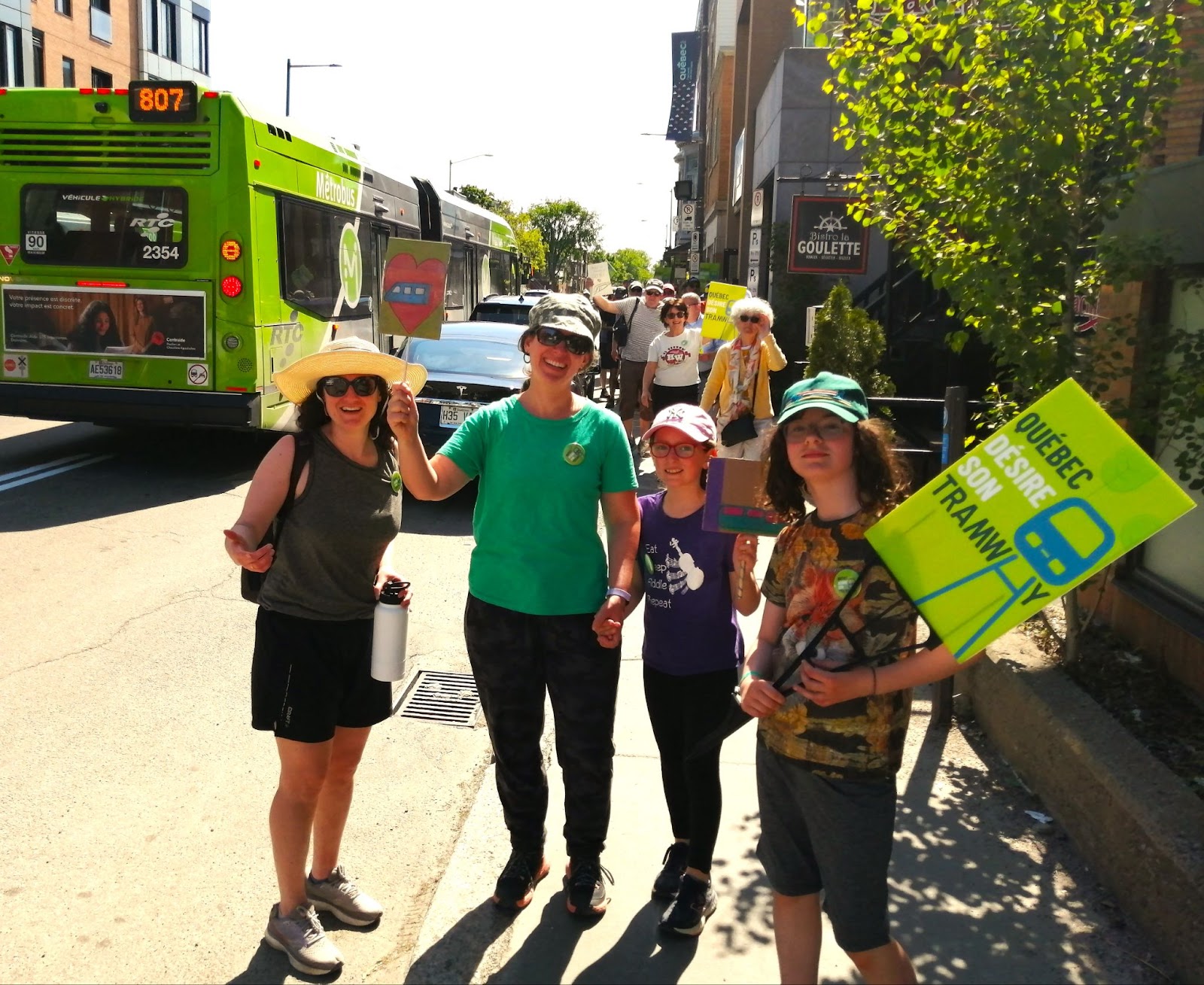
Among those eager to see the results of the Caisse study is Nora Loreto, co-founder of Quebec Désire Son Tramway, a group campaigning for the creation of a tramway system for the city.

On June 1, members of the group walked the full 19.3 kilometres of the proposed tramway route, from near the Ikea in Cap-Rouge to the eastern terminus near Ave. D’Estimauville. The march took six hours; more than 60 people started the route and 15 finished, according to Loreto.

“We’re optimistic that the experts at the Caisse will have the same opinion as the experts who have already studied this. All signals are that the question is not ‘yes or no’ but ‘how’ and what it will look like,” Loreto told the QCT while the trekkers stopped for a break near Ave. Cartier, about midway through the walk. 

She said it will be “up to the CAQ [Coalition Avenir Québec] government if they want to play politics with this issue.”

As the group was marching, the CAQ government released the results of a survey indicating 69 per cent of those polled are in favour of a “structured” public transport network. It also found “a strong majority (82 per cent) perceive that the construction of an additional road transport link between the two shores, including public transport, would be the proposal most likely to have positive repercussions.”

Another group lobbying for the tramway made its concerns known last week. Business leader and philanthropist Yvon Charest, head of the J’ai Ma Passe group, told a media conference the tramway project should not be stymied by questions of “social acceptability” and level of public support.

The mayor responded, saying “social responsibility is not a result; it is a process.”

30 

Trekking for the tram: From left, Nora Loreto, founder of Québec Désire Son Tramway, completed a crosstown trek alongside Aimée Dawson, Tessa Dawson and Della Greener. 

Photo by Peter Black

Caisse confirms mid-June release of regional transit report Read More »

Will Liberals try a bold idea to help save themselves from doom?

Peter Black

June 5, 2024

Local Journalism Initiative reporter

peterblack@qctonline.com

Imagine you’re in charge of a government that’s been in power for a long time and it’s pretty obvious the people are tuning you out. You’ve tried and tried to draw attention to all the great stuff you’ve been doing, but, darn it, you’re still way, way behind in the polls.

What’s a seemingly well-meaning but doomed government to do? 

Well, why not propose something so out-of-the-blue, so moon shot, so controversial, so strangely appealing, it just might change the conversation and breathe a bit of hope into your political prospects?

You probably think we’re talking here about the Liberal government of Justin Trudeau. Actually, we’re referring to a Conservative government, the one that’s ruled the United Kingdom for the past 14 years under five different prime ministers.

The current prime minister, Rishi Sunak, has called a general election for July 4, which was a bit of a surprise; more surprising still, he announced a major plank in the Tories’ platform: a program of compulsory national service for 18-year-old Britons. 

If the Conservatives are elected, all 18-year-olds would be required to do one of two types of national service: 30,000 would spend one year in the armed forces, and the others would be compelled to work one weekend a month for some non-military organization such as the police, fire service or the National Health Service.

The proposal was met with much mockery and howls of derision, but polls show the plan has about 47 per cent support overall, although the 18-plus target group is 65 per cent opposed.

It may take a bit of time to see whether the idea – still short on details – will move the polling needle for Sunak’s Conservatives. A recent survey found them 27 points behind the Labour Party, led by Sir Keir Starmer, a former top prosecutor and human rights lawyer.

As bad as things are for the Trudeau Liberals, it’s hard to imagine them trailing Pierre Poilievre Conservatives by such a grand canyon as the British Tory-Labour split. The gap has been a steady 20 per cent for months, suggesting folks are lapping up Poilievre’s incessant haranguing of all things Trudeau.

But there is the slightest glimmer of hope for the Grits. A recent poll showed the Liberals are actually regaining ground among voters aged 18-29, trailing 28 to 32.

Not for nothing do recent speeches by the prime minister and his entourage contain obligatory references to Millenials and Gen Z, the groups so frustrated in their aspirations to join the Liberals’ much-vaunted middle class nirvana.

What, though, remains in the Liberal bag of tricks, as the months count down to the reckoning at the polls come the fall of 2025, to entice younger voters, or voters of any age for that matter, to return to the fold and grant the Grits a fourth straight mandate? 

Trudeau must be feeling a bit like Seymour in The Little Shop of Horrors, trying to feed the insatiable monster plant. “I’ve given you cheap daycare, I’ve given you dental care, I’ve given you child care cheques, I’ve given you legal weed, I’ve given you gun bans, I’ve given you electric car plants, I’ve given you pandemic grants, I’ve given you a pipeline, I’ve given you carbon tax rebates … and on and on.” 

Crickets, say the pollsters, and (spoiler alert) the monster eats Seymour in the end.

(Of course, he’s also given rampant wokeness, blackface, SNC-Lavalin, immigration woes, massive deficits, international goof-ups and on and on.)

The Liberal-NDP supply and confidence pact expires about a year from now, leaving the governing party little time to come up with some policy ideas, some Hail Mary brainstorm that will change the narrative enough to avoid utter annihilation at the hands of the Conservatives. 

A national service program is not likely on the planning board in the Liberal Party election 2025 war room, but surely the Grits might prefer to go out with some big bang of an idea, rather than a whimper of surrender.

        30 

Will Liberals try a bold idea to help save themselves from doom? Read More »

“Yellow wave” in Gaspé, Côte-Nord regions makes bilingual health staff stand out

By Ruby Pratka

Local Journalism Initiative

The “sunflower” program providing English-speaking hospital staff at Brome-Missisquoi-Perkins Hospital and Memphremagog Hospital with sunflower badges to make them easier to spot has roots in the Gaspé and Côte-Nord regions.

Lou Landry, communications co-ordinator at the Centre intégré de santé et des services sociaux (CISSS) de la Gaspésie, said a similar program, YelloMello, has existed in the Gaspé since at least 2021, in hospitals and clinics throughout the region.

“I am told that we are receiving positive feedback from the English-speaking population. … English-speaking people tell us that it allows them to more easily identify employees who will be able to answer their questions quickly. Several employees have also mentioned in the past that they are proud to participate in this initiative.”

The CISSS de la Côte-Nord has also had a program in place since 2021, where English-speaking employees wear yellow badge clips. About 400 staff have the badges, according to CISSS spokesperson Pascal Paradis.

Jody Lessard, based in Baie-Comeau, is the president of the North Shore Community Association, an advocacy group for English speakers in the Côte-Nord region, and also president of the regional access committee for English-language health services in the region. She explained that the initiative started with a voluntary list of bilingual employees. When the idea of giving employees a visual identifier came up, Lessard mentioned she had seen English-speaking health professionals in the Laurentians wearing yellow tags to indicate that they could provide English service.

The Côte-Nord yellow badge program was born. In the region, it’s known as the Assistant Linguistic Liaison Orientation (ALLO) program. “With the language laws we can’t use an English tag, but the ALLO [acronym] sounds like hello to an English speaker,” she said. “It has made patients less shy about asking for English service.”

Lessard explained that there are about 5,300 anglophones in the region, many of whom are older and many of whom live in remote Lower North Shore communities without second-line health care services or road links with the rest of the province. “The biggest challenge is transport – it’s a long drive, or you have to fly in, and then there’s an overnight stay. Health centres help organize transport, but it’s still a lot for a 15- or 30-minute consultation and the older you get, the more stressful that is, especially with the language barrier…but things have improved, and there are a lot of staff who can speak English. “ In addition to the ALLO program, Lessard said several North Shore institutions were putting pictograms in place to help non-French-speaking patients find their way around.

“It would be really nice if [yellow badges and pictograms] could spread across the province,” said Lessard. “Remember the ‘orange wave’ a few years ago? It would be nice to have a yellow wave in health care.”

“Yellow wave” in Gaspé, Côte-Nord regions makes bilingual health staff stand out Read More »
Bromont transit plans to move forward thanks to pilot project

By Ruby Pratka

Local Journalism Initiative

Bromont’s public transit projects are getting a new lease on life thanks to the city’s inclusion in a Canadian Federation of Municipalities (CFM) mobility-as-a-service pilot project.

Bromont is one of a dozen Quebec municipalities included in the CFM’s Green Municipal Fund initiative, coordinated by YHC Mobility. The CFM will pay half of the estimated $265,000 needed to put in place a car-sharing system in Bromont.

Bromont Mayor Louis Villeneuve told the BCN that the funding would allow the city to acquire at least one electric vehicle and make it available for car-sharing using a mobile app, similar to the Communauto car-sharing service available in major cities in Quebec but on a much smaller scale. There will also be tools within the app to book ride-shares and allow citizens to make their own cars available for car-sharing, “kind of like an on-demand, Bromontois Uber,” Villeneuve said. The app, he added, is already being used by the regional public transport service in the Gaspé.

Villeneuve was unsure when the first rides would be made available for citizens. “We need to do a needs assessment, create the tools and prepare the cars,” he said, adding that the full cost, schedules and insurance implications still need to be worked out in the coming weeks and months. 

In 2021, Bromont rolled out MOBI, a summer shuttle bus pilot project. The city initially planned to make a form of MOBI permanent on weekends, launch an on-demand taxi service on weekdays and set up a city-run car-sharing platform by 2024. That project ran into a roadblock after three calls for tenders failed to turn up any workable bids. Earlier this year, Amélie Casaubon, communications and citizen services co-ordinator at the Ville de Bromont, told the BCN the city was “working on a sustainable mobility plan, but it’s still at a very early stage.”

“We were very disappointed that MOBI was stopped – we still believe in it,” Villeneuve said. “With MOBI, we were a bit left to ourselves – we had to pay for everything and run three calls for tenders to get a single bid which we weren’t able to accept. We can move forward with the [Green Municipal Fund] project because it’s a pan-Canadian fund subsidized by an organization.”

“Eventually, we’d like to be able to take some cars off the road, to have transit for tourists who have just gotten off the bus, for young people, for elderly people, for people who have had a few drinks,” Villeneuve said. “It’s important to have public transit. It’s a no-brainer.”

No one from the CFM was available to comment at press time.

Bromont transit plans to move forward thanks to pilot project Read More »
More on where your tax dollars go

Photo courtesy of the National Research Council of Canada

Dian Cohen

Local Journalism Initiative

In 2001, the federal government created Sustainable Development Technology Canada (SDTC), a foundation specifically to invest in “technologies that will create economic and environmental prosperity for all Canadians.” According to the SDTC website, it “is the single-biggest investor in Canadian sustainability entrepreneurs.” Again, reading from the website, and the 2022-2023 Annual Report, 316 Canadian companies, of which 229 are still active, have been funded to the tune of $1.7 billion taxpayer dollars. (In the interests of transparency, they’re all listed on the website.)

Looks like a reasonable use of taxpayers’ dollars – a 72+ per cent success rate in environmentally and economically attuned companies in every province and every economic sector. The SDTC website says,” Every dollar SDTC has invested since 2001 has resulted in more than seven dollars in follow-on financing from the public and private sectors.”

So it is somewhat surprising to see in tiny print at the bottom of the website the following:

On June 4, 2024 the Government of Canada announced that SDTC will be transitioning to the National Research Council of Canada. The transition process is expected to take several months. In the interim, SDTC will be resuming full business operations. Please check back here for updates.

What prompted this is the Auditor General’s most recent report. According to Report #6, “Overall, we found significant lapses in STDC’s governance and stewardship of public funds… the foundation awarded funding to projects that were ineligible, conflicts of interest existed in some instances, and certain requirements in the Canada Foundation for Sustainable Development Technology Act were not met.”

The Report goes on to say that 10 projects were awarded $59 million even though they did not meet key requirements…  we found 90 cases … representing nearly $76 million awarded to projects where the foundation’s conflict-of-interest policies were not followed.”

The enabling legislation requires that SDTC have a member council of 15. The Board of Directors reduced the council to 2. The A-G laid ultimate blame at the doorstep of the Minister of Innovation, to whom SDTC reports.  No wonder Minister François-Philippe Champagne shut SDTC down – ‘transitioning’ the remaining money and all the employees (ex the executives that resigned) to the National Research Council.  

Does the National Research Council have an exemplary record for doing its job? Not so much. It has been audited by the A-G three times, in 2004, 2007 and 2016. In 2004, NRC’s governance, management of projects, management of personnel, performance measurement and reporting were inadequate. In 2007, the A-G saw improvement but was still unhappy that half the seats on the member council were vacant. The 2016 audit was specifically focussed on mitigating the effects of severe weather. “Overall, we found that the federal government had not done enough to help mitigate the anticipated impacts of severe weather events… National Research Council Canada did not incorporate climate change trends into National Building Code updates, which could impact buildings and structures for decades to come. Although federal information and tools largely met departmental mandates, they did not fully meet decision makers’ needs…”

In a related story, the Public Policy Forum newsletter reminds us that at the height of the COVID-19 pandemic, Prime Minister Justin Trudeau made a $130 million dollar funding commitment to build a vaccine plant in Montreal to churn out Canadian-made Novavax COVID-19 shots by the end of 2020.

The National Research Council partnered with a private entity to set up Biologics Manufacturing Centre (BMC) Inc. as a not-for-profit corporation. BMC was completed on NRC land in June 2021 and certified by Health Canada as compliant with its regulations in July 2022. As of today, not a single vaccine has been produced at the facility. Meanwhile, the global demand for COVID-19 vaccines is plummeting. Even more worrying for Canada’s taxpayer investment is that Novavax is far and away the least desired of the vaccines available. Taxpayers are still funding the NRC for $17 million every year to keep the plant operational with about 100 staff on site. Novavax is still expected to use the plant, but the firm has already delayed that start three times.

Minister Champagne is counting on the NRC to do better than the SDTC. In a press release he said, “As a Government of Canada organization, the NRC is subject to rigorous and stringent oversight of its personnel and finances. This structure will help rebuild public trust while increasing accountability, transparency and integrity.” 

Maybe the auditor general will get to it soon and let us know.

Meanwhile, the PM followed Ontario Premier Doug Ford in directing lots of other taxpayer funds: he handed Sanofi $50 million to help with its new vaccine manufacturing facility in Toronto and the PM handed them $20 million. It’s the largest biomanufacturing facility in Canadian history (at 200,000 square feet). It will employ 200 people and is intended to produce vaccines for whooping cough, tetanus and diphtheria for domestic and international use. Sanofi is building a second new facility in Toronto to increase production of a flu vaccine specifically formulated for people 65 years and older. It’s now scheduled to open in 2027 (a year later than originally planned when it was announced in 2021.)

Interestingly, last month Novavax and Sanofi announced an exclusive licensing agreement to commercialize COVID-19 vaccine and develop novel COVID-19-influenza combination vaccines. There’s no mention in the press release that any of these will be produced in Canada.

Cohendian560@gmail.com

More on where your tax dollars go Read More »
Sherbrooke to send out public survey to help set future priorities

Fernanda Luz, Sherbrooke City Councillor, Évelyne Beaudin, Sherbrooke Mayor, and Jennifer Garfat, Lennoxville Borough Councillor. Photo by William Crooks

By William Crooks

Local Journalism Initiative

Starting next week, residents of Sherbrooke are encouraged to keep an eye on their mailboxes for a survey, available in French and English, conducted by the City of Sherbrooke in collaboration with Léger. This survey, announced in Lennoxville June 10 at its Town Hall, marks the first phase of “Sherbrooke at the Service of its Neighbourhoods” (SSQ), a public participation initiative aimed at engaging the community to gather input on local services and municipal priorities.

In 2024, the City is initiating major consultations focusing on both the territory, with the drafting of an urban plan, and the population, through the SSQ participatory process, according to a June 10 press release.

The Municipal Indicator, developed by Léger, includes a series of questions that will inform the City’s reflections and allow for comparison with other municipalities of similar size. The survey process involves postcards being mailed to all households, expected to arrive between June 17 and June 21.

One person per household can respond using a unique, secure access code. Participants will be eligible for a draw to win one of four $250 gift cards. The survey will conclude once the sampling criteria are met.

The information collected will set the stage for the next steps of the SSQ initiative through to winter 2025. This includes citizen meetings to foster collective dialogue on the vision for “Tomorrow’s Sherbrooke” grounded in local living environments, discussion and consultation activities with community organizations, and the development of a work plan for these consultations.

The initiative aims to assess the quality of life and sense of belonging of Sherbrooke residents at the district and neighbourhood levels, measure public satisfaction with municipal services, and open a citizen dialogue to analyze opinions, suggestions, and comments on community development, local services, and the offerings of community organizations.

Detailed information about the survey and the initiative is available online at: sherbrooke.ca/sondage

At the June 10 press conference in Lennoxville, Sherbrooke Mayor Évelyne Beaudin emphasized the importance of redefining the role of boroughs, noting that Sherbrooke was one of only eight cities in Quebec with boroughs. She highlighted her personal experience with community engagement and the need for human, personalized service. Beaudin invited all Sherbrooke residents to participate in the survey to help guide decisions that align with the real needs of neighborhoods.

Sherbrooke City Councillor Fernanda Luz explained that the survey was crucial for obtaining the information necessary for the executive committee to make informed decisions. She highlighted Sherbrooke’s values of equity, diversity, and inclusion and stressed the importance of giving a voice to all citizens, regardless of political affiliation or background.

Lennoxville Borough Councillor Jennifer Garfat, representing the Lennoxville borough in place of Borough President Claude Charron, highlighted the importance of maintaining Lennoxville’s distinct character and community spirit despite demographic changes. She noted that Lennoxville, once a separate city before the 2002 mergers, had managed to retain its unique identity.

Garfat pointed out the challenges of meeting the needs of both long-time residents and newcomers. She urged Lennoxville citizens to respond to the survey to better understand their needs and adapt services accordingly, aiding the integration of new residents while respecting the needs of long-time citizens.

The three provided more information in a media scrum after their prepared remarks.

Over two decades ago, there was a significant merger during the municipal amalgamations. Now, there’s an interest in understanding the population’s satisfaction with the current system, where many services have been centralized for efficiency. However, some services might benefit from remaining decentralized or even increasing their decentralized presence. The goal is to provide the best service to the population, emphasizing the importance of belonging to different boroughs versus the city as a whole.

The sense of belonging can drive community engagement, encouraging residents to volunteer, attend borough council meetings, or develop projects with borough officials. Cultivating this pride within the population is seen as beneficial in the long run.

Questions were raised about the types of information to be collected through the survey. The survey aims to determine if some services could be brought back or if the number of positions in various boroughs could be increased. However, specific outcomes depend on the survey results, which will guide future reorganizations.

The survey, conducted with the polling firm Léger, will also provide comparable data from other cities. It includes questions about residents’ satisfaction with various services and their sense of belonging. The questions are designed to be neutral to avoid biasing the results.

Following the survey, the next step involves citizen meetings in the six former boroughs to promote proximity and dialogue. These meetings will not just be Q&A sessions but opportunities for more in-depth discussions and debates.

Sherbrooke to send out public survey to help set future priorities Read More »

Pontiac MP accuses CAQ government of turning its back on Outaouais

Taylor Clark

LJI Reporter

Pontiac MP and spokesperson for the official opposition on health matters accused the Coalition Avenir Québec (CAQ) of abandoning the Outaouais health care system and its patients after the refusal to hold a travelling parliamentary commission.

“Not only does the CAQ refuse to act, but it does not even deign to come and see the situation and listen to stakeholders in the field,” André Fortin wrote in a press release. “Once again, the CAQ turns its back on Outaouais and prefers to abandon citizens to their fate, even if it means not receiving the health care to which they are nevertheless entitled.”

For the past few months, Fortin has been utilizing the question period during Assembly sittings to address the Minister of Health, Christian Dubé, about the catastrophic state of the region’s healthcare network.

In late May, Fortin decided words were not enough and wanted to bring Québec City to Outaouais to allow Dubé and those on the Committee on Health and Social Services to see for themselves the extent of the crisis in the form of a travelling parliamentary commission.

“If those public policymakers and those MNAs from other regions come to the Outaouais and witness just how dire the situation is, they cannot possibly ignore it,” said Fortin.

Yet ignored was exactly what the recent press release from Fortin conveyed, stating “the CAQ categorically refused” the request. The commission would have allowed key players in the field to propose measures to ensure retention and attraction of staff directly to decision-makers.

Fortin said the refusal confirmed the CAQ government’s “total disinterest toward the region and its citizens.”

As the press release was issued, the Minister responsible for the Outaouais region Mathieu Lacombe shared a clip to Facebook of Assembly proceedings, where he highlighted the work that was being carried out by health-care staff in his region.

“Over the past few days, I have travelled through the hospitals of Outaouais to take the pulse of the people who, every day, are there to care for our world,” said Lacombe. “Madam President, I would like to assure you that we will do everything possible to maintain and improve services to the population of Outaouais.”

Photo caption: Pontiac MP André Fortin demands answers for the population of Outaouais from Minister of Health Christian Dubé during Assembly sittings.

Photo credit: Screenshot from the question period during the Assembly sittings on May 22

Pontiac MP accuses CAQ government of turning its back on Outaouais Read More »

Have your say on homelessness and social development in Gatineau

Taylor Clark

LJI Reporter

Following the summit on homelessness held in April, the Ville de Gatineau is inviting residents to answer an online questionnaire to shape its next municipal action plan on social development and homelessness.

Similar to the themes discussed during the summit, respondents will be asked to speak to homelessness, the continuum of housing services, support for interventions and partnerships, the neighbourhood as a centre of development, camp and shelters as well as the conditions and quality of life.

The results will guide the City in better targeting the issues and identifying priority actions to be implemented in the 2025-2029 Social Development and Homelessness Action Plan.

The questionnaire can be accessed at gatineau.ca/consultations until June 20.

Photo caption: Gatineau citizens are encouraged to participate in an online questionnaire on social development and homelessness available on the City’s website until June 20.

Photo credit: Tashi Farmilo

Have your say on homelessness and social development in Gatineau Read More »

Gatineau byelection sees 33.06% voter turnout

Sophie Demers

LJI Reporter

A total of 67,118 residents out of 203,032 registered voters took to the polls Sunday, June 9 in Gatineau’s byelection. This 33.06% voter turnout is close to the previous 2022 municipal election turnout which totaled at 35.11%. There were a total of 379 rejected ballots.

Mayoral election vote breakdown:
• Maude Marquis-Bissonnette, Action Gatineau: 27,833 votes (41.70 %) ELECTED
• Yves Ducharme, Independent: 20,600 votes (30.87%)
• Olive Kamanyana, Independent: 7,253 votes (10.87%)
• Daniel Feeny, Independent: 6,539 votes (9.80%)
• Stéphane Bisson, Independent: 3,580 votes (5.36%)
• Rémi Bergeron, Independent: 499 votes (0.75%)
• Mathieu Saint-Jean, Independent: 485 (0.65%)

Voters also voted in a new municipal councillor for the Carrefour-de-l’Hôpital district after Olive Kamanyana stepped down to run in the Mayoral race. Of the 9,305 registered voters in the district, 3,774 citizens voted. This equates to a 40.56% voter turnout. There were 144 rejected ballots.
• Catherine Craig-St-Louis, Action Gatineau: 1,516 votes (41.76%) ELECTED
• Marie-Pier Lacroix, Independent: 1,168 votes (32.18%)
• Kethlande Pierre, Independent: 946 votes (26.06%)

Gatineau byelection sees 33.06% voter turnout Read More »

Outaouais association request to file $38 million class action lawsuit against Brigil and Gatineau

Taylor Clark

LJI Reporter

The Association pour la qualité dans la construction en Outaouais has filed a request for authorization to file a class action lawsuit against Brigil and the Ville de Gatineau before the Superior Court of Québec.

Supported by the law firm ABC Avocats, the non-profit association is claiming $38 million on behalf of more than 2,500 owners and tenants of Brigil condos built from 1996 to as recent as 2016.

The association was founded in 2020 to improve the quality of construction and renovation of residential buildings in Outaouais and the current collective action has been at the heart of their undertakings.

According to the 33-page application submitted to the court on May 28, the Association pour la qualité dans la construction en Outaouais alleged Brigil built nearly 100 buildings with more than 1,000 condos, without ensuring the condos’ wastewater drains were properly equipped with non-return valves which prevent sewer backups.

The Ville de Gatineau website stresses the importance of non-return valves, stating it was an “obligation”. As per a municipal bylaw, all owners are required to install non-return valves in their residences, regardless of the year of construction.

“Additionally, each check valve must be maintained in good working order. To ensure this, regular verification is necessary,” reads the website.

As the case was in the hands of the courts, the association did not grant an interview but issued a press release accusing Brigil of neglecting to have plumbing plans and specifications together prior to the construction of the condos in question. The finger was then pointed at the Ville de Gatineau for granting the necessary building permits despite the absence of said plans and specifications.

“It should be remembered that there is a municipal by-law in Gatineau requiring the submission of plumbing plans before a building permit can be granted,” highlighted the association.

Based on estimates from the Association pour la qualité dans la construction en Outaouais, it could cost tens of thousands of dollars to correct the construction defect in each of the affected condos, which would likely adversely affect their value.

The Association des professionnels de la construction et de l’habitation du Québec’s new home warranty plans and the Régie du bâtiment du Québec were also in hot water for “having grossly failed their responsibilities and duties” by not ensuring the existence of plumbing plans and specifications, as well as neglecting to carry out mandatory inspections during the construction period.

“Out of respect for the ongoing process,” the Ville de Gatineau did not want to issue any comments.

Brigil also did not wish to speak to the matter, stating “Brigil has always been recognized as a responsible company. We will work with the parties before the Court and intend to respond in a timely manner.”

The Association pour la qualité dans la construction en Outaouais, invited citizens to learn more about this legal action by visiting its website at aqco.ca and encouraged a free membership “to collectively defend their rights in this class action.”

Photo caption: The founder of the Gatineau-based construction company Brigil, Gilles Desjardins has been looped in with the Ville de Gatineau for a request for authorization to exercise class action submitted by the Association pour la qualité dans la construction en Outaouais on behalf of more than 2,500 owners and tenants.

Photo credit: Brigil Facebook

Outaouais association request to file $38 million class action lawsuit against Brigil and Gatineau Read More »

Gatineau in a game of catch-up with road network

Taylor Clark

LJI Reporter

Years of underfunding have left Gatineau’s municipal road network to erode rapidly. But it seems that no matter how much money was thrown at the growing situation, the state of the infrastructure would continue to plummet.

“There has not been enough money that has been put into our road network, which means that we end up with a much faster deterioration of what we can see on our roads compared to what it could have been,” Masson-Angers district councillor Mario Aubé told reporters. “But despite this, even if there had been additional investments to this day, we would not have caught up.”

The state of the roadways has been no secret, but the crumbling situation was put in black and white for elected officials during a presentation at a Comité plénier meeting on May 21.

The latest data from 2023 painted a new portrait of the estimated $1.9 billion road network, claiming 40 per cent or 550 kilometres of the roadways were below the desired service levels. Every year, around 20 additional kilometres are added to the sections falling below service levels. Another 370 kilometres or 27 per cent of the network was at the end of its life cycle, a value that has almost doubled since 2015.

While data from 2020 and 2023 appeared to show some stabilization with short-term interventions, filling potholes will not alone resolve the situation in the medium to long term.

Additional funds are required, and some have already been put in place by council, notably the $24 million bonus envelope at a rate of $6 million per year from 2022 to 2025 which was later extended until 2028. Another one-off bonus envelope of $27.4 million was adopted by council in the respective amounts of $7.4 million, $10 million, and an additional $10 million in 2023, 2024, and 2025. But the effects of these additional investments would not be reflected until the next roadway inspection in 2026.

The last three years have allowed an average of nearly 30 kilometres of renewal work to be carried out. The improvement envelopes should make it possible to achieve around 40 additional kilometres between 2024 and 2026, resulting in 13 kilometres per year. Gatineau anticipated this would assist in partially stabilizing the degradation of the network.

To ensure the current state was maintained, the need for annual intervention was estimated at approximately 50 kilometres. Depending on a 25 to 50-year catch-up period, Gatineau would need the annual interventions of 10 to 20 kilometres on top of the 50 kilometres, but this comes at the cost of major dollars.

“Just to maintain what we currently have; we would have to put $80 million per year in our roads. And if we want to improve our roads overall for 30 years, we would have to spend $110 million per year,” said Aubé. “It’s almost impossible for a city to put in that much, but we have to realize that we’ll still have to put in a little more.”

Without the renewal of the bonus envelopes, while also taking in inflation, the City expected the period from 2027 to 2029 to see below-average interventions and to reach less than 50 per cent of the target for maintaining the level of service.

“It’s clear that there are difficult choices to make,” said interim mayor Daniel Champagne. “We realize that the necessary budgets mean that it now costs 45 per cent more than it cost in 2019. This means that all the investments we make not only do not necessarily increase the number of kilometres of asphalt but do not necessarily even guarantee that we will be able to ensure the maintenance of our infrastructure.”

With the importance citizens place on road infrastructure, Champagne noted it was a worrying situation and would add the significant challenge of prioritizing come budget time.

Photo caption: Gatineau elected officials get a glimpse of a roadway in very bad condition as per the pavement condition index during the state of the road network presentation on May 21.

Photo credit: Screenshot of État du reseau routier – Auscultation 2023 presentation to Comité plénier on May 21

Gatineau in a game of catch-up with road network Read More »

Le Rivero apartment project converts former CNESST building

Peter Black

May 29, 2024

Local Journalism Initiative reporter 

peterblack@qctonline.com 

A massive former Quebec government building near the St. Charles River had been slated to be demolished. Instead, next year, once extensive renovation work is completed on the abandoned former headquarters of the Commission des normes, de l’équité, de la santé et de la sécurité du travail (CNESST), some 208 apartments will be added to the housing stock of the Vanier district.

The family-owned company Les Immeubles Simard acquired the five-storey structure in 2017, shortly after the CNESST announced plans to move its headquarters to a brand-new building in the D’Estimauville neighbourhood. 

The initial plan had been to demolish the building, opened in 1970, which had become a money pit for renovation work. According to media reports at the time, a $130 million project to upgrade and expand the structure had to be abandoned in 2016 due to cracks in its foundation. Some $20 million had already been spent.

The Simards had to wait five years for the CNESST to move into its new digs in 2022 to be able to start work on their project, which, company executive Jean-Michel Simard told the QCT, was initially imagined as an office building.

The pandemic changed that thinking, and the company, in partnership with construction giant Ogesco, shifted the focus to residential units, which involved transforming an office complex and rehabilitation centre into apartments.

Assured that there were no foundation issues for their project, work to gut the building and bring it up to code began in earnest a year ago, Simard said. Because of the configuration of the building, the units, ranging in size from 3 ½ to 5 ½, will be a different style, capitalizing on the high ceilings, long and narrow width and tall windows.

The marketing material on the website for Le Rivero, the project’s name, reflecting its proximity to the Saint-Charles River, describes the units as New York-style, “characterized by distinctive elements such as exposed concrete and large windows.”

Most of the units will feature what are called loggia, year-round enclosed balconies, heated in the winter and “open to the outside” in the summer. The rent ranges from $1,195 a month for the smaller units to a minimum of $2,295 a month for the larger ones.

The rental office for Le Rivero opened last week and Simard said the response has been very strong. “We’re looking at a market that wants something different,” noting that the apartments on offer have rents competitive with less distinctive units of the same size.  

Apartments completed in the first three phases of the project are slated for June 2025 occupancy, Simard said.

The complex includes amenities such as an indoor and outdoor swimming pool, an interior pickleball court, a landscaped courtyard and a lounge area. 

Simard said that besides the attractive features of the rental units, the big selling point is the building’s location on the St. Charles River and in a section of Vanier undergoing major redevelopment.

Simard said the company has other plans in the works for future phases of the development. 

          30

This image shows how the former CNESST headquarters in Vanier will be transformed into 208 rental units.  

Image from Graphsynergie

Large windows allow for the creation of year-round loggia rooms, available in many of the units in Le Rivero. 

Image by Étienne Dumas, 3D artist

Le Rivero apartment project converts former CNESST building Read More »

A brief history of famous (and dubious) anglo separatists

Peter Black]

May 29, 2024

Local Journalism Initiative reporter

peterblack@qctonline.com 

This country has seen some strange and unlikely political conversions over the years. 

For example, there’s raw-boned rancher and Alberta Progressive Conservative MP Jack Horner’s decision to cross the Commons floor in 1977 and join the caucus of Liberal prime minister Pierre Trudeau, who promptly named him industry minister.

Then there’s perhaps the most unlikely political spot-change of all, that of Richard Holden: lawyer, scion of a wealthy Montreal anglo family, one of four Equality Party MNAs elected in the 1989 Quebec election, and … wait for it … a defector to the PQ caucus under then-leader Jacques Parizeau.

The bizarre tale of Richard Holden’s brief pirouette as a PQ MNA inevitably springs to mind when the topic comes up of anglophone converts to Quebec separatism. 

As readers may know, current PQ Leader Paul St-Pierre Plamondon is wooing English speakers with a rather glossy TV ad in la langue de Alice Munro. 

The McGill and Oxford grad’s big pitch is that Quebec gives $82 billion a year to those nasty colonialists in Ottawa and gets nothing in return. Such a claim, objective observers would say, is utterly simplistic hogwash, not to mention reminiscent of the hilarious scene in Monty Python’s Life of Brian, where some Judean rebels ask, “What have the Romans ever done for us?”

PSPP neglects to say specifically how much better off anglos would be in la République du Québec, but no need to get ahead of ourselves more than two years out from the next election.

Back to Richard Holden. His 1992 defection from the anglo-rights Equality Party to the PQ was, in a way, the ultimate mischievous act of a maverick and gadfly. 

Holden joined the ranks of the PQ in reaction to being kicked out of the Equality Party because he refused to kowtow to its young leader, Robert Libman.

Surely such an over-the-top gesture gave Holden as much giddy satisfaction as it did Parizeau to have the MNA for Westmount, of all places, in his secessionist fold.

No one believed for an instant that Holden, a former anglo rights warrior, was a separatist in his heart, although he did run (and lose) for the PQ in the working-class Verdun riding in 1994.

The fact is, there has never been a true-blue anglophone Quebecer elected as a péquiste to the National Assembly, although one technical exception might be Robert Burns, who served in the cabinet of René Lévesque.

Burns was the son of a franco mother and anglo father who died when Burns was two. So, basically, he was raised and schooled in French and identified as a franco.

Then there is David Payne, a Yorkshireman immigrant to Canada, one-time teacher at Vanier College in Montreal and author of Autant de façons d’être Québécois (So many ways to be a Quebecer). 

Payne, a left-wing activist, found himself in PQ circles and in 1981 won the South Shore Vachon riding for the party. 

He lost in the 1985 and 1989 elections which brought in Liberal governments, but made a comeback with the PQ’s return to power in 1994 and 1998. He never made the cabinet of Parizeau or Lucien Bouchard.

This list of notable anglo-Quebec sovereigntists is likely incomplete and does not include other failed PQ candidates.

We cannot not mention another convert to Quebec independence, though with a large asterisk: Reed Scowen, a prominent Townships businessman, longtime Liberal MNA for Montreal’s NDG riding (1978-87) and, dare we say, an eloquent and wise voice for Quebec anglophone rights at a particularly challenging time.

In 1999, exhausted by the numbing discourse over Quebec’s place in Canada, Scowen wrote a book titled Time to Say Goodbye; Building a Better Canada Without Quebec.

As longtime friend and former Westmount mayor Peter Trent commented upon Scowen’s death in 2020, “He was very sad he had to reach the purported conclusion that the only solution was to say goodbye. He was saying a de facto separation had occurred, so let’s make it de jure.”

Scowen evidently felt more positively about Quebec’s future in Canada in the years following his cri de coeur. 

Still, his plea to just stop fighting and have an amicable breakup might be the kind of potion a PSPP would find more useful in seducing anglos than an $82-billion whopper. 

      30 

A brief history of famous (and dubious) anglo separatists Read More »

Brand new city courthouse installed in historic F.X. Drolet building

Peter Black

May 29, 2024

Local Journalism Initiative reporter

peterblack@qctonline.com

Justice may be blind, but that doesn’t mean it can’t look good.

That was the feeling municipal officials expressed at the May 21 official inauguration of Quebec City’s new municipal courthouse in the Saint-Roch district at the intersection of Rue du Pont and Rue du Prince-Edouard.

“Wow” was the word Coun. Marie-Josée Asselin, the city executive committee member responsible for police and fire services, used to describe the new facility installed in a completely gutted historic building.

The structure, which also contains a neighbourhood police station, is the former F.X. Drolet factory, a company that manufactured a wide range of steel products, including many manhole covers and fire hydrants still seen throughout the city.

Asselin lauded not only the design “genius” that went into the ultra-modern conversion, but the fact the building, located near the downtown zone, underlines the city’s commitment to maintaining services in proximity to citizens.

Mayor Bruno Marchand, whose party took over City Hall well after the project was put on the drawing board of the previous administration, said he was pleased with the fact, despite a two-year delay due to pandemic complications and other factors, that the project came within about five per cent of its budget, which ended up at $29 million.

The mayor said he also was gratified that city expertise managed the entire project, as was also the case, he noted, for two other recently completed major city projects – the new police headquarters in Charlesbourg which opened earlier this month and the revamped Gabrielle-Roy Library in Saint-Roch.

When asked by the QCT how these major projects stayed on budget while that of the proposed tramway soared, the mayor said a huge infrastructure project such as a tramway, planned years in advance, is vulnerable to many factors, the pandemic being a major one. 

The new courthouse is spacious, with huge, specially restored windows providing ample sunlight. It has five counters on the main floor as well as one courtroom and two interview rooms. It also has an exhibition space documenting the history of the Drolet company. In what might be a spin on the wheels of justice, the exhibit features a giant steel wheel unearthed during excavation work to decontaminate the industrial site.

On the second floor are three more courtrooms, including one with a more intimate configuration for particularly vulnerable people or sensitive situations. Those appearing in court will enter by a separate secure door leading directly to where the accused are seated. 

The neighbourhood police station is in quarters separated from the courthouse. A squad of officers will provide a rapid response to incidents in the downtown area.

Pierre-Luc Lachance, executive committee member and councillor for Saint-Roch-Saint-Sauveur said, “Since its construction in 1909, the F.-X. Drolet building has been an essential component of the Saint-Roch district, This building is one of the few that still bears witness to the industrial architecture of the early 20th century in Quebec. Today, it begins a new chapter in this history.”

The new facility is scheduled to open for business on June 3; residents will still be able to use the Sainte-Foy service centre on Route de l’Eglise to pay parking tickets and the like. 

30 

An exhibit at the new courthouse documents the history of the F.X. Drolet factory.

Photo by Peter Black

Large, specially restored windows provide ample light in the corridor of the second floor of the courthouse where three courtrooms are located. 

Photo by Peter Black

One of the courthouse’s four hearing rooms has a round table configuration for mediation or other, less formal, proceedings.

Photo by Peter Black

Brand new city courthouse installed in historic F.X. Drolet building Read More »

New police headquarters in Charlesbourg opens under budget

Peter Black

May 22, 2024

Local Journalism Initiative reporter

peterblack@qctonline.com 

Quebec City has a brand new police station, opened several years later and in a different location than originally planned, but delivered under budget and to rave reviews.

City officials gave an inaugural tour of the five-storey structure on May 14. Located in the Charlesbourg district on Boul. Louis XIV near the Autoroute Laurentienne, the new headquarters replaces the antiquated police station near Parc Victoria. That building is to be demolished and the park expanded.

Mayor Bruno Marchand, obviously pleased the project came in $2.3 million under its $112-million projected budget, said, “With this incomparable infrastructure, Quebec City now has one of the best facilities in the province. This is an undeniable advantage for continuing to make Quebec a city where citizens feel safe.”

He said, “Here, we have a concrete example that the city is capable of carrying out major projects that will benefit our community. It was high time to modernize the facilities in order to continue to offer quality services to citizens.”

Police Chief Denis Turcotte said, “The new centre will become the pride of all police and civilian personnel. Having the majority of our teams gathered in the same location will allow for better synergy which will undeniably have an impact on the efficiency of our operations, for the benefit of the population.”

The new police HQ, the area of one and a half football fields, features space for 750 workers, or about 70 per cent of personnel, 52 holding cells, 259 interior parking spaces and 629 exterior spaces. To help cops stay in shape, there is a spacious gym and training facilities. 

Various environmental measures in the building’s construction have created a 30 per cent energy saving.

For citizens, the new building offers, according to background information, “various amenities respecting the principles of universal accessibility. They will benefit from closed premises to ensure confidential complaints and self-service computers to submit an event report or a request for a criminal record check.”

Until the new facility is fully operational in the coming weeks, people will still need to go to the stations in Parc Victoria and on Route de l’Eglise in Ste-Foy to pay tickets or file a complaint.

Several years ago, the city purchased property on Rue des Rocailles, near Boul. Pierre Bertrand, at a cost of $2.6 million, for the new police station, but in 2019 the site was deemed to be too small to accommodate parking.

The new police headquarters in Charlesbourg is located on Boul. Louis XIV near the Autoroute Laurentienne.   

Image from Ville de Québec

The new police station contains an exhibit displaying items from the 181-year history of the force. Stéphanie Filteau is the curator. 

Photo from Ville de Québec

New police headquarters in Charlesbourg opens under budget Read More »

The Zone of Interest’s grim ‘Kanada’ death camp connection

Peter Black

May 22, 2024

Local Journalism Initiative reporter

peterblack@qctonline.com 

The women are in the kitchen having coffee. 

“She asked me where I got one of my jackets from. I said Canada. She asked me, ‘When did I get to Canada?’” The women laugh. One says, “She thought you meant the country.”

“An understandable mistake,” says the lady of the house, the concentration camp commandant’s house.

The scene comes a few minutes into the Oscar-winning movie The Zone of Interest, now available on Prime. If you haven’t seen it, or you did see it and missed the quick reference to “Canada,” there turns out to be a horrific story behind how “Kanada” became associated with one of the grim aspects of the Holocaust.

The “Kanada” to which the women referred was the name for the huge warehouses the Nazis built at the Auschwitz death camp in Poland to store, sort and distribute the possessions confiscated from the more than one million mostly Jewish prisoners who arrived at the camp destined to labour as slaves or to be executed.

It’s unclear how exactly the warehouses – Kanada 1 and Kanada 2 – came to be called Kanada, but according to Holocaust history sources, it was Jewish prisoners themselves who gave the buildings the name, which their Nazi captors adopted. Someone, presumably had the idea in mind that Canada was a place of great abundance. 

(We might interject here that despite the positive thoughts Jewish concentration camp prisoners may have had about Canada, at the time the Nazis were rounding up Jews for extermination, the Canadian government was systematically rejecting Jewish refugees from Europe.)

In the movie, Hedwig Höss, wife of Rudolph Höss, the long-serving commandant at the sprawling Auschwitz-Birkenau extermination centre, receives bundles of clothing delivered in a wheelbarrow by a Jewish prisoner. 

She tries on a fur coat and discovers a tube of lipstick in a pocket. She applies the lipstick, then quickly wipes it from her lips, realizing a Jewish woman was the last person to use it.

The volume of goods taken from new arrivals at the camp was staggering. Jews and other Nazi targets from cities and villages in Poland and elsewhere had no idea where they were headed when ordered to bring up to 100 pounds of possessions and then loaded on trains like animals, often travelling for days without food or water.

Upon arrival at the camp, guards took the prisoners’ goods, from clothing to books, musical instruments and jewelry, and stored them in a “Kanada” while their owners were either stripped and gassed immediately or forced into slave labour.

At their peak, in 1944, up to 2,000 prisoners, called Kanada Kommandos, were working at the Kanada warehousing operation. Most of the goods were shipped to Germany, but some ended up being worn by the commandant’s wife and her friends.

The Zone of Interest is a masterful cinematic expression of the “banality of evil,” political philosopher Hannah Arendt’s description of the methodical way in which the Nazis set about attempting to wipe out the Jews of the world.

The film is based on Martin Amis’ novel of the same name, drawn from the true-life account of the Höss family living an idyllic life in the Polish countryside, with industrial-scale incineration of human beings taking place on the other side of the garden wall.

We never see the grounds of the actual camp – its presence is suggested by the dull rumble of the crematoria and the sound of rifle shots. The only Jews seen are the family servants, including a girl whom Frau Höss admonishes, when she makes a small mistake, that her husband could have her ashes scattered. 

The film’s creator, Jonathan Glazer, opted to include the true story of a young Polish girl who would, secretly in the night, leave apples for the starving labourers at work sites near the camp.

Dare we say The Zone of Interest, winner of the Academy Award for best international feature film, would make an instructive film for screening during the long nights at the campus camp-outs in support of the liberation of Palestinians.

Real liberation of victims of true genocide occurred in January 1945 when a Ukrainian division of Soviet troops opened the gates of Auschwitz and began uncovering the extent of the Nazis’ “final solution.”

The retreating SS camp guards burned the Kanada warehouses to the ground, with whatever remaining goods in them going up in smoke.

            30 

The Zone of Interest’s grim ‘Kanada’ death camp connection Read More »

Replacing rusted steel priority for Quebec Bridge revamp

Peter Black

May 22, 2024

Local Journalism Initiative reporter

peterblack@qctonline.com 

The devil, as they say, is in the details, and it was details that bedevilled the prolonged negotiations between the federal government, CN Rail and the Quebec government that finally resulted in Ottawa retaking possession of the historic structure.

The deal, finally concluded in the last few weeks, centres on the federal government taking over control of the bridge and taking the significant measures required to ensure the historic span’s long-term future.

Two weeks ago, the federally appointed chief negotiator, Yvon Charest, told the QCT that the five major issues in the talks between Ottawa and CN had been resolved, and all that remained were minor issues. He said, “Both parties are motivated” to come to a deal.

Asked why the federal government deemed it so important to take control of the bridge, Prime Minister Justin Trudeau said, “Because it is a perfectly good bridge that has served for many years and can serve for decades more with proper maintenance and upkeep.”

Transport Minister Pablo Rodriquez, who said he often picked up the phone to talk directly to CN management about negotiations, said, “It was the right thing to do” to preserve the bridge for future generations.

Once the federal government takes possession officially in September, work will begin on priorities such as replacing steel components rusted beyond repair – some 2.7 million pounds of metal, according to Rodriguez.

About half of the $1 billion the federal government has committed to the bridge over 25 years will be devoted to repainting the bridge. Work had started a decade ago to repaint the bridge but came to a halt amid a dispute over the escalating cost.

On top of the federal investment in the bridge, CN, whose trains cross the bridge about 12 times a day, is committed to spending $6.1 million a year over 25 years; Rodriguez said that with indexation, the amount could reach $350 million.

Martin Guimont, CN vice-president for eastern Canada, said the company will invest amounts over and above the commitment in the deal and “looks forward to contributing to the economy of Quebec” with the bridge’s rejuvenation.

Under the deal, according to a background document, CN and the Quebec government “will retain responsibility for and ownership of the rail and road decks on the bridge structure, respectively, and will be responsible for all costs associated with these decks, as is currently the case.”

Quebec Infrastructure Minister Jonatan Julien provided no details on Quebec’s plans for the bridge with regards to adapting it to accommodate an expanded public transit component, such as a tramway.

All elected officials at the announcement were cautious about stating any specific impact an upgraded Quebec Bridge – the “first link” – might have on the Quebec government’s desire for a “third link” crossing the St. Lawrence. 

The Caisse de dépôt et placement report on the Quebec City region’s transit needs is expected in June.

Besides freight and passenger train traffic, an average of 33,000 vehicles cross the bridge daily. 

The Progressive Conservative government of Brian Mulroney ceded the Quebec Bridge to CN for $1 in June 1993.

    30 

Replacing rusted steel priority for Quebec Bridge revamp Read More »

Federal government buys Quebec Bridge, invests $1 billion in revamp

Peter Black

May 22, 2024

Local Journalism Initiative reporter

peterblack@qctonline.com 

Calling it a “great day for the Quebec City region,” Prime Minister Justin Trudeau confirmed the federal government will buy the historic Quebec Bridge for a token $1 and pour some $1 billion into its rejuvenation over the next 25 years.

The May 15 announcement took place at the lookout behind the Quebec aquarium, with the 107-year-old, 543-metre-long “Wonder of the World” in the background. 

It was the exact same setting where three years ago federal ministers announced the Trudeau government’s intention to purchase the bridge from Canadian National, and hired retired insurance executive Yvon Charest to spearhead negotiations. 

Trudeau thanked Charest, who was out of the country and unable to attend the announcement, for his efforts. “Without his work, we would not be here today,” Trudeau said.

MP Joël Lightbound, in whose Louis-Hébert riding the bridge is located, introduced the officials at the ceremony, noting he has been “waiting for this day since the first day I was elected” in 2015. 

Trudeau also saluted Jean-Yves Duclos, the MP for the Québec riding and minister of public services and procurement, calling him the “pillar” of the long and complicated negotiations with CN and the Quebec government.

Duclos credited the signing of the deal 31 years after CN took over the bridge to “hope and hard work,” spanning the terms of eight ministers of transport. He said the revamping of the bridge will offer the region “new options” for transit. 

Duclos also saluted former Quebec City mayor Régis Labeaume, who, along with longtime Lévis Mayor Gilles Lehouillier, pushed for the resolution of the impasse that saw the painting of the bridge started more than 10 years ago and then halted. There was even a “Bill, Paint Your Bridge” campaign aimed at Microsoft founder and major CN shareholder Bill Gates.

Duclos also thanked citizen groups who have led campaigns for action to preserve the bridge. He thanked Trudeau “above all” for his commitment to the bridge negotiations and the betterment of the Quebec City region.

Transport Minister Pablo Rodriguez, who also serves as Trudeau’s Quebec lieutenant, lent an extra note of levity to the event by making reference to the iconic Quebec TV series, Les Boys. He said it took “dureté de mental (mental toughness) to get the job done, in particular the perseverance of Duclos, the expertise of Charest and the commitment of the prime minister.

Rodriguez joked it would be Duclos who paid the symbolic dollar for the bridge as minister of procurement.

Jonatan Julien, Quebec infrastructure minister and minister for the Capitale-Nationale Region said the bridge is “a heritage jewel” that is “in the DNA” of people in the region. He praised the persistence of the federal government since taking power in 2015, to see the bridge’s future ensured.

Quebec City Coun. Maude Mercier Larouche, whose district includes the bridge, said people of the area are very proud of the bridge, but it has “lacked a bit of love” and the rejuvenation of the structure will allow future generations to feel the same pride.

Mayor Bruno Marchand said, “There would be nothing happening here today without political will,” calling the announcement “an immense day for the people of Quebec.” 

He thanked the prime minister, whom he called Justin, saying the acquisition of the bridge would not have been possible without his support.

“We are entering a new era for mobility in the region,” Marchand said. 

30 

Jean-Yves Duclos, Quebec MP and minister of public services and procurement stands at the podium with (from left) Louis-Hebert MP Joël Lightbound, Prime Minister Justin Trudeau, Quebec City Mayor Bruno Marchand, Transport Minister Pablo Rodriguez, Quebec City Coun. Maude Mercier Larouche and Quebec Infrastructure Minister Jonatan Julien, with the historic Quebec Bridge in the background. 

Photo by Peter Black

Federal government buys Quebec Bridge, invests $1 billion in revamp Read More »

The City of Montreal aims to triple off-market housing by 2050

by Lorraine Carpenter, Local Journalism Initiative reporter

After making two announcements about off-market housing projects in recent weeks, Montreal Mayor Valérie Plante spoke about the city’s plan to prioritize high-quality public, community or cooperative housing — units that will be protected from speculation.

In an interview with La Presse, Plante explained that this plan (summarized below by the executive committee’s urban planning specialist Robert Beaudry) is a response to the intersecting crises of housing and homelessness.

“(The city wants to) triple the percentage of off-market housing by 2050 to reach 20% of the total real estate stock in order to promote Montreal’s resilience and put a roof over the head of all Montrealers.”

The City of Montreal aims to triple off-market housing by 2050 Read More »

For the birds?

St. Francis Valley Naturalists’ Club members recently enjoyed a walk at Heather Ross’ farm in Birchton. Photo courtesy

Local Naturalists’ Club VP talks birdwatching, club activities

By William Crooks

Local Journalism Initiative

Are you wowed by warblers and eager to see eagles? In a June 4 interview with The Record, Gary McCormick, vice president of the St. Francis Valley Naturalists’ Club (SFVNC), shared on the rich history, vibrant activities, and the thriving birdwatching community of the local club.

The SFVNC, established in the 1950s, has long been a beacon for nature enthusiasts in the region.

“Our club is dedicated to educating the public about all things nature and our role in it,” McCormick explained. The club’s mission is to foster a greater understanding and appreciation of the natural world through education, conservation, and hands-on experience. McCormick has served as vice president for several years after a seven-year term as president, underscoring his deep commitment to the club.

Birdwatching is a cornerstone of the club’s activities, attracting a diverse group of enthusiasts ranging from amateur ornithologists to casual nature lovers. The club organizes regular field outings, primarily within the Sherbrooke area, but occasionally ventures further afield. Popular birdwatching spots include Burbank Pond near Danville, the Johnville Bog, and the marsh at Atto-Beaver Park.

“Spring is by far the best time for birdwatching,” McCormick explained, highlighting the increased variety of birds during this season.

“Birds are not only returning to nest and breed in the area but also passing through on their way further north, as far as the Arctic.” The early spring season, with its less dense foliage, provides optimal conditions for spotting birds.

When asked about notable bird sightings, McCormick mentioned several species that draw significant interest.

“We’ve seen Bald Eagles on some of our outings this spring, which is always exciting. The colourful Warblers are also a big draw, with species like the Indigo Bunting captivating many of our members. Sometimes we encounter rarities, such as the Summer Tanager at Katevale Marsh.”

Etiquette is crucial for a successful and respectful birdwatching experience. McCormick emphasized the importance of maintaining a quiet presence and avoiding the urge to chase after birds.

“It’s always best to keep conversations to a minimum and stay quiet,” he advised.

“Larger groups might split up, allowing the more dedicated birdwatchers to move ahead quietly, while others enjoy the social aspect of the outing.”

Technology has become an invaluable tool for birdwatchers, with apps like Merlin significantly enhancing the experience. Merlin identifies birds by “listening” to their calls.

“Merlin is very useful, especially for beginners learning common bird songs,” McCormick said.

“It’s also beneficial for experts who might not immediately recognize a distant call. However, it’s not a complete replacement for learning bird calls through experience. I find that sometimes I can identify a bird call before Merlin does, just because of familiarity and practice.”

Beyond birdwatching, the St. Francis Valley Naturalist Club is deeply involved in educational outreach. The club conducts educational programs in schools and hosts monthly meetings with speakers on a wide range of nature-related topics.

“We have talks on everything from bee and butterfly migration to opening up new trails,” McCormick noted. The club’s efforts extend to practical conservation projects, such as maintaining a pollinator garden on Square Queen in Lennoxville.

The club fosters a sense of community among its members, offering a platform for like-minded individuals to connect and share their passion for nature.

“It’s about enjoying nature and the environment together, learning something new, and meeting people with similar interests,” McCormick said. The club’s activities provide both educational value and social engagement, making each outing a multifaceted experience.

As the spring walking season concludes, McCormick encouraged members and interested individuals to stay informed about future events through the club’s Facebook page.

“Our regular meetings will resume in September, along with more field trips in the fall,” he said. The fall season, while not as prolific as spring, still offers excellent birdwatching opportunities.

For the birds? Read More »

A warm welcome for immigrant artist brought rich rewards

Courtesy McCord Stewart Museum

By Shawn MacWha

Local Journalism Initiative

For hundreds of years the Eastern Townships has been a destination for refugees. Whether it was the first Abenaki people fleeing early European incursions along the coast of Maine, United Empire Loyalists following the Crown northwards, or displaced Scottish Highlanders evicted from their ancestral crofts, people have been seeking new beginnings in this land for generations.

Robert Scott Duncanson was such a man. Born in the tiny hamlet of Fayette in the Finger Lakes region of New York sometime in 1821 Duncanson spent much of his childhood in Monroe, Michigan just south of Detroit. In 1840 he moved to Cincinnati and it was there that he emerged as the first internationally recognized African-American artist. Largely self-taught he first practised his art as a young man by making copies of popular prints while earning a living as a house painter. Later, he progressed to portraits and still-life paintings, gaining commissions from some of the more liberal minded citizens of the time who refused to let the colour of his skin mask his inherent talent. Towards the end of the 1840s Duncanson turned to landscape painting and was a founding member of the Ohio River Valley technique which sought to capture the soft beauty of America’s pastoral scenes. By the 1850s many considered Duncanson to be the premier landscape artist in the United States.

Despite these talents Duncanson faced an unceasing tide of racism during his time in Ohio. As a frontier city on the border between slave and free states Cincinnati saw major race riots in 1829, 1836 and 1841 and these tensions remained part of the city’s fabric throughout Duncanson’s time in Ohio. As art historian Joseph Ketner noted in a 1993 “A major portion of Cincinnati’s booming economy depended upon southern trade, forcing Duncanson to face the spectre of slavery daily in the markets, at the docks, and across the river from his home.”

Courtesy

These tensions were only heightened during the American Civil War and in 1863 Duncanson finally decided to leave his homeland and seek a more tolerant audience. He intended to go to Europe to exhibit his works but first stopped in Montreal which he had visited the previous year. Upon his return to that city he was so warmly greeted by the local artistic community that he cancelled his European plans and took up residence in Canada. In September, 1863 he mounted his first serious exhibition in his new homeland, showing his popular paintings Land of the Lotus Eaters and Western Tornado in the home of local photographer William Notman.

For the next two years Duncanson used Montreal as a base of operations as he travelled throughout Central Canada collecting material for future paintings. The Eastern Townships were a favoured destination for him during this time, and his journeys to this area ultimately resulted in some of his most beautiful paintings including Mount Orford and Owl’s Head Mountain. The first of these landscapes was last sold in 2005 when it was purchased at auction for the impressive sum of $296,000 US dollars. The latter work, Owl’s Head Mountain, now forms part of the collection of the National Gallery of Canada along with several of Duncanson’s other paintings. Other notable works from Duncanson’s time in Canada included Mount Royal, Waterfall on Montmorency, and St. Ann’s River. He also produced a number of other major works during this time not associated with the Canadian landscape including his stunningly beautiful Vale of Kashmir. This work showed the influence of British poetry upon his painting, with Alfred Tennyson, John Keats and William Wordsworth being cited as inspirations for his sweeping landscapes.

Not content to merely paint the local countryside, Duncanson also became an important mentor for several emerging Canadian painters during his time in Montreal. The most successful of these artists was Aaron Allan Edson, a native of the Eastern Townships who became a leading Canadian landscape artist himself and was, in 1880, a founder of the Royal Canadian Academy of Arts. Another close associate at the time was Prussian born Canadian artist Otto Reinhold Jacobi.

Owl’s Head. Courtesy National Gallery of Canada

Following the end of the Civil War Duncanson left Montreal to make his much-delayed trip to Europe, after which he returned to Cincinnati in 1866. He continued to paint for the next several years but by the early 1870s his health was starting to decline. In the autumn of 1872 he suffered from a nervous breakdown while preparing for an exhibition in Detroit and was confined to a nearby “insane asylum.” For the next two months he was beset with dementia and the belief that he was possessed by the soul of deceased artist, with some speculating that his condition was the result of lead poisoning from his earlier work as a house painter in the 1830s and 1840s.

Duncanson died in Detroit on December 21st, 1872 and was buried alongside his parents and several siblings at the family plot in the Woodland Cemetery in Monroe, Michigan. In a sad and troubling sign of the times his obituary in the Chicago Tribune the following week sought to downplay his work, noting that “It added a special feature of interest to his paintings that Mr. Duncanson had negro blood in his veins, and his pictures were, therefore looked upon with more or less of curiosity, and this feat sometimes gained for them a sale which could not always have been secured for them by their real artistic merit…”  Fortunately, a much more enlightened view of Duncanson’s skills holds today, and he is recognized for his fine artworks in leading museums around the world.

While Duncanson’s time in the Eastern Townships was fleeting, limited only to short expeditions to paint the local landscape, his mark on the region is noteworthy. During his short time in Canada he not only shared the beauty of this land with a global audience, but he also helped a new generation of Canadian artists to do the same. No small feat for a disheartened refugee 160 years ago.

Robert S. Duncanson, Waterfall on Mont-Morency, 1864 .Courtesy of Smithsonian American Art Museum

A warm welcome for immigrant artist brought rich rewards Read More »

The Solar Spectacle – Northern Lights explained

Photo courtesy

By Pooja Sainarayan

Local Journalism Initiative

The aurora borealis is a beautiful nighttime marvel that is worth travelling afar to observe. In fact, for most people it is the only way to come across “space weather.” Aurora activity is an indicator of ongoing geomagnetic storm conditions or solar flares. Solar flares are eruptions of energy, extreme ultraviolet light and x-rays that are caused by intertwined magnetic fields at the Sun’s surface. These magnetic fields can abruptly come undone or recombine producing the solar flares. X-class solar flares are the most intense type of flare the Sun produces.

A giant solar storm hit the Earth’s geomagnetic field on the first week of May, resulting in the most intense geomagnetic storm and longest displays of the aurora borealis seen in over two decades. After an approximate two-week break, the sunspot section that resulted in the intense storm seen in the beginning of May named Active Region 3664 (AR3664), had rotated back to face the Earth. Although appearing smaller than when we last saw it, the sunspot now renamed AR3697 still left quite a mark. On May 29th, the returned sunspot blasted out remarkably long intervals of solar flares, which lasted over an hour. According to the U.S. National Oceanic and Atmospheric Administration (NOAA) which assesses geomagnetic storms on a five-point scale, this geomagnetic storm was rated at an average G2 that peaked on Friday May 31st, compared to the severe G4 storm seen in early May. The AR3664 noted in the beginning of May, emitted nearly a dozen X-class flares. As the sunspot was going out of view by Mid-May, the emissions reached X8.7-class, the most powerful flare since 2017. Although the brightness and duration of the aurora activity seen the end of May was not the same as in the beginning, the forecast still showed a likelihood of spotting the northern lights throughout most of Canada.

Solar flares release high energy particles and radiation, amongst which energetically charged particles (high-energy protons) and electromagnetic radiation (x-rays) are the most dangerous emissions. On the surface of the Earth, we are shielded from these emissions by the Earth’s magnetic field and atmosphere. The x-rays from solar flares are halted way above the surface of our planet. However, they do disrupt the Earth’s ionosphere which consequently disrupts radio communications. In combination with energetic ultraviolet radiation, these emissions heat the Earth’s outer atmosphere, causing it to widen. Additionally, emissions and changes in the atmosphere can interfere with satellite communications such as the accuracy of Global Positioning System (GPS) measurements.

It is now known that most of the severe geomagnetic storms are caused by coronal mass ejections (CMEs), commonly associated with solar flares. The precise relationship between CMEs and flares is still not completely understood, as flares can trigger CMEs but sometimes CMEs can be observed without any flares. CMEs carry more material than flares throughout interplanetary space, raising the probability that these dangerous emissions interact with Earth. Solar flares alone produce high-energy particles close to the Sun, some which escape into space. However, CMEs drive a shock wave that can continuously release energetic particles as it spreads through space. When a CME hits the Earth, its impact disrupts the Earth’s magnetosphere, producing a geomagnetic storm. After it leaves the Sun, a CME normally takes three to five days to reach Earth. So, observing the correlated solar flare of ejection of CMEs from the Sun gives an early warning of geomagnetic storms.

Astronauts that are on a mission to the Moon or Mars are in serious danger from the energetic particles of flares. However, astronauts that stay relatively close to the Earth are not in immediate danger as they do not have to worry about the cumulative radiation exposure. A major problem with geomagnetic storms is the temporary loss of electrical power over a large area. The most well-known case of this occurred in 1989 in Quebec. The high flux in the magnetosphere causes elevated electric currents in power lines, exploding the transformers. This can occur more frequently at higher latitudes, where the induced electricity is greatest, and in areas that have longer power lines and where the ground’s conductivity is weaker.

The consequences of geomagnetic storms are more disruptive now than in the past due to our increased dependence on electronics and satellites that can be impacted by electric currents and energy particles up top in the Earth’s magnetosphere. In addition, the cost associated with repairing satellites and large-scale power grids can be very expensive and time consuming.

The Solar Spectacle – Northern Lights explained Read More »

Where have all the farmers gone?

By Mary-Ellen Kirby

Local Journalism Initiative

     Have you ever – literally or figuratively – painted yourself into a corner? I will never forget the first time that happened to me. As a very young and much too-cool-for-the-country adolescent, I made the mistake of complaining to my mother about how tragically bored I was, stuck on our stinky farm with nothing to do. With a sympathetic pat on the shoulder and a big smile, she assured me she could solve my problem. She left me sulking in my corner and disappeared. I was sure she would come back in clean clothes, ready to take me shopping in Sherbrooke. I could almost hear the exciting, new Carrefour de L’Estrie mall calling my name! When she returned a scant few minutes later, not only was she still wearing her chore clothes, but she was also carrying a broom and dustpan, a pail of hot, soapy water and a rag. Still beaming her big smile, she confessed that she was glad to hear that I had so much free time on my hands. She explained that because Dad needed her help outside so often, she had gotten behind in the housework and the living room floor was in desperate need of a good scrubbing.

   “Move the furniture and give the floor a good sweep, then wash it and when it dries, you can wax it, too. The floor wax and cloth are under the kitchen sink.” Stunned into silence, all I could do was nod. In those days, children simply did not talk back to their parents. That floor got the best sweeping of its life: the more I swept, the madder I got. I sloshed that hot, soapy water around and scrubbed till the pattern nearly came off the old linoleum, my sense of injustice building by the second. By the time the floor dried, I had worked myself into a fine lather of martyred indignation. In high dudgeon, I grabbed the can of floor wax from under the kitchen sink and, mumbling and muttering under my breath about the unfairness of it all, proceeded to power wax the living room floor. On my hands and knees, oblivious in all my righteous fury, I laid down a goodly coat of paste wax in warp speed – from the kitchen door right into the proverbial corner. So, there I sat: seething – or “stewing in my own juice” as my father would have said – waiting for the wax to dry enough for me to escape my self-imposed prison. It was a formative moment.

    I have been pondering painted-in corners and self-imposed prisons frequently of late. When I contemplate the subtle but alarming changes to the pastoral landscape of my beloved Eastern Townships, I get that same sinking feeling of rueful recognition. It appears obvious to me that we have been painting ourselves into a corner – agriculturally speaking – for quite some time now. Many of the picturesque villages and quaint hamlets set in gently rolling hills that make the Townships so attractive seem to have fallen on hard times; they are mere ghosts of their former bustling selves. In the village where I attended elementary school, there were two schools, two grocery stores, two hotel/bars, two banks, two gas stations, four churches, a post office, a grist mill, a lumber mill, a doctor’s office and several other small enterprises. Today, the only things still standing are one school, one gas station, one hotel/bar and the post office. We have added a depanneur and a restaurant and while three of the four churches remain open, their congregations have shrunk considerably.

   The decline is obvious, but what is not so obvious is the underlying reason for that decline. To grasp the root cause, a trip into the surrounding countryside is in order. In a five-mile radius around that village were 30-40 small dairy farms. The farm children went to school in the village, the farmers bought fuel and rubber boots and nails and baler twine and fencing wire and animal feed and groceries in the village; they went to dances on Saturday night and church on Sunday morning. The farmers sat on town council, volunteered at church, school, charitable and civic organizations, contributed to fund-raisers and organized events: they were the backbone of that community. In that same five-mile radius today, I can count the dairy farms on the fingers of my two hands…and still have fingers left over. So, where did all the farmers go? Like many simple questions, this one has a complex answer. I think one factor was the burden of increasing government interference: many farmers simply quit because they got tired of jumping through ever more onerous regulatory hoops. The rise of the Parti Québécois also played a role: some farmers just packed up and headed for more Anglo-friendly jurisdictions. Then there is the sad fact that fewer farm kids wanted to take over from their parents so that retirement-aged farmers had no option but to sell off the family farm. The pressures – both natural and man-made – exerted on farmers are formidable, no wonder there are so few applicants for the job.

   In our current agricultural landscape, small family-friendly farms have largely passed away and with them, our once vibrant village life. The farmland itself hasn’t disappeared; it has merely been swallowed up by increasingly larger farms who practice the ‘bigger is better’ business model. But the economic spin-offs from one large farm/farmer simply can’t make up for the loss of numerous small farm families: not in our schools, not in our churches, not in our villages. When numbered companies and foreign investor groups with deep pockets can swoop in and buy up large swaths of agricultural land, it prices our own real farmers out of the market.   Not so long ago, buying a farm – becoming a farmer – was an attainable goal in the Townships. A young farmer could be reasonably certain, that with good management, the farm would pay for itself and could be passed down to the next generation. Alas, this is increasingly rare.

   I was never very good at math, but it seems to me that when it is no longer feasible to buy a farm and pay for it by farming it, we have a huge problem. Land speculators produce nothing edible. When Townships farmland leaves the hands of real Townships farmers, our food sovereignty is diminished, our communities contract and ultimately, these beautiful Eastern Townships are tarnished by the losses. And so, dear reader, I think we have arrived at the corner of this conundrum.  We can see our predicament and we can even see how we got in this mess; what we can’t see is an easy way out of this uncomfortably tight corner. Whatever the answers are, I’m certain it won’t be as simple as waiting for the paint – or wax – to dry.

Mary-Ellen KIrby writes from her small farm in Bulwer, where she lives with her husband (a.k.a. the Shepherd), their dog, assorted barn cats, a motley collection of sheep, chickens, pigs and a donkey named Millie.

Where have all the farmers gone? Read More »

Health for all

Total number of COVID-19 cases reported to WHO January 5, 2020 to May 19, 2024
World 775,522,000
Canada 4,800,000
Courtesy WHO Dashboard

By Dian Cohen

Local Journalism Initiative

We humans are hard-wired to react to immediate threats. So we’ll jump if a speeding car is coming at us or an angry T-Rex is about to pounce. It’s not that we can’t plan for other less immediate threats: we can take an umbrella in the morning if it looks like rain by the end of the day. We can open a savings account that automatically gets a percentage of our paycheque. Our problem is that we aren’t good at hanging onto ideas once the threat has passed.

When the pandemic had us all spooked in 2021, when four million people had already died and were dying at the rate of 100,000 a month, all 194 member countries of the World Health Organization agreed to negotiate a global treaty that would govern their behavior ‘next time’ to make the next health emergency less deadly and disruptive than COVID-19 was.

Cut to today. The pandemic has waned – the immediate threat is gone. The whole world reported only 1,867 deaths in the 28 days ended May 19, 2024. Canada was a hotspot, reporting 30 deaths, although in a country of 40 million, it didn’t make many headlines. So maybe it’s understandable that when the World Health Assembly opened its 77th meeting in Geneva last month, the first announcement was that there was no agreed upon global accord. The high- middle- and low-income countries of the world couldn’t agree on how to share relevant knowledge and technology nor how to produce and distribute vaccines, tests and treatments.

A look at how the market economy works provides the answer to why the global accord never happened. Pharmaceutical companies are in business to make money by developing products that solve medical problems. They can spend tens or even hundreds of millions doing so. Legislation gives them several years’ monopoly on their products so that when they’re successful, they can charge buyers enough to get their development money back and pay dividends to their shareholders and reward their executives.

When COVID was declared a pandemic, scientists all over the world shared their research, otherwise known as intellectual property, freely and urgently. That’s how safe, effective vaccines were developed so quickly. But in this case, the money to develop the vaccines came from governments around the world – estimates are that the US, UK, Germany and others publicly funded (read taxpayer-funded) tens of billions of dollars to help scientists do their work. Moderna, BioNTech and Pfizer turned out to be the winners. At the height of the pandemic, it was assumed that they would share the vaccine technology and know-how with the WHO so that vaccines could be manufactured around the world. That didn’t happen. No restrictions were put on their monopolies over pricing and distributing their vaccines.

Number of COVID-19 deaths reported to WHO 28 days to May 19, 2024
World 1,867
Canada 30
Courtesy WHO Dashboard

All three companies made billions by charging multiple times the cost of production and selling almost all their vaccines to rich countries. Kim Campbell was one of many former heads of state or Nobel Prize winners imploring western governments in 2021 to lift the monopoly protection on COVID vaccines. To no avail.

That’s pretty much the whole story. The sticking points that shot down the global accord were the high income countries’ refusal to share with the low-and middle-income countries their intellectual property and manufacturing rights. The WHO has given their members another year to come to an agreement. It’s not going to happen without some consideration of how a market economy, driven by profit and protected by legislation, works.

Meanwhile, the World Assembly and its 2,000+ delegates proceeded to the week-long meeting at hand, “All for Health, Health for All.” Canada is one of 17 countries championing a resolution entitled “Economics of health for all”. The vision is captured in a 90 second info-clip:  “What if we could design an economy that would prioritize the health of all people and the planet we live on? Where … health is seen not as an additional cost or potential budget cut, but as a necessary investment for our future. A world in which health innovations are shared for the common good, so that everyone can access the health care they need and where governments have the capacity and resources to drive these changes.” In other words, to infuse capitalism with more public interest than private gain.

This resolution has passed, and with it, a mandate to the Assembly to complete a ‘how-to’ manual to transform the world’s economies and report on it at the 79th World Health Assembly in 2026.

The info-clip ends with an inspirational, “the question is not why should we, but what’s holding us back?” The answer to that question is chronicled in our past behavior. Even with the COVID  pandemic raging, we couldn’t agree to share vaccines. Neither did we share 30 years ago when the HIV/AIDS pandemic was raging.

You be the judge of the likelihood of a pandemic accord within the year and/or agreement among all of the 194 member nations that their economy should be built around health and well-being rather than command and control, the market, or whatever else it’s built around now. Humans not only find it difficult to hang onto ideas, but we’re also fundamentally irrational — reasoning, choice, and problem solving are often overwhelmed by fallacies, illusions, biases, and other shortcomings. Vaccine hesitancy and conspiracy mentality are but two more recent illustrations. A more long-standing one related to the economy is ‘the backfire effect’. It describes how we continue to hold onto established beliefs even when faced with clear, contradictory evidence.

cohendian560@gmail.com

Health for all Read More »

Is there a doctor in the house?

Family doctors have many demands on their time and often little flexibility. Courtesy StockCake

By David Winch

Local Journalism Initiative

It used to be so simple!

After we moved in the 1960s, my mother found us a new family doctor, as I recall, by looking one up in the phone book. She likely asked: when can you see us?  — “How about next Tuesday?”

It was often that easy to book a GP.

This has all changed in recent decades, as everyone sees. Finding and keeping a family doctor today is a real worry.

Somewhere between 15 and 20 per cent of Canadians have no family doctor. In B.C., roughly one million people have no GP, while a McGill survey concludes two million people in Quebec have none. In Ontario, the figure is officially 2.2 million; the Ontario College of Family Physicians said that by 2026 that shortfall may rise to as high as 4.4 million.

Alarm bells were ringing throughout the early 2000s, as hospital emergency wards became clogged with people seeking basic care.

Now we face a Boomers’ Crunch: boomer-age doctors are retiring in large numbers, just as their cohort seeks more medical care as seniors.

In my Townships village, two doctors retired in the last decade, with no replacements in sight. We joined a cooperative clinic 20 km away for nursing services and referrals, as needed, to an MD. That works, but nobody thinks it is ideal.

Overall, the doctor shortage risks getting worse before it gets better.

Canadian Medical Association data show government recruitment websites advertised full-time positions for 2,571 family doctors in late 2022. But only 1,461 completed the postgraduate training required to become licensed family doctors that year.

How did this crisis come about in a rich, developed country?

Specialization an issue

Many analysts point to budget cuts. In the early 1990s, during a deep recession, Canadian governments agreed to reduce medical admissions.

As the Toronto Globe and Mail reported in 2022, “Much of the decline in the share of younger doctors can be traced to 1992, when provincial health ministers agreed to cut medical school admissions as part of a plan to curtail mounting health care costs. A Canada-wide 10-per-cent reduction in admissions in the 1993 academic year left the country with fewer doctors entering postgraduate training for the first time, beginning with the graduating class of 1997.”

These cuts, concludes the paper, “resulted in Canada losing part of a generation of doctors”.

Another point of view is put forward by Dr. Anthony Sanfilippo, professor of medicine at Queen’s University. He wrote a 2023 op-ed titled, aptly, “This is why you don’t have a family doctor” and he is author of a new book, The Doctors We Need (Sutherland House Experts).

Dr. Sanfilippo stresses that medical education has changed, with more specialist training. This downplays general practice. When Sanfilippo graduated from medical school in the early 1980s, he was fully trained to start a practice after one year of internship. Today’s graduates are not, given the number of specialties that crowd medical training.

“Canadian medical schools graduate approximately 3,000 new doctors each year … but only about 45 per cent are choosing to engage in family medicine as a career, and just 50 per cent of those are opting to provide the continuing and comprehensive care that would address the needs of unattached patients”, he writes.

Sanfilippo spoke with Townships Weekend recently, and noted that, while each institution in the doctor-certification process does its job well, there is “no consolidated oversight”. We are left, for example, with family doctors working at a piecework rate, while a team approach and single fees might serve patients better.

A career full of obstacles

Some medical students avoid a career path that seems full of headaches.

Most family doctors, after all, must run a small business whose expenses —from office rental and computer service to staff —are entirely dependent on them. Patients suffer from multiple, complex issues. Time is short with many demands in doctors’ workdays. Paperwork stifles any extra time with sick people.

Macleans magazinein 2021 published the personal account of a youngish doctor, a female with four children, whose life in small-town B.C. might resemble the rural Townships.

In “A doctor’s dilemma”, Dr. Kristi Herrling recounted her daily life, starting with 6 a.m. wakeups, managing her children through school prep, then opening her medical office. After a workday often disrupted with emergencies, she helps her husband to make the family supper. She is finally free at 8 p.m. for a further 2-3 hours of paperwork and clinical data.

This includes all manner of tasks: “charting patient visits, checking labs, reviewing imaging, requesting consults, reading specialist reports, filling out forms, researching unusual presentations, advocating for patients, answering pharmacist queries, speaking to home care nurses, and discussing cases that can’t wait with specialists”. Such administration often takes up 25 per cent of a doctor’s time.

As for time off, Dr. Herrling despairs that a “locum”, or replacement doctor, is often elusive to cover her small-town practice.

Before we can graduate more doctors, governments across Canada must act to get the most patient hours from the existing pool of doctors. To this end, several provinces have expanded the responsibilities of nurse practitioners. Pharmacists in Alberta have been granted more initiative in issuing prescriptions.

Quebec has taken welcome steps to reduce paperwork: signing notes to certify student or employee sick leaves have traditionally made doctors “the police arm of human-resource departments”, said observers. Bill 68 has made this optional. Doctors will also be exempted from approving insurance and workers’ compensation claims. Quebec estimates these reforms will cut unnecessary appointments —up to 750,000 annually.

More practical action is needed, and more general-practitioner grads must be graduated for a growing country. Otherwise, regular appointments with the family doctor could become a thing of the past.

Is there a doctor in the house? Read More »

The Lionel Groulx School of History

Courtesy

By Guy Rex Rodgers

Local Journalism Initiative

Lionel Groulx – priest, historian, public intellectual and nationalist – understood the power of history to shape a national identity and make youth proud of their nation. Other countries had real and mythical heroes. Groulx wanted to make the descendants of Nouvelle France proud of heroes like Champlain, Radisson and Dollard des Ormeaux. Groulx’s idea of a good hero was based on the triple criteria of religion (Catholic), language (French) and race (European French). These criteria have exposed Groulx to accusations of xenophobia, and worse.

The CAQ government has resurrected the Lionel Groulx school of history. Francois Legault wants the new National History Museum in Quebec City to celebrate Quebec’s heroes and make young visitors proud to be Québécois. Legault belatedly conceded that the museum would need to find room for some non-Francophones.

I have been accused of ethnic bias in my documentary film What We Choose To Remember, although I have always made it clear that my film is an eyewitness account of contemporary Quebec history from the perspective of Anglos, Allophones and immigrants. One of the reasons I felt the need to make a film about Quebec history from this perspective is that the Lionel Groulx school dominates Quebec’s textbooks.

Last January I was speaking to a group of McGill students studying to become history teachers. I asked how many of them saw their family’s story reflected in the history they had been taught in high school. One student raised her hand, looked around and saw she was alone, and then offered an explanation. “My mother is French…”

I first realized how deeply Quebec history biased while working for the Pointe-à-Callière history of Montreal museum. In 1999 I was hired to write the large multimedia show because the version written for the opening of the museum had been accused of being too Franco-centric. I was hired to diversify the history and make it more inclusive of all Montrealers. 

The group of content experts overseeing my work was happy with a scene in which recent immigrants wrote postcards to relatives back home in Italian, Greek, Yiddish and Mandarin. 

The content experts were not happy with my proposed opening scene that presented several indigenous groups conversing in different languages, negotiating and arguing, and then falling silent as the first French explorers arrived. The museum’s content experts vetoed the scene because, “That would make it look like we stole the land!” The museum wanted the new history show to be inclusive, but the politics of land rights were incendiary in the wake of the Oka Crisis. The official story had to be that Indigenous peoples were nomadic and therefore had no specific land claims.

The rigidity of the official history became clear when I wanted to present a working-class Irish Montrealer. Using the city’s flag as a large visual image, I associated the fleur de lys with Montreal’s French history (the wife of mayor Viger), the rose with British immigrants (John Molson), the thistle with Scottish immigrants (John Young, chairman of the Montreal Harbour Commission), and the shamrock with an Irish immigrant who was digging the city’s sewers and had risked his life labouring on the Victoria Bridge.  

The oversight committee said ‘No!’ and was intractable. They would only agree to present a bourgeois boarding-house keeper whose fancy Victorian gown made a much louder statement than the words she spoke to an invisible audience of Irish labourers. It took quite awhile for me to figure out why the subject matter experts refused to show a labourer. During the next ten years, the multimedia history of Montreal I wrote for Pointe-à- Callière would be seen by two million visitors, mostly school students with impressionable young minds. A working-class English-speaking character would have undermined the popular myth that all Anglos are part of a powerful, wealthy elite. 

Pointe-à-Callière’s management and staff were sincerely trying to make the history of Montreal more inclusive, yet some myths were too sacred to challenge. The CAQ government has given this new museum a mandate to present the Lionel-Groulx version of history. Non-Francophones will feel their stories are excluded.  Some nationalists will celebrate the victory of reclaiming Quebec’s history for its rightful owners – the descendants of Nouvelle France.  The museum will stir up divisive identity politics but will not convince young Quebecers to reject global (English) culture. It will also fail to persuade bilingual youth to share the Groulx-CAQ dream of restoring the unilingual world of pre-Conquest Nouvelle France.

Guy Rex Rodgers was founding Executive Director of the English Language Arts Network (ELAN) until returning to filmmaking. You can reach Guy at: GRR.Montrealer@gmail.com

The Lionel Groulx School of History Read More »

City of Montreal allows Ferreira Café terrasse and others on Peel Street to reopen today

by Lorraine Carpenter, Local Journalism Initiative reporter

Following the forced closure of the Ferreira Café terrasse by firefighters last night, Montreal Mayor Valérie Plante has confirmed that their terrasse, and others on Peel Street, will be able to reopen today.

Ferreira Café owner Sandra Ferreira released a video on Instagram last night as her patrons were being cleared from the terrasse. Today, Ferreira explained that in order to reopen, they had to remove the roof of their terrasse, which, she maintains, the city had previously given special permission for the restaurant to install.

“We were all shaken by the testimony from Ferreira Café, whose terrasse was closed last night by teams from the City of Montreal’s Fire Safety Service (SIM) for safety reasons. The responsibility of the Fire Safety Service is to ensure the safety of citizens and visitors. The SIM must ensure constant dialogue and continue the search for solutions to combine security and vitality of the businesses that we all love.”

City of Montreal allows Ferreira Café terrasse and others on Peel Street to reopen today Read More »

Montreal’s newly renovated City Hall is having an open house on June 8

by Lorraine Carpenter, Local Journalism Initiative reporter

Montreal City Hall is marking the reopening of the old building at 275 Notre-Dame E. after a long period of renovations by holding an open house this Saturday, June 8. The free event promises tours, a look at the new museum space, musical performances, circus activities, educational storytelling, face painting for children and more.

Montreal Mayor Valérie Plante will be present for the open house.

“I am very happy to invite you to visit your City Hall on June 8! The home of Montrealers is now more open, more accessible and more democratic. I look forward to seeing you there!”

Montreal’s newly renovated City Hall is having an open house on June 8 Read More »

Suspect arrested in Yeshivah Gedolah shooting

By Beryl Wajsman, Editor
The Suburban

The SPVM arrested Mahdi Ahmed Abdirazak last week as a suspect in connection with the shots fired at the Yeshivah Gedola on November 12, 2023. The man, aged 20, lives in Les Cedres and was arrested in LaSalle by the West Criminal Investigation Division (Project Group). He appeared in court and was arraigned on charges of discharging a firearm, theft and receiving stolen vehicles.

On November 12 around 5 a.m., gunshots were heard on Deacon Road, near the intersection with Van Horne Avenue. A suspect is seen on video shooting in the direction of the Yeshivah located on Deacon Road, before quickly leaving the scene in a getaway vehicle. When they arrived, the police officers saw bullet holes on the school door and shell casings were found on the ground. It was the second shooting at the Deacon Rd. school in four days. The week before, Molotov cocktails were thrown at a synagogue and Jewish community centre in the West Island.

The investigation will continue regarding the possible participation of one or more other individuals in the shooting. Anyone with information is asked to contact 911 or their local station. You can also call anonymously to Info-Crime Montréal at 514 393-1133 or via the reporting form available on the infocrimemontreal.ca website.

Eta Yudin, Quebec vice-president of the Centre for Israel and Jewish Affairs, applauded the arrest and stated, “This attack marked a significant change in the threats experienced by the Jewish community in Quebec since Oct. 7 and well before. The stress and anxiety it caused the Jewish community since then cannot be underestimated, as we have had to endure intimidation after intimidation, as well as serial violence and antisemitism.”

“While the escalation of violence and hatred against our community only continues, we are nonetheless pleased that further charges may be brought against the suspect. This senseless act, this act of terror, must lead to more serious charges, as we have often repeated since the Hamas attacks. This will send a strong message that targeting a community with such acts is unacceptable. We must remember that some politicians had rightly declared that shooting at schools was a form of terrorism. The safety of Jewish Quebecers is at stake, but so is the safety of all Montrealers.” n

Suspect arrested in Yeshivah Gedolah shooting Read More »

NDG’s Porchfest pleases

By Joel Ceausu
The Suburban

The clouds took note, the sun was ready and all of NDG was primed, as crowds of west-enders walked, biked, strollered, drove and scootered to locations across NDG for Porchfest NDG 2024. More than 80 bands, duets and solo artists took to the stoops, balconies and lawns of homes across the neighborhood, while the lanes, curbs and roadways filled with folks who stopped to listen and dance to original music and covers.

Indeed, the eclectic offer of rap, blues, folk, rock, punk, jazz, alt and more, meant something for everyone and the weather cooperated. There was something magical on the first truly summery weekend listening to Linda Benoy’s folksy tunes under the wisteria, while further south local rapper Holden Stephan Roy brought his beats and infamous pickle hate to the street. If you were lucky you caught a special treat, Sarah Segal-Lazar and her fan fave If This City Were a Man. Outside Kensington Church on Sunday afternoon the Ok Chorale brought more than 40 voices together for a set of classic pop folk and rock, while up on Hingston the Sofa Kings paid wonderful tribute to the late great Gordon Lightfoot.

Every year Porchfest raises money for worthwhile local causes and this year was no different, with each venue collecting funds for Women on the Rise, a local non-profit organization that offers empowerment-based individual support, group support, and resource services to women and their families. Porchfest NDG has raised some $48,000 for local orgs since 2015. n

NDG’s Porchfest pleases Read More »

Motion to expedite Cavendish defeated by Projet Montreal

By Joel Ceausu
The Suburban

Opposition efforts to get the Cavendish extension back on the front burner of the Hippodrome development took a hard turn at city council last week. Saint-Laurent Mayor Alan DeSousa’s motion to prioritize the long-promised connection was defeated after meeting harsh pushback by CDN-NDG Mayor Gracia Kasoki Katahwa, who vaunted the Plante administration’s green vision to build 20,000 homes in Montreal’s most populous neighborhood, while criticizing Snowdon councillor Sonny Moroz for supporting the motion, suggesting his priorities lay outside his own district.

The motion speaks of a yet-to-be produced environmental impact study required for Quebec’s Bureau d’audiences publiques sur l’environnement to hold consultations, further delaying any action, and called for Cavendish to be included in Montreal’s 2025-2034 capital investment program. DeSousa said putting 20,000 units in Namur-Hippodrome in the short- and medium-term without transportation and mobility measures in place will create a “nightmare… Just look at what is happening in this sector: the development of Westbury, de la Savane; Décarie Square; Royalmount which opens this fall… then add Hippodrome to this mess? Congestion will be unbearable.”

Katahwa says Projet Montréal believes development begins with the Hippodrome and “then Cavendish to Cavendish,” the two not mutually exclusive and listed pressing housing needs of CDN residents, suggesting Snowdon residents should know Moroz supports saying “no, it’s not right, you shouldn’t have done it like that; you should have made sure we develop Cavendish to open up Côte-Saint-Luc before taking the opportunity to develop so many homes for Montrealers, for the people of Côte-des-Neiges.”

Characterizing Ensemble Montreal as a “pale representation” of Projet Montréal, she prompted Montreal North councillor Chantal Rossi to tell council president Martine Musau Muele “the councillor (Katahwa) is not responding to the motion and directly attacking a fellow councillor.”

“I’m not a councillor,” Katahwa replied from across the chamber, “I’m a mayor.” Rossi responded: “Here, you’re a councillor.” Katahwa apologized to Rossi then denied insulting Moroz, saying she “just pointed out” his priorities, prompting Muele to ask all to “stay on order and avoid attacks.”

Moroz replied, speaking of broken promises, monies not earmarked, and new plans every few years. “They continuously promise every election to the west end that they’re going to build this necessary infrastructure link. You keep promising it. Why bother promising it to people if you’re never going to build it? if you’re going to keep changing the name of the project, keep pushing issues down the road?” He also rejected accusations “of not caring about Snowdon residents, when I get up every day and think about how I can serve them. I don’t think anyone can take that away from me and accuse me of not caring about this project.”

He replied to Katahwa’s housing comments, saying “the last time I checked, there are 2,800 people in CDN-NDG waiting for social and affordable housing and there’s 121 units down the street from Blue Bonnets that has yet to get prioritized by this administration. There’s another 50-something down on Bates, so those are two projects in the largest borough that we have in our great city of Montreal that have yet to be put on the priority list, and yet we’re promising 10,000 ‘off-market’ units.”

DeSousa insisted including the extension plan for transport to open up the area as quickly as possible, reminding council that Montreal would never have acquired the Hippodrome without Cavendish being part of it. “This is a requirement. It’s not a choice.” n

Motion to expedite Cavendish defeated by Projet Montreal Read More »

Opponents rally against bike path

By Joel Ceausu
The Suburban

The work schedule for the reconfiguration of Terrebonne has already been established, with the first phase transforming the road into one-ways heading east and west from Cavendish, (to Girouard and Coronation respectively), installing a two-lane bike path and removing parking from the north side, slated for the week of June 24.

The plan has been adopted and the work schedule pronounced, but that did not stop opponents from rallying against the scheme, which they have long contended was not adopted with consultation of residents affected and is being imposed on the neighborhood to serve a small minority. They further questioned the bicycle traffic data and methodology used to support the plan, which will ultimately result in some 300 less parking spaces on Terrebonne. One person noted that after 90 minutes on the corner, only 9 cyclists were seen on the roadway., prompting another to say “the 400 the borough claims all ride at 3 am!” to hoots of laughter.

Some 120 people rallied at William Hurst park on Saturday to voice their opposition to the plan, carrying signs and hearing speakers, including NDG school commissioner Joseph Lalla and Snowdon councilor Sonny Moroz, along with organizers who denounced the process as undemocratic, and promised to not let up the pressure to see the project stopped or reversed “until a real consultation” is held, said co-organizer Irwin Rapoport.

Several demonstrators spoke of the effects on different institutions, indicating that the city will not allow Saint-Monica’s church to transform part of their greenspace into parking, effectively forcing the church to dramatically alter its weddings and funeral practices.

Watched closely by two SPDM officers, the group was heckled frequently by passers-by on bicycles, with shouts of “bring on the path!” and “deal with it!” as well as one cyclist stopping to berate the protestors before she departed cursing at the crowd. Many motorists however, honked in support of the demonstration, including several city of Montreal vehicles, with one municipal employee telling The Suburban at the intersection, “downtown doesn’t care about any of these people.”

The work will continue in three phases: Cavendish to Coronation; Cavendish to Grand; and Grand to Girouard and is expected to last about a month. n

Opponents rally against bike path Read More »

Second guilty verdict in Dopwell-Bailey murder

By Joel Ceausu
The Suburban

Andrei Donet, 21, was convicted last week of second-degree murder in the death of 16-year-old Jannai Dopwell-Bailey in Côte des Neiges in 2021. Dopwell-Bailey was stabbed repeatedly outside his school on Van Horne across from Plamondon Métro station shortly after school on October 18, 2021, in what prosecutors described as a brazen act of violence in broad daylight, due to a rivalry between street gangs in the borough of CDN-NDG.

The victim was accosted in the neighbouring park by Andrei Donet, 18 at the time, and two other individuals, including one who was also convicted as a minor of second-degree murder. The victim was pepper sprayed and then chased towards his school where he was stabbed nearly a dozen times.

Last Monday outside the Coronation building, where Dopwell-Bailey’s high-school program is located, his family and community members gathered to pay tribute to the young man, and express relief at the guilty verdict, while advocating for a strict sentence. “I raised my son from the day he was born until he was 16 years old,” his mother Charla told reporters. “He was in school; he wasn’t in a gang,” she said, noting that such narratives around a victim perpetuate racist stereotypes.

The court will hear sentencing arguments later this month as jurors have recommended that Donet be eligible for parole after serving 12 years of his automatic life sentence. n

Second guilty verdict in Dopwell-Bailey murder Read More »

Scroll to Top