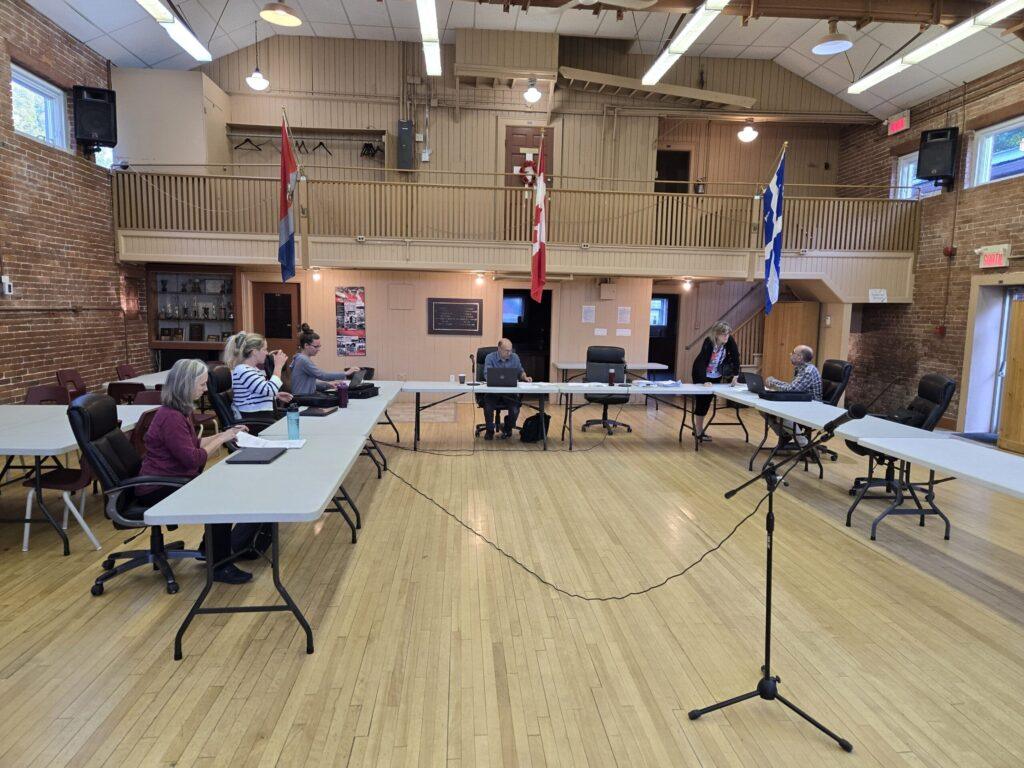
There will be no service on the Quebec City-Lévis ferry until the morning of July 15 due to a strike, the Société des traversiers du Québec (STQ) and the Confédération des syndicats nationaux (CSN) announced last week. Normal service will resume on July 15 at 6 a.m.
The striking union, the Syndicat des employés de la Société des Traversiers Québec-Lévis (CSN), represents about 100 sailors, dockworkers, ticket salespeople, maintenance workshop staff and welders, spokesperson Patrick Saint-Laurent explained.
Saint-Laurent said pay increases for ferry staff have not kept pace with increases for other public sector workers over the last decade, and accused the STQ of dragging its feet over the course of the ongoing negotiations, and of withdrawing concessions made in previous proposals. “We have been negotiating for a year and a half, things are moving forward very slowly, and the STQ does not want to give us its monetary offer,” he said.
Saint-Laurent said union members have voted themselves the option of an unlimited general strike, but they don’t want to use that option. “We want a good offer and we want to get back to work quickly.”
“The organization respects the use of the right to strike, but finds it unfortunate that employees are announcing this means of pressure at this time since negotiations are underway,” STQ spokesperson Catherine W. Audet told Radio-Canada.
City again interested in Église Saint-Jean-Baptiste after Coptic parish drops offer
Ruby Pratka, Local Journalism Initiative reporter
editor@qctonline.com
The future of Église Saint-Jean-Baptiste is up in the air once again.
The historic Catholic church towering above the neighbour- hood which bears its name held its last mass in 2015. Ever since, community groups and successive city administrations have proposed various uses for the massive building, including a centre for French-Canadian genealogy, a training centre for woodcarvers and stained-glass artisans, a community centre and an artists’ workspace.
In January, it appeared the church would become a place of worship again after the Coptic Orthodox congregation of the Virgin Mary, St. Mina and Pope Cyril submitted an offer to buy the building for a symbolic sum.
However, that offer is now off the table, Serge Savaria, president of the Saint-Jean-Baptiste parish assembly, announced July 6.
“On June 27, the Coptic community informed us that they were dropping out of the pro- cess and no longer intended to buy the church,” Savaria said in a statement to members of the parish, which has held mass at Église Saint-Dominique and Église Saints-Martyrs-Canadiens since its flagship church closed. “Consequently, the parish has asked the bishop’s permission to negotiate with the Ville de Québec to come to an agreement on the sale of the church.”
Further details on the city’s plans for the church were not available at press time. However, in 2022, before the planned sale of the church to the Coptic congregation was announced, the Ville de Québec mandated the Institut canadien de Québec, the arm’s-length nonprofit which oversees the city library system, to submit a “pre-feasibility study” for a cultural centre on the site.
The cash-strapped parish council has been responsible for heating and maintaining the empty church and its liturgical objects at a cost of hundreds of thousands of dollars a year, with an eye to the eventual sale or conversion of the building. The parish council “considers it essential that the sale allows the protection and enhancement of the exceptional religious heritage of Église Saint-Jean-Baptiste, not only for the neighbourhood, for the city, but for all of Quebec,” Savaria wrote.
New translation requirements cause trouble for test takers
Ruby Pratka, Local Journalism Initiative reporter
editor@qctonline.com
When Sophie Farnell-Morisset signed up for her Certified Specialist of Spirits exam from the U.S.-based Society of Wine Educators (SWE) earlier this summer, she was served a blank page.
“I signed up for the exam that I paid for, booked a date and time and I got a message saying, ‘We can’t certify you.’ I thought there must be some mistake.”
She contacted the SWE and was told that due to new legal requirements, any standardized test administered in English in Quebec must also be available in French. Without a French translation, test-takers in Quebec, regardless of their own willingness to do the exam in English or another language (some SWE exams are available in Spanish), can’t take the test.
“I did some research and saw that people taking exams for various kinds of niche training have to go out of province to be certified because it’s not possible to take the exam while you are in Quebec,” said Farnell-Morisset, a co-founder of the Rendez-vous Scotch & Whisky de Québec tasting series. She said she is considering going to Ottawa or Vermont to take the exam, but is worried she may be turned away or have problems accessing the online test once she gets there. “That would also be going around the spirit of the law… and I’m very uncomfortable with that,” she said.
The SWE certification exams are administered by the U.S.-based global standardized testing conglomerate Pearson Vue, which also administers a wide range of other standardized tests around the world, notably in the fields of medical technology and IT. The Medical College Admissions Test (MCAT), required for admission to most medical schools in English-speaking North America, is also a Pearson test.
Farnell-Morisset emphasized that she was completing her certification as a passion project – not a job require- ment – and worried about the impact the restrictions might have on people in Quebec planning to attend medical school outside the province or pursue IT careers. Several Montreal-based aspiring medical students recently told CTV News that because the English-only MCAT can no longer be taken in Montreal, they may have to postpone their school plans because MCAT centres in Ontario and New England are full.
“Although the intentions of the law are good, it does have side effects,” she said. “Pearson is a big player in standardized testing, Quebec is a small market and they could just tell [Quebec] ‘We don’t need you.’ I’m worried [these requirements] will stop people from learning.”
No one from Pearson Vue or the SWE was available to comment at press time due to the July 4 holiday in the U.S.
“The Charter of the French Language provides that consumers of goods or services have the fundamental right to be informed and served in French. Businesses in Quebec must respect this right. This does not prevent educational activities from taking place only in a language other than French. However, businesses in Quebec must always be able to inform and serve their custom- ers in French,” the Ministry of the French Language told the QCT in a brief statement.
by Timothy Edward, Local Journalism Initiative reporter
In a press conference today alongside Mayor Valérie Plante, Montreal public health director Dr. Mylène Drouin commented on the rise in visible homelessness in the city. Public consultations were announced, with the aim of collecting input on how Montrealers can live “harmoniously” with the homeless population.
According to the latest homelessness survey conducted, there are 10,000 homeless people in Quebec, including 4,690 in Montreal.
The findings from the survey, carried out on Oct. 11, 2022, include alarming statistics about the number of people living outdoors nightly (800) and the overall homelessness increase since 2018 (33%). City officials are sounding the alarm about the situation, which they perceive has only worsened since the survey despite a doubling of resources following the COVID-19 pandemic.
“Visible homelessness is on the rise in Montreal. It is a complex phenomenon that has multiple facets.”
As the dust settles from the July 1 moving rush, the Office municipal d’habitation de Brome-Missisquoi (OMHBM) is reminding renters that its services are now available year round.
Julie Dion is a housing search assistance worker at the organization, which manages public housing in the region and helps renters and people with lower incomes find a place to live.
“We have not had to provide emergency housing to anyone this year. Some of the people we were supporting moved in with family members, others decided to stay where they were and others found places, although they ended up having to pay more than they were expecting,” she said. “There are places out there, but some are out of people’s price range, and others are less expensive but they might discriminate against renters that don’t have perfect credit.”
Dion said the OMBHM housing search assistance service can help renters put together documentation to convince landlords of their reliability and ability to pay, help people learn their way around housing search tools like Marketplace, and help them avoid scams and common illegal practices (for example, it is illegal for a landlord to ask for a security deposit or a credit check deposit). The service is free.
“Since the service is year-round, we don’t have as many urgent last-minute requests, and I’m still seeing ‘for rent’ announcements now,” she said.
Dion advised people who think they might have to move in the next year to get on top of things early. “Don’t leave it to the last minute. Ask for references from your former landlords and your employer, and get in touch with us right away.”
If you need to move and are having trouble finding a place to live, contact the OMHBM housing search assistance service directly at 450 830-5453 or sarl@ohbm.ca.
On July 3, after several months of public consultations, the Ville de Cowansville unveiled a multifaceted protection plan for Lake Davignon, the synthetic lake that acts as the municipality’s main source of drinking water and a popular destination for recreational boaters.
“The action plan, adopted at the municipal council meeting on July 2, aims to ensure the protection of the lake’s ecosystem, to document current uses and to ensure access to the water body for the population,” city officials said in a statement.
“This action plan marks a crucial step in our commitment to protecting Lake Davignon. Close collaboration with our community and our valuable volunteers from the Comité de sauvegarde du bassin versant du lac Davignon (CSBVLD) was essential to developing sustainable solutions. Together, we ensure that the lake remains a natural gem for future generations,” Mayor Sylvie Beauregard said.
The plan, building on the 2018 action plan co-developed with the CSBLVD, includes 32 short-, medium- and long-term actions centred around three axes – preserving water quality; combatting the growth of invasive plants, specifically watermilfoil; and promoting safe and harmonious recreational use of the lake in light of growing crowds and the increasing popularity of electric watercraft.
The municipality plans to talk to boaters to raise awareness about safe and environmentally friendly boating practices; distribute erosion-preventing shoreline plants to owners of shoreline property; encourage homeowners to grow erosion-preventing rain gardens; consider expanding a municipal shoreline replanting project to include private land, potentially in partnership with the CSBLVD; upgrade aging water treatment infrastructure and continue to work with the MRC Brome-Missisquoi and the CSBLVD to monitor erosion and control invasive species, and discuss best practices in watershed management with other municipalities. The city also plans to maintain its current watermilfoil control programs and to scale up its optional “but strongly encouraged” boat-washing program, according to city environmental advisor Si-Lian Ruel. The city is considering making boat-washing mandatory, as the Town of Brome Lake recently has, and requiring a specific permit to access the lake, although no decisions have been made yet to that effect. The action plan also details measures to improve safety signage on the lake, raise awareness of safe boating practices and put in place a network of volunteer lake monitors.
City spokesperson Fanny Poisson said the municipality is “working on a cost-benefit analysis” of a possible motorboat ban on the lake, which would require Transport Canada approval. The action plan allows the city to put alternative measures in place and collect relevant data while waiting for a decision, she said. Gas-powered motors are already banned on the lake.
The action plan requires extensive community participation, from taking volunteer shifts to changing gardening, planting and boating practices. Poisson is optimistic the city will get buy-in from citizens. “The citizens are aware; they know it’s our drinking water. They are great collaborators,” she said.
Advocates for the shelved Bedford CHSLD expansion project are hopeful that a packed-out public meeting, an open letter in local media and intervention by the Official Opposition might persuade the CIUSSS de l’Estrie–CHUS to reconsider its plans.
Last month, the CIUSSS announced that it was cancelling the $15-million expansion due to a lack of demand, choosing instead to carry out some minor renovations and upgrades in collaboration with the community. However, the Bedford Pole Health Committee hasn’t given up. On June 17, the group held a public meeting at the Centre Georges-Perron that drew a larger-than-expected crowd, and since then, the group has been gathering signatures on a petition calling for the expansion to go ahead, and actively looking for seniors who are living in other CHSLDs and would prefer to move to Bedford.
“For the moment, we have not heard anything new [from the CIUSSS]. We are doing everything we can with the petition and looking for [seniors] who are elsewhere and want to move back to Bedford,” said Pierrette Messier-Peet of the Bedford Pole Health Committee. Messier-Peet also said Brome-Missisquoi MNA Isabelle Charest and the Quebec Liberal Party had been contacted about the petition; Charest has repeatedly said she doesn’t want to give up on the project, and reiterated that to the BCN through a spokesperson.
Open letter
Former Bedford resident Pierre Lévesque, 90, the father of Fondation Lévesque-Craighead cofounder Yves Lévesque, took the initiative to write an open letter to Health Minister Christian Dubé calling on the government to reconsider. “I thought I had to let him know what was going on,” the elder Lévesque, who now lives in Saint-Jean-sur-Richelieu, told the BCN. “Under [former Liberal health minister Gaétan] Barrette, we had a $4-million project to convert the single rooms into double rooms, but nothing ever came of that. There have been a lot of conversations, but there haven’t been any real repairs there for 30 years. We were dreaming of this [expansion project] for years, there has been a lot invested in it and now it’s cancelled overnight.”
The CIUSSS cited lack of demand as a reason for taking the expansion project off the table, but Lévesque, a retired businessman, said he knew seniors who had been placed in homes elsewhere in the region who were hoping for an opportunity to move back to Bedford. “They say they have no waiting list, but I can name three, four, five people who would be on it. There are people I used to work with who are displaced…who cry every day, whose sisters and brothers never come to visit,” he said. He added that in light of the aging population, he expected demand for places at the home to rise within the next four to five years.
“It was a shock to hear the project was cancelled…but people in the community are not going to drop the ball on this,” Lévesque said.
“CHSLDs are a necessary living environment for our seniors and I applaud the mobilization of the community,” seniors’ affairs minister Sonia Bélanger said in a brief written response. “The decision to expand the Bedford CHSLD has been revised by the CIUSSS, in part because the cost of the project has changed, as has the population, resulting in a reduced need for housing. Nevertheless, I expect the CIUSSS to carry out the necessary renovations and ensure that the needs of the region’s seniors are met. I remain in close contact with [Brome-Missisquoi MNA] Isabelle Charest, and we are following this issue very closely.”
Hatley Township’s Old North Church Cemetery, the oldest of the three cemeteries in the area, underwent restoration in 1990. To ensure its ongoing maintenance and to conduct genealogical research of the families interred there, the Old North Church Cemetery Association was established and is now asking the public for financial support.
Founders Terry and Phyllis Emery Skeats played a crucial role in forming the association; both are now deceased. Currently, the association is down to just three members after 33 years. Financial challenges have arisen, with low interest rates over the past decade causing a gradual decline in cash flow, barely covering the cost of mowing the cemetery grounds.
Up until 2013, the association had annual memberships. In light of recent financial strains, members decided at a recent meeting to reach out to descendants and interested individuals to generate support and improve their financial situation.
The association is reintroducing an annual membership and plans to hold yearly meetings, providing members with a copy of the minutes and financial statements. “Please consider helping us care for this precious place,” appealed association members Isabel Thwaites Nelson, Gwendolyn Conner McKnight, and Janet Little McLellan in an open letter to The Record July 8.
For those interested in supporting the Old North Church Cemetery Association, annual membership is $20 until Sept. 1, 2025. Donations over $25 are eligible for an official receipt. Cheques should be made payable to the Church Society, Diocese of Quebec, indicating that it is for the Hatley – North Church Cemetery. Donors are asked to include their email and mailing address.
The three members of the association met with The Record July 8 at the cemetery, providing a document that outlines the history of it and the church that used to stand there. It is summarized below:
The region was first settled in the 1790s by pioneers from New England, including Captain Ebenezer Hovey, who became a notable figure in the area. The Old North Church was one of the earliest churches established, with the first burial in the cemetery occurring around the same time.
In 1818, Reverend Charles Stewart, a missionary of the Anglican Church, proposed the construction of a permanent church building. The construction was completed in 1819, largely funded by local residents who contributed both labour and financial support. The building, however, faced challenges due to its location, leading to its abandonment in the late 1820s when a new church, Christ Church, was established in a more suitable location.
The Old North Church building fell into disrepair and was eventually taken down in 1928 and replaced with a commemorative cairn that marks the spot where the church’s front steps once were. In 1992, the cairn was fully restored and continues to serve as a historic landmark.
The cemetery, however, remained in use throughout these years and continues to be an important historical record for the township. The last burial took place in 2018, marking over 200 years of continuous use. The cemetery holds significant historical value, reflecting the early settlement and development of the Hatley region.
More from the association
Nelson, McKnight, and McLellan filled The Record in on more details in a group interview on the scene. The cemetery has a rich history intertwined with the region’s development.
“Settlers began arriving in this area as early as 1790,” a member explained. “They were primarily from Massachusetts and New Hampshire, and while some may have been Loyalists, the majority were simply seeking new opportunities in what they believed was part of the United States.”
The church opened its doors on Feb. 21, 1819, and became a central part of the community’s spiritual and social life. The cemetery’s association has been instrumental in maintaining the site. “Our goal is to create interest and improve our cash flow,” said one member. “We barely have enough to cover the mowing each year.”
The association operates on donations, an endowment, and a Guaranteed Investment Certificate (GIC), only using the interest for expenses. However, due to low interest rates over the past decade, their principal has diminished. “We need more funds to repair and straighten the headstones,” a member said.
A notable aspect of the cemetery’s history is its connection to the early Mormon pioneers. “A group of Mormons left from here by wagon train in 1836 and were among the founders of the state of Utah,” said a member. This connection has led to ongoing relationships with descendants in Utah, who have visited and contributed to the cemetery’s upkeep.
The cemetery is still under the ownership of nearby St. James Church, but the association continues to maintain the cemetery grounds, despite the challenges of fundraising and limited resources.
“Our mission is to keep the history of this place alive,” said another member. “If we don’t, it’s lost. Most of us are descendants of the original settlers, and we want to ensure future generations know about their heritage.”
Efforts are being made to digitize records and make the cemetery’s history accessible to the public. Copies of a comprehensive book on the cemetery’s history can be found at the North Hatley Library. The association encourages donations and memberships to support their ongoing preservation work.
“We hope people will see the value in maintaining this special place,” a member said. “It’s a link to our past and a testament to the resilience and spirit of the early settlers.”
On July 6, local artists and art-lovers gathered at 101 Montcalm St. to discover the newest Recycl’art exhibition while celebrating the project’s second decade in the Outaouais. The opening was hosted by the Centre d’art contemporain de l’Outaouais. The art centre, which has facilitated six outdoor public art exhibitions for Recycl’art, celebrated its 10-year anniversary. Starting at 2 pm, the unveiling was followed by a guided tour featuring each piece, including a Recycl’art creation designed by the students of Nicolas-Gatineau high school.
“Recycl’art is an imaginative art form, full of humour too, and the works often bring a smile to your face,” said Denis Marceau, CACO president. “The works speak to us of the environment, of preservation, of taking care of our world and our planet.”
The concept for Recycl’art stems from a Google search. After stumbling on a major European exhibition that used recycled metals to create sculptural work, multidisciplinary artist Jacques Charbonneau hosted the first Recycl’art Festival in Montpellier in 2004. At the time, the exhibition of sculptures produced with recovered materials was only made up of 16 artists. By 2016, the exhibition would make its way to Maniwaki and L’Ange-Gardien, making its debut in Ottawa and Gatineau by 2019.
Today, while CACO still “struggles to get Recycl’art recognized as a legitimate art form,” they continue to push Charbonneau’s initial vision to turn abandoned materials into something beautiful and playful.
“Here’s an example of how, despite the fact that things are thrown away, discarded, abandoned, forgotten, neglected and unloved, we reuse them to create works of art, each one more imaginative and amusing than the last,” Marceau closed off.
The exhibition will be on display every day, free of charge, until August 31, 2024.
Photo caption:
Photo #1: The free outdoor public art exhibition Recycl’art is back again this year. This 6th edition organized by CACO will be open to the public from July 6 to August 31, 2024. (DD) Photo: Djeneba Dosso.
Gatineau’s executive committee positioned itself in favour of the expansion of Vanier Road between Pink and Aylmer Road. Over the last few years, there has been significant development along the major artery, as well as significant population growth in Aylmer, making it difficult for residents to navigate Vanier with the increased traffic.
Many welcome this news as residents and local councillors have been advocating for the expansion for many years.
Caroline Murray, Deschênes councillor, announced that Gatineau has already taken a first step by awarding contracts for an environmental impact study as well as an opportunity study. Despite the enthusiastic announcement, there is still a long road ahead as the studies will take three years to complete.
Despite the timeline, the expansion is expected to include two lanes in each direction, as well as bike paths and sidewalks, which have been in high demand.
The environmental impact study is required by Bureau d’Audiences Publiques sur l’Environnement (BAPE). During a July 3 press conference, Gatineau Mayor Maude Marquis-Bissonnette stated that the opportunity study will provide a better overview of what is needed for the expansion.
“The study will allow us to see the impact and opportunities on des Allumettières, on Alexandre Taché, Aylmer Road and on Pink Road,” said Marquis-Bissonnette, highlighting that they will take into consideration the future Tramway which will intersect Vanier Road. The opportunity study will also evaluate traffic flow along the major artery.
WSP, an environmental consulting company, was awarded a $2.85 million contract.
The municipal council will officially approve these first steps during the July 9 council meeting.
Photo: The intersection of Vanier Road and Boulevard des Allumettières, the largest and most congested intersection along Vanier Road.
The long-awaited sports complex in the west and the expansion of the Guy-Sanche library are finally moving forward. Gatineau council positioned itself in favour of these two major infrastructure projects during a June 25 plenary committee meeting. These two projects will total $276.9 million from the residual envelope of Block D project 2024-2032. Gatineau plans for the projects to be completed in 2028-2029.
“These projects respond to the needs of residents in certain parts of the city that have not gotten these types of projects in the past. Especially the Sports Complex in the west, people have been waiting for many years,” said Steve Moran, President of the Executive Committee.
The sports complex is planned for a site between Boulevard des Allumettières and Boulevard du Plateau in Aylmer. The city hopes to meet the growing population’s needs and fill the sports infrastructure gap in the west of the city. Aylmer residents have been feeling the effects of the lack of sporting infrastructure for many years, especially with hockey rinks and spaces that can host multiple sports like badminton and pickleball.
The complex will include four National Hockey League (NHL)-sized ice rinks, including one for sledge hockey and other parasports. There will also be six locker rooms, one referee’s room per rink, and 300-seat stands for each rink. There will be two double gymnasiums, a multipurpose room, a classroom, a multifunctional room with a kitchen, multi-sports hall, and changing rooms.
There will also be communal areas, a canteen, reception and administrative offices, storage rooms, and a tiered parking structure that will incorporate sports and recreational spaces.
The plans for the building foresee a construction cost of $227.8 million for the sports complex.
Gatineau envisions the Guy-Sanche library being a state-of-the-art modern facility set to become a central gathering place for residents. The expansion will allow the library to diversify the service offered. The Guy-Sanche library is the most used of the nine libraries in Gatineau.
The expanded library will double the current library’s surface area, allowing for new services such as individual and collective workspaces, new book collections, and musical instruments. The plans include a technological update to improve the documentation services.
The project costs will total $46.8 million with a loan of $45.6 million for the temporary relocation of the library near the current site. The city also submitted a grant application for $11.5 million from the Capital Assistance program by the Ministry of Culture and Communications. “I am delighted with the adoption of these two major infrastructure projects that will meet the growing needs of our city. These projects represent investments of more than $276 million to provide a better service offering to the population. By making this decision today, the municipal council is ensuring sound management and giving a clear signal for their completion as soon as possible,” said Gatineau Mayor Maude Marquis-Bissonnette.
The plans for both projects include a LEED gold certification, meaning the building will have “excellent” sustainability incorporated in its design and operation. The official approval for both infrastructure projects will be discussed during the July 9 council meeting.
Photo: Digital rendering of the future sports complex slated for the Plateau in Aylmer.
The Service de police de la Ville de Gatineau is seeking the public’s assistance in locating 15- year-old Jasmine Heise.
The teenager left her home in the Orée-de-Parc district in the Hull sector on May 29 and has yet to return. Heise was last seen in the Bank Street area of Ottawa in June and could be on the other side of the bridge in Ontario.
Heise was described as a white, English-speaking teenager. She measures five feet, four inches tall and weighs approximately 100 pounds. The 15-year-old has blue eyes and long hair with often-changed colour.
She was last seen wearing a black hooded sweater along with black pants and black shoes.
Those with information on the location of Heise are invited to contact the Service de police de la Ville de Gatineau at 819-246-0222.
Photo caption: The public is invited to share information related to the location of 15-year-old Jasmine Heise, who has been missing from the Hull sector since late May.
When asked if shopping at public markets is a luxury, Lucie Daragon was quick to replace the
word luxury with investment. The senior has been attending markets across the Outaouais for
more years than she can count and in her opinion, it is clear that when paying for fresh produce,
every penny is worth spending.
“It is not a luxury, it’s an investment to encourage our people, our producers, and it’s important
to do it,” she said. “Some people are passionate about it, some people aren’t interested in it, but
the goal is finding those people who aren’t interested and making them curious enough to come
check it [public markets] out.”
Over the years, Gatineau has amassed an army of markets, each located in different sectors of the
city and offering various selections of vendors and products. These markets are made accessible
based not only on their location but on their hours of operations as well, which often fall on
weekends. Yet, Daragon notes most markets are frequented by regulars and an older crowd rather
than new and young faces.
“People don’t come because they assume it’s too expensive, but we pay for the quality and the
freshness,” she said. “Often in grocery stores, it’s a long way off—they travel a long way with it,
they arrive here, the next day they put it on the shelves. Here, produce is often picked in the
morning and sold that same morning or early afternoon.”
The question remains; besides pricing and freshness, what sets supermarkets apart from public
markets? For some it may be selection, for others practicality, as most markets are only open
once a week. For Marguerite Jarry Suarez, owner of Studio Crudo, what makes public markets
unique is community. The entrepreneur has been creating vegan candles and custom tote bags
since the pandemic. After refining her work, she began looking for places to possibly sell it and
public markets welcomed her with open arms. Now, she displays her work at the Vieux-Hull and
Outaouais Creative markets two to three times each month. She’s found that the long or short
exchanges with each customer makes all the difference.
“I love connecting with people. I am from the Dominican Republic, and we’re known to be
warm-blooded,” she said. “It’s great being able to talk with different people and the other
vendors who have become great friends— if one day I ever need a necklace I know who to call
and I would be supporting their business.”
Buying and supporting local businesses is “of paramount importance” for Daragon.
“It’s important to keep an eye on the ecology, the environment and our ecological footprint,” she
continued. “If anything happens, we’ll have no more farmers, no more market gardeners; we’ll
have nothing. You’ve got to support them and buy locally.”
Each market in Gatineau and the Outaouais region will be open throughout the summer until the
end of the season in October. Whether it be produce, clothing, artisanal work or local gems, a
public market near you may just have what you’re looking for.
Find a public market near you
Vieux-Hull Market (currently seeking more vendors)
1 Wellington Street (Gatineau)
Every Thursday from 930 am to 130 pm
Plateau Market (currently seeking more vendors)
205 de Bruxelles Street
Every Saturday from 9 am to 1 pm
Old-Aylmer Market
117 Principale Street
Every Sunday from 9 am to 2 pm
Notre-Dame Market
330 Notre-Dame Street
Every Friday from 11 am to 3 pm
Buckingham Farmers’ Market
390 Buckingham Ave
Every Saturday from 9 am to 3 pm
Chelsea Market
23 Cecil Rd
Every Thursday from 4 pm to 7 pm
Photo caption
Photo #1: Marguarite Jarry Suarez has been displaying and selling her handmade candles and tote bags at the Vieux-Hull public markets for a little over a year now. Used to seeing the same faces, she encourages young and curious people to come see what each market has to offer for them. (DD) Photo: Djeneba Dosso
“I did not see this coming,” said Audrey Leduc, the fastest woman in Canada to run the 100- and 200-metre sprints, when she was told she had qualified for the Paris Olympics.
Just a few weeks earlier, the Gatineau athlete, dubbed “Lightning Leduc,” set two Canadian records, notably breaking the 36-year old Canadian women’s 100m mark of 10.98. “I was hoping to qualify for the relay and the 100 metres via World Ranking, but I didn’t expect the 200 metres, too,” she stated. Her record-breaking performances earned her a direct flight to Paris to make her debut at the Olympics, July 26 to August 11.
Leduc’s background in soccer from a young age helped her discover her love for running, which propelled her into the field of track at the age of 10. Aged 25 today, the business student at the University of Laval has built an impressive resume, currently ranked 38th in the 100m world ranking and already having participated in the Quebec and Canada Games. After exceeding the Olympic standard of 22.57, setting the national record to 22.36 in the 200m, preceding running a national record of 10.96 at a 100m meet in Louisiana last April, the sprinter will now be representing Team Canada alongside 48 Canadian athletes.
“I’ve done the Quebec Games and the Canada games,” she said. “The Olympics game is just the big thing. I’m excited to get there, represent Canada as best I can, and run fast.”
Photo caption
Photo #1: After breaking the Canadian records in both the women’s 100m and 200m this spring, Audrey Leduc dubbed “Lightning Leduc” has qualified to make her debut at the Paris Olympics which are set to begin on July 26. The 25-year-old Gatineau sprinter, who has already participated in the Quebec and Canada games says she is excited to be representing Team Canada. (DD) Photo: Curtesy of Athletics Canada.
A second political party has been coming out of the woodwork to take on Gatineau’s reigning municipal party.
“The by-election was the pivotal point, I think, in Gatineau’s history since the arrival of the first political party,” said Évolution Gatineau founder Sylvie Goneau “It’s now become, I think, clear that without a second political idea carrying another type of ideology, people will not have the ability to vote for any type of view that has a chance to win against a political party.”
The former Bellevue district councillor reserved Évolution Gatineau with Élections Québec from June 5 to December 5.
At the core of the newfound political party was a central ideology with a slight right tendency when it came to economic and financial views, said Goneau.
“You have to be able to offer the population what the population needs within the means of the city. And to do that, you need to value everything the city has to offer.”
The party’s founder explained that the city has the responsibility to manage finances in a way that allows citizens to keep money in their pockets.
Having already run for mayor in 2017, Goneau said she had seriously considered adding her name to the ballot during the recent by-election but was thrown off by the number of independents battling it out against Action Gatineau.
“When I started counting the number of independents who were running and the political party’s ability and finances that they already had in their back pocket and the electoral machine and the lack of interest that the population has in voting in municipal elections, it became clear to me that the political party was going to win, hands down.”
Goneau said she maintained this prediction throughout the months of campaigning and was not surprised when Action Gatineau head Maude Marquis-Bissonnette was declared mayor.
With Marquis-Bissonnette’s win, the political party was reinstated at the city’s top job after losing to former independent mayor France Bélisle in 2021. Although Bélisle’s term was cut short, it marked the end of 8 years of Action Gatineau at the helm with founder Maxime Pedneaud-Jobin ending his two-year term as mayor.
In a previous interview, Pedneaud-Jobin explained the political party brought together experts to fuel large municipal decisions as the growing city tackled larger budgets and new responsibilities.
Hoping to level out the playing field between independents and members of a political party, Goneau founded the Regroupement des élus indépendants pour la démocratie, or RÉMI, during her time as district councillor.
“The financing opportunities that differentiate independents versus political parties is a great disadvantage for the independents,” said Goneau. “(RÉMI) had gained an extra year of funding, but that’s still not sufficient for independents to be able to win, especially not in a by-election like (that).”
Unlike independents, political parties of any municipality of 20,000 or more who received at least one per cent of the votes in the last general election were entitled to an annual allowance, distributed in proportion to the percentage of valid votes obtained in the previous general elections. According to Action Gatineau’s 2023 financial report, the political party’s allowance totaled $104,870.97.
Independent Pointe-Gatineau district councillor Mike Duggan, who supported the RÉMI movement in the past, has already joined Évolution Gatineau but Goneau did not expect anyone else to tag along so close to the next election.
“Next year we’ll be ready to start receiving applications for future candidates for the 2025 election, and it’s at that point, I think, that we can expect independents to jump on board with us.”
This was not the first time the independent councillor dabbled in political parties. Duggan reserved the political party name Démocratie modern in 2015, Infrastructure Outaouais in 2019, and Dans le milieu in 2022 which all failed to be officially formed.
The City’s new mayor and Action Gatineau head Maude Marquis-Bissonnette said she was not surprised by another political party being formed.
“I think it’s simple for democracy. This allows public participation in municipal authorities. Then as the responsibilities of cities evolve, I think it’s normal to want to work as a team,” said Marquis-Bissonnette.
Évolution Gatineau was not the only party name reserved for the municipality with Élections Québec. Former mayoral candidate Mathieu Saint-Jean reserved Équipe citoyenne de Gatineau from April 30 to October 30.
Goneau invited the public who wished to have another option, “who don’t see their values being represented right now,” to contact her or Duggan to obtain an Évolution Gatineau membership card. Goneau can be reached at info@sylviegoneau.ca while Duggan can be contacted at mikedugganconseiller@gmail.com.
Photo caption: Registered by former Bellevue district councillor Sylvie Goneau, the political party Évolution Gatineau aims to offer residents another option besides the city’s sole active municipal party, Action Gatineau.
On Saturday, June 1, Gatineau police arrested a 16-year-old boy for possession of a loaded handgun. Authorities were called regarding an intoxicated individual who was disturbing the peace on Saint-Rédempteur Street in Hull.
Officers located the individual near the intersection of Allard Street, with two other men who seemed to be trying to manage the interaction. When approaching the three individuals, officers noticed that the individual had his hand in a shoulder bag. According to the press release from Gatineau police, officers made contact with the teen in order to ensure their safety. They subdued the suspect and found a loaded handgun in the bag which they then seized.
After investigation, police concluded that the teen attempted to steal the vehicle of the men who were with him. The young man allegedly pointed the gun at the victims. The teen was taken to the police station where he was questioned by investigators. He now faces charges of failure to comply, theft, as well as several other firearm charges in Youth court.
Police highlight the importance of calling 911 when there is an imminent danger. In this situation, no one was injured but authorities warned that it could have ended badly.
Gatineau police urge residents with any information related to possession, trafficking, or use of firearms to use their confidential CENTAURE phone line at 1-833-888-2763. CENTAURE is a strategy that brings together Sûreté du Québec and partner police forces to maximize their efforts in fighting against firearms in the province.
Invasive plants and weeds are often used interchangeably, but generally speaking, weeds refer to plants growing where they are not welcome. Weeds can be local or non-local, invasive or non-invasive, and competitive or easy going. However, weeds tend to share certain properties in which they can gain advantage over desirable plants. First, they can reproduce in many way – sexually by seed and asexually by rhizomes. Second, certain weeds can block the sun from other plants by leafing out sooner than slower growers. They can also retain their leaves for a longer time during fall, allowing for a longer photosynthesis period and ultimately increasing their survival. As a result, weeds have populated areas undergoing extreme conditions such as draughts and have come on top as survivors. Apart from their top-notch survival skills that can harm the reproduction of other plant species, can our local weeds serve other purposes?
Weeds can give us a lot of information about soil, as all plants have specific environmental conditions, including soil preferences in order to thrive. For instance, the nitrogen content and whether the soil is too compacted or eroded. Identifying weeds that give hints on these possible issues can help us make the needed changes such as tilling or adding organic matter to our gardens. An example is weeds with deep taproots, such as dandelions and burdocks can be an indicator of compacted soil that lacks air, water and nutrients. On the other hand, weeds are the ecosystems way of correcting the soil to achieve more balance. Dandelions and burdocks have deep and strong roots that also help break up the compacted soil. Similarly, weeds can also be an indicator of good soil. In the case of common groundsel, knapweed, lambsquarters and fiddleheads that are all common weeds of Quebec, signal nutrient-rich and fertile soil.
Apart from providing hints of soil conditions, some weeds have played crucial ecological roles. The milkweeds are a prime example of such weeds. In Quebec, there are four native species – Common milkweed, Swamp milkweed, Poke milkweed (relatively uncommon), and the Butterfly milkweed (endangered species in Quebec). Milkweeds are perennials that carry flowers grouped in umbels. They are called milkweeds because of the milky white sap that leaks when the plant is injured, which may cause an allergic reaction in some people. The nectar of milkweed attracts many pollinating animals such as butterflies, hummingbirds, bees and wasps. Monarch butterflies feed exclusively on milkweed, being the only host plant for this butterfly species. The issue is, despite the importance of native milkweeds, these plants are often mistaken for regular weeds and wiped out causing harm to pollinators and declines in the monarch butterfly populations. In addition, milkweed has been used by the First Nations as food, and to make rope. The common milkweed has made a comeback because of the properties of its fiber, which is made by the silky hairs of its seeds. It is used primarily in thermal insulation, stuffing for quilts and pillow and even as an absorbent material in oil spills.
Other weeds such as dandelions and purslane offer several health benefits to humans. In French, the word dandelion translates to “pissenlit” which translates in English to “pee in bed”. This name comes from the strong diuretic properties of the dandelion leaves. The dandelion plant is edible and has been used throughout history to treat several conditions such as digestive ailments, joint pain and fever, although the evidence of efficacy requires more research. The dandelion leaves are highly nutritious, providing beta-carotene and vitamins C and K. The roots contain inulin, a prebiotic fiber that nourishes the good-gut bacteria. So, skip the weed killer and rid your lawn of dandelions by harvesting them! Similarly, purslane, also known as portulaca is an edible weed. It is known to contain ten times the omega 3 fatty acids found in spinach. It can be served raw in salads where it tastes like pea shoots, or it can be steamed where it tastes like spinach. Of note, beware of toxic imitators such as euphorbias that often grow close by. Euphorbias release a milky sap when its thick stem is broken, providing an easy method of identification.
To conclude, weeds can be detrimental to the garden and in some cases even toxic to humans. On the other hand, they can provide many benefits to pollinators and human health, meriting more respect than they get. It may just be worth it to research our garden weeds in more detail to learn about their possible key roles in our ecosystem and human health.
A friend who keeps an eye on a wide variety of topics sent me a link to an on-line article in The Conversation, a nonprofit media outlet. Written by Misha Teramura, an Assistant Professor of English at the University of Toronto, the article had the long title: Think tech killed penmanship? Messy handwriting was a problem centuries before smartphones.
My first reaction was to ignore the article. I already knew that messy handwriting predated smartphones and computers. I had firsthand experience with messy handwriting dating back to the middle of the last century.
I was first made aware of penmanship in Grade 5. That was the year that pupils were expected to make the big step of graduating from pencil to pen. In September, we were doing all our work in pencil. At some point in the year, those whose penmanship was judged adequate began writing with a pen. This was the late 1950s and a pen consisted of a handle and a nib. Every few strokes, the nib would have to be dipped into an inkwell. It could be messy. Hence, our teacher insisted that we had to write neatly and legibly with a pencil before we were permitted to write with a pen. At the end of Grade 5, I was one of those still writing with a pencil. (As I recall, in Grade 6, despite my failures in Grade 5, I was writing cursive with a ballpoint pen.)
It was only on second thought that I scrolled down to scan the rest of the text. It was written in response to an article in the New York Times several months earlier which attributed the poor penmanship of today to the use of laptops and smartphones.
Teramura begged to differ. As someone immersed in the world of Shakespeare and his contemporaries, the professor from Toronto had ample evidence that bad handwriting could easily be found 400 years ago.
Teramura wrote, “In countless letters that survive from the early modern period, writers apologize for their bad handwriting. Sometimes they blame it on circumstances: they were groggy from just waking up or tired late at night (“scribbled with a weary hand in my bed” reads one sign-off from 1585).”
At other times, he noted, the excuses for poor handwriting were medical: a broken arm from falling off a horse, a hand injured in a duel, or stiffening joints from arthritis or gout. A common excuse—as it still is today—was that the letter had to be written in haste and hence the handwriting was poor.
Teramura described cacography—or bad handwriting—as calligraphy’s evil twin. He pointed out that there is a long list of famous people who had poor handwriting, including Queen Elizabeth I and the Dutch scholar, Erasmus.
At the time, before typewriters and laptops, handwritten letters were all that could be sent. Penmanship was a necessary skill, or at least a useful one.
Strangely enough, although good penmanship was of benefit to the upwardly mobile, it was cacography that that appealed to the ruling class.
Teramura wrote, “The aristocratic nobility was notoriously bad at writing by hand. Popular dramatists even made jokes about it. But bad handwriting may have been deliberate. In fact, Shakespeare’s Hamlet says just that: I once did hold it, as our statists do,/ A baseness to write fair, and labored much/ How to forget that learning.”
Hamlet had mastered handwriting, but he now intentionally neglects to use this skill. It was below those born into power and privilege to write neatly.
Teramura noted, “Writing carelessly could be a way of asserting one’s social or political clout by forcing others less privileged to struggle to decipher what one had written.”
Today, or at least up until quite recently, the medical profession tended to be associated with cacography. A few decades ago, it was still commonplace for a doctor (sometimes more that one) to run a general practice in a small town. Typically, a patient would call the doctor’s office, show up for an appointment, and leave with a prescription for the pharmacist. In my experience, the prescription was always all but illegible.
Cacography is as close as I got to med school. Perhaps my handwriting wasn’t bad enough. Equipped with ball point pens, I remember carrying on regular and even frequent handwritten correspondence with friends through my teens and twenties. (Of course, I made a point of typing my papers at university.)
Today, on my laptop, I type the stories I send to my editor. The notes I take during interviews however, are scribbled with my ballpoint pen into my notebook. My handwriting hasn’t improved with age. I always try to type up a story as soon as possible after the interview. Even with a fresh memory, I’m not always able to decipher my hastily scrawled notes. And reading something scribbled three or four days previously is often impossible.
Teramura reminded me that I was in good company, “The Reformation theologian Martin Bucer allegedly couldn’t even read some of his own manuscripts. Nor was he alone. As the preacher John Preston (1587 – 1628) observed in a sermon, “One would think a man should read his own hand, yet some do write so bad, that they cannot read it when they have done.””
Teramura finished his article, “Today, the ubiquity of smart phones and laptops has no doubt played a role in the ways we write. But for those of us who can’t read our own sticky notes and to-do lists, it may come as a relief to know that bad handwriting is not an unprecedented phenomenon, but has its own centuries-long history. We’re simply living a new chapter of it.”
A quick inquiry into penmanship in school today makes me wonder if handwriting hasn’t already gone the way of straight pens and inkwells. Has cursive script already disappeared?
Describing her Grade 5 class, one teacher told me that of her 21 students, only one—a girl—always wrote in cursive script. All her other students wrote in block letters.
As well as being unable to use cursive script, many young people today cannot read a handwritten text.
In 2019, an enterprising teacher at a local elementary school initiated a local history project for Remembrance Day. The research material included documents from Archives Canada and handwritten letters from WWII. One of the difficulties the students met was that much of the old documentation was handwritten. The students had to learn to read and write cursive script to make sense of their research material. And then, as would those of us long accustomed to handwritten letters, they had to cope with cacography. The project planned for mid-November was completed in June.
Handwriting was useful until quite recently because writing in cursive script is much faster than printing out words in block letters. However, it is not as fast as typing and, in most circumstances, not nearly as convenient as a laptop or a smartphone.
Penmanship, in the form of calligraphy, continues to exist as a minor art form. For those of us who still do put pen (or pencil) to paper, cacography continues to be an occasional—if not frequent—presence, even on things as innocuous as a shopping list.
This provocative title is borrowed from a new book1 that provides some global perspective on the vitality of French and English. Which language is doing better or worse? Compared to what? And compared to when?
Lionel Meney is a French linguist, trained at the Sorbonne, who came to Quebec to teach at Laval University. After a lifetime of studying languages in a global context, Meney concludes that the battle between French and English is over. French has been defeated on every significant front and English has triumphed. His assessment is bleak but he supports it with 250 exhaustively documented pages of examples and statistics.
Meney refutes the arguments of naysayers who believe French in Quebec is doing just fine. Global data supports the claims of François Legault’s CAQ and Paul St-Pierre Plamondon’s PQ that French is seriously threatened and dangerously declining. However, while language pessimists are correct about the imperilled state of French, Quebec’s desperate attempts to address global problems with solutions that blame local villains are misguided and doomed to fail.
The most vivid example Meney offers to make his case is the working language(s) of the European Union. The first six countries to form the Union were France, Germany, Italy, the Netherlands, Belgium, which has three official languages (French, German, Dutch), and Luxembourg, which also has three official languages (French, German, Luxembourgish). The EU operated with four languages (French, German, Italian and Dutch). Things changed in 1973 when Great Britain joined.
As the EU increased from six members to 28, the cost in time and money of translation rose exponentially. English became the convenient lingua franca. By 2007, 72% of EU documents were written in English. No single fact demonstrates the irresistible power of the English language more clearly than the predominant role it continues to play in EU communications eight years after Brexit. The English people could vote to leave the EU, and Europe could wave England goodbye, but the EU continues to communicate in English, now the post-national working-language of the global community.
Other international institutions are subject to the same reality. The UN has 193 member nations that speak hundreds of different languages but the U.N. recognizes only six official languages: English, French, Russian, Spanish, Arabic and Chinese. The languages are not equally utilised. English dominates 75% to 85% of UN communications.
Meney documents the triumph of English in academic publications, second language instruction, international commerce and product labels. To have a comfortable mastery of English is a distinct advantage while to be unilingual in any other language, including French, is a handicap.
“Not long ago you could you could have a successful (international) career as a unilingual Francophone. That is no longer possible.” “Failure to master this language (English) has become an insurmountable obstacle.”
In addition, French societies are being invaded by English words and transformed by English syntax, and young Francophones are enthralled by English culture. The internet is massively dominated by English. Despite France’s long history of international influence and the large number of French-speakers globally, the French language is everywhere in retreat.
Is this English domination fair? Is it good? The one thing beyond dispute is that it is a reality.
Meney believes governments can play an important role in support of language by providing first class education and assisting immigrants to acquire language skills. The current government of Quebec prefers to score points among its base by reducing the availability of first class education – when it involves English-speaking universities and CEGEPs. The current government finds it more popular to deny immigrants services in languages other than French after six months rather than invest necessary resources to enable all immigrants to acquire French skills. The CAQ’s francisation program has been strong on rhetoric and aspirations but lamentably weak on planning and implementation.
Meney’s conclusion is sensible. “If the expansion of the domain of English seems inevitable, to save what can still be saved we must organize the cohabitation of the two languages on our territory.” The inescapable future is linguistic cohabitation, aka bilingualism. The utility and popularity of English are undeniable. Quebec’s worst strategy is to defend French by declaring English an enemy unwelcome in the workplace, the public square and private lives. That war has been fought and lost. If anyone doubts it, they need to read Meney’s book.
Guy Rex Rodgers was founding Executive Director of the English Language Arts Network (ELAN) until returning to filmmaking. You can reach Guy at: GRR.Montrealer@gmail.com
Le naufrage du français, the triomphe de l’anglais by Lionel Meney (collections L’espace public, 2024) ↩︎
Shortly after becoming prime minister in 2015, Justin Trudeau took Jean-Yves Duclos aside and told him to develop Canada’s first-ever national poverty reduction strategy. Thus began many months of roundtables and town halls, in person and online, via conversations and conferences, informing the then minister of Families, Children and Social Development on how to reduce poverty in this country.
Two and a half years later, “Opportunity for All – Canada’s First Poverty Reduction Strategy” was published. Its primary goal was to reduce poverty by 20 percent by 2020 and 50 percent by 2030 based on the official measure of poverty. (This article won’t deal with the secondary goals of reducing chronic homelessness by 50 percent, ending all long-term drinking water advisories on reserves by 2021 and reducing or eliminating housing need for 530,000.)
There are well over 100 benefit, credit, incentive and other programs offered up by federal, provincial and territorial governments, all designed to transfer cash to low-income Canadians to further the primary goal of reducing poverty. They are all administered, not by the department of Families, Children and Social Development but by the Canada Revenue Agency (CRA), the tax-collector-in-chief. In Canada almost all government cash benefit payments require recipients to file a tax return. Individuals who don’t participate in the tax system, often the most vulnerable in society, may forego these benefits or even entitlements to government services when such services are tied to tax return information.
For the 31 million of us who filed a personal income tax return this year, it’s a tedious but necessary pain in the ass. Tedious because the basic tax return has 172 lines and 15 different schedules to pore over before you get to “Refund or Balance Owing”. Necessary, because failing to file gets you the double whammy of draconian interest penalties to pay and missing out on possible cash transfers like the Guaranteed Income Supplement or the Canada Workers Benefit.
Do you know how many of us don’t file a return? Neither does the CRA. They think it’s between 4 and 5 million people. They also don’t know why these people don’t file, since the estimated value of cash benefits lost to working-age non-filers is at least $1.5 billion.
Leaving seniors’ benefits aside, the largest benefit is the Canada Child Benefit, which pays out over $24 billion/year to parents. As an example, a low-income family of four with two young children in Ontario is in line for about $19,000 in federal/provincial child and family benefits. Benefits are similar in other provinces. The growing financial importance of these benefits leaves eligible recipients who don’t file a tax return increasingly penalized. As important, it reduces the effectiveness of our poverty-reduction goals.
Courtesy Statistics Canada
In the interests of getting potential cash benefits into the hands of low-income earners, the CRA has, for the past six years, offered an automated phone service that allows low-income Canadians to file their tax return over the phone by answering a short list of questions. The uptake has not been good, averaging only about 60,000/year. Close to half the people invited to file for free may have paid a professional to help them file. The CRA can’t say why people would choose more expensive filing methods, although to an outside observer it looks like people don’t know about file-by-phone or the benefits for which they may be eligible, or the system is just too complicated or there are other reasons.
Indeed, there’ve been sufficient academic studies that say there are lots of ‘other reasons’. Many low-income people are suspicious of government and unfavorably disposed to tax filing. Some concerns are based on ignorance, like, for example, that cash benefit entitlements administered through the tax system will be clawed back from their social assistance benefits. Or they don’t understand how tax refunds work. Or they’re scared, fearing that by filing they might invite the CRA to dig into past income sources and expose them to serious actions by government.
In Budget 2023, the government announced its intention to increase the number of Canadians eligible for “SimpleFile by Phone” to two million by 2025, as well as to introduce a new automatic income tax filing service. Budget 2024 says the CRA will pilot a digital and paper version of its SimpleFile by Phone service intended for individuals who have gaps in their filing history or have never filed a tax return. It doesn’t say how the CRA will do that, but it does say it will provide an update in the fall of 2024.
So we really can’t say how much all this will cost – either the administrative costs to develop and deliver the file-by-phone program, or costs related to cash benefits delivered to individuals who would have otherwise not filed a tax return and would have foregone the benefits to which they were entitled. And we can’t say whether the CRA’s renewed efforts will be any more successful at convincing non-filers to file than their past efforts over the past six years.
In spite of the many billions of dollars that have been devoted to this project since 2018, the poverty level has moved from 11.2 percent in 2018 to an estimated 11.2 percent in 2024.
No doubt a lot of bad luck and real time issues – Covid 19, inflation, etc. – have intruded. Nevertheless, there’s a serious question to be asked. Is there not a better way to reach non-filers, get cash benefits into their hands and improve our track record of reducing the number of Canadians living in poverty? Other countries don’t require everyone to file a tax return and they manage to transfer money to low-income earners. Canada’s record on poverty reduction compared to other countries is not good. Is this new CRA initiative that builds on a failed old initiative the best we have?
As deer proliferate in the Townships, many residents cry «stop!». Photo by David Winch
Why are animal species both thriving and facing extinction in Townships?
By David Winch
Local Journalism Initiative
Wildlife is everywhere in the Townships. But some animal species are surging, while others are definitely not. Two examples of these extremes are deer and sturgeon.
Everyone sees how ubiquitous white-tailed deer are here. Regional conditions are ideal, with leafy deciduous forests, many farm fields and … tasty gardens.
Anaïs Gasse, a biologist for the Quebec ministry of forests, wildlife and parks, told The Record in November 2022 that the provincial government is aware of the deer boom in the Townships and has been trying to address the situation. “In the Eastern Townships, we have milder winters [than further north] … and we don’t have very many effective predators in the territory,” she explained.
There are no wolves, a few pockets of coyotes and some bear in the region, but not nearly enough to effectively control the deer. In 2021, the Quebec ministry of wildlife estimated the provincial deer population at 250,000 head— double the number in the 1990s. More control measures are needed.
Hunting licences increased
The province has increased the number of antlerless deer licences, allowing more hunters to target fawns and females, government biologist François Lebel told the CBC.
Hunters are now bagging nearly 50,000 deer a year. “When we are overpopulated with deer, we must reduce the population, and unfortunately, to decrease [that number], it is with a lethal method,” said Lebel.
This reduction may be difficult. Deer are a species known as “synanthropes” – animals that can thrive around human settlements. Deer have this aptitude, along with raccoons, squirrels, geese, rats, coyotes, pigeons, crows and, increasingly, wild turkeys.
Pristine nature is not their sole home. Even the biggest cities feel their increasing presence.
The New Yorker magazine reported in 2021 how deer are thriving in the biggest city in North America. There are now lots of deer in the New York borough of Staten Island; they first swam there from suburban New Jersey. Aerial studies by low-flying planes in 2014 counted 763 deer in the green spaces of the borough’s 18.7 square miles.
This puts local greenery under pressure. And the lack of predators for these urban and suburban deer is obvious.
A much-viewed YouTube documentary highlights how the reintroduction of predators can radically affect deer numbers and forest biology.
Once wolves were re-introduced there in 1995, deer started to avoid open grassy areas. Vegetation bounced back. This provided more habitat for songbirds. Firmer watersheds were good for beaver, and fish took advantage of deeper rivers. Wolves also killed coyotes, which meant more foxes and small mammals.
We can only imagine – or fear — how a peak predator prowling around the Townships might affect our deer population, and later, local vegetation.
Instead, we will have to rely on hunters. Venison, anyone?
Sturgeon are harmed by dams, limiting their numbers in Townships lakes.. Photo by David WInch
Sturgeon still around?
At the opposite end of the wildlife spectrum are sturgeon, known to biologists as lake sturgeon (or in French, esturgeon jaune).
Many people in the Townships have seen the classic “fishermen’s chart” wall-plaque, sold around Lake Massawippi. Its handwritten text highlights fishing holes and Massawippi-area animal habitats. It states clearly: “Sturgeon, 50 to 75 lbs., once swam in this lake. Last seen about 1927.”
A brief internet search turns up evidence to the contrary. The Eastern Townships Resource Centre site displays several photos of triumphant fishermen with sturgeon; in one catch dated 1969, a sportsman holds up an 86-pounder from Lake Massawippi.
After I asked on Facebook’s “Friends of Lake Massawippi” page for recent sturgeon sightings, one poster replied: “I saw a large one in Bacon’s Bay around 1999. It was in shallow [water], resting on the bottom. It looked like a log. It then slowly rose near the surface when I passed over it on a windsurfer board. There were two other witnesses with me. We’ve never forgotten it.”
Veteran fishermen in the area, however, caution that false sightings are common. The real number of sturgeon in that lake today, they say, is likely “zero”.
The water-control dam built downstream from North Hatley in 1967 effectively ended sturgeon spawning in the Massawippi River. The fish ladder installed there is not appropriate for slow-moving bass or sluggish sturgeon; they don’t leap like salmon.
Lake sturgeon prefer fast-moving water and spawn where they find that environment. They “can be found at depths of at least 5 meters but no greater than 20 meters,” clarifies Nature Canada. Sturgeon can still be found in good numbers further downstream in the St. Francis River, which eventually empties into the St. Lawrence.
Nature Canada notes that lake sturgeon also remains a threatened species because “it was overfished starting in the late 1800s and early 1900s.” Huge sturgeon hauls were even used as farm fertilizer. Their numbers fell steeply.
Sturgeon have relatively few outspoken defenders, perhaps because they are not cute and cuddly: “The largest freshwater fish in Canada, the lake sturgeon, can be easily recognized by its external bony scutes which are noticeable ridges along the fish’s body … They also have a pointed snout and four dangling, whisker-like organs, called barbells, located around the mouth. The lake sturgeon has shark-like features such as a cartilaginous skeleton”, adds Nature Canada.
One large biological study (Fortin et al., 1992), concluded that “Quebec is one of the rare regions of North America that still has relatively balanced and productive populations of lake sturgeon,” mostly clustered in the St. Lawrence and Ottawa rivers or in northern Quebec. Sturgeon have a long life cycle with relatively infrequent spawning, and they can live over 150 years.
So there is still hope for sturgeon here. But unlike deer, they need our help. That recovery could start with something as simple as a workable fish ladder.
A new multi-use trail has been added to the current network in the east of Gatineau. The first phase of the Lièvre Ouest trail, located between rue Pierre-Laporte and rue Maclaren East, was officially opened on June 27.
“This project, awaited by the community, is a great addition to existing links in the east of the city, allowing various modes of active transportation to be practiced in a safe manner. These are significant benefits for the entire population of Gatineau, particularly for residents of Buckingham and potentially for those of Masson-Angers, when the second phase of the project has been completed,” wrote Buckingham district councillor Edmond Leclerc in a press release.
Spanning 1.75 kilometres, the first phase of the trail included a route through a wooded area along with a portion of rue Georges which can be explored on foot, by bike, or even by scooter.
The new addition will allow safe access to the Brady Bridge across the Lièvre River. The link will also double as an incentive to abandon vehicles for active transportation, said Leclerc.
The creation of the trail in a wooded area was possible due to an agreement with Evolugen, which offered the required land.
“Contributing to the quality of life of the communities near our activities is part of our values, and allowing citizens to benefit from the land that belongs to us is one of the ways of doing so. Thanks to the City, our land, like this trail, allows people from the east to move, gather, and have fun,” wrote Evolugen’s director of Quebec operations, Mathieu Daoust.
Photo caption: Representatives from the Ville de Gatineau and Evolugen mark the official opening of the first phase of a new multi-use trail in the east end of the city.
Residents question Bury council during monthly meeting
By William Crooks
Local Journalism Initiative
Marked by active participation and candid discussions, residents of Bury raised numerous questions and concerns during the public question periods of the council meeting held July 2. Held at the Armoury Community Centre, the meeting provided a platform for residents to address various issues directly with council members, emphasizing the community’s engagement and the council’s accountability.
Opening and adoption of minutes
Presided over by Mayor Denis Savage, the gathering began promptly at 7:30 p.m. with the council adopting the agenda for the day. Following this, the minutes from the extraordinary meetings held on May 21 and June 3 were approved. These minutes included corrections related to human rights compliance.
The first question period kicked off with a flurry of inquiries from residents, reflecting a range of concerns and interests.
Tent purchases and usage
One of the initial questions centered on the municipality’s acquisition and use of tents intended for market creation.
A resident asked, “What happened to the first tent you bought with the intention of creating a market space? And what about the mini-tents purchased later with the same intention?”
The council responded by detailing the current status and future plans for the tents. “We bought pop-up tents last year,” explained a council member. “We’ll use them for various events. For the public market now, we’re using a fixed tent. If we see less need for the pop-up tents, we might put them up for sale. We initially had twelve tents in total—two large ones and ten smaller ones.”
This response led to further clarification about the old tents. The council mentioned that they attempted to sell the older tents during a recent auction, but there were no bids. “We announced the sale at the auction last week, but there were no offers. We’ll re-announce it,” a council member stated.
Employment changes in the municipality
Another resident raised concerns about the changes in employment within the municipality, comparing the current number of workers to previous years.
“How come there were only four workers before, and now there are seven or eight? It’s the same municipality with less work to do. How can you justify more workers?” the resident inquired.
The council addressed this by explaining that the current employment levels are necessary due to the evolving needs and projects within the municipality. “We have more specific projects and higher standards now, justifying the current employment levels,” noted a council member. The council highlighted that while fewer workers managed more tasks in the past, the current workload and the need for specialization required a larger workforce.
Fire Department equipment
A resident questioned the necessity and cost of replacing firefighters’ helmets, asking about the expiration dates and the rationale behind the purchases.
“We replace helmets only when necessary and in compliance with safety regulations,” explained a council member. “The expiration is typically ten years, and this ensures the safety and reliability of our equipment. We don’t exchange them in advance; we do it when we are required to.”
This explanation led to further discussion about the general maintenance and replacement schedule for the fire department’s equipment, emphasizing the council’s commitment to ensuring the safety and effectiveness of emergency response services.
Public works and infrastructure
There were also inquiries about the municipality’s handling of public works and infrastructure maintenance. One resident asked why certain roads had not yet received the necessary calcium treatment to manage dust.
“We’ve applied calcium on the main street, but what about the dirt roads this summer? It’s already July 2,” the resident queried.
The council responded that the application schedule was influenced by various factors, including weather conditions and budget allocations. “We plan to treat the dirt roads, but there are prioritization and logistical issues. We aim to complete it within the summer,” a council member assured.
Reports and correspondence
The council then moved on to the formal reports and correspondence. Savage provided a brief report, mentioning a minor fire incident at Valoris, a local multi-material sorting centre, that was managed without significant damage, allowing operations to resume promptly. There were also updates from various committees, including human resources, public safety, public works, urban planning, and leisure, sport, and culture.
The second question period provided another opportunity for residents to engage with the council, focusing more on specific agenda items and operational details.
Salary equity and employment practices
A resident raised concerns about salary equity within the municipality, asking whether male and female employees were paid differently for similar positions.
“Are we paying different salaries for men and women in similar positions?” the resident asked.
The council assured that salary equity is maintained and governed by regulatory standards. “This is a governmental mandate. We employ independent firms to ensure compliance and conduct regular reviews,” a council member responded. The council explained that these reviews are conducted to maintain salary equity and that the municipality adheres strictly to legal requirements regarding compensation.
Winter sand screening rental
A significant portion of the discussion focused on the rental of a screening machine for winter sand. The council reviewed two offers for the rental but ultimately decided against proceeding with it.
“Why don’t we find a more cost-effective solution rather than renting a screen for $9,470?” a resident questioned.
The council acknowledged the need for a thorough evaluation, stating, “We will look into alternative solutions and ensure the most cost-effective approach.” The decision to not rent the screening machine was based on a cost-benefit analysis, with the council emphasizing the importance of fiscal responsibility.
Fire Department reports
There was also a question regarding the fire department’s reporting procedures, specifically whether the reports were sent to higher government bodies.
“Are the fire incident reports by our fire department ever sent to a government office higher than our municipality?” a resident asked.
The council confirmed that the fire department completes specific reports for each incident, known as DSI reports, which are then submitted to the Ministry of Public Security. “We have a specific form for the Ministry of Public Security that we fill out and send for every fire incident,” a council member explained.
Future projects and expenditures
Residents also inquired about future projects and how funds were being allocated, particularly concerning public infrastructure and recreational facilities.
“Why wasn’t the park ready for the July 1st celebrations? And why are we spending so much on unnecessary projects?” a resident demanded.
The council clarified that while there were delays in certain projects, efforts were being made to ensure timely completion and efficient use of resources. “We faced some logistical challenges, but we’re committed to completing these projects efficiently,” a council member responded.
As the meeting concluded, the council announced the next regular session scheduled for August 5. The council encouraged residents to attend and participate, reinforcing the importance of community involvement in municipal affairs.
“We value your participation and welcome you to join us in our next meeting,” Savage said, emphasizing the council’s commitment to open and responsive governance.
Massawippi Blue Biologist Sabrina Leclercq and Director Laurence Langevin, Robonotic Co-founders Veronica Romero and David Caron, and Massawippi Blue Biologist Charles Plaisir. Photo by William Crooks
A revolutionary collaboration for aquatic biodiversity protection in Massawippi Lake
By William Crooks
Local Journalism Initiative
Bleu Massawippi has announced July 3 an innovative collaboration with Robonotic, aiming to utilize artificial intelligence and an underwater robot to detect and control invasive exotic species in Massawippi Lake, such as zebra mussels. This initiative marks a significant step in protecting aquatic biodiversity, according to a same day release.
Founded in February 2023, Robonotic has selected Bleu Massawippi as a beta client, transforming Massawippi Lake into a proof-of-concept site for their innovative robotic technologies. The project benefits from the collaboration of various academic and financial partners.
The zebra mussel detection model developed at Massawippi Lake will be tested at Lake Témiscouata, which exhibits similar symptoms. Ultimately, the goal is to apply this technology to all vulnerable water bodies in Quebec.
Robonotic integrates robotics and artificial intelligence to create an underwater robot capable of detecting and controlling invasive aquatic species. The project aims to develop tools to control the early spread of zebra mussels in new basins due to increasing climate change. The team combines their passion for artificial intelligence, robotics, and high technology to offer an innovative automated solution.
Bleu Massawippi is dedicated to preserving and enhancing the ecosystems of Massawippi Lake and its watershed. Through constant monitoring of threats to water quality and the promotion of best practices based on scientific data, the organization raises awareness among users, municipalities, and government bodies. With its capacity for citizen mobilization, Bleu Massawippi works towards the sustainable protection of the lake, contributing to local quality of life.
Université du Québec à Rimouski (UQAR) – ISMER Institute, represented by Réjean Tremblay, provides valuable support to the project, reinforcing its scientific expertise. Université de Sherbrooke (UdeS), represented by François Grondin, actively contributes to technological development. The MITACS Organization provides crucial financial support for the development of the artificial intelligence detection model.
Press conference
The announcement was made at a sunlit press conference by the picturesque Massawippi Lake on Massawippi Beach in Ayer’s Cliff. Lawrence Langevin, Director of Bleu Massawippi, opened the event with gratitude and a sense of purpose.
“Thank you for joining us on this beautiful, sunny day. The idyllic setting we’re in today not only showcases the natural beauty of our region but also symbolizes our commitment to preserving our environment and natural resources,” Langevin began. “We’ve chosen this location to highlight the importance of our announcement and to inspire everyone to protect our environment.”
Langevin emphasized the organization’s dedication to staying at the forefront of environmental conservation. “Today, we are excited to announce our partnership with Robonotic. At Massawippi Blue, we prioritize innovation and collaboration with inspiring, dynamic individuals who are dedicated to finding immediate solutions to environmental changes and invasive species.”
David Caron, Co-founder of Robonotic, shared the mission and progress of their collaborative project. “Our goal is to create an artificial predator to detect and collect zebra mussels in affected lakes. We’re leveraging existing industrial robots and integrating artificial intelligence to enhance detection and collection processes. This project began at Lake Témiscouata in 2022, where the appearance of zebra mussels deeply affected us.”
Caron expressed personal and professional motivation behind the project. “My family has lived by Lake Témiscouata for five generations, and its protection is close to my heart. The discovery of zebra mussels there was shocking. We consulted with local authorities, biologists, and eventually, Bleu Massawippi, to develop our approach.”
Veronica Romero, another Co-founder of Robonotic, outlined the broader vision for their technology. “We are actively working on a technological solution that will benefit organizations like Bleu Massawippi and various governmental bodies. Our ultimate goal is to control invasive species that threaten our lakes and water sources.”
Langevin stressed the importance of prevention and collaboration. “Prevention, such as boat cleaning, remains crucial. Our solution aims to assist human efforts and facilitate the fight against zebra mussels. The detection model we are developing can be exported to other lakes, helping to address various invasive species early on.”
In conclusion, Caron expressed optimism about the future of their partnership. “Our dream is to extend this technology to vulnerable lakes across Quebec and beyond. The AI will eventually detect other invasive species, helping us act early and effectively. Thank you all for being here today and for supporting our mission to protect our precious water resources.”
Photo Courtesy
More from Langevin
The Record interviewed Langevin on the scene after the conference concluded.
According to Langevin, the invasion of zebra mussels in Canadian lakes has become an increasing concern for environmental authorities. For the past three years, Bleu Massawippi’s efforts to control the zebra mussel population have intensified, with significant manpower and resources dedicated to mitigating the impact of these invasive species.
“We have been physically removing zebra mussels from the lake for the last three years,” stated Langevin. “It’s a tedious job, but right now, it’s the most effective method we have to control the population.”
The cost and logistics of these efforts are considerable. “We have to employ scientific divers, which is very expensive,” Langevin explained. “But given the concentration of mussels in certain areas of the lake, this approach remains the most effective.”
Zebra mussels were first detected in the lake in December 2021. Since then, monitoring and removal efforts have been ongoing. However, environmental factors have complicated data collection. “Last year, due to heavy rains and flooding, the data we collected was not representative of usual conditions,” Langevin noted. “This year is crucial as we need as much data as possible to understand the growth rate and spread of the population.”
Despite the challenges, there is cautious optimism. “We’re hoping that this year, the population will be smaller than expected,” said Langevin. “This would give us more time to remove them.”
Looking ahead, collaboration with various environmental bodies is a key strategy. “We work closely with the Ministry of Environment and conduct yearly inventories of indigenous water mussels,” Langevin said. “Additionally, we monitor the fish populations in the lake.”
New partnerships and technologies are also on the horizon. “We’re… exploring new methods for zebra mussel removal,” Langevin revealed. “We’re also looking into sustainable ways to dispose of the biomass we collect.”
The fight against zebra mussels is ongoing, but with continued efforts and cooperation, there is hope for controlling their impact on Canadian lakes. “We are committed to working with other lake protection associations and sharing our data and strategies,” Langevin affirmed. “Together, we can make a difference.”
More from Romero
Romero also let The Record in on more details in an interview on Massawippi Beach’s sandy shore. Robonotic, led by Romero and her team, aims to deploy AI-enhanced robots for this critical environmental task.
“We are not creating a new robot; we will be purchasing one that suits our needs,” Romero explained. “Our main focus is on implementing the AI component to detect zebra mussels, which is not an easy task.”
Zebra mussels, named for their distinctive striped shells, often hide at the bottom of lakes, making them difficult to spot. The AI technology will assist in identifying these mussels, determining their age, and differentiating between juvenile and mature mussels. “The AI model will help in detecting zebra mussels and provide important information about their age, which is crucial for managing their spread,” Romero noted.
Training the AI involves an extensive process of image recognition. “It’s like training the AI to distinguish between cats and dogs. We need hundreds of thousands of pictures, both with and without zebra mussels, to ensure accuracy,” Romero explained.
To validate the AI’s effectiveness, human oversight is essential. “This summer, our team is taking numerous pictures to train the model. A human eye will confirm the presence or absence of zebra mussels to ensure the AI’s accuracy,” she said.
The ultimate goal is to have autonomous robots scanning the lakes. “Our dream is to have a team of robots working together like bees, detecting and possibly removing invasive species,” Romero shared. “This is why we refer to them as artificial predators.”
Collaboration with other entities is also on the horizon. “We might work with different organizations because underwater operations present unique challenges. For example, Wi-Fi and GPS signals don’t pass through water, so we need alternative communication methods,” Romero mentioned.
The project reflects a broader vision of using technology to improve environmental conservation. “We believe that by working together with various organizations, we can create a better world,” Romero said.
ShazamFest returns for its 19th edition from July 11 to 14. Set against the scenic Eastern Townships, ShazamFest offers a vibrant mix of music, circus acts, burlesque, dance, wrestling, camping, and workshops. This family-friendly event, hosted on ShazamFarm, the childhood home of Founder/Director Ziv Przytyk in Barnston West, features four stages of diverse performances, according to a June 21 press release.
This year’s festival highlights include the KidzZone with workshops on circus skills, hula-hooping, and adventure playground building, and the Temple of Doom’s Doctor Doktorâh’s Laboratory, where kids can enjoy mad scientists and giant bubble performances.
Entertainment includes neo-vaudeville acts like sword swallowers and clowns, the Beard & Mustache Competition, and the epic Foam Sword Battle. Musical acts range from punk band DVTR and neo-soul duo Rau-Ze to Brooklyn’s That Handsome Devil. DJs like Da Joint Doctor and DJ Morzion will keep the energy high.
Additional attractions include female wrestling league Lutte à l’Est, Labokracboom troupe’s eco-conscious flea market, and sculptures by Philippe St-Denis and Brahima Kone. Food options are locally sourced, with vegan, vegetarian, and carnivorous choices, and Montreal’s Omnivore restaurant offering Lebanese fare. Affordable camping options are available, with free round-trip shuttle service on Sunday.
ShazamFest is committed to environmental responsibility, encouraging the use of reusable dishware and compostable cups. Stages and structures are built from recycled materials, and there’s a post-festival garbage sorting party for volunteers.
ShazamFest offers free entry for children under 14 and free camping for all attendees. Membazam membership is available for $35 per year, providing perks and discounts while supporting families in need. For the full lineup and schedule, visit the ShazamFest website and join the fun at ShazamFest 2024!
More from Ziv Przytyk
The Record spoke with Przytyk July 2, the founder and driving force behind the festival.
“Can you believe it? This is our 19th year,” Przytyk marveled. The festival has always taken place on his family farm, providing a consistent and familiar setting for attendees. “It’s always been at the same location,” he confirmed.
The idea for ShazamFest was born from Przytyk’s early experiences and ambitions. “I tried to get into circus school in Montreal when I was 13, but I failed miserably,” he laughed. “At 28, I decided to start the festival while looking for a job in the arts in a rural area.”
Despite initial challenges, including an 18-year “wait for a paycheck,” Przytyk’s passion for creating a vibrant community around the arts persisted. “It’s been a fun trip so far. We’ve built a really cool community and artistic culture.”
Over nearly two decades, ShazamFest has evolved significantly. “We’ve become more family-oriented,” Przytyk noted. “During the pandemic, we had almost 400 kids on site. The family and kids aspect makes it a lot of fun.” He emphasized the importance of play and creativity, especially for adults. “With all the kids around, they help remind us what play really is.”
The festival offers a wide array of activities tailored to children. “We have as much, if not more, going on for kids than adults,” Przytyk said. This includes workshops in circus creation, an adventure path in the woods, and costume creation for the festival’s fashion show. “We’ve really upped our game this year with support from the MRC of Coaticook and the Ensemble de Développement Couturier.”
Additionally, ShazamFest provides a unique meal plan for children, priced at $35, which covers three meals a day plus snacks for the entire weekend. “Not many places offer that,” Przytyk pointed out. “It allows parents to spend more time playing and having fun with their kids instead of worrying about meals.”
The festival kicks off on Thursday night with performances by two bands, including a punk band from Sherbrooke’s Battle of the Bands and Rotin and Les Princes, who perform ‘80s covers. Friday features a costume tricycle race, a performance by Montreal punk band DVTR, and a traditional burlesque show. Saturday is packed with events, including a bearded contest and performances by bands like Kirá Chao and a hip-hop showcase hosted by Will E Skandalz from Kanesatake.
New this year is a free shuttle bus service from Sherbrooke. “It’s part of our program to make the festival more accessible,” Przytyk explained. “We have a membership program called Membazam, which helps provide free entry to families in need and supports initiatives like the free shuttle.”
Food at ShazamFest caters to all tastes, including organic, vegetarian, vegan, and carnivore options. “The food is really good and not expensive,” Przytyk said, adding that many attendees now choose to dine at the festival instead of bringing their own food. The festival site, located in a natural amphitheatre by the Niger River, offers a picturesque setting for camping, which is included in the ticket price.
The festival attracts around 2,000 people, with the capacity to host up to 3,000. “The land can get pretty muddy when it rains, but it’s all part of the experience,” Przytyk said.
In terms of entertainment, ShazamFest blurs the line between artists and attendees. “We have 150 volunteers who run the festival. It’s a community affair,” Przytyk stated. The festival attracts a diverse crowd from across North America, fostering a cult following.
One notable performance this year is the Renoviction Show by Sherbrooke bands Plomberie and Excavation et Poésie. “They’re donating all ticket proceeds to subsidized housing, a cause close to our hearts,” Przytyk said. “It’s important to support the community and causes that affect our attendees.”
ShazamFest promises to be an inclusive and vibrant celebration of music, art, and community. “We believe in supporting the causes that impact our festival-goers and artists,” Przytyk said.
An intense investigation by the Sûreté du Québec into child-porn activities has resulted in serious charges laid against a Pincourt man – an individual police say was known to them for similar offences prior to this investigation.
Brian McGinnis, 51, appeared before a Quebec Court judge at the Valleyfield courthouse on May 23, mere hours after being arrested at his residence by SQ officers and investigators from the service’s child exploitation unit that hunts down online child sex offenders. McGinnis faces charges of possession of child pornography and intent to distribute child pornography.
According to the SQ, McGinnis is alleged to have had, in his possession, computer files containing images of children being sexually abused. In addition, he faces a charge of breaching the terms of his probation.
During the raid on McGinnis’s residence by the SQ, his computer was seized and the contents continue to be examined by the SQ and specialists from the Royal Canadian Mounted Police’s child sex crimes investigation unit.
McGinnis remains in custody until his next court date, which has yet been determined.
SHAWVILLE – A year of study and consultation came to fruition on June 20 with the signing of an agreement between the Centre intégré de santé et de services sociaux de l’Outaouais (CISSSO) and members of the Réseau de services locaux (RSL or LSN Local Service Network)
This joint committee was created as a communication and consultation vehicle favoured by CISSSO to achieve their mandate to provide leadership in concert with local health and social service providers.
The RSL-LSN stakeholders in the agreement represent a wide scope of health and social service providers in Pontiac, including government, community development, youth, and education organizations, as well as private enterprises like pharmacies, chiropractors, and medical clinics. Twelve members signed the agreement, with ten more expected to sign.
Objectives of the agreement The new agreement aims to create a collaborative framework in response to health and social service needs. The RSL committee will ensure transparent communication for service planning and assessment. The main objective is to improve customer care and experience while ensuring the people’s voice is heard.
Action Plan By developing an action plan, the committee will provide a comprehensive, collective response to the population’s needs that builds on the current situation to improve the accessibility, continuity, and quality of local and specialized services.
According to Nicole Boucher-Lariviére, CISSSO’s Pontiac director of local services, the RSL Pontiac Action Plan will create a structure to make the best use of local stakeholders’ expertise and experience, to set priorities, attract new services and better serve the population.
Photo – LSN committee members present to sign an agreement with CISSSO, June 20, in Shawville. Back L/R: Nadine Carpentier; Denis Rossignol, CSSHBO Director General; Michel Vallière, member representing TDSP; Rémi Bertrand, Board Member; Nicole Boucher-Larivière, LSN Pontiac Director; Karim El-Kerch, CJEP Director General; and Shelley Heaphy, member representing Connexions Resource Centre. Front L/R: Jennifer Larose, User Committee President; Jane Toller, MRC Pontiac Warden; Joanne Dubois, LSN Pontiac Assistant Director; Richard Gratton, member representing seniors; Isabelle Gagnon, member representing private health organizations; and Rhonda Perry, member representing SADC. (DS)
MUNICIPALITY OF PONTIAC – The municipality’s monthly council meeting was held June 11 at the Quyon Community Centre with a few residents present.
Administration RPGL Avocats are mandated to respond to a human rights complaint and represent the municipality in a judicial matter.
Relais Expert Enquête et Médiation Inc’s service offer for human resources management was accepted as well as Therrien Couture Joli-Coeur’s offer to support legal services in HR management.
Mario Pilon, director of finance and human resources, was appointed to manage access to information requests.
Public works Bylaw 09-24 on maintaining tolerance roads was tabled, to replace bylaw 08-23, adding roads and determining the cost of external maintenance contracts by estimate, not by km.
Planning Five new draft bylaws removed from the agenda of the last regular meeting were passed at special meetings on May 22 and 27. Councillor Laforest said council has been assured by municipal lawyers that the bylaws conform. Urban plan bylaw 10-24 replaces 175-01, zoning bylaw 11-24 replaces 177-01, construction bylaw 12-24 replaces 179-01, subdivision bylaw 13-24 replaces 178-01 and permits and certification bylaw 14-24 replaces 176-01. Changes are to harmonize planning bylaws with the land use and development plan of the MRC des Collines.
Subdivision projects at 3302 route 148 (9 building lots and a road) and 412 rte 366 ouest (4 building lots and a road) were authorized after cash contributions for parks are made.
The director general was mandated to negotiate the parks contribution with the developer of a subdivision at 75 ch Terry-Fox.
Requests to name the road at 3302 rte 148 “ch Simard” and the road at 412 rte 366 ouest “ch Laliberté” were made to Québec toponymy.
DHC Avocats has recommended a structural audit of 217 Cedarvale, the subject of many complaints. DWB consultants will carry out this audit for $4,633.
Cardo Urbanisme’s offer to provide support staff for the planning department to manage files and issue permits was accepted for $15,000 plus taxes.
Council supported an owner’s request to the CPTAQ to reconstruct a residence on farm land at 1874 ch de la Montagne.
Recreation and culture Council thanked volunteers Nathalie Larose, Lyne Lévesque, Marie-France Larose and Lina Légaré for helping with the landscaping of the municipal complex under the coordinator of recreation, community life, etc.
SHAWVILLE – Police are still looking for the perpetrator(s) behind the attempted bank burglary which targeted the Shawville National Bank on June 24.
Marc Tessier, Media Relations Officer for Sûreté du Quebec (SQ), told the Journal they received a call at 12:30 am, the same time the bank’s security alarm was triggered. However, by the time officers arrived at the scene, the suspects had vanished.
“[At this time,] it is unclear if they acted alone or in a group; it could be one or two people,” he said.
The attempted burglary left the bank with a damaged wall that the perpetrators tried bringing down to gain entry. It is unknown if they were armed and the nature of the tools used to damage the wall also remains a mystery. Nonetheless, the efforts to force entry were significant enough to trigger the bank’s security alarm.
“The identity of the suspects is unknown for the time being; however, the investigation is ongoing,” Tessier concluded. It is not known if police have retrieved security footage from the bank.
Just as work is resuming on Quebec City’s tramway project following the green light from the recent Caisse de depôt et placement Infra (CDPQ-Infra), future financial support for the project from the federal government is in doubt.
Conservative Party of Canada (CPC) Leader Pierre Poilievre last week repeated his vow to not provide any funding for the project if he becomes prime minister. He had previously said he would not give the project “one cent.”
Poilievre, on a tour of Quebec in a recreational vehicle, met reporters while visiting Quebec City on June 24 as part of Fête Nationale activities. Encountered by a protester demanding a referendum on the tramway plan, the Conservative leader said, “You don’t want a tramway; well, I don’t either. My thinking remains the same, common sense thinking, to say yes to buses, yes to cars, yes to the third link.”
In 2019, the Liberal federal government of Justin Trudeau committed $2.1 billion to the project which was then – pre-pandemic, pre-inflation – budgeted at $3.3 billion. The Caisse report, released two weeks ago, pegged the cost of the revised first phase of the project at $5.3 billion. The full system, with two other routes to serve the suburbs and a tunnel between Quebec City and Lévis, is estimated at $15.5 billion.
Poilievre said the project would end up costing each household in the metropolitan region $28,000.
As for the “third link,” Poilievre said he supports the Coalition Avenir Québec government’s latest proposal to build a bridge between the eastern ends of Quebec City and Lévis. The government unveiled the plan on June 13 – with no cost or timeline – at the same time it committed to approve the first phase of the tramway project.
In making the surprise bridge announcement, Premier François Legault and Transport Minister Geneviève Guilbault gave the compelling reason as “economic security” to avoid the “catastrophe” for commercial traffic if the Pierre Laporte Bridge should be closed for whatever reason.
A Journal de Québec investigation found the Laporte Bridge has never been closed completely for a structural reason, and has only had to close for a total of 22 hours over 54 years for other reasons, such as a suicide or regularly scheduled maintenance.
The Caisse report examined several scenarios for a “third link” but said it was not justified; it did recommend a tramway tunnel if there proved to be a necessity in the future.
Poilievre said the decision to build a bridge is “for the Quebec government, but what I’m saying is that a government led by common-sense Conservatives will make funding available to support a third link, for the future.”
The Conservative leader had by his side during a visit to the Port of Quebec two of his Quebec City-area MPs, Pierre Paul-Hus and Gérard Deltell.
Meanwhile, Éric Duhaime of the Conservative Party of Quebec released a poll con- ducted after the tramway- bridge announcement showing 58 per cent of people surveyed oppose the tramway project, while 34 per cent support it.
The poll, by Toronto-based Pallas Data based on 1,445 respondents, also found Duhaime’s party is neck and neck with the Parti Québécois in the Quebec City region, with about 30 per cent support; the CAQ is far behind with 18 per cent.
City lifts water restrictions early as no water main break found
Ruby Pratka, Local Journalism Initiative reporter
editor@qctonline.com
Water restrictions put in place over a large swath of Quebec City and L’Ancienne-Lorette due to a suspected water main break in the Les Rivières borough have been lifted, city officials confirmed on June 29.
A temporary ban on using drinking water to water lawns and driveways and fill swimming pools is no longer in effect, and residents can go back to washing dishes and doing laundry with tap water as normal. Restrictions were first imposed on June 26 and were expected to last until July 5 and perhaps beyond that, but city officials lifted the restrictions earlier than expected after it was confirmed that the pipe was not broken after all. Tests indicated that the leak was coming from a smaller, decommissioned drainage pipe.
“The scenario that we feared the most – a break in a 42-inch water main – has now been taken off the table,” Mayor Bruno Marchand announced on June 28. “In the last few hours, we have been able to get water flowing again through the pipe concerned. We will gradually bring it back into service and continue to monitor it and to monitor water quality. … It is with relief that we are lifting the restrictions on the use of drinking water six days earlier than the deadline initially planned.” He praised city employees who put in 16-hour days to monitor the leak and conduct needed repairs. “The success and speed of execution of the work are attributable not only to our teams but also to the contribution of citizens. I would like to thank them once again for their efforts, which have made a real difference.”
Patrick Bastien, director of the Les Rivières borough, explained that city staff had conducted exploratory digs near the site of the leak once the giant pipe had been emptied, and those digs continued to turn up water. Bastien said excavations suggested the leak had been coming from a pipe put in place to drain construction trenches when the water main was being built in the early 1950s. “We followed that pipe 600 metres north to a small marsh, and with dye tests, we managed to make a link between the leak and the water in that pipe. That’s not to say this is the only cause … there could be several sources, but we blocked that drainage pipe and there was no further water leaking.” Bastien said tests indicated that the 42- inch pipe was “still in very good shape” and that it would be progressively put back into service. The damaged drainage pipe is no longer needed, and workers are blocking it, Bastien said.
Marchand thanked residents for respecting the water restrictions, which brought water consumption down by 20 per cent and allowed the city to keep water flowing while the damaged pipe was out of service. He added that the city had received a “solidarity message” from Calgary mayor Jyoti Gondek, who is dealing with the sort of worst-case scenario that Quebec City officials feared – a “catastrophic break” in the feeder main pumping water from one of the region’s largest water treatment plants into Calgary’s water supply; the repaired water main is expected to be gradually brought back into service over the first week of July, ending a month of water restrictions.
QCT wins five awards at provincial Better Newspapers Contest
Ruby Pratka, Local Journalism Initiative reporter
editor@qctonline.com
The Quebec Chronicle- Telegraph (QCT) team won five awards at the Quebec Community Newspapers Association (QCNA) 2023 Better Newspapers Contest. The winners of the annual awards were announced June 28 at a gala dinner at the Holiday Inn in downtown Montreal, hosted by Ottawa comedian Jen Grant.
The Better Newspapers Contest recognizes the best work produced by the QCNA’s 28 English-language and bilingual member papers across the province.
The coveted Best Overall Newspaper award went to The Low Down to Hull and Back News (Outaouais); the other finalists were Nunatsiaq News (covering Nunavik, Nunavut and the Far North with staff based around the country) and The Suburban (Greater Montreal). The top individual writing award, the Paul Dumont-Frenette Outstanding Journalism Award, was given jointly to Trevor Greenway of the Low Down and Eve Cable of the Eastern Door (Kahnawake).
Peter Black of the QCT was recognized for his popular and varied weekly Commentary se- ries with a second-place finish in the Best Column Writing category, won by Steve Bonspiel of the Eastern Door. Black also finished second in the Best Arts and Entertainment Story category for his story “Honorary Spanish Consul pens book about colourful predecessor,” published in the Dec. 20, 2023 edition, which recounts the eventful tenure of the Count Premio-Real, Jose Antonio de Lavalle, a prominent Quebec City social figure in the late 1800s, through the eyes of current honorary Spanish consul Tommy Byrne, author of a book about the count. “The writer [Black] attended a book launch, but came away with a wonderful tale of why the reader should care,” the jury wrote. Nanor Froundjian of the Eastern Door placed first.
Black finished third in the Best Sports Story category for his coverage of the Quebec International Bonspiel, which bounced back from a pandemic pause and admitted women for the first time early last year. Cable of the Eastern Door won the category. Black also received an honourable mention in the Best Business Column or Feature category (won by Marcus Bankuti of the Eastern Door) for his story on the expansion of the Auberge Saint-Antoine.
OUTAOUAIS – A number of imaging technicians at the Pontiac and Wakefield hospitals are requesting transfers to other hospitals in the region following the announcement that they will not receive the $20,000 bonuses offered to staff at other hospitals. Nearly half of the local technicians have applied for jobs elsewhere, raising concerns about potential service interruptions.
Nicole Boucher-Larivière, CISSSO’s director of local services for Pontiac, confirmed on June 20 to CHIP 101.9 that four of the eight imaging technicians at the Pontiac Community Hospital (PCH) have applied for positions at the Hull Hospital, with another considering a move to Deep River. She underscored the critical role of imaging technicians in keeping emergency rooms operational and warned of potential service interruptions.
“Without full staffing, the risk of service interruptions is now very real,” Boucher- Larivière said, adding that while transfer requests could take months and aren’t guaranteed, she hopes a solution will be negotiated between the Provincial Treasury Board and the union representing the technicians, the APTS.
Pontiac MNA André Fortin blamed the situation on the government, which initially offered higher bonuses and paid leave to technicians at the Hull and Gatineau hospitals at the end of April, extending these benefits to the Buckingham and Maniwaki hospitals last week. Fortin criticized the approach, stating it would have been easier to offer a region-wide solution with equivalent salaries.
During the monthly meeting of the MRC Pontiac on June 19, council adopted a resolution urging Treasury Board President Sonia LeBel and Health Minister Christian Dubé to extend the bonuses to all hospitals in the Outaouais.
ALLEYN-ET-CAWOOD: The Municipality of Alleyn-et-Cawood along with the Evaluation Task Force put on a town hall meeting in Danford Lake on June 22 to explain the property assessment process, provide an update from the task force, and answer residents’ questions.
The community was rocked by a notice sent with the municipal property tax bills in February indicating a comparative factor of 3.7 for 2024, which could increase property values by 370%, resulting in a significant increase in taxes.
The comparative factor expresses in units the relationship between the sale price of a property and its assessment roll value. When sales prices exceed the assessed value, the comparative factor is greater than 1. For instance, if your property is valued at $100,000 and the comparative factor is set at 1.10, the standardized value, the property’s expected market price at the beginning of the year, becomes $110,000 ($100,000 × 1.10).
The dramatic increase in the comparative factor in Alleyn-et-Cawood was caused by the sale of a number of vacant lots that in some cases sold for more than triple their assessed value, driving the comparative factor up for the entire municipality. The problem was exacerbated by minimal residential sales, which have a lower comparative factor. Alleyn-et-Cawood Director General Isabelle Cardinal said that one of the problems is that the comparative factor is generalized rather than being categorized by the property type: vacant lots, forestry lots, cottages, or residences, so differences in value based on lot type are not taken into consideration.
Mayor Carl Mayer opened the meeting and welcomed residents, along with Councillors Sidney Squitti and Guy Bergeron. “We are small, but we are mighty. I have confidence that by working together, we can affect change.” said Squitti.
MRC Warden Jane Toller sent a video message of support; she was absent to attend the opening of the Rapides-des-Joachims splash pad. Toller said that more information about the new property values would be available on September 15 and that the Council of Mayors had adopted a resolution in support of Alleyn-et-Cawood’s requests to the Minister of Municipal Affairs.
MNA André Fortin also sent a video message of support, but it wasn’t played due to technical difficulties. He said that he has already spoken to the Minister of Municipal Affairs, Andrée Laforest, about the issue.
DG Cardinal and Yann Baillargeon, a resident and CPA, gave a presentation explaining the property assessment process. They started by explaining the function of the assessment roll, a public document containing a summary of the inventory of properties located on a municipality’s territory. The roll is used by municipalities and school boards in the calculation of taxes and must be updated every three years. The roll is prepared by an evaluator and submitted to the municipal clerk for certification.
Cardinal and Baillargeon went on to explain the median proportion, comparative factor, and standardized value, data intended to compare assessed values to actual sale prices. The median proportion indicates in percentage the difference between a property’s assessed value and its expected current market value, at the beginning of a year.
Cardinal explained some of the ways this data is used during each year of the roll including in calculations relating to school taxes, business tax rates, non-taxable values for churches, municipal shares to the MRC, financing of the Sûreté du Quebec (SQ), road maintenance contributions, duties on real estate transfers, and values of parks, playgrounds, and natural areas.
The task force proposes that in years two and three of the triennial roll, the comparative factor should not be used to calculate municipal shares or taxes. They also propose that the comparative factor should only be used to monitor the real estate market and should not be used for anything impacting costs to the municipality such as calculating MRC shares, SQ contributions, and school taxes.
Cardinal and Baillargeon explained the process for requesting a review of your property evaluation.
Cardinal concluded by clarifying that the municipal tax rate and assessment rate are distinct, with the tax rate being set by municipal council based on the municipality’s expenses, revenues, and total assessment. She also said that council will adjust the tax rate according to the new assessment roll and promised that property taxes will not be doubled or tripled.
Task force members Julie Vaux and Angela Giroux (Chair) gave an update on their work. The task force consists of elected officials, municipal administrators, and ratepayers. It was created following a request made by residents at the council meeting in May and the first meeting was held on May 20 with a mandate of reducing the 2024 comparative factor of 3.7, challenging the Ministry of Municipal Affairs on the relevance of the comparative factor, and requesting an update to the evaluation process.
The task force created a petition to rally residents affected by the anticipated 370% increase in evaluations and to build awareness about the issue. Volunteers, Mayor Mayer, and councillors collected more than 300 signatures by going door-to-door over 11 days. The petition was presented at the June council meeting.
A second petition requesting the provincial government to review the 3.7 comparative factor for Alleyn-et-Cawood and to review the triennel roll process was created and sent to André Fortin to be registered with the National Assembly and collect signatures provincewide. The task force hopes to collect thousands of signatures over the summer to be presented to the Assembly by Fortin in September. The petition is available here: https://www.assnat.qc.ca/en/exprimez-votre-opinion/petition/Petition-10859.
Going forward, the task force plans to focus on getting the word out via local and social media and reaching out to other municipalities and the MRC for support. They also plan to organize more events.
The presentations were followed by a public question period with a number of residents asking questions and commenting on the issue. Joan Long asked why Minister Laforest won’t meet with the municipal council. Julie Vaux, task force communications representative, answered that she believes Laforest will meet with council once she receives the letter from the task force and the signed petition.
Joseph Squitti called for a series of town hall meetings to present the issue throughout the MRC, similar to the EFW meetings that were held this spring. He also suggested a steering committee be formed at the MRC to address the issue.
The town hall meeting concluded with an ice cream social featuring ice cream from La Cigale.
MRC PONTIAC – Although some areas saw up to 85 millimetres of rain, MRC Pontiac’s public and civil security coordinator said the heavy rainfall was nothing out of the ordinary. “I would say it’s all probably a little above average, but we’re not talking anywhere near the flood levels we have had, even in the spring,” commented Julien Gagnon.
For the week of June 17, Gagnon reported that water levels at Fort-Coulogne rose by about 25 centimetres but quickly began to fall. The increase was insignificant compared to the levels in April, when the water increased almost a full metre, said Gagnon.
“The water that we can get in rainfall doesn’t compare to the water that comes down from the north in the spring with the spring runoff,” Gagnon added. “We’re only at a 20 % effect due to this rain, compared to what we can get in the spring.”
While the higher-than-average rainfall presented no emergency concern for water levels in the rivers, circumstances were different on land. Jason Durand, the MRC’s Director of Land Use Planning and Environment, reports heavy damage to many local roads. “We’ve got a lot of washouts, and that’s giving us a lot of trouble,” he said.
Particularly bad were two washouts, back-to-back, on Jim’s Lake Road, one of the most important bush roads up into the Pontiac’s TNO. The MRC expects to have two culverts replaced within a week.
Beyond Jim’s Lake Road, Bryson Lake Road suffered several major washouts, cutting off access to the Bryson Lake Lodge and four private cottages. The Lodge’s owner, Denis LeBrun, reports “We were able to fix the main road coming into our lodge. That took two days to temporarily repair the holes.” But past the lodge were seven sizeable washouts, blocking access to private cottages and three of the lodge’s own 15 cottages.
“At this point, we’re trying to fix it ourselves. We’ll try to make it passable but there’s going to be a lot of culverts that will need to be repaired and replaced,” added LeBrun. Without access to these three cottages, the lodge would be out a minimum of $45,000, on top of the costs to repair the road. LeBrun said he had not seen such destruction in his 31 years of owning the outfitters.
“We are an outfitting business. We rent out cottages. We’re not a road construction company. We don’t build roads … There [are] no outfitters that I know that have a backhoe, a tandem, a grader, and a loader. We have more construction company equipment, but we’re really renting cottages for fishing.”
Although the lodge is on a secondary road, LeBrun hopes for public funding to repair and maintain the roadway – rather than draining large chunks of the Lodge’s revenue.
“I know the MRC believes we’re important. We bring a lot of business to all the local businesses. We buy everything locally. We especially support the little businesses in the area. It’s just that there’s so little funding.”
Due to the frequency and increasing severity of the washouts, LeBrun said more politicians like the MRC’s Warden Jane Toller should be made aware of the issue. Toller herself did not respond by our deadline.
Photo – One of several washouts caused by heavy rain on Bryson Lake Road. Credit: Bryson Lake Lodge.
MRC PONTIAC – The MRC Pontiac’s Council of Mayors’ (CoM) monthly meeting was held June 19 at the MRC headquarters in Litchfield. It was standing room only as two new issues have stoked civic discourse.
Road rage
Former Campbell’s Bay Mayor Bill Stewart, backed by a sizable group of citizens, pled his case over a road dispute that has arisen in Otter Lake. On May 2, Stewart received a letter from the MRC informing him that log trucks would begin hauling on an abandoned colonization road that crosses his and another private property. Stewart claims the deactivated stretch of road hasn’t been touched by the municipality since before 1991 and residents have maintained it since then.
The MRC followed the letter with a meeting between Otter Lake Mayor Terry Lafleur, MRC Director of Land Use Planning and Environment, Jason Durand, and Bill Stewart and family. Durand then revealed the MRC’s intention to clear and lease 8 to 11 lakefront resort lots on Otter Lake, necessitating access via the road through Stewart’s land. The abandoned road was to be reactivated as a municipal road.
Stewart claims the reopening of the road would infringe on his property rights and cause safety issues.
At the June 19 council meeting, Durand said the road was listed as a municipal road in the 2013 cadaster, but it’s possible the listing was a mistake. MRC Warden Jane Toller suggested a meeting with Gail Sullivan, regional director for the Ministry of Natural Resources and Forests Outaouais- Laurentides to look into it.
Meanwhile, Stewart is preparing to gate the road and says he will take legal action if necessary. Toller promised no work will begin until the issue is resolved.
Seeking fairness
Isabelle Cardinal, Alleyn-et-Cawood director general, along with Angela Giroux, Property Evaluation Task Force Chair, three municipal councillors and a few other task force members asked the CoM to sign the municipality’s letter to the Minister of Municipal Affairs, Andrée Laforest.
The letter requests a review of the property evaluation process, questioning the relevance of the comparative factor, and asking specifically for a review of the 3.7 comparative factor Alleyn-et-Cawood has been hit with for 2024.
Council passed a resolution in support of the initiative, but there was some discussion surrounding the mayors signing the resolution vs. signing the letter. Ultimately, 15 mayors signed the letter, with Shawville, Mansfield and Waltham choosing to abstain.
The resolution from council also states the MRC will consider options other than the comparative factor to calculate municipal shares and will potentially draft a bylaw to minimize the effect of the comparative factor to guard against major increases in the second and third years of the triennial role. The National Assembly has approved Alleyn-et-Cawood’s petition requesting review of the property evaluation process. It can be found here: https://www.assnat. qc.ca/en/exprimez-votre-opinion/ petition/Petition-10859
Trash on the table
The MRC has hired a new environmental coordinator, Nina Digioacchino, to focus on waste management. Digioacchino lives in Bristol and has an extensive background in waste management, having worked in the field for both the cities of Ottawa and Gatineau. She has also owned her own waste management consulting business, Integrated Environmental Waste Services, for more than 15 years.
Digioacchino replaces Thierry Raimbault, who left for a job at the Ministry of Agriculture in the spring.
Council also moved to award the contract for the reception, transportation, and disposal of household waste to FilloGreen following a call for tenders in May. Two bids were received. The contract will begin in August.
Left in the dark
The meeting ended with a discussion about frequent power outages in Mansfield and the Upper Pontiac with multiple occurrences reported in the last few weeks. I’Isle-aux-Allumettes Mayor Corey Spence said aging infrastructure is the problem and upgrades are urgently needed. He suggested sending a resolution to the energy board, as the response from Hydro Quebec hasn’t been satisfactory.
Toller said she would try to set up a meeting with Hydro Quebec and the affected municipalities: Mansfield, Waltham, L’Isle-aux-Allumettes, Chichester, and Sheenboro.
The CoM will break for July and the next meeting will be held August 21.
Photo – Bill Stewart presents his case to council, backed by a group of residents. (BJ)
The body of a man who had fallen overboard on Canada Day was found in the Ottawa River the following day.
The Service de police de la Ville de Gatineau confirmed on the morning of July 3 that the body was discovered by drivers on the evening of July 2.
Emergency services first arrived at the Hull Marina on Laurier St. shortly before 9:45 pm. While how the man ended up in the river remained unknown, the Service de police de la Ville de Gatineau indicated that the boat he fell from was moored to the dock.
A search of the water was carried out that evening, but the man could not be located. Specialized teams joined the search on the morning of July 2 and the body was found later that evening.
The identity of the man was not disclosed to the media.
An investigation into the circumstances and cause of death continues.
Photo caption: Emergency services were deployed to the Ottawa River to search for a man who fell overboard from a docked boat at the Hull Marina on July 1.
Summer reading activities to resume at city libraries after strike
Ruby Pratka, Local Journalism Initiative reporter
editor@qctonline.com
The 26 libraries in the Ville de Québec public library system reopened June 27 after a strike which lasted nearly four months, and most summer activities have resumed as of July 2.
“Libraries will open their doors according to their usual schedule. Users will then be able to use various services again such as reserving documents online, making loans and returns, making requests for technological assistance and more,” Audrey de Champlain of the Ville de Québec citizen relations service said in a statement.
The libraries have reopened just in time for summer reading activities for school-age children, story hours for younger kids and family arts-and-crafts and scavenger hunt activities to resume.
The mobile children’s library at the Habitations Saint-Pie-X housing project in Maizerets will reopen July 17. The Paul-Aimé-Paiement Library in Charlesbourg is open despite ongoing construction, with episodic brief closures planned for the coming months.
The strike began March 1, the same day the city’s central library, the Gabrielle-Roy Library in Saint-Roch, was expected to reopen after nearly five years of closure for major renovations, slowed by the COVID-19 pandemic, difficulties with calls for tenders and unexpected major repairs to a beam. The city had planned a weekend of concerts and celebrations to mark the reopening, all of which were scuttled at the last minute due to the strike, costing the city an estimated $60,000. De Champlain’s colleague François Moisan told the QCT no decision has yet been made about when or whether the city would plan new reopening celebrations for the flagship library.
Denis Coderre enters Quebec Liberal leadership race in Bellechasse
Peter Black, Local Initiative Reporter
peterblack@qctonline.com
Vowing to run in the Bellechasse riding on the South Shore, former Montreal mayor and former federal Liberal minister Denis Coderre has entered the race for the leadership of the Quebec Liberal Party.
Coderre, who turns 61 in July, made the announcement on June 21 in front of the National Assembly, with a group of supporters at his side, including former Liberal MNA Raymond Bernier.
Coderre had announced his interest in the leadership earlier in the year and said he would reflect on the decision during a pilgrimage to Compostela in Spain in May.
Coderre is the first candidate to officially declare for the leadership, which will be decided by a convention in June next year. The job became open when Dominique Anglade resigned following the party’s disappointing 21-seat showing in the 2022 election.
Coderre was elected mayor of Montreal in 2013, but narrowly lost to Valérie Plante in 2017; he lost by a larger margin in a comeback attempt in 2021.
In April of last year, Coderre suffered a mild stroke from which he has said he has made a nearly full recovery.
Prior to his run for Montreal City Hall, Coderre was the Liberal MP for the Montreal riding
of Bourassa, winning the seat in 1997 after three unsuccessful tries. He was named minister of immigration in 2002, but after the 2004 election, was not reappointed to cabinet by then-prime minister Paul Martin.
Coderre, who says he voted Yes in the 1980 referendum, has since become a staunch federalist. In 1990, he came a distant second to future Bloc Québécois leader Gilles Duceppe in a Montreal byelection.
Coderre said part of the reason he wants to be Quebec Liberal leader is to fight against the Parti Québécois, which, under leader Paul St-Pierre Plamondon, has vowed to hold a referendum on sovereignty if elected in 2026.
“I don’t need a new country. I’ve got one,” Coderre said. “The best way not to have a referendum is not to vote for them [the PQ].”
At the announcement press conference, Coderre said he chose the Bellechasse riding “because it is a federalist riding with a high French-speaking content and an agricultural and industrial character.”
Even though the Liberal candidate in the 2022 election got only four per cent of the vote in the riding, now held by Stéphanie Lachance of the Coalition Avenir Québec, Coderre has said he will run there even if he does not win the leadership.
Coderre said he is in favour of a “third link” between Quebec City and the South Shore, and would support whatever Quebec City Mayor Bruno Marchand thinks is best for the tramway plan.
Coderre said he invited “all the disappointed Liberals” to join him. “I think we need experienced men and women. I’ve always loved this party. I have deep roots in it, no mat- ter what anyone says. I think it’s important for us to come together again.”
Coderre said he plans to embark on a series of spaghetti dinners in all 125 ridings in the province to raise support for his campaign.
Other potential candidates, according to media reports, are Frédéric Beauchemin, MNA for Marguerite-Bourgeoys; Charles Milliard, former president of the Fédération des chambres de commerce du Québec (FCCQ); and Antoine Tardif, the mayor of Victoriaville.
Court rejects parking garage on former church site on Grande Allée
Peter Black, Local Journalism Initiative reporter
Peterblack@qctonline.com
Those unaware of a prolonged legal battle between a developer and Quebec City Hall might be curious to know why there is a huge grassy vacant lot on Grande Allée kitty-corner from the Concorde Hotel.
Last week, the dispute between developer Louis Lessard and the city over a proposed nine-storey parking garage reached a new stage, with the Quebec Superior Court rejecting Lessard’s claim the city had acted in bad faith by making zoning changes that prohibited the project.
The decision, rendered June 13 by Judge Jean-Louis Lemay, is the latest chapter in a saga dating back to December 2010, when Lessard purchased the long-abandoned Église Saint- Coeur-de-Marie. Thus ensued a back-and-forth between the city and Lessard over his plans to redevelop the church site. After the city rejected a reported nine different proposals for a multi-storey residential building, some incorporating parts of the existing church, Lessard sued the city for $12 million in damages in 2017. (He later dropped the suit). Meanwhile the church, built in 1920, was deteriorating, with critical roof damage, to the point Lessard was granted a permit to demolish the structure.
In 2019, the building – with distinctive neo-Byzantine architecture but no heritage pro- tection – was levelled and the lot cleared in preparation for a building project. Lessard went back to the drawing board and proposed the parking garage, which, he contended in the suit against the city, conformed to existing zoning laws.
The city subsequently made zoning changes in 2022 and 2023 to close a loophole allowing “parking and taxi stands” in the area comprising Lessard’s lot.
Lessard claimed the city made the changes to deliberately block his application for a building permit for the parking garage project.
In his ruling, the judge concluded Lessard had not proved he had a prima facie right to a building permit and furthermore, had not fully complied with the application process, including failure to pay the full $57,600 fee to the city.
The court also affirmed the changes to the zoning plan to ban parking structures were within the city’s justified rights to correct an error or oversight. It noted the urban planning committee had made similar changes in many other zones in the city, so Lessard could not claim he was the “victim of discriminatory treatment.”
Though Mayor Bruno Marchand had described the parking garage project as “something good for the 1970s,” the judge ruled there was no element of “a plot” by elected officials or civil servants against Lessard.
City councillors Catherine Vallières-Roland and Mélissa Coulombe-Leduc had been called as witnesses in the case.
Contacted by the QCT, Loik Lessard, son of the developer and a company official, said in an email, “We are in reflexion and we are analyzing our options.”
City to impose restrictions during water main repairs
Ruby Pratka, Local Journalism Initiative reporter
editor@qctonline.com
On June 21, the Ville de Québec announced that a break had occurred in a major drinking water supply pipe in an area located near Rue de Chamerolles in the Les Rivières borough.
Between June 26 and July 5, city staff will pinpoint the source of the break in the 70-year-old pipe and conduct repairs, Mayor Bruno Marchand told reporters on June 25. Residents are asked to conserve water during this time, and to have a 48-hour supply of bottled or pre-filtered water in reserve (1.5 litres per person per day).
“We need the citizens concerned to reduce their water consumption so that we can maintain water quality… and ensure that everyone can get through these days safely and be capable of meeting their [water] needs,” Marchand said.
The break will affect water supply and quality in about 35 per cent of the city, including large swaths of La Cité-Limoilou, Les Rivières and La Haute-Saint-Charles boroughs; Vieux-Québec; Saint-Sacrement, Sillery and the Université Laval campus; and the town of Ancienne-Lorette.
Patrick Bastien, the director of Les Rivières borough, said the city will inspect the pipe to find the cause of the leak and “see if there are other issues” but he doesn’t anticipate the repairs or restrictions lasting beyond July 6. “There are a lot of possible causes — maybe there was already a micro-crack in the pipe when it was installed,” he added.
Water restrictions
Restrictions on the use of drinking water for the purposes of cleaning, watering and filling swimming pools in the affected areas will come into force on June 26 at 7 a.m and remain in effect until further notice. Citizens are also asked to limit household water use and reserve water for cooking and drinking on June 26 and 27.
The following activities are banned while restrictions are in effect:
Washing vehicles, cleaning parking lots, driveways and the exterior cladding of houses.
Watering lawns, both manually and using an automatic or underground watering system.
Filling swimming pools
Regular compliance monitoring will be carried out, and citizens who do not respect the ban will receive a warning. In the event of a repeat offence, they will face a minimum fine of $1,000, and $2,000 for a subsequent offence.
The use of drinking water is permitted for:
Watering vegetable gardens and edible plants using a manually controlled watering gun, between 8 p.m. and 10 p.m.
The partial filling of a pool for the shaping and maintenance of the canvas, limited to a maximum of 30 centimetres of water in the shallowest part of the pool, or an adjustment of the water level in order to avoid the breakdown of equipment connected to it.
Watering lawns under certain conditions.
Any intervention for the purposes of protecting, maintaining or restoring peace, public health or public safety.
The city also intends to suspend its own non-essential street cleaning and plant-watering activities during this time, although public pools and splash pads will remain open.
Marchand encouraged people who notice cloudy or discoloured tap water to call 311 and report it.
Housing crunch looms for renters as July 1 ‘bottleneck’ approaches
Ruby Pratka, Local Journalism Initiative reporter
editor@qctonline.com
The Ville de Québec is urging any renters who may be without a place to live on July 1 to contact the municipal housing search assistance service (Service d’aide à la recherche du logement; SARL) as soon as possible. The biggest moving day of the year approaches amid an unprecedented housing crunch, with vacancy rates near a 20-year low throughout the province.
“City employees will talk to you about your situation, what you’ve already done, what obstacles you might be facing, where you would like to live in the city and what you need to do. We can give you tools to find announcements or learn about the rental market or refer you to community organizations or renters’ rights groups,” said Marie-Christine Lamontagne, an organizational development and communications advisor with the housing search service, which is administered by the city and the Société d’habitation du Québec. “We are not there to provide housing, but we will stay with you until you’ve found a place that respects your accessibility needs and your capacity to pay. We’ll help you until you have a lease signed.”
Lamontagne said demand for SARL services had doubled compared to the same period last year. “July 1 creates a definite bottleneck, but over the last few years, we have been helping people year-round more than before, because people are starting to look earlier because they’re worried they might not find a place.”
Nicolas Villamarin is a community organizer at the Comité logement d’aide de Québec- Ouest (CLAQO), a non-profit which supports renters in the Sainte-Foy–Sillery–Cap-Rouge area, many of whom are students. “We [the CLAQO] can’t really help people search for housing, because we don’t have the resources – the SARL can accompany you, but most of what they do is help you search on Kijiji,” he said. “There aren’t a lot of options.” Villamarin said many renters are deciding
not to move due to the difficulty in finding a new place, and some rental housing is out of commission due to renovations undertaken before a provincial moratorium on evictions for major renovations went into effect in May – making the search even more difficult and expensive for those who must find somewhere else to live.
Long-term solutions
Although a new public- private partnership in social housing has arrived too late to help people in need of a new apartment this year, Mayor Bruno Marchand has said it should eventually reduce social housing waiting lists. On June 21, Marchand announced a new pilot project which would give private developers access to a subsidy of $2,500 per apartment per year to earmark apartments in new developments for social housing. Marchand acknowledged the program had come too late for people in need of urgent housing this year, but said he believed it was “part of the solution.”
Advocates for renters are skeptical. “We’re not creating long-term housing with this project – what we’re doing is subsidizing private housing,” said Marie-Eve Duchesne of the Comité populaire Saint- Jean-Baptiste, a renters’ rights organization in Saint-Jean- Baptiste, a historically afford- able part of Upper Town where rents have skyrocketed “exponentially” in the last few years, according to Duchesne – up to as much as $2,000 per month to for a 3 1⁄2. She said she would prefer to see different levels of government invest directly in the building of social housing rather than subsidizing the private sector.
“The housing crisis has been brought about by the private sector and the inaction of governments. Is housing a consumer good or is it a right?” she asked. “We believe it’s a right, and its availability shouldn’t depend on market forces or politics.”
Renters who are concerned about not having a place to live on July 1 can contact the SARL at 418-780-5211.
A fire caused 200 people to be evacuated from a seniors’ residence in the Aylmer sector on the evening of June 29. Fire services arrived at Aylmer Arms Apartments at 166 rue Principale around 9:18 pm, after residents were alerted by the alarm.
According to its website, Aylmer Arms is a non-profit organization incorporated under Quebec law to provide economical, affordable lodging for semi-retired and retired seniors.
The situation led to emergency evacuation by aerial ladder of several residents from the balconies closest to the fire. Smoke throughout the six-floor building complicated the work of firefighters, and the fire was extinguished around five hours later.
No injuries were reported, but 30 residents were in the care of the Canadian Red Cross.
A media release from the Gatineau Fire Safety Service indicated that damages were estimated at $3,743,730. Deschênes district councillor Caroline Murray said the fire had “seriously affected the building,” leaving the smell of smoke throughout the hallways days after.
“I went to see (those overseeing the building) to reassure them that the City would not let them down,” Murray said after meeting with the Aylmer Arms president and general manager.
The district councillor explained that the Canadian Red Cross only provides assistance for 72 hours. “For the City, it was really important to make them understand that, after 72 hours, they would not be on the street and that we would take care of them. There is no resident who will be left behind.”
Photo caption: Gatineau Fire Safety Service tends to an apartment fire at 166 rue Principale in the Aylmer sector on June 29.
In a recent interview with The Record, Richard Burcombe shared his journey from being a young boy in Lennoxville to his current role as mayor of the Town of Brome Lake. Burcombe spoke candidly about his experiences, motivations, and the challenges faced by his community, providing a detailed look at his life and work.
Background and early life
Burcombe’s early years were marked by significant changes. “I’m originally from Lennoxville,” he recalled. “My father passed away when I was young, around eight or nine years old. My mom remarried, and in 1961, we moved to Mansonville.” Eventually, Burcombe’s family relocated to Knowlton, where he has resided since his high school years. “I’ve been here ever since then,” he added.
The move to Knowlton was driven by Burcombe’s stepfather’s new job in Waterloo. These experiences shaped Burcombe’s sense of community and responsibility, values that would later influence his career choices.
Career in law enforcement
Burcombe’s professional journey began with a brief stint at North Electric, but it was in law enforcement that he found his true calling. “I started with the municipal police here in 1971,” he noted. “I worked my way up to sergeant and then became the Chief of Police in 1998.” His tenure as Chief of Police was marked by significant changes, including the integration of the Brome Lake Police with the Sûreté du Québec in 2002, a move that saw him become a lieutenant in the provincial police force.
Reflecting on his time as a police officer, Burcombe said, “I always wanted to help people and be part of the community. Of course, there were tough moments, like dealing with serious accidents involving people you know.” He emphasized the community-oriented nature of his work, adding, “We didn’t work by civic numbers; we knew everyone personally.”
Burcombe’s approach to policing was deeply rooted in his desire to support his neighbours and contribute to the town’s safety and well-being. “The big reason I joined was to help people and contribute to the municipality,” he said. “Even when you have to make tough decisions, like giving out tickets or making arrests, it’s about maintaining respect and upholding the law for the good of the community.”
Transition to politics
In 2013, Burcombe transitioned from law enforcement to politics, running for mayor of Brome Lake. His decision to enter politics was motivated by the same principles that guided his police work. “The same principles apply,” he explained. “I like to help people, but the rules are the rules.” He highlighted the importance of balancing tolerance and strict adherence to bylaws for the benefit of the community.
Burcombe’s tenure as mayor has been marked by a focus on community engagement and responsiveness to residents’ needs. “Meeting people, conversing with them, hearing their concerns, and trying to make the Town of Brome Lake a better place to live in – that’s what drives me,” he said.
Challenges as mayor
Burcombe identified several challenges his town faces, particularly the need for adaptation to change. “Since COVID, the biggest challenge is that people have become more aggressive and resistant to change,” he observed. “People want Brome Lake to stay as it is, but with rising costs, taxes have to go up to cover expenses.”
He also addressed concerns about urban development. “We’re focusing on using vacant land within urban limits rather than expanding outwards,” he said. “Maintaining the character of the town while accommodating growth is a delicate balance.” Burcombe highlighted that other mayors have praised Brome Lake’s approach to controlled development, which prevents urban sprawl and preserves the town’s unique charm.
The issue of change resistance has become more pronounced in recent years. “People are against everything,” Burcombe noted. “They don’t want change, and you try and tell them, look, the change is good. We’re not extending yet. We’re not making Knowlton grow on the outskirts like it is in other towns.”
Community concerns and future projects
Regarding community issues like evictions, homelessness, and mental health, Burcombe acknowledged their prevalence but noted that Brome Lake’s smaller size means these issues are less severe compared to larger towns. “Mental health calls are a significant part of the police’s job now,” he admitted, emphasizing ongoing efforts to support affected individuals.
The town has been proactive in addressing mental health issues. “The SQ has engaged a mental health person to work at the police station,” Burcombe explained. “She’s not a police officer, but she helps the police with mental health calls, which have become a big part of their job.”
On the topic of homelessness, Burcombe noted, “We don’t have a significant homelessness problem here. Maybe one person a year might stay here and then move on. It’s more of an issue in bigger towns where there’s more access to services and stores.”
Looking to the future, Burcombe outlined plans for infrastructure improvements, including road repairs and enhancing green spaces. “We’re working on making the Town of Brome Lake a better place to live, focusing on essential repairs and creating spaces for the community to enjoy,” he stated.
One of the major projects on the horizon is the repair and upgrade of roads. “Next year, we’re going to be redoing a 7-kilometre road, which will cost $7 million,” Burcombe revealed. “It’s about a million per kilometre when it comes down to that.” The focus is on doing the job properly to ensure longevity. “Years ago, roads were built just to be covered and then repaired frequently. Now, we dig down, do the base properly, and ensure it lasts for 20-40 years.”
Burcombe also mentioned plans for enhancing bicycle corridors and green spaces. “We’re putting in bicycle corridors and enhancing green spaces wherever possible. It’s about improving the quality of life for our residents.”
Reflections on public service
Burcombe reflected on the broader challenges of being a municipal politician. “It’s very challenging to be a municipal politician today,” he said. “Since the elections of 2021, more than 10 per cent of politicians elected in municipal politics in Quebec have resigned. There’s a big change in the way politicians are treated – the aggressiveness and lack of politeness are more pronounced now than before COVID.”
Despite these challenges, Burcombe remains committed to his role. “Helping people and improving the community is what drives me,” he affirmed. As he continues into his 11th year as mayor, Burcombe’s dedication to public service and community well-being remains unwavering.
Burcombe concluded with a hopeful message for the future. “We’re always working to make Brome Lake a better place. Whether it’s through infrastructure projects, addressing community concerns, or engaging with residents, the goal is to ensure that our town remains a wonderful place to live.”
Gatineau’s theatre community was rocked by the death of 86-year-old Gilles Provost on June 23.
The actor, director, and artistic director was a pillar in cultural development in Gatineau. During his long career, Provost notably became the heart and soul of Quebec’s only municipal theatre, Théâtre de l’Île, acting as the artistic director for more than three decades.
His more than 60-year career earned him an array of awards including the Queen’s Silver Jubilee medal in 1977, the Queen’s Golden Jubilee medal in 2002, the Prix Hommage des Culturiades from Culture Outaouais in 2003, and the Special Jury Award from the Capital Critics Circle in 2007. His long-standing accomplishments also earned him the Ordre de Gatineau in 2014, as well as the Municipal Merit award in 2016.
In a video honouring his 2014 win, Provost described the theatre as “(his) coke, (his) drug, (his) beer, (his) life.”
“I would like people to remember that for me, my seasons, there is comedy, there is drama, there are questions that are asked. There are things that will cause you to protest. I said, that’s theatre, that’s life. At 10 years old, I learned that laughing was important and that crying and being moved were also important,” said Provost.
Photo caption: Actor, director, and artistic director Gilles Provost shares his love for theatre after receiving the Ordre de Gatineau in 2014.
Photo credit: Ville de Gatineau YouTube – Ordre de Gatineau 2014 – Gilles Provost
by Lorraine Carpenter, Local Journalism Initiative reporter
In an SPVM press conference last week, Montreal police announced that gun violence in the city is down 24% in 2024 compared with the statistics from the same period last year.
There have been 53 recorded incidents involving firearms in Montreal over the past five months: 7 murders, 9 attempted murders and 37 weapon discharges. The SPVM reports that they made 118 arrests in connection with events involving firearms and seized 275 weapons in the same period.
Gun violence in Montreal has been on a steady decline over the past three years.
“We will continue to make our presence felt on the ground and work on armed violence upstream, in a proactive and integrated manner.”
Advocates for smaller nonprofit organizations across the province are breathing a sigh of relief after the Ministry of Health and Social Services (MSSS) walked back planned changes to the distribution of funds from a provincial program on which their operations rely.
The Programme de soutien aux organismes communautaires (PSOC; community organization support program), an established provincial funding scheme for nonprofits, received a $10-million top-up in the most recent Quebec budget. As many as 1,585 eligible nonprofits use the funding, known as global mission funding, to cover administrative costs, run activities and fill shortfalls. The funds are usually divided more or less equally according to criteria determined by regional round tables, Daniel Cayley-Daoust, co-spokesperson for the Coalition des Tables Régionales d’Organismes Communautaires (CTROC), a provincewide network of regional networks of community organizations, explained. “Every region has a regional procedure in place to make sure the money is distributed fairly, with the organizations that have the fewest other sources of funding being prioritized.”
Last month, the CTROC learned that the MSSS intended to divide the funds according to new criteria determined by minister responsible for social services Lionel Carmant. “We were told that [the MSSS] wanted to target organizations in difficulty, but they didn’t provide a definition of what that meant,” Cayley-Daoust said. “It just seemed kind of arbitrary.”
However, on June 27, the MSSS confirmed that there would be no changes to the funding distribution process. “There is no revision to PSOC global mission funding criteria in progress; PSOC global mission funding is being allocated according to the structure in place since November 2023,” MSSS spokesperson Marie-Claude Lacasse told the BCN.
“We put a little pressure on them and they changed their minds,” Cayley-Daoust said.
The funding is a drop in the bucket according to the CTROC, which estimates that the PSOC top-up would have had to have been $800 million – 80 times the $10 million granted – to respond to all of the member organizations’ needs. “Even though we won this year, salaries and rent and all sorts of expenses are rising very, very quickly, a lot quicker than financing,” Cayley-Daoust said. “Organizations are just tightening their belts and hoping for new money. At the same time, we see the needs going up, whether it’s in food aid or mental health support; it’s always something. We are complementary to the social safety net; we do a lot of prevention and support work that lightens the load on the public health, education and social services sectors. If [nonprofits] are badly funded, the public sector ends up with the overload.”
All boaters on Brome Lake must now have their boats washed before entering the lake unless they can prove that their boat or boats are used there exclusively. Councillors passed a bylaw imposing the requirement at the May 6 council meeting, and town officials are raising awareness of the new rules as summer boating season kicks into high gear.
The town’s boat washing station opened five years ago. Until now, washing was strongly suggested but not mandatory; the “growing threat of invasive species” prompted the town to make it mandatory, Town of Brome Lake (TOBL) communications director Ghyslain Forcier said in a statement.
“We had to act quickly to prevent the zebra mussel from invading Brome Lake. The risk is
real, since the species is already present in several lakes in the region, and many boaters
travel from one lake to another,” TOBL environmental advisor Anaïs Renaud said. “Once you get zebra mussels [in the lake], it is impossible to get rid of them and controlling them takes a lot of time and money. When there’s a lot of watermilfoil, there are parts of the lake where you can’t take your boat. We want people to continue to be able to use the lake.”
Beyond the immediate inconveniences for boaters, Renaud said the growth of invasive species threatens the biodiversity of the lake and can degrade some infrastructures, such as docks, over time.
The new rules apply to all boats, including motorboats, kayaks and canoes.
Before launching, boaters will have to obtain a wash certificate by having their boat
cleaned at the station located at 685 Bondville Road. They will also have to empty any
compartments that may contain water, such as ballast tanks and livewells, away from the
lake, streams and ditches. After washing, they will receive a wash certificate, which they should keep with them at all times on the water. Violators could face fines, although Renaud said she didn’t anticipate major compliance problems. “People are used to washing boats now,” she said.
“It’s important to us that residents commit to having their boats washed if they visit
another body of water. The health of the lake is a collective responsibility. We trust our
residents, knowing that they take the health of the lake to heart,” said Coun. Louise Morin,
town councillor responsible for the environment.
Motorboat owners who sign a pledge stating they will use their boat exclusively on Brome Lake can apply for a vignette exempting them from the wash certificate requirement. Applications will be accepted as of July 2 in person at the town hall or by mail.
The boat washing station is open from 6 a.m. to 7 p.m. daily until the end of August, and is free to use.
Further information is available at lacbrome.ca/en/boat-wash-station.