Author name: Brenda O'Farrell The 1019 Report

Pincourt breathes new life into long-awaited arena project

JOSHUA ALLAN
The 1019 Report

Pincourt’s 22-year saga to build an arena is finally entering the home stretch, the town announced last week, as it moved forward with a plan to build a sports centre.

In what municipal officials called “a major milestone,” Pincourt signed an agreement in principle with a construction company to conduct a feasibility study that would see a new sportsplex built across from the École secondaire du Chêne-Bleu on Pincourt Boulevard, the site of a former abandoned arena building.

 “The people of Pincourt have been waiting for this project for a long time,” said Pincourt Mayor Claude Comeau last week, adding that the town was taking “an important step forward with caution and commitment.”

The feasibility study, which will be carried out by construction company Médifice Investissements, will provide Pincourt with details on the timeline and cost of building an arena.

“This stage is non-binding for construction and aims to lay the concrete foundations for a structured and feasible project,” a statement from the town said.

The planned facility would include an indoor ice rink that can double as a multifunctional amphitheatre for musical, cultural and community events.

22-year imbroglio

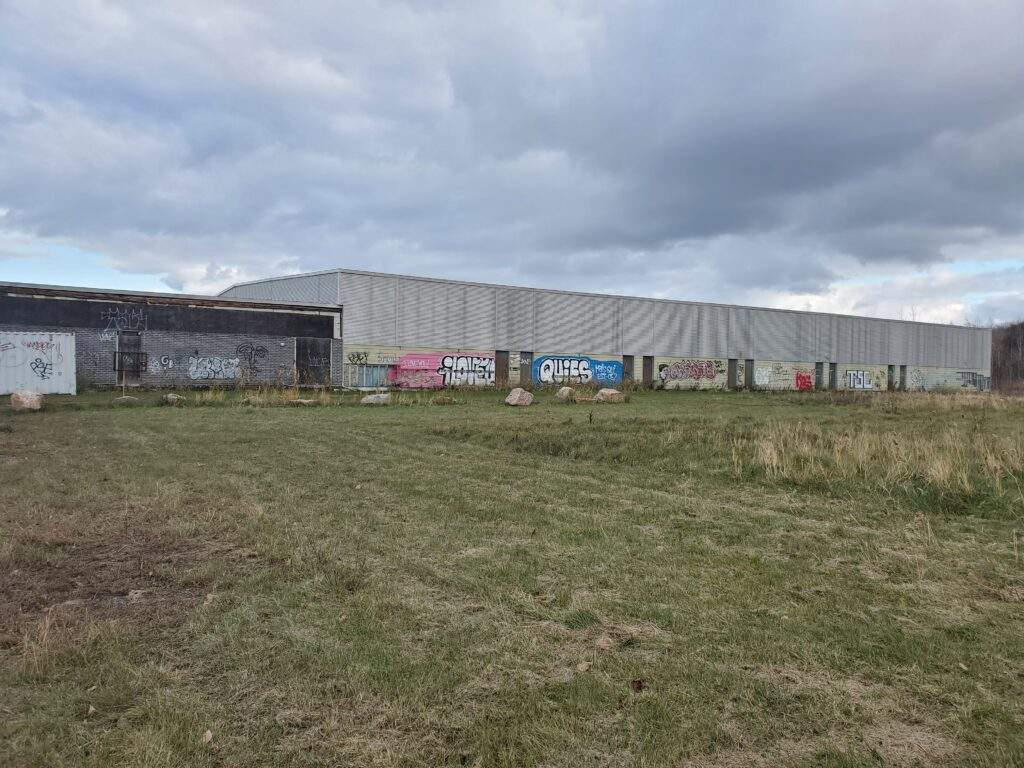
The project would also mean the abandoned building still on the site, which has been covered with graffiti and has long been an eyesore in the neighbourhood, will finally be torn down.

The dilapidated structure, which was never completed, near Fifth Avenue, was abandoned not long after construction of what was to be an arena began in 2003 due to financing issues.

Pincourt had subsequently faced a lawsuit by the building’s contractor. The dispute lingered in the courts for seven years before the town decided to purchase the building in 2012 for $3.25 million.

There had been multiple attempts since then by the town to sell the property to private firms for development, but each attempt failed to move the project forward. In 2019, the town had announced it would demolish the decrepit structure, but that plan was delayed as well.

Shortly after the 2021 election, Comeau promised to relaunch the project. With support from Vaudreuil MNA Marie-Claude Nichols, the town sought financial assistance from the Quebec government in 2023, but that bid was ultimately declined.

The town has since “deemed it appropriate to explore new avenues to bring this project, which is eagerly awaited by the population, to fruition,” the statement continues.

Over the past couple of years, the town has been meeting with officials of the neighbouring municipalities of Terrasse Vaudreuil, Notre Dame de l’Île Perrot and L’Île Perrot pitching the project as one that would benefit all concerned, as there is currently no arena on the island. All the towns have agreed to collaborate to see this project through.

“I am convinced that we can all work together to finally deliver this project, which is crucial for all citizens of the island,” Comeau added.

There is no precise timeline for when the study will be completed, but the town is hoping to have it by the end of this year, Pincourt communications director Vicky Sauvé told The 1019 Report.

Pincourt breathes new life into long-awaited arena project Read More »

At least two new faces running for St. Lazare council

JOSHUA ALLAN
The 1019 Report

In the 2021 municipal elections,only two of the nine positions on St. Lazare council were contested, drawing only a small fraction of the more than 16,000 registered voters to the polls.

This year, with a challenger running against incumbent Mayor Geneviève Lachance and three first-time candidates having already stepped forward to run for council, the November vote is shaping up to be a little bit more of a contest.

In District 8: Incumbent councillor David Hill, who was acclaimed in 2021, is only one of nine incumbents who has yet to announce whether he will run again in this district that covers much of the west end of the town.

While Hill said he will announce his intentions “in the next few weeks,” a challenger has stepped forward.

Daniel Thibaudeau is seeking the seat. A retired Sûreté du Québec officer, who spent nine of this 33 years on the force as the national spokesperson for the SQ, says he’s ready to give back to the community once again.

“With my background (in the SQ), I can bring that experience to the table at the city council in affecting change regarding many aspects of public safety,” Thibaudeau explained in an interview. “Looking at infrastructures and doing crime prevention and traffic safety through environmental design is one of my specialties and I look forward to putting that to the benefit of the citizens.”

Thibaudeau, who was awarded the Governor General’s Police Exemplary Service Medal in 2024, said his top priority is to address the looming issue of water quality and pressure in the Green Maple Hill neighbourhood – a small cluster of about 60 homes in the far-west sector in District 8.

“I want to get that file rolling and make sure that those people have adequate drinking water services,” Thibaudeau explained.

Like Hill, Thibaudeau said he wants to focus on preserving the natural character of the district, which covers heavily-forested areas west of the Saddlebrook neighbourhood. However, Thibaudeau explained he would take a more pragmatic approach to the role, differing himself from Hill’s approach, which he described as more of an activist.

Hill has voted against several development projects because they are “incursions into pristine forested areas.”

“We need people like that, most definitely,” Thibaudeau said of Hill. “They have their role. But his role in municipal council is not expected to be one of activist. It’s one to be working for the people and concretely achieving change.”

Thibaudeau added that he would be open to development in the district to meet with the increasing demand for housing. “But development on our terms, by our standards and at our pace.”

In District 7: So far there is only one declared candidate in this district, which covers the central-west portion of the town, including a swath north of Ste. Angélique Road east of Côte St. Charles.

Incumbent Donald Andrews, who won the seat by acclamation in 2021, said he will be running again.

In District 6: With incumbent Brian Trainor already stating he will not seek re-election, first-time candidate Lorraine Caron is the only registered candidate running in the ward, which covers the Cedarbrook neighbourhood.

A scientific researcher and consultant with a PhD in biomedical sciences and bioethics, Caron has held numerous committee roles with the town over the past decade. These include chairing the town’s environmental committee since 2016 and sitting as a member of the town’s Economic Development Committee since 2021. In 2023, she was recognized as St. Lazare’s “Volunteer of the Year.”

“I want to get involved in municipal politics to play a more proactive role in the decisions that will shape the long-term evolution of my town,” Caron stated in a press release.

Her priorities include maintaining “sound financial management,” adapting the town to climate change, preserving St. Lazare’s natural heritage and promoting the local economy.

In District 5: So far, incumbent Richard Chartrand is the only candidate. Chartrand has held this district, which covers much of the central area of the town, stretching westward from Bédard Avenue to Rue de l’Héritage since 2017. He was acclaimed in 2021.

In District 4: Incumbent councillor Michel Poitras is looking to hold on to his seat, which covers a central area of the town east of Bédard Avenue.

In 2021, this was one of the two seats that was contested, with Poitras winning the contest with just over 70 per cent of the vote cast.

In District 3: With incumbent Marc Emond having confirmed his intention to run for re-election last week, this is the only district where a race is guaranteed in the November election.

Emond won the ward, which covers the easternmost area of the town, including the Chaline Valley neighbourhood, in 2021 with a slim 51.5-per-cent majority.

To date, his only challenger is Roselyne Legault, a retired labour lawyer and former teacher who wants to encourage more residents to get involved in governance at the local level.

“The first government with which we can engage, it’s the municipal government,” Legault said in an interview. “We can speak much more easily to our municipal representatives than to our (MNAs or MPs).”

Many residents are unaware of the responsibilities of municipalities, how municipal budgets work or how to make sense of some of the language used by municipal governments, she said.

“Sometimes, governmental language, it’s like Chinese,” she said. “Often, when you don’t understand, you can’t get interested. We must improve resident participation and demystify the government language.”

“Through my training as a lawyer and teacher, I’m used to explaining things and simplifying them so that people understand,” Legault added.

She would maintain a constant on-the-ground presence in order to check the pulse of the district. “When you see people face to face, you better understand the situation.”

In District 2: To date, there is no declared candidate in the ward, which covers the town’s northeastern area, made up mostly of agricultural land.

Incumbent Pierre Casavant has not publicly announced whether he will run for re-election, and has not responded to a request for comment. He has represented the district since 2019, winning his seat in a by-election. He was re-elected by acclamation in 2021.

In District 1: Incumbent Tanja Minisini has confirmed her intention to run for re-election. The ward, which includes the north end of the town, including a cluster of homes south of Highway 40, and stretches to Harwood Boulevard, just south of Hudson. Minisini was acclaimed in the 2021 election.

Residents interested in running for town council have until Oct. 3 to register as a candidate. Municipal elections across Quebec will be held on Nov. 2.

At least two new faces running for St. Lazare council Read More »

Municipal merger advocate running for council in N.D.I.P.

JOSHUA ALLAN
The 1019 Report

One of the people that founded a group advocating for the merger of the four municipalities on Île Perrot has stepped forward to run for a council seat in Notre Dame de l’Île Perrot, a move that will put the issue of municipal fusions on the debate table.

“This will surely be a subject that will be discussed with people I meet to see how they feel about it,” said Lise Chartier, who announced her candidacy for the District 3 council seat last Wednesday. “I think one must see people, meet with them, talk with them (and) see what their positions are.”

“I intend to ask people ‘What would this mean for you? Do you want it? Would you like to know (about it)?’” said Chartier, who is a former journalist, communications professional and historian who’s written three books on the history of the island of Île Perrot. “Knowledge is the basis for good decision-making.”

The topic of a possible merger of the municipalities of Notre Dame de l’Île Perrot, L’Île Perrot, Pincourt and Terrasse Vaudreuil dates back to the 1980s. The subject was revived last year, when Chartier and a small group of residents on the island launched Avenir Île Perrot – Becoming Île Perrot, a grassroots group that is advocating for the merger and currently pushing for the four municipal councils on the island to request a free, no-obligation feasibility study conducted by the Ministry of Municipal Affairs and Housing (MAMH) to give residents all the facts on the pros and cons of a merger. A petition created by the group calling for each of the four municipalities to request the study has collected more than 500 signatures.

Chartier, who served as a board member and communications director for the group recently left Avenir Île Perrot – Becoming Île Perrot as she makes her run for council.

While she agrees a feasibility study would provide a much-needed “base” of information on this topic, she will listen to and respect the will of the constituents.

In July, L’Île Perrot council adopted a resolution requesting the merger study by the MAMH. However, a study can only be done if two or more municipalities adopt the resolution, and the topic has not gained much traction among the three other municipal councils.

Last week, Notre Dame council approved a resolution stating it was not in favour of a merger feasibility study. At the Aug. 12 meeting Notre Dame Mayor Danie Deschênes said a merger would complicate finances for the town, the largest and wealthiest on the island.

“We collectively experience enough instability in other areas of our lives that we do not wish to experience the same in our city and community,” she wrote in a message to The 1019 Report.

“That’s her opinion,” said Chartier of Deschênes’s opposition to municipal mergers. However, she added that the opinions of a mayor are not always shared by a majority of citizens. “I think the citizens should give their opinion.”

District 3, where Chartier will run covers the town’s northeastern section, north of Perrot Boulevard, bordering Lake St. Louis. The seat has been held by Daniel Lauzon since 2009. Lauzon did not respond to an inquiry as to whether he will run for a fifth mandate.

Encouraging more citizen engagement

While the merger question matters, Chartier said she is not a one-issue candidate. If elected, she aims to promote citizen engagement through increased communication.

A former journalist and communications specialist, Chartier said she understands the value of open communication. She had co-founded Caisse, Chartier et associés, a media-monitoring firm that operated Canada-wide for 30 years until it was bought out in 2001.

She has also been involved with various local historical and cultural groups, including the Notre Dame de l’Île-Perrot cultural committee, the Ste. Jeanne de Chantal Heritage Foundation and the Pointe-du-Moulin Historical Park Development Society. She also chaired the Île Perrot 350th anniversary committee in 2024 and serves as president of the Île Perrot History and Genealogy Society.

Municipal merger advocate running for council in N.D.I.P. Read More »

Mom charged with child abandonment remains in custody

FREDERIC SERRE
The 1019 Report

More than two months after a LaSalle mother parked her SUV at the fireworks outlet off Highway 20 in Coteau du Lac and asked an employee to call police saying she had lost her three-year-old daughter, a Quebec Court judge has ordered the woman to remain in custody until her next court appearance on Sept. 8 so that a 30-day mandated psychiatric evaluation can be completed to determine if she is fit to stand trial on charges of unlawful abandonment of a child and criminal negligence causing harm.

The mother appeared before Judge Mylène Grégoire at the Valleyfield courthose by videoconferencing from the Philippe Pinel Psychiatric Institution on Aug. 8, where she has been held since being arrested in connection with the dramatic events that unfolded last June 15. After three days of an exhaustive search by law enforcement throughout the Vaudreuil-Soulanges area, the woman’s daughter was found by Ontario Provincial Police officers in Ontario, on the side of Highway 417 – a rescue that made international headlines.

The woman, 34, was denied bail and a judge ordered the evaluation to determine the accused’s state of mind at the time the alleged crime was committed, in particular whether she was able to distinguish right from wrong.

If found guilty, the mother could face a maximum of five to 10 years in prison.

A publication ban prevents the identification of the accused and her child.

Mom charged with child abandonment remains in custody Read More »

No water bans in St. Lazare

JOSHUA ALLAN
The 1019 Report

St. Lazare will not follow other municipalities in the 1019 region with a temporary ban on non-essential water-use activities amid hot temperatures, according to Mayor Geneviève Lachance.

“We’re nowhere close to a ban,” Lachance told The 1019 Report. “According to our infrastructure department, we’re doing fine at this point.”

Although there is no water shortage in St. Lazare, water usage has increased in the past weeks, and is now considered excessive, according to barometer signs posted along main arteries.

This comes after several municipalities in the region placed temporary bans on lawn watering and other non-essential water-consuming outdoor activities earlier this month. Though temperatures have cooled a bit this week, these bans will remain for the remainder of the summer season.

In the past weeks, the towns of Hudson, Les Cèdres and Vaudreuil-Dorion have all announced bans on lawn watering, pool filling and the washing of cars, windows and driveways.

The smaller towns of Vaudreuil sur le Lac and L’Île Cadieux also have the bans in place, as they are connected to the Vaudreuil-Dorion water supply network.

The municipalities of Rigaud and Pointe des Cascades had previously implemented similar bans earlier this summer, which continue.

In separate public announcements, the municipalities all stated that these measures would prioritize water for drinking, infrastructure use and firefighting.

The restrictions came as Quebec’s wildfire management agency – known by its French acronym SOPFEU – listed Vaudreuil-Soulanges, Montreal and the North Shore as under “extreme” risk for wildfires earlier this month. The situation has since improved, with the SOPFEU lowering the region’s wildfire risk to “moderate.”

Bylaws in St. Lazare restrict the use of water to clean driveways or to fill swimming pools, while lawn watering using mechanical or automatic sprinklers is limited to a strict schedule. Lawn watering using a manual hose and washing individual cars is still permitted at all times.

The town has seen water usage increase in the past three weeks. Last week, St. Lazare’s water consumption was 9,054 m³; while the previous week, from Aug. 4-10, water usage hit 10,012 m³. And the week before that, from July 28-Aug. 3, it hit 9,090 m³.

An acceptable level of consumption is set at 7,299 m³ or less.

At this time last year water usage in St. Lazare was considered acceptable as it averaged about 6,500 m³ per week.

Residents should not confuse the barometer reading of usage levels with available levels of water, Lachance said.

“The barometer is to create awareness about consumption and doesn’t indicate that we’re running out of water,” she said. “As always, we encourage people to use water responsibly and follow bylaws on exterior use of potable water,” she explained.

For the time being, the bans are in place elsewhere in the region. Municipal inspectors are patrolling the towns that have bans in place to ensure residential compliance with these measures. First-time infractions could result in fines ranging from $250 to $500. Vaudreuil-Dorion and Hudson have announced its bans will remain in place until Sept. 2, at which time they will be reassessed.

No water bans in St. Lazare Read More »

St. Lazare mayor ‘underwhelmed’ with improvements to Cité des Jeunes

BRENDA O’FARRELL
The 1019 Report

The Quebec government’s announcement last week of the start of a $59-million project to improve traffic flow along Cité des Jeunes Boulevard in anticipation of the opening of the Vaudreuil-Soulanges Hospital was given a lukewarm endorsement from St. Lazare Mayor Geneviève Lachance.

“It’s an improvement to what it is, but it’s not enough,” Lachance said in an interview with The 1019 Report. “It’s clearly not what we wanted to improve safety and traffic.”

The first phase of the work to be carried out in Vaudreuil-Dorion beginning in the coming days, will see the construction of two roundabouts on Harwood Boulevard — at the intersection with Henry-Ford Street and at the junction of the Highway 30 ramp and De la Gare Boulevard.

A pedestrian and cycle path will be extended to connect the roundabouts to an existing multi-purpose path.

In addition, two intersections in front of the hospital will be reconfigured — at the eastbound Highway 30 ramp and at De la Petite-Rivière Road.

Quebec will also repave the Cité des Jeunes from Ste. Angélique Road in St. Lazare to Henry Ford Road in Vaudreuil-Dorion.

“The widening work will alleviate current traffic issues and accommodate the new traffic resulting from the arrival of hospital services,” said Vaudreuil-Dorion Mayor Guy Pilon in a statement.

Requests from municipal officials to widen the stretch of Cité des Jeunes Boulevard that runs through St. Lazare leading to the hospital, however, have been ignored. Instead, the province will add a turning lane at three intersections along the artery that cuts through the municipality — at Ste. Angélique Road; at St. Louis Road; and at Montée Labossière, where a traffic light will be installed, Lachance said. That work, however, is only scheduled to be carried out in 2027 and 2028, after the hospital is expected to open.

“It’s underwhelming,” Lachance said. “Logically, you would want to address roads before the opening of the hospital, not after. It’s not enough and it’s not being proactive.”

Traffic around the new $2.6-billion hospital, now scheduled to open in the summer of 2027, is expected to increase dramatically. The facility will have just over 3,000 employees and attract thousands of patients and visitors on a daily basis. The opening of the hospital is also expected to spur development along the length of the artery, with the addition of housing and commercial outlets.

In contradiction to Lachance and in clear contrast to St. Lazare’s demand since 2021 to widen Cité des Jeunes into a four-lane artery to facilitate anticipated increased traffic flow on a road that already sees significant rush-hour congestion, Quebec Transport Minister Geneviève Guilbault said:

“This highly structuring project is a concrete response to the current and future mobility needs of the population of Vaudreuil-Dorion and St. Lazare. Our commitment to providing Quebecers, wherever they are in our territory, with access to the best services is once again demonstrated here.”

St. Lazare mayor ‘underwhelmed’ with improvements to Cité des Jeunes Read More »

St. Lazare council approves move to use language other than French

BRENDA O’FARRELL
The 1019 Report

St. Lazare council last week approved a resolution to permit municipal employees to continue using English in some circumstances.

With a deadline marking the expiration of a transition period that would limit how municipal officials can communicate with members of the public in English under the regulations outlined in Quebec’s Bill 96 fast approaching, St. Lazare council voted unanimously to adhere to exceptions provided in the law.

“Nothing will change in the way we operate now,” said St. Lazare Mayor Geneviève Lachance at the Aug. 12 council meeting before the directive was approved, adding that the town’s website will continue to provide some information in English.

Under the implementation guidelines of Bill 96, which updated the province’s French Language Charter, adopted by the provincial legislature in 2022, all municipalities have until Sept. 2 of this year to comply. But there are a few exceptions towns can avail themselves of if they adopt a specific directive.

The Town of Hudson approved a similar resolution earlier this month.

The directive, entitled Directive relative à l’utilisation d’une autre langue que le français, outlines a clear framework for town staff as to when and how they can use English.

Council’s approval of the directive is necessary. Without it, a municipality would not be able to provide a broader range of communication in English to residents after September, when the so-called transition period to the stricter language guidelines outlined in Bill 96 expires.

St. Lazare does not have official bilingual status. Only three municipalities in the Vaudreuil-Soulanges region have bilingual status — Hudson, Pincourt and Île Cadieux.

St. Lazare council approves move to use language other than French Read More »

83-year-old man killed in Coteau quad accident

FREDERIC SERRE
The 1019 Report

The Sûreté du Québec and the Canadian Automobile Association are raising the alarm in the wake of three road fatalities involving quad vehicles this month in the province – one of them claiming the life of an 83-year-old Coteau du Lac man.

At about 10 a.m. on Aug. 7, the victim was riding his four-wheeled vehicle on Route 338 near the Centre nature Quatre-Saisons, east of Route 201, near his home in Coteau du Lac when he was struck by a car driven by a woman in her 50s, the SQ said. The speed limit in that sector is 70 kilometres per hour, according to SQ spokesperson Frederic Deshaies, adding that the collision was extremely violent. Both vehicles sustained serious damage, and both drivers were sent to hospital. The elderly man was declared dead in hospital, while the woman was treated for non-life threatening injuries.

According to former SPVM officer and CAA spokesman André Durocher, the Coteau du Lac incident is the third fatal quad-involved accident this month in Quebec, which, he said, is worrisome because it indicates that cars and quad vehicles are not sharing the roads properly. He urged drivers to be more vigilant and be on the lookout for quad bikes, which are often driven by elderly drivers or people with mobility issues.

“The problem is education,” Durocher said. “People (who drive quads) often don’t really know what they can and cannot do on the roads.”

Between Aug. 7 and 11, three people driving quad bikes died on Quebec roads, including one incident in Nicolet on Aug. 7, where a quad was struck by a truck as the driver of the off-road vehicle drove onto the highway to avoid a pile of garbage on the shoulder of the road. A passenger aboard the bike died. On Aug. 11 at 4:30 p.m., a man driving a quad was struck and killed by a truck in Laurier-Station.

Another problem, according to Durocher, is the lack of uniformity in traffic regulations, which vary from municipality to municipality. He said some cities allow motorized traffic on bike paths, while others do not.

83-year-old man killed in Coteau quad accident Read More »

Hudson strikes deal for Sandy Beach

BRENDA O’FARRELL
The 1019 Report

The Town of Hudson has struck a deal to buy Sandy Beach.

Now, it will be up to residents of the municipality to ratify the agreement that would see the purchase of 35 acres of the wooded waterfront land for $8.75 million as council prepares to adopt a loan bylaw to finance the acquisition.

“Holy s—t! We’re here. All the 30 years on this Save Sandy Beach group and that Save Sandy Beach group have all been working toward this. And we are here,” said Hudson councillor Mark Gray in an interview with The 1019 Report on Monday after council unanimously approved an agreement in principle to purchase the land on the shores of the Lake of Two Mountains.

“It’s a smart deal,” Gray continued. “I think people will see it’s an intelligent approach.”

“The community has asked for it,” said Mayor Chloe Hutchison. “So it is in their hands.

“Here’s an opportunity,” Hutchison added.

In all, the town proposes to buy seven lots — six owned by Nicanco Holdings Inc. and one owned by a numbered company — conditional to public approval of a loan bylaw to finance the purchase.

On Monday, town officials presented a calendar of next steps, which includes a public information meeting on Aug. 27 that will outline the financing details. This will be followed by a special meeting of council on Sept. 11 to present a notice of motion of a loan bylaw, followed by another special meeting of council on Sept. 16 to vote on final approval of the loan bylaw, which will be financed over a 40-year span.

The loan bylaw would be subject to a public register, set for Sept. 24. This process would allow any eligible voters to indicate their opposition to the town borrowing money for the purchase by signing the register. If 491 signatures are collected on the register to block the bylaw, the issue will be put to a town-wide referendum, which would be held after the Nov. 2 municipal election. The outcome of referendum will determine whether the public supports the purchase.

If fewer than 491 signatures are collected on the register, the borrowing bylaw would be approved.

Council is proposing to take $2 million from the town’s accumulated surplus to reduce the amount of the loan bylaw, while an additional $2 million has been offered by the Communauté métropolitaine de Montréal, the regional authority that placed a building freeze on the Sandy Beach area in 2022. But the CMM grant comes with certain requirements, including ensuring that if the green space is opened to the public, that it not be restricted only to Hudson residents.

“We’re ecstatic,” said William Dueck, a spokesman for the Save Sandy Beach group, which has been advocating to save the area from development for several years.

But Dueck admits the community will have to weigh in on whether it wants to accept the CMM grant.

“We have to be careful, I think, as a community to protect and preserve this place,” Dueck said in an interview yesterday. “We have to be careful how this space is managed.”

The Save Sandy Beach group is prepared to ramp up its fundraising effort to help lessen the financial burden on taxpayers, especially if there is a move to refuse the CMM grant and the conditions it comes with, he said.

Fundraising efforts just in the past weeks, he said, have been very positive. And he is optimistic the group’s campaign will help lower the cost of the purchase and/or provide funds to manage its administration and upkeep.

“There’s a huge appetite for this to move forward,” Dueck said. “There’s an appetite for Hudsonites to achieve this goal.

“We all stand to benefit,” he continued. “For everybody in Hudson there is a net gain in having this go through.”

“If citizens really want it, they will have it,” said Helen Kurgansky, a former town councillor who is a member of the board of the Save Sandy Beach group’s registered non-profit organization.

“This is our chance. It’s now or never. We have to grab it,” Kurgansky said. “There are so many reasons to save it. There are people who will help us make it happen.”

Hutchison said the town would look to rezone the area to ensure that it remain a natural space in perpetuity.

If the loan bylaw is approved, she said, the cost per household for the project would appear on municipal tax bills as a separate line item, with the cost, according to her calculations, hovering between $88 and $105 per year. The exact figures will be outlined at the upcoming information meeting and will depend on scenarios that include whether the CMM grant is accepted or rejected and if additional fund from the town’s surplus is put towards the purchase.

Hutchison added that as soon as the bylaw is approved — whether that is after register if fewer than 491 signatures are collected or after a referendum — Nicanco has agreed to open the walking trails and allow access to the beach. The beach has been closed since the spring of 2024, when Nicanco had announced it would no longer tolerate residents and visitors trespassing on its property. The move sparked an emotional response from many residents who had for years enjoyed walking along the trails through the woods that provide access to the beach.

Hudson strikes deal for Sandy Beach Read More »

Vaudreuil among fastest growing rental markets in Canada

BRENDA O’FARRELL
The 1019 Report

Vaudreuil-Dorion is among the Top 5 fastest-growing rental markets in Canada, according to the latest statistics released by Rentals.ca.

The largest municipality in the Vaudreuil-Soulanges region saw 7.6-per-cent growth in its rental market, meaning it saw a jump in the number of units added to the market, according to the Rentals.ca’s August report. It came in behind Kingston, Ont., which saw the largest growth, at 12.3 per cent; Saskatoon, which posted a 9.7-per-cent uptick; Stratford, Ont., which experienced a 9-per-cent increase; and St. Albert, Alberta, which saw its rental market jump by 8.6 per cent.

According to the 2021 federal census, about 35 per cent of the 16,715 private homes in Vaudreuil-Dorion at that time were either condos or apartments.

Rental.ca compiles data from its national rental listings data base in collaboration with Urbanization, a Toronto-based real estate research firm.

In terms of the cost of rents, the report, released Aug. 8, pointed to a downward trend in the price of rentals currently on the market, with an overall slip of 3.6 per cent in July compared with this time last year, according to the report.

This trend did have a few outliers, with only two Quebec municipalities listed as seeing average rents going up — Westmount and Pointe Claire.

See RENTS, Page x.

RENTS: Pointe Claire has most expensive rentals

From Page 1

The average price of leasing an apartment or condo in Pointe Claire in July was $2,227, up slightly from $2,207 recorded in April, the report found. Westmount was the most expensive market in the province, where asking rents in July averaged $2,563 per month. The highest monthly rents were being sought in North Vancouver, where the average was $3,043. Neither Montreal, nor Vaudreuil-Dorion made the Top 25 list of municipalities with the highest rents.

The lowest average rent was recorded in Lloydminster, Alberta, at $1,203. The lowest in Quebec was found in Quebec City, where the average rent was pegged at $1,595.

The overall average rent for the Greater Montreal region in July was $1,971, which represents a 1.6-per-cent decline from the same time last year. The overall average rent for the Montreal region in July was $256 per month lower than in Pointe Claire, a difference of slightly under 13 per cent.

Vaudreuil among fastest growing rental markets in Canada Read More »

St. Lazare mayoral candidates gearing up for fall election

JOSHUA ALLAN
The 1019 Report

Though the official start to municipal election campaigns across Quebec is still a little more than a month away, the two mayoral candidates in St. Lazare are already laying out their pitches to voters.

Incumbent Mayor Geneviève Lachance will face off against first-time challenger Marie Morin, an agriculturalist and business owner. No other mayoral candidates have stepped forward. This will be the town’s first competitive mayoral race since the 2017 election, as Lachance was acclaimed in 2021.

As the summer winds down, Lachance said she’s looking to hear from voters, inviting residents to “kitchen table meetings” to discuss the town’s direction under her leadership, her vision for the future and the challenges that lie ahead. And there will be no shortage of challenges facing the municipality in the next few years, she explained in an interview last week.

“There are so many different things that we can see coming up,” Lachance said.

These challenges include balancing population growth with forest preservation and water management, as well as funding municipal infrastructure and improving public transit. The arrival of the new Vaudreuil-Soulanges Hospital, slated to open in 2027, is also expected to pose challenges.

“That’s a big thing that will have a big impact on St. Lazare,” Lachance said, referring to the hospital. “So we have to be able to plan properly and have a vision of what we want to see and set that vision into a plan.”

Lachance said her chief asset heading into the election is her experience in municipal politics — the past four years as mayor and the previous four as a councillor. She is someone “who knows how the law works, how municipalities work (and) how government works.”

Lachance added that she plans to share more details of her vision for the future of St. Lazare publicly in the coming weeks.

Challenger seeks to encourage voter participation

As for Morin, she pointed to several reasons why she threw her hat into the ring, among them was not wanting a repeat of the 2021 election where Lachance and six councillors won their seats by acclamation.

“I believe in democracy, and democracy only happens if there are elections,” Morin said. “The last thing I want is for people to be acclaimed.”

As the owner of Serre St. Laz, a small-scale vegetable growing operation specializing in hot pepper production, Morin feels local businesses face too much red tape, which hampers the town’s economic viability.

“As a business entrepreneur, my way of looking at it is: Why do we have a butcher who lives in St. Lazare and has his shop in Vaudreuil? Why do we have a baker in St. Lazare that has his shop in Vaudreuil? Or a chocolatier that lives in St. Lazare with a shop in Vaudreuil?”

Her shop is located in neighbouring St. Clet.

Morin would also make environmental health a priority with a focus on forest management that sees dead or diseased trees removed more quickly. She mentioned that she would also be keen to see the town implement measures to prevent potential wildfires from spreading, such as using fuel breaks — a man-made clearing of land between forested areas designed to contain wildfires, which Morin recalled she frequently witnessed in her youth in Alberta.

Morin had told The 1019 Report back in March that she planned to knock on the doors of the more than 7,000 residences in the town to meet voters. That plan was paused due to a notice from Élections Québec informing her that the campaign period begins in September.

“I’m a rule-follower,” she said with a laugh, adding that she’ll pick up where she left off on Sept. 19, the official start day of the election campaign.

Residents interested in running for mayor or for council have between Sept. 19 and Oct. 3 to submit their nomination to the town. Municipal elections across Quebec are scheduled for Nov. 2.

St. Lazare mayoral candidates gearing up for fall election Read More »

Police looking for help after SWAT intervention in Île Perrot

FREDERIC SERRE
The 1019 Report

More details are emerging about last month’s dramatic police operation in Notre Dame de l’Île Perrot, which resulted in the death of a 33-year-old man, who had holed himself up inside a house on Perrot Blvd., after killing his mother in her home in Ville d’Anjou.

After an eight-hour standoff, members of the Sûreté du Québec SWAT team stormed the residence in Notre Dame, only to find Jérémie Béland dead inside of self-inflicted injuries.

At 1 p.m. on July 15, the day of the incident, an investigation into the incident was launched by the Bureau des enquêtes indépendantes (BEI), which investigates all deaths related to police interventions in Quebec.

Last week, the BEI released details regarding the case, and urged the public to come forward with any information that could be deemed useful to its investigation. The BEI also said it has called in the Montreal police department to assist in the investigation.

According to the BEI, Montreal police were called to a residence in Anjou shortly after 5 a.m. on July 15, where they found the mutilated body of 60-year-old Lise Roy.

At 5:08 a.m., a 911 call was made urging police to “intervene with a person who had made disturbing remarks” regarding the killing of Roy, according to the BEI.

Acting on a tip, Montreal police alerted the SQ to report that Roy’s son, Béland, was hiding inside a house on Perrot Blvd. near 192nd Ave. At 5:25 a.m., SQ officers approached the house and saw Béland standing outside. Officers attempted to speak with him, but Béland instead ran inside the house. The officers evacuated nearby residents and cordoned off the area and called in the SQ’s tactical response unit at 9 a.m. During the tense standoff, SWAT officers attempted to contact Béland several times, but without success.

The BEI said a team of officers entered the residence at 11:22 a.m. and found Béland’s body. Paramedics were called to the scene, where Béland was pronounced dead.

A BEI spokesperson said the investigation is continuing. Anyone with information is asked to contact the BEI at 450-640-1350.

Police looking for help after SWAT intervention in Île Perrot Read More »

Hudson weighs options for park improvements

BRENDA O’FARRELL
The 1019 Report

A total of 232 Hudson residents last month offered their two cents worth on how the town should improve its parks, indicating their preferences about what they would like to see added to the outdoor spaces, and including whether its main baseball diamond in the centre of the village should be relocated.

The input was solicited through an online survey, after the town hosted a public meeting that outlined options for its Parks and Green Spaces Master Plan 2025-2035. A range of possibilities were outlined to upgrade Hudson’s three main municipal parks and enhance its network of walking trails and natural parks.

The presentation was based on two main themes: to build and enhance the natural settings and respond to the recreational needs of diverse age groups.

For the parks, it presented a range of options, including building children’s splash pads to skate parks, ball hockey surfaces to pickleball courts. But the main question posed was where would residents like to see all these features located — at Thompson, Benson or St. Thomas parks.

The proposal floats the idea of creating a sports hub, that would bring a number of sports fields together. But the question to be determined is whether that should be centred at Benson Park, which already has a ball field. Or, move the ball field to Thompson Park in the west end of town.

The consultation also solicited feedback on how to enhance the town’s network of walking trails and other nature parks, including Jack Layton Park along the waterfront.

Consultants are now tabulating the input from residents. The input will serve to guide the final draft of the town’s parks plan, which council aims to adopt next month.

“What I would like to see come out of this is a committee for recreation,” said Hudson Mayor Chloe Hutchison at the public consultation.

Specific timelines, along with costs to implement the plan will still have to be determined.

Hudson weighs options for park improvements Read More »

Victims in head-on crash recovering

FREDERIC SERRE
The 1019 Report

While a Sûreté du Québec investigation continues into a head-on collision last month on Highway 20 in Coteau du Lac that killed a 25-year-old St. Polycarpe man, police now say the two occupants of one of the vehicles are expected to make a full recovery despite an earlier report by the SQ that their lives were in danger.

“The two victims are still hospitalized for major injuries, but we no longer fear for their lives,” said SQ spokesperson Elizabeth Marquis.

For an unknown reason, at about 12:45 p.m., on July 21, the St. Polycarpe man’s car veered off the eastbound lane of the highway in Coteau du Lac, crossed the median and slammed into a westbound car driven by a retired SQ officer and a female passenger. The impact was brutal, trapping all three victims in the wreckage. While the St. Polycarpe man was declared dead at the scene, firefighters used the Jaws of Life to extricate the two other victims, who were rushed to hospital with life-threatening injuries. Police now say they are expected to make a full recovery.

The SQ said the investigation is looking into all aspects of the crash to see if driver distraction, a medical issue or a mechanical problem played a role.

Victims in head-on crash recovering Read More »

Probe to look at municipal vehicle maintenance

BRENDA O’FARRELL
The 1019 Report

The City of Vaudreuil-Dorion is one of three municipalities across the province that will be subjected to a performance audit by the Commission municipal du Québec, it was announced last month.

Specifically, the examination by the provincial administrative tribunal will focus on the practices involving municipal vehicle fleets, the commission stated, including how vehicle maintenance is planned, implemented and monitored as part of a municipality’s responsibilities to deliver services.

The other towns selected to undergo the review are Boisbriand, a town in the Laurentians with a population of roughly 28,300; and Sorel-Tracy, east of Montreal on the south shore of the St. Lawrence River, which has just over 35,165 residents. Vaudreuil-Dorion has a population of 43,270, according to the 2021 census.

“The performance and availability of vehicles, machinery and equipment operated by municipalities are crucial for many citizen services, including snow removal, roadworks and the maintenance of infrastructure, buildings and parks, to name a few,” the commission outlined in a public statement. “Municipalities are, therefore, responsible for periodically maintaining their rolling stock to ensure its proper functioning throughout its lifespan, thus meeting the needs of their community.”

“Auditing the maintenance and availability of rolling stock means ensuring that municipalities have the necessary means to provide essential, reliable and continuous services to their population,” said Nancy Klein, interim president and vice-president of the municipal commission’s audit division.

The commission will conduct a detailed analysis of the procedures used in each municipality that has been selected for the audit. A report will then be prepared and made public. The process is expected to take a few months to complete.

The municipal commission routinely carries out a series of audits focused on a variety of issues involving municipalities every year.

The topics selected are based on risk analyses and other sources of information, including financial analyses, media monitoring, topics of interest, and concerns expressed by various stakeholders involved in the municipal sector, said commission spokesman David Dusseault in response to questions from The 1019 Report.

Hudson was part of 2023 audit

In 2023, the municipal commission conducted a financial audit of budgetary surpluses and reserves in towns with fewer than 10,000 residents that included Hudson and two other municipalities. It concluded that Hudson lacked the appropriate planning and supervision when it came to the management of its accumulated budget surpluses, according to the commission’s report issued in March 2024. It also made a series of recommendations.

According to the report, in 2021, Hudson had accumulated $9.9 million in allocated and unallocated surpluses. The total dropped to $9.8 million in 2022, which represents about 58 per cent of the town’s total budget for the current year. That figure has been whittled down since then, as the current council has used some funds to offset recent capital expenditures.

Earlier this year, Hudson council approved it annual financial report that showed it ended 2024 with a $2.2-million operating budget surplus, and an accumulated surplus standing at $5.2 million, up from $4.7 million at the end of 2023.

A request for comment from Vaudreuil-Dorion director-general Olivier Van Neste by The 1019 Report has gone unanswered.

Probe to look at municipal vehicle maintenance Read More »

Conservation plan IDs priority corridors in Hudosn

BRENDA O’FARRELL
The 1019 Report

The environmental mantra that urges people to “think globally, act locally” was reinforced Monday in Hudson as the town’s council adopted its long-awaited conservation plan that outlines what natural spaces should be protected.

“This is where the rubber meets the road,” said councillor Mark Gray, who is one of council’s advocates for natural space protection.

The plan is an important step, he said, to “enact legislation, bylaws, to protect biodiversity.”

The plan, which has been in the drafting stage for more than a year, identifies three main ecological corridors as “high priorities for conservation.”

These include the Viviry River corridor, which traces its way from Harwood north to the Sandy Beach area; the Black Creek corridor, in the Como district, which in turn links up with the Viviry; and what is known as the Alstonvale Escarpment corridor, in the western end of the municipality.

“I’m very proud that we’ve come this far with conservation and of the amazing team working on the town side as well as an amazing group of citizens on the environment committee,” Gray said.

“This is putting the international decrees into action,” Gray said, explaining how the plan provides a framework to fulfill accepted commitments to save 30 per cent of natural spaces. “And that is a big deal.”

The plan also aims to help restore degraded ecosystems through management, engage private landowners to be part of the conservation effort and improve sustainable access to nature.

An example of how to improve ecosystems, Gray said, is a pilot project that has recently been started that will see better forest management in the woods around Le Nichoir.

This is the first plan that includes the entire territory of the town, not just the municipality’s urban perimeter, Mayor Chloe Hutchison said. It also outlines what she called a “concerted approach” that not only includes the town, but private landowners, conservation groups and other stakeholders who can all contribute to preserving natural spaces.

The town, she explained, cannot aim to own 30 per cent of the land mass in its territory to ensure its protection, but it can collaboratively encourage it.

The town currently owns about 10 per cent of natural spaces in the municipality, Hutchison said.

Conservation plan IDs priority corridors in Hudosn Read More »

Hudson council approves move to use language other than French

BRENDA O’FARRELL
The 1019 Report

How municipal officials communicate with members of the public in English is about to change across the province as new restrictions outlined in Quebec’s Bill 96 come into force next month.

But a directive approved by Hudson town council on Monday aims to maintain using another language other than French in some circumstances, despite the fact that it is one of three municipalities in the Vaudreuil-Soulanges region that has bilingual status.

Under the implementation guidelines of Bill 96, adopted by the provincial legislature in 2022 that amended Quebec’s French Language Charter, all municipalities have until September of this year to comply.

But there are a few exceptions towns can avail themselves of if they adopt a specific directive. And that is what Hudson did Monday evening.

Hudson council unanimously approved a motion, entitled Directive relative à l’utilisation d’une autre langue que le français, which outlines a clear framework for town staff as to when and how they can use English.

Council’s approval of the directive is a key move. Without it, a municipality would not be able to provide a broader range of communication in English to residents after September, when the so-called transition period to the stricter language guidelines outlined in Bill 96 expires.

St. Lazare council is expected to make a similar move later this month, according to Mayor Geneviève Lachance.

“It’s a directive that allows employees to apply the exceptions specified in Bill 96 concerning the use of other languages,” Lachance said. “And yes, we plan to meet the deadline. Having said that, Bill 96 brings a level of complexity to municipalities like ours who in real life are truly bilingual even if in the eyes of the (Office québécois de la langue française), we’re not because they use birth language and not spoken language as a base of their law.”

The exceptions include in emergencies, in situations involving public safety, fire prevention, crime prevention, extreme weather events, to ensure that bylaws are accurately interpreted and issues touching on tourism. They also include communication to residents directly from the mayor.

St. Lazare does not have official bilingual status.

Reporter Joshua Allan contributed to this report.

Hudson council approves move to use language other than French Read More »

St. Lazare celebration pack Just-For-Laughs, Cirque-du-Soleil punch

JOSHUA ALLAN
The 1019 Report

The Town of St. Lazare’s is aiming to cap off its 150th anniversary celebrations with a “major event of the year” later this month, and have turned to a former head of production with the Just For Laughs festival and performers from the Cirque du Soleil to pull it off.

The event is an “urban opera” written by Patrick Rozon, a former executive producer with the renowned Montreal comedy festival, who also happens to be a resident of St. Lazare. The production will be staged in the town’s main park as part of the annual Festi Ouest weekend. It is a six-act performance that “retraces the City of St. Lazare over the (past) 150 years,” said Paul Lavigne, president of the St. Lazare anniversary celebration committee.

“It’ll absolutely be incredible,” Lavigne said. Rozon “really did an awesome job.”

Entitled “L’arbre des merveilles,” the show will be presented on Friday, Aug. 22, at 8 p.m. at Bédard Park.

It is part of ongoing events that have been organized to mark the town’s 150th anniversary and is being touted as a highlight of the third annual Festi Ouest weekend, which runs Aug. 21-24 .

The performance will feature music, historical images of the town, a fireworks display and performers from the Cirque du Soleil. It is based on historical research conducted by the St. Lazare Historical Society

“We’re using local people as extras, dancers from here and musical guests from all over the place. It’ll be an incredible show,” Lavigne said.

The performance will be followed by a “Supper in the Park” on Saturday, Aug. 23. The event will be held under a tent at Bédard Park that can accommodate up to 400 guests.

“We really wanted to create things that happened in the past. We’re bringing back the Saturday family supper,” Lavigne explained. “The supper with friends, neighbours, colleagues, family. Basically, what we want is to recreate a kind of family supper event.”

Tables, chairs and music will be provided. Guests may bring their own food or purchase from the several food trucks that will be on site. The commemorative 150th anniversary beer brewed by the Trois Lacs microbrewery that has been sold at anniversary events throughout the year will be for sale.

A number of events marking the town’s 150th anniversary have been held this past winter and spring. The public reaction to the festivities thus far has been “absolutely incredible,” Lavigne said. “People are just overwhelmed by everything original that we’re doing.”

Third annual Festi Ouest

St. Lazare’s annual weekend of western-themed fun will also be returning for its third edition that weekend, kicking off on Thursday, Aug. 21. Like previous editions, the festivities will include carnival rides, live country music, line dancing classes, food trucks, a mechanical bull and a meet-and-greet with some of the horses from Les Forestiers Equestrian Club and the Équi-Libre Therapeutic Riding Centre.

Saturday will feature country artists Sorenne, who performs in both English and French; Félix Lepage, a performer from Les Coteaux; Brittany Kennell, from Beaconsfield, she appeared on The Voice; and Guylaine Tanguay, who has performed with Roch Voisine. They will take to the stage between 11:30 a.m. and 10 p.m. Quebec artists AUDRÉE, Rebell Country and Dunberry will perform on Sunday, from noon to 4 p.m.

“This year is going to be an amazing year,” said Mayor Geneviève Lachance, referring to combining Festi Ouest with the 150th anniversary celebrations. “Just to celebrate the city and get together, all year it’s been a lot of fun.”

She has found it touching to see residents of all ages interacting at events like these, including between those who have recently moved to town and those who have lived there all their lives.

“That’s what I’m looking forward to the most, just the community gathering and the celebrating and people just being happy,” Lachance said.

Both Festi Ouest and the 150th anniversary celebrations are free events. Bracelets for access to unlimited rides are available for purchase online via the town’s website.

St. Lazare celebration pack Just-For-Laughs, Cirque-du-Soleil punch Read More »

Sandy Beach deal close, Hudson mayor

BRENDA O’FARRELL
The 1019 Report

The Town of Hudson is close to reaching a deal to purchase Sandy Beach, said Mayor Chloe Hutchison on Monday, adding she is hoping to schedule a public meeting in the next few weeks to outline the structure of a financing plan, including when a borrowing bylaw would be put to council.

“There could be a public information meeting before the end of the month if all goes well,” Hutchison said in an interview after Monday’s regular town council meeting, but cautioned negotiations are still ongoing with Nicanco Holdings, the owner of the forested land along the shores of the Lake of Two Mountains, and no final agreement has been reached.

The amount the town has put forward as a bid to purchase the land has not been made public.

Hutchison, however, is optimistic an agreement in principle could be reached in the coming days “if all goes well.”

Councillor Mark Gray echoed the sentiment.

“We’re optimistic,” Gray said Monday evening, referring to a possible deal in the coming days.

When asked to comment, councillor Reid Thompson said simply to watch the town’s website for an announcement of a public meeting.

Hutchison said the public meeting would “explain the numbers” of an agreement in principle, including the structure of how it would be financed, amounts that would be generated through a borrowing bylaw, sums attributed from the town’s accumulated surplus, capital pledged through a fundraising campaign and any possible grants to come from other sources.

Residents would then be given the opportunity to express their support or opposition through a register process that would be triggered when council approves a borrowing bylaw. If enough signatures are collected on the register to block the bylaw — a number Hutchison said would be approximately 10 per cent of eligible residents — the bylaw would be put to a town-wide referendum for approval.

The register could be held before the Nov. 2 municipal election, Hutchison said. But if enough opposition is expressed and the bylaw is put to a referendum, that step would have to be scheduled after the election.

That timeline would mean the ultimate decision to hold a referendum or drop the borrowing bylaw would be a left to a new council.

Members of the current council this week will be reviewing a report prepared by financial consultant Raymond Chabot Grant Thornton that provides an analysis of the impact a proposed deal would have on taxation.

Negotiations to buy the waterfront land surrounding Sandy Beach began in earnest in February, when Hudson council put an offer on the table to buy the tract of land that has been the focus of a growing grassroots campaign to preserve the natural space from development.

The offer came after the town commissioned two reports at a combined cost of $52,500 to determine the market value and a cost-benefit analysis of the proposed development plan for the site, which included potential infrastructure and service costs to the town.

The reports were ordered after Nicanco representatives asked the town if it would be interested in discussing a possible deal, marking the first time in recent years it had considered the option of a sale to the municipality.

Sandy Beach deal close, Hudson mayor Read More »

Nichoir urges those who fish to collect all gear

JOSHUA ALLAN
The 1019 Report

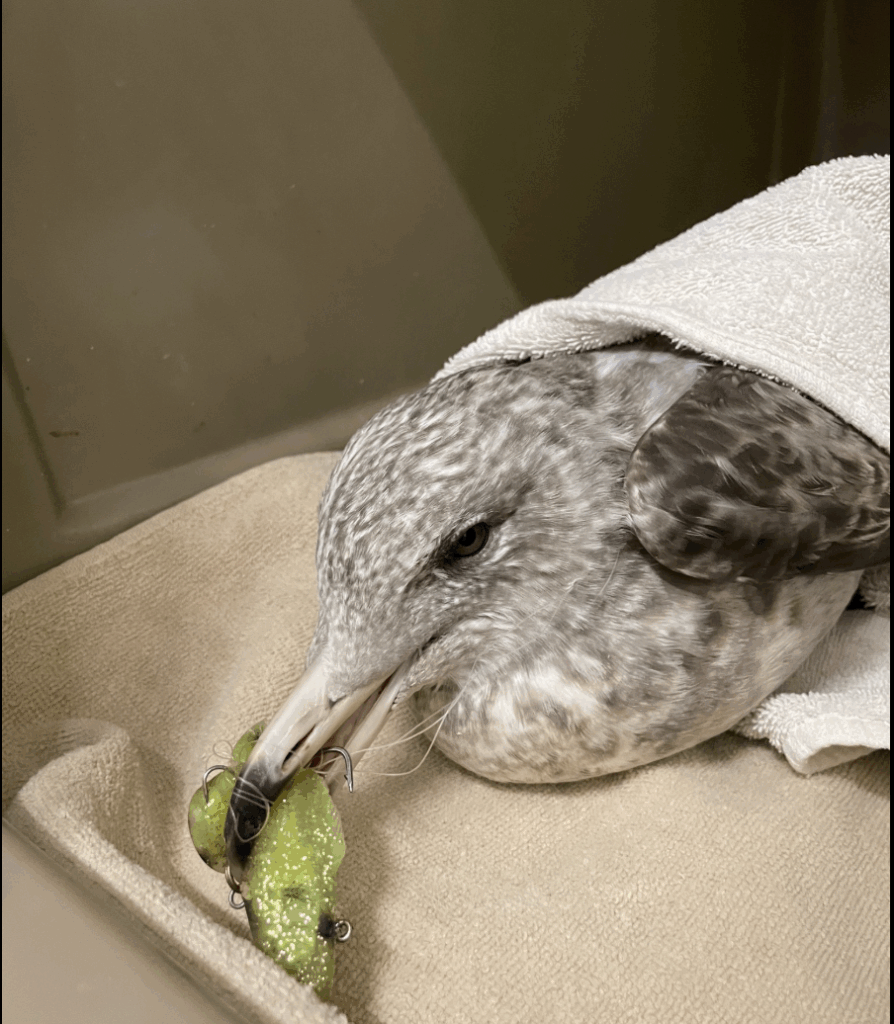
Le Nichoir bird conservation centre in Hudson is reminding residents not to abandon any fishing gear after the death of a young female mallard last week. The bird was admitted to the centre last Sunday with a fishing line tangled around its body and fish hook caught in its wing, requiring surgery. Despite the surgery having gone “really well,” the bird died the following day.

“Anytime we get a bird that was affected by fishing material, it always breaks our heart,” said Élise Laferrière, the education program coordinator at Le Nichoir.

Most residents enjoying summertime fishing may not think twice about cutting a tangled line, losing a small lead sinker or releasing a fish back into the water that had swallowed a hook too deeply to be removed.

“It’s been happening as long as people have been fishing,” said Laferrière. “And with the years, of course, those discarded materials accumulate.”

Le Nichoir treats about half a dozen birds that have been badly injured by abandoned fishing gear each summer, she said.

“And those are only the birds that were found,” Laferrière explained.

Cases often involve these birds getting tangled in abandoned fishing lines, sometimes cutting off circulation to one or more limbs and requiring amputation. Many fish-eating birds, especially loons, will also inadvertently consume hooks that have been left inside fish, causing severe internal damage, Laferrière said.

Even small lead fishing sinkers, a pack of which can be bought at Canadian Tire for around $7, can have a negative impact when left at a fishing site. Many species of birds swallow small stones to help with digestion, which can be easily confused with these lead sinkers.

“That causes an acute poisoning,” Laferrière explained. “They (become) anemic. They have severe neurological symptoms. Most of the time they will die from it.”

What’s more, deciding whether these injured birds require surgery is always a tough call for the workers at Le Nichoir, Laferrière added. Wild birds don’t tolerate anesthesia well, raising the risk of them dying during surgery or soon after.

“But we can’t just leave (them) because they will die from infection,” she said.

Residents who go fishing can prevent these unnecessary injuries to birds by being more mindful of their gear, Laferrière explained. This includes ensuring that all gear that was taken for fishing is brought back home at the end of the day.

Prevention may also include small changes in the choice of fishing gear, like using steel or copper sinkers instead of lead ones, and using barbless hooks that are more easily removed while catch-and-release fishing.

“We always say that it’s always better to prevent (these injuries) than to try and heal them from it,” Laferrière added.

Nichoir urges those who fish to collect all gear Read More »

Vaudreuil man to remain in psyche hospital

FREDERIC SERRE
The 1019 Report

Fabio Puglisi, the 45-year-old Vaudreuil-Dorion man who two months ago was found not criminally responsible for killing his mother and a neighbour and seriously injuring a third woman during a violent knife attack inside a Vaudreuil condo building last year, has been designated a high-risk offender and will never be released from the Philippe Pinel pyschiatric hospital, where he is being held.

The decision was made by Quebec Superior Court Judge Alexandre Bien-Aimé on July 7 at the Valleyfield courthouse. Bien-Aimé said Puglisi represents a threat to society if he is released because of his mental illness and violent outbursts. Bien-Aimé is the same judge who on May 12 ruled Puglisi wasn’t responsible for the killings due to his mental illness, adding that he suffers from schizophrenia, which causes him to be unpredictable and violent.

On the afternoon of Feb. 15, 2024, Puglisi murdered his mother, Elisabetta Caucci-Puglisi, 68, and neighbour, Manon Blanchard, 53. Evidence presented in court revealed that Puglisi stabbed his mother more than a dozen times inside their sixth-floor apartment before attacking Blanchard, who was killed when she knocked on the door of Caucci-Puglisi’s condo to let her know that her dog was running loose in the hallway. After killing both women, Puglisi fled into the hallway, where he stabbed and severely injured 70-year-old Nighat Imtiaz.

Puglisi has a long history of mental illness and assaults. He was diagnosed with schizophrenia in 2012 after being charged with assaulting a complete stranger. He was also charged with assaulting a woman and held in a psychiatric institution for several weeks. While being monitored by a CLSC, it was learned that Puglisi had stopped taking his medication while still living with his mother.

Vaudreuil man to remain in psyche hospital Read More »

Have a beer and protect ancient water source

JOSHUA ALLAN
The 1019 Report

All towns in the 1019 region face the challenge of balancing population growth with maintaining an adequate water supply. However, some smaller municipalities in the region’s western edges face unique challenges on that front — without municipal water systems, the towns of St. Télesphore, Rivière Beaudette and part of St. Polycarpe rely on an ancient groundwater source, known as an esker.

“We made it our mission to preserve the esker sector, because the sector is very fragile,” said Marie-Louise Séguin, one of the founding members of the group L’Esker de Vaudreuil-Soulanges. The non-profit organization held a launch party July 11 to celebrate its renewal as a group dedicated to the protection of a 12-square-kilometre area in St. Télesphore, as well as to broadening public knowledge about its functions and importance to the area.

L’Esker de Vaudreuil-Soulanges is a grassroots group that had been formed in the fall of 2023 to advocate against a plan put forward by the MRC Vaudreuil-Soulanges to build a compost facility north of the esker.

“It was a vulnerable location (for the project),” said Séguin, explaining that such a facility risked contaminating the water source.

The MRC ultimately abandoned its original plan. It is now proposing to build a multi-million-dollar compost-processing site on an 11-acre tract of land in the industrial park in Coteau du Lac.

Today, the group seeks to educate residents about the esker’s importance, not only as a source of drinking water, but also as part of the region’s “geological heritage,” Séguin explained, adding that it is “a unique and impressive ecological formation.”

The esker is a remnant of the Ice Age, when Canada was covered by a glacial sheet. The erosion of these glaciers about 10,000 years ago left behind geological ridges of sand and gravel deposited by glacial meltwater which are found across Canada and parts of the United States. This created a unique source for natural groundwater filtration, resulting in high-quality potable water.

A special feature of L’Esker de Vaudreuil-Soulanges’ July 11 launch was the introduction of a new craft beer, made with water sourced directly from the esker. The beer, named “L’Esker,” is brewed by the Ferme Brasserie Schoune, located just north of the ecosystem. The beer can sports the group’s blue water droplet logo. For each can sold, the Ferme Brasserie Schoune says it will donate $1 to L’Esker de Vaudreuil-Soulanges. The group is also accepting donations online.

The group says it plans to carrying out environmental studies of the esker, as well as organizing various public awareness campaigns to promote its continued protection.

Have a beer and protect ancient water source Read More »

Vaudreuil to build $14.7M refrigerated outddor rink

JOSHUA ALLAN
The 1019 Report

The City of Vaudreuil-Dorion is moving forward with a plan to construct a $14.67-million covered refrigerated ice rink in a park just north of Cité des Jeunes Blvd., near the junction with De la Gare Blvd.

City council adopted a loan bylaw for the project at the July 7 city council meeting, which then put it to a register process last Friday to allow anyone against the plan to oppose it. It failed to collect enough signatures to block the project.

The new refrigerated rink will be built in Quatre-Saisons school park, located next to École des Légendes and Hymne-au-Printemps elementary schools. It will have an NHL-size surface (60 metres by 26 metres) and will be included among the many playing surfaces already offered at the park, including a soccer pitch, a basketball court, a playground and a splash pad.

The rink will be built on the eastern side of the park, bordering Toe Blake and Maurice Richard Streets – a fitting location given that both were Montreal Canadiens legends who are in the NHL Hall of Fame. “Rocket” Richard and Hector “Toe” Blake, who also coached the team for 13 years, helped Montreal secure the Stanley Cup a combined 12 times in the 1930s, ’40s, ’50s and ’60s.

The rink project is part of the city’s five-year capital expenditure plan, which includes adding two pickleball courts and a utility building at the site.

The $14.67-million loan bylaw will be financed over a 20-year period, city clerk Zoë Lafrance explained at the July 7 council meeting.

As winter weather conditions become increasingly uncertain, more municipalities in Quebec are turning to refrigeration technology for outdoor rinks. These types of rinks use generators to keep the ice at an acceptable temperature for skating of around -5° C, even in fluctuating outdoor temperatures that reach as high as 18° C.

The towns of St. Zotique and Notre Dame de l’Île Perrot are currently the only municipalities in the 1019 region that have rinks that use this technology.

There is no set start date for construction of the rink, said city communications adviser Jessica Genest, but the city aims to have it operating for the winter of 2026-2027, and welcome skaters from November to April each year.

Vaudreuil to build $14.7M refrigerated outddor rink Read More »

One year after tornado

BRENDA O’FARRELL
The 1019 Report

It has been a little more than a year since that day when Daniel Gelinas felt the winds pick up violently around his house in Très St. Rédempteur. It was not normal. Then, he spotted a piece of tin fly through the air.

It was the last Monday in May 2024. With tree limbs cracking, debris swirling in a darkened sky, he grabbed his dog, opened the trap door in the floor of his old Canadiana-style farmhouse that gave access to the cellar, dropped the canine in and jumped down himself. By the time he hit the floor, the whole thing was over.

The winds calmed, almost immediately, but the dust-up caused by what was described as “30 seconds of mayhem” continue to swirl in the lives of Gelinas and his wife, Julie Asselstine.

The storm that blew through their lives made meteorological history. It was the first reported tornado to have touched down in this rural stretch of Vaudreuil-Soulanges. As reporters and camera crews found their way to this quiet little town of fewer than 1,000 residents near the Ontario border the next day to assess the damage, Gelinas and Asselstine collected their thoughts as they, too, took in the devastation that marked the twister’s path.

The roof of the old farmhouse they had bought as their retirement home was torn from its rafters. The two large willow trees that framed the old home that was built in 1868 were splintered. The gazebo behind their house was destroyed, with sections of it strewn across the street, while its lounge furniture was still visible, wedged high overhead in a nearby tree. The shed the couple had planned to take down was left half standing, tattered and twisted by the violent winds.  

A little over a year later, the scene is very different.

When asked what the last year has been like for the couple, they hesitate. They smile at each other, seemingly searching for where to begin.

“It was so intense — every day,” said Asselstine.

They faced a whirlwind of decisions. And it started with trying to figure out what to do, how to do it and where to start. And keep their wits about them. That is the year they have had.

Today, their house looks very different. The shape, the colour, the height, the style, the finishings — it’s all distinctly changed.

The damage forced the couple to basically rebuild it. As Gelinas explained, insurance covered the cost of replacing the roof and much of the upper storey of the old farmhouse, but a structural engineer told them the home’s original stone foundation had to be replaced. They had to find a budget for that.

A new foundation meant the house had to be raised. A new roof, meant the upper level had to be reconfigured. But the middle part of the original structure is still part of the new building.

As the renovations progressed, other issues had to be addressed — rot found behind the cladding in one wall, they always planned to add an extension as they needed more room, the list went on.

“We were forced to do a lot of stuff right away – what we were going to do over five and 10 years,” Gelinas said, explaining how he viewed their approach.

“We were hit with a tornado, so go big or go home,” is how Asselstine described it.

How they characterized the process of getting through it all, however, was similar: It was a life-changing ordeal that today they are surprisingly grateful for. Yet, they admit there were a few moments that brought them to tears and tested them to their core.

They are pleased with their new home, and point to the improvements made to the property they purchased in 2020 as they planned for their retirement — like the new building that replaced the old shed that was destroyed. It houses the gym Gelinas always wanted, complete with a cedar-lined sauna and office space for Asselstine on the second storey. They also point to parts of a willow tree destroyed by the wind that now sits by their front fence waiting to be picked up. They have engaged a furniture maker to transform it into a dining room table for their new home, a memento of sorts, of the storm’s damage.

The renovations continue, but the bulk of the work is done.

“It was a heck of a challenge,” Gelinas said, as he looked at Asselstine. They smile at each other, and their eyes scan their property, seemingly searching for how to describe it in more detail, but settle to let a brief silence sit.

Those “30 seconds of mayhem” on a Monday in May 2024: “We constantly say it was a gift, honestly,” Asselstine finally says.

One year after tornado Read More »

One town backs call to study Ile Perrot merger

JOSHUA ALLAN
The 1019 Report

At the urging of a grassroots groups advocating for the merging of the four towns of Île Perrot, L’Île Perrot’s council has approved a resolution requesting the Quebec government conduct a feasibility study on the possible fusion of the four municipalities on the island. But it is going to take more for the study to be triggered.

“We consider it to be a good coup,” said Gérard Farmer, president of Avenir Île Perrot – Becoming Île Perrot, of the resolution, explaining that other towns will have to pass similar resolutions before the Ministry of Municipal Affairs and Housing will conduct the analysis.

L’Île Perrot’s council opted to make the first move, unanimously adopting the resolution at its July 8 meeting, because the study would outline the pros and cons for any potential merger, said Mayor Pierre Séguin.

“The council and I think that if there was a serious study made that said the pros and cons (of a merger), the citizens could make a decision about whether they’re for it or not,” Séguin said in an interview last week.

The study can only be done at the request of two or more municipalities. Avenir Île Perrot – Becoming Île Perrot — a grassroots group focused on promoting the merger of the municipalities of L’Île Perrot, Notre Dame de l’Île Perrot, Pincourt and Terrasse Vaudreuil into one city — recently launched a petition calling for each of the four municipalities to request the study. The petition has collected more than 500 signatures.

The group had previously met with officials from Pincourt, but Farmer said there is little indication that elected officials are looking seriously into passing a similar resolution. A request for comment from Pincourt Mayor Claude Comeau went unanswered.

Though the group is content that L’ Île Perrot council took this step, it doesn’t come as a surprise.

“During our presentations (earlier this spring), the people from the Town of L’Île Perrot were very receptive,” Farmer told The 1019 Report. “So there wasn’t much surprise there because the majority of the councillors at that point were quite in favour of the unification of the cities.”

Séguin has previously spoken in favour of a merger and explained that his council felt the offer of a free, no-obligation feasibility study by Quebec would be too good to pass up. However, he added, “it takes two to tango.”

Both Farmer and Séguin said a feasibility study would at least provide answers to these long-standing questions about merging the towns. Séguin added that he has been hearing the same debate since the 1980s.

“If the study isn’t done, the conversation will continue anyway,” Séguin said. “We can’t ignore the question. Does it make sense? Or, does it not? “If it doesn’t make sense, we stop. That’s it.”

Notre Dame Mayor Danie Deschênes had described the subject as “dépassé” and a “non-issue” in an interview back in May.

“I don’t have any citizens who talk to me about this except those who write to me asking ‘Come on, what is this idea?’” she explained.

Merging the four municipalities would mean combining things like municipal debt, Deschênes said.

“It’s us who will take the lion’s share of this debt,” she said of her town, pointing out the higher average property value.

One town backs call to study Ile Perrot merger Read More »

Soulanges Canal played significant role in Canada’s shipping history

JOSHUA ALLAN
The 1019 Report

For centuries, the St. Lawrence River has served as an important shipping route, giving access to the interior of Canada. And for more than half a century — from 1899 to 1958 — the Soulanges Canal was part of that vital commercial route. Thousands of ships would enter the canal either at Pointe des Cascades or Les Coteaux and travel for 23 kilometres to bypass rapids before exiting and continuing their journey — either westward toward the Great Lakes or eastward out to sea.

Construction of the canal began in 1892, designed to replace the Beauharnois Canal that was not deep enough to accommodate larger cargo ships.

Construction of the Soulanges Canal spanned seven years, with as many as 1,200 workers facing the challenges of having to remove large stones found all long its route.

When it finally opened in October 1899, the canal was the first in the world to use the river’s current to generate electricity, which was used to power street lamps along its route. This electrification also enabled the five locks along the canal to function with fewer operators, allowing the canal to run 24 hours a day.

Four lighthouses — two at both the entrance and exit of the canal — also lit the way for passing ships. These lighthouses in Pointe des Cascades and Les Coteaux are still standing today.

Between 1940 and 1950 an estimated 5,000 ships travelled through the canal, with the last ship passing through in the fall of 1958.

While the Soulanges Canal fell into disuse, its history has been immortalized with numerous information panels that can be found along its 23-kilometre stretch. Over the past 70 years, the canal has also been enjoyed by locals for swimming, kayaking, paddleboarding and other water activities.

Petit Pouvoir

The hydroelectric power station built alongside the canal in Les Cèdres in 1899, dubbed the “Petit Pouvoir,” was designed by engineer Thomas Monro in the Romanesque château style, including turrets, quoins-style corners and cornices.

As with the canal itself, the station ceased operations in 1958, however, the Petit Pouvoir’s impressive architecture earned it a designation as a heritage building by the Quebec government in 1984.

Though the building has been vacant since 1995, Transports Quebec confirmed plans are in the works to restore the historic structure.

“Once restored, the ministry will seek to find a partner who can operate this heritage building in a viable and sustainable manner,” Transport Quebec spokesperson Stéphanie Langelier told The 1019 Report.

There is no timeline for the refurbishing plan, however.

Soulanges Canal played significant role in Canada’s shipping history Read More »

Speeding blamed for collision in St. Lazare

FREDERIC SERRE
The 1019 Report

Sûreté du Québec officers responded to two motor vehicle incidents in the region last Wednesday – both involving speeding and careless driving.

At about 4 p.m., a 911 call was made regarding a collision between a car and a truck on Cité des Jeunes Blvd. near Duhamel Street in St. Lazare. When officers and paramedics reached the scene, they learned that a female driver had struck the rear of a truck and ended up in a ditch. No injuries were reported.

Lamborghini speeding

Two hours later, two SQ patrollers caught a 2025 Lamborghini Huracan, worth an estimated $350,000, travelling along Route 201 in Rigaud at over 120 kilometres per hour in a 70 zone. It took two SQ patrol vehicles to intercept the speeding driver, and while a Lamborghini can reach a speeds up to 325 kilometres per hour, the driver instead chose to stop and was issued a speeding ticket.

Motorcyclist killed in Coteau crash

A 60-year-old man was killed Saturday when he lost control of his motorcycle and crashed while attempting to exit Highway 20 in Coteau du Lac.

The Sûreté du Québec say speed is the likely cause of the loss of control and crash, although the confirmed cause of the accident will only be announced after the investigation is completed.

The accident happened at about 5 p.m., when the motorcyclist was heading west on Highway 20  and took Exit 14, toward Autoroute 201 south to Valleyfield.

According to Ève Brochu-Joubert of the SQ, no other vehicle was involved in the motorcyclist losing control of his bike.

The victim was rushed to a Valleyfield hospital with critical injuries, where he was declared dead, Brochu-Joubert said.

Speeding blamed for collision in St. Lazare Read More »

Hudson gets TOD exemption

JOSHUA ALLAN
The 1019 Report

The Communauté métropolitaine de Montréal aims to more than double the number of people in Vaudreuil-Soulanges who live near an Exo train station — except in Hudson.

The regional authority’s proposed 2026-2046 urban development plan, or PMAD, would see the average number of residences within a one-kilometre radius of train stations in Vaudreuil-Dorion, Pincourt, Terrasse Vaudreuil and Île Perrot stations increased from 40 to 100 dwellings per hectare.

Hudson, which also has an Exo train station, however, has been exempt from having to adhere to the transit-oriented-development (TOD) density levels being imposed by the CMM, Mayor Chloe Hutchison confirmed earlier this month to The 1019 Report.

Hutchison welcomed the CMM’s omission of Hudson from the TOD zones in the proposed PMAD, explaining train departures from the Hudson station are too infrequent to justify a significant density increase.

The increased density requirement would have also have an impact the surrounding natural spaces, she said.

“Had we kept the TOD, that would’ve doubled the density and had (an) impact on Sandy Beach,” Hutchison said. There has been a push by both the town an

Hudson gets TOD exemption Read More »

Police looking for victims of know child molester

FREDERIC SERRE
The 1019 Report

Four months after 41-year-old Michael Michaud pleaded guilty to nine sex-related charges involving at least six boys ages 5 to 11 in various regions of the province, including St. Polycarpe, St. Clet and Île Perrot, police are now seeking the public’s help in connecting Michaud to other potential victims.

On Monday, Montreal police and the Sûreté du Québec issued a joint public alert, saying they strongly believe Michaud abused more victims.

On March 28, he appeared before a Quebec Court judge to plead guilty to charges of production and distribution of child pornography, sexual touching and invitation to sexual touching, and voyeurism.

“We have strong reasons to believe that Michael Michaud probably has more victims,” the statement said, adding that both the SQ and Montreal police have spent the past several months investigating Michaud.

Michaud, who police say was offering babysitting and mentoring services to families of young children, allegedly sexually assaulted several young boys over the last 10 years. According to the charges, Michaud assaulted his victims and filmed the sex acts.

Police allege Michaud’s crimes occurred between 2011 and 2024 in various municipalities in the Greater Montreal region, and that Michaud befriended families with young children, offering them babysitting or mentoring services. It was when he was alone with the children that he allegedly committed acts of a sexual nature on them, police said.

Michaud first appeared on the Montreal police’s radar in 2002, when he was investigated, but later was cleared of sexual assault involving a child. Last October, police released several photos of Michaud, going back to 2002. He was arrested in November 2023.

Evidence presented in court included more than 45,000 photos and 11,000 videos of boys between the ages of two months and eight years being sexually assaulted.

Police are urging the public to call 911 or Info-Crime Montreal at 514-393-1133 or by visiting infocrimemontreal.ca

Police looking for victims of know child molester Read More »

Hudson ends 2024 with $2.2-million surplus

BRENDA O’FARRELL
The 1019 Report

The Town of Hudson ended 2024 with a $2.2-million budget surplus, according to its annual financial report approved by council on Monday evening.

The surplus is slightly less than the reported surplus at the end of 2023, which was pegged at $2.8 million.

“The town is in sound financial health,” said Mayor Chloe Hutchison during the meeting.

Although the town’s budget surplus is shrinking year over year, Hutchison said, she would like to see it drop below the $1-million mark.

The auditors attributed the 2024 surplus, in part, to lower-than-expected salary expenses due to several job vacancies at town hall, along with higher-than-expected welcome tax revenues from a larger-than-anticipated volume of real estate transactions recorded in the year.

In 2023, Hudson was one of three municipalities across the province subjected to a financial audit by the Commission municipal du Québec that specifically focused on the municipalities’ budgetary surpluses and financial reserves.

In its report last year, the CMQ said Hudson lacked appropriate planning and supervision when it came to the management of its accumulated budget surpluses.

More specifically, the 35-page report issued by the provincial administrative tribunal in February 2024, which looked at the financial reserves of three small towns — St. Gabriel de Valcartier, a town in the Quebec City region with a population of roughly 3,770; St. Roch de l’Achigan, north of Montreal in the Lanaudière region, which has 5,725 residents; and Hudson, which has a population of 5,614 — pegged Hudson’s accumulated surplus at $9.9 million in 2021. It dropped to $9.8 million in 2022 and has since been reduced as council has used some funds to offset recent capital expenditures.

At the end of 2023, the accumulated surplus stood just under $4.7 million, according to the auditors, while at the end of last year, it was just under $5.2 million.

The town hired a financial consultant to determine the best way to manage the accumulated sums and has since implemented its plan.

The presentation of the 2024 financial report Monday brings Hudson up to date with its obligations to file its fiscal results with the provincial government. Its 2023 report was filed in February, months after it was due. It had been delayed due to a prolonged search for a new treasurer.

Hudson’s long-term debt at the end of 2024 stood at $22,475,330, slightly less than the $23,257,473 at the end of 2023. This puts the town’s debt ratio at $1.04 per $100 of property valuation, Hutchison said, below the level of $1.53 per $100 of valuation, which is the average of Quebec municipalities with comparable populations, and well below the $1.78 per $100 valuation of the province as a whole.

Hudson ends 2024 with $2.2-million surplus Read More »

MRC re-imagines its historic canal

JOSHUA ALLAN
The 1019 Report

An ambitious and audacious multi-million-dollar project to transform the Soulanges Canal into a unique linear park envisioned to become an iconic regional attraction that provides recreational activities, hosts cultural events and serves as a tourist destination, took a step forward earlier this spring when the MRC of Vaudreuil-Soulanges put forward a plan it hopes will capture the imagination of residents and provincial government funding agencies.

The blueprint, officially adopted in May, outlines a modern new vision for the historic 126-year-old canal.

Designed by Montreal-based architectural design firm Collectif Escargo, the plan showcases a series of hubs along the abandoned canal that follows the north shore of the St. Lawrence River and once served as a route for ships to bypass the rapids between Lake St. Louis and Lac St. François, stretching from Pointe des Cascades through Les Cèdres, Coteau du Lac and Les Coteaux.

Creating access points for water-based activities, improving cycling routes and providing outdoor entertainment venues, the revitalization of the canal is designed around five core themes: accessibility; recreation; protection of water and natural environments; art, culture, heritage and archaeology; and urban integration.

“It’s a project that has taken several years,” Marianne Sigouin-Lebel, the director-general of the Parc du canal de Soulanges, said in an interview last week. “But for us, it’s really worth doing it this way, to do it well.”

These themes closely align with residents’ desires for the future of the canal that have been expressed at numerous public consultations, Sigouin-Lebel explained. “We could really see in the project, and then in the images they gave us, the whole aspect of citizenship that was being promoted and then really the projects for accessibility, for citizens, for families, all that.”

Concept images of the plan show wide footpaths along the canal, boardwalks and pedestrian bridges, as well as docks for pleasure boats and ramps for improved accessibility to the waterway. Wooden bleachers look out to a platform on the water to be used for concerts or other forms of live entertainment. 

The plan also outlines potential locations for nearby dining and spaces for community gatherings, as well as locations for murals and other works of public art. The length of the walkways along the canal will also be lit at night using directional projection devices, allowing users to safely stroll the area at night while minimizing the impact on the local ecosystem. 

A nod to canal’s history

The plan also incorporates some of the canal’s historic landmarks, some of which are showing their age after years of neglect.

“We’ve got to remember the canal was closed in 1959 due to the fact that the St. Lawrence Seaway opened up,” said Pointe des Cascades Mayor Peter Zytynsky in an interview. “So the canal was abandoned. (Left to) rot.”

The “Petit Pouvoir” hydroelectric power station,  which operated along the canal in Les Cèdres from 1899 to 1959 — is shown as a featured point of interest in the plan. The two-storey red brick structure was deemed a heritage building in 1984, but has remained vacant since 1995. The plan envisions the building fully restored and open to the public as a heritage site in the future.

The plan also features the renovation of the historic lighthouse at the entrance of the canal in Pointe des Cascades, including the construction of a paved footpath up to and around the structure. The 50-foot-tall lighthouse was built in 1904 and served to guide vessels into the narrow canal at night.

Good for tourism, future generations

Zytynsky expressed appreciation for the care the MRC is showing in preserving the history of the canal, as well as enthusiasm for the added tourism the plan will bring to the area.

“Just in Pointe des Cascades, the amount of visitors we get now is huge,” said Zytynsky, explaining that people from all over the region and even from Montreal come to the area to swim, kayak, paddleboard and cycle along the canal, among many other outdoor activities in the area. He expects the plan to improve accessibility and restore the historic landmarks and help to “bring the canal up to snuff when it comes to stuff like (tourism).”

Zytynsky said that while this ambitious design is unlikely to see results in the near future, he called the plan a long-term investment “for future generations to enjoy.”

There is no estimated cost pegged to the plan.

“There is no specific cost associated with it, as the work and projects will be carried out as opportunities and subsidies become available, in collaboration with other partners as needed,” said MRC communications adviser Catherine St-Amour, who added the project will be rolled out over a 30-year timeframe.

Sigouin-Lebel confirmed that no estimates for the total estimated cost to the region could be provided, adding simply: “It is certain that it will be several million dollars, if not tens of millions” over the course of the 30-year timeframe, paid for both by the region and through subsidies from the Quebec government.

As the canal is owned by Transports Quebec, it is now up to the ministry to accept the MRC’s plan and implement a strategy to upgrade the existing infrastructure.

“We hope that this (master plan) will push Transports Quebec to act,” Sigouin-Lebel added.

In the meantime, St-Amour said the MRC will develop “a strategy for implementing the plan (. . .) based on future opportunities.”

MRC re-imagines its historic canal Read More »

CMM ups housing density targets dramatically

JOSHUA ALLAN
The 1019 Report

The Communauté métropolitaine de Montréal is looking to dramatically increase residential density in all 11 of the municipalities in the Vaudreuil-Soulanges region that are part of the regional authority’s territory, according to its new regional development plan unveiled last month.

The plan sets a minimum target density of 36 dwellings per hectare by 2026 for all municipalities in the region. That target will increase to 46 dwellings per hectare by 2046.

Although these targets are a significant increase from the levels outlined in the current development plan, they represent a dramatic five- to eight-fold hike from the reality of housing density that actually exist in towns like Hudson and St. Lazare in the next two decades.

For example, in St. Lazare, the second largest municipality in the Vaudreuil-Soulanges region, existing housing within the urban perimeter of the town stands at 4.9 dwellings per hectare, according to the CMM.

Some areas outside this village core, however, according to Mayor Geneviève Lachance, have a housing density of 1.2 to 2.7 dwellings per hectare, while in parts of the east end of the town, the ratio is about 16 dwellings per hectare.

In the current CMM development plan, the target has been set at 16 to 20 dwellings per hectare in much of the municipality, while the new proposed plan would see that benchmark rise to 36 units by 2026, and jump to 46 units per hectare by 2046.

In Hudson, the residential density is now at 4.5 units per hectare in the town’s urban perimeter. In the current plan, the minimum is 16. This target would increase to 36 units per hectare by 2026 and 46 units by 2046.

In parts of the 11 CMM municipalities in the Vaudreuil-Soulanges region that are designated public transit hubs — or Transit-Oriented Development (TOD) zones — the ratios would be even higher. These zones are located around the train stations in Vaudreuil-Dorion, Pincourt, Terrasse Vaudreuil and Île Perrot. In these zones, the housing ratio would be set at 40 to 100 dwellings per hectare. This would more than double the number of people in Vaudreuil-Soulanges area who live near an Exo train station.

“The revised (development plan) aims to create a complete and sustainable living environment,” said Laurence Pelletier, a research consultant for the CMM’s sustainable and prosperous communities department.

Pelletier added the recommendations included in plan, commonly referred to by its French acronym PMAD, including increased density in TOD zones, would “contribute to resolving the housing crisis while protecting the agricultural zone and conserving natural environments of interest.”

TOD zones include areas within a one-kilometre radius around a transit hub. Concentrating development in these zones is part of the CMM’s objective to reduce urban sprawl and encourage more residents to choose public transit over taking a car.

Does this increased density mean that residents of Vaudreuil-Dorion, Pincourt and L’Île Perrot should expect to see high-rise apartment complexes built near the train stations within the next few decades?

Not necessarily, according to Pelletier.

“The PMAD does not impose any height, lot coverage or dwelling dimension,” she explained, adding that the objective will depend on the “different standards established by the cities.”

She gave an example of a four-storey apartment building with apartments each at about 1,000 square feet in size. Such a structure, she explained, would more than meet the density requirement of 100 dwellings per hectare in a TOD zone.

CMM ups housing density targets dramatically Read More »

St. Lazare ended 2024 with $6.1-million surplus

JOSHUA ALLAN
The 1019 Report

The Town of St. Lazare ended 2024 with a $6.1-million budget surplus, according to the annual audited financial report presented at last week’s town council meeting, bringing its total accumulated surplus to just over $10 million.

According to the figures presented by St. Lazare financial director Dominic Leger, the town received $39,658,310 in total revenues last year, while posting expenses of $34,751,900, accounting for a $4.9-million surplus. Calculating these figures alongside payments for long-term debt and transfers leaves the town with a $6.1-million surplus.

The presentation highlighted $5.4 million unanticipated additional revenues in 2024. Among these revenues included $650,000 more than expected in “welcome taxes” from new property owners, $1 million in funds for projects pushed to 2025, and $1.5 million returned in fee adjustments for Sûreté du Québec services.

Mayor Geneviève Lachance spoke about the mishap with the SQ at the council meeting, lamenting the fact that the Quebec government did not see fit to pay the town interest on the $1.5 million it had been overcharged.

“The government took it (the money) and was very kind to keep it and send it back to us several months after, but we didn’t receive any interest paid to the city,” Lachance said. “The government makes interest on the backs of our citizens, so it’s a little absurd.”

Increased long-term debt

The presentation indicated a substantial increase in the town’s long-term debt, which was pegged at $48.9 million. This is an increase of 83 per cent, or about $22.2 million since 2023. This was attributed to temporary loans totalling $23.6 million, the majority of which went toward the construction of the sanitary sewer system in the Frontenac sector in the town’s east end — a project that looked to link 360 homes to the town’s sewer infrastructure. Residential homes in the sector were connected to the city’s network in August.

Despite this increase, Lachance pointed out that the debt rate for St. Lazare residents currently sits at 96 cents per $100 of property valuation.

“If we look at comparable cities in Quebec, the rate is $1.49 for $100 of valuation,” she explained, adding: “For the municipalities in the MRC of Vaudreuil-Soulanges, (the rate) is $1.35 for $100 of valuation, which is much higher than it is for St. Lazare residents.”

St. Lazare ended 2024 with $6.1-million surplus Read More »

Search continues for missing toddler, mother charged

FREDERIC SERRE
The 1019 Report

Rachel Todd, the 34-year-old mother of a missing 3-year-old who continued yesterday to be the subject of a massive police search in the Coteau du Lac area, appeared before a Quebec Court judge in Valleyfield yesterday where she was charged with one count of child abandonment.

The charge came as suspicion about Todd’s involvement in the child’s disappearance grew in the wake of a disturbing TikTok video she posted on Sunday, the day Todd’s daughter, Claire Bell, disappeared. In the video, where Todd appears holding her child, while angrily telling the camera: “Have you ever come up against a mother with nothing to lose? You try that again, and this is going to get ugly.”

Todd, who is separated from Claire’s father, Matthew Bell, has been held in police custody since Sunday afternoon, when she drove her Ford Escape SUV from her home in LaSalle to the fireworks outlet off Highway 20 in Coteau du Lac and asked an employee to call police, saying she had lost her child and didn’t know where she was. The Sûreté du Québec was immediately called to the scene at about 3:30 p.m., more than five hours after Claire was last seen in LaSalle, where they seized Todd’s vehicle and held her for questioning.

The SQ launched a massive 24-hour search stretching from LaSalle to the entire Vaudreuil-Dorion region, and as far as Lancaster, Ont. The search led two SQ officers to a ditch off Highway 30 near Highway 20 in Vaudreuil-Dorion on Monday afternoon, where they located a dead dog believed to be Todd’s. According to the SQ, the search was then focused on the area where the dog was found.

The SQ issued regular updates on the status of their search throughout the day yesterday, which involved air and ground units, with police even asking local municipalities to delay recycling pickups while the search for Bell continues.

Search continues for missing toddler, mother charged Read More »

Proposed housing plan advances in St. Lazare

JOSHUA ALLAN
The 1019 Report

The St. Lazare town council moved forward with its “Growing Greener” development project last week, which looks to develop an enclave of 60 single-family homes on land in the Saddlebrook area while preserving natural spaces by adopting two proposals to reduce the minimum sizes of the dwellings in the zone.

Councillor David Hill, whose district is where the project will be located north of Oakridge Street, was the lone council member to vote against the pair of bylaw changes June 10, meant to reduce some of the environmental impact of the new development. The proposals passed nonetheless by a vote of eight to one.

Hill had previously spoken out against the development project, telling The 1019 Report back in March that he does not support any project that causes “incursions into pristine forested areas.”

He took to Facebook on June 9, the day before the council meeting, to inform residents of the council’s proposals, calling the zone “the few remaining green spaces within the urban perimeter.”

Mayor Geneviève Lachance, however, has insisted on multiple occasions that this project takes environmental preservation to heart.

“This project is the result of a long process of discussions and revisions between the city and the developer, to reach a balanced compromise that supports both development objectives and environmental protection,” Lachance said in a reply to Hill.

She said developer Habitations Robert, which owns the land, had sued for the right to build a traditional development in the zone back in 2019. She added that such a project would have seen “a much higher number of homes covering the entire area.”

The “Growing Greener” plan will see 15 of the 53 hectares in the zone developed for homes and roads. The remaining 38 hectares, made up of woodlands and wetlands, will be preserved in perpetuity. What’s more, the wetlands in the zone will be given a 30-metre-minimum buffer area with the development – an increase from the 10-metre minimum in other areas in St. Lazare. A biologist will also be on-hand during the construction process to monitor the environmental impact.

The project sees the minimum lot size in the enclave reduced from 10,000 square metres to 1,500 square metres. The minimum width between units and the road will also be reduced from 12 to 10 metres, while the minimum distance between units will be reduced from 10 to eight metres.

“I think with the long list of things that we’re asking the developer to do in order to preserve (38 hectares of) this land, it’s the most ecological project we can have,” Lachance had explained in a March interview.

The town held a registry on the pair of bylaw changes yesterday, June 17, from 9 a.m. to 7 p.m. Both Lachance and town clerk Nathaly Rayneault clarified at the June 10 meeting that the registry was not for residents to vote against the development project itself, but against the proposals to decrease the lot sizes in the zone, and that the project may still go ahead regardless.

The two changes required 28 and 14 signatures, respectively, in order to be put to a town referendum. Results were not available before The 1019 Report went to print.

The project is not expected to break ground until at least next year.

Proposed housing plan advances in St. Lazare Read More »

Member of Rizzuto clan arrested in St. Lazare

FREDERIC SERRE
The 1019 Report

Police have declared open season on organized crime, and last week’s dramatic arrest of a member of the Rizzuto clan in St. Lazare is only part of a wider and highly publicized search for Canada’s most wanted criminal: All Boivin, who, according to several police sources, was recently seen in St. Lazare, where one of his relatives lives. He has been on the run since February 2023.

During the early morning hours of last Thursday, more than 150 Sûreté du Québec and Montreal Police officers swooped in on various residences in the Greater Montreal region, including St. Lazare, Montreal, Laval, Blainville, Shefford, Repentigny and Rosemère. By the time the raids were over, 11 individuals were in custody, including Leonardo Rizzuto, the youngest son of Vito Rizzuto, head of the most powerful Italian mafia in Canada. They are all being held on charges related to six murders committed between 2011 and 2021.

“This is one of the hardest strikes against organized crime,” said Benoit Dubé of the SQ during a press conference to announce the results of Operation Alliance, which focused on the Rizzuto clan and members of the Hells Angels. The probe, which spanned three years, was described as the largest criminal investigation in the country in recent years, and hinged on the confessions of a former gang member turned police informant.

The murder victims are all believed to be associates of the Hells Angels, an individual linked to the mafia, and another person who was targeted by mistake.

Crown prosecutors Kim Chaiken, Geneviève Aumond and Mathieu Longpré filed a direct indictment, an exceptional procedure that speeds up the judicial process. The 11 defendants, ages 27 to 57, will go directly to trial. This will avoid several trips to court for Frédérick Silva, a hitman who turned informant, who is hiding in a secret location, as there will be no preliminary inquiry.

Praising the work of investigators, the SQ meanwhile is stepping up its efforts to capture Boivin, head of the Blood Family Mafia, which has been waging a bloody war with the Hells Angels for control of the narcotics trade in all four corners of the province. Police say that despite being in hiding, Boivin is still calling the shots and controlling his gang.

Boivin is wanted on Canada-wide warrants for numerous drug-related offences, including trafficking, conspiracy to traffic and possession for the purpose of trafficking. Boivin is also suspected of having participated in several criminal activities that are still under active investigation by several police services.

While Boivin has numerous ties in Quebec, particularly in the Saguenay-Lac-Saint-Jean region, he was identified as having a residence in St. Lazare and was reportedly seen in the town last month to visit a relative. Investigators strongly believe he may still be in the province and that accomplices are helping him evade the authorities.

According to the SQ, Boivin may be on the run with a female accomplice, Yaulise Lemieux-Bellavance, 26. There is a $250,000 reward out for the capture and arrest of Boivin and Lemieux-Bellavance.

Member of Rizzuto clan arrested in St. Lazare Read More »

11th-hour pleas fail to block plan to widen Hudson street

BRENDA O’FARRELL
The 1019 Report

After the protests and weeks of acrimonious debate on social media, after the ribbons were tied to trees and hedges to highlight which would be removed, after false accusations of purposely misleading information being put forward were flung, after arguments for and against the plan were outlined, and after more than 100 people showed up at Monday evening’s special meeting in Hudson, with one resident pleading with members of the town’s council to examine their conscience, Hudson Mayor Chloe Hutchison cast a tie-breaking vote and approved a $3.65-million contract to rebuild and widen Lakeview Street, a crumbling 900 metres of road, adding a cycling and pedestrian path along its length.

It was a result that did not come as a surprise, prompting most of those in attendance to get up and leave, some uttering, “Shame.” And, “Shame on you,” as they walked out of the meeting.

“I am sorry that you are feeling such distress which, from my standpoint, seems to have been generated by several owners who do not seem to accept that they are occupying public property, and this for their private use and enjoyment,” Hutchison said at the start of the meeting as she acknowledged the residents who opposed her position in support of the project.

“I continue to feel that this is a valuable structuring infrastructure project that will bring added value to the town while making the most of a federal subsidy that enables the town to redo the foundations of this structuring infrastructure,” Hutchison explained before the vote.

Her comments were met with grumbles from the crowd.

Lakeview resident David Smith, one of many who took to the microphone during the meeting’s question period before the vote, describe the plan for Lakeview as a “path of destruction,” and pleaded with council.

“Before you vote tonight, take a step back with this,” Smith urged council members. “If you have any misgivings of whether this is the democratic will of the people,” he said, pleading councillors to reconsider.

In the end, three councillors – Douglas Smith, Benoit Blais and Reid Thompson – voted against the plan that will see the width of Lakeview double with the addition of a path and a required drainage strip to meet provincial norms. The plan would necessitate the removal of 18 trees and several hedges. It would also reduce the area between several houses and the edge of the built area of the street.

“It was a really hard one for me,” said Thompson in an interview after the meeting, as he explained why he voted against the project. “It did not have a majority buy-in,” he explained, adding it was not in keeping with what he described as the “look and feel” of Hudson.

“We could have explored a scaled-back option,” he said.

“This project does not belong here,” said Blais in an interview before the meeting as he explained his opposition to the plan.

 That sentiment was echoed by another resident who pleaded with council.

“It is not commensurate with the charm and esthetic of Hudson,” said Niki Paquin. “Can we not amend this so it’s more Hudson?”

“As announced,” Hutchison explained, “we are offering to work with each property owner along the length of the project to better personalize the integration of the project.”

This offer includes the town’s commitment to install 90 trees along the street once the roadwork is completed.

However, at least one resident said his attempts to have town officials explain how the plan will affect the driveway access to his property have left him in the dark.

“People are very angry,” said Lakeview resident Gilles Stratti in an interview yesterday morning.

In an email Stratti continued: “My wife and I are crushed this morning, and licking our wounds. It hurts because everything the new Lakeview Blvd. is, is what we chose not to live with in our lives. But the battle is not over.”

What the residents will do now is not clear, Stratti said. 

According to Iain Dalgarno, Hudson’s director of public works, excavation along Lakeview is expected to begin in three to four weeks, and last about 15 weeks.

11th-hour pleas fail to block plan to widen Hudson street Read More »

Plan calls to up housing density

JOSHUA ALLAN
The 1019 Report

The plan to increase the number of housing units across the Greater Montreal area — including parts of the Vaudreuil-Soulanges region — has been unveiled and, as anticipated, it outlines a framework that will see huge population increases in local municipalities.

How local towns will deal with this push to increase population densities is an open question, however.

“Such densities are not feasible across much of our territory, particularly in the west, where groundwater recharge zones, forest cover and low-impact development models must be protected,” said St. Lazare Mayor Geneviève Lachance in response to questions from The 1019 Report.

According to the Communauté métropolitaine de Montréal’s new land development plan released earlier this month, which sets guidelines for 2026 to 2046, housing density rates will be increased to 40 dwellings per hectare for much of the residential areas of towns like St. Lazare and Hudson, while areas next to transit services in Vaudreuil-Dorion could see housing densities reach up to 300 units per hectare. Currently much of the residential sectors of St. Lazare have a housing density of less than three units per hectare.

The CMM’s density target has been a topic of concern in St. Lazare for the past few years, where elected officials have cited increased density requirements as a risk to the town’s rural character.

Lachance said the town is already in contact with officials at the MRC to seek exemptions from the increased density target, particularly in the densely-forested Saddlebrook sector, where the density level currently sits at 2.7 dwellings per hectare.

While the PMAD offers some flexibility with the density requirements, Lachance added that “flexibility is conditional and must be justified with strong technical and planning arguments.”

The CMM, which includes 82 municipalities on and around the island of Montreal, released its land-use plan June 9. Now, Quebec’s Ministry of Municipal Affairs has until December to approve it. It is likely, however, that the plan will be sent back to the CMM for changes, said Catherine St-Amour, a communications adviser for the MRC of Vaudreuil-Soulanges.

“The (Municipal Affairs Ministry) will validate whether it is compliant (with the law),” St-Amour explained. “If there are things that are not compliant – that’s happened often in the past – often the first version is refused.”

She added that the MRC is still in the process of digesting the plan and declined to comment further.

“It’s very tricky to make a quick judgment,” she said.

Hudson Mayor Chloe Hutchison, who chairs the CMM’s Culture and Heritage commission, a position that has provided her with a front-row seat on how the plan has been development, said environmental preservation can be achieved by limiting urban sprawl – one of the goals of the plan.

“I think that’s what’s often missing in the criticism of this plan is that in order to protect more and to keep within our footprint without sprawl, we need to increase our density,” Hutchison said.

“It’s really an interesting plan once you understand what they’re up to,” she said. “It’s really about making sure the Greater Montreal area remains attractive, competitive and ‘un endroit où il fait bon vivre.’”

Lachance acknowledged that it would be several years before any proposed changes would be implemented at the local level.

“It’s a long way’s away,” she said while commenting on the plan during St. Lazare’s last council meeting on June 10. “But we still have to prepare now for it.”

Once Quebec approves the plan, it is expected that the MRC will have two years to conform to meet the goals listed. Once that is completed, individual municipalities will be given between six months and two years to ensure that their territorial development align with the regional guidelines.

Plan calls to up housing density Read More »

Charges laid in Rigaud hit-and-run that injured cyclists

FREDERIC SERRE
The 1019 Report

A Hudson family finally got some good news last week when a 54-year-old Ontario man turned himself in to police and was charged in connection with the May 24 hit-and-run crash in Rigaud that severely injured two cyclists – one of whom emerged from a coma last Wednesday, the same day that the suspect was officially charged.

Brian Poirier, of Vankleek Hill, who surrendered to police three days after the incident, faces a count of dangerous driving causing injuries and one of leaving the scene of an accident. He is being held in custody after being deemed a flight risk, according to the Sûreté du Québec. Poirier was charged last Wednesday after appearing by video conferencing before a Quebec Court judge at the Valleyfield courthouse.

The incident occurred at about 5 p.m. on May 24 on Haut-de-la-Chute Road near St. Thomas Road as Mario Da Rocha, 61, and Julie Gagnon, 58, were participating in a local 150-kilometre fundraising cycling event. A black GMC Terrain pickup truck slammed into the two cyclists, just as they were reaching the finish line, sending them into the ditch, before driving away. Witnesses immediately stopped to render aid to the couple, who were sent to hospital with severe injuries.

“First and foremost, they are alive. My mom has been discharged from the hospital and my dad is in very serious condition, but he’s out of the coma and expected to live,” said Robert Da Rocha, the couple’s son.

The SQ teamed up with the Ontario Provincial Police to locate Poirier’s vehicle at his residence in Vankleek Hill, which was immediately impounded.

Charges laid in Rigaud hit-and-run that injured cyclists Read More »

Hudson hires new DG – again

BRENDA O’FARRELL
The 1019 Report

Hudson has hired a new director-general – its third in as many years.

Vanessa Roach, a former top administrator with the Town of Senneville for 17 years, has been working as an independent consultant since 2023. She will start her new job June 25.

“She is results oriented,” said Mayor Chloe Hutchison on Monday evening, adding that is exactly what Hudson needs.

Roach, who also served as treasurer for the Town of Huntingdon in the Châteauguay Valley, has been hired on a two-year contract, with a four-month probationary period. This will give the current council the opportunity to assess her progress before the November municipal election, Hutchison said, while extending further assessments to the next council and maintaining continuity for the town’s administration.

Roach replaces Marie-Jacinthe Roberge, who reached a settlement to end her employment as director-general in March, almost seven months after taking a leave of absence. She officially was named to the post in early 2024.

Roberge was first hired in 2023 as assistant director-general under the guidance and training of interim director-general Martin Houde, a veteran municipal administrator who was hired by Hudson under contract on a temporary basis in the fall of 2022. Houde originally had been engaged on a four-month contract after Hudson council reached a settlement to terminate the employment of its previous director-general, Philip Toone.

Toone reached a settlement deal in September 2022 to terminate his employment. At that time, Hutchison said Toone opted to leave “to take on new challenges.”

As for Houde, he has seen his temporary contract renewed several times over the last almost three years, deals that saw his title flip from interim director-general to special projects’ consultant, back to director-general and interim treasurer, to part-time interim director-general. Hutchison said Houde will continue with the town until about August as special projects co-ordinator. He is currently overseeing negotiations with the municipality’s unionized workers.

The new hire will also signal the end of a contract with veteran administrator Susan McKercher, who is currently acting as interim director-general. Her contract ends in August.

In the meantime, Hudson is now on the hunt for a new co-ordinator of human resources following the resignation last month of Kathy Laviolette, a 14-year veteran with Hudson.

All of this comes after Hudson finally hired a treasurer in February, its second in three years.

Karine McDonald started as treasurer on March 5, replacing Christian Fincu, who served as director of finance for less than two months when he was fired in November 2024. His hiring last September came following a nine-month search after his predecessor, Mario Miller, was abruptly dismissed in January 2024.

Like Roach, McDonald is a former administrator with the Town of Senneville.

Hudson hires new DG – again Read More »

Veteran councillor announces mayoral run in Vaudreuil

JOSHUA ALLAN
The 1019 Report

After 33 years on the Vaudreuil-Dorion council, Paul Dumoulin announced his bid for mayor for the fall election last week. Dumoulin was accompanied by current Mayor Guy Pilon and fellow members of the Parti de l’action de Vaudreuil-Dorion (PAVD) at the historic Maison Trestler on Wednesday evening for the event.

“It’s been 33 years that I’ve been a councillor, and I’ve always said one of these days I’d like to (run for) mayor,” said Dumoulin in an interview. “Now the time (is right).”

Current Mayor Guy Pilon plans to step away from municipal politics after filling the role since 2005. He voiced his support for Dumoulin at the Wednesday evening event and in a subsequent interview.

Dumoulin “understands that you need to make decisions,” said Pilon, commending the political decisiveness of his government over the past decades. “We made decisions (. . .) when you look at the result after 20 years, I think it’s (been) fantastic.”

Pilon added that he plans to be involved in the election campaign this fall, where he’ll lend his voice in support of Dumoulin and the PAVD candidates for council.

Continuity promised

Dumoulin explained that he isn’t ashamed to say that his administration would largely maintain the same course set by Pilon.

“People like it in Vaudreuil-Dorion,” he said. “Sometimes people (are elected) and say it’s going to be different. But why should it be? I’ve been there with (Pilon) since he started as mayor. I don’t necessarily want to change everything.”

He compared the role of mayor of Vaudreuil-Dorion to manning the helm of a large ship. “The ship is moving well, and we still want the ship to go as well as it was going.”

The PAVD candidates will see a mix of new and returning faces. Councillors Luc Marsan and François Séguin will run again in Districts 1 and 2, respectively. They will be joined by political newcomers Dominic Lalonde (District 3), Alexandre Ménard-Levasseur (District 4), Nancy Dallaire (District 5), Sarah Champagne (District 6), Zoulikha Benfares (District 7), and John McRae (District 8).

At the Wednesday evening event, party members detailed their priorities for the future, including addressing the traffic woes along Harwood Blvd. in the Dorion district, flood zone protection, overseeing the opening of the new Vaudreuil-Soulanges Hospital, and practising fiscal responsibility.

New party to challenge old

Dumoulin and the PAVD will be running against the recently-launched Inspire Vaudreuil-Dorion, led by current District 4 councillor Karine Lechasseur. Lechasseur announced her bid for mayor at a party event on May 6, promising increased collaboration between residents and the city under her leadership.

District 3 councillor Jasmine Sharma will also run under the new party’s banner. Both Sharma and Lechasseur had been members of the PAVD, but left the party to sit as independents in January 2023, accusing the party of lacking inclusive engagement.

Along with Sharma, Inspire Vaudreuil-Dorion unveiled four candidates for council so far, all political newcomers: Maëlys Eouani, Sheldon Burgoa, Noémie Huet Gagnon and Benoît Giguère. This team will be the largest organized electoral group to challenge the PAVD since 2017, when the Équipe Nous Sommes challenged the ruling party, but fell short of getting any candidates elected.

Veteran councillor announces mayoral run in Vaudreuil Read More »

Rigaud mayoral race is off and running

JOSHUA ALLAN
The 1019 Report

Rigaud’s mayor has yet to announce whether she plans to run again in the November municipal election but that has not delayed the start of the race for the top elected position in the town of about 7,900, as two candidates have already thrown their hats in the ring.

Rigaud councillors Charles Meunier and Kevin Ménard announced their intentions to run for mayor in the fall election in the past weeks.

“I think the City of Rigaud is a wonderful playground with enormous potential,” Meunier said in an interview last week. “There’s so much we can do here. We just need to work more together. I think I can be the one with my team to make that happen.”

Meunier said he is running “with the goal of bringing more responsible and transparent leadership to Rigaud.”

If elected, his government would focus on infrastructure maintenance and development, environmental management and increasing community engagement.

Incumbent Mayor Marie-Claire Frigault has not indicated whether she will seek a second term.  She did not respond to a request for comment.

On May 16, Ménard announced he would be running for the position this fall. In a statement published to his Facebook page, Ménard explained that his focus would be on transparency and community unity, as well as “working together to build a more dynamic, ambitious Rigaud that is a great place to live.”

Ménard was acclaimed to his seat on council, representing District 4, in the 2021 election. He could not be reached for further comment.

Speaking with The 1019 Report, Meunier said that the town has been putting important issues on the backburner for too long.

“Instead of investments we need to do, we say that we’ll do that later,” he explained, using the example of the town’s aging wastewater treatment plant.

An engineer by training, with a background in sustainable development, business development and water treatment, Meunier said his professional experience would be an asset at the local level, but also when working with regional governing bodies.

Overall, Meunier said he’s hoping for a positive campaign with productive debates between candidates and without mudslinging. He added: “It’s very important to me that once the election is over that we all work together to do the best for our city. She deeply needs it.”

He added that more details on priorities and candidates are expected to be unveiled in the coming weeks.

First elected to the council in 2021, Meunier was faced with an Élections Québec inquiry amid questions about his place of residence prior to the election. The case was dismissed by the Quebec Superior Court in April 2024.

No other candidates have publicly announced their intention to run, confirmed Geneviève Hamel, communications director for the town.

With Meunier and Ménard in the mayoral race that leaves three of the town’s six councillor seats wide open, as the District 2 seat, held by long-time councillor Archie Martin has remained vacant since Martin’s death in January.

The period to officially register as a candidate for either mayor or for town councillor runs from Sept. 19 to Oct. 3. As this is still several months away, Hamel added “we can look forward to some surprises during this period.”

Rigaud mayoral race is off and running Read More »

L’Ile Perrot fire claims life

FREDERIC SERRE
The 1019 Report

Tragedy struck a quiet residential street in the Town of L’Île Perrot last Thursday afternoon when a three-alarm fire engulfed a residence, killing a male occupant.

The cause of the blaze is not yet known and the investigation is in the hands of the Sûreté du Québec and the Quebec Coroner’s Office, which has yet to reveal the identity or the age of the victim.

“At about 3 p.m., emergency services were called to a fire at a residence on 21st Avenue,” said SQ spokesperson Laurie Avoine, adding that once the flames were extinguished, firefighters made the grim discovery of a man’s body.

An autopsy will take place to determine the exact cause of death, Avoine said, adding a woman was able to escape the blaze and did not suffer injuries.

Because of the death, Avoine said, the investigation is being handled by the SQ’s arson squad. She said firefighters and paramedics attempted to revive the victim, but were unsuccessful.

L’Ile Perrot fire claims life Read More »

Bear in St. Lazare triggers wildlife protection, SQ response

FREDERIC SERRE
The 1019 Report

St. Lazare residents can rest easy, the wayward bear seen wandering through the Chaline Valley  neighbourhood on Monday appears to have returned home to a nearby forest, according to the Sûreté du Québec and a Quebec Wildlife Protection official.

“The bear left the zone and has gone back to the forest,” Tommy Shallow, a wildlife protection investigator, said in an interview yesterday. “We’re not quite sure where he went exactly, he might be back in his forest or wandering near neighbouring municipalities. But he definitely left our area last night.”

Panicked citizens called 911 around 7 a.m. Monday to report a black bear wandering around Place Charbonneau and neighbouring streets. Shallow says he and his officers were called in, along with SQ personnel. They immediately scoured the area while doing door to door visits to alert residents.

“They’re early risers, and they stay out at night,” said Shallow, who has been a wildlife agent for 15 years and who recalls the last time he dealt with a disoriented bear was in 2010 in St. Lazare. “It made the news everywhere.”

Shallow said the bear was probably very hungry, and because it is still early in the summer season and berries, corn and other food sources have yet to grow, it wandered from his forest habitat to residential areas to feed from compost bins.

Generally discreet, it is not uncommon for bears to end up in residential areas, Shallow said. If his activities are not disturbed, the animal will only pass through, and there is no need for residents to panic.

“We did a lot of door to door yesterday to check in with residents,” he said.

Because St. Lazare stretches over a 67 square kilometres of mainly forested area, wildlife, including moose, deer, coyotes, foxes, raccoons and bears also share the territory and, according to the Town, “are an integral part of our reality. Usually discreet, it is possible these animals occasionally end up in a residential area. If their passage is not disrupted, the animal will usually move on.”

Bear in St. Lazare triggers wildlife protection, SQ response Read More »

Cops storm apartment as neighbours hear battered woman’s screams

FREDERIC SERRE
The 1019 Report

Concerned residents living on Montée du Comté in Les Coteaux called 911 shortly after 7 a.m. Sunday to report a domestic violence incident at a neighbouring apartment building after reports that a man was beating a woman and had barricaded himself inside his residence. Residents told police they could hear the woman’s screams.

According to the Sûreté du Québec, officers raced to the scene and were met by a barricaded individual. Officers stormed the apartment and, according to the SQ, it took several officers to arrest the individual, who now faces charges of assault and battery. The SQ said he is being held until his court appearance. The woman was treated at the scene by paramedics.

According to one neighbour, who asked not to be identified, this is not the first time she has heard screaming and quarrelling at the apartment where the man was arrested.

“It’s in my apartment block,” the woman said. “I really hope she will be all right. It’s not the first time that the cops come here. I really don’t feel safe.”

Cops storm apartment as neighbours hear battered woman’s screams Read More »

Lakeview plan to go ahead: mayor

BRENDA O’FARRELL
The 1019 Report

Despite another delay in approving a contract to rebuild and widen a quiet secondary avenue in the heart of Hudson, hope of convincing the town’s elected officials of scrapping – or at least reducing – the plan is fading for residents who have mounted a groundswell of opposition to the project.

“It’s super-upsetting,” said resident Julia Schroeder, who spearheaded a movement to block the proposed plan for Lakeview Street, a $3.7-million project to widen the crumbling thoroughfare to include a multi-use path for cyclists and pedestrians separated from the street by a green strip designed to accommodate improved drainage. “I feel utterly unrepresented. It’s not fair. It’s not OK.”

Approval of the contract for the work, which includes rebuilding the road’s foundation, was withdrawn from the agenda for Monday evening’s council meeting because, as Mayor Chloe Hutchison explained, the council is split, and one councillor was absent.

A special meeting will be held Monday, June 16, where the contract will be put to a vote. Based on council’s deliberations, Hutchison expects the vote will be tied. But she made it clear, she will cast the deciding vote in favour of proceeding with the plan.

“This has not been an easy file for us,” Hutchison said before explaining her intention to approve the original proposal.

For several weeks, amidst a clamorous and unrelenting campaign on social media, residents of Lakeview, a 900-metre stretch of broken, bumpy and uneven pavement, have been requesting changes to the plan that would see the width of the space for the street double with the addition of a path and drainage strip. The plan would necessitate a total of 18 trees be removed along the street, along with several hedges. It would also reduce the area between several houses and the edge of the built area of the street.

All residents are in agreement that the street needs to be repaved, but many are adamantly opposed to the scope of the proposed plan. At a special meeting to explain the plan in early May, several suggestions were put forward by residents, including eliminating the pedestrian and cycling path and reducing the road to a one-way to narrow the width of the artery.

Hutchison said she rejects both suggestions.

If the path is eliminated, the town would lose a $2.04-million federal government contribution announced last July that will cover more than half the cost of the project to rebuild the street, including its foundation and drainage features. The grant, provided by the Canadian government’s Active Transportation Fund, comes with two strings attached – the cycling-pedestrian path must be a minimum of 2.5 metres wide and the project has to be completed by March of next year.

Adding to the complication of changing the scope of the project, Hutchison explained at the information session, is if the drainage plan is redesigned that would force the town to reapply for provincial approval, and that would push the completion of the project beyond the March 2024 deadline.

“We have sufficient support to move forward,” Hutchison said Monday evening in response to one resident’s question, referring to a majority of the entire council. She also pointed to support coming from residents who live in other areas of the town who support taking advantage of the federal grant.

Hutchison also confirmed the town is not looking at the option to turn the street into a one-way route.

In a letter to the editor of The 1019 Report, councillor Mark Gray, who did not attend Monday’s council meeting, said: “I agree that it is hard to imagine how Lakeview will look after the work is done, but I’m not convinced it will look like a boulevard.”

“The Lakeview project includes adding 91 trees after construction,” he added.

But a handful of residents on Monday continued to press their case for the project to be reconsidered.

“We have an opportunity to redo it – redo it properly,” said Oakland Street resident Rob McMaster, as he took to the microphone during Monday’s council meeting.

Council did approve a motion Monday to seek a possible extension from the federal government to complete the work without jeopardizing the grant, but Hutchison admitted in an interview an extension will not be necessary.

As for Schroeder, she has not yet given up all hope.

“People can always change their mind,” she said in an interview yesterday morning. “We just need one more vote.”

“It’s never too late,” she added. “We have to take a breath. There is an alternative. It’s way too big. It’s not a major artery.”

Lakeview plan to go ahead: mayor Read More »

CMM changes OK, but won’t amount to much: mayors

JOSHUA ALLAN
The 1019 Report

The Quebec government’s proposal to give smaller towns in the Communauté métropolitaine de Montréal more clout is a positive step, but still will not amount to much for municipalities in Vaudreuil-Soulanges, according to the mayors of the region’s largest cities.

“We’ll see what it will mean and how it will be put in place,” said Vaudreuil-Dorion Mayor Guy Pilon, the only mayor in the 1019 region who sits on the regional authority’s council. 

It remains to be seen, he said, whether the rebalancing of power among the 82 municipalities on and around the island of Montreal can appease elected officials in smaller towns who are fed up with the centralized decision-making ability of the governing body that imposes population densification requirements and huge costs for such things as public transit and on all its members.

“In my view, it’s mostly symbolic,” said St. Lazare Mayor Geneviève Lachance, adding that the larger cities – Montreal, Laval and Longueuil – would retain a majority of the decision-making power, while the smaller, more rural municipalities along the North and South Shores would continue to hold little weight on the council.

She described the proposed changes as “nothing-game changing.”

For these smaller municipalities, she said, “it’s a small win at best.”

There are currently 28 seats on the CMM council, 14 of which are held by representatives from the City of Montreal. In the instance when a vote results in a tie, Montreal Mayor Valérie Plante holds the deciding vote.

The proposed changes would see Montreal’s representation reduced to 12 seats on a 26-seat council. Plante, however, would retain the deciding vote in a tie.

The proposed changes were included in Bill 104, which was unveiled in the National Assembly on May 21 by Municipal Affairs Minister Andrée Laforest. In addition to reducing Montreal’s weight on the governing council, the proposal would also slightly increase the weight of the North Shore and South Shore representation. The municipalities in Vaudreuil-Soulanges are considered part of the South Shore region, or “couronne sud.”

“At the end of the day, you have to consider the couronne too, because we give a lot, lot, lot of money, and without the couronne, Montreal cannot live,” Pilon explained. “We have a big impact (and) we want to have an impact on the decisions, too.”

Among the CMM’s largest responsibilities are economic development and regional planning for the municipalities in the Greater Montreal region, an area that includes more than 4.4 million people, almost half the population of the province.

Included under the responsibility of regional planning is the task of setting population densification targets – a hot topic in several municipalities, including St. Lazare, where the threat of increased population density has left many residents worried about the impact on the rural identity of the town.

Lachance has warned that the CMM is expected to require new development projects to increase density to 40 homes per hectare – a significant jump from the current average of 2.7 homes per hectare in St. Lazare.

As for Pilon, he has been taking the temperature of local municipalities, gauging their sentiment toward the regional authority.

“There’s no town who, if given the choice to stay on the CMM or leave, they’d stay. Everyone would leave,” he said, adding that the municipalities would prefer greater control over their own planning and development.

Bill 104 is currently awaiting adoption by the National Assembly.

CMM changes OK, but won’t amount to much: mayors Read More »

Charges laid in crash that killed Pincourt man

FREDERIC SERRE
The 1019 Report

The family of a Pincourt man killed a year ago in a tragic highway crash in Baie d’Urfé in which his motorcycle collided with a construction vehicle is expressing relief that the driver of the heavy vehicle has been charged with dangerous driving causing death.

Matteo Visnadi, 20, was killed instantly when his motorcycle struck a loader that was illegally crossing eastbound Highway 40 in a construction zone at about 7:15 a.m. on May 10, 2024. A year after his death, charges have been laid against the driver of the loader – Luc Masse – after a lengthy investigation by the Sûreté du Québec.

Visnadi’s brother, Stefano, said he was “relieved” that charges have finally been laid, adding that the cause of the crash leaves no doubt about what happened to his brother, who was set to join the Canadian army’s training program.

Matteo Visnadi was on his way to work from his family’s home in Pincourt when the crash happened near the exit for Morgan Road. According to the SQ investigation, Masse chose to drive his loader slowly across the busy highway without an escort vehicle, which is mandatory. Masse, 40, was not injured, but Visnadi died on impact.

Charges laid in crash that killed Pincourt man Read More »

Vaudreuil teens facing charges linked to gang-suspected attacks

FREDERIC SERRE
The 1019 Report

A pair of Vaudreuil-Dorion teens arrested May 7 and charged with shooting up a Montreal pool hall are being investigated by Montreal Police as being members of a street gang known for committing acts of extortion against bars and restaurants in the Greater Montreal region.

Kassandra Pépin-Larocque, 18, and Steachy Valme, 19, are alleged to have fired shots from a stolen car at the front entrance of the popular Fitzroy Bar, located on Mont Royal Avenue in the trendy Plateau Mont Royal district on May 2 shortly before the bar’s 3 a.m. closing time. No injuries were reported.

Montreal police and the Sûreté du Québec did not reveal the location of the arrests, or how they were able to connect the two suspects to the shooting. Police, however, are linking their alleged crime to a campaign of terror being waged by a street gang named Arabs With Attitude. The group is suspected to carrying out attacks against businesses throughout the region.

According to a source with the Montreal police service, 72 hours after the May 2 attack, an associate with the company that owns Fitzroy was targeted at his residence on Nuns’ Island, when gunshots shattering a window of his home. No injuries were reported in that incident.

Police said Pépin-Larocque and Valme allegedly used an Intratec TEC-9 semi-automatic weapon to commit their crime and were aboard a stolen Toyota Tacoma. During their arrest on the evening of May 7, SQ officers noted that Valme was not wearing a court-ordered ankle monitor. A third suspect, 18, was also arrested, but released on a promise to appear at a later date.

The arrests in Vaudreuil-Dorion led to a raid on a location in St. Sauveur, north of Montreal. Police declined to provide details.

According to police, Pépin-Larocque and Valme are known due to their juvenile records, but do not have criminal records as adults.

According to the Montreal police, investigators are intensifying their hunt for members of Arabs With Attitude as cases of extortion against bars and restaurants are on the rise, with some gang leaders orchestrating the attacks from their jail cells. One police source said merchants are being told to pay several thousands of dollars or risk seeing their businesses torched or shot up.

“If you are a business owner and you’ve been a victim of threats, do not succumb to them. Contact the (Montreal police service) immediately to let us know,” states a press release issued earlier this month after establishments in LaSalle were attacked by arsonists in the span of 24 hours.

Vaudreuil teens facing charges linked to gang-suspected attacks Read More »

Friends of missing Hudson teacher grieve after body found in Adirondacks

FREDERIC SERRE
The 1019 Report

Friends and hiking colleagues of 22-year-old Hudson school teacher Léo Dufour took to social media last week to express their grief over the death of the Vaudreuil-Dorion resident, whose body was found by hikers May 10 on Mount Allen in the Adirondack Mountains of Vermont. Dufour was reported missing at the end of last November while hiking alone.

Hundreds of hikers expressed their sadness, while others issued warnings about the dangers of hiking alone.

“Be careful, friends, you see, even if you have a lot of experience, accidents can happen. Please be careful, and never hike by yourself,” commented Rachel Hamel on the 226,000-member Facebook group, Les Trippeux de Randonnée, which published notes of condolences to the family of Dufour.

Dufour, a physical education teacher at École St. Thomas, was reported missing to New York State Police at about 11 p.m. on Nov. 30 by his family as he hiked on Mount Allen, which is considered to be one of the most difficult climbs among the 46 Adirondack high peaks, with summits above 4,000 feet.

Dufour had driven to the nearby town of Newcomb the previous day from Vaudreuil-Dorion. Early Dec. 1, forest rangers began searching for Dufour. New York State Police first located Dufour’s snow-covered car at the Mount Adams trailhead. Rangers then found one set of tracks in the trail leading from Dufour’s car up Allen Mountain, but snowfall hampered tracking.

On May 10, hikers in the area made the grisly discovery of human remain and called 911. Authorities immediately contacted Dufour’s family and ordered an autopsy to determine the cause of death. Personal items belonging to Dufour were found near the body. Foul play, meanwhile, has been ruled out.

According to friends of Dufour, the young man went hiking by himself that day, but they said he was an experienced hiker who had climbed to the top of 32 of the 46 mountains in the Adirondacks. According to New York State Police, Dufour had successfully climbed Mount Allen and is believed to have begun his walk back to ground level when he vanished.

In all, 59 rangers spent nine days last December searching nearly 400 miles by foot over wintry, rugged mountain terrain. Two State Police helicopters equipped with Forward Looking Infrared (FLIR) cameras transported crews, dropped off supplies, and conducted aerial searches as weather conditions allowed.

Early in the search, rangers found what they believed was Dufour’s water bottle near a rockslide close to the summit of Allen Mountain. His phone also registered “two pretty definitive satellite hookups” at a lower elevation on Allen Mountain, police said in December.

Friends of missing Hudson teacher grieve after body found in Adirondacks Read More »

Scroll to Top