Local Journalism Initiative

“Punching above our weight”

Joel Ceausu – The Suburban LJI Reporter

It’s an understatement to say parents are getting weary: strike days, snow days, no buses, equipment breakdowns, and all when most thought their children’s education being compromised was in the rearview pandemic mirror. Not so, especially for the French public network, whose teachers have been on strike for weeks, and expected to continue for several more, as well as the English sector which joins them again Friday through next week.

That means a lot of kids not being educated, and parents scrambling for options. Offers are popping up all over social media for daycare services, outings, and tutoring, including many teachers currently on strike offering educational services for children forced to stay home.

One CDN-NDG organization that has been punching above its weight on the learning front for more than a decade has stepped in to help bridge this gap for many of those kids and their parents, especially from the most vulnerable communities.

Valiquette Academy on Van Horne near Victoria is bustling with some 80 kids aged 4 to 12 this week, catching up and moving forward in French, English, math, geography, study aids, chess and more. The educational nonprofit founded by Jay Valiquette is known for its summer camps with some 1,600 kids participating, coding courses, after- school programs, winter camps and other various activities throughout the year.

Staffed by professional educators, college students, high school students, grads of Valiquette summer camp programs, and other volunteers, they’ve all made the hard crash of the labour disruption much softer for area kids. When schools began shuttering last month during the public sector strikes, dozens of parents called in desperation. “We quickly got into action,” said Valiquette. “We are already very involved in the community and this is a very vulnerable, underprivileged group. A third are single moms, and we employ as many kids as we can from the neighborhood to help out, because they’re actually helping support their parents financially.”

Open from 7 a.m — 5:45 p.m., the Academy gives kids from underprivileged backgrounds, new immigrant families, families who are under-represented, a supplementary education. “We take everybody.” There is a cost, about $32 a day, and the Academy is a registered Canadian charity and actively seeks donations in terms of volunteer hours, laptop computers, and of course financial help to keep it all going the way he has for almost 12 years. Last year the Academy gave 50 free computers to children of parents who cannot afford them.

Valiquette’s first fundraising effort was six months ago, he says, until now it’s all been out of pocket and through volunteers, although he was able to secure help through the Canada Summer Jobs program three years ago. The academy became a non-profit in 2017-2018 and is an official partner with the city of Montreal, but is still stymied in acquiring assistance from the borough, which he says has been a laborious task due to application requirements. “We wanted to give our kids swimming lessons (at the nearby Côte-des-Neiges sports centre) but we’re not able to do it at this time.”

But at the root of it is learning: whether to swim, speak French, do math, or navigate a world map. “If you need a really wonderful place to send your kids during the strikes,” he pledges, “we are here for you. I promise your child will learn more in a week than they might do in two weeks in school.”

For more information visit https://valiquette.org/en n

“Punching above our weight” Read More »

Ste. Anne eliminates shortcuts to cope with bridge chaos

When there is a bridge crisis at the western tip of the island, the town of Ste. Anne de Bellevue has learned how to react: You cut off all the so-called “shortcut routes.”

It’s the only way to avoid complete gridlock in the town’s village core. Then, you wait and hope that the growing number of people who travel to and from the West Island and Vaudreuil will stop trying to find some alternative route through the quaint little village as they desperately attempt to avoid lines of traffic on the highway and rejoin the queue closer to the bridge.

That is one of the coping mechanism Ste. Anne Mayor Paola Hawa has adopted in the last weeks since ongoing emergency repair work on the Île aux Tourtes Bridge has closed all but one lane in each direction on the span along Highway 40.

“There is almost no access to (Highway) 20 west from the village,” Hawa said, explaining that eliminating left turns for commuters heading north on St. Pierre Street from the village to access the autoroute to Île Perrot has deterred drivers heading west from leaving the highway at Morgan and attempting to make their way along the lakeshore in the hope of bypassing the congestion on Highway 20.

“We’ve shut down each and every way,” Hawa said.

That includes eliminating access to commuters who attempt to cut across the John Abbott and Macdonald College campus to access westbound Highway 40 as a means of avoiding the backlog of traffic on that expressway that often snakes back all the way to St. Charles Blvd. in Kirkland during rush hours.

“It’s not ideal,” Hawa admitted. “It’s making the most out of a really bad situation.”

It is also – slowly, as commuters figure out the restrictions put in place and – in some instances enforced by police, who are handing out fines – ensuring that local traffic flow through Ste. Anne is not constantly snarled like when the Île aux Tourtes was closed completely for a short while in May 2021.

Hawa is outraged that mayors and provincial elected officials on both sides of the Île aux Tourtes are not clamouring for the Quebec government to answer for not acting sooner to begin construction of a new bridge or put forward a design of a new span that would accommodate extending the REM light rail service to the off-island.

“When are we going to call for an investigation on how we got here,” she said. “Who dropped the ball?”

On Monday, Quebec Transport Minister Geneviève Guilbault held a press conference in Senneville to announce that work on building a new span has begun and that its completion would be accelerated so that the new span would be put into service by the end of 2026, a target date that had already been put forward by Transport Quebec officials back in April.

Ste. Anne eliminates shortcuts to cope with bridge chaos Read More »

Five W.I. schools on Fraser Top 100 ranking

Five of the West Island’s 13 high schools are listed in the Top 100 of the Fraser Institute’s annual ranking of Quebec secondary schools, with Collège de l’Ouest de l’Île, the French wing of the private school in Dollard des Ormeaux, listed as the best performing in the region.

Another five are listed in the top half of the think-tank’s list that looks at all of the 468 high schools in the province.

The private schools in the area scored the highest on the ranking that was released Nov. 18, with Kuper Academy in Kirkland ranked in 37th place, while the English wing of West Island College was in 61st place.

John Rennie High School in Pointe Claire, which is administered by the Lester B. Pearson School Board, was the top ranked public secondary school in the region, registered in 67th place on the listing.

Appearing on the bottom half of the annual ranking report are École Secondaire des Sources in Dollard at 246th position, Beaconsfield High School in Beaconsfield, which was pegged in 255th position; and MacDonald High School in Ste. Anne de Bellevue, which was 307th on the list.

Joanne Malowany, the assistant director of communications with the Lester B. Pearson School Board, declined to comment on the report, explaining the board does not remark on external rankings.

The Report Card on Quebec’s Secondary Schools 2023, evaluated all 468 public and private high schools that provide instruction in both French and English in the province. The schools were ranked based the results of provincewide tests in four key subjects – the language of instruction, second language, science and math – during the 2021-22 academic year.

Taking the grades data, the Fraser Institute calculates a rating for each school based on five indicators: average uniform examination marks in each of the four subject areas; the percentage of uniform examinations failed; school-level grade inflation, which measures how a given school’s average marks compares with the overall average mark for required courses; the difference between the examination results of male and female students; and a measure of the likelihood that students enrolled at the school will not complete their program of studies in a timely manner. This computation results in a grade for each school on a scale of 1 to 10.

“Our report card offers parents information they can’t easily get anywhere else about their child’s school and how it compares to other schools across Quebec,” Yanick Labrie, a senior fellow at the Fraser Institute, said in a statement. The Fraser Institute is an independent public policy research and educational organization with offices in Vancouver, Calgary, Toronto and Montreal.

Five W.I. schools on Fraser Top 100 ranking Read More »

West Island cities push to extend Jacques Bizard Blvd.

West Island municipalities are pushing the Montreal Agglomeration council and Transport Quebec to revisit the idea of extending Jacques Bizard Blvd. south into Pointe Claire.

The hope is to build a new major north-south artery from Pierrefonds Blvd. to the south side of Highway 40. The city of Pointe Claire last week became the latest West Island municipality to endorse the push. Dollard des Ormeaux, Kirkland and the borough of Pierrefonds-Roxboro have also supported resolutions aimed at encouraging regional and provincial authorities to prioritize the plan.

The resolution passed by Pointe Claire council last week in support of building a new artery between St. Jean and St. Charles boulevards stipulates the need for either an overpass or an underpass at Highway 40. Pointe Claire’s support is contingent on an interchange of some sort at Highway 40, to avoid creating traffic bottlenecks on Pointe Claire streets. Pointe Claire council, however, did not unanimously endorse the idea. Two councillors voted against it, claiming it is not yet clear how and where the artery would be integrated in the existing street grid and whether it should be restricted to public transit.

West Island cities push to extend Jacques Bizard Blvd. Read More »

Agglo council is ‘a joke,’ should be abolished: West Island mayors

JOSHUA ALLAN
The 1510 West

The Montreal Agglomeration council is “a joke” that siphons money from demerged cities without giving them a voice, according to officials in several demerged cities.

“The demerged municipalities are really there to rubber stamp what’s on the agenda because we have absolutely no power,” Beaconsfield Mayor Georges Bourelle told The 1510 West. “The agglomeration council meetings are a joke. They’re an absolute joke.”

The comments come as towns across the West Island are in the throes of wrestling their municipal budgets into submission, attempting to juggle the increasing financial burden imposed by the city of Montreal for shared services, inflationary pressures that are pushing the cost of local services upward and the need to keep taxes increases from overburdening homeowners.

These monthly council meetings are designed to adopt bylaws and authorize expenditures on shared services across the island of Montreal, including public transit, social housing and emergency services. The council is  made up of 15 Montreal city councillors and the mayors of the 14 demerged cities.

However, the council’s voting system reduces the weight of the demerged cities significantly, allotting them only 13 per cent of the votes compared with the city of Montreal’s 87 per cent.

Kirkland councillor Domenico Zito sat in for Mayor Michel Gibson during the Nov. 15 and Nov. 23 agglomeration meetings, and offered a bleak report at the Dec. 4 Kirkland town council meeting.

The demerged cities had “nothing to say because we’re outvoted all the time,” Zito told council. “Whatever we would like to say, we are always being outvoted. Nothing really happened that really we could do anything about.”

This is not a new phenomenon, Zito said. “It is the same story every month.”

Gibson agreed: “We are not being heard and we cannot stop any agglomeration item on the agenda,” he stated in an email.

The mayor of Kirkland went on to suggest that the agglomeration council be abolished and replaced with what he called a “ special-purpose board.” He explained that this step would be the “only way to have justice and a say for what we are paying for.”

As for the Montreal councillors who sit on the agglomeration council, “they really don’t care,” Gibson added.

In 2019, the city of Beaconsfield launched a lawsuit against the agglomeration for what it claims is unfairly high taxation on Beaconsfield residents for public services. Bourelle said Beaconsfield residents pay about 60 per cent more for services compared with Montreal residents.

“We’re paying through the nose, and we’re not getting an equivalent service for the money we’re paying,” Bourelle said. The case is still pending.

The demerged cities are “a cash cow to the City of Montreal,” Bourelle added.

A recent report by Montreal’s Commission sur les finances et l’administration – on which Bourelle serves as vice-chair – highlighted the taxation inequity between residents of Montreal and the demerged cities.

The report states: “Most of the agglomeration’s services are provided on the territory and for the primary benefit of the population of the city of Montreal alone.” This report is set to be presented at the next Agglomeration council meeting, which takes place tomorrow, Dec. 14.

Agglo council is ‘a joke,’ should be abolished: West Island mayors Read More »

Increasing demand putting strain on West Island food banks

JOHN JANTAK
The 1510 West

Food banks in the West Island have seen requests for food baskets increase by up to 30 per cent this holiday season, leaving officials at the West Island Mission in Pointe Claire wondering if they will have enough in the new year.

“It’s alarming,” said Suzanne Scarrow, executive director of West Island Mission. “Typically, what came in at Christmastime pre-pandemic would last us until June and then we would run our Hunger Doesn’t Take a Vacation campaign.”

“The last couple of years the supply lasted until March, and right now we honestly don’t believe it will last us until March next year,” Scarrow said in an interview with The 1510 West. “It’s very surreal times.”

While food assistance requests from families have risen significantly in the last year, there also has been a noticeable increase among single adults and seniors.

More seniors asking for help

“That is very concerning to us,” Scarrow said. “People who are potentially collecting their pension and should be enjoying their lives are now in a position where they have to go to a food bank. That’s scary.”

“This is something we’ve never experienced before,” she added.

Food assistance requests have also increased by 20 to 30 per cent this year at On Rock Community Services in Pierrefonds-Roxboro, said president and founder Kim Reid.

“A lot of families are coming in who would have never used the food bank before, but with the cost of living increasing, it’s becoming really hard on families,” Reid said.

“We also have a fair amount of elderly people, too, who are using our services,” Reid added.

While demand has increased, Reid said some people are reluctant to ask for help.

“You’ve got to show up at the door and look people in the eye. There’s a shame there for a lot of people. We do our best to give as much dignity as we can to people that come to us,” Reid said.

“But at the end of the day, they’re still coming and asking for food because they can’t take care of their needs on their own,” he added.

Reid said On Rock is still able to meet the demand by networking with different distributors instead of relying solely on donations from Moisson Montreal, the largest food bank in Canada.

“Luckily, through our networking, we’ve always able to bring something extra,” Reid said. “I know it’s a struggle for a lot of food banks to keep up with the demand.”

Strikes affecting collections at schools

The West Island Assistance Fund in Pierrefonds-Roxboro has also seen demand for its food bank services increase, with an average of five to seven new applicants each week. It currently serves 1,600 people.

“It’s getting harder and harder for the population,” said Dillimah Nawosah, a spokesperson for the fund.

The organization is also worried its current food supply could run out by mid-February. It is appealing to the public to make whatever donations they can to keep their shelves stocked.

The provincial teachers strike has also put a crimp on the amount of food donations it would have normally received from schools in the area at this time of the year, Nawosah said.

“This is also impacting us. They give lots of donations during the festive times, and we’re already in a tough situation,” she said.

Increasing demand putting strain on West Island food banks Read More »

Pointe Claire windmill plan takes new twist

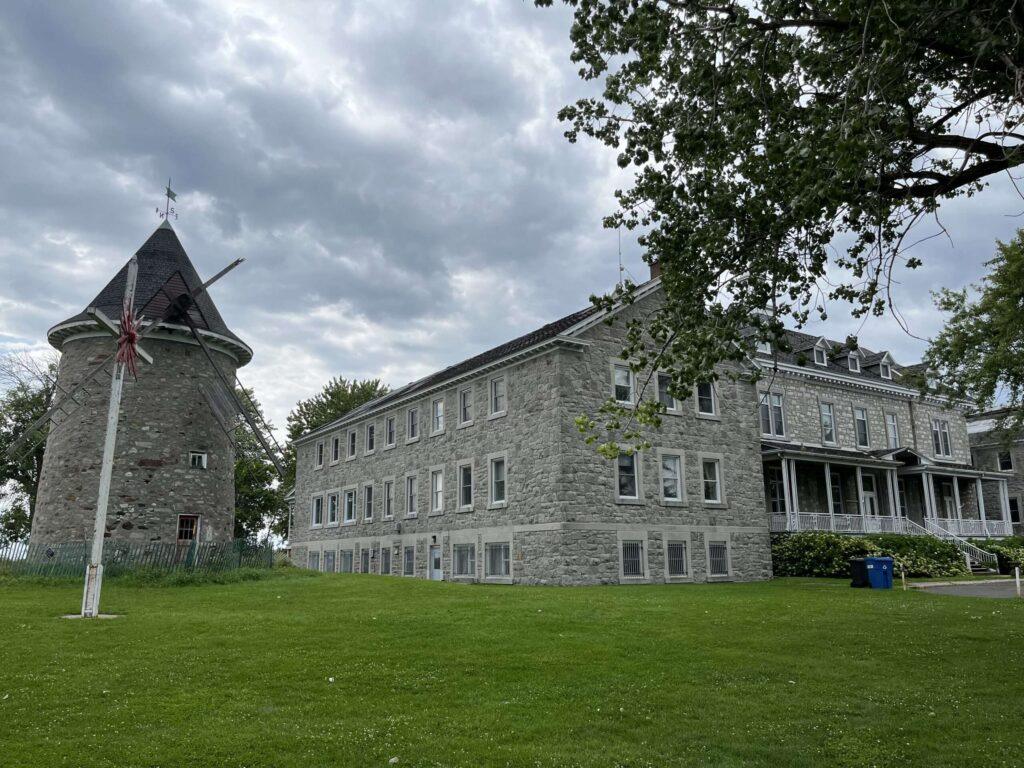
Will the iconic windmill along the waterfront in Pointe Claire be renovated and restored?

It’s still an open question, despite decades of talk, negotiation, the city pledging money to help cover the costs and – earlier this year – the announcement by Pointe Claire Mayor Tim Thomas that an agreement to make it happen was struck between the city and the Catholic Archdiocese of Montreal, which owns the historic landmark.

Last week, Pointe Claire council reset the long drawn-out process by approving a notice of motion to create a way for the Archdiocese to apply for funding from the city to restore the crumbling structure. Available funds have been capped at $967,000.

Determining if this is a step forward or a step backward in the process depends on who on Pointe Claire council describes this latest development.

According to Mayor Tim Thomas it’s a major setback that could delay any work getting started to restore the stone windmill by years.

“This process could easily take one or more years, if it happens at all,” said Thomas in an interview. “So we are back to Square One.”

Thomas contends that he and the city’s previous director general stuck a deal with the Archdiocese in September of 2022 that would have allowed work to begin, with the city contributing about $950,000, and the Archdiocese obtaining a matching amount from the province to carry out the needed restoration work that would see the windmill renovated and restored to working condition.

But the majority of councillors who refuse to accept the deal Thomas claims was struck last year and have approved the new framework last week claim the new process is a prudent and necessary step that aims to protect Pointe Claire taxpayers from getting hit with what they predict could be hefty maintenance costs in the future.

“The aim of the committee was especially to protect the taxpayer,” said councillor Claude Cousineau, referring to the group of councillors and city officials who put the latest process in place. It avoids, he said, “a very costly deal if it goes sideways.”

Councillor Paul Bissonnette described the deal Thomas had put together as “far from being complete.”

“There were a lot of things to iron out,” Bissonnette said. “We are not going to be there to maintain the windmill,” he said, after claiming the Archdiocese has failed up until now to maintain the structure or the neighbouring convent.

“We are not the evil bad guys here,” he said during last week’s council meeting. Built in 1710, the windmill is Pointe Claire’s civic symbol, gracing everything from the city’s water tower to its municipal website and banners. It was classified as a heritage site by the provincial government in 1983 and is one of a handful of Quebec windmills built under the French regime that still exist.

Pointe Claire windmill plan takes new twist Read More »

John Abbott plans to build $30-million sports complex

JOHN JANTAK
The 1510 West

John Abbott College is planning to build a $30-million multi-sports complex on its campus in Ste. Anne de Bellevue – if it receives a grant from the provincial government.

Officials at the CEGEP are seeking a $20-million subsidy from the province for the project. A grant application was submitted last week to the provincial financial assistance program for recreational, sports and outdoor infrastructures (PAFIRSPA), said Patrice Lemieux, manager of the Casgrain Sports Centre at the campus.

If approved, the new facility will provide indoor space for a wide range of sporting activities.

“We’re bursting at the seams,” Lemieux said. “The new sports complex will complement the services we already provide at our sports centre.”

Feedback from the students and staff at the college has been positive.

“Everyone is onboard with the idea,” Lemieux added. “It will free up space at our sports centre.”

“It’s also a great opportunity for the college to fulfill its internal needs and to also have that additional link with the communities we serve. It’s a win-win situation,” said Lemieux.

It could take two to three years for the multi-sports complex to be built if the college receives the grant. Details about the scale and scope of the project will be announced at that time.

“We’ll wait for the grant first to see if project goes forward,” said Lemieux.

John Abbott plans to build $30-million sports complex Read More »

More power and longer lifespan for future Chalk River nuclear reactor

Sophie Demers
Local Journalism Initiative

CHALK RIVER – Global First Power (GFP) hosted a virtual open house on November 29, presenting updated information on their Micro Modular Reactor (MMR) project and collecting feedback.  The Ontario-based company, jointly owned by Ontario Power Generation and Ultra Safe Nuclear Corporation, plans to build and operate an MMR at Chalk River Laboratories in Chalk River, Ontario. The process for the MMR project began in 2019, and plans estimate the reactor to be in operation by 2028. 

An MMR is a type of small modular reactor (SMR) designed by Ultra Safe Nuclear Corporation. SMR’s nuclear reactors are an alternative to fossil fuel, used to generate low-carbon power for industry and remote communities. Canada is leaning toward this new technology to meet their goal of net-zero carbon emissions by 2050.   

According to GFP, one MMR can replace 1.2 billion litres of diesel and require minimal operation and maintenance. The company also presented their updated plan for the nuclear reactor. The original design was for 15 megawatts of thermal energy and 5 megawatts of electrical. Now the design includes plans for 45 megawatts for thermal and 15 megawatts electrical.

The lifespan of the MMR has now been extended to up to 40 years before it will need to be decommissioned. This doubles the technology’s lifespan compared to the original design. However, the MMR will require periodic refueling and the site will store new and used fuel temporarily before it’s transported elsewhere. 

 According to the company’s estimations, at the end of its 40-year lifecycle, the reactor will produce about 12 cubic meters of waste. 

Concerns expressed

Many concerns have been raised by the community about the MMR; residents still recall nuclear accidents at the Chalk River Laboratories site in the 1950s, including the world’s first nuclear meltdown in  1952. During the cleanup of that accident, 4.5 million litres of radioactive water were dumped into ditches 1.5 kms from the Ottawa River. A second incident requiring a major cleanup followed in 1958.

“We’re in a climate crisis. We need to take action now, and nuclear is not ‘now’; it’s going to take quite a few years to implement this. There’s solar, wind, and water – these energy sources don’t need to be tested,” said Deborah Powell, president of Pontiac Environmental Protection. “I don’t believe this is a good picture to grab onto for a better future,” she added. 

However, according to Natural Resources Minister, Seamus O’Reagan, without nuclear energy, there’s no model that will allow Canada to reach its emissions goals.

An environmental assessment in accordance with the Canadian Environmental Assessment Act is underway. The assessment must prove the project is not likely to cause significant environmental effects. More information about the assessment will be available in 2024.

More power and longer lifespan for future Chalk River nuclear reactor Read More »

Norway Bay pier: “Swiss cheese” say inspectors

Deborah Powell
Local Journalism Initiative

BRISTOL – Divers from ODS Marine Construction conducted an underwater inspection of the Norway Bay wharf on December 1. Three divers took turns over more than six hours examining the 260 meters of the steel structure. The results were captured on video, including each divers’ comments on what they were seeing.

Over 70 years of wear and tear has taken a toll on the sheet pile structure. Both divers and their supervisor, Mike Chard, used the term “Swiss cheese” when asked about the wharf’s general condition. Ice erosion has worn it paper-thin, 30-50 cm below the waterline, with holes ranging from small to cavities large enough that the divers could put their arms through. The divers generally avoided striking the metal to determine soundness for fear of causing further damage.

Repair is going to be a large and costly job. Bristol Council has already paid out close to $20,000 to W.F. Baird and Associates Coastal Engineers for the study of the structure and recommendations for action.  The evaluation by ODS Marine Construction, recommended by the engineering firm, cost over $11,000.

Photo: A diver re-enters the water after equipment adjustment during the evaluation of the condition of the Norway Bay pier.

Norway Bay pier: “Swiss cheese” say inspectors Read More »

Public consultations on proposed Noire and Coulonge Rivers biodiversity reserve

Deborah Powell
Local Journalism Initiative

MRC PONTIAC – The Outaouais Regional Environment and Sustainable Development Council (CREDDO) and the Canadian Society for Parks and Wilderness – Ottawa Valley Section (CPAWS-OV) held two public sessions to gather input on the proposed protected area for the Noire and Coulonge Rivers: December 5, in-person, in Gatineau and December 6 online. A session planned for Fort-Coulonge on December 4 was postponed due to weather but will be rescheduled in January.

Since October 2019, CREDDO and CPAWS-OV have been planning activities as part of a process to create a protected area of approximately 1,150 km2 in the watersheds of the Noire and Coulonge Rivers. This project would increase the area of protected territory in Outaouais by a little more than 3%, while contributing to the efforts of the federal and provincial governments to protect 30% of its territory by 2030. On August 30, 2023, the province set aside 852.6 km2 of the territory. However, CREDDO and CPAWS suggest expanding the protection zone, in particular to include the eastern branch of the Coulonge River and to better protect the sensitive  habitats found there.

A number of studies have been carried out including Economic and Social Impact Potential, Impact on the Accessibility of the Area and Management of the Forest Road Network and a Wood Turtle inventory along the Coulonge and East Coulonge rivers this past summer.

Gathering input from stakeholders and interested citizens has been an ongoing process since 2019. Feedback will be an essential part of the Management and Delimitation Proposal for the Noire and Coulonge protected area that will be submitted to the government mid-2024.

At the Gatineau meeting, members of the Club de canot-camping Pierre Radisson and the 50-50 Fish+Game Club spoke in favour of an even larger protected area and asked questions about potential management and infrastructure.

In the online session, participants from varied backgrounds asked many questions including what sort of management structure might be feasible. A member of the Green Lake and Black River Cottagers Association expressed serious concerns about the effects of increased traffic in the area, particularly of people unfamiliar with the territory, and the risks for public security given there’s little or no cell phone reception.

There are a number of additional ways to have input on the project. There is the Facebook group Aire protégée – Rivières Noire et Coulonge (Protected Area Noire/Coulonge) and a project description on the CREDDO website with contact information (for English version try a web search “CREDDO protected areas”).

Photo: The Outaouais Regional Environment and Sustainable Development Council (CREDDO) and the Canadian Society for Parks and Wilderness – Ottawa Valley Section (CPAWS-OV) have proposed protected areas for the Black and Coulonge Rivers.

Public consultations on proposed Noire and Coulonge Rivers biodiversity reserve Read More »

ArtPontiac AGM

Jamie Cameron
Local Journalism Initiative

PORTAGE-DU-FORT – ArtPontiac held its annual general meeting, November 30 at the Stone School Gallery in Portage-du-Fort, chaired by Ellen Boucher of the Pontiac Community Development Corporation (CDC Pontiac). 

ArtPontiac has been operating with minimal board members since last January, starting with Marcel Renaud’s resignation as treasurer due to health reasons. After a nomination  period, Maureen McAuliff, Stephanie Pete and Bryan Chen agreed to join the board and their roles will be determined at the first board meeting in January.

President Cheryl Beillard explained the organization has had “two successful years” since the COVID pandemic. “Going through old annual reports, I’m astonished by what this organization has achieved and the amount of work that has been done,” she added.

ArtPontiac has been working on exploring  different disciplines, placing more emphasis on crafts, and creating a shop to help artists sell their work,  which has been successful. In 2023, they fought  to maintain focus, keep  the organization going,  and expand by establishing  new venues, among  other things. For example, Brauwerk Hoffman in Campbell’s Bay created a gallery to be part of the  MRC Pontiac’s new arts and culture map, and there’s a small gallery at Les Alpagas de Willow Lane in Bristol. They also expanded the number of exhibitions and types of artwork at Café 349 in Shawville.

Two issues the new board will have to deal with are finances and finding more volunteers. Every year, they need to secure enough funding to cover basic costs and more work is needed to obtain additional grants. There was talk of ways to lower operating costs and increase revenues; hosting more fundraisers, requesting larger grants from new sources, holding more workshops, and approaching the MRC Pontiac and Culture Outaouais for help.   

More online communication and keeping websites and social media pages up to date were stressed as  priorities to better promote the artists and their work.

A resolution was passed to address some book keeping errors needing correction before January, but financial statements were sound.

ArtPontiac AGM Read More »

NFSB will intervene in legal challenge over English communications

Sarah Rennie – LJI reporter

The New Frontiers School Board will ask for intervenor status in the court challenge launched by the English Montreal School Board (EMSB) against the provincial government over the right to communicate in English.

The EMSB announced on November 8 that it had filed a motion in Quebec Superior Court, requesting a stay of provisions of Bill 96 and the Charter of the French Language that require most of the board’s written communications be in French.

Many of the provisions in Bill 96, including a requirement that those in the public service make “exemplary” use of French, came into effect this past June. Since then, the EMSB began to receive internal complaints about the language used in internal written communications.

Narrow exceptions to these rules for English language school boards mean pedagogical communications, or those that are directly connected to teaching, can be written exclusively in English, while administrative communications that relate to the management or organization of the school board must be either in French or in both French and English.

According to the Office québécois de la langue française, examples of administrative communications include back-to-school information, registration procedures, school calendars, policies, annual reports, governing board meeting agendas and minutes, etc. The same would apply to school board internal documents, written communications between English school boards, and school social media accounts.

The law also requires that English school boards communicate exclusively in French when writing with key institutions of the English-speaking community, such as the Quebec English School Boards Association (QESBA) or the English Parents’ Committee Association of Quebec.

In a press release issued by the EMSB, Joe Ortona, the chair of the school board said he finds the requirements shocking. “These requirements should not apply to the EMSB as we are not a school service centre, given the Superior Court’s ruling in Bill 40. If they are found to apply to the English sector, then these provisions should be suspended, as they would cause irreparable harm to the English-speaking community.”

The EMSB argues the implementation of these provisions will alter its linguistic culture, while imposing translation burdens on staff, including principals. They may also make it more difficult to staff English schools if boards can no longer employ unilingually English teachers and support staff.

The EMSB is challenging the constitutionality of Bill 96, however it is expected that this will be a lengthy process. In the meantime, the EMSB is arguing a stay will prevent the board from undergoing irreparable harm until a court decision on the law is rendered.

During the December 5 regular meeting of the NFSB Council of Commissioners, a motion was unanimously passed for the board to become an intervenor in the EMSB’s request for a stay.

“Most boards are planning to intervene, and we have chosen to do so as well,” said NFSB chair John Ryan. An intervenor in a court case is a third party that is permitted by the court to make arguments in a case.

The lawyers will examine the situations of the intervening school boards to determine whether this interpretation of Bill 96 by the OQLF and the Quebec government could result in irreparable harm to the institutions involved. The boards will then be able to intervene in the case by presenting written or oral submissions to the court.

It is expected that the QESBA will ask for similar intervenor status in this case.

NFSB will intervene in legal challenge over English communications Read More »

Booming Huntingdon builds business complex to match residential expansion

Sarah Rennie – LJI reporter

The town of Huntingdon continues to boom. Along with a rapidly expanding residential sector, the town is now seeing rapid growth in commercial and industrial developments within its territory.

In partnership with real estate developer Capital Maurice, Huntingdon announced the creation of a light industrial development project during a brief press conference on December 6.

Estimated to cost around $20 million, the new industrial complex will involve the construction of at least eight buildings ranging in size from 2,500 to 12,600 square feet. The buildings will be built in a 330,000-square-foot expanded section of the existing industrial park next to the Maison Russet facility on Route 202.

“There is a shortage of this type of light industrial building in Huntingdon,” said Jean-Christophe Paquin, the president of Capital Maurice, who spoke on the versatility of the project. The buildings, which can be customized according to specific needs, will all be equipped with a separate septic system and access to municipal water. Each unit will feature one to five suites, 16-foot-high garage doors and 22-foot-high ceilings, with the possibility of adding a mezzanine.

Designed with small service companies in mind including electrical, welding, or mechanical workshops, the developers intend to keep rental rates affordable to attract young entrepreneurs. There will be a total of 40 commercial leases available, with the possibility of financial assistance and subsidies from the municipality.

Mayor André Brunette of Huntingdon welcomed the initiative. “It was time,” he said, noting the industrial park was completely full. “With these new buildings coming, it is going to create new jobs,” he added, suggesting these would be needed given the pace at which the town is currently developing.

“We have the infrastructure to accommodate everything that is being built now,” said Brunette, who maintains the town is developing with the community and its growing needs in mind. Capital Maurice is also involved in the development of a 42-unit residential and commercial building along the Ridge Road in Huntingdon.

The infrastructure for the project is complete, and work is being done to build an access road from Route 202. According to Paquin, the foundation for the first building is expected to be poured in February or March, with the goal of opening the building by April.

Booming Huntingdon builds business complex to match residential expansion Read More »

Farmers take a stand over a worrying future

Ian Ward – LJI reporter
Translated by Sarah Rennie

The voices of teachers, nurses, and healthcare professionals have been joined by those of the province’s farmers, who took to the streets to demonstrate in front of the Quebec National Assembly on December 6.

“We are at the heart of the solution,” proclaimed more than 1,000 farmers, who came in buses from across the province to send a clear message to the government that the current situation is untenable.

Faced with rising input and labour costs, as well as significantly higher interest rates and disastrous weather in 2023, many of the farmers present at the protest explained that the current model is no longer working, and that government programs need to be updated to better support the province’s farms.

“We have just transferred the farm to our son,” said Hinchinbrooke-based dairy farmer Jason Erskine. “We have just completed a big project for the future. We are invested in the farm for the long haul with significant capital to grow the business. I want to see him do well!” he exclaimed.

“Costs usually go up each year, and we invest in our farms by buying more efficient equipment, specializing, etc. to increase productivity, and it eventually balances out. With high interest rates, we can’t do that anymore. People say, ‘well, you’ll just have to spend less,’ but if we stop investing and increasing our productivity, prices will go up,” Erskine explained.

Michael Kessler, the new owner of Willkess Farm in Hinchinbrooke, agrees. “I am part of the next generation in terms of taking over the farm. They have already cut a lot of subsidies – what worries me is that they don’t realize how important we are. They think that whatever they do, we won’t make too much noise, but agriculture needs a future, so they can’t forget us either. No farmers, no food,” he said.

According to the Union des Producteurs Agricoles (UPA), which organized the December 6 march, the federal government’s budget for agriculture has fallen by 18 per cent over the past ten years, while support has dropped from 1.47 per cent to 0.98 per cent in Quebec’s overall budget. Over the same period, producer indebtedness has risen by 115 per cent.

Hinchinbrooke game producer Éric Leboeuf said he certainly feels this pressure. He took part in the march “in solidarity with the next generation of farmers, and to call for help in the face of climatic changes.”

A member of the Haut-Saint-Laurent UPA syndicate, Leboeuf also took part in the UPA’s annual congress, which was taking place concurrently with the demonstration. He says he is particularly concerned about the future for young producers.

“We are passionate about agriculture,” declared Julie Bissonnette, the president of the Fédération de la relève agricole du Québec, in front of the National Assembly. “We are resilient and determined young entrepreneurs. We should, however, be able to make a living from our profession. The financial and administrative pressures are enormous and weigh heavily on our shoulders. For the sake of the future of food production in Quebec, it is imperative that the government provides greater support for young farmers and makes them a priority of the province’s bio-food policy.”

At the conclusion of the march, UPA leaders presented a manifesto to André Lamontagne, the Quebec minister of Agriculture, Fisheries and Food, who spoke a few hours later at the UPA congress. “There is not a morning that I get up, and there is not an evening that I go to bed, where I am not thinking about you all, or where I don’t try the next morning to do the best I can for all of you,” said Lamontagne.

For his part, Jason Erskine hopes that the government will take concrete action before it’s too late. “This was a proactive march. Things aren’t so bad that we’re at an impasse, but the trajectory we’re on is worrying. You can see where it’s starting to fall apart.”

Note: The journalist is also a volunteer member of the board of directors of the Haut-Saint-Laurent syndicate of the UPA.

Farmers take a stand over a worrying future Read More »

Some Franklin residents frustrated over access to municipal survey

Sarah Rennie – LJI reporter

The municipality of Franklin wants to know how its residents feel about the Parc Antoine-Labelle municipal park and its current infrastructure.

A survey was published online on December 1 asking citizens to express their opinion on the condition of the equipment in the park, as well as potential development projects including renovations to the baseball field and the installation of a water park.

The questionnaire follows up on a public consultation meeting attended by around 30 people on September 25.

The survey is mainly accessible through the municipality’s website and social media accounts, but also in paper format at the town hall. The way the survey is being circulated is raising concerns, however, among some residents, who suggest access is limited to those with an internet connection.

In an online exchange with the municipality on Facebook, Franklin resident Johanne de Luca accused the local government of ignoring those without internet access. “How do people who don’t have the internet know that there is an important survey being circulated?” she questioned, noting there was no obvious mention of the survey in the December edition of the municipal newsletter.

“For once we could express ourselves, but we can’t if we are not online,” she laments, before suggesting that if the municipality wanted the opinion of a maximum number of residents, the administration could have mailed the information to every address. “I found out about it by chance, which is not normal,” she adds, pointing out that decisions related to the future of the park are important as they will impact municipal taxes and fees.

Franklin’s director general, Simon St-Michel, points out that the public consultation process on the park’s redevelopment was announced during the July, August, and September municipal council meetings. An invitation to attend the consultation was also publicized on the municipality’s website and social media pages. During the meeting, it was announced that an online survey would also be circulated.

“The elected officials and administration wanted to ensure that the development proposals corresponded to the needs of residents,” says St-Michel. “The public consultation yielded a number of excellent suggestions, which can be found in the online survey,” he adds, before noting that, in fact, all the suggestions made during the consultation were included in the survey that is currently circulating.

St-Michel points out that 2,200 people follow the municipality’s Facebook page, out of a population of 1,844, and for those without internet, he confirms paper copies of the survey are available at the town hall.

He says citizens’ suggestions will help inform the amounts set aside in the 2024 budget related to improvements to the park. The survey includes cost estimates for the installation of a water park and for different options concerning the baseball field, which St-Michel says will only be considered if the municipality is able to secure government funding for the projects.

Members of the citizens’ group Citoyens avertis engagés de Franklin say they are planning to meet to discuss the possibility of contesting the results of the survey

Franklin residents interested in completing the survey can access the paper copy during business hours at the town hall, or by going online via the municipality’s Facebook page or website at municipalitedefranklin.ca. The survey will close on December 15.

Some Franklin residents frustrated over access to municipal survey Read More »

Quarry bid too high

By Trevor Greenway

Chelsea Mayor Pierre Guénard says that if the municipality would have been successful in its bid to purchase 86 acres of land in the Déry Quarry, the group pushing for a new field hockey pitch, sports training centre and protected lands “would have been at the table.”

But the municipality bid 582 per cent more than it was allowed to when it tried to buy the quarry for $6 million – $5.1 million more than the land was valued at; the province’s Ministry of Municipal Affairs and Housing (MMAH) stepped in and said it wouldn’t fund a borrowing bylaw for that amount.

“When Mr. Déry suggested that the municipality buy his land, the municipality immediately showed an interest in this transaction with a view to creating social housing, improving the recreational offer and protecting the wetlands,” explained Chelsea spokesperson Maude Prud’homme-Séguin. “The municipality then contacted MMAH to find out about the financing conditions we would need to obtain the loan. MMAH replied that an assessment by a certified appraiser was required and that it would finance only the amount of this assessment plus 10 per cent. After negotiations with Mr. Déry, the municipality signed a promise to purchase for $6 million, including conditions related to financing with MMAH.”

According to a private land assessment from January, obtained through an access-to-information request last week, the quarry – 86 acres of land in Farm Point – was valued at $879,000 in January of this year. This proved a difference of $5.1 million between the assessment and the offer price, and the MMAH said no.

“The municipality subsequently received the appraiser’s report, which valued the land at $879,000,” she added. The municipality initially gave the Low Down incorrect figures, comparing the assessment to market value, when it should have given the munipality’s offer price. “Since the difference between the appraisal we received and the promise to purchase was 582 per cent, the promise to purchase was automatically cancelled.”

A 2023 MRC des Collines property assessment valued the land even lower – at $520,387.

Prud’homme-Seguin said the maximum the MMAH would finance in this deal would have been a $1 million bid for the property.

When asked why the municipality bid so high over the assessed value of the land, Guénard said that it was the price that Chelsea and landowner Laurent Déry had agreed upon when they made a promise to purchase the property in fall 2022. The municipality didn’t receive the private assessment until January 2023.

According to Guénard, council was supportive of former Olympian field hockey player Ian Bird’s idea to build a new field hockey pitch, training centre and a corridor of protected lands with Action Chelsea for the Respect of the Environment. But, because the deal fell through, so did the “dream project,” as some in the community have called it.

“We wanted to support some local groups and create the diversity and the offer of recreation,” said Guénard. “They would have been at the table to plan the whole thing.”

For his part, quarry owner Déry told the Low Down in late November that he is now in talks with private developers but wouldn’t talk about anything specific.

Quarry bid too high Read More »

Demand for food banks is up, but so is giving

By Madeline Kerr

If you want to give help to others, cash is king.

That’s the message from Cédric Tessier, the executive director for Centraide Outaouais, a local food aid organization, who told the Low Down: “At this time of the year, the best way to help us is to make a donation online.”

Marie-Pier Chaput, the director general of another local food aid organization, Le Grenier des Collines in Val-des-Monts, echoed that sentiment. She said her organization appreciates all of the food donations that it receives, but cash donations offer Le Grenier greater flexibility to purchase the food they need. She explained that often the food bank receives discounts for bulk purchases, meaning that a cash donation can go even further than you think.

“Inflation has caused real financial problems for people in the lower middle class and they now need services they didn’t need before,” Tessier said.

Centraide, which is often known as United Way in other parts of Canada, is a federation of nonprofit organizations that seeks to combat poverty and improve lives for some of the most vulnerable in society. It provides money and services to 88 community agencies, Tessier explained, which have all seen an increase in demand this year.

That increase means that this year the organization, which is headquartered in Gatineau, helped 88,000 people, according to Tessier – that’s roughly 20 per cent of the region’s population.

Tessier confirmed that supply has risen too.

“We collected 3.8 million dollars last year and this year, our goal is 4 million dollars,” he said. “We don’t know yet if we will reach that goal, but we’re on the right path to reach it.”

Tessier encouraged folks who want to give to Centraide Outaouais to consider entering the 50/50 draw on the organization’s website, where regular donations can also be made.

Linda Bardell, a volunteer with the Wakefield Food Pantry and Community Fridge, said that her organization, which runs out of the Shepherd of Good Hope church on Riverside Drive in Wakefield, has seen a lot of new faces this year, including an influx of young families.

While demand has gone up, Bardell said jokingly, “we don’t need crowd control yet.”

That’s because donations have been able to rise to meet the needs of the community. The Food Pantry was collecting cash and non-perishable donations on Dec. 9 at this year’s annual Wakefield Christmas Market and Bardell said, while she didn’t want to disclose the exact amount, “we did extremely well and we’re very happy.”

Food can be dropped off any time at the Wakefield Community Fridge located outside the Shepherd of Good Hope. The most desirable items are fresh fruits and vegetables, as well as commercially packaged meals and meat before its “best date.” Condiments, soups and homemade goods like jams and baking should not be donated to the Fridge.

Bardell said the organization is also welcoming donations by e-transfer to gsw@anglicansinthehills.ca. Be sure to write “food pantry: in the memo.

Food banks across the country are seeing an all-time high of people using their services. According to a recent study by Food Banks Canada, 2023 saw the highest food bank usage since the company began collecting data in 1989.

Demand for food banks is up, but so is giving Read More »

Unlimited teacher’s strike ‘in our back pocket’

By Trevor Greenway

Steven Le Sueur said it was “an easy decision” to reject the Quebec government’s latest offer, which would have seen teachers, nurses and public sector workers in the province get a 12.7 per cent raise over the next five years.

The head of the Quebec Provincial Association of Teachers (QPAT) told the Low Down that the offer was rejected immediately because it’s not retroactive to 2022.

“For cost of living, you look back a year,” said Le Sueur. “And they’re leaving [2022] out like it didn’t happen. It should have been 18 or 18.1 per cent, if we are looking at all the cost of living.”

Le Sueur confirmed that the demand from the Common Front union, which includes 420,000 teachers, social and health workers and public sector employees, is a 21 per cent increase over three years and said the latest offer “isn’t cutting it.”

Despite the low offer, Le Sueur said he is “optimistic” about negotiations, especially since there are new players at the table, including the French union, The Fédération des syndicats de l’enseignement (FSE), which represents 95,000 French teachers under 34 separate unions.

“I am hopeful, very optimistic. But you have to be realistic just the same,” said Le Sueur. “But yeah, we’re at a new table. It’s a combined table with the FSE and QPAT, and there are new players from the Treasury Board. And I think the real negotiations started as of [Dec. 7].”

Wakefield teacher and union rep Shannon Langlois was out on the picket line Dec. 8, as teachers with QPAT have launched a seven-day strike between Dec. 8 and 14. Langlois told the Low Down that, although parents are being impacted by the intermittent strikes, teachers are receiving a lot of support from passersby.

“I feel like every person I talked to, although definitely the parents are impacted because it’s really disruptive, but I think they still support us,” said Langlois, as she waved a green Common Front union flag that read, “With one voice.”

“And all the parent–teacher meetings are very encouraging,” she continued. “They understand what the conditions are and what we’re trying to fight for.” Langlois said that the latest offer doesn’t cover inflation, which has been predicted to raise by 17.7 per cent over the next five years, according to Quebec financial institution Desjardins.

“So it’s still a really low offer for all of the public service workers in our province, who are among the lowest paid in the country, I think,” added Langlois. She’s not wrong. According to Stats Canada data from October, Quebec teachers are, in fact, the lowest paid in the country. The base salary for a primary teacher in Quebec is $52,227. By comparison, Ontario teachers are paid $55,782. But where Quebec really lags is in salary increases. The Stats Canada data also reveals that, in Ontario, teachers with 10 years of experience get ​​$102,952, compared to just $70,197 here. Teacher’s salaries in Quebec top out at $88,652.

Le Sueur added that QPAT has an unlimited strike for January “in our back pocket,” but hopes an agreement is reached before that.

Union reps with the region’s French union, The Fédération autonome de l’enseignement (FAE), did not return the Low Down’s calls by press time.

Unlimited teacher’s strike ‘in our back pocket’ Read More »

Bill 15 adopted

By Trevor Greenway

An anglophone rights group is slamming the Quebec government for “thumbing its nose” at thousands of residents who have expressed serious concerns over the CAQ’s health reform, Bill 15.

Despite a petition calling for a halt to the bill, which garnered an impressive 6,400 signatures in less than a week, the ruling CAQ government invoked closure on the bill that the Quebec Community Groups Network (QCGN) says will “upend Quebec’s health and social-services network.”

“The enormous effort to centralize the health and social-services network, part of the CAQ government’s command-and-control strategy, will do nothing to ease the crises in our hospitals where people have died in overcrowded emergency rooms while waiting to see a doctor,” wrote QCGN president Eva Ludvig in a statement. “This same government made a solemn promise during debate on Bill 96 last year to not touch the English-speaking community’s access to health and social services in their own language.”

After failing to reach an agreement with opposition parties to extend the session on Dec. 8, the CAQ government invoked closure on the bill – a power enabling the party to end debate and fast track the bill’s adoption before the end of the legislative session.

The healthcare reform will see Quebec operate under a new centralized administration model, where one central authority – Santé Québec – will make decisions for the province’s 17 administrative regions.

Local health watchdogs from Vigi Santé say they are worried the healthcare reform bill will mean that English residents in the province could lose services in their first language. That fear sprung from an amendment tabled by Quebec Health Minister Christian Dubé last week that would give Santé Quebec the power to strip English services in places with less than 50 per cent anglophones. He later back-pedalled and tabled a new amendment that still gives the health authority the power to revoke the bilingual status of a health agency but will also require recommendations for such a move from a national health advisory committee and a regional committee.

Vigi Santé spokesperson Marcel Chartrand said that, while the new amendment is a “safeguard,” his health watchdog group isn’t convinced it will actually protect English rights.

“If the right people are on those advisory boards, I think we would be okay,” said Chartrand. “But again, the regional authority will have the last word; it won’t be the committee, so that’s a major concern.”

Chartrand said the amendment is a “slippery slope,” and has questions as to who would serve on these advisory boards – whether it would be the regional prefect or mayors from municipalities. He argued that there should be more local representatives called to sit on these committees.

“It has got to be more than that,” said Chartrand, referring to just professionals on the committees. “[The committees] must include community groups, not just professionals and not just politicians.”

Chartrand says his Vigi Santé group is campaigning for more services to be decentralized, especially mental health and social care initiatives.

In May, Premier François Legault told reporters that his government “will not refuse to treat a patient in English if it’s needed.” This statement no longer sits well with the QCGN, who took aim at the premier in its Dec. 8 statement, saying, “It is now crystal clear that no one can trust this government on anything.”

“From education to healthcare, from university tuition to trying to reduce the presence of unions in the management of the public service, the CAQ government wants to control everything it touches with as little public input as possible,” wrote Ludvig. “That should worry all of us as Quebecers very much indeed.”

Bill 15 adopted Read More »

Meet the QCT’s newest contributing writer, Alphonsine Sefu

Ruby Pratka, Local Journalism Initiative reporter

editor@qctonline.com

Alphonsine Sefu is a student in the international journalism master’s degree program at Université Laval, currently on exchange in Lille, France. She is also the QCT’s newest freelance writer. Ruby Pratka set up a trans-Atlantic Zoom chat for readers to get to know her a little better.

Ruby Pratka (RP): So tell us a little about yourself – did you grow up in Quebec City?

Alphonsine Sefu (AS): Yes! I was born in St-François- d’Assise Hospital, if I’m not mistaken, and I’ve lived [in Quebec City] all my life, except for this semester.

RP: How did you get interested in working in English?

AS: My parents aren’t anglophone, but I have family in the States, in New Brunswick and in England. I naturally had an interest in English when I was younger. I would watch English shows or movies and take notes of the words that I didn’t understand, and try and translate them. I em- braced anything that had to do with English-speaking culture, initially American but also English-Canadian and British culture. From Grade 5 through Secondary 5, I was in intensive English classes. I feel like every time you learn a new language, you have a different perspective because the people who speak that language come from different countries and you have access to a different mentality as well.

RP: You’ve travelled around a lot – England, Italy, the Democratic Republic of the Congo, different places. Where does your passion for travel come from?

AS: I’m very curious, and I’ve also had opportunities in my life. Sometimes it’s school trips. Sometimes I’m visiting a friend in another country, and this time, I’m studying abroad.

RP: What’s the most memorable trip you’ve taken so far?

AS: Italy last year was one of the most memorable, be- cause it was the first time I was travelling totally on my own. Before, it was always either organized trips or with friends. I really like the way I managed to travel alone in a country where I didn’t speak the main language at all. The first city I visited was Lucca, a little city in Tuscany where I don’t think there are a lot of tourists. I came there thinking people would speak English, but that wasn’t necessarily the case, and I didn’t have Inter- net service, so I had to use a physical map! I saw that I could manage to adapt in different or uncomfortable situations, and I liked the independence of going places when I could because I wanted to.

RP: I saw that you also travelled to Kinshasa, in the Democratic Republic of the Congo, which is also one of my favourite cities – what’s the story there?

AS: I have a lot of family there. I only went there for two weeks, but they made a big im- pression because it was my first time in Africa. The stress levels were so much lower – the way people carried themselves and the way people saw their way of life was very different from North America. I realized we didn’t really need that much of the go-go-go sort of mentality we have.

RP: What kind of stories are you most looking forward to writing for the QCT?

AS: I like anything that has to do with social justice, with minorities, especially religious and racial minorities. I think it’s very important to have their point of view in the media. Now we’re getting more and more of it, but I’d like to contribute to this effort. I’d also like to implement some international stories into local events. Anything that has to do with culture or consumer rights is very interesting to me as well.

This interview has been edited and condensed.

Meet the QCT’s newest contributing writer, Alphonsine Sefu Read More »

Health reform passes amid widespread skepticism

Ruby Pratka, Local Journalism Initiative reporter

editor@qctonline.com

The sweeping reform of the Quebec health-care system steered by Health Minister Christian Dubé was voted into law a few hours before sunrise on Dec. 9 after an all-night debate.

The law, expected to go into effect in six months, will create a single Crown corporation, Santé Québec, responsible for the administration of the entire health system, merging local health administrations and hospitals into the provincial body.

This centralization has been widely criticized by unions, patient advocates and politicians, including six former premiers – Liberals Daniel Johnson Jr., Jean Charest and Philippe Couillard and péquistes Pierre Marc Johnson, Lucien Bouchard and Pauline Marois – who argued in an open letter that the centralization was a “dangerous step away from the reform’s objective of making the health and social services network more efficient.” Dubé, for his part, has argued that the creation of a single agency would increase flexibility, creating a uniform system for employee seniority and allowing patients to get around long waiting lists by choosing to be treated in another region or at a private facility on the public dime.

At more than 1,200 pages long, featuring more than 1,000 articles and hundreds of amendments, the law is one of the densest in Quebec history. It was passed through closure, a procedure that allows the National Assembly to cut short debate and fast-track the passage of a bill. Some articles had yet to be fully analyzed in committee, despite well over 200 hours of debate.

Advocates for English-language health care have raised concerns about the bill. The Quebec Community Groups Network (QCGN) wrote a petition against the bill that gathered more than 6,400 sig- natures. “This bill centralizes everything in Santé Quebec and eliminates all [individual] institution boards. One board of directors will be responsible for everything. There goes community input,” said QCGN president Eva Ludvig. “It’s an ill-thought-out bill to start with, and it doesn’t address the major issues, like backup in ERs and lack of access to family doctors.”

Dubé caused alarm in the English-speaking community last week by proposing an amendment that would allow the Santé Québec board to withdraw bilingual status from health facilities that provide less than 50 per cent of their services in English after consulting with provincial and regional health-care access committees and the Office québécois de la langue française. He later modified the amendment so the access committees must recommend – not only be consulted on – the change and a regional access committee must ap- prove removal of status by a two-thirds vote.

“We are confused about why the amendment needs to be there in the first place, since [the government is] saying they don’t want to touch ac- cess to health care in English,” Ludvig said.

“If regional access committees are active and functioning and the provincial access committee is kept abreast of the community’s needs, [the new amendment] should be sufficient to prevent the removal of bilingual status, but it all depends on the final wording,” said Jennifer Johnson, executive director of the Community Health and Social Services Network (CHSSN), who spoke to the QCT the day before the bill was passed. “If they’re asking for a decision [from the access committees] it’s acceptable, but if they’re just asking for our opinion, it’s not. This bill is not supposed to affect an English-speaking person’s ability to access health and social services; that is the guarantee that we have had since the outset, although I am a little skeptical. We’re not satisfied until we’ve seen the final wording.”

Both Ludvig and Johnson said they would keep a close eye on the regulations devised by the Ministry of Health and Social Services as part of the bill’s implementation process in the coming months. The regulatory process is “where the rubber hits the road,” Ludvig said. “We are going to be watching and trying to bring to Quebecers’ attention when we see things that aren’t in their interest.”

Health reform passes amid widespread skepticism Read More »

Seventy-five teachers join picket line

Pierre Cyr, reporter

Funded by the Local Journalism Initiative

The latest protest by striking Pontiac teachers took place in Mansfield on Monday morning.
Members of the Syndicat du personnel professionnel du milieu scolaire de l’Outaouais (SPPMSO) from the Centre de service scolaire des Hauts-Bois-de-l’Outaouais (CSSHBO) territory assembled in front of Bower’s Restaurant to register their demands for better classroom conditions and a salary that keeps pace with inflation.
SPPMSO represents roughly 300 teachers in the Outaouais region, provincial public servants who have joined the Common Front strike for the week up to Dec. 14, 2023.
Guy Croteau, a high school teacher at École secondaire Sieur du Coulonge (ESSC), and a union representative, was proud of the public’s support for the school staff’s demands.
“I have been involved in strikes in the past and I really see that the population is supportive of our cause this time around,” Croteau told THE EQUITY at the Monday morning protest.
According to Croteau, class composition is a major issue. He says the union’s demands to find additional staff to help reduce the workload on teaching staff are entirely feasible.
The question of teachers’ pay is also at the heart of the dispute.
“We don’t want to impoverish ourselves,” said Croteau.
In his opinion, the government’s offer of a 12.7 per cent increase over five years is insufficient. Inflation forecasts for the next 5 years are 18.7 per cent so, according to Croteau, this should be the government’s minimum offer for a five-year contract.
Russell Dannis, a grade six teacher in Chapeau, and interim union representative from the Western Quebec Teachers Association, said the goal of this strike is to improve the working conditions of teachers as well as the learning conditions of the students.
Dannis is also in disagreement with the government’s intentions to modify the pension plans of teachers, a move he says is designed to influence teachers to retire later in order to avoid a smaller pension. Dannis hopes this week’s strike will put pressure on the government and accelerate the negotiations.
Around 100,000 teachers will be on strike this week to join the 66,000 members of the Fédération autonome de l’enseignement (FAE) who have been on unlimited strike since Nov. 26.
Croteau confirmed that the teachers have no strike fund to compensate for their absence from work.
The Common Front includes some 420,000 Quebec government employees looking for a new working contract.

Seventy-five teachers join picket line Read More »

CAQ passes healthcare reform bill, creates centralized Santé Québec

Sophie Kuijper Dickson, reporter
Funded by the Local Journalism Initiative

Quebec’s Coalition Avenir Québec (CAQ) government has adopted the major healthcare reform bill it has been reviewing for the past eight months.
Bill 15, tabled by health minister Christian Dubé in March, will centralize all health and social services, merging the CISSS and CIUSSS networks into one agency which would oversee the day-to-day operations of healthcare services across the province.
The agency will also become the province’s sole public healthcare employer.
Policy guidelines for the agency, called Santé Québec, will still be directed by the province’s health ministry.
The bill became law early Saturday morning, after Minister Dubé invoked closure, a procedure that limits debate on a bill and forces a vote before it has been fully reviewed.
One of the largest healthcare bills in Quebec’s history, Bill 15 is over 300 pages in length, and more than 1,000 articles long.
After over 200 hours of study and debate of the bill since it was first tabled, there were still hundreds of articles left to be reviewed by committee members.
“It’s almost like government is saying, ‘trust us, we’ve got this right,’ but because we had to make so many changes to the rest of the bill it’s hard to trust that it is done properly and didn’t need any corrections,” said André Fortin, provincial member for Pontiac and the health critic for the Liberal Party of Quebec
This is the fifth time the CAQ government has invoked closure to fast-track a bill into law since it was elected five years ago.
In a press conference on Saturday, Minister Dubé said the bill would bring greater efficiency to the province’s healthcare system, something he has promised it would do since the beginning, and would reduce wait times for Quebecers needing to see health specialists.
However, critics are concerned the amalgamation of all health services into one centralized body will reduce the capacity of regional health bodies to address their unique challenges and will undermine the ability of specialized health units to carry out their mandates.

Concerns over further centralization
Fortin said one of his greatest concerns with this bill is that it will demobilize healthcare workers, removing their agency in tailoring their services to the unique demands of the communities they serve.
“It takes away some of the innovation that often comes from staff, some of the local adaptations that often come from regional healthcare boards, and it takes away some of the pushback that comes from local doctors and nurses,” Fortin said.
“If people can’t make those suggestions anymore, if they don’t have a sense, as employees, that they can impact the way things are done in their work environment, then it will demobilize them and that’s the last thing we need from any healthcare reform right now. There comes a point where centralization is no longer of any benefit and we think we’ve reached that point in Quebec healthcare.”

In 2015, the Quebec Liberal Party, for which Fortin is a representative, invoked closure to pass another major healthcare reform bill, Bill 10.
At the time, it was criticized for dissolving the boards of individual health institutions, including hospitals, and consolidating them into 28 regional boards, the CBC reported.
Fortin said Bill 15 crosses a line that, eight years ago, his government “did not dare cross.”
“The merger of institutions back then didn’t affect the specialized institutions. All those institutes that have a very specific mandate were kind of left on their own in 2015. This time, they’re roped in just like everybody else,” Fortin said.
“Given that their mandate is so different, there’s a big worry on our part. That’s why six premiers spoke out against Bill 15, because of the loss of our very specialized healthcare institutions.”
Fortin said his concerns about a standardized, top-down approach also extend to how unique regional needs will be addressed.
“The Outaouais as a whole has a very different situation than the rest of the healthcare network. We lose our staff to Ontario and that doesn’t happen in Sept Îles, it doesn’t happen in Trois-Rivières. So we need to have local adaptations and Bill 15 takes that away from entire regions.”

English language services
An amendment to the bill tabled two weeks ago by Minister Dubé gave the government power to unilaterally remove minority-language access to health and social services in regions where the minority language is spoken by less than 50 per cent of the community served.
After significant pushback, the minister amended the amendment, only slightly, so that Santé Québec still has power to remove minority language services, but can only do so in consultation with two health advisory committees – one national and one regional.
The regional committee will include representatives from minority language communities, and will need support from two-thirds of its members to change the language status of a hospital.

Unclear effects on healthcare workers
Under Bill 15, Santé Québec becomes the province’s single healthcare employer. The bill also allows nurses to move between different regions while maintaining their seniority.
Jérémie Grenier is the secretary for SPSO, the syndicat des professionnelles en soins de l’Outaouais, the regional branch of the FIQ union that represents nurses across the province, including 1,200 in the Outaouais region.
He said his union was completely against the bill, and that he does not believe it will solve any of the problems the province currently has with attracting and retaining nurses.
“We in the Outaouais, we’re so close to Ontario, and so we are worried [the bill] will create an exodus if people are scared of how the bill will affect their work and leave for Ontario where they can find more stable employment,” Grenier said, in French.
According to Grenier, the FIQ has asked the government for clarity on how the bill will affect nurses and has received no response.
“We don’t know exactly how it is going to apply to us, which is causing fear,” Grenier said.
Fortin echoed this frustration with lack of communication from the government on what this bill will mean for healthcare workers.
“The problem is that the government itself has refused to debate that point and hasn’t told anybody what the possible implications of that are,” Fortin said.
“The analysis doesn’t seem to have been done, and so to adopt a measure like that without measuring it, without doing a thorough analysis, it seems like a big risk.”
The passing of the bill came just days before 80,000 nurses and healthcare workers across the province were set to join the hundreds of thousands of public service workers already on the picket line, demanding better pay and working conditions.
He said while Bill 15 may not affect the conditions that arise from the bargaining underway between the province and healthcare workers, “it certainly puts a cloud over the negotiations.”

CAQ passes healthcare reform bill, creates centralized Santé Québec Read More »

Dragons win in team’s first Shawville game

Camilla Faragalli, reporter

Funded by the Local Journalism Initiative

The Outaouais Dragons U15 AA hockey team defeated opponents Outaouais Bisons 4-1 at a packed Shawville Arena on Saturday.
The Dragons AA team, made up of some of the best U15 players in the Western Outaouais region, includes four former Pontiac Lions players; Taytum Thompson, Pierce Rusenstrom, Colton Hines and Tristan Queale.
“It was a good game right till the end, they battled hard, it was a really good team effort,” said head coach Tim Thompson of Shawville.
“Play as a team, win as a team,” he added.
Defenseman Colton Hines said it “felt pretty good” to be playing on home ice for the first time with this team.
“We wanted to do this to show support for some of our players and coaches that were former Pontiac Lions. We also thought it would be a good way to bring the community together,” said Collin Hines, president of the Shawville & District Minor Hockey Association (SDMHA), which helped organize the Shawville game.
“An event like this, held at our home arena, gives our young Lions players an example of what hard work and dedication can bring to them as they navigate their way through their minor hockey careers,” Hines said.
Coach Thompson echoed Hines’ sentiment.
“We don’t have that calibre of hockey here,” he said. “It was a really big deal for the kids, even the kids who aren’t from Shawville were so excited to play this game.”
The Outaouais Dragons is one of 14 teams in the Ligue de hockey Laurentides Lanaudière.
Thompson explained that most of the other teams in the league are based out of the North Shore in Montreal, so while home games are played in Gatineau, most road games are in the Montreal area.
“It’s a lot of travelling,” he said, adding that the game had originally been scheduled to be played elsewhere, but the team made a special request that it be played in Shawville.

“It was great that Eric Labelle [Outaouais Bison’s coach] and his team were nice enough to come play one of our season games here,” Thompson said, adding that the team and players’ parents had gone for an “amazing” dinner at Hursty’s Bar and Grill afterwords.
“We’d love to be able to do it again this season,” Thompson said. “It was just a really good experience for all of them. It couldn’t have went any better.”
Out of the 14 games the Dragons have played this season, they’ve only lost one. They have 12 left to play.
“Hopefully we continue on the winning streak,” said Thompson, adding that while he is glad to see his team doing so well, the personal development of the players is more important to him than the team’s record.
“I like developing the kids to the best of their potential, I like to see them become better hockey players,” he said.
Thompson is one of the Dragons’ five coaches; the others include Craig Lavallee, Dan Perrault, Jason Quaele, and Ed Russenstrom. Each coach has a son playing on the team.

Dragons win in team’s first Shawville game Read More »

Coulonge taxes increase

Pierre Cyr, reporter

Funded by the Local Journalism Initiative

The municipal council of Fort Coulonge held a special meeting last Wednesday to adopt the town’s budget for the fiscal year of 2024. Service taxes will rise from $1,607 to $1,759 per unit, an increase of 9.5 per cent compared to 2023. The property tax rate will rise from 0.70 to 0.75 per $100 of assessment, an increase of 7.15 per cent. For a single-family home valued at $100,000, the total increase in the tax bill will be $202, representing an increase of 8.8 per cent.
The public safety tax alone will rise by 22 per cent in 2024, to nearly $300 per housing unit annually. General manager of the municipality, Naomie Rivet, said she had no explanation from the MRC to justify the increase. The town’s expenditure for 2024 will reach over $3 million for the first time, an increase of around 6 per cent compared to 2023.
Following an article published in THE EQUITY (Tensions rise at Fort Coulonge council meeting over debt to local business, Sept. 13, 2023), some residents decided to take matters into their own hands, obtaining 410 signatures on a petition filed on Oct. 4 demanding that the city pay the amount owed to Romain Petit Moteur. To the applause of local citizens in attendance at Wednesday’s meeting, in a unanimous decision the council brought forward a new proposal to pay Romain Petit Moteur the full amount due of $6,521. Joel Romain and Debbie Laviolette said they were relieved and pleased with the outcome of this case which had taken on proportions that affected their lives and families.
A first vote held at the May 4, 2022 meeting had denied the company’s right to receive the amount due, based on a legal opinion stating that the town was not obliged to pay invoices that were more than two years old.
On a separate matter, a number of exchanges took place concerning residential development in the municipality. A local entrepreneur, Vic Sauriol, was turned down by council for a development proposed for the end of Dempsey Street. Some elected officials opposed the initial project because the proposal included the town ceding two lots to the developer who planned to build a dozen residences.
While the announcement of the refusal of the Sauriol project was one of the items on the agenda, the mayor and some councillors showed a certain openness to discussing the details again in order to encourage housing development in the area.
“With tax increases of 9 per cent in 2024, what’s going to happen in 2025 if there’s no development?” asked former mayor Hector “Junior” Soucie at the meeting.

Coulonge taxes increase Read More »

Bingo winners take home Christmas dinner

Camilla Faragalli, reporter

Funded by the Local Journalism Initiative

The Pontiac Lions Club was full to capacity on Sunday afternoon for its annual Christmas Turkey Bingo.
With the soft whirring of the club’s antique bingo-machine in the background, volunteer Kelly Beauregard called the numbers as nearly 70 people quietly dabbed away at their Bingo cards and nibbled on chocolates provided by the club.
“Everybody seems to look forward to our Christmas Bingo all year long, so we usually get a good turnout. Even the kids get involved!” said Debbie Frost, secretary of the Lions Club and a resident of Vinton.
She added that proceeds from the fundraising event go towards supporting the club.
“We give back to the community all year long,” she said. “[We give] bursaries, and to people who are in need of different things.”
The winners of four “special” games won noteworthy prizes – turkeys – along with $20 cash.
Joanne Hearty was one of the lucky winners.
“I’m going to frame the [Bingo] card, because I’ve never won before,” she said with a laugh, adding that she looked forward to digging into her winnings at Christmas dinner.

Bingo winners take home Christmas dinner Read More »

United Church celebrates Cheryl Campbell’s 50 years as choir director

Glen Hartle, reporter

Funded by the Local Journalism Initiative

Shawville United Church will soon celebrate 200 years. For more than a quarter of that time, Cheryl Campbell has been with the choir at the church, first as a member and then, for the last 50 years, as director. She was honoured in a special musical celebration Sunday that saw the church doors thrown wide and the community invited in.
There are many ways to show gratitude and appreciation, and the Shawville United Church demonstrated that it leads by example, not only espousing the message of goodwill accorded to the historical figure of Jesus of Nazareth, but by also putting faith into action with a joyful celebration of humility and community in keeping with the best of verse and, certainly, the best of the season.
The congregation at the church usually consists of some 50 or 60 parishioners and, while not quite full, that number ballooned for this special celebration.
The overall service felt like a well-coordinated event. Ushers Dorothy and Em Morrison, Sandra Barber and Allan Dean were welcoming spirits at the doors, knew everyone who entered and were of great assistance to any and all. Once the congregation was seated, Reverend Schalk W. Naudé took his now familiar, and yet somewhat new, place at the altar and in the loft behind sat a large choir ready to provide backdrop against which the festivities were to unfold. The bright light of day streamed through stained glass windows providing thematic decor and an almost jubilant aura. Commemorative poinsettias were scattered throughout the sanctuary in memory of loved ones past. The scene was set.
The Reverend, newly at the church and of South African roots, ran a balanced service complete with scripture, self-deprecating humour, light stories intended as allegory for moral teachings, engagement with various members of the parish and well-timed to-and-fro with both the choir and the celebrant. From a layman’s perspective, theological positioning aside, he was a very good emcee.
There were a variety of tributes to Campbell and they, individually and collectively, highlighted in turn just what an impact she has had on both the church and the community at large.
Glenda Baker led things off by sharing words sent ahead by former minister of the church, Paula Mullin. “In the midst of an already busy life and teaching career, you made time all those years ago to be a part of our choir and we are so grateful,” Baker shared. She also spoke of the value of Campbell’s leadership, encouragement and willingness to share of herself, and of her impact beyond the church walls. “You were an active member of Pontiac Players, often as the leading lady, and I remember all of those times you directed children at the McDowell Elementary School and accompanied the children to choir competitions throughout the region.”
Joan Conrod shared tales of Shawville from when Campbell first came to town and through the years, Eleanor Hayes shared “best-friend” giggles and Basil Hodgins shared words offered ahead by Beth Armitage, who suggested she may be the only one left who remembers that fateful Tuesday evening when Campbell first came to choir practice. All lent merit to the growing acknowledgement of legacy being crafted.
Reverend Naudé held nothing back in his summary of Campbell’s impact. “You have woven celestial melodies bridging the earthly and the divine, creating a tapestry of unity that binds our community,” he said.
As a part of his delivery, he unveiled a new plaque to be placed on the walls of the sanctuary of the church. “May this serve as a perpetual reminder of Cheryl’s enduring influence – a hymn to her tireless devotion and the lives she has enriched through music,” he said.
Emblazoned on the plaque under her name and praise, are listed phrases from six passages in the Bible all highlighting the joy and the importance of music and song in faith and chosen by members of the choir.
For her part, Campbell was clearly moved by the show of affection, admiration and support. With specific call outs to various pews of the gathered, she summarized with, “Thank you for this wonderful gift of a musical celebration. My life has been enriched by the people I have had the privilege of working with at Shawville United Church and this is wonderful and overwhelming. Blessings and thanks to all of you for this tribute.”
Throughout the service, the choir, still directed by Campbell and accompanied by Vincent Mar, raised their voices to amazing heights. They sang several pieces already familiar to the gathered including Open Our Eyes Lord, A Candle is Burning (Away in a Manger) and The Lord’s Prayer. What truly brought the musical celebration to a pinnacle was the final blessing song, I Believe. Here, the entire cast of musical talent met on an inspired plane offering Campbell both tribute to, and evidence of, her legacy.
Following the service, the entire congregation was invited into the community hall at the back of the church for a potluck lunch hosted by the United Church Women. There, a robust atmosphere of joy was elevated higher with a feast of broad offerings from a team of cheery apron-sporting ladies. The hall was alive.
As if celebrating 50 years as choir director wasn’t enough, the day also represented an 80th birthday party for Campbell and, as such, the potluck lunch was followed with appropriate singing, cake, ice-cream and gifts.
In the annals of Shawville’s United Church, Cheryl Campbell will be remembered and she will be remembered well.

United Church celebrates Cheryl Campbell’s 50 years as choir director Read More »

Magical mailboxes appear across the Pontiac

Camilla Faragalli, reporter
Funded by the Local Journalism Initiative

Down a snowy road in Norway Bay stands a very special mailbox, decorated with a Christmas garland and topped by a famous red-and-white hat. The letters that regularly fill this mailbox are special, too.
They come from an assortment of local children, and are addressed to one person only; Santa Claus.
The mailbox is one of three of its kind in the Pontiac. A second is located at Renaissance Variety in Shawville, and a third at the Canada Post in Portage du Fort.
All of them are being tended to by a member of Santa’s trusted honorary-elf team, Britney Gauthier.
“I call it my give-back initiative,” Gauthier said. “It was a pretty simple thought, but it seemed to take off.”
The Norway Bay mother of four started working for Santa this year. On Nov. 18, she left the special mailboxes at various locations throughout local communities.
Families that mail a letter through one of them can expect a handwritten letter in return, and those living in Norway Bay are often lucky enough to also receive a small gift, delivered by Santa’s helper herself.
Gauthier said she’s received nearly 100 letters for Santa to date, and that if this year’s initiative continues to be successful, she’d like to make the mailboxes an annual occurrence.
“It’s work but it’s fun,” she said, adding that her kids and husband have been a big help.
“Kids will tell Santa anything,” Gautheir said. “Some of them tug at your heartstrings. I’ve had a good cry reading a letter or two, but there have been some sweet little moments.”
Eleanor and Florence Laframboise visited the mailbox with their mother, Chelsea Declaire, this past weekend.
The girls had each written a letter to Santa. Eleanor, 7, asked for “a Big Stitch mallow” (a plush toy based off of the Lilo and Stitch Disney franchise), and Florence, 5, asked for “Mini Shopkins” (miniature supermarket-brand products for kids), but said that the rest of her letter’s contents were a secret.
“We were super excited to see someone in the community helping Santa send letters back to the children,” Declaire said. “It’s such a nice thing for them and it feels so homey.”
She added that the mailbox’s proximity to her house had been a big draw.
“We’re new to the community and they do so much for the kids [here], it’s so nice,” Declaire said, explaining that her family has lived in the Pontiac for 13 years, but are relatively new to Norway Bay.
“There’s always something they’re doing to make their day better.”
When Gauthier told Declaire’s daughters that she would be hand-delivering response letters from Santa, the two girls grinned from ear to ear.
“That smile is why working for Santa’s the best,” Gauthier said.
Families who have delivered letters to the Norway Bay mailbox will also be entered into a draw to win a large Christmas tray from The Bay Baker on Dec. 18, the day after the mailboxes close for this holiday season.

Magical mailboxes appear across the Pontiac Read More »

Highlights of Stanstead Township monthly meeting

Construction refusals and fire station location troubles

By William Crooks

Local Journalism Initiative

A denied construction request, by notable local Paul Desmarais, and complaints concerning the location of the new fire hall in Fitch Bay, figured prominently at Stanstead Township’s monthly meeting Dec. 11.

The issue with Desmarais’ request was the number of trees that would need to be cut to make way for his proposed building, said Director General Matthieu Simoneau in a Dec. 12 interview. Their bylaws allow for a building the size Desmarais wanted, but it was to be built in a forested area. The intended building was an 800 square meter waterfront principal residence including an indoor tennis court.

Georgeville, a town in Stanstead Township, used to have its own firehall, but the recent opening of a large, new firehall in nearby Fitch Bay, which now serves the whole area, caused the Georgeville firehall to be closed down. It was part of the plan from the beginning, Simoneau explained, that all the local firetrucks and equipment would be housed in the new firehall. The difference in location was expressly validated as not a safety issue before construction, he noted.

However, anyone who lives further than 8 km from a firehall must pay more in insurance, which some residents are newly realizing and find problematic. There is no real possibility or “avenue” to change these circumstances, Simoneau said; it was one of the conditions of approval for the new firehall that everything be moved there at a central location. “It’s more effective… It’s important to have the best infrastructure possible to respond to emergencies.”

In a general update, Simoneau noted the Fitch Bay Road construction is almost completed. A few details, remain, but the road is now “beautiful new asphalt”. The council will be looking for a grant in the future to fix up the local covered bridge. Other roads in Fitch Bay are on the docket for maintenance, likely in 2025.

Highlights of Stanstead Township monthly meeting Read More »

Local health vigilance committee shares Bill 15 centralization concerns

By William Crooks

Local Journalism Initiative

On Dec. 4, a videoconference brought together representatives from over fifteen citizen groups, vigilance committees, and local health and social services advocacy movements, gathered to address the challenges posed by the Bill 15 overhaul of the health and social services network, with a particular emphasis on fostering meaningful citizen participation.

Among them was the Memphrémagog Health and Social Services Vigilance Committee (MHSSVC), stressing the importance of citizen involvement and local governance when considering changes to the health and social services network.

A critical aspect of Bill 15 under scrutiny is the proposed replacement of current boards of directors with advisory councils. The specifics of these councils, including appointment procedures, remain undefined. The bill has also drawn criticism for its near omission of social services and home care, focusing predominantly on structural changes rather than service enhancement.

According to a press release published by MHSSVC , these concerns are resonating throughout various regions of Quebec, including Gaspésie, Bas-Saint-Laurent, Outaouais, Montérégie, Mauricie and Central Quebec, Saguenay-Lac-Saint-Jean, Chaudière-Appalaches, and Estrie. Centralized services shifting to urban centers have sparked a widespread outcry over the diminishing access to local healthcare and social services. Examples abound, from the dilapidating hospital in Drummondville to service relocations impacting Salaberry-de-Valleyfield, Sorel-Tracy, the MRC des Collines, Papineau in Outaouais, La Pocatière, Saint-Jean-Port-Joli, Amqui, and Estrie.

The recent videoconference, convened by prominent organizations such as the Alliance of Patients for Health and the Quebec Group of Physicians for the Decentralization of the Health System, resulted in the formation of a working group. This group aims to create a collaborative platform enabling various groups to work together effectively.

Jean-Guy Gingras and Michel Bissonnette, co-chairs of the MHSSVC, expressed hope that this meeting is the genesis of a province-wide citizen movement advocating for improved social and health services. They emphasized the necessity of collective action, asserting that reform must address the acute needs of local populations facing inadequate home care and insufficient medical and social services. Their message is clear: citizen involvement is crucial in shaping decisions that impact everyday lives, a sentiment echoed throughout Quebec as it struggles with the process of significant health sector reform.

In a Dec. 12 interview, Gingras, on behalf of the MHSSVC, expressed a cautious stance towards Bill 15. Despite acknowledging the need for change given the system’s 60-year struggle with various issues, the committee remains vigilant against potential negative impacts similar to those experienced subsequent to the Barrette reform of 2015.

In a recent meeting, the committee discussed the provisions of Bill 15, with particular emphasis on ensuring services are offered in native languages. The committee’s communications head had previously summarized the bill, highlighting areas needing closer attention.

Starting January, the committee will see a new co-presidency involving Gingras and Bissonnette, a significant figure in health advocacy, a former member of the Alliance des Aînés, and an analyst of Bill 15. Their combined expertise is expected to guide the committee’s approach to the upcoming changes.

A key concern for the committee is the centralization of healthcare administration, a trend previously resisted in Memphrémagog and other regions. Past reforms, such as the Barrette reform, had led to a centralization of decision-making, which the committee fought to decentralize to ensure local needs were met effectively. The group fears that Bill 15 might inadvertently lead to similar centralization, particularly concerning emergency room treatments and overall healthcare management.

“Now, what we want is for someone [to be] in place to be able to make daily [local] decisions,” Gingras emphasized.

Gingras noted decisions taken far from the affected communities often fail to address their specific needs. He pointed out past instances where local directors could not make timely decisions, leading to delays and inefficiencies.

Despite these concerns, the committee sees potential positive changes, like the streamlined decision-making process proposed in Bill 15, where regional directors could have more direct communication lines with higher administration levels. This change could result in quicker and more effective responses to local healthcare needs.

“[This is a point on which] we’re heading in the right direction,” Gingras said.

The committee plans to maintain a monthly dialogue with the vice-president of the CIUSSS de l’Estrie-CHUS, ensuring that regional concerns and issues are regularly addressed. They aim to make sure that the implementation of Bill 15 does not negatively impact the accessibility and quality of healthcare services in the Memphrémagog region and beyond.

Local health vigilance committee shares Bill 15 centralization concerns Read More »

Striking workers threaten unlimited walkout in January

Sarah Rennie – LJI reporter

Striking workers from the education, health, and social services sectors affiliated with the common front of Quebec unions were joined on the picket lines this week, by nurses and care professionals who began a four-day walkout on Monday. The members of the Front commun plan to end their seven-day strike action on Thursday.

Public sector unions all rejected the most recent offer by the government of a 12.7 per cent salary increase over five years, saying this offer falls below current inflation estimates and would mean a pay cut for employees. Both the common front and the Fédération interprofessionnelle de la santé du Québec (FIQ), which represents 80,000 nurses and other care professionals, submitted counteroffers to the government late last week. The FIQ is proposing a 20-per cent increase over four years, while the common front has agreed to negotiate a longer-term contract as well – up to five years – but only if this includes an indexation clause and salary catch-up.

The four union leaders of the common front have said they will meet on December 18 and 19 to take stock of progress at the negotiation tables. If they have not received a serious offer from the government at that point, the union group says it is prepared to call an unlimited general strike after the holidays.

“The intensity of the negotiations has definitely picked up,” says Nick Ross, the president of the Chateauguay Valley Teachers Association (CVTA). He notes that the negotiating teams at the provincial level are meeting almost daily and trying to work out the best possible scenario for the workers. In the meantime, he confirms the morale among local CVTA members remains high. “It is great to see all of the workers from the education sector together at mobilization activities: support staff, blue-collar, professionals, and teachers standing side-by-side in solidarity,” he says, noting striking workers are keeping things upbeat and positive by playing music and dancing to keep warm.

“The support of the community is unprecedented, and everyone appreciates each small gesture whether it be a honk and a smile or a delivery of coffee, hot chocolate, muffins or cookies,” says Ross, who reiterates that area teachers do not want to be on strike, but it is necessary to move things forward with the government.

Michael Helm, the director general of the New Frontiers School Board, says the strike is starting to stress the education network. He says he is concerned about the number of teaching days that have been lost. “Our focus is going to have to be on essential learnings,” he says, suggesting that if the strike continues there may be less time for enrichment or self-exploratory work with students. He says there has been no word from the Education Ministry to date about compensating for lost time. He is also keenly aware that over the course of the winter, there will likely be more school days cancelled due to weather.

Helm says he is also concerned about NFSB staff, students, and their families. “It has an impact on many levels, and everyone is still pretty fragile,” he says.

Nurses and care professionals also frustrated

For Dominic Caisse, the interim president of the FIQ-syndicat des professionnelles en soins de Montérégie Ouest, the government is not being fair. “Flexibility, efficiency, power: these are all words the government talks about, but what we want our patients and the public to understand is that it can’t be a one-way street,” he says.

“We too want the flexibility to be with our families; stable and efficient work teams to provide better care; and the power to set our own schedules. Authoritarian management is no longer acceptable to care professionals,” he states, while suggesting care professionals deserve to be paid what they are worth and won’t stand for a reduction in purchasing power.

Premier François Legault has said he is willing to increase the salary offer, but only in return for concessions on the part of the different unions.

Striking workers threaten unlimited walkout in January Read More »

“We’re going to be okay”

Bishop’s Principal assures community future is bright at 180th anniversary celebration

By William Crooks

Local Journalism Initiative

“We’re going to be okay!” Bishop’s University (BU) Principal Sébastien Lebel-Grenier assured the BU community during a speech at the university’s Dec. 8 celebration of its 180th anniversary; the statement was made in the face of Quebec government proposed tuition hikes that he has termed an “existential threat” to BU.

Between noon and 1 p.m., members of the BU community came together and enjoyed hot chocolate and purple-frosted cupcakes before BU Student Representative Council President Sophia Stacey, Odanak Chief Richard O’Bomsawin, and Lebel-Grenier took turns addressing the gathering. To round off the event, purple gloves were handed out with ‘main dans la main’ and ‘hand in hand’ written on them, a small choir of BU community members sang, and the crowd formed a large ‘180’ in BU’s Quad to be captured by a camera-sporting drone hovering overhead.

Following a land acknowledgement, Stacey introduced O’Bomsawin. “Times have changed and education has changed,” he said. When his people walked the land, education was not in buildings and in schools; the land itself was their education. “The land taught us everything we needed to know.”

Education was a right of passage – neither book, nor story, nor history. Though the world and education system are now different, the land is still here and is your oldest teacher. More can be learned from the land than schools, he insisted.

He thanked everyone for “sharing the land” with his people. “We’ll always walk hand in hand with you.” He emphasized that peace and friendships conquer all and he hopes that, together, the school will survive another 180 years.

Stacey took the stage. One word kept coming back to her as she reflected on BU’s 180 years of existence: community. None of BU’s many accomplishments would have been possible without the tens of thousands of people that “walked the halls before us”. BU has weathered many storms and adapted to meet the needs of each new era. The recent proposed tuition hikes are only the most recent big challenge.

Let us raise the bar for the aspirations of BU, she said, and maintain BU as a lighthouse for inspiration, a catalyst for change, and place with a sense of purpose and belonging. “May the flame of education burn brightly for another 180 years.”

Finally, Lebel-Grenier addressed the crowd, first thanking O’Bomsawin and Stacey for speaking at the event.

BU has been through “thick and thin” and is again demonstrating its perseverance, determination and unity, he said. Challenging times bring clarity and this one is no different, bringing to the fore important truths about BU.

He stressed that institutions create, support and propel communities. BU has been central to the Eastern Townships anglophone community, but also the diverse anglophone communities of Quebec.

Lebel-Grenier thinks BU is stronger because of its diversity, noting its student body is made up of anglophone and francophone Quebecers, out-of-province Canadian students and those from around the world. The same goes for BU’s staff, he added.

It has recently been demonstrated that BU matters to the local community. On Oct. 31, regional community leaders gathered at BU in a show of support that highlights the essential part BU plays in the area. They all refuse to see BU as a threat to the French language. This display of solidarity, he said, resonated with students and staff and gave them confidence in BU’s future. “We owe them a round of applause.”

He wished he could convey the government’s final decision on the tuition crisis, which he was previously confident he would be able to do, but the decision has “yet again” been delayed, probably for another week. “I’ll keep you informed.”

BU is in constant communication with the government, who continues to maintain BU is not a threat to the French language, and BU will be benefitting from special measures that will allow it to persist “in continuity with its rich history”. “In other words, we are going to be okay,” he said, to applause and hoots of approval.

BU was founded in 1843 to offer a “sound liberal education on reasonable terms”, Lebel-Grenier continued. Its curriculum encompassed the classics, in the original Latin and Greek, ancient history, theology, philosophy, and mathematics. While BU’s curriculum has evolved, it still has the same mission. “We should all be proud of the work being done here.”

The BU model challenges students to be autonomous, think critically, communicate effectively, and be curious life-long learners. Those who contributed to BU’s evolution must be acknowledged, for it is on the foundation they built that BU can look to the next 180 years with optimism. “Happy celebrations!”

“We’re going to be okay” Read More »

Canada’s debt crisis – or the credit grinch that’s stealing Christmas

Peter Black, Local Journalism Initiative reporter

peterblack@qctonline.com

Ebenezer Scrooge gets a bum rap. What was his crime, other than practising sensible spending restraint? Sure, he could have forked over a few shillings to the charity drive gents to help “buy the poor some meat and drink and means of warmth,” but surely he deserves a little credit for sticking to his principles of fiscal prudence.

Did we just say “credit”? Let’s talk about credit, then, but the not-so-beneficial kind. These days, there may not be treadmill jails and workhouses for the poor as there were in Charles Dickens’s time, but there is arguably a prison of another kind – and definitely not just for the poor. That’s the credit and debt trap.

With Black Friday becoming Black Month, and merging with the consumer orgy of Christmas “giving,” an alarming number of Canadians are facing financial stress of unprecedented proportions. Many will be hard-pressed to provide themselves with meat, drink and warmth.

The Equifax consumer credit reporting agency put out a release in September saying Canadian consumer debt had reached $2.4 trillion dollars by the second quarter of 2023 alone. The average non-mortgage debt among credit card users was $21,131.

The company said, “Many Canadians are slowing down their credit card spending, but lower-income households are having a harder time curbing spending, and fewer consumers were able to pay their monthly credit card balance in full during the second quarter.”

Some folks may find that paying off the balance notion laughable, as making the minimum payment may be beyond the means of many credit junkies.

When you add to the credit debt what Canadians as a whole owe on their mortgages, the crunch is truly staggering. In a report earlier this year, the Canada Mortgage and Housing Corporation (CMHC) said, “Canadian households are more in debt than those in any other G7 country, and the amount they owe is now more than the value of the country’s entire economy.”

Household debt currently amounts to 107 per cent of the economy, whereas it was a mere 80 per cent in 2008, when the world economy tanked.

In her recent fall economic statement, Finance Minister Chrystia Freeland acknowledged the “squeeze” many Canadians are feeling as a result of the inflated cost of most consumer goods and the rise in interest rates. She did promise a Canada Mortgage Charter to provide some measures targeted at helping vulnerable mortgage holders.

Thanks, but Canada’s credit and debt addiction goes way beyond pretty much anything any government can do, short of erasing all indebtedness at the stroke of some magic economic wand.

Sorry, Canadians, as much as inflation (among the lowest in the G7) and interest rates (also among the lowest in the G7) are causing the current squeeze, the fact is we all spend too much, and way too much of that spending is with borrowed money.

An economist was on the radio the other day saying that the average percentage of income folks pay to put a roof over their heads has not changed dramatically in the past several decades – about 30 per cent.

What has changed is the pressure, the need, the impulse, the whim of spending on a bunch of other things people consider to be essential for modern life – things they must have now.

There’s the car (or cars), the cell phone plan, the high-speed internet (all multiplied by the number of family members) and the trip to the Dominican Republic, Cuba or Costa Rica. There’s the summer vacay and camps for the kids, sports for the kids, lift tickets, those shoes, that suit, that restaurant meal, that game, movie, play or concert. Charge, charge, charge.

Not to sound too Scrooge-like here, but it would seem the affordability crisis is not just a product of inflation, but also of a lack of individual discipline, discretion, patience and sacrifice when it comes to spending.

Humbug to credit.

Canada’s debt crisis – or the credit grinch that’s stealing Christmas Read More »

Caisse to include ‘third link’ in study of Quebec transit system

Peter Black

Local Journalism Initiative reporter

peterblack@qctonline.com

The so-called “third link” idea is not dead. Indeed, the Coalition Avenir Québec (CAQ) government wants to see its recently abandoned notion of another river crossing re-examined in the study of a transit system for Quebec City which it ordered the Caisse de dépôt et placement du Québec (CDPQ) to undertake.

Details of the mandate the Legault government handed the Caisse’s infrastructure division were made public last week, confirming reports a connection to the South Shore would be included. The CAQ gave the Caisse six months to come up with what it believes to be the best and most cost-efficient system.

The basic mandate is “to identify a structuring transportation project to improve public transportation for Quebec City [and] to improve mobility and fluidity in the Metropolitan Community of Quebec, particularly between the two shores.”

In a media release, Jean-Marc Arbaud, the head of the Caisse’s infrastructure arm, said, “To achieve this mandate, CDPQ Infra will draw on the experience and expertise of its teams in the analysis and planning of large transportation projects acquired in Quebec and elsewhere in the world, while relying on essential collaboration [from] the ministry of transport and sustainable mobility and the Ville de Québec.”

The Legault government announced the abandonment of its plan to build a tunnel between Quebec City and Lévis in April. Since then, it’s been unclear what the next move would be in finding an alternative.

While the Caisse examines options, the office created for the initial tramway project will remain open and continue to work on various “essential” aspects of the system. According to media reports, transport ministry officials have asked the office for a report on work undertaken and underway. The office is also asked to work closely with the Caisse study.

Radio-Canada obtained a copy of a letter from the Ministry of Transport to the city saying it “wants the city to maintain the required teams in order to collaborate with CDPQ Infra in carrying out its mandate and to preserve the expertise developed.”

Radio-Canada also reported that the Caisse may be paid for its study of Quebec’s transit needs, depending on what plan is decided. If it turns out the Caisse will manage the project, the cost would be included in the project’s costs. If the project is handed off to another entity, the Caisse would be reimbursed.

Various interest groups are asking the Caisse to be heard during the process of exploring transit options. According to the 2015 agreement the Caisse had to plan and build Montreal’s REM system, it is required to consult with interested parties. Radio-Canada reports at least one group, Accès Transports Viables, has received an invitation from the Caisse.

Another citizens’ group, Québec Désire son Tramway, had yet to be contacted. Co-founder Nora Loreto told the QCT the group had sent an official request to the Caisse to be heard. The group recently staged a march in support of the tramway that drew thousands.

Meanwhile, a new political party fiercely opposed to the tramway is also asking to be consulted on the future transit project. Respect Citoyens, whose co-founder is former Quebec Conservative Party candidate Stéphane Lachance, wants to propose alternatives to the tramway plan, including reconverting a railway line into a suburban train route.

Photo from CDPQ Infra website

Caisse Infra head Jean-Marc Arbaud.

Caisse to include ‘third link’ in study of Quebec transit system Read More »

Developer has ‘no plans’ for Samuel Holland housing expansion

The 2021 plan for expanding the Samuel Holland complex on Ave. Ernest-Gagnon by Cargo Architectes.

Image from Cargo Architectes

Peter Black

Local Journalism Initiative reporter

peterblack@qctonline.com

After nearly four months of ignored and deflected inquiries with the city and the property owner, the QCT has learned a major project to expand the Samuel Holland housing complex in the Saint-Sacrement district is either dead or indefinitely on ice.

The property is currently a fenced-off field adjacent to Holland Elementary School on Ave. Ernest-Gagnon. Snow now covers vegetation that has grown and thickened in the two years since contractors demolished the building that used to be on the site, the former Quebec City RCMP headquarters.

The owner of the field, according to the city’s tax rolls, is officially registered as Samuel Holland Holdings Company, with an office listed in Halifax. That company is a division of Toronto-based CAPREIT (Canadian Apartment Properties Real Estate Trust), one of the country’s largest rental property landlords.

CAPREIT had acquired the Samuel Holland complex in July 2012 from GE Capital, which had in turn bought the six-building site from the real estate wing of insurance giant SSQ (now Beneva) in 2007.

According to media reports, in 2002 SSQ had proposed building a 150-unit housing project on the site, incorporating the former Mountie building, but abandoned the plan in the face of objections by occupants of the nearby Holland apartment complex concerned about losing their view.

When CAPREIT took over, it revived the project on Ave. Ernest-Gagnon, submitting a plan in 2017 to the city which exceeded zoning height restrictions. In August 2021, CAPREIT returned with a revised project for 168 units of housing, with a row of two-storey townhouse units along the street and an eight-storey building in the back.

This version, according to an August 2021 report in Le Soleil, conformed to local zoning bylaws.

In that Le Soleil report, CAPREIT president and CEO Mark Kenney said, “CAPREIT is refining the details of the project design with its team of consultants and expects to submit its construction permit application in early 2022.” He estimated the cost of the project as “between $40 and $50 million.”

In September 2021, demolition work began on the former RCMP building, which had been abandoned in 1995 and was badly deteriorating. Since then, apart from the installation of a fence around the 2,400 square-metre property, there has been no activity.

Inquiries with the city, beginning in August, revealed that no building permit had been issued for the site and that any inquiry about the status of the project was to be referred to the property owner.

The QCT contacted Cargo Architecture, the Quebec City company that had drawn up the plans for the Samuel Holland expansion, and was told they were no longer involved in the project and were not aware of its status.

Numerous calls and emails to CAPREIT officials, including Kenney, received no response. A receptionist invited the QCT to contact the company’s investor relations or media service, neither of which responded.

On Nov. 8, CAPREIT executives convened a conference call with reporters to discuss company quarterly results, during which the QCT’s request to ask a question was somehow not registered. Afterward, a media relations representative returned a call, apologized for the missed question and promised to look into the Samuel Holland situation.

Two weeks and two more inquiries later, CAPREIT’s anonymous media team sent a response. It said, “We have no development plans currently for this property, and as such, will not be providing additional comment at this time.”

In the absence of more information, official or otherwise, what happened to the 870 Ernest-Gagnon project in the CAPREIT boardroom between August 2021 and the present is open to speculation.

In the Le Soleil interview, Kenney made comments about the obstacles to development, especially zoning regulations slowing down construction projects. “The problem is we need more housing.… The desire to build is there, but it takes years and years because it is a municipal responsibility,” he said.

He also said real estate developers face rising material costs, such as the increase in land prices, so they must be able to build bigger projects to make their investments profitable.

In an August opinion piece in the Hill Times, Kenney wrote about Canada’s housing situation, “The legacies of this era of inaction are many: more burdensome zoning laws, higher development costs, more aggressive and successful “not in my backyard” (NIMBY) interests and fewer Canadians with access to housing that meets their needs and budgets.”

The Ville de Québec had not responded by press time to a request for comment on the icing of the Samuel Holland expansion project.

Including the Samuel Holland complex, CAPREIT has 2,777 units in its Quebec City rental portfolio. Overall the company has $16.5 billion in assets, including 64,500 rental units in Canada and the Netherlands.

The former site of the RCMP building on Ave. Ernest-Gagnon, adjacent to Holland Elementary School, remains vacant as plans for a housing project are suspended.

Photo by Peter Black

Developer has ‘no plans’ for Samuel Holland housing expansion Read More »

Some bright Quebec stars shed light on the mysteries of space

Peter Black

Local Journalism Initiative reporter

peterblack@qctonline.com

Marc Garneau is not known as the most poetic of Canadian astronauts, deep thoughts not being an essential requirement of a naval engineer for flying a space mission. But at a recent speaking engagement at the Morrin Centre, the first Canadian in space mesmerized the audience with a profound, nearly spiritual reflection on the vastness of the cosmos and humanity’s presumption of significance in it.

“From Earth, our perspective goes out to the horizon – 10 or 15 kilometres around. When you see the entire planet, your perspective starts to change. You see that this planet is the cradle of humanity … there’s nowhere else to go, and we have to find a way to get along with each other.”

One supposes that’s what sets astronauts – and now commercial space travellers – apart from more Earth-bound folk: The unique experience, as the poem goes, of slipping the surly bonds of Earth, and being alone with one’s soul and intellect at the doorstep of the unknowable universe.

Garneau, a proud francophone son of Quebec City, made his first of three voyages into space in 1984, a highlight of the remarkable role Quebecers have played and continue to play in exploring the secrets of the heavens.

There are, of course, Garneau’s fellow Quebec astronauts, David Saint-Jacques, who holds the Canadian record of 204 continuous days in space, and Julie Payette, who took part in two space shuttle missions, in 1999 and 2009.

Garneau went on from the astronaut program to become president of the Canadian Space Agency, whose first president in 1989 was physicist Larkin Kerwin of Quebec City, a former rector of Université Laval and head of the National Research Council. Kerwin is credited with naming the famous space Swiss army knife, the Canadarm.

Though, like Kerwin, he never made it into space, one of those remarkable Quebec space explorers, alas, recently “joined the stars” as his family put it – Quebec astrophysicist and science media “star” Hubert Reeves.

Educated at both Université de Montréal and McGill University, Reeves, who died at 91 in October, authored more than 40 books and countless articles about the mysteries of the universe and Earth’s environment.

An adviser to NASA in its early years, Reeves, who, with his white beard looked every inch the wizard professor, was also a serious researcher. He created several TV series to shed light on topics of astronomy and other scientific matters, earning accolades and awards from around the planet.

About his twin passions, he wrote, “Astronomy, by telling us the story of the universe, tells us where we came from, how we came to be here today. Ecology, by making us aware of the threats to our future, aims to tell us how to stay there.”

At the other end of the age spectrum is a remarkable young astrophysicist, Laurie Rousseau-Nepton, who, coincidentally was a recipient of a Hubert Reeves fellowship in 2010. She is also the subject of a newly released five-part National Film Board documentary, called North Star, about her life and career.

Rousseau-Nepton, who grew up and looked up at the stars in the Innu community of Mashteuiatsh in the Saguenay-Lac Saint-Jean region, is described as Canada’s first female Indigenous astrophysicist. She was a resident astronomer for six years at the Canada-France-Hawaii Telescope in Hawaii, forming an international group called SIGNALS “designed to investigate massive star formation in numerous galaxies close to the Milky Way.”

Currently an associate professor at the Dunlap Institute of the University of Toronto, Rousseau-Nepton, like Reeves, has become a popular communicator of the wonders of the stars, with an added Indigenous touch.

As she says in the documentary, “In the Innu culture and many cultures in Canada, we come from the stars and we also return to the stars – and it’s a cycle. For me, it makes sense that I’m doing this. It’s something that I’ve actually learned all of my life: to study where we come from.”

Based on these and other individual contributions, Quebec, with the world-class observatory at Mont Mégantic and the Canadian Space Agency in Longueuil, might rightly claim to be the centre of Canada’s universe in terms of the study and exploration of space.

30

Some bright Quebec stars shed light on the mysteries of space Read More »

Microbrasserie Griendel moving to former Cochon Dingue site in Montcalm

Peter Black, Local Journalism Initiative reporter

peterblack@qctonline.com

A popular microbrewery in the Saint-Sauveur district is hopping up to the Upper Town Montcalm district come the spring, taking over the space formerly occupied by the popular restaurant Le Cochon Dingue (now located on Rue Saint-Jean in the Old City).

The owners of Microbrasserie Griendel, faced with various obstacles at its current site at the corner of Rue Saint-Vallier and Rue Des Oblats, sought out another location, and settled on the space on Boul. René-Lévesque near Ave. Cartier.

Martin Parrot, one of Griendel’s co-founders, explained the move from Saint-Sauveur, where the resto-pub has been a neighbourhood fixture for eight years, also involves moving the actual brewing operation to the small town of Saint-Jacques-de-Leeds on the South Shore, where Parrot lives.

The move has been in the works for months, Parrot said. He explained that the restaurant faced the realities of fewer customers in Saint-Sauveur, plus the impact of major roadwork in the coming year. The busy intersection is also not ideal to attract terrasse customers.

The company has bought a building in Saint-Jacques-de-Leeds for the brewery, which will also include a small pub to sample the suds and a modest restaurant menu.

Parrot said the former Cochon Dingue space is ideal for Griendel’s expansion, with its large seating areas and its terrasse which can accommodate 70 customers.

He said the pub plans to continue activities like quiz nights and featured beer specials that made Griendel a popular spot in Saint-Sauveur.

Parrot’s path to ambitious micro-brewer has been an unusual one. After doing a postgraduate degree in humanities at York University in Toronto – specializing in the history and philosophy of witchcraft in England and Scotland – he found himself producing a documentary film about the emergence of the craft brewing business in Quebec.

The film, titled Brasseurs, focused on four microbreweries in the province, including La Souche in Limoilou, and was shown in theatres in Quebec City and Montreal. It can be viewed on YouTube with English subtitles.

During the making of the film, Parrot, who has been a “beer geek” and home brewer for years, said he had already started making plans to open his own microbrewery, which he did in 2015.

“Most of our clientele was in Saint-Sauveur, but I think that a large part of the people will come to see us [in Upper Town] because of the quality of what we were able to offer, both in terms of beer and in terms of dishes, and in terms of activities too,” he said.

Griendel will remain open in Saint-Sauveur while the new location is being prepared. Parrot said Griendel will be leasing the former Cochon Dingue premises with plans to eventually purchase the building with “one of the best terrasses in the city.”

“For us,” Parrot said, “it’s a stepping stone.”

As for the name, Parrot explains, “Griendel is a German name, an ex-monk from the early 18th century. He was a tinkerer and a travelling scientist. We liked the visual of the name, the German reference (casual German beer culture) and the tinkerer bit (we like to try out stuff, both in the brewery and in the kitchen).”

Cochon Dingue, meanwhile, has far from disappeared after leaving Montcalm. There are now six restaurants bearing the catchy name in the Quebec City region, including the newest in Le Concorde Hotel on Grande Allée. The parent company is also making plans to bring the brand to Montreal.

30

NE

Griendel co-founder Martin Parrot samples one of the microbrewery’s products at its current location in Saint-Sauveur.

Photo courtesy of Martin Parrot

The former home of the Cochon Dingue restaurant on Boul. René-Lévesque will become the new Griendel microbrewery and restaurant.

Photo by Peter Black

Microbrasserie Griendel moving to former Cochon Dingue site in Montcalm Read More »

Action Laval pays homage to Aglaia Revelakis on her 10th anniversary

Laval city councillor for Chomedey Aglaia Revelakis (centre holding bouquet) is seen here with some elected Action Laval members, as well as future candidates and supporters during the opposition party’s homage to her in early November. (Photo: Martin C. Barry, Laval News)

Martin C. Barry

In politics – where an elected official might be expected to serve one or two terms – a full decade in office can be something to really brag about.

But that’s how long Action Laval city councillor for Chomedey Aglaia Revelakis has been a leading player in local municipal politics.

Raised to office in the City of Laval’s 2013 elections when Action Laval’s first councillors were elected, Revelakis has proven herself since then to be a key player within the opposition party.

Chomedey loves Aglaia

She has won overwhelming majorities in two elections, while retaining a large and reliable base of support for Action Laval within her district.

Last month, Action Laval councillors, as well as party members and local elected officials from other levels of government, decided to pay homage to Revelakis during a 10th anniversary celebration event held at The Palace congress centre.

Among the nearly 300 guests attending were politicians old and new, including Consul General for Greece in Montreal Katerina Varvarigou, former Ahuntsic Liberal MP Eleni Bakopanos, longtime Montreal city councillor Mary Deros, former City of Laval executive-committee vice-president Basile Angelopoulos, Chomedey Liberal MNA Sona Lakhoyan Olivier and Vimy Liberal MP Annie Koutrakis.

Known in the community

In an interview, Koutrakis recalled to the Laval News that Aglaia Revelakis had become a quiet but influential presence in Chomedey long before Revelakis’s name was widely known throughout the community.

Koutrakis said that as early as 1994, Revelakis was working for the Greek Orthodox community of Laval as a general secretary and coordinator, while Koutrakis sat as treasurer on the board.

“Aglaia was very helpful with the organization’s finances, among other things, and she’s always been a staple in our community,” said Revelakis.

Before entering Laval municipal politics, Revelakis gained political experience as a key organizer in Parc Extension councillor Mary Deros’s many election campaigns since 1998 when Deros first was elected.

Up to 300 guests attended Action Laval’s event honoring Chomedey councillor Aglaia Revelakis in November. (Photo: Martin C. Barry, Laval News)

Anchoring the party

Since 2013, Revelakis has been one of Action Laval’s most valuable assets. Party officials acknowledge that the Chomedey district can always be counted on to anchor support for Action Laval, based largely on Aglaia Revelakis’s continuing popularity with voters in municipal elections.

At one point, when the party’s fortunes flagged, Revelakis was the lone Action Laval councillor left on city council, but managed to hold the fort until Action Laval got back its strength. They have five elected council members now.

“She stood alone for a while and held it together,” said Action Laval councillor for Saint-Bruno David De Cotis. “Credit has to be given to the person who made it happen, and that’s Aglaia Revelakis.”

Action Laval pays homage to Aglaia Revelakis on her 10th anniversary Read More »

LPD Blue

A man from Laval was among 26 people who were arrested recently during a province-wide police operation cracking down on child pornography.

Led by the Sûreté du Québec (SQ) along with major police forces, including the Laval Police, the operation took place simultaneously in New Brunswick and Ontario, involving the Ontario Provincial Police (OPP) and the Royal Canadian Mounted Police (RCMP).

In Quebec, arrests were made in Laval, Montreal, Trois-Rivières, Repentigny, Saint-Jérôme, Terrebonne, Saint-Hyacinthe, Drummondville, Quebec City, Acton Vale, Saint-Jean-sur-Richelieu, Sherbrooke, Val-d’Or, Rouyn-Noranda, Gatineau, Longueuil, St-Georges, Beauceville and Cap-Santé.

Those arrested in Quebec, between the ages of 17 and 84, were taken into custody by up to 300 police officers and support personnel deployed across the province. The suspects face charges of production, possession, distribution and accessing child pornography.

Police investigate death of 30-year-old man in Laval

A 30-year-old man died last Saturday night after being shot multiple times in Laval.

Police say they received a call about a fight around 11 p.m. Marc Issa El Khoury was found dead at the scene on the corner of Saint-Martin and de Blois boulevards in the Duvernay neighbourhood, outside a reception hall where he had been attending a celebration.

According to Sûreté du Québec spokesperson Camille Savoie, El Khoury was known to police. According to reports, he was acquitted last year of murdering a Hells Angels member in Ontario.

The SQ also found a burned-out car in Montreal a short time later and are trying to determine if there was a link with the death in Laval.

Laval Police dealing with sixth murder of 2023

Investigators with the Laval Police are dealing with one of the city’s latest homicides following the fatal stabbing of a woman at a home near the corner of rue Paradis and boulevard Saint-Elzéar in Vimont.

The LPD received a 9-1-1 call at around 5:30 pm on Nov. 23. When they arrived, they found a 61-year-old woman who had been stabbed multiple times.

After being taken to hospital by ambulance, she was declared dead. A 30-year-old male, identified by Radio-Canada as Jérôme Frigault of Caraquet NB, was arrested and was said to be related to the victim, according to the LPD.

According to La Presse, the woman, identified as Mireille Martin, had contacted the LPD more than an hour before the stabbing to report she was being threatened by the assailant who was her nephew. He lived in a unit of the duplex which she owned.

‘Illegal’ currency exchange operator from Laval charged by RCMP

The RCMP says it has filed charges against two individuals, one of whom is from Laval, who allegedly made illegal monetary transactions totaling more than $20 million.

Said Aimeur, 55, of Laval, and Nesreddine Atoui, 58, of Montreal, allegedly used a scheme to collect and move funds clandestinely from Canada to Algeria, mainly via China, according to the RCMP.

The investigation by the federal police force was conducted by Integrated Proceeds of Crime (IPOC), a federal public safety ministry unit, focusing on a 13-month period.

It began in December 2021, says the RCMP, when IPOC received information from the Financial Transactions and Reports Analysis Centre (FINTRAC), a federal government financial intelligence unit, related to suspicious banking transaction statements.

“The two men are each facing a charge under the Proceeds of Crime (Money Laundering) and Terrorist Financing Act for operating an unregistered money services business,” the RCMP says in a statement.

According to the force, they face imprisonment for up to five years and/or a fine of up to $500,000. They are scheduled to make a first appearance at the Montreal courthouse on December 1.

Arrest made after LPD officer hit by car during vehicle pursuit

A Laval Police Dept. officer suffered serious injuries but was expected to survive after being struck by a car on Autoroute 15 between Laval and Montreal while pursuing a suspect on foot.

Around 2:30 am on Nov. 27, two LPD officers in a patrol car noticed a vehicle southbound on the A-15 with headlights off and a rear window shattered. After the officers began following the vehicle, the suspect driver pulled over on the Médéric Martin bridge where he abandoned the car and fled on foot.

Running onto the northbound lanes of the A-15, he was intercepted by the police, but one of the officers was then struck by an oncoming vehicle. After being taken into custody, it was determined that the suspect may have been impaired while at the wheel of his vehicle.

LPD Blue Read More »

Common Front unions determined to see things through

By William Crooks

Local Journalism Initiative

Despite the sacrifices, local striking unions, part of Quebec’s Common Front of 420,000 public sector workers, are determined to see things through, and some associations are showing their support.

In a show of student unity and activism, the Student Association of Cégep de Sherbrooke (SACS) has announced its unequivocal support for the Common Front’s recent picketing movement at the Cégep campus. The Common Front’s strike, spanning from Dec. 8 to 14, is intended to put pressure on the government at the negotiating table with the stated effort of improving public sector working conditions. The SACS declaration follows a resolution passed at the General Assembly of the association on Oct. 3, underscoring the student body’s firm commitment to the causes championed by the Common Front.

Local teachers

“We know that our strike sequences are having an effect at the negotiating table,” said Brigitte Robert, President of Champlain Lennoxville’s SECCL teacher’s union, a member of the Common Front. The government recently offered the Common Front members a 12.7 per cent salary increase over the next five years, up from their previous offer of 10.3 per cent. The offer was refused. “It was not good enough for us,” said Robert, “because it doesn’t catch up to inflation.”

However, the Common Front sees that the government is “trying”, Robert noted, and there will be a meeting of the government’s negotiating committee this week. There is nothing official yet, she added, but “the rhythm has changed”.

Champlain Lennoxville has revised its school calendar in reaction to the Common Front’s strike actions, to ensure students’ continued success, explained Robert. The semester will now end on Dec. 26 and there will be no makeup classes in January. She is not expecting the school to use Dec. 26, but it is there just in case there is a storm or other obstruction.

One weekend day, Dec. 16, has been newly set aside for exams. The teaching days lost due to the strike, five and a half days, she reiterated, are “gone”. This was a “puzzle” for teachers, and many simply canceled their end of semester evaluations in response, since students could not be reasonably expected to be prepared. Some teachers opted for take-home exams, which add to their marking load, she noted. Since teachers do not wish to work while on strike, exams they have handed out are due on Dec. 15 or later. “We’re going to be grading all over Christmas.”

A mother of young children who are off school because of the strike, Robert cannot always bring them to the picket lines because of her role as President of the SECCL. They came to the strike with her last Friday and played in the snow. There is a table set up with “candy and sweet stuff”; her children said they came for the food.

Robert’s parents live in Sherbrooke, so her children can sometimes stay with their grandparents. She has two or three babysitters, young teenagers, who are also off school and can help out. It is too bad her children are missing school, but they do not seem to mind too much, she said with a laugh.

She acknowledges the difficulties parents are facing due to the strikes. Some are taking sick days from their bank, which takes a toll. Robert has a large network of colleagues with children, and has heard that many are dealing with the challenge by alternating between them who takes care of everyone’s kids. “We can manage and collaborate”. She is sure they are doing the right thing by putting pressure on the government, and all the parents she has talked to are supportive of the strike, though it is not very convenient.

Some teachers live paycheck to paycheck and are really sacrificing, she continued. The CSQ, a subgroup of unions part of the larger Common Front, is offering interest free loans for the equivalent of one week’s wages. Many members she knows have applied. “People are financially strained.”

Robert’s union’s strike fund is “rapidly depleting”. It has lowered its “strike pay” from $120 to $80 so it lasts longer, just in case more strike actions extend into the future. Single parents are finding it especially hard, she noted, as well as situations where both parents in a family are part of the Common Front.

The Common Front will be demonstrating Dec. 12 in front of Saint-Francois MNA Geneviève Hébert’s office. Dec. 13 there will be a “striker’s Christmas” event held locally, and picketing will continue throughout the week.

Student support

Marking their support in a tangible manner, the SACS have set up a distinctive tent at the Cégep de Sherbrooke picketing site. This move is emblematic of their active participation and solidarity with the members of the Common Front, states a press release. The Executive Council of the association is expected to be often present, playing an active role in the proceedings.

The association has extended a warm invitation to all Cégep de Sherbrooke students to join the picket line in a show of solidarity and support for the significant issues at stake. This collective mobilization is not just a mere gathering but a significant opportunity for the student community to visibly and vocally express their commitment to the ideals and objectives of the Common Front.

In a statement, the association expressed its belief that this demonstration is a potent display of the strength and unity of the student voice within the institution. They have called upon the entire student community to join forces in this significant event, to collectively amplify their support for the Common Front and the values it represents.

This development at Cégep de Sherbrooke is a vivid example of student activism and solidarity in the face of pressing social and educational issues, reflecting a broader trend of student involvement in civic and community matters across educational institutions.

The SACS’ mission is to defend the rights of the school’s students, said Abdoullah Hajji, Information Officer & Co-spokesperson of the association, and many students are training at the school with the intention of becoming workers in Quebec’s public sector. So, supporting the Common Front is closely related to supporting their own.

Some students find the strikes to be a good cause and wish to support their professors, he went on. Some are disappointed they are missing classes. They know the professors are doing their best to finish the semester as best as they can.

Hajji emphasized SACS will always be there to support the Common Front in its efforts to improve the working conditions of its members.

Common Front unions determined to see things through Read More »

Sutton water table study “a relief”: Benoît

By Ruby Pratka

Local Journalism Initiative

City officials in Sutton expressed relief and satisfaction after the release of a study showing that the town’s water table is on stronger footing than expected.

The study carried out by independent hydrogeology firm LNA, which takes into account the impact of a potential drought, found that the water table that currently supplies the Academy well in the Village sector can safely supply up to three times more water per day than is currently tapped from it. If a well is installed at the spring near Route 215, more than 5.5 times more water per day can be safely extracted.

Mayor Robert Benoît and director general Pascal Smith presented the report on Dec. 5 at a public meeting attended by about 50 members of the public, current and former councillors and officials from the city’s urban planning, public works and public safety departments.

“We have good news – we no longer fear water shortages in Sutton. In terms of quantity, we have plenty,” said Smith. “We need to know how much there is and what we should do with it. We don’t have all the answers yet.”

The difficulty lies with the town’s geography and existing water infrastructure. Sutton has two separate water networks – one using groundwater in the Village sector and one supplying the Montagne sector from surrounding lakes. Each one serves around 1100 homes. For several years, Sutton has been grappling both with periodic water shortages, particularly in the Montagne sector, and an acute housing shortage. In April 2022, Benoît announced a moratorium on construction in the Montagne sector to relieve pressure on the water supply. A subsequent study found that the Montagne sector didn’t have any significant water reserves of its own.

Smith noted that 13 studies on the water supply had been carried out in the past 40 years, mostly focusing on how to increase the flow of water in the Montagne network. The LNA study, he said, “looked at things from a different angle,” considering the capacity of the current Village groundwater supply to supply the whole town.

Over the next several years, the city plans to invest $7-10 million in a 2,350-metre pipeline and pump system to pipe water to the sector from the village and provide 258 homes with municipal water service. The Mont Sutton chalet and the Huttopia campground would also be connected to the network. Initial engineering studies are expected to begin next year.

In the longer term, the city is considering the installation of 1,200 metres of additional pipeline, one additional booster pump and one reservoir at the top of Chemin Boulanger, which would service 741 additional homes and cost an additional estimated $10 million. Ultimately, more than 80 per cent of the current Montagne network could be covered by the Village network once work is complete.

“This is a big number, and we would have to double the debt of the city…so we need to find sources of funding for that,” said Benoît, alluding to government subsidies and user fees. The municipality would most likely have to take out a loan to cover costs, which would lead to a bylaw and a potential referendum. The mayor said he expected “a big debate” in the years to come around the kind of development that could, or should, take place in the Montagne sector.

The moratorium is expected to remain in place, at least in part, until construction of the pipeline project or projects is completed. “Water availability in the mountains, particularly in the Maple sector, is still not sufficient to supply new construction. On the other hand, in the Academy sector, which is served by individual wells, it would be possible to relax some of the more restrictive zoning and subdivision measures, provided that the natural recharge of water to the village’s water table is preserved,” a city information document states. “We know we have a lot of water; now we have to know how to protect it,” summarized Claude Théberge, director of public works for Sutton.

The initial studies presented last week cost the city about $200,000 over two and a half years.

Sutton water table study “a relief”: Benoît Read More »

Taxes, utility fees to rise in Farnham

By Ruby Pratka

Local Journalism Initiative

Homeowners and commercial property owners in Farnham will see their tax bills creep up by about 6 per cent in the coming year, city officials announced on Dec. 4. As far back as July, Mayor Patrick Melchior hinted that tax rates would rise, saying the city had to “keep its head above water” amid rising inflation.

The BCN was unable to watch the budget presentation due to technical difficulties with a planned livestream, and Melchior was travelling and unavailable for further comment, but town officials shared a public Powerpoint presentation breaking down the highlights of the town’s $20.2-million budget, of which 77 per cent ($15.6 million) comes from tax revenues.

The presentation showed that total expenses were expected to rise by just under 6 per cent, with the biggest cost increases in the areas of administration, public safety and environmental hygiene. Spending for transportation and arts and culture was expected to decrease.

The general tax rate will be raised from $0.663 per $100 of evaluated value to $0.70, and contributions for the MRC and SQ will both rise by a few tenths of a cent per $100. As a result, the tax bill for an average single-family home with access to city water and sewer service is expected to increase by about $160. The tax bill for an average home without access to water or sewer service will rise by about $146.

Tax rates will also rise for most other types of property – from $0.588 per $100 to $0.625 for agricultural land, from $0.593 to $0.663 for forested land, from $1.91 to $1.947 for industrial property and from $0.683 to $0.72 for a property with six or more housing units.

Residents can also expect higher utility and waste management costs. Garbage and recycling fees will rise from $40 to $45, water service fees from $165 to $180, sewage fees from $160 to $170 and septic tank fees from $165 to $180.

Tax bills are payable in six installments, with the first installment due Feb. 15.

Infrastructure plans

Major infrastructure investments planned for 2024 include renovations to the town’s water purification and filtration plants ($3.46 million); extensive road work on Rue Jacques-Cartier, Rue Meigs, Rue St-André and Rue St-Alphonse; the acquisition of a new pumper truck ($1.4 million) and the installation of a new splash pad in Parc Uldège-Fortin. The presentation, accessible on the city’s website, contains a detailed list of infrastructure projects.

Budget season

Municipalities traditionally make budget announcements for the coming year in December. Bromont will announce its budget Dec. 11 (after the BCN goes to press) and Sutton’s announcement takes place Dec. 13. Cowansville and Brome Lake will announce their budgets Dec. 18.

Taxes, utility fees to rise in Farnham Read More »

Future of religious retreat centre sparks debate in Sutton

By Ruby Pratka

Local Journalism Initiative

A former religious retreat centre in downtown Sutton is the object of a tug-of-war between the Town of Sutton and the administrators of the non-profit organization that oversees its maintenance.

The Villa Châteauneuf is a former convent and school that was built in 1911 on a 25-acre plot donated by philanthropist and politician Eugene Dyer, who stipulated that it be used for educational purposes. In 1971, it was transferred to the Foyers de la Charité, a network of religious retreat centres-slash-utopian communities based in France and affiliated with the Catholic Church. In June 2023, amid declining religious participation and the impact of COVID restrictions, the papal delegate of the Foyers de la Charité decreed the closure of the entire network; the last six permanent residents of the Sutton centre, elderly laypeople who shared all their goods in common, moved out in September.

Since then, the building has stood empty, maintained by members of a volunteer governing board. Board members want to donate it to Le Chaînon, a Montreal-based organization for survivors of domestic violence. The town wants to acquire the complex – which has eight buildings with a total of 60 bedrooms, a chapel and a maple grove and is worth about $15 million according to the board – for use as a community centre, replacing the aging Centre John-Sleeth. Sutton mayor Robert Benoît said the vast facility could also be used for a daycare, meeting rooms, housing for temporary workers and/or a hub for local nonprofits. “It’s a magnificent place…and it should be given back to the citizens of Sutton,” he said.

“As noble as the mission of Le Chaînon may be, we believe the project we are presenting respects the vision of the land’s original owners,” Benoît said, referring to the Dyer family, who have veto power over any project. He added that the Diocese of St-Hyacinthe would also have to participate in any discussions. Sutton resident Ann Dyer, Eugene Dyer’s great-great-granddaughter, opposes the Chaînon plan, saying the board is “trying to give away the convent” to an organization with no connection to Sutton or Eugene Dyer’s stipulations.

Dyer said she and her sister, Diana Dyer, who oversee the family trust, were “in full agreement” with the property going to the town. “We propose a joint venture with the Church and the town to keep this going,” she added.

City officials said in a statement that there are “two ways to resolve this situation reasonably – either Le Chaînon gives up the donation, or the chair of the board of directors agrees to meet, with representatives of the diocese, the municipal council and citizens to discuss the terms of a harmonious transition with a view to the creation of a community centre in the Foyer de charité building.”

Board chair Serge Poirier said the board received four proposals from various nonprofits in the past few months, and no proposal came from the city. Benoît denied this, saying he and Poirier had what he assumed to be a constructive meeting about the building’s future in mid-September before the board cut off communications.

Vice-chair Victor Marchand said the board decided to donate the complex, which still has “sheets on the beds and dishes in the cupboards” to Le Chaînon because of the “expertise and solidity” of its proposal and the lack of services for domestic violence survivors in the area. He said the board “learned about the community centre project [on Dec. 6] when it came up in council.”

Benoît said the notice of reservation, which needs to be approved by the Ministry of Housing and Municipal Affairs (MAMH), could be the first step of an expropriation process. However, he said, “We don’t want to expel [Villa Châteauneuf]; we want to talk to them.” He noted that the notice of reservation doesn’t block Villa Châteauneuf from selling the building.

Poirier said he didn’t trust the city to maintain the Villa Châteauneuf complex, and the Le Chaînon donation represented “a golden opportunity” to create a rural retreat for vulnerable women. He was not optimistic about the outcome of a potential meeting between the board, the city and the diocese. “They invited us to a meeting last week, but instead of letting us in on the discussions from the beginning, they have a preconceived idea,” he said.

Le Chaînon communications director Ségolène Roederer said she was aware of the board’s intention to donate the property to her organization, but preferred not to comment further “because officially, there hasn’t been a donation.”

“If everyone decides to sit at one table and talk about this, we’ll find a solution, but if we’re stubborn, [the conflict is] going to last a while,” said Benoît.

Representatives of the Diocese of St-Hyacinthe and the MAMH could not comment in detail before the BCN went to press on Monday.

If you think “bizarre tug-of-war” is editorializing, feel free to dial it down.

Future of religious retreat centre sparks debate in Sutton Read More »

‘This is my way of fighting’

Joel Goldenberg – The Suburban LJI Reporter

It’s usually a cliché to say “you could hear a pin drop” to describe a silent, rapt audience listening to a compelling story, but that accurately describes the atmosphere at Federation CJA when former Torontonian Shye Klein Weinstein, now in Israel, described the harrowing story of his near brush with death from Hamas terrorists.

The impact was felt even more as Weinstein told the story in an understated but intense way.

Weinstein, who also showed photos and video of Oct. 7 before and during the Hamas terrorist attack on Israel, told of how he attended the Super Nova music festival, in Israel, with a cousin and mutual friends, and how he made new friends at the festival.

“Some of the feelings you might have at one of these events — anxiety, nervousness, adrenaline, love, compassion, excitement — those are all feelings I felt at my first music festival on Oct. 7.”

Weinstein then, in exacting detail, told of how the attendees first saw hundreds of Hamas rockets being repelled by Israel’s Iron Dome defense system, then hearing the sound of machine gun fire, how they slowly and excruciatingly left the festival grounds, and had to drive through fields where they saw abandoned cars — some with dead bodies in them.

Weinstein and his companions then had another harrowing drive towards Tel Aviv, where they passed numerous cars on the road — he chronicled the trip with video and warned those in the audience who could not tolerate such scenes to look away from what were dead bodies strewn all over the road. The occupants of the car containing Weinstein and his friends could be heard yelling and swearing in shock.

At one point, they passed Hamas terrorists who had their guns raised, but miraculously, they were not shot. They made it to Tel Aviv, and most of the people they met at the festival hid for hours before being rescued by the IDF and other military personnel. Sadly, two people they met were killed, along with 258 others.

Weinstein’s understatedness was in evidence during the question period, when The Suburban asked, as someone who was present during the attack, what did he think of the global media coverage of Oct. 7 and its aftermath, and the constant pro-Hamas demonstrations taking place.

“That’s not something I’m sure I can answer well enough to satisfy what you want to hear,” he said. “I am just a photographer. My apologies.”

Stephen Rabinovitch, of Federation CJA, who introduced Weinstein, asked where the former Toronto resident gets the strength to recount his story on several occasions.

“I am exempt from IDF service, so fighting is not an option,” Weinstein said. “This is my way of fighting and this is my way of helping.”

Weinstein told another attendee that he went back to the festival grounds to view the aftermath of the massacre.

“It was an alien world. The trees were all covered in blood, tents soaked in blood; people’s IDs, phones, wallets, glasses, art, their bags, their jackets, their belongings, bullet holes in the ground and in the streets. An ambulance burnt out, wrapped around a tree; I even visited Kibbutz Be’eri…whatever you’ve seen, it’s worse.”

Weinstein also told a student that he is returning to Israel following his speaking engagements. Applause followed.

“I would not have left Israel if it was not for the faces of Oct. 7 reaching out to me — everybody I loved and risked my life for there. My mom and brother still live here in Canada. I refused a rescue flight. I will be going back to Tel Aviv to be with my friends and family after my speaking tour.”

CSL resident Stanley Grunfeld asked if Weinstein had any military training or a sixth sense that prompted his fast reaction to leave the festival with his friends.

“I’m the kind of friend who, when you’re at a party with me, I’m done early and I’m making sure everyone has water,” Weinstein said. “I’m also an older brother, so I feel like that has something to do with it. I was in a new environment, a festival, and a new situation with hundreds of rockets. A lot of things were just feeling that something was wrong, the same feeling I felt when I thought I heard the gunfire, that feeling of sickness inside of me. Whether it’s luck or intuition, or a mixture of both…. I don’t know why we survived, I don’t know why those two men on the side of the road decided not to shoot us….We left at the right time to be just in the eye of the storm, safe from everything in front and behind us. I personally think it is just dumb luck, but that’s just me.”

Beryl Wajsman, The Suburban’s editor-in-chief, said Weinstein was no longer just a photographer, but a photojournalist. Wajsman asked about the Israeli security presence during the Oct. 7 attack.

Weinstein said that “during the festival, there was security, armed security and those who were there to make sure people didn’t take too much of anything. By the time we were in the parking lot, there was no security present within that region, they had all gone to the back of the festival and they were helping people. I’m sure much of the gunfire we heard was from security forces at the festival. I’m sure an equal amount was not.” 

‘This is my way of fighting’ Read More »

CSL residents plead for help against scammers

Joel Goldenberg – The Suburban LJI Reporter

Côte St. Luc residents pleaded with the city council to use its bylaws to counter scammers who go door to door offering services and fleecing residents of their money.

Resident Nathalie Guitta, speaking at the Nov. 13 council meeting, cited Bylaw 2470, Article 7.1 regarding solicitation, “selling products and services on the public domain, door to door.”

“In September, I called you personally, a roofing company destroyed numerous homeowners’ roofs,” Guitta told Mayor Mitchell Brownstein. “How could we enforce this bylaw? How can we protect the citizens of CSL so that this doesn’t happen again in the spring? They will come back. There are six homeowners that are probably going to start a lawsuit against them. This is long from over. A lien was placed on a house on Davies six days after they got their bill, and four days after that they got a 60-day notice that Revenue Quebec is auctioning off their house.”

Mayor Mitchell Brownstein responded that the city needs to communicate as best it can “that there are scammers out there of all types, and you can be scammed in so many ways, including the way these people did, and it is illegal. We need to provide more information to educate people. It’s really tough to catch a scammer if a resident lets them in.”

Guitta said the scammers can be seen on her Ring camera.

“I didn’t call them, they came to the door. They seem very legitimate, the give you a reasonable quote, they make a hole in your roof and, boom, $83,000. They say you have structural and mould problems and they did that to six other CSL homeowners.”

Brownstein said that could result in a criminal or civil suit between the residents and the company.

“Just don’t answer your door, or if it’s the phone, hang up,” he added.

Councillor Steven Erdelyi said that with Artificial Intelligence, scammers will become an even bigger problem.

“It happened at my day job — someone pretended to be me and got someone to purchase gift cards,” he pointed out. “Try to be careful.”

Guitta responded that “these guys are professionals. They’re bikers, they’re dangerous and they’re going to come back!”

Brownstein said that “what can be done is call the police, call Public Security.”

“The city should be doing more to protect its citizens,” Guitta said.

“When we know about it, we’ll stop them,” Brownstein said.

Another resident, Ayala Antel, told Brownstein a company representative came to her door and claimed he was from Hydro-Québec.

“I asked for paperwork and they had none. It got heated and he dropped the F-bomb on me. That’s when I called CSL security, nobody answered, I called you up because they were not disappearing.”

Regarding the advice not to answer the door, “you have to understand, these people are very professionally savvy in playing with your mind and somehow getting their way onto your property.

“You said ‘call the police.’ I called Station 9, they came. The company couldn’t produce the proof in the end, but they did a number on the police and according to your bylaw, they’re supposed to give a fine of between $100 and $1,000. None of that was done! [They] just let them go! This is not enforcing the bylaw! CSL public security can also enforce the law. Are they?! We need to do a better job of raising awareness of Article 2470.”

Brownstein said the city “needs to look into ways to enforce” the law.

“I got the message. Let’s follow up off line to see what can be done.” n

CSL residents plead for help against scammers Read More »

Hundreds in West End caravan protest Bill 96

Joel Goldenberg – The Suburban LJI Reporter

The monthly protests against language law Bill 96 held by the Task Force on Linguistic Policy came to the west end Sunday, with a procession of cars that travelled from Walmart on Jean Talon in Côte des Neiges to Trenholme Park in NDG, attracting hundreds of participants. Other motorists honked in support as the caravan proceeded through the streets, and at Trenholme Park. Previous caravans took place in the West Island, downtown and other locales.

Andrew Caddell, head of the Task Force, told The Suburban at Walmart that “we’re going to be heard, we’re not going away, and we’re going to continue these rallies to raise awareness of all the egregious elements of Bill 96.” At Trenholme Park, Caddell, joined by many other speakers. also discussed the CAQ government’s plan to almost double Quebec university tuition fees for students outside of the province, another of a series of policies after Bills 96, 40 abolishing school boards and 21 banning religious dress for those in authority under provincial jurisdiction and teachers.

“This is another attack on our institutions of the English-speaking community!” he said. “The cavalier rejection of Higher Education Minister Pascale Déry of the compromise position of McGill, Concordia and Bishop’s was a sign of a total lack of compassion, leadership and a lack of respect for our community!” Caddell said the tuition increase is the first step of a 50-point plan to “stop the so-called decline of French on the backs of the anglophone community, as if we were some kind of fifth column that is trying to undermine French rather than the largest bilingual and trilingual community in all of Canada!

“This is unacceptable! This is not time for intolerance on any side! We are better than that!” Caddell said Premier François Legault has said he wants Quebec to be the equal of Ontario.

“But by obsessing over language and attacking our institutions, he is undermining our economy and building an international reputation for bigotry and parochialism. Despite all these negatives, the CAQ doesn’t seem to care!… We are calling on the entire English-speaking community to come together and show we are a united front! We need your voice to join in an overwhelming chorus to say ‘enough is enough!’”

“Enough, enough!” the crowd chanted.

Marc Perez of the Task Force told The Suburban “we have to stop the CAQ’s appetite for intolerance.

“These [policies] all have one goal, to weaken the English community that has contributed enormously to this province. That’s why we have a lot more people, with all the rallies we have been doing, we’ve been raising awareness, people have been donating and calling us with their stories about Bill 96.”

Alex Montagano, a former CDN-NDG candidate, said the political system must be changed.

“We need to find ways to take back control of our city and our province.”

For more information about the Task Force on Linguistic Policygo to www.thetaskforce.ca. n

Hundreds in West End caravan protest Bill 96 Read More »

Second fire in two months at MoWest property

Joel Goldenberg – The Suburban LJI Reporter

A fire took place recently on Westminster North in Montreal West, Councillor Lauren Small Pennefather told the late October town council meeting.The property is near the Westminster rail bridge and is under investigation for a previous fire.

“The SPVM requested the assistance of our Public Security officers to help control traffic at Northview and Westminster, as Westminster was closed between Radcliffe and Westover,” she explained. “There is actually a criminal investigation underway by the SPVM, as the building was vacant due to an original fire that occurred two months previously. Luckily, nobody was hurt in either fire.”

The councillor, in her monthly report, also pointed out that car thefts continue to be “rampant.”

“It’s not only in Montreal West, it’s across North America,” she pointed out. “If you see some of the news specials on television, or on social media, this is a very significant issue and there have been vehicles in Canada that have been tracked to Africa, so this is not in isolation for the Town of Montreal West. There are certain measures you can take. There are certain devices that you can add to your vehicle that can assist if thieves try to break in. I suggest taking this up with your car dealership or your insurance company to get more information on how to protect your vehicle. We had the SPVM here in May to talk about this and some other security issues.”

Small Pennefather also informed the meeting that there were some car theft attempts on Oct. 22.

“Toyota Highlanders were targeted and another Highlander was stolen from the Westminster parking lot. One was targeted on Brock North as well.”

Police in other locales have issued alerts about thefts of Toyota Highlanders, saying the perpetrators use “relay and reprogramming technology” and that the targeting of these vehicles has been a growing trend this year.

Second fire in two months at MoWest property Read More »

Class action filed against Concordia for $15 million by Jewish students

Joel Goldenberg – The Suburban LJI Reporter

Jewish students and a teacher filed a $15 million class action suit against Concordia University, for not doing enough for more than 20 years to counter antisemitism.

They are asking for $10 million in general damages, and $5 million in punitive damages. A judge will have to approve moving the case forward to a hearing.

The claimants have asked the media not to reveal their identity for fear of reprisal, especially in the current atmosphere of the Israel-Hamas war that has prompted numerous antisemitic incidents in Montreal, including Jewish students being attacked by pro-Hamas individuals, Jewish schools being fired upon and Molotov cocktails thrown at Beth Tikvah Synagogue and Federation CJA’s West Island headquarters in Dollard des Ormeaux.

The class action claims stretch back to 2002, the year a planned appearance by now-Prime Minister Benjamin Netanyahu sparked a riot, assaults and damage to the Hall building downtown. At that time, this reporter was told by an anti-Israel individual to “go back where you came from.” The speech never took place, only press conferences before and after the riot.

The suit, obtained by Le Journal de Montréal, cites other incidents at the university, including the attacks by the pro-Hamas students on Nov. 8.

The suit claims negligence on the part of Concordia, alleging it did not investigate the cases, discipline wrongdoers, train university staff to handle them, and offer a safe space to study.

The claimants also say the incidents over the years have prompted them to have nightmares, a fear of certain public places and of practising their religion. n

Class action filed against Concordia for $15 million by Jewish students Read More »

Two West Island suspects arrested in major drug bust

Chelsey St. Pierre – The Suburban LJI Reporter

Montreal Police (SPVM) arrested two suspects aged 36 and 41 last week during a major drug trafficking operation deployed in the borough of Pierrefonds-Roxboro and the municipality of Terrasse-Vaudreuil. Searches were carried out at the residences of the two suspects, as well as in a business run by one of them.

Officers seized various quantities of street and illegally-obtained pharmaceutical drugs including; cocaine, 2C-B, ketamine, methamphetamine (tablets), methamphetamine in crystals, isotonitazene, amphetamines, fentanyl, cannabis, hashish, Cialis/Viagra, psilocybin and THC jujubes. The total value of the drugs seized was estimated at over half a million dollars.

The searches also led to the seizure of two vehicles, luxury accessories, 1 kilo of gold and nearly $20,000 in cash. The two suspects remained in custody while waiting for their arraignment at the Montreal courthouse to face multiple drug charges scheduled for November 17.

The investigation was a collaborative effort by the ÉCLIPSE squad, the ACCESS and proceeds of crime section, neighbourhood station 3 (L’Île-Bizard, Pierrefonds, Sainte-Geneviève, Roxboro) and the Sûreté du Québec. n

Two West Island suspects arrested in major drug bust Read More »

Scroll to Top