Local Journalism Initiative

New Grandes-Fourches bridge opens in Sherbrooke

By William Crooks

Local Journalism Initiative

The city of Sherbrooke celebrated a milestone with the official opening of the new Grandes-Fourches Bridge Dec. 20.

Work began on the bridge in August, 2021 and was scheduled to be completed by the end of 2022, but the project was suspended in November of 2021 until funding could be secured for mandatory decontamination work, which significantly increased the cost as well as the timeline to complete the bridge.

New bridge

The Grandes-Fourches Bridge project, long awaited the community, required a total investment of $47.5 million, states a press release. This project was supported by a grant of $26 million from the Ministry of Transport and Sustainable Mobility. The financial breakdown of the project includes $10.3 million for road construction, $10.5 million for the bridge construction, $2.25 million for the demolition of the old bridge, $2 million for preparatory studies, $3.1 million for professional fees including architecture, engineering, and work supervision, $11.1 million for decontamination, and $8.25 million for acquisitions.

A significant aspect of the project involved the demolition of the Terrill Street and Grandes-Fourches North interchange, replaced by a modern roundabout. This change is expected to improve traffic flow and safety in the area.

“I’m proud to tell you that the inauguration of this bridge, of the Grandes Fourches axis, which we hope is the last stage to find a unifying element, is an accomplishment today that marks a new era for our downtown and our future,” Kibonge said.

Emphasizing the bridge’s unique design, resembling an inverted canoe, he expressed pride in this accomplishment, marking a new era for the downtown area. Kibonge elaborated on the broader implications of the project, including the revitalization of the Saint-François River’s banks and the transformation of the city center. He thanked various partners and local businesses for their contributions, emphasizing the project’s local roots and its impact on future generations.

Hébert highlighted the new bridge’s role in integrating safe and friendly modes of transportation like walking and cycling.

“The railway bridge is one of the biggest bearers of our beautiful city and its beautiful rivers. It is a completely unique, historic site full of potential,” Hébert said.

During the question period, the focus shifted to technical aspects and future urban development. Caroline Gravel, Sherbrooke’s Director of Urban Infrastructure Services, answered questions about the project’s current status and future steps.

Gravel addressed a technical question about the impact of changing the bridge’s axis, which has created a new railway crossing. This change delayed the work and there was concern about potential traffic congestion if a train passes during peak hours. Prevention systems are now installed on all level crossings on the link, which are designed to avoid future traffic congestion issues. Gravel elaborated on the functioning of these new preventative barriers, which operate depending on the train’s speed, to facilitate smoother traffic flow.

She outlined the remaining steps to be taken after the bridge’s opening and assured that the work will not block the bridge but will be used minimally for truck traffic.

“There are old ramps that provided access to the old bridge, which need to be removed, along with concrete walls that protected the banks. The agreement we have with the Ministry of the Environment is that we must restore the banks to their natural state, so we have to remove all these structures and not leave them in the landscape,” Gravel explained.

New Grandes-Fourches bridge opens in Sherbrooke Read More »

Ayer’s Cliff Council approves 2024 budget with tax hike and infrastructure investments

By William Crooks

Local Journalism Initiative

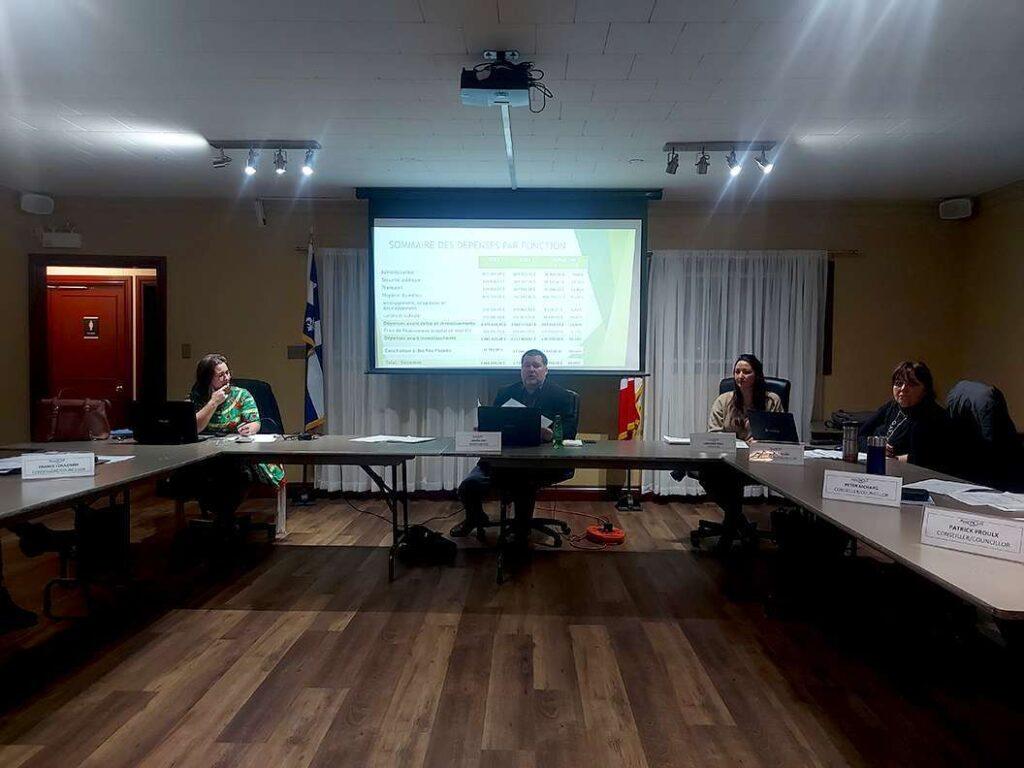
In a Dec. 18 special public meeting presided over by Mayor Simon Roy, the Ayer’s Cliff town council presented and approved the town’s budget for 2024. The key highlight of the budget was the anticipated tax increase for the year. For a home valued at $300,000, the tax hike is estimated at around 4 per cent. The hike is primarily due to fixed costs such as garbage, recycling, and compost fees, which have collectively risen by approximately $80 per residence. This increase is a direct pass-through cost, as the town does not profit from these services.

Budget overview

The total budget for the upcoming year is projected at $2.7 million, marking a $300,000 or 10 per cent increase from the previous year. This surge is attributed to additional investments in infrastructure and the creation of a contingency fund for future financial stability. The fund, amounting to 1 per cent of the budget or $25,000 annually, is designed to cushion the town against financial shocks, such as the end of grant subsidies for certain projects.

A substantial portion of the budget is allocated to various projects, including maintenance and infrastructure development. Notable expenses include the fire service costs, which have significantly risen due to the construction of new fire stations and the purchase of a fire truck. The budget also covers costs for waste management and firefighting services, which have both seen considerable increases this year.

The council has made strategic decisions to address future financial challenges and ensure sustainable growth. These include planning for long-term loan payments without grant support and increasing reserves to prevent abrupt tax hikes in the future. The town’s financial health is reportedly stable, with several successful initiatives and surplus generation ($150,000), indicating prudent financial management and planning.

Question period

Over 30 residents attended the meeting and were given the opportunity to question the budget presented.

One resident asked if property evaluations would be redone in the next three or four years. Re-evaluations will be done next year, responded Roy. “We’ve [had] about a 30 per cent increase in the first year of this term,” he said; many properties increased in value by “50, 60, even 80 per cent”. He thinks that the market will calm down during the course of the next year, but prices will certainly increase. They will adjust taxes accordingly.

Another resident asked why there was such a large increase (40+ per cent) in the budget for waste management. “It’s because we don’t do [it],” answered Roy. The work is contracted out, and only one company quoted a price for garbage, two for compost. The town must pay what the garbage company wants, he admitted. Roy noted that Sainte-Catherine-de-Hatley’s snowplowing costs recently tripled. “It’s crazy,” responded the resident. There are some great opportunities to get into the waste management business right now, Roy joked to chuckles from the audience. For a $300,000 home, the price has gone up about $80 per year, he reiterated.

A resident asked if waste management service for those near the end of the town’s routes would improve. Such residents would appreciate a text or a phone call when the trucks are late or plan on coming another day. Roy acknowledged the problem, but explained that the lower cost of the company compared to others that made offers made sticking with them the right decision for the town. The resident responded that those that receive worse service are paying the same as everyone else, which is not fair. Recycling has come late three times out of the last four weeks, said another woman. Roy urged them to call the town when this happens and speculated that putting waste management under the responsibility of the town in the future might be a good idea.

There will be a project to redo the skating rink using concrete, Roy said, responding to a question about why $600,000 was set aside for its renovation. With a concrete base, tennis or pickleball could be played on it in the summer. The change would also make it easier to put ice on the rink in the winter. The town is looking to finance the project primarily with voluntary donations and grants. If those do not come through, the project will not happen.

The beach is not under the responsibility of the town, Roy explained, when a citizen asked why it did not appear in the budget. The beach belongs to the Regie du Parc Massawippi (RPM). A portion of what the town pays towards the RPM goes towards the beach: $6,000. It is an excellent investment, he continued, because that money is mostly going towards the payment of the loan that was used to buy the beach. The beach will generate revenue in the future.

The meeting was adjourned at around 6:40 p.m.

Ayer’s Cliff Council approves 2024 budget with tax hike and infrastructure investments Read More »

GASPÉ TALES: Light at the end the tunnel for Canada’s largest lighthouse

Ruby Pratka, Local Journalism Initiative reporter

editor@qctonline.com

On July 13, Quebec Lighthouse Day, Lucie Bergeron was hoping to welcome hundreds of tourists to the Cap-des-Rosiers Lighthouse to climb the 122 steps up the lighthouse tower and admire the giant electric lantern and the breathtaking views of the Gulf of St. Lawrence. Instead, she and about 100 other Gaspesians showed up at the lighthouse with picket signs. Perhaps fittingly, it was a damp, foggy day. The historic site, Canada’s tallest lighthouse (at 34.1 metres tall) and one of its oldest, had been hastily surrounded with security fencing the day before; Fisheries and Oceans Canada (FOC), which oversees the lighthouse, had closed it for security reasons.

The lighthouse has stood sentry to nearly 150 years of Canadian maritime history. It was completed in 1858, 10 years after the brig Carricks ran aground off Cap-des-Rosiers; at least 120 people, mostly desperate refugees fleeing the Great Famine in Ireland, drowned in the freezing water, and a memorial visible from the lighthouse commemorates their lives. After the tragedy, the British colonial administration funded the construction of the lighthouse, built from grey sandstone and brick later replaced with gleam- ing white marble. “It’s older than Canada,” commented Bergeron, the president of the volunteer-run Société historique maritime de Cap-des- Rosiers (SHMCR), which oversees the historic site. Twelve lighthouse keepers, usually political appointees, lived and worked on the site from 1858 to 1981; lighthouse keeper Joseph Ferguson entered local legend in 1942 after spotting a German U-Boat from the top of the tower. Now automated, its light can still be seen for miles, its distinctive blinking pattern supplementing modern GPS systems to help sea captains find their way.

The lighthouse has been classified as a national historic site since 1973. Starting in the 1980s, descendants of the lighthouse keepers gave informal tours; later, that duty was taken over by the Cap-des- Rosiers chamber of commerce and the Musée de la Gaspésie before falling to the SHMCR.

“We make minor repairs, but we’re a small organization, and major repairs are done by FOC,” Bergeron said. “There have been no major repairs since 1994. There’s water coming in, the cupola needs to be repainted, and the steps are wooden and wood rots. We can’t do everything.” Bergeron said that in 2017, the SHMCR was told complete repairs would cost $6.5 million. Six years of wear and tear, two prolonged closures (during the COVID-19 pandemic and more recently for safety) and rising construction costs have done nothing to decrease that number. “The more we wait, the more it will deteriorate,” said Bergeron. “Why should we let a jewel like this rot?”

Bergeron said the closure was announced “kind of cavalierly” on July 11 and a series of inspections were conducted by DPO personnel. Gaspé MP Diane LeBouthiller, appointed Fisheries and Oceans minister in this summer’s Cabinet shuffle, has assured Gaspesians that the closure is “temporary” although no reopening date has been announced. Calls for tenders were launched in late September for medium-term repairs aimed at filling cracks in the structure and replacing faulty wooden steps, according to Bergeron. “It’s a good start, because before, we had nothing,” she said.

“We’ve called for serious investment in the lighthouse, but so far, all we’ve had are cosmetic investments to secure it, and it’s stopped there,” Gaspé Mayor Daniel Côté told the QCT.

Since the QCT spoke to Côté this fall, FOC has launched several calls for tenders and a Quebec City-based company has been mandated to secure the windows and seal cracks in the centuries-old building. That work is expected to finish before the end of the year.

The long-term future of the lighthouse is still up in the air. Bergeron and Côté believe incorporating the lighthouse into Forillon National Park is one potential solution – the park’s north entrance is less than 300 metres from the site. However, Parks Canada “doesn’t have the intention” to acquire the site, spokesperson Anne-Marie Laliberté said.

“Parks Canada has as part of its mission to maintain heritage buildings, while FOC doesn’t,” Côté argued. “There’s an argument between the two ministries. I even told [Prime Minister] Justin Trudeau about it when he visited in 2017. I said, your father designated this a historic site and you have the chance to save it. He looked me in the eye with that charisma of his and said he’d talk to Diane [LeBouthillier] about it.”

LeBouthillier, for her part, left Côté and Bergeron with the impression that the lighthouse “wasn’t a priority” until recently, something that Bergeron found “extremely painful.

“It’s an extraordinary tower, and we want the federal government to free up funds to repair it,” Bergeron said. “Now we’re going in the right direction.”

GASPÉ TALES: Light at the end the tunnel for Canada’s largest lighthouse Read More »

Front Commun, teachers’ unions hope for end to strikes before holidays

Ruby Pratka, Local Journalism Initiative reporter

editor@qctonline.com

Students around the province had an un- scheduled vacation from Dec. 8 to 14 due to a wave of strikes organized by the Front Commun bloc involving more than 420,000 public sector employees across the province, including teachers and support staff in CEGEPS and English-language public schools around the region. Students in French-language public schools in Quebec City, whose teachers are represented by the Fédération autonome de l’enseignement (FAE), have been out of school since Nov. 23, when their teachers began an indefinite general strike.

Both union and government leaders have said they hope to reach agreements to end the strikes before Christmas.

Éric Gingras is the president of the Confédération des syndicats du Québec (CSQ), a member of the Front Commun. The CSQ’s educational arm, the Fédération des syndicats de l’enseignement (FSE) represents teachers at Quebec’s English public schools through its member association, the Quebec Provincial Association of Teachers (QPAT). Gingras said the government has walked back some of its demands in the past week, and the Front Commun has indicated its willingness to accept a longer agreement instead of renegotiating after three years. “We are far from an agreement but we are moving forward,” he said. “The strategy we chose – not going out on an indefinite strike right away – gives us breathing room. Our strike ended [Dec. 14] and we want to negotiate and reach an agreement.”

FAE members rallied in front of Education Minister Bernard Drainville’s office to “denounce the unacceptable and coun- terproductive attitude of the Legault government.” Gingras said Front Commun members would meet Dec. 19 to discuss the movement’s future. In the fall, member unions voted for pressure tactics up to and including a general strike. “I’m an eternal optimist, and I believe a general strike can be avoided. We want to avoid it,” said Gingras. Striking teachers’ major concerns include salary increases, support for early-career teachers and class composition.

Performing arts teacher Tess LeBlanc is the teachers’ union representative at Quebec High School (QHS). “I kind of hoped that after a five-day strike we would be closer to seeing this end, and we may be, but I don’t know,” she said.

“There have been agreements on the smaller points but not on some of the larger points. It’s been a roller-coaster ride.” LeBlanc said she had “fingers and toes crossed” an agreement would be reached before Christmas.

“If the government doesn’t invest in public services, the quality will just keep deteriorating,” added Lisa Birch, a CEGEP Champlain-St. Lawrence professor represented by a CSQ-affiliated union. St. Lawrence teachers and staff participated in the Front Commun strikes. “What they’re offering support staff is ridiculous … schools don’t work without these people, and many of them aren’t making the highest salaries to begin with, and being hit the hardest by inflation. I don’t know why the government isn’t moving on this.”

QPAT members, like FAE members, do not have a strike fund. “I know it hasn’t been easy for a lot of teachers – especially early-career teachers and people in two-teacher households,” said LeBlanc. “Some have had to get part- time work in cafés or tutoring. It’s not easy to go on strike and give up your pay, but we’re doing it because we have valid reasons.” Two other large unions, Unifor-Québec and the Syndicat des Métallos, have clubbed together to raise a combined $170,000 for striking teachers, much of it handed out as grocery gift cards, and at least one local school parents’ committee has also chipped in.

On Dec. 6, about 100 QHS students held a protest in solidarity with their teachers. “That was really commendable and touching,” LeBlanc said, clearly moved. “They’re our future, and they’re the ones standing up for our rights and trying to make a better world.”

Front Commun, teachers’ unions hope for end to strikes before holidays Read More »

Historic paintings of Quebec City on display in Montreal

This painting of an improvised skating rink overlooking Dufferin Terrace by Newfoundland-born painter Robert Wakeham Pilot is part of Paysages de Québec (Quebec City Landscapes), an exhibit of historic paintings of the city from the Power Corporation collection, on display until Jan. 7 at the Château Ramezay Museum and Historic Site in Montreal. Art lovers passing through La Métropole this holiday season can look at some of their favourite Quebec City landmarks through artists’ eyes and discover parts of the city that have been lost to history.

Historic paintings of Quebec City on display in Montreal Read More »

Fortin celebrated at annual MNA holiday breakfast

Camilla Faragalli, reporter
Funded by the Local Journalism Initiative

Liberal MNA for Pontiac André Fortin hosted the annual MNA holiday breakfast at the Mickey Creek Golf Club on Saturday morning.

“It’s been a busy session, for me it’s been a busy year,” Fortin said, addressing the packed dining room in a brief introductory speech.

“But it’s nice to be back here and connect with you guys, and see what your priorities are.”
Fortin said he believes that the current public-sector strike is among the most pressing of issues on people’s minds locally.

“There are kids who haven’t been to school in weeks, it’s affecting their school success,” he said, adding that his own seven-year-old daughter, Élodie, is among them.

“To me it’s the government being somewhat irresponsible. They’ve had a year to deal with this, they knew this was coming, the unions gave them a lot of notice that it was going to happen, and there doesn’t seem to be any urgency within government to resolve these patterns and to settle these working conditions.”
Following Fortin’s speech, his wife Marlene Floyd took the floor with a special announcement: Fortin has been voted Parliamentarian of the Year in the National Assembly.

Her words were met by a standing ovation.
John Brennan, owner of Brennan’s Recreational Farms in Sheenboro, knows Fortin personally.

“He’s always been a great lad,” Brennan said. “The award just goes to show the kind of a representative that we have.”

Sophie Chatel, Pontiac Member of Parliament and a colleague of Fortin, was also present at the breakfast.

“I think Fortin is a really good MNA,” she said. “He’s doing excellent work in our community.”

“It’s a nice pat on the back from across the aisle,” Fortin told THE EQUITY of his award, which was determined in a vote open to all 125 parliamentarians.

“It’s always a balance for opposition members. You have to be vocal, you have to be able to call the government out on their failings – and there are numerous on healthcare, especially,” he said.

“But you also have to do it in a way that you’re able to talk to ministers and advance your local files, so it’s a delicate balance. My colleagues seem to think I do it in a very efficient and productive way.”

Fortin celebrated at annual MNA holiday breakfast Read More »

Beck’s farm to introduce voluntary milking system

Camilla Faragalli, reporter
Funded by the Local Journalism Initiative

At the Beck Family Farm, free-stall cows eat, drink and move about at will. Soon, the 145 inhabitants of the large dairy farm will have a level of freedom unprecedented by local bovine; a choice over when they are to be milked.

The Clarendon farm is installing a voluntary milking system, often referred to as a “robotic” milking system, in the spring of 2024.

Kristine Amyotte, who co-owns the farm along with her husband Robbie Beck, said the couple is excited to implement the new system.
“Like any business, we look at what our goals are going to be for the future management, we look at the replacement cost, we look at the changes that need to be made overall,” she said, “and currently we’re in a position where we have to do some sort of infrastructural update.”

She explained that the capital cost of implementing the robots is less than updating the entire parlour system, which would involve expanding the footprint of the building.
“It’s going to be a retrofit. We don’t need to build a new barn or new animal housing,” she said.
Amyotte said that in addition, while the farm’s maintenance costs will be higher with the implementation of the new system, there will be fewer people looking after the same amount of cows, which are currently milked twice daily in a process that takes two hours each time.
“When we put all those components together, for us it made sense to go with a robotic system,” she said, “We think at the end of the day it’ll be a gain for us.”

How a voluntary milking
system works

The robot that will be taking over milking duties at the Beck Family Farm is officially named the Lely Astronaut A5.
Amyotte and Beck are already in possession of three of them, and are planning on starting the renovations to accommodate their implementation in January.
“If everything rolls exactly the way we are hoping, by the end of February, early March, the technicians will come and put the robots together,” Amyotte said.
“Then there’s a training process for the cows,” she added.

The new system will involve installing three milking stations. Each will allow one cow at a time to enter, when she is ready to be milked. A transmitter on each cow’s collar identifies her and tracks many aspects of her health. If the identified cow is deemed “eligible”, the robot aligns itself to her udder and dispenses a ration of her food.
“They are very interested in eating,” Amyotte said, adding that the ration is individualized to the cow, based on her lactation phase.
Incentivized by the food, the cow will allow the robot to clean her udder with a brush. The robot then uses lasers to sense and monitor her precise location, and milk her. Once the process is complete, she is released back to the herd.

Once the Lely robots are installed, they will be available for use at all hours of the day, seven days a week, except for when they are being washed or sanitized.
Amyotte said that for approximately three weeks after installation she and the rest of the staff will take rotating shifts so that there is someone on site at all times to help guide the cows to the robots, “until they make the connection that that’s what they need to do.”

According to Amyotte, 95 per cent of cows in a given herd successfully adapt to the system.
She said that though the technology has existed for some time, she believes her and her husband’s farm will be the first in the region to implement it.
“It’s going to be great, because we’re going to be able to really individualize the care for each animal,” she said.
She added that she believes the robots will become more mainstream as farmers update ageing infrastructure.
“It [robotic system] is becoming more cost-feasible,” she said. “In our case it would have cost more to stay with a conventional system.”
“That doesn’t mean it’s the answer for everybody,” she added. “You have different herd management styles and goals and aspirations that would drive you to choose different infrastructure – that’s very individual per farm – but this was right for us.”

Amyotte said that a big part of the draw is flexibility in terms of her and her family’s schedule, explaining that with the current system, there is no flexibility on the timing of the cows’ daily milking.
“[It’s] 365 days a year, so birthdays, Christmas, Easter, it doesn’t matter what’s going on, that’s what has to happen,” she said.
“We love to work with the animals, it’s work that we choose to do, but it’s nice on the flipside to be able to build a little bit of flexibility into your life.”

The benefits of
individualized care

Amyotte said her cows are already monitored with sensors that give stats on things like their daily level of movement, how much they eat, ruminate, lie down, and when they’re going into heat.
“I’m kind of a data junky so I’m pretty excited about being able to get the information off the cows,” she said.
The data collected in the collar of each animal with the new system will be sent in a report to Amyotte’s phone, along with an alert, if the system detects something unusual.
“When you’re dealing with a herd of production cattle, you need to consider them almost like athletes,” she said. “You need to provide them the nutrition and the comfort that they need to do their thing.”
“Cow comfort is very important,” she added.

The average cow produces around 30 litres of milk a day, and Amyotte said a high performing cow with good genetic make-up can produce up to 50 litres a day during peak lactation.
Amyotte said she expects her cows’ overall production levels to increase with the implementation of the new system.
“A cow could visit three to four times a day if she’d like, and that will automatically stimulate her to produce more,” Amyotte said, adding that the production increase is typically between 15 and 20 per cent.
“I’m optimistic that they [the cows] are going to adapt well. If I had any concern about their welfare, I wouldn’t be doing this,” she said.
Amyotte said that while the robots will expedite one portion of the tasks involved in caring for her cows, “The rest of the care remains the same. We’re still here 365 days a year.”

She emphasized the continuing need for her cows to be fed, have their stalls cleared and bedded, and be artificially inseminated.
“It’s not a silver bullet,” she added of the robots, “but I do think it’ll become more and more mainstream.”
“We’re displacing roles that not a lot of people want to fill.”
Amyotte said she plans on keeping her current team of staff in place for now to keep the cows comfortable and producing well.
“We’ve been planning for this for a long time,” she said. “We have a lot of university and college students that work for us that will be graduating. As people leave for their own natural reasons, we just won’t replace them.”
Amyotte said her and Beck’s own daughter, Cadence, is currently studying agriculture and business at the University of Guelph, with plans to return to run the farm in the future.
“The whole community has been very supportive. We’ve had a lot of good questions come out of it, but really overall, great support and enthusiasm,” Amyotte said.
“It’ll be a very busy winter, but we’re looking forward to the change.”

Beck’s farm to introduce voluntary milking system Read More »

Still Missing

Sophie Kuijper Dickson, reporter
Funded by the Local Journalism Initiative

Michael Scandiffio had a modest but generous vision for his retirement.

He wanted to take on a bigger role in his sons’ sports, dedicate more time to his basketball association, and spend some quality time with the new puppy his family had recently taken in, that he was quickly, to his surprise, growing attached to.
Mike, as his family called him, was a spiritual man, and he yearned to become more involved at the Catholic church he had been attending since he was born.
It was the church where his parents had gotten married, where he had been baptized as a child, where he married his wife Debora Brown, and where they baptized both of their two sons.
During his career working in communications, as a reporter and deputy-editor for The Hill Times, a political newspaper in Ottawa, as a producer for CTV, and later as a communications director for the federal government, he maintained an active role in the lives of his sons and in his community.
When Mike was not at work, he spent his time helping his sons with homework, coaching their sports teams, and volunteering with the church.
In his retirement, he wanted to lean into these communities, and spend more time with the people he loved.
“He was just a really gentle, kind soul. He loved to have deep conversations with people about philosophy and religion,” remembered Kelly Steele, Mike’s sister-in-law.
Steele spoke with THE EQUITY on a cold afternoon in November, just over a year after he disappeared from Ladysmith’s Oktoberfest.

She had just returned from a week in Florida with her parents – a trip she hoped would allow all of them a small window of escape from the complicated cloud of mourning, without closure, and with so many questions still unanswered that had hung over the family’s head since Mike had gone missing.
“That was the best thing about Mike,” Steele remembered. “No matter what opinion you had, he respected it, even if it was the polar opposite of his. He could sit and have a conversation with an atheist and really enjoy it and be interested in understanding why they believed what they believed.”
Aside from church, baseball, and basketball, Mike’s great love was his cottage near Otter Lake.
His parents had built it on Clarke Lake in the 80s when he was a teenager, and he had been going up ever since.
“He liked the sunsets and the sound of water and reading and just being outside with the kids,” Steele said.
Steele remembered how Mike and her husband, good friends, would get talking at dinner and continue their conversion on the front porch of the cottage, often long into the night after everybody else had gone to bed, and often with a tiny glass of scotch.
“One of the things that united them so strongly was their love of philosophy, and for Mike, theology,” Steele said.
“I imagined that they talked about the meaning of life and what comes after. He was always looking to do the right thing and feel part of the spiritual world that he so believed in.”
But Mike has not been able to enjoy the retirement he had long dreamed of.
On Oct. 1, 2022, he left Oktoberfest at the Thorne Community RA centre in Ladysmith to take some food from the event to one of his sons who had stayed back at the cottage with a friend. The plan was for him to return to the party later to pick up Brown, but Mike never came back.

When Brown called her son at the cottage, she learned Mike had never made it there at all.
Mike and his vehicle went missing that evening, and in the 14 months since he disappeared, not a clue has been found as to what may have happened to him.
While a substantial community search in the first weeks after Mike disappeared covered significant ground, the family says they remain largely disappointed by the lack of communication from the police throughout the course of their investigation.
For their part, the police say they respected protocol, and that they deployed all resources their protocol made available to them, but the family feels they could have done so while also being more transparent and empathetic in communicating what this protocol was.

The night Mike disappeared

Kim Cluff was one of the last people Mike spoke with before he disappeared.
She has been volunteering at Oktoberfest since she was a teenager. Her grandfather was Clarence Bretzlaff, who founded the festival just shy of 40 years ago.
On the evening of Oct. 1, 2022, Cluff was stationed at the canteen, selling sausages in buns.
“He and his wife came up, and we just chatted about how they wanted to take the sausages home to feed the teenagers. He was going to take this back to the cottage, and she was going to stay and wait for him. Both of them were very lighthearted, and laughing,” Cluff remembered.
“I wrapped up their sausages for them, and they were so appreciative, and the next thing I heard was about this man who had disappeared.’”
Steele herself wasn’t at Oktoberfest that night, but what she remembers of what her sister Brown told her, Mike was going to take the food back to his son while Brown stayed at the festival with a friend from the area.
“Mike is kind of a quiet guy. Deb, Mike and their friend were dancing and he was participating and having fun enjoying the live music,” Steele said, adding that her sister understood when Mike offered to take some food back to the boys at the cottage that he wanted to check the score of the baseball game that was on TV that night.

He left Ladysmith around 8:30 p.m.. It was an hour later, shortly after 10 p.m., when he had still not returned, that Brown began to worry.
She called Mike’s cell, which was low on battery when he left, but he did not answer, which Steele said was not out of the ordinary. So Brown called her son at the cottage to see why Mike was late.
“That’s when she found out he had never made it back with the food. So right away she worried, because there’s nowhere else he would go,” Steele said.
Steele said Brown spent the evening calling Mike’s cell phone over and over again, with no answer.
At one point Brown asked the police whether they could ping Mike’s cell phone to locate it, but according to Steele, the police refused because it was not proper procedure.
“Which I kind of get because she could be a psycho wife looking for her husband,” Steele said. “But at the same time, that would have made all the difference, so it’s a hard pill to swallow.”
Steele said Brown spent the remainder of the evening talking to first responders and other people at the event about whether people had seen her husband. Brown and her friend ended up getting a ride home with an Oktoberfest volunteer many hours later.
When Brown got back to the cottage, she borrowed her friend’s car and used it all night, driving the roads of the area, looking for her husband.

She knew Mike was a cautious driver, and that if he missed a turn and got lost in the dark, or if a deer jumped out in front of him, he could easily get overwhelmed and end up off the road.
But Brown found nothing.
The next morning, Sûreté Québec police came to the cottage to gather information needed to begin the search.
The police spent many hours at the Clarke Lake cottage, searching the area with special lights designed for looking in the forest.

That same day, they put out the first of a series of media releases notifying the public of the search.
It detailed Mike’s age, physical description, the make and model of the car he was driving – a 2017 black Ford Escape, with Ontario license plate BNXP701 – and the place he was last seen.
He was described as wearing blue jeans, a red t-shirt, and a red Raptors basketball cap.
After the police finished their initial questioning, Brown drove back to her home in Ottawa to update her other son about what had happened.
She stayed in Ottawa from then onwards, making occasional trips up to the Pontiac to check security camera video footage or meet with people doing ground searches.
Family and friends took turns staying up at the cottage in the weeks that followed, watching over it and acting as a local liaison with the police and the neighbours who were out searching.
“One thing we do know for certain is if Mike could get home to his wife and kids, he would do anything to make that happen,” Steele wrote in an Oct. 7 Facebook post, about a week after Mike went missing.
For weeks, the family was hoping and believing Mike would find his way home to the cottage, and they wanted to be sure someone was there to receive him.

The Pontiac search

Sergeant Marc Tessier is the spokesperson for Sûreté Québec, and the media contact for this investigation.
“It’s very hard, unfortunately, to determine exactly what happened,” Tessier told THE EQUITY in a sit-down interview in Nov. 2023
“He may have continued his driving, and maybe he’s not even in that area. When you find at least a vehicle, you can narrow the search in that area, but unfortunately in that case we haven’t found his vehicle.”
Tessier explained one of the first things the police do in a missing person case is search the area, including every house, within a 300-metre radius from the last known place the person was seen.
If or when that is not conclusive, they expand the search.
“But if we don’t have precise information, if the search area is too big, we can’t search everywhere, so that’s why we’re always trying to put the most probable areas that a person with a vehicle going that way could go,” Tessier said.

As far as anybody knew, when Mike left Ladysmith that evening, his plan was to go straight back to the cottage. He had hot food to deliver, and his son was expecting him.
This meant he likely would have taken the fastest route home, turning north out of Ladysmith onto the 303 heading to Otter Lake and then left onto Stephens Road, which is marked by a white picket fence along the highway.
But Steele said in all the years driving that route to the cottage, family members often missed this turn off.
In this case, instead of turning around, they would continue on through Otter Lake, turn left on Highway 301 in Otter Lake, and left again at the Otter Lake cemetery, onto the western end of Stephens Road.
Steele said it is not a stretch to imagine that Mike may have gone this way instead.

A third option also had to be considered. Instead of turning north onto the 303 out of Ladysmith, Mike could have gone northwest out of Ladysmith, taking the 366 towards the 301, and turned right on the 301 to get up to Stephens Road.
“The probability is that Mike would turn [onto the 303]. But what if when he pulled out the food slipped and went down on the floor and he got turned around and went straight, or hit a large animal,” Steele wondered.
Early in the search for Mike, footage recovered from a surveillance camera at the Bretzlaff Store in Ladysmith showed a black Ford Escape turning north onto Highway 303 around the time that Mike would have been heading that way, but neither the license plate nor the driver could be identified.
Without this identification, none of the above scenarios could be eliminated, and so these three possible routes came to define the parameters of what became the main search area.
Of course, at times these parameters felt arbitrary. There was no way of knowing, absolutely, in which direction Mike drove.

But highways 301, 303, and 366, and the shoulders, ditches, ravines, and lakes that lined them, were the places of logic, of sanity, of plausibility. These were the places where the family could do something, instead of standing idle as the police conducted their investigation.
Sergeant Tessier said the police searched both main roads and side roads with patrol cars and four-wheelers, and went door to door in the Otter Lake and Ladysmith areas, asking if anybody had seen anything or had security cameras that might have captured pertinent video footage.
He said the SQ also surveyed the area with a helicopter on two separate occasions, once on Oct. 4 and again near the end of the month.

Ottawa police were notified, as well as the police with the MRC des Collines-de-l’Outaouais, the Gatineau police, and the OPP in Renfrew.
Tessier said key information, including vehicle make and license plate were shared with these police agencies but could not detail the extent to which any of these units were involved in investigative work.
An Oct. 27 media release said officers were continuing their ground searches, as well as their investigative work, and called on the public, especially hunters, to keep an eye out going into deer hunting season.
Tessier said this was the last media update the police put out sharing general information about the search and that, beyond what was shared in these releases, he could not confirm details of what the investigators did or did not look into, or what areas they searched.
He could not say when police stopped their ground searches in the area, but he did explain that in standard protocol, there comes a point when an area has been searched numerous times with no results that police need to make a decision to end active ground searches.
Tessier said the file remains open, but that new information is needed to spark new ground searches or investigative work.

Without a new tip or clue to move the investigation along, no further resources could be deployed, he said.
Steele said the family had the most interaction with the police in the first week of the search, but that as time went on, it was increasingly difficult to get answers from them about what was happening with the investigation.
“We didn’t really know how many people they had. We didn’t really know where they were looking,” Steele said. “Because we weren’t really hearing very much from the police, we were just doing our own thing.”
Steele and Brown coordinated search efforts from Ottawa.
“I was what felt like 24/7 on my computer at home or with my sister on my laptop. Except for any sleep we were trying to get, we were doing that the whole time.”
In the first week after Mike disappeared, Brown hired a military drone specialist to try and get a more detailed aerial view of the area than she thought the helicopters would be able to provide, but nothing came of it.

Steele put out social media blasts on Facebook, and reached out to local ATV clubs and hunting clubs in communities including Campbell’s Bay, Ladysmith, Shawville, and even La Pêche.
“There were some really instrumental people who we got connected with,” Steele said.
Nathalie Gagnon, of Otter Lake, was one of these people. She helped the family print and distribute posters, posted Facebook Lives about the search, and coordinated ground searches in the area.
Steele said people were putting up posters as far as Val des Bois, searching ditches up the Picanoc, and taking boats out on their lakes.
“It was a snowball. It got big and it grew and it grew,” Steele remembered. She said hundreds of people showed up to help with the search for Mike.
“We asked people as far out as we could to search their properties and barns, and nothing came back,” Steele said.
“It’s kind of mind boggling you know? It’s not just a person missing, it’s a freaking hunk of metal, like where is it?”

Frustrations with police

Steele said the family had immediate concerns about the possibility that Mike might have ended up in one of the lakes in the area.
Both alternate routes Mike could have taken home, one if he missed the turn and looped back through Otter Lake, and the other if he took the 366 instead of the 303, involved driving a portion of highway that hugged a body of water, with no guardrail separating the two.
If Mike had missed his turn and approached his cottage instead from the western end of Stephens Road, he would have had to drive around McCuaig Lake.
“It’s super dangerous. It’s a dirt road with no guard rails, and there’s some steep turns with big drops, so right away that was a concern for us,” Steele said.
Had Mike taken the 366, he would have passed Sparling Lake, also right along the highway, and also without any guardrails.

Steele said the family presented these concerns to the police, and the response they got was, “limited resources, limited money. We can’t just dive every lake,” she summarized.
“I get that,” Steele said. “But I don’t think they dove one single lake.”
When asked to confirm whether any of the lakes had been dived, Tessier said none had been, and then clarified, after checking his computer file, that he had no information about whether the police had dived any of the lakes in the area.

The family encountered this resistance several times in the first month of the search. Because there was no clue as to a specific site that should be searched, the police were limited in what further resources they could deploy.
Steele ran into this when she reached out to a local search and rescue (SAR) volunteer group, Sauvetage Bénévole Outaouais, asking for help, only to learn from them they could not be engaged until the police requested their assistance.
“For a ground search to commence one of the key things is you have to have a starting point,” explained Steve Nason, director of operations for the organization.
He said police forces will call in the SAR team once they have a specific area to search.
With the MRC des Collines police, for example, the SAR group will be called in to take on management of the search under the jurisdiction of the police service. The police retain responsibility for the investigation work, and the SAR team will run the ground search. But the investigative team leading the search for Mike never called in the SAR volunteers for assistance, likely because they had no starting point from which to begin.

The family also ran into a protocol road-block when they asked why the OPP could not be more involved.
“Mike was a resident of Ontario,” Steele said. “But we were told in no uncertain terms that this was the Sûreté’s [jurisdiction]. As far as we know, the OPP were notified but not involved.”
While Steele was frustrated with the dead-ends she kept running into when it came to finding additional resources for the search, she was also frustrated at how little the family was kept in the know about what the police were doing.
“It was very much, ‘we have our procedure and we need to follow it and we’ll let you know if anything turns up’,” Steele said, describing the tone the police would take the few times they would call with updates.
“So it just didn’t leave us feeling like a lot was being done because they weren’t sharing details about what they were doing, which is why we were in panic mode trying to collect people and do things because Mike could have had an accident and still been alive.”

This absence, whether a reality or only a perception, was reflected by people on the ground in the search area as well.
“People from the Pontiac were constantly reaching out asking why they weren’t seeing more police around,” Steele said. “We should have been able to say ‘the cops are doing this and that, and this is the procedure because of this,’ but we couldn’t even do that.”
Nathalie Gagnon said when she spoke with the owners of Coin Picanoc store in Otter Lake on Oct. 7, she learned the police had yet to look at the footage caught by the camera there.
The footage captured by the store, which sits at the junction of Highway 301 and the Pikano River Road, also known as the Picanoc, would have been critical to determining whether Mike had gone north up the 301 past Otter Lake or not.
“There’s not that many stores, and it’s quite a few days later, and they hadn’t looked at the footage yet,” she said.
Kim Cluff, the woman who served Mike food at Oktoberfest the night he disappeared, said she was never approached by any police.
When THE EQUITY tried to get some clarity about what had and had not been done in the investigation, including whether the police had been able to track Mike’s car or whether they had tried to locate his cell phone, Tessier said it was not police protocol to share details of the investigation.
“The family, they know what we’re doing, but it’s not public information.” Tessier said, adding that this is standard procedure, because the nature of Mike’s disappearance is still undetermined.
“If it’s a criminal case, every information has to be evaluated by a judge and not the public,” he said.
Tessier assured that proper protocol was followed and that the public had no reason to worry.
But by Steele’s account, the family did not know what the police were doing in their investigation. She did not feel, based on how the leading officers communicated with the family, that they felt the same urgency the family did.

She also raised concern that by her memory, the lead officer on the case was changed two or three times in the first months after Mike disappeared.
Sergeant Tessier would not confirm whether this was true.
“It was disappointing and frustrating and I’m a little angry about it too, for my sister,” Steele said, adding that what she saw of the search did not leave her feeling confident about how the local unit deals with missing persons.
“It left us feeling very alone and unimportant. I don’t think he got what he deserved from the search, and it’s not any one person, really, it’s just how the whole thing happened,” she said.
She clarified that while she is well-aware the police likely did more than they communicated, this does not change how their lack of transparency left the family feeling.
“If they had just talked to us on a more regular basis and been a little bit more empathetic it would have gone a long way in those early months that we were desperately holding onto hope that he would be found alive.”

SAR experts redo search

In July of this year, the search for Mike was given new life.
A veteran SAR team of two traveled to the Pontiac after learning of Mike’s disappearance, and that his file was still open.
The team, made up of partners Shari Hughson and David See, have volunteered their recovery efforts for dozens of cold cases in Quebec, Ontario, British Columbia and Alberta.
Typically, they show up after the initial search and rescue portion has been completed, often months, sometimes years later.
Their goal is to reactivate some form of search in the community, with the hopes that somebody comes forward with a new tip or piece of evidence that might help the family of the missing person finally get answers.
In the years they have done this, they have never found a body, but have found other objects connected to the case.
“That really was what we were trying to do while we were up there. Could we find something, could we stir up the community a bit to see if someone comes forward, because that’s the only way we’re going to dive deeper again,” Hughson said. Hughson knows the agony that is wondering what has happened to a loved one who has disappeared without explanation. When she was in her early thirties, her spouse went missing.

An intensive SAR effort was deployed at the time, in the area where the vehicle had been found, but his body was not recovered until seven months later when a hiker and his dog found him hanging in a tree, only 50 yards off the hiking trail.
A big part of the motivation behind Hughson and See’s volunteer recovery work is helping people, families, find closure.
See is a private investigator, and was a SAR team leader in Alberta for more than three decades, where he worked closely with police departments to find missing people. Hughson is a nurse with a specialty in mental health issues. They are both outdoor survival experts.
See and Hughson spent three weeks in the Pontiac, combing over every possible place they believed Mike could be, within the confines of the original search area, marked by the three highways.
“We’re 98 or 99 per cent sure he isn’t in that search area, “ See said. “We’re sure his vehicle is not there.”

They went down embankments and into ravines with metal detectors, they followed up on leads about suspicious activity, they consulted with the police, and as they went they talked to everybody they met about what they were doing.
Both See and Hughson are also scuba divers.
“We did eliminate any body of water you could drive a vehicle from the road into,” Hughson said.
“There were two lakes we had told the family we did not clear. They got deep very, very quickly and you could enter that body of water from a roadway,” Hughson said, naming McCuaig Lake, specifically the section hugged by Stephens Road, and Sparling Lake.
“So those still do need to get dived. They absolutely are a possibility. Those are the only things in our view that are still left within that original search area of where he might have been.”
“And don’t get us wrong,” See said. “It’s not like it’s a 50/50 chance. It’s a very slim chance because he would have to lose control or dodge a deer at that exact spot where there’s a bend in the road. But we can’t eliminate it.”

See explained that when a vehicle hits the water, it can float at half a mile an hour for a couple minutes before it actually sinks, and once it sinks it can keep travelling along the bottom of a lake if it is sloped.
At the bottom of a deep lake, a black SUV would be difficult to detect from the air.
“A helicopter might eliminate a lake, but it’s not truly eliminated until you dive it,” See said.
Hughson and See said a person usually goes missing for one of five reasons: foul play, suicide, a medical event, an accident, or they choose to leave.
After their thorough search, the couple eliminated suicide and the possibility of Mike having willingly abandoned his family.

They agreed he would have had far more opportune times to execute either of these scenarios than the small window he had between the time he left Ladysmith and when his son and wife were both expecting him within the hour.
They also said foul play was statistically improbable within such a small time frame, and on an evening when there were so many people on the roads.
“So we’re down to a medical issue or an accident,” Hughson concluded. “Something sudden occurred to have caused the car to leave the road. And it’s ended up in somewhere that’s very, very hard to see.”
“Our standing theory is he’s gotten confused or turned around. He doesn’t drive a lot, and he doesn’t drive a lot at night,” See said.
“He’s just gotten turned around in the dark, and tried turning around somewhere and went down an embankment or in the water,” Hughson elaborated, adding that wherever this is, they are almost positive it is outside the original search area.
“Our theory is it’s just a matter of time of searching before you find them. It’s the needle in the haystack,” See said.
Life with no closure

This theory, that Mike is somewhere in the Pontiac, in a lake or at the bottom of an embankment, is what Steele and Mike’s immediate family still believe today.
“We feel in our heart of hearts that Mike had an accident in the vicinity of the cottage,” she said, adding that keeping Mike’s story alive in the Pontiac is all they can do right now, “keeping the word out there as much as possible that Mike is still missing, he was never found, and asking people to continue looking and listening.”
The family worked with Gagnon and the Oktoberfest team to get that message out at this year’s festival.
The police also put out a media release at the beginning of November reminding residents to keep their eyes open while they were in the bush over hunting season.
“I hope that Mike is still very much on [the police’s] radar, I hope that they don’t stop looking for him, and I hope they consider doing more than they have even a year later, like maybe sending some divers into a lake,” Steele said.
“Until we find Mike, it’s never too late. And we need to find Mike, because I just can’t imagine this going on forever, you know, for years and years.”
She said the family is surviving, because they have to, but that the grief is always present.
“It’s always there. I see it in their eyes,” Steele said. “When someone passes away, you accept it, and you’re like, ‘okay, it is what it is. They’re gone.’ But it’s so not like that when you don’t know what happened or where they are or anything.”
She said as time has gone on, people have asked the family whether they are planning a celebration of life.
“I can’t even imagine doing that at this point. It’s only been a year.”
The silver lining, for Steele, is the support she and the family have received from people across the Pontiac.
“We’re so grateful for all that they did, and continue to do,” she said. “Hopefully, one day, somebody will find him so that I can go on social media and tell everybody he was found.”

Still Missing Read More »

‘More than a café’ opens in Campbell’s Bay

Camilla Faragalli, reporter
Funded by the Local Journalism Initiative

At the beginning of this month, Lisa Boisvert made a childhood fantasy a reality, opening the doors of her new café, Méli Mélo Bistro, to the public for the first time.
The Ladysmith resident says it’s something she’s been thinking about for decades.
“When I was a kid I always played restaurant, I had a cash-register for fun,” she said. “I love people so much, I love the public. I love interacting with all ages. And I’ve been in the service industry for a very long time.”
The café, located in the centre of Campbell’s Bay on Front Street, offers a variety of healthy dine-in and take-out options for breakfast and lunch, as well as coffee and fresh-baked snacks.
Boisvert said she hopes Méli Mélo Bistro will provide a space where teenagers and young adults, particularly, know they are welcome.
“I’m not a babysitter, but I want to offer a place for them to be, where they know they’re not going to be kicked out,” she said, explaining that for many teens, finding a place to relax either in solitude or with friends can be challenging.
“I want this to be more than a café. I hope I can be everybody’s comfort. I had a place like that when I was younger, I was very fortunate,” she said.
“I think I’m trying to give back what I had, because I’m glad I had it.”

‘A little bit of this and
a little bit of that’


While Boisvert is still working around empty fridges and display cases from the building’s previous tenants, she said so far business has been good.
There is no fixed food menu at Méli Mélo, but daily specials and some staples are available.
“I’m adapting, it’s whatever they [customers] want,” she said.
Based on customer feedback, Boisvert said she has plans to start serving breakfast, and have chili on offer every day.
“To me, that’s what méli-mélo means – ‘whatever you want’ – a little bit of this and a little bit of that.”
In addition to providing healthy options, Boisvert is making an effort to keep her prices affordable, and is including taxes in her prices.
“The reason I did that is the market I’m aiming at. I don’t need them counting their pennies and wondering if they have enough,” she said.
She added that she is discounting food from the day before, and if still unable to sell it, freezing it and donating it to local food bank, Bouffe Pontiac.

A place for youth


According to Boisvert, there aren’t many options for teenagers wanting to hang out in Campbell’s Bay.
“They’re mature adolescents and yet they have nowhere to go and nothing to do,” said the mother of three.
Boisvert said she intends to remove the old fridges that line the front room, and change the lighting to make the space more cozy, or “zen,” as she called it.
Boisvert said she is familiar with many of the local youth from years of experience working in a CEGEP program called La Défriche.
Through the program, which serves different local high schools including Pontiac High School in Shawville, Dr. Wilbert Keon School in Chapeau, and École secondaire Sieur-de-Coulonge in Mansfield, Boisvert worked with students on things like social autonomy, cooking, positive communication and budgeting.
“I did some entrepreneurial projects with them so I know that they’re smart, they have so many ideas, too,” she said, “And a lot of them recognize me, so I have that to my advantage.”
Boisvert said she’s got plenty of ideas about how she wants to use her new space beyond the café’s regular hours.
“Once I establish myself and know I’m viable, I want to be able to offer evening paint nights and workshops,” she said.
She said she’s already received recommendations from young people as to ways to use the space to best accommodate them.
“Live music and dances, crochet lessons and games nights,” said Boisvert. “I’ve had all age groups come in and I love it, I’ll never turn away anybody.” she said.

Supporting other businesses


Boisvert was keen to stress the need for more inter-municipal community support for local businesses to thrive.
“We’re 18 municipalities and nobody talks to each other,” she said. “Everybody sticks to their own.”
“I want restaurants to encourage each other,” she said. “There’s banger places around and nobody knows about them.”
Boisvert said that in an effort to encourage this, she is toying with the idea of introducing placemats referring customers to restaurants outside of the immediate vicinity.
“I’m not afraid I’m going to lose business because I’m encouraging people to go to other businesses near me,” she said. “I’m just happy to be here. I took a chance, I tried, and whether I make it or not, it’s something that I really wanted to do.”
“We [municipalities] all have good food,” she added, “We should try everywhere and encourage everyone.”
Méli Mélo is open Monday to Saturday from 7 a.m. until 2 p.m. Hours are subject to change.

‘More than a café’ opens in Campbell’s Bay Read More »

Facing the challenges of the holiday season: the transformative power of exercise

By William Crooks

Local Journalism Initiative

As the holiday season casts its long shadow with shorter days and increased social isolation, Dr. Steven Grover of McGill University emphasizes the profound benefits of exercise as a remedy for the mental and physical health challenges that many face during this time. With insights on combating Seasonal Affective Disorder, loneliness, and the sedentary lifestyle that often accompanies winter’s chill, Dr. Grover’s advice offers a beacon of hope. His expert opinion underscores the vital role of physical activity in maintaining wellbeing, particularly in a season marked by overindulgence and potential disconnect.

“As we go into the holiday season there are a bunch of things that are working against us in terms of mental health,” said Grover. If you are about to spend two weeks celebrating with family and friends, he added, you likely have it covered. For those who are less fortunate, it is a tough time for a number of reasons:

1) The shortest days of the year are upon us and the lack of sunlight in Canada is “problematic”. Anyone with even a tendency towards Seasonal Affective Disorder will start to feel the effects of less daylight on their sleep, mood and eating habits. “The absence of light is not healthy.”

2) For those who will not be soon surrounded by family, social connectivity will start to fall off, given they will not be working and may see their friends less. “Loneliness, to various degrees, is a major issue.”

3) Poor weather can be a problem as well, making getting out of the house difficult. Many will likely not exercise as much as they usually do.

Lack of exercise is a particularly important factor here, since it is the main and most efficient remedy to all of the above problems. Exercise outdoors is ideal, but indoor exercise will suffice if that is not possible. Regular exercise helps you sleep better, and lowers anxiety, stress and depression symptoms.

“The research data on exercise is so compelling,” he insisted, it has been shown to be as good as any medication out there, some data suggesting it is even better. He emphasized that he is not proposing prescribed medication should be replaced by exercise.

Exercise also helps you manage metabolic health risk factors, he continued, such as a blood pressure and blood sugar levels, with or without diabetes. It is crucial at a time when you might be partying, overeating and gaining weight. Even if you have no physical or mental health issues, “getting out is really important”.

For those without a holiday-time social circle, getting out to a gym or community centre is a great idea. He does not believe digital social connections are as good as real social connections. But they are better than nothing, “certainly better than watching television all day long”.

Superior to social media, he suggests, is a “facetime” or “zoom” interaction where you can see the other person’s face. People can get down on themselves on social media by looking at how others present their lives. “Everybody is posting about how great their life is.” This is the time of year that these forms of distress are likely to occur, so people need to know feeling this way is normal and they are not alone.

Finally, Grover extolled the virtues of “mindfulness”. Good information can be found on YouTube as to how to relax mindfully. The holidays are an excellent time to learn how to practice mindfulness, which can be done in a few weeks. “It’s not that complicated.”


Accessing mental health resources in Estrie

Mental Health Estrie was contacted by The Record for a quick list of suggestions on some good options for those struggling with their mental health this holiday season. For those seeking mental health support in the Estrie region, a variety of resources are available:

– Mental Health Estrie offers assistance and can be contacted at 819-565-3777 or through their email at info@mentalhealthestrie.com

– 811 Health Line: To speak with a nurse, choose option 1, or for a psychosocial intervener, select option 2.

– CHUS’ Hotel-Dieu and Fleurimont hospitals provide services at 819-346-1110.

– The provincial helpline for suicide prevention is available at 1-866-277-3556 for those in crisis.

– Kids Help Phone offers support for young people. You can call 1-800-668-6868 or text 686868 for assistance.

– Vent Over Tea is an online platform offering a listening ear, accessible at ventovertea.com

– Secours Amitié Estrie is available at 819-564-2323 for those needing someone to talk to.

Facing the challenges of the holiday season: the transformative power of exercise Read More »

Belt tightening, tax increase in the cards for Bromont

By Ruby Pratka

Local Journalism Initiative

The city of Bromont is expecting to tighten its belt in the coming months, city officials announced Dec. 11. Mayor Louis Villeneuve, finance director Stéphane Brochu and director general Francis Dorion presented the 2024 budget and five-year infrastructure plan at the final council meeting of the year. The budget includes a residential property tax increase of just under eight per cent and an emphasis on the maintenance of essential services.

“Everyone has been through a difficult year and had to make difficult budget choices, and it’s kind of the same thing for the city,” said Villeneuve, commenting that this year’s budget was “the least simple” he has seen in ten years in municipal politics. “Our needs are changing, not just due to growth, but due to [evolving] ways of doing things…and this is happening in conditions that aren’t ideal. Since 2006, taxes on home sales have allowed us to build up a fund that was sufficient to avoid tax increases. This year, we’re seeing a construction slowdown due to rising construction costs and interest rates. This has an inevitable impact on the budget.” Service costs have also risen sharply, according to data provided by the city – fuel, natural gas, asphalt, roadwork and maintenance costs have all gone up by 20 per cent or more (roadwork costs have risen by 37 per cent), salaries have risen and the city’s contribution to the MRC has risen by 11 per cent. The city received fewer bids from outside contractors for ongoing projects, pushing prices up, Dorion explained. Additionally, certain city infrastructure, including some water and sewer lines, was “reaching the end of its useful life,” he added.

The challenge, Dorion told reporters, was being able to maintain existing services and honour existing financial commitments (including debt reimbursement, which takes up about 15 per cent of the budget) while respecting taxpayers’ capacity to pay.

Tax rates for all types of property will rise, after a tax rate freeze in 2023. The residential tax rate has been raised from $0.558 per $100 of value to $0.604, meaning that the owner of an average single-family home with municipal water service can expect to pay $3,415 in property taxes, not including utility fees – $260 more than last year. Owners of multi-unit buildings with six units or more will pay $0.647 per $100 rather than the previous $0.598; owners of non-residential buildings will pay $1.578 rather than $1.458, owners of industrial buildings pay $2.104 rather than $1.944. Tax rates on agricultural land will also rise, from $0.488 to $0.528. Taxes on unused land covered by the city water network will nearly double, from $0.698 to $1.208, mainly as an incentive to encourage construction.

Utility fees will go up for both residents and owners of other types of property. Water fees, which had been stable since 2015, will rise from $226 to $237 for both homes and businesses. Residential septic tank fees will jump from $65 to $90 and sewage management fees from $110 to $137. Recycling and commercial water and sewage fees will also rise slightly.

Brochu said 85 per cent of the city’s current revenue comes from residential property taxes. He said he hoped further development of the industrial park and sales of city land there will help shift some of the tax burden from residents to businesses and bring the city an estimated $39 million in additional revenue.

Five-year infrastructure plan

Villeneuve and Dorion presented the city’s five-year infrastructure plan – a first for the city, which, like most municipalities, usually releases a three-year infrastructure plan at the end of every year. Dorion said a five-year plan made long-term planning easier. He said the current plan would focus on “essential investments.”

The five-year plan laid out $190 million in investments, of which $76.4 million would be paid by taxpayers, $16.7 million financed by land sales in the industrial park and $37.8 million by subsidies from other levels of government. Dorion gave a rapid overview of major upcoming projects including upgrades and extensions to the town’s sewer and water networks, upgrades to the water treatment plant which will allow more water to be pumped in from the Yamaska river, the first phase of construction of a new sewage treatment facility, the long-awaited new main fire station, Parc Grégoire, the Lac Bromont beach and a new public green space within the industrial park.

Belt tightening, tax increase in the cards for Bromont Read More »

English universities react to tuition measures, Bishop’s exemption

By Ruby Pratka

Local Journalism Initiative

Bishop’s University has received a show of support from one of its English counterparts after it was given a partial exemption to the CAQ government’s planned fee hike and language strategy affecting English-language universities.

In October, Minister of Higher Education Pascale Déry announced plans to double tuition for out-of-province Canadian students enrolled in undergraduate programs and certain masters’ programs and introduce a minimum tuition rate for international students. At the time, she argued that the measure would help counter the perceived anglicization of Montreal and keep Quebec taxpayers from subsidizing out-of-province students who took advantage of Quebec’s relatively low tuition fees and then returned home to work. Bishop’s is the smallest English-language university in the province, which receives 30 per cent of its students from the rest of Canada. After Bishop’s argued that the fee increase posed an “existential threat,” Déry indicated she was willing to relax some aspects of the policy for them. The opposition Liberals have called for it to be scrapped entirely.

In a Dec. 14 directive, Déry partially walked back the tuition increase, reducing the total base rate from $17,000 to $12,000 (The base rate for Quebec resident undergraduates at Bishop’s is just under $3000). The policy allows Bishop’s to enroll up to 825 Canadian out-of-province students at the current out-of-province base rate of just under $9,000. Funding for Bishop’s, unlike for McGill and Concordia, will not be tied to reaching French-language proficiency targets, although it will still be expected to aim for 80 per cent of their non-Quebec undergraduate students to reach intermediate French proficiency by the end of their studies.

Vannina Maestracci, a media relations officer for Concordia University, said Concordia supported the exemption for Bishop’s. “We are relieved to see that Bishop’s particular circumstances were taken into account by the government. The support provided by the community around Bishop’s also demonstrated how important this institution is for the Townships,” Maestracci told the BCN.

Echoing comments made by Bishop’s principal Sébastien Lebel-Grenier, Maestracci noted that despite the softened measures, the damage may have already been done to out-of-province enrolment, at least for this year. “Following the negative message sent to prospective students from outside Quebec over the last two months as well as the confusion surrounding tuition fees, we have already seen a decrease in applications of around 20 per cent for out-of-province students and 30 per cent for international students. Given this, despite tuition fees for out-of-province students now having been set at $12,000 rather than $17,000, we believe that the assessment of anticipated financial impact we did in late October still holds and that the new measures will result in a loss of about 10 per cent of our budget,” she said.

McGill University officials said in a statement that McGill “is very happy that Bishop’s University will largely escape the targeted, punitive measures that the Quebec government is inflicting on Concordia and McGill, Quebec’s other anglophone universities. We will not congratulate the government for limiting the damage to Bishop’s that the government has itself caused. The incoherent policies will have a devastating effect on the Quebec economy and on the Quebec university network in general.”

English universities react to tuition measures, Bishop’s exemption Read More »

Sutton raises residential property tax by 6.5 per cent in budget

By Ruby Pratka

Local Journalism Initiative

Sutton mayor Robert Benoît and director general Pascal Smith presented the 2023 budget and three-year infrastructure plan at the Dec. 13 council meeting.

City officials painted a relatively rosy picture of the town’s finances despite an uncertain overall economic situation marked by inflation, rising costs and interest rates. “This is our third budget since being elected, and we have pursued our initial objective of gradually restoring a balanced budget so as to no longer draw on the unallocated surplus to finance our current expenses,” said Benoît. “We are very satisfied with the work accomplished.”

The city expects to run a deficit of slightly over $960,000 this year, compared with $1.14 million last year. Smith noted that “further work would be conducted” in the coming year to look at different ways to “optimize” the city’s long-term debt of $10.8 million.

According to a city information document, the budget’s main aims are to maintain the current level of services to citizens, implement the family and seniors’ policy and the cultural policy, reduce utilization of the surplus and keep property tax increases down.

On the property tax front, residential, multi-unit residential and agricultural property tax rates will rise by just over 6.5 per cent, from 48.9 cents per $100 to 52.1 cents. Unused serviced land and non-residential buildings will see the largest increases, at 7.15 per cent (71.3 to 76.4 cents) and 7.24 per cent (88.3 cents to 94.7 cents) respectively. Water, sewage and septic tank fees will stay stable, with garbage collection fees decreasing slightly (from $198 to $196.30). The owner of an average single-family home in the Village sector will owe a combined $3,617.12 in property taxes, debt service and utility costs – an increase of $162.13, or 4.69 per cent, from last year; in the Mountain sector, the average homeowner will pay $3,546.90, an increase of $77.88 or 2.24 per cent. A homeowner with a house that isn’t served by the city’s water or sewage networks will owe an average of $3,160.80 – an increase of $157.45 or 5.24 per cent.

The city’s primary expenses are in transport, including road maintenance (25 per cent of the budget), public safety (16 per cent) and environmental hygiene including waste management (14 per cent), economic development (13 per cent) and administration (12 per cent). Smith noted that a large part of the security cost increase is attributed to an increase in the town’s contribution to the Sûreté du Québec, which is tied to combined property value. “Since property values went up [last year], we had to expect an increase in our Sûreté du Québec share,” Smith explained. The share the city pays to the MRC also rose by 14 per cent. “There’s a whole system that should be called into question there,” Benoit said, noting that the MRC and SQ shares paid by each municipality have no correlation with the amount of services requested or provided.

Smith noted that the municipality is reliant on taxes for 82 per cent of its income, and more than 90 per cent of tax revenue in Sutton comes from residential property taxes.

After concluding the budget presentation, Smith presented the city’s three-year infrastructure plan. Projects on Sutton’s to-do list for 2024 include major upgrades to water and sewage infrastructure on Western St. North, two culverts at the intersection of rue Réal and rue Harold and along Chemin de la Vallée-Missisquoi, long-awaited upgrades to Parc Gagné, the replacement of a bulldozer and a 12-wheeler truck and the creation of a dog park at the end of Rue des Puits – the winning project in the participatory budget poll held this fall. Smith noted that there would be no participatory budget poll in 2024. “It’s an excellent project, but it takes a lot of energy,” he said.

Sutton raises residential property tax by 6.5 per cent in budget Read More »

Gordon Ross holds the Grey Cup

By Nick Fonda

Local Journalism Initiative

In his three seasons with the Montreal Alouettes, Gordon Ross never got to pose triumphantly with the Grey Cup. The Als won the Cup in 1949, the year before Gordon first suited up for the team, and they’ve won the Cup several times since he hung up his cleats, including this year when they came from behind in the final minute of the game to beat the much- favoured Winnipeg Blue Bombers.

However, last Friday, 71 years after playing his final game, and thanks to the team at the Wales Home, Gordon Ross held the Al’s newly-won Cup while a dozen guests took pictures and three video crews (including CBC) recorded the moment.

Before Gordon was presented with the Cup by Alex Gagné of the Als, the Executive Director of the Wales Home, Brendalee Piironen, gave a short overview of Gordon’s life, and also explained how the Cup came to the Wales Home, a case of family connections.

The Wales Home has always had at least one doctor. At the present time, in addition to Dr. Frazer, Dr. Sophie Bourbeau attends to the medical needs of the Home’s residents.

It was common knowledge that Gordon was not only an Alouettes’ fan but also a former player. After the Alouette’s victory, Brendalee voiced the sentiment that it would be special for Gordon, who turned 100 this year, to get to hold the Grey Cup.

Sports teams have active public relations departments and a request to the Alouettes’ front office for a special visit might have eventually borne fruit, but it turned out that there was a much easier way to ask. Dr. Sophie Bourbeau’s sister, Pascale, is the life partner of Pierre-Karl Péladeau, the owner of the Montreal Alouettes.

So it was that less than four weeks after Alex Gagné (who played for the Université de Sherbrooke and is nick-named Captain Quebec by his Alouettes team-mates) hoisted the Cup in Hamilton, he passed it into the arms of Gordon Ross.

Gordon was born in Sherbrooke, the middle child and only son of Alexander Ross who owned an ice delivery company and who served as mayor of Sherbrooke from 1942 to 1944. Athletic and active, Gordon grew up playing hockey, basketball, football, and rugby. He grew to be 6’3” and 210 pounds at a time when the average Canadian male was 5’8” and weighed 160. He particularly loved contact sports and had his nose broken twice. In his 20s, just before household refrigeration became common, he worked for his father, collecting, storing and delivering ice (25,000 tons of it in 1948) that was then sold in blocks that weighed 25 – 100 pounds.

It was making ice deliveries to the Sherbrooke Hospital that he came to meet a nursing student from Danville, Mabel Elizabeth McCullough. A few years later, in 1952 when he was 29 and Betty was 26, the couple were married in Sherbrooke. For Gordon it was the beginning of a new phase of his life but also the end of his playing career.

Gordon had joined the Alouettes in 1950 as a lineman, playing center, guard, or defensive end. At some point he earned the nicknames Beef and Bruiser. There may have been renown and glamour to playing professional football in the 1950s but there wasn’t much money. Gordon was paid $25 when he attended a practice, and $100 when he played a game. By way of comparison, the minimum annual salary in the CFL in 2023 was $70,000.

In 1950, the Montreal Alouettes franchise had only been in existence for five years. They were part of the Interprovincial Rugby Football Union along with the Ottawa Rough Riders, the Toronto Argonauts, and the Hamilton Tiger-Cats. Teams dressed 37 players compared to 45 today and a season lasted a dozen games rather than 18. Out of town games meant travelling by train, only two hours from Montreal to Ottawa but six and a half to Hamilton. When Gordon had to stay overnight in Montreal, it was at the YMCA.

Two years after his retirement from the Alouettes, Gordon returned to football as a coach with the Bishop’s Gaiters where he won the championships that had eluded him as a player. He coached from 1954 to 1961, a time during which Bishop’s played against Loyola College, MacDonald College, the Royal Military College, and St. Patrick’s College. His teams won the league three years in a row, winning 18 of 19 games over that period. Yet, at 38 and after seven years of coaching, Gordon wanted to give more time to his growing family.

By the early 1950s households were replacing ice boxes with refrigerators and the job that had seen Gordon through his late teens and early twenties disappeared. For a time, he and Betty managed an oil delivery business until Gordon opted to start work at the Ingersoll Rand factory where he stayed until retirement. He continued to enjoy physical labor and helped out at a moving company as well as at the W.H. Hunting & Sons Ltd. saw mill, and the C. Wilson & Sons music and furniture store on Wellington Street.

Gordon and Betty raised three children: Peter, Catherine, and Paul.

“Both Mom and Dad were athletic. Peter and I inherited some of their athleticism and we were involved in numerous sports,” says Catherine Ross, “but neither of us had that extra drive, determination, and mental toughness that our father had that put him into the professional ranks.”

Gordon and Betty were active in the Trinity United Church and also involved with various social organizations like the Rotary Club and the Y’s Men’s Club, which hosted track and field meets.

“My father liked people,” she says, “and people liked him. He was a very modest, humble person who never really talked about himself or his accomplishments. Over the past two weeks, thanks to this wonderful event the Wales Home has put on, we were prompted to go through our family archives to pull out facts and photos on Dad’s career.”

“Dad’s been at the Wales Home now for about three and a half years, and he’s very happy here. And we’re very happy with the care and compassion that he gets from everyone here,” she says.

Those who attended the event at the Wales Home learned that Gordon is not the only centenarian former athlete in residence. As a prelude to the Grey Cup ceremony, Brenda-Lee Piironen introduced Keith Baldwin. Keith and Gordon are only a year or two apart in age, and, when they were in their teens, they played competitive hockey against each other on Sherbrooke’s outdoor rinks.

Gordon Ross holds the Grey Cup Read More »

Terrebonne session gets heated

Joel Ceausu – The Suburban LJI Reporter

“Don’t take us for fools.”

That was just one message delivered last Thursday night as some 300 people came to Benny library for a long-awaited info session on the controversial Terrebonne bike path planned for next summer.

CDN-NDG borough announced that Terrebonne would be transformed into two one-way roads from Cavendish heading east toward Girouard and west towards Belmore, and according to the plan there would only be 171 parking spaces left of the original 478, with all parking removed on the north side.

Borough mayor Gracia Kasoki Katahwa subsequently clarified at Monday’s council that it will not be 300 parking spaces removed per se from Terrebonne, but rather 200. The discrepancy in numbers is due to the fact that remaining spaces would not actually be removed, but rather liberated by the borough enforcing parking rules already in place, i.e., restrictions on cars parking too close to the intersections.

It’s the newest version of a plan which went ahead in 2020 as a pilot project but quickly scrapped due to overwhelming opposition.

The new plan comes from a technical report the borough commissioned at a cost of $150,000, and requires installation of 200 signs, 350 bollards, eight planters and thousands of linear metres of street markings for an estimated cost of $219,000.

Valerie Keszey bought her home on Terrebonne some 20 years ago with the ability to park outside, she told a group of fellow bike path opponents before the meeting. “I don’t have private parking, I have to park on the street. I can’t put my car in my pocket… Removing 300 parking spaces on Terrebonne is unacceptable.”

More than 200 people filled the room to capacity, leaving some 50 frustrated residents in the lobby waiting for people to leave so they could enter. One man stormed out early saying if the city’s experts “don’t live on Terrebonne then they are not experts.” The presentation was in French, spoken and displayed, but printed English copies were handed out and Loyola councillor Despina Sourias translated responses from the staff during question period, where residents were cautioned to ask only technical and not political questions.

The session was not billed as a consult, which raised the ire of many opponents. “When are we going to have a real consultation?” Irwin Rappoport asked NDG councillor Peter McQueen before the session began. “This is a consultation” replied McQueen, gesturing to the panel. “You know that’s not true” Rappoport replied.

Confusion reigned over the meeting’s vocation, critics repeatedly demanding true consultation take place, the plan seen as a fait accompli by many around the room when Katahwa spoke about discussions with residents, suggesting consultation had taken place. “Where was the consultation?” many shouted.

Katahwa said the study was released in October “so we would have a good six months to answer your questions.” On social media and in a press conference the day before the meeting, opponents of the plan insisted they support bike paths but not without proper consultation of residents affected. “Your concerns are really valid and that’s why I want to hear from you,” said the mayor. “Our goal tonight is to foster a real dialogue where your voices are heard… This is not the end,” she assured, suggesting even after a vote is taken in the new year “we still have time to listen and hear how we can improve the configuration… We are not only here to explain but to listen.”

While reasons cited for opposing the plan are numerous, some slam what they call skewed city priorities, with residents on the road still waiting for Montreal to change their lead water pipes, which won’t happen for at least a year after the path is implemented. Borough planner Jonathan Leduc said currently 400-500 bikes travel the road daily.

Despite rules that only technical questions would be entertained, some residents lambasted the administration for what they claim was bad data, ignoring residents’ positions, lack of consultation, making assumptions on winter usage, selectivity in data collection days and more.

“How are we going to keep paths clear and safe for cyclists if we can’t keep sidewalks clear for pedestrians” asked one woman, to which Sourias replied that a pilot project for Walkley and Lacombe bike paths would determine how. Another resident said the previous bike path attempt, which for her as a woman with a rare disease and who walks with a cane to her car, “was revolting.” She noted Projet Montréal sent out a notice “telling people to come and support this… As a citizen,” she asked Katahwa and McQueen, “respect people for once. Don’t take us for fools!”

Sourias insisted there is no fait accompli, good news for EMSB chair Joe Ortona who told the panel that Willingdon, St. Monica and Mackay schools are on Terrebonne, and administrators’ impression of meetings they had with the borough was precisely that. “If you’re telling us tonight that this is not, I find that reassuring because there were several issues.” For example, he says at Mackay, where many students are severely handicapped, “we have a drop-off on the land but there’s currently a drop-off zone on the north side of Terrebonne on the street. They would be moved to the south” and families drive big vans because they have disabled children that they have to carry and now they have to cross the street.” For all schools he says school buses, pick-up and drop-off on Terrebonne would be disrupted because of the new one-way configuration. The borough “is open to some adjustments,” said Leduc. “We will continue the dialogue with your schools.”

Terrebonne session gets heated Read More »

NDG MNA off to Dubai for COP 28

Joel Ceausu – The Suburban LJI Reporter

Among the more than 70,000 elected officials, bureaucrats, scientists, media, lobbyists, entrepreneurs, academics and observers descending on Dubai this week, will be Official Opposition Liberal critic for environment and climate change, Désirée McGraw.

The Notre-Dame-de-Grâce MNA will be one of the throngs walking the halls of the COP28 (2023 United Nations Climate Change Conference) this week, the only Quebec opposition member to do so.

As local green entrepreneurs and the provincial environment and business ministers bring Quebec’s message to the table, McGraw is part of the Quebec delegation while serving as a counterweight to the official provincial line, investigating on her own what the rest of the world is doing in terms of civil society, the private sector, and what lessons can be brought home to Quebec and Canada for achieving carbon neutrality.

The former youth ambassador at the Rio Youth Summit and reporter says she’ll be watching all negotiations closely. “The government invited, and I accepted. I believe it’s my duty as the critic on climate change to be there and play that role and hold our government to account,” McGraw told The Suburban.

In light of the recent controversy over FTQ union president Magali Picard jetting off to the Dubai summit while almost half a million public sector workers walk frigid picket lines in Quebec, McGraw understands the cynicism, but says “believe me, no one is going on vacation. It’s very intense and I don’t expect to be seeing much of Dubai, which is fine, because I’m there to work.”

What she’s concerned about when people watch these conferences “is that it should not lull people into a false sense of progress, just because people are meeting and talking necessarily, it’s far from sufficient… When the rubber hits the road,” it’s about implementing programs and policies to meet targets “or it’s meaningless.” While bold agreements are needed, “the real work is when you go home and the concern is the targets need to be aligned with reality, science, and then work at a national level and come up with a plan and actions that meet those.”

For example, Quebec has a green plan “but our targets are insufficient to achieve carbon neutrality by 2050,” and not on track in the short term to meet GHG reductions required compared to 2005 levels, with only 65% of measures in place. In other words, “inadequate measures to get to inadequate targets.”

“Quebec has no excuse; we should be leaders… because our economy is set up for success. There were decisions made — by a Liberal government — in the 1960s to invest in hydro power, clean energy, which does have some environmental challenges but from a carbon, climate perspective, it’s low to zero emissions,” and then under former Premier Jean Charest, Quebec created the first ever carbon market in North America along with California. “Right now with the CAQ, we’re kind of resting on our laurels.”

“Part of the reason I’m going to COP is for solutions; people can get overwhelmed by the science and intellectual pessimism, but we have to be operatively optimistic. It’s an honour and a duty to go, and that’s why I accepted.” 

NDG MNA off to Dubai for COP 28 Read More »

Red Coalition and JCC call for Manaï to resign

Joel Ceausu – The Suburban LJI Reporter

The Red Coalition (RC) anti-racism lobby group and the Jewish Community Council (JCC) are calling for the resignation of Montreal’s Commissioner for the Fight Against Racism and Systemic Discrimination, Bochra Manaï.

Since the creation of the Bureau, both the Commissioner and former executive committee chair Dominique Ollivier have chosen to remain silent and diminish all matters regarding racism and discrimination denounced by Black and racialized City of Montreal employees, says the Coalition. “Both Ms. Ollivier and Ms. Manaï have been aware of the suffering of several of their employees for a long time,” says executive director Joel DeBellefeuille. “They did not act swiftly, but instead chose to remain silent.” As the head of the Office de consultation publique de Montréal in 2020, Ollivier released a report suggesting that in combatting racism and discrimination, the City of Montreal should become an example and serve as a model for its partners, suppliers and civil society. However, following the 2021 municipal elections and with the appointment of Ms. Ollivier as an elected official responsible for the anti-racism and discrimination dossier, says the RC, “the Bureau has gone from having an anti-racism approach to a posture designed to accommodate resistance to change.”

The Coalition maintains after three years of the Bureau’s existence, racism and discrimination are rampant and employees have given up on the prospect of any meaningful changes going forward. RC director of racial profiling and public safety Alain Babineau says Manaï went along with that new stance. “Ms. Manaï has lost the respect of Black and racialized employees, their families and most recently, members of religious and ethnic communities spread across the island of Montreal. The city has also betrayed and failed those who participated in the OCPM public consultation.”

The JCC’s Kalman Emanuel stated even stronger charges. “Since the terrorist attack on Israel on Hamas we have seen an unprecedented rise in antisemitism and repeated attacks on Jewish schools, synagogues and institutions. Our community is frightened. Children are scared to go to school and members of our community are hesitant to attend services. At times like these we need leaders who will stand up against hatred while striving to build bridges between Montrealers of different religions and backgrounds. When she was appointed in 2021 as our City’s first Commissioner to Fight Racism and Systemic Discrimination, Bochra Manaï said, ‘I will be able to put forward my skills in developing strategies to counter discrimination, my leadership in putting into action anti-racist interventions as well as my strengths to raise awareness, develop tools and strengthen the city’s capacity to fight against racism and discrimination.’ The Commissioner’s actions speak louder than her words. Ms. Manai has attended pro-Palestinian rallies and made inappropriate posts on social media. Two weeks ago, our community called upon her to speak out against antisemitism yet she remains silent while our schools and synagogues continue to suffer a wave of anti-Semitic attacks.”

Manaï has been harshly criticized by several Jewish organizations following revelations of her activities including participation in demonstrations which featured highly inflammatory anti-Israel and antisemitic rhetoric, all while remaining silent as the number of antisemitic incidents, including shootings, fire-bombings and assaults, have risen in the city since the October 7 terrorist attacks on Israel. Calls for her resignation were rebuffed by the Plante administration which instead has mandated her to build bridges with the community.

The Red Coalition was instrumental in orchestrating the March 2023 denunciations revealed in a series of media reports and since that time, these employees have not received an official apology from the City, nor has the City created an independent entity to deal with such complaints. “Instead, the Plante administration has proudly announced the creation of a ‘one-stop counter’ to handle racism and systemic discrimination complaints.” The “zero-tolerance” message sent by city director-general Serge Lamontagne in March “is being laughed at by those set on maintaining the status quo. In many instances it has produced a backlash against racialized employees. There is no faith in that new process!” says DeBellefeuille.

The RC has filed a racial harassment and racial discrimination complaint with the Quebec Human Rights Commission against Manaï and the City on behalf of EDI expert Nathalie Carrénard who herself is part of the bureau. “Many racialized employees have turned to the Red Coalition for help and to speak on their behalf! They are afraid of retaliations from the city,” says Babineau. The RC has also filed a complaint with the Ordre des conseillers en ressources humaines agréés regarding an ex-employee of the City who made misogynistic and racist comments towards colleagues, including Carrénard, while working for the city.

Emanuel pointed out that, “A Molotov cocktail damaged our entranceway. Leaders from across the political spectrum spoke out against this horrific act, and many took the time to visit our premises to express sympathy and solidarity. Ms. Manai’s silence was deafening. At a time of increased tension in our city we need a Commissioner to Fight Racism andSystemic Discrimination who is willing to stand up and be counted. In her actions and her words, the Commissioner has to personify the values that bring peace and safety to all Montrealers. Ms. Manai does not have the credibility or the moral fiber to do the job. She should resign or be dismissed.” 

Red Coalition and JCC call for Manaï to resign Read More »

Days of action against gender violence

Joel Ceausu – The Suburban LJI Reporter

As part of the 12 Days of action against Gender Violence running until December 6, SHELTER MOVERS has launched its new campaign ‘’Let’s act on precariousness, let’s fight against gender violence ‘’ to raise awareness of women’s socio-economic conditions and the impact of gender-based violence.

SHELTER MOVERS is a Canada-wide, volunteer-driven charitable organization that provides free moving and storage services to families fleeing violence. Since its inception in 2020, over 500 moves have been completed in Quebec alone. It’s the only service of its kind in Quebec. In collaboration with local businesses and community agencies, the organization supports people who want to break the cycle of violence and overcome the financial obstacles preventing them from leaving abusive environments.

Prominent Quebecers will participate in the campaign’s flagship event, which will take place on December 4. Singer-songwriter Laurence Jalbert will give a lecture, which will be preceded by a panel discussion. Moderator Janine Ross will lead the panel, which will also include former Minister of Status of Women Christine St-Pierre, Annick Brazeau (President of the Regroupement des maisons pour femmes victimes de la violence conjugale) and Anuradha Dugal (Vice President, Community Initiatives at the Canadian Women’s Foundation).

” When you are transitioning to a life without violence, you often leave everything behind. A service like « SHELTER MOVERS » which provides, thanks to volunteers, free moving and storage services, is a game changer and a huge impact said Jalbert who is inviting Quebecers to support, financially or voluntarily, the activities of organizations that work with women and children in difficulty. Anyone interested in attending the online panel is invited to register on the campaign page: https://mailchi.mp/transitseco…

Days of action against gender violence Read More »

EMSB axes midterm exams

Joel Ceausu – The Suburban LJI Reporter

Some high school students who were doubly burdened by concerns over midterm board exams and lost days of learning due to the teachers’ strike, may breathe a small sigh of relief after the EMSB announced that it is cancelling school board midterm exams scheduled for January.

Unlike the provincial ministry exams, the EMSB board exams are not required for graduation.

The school board wrote to parents calling the decision “a necessary adjustment to our academic calendar” due to the “interruption of service caused by the strike days.” After discussion with school principals, the board decided to axe the January exams, although teachers can still hold in-class assessments. The board says their decision “aims to provide teachers with more time and allow students to focus on learning without the added burden of impending board exams.” n

EMSB axes midterm exams Read More »

Shield of Athena raises $150K for Second Step Shelter

Joel Goldenberg – The Suburban LJI Reporter

The Shield of Athena marked 32 years of helping victims of conjugal violence by raising $150,000 for its planned Second Step Shelter. The Lilac Event, held at the Palace Convention Centre, celebrated the work of the organization and its staff.

“As the need for the Shield’s services continue to grow, funds raised will ensure the completion of Laval’s only Second Step shelter and support the expansion of Athena’s House, the Shield’s emergency shelter,” organizers said.

The Second Step Shelter is scheduled to open in 2024 and “will have 17 apartments which will be able to house women and children for up to two years. During their time at the Second Step shelter, the women will receive the specialized support they need to emerge stronger and self-sufficient.”

Melpa Kamateros, Executive Director of the Shield of Athena, pointed out that “our Second Step shelter will be able to house between 34 and 54 people at any given time.

“On behalf of our entire organization – and the people that their contributions will help to lift up, I cannot thank our community and our sponsors enough for their support.”

Chris Ann Nakis, President of the Shield of Athena, said that “our Lilac Event was an incredible success, and this evening is only the beginning of a concerted campaign to increase the support for women and children in crisis.

“Currently, we provide services in 17 languages to 1,100 women and children annually. Every penny raised is critical to continuing and expanding our work.”

Carole Leblanc, President of Mercedes-Benz Laval and Godmother of the Second Step Resource, said that the ultimate goal is to “eradicate violence against women and children.

“Unfortunately, until that dream becomes a reality, the women working at the Shield and all the resources they provide are so very precious to our community.”

In addition to individual donors, premium sponsors of the Lilac Event were: The Azrieli Foundation (Platinum), Schwartz’s (Gold), Global Montreal (Media), ICI Television (Media), Mercedes-Benz Laval (Silver), Banque Scotia (Silver), Pantazis and Associates (Silver) and The Papadimitriou Family (Silver).

Also on hand for the Lilac Event were Chomedey MNA Sona Lakhoyan Olivier, Mille-Îles MNA Virgine Dufour, Laval-des-Rapides MNA Celine Haytayan, Côte des Neiges-NDG city councillor Despina Sourias on behalf of Mayor Valérie Plante, Laval councillor Sandra El-Helou on behalf of Laval Mayor Stéphane Boyer, Greece’s Consul General Katerina Varvarigou, and Armenia’s Honourary Consul General Levon Afeyan. The emcee was Bell Media broadcaster Debbi Marsellos.

More recently, St. Laurent MP Emmanuella Lambropoulos brought up the issue of gender-based violence, saying on Nov. 27 that “today is day three of the 16 days of activism. This issue continues to plague us. In 2022, 184 women were brutally killed in Canada, mainly by men. In other words, one woman or girl is killed every 48 hours.

“Thousands of women and children use the services of women’s shelters, but every night, roughly 300 women and children are turned away because the shelters are already full. That is a real problem. As a society and as a country, we need to do better. I would like to say how much I appreciate the work that the women’s shelters do to help women who are victims of domestic violence. I would like to thank a couple of organizations in particular that are making a huge difference in the community of St. Laurent: the Centre Amal pour femmes, and the Shield of Athena. To all the employees of these centres and all those who work every day to save women’s lives, I thank them very much.”

Shield of Athena raises $150K for Second Step Shelter Read More »

VSL École Maimonide vandalism investigated by hate crimes unit

Joel Goldenberg – The Suburban LJI Reporter

The entrance to the École Maimonide School parking lot on Bourdon Street near Tait in St.Laurent was vandalized with pro-Hamas graffiti, and a sign was defaced. The SPVM’s hate crimes unit is investigating. The graffiti calls Israel “terrorist,” and the sign was covered in black paint.No suspects have as yet been arrested.

David Malka, who posted a picture of the vandalism on Facebook, tagged Maimonide, Prime Minister Justin Trudeau, Federation CJA and the SPVM, and wrote, “Montreal wake up!!! What are you waiting for exactly?? This can’t be taken as a joke. Enough is enough. I know you’re trying to get armed security at doors but why don’t you start with regular unarmed security. Maybe that’s a start.”

This incident follows shootings at two Jewish schools in Côte des Neiges-NDG — police can still be seen at all hours in front of Yeshiva Gedola School on Deacon, which was fired upon twice; the firebombing of Congregation Beth Tikvah and Federation CJA’s West Island headquarters in Dollard Des Ormeaux; and many other hate crimes committed against the Montreal Jewish community. n

VSL École Maimonide vandalism investigated by hate crimes unit Read More »

Hampstead bans removal of authorized signage

Joel Goldenberg – The Suburban LJI Reporter

Hampstead council unanimously, by individual voice vote, passed bylaws imposing penalties for removing any signage approved by the town on public property, and for certain actions related to any demonstrations in the town.

The final signage bylaw was passed at a special council meeting Nov. 20, which is also when it came into effect. This and the Nov. 14 council meeting had much police attendance — The Suburban was the only attendee other than council and staff at the Nov. 20 meeting.

“While the signage bylaw is in relation to pro-Hamas individuals in many cities removing posters of hostages held by the terrorist group, the bylaw itself does not specifically refer to those posters,” the Mayor said at the Nov. 14 council meeting, where he also referred to Hamas as a “genocidal maniac terrorist group.” The town itself has put up posters on Fleet and Queen Mary Roads, and Levi urged others to put up posters of hostages.

The signage bylaw’s wording is “any act of breaking, altering, removing or displacing, without prior authorization from the town, a sign, notice, board or placard installed on public property constitutes a nuisance and is prohibited.” The fine is $1,000 for a first offence and $2,000 for a second offence.

“There will not be any warnings, there will not be any exceptions,” Levi said. “This law will be fully applied” and enforced by Public Security and the SPVM.

The Mayor said that if it was up to the town, the fine would be even higher.

“But $1,000 is the maximum we’re allowed to do. Also, it’s not part of the law, but you have unanimous commitment from everyone here that every single dollar that’s collected from this will go straight to Israel. For anybody who is thinking about doing anything stupid in our town, you think you’re helping your cause? You’re actually helping Israel. The next day, two posters will go up for every one that is taken down.”

Levi also condemned the fact that Montreal city workers and independent contractors are taking down the hostage posters.

“It’s a complete disgrace. And to Mayor Valérie Plante, I think it’s disgusting that you’re actually endorsing the taking down of these posters. Really, you should be ashamed of yourself for doing that.”

The second draft bylaw passed at the Nov. 14 meeting and passed in its final version Nov. 20 says that assemblies, parades or other gatherings may not be held if they “disturb the peace, public order or public safety,” “promote, glorify or threaten violence, hatred based on racial, ethnic, religious or other prohibited motives of discrimination, war crimes and terrorist acts.” A peace officer is also authorized to declare the event illegal according to the provisions of the bylaw.

Also prohibited is the molesting or jostling of citizens or obstructing their movement, and carrying or having, “without a reasonable excuse, a blunt instrument that is not used for the purposes for which it is intended,” such as a baseball bat, hockey stick or any other sticks or bats.

The fine for contravening the bylaw is $1,000 for a person, and $2,000 for a legal person (such as an organization), and a second conviction results in a $2,000 fine for a natural person and $4,000 for a legal person. n

Hampstead bans removal of authorized signage Read More »

CSL seeking dismissal of Meadowbrook case

Joel Goldenberg – The Suburban LJI Reporter

The City of Côte St. Luc is seeking the dismissal of the near 20-year-old case against them by the owner of the Meadowbrook Golf Course, Meadowbrook Groupe Pacific.

Meadowbrook Groupe Pacifique and the site’s previous owner have wanted to develop the golf course, which is located in Côte St. Luc and the City of Montreal borough of Lachine, for housing for decades. Legal actions have been taken by Meadowbrook contesting Montreal’s refusal to enable the course to be developed.

Legal action was also taken in 2002, against CSL’s rezoning in 2000 of its part of the land from residential to recreational.

Councillor Dida Berku introduced a resolution at council calling on the firm of Belanger Sauvé to file a motion to dismiss the case, and to pay an invoice amount to $19,994.73 to the firm.

“We were originally sued for approximately $30 million and the lawsuit is still going on 20 years later,” she explained. “Our new attorney on the file has discovered some technical irregularity, which he considers to be significant. So, we agreed to go forward with the motion to dismiss. We’ll see how that works out. In the meantime, our case is suspended until the City of Montreal defends the” Development Plan for the entire agglomeration, 2015 (Schema) concerning the designation of its property” on the Lachine side.

Asked at the end of the meeting to specify the technicalities prompting the motion to dismiss, Berku told The Suburban “our attorney uncovered that they declare one owner to be the owner of the Lachine side, and another owner to be the owner of the Côte St. Luc side.

“Actually, there’s an issue with legally who is the real owner. One owner on the CSL side is the party that acquired the litigious rights when they bought the property from Marathon Realty. The two owners are related companies. It’s very technical.”

In 2022, as reported by The Suburban, Quebec Superior Court Judge Babak Barin rejected two June 2021 bids by Montreal and Côte St. Luc to dismiss then-new legal action against them by Meadowbrook Groupe Pacific.

Montreal and CSL were requesting “the dismissal of Meadowbrook’s two originating applications.” In 2021, Groupe Pacifique’s original cases against Montreal and CSL were amended to claim that “it is the victim of a disguised and illegal expropriation of its land by Montreal as well as by CSL, due to regulatory changes of urban planning applicable thereto, and that, alternatively, the Scheme and the concordance by-laws instituted by Montreal are ultra vires or unenforceable against it.”

Montreal claimed that “Meadowbrook’s action is abusive, manifestly ill-founded in law and does not raise any question of law that has not already been dealt with by the Superior Court and the Court of Appeal.

CSL claimed that “based on the Municipalité de Saint-Colomban vs. Boutique de golf Gilles Gareau inc. case, ‘Meadowbrook’s action is doomed to failure given the state of the law, the application of which ‘cannot be the subject of any reservation or hesitation, the almost century-old [use] of the golf course for recreational purposes that are not altered or modified by the regulations of [CSL].”

But the judge dismissed the claims of the two cities in 2022, with legal costs, writing, an order to conclude the cases against Montreal and CSL are abusive, “they must be manifestly ill-founded, frivolous, dilatory and the abuse must be summarily established.”

The judge wrote that Meadowbrook’s experts “seem to indicate, rightly or wrongly, that the activities and uses permitted by the By-laws do not allow Meadowbrook the reasonable enjoyment of its property.

“In the circumstances and at this stage, therefore, terminating Meadowbrook’s claims prematurely would potentially nullify its rights. Without commenting on the chances of success of these, Meadowbrook must benefit from the opportunity to demonstrate how the effect of the regulations constitutes a disguised expropriation by the reduction of permitted uses, which it is trying to do with his expertise. It is therefore premature at this stage to deprive Meadowbrook of its recourse against Montreal, as well as against CSL.” n

CSL seeking dismissal of Meadowbrook case Read More »

MoWest stands by tempo ban

Joel Goldenberg – The Suburban LJI Reporter

Montreal West will maintain its ban on tempos — temporary shelters for cars during the winter — Councillor Colleen Feeney said in response to an emailed question from a resident at the Nov. 27 town council meeting.

The resident referenced a recent Suburban article about Côte St. Luc now allowing tempos throughout the city this winter. The allowance of tempos where they were previously not allowed is a pilot project, Feeney noted as part of her response.

The Strathearn North resident asked why Montreal North cannot do what CSL is doing, “especially for those who do not have a garage or are elderly.” The questioner added that it could help the town reach its goal of being senior-friendly.

Feeney, who has the Municipalité amie des ainés (MADA) age-friendly town portfolio, pointed out that the town has answered the question many times.

“It’s not the intention of this council to change our policy on tempos at this time,” she said. “In addition to the fact that they’re not aesthetically pleasing and and that they can be up for up to six months of the year, some studies have found that they pose security issues, whether it’s the sight line for drivers backing into the street or even going forward, whether it is the potential collapse if the snow is not cleared [from the tempo] — it does have to be cleared after a heavy snowfall. Then there are other security issues — they can block the view of a front door, somebody can hide in them.”

The councillor added that the town does feel for seniors, and that there are options other than tempos, such as “hiring a snow removal service, or a neighbour.

“But let’s face it, the cost of investing in a tempo and then paying for the installation and de-installation every year, you might want to compare the cost.” n

MoWest stands by tempo ban Read More »

West Island drivers wake up to shovels and snow plows

Chelsey St. Pierre – The Suburban LJI Reporter

Snowy weather overnight into Monday morning caused slower traffic throughout the West Island this morning. Slowed traffic on the three main north-south arteries, Saint-Charles, Saint-Jean and Sources Boulevards leading to Highway 40 and Highway 20 were scattered at multiple intersections as snow plow drivers worked to clear the roads. Lane closures on all three roads due to repair work caused long standstills as traffic was consolidated to one or two lanes at several intersections.

Highway 40 blockages due to lane closures on the Ile-aux-Tourtes bridge are ongoing and was exasperated by the heavy snow fall. Chemin Sainte-Marie exit remains closed causing congestion at the Saint-Charles Boulevard detour. The Ministry of Transport continues to encourage road users to opt for public transportation or telework in order to reduce heavy congestion resulting on both Highway 40 and Highway 20 from Vaudreuil-Dorion to Dorval circle. Express bus 40 is now free to travelers until further notice.

Highway 20 continues to be used by road users as a detour from Highway 40. Snow removal began shortly after 10:30 p.m. yesterday evening west of Saint-Jean Boulevard. Traffic was slower than usual Monday morning until approximately 9 a.m. at which point it resembled the typical 6:30-8:30 a.m. traffic hours. Municipal snow removal vehicles were busy clearing snow on residential streets while residents were busy shovelling or plowing the snow piles blocking their driveways.

Police authorities sent reminders that removing snow and ice from their vehicles is obligatory before hitting the roads and that winter tires are required as well since December 1st. Police vehicles from the Montreal Police Service (SPVM as well as Provincial Police (SQ) were present at the majority of major intersections Monday morning, especially near Highway exits. Schools and daycares sent letters to parents Sunday evening or Monday morning allowing for late arrivals or absences on an as needed basis taking into account the difficult road conditions.

West Island drivers wake up to shovels and snow plows Read More »

Farmers take messageto streets of Quebec City

Brenda O’Farrell
The Advocate

An estimated 1,000 members of the Union des producteurs agricoles took to the streets of Quebec City on Dec. 6 to draw attention to the increasing challenges farmers in the province are facing.

Under sunny skies, a light snow and minus-16 temperatures, the parade of agricultural producers from all regions of the province made its way to the National Assembly, where they demonstrated, calling attention to the growing concern about the financial viability of many farms and the need to encourage and support young people to invest in the sector.

“Producers participate every day in a very important social project, that of feeding their fellow citizens,” said UPA president Martin Caron in front of provincial legislature. “In return, they wish to be at the heart of discussions and decisions having an impact on their future as well as that of the next generation. This future is more fragile than ever and it is high time that lasting solutions are identified and implemented.

“What will be on the plates of Quebecers for the next 10, 20, 100 years that is at stake,” Caron said.

Farmers take messageto streets of Quebec City Read More »

Ile-aux-Tourtes reduced to single lane each way

Chelsey St. Pierre – The Suburban LJI Reporter

Only one lane in each direction will be available on the Île-aux-Tourtes bridge for several weeks.

The toll on Highway 30 as well as travel from certain stations on the Vaudreuil-Hudson Exo train line will be free during this period.

Despite these actions, traffic was still backed up during the Monday morning and evening commute for tens of kilometres in either direction on both Highways 20 and 40. In many cases it took motorists up to two hours to reach their destinations.

As the bridge situation changes rapidly, the MTQ continues to encourage people to favour public transportation or telework where posssible.

According to the Chrono application, motorists are encouraged to use Highway 20 and it is recommended that truckers use Highway 30. Damage to a portion of the slab has led to the reduction of lanes to traffic for the foreseeable future. n

Ile-aux-Tourtes reduced to single lane each way Read More »

Quebec has to do more to support farmers

That’s the message
UPA sent legislators
in provincial capital

Brenda O’Farrell
The Advocate

If the Quebec government says agriculture is a priority, it has to allocate more of its budget to the sector. And that means investing more than 0.98 per cent of its overall budget as it does now.

That was the clear message from the Union des producteurs agricole as it wrapped up its 99th annual Congrès Général in Quebec City earlier this month.

“We don’t want pity,” UPA president Martin Caron told The Advocate in an interview as the three-day convention wrapped up. “We want equity.”

With about 700 delegates gathering for the convention in the provincial capital, the changing realities of farming was showcased. And it came with a clear, impassioned plea from the UPA , which represents the more than 42,000 farm families from across the province – the government has to put its money where its mouth is and support Quebec farmers now, as the  growing inflationary and climatic pressures are threatening their financial viability.

“We can’t keep going into deeper debt,” Caron said.

To underline its message, the UPA staged a march through the streets of Quebec City on Dec. 6, and held a rally outside the National Assembly, where Caron presented Quebec Agriculture Minister André Lamontagne with the organization’s newly drafted manifesto.

The demand to be part of the solution to help the province’s agricultural producers who face increased economic challenges was on clear display as about 1,000 members of the Union des producteurs agricoles demonstrated through the streets of Quebec City on Dec. 6 as they took their plea to the National Assembly.

“We, the agricultural and forestry producers of Quebec, call on a collective push from citizens and government for the viability and sustainability of agriculture and forestry,” the document declares.

“For more than 100 years, we have been committed to feeding the world with determination and passion, despite all the challenges we have encountered over time,” the message continues, referring to the fact that the UPA is set to mark its 100th anniversary.

“Today, we are at a turning point in our history: more than ever, the sustainability of

our farms are being called into question. The unparalleled situation of economic challenges,

environmental, climatic and social factors expose the vulnerability of the future of agriculture and our ability to ensure Quebec’s food autonomy.”

The manifesto issues a direct call for the provincial government to act:

“Today, we, the 42,000 agricultural and forestry producers of Quebec, call on the government to prioritize our mission, which is so critical to Quebec, through a new, strong bio-food policy that is adapted to the new economic, environmental and social rules, and reflective of the challenging global context and realities of climate change.” “We, the women and men who feed the public, must be at the heart of a social plan that allows us to exercise our profession in an economically viable, effective framework that provides a safety net that supports environmental sustainability.”

Quebec has to do more to support farmers Read More »

Police find body of 23-year-old man in Lachine apartment

Chelsey St. Pierre – The Suburban LJI Reporter

Montreal police discovered the body of a 23-year-old man in an apartment located in the near the intersection of Duranceau Avenue and des Érables Street in the Lachine borough on Wednesday evening.

Police officers and Urgence Sante responded to a 911 call at approximately 5:30 p.m. The man’s death was pronounced on site.

Following an investigation surrounding the circumstances surrounding the man’s death, authorities established that the cause of death was homicide.

This is the 32nd homicide recorded this year in the Greater Montreal Area..

Police find body of 23-year-old man in Lachine apartment Read More »

Marquis clan of Ste. Croix named farm family of 2023

Brenda O’Farrell
The Advocate

The Marquis family of Ste. Croix – just north of Laurier Station, west of Lévis – was named the Farm Family of 2023 by La Fondation de la famille agricole during the Union des producteurs agricoles’ annual Congrès Général in Quebec City earlier this month.

The family, headed by Émilienne Dion and André Marquis, who married in 1962, had six children – Carl, Simon, Brigitte, Nicolas, Bernard and Marie-Andrée – and now count three generations who are active in farming.

Dion was raised on a farm, while Marquis followed in his father’s footsteps and was a butcher. Together, they had a modest beef farm, where they launched a small grocery store that featured a butcher’s shop that marketed beef they raised themselves.

In 1980, they expanded their operation, purchasing a forested area, where they launched a modest maple operation, tapping about 450 trees, collecting sap in buckets.

As their children grew, so did their family’s farming ambitions.

The couple’s oldest son, Carl, at the age of 19, married and with the financial aid of his parents,  purchased what was considered at the time a rather rundown farm. It is here, at what would become known as La Ferme Lorka, where the family builds dairy, forestry and maple operations.

This expansion also inspires Carl’s brothers to pursue their livelihoods in agriculture.

Brother Simon found employment with a dairy equipment company and became an entrepreneur specializing in farm building construction. He also bought Holsteins that were kept at La Ferme Lorka. He eventually bought his own farm in St. Charles de Bellechasse, where he raised beef cattle. In 1992, with his wife, they launched their own dairy operation, creating what they would christen La Ferme Sika.

The third brother Nicolas became a dairy consultant, and continues to work for Sollio Agriculture.

The fourth brother, Bernard, became an agronomist. Today, he is vice-president of strategic projects for Sollio Group Coopératif.

Now, as the family’s third generation grows into adulthood, the future of both La Ferme Lorka and La Ferme Sika are destined to be transferred to an all-female leadership.

Carl’s daughters Catherine and Justine both aspire to taking over their parents’ farm in Ste. Croix, while Simon’s daughter Laurence aims to take the reins of operations in St. Charles de Bellechasse.

Carl’s other children are also very active in the world of agriculture – Élaine is a veterinarian, while Guillaume has a 4,000-tap maple operation.

As for André Marquis and Émilienne Dion, they are enjoying their retirement as they continue to watch their children and grandchildren build and expand prosperous farming operations. They sewed the seed that has developed strong roots in a farming tradition that continue to grow.

Cutline: When the three generations of the Marquis-Dion family get together it is a large and boisterous gathering.

Credit: Photo courtesy of Union des producteurs agricoles

Marquis clan of Ste. Croix named farm family of 2023 Read More »

Final phase of consultations on farmland use launched

Brenda O’Farrell
The Advocate

The provincial government earlier in December launched the third and final phase of its public consultation as it prepares to overhaul the laws that govern the protection of farmland in the province.

The focus of this phase of the consultation will be the ownership of agricultural land and who should have access to it. The aim of the exercise is to solicit opinions on the increasing value of farmland and the consequences that carries in terms of taxation and the ability of young producers’ to buy it, as well as the question of imposing limits on non-residents owning farmland.

This phase of the consultation is expected to last 45 days, wrapping up in the third week of January. Farmers are encouraged to share their views online at https://consultation.quebec.ca/

Click on “Consultations,” then scroll down to the third option, which outlines the process for the consultation on farmland use.

The consultation is open to the general public, as well as those involved in municipal development.

Once this phase of the consultation is completed, provincial officials will tour the regions hosting online webinars in late winter with those who have shared their opinions with the aim of getting more in-depth feedback.

A final day-long public consultation session will be held in March, before a final report is written summarizing the finding of the consultation process that began last June.

This process marks the biggest reform of the rules and regulations administered by the Commission de protection du territoire agricole du Québec since the agency was created in 1978.

“We must act to ensure that producers will be able to cultivate the land and feed the Quebec of tomorrow,” said Quebec Agriculture Minister André Lamontagne in officially launching this latest phase of the consultation.

But some critics worry that the reform of the law, which might strengthen the protection of some of the highest valued farmland, could make less valued agricultural land more vulnerable to dezoning.

In the last few years, municipal officials in a growing number of regions have been applying pressure on the Legault government to be more flexible when it comes to farmland zoning, as demand for housing and industrial expansions grow.

In an interview in May 2022, Premier François Legault commented on criticism levelled at the CPTAQ, claiming, in some instances, it was too lax in protecting agriculturally zoned land, while in other instances it was too rigid in its protection. The premier responded: “The priority for me is the economy and the acceptability of citizens, and not only the CPTAQ.”

And in recent months, hundreds of hectares of farmland have been earmarked for development for massive electric vehicle battery plants. And a recent report by Radio-Canada claimed that from April 1998 and March 2022, the Commission de protection du territoire agricole approved all 10 mining related requests on agricultural land it received, taking 1,780 hectares out of food production.

The Union des producteurs agricoles has been very clear, it is against any loosening of protections for all farmland, advocating for a zero-net loss policy across the board.

Final phase of consultations on farmland use launched Read More »

Farm equipment sales expected to drop next year

Brenda O’Farrell
The Advocate

New farm equipment sales are expected to slow in 2024, according to the latest analysis by Farm Credit Canada.

The predicted dip in sales is due to a combination of higher interest rates, elevated equipment prices and a drop in commodity prices, the FCC says.

Challenges in the livestock sector are fuelling the cautious purchasing decisions expected for 2024 due to drought in western Canada and what is being described as “tighter revenues” in the hog and dairy sectors in eastern Canada.

Strong equipment sales in 2023 were recorded, reflecting the resolution of supply-chain issues and record-high crop receipts in 2022 and the first half of 2023, the FCC reported.

The drop in demand for equipment will be seen most in the category of lower horsepower tractors.

Cutline:

Chart outlines the percentage growth and decline in sales of the different categories of farm equipment over recorded and expected in 2022-2024.

Farm equipment sales expected to drop next year Read More »

Quebec grown beef to be identified in grocery stores

Brenda O’Farrell
The Advocate

Consumers will soon be seeing local beef products in grocery stores sporting a new stamp: “Boeuf du Québec.”

The certification is part of the Producteurs de bovins du Québec’s new marketing campaign to address the growing consumer demand for quality meat that is homegrown.

“With this certification, producers are responding to this demand,” said Jean-Thomas Maltais, president of the Producteurs de bovins. “Buying local beef at the grocery store means helping to increase the province’s food autonomy and contributes to the economic vitality of all our regions.”

The certification guarantees that the animals were raised on a farm in Quebec, and that 85 per cent of the animals on that farm were born in the province. Producers must produce proof of these criteria to qualify for the certification.

Qualifying products will be packaged with the distinctive “Boeuf du Québec” logo, in red, ivory and black, featuring the silhouette of a cow in a field. It will appear on products in all Sobeys grocery stores, which includes the IGA chain.

The Producteurs de bovins represents the more than 12,000 beef producers in Quebec. Beef production is the fourth largest livestock production group in Quebec, producing about $583 million in sales.

Cutline: This is the new logo that consumers will find in grocery stores on beef products from Quebec.

Credit: Courtesy of the Producteurs de bovins du Québec

Quebec grown beef to be identified in grocery stores Read More »

La Financière tops up aid fund to help Quebec farmers

Andrew McClelland
The Advocate

La Financière Agricole du Québec is answering the call of thousands of agricultural producers to provide relief money as inflation and a wave of extreme weather events have left them struggling to make ends meet.

On Nov. 23, Quebec Minister of Agriculture André Lamontagne announced an increase of $10 million to La Financière’s annual budget. That brings the total amount of relief funds up to $25 million, generating liquidity of $167 million.

“This announcement demonstrates our determination to ensure the sustainability of our agricultural businesses,” Lamontagne said.

“The enhancement of the Programme Investissement Croissance Durable (Sustainable Growth Investment Program) and the modification of its parameters will allow companies to receive financial assistance based on their turnover,” Lamontagne said in a statement. “We will continue to work collaboratively with partners to finalize the analyses of the 2023 season.”

La Financière is also reviewing the terms of that program to provide support based upon the revenues of each farm business.

The 2023 season has been particularly hard on Quebec farmers, with heavy and prolonged rainy periods making harvesting nearly impossible in some regions.

In August, the Ministère de l’Agriculture, des Pêcheries et de l’Alimentation du Québec (MAPAQ) set up a special committee to suggest changes to existing programs to help producers meet the cost of production.

In early November, André Fortin, agriculture critic for the Quebec Liberal Party, told the National Assembly that La Financière’s programs no longer met the reality of the province’s agricultural economics.

“It is urgent to review our programs to offer support to those who feed Quebecers,” said Fortin. “We need solutions adapted to their new reality. Our food autonomy and security depend on it.”

Key changes to aid program

The key changes to the Sustainable Growth Investment Program are follows:

  • Eligible businesses benefit from a 10-year working capital loan guarantee with no capital repayment for the first three years.
  • The period for submitting an application for the “Working Fund” component is extended by one year (until March 31, 2025, or until the amounts are exhausted), whichever comes first. So apply early.
  • The financial assistance granted can be no more than 15 per cent of the value of the working capital loan.
  • As of Oct. 31, 2023, 426 businesses obtained a working capital loan from the program, for a total value of nearly $21 million.

La Financière tops up aid fund to help Quebec farmers Read More »

Townships dairy legacy: 21-year-old first Canadian to win top honour at World Dairy Expo

Andrew McClelland
The Advocate

There’s a reason why so many successful farm businesses are also family businesses.

Through the decades, the knowledge and passion for agriculture are passed down, giving each generation a solid foundation to build upon and leaving room for some improvement.

You can’t find a better example of that business model than the Crack family of the Eastern Townships. And 21-year-old Savannah Crack is very aware of the benefits she’s reaped by coming from a dairy family.

“I’m very grateful,” Crack said, speaking on a rare break from work at the family farm in Cleveland, Que. — just a few kilometres east of Richmond in the Eastern Townships. “It is extremely, extremely, extremely difficult to get into this business if you don’t come from a dairy farm family, if you don’t have quota already.”

But it’s more than just quota and assets that Crack is grateful for. From a young age — looking up to her father, David, and grandfather, “Butch” Crack — young Savannah was aware that every day on the farm was part of an agricultural education.

“I always associated the farm with family,” she said. “It was always: ‘We’re going to see Grandpa!’ And my brother, Kolton, and I learned a lot of tips and tricks of the trade over the years when it comes to animal handling.”

It was, in fact, Savannah’s great grandfather, Gordon Crack, who founded the farm in 1967. The next generation — represented by grandfather “Butch” Crack — took Crackholm Farm into the world of dairy cattle genetics, a passion that Savannah and her younger brother Kolton share to this day.

Started with 4-H

That passion started young as Savannah became a devoted 4-H member. Soon she was showing Crackholm heifers at locals rallies and fairs and setting her sights on the TD Classic at the Royal Winter Agricultural Fair in Toronto.

“I was 12 the first year we went,” Crack said. “And I’ve gone every year ever since — except the year they didn’t have it during COVID.”

The TD Canadian 4-H Dairy Classic competition requires participants showing their cows to have already shown in four other rallies that year in order to qualify. So life for the Crack family often consists of practicing the finer details of cattle showing and, of course, loading up the cattle trailer to make it to a regional show or national competition.

“It’s normally me, my dad and brother in the truck when we head to the Royal,” Crack explained. “Along with the trailer, holding our cows and pretty much anyone else’s from the region who is showing in Toronto that year.”

Wins racked up

And the Crack family has racked up quite the impressive trophy collection in the past few years. Just this year their Holstein “Midas-Touch Montery 1127-ET” won first place for Best Udder in the 4-Year-Old category; another placed third in the Spring Heifer category; in 2022, the family brought home the First Prize Female ribbon in the Junior 3-Year-Old category.

“My brother and I generally do pretty good at the Royal,” said Crack with characteristic understatement.

“Although every year, nothing goes according to plan. I’ll have a heifer who behaves well in every other show ring, and then when we start showing at the Royal, she won’t walk. There’s always something that’s off. Every calf that I’ve shown.”

But any setbacks in showing don’t seem to be affecting Crack’s success. In October, she won the Merle Howard Award at the 56th World Dairy Expo in Madison, Wisconsin, (where she also won the Junior Showmanship Contest in 2015, by the way). The award is the highest recognition a youth showperson can receive at World Dairy Expo — and Crack is the first Canadian to ever win it.

FMT grad

But you won’t hear Crack gloating — or even mentioning — those awards and honours in conversation. Instead, she’s more focused on her integration into working full time on the family farm, having graduated from Macdonald Campus’ Farm Management and Technology program in April of this year.

“Every day, I get up and milk, feed my dry cows, go back for breakfast, then check on the heat, check on the cows that don’t feel good and she who needs to be vet checked,” she said, with a tone that reveals this young farmer has no fear of hard work or long hours.

“What makes me feel good is when I can sit down at my computer and look at the data and see that our cows are hitting a 40-kilo average,” Crack said. “That makes me proud. And that’s what makes me feel really good about farming.”

Cutline: Savannah Crack of Crackholm Farm in Cleveland, Que., has shown a lot of cattle. In October, the 21-year-old became the first Canadian to ever win the Merle Howard Award at the World Dairy Expo in Wisconsin.

Townships dairy legacy: 21-year-old first Canadian to win top honour at World Dairy Expo Read More »

Fossil fuel treaty brings Dubai climate talks home to farm country

Mitchell Beer
The Advocate

One day, generations from now, when we write the history of how humanity just managed to avert the calamity of runaway climate change, Canada’s National Farmers Union will be inscribed as one of the heroes.

That is because the NFU is one of the organizations that endorsed the Fossil Fuel Non-Proliferation Treaty.

The Fossil Fuel Non-Proliferation Treaty is a global campaign led by Canada’s brilliant and irrepressible Tzeporah Berman, an environment activist and writer. It has so far drawn the support of 11 small countries; 95 cities, provinces and states; 2,234 organizations of all kinds; and nearly 625,000 individuals.

At its convention last month in Ottawa, the NFU did everyone a massive favour by endorsing the non-proliferation treaty.

“Farmers know how to pull our weight,” former NFU vice-president Glenn Wright said in a release. “We work hard. We also know how to adapt to drought, floods, blizzards, plough winds and whatever Mother Nature serves up. We dig in and we persevere.”

But “overloading the atmosphere with greenhouse gases is taking us far away from ‘normal,’ ” he added. “Our climate will continue to accelerate away from normal until we stabilize our emissions by addressing our addiction to fossil fuels.”

The purpose of the Fossil Fuel Non-Proliferation Treaty is stated in its name. I have been a fan of the treaty campaign, including its tone and tactics, even though I have my doubts that it will achieve its literal goal. How will enough big-power countries sign on and adopt a formal treaty in the very short time we have available to wrestle climate change to the ground? Not when international negotiators at COP28 can’t even entertain an agenda item to decided how, when and whether they might want to talk about agriculture and food. (“COP28” is short for “28th Conference of the Parties to the UN Framework Convention on Climate Change.)

Toward the end of the first week of the 12-day negotiating marathon in Dubai earlier this month, a discussion on decarbonization and adaptation of the global food and agriculture system was deferred to follow-up discussions next June.

As the U.K.’s Energy & Climate Intelligence Unit stated: “Observers were left frustrated with a sense that blocking tactics have, in effect, killed talks on food for another year, at least.”

But at this year’s COP, more than ever before, there were signs that momentum is shifting in favour of the purpose of a non-proliferation treaty — to urgently stop fossil fuel expansion. That would mean phasing down and phasing out oil, gas and coal production and ending the trillions of dollars each year that governments are pouring into subsidies to fabulously profitable fossil fuel companies. Then shifting those dollars to sectors like agriculture that hold the keys to climate progress.

As The Advocate went to press, it wasn’t clear whether fossil fuel phase-out language would make it into the final declaration. But it’s moving up the queue. It’ll be back next year and the next. And it is 100-per-cent clear that the more than 100 countries and countless advocates who support the phase-out will keep at it until the job is done.

I’m absolutely certain that the very notion of a Fossil Fuel Non-Proliferation Treaty, not to mention the smart, compelling tactics the campaign has used, will be one of the driving influences that eventually make a fossil fuel phase-out a reality. And that every single endorsing organization will have played a central role in making it happen. And that will include Canada’s National Farmers Union.

Fossil fuel treaty brings Dubai climate talks home to farm country Read More »

Reindeer Games: Dasher and Donner get blitzed

Paul Hetzler
The Advocate

If a certain fungus is not available this year, Santa’s sleigh will be grounded on Christmas Eve, and gloom will reign at the North Pole.

Sometimes called the fly agaric because it supposedly was once used to kill flies, A. muscaria is common throughout North America and Eurasia from temperate latitudes to the far north. If you spend much time in the woods, there’s a good chance you’ve seen this fungus. It’s actually a tree-root symbiont, taking a small amount of sap from tree roots, but greatly boosting their efficiency in return.

Fungi are always present in a forest, although we can’t see them. By weight as well as volume, the vast majority of any fungus is hidden underground, or in things like old snags, stumps and logs. The “body” of a fungus is the dense, often mat-like mycelium that you may find under the bark of a dead tree or if you chop into rotted wood. Its “arms” are threadlike hyphae that extend out from the mycelium in search of neat stuff to do, like talking to trees (we think) and eating small animals (well, nematodes).

Mushrooms are what happen when fungi get in the mood to make babies. They don’t scroll through “Timber” for a hook-up, though, or otherwise have fun reproducing. If a fungus has consumed lots of organic matter for energy and enough moisture is present, it pushes out some erect structures like ’shrooms or conks (a.k.a. brackets, shelf-fungi), depending on species. These are called fruiting or spore-bearing bodies. Tiny spores, zillions of them, rain from the undersides of fruiting bodies and are carried on the wind to germinate elsewhere.

The fruiting body of A. muscaria is big: Its domed cap is known to get 30 centimetres or more in diameter, though 8-20 cm across is more typical, and it stands 6-20 cm tall. Sporting a bright reddish (orange on occasion) cap studded with prominent white spots, the fly agaric is one of the most recognizable free-standing mushrooms in the world; it’s the big polka-dotted red mushroom of colouring books, garden statuary, and Alice in Wonderland.

A. muscaria has psychoactive properties, and for millennia has been ritually ingested by Siberian shaman. It is also eaten by wild reindeer for – well, flying, I guess. Comet, Cupid, and loads of other blitzed reindeer (or caribou as we know them) have been seen lurching about after they’ve selectively browsed these mushrooms.

Santa’s reindeer-powered sleigh entered pop culture in the late 19th century, which is no surprise given that reindeer have had a close relationship with humans for millennia. At least a dozen thriving cultures still rely on this species today, including the Inupiat, Inuit and Gwich’in of North America and the Sámi of Nordic countries and northwest Russia.

Saint Nick’s team is shown having antlers, even though males shed theirs in autumn. However, unlike other members of the deer family, female reindeer also have antlers, which they keep until after spring calving. Clearly, Santa’s coterie of coursers are females. It figures – that’s who does most of the work in our species, too.

Naming these animals wasn’t Santa’s invention. The Sámi, traditional herders of feral reindeer, name the ones they train to pull sleighs. But airborne gift delivery may have been Santa’s brainchild. He knew that reindeer leg tendons click loudly as they walk or run. It’s hard to sneak up on kids with nine reindeer making a racket like hail on a tin roof. Good thing someone told him about Amanita muscaria.

The name Amanita may ring a bell: A close relative of the fly agaric, Amanita phalloides or death-cap, made the news this fall when three people in Australia were killed by a vengeful in-law. Turns out she slipped a few caps into their stew. Native to Eurasia, the death-cap was introduced to the Pacific coast and is now on Vancouver Island and the Lower Mainland. Just a cap fragment can devastate one’s liver and kidneys, making organ transplant the only “antidote.”

But our cheerful A. muscaria, in addition to being hallucinogenic, can induce nausea. This unpleasant side-effect is mitigated by drying with gentle heat – high heat takes all the fun out of the fly agaric by destroying its mind-altering properties. In Siberia and other regions, A. muscaria was often placed in stockings and hung near a fireplace to dry. This way, the moderate heat rendered them (mushrooms, not stockings) OK to use. Maybe it’s just me, but the image of stockings full of red-and-white stuff, hung by the chimney (with care, presumably) sounds familiar.

If you’re skeptical about a fungus-Christmas link, search for “mushroom Christmas” online and you’ll get a bazillion, give or take a few, images of A. muscaria tree ornaments, cards, candle holders, wrapping paper, and you-name-it.

In Cheech Marin and Tommy Chong’s hilarious 1971 sketch “Santa and His Old Lady,” Cheech explains how the flying sleigh is fuelled by “magic dust” that Santa gives the reindeer, and then takes himself. Maybe it’s a reference to fly agaric – who knows?

Although it grows throughout most of Quebec, please don’t experiment with A. muscaria. For one thing, autumn-picked mushrooms are said to be up to 10 times stronger than those gathered in spring and summer. Also, potency varies by site.

From tree ornaments to stockings full of goodies, the fly agaric has inspired many of the secular trappings of Christmas. If Cheech and Chong are right, it could account for Santa’s unnatural jolliness, too. And we know it’s the reason Santa’s team are able to soar around the world delivering presents. But then, maybe the reindeer only think they’re flying.

Reindeer Games: Dasher and Donner get blitzed Read More »

Alleged members of South American theft ring arrested after TMR break-in

Chelsey St. Pierre – The Suburban LJI Reporter

Montreal Police arrested two suspects in connection with break-ins that occurred in the Town of Mount Royal and in the Saint-Léonard borough. Jordan Camilo Garcia-Prada, 29, and Alvaro Sebastian Parra-Orjulea, 24, were arrested shortly after the incidents. They are facing charges of breaking and entering and receiving stolen property.

Investigators say that the two individuals arrested are believed to be part of a cell linked to an international criminal network called the South American Theft Group (SATG) specializing in private residence break-ins. Operating in several countries, members of SATG’s criminal network travel to carry out organized theft activities. The SATG is under investigation by various police forces and border patrol services.

Officers discovered items in their possession such as jewelry, laptops, chequebooks, a wave jammer and burglary tools.

Following a search of their home located in the Plateau-Mont-Royal borough, investigators found additional stolen property linked to a similar break-in that had previously occurred in a house in Laval.

The two suspects remain detained following their arraignment that took place at the Montreal courthouse. n

Alleged members of South American theft ring arrested after TMR break-in Read More »

Dorval implements transit corridor and Inuktitut signage

Chelsey St. Pierre – The Suburban LJI Reporter

The City of Dorval implemented measures to secure the transit corridor of the Ullivik residence following the death of two Inuuk women, Jane Tulugak and Nellie Niviaxie, who lost their lives in tragic circumstances as they were walking from the residence to Dorval’s commercial and transport hubs in 2022. Dorval Mayor Marc Doret fulfilled his promise that he would do whatever would be necessary to avoid another tragedy of the sort.

New pedestrian crossings have been installed along the transit corridor that was defined in cooperation with the implicated partners, and new directional signs were introduced in three languages (French, English, and Inuktitut).

These newly implemented measures were initiated by the City of Dorval in collaboration with the Montreal Police department (SPVM) and the Ministère des Transport du Québec (MTQ). “The changes initiated by the City of Dorval have been instrumental in developing pedestrian routes which allow our Ullivik residents to access transport hubs. It has transformed the way our residents move, granting them confidence and convenience bringing the Inuktitut language into the very fabric of our streets,” Ullivik residence Director Rita Noralinga stated.

City officials and officers from station 5 (Dorval) of the SPVM walked the walk along the new pathway following the announcement. “We will continue to participate in any projects that are undergoing to ensure the safety of the Inuit community and all of the Dorval community,” Station 5 officer Lisa-Marie Bridges, accompanied by station 5 Division Chief Francois Charron, told The Suburban.

“In August 2022, I made a commitment with our Director General to find a way to provide a safe and secure environment for those staying at the Ullivik residence to move back and forth between Ullivik, the Dorval EXO-STM terminal, and the commercial hub on Dorval Avenue. We decided that solutions needed to be found, not just discussed, and we acted without waiting for higher levels of government or ministries. We did this at the local level to ensure the safety of all members of our community and to prevent any more fatal accidents like the ones that took the lives of Mary-Jane and Nellie,” Doret said.

“For us, it was paramount that, as an administration and based on the wishes of the municipal council, we take the necessary actions to make sure that such tragedies do not happen again. I am proud of the various City of Dorval teams that worked closely alongside our community partners to put in place measures that could potentially save some lives,” Marc Rouleau, Director General of the City of Dorval, said.

Action Jeunesse de l’Ouest de l’île (AJOI) in partnership with the City of Dorval, will be donating reflecting backpacks containing a first aid kit, hygiene products, a map of the Greater Montreal Area (GMA), a list of resources and tickets for public transport in the coming weeks to Ullivik residence users. Communications director Sarah-Jane Boivin presented the backpack with enthusiasm stating that “we know the the backpacks will make a difference for the beneficiaries to make them feel more at home, because they are home. This help will facilitate their stay as they enter into a new step of their lives.” n

Dorval implements transit corridor and Inuktitut signage Read More »

Public input sought for development of NFB site in St. Laurent

Joel Goldenberg – The Suburban LJI Reporter

The federal crown corporation Canada Lands Company is seeking ideas in the next several months for the former National Film Board site at 3155 Cote de Liesse in St. Laurent, and its top goal is to tackle the housing crisis. The venerable 84-year-old film company’s headquarters is now in downtown Montreal. Any construction on a new project could begin in 2025.

CLC’s website includes details on a potential project for the St. Laurent site. “A master plan is currently being created and will define the development and urban design criteria for this nearly 4.9 hectares (12.1 acres) site,” a company statement says. “More precisely, it is part of a collaborative design process broken down into several activities and involving various stakeholders, including: Residents and workers from surrounding neighbourhoods, community groups, organizations and those with expertise in local issues, and municipal representatives.”

The company is inviting “stakeholders and the community not only to express their aspirations for the future site, but also to play an active part in shaping its development and inform the master plan. “The future of the NFB’s historic site is in keeping with its cinematic DNA, which has the capacity to tell the story of the past while reinventing itself as a space that contributes to the community in which it is located. This goal will be achieved by providing a variety of uses, creating a welcoming public space, and implementing a sustainable development strategy.”

CLC says the goals of a project are to “tackle the housing crisis, with the addition of affordable and market housing; repurpose most existing buildings to encourage economic development and artistic uses; be exemplary in the sustainable development of the property; and create a living environment that is open to the community and its needs.”

Throughout January and February, there will be an Online Activity – Site Visioning activity for the general public. Details on how to participate are forthcoming.

Other phases include an engagement workshop in April to look at three scenarios, at separate events for targeted stakeholders and the general public, and an online alternative for the general public; and in June, a participation activity at separate events for the general public and targeted stakeholders, and finally, a virtual presentation activity.

For more information on the project and to register for various activities, go to engage.clc-sic.ca/cote-de-liesse.

Public input sought for development of NFB site in St. Laurent Read More »

Police Chief Dagher tells Jewish community “We should not let the fear get to us.”

Joel Goldenberg – The Suburban LJI Reporter

Montreal police chief Fady Dagher took part Thursday in a virtual public meeting organized by B’nai Brith Canada’s Quebec regional office and another meeting with Federation CJA and the Centre for Israel and Jewish Affairs (CIJA) to reassure the Jewish community about the SPVM’s ongoing efforts to protect Jewish institutions.

That has included a 24/7 police presence across from where I live, at Yeshiva Gedola School on Deacon Road in CDN-NDG. That school was fired upon twice last month.

Dagher told the B’nai Brith meeting, moderated by Quebec regional director Hank Topas, that patrols and visibility have increased and almost $2 million has been invested so far to protect such institutions as synagogues and schools since the Oct. 7 Hamas terrorist attack on Israel, and subsequent antisemitic incidents in Montreal, including 116 hate incidents.

Dagher said 7,600 officers are patrolling 24/7 and the effort is ongoing, and hate crimes have lessened as a result. He also announced all officers will be trained to handle complaints of potential hate crimes.

In his meeting with Federation CJA CEO and president Yair Szlak and CIJA’s Quebec vice-president Eta Yudin, Dagher also said that security has been constant around Jewish community institutions, and that he sees anxiety and stress in the community.

Szlak acknowledged the police visibility, but pointed to recent antisemitic incidents, such as the Molotov cocktails thrown at Beth Tikvah Synagogue and Federation CJA’s West Island headquarters in Dollard des Ormeaux, and the Jewish Community Council, and the shots fired at Yeshiva Gedola and United Talmud Torah, and asked about the status of the investigations and potential arrests.

“Some of the [hate crime] incidents that happened in the past six weeks, we have made some arrests, and the people who have been the victims of these events know [that],” the police chief said. He repeated the same, in French, to Yudin.

Dagher also said, “I really want to make sure my community, the Jewish community, that their behaviour does not change.

“The mezuzah, [other Jewish items], don’t touch them. Keep them and be proud of it. The kippah that you’re wearing, don’t cover it. Continue what you were doing before [the Oct. 7 Hamas attack on Israel]. We should not let the fear get to us.”

Dagher also told Yudin and Szlak he does not know of any direct threat to the Jewish community.

“Please, go to Hanukkah [events]. Celebrate!”

Szlak and Yudin expressed appreciation for Dagher’s efforts.

“You’ve continued to listen to our concerns and I think it’s important for our community to hear that,” Szlak told Dagher. n

Police Chief Dagher tells Jewish community “We should not let the fear get to us.” Read More »

Previous administration rushed Hampstead tennis contract: Mayor

Joel Goldenberg – The Suburban LJI Reporter

The previous Hampstead administration under Mayor William Steinberg rushed the initial process for the town’s redone tennis court, Mayor Jeremy Levi told a resident at the Dec. 4 council meeting.

Earlier this year, when asked why the cost of the court increased from $1.3 million to $3 million, Levi, who did not refer to his predecessor by name, said he did not know what took place with the process before he became Mayor. At the December meeting, he had more information.

“It’s important you have context to this,” the Mayor said. “The way that tennis turned out with the new construction, nobody’s happy about it, full stop. There was an initial contract that was issued, and that was issued under a previous mandate, it wasn’t when I was Mayor. The Mayor at the time rushed through a contract. The procedures to create the bid document were not done properly. There were a lot of missing parts that needed to be formulated, and by missing some information, there was a company that was selected that really should never have submitted a bid to begin with, because they were not qualified.”

Levi added that after the election took place in which he became Mayor, “they demolished the existing tennis court and there was nothing to do. The company didn’t show up to work, to carry out the construction of the tennis courts, it was a very big problem.

“We tried many different ways to force them to finish, we had three choices. One was to do nothing, leave it as is and the entire town would be without the tennis courts. Two, we could take legal action, pursuing the warranties and it could drag on in court and cost us hundreds of thousands of dollars trying to enforce the contract, and years would go by until we had tennis courts. Or three, we could go back to the drawing board and renegotiate with the existing company to buy the product we already secured and hire somebody else to do it. None of those options were great, but those were the cards we were dealt. That’s what we inherited from a previous mandate.”

Levi added that if it was known what the cost of the redone court would eventually be, “I guarantee you there wouldn’t have been anyone on this side of the table [council] that would have been in favour of demolishing the court to begin with.

“But because there was a rush on the initial contract to get the contract out and redo the courts, certain things were missed. And although the courts cost a significant amount more than what we anticipated, we have been able to significantly increase the fees and I think we collected about $150,000 of revenue just from the tennis courts. So based on that, in a 10-year period, we’re going to recover maybe 80 percent of the costs of this expenditure.”

Councillor Harvey Shaffer, a lawyer by profession, agreed that if the legal case route was pursued, “the likelihood would have been that we would not have had any tennis for our residents for several years.”

When the resident later pointed out that the current council is mostly made up of the same people as the previous council, he was told they did not have the same information then that they have now.

Steinberg replied to The Suburban that “first, we were not rushed and five of the six members of the current council voted for the contract on the advice of consultants and management.

“The vote was unanimous. The problem was that the company hired did not fulfill the terms of the contract. The new council did not sue the company hired and instead paid them off for cancelling the contract. I can’t imagine why they did that. Then they paid far too much for the new company and in total, with the payoff, the cost more than doubled from what my council wanted to pay.”

Previous administration rushed Hampstead tennis contract: Mayor Read More »

Law firms call out Law School Deans on rampant antisemitism

Joel Goldenberg – The Suburban LJI Reporter

Some 80 law firms have sent an urgent letter to Canadian law school deans, calling for a meeting in light of a surge of antisemitic harassment and incidents at universities. At a recent House of Representatives hearing in the United States, some university heads could not bring themselves to say that calls for genocide against Jews violate university policy.

The letter from lawyers across Canada says, “among the core values at each of our law firms is that every person is entitled to be treated with respect and be free of any discrimination or conduct that targets their identity or that may be offensive, hostile, intimidating or inconsistent with their personal dignity and rights.

“Over the last several weeks, we have been alarmed by the surging reports of anti-Semitic harassment, vandalism and assaults on university campuses. These include protesters calling for the death of Jews. Such antisemitic acts would never be tolerated at any of our law firms, nor should they be tolerated at our Canadian universities. We also believe that universities should not accept student societies and outside groups engaging in acts of harassment and threats of violence, as has been occurring and tolerated on many campuses.”

The letter points out that some of the student groups associated with many universities have shown support for the terrorist group Hamas, which carried out the attack on Israel Oct. 7 that killed 1,400 people, and left thousands injured and with more than 200 people taken hostage.

“Students look to you for guidance and protection in a manner that affirms key core Canadian values being: respect, equality, safety and peace, all of which we as Canadians hold dear. We understand that as educators of higher learning, you must encourage discourse on various issues. This comes with the responsibility of managing a balance of the free exchange of ideas with the respect, safety and security of its students. As the leaders of these institutions this responsibility falls squarely on your shoulders.”

The lawyers added that at each of their firms, “we prohibit any form of discrimination, hostility or harassment, whether verbal, visual or physical.

“Let us be clear: there is no room for antisemitism, Islamophobia, racism or any other form of violence, hatred or bigotry on your campuses, in our workplaces or our communities. As employers who recruit from each of your law schools, we look to you to ensure your students are prepared to join workplace communities such as ours that have zero tolerance for any form of discrimination or harassment. We continue to carefully monitor the situation and trust that you will take the same unequivocal stance on your campuses. We also invite you to meet in order to arrange a respectful dialogue so that we can understand how you are addressing with urgency this serious situation.”

The signatories are: Allen McDonald Swartz LLP, Anglehart et al., Azancot & Associates Inc., Bereskin & Parr LLP, Boro Frigon Gordon Jones, Breder Law, Brownlee LLP, Chaitons LLP, Choueke Hollander LLP, Consumer Law Group Inc., Cooper, Sandler, Shime & Schwartzentruber LLP, Cozen O’Connor, De Grandpré Chait LLP, De Louya Markakis Avocats, Derhy Lawyers and Notaries, Diamond & Diamond LLP, DLA Piper, Duncan Craig LLP, Dunton Rainville L.L.P., Eidelmann Law Inc., Epstein Cole LLP, Fishman Flanz Meland Paquin LLP, Fogelman Law PC, Francis Mehr LLP, FWCanada, Gluckstein Lawyers, Goldman, Spring, Kichler & Sanders LLP, Goodman, Solomon & Gold, Green and Spiegel LLP, Greenspoon Lawyers, Guardian Law Group, Halpern Law Group, Hatch Law, Hladun & Company, Hoffer Adler LLP, Igor Ellyn ADR, JML Law Corporation, Kahn Zack Ehrlich Lithwick LLP, Kaufman Lawyers LLP, KRB Lawyers, Kugler Kandestin LLP, Labarge Weinstein, Law Office of Cynthia Lauer, Law Office of Harriet Altman, Lax O’Sullivan Lisus Gottlieb, Leo Adler Law, Leora Shemesh Criminal Law, Levine Frishman S.E.N.C., Levy Tsotsis, Lex Group Inc., MacDonald & Partners LLP, Manis Law, MBM Intellectual Property LLP, McCague Borlack LLP, McLennan Ross LLP, Neuberger & Partners LLP, Parlee McLaws LLP, Pinto Law, Pitblado LLP, Rachlin & Wolfson LLP, Ravinsky Ryan Lemoine, Robins Appleby LLP, Robinson Sheppard Shapiro LLP, Rosen Sunshine LLP, Rosenstein Law, Scharfstein LLP, Schneider Legal, Segev LLP, Shadley Knerr s.e.n.c.r.l., SOS Legal, Speigel Nichols Fox LLP, Spiegel Sohmer Inc., Stein & Stein Inc., Steinbergs LLP, Taylor & Blair LLP, Teplitsky LLP, Tilda M. Roll, Professional Corp; Torkin Manes LLP, Tutino Joseph Grégoire, Victor Vallance Blais LLP, Wagner Sidlofsky LLP and WLG Law. n

Law firms call out Law School Deans on rampant antisemitism Read More »

Children’s hospitals urge parents to keep children from ERs

Joel Goldenberg – The Suburban LJI Reporter

The CHU Ste. Justine and Montreal Children’s Hospital came together in a call for public cooperation, urging parents not to bring their children to crowded hospital emergency rooms unless the medical situation is urgent and immediate care is needed.

Officials from both children’s hospitals say both of their ERS are “under heavy pressure from the high volume of cases of respiratory viruses.” Dr. Laurie Plotnick, Medical Director of the MCH’s ER, said that “patients are seen in order of priority following a nurse’s assessment. Therefore, any patient who presents with a cold, flu or gastroenteritis and whose symptoms are mild should plan to wait several hours before seeing a doctor in the ER.”

The Montreal Children’s Hospital and CHU Sainte-Justine also emphasized that, on the other hand, “no child in need of medical care will be turned away from the ER. Emergency services should be reserved for people whose condition requires immediate care, and for children who are not seriously ill or injured, other solutions can be considered, such as the 811 line, or walk-in clinics,” said Dr. Antonio D’Angelo, Medical Chief of the CHU Sainte-Justine Emergency Department.

The hospital officials pointed out that between Nov. 17 and Dec. 1, “patients with a minor health problem (categories P4-P5) accounted for an average of 57.73 per cent of visits to the MCH ER. For the same period, the average occupancy rate of the MCH ER was 157.47 per cent. The average occupancy rate in the CHU Sainte-Justine emergency department was 172.13 per cent between Nov. 17 and Dec. 1. Patients with minor health problems (categories P4-P5) accounted for an average of 37.26 per cent of visits to the CHU Sainte-Justine emergency department between Nov. 5 and 28.”

The doctors emphasized that care at home is often the best solution.

“Mild flu symptoms, gastroenteritis and fever, which generally last three to five days, can be treated at home,” said Dr. D’Angelo. “When in doubt, you can consult your community pharmacist for prompt advice from a health professional. If symptoms persist, a consultation with a physician remains the preferred option.”

Dr. Plotnick said that “preventive measures, such as vaccination and good hygiene practices like regular hand-washing, are effective ways to reduce the number of unplanned emergency room visits and the long waits that follow during the busiest time of the year.”

Other options include:

• “In case of symptoms, first call Info-Santé at 8-1-1. Nurses are available at all times to assess your child’s condition, advise you and let you know when and whom to consult.”

• “You can also contact your family doctor, the Primary Care Access Point (GAP), your local Centre intégré de santé et de services sociaux (CISSS) or a walk-in clinic. Pharmacists are also excellent advisors.”

• “The MCH and CHU Sainte-Justine websites also offer a wealth of advice and information for families.”

A parent should bring a child to the ER in cases of:

• Fever in a baby under three months of age or fever with torticollis.

• “Unusual sleepiness or confusion.”

• “Difficulty breathing.”

• “Vomiting or diarrhea with an inability to retain fluids and/or signs of dehydration.”

• “Injuries such as head trauma with loss of consciousness, confusion or repeated vomiting.

• “A cut that may require stitches.”

• “An injury where a broken bone is suspected (example: swelling or inability to use the limb).”

• “Eye injury.”

• “Burns resulting in blistering.”

• “Ingestion of a poison, drug or unknown substance.”

• “Skin rash resembling small bruises.” 

Children’s hospitals urge parents to keep children from ERs Read More »

Otis Grant to bring boxing program to Pointe-Claire

Chelsey St. Pierre – The Suburban LJI Reporter

The City of Pointe-Claire and retired Canadian boxer Otis Grant have teamed up to offer the Grant Brothers Amateur Boxing Program at the Olive-Urquhart Sports Centre.

The program includes boxing classes as well as group and one-on-one training sessions, work-out sessions and a variety of community programs.

For over 20 years, brothers Otis and Howard Grant have been training boxers in the West Island. The duo run their own boxing gym in Dollard-des-Ormeaux, and are now expanding their program to Pointe-Claire.

Pointe-Claire Mayor Tim Thomas told The Suburban that he is very proud to have signed this agreement with Otis Grant and pleased to see that major sports figures are willing to offer their programming in Pointe-Claire’s sports facilities. “This is a win-win for us and the Grant brothers. We fill an under-utilized space with programming and an established martial arts organization and they extend their existent programming to a broader community.”

Otis Grant is a former professional boxer who competed on the world stage and won a silver medal for Canada at the 1987 Pan-American Games. He is also one of the few Quebec boxers to have won a World Boxing Organization (WBO) championship.

Following his professional boxing career, Grant has been involved in a wide variety of community and charity work. The former boxer started his own foundation in 1999, namely The Otis Grant and Friends Foundation, which continues to donate medicine, as well as food and clothing to communities, while also aiding families in need across the country.

Otis Grant to bring boxing program to Pointe-Claire Read More »

Despite support, parents and teachers are hurting from strike

Chelsey St. Pierre – The Suburban LJI Reporter

The ongoing strikes of nurses and French-sector teachers joined last Friday by English-sector teachers are having significant consequences on strikers and parents alike. The nurses are partial walkouts. But the teachers are out full time forcing parents to balance work and family.

“We are always the bottom of the barrel,” school transport services worker John Rallis told The Suburban. “These bogus government offers are utterly disrespectful to us.”

“Before Legault got elected he was raving about how important school boards, nurses and essential workers were. And again during the pandemic. What does it look like now?” school payroll employee Kathleen said to The Suburban. “This is not just about salaries. We understand parents, we (many of us) have kids. Particularly parents with special needs kids need our support. Down the line this is for the students.”

“Teachers are important, but support staff are also important, we play an important role also for the students. The education system needs change. There were many reforms but without putting students first. We need to revolutionize so future generation receive adequate education. I tell my own kids that we are making history for the future generation of students,” Sandra, a school organization technician, told The Suburban.

When asked what is at the forefront of these efforts from her perspective, Sandra replied straightforwardly that special needs students are neglected. “We need to improve student services.”

Picketing without pay has also affected staff. Personal sacrifices are being made by many strike participants in order to hold the line. “Many of us (involved in the strike) have cancelled Christmas this year, or scaled down, hoping that this will make some kind of impact,” Kathleen explained.

Quebec Premier Francois Legault is calling the negotiation tactics “detrimental to families.” Many parents living through the difficult consequences of ongoing strike days agree. Others are willing to make the sacrifice in support of staff and in support of improving learning conditions for students.

A mom of three, one with special needs in elementary school, told The Suburban that although the financial pressures on her family are high at this time, she is in support of a long-term solution. “My son was integrated into the public system that offers extra support, but it is clear to me that he needs more and the staff are willing to offer it, but they need our support now to put pressure on the government to recognize these issues and act.”

“Our family can barely make ends meet. Christmas as we know it is cancelled. I am barely making it as is and missing work to care for my son while he is scheduled to be in school is exhausting my already limited financial resources,” a single working mom said to The Suburban. “At the end of this strike, they might get paid more but I won’t and if this continues, I might be out of a job.” n

Despite support, parents and teachers are hurting from strike Read More »

DDO mayor and Avi Krispine help West Island sports

Chelsey St. Pierre – The Suburban LJI Reporter

Dollard-des-Ormeaux will soon be the home of a new Sportsplex which will include a Soccerplex. There has been growing demand by West Islanders for such a facility. It is expected to come to life as soon as financial resources from the minister of education as well as private funding respond to the initial plans drawn up by DDO.

With the closure of Lachine’s Soccerplexe, previously named Catalognia, the closest indoor facility for West Island players is located in Laval.The demand for an indoor complex for soccer as well as an array of sports such as basketball and tennis that need them through the winter months is growing in the West Island and off-Island neighbouring communities.

With the 2026 Fifa World Cup coming to Canada, the competition amongst local soccer players is fierce and training facilities are in high demand. “This is a lucrative revenue stream for the city and benefits local athletes and residents,” Dollard-des-Ormeaux (DDO) Mayor Alex Botaussci told The Suburban. According to Botaussci, the facility will come at a low cost for residents as it will generate revenues from indoor events such as a theatre while benefiting athletes from a buffet of sports. “The opportunities seem endless,” he said.

Additional uses under consideration include: public education, sport study programs, dance, entertainment and city run outdoor event alternatives to rain-outs. The exact location of the Sportsplex will be officially disclosed following several “next steps,” however Botaussci shared an exclusive hint with The Suburban that it will be located near the city centre (near the civic centre) with easy access to Highway 40.

Former Soccerplex Lachine owner Avi Krispine bought Catalognia as a property ripe for condo development. Shortly after he purchased the property, he was made aware of the importance of the Soccerplex facility. Krispine then gave up his lucrative condo project in an act of goodwill and decided to keep the facility running under his administration for the sake of the community.

“I got connected to soccer and developed an understanding of the sport. I even started playing myself,” Krispine told The Suburban. “I genuinely wanted to save the business, but with the price I paid for the land, I could not afford the payables with the revenues from the business and was forced (for financial reasons) to revert back to my original condo plan after trying for two and a half years.”

Botaussci’s desire to build an athletic facility to serve the West Island and Krispine’s experience both as a former owner of a Soccerplex and as a developer was a “match made in heaven” for West Island athletes. Krispine, a DDO resident himself, offered to donate all equipment from the Lachine facility and his knowledge on a volunteer basis. “I am very excited about this project and what it represents for our city and for the West Island. Avi’s support is appreciated and we are lucky to have him,” Botaussci said. n

DDO mayor and Avi Krispine help West Island sports Read More »

Police seek public’s help in solving murders linked to organized crime

Chelsey St. Pierre – The Suburban LJI Reporter

Montreal Police (SPVM) and Quebec provincial police (SQ) carried out six searches linked to organized crime in the cities of Laval, Mirabel, Rosemère and Notre-Dame-de-l ‘Île-Perrot on Wednesday to gather evidence. Five searches related to the same investigation were carried earlier this week in Vaudreuil–Dorion as well as in the Montreal boroughs of Anjou, Lachine and Montréal-Nord.

The police forces joined in the investigation with the objective of solving several murders linked to organized crime which occurred in the Greater Montreal Area (GMA) dating from the mid 1990s until the present. Authorities confirmed that individuals associated with the Italian Mafia and the Hells Angels as well as other street gangs are targeted by the investigation.

Three murder victims who were targeted by mistake in connection to organized crime were identified by authorities working to solve their cases:

– Ms. Lida Phon, 32, who was murdered in a residence on Brunel Street, in Laval, in August 2012;

– Mr. Domenico Facchini, 37, who was shot dead in a café on Boulevard Provencher, in Saint-Léonard, in December 2012;

– Mr. Nicolas Lavoie-Cloutier, 18, killed near Montée Major, in Terrebonne, in June 2018.

The joint investigation is ongoing. Anyone with information is asked to communicate anonymously and confidentially with Info-Crime Montréal at 514 393-1133 or with the SQ Criminal Information Centre at 1-800-659-4264.

Police seek public’s help in solving murders linked to organized crime Read More »

Exclusive interview with family of murdered Canadian

Beryl Wajsman – The Suburban LJI Reporter

The Suburban had the opportunity for an exclusive interview last week with the family of Tiferet Lapidot, who was killed by Hamas terrorists during their Oct. 7 attack on Israel. She was at the Super Nova music festival, where some 260 people were killed. The family had thought she was a hostage in Gaza, but her body was found in Israel Oct. 17. Tiferet’s story sparked considerable interest throughout the country as she was one of six Canadians killed on Oct.7. Her family’s ties to Canada go back to her grandmother’s life in Saskatchewan and the family maintained joint Israeli-Canadian citizenship. The interview took place at the Israeli Consulate in Montreal and was made possible by Amb. Paul Hirschson, Israel’s Consul-General. We interviewed Sarit Lapidot, Tiferet’s mother; Ohad Lapidot, Tiferet’s father; Harel Lapidot, Tiferet’s uncle and Rashit Lapidot, Tiferet’s sister.

The Suburban: It would be impossible to think of the pain you mustallbe feeling, but tell us what do you want people to know from what you all have lived through?

Ohad: The threat that the Western world is fighting. Israel is just the frontier for a great threat that we have to peace and our own concept of values that Canada and Israel share. At that music festival, there was a great slaughter, a great butchering that we can’t even imagine in our wildest dreams. It was worse than Auschwitz, not in the amount, but in the cruelty. The whole world should know about this.

TS: The Prime Minister-elect of the Netherlands said there is now not a clash between civilizations, but between civilization and barbarism. We get the impression Western Europe, and the United States, are staying with Israel longer than at any previous Gaza encounter. Do you think Western Europe and the U.S. are getting it?

Ohad: I really hope so. I agree with you that this is what is going on. I hope they understand, the sooner the better. It’s a matter of time before the whole world faces this great threat.

TS: We know this is difficult to answer, but tell us about the last conversation with Tiferet on the phone, while she was hiding in the bushes.

Rashit: She just wanted to speak with my mom. I think it was kind of a goodbye, she didn’t want to freak her out. She said,” I love you.” For 10 days, we didn’t know what happened to her.

TS: What indications did the family have that maybe she was taken hostage?

Harel: The signal of Tiferet’s phone was in Gaza. It’s not enough that they killed, did those horrible things, they even took the cell phones from the bodies. The cruelty was not enough, they took what they could. Unbelievable! This was planned. They knew who was going to shoot, who was going to rape, who was going to kill. As far as we know, they were trained on dolls, animals for them to be able to do those horrible things. But the most horrific thing was to see the Gazan civilians cheering, clapping when they took the hostages, beating them.

TS: When the fences were broken, Gazan civilians came in. There’s video of Gazan civilians beheading dead Israeli soldiers and doing other horrific things.

Harel: During World War II, many people in Western and Eastern Europe risked their lives [to save Jews]. In the streets of Gaza, nobody stopped them, not one human being was there to stop them. Those animals standing in the street, clapping, happy, throwing candies, when a human being, young girls, were taken. Not even one soul stopped them!

TS: Tiferet would volunteer, would teach in underprivileged areas as we understand.

Harel: At the same time Tiferet volunteered for kids in South Africa, she didn’t ask if they were Jews, Muslims or Christians, most of them were Muslims and Christians. None were Jews. but kids are kids. If a kid needs help, we’re going to help them. At the same time she was volunteering for kids, those animals were teaching their soldiers how to murder kids, how to butcher them. That’s the most unbearable thing to think about. The values we share are so different than the values they share.

TS: Maybe this horrible incident will wake up a generation to understand there is total evil.

Harel: We were taught that Auschwitz was another planet. It wasn’t. Oct. 7 was one day of Auschwitz.

TS: As a mother, what is your gut feeling, no filter, and what do you want people to know?

Sarit: (after a long pause to gather her emotions): (translated from Hebrew) Almost every minute, every hour, I was waiting for the phone to ring. Tiferet’s friends said beautiful things about her, about her great soul, the light that came from her and how people are talking about her. I always knew Tiferet had a big soul for the world, and that she was going to do and create great things for the whole world. Tiferet encouraged her friends, made them feel happier and brighter, and if their hearts were broken, she told them how to cure their hearts.

TS: She believed people could be brought together if one person is good? After something like this, do you think the world has learned that perhaps people can’t be brought together until both sides respect each other? Can you maintain the same level of tikvah (hope) she had about people relating to each other?

Sarit: (translated from Hebrew): I think the world does not understand what we went through, because after such a horrific day, and days, people are not gathering and hugging. Instead, they criticize. How can you criticize light and say something about darkness that is good?

Harel: It’s like cheering for the Nazis and criticizing the Allies in World War II, when the evil in the world is so dark and you can see it [right in front of you].

TS: Do you think more of the world is getting it than before? We have to ask that question. How has this affected the six siblings?

Rashit: Each of us feels differently. I lost both my sister and my best friend. My youngest brother lost his funny big sister. She had a special connection with each one of us.

TS: How do you react to the opinion that the music festival, criticized by some for being held on Shabbat, basically stopped what was planned to be a much bigger attack? Does it give you any comfort?

Ohad: I think Jewish people have a great message to the world….We are hunted generation after generation due to the fact that the war with Hamas is not about occupied territory in Gaza. It’s about the fight between the bad and the good, and now it’s our turn in history to be part of this great thing we bring to the world. Now we paid the price, but there’s no doubt that the new chapter of the history of Israel is now written. Part of the history of Israel is going to be written in Tiferet’s blood.

Harel: Professor Irwin Cotler told us that when it starts with the Jews, it never ends with the Jews. The world has to understand that. He also told us, 2023 is not and never will be 1943. The people of Israel are strong and will do whatever it should do to bring a peaceful end and demolish those Nazis, ISIS, Hamas, period.

Exclusive interview with family of murdered Canadian Read More »

Menorah still banned from TMR town hall

Joel Ceausu – The Suburban LJI Reporter

The Town of Mount Royal will not reverse its ban on religious holiday symbols in front of Town Hall, “as the current council continues to support the decision taken by the then municipal council in 2011,” TMR Mayor Peter Malouf told The Suburban.

The Suburban asked the administration if it would reconsider what they call their “statement of principles,” given the current context: Many communities around the world rejoiced with the news that a UK town outside London reversed its decision to ban a menorah on City Hall grounds, followed swiftly by the City Council of Moncton, NB reversing a similar decision it took in haste a week prior to achieve some sort of state neutrality, while maintaining a Christmas tree which it labelled a “Holiday Tree.”

Canadian Jews are witnessing unprecedented levels of antisemitism across the country, and the feeling of insecurity of Jewish communities is palpable, including Jews on the island of Montreal, thousands of whom live in Town of Mount Royal.

Mount Royal is an inclusive community made up of different cultures and origins, said the mayor, “that’s what makes us strong. I know that the members of our Jewish community feel supported and appreciated to the highest degree, and that in the current context they know how to make a difference and understand this decision.”

The TMR decision applied equally to the town’s nativity scene as well as the menorah or any other religious symbols, Malouf said, “and as you correctly mentioned, we do refer to our symbol of the holidays in front of Town Hall as a Holiday Tree.” Malouf said he met with TMR-based Chabad of The Town’s Rabbi Moshe Krasnanski, who inquired about a menorah “and was supportive of the Town maintaining its agnostic position.”

That’s not quite how Krasnanski describes it. “I’m very upset, we are very unhappy,” Krasnanski told The Suburban, just hours before the lighting of the first Hanukkah light. “It’s a terrible policy,” he said, “whatever they want to call their tree. They want to call it a Holiday Tree? Okay so let’s call the menorah Holiday Lights!”

“Now is absolutely not the time to ban celebrations from the public,” he said. “This is about celebrating our identity, who we are.” Asked if it makes any difference that the TMR ban only applies to town hall grounds, Krasnanski said “Listen, it’s about celebrating side by side, who we are, in the community out in the open; we are a different people, but we all live together.”

At the Parliament Hill rally for Canada’s Jewish community on Monday, Thornhill MP Melissa Lantsman challenged communities across Canada to light an extra menorah on behalf of those who cannot, a clear nod to the Moncton council’s decision.

Other Canadian politicians including Mount Royal MP Anthony Housefather voiced support for communities wishing to light a menorah, Housefather stating on X last week: “For any city in the country that claims that they are not allowed to light the Menorah on city hall grounds, please note that (like every year) we are doing Hanukkah on Parliament Hill on December 11. By the way the last few years, a Supreme Court Justice lit one of the candles.”

While TMR’s stance was set a few years ago, Housefather, whose riding is home to one of Canada’s largest Jewish communities, reminded all government officials that “this year is not a good time to decide to remove your Hanukkah decorations from their place next to the Christmas ones.”

Menorah still banned from TMR town hall Read More »

Scroll to Top