Local Journalism Initiative

Still no solution when it comes to air transportation

Nelson Sergerie

GASPÉ – The Government of Quebec continues to search for the right solution to provide the regions with air transportation services and, in that regard, the Air Transport Committee held a meeting on February 20 in Quebec City.

The president of the committee on air transportation within the Union of Quebec Municipalities and the mayor of Gaspé, Daniel Côté, is starting to get the impression that the solutions are not forthcoming.
“It appears that we are always at the mercy of what carriers want and can offer us as a service. It appears that the clientele is not always there. In Gaspé, there has been a fairly pronounced drop in customers over the last few months because there is still uncertainty,” says Daniel Côté.

The $500 program or the 30% discount on tickets does not seem to reflect reality. “This program seems too complicated, so it ran out of $500 tickets. And few people apply for reimbursement because people don’t know about this program. In short, there are plenty of problems,” notes the mayor.

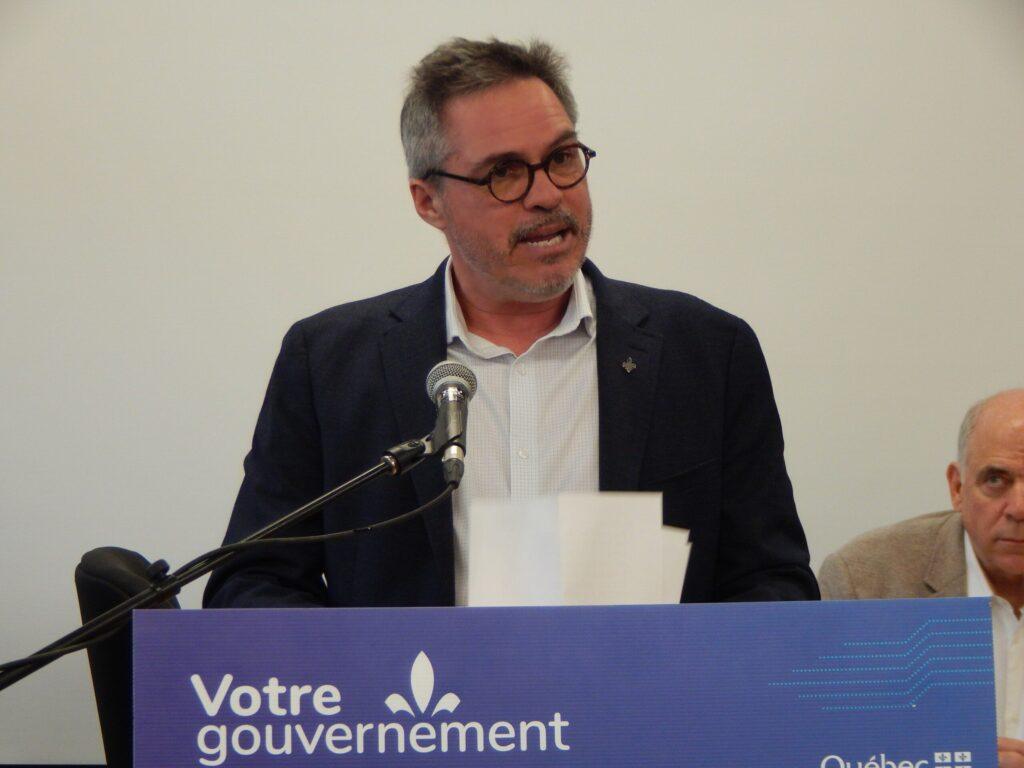
Yves Montigny, who chairs the Quebec government committee, and is the Member of the National Assembly for René-Lévesque, is aware of the problem.

Mr. Montigny mentions that, in January, ticket sales increased by 30% in several destinations in Quebec, but admits at the same time that Gaspé has not experienced this growth.

“The PAAR program (Regional Air Access Program) is having an effect, but it is not having an effect everywhere. We see it in Gaspé, Mont-Joli and Baie-Comeau where we must adapt it. We want to improve it to ensure better service and better frequency,” says Mr. Montigny, who believes that the program must be revised.

“We want to ensure that the changes we are going to make correspond to the real needs of Quebec citizens. We are in consultations,” he said.

According to Mr. Côté, the Quebec Government intends to adopt an air strategy. The mayor suggests using Premier François Legault’s idea, who mentioned a possible solution during his visit to Gaspé last November. At the time the premier had promised seven days a week service imposed on carriers by the government, in each region of Quebec with tickets at $500 round trip and that the province would subsidize the deficits.

“I say it clearly, even if it doesn’t make the carriers happy, I expect that Mr. Legault’s promise materializes,” states the mayor.

“What the Premier said in Gaspé makes a lot of sense. We are working on that. We are working to have regular service to major airports in Quebec,” says Mr. Montigny.

“We are working to put in place means to find a way with one or more carriers so that services can be improved in the coming weeks and months,” specifies Mr. Montigny.

However, it remains to be seen what the carriers will do as Mr. Côté notes that they do not want to have anything imposed on them.

“We have to be able to agree because the Quebec government has decided to take on this important issue. There is also an important issue. This must be done with companies because it is private companies that transport. You have to get along with them. It’s not always easy. We have the same objective of finding common ground with businesses to better serve important destinations which have experienced a drop in traffic,” indicates Mr. Montigny.

For its part, the Parti Québécois is once again calling for a real plan to ensure effective air services for the regions of Quebec.

The Parti Québécois transport spokesperson, Joël Arseneau, notes that the government still has no vision. “If we don’t know the objective to achieve, obviously the means will not follow and we have the results that we see today. It has never been so bad in air transportation,” notes the opposition representative.

According to Mr. Arseneau, the $500 ticket program is not working, as he’s noted a visible decrease in ridership, particularly in Gaspé. Out of a target of 166,000 tickets, only 73,000 tickets were sold in two years.

The elected official notes that the Air Transport Committee set up by the CAQ is not working. “At each meeting, we go around the table and it’s like going in circles because everyone’s interests don’t align perfectly. The government is not capable of getting the best from its participants,” adds the MNA for the Magdalen Islands.

Air transportation has been the subject of reflection since February 2018, when Philippe Couillard’s Liberal government held the first forum on the issue.

Still no solution when it comes to air transportation Read More »

Miron reinstated as deputy mayor of Gatineau

Taylor Clark

LJI Reporter

L’Orée-du-Parc district councillor Isabelle N. Miron will return to her role as deputy mayor after

her appointment was unanimously accepted during a session on February 27.

“By suggesting that Miron resume her duties as deputy mayor, I want to send a clear message

that our council will be an inclusive place and a respectful place, that women around the table are

welcome, and that politics is for everyone,” said interim mayor Daniel Champagne.

In the time he will occupy the position, Champagne assured he would do everything in his power

to ensure that all discussions take place with respect and that everyone feels welcome.

“In Gatineau, we have adopted (a gender equality policy) precisely to ensure that our political

bodies, but also our administrative bodies, are representative of the Gatineau community.” A

policy both Champagne and Miron contributed to before its adoption by the municipal council in

2021.

Miron returns to the position after being stripped of the duty in early February by former mayor

France Bélisle.

“When I was acting mayor before, I really did it with complete objectivity,” said Miron. “I do not

play partisan politics when I represent the City, and that is very important to me. As Mr.

Champagne has committed to doing, I too will be as neutral as possible in my functions as

deputy mayor.”

While Miron said she had no intention of throwing her hat in the ring for mayor, she hoped

women would step forward for the position.

But like Bélisle, countless municipal officials are faced with harassment and intimidation.

According to the Union of Municipalities of Quebec, around 10 per cent of officials have left

their position since the last municipal election in 2021, an unprecedented situation for the

province.

To combat the alarming findings, the Union of Municipalities of Quebec organized a committee

on municipal democracy at the beginning of this year.

“We are working on concrete and ambitious proposals to promote the importance of local

democracy and healthy and respectful debates,” wrote Julie Bourdon, president of the committee

on municipal democracy and mayor of Granby. “We are in action and mobilized, to promote

commitment, to promote the essential involvement of municipal elected officials throughout

Quebec.”

The Council of Elected Women of the Assembly of First Nations Quebec-Labrador is also

striving for change in Quebec’s political realm. Comprised of all female Chiefs and councillors

among the First Nations communities in Quebec and Labrador, the Council has developed and is

​implementing the principle and applications of Lateral Kindness at all levels of First Nations

governance and, in the aftermath of Bélisle’s resignation wish, to promote the concept to all

elected officials in Quebec.

“Everywhere in our societies, the intimidation of elected officials is compromising sound

governance … We must put a stop to this. Politics are often very harsh but should never be

brutal. Above all, politics must never, ever be used as a pretext for contempt towards women or

any other targeted group,” councillor Nadia Robertson wrote in a press release.

The Council aims to have a discussion on Lateral Kindness included on the agenda for the next

meeting of the Assembly of First Nations Quebec-Labrador with the mayors of Quebec.

“I am very attentive to what happens next, and I invite my colleagues throughout Quebec to do

the same,” said Champagne. “It is our collective responsibility to ensure that all elected officials

can carry out their duties with peace of mind.”

Photo caption: Isabelle N. Miron says she will remain objective as she returns to her role as

deputy mayor of Gatineau.

Photo credit: Screenshot from Séance spéciale on February 27

Miron reinstated as deputy mayor of Gatineau Read More »

Chandler Councillor Bruno-Pierre Godbout must resign

Nelson Sergerie

CHANDLER – The Quebec Municipal Commission has initiated legal action in the Superior Court, seeking a declaration of provisional incapacity against Chandler councillor, Bruno-Pierre Godbout, who is the Newport Ward councillor, and serving as the pro-mayor of Chandler as well.

Mr. Godbout voluntarily complied with the request and has since tendered his resignation.

The Commission points out that the administrative investigation against the elected official is complete, leading to the filing of the petition. The case is scheduled to be heard on April 4 at the Percé Courthouse.
On January 17, Mr. Godbout was charged with fraud, forgery and use, possession or trafficking of a document. The request for a declaration of provisional incapacity stemmed from these charges. The accused is set to appear at the Percé Courthouse to address these criminal charges on April 22.

The Permanent Anti-Corruption Unit (UPAC) emphasized that its investigation revealed that between February 1 and July 31, 2021, while acting as pro-mayor during the Quebec Municipal Commission’s suspension of former mayor, Louisette Langlois, Mr. Godbout produced and used false expense reimbursement requests.

UPAC estimated the fraudulent amount to be approximately $10,000.

In the court document, the municipal commission states that jurisprudence establishes the burden to be met for such a request to be filed, namely serious reproaches if prima facie evidence shows that these acts appear to have been committed, and if the public interest justifies temporarily relieving the elected official concerned by determining the link between the reproached acts and the performance of his duties and the extent to which these acts bring the administration of the municipality into disrepute.

The petition states that for the fraud charge, the maximum penalty is 14 years in prison, while the production of a false document carries a maximum penalty of 10 years and the same for the forgery of a document.

The Commission notes that the elected official faces charges punishable by two years of imprisonment or more, which gives the power to the Superior Court to provisionally declare Mr. Godbout incapable of exercising any function related to his office as a member of the municipal council, based on Section 305.1 of the Act respecting elections and referendums in municipalities.

Since Mr. Godbout filed an act of acquiescence to the request signed on February 19, the Municipal Commission requests that he be declared temporarily incapable of exercising the function of member of the council of any municipality in Quebec, i.e. until a stay of the proceedings, acquittal or the end of his term.
The mayor and councillors were informed of the discussions between the Quebec Municipal Commission and the councillor.

“Mr. Godbout was very transparent,” stated the mayor of Chandler, Gilles Daraîche. “The Municipal Commission presented him with three scenarios. He chose the scenario of resigning during the proceedings. He could have chosen scenario two or three and it would have cost the town much more, as in a trial that we know about, but he chose the scenario which will cost much less for the Town of Chandler,” adds the mayor.

Mr. Daraîche is indirectly referring to the legal saga involving the former mayor of Chandler, Louisette Langlois, whose legal expenses exceed $350,000.

Chandler Councillor Bruno-Pierre Godbout must resign Read More »

Vaping products seized from Hull convenience store

Taylor Clark

LJI Reporter

Several vaping products were seized from a convenience store on rue Georges-Bilodeau on

February 28 as part of an investigation regarding the sale of tobacco products.

Service de police de la Ville de Gatineau investigators were joined by Ministry of Health and

Social Services inspectors to carry out a search warrant in the Mont-Bleu sector.

The operation saw the seizure of 208 flavoured vapes, 44 disposable flavoured vapes, 642

flavoured liquid refills, 245 packs of flavoured rolling papers, and 75 packs of nicotine wraps.

The owner received tickets from the Ministry of Health and Social Services under the Anti-

Smoking Act. Service de police de la Ville de Gatineau indicated the investigation was ongoing

and additional charges were expected to be laid.

Quebec banned the sale of vaping products with a flavour or aroma other than tobacco back in

October 2023 in an attempt to make vaping less appealing to minors.

Photo caption: Service de police de la Ville de Gatineau expects charges to be laid against a

convenience store owner after vaping products were seized from the store on February 28.

Photo credit: Service de police de la Ville de Gatineau Facebook

Vaping products seized from Hull convenience store Read More »

Musée Régional en Outaouais takes step forward with the Université du Québec en Outaouais

Taylor Clark

LJI Reporter

The Musée Régional en Outaouais takes an important step forward thanks to $1.2 million in

financial assistance from the Government of Quebec.

“Museums are major anchors in the quality of life of citizens. This financial assistance will make

it possible to structure this identity project and thus improve the museum offering in the

Outaouais region,” wrote Mathieu Lacombe, Minister of Culture and Communications, Minister

responsible for youth and Minister responsible for the Outaouais region, in a press release.

Lacombe was accompanied for the announcement on February 29 at the Université du Québec en

Outaouais by the Minister of Municipal Affairs and Minister responsible for the Saguenay-Lac-

Saint-Jean, Andrée Laforest, the Member of Parliament for Hull, Suzanne Trembly, and the

president of the board of directors for the Musée Régional en Outaouais, Jean-Marc Blais.

“This museum will be a common home for all citizens of Outaouais and an essential place for the

many visitors who wish to discover our region and the countless treasures it conceals,” wrote

Blais.

The Musée Régional en Outaouais, which temporarily calls the Maison Scott-Fairview home,

intends to provide the region with state-of-the-art museum equipment to support existing and

future museum institutions in the region.

The $1.2 million will allow for a feasibility study for the development of the museum, identify

the financial and human resources required, determine its final location, and assess the costs of

restoration and renovation come spring 2025.

With the funding also came news of a partnership between the Musée Régional en Outaouais and

Université du Québec en Outaouais.

“I am particularly enthusiastic about the continuation of this collaboration which is intensified by

the reception of the Musée Régional en Outaouais project office on campus,” wrote Murielle

Laberge, rector of Université du Québec en Outaouais, in a press release. “It must be said that

this close link between the Musée Régional en Outaouais and (the Université du Québec en

Outaouais) is completely natural, and I would say without any exaggeration, essential.”

The collaboration with the museum project represented an unprecedented opportunity for

students and teaching staff to contribute to the design, creation, and implementation of a brand-

new museum, said Laberge.

“By welcoming the project office to our university, we look forward to strengthening our ties

with the leaders of this structuring project for the region and exploring potential synergies with

our members.”

Photo caption: Minister of Culture and Communications, Minister responsible for youth and

​Minister responsible for the Outaouais region, Mathieu Lacombe, announces $1.2 million in

funding for the Musée Régional en Outaouais project on February 29.

Photo credit: Université du Québec en Outaouais X

Musée Régional en Outaouais takes step forward with the Université du Québec en Outaouais Read More »

Neglected gem: Brewery Creek to be dusted off and revitalized

Taylor Clark

LJI Reporter

The National Capital Commission is working alongside the Ville de Gatineau and the Société de

transport de l’Outaouais to give the area around Brewery Creek a facelift.

“For the region as a whole, it is truly a gem that has been neglected for too long,” Hull-Wright

district councillor Steve Moran told his colleagues during a plenary committee meeting on

February 27.

The National Capital Commission has launched a land use plan to revitalize 1.45 hectares of land

in the heart of downtown Gatineau to not only increase visitors, improve accessibility, and

preserve heritage, but also to create mixed-use residential and commercial spaces.

The land left highly contaminated by Hull’s industrial decline will require more than $20 million

for ground remediation, as well as the development of green and public spaces.

Plans included four buildings with the potential of 364 units, pedestrian laneways, large green

spaces, a multi-use pathway, and a walkway. Buildings were expected to make up 35 per cent of

the total area while the remaining 65 per cent would be available for green and public spaces.

The Ville de Gatineau also has plans for Brewery Creek, notably the redevelopment along the

west bank and converting Taylor Street into a shared roadway. The project would see the

enhancement of the Brewery Creek stream through landscaping but also access with four-season

use of the stream. The sector’s known views like the Montcalm Street bridge and water tower

will also be enhanced along with the cycling lanes.

“It’s a scaled-down version of what people have wanted for a very long time. I want us to take at

least this first step, but there will be others in the future,” said Moran. The Hull-Wright district

councillor said the vision was there, but other phases were needed for the plans to be a success.

The project was expected to cost $6.8 million but rise to $10.9 million to include subsequent

phases for complementary public places.

Both the National Capital Commission’s plans and those of the Ville de Gatineau are available on

their respective websites.

The public can share feedback on the Commission’s concept through an online survey until

March 14. The comments received will be taken into consideration for its request to update the

Ville de Gatineau’s urban plan and the request to update the Commission’s Ottawa River North

Shore Parklands Plan.

Photo caption: A rendering offers an idea of what the National Capital Commission has in store

for Brewery Creek.

Photo credit: National Capital Commission Website

Neglected gem: Brewery Creek to be dusted off and revitalized Read More »

Aydelu spreads the love with annual seniors’ Valentine’s Day supper

Taylor Clark

LJI Reporter

The Aydelu Centre hosted another seniors’ Valentine’s Day supper for the books on February 17.

Situated in Old Aylmer, the centre has become a staple to the community and home to various

events. For more than 20 years, the dinner has been a way to thank the seniors who have been

frequent faces at Aydelu’s events like Bingo Night, said Aydelu president Guy Rochon.

Greg Fergus, MP for Hull-Aylmer, André Fortin, Liberal MNA for Pontiac, and Gatineau district

councillors Steven Boivin, Gilles Chagnon, and Caroline Murray all lent a hand to serve close to

165 attendees. “This is one of my favourite events to come to year after year. It gives politicians

a real chance to actually serve people for once and actually do something for you guys,” said

Fortin.

Although the former mayor France Bélisle was not able to attend, Chagnon shared her message

of Happy Valentine’s Day with the happy couples.

Attendees enjoyed a night of good food and community cheer accompanied by live music and

over 100 gifts provided by councillors.

Missed out on this year’s Valentine’s Day supper? No need to worry. Rochon said Aydelu has

already set aside February 15, 2025, for the next evening of love.

Aydelu spreads the love with annual seniors’ Valentine’s Day supper Read More »

Fishermen and MAPAQ iron out loan details

Nelson Sergerie

GASPÉ – Fishermen and the Ministry of Agriculture, Fisheries and Food (MAPAQ) are reviewing the terms of repayment for loans granted during the crisis affecting the fishing sector.

“There are indeed files being analyzed at the regional management level of MAPAQ,” confirms the Member of the National Assembly for Gaspé and government assistant for fisheries, Stéphane Sainte-Croix.
Quebec’s Minister of Fisheries, André Lamontagne, had previously stated that the government would support fishermen during the crisis.

“We will do everything we can to make effective use of all the tools at our disposal and do everything possible to promote, in one way or another, measures which will put a balm – so to speak – on the current problems experienced by our communities,” adds Mr. Sainte-Croix.

On February 27, all stakeholders in the field unanimously requested federal aid to get through this crisis.
“It takes extra help. We cannot go through this crisis with companies worth several million dollars that are under loans, loan guarantees or things like that… that the banker calls… that the house is mortgaged. Some people are at risk of losing their homes. It’s going to take direct aid,” repeats the mayor of Gaspé, Daniel Côté.

Considering how climate change is impacting the Gulf and the marine ecosystem, Mr. Sainte-Croix believes that a thorough reflection is necessary.

“The fishing industry is at a crossroads. We are talking in the short term about what we are experiencing in terms of turbot or shrimp boats. We must look further and what we are currently experiencing risks becoming a more and more present phenomenon. I hope that as governments, both federal and provincial, we can reflect on the future of things to see the bad news coming and be equipped to support our communities in these challenges,” adds the MNA.

Marketing redfish remains a challenge, especially if minimum quotas are increased beyond the floor of 25,000 tonnes announced by the Minister of Fisheries and Oceans, Diane Lebouthillier.
“We are waiting for final information and, for our part, we are working on how to put in place measures to ensure the most efficient marketing possible in the short, medium and long term for this resource,” indicates Mr. Sainte-Croix.

Fishermen and MAPAQ iron out loan details Read More »

Concerns heard at phase two information session for Pink Road widening

Taylor Clark

LJI Reporter

Work on phase two in the widening of Pink Road from two to four lanes should commence in

three years, “if all goes well.”

“We heard today that there are things we cannot control, but we are optimistic,” Mitigomijokan

district councillor Anik Des Marais told attendees at a consultation session on February 19.

The information session was organized by the Ville de Gatineau as a continuation of the previous

sessions with the public to discuss the Pink Road project, which aims to resolve traffic and safety

issues by improving the road conditions and flow of traffic.

“We are located in a strategic territory that has, on the one hand, experienced strong urban

growth continuously for around 30 years,” said Alexandra Cordisco-Moreau, senior specialist of

consultation, dialogue, and relationship with the human environment with consulting firm WSP.

“Then, on the other hand, it is a territory which requires significant needs for vehicular and

active travel in an east-west orientation.”

From 2019 to 2020, phase one was carried out between Rue de la Gravité and Boulevard des

Grives. The City later launched a modification request procedure in 2020 to kick phase two into

high gear. WSP was enlisted in 2021 to update certain studies and the detailed preliminary

project plans as well as to carry out the information session.

Phase two will see the continuation of widening to four lanes of approximately 2.7 kilometers

from Boulevard des Grives to Chemin Vanier. Planned improvements included bus shelters, a

one-way cycle lane on the roadway, a multifunctional off-road path on the south side, a concrete

sidewalk on the north side, the installation of traffic lights at various intersections as well as

similar landscaping and street features as phase one.

Many of the comments heard by the City and WSP dealt with concerns about speed, the safety of

pedestrians, and the environment.

“Rest assured that you have been listened to,” said Des Marais.

All the feedback received will be compiled into a report by WSP and will join the three other

studies requested by the ministry to allow the analysis of the project and the issuance of the

modified decree to fulfill phase two.

“We will put in place means to ensure that you are informed as the work progresses.”

A recording of the information session can be viewed through the City’s website or the Ville de

Gatineau YouTube channel.

Photo caption: Mitigomijokan district councillor Anik Des Marais thanks the attendees of the

phase two information session for sharing their concerns and feedback on February 19.

Photo credit: Screenshot from information session on phase two of the Pink Road work

Concerns heard at phase two information session for Pink Road widening Read More »

Citizens fight to keep their bank

Nelson Sergerie

CHANDLER – Following an announcement by the Caisse populaire Desjardins Centre-sud Gaspésien on February 19, citizens of Newport are mobilizing in an attempt to save their Desjardins ATM, which is due to close on May 24.

Additionally, the Gascons service centre will close on March 28, with the ATM scheduled for removal in May.

“I brought the message that Desjardins’ decision to close the Newport counter is unacceptable and that they should never have thought of that. There will no longer be any local services,” says the citizens’ spokesperson, Luc Legresley, who met the management of the Caisse on February 23.

Desjardins says the marked reduction in ATM use as justification for the closure. “If it is Desjardins’ position to make decisions without consulting members, it is not respectable,” says Mr. Legresley.

Mr. Legresley is inviting the population to express their dissatisfaction. “Desjardins is failing in its first duty, which is to serve the community,” adds the spokesperson.

On social media, reactions are unanimous against the decision of the Caisse to remove the counter services.

“We must not forget that seven years ago, there was a meeting at the Newport Golden Age Club where there was talk of closing the Newport service point. It happened but they had made certain promises to the effect that the Newport window would remain for around ten years,” recalls Mr. Legresley.

“I left the counter and went to the ATM. Now, I am asked to go to Accès-D or travel 40 kilometres to make a deposit or a transaction,” he says.

“They are not keeping their promises to the Newport community. It’s unfortunate,” concludes Mr. Legresley.
“It’s a decision that hurts our aging population. People in Newport-West are far from Chandler services and Gascons will be closed too. This adds a level of difficulty to being well-served. I told Jovin Caron (director general) of the Caisse that we were going to take a stand and support our population,” says the mayor of Chandler, Gilles Daraîche.

Citizens fight to keep their bank Read More »

Carleton-sur-Mer: Ambitious GHG objective

Nelson Sergerie

CARLETON-SUR-MER – The Town of Carleton-sur-Mer has set an ambitious objective to reduce greenhouse gas emissions by 60% by 2030, based on the emissions inventory conducted in 2019.
“We have a clear action plan with actions to follow to achieve this target. It’s realistic and we’re already working on it with the electrification of transportation. We will give mandates to remove fossil fuel energy from buildings. It’s an ambitious plan, but it’s realistic,” says the mayor of Carleton-sur-Mer, Mathieu Lapointe.

Residual materials account for 63% of greenhouse gas emissions, particularly through the municipal campsite.

“We are working very hard on it. We are involved in the creation of the Intermunicipal Residual Materials Management Board. We are hopeful that we will come up with solutions to improve our balance sheet by adding composting,” suggests the mayor.

However, implementing composting infrastructure may take some time. “2024 seems unrealistic, but we are making all the necessary efforts to achieve it,” says the mayor.

It is a three-year action plan and halfway through a review will be made to assess the progress made.
The town wants to set an example and hopes that citizens will also participate.

“We also want to have a plan on the general scale of the municipality for all greenhouse gas emissions by all residents. This is the second phase that we are thinking about,” says Mr. Lapointe.

“We are much more ambitious in our objectives if we compare ourselves to the governments of Quebec and Canada. Few municipalities have clear targets. We are certainly in the lead in Quebec,” believes the mayor.

The process was conducted in collaboration with the Gaspésie Regional Environmental Council.
Greenhouse gas emissions emitted by the town were estimated at 426.94 carbon dioxide equivalents.
Apart from residual materials, 20% of emissions come from buildings and 16% from transportation.

Propane (42%), diesel (26%) and gasoline (10%) constitute the main energy sources of greenhouse gas emissions from municipal activity.

Carleton-sur-Mer: Ambitious GHG objective Read More »

New general director for L’Imagier

Taylor Clark

LJI Reporter

The new general director of L’Imagier aspires to make the centre d’exposition d’art a second

home to not only artists, but also its attendees.

“It’s difficult to enter a place when you don’t feel invited. The idea that I would like to establish

is that people feel that they can come back here as if they were going home,” said Karina

Pawlikowski. “Then they will have access to art in a way that is much more natural than in

something that is much more constructed.”

Being a professional visual artist from Outaouais herself, Pawlikowski brings an unmatched

connection to artists, as well as various artistic organizations in the region like Axenéo7,

Daïmôn, and Transistor Média.

“It feels like I know every part of the job,” said Pawlikowski.

She holds a master’s degree in museology and arts practices from the École des arts et cultures

de l’Université du Québec en Outaouais where she has taught observational drawing since 2018.

Her work has gone on to be supported and exhibited in Quebec, in Canada, and internationally.

But L’Imagier holds a special place in her heart as her first solo exhibition was at the old

building in 2015.

“I always had an interest in what the vibe was like inside the centre. How did people

communicate with each other? Do you feel well received as an artist, but also as a spectator?

When you come to openings, it’s important that people feel that they have the right to come.”

While exhibition centres can be observed as formal and intimidating, Pawlikowski plans to

facilitate a welcoming, accessible space where people can feel comfortable and get involved.

“We are really looking for people who will come and get involved at L’Imagier, both as

employees and volunteers, as members, and as members of the board of directors as well.”

Photo caption: L’Imagier’s new general director Karina Pawlikowski welcomes visitors to the

opening of the Tropical Bliss exhibition by artist David Gumbs on February 16.

Photo credit: Taylor Clark

New general director for L’Imagier Read More »

ArtistsInspire offers students new opportunities in arts education

Sarah Rennie – LJI reporter

Parents picking up their children after school at Heritage Elementary in Huntingdon are invited to meet them in the ‘mini gym,’ which happens to be right beside the school’s N.E.S.T. room and a stunning new mural painted by Grade 5, 5-6, and 6 students, with special help from those in kindergarten and Grades 1 and 2.

On one afternoon last week, a young girl pushed past some parents to align her hand with one painted as a leaf on the mural. “That’s my hand,” she announced proudly. Mackenzie Hooker, a community development agent with the New Frontiers School board, says that sense of pride is exactly the kind of reaction they were hoping to generate with the project.

Education technicians Megan Vézina and Ashley Jewer, who work in the N.E.S.T. room, had approached Hooker with a project in mind, and she reached out to artist Adele Reeves who specializes in collective murals inspired by scenes of nature. Reeves, who is associated with the English Language Arts Network’s (ELAN) ArtistsInspire program, had previously worked with Franklin Elementary to complete their spectacular Alphabet on a Barn project.

ArtistsInspire is a micro-grant program that offers English schools in Quebec the opportunity to bring artists into the classroom through ELAN, with support from the federal Department of Canadian Heritage. Hooker says the students first worked on drawings of the different animals native to Quebec with art teacher Marguerite Bromley. Reeves used these images as inspiration.

PHOTO Sarah Rennie
Students in Grade 3 at Heritage Elementary School took part in a dance and paint workshop on March 1 with artists Adele Reeves and Kerwin Barrington.

The project took over two days to complete, with students doing the bulk of the painting while Reeves added small details and cleaned up some edges. The older students painted sections in small groups before returning to their classes. Reeves says working with just four students at a time is quite special. “I can really connect, and so the whole group feels they have had my attention,” she explains, noting children who might not normally participate in such an activity tend to really respond to this format. 

Reeves was back at Heritage on March 1 with friend and fellow artist Kerwin Barrington for an eclectic dance and paint workshop with students in Grades 3, 3-4, 4 and the Learning Centre. Focused again on themes found in nature, Reeves and Barrington structured their workshop around water and the elements. The students danced together and then incorporated some of the moves they had learned into creating mixed media portraits of themselves.

Barrington says she especially enjoys how humbling it can be to work with kids. “I love teaching them about what their body feels like and what it can do, and dance and paint is a really cool abstraction of that,” she explains. “It is about being yourself, but while being a part of something bigger in a group.”

For Heritage principal James Furey, the program brings a lot more than an artist into the school. “It takes the industrial feel out of the space and makes it more welcoming,” he says, of the new mural gracing the N.E.S.T. wall. He especially appreciates the fact students were active participants in the school improvement project from start to end. He says the results, both on the wall and in terms of student pride, are impressive.

ArtistsInspire offers students new opportunities in arts education Read More »

Saint-Anicet mayor addresses senate as the head of a multinational initiative

Sarah Rennie – LJI reporter

The municipality of Saint-Anicet is at the forefront of freshwater management in Canada.

On February 27, Mayor Gino Moretti testified in Ottawa on behalf of his municipality and the Great Lakes and St. Lawrence Cities Initiative (GLSLCI) before the Standing Senate Committee on Transport and Communications, as part of a meeting to study the impacts of climate change on critical infrastructure in the transportation and communications sectors.

Moretti currently sits as chair of the GLSLCI, a multi-national coalition of over 240 mayors and local officials working with federal, state, and provincial governments to advance the protection and restoration of the Great Lakes and St. Lawrence River basin.

The local mayor’s presentation focused on critical challenges to marine strategy and the blue economy, including Canada’s commitment to policies and strategies to facilitate the movement of people and goods across freshwater systems. He raised concerns around transportation infrastructure and funding requirements necessary for developing or maintaining these resources, while also addressing the pressing impacts of climate change on the waterway.

PHOTO Municipality of Saint-Anicet
Saint-Anicet mayor Gino Moretti addressed the senate bout freshwater management on February 27.

“Reduced ice coverage in the basin presents environmental challenges, with winter storms causing substantial damage. Erosion, damaged retaining walls, and extreme weather events with high repair bills surpass the capacity of local governments,” Moretti testified. He then suggested Canada explore opportunities for investing in climate-resilient infrastructure as an adaptation strategy, while noting current government programs and policies, as well as funding, need to be adjusted to allow local governments to better respond to these challenges.

Bringing together local governments

The Great Lakes and St. Lawrence Cities Initiative was founded 21 years ago by the mayors of Chicago and Toronto, and it has since grown to include 240 mayors from Quebec, Ontario, Illinois, Indiana, Michigan, Minnesota, New York, Ohio, Pennsylvania, Wisconsin, and leaders of several Indigenous communities.

The coalition is emerging as a strong, united voice defending coastal resilience, the equitable access to water and resources, the economic benefits from local freshwater resources, and the protection and restoration of the basin, which includes 10,000 kms of vulnerable shoreline.

Moretti was approached about joining the GLSLCI in 2019 by Régis Labeaume, the mayor of Quebec City at the time. There was no rural municipality involved in the initiative from the mouth of the St. Lawrence Seaway in Quebec. Moretti submitted his name, and he has been heavily involved ever since. He is also a member of the Union des municipalités du Québec’s comité maritime, and co-chairs the Table de concertation régionale Haut-Saint-Laurent – Grand Montréal, which is focused on water and aquatic ecosystems in the areas downstream of the St-Lawrence River, with Repentigny mayor Nicolas Dufour.

Moretti says these associations are about advocacy, education, and collaboration between the different mayors, where each municipalityhas an equal voice no matter their size. For example, each province and state have a different way of protecting their shorelines, he explains, noting how the mayors can share their best practices and learn from each other’s experiences.

“Mayors are looking for the best ways to support their cities or municipalities,” says Moretti. “We never lose sight of our citizens,” he adds, noting that accountability also plays a very strong role in their work.

“There are a lot of issues, and we try to prioritize them,” Moretti says, noting funding is a major hurdle for most municipalities.  “The only time there is funding is when there is a disaster,” he says, admitting this is a significant concern in terms of climate change and adaptation. He feels that responsible management of the freshwater basin will require stable, predictable, and long-term funding, “as the cost of inaction and repairs will be much higher than climate adaptation.”

He says they are already seeing signs of climate change. “This winter will have an impact,” says Moretti of the potential consequences of the unseasonably mild weather over the past several months. “There will be more surface erosion into the water,” he adds matter of factly. There was next to no ice cover on Lake Saint-François this year, which resulted in a higher flow of water that could cause problems for different dams along the Seaway.

Moretti says one goal for the GLSLCI is to change the perception of the Great Lakes and St. Lawrence Seaway from an industrial heartland to that of a green corridor. “We are not environmental activists,” he insists, saying the mayors just want to be sure there is water for future generations and that economies can continue to be developed along the waterway in a sustainable way that is adapted to climate realities.

Saint-Anicet mayor addresses senate as the head of a multinational initiative Read More »

Huntingdon paramedics hope funding could end shift work

Sarah Rennie – LJI reporter

The government’s recently announced action plan to improve the province’s prehospital emergency system provided a glimmer of hope for Huntingdon paramedics, who are alone in the Montérégie working on-call shift hours.

The province announced it will spend nearly $630 million over the next five years on ambulance services, including at least $1.3 million that will be directed to the Montérégie-Centre region to convert shift schedules or add hours of service. All ambulance services in the Montérégie are directed through the Centre integré de services de santé et de services sociaux de la Montérégie-Centre (CISSSMC), including those based in Huntingdon.

According to the Ministry of Health, these funds will be allocated in addition to funding released in 2022 that allowed for the conversion of 46 shift schedules to set hourly schedules, including those worked by paramedics in Hemmingford. On-call shift work has now been abolished in all areas of the Montérégie except for Huntingdon, where Paraxion provides prehospital services to the town as well as the western territory of the Haut-Saint-Laurent including Godmanchester, Hinchinbrooke, Elgin, Sainte-Barbe, Saint-Anicet, and Dundee.

PHOTO Sarah Rennie
Huntingdon paramedics with Paraxion are the only ones in the Montérégie still working on-call shift hours.

“Huntingdon is in a particular situation,” says Mathieu Lacombe, a spokesperson for the Syndicat des paramédics et du préhospitalier de la Montérégie (SPPM-CSN). On-call paramedics are on duty 24 hours a day for seven consecutive days at home and must first get to their ambulance before leaving to respond to an emergency, while those working set hours are already at a station or in their ambulance waiting for calls, he explains.

“Right now, we have good service in Huntingdon,” says Lacombe. The closure of the Larocque Bridge linking Saint-Stanislas-de-Kostka with Salaberry-de-Valleyfield in January created a temporary situation in which shift work for Huntingdon paramedics was converted to an hourly schedule. Presently, there are two regular ambulances available during the day as well as one ambulance overnight, he explains. This exception is set to end on April 7, when paramedics will return to shift work.

Lacombe says the situation is unfortunate, both for the paramedics and for the local population. He reports that on February 5, paramedics were called to an emergency in Huntingdon involving a 61-year-old patient. The 9-1-1 call was received at 11:32 a.m. and because paramedics were already in place, they arrived on scene at 11:40 a.m. The team worked quickly, and the patient was resuscitated by 11:43 a.m.

According to Lacombe it was the second ambulance that intervened, as the first was responding to another call. He says there is no doubt the paramedics were able to respond as quickly as they did because they were working regular hours and were not at home when the emergency call was received.

According to The Last Ambulance Project, which tracks the average response times for ambulances for the most critical emergencies, the average wait time for a priority 0 call in Huntingdon is 18.03 minutes, 19.67 minutes in Godmanchester, 22.5 minutes in Hinchinbrooke, 24.12 minutes in Saint-Anicet, and 38.5 minutes in Dundee. Times in Ormstown, where there is a station, average 15.62 minutes, and similarly, those in nearby Haut-Saint-Laurent municipalities served by Ormstown, including Franklin, Havelock, Howick, Saint-Chrysostome, and Très-Saint-Sacrement, are lower averaging 16.7 minutes.

“Shift work can be effective in very rural areas, but the population is growing, and this no longer applies to Huntingdon,” says Lacombe, noting the delays in shift work create added stress on paramedics, who are all too aware of how every second can count when responding to an emergency.

The Huntingdon paramedics are also important to the regional network, which he says is currently overloaded. “Each zone is backed up by another,” he explains, suggesting Huntingdon could be called to Ormstown or Valleyfield, or vice-versa, depending on where there is a need.

He adds that there has been no indication whether the funds announced by the government to convert shift schedules will apply to Huntingdon. The SPPM-CSN has asked for an urgent meeting with Huntingdon MNA Carole Mallette to discuss the situation. The town of Huntingdon and some neighbouring municipalities have also passed resolutions in support of the local paramedics.

“We hope to receive good news,” says Lacombe.

Huntingdon paramedics hope funding could end shift work Read More »

Paramedics are concerned over government plan to improve ambulance services

Sarah Rennie – LJI reporter

Quebec Health Minister Christian Dubé followed through on a promise to provide an action plan to improve ambulance services, after pronouncing earlier last month that the current wait times were simply “unacceptable.”

Dubé announced on February 29 that investments totalling nearly $630 million would be provided over five years to improve the province’s prehospital emergency system. The plan includes several concrete actions to address the situation, such as increasing the number of automated external defibrillators accessible to the public and extending first responder services to more areas. There are also up to $5.9 million to improve ambulance services in the Laurentides, Mauricie-Centre-du-Québec, Montérégie-Centre, and Chaudière-Appalaches regions.

In a statement, Dubé noted that in the context of an aging population and growing health needs the government is reviewing its front-line services. The plan aims to modernize pre-hospital emergency services while bringing about a change in culture to optimize the role of paramedics and improve such services in the regions.

For example, a total of $7.65 million over five years will be dedicated to reducing the time spent by paramedics in hospitals. According to the Ministry of Health, paramedics spend on average 100 minutes during a pre-hospital intervention, of which 50 minutes are spent in hospital. The ministry has set a target of 45 minutes by 2026 and says this could recover the equivalent of 50,000 hours of ambulance availability.

The government has also announced the creation of four helipads, which will be located at the Centre hospitalier régional de Lanaudière in Joliette, the Hôpital de Roberval, the McGill University Health Centre, and the Hôpital du Sacré-Coeur in Montreal.

No new ambulances 

Montérégie paramedics, while welcoming the additional funding and resources, are sounding an alarm over the lack of financing in the action plan for any new ambulances.

The territory served by the Coopérative des techniciens ambulanciers de la Montérégie (CETAM), which covers Salaberry-de-Valleyfield, Vaudreuil-Dorion, Chateauguay, and municipalities along the South Shore, is among the most overloaded in the province according to the provincial classification of workloads by ambulance zone. Between April 2022 and April 2023, over 93,000 calls were assigned, and paramedics worked over 4,221 overtime hours, mostly at the end of their shifts. The Syndicat des paramédics et du préhospitalier de la Montérégie (SPPM-CSN) says they have been calling for years for an additional seven vehicles to adequately respond to the growing number of calls.

Instead of seeing their fleet grow, however, the SPPM is currently waiting to learn whether cuts to the number of ambulances will take place this spring within the territory served by the CETAM.

Since 2021, the Centre integré de services de santé et de services sociaux de la Montérégie-Centre (CISSSMC), which coordinates the ambulance services for the entirety of the Montérégie region, has authorized the temporary addition of four ambulances to help cover the territory. The organization evaluates whether to keep the additional vehicles each year at the end of March. Last year, the CISSSMC announced it did not have the finances to maintain the ambulances, though the organization reversed its decision soon after.

“The deadline is fast approaching, and despite this, the CISSS and the ministry are still unable to confirm that the temporary additions to the fleet will be continued,” said Gaétan Dutil, the president of the SPPM-CSN. “Year after year, we’re asked to add vehicles, and year after year, we’re offered temporary and inadequate half-measures,” he added.

“This situation is putting enormous pressure on our paramedics, and does not bode well for services to the population in areas where access to an ambulance within a reasonable time is already difficult,” he added.

“It would be catastrophic if we lost an ambulance,” said Mathieu Lacombe, a spokesperson for the SPPM-CSN. The fact there has been no indication of where the government funds will be invested in the Montérégie is a concern, he added.

“We have no idea,” he said. “It is really uncertain right now – for paramedics, but for the population as well.”

Paramedics are concerned over government plan to improve ambulance services Read More »

Students tap first trees for their new maple syrup business

Sophie Kuijper Dickson & Pierre Cyr, LJI Reporters

On Thursday morning, outdoor education students from École secondaire Sieur-de-Coulonge (ESSC) piled into their warmest winter clothes and headed out into the last sunny winter day of February.
The group, led by ESSC teacher Martin Bertrand, spent the morning tapping the maple trees on 10 of the 75 acres of forest on the land behind the school.

Tapping these trees is one of the first steps in a new business project Bertrand is getting off the ground with students from the school’s outdoor education program.
Over the next three years at least, he plans to lead the students in developing a small maple syrup business that will sell its products back to the school.

“The goal is to produce maple syrup for the school’s events,” Bertrand said, admitting that at the moment, the school often uses artificial syrup for the various feasts it hosts.
Offering homemade maple syrup at the school’s pancake suppers is a welcome benefit of the project, but only peripheral to what Bertrand is really trying to do, which is teachstudents to become business leaders.
“The real entrepreneurial mindset will be taught, encouraging perseverance and leadership of different kids,” Bertrand said.

The core group of 24 students from secondary 3, 4 and 5 have already begun developing a business plan and drafting a budget.
Through this project, they will learn to identify good trees for tapping, learn different methods of tapping trees and collecting and processing the sap, and learn to adapt their business plan when unfavourable weather conditions affect their forecasted harvests.
The students will also develop a forestry strategy to take care of the forest diversity and maximize the potential of the maple trees’ growth.

Down the road, the young entrepreneurs will use a $500 grant from provincial non-profit organization OSEntreprendre to purchase a sap evaporator, but getting that set up will involve building an ESSC sugar shack, which will take some time.
For the time being, Bertrand has partnered with a local sugar shack, Pourvoirie du Lac Bryson, which will help the students boil their sap this year.
“I’m thinking it’s not going to be an awesome year this year because of the weather, but it’s a start,” Bertrand said.

Students keen to get outside

In the sugar bush on Thursday morning, the students, armed with stacks of metal pails and tree taps borrowed from local syrup producers, were keen to get going on their new business endeavour.
‘’It is a nice project, it helps us to go outside’’ said Emma Rochon, one of the students. She said she thinks the project will motivate students to go to school.

“It’s a nice experience, and we’re lucky to be able to do this maple syrup business project at school,” Gabriel Mallette, another student at the school, told THE EQUITY in French, adding that like Rochon, he loves that this project makes it possible for him to spend time outside.
For Éva Graveline, a third student participating in the program, the big lesson was about what can be achieved when people work together.

“It makes me realize that teamwork is important,” Graveline said.
While the maple syrup season may be short, Bertrand hopes this teamwork will continue throughout the summer and into the next school year, in preparation for growing the business next spring.
He will be encouraging the students to keep an eye out for old doors, windows and wood that can be used to build a new sugar shack next school year.

“We really want to show that we can do something without going to buy new, and create different situations where they can try and work together,” he said.
Bertrand believes getting students outside of the classroom can do wonders for engaging them in learning.
“The potential for education with this program is beyond regular school. There’s application of sciences, of nature, of history and geography,” he said.

The bigger picture motivating Bertrand in starting this new business program is helping the students realize there are great opportunities in the Pontiac.
“We often hear the Pontiac is a place where there’s nothing,” Bertrand said.
“I believe it’s the other way around. It’s a place where the opportunities are there. So if we have entrepreneurs that have the itch to start their own businesses and bring something new to the Pontiac, we can teach these skills, teach this mindset, and work with kids in school. Then I think the Pontiac, in 10 to 20 years, will be a whole different place.”

Students tap first trees for their new maple syrup business Read More »

Quad Club promotes Pontiac with local sugar shack tour

Camilla Faragalli, LJI reporter

A sea of quads filled the Pine Lodge parking lot in Bristol on Saturday morning for the Pontiac Quad Club’s sugar shack tour.
Following a scenic ride on local trails, Quad Club members indulged in a traditional sugar shack brunch at the lodge, followed by a wagon ride down to the sugar shack for a tour, where a warm campfire crackled and busy hands kept a continuous stream of fresh maple taffy on offer.
“Our mandate is to inform people of the beauties of the Pontiac,” said Pontiac Quad Club director Diane Barrette, explaining that a third of the 75 people present that day came from outside of the region.
“We’re doing what we can to promote the area.”

Isabelle Gaudreau, a Quad Club member of less than a year from the Gatineau area, said she attended the event to familiarize herself with the area.
“I like to do the organized events like this since I’m still new to the club, just to know where the trails are and meet new people,” she said, adding that she had purchased her new quad to pursue her love of the outdoors.

Locals enjoy the quad magic, too.
Mark Racine of Otter Lake has been a Quad Club member since 2018. He shared similar sentiments to Gaudreau.
“It’s a way to see the scenery, it’s a different way of doing it,” he said, adding that he and his wife have seen bears, deer and partridge on their quad excursions.
“You can go all over the Pontiac with it [a quad] if you want. You can do that with a car too, but it’s kind of boring,” he said.

Barrette said that members had been requesting a sugar shack excursion and that Pine Lodge had agreed to open a week ahead of their regular season to realize their vision.
“There aren’t very many [sugar shacks] but I’ve heard it’s a tradition here [Outaouais] that goes back generations,” Barrette said, “and Pine Lodge is just superb.”
“It’s been a really early season. Normally we wouldn’t start until next weekend or the following weekend,” said Adam Thompson, who co-owns the Pine Lodge with his family and hosted the club’s sugar shack tour. “But with the spring we’ve had we got started early, so we already had about 1,000 gallons of sap ready to boil.”

Quad Club promotes Pontiac with local sugar shack tour Read More »

Concern over incinerator fills Campbell’s Bay Rec Centre

Pierre Cyr, LJI Reporter

One hundred and twenty-four people attended a public information meeting at the Campbell’s Bay Recreation Centre on Saturday afternoon to hear concerns about MRC Pontiac’s proposal to build a garbage incinerator in the Municipality of Litchfield.
The meeting, convened by Judy Spence and her group Citizens of the Pontiac presented four speakers with extensive experience on the matter of energy-from-waste incinerators, all of whom joined the meeting via Zoom to share their views.

The keynote speaker, Dr. Paul Connett, is a graduate of Cambridge University and holds a PhD in chemistry from Dartmouth University. He is the author of the 2013 book The Zero Waste Solution and is an international expert in waste management and environmental toxicology. Connett, who doesn’t charge anything to share his expertise and channels all the profits from his sales of his books to support non-profit organizations, participated in Saturday’s meeting via Zoom from England.

“This is really an absurd solution for Pontiac,” said Connett who has shared his expertise on over 300 incinerator projects. “You will be producing 20 times more toxic ash than the trash you currently have,” he said, explaining that an incinerator that burns 400,000 tons of garbage produces about 100,000 tons of ash, which is 20 times the 5,000 tons of garbage currently produced across Pontiac County.
Connett said that the fly ash coming from the incinerator is particularly toxic with some extreme levels of lead and cadmium, and showed studies revealing that these chemicals, dioxins, and nanoparticles accumulate in the environment and contaminate surface waters and the food chain.
‘’Why would you play Russian roulette with your children’s brains?” Connett asked.
“Making dirty energy is stupid,’’ he said, adding that a big incinerator will ruin the image of Pontiac, reduce property values, threaten farming, and undermine hope for genuine economic development.
‘’You can’t be polite about it. You can’t keep quiet about it. You have got to shout and make some noise if you don’t want this to happen in Pontiac,’’ he said.
Connett believes the alternative for Pontiac is a good zero-waste program that will reduce residual waste to 1,000 tons per year.

He also said that, in contrast with the 50 jobs promised for the envisioned $450,000 facility, far more jobs would be created by having a good zero-waste strategy here in the Pontiac
“Our job today is not to find better ways to destroy material, but to stop making products and packaging using materials that must be destroyed,” he said.
The second speaker was Linda Gasser, who fought against the Durham York Energy Center (DYEC) incinerator project in Ontario and is with the group Zero Waste 4 Zero Burning. She shared that the cost of the project went up from the original estimate of $197 million to $295 million for the 140,000-ton capacity incinerator. She said the Durham York incinerator suffered two fires in its early days, as well as breakdowns requiring shutdowns of the facility for up to three months.
‘’No one should point to DYEC as an example to follow. It’s a failure in every respect,” said Gasser.

The next speaker was Wendy Bracken with the group Durham Environment Watch who was also involved in the environmental watch of the DYEC. She offered data that shows emissions of dioxin/furan more than 12 times above the legal limits. Bracken also brought forward weaknesses in the testing of the emissions coming from the incinerator, saying they were conducted too infrequently and for too short a period to provide an accurate indication of the level of toxins actually being emitted. According to Bracken, Canadian regulations and standards regarding incinerators are outdated when compared to those in Europe or the United States.

Next was Liz Benneian, a former newspaper editor with a degree in science, now working with the Ontario Zero Waste Coalition, who helped to run a successful campaign to stop an $800 million incinerator project in Ontario in 2005.
“We were able to prove that these plants never work as promised. We could prove their emissions were toxic,” said Benneian.
Benneian said that one of the characteristics of the incinerator experience is untransparent local government.

“In the Pontiac, why is public money being spent on business cases, and why is pre-agreement being sought to bring waste from Ontario while the public is kept in the dark?” asked Benneian. “What else is going on behind the scenes?”
According to Benneian, it should be obvious that the problem of waste generation cannot be solved by an incinerator that requires an ongoing production of waste.
“With only 5,000 tons of waste to manage, the incinerator is a solution we don’t need for a problem we don’t have,” concluded Benneian.
Benneian, Bracken and Gasser have helped more than 10 Ontario community groups in their battle to prove that an incinerator project was not a good solution for waste management. They succeeded in 100 per cent of the cases to have local and regional politicians change their mind and vote against an incinerator project.

After listening to the speakers at the meeting, Josey Bouchard, a Campbell’s Bay municipal councillor and spokesperson for the health advocacy group Pontiac Voice, declared that she will now support efforts to stop the construction of the incinerator.
“It is a dump, a glorified dump, and I don’t think our region should be anybody’s dump,” said Bouchard.
Video of the presentations will be available at www.citizensofthePontiac.ca over the coming days.

Concern over incinerator fills Campbell’s Bay Rec Centre Read More »

Norway Bay pier closed for 2024

Sophie Kuijper Dickson, LJI Reporter

The Municipality of Bristol has decided to keep the Norway Bay pier closed for the entirety of the 2024 season. The beach and boat launch will remain open.
The decision came after council received the final report from an engineering firm that investigated the structural integrity of the pier last fall.
The report found the pier to be in poor condition and recommended it be closed for the season, according to Bristol mayor Brent Orr.

“Once we got the report we were obligated to close it up until the repairs are made,” Orr told
THE EQUITY following the Mar. 4 council meeting where the report was received.
The municipality’s insurance company also recommended full closure of the pier to ensure no injuries occur.
Orr said municipal employees would be asked to remove the docks from the pier and erect a fence barring access, adding that while it was too early to say for how long the pier would be closed, the plan is to repair it and not to tear it down.
“It’s just a matter of how and when,” he said.

Valerie Twolan-Graham, Bristol councilor for the Norway Bay community, noted the significant impact this closure would have on usual summer activity programming and life in general in Norway Bay and said she had already been in contact with the Norway Bay Municipal Association regarding the decision.
“They are well aware and are trying to come up with a backup plan,” Twolan-Graham assured.

‘Beyond its best before date’

Orr said the main issue affecting the structural integrity of the pier is that the water has rusted holes through the sheet piles, the metal supports that line its sides.
He said the municipality repaired these holes years ago by welding patches on, but the repair job is no longer holding up.
“The life expectancy of the pier was probably 50 years when they built it, so it’s well beyond its best before date.”

The pier, which is over 70 years old, has sustained several floods in recent years which caused significant damage.
Orr explained that as the water wears at the side of the pier, it washes the sand out from under the pier, which causes the interlock on the pedestrian walkway, usually supported by the sand, to form sinkholes.
The report suggested two options for repairing the pier. The first is to drive in new piling, creating a second wall next to the original wall and filling in the space between the two with sand.
The second option presented in the report is to build out slanted walls against the current walls of the pier, but Orr said this option would not work for the community as it would interfere with the ability to attach floating docks to the side of the pier.

The repairs could cost anywhere in the range of $3 million to $6 million.
Orr said the municipality has its regular repair maintenance budget, including about $100,000 for pier repairs, which he referred to as but “a drop in the bucket” when it comes to the massive cost of the needed repairs.
“The funding will be one of the major, major stumbling blocks we will have to endure,” he said.

Pier committee to assess best path forward

The municipality will establish a pier committee which will have a mandate of doing an in-depth study of the report, preparing recommendations to council for how best to move forward, and leading the way on all fundraising efforts, including grant writing.

Councillor Twolan-Graham said while at least seven community members have volunteered to sit on the committee, she intends to extend the invite to all interested, not only residents of Norway Bay.
“It’s a sobering kind of project but one I know our community feels deeply connected with,” Twolan-Graham said. The municipality is welcoming applications by people with all sorts of relevant experience, including engineering, construction, human resources, fundraising, and administration.
“And just people who want it reconstructed because it’s where they fished with their grandson,” Twolan-Graham emphasized. The new pier committee is expected to be formed and holding its first meetings by April.

Norway Bay pier closed for 2024 Read More »

Strike sinks Gabrielle-Roy Library reopening, March Break activities

Strike sinks Gabrielle-Roy Library reopening, March Break activities 

Ruby Pratka, Local Journalism Initiative reporter

editor@qctonline.com

The delay-plagued reopening of the Gabrielle-Roy Library hit another roadblock days before the scheduled opening ceremonies.

On Feb. 25, the 240 employees of the Institut Canadien de Québec, which manages the city’s public library network, voted in favour of an indefinite strike starting March 1, the first of three days of planned festivities to celebrate the library’s reopening.

“On March 1, there will be a picket line [in front of the library] if we don’t have a satisfactory offer,” Roxane Larouche, a spokesperson for Travailleurs et Travailleuses unis de l’alimentation et du commerce, Local 501 (TUAC 501) which represents workers at all of the city’s 26 public libraries, said at the time.

Larouche said there would be “no book borrowing, no documentation, acquisition, classification, billing or people preparing materials” to be lent out, for the duration of the strike. The city also scuttled the three days of free concerts, tours and demonstrations planned for the grand opening. Although Mayor Bruno Marchand initially insisted the celebrations would go forward, city officials ultimately decided that “the situation doesn’t allow the public to fully enjoy the planned activities and discover its library.” A media tour was held Feb. 29, the day before the strike began (See article in this edition). City officials say $300,000 of public money was invested in the opening celebrations, of which $60,000 is not recoverable.

“I don’t know what we’re going to do [to celebrate the reopening] but we won’t have the same resources,” said Marchand.

Union members are calling for higher salaries, a payscale in line with Ville de Québec employees carrying out similar tasks, more predictable schedules, paid break periods and the ability to take partial vacation days, Larouche explained. They have been without a contract since December 2022.

The strike comes at an extremely inconvenient time for the central library. It closed for major renovations in August 2019 and was originally sup- posed to reopen in 2021. The ripple effects of the COVID-19 pandemic, the labour shortage and the cancellation of a call for tenders after bids came in higher than expected delayed the opening for more than two years. In March 2023, the reopening was pushed back further when construction crews found that a beam was in need of major repairs. The strike pushes the planned public opening back further; it is now scheduled for March 12.

Twenty-three of the city’s 26 libraries will close for the duration of the strike. The Monique-Corriveau Library (Sainte-Foy) and the Étienne- Parent Library (Beauport) will reopen on a reduced schedule starting March 6.

Strike sinks Gabrielle-Roy Library reopening, March Break activities Read More »

Provincewide forum seeks perspectives of local English-speaking youth

Provincewide forum seeks perspectives of local English-speaking youth

Ruby Pratka, Local Journalism Initiative reporter

editor@qctonline.com

Provincewide civic participation organization Youth 4 Youth Québec (Y4Y) is seeking young people aged 16-30 from the English- speaking community of the Capitale-Nationale region to participate in its annual youth forum in Montreal on March 15.

Youth are encouraged to attend the forum in person at the Concordia Conference Centre on the campus of Concordia University in Montreal, but those who cannot or would rather not make the trip in person will be able to participate online. Participants from Montreal, the Gaspé region, the Lower North Shore and the Centre-du-Québec region are among those expected to take part.

Y4Y executive director Adrienne Winrow said the forum represented a precious opportunity for English-speaking youth from across the province to talk to each other and to share their concerns with representatives of the provincial Secretariat for Relations with English-speaking Quebecers, the federal Office of the Com- missioner of Official Languages and other organizations that support the civic participation of both French- and English- speaking young adults, including Elections Canada. Youth talent will also be on full display with an onsite art exhibit and panel discussions.

“We have put together three youth-led panels on education, the job market and civic engagement, and we want to hear what you think,” Winrow told the QCT. “We want to hear from youth who are in high school, CEGEP or university or who have already started their career path. We want to show the community’s diversity and strength.”

She noted that in policy discussions about Quebec’s English-speaking community, “the focus is often placed on Montreal, but we are stronger if we understand the realities across distances. There is a wide range of different social and economic realities be- tween Montreal and the Gaspé or the Abitibi, for example. If you want to study in English and you’re from the Gaspé or the Abitibi, that means leaving home at 17 – which is obviously much different from growing up in Montreal and being able to live at home and take the bus to school. [The forum] is a networking opportunity, but also a learning opportunity…. My hope is that youth come away from the forum feeling like they are part of something larger.”

Winrow said she is looking forward to hearing the conversations between youth from different regions and between youth and representatives of government bodies. “What is going to be on full display is the potential and professionalism and willingness to engage, of youth in this province. English- speaking youth are a resource for the community, they want to contribute and they are thoughtful about the future.”

To register or learn more, visit y4yquebec.org/youth-forum-2024.

Provincewide forum seeks perspectives of local English-speaking youth Read More »

Pro-Palestinian protesters barricade IDF reserve soldiers’ event

Photo Hannah Bell

Maria Cholakova
Local Journalism Initiative

On March 4, over 150 pro-Palestinian protesters blocked the entrance of the Federation CJA building, to protest three Israel Defence Forces (IDF) soldiers speaking at a StartUp Nation hosted event. 

The original event was set to occur on Concordia University’s campus. Due to backlash, the event was cancelled but was later moved to CJA.

Although CJA didn’t release the address of the event until 6 p.m. on March 4, a half hour before the start of the talk, the address was leaked on social media. 

The Link had a ticket and a media pass, and had confirmed our attendance by phone, yet was not allowed to enter the CJA building.

Along with Solidarity for Human Rights Concordia (SPHRConU) and Montreal4Palestine, Independent Jewish Voices (IJV) Concordia joined the protesters to stand in solidarity with Palestine. 

During a speech by IJV members, the speakers condemned the event being hosted in front of the Holocaust Museum. 

“To hold an event like this, at a space that commemorates one of the worst acts of humanity, is an insult to the victims of the Holocaust our ancestors and the Jewish people,” said the speaker. “Being an anti-zionist Jew often means standing against our own communities, which we were once a part of, and taking a critical look at the institutions we were once connected to, but refuse to anymore.” 

Several times during the night, Israeli on-lookers agitated pro-Palestinian protesters, flashing them the middle finger, calling them names and becoming increasingly violent. At around 7 p.m., a woman shoved a pro-Palestinian protester and hit their camera. 

During the protest, several speakers took turns to speak to the crowd. Palestinian activists encouraged protesters to stay calm, keep blocking the doors and not get agitated by on-lookers. 

The protest was monitored heavily by police, with over six police cars surrounding the building and streets. 

Demonstrators blocked all three entrances and demanded that IDF soldiers not be let into Montreal.

According to a protester, who wished to remain anonymous for safety reasons, IDF soldiers shouldn’t be allowed in Montreal. “We are talking about soldiers that only a few weeks back were killing children, civilians, conducting war crimes, [yet] they are just invited to an event like they are guests,” said the protester. They continued to urge the Canadian government to sanction and stop their support for Israel. 

The sentiment was echoed by other participants. According to Laith Barghouthi, SPHRConU “[Organizers] are still brainwashed thinking that IDF soldiers… are heroes of some sort. They are genocide enablers, they are killing children… they are doing all sorts of evil crimes,” Barghouthi said.

Montreal4Palestine, SPHRConU and the Centre for Israel and Jewish Affairs (CIJA) all released statements about the event by the night’s end. 

In a statement released after the event, Montreal4Palestine accused the SPVM of being hostile and threatening towards protesters. “This behaviour is not an isolated case. It is part of a broader context of police brutality and systemic racism against racialized people in Montreal,” read the statement.

In addition, SPHRConU condemned the location of the IDF event, stating, “Hosting soldiers under investigation for genocide by the International Court of Justice in a place of rememberance for genocide victims is a new low, even for the Zionist entity.”

During the protest, CIJA also released their statement, calling the pro-Palestinian protesters an “aggressive and physically intimidating mob.” The statement further demanded the SPVM to make arrests, citing that calling for “intifada,” which translates to ‘uprising’ in Arabic, is terrorism against civilians and not a peaceful protest. 

With files from Julissa Hurtado, Hannah Bell and Nadia Liboneye

Pro-Palestinian protesters barricade IDF reserve soldiers’ event Read More »

Tuition strikes: student mobilization underway

This graphic is incomplete, check in with your association on current strike status. Graphic Panos Michalakopoulos

Maria Cholakova
Local Journalism Initiative

In the past two weeks, the Arts and Science Federation of Associations (ASFA) and fellow student associations at Concordia have been mobilizing students to vote, attend general assemblies, spread the word and encourage students to protest the Quebec government’s tuition hikes. 

According to Angelica Antonakopoulos, the academic coordinator at ASFA, this is a crucial time for the student movement to come together in a university-wide strike. 

“[Striking] places a lot of economic stress on the government because the government subsidizes education in Quebec […]So if you’re placing this imminent threat of cancelling a semester, the government will have to re-subsidize the students that got held back while also subsidizing a new cohort of students coming in,” Antonakopoulos said. 

She continued to explain that apart from the government having to re-invest funds, strikes are withholding an entire group of students from graduating and entering the workforce, which would have a significant effect on the economy.

Currently, 14,524 students  are striking from March 11 to 15. In the upcoming days, five associations (Urban Planning Association, Concordia Association Psychology Association, Concordia Religion Student Association, Political Science Student Association, Sustainability and Diversity Student Association) are holding GAs for students to vote on striking. 

However, getting students to mobilize has been a challenge, according to Antonakopoulos.

“Nowadays, especially post-COVID, it’s really difficult to convince folks to do anything outside the immediate scope of their academic affairs,” she said. 

Antonakopoulos added that Concordia hasn’t been too open to the idea of students striking. 

“Concordia has done a very elegant job at making any disruption to regular academic life seem like the end of the world, which is why a lot of students are very wary toward striking,” she said. 

However, ASFA is not backing down. According to Antonakopoulos, a demonstration during the striking week is being planned, alongside some of the smaller, independent actions that will be occurring within Concordia, like a picketing workshop on March 6 and March 8 on the seventh floor of the Hall Building. 

Tuition strikes: student mobilization underway Read More »

Measles outbreak: Montreal public health lists local sites of recent possible transmission

Montreal public health director Dr. Mylène Drouin and her provincial equivalent Dr. Luc Boileau spoke to the media about measles on Monday, sharing information about recent sites of potential transmission in the city. While measles is a virtually eradicated virus that’s easily preventable via basic childhood vaccinations, Drouin noted that vaccination rates in local elementary schools can be as low as 30%.

The measles resurgence appears to be a global phenomenon, with outbreaks reported in Florida as well as in parts of Europe and beyond. Quebec has the most measles cases in Canada, 10 (7 of which are in Montreal), 3 linked to travel and the other 4 via community spread. There are also 5 cases in Ontario and 1 in B.C.

Standard childhood vaccinations have included the measles vaccine since the 1970s, but experts have noted that two doses are required, not one as previously believed. Public health is urging everyone to make sure that they and their kids are up to date with their immunizations.

Symptoms of measles include itchy red spots, a rash that appears 3 to 5 days after other symptoms, which are similar to cold and flu: high fever, cough, runny nose and watery eyes. Symptoms appear 7 to 14 days after contact with the virus, which is why public health included end-dates for monitoring your condition if you’ve been to any of the sites of potential transmission.

Measles outbreak: Montreal public health lists local sites of recent possible transmission Read More »

Communication between administrative bodies must be only in French, ombuds office says

By Ruby Pratka

Local Journalism Initiative

The head of the Eastern Townships School Board (ETSB) education services advisory committee is raising concerns about the capacity of the new regional student ombudswoman’s office to serve the English-speaking community after ombudswoman Caroline Audette responded to English-language questions in French during a presentation to the committee.

“On Feb. 6, the regional ombudswoman came and spoke to us and gave a Powerpoint presentation. She was very professional and very polite, but what concerns me is that while we are an English board and we conduct our meetings in English, her presentation was in French and questions were answered in French,” commissioner Mary-Ellen Kirby told The Record. “That raised red flags for us.”

Student ombudspeople handle complaints from parents and students concerned that a school, school board or school service centre is not meeting its obligations in terms of service provision or protecting student safety. At the beginning of the 2023-2024 school year, national student ombudsman Jean-François Bernier, Audette and 16 other regional student ombudsmen took office after a reform of the ombuds system by the Legault government. Ombudsmen were previously appointed by school boards or regional groups of school boards, Kirby explained, but Bernier, Audette and their counterparts across the province were appointed by Education Minister Bernard Drainville.

“The ombuds office is kind of a last resort for students and parents when things are not going as they perceive they should,” Kirby said. “You don’t go to the ombuds office when everything has been going great. You go there when there has been a trauma, and when there’s a trauma you need to communicate in your mother tongue.”

Audette has previously assured The Record that her office is able to serve English-speaking students and parents in English, and according to Kirby, those assurances were reiterated at the Feb. 6 meeting, but the committee “saw no evidence” that Audette could serve the community in English.

Kirby emphasized that she found Audette personable and professional, and in terms of language skills, she “clearly understood what we were saying.”

“I detected no ill intentions on the part of Mme Audette. She sincerely believed anyone who called her office and spoke English would be served in English, but she couldn’t assure us of that in English. I believe it is because of the dictates of the office,” said Kirby. She said the committee would be “registering our concerns” with Bernier, Audette’s superior.

Via a spokesperson, Bernier told The Record that he and his regional counterparts “are concerned about respecting the Charter of the French Language, and showing exemplary use of the language. Our personnel must express themselves exclusively in French except in certain situations … notably when the principles of health, safety or natural justice require it, or when they are speaking to a person who is eligible for English-language public education.”

“These exceptions allow us to ensure full and real access to our procedure for processing complaints and reports, in a language other than French if necessary,” the spokesperson, Pier-Olivier Fortin, told The Record.  “Moreover, our forms for filing complaints and reports are available online in French and English, as are the posters which were distributed in schools in the English-speaking school boards of Quebec.

He added that bilingualism is part of the selection criteria for regional ombudspeople and their staff  “when required depending on the realities of the region of assignment … in order to be able to speak with non-French-speaking students and parents.”

However, under the French language charter, Fortin said, “communications between administrative bodies, including English-speaking school boards, must be only in French.”

Communication between administrative bodies must be only in French, ombuds office says Read More »

Work on hold in Brigham pine grove

By Ruby Pratka

Local Journalism Initiative

The planned partial clearcut of a pine grove in Brigham has been put on hold due to adverse climatic conditions, Pierre Lefebvre, director general of the municipality, confirmed late last week.

Under a forestry management plan announced in February for a 21-hectare forest owned by the town, a 2.7-hectare pine grove was supposed to be mostly clearcut, and an adjacent forested area of a little less than one hectare was intended to be partially clearcut; “maintenance gardening” including the cutting of some dead, dying or dangerously positioned trees was supposed to be carried out along hiking trails in the rest of the forest. Some residents raised concerns about what they considered a lack of public consultation and a lack of a detailed reforestation plan. An online petition calling for a moratorium on the current forestry plan and for a wider public consultation has gathered 308 signatures as of this writing.

On Feb. 28, the day before the work was scheduled to begin, a public notice was posted on the town’s website to the effect that “the work that was scheduled in the coming days in the pine grove must be rescheduled in light of climatic conditions.”

Lefebvre later told the BCN that no new date had been determined for the beginning of work. “To avoid pointless damage and protect the wood, the soil needs to be either dry or frozen, and it’s neither one right now,” he said. “We’re having a hard winter for that.” Lefebvre said town officials would meet with forestry engineers to determine a new start date. “It will be sometime in the next few months; it could be in the fall. It depends on what the engineers tell us.” 

Work on hold in Brigham pine grove Read More »

Massey-Vanier lockdown shows folly of classroom phone ban: Murray

By Ruby Pratka

Local Journalism Initiative

Eastern Townships School Board chairperson Michael Murray has criticized Education Minister Bernard Drainville’s blanket ban on mobile phones in classrooms after hundreds of students were left without a way to directly contact their parents during an evacuation on Feb. 27.

That afternoon, students at Massey-Vanier High School in Cowansville were evacuated during classes after the school received a threatening phone call. Sûreté du Québec (SQ) officers were called, and conducted a thorough search of the building, which is jointly administered by the ETSB and the French-language Centre de services scolaire Val-des-Cerfs. As of this writing, the SQ has determined that “there was no threat in the building,” but the source of the call is still being investigated, according to SQ spokesperson Sgt. Valérie Beauchamp.

“We had a situation at Massey-Vanier and immediately, the social media buzz lit up,” Murray told the BCN. “Parents got messages from their friends saying, ‘What’s this I hear about a bomb threat at the school?’ In the meantime, the police evacuate the school and the students’ cell phones are in their lockers. Parents are trying to message their kids on social media and the kids can’t answer. That just generates additional panic. It really shows the folly of a blanket ban.”

In October 2023, Education Minister Bernard Drainville issued a directive banning mobile phones in daycare centres and elementary school, high school and vocational training centre classrooms, except for situations where phones are required for pedagogical reasons, to provide support for a student with disabilities or because of a student’s state of health. At the time, Drainville argued that the phone ban, which he first proposed in August 2023, “aims to create a climate more conducive to teaching and learning in order to promote the academic success of students.” The specifics of the ban’s enforcement were left to school boards, service centres and personnel. The ban took effect in January 2024.

“At some schools, students are told to leave their phones in their lockers. Some teachers have boxes at the back door of their classroom that you put your phone into. Some schools are allowing students to use them at recess and at others it is discouraged altogether,” Murray said. Students had no opportunity to go get their phones before the school was evacuated. “We had to respect the evacuation order – you stop what you’re doing and you go outside.”

Murray said the board intended to “bring the issue to the minister’s attention when the opportunity arises.” He added that the board has “larger issues to work on, trying to recover from the strike and coping with various other challenges.”

No one from the Ministry of Education was available to comment at press time.

Massey-Vanier lockdown shows folly of classroom phone ban: Murray Read More »

Bill 21 upheld by appeals court

By Ruby Pratka

Local Journalism Initiative

Quebec’s controversial state secularism legislation, known as Bill 21, which forbids authority figures including police officers and public school teachers from wearing religious symbols while on the job, has been upheld by the province’s Court of Appeals, much to the dismay of many in the English-speaking community. The appeals court panel, made up of Judges Manon Savard, Yves-Marie Morrissette and Marie-France Bich, handed down their judgment on Feb. 29.

The judges found that the law was “valid with regard to the power-sharing principles set out in the Constitution Act, 1867, and did not contradict the law, nor any pre-Confederation principle having constitutional value.” They also found that the law did not infringe on the principle of equality of the sexes or the “educational rights” of the English-speaking community of Quebec, and its uses of the notwithstanding clause were not unconstitutional. They specified that the law banned visible religious symbols in public daycare centres and primary and secondary schools, but did not affect private schools, CEGEPs or universities, and did not prevent anyone from wearing a hijab, kippa, turban, cross or similar symbol outside of a professional context.

The panel overturned a previous Superior Court ruling which found that the law infringed on the constitutional right of the English-speaking community to govern its own schools.

Premier François Legault said the ruling represented “a great victory for the Quebec nation.”

“In 2019 we made the decision to forbid people in authority from wearing religious symbols [while exercising their functions] … as a guarantee that these people are neutral,” he said in a brief French-language video message posted on Facebook. “This is a principle that unites us. We’ll continue to use the parliamentary sovereignty [notwithstanding] clause as long as it takes for Canada to recognize the choices of the [Quebec] nation. I will always fight for our nation to make its own choices,” he said.

The English Montreal School Board was one of the organizations that contested the law in court, supported by the eight other English school boards in the province, including the Eastern Townships School Board (ETSB), and the Quebec English School Boards Association (QESBA).

QESBA vice president Paolo Galati said he was surprised by the judgment. “The part where the judges say they feel the law does not infringe on our right to manage and control our schools – that’s where we don’t see eye to eye,” he said. “Also, we have an important teacher shortage in Quebec, and to oppose restrictions on who we can hire is counterproductive.”

ETSB board chair Michael Murray took exception to the Legault government’s broad interpretation of parliamentary sovereignty, which the ruling upheld. “They [the government] have argued that the legislature has the final say – there are no rights; there are only permissions which the legislature can modify or revoke at any time.” He added that as far as he knows, the board has never received a complaint from a parent uncomfortable with a teacher wearing a hijab, cross or kippa.

“We maintain that the bill infringes on our right to manage and control our own schools,” Galati said, adding that the QESBA board of directors would meet to discuss further steps, which may include an appeal to the Supreme Court of Canada. Federal justice minister Arif Virani has indicated that the federal government will support any appeal.

The Quebec Community Groups Network said it was “profoundly disappointed” with the ruling. “We believe [English] schools should have the latitude to manage their own affairs, as is the case with minority-language schools in other provinces,” QCGN president Sylvia Martin-Laforge said.

“Every time this government doesn’t know what it’s doing, they invoke the notwithstanding clause,” she added. “It is a sad statement about the climate we live in that the government feels the only way it can engineer society the way it wants is to deprive minorities of their rights. [Professionals] who want to wear the kippa or the hijab will want to go somewhere else, for sure.”

Bill 21 upheld by appeals court Read More »

An anti-Airbnb protest is happening in Montreal on March 6

by Lorraine Carpenter, Local Journalism Initiative reporter

An anti-Airbnb protest will take place in Montreal this Wednesday, March 6 in front of a newly constructed building in Hochelaga-Maisonneuve that’s currently being used for temporary tourist rentals. Going against the borough’s bylaws (and contrary to what housing advocates and residents were told during construction), 3 of the building’s 29 units are currently listed on Airbnb. Advocates suspect that the rest of the units, which are furnished but with no tenants, are destined to serve the same purpose.

“We are calling on our neighbours to come together to proclaim loud and clear that this project will not be tolerated. Together, let’s put pressure on our local representatives to honour their commitments to our community. Let’s protect the integrity of our neighbourhood and work for dignified housing for all.”

The demonstration will take place at 3650 Ontario E. this Wednesday, March 6 at noon. Organizers (Entraide Logement Hochelaga-Maisonneuve and Anti-évictions Hochelaga-Maisonneuve) are also holding a sign-making workshop this afternoon.

For more on the anti-Airbnb protest in Montreal, please visit the event page.

An anti-Airbnb protest is happening in Montreal on March 6 Read More »

Desjardins will also close the Gascons service point 

Nelson Sergerie

PORT-DANIEL-GASCONS – On February 20, the Caisse populaire Desjardins du Centre-sud Gaspésien announced that the Gascons service centre will close its doors on March 28. 

This announcement follows an announcement by the Caisse Desjardins Baie-des-Chaleurs on February 19 that the Caplan and Nouvelle service points will be closing. 

Once again, the marked drop in attendance at counters and ATM services has led the credit union to make this decision. 

“We adjust to the transactional habits of our members. Indeed, the reduction in traffic leads us to make this decision,” says the Caisses Desjardins du Centre-sud Gaspésien director, Jovin Caron. 

Approximately fifty members will be affected by this closure. 

“We know these people. There will be a personalized approach by our staff to see their needs and give them support based on their challenges,” notes the director. 

The closest service points are in Chandler (27 kilometres) and Paspébiac (39 kilometres). 

“We will try to support them with digital transactions. We will also support those who are more vulnerable by offering them personalized transportation,” says Mr. Caron. 

It is difficult to know whether workers will lose their jobs. 

“We have two relocated positions and positions that will be abolished. We have other openings elsewhere. I cannot say at this time whether there will be job losses. Everything will depend on the choice of the employees,” specifies the director. 

As part of this restructuring of the service offering to members, the Gascons and Newport ATMs will be removed on May 24. 

The mayor of Port-Daniel-Gascons, Henri Grenier, was presented with a “fait accompli” when he was informed on February 19 by the leaders of the Caisse populaire Desjardins Centre-sud Gaspésien of the decision to close the Gascons service counter. 

“I am extremely disappointed with this decision to close the service point as well as the ATM of the municipality of Port-Daniel-Gascons,” says Mr. Grenier. 

The closest counter will be in Chandler, 27 kilometres from the municipality. “It’s far from home,” says the mayor. 

“They are not aware that the needs of small municipalities like Port-Daniel-Gascons are the same as those of larger municipalities,” notes the mayor. He adds that the town has a vested interest in the services available to the population. 

“And, overnight, Desjardins announced the closure of the Caisse, a service to our citizens. It’s hard to take,” adds Mr. Grenier. 

“I intend to discuss it with the Desjardins members, and we will surely set up a citizens’ committee to meet with the managers of the Caisse so that we can at least keep the ATM,” demands the mayor. 

Desjardins will also close the Gascons service point  Read More »

Bill 21 upheld in today’s Quebec Court of Appeal ruling

by Lorraine Carpenter, Local Journalism Initiative reporter

The Quebec Court of Appeal has ruled that Quebec secularism law Bill 21 is constitutional. The law bars public sector employees in positions of authority (including teachers) from wearing religious symbols.

Though the law was upheld by the Quebec Superior Court following a challenge in April 2021, provisions relating to English school boards and a ban on face coverings for MNAs were struck down. The Quebec government appealed the ruling on English school boards, with Premier François Legault saying, “We fully respect the rights of the English-speaking minority, but secularism and Quebec’s common values have no language barrier.” English schools have had to abide by Bill 21 pending the conclusion of the government’s appeal, but their exemption from the law has been overturned by today’s ruling.

The earlier ruling also acknowledged that the law violates the rights of Muslim women and is “cruel” towards people who wear religious symbols and are forced to choose between their beliefs and their ability to work in the public sector.

In order to pass Bill 21 in 2019, the Quebec government invoked the notwithstanding clause, meaning the law couldn’t be challenged on the grounds that it violated basic rights according to certain sections of the charter. However, the law could still be subject to a Supreme Court challenge, and should this take place, Prime Minister Justin Trudeau reiterated in a press conference today that the federal government would intervene “to protect the rights and freedoms of Canadians.”

Bill 21 upheld in today’s Quebec Court of Appeal ruling Read More »

CDN/NDG Mayor appointed to Montreal executive committee

By Joel Ceausu

Côte des Neiges—Notre Dame de Grâce Borough Mayor Gracia Kasoki Katahwa says her latest position at the city is a boon for the borough. “I want to tell you, the people of CDN-NDG, my appointment to the executive committee is excellent news for the borough” Katahwa told council this month. “Since I took office, I’ve always told you that you’re the first winners from good co-operation between the city centre and our borough. My appointment is a continuation of this vision,” she said, thanking Mayor Valérie Plante and executive committee chair and Plateau Mont-Royal Mayor Luc Rabouin for their trust.

  • Cited in the announcement of her inclusion to the city’s 19-member executive committee as a “rising figure” in the Plante administration, the new member responsible for systemic racism and discrimination, human resources and reconciliation with Indigenous peoples, Katawha began the February meeting by noting “January 7 (sic)was Holocaust Remembrance Day, a dark chapter in our global history. On January 29,” she continued, “we commemorated another dark moment that marked our society, the attack on Quebec City’s Grand Mosque, which occurred seven years ago. There is also Black History Month which began at the beginning of February.”

By highlighting “these three moments in history, it is crucial to recognize and fight one of the roots of the deepest and most destructive of tragedies experienced by Jewish, Muslim, and Black communities and so many others,” she said. “That is, toxic ideology that claims the existence of a hierarchy between humans and that continues to threaten our communities. This manifests itself in the form of hate speech, acts of violence and systemic structures of inequality.”

Katahwa, who also sits on the STM board of directors, joins her Projet Montréal borough colleagues, Côte des Neiges councillor Magda Popeanu (Organizational performance, Citizen Participation and Democracy) and Loyola councillor Despina Sourias (Housing, Cleanliness and Protection of Rental Housing) on the executive committee.

  • Editors Note: International Holocaust Remembrance Day is commemorated on January 27.

n

CDN/NDG Mayor appointed to Montreal executive committee Read More »

Montreal’s Wallenberg Centre charges Hamas with war crimes at ICC

By Joel Goldenberg

The Montreal-based Raoul Wallenberg Centre for Human Rights filed a massive brief Feb. 14 with the International Criminal Court in the Hague, accusing the terrorist group Hamas of war crimes against the hostages kidnapped during their Oct. 7 attack on Israel.

That attack resulted in the brutal murder of more than 1,200 people in Israel, and more than 250 people kidnapped, as well as thousands injured. More than 100 hostages remain. The more than 1,000-page brief includes evidence and legal analysis, as well as video evidence.

The brief “describes the perpetration of war crimes and crimes against humanity by Palestinian terrorists, including hostage-taking, enforced disappearance, torture and rape.” The group says the brief provides “compelling evidence to serve as a basis for issuing arrest warrants.”

Former federal Justice Minister and Mount Royal MP, and founder of the RWCHR Irwin Cotler said that “Hamas and Palestinian Islamic Jihad not only take Jews captive, but also hold Palestinians, peace activists and humanitarians hostage.

“These perpetrators are therefore not only the enemy of Jews, but also the enemy of Palestinians, and the enemy of peace and our common humanity. They must be held criminally accountable.”

The organization held a press conference Feb. 15 at the Hague. International human rights lawyer and RWCHR Director of Policy and Projects Brandon Silver, who is spearheading the case and has in the past helped secure the release of hostages and political prisoners around the world, told the press conference that “while motivated by the genocidal antisemitism expressed in the Hamas Charter, these crimes engage all of humanity. Those taken captive represent over 40 different nationalities, many different ethnicities, and a range of religions and beliefs.

“The most basic fundamental of human values and international norms were breached,” he added. “These crimes are still ongoing as we meet in this room today! The hostages are calling out for justice, and for the international community to take action! This case is not just about laws, but about human lives! If there was ever a case the ICC was meant to address, it is the heinous atrocities [of Hamas]!”

The RWCHR’s legal team is led by barrister Michelle Butler of Matrix Chambers, and Sullivan & Cromwell LLP, a leading international law firm “with extensive experience before the ICC, and the lawyers of Sullivan & Cromwell include former top anti-terrorism prosecutors from the U.S. Department of Justice.”

The brief was submitted “in partnership with the Families of Hostages and Missing Persons Forum, a volunteer-based Israeli civil society association representing the interests of the hostages.” n

Montreal’s Wallenberg Centre charges Hamas with war crimes at ICC Read More »

CSL working to help evicted King David seniors

By Joel Goldenberg

Côte St. Luc council regular Norman Sabin called on the city to speak out regarding the recently announced Sept. 30 closure of the Le King David seniors residence. “You have to feel sorry for these residents,” Sabin said. “They’re going to have to go somewhere else, maybe pay more for their lodging. It’s always a hardship for them and their families.”

He also pointed out that the Quebec government has a five-year program to help such residences remain open, and that perhaps this could help the King David remain operational.”I think, at a minimum, council should make a statement on the King David. These are 77 residents of CSL. We have a certain degree of responsibility towards them.”

Mayor Mitchell Brownstein replied that the city has been in close contact with the King David. Councillor Steven Erdelyi, whose district includes the King David, said he has been speaking to the King David, the Waldorf and B’nai Brith House. He also said he has heard the amount of residents at King David is in the low 60s. “Really, since the pandemic, things have not been going well financially for the King David, they’ve been honest with me, I spoke to them a few times over the past few years. I tried to promote them, they were our Merchant of the Month in the fall of 2022. I tried to help them as much as I could. They haven’t been full for a long time. It was in December 2023 when they told me financially, it wasn’t sustainable.”

Erdelyi said his goal was to help residents find a new home at a comparable cost, and that the Waldorf agreed to have them live at that residence at the same rent they were paying at the King David, “with just an increase based on inflation.

”Many of the residents have gone to the Waldorf, and others have gone to the [west-central] CIUSSS. B’nai Brith House took a few, but they are more independent living. I’m not happy about this but, on the financial side, the city doesn’t have the means to support a private residence, or a public residence.”

Regarding the provincial government program to help residences, “I think, at that point for them, it was too late.”

Erdelyi also said he spoke to the owners of the King David about keeping it open longer.

“They said, it’s a dilemma because the staff are aware the King David is closing, and their first instinct would be to look for alternative jobs, so it’s tough for them to maintain services for the existing residents. For me, the goal is to have the residents placed and their moving costs are being covered.”

On Feb. 22, King David employee Leonora Longdon told The Suburban that, to her knowledge, not one King David employee has found a new job yet.

“Plus, they’re not giving us severance pay and they still owe us $4 an hour bonus that the government said they have to give us. They haven’t paid us that for months.”

The latter point was recently brought up by Daniel Lévesque of the Syndicat québécois des employées et employés de service.

Longdon added that the employees do not know exactly when or why the King David is closing, although the official announcement says the end of September.

“They have brought in two organizations to help us look for jobs. These are unilingual [English] employees who have worked for them for 30 years, and the way we are being treated is not very nice.”

CSL working to help evicted King David seniors Read More »

Driver acquitted for using mounted cell phone

By Joel Goldenberg

Montreal Municipal Court Judge Isabelle Doray recently ruled that Mohamed Farah did not contravene Section 443.1 of the Highway Safety Code when he scrolled a Spotify playlist on a cellphone mounted on a bracket and adjusted the volume while stopped at a red light.

The city had accused Farah of violating the law, arguing that “even if the cell phone was mounted on a bracket, Mr. Farah still used its screen, which, at the relevant time, was not displaying information relating to the operation of the usual equipment of the vehicle” and that “scrolling down a playlist for 10 seconds does not constitute a simple usage of the phone screen and is thus a prohibited distraction.”

Farah argued that his operation of the cell phone was no different than a person operating a standard car radio, and that the city did not prove the law was violated. According to court documents, Farah was stopped by police and accused of operating the phone while holding it in his hand while driving. But Farah countered that he was touching the phone as it was attached to a bracket.

“[Farah] explained that he had only touched it to find a song on a Spotify playlist and to turn down the volume. According to him, that is not an action prohibited by the law.” The court determined that while the police officer reported having a “close and unobstructed view when he allegedly saw Mr. Farah holding his cell phone in his hands,” this was “insufficient to reject Mr. Farah’s contrary version, as the Court must not assess the credibility of this version by opposing it to that of the police officer.

“Nothing in the content of Mr. Farah’s testimony or in his way of testifying justifies rejecting his version of the events. He appeared to genuinely attempt to answer questions accurately and did not contradict himself during cross-examination.Even if the Court determines that the officer honestly believed that Mr. Farah was holding his phone when he saw him at the red light, the Court equally believes in Mr. Farah’s sincerity when he denied it. This is, in a nutshell, the very essence of reasonable doubt.”

The judgment added that such a conclusion would still not be enough for an acquittal, and that Farah still had to prove he did not violate the law. The defendant argued that he was not distracted, “since he could see the cars ahead of him were still not moving.”

The City of Montreal’s lawyer argued that “the screen [Farah] used was not displaying information relating to the operation of the usual equipment of the vehicle.”

But the judge disagreed, saying that while the relevant provision of the Highway Safety Code “authorizes the use of a screen as long as it only displays information relevant to driving the vehicle or relating to the operation of its usual equipment,” the legislator “had not yet defined the term ‘usual equipment” — this was revised June 1, 2023, after the alleged offence took place.

The judge said that “usual equipment”, according to the Merriam-Webster dictionary, means equipment that is commonly used.

“In the Court’s opinion, the audio system of a vehicle qualifies as usual equipment within the scope of this definition,” the verdict says. “It is used regularly, if not daily, by most drivers. Given Mr. Farah’s credible testimony that he used his cell phone to play music, the Court concludes that in doing so, he was using the audio system of his vehicle….much like he could have scanned through a few radio stations.”

To read the judgment, go to citoyens.soquij.qc.ca/ and search 854-092-621. n

Driver acquitted for using mounted cell phone Read More »

Student group says Concordia lies on fighting antisemitism

By Joel Goldenberg

The recent response by Canadian universities to MPs that calling for the genocide of Jews violates Codes of Conduct and other issues does not match the reality on the ground, specifically at Concordia University, says the group StartUp Nation. Concordia denies this is the case. The university has received legal demand letters from attorney Neil Oberman, senior partner at Spiegel Sohmer, on behalf of Jewish students who accuse the university of allowing rampant antisemitism by pro-Hamas students that have included physical attacks on Jews.

Legal action has been launched against Concordia and other universities, calling for action against hate on campus.The group StartUp Nation organized last November’s pro-Israel rally at Concordia University, which took place after pro-Israel students were assaulted verbally and phsyically by pro-Hamas individuals.

The StartUp Nation letter, addressed to MPs Anthony Housefather, Ben Carr, Marco Mendicino, Anna Gainey and outgoing MP David Lametti, pointed out that “tensions on university campuses have skyrocketed since the brutal terrorist attack by Hamas on Israel on Oct. 7, and we congratulate you for reaching out to university leadership across Canada to gain a better understanding of the steps they are taking to fight hatred and racism and ensure students feel safe on their campuses.

“More needs to be done, and we are looking to elected officials like you to show leadership and to speak out,” wrote StartUp Nation founder Anastasia Zorchinsky and Vice President, External Affairs Michael Eshayek.

The two added that “unfortunately, there is a significant discrepancy between the answers provided and our on the ground reality. “To be clear, the administration is failing to implement its own policies. While we welcome the administration stating that ‘calling for genocide against the Jewish people . . . constitute a violation of Concordia’s University’s Code of Rights and Responsibilities,’ until now this policy has not been enforced. For example, posters have appeared on campus declaring ‘Free Palestine! Intifada Until Victory!’ At the November demonstration in the Engineering, Computer Science and Visual Arts Integrated Complex (EV Building) an enormous map appeared as a backdrop where Israel has been removed. Demonstrators frequently chant ‘from the river to the sea, Palestine will be free’ and call upon, among other things, for the university to ‘cease exchange programs with Israeli institutions and cut ties with current and future Zionist donors.’”

Zorchinsky and Eshayek wrote that Concordia’s Code of Rights and Responsibilities “forbids demonstrators from hiding their faces by wearing masks. “Once again, this policy is not being enforced. We in fact fear that a good number of the instigators of the demonstrations on campus are not even Concordia students….To date, the administration has not launched proceedings against the instigators of recent demonstrations. We have for example indicated that Bara Iyad Abuhamed, a part-time student at Concordia since 2016, has broken our conduct code and is on campus in order to agitate. Mr. Abuhamed has been caught on film threatening and indeed attacking students and staff on campus. His posts on social media also call for violence against Jews. Yet the administration is turning a blind eye to his activities, and he has not been disciplined.”

StartUp Nation also argues that Concordia has not disciplined the Concordia Student Union and Solidarity for Palestinian Human Rights in terms of a hostile environment on campus.

“They refer to Israel as an apartheid state, and together they have led anti-Israel activities, including a walk-out on campus. Leaders of the CSU are members of the SPHR and have been videotaped shunting at pro-Palestinian demonstrations. Contrary to its policies, the CSU has never consulted with Jewish and Israeli students and student groups like ours on the statements it has issued on the war in recent months and their impact on our community. The CSU has set a narrative on campus which makes Jewish and Israeli students unsafe, and the administration has not intervened.”

Asked for a response, Vannina Maestracci of Concordia’s media office referred us to the university’s response to the MPs and its Jan. 22 response to The Suburban, that “the university has taken several measures on campus to ensure our community’s safety, including increased monitoring of events and demonstrations as well as adding supplemental personnel when appropriate; meetings with student groups; the creation of a committee with expertise in mediation and conflict resolution; increased workshops on anti-discrimination for our community; launch of an active listening initiative to help community members address distressing events.

“I also want to reiterate that complaints and processes under the Code of Rights are confidential and, contrary to what is stated in the letter you refer to, we can confirm that the university is acting on complaints made following recent events. Also, regarding student associations, they are funded by student fee levies and are independent of Concordia University. In Quebec, the independence of student associations is enshrined in the Act respecting the accreditation and financing of students’ associations. However, Concordia University students and members are subject to the provisions of the Code of Rights and Responsibilities. Since Oct. 7, the university administration has held several meetings with members of student groups to ensure that any activities and demonstrations take place with respect for all members of the community and in contexts that are safe for all.” n

Student group says Concordia lies on fighting antisemitism Read More »

Poilievre addresses housing crisis in Pointe Claire visit

By Chelsey St-Pierre

Federal Conservative leader Pierre Poilievre held a news conference in the Fairview Pointe-Claire shopping centre’s parking lot as part of a series of stops where he shed light on hyper-local issues causing delays in housing projects affecting the overall Canadian housing crisis.

Tens of thousands of housing units have been stalled in the Greater Montreal Area, which caught the attention of the Federal Conservative leader. In January, he declared Montreal Mayor Valerie Plante to be “incompetent”, as she continues to stall development.

Poilievre criticized the City of Pointe-Claire for blocking the Cadillac Fairview development plan for part of the mall’s parking lot. “Local bureaucracy is blocking that construction that would allow seniors and students to live next to a massive transit station.”

Pointe-Claire Mayor Tim Thomas disagreed, stating that he was elected for the purpose of slowing down development. “Too many housing units have been built without much thought given to the best way to design the urban fabric. This is sensible, responsible urban planning in a community where developers have been given too many red carpets, and not enough red tape,” Thomas wrote in response to Poilievre’s visit.

One thing Poilievre and Thomas agreed on is that the green space for Fairview Forest should remain untouched in the development plan. Cadillac Fairview’s proposal includes two 25-storey residential towers as part of a first phase and single family units in lieu of the green space as part of the second phase. Both phases of the proposed development project were stalled by an interim control bylaw issued in the spring of 2022.

Poilievre said the City of Pointe-Claire could have managed the development better. He stated that under the Conservative government, all new transit projects would be required to include a housing component. “Trudeau has caused this problem by funding local bureaucracies that block homebuilding,” Poilievre told reporters. “Building homes is a 911 emergency and I have a good-sense plan to get it done.”

Poilievre’s plan includes proposed incentives for municipalities who reach development goals and penalties for municipalities that score below the calculated rate of target development. The calculation would include consideration for the size of the municipality while considering the effect and contribution to the overall economy. n

Poilievre addresses housing crisis in Pointe Claire visit Read More »

$113,000 raised in Lachine Polar Bear Challenge

By Chelsey St-Pierre

Senior officers from numerous police forces and law enforcement agencies jumped into the icy waters of the Lachine Canal on Saturday for the 16th annual Polar Bear Challenge.

Organized by the Peace Officers Torch Run and volunteer officers from the Montreal Police service (SPVM), the Lachine edition raised nearly $113,000 this year for the benefit of Special Olympics Quebec.

Three-hundred participants including elected officials, Lachine mayor Maja Vodanovic; Ian Lafrenière, Member of Parliament for Vachon and Minister responsible for Relations with First Nations and Inuit, Enrico Ciccone, deputy for Marquette and Sterling Downey, City Councilor and member of the Agglomeration Council, jumped for the cause.

On the verge of jumping, SPVM deputy chief Marc Charbonneau, told The Suburban that police officers are happy to support programs that promote inclusivity.

“The police services that put this on across Quebec are phenomenal. This is a great way for them to show what they are doing in giving back to the community,” Downey, who has jumped for the cause eight years in a row, told The Suburban.

Moments away from jumping for his fourth consecutive year, Ciccone told The Suburban that he was excited to be present again this year. “These kids are our heroes!”

Police tech students from John Abbott College greeted the jumpers as they came out of the water with thermal blankets and hot beverages as they entered the chalet.

Hundreds of attendees gathered with hot chocolate and snacks at the shore of the St. Lawrence River at the new Lachine riverside park, on Iroquois Road, to encourage the participants.

The funds raised will be used to finance health programs as well as weekly supervised sports activities throughout the year for Quebec athletes with intellectual disabilities or autism.

Sylvain Chevalier, provincial director of the Torch Race, challenged this reporter to participate in the jump next year “It is a little bit cold,” he said. n

$113,000 raised in Lachine Polar Bear Challenge Read More »

WI Art teacher and LBPSB sued for $1.4 million

By Chelsey St-Pierre

The art teacher from Westwood Junior High who placed his students’ artwork online for sale along with the Lester B. Pearson School Board (LBPSB) are being sued by parents for $1.4 million and the number keeps going up as more families continue to join the lawsuit. The LBPSB, the school’s administration and the art teacher, Mario Perron have all remained silent and unapologetic in the face of the accusations despite the incident having made international headlines.

Joel DeBellefeuille, the parent who originally launched the lawsuit, told The Suburban after the demand letter was sent, that his son along with other students were called down to the principal’s office to be questioned during school hours, while the administration continues to ignore parents’ demands for answers. “The school should not be questioning these kids without a parent present while on the doorstep of a lawsuit. They say that they can’t comment to parents but are systematically calling down students. They are scrambling trying to figure out what to do, but doing all the wrong things. They are completely shutting parents out, yet have the nerve to interrogate the children without a parent or guardian present. It’s insane.”

The artwork produced in Perron’s classroom was part of an assignment that he asked students to complete. The online sale of the items was discovered by students last week and reported to parents. DeBellefeuille immediately reached out to the school’s principal who refused to give him any information as to its intentions on how to remediate the situation. The school board also refused to respond. Upon receiving the demand letter, LBPSB’s legal advisor contacted DeBellefeuille to tell him that the file has been sent to their insurance company. “It’s so blatantly obvious what this guy did, and an apology would go a long way. No steps have been taken to appease parents,” he told The Suburban.

An online search conducted by The Suburban as well as by the parents’ legal counsel revealed that the artwork of 96 students was uploaded for sale with print-on-demand options for 31 different products, such as cups and t-shirts.

“The volume of items sold through this scheme is immense, totalling 2,976 items, constituting 2,976 distinct violations of intellectual property laws,” the demand letter sent by the students’ families’ lawyer reads.

Parents are also concerned about the confidentiality and safety of their students as the artwork produced was a style of portraits of themselves or their peers entitled “creepy portraits” and the names of the artists were placed online with their respective creations.

The school principal, Anna Haller, however, only mentioned her concern for the privacy of school staff in response to an e-mail sent by DeBellefeuille requesting her help with the matter prior to his decision to sue. “Thank you for your email. The matter is currently under investigation. All matters pertaining to LBPSB employees remain confidential” was the total extent of her e-mail to him. n

WI Art teacher and LBPSB sued for $1.4 million Read More »

Quebec Ombudsman warns of excessive use of restraints at LGH

By Chelsey St-Pierre

The West Island health authority (CIUSSS) and the Quebec health ministry received recommendations following an investigation conducted by the Quebec Ombudsman of the Lakeshore General Hospital (LGH), after multiple reports of negligence were filed.

“In January 2023, the Québec Ombudsman received several reports of negligence in the quality of care and services provided by Lakeshore General Hospital emergency staff,” Ombudsman Marc-André Dowd wrote. The Quebec Health Ministry requested an independent investigation into the hospital last February.

According to the report, the West Island health authority (CIUSSS-ODIM) and the Ministry of Health and Social Services (MSSS) are aware of the issues of difficult working conditions and work overload at Lakeshore General Hospital.

The investigation includes concerns about staff practices such as the excessive use of restraints. “The investigation showed that there were several flaws in this area,” Dowd determined. Restraints are control measures designed to limit a person’s movements to ensure both their safety and that of others. They can be physical, such as barriers, bindings and force, or chemical, such as sedatives.

Dowd noted that emergency staff lacked knowledge about the protocol governing control measures; restraints were sometimes used too quickly without alternative measures attempted first and there were shortcomings when it came to supervising and record-keeping use of the control measures.

Several recommendations were made to the Quebec Health Ministry as well as the West Island health authority and both are required to report back to the Ombudsman by April 30.

This hospital serves a population of more than 225,000 and its emergency room receives more than 40,000 visits a year, making it one of the busiest in Montreal. “Despite their heavy workload, all staff members are concerned about providing quality services and care to users,” Dowd stated. n

Quebec Ombudsman warns of excessive use of restraints at LGH Read More »

$680,000 raised at Dellar Residence 25th annual Valentine gala

By Chelsey St-Pierre

The 25th Annual Valentine’s Ball in support of the Teresa Dellar Palliative Care Residence was a triumph raising $680,000, There were nearly 450 guests, sponsors, and donors. The Ball was held at Château Vaudreuil’s Pavillion sur le Lac, under the Honorary Presidency of Barry F. Lorenzetti. Dale Weil, Executive Director of the Residence said, “Tonight, we celebrate our remarkably supportive community, the benevolence of our donors, the dedication of our sponsors, and the tireless efforts of our volunteers and employees who embody the Residence’s mission, providing quality palliative care for patients and their families day-in and day-out. The resonance of support from our community is truly profound, and we are sincerely thankful for their commitment.”

The 25th edition of the Ball not only marked a significant milestone but also provided a moment to honor Russell Williams, co-founder of the Residence.   Amidst the festivities, a special segment was dedicated to acknowledging his contribution to the inception and success of the Residence. The gourmet dinner was followed by a surprise duet performance by Barry and Brittany Kennel and an evening of dancing with The Fundamentals.

Emcees for the evening were Yolande James, Managing Director and Head of Strategic Communications and Global Governmental Affairs at PSP Investment and Jamie Orchard, journalist and Senior Advisor, Public Relations & Media, VIA Rail Canada. Barry F. Lorenzetti, CEO and Founder of BFL Canada stressed the importance of getting involved in the community. Elected officials in attendance included MP Francis Scarpaleggia (Lac-St-Louis), and MNA’s Monsef Derraji (Nelligan), Brigitte Garceau (Robert Baldwin), as well as West Island mayors Jim Beis, Heidi EktvedtTim Thomas, Alex Bottauscii.

Major sponsors were BFL Canada, BroccoliniPfizer Canada, Merck Canada, Hagen Group, TASK, Delmar International, Voluntas commemoration and Roxboro Excavation.

$680,000 raised at Dellar Residence 25th annual Valentine gala Read More »

Beis slams Plante on failure to help residents with reduced mobility

By Chelsey St-Pierre

Pierrefonds-Roxboro Mayor and spokesperson for the Official Opposition on snow removal, Jim Beis along with organizations defending the rights of people with reduced mobility held a press conference to challenge the Plante administration’s failure to respect universal accessibility standards during snow removal in Montreal.

Ex Aequo and the Group of Users of Adapted and Accessible Transport on the island of Montreal (RUTA-Montreal) say they want better conditions for Montrealers with reduced mobility.”I think the most important aspect about accessibility in the winter is making sure that snow and ice chunks are removed from the bottom of curbs, because the curbs often are cracked and when they have extra snow it becomes bumpy and people’s wheelchairs can flip over,” Natalie Cinman, told The Suburban.

Natalie says she saves her medical appointments as much as possible for the spring avoiding travel during the winter months. In 2020, the City of Montreal launched a universal accessibility project aimed to “improve its practices in universal accessibility” which was supposed to lead to the development of a 2024-2030 action plan by the spring of 2024.

“We requested at that time that the mayor look at and be committed to adding a clause to all contracts for snow removal that the areas that we are talking about today, be prioritized and taken care of,” A priority that has been overlooked according to Beis.

According to the 2021 census carried out by Statistics Canada, nearly 158,000 Montrealers have difficulty walking, using stairs, using hands or fingers or to perform other physical activities. n

Beis slams Plante on failure to help residents with reduced mobility Read More »

WI art teacher sells his students’ work for own profit

By Chelsey St-Pierre

An art teacher at a public junior high school in Saint-Lazare placed his students’ artwork on his website as well as a U.S.-based public website for sale.The grade 8 art teacher, Mario Perron used the names of the students who produced the drawings in the titles which were displayed above their respective pieces of art on the site, all which could be found under a section entitled “student art” under his seller profile.

Perron has just over 1,700 works of art for sale on the U.S.-based site. He placed 96 student creations for sale with prices ranging from $94.00 — $190.00. “For this guy to feel like he has carte-blanche is extremely alarming,” said a parent named Dave (pseudonym used for this purpose of this article) who contacted The Suburban, on condition of anonymity in order to protect the identity of his minor child.”My teen came home from school telling me that his art teacher is selling students’ artwork online. This is invasive to the privacy of the students that he is teaching.”

The Suburban contacted the school’s administration as well as the school board that refused to comment except for the following, “The Lester B. Pearson school board (LBPSB) is aware of the situation and is taking these allegations very seriously. An investigation is underway so the school board cannot comment on this matter any further at this point,” LBPSB spokesperson Darren Becker told The Suburban.

Westwood Junior High School principal Anna Haller did not respond to The Suburban’s request for comment, however when a parent reached out, she responded with concern for the confidentiality pertaining to staff. “Thank you for your e-mail. This matter is currently under investigation. All matters pertaining to LBPSB employees remain confidential.”

“Mr. Perron did not take into consideration the children’s confidentiality when he posted and then attempted to sell their drawings online without the consent of the children. the parents or the school board. This is extremely troubling and concerning,” Dave explained.

The Suburban ran an online search test and it took less than 10 minutes to connect the dots between where Perron works and view the names of his students starting from the artwork sales site. On his Facebook profile, Perron is listed as a teacher for the Lester B. Pearson school board and links to the sale of his students’ artwork was also connected to his public profile. In his Bio link, it says he teaches at a West Island school. With a quick search of “West Island school’s staff lists and Mario Perron”, it was easy to locate Perron as a current staff member at Westwood Junior high school. n

WI art teacher sells his students’ work for own profit Read More »

Bill 495 hits National Assembly to protect Quebec’s agricultural land

Tashi Farmilo

Local Journalism Initiative

QUEBEC – On February 1, Québec Solidaire, the second opposition party in Quebec’s National Assembly, announced significant progress in the protection of the province’s agricultural lands. Bill 495, aimed at combatingthe acquisition of agricultural land by private investment funds, has been officially brought to the Salon bleu (National Assembly Hall) by the Legault government. The bill was initially tabled last September by Alejandra Zaga Mendez, Québec Solidaire’s (QS) agriculture spokesperson.

Émilise Lessard-Therrien, another QS spokesperson, is satisfied with the advancement of the bill. In an interview with CHIP FM, she high-lighted the importance of the legislation in preserving agricultural land for farming rather than speculative investments. She emphasized the need for a public registry to track agricultural transactions and the prohibition of land acquisitions by investment firms. “This bill is an important step so Quebec’s agricultural land is used to feed the world, and not to enrich a handful of investors who artificially inflate the price of land in the hope of one day planting crops there,” she said.

The bill, first introduced by Lessard-Therrien in 2022, had previously stalled. However, its recent endorsement by the government signals a renewed commitment to addressing the issue of land grabbing, which poses a threat to Quebec’s agricultural sector and food autonomy. The proposed legislation seeks to prevent the inflation of land prices by investors and ensure agricultural lands are used for cultivation rather than development.

The complete text of Bill 495 can be found on the Quebec National Assembly’s website: https://www.assnat.qc.ca/fr/travails-parlementaires/projects-loi/projet-loi-495-43-1.html.

As the bill progresses through the legislative process, Québec Solidaire hopes for swift action to protect the province’s agricultural heritage and promote sustainable farming practices.

Bill 495 hits National Assembly to protect Quebec’s agricultural land Read More »

Stockmanship with Dr. Frédéric Tremblay

Bonnie James

Local Journalism Initiative

SHAWVILLE – A clinic called Contact with Large Animals (Cattle and Sheep): Safe Behaviour was held February 19 at Little Red Wagon Winery as part of the 2024 Rendez-vous agroalimentaires de l’Outaouais. The clinic featured an introduction to stockmanship, or stress-free cattle handling, presented by Dr. Frédéric Tremblay of Bureau vétérinaire Sainte-Marie-de-Beauce (Large animals).

The day began indoors with a presentation on stockmanship theory and stress-free cattle handling. Stockmanship uses a more natural approach to handling cattle based on pressure and release techniques, which work with the animal’s instincts. The methods are similar to those of better-known natural horsemanship, made popular by trainers such as Monty Roberts and Pat Parelli.

Dr. Tremblay said stockmanship has become popular in Western Canada, the United States, and Australia, but its influence has not yet reached Quebec, likely due to the language barrier. He is working on introducing the techniques to Québécois dairy and beef producers who haven’t had access to the information in French.

Dr. Tremblay spoke about the negative affects of stress on cattle: decreased milk production in dairy cows and decreased reproduction in beef cattle. Cows will not bond as well with their calves when stressed. On a large dairy farm, even one handler who is harsh with the animals will increase stress levels in the entire herd. High stress levels are also associated with increased use of antibiotics as the animal’s overall health is negatively affected.

Dr. Tremblay explained bovine behaviour, psychology, and how cattle experience the world through their senses. Since cattle are naturally inquisitive and easily distracted, better results are often achieved in handling cattle by removing distractions and creating a calm, quiet environment. Avoiding yelling and aggressive movements can make a big difference in daily operations. He also suggested reducing loud metal-on-metal noises, such as slamming gates, etc.

Dr. Tremblay went on to explain the zones of influence: the flight zone and the pressure zone and how the animal can be moved forwards or backwards by working with their point of balance. The flight zone and the pressure zone are the areas immediately surrounding the cow, with the flight zone closest to the animal. The “driving pressure” of being in the flight zone will cause the cow to move forwards or backwards depending on the handler’s position relative to the cow’s point of balance, which is at their shoulder. Positioning yourself behind the cow’s point of balance will cause the animal to move forward. Positioning yourself ahead of their point of balance, will cause them to move backwards.

The pressure zone is the area surrounding the flight zone. The “drawing pressure” of occupying this zone will cause the cow to turn and look at the handler and to want to move toward them.

Using pressure and release techniques and working with the cows’ zones of influence and point of balance, the animals can easily be moved into a pen, chute, or loaded onto a trailer.

After lunch, participants travelled to Willow Hollow Farm in Clarendon for the practical portion of the workshop where Dr. Tremblay demonstrated the cattle handling techniques discussed during the morning presentation.

The Rendez-vous agroalimentaires de l’Outaouais is a series of events aiming to giveagricultural producers the opportunity to learn about and discover new approaches, visions, and techniques. The series is organized by the Table agroalimentaire de l’Outaouais (TAO) and the Ministry of Agriculture, Fisheries and Food (MAPAQ) with financial support from the Government of Quebec, Desjardins Entreprises Outaouais, and the Agriconseils Outaouais network.

Stockmanship with Dr. Frédéric Tremblay Read More »

CSL’s King David Residence closing

By Joel Goldenberg

The Le King David Residence, a category 3 semi-autonomous seniors residence that first opened in Côte St. Luc 49 years ago, officially announced it is closing and halting all operations by Sept. 30, forcing its residents to move. The owners, Thomas Marcantonio and Alfonso Graceffa, have declined comment to media.

The residence has provided nursing and recreational services.”Since its inception in 1975, Le King David has been a symbol of compassion, empathy, and exceptional care in Côte St. Luc,” the residence’s website says. “With a profound sense of responsibility, we announce the closure of this esteemed seniors’ residence. This decision, influenced by the post-COVID era’s challenges, recognizes the profound impact it will have on our residents and the community.The residence’s website adds that it is “working closely with the local health authority and the CLSC to facilitate transitions for residents opting to move into the public system.”

The CLSC has confirmed that it was advised of the closure and has vowed to help those looking for a new place to live, adding that the 77 residents have been assessed by an independent living for seniors professional and that two information sessions have already taken place for the residents and their families.

Daniel Lévesque of the Syndicat québécois des employées et employés de service, expressed concern about residents aged between 80 and 90 having to seek new housing at this time of their lives. “I have the impression that the owners consider it like real estate,” he told Radio-Canada. Lévesque added that several of the residence’s 40 employees did not receive a $4 per hour bonus for several months, and that the need for unilingual English-speaking employees to find new work is also a concern.

Côte St. Luc communications director Darryl Levine has said that while the city has not received a permit request to convert the building to a new type of housing, no zoning change would be needed to do so. In 2017, it was announced that the Castel Royale seniors residence on Cavendish Blvd. would become an apartment building. The building closed as a seniors residence because of maintenance issues.

CSL councillor Steven Erdelyi told The Suburban that the closure is not a surprise to him, and that “I have since been checking in with the King David and Waldorf, and reached out to the B’nai Brith House and CIUSSS to help make sure everyone can be placed.” n

CSL’s King David Residence closing Read More »

Hampstead flags at half-mast until hostages released

By Joel Goldenberg

Flags in the Town of Hampstead will remain at half mast as a symbolic gesture until all the more than 100 hostages held by the terrorist group Hamas since its Oct. 7 massacre of 1,400 people in Israel are released, Mayor Jeremy Levi told the Feb. 5 town council meeting.

A resolution was passed to this effect. The flags are at the Adessky Community Centre, where council meetings take place, and at town hall at Queen Mary and Stratford. The Israeli flag has been present, along with the Canadian and Quebec flags.

The Israeli flag “will be a permanent mainstay, with the other flags,” Levi pointed out.

The Mayor also reminded residents that at its October meeting, the council unanimously passed a resolution calling on the Canadian government to do everything in its power to demand the unconditional release of all hostages from Gaza.

“This council is very disturbed by Canada’s position, the way they voted at the UN, voting for an unconditional ceasefire,” Levi said.

The resolution passed by council says:

“Whereas the Town of Hampstead acknowledges the recent decision by the Government of Canada to vote in favour of a UN unconditional ceasefire; Whereas the town council expressed its discontent with the aforementioned decision, particularly in light of the ongoing hostage situation involving Israel; Whereas the safety and well-being of the hostages are of utmost concern and a strong stance is deemed necessary to advocate for their release.”

The resolution then says the town “voices its discontent with the Government of Canada’s decision to vote for a UN unconditional ceasefire given the unresolved hostage situation.

“The Town of Hampstead will keep the flags of all its facilities at half-mast as a symbolic gesture until the hostages are released, demonstrating solidarity with those affected by the ongoing crisis.”

A copy of the resolution has been sent to the federal government. n

Hampstead flags at half-mast until hostages released Read More »

Petition calls for Montreal trusteeship after massive tax hikes

By Joel Goldenberg

A change.org bilingual petition is calling on Premier François Legault to place the City of Montreal under trusteeship in light of steep commercial and industrial property tax increases for many in the past two years.Two owners of commercial properties in St. Laurent brought the petition to The Suburban‘s attention before the start of the February borough council meeting.

“In 2024, commercial and industrial property owners in the city of Montreal received incredulous increases for their municipal properties [of] between 15% and 20%-plus,” the petition says. “In 2023 it was 22%! As an owner, this makes absolutely no sense! To be at nearly 39% of increases in two years because of inflation is incredulous. The result is an increase in inflation: tenants pay more, consumers pay more and the cycle continues.”

Legault is being asked to place Montreal under trusteeship “to stop these incredulous annual increases. “Furthermore, we are also asking for a class action lawsuit for all tenants and commercial and industrial property owners on the island on Montreal.”

The petition can be seen at www.change.org/p/creation-de-l-inflation-par-la-ville-de-montr%C3%A9al-inflation-creation-by-the-city-of-mtl?utm_source=starter_dashboard_page_qr_code.

Rosemont resident Alfred Decivita, who has a 5,000-square foot mailroom equipment business in an industrial building on Sartelon in St. Laurent, told The Suburban that his property tax increased by $5,000 in the past two years — his bill this year is over $16,800.”The increase was not just me — I asked my neighbours on our street, we all got the same increase, 17 percent,” he added. “Last year, it was 22 percent. Next year, what’s it going to be? Another 17 percent?” The business owner also says owners like himself get less service, such as no access to eco-centres.

Jimmy Metaxas, who has a 3,500 square-foot industrial condo with his brother on Pitfield and rents to a paper business, said his taxes went up the same amount in the past two years. “It’s getting ridiculous, my bill is up to $14,000. It’s literally gone up 40 percent in two years. This is really getting out of hand — we’re talking about $1,200 a month just for taxes. There’s also school taxes — I don’t know what’s going to happen. If we’re talking about two to three percent inflation, we’re six times more with the tax.”

During the council meeting, Decivita addressed Mayor Alan DeSousa on the issue, saying the tax increase from the Plante administration is “not normal.

“Are you taking your budget out on the businesses?”

DeSousa said former Executive Committee chair Dominique Ollivier, who is a Rosemont city councillor, “made the budget that was proposed to council” and that he, City Councillor and Montreal Opposition leader Aref Salem and City Councillor Anna Nazarian also questioned the budget and voted against it.

“We found lots of places where the administration could and should have reduced expenses [to reduce the tax bills]. We made constructive proposals to the administration, saying the 4.9 percent residential average increase and the 4.6 percent average for non-residential is way too high in the current economic context. The administration refused to consider it. We had found ways to reduce everyone’s tax bill by at least one percent.”

Decivita urged DeSousa to visit his business neighbours.

“My neighbour’s a plumber. He’s got 35 plumbers, he laid off 10 this week!”

“Your concerns are our concerns,” DeSousa said, adding that the business owner should also bring his concerns to Montreal city council. He also mentioned to The Suburban that the much higher than average tax increase for some property owners was the result of valuation changes. n

Petition calls for Montreal trusteeship after massive tax hikes Read More »

Community leaders “disgusted” with Plante stance on antisemitism

By Joel Goldenberg

A group of leaders from various communities wrote an open letter this week demanding Mayor Valérie Plante do more to counter antisemitism in Montreal.

The letter was signed by the Honourable Marlene Jennings, Ramon Vincente of Filipino Family Services, former Snowdon councillor Marvin Rotrand; Juleen Barrington, president of the Antigua and Barbuda Association; Elie Israel, Commissioner Ward 1 on the English Montreal School Board; Norman Simon, President, Canadians for Coexistence; Norberto Mandin, Founder, CPRM Community Radio; Luzviminda Mazzone, President, the Federation of Filipino Canadian Associations of Quebec; Yvonne Sam, Chair of the Rights & Freedom Committee of the Black Community Resource Centre; Dr. David Zuroff, Emeritus Professor of Psychology at McGill University; Gemma Raeburn Baynes, President, Playmas Caribbean Cultural Association; Andrew Caddell of the Task Force on Linguistic Policy and Cynthia Waite, president of Barbados House.

“We are united in our condemnation of the horrific spate of antisemitism that Montreal has witnessed since the Oct. 7 attack by the Hamas terrorists on Israel,” the signatories wrote. “We were shocked when hateful anti-Israel demonstrators appeared at the Agglomeration Council meeting of December 21, 2023 to attack the Town of Hampstead for having adopted a bylaw fining those caught tearing down posters which call for the immediate and unconditional release of the hostages held by terrorists.”

The letter-writers added that they were disgusted to learn “that these demonstrators were urged at the Dec. 18 Montreal Council meeting by Montreal Mayor Valerie Plante and Alexander Norris, her party leader, to come to the Agglomeration Council to directly question the Mayor of Hampstead,” Jeremy Levi.

“That however fits a pattern. Mayor Plante has vigorously defended Bochra Manaï, the city’s Anti-Racism Commissioner, who unapologetically attended anti-Israel rallies where antisemitic chants were heard and at which a local Imam made remarks that were condemned by both Prime Minister Trudeau and Premier Legault as antisemitic and inciting hate against Jews.”

The signatories applauded the Jewish Community Council and the Centre for Israel and Jewish Affairs for demanding Manaï’s firing.

“While no city in North America has witnessed as many and as violent incidents targeting Jews over the last months as Montreal has, Mayor Plante has yet to give a full-throated and clear denunciation of antisemitism and call for Hamas to give up its arms and release the hostages. It is time for action.”

The letter-writers are asking Montrealers to support their demands that Manaï be immediately fired, as well as “a clear statement from Mayor Plante denouncing Hamas as a terrorist group and a call for the immediate unconditional release of the hostages; and the adoption by city council of the International Holocaust Remembrance Alliance definition of antisemitism.”

The signatories concluded that they are not mollified by Alexander Norris’s recent loss of his role as Projét Montréal majority leader, which followed his defence of 16 anti-Israel questions, nothing to do with agglomeration affairs, at the December and January agglomeration meetings as freedom of speech.

“Unlike many of Canada’s big city Mayors, Mayor Plante has not vigorously condemned antisemitism. It is time she did. Am Israel Chai.” n

Community leaders “disgusted” with Plante stance on antisemitism Read More »

Scroll to Top