Local Journalism Initiative

Shawville rescinds support for EFW incinerator

CATHY FOX – LOCAL JOURNALISM INITIATIVE

SHAWVILLE – About 20 people attended a council meeting in Shawville, April 23, in order to voice their opinions and ask questions about a motion on the agenda regarding council rescinding its earlier support of the MRC Pontiac’s proposed Energy-From-Waste (EFW) incinerator project.

Council allowed residents to speak and ask questions before the vote on the motion was held. A number of people addressed council:

Janet Atkinson, a cottage owner who provided copies of a study on the state of incineration in North American cities, asked why the MRC would invest in incineration when big cities are moving toward zero waste solutions.

Christine Armitage asked whether support for every clause of the original motion would be rescinded given that it included environmental studies. The new motion makes support conditional on further study of environmental impact, which could cost up to $30 million. Council said support for all aspects would be rescinded and no large monetary amounts would be considered.

Linda Davis asked for assurance that if any further studies are funded by private individuals, they be fully vetted since even the mafia has been investing in garbage projects.

Jim Coffey asked why council wouldn’t go a step further than staying neutral, given that a significant number of citizens are unsupportive of incineration. Coffey noted it would be a positive, proactive move to make a statement clearly opposing the project, taking the lead to educate other communities about zero waste initiatives. Mayor Bill McCleary said council will take it one step at a time.

Armitage noted Otter Lake’s council not only rescinded their support, but also added a motion to support recycling and other waste recovery efforts. In response, Councillor Sharpe asked that a clause to explore zero waste as a garbage solution be added to the motion. She said she hopes residents are willing to invest the same effort displayed in protesting the EFW project in working with council to find alternate solutions. A vote was called and the motion was passed unanimously.

Shawville rescinds support for EFW incinerator Read More »

Another warning issued for products from Shawville slaughterhouse

TAYLOR CLARK – LOCAL JOURNALISM INITIATIVE  

SHAWVILLE – For the second time in just over a month, the Ministry of Agriculture (MAPAQ) has issued a warning for products from Abattoir les Viandes de Pontiac, which is now closed and has removed its online store and Facebook page.

The population is advised not to consume various cuts and ground beef products packaged between March 7 and 11 with traceability numbers 5827, 5828, and 5829. The warning also involved all cattle offal products packaged between March 7 and 11. Sheep carcasses between the same dates with the traceability number of 504765086 were listed as well.

In March, a similar warning was issued for ruminant stomach products from the abattoir.

Those with any of these products in their possession are advised not to consume and to throw away the meat even if the product does not show signs of spoilage or have a suspicious odour.

MAPAQ issued the warning as a precautionary measure. To date, no cases of illness associated with the consumption of these products have been reported.

Another warning issued for products from Shawville slaughterhouse Read More »

New bursary aims to help solve the Pontiac’s nursing shortage

DALE SHUTT – LOCAL JOURNALISM INITIATIVE

SHAWVILLE – On April 26, Alan Dean, Pontiac Community Hospital Foundation vice-president and Nicole Boucher- Lariviére, health network coordinator, revealed details about a new bursary for Pontiac nursing students.

The MacLachlan Family Bursary has an envelope of $100,000 to help nursing students achieve their education goals. Accepted students will receive $5,000 for each academic year in full-time studies and $2,500 for part-time.

The bursary is funded by William MacLachlan Jr., his wife Inga Gusarova, and sisters Dre Carol Richardson and Janice Bukle. Recognizing that tuition and lodging are often difficult for Pontiac families, the bursary’s goal is to help and encourage local nursing students. The family has indicated that future bursaries may be available.

Interested students can contact the Pontiac Community Hospital Foundation. They must submit a cover letter (max 500 words) explaining why they should be selected, their reasons for applying, and their desire to pursue a career in a rural area, preferably the Pontiac. They must also submit a copy of their most recent academic transcript or a letter of attestation confirming they’re on track to successfully complete their program as well as proof of full-time or part-time enrollment in a nursing education program in Québec or Ontario for the next year. Students already enrolled who have not finished their nursing studies can also apply.

Students are guaranteed work at the Pontiac Community Hospital or the CLSC in Mansfield during their studies and summer vacations. After graduation, they must agree to work one year in the Pontiac for every year they’ve received a bursary. 

Photo – Pontiac Community Hospital Foundation Vice-President Alan Dean and Health Network Coordinator Nicole Boucher-Lariviére introduced a new nursing bursary on April 26. (DS)  

New bursary aims to help solve the Pontiac’s nursing shortage Read More »

CNL’s Ottawa River spill raises nuclear waste management concerns

Katharine Fletcher – Local Journalism Initiative

CHALK RIVER – Canadian Nuclear Laboratories (CNL) released a Community Information Bulletin on March 27 concerning a “recent” [no date] contaminated sewage spill from Chalk River Laboratories (CRL) into the Ottawa River.

“Recent results of routine sampling conducted on effluent (treated discharge) from the conventional Sanitary Sewage Treatment Facility (SSTF) at Chalk River Laboratories were non-compliant with requirements.”

This contaminated spill means CNL remains in the news regarding plans to construct a Near Surface Disposal Facility (NSDF) at Chalk River, which would hold one million tonnes of radioactive and other hazardous waste in an above-ground mound 1.2 km from the Ottawa River, 180 km north-west of Ottawa, on the CRL property. The Canadian Nuclear Safety Commission’s January 9 licensing of the NSDF triggered a legal challenge from Kebaowek First Nation, who remain actively opposed to its construction.

CNL’s bulletin was intended to reassure community members regarding the spill: “On discovery, CNL notified all relevant regulatory agencies and initiated an investigation to identify the cause of the disruption. A corrective action plan is underway to rectify the issue, including securing support from external agencies.”

Practically one month later, on April 24, CNL published “Update #1: Non-Compliance in Sewage Effluent” in which for the first time, they admitted the contaminated spillage occurred in February.

Kebaowek First Nations noted, “For two months, Chalk River Laboratories has been unlawfully releasing hazardous pollutants into the Ottawa River, posing a risk to the environment and public health.”

As indicated in their April 24 bulletin, CNL apparently still doesn’t fully comprehend what had occurred, requiring third party consultation. “CNL is taking extensive measures to fully understand what is leading to the non-compliance and to return the SSTF to normal operations,” it stated.

The bulletin explains the “extensive measures” include:

• Increased toxicity testing on SSTF effluent

• The procurement of third-party support to complete a toxicity evaluation on SSTF effluent and to review all facility operations

• A detailed review, as well as chemical analysis, on all SSTF influent and effluent

• The delivery of company-wide training on allowable releases to the SSTF and a communication campaign to support staff education

• A review of all known discharges to the SSTF to identify abnormal activities and the cessation of a routine release within one of CNL’s research laboratories

• Facility improvements to restore the necessary treatment process

“If Canadian Nuclear Laboratories can’t even handle ‘regular’ industrial waste, how can we trust them with safely managing radioactive waste that will pose a threat for millennia?” stated Kebaowek First Nation. Their opposition to the NSDF is supported by the Concerned Citizens of Renfrew County and Area, Canadian Coalition for Nuclear Responsibility, and Sierra Club Canada Foundation.

Dr. Ole Hendrickson, chair of the National Conservation Committee of the Sierra Club Canada Foundation, said: “The NSDF project includes a water treatment plant to remove some radioactive and hazardous substances leaching from the mound before they are released to Perch Lake and the Ottawa River. CNL’s inability to operate a sewage plant safely does not bode well for their ability to operate a radioactive waste treatment plant.”

As of press time, CNL’s director of corporate communications hadn’t responded to the Journal’s questions.

Photo – Kebaowek First Nation members rally against CNL’s NSDF facility on Parliament Hill, February 14. (KF)

CNL’s Ottawa River spill raises nuclear waste management concerns Read More »

La Pêche threatens legal action over budget critique

By Trevor Greenway

editor@lowdownonline.com

The municipality of La Pêche is taking legal action against a resident who made comments online that councillors and the mayor consider “defamatory.”

La Pêche is fighting back against resident Michel Beaulne after he critiqued their budget presentation in January of this year, and posted a short rant on Facebook criticizing municipal spending. It’s these remarks that Mayor Guillaume Lamoureux and his council consider “defamatory.”

“Disrespectful behaviour towards municipal elected officials has serious repercussions on local democratic life and the proper functioning of a municipality,” wrote the municipality in an April resolution. “During the presentation of its 2024 budget to taxpayers at the start of the year, defamatory information and insulting remarks were spread against members of the municipal council. These baseless and offensive statements have damaged the reputation of municipal elected officials.”

The resolution continues: “The municipality will take legal measures against Mr. Michel Beaulne, the author of these unacceptable comments on social networks. The municipal council therefore authorizes the administration to take all necessary legal steps against Mr. Michel Beaulne to put an end to any defamation against municipal elected officials and obtain compensation for the damage suffered.”

Toxicity in politics has increasingly become a concern among politicians. Several leaders recently quit their high-profile posts: Gatineau Mayor France Bélisle quit in February over what she called “hostile” political climate and a mayor in Russell, Ont., quit over similar concerns this April. It’s this “hostile” environment that municipalities like Low, La Pêche and Val-des-Monts are trying to curb with local bylaws that govern council meetings and how residents behave when dealing with public servants. 

In Val-des-Monts, councillors proposed a new bylaw banning “debate-provoking” questions from council meetings after several recent meetings went overtime and led to back-and-forth spats between councillors and the public. 

Low passed a similar bylaw last year that gave Mayor Carole Robert and any future mayors the power to remove anyone from a public meeting for “shouting, heckling, making noise” or “initiating debate with the public.”

La Pêche also has a decorum document of its own, but it’s nowhere near as strict as Low or Val-des-Monts. In La Peche’s council meeting decorum bylaw, residents have three minutes to ask any question they like, and councillors will only cut them off if they abuse the time limit, go off-topic or attack anyone in public.  

“The chairman of the meeting may refuse any question from a speaker or interrupt the speaker and withdraw his or her right to speak if it contravenes the rules of procedure; if the question is of a frivolous or vexatious nature; if the question exceeds the time limit; or if it is a personal attack on a member of council or municipal staff.”

The posts in question have since been removed from Beaulne’s Facebook page. La Pêche didn’t confirm how much money in terms of “compensation” it is seeking from Beaulne. 

Michel Beaulne did not respond to the Low Down’s queries by press time. 

La Pêche threatens legal action over budget critique Read More »

La Pêche drops ward in electoral changeup

By Trevor Greenway

Editor@lowdownonline.com

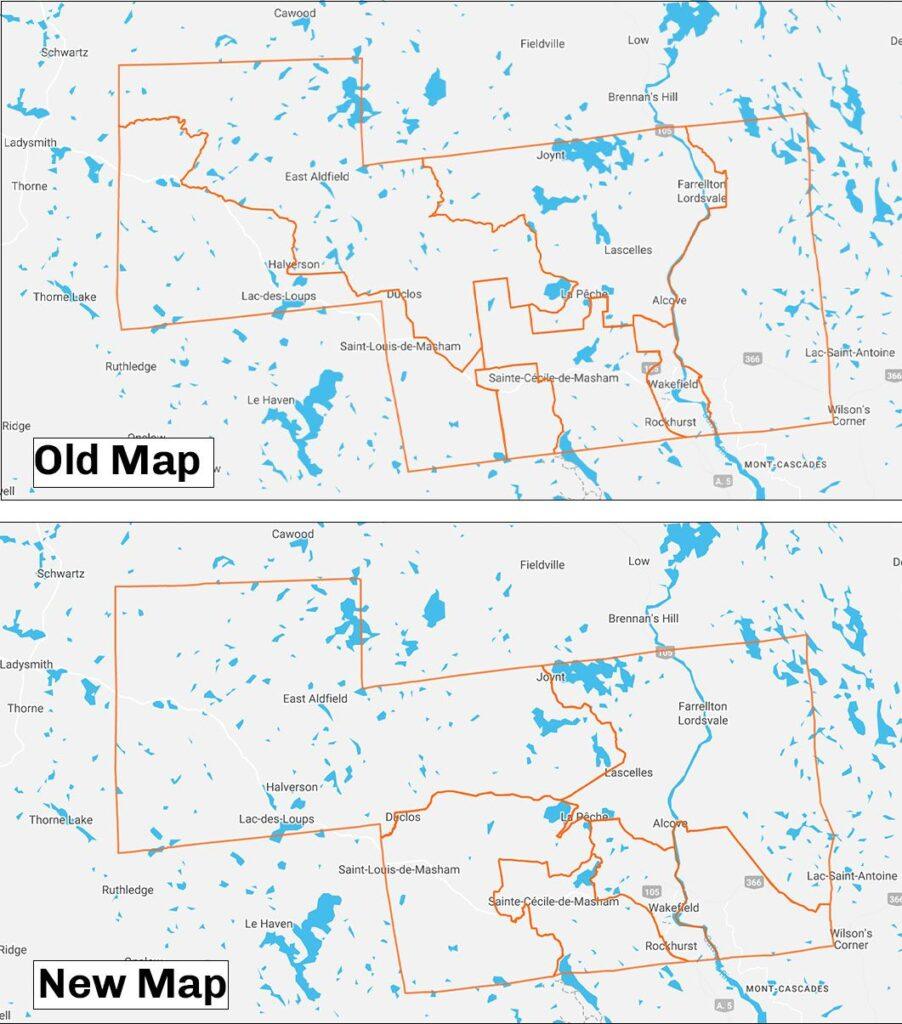
Hundreds of voters in La Pêche will lose their municipal councillor – or be shuffled into a new ward during the next municipal election, as the municipality gets set to shrink its electoral districts from seven to six. 

The major shift in La Pêche politics will see the municipality elect one fewer councillor to its chambers and change every electoral district, at least slightly, by the time the next municipal election rolls around. This means that residents in Edelweiss, Farrellton and Lac-des-Loups will experience the most significant changes in their representation. 

According to Elections Quebec, of the 207 municipalities in Quebec with a population of 20,000 or fewer, only one is divided into seven electoral districts: La Pêche. Mayor Guillaume Lamoureux said that the change would not only provide a better balance in voter populations throughout the municipality but would also save the municipality $27,000 per year with one fewer councillor’s salary on the books.

“It’s a question of efficiency,” Lamoureux told the Low Down. Two hundred municipalities below 20,000 residents function that way – you’re able to do the same thing at a lower cost. There’s also something to be said about having an even number of councillors when there’s an [split] vote; the mayor has a tiebreaker.”

Municipalities are supposed to review their electoral boundaries every four years. Lamoureux said it was evident in 2020 that La Pêche’s boundaries would have to change, as the municipality has grown by more than 800 registered voters since 2016. Because of this influx of voters, the representation among La Pêche’s seven wards became skewed, with Ward 7 (Edelweiss) having too many voters, while Ward 1 (East Aldfield) and Ward 2 (Lac-des-Loups) didn’t have enough. The new changes will see much more balance throughout the wards regarding voter population, with the new Ward 3 (Masham) hosting the most voters at 1,305, compared with the lowest in Ward 6 (Wakefield-Edelweiss) at 1,013 voters. 

“Overall, the number of electors per district is increasing because we’re going from seven [wards] to six,” added Lamoureux. “The changes are more important in places in the municipality where you have a lower population density. The reason we do this in the first place is because the balance of electors is no longer respected.”

With the proposed changes, Lamoureux said he hopes that balance will be restored.  

The most significant changes will be felt in Ward 6 (Wakefield-Edelweiss), where voter numbers dropped by 14.5 per cent, and in the former Ward 7 (Edelweiss), where voters have been moved to either Ward 6 or Ward 5 (Lascelles-Farrellton). Ward 2 (Lac-des-Loups) is also being chopped up. 

La Pêche held public consultations in early April, and residents have until May 13 to sign a register opposing the proposed electoral changes. To sign the register, visit the municipal office. 

La Pêche drops ward in electoral changeup Read More »

Wakefield to lose 3 MDs by summer’s end

By Madeline Kerr

The number of Hills’ residents without a family doctor is expected to rise, and the shortage “won’t get better any time soon,” according to a long-time Wakefield physician.

There are already over 6,000 residents in the region waiting for a family doctor – and 72,000 in the Outaouais, according to the Centre intégré de santé et de services sociaux de l’Outaouais (CISSSO). 

Last fall, Dr. Amani Ben Moussa, who was practising at the Clinique médicale des Collines in Wakefield, left to join a private practice in Gatineau. And in the coming months, two family doctors who have both served the community since the 1980s, Dr. Curtis Folkerson and Dr. Gary Satenstein, will retire without a plan to be replaced. 

While the Centre intégré de santé et de services sociaux de l’Outaouais (CISSSO) said that it could not confirm how many people are affected by the departure of these doctors, Dr. Folkerson recently told the Low Down that he has well over 600 patients on his active caseload. 

He estimated that his colleague, Dr. Satenstein, has more than 700 patients in his care. 

These patients will soon be doctorless, although Folkerson explained that the clinic is trying to accommodate the roughly 1,400 individuals left without a family doctor by offering them appointments with other MDs at the clinic if available. 

“It’s not going to get better any time soon,” Dr. Folkerson told the Low Down. He said that his decision to retire after 42 years at the Wakefield Family Medical Centre was a difficult one, but he said he believes that even if he were to wait a few more years, there still wouldn’t be anyone available to replace him. 

The reasons for the shortage, Folkerson explained, are wide-ranging and can be traced, at least in part, to the federal budgetary deficits of the 1990s. 

He explained that cuts to transfer payments led provinces to slash healthcare spending, which resulted in fewer doctors being trained at universities like McGill, leaving a dearth of family doctors for generations to come. 

Folkerson said rising administrative obligations – too much red tape, in other words – and the need to pass French language exams have also added to the shortage. 

Plus, medical professionals can usually expect to earn more across the border in Ontario, making western Quebec especially susceptible to losing trained doctors. 

Camille Brochu-Lafrance, a spokesperson for the CISSSO said one resource for patients who are without a doctor is the Primary Care Access Point, known as GAP, which helps Quebecers find health services even if they don’t have a doctor. 

“[This] will be the entry point for people who have lost their family doctor. The GAP assesses the person’s needs and makes an appointment with the right professional depending on the person’s condition,” Brochu-Lafrance said. 

The average waiting time for patients registered with the Quebec Family Doctor Finder (GAMF) in the MRC des Collines is 575 days, or over a year and a half, CISSSO reported. 

However, anecdotally, some individuals told the Low Down that they are left waiting much longer. Recently, Liberal MP for Pontiac Kitigan Zibi, Sophie Chatel, who lives in Gatineau, said she has personally been waiting 10 years for a family doctor. 

The shortage of family doctors is dire province-wide: According to the Montreal Gazette, around 40 physicians left the public network in Quebec last year, contributing to the shortage of more than 1,200 family doctors. Even worse, a quarter of all family doctors in the province are already over the age of 60, suggesting there will be a surge of retirements in the decade to come.

A spokesperson for the CISSSO said that “the regional department of general medicine (DRMG) in collaboration with doctors from each of the local service networks (RLS), is in the process of continuous recruitment. A team is dedicated to medical recruitment.” 

The spokesperson affirmed: “If a candidate is interested in a practice in the RLS des Collines, [they] will be welcomed without delay.”

Wakefield to lose 3 MDs by summer’s end Read More »

‘Nightmare’ in the Outaouais: ER Doctor

By Madeline Kerr

madeline@lowdownonline.com

Gatineau Hospital will go down to just one operating room this summer, and an ER doctor is raising the alarm about what this could mean for anyone giving birth who may require an emergency cesarean section.

Dr. Peter Bonneville, who works as an emergency room doctor in Gatineau and is the president of Conseil des médecins, dentistes et pharmaciens (CMDP) of the Integrated Health and Social Services Centre of Outaouais (CISSSO) explained that Gatineau is “the only hospital in the area that does obstetrics now. And we may not have good 24-hour-a-day coverage for cesarean sections, which is a nightmare.” 

He added, “I’m very concerned about the safety of those women.”

Bonneville told the Low Down that the hospital has seven operating rooms in total, but not enough staff to run them.

“If you go back about seven or eight years ago, all seven were working every day,” he said. “But right now, we’re down to two per day. Sometimes with retired people coming to help, we can get three operating rooms a day.”

However, over the summer “the nursing staff, because they are allowed, like any human being, to have vacations…we’re going to be going down to pretty much one operating room. And that operating room is going to need to work, obviously, 24 hours a day because you can’t function [otherwise].”

“So those nurses for the summer, they’re going to be either on vacation or working non-stop,” which Bonneville admitted doesn’t make for a “great lifestyle.”

According to CBC News, the Gatineau birthing unit delivered more than 2,300 babies last year. The only other hospital in the Outaouais with a birthing unit is the Pontiac Hospital in Shawville. 

In Quebec, a little more than one in four births results in a c-section, according to the not-for-profit organization Naître et grandir. A portion of these are planned in advance, but some are unplanned or emergency c-sections, which require surgery to be done immediately once a doctor has determined it’s necessary. 

However, if the operating room is already in use, Bonneville said there will be nowhere else in the hospital for the woman to receive that necessary surgery.

When asked what hospital staff would do in this event, Bonneville said, “We’re trying to work on contingency plans.”

For now, he said, “We’re going to make sure that the government understands there’s a sense of urgency to this. I mean, I’m totally against Band-Aid solutions, but we’re going to need a Band-Aid here until [the government can] manage the complete problem.”

“I think most women right now do not realize that that is the case,” he said, adding that part of his plan is to alert the public to this situation.

According to the CISSSO, five hospitals in the Outaouais can perform emergency surgeries, including Gatineau, Hull, Papineau, Pontiac and Maniwaki hospitals.  In December 2023, CBC News profiled the Gatineau birthing unit, calling it a rare success story in a healthcare system otherwise struggling with a lack of resources. At that time, the unit had 28 vacancies without replacement out of the total 188 positions. 

A doula’s perspective

Local doula, Kaëlla Charette, told the Low Down the news that Gatineau Hospital will go down to just one operating room this summer is “definitely concerning.”

A doula is a trained professional who supports parents during childbirth. 

According to Charette, emergency c-sections are relatively rare. In her five years of experience, she has assisted more than 100 births including many at Gatineau Hospital. She said that only two of the births she’s attended as a doula have resulted in what is known as a “P0” cesarian, or a c-section that needs to be performed without any delay. Most c-sections are less urgent, she explained, although typically surgery is performed within 30 minutes to two hours after a doctor deems it necessary. 

She pointed out that research by the World Health Organization has found that countries where more than 10 per cent of births result in c-section do not see any increased benefits in maternal or newborn mortality rates. Currently, Quebec’s rate of c-sections is around 28 per cent. Charette hopes that, in the face of an operating room shortage, health care providers will focus on “evidence-based care” that is proven to reduce the need for a c-section. 

“Some c-sections are absolutely life-saving and necessary,” Charette said, “but lowering the overall number [of c-sections] will lessen the burden on the system.”

‘Nightmare’ in the Outaouais: ER Doctor Read More »

Mutiny at the MRC: 16 to 1 vote against EFW newsletter

Bonnie James – Local Journalism Initiative

LITCHFIELD – The MRC Pontiac’s Council of Mayors held a special meeting, April 29 at the MRC headquarters in Litchfield, with one item on the agenda: a newsletter concerning the Energy-from- Waste Initial Business Plan (IBP) and to set aside $3,000 from the warden’s travel budget to cover its printing and distribution.

It was standing room only, with two police cruisers parked across the street.

Tension filled the room from the start as Otter Lake Mayor Terry Lafleur opposed the motion to open the meeting stating they shouldn’t be having it. Waltham Mayor Odette Godin agreed.

The motion to open passed and MRC Warden Jane Toller explained the reason she called the meeting. “I felt we had unfinished business. We haven’t been able to communicate the results of the IBP to the entire MRC population. Only 2.5% of the population attended the town hall meetings,” she said, suggesting a newsletter was the most effective way of communicating the results to the entire population.

Lafleur cut Toller off asking: “Why don’t we just release the business plan? Or put our efforts toward getting permission to release it?” Toller responded that they haven’t been able to legally release the full IBP, and noted the many pages it contains.

The meeting then moved on to public question period with Toller saying questions and comments were to be on the newsletter and budget only and six people could speak for five minutes each.

Shawville activist Linda Davis questioned the limiting of what could be asked. Toller responded it’s the rule for special meetings. Toller and Davis continued to banter and when Toller tried to move on to the next speaker, Thorne resident Emma Hancock interjected: “No! Keep going, Linda!” so she continued. She asked if the proposal for the creation of the IBP had been checked by the MRC’s legal counsel prior to approval. MRC Director General Kim Lesage said it was reviewed internally.

Otter Lake Councillor Jennifer Quaile was next to speak. As soon as she began, Toller interrupted asking: “Is this a question? This doesn’t need to be personal. Please stick to the subject at hand.” Again, Hancock vocally objected to Toller’s interruption, at which point Toller got out of her chair, confronted Hancock and told her to leave. Hancock refused and was loudly supported by the crowd. Toller finally turned her attention back to Quaile, who asked Toller if she was looking for support to pursue a second business plan with the newsletter.

Toller said the priorities right now are improving recycling, starting major composting and working towards zero waste. She said there are no plans for another business plan as they have to find funding outside of the MRC’s budget. She mentioned the Outaouais and City of Gatineau are working together on waste management solutions through the Conférence des Préfets de l’Outaouais (CPO).

Several citizens spoke, predominantly asking the MRC to consider future generations in their decisions. Resident Pat Shank asked if an incinerator of any size is still on the table and Toller responded it is, along with many other options.

The Equity’s publisher, Charles Dickson, asked why Council wouldn’t invest the proposed $3,000 communications budget in the local media rather than a mailer. Toller said she already spoke to the Journal and advertising is being looked at in addition to the newsletter, with cost and reach being considered.

Mayor Lafleur asked if all information sources would be cited in the newsletter. Toller said the newsletter references the Ramboll and Deloitte companies, the main sources, and people can contact the MRC with questions. Lafleur expressed concern that by not listing the sources, the MRC was positioning itself as the information authority.

Lafleur went on to question the use of funds from the warden’s travel budget to finance the newsletter: “Use the media you have and save the money you weren’t supposed to spend in the first place.”

Several mayors proceeded to comment in a roundtable discussion. Fort-Coulonge Mayor Christine Francoeur said she wasn’t against informing the public, but the newsletter needed to be revised to include the sources and details about the newsletter budget prior to sending it out.

Litchfield Mayor, Colleen Larivière, said she had heard from residents across the Pontiac saying they don’t want an incinerator. She said many residents didn’t attend the town hall meetings because they were confident mayors would “do the right thing”.

Mansfield Mayor, Sandra Armstrong, agreed the communications budget should be spent with the local media and more information needed to be added to the newsletter. “People seem to not want this. They’re afraid. We need to take our time voting on things like this. We need to regroup and talk about it,” she added.

Bristol Mayor, Brent Orr, said “One page won’t even scratch the surface. We should put the whole thing [IBP] on the website.”

L’Isle-aux-Alumettes Pro-Mayor, Ivan Schryer, said the proposed newsletter is “totally biased to sell a product. If we put out a newsletter, let’s make it unbiased.”

Godin commented: “I hate coming to these meetings now. The mayors and communities are against each other; it’s just wrong. When will we be able to say it was an idea, we pursued it, and it’s done?”

Chichester Mayor Donnie Gagnon finally called the vote. The resolution was rejected 16 to 1, with only Portage-du-Fort Mayor Lynne Cameron voting in favour. Thorne had no representative at the meeting.

Mutiny at the MRC: 16 to 1 vote against EFW newsletter Read More »

City of Gatineau opens summer camp registration

Djeneba Dosso

LJI Reporter

Registration for Gatineau’s annual summer camps will begin on May 13. Open to children aged 5

(as of September 30, 2023) through 12, the day camp registration will be divided by sectors.

Registration will start with the Aylmer sector at 6:00 pm on May 13, followed by Hull, Buckingham, and

Masson-Angers on the 14th and then the Gatineau sector on Wednesday, May 15. Registration for these

regions will continue until May 21 and will be followed by the second wave that will open the portal to non-

residents as of May 28. This wave will take place within the limits of capacity, closing at 11:59 am on June

13.

This year, all registrations will be done online through the citizen portal. Parents and guardians

who have not done so already are advised to create their profiles and have their Gatineau Access

cards ahead of time. In order to ensure fairness, the registration site will close at 5:00 pm and the

first-come, first-served principle will apply as soon as the site reopens at 6:00 pm.

For resident children without childcare, a typical day at the camp will start at 9:00 am and will

end at 4:00 pm at a cost of $62 per week. Children who are opted-in childcare services will benefit from

more flexible hours; their days can begin as early as 7:00 am and end at 5:30pm for $134 a week. Non-

resident children will pay a weekly rate of $134 without childcare or $298.75 with childcare services.

The programs will take place over six weeks starting on July 2 and ending on August 9.

The list of each day camp site by sector, available payment methods and a parents’ guide can be

found on the www.gatineau.ca website.

City of Gatineau opens summer camp registration Read More »

Join the winning team: Gatineau cheerleading holds tryouts

Djeneba Dosso

LJI Reporter

On April 12 and 13, Elite Cheer Outaouais won its first national title, taking first place in the

U12 Level 2 category. After bringing home the trophy from the Canadian All-Stars Nationals in

Niagara Falls, the largest cheerleading competition in Canada, the Gatineau team is gearing up

for the next season. Starting the week of May 6 through Friday, May 10, tryouts will be held for

levels one to four and the Worlds.

Open to all, the tryouts lead to pre-competitive and competitive programs. They are divided into

two sections: regular, which cost $5, and Worlds, for a fee of $20. Once built, teams will vary,

with some including tumbling and others focusing on dance floorwork. A recreational program

that only requires registration is available for those between the ages of three and 12. However,

no matter the program, experience is not required.

Because all athletes are guaranteed a spot (with the exception of the Worlds), “the tryout is a

ranking process that allows our qualified and experienced coaches to determine which team best

suits the skills and needs of each athlete,” reads the Elite Cheer online tryout registration page.

During the assessment, participants can expect to perform stunts as well as showcase dancing

and gymnastics skills.

Additionally, for the 2024-25 season, Elite Cheer Outaouais will lead a pilot team.

“This non-profit organization, which serves the Outaouais region, aims to offer a U18 level 4 for

its 2024-2025 season, a level not currently offered by other clubs in the Ottawa-Gatineau

region,” the cheerleading team announced in a press release on April 19.

Just days before, their Prodigy team, made up of athletes aged 9 to 12, won their first national

title with two “hit zero” performances for which no deductions were applied, a sign of perfect

execution of their routine.

Prodigy’s coaches, Rose Bernier, Sophie Houle and Kariane Thibault watched their team exceed

their expectations.

“To witness the success of our athletes, to see them shine with such passion and take first place

among twelve teams is a source of immense inspiration and satisfaction for us. Our pride is

immeasurable.”

For more information or to participate in the tryouts, please email info@elitecheeroutaouais.org

or visit their website: https://www.elitecheerout/

Photo #1: Elite Cheer Outaouais’ Prodigy team, made up of athletes aged 9 to 12, won the club’s

first national title on April 12 and 13. The dynamic team won against twelve other groups at the

Canadian All-Stars Nationals in Niagara Falls, the largest cheerleading competition in Canada.

(DD) Photo: Courtesy of Elite Cheer Outaouais.

Join the winning team: Gatineau cheerleading holds tryouts Read More »

Chris Judd honoured with provincial medal

Clifford Welsh – Local Journalism Initiative

SHAWVILLE – Friends, family and local politicians gathered at the Little Red Wagon Winery, April 26, to watch as Pontiac MNA André Fortin presented Chris Judd, a local farmer and community activist, with the National Assembly Medal for his 60 years of contributions to the wellbeing of the Pontiac.  

Fortin said he and his team decided to honour 10 individuals who’ve made tremendous contributions to the region, with Judd as the first. “As Agriculture Critic, I attend events all across the province and without exception, someone will say to me, ‘I know someone from the Pontiac, Chris Judd!” he told the crowd. Fortin emphasized the “passion Chris has shown for every aspect of agriculture across the province and the contributions he has made to promoting and bringing awareness to family, health and environment issues over the last decades.”

Clarendon Mayor Ed Walsh said Judd’s hard work and dedication to community issues made him richly deserving of the honour. Shawville Mayor Bill McLeary, who worked on Judd’s farm when he was 12 years old, expressed appreciation for all the contributions Judd has made and continues to make to the area.

After receiving the award, Judd humbly noted “It has to be fun” and “It takes a whole community to make things work.”

In an interview with the Journal, Judd spoke about how he has always seen himself as someone who “starts the fire” to get others concerned about issues affecting us all. He first got involved with 4H as a youngster and was part of one of the initial groups that founded Quebec Young Farmers in 1964. He has also been active in the Union des Producteurs Agricoles (UPA) for 50 years, the PLQ milk board (Les Producteurs de lait du Québec) for over 40 years and has served on the PBQ beef board (Les Producteurs de bovins du Québec). Judd served two terms as a councillor in Shawville before becoming provincial president of the UPA.

Judd said that without the support of his wife and co-operator of their farm, Jean McMullin Judd, there’s no way he would have been able to do all he has done. “The three most important things for a farmer’s success are their mate, their banker and their mechanic, in that order,” he said, quoting a book.

When asked about his current concerns for the Pontiac, Judd listed mental health as his biggest, followed by dealing with local waste and acknowledging climate change and its effects on farming.

Chris Judd honoured with provincial medal Read More »

Kamanyana urges Gatineau to steer away from digging into the pockets of citizens to cover

Taylor Clark

LJI Reporter

Despite having sat on council during the time of the decision, independent mayoral candidate Olive Kamanyana has challenged council to rethink its decision to have citizens foot the bill for the Société de transport de l’Outaouais’ $10 million deficit with a two-part vehicle registration tax.

Although the Société de transport de l’Outaouais hoped for a $90 increase to the current $30 annual public transit contribution, council decided to implement a two-phased approach to the tax. The first $60 hike in 2025 would cover the public transit system’s deficit but no service improvements would be seen until the second increase of $30 the following year. Kamanyana later resigned from her district councillor position on April 25 as she ran for mayor.

“I made it clear that it was a very hasty decision, very quickly taken without having sincerely spent the time to lift all the stones to see how we want to absorb the Société de transport de l’Outaouais’ deficit,” said Kamanyana.

Cited as one tax too many, Kamanyana sided with the many citizens who have contested the tax since it was first raised by former Gatineau mayor France Bélisle prior to her resignation.

“What is happening is that people are tired, very tired on a budgetary level. They no longer have the means to dig into their pockets. You can see for yourself on the shelves how the prices have increased, and people do not understand how this measure comes suddenly without having had a discussion,” she said.

With her own property tax paper in hand, Kamanyana pointed to the fact that Gatineau residents already contribute to public transportation with their property taxes. “The ecological transition is very important, but the successful ecological transition will be one that is supported by all citizens. And above all, we must not impose anything on citizens without talking to them.”

The inflationary period felt by residents required a review of spending and another way of exercising leadership in expense management, said Kamanyana. If elected, she committed to quickly working with the Société de transport de l’Outaouais to help innovative management and optimize their expenses.

Photo caption: Gatineau mayoral candidate Kamanyana condemns municipal council’s decision to go forward with a vehicle registration tax to fund the Société de transport de l’Outaouais’ deficit.

Photo credit: Taylor Clark

Kamanyana urges Gatineau to steer away from digging into the pockets of citizens to cover Read More »

Bisson unveils ambitious plan to bring life into Gatineau’s centre-ville and neighbourhoods

Taylor Clark

LJI Reporter

Independent mayoral candidate Stéphane Bisson gathered journalists in the heart of Vieux-Aylmer on April 29 to reveal an “audacious” plan to rejuvenate the centre-ville and neighbourhood centres of Gatineau.

“It is time to renew our approach and intensify our efforts to revitalize these vital centres of our community,” said Bisson.

With the intention of being Gatineau’s mayor beyond the short mandate, Bisson committed to a “clear vision” of the future of the City’s centre-ville over the long term with four measures.

At the top of his checklist was revisioning the Programme particulier d’urbanisme du centre-ville followed by the redevelopment and “reappropriation” of the ruisseau de la Brasserie. Bisson would also like to see the transformation of the segment of roadway from Highway 50, commonly known as Autoroute Guy-Lafleur, to Highway 5 into an urban boulevard to improve connectivity between the centre-ville and the Saint-Joseph boulevard area. He would also promote the continuation of urban densification in the “industrial wasteland” between Montclair and Montcalm.

“For more than 10 years, discussions around the revival of downtown Gatineau have followed one another without a concrete or unified solution being implemented. Past projects, although ambitious, have not succeeded in reversing the spiral of devitalization that our centre-ville has suffered,” said Bisson.

His address did not leave out the neighbourhoods that make up all the sectors of Gatineau. “Neighbourhood quarters are crucial to stimulating and developing the feeling of belonging to our city.” To do so, Bisson proposed the creation of neighbourhood councils, development and implementation of district-specific action plans, promotion of cultural events, ongoing dialogue with key stakeholders, and implementation of a harmonized brand image to boost activity in each district.

“Together, dear citizens of Gatineau, we can transform our city into a place where it is good to live, work, and play. I invite you to join me in this ambitious project, to share your ideas, and to actively participate in building a dynamic and inclusive city.”

Photo caption: While there have been discussions around revamping Gatineau’s centre-ville, mayoral candidate Stéphane Bisson says concrete action has been lacking to bring past projects to a reality.

Photo credit: Taylor Clark

Bisson unveils ambitious plan to bring life into Gatineau’s centre-ville and neighbourhoods Read More »

MP Sophie Chatel discusses fed’s budget

BONNIE JAMES

– LOCAL JOURNALISM INITATIVE

FORT-COULONGE – On April 22, the Pontiac Chamber of Commerce and the Community Futures Development Corporation (SADC) hosted Pontiac MP Sophie Chatel for a town hall style discussion of the 2024 federal budget at Café Downtown in Fort-Coulonge. Approximately 20 people attended, mostly Chamber members.

Chamber president Sébastien Bonnerot opened by introducing Chatel, an experienced fiscalist and international tax expert, who worked at the Department of Finance for years. Chatel said that she would be giving a high-level presentation of the most important measures in the budget.

The 2024 federal budget is titled: Fairness for Every Generation. Chatel explained that the budget recognizes that one of the main problems Canada is facing is the gap between generations, with affordable housing the biggest challenge for the younger generation. She said that young people feel that homeownership is out of reach. In light of this, housing is one of three main focuses of the budget. With an objective of increasing the housing supply, the budget allocates $13.2 billion to build 3.9 million new homes across Canada by 2031.

The second focus is on “making life more affordable” with specific measures for young adults, children, all generations, and farmers. Of particular interest for the Pontiac is enhanced student loan forgiveness for doctors and nurses who choose positions in rural and remote areas.

For farmers, the budget launches consultations on the “right to repair” regarding copyright legislation that has hampered their ability to work on their own equipment. The budget also eliminates interest payments on the first $250,000 of agricultural loans Regarding succession, the lifetime capital gains exemption for farmers is increased when they sell their farm to $1.25 million. An additional $2 million is also partially exempt.

The third focus is on investment in green and technological economic transition featuring the net-zero economy plan, clean electricity tax credit, artificial intelligence (AI) sector investment, and 10% electric vehicles supply chain investment tax credit.

Lastly, the budget “improves tax fairness” by increasing the tax on capital gain over $250,000 per year.

The inclusion rate for annual capital gains exceeding that amount will increase from 50% to 66% as of June 25, 2024, with the rate for gains up to $250,000 remaining at 50%. Specific exemptions will be maintained for principal residences. The increase is expected to generate $19.4 billion in revenue over the next four years which will help fund the housing initiatives etc.

Chatel also stressed that the deficit will be maintained at $40 billion and is expected to decrease in the coming years.

Questions & Answers

Jon Stewart asked how the Liberals will explain the carbon tax to businesses to counter the Conservatives’ “axe the tax” platform. Chatel replied that the federal carbon tax does not apply in Quebec as the province has its own carbon pricing scheme. She pointed out that the Conservative party included a similar cap-and-trade carbon policy in their 2021 platform.

Stewart also asked how the federal government can help Pontiac businesses hit hard by the costs of changes required under Bill 96. Chatel replied that the federal government is supporting the court challenge against the use of the notwithstanding clause in Bill C-21, which was also used in the invocation of Bill 96. She said that if the challenge is successful, Bill 96 will need to be reopened.

Local investor Larry Charbonneau talked about the challenge of offering newly renovated rental units at an affordable price: “When we fix up apartments, people can’t afford to rent them. We can’t afford to rent them out at $700, but people can’t afford $1,200. So what are we supposed to do?” he asked. Chatel didn’t offer an answer but listened empathetically.

Chamber Vice President Todd Hoffman asked Chatel if the budget was driven by data or feelings, referring to the title. Chatel replied that the theme of the budget is based on a desire for fairness but said that data was also considered. Hoffman stated that the youth of all generations have always felt hard done by and that the budget should be based on national interest. Chatel responded: “I was able to work part-time, go to school, and still buy a house. Youth can’t do that now.”

MP Sophie Chatel discusses fed’s budget Read More »

Montreal to test siren today as part of emergency alert system to warn public about toxic leaks

by Lorraine Carpenter, Local Journalism Initiative reporter

The City of Montreal has issued an alert about an emergency siren test being conducted across Montreal today. The system is in place at factories across the city to warn the public about toxic leaks of hazardous materials.

The public is being advised to not be overly alarmed when the emergency siren sounds between 9 a.m. and 3 p.m.

“This Wednesday, May 8, between 9 a.m. and 3 p.m., a test of warning sirens will take place in Montreal.”

Here is the siren test schedule for participating factories across Montreal:

  • From 9 a.m. to 9:10 a.m.: Lactalis Canada
  • From 9:20 a.m. to 9:30 a.m.: Brasserie Labatt
  • From 9:40 a.m. to 9:50 a.m.: Bœuf Mérite, Metro Richelieu
  • From 10 a.m. to 10:10 a.m.: Cold storage Total
  • 10 to 10:30 a.m.: Dural – Multibond
  • From 1:10 p.m. to 1:30 p.m.: Saputo Dairy Products Canada (Saint-Laurent)
  • From 1:40 p.m. to 1:50 p.m.: Suncor Energy Products – Sulfur plant
  • From 2 p.m. to 2 p.m. 10: Entreprise Indorama PTA Montréal
  • From 2:20 p.m. to 2:30 p.m.: Saputo Dairy Products Canada (Saint-Léonard)
  • From 2:40 p.m. to 2:50 p.m.: Pêcheries Atlantiques du Québec, Metro Richelieu

To hear what the siren sounds like (a cross between an emergency vehicle siren and an extremely loud slide whistle), please click here.

Montreal to test siren today as part of emergency alert system to warn public about toxic leaks Read More »

Roads, $11 million in loans, and ballparks

Mayor Mario Gendron presided over the 45-minute meeting with well over 50 separate items on the agenda

Cookshire-Eaton holds its monthly council meeting

By William Crooks

Local Journalism Initiative

The Municipal Council of Cookshire-Eaton held its monthly meeting May 6 at the Cookshire Town Hall, with much of the public discussion centering around the use and abuse of local roads.

Topics at the meeting also included two unanimously adopted bylaws authorizing substantial loans, one of more than $11 million, and a proposal to replace Birchton’s baseball field with a housing development.

Mayor Mario Gendron presided over the meeting with around nine local residents in attendance. The meeting lasted roughly 45 minutes, with well over 50 separate items on the agenda.

Roads   

In the meeting’s first question period, community members voiced concerns about local infrastructure, municipal projects, and public safety issues. The conversation started with a citizen addressing Gendron directly.

He offered a proposal concerning municipal street cleaning operations. Observing street cleaners at work, he believes their labour conditions are deplorable and inefficient. He suggested the city should invest in advanced cleaning machines that can streamline the process. According to him, these machines can significantly reduce the workforce required, resulting in more efficient cleaning.

Throughout, he passionately described the difficulty street workers endure, emphasizing how disheartening it is to see them struggle. He insisted that better equipment would make their work easier, allowing one operator to do the job of multiple people.

He also brought up a Facebook post advertising a new machine that could handle the workload with a single person. He expressed concerned about the maintenance of the equipment, noting that sometimes machines are down for repairs.

Another individual raised concerns about the grading of gravel roads. He claimed that the current maintenance isn’t keeping up with demand, leaving potholes that reappear shortly after grading. The individual questioned the need for additional graders, considering that in the past, fewer graders handled the same workload without a problem.

Further conversation highlighted road widening initiatives that could necessitate additional gravel. Residents expressed frustration with the inefficacy of repairs, noting that water drainage issues persist. The municipality’s reliance on external contracts rather than fully utilizing in-house resources was questioned, and Gendron acknowledged the concern.

Another speaker discussed speeding vehicles in a residential area. He reported how a delivery driver was recently clocked at 64 km/h on Chemin Learned Plain, endangering pedestrians and employees who work near a blind curve. He suggested reducing the speed limit to 30 km/h to ensure safety.

The conversation briefly shifted to the perceived negligence of a local event organizer who allegedly failed to notify residents about decibel testing and other measures to mitigate noise complaints. A council member claimed that the project is suitable but agreed it shouldn’t occur near residential neighborhoods.

Finally, a citizen questioned the recent voting process for a dam project in Cookshire. He mentioned confusion about the process, recounting how he was informed that he had missed some paperwork during the voting. After a neighbour’s call, he returned to rectify the issue, but was upset that it occurred. A council member agreed that it should not have happened, but insisted it was unintentional.

Throughout the meeting, Gendron listened attentively, validating concerns and promising follow-up actions or further clarification with relevant departments or stakeholders.

Loans

Notable amongst the many items on the agenda were two new unanimously-adopted bylaws introduced to authorize large loans.

The first allowed the town to go ahead with an expenditure and a loan of $800,000 for the repair of municipal services on Sawyer, Bibeau, and de la Meunerie streets.

The second focused on the implementation of a water network in the Johnville area. This by-law will permit a loan of $11.1 million for the project, which will include a grant from the Ministry of Municipal Affairs and Housing under the Municipal Infrastructure Program.

Ballpark

The Record received a message in mid-April urging it to look into the proposed replacement of Birchton’s park with a housing development.

The message said tensions are rising due to the municipality’s plan to demolish the ballpark, playground, and picnic area in favor of an expensive housing development. It said since merging with Cookshire, Birchton has lost several amenities and now faces losing more.

The message said Yvon Roy, who contributed significantly to the park’s creation and is a former town councillor, is determined to oppose the plan. The Record was provided with Roy’s contact information but has received no response to attempts to contact him since April 17.

At the end of the second question period on May 6, the Record asked the council about the issue.

Councillor Marcel Charpentier responded that a meeting would be held May 14 wherein residents from Birchton are going to “tell [the council] what they want.”

“Nothing is decided,” he added.

“We’ll go from there,” Charpentier continued, “there’s no skyscrapers going up yet.”

He went further and explained that no baseball is possible at the park because the town cannot get the appropriate insurance. “We have two really nice ballparks, one in Sawyerville and one in Johnville,” he said, which are insurable.

The Birchton ballpark is not insurable because the “ball goes too far,” he said, “and you cannot control who goes on there.”

The Record was initially under the impression that the upcoming meeting will be open to the public, for an attendee urged this reporter to put the date of the future consultation in this report.

However, Adjoint General Director France Dumont confirmed May 7 in an email that “there is a meeting between a citizens’ committee and the city, but it is not public.”

The Record followed up and asked who was on the citizen’s committee and why the meeting will not be public but did not receive a response before this article went to press.   

Roads, $11 million in loans, and ballparks Read More »

ÉquiMobilité transit pass prices to drop July 1

ÉquiMobilité transit pass prices to drop July 1

Ruby Pratka, Local Journalism Initiative reporter

editor@qctonline.com

Getting around the city will get slightly easier on July 1 for people covered by the Ville de Québec ÉquiMobilité program.

The program, a longtime demand of groups advocating for the rights of low-income people in the city, was launched in spring 2023 and offered a 33 per cent discount on bus tickets and monthly passes for people whose income was below a predetermined poverty threshold. Recent changes to the program, in effect July 1, will bump that discount up to nearly 50 per cent.

As of July 1 and for the next two years, ÉquiMobilité participants will pay a fixed rate of $50 for a monthly pass and $2 for a single-ride ticket (com- pared to full prices of $97.50 and $3.50 respectively). The income eligibility threshold will also rise slightly, to $30,526 for a single person (higher for couples and larger families). People with disabilities who are registered for the STAC adapted transit service are automatically enrolled regardless of income.

Mayor Bruno Marchand, for whom the program was a 2021 campaign promise, said he was proud of the program. “An inclusive community is a community that accepts … to create a social safety net with programs where everyone has possibilities to dream and build the city, to build it with us, and not to be stuck at home because the fact they have low income restricts their mobility,” he told reporters at City Hall on May 2.

Coun. Maude Mercier Larouche, member of the executive committee responsible for public transportation, integrated mobility and major projects, said freezing the fee at $50 for a monthly pass made the program “more predictable” for people on tight budgets.

Accès Transports Viables was among the groups that advocated for social pricing for many years. “Mobility is a fundamental right which conditions the exercise of many other rights,” said the organization’s director general, Marie-Soleil Gagné. “It’s simple: if we don’t have transportation options that meet our needs … chances are we won’t be able to go to school, go to work [or] access essential services – we become confined to our own space. Public transportation is the means of transportation for people who don’t own a car – seniors, people in poverty, single mothers, young people, students. In Quebec City, that’s a lot of people.”

Spending less on transit also gives people in precarious financial situations breathing room to afford healthier food, more weather-appropriate clothes, community activities or home care, disability rights advocate Véronique Vézina explained.

According to the Ville de Québec, more than 8,400 people have bought monthly passes through the program since its inception. City officials estimate that several thousand more residents are eligible for the program but not using it.

If you think you are eligible for ÉquiMobilité, application forms (in French only) are available on the city website. Go to the Limoilou or Sillery borough office (bureau d’arrondissement) with your completed form, your most recent notice of assessment from Revenu Québec or Revenue Canada if you have it, proof of refugee or social assistance status if you have it, and a piece of photo ID. If you’re eligible, the borough office will give you a document to take to the Brunet pharmacy near the Limoilou borough office; the RTC information centre at 820, Ave. Ernest-Gagnon; the Horizon Santé pharmacy in Les Galeries de la Canardière or the Brunet pharmacy at 2700, Boul. Laurier. Pharmacy staff will create your card. Both the application and the card are free.

It’s also possible to apply by mail and have your card mailed to you. Visit ville.quebec.qc.ca/citoyens/deplacements/programme-equimobilite.aspx for details.

ÉquiMobilité transit pass prices to drop July 1 Read More »

Geddy Lee and Star Wars: FEQ and Grand Theatre partner for eclectic program

Peter Black

Local Journalism Initiative reporter

peterblack@qctonline.com 

Eclectic might be an understatement to describe the set of six events at the Grand Theatre announced as part of Festival d’Été programming.

On July 13, for example, there’s an afternoon session with Geddy Lee, founder and bassist with the iconic Canadian band Rush, talking about his autobiography, My Effing Life

In the evening, rock talk switches to movie music, with Star Wars: A New Hope in concert, featuring the score of the epic 1977 George Lucas classic performed by Montreal’s FILMharmonique Orchestra. 

Though its repertoire does not include film music as its name suggests, The Cinematic Orchestra, a U.K.-based jazz band, is known for its “impressive and enigmatic live performances,” a FEQ press release stated. The group plays on the evening of July 7.

Also slated for Grand Theatre shows are Cajun favourite Zachary Richard (July 5), French-Swiss jazz trumpeter Éric Truffaz (July 4), and popular Quebec pianist Marianne Trudel opening for American jazz pianist Natalie Tenenbaum (July 12). 

FEQ content director Louis Bellavance said the festival decided to pursue some acts that are not well-suited to an outdoor setting, an idea that’s been brewing with FEQ for several years.

“Instead of letting go of some of these amazing artists we were interested in,” the partnership with the Grand Theatre presented a way to do it, Bellavance said.

“It’s not for everyone to go to an outdoor festival and be standing up on a hill. There’s something very comforting about being part of Festival d’Été, but being inside and buying your seat and knowing where you’re going to be,” he added. 

Bellevance said booking prog-rock legend Geddy Lee took considerable persuasion given he had already wrapped his book tour. He finally agreed, “because he wanted to connect with his Quebec fans.”

Tickets for individual shows are on sale through the FEQ website at prices ranging from $42.50 to $79.

      30

Geddy Lee of prog-rock legends Rush will discuss his autobiography at a FEQ event at the Grand Theatre on July 13.

Photo from FEQ

Geddy Lee and Star Wars: FEQ and Grand Theatre partner for eclectic program Read More »

Government hints Mont Sainte-Anne’s future could be decided soon

Peter Black,

May 1, 2024

Local Journalism Initiative reporter

peterblack@qctonline.com

With another season ended at the Mont Sainte-Anne ski resort, there are signs the Quebec government is preparing to act to find a new operator and upgrade the deteriorating attraction.

Jonatan Julien, the minister of infrastructure and minister responsible for the capital region, said a deal regarding the future of the ski hill, currently in the hands of Alberta-based Resorts of the Canadian Rockies (RCR), “is certainly possible” before the start of the next season.

Julien made the comments at an April 23 parliamentary committee meeting to discuss budget credits for the capital region. Responding to questioning by Liberal interim leader Marc Tanguay, Julien said the file “is progressing very well, quite honestly … We are having very, very important discussions.” He did not specify with whom.

Whatever deal the government may be working on, a tight deadline looms, according to Les Amis de Mont Sainte-Anne, the group that’s been pushing for new ownership to revamp the facility.

Group president Yvon Charest told the QCT, “If you don’t have a new manager for the mountain by July 1, it’s going to be impossible to make the infrastructure improvement in time for the Canada Winter Games that will be happening in February 2027.”

Charest said the Coalition Avenir Québec government needs to change its strategy of trying to negotiate with RCR, which has already rejected private offers to purchase the ski station. He said the government “does not want to play tough with RCR” because it is afraid the owner will walk away and stick Quebec with the ownership and onus to invest millions in new facilities.

Charest said there is an ideal option available with the interest expressed in Mont Sainte-Anne by Christian Mars, founder of the French-Swiss management company e-Liberty, which last year signed a 33-year lease to operate the Mont Grand-Fonds ski hill in the Charlevoix and plans to invest some $45 million to develop the site.

Mars, through his Compagnie des montagnes de ski du Québec, has offered to invest $100 million in Mont Sainte-Anne, topped up by another $20 million from local investors, Charest said.

In a recent interview with the Journal de Québec, Mars deplored the deteriorating condition of Mont Sainte-Anne. “It’s true that in Europe, a station in this state is closed immediately. We don’t let it run. It is not possible. There is a level of security that is not sufficient.”

The safety factor may give the Quebec government an opening to seek expropriation of Mont Sainte-Anne, Charest said, noting ski lifts on the mountain are more than 35 years old and operating well under capacity. Serious accidents on the lifts have occurred in recent years.

The public interest factor also needs to be considered, Charest said, with the upcoming Canada Winter Games in Quebec City in need of a downhill ski event venue up to current standards.

Mars said he met with Industry Minister Pierre Fitzgibbon at Mont Grand-Fonds in March. “He was able to see that we were doing what we are committed to. We are operators and we have shown that what we say, we do.”

Mars said, “The solution lies with the government. Our plan is known to the premier’s office, Mr. Fitzgibbon and Investissement Québec.”

Charest said RCR may have more incentive now to divest itself of Mont Sainte-Anne having recently lost control of the eastern part of the mountain in a court case brought by the Quebec government’s SEPAQ outdoors facilities agency. 

The loss of revenue from that on top of the bleak ski season just finished may add up to retaining the resort not being worth the cost to RCR, he explained. 

Charest said, “The way I see it is that it would be quite wise for the government.to move right now because of public interest, and I’m sure that if the government wants to do so you would have a happy community.”

      30

Le Mont-Sainte-Anne, en avril 2024  Photo from e-Liberty

Prospective Mont Sainte-Anne operator Christian Mars shows off the gondola lift he’d like to see on Quebec slopes. 

Government hints Mont Sainte-Anne’s future could be decided soon Read More »

Quebec getting to know what’s in PSPP’s heart and head

Peter Black

May 1, 2024

Local Journalism Initiative reporter

peterblack@qctonline.com

The Parti Québecois has had six elected leaders since the sovereigntist party was created in October 1968. Its founder, René Lévesque, was never actually elected leader, but as the head of the larger group that merged with another group to form the PQ, he automatically assumed the leadership. 

One leader since then has been acclaimed – Lucien Bouchard, in 1995, after then-premier Jacques Parizeau resigned abruptly in the wake of the failed sovereignty referendum of the same year.

This group of leaders can be broken down generally into two categories: heart or head, emotion or reason. Some fit more neatly into one category or the other.

Take the founder, for example. Lévesque knew instinctively that the path to sovereignty lay with an emotional appeal to Quebecers fed up with a federation that showed little respect towards the francophone majority. Little concerned was he with the nuts and bolts of how sovereignty-association with Canada might work. When he was preparing to bolt the Liberal Party, his then friend and future political foe Robert Bourassa cautioned him, “You don’t seem to realize that political independence goes with monetary independence. Quebec cannot be sovereign and pay the bill with Canadian dollars.”

To which Lévesque replied, “Monetary system, economic system, all this is plumbing. One doesn’t worry about plumbing when one fights for the destiny of a people.” Heart.

By contrast, Jacques Parizeau, though a bit of a lefty radical in his youth, was a technocrat through and through. Prior to joining the PQ in 1969, he had been a senior civil servant instrumental in setting up much of the infrastructure underpinning the Quiet Revolution – the nationalization of Hydro-Québec and creation of the Caisse de depôt et placement being two examples.

His pompous demeanor and trademark three-piece banker suits were not exactly the package to connect with the little people. Still, he had the good timing to take over the PQ as the Meech Lake Accord was unraveling and about to rev up the masses with the potent brew of humiliation and resentment. 

A few thousand votes more on the Yes side in the 1995 referendum and Parizeau could well have been the perfect péquiste premier to negotiate Quebec’s exit from Canada. All head.

Then, amongst the group of five PQ leaders to win an election – Lévesque the only one to win two, 1976 and 1981 – there is Lucien Bouchard, who, history concedes, nearly single-handedly brought the Yes side to the brink of victory.

That Bouchard was all heart, a mesmerizing, emotional speaker who felt first hand the bitter failure and betrayal of Meech. Once winning the 1998 election, however, with the referendum heat cooled, he was the Quebec leader forced to bring in hotly contested austerity measures. 

The only other PQ leader to win an election was Pauline Marois, who cashed in on fatigue with the long reign of Liberal Jean Charest. She won a minority in 2012 but lost two years later to new Liberal leader Philippe Couillard. She wasn’t around long enough to determine how much heart she had – obviously not enough to stay in power, let alone win a referendum.

Other PQ elected leaders – Pierre-Marc Johnson, Bernard Landry, André Boisclair, Pierre Karl Péladeau (!) and Jean-François Lisée – sorry to say, are asterisks in the party’s saga, which, frankly, seemed to be nearing an end with the three seats won in the 2022 general election under new leader Paul St-Pierre Plamondon (PSPP).

So what about PSPP? Heart or head? 

He is so high in the polls he is convinced he sees the promised land. But does that make his heart soar like a hawk? Hardly, based on the 1960s-style bitterness- and resentment-spewing speech he gave to a PQ gathering in Drummondville on April 14.

His Durham Report vision of a Canada deliberately plotting to “weaken and erase” the Quebec people, to “crush those who refuse to assimilate,” had commentators rethinking the glowing praise they have been heaping on the separatist golden boy since the party won a surprise victory in a Quebec City byelection last year..

Then, last week, in a National Assembly exchange with Premier François Legault, PSPP mimed slitting his wrists when the premier asked him if he would join the CAQ if the PQ leader’s proposed third referendum failed.

Heart or head? Hard to tell. But folks are sure getting to know more about the real PSPP.
    30

Quebec getting to know what’s in PSPP’s heart and head Read More »

FEQ fills in blanks with Canadian legends

Peter Black 

April 24, 2024

Local Journalism Initiative reporter

peterblack@qctonline.com 

The Festival d’Été de Québec has completed its lineup, filling in some blanks in the schedule with familiar acts on an all-Canadian night.

Legendary rockers Blue Rodeo are the marquee act on July 13 on the Loto-Québec stage in Parc de la francophonie, with veteran rocker Sass Jordan warming up the crowd.

The same night, across the park on the SiriusXM stage, Canadian country-rock band the Hello Darlins, open for multiple-platinum album pop-rock singer Amanda Marshall, the pride of Toronto. 

FEQ also announced an “Emo Punk” night on July 10 featuring American band All Time Low on the Loto-Quebec stage while Canadian quartet Silverstein perform on the SiriusXM stage. Other acts on the program are Toronto punk-rockers The Anti-Queens and Moneen, and singer-songwriter Cam Kahin.

FEQ opens on July 4 and runs until July 14, featuring hundreds of performers, including such big names as Post Malone, Nickelback, 50 Cent and the Jonas Brothers.

All general admission passes (bracelets) are sold out. The sole remaining passes available are hotel packages.

      30 

PHOTO BELOW 

Quebec rocker Sass Jordan opens for Blue Rodeo on July 13.

Photo from FEQ

FEQ fills in blanks with Canadian legends Read More »

La Maison Smith to conquer Plains of Abraham crowds with café

Peter Black 

April 24, 2024

Local Journalism Initiative reporter

peterblack@qctonline.com 

After an absence of three years, food and drink service is returning to the pavilion on the Plains of Abraham next to the Edwin-Bélanger Bandstand. 

The new operator of the concession will be La Maison Smith, a familiar player in the city’s restaurant community. The Plains location will be the family-run company’s 11th coffee shop in the city.

The cafe is expected to open on June 8, once renovations to the pavilion are completed. La Maison Smith will also provide a food truck and an “espresso bike” to reach less accessible areas.

Mathilde Plante St-Arnaud, one of the three co-owners of La Maison Smith, explained why the company bid for the Plains location: “For 10 years, we have carefully selected the sites where each coffee shop is established. The Plains of Abraham are emblematic and we see the opportunity to promote the city of Quebec by combining our offer with the exceptional site.”

Plante St-Arnaud said the existing pavilion’s interior will be renovated in line with La Maison Smith’s typical decor, but “we always immerse ourselves in the environment where we set up. We have a few weeks to put the interior of the pavilion in our image while respecting the character of the Plains.”

Katherine Laflamme, director of marketing and development for the National Battlefields Commission, said in an April 18 news release the partnership with La Maison Smith “will enhance the experience of visitors to the Plains of Abraham throughout the year. We are excited to provide a wide variety of high-quality food to people visiting the site to discover its history, have fun, play their favourite sport or simply enjoy the park.”

Some four million people visit the Plains park each year.

The Plains cafe will be open year-round, with the daily operating schedule adjusted to events in the park and the demands of the tourism season. There will be interior seating for 55 people and outdoor seating for 50. The cafe will serve alcoholic beverages as well as hot drinks. 

La Maison Smith opened its first coffee shop in Place Royale in 2013, in a building erected in 1653 and occupied for many years by businessman Charles Smith and his family.

Since then, it has added outlets in Old Quebec and around the city. It also recently took over restaurant space in the Centre des congrès de Québec. Its food truck has become a regular sight at major events. 

The company has a coffee roasting facility at its location in Limoilou. It has a workforce of some 270 employees.

Plante St-Arnaud said the company’s rapid success and expansion are due to putting “all our energies in the quality of the product and service. Roasting and training are two key elements. In addition, the choice of each location is decisive.” 

Plante St-Arnaud recently became a co-owner in the company where she has served as executive director since it was founded by Jerome Turgeon and Veronic Pelletier in 2013. 

She said, “It’s sometimes hard to believe for Jérôme and I that we have reached 11 coffee shops and a [food truck] in 10 years. But we keep pace with the demands thanks to an incredible team who support us, who grow with us and who are the foundation of the company.” 

   30 

PHOTOS BELOW 

Mathilde Plante St-Arnaud, co-owner of La Maison Smith; Johanne Laflamme of the National Battlefields Commission, and co-owners Jerome Turgeon and Veronic Pelletier stand before the pavilion near the Edwin-Bélanger Bandstand, the future location of the popular café. 

Photo courtesy of La Maison Smith/Noemie Rochette

A Maison Smith “espresso bike” will be pedaling coffee to visitors to the Plains. 

Photo courtesy of La Maison Smith 

La Maison Smith to conquer Plains of Abraham crowds with café Read More »

Feeny brings a “housing-first approach” to Gatineau’s homelessness crisis

Taylor Clark

LJI Reporter

Independent mayoral candidate Daniel Feeny proposed five “concrete measures” on May 1 for immediate implementation to fight against Gatineau’s growing number of citizens experiencing homelessness.

Of his first measures, Feeny committed to ensuring the safety and well-being of those experiencing homelessness, stakeholders involved, and citizens in the neighbourhood with what he referred to as “frequent cleaning chores on the Guertin site,” establishment of a local service centre, improvement of adapted services, and continued collaboration with camp partners.

“Not knowing what will happen is a situation that adds anxiety and insecurity for our most vulnerable population, the organizations on the ground, and the residents of the Guertin sector. I don’t just want to talk about cleaning, waste, (and) moving people. It’s about our community and our fellow citizens. For me, this means respect, collaboration, and above all a ‘housing first’ approach,” Feeny wrote in a press release.

The need for temporary transitional housing was evident, said Feeny. The candidate committed to the continuation of Gîte Ami’s Mon Calme project, which provides citizens with a temporary housing solution for two to nine months as they seek new accommodations. Feeny also proposed a system to accelerate the support and authorization for transitional housing projects throughout the city.

“Funding for 500 housing units is available from the Government of Quebec for this type of need. Gatineau must be among the first to submit projects to help our most vulnerable population.”

In the hopes of better coordination, Feeny would like Gatineau and the province to jointly finance the position of a homelessness commissioner to facilitate dialogue and innovation between different levels of government and stakeholders.

Inspired by the Fondation du Grand Montréal, the candidate also proposed the creation of the Gatineau Foundation for Life with Philanthropie Outaouais to allow the City to bring together private and public resources to support local initiatives.

Photo caption: In a promise of leadership, mayoral candidate Daniel Feeny committed to ensuring the safety of all players involved at the Guertin site in his plan to tackle Gatineau’s homelessness issue.

Photo credit: Daniel Feeny Facebook

Feeny brings a “housing-first approach” to Gatineau’s homelessness crisis Read More »

Free self-service sports equipment lending project launched in Bromont

By Ruby Pratka

Local Journalism Initiative

Bromont residents who want to borrow sports equipment at Grégoire Park in Adamsville can now do so through a mobile app at a self-service kiosk. Mayor Louis Villeneuve and Adamsville Councillor Jocelyne Corbeil officially opened the service on April 30 alongside representatives of the city’s recreation department and the Montérégie recreation and sports directorate and students from the nearby St-Vincent-Ferrier primary school.

People who want to borrow equipment from the Boxup kiosk will have to download an app using a QR code displayed onsite, fill out an online form and provide a piece of ID, explained Laurent Bédard, sports and recreation co-ordinator for the Ville de Bromont. They’ll then be able to open the locker containing their chosen ball, bat or pair of skates, and use the equipment for the next three hours.

The Boxup module in Grégoire Park has six lockers; Bédard said city staff will make sure the equipment on offer varies from season to season. “There will be things like baseball bats and gloves and a basketball there in the summer; in winter we want to bring in hockey helmets and skates,” he said. The module will be in Bromont for at least the next four years as part of a pilot project; it may be moved from one park to another during that time depending on demand.

“In light of the labour shortage, the city wants to use digital tools to offer equipment rental in parks where there are not necessarily staff there all day,” Bédard said. “We also want to make sure everyone has access to recreation – stereotypically, Bromont is a wealthy city, but there are families that find recreation expensive.” Annie Guillemette, a recreation advisor at the Conseil Sport Loisir (CSL) Montérégie, said studies showed that a lack of accessible equipment made immigrants and families with young children less likely to try outdoor activities.  Bédard, who has a young son, said the opportunity to rent equipment will also come in handy for people who want to try a sport or let their children try a sport without buying a full set of equipment or without hauling their own equipment to the park.

“We want the project to be well known and used, so that it brings more life to the parks and is used by kids and the whole neighbourhood,” Guillemette said.

The Bromont self-service kiosk is part of a provincewide project co-ordinated by regional sports directorates, aimed at increasing access to borrowed or rented equipment. By the end of June, similar kiosks should be set up in Val-des-Sources, Danville, Weedon, Cookshire-Eaton, Potton and Ayer’s Cliff, according to Nadia Fradette, coordinator responsible for outdoor activities, parks and recreational spaces and adapted recreation at the Conseil Sport Loisir de l’Estrie. The same application allows people to rent equipment from any box in the province. Other sports equipment rental projects, not involving the app, are planned later this summer for Val-Saint-François and Windsor, and elsewhere in the Montérégie region, according to Fradette and Guillemette.

Free self-service sports equipment lending project launched in Bromont Read More »

Local organizations receive tourism grants

By Ruby Pratka

Local Journalism Initiative

Ski Sutton, Ski Bromont and several other area tourist attractions will benefit from the latest round of post-pandemic “relaunch” funding from the provincial tourism ministry, Tourism Minister Caroline Proulx announced April 29.

“The tourism industry is booming in the Eastern Townships, a region that has nearly 1,400 businesses and more than 20,500 tourism-related jobs. According to the most recent data, the economic contribution of sectors associated with tourism amounted to $794 million. The supported projects will promote the growth of tourism, an important driver of local economic development,” the minister’s office said in a statement.

Alongside CAQ MNAs from around the region, Proulx announced that the government would provide $34.3 million of funding across five programs – the Programme d’aide à la relance de l’industrie touristique (PARIT), Programme d’appui au développement des attraits touristiques (PADAT), Programme de soutien aux stratégies de développement touristique (PSSDT) and the regional development agreement for digital transformation in tourism.

“The investments announced today demonstrate the dynamism of local businesses and the strong tourism potential of the Estrie and Brome-Missisquoi regions. I congratulate the organizations in my riding which have received support from our government, in particular Ski Sutton, whose project is in perfect agreement with its mission to offer … distinctive four-season activities in the great outdoors,” Brome-Missisquoi MNA Isabelle Charest said.

Ski Sutton was one of the largest recipients, receiving a $5-million PARIT grant to install a new four-person lift cabin, automate its lift access system, expand its sculpture garden with contributions from local artists, add a lookout for hikers and add summer glamping (luxury camping) facilities. Expérience Embargo, which organizes the annual Soif de Musique music festival in Cowansville, got a $35,000 grant through the regional development agreement toward organizing this year’s edition. Ski Bromont ($35,000 for real-time visitor communication tools) and the Vignoble Léon-Courville in Brome Lake ($23,000 for renovations and improvements to guided tour areas) also received regional development agreement funding.

Soif de Musique cofounder Philippe Mercier said the funding comes at a crucial time for the rapidly growing festival, which is preparing for its fifth edition. “Everything is costing more and it’s harder to find volunteers,” he told the BCN. This year’s festival has an impressive list of headliners – Flo Rida, Charlotte Cardin, Patrick Watson, Les Trois Accords, rising Montreal-based girl power band Les Shirley and Acadian trad-rockers Salebarbes – and will also feature an expanded campground and vineyard tours with surprise pop-up concerts.

Ski Sutton CEO Jean-Michel Ryan echoes Mercier’s sentiments. “This support is fundamental … since the pandemic, costs have exploded, and a lot of projects would not be realizable without PARIT.” he said. He said the new four-person lift will make it easier for families with young children to stick together on the same lift. The size, exact location, capacity and opening date of the “glamping” facility are yet to be determined pending discussions with the Town of Sutton, although Ryan said it would include “more cabins than tents” and would provide one more possible place for tourists to spend the night in a region struggling with a shortage of housing options.

Ryan said he expects the lookout, the new “glamping” facility (exact placement and capacity to be determined) and the expanded sculpture garden to help the resort develop year-round revenue streams, a necessity in light of climate change and shortened ski seasons.

Local organizations receive tourism grants Read More »

Fête des Générations to return to Sutton School grounds

By Ruby Pratka

Local Journalism Initiative

During the week, the grounds of Sutton School ring with the shouts and laughter of elementary school children. On May 11, the municipality is hoping to draw a more varied crowd.

The Sutton-Abercorn Community Development Table is organizing the second post-pandemic edition of the Fête des Générations (Generations Party) on the school grounds that day from 11 a.m. to 2 p.m.

“Many families with young children know other families with young children, and many people over 60 know other people over 60, but this is an invitation to go and mingle,” said Sutton resident and organizing committee member Chantal Renaud, 39.

The event will feature a free cold buffet, board games, storytelling, arts workshops, slacklining, pickleball, skateboarding, pump track activities, activities for babies, concerts by local artists including performers from the Sutton International Fiddle Festival, kiosks with information about community services and an intergenerational barter market. In case of rain, the event will be moved inside the school; only the activities that require specific outdoor facilities, like the pumptrack, will be cancelled. The event will be free and people will be able to drop by for a few minutes or stay the whole day. Although there is no charge for the buffet, there will be a $2 charge for compostable dishes – participants are encouraged to bring dishes from home. Organizers are planning for a crowd of several hundred.

“We’re trying various things to get people talking and mixing, things that are appealing to all age groups,” said Renaud, who attended the event last year with her family and was won over by the concept. “You might be sharing a table with people you don’t know at lunch, or trading an unopened toothbrush for a puzzle, or something like that, at the barter market. The sky’s the limit!”

“If your kids are in school or daycare, you run into your kids’ [classmates] and their parents all the time, but you don’t necessarily run into other people in the village. A lot of my neighbours are seniors, and we see them regularly, but we wouldn’t necessarily invite them to our house because our house is messy with three kids and they might not feel comfortable. That’s why it’s important to have activities where different generations can meet up, like the Grace Church supper and like this event.”

Renaud said she believes it’s important for children and young parents to get the opportunity to interact with seniors, and vice versa. “So many seniors suffered from the absence of children in their lives during the pandemic. For kids, it’s important to see people older than your parents, to get the whole picture of what life is – it broadens your horizons. For my children, their grandparents don’t live close by so it’s important for them to have that contact with elders. We’ve learned a lot about Sutton [by getting to know seniors], and sometimes a lot of just general life and parenting wisdom.”  

The volunteer organizing committee, CAB Sutton, Sutton School, Sutton School Parent Participation Organization, Club FADOQ Les Deux Monts, Racine Pop, Maison des jeunes Le Spot, Parc d’environnement naturel de Sutton, Jardin d’enfants de Sutton, Coop Gym Santé Sutton, CIUSSS de l’Estrie – CHUS and the Town of Sutton have collaborated to organize the community party, which gets funding from the CIUSSS de l’Estrie – CHUS (“Éclaireurs” project) and the Réseau de développement Brome-Missisquoi funded by the Fondation Lucie et André Chagnon. Anyone who would like to volunteer during the event can write to fetedesgenerations.sutton@gmail.com

Fête des Générations to return to Sutton School grounds Read More »

East Bolton public market to get permanent home

By Ruby Pratka

Local Journalism Initiative

The East Bolton public market will soon have a permanent home in Terrio Park. Construction is scheduled to begin this week on a permanent pavilion with a steel structure and wooden roof to replace the seasonal tent used to house the market in past years. The new pavilion, set on a 12×18 concrete slab and 6.6 metres high, should be finished by mid-July, according to the municipality.

When the market is not in session, the pavilion can be used for public events, concerts and family reunions, Mayor Vinciane Peeters explained. Although it won’t be heated, it will be accessible year round and set up close to an existing parking lot.

The pavilion is expected to cost $330,000, with more than half of that amount funded by grants from the MRC de Memphremagog and the Quebec ministry of agriculture, fisheries and food (MAPAQ). Le Rucher Boltonnois, the food security and arts and culture nonprofit which coordinates the public market and a concert series in East Bolton, took steps to have it installed, Peeters said.

The Saturday morning public market began in 2018 in a small gazebo in the park and has kept growing ever since. Peeters said the municipality has been trying to have a permanent structure for the market built for the past several years. “The market is doing well, but it costs a lot to put the tent up and take it down again, and [the tent] will reach its expiration date at some point, so we thought it would be better to have something permanent,” Peeters said. The structure could be expanded with added awnings if needed, she said. The market will begin in June under the tent before moving to the pavilion when it’s ready; the tent will eventually be sold.

Peeters said by building the pavilion, the municipality hopes to encourage local farmers and “create a living community space” used for events and public gatherings. “We don’t have a big community hall in East Bolton, so we’ll hold public events there [weather permitting],” she said. Residents who are planning events such as family reunions will be able to call the municipality and book the pavilion, although priority will be given to town events.

“Our municipality sets itself apart by using its park to encourage inclusion and vitality in its

community. It wants to make it a place that fosters the creation of links between people of all

backgrounds in order to encourage at the same time the local and proximity economy, culture,

family and community life in nature and in a pleasant outdoor setting,” Peeters said. An official opening ceremony should take place later this summer. 

East Bolton public market to get permanent home Read More »

May flowers bloom

Mary Neville shows off this year’s flora, with her new business set to open May 8

New Neville greenhouse set to open this week

By William Crooks

Local Journalism Initiative

Les Serres Mary Neville, located just outside Lennoxville on Chemin Dillon, will open its doors to the public for the first time May 8. Selling a wide variety of flowers, vegetables, and herbs until June 30, the greenhouse is the latest iteration of the local Neville family’s decades-long history of providing plants to the area.

“My parents had the business for many, many years,” Owner and Operator Mary Neville said to The Record in a May 6 interview on her property. The Nevilles previously operated a garden centre in Lennoxville on Queen Street beginning in the late 80s. “I grew up in this,” she said.

Initially, Neville did not want to take over the business, but she helped out on and off her entire life. Neville returned to university in her early thirties and worked at the family business full time from spring until the early autumn. “It was those years when I started really liking it a lot,” she said.

Neville’s parents eventually sold the garden centre and she worked for the new owners for three years. This is when she really gained the experience to “be in charge of everything.” She learned a lot and it went really well.

The best way to do retail and production is to sell from the place you are producing, she went on, because it limits costs. Moving plants from one place to another is a “huge job.” Full time staff are needed to load, unload and place everything. That is why she decided to do it all at one location.

“This year we’re keeping it pretty simple, because it was a little last minute,” she said. She plans on expanding every year. Moving forward, she is looking to have more perennials, indoor plants, shrubs and even fruit trees.

The Nevilles suffered a fire at their production greenhouses on Dillon in 2018. All five greenhouses used to be heated and running all season. Two greenhouses remain functional. Her secondary greenhouse currently holds mostly vegetables. They are saving money by heating with sawdust from their own land along with the standard propane.

Neville received the cuttings for this year’s crop around March 22. Before that there was clean up and preparation to do. “I had about a month and three weeks to grow all this stuff,” she said with a laugh. Neville has no real staff; her parents are helping with some of the logistics, such as the accounting, setting up the cash register, taking orders, and taking care of the vegetables.

Neville emphasized she does not use any chemical fertilizers or any chemicals at all with her vegetables. She does use fertilizer for her flowers. “It’s pretty hard not to with flowers,” she admitted. Nevertheless, she uses no insecticides or plant-growth regulators.

She said many industrial-sized greenhouses use plant-growth regulators to slow the growth of their plants to keep them a certain size before shipping. Plant-growth regulator use can be hazardous and requires special safety equipment. She said they space the plants properly instead so they keep a nice shape.

Neville has already received advance orders from the municipality of Waterville and Bishop’s College School. Other individuals have pre-ordered special boxes of flowers and arrangements. “If people want something really nice, I’m your man,” she said.

Neville stressed that clients will be able to pay by card. “People think, ‘Oh, we’re going to the country, so it’s cash-only,’” she said, “but it’s not.” They will also provide a delivery service; she just bought a van for the purpose.

Expansion next year will depend on how things go this year. She would love to get her other greenhouses going, but they would need to set up the heat and plumbing, and do a few minor repairs. These greenhouses are framed in metal and were partially melted in the fire. “We know how to do it all,” she said, “I hope over time it will happen – I’d like it to.”

“We’re always here for advice,” Neville said. She said she can usually figure out her clients’ problems and offer solutions. She has accumulated a lot of knowledge over the years.

“Come on over to ours this season!” reads Neville’s new brochure.

Find out more here: www.lesserresmaryneville.com   

May flowers bloom Read More »

Detached dwelling dos and don’ts

Sherbrooke officials hold consultation meeting in Lennoxville on proposed new construction bylaws

By William Crooks

Local Journalism Initiative

Officials from the city of Sherbrooke held a public consultation meeting April 30 at Lennoxville’s Town Hall to discuss several proposed by-laws concerning the city’s zoning and construction codes. City Councillor and Borough President Claude Charron presided over the meeting with a few members of the public in attendance.

Charron explained the purpose of the new rules in his own words during the meeting. He called the process “soft densification,” where the city’s officials are encouraging the practice of adding additional dwellings to single-family or semi-detached properties.

He emphasized that this approach, which involves minor additions or modifications, contrasts with “hard game” densification, which could involve building larger structures that might affect the landscape and other aspects of the environment.

The idea behind soft densification is that it can support multi-generational living or provide housing for students. The city has aligned its laws to facilitate such modifications, whereas previously one would have needed to apply for a permit to make these changes. The overarching goal is to encourage this type of gradual and gentle increase in housing density.

Among the bylaws discussed were amendments to the zoning and subdivision by-law, which would allow the construction of additional attached or detached dwelling units for secondary use in single-family or two-family dwellings.

Another item proposed integrating the National Building Code of Canada 2015 into Sherbrooke’s construction by-law. Further discussion centered on requiring fire separation for secondary use detached dwelling units and amending conditional use by-laws to cover additional dwelling units and expansions.

The following is a summary and selection of the voluminous proposed technical changes to Sherbrooke’s municipal regulations, which will go into effect, unless appealed, within the next few months:

Bylaw 1200-222: Zoning and Subdivision Regulations

1. Definition of Principal Residence:

   – A principal residence is defined as a residence where a person primarily resides, centralizing their family and social activities.

   – This definition was added to respond to public consultation feedback.

   – Requirement: The residence must be the principal residence of one of the persons living in the dwelling.

   – The definition is aligned with the Quebec Tourism Accommodation Act.

2. Main Buildings and Detached Units:

   – The city has a limit of one principal building per plot.

   – Exception: Allows an additional detached dwelling unit alongside the main residence. This applies to additional detached units located in the backyard.

3. Building Dimensions:

   – Minimum Area: For main buildings, the minimum area was 45 square meters, with a minimum frontage of 7.3 meters. This requirement is removed for additional detached units.

   – Maximum Area: The maximum area for an additional detached unit is 70 square meters.

   – Maximum Height: The height of the additional detached unit should not exceed that of the main dwelling.

4. Building Accessories:

   – The total number of accessory buildings on a lot is limited to two.

   – A person cannot have two accessory buildings, such as two garages, and then add a third building as a detached dwelling.

   – For example, one garage and one detached additional dwelling are permissible.

5. Parking Regulations:

   – For complementary dwellings, integrated and detached additional units, no specific minimum parking space is required.

   – The number of parking spaces will be evaluated under conditional use regulations to satisfy the residents’ needs.

   – The evaluation will be conducted by the Planning Advisory Committee and the municipal council.

6. Additional Regulations for Detached Units:

   – Location: The additional detached dwelling must be located on the same lot as the principal residence. No cadastral operation can dissociate the two buildings.

   – Occupancy: One of the dwellings must be occupied by a person for whom the dwelling is the principal residence. The lot must have a minimum area of 450 square meters.

   – Foundation: The building must be constructed on a foundation that conforms to the building code.

   – Balconies: Only one balcony, with a maximum area of 5 square meters, is allowed on certain facades.

   – Utilities: A single water and sewer connection must serve both the main and additional dwellings.

   – Privacy: Landscaping or fencing should preserve the neighbors’ privacy.

   – Shared Spaces: The shared amenities, such as swings or pools, are encouraged to be used by all occupants.

   – Floor Area: The floor area of the additional dwelling must not exceed 35 percent of the total floor area of the main building, including the basement but excluding the garage.

7. Procedural Steps:

   – June 4th: Planned adoption.

   – June 4th – July 4th: Period for appeals to the Commission Municipale du Québec on conformity with the urban planning scheme.

   – July 6th: Expected enforcement date.

 Bylaw 1201-4: Construction regulations

1. Fire Separation Requirements:

   – Introduces fire separation requirements for detached additional units.

   – Separation: At least 45 minutes of fire resistance is required between a garage and an additional dwelling.

2. Procedural Steps: same as above.

Bylaws 1206-2 and 1201-3: Conditional use regulations

1. Overview:

   – Updates building regulations and aligns with the 2015 Building Code.

   – Alternative Solutions: Allows for alternative measures if they meet safety standards, approved by professionals.

2. Regulation of Conditional Uses:

   – Applies to detached additional units, integrated additional units requiring an extension, and complementary units requiring an extension.

   – The evaluation of conditional use requests follows a defined process, including examination by the Planning Advisory Committee and the municipal council.

   – Criteria for Evaluation:

     – Compatibility with surrounding uses.

     – Minimal impact in terms of nuisances like light and noise.

     – Harmonious integration with the built environment.

     – Preservation of trees and vegetation.

     – Adequate parking for the residents’ needs.

3. Solution of Last Resort:

   – If compliance with the building code is impossible, the city may accept an alternative solution if approved by an engineer or architect.

   – The alternative solution must maintain the safety of occupants and the building.

   – An advisory committee evaluates the proposed alternative measures.

4. Procedural Steps: same as above.  

Detached dwelling dos and don’ts Read More »

Corporation de l’âge d’or d’Aylmer seeks change for sector’s seniors

Taylor Clark

LJI Reporter

The Corporation de l’âge d’or d’Aylmer has launched a petition to bring the lack of services and activities for seniors in the sector to the attention of future elected officials and Gatineau’s administration.

The petition cites feelings of neglect compared to seniors in other sectors. “We have an imminent need for change in Aylmer. The area is being filled with elderly people by building huge and very expensive buildings for them, but there is no increase in the services and activities being offered in Aylmer,” reads the petition.

It emphasizes the need for the creation of recreational, sporting, social, charitable, and other activities to enrich the minds of seniors, some of whom still have feelings of isolation following COVID-19.

The petition stresses the need for an outdoor shuffleboard court and shallow swimming pool for aqua fitness, as well as improvements to the Centre communautaire Ernest-Lattion on rue Court, which is described as having “enormous design and maintenance problems.”

Along with brighter outdoor lighting, the corporation is calling for the addition of a sidewalk on rue Court, adequate snow removal, better signage, and regulation of its parking lot and garbage bins to deter non-member usage.

The petition can be signed at the Centre communautaire Ernest-Lattion on rue Court until May 31.

Photo caption: The Corporation de l’âge d’or d’Aylmer is calling on future elected officials to address the needs of seniors in the Aylmer sector.

Photo credit: Corporation de l’âge d’or d’Aylmer Facebook

Corporation de l’âge d’or d’Aylmer seeks change for sector’s seniors Read More »

Marquis-Bissonnette reveals three solutions for Gatineau’s housing crisis

Taylor Clark

LJI Reporter

Action Gatineau head Maude Marquis-Bissonnette presented what the mayoral candidate referred to as “win-win” solutions to pull Gatineau out of the housing crisis.

“Despite the increase in construction starts for several years, too many citizens do not yet have access to housing that meets their situations and this is proof that we need to do things differently. Tools exist; we must seize them to build communities for our world,” Marquis- Bissonnette told journalists on May 2.

Marquis-Bissonnette offered three “concrete and realistic solutions” to meet the needs of citizens without stretching their wallets. Among the first was using the city’s new powers of incentive zoning or tax credits to facilitate affordable, social, and family housing. Marquis-Bissonnette committed to opening the doors of communication between citizens and developers prior to a project being realized.

“Citizens are interested in the projects that are developing in their neighbourhood. They want to be informed and listened to by developers before the project is submitted to the city,” she said.

With the adoption of the affordable housing strategy, Marquis-Bissonnette said it was high time Gatineau put some of those tools, like the right of pre-emption, into motion.

“Faced with this urgent situation, the responsibility of a mayor is to defend the interests of everyone. With what I am proposing, we are clarifying the rules of the game to ensure that developers can contribute and do their part to adequately accommodate our world.”

Photo caption: Action Gatineau mayoral candidate Maude Marquis Bissonnette stresses urgent action to stop the City’s housing crisis from unraveling.

Photo credit: Taylor Clark

Marquis-Bissonnette reveals three solutions for Gatineau’s housing crisis Read More »

Hanson or Guertin? Gatineau to choose between two options for the future of Tent City

Taylor Clark

LJI Reporter

Gatineau officials were faced with two possibilities for the future of those residing at Robert-Guertin Centre, also known as Tent City, as the arena awaits demolition.

Officials will have to decide whether to move the site to municipal land on rue Hanson or rearrange the current Guertin site to allow those experiencing homelessness to safely stay, despite the construction work.

“The reality is that we must redevelop the site one way or another. We’ve known that since last fall when we started talking about the possibility of demolishing Guertin,” Hull-Wright district councillor Steve Moran told journalists following a plenary committee meeting on April 30.

With the May 15 deadline with Devcore Group quickly approaching, Gatineau’s interim mayor Daniel Champagne said the City must act quickly.

Municipal land on rue Hanson was identified as the only possible option for relocation, but there is a high risk of soil contamination at the site. Several analyses would be necessary to determine if the land would be developable. The alternative was to maintain the current site, which Champagne noted was an interesting option.

No matter the decision, the Director of Service des loisirs, des sports et du développement des communautés, Sébastien Vallée, said the entire Guertin site requires reorganization. The City planned to explore how the area could be organized with partners to reduce the tension that currently erupts.

“Homelessness is going to be with us at least for the next 10, 2, 3, 4, 5 years, that’s for sure,” said Moran. “Let’s establish a plan for the next few years so that we can organize everyone and finally provide the services that people need.”

Champagne noted that the first step would be for the City to see what is possible at the Hanson site. In the meantime, the acting mayor said Gatineau would maintain the Guertin site.

Photo caption: With the Robert-Guertin Centre up for demolition, Gatineau elected officials were presented with two options on where to locate homeless citizens who have flocked to the arena.

Photo credit: Taylor Clark

Hanson or Guertin? Gatineau to choose between two options for the future of Tent City Read More »

Montreal public health: “The time for half-measures on the climate crisis is over”

by Lorraine Carpenter, Local Journalism Initiative reporter

Ahead of the Climate Summit in Montreal this week, Dr. Mylène Drouin spoke with the media about the city’s fight against the climate crisis. Drouin said that half-measures, and the notion that actions have to be 100% socially acceptable, must be put aside in favour of radical action that will, at times, necessitate “unpopular decisions.”

“The time for half-measures in the face of the climate crisis is over,” Drouin said. “The city must accelerate the pace of its actions to achieve greater resilience without seeking social acceptability at all costs.”

Drouin spoke about prioritizing the reduction of GHGs, the augmentation of city’s green canopy, the promotion of public transit and active transportation and the protection of those most vulnerable to the effects of climate change (such as extreme heat and smoke). She also quoted the WHO, saying, “climate change is the greatest threat to humanity.

“The list of challenges for Montreal is long, and time is starting to run out,” Drouin stated. “To bring about such important changes, quickly — because the urgency is there — everyone must play their part.”

The third annual Climate Summit, of which Drouin is a co-president, is taking place at the Grand Quai of the Old Port of Montreal on May 7 and 8.

Montreal public health: “The time for half-measures on the climate crisis is over” Read More »

CAQ government proposes new $2.8-billion bridge for Île d’Orléans

Peter Black 

April 24, 2024

Local Journalism Initiative reporter

peterblack@qctonline.com 

There will be a new bridge to Île d’Orléans as of 2028 at an estimated cost of $2.79 billion, according to a plan the Coalition Avenir Québec (CAQ) government released last week.

The new bridge would replace the existing one built in 1935 which, while officials assure it is still safe, does not conform to modern standards. The government awarded the contract to a consortium called Groupe Heritage Île d’Orléans, one of two bidders for the project.

Deputy premier and Transport Minister Geneviève Guilbault, in making the April 16 announcement, noted one of the challenges of building the new span: “The new Île d’Orléans bridge is a unique project, in an extremely fragile environment. Every detail of the project is thought out in this sense. This is also why a cable-stayed bridge is built. This is the best solution to respect the environment and cultural heritage.”

The bridge will be just over two kilometres long and have one lane in each direction with wide shoulders, paths for pedestrians and bicycles on both sides, as well as lookouts.  

The new bridge is to be built about 120 metres to the west of the current structure, which will be demolished.

A new bridge for the island had been proposed in 2015 by the previous Liberal government. When the CAQ came to power in 2018, it adopted the notion, initially estimating the cost at about $500 million. 

Guilbault acknowledged the cost was high, due in part to delays in moving forward with the project, but said the government had no choice in the matter.

Jonatan Julien, the minister of infrastructure and minister responsible for the Quebec capital region, said in a press release, “Agricultural and tourist activities on the island will be boosted. They will contribute to the socioeconomic development of the MRC of L’Île-d’Orléans and the Capitale-Nationale.” 

While municipal officials on the island lauded the decision, there was negative reaction from other quarters. 

Lévis Mayor Gilles Lehouillier, a staunch proponent of a third link across the St. Lawrence River, told TVA after the announcement that it is  “unimaginable that we would submit a project like that to the population … without an overall vision” and without waiting for the conclusions of the Caisse de dépôt et placement du Québec (CDPQ) Infra which is studying the transportation needs of the region.”

He said, “The disappointment among the population does not diminish in the face of what is happening: for the tram, the cross-river link and the Île d’Orléans bridge. The disappointment of the population of Quebec City and Chaudière-Appalaches is enormous.”

Quebec City Mayor Bruno Marchand said in a Radio-Canada interview that he was surprised at the price of the bridge, but it’s “a classic case of what happens when you wait too long” to get a project underway. He said he agrees a new bridge to the island is needed, but hopes the money is still there for the city’s tramway project.

Perhaps the harshest criticism came from Quebec Conservative Party Leader Éric Duhaime, who has been advocating a third link to the South Shore passing across Île d’Orléans.

Duhaime said in a release that he thought it “insane” to spend “$2.7 billion for the Île-d’Orleans bridge, which was initially expected to cost around $500 million, in order to serve a population of 7,082 people.”

Duhaime said the CAQ government is “announcing very bad news, poorly planned, without vision, not broad enough, too expensive. Why the rush when the Caisse will submit its report on the third link within two months?”

The CAQ government commissioned the Caisse report in November in reaction to the new $10-billion estimate to build Quebec City’s tramway system. The Caisse was mandated to study the overall transit needs of the city, including a possible new bridge or tunnel between the two sides of the river. 

   30 

IMAGES BELOW 

This cross-section image of the proposed bridge shows two lanes for motorized traffic and paths on both sides for pedestrians and cyclists. 

Image from Quebec government.

The new bridge to Île d’Orléans will be two kilometres long and cost at least $2.8 billion. 

This view is looking towards Beauport and Montmorency Falls. 

Image from Quebec government. 

CAQ government proposes new $2.8-billion bridge for Île d’Orléans Read More »

Dear Bill Maher: Canadian ‘cautionary tale’ is a bit of a joke

Peter Black

April 24, 2024

Local Journalism Initiative reporter

peterblack@qctonline.com 

Dear Bill,

You have no way of knowing this, but my wife and I are big fans of your Friday HBO show, Real Time with Bill Maher. It’s been an essential viewing ritual ever since we subscribed to HBO (yes, kids, we have Game of Thrones!), ever more so with the political rise of Donald Trump. 

Suffice it to say, you had us with that whole business of Trump suing you for suggesting he was sired by an orangutan because the primate’s fur colour is the only one in the natural world comparable to Trump’s trademark mop. It was obviously a joke, but Trump took the bait, and later dropped the suit.

We admired how you fearlessly skewered Republicans and Democrats, hosted panels that combined folks with all points of view, and interviewed a wide range of guests from Elon Musk to William Shatner to David Byrne.

We were thrilled that the show the week before the November 2016 election (that Trump won) featured a panel of three natural-born Canadians: comedian Martin Short, conservative commentator David Frum and former Michigan governor Jennifer Granholm; soon-to-be former president Barack Obama was on the same show.

We noted that current federal Finance Minister Chrystia Freeland has been on the show twice, the first being in November 2013, when she was a new Liberal MP after a high-profile career in business journalism. The second was in November 2015, when she was the newly minted trade minister in the Justin Trudeau government, destined two years later to negotiate a new free trade deal with the Trump administration. 

We remember how on that program you and Freeland sparred over the place of Muslims in North American society, with Freeland defending the principle of diversity. You, meanwhile, called out liberals who defend Islam, despite views that, for example, treat women as second-class citizens.

We think, Bill, that Freeland’s attitude may have stuck in your mind (which, you admit, is frequently “enhanced” by pot) as the kind of approach that would eventually brand the Trudeau government as, dare we say it, a beacon of wokeness. 

Hence, for whatever reason that triggered it, in a recent episode you devoted your usual closing “New Rules” editorial to exposing “zombie lies” about how wonderful Canada is – “Where all the treasured goals of liberalism worked perfectly. It was like NPR [National Public Radio] come to life, but with poutine.”

You went on to list the woes besetting Canada, from an enormous influx of immigrants, to pollution in cities, to the unemployment rate (compared to the States), to the price of housing: “If Barbie moved to Winnipeg, she wouldn’t be able to afford her dream house and Ken would be working at Tim Hortons.” 

You took aim at the “vaunted health care system, which ranks dead last among high-income countries for access to primary health care and ability to see a doctor in a day or two.” Can’t argue with that, although the U.S. ranks 69th in the world in quality of health care, according to another comprehensive survey.

We think you might want to invite your pal Chrystia back to the show to correct your assertion that “Canada has the highest debt to GDP ratio of any G7 nation. I don’t know what that means, but it sounds bad.”

I don’t know what it means either, but the fact is Canada has by far the lowest debt-to-GDP ratio among the G7 – 15 per cent vs 96 per cent in the U.S. Japan is tops with 159 per cent.

The point of your rant is that Canada is a “cautionary tale” for America: “You can move too far left, and when you do, you wind up pushing the people in the middle to the right. At its worst, Canada is what American voters think happens when there’s no one putting a check on extreme wokeness.”

Bill, thanks for thinking about Canada and all that, but, all joking aside, what’s happening in the American election, with Trump still a credible contender for president, would seem to be a more serious “cautionary tale” for the world than Canadian liberalism.

-30-

Dear Bill Maher: Canadian ‘cautionary tale’ is a bit of a joke Read More »

Sherbrooke Mayor steps back

Sherbrooke Mayor Évelyne Beaudin answers reporters’ questions after stepping down as head of the Sherbrooke Citoyen party and announcing she will not seek re-election as mayor in 2025

Beaudin steps down as head of Sherbrooke Citoyen party, will not seek re-election for mayor

By William Crooks

Local Journalism Initiative

Sherbrooke Mayor Évelyne Beaudin announced May 3 her decision not to seek re-election in the November 2025 municipal elections. She intends to complete her current term to fulfill commitments made to the citizens of Sherbrooke.

Concurrently, she will resign from her position as leader of the Sherbrooke Citoyen party. The interim leadership of the party will be assumed by councillor Geneviève La Roche until a new party leader is elected.

Surrounded by reporters and backed by Citoyen elected officials at City Hall, Beaudin expressed her dedication to founding a new political party and to the profound reform of municipal governance, stating her belief in her suitability for the tasks she undertook during her term.

She mentioned that it seemed prudent to make way for a new mayor who can bring different talents and strengths, as well as a fresh approach to meet the evolving needs of the city. She remains confident and committed to honoring her avowed obligations to the populace until the end of her term in November 2025.

Beaudin also advocated for a thorough and expanded reflection on local democracy and reiterated the need for a consultation commission throughout Quebec to lay the groundwork for reforming local democratic institutions.

Responding to reporters after the announcement, Beaudin said she was primarily feeling a sense of accomplishment. She admitted recent political difficulties have “left a mark” on her. Her decision to stay on as mayor until the next election is all part of the original four-year plan her party devised at the beginning of her mandate.

While she feels good and full of energy at the moment, she does not see herself as able to put in another four years after her mandate ends. In addition, she is unsure what the political context surrounding her party will be around the time of re-election.

She thanked those who voted for her “from the bottom of her heart.” It is not time to say goodbye, she said, for 18 months still remain in her term.

“Politics will remain politics,” she responded to a reporter asking if this decision would “lower the tension” in city hall. She thinks tensions will rise, as is normal, with the approach of the next elections.

She hopes the media will turn their attention in the next few months to the leadership election for head of the Citoyen party. She feels she still has the support of Sherbrooke citizens, with many residents expressing it to her in person.

The Record asked if her decision had anything to do with recent high-level resignations and the criticism of Beaudin from some of Sherbrooke independent elected officials. “No,” she responded.

Councillor Danielle Berthold recently resigned as chair of the city executive committee following a phone call from Beaudin, which Berthold interpreted as threatening. During the call on April 8, after Berthold informed Beaudin of her intent to vote against the pool tax, Berthold said Beaudin emphasized the importance of unity in the committee and warned of consequences for dissent.

Several independent members of Sherbrooke city council expressed concerns last month to the Record about the future of democratic debate in the chamber, as Beaudin’s Citoyen slate increasingly fills key roles.

Sherbrooke Mayor steps back Read More »

The tiny town of Weedon yielded supplies of copper, zinc, silver, and gold

Weedon, c1950s. Courtesy BANQ

By Shawn MacWha

Local Journalism Initiative

Following the end of the War of 1812 in North America and the Napoleonic Wars in Europe the British government decided to set aside large swaths of Lower Canada to provide the soldiers who had fought in those conflicts with farms. Weedon Township, located 50 kilometres northeast of Sherbrooke, was one such tract and although it was surveyed in the spring of 1818 no veterans came to the area until Major Toussaint Hubert Goddu was granted 202 acres on May 4, 1835. Goddu, accompanied by two friends, moved from his farm at Sainte-Marie-de-Mannoir outside of Montreal to his new home that summer, but seeing the loneliness of the place promptly turned around and returned home.

The township remained empty until 1841 when Germain Biron arrived at the site of what would later become the town of Weedon. His family lived there, alone in the wilderness, until 1847 when they were finally joined by several other French-Canadian families who were seeking opportunities away from the crowded seigneuries along the St. Lawrence River. These new arrivals included the Brière, Fortin, Fontaine and Gauthier families and together they formed the basis of a new community.

Courtesy The Montreal Gazette, March 26, 1858

In August, 1848 Pierre Founier constructed the first saw mill in the area and later, in 1854, the town’s first chapel was erected. It was also around this time that the government began to offer over 12,000 acres of Crown Land for sale along the First, Second, Third, fourth and Fifth ranges of Weedon Township for the astounding price of 60 cents an acre. Fuelled by the new families coming in to open farms on these lands a growing settlement was established around the church and saw mill and on June 21, 1886 the village of Weedon was officially incorporated.   

By the turn of the century Weedon was a thriving commercial hub of almost 400 people which included two sawmills, a hotel, a creamery, a small carriage factory, and a bustling station on the Quebec Central Railway. As with so many other towns in the Eastern Townships it was the railway which formed that backbone of the community, connecting it and its products to the wider world. When James Miller, the local station agent, discovered rich copper and sulphur containing pyrite deposits about six kilometres east of Weedon in 1908 it was the proximity of the railway that permitted the development of a profitable mine. 

Hunting in Weedon, late 1940s. Courtesy BANQ

As it so happened these deposits were the largest ones in Canada east of the Great Lakes and mining operations began at this site in 1913 under the direction of the East Canada Smelting Company, which leased the project to the Weedon Mining Company the following year. Over the next eight years the mine produced almost 585,000 tons of ore containing an average of 3.5 per cent copper and 40 per cent sulphur. After a failed experience with trucks, the ore was shipped from the mine to Weedon Station by means of an ingenious aerial tramway. From there it was shipped directly to markets in the United States where it was used primarily in the production of copper and sulphuric acid, a key industrial chemical. The mine closed in May, 1921 following the discovery of larger and more economical pyrite deposits in Texas and Louisiana and two years later the pumps were turned off, allowing the shafts to flood.

This was not, however, the end. As 1930 the provincial government had recognized that the mine appeared to contain sufficient copper reserves to warrant a salvage operation to reopen the pit. Unfortunately, this did not happen until the 1950s when, as the Montreal Gazette noted, a “boomlet” of mining activity occurred in the Eastern Townships that saw several decommissioned mines brought back into production in order to meet the post-war demand for minerals. One of these facilities was the old Weedon Mine and in February, 1951 the Weedon Pyrite and Copper Company began the process of bringing the old mine back into production in order to access the estimated 500,000 tons of viable ore that still remained in the ground. Tests showed that this ore averaged 1.5 per cent zinc, 2.5 per cent copper and 35 per cent sulphur content, more than enough to make the effort to recover it worthwhile.

Weedon Ferry circa 1920s. Courtesy BANQ

The reopening of the mine was facilitated by the fact that the original operations had seen the construction of three inclined shafts that accessed 13 subterranean levels. It was the existence of this infrastructure that made reopening the mine economically viable as the most significant work required to access the ore was to de-water the old mine. This took place throughout the summer of 1951 and the flooded shafts were pumped out at a rate of about 70 feet per week. Once reopened in 1952 the mine remained in service again until 1960 when a series of cave-ins halted production. By this time the original deposits discovered by Miller had yielded over 19 million pounds of copper, five million pounds of zinc, 113,500 ounces of silver, 11,000 ounces of gold and 200,000 tons of sulphur bearing pyrite. The mine was briefly reopened again in 1969, this time by the Sullivan Mining Group before finally closing for good in 1973.

With the mine closed the focus of the area’s economy returned, once again, to the agriculture and forestry that it has relied upon 100 years earlier. For the most part, that remains the case even today, although over the past few decades tourism has become an increasingly important economic driver. Today Weedon is a thriving town of about 3,000 people living within Le Haut-Saint-Francois Regional County Municipality. An overwhelmingly francophone community its historical path has taken it a long way from its intended destination as a home for retired British soldiers. But such is the nature of the Eastern Townships, and the manner in which First Nations, English, French and more recent arrivals have all come together to form the rich cultural tapestry that runs so deeply through these hills.

Weedon c1900. Courtesy BANQ

The tiny town of Weedon yielded supplies of copper, zinc, silver, and gold Read More »

Chaga – The medicinal mushroom

Photo courtesy

By Pooja Sainarayan

Local Journalism Initiative

Chaga, Inonotus obliquus is a fungus that grows on tree trunks, mainly on yellow and white birch trees found in Quebec as well as other parts of Canada. Chaga flourishes in extreme cold environments making Canadian chaga highly valued. The fungi exists as an encrusted black growth on the trunks called a conk, which absorbs nutrients from the wood. Chaga mushrooms can be found on wounded trees where the conk grows out of the broken branches or trunks. The fungus shields the tree’s wounds and protects it from invasive microbes. Although loggers referred to this fungus as “tree cancer”, it has recently exploded in popularity in the west due to its many natural medicinal properties. The host tree and chaga can co-exist in symbiosis for several years, and the mushroom can be collected up to three times over the course of its lifetime. The chaga actually extends the life of the host tree so that the fungi can survive.

Trees that look similar to birch such as aspen may sometimes be infected with the chaga mushroom, however chaga taken from these species of trees is thought to contain less medicinal properties than the birch chaga does. To harvest the mushroom, it is important to leave enough behind so that the fungus is still touching the exterior of the tree. This ensures that the tree remains protected against any further environmental damage or future infections. Chaga usually grows high up on the tree, so in order to harvest the fungi, one would need to climb the tree. In addition, chaga that is found higher up is speculated to be more potent. Harvesting chaga from fallen or dead trees, or chaga that has fallen to the ground is not advised as it may be contaminated with mycotoxins. This is known as “dead chaga” and is black from the inside and out. Trees containing chaga growing on or close to contaminated lands, mills and industrial areas is also not recommended to harvest. When harvesting the fungi, it should be the size of a large soft ball at minimum and using the proper tools such as an axe, machete, or battery-operated saw is required as it is difficult to separate from the trunk. Proper harvesting and handling methods are key to reaping the most benefits.

Once the chaga has been harvested, it can be processed for consumption. The black outer crust should not be discarded. An air compressor can be used to blast away any dirt and bark. Chaga must be dried immediately following harvest in a well-ventilated area, or kept in a deep freezer if processed at a later time. Placing the chaga to dry quickly in a hot oven is speculated to remove most of its biologically active nutrients, however a commercial food dehydrator can be used. The fresh chaga must be cut into approximately 2-inch pieces to dry until the pieces are stiff and crumbly. The dried chaga can then be storied in an air-tight sealed container for several years.

The history of the chaga mushrooms dates back to centuries, where it was used in ayurvedic and traditional Chinese medicine. Chaga tea has also been used in Russia since the 16th century, as well as in Poland and other Baltic countries. The fungus is believed to have several health benefits such as antioxidant and anti-cancer properties. In addition, it was also used to treat gastric problems, tuberculosis, diabetes, arthritis, and cardiovascular disease. Chaga was also used for centuries by Canadian aboriginal First Nations people. So, let us look at any possible scientific evidence to support the medicinal properties of chaga.

According to a 2021 article published in the Polymers journal, the extract from chaga mushrooms, known as Inonotus obliquus polysaccharide (IOPS), which is a major bioactive component present in the mushrooms, exhibited significant hypoglycemic, hypolipidemic, antioxidant, anti-fatigue properties, as well as cytotoxicity towards several cancer cells such as hepatic carcinoma, lung cancer, ovarian and cervical cancers. In addition, the low toxicity of the chaga mushrooms makes it more attractive for further investigations. However, the polysaccharide composition and content variations between the natural habitat environment and extraction methods are not the same. Therefore, the standardization of planting and extraction is of high importance. Other studies have shown that the various bioactive compounds, including polysaccharides, triterpenoids, polyphenols, and lignin metabolites are responsible for the many health-benefiting properties of the fungus.  Further investigations in the precise mechanisms of the compounds found in chaga and its interactions with enzymes or proteins of the relevant pathways are required to establish more concrete scientific evidence in its health benefits.

Chaga – The medicinal mushroom Read More »

Danny Perkins moves to St. Andrew’s

Danny Perkins. Photo courtesy

By Nick Fonda

Local Journalism Initiative

The official opening won’t be until mid-May, so right now the interior of the new Perkins Art Gallery is a vast, near-empty, well-lit space with newly sanded floors and white walls.  The renovation work, including the entire electrical re-wiring of the building, was started the first week of January and is now down to the final details. 

The only change to the exterior of the building, aside from signage, is visible only at night, when coloured lights illuminate the spire of the new gallery, a building that for almost two centuries served as St. Andrew’s Presbyterian Church.

“We had been looking for a new space for the gallery for about a year,” says Danny Perkins.

“We’ve been in the gallery on the Danville Square since 2020,” adds Rebecca Taylor, the gallery director.  “We only had 500 square feet on the ground floor.  The basement, which was much larger, was useable space but access to it was difficult.  Here, 95 per cent of the building is wheelchair accessible.”

“And here, we have 8,000 square feet of space,” Danny continues.  “The basement is only a little smaller than what was the church sanctuary and the church hall.”

Built between 1841 and 1842, St. Andrew’s Presbyterian Church had some unusual features, including box pews.

“We had requests for some of those pews,” says Rebecca.  “The Richmond County Historical Society next door kept a couple and a few other organizations kept some as well.”

“We recuperated all the wood from the pews,” Danny adds.  “A lot of it is stored in the basement, and we’ve been using it in our renovations for door and window frames, for molding and baseboards.  We’ve even cut some of it into thin strips to fill the cracks between the pine floorboards.  The wood they used for the pews was butternut and some of the boards are as much as 20 inches wide.  In the long run, it’s all going to be used.  An artisan in Victoriaville is using some to make pens.  Another artisan will be using some to make jewelry.”

The cracks between the floorboards were the inevitable result of the wood shrinking. 

“Two coins were found when the pews were removed,” says Rebecca.  “One with the date 1829 and the other dated 1781.”

The coins, American halfpennies, are about the diameter and heft of a loonie.  They are, understandably, quite worn.  The older coin would have been in circulation for over 60 years if it went lost when the church was first built. 

“The coins will be on display with several other artefacts,” Danny explains.  “We want to acknowledge the history of St. Andrew’s and we’re planning to have an area set aside for a permanent exhibit dedicated to the church.  It will certainly include one of the box pews, some of the organ pipes, and a much-used roll-top desk.”

In addition to a history space, the Perkins Gallery will also have classroom space.

“We are setting up a multi-purpose studio,” Rebecca says.  “We want to host open workshops.  Visual artists who work in anything from ceramic to watercolours would have space to accommodate a workshop of a dozen or more participants.  It could be used for a Saturday morning art class, for example.  It could also be used by an artist from someplace distant who comes here to give a multi-day workshop.”

“Our aim,” she continues, “is to bring people in.  Some people might feel intimidated by the name, art gallery.  We want to be just the opposite.  We want people to feel welcome to come in and look.  We will be displaying the work of 30 artists who span all the spectrums, from emerging to established, from young to old, from local to international.  Similarly, the artwork we sell will go from very affordable—like cards that cost no more that $5—to quite expensive artworks that cost as much as $75,000.”

The Perkins Gallery wouldn’t be the Perkins Gallery if it didn’t include Danny’s artwork, which is now also being exhibited and sold across North America.  As well, his work has found its way to Japan, the Bahamas, and Australia. 

Only seven years ago, Danny was bringing his metalwork to the Richmond Craft Fair and attracting local notice with the three sets of metal gates at the Richmond fair grounds—work he did pro bono.

Since then, he has shown his artwork well beyond Cleveland Township.

“In 2018,” he recalls, “I brought some of my work to the Royal Agricultural Winter Fair in Toronto, which lasts 10 days.  I’ve been back every year since.  This year, I was asked to prepare an entrance piece—something that will be seen by visitors as they arrive.  I’ve also been asked to prolong my stay.”

In 2022, Danny’s work was exhibited in Miami and in Los Angeles the following year.

“Often,” says Rebecca, “an artist, or a gallery, can apply to attend a show.  Some only take artists, while others only accept galleries, and some are open to both.  If the show likes the samples that are submitted, the artist or gallery will be invited.”

“Other times,” she continues, “we’ve received an invitation to attend.  That was the case at the Hamptons Fine Art Show in New York in 2023.”

“That show was memorable for all the wrong reasons,” Danny adds.  “The area was hit by a violent rainstorm.  We were set up in tents and pavilions.  As the rain continued, we found ourselves standing in several inches of water.  Everybody was told to evacuate but all the artwork was left behind.  In my case, it didn’t really matter if my metalwork got wet, but other artists, those displaying watercolours for example, were not so lucky.”

“Another show we’ve attended is in Perth, Ontario,” he continues.  “It is also an outdoor art show.  In terms of the ratio between investment and return, it has been a great show for me.”

Artwork by Danny Perkins can now be found in widely disparate places including an outdoor sculpture garden in Los Angeles, a gallery in the small town of Ellaville, Georgia, the boutiques of the Royal Canadian Mint in Ottawa and in Winnipeg, and the Hockey Hall of Fame in Toronto.

“Something that’s become popular recently,” Danny explains, “is fingerprint art.  Imagine a small statue, about 12 inches high with all the ridges and whorls of a fingerprint.  I made Darryl Sitter’s fingerprint for the Hockey Hall of Fame.  Typically, I’ll make six copies of a fingerprint, of which one goes to the individual, three stay with me, and the two others are often auctioned off at a fundraising event.”

The first event that is going to be held at the new Perkins Art Gallery will be the Salon Empreinte d’Art.  Last year, the Perkins Gallery held the show in June at Parc Marie-Victorin in Kingsey Falls.  This year it will be held on May 18, 19 and 20 at the old St. Andrew’s church in Melbourne.

“We’ll be holding an official opening on the 17th as a VIP event,” says Rebecca Taylor.  “The following day the Salon will be open to the public.  After that, we’ll be open on Fridays, Saturdays, and Sundays, and also by appointment.  We’re also planning a commemorative event in November for Remembrance Day.”

“The gallery opening is the first step,” Danny Perkins adds.  “Possibly as early as next year we will be installing an artistic garden on the five-acre plot of land around the gallery.”

St. Andrew’s transition from place of worship to art gallery will not be an easy adjustment for everybody.  Just a few years ago the Conseil du patrimoine religeux invested considerable sums of money to preserve St. Andrew’s when it was a church.  There were restrictions on what could be done with the building, for example a prospective investor couldn’t subdivide it into housing units.  Its new vocation as an art gallery had the consent of the Conseil.

In its new incarnation, it will again draw people.  They won’t be coming to reflect on the spoken word, but, Danny Perkins and Rebecca Taylor hope, they’ll be prompted to reflection by the visual art.

Danny Perkins moves to St. Andrew’s Read More »

Look closely: can you see steam coming out of my ears?

By Dian Cohen

Local Journalism Initiative

I’m also tearing my hair out trying to imagine how we have collectively elected such dunderheads to manage the part of the economy they are responsible for managing.

My rant today focuses on healthcare. The Quebec government has just announced yet another of its seemingly endless ‘innovative’ ideas that, if we’re lucky, will be forgotten before millions of our tax dollars are spent. If we’re unlucky, they’ll spend millions on “mini-hospitals to bridge the gap between family medicine groups (GMFs) and hospitals.”

Leaving aside a description of this profligate idea, remind yourself of our possibilities to access healthcare.

  • We can go to a GMF.
  • We can go to a hospital.
  • We can go to a doctor in private practice.
  • We can go to a health co-op.  

With regard to GMFs, last time I looked, most GMFs weren’t taking new clients. That’s one reason there are at least 834,000 people on the government’s Family Doctor Finder list. And why Quebec now allows primary care nurse practitioners to register patients.

Most emergency rooms are operating over 100 percent capacity and wait times range from 5 to 14 hours – something that hasn’t changed despite the many promises and numerous ‘reforms’ over the years aimed at reducing wait times.

There are about 600 Québec GPs working in private clinics, where patients pay for all services from their own pockets. The government has already gotten rid of family physicians who hung out a shingle and practiced on their own, and they have recently said they want to get rid of physicians who have opted out of the public sector.

Health cooperatives are our last, best hope. Quebec’s co-operative movement traces its history back to 1900, when Alphonse Desjardins opened the first Caisse Pop —  Desjardins is now the largest cooperative financial group in North America and fifth largest in the world. Agropur and La Co-op Federée are two of the biggest farm co-ops in the world. This is not an untested business arrangement.

There are 40 health co-ops in the province managing the medical files of 300,000 Quebecers. They have been created by their communities – ordinary people who got together to fill a need. They voted in a board of directors, raised money for the building, furniture and fixtures, hired the doctors, nurses and staff. Start-up costs range up to $500,000 – money raised in the community, unlike the ‘mini-hospitals’ now being touted.

These co-ops are non-profit organizations that for years have been meeting healthcare needs not met by the public network or the private clinics. Most of them most of them are located in rural areas far from the main hubs of integrated health and social services. Their mission is more than helping sick people get well – they are strong proponents of preventative care and wellness. Funding to operate a co-op comes mainly from an annual membership fee by regular users and extends benefits beyond access to a doctor. Non-members also have access to a doctor, as prescribed by the Canada Health Act.

Yet the Quebec government is not benignly oblivious to health co-ops, it is actively discriminating against them. Here’s how:

Family medicine groups (GMFs), which are mostly profit-making corporations, are heavily subsidized by the government. Health co-ops, which are non-profit organizations, have been excluded from any financial subsidies. On March 29, 2022 the CAQ signalled a major shift in the organization of healthcare – it wanted to “think and do differently”. That was Bill 15, creating Santé Québec. What a perfect opportunity to right the wrong of excluding health coops from financial subsidies. Asked specifically by the Federation of Health Co-ops (FQCS) whether health coops were included as eligible organizations, the minister confirmed that they were. Yet nothing has changed.

Health co-ops are specifically excluded from financial subsidy because they’re not designated Non-Profit Organizations (even though they are). They aren’t designated non-profit organizations because they’re incorporated under the Cooperatives Act rather than the Corporations Act. Talk about convoluted! Because of this, co-op fees have been deemed to be “extra billing”, which is a no-no under the Canada Health Act.

The CAQ knows better. Extra-billing is the difference between the provider’s charge and the allowed amount. For example, if the government rate for a procedure is $100 and the doctor wants to charge $150, the doctor would have to bill you for the remaining $50. That’s the no-no. Co-op fees cover the operating costs to run the health facility – offices equipped with examination tables and diagnostic aids, nurses who triage patients, receptionists who make appointments, everything except the doctors’ fees, which are paid by RAMQ, the government’s Health Insurance Agency. These are the same expenses that the government subsidizes in larger, for-profit GMFs.

The Federation of Health Coops delivered a pre-budget paper asking the CAQ to create a funding program to put health coops on an equal footing with everyone else in the public network. Their ask was $2 million/year — not $2 million for each of the 40 co-ops, $2 million/year to be split between all the co-ops. The 2024 Quebec budget documents spending $62 billion on health and social services this year with nary a word about bringing health co-ops — the one group that’s in place and ready to meet the  needs of regular citizens – into the fold. Meanwhile, Health Minister Dubé’s office has confirmed that the government will allocate $35 million in public funds (borrowed or taxpayer) annually for each non-existent, start-from-scratch mini-hospital.

cohendian560@gmail.com

Look closely: can you see steam coming out of my ears? Read More »

Downtown? What downtown?

Wellington North at Frontenac should be bustling, but downtown often lacks oomph. Photo by David Winch

Sherbrooke struggles to establish an attractive, walkable central city

By David Winch

Local Journalism Initiative

The pop tune “Downtown” was a perky 1965 hit by Brit singer Petula Clark (ask your parents) that captured the allure of nighttime streets:

Just listen to the music of the traffic in the city

Linger on the sidewalk where the neon signs are pretty

How can you lose?

The lights are much brighter there

You can forget all your troubles, forget all your cares

So go downtown, things’ll be great when you’re

Downtown, no finer place for sure …

Clark evokes the fun of “movie shows” and “little places to go to” to forget all your troubles.

Sadly, that kind of city sparkle is missing in Sherbrooke — and has been for decades. Sure, there is some downtown life on Wellington St. North and King West, a good cineplex here or a nice Thai restaurant there, but overall, the area comes off as shabby and undistinguished. Red-brick industrial buildings and 1920s-vintage banks sit listlessly waiting for some purpose — anything.

“It’s just ugly”, said one dinner companion bluntly, speaking of central Sherbrooke.

To be fair to Wellington North, the main downtown street, walking around there on a sunny Saturday recently I noted the many restaurants, Asian-fusion, Lebanese, Iranian and Italian, the clothing boutiques, the excellent book and magazine outlets, and the Granada concert hall with its full slate of concerts. But somehow, this didn’t make for a bustling street scene. There was barely any bustle.

Longtime Townships residents recall nostalgically being drawn to the big Woolworth store on Wellington or to nearby Tony’s Pizzeria. But retailing has mostly moved to suburban outlets. The food court at the Carrefour de l’Estrie mall today matches the fast-food variety available in downtown Sherbrooke.

City of Sherbrooke’s revitalization plan for downtown focuses on six ‘quartiers’. Courtesy Ville de Sherbrooke

Plans to revitalize

As in cities throughout North America, Sherbrooke became progressively more suburbanized from the 1970s onward, with malls and autoroute-accessible restaurants, cinemas and shops dominating the retail trade.

Across Canada, a range of mid-sized cities resembling Sherbrooke – from Thunder Bay and Sudbury to Moncton and, in Quebec, Trois Rivières – also suffered the impact of declining industries: pulp and paper, forestry, mining, railroads and shipping and, in the Townships, the textile industry. This affected these cities’ dynamism.

A year ago, I wrote about my pleasant experience in Vermont’s capital (“Sherbrooke and Burlington: Twin cities?”, June 3, 2023). I enjoyed Burlington’s picturesque and walkable urban setting. A broad pedestrian mall straddles the downtown, the result of a push by key town councillors to follow examples in Europe, notably the Stroget in Copenhagen.

Can downtown Sherbrooke ever compete with that? Planners are aware of the stagnation issue. The “Mon Centro” revitalization plan posted on the city’s website “is the result of an initiative that began approximately 10 years ago, and culminated in 2015, with the adoption of the Downtown Sherbrooke Sustainable Development Master Plan (also known as Centre-ville 2020)”.

Its goal is ambitious: “The master plan aims to double the population living in the city’s downtown within the next 20 years, while greatly increasing availability of retail and office space” (for English summary, see www.sherbrooke.ca/en/major-projects/mon-centro ).

Pursuant to this plan, downtown Sherbrooke is now seeing “many large-scale projects materialize at the same time: construction of the Espace Centro project, redevelopment of a section of Galt Street West, moving the Grandes-Fourches Bridge … And that’s only the beginning!”

Sherbrooke planning chief Yves Tremblay is a believer; he lives downtown by the river on King. He says he can walk to everything, from the local Maxi to his work at city hall. He agrees there is “no magic formula” for downtown revitalization, especially when Internet is changing shopping habits so fast.

The rugged topography of Sherbrooke also affects its downtown. “Its geography is not linear; there are about six different ‘plateaux’,” which affect neighbourhood character. “Some streets such as rue Alexandre, stand out for their distinct local feel”, notes Tremblay.

Upgrades coming

Other experts in urban planning, however, stress that mid-sized cities don’t often have the downtown population or the geography to maintain a lively scene. The success of Burlington is a special case.

Planning specialist Pierre Filion of the University of Waterloo, for one, has studied dozens of mid-sized cities, ranging from 100,000 to 500,000 residents. He concludes they have to be “very lucky” to bring together all the plusses needed to revive a downtown. Filion also chronicled the “Eaton’s effect” that killed other Canadian downtowns – one department-store closing greatly reduces pedestrian traffic.

Among the successful mid-sized cities that Filion cites — standouts include Madison, Wisconsin, and Kingston, Ontario — there is often a built-in downtown population around a university campus, a major public employer such as a state or provincial capital, and geography that discourages sprawl. Madison’s centre, for example, is built on an isthmus squeezed between two lakes.

Sherbrooke has none of these advantages. And it never even had a downtown Eaton’s.

Today, you can see upgrades on Wellington St. South (until recently a headache for drivers): the broken pavement was replaced with brick and concrete squares, sidewalks have been widened, with planters installed for small trees, and parking made more convenient. Two new office towers of 6 and 10 stories anchor a young working population. Software developer Ubisoft and the school of digital arts (NAD) of the Université du Québec have already moved in. Trendy coffee outlets have followed.

In coming months, the city will adopt “intervention plans” for five more neighbourhoods, denoted as Galt; Alexandre; Marquette, Dufferin and, crucially for downtown life, Well Nord.

But, will these earnest revitalization efforts work?

Filion cautions: “All the elements have to be present for a downtown to be revitalized; above all, there have to be people living and working in the area”.

A tall order, for sure. But well worth it if locals can, some evening soon, like Petula, cheerfully head downtown.

Downtown? What downtown? Read More »

CISSSMO is now screening for deafness in infants

Recently, the Centre intégré de santé et de services sociaux de la Montérégie-Ouest (CISSSMO) introduced an early hearing detection program to screen newborn babies for hearing issues.

The service was introduced at the Hôpital du Suroît’s Centre mère-enfant birthing centre in Salaberry-de-Valleyfield on March 18, and the hospital had already screened 80 babies as of April 19.

PHOTO CISSSMO
Only hours old, newborn Jackie James Fenlon was the first baby to benefit from the new early hearing detection program at the Hôpital du Suroît’s Centre mère-enfant birthing centre in Salaberry-de-Valleyfield.

“Nursing assistants are specially trained to detect early deafness from the very first days of life. In this way, early interventions can be undertaken to reduce the impact of deafness on the child’s development,” shares Catherine Brousseau, a communications representative for the CISSSMO.

Babies born at the Hôpital du Suroît can now be screened free of charge before being discharged. However, in the event a new family is not seen before being discharged, they are welcome to make an appointment for their infant as an outpatient and return for the screening.

The CISSSMO says that four in 1000 babies are born with some degree of hearing loss. These tests are a quick way to see if a baby may be affected. Participation in the program is offered to all parents for their infants; however, it is voluntary, and a consent form must be signed in order to participate.

The service will also be available starting this spring at the Hôpital Anna-Laberge birth pavilion in Chateauguay. The process is a simple one, and Brousseau assures parents that “The screening test is rapid, painless, and harmless for the baby. The tests can be carried out on a newborn as early as 24 hours old to the age of one month old.”

CISSSMO is now screening for deafness in infants Read More »

The Complices Alimentaires adds more fruit and vegetable freezers to its network

The Complices Alimentaires inaugurated the latest addition to its network of fruit and vegetable freezers at the Huntingdon Medical Centre on April 18.

The “smart” or self-serve freezer is now stocked with low-cost frozen fruits and vegetables from local farms that was processed and packaged as part of an employability program at Huntingdon’s École Arthur-Pigeon high school. The affordable products are now available for purchase through a social pricing system, where clients pay what they can afford.

New freezers were also recently installed in Mercier and Chateauguay, bringing the total number of service points to ten locations, including the Hemmingford post office, the MRC du Haut-Saint-Laurent, the town hall in Dundee, and La Bouffe Additionnelle. The organization, which reduces food waste by recuperating locally harvested fruits and vegetables that would otherwise go bad, also has plans to install a freezer in the library at the Valleyfield CEGEP.

PHOTO Sarah Rennie
Nathalie Collin of the Complices Alimentaires inaugurated the new ‘smart’ freezer at the Huntingdon Medical Centre on April 18 with Dr. Fabienne Djandij, who co-owns the building.

Project manager Nathalie Collin says the collective is now receiving requests from different organizations to install more freezers. She says the challenge for this year will be its employability program, which now includes 15 employees. “We believe that if we are going to improve the lives of those working for us, we need to pay them,” she explains, noting there are no volunteers.

“We have been able to help numerous young people gain access to the job market,” says Collin, but, she admits, this involves an investment in time and energy to ensure the employees are well supported. This is the first year since the project started that the Complices have maintained their employees throughout the year.

The “smart” freezer in the Huntingdon Medical Centre was installed thanks to funding from the Table de concertation en sécurité alimentaire du Haut-Saint-Laurent. “When they approached us, we jumped at the opportunity,” says Marie-Josée Fournier, who co-owns the medical centre with Dr. Fabienne Djandji. “We are very happy with the freezer and with what it brings to the population. Everyone can eat, and it doesn’t cost very much.”

The Complices Alimentaires adds more fruit and vegetable freezers to its network Read More »

Huntingdon BMO closes its doors

Sarah Rennie – LJI reporter

Clients of the Bank of Montreal (BMO) in Huntingdon will now have to do their banking at the Salaberry-de-Valleyfield location or switch their accounts to one of the two remaining banking institutions in the town.

The Huntingdon BMO was closed on April 26. Shortly before 5 p.m. security professionals in a Garda truck pulled up to the Chateauguay Street location to empty the ATM. White coverings were installed over the Bank of Montreal signs, and the doors were locked.

All bank accounts, loans, and investments with the Huntingdon branch have automatically been transferred to the location on rue Nicholson in Valleyfield.

PHOTO Sarah Rennie
The Bank of Montreal in Huntingdon was permanently closed on April 26. All accounts have been transferred to the nearest branch in Salaberry-de-Valleyfield.

The decision to close the Huntingdon branch was made public last September when signs announcing the change and thanking customers for their loyalty were posted inside the bank. A public meeting took place on November 21, where clients were told the decision to close was final and the full-service ATM would be removed.

“The transition is going well,” said Jeff Roman, the director of Enterprise Media Relations with BMO. In an email, he confirmed that the “BMO team at our Valleyfield branch is welcoming customers from Huntingdon.”

According to Roman, the four employees from the Huntingdon branch have transitioned to the Valleyfield location or to other opportunities within the BMO network. He did not comment on the future of the now-empty building in Huntingdon, though it was previously revealed it would be put up for sale.

Huntingdon BMO closes its doors Read More »

Historic O’Connor Building gets a second life

Sarah Rennie – LJI reporter

Work has begun to restore the historic O’Connor Building in Huntingdon.

The century-old structure, which was listed as a heritage building by the town of Huntingdon in 2009, had been abandoned for several years before a fire last April resulted in significant damage.

Built in 1915, the building included a restaurant, a post office, movie theatre, and several other businesses and organizations over the years. Now, owner Howard Greenspoon of the Montreal-based holding company Greenvest Enterprises, Inc. plans to restore the building for residential purposes.

PHOTO Sarah Rennie
The historic O’Connor Building is being restored in Huntingdon.

Work began months ago to stabilize the structure from the inside. The annex at the rear of the building where the fire originated was recently demolished and is currently being rebuilt. According to Huntingdon mayor André Brunette, an engineer reported that most of the damage caused by fire was limited to the annex; however, the front section was badly affected by smoke and water damage. Water had also been infiltrating the building from holes in the roof for years.

“We had no choice but to demolish the interior of the building, including the entire roof and upper floor,” says Greenspoon, who admits the structure was in jeopardy of collapsing following the fire. He says the town agreed to issue a building permit, provided the original façade was maintained along with the look or character of the building.

“What was important for the town was to preserve the building,” says Huntingdon director general Johanne Hébert, who confirms the town has been working closely with Greenspoon on the project.

During the April 2 regular meeting of the municipal council, the town introduced a revitalization program for the restoration of historic buildings in the downtown area.

The main objectives of the program will be to provide support to the owners of buildings of particular interest for restorative work, to rehabilitate the built environment, and to preserve historic buildings within the town. As part of the program, financial assistance for a maximum period of ten years, including in the form of a tax credit, can be offered to property owners.

Brunette confirms the project to restore the O’Connor Building corresponds with the criteria set out in the program. “It is a $2.5 million investment,” he says, of the work being done by Greenspoon, while pointing out that to benefit from the program, the exterior structure of the building, including the façade and the lettering, must remain the same.

“We are doing our best to try to salvage this important heritage property which will hopefully be enjoyed once again by the people of Huntingdon,” says Greenspoon.

The town is also working on a zoning bylaw that will convert the commercial space to residential and allow for the creation of 20 apartments in the building. Parking for the residents will be underground. Brunette says there is already some interest in the apartments.

Historic O’Connor Building gets a second life Read More »

Judge stays parts of Bill 96 to allow the use of English in school board communications

Sarah Rennie – LJI reporter

A ruling issued by a Quebec Superior Court judge on April 10 has suspended certain provisions of the province’s language charter that required English school board written communications be issued exclusively in French.

In a 38-page decision, Justice Suzanne Courchesne stayed six articles of Bill 96 relating to communication, contracts, and the provision of services. These provisions required, among other things, that English School Boards communicate only in French when interacting with English-speaking groups and community organizations, including the Quebec English School Boards Association and the English Parents’ Committee Association of Quebec.

The English Montreal School Board, which requested the stay of proceedings last November, is also behind a legal challenge to the constitutionality of Bill 96. The board argued that the suspension of several provisions would prevent the organization from undergoing irreparable harm while the court weighs the legal challenge to the language legislation.

Courchesne states in her decision that, “Clearly, the prohibition on English school boards using English in their written communications, contracts, and services with partners from the minority language community, in the majority of situations, causes them serious and irreparable harm.”

The ruling does include an exception for situations where the partner or co-contractor of the school board requires the use of the official French language.

The stay extends to all English school boards and will remain in place until a judgement is issued by the court on Bill 96.

John Ryan, the chair of the New Frontiers School Board Council of Commissioners, says those involved with the constitutionality lawsuit expect the legal battle may drag on. The NFSB was granted intervenor status in the EMSB’s request for the stay, along with the Quebec English School Boards Association and six other English school boards.

“It appears to be a common-sense judgement,” says Ryan, who suggests the ruling is “another piece that supports the arguments we have been putting forward all along” regarding the constitutionality of the law.

“Had this stay not come through it would have certainly made things more challenging,” Ryan acknowledges. He says there is little doubt that requiring school boards to divert resources to accommodate unnecessary rules would have resulted in negative consequences.

“We don’t restrict ourselves to English when French is required,” Ryan maintains. He points out that school boards like the NFSB have traditionally operated bilingually. “We communicate in French in many instances,” he says, suggesting this is something they have been doing all along.

Ryan says he recognizes the stay represents good news for the English-speaking community. “There is a little hope,” he admits, while hesitating to suggest whether this ruling might be a precursor to something bigger.

“Bill 96 is a serious case and a fundamental case, so we will just have to wait.”

Judge stays parts of Bill 96 to allow the use of English in school board communications Read More »

LPD arrests fraud suspects wanted for $25,000 sting

Martin C. Barry, Local Journalism Initiative Reporter

The Laval Police say they recently arrested two suspects during an operation to find the perpetrators of a fraud scheme during which victims were robbed of more than $25,000.

On April 18, officers from the LPD executed two arrest warrants related to six cases of fraud alleged to have taken place on Laval’s territory during the autumn of 2023. The victims of the scheme were primarily senior citizens.

The LPD identified the suspects as Jean-Yves Caron, age 56, and Borris-Armel Bahouely Kraye, age 27. They both face charges of fraud over $5,000, theft of credit cards, and identify theft.

Caron was freed on bail after his initial arraignment, and he has another court date on July 26. The second suspect was still detained last week when the LPD released a statement, although he was expected to be arraigned in the following days.

If is alleged that one of the suspects would establish the initial contact by telephone with victims at their homes. He would pose as a bank employee and was known to use the name Jean-Pierre Labonté, telling the victims they had been targeted by fraud artists through their bank debit card.

After winning their confidence, the suspect would ask them to place their bank transaction cards in an envelope and write their personal identification number (PIN) on the envelope’s back.

They would then be told that an investigator would pass by to pick up the envelope. The banking cards would then be used by the suspects to commit acts of fraud at automated teller machines (ATM) and in businesses.

The Laval Police say they have reason to believe that the two suspects had several victims in the greater Montreal region. As such, they are inviting people who don’t necessarily reside in Laval to come forward and share information or file a complaint if they feel they may also be among the victims.

The LPD is warning the public that no one should consider themselves above becoming the victim of fraud artists, as they’ve found that victims come from many walks of life and backgrounds. The police also point out that bank employees don’t go to a client’s home to pick up documents or cash sums.

LPD arrests fraud suspects wanted for $25,000 sting Read More »

Lanvac Group expands offerings with new monitoring central and FindMyAlarm.com

Martin C. Barry, Local Journalism Initiative Reporter

Lanvac Surveillance, Canada’s leading third-party wholesaler of alarm monitoring services, foresees more milestone events this year – ones that hold the promise of expanding the Montreal-based company’s imprint from that of a respected wholesaler into a more instantly recognizable brand name.

Members of the Lanvac team were on hand at their corporate booth during the Security Canada East trade show at the Laval Sheraton on April 24.

Gathering of security experts

With Security Canada conventions also taking place in western and central Canada this year, the gatherings are a time for security experts from across the country to focus on building and renewing relationships with hundreds of professionals deeply involved in Canada’s security services sector.

“Essentially there are two main things that are new this year with the Lanvac Group,” Stephanos Georgoudes, one of several members of a family deeply invested with Lanvac, said in an interview with Newsfirst Multimedia.

The Lanvac Group consists of three divisions: Lanvac Surveillance (the original unit), NBG Telecom (providing alarm dealers with the tools to compete against big telecom), and the company’s latest division, FindMyAlarm.com.

FindMyAlarm.com

While Lanvac Surveillance oversees monitoring of alarm systems across Canada, NBG Telecom sells alarm equipment to Lanvac dealers who retail it to consumer-level customers.

In the meantime, FindMyAlarm.com (the most recent addition) is tailored to the needs of end-users (consumers), so they can locate local alarm companies should they ever become disenchanted with their own provider and want to switch to another firm.

“If a random customer is not satisfied with his current alarm company or is looking for an alarm company for the first time, he can go to FindMyAlarm.com, put in his postal code, and three to four alarm companies in his area are listed,” said Georgoudes, adding that “only trusted and customer service-oriented alarm companies are listed on FindMyAlarm.com.”

Growing the Lanvac brand

As a wholesaler of alarm system monitoring services to consumer-level companies, Lanvac has had relatively few opportunities until now to become known among consumers as a brand. Although FindMyAlarm.com was designed to promote alarm companies dealing with retail customers, the web portal holds the potential to build a bridge between retail clients and the Lanvac name.

“We created FindMyAlarm.com so that they can find a company closer to them that can serve them better,” Georgoudes explained. “And, of course, those companies are connected with Lanvac.”

Lanvac Group is currently in the midst of two other significant development projects. With the first, the company is building a second central alarm monitoring station in Montreal. It is located in Montreal North. Lanvac also has monitoring stations in other regions of Canada, including Toronto.

Bosch Security partnership

In the second development, the NBG Telecom unit is now an officially authorized partner of Bosch Security and Safety Systems. “NBG Telecom can now sell any Bosch alarm systems, whether it’s for intrusion, fire or access,” added Georgoudes.

“It took us about three years to prove ourselves, but now that we have, Bosch has made us authorized Bosch partners.”

Lanvac is still working actively with Ukraine-based intrusion alarm products manufacturer Ajax Systems, which had entered the Canadian market last year. “We’re still very good partners with Ajax,” said Georgoudes. “We’re about to offer video monitoring through Ajax’s photo-verification services.”

Lanvac’s roots go back more than 40 years, during which the company developed a reputation for being dedicated to providing quality monitoring services for alarm dealers across the country and their customers.

Deep roots in Montreal

Lanvac was founded by brothers John and Bill Georgoudes. Raised in Montreal’s Park Extension district – which was at one time home for most of the city’s Greeks – they turned their initially small burglar alarm company into a big-time contender.

Lanvac’s first monitoring station was in Montreal’s Parc Extension neighbourhood, in the basement of a building at the corner of Durocher and Jean Talon. Bill got his elementary education at Barclay School on Wiseman Ave., while John attended Strathcona Academy in Outremont.

Bill received his secondary education at the former William Hingston High School, which has since become the area’s most important community centre. John attended another legendary secondary school, Baron Byng High, which was made famous by novelist Mordecai Richler.

Lanvac Group expands offerings with new monitoring central and FindMyAlarm.com Read More »

Indigenous hockey showcase in Gatineau

LJI Reporter
Tashi Farmilo

This past weekend, the Slush Puppie Centre in Gatineau was a hub of activity and inspiration as
it hosted the inaugural Indigenous Hockey Showcase. From April 12 to 14, the event brought
together 100 Indigenous student-athletes from various communities, including Cree, Innu,
Atikamekw, Ojibway, Mississauga, Kanien’kehá ka, Huron, and Inuit, alongside the home
Algonquin Nation.

The showcase provided a significant opportunity for these young athletes to demonstrate their
skills on the ice in front of representatives from prestigious United States prep schools. It also
offered them a platform to engage in off-ice sessions where they learned about integrating
education with their athletic pursuits. Each participant was required to present recent report
cards and attendance records, emphasizing the importance of academic performance in
conjunction with sporting excellence.

John Chabot, founder of First Assist and a former NHL player from the Algonquin community of
Kitigan Zibi First Nation, explained the showcase’s dual focus. “This event isn’t just about
hockey; it’s about opening doors for these young athletes to a future that values their education
as much as their sports prowess,” he said.

The weekend also served to honour the legacy of Charly Washipabano, a revered figure from
the Cree Nation of Chisasibi and the first James Bay Cree to play NCAA hockey. “Charly dreamt
of this kind of event, where young people from our communities could come together, learn from
each other, and seize new opportunities,” noted a spokesperson from the Eeyou Istchee Sports
and Recreation Association.

Educational presentations included a seminar on the ‘Medicine Wheel’ coaching approach by
Dr. Mike Gauthier of Taykwa Tagamou First Nation, and insights into the psychological aspects
of sports by Dr. Cassidy Preston. Moreover, physical testing sessions were conducted by Mike
Diabo of Kitigan-Zibi First Nation in collaboration with the Ice Hockey Research Group from
McGill University and the Indigenous Hockey Research Network.

As the event wrapped up, the energy and determination of these young athletes were palpable,
promising not just better sportsmanship but also a brighter future through education. The
organizers, including Hockey Without Borders, expressed their commitment to continuing this
impactful initiative, ensuring that it remains a cornerstone for cultural exchange and personal
development among Indigenous youth.​

“This weekend was a step toward fulfilling our collective responsibility to support these
incredible young people,” concluded Chabot. “We are using hockey to open doors to
educational opportunities that might otherwise be out of reach.”

Photo: From April 12 to 14, the Slush Puppie Centre in Gatineau, Quebec hosted the inaugural
Indigenous Hockey Showcase, bringing together 100 Indigenous student-athletes from Cree,
Innu, Atikamekw, Ojibway, Mississauga, Kanien’kehá ka, Huron, and Inuit communities, as well
as the local Algonquin Nation. (TF) Photo courtesy of Sean Rudy, Grade 8 Homeroom Teacher,
Tsi Snaihne School

Indigenous hockey showcase in Gatineau Read More »

Scroll to Top