City-funded Réverbère street festival returns for second edition for Thanksgiving

Réverbère street art festival returns for a second edition for Thanksgiving

Cassandra Kerwin, Local Journalism Initiative reporter

cassandra@qctonline.com

As days grow shorter and nights longer, street artists step into the glow of street lights for all to see. The City of Quebec is funding, for the second year, the Réverbère street art festival from Oct. 10 to 13. Over Thanksgiving weekend, locals and tourists can watch a variety of street performances in Old Quebec.

“Street performers have always been a part of Quebec City’s culture, even though in recent years, [that culture] has diminished,” said Mayor Bruno Marchand at the Sept. 15 press conference at City Hall. “The budget was $480,000 last year, and it’s $580,000 this year. We’ll continue to increase it next year because we believe in culture, we believe in artists and we believe in supporting our local community. It’s also the soul of a city. That is why we are investing in these cultural events and will continue to do so in the future.”

Despite criticism from some media outlets, last year’s event was deemed a success, enjoyed by hundreds of thousands of attendees, according to the mayor. These street performers are often popular with tourists, some of whom inquire about their whereabouts and schedules.

From 10 a.m. to 9 p.m. on Oct. 10, noon to 9 p.m. on Oct. 11 and 12, and 1 p.m. to 5 p.m. on Oct. 13, visitors and locals can meander along Rue Saint- Jean from Place D’Youville to Place de l’Hôtel-de-Ville, the Jardins de l’Hôtel-de-Ville, Rue Sainte-Anne and Place d’Armes and from Parc Montmorency to Dufferin Terrace to watch artists from more than 24 companies dance, make music or perform circus acts. Cirque Kikasse, Flip Fabrique, Graffiti Numérique, Bazar Création, École de Cirque, Compagnie Artifice and the Ligue d’improvisation musicale de Québec, to name a few, are among the participating companies.

“On Saturday, Oct. 11, we are celebrating the the 51st- and-a-quarter anniversary of L’Aubergine, the founding company of street performances in Old Quebec,” said Marc Gourdeau, the artistic director of Réverbère. “At noon, we will have a parade from City Hall Place to Place D’Youville.”

“In 1974, my father, Paul Vachon, and Josette Déchène and Lina Vachon created the clown trio L’Aubergine de la Macédoine to do clown acts in Quebec City,” said Émile Vachon. “That same year, he created Informatique, becoming one of the first acts of the Festival d’été de Québec. In 1979, they attracted 21,000 spectators. Within a few years, they had an audience of over 300,000 people.

“Today, L’Aubergine is more than alive and is happy to partner with the City of Quebec. There have always been street artists in Quebec City, but we were missing an event dedicated to them,” said Vachon. “Magic is created when spectators become part of the act. We are here to mark and celebrate an anniversary and the art of street performances. Paul would be more than happy to see this party return to the streets of Quebec.”

For more information on the Réverbère, visit ville.quebec.qc.ca/reverbere (link in French only). For more information about L’Aubergine, visit laubergine.qc.ca/en.

City-funded Réverbère street festival returns for second edition for Thanksgiving Read More »

Patella enters North Hatley mayoral race with call for transparency and accountability

Courtesy
Aaron Patella, who previously served as a North Hatley councillor, has announced he is running for mayor in the Nov. 2 municipal election, emphasizing transparency, accountability, and community engagement

By William Crooks

Local Journalism Initiative

North Hatley resident and longtime entrepreneur Aaron Patella has announced his candidacy for mayor in the upcoming municipal election on Nov. 2, positioning himself as a voice for greater transparency and fiscal responsibility in the village’s administration.

Patella, who previously served on council in 2018, said his decision to run is rooted in both his professional expertise and his concerns over how the town is currently managed. “I want to bring clarity, accountability, and I want to do it in a community that works together,” he said.

Professional and academic background

Patella has been an entrepreneur for over 20 years and teaches business at Champlain College, where he covers administration, marketing, law, and statistics. His academic career includes a master’s degree in finance and ongoing doctoral research focused on municipal financial accounting. Recently, he became a PhD candidate after completing his comprehensive exams.

“With my coursework done, I now have time to devote to properly engaging in municipal politics,” he explained.

First term experience

Elected to council in 2018, Patella said he learned quickly about the pitfalls of small-town politics. His early run, he recalled, was sparked by community anger over restricting free beach access.

“The town’s administration can have an undue influence on an ill-equipped or ill-prepared town council,” he said, stressing that his years in office gave him valuable insight into the system.

Concerns about administration and spending

Patella is openly critical of the current allocation of municipal resources.

“The town’s public administration is spiralled up to 26 per cent of the budget,” he said. “At some point, you can’t tell me that continuing to pay individuals’ salaries is more effective than delegating to town committees and community efforts to do the same job.”

Community engagement and local expertise

North Hatley, Patella said, is home to a highly educated population eager to contribute. “We have a ton of professionals that would love to donate time, and they’re continually rejected. It makes no sense,” he argued.

He believes tapping into residents’ expertise would not only save money but also build stronger community trust.

Addressing cultural transition

Another challenge he identified is maintaining the village’s cultural balance as demographics shift. “We’ve gone from a majority English town to a town that’s now 40-60 English versus French,” he said. “We’ve got to maintain the historicity of our English culture and support our new citizens and make them both feel welcome.”

He suggested the town’s three remaining churches could serve as anchors for cultural and social integration, while secular initiatives should also be strengthened.

Relationship with administration

While he does not plan to run with a slate of councillors, Patella said much depends on the relationship between the mayor and the director general. He emphasized the need for oversight without allowing either side to dominate.

At the same time, he criticized the tone of official communications. “I find a number of them to take a very high horse position on what’s going on, talking down to the citizenry,” he said. The result, he added, is that some residents feel compelled to launch their own investigations.

Campaign outlook

Patella has launched a bilingual campaign website, AaronPatella.com, outlining his priorities. He plans to campaign door-to-door and is open to public discussions or “ask me anything” events. With candidate registration closing soon, he said his focus is on maintaining steady progress. “It is pace, not race,” he said.

Despite a full professional life, Patella stressed he is committed to the role. “A couple of people have said to me, you know, you’re a busy person. But I have time for priorities, as you can see. When it’s important, it gets done.”

Patella enters North Hatley mayoral race with call for transparency and accountability Read More »

Local school board grapples with budget delays, staffing, and student services

By William Crooks

Local Journalism Initiative

The Eastern Townships School Board (ETSB) Council of Commissioners met Sept. 23 under the leadership of chair Michael Murray, addressing financial uncertainty, staffing pressures, and questions about support for vulnerable students. Several issues of direct concern to staff and parents took centre stage.

Budget adoption delayed

Murray confirmed that the ETSB’s 2025–26 budget remains unfinished due to months of shifting government directives. “We are still wrestling with all of the conflicting announcements that have been made over the last five months which have precipitated the entire budget process into chaos,” he said. The deadline for school boards has been extended to Oct. 30, with ETSB aiming to adopt its budget on Oct. 28. Murray acknowledged it may need to be passed “with caveats” if conditions are not yet clear.

The board remains caught between shifting provincial requirements and the daily realities of keeping classrooms supported. As Murray put it, “We will present the budget as best we can … with whatever conditional elements it may still contain.”

Cuts and collaboration

Responding to a question about cost savings, Murray outlined a series of service-sharing agreements with neighbouring school service centres, including joint bussing with Val-des-Cerfs, shared adult and vocational centres, and co-managed facilities in Sutton, Lennoxville, and Sherbrooke. He emphasized that collaboration has already helped soften the impact of funding cuts.

Health and safety committees in limbo

The Appalachian Teachers’ Association (ATA) pressed the board on the dismantling of the Bill 59 health and safety framework, saying it had worked effectively. An ATA representative argued prevention was being sidelined: “Last year we had a system that was in place that worked … it could have been tweaked as opposed to dismantled altogether.” Murray said the matter was technical and promised administrators would follow up with details about when new committees would begin work.

Staffing challenges for vulnerable students

Concerns were raised about shortages of support staff and resource teachers, with some students reportedly going without services. One representative noted, “Some of our most vulnerable students may not be receiving the services and support that they require.” Murray admitted financial compressions and staff shortages were straining the system. Although all professional vacancies were filled this year, including a speech and language therapist, he said, “We acknowledge that we cannot deliver all of the services [within] the budget parameters that we’ve been given.”

Devices and insurance costs

Questions also surfaced about teachers being charged $100 for computer repairs. Murray said the board does insure its devices but noted that “the question of repair is always a contentious one.” Administrators will prepare clearer guidelines on when staff may be asked to cover costs.

Defining administrative roles

Staff asked for a clearer outline of responsibilities within ETSB’s senior administration. Murray explained that while broad roles exist, “almost every administrator wears multiple hats … they overlap and intersect so much that there are no clear boundaries.” He emphasized that cooperation, rather than rigid definitions, guides board operations.

Professional development and legal fees

Concerns were raised about rising spending on consultants and legal services during a period of school-level cuts. Murray replied that most professional development budgets are decentralized to schools, with local staff councils deciding how to use them. On legal costs, he stressed these are primarily tied to internal labour matters and grievances, not to Quebec English School Boards Association (QESBA) lawsuits. “No part of our school budget goes to support … QESBA legal initiatives,” he said.

Student adaptation to new cell phone rules

The Student Advisory Committee reported that students were adjusting to limits on cell phone use. Many rely on their devices for agendas or calculators, with one student remarking they would “have to buy a calculator.” Commissioners noted the importance of monitoring how restrictions affect learning and daily organization.

Other highlights

  • Graduation rates improving: Director General Kandy Mackey noted that despite higher vulnerability among ETSB’s kindergarten entrants, 75.6 per cent of students now graduate within seven years, with 66 per cent of students with special needs completing their studies.
  • Recognition of excellence: Schools held Terry Fox Runs, raising thousands for cancer research. ADS Elementary inaugurated a “Buddy Bench” to encourage kindness and inclusion, while Phelps Helps launched a $550,000 fundraising campaign for a new youth space.
  • Transportation update: Most bus routes are running, though a few remain affected by driver absences.

Local school board grapples with budget delays, staffing, and student services Read More »

Laval city councillors table petitions during September council meeting

Martin C. Barry, Local Journalism Initiative Reporter

In a municipality as big and as populous as the City of Laval, one of the many things that takes place during city council meetings is the tabling of petitions from residents seeking interventions on a range of issues.

At every monthly council meeting, there is a period around the beginning when councillors in the 21 districts formally present the petitions, which are accepted and registered by the city’s chief clerk.

Petitions tabled during meeting

During the September 9 council meeting, Laval-Les Îles councillor Nicholas Borne presented a petition started by Robert Papillon of Pesant St. in the district, asking that the city conduct an analysis of speed bumps installed on the street. According to Councillor Borne, 43 residents of the street signed the petition.

A petition was also tabled by Duvernay district councillor Achille Cifelli, regarding a skating rink at Val-des-Arbres Park, where, according to the 222 residents who signed the petition, the rink is in poor condition and has been moved to various locations over time, most recently to make space for a dog park.

Safety issues on Lévesque Blvd.

Independent city councillor for Saint-Vincent-de-Paul Paolo Galati tabled a petition gathered by residents of St-Jean St. and Lévesque Blvd. East in his district, expressing concern about the safety of pedestrians, many of them children, as well as public transit users, because of traffic hazards on Lévesque Blvd.

“Traffic on Lévesque Blvd. East has become much too fast and too dense,” Galati said while tabling the petition.

“Vehicles are passing regularly at an excessive speed, making it extremely dangerous to cross, especially for children going to school, to the park or to neighbourhood activities, as well as for families who must cross this artery, and users of the STL who most cross to get to bus stops.”

Girl killed by car in 2016

Galati said that over the years, he’s often raised the issue, and that in 2016 a young girl was killed after being hit by a car on Lévesque while she was walking along with her father, her grandmother and another child.

He said the residents are therefore demanding that the city act urgently and concretely by implementing the following measures: installation of a pedestrian crosswalk with an adapted traffic light, reduction of the maximum speed to 40 km/h between des Cépages Blvd. and Roger Lortie Ave., and addition of a solar panel with a digital speed display.

“This citizen initiative is a pressing appeal for prevention in order to avoid that a serious accident, or worse a tragedy like the one in 2016, does not happen again,” added Galati, demanding that the city’s traffic department develop an action plan quickly.

Suicide Prevention Month

During a period reserved for councillors’ statements and new business, Chomedey independent councillor Aglaia Revelakis noted that September has been set aside on the calendar as the National Month for the Prevention of Suicide.

“This is a moment that reminds us undeniably of those persons in our community who are in need of help, as well as those who have been impacted by this problem,” said Revelakis.

“Mental health is important and asking for help is a sign of strength rather than weakness,” she continued. “Together, let us create a community where support, compassion and understanding make all the difference.”

At the same time, Revelakis wished her Jewish constituents a happy Rosh Hashanah, and she wished good luck to all the incumbent and new candidates in the upcoming municipal elections taking place on November 2.

Memorial sought for Greeks

L’Abord-à-Plouffe city councillor Vasilios Karidogiannis noted that he recently met with the newly-elected president of the Hellenic Community of Greater Montreal, Basile Angelopoulos, to discuss a variety of issues.

Karidogiannis added that Laval’s Greek population is among the five most significant multicultural communities in the city, with more than 20,000 people being of Hellenic heritage.

He tabled a resolution during the council meeting proposing the installation in a public place along Souvenir Blvd. of a memorial of some kind paying homage to the contributions made in Laval by the Greek diaspora.

Laval city councillors table petitions during September council meeting Read More »

Laval passengers navigate claims process after Air Canada strike

By Matthew Daldalian — Local Journalism Initiative Reporter

Nearly a month after Air Canada’s four-day strike stranded hundreds of thousands of passengers worldwide, Laval residents are now wading through the airline’s compensation process. While some report relatively smooth experiences, others say they are still waiting for answers.

The strike by more than 10,000 flight attendants between August 16 and 19 disrupted more than 3,000 flights and left some 550,000 people scrambling for alternatives. It was the first flight attendant walkout since 2011 not immediately halted by federal back-to-work legislation.

Filing claims

For Laval resident Rosy Trimboli, whose family trip to Europe was stretched into an exhausting ordeal, the aftermath has been surprisingly straightforward.

“I submitted the… out of pocket expenses for extra week. So Airbnb, food, taxis, all the extra expenses incurred as a result of the strike. And within, I think it was the next day, I received a confirmation with a case number,” she said.

Trimboli also filed for additional compensation under EU261, a European regulation that entitles travellers departing from the EU to up to 600 euros per passenger.

The airline confirmed her claim. “Everyone got confirmation that their request had been received and they were entitled to the compensation of €600 per passenger plus the expenses that I submitted out of pocket,” she said. “All in all, I’m quite content with the outcome, to be honest. It was still stressful. It was, you know, it wasn’t a fun five days. But I didn’t have to fight too much.”

She added that the payout could take “up to four to six weeks” but said she is reassured by the confirmation number and approval notice.

Others still waiting

Other passengers say the process is less straightforward.

Christine, another Laval resident whose family trip was disrupted by the strike, said she applied for compensation but has not yet received a response. She expects the delay to stretch until at least the end of September, since Air Canada told her the timeline for claims is four to six weeks.

Similarly, Laval resident Jennifer Bovin said her family’s request is still in process. She confirmed the claim has been filed but that she has not heard back from the airline.

The differences reflect a patchwork system where outcomes depend on the jurisdiction of travel. Under Canada’s Air Passenger Protection Regulations (APPR), a strike is considered outside of an airline’s control, meaning passengers are not entitled to cash compensation— only refunds or rebooking. But under EU and U.K. rules, the strike is considered within the airline’s control, making customers eligible for compensation on top of reimbursement.

Millions potentially owed

According to Toronto-based startup Airfairness, Air Canada could owe passengers more than $66 million under EU261 and UK261 rules alone. The firm, which scrapes aviation data to help travellers file claims, estimates that thousands of passengers are eligible for sums of up to 600 euros or 520 pounds sterling depending on the jurisdiction.

Air Canada, for its part, previously told the Toronto Star that it is processing claims on a rolling basis and said it follows all applicable regulations in the jurisdictions where it operates.

Long waits

Online forums such as the Air Passenger Rights Facebook group, which Trimboli credited for guiding her claim, remain filled with frustrated passengers comparing experiences. Some cite days of silence, while others say the airline has rejected receipts or delayed reimbursements.

The Canadian Transportation Agency, which enforces the APPR, reported a backlog of more than 85,000 complaints even before the August strike. Advocates argue that Canada’s protections remain weaker than those in Europe.

For Trimboli, persistence and paperwork paid off. “I had entered all my expenses, I had scanned all the invoices or the receipts, submitted everything. I mean it was work,” she said. I was surprised, but it’s fair and it was rather quick.”

But for others like Christine and Bovin, the wait continues.

Laval passengers navigate claims process after Air Canada strike Read More »

Liberals make appearance as Val-des-Brises festival draws big crowds

By Matthew Daldalian – Local Journalism Initiative Reporter

The annual Val-des-Brises Neighbourhood festival turned into both a block party and a political stage Sunday as hundreds filled the streets for food, games and face-to-face time with Quebec’s Liberal leaders.

The community festival, now in its 16th year, closed off roads in the Duvernay district and spilled into Parc du Royal-22e Régiment for a day of music, inflatable games for kids, a small train ride and even a live-horse carousel. Food trucks lined the pavement— including one from Tim Hortons— while local businesses set up booths offering everything from gym memberships to real estate advice.

Organizers billed the event as a way to bring residents together and raise money for community causes. Volunteers in orange shirts oversaw activities while families mingled under late-summer sun. All proceeds from this year’s edition were donated to the Centre de services scolaire de Laval and to the Sir Wilfrid Laurier School Board Foundation to fund local educational and community projects.

A political showcase

Leader of Quebec’s Liberal party, Pablo Rodriguez used the stop to underline his party’s momentum ahead of the 2026 provincial election. Surrounded by Laval MNAs Virginie Dufour and Sona Lakhoyan Olivier, he praised the grassroots energy on display.

“When you look at all the orange shirts, it’s amazing,” Rodriguez said, pointing to the volunteers staffing the festival. “If all the work done by volunteers had to be paid by the government, we couldn’t do this. Hats off to them.”

Leader of Quebec’s Liberal party, Pablo Rodriguez (center) with Laval MNAs Virginie Dufour (right) and Sona Lakhoyan Olivier (left) on September 14 2025. (Photo: Matthew Daldalian, NewsFirst Multimedia)He told attendees the Liberals are climbing in the polls and cast the event as proof of a party re-energized in Laval.

Dufour, who represents Mille-Îles, said residents are showing new openness after years of frustration with the governing Coalition Avenir Québec. “People are listening. They’re happy to see us. They’re happy to see that the Liberals are back,” she said.

Lakhoyan Olivier, MNA for Chomedey, struck a similar note, saying locals were eager to meet Rodriguez in person. “Whoever sees Pablo, even today, wherever we are, they run to say hello,” she said.

Community front and centre

Still, politics were only one part of the day. Booths from local businesses drew steady traffic from passersby. Victoria Belluscio, representing Orange Theory Laval East, a fitness studio said the festival helps cement ties with residents.

“There’s a lot of energy today,” she said. “We already have a lot of people from Val-des-Brises who come to the gym, so this is just getting more integrated with the community.”

A wheel of prizes at her table offered free classes, week passes and merchandise, attracting curious families and first-time gym-goers.

Victoria Belluscio (right), representing Orange Theory Laval East, a fitness studio said the festival helps cement ties with residents on September 14 2025 (Photo: Matthew Daldalian, Laval News)

Real estate agent Alex Haddou, taking part for the eighth year, said his team sees the event as a chance to give back. “It’s not only about the business. It’s more about community,” he said, recalling past partnerships with local grocers and sports clubs.

Children gravitated to his booth for balloons and other giveaways while parents lined up to ask about the housing market.

A block party feel

Residents described the festival as one of the rare occasions where neighbours from across Val-des-Brises come together on such a scale. Streets were filled with families moving from booth to booth, music echoing over the crowd and the smell of food wafting from the trucks.

Rodriguez, who at one point joked about trying the cannoli on offer, said the chance to share food and conversation is what he values most about the festival. “Meet people, shake hands and try some food,” he said.

The event was organized by Achille Cifelli, municipal councillor for Val-des-Arbres, with all proceeds from this year’s edition going to the Sir Wilfrid Laurier Foundation to fund educational and community projects for local students.

Looking ahead

For Liberals, the festival was an early test of their ability to connect with voters on the ground. Rodriguez positioned his party as a responsible alternative ready to take over in 2026.

“We have to help [small and medium-sized businesses] to become more productive through innovation, through research and development,” he said, tying economic priorities to the family-focused setting of the fair.

But for most who came out, politics were secondary to the sense of neighbourhood belonging. From children laughing on the carousel to parents balancing bags of fried food and drinks, the Fête de quartier de Val-des-Brises again proved itself as Laval’s late-summer block party— one where residents, businesses and politicians share the same street.

Liberals make appearance as Val-des-Brises festival draws big crowds Read More »

Laval residents press city on Berger Blanc contract

By Matthew Daldalian — Local Journalism Initiative Reporter

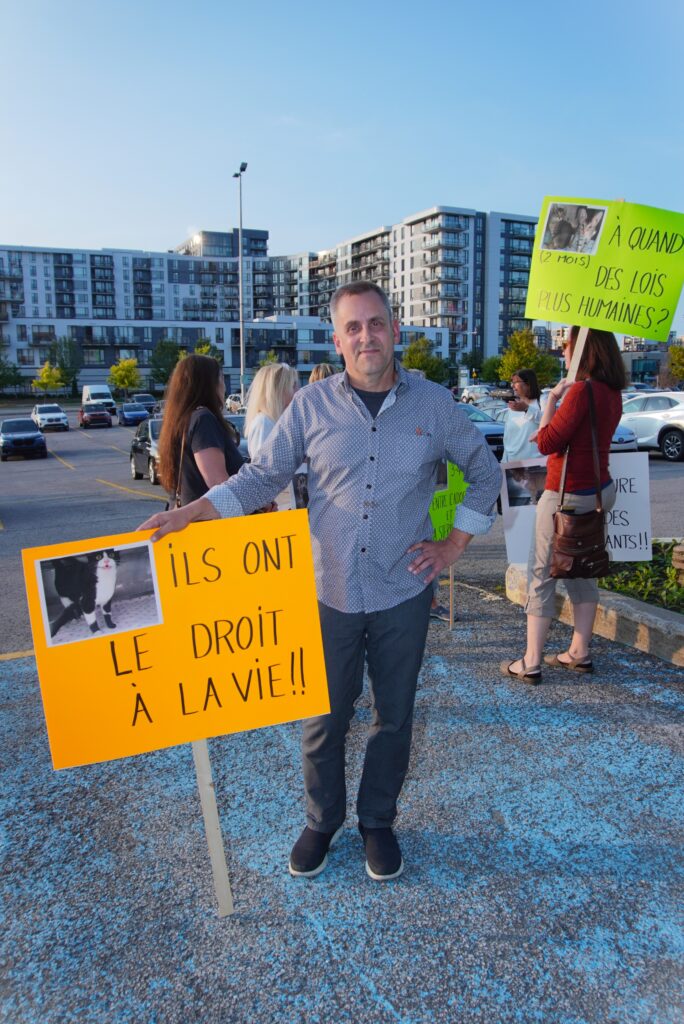
At Laval’s most recent city council meeting, animal welfare concerns once again took centre stage. Protestors and residents demanded accountability over the city’s ongoing contract with Le Berger Blanc, the private shelter and animal control service that has faced criticism for years.

The push follows a June demonstration outside the facility where protestors raised red flags about adoption practices, euthanasia rates, and what they described as a lack of transparency. This time, citizens brought their concerns directly to councillors and Mayor Stéphane Boyer.

Access to information sparks outrage

Among those speaking was Sylvie Desrosiers, a Laval resident who used Quebec’s access to information law to request euthanasia statistics from the city earlier this year.

“I’ve been there on several occasions,” she said. “The animals, to visit them, you have to take them out in the parking lot. They clearly aren’t being taken outside otherwise. No volunteers, no enrichment. It raises real questions about the conditions they live in.”

Desrosiers said she was “shocked” when she reviewed the figures. Between 2023 and April 2025, a total of 1,906 animals were euthanized at the shelter, while 944 were adopted and 413 reclaimed by their owners. In 2024 alone, 960 dogs and cats— about 45 per cent of the animals housed there— were put down.

“The volume of animals that pass through Berger Blanc is immense,” she said. “It’s worrying.”

Calls for systemic reform

Patrick Devos, a retired hospital worker who now advocates for animal welfare, urged the city to consider a broader rethink of how animal services are run in Quebec.

Devos pointed to a 400-page “livre blanc” (white book) authored by former Mont-Saint-Hilaire official Denise Loiselle, which proposes creating a provincial Crown corporation to oversee animal services, replacing for-profit contracts with publicly run or nonprofit centres.

Patrick Devos, a retired hospital worker who now advocates for animal welfare, urged the city to consider a broader rethink of how animal services are run in Quebec. Photo taken September 9 2025 (Photo: Matthew Daldalian, Laval News)

“I think that in 2025, we should have the money to improve the living conditions of animals so that there will no longer be pounds, but rather animal centers that are ethical and have practices that promote animal welfare,” Devos said

The former hospital worker hopes Laval officials will agree to meet with Loiselle and hear her proposals.

“The city has adopted an ethical and animal welfare philosophy… we have to walk the talk,” Devos said.

Organizers keep pressure on

For Any Vézina, a protest organizer who also addressed council, the stakes are too high to ignore.

“We want answers on why there’s no transparency, why cages are so small, why so many animals are euthanized,” she said. “We want to know why, when the city does its four inspections a year, they don’t see what regular citizens see in a single visit.”

Any Vézina, a protest organizer who also addressed council, believes the stakes are too high to ignore. Photo taken September 9 2025. (Photo: Matthew Daldalian, Laval News)

Vézina warned that unless change comes soon, demonstrators will return each month. “It’s impossible that so many of us can witness irregularities, but the city sees nothing,” she said.

Political response

Parti Laval councillors Claude Larochelle (Fabreville) and Louise Lortie (Marc-Aurèle-Fortin) both expressed support for protestors during the council meeting. Lortie, who previously met with demonstrators outside the shelter, spoke about her personal experience hearing about Berger Blanc’s conditions.

Both pledged that, if elected in this fall’s municipal election, their party would introduce a CSRM program— capture, sterilization, return, and maintenance— focused mainly on stray cats. The model, already in place in other Quebec municipalities, reduces feral populations through vaccination and neutering rather than euthanasia.

Boyer defends city oversight

Mayor Stéphane Boyer acknowledged residents’ concerns but defended the city’s approach, stressing that Berger Blanc has changed since its widely publicized scandals of 2011.

He said the city receives regular reports and statistics, uses independent veterinarians, and investigates complaints.

Boyer did concede that Berger Blanc’s lack of a social media presence limits its reach. “In 2025, it’s probably a good idea to be on Facebook to get animals adopted,” he said, promising to consider adding such requirements in future contracts.

Debate not going away

For many, including Desrosiers, the city’s assurances do little to dispel doubts. “I myself called Berger Blanc a few times. Depending on who you talk to, you get different versions,” she said. “It doesn’t really advocate transparency.”

With Laval paying Berger Blanc $1 million annually to manage animal control, critics argue that taxpayers deserve greater transparency. The tension reflects a broader debate over whether animal services should be profit-driven at all— a concern echoed in June by Montreal SPCA director Sophie Gaillard, who said municipal or nonprofit models remain the gold standard.

As Vézina put it: “They are living beings. They deserve respect. And if necessary, we will come here every month until we have reached our goal.”

Laval residents press city on Berger Blanc contract Read More »

Assistance dog helps Laval youth in sensitive interventions

By Matthew Daldalian – Local Journalism Initiative Reporter

Two years after his arrival, an assistance dog named Mac is being credited with helping hundreds of children navigate some of the most difficult moments of their lives in Laval’s youth protection system.

The Centre Intégré de Santé et de Services Sociaux (CISSS) de Laval says the furry companion, trained by the MIRA Foundation, has taken part in more than 300 interventions since 2023. The dog works alongside criminologist Daphnée Morency Mac Donald at the Direction de la Protection de la Jeunesse (DPJ).

Officials describe Mac’s presence as a way to reduce anxiety and build trust when children face interviews, court proceedings or emotionally charged announcements. “Mac acts as a bridge between the child and the caregiver. He reduces anxiety, eases tension, and opens the way to authentic exchanges in moments when speaking is sometimes difficult.,” Mac Donald said in a CISSS presse release.

Frontline role

In an interview with The Laval News, Mac Donald noted that Mac’s role is specific to youth protection interventions. “There really is a nuance,” she said.

That can mean accompanying a child during a police video interview, sitting quietly at their side in court, or simply being present during the delivery of difficult news such as a foster placement or the death of a parent.

“It doesn’t necessarily make the task easier, but it does make it more calming for the child because of the dog’s presence,” Mac Donald said.

She noted that children also interact with Mac during less formal moments, such as waiting for appointments or during supervised visits. Sometimes they simply play with Mac in the corridor, giving them what she described as “a more normal time.”

Concrete impact

Mac Donald recalled cases where Mac’s presence shifted the outcome. In one file, a teenage girl requested the dog’s support at multiple steps of her journey, from youth protection meetings to appointments with a psychiatrist.

“Mac brought some comfort in what was coming for her,” Mac Donald said.

Another case involved a child with selective mutism who had not spoken during earlier interventions. With Mac in the room, she said, the child began to verbalize. “Once the dog was there, we saw that the process was moving forward.”

According to Mac Donald, colleagues in other units also requested the dog’s support for their cases, with his growing reputation inside the DPJ.

A steady companion

Mac Donald noted that part of Mac’s effectiveness comes from his ability to remain calm and available for long periods “except when there are moments when he can allow himself not to.” She credits this tendency to switch between modes to his effectiveness in dealing with children.

The CISSS said the project was made possible with funding from the Fondation Cité de la Santé. Jean-François Payette, director of youth protection in Laval, called it a hopeful example of innovation in social services. “This assessment is a source of hope. It shows that innovation in health and social services can take unexpected, but profoundly effective forms,” she said.

Broader context

The CISSS de Laval employs more than 13,000 people across over 30 facilities, including the Hôpital de la Cité-de-la-Santé and several youth and rehabilitation centres. Affiliated with Université de Montréal and McGill University, it has positioned Mac as part of a larger push to test human-centred approaches.

For Mac Donald, the results speak for themselves. From quiet companionship in a courtroom to playful moments in a hallway, she said, the dog has become a steady presence for children facing upheaval.

Assistance dog helps Laval youth in sensitive interventions Read More »

Hospital Foundation modernizes bylaws, backs nursing future

Cathy Fox
Local Journalism Initiative

SHAWVILLE – The Pontiac Hospital Foundation (PHF) held its annual general meeting, September 12 at the Pontiac Community Hospital, unveiling major updates to bylaws that haven’t been reviewed since their creation more than 50 years ago.

One of the most significant changes was eliminating membership fees as a requirement for serving on the board, a practice members confirmed had not been applied in recent years. Language in the bylaws was also modernized with inclusive pronouns, and conditions for removing uncooperative board members were updated to allow more timely responses.

Other key revisions included:

  • Expanding the number of board directors from 9 to 13, with only one position reserved for a practitioner with active Pontiac hospital privileges.
  • Eliminating the category of auxiliary members.
  • Replacing the Executive Director position with that of Secretary-Treasurer, with duties that may be delegated to hospital staff.
  • Electing the president, vice-president, and secretary-treasurer from within the board itself.

Despite reporting a $109,000 deficit, the foundation reassured attendees the shortfall will be balanced by the end of the fiscal year in March. Spending totalling $152,276.84, went toward essential equipment funded through community fundraising, including an emergency sterilization system for power outages, oncology chairs, an extra-long hospital bed, and an emergency locking system for the dementia unit.

A significant long-term investment of $20,000 per year promises a good return: four annual bursaries of $5,000 each for four nursing students. In return, recipients must commit to working one year at the hospital for every year of funding received. “Keeping trained nurses is the biggest challenge in the Pontiac, with higher wages available just across the river. This should help fill that need,” explained Dr. Thomas O’Neill.

Danielle Romain, head of the Family Medicine Group (GMF), shared positive feedback from a recent visit by McGill University representatives for student trainees that do four-week rotations under local doctors. Each year, up to 45 medical trainees—including interns and medical students—are housed near the hospital and supervised by the GMF. The group also oversees nine private doctors, clinics and ensures access to care for “orphan” patients without a family physician. Thanks to recent efforts, many clinics have begun accepting new patients on a shared-appointment model.

Three new board positions are now open to community members who are not hospital employees. Candidates should be active volunteers and non-partisan.

Photo: PHF Board of Directors, from left: Nicole Boucher-Larivière, Leanne Gray, Mike Rusenstrom, Elaine Lang, Dr. Thomas O’Neill, Sylvia Poisson Hodgins, Richard Grimard, Pat Moffat, Danielle Romain, and Allan Dean (President). (CF)

Hospital Foundation modernizes bylaws, backs nursing future Read More »

Outaouais Health Forum confronts $348M gap and urges shift in power

Tashi Farmilo
Local Journalism Initiative

GATINEAU – The chronic underfunding of health and social services in the Outaouais took centre stage September 18 at a public forum at the Maison du citoyen in Gatineau. Elected officials, health workers, and local organizations gathered for the Forum Santé Outaouais 2025 to demand fair funding and greater control over how healthcare is delivered. Their message was clear: the Outaouais is being left behind.

Organized by Action Santé Outaouais, AQDR Outaouais, and the Conférence des préfets de l’Outaouais, the forum focused on one number — $348 million. That’s the estimated annual shortfall in health funding compared to other Quebec regions. Speakers linked the gap to the daily struggles residents face in accessing care.

Five regional leaders took the stage: Gatineau Mayor Maude Marquis-Bissonnette, and Wardens Chantal Lamarche (MRC Vallée-de-la-Gatineau), Marc Carrière (MRC des Collines), Jane Toller (MRC Pontiac), and Paul-André David (MRC Papineau). All pointed to a growing population, rising needs, and a lack of staff and services. They called for decisions to be made locally and for funding that reflects the region’s reality.

Education leaders Steve Brabant of Cégep de l’Outaouais and Murielle Laberge of Université du Québec en Outaouais stressed the need for long-term investment in training healthcare workers. Dr. Marc Bilodeau, CEO of the regional health authority (CISSSO), acknowledged efforts underway but admitted the shortage is dire, with more than 1,400 vacancies.

In the Pontiac, 80% of residents now cross into Ontario for care. Toller said the closure of obstetrics in the Pontiac is unacceptable, forcing women to give birth in Pembroke or Gatineau. More C-sections are scheduled to accommodate long travel times. “Women have the right to give birth where they live,” she said, pledging to fight to restore local birthing services.

Seniors’ care is another pressing issue: the region is already short nearly 400 long-term care beds, a gap expected to reach 1,400 by 2040. The Outaouais also ranks last in Quebec for publicly funded home-care hours. With too few family doctors, many seniors struggle to stay at home.

Mental health services were described as fragmented and underfunded, especially outside Gatineau. Community groups face long wait times and unstable financing, while rural areas contend with distance, transport, and language barriers.

Participants proposed local solutions: planning tables with real decision-making power, an innovation hub for recruitment and research, expanded training programs, housing incentives for staff, better recognition of foreign-trained professionals, and clear pathways from schools into health careers.

Other recommendations included restoring local decision-making to CLSCs, especially in remote and Indigenous communities; cooperative housing and guaranteed home-care hours for seniors; and, in mental health, stable funding for community groups, mobile crisis teams, and stronger links between schools, clinics, and youth services.

Photo – G/D: Mayor Maude Marquis-Bissonnette, and wardens Jane Toller, Paul-André David, Chantal Lamarche, and Marc Carrière. (TF)

Outaouais Health Forum confronts $348M gap and urges shift in power Read More »

Shawville arena faces $17M repair bill

Cathy Fox
Local Journalism Initiative

SHAWVILLE – The Shawville Council held a public information session September 18 at the Shawville RA Centre to gather feedback on next steps following a new report on the condition of the arena. The engineering firm JL Richards & Associates, with costing by Hanscombe, delivered the latest assessment on June 23.

The purpose of the session was “to present the arena’s condition, costs, and decisions to date; summarize the renovations prefeasibility findings; and outline next steps.” The sobering report estimated $16.87 million in repairs would be needed just to bring the facility up to code, based on a visual inspection rather than a full structural review.

The main concern raised by both patrons and council was the arena floor, which is 20 years past its service life, along with the pipes embedded beneath it. The ice-making equipment, including condensers and the compressor room, is also deteriorating. Repairs last season alone cost $40,000, with more breakdowns expected.

Other issues include fire safety, accessibility to bleachers, washrooms, and upstairs rooms, as well as improvements needed for heat retention, ventilation, dehumidification, lighting, and increased electrical capacity with Hydro-Québec.

Funding remains a major challenge. Shawville currently spends 8.5% of its municipal budget on the arena, limiting other recreation projects. The annual deficit between revenues and operating costs stands at $177,000 and continues to grow. Some argued Shawville should carry the load because of its central location and business tax revenues, while others suggested user fees for out-of-town adult league players.

Megan Derouin of Parents’ Voice recommended expanding daytime rentals to groups such as daycares and seniors’ clubs, and improving online booking. Kathy Murray received strong support for creating an independent committee to coordinate municipalities, service clubs, and government grants in pursuit of keeping the arena open. Councillor Katie Sharpe supported moving quickly on these ideas before the current council’s term ends October 1.

Some questioned the accuracy of the cost estimates, noting grant applications must be based on licensed contractor rates while much local work is often done by volunteers at lower cost. Residents agreed the arena must remain open during any renovations, while long-term planning for a new facility should begin. Construction of a new arena is considered less costly than extensive renovations, but new recreation grants will not be available until at least 2027–28.

In the meantime, council has invested in quality equipment, including the purchase of a new Zamboni this year. With community support and targeted repairs, many hope the arena can continue serving the region well into the future.

Photo – Shawville council members discuss the future of the arena at a special meeting held September 18 at the RA Centre.

Shawville arena faces $17M repair bill Read More »

National Industrial Strategy: agriculture gets boost, forestry left waiting

Sophie Demers
Local Journalism Initiative

OTTAWA – At the beginning of September, Prime Minister Mark Carney announced the federal government’s Industrial Strategy, which includes a variety of measures to mitigate the impact of US tariffs on Canadian businesses and strengthen the economy.

The measures include $5 billion to help businesses, a “buy Canadian policy” ensuring all government purchases support Canadian businesses, as well as an increase of $550 million to the Regional Tariff Response Initiative, which now totals a billion dollars. Additionally, Carney announced $370 million to assist canola, beef and seafood industries.

The Regional Tariff Response Initiative provides tariff relief funding to support small and medium-sized businesses. Pontiac MP Sophie Chatel says the program, along with agricultural funding, will benefit the region’s farming and forestry sectors.

“Hopefully this will benefit local industries and mills. They can apply and receive support to modernize to meet growing domestic demand while exploring new markets,” said Chatel.

Chatel also highlighted a $50 million measure that aims to aid workers who lose their job because of trade disruptions, offering 5 to 6 weeks of unemployment as well as training to re-orient the workers into growing sectors.

“These measures are a good thing, depending on how easily businesses can access the funds,” said UPA Pontiac President, Claude Vallière. “Sometimes there’s money available, but lots of paperwork and red tape to access it.”

Cash Allard, president of the Pontiac Forest Products Producers Board, says the initiative won’t help the Pontiac’s forestry industry unless investments are made to reopen local mills.

“We’re in a crisis, unable to sell our wood because we have almost no mills locally. We won’t see or feel any benefit from this announcement until investments are made in a mill that can handle at least 70,000 green metric tonnes. Without this, the announced grants for small and medium businesses means nothing for the forestry sector in Pontiac,” he concluded.

Chatel said the initiative is intended to be a rapid response and discussions are underway to determine how to deploy the funds in an efficient and timely manner

National Industrial Strategy: agriculture gets boost, forestry left waiting Read More »

Pontiac on the move: improving transportation

Mélissa Gélinas
Local Journalism Initiative

LITCHFIELD – A new transportation hub at the MRC Pontiac headquarters was inaugurated September 16, marking an important step in improving public transit and sustainable mobility in the region.

The event brought together several guests, including MRC Pontiac Warden Jane Toller, MRC des Collines Warden Marc Carrière, and Chelsea Mayor Pierre Guénard, who is also president of the sustainable mobility and transportation commission of the MRC des Collines.

The inauguration included a presentation of the project, speeches by dignitaries, a traditional ribbon-cutting and a photo session.

Key project achievements include:
• A new safe access road linking Highway 148 to Highway 301 North, improving the site entrance and ensuring safe passage for buses on the MRC grounds.
• Installation of a bus stop with a shelter served by intercity line 910 operated by Transcollines.
• Development of a park-and-ride lot for carpoolers and transit users.
• Installation of five charging stations for electric vehicles.
• Landscaping to green the site and reduce the visual and environmental impact of paved areas.

A press release also announced that Transcollines will soon launch an on-demand transit service along Highway 148.

“By encouraging carpooling, public transit and the use of electric vehicles, this project demonstrates Pontiac’s commitment to protecting the environment while making the area more attractive for residents […]” said Rachel Soar Flandé, economic development officer at the MRC Pontiac. The project was funded by the Regions and Rurality Fund (FRR).

Photo – Marc Carrière, Jane Toller and Pierre Guénard cut the ribbon at the inauguration of a new bus shelter at the MRC headquarters, served by Transcollines’ line 910, as part of the Pontiac Transportation Hub project.

Pontiac on the move: improving transportation Read More »

Thieves target Campbell’s Polaris again

Carl Hager
Local Journalism Initiative

SHAWVILLE – Four thieves, hooded and disguised, were captured by security cameras at Campbell’s Polaris dealership in Shawville Sunday evening, September 21, as they stole two machines from the rear of the lot. The dealership has now been robbed twice in about two months. The thieves jumped over the security fence then drove the machines out of the lot.

Steve Gilpin, owner of Campbell’s Polaris, reported that a white Polaris side-by-side model 2022 RZR 1000 and an orange Polaris 2015 RZR 1000 were stolen. Police spent the evening and most of Monday morning investigating the crime at the dealership.

Thieves target Campbell’s Polaris again Read More »

See Jane run!

Clifford Welsh
Local Journalism Initiative

MANSFIELD – MRC Pontiac Warden Jane Toller chose the Pont Marchand in Mansfield on September 19 as the backdrop for a press conference announcing she will run in the upcoming election — a change from her earlier decision to step aside.

In a prepared statement, Toller recalled how her involvement in local affairs began with a petition to save the Félix-Gabriel-Marchand Bridge after it was closed by the Ministry of Transport.

Toller explained that after announcing on July 23 that she would not seek re-election, she received a “strong reaction of shock and disappointment.” Over the past few months, she said many people have urged her to reconsider.

She said there were many projects launched under her guidance that she wants to see through. “I am the only one who can complete them as I have the interest, health, experience and qualifications,” she said.

Asked by the Journal which projects she was referring to, she cited revival of the Jovalco site, solar energy production, the abattoir, a trade school, a driver training school, expanded SAAQ services in Pontiac, and the fire coverage plan, which aims to increase co-operation and amalgamation among municipal fire and emergency services.

Toller added she will outline her goals for the next four years at a later date.

See Jane run! Read More »

Pontiac Journal uses alternative delivery locations during postal strike

Tashi Farmilo & Lynne Lavery

Local Journalism Initiative

MRC PONTIAC – The Pontiac Journal will be delivered directly to the public using drop-off locations due to the suspension of Canada Post’s Neighbourhood Mail by the Canadian Union of Postal Workers (CUPW), which began on September 15. Unaddressed items including flyers, and community newspapers such as the Pontiac Journal, have been impacted by this escalation of strike action by CUPW.

Despite the interruption, the Pontiac Journal remains available to readers at many locations throughout the Pontiac and the Municipality of Pontiac. Copies can be picked up at the Journal’s office in Mansfield, as well as every municipal office, the MRC Pontiac office, local dépanneurs, restaurants, grocery stores, and CHIP FM. A list of locations as well as a digital version of each issue is available online at www.pontiacjournal.com.

The Journal’s General Manager, Lynne Lavery stated, “This is a very challenging time. Not only did we just go through this late last year, now they are specifically targeting free distribution newspapers. It’s a hard pill to swallow. During the COVID 19 pandemic, when everything was shut down, newspapers were deemed an essential service and we had to find ways to continue to get important news out to the population. It is no different today than back in 2020…there is lots of news that needs to get out. I hope our readers and advertisers will understand they can still pick up a copy or go online to get the information they need, especially with municipal elections coming up. It’s time the government steps in and creates an exemption for the essential service that our newspapers provide.”

CUPW has said, it was “forced to take this action to get the parties back to the table.” The move followed Canada Post’s rejection of the union’s latest offer on August 20, which Canada Post dismissed as unaffordable and lacking practical solutions.

Canada Post is preparing new global offers, aiming to bring CUPW back to the table as early as this week.

Pontiac Journal uses alternative delivery locations during postal strike Read More »

MRC Meeting: solar hopes dim, costly abattoir repairs ahead

Bonnie Portelance
Local Journalism Initiative

MRC PONTIAC – The current Council of Mayors met for the last time on September 17 at the MRC headquarters in Litchfield. Council will not meet again until November 26, following the municipal elections.

Warden Jane Toller opened the meeting by highlighting challenges and accomplishments of the outgoing council. These included managing the COVID-19 pandemic, addressing flooding, re-opening the mill at Rapides-des-Joachims, administering $5 million in Regions and Rurality Fund (FRR) support, studying the Energy-from-Waste project, implementing composting and recycling, purchasing the abattoir and starting the AgriSaveur project, exploring solar energy potential, creating the transportation hub, and launching new housing projects.

Solar energy setback
After signalling the move in May, council formally declared jurisdiction over renewable energy production in the Pontiac. Alleyn-et-Cawood, Bristol and Clarendon exercised their right to withdraw, leaving the MRC responsible in all other municipalities.

Energy developer Innergex submitted two solar projects for the Pontiac to Hydro-Québec, but both were rejected because outdated distribution lines could not handle the power. Provincewide, nine of the company’s ten projects were refused for the same reason.

Council adopted a resolution to contact Hydro-Québec requesting the timeline for line upgrades, details on required work and reasons for the refusals. The resolution noted, “The lack of upgrading not only creates poor distribution of electricity to the citizens but is also hindering economic development.”

Immigration plan adopted
Council approved the immigration action plan developed by the immigration committee with help from the firm CommunAgir. The plan now goes to the Ministry of Immigration for approval. If endorsed, the MRC can apply for funding under the ministry’s Community Program to implement the actions over three years.

Otter Lake Mayor Jennifer Quaile opposed the plan, arguing it does not adequately address key issues such as jobs, housing and transportation. She also criticized the lack of cost estimates and said the plan was “rushed through.” Quaile noted the mayors only received it at the September 10 plenary and were not given time for full discussion. She asked if adoption could be deferred to November.

Toller replied that the deadline for submission is the end of September and grant eligibility depended on council’s approval.

The plan passed 16–2, with Quaile and Alleyn-et-Cawood Pro-Mayor Sidney Squitti opposed.

Although the plan was expected to be made public after council’s approval, MRC Strategic Communication Advisor Francis Beausoleil told the Journal it cannot be released until the ministry signs off.

Abattoir lease and repairs
Council approved a 30-year emphyteutic lease with the Pontiac AgriSaveur Solidarity Cooperative for use of the abattoir facility and equipment. While the MRC remains owner, the co-op will assume rights and obligations of an owner, including full maintenance costs, though no rent will be charged.

Inspections by three agencies revealed water infiltration and mould throughout the building. Council authorized repairs of up to $353,638, funded through stream two of the FRR. Work was expected to begin this week and finish by mid-November, followed by a gradual start-up phase with tests and adjustments.

Fire services information sessions
The MRC scheduled three public information sessions on its proposal for combined fire services. The first, in French, will be October 8 at the Golden Age Club in Fort-Coulonge. Two English sessions will follow: October 9 at St. Joseph’s Hall in L’Isle-aux-Allumettes and October 23 at the Campbell’s Bay RA Centre. All begin at 6:30 pm.

Photo – Local weightlifter Xavier Lusignan (left) was invited to update council on his goals and recent accomplishments, including winning bronze at the Senior Pan American Championships. Lusignan is heading to Norway at the beginning of October for the World Senior Championships in hopes of securing a spot with Team Canada at the 2028 Olympic Games. (BJ)

MRC Meeting: solar hopes dim, costly abattoir repairs ahead Read More »

Chelsien combats cancer with chemo, community 

By Madeline Kerr 

Over the last 45 years, millions of Canadians have helped extend the legacy of Terry Fox, and this year for the first time Justin Lacroix was one of them.

But the 75-year-old Chelsea resident wasn’t merely content to participate in a local Terry Fox Run, an annual fundraiser for cancer research, which has raised over $900 million since it was founded in 1981. 

Instead, Lacroix organized his own run on Sept. 14, bringing out 70 participants and raising more than $8,300. 

Lacroix told the Low Down that, like so many others, he has been personally touched by cancer. Five years ago he lost one of closest friends to the disease, and in May this year, Lacroix himself was diagnosed with an aggressive form of prostate cancer, which he said has spread to his bones and lungs. 

He is currently undergoing chemotherapy treatments, but explained that his doctors have told him his cancer is incurable. 

Despite a tough prognosis, he had the energy and enthusiasm to organize Chelsea’s Terry Fox Run in only 10 days and even hosted a BBQ for participants at his home near Gleneagle.  

Lacroix said he was touched by the support of friends and family members, who came from as far away as Rochester, N.Y., and Quebec City to support him. 

“What I am most moved by is the goodness of people,” Lacroix told the Low Down. 

He added that he hopes he has “planted the seed” and that next year someone else will take up the cause and organize a Terry Fox Run in Chelsea. 

“I’ll see how I’m feeling, but I’d like to be there to help out,” Lacroix said. 

To donate to Lacroix’s Terry Fox Run, visit run.terryfox.ca and search “La vie est belle – Chelsea 2025”.

Terry Fox was a 22-year-old Canadian who lost his leg to bone cancer and, in 1980, decided to run across Canada to raise money and awareness for cancer research. Fox died in 1981 before completing his ‘Marathon of Hope’. An annual fundraiser has been held in his honour every year since, raising over $900 million to date. 

Chelsien combats cancer with chemo, community  Read More »

Chelsea school zone sees speed reduction

By Madeline Kerr

No more speeding to make school drop-off on time: Chelsea municipality recently announced that the speed limit on Old Chelsea Road in front of the entrance to Chelsea Elementary will soon be reduced to 30 km/h.

At a council meeting on Sept. 16, Mayor Pierre Guénard said that he is relieved to see that the speed reduction has finally been approved by the Ministère des Transports et de la Mobilité durable. A sign installed on Old Chelsea Road states that the new speed limit will come into effect on Oct. 7. 

“The municipality has asked for this speed reduction several times over the years and it was denied by the Ministry of Transport,” he said. 

He explained that the municipality made a further request after the completion of the roundabout at the intersection of Old Chelsea Road, Chemin Jean-Paul Lemieux and Chemin de l’Hôtel-de-Ville which was finished earlier this year. 

“This is good news for our families because now this will officially become a school zone,” Guénard said at the meeting. He added that the 30 km/h speed limit will be in place during the day from Monday to Friday throughout the school year.

Chelsea school zone sees speed reduction Read More »

‘French, English – we are all Chelsiens’: mayor

By Madeline Kerr

In the face of ever stricter language regulations, Chelsea council says it wants to protect anglophones’ ability to interact with the municipality in English. 

At a meeting on Sept. 16, Chelsea councillors unanimously resolved “to continue to offer services in both languages in the interest of its citizens.” 

A copy of the resolution will be sent to Minister of the French Language, Jean-François Roberge; Minister responsible for the Outaouais region, Mathieu Lacombe; MNA for Gatineau, Robert Bussière; as well as the Ministry of Municipal Affairs and Housing and the MRC des Collines-de-l’Outaouais.

The resolution takes aim against a requirement imposed by Bill 96, the province’s law for protecting and promoting French as Quebec’s official language. The law, which passed in 2022, allows exemptions for some municipalities like Chelsea that have been granted official bilingual status. 

According to the resolution passed on Sept. 16, the council has until Dec. 1, 2025, to act if it wants to take advantage of some exemptions – including the ability to interact with certain residents in English. 

At the council meeting, Mayor Pierre Guénard explained that in the future, municipal staff could be required to interact with residents in French unless residents are able to demonstrate that they’ve previously corresponded with the municipality in English. He said this could lead to the municipality being required to maintain a list of which residents it can interact with in English and which can only be interacted with in French. 

He added that it would apply to all municipal services – from asking a question at council meetings to checking out a book from the library. 

In an interview with the Low Down after the meeting, Mayor Guénard stated emphatically: “These rules [regarding language use] are imposed – I’ll say it again, imposed – by the province.…Chelsea is and will remain a bilingual community. Bilingualism is our strength.” 

He added that he intends to “show respect to anglophones in Chelsea. It’s a question of human rights. We have to be able to work with our residents in the language of their choice.”  

At the Sept. 16 meeting, a few Chelsea councillors voiced their strong support for the resolution, including an impassioned Ward 3 Coun. Cybèle Wilson, who said: “As someone raised in a bilingual household by a French Canadian mother and an English Quebecker father, this issue strikes at the very heart of my [core values].” 

Ward 6 Coun. Kimberly Chan said in French that she “can’t understand the government’s vision” and can only imagine the division that a rule like this would impose on the community. 

Ward 2 Coun. Dominic Labrie said that he agrees residents need to be served in the language of their choice, but added that the municipality could consider ways to expand its bilingualism by making council resolutions available in both languages, for example.  

Mayor Guénard told the Low Down that Chelsea’s anglophones and francophones live and work together harmoniously. 

“French, English – we are all Chelsiens,” he said, using the newly chosen name for residents of Chelsea.

‘French, English – we are all Chelsiens’: mayor Read More »

Cantley councillor seeks seat at Chelsea table

By Madeline Kerr 

The race for a new face in Chelsea’s Ward 6 is officially on.

Current Cantley Coun. Jean-Charles Lalonde has announced he will run for a Chelsea council seat, hoping to represent Hollow Glen, Kingsmere and Hendrick Farm. 

Lalonde explained his family is still in the midst of moving from Cantley to the Chelsea Creek neighbourhood, telling the Low Down that it was important for his daughter, who already attends Chelsea Elementary, be able to grow up around her friends and peers. 

Chelsea Creek is part of Ward 2, not Ward 6, but Lalonde explained that he wants to see current Ward 2 Coun. Dominic Labrie re-elected to represent the centre village. 

“Dominic brings a lot of good things to the table. I don’t think a competition for his seat would benefit the community,” Lalonde said. 

Current Ward 6 Coun. Kimberly Chan recently announced she will not be seeking re-election. Longtime Hollow Glen resident Donald Dery will be running against Lalonde for the seat. 

Lalonde said he can offer the council an unusual combination of experience and a fresh perspective. He would be a new face on council, but he said, “I bring with me valuable experience as a municipal councillor in Cantley.… I already know what to expect. The learning curve will not be so steep for me.” 

In a written statement, Lalonde said that Chelsea “has already felt like my home.…I’ve heard concerns around issues like road safety and parking, community infrastructure, river access and ensuring services are effective and responsive. I’ve also seen how important it is to build strong community partnerships … and I want to strengthen those relationships to better serve residents. I’m also aware that businesses are facing challenges – navigating permits and regulations and the need for clearer, fairer rules and more support.”

Lalonde is a trained social worker who currently works as a program manager for the local health authority CISSSO. His work involves supporting seniors who want to remain at home as they age. His work gives him an in-depth perspective on the challenges seniors face in Chelsea, he said, adding that retirees are too often driven out of the municipality due to the cost of living.  

Regarding unique challenges in Ward 6, Lalonde said he wants to address Hollow Glen’s isolation from the rest of the municipality. He proposes bringing more cultural and recreational programming to Hollow Glen to foster “a greater sense of belonging, rather than expecting everyone there to always be going to the Meredith Centre [in the centre village].” 

He said he also wants to prioritize traffic getting in and out of Hendrick Farm by “advocating to get streetlights installed at that intersection sooner rather than later.” 

Lalonde pointed to his work in Cantley as evidence that he knows how to manage municipal finances: At the start of his term, the municipality was running a budgetary deficit but council has since been able to balance the budget. He said that he has watched Chelsea’s finances “ballooning” adding, “Taxes are climbing at an alarming rate….I want to help bring greater stability.”

Lalonde was among five council members who voted in favour of a controversial resolution to increase densification in Cantley earlier this year. 

He told the Low Down, “Every decision I make [as councillor] will make some people happy, others less happy…I’m doing this job for the best interest of the masses.”

Municipal elections will take place on Nov. 2.  

Cantley councillor seeks seat at Chelsea table Read More »

Bishop’s opens psychology clinic to expand affordable mental health care

William Crooks
Dr. Laurie Laberge and Dr. Catherine Malboeuf-Hurtubise at Bishop’s University’s new Psychology Clinic on Sept. 23

By William Crooks

Local Journalism Initiative

Bishop’s University officially opened its new Psychology Clinic on Sept. 23, marking an important step in expanding access to affordable mental health care in the Eastern Townships. The facility will also serve as a key training ground for doctoral students in clinical psychology, blending community service with hands-on education.

The Record toured the clinic earlier in the day with psychologist and internship manager Dr. Laurie Laberge, who oversees operations. “The services are offered exclusively by the students,” she explained, “they’re supervised by the profs.”

The clinic offers individual therapy sessions at $25 each, a fraction of the roughly $140 charged in the private sector. Laberge emphasized the importance of keeping the service accessible: “It’s a really small amount… so it’s a big difference. We offer the most accessible service here.”

Training future psychologists

Second-year students in Bishop’s Doctor of Psychology program (PsyD) are the first cohort to provide services through the clinic. These students, still generalists at this stage, handle a broad range of cases. If a client’s needs require more specialized expertise, they are referred elsewhere.

The program is accredited by the Ordre des psychologues du Québec (OPQ), which ensures that the training follows established standards. Associate Professor Catherine Malboeuf-Hurtubise, who helped found both the program and the clinic, said the approach is entirely standard. “This is a very normal type of thing,” she noted. “That’s how we all learn.”

The clinic includes therapy rooms equipped with cameras for supervision, a child therapy space, and facilities for group supervision. All recordings remain on secure servers and are protected under provincial privacy law. “It was really complicated,” Laberge admitted of the cybersecurity measures. “We go by the Law 25 for the privacy matters… a really strict law.”

Serving the community

The clinic is open to the public rather than to Bishop’s students, in order to protect confidentiality within the small university community. Clients so far have ranged in age from eight to 75. Half of the clinic’s early requests have come from English-speaking residents, many of whom reported struggling to find services in English. Others are francophones, reflecting the bilingual mission of the clinic.

Doctoral student Emilie McLean, who is part of the inaugural group of interns, told The Record she is looking forward to applying her training in a real-world setting and helping meet the region’s need for care.

Malboeuf-Hurtubise highlighted that community need was central to the project’s creation. “There is a need in the community for mental health services, especially in English,” she said, explaining that the clinic was designed to serve both francophone and anglophone populations.

Support and growth

A related press release states that the clinic is also supported by the Hewitt Foundation, which funds scholarships for PsyD students. This support allows trainees to focus on their academic and clinical work, with the goal of completing the four-year program and increasing the number of licensed psychologists in the region.

Malboeuf-Hurtubise described the clinic as both a service and an investment in the future. “Through internships, students gain practical experience delivering care to the community. Upon graduation, they will be licensed psychologists equipped to serve clients in both official languages.”

Laberge added that the clinic plans to expand its services over time, with couples therapy expected to be introduced next year. For now, the focus is on building trust with the public and offering high-quality, supervised care.

Bishop’s opens psychology clinic to expand affordable mental health care Read More »

Sherbrooke mayoral candidate Kibonge unveils housing plan to tackle crisis

William Crooks
Raïs Kibonge speaks at the announcement outside Faubourg Mena’sen as Sarah Rahimaly looks on during the campaign event

By William Crooks

Local Journalism Initiative

Standing outside the Faubourg Mena’sen on Sept. 23, Raïs Kibonge, candidate for mayor of Sherbrooke and leader of Sherbrooke Citoyen, unveiled a three-part housing strategy aimed at taking units out of the speculative market, boosting social and community housing, and speeding up renovations in the municipal housing stock.

The choice of location was deliberate. Faubourg Mena’sen has become a symbol of Sherbrooke’s housing crisis after residents faced uncertainty and upheaval during recent ownership changes. “We must act to prevent human and social tragedies like the one we witnessed here,” Kibonge said, flanked by party members and supporters.

“This is about building a city where the right to housing is not a luxury, but a reality for all,” he added. “Families, seniors, and young people deserve homes that respect their budgets. No one should have to choose between rent and groceries.”

Kibonge explained that his party would support community non-profits (OBNLs) in acquiring rental buildings to protect them from speculation, with the city offering financial backing or municipal guarantees to strengthen their ability to act quickly in competitive transactions.

The second part of the plan is a commitment to progressively raise annual investments in social and community housing from the current $8 million to $12 million by 2029. The move, he said, aligns with Sherbrooke’s housing policy adopted earlier this year, which sets a target of 20 per cent of all housing being out of the private market.

The final measure focuses on renovations. Beginning in 2026, Sherbrooke Citoyen promises an additional $1.5 million annually for refurbishing municipal housing units. “Too many apartments remain vacant while waiting for repairs,” Kibonge noted. “We will make sure no Sherbrookois lives in precarious conditions.”

Sarah Rahimaly, Sherbrooke Citoyen’s candidate in the Pin-Solitaire district, underlined the urgency of the crisis. “Housing is no longer just a matter of availability, but of human dignity,” she said. “The saga around Faubourg Mena’sen must not happen again. Families, seniors, and young people should not have to live in insecurity.”

During the media scrum, Kibonge fielded questions about how the city would finance the new commitments. Asked if property taxes would rise to cover the additional $4 million in annual investment, he replied, “Not only will we not raise taxes for this, but we will manage better. More people are moving to Sherbrooke, new projects are being built, and that brings in new revenues. This is about sound management”.

Pressed on whether $12 million was enough given the scale of need, Kibonge admitted it was not. “Twelve million is not enough, but it is what we can do right now. We started at $2 million, then $4, then $8. By aiming for $12 million by 2029, we give ourselves room to increase progressively and bring in other partners,” he said.

On renovations, Kibonge drew on his experience as former president of the Office municipal d’habitation (OMH). He explained that about 60 to 80 units are typically turned over each year, and the city must keep pace to ensure they can be returned to service quickly. “Renovation brings faster results than new construction,” he said.

Both Kibonge and Rahimaly framed the plan as part of a wider effort to reshape Sherbrooke’s housing market. “We want a city where housing is managed by the community,” Rahimaly said.

Sherbrooke mayoral candidate Kibonge unveils housing plan to tackle crisis Read More »

Homelessness on Notre-Dame Street Worries Several Businesses

Mélissa Gélinas LJI Reporter

The homeless situation is becoming increasingly prevalent in Gatineau, particularly in the Notre-Dame neighbourhood, where many businesses continue to feel unsafe.

In fact, more than 15 of them decided to unite by signing a letter sent in early September to the Gatineau Chamber of Commerce (CCG) and Gatineau Mayor Maude Marquis-Bissonnette to denounce the situation and express their concern about possibly having to close their businesses.

Lucie Nadon, owner of the Escale Détente beauty salon located at 282 Notre-Dame Street, believes that the issue of homelessness has greatly increased in the area in recent months. “I have to lock the door to my salon so that customers feel safe,” she said. “People come here to relax, not to be afraid.” She said that many homeless people enter her establishment without an appointment. “They come to see what’s going on.”

Despite the numerous investments on Notre-Dame Street, Nadon believes it is dangerous for residents to go there. “We can’t even walk along the waterfront anymore,” she commented. Furthermore, according to her, there are more and more parties where homeless people gather. “It’s becoming very problematic.”

According to Nadon, quick solutions are needed. “Businesses really need help,” she said. “Obtaining more police surveillance would be ideal.”

At the municipal council meeting on September 16, Denis Girouard, councillor for the Lac-Beauchamp district, expressed his dissatisfaction with the lack of action taken in the neighbourhood. “The reality is that neither the mayor, nor the homelessness commissioner, nor municipal councillor Steve Moran is sufficiently concerned about the issues of homelessness in the Lac-Beauchamp sector,” he stated.

According to Girouard, there is no game plan to resolve the issue, despite the growing number of homeless people in Sanscartier Park, on the Lac-Beauchamp property, and on Notre-Dame Street. “From a municipal perspective, this is a complete neglect, and that is unacceptable,” he said. “We are finding used syringes left on the ground in our public parks that are accessible to children […].”

Girouard noted that the Homelessness Commissioner and the Chair of the Executive Committee decided to invest the most action and budgets in the downtown core. “The residents of Lac-Beauchamp have been more than tolerant,” he said. “Homelessness doesn’t only exist on the Guertin site!”

Photo: Denis Girouard, municipal councillor for the Lac-Beauchamp district, at the Gatineau City Council meeting (September 16, 2025) (MG) Photo: Screenshot

Homelessness on Notre-Dame Street Worries Several Businesses Read More »

COVID-19 vaccines no longer free for everyone as fall campaign begins

By Ruby Pratka

Local Journalism Initiative

Starting this fall, COVID-19 booster shots will no longer be offered for free to the general public in Quebec pharmacies. The shots will still be free for members of high-risk groups, namely seniors 65 and older, people living in nursing homes or other shared living environments, health workers, pregnant women, people living in certain remote areas and younger adults with chronic health conditions. Quebecers who are not part of those risk groups will have to pay between $150 and $180 to get a booster shot, according to the Association québécoise des pharmaciens propriétaires.

Dr. Nicholas Brosseau is a public health specialist at the Institut national de santé publique du Québec (INSPQ) and a member of Quebec’s provincial immunization committee, which issues recommendations around vaccination to the Ministry of Health and Social Services (MSSS). “I’m not involved in the decision – the health minister makes the decision – but there’s a Quebec vaccination committee and a pan-Canadian vaccination committee, and they both recommended a targeted vaccination program [focused on] older people,” he said. “That’s where we can make a difference.”

“Among young, healthy people, there is a very low risk of complications,” he said. “Most people have had COVID a few times and been vaccinated a few times. “Your first infection is usually your most severe. Long COVID is still a concern for young people, and we reduce the risk of long COVID [through vaccination] but recent studies have shown that yearly booster shots don’t make that much of a difference. The risk of long COVID is very low [if you don’t already have it after being infected several times].”

However, Brosseau cautioned that the “younger people are at lower risk” rule of thumb doesn’t apply to everyone, and that some young adults should get a booster shot. “Older people are often aware they are at higher risk, but sometimes young people with chronic illnesses – with diabetes or heart problems, for example – aren’t aware they are at risk. They are being targeted by this fall’s campaign.”

As of this writing, it was unclear how young people who were part of higher-risk groups, particularly those without a family doctor, would “prove” their status.

MSSS spokesperson Marie-Pierre Blier said more information about the logistics of the upcoming vaccination campaign would be announced “very soon.” Vaccination campaigns in previous years have typically kicked into high gear in early October.

While Blier said the ministry’s decision was based on “the most recent scientific information about who would draw the most significant benefits from vaccination,” she did note that “in previous years, significant quantities of doses were supplied to Quebec by the federal government, which is no longer the case.” 

COVID-19 vaccines no longer free for everyone as fall campaign begins Read More »

Elevated PFAS levels found at Farnham water treatment plant

By Ruby Pratka

Local Journalism Initiative

The municipality of Farnham has ordered further tests after higher-than-expected levels of per- and polyfluoroalkylates – more commonly known as PFAS or “forever chemicals” – were found in residue from the town’s water treatment plant.

Water treatment residue, also called sewage sludge or biosolids, is sometimes used as fertilizer for large-scale farming operations, in place of chemical fertilizer or manure. In March, Quebec’s environment ministry imposed PFAS concentration limits for biosolids, beyond which they could not be used for fertilizer. The new norms are scheduled to take effect in November. “When the Quebec government announced new standards [for PFAS levels], we could have waited a year [to test the biosolids], but I’ve always believed you need to be proactive for things like that,” Farnham Mayor Patrick Melchior told the BCN. “It turns out we’re higher than normal. We’ve ordered other tests and we should have the results from one day to the next.”

The town’s priorities are now to find out where the elevated levels are coming from and keep further PFAS contamination from leaching into the town’s drinking water, which is drawn from the Yamaska River, Melchior said. He emphasized that the levels detected were not threatening to human or plant health, but “we need to find out where it’s coming from to keep it from getting in the water. We need to take time to do things right.”

Melchior said local farmers and the Quebec Ministry of Environment, the Fight against Climate Change, Wildlife and Parks (MELCCFP) were contacted as soon as the higher PFAS levels were detected. “There have been discussions with [the environment ministry] and they have assured us of their support – they have to help us find a way.”

PFAS have been used for decades in fire retardants, antiadhesive coatings, food wrapping and some cosmetics, to make materials waterproof, stainproof or fire-resistant. According to Health Canada, prolonged PFAS exposure may affect a person’s liver, kidney and thyroid function; metabolism; and immune response. While many once-common uses of PFAS have been phased out since their health effects became apparent, the substances are notoriously hard to break down, hence the name “forever chemicals.”

“Once they’re there, they’re there, although maybe future scientific research will find a way” to remove PFAS from groundwater, Melchior said.

The fact that the chemicals have been so common also makes their sources hard to pinpoint. Farnham is home to a decommissioned military base, and outdated Cold War-era chemical storage practices at CFB Valcartier, near Quebec City, were linked to the contamination of groundwater in a nearby municipality. However, it’s far from clear that the elevated PFAS levels in Farnham are linked to the base. As Melchior pointed out, “these chemicals are in lots of things.” A worldwide study, published in 2024 in the journal Nature Geoscience, found that they were present in 31 per cent of groundwater samples. 

“We will investigate, and all parties need to get involved, because this concerns everybody,” the mayor said.

The Department of National Defence (DND) and the MELCCFP could not comment by the BCN’s deadline, although a DND spokesperson said a response would be provided at a later date.

Elevated PFAS levels found at Farnham water treatment plant Read More »

Brome Lake Ducks forced to cull birds after bird flu detected

By Ruby Pratka

Local Journalism Initiative

About 60,000 ducks were slaughtered in a preventative cull last week at Brome Lake Ducks after a single duck tested positive for H5N1 bird flu (also referred to as highly pathogenic avian influenza or HPAI) at one of the company’s breeding facilities.

For privacy reasons, the Canadian Food Inspection Agency (CFIA) does not reveal the specific locations of bird flu outbreaks at commercial poultry farms, but the company confirmed the outbreak had occurred on its premises in a statement sent to La Voix de l’Est. The company told the paper that it was concentrating on putting in place the disinfection measures mandated by the CFIA, and did not plan to comment further. The company had not responded to requests for comment from the BCN by press time.

Products purchased from Brome Lake Ducks remain safe to eat; according to the CFIA, there is no evidence that eating cooked poultry or eggs can transmit the virus to humans.

However, there have been isolated cases of humans catching the virus through contact with live birds, hence the practice of preventive culls. “A key part of managing HPAI outbreaks is the humane culling of infected domestic flocks,” a CFIA information document states. “Culling methods are quick and humane and aim to minimize suffering and distress. This measure is also extremely important in limiting spread of the virus and its opportunity to amplify, change and infect other species, including humans.”

On Sept. 15, the CFIA designated a large swath of the town of Brome Lake a “primary control zone” for HPAI, requiring all poultry farms operating in the area to conduct certain surveillance operations to detect suspected bird flu cases. Farms in affected areas are also asked not to bring new hens or baby birds onto their premises during this time. Farms where an infection has been detected are required to remove contaminated products through burning, burial or other approved methods; thoroughly clean and disinfect all affected surfaces and equipment, through a six-step process approved by the CFIA, before the measures can be revoked. For two weeks following the disinfection procedure, farms have the option of either implementing strict surveillance measures to ensure the outbreak is over, or letting the facility sit empty for two weeks.

This is the second time Brome Lake Ducks has been faced with a bird flu outbreak since the virus became endemic in Canada in 2022. That year, an outbreak hit four of its production facilities, leading to the culling of 200,000 birds. Three hundred employees were laid off during the time it took for the company to safely restart its operations. At the time, director of operations Angela Anderson told reporters it would take about a year, and several million dollars, for operations to return to normal. Farms are not reimbursed for costs associated with managing a bird flu outbreak; the business must absorb the costs of the cull itself, the disinfection process and any lost earnings.

In a statement, the Town of Brome Lake alerted residents to the outbreak and advised bird owners to disinfect places where birds were kept and limit contact with wild or commercially raised live birds. It advised small-scale poultry producers to limit the number of visitors to their farms and “avoid all contact, for example, personnel sharing” with larger operations.

Brome Lake Ducks forced to cull birds after bird flu detected Read More »

Farnham to build new community centre in 2027

By Ruby Pratka

Local Journalism Initiative

The town of Farnham is building a new community centre with support from a local foundation, officials announced last week.

The facility will feature meeting rooms of various sizes and a gym and be built on vacant land in the Des Braves neighbourhood behind the town’s existing recreation centre, the Centre Romuald-Potvin. It will be funded by the Fondation Farnham-Rainville and the municipality; town officials also plan to request government grants to further offset the cost to taxpayers. The cost, detailed timeline and appearance of the future multipurpose centre remain to be seen; Mayor Patrick Melchior told the BCN the project was “still at the architects’-sketch stage” and details about the cost of the project would become clear in the coming year. The project is expected to be completed sometime in 2027, in partnership with the Fonds de développement Farnham-Rainville (FDFR), which will contribute a yet-to-be-determined amount.

“This ambitious project…will offer practical and accessible installations, including offices and multipurpose spaces for the municipality,” Annie Lévesque, director of communications and citizen relations for the town of Farnham, said in a statement on Sept. 17. “It will allow us to centralize several activities under one roof, favouring the collaborative development of community activities. It will also offer inclusive and adaptable spaces for residents, community organizations and partners, including meeting and training rooms, family and community event spaces and a large gymnasium-type room for various sports activities.”

Melchior said the project had been the subject of discussions for several years. “We have nearly 50 accredited community organizations, and the population is growing fast,” he said. “We’ve had to refuse proposals from community groups for activities because we don’t have the space.”

The FDFR was founded in 1998 by the town of Farnham, the former neighbouring municipality of Rainville and members of the local business community to encourage businesses to set up shop in the area. Melchior said that now that the foundation has achieved its original goal – “the industrial park doesn’t have any vacancies anymore” – it is in a position to help fund community service-centred projects. FDFR board chair Serge Seney said in a statement that the foundation was “proud to contribute to a project that will reinforce the dynamism and vitality of Farnham.”

“This centre represents a major investment in the quality of life of our citizens and the dynamism of our community,’” Melchior said. “Over time, we’d like for the community to take ownership of it and enjoy it.”

Farnham to build new community centre in 2027 Read More »

Labrie closes Facebook page, citing “degradation” of public debate

File photo Record Archives, 2023

By Ruby Pratka

Local Journalism Initiative

Sherbrooke residents may see a lot of MNA Christine Labrie at community events over the next year or so, but there’s one place they won’t be seeing her – on Facebook.

In a long, since-deleted post on her Facebook page late last week, Labrie announced that she planned to leave the social network. Although at the time she said she planned to keep the page up for another two weeks or so, it already appeared to be deleted when The Record checked it on Sept. 22.

Labrie told The Record that she had been questioning the platform’s usefulness for the past two years, since around the time Meta began blocking content from Canadian news outlets. “I noticed that [the discussions on my page] were a lot less interesting than before, specifically because I was no longer able to post news articles. Before, I posted news articles several times a week to let people know about issues I had commented on or taken a position on, or thought they should know about,” she said.

Over time, she noticed a “depressing degradation of the constructiveness” of the quality of debate in the comments section of her posts.

“I think there were a number of people who made articulate and interesting contributions who gave up, because they were fed up with being answered in disrespectful ways or didn’t want to get involved in long debates,” she told The Record. “There was less and less thought-out debate and constructive discussion.”

However, she said the drop that spilled the vase was a post she made in support of the Fière la Fête Pride festival over the second weekend of September. “I wrote a post about Pride and how it was important to show up there [in support of the LGBTQ+ community],” she said. The comments section “degenerated quickly, with people making comments saying things like, ‘Homosexuality is a mental illness,’” she said. “I don’t have the capacity to filter out all of those kinds of comments, and there were people who were distressed by what they read.” With rare exceptions, the comments were not directed at Labrie personally, but she felt she had to take the post down before things got worse.

She noted that there were “always some comments to mask and people to block” when she posted about LGBTQ+ issues, especially trans issues, but this time, the quality of discussion went downhill faster and more virulently than usual.

“I have colleagues in the National Assembly, like [Liberal critic for LGBTQ+ issues] Jennifer Maccarone for example, who see that a lot,” she said. “I wasn’t that surprised [by the disparaging comments], except by the scale and speed this time around.”

“We talk a lot with advocacy groups, and we see that there has been a lot of hate and rage directed toward the LGBTQ+ community in recent years,” she said, citing a provincewide study by GRIS-Montréal, a group which gives talks in schools about sexual orientation, gender identity and tolerance based on the lived experience of LGBTQ+ volunteers. The study, released in January, found that the proportion of high school students who said they would be uncomfortable if their best friend was gay or lesbian had nearly doubled between 2017 and 2024, and that levels of discomfort were similar for boys and girls across all age groups, regions and levels of religious observance.

Labrie, who was a lecturer in women’s studies at the Université de Sherbrooke before she went into politics, said she didn’t want to be responsible for creating a space where citizens went to insult each other.  The second-term Québec Solidaire MNA, who closed her Twitter account several years ago and only rarely posts on Instagram, said elected officials don’t need a social media presence to do their jobs. “It’s important to be available, but there are several different ways we can do that,” she said. “Read traditional media, get in touch with us on our website, call us, write to us with any kind of questions if you want to know my position on any issue.”

She said the degradation of public debate had been one of the reasons she decided not to seek a third term. “I don’t recognize myself in the polarization of the political ecosystem,” she said. “I’ve always been uncomfortable with partisanship. I want to look for other possibilities to work with people and contribute to the community. I’ve seen enough of partisanship and I don’t want to be part of it. That’s also part of why I closed the Facebook page. I started it to discuss ideas, not to smear other people as enemies, but that’s not how social media works anymore. It got depressing.”

Labrie closes Facebook page, citing “degradation” of public debate Read More »

North Hatley presents review of achievements, residents raise questions

By William Crooks

Local Journalism Initiative

North Hatley held a public meeting on Sept. 16 to present what it describes as four years of accomplishments. With the municipal election scheduled for Nov. 2, where Mayor Marcella Davis-Gerrish has already announced she will seek re-election, the presentation served both as a review and as a forward-looking message about the town’s finances and projects.

According to the presentation, the municipality’s debt has declined significantly from its historic high in the mid-2000s, when major water and sewer system upgrades forced large borrowing. Councillor Michel Desrosiers recalled at a Sept. 18 meeting that, at the time, almost the entire village had to be dug up to replace aging infrastructure, some of which was made of cedar, and that residents lived under a boil-water order for over a decade. Officials credited aggressive pursuit of outside subsidies in recent years for easing the local financial burden, noting that grant money now covers much of the cost of infrastructure upgrades.

The report also highlighted that property values have risen sharply while tax rates have remained stable. Salaries and administrative costs were detailed, along with major projects such as new housing, a daycare, equipment purchases, and the drafting of a new master plan. Councillor Andrew Pelletier said elected officials helped secure government funding through connections in Quebec City, and Davis-Gerrish emphasized that municipal debt repayment is fixed and predictable, unlike personal debt, though refinancing at higher rates can sometimes affect costs.

The mayor said once the remaining debt is paid down, the town could see opportunities for reinvestment or tax relief. She added that councillors are taxpayers too, and “feel the pain” of local finances.

Not everyone agreed with the picture presented. North Hatley resident Antoine Reed, in correspondence with The Record, questioned the debt figure used by the town and argued that audited financial statements should be made public more promptly so residents can assess the municipality’s true financial position. He also raised concerns about administrative spending and council compensation. His full arguments were posted online Sept. 22.

Asked for comment about Reed’s concerns, the town stressed that all figures are audited annually by Raymond Chabot Grant Thornton. In a Sept. 22 interview with The Record, Pelletier added he had not studied Reed’s arguments directly but fully supported the town’s presentation, noting that staff handle access-to-information requests and have been under pressure from a high volume of inquiries.

Later that day, Reed told The Record he had received a cease-and-desist notice from the municipality over his comments, which warned of possible legal consequences if he continued to, in the town’s view, misrepresent the facts.

North Hatley presents review of achievements, residents raise questions Read More »

It’s BAM! At the Gatineau Social Pediatrics Centre

Mélissa Gélinas LJI Reporter

The Gatineau Social Pediatrics Centre (CPSG) is proud to have officially inaugurated the collective learning project entitled Boîte à Musique (BAM), dedicated to the development, creativity, and learning of vulnerable children in the region, on September 18 at the Gatineau Social Pediatrics Centre in the Old Hull sector.

Inauguration proceedings

Several partners, collaborators, community members, and guests of honour were present for the occasion, including The Honourable Greg Fergus, Member of Parliament for Hull-Aylmer and representative of Social Development Canada (ESDC).

The event began with opening remarks and a presentation of the CPSG and the BAM project. Speeches were then given by the Chairman of the Board of Directors, Pierre Landry, guests of honour, and partners. The inauguration then gave way to the official ribbon cutting, followed by a musical performance and an official closing ceremony presented by CPSG Dr. Anne-Marie Bureau. The event concluded with a guided tour of the centre.

“La Boîte à Musique embodies our mission: to provide children with a caring environment where they can develop their full potential, despite the challenges they face,” emphasized Landry.

“The Government of Canada is truly proud to be one of the groups supporting this vital project for our region,” commented Fergus.

Boîte à Musique

BAM is a collective music learning project that offers various types of activities for vulnerable youth in the region. It is funded in part by the Government of Canada through the Social Development Partnerships Program as well as by the following partners: BBL Construction, 1001 Voix, the Conservatoire de musique de Gatineau and the Choquette Legeault Foundation.

Conceived over 10 years ago in partnership with the Conservatoire de musique de Gatineau, the project took shape in 2017 and 2018 with two editions of the 1001 Voix benefit show. These events raised nearly $125,000. In 2022, the project came to fruition thanks to funding from ESDC, where several schools and early childhood centres (CPEs) were able to host the first workshops.

Since then, it has enabled the participation of over 540 children, including 530 activities and 289 workshops in partner kindergarten and CPE classes.

Mission:


• Break social isolation

• Contribute to children’s well-being by reducing their stress

• Develop self-expression and self-confidence

• Promote creativity

• Strengthen the sense of belonging

• Increase accessibility to learning music

The Gatineau Social Pediatrics Centre

Since 2009, the centre’s mission has been to accompany, support, and provide care to vulnerable children in the region, aged 0 to 17. The team is composed of over 20 professionals, including doctors, therapists, neuropsychologists, and more.

The numbers:

• More than 2,300 children supported since 2009

• 1,115 children received services between 2024 and 2025

• More than 11,076 interventions

• 70 mothers supported

• More than 200 children monitored this year

• 56 infants assisted since 2021

Photo: Musical performance with one of the doctors from the Gatineau Social Pediatrics Centre on the violin, the Boîte à Musique coordinator on the guitar, and a child receiving care at the centre on the bass (September 18, 2025) (MG) Photo: Mélissa Gélinas

It’s BAM! At the Gatineau Social Pediatrics Centre Read More »

Municipal Council Meeting in Buckingham, September 16, 2025

Mélissa Gélinas LJI Reporter

Several topics garnered attention during the Municipal Council meeting held at the Buckingham Service Centre on September 16. Residents were able to express their views on various topics related to civil security, road safety, labour negotiations, and more.

Hydrogen Pipeline Project in Buckingham

Many members of the Buckingham Residents Association expressed their concerns about the route of the Enbridge Gaz Québec and Evolugen project, which involves the capture and transportation of 100% pure hydrogen at high pressure (3,500 kilopascals). The pipeline will cover more than 20 kilometers, passing through residential and sensitive areas in Buckingham and Masson-Angers, where many properties, seniors’ residences, daycares, gas stations, and more are located.

Moreover, more than three areas along the route are susceptible to landslides, in addition to being a route used by 7,000 heavy trucks transporting hazardous materials.

“This is, in particular, a world-first project imposed here in Gatineau […],” explained Véronique Santos, a member of the Buckingham Residents Association.

Although this project aims to reduce greenhouse gas emissions, residents are particularly concerned about the route, which could compromise public safety due to the risk of explosions linked to the volatile and flammable nature of hydrogen. “Hydrogen transportation can be very promising for energy transition, but not at the cost of public safety,” said Santos. “Our position remains the same: we oppose the proposed route, not the project.”

“Enbridge is imposing the riskiest option when we know there are other, safer routes available. They chose the route of the facility and also benefited from its acquired rights on Georges Street, where their buried natural gas pipelines are already located.”

Consequently, the project could not be subject to a Bureau d’audiences publiques sur l’environnement (BAPE) given the project’s characteristics (pipeline diameter and pressure in kilopascals), which were below the regulatory thresholds. Members of the Buckingham Residents Association nevertheless lobbied for the project to obtain a discretionary application for a BAPE from the Ministry of the Environment. For these reasons, the City of Gatineau voted unanimously in favour of the application.

Petition Against Speeding

A total of 182 signatures were collected to reduce the speed limit on Bertrand Street in Buckingham. Despite one resident’s success in getting signs installed indicating the 40 km/h zone, the speed limit has not been reduced. “With a population that continues to grow in our busy area, our young children are not safe,” says Sylvie Laframboise, a Bertrand Street resident for 30 years and a signatory of the petition.

“There are also a lot of four-wheelers and motocross bikes travelling at high speed,” explained Carl Simpson, a Bertrand Street resident and signatory of the petition. According to him, Bertrand Street serves as a shortcut to avoid having to pass in front of the police station located on George Street, which consequently causes a high volume of traffic. Edmond Leclerc, city councillor for the Buckingham district, recommends continuing to call 3-1-1 to obtain speed records. “By talking about it and trying all the other speed reduction measures, I believe we can get speed bumps, but the street has to qualify,” he said.

Gatineau Fire Department

Nicolas Houle, president of the Gatineau firefighters union, and Jean-François Olivier, vice-president of the Gatineau Firefighters Association, attended the city council meeting to denounce the city’s inaction regarding the various ongoing issues within the Gatineau fire department, such as the lack of equipment and outdated equipment and poor working conditions.

“Despite all our efforts, no representative from the City of Gatineau has followed up with us,” said Houle.

According to Olivier, there was only one negotiation meeting with the City in 2025.

The mayor emphasized that there are no negotiations when it comes to security. “The best way to have a collective agreement that suits you and meets your needs is for it to be negotiated,” she commented. “This is the solution we’ve been hoping for from the beginning, and I think everyone needs to compromise on that.”

Photo: City Council meeting at the Buckingham Service Centre (September 16, 2025) (MG) Photo: Mélissa Gélinas

Municipal Council Meeting in Buckingham, September 16, 2025 Read More »

Huzzah for the Hussars!

William Crooks
Luc Tremblay, President of the Sherbrooke Hussars Association (SHA), Samuel Beaudette, Commanding Officer of the Sherbrooke Hussars, Sherbrooke MP Élisabeth Brière, and David W. Rothschild, former Colonel and current Administrator of the SHA, in the Milby Golf Course clubhouse Sept. 20. A golf tournament and dinner were held at the location, raising $13,500 for the SHA.

Golf tournament raises $13,500

By William Crooks

Local Journalism Initiative

Friends, family, veterans, and those currently serving in the local military gathered Sept. 20 at the Milby Golf Course for a tournament fundraiser that brought in $13,500 for the Sherbrooke Hussars Association (SHA). Bookended by a méchoui dinner, over 50 attended with the festivities and fellow-feeling continuing on into the night. Military members let The Record in on the latest happenings in the area: a change of command, an update on the two heritage buildings being renovated, and how recruitment is going overall.

Near the end of the dinner, SHA President Luc Tremblay thanked the more than 20 local organizations that leant their support and noted former Colonel and current SHA Administrator David Rothschild had a hand in liaising with many of them. The guest of honour, Sherbrooke MP Élisabeth Brière, then took over the microphone and addressed the audience.

After joking about her poor performance on the links and congratulating the winners, the team of the Sherbrooke Fusiliers’ Commander Lieutenant-Colonel Jean Janelle, Brière mentioned work was underway and going well on the two Sherbrooke heritage military buildings, the Belvédère Street and William Street Armouries. She congratulated serving members on their recent “historic” 20 per cent raise, which will allow them to better respond to their challenges home and abroad. “Thank you for your service,” she said. She was then presented with “Green Fields Beyond: The Story of the Sherbrooke Fusilier Regiment”, written by local author Daniel M. Braün.

Samuel Beaudette, recently-appointed Commanding Officer of the Sherbrooke Hussars, then spoke on the expanding numbers of the regiment and his optimism for its future. Janelle added in a later conversation that the Fusiliers’ numbers are up as well. After some post-pandemic changes to the regiment , the Fusiliers are now “healthy” and considered the “top in Quebec.” So many recruits are coming in it has become an issue to train them. Janelle speculated that new younger recruits are joining because they are watching the news and want to do something special for Canada. He praised the collaboration between Sherbrooke’s four units in meeting these challenges.

Rothschild emphasized how important the changing of the Hussars’ command was on Sept. 14. It took place at the regiment’s temporary 700 Woodward Street site. Beaudette replaced Lieutenant Colonel Paul Langlais in what Rothschild called a “very formal” and “important” ceremony. Participating were the local Fusiliers’ orchestra and many dignitaries including Brigadier General Stéphane Tardif and other “top brass.” Rothschild noted that Beaudette came all the way up through the ranks to his position, which is rare.

The Hussars’ Chief Warrant Officer Justin Dohler noted Commanding Officers (COs) typically serve three years, perhaps four under special circumstances. The appointment to CO follows a rigorous process and review from Ottawa, with preferential treatment for those having a connection to the history and current functioning of the regiment. A regiment CO oversees every aspect of their unit with a view to maintaining a high “readiness state.” “It’s his name at the end that ensures all is good,” Dohler said.

Former Hussars CO Colonel Louis-Benoît Dutil provided a few more details about the ongoing construction on the armouries. First, parts of the buildings are to be demolished. It is planned that shovels will not hit the ground for new construction until 2027. The buildings are estimated to be finished by 2031. Another large totally new related complex will be constructed in the area in addition to the renovations.    

Huzzah for the Hussars! Read More »

Canada has officially recognized the State of Palestine

by Timothy Edward, Local Journalism Initiative reporter

Prime Minister Mark Carney announced today that Canada has officially recognized Palestine as a state.

“Today, Canada recognizes the State of Palestine and offers our partnership in building the promise of a peaceful future for both the State of Palestine and the State of Israel. Canada does so as part of a coordinated international effort to preserve the possibility of a two-state solution.”

A number of other countries are recognizing Palestinian statehood at the United Nations General Assembly this month, including France, the U.K., Belgium, Portugal, Luxembourg, Malta, Andorra and Australia.

Prior to a wave of announcements regarding Palestinian statehood from these countries this summer, only 147 out of the UN’s 193 member states officially recognized Palestine as a state. These included Iceland, Ireland and Spain, but none of the G7 countries.

In July, Carney said that although Canada has long supported a two-state solution to allow Israel and Palestine to co-exist peacefully as sovereign states, brought about by a peace process, “regrettably this approach is no longer tenable” due to the actions of both Hamas and the Israeli government in recent years — namely Hamas’s terrorist attack of Oct. 7, 2023, and Israel’s role in the humanitarian disaster in Gaza and plans to annex the West Bank.

Canada has officially recognized the State of Palestine Read More »

Coroner urges UPA to act in wake of farmers’ deaths in manure pit

Frederic Serre
The Advocate

A Quebec coroner examining the tragic 2024 deaths of a farming couple in Montérégie is calling on the Union des producteurs agricoles to alert its members about the importance of wearing protective equipment to prevent the inhalation of deadly gases when working near manure pits.

It was deadly gases that killed farmers Caroline Robidoux, 40, and Éric Jutras, 44, at their family farm, which raises grain-fed calves, in the village of Ste. Christine near Acton Vale on Oct. 4, 2024. At about 6 p.m. that day, Robidoux rushed to try to save her husband as he worked in a manure pit and had lost consciousness, but she, too, inhaled the deadly gases and died from poisoning 18 days later in hospital. Autopsies revealed that the couple died from asphyxiation due to exposure to hydrogen sulphide inside the pit.

“(Éric Jutras) had always worked on a farm, so he had a lot of experience in this area and knew he shouldn’t go down into the pit without equipment. However, according to his loved ones, he was a bit reckless and probably wanted to do something quickly,” said coroner Nancy Bouchard in her report released Sept. 2.

When mixed with water, manure becomes slurry, a form of fertilizer. When stored in an enclosed space, this liquid releases toxic gases as it decomposes, Bouchard said.

“Every year, gases emanating from slurry storage structures claim victims, most of whom die before help arrives,” Bouchard wrote in her report.

She urged the UPA, the province’s professional farmers’ association, to boost awareness activities concerning procedures for entering such pits, which include training, adequate ventilation, and the wearing of respiratory protection equipment.

According to Bouchard, it is “likely” that Jutras was working on the pump inside the pit. When his wife, concerned about his absence, went to look for him, she found him lying face down, unconscious, with his face submerged in manure.

“Instinctively,” she climbed down into the pit without taking the time to protect herself, the coroner said.

After seeing her parents in the pit, one of the couple’s daughters ran to find her uncle, Francis Robidoux, warning him that her parents needed help. Paramedics and firefighters were called to the scene.

Jutras was pronounced dead the same day, while Robidoux was kept in an induced coma for several days before doctors discovered irreversible brain damage. She died on Oct. 22, 2024.

A Gofundme campaign was launched by the family of the couple, raising more than $19,500 to support their three children.

The tragedy was the second of its type to occur in the area. In 2016, a pig farmer and his 18-year-old employee died while trying to do some work in a manure pit at a farm in St. Valérien de Milton, located about 30 kilometres from Ste. Christine.

In the St. Valérien incident, investigators reported that the farmer, who was in his 50s, lost consciousness due to the toxic fumes in the pit, and his employee rushed to his aid but was also overcome by the fumes. Both men died at the scene. It was determined that their deaths were the result of inhaling high levels of hydrogen sulfide.

Cutline:

Éric Jutras and his wife Caroline Robidoux died last October. They were both asphyxiated due to exposure to gases emanated from the manure pit on their farm near Acton Vale where they raised grain-fed calves.

Coroner urges UPA to act in wake of farmers’ deaths in manure pit Read More »

Quebec issues $40K in fines for misuse of gov’t forests

Frederic Serre
The Advocate

The Quebec government has levied fines totalling nearly $40,000 against 27 individuals and companies that have violated the province’s regulations respecting sustainable forest development on government land.

The Ministère des Ressources naturelles et des Forêts made the announcement last month, identifying the offenders who violated the Sustainable Forest Development Act, and the regions affected, between July 1, 2024, and June 30, 2025. In all, $39,590 in fines were handed out.

In the Bas-Saint-Laurent region, three charges of illicitly measuring wood during June 2022 resulted in $3,000 fines levied against Conseillers forestiers de la region du Québec Inc. Réginald Michaud was fined $1,000 for failing to deliver his 2022 annual report, and 9126-7815 Quebec Inc. was given a $300 fine for illegally cutting wood in 2022.

In the Capitale-Nationale region, Érablières des Frères Champagne Inc. was fined $1,000 for failing to file their 2024 annual report on time, while Yves Lalonde was slapped with a $3,000 fine for doing construction and renovation work and blocking a path on government land. Lalonde was also cited for cutting wood without a permit. The fines were related to activities that occurred in 2022. Forex Langlois Inc. was given a fine of $9,000 for illegally crossing a riverbed with forestry equipment, spilling earth in a waterway and failing to stabilize a waterbed after the completion of a project – all incidents in 2021.

In the Mauricie region, Gaston Buisson was fined $600 for cutting wood without a permit in 2022, while 9418-2292 Quebec Inc. was slapped with a $1,005 fine for cutting wood without a permit and illegally doing construction work on government land in 2021. Jean-Philippe Boulanger was also fined $800 for illegally cutting wood in 2022.

In the Eastern Townships, Sucrerie 2000 Inc. was fined $2,000 for violating terms of its permit in 2022, while Mario Dupuis was fined $6,885 for illegally tapping maple trees in 2022 and 2023. Érablière Lapierre was slapped with a $2,000 fine for illegally cutting wood in 2021.

In the Northern Quebec region, Matériaux Blanchet is facing $9,000 in fines related to spilling earth in a waterway, illegally crossing a riverbed with forestry equipment, and moving equipment too close to a waterway — all of these fines were for incidents that occurred in 2020.

According to the Quebec government, laws and regulations associated with forest management are intended to protect the various resources of the forest environment by targeting, among other things, four areas of concern: the size and distribution of cutting areas, the development of infrastructure for crossing watercourses, soil protection, and the regeneration and protection of fragile environments and wildlife habitats.

Quebec issues $40K in fines for misuse of gov’t forests Read More »

32 Quebec farms to see biodiversity enhancements as part of program

Frederic Serre
The Advocate

An ambitious land development program led by a consortium from Ottawa, the Quebec government and a federation within the Union des producteurs du Québec has selected 32 agricultural businesses in 24 municipalities in the province as participants to promote biodiversity.

In making the announcement on Sept. 2, the UPA’s Fédération de la Montérégie and ALUS Montérégie announced that more than 20 hectares of additional farmland will be developed this year to promote biodiversity and support the resilience of communities. The program is being spearheaded by ALUS and the Montérégie federation.

ALUS, which stands for Alternative Land Use Services, is a community-developed, farmer-delivered non-profit program that provides support to farmers and ranchers to enhance and maintain ecological goods and services, or what could also be called “nature’s benefits,” on their property.

The areas selected include Acton, Brome-Missisquoi, Haut-Saint-Laurent, Jardins-de-Napierville, Maskoutains, Pierre-De Saurel, Rouville, Roussillon, Vallée-du-Richelieu, and Vaudreuil-Soulanges.

“This will have a real impact on the environment and the quality of life of citizens,” said Julien Pagé, vice-president of the Fédération de l’UPA de la Montérégie and president of ALUS Montérégie.

The program includes creating wider riparian strips, multifunctional hedges, biodiversity islands, flower strips and meadows for pollinators, and setting aside plots for delayed hay mowing for farmland birds.

“By creating environments that are favourable to wildlife and flora, we are strengthening the resilience of our farms and communities in the face of climate change,” Pagé said. “These actions today are sustainable investments for future generations.”

Through ALUS, Pagé said, federal and provincial governments, committed businesses, and philanthropic foundations are investing in agricultural projects to generate positive environmental, economic and social benefits in their communities, one acre at a time.

32 Quebec farms to see biodiversity enhancements as part of program Read More »

President of Agricultrices du Québec killed in plane crash

Brenda O’Farrell
The Advocate

The funeral for Valerie Fortier, president of Les Agricultrices du Québec, has been set for Sept. 21 in Victoriaville following her sudden death last month in a plane crash in the Haute Mauricie region in the north central sector of the province.

Fortier, 42, the mother of three who operated a dairy farm with her father in St. Valère, just west of Victoriaville, was killed Aug. 31, when the small plane she was travelling in crashed in a remote area near La Tuque after taking off from a former military airport in Casey, a small village halfway between Saguenay and Rouyn-Noranda.

The crash happened just after 5 p.m. on Aug. 31. According to the Sûreté du Québec, the plane issued a distress call before it fell from the sky and caught fire. Both Fortier and the pilot, Jean-Pier Godin, 41, of St. Eulalie, were declared dead at the scene.

“Ms. Fortier was one of the pillars of our organization, passionately championing the cause of Quebec women farmers for several years now,” said a statement issued by Les Agricultrices. “Her sudden passing leaves an immense void that we still struggle to measure and understand.”

“She was a mother, an entrepreneur, a farmer and, above all, an exceptional woman with a contagious and inspiring passion,” the statement continued. “The board of directors of Les Agricultrices du Québec and all members extend their sincere condolences to her family and loved ones.”

The SQ is investigating the crash along with the Quebec Coroner’s office. The Transportation Safety Board of Canada has also initiated a probe to determine the cause of the accident.

The SQ could not confirm if the flight was related to the AéroVenture 2025 event that was held at the Casey airbase that weekend, but the organizer of air show that welcomes pilots of small aircraft, Noar Cohen, posted a video on social media Sept. 1, confirming the accident, and saying he was one of two people who were first on the scene of the crash.

On Sept. 3, Cohen took to social media again saying authorities were looking for anyone who participated in the event that had video recordings related to the accident, including footage of the plane’s takeoff or of the craft as it stalled before the crash.

Fortier was named president of Les Agricultrices du Québec in 2023. In a statement Sept. 3, the group said several projects were carried out under her leadership, including a major awareness campaign about the mental load female farmers carry as they put in countless hours of what is commonly referred to as “invisible work,” which includes child care, meal preparation and maintaining the home, along with work to run the farm business.

Fortier — who was predeceased by her husband, Sebastien Nolet, who died in 2013 — leaves to mourn her three children — Marylune, Félix and Maya.

Cutline:

Valérie Fortier was named president of Les Agricultrices du Québec in 2023.

President of Agricultrices du Québec killed in plane crash Read More »

UPA gives Quebec’s $25-billion bio-food plan cautious endorsement

Frederic Serre
The Advocate

The Union des producteurs agricoles is reacting cautiously to the province’s ambitious 10-year, $25-billion bio-food policy program that aims to strengthen food autonomy and support a sector the government says is essential to the economic future of Quebec.

And while UPA president Martin Caron says his organization, which represents Quebec’s 42,000 farmers and forestry producers, will work with the government on the program, “it should be noted that the previous version (of the program) also targeted several billion dollars in private investment, which contributed to a record agricultural debt of $32 billion in 2024. The means chosen to reach $25 billion must avoid exacerbating this problem.”

Announced on Aug. 22 by André Lamontagne before the former Agriculture minister left cabinet, the program charts the course for the next decade to improve what government officials say is the sector’s competitiveness and sustainability, while facilitating adaptation to climate change, economic challenges, and global uncertainties. This year alone, the government has pledged $1.5 billion.

According to Lamontagne, the program has three goals: increase Quebec’s food self-sufficiency, develop a prosperous and sustainable sector, and accelerate innovation in the bio-food sector.

“These (goals) will translate into concrete targets, including generating $25 billion in investments from agricultural, aquaculture, fisheries and food processing companies; diversifying markets and reaching $15 billion in bio-food exports; and aiming for zero net loss of high-potential agricultural land,” Lamontagne said.

Quebec Premier François Legault praised his government’s initiative, saying “the food and agriculture sector is the heart of our economy. Every day, thousands of producers, processors, and workers feed Quebecers and bring life to our regions. It is a sector that generates billions in economic spinoffs, creates jobs throughout Quebec, and sets us apart in international markets. But beyond the numbers, it is also our autonomy and our food security. Focusing on our agriculture and food means investing in our future and in the quality of life of all Quebec families.”

According to Lamontagne, the program puts forward three main orientations that will serve as a guide for navigating a changing business environment: strengthen the sector’s competitiveness in domestic and foreign markets; promote the potential of the territory and bio-food stakeholders; intensify sustainable practices and the response to climate change.

Caron praised the government for adopting several of the recommendations from the UPA and the agricultural community, including a primary concern for the competitiveness of businesses, their potential, and their adaptation to new economic and climatic realities.

But while market diversification and increased exports are laudable and relevant objectives, Caron said, these objectives would be easier to achieve “if the government had responded to the demands of the agri-food common front formed last February. Specific support for businesses penalized by the tariff dispute with the United States is still pending.”

“The significant gap between the sector’s needs and the announced funding ($1 billion over five years) is a major fly in the ointment,” Caron said. “The agricultural community made it very clear, following the mobilization of producers and the next generation of farmers in June 2024, that the policy should pave the way for a major increase in budgets and support. As things stand, this is certainly not the case.”

“Clearly, the ambitions set out in the new policy would be much better served if more support were available,” he said.

“This applies to production sectors, such as cattle farming, which is achieving increasing success in adapting to climate change, but also to peripheral regions, local farms, and the organic sector. Ambition is essential to increasing food security and self-sufficiency. But we must also give ourselves the means to achieve it.”

UPA gives Quebec’s $25-billion bio-food plan cautious endorsement Read More »

Legault names new ag minister

Brenda O’Farrell
The Advocate

The long-promised provincial cabinet shuffle that political pundits have suggested served merely to rearrange the deck chairs on Premier François Legault’s Titanic-fated CAQ government has produced a new agriculture minister.

Donald Martel, a back-bench MNA since 2012 representing the riding of Nicolet-Bécancour on the south shore of the St. Lawrence across from Trois-Rivières, took over the post Sept. 10, replacing André Lamontagne, who was informed the day before that he would be dropped from the cabinet ranks as part of a shake-up of a government plagued by scandal and plummeting in the polls.

“I will always be the biggest fan of those who feed Quebec,” Lamontagne said in a post on X Sept. 9 after being told he would be shuffled out of the minister’s job.

First elected in 2014 as the MNA for the riding of Johnson in the Centre-de-Québec region, Lamontagne was named to the agriculture portfolio in 2018, when the CAQ first formed government. He has held the post for almost seven years over two mandates.

Earlier this year Lamontagne, 65, said he would not run for re-election in next year’s province-wide vote.

Martel, 61, is a former secretary-treasurer of the MRC of Nicolet-Yamaska and served as an administrator with the local economic development centre. Previous to that he held the post of president of the Association des directeurs généreaux des MRC.

Prior to being elected as a member of the CAQ government, Martel ran unsuccessfully in the 2007 provincial election as a candidate for the Parti Québécois.

The Sept. 10 cabinet shuffle was Legault’s second cabinet reorganization. The first cabinet shake-up came at the beginning of the COVID-19 pandemic.

Legault names new ag minister Read More »

Lunar pull: Studies show moon can affect your sleep

Paul Hetzler
The Advocate

As Dean Martin crooned in the iconic 1987 film Moonstruck, “When the moon hits your eye like a bigga pizza pie, that’s insomnia.”

Wait, no!  “…that’s amore,” not insomnia. But it turns out that how long you sleep drops way off around the time of the full moon, whether or not it hits your eye. And to some extent, the moon can even influence how we feel as well.

Studies on how the lunar cycle impacts our sleep used to rely on test participants’ reports, upon getting up each morning reporting how well and how much they had slept the night before. This was a major flaw. I mean, it’s tough to rate your sleep quality when you are unconscious the whole time. It’s no surprise that results were all over the map.

However, the advent of “smart watches” solved that problem.

In 2021, scientists from the National University of Quilmes in Argentina, the University of Washington and Yale University joined forces on the largest, most in-depth study on lunar cycles and sleep ever done. Thanks to wrist devices that recorded heart rate, brain activity and other factors, it was the most accurate, too. The verdict? Earth’s only natural satellite appears to have a big effect on sleep.

Studies took deep dive

To reach this conclusion, researchers monitored the sleep of 98 people for several months in three Argentine villages. One village had a modern electric grid, while another had limited access to power, with each house having just one or two electric lights. A third settlement was very remote and had no electricity at all. In every case, participants’ sleep changed with each lunar cycle.

Although the effect was greatest in the village with no power, it was significant in modern, well-lighted homes, too.

On average, participants fell asleep 30 minutes later and woke about 15 minutes earlier during the three nights prior to a full moon. In the village with no power at all, participants slept a whole hour less on each of the three nights leading up to a full moon.

The scientists said the changes in sleep patterns they saw might be an ancient adaptation for making use of additional hours of light during each full moon. Regardless, they say that this phenomenon must be taken into account in all sleep studies going forward.

Gravitational pull plays role

But moonlight isn’t the only thing that varies with each lunar cycle. The moon’s gravitational pull is enough to slosh our planet’s oceans around, creating the tides. Given that we are about 60 per cent water, it seems logical to conclude the moon must tug at us in some way. Exactly how and to what degree, though, remains an open question.

The idea that the moon can tweak our emotions goes back a long way. Indeed the term “lunacy” was coined in the 16th century to describe this very effect. These days this word is offensive, though until being banned in 2012, it was on the books in a number of federal laws in the United States.

It might not be called lunacy today, but some emergency room workers and law enforcement personnel have reported a rise in “crazy behaviours” leading to hospital admissions and arrests around the full moon.

Although science has yet to find a clear link between moon and mood across the board, there is evidence that the moon’s position does affect people with bipolar disorder.

Some affected more than others

In 2018, Dr. Thomas A. Wehr, a scientist at the National Institute for Mental Health in the U.S., released the results of a two-year study on potential lunar effects on bipolar illness involving 17 patients who suffered from the illness.

Wehr found a distinct pattern of these patients rapidly switching between the manic and depressive stages of bipolar illness at certain lunar phases. The most significant changes precisely corresponded to the “supermoon,” when a full moon happens within 24 hours of the time it comes closest to Earth in its monthly orbit. Although Wehr doesn’t claim the moon caused the mood oscillations he saw, he did say the data suggest a possible biological pathway through which lunar gravitational pull might affect moods.

A lesser-known lunar effect happens through tidal movements creating electricity. It’s not enough to harness and plug into the grid, but when salt water passes back and forth across the face of our planet, it induces tiny yet measurable electric currents. Indirectly, this could have an impact, because electrical fields are proven to alter human brain function.

In 2019, a research team from the University of Tokyo and the California Institute of Technology showed that humans can detect natural geomagnetic currents. They found that even minute electrical fields can reduce human alpha-wave brain activity. Alpha waves are associated with relaxed or meditative states.

Knowing that we all lose sleep as the full moon approaches, we should try to exercise a great deal more patience in the ways we conduct our relationships, motor vehicles and other things that have a high hazard potential should something go awry.

Lunar pull: Studies show moon can affect your sleep Read More »

Central Quebec gets $2.1M funding injection to promote local food products

Frederic Serre
The Advocate

The province’s bio-food industry is set to receive a $2.1-million boost from the Quebec government over the next two years as part of a campaign to attract more workers and support innovative projects throughout the province.

“This investment is excellent news for the Centre-du-Québec region,” Quebec Agriculture Minister André Lamontagne said during a press conference Aug. 25 to announce the new funding. “We are giving regional stakeholders the means to build a strong, innovative and sustainable bio-food sector for greater food autonomy.”

The funding, made possible by the renewal of the Centre-du-Québec Bio-Food Development Sectoral Agreement, will be used to provide financial support for innovative projects and flagship initiatives for the future of the region, through collaboration among local stakeholders, Lamontagne said.

Part of the funding is reserved for a call for projects that meet the priorities identified by the community. Bio-food organizations in the region are invited to submit their initiatives by October 15. Selected projects will be eligible for up to $250,000 in financial support.

Among the initiatives already supported by the Agreement are Goûtez-y!, which promotes the marketing of agri-food products from the Centre-du-Québec region, and L’ARTERRE, which facilitates the matching of agricultural business transferors with aspiring farmers.

Andrée Laforest, Minister of Municipal Affairs and Minister responsible for the Saguenay–Lac-Saint-Jean region, welcomed the news, saying the funds will go directly towards supporting organizations that are already making a difference in their communities.

“This support for the bio-food sector in Centre-du-Québec demonstrates the importance we place on the vitality of the regions and the strength of their stakeholders,” Laforest said. “With this funding, we are supporting initiatives that contribute directly to the economic and social vitality of our communities, while strengthening a sense of pride and belonging to the region.”

Central Quebec gets $2.1M funding injection to promote local food products Read More »

From rugby fields to pig pens: Young farmer brings drive, efficiency to family operation

Andrew McClelland
The Advocate

Agrologists and governments have been telling farmers for years that being efficient is the key to running a successful farm.

And young Ontario producer Olivia Mudde is so busy that she had to learn how to be efficient in every part of her life.

“My time at Macdonald Campus (in Ste. Anne de Bellevue) helped prepare me for life and business because I was on the varsity women’s rugby team. I had to be very good at time management because all practices and games were downtown!” beams the 21-year-old Farm Management and Technology (FMT) graduate. “By being on the team and having a full schedule with the FMT program, my spare time was limited.”

Looking at Mudde’s résumé would leave one wondering how she has had time to earn all the accolades that have been awarded her in recent years. A two-time FMT scholarship recipient at Mac, Mudde also completed an internship with Bayer Crop Science Canada in her second year of university, and, along with playing on McGill’s women’s rugby team, dove headfirst into planning the FMT graduation supper and started a fundraiser for the event with Farmers Feed Cities.

Her efforts were acknowledged following that when she was awarded Mac’s Gold Key Award for her outstanding and commitment to enriching student life on campus.

“Since graduation, I find myself having more and more contacts from people at Mac,” said Mudde, who completed her final semester last spring. “And that has helped me the most with learning about new ideas and techniques to implement on my farm.”

Responsible for the herd

The farm in question is no small operation. Together with her father, Ian, Olivia is now the youngest generation to run Mudde Farms Inc., a cash cropping and swine farm in Iroquois, Ont., 60 kilometres up the St. Lawrence River from Cornwall.

With 1,930 acres on a corn/soybean/winter wheat rotation and a swine herd of 230 sows, there’s lots of work for an eager producer to do around the farm.

“I’m in charge of managing the swine barns — still with some guidance from my dad,” Mudde explained. “I’m also the certified site manager and CQA (Canadian Quality Assurance)manager, meaning I’m responsible for the animal welfare aspects and deciding if a pig is fit to ship, as well as the treatments it will receive and record keeping.”

Growing up, Mudde had plenty of opportunities for gaining experience in agriculture: her grandfather — who emigrated from the Netherlands in 1966 — ran the cash crop and swine herd, and her mother’s family ran a dairy farm. Mudde got the chance to work on both farms, learning the ropes and making memories.

“My first memory of the farm was helping my Opa move pigs out of the hot rooms to the grower barn. He was always so patient with my brother and I, since we were just small, and often the pigs were almost the same size as us.”

Mudde was very enthusiastic about moving to the island of Montreal to attend Macdonald Campus at just 16 years old. And then COVID happened.

“I couldn’t go to school, couldn’t play the sports I loved. Everything just stopped,” she said. “I’m a very athletic person, so there was no way doing nothing was going to work for me. I began going to the barns and working in the fields when I was supposed to be doing ‘online school’. I think every farm kid was doing this.”

But the experience of quarantine was a blessing in disguise, helping Mudde to see what a career made on the family farm would be like.

“Truly, being on the farm during COVID helped me to find my love for farming,” she explained. “And seeing my entire family work together during this weird time was amazing. I loved it.”

Grateful for family business

Mudde feels that her degree at Mac help her see the business side of the family farm she grew up on. And now, it’s her (and her family’s) intention to manage that business so that it can support her family and allow her father to retire. And she has lots of ideas.

“Since being back on the farm, I’ve seen a need for better record keeping,” said Mudde, who has introduced the online platform PigKnows to the farm, allowing Olivia and her father to keep better records of all sows and inventory of pigs.

“It’s a key program for us to get good at using before next summer. That’s when we’ll be converting our dry sow barn to a free-access stall barn.”

Until then, Mudde is enjoying life on the farm and the challenges it gives her to apply her learning, work with her father, and being productive and efficient in her craft.

“Being back on the farm has been great,” she said. “The summer has absolutely flown by.”

From rugby fields to pig pens: Young farmer brings drive, efficiency to family operation Read More »

Farms will need to address climate-change risks

Christopher Bonasia
The Advocate

Last year, a report warned incorporated farms had to prepare for climate reporting. The report noted that farms that incorporate are subject to the same legislation regulating other corporate businesses, and so are required to establish a board of officers and directors who are required to exercise care and due diligence for overseeing the farm’s operations and ensuring its long-term viability. They can be held accountable by shareholders if they don’t.

The issue came up again late last month, when the Commonwealth Climate & Law Initiative published its own legal opinion clarifying the legal nuts and bolts of how directors of Canadian corporations might face legal action for failing to address risks from natural disasters and climate change risks (termed nature-related risks, or NRRs). Though the opinion was directed at corporate directors across the nation’s economy, it identified agriculture among the sectors where businesses are most dependent on nature and climate for their profitability. That places directors of incorporated farms as particularly likely to deal with nature-related risks in the future.

Opinion is clear

The gist of the opinion is fairly clear cut — now that the risks of climate change are well established, a director who fails to acknowledge and prepare for climate threats to a farm business would fail their duties under Canadian law.

The laws requiring company directors to prepare their company for emerging threats are primarily found in the Canada Business Corporations Act (CBCA). The CBCA charges all Canadian corporation directors with a fiduciary duty to “act honestly and in good faith with a view to the best interests of the corporation,” and also with a duty of care to “exercise the care, diligence and skill that a reasonably prudent person would exercise in comparable circumstances.”

A duty of care

That duty of care includes a legal obligation to identify and manage foreseeable material risks. Risks of future climate impacts are now well-documented and very much foreseeable, and so they can now be considered to pose material financial risks to companies — either directly through physical risks like natural disasters, or indirectly through new climate regulations or from legal challenges arising from a company’s impacts on nature. 

Any single farm corporation’s obligation to address a specific NRR depends on the specific facts of the case. 

But farms are more threatened by climate change and natural disasters — which are becoming more frequent and intense due to the changing climate — than many other businesses.

Cost of risks mounting

In Quebec, where about 25 per cent of farms were listed as either family or non-family corporations in 2021, severe weather, like floods and droughts, was a major factor that led to La Financière Agricole disbursing more than $1 billion to compensate farmers (the average payment over the 10 years prior was $439 million). Hay producers in Abitibi alone received $6.8 million — up from an annual average of $1.7 million — because of an intense drought.

The legal opinion says all directors are required to, at a minimum, identify and assess how nature and climate risks could affect a company’s operations, value chains, strategy and stakeholder relationships.

Additional steps to avoid legal action include making an effort to understand nature-related risks that could affect their farms, and erring on the side of caution when considering whether such a risk needs to be disclosed. Directors and officers of a farm corporation should be trained to address nature risks and emerging legal expectations.

Farms that intend to take these steps and implement policies for nature-related risk governance, management, and disclosure policies can look to existing frameworks — like the Taskforce on Nature-related Financial Disclosures, for example.

“Directors don’t need to be expert scientists or activists, but they are required to consider nature-related risks like any other foreseeable risk to their business,” said Lisa DeMarco, senior partner and CEO of Resilient LLP and the opinion’s lead author.

“Ignoring nature risks is no longer legally defensible as proper corporate governance.”

Farms will need to address climate-change risks Read More »

New ward, younger face for Edelweiss

By Trevor Greenway

Benoit Hudon got his first taste of politics at age 11. 

“I visited the parliament in Quebec, representing the local MNA as an elementary student,” Hudon told the Low Down. “It was a very powerful experience to be in the National Assembly, and that got me to look into how it works.”

After spending many years in business consulting, management and organizing social causes in the region, the Edelweiss resident is now looking to get back into the political ring as the La Pêche councillor for Ward 6.  

“Being based in La Pêche, I now realize that being a municipal councillor in local politics has a real impact on people. It’s an accessible service. It’s where we can be in contact with the population. And I feel this is a very important level of interaction and service which I now want to be involved in,” he said about running for councillor in the upcoming November municipal elections.

Hudon said he wants to continue the good work of his predecessor, outgoing Edelweiss Coun. Richard Gervais. He said he hopes to continue being a voice for his constituents in the newly formed Ward 6, which encompasses every La Pêche resident east of the Gatineau River. The area is vast, but not densely populated, with around 1,000 residents. Despite the smaller population, Hudon said he will fight for his constituents’ share of the municipal pie if elected. 

“It’s important for me that even if it’s a … low demographic area we have a voice on the council, and we’re not forgotten in regard to road infrastructure and investment in that part,” he said. 

“New people are coming here and people are biking. It’s important for me that when we take on new projects and evolve the road infrastructure in that area alongside the 366 that we keep it safe for people biking to and from the Edelweiss valley to the village, or Clark Road to the village, and the same for Chemin la Montagne and so on,” he said. 

In terms of general La Pêche priorities, Hudon said he was pleased to see that the municipality is taking water protection seriously, but he wants to push further to ensure that people aren’t faced with dry wells or other water issues as more development heads to the village. 

The new Esplanade development on MacLaren Road, once all its phases are completed, could feature up to 250 new housing units. Hamilton Gardens near Valley Drive in Wakefield, which is set to break ground in the next few weeks, will boast 40 units across multiple buildings. 

“We need to have this good balance between development, which I think is still the case at the moment, but always we have to be vigilant,” he said. “It’s how we develop versus the quality of life of the resident.”

Hudon grew up in Buckingham but has lived in La Pêche since 2020. He is the current executive-director at Ski à l’école, a non-profit organization that introduces cross-country skiing at no cost to kids, adolescents, teens, adults and seniors – anyone between the ages of four and 104. Ski à l’école has visited local schools and senior groups. Since Hudon took over as director, more than 100,000 free ski outings have taken place in the region.

At just 33, he is among the youngest councillors in the province, as only 10 per cent of municipal councillors in Quebec are between the ages of 18 and 34. Hudon said he feels that this gives him a bit of an advantage, as it will help him engage with youth and young adults when working on projects such as climate change, recreation services and municipal budgets. 

“Without having this intention of being a role model of any kind … I think just having the passion for myself and the will to serve … it can create this conversation around me,” said Hudon. 

“I think among people of my age or younger it creates interest and I hope to bring that into the political realm as well.”

The municipal elections take place Nov. 2.

New ward, younger face for Edelweiss Read More »

Farming Facts: From trade to wildfires

Here are a few fun facts that quantify a few realities of the farming sector.

U.S.$49.5 billion: The amount of the forecasted U.S. trade deficit for agricultural trade with Canada, which represents a $500-million increase from the forecast made last February. The jump in the trade deficit is largely attributed to Canadian consumers’ “buy Canadian” response to trade tariffs imposed by the U.S. on Canadian good.

3/5ths: That is the amount of all the soybeans traded on international markets imported by China.

And with China forecasted to need to import 100 million to 105 million tons this year, and its trade war with the U.S., this could leave American farmers facing losses.

Before U.S. President Donald Trump’s trade war, China bought a quarter to a third of the U.S. soybean crop, which represented the largest export from the U.S. to China.

15-20%: That is how much John Deere said it expects 2025 sales of large agricultural machinery to fall. And it expects those drops to continue in 2026. Large agricultural machinery is the company’s source of most of its revenue.

The figures were released in early September after the Illinois-based company, one of the largest manufacturers in the U.S., laid off 238 employees in factories in Illinois and Iowa, in the wake of rising steel and aluminum costs as a result of U.S. tariffs on imports.

60%: That is amount the price of new tractors rose in the U.S. over the last eight years, with some models more than doubling in price, jumping US$250,000 or more than they used to.

5.5 million: The number of hectares of land in Canada that has burned in wildfires in 2025 by mid-July, which represents about double the 10-year average for this time of year.

Farming Facts: From trade to wildfires Read More »

Ramacieri throws her hat in the ring for mayor of Stanstead Township

Courtesy
From left to right: Pierre Martineau, Johanne Fradette, Constance Ramacieri, Andrew Phaneuf, and Paul-Conrad Carignan, all announced their candidacy in the upcoming Stanstead Township municipal election. Absent from the photo is Brian Wharry.

By William Crooks

Local Journalism Initiative

Constance Ramacieri has officially announced her candidacy for mayor of Stanstead Township in the upcoming municipal election, scheduled for Nov. 2. Currently serving as a councillor, Ramacieri is hoping to take the next step in her public service journey by building on projects already underway and fostering a broader community conversation about the township’s future.

“I was elected councillor in 2021 without opposition,” she said in a recent interview. That election saw six of the seven seats filled by acclamation, including the mayor’s, which she described as “a very sad moment” for democracy. “We announced our candidacy like to no one… It was right in the midst of COVID,” she recalled. “I actually think people were afraid of running.”

This year, however, the atmosphere is different. “It’s a good time to say: let’s have a good debate,” she said, adding that she’s inspired by famous American journalist Bob Woodward’s statement that “democracy dies in darkness.” Her hope is to encourage dialogue and “shine a light on democracy.”

Ramacieri emphasized that her mayoral run is not a solo venture, even if it’s not a formal slate. On Thursday, Sept. 12, she gathered in Georgeville with like-minded individuals who also announced their candidacies: Pierre Martineau, Johanne Fradette, Andrew Phaneuf, Paul-Conrad Carignan, and Brian Wharry—all running for council seats. “They’re all current councillors who decided to put their names forward again,” she said. “It’s not a slate, but it’s a group of people who have worked well together and share common goals.”

Her decision to run was partly influenced by outgoing mayor Pierre Martineau, who will be seeking a seat as a councillor this time. “We worked well together,” Ramacieri said. “Running for mayor is an opportunity to advance a couple of projects that I’ve been working on. I’m not very original,” she joked. “You start stuff, and you want to see the end of it.”

Among the achievements of the current council are the construction of a new fire hall and extensive roadwork. The township has also adopted an updated urban plan aimed at revitalization. “We want to bring more people into the town,” she said. “What do people think about that? Are they behind us?”

For Ramacieri, the election is not just about continuity but also about gauging public support. “We need to know if the population is behind us, if they want to go in that direction,” she said.

Her key commitments are to the environment, community cohesion, and fiscal responsibility. “We have to be very cautious with public spending,” she noted.

She sees some clear challenges ahead. “We’re an aging population,” she said. “We need to bring in people with new ideas and perspectives.” She also emphasized the importance of preserving the township’s heritage, particularly in Georgeville and Fitch Bay. “We need to work together on common values and common projects.”

While the official nomination period opens soon and other candidates may step forward, Ramacieri welcomes the competition. “I think that’s great for democracy,” she said. “It means we have a vibrant community where people are involved and engaged. That’s good for all of us.”

Ramacieri throws her hat in the ring for mayor of Stanstead Township Read More »

Heat wave risk multiplied by climate change, says Environment Canada

By William Crooks

Local Journalism Initiative

Environment and Climate Change Canada (ECCC) presented new findings Wednesday showing that climate change has significantly increased the likelihood and severity of heat waves across the country during summer 2025 — in some cases making them at least 10 times more likely to occur.

Speaking at a bilingual media briefing held via Zoom, Jennifer Smith, National Warning Preparedness Meteorologist, and Dr. Nathan Gillett, Research Scientist, presented data from Canada’s rapid extreme weather attribution system. The findings suggest a clear human fingerprint in many of the most intense heat events experienced nationwide over the past season.

Diverse and dangerous heat across regions

“Heat touched every part of Canada this summer,” said Smith, “but it didn’t happen all at once.” She explained that the timing and characteristics of heat events varied regionally. Western Canada experienced major heat waves in May and again in late August and September, with daytime highs reaching 40°C in B.C.’s Fraser Canyon. In contrast, Eastern Canada saw a condensed stretch of heat from late June to mid-August, with several regions setting records.

Maple Plains, P.E.I., set an all-time provincial high of 38.1°C on Aug. 12. Newfoundland’s Avalon Peninsula experienced its longest-ever heat warning: seven consecutive days. “That’s what sticks in people’s memories,” Smith added, emphasizing that Canadians don’t live the monthly averages — they live the extremes.

She also noted that in the Northwest Territories and Nunavut, peak heat arrived later than usual, with fewer overall warnings issued despite multiple five-day events along the Mackenzie River Valley.

Quantifying climate change’s role

Dr. Gillett described how the attribution system uses global climate models to compare simulations of pre-industrial climate conditions (without human influence) to present-day climates influenced by greenhouse gas emissions.

Of the 12 heat waves analyzed this summer, 11 were found to be “much more likely” — at least twice as likely — due to human-induced climate change. One event, the Aug. 13 heat wave in Atlantic Canada, was classified as “far more likely,” meaning at least 10 times more likely due to climate change.

“That heat wave was the rarest and most extreme of the season,” said Gillett. “It peaked at around four degrees hotter than the typical hottest day of the year.” He explained that it occurred against a backdrop of already dry conditions, exacerbating wildfire risks.

Gillett displayed a graph showing the Atlantic event as a one-in-100-year occurrence in today’s climate — and far rarer under pre-industrial conditions. “That event was made at least 10 times more likely by human-induced climate change,” he said.

Media Q&A reveals future direction

During the media question period, journalists probed further. In response to a question, Gillett explained how the program has evolved since its 2024 pilot. “We refined our system this year,” he said. “We now focus on how observed heat wave temperatures compare to the hottest day of the year for that region, which is a shift from how we approached the analysis last year.”

He also confirmed that ECCC has begun analyzing precipitation extremes using smaller geographic regions (89 across Canada, versus 17 for heat waves). Early results indicate that precipitation events are also becoming more frequent and intense due to climate change, though they require higher-resolution models to analyze effectively.

Gillett addressed timing concerns as well, saying, “We are running the system daily, but it does take time to translate findings into public-facing results. We’re working on releasing these more quickly in the future.”

Asked how researchers distinguish human influence from natural variability, Gillett explained that while solar cycles and volcanoes do affect the climate, their contribution is dwarfed by the warming effect of human-released greenhouse gases. “By far, the dominant factor driving the warming we’ve observed is increases in greenhouse gases from human activity,” he said.

Fewer warnings but longer events

In response to questions about alert patterns, Smith noted that the overall number of heat warnings this year may have been lower than previous years in some regions, but some warnings lasted longer. “We saw very long-duration events, like in Newfoundland and Labrador,” she said. “Previously they may have had warnings for one or two days; this year they had a seven-day event.”

In Western Canada, despite hot daytime highs, fewer heat warnings were issued because overnight lows remained cooler, preventing the events from meeting full warning criteria.

Science for safety and adaptation

“Heat is one of Canada’s deadliest weather hazards,” Smith reminded participants. Gillett echoed this concern, referencing the 2021 Western Canada heat dome, which caused over 600 deaths. He stressed the importance of attribution science for public safety and policy planning.

“These results can help us better plan for, respond to, and rebuild after weather emergencies,” Gillett said. “Understanding how risks are changing can inform decisions to protect Canadians and help plan climate change adaptation strategies.”

Heat wave risk multiplied by climate change, says Environment Canada Read More »

Déjà vu? Hamilton Gardens still on the way

By Madeline Kerr

Wakefielders who have been following the decade-and-a-half long saga of the Hamilton Gardens development, planned for the lot behind Cafe Earle, have heard this one before: the developer recently told the Low Down that the first phase of construction will begin “within the next couple of weeks.”

This is similar to what representatives from Devcore, the Gatineau-based firm in charge of the Hamilton Gardens development, told the Low Down earlier this year in May, last September and even all the way back in 2016. 

But Philippe Goulet, VP of design and construction at Devcore, sounded confident when he asserted on Aug. 29 that the company has “the permits in hand” to begin building a single dwelling on the property, intended for the former owner of the land. 

With regards to the rest of the development, which will include 40 units in total, Goulet said that Devcore has completed all required hydrogeological and geotechnical studies on the site and is now working with the municipality on plans to connect the site to municipal services like water and sewer. Later this month, according to Goulet, Devcore will be submitting their plans for the buildings’ designs to the municipality, and then, he anticipates, Devcore will “get the [rest of the] permits in hand before the end of the year and we can start [construction] after that.”

He acknowledged that the community has been anticipating this development for more than a decade. Devcore bought the land, which was originally home to Hamilton Motors, for $870,000 around 15 years ago. In 2011, Devcore’s original proposal for the site included three-story condos, up to 60 apartments and underground parking – vastly different from what Devcore plans to build now. 

According to La Pêche Mayor Guillaume Lamoureux, zoning for the development was approved in 2013. 

“I understand that people think that [plans for the development were] dealt with 10 years ago, and that we haven’t changed anything [in the meantime], but that’s not the case. The plans have been adapted – we restarted this project probably a year and a half ago or close to two years ago,” Goulet explained. 

He said he’s also aware that some residents are concerned the higher density housing will put a strain on the village’s water table.

“We did have an exhaustive hydrogeological study completed with test wells…to see the drawdown of the water table, and the effect was negligible,” Goulet asserted. 

He added, “We’re satisfied that it’s okay to build and that it won’t affect the municipality or the other residents nearby.” 

Hamilton Gardens will include 40-unit townhouses, duplexes and triplexes. In May this year, Devcore told the Low Down the homes would feature peaked roofs, large windows and oversized porches reminiscent of homes from the 1950s and would be available in colours that blended “seamlessly” with the rest of the village. 

“Right now the land is unfortunately underused,” Goulet said of the site, which has sat empty for close to 15 years. “It’s asphalt and overgrowth…it’s a bit of an eyesore.” 

He promised that eyesore would become “a very nice sort of entrance to the village…pretty soon.” 

Déjà vu? Hamilton Gardens still on the way Read More »

More questions than answers about Wakefield’s spring

By Madeline Kerr

Wakefielders have a lot of questions and few clear answers about the water coming out of the iconic spring, which has been under a boil water advisory for more than three months now. 

At a meeting held at Biblio Wakefield on Sept. 10, around 30 residents gathered to learn and ask questions about the health, protective measures and future of the spring, which is located on Chemin de la Vallée-de-Wakefield.

The meeting began with a presentation by Bettina Koschade, a member of the newly formed Source Wakefield Spring group, which is advocating for more information and protection around the spring. Koschade said the group is concerned by the frequency and duration of boil water advisories and worries that development in the village has and will continue to impact the spring’s quality. 

Koschade used maps and information gathered from hydrogeological studies and surveys to paint a picture of what is known about the source of the spring’s water and the history of development surrounding the spring’s collection point. 

She admitted, “There is a lot we still don’t know.” 

The meeting revealed that the exact flow of groundwater that feeds the spring, for example, and the source of what may be causing increasing contamination of the spring water are both unknown.

But Koschade added, “We do know that our spring water is not what it used to be. That’s the truth.” 

After Koschade spoke, La Pêche Mayor Guillaume Lamoureux answered questions posed by Source Wakefield Spring, as well as fielding questions from those residents in attendance.

The spring has been under boil water advisories in the past, although the mayor confirmed that these appear to be growing in frequency and length. The current advisory has been in place since June 9, making it perhaps the longest period in recent memory. However Lamoureux said it’s important to note that the coliform levels detected in the water are not drastically higher than usual. 

Coliforms are bacteria present in animals and humans, including their waste. Boil water advisories are issued when test results indicate that the coliform level is too high according to provincial regulations. 

The fact that the boil water advisory has stretched on so long could be due to more consistent contamination in the water supply but could also be attributed to the stringent provincial standards for water testing that the municipality is obligated to follow, Lamoureux explained. 

The reason for its contamination is one mystery surrounding the spring. Another involves its origins. 

Lamoureux noted that the spring’s collection point used to be located to the north of where it is now and was moved during the construction of Hwy 105 in the 1980s when pipes were installed to carry the water to its current location. Lamoureux said the municipality intends to conduct a study using a specialty camera to determine exactly where the funneling of the spring water begins.  

But even if this is known, the exact location, depth and flow of the aquifer that feeds the spring remains somewhat mysterious. Lamoureux said that underground water generally flows toward the Gatineau River, but the exact course it takes can be complicated by a number of factors. 

Without knowing many of the specifics about the aquifer, some residents remarked that it’s hard to gauge the impact that development in the village may have on the spring water. For instance, the planned construction of two duplexes on the corner of Chemin Rockhurst and Hwy 105 has worried some residents, who pointed to a hydrogeological report from 2013 that indicates the spring is fed by water directly below the site. 

But Lamoureux, citing recommendations made to the municipality by a hydrogeologist, asserted that the duplexes, which are around 700 metres from the zone of protection surrounding the spring’s collection point, should be far enough away to not pose any risks to the drinking water. 

Residents have reason to be concerned about the impact of development. As reported in the Low Down in 2023, dynamite blasting to build the Hwy 5 extension to Wakefield over 10 years ago contaminated some nearby wells. 

Koschade pointed out during her presentation that two pumping stations were installed near the Wakefield roundabout after its construction to draw out a chemical called perchlorate, which was used during dynamiting for the highway extension. A certain level of perchlorate in drinking water is harmful to humans, and the pumping stations are designed to remove the contaminated water from the drinking supply. 

Koschade asked, “Do we know the effects on the [spring’s] recharge zone when water has been diverted from the aquifer continuously for over 10 years?”

This question, like several others posed during the meeting, remained unanswered. 

The group H20Wakefield, which has been working alongside Source Wakefield Spring, will be hosting a meeting to discuss issues relating to Wakefield well water on Oct. 21 at 6:30 p.m at Biblio Wakefield. 

More questions than answers about Wakefield’s spring Read More »

Scroll to Top