Local Journalism Initiative

EMSB asks Quebec to make Holocaust education compulsory

Joel Ceausu – The Suburban LJI Reporter

The province’s largest school board has adopted a resolution calling for the Quebec government to make Holocaust education compulsory in elementary and high schools.

The English Montreal School Board says the province of Ontario introduced mandatory Holocaust learning for the first time in elementary schools this fall, and repeated studies across jurisdictions demonstrate that when Holocaust education is provided, hate crimes and incidents against Jews decrease significantly, along with those targeting other racial and religious minorities.

The EMSB cites B’nai Brith Canada’s figures which documented 722 antisemitic incidents in Quebec last year. The board meanwhile has initiated its own Holocaust Education Program, including guest speakers and visits to the Montreal Holocaust Museum and says the current public high school History curriculum offers opportunities to discuss the Holocaust.

“As Holocaust survivors age and pass away,” reads the motion, “it is more important than ever that the education system play an increasingly important role.”

The motion, passed unanimously, asks Quebec’s education ministry “to make Holocaust education compulsory in elementary and high schools and that the Ministry consults the Ontario curriculum and mandate the Conseil Supérieur de l’Éducation and other stakeholders to determine how best to introduce this new curriculum and ensure teacher training.”

The motion refers to the pedagogical guide produced by the Montreal-based Foundation for Genocide Education, which could give Quebec teachers access to the educational tool to support them in a sometimes difficult and challenging task of studying genocides in the classroom.

As reported in The Suburban last week, Montreal city councillor Sonny Moroz is urging the borough of Cote des Neiges-Notre Dame de Grace to adopt a similar resolution and will press for Montreal city council to follow suit.

EMSB asks Quebec to make Holocaust education compulsory Read More »

A bag of trash a day on Snowdon streets

Joel Ceausu – The Suburban LJI Reporter

Snowdon resident Katie never liked seeing trash around the neighborhood but didn’t realize how bad it was until she got a dog almost two years ago. “When you walk your dog, you spend more time looking down,” she told The Suburban. “You have more time to notice.”

“It began to upset me more,” she recalls. “Rather than looking up at the nice sky, you’re looking down and seeing garbage.” She began stopping to pluck trash off the ground. “It’s easy to do, like pick up a bottle. I know I’m going to the garbage with the dog bag anyway so on my way I’ll pick up things that are easy to gather. Then I realized it’s too much and I’m not seeing the results.”

Toting gloves and bags, she collected more, particularly between Isabella and Côte St-Luc Road, to compare hauls and measure her contribution. A bread bag per walk, per day. For a year. That’s a lot of trash.

“I’d like to say Earnscliffe is Montreal’s cleanest street,” she laughs, “but it’s not true because it’s a never-ending job.”

She’s only seen litterbugs in action twice: a man emptying his car, another tossing garbage on the ground. Her trash bounty mostly includes leftovers from waste pick-up, candy wrappers, tissue, coffee cups, bottles and cigarette packaging. “There are less masks now,” she says, “and cigarette butts are a tragedy that I don’t pick up because it’s too much.”

She’s more disappointed than angry, and doesn’t feel taxpayer-funded services are insufficient. “There is the city’s brigade de propreté but it’s more that people are not careful.” Montreal’s brigade de propreté actually targets commercial areas of arterial streets like Sherbrooke, Côte des Neiges, Queen Mary and Décarie, from approximately mid-April to November.

Snowdon councillor Sonny Moroz wants more modest-sized bins at the same locations. Too large he says, and people dump personal garbage; too small and they fill up fast so people chuck garbage elsewhere. Multiple bins at one location can handle overflow. “The city can collect more garbage without making more visits.”

He tells residents to report issues to 311 and forward reference numbers to the city councillor to escalate when urgent or if issues persist.” The Montréal – Resident Services app can also help, auto-producing and emailing you a reference number. “Whenever anyone tells me about an issue I go on the app and make the request immediately. I ask them to do as well, multiple requests to the same issue escalates the importance.”

The increase in local trash could also be due to people thinking one little scrap doesn’t matter; but when 200 think the same way, you end up with a pigsty, Katie agrees. “You know Monkland is very nice, it’s very clean, but Queen Mary is extremely dirty. Why is that?”

Moroz says Monkland’s local business association ensures a certain level of cleanliness, adding the borough recently warned Queen Mary merchants “that they would be sending more inspectors and issuing more tickets, but I don’t think I’ve seen it any cleaner now than in previous years. At the same time, we reduced commercial garbage collection from two days to one, and now we are asking businesses to compost.”

On her walk, Katie says she’ll keep doing her part. “Maybe I’ll pick up more when I retire,” she laughs. “It would be nice for our community to realize a small effort on their part could make a real difference for the cleanliness of our neighbourhood.” 

A bag of trash a day on Snowdon streets Read More »

Anger boils over reduced parking in St. Laurent

Joel Goldenberg – The Suburban LJI Reporter

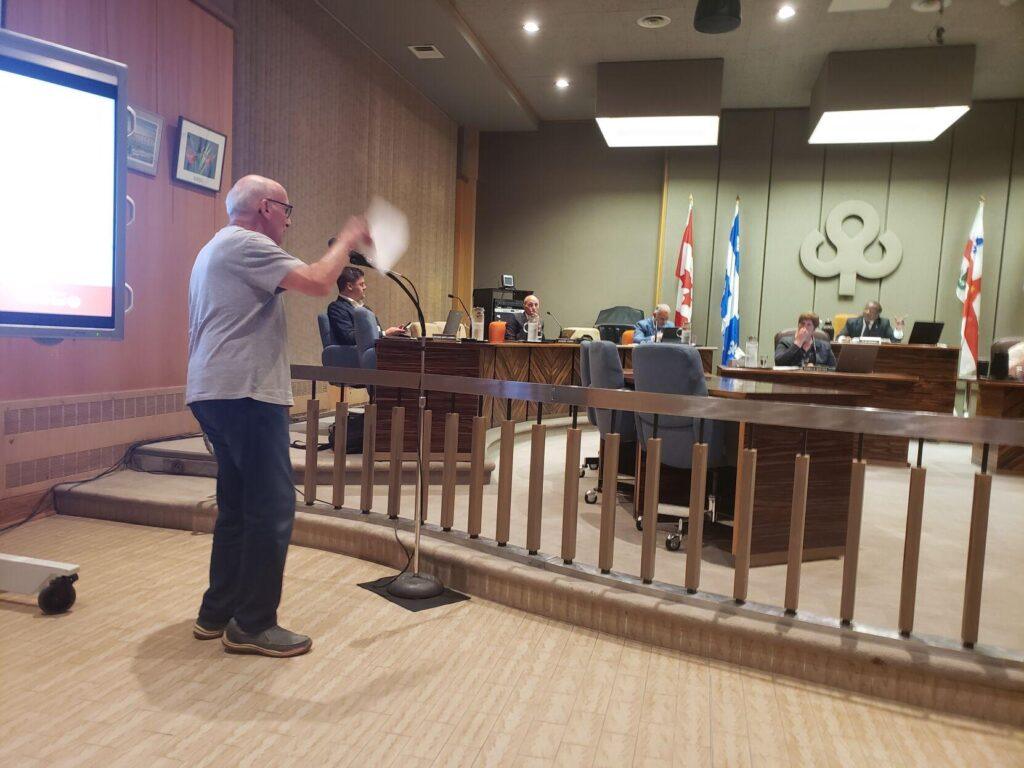
The ongoing issue of reduced parking in St. Laurent, prompted by new no parking zones five metres from intersections and lengthy restrictions, as much as eight hours long, on designated days, prompted a great deal of anger at the October borough council meeting.

The question period was a marathon one, lasting for three and a half hours, with the vast majority of residents, primarily in the west end of St. Laurent, asking about the issue. One resident said her son has to park blocks away, another said she and her husband have difficulty parking near their home in their two cars.

“I’m embarrassed to say you’re my Mayor!” Carré Simon resident Barry Vengroff told Mayor Alan DeSousa. “You could change things! This city is becoming a hole!”

Former councillor Charles Benchimol prompted cheers when he said, as far as he could see, there was no problem involving parking and traffic for the last several decades.

“Is it your job to create or solve problems?” another resident asked.

De L’Everest resident Vince Monticciolo, from the Bois Franc area, told The Suburban he may start a party and run against DeSousa over the parking, and other traffic and quality of life issues. Another resident was heard asking when the next municipal election is taking place.

White Street resident Barry Rolbin, who questioned council at the September meeting, asked DeSousa if council would halt the process of the five-metre and lengthy one day a week parking restrictions.

“We’ve done our surveys, we’ve gone door to door, we’ve let everyone know about this,” Rolbin said. “We have signs on my streets and other streets where it goes from five metres to 20 metres depending on the aesthetics and placement of the post. This was told to us by a public worker who was there…. Now, you plan on implementing this in the rest of St. Laurent. Are you planning on stopping this?”

DeSousa said he checked out the situation himself.

“With regards to the application of the rules, clearly there’s nothing new [with the five metre rule], it’s the provincial Highway Code, that’s what’s being applied. And you’re saying right now, it’s being applied in an inequitable manner, then anything you can bring to our attention, we will bring it to the attention of the committee that is applying this. And will we be assessing this? Yes, we will, we have on a continuous basis brought it to the attention of our staff.”

Rolbin pressed for an answer to his question, “when are you going to stop this and reassess this before you continue with this fiasco?”

DeSousa said the regulations are being implemented.

“So you’re not stopping it?” Rolbin asked.

“No, we’re rolling it out and it’s being applied,” DeSousa said. “If there are elements that are incorrect or [we can] adjust or find solutions to, we’re quite willing to do that.”

“You’re going to create the problem and fix it afterwards?” Rolbin asked. “That’s what’s happening!”

“No,” said DeSousa. “From what I observe, the work is being done and according to a methodology that appears correct.”

“You’re going to continue!” Rolbin said.

“I’m giving you a straight answer,” DeSousa replied.

“It’s a horrible answer,” the resident said.

Some residents wanted to express their concerns directly to The Suburban. Carré Simon resident David Bokobza said “the problem is not stopping, it’s just increasing. Every single day, they’re doing new streets and more and more people are very upset because they don’t have space to park their cars anymore! On small streets, they remove up to 18 parking spots with what they’re doing! They’re not doing this on a case by case basis.” n

Anger boils over reduced parking in St. Laurent Read More »

Choose well-made, local goods over Amazon this Xmas

By Trevor Greenway

If there is one thing Pamela Falkner wants you to do this holiday season, it’s to forget about Amazon.

Skip the mass-produced plastic toys, the gimmicky gadgets and the cheaply-made gifts, and instead get your loved one something truly unique, something handmade, something local.

You’ll have lots of time to browse for such goods at the Des Collines Health Foundation Craft Fair this year, as more than 70 artisans will be setting up inside the Meredith Centre Nov. 4-5 to sell their wares.

The Craft Fair is usually held at Vorlage, but it’s being moved to Chelsea this year because the Meredith Centre is more accessible, as it has elevators.

Falkner said that this year’s list of artisans has been “curated” to ensure the goods being sold are local, handmade or by artists who are “transforming” something.

“So we took applications in, and then had a committee curate to focus on local craft people either handmade or transforming,” said Falkner, director at the Foundation. “Not somebody that was just reselling goods.”

And there will be tons of these local crafts to browse — everything from local art courtesy of artists Jane Macmillan and Celine Moriset to handmade gifts from Mud Pies PotteryZola Handmade Goods, including toques from Knots & Purls and much more.

“When you look at the breadth of talent around here, it’s incredible,” added Falkner. “Traditional art potteries, clothing, leather goods, lots of food people. There’s skincare products, candles and all sorts of things.”

The Craft Fair is one of the premiere fundraising events for the Des Collines Health Foundation, and organizers would like to bring in $20,000 from this year’s event. Falkner said the Craft Fair average is usually around $18,000, but they’re hoping to push it over the top. The Foundation is a non-profit health organization located in the Gatineau Hills region, which fundraises for healthcare.

This year’s money will go towards purchasing automated chairs, a bladder ultrasound machine, a chair lift and television sets for patients in the short-term care unit at the Wakefield Hospital, among other items.

Falkner said she and her fellow volunteers at the Foundation have been “blown away” by the support they’ve received from the community this year — both from shoppers and volunteers looking to help out. Through such events as the Masquerade Ball, the curling bonspiel, golf tournament and garden party, the Foundation has brought in an impressive $36,700. These past events have helped the Foundation purchase things like a Bladder Scan for the CHSLD (resident and long-term care centres), bariatric beds (heavy-duty beds, typically wider than standard hospital beds), sit-to-stand aids and hydraulic and shower chairs for the region’s long-term and palliative care homes.

The Craft Fair takes over the Meredith Centre on Nov. 4 and 5, both days beginning at 10 a.m. On Saturday, the fair runs until 4 p.m. and on Sunday, it runs until 3 p.m. For more information or to browse the list of vendors, check the Des Collines Health Foundation website.

Choose well-made, local goods over Amazon this Xmas Read More »

Montrealer killed by Hamas

Joel Goldenberg – The Suburban LJI Reporter

Montrealer Alexandre Look, who was at the music festival where some 260 attendees were killed, was murdered by the terrorist group Hamas during its attack this weekend.

Look, 33, died trying to save two young women as the murderers attacked, and was in touch with his family in his last moments. He is being remembered fondly by his numerous friends from around the world.

Look was a Côte St. Luc resident. Alain Look posted on Facebook, “like a true warrior, he left like a hero wanting to protect the people he was with. Alex was a force of nature, blessed with unique charisma and unparalleled generosity. The world will never again be the same without you.”

Chabad Westmount posted on social media, “it is with shock, disbelief, and a deep sense of grief that we come to understand the totality of the devastating attacks on Israel. For the Jewish community in Westmount, this travesty hit even closer to home: Our dear and treasured friends, and members of our community, Alain and Raquel Look, lost their son, Alex. Alex was visiting Israel, and died in one of the terrorist attacks, as he heroically and selflessly saved others while fending off the attackers. We join our brothers and sisters here in Westmount, and the world over in mourning the devastation that has befallen our people and our land.

“The Jewish people are one family. An Emergency Fund has been set up to assist the Look Family in their time of need.”

Quebec Premier François Legault also expressed his sympathies, posting on X (Twitter), “my thoughts are with the family and loved ones of Quebecer Alexandre Look, who lost his life in one of the Hamas terrorist attacks in Israel. I am saddened by the dramatic circumstances of his death. He was only 33 years old.”

The Premier also posted that the Quebec flag would be flown at half mast Oct. 10, “from dawn to dusk, on the central tower of the National Assembly, in memory of the civilian victims of Hamas. Our hearts go out to the Jewish community of Quebec.”

joel@thesuburban.com n

Montrealer killed by Hamas Read More »

Fire smokes out seniors residence

By Madeline Kerr

Three separate fire-related incidents displaced 17 residents from Le Manoir seniors residence and shut down Wakefield village on Oct. 11.

At around 9:30 a.m. the fire department first visited Le Manoir, located at 775 Riverside Dr., after a small electrical fire in the building’s laundry room was detected. The first was deemed under control at the time, but a couple of hours later, firefighters returned following a report that thick smoke had begun to spread through part of the building.

MRC-des-Collines Police spokesperson Martin Fournel told the Low Down that there are approximately 60 residents housed in the building who were all safely evacuated. No injuries were reported and a statement released by the municipality of La Pêche said that Le Manoir’s emergency plan was implemented effectively.

Nine fire trucks, multiple police cars and an ambulance made the road impassable until mid-afternoon. Residents of three out of four sections of the building were allowed to return to their rooms later that same day, but 17 residents from one section of the building had to be temporarily relocated as their rooms required clearing after having been filled with smoke.

Health authorities with Centre intégré de santé et des services sociaux de l’Outaouais (CISSSO) took charge of caring for the displaced residents.

That evening, fire trucks once again returned to Le Manoir following a report that someone in the building smelled smoke. No fire was detected at that time, and residents were able to remain in the building without incident.

The cause of the fire has been deemed accidental and electrical in origin.

Le Manoir first opened in 1997, but part of the building is well over 150 years old. Once the site of the Wakefield Hospital – prior to its move up the hill on Burnside Drive – the original building was a manor house built by the MacLaren family in the 1860s, according to the Gatineau Valley Historical Society.

Fire smokes out seniors residence Read More »

Families gather for science fair at Bombardier in Dorval

Chelsey St. Pierre – The Suburban LJI Reporter

Bombardier’s “Women in Engineering” group held a science fair for the families of its employees. Over 1,000 attendees visited one of the company’s facilities located at 500 Côte Vertu Blvd. West in Dorval.

The fair was designed to encourage girls and boys aged from six to 14 to consider careers in science, technology, engineering and mathematics. Security personnel guided participants on a walk through the warehouse where dozens of planes could be seen up close, into an open area with over 25 kiosks set up by some 120 employee volunteers.

The Suburban attended a guided tour led by Bombardier spokesperson Christina Lemyre McCraw, Manager, Public relations and communications. “Volunteers took the extra steps to find ways to make science fun for kids at this event. Bombardier supported the idea as it wants to be proactive in supporting initiatives to stimulate interest from youth,” she explained as she pointed out the various activities and kiosks.

The in-house initiative, organized entirely by Bombardier team members, introduced the attending employees’ children and spouses to the Ecojet research platform, aircraft configuration, industrial design, thermodynamics and aerodynamics with kid-friendly comprehensive activities and demonstrations at the various kiosks.

Participants were also able to “fly” via virtual reality headsets.

T-shirts along with other souvenirs were handed out to children at table-stops set up throughout the fair.

According to Kathleen Dussault — Technical expert in aircraft architecture and organizer of the science fair, the event was launched with the aim of challenging young people to consider the world of science for their future careers.

“We want to give them a taste of what the outcome of their studies could be. They can see what all the hard math, homework and science studies amount to in their future experience,” Dussault told The Suburbann

Families gather for science fair at Bombardier in Dorval Read More »

Deep well of history

By Madeline Kerr

It’s been called “magical,” “iconic” and “essential.” It’s a destination for out-of-towners and indispensable for numerous locals. It’s been threatened and defended and discussed more times in the pages of this newspaper than we can count. And, at the time of publication, it remains under a boil-water advisory that has stretched on for months.

It’s a local truism: Wakefielders love their spring. The natural water source is fed by the hills that surround it, and thousands of residents have come to rely on its steady flow as their main source of water, either year-round or during power outages, which have become increasingly frequent.

The spring, located on Valley Drive near the Hwy 105 roundabout, was closed through much of this summer due to contamination from coliforms, and since Aug. 18 it’s been under a boil-water advisory that La Pêche Mayor Guillaume Lamoureux said cannot be lifted until two back-to-back tests confirm a total absence of coliform particles. Coliform bacteria, which includes e-coli, are organisms that are present in the environment and in the feces of all warm-blooded animals and humans. Testing for coliforms, including for e-coli, is conducted twice a month; the results are made public via the municipality website.

Although the cause of this specific contamination is unknown, many have worried about – and some have fought fiercely to protect – the spring’s health over the years. To bring newcomers up-to-date and to give long-timers a refresher, here is a brief history of Wakefield’s love affair with its spring.

The spring is moved, 1986

Few seem to know that the spring is officially named “The Lorne Shouldice Spring” after the late municipal councillor who helped secure its safe relocation when the source was threatened by road construction on Hwy 105 in the 1980s. Shouldice and others worried that the spring was being contaminated by pollutants seeping from the construction site and also feared it would be paved over by the Ministry of Transportation Quebec (MTQ) if it wasn’t routed elsewhere. Shouldice’s resolution was ultimately successful and in 1986 the MTQ agreed to move the spring to its current location on Valley Drive using pipes that fed it under the road for approximately 100 metres.

Save our Spring, 2009

The extension of Hwy 5 posed serious concerns for environmentalists in the Hills during the 2000s. Around 2009, well-known photographer Helene Anne Fortin founded Save our Spring (SOS) Wakefield, a committee that pledged to, well, save the spring. At that time, locals feared that the rock blasting required to extend the highway would pollute the aquifer that feeds the spring and many nearby wells. In 2010, Natural Resources Canada concluded that the dynamiting would have an impact, which SOS used to put pressure on the council and MTQ to carry out more environmental studies. The report also estimated that the highway development would decrease the aquifer’s supply by 25 per cent.

Mock funeral, 2012

In 2012, SOS organized a mock funeral to protest the “death of the spring,” which they feared would be the result of excavation of the sandpit near Rockhurst Road. Around 50 locals, dressed in black, formed a procession behind a black wooden casket, carried by six young pallbearers. Masham resident Bettina Koschade attended the funeral with her whole family. She recalled there was a shared feeling that “the [spring] is a vital source for a lot of people, and community forms out of gathering places that are open to everyone…what would we do if it was gone? We were protesting the reckless treatment of something so essential.”

Bussière sees dollar signs, 2014

Two years later, former La Pêche mayor and current MNA, Robert Bussière put forward a plan to bring in an outside company to bottle some of the water from the spring. He said that funds raised from selling the water could be put towards community projects. SOS sprung into action again and protested the idea. Speaking to CBC News at the time, SOS chair Peter Andrée said he believed “some things should be kept in common…and celebrated in common as our common resource.” Eventually the notion was rejected and a resolution was adopted that included many of SOS’s proposals, such as keeping the spring free for all to access, prohibiting the use of de-icing calcium on Valley Drive upstream of the spring, maintaining the structure surrounding the spring and carrying out regular testing of the water.

A deluge of stories

The spring has sourced countless rumours over the years. One, divulged by Wakefield Coun. Claude Giroux with the caveat that it may only be an “urban legend” is that a regional wine-maker used to drive up to the spring at night and take away 450 gallons of water to supply all of his wine-making. In 2015, the Low Down reported that two individuals alleged they saw the spring, which has had a constant flow for as long as anyone can remember, stop running for several minutes. And of course, the rumour that Wakefield’s spring is the freshest, best-tasting water around (when it isn’t under a boil advisory) has reached to far-off places, bringing in an estimated 300 cars a day at times from Ottawa and beyond. Although, as locals know, that isn’t just a rumour — it’s the truth, and it’s worth protecting.

Deep well of history Read More »

Lachine launches first Montreal “Make a Village Dance” video

Chelsey St. Pierre – The Suburban LJI Reporter

The Lachine borough held a community concert last Thursday evening at Lachine’s cultural center, “L’entrepot” where it launched a video entitled “Making Lachine Dance”. Directed by Maude Lecours, creator of “Making a Village Dance”, 230 Lachine residents are featured in the video dancing in various symbolic places throughout the borough to a song Au rythme de l’eau composed by Lachine resident, singer-songwriter, Joseph Boonen.

The video highlights maritime, heritage and industrial attractions unique to Lachine. It highlights the collective culture native to Lachine residents inclusive to persons of all ages, ethnicities and religious backgrounds. Elected officials, borough staff, firefighters, merchants and residents gathered in a variety of locations to demonstrate their attachment to Lachine by dancing.

“Composed by a young singer-songwriter from Lachine, this video is a great way to celebrate a sense of belonging in our community,” Maja Vodanovic, Mayor of Lachine told The Suburban. “We are so happy to participate in this project which celebrates our collective pride in being ‘Lachinois’.”

Boonen says that he was glad to answer the call to bring people together. “It was easy for me to find inspiration. I am proud of my roots as a French Quebecer and ‘Lachinois’,” Boonen said to The Suburban.

The Making a village dance project was launched in 2018 by Maude Lecours and Marie-Claude Lord to demonstrate the joy of living in the Brome-Missisquoi region. At the end of May 2018, the team produced and directed the first video in a series by filming people dancing in their community in Cowansville, Dunham and Frelighsburg.

The duo continues to expand the project to other regions by encouraging Quebec communities to dance in order to promote themselves and gain a sense of pride as members of a collective community.

Lachine is the first borough of Montreal to join the movement.

Lachine launches first Montreal “Make a Village Dance” video Read More »

Go slow for the kiddos

By Madeline Kerr

A notice to all lead-footed Chelsealites: the stretch of Hwy 105 that runs in front of the Chelsea Montessori school has officially been reduced to 30 km/h during the school day.

Notice signs were installed on Aug. 22 to warn road users of the change, which was adopted by the Chelsea municipal council during a regular meeting on Sept. 5 this year.

In a press release, the municipality explained that: “following the recommendations of the Public Works and Infrastructures advisory committee and the Active and Sustainable Mobility committee, the municipal council officially adopted the bylaw modifying the speed limit on this section of the road.”

The 30 km/h speed limit will be in effect from Monday to Friday between 7 a.m. and 6 p.m., from Aug. 15 to June 30 each year.

Chelsea Montessori is a private elementary and preschool that has been operating in the village since 1997. The school’s director-general, Nancy Courchesne, told the Low Down that, although the school did not advocate to the municipality for the speed change, she is glad that it’s been made.

“Because some of our kids walk to the library and they have to cross that road, I think it’s a great thing,” she said.

Speed limits along various sections of Chelsea’s Hwy 105 have been a point of contention for years. In February 2022, the Chelsea Ward 2 Residents’ Association and Sustainable, Active, Fun, Equitable (SAFE) Chelsea conducted a study of 20 crosswalks along Old Chelsea Road, Kingsmere Road near Old Chelsea, Scott Road, and part of Hwy 105 and found problems with most of them. The report also provided suggestions on how to make the crossings more visible to drivers and therefore safer.

In March this year, the death of 74-year-old Emilian Dragulescu from Burnett, who was struck by a car while walking his dog along the highway, sparked an outcry from the community and led to a petition asking the government and Chelsea council to lower the road’s speed limit. The petition garnered 389 signatures and helped lead to the council’s adoption on May 2 of a reduced speed limit – from 70 km/h to 50 km/h – along the stretch of Hwy 105 within Chelsea’s boundaries.

At the time, councillors said that Hwy 105 had transitioned from a highway to a residential road, explaining that the road’s dynamics have changed as well. Speed changes are one way to reflect that the road is now frequently used by pedestrians and cyclists.

Go slow for the kiddos Read More »

Kirkland youth drop-in centre opens

Chelsey St. Pierre – The Suburban LJI Reporter

The Minister responsible for Social Services, Lionel Carmant, as well as the session chair and Member of Parliament for Anjou-Louis-Riel Karine Boivin Roy, held the official inauguration of the Kirkland “Open Air” youth drop in centre in the West Island of Montreal last week.

Located at 2820 Saint-Charles Blvd. in Kirkland, the drop-in centre houses a network of integrated services for young people aged 12 to 25. It was developed in collaboration with young people in the community, families and partners in order to meet the needs of the clientele it serves.

The drop in centre is equipped to receive youth seeking mental health services, in particular. Youth can also find support concerning a wide range of issues that may affect all areas of their lives.

The $40 million Open Air project is one of the measures that are an integral part of the 2022-2026 Inter-ministerial Mental Health Action Plan.

According to Carmant, by 2026, the (CISSS or CIUSSS) expects to have 27 of the 80-90 planned centres for the province on its territory.

Currently, 24 establishments offer services throughout the province, of which 22 service points are officially open.

Carmant advocates on the importance of local accessible services for youth.

“Speaking to youth, they often say that when they knock on a door for help and there is no response, they don’t go back,” Carmant told The Suburban.

For Carmant, the participation of youth in the creation of the project was key to manifesting an environment that answers their actual needs in a way that is familiar and recognizable to them. “The concept was created by youth for youth on every account from choice of services right down to the décor.”

Youth services are normally geared towards pre-teens and teens aged 12-18, however the new Open Air centres offer services for youth until age 25.

“Youth fall between the cracks between 18-25. This is why it is important to assure a continuum of service until 25 years of age,” Carmant explained.

This new centre offers the services of a general practitioner directly on site.

The realization of the Kirkland centre was made possible as a result of a collaborative effort between Carrefour Jeunesse Emploi de l’Ouest-de-l’Île, the YMCA and the surrounding school network (school boards and CEGEPs).

This site also benefited from a generous vehicle donation, which allows team members to expand their awareness activities and provide assistance to young people in need of transportation.

“This is a magnificent project that will allow young people in Kirkland and the surrounding area to benefit from a range of free and confidential services. I am proud to see this great team, made up of workers who will be able to listen to young people and help them, regardless of their concerns or their needs, settle in the region. I would like to thank all the partners as well as all the young people who have worked hard over the last few months to implement such a unifying project for the community,” Karine Boivin Roy, MP for Anjou-Louis-Riel, said. n

Kirkland youth drop-in centre opens Read More »

Sexting talk for parents and teens this week

By Trevor Greenway

Parents looking for advice on how to talk to their kids about sexting, social media and online security can show up to the Wakefield community centre Oct. 19 for an Online Safety Presentation for Families.

The presentation is being put on by Paul Davis, an IT expert and social media critic who has been speaking to students and parents across the country over the past decade. Davis has presented to over 780,000 students from Grades 4 to 12 across North America and is bringing his important discussion to Wakefield. The presentation will cover the dangers of “sexting” among teens, digital trails, smart phones and online security.

The session is geared towards students in Grade 7 and up and their parents. The talk starts at 6 p.m. and is free for everyone. More information can be found on the Wakefield Activities for Youth (WAY) Facebook page.

Sexting talk for parents and teens this week Read More »

Local phone helpline organization looking for volunteers, financial aid

By William Crooks

Local Journalism Initiative

Secours Amitié, a local phone helpline organization based in Sherbrooke, is looking for more volunteers to man their phoneline, and financial aid. Their mission is to provide a confidential and anonymous service, in French, for those who need someone to listen to them concerning any issue at all. Secours Amitié employees Sandy Brouillard, Rachelle Lessard, and Micheal Joseph, and volunteer David Alonso manned a kiosk in Jacques-Cartier Park to inform the public about their service and recruit volunteers Oct. 24.

“September 25th, Secours Amitié launched its annual fundraising campaign,” explained Lessard, and them having a kiosk in the park is a continuation of that project. Many have not heard of their service, so they want to bring it to the public. It is a great day to do it, she went on, since it is ‘Journée de l’écoute’, a day set aside in the province for this very purpose.

Secours Amitié has received 10,500 calls so far this year and needs more volunteers to respond to the public’s need for a listening ear. “We need the public’s help to keep this service alive,” Lessard insisted. Their financial campaign aims to raise $20,000 over the next year; they have raised $3,000 so far. It takes a lot more than that to maintain the quality of their service, with expenses such as recruitment and training that need to be covered.

There are currently 54 volunteers working their phoneline, and they are looking for 30 more. Their phoneline is open from 8 a.m. in the morning to 3 a.m. at night, 365 days a year. Each volunteer is meant to work four hours a week. If they meet their new volunteer goal, they will be able to serve twice as many people – nearly 20,000 calls.

Brouillard emphasized that anyone can call for any reason. “There is no bad reason to call,” she went on, whether you want to “vent” about what happened during the day, a fight with your boss or someone in the street, anything.

Secours Amitié also offers training in “active listening”, to other community organizations, for a price. “It is another way to fulfill our mission,” Lessard said.

To become a volunteer, there is first an information session, followed by an interview. The training involves an 18-hour course on active listening. “We believe anyone can learn how to listen properly,” Brouillard noted.

“Everything is in French, for now,” Brouillard continued. One must be fluent in French to volunteer. It is their “vision” to expand into English services at some point, she said, but they are not sure when that will happen.

The organization celebrated its 51st year of existence last week.

Secours Amitié is holding a virtual information session online Oct. 26. More information on this, their other activities, and how to donate, can be found on their website.

Local phone helpline organization looking for volunteers, financial aid Read More »

students bring local journalism into school

By Trevor Greenway

Getting teenagers engaged in anything these days is a feat on its own. Getting them excited about local journalism, newspapers and cutting through misinformation is perhaps and even greater challenge.

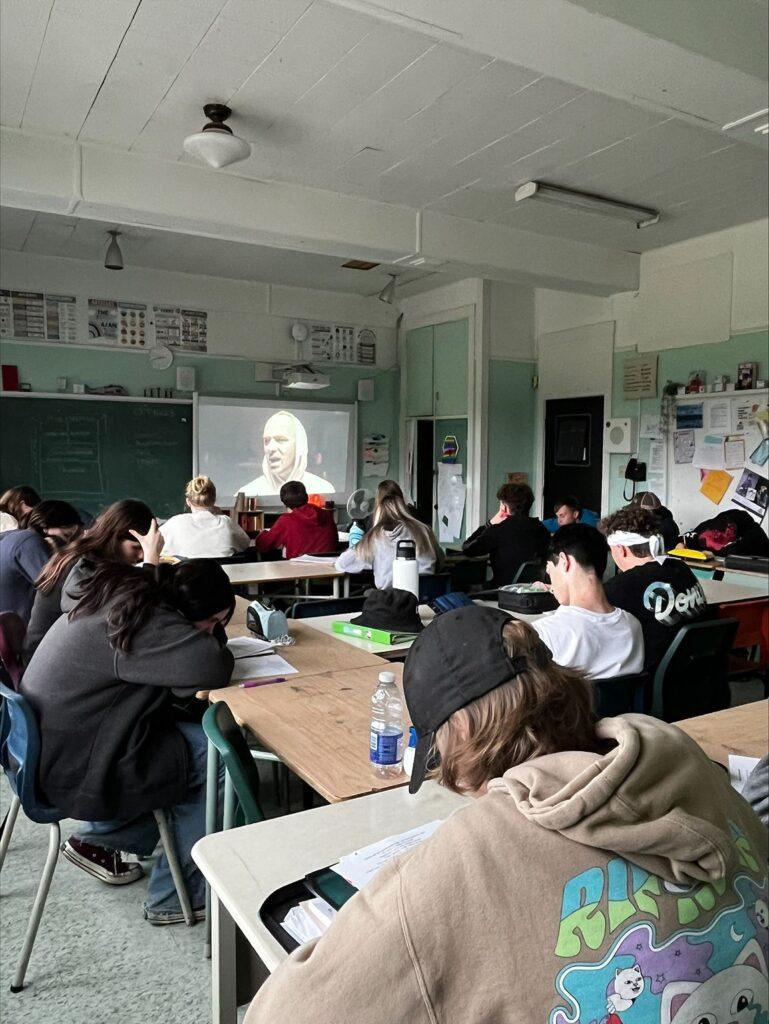
But the Low Down’s fearless editor-in-chief Trevor Greenway was up for the challenge and spent an afternoon workshopping story ideas with Grade 10 students at St. Mike’s High School in Low in late September.

The workshops were a collaboration between the Fairbairn House Heritage Centre and the Low Down and were designed to help students develop story ideas, cut through misinformation, take compelling photographs and learn the importance of fact-based reporting in today’s media landscape. Editors at the Low Down worked with the students throughout the process, editing their work and ultimately preparing it for publication in a St. Mike’s Student Page in the Low Down’s Oct. 18 edition.

The story ideas that flowed from the student’s minds involved everything from women’s rights and sports to drug use, homelessness and conspiracy theories around the Hawaii fires. There was even a listicle on different types of pasta.

And it wasn’t difficult to get the kids talking about the world around them. The kids at St. Mike’s are naturally curious and want their voices heard.

Below you will find stories that the students wrote themselves. They took time to interview subjects, dive into research and craft, in most cases, their first published pieces of work.

students bring local journalism into school Read More »

Laval City-Watch

Martin C. Barry

Two Laval city council opposition members are accusing the Boyer administration of wasting taxpayer money after an $8 million expenditure was recently approved to update the City of Laval website.

Chomedey councillor Aglaia Revelakis and Saint-Vincent-de-Paul councillor Paolo Galati, who are both with Action Laval, issued a statement saying they had difficulty understanding Mayor Stéphane Boyer’s choice of priorities given the city’s other pressing needs.

Streets and sewers…

“While the streets, and while the sewer system on the island need investments in the hundreds of millions of dollars, and while the parks are in a deplorable state, and while the overall upkeep of the city is becoming worrisome for most residents, Laval’s mayor wants to spend $8 million to bring the city’s website up to date,” they said.

“The mayor has completely lost touch with reality,” said Revelakis, adding that she has yet to hear from even one Laval resident commenting on the city’s website. “Nobody complains about this, although how many phone calls have I received about potholes, the state of the parks and snow removal? These are the true priorities of the city.”

Question of priorities

According to Action Laval, city services employees recently gave a presentation outlining the work that needed to be done to bring the sewer system up to standards in order to meet provincial government requirements.

The opposition party maintains that several sections of the sewer network have reached the maximum of their capacity, thus preventing new residential developments from taking place. In the meantime, Action Laval adds that the city is in the midst of a housing shortage crisis, while the mayor just raised taxes on properties that are going undeveloped.

During the Oct. 4 public meeting of Laval city council, Sainte-Dorothée city councillor Ray Khalil, who is vice-president of the executive-committee, justified the $8 million expense, saying that by 2026 Laval’s web platform will be reaching the end of its useful lifespan and the city will have no choice but to upgrade it.

As well, he suggested that the city will be achieving savings through the upgrade because Laval will be able to automate and put online certain services like permit renewals while reducing manual tasks now performed by employees.

“The city’s website is an important platform and one of the principal ways we communicate with out citizens,” he said. “Above all this, it’s all about being faster, better, more accessible to our residents, which are all part of providing services to them. We will be gaining all of these with this web upgrade.” As well, Khalil noted that only 4 per cent (mostly senior citizens) of Laval’s residents are not connected to the internet.

Improving cybersecurity

In September 2022, the City of Laval’s computer systems were the target of an intrusion attempt during which hackers were able to download what Mayor Boyer later described as a “limited” amount of data. Laval and other municipalities are increasingly building their computers’ defences against cyberattacks.

In the attack last year, a spokesperson for the mayor described the data which was stolen as consisting mostly of material such as photos and text, but not personal or financial information belonging to residents. Following the attack, the city brought in experts from Microsoft to deal with the fallout.

Action Laval furious over city’s $8 million website upgrade

The City of Laval has something new planned for its 50th annual blood donor clinic, which takes place on Nov. 7 from 9 am to 7 pm.

The clinic, which is one of the largest blood donor events in Canada, will be taking place at Place Bell where the Laval Rocket plays its matches. The city and the AHL hockey team are partnering for the event and reservations are now being taken for anyone who would like to give blood on Nov. 7.

“All signs pointed to the Laval Rocket becoming the partner for an association with Laval’s blood donor clinic,” says Mayor Stéphane Boyer. “In addition to being models of perseverance on the ice, the players get involved in their community for good causes such as this one.

Place Bell new venue

“As well, we will be able to take full advantage of the facilities at Place Bell to welcome more donors than ever while saving lives. Therefore, I invite all people in Laval to come and give. It’s a simple act, but so important.”

Laval city councillor for Chomedey Aglaia Revelakis.

In addition to being able to walk on the playing surface of the Rocket’s home arena, blood donors will have the opportunity to meet some of the players who will be dropping by over the course of the day.

“The Laval Rocket is proud to be able to welcome the Laval blood donor clinic to Place Bell for the event’s 50th anniversary,” says Jean-François Houle, head coach for the team. “This cooperative effort with the City of Laval and Héma-Québec will be the ideal occasion to get everybody involved for the largest number possible of blood donors.”

50 years since first clinic

More than 50,000 blood donations have been collected at City of Laval blood donor clinics since they started being held in 1973. This year’s target is 600 donations in a single day. It should be noted that most adults in good health are considered eligible to give blood.

Appointments to give blood are recommended and can be made online or by phone by calling 1 800 343-7264. Additional information is available at the Héma-Québec website: hema-quebec5.qc.ca.

Laval City-Watch Read More »

Woman charged in violent attack on Lachine man

Chelsey St. Pierre – The Suburban LJI Reporter

A 43-year-old man was the victim of a violent assault in an apartment in Lachine. The scene of the assault was on Louis-Paré Street, near 30th Avenue. Police at the scene had the victim transported to hospital by ambulance. He is in critical condition.

According to authorities, the victim suffered multiple wounds caused by a sharp object and is currently recovering in hospital. SPVM spokesperson Carolyne Chevrefils said police officers questioned a 31-year old woman who accompanied them to the police station voluntarily. She was not under arrest at that point.

Following further police questioning, the woman was charged and arraigned in court Wednesday. “The circumstances surrounding the event were not clear at the moment when the woman was initially transported to the investigation centre,” Chevrefils told The Suburban.

According to Chevrefils, the stabbing victim is also expected to be questioned as soon as his health allows.

The apartment has been sealed off while the investigation continues. Authorities have not confirmed what the connection is between the man and the women allegedly involved in the incident.

Woman charged in violent attack on Lachine man Read More »

Chelsea property values up 46 per cent

By Madeline Kerr

Property values are going up an average of 46 per cent in Chelsea, according to the latest triennial assessment roll in the MRC des Collines.

The latest assessment, released Oct. 19, is based on the region’s real estate market as of July 1, 2022, and although the increase is high, Chelsea is assuring residents not to expect a similar increase on their tax bills next year..

“Council has not yet determined the tax rate, but we would like to reassure residents that this does not mean they will be taxed to the extent of the roll increase,” Chelsea Spokesperson Maude Prud’homme-Séguin told the Low Down. “Council will adjust the tax rate downwards to remain reasonable and strike a balance between the increase of the assessment roll, the cost of living, and the needs of the municipality.”

The property assessment roll is a summary of the inventory of buildings and vacant land located within a municipality, assessed on the same basis and on the same date. The assessment roll, which is in effect for three municipal fiscal years beginning on Jan. 1 of the year after the assessment is completed, is the basic tool for calculating the amount of municipal and school taxes in a municipality.

An information session will be held on Oct. 27 at 7:00 p.m in the basement of 220 Old Chelsea Road to explain the reasons for the increase, outline the process for requesting a review and answer questions residents may have, according to municipal Prud’homme-Séguin

She added that “the Municipality is in the middle of the budgetary period. The tax rate will be announced in December when the budget is officially adopted.”

Vacant land values in Chelsea saw the greatest increase, rising in value 54 per cent, while condominiums rose 37 per cent in value. Single-dwelling houses rose 46 per cent in value – the same as the average across all properties in the municipality. The average price of a single-dwelling house in Chelsea is now $663,800.

Chelsea property values up 46 per cent Read More »

Return your king cans for maximum bottle return

By Trevor Greenway

Got a mountain of empty, king-size beer cans piling up in the garage?

If you return them to a bottle exchange depot before Nov. 15, you’ll get the maximum return of 20 cents per can, but after that date, you’ll only get half that amount, as the province is reforming its returnable container deposit-refund program this fall.

The new reformed program will phase in on Nov. 1 with all returnable containers, except for glass bottles between 500 millilitres and two litres, adjusting to a 10-cent return. This translates into an increase in the deposit-refund price for all aluminium cans — except king cans, which will drop from 20 to 10 cents. Regular-sized cans, such as soft drinks, will see their deposit price increase by five cents.

The Association québécoise de récupération des contenants de boissons (AQRCB), the organization designated by Recycle to carry out the reform, said that the new measures aim to increase the number of recycled containers and simplify the deposit system.

According to AQRCB president and CEO Normand Bisson, some 2.5 billion beer and soft-drink containers are redeemable under the new reformed program, and 100 per cent of recovered containers are recycled. When the new phased-in program is complete in 2025, the number of redeemable containers will have increased to around 5 billion.

“Quebecers have been actively taking part in this circular-economy initiative for nearly 40 years,” said Bisson in a statement. “Thanks to their efforts, we have achieved a recovery rate of 73 per cent, which is substantial. With the changes introduced as part of deposit-refund system modernization and expansion, we are targeting a rate of 90 per cent by 2032.”

Phase 2 of the program, which will launch in March 2025, will extend the recycling program to all glass, plastic and multi-layer beverage containers between 100 millilitres and two litres. For more information, visit www.consignaction.ca.

Return your king cans for maximum bottle return Read More »

Phase 2 of Chelsea Creek development finally approved

By Madeline Kerr

A housing development that was first proposed in 2019 has finally been approved by Chelsea council, but how much of it will be considered affordable is still up for debate.

During the Oct. 3 council meeting, Chelsea Mayor Pierre Guénard told the crowd that up to 15 per cent of the new units in Phase 2 of the Chelsea Creek development, which will add 72 multi-residential units and 16 semi-detached houses, would be set aside as “affordable” housing.

Municipal communications officer Stéphanie Deforges explained after the meeting that the definition of affordable “remains to be determined officially as part of a future affordable housing policy.”

“Affordable usually means the rental cost is equal or less than 80 per cent of the regular market rental price, or that the housing cost represents less than 30 per cent of an individual’s monthly expenses,” she added.

Multivesco CEO François Juneau, the company behind Phase 2 at Chelsea Creek, said that his company intends to make a percentage of the units affordable by such definitions, but ultimately “it will be the decision of the builder and owner of the multi-residentials. It is not Multivesco’s final decision.”

Deforges told the Low Down that the municipality “will encourage the project’s builders to uphold the developer’s promise,” but did not specify how it would do so. She added that the municipality is waiting to receive funding from the Canada Mortgage and Housing Corporation’s Housing Accelerator Fund before developing an affordable housing policy that will impact future projects.

The results of a triennial assessment of taxable property values in Chelsea, made public on Oct. 19, show that the average cost of all property types has increased by 46 per cent. The average taxable value of a single-family dwelling in Chelsea is $663,800.

Currently, there are 164 single-family and semi-detached homes in the Chelsea Creek subdivision, which sits behind Isabelle Ménard Pharmacy on Old Chelsea Road.

‘Frustration’ over back and forth requests (Text break)

The process of approving the Chelsea Creek development has involved “back and forth” discussions between the developers, the municipality and residents, according to Juneau.

Three public consultations have been held, during which Multivesco heard from residents and business owners and made modifications to their plans based on feedback, Juneau said.

Key elements of that feedback, according to Juneau, included ensuring accessible housing for seniors, so they can remain in their community; integrating seniors’ units into the design of each building (originally seniors were going to be separated); and ensuring that young families could find housing in the village that’s less expensive than a single-family home.

“We were implored to include multi-residential units in the project, which we agreed to do, based on the idea of being inter-generational,” Juneau explained.

Density was another priority.

“A lot of comments we received were geared toward the environment; people wanted a lot of greenspace,” said Juneau, who added that this resulted in the decision to include underground parking beneath some of the buildings.

“People recognize the need for density,” he said, “but there was a real resistance to offering buildings more than three [stories high].” He said his company eventually gave up on planning taller than three stories because “it seems there was no social acceptance of it.”

Following more delays due to the pandemic and the municipality’s new master plan, which was completed in November 2022, Juneau said his company finally approached the current council with their plans and received yet more feedback and requests.

“This is why, at the presentation [on Oct. 3] you might have seen a certain level of frustration because of all this back and forth…we asked the council to take a position and decide if they want the project or not.”

Juneau said the project could take some time — up to a year just to bring power to the subdivision.

“Hopefully we’ll see some work by the second half of 2024,” he said.

Juneau said that it is too soon for his company to estimate the average rental or sale price of units in the new Chelsea Creek development, and he also could not confirm the size of the units, although plans show that there will be a combination of two and three bedroom, single and multi-story apartments.

“We know there is a housing crisis,” said Juneau, “but it’s taking much longer to work with municipalities nowadays. And this is a project that is 100 per cent compliant [with bylaws], so for projects that are not compliant, it can take even longer.”

Phase 2 of Chelsea Creek development finally approved Read More »

LPD Blue

Martin C. Barry

A cooking fire in Chomedey left six families homeless last week. According to authorities, the blaze started around 5:30 p.m. on Oct. 19 in the basement unit of a six-unit apartment building on 80th Ave. near Perron Blvd.

Laval fire department chief of operations Jean-Francois Lortie said firefighters brought the blaze under control by 6:43 p.m. He said it started in a basement unit, causing major damage to other units.

Other units in the building were damaged by smoke, and for that reason, occupants were not be able to return for several days. The Red Cross was at the scene to provide immediate shelter and food assistance to those who needed it.

LPD arrests man for alleged sex crimes against children

The Laval Police say they are searching for potential victims after arresting a 64-year-old man in Sainte-Rose in connection with sex-related crimes against children.

Jean-Claude Deslauriers was taken into custody in August. He faces charges of sexual assault, sexual contact with a minor and breach of conditions. He was released with conditions following an initial court appearance.

According to police, the alleged offences occurred between the summer of 2022 and August 2023. They allege the suspect would often walk his dog around Sainte-Rose and would invite young, underage girls to his home.

While there, he allegedly took advantage. Deslauriers is expected to return to court on Dec. 6.

Anyone with information about Jean-Claude Deslauriers is encouraged to call 450 662- INFO (4636) or dial 911 and mention file LVl-230806-042.

Two from Laval arrested in Ontario on stolen car allegations

Police in Waterloo west of Toronto say two men from Laval were arrested in nearby Cambridge earlier this month while allegedly putting stolen vehicles into a shipping container.

Waterloo Regional Police officers were dispatched after a suspicious vehicle was reported, according to police.

They said when officers arrived, they found the men putting four vehicles into the container.

Four vehicles with an approximate total value of $320,000 were recovered. The two Laval residents, aged 24 and 27, are facing several counts of possession of stolen property over $5,000 and trafficking stolen property over $5,000.

Laval Police seize more than $1.5 million worth of unauthorized cannabis

The Laval Police announced recently that three drug raids they conducted on Oct. 3 led to the arrest of three suspects believed to be connected to the unauthorized distribution of marijuana.

According to the LPD, an investigation that began last January based on a citizen’s tip led organized crime investigators to an address in Fabreville.

In addition to the Fabreville location, the trail also led to addresses in Boisbriand on the North Shore and Saint-Adèle in the Laurentians.

The investigators found that three suspects who were arrested and later released, with pre-court arraignment conditions to be followed, had a valid license from Health Canada for cannabis production.

However, they were diverting some or all of their product for distribution and use beyond the strictures of the law and the conditions of their license.

What the LPD seized:

  • 1,453 cannabis plants valued at $1,453,000;
  • 1,565.78 grams of dried cannabis worth $15,657;
  • 1,532.99 grams of solid concentrated cannabis worth $30,659;
  • 1,804.56 grams of cannabis residue worth $9,022;
  • 2.75 grams of psilocybin worth $27.50;
  • Equipment for processing cannnabis worth $170,000;
  • One jackknife;
  • One Glock-type air pistol;
  • 4 cell phones worth $4,000;
  • Cash Canadian, amounting to $36,575.

Motorcyclist dies after head-on collision in Sainte-Rose

A 30-year-old motorcyclist died on Oct. 20 after he collided with a vehicle in Laval’s Sainte-Rose district.

The collision happened around 2 p.m. at the intersection of Avenue de la Renaissance and Boulevard Sainte-Rose.

The vehicle was travelling westbound on Avenue de la Renaissance, while the motorcycle was travelling eastbound on Boulevard Sainte-Rose, according to the Service de police de Laval (SPL).

“At the intersection, there is a traffic light. The vehicle wanted to turn onto Highway 15 North. That’s when the motorcycle hit the vehicle,” said SPL spokesperson Stéphanie Beshara.

The motorcyclist was then ejected from the vehicle. The seriously injured man was taken to hospital, where he was pronounced dead, said Beshara.

A security perimeter was set up and police were continuing their investigation on Friday evening to better understand the circumstances surrounding the collision.

LPD Blue Read More »

Lennoxville Councillors deplore university tuition hike at monthly meeting

By William Crooks

Local Journalism Initiative

At their monthly meeting Oct. 24, Lennoxville’s Councillors universally deplored the recent provincial commitment to double tuition for out-of-province university students. Along with putting forward an official statement in support of Bishop’s University (BU) “to help counter the tuition hike”, the Councillors expressed their personal views on the subject. Two residents attended the proceedings, which were otherwise mostly uneventful, including, notably, BU Student Representative Council (SRC) Student Life VP Olivia Woods. The meeting began at 5 p.m.

Councillor Claude Charron read out the Council’s “recommendation”. BU has existed for over 180 years in Lennoxville, he began. Thirty per cent of the student body is made up of out-of-province students. Losing these students could have a “catastrophic” effect on the functioning of BU as a whole. Many local residents work directly or indirectly for BU, and their employment is now under threat in the medium or long term. Thus, the Council supports BU in their opposition to the tuition hike. The recommendation will be forwarded to Geneviève Hébert, MNA of the Saint-François region.

“I am usually an optimistic person,” Councillor Jennifer Garfat said, giving her personal views on the tuition hike, “but all I could think of is at least this bomb didn’t fall and destroy buildings.” This bomb does not do damage materially, but in another way, she continued. Garfat wore her BU Gaiters sweatshirt to the meeting, overtop of her McGill sweatshirt, of which she is a proud graduate.

University is about learning to keep learning, she said. Meeting people at McGill from all over the world and the rest of Canada was an important part of her experience there. Even if some who study in Quebec do not stay here, they become “ambassadors” for the province when they return home. She has sons who have either graduated from McGill, are there currently, or have graduated from BU.

While she acknowledges tuition could be reasonably raised by a few thousand dollars per year, doubling it sends the wrong message to prospective out-of-province students. “It tells them: we don’t want you here.” She addressed Quebec Premier François Legault, saying “open mindedness is a good thing”.

In response to friends and family that wonder why she does not move out of Quebec, she says “my family has been here for 200 years, why should I move?” She insisted day to day life for English Quebecers is good, especially in the Townships, and not the way it is presented in the media.

Councillor Guillaume Lirette-Gélinas, responding to BU Principal Sébastien Lebel-Grenier’s call for alumni testimonies, said the following:

BU provides a “modern” form of education revolving around small class sizes. This gives students a closer and more engaging relationship with their professors. He fondly remembers gathering with his classmates and teacher at the Golden Lion Pub, reviewing modern music “in between two chicken wings”.

BU provided “revision services” that allowed Lirette-Gélinas to complete his master’s in his second language, English. BU’s commitment to a Liberal Arts education gives its students the flexibility and open-mindedness to have an “advantageous problem-solving capacity”.

BU contributes to Lennoxville like no other institution. BU’s heritage buildings delight foreign visitors. He applauds Sherbrooke Mayor Évelyne Beaudin and other local politicians’ support for BU. “I am a proud Bishop’s alumni, and I still bleed purple.”

The powers of the Council for the Lennoxville Borough are subordinate to the provincial government, Charron noted. The only thing they can do about the situation is to influence public opinion via their resolution. Influencing the CAQ will be difficult, he went on, for they face very little opposition. There is talk of some form of backdoor “compensation” for BU to make up for the money lost, but that would just be a patch.

The CAQ’s reasoning for the tuition hikes is based on information from Montreal, which is not the same as the Townships, he explained. Bills 101 and 96 “chip at our languages issue”. These problems don’t exist in Lennoxville, he insisted, which has a bilingual community that has been living together “for ages”. “It is negative for our community,” he summed up.

Garfat congratulated Sherbrooke’s Société de Généalogie for releasing a booklet, in English, containing the biographies of local English military veterans. This year’s Remembrance Day ceremony will be at 11 a.m. Nov. 5 beside the Borough Office in Lennoxville. There will be a rally against the tuition hike at the Golden Lion Pub Nov. 4.

After the meeting was adjourned at 5:35 p.m., Woods thanked the Council on behalf of the BU SRC for “supporting [them] fully”. She hopes BU can persevere through this. She reminded the group that there will be a “mobilization” of Quebec’s three English universities in Montreal on Oct. 30.

Lennoxville Councillors deplore university tuition hike at monthly meeting Read More »

‘Melina’s Room’ pays homage to Lyceum of Greek Women’s generosity towards MUHC

Martin C. Barry

More than 100 guests gathered on Oct. 17 in the Elspeth McConnell Atrium at the Research Institute of the McGill University Health Centre to celebrate the Lyceum of Greek Women of Montreal’s many generous donations to the MUHC Foundation since 2019.

The Montreal-based Hellenic community group’s members have established themselves as strong supporters of women’s health while championing the work of gynecologic oncologist Dr. Lucy Gilbert, whose first-of-its-kind DOvEEgene test can detect ovarian and endometrial cancers early.

‘Melina’s Room’

In recognition of their efforts, a plaque unveiling took place to name a room in the MUHC’s surgical oncology unit. And to recognize the strength of Greek women in Montreal and around the world, the Lyceum members chose to adorn the plaque with the words “Melina’s Room.”

The event was attended by Lyceum members as well as dignitaries with Greek roots, including Lyceum of Greek Women of Montreal president Justine Frangouli-Argyris, Consul General of Greece in Montreal Katerina Varvarigou, Vimy MP Annie Koutrakis, Saint-Laurent MP Emmanuella Lambropoulos, Montreal city councillor Mary Deros, and Laval city councillors Aglaia Revelakis and Vasilios Karidogiannis.

Two Melinas honored

The tribute recognized two strong Greek women. Melina Mercouri (1920–1994) was the Minister of Culture and Sport of Greece and a widely-revered actress who lost her life to lung cancer. Closer to home, Melina Tsagaropoulos, a member of the Lyceum of Greek Women of Montreal, is a young mother who is currently fighting ovarian cancer while receiving treatment at the MUHC.

Speeches were given by Consul General Varvarigou, MUHC Foundation President and CEO Marie-Hélène Laramée, Lyceum of Greek Women of Montreal president Justine Frangouli-Argyris and Dr. Gilbert.

Finding cancer early

“I cannot put into words how much this effort by the Lyceum of Greek Women and their supporters means to the DOvEE Project,” said Dr. Gilbert. “It not only gives us the funds that we need to work, but the inspiration and the feeling that we are supported by women, to help women. It means so much to us.”

DOvEEgene is a pap smear-like test that uses a specially designed brush to collect cells from the uterus. The sample undergoes genetic testing, allowing the DOvEE team to detect the presence of ovarian cancer in its earliest stages.

Finding the cancer early is critically important because once it has spread, it is essentially a death sentence. Worse, ovarian and endometrial cancers do not present symptoms until they are advanced, meaning the majority of women who develop the disease die from it.

Final clinical trial

The DOvEEgene test must go through several important steps before it can be made available to women across Canada and around the world. It is currently undergoing a final clinical trial for effectiveness. Over 4,000 women have been tested as part of the trial, and the Greek community is proud that over 1,000 of its members have taken part.

Already, the test is saving lives. According to officials at the MUHC, it has helped Dr. Gilbert and her team identify cancer and pre-cancer in numerous trial participants. With the generous and ongoing support of the Lyceum of Greek Women of Montreal, Dr. Gilbert and her team will be able to continue on the path to making the DOvEEgene test a standard part of women’s health care.

‘Melina’s Room’ pays homage to Lyceum of Greek Women’s generosity towards MUHC Read More »

Premier’s Halloween strike date speculation a scare tactic, union leaders say

By Ruby Pratka

Local Journalism Initiative

Public sector union leaders say there’s no plan for a general strike to begin Oct. 31, despite an assertion to that effect last week by Premier François Legault.

“Unions always think they have to go on strike to gain as much as possible, so we’re going to expect a strike on Oct. 31,” Legault told reporters on Oct. 17, the day after the conclusion of a round of strike votes where locals under four public sector union federations voted in support of a strike mandate by an average of 95 per cent.

Éric Gingras is the president of the Centrale des syndicats du Québec (CSQ) and a co-spokesperson for the Front Commun, the negotiating bloc made up of the CSQ, the Fédération des travailleurs du Québec (FTQ), the Conseil des syndicats nationaux (CSN) and the Alliance du personnel professionnel et technique de la santé et des services sociaux (APTS).

“We don’t usually comment on rumours, but unfortunately, we have to comment on this one because it came from the premier,” Gingras said. “That [Oct. 31 strike date] is not what is planned.”

Gingras said unions that go on strike are bound by legal restrictions that require ten days of advance notice before any strike action. “A strike action is not something that we’ll announce the night before,” he said. He also said union members would most likely engage in a series of brief, time-limited strikes before taking the rare and drastic step of an unlimited general strike. Such a strike would close schools, colleges and daycares around the province, and some health care workers would also walk picket lines, although the Essential Services Act ensures that there won’t be service interruptions in the sector. A Front Commun statement released Oct. 18 said “Bientôt en Grève” (“On strike soon”) banners will soon pop up across the region. “This is a clear warning to the government that public sector workers are willing to go all the way,” the statement said.

Gingras said negotiations were ongoing between the Front Commun, which represents a combined 420,000 public sector workers in health, education and social services fields, and the government. Union leaders have previously told the BCN that a salary increase below the predicted rate of inflation, the imposition of pension penalties for those who retire early and working conditions that they say don’t encourage retention are among the major sticking points. “The goal is to get an offer that’s satisfying for our members – we don’t want to have to reach an unlimited general strike. The next few weeks [of negotiations] will be key,” said Gingras.

“If we go on strike, people will find that difficult – we know that,” he added. “We’re fighting so that the public can have the levels of service they’re entitled to, so that our members will be able to better serve the public.”

Premier’s Halloween strike date speculation a scare tactic, union leaders say Read More »

Harvest Breakfast in Bryson

Camilla Faragalli, Reporter

Funded by the Local Journalism Initiative

The annual Catholic Women’s League Harvest Breakfast was held on Sunday morning at the Immaculate Conception Church in Bryson.

It was a full house, with over a hundred people showing up over the course of the morning.

“We always get wonderful support from our own community and all the surrounding communities as well – so it’s a lot of fun for us,” said Betty Maloney, a key organizer of the event, long-time member of the Catholic Women’s League and a parishioner at the Immaculate Conception Church.

“The food is amazing and the pancakes are known to be the best around,” she said, adding with a wink that her husband is responsible for making them.

The event is one of several community gatherings organized by the Catholic Women’s League of Canada (CWL), a 100-plus year-old national organization comprised of over 60,000 members across different communities that stands for faith, service, and social justice.

“We’re always trying to give back,” said CWL Bryson president Sheila Racine, “I’ve lived here all my life and was raised in Bryson. We always thought what people give you, you help out with, too.” One lucky attendee was the winner of a 50/50 draw, taking home half of the proceeds from ticket sales, Margo Newberry of Bryson.
“I usually never win, but oh my God, what an honour,” said Newberry after her name was called. The CWL will direct the rest of the proceeds from the event towards supporting the Immaculate Conception Church.

Harvest Breakfast in Bryson Read More »

Harvest Supper conjures ‘hometown feel’ in Otter Lake

Camilla Faragalli, reporter

Funded by the Local Journalism Initiative

Lively discussion filled the basement of the Church of St. Charles Borromeo during the Harvest Supper in Otter Lake on Saturday.

One hundred and sixty people from across the Pontiac were in attendance. “People are happy to be here,” said Father Michael Smith, “It’s an initiative of the parishioners and there’s been a very good response.”

Anita Lafleur is one of the parishioners who initiated the event. “I just wanted to bring proceeds to the church, to help the church,” she said, adding that it was a group effort that made it all possible. “The ladies that used to be the Otter Lake Auxiliary pitched in,” she said, “And we all worked together.”

After an opening blessing from Father Smith, attendees patiently waited to be called up table by table to the impressive buffet-style spread.

“It was advertised, we go to church, it was supper, and the price was right,” said Larry Kluke, whose wife Isabel Kluke added that because of covid, many regular church events have been cancelled. “This is the time that we’re having something this year,” she said.

In the French, English and laughter-filled room that had been specially decorated for the occasion, one thing seemed evident – a sentiment perhaps best captured by the words of attendee Adam Lafleur:

“Supper and family brought me here tonight,” said Lafleur, “And the hometown feel – that’s not going to change.”

Harvest Supper conjures ‘hometown feel’ in Otter Lake Read More »

Volunteer shortage plagues Pontiac community groups

Connor Lalande, reporter

Funded by the Local Journalism Initiative

It’s mid-October and Mona Woodstock and other volunteers from the Pontiac Legion in Campbell’s Bay are preparing for Remembrance Day.

Spending a rainy Saturday counting poppies and organizing donation trays to be dispersed throughout the region, the group knows their work will be worth the effort in the money it raises to support local veterans and their families.

And yet, many of them are concerned.

The number of volunteers offering to lend a hand with Remembrance Day fundraising and the various social events the Legion holds over the span of a month has been in decline in recent years.

The trend has some members, like Woodstock, concerned for the future of the Legion and for the fabric of community within the Pontiac. Woodstock has been with the Legion for nearly 8 years.

“When we first joined, it was really good. We had lots of participation,” she said.

“But as people get older in the Legion, there’s less and less they can do. And then they pass away. I mean, in one year, we had like five, six members die, and they were all members that were always willing to help out.”

Woodstock said these days there

are only three, sometimes four people who do everything at the Campbell’s Bay Legion. While she says this core group of volunteers is dedicated, they recognize the long hours they put in are not sustainable in the long-term.

“We have such a limited amount of people working. After a while it just doesn’t get to be fun anymore,” Woodstock said.

She attributes a declining engagement with the Legion in part to an aging population and a lack

of education on veterans’ issues in schools.
“Kids are not taught anything about the wars anymore. They don’t

know what it’s like to be a veteran. They don’t know what these veterans did when they came back from the war and what they went through,” Woodstock said.

“Some kids don’t even know what a poppy is. I think everybody’s lacking in education on that part,” she added.

A lack of volunteers, as Woodstock describes, is an all too familiar dilemma affecting community groups and organizations throughout the Pontiac.

This is a region where volunteer-run fundraising initiatives and social events like church suppers, barn dances, theater performances and car rallies play an invaluable role in fostering its sense of community, but it is struggling to recruit the very volunteers that make these events possible.

For the people who are indispensable in putting these events on – the unsung and often underappreciated volunteers who work tirelessly to make them happen – it’s a worrying trend.

“When I was a kid, we had a recreation committee,” said Woodstock, who grew up in Danford Lake.

“The kids and the parents put on everything. We had an outdoor rink we made when it snowed. We cleaned the ice weekly and kept it usable. We did everything.”

“And now even in our small municipality, we have an outdoor rink, and the municipality pays someone to clean the rink,” she said, adding she does not think it would happen if left up to volunteers.

“I think people volunteering for things is just something that is going and gone and will never come back because everyone is just too busy in their own lives.”

Trouble in Quyon

Further east, in Quyon, Joan Belsher of the Quyon Lionettes describes an all too similar problem.

Belsher, who has volunteered with the Lionettes for 20 years, says she first got involved with the organization after witnessing first-hand the important community work the Lionettes were doing.

“At the time, my father was in long-term care, and they needed some comfortable chairs for their sunroom,” Belsher recalled.

“I was on the user committee at the care facility he was living at and so I approached the Quyon Lionettes for assistance, and they purchased the chair right away,” she said, the appreciation still discernible in her voice. “So, I thought to myself, ‘as soon as I was able to, I was going to see about joining that organization to work for the community’ because I was very impressed that they helped me when I was in need.”

She joined soon thereafter.

That was 20 years ago. At the time, Belsher says the Lionettes were made up of around 25 invested members.

As the years passed, however, some members began to age to a point where the volunteer work was too demanding, and membership began to decline. They currently have six members and most are seniors.

The Lionettes attempted to supplement their numbers by recruiting younger volunteers, but after seeing the hour demands, many resigned.

Belsher is understanding of their choice and recognizes that today’s challenging economic climate makes the time commitment of volunteering difficult for someone trying to raise a family. “At one point, a lot of women didn’t work outside the home, so they could devote more of their daytime to volunteering,” said Belsher.

“Now, I mean, it’s almost impossible for a mother not to be working outside the home. The first priority is the family, which is understandable.”

Nevertheless, Belsher knows better than most the impact the volunteer work organizations like the Quyon Lionettes have on the social fabric of Pontiac.

“We just had our car rally, we did a 50/50 draft to raise money to buy a new microwave for the community center, and we will do the free hotdogs and hot chocolate for kids during the Santa Claus parade in December,” Belsher said, describing recent and upcoming initiatives being undertaken by the group.

“We’re just so thankful that we were able to do that as an organization, and don’t like to see it dissolve,” she said, confiding that the Lionettes were close to disbanding this year.

“It’ll be a sad day if we have to make that decision.”

“We’re just hoping we can keep going”

Volunteer shortfalls in the region are not confined to community organizations like the Pontiac Legion and the Quyon Lionettes.

In August, THE EQUITY reported that TransporAction Pontiac – a public and paratransit service that connects residents in need of transportation with volunteers – needed more drivers. The service, funded by MRC Pontiac and Quebec’s ministry of transportation, is primarily used by residents needing a ride to medical appointments.

While some drivers have taken up the call, TransporAction Pontiac Executive Director Sylvie Bertrand said she hopes more will get involved, as the demand for the services has grown beyond what their current list of volunteers can reasonably handle.

“Sometimes when people call, we have to tell them, ‘I’m sorry we can’t take you at that time.’ We never used to have to tell people that,” explained Bertrand. “For most of our clients, they need to get to an appointment. Sometimes it takes a while to get an appointment from a doctor, so to ask somebody to reschedule it because you can’t get them a ride is a hard thing to do,” Bertrand said. TransporAction continues to do what it can to provide residents with a means of affordable transportation, including double and triple-loading vehicles

with passengers.
But Bertrand said the fact remains that if TransporAction is to continue

facilitating the service to Pontiac residents, it will need more volunteers.
“I think the price of gas is a factor and that, at the moment, COVID is making a resurgence, so some people are worried about getting sick,” Bertrand said. “But

we’re just hoping we can keep going.”
According to Bertrand, retirees make up the lion’s share of TransporAction

drivers. While she said she would be thrilled to see younger people getting involved, she thinks the economic circumstances of the day make that unlikely.

“They’re looking for a steady job,” said Bertrand of the demographic. “They want 35 hours and they’re looking for a salary every week, and that’s not something we offer.”

Despite TransporAction’s own struggles recruiting volunteers, Bertrand recognizes that the issue goes far deeper in the region.

“For our volunteers, they get money to do it,” Bertrand said, explaining that drivers get paid for the mileage they travel. “So, imagine if it’s an organization where it’s really just volunteer work, you know? It would be much harder to find people.”

Volunteer shortage plagues Pontiac community groups Read More »

Almost $2 million for local development projects

Sophie Kuijper Dickson, reporter

Funded by the Local Journalism Initiative

New money will be flowing to a handful of projects that advance social and economic development in the MRC Pontiac thanks to funding from the MRC’s regional revitalization initiative.

“The vitalization committee received in the number of about 35 requests for grants,” said Guillaume Boudreau, director of economic development for the MRC, at the October 18 meeting of the Council of Mayors.

“The investment committee went through an analysis phase of all the projects. All these analyses were presented to the vitalization committee which decided on 10 municipalities, three not-for-profit organizations, four private companies as well as one MRC project.”

The 18 projects selected will share $1,782,000 of the $2,000,000 available.

Each funding application was considered on the basis of whether it would bring specialized labour to the MRC, whether it would strengthen a village core, whether it would encourage community involvement, and whether it would showcase the community’s attractions, among other qualifications.

These grants come as part of a funding agreement signed between the MRC Pontiac and the provincial ministry of municipal affairs and housing in 2021 to support economic and social growth in the region.

Projects receiving funding

• The Groupe d’Entraide et de Solidarité Sociale pour Hommes du Pontiac (AutonHomme Pontiac) is receiving $100,000 to renovate and furnish apartments for fathers with children.

• Bouffe Pontiac will receive $20,734 to remove carpets from its premises and replace the floors with commercial tile, which is better suited to the organization’s activities.

• The Parish of the Anglican Church of Western Quebec in Clarendon will receive $64,079 to purchase and install commercial-grade kitchen equipment, upgrade the electrical system, and refresh the floors with an epoxy finish. The organization will also be able to install wheelchair-accessible doors.

• The Brauwerk Hoffman brewery in Campbell’s Bay will receive $58,115 to build a greenhouse where it will grow food for its restaurant and host events, and to install a sound system for those events.

• Sheenboro’s Pontiac Hotel in Fort-William will get $60,750 to insulate its plumbing so it can host visitors through the winter season.

• Pontiac’s first cheese factory, Fromagerie La Drave, will get $100,000 to purchase new production equipment.

• The Hub 21 shared business and workspace center (Century 21 Élite) will receive $40,937 to create a shared business center based on a flexible workspace model equipped with state-of-the-art technology for videoconferencing and working remotely from the office.

• The Municipality of Alleyn-and-Cawood will get $100,000 to install trail and campground signage, wildlife-proof waste management equipment and environmentally friendly outhouses at Parc du Mont O’Brien.

• Clarendon will get $93,230.37 to convert a vacant lot it owns into a recreational green space for its residents.

• Otter Lake’s Pontiac Nord EcoRecharge project will receive $100,000 to integrate charging stations into Hydro-Québec’s Circuit électrique, for residents who use an electric vehicle.

• Fort-Coulonge will receive $100,000 to develop its Escale sur la rivière project, which involves transforming municipal land that became vacant following the 2019 floods into an open-air relaxation area along the Ottawa River. It will also feature a parking lot for recreational vehicles for up to 48-hour stays.

• The Municipality of Île-du-Grand-Calumet will receive $70,960 to create a multifunctional gathering place for the community.

• Litchfield will receive $100,000 to increase its visibility at its road entrances with new welcome signs, and install public and accessible infrastructure for people with reduced mobility.

• Portage-du-Fort will receive $100,000 to create a multifunctional community center.

• Rapides-des-Joachims will receive $38,676 to install a new boat docking system for fishermen and recreational boaters visiting the community.

• Shawville will receive $88,902 to carry out a feasibility study on the future of its arena.

• Thorne will get $87,345 to proceed with major renovations to its community center.

• Finally, the MRC Pontiac will get $450,000 towards its AgriSaveurs project which will see the creation of a commercial kitchen that would be available to local producers and restaurateurs for product packaging, and food processing and preparation.

The MRC will release final details concerning this funding in the coming weeks.

Almost $2 million for local development projects Read More »

Labour shortages key challenge for small businesses

Camilla Faragalli, reporter

Funded by the Local Journalism Initiative

The Outaouais is seeing greater labour shortages than elsewhere in Quebec, according to a presentation from the Canadian Federation of Independent Buisinesses’ (CFIB) at last week’s Pontiac Chamber of Commerce (PCC) meeting.

The PCC held its monthly Business Association meeting on Thursday under the warm lights of the Little Red Wagon Winery in Clarendon with special guests from the CFIB, a non-profit, non-partisan organization that advocates for businesses in Canada.

“Two out of five businesses in Quebec say that they don’t have enough employees to run their businesses, but here in Outaouais it’s actually three out of five businesses. Nowhere else in Quebec is it like that,” said Benjamin Rousse, a policy analyst at the Canadian Federation of Independent Business.

The issue is of particular concern as, according to a survey conducted by the province, small businesses are the driving economic force of the Outaouais: the proportion of companies with fewer than 50 employees makes up a whopping 95 per cent of those surveyed.

“Right now it’s very hard for businesses in Quebec in general,” Rousse said. “But in Outaouais it’s another world.”

The PCC event was one of many held across Canada this week in recognition of the country’s Small Business Week.

“You’re gaining information and information is like gold,” said PCC vice president, Todd Hoffman of the event.

“The more information you get the better. But the whole making of it is in the networking, that’s something that’s really overlooked.”

Sébastien Bonnerot, president of the PCC, said that for many small business owners in Pontiac, opportunities to network are few and far between given the vastness of the region.

We’re actually the widest chamber of commerce in Canada in terms of kilometres – 14,000 square kilometres – so it’s not always easy to get people together, participating in events,” Bonnerot said.

“When we’re able to do something like this in the middle of the Pontiac, it’s great.”

Martin Bertrand, owner of Horizon X rafting company on Grand Calumet Island, said he attended the event to meet other entrepreneurs in the Pontiac, make new connections and see new faces.

“Back in the day I was really involved with tourism, really involved within the community and within the Chamber of Commerce as well, and it’s quite exciting to see it flourishing and doing well in the past year,” said Bertrand.

The next PCC meeting will be held in late November.

Labour shortages key challenge for small businesses Read More »

Singing for snowsuits

Camilla Faragalli, reporter

Funded by the Local Journalism Initiative

Andrea Smith (lead vocals) and Kathryn Perry (piano and vocals) led the dozens gathered at the New Hope Christian Fellowship Church in an evening of old-fashioned hymn singing on Sunday.

“It lifts our spirits to sing about Jesus, and we want our town to radiate with his love,” said Perry, a parishioner at the church who taught piano for 53 years prior to retiring,

She and Smith, who were united by a mutual love of music and their religion, initiated the now-regular hymn-sings together about a year ago.

“We have these sings once a quarter and we’re hoping to have them a lot more often,” Perry said.

The two women were joined on stage by Steven Beattie on tenor saxophone, and Paulette Gauthier on violin. The group took requests for hymns from the audience for the entire duration of the event.

“Hymns are the church theology,” said Pastor Walter Perry of Pembroke. “We learn more about God, about his love.”

Angela Jonkers, a parishioner at New Hope who lives just outside of Shawville, said her love of singing – especially old hymns – had brought her to the event.

“And I’ve gotten used to this church,” Jonkers added, “I really like the people in it.”

It seems Jonkers was not the only person present who felt that way; nearly everyone that attended the hymn-sing hung back afterwords to chat – and sample from the dazzling array of homemade cookies provided by Smith’s mother, Lorna (Smith).

All proceeds from the event were donated to the Snowsuit Fund, a program that provides low-cost snowsuits to families facing financial stress.

Singing for snowsuits Read More »

Annual snowsuit fund returns amid increased demand

Connor Lalande, reporter

Funded by the Local Journalism Initiative

The Maison de la Famille du Pontiac’s annual snowsuit fund is returning for the upcoming winter.

The fund, which provides children 13 and under with access to subsidized winter clothing, has grown considerably since its inception,
with families throughout the Pontiac now utilizing its services.

Maison de la Famille du Pontiac’s Executive Director Lisa Danis said that over 100 families used the snowsuit fund last year and that for this upcoming fund, she expects that number to rise.

“Every year since covid the demand for the fund has gone up,” Danis said. “We have a lot more families now than we ever had.”

With cost-of-living increases and inflation hitting the bank accounts of Canadians, families are turning to organizations like Maison de la Famille du Pontiac for support.

For example, a 2022 report from Second Harvest, a national food security organization that redistributes excess food to those in need, forecasted a 60 per cent increase in reliance on food banks and other food charities in 2023.

Across the border in the United States, One Worn Coat, a non-profit that runs coat drives throughout the country, has reported a 50 per cent increase in demand from the fall of 2020.

Snowsuits given out through the fund consist of winter jackets and winter pants, purchased by Maison de la Famille du Pontiac in bulk from a supplier. Various sizes and different colours are available.

Maison de la Famille du Pontiac charges $20 per suit provided, the cost of which goes back into the program to help fund next year’s purchase of snow suits.

“We know it’s a difficult time for everyone,” Danis said. “We’re here to help and I would encourage everyone to come in and grab a snow suit. It’s not something that people should be embarrassed by. We are here to help during these difficult times.”

Danis said the organization tracks the number of people using the service so that it can request more support for the program.

“Maybe at some point, we’ll be able to give it for free to the families instead of making them pay $20 to keep the program going.”

In addition to the standard, subsidized winter clothing available, Maison de la Famille du Pontiac is also soliciting donations of gently used, good condition winter clothing. Available to both children and adults for free, articles of clothing that have been donated include toques, mittens and boots.

The final date to register for the fund is November 17. Distribution of suits will go until mid-December.

More information on the fund and how to access it can be found on the Maison de la Famille du Pontiac website.

Annual snowsuit fund returns amid increased demand Read More »

Local family feels ripple effects of Quebec tuition hikes

By Ruby Pratka

Local Journalism Inititaive

A British Columbia family with aspirations to settle in the Eastern Townships is asking hard questions after the CAQ government announced plans to double tuition fees for out-of-province students.

Clay and Dianne Bassendowski are based in Dawson’s Creek, B.C., but have a holiday home in Knowlton – where they hope to retire – and attend Sherbrooke Phoenix games at every opportunity. Although they’re not fluent in French, Clay Bassendowski said they “love the language” and become better versed in it with every visit. Their 17-year-old daughter, an aspiring math teacher, learned earlier this fall that she had been accepted to Bishop’s University in Lennoxville, realizing a long-held dream.

That was before Oct. 13, when higher education minister Pascale Déry announced that tuition fees for out-of-province students at Quebec universities would double starting next September.

When the Bassendowski family heard the announcement, they “were in shock,” Clay Bassendowski said. “She found out she was accepted, and we learned about this the same week. It’s a real emotional roller coaster.”

They are now considering other options. Although the family hasn’t given up on sending their daughter to Bishop’s, “the more we digest it, the more we realize we need a plan B,” he said.

“One of the concerns we have is the cost – it’s an extra $40,000 over four years, although living expenses are cheaper, and we are factoring that in,” he said. “The other concern is that with 40 per cent of the student body coming from out of province, that’s a big part of the university’s business model. What happens if in three or four years, the university’s business model isn’t viable anymore?”

Bassendowski, a former town councillor, said the idea of finding a workaround to make his daughter eligible for in-province tuition via their holiday home didn’t sit right with him. “I don’t feel we deserve the in-province rate, but we would be happy to pay the same rate that a Quebecer would pay at the University of British Columbia (UBC),” he said. “It’s a great thing for students to be able to experience other provinces.”

He said the opportunity to perfect her French – and one day teach in Quebec – was part of the appeal of Bishop’s for his daughter. “I don’t know why the government assumes that people won’t stay,” he said. “You go to university, you make friends, you put down roots – I think there’s a very high likelihood you will stay.”

Political fallout

The announcement has been roundly criticized by opposition parties. Madwa-Nika Cadet, the Liberal Party critic for public finances and the French language, called on Déry to produce data to back up her assertions that out-of-province students don’t stay in the province or integrate. She noted that students who do leave after their studies in Quebec can be “ambassadors” for Quebec language and culture elsewhere, strengthening connections within the federation.

Québec Solidaire MNA Christine Labrie’s riding includes Bishop’s University. She has called on Déry to exempt Bishop’s from the fee increase. “Bishop’s risks losing a third of their student body, and if nothing is done, this policy will lead to job losses. The consequences will hit the region hard, and the policy won’t achieve its goal because there will be less money coming in to finance French-language universities.”

Labrie said out-of-province students who attend Bishop’s, McGill or Concordia “choose to come and live in a francophone province, and I read that as a will to learn more about Quebec. If they stay, great. If they leave, that means more people in the rest of Canada are familiar with Quebec, and that’s also great.”

Parti Québécois education critic Pascal Bérubé said his party supported the measure but didn’t believe it would have a significant impact on the vitality of French. He said the government should apply the Charter of the French Language to CEGEPs and invest more in French language learning opportunities for temporary foreign workers to reinforce the vitality of the language.

Local family feels ripple effects of Quebec tuition hikes Read More »

Feds to make it easier for cities to regulate lakes

By Ruby Pratka

Local Journalism Initiative

Municipalities and Indigenous communities will soon have access to a faster and easier process to regulate navigation on lakes in their jurisdiction, Compton-Stanstead MP Marie-Claude Bibeau announced last week.

Bibeau, Brome-Missisquoi MP Pascale St-Onge, and Sherbrooke MP Isabelle Brière gathered alongside municipal officials and lake preservation advocates near Lake Massawippi in Ayer’s Cliff on Oct. 12 to announce upcoming policy changes.

Navigable lakes and rivers in Canada, even those on the territory of a single municipality, fall under federal jurisdiction. For many years, municipalities that wanted to regulate lakes on their territory – for example, to ban a certain type of boat or impose a boating speed limit – had to apply to Transport Canada for authorization, a long and involved process that could take two to three years. Transport Canada can now approve municipalities’ requests by decree, making the process much faster.

Bibeau said she had been determined to reform the process since 2016. “Our challenge was to change the Canada Shipping Act, which I was jokingly told was harder to change than the Constitution … that gives you an idea of the challenges we faced. We recently proposed modifications to the Act which received royal assent in June.” She said the new regulations that will be developed in the wake of these changes will clarify the role of municipalities and streamline the authorization process. In the interim, Transport Canada has eliminated several steps from that process. “It’s now easier and faster for municipalities and Indigenous communities to seek restrictions on local waterways if they have safety or environmental concerns,” she said.

“For those who haven’t been following the file closely, the changes aren’t super clear, but in essence…a municipality that wanted to ask to regulate a lake had to submit an application which would go through two or three levels of jurisdiction, and that would take a year or two,” explained Pierre St-Arnault, the president of the Comité de sauvegarde du bassin versant du lac Davignon and a longtime advocate for a streamlined process, who attended the Ayer’s Cliff announcement. “Now, the city will fill out the same forms, and if the ministry decides the application is sufficient, it can issue a decree authorizing the municipality to regulate. You submit something before the end of the year, and it can be authorized by this summer.”

Jacques Demers, president of the Fédération québécoise des municipalités, said the changes were “a positive step” after years of discussions and consultations on the issue.

In Cowansville, city officials have been in discussions with Transport Canada since earlier this year with an eye to ban motorboats on Lac Davignon. Cowansville communications director Fanny Poisson told the BCN the reforms announced last week were “good news” but that the city would not comment further while discussions with the ministry and public consultations were ongoing.

St-Arnault said the Lac Davignon motorboat ban needed to be authorized as soon as possible, for the safety of swimmers and kayakers and for the good of the lake. “Our goal is to ban all motors, fuel or electric, even the smallest ones. We have a small, shallow lake and motorboats stir it up – they stir up sediment which contains a lot of phosphate, and that’s bad for the lake. They’re an important [vector] of invasive species. … and they affect the safety of swimmers, kayakers and paddleboarders. We can’t have boats zooming around at 70 miles per hour if we care about the health of the lake and the safety of its users,” he said.

Feds to make it easier for cities to regulate lakes Read More »

Fee increases pose potential “existential threat” to Bishop’s

By Ruby Pratka

Local Journalism Initiative

Bishop’s University Principal and Vice-Chancellor Sébastien Lebel-Grenier has said proposed changes to the province’s university fee structure announced last week could pose an “existential” threat to the Lennoxville institution.

On Oct. 13, Higher Education Minister Pascale Déry announced the province would essentially double university tuition fees for out-of-province students in undergraduate and professional master’s degree programs at Quebec universities. Fees for international students, whose tuition is already several times higher than what Quebec students pay, are also expected to rise slightly. The measure would apply to new students as of the 2024-2025 school year; fees for current students will remain the same until they finish their degree.

International students whose home countries have a reciprocity agreement with Quebec are exempt, as are doctoral students and those in research-based masters programs. Déry alluded to possible future exemptions for students from francophone communities outside Quebec, although no such exemptions were announced.

Déry argued that most Canadian students from outside Quebec leave at the end of their studies, and the change meant Quebec taxpayers would no longer subsidize out-of-province students who took advantage of Quebec’s relatively low tuition fees and then returned home to work. She did not cite data supporting her premise.

The proposal received immediate backlash from English-speaking educational institutions. Celine Cooper, managing director of the Consortium of English-language CEGEPs, Colleges and Universities of Quebec, said institutions reacted with “profound disappointment.”

“The measures announced on Friday are counterproductive. They will have serious and far-reaching consequences not only for Quebec’s higher education sector in the broadest sense, but also for Quebec’s economy, workforce development and international reputation,” Cooper told the BCN. “These new measures, coupled with recent changes to the Quebec Experience Program [for international students], are likely to discourage thousands of international students from choosing Quebec. The price point will be prohibitive for many out-of-province students, [and] we expect that Quebec’s English universities will see a significant drop in enrollments from out-of-province students.”

While Déry emphasized that the policy change, applied to all universities, “was not a measure against anglophones,” it will have a disproportionate impact on Quebec’s three English-language universities, McGill, Concordia and Bishop’s, which welcome the lion’s share of students from other provinces. Déry said revenue from international and out-of-province student fees “creates a significant imbalance” between the French and English university systems. Between 2019 and 2022, according to the ministry, English-language universities gained a total of $282 million in extra revenue from international and out-of-province student fees, compared to a combined $46 million for the 10 public French-language universities in the Université du Québec network and an estimated $79 million for French-language universities outside the network. “I have to reduce this imbalance so our French-language universities can shine and grow,” said Déry. The extra income from the fee increase will “give the ministry the means to … better support the francophone network” while “putting the brakes on the anglicization of Montreal,” she argued.

None of that is any consolation to Lebel-Grenier, who said the announcement came “out of nowhere.”

“We got a two-day advance warning that this policy was going to be put in place; there was no consultation,” he told the BCN. “We received a letter in late spring telling us the minister was concerned about out-of-province students…but there was no invitation to discuss.” He said he was “expecting a conversation on how we can be better partners for unilingual anglophone students who want to learn French – not punitive measures.”

Nearly one in three Bishop’s students are from other provinces and one in six are international. Lebel-Grenier said he “fully expects” many prospective out-of-province students to reconsider their plans. That would have a potentially “catastrophic” impact on the university’s finances, with preliminary projections suggesting at least 25 per cent of the academic budget would vanish, affecting “our ability to go on as a university,” he said.

The school’s culture would also take a significant hit. “We’ve always been premised on welcoming students from across Canada, and the diversity of our community is what makes Bishop’s an incredible place to learn and grow as a person,” he said.

Lebel-Grenier said the university was receiving calls from “distraught” parents and prospective students. Beyond the financial impacts of the fee increase, “they are seeing this [announcement] as a message that they aren’t welcome.”

“A lot of students come to Bishop’s because they are curious about Quebec and they want to stay and learn French,” he added. “We don’t have data [on how many graduates stay on], but we have a lot of great stories of people who have stayed.”

Déry said she was “sensitive to” the school’s situation, but could not make an exemption to the policy for a single school.

Fee increases pose potential “existential threat” to Bishop’s Read More »

Local health authority faces challenge to use less independent labour

By William Crooks

Local Journalism Initiative

In the face of upcoming Quebec government legislation set to prohibit the use of independent labour in the Townships by 2025, the CIUSSS de l’Estrie-CHUS has yet to show a reduction in its reliance on such labour. As of the mid 2023-2024 fiscal year, the hours clocked by independent workers at the CIUSSS increased to 185,000 — 100,000 hours more than the previous year at the same time.

This comes after Marc-Antoine Rouillard, Assistant Director of Human Resources, Communications, and Legal Affairs of the CIUSSS expressed confidence back in February about the organization’s trajectory in reducing its dependence on placement agencies by the stipulated 2025 deadline, especially as it aligns with the upcoming Bill 10 affecting ‘bordering territories’ like the Townships.

Sherbrooke MNA Christine Labrie released a statement Monday morning regarding the use of independent labour at the CIUSSS.

“It’s discouraging to see that not only are we failing to free ourselves from agencies, but we are also moving away from this goal. I am particularly concerned about the explosion in the use of private agencies for social workers or educators. In social services, especially in youth protection, establishing a trust relationship is fundamental, and this requires stable teams. Using agencies seriously compromises the quality of social services provided to the most vulnerable individuals,” Labrie commented.

“We need as many qualified and competent people as we can get to meet the needs of the population,” Rouillard explained. It is not currently possible to fill these roles with public sector employees alone.

The cause of the Townships’ lack of public sector employees is “multifactorial”, he continued, though he admitted he is not a specialist. One reason is that the population is getting older and requires more complex care. Quebec is suffering a general labour shortage that affects healthcare as well, he added.

We need to work on retaining, making these jobs more attractive, and providing better working conditions, he went on. One positive step they have taken in the Townships is to allow employees to participate in forming their own schedules. Because schedules are planned so far in advance, more difficult periods for making sure there is adequate coverage, like during the summer, have been handled “with good results”. They have also given employees more flexibility in choosing when they can take their vacation. Finally, they have reintroduced surveys to gauge employee satisfaction and get a better idea of where they can improve.

When asked how the CIUSSS would deal with their future inability to hire private contractors in 2025, Rouillard insisted a major factor would be continuing to make the jobs that need filling “as attractive as possible”. The Townships region is better positioned to make up for the lack of staff than other regions, since the percentage of private contractors they use is less (two to three per cent vs. five per cent), he added.

It must be recognized that they face a difficult challenge, he said, but they should be able to meet it together with other regions in a synchronized way. It would be much more difficult if the Townships were the only region facing this dilemma.

Local health authority faces challenge to use less independent labour Read More »

Pro-trans protesters hold up signs in support for their cause.

Pro-trans protest counters OMMC for a second time

Pro-trans protesters hold up signs in support for their cause. Photo Vincent Casinghino

Julia Israel
Local Journalism Initiative

On Oct. 21, clashing protests outside the Ministry of Education office occurred between the One Million March for Children (OMMC) group protesting LGBTQIA2S+ inclusive school curriculums and a collection of counter-protesting groups advocating for the rights and safety of LGBTQIA2S+ youth.

This is the second time they’ve gathered since Sept. 20 to counter the country-wide protests against gender-inclusive curriculums and policies in schools.

Counter-protesters arrived early to occupy the area in front of the Ministry of Education building on Fullum Street. They managed to block the whole street, redirecting OMMC protesters to regroup on the other side of the building.

The crowd of hundreds of counter-protesters played music, provided free meals and refreshments, and strictly controlled access to the gathering for safety purposes. Social media posts by organizers Celeste Trianon and Sarah Worthman stated that the aim of the counter-protest is to disrupt a movement that wants to deprive students of comprehensive and inclusive educations that support the rights and freedoms of all.

With signs reading “our kids belong to us” and “stop indoctrinating and sexualizing our children,” the OMMC protest stands against LGBTQIA2S+ inclusive policies in schools. These policies include a child’s right to use their preferred pronouns and preferred first name without parental consent, mixed-gender bathrooms, and education on sexual orientation and gender identity. The rise of this movement was originally sparked by the New Brunswick government’s policy of parental consent for teachers to use students’ preferred pronouns and first names in June. Additionally, Saskatchewan’s subsequent adoption of this bill on Oct. 20 does the same.

The rise of these protests around the country has raised fears and concerns for safety among the  LGBTQIA2S+ community and its allies. A number of protesters in cities across the country were arrested for inciting hate and disruption in this past month. Police reported that anti-LGBTQIA2S+ hate crimes have risen 64 per cent since 2021, according to Statistics Canada.

Counter-protester Alex Nelson said he felt hypocrisy among the protesters in their messaging about child protection. “They have nothing against child’s pageant contests, which is really sexualized,” said Nelson. “They only have a problem when it’s trans kids expressing themselves.

No statement on the protests has been made by Quebec Education Minister Bernard Drainville who said he objects to mixed-gender bathrooms in schools last month.

“It’s about showing up and being an ally,” said Sharon Desouza, a counter-protester, “we want to make sure that our communities are being fully represented.”

High school teacher Elyse Bourdeau emphasized that LGBTQIA2S+ policies aim to create safe spaces for students at school who might otherwise not have a place to express themselves safely. She said that parental consent policies single out trans and non-binary students, putting them in particularly vulnerable positions. “The teenager must have a safe space in school to experiment, to try to discover themselves. And our goal is never to hide anything from the parents. But sometimes we have to, and most of all, we must protect the teen,” Bourdeau said.

When protesters with the OMMC started arriving around 11 a.m., they were directed to the other side of the Ministry of Education building by counter-protest volunteers at the blockade on Fullum Street and St Catherine Street East. Some non-violent hostile interactions occurred between sides. The groups faced off near the Ministry of Education building for a couple hours until the OMMC protesters dispersed.

Once the protesters dispersed around 1:30 p.m., counter-protesters marched down St Catherine Street East to Frontenac Metro. “There’s no place for hate in Montreal, there’s no place for transphobia in Montreal,” cheered counter-protesters.

Pro-trans protest counters OMMC for a second time Read More »

Housing starts in Gatineau region witness growth in September

The Canada Mortgage and Housing Corporation (CMHC) has reported a positive trend in housing starts for the Gatineau region and across Canada in September 2023. According to CMHC data, the trend in housing starts in September stood at 254,006 units nationally, reflecting a 3.9% increase from 244,511 units in August. The trend measure is a six-month moving average of the monthly Seasonally Adjusted Annual Rate (SAAR) of total housing starts for all areas in Canada.

On a national level, the monthly SAAR of total housing starts for all areas in Canada increased by 8% in September, reaching 270,466 units, compared to 250,383 units in August. In the Gatineau region, specifically, the data indicates a noteworthy increase in housing starts. The monthly SAAR of total urban housing starts in areas with a population of 10,000 and over increased by 9% in September, with 250,766 units recorded. Of this, multi-unit urban starts increased by 10%, totalling 207,689 units, while single-detached urban starts saw a 3% increase to 43,077 units in September.

Bob Dugan, Chief Economist at CMHC, highlighted the trend in housing starts and the persistent activity in multi-unit starts. He stated, “Both the SAAR and trend in housing starts were higher in September. Multi-unit starts activity has persisted and maintained similar levels to 2022 despite the higher interest rate environment. This has helped offset double-digit declines in single-detached starts in all provinces. In fact, September was the second-highest month this year for multi-unit starts. It seems the current higher interest rate environment has so far not had the expected negative impact on multi-unit construction activity in 2023.”

With notes from Mary Baskin, Marie-Eve Turpin and Lily Ryan

Housing starts in Gatineau region witness growth in September Read More »

Laundromat no longer available for Mansfield/Fort Coulonge

Pierre Cyr, reporter

Funded by the Local Journalism Initiative


It was bad news for citizens in Fort Coulonge and Mansfield to learn

that the laundromat located in the heart of Fort Coulonge was closing

effective June 1.
The laundromat has been in operation since 2011.

The owners, Robert Soulard and Hélène Vaillancourt, came to this

decision because they were unable to convince the local authorities to

review the 60 per cent increase in their tax bill since May 2022.
When the owners received the increase of $4,500 in their taxes for 2022,

they thought it was a mistake. The total tax bill for their commercial

building, which includes four small businesses and four one-bedroom

apartments, is now $12,000, compared to $7,500 in 2021, even though no

improvements were made to the building over that period.
In 2013, the tax bill was $6,000, which has now doubled over the last 10-year period.
Soulard says he feels helpless in his efforts to have the Village of Fort

Coulonge review the way they calculate his tax bill, which includes

municipal services. When village representatives were not willing to

review their case, the owners came to the realization that the

laundromat, which alone costs $3,000 in taxes per year, was no longer

profitable and would have to be closed.
Approximately 50 people have been using the laundromat on a weekly

basis, most of whom will now have to go to Pembroke to do their laundry.

Soulard mentioned tourists were also frequent users of the facility,

mostly in the summer. He feels that a laundromat is an essential service for a

small community and that common sense should have prevailed.
Soulard can’t see how the village officials can justify a $12,000 yearly tax bill

for such small commercial activities. “That is not a good message to anybody

who would like to invest in the community as high tax rates are discouraging

people to operate a business or create affordable lodging spaces

in Fort Coulonge,” he told THE EQUITY.

At last Wednesday’s meeting of Fort Coulonge council, THE

EQUITY asked if the municipality had attempted to find a solution to

the problem of the large tax increase facing the laundromat. Pro-mayor

Debbie Laporte responded that the matter was private but added that the

information posted on the laundromat storefront explaining that it was

closed due to the a 60 per cent tax increase was not true.
Following an indication from the municipality that the property would be put up

for sale for non-payment of taxes, Soulard paid off the balance of his

outstanding tax bill on Monday of this week.

Laundromat no longer available for Mansfield/Fort Coulonge Read More »

Aylmer Legion Branch 33 Remembrance Walk honours Canada’s military heroes

On Sunday, November 5, the Aylmer Legion Branch 33 will host a Remembrance Walk to pay tribute to Canada’s military personnel who have made immense sacrifices in the line of duty.

The event will take place between 1:00 pm and 4:00 pm, commemorating Aylmer’s heroes and recognizing their service.

The Remembrance Walk will involve a solemn visit to local cemeteries, where participants will place a Poppy at the headstone of each veteran as a symbol of remembrance and gratitude.

The event aims to foster a spirit of unity and to honour those who have dedicated their lives to serving Canada.

All members of the community are warmly invited to join the Remembrance Walk, where instructions and Poppies will be provided at the beginning of the event. The schedule includes stops at Pink Cemetery Mountain View at 1:00 pm (1521 Ch Vanier), Bellevue Cemetery at 2:00pm (1030 Aylmer Road), and St. Paul’s Cemetery at 3:00 pm (corner of Aylmer Road and Samuel-Eddy).

Following the Remembrance Walk, a Get-Together for all participants will be held at 4:00 pm at the Aylmer Legion Branch 33, located at 59 Rue Bancroft. This gathering provides an opportunity for the community to come together, share their thoughts, and express their gratitude for the sacrifices made by Canadian military personnel.

Photo: On Sunday, November 5, the Aylmer Legion Branch 33 will host a Remembrance Walk to pay tribute to Canada’s military personnel who have made immense sacrifices in the line of duty. The event will take place between 1:00 pm and 4:00 pm, commemorating Aylmer’s heroes and recognizing their service. (TF) Photo courtesy of the Aylmer Legion,Quebec Branch #33

With notes from Mary Baskin, Marie-Eve Turpin and Lily Ryan

Aylmer Legion Branch 33 Remembrance Walk honours Canada’s military heroes Read More »

End of the road for Davidson Sawmill

Pierre Cyr, reporter

Funded by the Local Journalism Initiative

“Enough is enough!”
These are the words of Hubert St-Cyr, Chairman of the Board of Davidson Sawmills in Mansfield-Pontefract. He and his brother Bruno St-Cyr, Executive Vice President, have decided to throw in the towel.
Despite their best efforts over the past five years, the Quebec government has once again refused to grant them guaranteed wood supply reservations (GA – Garantie d’approvisionnement) to relaunch the Davidson industrial site.
“We’ve had the impression for the past few years that we’ve been tilting at windmills,” said Hubert St-Cyr. “The file is not moving forward.”
Without these GAs, management cannot restart the sawmill, a mill with equipment still in place and just waiting to be powered up to get going.
‘’Unfortunately, in 2018, most of our GA reservations went to companies outside the region,’’ says Hubert St-Cyr.
The company’s multiple attempts to recover GA have all been turned down by the Quebec government, which even cited the protection of woodland and mountain caribou to explain its latest decision. Such an argument raises eyebrows among the owners of Scieries Davidson, given that the coveted GAs are located in the Témiscamingue region, which is not home to any caribou.
The Davidson industrial site is located on 125 acres of land that has long been considered an industrial jewel, dating back to 1903. The site was acquired in 2007 and was in operation for only 18 months. The closure of Smurfit-Stone (pulp processing) in Portage du Fort in the fall of 2008, the softwood lumber crisis, the economic crisis and the temporary closure of the Bowater mill (the buyer of white pine chips) had forced operations to cease. The mill has never restarted since 2011, despite management’s best efforts.
The St-Cyr brothers are particularly irritated by the authorities’ lack of eagerness, as prices for noble woods – white pine and certain hardwoods – have been very high for several years, and would generate appreciable returns for the company. Some fifty well-paid jobs are at stake. To rebuild an industrial site of Davidson’s scale would easily cost $70 million. The current owners estimate the cost of restarting the business at around $9 million.

The company’s business plan, which the Quebec government is not questioning, called for the relaunch of sawing, drying and planing operations, coupled with a $70 million, 9.5 MWh cogeneration plant project.
The cogeneration plant was a key element of the project, as it would enable wood chips and residues to be processed on-site, in addition to generating electricity. Davidson Energy has a 25-year contract with Hydro-Québec to supply the power grid directly from the cogeneration plant. This plant could also have greatly helped the forest industry cluster in Ontario and Quebec to have a place to monetize their forest residues. The plant would have created 12 permanent jobs and major positive economic impact during its construction.
The envisioned project also had a Phase 2. Davidson Energy has signed an agreement in principle with a Canadian partner based in France to install a green fuel refinery for the lucrative aerospace market, fuelled by CO2 generated by the on-site cogeneration plant. The refinery alone would produce 32 million litres a year.
According to the business plan presented, this project would have generated investments of around $360 million and substantial annual revenues of $90 million.
Phase 2 also included an aquaculture project (rainbow trout), at an initial cost of over $20 million. This aquatic greenhouse would have been heated by the cogeneration plant. Phase 2 would also have brought a total of 40 additional permanent jobs.
The shareholders’ decision to dismantle and sell all or part of the facilities at the Davidson industrial site comes barely two months after the owners of Jovalco, located on Highway 148 in Litchfield, sold the sawmill equipment for $1 million to a Lanaudière-area company.
In recent years, the owners say they have never really felt fully supported by either provincial or MRC elected officials for the project to revive forestry activities, including the contribution of the cogeneration plant. We are witnessing the end of an era and a part of Pontiac’s history As the saga surrounding the relaunch of the Davidson facility seems to be over, it seems we are witnessing the end of an era in Pontiac’s history.
“Contacts have already been established with equipment manufacturers for the disposal of assets. We’ll be dismantling and selling our fixed and rolling equipment in the coming months,” says Hubert St-Cyr.
Pontiac Warden Jane Toller says she respects the decision of the St-Cyr brothers to abandon their project.
“I worked hard with the provincial authorities through the years to support the plan to reopen the Davidson industrial site,” she told THE EQUITY on Monday.
The warden said that the owners’ insistence on reopening a large sawmill first, instead of starting with a cogeneration plant, didn’t work to their advantage.
“The capacity for the government to guarantee access to pine resources is simply not there anymore,” she said.
Toller said she is confident that the Davidson industrial site will be attractive for new investors or new partners with a view to building a cogeneration plant, and possibly other activities such as aquaculture and perhaps eventually a sawmill at some point in the future.
“For a multitude of reasons, the owners are making a difficult choice, among them the lack of support from the current government,” Pontiac MNA André Fortin told THE EQUITY on Tuesday.
“Unfortunately, the CAQ government has never supported the project to revive the Davidson industrial site,” he said.
“The forest and its processing must continue to be part of the region’s economic future. More than ever, Pontiac residents are aware that our forest must be processed here, in the Pontiac, by local people. There’s no way around it,” said the MNA.

End of the road for Davidson Sawmill Read More »

Quebec universities rally for first of six climate webinars ahead of COP28

As the world gears up for the pivotal United Nations Climate Change Conference, COP28, in Dubai this November, Quebec’s academic institutions have taken a proactive step to kindle understanding and collaboration. On October 18, the first of six engaging webinars took place. It was organized by eighteen universities from Quebec, a testament to their commitment to shed light on global climate issues.

This innovative series, organized by the Réseau universitaire québécois en développement durable (RUQDD), showcases the rich tapestry of academic expertise across Quebec. Their collective mission is not only to share insights from Quebec’s climate research and solutions butalso to highlight the nuances and implications surrounding the forthcoming COP28 discussions.

The first inaugural webinar, entitled “Everything you need to know about COP28”, brought together eminent experts to address the myriad dimensions of climate change. Dominique Anglade, an Associate Professor at the HEC Montreal School of Sustainable Transition, powerfully articulated the universality and inequalities of climate change, stating, “The fight against climate change impacts everyone. However, while facing this universal storm, the boats we’re in differ significantly. Climate change accentuates disparities, especially between the Global North and South. We aim to unpack COP28’s themes, making them accessible and relatable to everyone.”

In a deep dive into history, Frédéric Fabry of McGill University explored humanity’s longstanding reliance on fossil fuels. He illustrated how cheap energy has been the linchpin of modern societal growth, saying, “This energy affordability ushered in resource abundance, sparking population growth and surging energy consumption.” Yet, he warned of the perils ahead, cautioning that persisting on this trajectory would herald dire consequences by 2100.

Shining a light on representation imbalances at global climate meets, Annie Chaloux from the University of Sherbrooke highlighted that the delegation scales often tip in favour of developed nations. “While Canada regularly presents a robust team, it’s worth noting the disparity. Quebec alone occasionally outnumbers delegations from some developing countries.”

Joseph EL-Khoury of Université de Montréal brought the discussion closer to home, emphasizing Montreal’s urban transition challenges and potential. He deliberated on Montreal’s ambitious aim of carbon neutrality by its 400th anniversary in 2042 and posited, “Could Montreal spearhead this movement, setting an example for global cities to emulate?”

These webinars, while undoubtedly educational, also serve as a clarion call for collective action against the looming climate threat. As the global community preps for the landmark discussions at COP28, the contributions from the first webinar and the upcoming ones will offer invaluable guidance.​To further bolster this initiative, Magali Simard-Galdes, a renowned opera singer and Radio-

Canada columnist with expertise in Sustainability Management, will be moderating the series. This series, in line with the United Nations Sustainable Development Goal #13, aims to foster decisive action against the challenges of climate change.

The Quebec government, recognizing the significance of these webinars, has extended financial support, aligning with their 2030 Plan for a Green Economy. Benoit Charette, Quebec’s Minister of Environment, Climate Change, Wildlife, and Parks, extolled the series, emphasizing the indispensable role of Quebec’s academic community in this endeavor.

For those eager to participate in the upcoming webinars, detailed schedules and registration are available on www.unis-climat.teluq.ca . The webinars, spanning from October 18 until November 22, will be broadcasted live every Wednesday from noon to 1:00 pm. Furthermore, two of these sessions will be presented before a live audience in Montreal, enhancing the experience.

Photo: Unity in Wisdom: Quebec’s Academic Luminaries Combine Forces for Climate Action. (TF) Photo: Tashi Farmilo

With notes from Mary Baskin, Marie-Eve Turpin and Lily Ryan

Quebec universities rally for first of six climate webinars ahead of COP28 Read More »

Historic Aylmer Road home slated for demolition to make way for residential project

Photo 1: Historical home at 674 chemin d’Aylmer, built in 1920, facing threat of demolition.

It’s clear that Aylmer is experiencing a development boom, with many demolition requests and apartment complex projects being approved by Gatineau. The 103-year-old house located at 674 chemin d’Aylmer is no exception.

A demolition request has been submitted for the house in the Mitigomijokan district that was built in 1920.

According to city documents, the single-family house is in an advanced state of disrepair. The owner submitted documents to the city that detail the work needed to restore it would total approximately $302,907. According to city documents, the building is worth $110,000, while the property is worth $136,700.

Photo 2: Draft of developer’s land use plan. Details a four-storey 32-unit apartment building.

The house has two residences, one in the front section of the building and the other at the back. Currently, both units are vacant due to the state of the building.

The Service de l’Urbanisme et du Développement Durable (SUDD) does not recommend the demolition and says that the building has a strong heritage value, as it bears witness to the housing style of the early 1900s and is “characterized by an unusual architectural style”. However, the home is not on the 2008 built heritage inventory.

At the request of SUDD, the property owner hired a company to analyze the home’s heritage value. This final report of the analysis states that, due to the building’s lack of maintenance and state of deterioration and that it does not have heritage protection status, they conclude that the building has low heritage value.

The project is located in an area of Aylmer Road that is designated the countryside integration sector and a woodland protection area.

The Aylmer Heritage Association (AHA) has written a letter to the city voicing their concern with the demolition request. The letter highlights the history of the building and asks the city to consider postponing the demolition decision to allow all parties, including the developers, SUDD and AHA to determine the best course of action.

“We’re extremely concerned about the changes that have taken place along the Aylmer Road in recent years and it is clear that, despite a long series of laws, policies and regulations, heritage buildings in Gatineau, and Aylmer in particular, are gradually disappearing, and are now more threatened than ever before,” reads AHA’s letter to Gatineau. “We feel that Gatineau must send a clear signal of its commitment to heritage, the environment, sustainable development and building maintenance, without penalizing well-intentioned owners unduly.”

The Comité sur les demandes de démolition (CDD) will meet on October 24. At press time, it was not known if the demolition request would be approved, rejected, or postponed.

For 30 days following the CDD’s decision, any resident or legal entity whose address is in Gatineau can request a review of the CDD’s decision by the municipal council. This request comes with a fee of $122.50. After the request has been submitted, authorization to demolish the building will be suspended until the council reviews the decision. ​Because the house was built before 1920, if the demolition is approved, Gatineau must send a “notice of intent to authorize demolition” to the Minister of Culture and Communications and thenwait at least 90 days before issuing the demolition authorization.

Photo Credit: Ville de Gatineau

Historic Aylmer Road home slated for demolition to make way for residential project Read More »

Quebecers’ debt concerns mount amidst anticipated interest rate hikes

A recent study paints a worrying picture for Quebecers as they grapple with the prospects of escalating interest rates. The MNP Consumer Debt Index, conducted by Ipsos on behalf of MNP LTD, indicates that the province’s residents are increasingly anxious about their ability to manage rising debt.

According to the report, there has been a notable 11-point jump from the previous quarter in those who foresee difficulties in handling an extra $130 in interest payments on their existing debt, with the figure now standing at 34%. Additionally, the study reveals a seven-point increase to 26% in respondents who believe their capacity to withstand an interest rate rise of one percentage point has diminished.

With interest rates transitioning from near-zero levels to their highest in over two decades, Quebecers concerns are intensifying. The anxiety is particularly pronounced given the imminent interest rate announcement by the Bank of Canada.

Frédéric Lachance, a Licensed Insolvency Trustee with MNP LTD, weighed in on the findings. He observed, “The rising debt carrying costs combined with escalating living expenses have put considerable strain on household budgets. Given these circumstances, the bleak financial outlook in Quebec is understandable. For an increasing number of individuals, making ends meet has evolved into a formidable challenge.”

Furthermore, the study divulged a rise in the proportion of Quebecers who perceive their present debt situation as significantly deteriorating compared to a year ago, increasing by three points to 16%. In a similar vein, those expressing concern about their debt situation as being worse than it was five years ago have surged by six points to 22%. The forward-looking sentiment isn’t optimistic either, with 18% anticipating their debt scenario to deteriorate a year from now, marking an increase of five points. Looking five years ahead, 17% predict a worsening debt situation, also up by five points.

Lachance added that while current challenges are daunting, some financial pressures have been alleviated due to a robust job market. However, he warned of potential economic slowdowns that could lead to heightened unemployment rates as higher interest rates take effect. This sentiment is mirrored in the report, with an increasing number of respondents, now at 42%, voicing concerns about potential job losses within their households, a three-point
increase from the previous quarter.

Highlighting the dangers of relying on credit, especially during uncertain financial times, Lachance explained, “Households may resort to credit to bridge financial gaps, hoping to clear it once circumstances improve. This could initiate a vicious cycle where one relies on credit for one bill after another, eventually leading to missed payments and a spiral into a high-interest debt trap.”​To combat this, Lachance emphasises the importance of proactive measures. He recommends
individuals anticipating financial difficulties to engage directly with their lenders, potentially setting up a payment plan, and to consult a Licensed Insolvency Trustee for professional advice.

Photo: Quebecers grapple with debt challenges amid anticipated interest rate hikes. (TF) Photo: Tashi Farmil

With notes from Mary Baskin, Marie-Eve Turpin and Lily Ryan

Quebecers’ debt concerns mount amidst anticipated interest rate hikes Read More »

AutonHomme Pontiac’s new community service centre in Campbell’s Bay

Pierre Cyr, reporter

Funded by the Local Journalism Initiative


AutonHomme Pontiac is now officially located at 128 Front Street in

Campbell’s Bay. The new community service center will be open on January

31, 2023 and be in full operation in April. The official opening took

place last Thursday, Jan. 19 at noon. About 40 people attended the

event. A snack was served courtesy of Langford’s Grocery in Campbell’s Bay.
AutonHomme Pontiac helps mainly men from the Pontiac who are

facing psychological, financial, personal distress and various problems

related to family breakups, violence management or addiction.
AutonHomme Pontiac also offers temporary housing for any person (man, woman,

family) struggling with homelessness as well as help with finding

housing and maintenance support. The organization also offers support to

seniors and low-income individuals to assist them in completing their tax returns.

Tyler Ladouceur, Executive Director, is also proud that

the new facilities are large enough to allow other Pontiac organizations

to rent office space or the larger meeting room for their activities.

In addition, the organization can offer more adequate work space to

employees and expand their service offering. This project is the

culmination of four years of work. Ladouceur mentioned that the covid

situation has brought significant challenges for the financial plan for

the renovation of the old pharmacy at 128 Front Street and resource

availability more generally.

President of the Board of Director Pierre-Alain Jones emphasized

that this project could not have been realized without the contribution of

the government, the financial support of the MRC, the collaboration with the

municipality of Campbell’s Bay and the contribution of a supportive and daring Board of

Directors. Pontiac MP Sophie Chatel acknowledged the contribution of

the AutonHomme Pontiac team as they are an important safety net in our

community. They are silent heroes who work with heart and passion.

Sandra Armstrong, representing the MRC, as well as André Fortin also

underlined the good work of Ladouceur and his team.

AutonHomme Pontiac’s new community service centre in Campbell’s Bay Read More »

Commemorative bench and tree program rejected by municipal council

During the October 17 municipal council meeting, a vote was taken on whether or not to adopt a commemorative tree and bench program. Council was divided but ultimately the program was rejected with nine voting in favour and 11 against. This came as a surprise, as earlier that day during the preparatory caucus, council voted in favour of an amendment allowing significant moments to be commemorated in the program as well.

In 2020, former Aylmer councillor Audrey Bureau tabled a motion that, among other things, included the creation of a program that would allow citizens to buy trees or benches and add a plaque to commemorate loved ones who have passed.

Bureau said she realized that this service was needed when an Aylmer family that had lost their son wanted to make a donation to the city to have something in a local park that commemorated him. At the time, there was no mechanism in place for the city to process this request.

After an analysis by the city administration, the program was presented to the municipal council on September 19 for their approval. The program proposal details that residents could submit the commemorative bench or tree application at any time of year. Then trees would be planted in the spring or fall, and benches and plaques would be added in the summer season.

According to Gilles Chagnon, Lucerne councillor, who advocated for the program with Audrey Bureau, parks are public spaces and are an ideal area to commemorate someone who has contributed to the community or someone who simply lived there.

“Families will be able to make use of their public places so that the community can remember the passing of these individuals in our city,” said Chagnon during the council meeting. “It will also help people cope better with their grief, knowing that an element of the park will pay homage to their loved ones.”

During the preparatory caucus before the city council meeting, Marc Bureau, Parc-de-la-Montagne-Saint-Raymond councillor and supporter of the program, proposed an amendment adding the ability to commemorate a significant moment, not just a passing. The council voted in favour of the amendment.

Other councillors were unsure of the amendment and the program. Olive Kamanyana, Carrefour-de-L’Hôpital councillor, voiced her concern, asking if Gatineau has the adequate human resources to carry out the program.

“I find it unfortunate that the city council rejected a program that offered a service to citizens and responded to needs such as park infrastructure,” said Audrey Bureau. “The program presented very little risk to the city as the trees and benches are paid for by the citizens wanting to commemorate a loved one. I think the council’s decision was unjustified as those who opposed the program did not propose amendments or changes to reach a consensus. It feels like people are playing politics to the detriment of citizens.”

Chagnon says he is unsure if the program will be put before the council again. “I am open to making changes to the program if necessary because I believe in its beneficial effects for bereaved families. But first we need to take the pulse of the council to see if there’s any interest in reactivating it.”

Commemorative bench and tree program rejected by municipal council Read More »

Première Moisson bakery opens new location in Aylmer

A new bakery has arrived in Aylmer. Première Moisson, located at 60 rue de Seto, suite 101, officially opened its doors on October 18. The store is open Monday to Sunday from 8:00 am to 7:00 pm.

The new 3,534 sq. ft. bakery has space and seating for 40 people inside as well as a terrace that can accommodate a dozen people, weather permitting.

Première Moisson offers a large variety of baked goods, breads, confectionery items, pastries, and drinks. There are also ready-to-eat and take-away products, including charcuterie.

The investment in the new location allows owners Marc-André Juillet and his wife Annick Vachon to offer 30 new full-time and part-time jobs. This new location is an addition for the owners who opened the Gatineau location on boulevard Maloney Ouest in 2018.

Many attended the new location opening, including Isabelle Miron, l’Orée-du-Parc councillor and Deputy Mayor, Gérald Blachon, Vice-President of retail network with Groupe Première Moisson, and Éric Côté, Vice-President and General Manager of Groupe Première Moisson.

Première Moisson was founded in 1992, and now employs over 1,200 people in their 24 Quebec locations and their Ottawa location. Many of their products can also be found in grocery stores across the province. Première Moisson is owned by METRO.

Photo: The official opening of Première Moisson’s Aylmer location. From left to right: Gérald Blachon, retail network Vice-President at Groupe Première Moisson, Annick Vachon and Marc-André Juillet, owners, Isabelle Miron, l’Orée-du-Parc councillor and Deputy Mayor, along with Éric Côté, Vice-President and General Manager of Groupe Première Moisson.

Photo Credit: Groupe Première Moisson

Première Moisson bakery opens new location in Aylmer Read More »

Local woman wants to bring films to life for blind moviegoers

By Ruby Pratka

Local Journalism Initiative

Since childhood, Monika Nelis Dupont, 24, who lives in Bedford, has enjoyed going to the movies in Cowansville with friends and family. Since she lost her sight due to a degenerative condition five years ago, she finds it hard to follow all the action with sound alone. “When you need to constantly ask [other people] what happened, it’s not as much of a communal experience anymore,” she said.

Nelis Dupont, an activist and aspiring children’s author, has launched a petition on Change.org asking the Princess Cinema in Cowansville to invest in audio description devices. These devices, which are shaped like portable cassette players and include headphones, add an extra audio track to the film so moviegoers who are blind, visually impaired or experiencing sight loss can follow the action.

“If you’re watching a film and you hear suspenseful music, you understand why, but if you’re blind, you might not be able to follow the action,” she said. “If the film had audio description, I would hear, ‘Charlie is creeping down the hall with a baseball bat in his hand,’ and so forth. I wouldn’t have to ask what was going on…and it [wouldn’t] disrupt anyone else,” she said.

Nelis Dupont said the closest theatre which regularly shows English-language films with audio description is in Brossard, an hour away. She said she believes more widespread use of audio description devices in local theatres would help bring more blind and partially sighted people and their families and friends back to the movies. Her petition has received more than 360 signatures as of this writing, and she plans to launch a flyer campaign in the next few months. She said she has yet to receive a response from the Princess Cinema.

“The Princess Cinema is wheelchair-accessible, and that’s why I want to support it,” added Nelis Dupont, who also uses a wheelchair. “We have wheelchair-accessible seats. We have subtitles. It would be great if we had four or five audio description devices.”

Local cinema entrepreneur Yvan Fontaine owns the Princess Cinema and four other theatres in Magog, Orford, Quebec City and the Beauce region. He said he is aware of the petition but does not plan to invest in the devices for the moment.

“It’s not that we don’t want to do it,” he explained. “The equipment is not hugely expensive, but we need to make sure all of our theatres are equipped for it, and that requires installing transmitters and receivers. We would need to buy and install that equipment and then ensure that the films came with audio description, which not all films do. People don’t realize the complexity.”

“All of our theatres are wheelchair-accessible, but we have maybe two or three wheelchair users a year,” he added. “Just because we are adapted doesn’t mean people will come. I don’t know how many people have [visual impairments] in Brome-Missisquoi.”

He said he and his counterparts at the Association québécoise des propriétaires du cinéma have been asking for greater support from the Société de développement des entreprises culturelles (SODEC), the provincial crown corporation that supports film and TV production. He said theatre owners have asked SODEC for funding to support installation costs and assurances that future Quebec-made films will include French-language audio description tracks. “We’ve been told that is not a priority for them right now,” he said.

SODEC communications director Johanne Morissette was not able to comment at press time.

Local woman wants to bring films to life for blind moviegoers Read More »

North Hatley curlers hang on to ‘Quebec Challenge Cup’

By William Crooks

Local Journalism Initiative

An eight-man curling team from Cornwall faced eight from the North Hatley Curling Cub for the ‘Quebec Challenge Cup’ Oct. 20 in North Hatley. The cup is currently held by North Hatley; the team from Cornwall arrived around 6 p.m., shared a meal with North Hatley’s defenders, then both went at it for the bragging-rights of possessing the oldest competitive trophy in North America (since 1874).

Cornwall conceded in the eighth round, losing 8-14.

“It’s a big ladder tournament,” explained Marty Rourke, North Hatley Curling Club VP. Clubs that compete for the trophy can come from as far away as Deep River or Brockville, Ontario and Montreal – any team that is part of the Royal Canadian Branch. It can be five to seven years between the times a club can challenge for the Cup, if they lose.

There are about eight challenges a year. North Hatley’s turn came up last year in late November, travelling to Bedford to compete with the then current champions. The game came down to the last shot and North Hatley won – the first time in the history of their club.

“We win and there’s this massive excitement,” Rourke said. They successfully defended first against a team from St. Lambert, then Sutton, then Dalhousie Lake. Challenges occur about once a month.

The game played is 10 ends, with a break after five. The host is expected to “put on a little bit of a show”. When the game is done, everyone drinks a “rusty nail” out of the Cup, as is tradition. Since the pandemic, their procedure for this has changed – the booze is mixed in the Cup and then distributed among individual glasses.

The eight members of the team can change, Rourke explained, but this game was played with the original eight that won it in the first place. “We’ve got a good little dynamic happening.” Rourke insisted that everyone on the team plays because they enjoy it and it is a way to keep competitive.

The league has probably 50 to 60 teams, Rourke speculated. The next team on the list is the Ottawa Curling Club. If North Hatley keeps winning: Windsor, then Lennoxville. “It’s a nice tradition that keeps going.”

Matt Dupuis, Cornwall’s Skip, fought for the Cup around six years ago. They won and defended it a few times. “It’s a fantastic event,” he added. Their team is composed of two men’s teams that play together regularly. He visited the Townships last year to play for the Cup with a different team but was unsuccessful.

Soundly defeated, Cornwall returned to Ontario Cup-less that same night. One member of their team is a nurse and had to be at work at 7 a.m. the next day.

North Hatley curlers hang on to ‘Quebec Challenge Cup’ Read More »

Investing in food production Canada’s ‘moonshot:’ new report

Brenda O’Farrell
The Advocate

“Canada’s moonshot.” That is how the authors of a new report looking at the future of Canadian agriculture have described the opportunity the country has to become a global leader in food production – a sector that is gaining in importance as the world’s population continues to grow at an increasing rate.

But governments in Canada have to invest more in Canadian farms, farming practices and farmers themselves, they claim.

“Canada is uniquely placed to lead: Our assets are unparalleled, but we need to do more to maximize them,” states the report entitled A New Ag Deal: A 9-Point Plan For Climate-Smart Agriculture released Oct. 3 by Royal Bank of Canada, the BCG Centre for Canada’s Future and the Arrell Food Institute at the University of Guelph.

“As a politically stable country, and a reliable supplier of safe, high-quality food, Canada has an opportunity to become the world’s sustainable breadbasket,” the 19-page report concludes as it lays out nine initiatives as a road map to this destination.

The ‘moonshot,’ if achieved, would see Canada produce 26 per cent more food by 2050 with few emissions. The increase in production is the an amount estimated to be enough to maintain the country’s contribution to feed the global population as it grows – while reducing

But the report also raises the alarm that if Canada fails to invest, the opportunity to be a global leader in food production will be taken by other countries, leaving Canada’s agricultural sector at a disadvantage as world demand for food grows.

See MOONSHOT, Page 4

MOONSHOT: Canadian governments have
to match other countries’ investments

From Page 1

“Canada is already falling behind,” the report states. “The agriculture sectors in the U.S., EU, Australia and China get roughly three times the climate funding that Canada provides to its industry. Yet, the expectations placed on our farmers are growing: to produce more (in increasingly adverse weather conditions), to cut emissions and to help boost global food security.”

The report continues: “The world’s top food producers are on the move. Making sustainable agriculture a strategic priority, Canada’s peers are laying the foundations for formidable climate-smart food supply chains backed by sizeable funding and bold policy measures.

“The sector risks falling behind if Canadian governments don’t match their competitors in supporting producers with the funding and policy tools to grow more food with fewer emissions.”

The authors urge governments to act – and quickly.

“Ottawa and the provinces will need to transform their approach to agriculture policy to protect a sector that accounts for 7 per cent of national GDP — with huge potential for further growth.”

Currently, Canada lags behind other countries in funding for the agricultural sector. For example, the report points out, the U.S. provides US$19.5 billion in incentives and tax credits to support ag-tech and other measures to the farming sector through its recently adopted Inflation Reduction Act. And the pending US $1.5 trillion Farm Bill could catapult the United States’ advantage in the economic sphere.

At the same time, China is investing US$7 billion to revitalize its farmland, while the European Union has earmarked US$224 billion for what it has identified as “climate-relevant initiatives” that will be rolled out between now and 2027.

The report highlights Canada’s strengths in the sector, too.

“Canada is already a vital contributor to global food security and has a head start in climate-smart farming. Canada is already a top food exporter, with a food system ranking among the highest in sustainability, according to the Food Sustainability Index.”

It also points to how more than 65 per cent of Canadian farmers have adopted at least one practice to improve their farms’ resiliency to soil, water and biodiversity challenges.

“Now is the time for Canadian governments to build on our farmers’ successes,” the report concludes. “Canadian governments have an opportunity to step up their commitments and create a robust policy environment that recognizes the sector’s economic potential, its global role as a reliable food exporter and as a climate-smart leader. This is Canada’s moment.”

Investing in food production Canada’s ‘moonshot:’ new report Read More »

Yamachiche pork facility to close next month

Andrew McClelland
The Advocate

The Lucyporc cutting facility in Yamachiche just west of Trois-Rivières will close its doors for good on Nov. 17, leaving 74 workers out of work.

The announcement was made by parent company Viandes Robitaille in early October. The Lucyporc factory specialized in preparing the “Nagano” pork line — Quebec-raised-and-butchered pork designed specifically for the Japanese market. According to Viandes Robitaille plant manager Carl Robitaille, the decision to cease operations was based on currency inflation in the destination markets.

“The very difficult decision to close the plant comes from the reduction in demand for pork products for export,” said Robitaille. “We just have to look at the price of the yen. The ability of the Japanese to pay a good price is more difficult.”

While Viandes Robitaille said the Lucyporc facility was doing well, the age of the building — and the fact that its equipment is more than 30 years old — meant its closure was a necessary choice.

Quebec pork giant Olymel has a variety of facilities in the Trois-Rivières region, including those operated through partnerships with groups like Viandes Robitaille. Workers from the Lucyporc plant will be well-positioned to find employment at “Olymel de Yamachiche.”

“From a workforce and operations perspective, Olymel de Yamachiche is able to fully serve the Japanese market with Olymel and Oly-Robi products,” says Richard Vigneault, Olymel’s corporate communications manager. “Oly-Robi employees from the former factory will be able, given their experience, to apply for a position in the meat sector at Olymel.”

Included in that group are approximately 50 temporary foreign workers, some of whom have been in the country for a little over a year and are still in training.

Troubled times

The Lucyporc factory has shifted operations and parent companies a few times in recent years. In 2015, the facility merged operations with provincial pork giant, Olymel. In 2019, all employees were transferred to the nearby “Atrahan Transformation” processor. Then, in October 2021, Viandes Robitaille formed a partnership with Olymel, resulting in the reopening of the Lucyporc building.

The Lucyporc closure follows the announcement of another in July of the closure of the Olymel factory in Vallée-Jonction, in the Beauce region. That plant is scheduled to close on Dec. 22. In that case, an additional 50 foreign workers will be transferred from Beauce to Yamachiche, more than 200 kilometres away.

“What we want is for these workers to rediscover the pleasure of working with us, but in another region,” said Olymel vice-president Paul Beauchamp.

The many plant closures and workforce transfers point to the global pork crisis resulting from the lingering effects of the COVID-19 pandemic, rising input costs and a drop in demand. Olymel claims it has lost $400 million in the past two years alone.

In February, the company also announced the closure of processing plants in Blainville and Laval. And in November, it announced the closure of a factory on St. Jacques Street in St. Hyacinthe. Olymel has remaining facilities in Yamachiche, in Ange-Gardien (Montérégie region), and St. Esprit, in Lanaudière.

While Viandes Robitaille’s Lucyporc building will close Nov. 17, the slaughterhouse in Yamachiche will remain open.

Cutline: The Lucyporc pork processing plant operated by Viandes Robitaille in Yamachiche will close Nov. 17, eliminating 74 jobs, the company announced in early October.

Yamachiche pork facility to close next month Read More »

Mining, battery plants eroding farmland: report

Brenda O’Farrell
The Advocate

Following last month’s announcement of the $2.7-billion investment by the federal and provincial governments to help build a massive electric vehicle plant near St. Basile le Grand and McMasterville, a recent report by Radio-Canada claims concerns have been raised at how Quebec’s push to attract battery tech plants could eat up valuable farmland.

According to a document obtained by the French-language media outlet, everything from graphite mines to battery factories represent what is described as just the beginning of a trend that will erode farmland, pushing it to be put to other uses, officials with the provincial Agriculture Ministry are warning.

And these concerns are being raised as the provincial government continues its year-long consultation as it prepares to overhaul the laws that govern the protection of farmland in the province.

In September, Swedish battery manufacturing giant Northvolt announced it would build a factory in St. Basile and McMasterville. It is its first battery mega-factory outside of Europe. The first phase of the project, pegged at $7 billion, was characterized as the largest private investment in Quebec’s history. It will be located on 170 hectares.

When in operation, the facility is projected to produce batteries for 1 million electric vehicles and contribute up to $1.6 billion to the economy.

Mining requests OK’d

When it comes to mining, the provincial Agriculture Ministry is raising a warning, pointing to recent alarming statistics. According to Radio-Canada: “In Quebec, when a mining project wants to encroach on agricultural land to explore or exploit, it gets the green light every time.”

The report claims that between April 1998 and March 2022, the Commission de protection du territoire agricole approved all 10 mining related requests on agricultural land it received. This put 1,780 hectares out of food production.

The CPTAQ has also approved 97 per cent of all infrastructure projects linked to transportation and hydroelectric production, representing another 2,826 hectares of farmland lost.

Mining, battery plants eroding farmland: report Read More »

Scroll to Top