Local Journalism Initiative

Finances and personnel addressed at artPontiac AGM

Glen Hartle, reporter

Funded by the Local Journalism Initiative

Local art association artPontiac held their annual general meeting (AGM) on Thursday at its Portage du Fort headquarters, the Stone School Gallery.
As a precursor to the AGM, the association had held a special meeting on “The Future of the Pontiac Artists’ Association (artPontiac)” on Nov. 9 where they advised members, supporters and community members alike that the livelihood of artPontiac was in jeopardy. At that meeting, they invited anyone and everyone to step up, prepare for the AGM and consider how they might contribute moving forward, considering the significant challenges the past few years have represented.
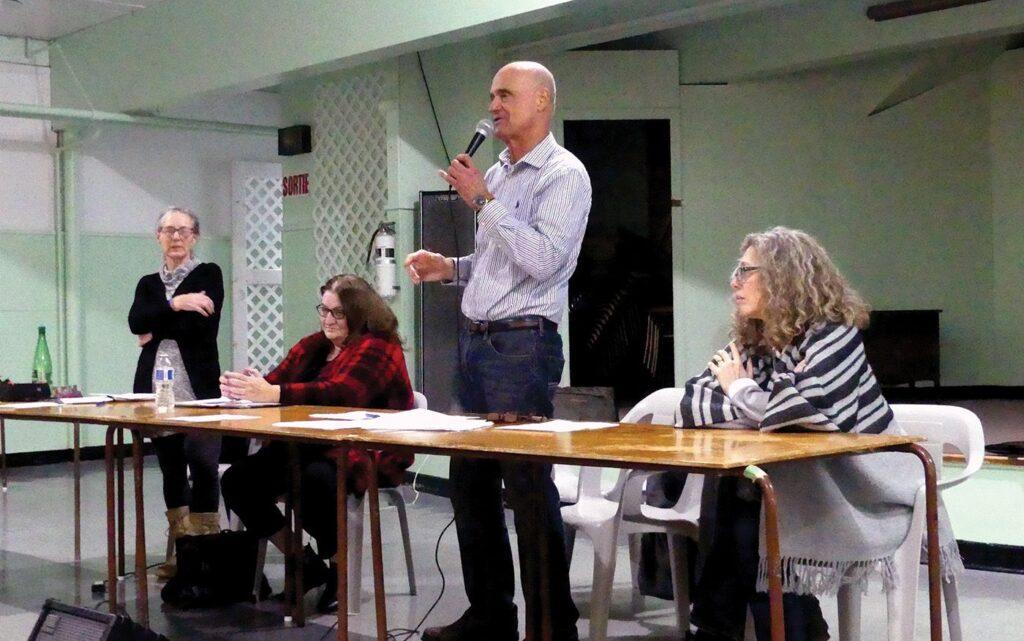
Given the severity of the issues facing the association, President Cheryl Beillard invited an outside facilitator from the Pontiac Community Development Corporation (CDC Pontiac) to run the meeting. Ellen Boucher, Director of Development for CDC Pontiac, stepped in and joined Beillard, Vice President Clair Taillefer and Secretary Linda Roy at the head table.
Attendance was balanced between a virtual cluster via Zoom and about thirteen persons at the gallery. The total number of attendees was less than at the special meeting just weeks prior.
As reported in THE EQUITY (artPontiac at a crossroads, Nov. 16, 2023) the biggest issues for the association relate to finances and personnel in that both are in short supply. These two items became the focus of the bulk of the AGM.
Beillard and Taillefer took turns presenting specifics contained within the Annual Report and were happy to report on the successes of the past year including a Professional Development Day, roundly applauded exhibitions at the gallery, the second year of running the Stone School Shop and a popular weekly schedule of “Plein Air” art sessions.

On the flip side, they noted a decline in participation with courses offered via the Pontiac School of the Arts branch of the association and cited several initiatives that did not reach fruition for a variety of other and yet similar reasons.
Adding to the overall tenor of monetary alarm, the financial report for the year, as presented in the handout and official Annual Report 2022-2023, was not adopted. Beillard took length to specify that there were errors in the report, what the errors were, and the difficulties that the association has had in dealing with the professionals on board to deal with such things.
The meeting took the unusual act of not accepting the financial report and also of not appointing auditors and accountants for the next year. It was accepted that the new board would have as a top priority the reconciliation and resolution of these items. It is here where Boucher’s experience and expertise were most on display.
Operationally, Beillard noted that the lack of helping hands meant that she, Taillefer and Roy have been running as a “working board” and this has to be a top, if not the top priority for the association. “There are simply too many tasks to be accomplished by too few people and we need more shoulders to the wheel,” she said.
Boucher stepped in and affirmed that artPontiac is not alone in this and “it’s a real struggle everywhere.”
In an effort to help an incoming contingent of hands, should there be one, the current board has taken measures to document as much as possible the discrete items comprising the various tasks making up the bulk of the association’s activities. They also said that they are all staying close at hand and are offering to help in the year ahead.
An initial cycle of nominations and votes resulted in only two board members, not enough to retain legal status as an association. Once this became clear, Stephanie Pete, attending via Zoom, stepped up and became a third board member offering the association a chance to move forward. She joins Bryan Chen and Maureen McAuliff as board members for 2023-2024.

Finances and personnel addressed at artPontiac AGM Read More »

La Fée des Bois Christmas market connects shoppers with the natural world

Camilla Faragalli, reporter

Funded by the Local Journalism Initiative

Hundreds of twinkling fairy lights decorated the grounds of La Fée des Bois on Saturday, the first day of a two-weekend Christmas market hosted by the farm this holiday season.
Inside the farm shop, ornately-packaged tinctures, soaps and teas, all made in-house from various medicinal plants, were on display for shoppers.
“It’s all local; local honey, local alpaca, local books from an herbalist in Wakefield,” said owner Mariane Desjardins Roy, who has been growing her medicinal plants on the property for 12 years.
“I’m just trying to add more every year to make it more special,” she said.
“I buy local, local, local. I try to avoid chemicals in my life. I love being outside and I really like connecting people to these things,” Roy said.
Visitors to the market could also harvest their own Christmas tree from the forest or choose one from a pre-harvested collection, explore some of the property’s trails, visit with the farm’s sheep and chickens, and warm up by a large outdoor fire that was burning throughout the day.
“It’s way over what I was expecting,” said Nathalie Dupont, who visited the farm for the first time on Saturday.
“I know quite a lot about herbalism and can’t believe all the work [here], the quality of the product, the smell.”
Dupont said the previous owners of her new house in Bristol left behind an anti-inflammatory cream, made by La Fée des Bois.
She sampled the cream to try and soothe her arthritis when she moved in a couple years ago, and loved it so much, she said she had to see the place it came from.
“[It feels] like you’re in the woods with the fairy,” said Dupont’s husband, Peter.
“I had no idea it was so beautiful.”
La Fée des Bois will host its Christmas market again the next two weekends.

La Fée des Bois Christmas market connects shoppers with the natural world Read More »

McDowell throws a beach party

Glen Hartle, reporter
Funded by the Local Journalism Initiative

The McDowell Elementary School in Shawville hosted a somewhat unusual winter party on Thursday. With colourful floral leis, tropical attire showcasing love for the sand, essential 60s era music wafting through the air, a tiki bar with fruit snacks and water, and a seemingly endless supply of party-goers, the McDowell Beach Party caught a wave and rode it ashore.
Brainchild of Bonnie Richardson and Greg MacIntosh, the party had been planned since September as a way to let parents know what their kids were doing in music class at the school and as a seasonal way to have something fun to do. The idea resonated strongly with parents and attendance was more than expected.
What was hoped for was fun and they had that in spades.
With MacIntosh on the keyboard and Richardson acting as emcee, conductor and sometimes guitar player, the roughly hour-long party was part sing-, dance- and clap-along and there was broad participation across the ages. On stage getting things going were the four-to-seven year old attendees of the school and they were encouraged to peruse the audience for would-be additions to the stage, which often resulted in parents and grand-parents making their way onto the gym floor as clear targets for young love.
Various tunes, popular across the ages, played across the mouths of the young and the less young. If You’re Happy And You Know It, We Are Children of the World, and We’re Going On A Bear Hunt resonated fully and these were augmented by a delightful rendition of Circle of Song with Richardson and MacIntosh and their Gingerbread Choir of youngsters. The evening culminated with a Conga Line and an invitation to limbo out of the gym and on to the rest of the season.

McDowell throws a beach party Read More »

Marina “hot topic” at North Hatley’s monthly meeting

By William Crooks

Local Journalism Initiative

The future of North Hatley’s marina was a hot topic at the town’s monthly council meeting held Dec. 4 at 7 p.m. Mayor Marcella Davis Gerrish presided over the notably short meeting (around 35 minutes), with a total of three residents in attendance. The low hum of a generator powering the meeting at the town’s community centre could be heard throughout, as the area was suffering from a power outage. Local events, budgeting, and financial aid were also discussed.

On the topic of North Hatley’s marina, it was stated that the council was aware of the many options they had to choose from regarding the marina’s model of operation for the 2024 season. It noted its commitment to an independent and transparent assessment of these options. Thus, it confirmed its decision to hire advisory firm Raymond Chabot Grant Thornton (RCGT) to aid in this task.

During question period, a local resident inquired as to why RCGT was hired to advise on the marina’s future when they are “more financial experts than anything else”. Gerrish acknowledged that the marina is a “hot topic” for those in the municipality. The council reached out to different people to look at the “global situation” to see what can and should be offered at the marina. The intention is to then present this information to residents. RCGT has a division with an employee who has previously analyzed three or four marinas to determine “what makes sense going forward”.

The resident then asked whether or not the company would be looking at the marina in its context as part of the center of the town. Just the marina, the land the marina sits on, and the services that are offered there, responded Gerrish.

The resident emphasized she thinks anything that happens with the marina must be part of an overall vision for the center of town. She worries that money will be spent on the marina that will not take into account other related problems with the center of town, particularly the fact it is a flood zone. Gerrish assured her that “all of that” will be taken into consideration.

Gerrish insisted the municipality will continue to own the marina and it is, therefore, its responsibility to figure out what it can do with the marina “without hurting anyone in the process”. Not everything in the center of town is owned by the town, Gerrish noted. Gerrish reaffirmed that there will be a public consultation pursuant to RCGT’s findings. “The goal from day one… was to include the population, because it’s our decision,” Gerrish said.

General Director Benoit Tremblay assured the resident that RCGT was qualified and this was only the first step towards determining what is to be the “global vision for the future” of the area. The resident asked to see the contract in question, but was told only the “service offer” could be made public, which will be put up on the town’s website shortly. RCGT’s analysis is predicted to take eight weeks.

Gerrish thanked members of the town’s public works department for helping with the second annual “lighting of the Christmas tree” event held Dec. 1. Some 30 to 60 locals attended and enjoyed the hot chocolate, coffee and donuts provided. It was nice to see such a turnout, given the bad weather, she added.

The town’s Christmas market will be held Dec. 9, from 1 p.m. to 8 p.m., in River Park. An extraordinary public meeting of the council will be conducted Dec. 13 concerning the adoption of the town’s 2024 budget. The Environment Committee will be putting out a series of “enviro-letters”, starting in December, explaining the various environmental concerns it has; its first will detail what it thinks is the best way to manage the town’s “shoreline zone”.

Two new town workers were confirmed as hired. The council reported that $44,361.72 was spent in total wages for the town’s employees in November. Monies amounting to a maximum of $104,045, before taxes, were confirmed to pay for renovations on the community centre for “better energy efficiency”.

Two resolutions were adopted to allow local residences to make minor modifications to their buildings. A resolution to put in a request for financial aid to improve the community centre for its new temporary role as a “child centre” was adopted. At the request of the MRC, the council adopted new regulations concerning alarm systems in the municipality. The council renewed a contract with the Red Cross, for $225, concerning helping “those in need”.

The meeting was adjourned at around 7:35 p.m.

Marina “hot topic” at North Hatley’s monthly meeting Read More »

Galt goes gold

Sporting performances of Galt athletes top tier last weekend

By William Crooks

Local Journalism Initiative

The basketball and hockey skills of Alexander Galt Regional High School’s male and female athletes dazzled throughout southern Quebec last weekend. Notably, the Junior Boys’ Hockey Team went undefeated and won the Soulanges Pionniers’ Tournament in Saint Polycarpe, and the Senior Girls’ Basketball Team won a tournament held at Sherbrooke’s CEGEP.

The Junior Boys’ Hockey team won all five games they played on their way to being tournament champions by winning the finals 3-2 against Cardinal-Roy, said Galt’s Athletic Director Robbie Fisk. The winning goal was scored with 56 seconds remaining in the game. The Senior Boys’ Hockey team lost 1-2 in their final of the same tournament. The Bantam Boys’ Hockey Team went 1-1-1 and failed to make the finals.

The Senior Girls’ Basketball Team went 3-1, winning their final championship game by four points. Eight teams participated in the tournament. The Bantam Girls’ Basketball Team made a valiant effort but failed to win a game.

The Senior Boys Basketball Team participated in a tournament at Howard S. Billings High School in Chateauguay, but Fisk had not yet heard what the results were.

Galt goes gold Read More »

Steadfast in their commitment to the community, the Aylmer food bank prepares to support families this holiday season

Photo 1: Centre Alimentaire Aylmer volunteers cooking meat pies for a recent fundraiser.

Photo credit: Aylmer Bulletin Archives

With more acute needs, the price of groceries and the price of living reaching all-time highs, the Centre Alimentaire Aylmer (CAA) is committed to supporting the Aylmer community. This year will be the 18th Christmas Share store, which is one of the organization’s major annual projects.

Photo 2: Archived photo of volunteers from the 2020 Christmas share stores event.

Photo credit: Centre Alimentaire Aylmer

The first part is the share store, where individuals and families can go to the CAA, where a store has been set up, and do their Christmas grocery shopping at a fraction of the retail price. Participants pay approximately 10% of the retail price, which allows them to get the food they need for their families, including non-perishable and perishable items. The Christmas share store will be open from December 11 to 15.

This store will help 160 households, a total of 412 people, 175 of whom are children. The children aged 0 to 12 will also receive a small toy for Christmas.

The second part of the project is their Christmas food distribution. The food centre prepares packages of meals that are delivered to the families. The packages include everything they need for a Christmas meal.

The two parts of the program will help approximately 800 individuals this year, according to Director of Programs and Assistant General Director Mercedes D’Trinidad.

The surge in food prices and the cost of living are affecting everyone, especially the food bank. “We are very thankful for the dedicated donors who support us year after year,” said D’Trinidad. “With the increased prices, even with the same amount of money, we have less buying power. We are having to adjust, but we are lucky that we are still able to help many families.”

According to their 2022-2023 annual report, the organization helps 711 families this year and distributes the equivalent of $38,755 worth of food every week. They recently distributed winter clothing for those who needed them. The food bank also offers psychosocial support. In the last year, they had individual meetings with 3,491 individuals.

There are approximately 195 volunteers who helped throughout the last year. In total, they contributed 13,500 hours of their time. The food bank is an essential service for many in the community. They rely on their partners, including Moisson Outaouais and the contributing grocery stores. They also receive donations from the business community and individuals.

How to help

One way to support CAA is by organizing a food donation collection, talking to your neighbours, and getting donations together. “Even small donations make a difference,” said D’Trinidad. Another way to help is through monetary donations through their website https://www.centrealimentairea…

Volunteering time is another way to support the organization. Although there are a large number of volunteers, many are older and have difficulty doing physical work or lifting associated with loading and unloading donations. “Even if it’s just three hours that an individual can give, it’s three hours that we really appreciate,” said Denis Parizeau, Director General.

The CAA is located at 67 rue du Couvent in Aylmer.

Steadfast in their commitment to the community, the Aylmer food bank prepares to support families this holiday season Read More »

Two-unit home on Brook Street in Old-Aylmer to be replaced with 8-unit building

Photo 1: Two-unit building at 64 Brook Street set to be demolished.

The home built in 1946, located at 64 Brook Street in old Aylmer may face demolition. The property owner submitted a demolition request for the existing two storey, two-unit home. There are currently tenants occupying both units.

According to the property owner, the current state of the building would require $307,160 to restore. It is valued at $220,700, while the land is valued at $155,300. Currently, the building has water seepage in the basement, a cracked foundation, and outdated plumbing, among other issues.

According to city documents, the building does not have heritage value. The Service d’Urbanisme et de Développement Durable (SUDD) supports the demol

ition request.

The property owner has submitted his preliminary land use plan, along with the demolition request. The plan details a two-storey, eight-unit apartment building. There are many multi-unit buildings on Brook Street and, therefore, the new building would blend with the surrounding area. The construction of a multi-unit dwelling will have to be approved by the municipal council.

Photo 2: Plans for the cleared land include a two-storey, eight-unit apartment building.

Before the plans for construction are approved, the Committee on Demolition Applications must accept or reject the demolition request. The decision will be made during the committee’s meeting on December 12 at 4:30 pm in the Mont Bleu Hall, located in the Maison du citoyen, 25 Laurier Street.

Residents wishing to address the committee must attend the meeting in person. Those who wish to watch the demolition committee meeting can do so via videoconference, which can be found on the Gatineau website on the public notices page.

Within 30 days of the decision, any resident or corporation can request a review of the committee’s decision by the municipal council. The authorization to demolish will be suspended until the review is complete. There is a fee of $122.50 associated with this process.

Two-unit home on Brook Street in Old-Aylmer to be replaced with 8-unit building Read More »

Nesbitts greenhouse: from small garage to household name

Muriel Nesbitt was born and raised in Aylmer. She came from a humble happy home. “We didn’t have much, but we were happy,” said the 97-year-old, reminiscing about her childhood. She and her eight siblings grew up in a home on Eardley Road, near where Nesbitts Greenhouse is now located.

She married her husband Herald Nesbitt, and raised her children at home. At the time, Mrs. Nesbitt supported her family by crafting various handmade items that she would sell to a store with eight locations in Quebec, and by hosting crafting open houses at her home.

Herald Nesbitt was a stationary engineer and had summers off. He grew up with a family who did market gardening; they would grow fruits and vegetables to sell wholesale to markets in Ottawa. Mr. Nesbitt had a small at-home greenhouse where he grew vegetables in the summer. In 1953, Mrs. Nesbitt had the idea to turn Mr. Nesbitt’s small greenhouse into a viable business. That summer they started selling vegetables out of their garage. They did not know it at the time, but their business would soon grow into the well-known and beloved large family-owned and operated greenhouse and nursery that it is today.

Later, Mrs. Nesbitt started reading about growing flowers. Soon after Mr. Nesbitt started growing flowers and Mrs. Nesbitt would sell them along with the vegetables.

The business was slowly growing, and they decided to hire someone to build a bigger greenhouse on their property. “I was so scared when we got the greenhouse, I thought nobody was going to come, but people did. Slowly, every week more people would come and soon there were people wall to wall. We were very busy,” said Mrs. Nesbitt. “People loved it, and I loved them. I loved what I was doing. We had a very happy place; the staff was happy, and we were happy.”

It was not without its challenges, however. Mrs. Nesbitt remembers that, when Allumettière was built, it redirected traffic and fewer people passed by the Greenhouse. However, it did not take long for customers to start flowing back.

Mr. and Mrs. Nesbitt’s son Ron Nesbitt grew up working at the Greenhouse and eventually took over the business which he now runs with his wife Sylvia Nesbitt. “I am very pleased with how they run Nesbitt’s. I couldn’t be happier, seeing it grow into what it is now,” said Mrs. Nesbitt.

Nesbitts is now a 45,000 sq.ft greenhouse and nursery that offers an impressive variety of flowers, plants, and everything one would need for their garden. It never strayed from its roots as a family owned and operated business even as it blossomed into the household name that it is today. Nesbitt’s Greenhouse is at 147 Chemin Eardley in Aylmer.

Nesbitts greenhouse: from small garage to household name Read More »

Historic class action suit targets Sherbrooke Archdiocese for decades of alleged abuse

By William Crooks

Local Journalism Initiative

In a groundbreaking legal move, the Arsenault, Dufresne and Wee (ADW) law firm has launched a class action lawsuit against the Sherbrooke Archdiocese, holding it responsible for alleged sexual abuses spanning from the 1930s to the present. The lawsuit seeks to address systemic failures within the Archdiocese and obtain justice for over 75 claimants who allege abuse by clergy and church personnel. With the promise of anonymity and no requirement for a police report, ADW urges all affected individuals to step forward in a pivotal moment for accountability and historical redress.

“This class action suit is aimed at the Sherbrooke Archdiocese,” said ADW Lawyer Jérôme Aucoin, targeting the Archdiocese’s liability for the fault of its subordinates. The individual priests or volunteer workers that are allegedly at fault are not being pursued by Aucoin’s firm. “It is almost like going against the employer for the fault of the employees,” he explained, which is a principle recognized in civil law in Quebec.

The suit concerns alleged sexual abuses that took place from the 1930s to the present day. These were said to have been committed by priests, employees of the church or volunteers.

The ADW is also alleging that the Archdiocese “could not ignore” the many actions of their priests; their handling of the problem is also faulty, since, for instance, they did not work out a “politics or framework” to protect their parishioners.

More than 75 people have contacted his firm and detailed cases of sexual abuse, reporting that over 40 individuals, mostly priests, but also a volunteer worker and an organist, are involved. All the accused are francophone, or have French names, he noted.

The firm is looking for reparations from the Archdiocese, but also public recognition of wrongdoing. It is important for the members of the lawsuit that they be acknowledged as victims of abuse, for often they were either not believed or told not to speak about what they had undergone. The firm will ask for a letter of apology along with damages, both of symbolic significance, Aucoin said.

Aucoin views it as abnormal that no English-speaking Townshipper has come forward to join the suit. The region has an important Irish heritage, he continued; there is an English-speaking Catholic population. He wonders if “something is going on”.

His firm does not have the exact numbers or a percentage of the English Catholics in the Townships, but they do know where they are primarily located: Ayer’s Cliff, North Hatley and Melbourne.

It is important for people to know, Aucoin insisted, that everything anyone tells them and anyone’s participation in the suit is protected by complete anonymity. A judge of Quebec’s Superior Court has ordered that the names of those involved be “entirely withheld”. Participation is completely free, Aucoin added.

No police report has to be filed, and no criminal action against any alleged abuser will be taken as result of this civil lawsuit.

Those who participate will speak with the firm and make a deposition, and the firm will document the consequences the abuse had on their lives. Damages in civil law are calculated according to the severity of the consequences.

Aucoin hopes everyone affected will call in, for the more people that take part, the stronger the claim. We are living through a historical moment where the wrongdoings of the past can be corrected in court, Aucoin emphasized. He recognizes it is not easy to speak up, but it is very important to do so.

The ADW can be contacted, regarding this suit, by phone: 514-527-8903, or email: actioncollective@adwavocats.com

Historic class action suit targets Sherbrooke Archdiocese for decades of alleged abuse Read More »

Caroling, caroling!

Bishop’s St. Mark’s Chapel Choir to hold Carol Services this weekend

By William Crooks

Local Journalism Initiative

Bishop’s University’s (BU) St. Mark’s Chapel Choir will be putting on its two annual Carol Services this weekend, Dec. 9 at 7 p.m. and Dec. 10 at 2 p.m. Director Sarah Heath will conduct the 22-member choral group in a series of anthems peppered throughout many traditional Christmas carols that all attending may sing along to. The event will be candle-lit and feature a local trumpeter, Nicolas Leblanc, and the Chapel’s organ, played by BU’s organist Pam Eby.

In years past, only one Carol Service was held, but it was so popular that two rows of extra chairs had to be placed in the aisle. “It was a bit of a hazard,” Heath admitted. So, they decided to do it twice. Heath has been heading the service for 11 years and also ran it back when she was a student at BU.

These carol services have been put on within anyone’s living memory, Heath said, possibly for over 100 years. It’s form models Cambridge university’s “nine lessons and carols” service. Readings are accompanied by a thematically-related carol or anthem, starting from the Garden of Eden to the birth of Christ. BU students, staff, and community members make up the group doing readings. BU Chaplain Jesse Dymond will be presiding over the service, but there is no communion or homily, Heath noted, just song after glorious song.

The choir used to travel into Cookshire to put on a version of the service, but no more, Heath explained. “It’s too much for the students at the end of the semester.”

The choir’s ranks are filled mostly by students, with some community members to top it off. “It’s a very strong choir this year,” Heath insisted. They sing together every Sunday, but really look forward to the Carol Services every year. Preparation began in October.

Last year the chapel lost power during the service, so it was “very candle-lit”, said Heath with a chuckle. She hopes it will not happen again, because the organ runs on electricity. Trumpeter Leblanc has been joining them for many years, and is well-known on the local music scene, Heath said. The service will conclude with a trumpet/organ duet postlude.

BU Student Ava Bogyay, who is taking conducting lessons for credit, will conduct one of the anthems.

Parking will be free on campus for the events, and Heath suggests arriving early to get a good seat. The service is free, but there will be a time for a voluntary offering, the proceeds of which go towards supporting music at St. Mark’s.

Caroling, caroling! Read More »
Feds, Google reach online news agreement

By Ruby Pratka

Local Journalism Initiative

The federal government has signed a $100-million deal with Google to compensate media outlets and ensure that articles from Canadian news outlets remain accessible on the market-dominating search engine, Heritage Minister Pascale St-Onge announced last week.

Earlier this year, Google threatened to de-index articles from Canadian news outlets unless the federal government walked back the Online News Act, a law passed this spring in order to create a mechanism for online platforms with annual revenues of over $1 billion to compensate news outlets. The company has agreed to put $100 million annually, indexed to inflation, into a compensation fund for Canadian media.

“For more than a decade the media sector has been disrupted by the web giants. More than 500 media outlets have closed, thousands of journalists have lost their jobs and a lot of information has gone unreported,” St-Onge, MP for Brome-Missisquoi and a former communications union representative, told reporters Nov. 29 on Parliament Hill. “Everywhere, governments are seeking to establish a more level playing field between the online giants and the media. Here, we’ve decided to pass the Online News Act. We’ve [also] found a way forward to respond to Google’s concerns.”

“Following extensive discussions, we are pleased that the Government of Canada has committed to addressing our core issues with Bill C-18, which included the need for a streamlined path to an exemption at a clear commitment threshold,” Kent Walker, president of global affairs at Google and its parent company Alphabet, said in a statement. St-Onge, for her part, called the agreement “a historic development” and said the government had made no significant concessions to Google. However, the $100 million annual payment agreed to was below the $172 million for which Google was liable according to previous government estimates.

St-Onge said the agreement would allow Google to “do business with a single collective representing all admissible media outlets.” Much remains to be seen about how the money will be divided and administered. Quebec Minister of Culture Mathieu Lacombe has called for CBC and Radio-Canada to be exempt from receiving money and for Quebec to have “a seat at the table,” and the Conservatives have pledged to repeal the act in the event they take power.

Brenda O’Farrell is the president of the Quebec Community Newspapers Association, which represents 33 English-language, bilingual and diaspora publications across Quebec (including the Record and the BCN). She said the agreement is a partial victory for Canadian media outlets. “The fact that there’s an agreement with Google is a good thing. What was at stake is that news in Canada would not be searchable on Google, and that catastrophe has been averted.”

However, she still has concerns about the law itself and about how the funds will be distributed. “The bill is a flawed piece of legislation. Everyone thinks it’s going to help media, but it will help some media partially,” she said. She pointed out that instead of negotiating compensation with individual media outlets, as originally planned, Google will negotiate with a collective. “The big dailies will be at the front of the line, they will carve out a bit for the Globe and Mail and a bit for the [Toronto] Star and Postmedia will get the remnants. [Major dailies] have gotten the lion’s share of every benefit and they have still cut jobs, circulation and coverage. Support for local media still needs to be addressed.”

O’Farrell called on the federal government to support small, local media outlets with ad buys and other targeted programs. “The foundational problem is that the government has to stop looking at media as one-size-fits-all.”

The law goes into effect Dec. 19. Walker stated that “While we work with the government through the exemption process based on the regulations that will be published shortly, we will continue sending valuable traffic to Canadian publishers.”

Google and Meta, Facebook’s parent company, are the only two companies covered by the law, designed to cover online platforms with annual revenues of $1 billion or more. Since June, people in Canada have been unable to share news content on Facebook. As of this writing, no agreement has been reached with Meta. “It’s up to Facebook to show why they are leaving their platform [open] to disinformation and misinformation instead of sustaining our news system,” St-Onge said.

Feds, Google reach online news agreement Read More »

Generations of song–a tale of three poems

The Bishop’s University choral scene, then and now

By William Crooks

Local Journalism Initiative

This past weekend, generations of choristers, the age gap between the youngest and oldest spanning over 60 years, performed three concerts in a tribute to the Beatles at Bishop’s University’s (BU) Centennial Theatre. Nearly 150 Champlain Lennoxville students and staff, BU students and staff, community members, and even a single highschooler, joined together in song in what was Co-Directors Fannie Gaudette and Jamie Crooks’ 25th year leading the BU Singers. Tom and Barbara Matthews, husband and wife, who sang together in BU’s choral group ‘Deep Purples’ in the late ‘50s and early ‘60s, took a stroll down memory lane in a recent interview. Backstage, on the night of Dec. 2, 2023, Tom read out poetic encomiums to Crooks and Gaudette, then received an honour of his own.

1950s: The Deep Purples

“I believe the Deep Purples started in ‘54 or ’55,” recounted Barbara. The director was a chemistry professor, Dr. Wally McCubbin. The Deep Purples were named after a popular song of the era. It was a really nice group, Barbara said, everyone had to wear uniforms with purple blazers and grey bottoms, the women in skirts. The group had around 40 people in it, considerable since BU only had just over 400 students at the time.

“The Deep Purples were all volunteers,” Tom said; BU did not have a music program. McCubbin was very demanding and they learned a lot from him.

“It just seems like yesterday,” Barbara continued, many of the buildings on BU’s current campus did not exist yet, like the Student Union Building. Concerts and plays were held in the gymnasium.

Barbara remembers that they sang everything from classical pieces to the popular music of the times. A subsection of the group formed a quartet, of which Tom was a member, who accompanied themselves with guitar and banjo. The group traveled and performed in places such as Thetford Mines, Ottawa, and Montreal. “We sang at King’s Hall, Compton, too,” Tom said, and other local high schools.

Barbara is not completely sure, but, after her and Tom had left, the famous Howard Brown likely took over from McCubbin in the mid ‘60s.

Upon graduation, Tom taught in northern Quebec in Mutton Bay. After nine years, he and Barbara returned and Brown was in charge. Eventually taking over from Brown was Nancy Rahn, followed by Crooks in the late ‘90s, with Gaudette as his accompanist.

2023: Backstage

Tom addressed the BU Singers backstage before their last performance of the recent show on the night of Dec. 2.

“Do you remember last night when Fannie and Jamie stood up and thanked everybody?” Tom queried, “but nobody said anything to them… so… I have something…”

After emphasizing how pleased he was to still be singing with so many people of individual and collective talent, who all made the worthwhile sacrifice to put on this show, Tom read two poems, one devoted to Crooks and one to Gaudette:

Jamie Crooks

Who knew this show was cooking,

In Jamie’s fertile mind;

(I’ve sung for him for MANY years,

So many that I find

There’s somewhat of a ‘blur effect’

In sorting out the shows…)

He’s been our maestro sans pareil,

As everybody knows,

In every show he’s ever launched,

Both here and on the road,

(And those were trips we shan’t forget!)

We literally showed,

The very best that Bishop’s has

In music – song and dance!

So thank you Jamie for the Beatles,

Giving us this chance

To come once more together to

Do what we love to do,

And watch you from our first-class seats,

Singing, dancing too!

Tonight, we watched you watching us

We watched you like a hawk,

Directing us, correcting us,

(Occasionally not…)

For some of us, who show the signs

That time is creeping on,

The Beatles were quite radical,

When first they came along…

They shocked our parents, baffled critics

In 1962,

For what on earth could threaten more,

Than this song ‘Love me, Do’!

But thankfully for all of us,

None of them were right –

SO

We got to open with Magical Mystery,

And end our show with Good Night!

Yes, Thank you Jamie, for this show,

Our memories will last…

George Harrison knew ‘bout change and I

Shall ponder ‘All Things Must Pass’

Fannie Gaudette

Is there anything musical Fannie can’t do?

Just think about what we have seen!

Arranging our music, re-arranging as needed,

Nothing’s beyond her, it seems!

Guiding, supporting, leading and helping,

She’s never heard of – ‘defeat’!

Committed to get our production top-ready,

She remained, no surprise, quite upbeat!

Behind the scenes when we’re all so pressed,

To get our show polished and ready,

She worked with the techies, stage crew, musicians…

Remaining, of course, calm and steady.

There’s so much you give us, our very Dear Fannie,

You’ve even provided a band!

And very great skills in all that you do,

… But Fannie, I don’t understand

How often you know just what Jamie is thinking,

More often seem one step ahead,

Is it all likely, in terms of the Beatles,

You’ve joined them inside Jamie’s head?

Thank you, Dear Fannie, for musical gifts

You’ve shared with us all through the Fall,

Without you, I wonder if we’d have a show!

Yes, thank you, I’m sure, from us all

Tom’s surprise

Stepping forward after Tom’s poems, and urging Tom to remain center stage, chorister and retired BU professor Stuart McKelvie addressed the group. Noting that Tom’s contribution itself had not been recognized, McKelvie read out a limerick of his own:

There is a young noble vocalist named Tom

Who’s given some seven decades to Bishop’s choir song.

He also pens lyrics

That wow all the critics

Which is why we award him this nobel medallion.

McKelvie presented Tom with a golden medallion embossed with the word ‘lyrics’ to the enthusiastic laughter and applause of those gathered.

Generations of song–a tale of three poems Read More »

“À toi la parole!”: Empowering Youth Voices in VSP

In an exciting initiative to foster youth engagement and empower the voices of young people, the Villeray–Saint-Michel–Parc-Extension borough is hosting a unique event titled “À toi la parole!” on Monday, November 27. This event is specially designed for youth aged 12 to 17 and offers them a platform to discuss issues that matter to them while sharing their visionary ideas for the future of the Villeray neighborhood.

The main objective of “À toi la parole!” is to create a welcoming and dynamic space for young individuals to connect with their elected officials and understand the workings of the municipal process. This initiative aims to demystify the complexities of local governance and provide an opportunity for open dialogue between young residents and the members of the borough council.

The event is scheduled for Monday, November 27 from 4:30 PM to 7:30 PM at Le Prévost Library, located at 7355 Christophe-Colomb Avenue. Registration is easy, either in person at the library or by calling 514-872-1526. The event includes a diverse range of activities throughout the evening, starting with a warm welcome at 4:15 PM, followed by an icebreaker activity, a presentation on borough council operations, interactive workshops, an opportunity to meet elected officials, a dinner activity, and closing remarks by council members, all designed to engage and empower young voices. As an added incentive, attendees will enjoy complimentary meals, and two STM public transportation tickets will be provided for each participant. There will also be a thrilling prize draw at the end of the evening.

“À toi la parole!” represents an important milestone as the first youth consultation space project in the Villeray–Saint-Michel–Parc-Extension borough. It demonstrates the commitment of local authorities to involve young voices in shaping the future of their community.

Furthermore, this exciting initiative is just the beginning. In 2024, the project is set to expand its reach to include the Saint-Michel Library and the Parc-Extension Library, promising even more opportunities for young residents to have their say in the development of their neighborhoods.

“À toi la parole!”: Empowering Youth Voices in VSP Read More »

Council rejects project at 390 Chemin McConnell, updated proposal to be discussed at December 5 meeting

By Greg Newing, The Aylmer Bulletin LJI Reporter

City Council rejected plans for a mixed residential and commercial construction project at 390 Chemin McConnell at its meeting on November 14. The project involved a six-storey building with 91 units and commercial properties on the first floor. Construction would have removed a significant number of trees in a forested area on the site. Councillor Murray called for a vote on the project at the council meeting, arguing that it did not respect the city’s criteria to limit the number of trees cut down in a single project, especially trees of special environmental importance. She stated, “While the project does preserve some of the trees on the site, in my opinion it does not preserve a sufficient amount of woodland, nor do the proposed new trees to be planted sufficiently compensate for the existing ones.” The project was rejected with 12 votes against, seven in favour and one abstention.

Murray said that she is not opposed to the idea of a mixed construction project in the area, and highlighted the fact that many of the units were affordable and large enough to accommodate families. However, she said that any potential project would need higher environmental standards, “It is a sector that is expected to significantly grow in density. The project is in a woodland right next to a major ecological corridor, and I personally would like to see a proposal that better preserves the environment, given that it is a sensitive zone where many of the trees will likely disappear in a few years’ time,” said Councillor Murray during the council’s preparatory caucus.

Councillor Murray said that the developer offered to modify the project proposal to reduce its environmental impact following the council’s decision. While she did not yet have details about the modifications, she said that the developer offered to re-plant a higher number of trees than initially proposed. Murray said that the updated project will be on the council’s agenda at its next meeting on December 5.

The woodland at 390 Chemin McConnell is listed as woodland for protection and integration (Boisé de protection et d’integration). While this does not mean that construction cannot happen in this zone, the city’s by-laws state that projects must limit the number of trees that are cut down and avoid harming trees which are important for the surrounding landscape.

Council rejects project at 390 Chemin McConnell, updated proposal to be discussed at December 5 meeting Read More »

MP Sophie Chatel: Fall Economic Statement will impact housing, daily living in Pontiac

By Greg Newing, The Aylmer Bulletin LJI Reporter

The federal government’s 2023 Fall Economic Statement was made public on November 21. The statement provides an overview of Canada’s economic situation and introduces new measures geared towards supporting employment, housing and addressing rising costs of everyday living. We spoke with Pontiac MP Sophie Chatel about what impacts the new measures will have for those living in the Pontiac riding.

Affordable housing is one of the major priorities for 2023-2024 and the federal and provincial governments have both invested an additional $900 million in housing development in Quebec. Chatel said she has been speaking with developers and there is a growing interest to build in the Pontiac, “Now that the population is growing, there is a great opportunity to increase out housing stock and welcome new residents,” said Chatel. However, she added that infrastructure upgrades for drinking water, also electricity, wastewater, road and internet service are needed to accommodate new housing projects.

While new infrastructure funding was not included in the statement, it said it will be announced in the 2024 budget. As the chair of the Rural Liberal Caucus, Chatel said she has been advocating for increased infrastructure investment and is confident that the new budget will include the support needed for new development in the Pontiac when it is announced next spring.

Mortgage interest rates are forecast to start going down by mid-2024 and requirements and application processes for new mortgages will be streamlined and simplified. A new Canadian Mortgage Charter was also announced. While the charter is not law, it lists clear expectations and guidelines for how banks should treat borrowers struggling to pay their mortgage. New co-op rental housing developments will also no longer be charged GST.

To address the rising costs of daily living – especially food prices – Chatel said there will be major amendments to Canada’s competition laws, “The current situation has led to a system where grocery chains control the price of food and food inflation is completely passed on to consumers. We want to break this cycle by increasing competition and leaving room for small grocers to provide more affordable food.” She said the government will also continue to meet with big grocery chains to address inflation in food prices.

Chatel highlighted additional developments that she expects will be relevant for the Pontiac including removing barriers to labour mobility within Canada – particularly in construction, childcare and health care. The repayment deadline for Canada Emergency Business Account (CEBA) loans, to qualify for partial loan forgiveness of up to $20 000, is extended to January 18, 2024, and four additional weeks of employment insurance benefits were announced for seasonal workers such as those in the tourism sector.

There will also be a 30% tax credit for biomass systems that produce electricity or heat from organic waste and a new program will provide households with up to $15 000 plus a $250 payment incentive to switch from oil to electric heat pumps.

While the Canadian Journalism Labour Tax Credit program was expanded, Chatel said that the changes are unlikely to benefit smaller community newspapers and radio and has been advocating for new measures to support local media.

To view the 2023 Fall Economic Statement and read about other programs and measures visit www.budget.canada.ca/fes-eea/2023/home-accueil-en.html.

MP Sophie Chatel: Fall Economic Statement will impact housing, daily living in Pontiac Read More »

Strike challenges and impact on health services in Quebec

By William Crooks

Local Journalism Initiative

The Common Front, a union group comprised of 420,000 Quebec public sector workers, announced plans for a seven-day strike from Dec. 8 to 14. According to Danny Roulx, provincial representative for the Alliance du Personnel Professionnel et Technique de la Santé et des Services Sociaux (APTS), part of the Common Front, public sector health workers face particular challenges.

In a recent interview, Roulx shared insights on the ongoing strike and its significant impact on the health network in Quebec.

Roulx highlighted the withdrawal of a key “centre documentaire”, a centre that holds important documentation, a move that has affected several sectors within the health network. This action has prompted various sector workers to craft new responses to the challenges they now face, especially those working with individuals suffering from sexual disorders or behavioral issues. “All of this was removed by the employer,” he said, and it is important for them to put it all back in place.

A critical aspect of the strike revolves around the financial strain it places on APTS members. Roulx confirmed that while there is strike compensation, it kicks in only after a certain period (60 days), acknowledging the monetary sacrifices members are making. The core message from the APTS members is clear – enough is enough. After years of vocalizing their issues and suffering salary losses, they demand an augmentation of their conditions. The loss of skilled professionals to other sectors or places offering better salaries is a stark reality that the health network faces.

Roulx passionately spoke about the struggle to maintain a network that provides quality care and upholds the standards of the past. He pointed out that the current scenario often forces them to make difficult decisions about the care they can or cannot provide, deeply affecting the members who are dedicated to the health network.

The APTS’s stance is not just about immediate concerns but also about the future of the health network. The strike is seen as a necessary step to ensure a sustainable, efficient, and caring health system that attracts and retains qualified personnel.

“One woman out of ten in Quebec works in the health network – where do you think they’ll go?” he added.

The support of the population and the government’s willingness to acknowledge the gravity of the situation are pivotal in this regard.

Roulx also touched upon the challenges faced in reallocating personnel during the pandemic, critiquing the arbitrary manner in which decisions were made. He emphasized the need for equitable mechanisms in managing staff movements and placements, ensuring that personnel are familiar with and trained for the sectors they are moved to.

On the possibility of escalating the strike to an unlimited duration, Roulx expressed a firm resolve to go all the way next time, underlining the importance of continuous pressure to bring about change. The overarching goal is clear – to improve the network for the benefit of both the workforce and the patients, making it a win-win in the long run compared to the losses incurred during strike days.

Roulx emphasized the broader societal impact of the strike, particularly on parents and the education system. He drew attention to the numerous services postponed due to staff shortages and challenging working conditions, a situation that pales in comparison to the strike’s impact.

“We understand very well… that [poor working conditions] paralyze the networks, including education… I can tell you that out of 365 days, the number of services that we have [had] to postpone, whether it’s an operation, surgery, mental health services, given the personnel shortage, [is considerable],” Roulx insisted.

Responding to a request for an interview, CIUSSS de l’Estrie – CHUS Media Relations member Eliane Thibault sent the following statement over email:

“For the moment, we are not able to provide a precise response regarding the consequences of [the] seven-day strike. However, there will be slowdowns and reductions in care and services. Several factors must be considered in the organization of services during this strike, which will be longer than the previous ones, including the fact that it affects the weekend shifts. We will also have to deal with the strike of the employees who are members of the FIQ, who have also announced strike days from Dec. 11 to 14.”

Strike challenges and impact on health services in Quebec Read More »

Sûreté du Québec leads province-wide initiative against intimate partner violence, sets up in Cookshire

By William Crooks

Local Journalism Initiative

The Sûreté du Québec (SQ), in collaboration with a diverse array of partners, launched a province-wide campaign Nov. 29 to combat intimate partner violence (IPV). Marking a significant step in public awareness and action, these concerted operations spanned across Quebec, involving strategic interventions on road networks and local business kiosks, including one at Cookshire’s main intersection of routes 108 and 253. This year’s campaign, building on the success of last year’s 90 operations, extends the involvement to various municipal police services and indigenous police forces, amplifying its reach and impact.

“The fight against intimate partner violence requires a unified front,” stated Caroline Girard, Lieutenant Coordinator of the SQ’s specialized IPV team. “Our concerted efforts today, alongside organizations directly aiding victims, demonstrate a powerful collaboration of expertise and resources, reinforcing our commitment to support and protect victims and their families.”

These awareness operations underscore a societal call to action, emphasizing the collective responsibility in addressing and preventing IPV, states a press release. The campaign features the participation of significant organizations such as SOS Domestic Violence, the Federation of Women’s Shelters, and the École Nationale de Police du Québec, among others. This initiative is not just a law enforcement operation but a societal movement, aiming to weave a comprehensive safety net for victims and their children and enhance access to available support resources.

“It is the second edition of this type of operation,” said SQ Agent Louis-Philippe Ruel on the scene in Cookshire before the intervention began. Its aim is to engage those that are not usually reached on the topic of IPV and inform them of the various related public resources at their disposal. With the holiday season approaching, it is important for people to know they must not remain “mute” in the face of IPV, he explained.

He emphasized that incidences of IPV must be reported to the authorities or other organizations tasked with dealing with those situations, whether one was personally involved in the incident or was merely a witness.

“Frédérique”, an intervener at La Méridienne, a local organization with the mission of helping female victims of domestic violence, and their children, participated in the initiative in Cookshire. Her real name was kept confidential for security reasons having to do with her vocation. The organization supports afflicted women and children with all aspects of their situation, including helping them navigate the legal system and with their health, both physical and psychological. She expressed her gratitude that Quebec police forces organized this initiative.

The police and interveners set up at the Cookshire intersection, flagged down cars traveling through, and, handing out pamphlets, spoke briefly with commuters to raise awareness.

Sûreté du Québec leads province-wide initiative against intimate partner violence, sets up in Cookshire Read More »

Google agrees to pay $100-million per year to news companies in Canada

Lorraine Carpenter, Local Journalism Initiative reporter

According to multiple news sources in Canada, Google has agreed to abide by legislation put forward by the federal government requiring the tech giant to compensate Canadian news companies for their content online.

Google has reportedly agreed to pay $100-million per year to news companies in Canada.

The government had initially estimated the annual amount owed by Google to Canadian news outlets at $172-million.

Federal Heritage Minister Pascale St-Onge is expected to formally announce the news in a press conference at 1:30 p.m. this afternoon.

Meta continues to protest Canada’s Online News Act — aka Bill C-18, which comes into effect on Dec. 19 — with a ban on Canadian news content on their Facebook and Instagram platforms.

Google agrees to pay $100-million per year to news companies in Canada Read More »

India Reinstates Electronic Visa Services: A Relief for Parc-Extension’s Indian-Canadian Community

In a significant development that promises to ease strained ties between Canada and India, the Indian government announced the reinstatement of electronic visa services for Canadian nationals. This move, reported by the Associated Press, comes at a crucial juncture in the bilateral relations of the two nations, particularly resonating with the Indian-Canadian population in Montreal’s Parc-Extension.

Parc-Extension is home to a substantial number of Indian-Canadians, has been closely monitoring the escalating tensions. These were primarily fueled by Canada’s allegations against the Indian government regarding the assassination of Hardeep Singh Nijjar, a Sikh leader in British Columbia. Prime Minister Justin Trudeau’s endorsement of these allegations added to the growing unease within the community, concerned about the impact on familial and business ties with India.

Nijjar’s death in Surrey, involving masked gunmen, intensified these tensions. India’s longstanding accusation of Nijjar’s terror links, which he denied, and Canada’s subsequent claim of India’s involvement in his assassination, marked a low point in diplomatic relations. The situation worsened when Canada recalled a significant number of its diplomats from India following threats to their diplomatic immunity.

The Indian-Canadian community in Parc-Extension, which maintains deep-rooted connections with India through family, culture, and commerce, found themselves caught in the crossfire of these diplomatic exchanges. The resumption of electronic visa services by India is thus a welcome relief, signaling a potential thaw in relations and easing travel for family visits, business trips, and cultural exchanges.

While the core issues at the heart of the diplomatic rift remain unresolved, the latest development is a step towards normalizing relations. It offers a glimmer of hope to the Indian-Canadian residents of Parc-Extension, who yearn for harmonious and stable ties between their adopted and ancestral homelands.

India Reinstates Electronic Visa Services: A Relief for Parc-Extension’s Indian-Canadian Community Read More »

Montreal’s Response to Israeli-Palestinian Conflict-Linked Events: Ensuring Safety in Parc-Extension

In recent weeks, Montreal has witnessed a series of events related to the Israeli-Palestinian conflict that have targeted both Arab-Muslim and Jewish communities. As tensions escalated, the Service de police de la Ville de Montréal (SPVM) swiftly mobilized to prioritize the safety and peace of the entire population, including the diverse community in Parc-Extension.

From the beginning of the conflict, the SPVM implemented various measures to maintain peace and security. These measures include increasing visibility around places of significance to the affected communities, such as places of worship and schools. In addition to local neighborhood police stations, specialized and investigative teams have been deployed to provide support.

In response to recent events, the SPVM has further intensified its visibility plan. Moreover, the police force has established close contact with representatives from the Arab-Muslim and Jewish communities. Regular meetings are held to exchange information, perspectives, and to assess the ongoing situation.

Assistant Director Vincent Richer emphasized the SPVM’s commitment to maintaining calm and ensuring the safety of all residents. He stated, “The SPVM reiterates its call for calm and wishes to reassure the population: we are redoubling our vigilance and we have all the necessary personnel, at the operational level, to carry out our mission. All communities have the right to live in safety. Hate crimes are unacceptable, we take them very seriously, and we spare no effort in tackling them.”

For those who feel threatened, unsafe, or believe they are experiencing harassment, threats, or hate discrimination, the SPVM encourages immediate contact. Residents can reach out to the police by calling 911 or their local neighborhood police station. Each report is treated promptly, ensuring that every individual’s concerns are addressed with care and urgency.

The SPVM’s proactive measures, coupled with ongoing collaboration with affected communities, reflect a commitment to fostering peace, security, and harmony in Montreal, including neighborhoods like Parc-Extension. In these challenging times, it is essential for all residents to stand united against hate and discrimination, and to work together to build a safer and more inclusive city for everyone.

Montreal’s Response to Israeli-Palestinian Conflict-Linked Events: Ensuring Safety in Parc-Extension Read More »

Support Urgently Needed for Parc-Extension Independent Businesses in Light of Federal Fall Economic Statement

Support Urgently Needed for Parc-Extension Independent Businesses in Light of Federal Fall Economic Statement

Parc-Extension, is home to a diverse array of independent businesses, from cozy cafes to family-run shops. These small and medium-sized enterprises (SMEs) have been the backbone of our community, offering unique products and services while fostering a sense of connection. However, recent challenges have left many Parc-Extension SMEs struggling to keep their doors open.

According to the Canadian Federation of Independent Business (CFIB), the Federal Fall Economic Statement 2023 provides an opportunity for the government to announce measures aimed at supporting SMEs. Rising costs, driven by factors such as high-interest rates, pandemic-related debts, declining consumer demand, and labor shortages, have created an uncertain future for many Parc-Extension businesses. It is crucial that the government steps in to assist and protect these local enterprises, which have not seen normal sales for over three years.

Jasmin Guénette, Vice-President of National Affairs at CFIB, highlights the urgency of the situation. He states, “The government needs to do more to help and protect [SMEs].” Parc-Extension businesses are eagerly awaiting support measures that can alleviate their financial burden and help them weather these challenging times.

Key Measures Hoped for in the Fall Economic Statement 2023:

Emergency Business Account (CEBA) Loans: CFIB is advocating for an extension of the CEBA loan repayment deadline to December 31, 2024. This extension would allow businesses to keep the subsidy portion and provide much-needed relief. Guénette emphasizes that the recent 18-day extension announced by Ottawa is insufficient for SMEs, many of whom are still far from recovering their normal revenues.

Assisting SMEs with Rising Operating Costs: To support these businesses, CFIB proposes the cancellation of the planned increase in Employment Insurance (EI) premium rates in 2024 and a reduction in EI premiums for smaller businesses. Additionally, CFIB suggests postponing the gradual phase-out of accelerated depreciation deductions and making immediate expensing permanent. These measures would encourage Parc-Extension SMEs to invest in automation and cope with labor shortages.

Carbon Tax: CFIB recommends expanding the exemption for heating oil to all other types of heating fuels used by Canadian SMEs, including natural gas. Furthermore, they call for a freeze on all future carbon tax increases, including the one scheduled for April 1, 2024. Immediate reimbursement of funds promised to Parc-Extension SMEs that have paid the carbon tax since 2019 is also crucial. CFIB estimates that businesses in the neighborhood have received only a meager 0.17% of the revenues from the carbon tax, despite the initial promises.

Christina Santini, Director of National Affairs at CFIB, stresses the importance of these measures for SMEs, stating, “The federal carbon tax is unfair to SMEs. SMEs contribute a significant share of the revenues generated by the carbon tax but do not receive the same rebates as households. SME owners want the government to freeze future carbon tax increases and return the promised amounts to them.”

Support Urgently Needed for Parc-Extension Independent Businesses in Light of Federal Fall Economic Statement Read More »

The Exodus of Skilled Professionals in Quebec’s Public Schools: A Growing Concern

The Exodus of Skilled Professionals in Quebec’s Public Schools: A Growing Concern

In the borough of Parc-Extension as well as all over Quebec, public schools are facing a silent yet significant crisis. This issue extends beyond the realm of teachers to encompass a range of professionals crucial to the educational framework. According to recent local media reports, there is a troubling trend: a growing number of specialized professionals, such as special education technicians, psychologists, and speech therapists, are departing the public school system. This exodus is not merely about unfilled positions; it’s causing a domino effect that jeopardizes the academic achievement of students, especially those requiring special educational support.

As of October 2022, the number of positions waiting to be filled in these specialized roles surged from 1076 to 1996 within a year, highlighting a growing crisis. The Ministry of Education cautions that these figures are subject to change and advises careful interpretation. However, the upward trend is unmistakable and worrying.

Jacques Landry, president of the Federation of Quebec Education Professionals (FPPE-CSQ), points out the vicious cycle at play: fewer professionals on the ground make the work less appealing, accelerating the shortage. He criticizes the Legault government’s approach, describing it as “willful blindness” to a system in continuous decline. According to Landry, the lack of adequate tools and support is forcing many to abandon the public sector.

This problem isn’t confined to a few schools; it’s a province-wide issue. Kathleen, the president of the Montreal Association of School Establishment Directors (AMDES), echoes the concern. These professionals, essential in classrooms and playgrounds, are increasingly difficult to retain. She points out that the annual reevaluation of budget allocations by Quebec prevents schools from offering many permanent positions, leading to a sense of instability among the professionals.

Nicolas Prévost, president of the Quebec Federation of Educational Establishment Directors (FQDE), observes a trend of these skilled workers turning to the private sector, attracted by better employment conditions. He highlights that the most immediate victims of this professional desertion are students with special needs, who face longer waiting times for essential evaluations and services.

The Human Rights and Youth Rights Commission (CDPDJ) in 2018 reported that students with disabilities or learning difficulties represent a significant portion of the public school network. Yet, there’s a glaring mismatch between the number of students and the available specialized staff. The situation has reached a point where even the Ombudsman, in 2022, recommended establishing a minimum threshold of services for students.

Professional bodies are raising alarms too. Dr. Christine Grou, president of the Order of Psychologists of Quebec, and Paul-André Gallant, president of the Order of Speech Therapists and Audiologists of Quebec, emphasize the critical shortage of professionals in their respective fields. They note that the scarcity of such professionals is hindering the provision of adequate support and mental health services to students.

The numbers paint a stark picture: in 2013, there were 966 psychologists for 864,491 students in Quebec’s public schools. Ten years later, despite an increase in student numbers, the psychologist count has dropped to 787. This decline in professional support staff is not just about numbers; it’s about a generation of students at risk of being underserved, potentially impacting their future prospects.

The Exodus of Skilled Professionals in Quebec’s Public Schools: A Growing Concern Read More »

Local eco-friendly woodworker and designer gets Manufactured in Quebec seal

Danou Charette, local artist and woodworker from Cantley, working on creating his unique wood furniture pieces. Photo credit: Danou Charette

Danou Charette, known simply as Danou, is an eco-friendly woodworker and artist who creates furniture and art pieces in his shop in Cantley. Recently, Danou products got the Manufactured in Quebec seal through the Les Produits du Québec program.

Produits du Québec is a non-profit organization, supported by the Quebec government. The program was based on the Aliments du Québec seal that has been indicating to consumers which food products are made in Quebec. Manufactured in Quebec is a certification that allows people to shop for locally made products. It is a guarantee to consumers, as the seal requires a thorough verification process.

“Obtaining the Manufactured in Quebec certification was an obvious thing to do for my business, knowing that my clientele is mostly local,” said Danou. “I’m proud to offer a second life to trees, to revitalize the wood of our forests, and to partner with other local businesses in the spirit of solidarity and reciprocity. I believe consumers can appreciate not only the quality of my product but of the thought that is put into it.”

Danou has been creating his minimalist and modern pieces since 2017 from reclaimed solid wood from Quebec forests. The young entrepreneur’s goal is to show consumers that it’s possible to buy responsible and sustainable products that are unique and beautiful.

“Wood is not a raw material, but a gift from nature that we have a duty to protect,” said Danou, who highlights that he uses wood that has already been cut or trees that have fallen to recycle it. Danou salvages any wood he can find, even pieces that others may have discarded. The non-standardized wood leads to unique and interesting creations.

Danou’s passion for trees and woodworking partly stems from his family connection to woodworking. His parents lived in a home surrounded by forest; his father was a wood sculptor; his grandfather owned a mill; and, his uncle was also a woodworker.

Danou offers workshop tours to the public by appointment and on open house days. This gives individuals a more in-depth view of Danou’s work and process. The woodworker does custom projects and, to discuss a custom piece, individuals can book a virtual consultation through the Danou website: https://danoucharette.com/

Local eco-friendly woodworker and designer gets Manufactured in Quebec seal Read More »

Rural healthcare in the spotlight across the Outaouais

Deborah Powell
Local Journalism Initiative

BRISTOL – Close to 30 people were at Jack Graham Hall in Bristol on the evening of November 9 for a session entitled Ensuring Access To Healthcare In Rural Areas, Listening To Rural Communities. The event was one of four held simultaneously across the Outaouais, organized regionally by Action Santé Outaouais in conjunction with local grassroots organizations such as Pontiac Voice.

The evening opened with an hour-long online panel in French with Chantal Lamarche, Warden of the MRC Vallée-de-la-Gatineau; Dr. Ruth Vander Stelt, Quyon doctor and board member of the RQMDSS – a group of Quebec doctors for decentralization of the health system; and Roch Martel, who has been working as a consultant for the MRC Vallée-de-la-Gatineau’s project for local healthcare management.

Major points from the panel discussion included consensus that the provincial government’s “one-size-fits-all” measures don’t work because urban and rural situations are not the same. The importance of returning certain decision-making powers to local health personnel so they can innovate in finding solutions was also underscored. The need to return lost services to the regions as well as the “human touch” were points agreed upon as essential to restoring citizen confidence in the healthcare system.

While the automatic English translation of the panel discussion was dubious at times and required very fast reading on the part of the audience, most participants said they were able to get the gist of what the panelists were saying. Small group participant discussions touched on the same points the panelists had gone over. The return of lost local services for things such as cataract surgery and obstetrics were major items. Attendees were provided with a booklet containing 6 questions to help structure the discussions.

Dr. Ruth Vander Stelt arrived at the hall in person to contribute to the workshop conversations. “Local mobilization is essential to improving our services. People need to provide feedback and help the Local Users’ Committee to do its work,” she said, repeating a point made during the panel discussion when she had also said effective citizen committees make citizens feel heard and supported.

Nicole Boucher-Larivière, Proximity Director for Pontiac Local Service Network (RLS) was also present for the workshop discussions. She was appointed less than a year ago by CISSSO, the regional health authority. “I’m confident that if we all start working together we can improve. The key is to work as a community network,” she said, while recognizing the particular difficulties the Pontiac faces, such as the challenge of recruiting bilingual personnel to serve the 65% of the population who are English-speaking.

Photo: Josey Bouchard (centre) of Pontiac Voice, the local organization behind the “Listening to Rural Communities” event, shares her experiences during the small group discussions that followed the online panel.

Rural healthcare in the spotlight across the Outaouais Read More »

MRC Pontiac Warden’s Breakfast

Clifford Welsh
Local Journalism Initiative

CAMPBELL’S BAY – The second annual MRC Pontiac-sponsored Centraide Outaouais fundraising breakfast was held November 20 at the Campbell’s Bay RA Hall. The breakfast was initiated last year by MRC Warden Jane Toller to raise funds for, and awareness of, the work done locally by Centraide Outaouais (CO).

CO Director General, Cedric Tessier, explained the work the organization does: helping last year over 7,000 individuals in the Pontiac and partnering with seven agencies that are actively fighting “poverty and exclusion.” This year, CO distributed $223,000 between Bouffe Pontiac, Centre Serge Bélair, Comptoir St-Pierre in Fort-Coulonge/Mansfield, Le Jardin Éducatif du Pontiac, Les Maisons des Jeunes du Pontiac, Maison de la famille du Pontiac and Le Patro de Fort-Coulonge/Mansfield.

Tessier expressed appreciation to Warden Toller for continuing the breakfast this year and to all the business, community and political leaders and individuals who attended to show support for CO. A total of 129 tickets were sold and many local mayors and others who were not able to attend donated their tickets to Les Ami(e)s du Manoir St-Joseph so that 24 of the residents were able to attend the breakfast.

Speakers at the event, representing some of the organizations receiving support from CO, included Martin Riopel of Jardin Éducatif, Kim Laroche of Bouffe Pontiac, and Director General Stéphane Durocher of Maison des Jeunes and Le Comptoir St-Pierre. All the speakers described how the funds received from CO are critical to their operations and expressed their appreciation to CO and those who donate to campaigns such as the Warden’s Breakfast.

Campaign President Denis Harrisson expressed appreciation to those who attended and volunteered their time to make the Warden’s Breakfast a success. Harrisson described how across the region over 88,000 people have been helped through the work of CO and their program partners. He also spoke to the needs of addressing poverty, housing and mental health with caring and compassion, which requires support from campaigns such as the breakfast and also from individuals.

Director of Philanthropy, Noëlla Beausoleil, left the crowd with encouragement to participate in the second annual Centraide Outaouais 50/50 draw which is looking to hit a total pot of $50,000 giving the winner a whopping $25,000 take away. The winner last year took home $23,000 and ticket sales so far are exceeding those of last year. The draw is only open to residents of Quebec and tickets can be purchased online at www.centraideoutaouais.com where purchasers can indicate their region, enabling CO to track where proceeds should be distributed.

Warden Toller wrapped up the event by expressing her appreciation to the Municipality of Campbell’s Bay for substantially reducing the rate for the hall and to all the volunteers from the MRC, local organizations, individuals and businesses who gave their time and effort to make the breakfast such a success.

Photo: L/R: Centraide Outaouais DG Cedric Tessier, CO Campaign Mgr/MRC Pontiac Liaison Sara Ait-Jilali, MRC Pontiac Warden Jane Toller, CO Director of Philanthropy Noella Beausoleil and CO Campaign President Denis Harrisson at the Warden’s Breakfast event November 20 in Campbell’s Bay.

MRC Pontiac Warden’s Breakfast Read More »

ArtPontiac Special Meeting: More board members and funding required

Jamie Cameron
Local Journalism Initiative

PORTAGE-DU-FORT – On November 9 at the Stone School Gallery in Portage-du-Fort a hybrid meeting of artPontiac was held to reach as many members as possible regarding issues that needed to be addressed and resolved. “We need more board members and more volunteers to deliver an ever-expanding program,” said President Cheryl Beillard. “We also need to address some budget issues,” she added.

The end of the pandemic brought an increase in membership, which had declined during Covid. With over 120 members to date, they currently only have three board members running the association and need more volunteers to help with the long list of overdue things to get done and keep updated. “Happily, lots have offered to help since the meeting and we have a candidate for a Treasurer, which we haven’t had since January,” said Cheryl. Members will vote at the AGM on November 1 and a decision will be made at the first meeting.

Also, in the last few years, the association has had to pull money from their emergency fund to keep up with costs. They asked the members to brainstorm options to save money, ways to create more funding, and possible grants they could apply for.

Photo: ArtPontiac held a special meeting on November 9 in Portage-du-Fort to discuss the need for more board members and to talk about finances.

ArtPontiac Special Meeting: More board members and funding required Read More »

PDZA: local producers discuss agricultural priorities

Bonnie James
Local Journalism Initiative

SHAWVILLE – On November 22, the MRC held the first of three public consultations on the revision of the Agricultural Zone Development Plan (PDZA) at the Little Red Wagon Winery in Shawville. Local agriculture stakeholders were invited to discuss regional priorities for the next five years.

The event was led by MRC Economic Development Commissioner for Agriculture Shanna Armstrong and Groupe Pleine-Terre’s Assistant Director and Consultant for Cash Crops and Territory Management Samuel Comptois. The 42 participants were divided into six groups to engage in three activities to help identify regional priorities. Each group included a facilitator from the MRC who recorded the ideas presented.

The first activity had participants discussing “elements of value of the MRC Pontiac”. The groups were asked to identify local elements that are essential and distinctive. One group identified the Shawville Fair and Island Fest. They also discussed the importance of the cattle industry and maple syrup production, both which they felt are underdeveloped and have potential. Participating in the discussion was MRC Director of Land Use Planning and Environment Jason Durand, who talked about the potential for developing a Pontiac “appellation réservée” or “appellation d’origine contrôlée”, which is a local product that the region would be known for.

The second activity gave each group a different scenario and asked them to discuss what challenges might be faced locally in each instance. The challenges presented included items such as marketing livestock to out-of-province buyers and integrating successors into a family business. Farmer Emily Evterra talked about the challenges a family farm may face in trying to build additional residences on a property due to strict government regulation and red tape. She said these same challenges are a hinderance in building and providing staff or visitor accommodations.

The final activity was titled “Tomorrow’s Front Page” and asked participants what future success stories they envision for Pontiac agriculture. One group said they hope to see an influx of young farmers resulting from the promotion of agriculture education today. They talked about the importance of introducing kids to agriculture who might not otherwise have the exposure. They discussed ways to connect schools with farms to foster interest among the students.

The MRC will now take the information gathered and identify four emerging themes or priorities. A second forum will be held in February where small groups will be invited to discuss the themes and priorities identified that affect them. Based on the information gathered in these forums, the MRC will create an action plan in the spring. The third and final forum will be held in fall 2024 to present the preliminary revision of the PDZA and gather feedback. The plan will then be finalized in winter 2025.

Photo: L/R: Amy Taylor, Jason Durand, Nicole Craig, Rachel Soar Flande, and Charleen and Garry Overton participate in a group discussion at the first PDZA forum November 22 in Shawville.

PDZA: local producers discuss agricultural priorities Read More »

Local group holds forum on EFW concerns

Clifford Welsh
Local Journalism Initiative

THORNE – A meeting billed as a “Meet and Greet” by the newly formed group “Friends of the Pontiac” was held at the Thorne Municipal Hall on November 16. Twenty-five interested citizens, including MRC Warden Jane Toller, were in attendance and heard concerns regarding the MRC’s proposal to construct a Waste to Energy Incinerator at the former pulp mill site in Litchfield.

The evening began with Friends of the Pontiac Committee member Remo Pasteris setting out ground rules for the event and introducing the three main speakers.

First, Jennifer Quaile, a municipal councillor and the Pro Mayor of the Municipality of Otter Lake, began by describing her background as a project assessment officer with the Federal Government. She said her experience enabled her to see flaws in the way the proposed incinerator project was being presented to the public. Quaile also sits on the Waste Management Committee at the MRC and said that she became aware the committee had no input into the decision-making about the project. Quaile described how she endeavoured to educate herself using credible university-based studies about similar projects and noticed that there was a vast discrepancy between what she was reading and what was being presented by the MRC Warden in her presentations about the project. She said that issues brought forward at the MRC and in public forums were met by Warden Toller with a refusal to acknowledge the validity of her concerns.

Next, Linda Davis described her previous experience as a municipal councillor in Ottawa and emphasized the importance of open and transparent government. Davis pointed out that the numbers don’t add up, whether the amount of garbage required to make the project feasible, the willingness of other areas to truck in their garbage or the projected operating costs. Davis questioned the reality of claims made by Warden Toller about every aspect of the project and urged citizens to do the research so that they could ask informed questions about such an impactful issue.

Finally, Remo Pasteris described his experience working for Agriculture Canada with training in environmental assessment technology and his scientific background. He described the potential and real drawbacks to the incinerator systems which have been experienced by facilities in the USA and in Europe which, in his estimation, are not being acknowledged by the Warden at this time.

Questions to the speakers from the audience showed different levels of awareness of the details of the proposed project. A high level of concern was expressed regarding the openness of the process to the public and that a heightened level of transparency in governance is needed. Committee member Christine Anderson closed the meeting by encouraging everyone to stay engaged in education and promotion of cooperative ventures to preserve and enhance our environment.

Photo: The Friends of the Pontiac group held a “Meet & Greet” event November 16 in Thorne to discuss concerns with the proposed Energy From Waste project. L/R: Friends of the Pontiac members Christine Anderson, Linda Davis, Remo Pasteris, and Jen Montague.

Local group holds forum on EFW concerns Read More »

MRC Meeting: 2024 budget approved

Bonnie James
Local Journalism Initiative

MRC PONTIAC – The MRC Pontiac’s Council of Mayors’ monthly meeting was held November 22 at the MRC headquarters in Litchfield.

2024 Budget

The MRC accountant, Annie Vaillancourt, presented a balanced budget for 2024, showing an increase of 3.7%; it was approved unanimously. A press release from the MRC read: “With this budget, the MRC has given itself the means to pursue its mission of revitalizing and developing the region’s economy, while focusing on its core responsibilities, such as property assessment, public safety and land use planning. Also on the environmental front, the MRC is giving itself the capacity to meet provincial requirements for the recovery of residual materials by introducing recycling and compost collection in interested municipalities.”

Highlights of the budget include:

• Total MRC Pontiac expenditures: $9.8 million

• Municipal shares  revenue ($4.2M)

• Transfers, grants etc ($5.5M)

• Appropriation from the surplus of $145,000 to balance the budget.

Expenditure by department:

• Administration: $1,970,209

• Public Safety and Engineering: $459,187

• Assessment: $1,282,423

• Land Use Planning and Development: $1,827,227

• Economic Development Projects and Activities: $3,523,363

• Transportation: $634,500

• Renovation programs: $31,500

• Financing costs and capital expenditures: $110,319

• Warden election costs by universal vote (pro-rated over four years): $20,000

FRR Stream 2 projects approved

Of 14 project applications received, five were approved:

• The Fort-Coulonge Knights of Columbus will receive $41,982.48 to install insulation and ventilation in the attic of their community hall.

• Groupe L’Île-du-Grand-Calumet’s Honouring Our Roots project will receive $36,178.26 to build a gazebo.

• The Municipality of Thorne will receive $33,191.85 towards the second phase of development of the multi-complex.

• The Municipality of Otter Lake will receive $26,000 to build a rest area as part of the development of the recreational grounds.

• The Municipality of L’Île-du-Grand-Calumet will receive $66,201.90 for the development of La Jeunesse Park.

The total amount of funds to be distributed is $203,554.49.

Piscine Pontiac pool project

The mayors moved to support steps taken by Piscine Pontiac to establish a public swimming pool. The Piscine Pontiac organization will be submitting an application for funding to Quebec’s Financial Assistance Program for Recreational, Sports and Outdoor Infrastructure (PAFIRSPA) on December 5. MRC Warden Jane Toller said that an answer is expected in June.

The proposed facility includes two swimming pools, but no gym, as previously planned. The project is expected to cost $12.2 million with 90% funded by the provincial government. Piscine Pontiac will need to raise the final $1.2 million for the build. Toller said the pool will be set up as a non-profit organization and its operation and maintenance will not be taxpayer funded. Operating costs are expected to be covered by fundraising and donors as well as potential membership fees.

Legal action

Council moved to hire a law firm to “put an end to defamatory, tendentious, and derogatory comments made against the MRC and its employees on Facebook and to request the retraction of these comments.” Earlier this month, the MRC’s lawyers issued a formal notice to Pat Goyette of Fort-Coulonge regarding comments that he made on his Pontiac Independent Facebook page. The notice ordered Goyette to “immediately stop publishing any postings which call into question the integrity and transparency of the MRC” regarding Goyette’s questions about the employment of a specific staff member and their possession of an MRC credit card. The notice also ordered Goyette to retract his comments, which he later did, stating that he was doing so under duress as he couldn’t afford a legal battle with the MRC.

Photo: New Rapides-des-Joachims Mayor Lucie Rivet Paquette takes the mic at her first Council of Mayors meeting November 22.

MRC Meeting: 2024 budget approved Read More »

Clients are frustrated as BMO confirms Huntingdon branch closure

Sarah Rennie – LJI reporter

The Bank of Montreal held a public information meeting on November 21 to answer questions about the upcoming closure of its Huntingdon branch.

A presentation was given by BMO regional vice-president Katy DeGrandpré to a crowded room at the Huntingdon Legion. “This is a difficult situation,” she said. “We recognize that this change is significant for this community and that it will be hard.” Nonetheless, she confirmed the decision to close the bank on April 26 was final, and that all accounts will be transferred to the Salaberry-de-Valleyfield branch.

DeGrandpré said that final decision was made over the summer; the town of Huntingdon was not consulted. The bank’s imposing building on Chateauguay Street will be put up for sale.

She acknowledged that travelling to Valleyfield might be difficult or impossible for some clients, but guaranteed the local team will help with the transition, both to the new location and to virtual banking, as Huntingdon’s full-service ATM will also be removed.

During a question period that followed the presentation, clients focused on ATM access, withdrawals, and deposits, as well as accessibility issues with the Valleyfield branch. One participant referred to the decision as shortsighted, considering Huntingdon’s booming population. “This is a real blow,” she said.

Concern was also expressed for local employees. DeGrandpré reiterated the bank will help with the transition; she said several Huntingdon employees will transfer to Valleyfield, while others will be relocated elsewhere.

Clients are frustrated as BMO confirms Huntingdon branch closure Read More »

Shared-housing initiative launches in the Haut-Saint-Laurent

Sarah Rennie – LJI reporter

The housing crisis affecting the rest of the province has not spared the Haut-Saint-Laurent, where there is a dire shortage of affordable housing options despite new residential developments going up in several municipalities.

Home sharing may offer a solution to this issue, but finding a home or a compatible individual to live with can be difficult or overwhelming. A group of community organizations and area businesses have united to create Les Habitations Partagées, an innovative shared-housing initiative aimed at tempering the housing crisis without relying on new social housing construction.

Around 20 people gathered on November 14 in Ormstown to learn more about the initiative, which aims to pair home seekers, or those who are looking for affordable housing, with compatible home providers who are currently living alone with room to share. “There are so many lonely people living in large homes; why not use this untapped resource to increase the supply of housing in our region?” said Joanie Gravel, the director of the Habitations des Tisserandes social housing complex.

The Habitations des Tisserandes has partnered with Une Affaire de Famille as well as the Centre de recherche d’emploi du Sud-Ouest (CRESO), the CDC du Haut-Saint-Laurent, and Maison Russet to develop this program. Representatives from each organization spoke in turn about their interests in the project. For example, Une Affaire de Famille has experience with pairing individuals through its various programs, while the CRESO works with temporary foreign workers and new arrivals to the region who face additional roadblocks in terms of finding housing. Maison Russet is actively recruiting foreign workers to staff its sweet-potato processing facility in Huntingdon and is finding it difficult to provide adequate housing. All have a vested interest in ensuring more sustainable housing in the region.

“We are here to respond to the needs that are here right now,” said Thomas Gauvin, an immigration counselor responsible for intercultural pairing, accompaniment, support, and employment with the CRESO.

According to Gabrielle Limoges, the director of Une Affaire de Famille, the project was well-received and many of those present were interested in potentially becoming hosts. The model is based on successful initiatives that have taken root in the Outaouais region and in other provinces. For the moment, recruitment will take place through the partner groups’ various networks. Home seekers and home providers will be accompanied through the entire process of being paired, with weekly follow-ups taking place once a compatible match has been made.

Those interested in participating in the program or learning more about the initiative can contact Une Affaire de Famille by phone at 450-829-3782, or by e-mail at uaf.reception@gmail.com.

Shared-housing initiative launches in the Haut-Saint-Laurent Read More »

Municipalities oppose changes to electoral map

Sarah Rennie – LJI reporter

Opposition is mounting against proposed changes to the boundary of the Huntingdon riding, following a report published by the Commission de la représentation électorale du Québec that recommends adding five municipalities to the constituency.

The commission is proposing to offset population growth in neighbouring ridings by adding the municipalities of Saint-Étienne-de-Beauharnois, Saint-Stanislas-de-Kostka, Saint-Louis-de-Gonzague, Saint-Blaise-sur-Richelieu, and a section of the city of Saint-Jean-sur-Richelieu to the Huntingdon riding.

Public consultations on the proposed changes ran from mid-October to November 15. A total of seven briefs were presented during an in-person session on November 7 in Salaberry-de-Valleyfield. Beauharnois MNA Claude Reid, Soulanges MNA Marilyne Picard, and Vaudreuil MNA Marie-Claude Nichols presented their perspectives, as did Miguel Lemieux and Patrick Bousez, the prefects for the MRC de Beauharnois-Salaberry and MRC de Vaudreuil-Soulanges. None spoke positively of the commission’s recommendations. Huntingdon MNA Carole Mallette was especially critical, arguing the changes would see the riding expand even further without any additional resources to meet new needs.

The CDC du Haut-Saint-Laurent also denounced the proposed changes in a memoir submitted to the commission, suggesting the addition of more populous municipalities could disproportionally impact the MNA’s available time to address issues facing smaller communities.

A resolution adopted by the municipality of Havelock on November 6 requests the status quo be maintained for the riding.

A parliamentary commission will review the recommendations and a revised proposal will be debated in the National Assembly before any new electoral boundaries will be adopted. The revised electoral map will be in place for the 2026 provincial election.

Municipalities oppose changes to electoral map Read More »

Public sector strike: Negotiations underway after four days of action

Sarah Rennie – LJI reporter

The picket signs, banners, and flags have been stowed for the moment, as local members of the Front commun have returned to work at Valley schools and heath care institutions after staging a three-day walkout last week in protest of lagging contract negotiations.

Nurses, auxiliary nurses, and other care professionals with the Fédération interprofessionnelle de la santé (FIQ) are also back at work after striking for two days last week. Only the teachers who are members of the Fédération autonome de l’enseignement (FAE) remain on the picket line after launching an unlimited strike on November 23. This strike is not impacting local schools, however.

Nick Ross, the president of the Chateauguay Valley Teachers Association (CVTA), says the demonstrations in Ormstown and Chateauguay were well-attended, and he notes that the three-day strike was a new experience for many teachers. He says the pressure from the public sector strikes is starting to motivate the government to negotiate, while suggesting that the Front commun’s request for a conciliator worked well to quash government talking points that said the unions were not willing to negotiate.

“Hopefully we won’t have to continue along a progression towards a general strike,” Ross says, before confirming that as of press time, no further action is being planned by members of the Front commun.

Public sector strike: Negotiations underway after four days of action Read More »

Amendment to Bill 23 means English boards can govern themselves

Sarah Rennie – LJI reporter

Quebec has suspended the application of certain sections of its controversial school governance legislation for English school boards.

Education minister Bernard Drainville tabled an amendment at the National Assembly on November 21 that would delay the coming into force of 13 sections of Bill 23 within the English education network.

The sections of the bill referred to in the amendment revolve around three clauses related to school board governance. The first allows the government to appoint or to remove the directors general at school service centres and boards. The second bestows new powers on the minister of Education to annul decisions taken by school boards or to force a decision at the minister’s initiative. The third clause sees school boards enter into management and accountability agreements with the Education Ministry.

The bill was first introduced on May 11 by Drainville, who insisted at the time that it respects the rights of the English-speaking community to manage and control its educational institutions. The Quebec English School Boards Association (QESBA) disagreed, and accused the government of infringing upon these rights while threatening legal action if changes were not introduced.

The decision to amend the bill follows meetings between Drainville and representatives from QESBA. “It was something we have been working on,” said John Ryan, the chair of the council of commissioners of the New Frontiers School Board, which is a member of QESBA. Still, he said, the announcement was “almost unexpected.” Even more of a surprise was the reaction of other parties and MNAs at the National Assembly. “The prediction was that it was going to be problematic, but it went through!” he exclaimed.

Ryan considers the amendment as a win for English school boards. “It takes a lot of pressure off of us,” he explained, while acknowledging that if Bill 23 were to have been adopted without the amendment, QESBA would have immediately applied for a stay. “It saves us energy, time, and more expense,” he added.

The QESBA is also celebrating a partial victory. In a statement, QESBA president Joe Ortona maintained the sections of Bill 23 are unconstitutional, while conceding he was pleased with the understanding reached with the minister to exempt English school boards from these sections of Bill 23. Drainville also promised to consult with QESBA and the English-speaking community before enacting any of these sections in the future.

“Would we have preferred to have been completely exempt? Absolutely, but this is a step in the right direction,” said Ortona.

The bill, if adopted, will apply in full to French education service centres. The government says it hopes to pass the bill before the National Assembly breaks for its Christmas recess.

Amendment to Bill 23 means English boards can govern themselves Read More »

A walk in the snow? Speculation grows on Trudeau’s future

Peter Black, Local Journalism Initiative reporter

peterblack@qctonline.com

Things could change, of course.” Ah, the escape hatch for the prediction-hedging columnist.

Those words were written in a July piece in which your scribe predicted a rough ride ahead for the leader of the Conservative Party of Canada.

We boldly continued, “Given the beating the Liberals have endured over the past several months (yaddah yaddah) … not to mention the usual fatigue with a government now in power for nearly eight years, one would think the Grits would be tanking hopelessly.”

So, yes, one would think that. But things did change this summer. Perhaps the rising price of hamburger for the barbecue, or the raging forest fires, or raging about a Nazi being applauded in Parliament, or just general raging against anything Liberal, the Grits under Justin Trudeau are indeed “tanking” in the polls. The question, of course, is how “hopelessly.”

The degree of hopelessness has inevitably ignited rampant speculation in the media and at the dinner table about the future of the current prime minister, whose level of public loathing has reached new heights (depths?).

The latest surge of pontification amongst the punditry on the subject, what might be called the “walk in the snow” debate, was sparked by a recent op-ed from Senator Percy Downe, who used to be chief of staff to Jean Chrétien, a politician who knew a thing or two about winning.

Downe writes about future Liberal prospects: “There is a possibility that under our first-past-the-post electoral system, Justin and the NDP could squeeze enough seats to form a minority government. The questions for Justin Trudeau are: given the divisions in our country, is that the best result for Canada, and is it the best result for Justin personally?

“The prudent course of action is for another Liberal leader to rise from the impressive Liberal caucus and … if the next Liberal leader is able to bring the party back to the centre of the political spectrum, Liberals have a chance of being re-elected.”

Downe, incidentally, doesn’t offer a specific diagnosis of the Liberals’ summer swoon in the polls, save “a lack of fiscal responsibility in the Trudeau government, and the damage it caused our economy is now showing up.”

So, in Downe’s opinion, Trudeau needs to take that famous walk in the snow like his father did in February 1984 and call it quits.

Downe’s plea came at just about the same time another voice entered the fray in the person of Mark Carney, former head of the Bank of Canada and the Bank of England – and, even more politically sexy, a bilingual Albertan.

Carney, a card-carrying Liberal, gave an interview to the Globe & Mail in early November where he did not dismiss outright the notion of being interested in the Liberal leadership. As Max Fawcett of the National Observer put it, “in the dialect of aspiring political leaders, that’s as close an answer to ‘hell yes’ as you’re going to get.”

The Liberals still have the gift of time, assuming NDP Leader Jagmeet Singh does not put his precious balance-of-power gig at risk and pull the plug on his party’s deal with the Liberals in the coming months.

Trudeau and his brain trust may make the calculation that they will eventually bottom out in the polls and have nowhere to go but up.

With inflation easing, interest rates dropping and a mercifully brief recession to be endured, some of the anger and bitterness may drain off and put the Liberals back in contention come 2025. Canadians may also become fatigued with the discourse of the Conservative leader.

If, however, defeat does seem inevitable no matter what the Liberals do – the assumption being Trudeau himself is the party’s biggest liability – then perhaps Liberals would ask, “Why would we burn a new leader on a lost cause, and why not let Justin have his round in the ring with his Conservative tormenter in a final, epic campaign?”

There is also the Joe Clark scenario in which the Conservatives win a minority, but voters quickly regret what they did and return the Liberals to power quicker than you can say “Ax the Tax.”

Unlike in 1979, when the Liberals begged a defeated Pierre Trudeau to renounce his resignation and return to lead them into the February 1980 election, one would think the Liberals would allow Justin to stay retired.

Of course, things could change.

A walk in the snow? Speculation grows on Trudeau’s future Read More »

CAQ delays tramway, asks Caisse to decide best transit project in six months

Peter Black, Local Journalism Initiative reporter

peterblack@qctonline.com

The Coalition Avenir Québec government has forced yet another delay in Quebec City’s project to build a tramway system, leading some to wonder if it’s the end of the line for the current plan.

Premier François Legault informed Mayor Bruno Marchand at a Nov. 8 meeting in the premier’s National Assembly office that he was rejecting the $8.4-billion plan the mayor had presented the week before.

Instead, the premier has tasked the infrastructure wing of the Caisse de dépôt et placement du Québec (CDPQ Infra) to “study over a six-month period the best project for a structured transport system for Quebec [City]. Quebec deserves a transport system worthy of a great capital.”

At a Montreal press conference two days later, Legault said, “What I want first of all is a beautiful, structured transport project that will please people,” whether that be a “tram, a metro or light train.”

He said, “We are asking experts from the Caisse de dépôt to evaluate the Quebec tramway project, which went from $3.4 billion to more than $8 billion, to look at other possible projects.”

In announcing the revised cost of the tramway project last week, Marchand had also said the city would take over the management of the infrastructure construction of the tram line, since no private bidder was able to meet the financing or deadline conditions.

Marchand said the city had the in-house expertise to manage the project and has handled the preparatory work for the tramlines so far.

CDPQ Infra has just completed its first major undertaking, Montreal’s 67-kilometre Réseau Express Métropolitain (REM), a suburban commuter train project for which construction began in 2018. The premier said he had spoken with the head of the Caisse, but as of this writing, according to media reports, no mandate letter had been sent to the pension manager.

Upon leaving the meeting with Legault, Marchand told reporters, “I had a very good discussion with the premier, where we both spoke face to face, alone, he and I, where I presented the plan for the city to carry out the structuring transport project that is the tramway. This is not the option he will choose. Obviously, I’m disappointed.”

Two days later, Marchand, appearing at an announcement with Jonatan Julien, minister for infrastructure and the national capital region, told reporters “all questions related to this project will be redirected to the minister. You may ask me 50 questions, but in the coming months, I won’t answer them. It’s a government decision – they took the ball, they will respond, they will lead the process and we will talk about it again.”

Opposition Leader Coun. Claude Villeneuve, whose Québec D’Abord party ran on a pro-tramway platform, was present at the same announcement. He said, “It is humiliating for the mayor, and through that, it is humiliating for all the citizens of Quebec, the sequence [of events], what we are experiencing, to have the project withdrawn. This is a very hard blow for everyone. Whether we are for or against the tram project, it is certain that it is not a party [the CAQ] for Quebec [City]. I try to imagine [former mayors] Jean-Paul L’Allier, Andrée Boucher or Régis Labeaume putting themselves in that situation, and I don’t believe it.”

Despite the apparent freeze and takeover of the tramway project by the Quebec government, work continues. City spokesperson Miriam Bard-Dumont told Le Soleil, “The project office is continuing to carry out the preparatory work as planned in the various contracts awarded to suppliers.”

It was unclear what the consequences of the Quebec government’s action might have on the contract with Alstom to build the cars for the tramway, mostly at its plant in La Pocatière. The contract called for manufacturing to begin in 2025.

30

Mayor Bruno Marchand, right, is shown at a press conference with Jonatan Julien, minister for the capital region, at a news conference two days after the Caisse announcement.

Photo from Radio-Canada

CAQ delays tramway, asks Caisse to decide best transit project in six months Read More »

‘Sabotage’ and ‘Groundhog Day’: CAQ Caisse plan draws strong reaction

Peter Black, Local Journalism Initiative reporter

peterblack@qctonline.com

Jean-Yves Duclos had some uncharacteristically harsh words for the Legault government’s decision to hand Quebec City’s tramway project over to the Caisse de dépôt et placement du Québec (CDPQ).

The powerful federal procurement minister and MP for the downtown Québec riding called the move a “sabotage attempt” by the Coalition Avenir Québec (CAQ) government.

Questioned by reporters on Parliament Hill in Ottawa the day after the Nov. 8 announcement, Duclos said, “I think that the Quebec government sabotaged the community’s efforts yesterday because the tramway project has been under study and discussion for 15 years.”

Duclos did not say whether the CAQ decision puts federal funding for an eventual transit project at risk. Last week, Duclos said the Liberal government would financially support the city’s “Plan B” option, with a revised budget of $8.4 billion.

Noting that Quebec City is the only city of its size in North America not to have a modern and electric public transit system, Duclos said the CAQ government is putting at risk “the largest Canadian investment in Quebec in history.”

He said, “The only way the Canadian government can exercise leadership is if the leadership of the Quebec government is also present. I’m sad about yesterday’s result, but I think we have to continue. We can’t afford to stay behind. We must invest in people’s quality of life and people’s health.”

Nora Loreto, cofounder of the group Québec désire son Tramway (QDST; Quebec wants its tramway), said in a statement to the QCT, “This is a really disappointing move from François Legault. Projects like these take years, and by delaying it, the costs will only increase. At the same time, car traffic will also increase, exacerbating an already difficult situation within the national capital region.”

She said, “If the CAQ thinks that delaying this project will hand them the next election, they’re wrong. This decision is a gift to Québec Solidaire and the Parti Québécois, both parties who support the project, and also to the Conservatives, who can cynically use this flip-flopping to try and win a riding or two in the region.”

A post on the QDST Facebook page speculated on the potential impact of the CAQ-Caisse decision on the current project office. William Gagnon-Moisan, who says he’s an engineer specializing in urban transit who’s worked at the office for three years, said, “This project will always have been complicated and strewn with upheavals. But this evening I have difficulty being positive, seeing hope, to still perceive light. So much hard work (and money spent) by so many competent people, to end up like this.” He said, “87 people at the [project office] will lose their jobs … I would have liked to be one of those who will have positively changed the face of our city; unfortunately, it seems that this will not be the case … let’s just hope that the CDPQ will be able to take over.”

The city’s neighbourhood councils, which had, the week before, issued a collective message of support for the city’s plan, reacted with anger and disappointment to the CAQ government’s move. Alexia Oman, president of the Saint-Roch council, told the local news website Mon Quartier that “the CAQ’s recent abandonment of the Quebec City tram project is more than a disappointment; it is a betrayal of citizens and a regression for the future of our city. By refusing a structuring transport system, the government is turning its back not only on residents of central neighbourhoods but also on anyone who dreams of a modern, ecological and efficient capital.”

Veteran municipal columnist François Bourque of Le Soleil wrote, “The good news here, if there is any, is that the government says it is committed to a structuring transport project – for what its word is still worth. Concretely, the scenario of a tram remains possible. However, it will be put back into the balance with others. As if the exercise had never been done. As if the Caisse was going to be able to do better in six months than what has been analyzed for 10 years. The difference is that the bill will have continued to rise and the federal funding may no longer be there when Groundhog Day returns.”

‘Sabotage’ and ‘Groundhog Day’: CAQ Caisse plan draws strong reaction Read More »

St. Lawrence prof Bleau’s research included in new JFK assassination book

Peter Black, Local Journalism Initiative reporter

peterblack@qctonline.com

As the 60th anniversary of the Nov. 22 assassination of John F. Kennedy is marked, CEGEP Champlain-St. Lawrence business professor and assassination researcher Paul Bleau found himself at the scene of the crime in Dallas, Texas.

Bleau is one of the five authors who contributed 10 chapters to a new compendium of research into the president’s killing, titled The JFK Assassination Chokeholds. The title refers to what the authors deem to be examples of incontestable proof “lone gunman” Lee Harvey Oswald was innocent and that there was a conspiracy to kill Kennedy.

Last year, Bleau’s research drew national attention when he was featured in Oscar-winning director Oliver Stone’s documentary, JFK Revisited: Through the Looking Glass. Stone screened the documentary in Quebec City at packed events in June 2022. (The documentary is running again at this time on the Crave channel.)

The release of Chokeholds comes in the wake of the recent stunning revelations from former Secret Service agent Paul Landis, “whose new evidence,” according to Bleau, “seriously calls into question the chain of custody and truth surrounding the alleged ‘magic bullet’ (which is the foundation of the ‘lone nut assassin’ fable of the Warren Commission).”

Besides Bleau, the other contributors are James DiEugenio, who wrote the script for the Stone documentary and is considered the “pre-eminent scholar” of assassination history, and lawyers Matt Crumpton, Andrew Iler and Mark Adamcyk.

Bleau flew last week to Dallas to present the book and his research at a conference and give at least five interviews to local media. It’s a place he has visited previously in the context of his JFK investigations. He confesses he got a souvenir of the famous Dealey Plaza site – a tiny piece of the picket fence behind the famous grassy knoll where some witnesses say they heard shots that did not come from the Texas Book Repository from where Oswald was alleged to have shot the president.

The longtime St. Lawrence business professor came to the attention of the assassination research community with an article he wrote, inspired by his access to education texts through his work at the college, about how the Kennedy assassination is taught to students.

It found that while some books acknowledged there was controversy, readers would conclude that the “lone nut” theory – that former Soviet defector Lee Harvey Oswald acted alone – was the established historical version of what happened.

Bleau’s contribution to the Stone documentary was based on another article he wrote looking into possible prior plots to kill Kennedy in Chicago, Tampa and Los Angeles in the months and weeks leading up to the Dallas killing.

Bleau said the goal of Chokeholds was not to suggest who might have committed the crime but to lay out a series of indisputable, meticulously researched facts that debunk the so-called official version.

Bleau said he is “particularly proud” of his opening chapter of the book which picks apart the inconsistencies, contradictions and omissions of the Warren Commission report.

In a release accompanying the launch of the book, Bleau said, “There is now an overwhelming mountain of evidence that would give a jury more than a reasonable doubt of Oswald’s guilt, and that there is clear and convincing evidence that there was indeed a conspiracy to assassinate the president and to cover up the true nature of the assassination, which has resulted in 60 years of obstruction of justice.”

He said the most recent example of obstruction is “the decisions of both presidents Trump and Biden to keep hidden the thousands of records about the assassination that remain held in secret by the CIA, FBI and other recalcitrant agencies.”
He said, “We’re getting down to the ‘smoking gun’ documents. We kind of know what the documents they are not releasing are about. Many people suspect they would be very, very troubling.”

As for Bleau personally, his JFK assassination curiosity and research have taken him not only to Dallas but to England where there is a community of interest in the mysterious, unsolved killing, what Bleau calls “the greatest whodunit of the 20th century.”

Chokeholds is available online and in bookstores.

30

What is the source of this image?


Chokeholds compiles evidence contradicting the official version of who killed JFK.

St. Lawrence prof Bleau’s research included in new JFK assassination book Read More »

JFK and me: Reflections 60 years after assassination

Peter Black, Local Journalism Initiative reporter

peterblack@qctonline.com

Those who were old enough to remember, remember.

We were in class that Friday morning, itching for the noon bell to send us home for lunch. Someone came to the door and whispered something to the teacher. He settled us down and told us President Kennedy had been shot in Dallas, Texas.

We went home and watched coverage on our small black-and-white TVs. We all knew, children though we were, that the world had changed, and likely not for the better.

What followed in the ensuing days were the indelible images: Oswald’s murder; Jackie’s grief; Bobby comforting the family, the weight of destiny already upon him; John-John saluting his father’s coffin. The Kennedy clan, cursed by tragedy and folly, at its most dire moment.

Years later, having read one of the early books exposing factual improbabilities surrounding the lone gunman theory of who killed Kennedy, I became a low-level JFK assassination buff and followed the various revelations as they cast more and more doubt on the official version.

I have a modest collection of works about the event, including a copy of the debunked and ridiculed Warren Commission report.

There’s also William Manchester’s The Death of a President, which, though rich in fascinating detail and featuring exclusive interviews with Jackie Kennedy – revealing she was a smoker! – still unquestioningly accepted the notion Oswald acted alone. “Oswald was correctly identified as the assassin; the absence of a cabal was established.”

In 1991, the world of JFK assassination skeptics changed with the release of Oliver Stone’s controversial movie JFK, starring Kevin Costner as Jim Garrison, the dogged DA investigating the murder, and Gary Oldman as the “patsy” Oswald.

The movie was so compelling in its destruction of the lone gunman theory that it influenced the U.S. Congress to set up a committee to investigate the assassination.

As circumstances would have it, the assassination buff in me had three opportunities later in life to have a brush with folks familiar with the epic drama 60 years ago.

One was interviewing Stone himself last year when he came to Quebec City to present his documentary updating research into the assassination.

A few years earlier, I had a chance to interview the director of another important film about the assassination, Parkland, which dramatized the shock, chaos and conflict behind the scenes in the immediate aftermath of the shooting, especially at Parkland Hospital, where Kennedy was rushed.

In one scene there is literally a stand-off, with guns at the ready, over who would take possession of the slain president’s body. Another scene depicts Oswald’s lonely funeral.

Coincidentally, there is a brand new documentary series out featuring the testimony of doctors at Parkland, several of whom are still alive.

The documentary concludes, “The government did everything it could do to negate, intimidate and threaten the Parkland doctors, because their observations contradicted the single ‘magic bullet’ theory of the Warren Commission.”

The other brush with the JFK saga was more personal, and frankly, astonishing. I wrote a column about an aspect of the tale last year on the 60th anniversary of the death of Marilyn Monroe, one of Kennedy’s not-so-secret affairs.

In 2013, for the 50th anniversary of the assassination, I interviewed and did a radio documentary about Charles Foster, Monroe’s one-time publicist and subsequent friend, TV scriptwriter and later Moncton-based newspaperman. Foster claimed Kennedy first met Monroe in the flesh by crazy coincidence in his Hollywood apartment when JFK was in Los Angeles in June 1960, to accept the Democratic Party nomination.

Foster had recounted his adventures with MM before in a story published in a local seniors’ magazine, but never revealed the nature of his relationship with Kennedy that followed that chance encounter in his apartment.

He said he was a confidant to the president and from time to time would get personal calls from Kennedy seeking his advice.

Why did he keep the full story of his friendship with Kennedy and Monroe to himself for so many years? “I think mainly I was unhappy with the ending. I cried twice. And I lost two great friends … I want to remember two remarkable people who were very good people and very kind people, and living their own lives at a time when both of them needed to live their own lives.”

For a lifelong assassination buff, hearing Foster’s intimate memories of Kennedy was about as close to the slain president as one could ever dream of getting.

JFK and me: Reflections 60 years after assassination Read More »

Marchand to co-operate; Duclos warns funds at risk

Premier François Legault (right) met with Caisse head Charles Émond Nov. 15 to discuss the tramway study.

Peter Black, Local Journalism Initiative reporter

peterblack@qctonline.com

Events are in motion in the wake of the Quebec government’s surprise decision Nov. 9 to ask the Caisse de dépôt et placement du Québec to choose the best option for Quebec City’s “structured” transit system.

Premier François Legault met Nov. 15 with Charles Émond, head of the Caisse, to formally deliver the mandate to the pension fund manager.

The Journal de Québec reported the CAQ government plans to mandate the Caisse to expand its scope beyond Quebec City to include Lévis, according to Legault’s press secretary, Ewan Sauves. It also learned, according to government sources, that the infrastructure wing of the Caisse may be asked to manage whatever project is decided, as it did with Montreal’s newly opened REM (light rail) system.

Mayor Bruno Marchand, stung by the Legault government’s dismissal of his plan to have the city manage the project he had announced a week earlier, has now promised to cooperate with the Caisse mission.

He told reporters at a fundraiser for his Québec Forte et Fière party Nov. 15 that while he was disappointed by the government’s decision, “We are going to collaborate in writing the mandate [for the Caisse] … to ensure the best project possible.”

He said he is not “sulking in my corner” and that “the city will win even though my ego may be bruised.”

Marchand said, “We are going to collaborate, but that does not mean that we are going to accept any boboche [shabby, improvised] project or any postponement in time.”

Marchand’s comments came at the same time as reports said the Legault government had discussions with the Caisse about 10 days before Marchand made his “Plan B” announcement with a new price estimate of $8.4 billion for the tramway.

Meanwhile, Jean-Yves Duclos, federal minister of procurement and MP for Québec, issued a subtle warning that delaying the tramway project puts federal financing at risk.

Duclos told reporters at a Nov. 15 news conference for another announcement in Quebec City, “There are already many studies that have circulated on this project. We are talking about six months [for the Caisse mandate]. Can we do it a little faster?”

Duclos said, “The objective now is to maintain the momentum of the project … so that in Quebec we continue to have the expertise to implement the project in the event that the Caisse de dépôt rules that the tramway continues to be the right project.”

Duclos also said if the Caisse becomes the project manager, the nature of federal funding would need to change. “The government of Canada’s infrastructure funds are not there to generate profits and returns. This is why the assistance from the government of Canada for the REM was in the form of a loan,” he said.

On a lighter tramway note, the popular Radio-Canada news satire program Infoman took a scathing look at the saga in a five-minute segment titled “Le Vaudeville du tramway,” in which “we go forward three steps and go back four.”

Marchand to co-operate; Duclos warns funds at risk Read More »

3 Police services collaborate

Photo: Partners of the Thérèse-De Blainville Fraud Prevention Working Committee:

Launch of Innovative Tool to Safeguard Seniors from Fraud in Thérèse-De Blainville

In a significant step towards protecting the elderly from scams and fraud, the fraud prevention working committee, a branch of the senior abuse prevention committee in Thérèse-De Blainville, introduced its latest weapon in the fight against financial exploitation. The unveiling of this groundbreaking prevention tool was preceded by an insightful conference on fraud, attended by an eager audience of over a hundred concerned citizens.

Recent months have witnessed an alarming surge in fraud cases across multiple cities, with seniors being particularly vulnerable targets. To combat this growing menace, the region has come together to launch a concerted effort aimed at preventing and educating the public about various fraudulent schemes.

Fraud is a multifaceted problem, encompassing financial scams, identity theft, and online fraud, among others. Its consequences are profound, resulting in substantial economic losses, shattered lives, and a pervasive erosion of trust in our societal institutions. Within the three police services collaborating on this committee, cases of grandparent fraud and imposter scams have emerged as the most frequently employed tactics by fraudsters.

In a world that is becoming increasingly complex and interconnected, fraud continues to adapt and evolve. Yet, there is a shared belief that knowledge, cooperation, and the deployment of advanced technologies can significantly bolster our collective efforts to combat this pervasive issue.

A diverse group of stakeholders from various sectors has united to create an innovative awareness tool – a counterfeit $20 bill designed to capture attention. However, this bill serves a different purpose; it carries valuable prevention tips on its reverse side, serving as a vital resource for potential victims. These tips inform individuals about the existence of fraudulent activities and help them navigate the treacherous terrain of scams. Additionally, the fake bill provides information on where victims can promptly and efficiently seek help or file complaints.

The primary objective of this tool is to stimulate discussions and encourage families to educate their vulnerable loved ones about the dangers of fraud. Its compact format makes it an easily accessible reminder, whether placed near a phone, computer, or tucked into a wallet. To ensure that even the most isolated and vulnerable citizens have access to this crucial information, the committee has decided to distribute these resources by mail, covering all residences in the Thérèse-De Blainville Regional County Municipality, as well as the City of Terrebonne. Furthermore, this tool will be utilized by all committee partners to initiate meaningful conversations with citizens during various outreach activities.

The committee remains steadfast in its commitment to raising public awareness about the devastating consequences of fraud. Citizens are encouraged to report any suspicious behavior, as collective vigilance is crucial in our fight against fraud.

Quebec Association for the Defense of the Rights of Retired and Pre-retired Persons Laval Laurentides, Laurentides Integrated Health and Social Services Center (CISSS des Laurentides), FADOQ – Laurentides Region, Alternative Measures of Basses-Laurentides, Thérèse-De Blainville Housing Office, Thérèse-De Blainville Intermunicipal Police Board (RIPTB), Blainville Police Service and Terrebonne Police Service

3 Police services collaborate Read More »

10,000 Trees Planted in Deux-Montagnes for 2 Billion Trees Program

10,000 Trees Planted in Deux-Montagnes for 2 Billion Trees Program

Canada, renowned for its vast and pristine forests, is leveraging its natural treasures in the fight against climate change. Trees, recognized for their remarkable ability to capture carbon, rejuvenate ecosystems, reduce wildfire risks, and mitigate flooding, are pivotal allies. To harness these vital benefits, Canada has undertaken an ambitious commitment to plant two billion trees.

Collaborating seamlessly with the Regional County Municipality (RCM) of Deux-Montagnes and the Institute of Territories, the Government of Canada has set its sights on climate change mitigation by promoting afforestation and diversifying tree species in the region.

A Joint Effort to Combat Climate Change

In a groundbreaking announcement, The Honorable Jonathan Wilkinson, Minister of Natural Resources and Energy of Canada, and Pierre Charron, Mayor of Saint-Eustache, unveiled a joint investment exceeding $250,000. This substantial funding will facilitate the planting of a remarkable 10,000 trees, spread across 24 public sites, encompassing an impressive total area of 9.5 hectares. The primary objective is to bolster community resilience against the relentless impacts of climate change and natural disturbances.

Variety and Adaptability

The selection of tree species is as diverse as the benefits they offer. Among those chosen are the red maple, white oak, shagbark hickory, and tulip poplar, with some even undergoing assisted migration to new territories. Diverse forests provide a multitude of advantages, including assisting in climate change adaptation, enhancing the visual landscape, creating flourishing wildlife habitats, mitigating urban heat islands through temperature regulation in urban centers, and reducing the risks of wildfires and flooding. Additionally, some of the planted species are strategically chosen to combat the spread of invasive exotic plants.

2 Billion Trees Program: An Environmental Commitment

Through its visionary 2 Billion Trees program, the Government of Canada contributes to elevated air quality, offers respite from summer heat through urban cooling, generates employment opportunities, and plays a significant role in the fight against climate change while preserving the natural environment. Collaborating seamlessly with provinces, territories, non-governmental organizations, local communities, and Indigenous peoples, Canada is steadfast in its commitment to ensuring a healthier and brighter future for generations to come.

A Collective Endeavor

“Today’s announcement is a significant step towards planting our two billion trees to clean the air, enhance biodiversity, and advance climate action across the country. Collaborative efforts to plant over 10,000 trees in Deux-Montagnes will help ensure that citizens enjoy cleaner air and a healthier living environment. Partnerships with municipalities produce significant results for the Canadian population and ensure that the right tree is planted in the right place for the right reasons,” emphasized The Honorable Jonathan Wilkinson, Minister of Natural Resources and Energy of Canada.

Pierre Charron, Mayor of Saint-Eustache and Prefect of the RCM of Deux-Montagnes, expressed his pride in participating in this monumental project. He remarked, “I am proud, on behalf of all my colleagues, to participate in this ambitious project throughout the region in collaboration with Natural Resources Canada and the Institute of Territories, two valuable partners. Our efforts are part of a series of initiatives aimed at countering the impact of climate change while enhancing the quality of our landscapes.”

A Brighter, Greener Tomorrow

“Thanks to these 10,000 trees and by adhering to the principle of the right tree in the right place, various habitats are enriched by the numerous contributions of trees. Here, we have created a privacy screen. There, a wildlife habitat is established. Here, the resilience of a heritage forest is increased, while further down the road, a highway landscape is enhanced. In a strategic location, the spread of an exotic species is curbed. On a cross-country ski trail, the harmful effects of the sun are filtered,” concluded André Goulet, Forestry Engineer at the Institute of Territories.

With this monumental tree-planting effort, Canada takes a significant stride towards a greener, more sustainable future while reaffirming its dedication to combatting the pressing challenges of climate change.

10,000 Trees Planted in Deux-Montagnes for 2 Billion Trees Program Read More »

Exciting Prospects for a Polydome Project in Lorraine: Grant Application Underway

Exciting Prospects for a Polydome Project in Lorraine: Grant Application Underway

Lorraine, is eagerly pursuing a project that promises to be a game-changer for its residents and the surrounding community. On November 10, 2023, the municipal council announced a significant milestone: the submission of a grant application for a Polydome project. This initiative has garnered widespread support, and Lorraine’s elected officials are enthusiastic about its potential impact.

The Polydome Project: A Glimpse into the Future

The grant application, spearheaded by the Lorraine Polydome Association for Ice Rinks and Sports (PAFIRSPA), is a testament to the town’s commitment to enhancing the quality of life for its residents. At the core of this endeavor is the creation of a polydome, a multifunctional structure that will have a transformative effect on the community.

Notably, the grant application includes numerous letters of support from various stakeholders. These letters come from the three schools in Lorraine and various local associations and organizations. This overwhelming show of support reflects the widespread belief in the potential of the polydome project to bring positive change to the town.

Extending the Ice Skating Season and More

One of the most exciting aspects of the proposed Polydome project is its potential to extend the ice skating season. With a covered ice rink, residents and visitors will have the opportunity to enjoy ice skating for a longer duration, even when Mother Nature doesn’t cooperate. Beyond winter, the polydome will provide a sheltered space for a variety of activities during other seasons, ensuring that it remains a hub of community engagement year-round.

The Benefits for Lorraine and Its Residents

The benefits of a polydome in Lorraine are numerous and far-reaching. It will not only serve as a hub for recreational activities but also as a place for community gatherings, events, and even potential economic opportunities for the town. The polydome is envisioned as a cornerstone of Lorraine’s growth and development, enriching the lives of its residents and fostering a sense of community.

Hopes for a Positive Response in 2024

The City of Lorraine is eagerly awaiting a response from the government regarding the grant application. Mayor Jean Comtois expressed optimism about the project’s chances, with hopes of receiving a positive response during the course of 2024. The municipality remains dedicated to keeping the population informed about the developments surrounding this exciting initiative.

Public Engagement and Community Spirit

Mayor Comtois also expressed his appreciation for the active participation of the public in the consultation meeting. He highlighted the significance of community engagement, emphasizing that it demonstrates the deep-rooted commitment of Lorraine’s residents to the town’s development. The insights, suggestions, and concerns shared during the consultation will play a pivotal role in shaping the future of the Polydome project.

Exciting Prospects for a Polydome Project in Lorraine: Grant Application Underway Read More »

Major Anti -Drug Trafficking Operation Unfolds in Montreal and Surrounding Areas

Major Anti -Drug Trafficking Operation Unfolds in Montreal and Surrounding Areas

In a significant development nearly one year after launching raids targeting a major synthetic drug production ring spanning Quebec and Ontario, Montreal police have announced a fresh wave of arrests in connection with their ongoing investigation. This latest operation, led by the anti-gang squad, is anticipated to result in “numerous” apprehensions.

Early on Tuesday November 21st 2023, law enforcement officials disclosed that warrants were being executed in various locations, including St-Lin–Laurentides, Gore, Ste-Julienne, Morin-Heights, Neuville, Deux-Montagnes, and the Montreal borough of Pierrefonds–Roxboro.

These recent arrests follow a series of nearly two dozen raids conducted by Montreal police on November 23, 2022, in both Quebec and Ontario. The operation, which involved the collaboration of over 300 police officers and enlisted the support of the Sûreté du Québec and Ontario Provincial Police, saw 22 warrants carried out across Montreal, Trois-Rivières, Lanaudière, the Laurentians, Hastings County, and Napanee, Ontario.

During these raids, law enforcement agencies apprehended a total of 13 suspects and seized nearly one million methamphetamine pills. Additionally, they confiscated equipment used in drug production, various chemicals, electric stun pistols, knives, and thousands of dollars in cash. At the time of this operation, authorities had already indicated that further arrests were imminent.

Major Anti -Drug Trafficking Operation Unfolds in Montreal and Surrounding Areas Read More »

Rosemère’s 2024 Calendar Goes Green: A Sustainable Approach to Distribution

Rosemère’s 2024 Calendar Goes Green: A Sustainable Approach to Distribution

In a bold move towards sustainable development and a commitment to reducing paper waste, the Town of Rosemère has decided to change the way it distributes its annual municipal calendar for 2024. Rather than delivering the calendar door-to-door, as has been the tradition, the town has adopted a more environmentally-friendly approach by making the calendar available for pickup at various municipal locations. This innovative initiative aligns with Rosemère’s environmental policy and represents a conscious effort to minimize its ecological footprint.

A Greener Distribution Method

Starting on December 6, 2023, Rosemère residents and business owners can obtain a copy of the 2024 wildlife-themed municipal calendar at several convenient points of service within the town. The calendar will be available for free at the following locations:

Town Hall reception window (100 Charbonneau Street)

H.J. Hemens Public Library circulation desk (339 Grande-Côte Road)

Memorial Community Centre supervisor’s office (202 Grande-Côte Road)

By adopting this pickup-based distribution model, the Town of Rosemère aims to encourage its community to take an active role in obtaining the calendar while minimizing the environmental impact associated with traditional delivery methods. This approach not only reduces paper waste but also encourages residents to engage with their local government and explore various municipal facilities.

An Electronic Option

Recognizing the importance of digital accessibility, the Town of Rosemère is also taking steps to ensure that its 2024 calendar reaches a wider audience. An electronic version of the calendar will be made available on the town’s official website, ville.rosemere.qc.ca, under the “Town/Discover Rosemère” section. Residents and interested parties can view and download the calendar in PDF format, allowing them to access it conveniently on their computers, tablets, or smartphones.

Mayor Eric Westram’s Perspective

Mayor Eric Westram expressed his enthusiasm for this eco-conscious approach, stating, “Rosemère residents and business owners who would like a copy of the municipal calendar to keep track of their appointments or to hang in a place of honor will be able to pick one up from one of these locations. We are proud to be embracing this new approach, which is directly in keeping with our environmental policy and will help us cut down on paper waste.”

Accessibility for All

The Town of Rosemère is committed to ensuring that everyone in the community has access to the calendar, regardless of mobility issues. Those who wish to receive a copy but face challenges in visiting the designated pickup locations are encouraged to contact the town’s administration for assistance. The town is actively exploring options to accommodate individuals with special needs and will make every effort to ensure they receive a copy of the calendar.

Rosemère’s 2024 Calendar Goes Green: A Sustainable Approach to Distribution Read More »

New platform aims to help establish and grow agricultural businesses in the Outaouais

Photo: screenshot of the RésOterres promotional video showing an example of the land and resources they are providing to local agrifood businesses. Photo credit: Screenshot by Sophie Demers

The Centre de Recherche et de Développement Technologique Agricole de l’Outaouais (CREDÉTAO) will be launching their new online platform RésOterres in spring 2024. The platform is described as a business incubator and accelerator, which means it provides support and tools for new and developing companies.

The platform is intended for Outaouais agricultural and agrifood businesses and was based on a l’Ange Gardien incubator platform that was used for 10 years. In 2020, CREDÉTAO decided to expand this platform to other areas in the region. The platform has subsections for each region which focus on the specific agricultural practice found in the area. Specifically, agroforestry for Papineau, livestock for Pontiac, berries for Vallée-de-la-Gatineau, and organic market gardening for L’Ange-Gardien.

The L’ange Gardien platform, which the new larger platform is based on, has proved successful as various businesses in the area benefitted from the support and accompaniment.

“Starting my business at the plateforme de maraîchage des Collines allowed me to focus on

developing my farm without having to make major investments and to learn every day from the other entrepreneurs on site,” said Éric Perron, owner of La Marmaille farm.

RésOterres will allow business owners to rent plots of land in fields, greenhouses, pastures, forests and even productive berry plants for start-ups or companies looking to diversify. The businesses that apply will receive support and training courses. The new platform will offer shared equipment and infrastructure that aims to facilitate the creation of agricultural businesses as well as boost profitability.

“I produce on a small scale and it’s not worth the cost of buying expensive equipment. Sometimes it is not even profitable to harvest all my berries. So, I’m very happy that RésOterres will enable me to rent packaging equipment and infrastructure close to home,” said Antoine Taillon, with Les baies du Bonnet Rouge company.

The project has many partners and collaborators, including the Quebec government, Desjardins banking, Hydro Quebec, and all the MRCs, among others.

CREDÉTAO is a non-profit organization that aims to provide innovation, technology transfer, and entrepreneurship services in the agricultural and agri food sectors. They work with local farmers and partners to promote sustainable development in the Outaouais. More information for businesses is available on their website: https://www.credetao.com/

New platform aims to help establish and grow agricultural businesses in the Outaouais Read More »

Crowds gather in Chelsea for Remembrance Day ceremony

Photo 1: Chelsea Remembrance Day ceremony on November 11. Photo Credit: Marc Carrière

Many residents, families, organizations, and associations participated in the Remembrance Day ceremony in Wakefield on November 11 to honor and thank veterans as well as Canadian Armed Forces (CAF) members.

The ceremony took place at Cimetière des Pionniers with Cybèle Wilson, district 3 councillor for Chelsea and CAF member, as the master of ceremonies. The Chelsea Firefighter Association as well as the MRC des Collines-de-l’Outaouais public security attended the event.

Many politicians were present while others attended the Wakefield Remembrance Day Ceremony. Guenard Pierre, Chelsea Mayor, Marc Carrière, Collins-des-Outaouais prefect, Sophie Chatel, Member of Parliament for Pontiac, Chris Blais, District 4 councillor, and David Gomes, Cantley Mayor.

The event was organized by the Municipality’s leisure, sports, culture, and community life department in partnership with the Vallée-de-la-Gatineau Historical Society.

Crowds gather in Chelsea for Remembrance Day ceremony Read More »

17.6% salary increase over 5 years for Collines-des-Outaouais police officers

The MRC des Collines-de-L’Outaouais and the police fraternity of the MRC have signed a new collective agreement. The agreement details a 17.6% salary increase over 5 years, as well as a structuring work schedule and increased flexibility.

“This new agreement is a modernization and update for our organization,” said Martial Mallette, Director for the MRC des Collines-de-l’Outaouais public security. “It will enable us to lay the groundwork for a reorganization of our public safety service structure.”

The MRC states that these measures will ensure a better work-life balance. The contract will be valid until December 31, 2026.

“The work of our police officers has a direct impact on the quality of life of our citizens. Thanks to the remarkable work of our negotiating teams, this new agreement will enable us to move forward with several projects for our communities with the certainty that our police officers enjoy excellent conditions and a stimulating work environment,” said Marc Carrière, MRC des Collines-de-l’Outaouais Prefect.

Photo: Benoît Gauthier, Directeur général, Carole-Anne Rochon, Vice-Présidente de la Fraternité des policiers et policières, Annick Marcouiller, Conseillère RH, Manuel Bandeira, Président de la Fraternité des policiers et policières, Marc Carrière, Préfet, Martial Mallette, Directeur, sécurité publique, Diana Dumitru, Directrice RH, Joël Graveline, Vice-Président de la Fraternité des policiers et policières et Sylvain Gauthier, Vice-Président de la Fraternité des policiers et policières.

Photo credit: MRC des Collines-de-l’Outaouais public security

17.6% salary increase over 5 years for Collines-des-Outaouais police officers Read More »

Before digging into city affairs, Gatineau councillors take a moment to invite residents to local activities

Despite later digging deep into municipal affairs, Gatineau councillors took a moment at the start of the November 14 municipal council meeting to invite residents to participate in various local activities.

It started with the mayor, France Bélisle, inviting residents to participate in the Grand Partage fundraising campaign. Le Grand Partage helps provide food for vulnerable families and individuals in collaboration with the Society of Saint Vincent de Paul. There will be a Breakfast with the Mayor event that individuals can attend on December 10 at 10:00 am at the Hilton Lac-Leany. Tickets are $35. The Grand Partage has been supporting vulnerable populations for 30 years. Interested residents can visit their website: https://legrandpartage.ca/

Alicia Lacasse-Brunet, Bellevue councillor, invited residents to her event, where citizens can meet with her and talk about their needs and concerns. The event will take place on Saturday, November 25, from 1:00 pm to 4:00 pm, at Pavillon Lavérendrye at 730 rue Main.

Denis Girouard, Lac-Beauchamp councillor, highlighted that, financially, this is a challenging time. He encouraged everyone to donate to the Centre en sécurité alimentaire de Gatineau located at 305 rue Notre Dame.

Finally, Mario Aubé, Masson-Anger councillor, invited Gatineau residents to the first Christmas lighting at Parc de l’église at 6:30 pm on December 1.

Photo 1: France Bélisle at the November 14 council meeting.

Photo credit: Screenshots by Sophie Demers

Before digging into city affairs, Gatineau councillors take a moment to invite residents to local activities Read More »

The Aylmer development boom continues, Plateau getting 740-unit apartment complex

Aylmer has seen a lot of new developments in the past few years, especially in the Plateau district. This development is not stopping, as the site located at 515 Boulevard du Plateau near the intersection of boulevard de l’Amérique-Française is set to receive eight new apartment buildings, each with six storeys, for a total of 740 units.

The buildings will have contemporary architecture and flat roofs with material that limits the effect of heat islands. The plans include a three-level parking garage, which limits the pavement surface area that causes heat islands. Developers also plan to have a dog park to the north of the parking structure.

There will be a central pavilion that will include an outdoor swimming pool and a sports club for the complex residents.

The city’s project analysis documents detail that an ecological study was done of the site, which confirms that there are no wetlands or woodlots located on the site.

During the plenary meeting on November 14, Plateau councillor Bettyna Bélizaire acknowledged the developers for their efforts, as some of the elements responded to residents’ needs. However, she also voiced concerns for the project. “There could have been improvements,” she said. “Most units are one- or two-bedroom, which aren’t accessible to families, and affordable or social housing is not included in the plans. However, the biggest issue is the traffic the development will bring to the area.”

Gatineau’s urbanism and sustainable development department supports the development but acknowledges the traffic issues in the area. The traffic study shows that the development will cause an increase in traffic flow in the area, but that, for the short term, the roads have the capacity to support it.

However, with all the developments in the area over the next 10 years, the roads will not be able to keep up with traffic. The city states that the complete redevelopment of boulevard du Plateau and the introduction of a structured system of transportation on the boulevard will be needed.

In the meantime, the city is working with the Société de Transport Outaouais (STO) to create a reserved bus lane on the boulevard.

“We are creating more housing in the West but there are no services that are going along with the increase in population. There is more traffic and little affordable or social housing,” said Anik des Marais, Mitigomijokan councillor, a neighbouring district to the Plateau.

Bélizaire put forward a proposal notice for a complete traffic evaluation of the Plateau. The councillor stated that the study would allow for better planning and highlighted the importance of finding a way to manage the population growth.

Photo: Google maps screenshot of the site for the planned eight-building, 740-unit apartment complex. The site is located at 515 boulevard du Plateau.

Photo credit: Screenshot by Sophie Demers

The Aylmer development boom continues, Plateau getting 740-unit apartment complex Read More »

Scroll to Top