Palestine

Montrealers rally for Palestine on global day of action

Photo Matthew Daldalian

Matthew Daldalian,
Local Journalism Initiative

Demonstrators gathered outside the U.S. Cconsulate to call for an end to the violence in Gaza

Protesters gathered outside the U.S. consulate in Montreal on the evening of April 25—waving Palestinian flags and chanting for liberation—as they joined a global day of action in support of Palestine.

Demonstrators in Montreal joined the international wave of protests alongside others rallying in solidarity with Palestine worldwide. In front of the U.S. consulate downtown, students tied local victories on university campuses to broader demands for an end to the genocide in Gaza.

Among those attending the protest was Ghazi El Masri, a student at Collège Montmorency, who said he felt compelled to show up as the violence continued.

“The problem with all of this isn’t just the fact that [Palestinians] are oppressed—it’s that children are dying, women are dying, families are dying,” El Masri said, “and unfortunately, Canada is acting as if nothing is happening.”

The protest was organized by the Palestinian Youth Movement’s (PYM) Montreal chapter and Students for Palestine’s Honour and Resistance (SPHR) Concordia and McGilll.

Before the march began, Montreal journalist and community organizer Mostafa Henaway addressed the crowd, highlighting the dangers facing media workers in Gaza. Over 200 journalists have been killed in Gaza since October 2023, according to the Costs of War Project at Brown University, making it the deadliest conflict for media workers ever recorded.

The demonstration came after recent significant developments on Montreal university campuses. 

Concordia University disclosed its $454 million investment portfolio after pressure from activists, while McGill University’s student society officially ratified a pro-Palestine policy following a Quebec Court ruling that upheld students’ right to political expression.

Zeyad Abisaab, a history student at Concordia and a PYM member, called Concordia’s disclosure of its investments a “historic achievement,” but said that demands continue.

“The student movement at Concordia and the movement in all of the diaspora for Palestine demands that [the university] cut ties with the weapons companies, and Zionist weapons companies to be specific,” Abisaab said.

Abisaab added that the demonstration was also part of a direct response to calls from professionals currently in Gaza.

“The journalists and doctors […] have made an outcry to the world to protest in front of the U.S. consulate due to their complicity and support,” Abisaab said.

After speeches, demonstrators marched through the streets downtown, heading down Stanley St. and marching along René-Lévesque Blvd.

A spokesperson for SPHR Montreal, who has been granted anonymity for safety reasons, said the day of action showed that students remain a critical force.

“This call came straight from Gaza and it’s calling on all segments of society and civil society to respond to this call, including students,” the spokesperson said. “Students from New York state, Montreal and Concordia and McGill, who are essentially here to reaffirm that the students are part of this broader movement.”

Following the march, protesters returned to the consulate at around 8 p.m.

Before the crowd dispersed, organizers said their movement and its demands are only growing stronger. For El Masri, simply showing up was a necessary part of that momentum.

“Even if, at the end of the day, it’s just about showing up, I think every presence matters,” El Masri said.

Montrealers rally for Palestine on global day of action Read More »

Celebrating Pride through resistance

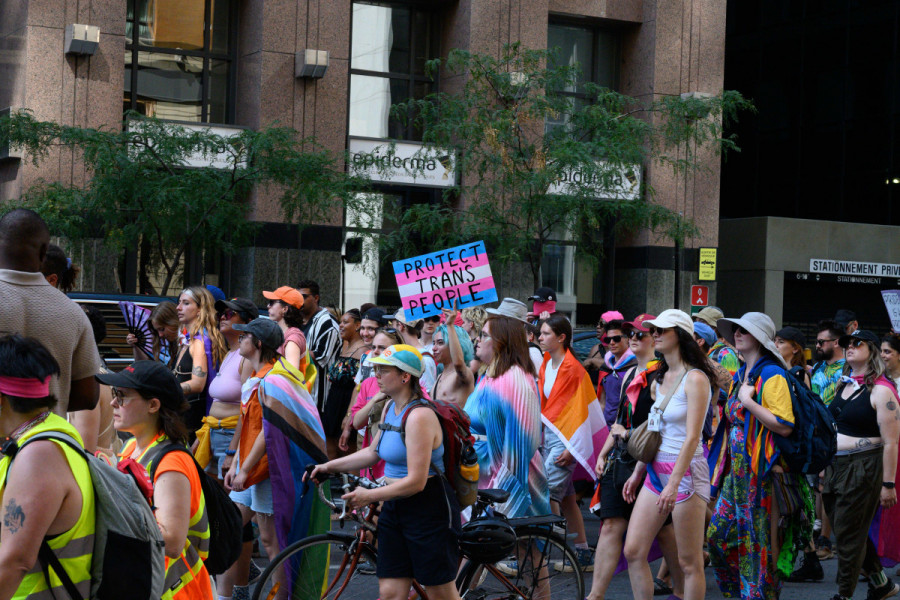
Thousand of Montrealers take to the street for the Wild Pride march on Aug. 10. Photo Lana Koffler

Maria Cholakova & Geneviève Sylvestre,
Local Journalism Initiative

New Wild Pride festival aims to create a non-corporate, safe space for queer identity and politics

Yara Coussa and Aisha White first decided to create an alternative Pride festival following the wave of queer groups and organizations that publicly cut ties with Fierté Montréal back in the spring of 2025.

Coussa and White were texting each other about the city’s need for a non-corporate Pride event, and a week later, White had created an Excel spreadsheet with potential collaborators. 

Preparations for Wild Pride had begun. 

According to them, Wild Pride aims to be an alternative space for queer individuals to celebrate Pride in a radical, anti-colonial, anti-capitalist and anti-corporate environment.

“ [The events are] really a response to a gap and a silence, specifically when it comes to the genocides all over the world, and an unwillingness to make Pride what it is at its core: a political fight,” Coussa said. 

They believe that pre-existing Pride events, like those planned by Fierté Montréal, were overly sanitized and lacked necessary political resistance. 

“In Montreal, [Pride] started as a riot against the police. It started as being led by lesbians of colour, by sex workers,” Coussa said. “So, to be in line with what Pride is, we need to continue being political. We need to continue with our fight.”

To gauge if there was interest within the Montreal queer community for an alternative festival, Coussa and White planned a town hall where 150 organizers showed up and 84 events were planned. 

Celebrations and events started on July 30 and will conclude on Aug. 18 with a variety of shows, workshops and community days.  

On Aug. 8, Wild Pride held a Community Day event, where 22 organizations gathered to promote their community organizations.

Firoza, a Montreal artist who offered henna art, was present and gathering donations for a Palestinian family in Gaza. 

“Historically, Pride has involved working-class queer and trans people, and it feels weird to be in an imperial [corporation], celebrating Pride with the same corporations that are fuelling the genocide and contributing to state-sanctioned violence against Black and Indigenous people,” Firoza said. 

Coussa also emphasized the importance of speaking up about Palestine as queer individuals. 

 “To say that the Palestinian cause and LGBTQ rights are dissociated is just to be blind to what is going on,” Coussa said. “It’s to be blind to the fact that the genocide in Palestine is being justified by pinkwashing.”

A number of QueerJewish and Palestinian voices have spoken out about the dangers of pinkwashing. Decolonize Palestine defines pinkwashing as occurring when “a state or organization appeals to LGBTQ+ rights in order to deflect attention from its harmful practices.”

Coussa, who is from the Levant region, said they feel connected to the Palestinian cause and the need to fight against both queer and Palestinian oppression.

“We live in a globalized system where our consumerism essentially funds [genocide],” Coussa said. “We have this added responsibility to be very conscious about what we consume, about what we support.”

Marchers hold up Palestinian flags and signs in support of the trans community. Photo Lana Koffler

Fierté Montréal and recent fallout 

In April, a number of LGBTQIA2S+ organizations, including Sweet Like Honey, Jeunesse Lambda and Helem Montréal, announced on Instagram that they were cutting ties with Fierté Montréal.  

The CBC also obtained an open letter in May signed by 10 LGBTQIA2S+ organizations denouncing Fierté Montréal, claiming it no longer represented them and that its practices were “unacceptable.”

Signatories also stated that they felt “unheard, used and underpaid.” 

On July 30, following calls from the queer community for the organization to show vocal support for Palestine, Fierté Montréal released a statement condemning the genocide in Gaza. The organization’s board of directors announced it would exclude groups it considered to be “spreading hateful discourse” from this year’s Pride events.

The two groups affected—Ga’ava, a Montreal-based, student-run Pro-Israel LGBTQIA2S+ group, and the Centre for Israel and Jewish Affairs (CIJA)—quickly denounced Fierté’s statement. 

CIJA defines itself as “the advocacy agent of Jewish Federations of Canada-UIA” and has been critical of pro-Palestine movements across Canada.

Over the years, they have opposed the teaching of Palestinian history in Canadian schools, opposed Canada providing aid to Palestinians through the United Nations Relief and Works Agency (UNRWA) and heavily criticized Canada’s decision to recognize Palestine as a state in September. 

Ga’ava, the second banned group, has also faced controversy, with reports from The Rover showing that the organization’s president, Carlos A. Godoy, has denied famine in Gaza and has claimed that “Palestinians are complicit with Hamas.” 

According to the UN, 12,000 children under the age of five were suffering from acute malnutrition in Gaza in July. 

A week after their statement banning the groups from the Pride parade, Fierté reversed their ban and apologized for their original decision, stating that all groups, regardless of religion, were invited. 

Émilie Grandmont, a member of the organization AlterHéros who cut ties with Fierté Montréal in April, was panelling at the Wild Pride community event and spoke of the importance of having an alternative Pride festival. 

“With the recent turn that Fierté has taken—not just with corporation affiliation, but with the refusal to stand against the genocide and pinkwashing—it has become more important to have an alternative community gathering where we can be queer and be proud of it,” Grandmont said. 

The Link reached out to Fierté Montréal for comment, but has not received a reply as of the time of publication. 

Celebrating Pride through resistance Read More »

Sit-ins for Palestine continue across Canada

Activists wave the Palestinian flag at a sit-in on Aug. 6. Photo Maria Cholakova

Maria Cholakova & Geneviève Sylvestre,
Local Journalism Initiative

Activist groups call out federal government over lack of action on Gaza reunification program

Pro-Palestine groups across the country are continuing sit-ins at Canadian immigration offices, demanding that the federal government take action to unite Gaza family members in Canada.

Activists and community groups are demanding that the government follow through on the Canadian reunification program. First introduced in January 2024 with a 5,000 temporary resident visa applicant cap, the program was meant to keep the promise of reuniting families.

According to the most recent statistics on the Canadian government’s website, as of July 8, more than 1,750 people who exited Gaza have passed security screenings and are approved to come to Canada. However, only 860 applicants have arrived safely from Gaza.

Additionally, as of July 26, Canada has assisted 11 Canadians, including children travelling with their mothers, in leaving Gaza safely, a move the Gazan Canadian Families organization called “not even a bare minimum response” in a press release.

In Montreal, weekly sit-ins, organized by activist Summer Alkhdour, Gazan Canadian Families and Independent Jewish Voices (IJV), happen every Wednesday in front of the Immigration and Refugee Board of Canada building.

On Wednesday, Aug. 6, activists played songs, waved the Palestinian flag and chanted, “IRCC [Immigration, Refugees and Citizenship Canada] while you delay, bombs are dropping every day.” 

Activists from Gazan Canadian Families handed out pamphlets urging immigration officials and the government to implement an efficient screening policy of 14 days and remove biometrics from applications for Gazans; to allow safe evacuations from Gaza through negotiations with the Israeli government; to fast-track approvals for applicants stuck in Egypt; and to collaborate with provinces to provide healthcare and coordinated support for arrivals.

IJV member Niall Clapham Ricardo emphasized the importance of caring about the genocide and confronting the government’s inaction. 

“People should not see this as separate issues from their daily lives; everybody is impacted by [immigration],” Ricardo said. “The more restrictions and obstacles we put towards immigration in this country, the more it will have an impact on every single community.” 

Sit-ins for Palestine continue across Canada Read More »

Autonomous students vandalize Concordia’s Azrieli Institute

Courtesy Students for Palestine’s Honour and Resistance

Maria Cholakova,
Local Journalism Initiative

Student action against the university continues

In the evening of April 10, autonomous students targeted the Azrieli Institute of Israel Studies, located in the ER Building of Concordia University on Guy St. The institute’s doors were spray-painted with the message “Genocide institute,” and a window was broken. 

By the morning of April 11, the graffiti was erased and the window boarded up. 

The incident was first commented on by Students for Palestine’s Honour and Resistance (SPHR) Concordia, who claimed that the students “will never abandon Palestine.” 

In a post on Instagram, SPHR stated that “students are growing more and more impatient with the Concordia administration, as we have all been demanding that Concordia ends its complicity with zionism.” 

According to Concordia’s website, the Azrieli Institute was founded in 2011 to support “the advancement of Israel Studies through educational programs, publications, and financial support for students and faculty.” 

The institute has come under fire for years due to allegations of encouraging the “touring of colonized areas and the sanitization of apartheid with a university that collaborates with the Israeli army to develop weapon technology,” according to a letter written by Concordia alumni.

An SPHR representative, who was granted anonymity for safety reasons, said that the escalation in pressure tactics is to be expected from students. 

“The administration’s response to these demonstrations has been repressive; it’s only natural for the students to escalate and grow because it’s constantly giving another reason for students to mobilize, on top of the very just cause, which is Palestine and Boycott, Divestment and Sanctions,” they said. 

The SPHR representative further justified students’ dissatisfaction with the administration and the institute. 

“This year has been filled with victories and successes for the movement and has been terribly scandalous for the administration, whether it’s their more exposed complicity or their hiring of mercenaries to beat up their own students,” they said. “The only approval this administration should worry about is that of their students.”

They continued, stating that Concordia’s administration needs to act in good faith towards student demands and stop its administration’s complicity in the genocide of Palestinians in Gaza.

A statement from Concordia president Graham Carr condemned the attack and stated that the incident was being investigated by the SPVM. He stated that violence and hate had no place in the university. 

“I ask the university community to join me in addressing [deeply polarizing challenges] peacefully. Together, we must actively model respect and compassion for all who are suffering, and we must commit to keeping Concordia safe and welcoming for everyone,” his statement read. 

Autonomous students vandalize Concordia’s Azrieli Institute Read More »

What happened last year at Concordia University

Student protesters gathered outside Concordia University’s downtown campus to strike in solidarity with Palestine on Nov. 21, 2024. Photo Andrae Lerone Lewis

India Das-Brown,
Local Journalism Initiative

A look back at protests, arrests and security at the university and how the administration responded

From September 2024 through spring 2025, Concordia University saw on-campus policing, arrests during two protests, the hiring of private security and advisory council resignations.

This retrospective traces the flashpoints, how decisions were justified, who was affected and what demonstrators can take into this year.

The flashpoints

Sept. 25, 2024 – Walkout and three arrests. A daytime Palestine solidarity walkout travelled from the Henry F. Hall Building through campus tunnels and out onto the street. SPVM officers arrested three people at the Guy-Concordia Metro station on allegations of mischief, assault and obstructing a police officer, according to police quoted at the time. The arrested students were aggressively handled by police officers, with one woman yelling that she couldn’t breathe as an officer kneeled on her back, according to eyewitnesses. Concordia later said Campus Safety and Prevention Services (CSPS) had alerted the SPVM in advance and that one CSPS agent was assaulted while intervening in response to vandalism in the tunnel.

Oct. 31, 2024 – Cops Off Campus and two arrests. A demonstration opposing police presence on campus ended with two student arrests. The SPVM and a university spokesperson said officers intervened after the students allegedly assaulted a CSPS agent. One protester alleged that one CSPS officer began chasing a student through the tunnels before the student was detained by SPVM officers in the LB building. 

How Concordia’s art gallery entered the picture

The Leonard & Bina Ellen Art Gallery was, perhaps unexpectedly, drawn into the year’s conflicts. In November 2024, a scheduled artists’ talk became a surprise silent protest against the arrests of students in the vicinity of the gallery and the dismissal of gallery director Pip Day. Artist Ésery Mondésir criticized the gallery’s use as a “detention centre” during an Oct. 31, 2024, protest and alleged that the community has reason to believe Day was fired because of her support for Palestine. 

By January 2025, five of the gallery’s eight advisory council members resigned. In their public letter, they pointed to “disturbing events” during the previous semester, including the arrests and the director’s departure. They also argued that the university failed “to recognize the legitimate right of the entire Concordia community to peacefully and meaningfully express their solidarity with the Palestinian people.”

The university did not confirm any connection between the director’s dismissal and activism on campus.

More recently, on Aug. 18, artists scheduled for a gallery screening withdrew “in protest against the use of their work to artwash Concordia’s suppression of Palestine solidarity at the Gallery and on campus,” according to an Instagram post by Regards Palestiniens, Artists Against Artwashing, and Academics and Staff for Palestine Concordia.

How Concordia’s security strategy shifted

In November 2024, The Link reported that some students, particularly those from marginalized communities, said they felt surveilled and at times mistreated by campus security.

“You can see the shift,” said a former student union executive at the time. “Security has become more aggressive with students connected to pro-Palestinian activism.”

A Concordia spokesperson told The Link that she encourages students who feel targeted by security to file a complaint with the Office of Rights and Responsibilities.

For 14 days during the Fall 2024 semester, Concordia hired Perceptage International, an external firm founded by a former Israel Defense Forces soldier. According to university records obtained by The Link, the firm’s agents were issued CSPS logo patches and tasked with “crowd control and special intervention.” 

A video posted on Nov. 22, 2024, on the Solidarity for Palestine’s Honour and Resistance (SPHR) Instagram page, appeared to show the extent of security officers’ intervention in student activism. In the video taken during the student strikes for Palestine, Perceptage and other CSPS officers appear to be aggressively pushing students away from picketing actions and into the stairway of the Hall building, while students shouted: “Don’t touch them, don’t shove them, these are Concordia students.” 

Concordia’s deputy spokesperson claimed the Perceptage agents were Canadian Armed Forces veterans and said supplemental staffing was added after reports of “aggressive behaviour, assault and vandalism” at demonstrations. Student organizers criticized the optics and reported rough handling during pickets.

Concordia also publicized protest “behaviour guidelines” at the start of the 2024 Fall semester, outlining existing rules for picketing, encampments and classroom access, and noting that breaches can trigger investigations and sanctions. 

How student leaders responded

Following the September and October 2024 arrests, the Concordia Student Union (CSU) held a press conference with allied groups, alleging police brutality and racial discrimination at the university, while demanding that police be kept off campus. 

On Jan. 29, 2025, over 800 undergraduates voted to mandate the CSU to adopt two Boycott, Divestment and Sanctions motions for “financial investments which are currently held in funds complicit in or which benefit from militarized violence, war, colonialism, apartheid, and genocide.” Concordia president Graham Carr released a statement the next day saying that such boycott campaigns run “contrary to the value of academic freedom.”

A week later, Concordia opened an investigation into how the special general meeting was conducted and suspended the CSU’s ability to book campus spaces, citing alleged policy breaches, pending the outcome. After the CSU sent a legal demand and sought relief in court, Concordia temporarily restored limited booking rights so elections could proceed.

Can you still protest safely?

Knowing Concordia’s protest guidelines can be helpful. Being aware of the limits—such as restrictions on blockades or classroom access—can help participants anticipate when police might be called. 

Documentation is one of the strongest forms of protection. Protesters who record events through video, photography or even audio recordings create a public record that can later be used to clarify disputed accounts. It is also helpful to plan exits in advance and identify safe meeting points should a demonstration be dispersed.

In practice, protests on campus may not be risk-free―but no protest is without risk. How 2025-26 feels on campus remains to be seen.

What happened last year at Concordia University Read More »

‘Enough is enough’: Montrealers protest seized Gaza-bound aid boat

Montrealers gather in protest in downtown Montreal less than 24 hours after Israeli forces detained 12 activists, including Greta Thunberg, aboard the Gaza-bound Madleen, on June 9, 2025. Photo Ryan Pyke

India Das-Brown,
Local Journalism Initiative

Demonstration comes in response to interception of the Madleen ship and detention of 12 activists

Hundreds of Montrealers took to the streets on the evening of June 9, demanding the release of the Freedom Flotilla crew aboard the vessel Madleen and urging Canadian and international governments to ensure the delivery of essential supplies to the Gaza Strip.

The demonstration began at 5:30 p.m. outside the Israeli consulate in downtown Montreal, less than 24 hours after Israeli occupation forces detained the Madleen crew in international waters and seized its humanitarian cargo.

The boat was carrying aid―including baby formula, food and medicine―along with 12 activists and journalists, among them Swedish climate activist Greta Thunberg.

“We’ve seen for the last two years, the Israeli government commit war crime after war crime,” said Palestinian Youth Movement (PYM) organizer Rand Hasan. “Enough is enough.”

On board the Madleen were Thunberg; French-Palestinian Member of the European Parliament Rima Hassan; German activist Yasemin Acar; Baptiste Andre, Pascal Maurieras, Yanis Mhamdi, Reva Viard and journalist Omar Faiad from France; Thiago Avila from Brazil; Suayb Ordu from Turkey; Sergio Toribio from Spain; and Marco van Rennes from the Netherlands.  

Hasan called on Canada to “cut all diplomatic ties,” and suspend arms shipments to and from Israel.

“There’s still arms being shipped back and forth to the U.S. and to Israel through Canada,” she said.

Presently, Canada maintains formal diplomatic relations with Israel, including an embassy in Tel Aviv. Cutting diplomatic ties would mean shutting down the embassy, halting formal communications and withdrawing diplomatic staff—an action typically reserved for countries in conflict or severe political disapproval.

Canada has suspended the approval of future arms export permits to Israel as of March 2024, following a non-binding vote in the House of Commons. However, this suspension does not apply retroactively, meaning permits approved prior to that decision may still be active.

“We need to hold all our governments accountable,” Hasan said.

“Mark Carney, pick a side,” was one of several chants that rang out during the march. 

This took place the same day the prime minister shared an Instagram post following his visit to the Nova Music Festival Exhibition, which he described as telling “the story of the brutal massacre carried out by the terrorist entity Hamas on October 7, 2023.”

That same day, PYM’s Toronto chapter posted a video showing the prime minister responding, “Time and a place,” to a question about whether he would be “saying anything about the genocide of the Palestinian people.”

On June 1, the Freedom Flotilla Coalition sent the Madleen from Catania, Italy, to break the blockade in Gaza and deliver aid.

According to the Flotilla, the Madleen was stopped in international waters in the early hours of June 9 in Israel time, shortly before reaching its intended destination off the Gaza coast.

Israel’s Ministry of Foreign Affairs said the move was in line with a naval blockade imposed on the Gaza Strip since 2007, which prohibits unauthorized vessels from entering the coastal territory, according to multiple media reports

According to international law, countries hold no sovereign rights over international waters. Israel’s occupation and siege on Gaza has also been deemed illegal by most governments, as well as the United Nations.

Thunberg is among the four activists who agreed to deportation, while those remaining are set to appear before Israeli authorities.

One protester, Alex, who declined to give his last name due to safety concerns, said the protest was “a manifestation of people not being okay with the status quo.”

Standing outside the Israeli consulate, he called for Canada to “expel all the Israeli diplomats right now, cut all ties with Israel and close the current delegation in Tel Aviv.”

“This business of intercepting boats in international waters is just such a violation of international law,” added Montrealer Rose Marie Walley. “I’m just in horror at what’s happening in Gaza. Not just the Flotilla, that’s just the latest situation.”

Walley said people who want to get involved should call their member of parliament. 

“Tell them to demand an arms embargo,” she said.

Hasan has a message for the Madleen crew and Montrealers alike.

“This is an act of bravery, and we need to continue doing stuff like this, and everyone has a role to play, even if that’s a really simple one like being on a boat or protesting,” she said. “This is just the start of what we can do when we’re organized.”

The protest remained peaceful, with light police presence throughout. The crowd dispersed around 8 p.m. at Phillips Square downtown.

‘Enough is enough’: Montrealers protest seized Gaza-bound aid boat Read More »

Students call for boycott of McGill summer course in Israel

Students for Palestine’s Honour and Resistance McGill has started an email campaign to oppose relaunch of summer program. Photo Andraé Lerone Lewis

Geneviève Sylvestre & Maria Cholakova,
Local Journalism Initiative

SPHR McGill denounces university for relaunch of summer exchange program with Israeli university

Students at McGill University have started an email campaign to prevent Israel Defense Forces (IDF) soldiers and Israeli students from coming to the university’s campus. 

The campaign, first started by Students for Palestine’s Honour and Resistance (SPHR) McGill, aims to boycott a summer exchange course between McGill and the Hebrew University of Jerusalem (HUJI).

In their campaign, SPHR McGill accused the university of secretly restarting the POLI 339 course despite previous student attempts to shut it down. In a press release, the group then claimed that McGill has doubled down on its complicity regarding the Palestinian genocide. 

“While students in Gaza fight for the lives of themselves and their families, McGill has invited the facilitators of genocide to spread their genocidal agenda at our university,” the press release reads. 

According to a SPHR McGill Instagram post, Israeli exchange students are supposed to visit McGill from Aug. 1 to Aug. 22. 

History repeats itself

The email campaign is not the first attempt to shut down the course. In April 2019, students organized a sit-in to protest the course and demand its cancellation. 

The course requires enrolled students to pay a mandatory fee of $1,000, which needs to be approved by the Arts Undergraduate Society (AUS) of McGill University. 

In late January 2019, the AUS council voted 14 against and 13 for holding the summer course. According to reports from The McGill Daily, those in favour of the course cited “academic opportunity,” while those against claimed it “discriminated against Palestinian students, Arab students, and students who oppose the Israeli occupation of Palestine, as they could be denied entry at the border and detained by Israeli officials.” 

Accusations of scholasticide and complicity 

In a 2024 statement, the Palestinian Federation of Unions of University Professors and Employees criticized numerous Israeli universities for their complicity in genocide. 

HUJI, in particular, was criticized as one of its campuses was partially built on land illegally expropriated from Palestinian owners in Israeli-occupied East Jerusalem. The university has also hosted a military base on its campus to offer academic training to IDF soldiers.

The Link has reached out to McGill for comment, but has yet to receive a response as of the time of publication. 

Students call for boycott of McGill summer course in Israel Read More »

Montrealers protest 300 days of genocide in Palestine

A few dozen protesters march through Downtown Montreal to denounce 300 days of genocide in Gaza. Photo Andraé Lerone Lewis

Geneviève Sylvestre,
Local Journalism Initiative

Protesters march from Dorchester Square to the Israeli Consulate continuing their demand for a ceasefire in Palestine

On Aug. 3, Montrealers gathered to protest 300 days of genocide in Gaza. 

The demonstration, organized by the Palestinian Youth Movement (PYM) Montreal, began around 2 p.m. at Dorchester Square with protesters waving flags, playing music and banging on drums to enliven the crowd.

A speaker for PYM Montreal addressed the crowd before they began marching. 

“We must continue to be the voice of justice,” said the speaker. “We demand, as we have for the last 300 days, an immediate ceasefire and an end to the genocide.”

The speaker also called for the release of 10,000 Palestinians from Israeli prisons, an immediate arms embargo on Israel and the lifting of the siege on Gaza. 

Since Oct. 7, 2023, Israel has instigated over 17,000 attacks in Palestine, Lebanon, Syria, Yemen and Iran, over 60 per cent of which were on Palestinian territory.   

Additionally, over 39,445 Palestinians, 15,000 of whom were children, have been killed since the events of Oct. 7. 2023. According to a study done by the medical journal Lancet, the total death count could exceed 186,000. 

Protesters waving Palestinian flags left the square at around 3:30 p.m. and began marching up René-Lévesque Blvd.

Zeyad Abisaab is the former general coordinator of Solidarity for Palestinian Human Rights Concordia and a member of PYM Montreal. He spoke of the importance of standing in solidarity with Palestine. 

“What happens here in the West, in the diaspora, the people in Gaza they see it. The people that are resisting the genocide, they feel it,” said Abisaab. “If they are not deterred from a genocide, if they are resisting, then what is our excuse here to not want to stand in solidarity with them?” 

PYM Montreal has been organizing weekly protests to stand in solidarity with Palestine, with many drawing in hundreds of Montrealers. Abisaab considers this an “unprecedented accomplishment.”

“There is unrest in this city. The people of Montreal and the people of Quebec, through these protests and other events, have shown their opposition to this genocide,” he said.

Estelle and her friend Nawel, whose last names have been kept anonymous for safety reasons, have attended a few protests in solidarity with Palestine.

“As citizens, we have a [voice] which is fairly powerful and I find it important to continue to manifest that power in solidarity with the people of Palestine,” said Estelle. 
 
The Gaza Health Ministry recently declared a polio epidemic in Gaza. The virus was detected in samples of wastewater in Khan Younis and Deir al-Balah and, according to the World Health Organization (WHO), children under five years old, especially infants under two years old, are at risk.

The WHO is sending over 1 million vaccines to help lessen the spread of the virus, but the organization claims a ceasefire and an increase in humanitarian aid is necessary to avoid deaths. 

Maud, who was also granted last name anonymity for safety reasons, is a French citizen who has been attending protests and demonstrations for Palestine for years both in France and in Montreal. 

“It’s the moral minimum to support Palestinians today,” said Maud. “300 days is too many, it’s 300 days too many.”

The protest ended at 4:38 p.m. in front of the Israeli Consulate with organizers handing out watermelon slices to the crowd. 

Montrealers protest 300 days of genocide in Palestine Read More »

Concordia gallery council resigns in protest

Five members of the Leonard & Bina Ellen Art Gallery Advisory Council resign after gallery director dismissal. Photo Alice Martin

Geneviève Sylvestre,
Local Journalism Initiative

Members of the Leonard & Bina Ellen Gallery Advisory Council name Palestinian solidarity suppression as reason for resignation.

Five members of the Leonard & Bina Ellen Art Gallery Advisory Council resigned following the dismissal of gallery director Pip Day in November. 

In their resignation letter sent to the administration on Jan. 9, the members said they believed Day’s dismissal was due to “her support of artists, students, and community groups who have spoken out on behalf of Palestinians.”

The Link received confirmation of Concordia University’s dismissal of Day on Nov. 18, less than six months after the start of her mandate in June 2024. 

Ex-advisory council member Claudine Hubert claims that members were only notified of Day’s termination when reading an article in The Link

“This disregard for our role, and for the institutional safeguards designed to prevent abuse, reflected a profound disconnect and lack of accountability within the administration,” Hubert said.

According to Concordia deputy spokesperson Julie Fortier, five of the council’s eight members resigned. Fortier clarified that the reason for Day’s dismissal cannot be disclosed as labour laws prevent the university from discussing “specific employee matters.”

“I want to reiterate that Concordia always respects its employees’ freedom of expression, as is quite evident from the diversity of views and stances regularly expressed by members of our community,” Fortier said, adding that the gallery has full control over its programming. 

In the resignation letter, the advisory council noted that the university has failed “to recognize the legitimate right of the entire Concordia community to peacefully and meaningfully express their solidarity with the Palestinian people.”

A spokesperson for Students for Palestine’s Honour and Resistance (SPHR) Concordia, who was granted anonymity for personal safety, agreed with the members’ statement. 

“When tens of thousands of students go on strike for BDS (Boycott, Divestment, Sanctions) and continue to get repressed and ignored, it’s clear that the university is not recognizing the legitimate right of students to express solidarity with Palestine and its people,” the SPHR spokesperson said.

Fortier said that the university regrets that some members have opted to resign, but also regrets that some groups have “called on artists and curators to boycott a space that has long supported the role of art as a catalyst for cultural debate, instead limiting opportunities for artists to freely showcase their work there.”

The resignation letter listed a few “disturbing events” that were alleged to have taken place during the Fall 2024 semester. The first was the university’s cancellation of a screening of the film Resistance, Why? at the Concordia J.A. DeSève Cinema on Oct. 11.  The film screening was organized in partnership with the Montreal-based collective Regards Palestiniens.

Campus Safety and Prevention Services had sent Day a “postponement notice” for the screening on the evening of Oct. 10 because of “additional information regarding the event in question which necessitates further review.”

“The ad hoc outdoor film projection that took place instead was marked by a substantial security presence, reflecting a growing trend of securitization and surveillance at Concordia,” Regards Palestiniens member Claire Begbie said.

Begbie believes that censoring Palestinian films compromises awareness of the Palestinian cause.

“Palestinian films can serve as critical tools to teach students and other viewers about both the history and ongoing struggle of the Palestinian people against Zionism and its collaborators,” she added.  

The resignation comes after artists Miryam Charles and Ésery Mondésir led a silent protest at the gallery on the evening of Nov. 21. They were invited to speak about their work, but chose instead to share their frustration with the arrest of two students by the SPVM at a “Cops Off Campus” rally on Oct. 31.  

Hubert said she was in disbelief seeing the gallery used as a temporary detention centre for students and was unsettled by the images she saw afterwards. 

“What message does an institution send when it summons police to its campus? […] For students and faculty alike, watching peers detained within a gallery—or other spaces on campus—instills fear, shatters any sense of safety and fosters anxiety,” Hubert said. 

Advisory council members also mentioned the arrests in the letter, claiming that the university did not protect Day from “numerous intimidating messages she received from external stakeholders and donors, criticizing the Gallery’s embrace of pro-Palestinian artists and causes.”

“What happened on that day is not only a clear violation of students’ rights to protest, but turning the gallery to a detention centre and then blatantly lying about the reason [for] doing so is a beyond shockingly repressive behaviour from the administration,” said the SPHR spokesperson. 

This article originally appeared in Volume 45, Issue 8, published January 28, 2025.

Concordia gallery council resigns in protest Read More »

Silent protest at Concordia art gallery following student arrests and director’s dismissal

Ésery Mondésir (front) and members of the Concordia community sit in the Leonard & Bina Ellen Art Gallery to demonstrate against recent student arrests and the firing of Pip Day. Photo Alice Martin

India Das-Brown,
Local Journalism Initiative

Artists and members of Concordia’s community protested the university’s recent actions at the Leonard & Bina Ellen Art Gallery

On the evening of Nov. 21, Concordia University’s Leonard & Bina Ellen Art Gallery hosted a conversation between artists Miryam Charles and Ésery Mondésir in the J.W. McConnell Building. 

A few minutes into the event, it became clear that the artists would not be talking about their work, but rather holding a silent protest against the university.

“We are not here to talk about our work. There are things that are really, really more important,” Mondésir said, addressing the crowd of roughly 55 people in the small gallery space. “Not too long ago they transformed this place right here into a detention center. I have pictures of students who are arrested in handcuffs looking at my work, [that] is talking about liberation.”

On Oct. 31, two Concordia students were arrested at a “Cops Off Campus” demonstration and detained by SPVM officers inside the Leonard & Bina Ellen Art Gallery. This was one of multiple incidents criticized by Mondésir and Charles in their protest.

Charles, a Haitian-Canadian filmmaker from Montreal, learned of the arrests only a couple of hours before the silent protest when Mondésir showed her the pictures.

“I’m sad and frustrated about the fact that it happened,” Charles said. “I think that there is other ways to engage in dialogue with protesters, and arresting them is not the solution.”

On Nov. 18, The Link received confirmation that Concordia terminated Pip Day’s employment as director of the Leonard & Bina Ellen Art Gallery. Beginning her mandate in June of this year, the ex-director retained her position for less than six months. 

According to Mondésir, the community has reason to believe Day was fired because of her support for Palestine.

“The director is not here. We should ask the university, ‘Why isn’t Pip here?’” asked Mondésir, addressing the crowd. 

When asked about the motivations behind Day’s firing, Concordia spokesperson Vannina Maestracci told The Link, “We don’t discuss employee matters. Concordia always respects its employees’ freedom of expression, as is quite evident from the diversity of views and stances regularly expressed by members of the community.”

On Oct. 11, the ex-director of the gallery had planned to host a screening of the documentary Resistance, Why? at Concordia’s J.A. DeSève Cinema. On the evening of Oct. 10, the university’s Campus Safety and Prevention Services sent Day a “postponement notice” for the screening, due to “additional information regarding the event in question which necessitates further review.”

The screening was organized as a pay-what-you-can fundraising event, followed by a discussion moderated by members of Regards palestiniens, a Montreal-based collective that organizes Palestinian film screenings.

“Why did they not have the screening that was scheduled to happen here?” asked Mondésir, before inviting the crowd to join him and Charles in silent protest at the gallery.

According to Regards palestiniens, the event had been pre-approved almost a week before Oct. 11.

“That’s one reason we consider this censorship,” said a member of the collective, granted anonymity due to fear of occupational repercussions. “Another reason we consider this censorship is because the university considered that it’s a problem with the event being a one-sided fundraiser.”

Regards palestiniens questioned why the university had allegedly had an issue with one-sided fundraising for Palestine, while the university’s website lists a donation link to the Ukrainian army.

As an act of protest, the collective projected the film onto the wall of Concordia’s Henry F. Hall Building at the corner of Mackay St. and De Maisonneuve Blvd. W. There, they were surrounded by nine cop cars, including a cop van, and more cops than people, according to the collective.

“All fundraising efforts are, by nature, ‘one-sided.’ It would be unconscionable to attempt to make this effort ‘two-sided’ by supporting the continuation of this genocide,” wrote the collective on the morning of Oct. 11, in an email that was forwarded to three members of Concordia’s administration. “To do so would be to engage in dangerous complicity, in contempt of the ICJ’s (International Court of Justice) ruling—an issue that, unfortunately, both the Canadian government and Concordia University have failed to confront with the seriousness it requires.”

The silent protest at the Leonard & Bina Ellen Art Gallery welcomed people to break the silence with poems or songs in the spirit of protest. 

Alexis O’Hara, a Canadian transdisciplinary performer and friend of Day, shared a poem Day had sent her, titled “Revolutionary Letter #25,” by Beat poet Diane di Prima.

“These institutions are revealed to be far more Zionist than we thought,” O’Hara told The Link. “The sooner we can all wake up and join the resistance, the better off we’ll be.”

Miguel Soriano, a recent master’s graduate in media studies and communication at Concordia, came to the gallery in expectation of attending a talk between Mondésir and Charles. However, he was far from disappointed with the surprise protest.

“In history, student radicalism is what leads to change,” Soriano said. “It’s really nice to see artists and people come in to talk at the university or [those who are] not directly affiliated also take a stand. And I think that shows so much; it shows their solidarity with people who are actually actively protesting or getting arrested.”

Mondésir said the silent protest was held in solidarity with the student strikes for Palestine, which had taken place earlier that day.

“It would be very hypocritical of me to come here and have my little talk and talk about whatever and not take a stance,” said Mondésir, who is also an assistant professor at the Ontario College of Art & Design University in Toronto. For him, the arrests made in the gallery space on Oct. 31 are sacrilegious.

“It should be the space where I know that I can express myself and have the freedom to do so, and not having to think about what will happen if somebody doesn’t like what I say,” Mondésir said. “So by them doing this here, I think it was outrageous. It was sacrilege. It was a desecration of this place.”

According to Mondésir, the university’s termination of Day’s employment was an attempt to silence protest, which he and Charles responded to with silent protest.

“I just cannot sit with that,” Mondésir said. “If you look at the work that I do, it would be very hypocritical of me.”

Silent protest at Concordia art gallery following student arrests and director’s dismissal Read More »

Students set up indefinite encampment for Palestine at McGill

Photo Hannah-Scott Talib

Hannah-Scott Talib,
Local Journalism Initiative

Hundreds of students demand that McGill and Concordia divest their funds supporting Israel

Starting at 1:30 pm on April 27, students from McGill and Concordia University banded together to create an indefinite encampment by the Roddick Gates on McGill’s main campus.

The coalition of students that organized the encampment contained members of Solidarity for Palestinian Human Rights (SPHR) groups from both universities as well as participants of the McGill Hunger Strike. It was also co-organized by both Concordia and McGill chapters of the Independent Jewish Voices group. At the time of the start of the encampment, around one hundred students were within and picketing around the space. The number drastically increased by the end of the afternoon as passers-by and marchers from a nearby protest led by the Palestinian Youth Movement (PYM) joined in. 

This encampment comes at a time when student demonstrations to liberate Palestine are at a high at universities around the globe. This week marks the second week of this spike in student protest movements, with students at New York’s Columbia University being some of the kickstarters of the student revolution for Palestine. 

“We are here to follow the revolutionary student movement and demand divestment at McGill and Concordia — it’s the demand of pretty much all the students in North America,” said Ali Salman, spokesperson for the student encampment movement at McGill. “We’re here indefinitely, we’re here until our demands are met, so let’s hope that the community can not only sustain it but also defend it.”

Salman added that the encampment will not end until the students’ demands for McGill and Concordia to divest from funds contributing to the genocide in Gaza are met by the universities.

In a statement released by McGill University on April 29, it was acknowledged that the amount of protesters within the encampment has tripled since it was first set up. The statement equally included a claim that “video evidence of some people using unequivocally antisemitic language and intimidating behaviour” had been seen, and also states that the encampment violates both the “right to freedom of expression and freedom of peaceful assembly”. McGill administration representatives were eventually sent to the field to make a ‘final warning’ asking for the encampment protesters to leave. The speech was drowned out by the demonstrators. 

Police presence increased on April 29, but were effectively prevented from entering the encampment.

The PYM Montreal march that coincided with the encampment’s first day began at 2 p.m. at the Guy-Concordia metro station. Protesters made their way up Sherbrooke Street towards McGill University, reaching the encampment at around 3:30 p.m. 

Upon reaching the area, marchers joined the picket line around the encampment, shouting chants such as “Until schools divest, we will not stop, we will not rest” and “listen to the (International Court of Justice) ICJ, genocide is not okay.”

Kanien’kehá:ka activist, artist and filmmaker Ellen Gabriel gave a guest speech at the encampment. 

“We are here to say that all human rights are universal, all human rights are applied to each and every one of us equally, not because we belong to a certain sect or to a certain race, but because we are all human beings and for that, what you are doing today is important,” said Gabriel, addressing the students within the encampment and the crowd gathered around it. 
On the picket line, protesters held up banners that read “Ceasefire”, “Free gaza now”, “Jews against genocide” and more. 

“The warmongers are listening to you right now — they see you, they’re scared of you. Don’t be scared of them, because fear is what they feed off of. Fear is what they want you to feel,” said Gabriel. “What you are doing today is for humanity and what you are doing today is not just for Palestinians but for all people.”

Outreach for the encampment attracted a crowd beyond just McGill and Concordia students as well. 

“I got the news on social media,” said one protester who was granted anonymity for safety reasons. “In the first few hours I think it’s very important to show our support and say that [this cause] is serious, [and] to support legitimate demands.”

The student added that they felt it was heart-warming to be a part of the ongoing global student revolution and seeing the increase in action to push for divestments and a permanent ceasefire in Palestine across North America this week. 

“[The fact] that students can possibly have the time or the capacity to be somewhere — to be at this encampment, to always show up to protests […] I think it’s amazing,” said one Concordia student protester. “Everyone should be doing it but I think students [in particular]. We’re at university to learn, to share ideas, to think critically about situations, and it doesn’t take much critical thinking to see what’s going on is just genocide.”

The encampment is accepting donations of tents, batteries, blankets and more from the general public. Updates on the needs of the protesters can be found on Instagram at the accounts @pymmontreal, @sphrconu and @sphrmcgill. 

Following the publication of this article, The Link was made aware that the Concordia and McGill Independent Jewish Voices chapters also participated in the organizing of the encampment. The article has been modified to reflect this information.

Students set up indefinite encampment for Palestine at McGill Read More »

The palette of protest

Protesters picket the Hall auditorium. Photo Alice Martin

Alice Martin,
Local Journalism Initiative

Rarely will you see protests without art, and often will you see it go beyond symbolism

Most of the time, protesters don’t march in the streets empty-handed.

They brandish handmade signs, banners or anything to get their message across. In any protest, art serves multiple purposes to strengthen the broader cause.

“I personally really love the use of art in organizing and protests,” Arts and Science Federation of Association (ASFA) academic coordinator Angelica Antonakopoulos said. “Art in protest is a very eye-catching way to send a message, instead of having to go person-to-person and tell them what you’re trying to accomplish.”

Tuition hike strikes

Over five days last March, the tuition hike strikes mobilized students from select student associations to enforce hard picket lines. Hard pickets require students congregating in front of a classroom to dissuade other students from entering. 

With dozens of classes having to be picketed at the same time, and only so many students, protesters used hand-painted banners with dual purposes: displaying their demands and protecting protesters.

“[Banners] are big, they’re flashy,” Antonakopoulos said. “They have a message on them. [Students] don’t have to come up and talk to you and they still get the gist of what the protest is about.”

According to Antonakopoulos, Concordia’s Code of Conduct prohibits students from physically blocking a classroom. She said banners act as a bypass.

“[Students] were more than free to lift the banner and go underneath if [they] really want to go into class,” she said. “It protected both students that were picketing and students that were dissenting towards the cause.” 

She said that banners help students “think twice” before crossing a picket line, as well as avoid physical confrontation.

“There was a lot of verbal engagement with students with flyers and FAQ sheets coming out,” she said, noting that that was what picketers were told to do. “[But banners] send a poignant message in a non-confrontational, peaceful vehicle.”

Students paint Mackay Street to advocate for its pedestrianization. Photo Alice Martin

Pedestrianize Mackay

In September 2023, the Pedestrianize Mackay group staged a protest demanding that Mackay St., between Sherbrooke St. and Maisonneuve St., be closed to vehicles and converted into a pedestrian area for students.

For Mowat Tokonitz, communications vice president with the Urban Planning Association, it was one of the first student mobilizations he was part of.

“It’s something that really interests me and it relates to my program,” Tokonitz said. “I think it’s important to have actual campus space outside that we can use, while also having less cars.”

The protest consisted of blocking Mackay St. at the intersection of Sherbrooke St. Demonstrators also painted an enormous version of the vibrant pink, green, blue and yellow Pedestrianize Mackay logo on the road.

Tokonitz said painting the road was a good way to appropriate the street and show its potential to a wide range of Concordia students who pass by daily.

“The fact that we also had the street blocked off, and we had picnic tables and banners and things in the street, it gave a very basic example of what that space could be in the future,” he said. “It really didn’t take very long for there to be street furniture on Mackay and for people to be out eating lunch. I can only imagine what it would be like if that was permanent.”

Looking back on the tuition hike strikes and Pedestrianize Mackay, Antonakopoulous said the mural painting was a great way to engage students in the cause.

“It’s always really a fantastic way to build community because mural painting is not like a picket. It’s not like a protest,” she said. “We need to be cognizant that there are a lot of people that don’t engage with that, right? They don’t engage with noise, they don’t engage with confrontation.”

Ned Mansour’s sixth chalk drawing, made on Aug. 30. Photo Alice Martin

Divest for Gaza

The pro-Palestine student encampment at McGill University stood strong for over 70 days before being demolished on July 10. To protect itself and the privacy of campers, the encampment used a variety of colourful handmade signs from different student movements on the gates.

When a private security firm dismantled the camp, the colour didn’t stop. Activists still gather daily in front of the Roddick Gates to repeat their demand: for McGill to divest from companies involved in arms manufacturing and the settlements in Gaza and the West Bank.

This is the case of Ned Mansour, a Montreal artist whose father is Palestinian. He has been coming to the gates for over a week—a new tradition for him. He aims to go to the Roddick Gates every day, barring rain and other engagements.

Mansour was working on his sixth painting when he met with The Link. This painting was inspired by a photo he took. 

“I try to choose something that has to do with what’s happening right now, with the genocide, and just a reminder of how many days it’s been since the genocide has started,” he said. “I try to pick images that are visually striking and can fit on this thin column.”

Mansour’s paintings are made with chalk, something protesters have been using every day to write messages and demands on sidewalks and university grounds. As a wedding photographer with experience in drawing, Mansour applied his skills to McGill’s walls.

Despite squabbles with security, his motivation to keep drawing remains steadfast.

“Every day that passes, somebody’s being killed in Palestine, and the genocide is happening in real-time,” Mansour said. “So I wanted to do something that’s in real-time as well. We feel here, it seems like it’s almost a mirror image of what’s happening in Palestine. Obviously, we’re not being killed, but there are forces that are trying to silence us.”

Mansour’s chalk drawings, like the days that go by, are ephemeral. Every night after he finishes drawing, security washes them away, providing him with a fresh slate for another drawing.

“They think that by erasing our work and our message, that we will stop, but what they’re doing is actually encouraging us to come back and remind them again of what’s happening,” Mansour said. “Just like the Palestinian people that are being erased right now.”

This article originally appeared in Volume 45, Issue 1, published September 3, 2024.

The palette of protest Read More »

The cedar and olive tree are forever interlinked

Lebanese and Palestinian protesters unite at a protest to denounce Israel’s attacks on both countries. Photo Andraé Lerone Lewis

Yasmine Chouman,
Local Journalism Initiative

In January 2024, Salima Telal, 48, was sitting on her couch with her shisha in hand. The TV was playing while her dog ran around the house. One of her sons was cooking in the kitchen, while the other sat across, listening as she spoke about their 2006 trip to Lebanon. 

“We went all the way to Syria, afraid [our car] would get bombed,” Telal said, “with my 8-month-old with 40-degree fever on one side and my 5-year-old on the other.”

The day was July 12, 2006, when Israeli forces invaded Lebanon with air strikes after Hezbollah succeeded at a cross-border raid during an ongoing conflict over land. This resulted in what is called the Second Lebanon War. 

Telal and her family drove from Lebanon towards the Syrian border, avoiding impact holes left in the ground by airstrikes. Cars were being bombed left and right. Beirut’s Rafic Hariri International Airport had been bombed. Civilians had few chances to escape. 

Telal was one of the few who managed to flee the war in its early stages, returning to Montreal. 

“Everybody was scared. It was hell and back,” she said, exhaling the smoke from her shisha.

Telal lived in Beirut, Lebanon for most of her life. She grew up there before coming to Montreal around 25 years ago where she raised her kids. During her visit to Lebanon in 2006, she recalled buildings being destroyed, civilians being bombed and people trying to flee. Water and electricity were restricted and there was no cell service. 

“They emptied the city so they could take it over,” Telal said, “like they’ve been [trying to do] to Palestine for years.”

The conflict ended with a ceasefire that was brokered by the United Nations, which came into effect on Aug. 14, 2006, after a month of bombings. 
Since 1948, after hundreds of thousands of Palestinians were forced out of their homeland, they have continued fighting for their lives in response to Israel occupying their land and turning cities like Gaza into open-air prisons. As for Lebanon, it has had a strained relationship with Israel since 1982, when it invaded southern Lebanon during the Lebanese Civil War, and with the 2006 Second Lebanon War.

This is why many people in the Lebanese community in Montreal have stood in solidarity with Palestine and continue to do so. This was the case when The Link spoke with Telal in January, and has become especially true now. 

On Sept. 23, Israel fired airstrikes across Lebanon. At the time of publication, Israel has killed over 1,000 and wounded at least 6,000 Lebanese people in the attacks, according to Lebanon’s Ministry of Public Health. These are the heaviest tolls since 2006.

In response, Hezbollah fired missiles targeting Israeli military air bases. 

From the south of Beqaa to Beirut, hundreds of thousands of residents have been forced to flee, leaving behind their beloved homes, with seemingly nowhere to go. At least 58 towns have been hit with over 1,300 Israeli airstrikes. Before the escalation, Israel had detonated pagers used by Hezbollah, killing 37 and injuring about 3,000 people.

In an interview with CBS, former CIA Director Leon Panetta called the targeted pager attacks on Lebanon a “form of terrorism.”

Reina Sinno, a Lebanese LaSalle College student, said the media does everything in its power to dehumanize Arabs.

“Western media is good at manipulating,” Sinno said. The 20-year-old student sat on the school floor during her break between classes to talk about how she thinks the media views Arabs. Sinno was born in Montreal but lived in Lebanon for the first few years of her life until her family moved back to Quebec.

She keeps in contact with her father, who lives in Lebanon. Over the past 11 months, border skirmishes between Hezbollah and Israel have been happening almost daily, with little to no coverage in the media, Sinno said. Her father said he received daily alerts on his phone about incoming missile strikes.

Sinno said the media only portrays Israel bombing Lebanon as a two-time occurrence, referring to the civil war and the 2006 war, when in reality, it has been happening on and off for the last 37 years

“They’re portraying it in a lie,” Sinno said.

On Jan. 3, Israeli forces attacked the Lebanese capital with drone strikes, killing seven people, including Hamas deputy leader Saleh al-Arouri. While this made some noise in the media for a few days, Israel has not officially accepted responsibility for the attack. Israel has been known to censor information in the media regarding their actions.

Jean Balka, 61, was not surprised at the avoidance of accountability. In a phone interview, he alleged, “Habibti, the media is controlled by Israel. How could you put stuff out against yourself?” 

Balka is a former fighter in the Lebanese Civil War and fought for the Christian side. They were called the Lebanese Front and consisted of national Maronites who were against Palestinian militancy in Lebanon. Despite disagreeing with the politics, Balka was forced to fight for the Lebanese Front rather than the Lebanese National Movement.

After the war, he went to New York and has been living both there and in Montreal since.

He spoke on his recent experience of being an Arab man in the Western World after the current war broke out. Sometime in early January, Balka was on his way to New York, a drive he has routinely done for the last 33 years, when he was stopped at the border. 

“I’m going to ask you some questions,” the man in the uniform said. “Are you Muslim or Christian?”

He had never been asked this question before.

“Since 9/11, us Arabs are viewed as terrorists and murderers,” Rayane Sakr said as she sipped her coffee at the local Second Cup Cafe in the cold December weather.  

Sakr is the child of Lebanese immigrant parents and has felt the struggle of being an Arab-Muslim woman in today’s society. Over the sound of coffee beans getting ground, the 19-year-old said, “We aren’t viewed as humans.” 

“They have lives, they go to school, they have hopes, they do birthday parties, they get married, they do their makeup, they dance,” she added, her voice trembling. “They are human!”

In January, there were over 250,000 Palestinian refugees in Lebanese refugee camps. Now, with many camps being destroyed, the stateless refugees have the possibility of living in poverty and facing harsh legal discrimination in Lebanon. 

Despite the daily fear, many individuals in the Lebanese community are confident in their nation’s ability to defend itself if the occasion arises. 

“Our people, being depressed and struggling for so many years, are ready to die for the cause of Palestine,” Balka said.

The Arab community in Montreal has mobilized for Palestine with protests drawing hundreds to thousands, raising awareness of the situation.

“At the protests, you see so many Lebanese flags because we know we can expect it too,” Sinno said.

Balka believes going to protests in support of the Arab community won’t make a difference. 

“Free Palestine! Free Palestine!” Balka shouted, “Free Palestine, but no one listens!”

“The more awareness you spread, the more people will try to help and put pressure on foreign governments to go for a ceasefire,” Telal said. 

However, spreading awareness both online or in person brings hope to those worried about their communities. Telal said the media is finally giving a voice to the Palestinian people and the Arab community.

“You don’t have to carry a gun to be a fighter for a cause,” Telal said. “A fighter can be a musician, a writer, a politician, a protester, a donator. Could be anything.”

For privacy and security reasons, the name ‘Salima Telal’ is a pseudonym.

The cedar and olive tree are forever interlinked Read More »

Concordia vandalized after demonstration

Henry F. Hall Building windows smashed following demonstration on Sept. 29. Photo Alice Martin

Alice Martin,
Local Journalism Initiative

Demonstrators smashed windows and threw Molotov cocktails at police officers

During the evening of Sept. 29, the lobby windows of Concordia’s Henry F. Hall Building were shattered as part of a demonstration and march organized by autonomous students.

Demonstrators also spray-painted pro-Palestine messages like “Free Gaza” and “C = Complicit” on the windows of the Hall building lobby. As they marched, demonstrators also held a banner that read “Hope lies in the fight” with an anarchy symbol next to the message.

Around 50 demonstrators had gathered on De Maisonneuve Blvd. for an “impromptu demonstration,” according to SPVM spokesperson Jean-Pierre Brabant. He said the windows were broken using blunt objects like baseball bats and hammers.

Four arrests were made on the scene, police later identified the arrestees to be in their 20s. The demonstrators were released without charges conditional to the results of an ongoing investigation.

“I am extremely concerned about the violent escalation of recent protests,” said Concordia President and Vice-Chancellor Graham Carr in a statement sent out to students on Sept. 30. “Concordia students, faculty and staff can certainly express themselves in a civil and respectful manner, but we cannot, as a community, tolerate intimidation or hatred in any form on our campuses.”

Montreal police arrived on site after 911 calls reported broken windows at the university, but by then demonstrators had already begun walking down De la Montagne St. The march continued down Sainte-Catherine St., with demonstrators breaking the windows of multiple store fronts, according to Brabant.

The SPVM representative said that multiple police officers attempted to scatter protestors who were committing criminal acts, with some officers chasing after demonstrators.

“During the pursuit, demonstrators threw at least two Molotov cocktails and incendiary objects in the direction of the police officers,” Brabant said. He added that no one was hurt in the demonstration.

According to videos circulating on social media and shared by accounts such as @clash.mtl on instagram, fireworks were also set off during the march.

“We will aim to gather evidence and see with surveillance cameras if we can find any information to know who did what and if anyone committed criminal acts,” Brabant said.

According to police, the demonstration died down at around 11 p.m. 

In his statement, Carr said that Concordia is assessing the events and will take “appropriate action” in accordance with the university’s Code of Rights and Responsibilities.

This event follows a Sept. 25 pro-Palestine student walkout where Concordia students demanded the university divest from Israel. The walkout saw severe police intervention, as well as three arrests.

This article originally appeared in Volume 45, Issue 3, published October 1, 2024.

Concordia vandalized after demonstration Read More »

One year since Oct. 7

Protesters marched through downtown Montreal for the Palestinian liberation cause on Feb. 18, 2024. Photo Andraé Lerone Lewis

Hannah Scott-Talib,
Local Journalism Initiative

Reflecting on the heights of activism this past year and the future of the movement

It will soon be one year since Oct. 7.

Exactly 357 days ago, the Palestinian militant group Hamas fired rockets into and re-entered the occupied territory known as Israel, killing over a thousand Israeli civilians, according to Israeli officials. Israel’s retaliation of the event continues, with the displacement of over 2 million Palestinians and 42,000 confirmed Palestinian civilian murders to date, according to the Gaza Health Ministry. 

Reflecting on the past year, advocates for Palestine in Montreal talk about how the Palestinian liberation movement has progressed and discuss where it is now. 

Peaks of activism

Last year, the first peak in mobilization came immediately after Israel’s escalated attacks on Gaza. 

“In the heat of the moment, everyone just wanted to do something for Palestine. They didn’t care what we were doing [or] how we did it, as long as we did something,” said Hassan Ridha, a member of Concordia University’s Thaqalayn Muslim Students’ Association and an active advocate for Palestine. 

“We hadn’t mobilized this quickly and this efficiently until an attack happened, until we saw the death numbers rise significantly within a matter of days,” Ridha said. “So this is when we reacted.” 

Ridha added that, over the past year, another key point in the liberation movement was the establishment of the encampment at McGill University.

“When students came together to say ‘No, we’re not going to get used to what is happening in Gaza, until the university meets [our] demands we’re not just going to sit idly,’” he said, “I think this revived the spirit of many people who weren’t as involved anymore with the movement.”

Ridha isn’t the only one that feels like the encampment was a key step towards liberation. 

“The encampment set a precedent,” said a member of Students for Palestine’s Honour and Resistance Concordia (SPHR ConU), who has been granted anonymity for safety reasons. They said that the encampment saw a huge surge in student mobilization in particular, and that it set a precedent for what was considered fair protest in Montreal through McGill’s two rejected injunctions to dismantle the encampment.

According to Ridha, throughout the year, collective activism for the Palestinian cause was the most prominent directly following Israel’s heaviest attacks. He said there was a surge in activism most recently following Israel’s air strikes on Lebanon that began on Sept. 23.

“People came back together after they saw the heavy bombardment of Beirut,” Ridha said, “which at least shows consistency, that we are able to come back together [and mobilize].”

The future of the Palestinian cause 

“Over the last year, I think we’ve seen action from the masses at, what I would say, is an unprecedented and an inspiring level,” said Haya, a member of The Palestinian Youth Movement’s (PYM) Montreal chapter, whose last name has been kept anonymous for safety reasons. “People have responded to the fact that the genocide has been going on for a year and continue to respond to it.”

Now, Haya added, PYM is looking to shift to more long-term forms of activism. She said that PYM recently launched a new campaign entitled “Mask Off Maersk.” which aims to target one of the largest shipping companies in the world, the A.P. Moller-Maersk Group. 

“[Maersk] acts as a middleman for arms and weapons shipments to Israel,” Haya said. According to her, by interrupting the logistics of shipping, this campaign will attack weapons and arms manufacturers “across the board.”

Meanwhile, the SPHR ConU member said they feel that—through heightened awareness for the Boycott, Divestment, Sanctions (BDS) movement—successfully pressuring Concordia, McGill and other large Montreal institutions to divest from Israel is a realistic goal for 2025. 

“We’re closer to divestment than ever,” they said. “[The] BDS movement has grown so much it’s become a [central] topic in the city.”

They added that, in relation to the BDS movement, the next step after divestment would be an academic boycott of institutions such as Concordia. 

“Everyone has the freedom to learn whatever they want, but if it’s at the cost of the occupation of a people, or if it’s at the cost of killing people, then I don’t think that’s academic freedom,” they said. 

Still, activists like Ridha believe that certain important accomplishments have already been made since Oct. 7, 2023.

“The biggest achievement, for me, is awareness—it’s something you can’t lose,” Ridha said. “Over time, people might lose interest in participating in protests or in doing active work for Palestine, but no one is going to go home and forget about the companies to boycott.”

He added that new activists for the Palestinian cause have learned so much more about the movement as a whole over the past year, from the meaning of the keffiyeh to the history of Palestinian resistance

“This, I think, is the best thing we have achieved since Oct. 7,” Ridha said. “It’s the gaining of knowledge that gives us a foundation for the next time.” 

With files from Menna Nayel

This article originally appeared in Volume 45, Issue 3, published October 1, 2024.

One year since Oct. 7 Read More »

McGill Hunger Strike for Palestine enters its seventh week

McGill students and hunger strikers seated on the stairs to McGill University. Courtesy McGill Hunger Strike

Kara Brulotte,
Local Journalism Initiative

Students protest university’s ties to Israel as McGill refuses to divest

nterviewed students withheld their last names for their safety.

On Feb. 13, a new student group called McGill Hunger Strikes announced on Instagram that a number of students would not eat until McGill divests from Israel. Now, over a month later, students are continuing their efforts as a part of their indefinite strike.

“What drove me to do it is really the outrage and the sadness that everyone is feeling right now and the need for something to be changed,” said Zaynab, a hunger strike member.

According to Zaynab, the hunger strike is a direct response to McGill’s refusal to listen to its students, despite criticism and protest from the student community. 

“We have exhausted every single other avenue,” said Zaynab. “We tried it the democratic way and it was put on hold. We tried manifesting, we tried sit-ins, we tried talking to admin, we tried everything.” 

On March 23, one hunger striker was hospitalized and has since no longer been able to continue her strike.

“[The goal of the strike is] to get the demands of divestment met, to get back $20 million that is being invested into genocidal weapon manufacturing companies, and to have a full academic boycott of Israeli institutions,” said Kris, a member of the McGill hunger strike.

McGill University has continued to economically support companies such as Lockheed Martin, Safran and Airbus Aerospace, all weapons manufacturers, as well as several other companies that have more indirect ties with Israel, such as Coca-Cola and L’Oreal, which both operate factories in Israel settlements on Palestinian land. McGill has also collaborated with several Israeli academic institutions like Tel Aviv University and collaborations such as the McGill-Israel Entrepreneurship Program. These programs have been long protested by pro-Palestinian student groups.  

Despite the protest from student groups and the hunger strike, Angela Campbell, the Associate Provost at McGill stated that will not sever ties with academic and research institutions in Israel. 

In a statement to The Link, McGill’s media relations team said that “McGill respects students’ rights to pursue political objectives and express political convictions,” the statement read. “We have reminded the students that there is a process in place for expressing their concerns about any investment holding of the university.”

According to the McGill Hunger Strikes Instagram account, on March 18, McGill asked for private meetings with the hunger strikers, with a maximum of eight people present. However, the McGill hunger strikers declined the invitation, as students are adamant to host the meeting in public. 

The university emailed the group to discuss an offer to meet privately, but no meeting has taken place as of the day of publication. The post adds that McGill’s administration had previously agreed to a 90-minute public meeting, but later cancelled.

“We have offered more than once to meet with them, but they have refused to meet on the terms proposed,” the media relations spokesperson said. 

“Our first demands were that we want a public meeting, because it’s a public matter,” said Kris. “And it’s not just hunger strikers who have been asking and demanding for this, it’s many student groups and many people and the community as a whole.”

According to the striking students, the communication between strikers and the administration has been inconsistent, with periods of contact followed by silence for weeks. As of publication, the McGill administration has not been in contact with the group since March 18. 

“At one point, communication was cut off for 19 or 20 days so nothing from the McGill administration for 20 days while students were starving,” Zaynab said.

Although the university’s administration has shown concern over students’ health, the university’s inaction has led to frustration and outrage from many, expressed through repeated support for the students. 

“I think they’re very much an institution, like many others, that really only care about money,” said Kris. “I’d say they’re more of a corporation than a space of education.”

According to the statement from McGill University, they “continue to work daily on this issue,” but since change is not evident, at least in the present time, the hunger strike will continue indefinitely, connecting more and more with the Canadian and international community. 

“What’s happening with the Mohawk Mothers, with the hunger strikers, it’s getting global attention,” Kris said.

The hunger strike has also collaborated with other pro-Palestinian student groups, sharing resources and working together towards their common goals. 

“All the protesting groups on campus, we’ve been in contact with them, we’ve worked with them and it truly has been a great proof of unity,” Zaynab said.

The support for the hunger strike has been widespread, with the group’s Instagram accumulating more than three thousand followers in a little more than a month. 

“Just the response of so many organizations and people willing to help and offer space and time and commitment in some form, I feel a lot of hope in our movement,” Kris said.

The McGill hunger strike has no set end date and no clear end game, as the McGill administration has yet to meet the strikers’ demands. In the meantime, the strikers continue to experience and document the serious health issues that ensue on their Instagram.

This article originally appeared in Volume 44, Issue 13, published April 2, 2024.

McGill Hunger Strike for Palestine enters its seventh week Read More »

SPHR Concordia is going independent

SPHR is now independent, but their goals for divestment are still their priority. Photo Maria Cholakova

Maria Cholakova,
Local Journalism Initiative

The club will continue to fight for Palestine until divestment

Solidarity for Palestinian Human Rights (SPHR) Concordia has established itself since 1999 as one of the primary voices supporting Palestinians at Concordia.

Now, 25 years later, they are still fighting for the same cause.

From fundraisers to sit-ins, walkouts, protests and a contribution to the encampment at McGill University, the club has made its stance clear: There will be no rest until there is a permanent ceasefire in Gaza and Concordia University completely divests from Israel. However, divestment is currently not a priority for Concordia. 

On May 27, Concordia President Graham Carr testified at a House of Commons Standing Committee on Justice and Human Rights, stating that “the university’s position, since 2014, has been in opposition to BDS (Boycott, Divestment, Sanctions).”

However, Concordia’s current position isn’t stopping SPHR. According to an SPHR member, who was granted anonymity for safety reasons, the 2023-2024 academic year was a build-up towards BDS being a central topic of the discussion.

“[Now] you can’t go a few days or a few articles without Graham Carr or Deep Saini mentioning BDS,” they said. “That’s something that’s very important,” they said. 

Zeyad Abbisab, SPHR’s general coordinator, expressed that Concordia’s pushback on BDS and SPHR is more complex than just keeping the campus safe.

“[Institutions try] to suppress our voices because we are a threat to Zionism,” Abisaab said. “This is, yes, orientalism, but also economic incentives.”

Although Concordia’s investments are not shared publicly, the university has affiliations with companies that have been accused of being complicit in genocide. One of these companies is the Bank of Montreal, which in 2021 loaned an estimated US$90 million to a company that makes weapons and surveillance equipment used by the Israeli military.

Concordia also has academic connections to universities in Israel. The Azrieli Institute offered a field trip program in the summer of 2023 that allowed Concordia students to explore Israel in collaboration with Bar-Ilan University. Bar-Ilan is an institution that has allegedly been involved in “work with the Israeli military to develop unmanned combat vehicles and heavy machinery used to commit war crimes like home demolitions.”

SPHR is not alone in fighting against genocide and for BDS on campus. In the past year, the Arts and Science Federation of Associations and the Fine Arts Student Alliance passed a BDS motion. Additionally, the Quebec Public Interest Research Group, The People’s Potato, the Muslim Student Association, Solidarity Economy Incubation for Zero Emissions as well as hundreds of students across campus have all been demanding that Concordia divest from companies complicit in genocide. 

Although SPHR is continuing its activism work, it is also going through structural changes. Effective Sept. 3, SPHR will become an independent club, funding itself solely through community donations. SPHR has accused the university of not allowing them to sign up to become an official club this year. 

In June, the club received an email from the current acting dean of students, Katie Broad, as well as the director of the Office of Rights and Responsibilities (ORR), Aisha Topsakal. The university explained that SPHR will not be signed up as a student club anymore due to violations of the Code of Rights and Responsibilities. In the email, Concordia asked SPHR to remove three posts from its Instagram page as a condition for allowing the club to sign up once again. SPHR says that their independence won’t deter them from continuing their advocacy. 

Tension between the university administration and SPHR is nothing new. According to Abisaab, March and April were intense months for him and the club. 
 
On March 12, pro-Palestinian students picketed a talk by a professor from Tel Aviv University. The Israeli university was accused of offering special benefits and scholarships to student soldiers who participated in a 2014 military assault on Gaza. 

Although SPHR claims they did not organize the picket, the student group did participate in the strike. 

A month later, on April 10, Abisaab received two ORR complaints. One of the complaints was filed by the director of Campus Safety and Prevention Services because of SPHR’s involvement in the March 12 demonstration. The complaint alleged that Abisaab broke eight articles of the Code of Rights and Responsibilities. 

The second complaint was filed by a professor in the university, whose name The Link has not included for safety reasons. The complaint accused Abisaab of targeting the Azrieli Institute of Israel Studies. At the time of publication, the complaints are still ongoing. 

According to  Abisaab, the complaints were targeted towards him mainly due to his status as general coordinator of SPHR.

“It’s also an instance of profiling and discrimination,” Abisaab said. “Instead of actually looking at people who were there, or actually doing an investigation, or actually finding out what was said […], they just pin things to me.”

According to Concordia spokesperson Vannina Maestracci, over the past year, the administration has tried to keep the university safe by implementing changes across campus. Changes include increased personnel and monitoring of events and demonstrations; meeting with student groups to discuss de-escalation during events and taking disciplinary actions against students who have violated university rules; increased workshops on anti-discrimination and the establishment on April 3 of the Standing Together against Racism and Identity-based Violence Task Force. 

Although the university is making changes, the anonymous SPHR member still has concerns with the escalating number of Concordia Safety and Prevention Service officers during pro-Palestine events.

“We’ve definitely seen throughout the semester security watching us specifically when you walk [with] your keffiyeh on your shoulder,” the member said. 

Additionally, they believe that Palestine solidarity and the divestment movement are now much bigger than SPHR itself.

“Concordia should understand that all of these efforts [with security] do not help with reducing unrest on campus because it’s simply not just SPHR anymore,” the member said. “[Students] passed BDS motions.” 

 Abisaab is hopeful that the movement will stay strong and continue to fight for Palestine.

“We cannot be deterred by administrations, nor the courts, nor the SPVM, nor the city, nor the province, nor the country. No one can deter us, especially not the Zionists. Concordia and McGill and all administrations will be forced to adhere to our demands,” he said. “And the only thing between us and them are days.” 

This article originally appeared in Volume 45, Issue 1, published September 3, 2024.

SPHR Concordia is going independent Read More »

“Plight through art”: How a Palestinian artist reclaims her heritage

Najat El-Taji El-Khairy points to the Palestinian cross-stitch motifs she has painted on porcelain tiles. Photo Sarah-Maria Khoueiry

Sarah-Maria Khoueiry,
Local Journalism Initiative

Montreal-based artist Najat El-Taji El-Khairy on preserving and adapting traditional Palestinian embroidery

In her kitchen, Najat El-Taji El-Khairy stirs a hot apple and lemon cider on her stovetop. On her hand is a ring with the cross-stitch pattern of the flower of Ramla—her hometown in Palestine.

She wears it, along with a pendant with a similar shape, to keep her homeland close to her. She strains the liquid into two teacups and sits on an armchair next to a cushion she cross-stitched in 1986, embroidered with several Palestinian flowers originating from different cities. They all stand side by side, tightly interwoven and connected by colour and history. The pink and blue threads complement each other, and she looks at it proudly, saying she hopes it will be passed on to future generations in her family.

Born in Egypt in the year of the Nakba, in 1948, El-Taji El-Khairy has made it her life’s work to advocate for the liberation of her people. The first time she heard the word “Nakba,” the event marking the violent displacement of roughly 750,000 Palestinians for the creation of the Israeli state, was when her family was discussing her birth year. She had no idea what it meant; it was a bad word, she recounts, one to avoid. It wasn’t until she grew up that she understood its meaning and relation to preserving her heritage.

“I [clung] to Palestinian art,” El-Taji El-Khairy said. She described a cloth runner her mother had for the table, made with traditional Palestinian embroidery—tatreez fallahi—from Ramallah.

“When I asked who had made this, she said it was one of the village women,” she recounted. “I wondered what became of that woman and I really felt sad.”

She learned more about embroidery by watching women in her family work. She decided, however, that for her own art, she wanted a medium with more longevity, as a symbol of Palestinian resistance.

Tatreez—the Arabic word for embroidery—is a common practice in Palestine that dates back to the Canaanite era in the Southern Levant. It is most commonly used on clothing to decorate and express cultural heritage. Palestinian thobes―long-sleeved, flowy, ankle-length traditional garments, are embroidered using elements and colours depending on geographic location, occasion and social status. They are usually black or white, and incorporate an intricate chest panel that extends to the bottom of the garment. Thobes often include a belt that is designed with the same motifs.

Mostly developed in Palestinian rural areas with motifs and patterns belonging to different regions and traditions, Palestinian cross-stitch embroidery has evolved to represent Palestinians’ attachment to and ownership of their land and history. As of 2021, the art form has been added to UNESCO’s Representative List of the Intangible Cultural Heritage of Humanity.

After moving to Montreal from Riyadh in 1988, El-Taji El-Khairy developed her own unique art practice thanks to a Hungarian master who taught her how to paint on porcelain tiles. She was trained with classical European techniques—typically focused on flora—but she found that her heart wasn’t entirely in it. Wanting to give a more personal touch to her art and bring visibility to an issue important to her, she incorporated Palestinian cross-stitch symbols and colours into her paintings.

“It was a success,” El-Taji El-Khairy said. “I want the embroidery to survive no matter what, no matter where we are, no matter where we go. I left the flower art, and I thought, ‘This is why I was born.’”

Having found her purpose, she copyrighted her invention—Palestinian cross-stitch motifs painted on porcelain tiles—and committed to advocacy-centered art. She focused on conveying a message and fighting for a free Palestine. She says the copyright affirms Palestinian ownership of a Palestinian art form. In a time when her people are being uprooted and her culture is being eradicated, she can provide documented proof of the origin of her work.

Both she and her husband, Mazen El-Khairy, believe in the power of art to reinforce a cause and move people.

“Empires rise and empires fall,” said Mazen El-Khairy. “Art thrives even during catastrophes. Art is a sign of duration and value.”

For this reason, the olive tree has become a recurring symbol in El-Taji El-Khairy’s work. Palestinian olive trees are among the oldest trees on earth, symbolizing Palestinian identity, with their roots representing generational ownership of the land. Their meaning in relation to Palestinian people is something that has led her to include them in several of her pieces—in both joyful circumstances and other, darker ones. She puts her cider cup aside and walks around her apartment, looking at the pieces she has hung on her walls.

One of her favourite tiles is inspired by Lebanese writer Khalil Gibran’s Les esprits rebelles. It depicts olive trees uprooted by the Israeli occupation, with one in the middle still standing strong.

“The spirits of the dead olive trees are coming to defy the uprooting of their sister,” El-Taji El-Khairy said.

She proceeds to point out a few of her other signature symbols on the tile. Her finger hovers over the Bethlehem stars with their blue lozenges arranged in a circular pattern, the orange and brown mountains of Jerusalem in the background, the green and yellow palm trees in a zigzag pattern, the red grape motif, and the map of Palestine hidden in the standing tree’s roots. She says they are there to remind her audience that this issue concerns Palestine in its entirety.

El-Taji El-Khairy strongly believes in the importance of the representation of Palestinian joy to counter the dehumanization seen in the media, and she doesn’t see how she can separate her art from politics.

“You cannot talk Palestine without talking politics,” she stated. “We have been robbed [of] our culture, and our culture is something that talks about us.”

She quickly learned that people knew little about her country and became determined to oppose its erasure. She found that it was easier to attract an audience by displaying the beauty of her country and then educating them about the meaning of her subject matter.

Dr. Raouf Ayas, who has known El-Taji El-Khairy for over 30 years, says her art has had an impact on him and the community. It is a reason why he invited her to participate in a roundtable in February to give her perspective on the war on Gaza. He believes there are different ways to spread awareness and fight for a cause, and including art in the debate is one of them.

“Everyone expresses themselves differently,” he said. “[The roundtable] is our way to express ourselves and to think. Some people protest every week, but it is not our style. With this event, we could sit and listen to five Palestinian women’s truths and learn from their stories and individual expertise.”

One issue important to El-Taji El-Khairy is Arab complicity in Palestine’s occupation. She and her husband mention how some governments are openly normalizing the Israeli state and negotiating with its leadership, like Jordan’s trade deals which exported $566 million to Israel in 2022, or the now-paused Saudi Arabia-Israel dialogue. But she says complicity also occurs on a more personal level.

A year or so after she started selling mugs and other items with her copyrighted cross-stitch painting technique on her website, she discovered places in Dubai that sold mass-produced mug sets copying her style without permission. Though she says it is not a direct imitation of her work, she believes the designs were similar enough that they were based on her art.

But El-Taji El-Khairy says she doesn’t really mind, as it still serves to promote Palestinian identity and culture.

“Any ideas are always prone to be imitated and stolen,” she said. “Even designers of haute couture have the guts to do it. They still steal our Palestinian embroidery and claim [it as] their own. I do my best to reclaim [it]. This is the ultimate purpose of my idea or invention.”

The cider has gone cold. El-Taji El-Khairy studies the embroidered porcelain she has dedicated her life to—her and her people’s “plight through art.” Just like the 1986 cushion, they are her legacy, her contribution to the world. She hopes they will be passed down to her descendants, never forgotten, until they see a free Palestine.

This article originally appeared in Volume 45, Issue 1, published September 3, 2024.

“Plight through art”: How a Palestinian artist reclaims her heritage Read More »

A look back on student encampments and resistance

Students set up McGill encampment for Palestine. Photo Hannah Scott-Talib

Zina Chouaibi & Geneviève Sylvestre,
Local Journalism Initiative

The dismantling of the McGill encampment was not the end of Palestinian solidarity in Montreal

Over the past year, universities in Montreal and across the world have witnessed a surge in student activism, with campus encampments serving as symbols of Palestinian solidarity.

Antler, a camper at the McGill University encampment, who was granted a pseudonym for safety reasons, was about to leave Montreal for summer break when the encampment was erected on April 27. Instead, she chose to stay in the city to show her solidarity.

“This is a student opportunity that doesn’t happen often. It’s the first encampment in Canada, it was in a school that is already on stolen land, it had a lot of backstory to it that was very important to us,” said Antler. “At the time of the encampment, it kind of felt like it was the most we could do.”

The encampment brought unprecedented attention to the issue of divestment, highlighting activists’ demands that McGill and Concordia divest from companies with connections to the ongoing genocide and cut all academic ties with Israel.   

McGill filed three injunctions in an attempt to get the encampment removed. Two were rejected by Quebec Superior Court judges, and the last was withdrawn by McGill after the dismantlement of the camp by a private security firm on Jul. 10.

“The fact that it was forcefully removed by mercenaries only contributed positively to the momentum,” a representative from Solidarity for Palestinian Human Rights (SPHR) McGill said. 

According to the representative, the encampments showcased the unity and power of the student front.

“We had never seen this much media coverage on this topic despite divestment being a demand for the past two decades,” they said.

Antler was not present the day the encampment was taken down, but says she is very proud of what all the campers accomplished.

“Honestly, more than anything, more than disappointed, I was just very, very proud of how long the encampment stayed and how resilient the students were,” she said. 

The removal of the encampments did not mark the end of the divestment movement, but rather a shift in tactics. Activists like Hassan Ridha from the Palestinian Youth Movement are now focusing on long-term strategies that involve coalition-building across different communities.

“When multiple separate efforts are joined together, they become more powerful,” Ridha said.

Despite the lack of meaningful progress from university administrations, Ridha sees the rise in solidarity as a significant victory.

“I consider the unification of students, businesses, professionals and parents a major success of the encampment,” he said. 

According to the SPHR McGill representative, the Montreal community played a crucial role in supporting the encampments and keeping the movement alive.

“The Montreal community has supported us throughout the encampment with donations for what was necessary to keep the encampment alive,” the SPHR McGill representative said. “That in itself plays a huge role in achieving divestment.” 

Currently, activists like Ridha are looking to engage new supporters to sustain the movement, particularly incoming students who may be unfamiliar with the history of the encampments. 

“To engage new supporters, it is important to be as present as possible in as many places as possible,” Ridha said. He believes that by expanding the movement’s reach and involving more communities, the movement can continue to grow and evolve.

“At the end of the day, we are students who don’t want our tuition money to go to the funding of a genocide,” the SPHR McGill representative said. “That is such a simple ask: justice.” 

With files from Maria Cholakova

This article originally appeared in Volume 45, Issue 1, published September 3, 2024.

A look back on student encampments and resistance Read More »

Divestment then. Divestment now. Why does it seem tougher?

The student-led divestment movement against Israel follows a similar framework to the one that helped liberate South Africa from Apartheid. Photo Andraé Lerone Lewis

Hannah Vogan,
Local Journalism Initiative

A look at the historic student-led divestment campaign against Apartheid South Africa and the current against Israel

From 1949 to the early 1990s, South Africa was under the boot of a racist, oppressive, nationalist, segregationist regime.

It went by the name Apartheid, which in Afrikaans translates to ‘separateness.’ The minority of white South Africans dominated the region socially, economically and politically, impoverishing the Black population. Eighty-six per cent of South Africa’s land was apportioned to white people, with the remaining 14 per cent to the Black population per the Native Trust and Land Act enacted in 1936. Sexual relations between different races were illegal. Black people could not vote or form political parties. They had limited access to education and were excluded by law from holding skilled jobs, as they were reserved for whites. The Apartheid government also enforced a mandatory birth control plan for the Black population to suppress their growth.

In the 1960s, activists began denouncing the racist regime by calling for divestment from South Africa. The movement grew to immense popularity in the late 1970s. Student campaigns popped up around the globe demanding their educational institutions to economically isolate from Apartheid South Africa. Upwards of 200 universities and colleges in the United States took part in the grassroots movement against Apartheid, which notably stemmed from Columbia University, Yale, Berkeley and Stanford. Canadian students dually partook in the movement with campaigns from the University of British Columbia, York, Queen’s, Dalhousie, University of Toronto, McGill and Concordia. 

On Nov. 19, 1985, following years of pressure from anti-Apartheid student activists, McGill became the first Canadian university to divest wholly from South Africa, with York and Dalhousie following soon after. According to The Link‘s archives, McGill’s Board of Governors (BoG) voted 9-4 to divest $45 million CAD from companies doing business in South Africa.

A number of McGill’s student activists’ success in pressuring the university to comply with their demands can be attributed to the university’s South Africa Committee (SAC). Barbara Jenkins, was a political science student at McGill, the chairman of SAC, an undergraduate representative on McGill’s BoG and a student union representative in 1980, a year after SAC’s inception. 

While she was chairman, her goal was to raise awareness about divestment. Jenkins was at every BoG meeting, consistently bringing up the problematic nature of the university’s ties to South Africa.

“It became such a big student movement on campus,” Jenkins told The Link. “It became the movement on campus.” 

She noted that following BoG meetings, the governors would regard her speeches as unimportant. The governors saw Jenkins as no more than ‘cute.’ She recalled an instance where the chair of the BoG at the time allegedly came up to her after she made a rousing speech for divestment, saying: “Oh, my sweet little girl, can I give you a kiss?” Nevertheless, SAC and students united for the cause never backed down.

She explained how the group’s popularity grew rapidly on campus as it organized protests, integrated into student government and continually raised questions at the Senate, while also handing out pamphlets, hosting events, talking to students, going to classes and delivering speeches.

To Jenkins, this persistence, coupled with years of advocacy, yielded success.

“Any successful grassroots movement takes time,” she said. “You have to be persistent and keep going, and building and building your influence until […] they can’t ignore you anymore.”

Jenkins also attributes McGill’s divestment to an overall shift in the political tide in 1985.

“It was starting to become more normal around the world to divest,” she said. 

An example of this shift was in the 1980s when the Canadian government encouraged Canadians to boycott Apartheid South Africa.

“I don’t even think I remember Concordia ever divesting formally from South Africa,” said Grant Spraggett, former Concordia student and organizer for Concordia University’s SAC, later renamed to Concordia Students Against Apartheid (CSAA).

Spraggett is correct. Concordia never divested formally from South Africa. Other associations within Concordia, however, did. 

CSAA was pushing for Concordia to divest its funds from the Bank of Montreal (BMO). At the time, the university had more than $54 million in outstanding loans to the South African government and its agencies, according to The Link’s archives.

In the same month McGill divested, Concordia’s BoG established a 10-member standing committee on social policy to consider divestment, including two members who head companies that bank with BMO.

In 1986, the Concordia University Faculty Association (CUFA) withdrew all the money it had invested in BMO and transferred it to government securities instead, citing moral reasons warranting the decision to divest. 

That same year, Concordia University Students Association (CUSA), later renamed the Concordia Student Union (CSU), decided all Carling O’Keefe products would be boycotted and no longer sold by CUSA due to the brewery’s ties and “symbolic connections” to South Africa. 

Spraggett was on CSAA until he graduated in about 1985. He had found and shortly after joined CSAA while they were tabling.

“We used to set up tables everywhere,” Spraggett noted. CSAA would set up their tables outside the Hall building cafeteria and spark up conversations with other students, screen documentaries, hand out flyers and advertise events.

According to Spraggett, CSAA was primarily an educational group with the goal of mobilizing divestment locally.

“Divestment was a core issue, which is why the local was involved,” Spraggett emphasized.  “We are implicated, and we should know that we can do something about it.”

CSAA may not have had the same campus influence compared to McGill’s SAC, but they made due. 

“We showed movies because you didn’t see much about Apartheid on the news,” Adrian Archer told The Link. “The movies dealt with the personal lives of these people under this regime that controlled your life from cradle to grave.”

Like Spraggett, Archer chatted with students who stopped by the CSAA table to provide context about the reality of Apartheid.

“I would also explain to people on the tables what Apartheid was like,” said Archer, who educated himself extensively on the matter at the time. “I could give students the concrete information that they could identify with, and that was key to me.”

Spraggett, Archer and Jenkins all agree that the anti-Apartheid movement took time but was nonetheless successful, and was nowhere near as complicated and widely-debated as the current divestment movement against Israel.

“There was no other side to the anti-Apartheid movement, merely inertia and indifference,” Spraggett said.

“The support South Africa had was not equivalent to the support Israel has from, for example, the United States,” Archer said.

Pro-Palestinian activists and students in Montreal have long been calling on Concordia and McGill for an academic boycott and divestment from Israel. The pressure has only increased as Israeli attacks have killed more than 40,000 Palestinians in Gaza since Oct. 7, 2023. The coalition of pro-Palestinian students leading the demand on university divestment, the Montreal Popular University of Gaza, is composed of and supported by organizations like Solidarity for Palestinian Human Rights McGill and Concordia, and Palestinian Youth Movement Montreal. This student movement follows a similar framework to the academic boycott of Apartheid South Africa in the 1980s, which contributed to the liberation of Black South Africans. Students are demanding the university comply with the Boycott, Divestment, Sanctions (BDS) movement, which works to “end international support for Israel’s oppression of Palestinians and pressure Israel to comply with international law.

The CSU voted to divest from Scotiabank in March due to accusations of the bank investing in Elbit systems, which produce weapons for the Israeli Defense Force. However, in the past few years, it has made no by-laws or public statements about divestment or BDS. In the 1980s, the CSU voted in agreement that the university should divest from entities tied to and funding the Apartheid state of South Africa. The CSU has yet to respond to The Link’s request for comment after multiple attempts to clarify the union’s stance on divestment, particularly in alignment with the BDS movement.

Concordia has made its stance on BDS crystal clear.

“Concerning BDS specifically, [Concordia] stated clearly in 2014 that barring contact with other universities and scholars would be contrary to the value of academic freedom—a pillar of all universities,” Concordia spokesperson Vannina Maestracci said.

Though the current academic boycott against Israel follows the same structure as the one in the 1980s, activists are having a harder time garnering support because it is a much more divisive matter.

Michael Bueckert, vice president of Canadians for Justice and Peace in the Middle East, compared the South African anti-Apartheid movement to the current BDS movement in his PhD dissertation. Bueckert said he believes that, even if the same tactics are being applied to a new case of oppression, pro-Palestiain activists are having a more challenging time building a case as the movement is being framed as an issue of antisemitism.

He explained how there was a fringe of people who believed the boycott of South Africa was racist to white South Africans, “yet very few people fell for that,” Bueckert said.

“Whereas, with the history of Jewish persecution and genocide, I think people are much more likely to see the sorts of claims as credible when you say that boycotting Israel is racist,” he said. 

Like Jenkins, Bueckert added how it takes time to thrust a movement into the agreeable mainstream with many social dynamics changing the way people think about a movement’s credibility.

“The anti-Apartheid movement in the South Africa case really spent decades organizing before they really got a lot of traction,” Bueckert said.

In 2016, Parliament voted to condemn Canadians who used divestment tactics against Israel in solidarity with Palestinians, signalling to activists Canada’s strong stance with Israel. However, Bueckert notes that with persistent movements, each small step taken toward liberation is an example of the changing tide, like Canada halting arms sales to Israel.

“[This] is something that, a year previously, we couldn’t have imagined,” Bueckert noted.

To Bueckert, it is not just students but all areas in civil society that need to demand change to spur the Canadian government into action. However, he believes students are essential to spearheading movements and building momentum that addresses complicity domestically.

“Power speaks its own language, and that language is often money. So long as there is money to go after, sites of resistance will be crushed,” Spraggett said. “But when money is held back from the powerful, that is one hope we might have.”

This article originally appeared in Volume 45, Issue 1, published September 3, 2024.

Divestment then. Divestment now. Why does it seem tougher? Read More »

Pro-Palestinian protesters continue demanding for a ceasefire

Speakers commence the demonstration at Dorchester Square on March 24, 2024. Photo by Ellie Wand

Ellie Wand & Finn Tennyson Lean
Local Journalism Initiative

On March 23, hundreds of protesters gathered in Dorchester Square to protest in support of Palestinians in Gaza.

The demonstration was the first protest organized by la Coalition du Québec URGENCE Palestine, a newly formed coalition of pro-Palestinian organizations from Quebec. The coalition was supported by 228 organizations, including The Confédération des syndicats nationaux and the FTQ, as well as political parties such as Québec Solidaire and the Communist Party of Québec.

“We thought that it was important that we do something to express our ideas, to express our solidarity with the Palestinian people, and to protest against the action or inaction of our government,” said Diane Lamoureux, an administration committee member of the Ligue des droits et libertés, one of the member organizations of the coalition.

According to Gaza’s health ministry, over 32,000 Palestinians have been killed since Oct. 7, 2023. Humanitarian aid is still facing blockades and is unable to reach many Palestinians, despite funding from countries around the world, including Turkey, the U.A.E, and Egypt. Canada pledged $40 million in aid for Gaza in January 2024, shortly after pausing funding for the United Nations Relief and Works Agency, known as UNRWA. In February, the United Nations (UN) warned that a quarter of Gaza’s population is at risk of imminent famine.

The coalition’s focus at the protest was to call for an immediate ceasefire and the safe passage of humanitarian aid into Gaza.

Ellen Gabriel, a Mohawk activist, spoke at the demonstration to urge Quebecers to stand for Palestine in the same way they should stand for Indigenous people. 

“As Indigenous people, we have always known there exists double standards,” said Gabriel. “We see the cracks that Gaza has revealed. When we see something as horrific as is happening in Gaza—the murder, the psychopaths with weapons killing innocent people and children and maiming them—to me, there are no more words to describe the evil that they have been unleashing against the Palestinians.”

Gabriel also spoke about the illegality of the situation in Gaza. “It’s really important for people to show up and call out the hypocrisy of Western states,” she Gabriel. “What they’re doing is not only against the Geneva Convention, but international human rights law, and I think they should be held to account not just by the people who are here.”

On March 23, the secretary-general of the United Nations, Antonio Guterres, visited Cairo, Egypt, where he restated the UN’s support for a ceasefire in Palestine. Despite international pressure, Israel rejected ceasefire terms proposed by Hamas in February.

On March 25, the UN Security Council voted in favour of a ceasefire in Gaza during Ramadan. 14 votes were cast in support, including Canada. The United States abstained. 

According to The Associated Press, around 80 per cent of people in Gaza have had to leave their homes since Oct. 7, 2023. Following military operations in the northern part of Gaza, people have fled south towards Egypt. 

Ghida, a spokesperson for the Palestinian Youth Movement, who did not wish to reveal her last name for safety reasons, has been organizing weekly protests in Montreal since October. She said that sustained pressure—in any form—is essential for change. “We should always be demanding more,” she said. “I would never underestimate any form of action. Everything is important because a movement needs different action to be a movement.”

Just two weeks ago, on March 9, protestors gathered on Parliament Hill in Ottawa for the National March for Gaza, which was said to have been one of the largest pro-Palestinian demonstrations in the city.

“You shouldn’t be an activist by yourself,” said Ghida. “Join a movement, join your local neighbourhood organization, because we can only put pressure as a collective.”

Hélène Denoncourt, who has been active in different forms of protests since she was a teenager, attended the demonstration with her friend, Johanne Laplante. While they both believe protests help to show solidarity and build community, they think politicians have the real power to affect change. 

“It’s to be together,” said Denocourt when asked why she was attending the protest. “It’s to feel that you’re not alone.”

Pro-Palestinian protesters continue demanding for a ceasefire Read More »

Montreal marches for Palestinian and Indigenous women

Activists Marlene Hale (left) and Dolores Chew (right) stand before the crowd as another activist reads off their speech. Photo Julia Cieri

Hannah Scott-Talib
Local Journalism Initiative

Hundreds of Montreal residents gathered in Dorchester Square on March 8 to celebrate International Women’s Day and protest in solidarity with oppressed women worldwide.

The march, entitled “Women resist! War, colonialism, capitalism,” was initiated by the Women of Diverse Origins (WDO) group. It began with a pre-march gathering at the square at 5:30 p.m., where organizers later led the crowd into the road heading east along De Maisonneuve and Saint-Catherine street at around 6 p.m.


“We take [to] the street to keep the militant spirit of women’s struggle day alive. This is much needed in these dark and exhausting times that we are living through,” said one of the night’s speakers, WDO member Dolores Chew. 


Chew addressed the crowd before the march began, speaking on the oppression of women worldwide in relation to capitalism and colonialism, but particularly in relation to the ongoing genocide in Gaza. 


“Of the over 30,000 people who have been killed in Gaza and the 10,000 who are missing under rubble, two thirds are women and children. Many children who survive have been orphaned, and many survive with amputations. Meanwhile, famine looms,” said Chew in her speech. “The Palestinian resistance has galvanized peoples around the world in a global community of resistance.”


Her addressal of Palestine was later continued in a speech given by a representative of Montreal’s chapter of the Palestinian Youth Movement (PYM), Sarah Shamy. 


“On this International Women’s Day, we uplift our women martyrs, the wives and mothers of martyrs, and the comrades sisters imprisoned in Zionist jails who remain steadfast in the face of oppression,” Shamy said. 

Another speaker, activist Marlene Hale of the Wet’suwet’en Nation, addressed the issue of women’s rights and Indigeneity, drawing from her family history as well as her role as an activist and filmmaker to delve into the importance of women’s rights.


“I’ve been mentored by my grandmother, by my great aunties, who have shown me their ways into being a woman and being an Indigenous person,” said Hale. “Today, they say to us: ‘Make sure you are using your voice, make sure you are heard, make sure that wherever you are standing in this world, you are never to be alone’.”


Throughout the march, protesters held up signs relating to various specific women’s rights issues worldwide, chanting lines such as, “To exist is to resist” and “The women united will never be defeated”. 

“I am here to raise my voice because in my country back home, we can’t, as women, go out and feel safe in the streets,” said one protester, Johanna Moreno from Mexico.

As hundreds rallied on this year’s International Women’s Day, Chew said that the event was both a protest and a celebration of women’s rights. 

“We shout in anger at the state of the world where human life has become so cheapened by greed, but we also celebrate the centuries of struggles of women, who have snatched and won many gains,” said Chew. “When women stop, the world stops.”

Montreal marches for Palestinian and Indigenous women Read More »

Mosque hosts event for Palestinian youth activism

Attendees listen to pro-Palestinian activists Bara Abu Hamed, Danna Noor, and Ali Salman. Photo Sarah-Maria Khoueiry

Sarah-Maria Khoueiry
Local Journalism Initiative

On March 7, Palestinian activists Bara Abu Hamed, Danna Noor, and Ali Salman took a seat behind a table draped with the Palestinian flag at Masjid Ahlillbait Mosque to speak for a youth activism event.

The event, organized by the mosque’s youth group, Muslim Youth of Montreal (MYM), was a collaboration between several pro-Palestine organizations in Montreal, including Solidarity for Palestinian Human Rights Concordia (SPHR ConU), Montreal4Palestine, and Thaqalayn Muslim Students’ Association Concordia (TMA). 

According to Hassan Ridah, an organizer with the MYM, Muslim youth needs to be more involved in the movement, as he believes Muslims to be the biggest group affected by the war on Gaza.

“The genocide in Palestine is a humanitarian crisis, not a crisis towards one main group,” he said. “But the people being targeted are Muslim Arabs specifically, so we want to see a bigger proportion of Muslim Arabs [in protests]. To put [the event] in a mosque brings people more together and puts them in touch with their community through their origins, especially with the upcoming month of Ramadan.”

Sara, an attendee who asked to stay anonymous for safety reasons, says she was there to educate herself alongside people who share her values, and learn more about community organizing from the youth at the frontlines of the movement in Montreal.

“We can’t keep our eyes closed and do nothing,” she said. “It’s our duty to speak out.”

Each speaker at the event highlighted the importance of the youth’s energy in any movement, as young people are the ones who push forward and remind older generations that there is still hope.

“It has always been the young people who have reminded their parents that there is still the possibility of liberation,” said Noor, who is a member of SPHR ConU. “Youth have always been the catalysts. In every movement they bring the energy, they bring the light.… We’re setting ourselves up for our own futures.”

She believes that it is not only a responsibility, but a privilege, to actively advocate for Palestine, especially when she lives in the “centre of imperialism.” She says she has tools and opportunities Palestinians in Palestine don’t possess, and therefore considers it her duty to “[break] the status quo” upheld by complicit institutions in the West.

As well, Salman, also part of SPHR ConU, brought up the complicity of universities and CEGEPs in funding Israel.

“My main point here is to urge people as much as I can, students especially, to mobilize and to find out what these universities and CEGEPs and institutions that you’re a part of [do], and… use your energy in the right way,” stated Salman.

They then opened the ground for questions, which ranged from asking about how to find reliable sources for donations, and how to reconcile being part of complicit institutions and fight from within, to the relevancy of certain chants in protests. The topic that was brought up the most, however, was the place of religion in the movement.

While most acknowledged the need for Muslims to show a unified front, both Abu Hamed and Noor emphasized the problem with framing the Palestinian cause solely as a religious one.

Noor says this furthers the colonial narrative when activists should be more focused on gathering people standing against a certain ideology rather than working alongside institutions.

“There’s a lot of danger in saying let’s unite religious groups,” she affirmed. “At the end of the day, it’s about Indigenous people’s relationship with imperialism and settler-colonialism.… It shouldn’t be a question of Jews and Christians are joining the Muslims for the Palestinian cause. It should be that the Palestinians are leading the people who are against settler colonialism towards collective liberation.”

Among messages of strength and solidarity, still, a heavy sense of grief remained. Some shared stories about family members in Gaza, and others tackled the impossibility of implementing change from Western countries.

“You funded genocide,” Abu Hamed said with tears in his eyes. “I funded genocide. 151 days is too much. Every day that passes by—I can’t see people live normally. This is not why we came to Canada.”

Mosque hosts event for Palestinian youth activism Read More »

Pro-Palestinian protesters barricade IDF reserve soldiers’ event

Photo Hannah Bell

Maria Cholakova
Local Journalism Initiative

On March 4, over 150 pro-Palestinian protesters blocked the entrance of the Federation CJA building, to protest three Israel Defence Forces (IDF) soldiers speaking at a StartUp Nation hosted event. 

The original event was set to occur on Concordia University’s campus. Due to backlash, the event was cancelled but was later moved to CJA.

Although CJA didn’t release the address of the event until 6 p.m. on March 4, a half hour before the start of the talk, the address was leaked on social media. 

The Link had a ticket and a media pass, and had confirmed our attendance by phone, yet was not allowed to enter the CJA building.

Along with Solidarity for Human Rights Concordia (SPHRConU) and Montreal4Palestine, Independent Jewish Voices (IJV) Concordia joined the protesters to stand in solidarity with Palestine. 

During a speech by IJV members, the speakers condemned the event being hosted in front of the Holocaust Museum. 

“To hold an event like this, at a space that commemorates one of the worst acts of humanity, is an insult to the victims of the Holocaust our ancestors and the Jewish people,” said the speaker. “Being an anti-zionist Jew often means standing against our own communities, which we were once a part of, and taking a critical look at the institutions we were once connected to, but refuse to anymore.” 

Several times during the night, Israeli on-lookers agitated pro-Palestinian protesters, flashing them the middle finger, calling them names and becoming increasingly violent. At around 7 p.m., a woman shoved a pro-Palestinian protester and hit their camera. 

During the protest, several speakers took turns to speak to the crowd. Palestinian activists encouraged protesters to stay calm, keep blocking the doors and not get agitated by on-lookers. 

The protest was monitored heavily by police, with over six police cars surrounding the building and streets. 

Demonstrators blocked all three entrances and demanded that IDF soldiers not be let into Montreal.

According to a protester, who wished to remain anonymous for safety reasons, IDF soldiers shouldn’t be allowed in Montreal. “We are talking about soldiers that only a few weeks back were killing children, civilians, conducting war crimes, [yet] they are just invited to an event like they are guests,” said the protester. They continued to urge the Canadian government to sanction and stop their support for Israel. 

The sentiment was echoed by other participants. According to Laith Barghouthi, SPHRConU “[Organizers] are still brainwashed thinking that IDF soldiers… are heroes of some sort. They are genocide enablers, they are killing children… they are doing all sorts of evil crimes,” Barghouthi said.

Montreal4Palestine, SPHRConU and the Centre for Israel and Jewish Affairs (CIJA) all released statements about the event by the night’s end. 

In a statement released after the event, Montreal4Palestine accused the SPVM of being hostile and threatening towards protesters. “This behaviour is not an isolated case. It is part of a broader context of police brutality and systemic racism against racialized people in Montreal,” read the statement.

In addition, SPHRConU condemned the location of the IDF event, stating, “Hosting soldiers under investigation for genocide by the International Court of Justice in a place of rememberance for genocide victims is a new low, even for the Zionist entity.”

During the protest, CIJA also released their statement, calling the pro-Palestinian protesters an “aggressive and physically intimidating mob.” The statement further demanded the SPVM to make arrests, citing that calling for “intifada,” which translates to ‘uprising’ in Arabic, is terrorism against civilians and not a peaceful protest. 

With files from Julissa Hurtado, Hannah Bell and Nadia Liboneye

Pro-Palestinian protesters barricade IDF reserve soldiers’ event Read More »

Vigil remembering those lost in 2017 Quebec Mosque shooting

A speaker addresses the crowd at the vigil in remembrance of those who lost their lives. Photo Solène de Bar

Julia Cieri
Local Journalism Initiative

On Jan. 29, dozens gathered in the cold at Parc metro station in remembrance of the lost lives of Azzeddine Soufiane, Aboubaker Thabti, Khaled Belkacemi, Abdelkrim Hassane, Ibrahima Barry and Mamadou Tanou Barry. They were killed in the 2017 Islamic Cultural Centre shooting.

Organized by the Muslim Awareness Week association (MAW), the vigil commemorated the seventh anniversary of the massacre.

Organizers spoke in front of six posters of the victims whose lives were brutally taken. The organizers spoke out against Islamophobia in the province, the remembrance of lost Muslim lives, and solidarity with Palestinians and Arab diasporas.

“We are not here to victimize ourselves,” Samia Laouni, co-founder of MAW explains. “We are here for duty of memory towards the lost lives of the six Muslims, towards the people who were left handicapped until the end of their lives because of it, and towards the orphans that were left without a father simply because he was Muslim.” 

On Jan. 29, 2017, Quebec bore witness to one of the deadliest mass shootings in Canadian history; along with the six Muslim men who were killed, five men were critically injured by gunman Alexandre Bissonnette at the Islamic Cultural Centre of Quebec City. 

The gunman entered the mosque after evening prayers had ended, shot the men with his pistol, fled in a car and turned himself in 20 minutes later. He pleaded guilty in 2018 with six counts of first-degree murder and six counts of attempted murder, but was not charged with terrorism-related offenses. 

Religious tension in Quebec has always been contentious, particularly the visibility of religious symbols within the province. Since the early 2000s, provincial governments have implemented bills seeking to “regulate” them.

Laouni believes that the federal government does not do enough to incite concrete change against the problem of Islamophobia within the country. “I get the feeling that whatever they’ve done is a mask, and their words do not follow their actions.”

Mayada Elmousawi and Zainab Ridha, a mother and daughter who attended the vigil also expressed their disappointment with the government. “We need their collaboration and we need their help,” they said. “We ask for a lot more work to be done to help fight Islamophobia.” 

In 2019, Bill 21, an act “respecting the laicity [secularism] of the State”, was enforced through the use of the notwithstanding clause, officially prohibiting the wearing of religious symbols in public service. The provincial legislature of Quebec decided that State laicity was of fundamental importance.

Research has shown that controversial secular laws such as Bill 21 are connected to the increase in hate crimes throughout the province. Ontario and Quebec are provinces in Canada with the greatest number of Islamophobic crimes. Most muslims in the country live in these provinces. According to Angus Reid, Islamophobia is most intense in Quebec. 

Ridha perceives this bill as a form of Islamophobia and finds it impedes on her freedom of religion. “They’re trying to limit what we can do, if I wanna follow my religion, I think I should be able to do it freely,” she expressed. “I’m not harming anyone, I’m not disturbing anyone.”

Reporting has shown that job applicants whose family names suggest an Arab background are up to two times less likely to be hired.
Since the events of Oct. 7, 2023, hate crimes and Islamophobic acts have skyrocketed, exceeding levels seen after 9/11. There has been a 1,300 per cent increase in Islamophobic incidents since Oct. 7, according to the National Council of Canadian Muslims.

“Our community has suffered a lot and continues to suffer with the current crisis in the Middle East,” said Salam El-Mousawi, another co-founder of MAW. “We think it’s important to shed light on the root cause of these issues and hope that everyone comes together to fight against injustices of all people.”

Vigil remembering those lost in 2017 Quebec Mosque shooting Read More »

100,000 protesters rally in Ottawa for Palestine

Photo Dorothy Mombrun

Iness Rifay & Hannah Vogan
Local Journalism Initiative

In his eight years of bus driving, Mourae Mouassine feels he has never taken a more important contract than the drive from Montreal to Ottawa on Nov. 25.

“This is more than work,” he said, seated in the school bus driver’s seat with a keffiyeh hanging from his shoulders. “I am proud to be here to support humanity.”

Mouassine was one of the bus drivers who volunteered with Palestinian Youth Movement (PYM) to mobilize protesters from across Canada to Parliament Hill. Nine sold-out PYM-affiliated buses departed from Place du Canada around 9:30 a.m., all of which carried about 50 participants per busload.

Mouassine keeps a folder on his phone filled with pictures of the children who have died since the attacks on Gaza started. Between Oct. 7 and Nov. 26, over 6,000 Palestinian children have been killed. Following the collapse of Gaza’s health system, the Health Ministry has been unable to keep a regular count of the casualties, but it believes the toll continues to rise sharply.

“I have four kids,” he said. “Every time I see this murder, I can’t sleep. Imagine if it was my child, my friend’s child, my neighbour’s child; I cannot accept this.”

Upon arriving in Ottawa, Mouassine stood on Parliament Hill alongside his family who drove from Montreal to attend with him. They joined over 100,000 protesters gathered from all around the country in what organizer PYM considers the largest pro-Palestinian protest in Canadian history. 
 
“We are not standing on the hills of Parliament because we think we can convince or appeal to Justin Trudeau or the Canadian government’s morality,” said Yara Shoufani, a PYM member. “We are standing here because we know that by building a movement of the masses, we can force the Canadian government to change its direction.”

Speeches began echoing against the walls of Parliament around 1 p.m., delivered by a variety of speakers. Among them were independent Hamilton Centre member of provincial parliament Sarah Jama, who was removed from the Ontario New Democratic Party caucus; Dr. Tarek Loubani, a medic who worked in Gaza’s Al-Shifa hospital; Montreal Mohawk activist Ellen Gabriel and journalist Desmond Cole. 

“We will never be bullied or intimidated into silence while Justin Trudeau and his partners in crime continue to support the genocidal Israeli regime in the slaughter of more than 14,000 people,” Jama said. 

On Nov. 24, Israel granted a four-day ceasefire in Gaza to exchange 50 of the 240 Israeli hostages held by Hamas with 150 Palestinian women and teenagers in Israeli detention. For Loubani, this isn’t enough. 

Loubani shared his experiences with protesters of “sewing up children’s heads” in Gaza without anesthesia prior to the events of Oct. 7. 

“Ceasefire is not my only demand,” Loubani shared with the crowd. “I will not go back to treating patients without tools. I will not go back to making up for the failures of the world to treat our Palestinian brothers, sisters and siblings.”

Protesters began marching through Ottawa at 3:40 p.m., with the demonstration looping back to reestablish its place on Parliament Hill around 5 p.m. Palestinian flags and signs of all sizes waved in the dry, chilly wind. The signs read “stop killing children” and “end the genocide in Gaza.”

Janine—a Palestinian protester who wished to keep her last name anonymous for safety reasons—has witnessed the Israeli occupation first hand. She feels that what is happening in Palestine is unjust, and deserves nothing less than demonstrators to dedicate their Saturday to solidarity. 

“[Our politicians] are the ones who are in control of this situation, they are the ones who are murdering the children—maybe not first hand—but they are not calling for the ceasefire,” said Janine. “For us to be such a huge number in the capital of our country puts a lot of pressure on Justin Trudeau who is complicit.”

English, Arabic, and French chants were loudly, and diligently, repeated throughout the protest. “The people united, will never be defeated,” “From Turtle Island to Palestine, occupation is a crime,” and “Ceasefire now” were among the chants cried out in unison by the masses.

Jina —who wished to keep her last name anonymous for safety reasons— is another Palestinian protester who wore face paint that read “Free Palestine” on her cheek. Jina partook in the protest because Palestinians “deserve to have a land, and deserve to live in it.” 

Jina recalled how when she was little, she would bear jealousy, as her classmates who weren’t from Canada would share about going home for the summer, while she had to stay. “I couldn’t go home, there’s no such thing for me. I just know that’s a feeling that a lot of other [Palestianians] feel,” expressed Jina. “I don’t think that is a feeling that anyone should feel.”

100,000 protesters rally in Ottawa for Palestine Read More »

Scroll to Top