Local Journalism Initiative

Maisons des jeunes activity nights see strong return post-pandemic

Camilla Faragalli, reporter
Funded by the Local Journalism Initiative

Cartwheels and back-handsprings abounded Wednesday evening at the multi-sport and nutrition night hosted by Les maisons des jeunes du Pontiac at the St. John’s Elementary School in Campbell’s Bay.
The session launched the winter season of the weekly program which had, until this fall, been on hiatus since 2020 due to pandemic-related restrictions.
Les maisons des jeunes is a not-for-profit that offers activity programming and other supports for youth across the Pontiac.
This winter season’s multi-sport night provides kids ages 7-17 with after-school sports activities that change each week.
“We kind of decide as we go, depending on who shows up,” said Allyssa Boughner, an animator for Les maisons des jeunes who was running the session.
Boughner said that while a majority of each two-hour session is sports-oriented, the final half hour is spent doing “some kind of snack or nutrition activity,” like assembling fruit cups with yogurt.
“They’re learning how they can also make a healthy snack at home as well with whatever they have in their fridge,” Boughner said.
“Most of our activities are [based] around needs, whether it be food security, or an experience for youth to learn about themselves,” said Desiree Tremblay, a program coordinator for the organization.
The program has a registration fee of five dollars. It is what Boughner described to be “a little bit on the cheaper side, so that people can afford to do activities no matter who they are.”
Boughner, who has been with the organization for over three years, said she loves the kids she gets to work with through the program.
“There’s all kinds of kids from different backgrounds and it’s cool to get to see them grow up,” she said, explaining that she’s worked with some of them for more than three consecutive years.
“I’m watching them grow into little teenagers.”
Boughner described the fall season of the multi-sport and nutrition program, the first official return of the program since the pandemic, as having been very successful with over 22 participants.
“I would say it’s a very good number of participation that we have,” Tremblay said.
“It’s a very accepting place,” said Keira Lewis, 11, who’s been participating in the program for three years.
Kenna Bertrand, 7, one of the multi-sport participants, said her favourite part of the night is getting to play with her friends, while Avery Tubman, 9, said for her, it’s the snacks.
The winter program will run for the next five weeks, and is still open for registration. A series of nutrition and mental health workshops run by Les maisons des jeunes is coming up in February.

Maisons des jeunes activity nights see strong return post-pandemic Read More »

Puzzling it out at Pieces of Bristol

Glen Hartle, reporter
Funded by the Local Journalism Initiative

Ten teams of four to six people competed against each other and the clock to complete different jigsaw puzzles at the aptly-named Pieces of Bristol event hosted by the Bristol Community Association (BCA) at the Jack Graham Community Centre on Saturday. Each puzzle was a mosaic of 12 different art pieces contributed by locals and consisted of photographs and both watercolour and acrylic paintings. Photographers Jan Eastaugh, Bonnie Tubman-Zimmerling, Cheryl Bezoine and Brian Beattie made contributions as did artists, who had also participated in the fundraising calendar project from 2023, Debbie Kilgour, Betty Chamberlain, Peg Gareau, Edith Campbell, Nicole Forge, Elsie McIntosh, Bonnie Beveridge and Elva Stark. Organizer, and president of the association, Anne McConnell shares “we wanted to do something different” and, by every measure, they succeeded at that. McConnell’s daughter, Kelly, served as emcee for the event and also ran the popular canteen where a variety of options were available. Stalwart volunteers, and new members to the association, Barb and Peter Haughton covered the door, where donations were accepted and tickets for door-prizes were doled out, as well as the nibbles counter, where complimentary chips and the like were delivered to the tables upon request. What wasn’t all that different from most events undertaken by the hard-working BCA was the large group of people gathered around tables throughout the Jack Graham Community Centre enjoying an afternoon of fellowship and laughter. The winning team nearly lapped the competition by completing the 500-piece puzzle in a pulse-quickening 38 minutes. Self-titled the Jigsaw Junkies, Wesley Mawer and his wife, Libby, were joined by Libby’s mom, Marlene Daly, and brother, Joe Daly, and they already look forward to competing again next year. The BCA next hosts Cabin Fever Day on Feb. 17 with an afternoon of board games and a euchre tournament followed by a hot supper. Details can be found on their Facebook page.

Puzzling it out at Pieces of Bristol Read More »

Former Shawville postmaster publishes book of spiritual reflections

Sophie Kuijper Dickson, reporter
Funded by the Local Journalism Initiative

Esther Colpitts, known to many as a former postmaster in the Shawville post office, is a woman of faith.
Anybody who has read her contributions to THE EQUITY over the years in the form of a semi-weekly column will know this.
Her short, almost poetic musings about the smallest moments or details from her daily meanderings offer wisdom and guidance to readers, religious or not, about how to navigate this world of chaos with grace and acceptance.
Each window into Colpitts’ life is framed by her faith in God, and each reflection concludes with an insight into what it means for her to trust Him and His plan for her life.
In one, she writes about noticing one squirrel carrying another, of equal size, in its mouth, without being able to figure out why this squirrel was doing this. “It is hard not knowing why, no matter what the circumstance,” she concludes in that column. “We always want answers and sometimes they do not come.”
In another, she writes about how accidentally buying an electric lawn mower after misinterpreting the labeling on the box compels her to reflect about how we cannot ever really know what is happening underneath the surface of a person.
Now, she has published a collection of these reflections and stories in a book. It is called The Apple Outside My Window: Things I Learned in a Little Town, and it is an ode to both her faith and to the small but beautiful riches that life in Shawville has brought her over the years.
“If God doesn’t care about the little things in my kitchen and in my little life, then He doesn’t care at all,” Colpitts said.
Writing to process her world

Colpitts has been writing since she was a young girl in a childhood she described as filled with “limitations and little sadnesses.”
She said she used writing as a way to process the chaos of her world and sometimes invent new ones.
“Maybe that’s part of why I write,” she wondered. “It’s part of who I am to be able to put down and record things.”
Colpitts was born in New Brunswick, but her parents moved to Ottawa when she was a small child. After her parents split up, her mother began sending Colpitts and her brother to church, where someone taught her that Jesus had died on the cross for her.
“That blew me away, that somebody cared enough about me to die for me,” she remembered. This was the beginning of her life of faith.
Colpitts said she always dreamt of returning to the maritimes, alluding to a feeling of being displaced, raised disconnected from where her roots were.
She never imagined she would end up in the Pontiac.
Before moving to the area in the mid 80s, she was living in Wilson’s Corners, near Wakefield, running a small post office with her husband while raising her three boys.
During that time the post office saw two armed robberies, so the family moved to a farm in Bristol to ensure it would not be victim to another.
“You think you know what you want, you say you know what you want, but you don’t know what’s around the bend,” Colppitts reflected, regarding what felt like a strange and unpredictable decision to move to the Pontiac.
“The fact that I believe God orchestrates things conquered my fear of this change.”
Writing waned, but never her faith

Just over 30 years ago, Colpitts’ son Glen disappeared from a Christian summer camp he was attending in northern Quebec. A search tried to find some clue as to what had happened to him, but came back with nothing.
“When I first came back from the search, I thought, ‘What do I do? I don’t have any money.’ Because I wasn’t super brave or adventurous,” she remembered of those painful first weeks after he went missing. But Colpitts is adamant that this tragedy did not shake her faith.
“It tortured me that I couldn’t have my son and, but I thought for the longest time, ‘God will take care of him and maybe he’ll be found’,” Colpitts said. “That didn’t happen, but everything is ok because I believe he’s with the Lord.”
While her faith did not wane, her ability to write disappeared completely.
When Colpitts picked up the pen again, seven years later, her writing came to her in the form of songs, and poems, “hundreds and hundreds of poems,” she figured. She began to record her songs onto CDs and her words onto paper to try to achieve some kind of permanence, something that would last, and to share her emboldened faith in God with her community.
“I’ve heard people say, ‘your faith is a crutch,’ but it’s the only safe crutch to lean on because God will never hurt us. Sometimes he allows hurt because it will help us in the future,” Colpitts said.
The apple outside her window

Only a few months before Glen disappeared in 1993, he bought a small piece of land in Beechgrove, near Quyon, with a view of the Gatineau hills. It was there that he had dreams of building a house and settling with a family.
Years later, once Colpitts was finally ready to return there, she decided to fill it with apple trees.
“The picture on the cover is the first apple tree that grew,” she explained. Today, there are some 200 apple trees growing there. But the apples pictured on the book are not those that inspired its title.
When Colpitts was living in a house on Shawville’s Clarendon Street, there were three apple trees outside her window. She noticed one apple that hung onto its branch long into the winter, “all shriveled up and blowing in the wind,” Colpitts recalled.
“It felt like my life,” she said with a laugh. “You know, the fact that it was still hanging on there, despite everything.”
The book features 200 stories, about four years worth of her musings on whatever is outside her window, or down the street.
She admits she has not always known what to write about, and when she has been at a loss, she has prayed for inspiration, and usually, it works.
You can pick up a copy of Esther Colpitt’s book at
Pontiac Printshop in Shawville.

Former Shawville postmaster publishes book of spiritual reflections Read More »

Gabrielle-Roy Library to add outreach specialist for homeless

Ruby Pratka, Local Journalism Initiative reporter

When the expanded and renovated Gabrielle- Roy Library reopens in March, it will be more than a place to study and borrow books. People experiencing homelessness, many of whom rely on city libraries to warm up, charge their devices and enjoy a few hours of peace and quiet, will be able to access social support and housing support resources at the library through the work of a designated resource person. “There have always been vulnerable people in Saint-Roch; there’s nothing new about that,” said Montcalm-Saint- Sacrement Coun. Catherine Vallières-Roland, the city’s point person on the library project. “With the pandemic and the housing crisis, homelessness is on the rise…and we want the library to remain an open and inclusive place where both homeless and housed people will feel safe.”

Vallières-Roland said the resource person, whose hiring has not been announced as of this writing, would have a background in social work and be in a position to “build trust and de-escalate certain situations” which might lead to conflict between library users. “A significant part of their work will be to support tolerance and calm the social climate,” Vallières-Roland said. The resource person will also connect vulnerable people with other services in the community. A security officer will be on duty in the library.

At least nine Canadian cities, including Winnipeg and Edmonton, have hired or announced plans to hire staff dedicated to homelessness outreach within the past several years; Vallières-Roland said the initiative at the Gabrielle- Roy Library was inspired by a project in Drummondville.

The decades-old library was closed for major repairs in August 2019 and was initially scheduled to reopen in 2021, but the pandemic, the labour shortage and construction problems led to major delays. As previously reported in the QCT, the four-storey library will be 25 per cent larger than its predecessor. The space will be organized for “harmonious cohabitation” and easy monitoring by library staff. Its collections will be organized into thematic areas (children’s space, culinary space, city life space, comic book space, language and literature space, creative space, travel space, music and film space, society and culture space, nature space and science and technology space) bringing together books and magazines, multimedia content and areas to watch and listen to that content, and collaborative workspaces. The glass-fronted building will include exhibition rooms, recording and broadcasting facilities and a creative hub with publicly accessible digital tools for artists and community organizations. It will also feature a “culinary hall” and a collection of 10,000 books in languages other than French, mainly English and Spanish. Vallières-Roland said she intends for the library to serve as an “entry door to the community” for new immigrants, people experiencing homelessness and anyone else who is as-yet unfamiliar with what the library has to offer.

Gabrielle-Roy Library to add outreach specialist for homeless Read More »

Coptic congregation plans to buy Église Saint-Jean-Baptiste

Ruby Pratka, Local Journalism Initiative reporter

editor@qctonline.com

A historic Quebec City church which has sat empty for nearly a decade is expected to become a place of worship again after a landmark agreement between the Catholic parish which oversees it and a local Coptic Orthodox congregation.

The Église Saint-Jean-Baptiste, the hulking 1880s church on Rue Saint-Jean which gives the surrounding Faubourg Saint-Jean-Baptiste its name, held its last mass in 2015 after years of declining attendance and rising maintenance costs. In the intervening years, community groups and successive city administrations floated various uses for the vast building, including a community centre, a training centre for woodcarvers and stained- glass artisans and a centre for French-Canadian genealogy. Most recently, at the request of the Ville de Québec, the Institut canadien de Québec presented a “pre-feasibility study” for a cultural centre and artists’ workspace inside the church.

However, according to André Bernier, director general of Saint-Jean-Baptiste parish, the Coptic Orthodox congregation of the Virgin Mary, St. Mina and Pope Cyril was the only organization to submit a formal offer to buy the building. Although the QCT could not independently confirm this information at press time, various sources say the parish intends to sell the church to the Coptic congregation for a symbolic sum of $1.

The Saint-Jean-Baptiste parish council, the bishops of the respective churches and the Quebec Ministry of Culture and Communications must approve the sale before it can be finalized. Bernier said the parish council is “super happy” at the prospect of the church building being used for worship again. He added that the church has been carefully maintained since its closure and could reopen “tomorrow.”

“We’re delighted that the sale of Église Saint-Jean-Baptiste to the Coptic community will allow Christian worship to continue in the building,” commented parish council president Serge Savaria in a statement, pointing out that the sale was announced during the worldwide Week of Prayer for Christian Unity.

Members of Saint-Jean- Baptiste parish were consulted at a meeting on Jan. 21 at Église Saints-Martyrs-Canadiens, where representatives of both the Catholic and Coptic congregations spoke. “Even though the proposal is very recent, the parties wish to pro- ceed rapidly – the Coptic community is forced to move and the [parish council] wishes to be relieved of its financial burden,” said parishioner Paul Mackey, who attended the meeting. “During the question and comment period, most people expressed their sup- port for the sale and for the continued use of the church as a worship centre.” Speakers at the meeting, including Coun. Mélissa Coulombe-Leduc, indicated that church space may also be used for some community activities.

The Coptic Orthodox Church is an ancient branch of Christianity with roots in Egypt. The Coptic Orthodox congregation of the Virgin Mary, St. Mina and Pope Cyril is a multilingual (English-, French-, Coptic- and Arabic-speaking) congregation that has been based out of the former St. Stephen Catholic Church in Sillery for many years; it currently has about 60 members. “The Coptic community will be very happy to continue its activi- ties in this church, which is a jewel of Quebec City’s religious heritage,” said Nabila Nassif, a member of the Coptic congregation’s parish committee. “St. John the Baptist is a very important saint in the Coptic church, so the church will keep its name.”

Coptic congregation plans to buy Église Saint-Jean-Baptiste Read More »

Sherbrooke councillor Marc Denault resigns as president of transport associations, cites exclusion from crucial meeting

By Daniel Kirchin

Local Journalism Initiative

Marc Denault, councillor for the Golf district in Sherbrooke, held a press conference around noon on Tuesday in front of city hall to announce that he is stepping down from his role as president of the Société de transport de Sherbrooke (STS).

According to a statement from the STS, Denault expressed disappointment at being excluded from a meeting between Minister of Transport and Sustainable Mobility Geneviève Guilbault and Sherbrooke Mayor Évelyne Beaudin.

Denault also relinquished his position as president of the Association du transport urbain du Quebec (ATUQ).

The statement from Denault’s office explains that Monday afternoon, Mayor Beaudin’s chief of staff, Steve Roy, sent a text message to Denault informing him about a meeting planned for Tuesday in Sherbrooke. The meeting was scheduled to include Minister Guilbault, STS executive director Patrick Dobson, and other officials to discuss the STS.

Given his extensive involvement in the STS and provincial-level transport financing with the STS and ATUQ teams, Denault said he expressed a desire to participate. His request was denied, citing the meeting’s restricted nature. According to Denault’s statement recounting the exchange, Roy justified the refusal by emphasizing the mayor’s need to demonstrate her transport expertise and establish credibility with the minister.

Denault conveyed his dissatisfaction to Roy, repeatedly seeking the opportunity to speak with the mayor. However, he was informed that she did not have the time for a discussion.

That response, according to the Golf district councillor, serves as “a clear indication of the breakdown in the bond of trust for an individual who has served in elected positions for 22 years, with over 14 years of dedicated service at STS.”

Given Mayor Beaudin’s decision to exclude him and the perceived conflict with his values, Denault found it impossible to continue his duties without the trust and respect of the mayor.

Choosing to resign “with great difficulty”, Denault cited a values misalignment and expressed his heartbreak over the decision. “It’s a heartbreaking choice, but I have to put my foot down. There is a line, and it has been crossed”, he remarked.

Following the announcement Roy, the mayor’s chief of staff, called Denault’s decision regrettable, emphasizing his significant contributions to public transportation issues. Roy deemed the resignation hasty, calling it “a misunderstanding” and noting that “mayors sometimes meet alone with ministers”.

Despite the departure from the STS and ATUQ, Denault will retain his seat on the municipal council and plans to finish his mandate. However, he clarified that he will not run for re-election in 2025.

As the vice-president of the STS, councilor Geneviève La Roche will serve as interim president.

The ATUQ, facing a logistical challenge with Denault’s departure, plans to hold a new election for the position of president in April.

Sherbrooke councillor Marc Denault resigns as president of transport associations, cites exclusion from crucial meeting Read More »

Was NatAss vote to abolish lieutenant-governorship an insult to new LG?

Peter Black

Local Journalism Initiative reporter

peterblack@qctonline.com

On Dec. 7, Prime Minister Justin Trudeau announced the appointment of a new lieutenant-governor of Quebec, Manon Jeannotte, a woman of many accomplishments, not the least of which is serving as chief and councillor of the Gespeg Micmac nation in the Gaspé.

When Jeannotte is sworn in on Jan. 25, she will succeed J. Michel Doyon, a distinguished lawyer who has held the position since 2015. Jeannotte is the first Indigenous person to be appointed to the position in Quebec, and the second woman, following the regrettable 10-year tenure of Lise Thibault (convicted of fraud, served six months in prison. Another first).

In a Radio-Canada interview on the day her appointment was announced, Jeannotte, a graduate of the McGill/HEC executive MBA program, said about the vice-regal gig, “It is a source of pride, a recognition. For me, the priority has always been reconciliation, working together, being there for everyone. I want us to find a way, as a society, to progress together, to understand each other better.”

Gaspé Mayor Daniel Coté said about Jeannotte, “She carries this culture, this background, and with her qualities as a leader and visionary … I can tell you that I am terribly proud. It’s incredible.”

“Incredible” might be one way to describe, in a less complimentary way, how the National Assembly reacted the very day after Jeannotte’s nomination.

On a motion proposed by Sol Zanetti, the Québec Solidaire MNA for the Quebec City riding of Jean-Lesage, the National Assembly voted unanimously, all 100 of the deputies in the chamber that sleepy Friday morning, to abolish the office of lieutenant-governor. That includes all 15 purportedly federalist Liberals in attendance. Premier François Legault had exited before the vote.

The motion reads: “With all respect for the person who occupies this position, may the National Assembly note that the function of lieutenant-governor has no democratic legitimacy and that its origins remind us of a colonial period in our history which no longer has anchoring in modern Quebec; Let it take note of the very weak attachment of Quebecers to monarchical institutions; That the National Assembly expresses the wish that the position of lieutenant-governor be replaced by a democratic institution.”

The motion, seconded by the Parti Québécois, will be sent to the federal government and the Coalition pour l’abolition de la monarchie au Québec.

No debate, no speeches … and of course, no actual legislative impact, aside from the symbolic statement of rejection of the monarchy.

One wonders, despite the “all respect” bit, how the incoming LG feels about such a rebuff in the immediate aftermath of an appointment she accepted with pride, knowing its historic baggage.

The reference to the “colonial period” surely must seem to her a bit rich coming from a body of lawmakers containing precisely one Indigenous member (CAQ MNA Kateri Champagne Jourdain, who voted for the abolition). There has been only one other Indigenous MNA in Quebec history.

How does such a motion rank on the wokeness scale, where knee-jerk abhorrence of the monarchy trumps the implied gratuitous insult to a prominent Indigenous woman appointed to an important, though largely symbolic post?

There is, of course, no suggestion in the motion of how exactly the “position of lieutenant-governor be replaced by a democratic institution.”

As those who inform themselves on such matters would know, it’s not that Canadians embrace the monarchy – indeed polls show most folks across the country would rather give King Charles III and the royal firm the heave-ho. The problem is finding the political will, the constitutional means and a workable alternative to the current admittedly archaic system.

The constitutional bit might be the easy part, requiring a majority vote of the House, the Senate and all 10 provincial legislatures. And then what?

The most recent – and rare – example of a subject nation abolishing the British monarchy is Barbados, where all that it took to do the deed in 2021 was a two-thirds majority vote of both houses of parliament.

The new president of the Republic of Barbados, incidentally, is Sandra Mason, elected by a majority vote of parliament. Mason had been the previous governor-general of the country.

Neither the abolition of the monarchy nor the selection of head of state involved a vote of the people. Not exactly “democratically legitimate.”

Here in Canada, we are stuck with Chuck for the foreseeable future, and so folks might as well embrace Manon Jeannotte, his esteemed and historic vice-regal rep.

30

Was NatAss vote to abolish lieutenant-governorship an insult to new LG? Read More »

Tramway

Year-end shows mock QC transit woes but 2024 promises action

Peter Black

Local Journalism Initiative reporter

peterblack@qctonline.com

Although both the “third link” tunnel plan and Quebec City’s tramway project stalled in confusion in the past year, they did provide hilarious fodder for Radio-Canada’s popular year-end shows, Infoman and Bye Bye 2023.

Both sketch comedy shows devoted elaborate segments to the Coalition Avenir Québec (CAQ) government’s flip-flopping on the cross-river connection and its decision to freeze the tramway project while the Caisse de dépôt et placement du Quebec’s infrastructure department takes six months to study it.

The Infoman bit, titled “La Re-résurrection du troisième lien,” began with an image from the movie Ice Age, where the resignation of CAQ MNA Joëlle Boutin provoked a catastrophic byelection loss for the government in the Jean-Talon riding and sparked Premier François Legault to revive the plan to build a “third link” abandoned only a few months before by his government.

The segment contained a scene in CAQ MNA Bernard Drainville’s office where he unveiled a model for the link, a bridge seemingly made with a child’s play kit. Quebec City Mayor Bruno Marchand welcomed host Jean-René Dufort to his office, where stacks of tramway studies were piled high on his desk.

“How will the Caisse go through these in six months when it would take an army of people to read them in that time?” Marchand said.

What followed was a parody of a “bad film,” in the words of interim Liberal Leader Marc Tanguay, the Jesus of Nazareth series from 1977. Using actual scenes from the series, the faces of Quebec politicians and media figures were cleverly inserted, with the premier as a Roman ruler and Marchand nailed to a cross as the Messiah of Limoilou.

Afterwards, Dufort and Marchand wrote on slips of paper who they thought was the “Judas” of the tramway project. The two seemed to agree, and then Dufort ate the pieces of paper to keep the secret.

Bye Bye featured a parody of the TV series Plan B, whereby Legault, played by Claude Legault (no relation), prodded by his wife, played by Guylaine Tremblay, repeatedly goes back in time to change the plan for the “third link.” His final idea is a gondola ride between Quebec and Lévis.

All joking aside, 2024 promises to be a year of decisions on the two key transit projects in the Quebec capital. Ironically, it appears the fate of both the tramway and the “third link” may be determined by the Caisse’s study of the global picture of Quebec City and Lévis’ transit needs.

The clock is ticking on federal financing of the tramway and potentially the cross-river project, with Jean-Yves Duclos, the MP for Québec and powerful minister of public services and procurement, warning Ottawa can’t and won’t wait forever while Quebec dithers on major infrastructure projects.

Duclos will be front and centre on another major regional transportation issue, with a settlement possibly imminent on the decades-long dispute over the Quebec Bridge.

Just prior to the holiday break, Duclos, in year-end interviews, said the federal government’s “final” offer to purchase the 100-year-old span is currently on the desk at Canadian National, the owner of the bridge.

Once the ownership issue is settled, there remains the question of who pays to complete the paint job which began several years ago. The government of Quebec, as a major user of the bridge, will inevitably be asked to contribute.

At the moment, the Quebec transport ministry is undertaking major work at the approaches to the bridges, forcing reduced lane access during the day and nighttime closures.

CN has not made any public statement on the federal offer as of this writing.

30

Year-end shows mock QC transit woes but 2024 promises action Read More »

Limoilou to Charlesbourg is next big bike path project

Peter Black

Local Journalism Initiative reporter

peterblack@qctonline.com

With residents still adjusting to and businesses coping with the implementation of year-round bike lanes along Chemin Sainte-Foy, the city is moving forward with a plan for a similar project to extend a path from Limoilou to Charlesbourg.

The plan, unveiled before Christmas, would see a north-south path created along 6.7 kilometres of streets, with a connecting 2.3 km “antenna” on 3ème Ave. Ouest. The path would pass along 3ème Ave. Est and 4ème Ave. Est, with one stretch through Limoilou along a trajectory to be determined.

The path network would be built in six sections beginning this year, with completion expected in 2026. The Charlesbourg line is part of the sweeping Corridor Vélo Cité (CVC) plan to vastly increase the extent of the city’s bike path system. After Charlesbourg, networks serving Beauport to the east and Lebourgneuf in the west are in the works.

Coun. Pierre-Luc Lachance, the executive committee member responsible for transport and mobility, said in a Dec. 12 release, “We chose the Charlesbourg/city centre axis as the first official Vélo Cité corridor because it corresponds to the axis with strong current and anticipated cycling potential in this sector.

“This is an important step in our vision of building an integrated, continuous and connected cycling network, thus promoting sustainable and inclusive mobility for all.”

While the Charlesbourg project may be the first official CVC, the path implemented along Chemin Sainte-Foy the past summer was the first local test case of the insertion of permanently designated bicycle lanes in a dense urban street.

To create the two-km path, with lanes on either side of the street, some 136 parking spots needed to be eliminated, provoking some consternation among business owners along the route.

There are plans afoot to extend the Chemin Sainte-Foy path east to Place D’Youville in the Old City. Mayor Bruno Marchand made the commitment at the official opening of the Chemin Sainte-Foy bike paths in September. The city is studying options for the route, but merchants have already raised concerns about the impact the path might have on parking and accessibility.

The city plans to hold consultations on a key section of the Charlesbourg corridor through Vieux-Limoilou. The choices offered for the stretch between de la Canardiere and 22e Rue, are 3ème Ave and Boul. Benoit-XV, or 4ème Ave. The city will organize a vote by residents on the choices.

Full details on other issues for consultation on the CVC plan are available on the city’s website, as well as the map of the proposed routes. Work is set to begin in the spring on at least three of the six sections of the Charlesbourg bike path.

By 2027, the city hopes to have expanded its “active mobility” network by 100 km, for a total of 500 km. A budget of $95 million has been designated for the project, of which $50 million comes from the provincial government.

-30-

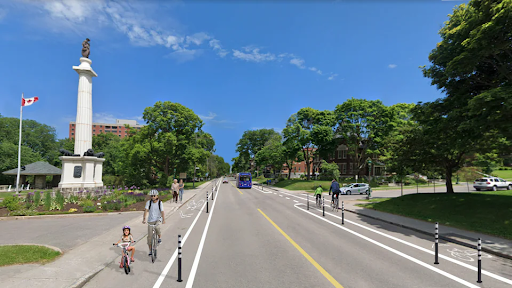
A bike path opened last summer along Chemin Sainte-Foy. Work is expected to begin on a similar path between Limoilou and Charlesbourg this summer.

Image from Ville de Québec

Limoilou to Charlesbourg is next big bike path project Read More »

Aftermath of Quebec teacher strikes: Is there a better way?

Peter Black

Local Journalism Initiative Reporter

peterblack@qctonline.com

Snow days notwithstanding, students are returning to public schools and CEGEPs across the province, in the wake of the storm of teacher strikes.

When all is tallied up – an estimated $11 billion in wage increases each year of the five-year deal; a $300 million catch-up plan; incalculable impact on the learning of affected students, particularly kids with disabilities; and parental frustration and anger – what conclusions can we draw about how unions and government handle negotiations in Quebec’s education sector?

We’ll leave the question of whether the strikes were worth it for the strikers themselves. One thing seems clear: the settlement reached might bring the salaries paid to teachers in Quebec closer to what teachers are paid in other provinces.

According to Statistics Canada, teachers in Quebec are the lowest paid in the country by a considerable margin. The numbers for 2019-20 show the average entry-level salary for both elementary and secondary teachers here is $42,431. The next lowest is British Columbia with $52,300. Ontario is $54,648, and the highest – excepting the territories, where salaries reflect the far higher cost of living – is Manitoba at $60,806. The national average is $52,975.

Quebec teachers nudge ahead of their New Brunswick counterparts by a few bucks after 15 years of service, at $82,585 versus $81,480, but are way behind Ontario at $100,925 and the national average of $93,646.

One can conclude there was some catching up to do during the recent negotiations with the Coalition Avenir Québec (CAQ) government, hence the 17.4 per cent hike over five years. Benefits and working conditions are too complicated for this space to compare to other provinces.

Despite the significant salary increase, one must feel some pity or something like it for the members of the Fédération autonome de l’enseignement (FAE), who stayed out the longest, without the benefit of a strike fund (how is that even legal?). The increase they won may compensate somewhat for a large chunk of lost income in 2023.

Is all this strike damage necessary? For a partial answer, we turn to the United States, a country one assumes to be a pro-union bastion, but not when it comes to teachers. According to a recent report on the Education Week website, 37 of the 50 states ban teacher strikes, including two of the three most populous, Texas and New York – one red, one blue. California, notably, allows teacher strikes, and there were several in 2023.

Despite the restriction of such drastic labour tactics, teacher salaries in the U.S. have kept pace with the rest of the Western world. The average starting salary for a public school teacher in the U.S. is $42,723 US vs. $40,722 US in Canada; the top rate is $74,214 vs. $70,331 in Canada.

If you want to make your fortune as a schoolteacher, by the way, head to Luxembourg, where the starting salary is $71,812 US, topping out at $126,000.

Clearly in a place like Quebec, where big unions have serious clout, it’s unlikely any government, especially one afraid of its own shadow like the CAQ regime is these days, is going to dare take up the cause of declaring teaching an essential service and protecting the enshrined right of children to an education.

In any event, with a hard-won five-year deal now in place – barring a rejection in ratification – both parties are surely in no mood to engage in a battle over the right to strike.

Parents, though, are not likely to be so complacent in ensuring their children’s education isn’t put in peril by future labour disruptions. The current trend to send kids to Quebec’s network of government-subsidized private schools is likely to accelerate.

According to one recent study of Quebec’s education system, enrolment in public elementary and secondary schools has dropped by four per cent and five per cent respectively over the past two decades, while enrolment in private schools has surged by 20 per cent over the same period.

The point has been made, in the debate over teachers’ strikes, that educators take to the picket lines not just for more money, but to improve working conditions and thus provide better education for children.

That notion will be put to the test as hundreds of thousands of Quebec students try to catch up on many days of learning lost to strikes.

30

Aftermath of Quebec teacher strikes: Is there a better way? Read More »

Anglo rights group files injunction against Bill 96, future English-language restrictions

By Jack Wilson

Local Journalism Initiative

The Task Force on Linguistic Policy filed an application Jan. 17 asking a judge to stop the province from further restricting the English language or penalizing its use under Bill 96. A judge will hear the case Feb. 6.

“Every week that goes by, there’s another measure that’s being either promised or brought out by this government,” with the intention of protecting the French language, said Task Force president and lead plaintiff Andrew Caddell. “They’re using the anglophone community as a scapegoat for what they see as the decline in French.”

Caddell said he’s looking to “send a shot across the bow to the government that they cannot bring forth these other measures.” Anglophone Quebecers “are full citizens no matter what the government says,” he added.

“We’ve received stories from people who’ve received really egregious treatment from the government,” Caddell said. Indeed, the application lists 30 examples of people it says were discriminated against for speaking English.

The filing references a woman who left a hospital after a triage nurse refused to speak to her in English. The next day, the woman went to another hospital where she was found to have sepsis which triggered a cardiac event. “She almost died,” the document states.

The filing references other examples of discrimination in healthcare settings, a person hung up on by RAMQ after asking for service in English, another unable to seek justice for human rights violations because the Human Rights Commission won’t communicate with her in English and multiple people struggling to complete CEGEP as a result of new French-language rules under Bill 96.

Caddell said the Task Force enjoys wide support in the Anglophone community, having raised over $100,000 for its legal efforts.

He pushed back against notions that English-speakers aren’t integrated into French-speaking society. “Eighty per cent of Anglo Quebecers are bilingual, which is an incredible number when you think about it.” The notion that the French language is in decline doesn’t hold up to scrutiny, Caddell said, given the number of Anglophones and immigrants able to speak French.

Those who can’t speak English tend to be “people who are elderly, visible minorities, Indigenous people, rural poor and recent immigrants,” Caddell said, as well as people with physical or mental disabilities. As a result, marginalized people are the most impacted by the province’s language policies, he said.

“The people that are on the margins, they need to have somebody to stand up for them,” Caddell said. “That’s why I’m doing it.”

Anglo rights group files injunction against Bill 96, future English-language restrictions Read More »

Suburbs push back on rising agglo costs

BRENDA O’FARRELL
The 1510 West

As West Island demerged cities enter into a new year on the heels of approving their annual budgets for the coming 12 months, the growing burden of the cost of shared services controlled by the Montreal agglomeration is put in sharper focus. But this year, the accelerating pace of those costs and the seeming trend to shift a greater weight of the financial burden on to the suburbs is hitting a breaking point.

“Enough is enough,” is the message being levelled by the Association of Suburban Municipalities, a coalition that represents the 15 demerged cities on the island of Montreal, including eight West Island municipalities.

“This injustice is a true abuse of power, and in the name of fairness and respect for all taxpayers, it must absolutely stop,” said Beny Masella, president of the association and mayor of Montreal West, in a recent statement. “We call for an urgent and genuinely effective response from the city of Montreal to address this blatant fiscal injustice for our citizens.”

According to the association, residents of demerged cities now pay about 65 per cent more per capita for services managed by the agglomeration than citizens of the city of Montreal. And in many cases, they receive what is described as “significantly fewer” of those services, including police presence and public transportation.

In the West Island, this has translated into taxpayers in almost all demerged cities forking over about 46 to 62 cents of every tax dollar they will pay in 2024 to the Montreal agglomeration.

See COSTS, Page 2.

Also see Editorial, Page 6.

COSTS: Kirkland mayor calling for end to agglo

From Page 1

And in every demerged city – from Senneville to Dorval – the amount being charged to taxpayers has increased this year.

In Dorval, the city will be paying $84.3 million for agglomeration services this year. That is $4 million more than the municipality was billed in 2023.

In Pointe Claire, the agglomeration charges will reach $85 million – about $5 million more than last year.

In Kirkland, the agglomeration bill this year has hit $38 million. It now represents more than half – 52 per cent – of the municipality’s annual budget.

While the cost of services are going up across the island, the proportion of the growing burden is shifting, the Association of Suburban Municipalities says. This means the rate of increase assessed taxpayers in the suburbs is increasing more compared with taxpayers who live in the city of Montreal.

More specifically, the association claims that between 2019 and 2023, the inequity continued to grow, with demerged towns seeing a 28.2-per-cent increase in costs, while Montreal saw its burden rise only 19.3 per cent.

The situation has pushed Kirkland Mayor Michel Gibson to call for the abolition of the agglomeration.

“The agglomeration is something that should be eliminated completely and we should look at a more democratic way of being able to share expenses,” Gibson said in an interview with The 1510 West.

In Beaconsfield, municipal officials continues to pursue a court action initiated against the agglomeration in 2019.

Beaconsfield Mayor Georges Bourelle has called the agglomeration “a joke.” And does not hide his disdain for its practices of shifting the cost burden onto the suburbs.

This year, more than half of Beaconsfield’s $59.9-million budget – $30.6 million – will be handed over to the agglo.

In a report by the Association of Suburban Municipalities submitted to Commission on Finances and Administration of the City of Montreal in December, the demerged cities claim that despite efforts to address the growing disparity in the assessment of costs, substantial “disagreement persists” between affiliated municipalities and the city of Montreal regarding the fair sharing of agglomeration expenses.

The association even goes as far as to accuse the city of Montreal of making “no concrete effort to resolve this situation and evidently prefers to continue benefiting financially from these fiscal inequalities.”

“This is socially and morally unacceptable,” Masella stated. “We cannot accept that there are two classes of citizens on the Island of Montreal.”

Suburbs push back on rising agglo costs Read More »

Suburban mayors demand betterfrom Montreal agglomeration

Here are a few points from the report from the Association of Suburban Municipalities to the Commission on Finance and Administration of the City of Montreal delivered last month.

“The City of Montreal, through the president of its executive committee, officially recognized during the Agglomeration Council meeting of Nov. 29, 2022, that the existing system of assessed contributions for the Agglomeration de Montréal had reached its limit. Unfortunately, this legitimate recognition has yet to be translated into concrete action and results.

“For more than 16 years, the (Association of Suburban Municipalities has) been lobbying the City of Montreal to achieve true tax fairness for their taxpayers, and to date, without any real response or success. We insist and remind all concerned that there is a flagrant tax injustice for the citizens of our linked metropolitan cities in the agglomeration of Montreal, and that this problem must ultimately and effectively be resolved. Such an agreement will be the cornerstone of a true agglomeration partnership.

“Now that all our cities, including Montreal, have recognized the obvious fact that the current quota system for the agglomeration of Montreal has reached its limits, productive discussions should be relaunched as soon as possible to identify and implement a new management framework for sharing agglomeration expenses.”

Suburban mayors demand betterfrom Montreal agglomeration Read More »

Cops probe after canal building gutted by fire

FREDERIC SERRE
The 1510 West

Ste. Anne de Bellevue residents wishing to take a stroll along the canal in the town’s west end will have to wait as Parks Canada and police investigate a suspicious fire last week that gutted a visitors’ cabin on the grounds of the historic site. For now, the area has been cordoned off, said Ste. Anne de Bellevue spokesperson Rita Latif.

“We know as much about this fire and its cause as what Parks Canada has told us,” Latif added.

Parks Canada issued a public notice Jan. 10, alerting residents that a fire had broken out inside the building, causing extensive damage.

“Please note that the Ste. Anne de Bellevue Canal National Historic Site is currently closed indefinitely due to a fire in the lock’s log cabin. We ask you to respect the signage in place,” the notice stated.

The town also posted a public notice on its website and Facebook page, repeating Parks Canada’s warning to stay away from the locks while the investigation continues.

Parks Canada officials could not be reached for comment.

Local resident Natacha Filion, who regularly strolls along the canal, said she hopes the cordoned off area will reopen to the public soon.

“One thing for sure is that I miss my jetty walks,” Filion said. “The crossing is blocked from access.”

Another local resident, photographer Dan Bouger, visited the site this week and posted a photo of the gutted structure, suggesting that perhaps some good can come from the unfortunate incident.

“Here’s wishing that Parks Canada takes the occasion of this fire to rebuild and beautify the current site,” Bouger said, “with more open space and lots of windows rather than a cabin with disgusting toilets for employees who deserve better.”

Cops probe after canal building gutted by fire Read More »

Still no parking at Pointe Claire REM station

BRENDA O’FARRELL
The 1510 West

With just months before the Reseau express métropolitain light rail commuter train line is pushed into service in the West Island, there is still no provisions for parking at the Pointe Claire station next to the Fairview shopping centre.

According to a spokesperson for CDPQ Infra, the consortium building the $6.9-billion rail project, no plan to provide commuters with a parking area has been secured for the Pointe Claire station, nor has any parking for the general public been devised for the Kirkland station.

The town of Kirkland has struck a deal with a developer to provide 200 spots near the station, but this area will be reserved for Kirkland residents only.

“CDPQ Infra seeks to maximize access to REM stations by focusing on different modes of transport, including active and collective transport, as well as access by personal car,” said Michelle Lamarche, director of media relations for the consortium developing the rail service, in an email to The 1510 West last week.

“We are always working with local partners to develop access proposal best suited to the sector,” Lamarche added. But so far, no space for vehicle parking has been identified.

When plans for the REM in the West Island were unveiled in 2016, CDPQ Infra had promised 4,500 parking spots at the four West Island stations along the 14-kilometre route. That number has since been cut to 700, including 500 spaces at the Des Sources station and 200 at the Anse à l’Orme station in Ste. Anne de Bellevue.

It is expected that 4,300 riders will use the West Island train on a daily basis by 2031, according to CDPQ Infra. On its website, it only lists space for 50 bicycle parking spots at the Pointe Claire station – 30 under a roofed stand.

Almost two years ago – in the spring of 2022 – a CDPQ Infra spokesperson admitted that the lack of parking at the Pointe Claire and Kirkland stations was a concern that kept being brought to the consortium’s attention. At that time, the spokesperson said CDPQ Infra was looking to negotiate a deal to allow commuters using the Pointe Claire station to use existing parking lot space at the Fairview mall. Cadillac Fairview, the owners of the mall, have not been willing to agree to any such offer.

Still no parking at Pointe Claire REM station Read More »

Community involvement propelledHurley into mayor’s post in Île Bizard

JOHN JANTAK
The 1510 West

Nearly three decades of community involvement through volunteerism inspired Doug Hurley to run for mayor of the borough of Île-Bizard–Ste. Geneviève under the Ensemble Montréal banner last fall, winning the by-election Dec. 17.

Hurley, a former police officer and currently a teacher at John Abbott College, won the support of residents with 78.42 per cent of the votes. He replaces former borough mayor Stéphane Côté, who resigned in August because of health problems. Hurley beat opponent Ghassan Baroudi of Valérie Plante’s Projet Montréal party.

“I’m a local boy,” Hurley told The 1510 West. “I’ve been here for 37 years and I’m literally humbled by the amount of people who voted for me.”

Hurley said he ran for mayor because it’s an extension of what he already does in the community as a volunteer.

“I’ve been the president of the local Optimist Club for the past seven of the 10 years I’ve been with them,” said Hurley. He has also coached hockey, baseball and softball in the community for 27 years.

“This probably explains why when I was doing my door-to-door election campaign, I was surprised at how many people I knew,” he said.

Overseeing the construction of the new Jacques-Bizard Bridge, improving public security and keeping the green aspect of Île Bizard are his priorities.

“That’s the one thing we’re famous for,” he said. “We have the land mass necessary for parks and green spaces. I’d compare it to living in Hudson. We want to keep that orientation.”

The city will also prepare for the influx of traffic expected into Île Bizard during the President’s Cup golf tournament at the Royal Montreal Golf Club in Île Bizard in late September.

“This is going to be another one of our challenges, especially with the bridge under construction,” Hurley said, as thousands of spectators are expected to attend the event.

“That’s where my background with 32-and-a-half years as a police commander is going to come into play, plus my 28-plus years training police officers at John Abbott College as a teacher,” he added.

Community involvement propelledHurley into mayor’s post in Île Bizard Read More »

Pointe Claire presents new plan to preserve iconic windmill

BRENDA O’FARRELL
The 1510 West

Pointe Claire council is set to move forward with a plan that aims to see the iconic centuries-old stone windmill along its lakefront restored. But it is still not clear when work will begin.

On Tuesday evening, council was expected to approve the adoption of a bylaw to create a financial assistance program that would fund the restoration of the windmill, which dates back to the early 1700s. The bylaw was proposed in December and was slated to be adopted with modifications yesterday after The 1510 West went to print.

The move would allow for the Catholic Archdiocese of Montreal, which owns the windmill, to apply for a grant from the city of up to $967,761. The grant would be subject to a number of conditions, including that the archdiocese secures a matching grant from the provincial government to carry out the needed renovation work to ensure that the historic stone structure be restored.

According to councillor Brent Cowan, a member of a committee that hammered out the framework for the new grant program to fund the windmill restoration, the proposal agreed to would see only work on the exterior of the windmill carried out – including repairing the roof, stonework and replacement of the blades. Replacing the inner mechanism of the windmill that would enable the mill to be returned to working condition is not included.

In addition, the archdiocese would not have to commit to allowing public access to the site, an issue that previously had brought up concerns about liability and insurance requirements. The church, however, would be prohibited from building a fence around the structure, Cowan said.

In an interview Monday, Cowan said he was not aware of the modifications that would be included in the final version of the bylaw set for adoption yesterday, explaining that they were determined during the last round of discussions between Pointe Claire’s director-general and the archdiocese’s representative on Monday morning.

Although council in the fall of 2022 approved a preliminary plan that pledge public funds to finance the restoration, a needed step to allow the archdiocese to move forward with an application to secure a provincial grant to cover half of the cost of the restoration work, Cowan said church officials have not yet submitted a request for funding with Quebec. With that step still expected, it is predicted that the delays for approval of provincial funding could take up to 18 months, which will delay the start of any work.

In an interview last weekend, Pointe Claire Mayor Tim Thomas criticized the proposed deal.

“We’re years off with this arrangement,” Thomas said.

The mayor is frustrated that council refused to ratify a deal he had negotiated along with the city’s former director-general and the archdiocese in the fall of 2022 that would have included restoring not only the exterior of the windmill but its inner workings.

“We are going to get less for our money,” he said, adding that the delay also pushes the project further back without a clear start date.

“It’s all so that I won’t get a windmill agreement during my mandate,” Thomas said.

Built in 1710, the windmill is Pointe Claire’s civic symbol, gracing everything from the city’s water tower to its municipal website and banners. It was classified as a heritage site by the provincial government in 1983 and is one of a handful of Quebec windmills built under the French regime that still exist. 

Cutline:

Neglected for years, the blades of the windmill on the shores of Lake St. Louis in Pointe Claire has been damaged by storms, while its roof and stonework are in need of repair.

Credit:

The 1510 West file photo

Pointe Claire presents new plan to preserve iconic windmill Read More »

Average property tax bill up 4.6% in Baie d’Urfé

JOSHUA ALLAN
The 1510 West

Homeowners in Baie d’Urfé will see their property tax bill increase again this year, jumping another 4.6 per cent, according to the town’s $28.3-million budget for 2024 adopted last month.

That means the owner of an average home valued at $1.17 million will pay $5,026 in property taxes this year, $223 more than last year.

The residential property tax rate is set at $0.4310 per $100 evaluation, slightly up from $0.4118 per $100 of valuation in 2023.

Overall, the town will spend $1.9 million more this year compared to last year, which represents a 7-per-cent increase.

Almost 62 per cent of the town’s budget – or $17.5 million – is attributed to cover the cost of services provided to the Montreal agglomeration contribution. These costs, shared with the City of Montreal and other demerged cities, include emergency services, public transport and water management. Baie d’Urfé’s agglomeration payment rises by $600,000 – or 3.5 per cent – this year compared with 2023.

“Overall, this expense represents 62 per cent of our total budget, and 76 per cent of our property tax revenues,” said Mayor Heidi Ektvedt at a Dec. 12 town council meeting.

Among the additional local expenditures in this year’s budget Ektvedt highlighted are adjustments to the drainage systems on Sunny Acres Street and Lakeview Street, the construction of a central septic system to service recreational centres and a “facelift” for Bertold Park.

Average property tax bill up 4.6% in Baie d’Urfé Read More »

Beaconsfield taxes to see 3.7% jump in 2024

JOSHUA ALLAN
The 1510 West

Property taxes are swinging upwards once again for Beaconsfield residents. After being hit with a 9.4-per-cent tax increase last year, the city’s $59.9-million budget will deliver another 3.7-per-cent hike.

This raises the total municipal tax on an average single-family home – valued at $1.03 million –

to $7,030, an increase of $242 compared with 2023.

The bill includes an annual garbage fee of $210, an increase of $25 compared with 2023; and a water tax of $40, which is unchanged from last year.

The residential tax rate has been set at $0.6061 per $100 of property valuation, up from last year’s rate of $0.5878.

Beaconsfield will increase its overall spending in 2024 by just over $2 million, according to the budget that was approved in December.

Some $30.6 million – just over half of Beaconsfield’s total budget – will go to toward the Montreal agglomeration budget as payment for shared services. These services include public transit, social housing and emergency services. This cost is up by nearly $960,000 compared with last year.

In a Dec. 12 presentation on the new budget, Beaconsfield city manager Patrice Boileau and finance and treasury director Robert Lacroix delved into the details of the changes in the new budget compared with last year.

The presentation compared the yearly change in cost of the local budget with that of the city’s agglomeration payments. All in all, the cost of Beaconsfield’s local budget was upped by 4.3 per cent, while the cost of the agglomeration portion of the budget rose by 3.2 per cent.

However, Boileau and Lacroix pointed out that this change is not indicative of the overall trend over the past decade.

“Over a time base of 11 years it’s the opposite,” Lacroix said. “The agglomeration increases have been a lot more than the local increase.”

Beaconsfield’s agglomeration payments have risen by 56.6 per cent during that period, while its local budget has comparatively risen by just 12.6 per cent, according to Boileau and Lacroix.

Beaconsfield Mayor Georges Bourelle has been vocal in his opposition to the growing price tag of these agglomeration payments for demerged cities. He has argued that the City of Montreal has taken advantage of demerged cities by overtaxing residents, while giving these cities little voting power at agglomeration council meetings.

Bourelle is at the forefront of an ongoing lawsuit against the Montreal Agglomeration Council for what he claims is an over taxation of residents of these demerged cities. The council treats demerged cities and their taxpaying residents as a “cash cow,” Bourelle told The 1510 West in December.

Beaconsfield taxpayers will receive municipal tax bills to be paid in three instalments in 2024, Boileau explained. First, residents will receive their agglomeration tax bills this month to be paid in two installments – one in February, and the other in May. The local tax bill will be distributed in November to be paid in December.

Beaconsfield taxes to see 3.7% jump in 2024 Read More »

Grande-Rivière High School’s Volleyball Team Secures Silver at Montreal Youth Cup

Photo: Les Cyclones, the triumphant volleyball team from Grande-Rivière High School, adorned with their hard-earned silver medals at the Montreal Youth Cup. (TF) Photo courtesy of the Grande-Rivière High School’s Volleyball Team

In a remarkable display of skill and teamwork, the female volleyball team of Grande-Rivière High School, affectionately known as “Les Cyclones”, clinched the silver medal in the U16 Division 1 category at the Montreal Youth Cup. This prestigious tournament, which took place onJanuary 6 and 7, saw Les Cyclones showcasing their prowess against some of the best teams in the province.

The team’s journey to the Montreal Youth Cup has been marked by consistent high-level performance and dedication. Coach Jason Brennan, who has led the team for four years, shared his insights into their preparation: “The team itself has always been a high-level team and has always been amongst the best teams in the area at the school volleyball level.” This long-term commitment to excellence set the stage for their success at the Cup.

A pivotal moment in the tournament, highlighting Les Cyclones’ resilience, was their advancement to the semifinals, emerging as one of the top four teams from a competitive pool of 24. Reflecting on this significant milestone, Coach Brennan remarked, “We found ourselves among the elite, facing off against some of the province’s top Sport Etude programs and premierclub teams in Quebec. Our journey led us to a challenging match against Ontario’s 10th ranked club team. Pushing them to a decisive third set in the gold medal game was a defining and extraordinary moment for our team.”

This achievement is more than just a medal; it’s a milestone in the team’s journey toward the regional championships. Coach Brennan emphasized the impact of this accomplishment: “It’s all part of a process in getting the girls ready for our regional championships. But it helped in reinforcing the fact that we’re on the right track.”

The team’s success is attributed to their hard work and focused training regime. “The girls work hard and aim to be the best they can be. When they come to practice, they come with goals of getting better every time, and they train with intent and purpose,” said Coach Brennan.Les Cyclones’ participation in external tournaments is made possible through the support of generous sponsors and annual fundraising efforts. Their next challenge awaits in a tournament in Boston in March 2024.

With notes from Mary Baskin, Marie-Eve Turpin and Lily Ryan

Grande-Rivière High School’s Volleyball Team Secures Silver at Montreal Youth Cup Read More »

Rethinking connectivity: Steve Moran advocates for a sustainable future of Alexandra Bridge

Photo: Alexandra Bridge in daylight, envisioned by Councillor Steve Moran as a future hub for public and active transportation in his sustainable urban planning proposal. (TF) Photo: Courtesy of Councillor Steve Moran’s Facebook Page

In a bold move addressing the future of the Alexandra Bridge, Hull-Wright district municipal councillor Steve Moran has put forward a series of progressive ideas focusing on sustainable transportation and heritage preservation. As the bridge, a prominent feature in the Ottawa–Gatineau skyline, approaches the end of its service life, Moran’s proposals offer a fresh perspective on urban infrastructure and its potential for adaptation to modern needs.

Built over 120 years ago, the Alexandra Bridge has been a vital connection between Ottawa and Gatineau. Designed to accommodate various modes of transportation, it has evolved to become a significant conduit for motorists, pedestrians, and cyclists alike. Currently, the bridge handles approximately 9% of the interprovincial vehicular traffic and a noteworthy 33% of active mobility crossings, highlighting its importance in the region’s transport network.

As the Alexandra Bridge approaches its scheduled reconstruction between 2028 and 2032, Hull-Wright district municipal councillor Steve Moran is not only advocating for a shift in its usage, but also emphasizing the need for a comprehensive feasibility study on this potential transformation. Understanding the critical role the bridge plays in the area’s transportation network, Moran proposes repurposing it exclusively for public transit and active transportation modes like walking and cycling. This significant change, he suggests, could effectively reduce the strain on the bridge’s infrastructure, thereby extending its service life while also aligning with broader environmental sustainability goals.

Moran’s proposal for the Alexandra Bridge, emphasizing a reduction in car reliance, is in line with broader regional transportation strategies seeking systemic change. He advocates for prioritizing public transit over the expansion of car lanes, stating, “The solution isn’t more lanes for cars, but better public transit systems.” This approach is crucial for addressing urban mobilityand environmental sustainability challenges. Traditionally, expanding car lanes to combat traffic congestion has counterintuitively led to increased vehicle usage, a phenomenon known as induced demand, which exacerbates congestion and pollution. Moran’s vision for enhancing public transportation infrastructure offers a sustainable and efficient alternative. By shifting focusto public transit, cities can alleviate traffic congestion and significantly reduce carbon emissions,a vital step in combating climate change and creating healthier, more sustainable urban environments.

Furthermore, Moran brings attention to the historical and cultural significance of the Alexandra Bridge. As a symbol of the region’s heritage, the bridge’s preservation is a matter of public interest. Moran suggests that acknowledging its historical value could lead to innovative ways tomaintain its structural integrity while adapting its function to contemporary needs. He urges consideration of the bridge not only as a transportation artery but also as a cultural landmark that merits preservation.

As discussions about the bridge’s future continue, Moran’s ideas offer a framework for balancing​historical preservation with the evolving demands of urban transportation. His emphasis on sustainability, public transit, and heritage reflects a holistic approach to urban planning, one that could serve as a model for similar projects globally. With the potential transformation of the Alexandra Bridge, Moran’s vision could redefine the relationship between historical structures and modern urban mobility.

With notes from Mary Baskin, Marie-Eve Turpin and Lily Ryan

Rethinking connectivity: Steve Moran advocates for a sustainable future of Alexandra Bridge Read More »

Gatineau’s winter season: a playground of snow and ice for all ages

Photo: Locals enjoying the winter season at one of Gatineau’s scenic outdoor recreational areas. (TF) Photo courtesy of the city of Gatineau

With the winter season well underway, Gatineau is buzzing with excitement as the city unveils a host of outdoor activities. Blanketed in snow, the city has come alive, opening eight slide and tobogganing sites and a variety of ice rinks. These offerings provide a splendid opportunity for residents to engage in winter sports and enjoy the beauty of the season, all within the urban landscape of Gatineau.

The City of Gatineau attaches great importance to its urban open air offerings, aiming to establish itself as a leading outdoor destination in Quebec. The city boasts an impressive range of facilities for outdoor enthusiasts, including 298 km of cycling or multifunctional paths, with 135 km available during the winter season. This winter, an additional 10 km of snow-cleared paths have been added. Gatineau is also home to more than 360 parks and natural areas, accounting for 14% of its territory, and is flanked by major rivers like the Outaouais, Gatineau, Blanche, and Hare. There are about 20 developed and potential outdoor sites, and residents can engage in a dozen different outdoor disciplines.

This winter, the city offers 14 slide and tobogganing sites suitable for all ages and spread across different sectors. Notably, at the Lac-Beauchamp Park open-air centre, air rooms are available for rent (free with the Accès Gatineau + card), although citizens must bring their own equipment to enjoy the other 13 slide sites.

In terms of ice rinks, Gatineau boasts 82 outdoor rinks across its territory. These include three general public ice rinks, three rings and icy alleys, 46 ice rinks with or without bands, and 30 proximity skating rinks maintained by local organizations. The opening of these rinks is weather-dependent, requiring at least 20 cm of snowfall on the ground and temperatures of -5° C or lower during the day. An ice thickness of 10 cm is necessary to open a rink, with some like Lac-Beauchamp and the Brasserie stream requiring 30 cm.

The majority of the ice rinks are currently in the preparatory phase. Citizens are encouraged to visit the Gatineau website to check the ice conditions throughout the skating season.

Additionally, Gatineau and its partners are offering six urban outdoor centres and sites this winter, with equipment such as snowshoes and cross-country skis available for rent (free with the Accès Gatineau + card). Winter cycling is also an option at several outdoor centres, including the Gatineau Park open-air relay and the Lake Leamy and Lac-Beauchamp Park outdoor centres.

The Chairman of the Commission for Recreation, Sports and Community Development and Councillor for the Plateau District, Bettyna Bélizaire, expressed her enthusiasm for the season: “Again this winter, young and old will be able to slide, skate, ski down the slopes, and pedal through snow-covered landscapes in all five sectors of the city. I invite all citizens to get outside and enjoy these urban outdoor activities, which are free and accessible to all.” ​For more information on Gatineau’s winter activities and facilities, please visit their website at https://www.gatineau.ca/portai…CA&p=activites_evenements_idees_sorties/plein_air_urbain .


With notes from Mary Baskin, Marie-Eve Turpin and Lily Ryan

Gatineau’s winter season: a playground of snow and ice for all ages Read More »

Gatineau’s Mayor Bélisle reflects on 2023: A year of bold steps and challenges

Photo: Mayor France Bélisle, reflecting on a year of significant progress and challenges for Gatineau during her mayoral tenure. (TF) Photo courtesy of France Bélisle’s Facebook Page

As 2024 begins, Gatineau’s Mayor France Bélisle takes a moment to look back at the eventful year that was 2023. Marking the midpoint of her tenure, it was a year that stood out as a definitive period for her administration. Characterized by a host of initiatives and notable challenges, 2023 was replete with significant achievements, the introduction of innovative solutions, and the learning of important lessons, all of which have shaped the trajectory of Gatineau under her leadership.

Housing Initiatives: A Collaborative Success

At the forefront of Mayor Bélisle’s achievements in 2023 was the revitalization of Gatineau’s housing sector. The creation of the shock committee in housing was a bold step toward addressing the city’s housing backlog. With 850 units stalled at the start of her tenure, the committee’s collaborative approach, uniting the city, private sector, and community organizations, brought a wave of progress.

Compassionate Approach to Homelessness

Homelessness, a complex and pressing issue, saw significant attention in 2023. Mayor Bélisle, moved by the plight of the city’s most vulnerable, led the council in allocating an unprecedented $5 million to homelessness services. This funding will contribute to the construction of a permanent infrastructure, offering essential support to those in need.

Advancing the Climate Agenda

Environmental stewardship was another key focus. The administration’s efforts culminated in the advancement of the city’s Climate Plan, a crucial step toward sustainable urban living. Securing a $25 million grant from the Quebec government, Mayor Bélisle’s team made significant progress in addressing the environmental challenges posed by the Cook landfill site, one of Quebec’s largest greenhouse gas emitters.

Encouraging Sustainable Transportation

The introduction of the “Libre Accès Jeunesse” program marked a leap forward in promoting sustainable transportation. Offering free, unlimited public transit access to over 10,000 students during the summer, this initiative not only cultivated environmentally friendly habits among the youth but also eased the burden on families.

Rethinking Tax Payment and Service Delivery

A significant administrative reform introduced by Mayor Bélisle was the new flexible method of tax payment, allowing residents to pay municipal taxes in four installments. This policy change, though simple, had a profound impact on the lives of many Gatineau residents, exemplifying theadministration’s focus on practical, everyday solutions. Alongside this, improvements in waste management, snow removal, and general service delivery underscored a commitment to enhancing the quality of life for all citizens.​

Restructuring for Greater Efficiency

2023 also saw an internal restructuring within the municipal government aimed at increasing efficiency and responsiveness. New services focusing on citizen interaction, asset planning, and performance management were established. These changes represent a strategic shift toward amore agile and effective municipal administration.

Looking Ahead: 2024 and Beyond

As Gatineau steps into 2024, Mayor France Bélisle’s vision encompasses a range of ambitious goals. Building on the foundations laid in the previous year, her focus remains steadfast on critical areas like housing, economic development, mobility, public safety, and infrastructure.

Continued Housing Innovation: With the groundwork laid in 2023, the mayor plans to continue the momentum in the housing sector. The construction of 400 new housing units is just the beginning. The administration aims to further collaborate with various stakeholders to address the housing crisis innovatively and compassionately.

Economic Development Focus: Recognizing the potential for economic growth, Mayor Bélisle intends to devote more resources to this area. The goal is to streamline efforts, ensuring that Gatineau’s economic development is both robust and sustainable. This will involve a closer look at local businesses and a strategic plan to boost the city’s economic vitality. By nurturing the local economy, the administration aims to create a thriving environment for businesses and residents alike.

Enhanced Mobility Solutions: The “Libre Accès Jeunesse” program is set to expand, potentially covering more students and promoting wider use of public transport. This initiative is part of a larger vision to transform Gatineau into a city where sustainable transportation is not just encouraged but seamlessly integrated into everyday life.

Public Safety Initiatives: The plans for a new Police Headquarters and the creation of a public safety commission highlight the administration’s commitment to ensuring the safety and securityof all Gatineau residents.

Infrastructure for a Growing City: Projects like the Complexe de l’Ouest showcase the city’s commitment to providing top-notch recreational facilities. The administration’s focus on infrastructure extends to improving roads, public spaces, and community centres, ensuring that Gatineau’s growth is both balanced and beneficial to all residents.

With notes from Mary Baskin, Marie-Eve Turpin and Lily Ryan

Gatineau’s Mayor Bélisle reflects on 2023: A year of bold steps and challenges Read More »

Convenient or compromising: experts say keyless entry has led to rising car theft figures

Djeneba Dosso

LJI Reporter

The saying “technology is our friend” is no longer true for many motorists across Gatineau. The number of reported thefts has more than doubled in the last three years, climbing from 153 vehicles in 2020 to 318 last year. This increase is not unique to Gatineau. It’s a similar story across the bridge, as Ottawa police say more than 1,200 vehicles were stolen as of December 2022. Of these, only 173 were recovered, meaning 85 per cent were never found – a figure that is worrying for authorities. 

Andrée East from the Gatineau City Police Services (GCPS) says the provinces of Quebec and Ontario and the National Capital Region have all joined forces to crack down on structured vehicle theft networks. 

On January 6, GCPS arrested five individuals in connection with vehicle thefts, and recovered three stolen vehicles, thanks to the vigilance of a citizen. 

Around 5:30 am, the Gatineau resident reported the unusual presence of three SUVs parked on rue de Fréjus. When police arrived on the scene, they found two Toyota SUVS, one with the side windows smashed in, while the third was intercepted nearby on rue d’Antibes. 

The five young men are all residents of the Greater Montreal area, between the ages of 14 and 21. They were taken to the police station to be interviewed by investigators and subsequently released. 

Charges in connection with the vehicle theft will be submitted to the Director of Criminal and Penal Prosecutions (DPCP), as well as the Youth Division in the case of the two teenagers. 

Police say the investigation is still ongoing, and additional charges may be filed. As the number of thefts and car trading continues to rise, experts say technology carries some of the blame. 

More often than not, a carjacker’s golden ticket, at a motorist’s demise, is keyless entry technology.

“In the vast majority of vehicle theft cases, the stolen vehicles are equipped with push-button start systems,” notes East. “What’s more, these are luxury vehicles, valued at $50,000 or more.” 

In 2023, the vehicles most susceptible to theft in Gatineau were the following: Toyota RAV4, the Highlander, Jeep Wrangler and Gladiator and the Honda CR-V. Each of these models is equipped with innovative technology ranging from multimedia CarPlay to power heated mirrors and windows.

Automotive engineers’ objective is to enhance the driving experience, but what happens when those bells and whistles make drivers a target?

For Ottawa business owner Andre Derouchie, the solution is clear: engine immobilizers. Family-owned and operated since 1984, Derand Motorsports specializes in an array of automotive services ranging from car audio, alarm systems, remote starters, ATVs, and security devices for cars. 

Derouchie, who has seen the demand for their anti-theft technology double over the past year, says thieves’ biggest targets are Toyotas, Lexus, Dodge, Jeep, and GMC. Although these cars aren’t all equipped with state-of-the-art technology, they all have one thing in common. 

“If you have an all-wheel drive or a four-wheel drive, that’s exactly what they’re looking for.”

To address this issue, insurance companies suggest drivers invest in AirTag tracking devices or steering wheel lock bars. But, Derouchie believes these tactics may be outdated. 

“To me, it’s not really a big deterrent,” he says. “Tracking devices are okay, but when they steal a vehicle at two o’clock in the morning and you wake up at eight, they’ve had a bunch of hours to get a head start on you. [The same goes for steering wheel locks.] They may look at it, but they come with special saws. They can cut through the steering wheel lock bar in about 30 seconds.” 

When drivers come to him with these concerns, Derouchie always suggests his two bestsellers: the IGLA and Viper standalone engine mobilizers which are compatible with any vehicle that isn’t hybrid. 

The IGLA starts at $899 and includes an engine immobilizer, two IGLA remotes with advanced coding and a sequence code as backup. 

The Viper starts at $1,199. “The Viper is the one I try to push people to go to because it has an engine mobilizer like the IGLA, but it also has an alarm system. So, as soon as they touch the door, break a window, open the hood or the tailgate, the alarm is going to start screaming and the headlights and taillights will start flashing,” he explains. “It will also send a signal to your phone and to a remote control that you could leave by your bedside, which will start beeping and flashing.”

The tools available on the market have aided in the prevention of vehicle theft according to the GCPS. In 2022, the total number of charges laid with the Director of Criminal and Penal Prosecutions (DPCP) was 48. Last year, it decreased to 36. However, carjackers usually don’t act alone. 

“It’s important to note that it’s possible for more than one person to be charged in the same case,” clarifies East. “So, even if we’re talking about 36 files with charges laid in 2023, there weren’t necessarily just 36 arrests or 36 charges.”

The Gatineau City Police Services, who have launched a special operation to target these crimes, urge residents to remain vigilant and report any suspicious activity in their neighbourhoods. Adopting preventative habits such as parking in a well-lit area under video surveillance can also deter criminals or, at the very least, provide important investigative evidence in the event of theft. 

“We would like to reassure the public that our police officers are well aware of the phenomenon and pay particular attention to it,” said East. “As this is an interprovincial [issue], the GCPS works closely with other police forces.”

Convenient or compromising: experts say keyless entry has led to rising car theft figures Read More »

Happy New Year: Amicale des Algériens au Canada bring Yennayer festivities to Gatineau

Djeneba Dosso

Yennayer, the new year celebration observed by the Amazigh, an indigenous group from North

Africa, has been celebrated on January 12 since 2971. On Saturday, non-profit organization

Amicale des Algériens au Canada (AAC) hosted their first Yennayer jubilation at Palais des

Congrès. The holiday, which is based on unity, love and prosperity, was an opportunity for

Algerians to bring their customs to Gatineau.

Growing up, Fatiha Benaicha’s fondest memories were those spent in her village celebrating the

new year. She recalls dancing to vibrant songs of love, fertility, and prosperity, accompanied by

tasty meals shared with family and loved ones. Today, she is the president of the AAC and aims

to bring together the Algerian community in Gatineau.

“When I came to Canada, there were only 30,000 Algerians; now there are 150,000,” she said.

“There’s change happening and, because we’re here, we want to pass this on to our children.”

For the AAC, this event was a chance to bring a piece of ‘back home’ to Canada. The festivity

saw a great turnout of Algerians, North Africans and locals wanting to learn more about the

Amazigh culture.

When they arrived, guests were greeted with beautiful traditional music and stuffed dates—a

North African snack. Local vendors were lined up offering a variety of products such as Algerian

olive oil, Arab perfumes, hijabs, henna, traditional paintings and jewelry. The day was also filled

with performances from North African singers, dancers and musicians.

Khaled Belkebir of Sahara Savours has been bringing “Sahara’s finest” food to Ottawa and

Gatineau since 2016. His shop caters to those wanting to taste the savours of North African

cuisine.

“I’m happy to see that the whole community has come together to connect with our North

African traditions and to see that the community is growing in the capital region,” he said.

This event reflects the AAC’s mission to grow the Algerian community in the Gatineau-Ottawa

regions and help newcomers integrate into society.

When they arrive in Canada, the AAC will guide immigrants by helping them find housing,

schools, setting up bank accounts and informing them of any foreign laws or cultural nuances.

“When I help people get settled here properly in a way that ensures that they don’t have

difficulties, that they stay in Canada and that they rejuvenate this society, I assume my role as a

citizen,” said Benaicha.

The AAC only counts seven permanent members who fund the entirety of their operations

alongside their president.

“Sometimes we solicit a few people from our community who participate in the small collection,

but for the moment there is no grant or help.”

Nonetheless, limited funding has not stopped them from hosting events two to four times a year

—the Yennayer being the first.

The AAC’s next event, hosted alongside Séfar Production, is scheduled to take place on March 2

in Laval. The Salon des Saveurs et Parfums d’Algérie will be an opportunity to discover the

culinary and cultural treasures of Algeria. The exhibition will be a sensory experience with more

than 70 vendors in attendance.

Despite the cold weather, hundreds of Gatineau residents made their way to Palais des Congrès

to observe the Yennayer celebration. Benaicha is hopeful to see an even greater turnout in March.

With notes and edits from Lily Ryan and Mary Baskin

Happy New Year: Amicale des Algériens au Canada bring Yennayer festivities to Gatineau Read More »

Owner of average house in Pointe Claire to see 3.9% tax hike

BRENDA O’FARRELL
The 1510 West

Homeowners in Pointe Claire will be seeing their municipal tax bills go up again this year, with the owner of an average house having to pay 3.9 per cent more in 2024, according to the city’s $181.5-million budget adopted last month.

That means the owners of an average house – valued at $674,216 – will pay $4,221 in municipal taxes this year, an increase of $158 compared with last year. This does not include a separate rate for water, which goes up slightly this year.

The tax rate for a single-family home has been set at $0.6261 per $100 of valuation, up from last year’s rate of $0.6026.

In terms of expenses, the city will increase its spending this year by $8.3 million, which represents a 4.8-per-cent jump compared with 2023. A large portion of that – about $5 million – is attributed to increased charges from the Montreal Agglomeration for shared services, said Pointe Claire finance director Daniel Seguin during a public meeting last month when the budget was presented.

In 2024, Pointe Claire will pay a total of $85 million to the agglomeration. This represents a 6.4-per-cent hike in charges over last year. It also represents almost half – 46.8 per cent – of the city’s overall budget this year. Services provided by the agglomeration include public transit, police and water.

The latest increase in agglomeration charges is in addition to the 8.1-per-cent hike assessed last year, bringing the rise in charges from the central island authority to 17.4 per cent since 2022.

“We give our citizens more bang for their dollar than the city of Montreal,” Mayor Tim Thomas said when asked to comment on the rising agglomeration charges.

Thomas criticized the agglomeration for not providing adequate justification for the increasing bills.

“If you have to pay, we should be getting accounting,” he said. “There is no real itemized bill.”

Among expenses controlled by the municipality, the largest increases in costs come from the operational expenses for city buildings, which jump 11.7 per cent; public security, which will see a 9.1-per-cent hike; and vehicle charges, which are up 7.8 per cent.

Pointe Claire council also approved the city’s three-year capital expenditures program. The plan will see $35.4 million invested this year on various infrastructure projects, as well as the renovation of certain municipal buildings and upgrades in parks. More specifically, the city plans to carry out road work on Monterray, Milhaven and parts of Winthrop avenues, planning for the overhaul of two highway overpasses – Highway 20 and Sources Blvd., and Highway 40 and St. Jean Blvd.; the installation of a pickleball court in Northview Park and a bicycle path near Brigadoon Ave.

Owner of average house in Pointe Claire to see 3.9% tax hike Read More »

Dorval residents to see slight tax increase in 2024 budget

JOSHUA ALLAN
The 1510 West

The average Dorval taxpayer will see a 2-per-cent increase on their municipal taxes in 2024, ending the city’s multi-year trend of lowering the average resident’s tax bill.

The owner of an average single-family house in Dorval– valued at $640,631 – will pay $58 more in municipal property taxes this year, according to the city’s 2024 budget adopted in December. That means the tax bill for that house will increase to $2,939 in 2024, which represents a 2-per-cent hike from the $2,881 paid in taxes in 2023.

The residential tax rate per $100 of valuation is set at $0.4587. This is a slight decrease from 2023, when the rate was set at $0.5005.

Tax rates for non-residential buildings, industrial buildings and residential dwellings of six or more units will be raised by six per cent, said Dorval Mayor Marc Doret.

Up until this year, Dorval taxpayers have seen slight reductions in their annual municipal tax bills every year since 2017 – with the exception of 2019, when taxes were raised by 0.1 per cent – followed by a freeze in 2023.

Referring to this year’s increase, Doret called for residents to keep the current economic circumstances and high inflation rates in mind.

“Despite an increase of 2 per cent in their 2024 tax bill, citizens must realize that they benefited from a real-life decrease due to the 4.6-per-cent inflation rate,” he said.

Overall, Dorval will spend $158.4 million in 2024. This figure represents an increase of $10 million, or 6.67 per cent, compared with 2023.

As with other demerged cities, Dorval’s municipal budget includes expenses for local services and payments to the city of Montreal for services supplied by the agglomeration, which include public transit, social housing and emergency services.

For services provided by Dorval, the city this year will spend $74 million, a $6.1-million increase increase over last year, which represents a 9-per-cent jump. Areas of increased local spending include: transport, which increased to $17.1 million, a 20.5-per-cent jump; and leisure and culture, which increases by 5.7 per cent to hit $20.7 million. Amortization costs jump 21.2 per cent to hit $11.7 million this year.

Dorval’s share of agglomeration payments has increased by $4 million, or 5 per cent, totalling $84.3 million this year. This makes up for around 53 per cent of the city’s total 2024 budget. Doret said the agglomeration payments have increased by approximately $15.6 million since 2021.

Dorval will invest just under $51 million in various community projects as part of its three-year capital expenditures program. Among the projects are a redesign of St. Charles Park, the construction of a covered refrigerated skating rink and upgrades at the Ballantyne Aquatic Centre.

Dorval residents to see slight tax increase in 2024 budget Read More »

It’s a 6.5% tax hike for owner of an average home in Kirkland

JOHN JANTAK
The 1510 West

Homeowners in Kirkland will see their tax bills increase an average of 6.5 per cent this year after council adopted its $73.76-million budget for 2024 in December.

For the owners of an average residence assessed at $810,982, they will receive a tax bill of $5,189 this year, which is an increase of $311 compared with 2023, and includes a $90 fee for water.

The residential property tax rate for 2024 has been set at $0.6288 per $100 of valuation, a decrease from the 2023 rate of $0.6628.

“The overall tax increase is in line with what the city was projecting to do,” Mayor Michel Gibson told The 1510 West. “If you look at our history over the last 10 years, the average increase per year was 2.3 per cent.”

Kirkland will spend about $2.5 million more this year compared with 2023, according to the $73.76-million budget, which represents an increase of 3.52 per cent.

A 2.2-per-cent wage increase included in the latest collective agreements with the city’s blue- and white-collar workers and the hiring of staff in the public security and urban forestry departments were factored into this year’s budget, Gibson said.

The city’s contribution to the Montreal Agglomeration rose by 3 per cent this year to just over $38 million — up from the $36.9 million it contributed last year. Fees paid to the agglomeration represents 52 per cent of Kirkland’s total budget for 2024.

“What can we say,” Gibson said, referring to the agglo charges. “We don’t have any control over the budget which is set up by the agglo. It’s completely under the control of Montreal, unfortunately, and these expenses are still going higher. It seems they don’t know how to control their own budget. We don’t have a say.”

“The agglomeration is something that should be eliminated completely and we should look at a more democratic way of being able to share expenses,” Gibson added. “We still have a long way to go in this area.”

Kirkland will spend $16.84 million for various projects in 2024 as part of its triennial capital works program. The amount includes $8 million for road repairs, $2.6 million for sewers and aqueducts, $5.4 million for the development of parks, green spaces and bicycle trails, $641,000 for it municipal vehicle replacement program and $207,000 for the repairs of buildings and street lights.

The various projects planned for the city’s parks include work at Paiement Park; an overhaul of Heritage Park, which will include adding a splash pad; and three new tennis courts at Holleufer Park.

It’s a 6.5% tax hike for owner of an average home in Kirkland Read More »

Property taxes up 5.5 per cent in Ste. Anne de Bellevue

JOHN JANTAK
The 1510 West

Homeowners in Ste. Anne de Bellevue will see their tax bills increase an average of 5.5 per cent this year after council adopted its $23.19-million budget for 2024 last month.

The residential property tax rate for this year has been set at $0.7221 per $100 of valuation, up from the 2023 rate of $0.6755.

For the owners of an average residence valued at $575,000, they will receive a tax bill of $4,152 this year, an increase of $268 compared with 2023. 

The town’s share of expenses to the Montreal agglomeration, including potable water this year, increased by $599,800, a hike of 5.9 per cent compared with 2023. The total amount set aside for the agglo is just over $10.7 million and represents 46.2 per cent of the town’s total operating budget this year.

The 46.2-per-cent increase represents the fourth highest percentage jump in agglo charges among the 15 demerged municipalities on the Island of Montreal.

In terms of local improvements planned, Ste. Anne will make significant investments in its parks and playgrounds this year as part the city’s triennial program, which also includes repairs to streets and municipal buildings.

The city has set aside $1.5 million for phase 2 of work that will take place at Robillard Park, $1.57 million for the construction of an open pavilion at Lalonde Park and the relocation of the parking area at the park, and $1.4 million for the redevelopment of Aumais Park to include water games, and new tennis and pickleball courts.

Improvements to the city’s road infrastructure include $750,000 to repair the intersection at Garden City Avenue and Pacific Avenue and $350,000 for the installation of permanent traffic lights on Anciens-Combatants Avenue at the east side entrance to the new Dev Méta Clinic.

The town has also allocated $3.2 million for the renovation of Industriel Boulevard and Daoust Street from Chemin Ste. Marie to the end of the existing sidewalk on Daoust Street.

Work slated for the village area includes $1.5 million earmarked for upgrades to the waterfront boardwalk and retaining wall as part of flood mitigation measures at the Lalonde parking lot, and $1.5 million to repair the retaining wall and paving stones at Kelso Park, which is also being done to reduce the risk of flooding.

Property taxes up 5.5 per cent in Ste. Anne de Bellevue Read More »

Senneville property taxesup 7.3%, agglo costs up 4.6%

JOHN JANTAK
The 1510 West

Homeowners in Senneville will see their tax bills increase an average of 7.3 per cent this year after council adopted its $7.95-million budget for 2024 last month.

The residential property tax rate for 2024 has been set at $0.4800 per $100 of valuation, up from the 2023 rate of $0.4532.

For the owners of an average residence valued at $1.33 million, they will receive a tax bill of $7,236 this year, an increase of $481 compared with 2023.

The village’s share of expenses to the Agglomeration of Montreal this year increased by 4.63 per cent compared with 2023, which is less than the 13.18-per-cent increase last year. The total amount set aside for the agglo is just over $4.38 million and represents 55 per cent of the village’s total operating expenses this year.

The village has allocated $2.78 million this year for several projects as part of its three-year capital program, including the conversion of the town hall into an emergency shelter with a stand-alone generator to maintain emergency operations.

Other infrastructure projects include the redevelopment of Pacific Avenue/Ste. Anne Street/Anciens-Combattants Road intersections in collaboration with the neighbouring municipality of Ste. Anne de Bellevue.

Also included on the list of investments is the shoreline development at Souvenir Park, upgrades of the playground and pool equipment at Senneville Park, studies for a path at Grand Parc de l’Ouest, and eco-territory forest conservation and tree planting for a total cost of just over $937,000.

Senneville property taxesup 7.3%, agglo costs up 4.6% Read More »

Mine your own business

By Trevor Greenway

Low is gearing up to protect its land, lakes, streams and the Gatineau River from mining companies who have set their sights on extracting lithium and graphite from the region.

During its Jan. 8 council meeting, several concerned landowners showed up to see what they can do to protect their land from companies who have already staked claims on their land – and to question why the information wasn’t relayed to taxpayers sooner when they mayor knew about the companies staking claims as early as summer 2023.

“How come it was two concerned citizens that put on a meeting and not council?” resident Ellen Rice-Hogan said to Mayor Carole Robert. She was referring to a Jan. 5 information session on mining activities, which was put on by Chemin Martindale residents Sylvie Ott and Martin Belanger. “If you’ve known yourself, Carol, since, what, September, give or take?”

Robert told the crowd that she has known about the mining claims since summer when a resident spotted a mining company representative on his land. She said mayors from the 17 municipalities that make up the MRC Vallée-de-la-Gatineau got together in September and passed a resolution to protect water sources across the region. That protection was accepted by the Ministère des Ressources naturelles et des Forêts and took effect in September. But the protection is only temporary and will expire in March.

That’s why, at its Jan. 8 council meeting, Low passed another resolution to protect “agriculture, forests, recreational properties, as well as lakes, streams and the Gatineau River,” from mining claims. The resolution will now go to the MRC, which is building a bigger protection pitch to protect much of the MRC from mining activities. Low also struck a mining committee and named councillors Maureen Rice and Maureen McAvoy to represent the town.

Robert said the mining claim boom in the region began with a massive claim near Manitou Lake, which was made on Crown land. Since then, claims have been popping up all over the region, most of them by mining companies Brunswick Exploration, Lomiko Metals and On Track Exploration.

By press time, 96 claims had been staked in Low, equaling close to 15,000 acres of land throughout the municipality.

“That’s 20 per cent of your municipality that is potentially going to be affected by this,” Rice-Hogan told the mayor.

Rice-Hogan told the Low Down that On Track Exploration has claimed 538 acres on her Low farm – claims that popped up sometime between September and December of 2023.

“It’s so scary,” said Rice-Hogan, flipping through maps to show where the claims have been staked. “It’s a large portion of the property.”

Resident Wally Brownrigg is another resident who has claims on his land. The longtime Low resident says he’s spent close to 50 years on his farm, developing forestry management plans, plantations and a trout pond that flows through the property.

“One inch of that area is equivalent to two million gallons of water going into my trout pond,” he said. “If they dig me up and do that mining, it’s not going to be too good. I own this property and have invested my life into this.”

The mining companies are targeting graphite and lithium used to produce EV car batteries. During the information session held by Ott and Belanger, landowners were encouraged to purchase mining claims on their own property. Anyone can purchase a mining claim using an online registry for as little as $75 – even if that land is owned by someone else. Land claimers are not obligated to notify a landowner if they purchase a claim.

This is what has happened to residents like Rice-Hogan and Brownrigg.

Mining claims are valid for up to three years. Quebec’s Mining Act states that landowners have the right to refuse exploration on their land, although in some cases, expropriation may be possible. Companies may use helicopters to carry out survey work, even without the landowner’s permission.

Low’s pitch to save its territory from mining will go to the MRC later this month before a full protection plan for the MRC is submitted to the ministry.

Mine your own business Read More »

Low arena turns 30 despite ‘90s ‘naysayers’

By Trevor Greenway

Every single nail that has been pounded into the Central Gatineau Arena has been hammered by a local volunteer. Every rivet drilled into the tin, every piece of glass installed into the arena boards, every rafter raised, every line on the ice painted by the hands of a Hills resident.

This Saturday, the arena celebrates its 30th anniversary – a culmination of the last three decades of blood, sweat and tears that volunteers have poured into every inch of the Low arena. From the many hands that helped erect it in 1994 to the scores of locals who keep the lights on today, everyone will be celebrated on Jan. 20.

“There’s gonna be some stuff for kids like sleigh rides and face painting and stuff like that,” said longtime volunteer Scott Mahoney about the anniversary party. He’s flipping through old photos of volunteers who put their lives and farm chores on hold to help build the arena. He pauses on one of a crew of locals posing on scaffolding as they install siding in 1993 – Roddy McCambley and Guy Monette, along with some of the other main builders of the arena. Both have since died but left a legacy in the form of an arena that has become a social hub for the municipality.

Mahoney has been sending these vintage images to family members over the last few days and shared a text message from Monette’s son Jamie:

“That was quite the crew,” wrote Jamie, who agreed to publish the message. “When I left for school that September, I couldn’t believe the progress they had made by Thanksgiving. I remember getting home, and every bale of hay was still in our fields. That crew made massive sacrifices to get that place built.”

The push for an indoor arena in Low began in the 1950s, when the former Gatineau Power Company offered land and money to build an arena, and there was interest from groups from Chelsea to Gracefield. All those pitches failed, including one group of municipal representatives that was one vote shy of kickstarting the arena build. The idea wasn’t reignited until 1991, when the Low Rec Association had plans to buy land and build an arena.

“There was no arena between Hull and Maniwaki,” said Morris O’Connor, former Low mayor, who also became chair of the Central Gatineau Arena Association (CGAA). He was instrumental in securing funding for the arena. After meeting with local politicians, he secured $215,000 in funding for the project.

One thing organizers did not want to have to rely on was municipal funding. Past pitches died on what volunteers called a “decades-long roadblock” as many feared that tax hikes would kill the project. It became a volunteer-driven project with fundraising as the primary source of revenue. In April 1993, the Low & District Lions Club came on board and chipped in another $100,000 for the project.

“It wasn’t easy at first,” said O’Connor, referring to how he convinced many to donate their money, time and equipment. He told the Low Down that “a lot of naysayers” told him that the project would fail like it did in the past. But as the project progressed, more volunteers began showing up, and things started happening. He said he remembers volunteers saying,“Give me something to do.”

“And then, as the thing started getting built, people started saying, ‘Oh, I think it’s looking like it’s going to happen,’” added O’Connor. “And then, just like that, we had 45 to 50 volunteers showing up at the same time.”

The amount of time, equipment and materials donated for the project is impressive. Over 2,800 hours were donated through various organizations, including the Low Rec Club, The Lions Club, the Low Youth Club, the Brennan’s Hill Sports Association and Senior Citizens groups in Low. Nine companies, including Aime Fleury Trucking, Wally Brownrigg and Ronald O’Connor Construction, donated more than 4,000 cubic yards of gravel. Over 100 volunteers showed up in May of 1993 to help prepare the site for the build, which took 10 full eight-hour days. More than 20 companies donated machinery to help prep the site.

Low resident Cecil Crites managed to convince 13 steel workers from Local 711 to volunteer their services to install steel beams, while electrician Aurele Normand, along with 15 fellow wire workers from Bourassa Electric, volunteered to oversee the electrical.

Even the bleachers that fans sit on were donated by the town of Lac-Ste-Marie, and were originally part of the Jarry Park Stadium, where the Montreal Expos home games were first played during the Jackie Robinson era.

Following nearly a full year of construction, the rink boards went up in early December of 1993, and a Zamboni was donated by Rene Mayer, a local, saving the arena another $50,000.

On Jan. 24, 1994, Brennan’s Hill resident and volunteer Yvon Fleury was the first to strap on skates and take a lap on the fresh, gleaming ice. O’Connor and volunteer builder McCambley later joined him – as did a roster of other helpers for an evening skate, which is rumoured to have lasted into the wee hours. The following day, on Jan. 25, the Central Gatineau Arena opened to the public, where more than 250 skaters showed up.

The Central Gatineau Arena has become the gem of the municipality, where local schools get free ice time, and kids get free hockey practices on Saturdays. It’s become a social hub where close to 600 hockey fans pack in every week to see their Paugan Falls Rapids take on their weekly foe; the place where seniors can stay active while getting their curl on; and where families are dazzled by their kids’ spins and twirls during the Gatineau Valley Skating Club’s year-end figure skating show.

“It’s a really important place for sports in the Gatineau,” added O’Connor. “And for the rest, it’s a social place for people to be – it’s great for the kids.”

The arena still operates without municipal funding today, and every person you see selling beer, cooking food or selling 50/50 tickets is not getting paid.

Saturday’s festivities will include a women’s hockey game, curling demonstrations and a food menu cooked by, you guessed it, volunteers. The celebration kicks off at 1 p.m.

Low arena turns 30 despite ‘90s ‘naysayers’ Read More »

Low passes modest budget with 5% hike

By Trevor Greenway

Residents in Low are facing a 5.61 per cent tax increase – a welcome hike compared to last year, in which taxes went up 20 per cent for the median homeowner.

Low councillors along with Mayor Carole Robert passed a $3.6 million budget in 2024, up from the $3.4 million budget in 2023, with the biggest increase coming in public works, which rose from just over $1 million in 2023 to $1.184 million this year.

Mayor Robert said that the public works budget is mostly eaten up by road maintenance, as the municipality has an extensive network of roads that the municipality is constantly working to stay on top of.

She told the Low Down that she was happy with the 2024 budget, touting that the increase this year for the median homeowner is just $42 on a home worth $176,900 – another welcome jump after property values increased by 40 per cent last year.

“So, really, the increase for the median homeowner is 42 bucks, but it will be more for some and less for others,” said Robert, scrolling through finance documents. She even stopped and mentioned her own property and how she will be paying a $77 increase.

“But I don’t mind. Last year was the worst because we got hit hard with the property assessments,” she said.

Robert and councillors increased the mill rate this year to $0.59434 per $100 of property evaluation. The mill rate is the municipal tax rate, which is based on the total value of property within a municipality’s jurisdiction to provide the necessary tax revenue to cover projected expenses.

Police services to the Sûreté du Québec increased by just over five per cent, while environment went up nearly eight per cent. Low’s contribution to the MRC Vallée-de-la-Gatineau rose by nearly 11 per cent, to $331,246.

One thing Robert said she was happy to report was that garbage fees came down this year, from $556 in 2023 to $525.20 per household in 2024. This was another item praised by residents, as some faced massive garbage hikes last year, including Brennan’s Hill owner Tara Shippers who saw a 400 per cent increase.

Robert and other councillors didn’t know how much debt Low has accumulated – or how much of this year’s budget will go to paying down the debt, and the interim director-general couldn’t find the information before press time.

Robert told the Low Down that the municipality is looking to add infrastructure for seniors and has big plans to build a new town hall and new fire station, but those are bigger, wish-list type projects she said she’d like to see realized.

“The fire station we have has been there since 1962,” said Robert. “Our fire department is growing out of it, and it just doesn’t make sense to add on to an older building.”

Projects on the books for this year include a new park at 400 Hwy 105 for kids and a new gazebo structure near the football fields so seniors can stay in the shade while enjoying local high school sports events.

“You know, things are starting to move,” said Robert. “And we’re happy to see things like that because it’s for the citizens and for kids. The gazebo in the back was important for me because I always thought that our seniors don’t go out to watch a game or whatever because of the sun. But just having this gazebo gives them a shady area to sit while they enjoy a football or softball game.”

Low passes modest budget with 5% hike Read More »

New short term mental health unit for those in crisis

By Trevor Greenway

A new short-term mental health unit in Gatineau is getting people get the help they need when they are in a crisis and it doesn’t matter what language they speak.

The new L’unité d’intervention brève en psychiatrie (UIBP) brief psychiatric intervention unit at the Centre intégré de santé et des services sociaux (CISSS) de l’Outaouais offers stays up to 72 hours for “any person aged 18 and over who is in a crisis situation with psychiatric components,” and whose daily life is affected to the point where “an episode of inpatient care is necessary to stabilize his or her state of health.”

The new service was launched in September last year, and 68 patients have already come through the program.

“Services are offered in both French and English,” said CISSS de l’Outaouais communications officer Quern Boua. “In addition, an interpreter can be called in if needed in another language.”

Boua said the new unit is “not linked to an increase in mental health calls/visits but rather to an initiative stemming from the interdepartmental mental health action plan.”

The new program is part of the Professional and Technical Health and Social Services Personnel Alliance’s (APTS) interministerial mental health action plan and aims to provide an alternative to lengthy hospital stays for those dealing with mental health issues. Boua said that those who are in crisis still need to first see an ER doctor at a hospital, who can then refer them to an on-call psychologist. This psychologist can then refer the patient to the UIBP, and they will be transferred to the mental health unit immediately, where they will receive care from a team of up to eight caregivers, including psychiatrists, nurses, psychiatric intervention officers and social workers.

“The person does not need to have a regular psychiatrist beforehand, but must be seen by a psychiatrist at the emergency level,” explained Boua.

She added that the program aims to “reduce the ‘revolving door’ phenomenon” around mental health treatment.

“The unit aims to overcome the limitations of traditional psychiatric hospitalization while reducing the length of hospital stay,” she said. “The expected length of hospitalization is around 48 to 72 hours.” She added that the unit’s objectives are to “stabilize the crisis, confirm or make a diagnosis, initiate treatment, strengthen coping skills for recovery in the community and ensure continuity of care after discharge.”

The program also includes support for families and at-home caregivers to “equip loved ones to facilitate their role with the patient.”

The new UIBP unit is located inside the Gatineau Hospital. For more information on the program, visit the CISSS de l’Outaouais at www.cisss-outaouais.gouv.qc.ca.

New short term mental health unit for those in crisis Read More »

Local IGA workers get 24% salary boost

By Madeline Kerr

Employees of IGA Famille Charles in Chelsea will see their salary increase by 24 per cent over the next seven years thanks to a new collective agreement signed with the local division of the United Food and Commercial Workers union (UFCW).

It’s a notable victory in an industry that has been under heavy scrutiny lately following reports that Canada’s top grocers made record profits of over $6 billion in 2023, while many grocery store workers’ wages haven’t even kept up with the pace of inflation.

Besides higher wages for all unionized employees, department supervisor bonuses will increase from $0.65 to $1 per hour worked. The union’s dental plan will continue to be fully paid for by the employer, and three new regular positions will be created. Spokesperson for UFCW Roxane Larouche told the Low Down that these improvements will help the store attract and retain workers.

Negotiations took place over just two meetings, which Larouche described as having “a harmonious climate.” She explained that approximately 80 employees will benefit from the collective agreement, which came into effect on Dec. 12, 2023.

IGA stores are supplied by Sobeys, the second largest grocer in Canada after Loblaws, and are owned by Empire Company Limited. Empire’s CEO Michael Medline made more than $8.6 million in total compensation in 2022, up from just over $7.4 million the year before, according to the Canadian private sector union Unifor.

Loblaws’ CEO Galen Weston Jr. made a staggering $11.9 million in compensation in 2022. Unifor concluded in a report published in April 2023 that the average grocery store employee – who at the time earned $18.97 per hour according to Statistics Canada – would have to work 340 years to earn Westen’s pay in just one year.

Local UFCW president Antonia Filato said in a statement that the latest salary raise for IGA Famille Charles workers is a good example of how “collective agreements ensure that our members obtain fair and equitable recognition for the work accomplished for their employer.”

Local IGA workers get 24% salary boost Read More »

Héma-Québec seeks blood donors after storm cancellations

Ruby Pratka, Local Journalism Initiative reporter

editor@qctonline.com

Héma-Québec is calling on Quebecers, especially those with type O+ and O- blood, to sign up for their local blood drive after snowstorms over the past week have led to a wave of cancellations. “Blood donations are often down during the holiday season, while demand for blood from hospitals is up. Though Héma-Québec has a solid blood supply overall, the need for donations from these two blood types has grown in the last few days, partly because many potential donors have cancelled their appointments due to the weather,” Héma- Québec spokesperson Josée Larivée said in a statement.

Type O is the most common of the four main blood types, and people of any blood type can safely receive type O blood, hence the high demand for it.

“We can’t expect anyone to come donate blood when they would be putting their safety in danger, or when they feel uncomfortable, but if you can’t attend your scheduled appoint- ment, please take the time to cancel, so someone who lives close by or decides to donate on the spur of the moment can take your appointment,” Larivée said.

“Héma-Québec has existed for 25 years and we’ve never lacked blood during that time …but we don’t want to get in a position where we have a critical shortage, so, preventively, we’re doing a public callout,” she said.

She pointed out that many longstanding restrictions keeping people from giving blood based on their travel history and past sexual experiences have been rescinded in recent years. For decades, people who had lived or spent time in the United Kingdom between 1980 and 1996, or in the Republic of Ireland or France between 1980 and 2001, could not donate blood in Canada due to concerns about Creutzfeldt- Jakob disease, and men who had had sex with men were ineligible to donate – both blanket bans have since been lifted. Also, contrary to popular belief according to Larivée, people with diabetes can be blood donors, and people with tattoos can donate as long as their most recent tattoo was done at least three months ago.

First-time donors can expect to take a finger-prick hemoglobin test and answer a health questionnaire before getting in the chair. The process of donating blood itself lasts about 10 minutes, and about a pint of blood is taken with each donation. “Tell [the nurses] it’s your first donation, and they’ll give you a lot of love,” said Larivée. “Then you’ll get your sugary, salty snacks and spend a nice moment in the company of other donors.”

Héma-Québec invites first- time donors to make donating part of their regular routine. As a general rule, men can donate every two months, and women can donate every three months unless they are pregnant or have recently given birth. Young people can donate as soon as they turn 18.

Each blood donation can save up to three lives. “If you ever have to be at the hospital with a loved one and you watch the blood bags arrive, then you understand the impact of all the people who took an hour out of their day to donate,” Larivée said.

Visit the Héma-Québec online reservation platform at jedonne.hema-quebec.qc.ca to book an appointment at a blood drive or Globule donation centre near you. Although Héma-Québec can’t guarantee that all staff are bilingual, every effort will be made to ensure donors get explanations in their preferred language.

Héma-Québec seeks blood donors after storm cancellations Read More »

Tutoring, free summer school part of post-strike catchup plan

Ruby Pratka, Local Journalism Initiative reporter

editor@qctonline.com

Students across the province affected by teachers’ strikes will have access to additional tutoring, ministry exams will be delayed and organi- zations working with at-risk youth will receive additional financial support as part of a $300-million “catch-up plan” announced Jan. 9 by Education Minister Bernard Drainville. Secondary 4 and 5 students who fail a ministry exam and must retake it to graduate will also attend summer school for free.

Dozens of French-language public schools across Quebec, including those in the Centre des services scolaire (CSS) de la Capitale and CSS des Premières-Seigneuries service areas in Quebec City, closed from Nov. 23 through the holidays after the Fédération autonome de l’enseignement (FAE) declared an indefinite general strike. The rest of Quebec’s public school teachers, including those in English-language schools, are affiliated through regional unions with the Centrale des syndicats du Québec (CSQ). Students in those schools missed eight non-consecutive days of school due to strikes. Although the agreements-in- principle reached between the unions and the government have yet to be ratified, school resumed Jan. 9.

Drainville said the funding would be made available to all affected schools, although further information on how it would be divided among schools and regions was not available at press time.

He emphasized that the ministry “did not want to make a wall-to-wall plan” and intended to distribute the funding to individual schools through boards and service centres, to allow schools to use it as they saw fit. “The needs are different from one student, one service centre and one school to another; the students’ needs will guide us and the schools are best placed to understand those needs,” he said.

Drainville said service centres would be responsible for organizing tutoring and enrichment activities outside school hours for students needing additional support. These activities, he said, would be led by teachers and other professionals who would sign up voluntarily and be paid for the extra hours according to their collective agreement. Student teachers and retired teachers might also be asked to pitch in. Activities are expected to start Jan. 29.

January ministry exams will take place a week later than scheduled, and June exams will also be rescheduled with new dates to be announced. The exams will count for a smaller part of students’ final grades (10 per cent instead of 20 per cent for primary school and Secondary 2 students; 20 per cent instead of 50 per cent for Secondary 4 and 5).

“We don’t know how the funding will be divided – the [schools] that lost more time to the strike will probably get more – but we’ll be happy with whatever share of the funding we get,” said Central Québec School Board (CQSB) chairperson Stephen Burke.

Burke said school teams have been asked to identify students who are struggling and teachers who are willing to work extra hours to tutor those who have fallen behind.

Parents of children targeted for extra intervention should receive letters in the coming week. “The parents have to agree to the extra effort being asked of their children and themselves,” Burke said.

Steven Le Sueur, president of the Quebec Provincial Association of Teachers (QPAT), said he expected teachers to “do the best [they] can” to identify and support students who needed additional help, and many would appreciate the extra paid hours after taking a financial hit from the strike. “It would have been nice if [Drainville] injected the extra funding before the strike,” he added.

Katherine Korakakis is president of the English Parents’ Committee Association of Quebec (EPCA), one of the organizations consulted during the plan’s development. “It’s good to have extra hours of tutoring, but a lot of it is going to depend on parents,” she said, pointing out that many parents had to “rearrange their entire life” during the strike, and some may have to do so again, arranging transportation around after-school tutoring. She noted that the strike placed students from poorer or less educated backgrounds, students with disabilities and older students – who might have been tempted to drop out – at a disadvantage.

Burke said he didn’t see the eight days of missed class as an insurmountable obstacle. “If we had missed 24 days of class I wouldn’t be as optimistic, but we have until June to make up 40 hours,” he said.

Drainville said March Break would go ahead as scheduled – although schools could decide to open their doors for enrichment activities – and no exams would take place after June 23.

Tutoring, free summer school part of post-strike catchup plan Read More »

The Laval News takes a look back at the year 2023

Former NDP leader Tom Mulcair addressed lawyers and jurists at Concordia University last year on the impact of Quebec’s Bill 96. (Photo: Martin C. Barry, Laval News)

Martin C. Barry

Although it may sound like somewhat of a cliché, ‘Out of the frying pan and into the fire’ might be the expression that best describes the overall mood last year.

After nearly three years of living through the Covid pandemic, a lot of people probably expected they’d be going from a bad situation towards some improvement.

But what with galloping inflation, shaky investment markets and new wars threatening to destabilize the world, 2023 turned into a year when it was hard to believe things would ever get back to normal.

January 2023

Storm fiasco galvanized demands for better air passenger rights

[31-01 p 3] Were you among the thousands of people from across Canada whose travel plans were overturned just before the Christmas season last year when airlines postponed or cancelled flights as a major storm wreaked havoc across Canada and the U.S.?

While Air Canada and other airlines got caught up in the ensuing mess, if anything it was Canadian low-cost carrier Sunwing that got hit with the most flack.

Gabor Lukacs, founder of the independent non-profit Air Passenger Rights group, took issue with Sunwing’s and the other airlines’ claims they were caught off-guard by the pre-Christmas weather disruption. “That’s the airlines’ story that there was a storm,” he said during an interview with Newsfirst Multimedia.

In police and local crime news, an alleged fraud artist from Laval was facing more than 30 charges in Atlantic Canada after allegedly taking part in a scheme to cheat senior citizens while posing as a police officer, a lawyer or a bail bondsman. Omar Zanfi, 24, from Laval was arrested in Moncton NB. It was alleged he defrauded 15 seniors in Nova Scotia using the so-called “grandparent scam.”

In a talk at Concordia University in January last year, former NDP leader Tom Mulcair said that in an election he expected later in 2023, Quebec’s Anglophone community should “express clearly what its views are” on the Trudeau government’s Bill C-13, as well as on “the abject failure” by Prime Minister Justin Trudeau and federal Justice Minister David Lametti “to do anything to defend” the constitutional rights of Anglo Quebecers.

“I can tell you that if you want a result, let people who want your vote know that you’re dissatisfied with what they’ve done so far,” Mulcair said.

The Laval News takes a look back at the year 2023 Read More »

Laval News Year in Review: February 2023

Federal Immigration Minister Sean Fraser (centre).

Martin C. Barry

Although federal Immigration Minister Sean Fraser insisted during an interview in February last year with The Laval News that Quebec was entirely within its constitutional rights to set limits on immigration into its territory, he said he personally favoured higher levels of immigration for economic reasons.

“My own view is that Canada needs more people for economic reasons,” he said. “My view is that we need to embrace immigration in the short term to address some of these gaps in the labour force …”

Under Quebec Premier François Legault’s immigration plan for 2023, the province could admit up to 52,500 new permanent residents last year – exactly the same as Quebec’s immigration plan for 2022. The plan had come under fire, especially from the province’s business community, which had serious concerns about post-pandemic labour shortages.

The Feb. 8 2023 issue of The Laval News profiled Jonathan Goldbloom, a longtime Montreal public relations professional who was appointed to the board of directors of Hockey Canada, following the national governing body of hockey’s collapse under the weight of scandal. (Goldbloom has been appointed chair of the board since then.)

“I wouldn’t be on the board if I didn’t think there was a crisis and that it needed to be addressed,” he said in an interview. “Yes, there was a lack of transparency. Yes, there should have been a proper investigation from day one and it should have been followed through with whatever ramifications there are.”

In one of the most controversial news stories to emerge from Laval last year, the driver of a Société de transport bus was charged with first-degree murder, attempted murder and assault in early February after he drove into the front entrance of a daycare in Sainte-Rose.

Two children, Maëva David and Jacob Gauthier, who were enrolled at the daycare on Terrasse Dufferin, were killed in the crash, while another six children were injured, when Pierre Ny St-Amand drove into the Garderie Éducative Ste-Rose, demolishing a corner of the building.

A small but angry nucleus of residents on Chomedey’s Ridgewood and Korman avenues was threatening to launch a lawsuit against the City of Laval over what they claimed were persistent problems with snow removal.

The problems were being blamed on a change the city had been gradually implementing in the width of Chomedey’s residential streets, which were previously nine metres wide with 128-centimetre-width sidewalks.

Laval News Year in Review: February 2023 Read More »

Laval News Year in Review: March 2023

Andrew Caddell, president of the Task Force on Linguistic Policy.

Martin C. Barry

In March last year, the Task Force on Linguistic Policy was facing a challenge meeting a fundraising goal to contest Quebec’s Bill 96 in the Supreme Court of Canada, but hoped to make up the difference through new pledges.

“It’s been somewhat disappointing – we haven’t gotten the kind of response that we would have liked to have seen,” said Andrew Caddell, president of the task force. In the end, the group met its goal and filed its lawsuit.

Following a three-year hiatus when the Agape Youth and Parents Association couldn’t hold fundraisers because of Covid pandemic restrictions, a faithful supporter made up for the shortfall early last year with a generous donation to the Chomedey-based social services provider.

Brendt Schonfelder generously donated $1,000 towards funds gathered during Agape’s annual Denise Williams Valentine’s Day Love Walk.

“We really went down in the donations when we were online,” Agape co-founder and board member Betty McLeod said in an interview with the Laval News. As for Brendt Schonfelder’s $1,000 donation, McLeod said, “He’s a big donor to Agape. He’s a fantastic man. He’s known hardship, but he’s always been there to help us out and we have appreciated it.”

In March last year, the City of Laval joined agencies and governments around the world that were banning the use of the Chinese-owned TikTok video app from being used on electronic devices assigned for official business. The city said it was taking the action in order to prioritize the protection of the security of its citizens, employees and suppliers.

In March 2023, the City of Laval became one of 10 municipalities along the Mille Îles River that agreed to create a massive waterfront linear park more than 40 kilometres in length to enlarge overall green space in the Montreal region, while also assuring ongoing access to clean drinking water.

“This is one of our electoral commitments that is coming together today,” said Mayor Stéphane Boyer, who also sits on the Montreal Metropolitan Community’s executive-committee. “In Laval, not only is it one of our priorities to project natural areas, but it is also our wish to further develop them so that citizens may be able to take advantage of them fully.”

The Nuits de Beyrouth restaurant in the heart of Chomedey was targeted by arsonists this month for the third time since last year. In the latest incident, a front window was broken and an incendiary device was hurled in by a suspect or suspects. (The restaurant has since then closed, saying it was impossible to continue with ongoing arson threats.)

Laval News Year in Review: March 2023 Read More »

Laval News Year in Review: April 2023

Canadian Heritage Minister Pablo Rodriguez .

Martin C. Barry

In an interview published this month last year in The Laval News, Canadian Heritage Minister Pablo Rodriguez (who is the Trudeau government’s pointman for Quebec) said Ottawa was focusing on affordability issues for families across the country as it unveiled details of the budget for the year ahead.

Among the elements was the Canadian Dental Care Plan, due to be fully implemented by 2025, providing dental coverage for up to nine million Canadians. “No one should have to choose between taking care of their teeth and paying their bills,” Prime Minister Justin Trudeau said about the plan in an earlier statement.

As reported in our April 5 issue, elected officials from three levels of government gathered at the war cenotaph near Laval city hall to pay respects alongside residents of Hellenic origin to Greek veterans and soldiers on the occasion of the 202nd anniversary of Greece’s independence.

“We are all proud Greeks,” Laval city councillor for Chomedey Aglaia Revelakis said in an interview with The Laval News. “You have to remember our history. It’s because of the heroes of 2021 that we were liberated and we’re here today.”

If male attendance during an event held recently at the Laval English Speaking Senior Wellness Centre was somewhat higher than it usually is, this was perhaps not completely surprising, since men do tend to have a greater appreciation for sports heroes like legendary former Montreal Alouettes quarterback Anthony Calvillo.

Perhaps in anticipation of the Als’ surge later in 2023 when they won the Grey Cup, Calvillo predicted to the audience of seniors that there was “a lot of excitement” under new Als owner Pierre Péladeau, because he was going to let general manager Danny Maciocia “do his job” without owner interference.

An ice storm that raged through the Laval region in early April made a devastating impact on trees in neighbourhoods like Chomedey – although not to the same extent as the far more disastrous 1998 ice storm.

If anything, older trees with brittle trunks and limbs seemed to have been more susceptible to shearing off and falling. In Chomedey, on 90th Ave. near the corner of 7th St., one of the neighbourhood’s oldest and stateliest trees fell halfway across the road.

Laval News Year in Review: April 2023 Read More »

Laval News Year in Review: May 2023

Martin C. Barry

Last May, with significant rain forecast for Laval since the beginning of the month and over the following days, officials with the city were determined not to be caught off-guard with rising floodwaters, compared to past years when preventive measures were taken too late.

Since late April, according to the city, teams with the public works department were setting up a variety of barriers in especially flood-prone spots (such as on Riviera St. along the Rivière des Mille Îles in Laval-Ouest) as a precaution against the threat of rising waters.

The City of Laval’s public works department was sandbagging the edge of the Rivière des Mille Îles in some areas last May as a precaution against rising spring floodwaters. (Photo: Martin C. Barry, Laval News)

According to an inventory conducted by the city, more than 209 homes in affected areas of Laval were threatened by flooding. As a result, the City of Laval had erected 1.2 kilometres of flood-resistant barriers (equal to 10 football fields).

Lanvac Surveillance, Canada’s leading third-party wholesaler of alarm monitoring services, marked a milestone – a partnership to provide support for Ukraine-based Ajax Systems’ intrusion alarm products in Canada

“Ajax is exploding all over Europe and they have just entered the Canadian market,” Stephanos Georgoudes, who is one of several members of a family deeply involved with Lanvac, said in an interview with The Laval News.

The 100 Laval Squadron of the Royal Canadian Air Cadets staged their 10th annual ceremonial review in the gym at Laval Junior Academy on May 6 with Chomedey Member of the Quebec National Assembly Sona Lakhoyan Olivier as the special guest and reviewing officer.

From late morning into the early afternoon, parents and friends seated on the sidelines had the opportunity to see their sons and daughters in the squadron undergo an inspection and review by Lakhoyan Olivier.

Our May 17 issue reported a “Spaghetti Day” fundraiser held by the Chevaliers de Colomb’s five councils in Laval at the Embassy Plaza on Curé Labelle Blvd., raising around $15,000 for the Maison de la Sérénité de Laval, a palliative care facility in Saint-Vincent-de-Paul.

Although it had been more than half a year since the 2022 Quebec general election, it was only on May 18 that Chomedey Liberal MNA Sona Lakhoyan Olivier finally got around to holding an official opening for her riding office. National Assembly work obligations and local office renovations held things up for a few months.

“I’ve been between the National Assembly three or four days a week and two days here,” she explained to supporters.

Laval News Year in Review: May 2023 Read More »

Laval News Year in Review: June 2023

An old tire dumped on the edge of 2nd St. in Chomedey was among the refuse a local resident complained about to the Laval News.

Martin C. Barry

Responding in June last year to a complaint about poor sanitation on a street in the district of l’Abord-à-Plouffe, the Laval city councillor responsible had the following advice: “Call me first,” said Vasilios Karidogiannis, before contacting the media.

Sotirios Limnios, the owner of a small apartment block on 2nd St. near the corner of 92nd Ave., took The Laval News on a stroll along a stretch of 2nd St. He claimed it had become an unsanitary mess strewn in some spots with bio-waste, including soiled disposable diapers, old vinyl medical gloves and broken glass.

Karidogiannis denied ever being contacted for assistance on the matter. For his part, the building owner acknowledged being aware Karidogiannis was his city councillor, but didn’t confirm whether he’d reached out to him for help.

Action Laval city councillor for Saint-François Isabelle Piché welcomed dog owners from her district to the official opening of a new dog park on June 12. Located just behind the firehall on Marcel Villeneuve Blvd., the canine facility was open to dog owners from all over the Saint-François area.

Laval city council’s toponymy committee chose the name Lava – that being the name of the first dog to serve in the LPD’s canine unit. Lava served from February 2003 until March 2009. “It’s a name which I find is appropriate for this dog park,” Piché said.

Although the fun and excitement were all there as in past years, the venue for the 2023 Laval Firemen’s Festival was entirely new on the weekend of Saturday June 3 and Sunday June 4.

Staged for years at the Laval Centropolis, the City of Laval and the Laval Fire Dept. decided to move the festival around two kilometres east to the parking lot at Collège Montmorency, citing improved safety and better access to public transit.

What started out at Laval Senior Academy as a day of high jinks to mark the end of another school year, turned into a dark chapter – with lasting consequences for up to 75 students. While end-of-year pranking has become somewhat of a tradition at LSA, 2023 is likely to be remembered as the year things went more than a little too far.

Among the pranks staged by the students were stink bombs, paint, water guns and graffiti on school property. Several LSA students were banned from attending the end-of-year prom as a consequence.

Laval News Year in Review: June 2023 Read More »

LEARN Quebec tutoring program left out of ministry catchup plan

By Ruby Pratka

Local Journalism Initiative

The English Parents’ Committee Association of Quebec (EPCA-Quebec) is raising concerns after LEARN Quebec, a provincewide organization which provides online tutoring to English-speaking students, professional development for teachers and support for community learning centres in English public schools, was apparently left out of a $300-million post-strike catchup plan announced last week by Education Minister Bernard Drainville.

Although most of the funding was earmarked for schools, through school boards and service centres, $42 million was set aside for organizations providing tutoring, literacy support or dropout prevention services. LEARN did not receive funding; the BCN asked ministry officials whether other organizations specific to the English-speaking community received funding, but that information wasn’t immediately available on Monday.

“A lot of English public schools cover vast areas and staying after school isn’t a possibility for all students due to transportation issues,” said EPCA president Katherine Korakakis. “In-person learning is best, but if [online tutoring through] LEARN works, then they should get funding. … While acknowledging the government’s commitment to addressing the challenges faced by students, EPCA Quebec expresses concern about the omission of established educational entities, such as Learn Quebec, which has a proven track record of offering services to the English-speaking communities.”

“Despite the government’s plan and media coverage indicating increased funding for homework-help organizations, LEARN, which has been providing tutoring services to the English-speaking community of Quebec for over 19 years, was not included in this initiative,” said LEARN communications manager Carolina Toteda. “If additional funds were made available, we would gladly accept them to support more families and students in need.”

Toteda said her organization has yet to discuss further funding with the ministry. LEARN offered more than 37,000 tutoring sessions in the past year and has been forced to cap registration for its online tutoring program.

LEARN Quebec tutoring program left out of ministry catchup plan Read More »

Cowansville, Farnham warming centres up and running for second year

By Ruby Pratka

Local Journalism Initiative

People experiencing homelessness in Cowansville and Farnham will be able to come in from the cold at community warming centres for the second straight year.

The Cowansville centre is open on Monday and Thursday from 5 p.m. to 9 p.m. on the otherwise unused lower floor of the Uniprix pharmacy on Albert St. The Farnham centre, at the community centre on Rue St-André Sud, is open Tuesday and Wednesday from 5 p.m. to 9 p.m. On nights where the wind chill falls below -20, both centres will be open overnight from 6 p.m. to 8 a.m. “We would love to have places open five days a week with longer hours, but we have budgetary concerns, and we’re doing what we can,” said project co-ordinator Marie-Andrée Pomerleau.

Pomerleau is a project co-ordinator at the Maison des Jeunes de Farnham, one of more than 30 organizations that have worked together, through the Brome-Missisquoi Homelessness Committee, to get the shelters open.

“There’s a lot of hidden homelessness in Brome-Missisquoi – people who have been couchsurfing at friends’ houses or who are in precarious housing situations [or] have lost their housing due to the housing crisis. We need to ensure people’s safety as best we can. We decided to put [the warming centres] in place to support them because there are no other resources like this in the region.”

At the warming centres, which opened in early December, people in need hang out on the couch, stock up on snacks and handy winter supplies like socks, enjoy a hot coffee, speak with support workers onsite and get referrals to other services. People under the influence of alcohol will be allowed in the centres “unless the situation is completely unmanageable,” Pomerleau said.

Pomerleau said the people using the centre are from a cross-section of society. “We see both men and women, relatively few young adults and families – the one thing they have in common is that they are people in distress. They’re not, by definition, dangerous.”

She emphasized that homelessness can happen to anyone. “We say that everyone is two pieces of bad news away from homelessness – for example, if you lose your job and lose your apartment, one thing leads to another, and you can’t get your head out of water.” According to a 2022 census of the provincewide homeless population, substance abuse, loss of housing after a hospital or rehab stay and eviction were the three most common causes of homelessness in the Estrie region.

If you would like to contribute snacks, warm clothing or other supplies to the warming centres, send a message to the Haltes-Chaleur Farnham & Cowansville Facebook page.

Cowansville, Farnham warming centres up and running for second year Read More »

“It’s the only place everyone can go” People without family doctors among those filling ERs

By Ruby Pratka

Local Journalism Initiative

For weeks, emergency rooms across the Eastern Townships have been full to overflowing. On Jan. 14, according to the health data website IndexSanté, Granby Hospital had an occupation rate of 145 per cent, the Hôtel-Dieu de Sherbrooke 105 per cent, the Fleurimont Hospital 104 per cent and Brome-Missisquoi-Perkins (BMP) Hospital 81 per cent – down from 131 per cent two days earlier.

Health Minister Christian Dubé told reporters at a Jan. 13 press conference that the situation in the province’s emergency rooms would “continue to be difficult” in the coming days and weeks. Dr. Gilbert Boucher, president of the Association des spécialistes en médecine d’urgence du Québec, said emergency room personnel “are struggling to provide adequate service to the population.”

“We are always there for you if you’re sick, [and] urgent cases won’t wait, but if you are low priority, you probably won’t be seen,” Boucher added.

Dubé said about half of the 10,000 people seeking care in the province’s emergency rooms every day are patients with minor health issues, who should ideally be treating their symptoms at home or seeking care or health advice elsewhere – from a family doctor, a pharmacist or a nurse through the province’s 811 helpline.

Two members of a Waterloo-area family wish it was that easy. Nadine and her daughter Abbie, who asked that their last names not be used, are among the nearly 540,000 Quebecers – including more than 64,000 Townships residents – waiting for a family doctor.

Both have chronic health conditions – Nadine, 46, is a cancer survivor with a liver condition and Abbie, 28, is diabetic. Their family doctor retired more than four years ago and was replaced by a doctor who took fewer patients. The new doctor “took my five-year-old son, but not me,” Nadine said. “Knock on wood, so far I haven’t been sick, but if I was, I would have to go to the emergency room and hopefully wait less than 12 hours.”

“I’ve just been staying away from everyone so I don’t get sick,” said Nadine, who isn’t working at the moment. “If I was able to see a doctor, I’d feel a lot safer. I have been trying to get a prescription renewed for three months, and the pharmacy said they couldn’t fill it unless I saw a doctor.” Nadine’s own mother, who is in her 70s, doesn’t have a family doctor either, despite recent surgery. “She had a hip operation and now her feet are starting to turn black…she doesn’t want to go sit in the hospital. She’s just been staying home and trying to keep blood flowing.”

“It would be nice to start getting regular checkups and blood tests, get back on proper medication and get [my health] under control,” said Abbie, who has been trying to keep a handle on her diabetes as best she can, with regular blood sugar self-checks. Although private care is out of reach, she has driven three hours to be seen at an Ontario hospital on several occasions.

Cowansville resident Jill Glover’s mother lost her family doctor in 2017, and was unable to see a doctor between 2017 and March of last year, when she had a heart attack. She tried and failed to make an appointment at the Knowlton Clinc, but wasn’t seen there. “They gave me a number for a nurse practitioner’s clinic in St. Alphonse…but my mother is English and didn’t want to go too far from home, so we didn’t go there.”

Dubé said the Ministry of Health and Social Services has been in discussions with the Fédération des médécins omnipraticiens du Québec (FMOQ), the family doctors’ professional association. The federation’s president, Dr. Marc-André Amyot, said he’s aware that many people go to the ER because they don’t have a family doctor. He said the province was short about 1,200 family physicians, and one in four practicing family doctors was over 60. However, he said, “we don’t just want to sit on the fact that there’s a shortage.” According to the FMOQ, possible solutions include getting rid of the “patient ceiling” – the number of patients beyond which doctors are paid a smaller amount per patient – scaling up the number of appointments available via Info-Santé during peak virus season, and allowing those who call 811 or show up at emergency rooms to make an appointment with a doctor or another health professional, such as a dentist or a physical therapist.

“The emergency room is the one place everyone can go,” said Dr. Pierre Fontaine, co-spokesperson for Médecins québécois pour le régime public, a doctors’ group which advocates for a more accessible public health system. “We agree that they shouldn’t be in the ER, but it’s their only option. We need strong frontline services and better working conditions [and] it needs to be easier to make a doctor’s appointment. We really need to reinvest in local clinics.”

Stéphanie Goulet is the interim president of the Syndicat des professionnelles en soins des Cantons-de l’Est (SPSCE), the union representing nurses in the Townships. “There are people in the ER who should not be there, but it’s not their fault, and if we took them away, we’d still have a problem, because there aren’t enough beds on the wards.” She said a shortage of doctors in the region is compounded by a lack of nursing home beds and a labour shortage among nurses – there are at least 800 vacant public sector nursing jobs in the region. “We have a chronic personnel problem that we need to solve – we need to improve working conditions and then we can open beds.” The SPSCE is a member of the Fédération interprofessionnelle de la santé du Québec (FIQ), the nurses’ union federation, which is currently negotiating a new collective agreement with the government. “Our network is imploding.”

“It’s the only place everyone can go” People without family doctors among those filling ERs Read More »

Feds approve nuclear waste disposal facility

Sophie Kuijper Dickson, reporter
Funded by the Local Journalism Initiative

The Canadian Nuclear Safety Commission (CNSC) has approved the construction of a disposal facility for radioactive waste at the site of the nuclear research station in Deep River, Ont.
The near surface disposal facility (NSDF) will be built just over a kilometre from the Ottawa River, about 10 kilometres upstream from Sheenboro, on unceded Algonquin territory.
The proponent, Canadian Nuclear Laboratories (CNL), says the facility will be used to dispose of up to one million cubic metres of low-level radioactive waste created by decades of nuclear research at the site.
About 90 per cent of the waste to be stored in the facility is currently sitting above ground at Chalk River. It includes rags, mops and clothing that have been exposed to radiation, and contaminated soil and debris from decommissioning old buildings.
“After careful consideration of all submissions and perspectives received throughout the multi-year hearing process, the Commission concluded that the NSDF Project is not likely to cause significant adverse environmental effects,” the CNSC said in a press release announcing the decision last week.
The approval came after several public hearings during which dozens of groups, including municipalities, First Nations, and environmental protection organizations, expressed significant concerns regarding the proximity of the site to the Ottawa River, the long-term management of the facility, and the lack of consent from 10 of the 11 federally recognized Algonquin communities with unceded claims to the territory.
Mayors in the MRC Pontiac were among the dissidents of this proposal. In 2021, the Council of Mayors unanimously adopted a resolution that requested the federal government move the site away from the Ottawa River
“In the event of radionuclides and/or hazardous waste stored at the facility seeping into the Ottawa River, our population will suffer an irreparable impact on both their health and the health of the Ottawa River. We cannot take this risk for our present generation, but also for future generations,” said MRC Pontiac Warden Jane Toller in a press release following the announcement.
Sheenboro is the Pontiac municipality closest to where the waste will be stored.
When asked for her opinion on the approval, the municipality’s mayor Doris Ranger said she had no comment.
For its part, the commission concluded the design of the waste facility to be “robust, supported by a strong safety case, able to meet its required design life, and sufficient to withstand severe weather events, seismic activity, and the effects of climate change,” according to its press release.
The review of the proposal first began in 2016. Now that the facility is approved, construction will take about three years. CNL will have to apply for another license to run the facility once it is constructed.
Environmental concerns
The proximity of the site to the Ottawa River has many concerned about what will happen if the facility fails to contain the radioactive waste and leaks it into the river, the source of drinking water for over six million people.
“What struck me was the ‘not likely to,’” said Deborah Powell, president of local volunteer-based group Pontiac Environmental Protection.

“Obviously the consequences of the ‘not-likely’ turning into an ‘it actually did’ are extremely serious when you have an [waste facility] that’s located so close to the Ottawa River. Alternative locations were not examined sufficiently, and that’s a point you’ll find all sorts of people making.”
According to CNL, this facility would contain the waste for some 500 years, giving the radioactive elements within it enough time to decay to environmentally safe levels before the mound would start breaking down, releasing the waste into the environment.
This waste mound will hold many long-living radionuclides, including uranium, plutonium and thorium, as well as radionuclides with shorter half-lives, like tritium, a radioactive form of hydrogen that binds with water and is very difficult to remove.
CNL says that while the maximum level of tritium to be released is high, in fact fifty times higher than drinking level standards, they will be well below the level under which tritium is expected to have no effects on biota.
But Algonquin communities and researchers with the Canadian Museum of Nature are not convinced this will be harmless.
Kebaowek First Nation has spent the past year doing research on the ground at the site of the proposed waste facility to understand how it might affect or endanger already at-risk species.
“We’ve been able to show that a number of species at risk are going to be impacted. Whether they’re protected by the Ontario government or federally protected,” said Justin Roy, Kebaowek’s consultation coordinator.
He listed the black bear, the Canadian warbler, the black ash tree, the hickorynut muscle and the ancient lake sturgeon as just a few of the at-risk species Kebaowek documented on the site that might be affected by the nuclear waste mound.
A study conducted by researchers at the Canadian Museum of Nature also raised the alarms when it comes to how nuclear waste might affect the muscle and the lake sturgeon.
Researchers said the waste could harm the “delicate balance” between these two species that keeps both of them alive, the CBC reported earlier this month.
Roy said there are plans underway amongst opponents to the facility to file for a judicial review of the CNSC’s decision.
Sophie Chatel, Liberal Member of Parliament for Pontiac, said she understands these concerns, but that most pressing for her is that the waste is currently sitting above ground.
“I’m not an expert but the commissioners are independent and their job was to assess the impact on human safety and environment. They concluded it is safe for humans, for biodiversity, for nature, and that it won’t have any significant impacts. That I find reassuring,” Chatel said.
“Right now there is nuclear waste that is unprotected and we need to secure it for the protection of our community.”
Consultation frustrations

Chatel said she is frustrated communities were never consulted on alternative sites for the waste mound.
“We’re all unhappy about the situation that there’s nuclear waste at Chalk River. We can be upset but it’s there and we need to deal with that,” she said.
“We could have collectively decided that there’s no better option out there. But we could not reach that conclusion together because it was not part of the consultation process.”
The consultation process was a big sticking point for the Algonquin First Nations on whose unceded territory this waste facility will be built.
Like MP Chatel, many were frustrated they were only consulted after a site for the facility had been chosen.
At the final licensing hearing in August, Kebaowek and Kitigan Zibi Anishinabeg First Nations reiterated a point they had made at previous hearings – that consultation had been insufficient, and had come after most of the decisions had been made.
Roy expressed frustrations that at the Aug. 10 hearings, Kebaowek did not receive a single question from commissioners following its presentation of a year of research it had done into the potential environmental and rights impacts of the nuclear waste facility.
“That was just more writing on the wall that we’re just a checkbox. They’re listening, but they’re not listening,” Roy said.
“I don’t know how they can say that the duty to consult has been met unless the CNSC believes that informing and listening is meeting that duty to consult,” he added.
Only one community, the Algonquins of Pikwakanagan First Nation, consented to the nuclear waste facility going ahead, signing a long-term relationship agreement with CNL in June 2023.
Beyond concerns surrounding the duty to consult, the First Nations have also said if CNSC approves a license for constructing this facility it will be violating the United Nations Declaration on the Rights of Indigenous People (UNDRIP).
UNDRIP is not currently legally binding in Canada, but the federal government is on track to adopting it as law.
The CNSC declined THE EQUITY’s request for an interview regarding its interpretation of its duty to consult, but the commission’s final decision explains that because UNDRIP is not yet law, the commission is not empowered to determine how to implement it and must instead be guided by current consultation law.
Beyond this, the commission states that “the focus is on the process and whether reasonable efforts were made, and not on the substantive outcome.”
Chatel said she has no plans to challenge this decision, but does plan to speak with the Minister of Natural Resources to begin a process of shifting all decision-making regarding nuclear waste back into the hands of the federal government and away from the private sector.
“Nuclear waste management is a moral, ethical issue, and I think that belongs to the government,” she said.
A House of Commons petition started by Ole Hendrickson, founder of Concerned Citizens of Renfrew County and Area, and sponsored by Chatel, called for the federal government to pause any licensing decision until Canada’s UNDRIP obligations were met, and requested a review from an international nuclear oversight body.
The petition had received 3,127 signatures from people across the country by the time it closed on Jan. 10, more than six times the amount needed to trigger a response from the federal government.

Feds approve nuclear waste disposal facility Read More »

Coulonge Comets are U13 B tournament champs

Camilla Faragalli, reporter
Funded by the Local Journalism Initiative

The Pontiac Lions’ U18A team was one of 16 that played in this year’s Pontiac Provincial Tournament, which took place at the Shawville arena over the past two weekends.
The first weekend of the tournament (Jan. 5-7) featured the U11 and U13 divisions, while the second weekend’s tournament (Jan. 12-14) saw the U15 and U18 divisions take the ice.
Ed Rusenstrom is head coach of the Lions U18A team, and sits on the tournament’s board of directors. He said that this was the first year since before covid-19 that the tournament has been played over two weekends.
“Last weekend was a lot of fun to see the younger age groups back. It’s kind of the grassroots part of hockey where everyone is pretty innocent, just loves the game,” he said.
In last weekend’s tournament, Gaulois St-Lin-Laurentides won the U11 A-division, while the U11 B-division was won by the Lakeshore Jaguars. The Maniwaki Mustangs were champions of the U13 A-division while the U13 B-division was won by the Fort Coulonge Comets.
Ben Richardson won the Jimmy Russell Award for top Pontiac Lion PeeWee (U13) player of the tournament.
“You get into this [second] weekend where there’s a little more to it, kids are older and a little more intense,” Rusenstrom said. “But all in all it’s awful fun to see hockey back, and everywhere busy.”
This past weekend, the U15 A-division was won by Nepean – Dave’s Dusters and the U15 B-division by the Cassleman Vikings. The St-Constant Cougars won the U18 B-division, and U18 A-division was won by the Nepean – Beasts of Barrhaven.
U18 Shawville beats Coulonge

While the Shawville U18 team were not champions of their division, players celebrated a close second.
“I can’t be disappointed in this weekend, we still made it to the finals,” said Lucas Barre, Captain of the U18 Lions A-division team, which lost 2-0 in the final to the Nepean – Beasts of Barrhaven in a game coach Rusenstrom described as “really well-played on both sides.”
“We got to this point, and I’m just happy with that,” echoed fellow player Liam Dowe. “We made it to the finals. We’re the only Shawville team that did, and we beat Coulonge, so that’s a bonus,” he added with a grin.
The win over long-time rivals Fort Coulonge Comets U18 A-team on Saturday was the highlight of the weekend for many of the Lions players.
“We came into the [Coulonge] game underdogs, we went and tried our best, worked as hard as we could and came out on top, so that was very special to me, something I’ll remember for the rest of my life,” said Lions player Brodee Campbell.
“We had that circled on our calendar for a while. We know a lot of the guys on that team, we’re close and it’s been a rivalry forever,” explained Lions player Cade Kuehl. “It [the win] brought us together as a team.”
“It’s the best hockey we’ve played so far this season,” said Rusenstrom. “And there’s nothing better than getting a chance to play in front of your hometown.”
For several U18 Lions players, 2024 will be their final year playing minor hockey and their last experience in the Pontiac Provincials Tournament.
“It was nice to be out here one last time with people I‘ve played with since I was four years old,” Campbell said. “These guys are pretty much family now.”“We’ve played hockey since as long as I can remember and it’s been a great experience,” echoed Colton Mohr. “We’ve had many memories over the years so it’s just getting to play in it [the tournament] one more time.”
An overall success

Nepean – Beasts of Barrhaven head coach John Mason said the tournament had been “a great experience all around.”
“Each game was like a video game, like they [players] were levelling up and able to succeed,” he said.
“Both teams played really well [in the final], it could have gone either way. Fortunately for us we were able to hang on and weather their pressure and come out on top. I’m very proud of them.” Tournament committee member Angie Ireland said that overall, the tournament had gone extremely well.
“There was lots of excitement, we had praise from both local and away teams, and lots of help from dozens and dozens of volunteers,” she said. “We couldn’t do it without them.”
A 50/50 draw and raffle was held upstairs at the arena during the first weekend of the tournament, and the second weekend of the tournament featured a market, with more than 10 local vendors selling their merchandise.
“Getting to talk to some of the kids from our local teams, how they’ve enjoyed the experiences of the last two weekends, they just love playing in their home tournament, and that’s what we love to hear,” said tournament president Jeff Ireland.
“That’s what these tournaments are all about. It’s all about the kids and the community.”

Coulonge Comets are U13 B tournament champs Read More »

Province-wide cellphone ban in classrooms finds support at PHS

Camilla Faragalli, reporter
Funded by the Local Journalism Initiative

A new law banning cellphones from the province’s public elementary and secondary school classrooms came into effect last week, as students returned to school following their winter break.
Quebec Education Minister Bernard Drainville first introduced the ban last August, following the publishing of a report from the United Nations in July which found that cellphones in classrooms can have negative effects on students.
Local education leaders are in favour of the ban.
“I very much do feel the ban-policy is necessary,” said Pontiac High School (PHS) Principal Dr. Terry Burns, explaining that with no policy in place, students would have their phones out constantly.
“We have to make sure that that instruction comes first,” he said.
Quebec is Canada’s second province to implement such a ban, following Ontario which passed a similar policy in 2019.
Why it was necessary

The UNESCO report found that cellphones had a negative effect on student focus, socialization and mental health.
“The digital revolution holds immeasurable potential but, just as warnings have been voiced for how it should be regulated in society, similar attention must be paid to the way it is used in education,” said UNESCO Director General Audrey Azoulay in a statement at the time the report was released.
Lindsay Woodman teaches French at PHS. She said she has witnessed firsthand how distracting phones can be to her students, and how negatively they can affect their social and emotional well-being.
“A number of students are very much addicted to their screen. “Being able to limit that [screentime] is helping to reintroduce the idea of actual interactions, face to face, among students and the staff as well,” Woodman said.
“We want to make sure that they [students] are safe, and that they’re able to succeed academically as well as socially, emotionally.”
Some students also recognize the need to limit screentime in the classroom.
Holly Smith is in grade 11 at PHS, and the student council Vice Chair.
“If I’m trying to work on something and I’m being texted by other people, I can’t focus at all. I have to do a shutdown,” Smith said, adding that she has witnessed classmates use their phones for entire periods, posting on social media. “It’s not necessary for us to have our cellphones in class. It’s a time for learning,” she said.
Amy-Lynn Moffitt, another PHS student and student council chairperson, agreed that the protocol is necessary.
“We’re kind of unanimous about that at student council, especially with the increasing usage of Chat GPT and AI, which can really help you with your assignments,” she said, “It [the ban] prevents cheating.”
Woodman pointed out that the ban will also greatly limit the opportunities for bullying and cyberbullying during school hours.
“It’s high school, and as we all know, it [bullying] occurs. Sometimes it happens, and people don’t even know,” she said, giving the example of students taking photos of unsuspecting classmates, adding captions or turning them into memes, and sharing them with others via social media like Snapchat or TikTok.
“That affects the mental well being of the students,” Woodman said.
“Students are [now] able to focus on learning, on taking care of themselves, as opposed to worrying about whatever peer pressure is happening.”
“I fully endorse this policy,” she added.
Implementation

While Quebec’s new law means students are not able to access their phones for personal reasons during class time, it is up to individual schools to determine specific protocols and implementation of the ban, as well as exceptions.
According to Woodman, the school’s existing cellphone policy prior to the ban meant there was little change for students with its implementation this semester.
“I have been at PHS for seven years, and we’ve had a policy like this in place for almost all of those years. It’s just an everyday routine for us,” she said.
PHS’s policy allows teachers to permit cellphone use in class if for instructional purposes, including calculation, translation, research and online quizzes.
Woodman explained that every classroom at PHS is equipped with “pocket holders” capable of storing 35 phones, situated either behind or near the teacher’s desk.
When students enter the classroom, they simply put their phone in its assigned slot of the pocket holder for the duration of the class.
“It’s nice for organizational purposes, it also makes it nice for safety reasons. We know that the phone is right there, and if somebody took somebody else’s phone by mistake,” Woodman said.
“The government gave us a lot of latitude to really restrict cellphone usage,” Dr. Burns said.
“We actually feel that we have given them [students] a very balanced approach to cellphone use. We actually are probably on the more liberal side of what could have happened.”
According to Dr. Burns, some students who “really love their cellphones” have challenged the policy. “Just like their adult-community friends … they want to grab their phones and connect to information and people,” he said.
But he said that most students have complied with the new rules, and he feels parents have supported the policy.
“The students understand that some of their friends would not have an easy time without some sort of policy. They understand the need for it.”

Province-wide cellphone ban in classrooms finds support at PHS Read More »

New evacuation chair to make Pontiac more accessible

Sophie Kuijper Dickson, reporter
Funded by the Local Journalism Initiative

James Harvey pulls on his sock using a contraption he made out of an old windshield wiper fluid bottle.
The device is modeled after a tool he grew to love and rely on for his morning routine while in a physical rehabilitation program following the amputation of his left leg in 2014.
He needs it because without his left leg, he can no longer lean over to pull on a sock without losing his balance and falling out of his chair. The device allows him to get the sock down to his foot without shifting his weight.
Last year, after almost a decade of using the same homemade tool, Harvey took it upon himself to modernize his design, and share his invention with the greater Pontiac community.
He bought a hard plastic orange pail from Home Depot, and he set to work making piles of these sock puller-uppers for other amputees or people with mobility challenges.
He called it the Sock-It-Up.
Last summer, he went into overdrive making his Sock-It-Ups. He offered them as some of many local creations made to raise money for the purchase of a new evacuation chair that will be available to Pontiac residents who use wheelchairs and need assistance getting into or out of places that would otherwise be inaccessible to them.
Access Squad, a local group organized to support people in the region who have mobility challenges, began raising money for the chair in the fall of 2022, with many of its members crafting items to be sold or auctioned off.
“People who have disabilities can have access to programs to adapt their home, but that doesn’t mean you can go anywhere,” said Olga Ouellet, occupational therapist and founder of Access Squad. She led the effort to bring the chair to the Pontiac.
“Your family members might not have their homes adapted, for example. But with the chair, it opens up new possibilities.”
The chair works to transport people up and down stairs without the operator having to actually lift the chair. Instead, the operator acts more as a guide.
Use of the chair will be facilitated by TransporAction Pontiac, a local volunteer-based public transportation service.
Harvey got a sneak preview of how it works in July, when Ouellet organized a demonstration of the chair at the Shawville Lions Club, which is up a steep flight of stairs above the Shawville arena.
He said the chair carried him smoothly up the stairs, pivoting seamlessly at the landing to continue the journey up the second flight and into the Lions Club.
“The chair is amazing. I would highly recommend it to anyone,” he said. “It’s unbelievable what you can do with it.”
The $5,000 needed for the purchase was raised through selling creations handmade by members of the Access Squad, and through generous donations from the Shawville Lions Club, the MRC Pontiac, the Quyon Legion, and the Pontiac County Women’s Institute.
“This started from a small group of people that are going through a lot and that put their energy towards something positive,” Ouellet said. “When you engage in meaningful action, you better your health.”
Helping people help themselves

Ouellet has been working as an occupational therapist for about 30 years, 10 of which have been out at CLSC in Shawville. In 2019, she began inviting her patients to participate in a new group she was starting.
“Members of the Access Squad are people that are going through grieving. So grieving of their abilities, with their functional levels, or grieving of a loved one,” she explained.
“What I try to offer is an environment where people can be in relationships with others going through the same thing.”
The group meets about once a month in St. Paul’s Anglican Church, which is fully accessible.
Ouellet said about 12 members show up in person to meetings, but many more participate from home.
“The idea is to give a sense of belonging and contribution. It’s a therapy group based on the occupational therapy philosophy that when you’re doing something meaningful it has a positive impact for your wellbeing.”
Harvey can attest to these benefits.
When he lost all feeling in his left leg due to paralysis, his Shawville doctor sent him by ambulance to Montreal, where his leg had to be amputated.
He had been a working tinsmith in Ottawa for 45 years, making many of the city’s notable signage, including the Little Italy sign that is attached to the Highway 417 overpass on Preston. He loved the work and the community that came with it.
All of this ended when his leg stopped working. That was 10 years ago, and Harvey has been using a wheelchair ever since.
“It was a little hard at first, but life goes on. You can’t curl up in a corner and cry,” Harvey said.
Ouellet invited him to join Access Squad just over a year ago, when she was visiting his home to fill out some papers he needed to get a chair lift installed in his home and to have his washroom renovated to be more accessible.
“I’m doing it because I can’t do anything else,” he said. “That’s the only thing I can do to keep busy, by helping people help themselves, like putting on their own sock.”
But beyond this, he appreciates the community the group has offered him.
“I’ve met a lot of amazing people. There’s people in there that have problems just like myself,” he said.
“Everyone’s been very good, very helpful with each other. We’re brothers and sisters, that’s the way I look at it.”

New evacuation chair to make Pontiac more accessible Read More »

Scroll to Top