Author name: Aylmer Bulletin

$5.8 million for the future of young people!

Mélissa Gélinas LJI Reporter

On November 4, the Government of Quebec officially announced that it will provide more than $5.8 million to support youth initiatives.

According to Mathieu Lacombe, Minister of Culture and Communications, Minister responsible for Youth and Minister responsible for the Outaouais Region, this amount will be distributed to 19 non-profit organizations for funding in 2024-2025 and 2025-2026. More specifically, it is to continue the transition from the 2021-2024 Youth Action Plan to the new action plan that will be made public in 2025.

This transition will therefore ensure the stability and continuation of services. This will allow the 19 organizations to keep offering their services to young people until the next Youth Action Plan 2025-2030. The extension of this funding is therefore essential to continue and plan future projects with young people. The 19 organizations play a crucial role, since they support young people on their journey in terms of employment, education, entrepreneurship, culture, the environment, health and citizenship.

The goal is to meet the needs and priorities of young people aged 15 to 29. Following the pandemic, many young people have been faced with several questions about their development and their future.

In addition, more than $300 million in government investments have been raised in three years.

On the other hand, with more than 130 measures, including more than 80 new initiatives such as assistance programs, strategies, partnerships and others, more than 500,000 young people have joined this action plan.

Photo: The Culture, Communications and Youth team. From left to right: Samuel Poulin, Parliamentary Assistant to the Minister of Culture and Communication and to the Minister responsible for Youth, Mathieu Lacombe, MNA for Papineau, Minister of Youth Culture and Communications, and of the Outaouais region, Mathieu Rivest, MNA for Cote-du-Sud (September 2023)

(MG) Photo: Facebook page of Mathieu Lacombe, Member of the National Assembly for Papineau

$5.8 million for the future of young people! Read More »

A 28th edition for the Excelor Gala to honour the Outaouais business community

Mélissa Gélinas LJI Reporter

The 28th edition of the Excelor Gala of the Gatineau Chamber of Commerce will take place at the Hilton & Casino du Lac Lemay on Saturday, November 16, 2024.

Presented in partnership with Gazifère, the Excelor Gala has welcomed more than 1,000 people for several years to celebrate the excellence of the Outaouais region’s business community. It is an opportunity to bring together local businesses and entrepreneurs while celebrating entrepreneurial successes that have a major impact on the region’s economic development.

Many categories such as: SME of the Year, Large Company of the Year, Employer of the Year and more will be in the running to be elected winner. Being selected therefore provides excellent visibility to the company and, by the same token, allows it to be recognized for its success, excellence and contribution.

Several partners such as the City of Gatineau, Desjardins, Scotiabank, Brigil, UQO, the Gatineau Chamber of Commerce, Bell and more, are an integral part of the Excelor Gala and contribute to its great success.

For more information on the event and registration, go to: Gala Excelor 2024 presented by Gazifère – Gatineau Chamber of Commerce

Photo: Finalists in the “Microenterprise” category and self-employed worker of the year presented by Brigil for the Gala Excelor 2024 (MG)

Photo: Facebook page of Gatineau Chamber of Commerce

A 28th edition for the Excelor Gala to honour the Outaouais business community Read More »

Informative speech by young schoolboy calling for safety in school zones

Mélissa Gélinas LJI Reporter

In Gatineau, since the start of the school year, a high number of infractions have been issued to drivers who have not complied with the highway safety code in school zones.

According to information from the Gatineau police, more than 1,719 tickets for speeding in school zones were issued between August 30, 2023 and June 20, 2024.

To make this heard and raise awareness about the problem among residents, a young boy named Émile Sirois from Lac-des-Fées school spoke at the October 22 city council meeting at the Maison du Citoyen. His message was that he and other schoolchildren should feel safe when riding their bikes or walking to school.

The speech was both simple and informative and it generated positive reactions from the public, councillors and the mayor of Gatineau, all aware that changes in terms of safety and mobility in schools are necessary.

Currently, several projects and initiatives are being rolled out. Initiatives by Gatineau police officers as well as infrastructure projects, such as the development of new bike paths, sidewalks and school corridors, will be funded by the federal government in order to improve mobility and safety for all.

Photo caption: Émile Sirois, during his speech at the municipal council meeting on October 22.

Photo credit: Mélissa Gélinas (MG)

Informative speech by young schoolboy calling for safety in school zones Read More »

La Petite Soif officially opens its first restaurant

Mélissa Gélinas LJI Reporter

On Thursday morning, October 24, after 10 years of existence, the local company Soif officially opened its first restaurant, La Petite Soif. Located in the Canevas shopping centre at 425 boulevard Saint-Joseph, it is the ideal place to encourage and promote local businesses.

The new restaurant was made possible thanks to the support of the City of Gatineau, through its revitalization program for the relaunch of the downtown area, and with the support by many partners, such as Brigil and Desjardins.

La Petite Soif is, more precisely, a project that was born out of the pandemic by Véronique Rivest and Roxanne Mant, owners of the new restaurant. Inspired by the Italian model, La Petite Soif is, at the same time, a boutique, a neighbourhood bar, a restaurant and a gathering place. Aperitifs from 5pm to 7pm, dinner with friends, workshops or business events, all of these are reasons to go there.

The wines are all from eco-responsible, high-quality vineyards from the four corners of the world. They can be consumed on-site or purchased with meals for take-out.

The healthy cuisine is entirely homemade. A wide variety of dishes such as tapas, sandwiches, soups, cold cuts, etc., can be enjoyed at the restaurant or ordered for take-out.

The restaurant also offers delicatessen products, including preserves, oils and more.

Photo caption: Véronique Rivest and Roxanne Mant, during their speech at the inauguration of their restaurant (October 24, 2024)

Photo credit: Mélissa Gélinas (MG)

La Petite Soif officially opens its first restaurant Read More »

Breakfast to support young people with learning difficulties

Mélissa Gélinas LJI Reporter

A benefit breakfast will take place at Mikes restaurant, located at 200 boulevard Gréber, on Wednesday, November 6 from 6:30am to 11am. Organized by the Gatineau police, this event will raise funds for the foundation AQETA.

Founded in 1978, AQETA, (Association québécoise des troubles d’apprentissage) is a non-profit organization located in the Outaouais region. Its mission is to help young people suffering from learning disabilities and/or attention deficit disorders (ADD).Learning disabilities come in many forms, including dyslexia, dysphasia, autism, etc.


Providing help and support to young people allows them to acquire better integration into the social sphere. The organization also works with the families of affected children, to accompany and support them and to find solutions to the daily challenges encountered.

To do this, several activities and workshops are organized for children aged 6 to 12 as well as for adolescents aged 12 to 17. Themes of anxiety, social skills, self-esteem, etc. are addressed. Information sessions in the form of conferences are also offered to parents.

Social worker, special education teacher, facilitators and several other people from different fields make up the AQETA team. Together, they want to become the reference in learning disabilities by putting their vision, mission and values ​​forward.

Photo caption: SPVG members at the 2023 benefit breakfast at Mikes restaurant.

Photo credit: Facebook

Breakfast to support young people with learning difficulties Read More »

Important appointment for Mathieu Lévesque

Mélissa Gélinas LJI Reporter

It was on October 15 that Simon Jolin-Barrette, Minister of Justice, Attorney General of Quebec and parliamentary leader of the government, officially appointed Mathieu Lévesque, MNA for Chapleau and deputy parliamentary leader, as government assistant to the Minister of Justice.

By working in close collaboration with the Minister of Justice, his role will be defined by the modernization of the justice system. In this sense, he will have to support Jolin-Barrette on Quebec’s present constitutional issues with the Canadian federation, a role that proves crucial to carry out the necessary reforms to the current system.

According to Simon Jolin-Barrette, Lévesque’s professional experiences and his academic background will undoubtedly be a great asset for updating the justice system.

Originally from Gatineau, Mr. Lévesque obtained his first bachelor’s degree in social sciences at the University of Ottawa in 2008. He subsequently obtained his second bachelor’s degree in civil law/common law at McGill University, in 2011. In 2018, he continued his studies to obtain a master’s degree in management science at HEC Montréal.

Notably, in 2013, he obtained his title as an official member of the Quebec Bar; the same year that he worked as a lawyer at the firm BCF Business Lawyers. In 2018, he joined another firm, ZSA Legal Recruitment, where he held the position of legal recruiter.

Mathieu Lévesque says he is very honoured to have been chosen for this appointment. He is committed to defending the interests of Quebec and to promoting respect for the vision of the federation while working closely with the Minister of Justice Jolin-Barrette, as well as Kariane Bourassa, Member of Parliament for Charlevoix-Côte -de-Beaupré.

Photo caption: Mathieu Lévesque and Simon Jolin-Barrette during the appointment

Photo credit: Instagram

Important appointment for Mathieu Lévesque Read More »

Volunteering: Much more than a simple gesture of helping

Mélissa Gélinas LJI Reporter

The entire population of Outaouais, including the municipality of Pontiac, is invited to submit nominations of volunteers and organizations that stand out for their dedication and commitment, for a chance to win the prestigious Volunteer Tribute Award-Québec 2025, awarded by the Government of Quebec.

Won for the first time in 1998, the Quebec Volunteer Tribute Award is designed to highlight and recognize the significant contribution of organizations and volunteers who give generously to their community through their support, commitment and dedication.

In Quebec, each volunteer devotes an average of over 189 hours to volunteering annually and, as a result, the total number of hours represents more than 533,100 full-time jobs.

The Quebec Volunteer Tribute Awards are divided into three categories: Volunteer, Organization and Young Volunteer – Claude Masson Award. The Volunteer category is for people aged 36 and over. The second category: Organization, is for non-profit organizations and the last category: Young Volunteer – Claude Masson Award is for young people aged 14 to 35.

A selection committee is also present to represent the Federation of Quebec Volunteer Action Centres, the Masson family, the Government of Quebec and the Quebec Volunteer Action Network.

Applications must be submitted before December 5, 2024. To complete the application form and for further information, please visit the following website: Québec.ca/prixbénévolat

The awards will be presented in the spring of 2025, during Volunteer Week.

Photo: Hommage bénévolat-Québec (MG) Photo: Facebook page of the Ministry of Employment and Social Solidarity

Volunteering: Much more than a simple gesture of helping Read More »

Long live the light!

Mélissa Gélinas LJI Reporter

November has arrived, which means that the days of sunshine are reduced to make way for darkness. This is typical in Nordic countries like Canada and the lack of light can affect people in different ways.

Indeed, it has been proven that the lack of light can cause problems with sleep, energy, mood and even depression. As for depression, better known as “seasonal depression”, this affects between 1% and 10% of the population living in Nordic countries.

However, there is a simple and effective alternative called: light therapy. Light therapy is a treatment that consists of daily exposure to white light with an intensity greater than 2,000 lux that imitates that of the sun. According to some clinical studies, it would be recommended to use a light with a power of 10,000 lux, to gain as much as possible from its benefits. Moreover, lux is a unit of measurement of luminous illumination.

It is especially recommended to expose oneself to light in the morning for a period of at least 30 minutes. The face must also be well exposed.

In addition, it is advisable to start treatment during the fall season and to continue until the arrival of spring. The results are generally felt after a week of treatment and require an average of 4 weeks to be optimal.

Light, although it may seem harmless, plays a crucial role in regulating the human being’s internal biological clock. In this sense, this energy source controls several body functions, such as wakefulness and sleep cycles, as well as the secretion of various hormones, such as the happiness hormone serotonin.

Several light therapy devices are available on the market. However, it is advisable to use LED lights since they do not emit any UV or infrared rays, which are known to be harmful to the skin and eyes.

Although they may be rare, some side effects such as headache, nausea and eye fatigue may be felt by some people. If in doubt or to obtain further information about the treatment, it is recommended to consult a healthcare professional.

Long live the light! Read More »

The Steampunk Capital Show inspired by the Ottawa River

Mélissa Gélinas LJI Reporter

The Steampunk Capital Show was at the Galeries Aylmer on October 19 and 20 to present its second edition on the theme of 20,000 leagues by the waterways, a tribute to Jules Verne’s novel as well as to the Ottawa River.

To celebrate this festival, several people were there to present and display their creations, using kiosks and/or exhibits. Information sessions were also presented on the history of the 19th century in connection with the importance of the Ottawa River. Activities and contests were also offered, and it was the ideal time for participants to display their best costumes and interact with people in the community.

Inspired by science fiction of the Victorian era, Steampunk, first known in literary form, is now expressed in several ways, such as fashion, art and cinema. Much more than a means of expression, it is also a community and an international cultural movement advocating for diversity and inclusiveness.

Photo caption: Two participants during the festival: The Steampunk Capital Show at the Galeries Aylmer (October 19, 2024).

Photo credit: Facebook

The Steampunk Capital Show inspired by the Ottawa River Read More »

The Ghost of Hannah Symmes; legend or reality?

Mélissa Gélinas LJI Reporter

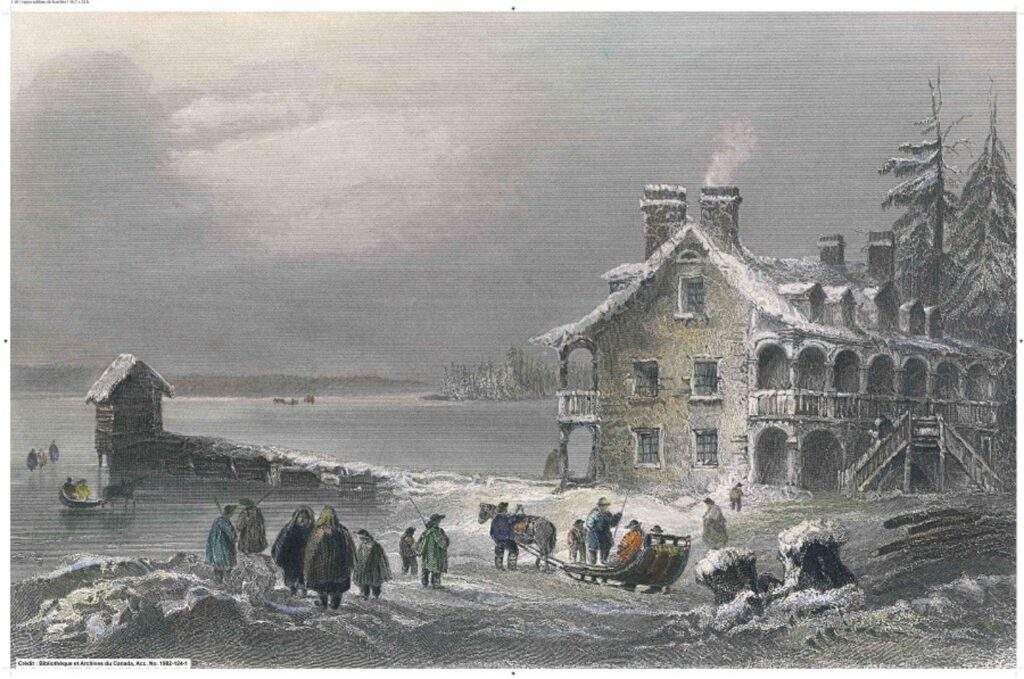
In 1831, Charles Symmes, a native of Massachusetts, politician, founder of the village Symmes Landing (Aylmer) and nephew of the famous Philemon Wright, built his very first inn: L’Auberge Symmes on Front Street. According to a legend, his daughter Hannah Symmes, aged 12, is said to have left her soul in the attic on a very cold winter evening. From then and to this day, her spirit haunts the place.

The young girl was suffering from a mental illness that would complicate the course of her life. Considered very taboo at the time, her father often locked her in the attic to hide her from the eyes of others. She spent entire days there.

In 1858, Charles Symmes organized a festive evening at the inn, to mark a new alliance between Robert Conroy, John Egan, Harvey Parker and himself to inaugurate the new construction of a flour mill and a sawmill. These new businesses would constitute an important source of investment for Aylmer’s economy. Guests were warmly welcomed with excellent gourmet food accompanied by fine liquors. Meanwhile, Hannah Symmes was once again hidden in the attic, where she would die in a terrible way from the cold.

Legend or not, the story of Hannah Symmes continues to touch people. In recent years, several teams of paranormal investigators have gone to the scene to investigate the young girl’s story. Teams such as: Ghost Trackers, Bytown Paranormal, Outaouais Paranormal have been able to capture, for some of them, laughter, tears, singing, etc., coming from Hannah.

Furthermore, a medium who is part of the Bytown Paranormal team also got a surprising answer from Hannah. When asked if someone came to see her and take care of her, the young girl answered the name Elizabeth. According to sources, Elizabeth could either refer to her sister Elizabeth Symmes or her grandmother, known as Elizabeth Wright.

On the other hand, a student at Ottawa’s Heritage College named Julia claims to have seen the young girl during her visit to L’Auberge Symmes as part of one of her school projects. Her experience had a profound impact on her.

The tombstone of young Hannah Symmes rests in the Bellevue Cemetery in Aylmer, where the other members of her family are. As for her soul… that’s another story.

To keep the legend alive, a program of activities will take place in her honour at L’Auberge Symmes. For more details, visit the Facebook page of Tourisme Outaouais or the Musée de l’Auberge Symmes.

Photo caption: Old painting of L’Auberge Symmes

Photo credit: Library and Archives of Canada (Facebook)

The Ghost of Hannah Symmes; legend or reality? Read More »

Summary and brief history of Oktoberfest

Mélissa Gélinas LJI Reporter

At the end of the 2024 fall season, Oktoberfest was once again celebrated in large numbers in Aylmer, to entertain the community and encourage local businesses. Although popular in North America, as well as in several regions of the world, its history remains somewhat unknown.

A long-standing tradition of Bavarian origin, Oktoberfest, also known as “Beer Festival”, was celebrated for the very first time in 1810 in the city of Munich in Germany. Following the wedding of Prince Louis I and Princess Therese of Sassonie-Hildburghausen, nearly 40,000 citizens were invited to join the festivities organized by the families of the newlyweds. Result: several days of festivities passed where beers and food were served in abundance. The tradition of serving beer and food with Bavarian flavours therefore comes from this event, which occurred more than two centuries ago.

To return to Aylmer, the tradition was well and truly respected by the many restaurants, cafes, bistros, micro-breweries and bars that participated by offering beers and special menus.

La Tite Frette was very happy to participate, once again, in the event by introducing their German craft beers.“It was Yvon of La Tite Frette who made the Oktoberfest event possible and who made it a success!” mentioned Louise Rousseau, general director of APICA.

During the last weeks of September and the first weeks of October, Bistro L’Autre Œil also served beers and a special German-inspired menu. Their homemade pretzels were a hit with the customers.

As for the 5e Baron, their German craft beers were also very popular and appreciated by people.

Other restaurants, cafes, bistros and bars participated in the event as well, and there were several artists and shows, all of which helped make Oktoberfest, once again, a memorable experience in Aylmer.

Photo caption: Music group: Libby & Cal playing in the 5e Baron during Oktoberfest.

Photo credit: Facebook

Summary and brief history of Oktoberfest Read More »

Aylmer Psychic Fair: Spirituality, Healing and Love

Mélissa Gélinas LJI Reporter

Every spring and fall since 2022, Megan Driskell, a medium and Reiki teacher, invites people to participate in the Aylmer Psychic Fair, a spiritual event that she created.

Activities such as healing sessions, psychic readings and art workshops are among the many offered during the event. Everyone can participate in activities of all kinds allowing them, in turn, to discover people from the local spiritual community.

Megan began her career as a Reiki teacher and worked in this field for almost 10 years. Subsequently, she decided to work in mental health by becoming a coach to help people who had suffered from trauma. “I have always been very connected spiritually, but being able to heal from my own traumas gave me the opportunity to fully reconnect with my gifts,” Megan says.

With the Aylmer Psychic Fair, Megan aims to bring spirituality and healing to the community. “It helps connect people to love and healing,” she states. “It’s very motivating to see between 80 and 200 people present at each event.”

Megan knows the owners of Café Mulligan very well and the Aylmer Psychic Fair events have always taken place there. She is very connected with them, and she says they have always been there to support the vision of her project. “They are people with wonderful souls who are very concerned about everyone’s healing,” she states.

A group of women from the fields of arts and spirituality also work in collaboration with her during her events. “From the beginning, they have been an integral part of the Aylmer Psychic Fair,” she explains.

For more details on the events, visit the Facebook page Aylmer Spring Psychic Fair 2024 or contact Megan Driskell at the following email address:Mdriskell0824@outlook.com

Photo caption: Megan Driskell (left) with her team: Krystel Grenier, Jen Provost and Chantal Faucher (far right) at the Aylmer Psychic Fair event at Café Mulligan.(October 2024)

Photo credit: Megan Driskell

Aylmer Psychic Fair: Spirituality, Healing and Love Read More »

Gatineau to invest $5 million for their homelessness action plan in 2025

Sophie Demers

LJI Reporter

During the second day of the city’s budget discussions last week, Gatineau presented the action plan for homelessness and social development for 2025-2029. The proposed plan details a $24,028,235 investment over the next five years. For 2025, the city plans to invest $4,997,394.

According to city documents, Gatineau aims to demonstrate strong leadership in fighting homelessness and social development where all residents have a good quality of life and are put at the centre of all actions.

The plan details six categories for achieving their goals:


• Governance: This includes the creation of a municipal team dedicated to the issue of homelessness and social development, an action plan with community organizations, allocating resources and establishment of an interdepartmental committee. In 2025, $3,050,000 of the budget will be allocated to this.


• Targeted communication: Next year, $286,500 of the budget will be allocated to raising awareness with residents, stimulating the interest of organizations and project promoters in developing related initiatives, and improving communication.


• Research, consultation, and partnerships: This category represents a $415,000 investment to strengthen partnerships with community organization and municipal services and optimize support for organizations through the Community Development Support Framework.


• A roof for everyone: Of the total budget for homelessness, $1,325,000 will go toward increasing the construction of housing such as affordable, transitional, and emergency housing, and contributing to access to housing.


• Interventions: Largely, this entails supporting various programs, managing encampments, implementing frameworks for managing encampment operations and makeshift camps.


• Neighbourhood life and community development: This involves encouraging the development of links between community centres, local associations, and social development committees, and supporting citizen access to infrastructure, and encouraging civic participation. This category also involves supporting healthy-living environment initiatives, supporting community partners’ initiatives in public and active transportation, and integrating community development approaches to public spaces and city infrastructure.


The homelessness crisis has been an ongoing issue with the city for many years. At almost every council meeting, there is a resident addressing the council on the topic. There was always a lot of discussion on the fact that homelessness is a provincial issue being pushed on municipalities. Some councillors feel that investing this amount excuses Quebec from its responsibility. Despite most councillors agreeing that Quebec should be supporting cities in fighting homelessness, the proposals to reduce the amount budgeted were rejected.

While the initial plan was kept after going to a vote, a few expressed their disagreement with the approach. Jocelyn Blondin stated that he doesn’t believe that the way the city is going about it will help get people experiencing homelessness out of their situation. “I don’t think that what we are doing now is really a solution to help them in the long term. I have learned over the years that if you want to help someone get by, it’s not by giving them fish; it’s by giving them a fishing rod and showing them how to fish. So, I’m looking for other things in the movement we are doing to really help them get by,” said Blondin.

Mike Duggan, Pointe-Gatineau councillor, stated that the five-year commitment relieves the province from their responsibilities for too long, suggesting that the plan outline be for one or two years instead.

“If we don’t take responsibility, if we don’t fill the void left by our provincial government, who’s going to do it?” said Daniel Champagne, Versant councillor and president of the housing committee. “We’re probably going to find ourselves in much worse situations over the next few years. So, I recognize that it’s elsewhere that we should invest those sums. I totally agree with that. But our reality is very different.”

Steve Moran, President of the executive committee, echoed this, stating, “The sums we allocated, will not be able to meet the needs on the ground. The needs are beyond this defined by the community and by the City of Gatineau. We are doing this to meet our budgetary capacity.” He highlights that if the city doesn’t budget these sums, it will be spent anyway due to community needs and management of encampments.

Photo: The municipal council gathered on the final budget discussion day, where a discussion took place about the amount the city is budgeting for fighting homelessness.

Photo: Sophie Demers

Gatineau to invest $5 million for their homelessness action plan in 2025 Read More »

Gatineau renews partnership with the Boucher Forest Foundation

Sophie Demers

LJI Reporter

Since 2019, the City of Gatineau has been working in partnership with the Boucher Forest Foundation. The collaboration was established to support the development of a public outdoor area and the creation of the Boucher Forest Park and ensure conservation of the forest’s ecosystems.

At the end of September, Gatineau announced that they are renewing the partnership agreement with the Boucher Forest Foundation from potentially 2024 to 2028. The current agreement expires in December 2026, with the possibility to extend it to December 2028 if funding is available. The City agreed to contribute $450,000 per year to the Foundation.

“The Boucher Forest is one of Gatineau’s natural gems, in the heart of the Aylmer sector, and we are delighted to contribute to its protection and enhancement for years to come. This strategic partnership with the Boucher Forest Foundation is in line with our desire to develop the urban outdoors and strengthen our collaboration with local organizations,” said Maude Marquis-Bissonnette, Gatineau Mayor.

The funds are used to support their mission to protect and preserve the diverse flora and fauna found in the Boucher Forest. The City will also be providing financial, technical, and professional support to facilitate operation, this could include professional services, space, equipment and building loans.

The City states that residents benefit from this agreement as it allows the Foundation to expand its offer of outdoor activities, add new facilities, and do regular path and forest maintenance.

The agreement outlines various goals and projects such as the management and development of an urban outdoor conservation site, the development of projects and organization of eco-responsible events, production and implementation of a conservation plan, restoration and conservation of ecosystem integrity, governance, accessibility and sustainable development, and promotion of the Boucher Forest.

Since the agreement began in 2019, many projects have been completed. These projects include two market studies and a wetland delineation study, the creation of a park plan, installation of park signage and furniture, the development of trails, pruning and tree maintenance, and the construction of a shelter.

“Conservation actions are long-term endeavors, and therefore require regular and rigorous planning and follow-up. Today, the Foundation is pleased to commit to a multi-year agreement that will enable us to work for the good of the Boucher Forest, the environment and the quality of life of Gatineau residents,” said Adrian Corbo, President of the Boucher Forest Foundation. “This agreement will not only ensure the conservation of the forest, but also provide citizens with quality outdoor programming. The Foundation is proud to help Gatineau achieve its goal of preserving 30% of its territory. We invite residents to come and enjoy this magnificent area spanning over 600 acres.”

The Boucher Forest is often referred to as Gatineau’s left lung. There are over 1,145 species of flora and fauna found in the forest and 11 priority ecosystems for biodiversity conservation. Boucher Forest is bordered by chemin Vanier, boulevard des Allumettières, boulevard Wilfrid-Lavigne, and chemin Antoine-Boucher.

Photo: Inside the Boucher Forest.
Photo: Courtesy

Gatineau renews partnership with the Boucher Forest Foundation Read More »

Gatineau approves 2025 budget despite pushback from five council members

Sophie Demers

LJI Reporter

The $887 million budget, approved on December 10, represents a 10% increase in spending compared to the 2024 budget. It includes a 3.18% tax increase for the residential sector and 4.18% for the non-residential sector.

The budget details an investment of $5 million to fight homelessness, investments in Gatineau’s climate needs and the revival of the city centre. Specifically, the largest budget allocations are $145 million for police and fire services, $140 million for public works, as well as $80 million for the Climate Plan.

“Accelerate urgent investments and reduce pressure on taxpayers. What we offer you is not a sum of numbers. It is an electroshock, a structuring response to our great collective challenges,” said Gatineau Mayor Maude Marquis-Bissonnette in her opening statement. Later in the speech, Marquis-Bissonnette stated, “I am extremely proud of the budget proposal before us tonight and the path we have taken to achieve it. City finances are well managed with tools that allow us to project ourselves in time. The level of debt is low, and we are in a good position to face the challenges.”

Fifteen of the twenty council members voted in favor of the budget while five independent councillors voted against, namely Gilles Chagnon (Lucerne), Mike Duggan (Pointe-Gatineau), Denis Girouard (Lac-Beauchamp), Jean Lessard (Rivière-Blanche) and Mario Aubé (Masson-Angers).

“The budget before us offers out-of-control spending, historical tax increases, increases in all rates, budgetary choices far from the priorities of the Gatineau residents, and spending in the place of the Quebec government. The 2025 budget of the City of Gatineau is a budget of ease because it is much easier to spend and tax than to manage and prioritize. It is visionless and too expensive for the people of Lac-Beauchamp,” said Girouard during the council meeting.

“We will reduce our spending on infrastructure. For example, our investments in paving will be maintained at $55 million in 2025, which was part of our five-year plan that will end in 2025. So, in 2026, 2027, 2028 and 2029, we will fall back by nearly $33 million per year,” echoed Chagnon in his statement. “Meanwhile, the people I meet in my door-to-door cut everywhere in their personal expenses to make ends meet, for example, fewer restaurants. We should take an example of those who tighten their belts a little.”

Photo: Gatineau Mayor, Maude Marquis-Bissonnette, during her opening statement before the budget approval.
Photo: Courtesy

Gatineau approves 2025 budget despite pushback from five council members Read More »

A book of family histories in Gatineau


Tashi Farmilo
LJI Reporter

The Outaouais Genealogy Society (SGO) has unveiled its latest French publication, Gatineau,
ville d’accueil – Recueil d’histoires de familles , a powerful anthology celebrating the diverse
journeys that have shaped the city’s identity. This remarkable book features 24 stories written by
students from the Cégep de l’Outaouais, who explored their family histories to uncover the
unique paths their ancestors took to settle in Gatineau. From stories of families arriving
centuries ago to recent migrations, the collection captures the spirit of Gatineau as a truly
welcoming city. Inspired by frequent remarks from visitors to the SGO’s research room—“I don’t
know if you can help me; my family isn’t from here”—the idea blossomed into a creative
competition where students researched their genealogical roots and wrote 500–600-word
narratives blending factual data with storytelling. The result is a tapestry of personal histories,
including tales such as “History of my family, from Libya to Quebec” by Lahmya Chapleau and
“Because of the Rideau Canal” by Noémie Séguin-Richard. Each piece showcases the rich
diversity of cultures and experiences that converge in Gatineau, reinforcing its status as a
multicultural hub. For more information about the book or the Outaouais Genealogy Society,
visit: www.genealogieoutaouais.com .
Photo: Tashi Farmilo

A book of family histories in Gatineau Read More »

Quebec recognizes Donalda Charron as a historic figure


Tashi Farmilo
LJI Reporter

Donalda Charron, a trailblazer for women’s unionism in Quebec, has been officially designated
a historic figure under the Cultural Heritage Act. The announcement was made by Mathieu
Lacombe, Quebec’s Minister of Culture and Communications. Charron’s designation pays
tribute to her remarkable contributions to labour activism and her enduring impact on the
province’s history.

Charron emerged as a leader during a pivotal period for workers in Hull, now part of Gatineau.
In 1922, she was elected president of Section A of the Hull Matchmakers’ Union, an
organization tied to the Hull Catholic Workers’ Association. The union, established in 1919
following a landmark labour dispute with the E. B. Eddy Company, Canada’s largest match
producer, fought to improve working conditions for female matchmakers.

In 1924, another labour conflict arose, and Charron played a central role in rallying support for
the workers. She organized demonstrations, led fundraising efforts, and advocated publicly for
their rights, earning her the nickname “union policeman.” Her activism extended beyond the
matchmakers, with significant contributions to the Central Council of Women’s Unions and the
Hull Catholic Women’s Union.

Although her achievements faded from public memory for decades, Charron’s legacy was
revived thanks to the work of anthropologist Serge Bouchard, who highlighted her story on his
radio program De remarquables oubliés . In 2019, the citizens of Gatineau honoured her legacy
by naming their municipal library after her through a popular vote.

“Donalda Charron is a pioneer of women’s unionism in Quebec. It is important for me to
recognize her courage, her tenacity, and her significant contributions to our society,” Minister
Lacombe said. “Her name stands as a symbol of leadership and determination, not only for the
Outaouais but for all of Quebec.”

Photo: Quebec has officially recognized Donalda Charron as a historic figure for her pioneering
role in women’s unionism and labour activism, cementing her legacy as a champion of workers’
rights and dignity. (TF) Photo: Courtesy of the City of Gatineau

Quebec recognizes Donalda Charron as a historic figure Read More »

Quebec launches $20M initiative to boost agricultural productivity in Outaouais


Tashi Farmilo
LJI Reporter

The Quebec government has announced a $20 million initiative aimed at boosting the
productivity and competitiveness of agricultural businesses specializing in plant production and
beekeeping. This funding, available to businesses across the province, includes significant
support for those located in peripheral regions such as Outaouais. The initiative will help
agricultural producers modernize their equipment, reduce labour hours, and improve efficiency
in their operations.

For businesses in Outaouais, the program provides a unique opportunity to benefit from an
additional 15% financial assistance, as the region falls under the “peripheral” classification. This
extra funding could be pivotal for local farmers and beekeepers looking to invest in state-of-the-
art equipment and technologies to keep up with growing demands and the challenges posed by
climate change.

The program is divided into two distinct areas of focus. The first supports plant production
businesses by helping them purchase equipment that will streamline their operations, reducing
the amount of time spent on labour-intensive tasks such as planting, harvesting, and packaging.
The second area addresses the beekeeping sector, where producers can receive funding to
purchase equipment aimed at increasing bee population survival rates and enhancing workforce
productivity.

For businesses to be eligible, they must meet certain requirements, such as being registered
with the Ministry of Agriculture, Fisheries, and Food (MAPAQ) and, in the case of beekeepers,
being part of the province’s beekeeping registry. The funding is available on a first-come, first-
served basis, and businesses can apply between December 10, 2024 and February 7, 2025.
The financial aid comes in the form of non-repayable contributions, covering up to 45% of
eligible expenses for plant production projects and 50% for beekeeping initiatives. In addition, a
15% bonus is available for projects involving organic products, agricultural cooperatives, or
those located in peripheral regions.

For more information, visit: https://www.quebec.ca/agriculture-environnement-et-ressources-
naturelles/agriculture/aide-financiere/initiative-ministerielle-productivite-vegetale .

Photo: The Quebec government’s $20 million initiative aims to boost agricultural productivity in
peripheral regions like Outaouais by providing financial support for businesses specializing in
plant production and beekeeping to modernize equipment and improve efficiency. (TF) Photo:
courtesy of the Government of Quebec

Quebec launches $20M initiative to boost agricultural productivity in Outaouais Read More »

Outaouais needs adequately funded health services


Tashi Farmilo
LJI Reporter

On December 1, Santé Québec officially took over the management of health services across
the province, centralizing healthcare administration. However, this restructuring comes with
troubling news for the Outaouais region, where the provincial government has announced a $90
million cut in healthcare funding to the Centre intégré de santé et de services sociaux de
l’Outaouais (CISSSO).

The Coalition solidarité Outaouais, a collective of civil society organizations, trade unions, and
community groups, has raised alarms about these cuts. Members of the coalition argue that
these funding reductions, along with the increasing trend of privatizing healthcare services, will
have a detrimental effect on access to and quality of care in the region. “Private healthcare is
less effective, more expensive, and inequitable,” warns Mathieu Charbonneau, director of Action
Santé Outaouais. “It diverts resources and staff away from the public system, leading to longer
wait times and reduced access to care.”

Geneviève Tremblay-Racette, coordinator of the Table ronde des organismes volontaires
d’éducation populaire de l’Outaouais, emphasizes that privatization has already caused
disruptions in critical areas like obstetrics, emergency services, and medical imaging. “Cutting
public funding will only make the situation worse, particularly for the vulnerable populations who
rely on these services,” she says.

In addition to the funding cuts, the shift to centralized management under Santé Québec raises
concerns about the erosion of regional governance and local input. Many fear that decisions will
be made without considering the unique needs of the Outaouais region, diminishing the ability of
local healthcare workers and residents to have a say in the management of their services.
The Outaouais region has long struggled with a chronic shortfall in healthcare funding, now
estimated at $200 million. This underfunding has contributed to declining services and a
growing migration of healthcare professionals to neighbouring provinces. In light of this, leaders
are calling for a significant reinvestment in the public healthcare system, as well as a return to
more localized, democratic governance that gives citizens and healthcare workers a meaningful
role in decision-making.

Alfonso Ibarra Ramirez, president of the CSN Outaouais Council, questions whether the
government’s actions will accelerate the privatization of the healthcare system. “Has the CAQ
handed over the keys to the private sector, opening the door to even more privatization?” he
asks, noting that over 4,000 activists from the CSN and allied groups recently gathered in Trois-
Rivières to protest the increasing privatization of healthcare services. The group called on the
government to stop the migration of doctors to private clinics, halt issuing permits to for-profit
healthcare facilities, and impose a moratorium on outsourcing.​

The cuts, which also affect mental health services and are made despite recent collective
agreements aimed at improving regional healthcare, are deeply concerning. Guylaine Laroche,
president of the APTS Outaouais, highlights the inconsistency in the government’s policy. “The
government is imposing drastic cuts to services that the region has already been struggling to
access. This will hurt vulnerable populations the most,” she says.

For years, the Outaouais has been underfunded, with healthcare services continuously
deteriorating. The region is also seeing a steady outflow of healthcare professionals seeking
better opportunities elsewhere. Now, with further cuts looming, the government must act to
reinvest in the public system, improve working conditions for healthcare staff, and ensure that
healthcare services are accessible to all residents.

The Coalition solidarité Outaouais continues to call for a healthcare system that remains public,
adequately funded, and accessible to all. “To meet the specific needs of the Outaouais region,
we need a reinvestment in public healthcare, and we need a governance system that listens to
the voices of both citizens and healthcare workers,” concludes Charbonneau.

Photo: The Outaouais region urgently needs a reinvestment in its public healthcare system to
address chronic underfunding, prevent further privatization, and ensure accessible, equitable
care for all residents. (TF) Photo courtesy of CISSSO

Outaouais needs adequately funded health services Read More »

Gatineau Police host inaugural domestic violence conference


Tashi Farmilo
LJI Reporter

The Gatineau Police Department (SPVG) held its inaugural conference on domestic violence on
November 26 at the Gatineau Cultural Centre, bringing together over 165 participants from law
enforcement, healthcare, social services, and community organizations. The event, part of
SPVG’s 2023-2026 action plan on domestic violence, focused on intersectionality—exploring
how various factors such as race, gender, socioeconomic status and disability intersect to affect
victims of domestic violence.

The event featured five expert-led sessions that explored the complexities of domestic violence,
emphasizing the importance of an inclusive, multi-disciplinary approach. Presenters highlighted
the need for services that are not only effective but also equitable and accessible to all
individuals, regardless of their background.

Fourteen organizations, including Jeunesse Idem, UQAM, AGIR, Maison d’INGRID, and Maison
L’Autre Chez Soi, set up information kiosks throughout the day, offering valuable resources to
attendees. These organizations, along with community support groups, justice system
representatives, and healthcare providers, all collaborated to create more inclusive service
pathways for victims. The conference was financially supported by the Centre intégré de santé
et de services sociaux de l’Outaouais (CISSSO), highlighting the importance of community
collaboration in tackling the issue.

Keynote speakers included Mifaly Andriamady, training and strategic monitoring manager at
AGIR Outaouais, and Denise Bugere, intervention coordinator at United-Towards-Women
House. They addressed the unique challenges faced by victims, particularly how
intersectionality impacts experiences of domestic violence. Andriamady said, “Applying the
intersectional approach in our interventions requires an awareness of our individual role,
followed by concrete actions to adapt structures and break down barriers within organizations.”
Bugere added, “We must propose adapted and non-standardized solutions to better support
each person in their unique experience.”

Simon Fournier, Director of the Gatineau Police Department, also emphasized the importance of
inclusivity in domestic violence services, stating, “No one should be excluded from receiving
high-quality, inclusive, and accessible services,” adding that it is important to continuously
improve support services for victims.

The event also focused on the unique difficulties faced by immigrant communities, who often
experience language barriers, fear of deportation, and a lack of awareness of available services.
Experts called for more culturally sensitive approaches to ensure all victims, regardless of their
background, can access the help they need. Amina Hufane, speaker responsible for the
Workplaces Allied Against Domestic Violence component at Maison Unies-Vers-Femmes, said,
“The obstacles faced by women with an immigrant background are numerous and complex, and
we need to understand the specific realities they experience in order to offer them the
appropriate support.”​

Sessions on youth dating violence, such as those led by Pénélope Allard-Cobetto and Estelle
Piché from UQAM, provided valuable tools for preventing intimate partner violence in
adolescents and young adults through programs like Étincelles and Constellation. Allard-
Cobetto said, “Youth dating violence is a public health issue, and it’s critical that we engage with
adolescents and young adults to promote healthy relationships and prevent violence.”

Other presentations covered domestic violence among LGBTQ+ populations, with Sylvie
Thibault, Professor and Director at Saint-Jérôme campus, addressing the specific health and
service needs of LGBTQ+ individuals facing intimate partner violence. Thibault stated, “The lack
of domestic violence services adapted to LGBTQ+ needs is a significant gap, and we need to
work to close that gap by better equipping workers and creating tailored services for these
populations.”

Photo: The inaugural conference hosted by the Gatineau Police Department focused on
addressing domestic violence through an intersectional, collaborative approach, bringing
together over 165 participants to discuss ways to improve services for victims, particularly those
from marginalized communities. (TF) Photo: Tashi Farmilo

Gatineau Police host inaugural domestic violence conference Read More »

Milliard pledges healthcare reform for Outaouais


Tashi Farmilo
LJI Reporter

Charles Milliard, candidate for the leadership of the Quebec Liberal Party, appeared in Gatineau
on November 25 to unveil a transformative healthcare plan for the Outaouais region. Standing
outside the CHSLD La Piet à on Rue Laurier, alongside Pontiac MNA André Fortin, Milliard
outlined his vision for tackling the region’s chronic healthcare challenges, with a focus on wage
parity and increased funding.

The Outaouais has faced persistent challenges in retaining healthcare professionals, largely
due to substantial wage disparities with neighbouring Ontario. Milliard proposed new legislation
to establish wage parity for healthcare workers in the region, aligning their salaries with those
across the border. He emphasized that this initiative would not only help stabilize the regional
healthcare workforce but also improve the quality and availability of services for residents.
“Every region of Quebec has its own specific needs and realities,” Milliard stated. “The
Outaouais region is a glaring example of regional inequality. My commitment is clear: to restore
balance and provide the people of the Outaouais with healthcare services that meet their
expectations and reflect their contributions to Quebec.”

Milliard also highlighted the severe underfunding that has plagued the region’s healthcare
system for years, leaving emergency rooms operating at less than 30 per cent capacity and
surgical units in Gatineau staffed at only a quarter of optimal levels. Currently, the Outaouais
receives $448.54 less in healthcare funding per capita than the provincial average, contributing
to the province’s longest surgery wait times.

André Fortin, who has endorsed Milliard’s leadership bid, criticized the provincial government’s
failure to address the crisis. “One-off bonuses and temporary solutions are not enough,” Fortin
said. “We need structural and sustainable actions to meet the needs of citizens and retain
talent.”

Milliard’s plan includes an annual reinvestment of over $200 million to bring the region’s
healthcare spending in line with the provincial average. He also pledged to modernize
healthcare infrastructure and expand regional training programs, ensuring a steady pipeline of
local healthcare professionals. Part of his proposal includes reserving a percentage of medical
school admissions for students from the Outaouais to encourage them to practice in the region.
“If elected, wage parity legislation will be a top priority,” Milliard announced. “In the first year of a
Liberal government under my leadership, we will pass a law to ensure wage parity in healthcare
for workers in this region. This measure will be the first step toward the justice the Outaouais
has demanded for decades.”

Photo: Charles Milliard, Quebec Liberal Party leadership candidate, has unveiled a plan to
address healthcare inequities in the Outaouais, pledging wage parity legislation and substantial ​
reinvestments to improve regional services and retain professionals. (TF) Photo: Courtesy of the
Quebec Liberal Party

Milliard pledges healthcare reform for Outaouais Read More »

Renaître de ses cendres Aylmer’s new public artwork


Tashi Farmilo
LJI Reporter

Rising from the Ashes ( Renaître de ses cendres ), a striking new public artwork by
multidisciplinary artist Jérôme Bertrand, was unveiled by the City of Gatineau to honour the
identity and resilience of Aylmer. Selected as part of the Commemorative Public Art Program,
the piece symbolizes the community’s enduring spirit, shaped by events such as the Great Fire
of Aylmer in 1921.

Inspired by the concept of a timeline, the artwork weaves together archival photographs and
contemporary images to tell a story of survival and renewal. Vibrant organic shapes,
representing life and rebirth, bring energy to the composition, contrasting with the linearity of the
historical and modern visuals.

The artwork, to be installed on the wall of the Aydelu Centre at 94, rue du Patrimoine,
represents a $109,000 investment in Aylmer’s cultural development. Production begins in
December 2024, with installation planned for late summer 2025.

The selection process, which started in September 2023, evaluated submissions based on
creativity, historical relevance, visual impact, and the artist’s experience. Bertrand, who grew up
in Aylmer and now works in Montreal, stood out for his ability to blend historical narrative with
vibrant, contemporary elements.

“This program transforms art into a living vehicle for memory and identity,” said Isabelle N.
Miron, Chair of the Arts, Culture, Literature, and Heritage Commission. “It celebrates the
historical and cultural milestones that shape Gatineau, while fostering a sense of community
ownership over the works that enrich our public spaces.”

Councillor Steven Boivin, representing Aylmer, noted the deep connection between the artwork
and the community it represents. “Rising from the Ashes embodies Aylmer’s legacy and its
strength. It is a proud celebration of a community that has rebuilt itself, not only after the Great
Fire of 1921 but throughout its history. By bridging past and present, this work underscores the
role of culture in shaping our identity.”

Printed on brushed aluminium plates, the artwork expresses themes of leisure and community
spirit, with vibrant colours symbolizing biological movement, life, and rebirth. As anticipation
grows, the project promises to honour Aylmer’s history while celebrating its vibrant future.

Photo: The City of Gatineau has commissioned Renaître de ses cendres , a $109,000 public
artwork by Jérôme Bertrand that honours Aylmer’s resilience and history, with installation
planned at the Aydelu Centre in summer 2025. (TF) Photo courtesy of the City of Gatineau

Renaître de ses cendres Aylmer’s new public artwork Read More »

Interview series with Gatineau Councillors: Jocelyn Blondin, Manoir-des-Trembles District


Tashi Farmilo
LJI Reporter

Councillor Jocelyn Blondin of the Manoir-des-Trembles district reflects on his achievements, the
challenges faced, and his vision for the future as part of our annual interview series. Here is
what he had to share about 2024 and his plans moving forward.

What do you consider your biggest accomplishments on the council this year ?

My greatest achievements this year include several significant improvements to infrastructure
and public amenities, such as the installation of a sidewalk along the south side of A.-Taché
Boulevard, which enhances pedestrian safety between École Jean-de-Brébeuf and St-
Raymond. We also resurfaced A.-Taché Boulevard and redesigned intersections to improve
student safety, which has had a direct and meaningful impact. We gave a valuable new space
for recreation at the Trembles Community Centre by adding a skate park. Another key
accomplishment was facilitating the return of STO bus routes to the CEGEP, a change that
benefits students and other commuters.

What were the most significant challenges faced by your district in the past year, and how were
they addressed ?

The most significant challenge this year involved balancing community needs with proposed
developments. A proposed housing cooperative at Val-Tétreau drew strong objections from
residents, ultimately influencing the council’s decision to halt the project. Community feedback
played a central role, reminding us how important it is to listen and adapt when necessary.

What feedback from district residents shaped council decisions and how did you incorporate
their concerns ?

Residents’ voices have guided many of this year’s decisions. For instance, safety concerns from
parents of students at École Jean-de-Brébeuf directly led to changes at key intersections. These
interactions ensure that our initiatives reflect what the community truly needs.​

What improvements or changes have been made in your district’s infrastructure, such as roads,
parks or public spaces ?

Beyond the sidewalk and road improvements I mentioned earlier, we’ve also enhanced the
cycling infrastructure in the district. Upgrades were made to sewer systems on Montmartre,
Rouleau, and Richelieu streets, which address longstanding issues for residents. Each of these
projects represents progress toward a safer and more liveable district.

How have local businesses in the district been supported, especially during challenges like
inflation or the post-pandemic recovery ?

This year’s focus was primarily on community infrastructure rather than direct business support.
However, strong public amenities contribute to a thriving local economy and there are plans to
prioritise this area in future budgets.

How has the district’s budget allocation been spent, and what were the key priorities for local
spending ?

The budget was carefully allocated to projects that directly impact residents’ quality of life. This
included investments in cycling pathways, pedestrian safety measures, and community
recreation facilities like the skate park. We aimed to address the most pressing concerns while
planning for long-term benefits.

What policies or initiatives do you believe have made the most impact on residents’ quality of life
this year ?

I believe that promoting active and sustainable transport has made the most impact. Improving
cyclist safety and encouraging students to commute by bike were particularly impactful. It’s
about fostering habits that benefit both the individual and the community.

What lessons did you learn this year that will guide future decisions ?

One key lesson is the importance of clear communication. We need to explain decisions
thoroughly, involve the public early, and ensure that residents feel heard. It strengthens trust
and leads to better outcomes.​

Interview series with Gatineau Councillors: Jocelyn Blondin, Manoir-des-Trembles District Read More »

Liberal MNAs visit Gatineau Valley to address regional concerns


Tashi Farmilo
LJI Reporter

Two Liberal MNAs toured the Vallée-de-la-Gatineau to meet with local stakeholders and discuss
pressing regional issues. The Official Opposition’s critics for employment and forests met with
members of the MRC’s forestry crisis unit, municipal elected officials, and the team from the
region’s Carrefour Jeunesse Emploi Vallée Gatineau (CJEVG). The visit focused on the
indefinite closure of the Resolute Forest Products sawmill in Maniwaki and significant cuts to
employment services.

The forestry sector, a cornerstone of the Gatineau Valley economy, was at the heart of
discussions with municipal leaders, including MRC prefect Chantal Lamarche. According to
Pontiac MNA André Fortin, who serves as the Official Opposition critic for forests, the provincial
government is failing to grasp the urgency of the crisis. “There is no sense of urgency in the
Minister of Forests, even though the region’s economic future is currently at stake,” Fortin said.
He called on the Minister to listen to the community, which has proposed “concrete and realistic
solutions” to support forestry entrepreneurs in the region.

The tour also shed light on the effects of recent budget cuts to employment services. The
CJEVG, which plays a critical role in helping local job seekers, has seen its funding reduced by
38% over the past two years. Executive Director Sophie Beaudoin described the cuts as
catastrophic. “Weakening the CJEVG does not help job seekers,” Beaudoin said, criticizing what
she called a ‘wall-to-wall’ approach by the CAQ government that fails to consider the unique
challenges of rural regions like the Vallée-de-la-Gatineau.

Fortin reinforced these concerns, warning of broader implications for the community. “If the CAQ
government continues to sit idly by, entrepreneurs in the region will be forced to hand over their
keys to the bank. It’s as simple as that,” he said.

Madwa-Nika Cadet, the Official Opposition spokesperson on employment, denounced the
government’s approach as abandoning vulnerable populations. “Organizations in the Vallée-de-
la-Gatineau are right to be concerned,” she said. “The wall-to-wall system imposed by the CAQ
does not meet the region’s needs.”

Chantal Lamarche also voiced frustration at the lack of provincial support. “Since this
government support is no longer there, we have proposed with resilience, wisdom, and rigour
the implementation of a Workforce and Rurality Strategy,” Lamarche said. This initiative aims to
ensure accessible, high-quality employment services tailored to local realities but has been
rejected by the Minister of Employment. “We will officially resubmit it and call on the Premier to
get involved.”

The Liberal MNAs pledged to continue advocating for the region and pushing for immediate
government intervention. As Fortin stated, “The Minister must show leadership and agility and
agree to implement solutions better adapted to the Outaouais region.”​

Photo: The Official Opposition’s critics for employment and forests met with members of the
MRC’s forestry crisis unit, municipal elected officials, and the team from the region’s Carrefour
Jeunesse Emploi, as two Liberal MNAs toured the Gatineau Valley to address concerns over
the indefinite closure of the Resolute Forest Products sawmill in Maniwaki and cuts to
employment services, urging the provincial government to adopt tailored solutions and act
swiftly. (TF) Photo: Courtesy of André Fortin’s Facebook Page

Liberal MNAs visit Gatineau Valley to address regional concerns Read More »

Gatineau Council prepares for key votes on housing, traffic, and development


Tashi Farmilo
LJI Reporter

Gatineau’s municipal officials convened on November 19 to prepare for a pivotal city council
meeting, addressing major issues on housing, traffic regulations, and zoning amendments. The
discussions highlighted both urgency and the need for careful consideration as councillors
debated measures that could significantly impact residents.

Councillor Jocelyn Blondin (Manoir-des-Trembles–Val-Tétreau) pushed for a delay on
amendments to reserved lane regulations, specifically regarding carpooling requirements. “We
need a full analysis to ensure these measures align with long-term transit goals,” he argued,
highlighting collaboration with the Société de transport de l’Outaouais (STO).

In contrast, Councillors Bettyna Bélizaire (Plateau) and Steve Moran (Hull–Wright) advocated
for immediate action. Bélizaire highlighted pressing safety concerns at intersections such as
Pink Road. “This is about securing key routes for public safety,” she stated. Moran agreed,
urging that delays be avoided to address urgent community needs.

The council also discussed zoning adjustments, including increasing parking capacity at 279
Alexandre-Taché Boulevard. Councillor Gilles Chagnon (Lucerne) expressed concerns about
the impact on neighbourhood dynamics, while Caroline Murray (Deschênes) stressed the
importance of policies supporting family-oriented housing developments to address growing
demand.

Affordable housing initiatives were another major focus, with officials examining funding
strategies for social housing projects. Mayor Maude Marquis-Bissonnette reaffirmed the city’s
commitment to balancing fairness for taxpayers with the need for sustainable, inclusive growth.
“These projects are central to ensuring a vibrant and accessible community for all residents,”
the mayor noted.

As the session concluded, councillors underlined the importance of collaboration in crafting
policies that address both immediate concerns and the city’s long-term development goals.
Residents are encouraged to watch the council session live or access recordings at Gatineau’s
official website: https://villes.pqm.net/gatineau/index.php?lang=ang.

Photo: Gatineau’s council prepared for critical decisions on November 19, 2024, focusing on
traffic, housing, and zoning, with debates highlighting the balance between urgent community
needs and long-term planning. (TF) Photo screenshot of the Caucus preparatory
Meeting of Novembre 19, 2024

Gatineau Council prepares for key votes on housing, traffic, and development Read More »

A festive tradition returns to Gatineau with Noël Une Tradition en Chanson


Tashi Farmilo
LJI Reporter

The magic of the holidays will come alive in Gatineau on December 8, 2024, as Noël Une
Tradition en Chanson arrives at Salle Odyssée for a one-night-only performance. Now in its
seventh year, the beloved production has become a staple of Quebec’s festive season, drawing
audiences with its timeless music, dazzling stage design, and heartwarming performances.

This year’s edition features a star-studded lineup, including Barnev, Joe Bocan, Marie Michèle
Desrosiers, Gabrielle Destroismaisons, Luce Dufault, and Lunou Zucchini. Under the musical
direction of Jacques Roy and the creative staging of Joël Legendre, the show offers a blend of
holiday classics like C’est la nuit de Noël and Hallelujah , along with fresh interpretations of
seasonal favourites. The production’s commitment to capturing the essence of the holidays has
made it a cherished tradition for nearly 100,000 attendees since its inception.

The tour, which runs from November 24 to December 23, includes stops in cities such as
Montreal, Quebec City, and Sherbrooke, culminating in a final performance in Laval. The
Gatineau show promises to be a highlight, as audiences gather to celebrate the season in a
venue known for its intimate atmosphere and exceptional acoustics.

Tickets are on sale now, and organizers encourage early booking, as demand is expected to be
high. For more information or to secure a seat, visit the official website at
www.productionsmartinleclerc.com . This year, let the timeless charm of Noël Une Tradition en
Chanson set the tone for a memorable holiday season.

Photo: Noël Une Tradition en Chanson brings its enchanting blend of holiday classics and stellar
performances to Gatineau’s Salle Odyssée on December 8, promising an unforgettable
celebration of the festive season. Photo: Jean-Charles Labarre

A festive tradition returns to Gatineau with Noël Une Tradition en Chanson Read More »

Radio Canada hosts community discussion on trust in media


Tashi Farmilo
LJI Reporter

Radio-Canada hosted an interactive public discussion at the Université du Québec en Outaouais
to explore trust in the media, drawing a crowd of engaged participants eager to share their
perspectives on journalism and information consumption.

Moderated by Mélanye Boissonneault, a familiar voice from Les matins d’ici , the event featured a
panel of prominent journalists and media professionals, including Catherine Lanthier, Mathieu
Nadon, and Frédéric Pépin. The discussion delved into issues such as declining public trust in
news organizations, the rise of misinformation, and the role of transparency in rebuilding
confidence.

Audience members actively participated using the Slido platform, which allowed real-time input
and polls. One poll revealed that many attendees rated their trust in media at a moderate level,
with a significant portion placing their confidence at 8 out of 10. Another question prompted
attendees to highlight the most important qualities for journalists, with “integrity,” “objectivity,” and
“impartiality” emerging as top values.

During the discussion, attendees raised concerns about the diversity of perspectives in media
reporting, particularly in international coverage. One participant noted that Canadian media often
underrepresents global stories compared to European outlets. “It’s important to cultivate interest
in international issues and expose audiences to global realities,” said a panellist in response,
emphasising the media’s role in fostering awareness.

Panellists also shared insights into their professional routines, addressing how they verify
information, navigate editorial challenges, and strive to maintain impartiality. Frédéric Pépin, a
journalist with a focus on municipal affairs, stressed the importance of transparency in the
reporting process. “Trust is built when audiences understand how stories are researched and
verified,” he explained.

The event concluded with a call for ongoing dialogue between journalists and the public.
Boissonneault encouraged attendees to stay engaged and continue sharing feedback to help
media outlets better meet audience needs. For many in attendance, the evening underscored the
importance of fostering trust through open communication and accountability.

Held in a university setting, the forum reflected the democratic values of debate and critical
thinking. As one attendee remarked to the crowd, “Events like this remind us how crucial it is to
have spaces where we can discuss the challenges facing the media and work toward solutions
together.”

Photo: Radio-Canada hosted a community discussion at the Université du Québec en Outaouais,
featuring a panel of Mélanye Boissonneault, Catherine Lanthier, Mathieu Nadon, and Frédéric
Pépin, where attendees explored trust in media, misinformation, and journalistic values. (TF)
Photo: Tashi Farmilo

Radio Canada hosts community discussion on trust in media Read More »

Canada pushes for transformative Climate Finance Deal at COP29


Tashi Farmilo
LJI Reporter

As the world faces escalating climate challenges—rising temperatures, destructive storms, and
alarming biodiversity loss—Canada is calling for bold, collective action at the United Nations
Climate Change Conference (COP29) in Baku, Azerbaijan. Environment and Climate Change
Minister Steven Guilbeault is leading the charge, urging global leaders to agree on a
transformative climate finance goal to address the scale and urgency of the crisis.

“Canada has come to COP29 ready to secure a new climate finance goal that addresses the
nature and scale of the climate crisis,” Guilbeault stated. “Outside the halls of these important
negotiations, the urgency of action is undeniable. Rising global temperatures, more frequent
extreme weather events like wildfires and hurricanes, and the rapid loss of biodiversity all
demonstrate the profound and lasting impacts that climate change is having on the planet.”

Guilbeault’s words are set against a backdrop of growing concern. This year, Canada suffered
its worst year on record for insured losses from wildfires and floods, with thousands of
Canadians displaced and billions of dollars in damages. Nations in the Global South—
particularly Small Island Developing States and Least Developed Countries—face existential
threats from rising seas and severe droughts. Guilbeault stressed the moral and practical
imperative of aiding these nations. “We need to scale up investment in mitigation and
adaptation, particularly to support the most vulnerable nations and communities,” he said. “A
new collective finance goal is a critical step to help us get there.”

The negotiations at COP29 centre on the New Collective Quantified Goal (NCQG), which would
replace the $100 billion annual target set in 2009. That figure, while significant at the time, has
proven inadequate in addressing the growing scale of climate impacts. Guilbeault stressed that
the NCQG must be more than just a financial target—it must provide a clear framework for
effective and accessible funding that ensures the global community keeps the 1.5 degrees
Celsius target within reach.

“While the numbers are critical, we also need the right framework,” he explained. “A framework
that makes finance more accessible, acknowledges existing financial contributions, and helps
close the global investment gap is how we encourage everyone to deliver finance effectively.”
Canada has already taken steps to address these concerns. At last year’s COP28, it pledged
$16 million to launch the Fund for Responding to Loss and Damage, designed to help nations
recover from irreversible climate impacts. This year, the Canadian government announced the
creation of GAIA, a $1.48 billion finance platform aimed at supporting clean energy projects and
climate resilience in up to 25 developing countries. With 70 per cent of GAIA’s funding directed
toward adaptation projects and 25 per cent allocated to vulnerable states.

“Finance is all about partnership,” Guilbeault noted. “Increasing investments to support clean
energy, clean cooking, and energy security require reforms to ensure that funding reaches the ​
people and communities on the frontlines of climate change in developing countries, including
Indigenous peoples, women, workers, and young people.”

As negotiations continue, Guilbeault’s focus remains on building trust among nations. “Things
have changed significantly since the first goal was set,” he said, reflecting on lessons learned
since the original $100 billion commitment. “The development of a new goal provides us with a
collective opportunity to show that the Paris Agreement is working to tackle the climate crisis.
Let us show the world that we can keep 1.5 degrees Celsius within reach and agree to a finance
goal that will help us get there.”

The stakes for COP29 are monumental, not only for vulnerable countries but for the global
economy and the planet’s future. Guilbeault’s closing message underscored both the challenge
and the opportunity at hand: “We came here with a purpose, and we understand our
responsibilities.”

Photo: Canada’s Environment Minister Steven Guilbeault addresses global leaders at COP29,
calling for a transformative climate finance goal and emphasizing the urgency of bold action to
support vulnerable nations and keep the 1.5°C target within reach. (TF) Photo: Hermine Landry,
Minister Guilbeault’s Press Secretary

Canada pushes for transformative Climate Finance Deal at COP29 Read More »

Quebec launches youth media literacy initiative


Tashi Farmilo
LJI Reporter

In a proactive move to equip Quebec’s youth with essential tools to navigate today’s complex
information landscape, Mathieu Lacombe, Quebec’s Minister of Culture and Communications
and Minister responsible for Youth, has introduced the Program for a Well-Informed Youth. This
new initiative, developed in partnership with the Secretariat for Youth, invites a wide range of
local organizations to propose projects that focus on strengthening media literacy and fostering
critical thinking among young Quebecers. Applications for project funding, which can reach up to
$50,000 per qualifying project, will be accepted until December 17, 2024.

The program’s timing responds to a growing reality: young people in Quebec, much like their
peers worldwide, predominantly turn to social media for news. A recent study by Quebec’s
Académie de la transformation numérique found that 62% of Quebecers aged 18 to 24 rely
primarily on social platforms for current events, where algorithms often reinforce existing views
and can accelerate the spread of misinformation. A 2018 study by MIT found that false
information spreads six times faster than accurate news online, a dynamic that complicates
young people’s ability to distinguish credible content from misleading information.

The initiative has two key components. The first focuses on developing critical thinking among
youth, particularly those aged 12 to 29, to empower them to analyze and evaluate the wide
array of information they encounter daily. The second component encourages the creation of
news content by and for young people, promoting youth engagement with current events in
formats and perspectives that resonate with them. By supporting the production of news content
that speaks directly to youth audiences, the program aims to foster informed dialogue and
create a sustainable interest in quality journalism.

Minister Lacombe, who has a background in journalism, expressed his commitment to
supporting this initiative. “Supporting media literacy among young people is critical,” he said.
“Through education and critical thinking, we’re helping tomorrow’s citizens make informed
choices. Combating misinformation and promoting youth-driven content are essential steps in
ensuring that quality information reaches and resonates with them.”

Eligible applicants include non-profit organizations, cooperatives, Indigenous groups, colleges,
universities, libraries, and media outlets with a youth-focused mission. Projects under the
program are expected to support either the development of critical media literacy skills or the
production of youth-oriented news content, with an emphasis on digital media formats that
appeal to younger audiences.

Interested organizations can apply until December 17, 2024, with further details available on the
program’s official webpage at: www.quebec.ca/culture/aide-financiere/aide-aux-projets-
appel/jeunesse-bien-informee/programme-pour-une-jeunesse-bien-informee.​

Photo: Quebec Minister of Culture and Communications, Mathieu Lacombe, has launched a
new program to promote media literacy and critical thinking among young Quebecers, offering
up to $50,000 in funding for projects aimed at combating misinformation and supporting youth-
focused news content. (TF) Photo: courtesy of Secrétariat à la jeunesse du Québec

Quebec launches youth media literacy initiative Read More »

Quebec Solidaire and Coalition warn of health crisis in Outaouais


Tashi Farmilo
LJI Reporter

Quebec Solidaire MNA Vincent Marissal, the party’s health spokesperson, issued a stark
warning about the state of the healthcare system in the Outaouais region during a recent visit.
Accompanied by local advocacy groups, including Action-Santé Outaouais and the regional
union representing health and social service workers, Marissal criticized what he described as
the CAQ government’s austerity policies and its growing reliance on private-sector involvement
in public healthcare.

“Every conversation I have with patients and healthcare workers tells the same story: frustration
and disappointment with a government that appears to be abandoning the public health
system,” Marissal said. “Austerity measures, budget cuts, privatization, and neglect of regional
needs have left the healthcare network weakened, with patients suffering the consequences.”

Local organizations joined Marissal in condemning the government’s approach, arguing that it
has eroded the quality and accessibility of public health services in the region. Jean Pigeon,
spokesperson for SOS Outaouais, noted that the visit offered a rare chance to draw attention to
the impact of budget reductions and private-sector pressures on local healthcare. Pigeon
expressed hope that Marissal’s visit would encourage the National Assembly to recognize
Outaouais’s specific challenges and take meaningful action.

Mathieu Charbonneau, director of Action-Santé Outaouais, criticized the government’s strategy
of centralization and privatization, contending that it has reduced the voices of healthcare
workers and community members in decision-making while diverting public resources to private
interests. He called for a shift in policy to prioritize the right of Outaouais residents to accessible,
quality healthcare.

Alain Smolynecky, president of the regional health workers’ union, noted that, despite
government statements about improving workforce stability, recent budget cuts and hiring
freezes have undermined those goals. Smolynecky questioned whether the government is
genuinely committed to supporting a truly public healthcare system.

Guylaine Laroche, head of APTS Outaouais, warned that ongoing austerity measures, including
unfilled vacancies and hiring freezes, would only lead to heavier workloads and reduced time for
direct patient care, which she argued would undoubtedly affect service quality.

Caroline Dufour, a doctoral candidate in nursing at the Université du Québec en Outaouais,
added that unless the government improves working conditions, retaining nurses in the region
will remain a challenge. She highlighted long-standing issues, such as the demand for
manageable nurse-to-patient ratios, the elimination of mandatory overtime, and greater control
over scheduling, which have yet to be addressed.​

Marissal, pledging to bring these concerns to the National Assembly, continued his visit by
meeting with local patients and healthcare workers. He plans to extend his healthcare tour to
other regions across Quebec in the coming weeks.

Photo: Quebec Solidaire MNA Vincent Marissal, voiced urgent concerns over healthcare cuts
and privatization, warning they are deepening the crisis in the region’s public health system.
(TF) Photo: courtesy of Vincent Marissal Facebook page

Quebec Solidaire and Coalition warn of health crisis in Outaouais Read More »

Local author Lynette Harris leads seniors in storytelling workshop


Tashi Farmilo
LJI Reporter

Shawville’s St. Paul’s Church Hall recently buzzed with creativity as local author Lynette Harris
led a two-part workshop series titled “Capturing Our Stories,” aimed at the 55+ community.
Organized by the Pontiac MRC’s Community Outreach and Engagement Coordinator Shelley
Heaphy, the workshop encouraged seniors to explore the art of writing and sharing their life
stories.

In the first session, Harris introduced participants to her journey as an author, describing how
she began writing as a way to preserve her family’s legacy. Known for her books, including I
Always Wanted to Please My Mother and the children’s book Why Am I Me , Harris noted the
therapeutic benefits of writing. She shared personal stories of loss, resilience, and joy, inspiring
attendees to consider the value of capturing their own experiences in writing.

Harris provided participants with practical advice on descriptive storytelling and offered tips for
getting started. Each participant had a chance to discuss their own ideas and the themes they
wanted to explore in their stories. The supportive environment fostered a strong sense of
camaraderie, with many attendees feeling encouraged to begin writing their personal histories.

By the second session, attendees returned with excerpts from their writing assignments, eager
to share their progress. Harris led the group in offering feedback and constructive
encouragement, creating a warm, collaborative space for self-expression. According to Shelley
Heaphy, “It was wonderful to see so many exploring their creative sides and encouraging each
other along the way.” Heaphy, who coordinates community engagement initiatives for the MRC
du Pontiac, expressed pride in supporting an event that fostered both creativity and connection
among seniors.

Harris’s dedication to helping others tell their stories has sparked additional interest in similar
workshops, with invitations to lead sessions for other senior groups, including one in Wakefield.
She described guiding others in preserving their memories as her “life’s passion” and expressed
gratitude for the opportunity to share her skills with the community.

The Pontiac MRC will continue to host events that promote creativity and well-being for seniors.
Upcoming activities include art sessions in Shawville, a community creation program in Portage-
du-Fort, and informational talks on nutrition, diabetes, sleep, and discussions on medical aid in
dying (MAID). These initiatives reflect the MRC’s commitment to supporting seniors in
meaningful and engaging ways.

For more information about upcoming workshops and events, visit the Connexions Resource
Centre’s website at centreconnexions.org .

Photo: Local author Lynette Harris inspired Shawville seniors to capture their life stories in a ​
recent storytelling workshop, fostering creativity and connection within the 55+ community. (TF)
Photo courtesy of Lynette Harris

Local author Lynette Harris leads seniors in storytelling workshop Read More »

Aylmer honours veterans with annual Remembrance Day ceremony

Sophie Demers

LJI Reporter

With poppies on their jackets, hundreds gathered at the Aylmer Cenotaph to remember those who lost their lives fighting for Canada. Opening with a land acknowledgement, speeches were given, poems were read, and wreaths were laid at the foot of the monument.

Veterans and active members of all branches of the Canadian Armed Forces were present, as well as representatives from the RCMP. Local politicians in attendance were Greg Fergus, Liberal MP for Hull-Aylmer and Speaker of the House of Commons, representing the federal government, André Fortin, Deputy for Pontiac, representing the provincial government, and Mayor Maude Marquis-Bissonnette, representing the municipal government. Councillors Steven Boivin (Aylmer), Gilles Chagnon (Lucerne) and Caroline Murray (Deschênes) also participated in the ceremony.

Photo: Sophie Demers

Aylmer honours veterans with annual Remembrance Day ceremony Read More »

Gatineau to introduce parking lot tax in 2025, projecting $27 million revenue boost

Sophie Demers

LJI Reporter

Gatineau’s budget week brought about many new initiatives by the city, one of which is the plan to implement parking lot taxes, starting in 2025. The city administration studied 32 different taxation scenarios before choosing the one best suited for the city.

In 2024, a parking lot tax was applied to parking lot operators and office buildings in Gatineau. In 2025, this will extend to all non-residential buildings in the city. This new tax is projected to generate an estimated $27 million for the city.

The objectives for the parking lot tax include diversifying city revenue to meet the city’s growing responsibilities, addressing environmental issues such as encouraging public transit, and reducing greenhouse gases. Other objectives include reducing asphalt and concrete surfaces that create heat islands, increasing urban densification, development of green spaces, and land optimization.

Gatineau had a third-party organization, AppEco, do an economic study of their revenue diversification measures. AppEco provided three conclusions: the tax must be high enough to change user behaviour; it must provide an incentive to transform the parking lot into more productive spaces; and that even doubling the current rates would have little to no impact on business competitiveness.

The executive committee recommended a progressive rate with a 650 m2 credit. This is equivalent to 22 parking spaces. This 650 m2 credit safeguards most small businesses from the tax. However, this credit would not apply to parking lot operators.

“I want to note the importance of the fact that 60% of the cases are without financial impact,” said Steve Moran, president of the executive committee, and Hull-Wright councillor. “Eighty per cent of the impacted businesses will see less than 10% increase on their tax bill. And I also insist on the strata, the progress of the measure; that is to say, that small businesses are eliminated. The more we grow, the more we have a parking lot area, the more we will be taxed. This is a very important element in encouraging developers to incorporate less parking spaces and encouraging public and active transit.

Four areas will be excluded from the tax, a section of Old Aylmer, the Buckingham urban core, two sections of Gatineau, specifically Notre-Dame and the Masson-Angers revitalization area. The parking lot tax will be 25% higher for buildings in city centres, as detailed in city documents. The city states that these areas are aimed at making the city more compact, user-friendly, allowing for quality living environments with an efficient public transit system. For example, the downtown core.

“We have to find a way to at least benefit the services to the affected businesses after imposing this tax. That’s why I proposed, during an executive committee meeting, to offer things to these commercial zones,” said Point-Gatineau councillor Mike Duggan. “For example, to help with zoning plans for their redevelopment, revitalization, densification. And it was added to the recommendations, so I’m happy to see it.”

Buckingham councillor and executive committee member, Edmond Leclerc also weighed in, stating, “I think we have a regulation that allows us to target our objectives, and I think we included the concerns and demands of our business owners, and I thank them for participating.

Photo: Steve Moran, president of the executive committee and Hull-Wright Councillor, speaking in support of the parking lot tax on November 5 during the Gatineau 2025 budget discussions (SD) Photo: Sophie Demers

Gatineau to introduce parking lot tax in 2025, projecting $27 million revenue boost Read More »

Aylmer’s architectural heritage in Diane Aldred’s bestseller


Tashi Farmilo
LJI Reporter

Local author Diane Aldred brings Aylmer’s architectural history to life in her acclaimed book,
Aylmer, Québec: Its Heritage – Son patrimoine , a bilingual bestseller that has become an
essential guide to the town’s past.

Packed with over 200 pages of detailed historical accounts and more than 200 photographs and
illustrations, Aldred’s book provides a window into Aylmer’s early houses, offering fascinating
insights into how they were constructed and the stories of those who called them home. This
book not only captures the architectural styles that give Aylmer its unique charm but also
connects readers with the town’s early inhabitants, bringing history into vivid detail.

Aylmer, Québec: Its Heritage – Son patrimoine is an accessible, beautifully designed resource
for both English and French speakers, making it an ideal addition to any household in Aylmer.
Available for $25 at Bouquinart and through the Aylmer Heritage Association, this book is a
must-have for residents and history enthusiasts alike, celebrating Aylmer’s architectural heritage
and cultural history. Members of the Aylmer Heritage Association can purchase the book at a
discounted rate of $20. Copies can be obtained by visiting the Aylmer Heritage Association or
contacting them at 819-684-6809 or by email at associationpatrimoineaylmer@gmail.com .

Photo courtesy of the Aylmer Heritage Association

Aylmer’s architectural heritage in Diane Aldred’s bestseller Read More »

200 years of Aylmer’s British Hotel and its storied past


Tashi Farmilo
LJI Reporter

A cornerstone of Aylmer’s history, the British Hotel has been an important part of the community
for two centuries, and local historian Richard M. Bégin captures its rich and vibrant past in his
book, Aylmer’s British Hotel – Two Centuries at the Heart of History and Heritage .
This compelling volume offers a comprehensive look at the British Hotel, tracing its
transformation from a gathering place for 19th-century politicians and prime ministers to a mid-
20th-century hotspot for country music lovers and, most recently, an architectural marvel after a
meticulous 21st-century restoration.

Bégin’s book goes beyond just the hotel, diving into the wider historical tapestry of Aylmer’s
growth and development. The book is divided into three sections: Aylmer’s historical evolution,
the fascinating journey of the British Hotel itself, and valuable suggestions for protecting
heritage buildings to preserve local character. With over 300 pages and 750 illustrations—
including rare photographs, detailed drawings, maps, and plans—this richly illustrated work is
both a visual and narrative treasure for anyone interested in Aylmer’s heritage.

Available in both English and French, this book caters to a broad audience. The French version,
titled L’Hôtel British d’Aylmer – Au cœur de deux siècles d’histoire et de patrimoine , offers the
same rich insights and visual detail for French-speaking readers. Both versions are priced at
$55 and available through the Aylmer Heritage Association. Copies can be obtained by visiting
the Aylmer Heritage Association or contacting them at 819-684-6809 or by email at
associationpatrimoineaylmer@gmail.com .
|
Photo courtesy of the Aylmer Heritage Association

200 years of Aylmer’s British Hotel and its storied past Read More »

Gatineau Council moves forward with 2025 budget amid debate over timing


Tashi Farmilo
LJI Reporter

On November 4, Gatineau’s City Council convened to discuss the proposed 2025 budget,
opening with a debate over the timing of its presentation. Councillor Denis Girouard from the
Lac-Beauchamp district requested a delay, citing that the budget documents were received late
and required additional time for review. He was supported by Councillors Mike Duggan of
Pointe-Gatineau, Jocelyn Blondin of Manoir-des-Trembles–Val-Tétreau, and three others, all of
whom raised concerns about the time needed to thoroughly assess the budget.

Councillor Steve Moran of Hull–Wright, representing Action Gatineau, opposed the delay,
arguing that the schedule was consistent with previous years and that adequate time had been
provided. Following a brief discussion, a majority vote led to the decision to proceed with the
meeting as scheduled, moving into budget discussions.

The 2025 budget proposal totals $887 million, marking a 10.4% increase from the previous
year’s $803 million. The proposed budget includes a 3.18% increase in residential property
taxes and a 4.18% rise for commercial properties. Additionally, new taxes on vacant lots and
vehicle registrations are expected to generate around $23 million, part of an effort to reduce the
city’s reliance on property taxes as a primary revenue source.

Several areas of the budget show increases compared to last year. Public Works is set to
receive $138.6 million to maintain infrastructure and expand winter services, including
purchasing additional snow-clearing equipment as part of a $55 million annual road paving plan
in a five-year, $210 million infrastructure initiative. Affordable housing also receives a boost, with
$7 million allocated for 2025 and 2026 to address the housing crisis and facilitate the creation of
1,137 new affordable housing units, a $3 million increase over previous commitments.

The budget for public safety, covering police and fire services, is set at $145.3 million to support
emergency response as the city’s population grows. Environmental initiatives see $79.7 million
allocated to climate action and sustainability projects, including public transit improvements, like
new electric buses and expanded waste management services. The budget sets targets to
reduce city-operated greenhouse gas emissions by 50% and citywide emissions by 35% by
2030, aiming for carbon neutrality by 2050. This year, Gatineau has introduced measures for
urban reforestation and a biodiversity charter to improve environmental resilience, along with
close to $5 million dedicated to upgrading and securing the cycling network.

Infrastructure development is also a focus, with $117.7 million designated for facility upgrades,
road repairs, and enhancements to parks and public spaces. An additional $4 million is
allocated for land acquisitions to support future urban development. The city also emphasized
revenue diversification through new fees, including development charges and a tax on non-
residential parking lots, to reduce the property tax burden on residents, bringing the property tax
share of revenue down from 84.4% to 80.1%.​

Social services funding has increased to address community needs, with $5 million earmarked
for homelessness services, in partnership with local organizations, and $1 million allocated for
the revitalisation of historic neighbourhoods. Cultural and recreational infrastructure projects are
also in focus, with ongoing development of the Lucy-Faris Library, funding for a new sports
dome, and support for modernizing the Cégep de l’Outaouais auditorium to broaden cultural and
recreational offerings for residents.

On November 7, the council held an indicative vote on the proposed 2025 budget, with a
majority voting to move it to the next stage. The final adoption of the budget is scheduled for
December 10, following public consultations where residents can provide feedback on the
proposed initiatives.

The Ville de Gatineau has organized two public consultation sessions for residents to review
and discuss the budget. These sessions will be held on November 12 and 14, from 6:30 pm to
8:30 pm. The November 12 session will take place at Maison du Citoyen, 25 Laurier Street,
Gatineau, and the November 14 session will be at Centre Communautaire Père-Arthur-Guertin,
16 Rue Bériault, Gatineau. Further details are available on the city’s official website.

Photo: Gatineau’s City Council advanced its 2025 budget proposal after debate on whether to
delay, approving a $887 million budget focused on infrastructure, environmental initiatives, and
social services, with a 10.4% increase from last year. (TF) Photo: Tashi Farmilo

Gatineau Council moves forward with 2025 budget amid debate over timing Read More »

Aylmer cooperative ‘Créations Partage’ wins Découverte Jeunes Entrepreneurs award


Tashi Farmilo
LJI Reporter

In a growing community where young families often struggle with isolation and a lack of
resources, one cooperative in Aylmer is changing the landscape for new and expecting parents.
Créations Partage, founded just over two years ago by Chanel St-Louis, Hannah Zanovello, and
Kaëlla Charette, has rapidly gained recognition as a unique support system, offering resources,
workshops, and a welcoming space to connect. This week, the cooperative was awarded the
“Découverte Jeunes Entrepreneurs” prize by the Conseil québécois de la coopération et de la
mutualité, a milestone for the organization and a powerful endorsement of its work in perinatal
and family support.

Créations Partage began as a shared dream between St-Louis and Zanovello, who both
experienced first-hand the challenges of navigating early parenthood without community
connections. “We were both new mothers, feeling the same need for a place where families
could meet, share experiences, and find resources,” said St-Louis, now the cooperative’s
president and coordinator. Since its founding, Créations Partage has grown with the help of the
CDR Outaouais-Laurentides and the addition of Kaëlla Charette, a seasoned doula who brought
valuable expertise in perinatal care.

Today, Créations Partage operates as a cooperative de solidarité, with 13 active members
offering an array of support services tailored to new parents, including lactation consulting,
doula services, baby-wearing education, and sleep coaching. The cooperative’s activities have
already impacted over 400 families in the past year alone, with many parents describing it as a
safe, non-judgemental space where they feel part of a supportive community.

Each co-founder brings unique expertise to the cooperative’s programming. St-Louis, a former
teacher, coordinates the cooperative while supporting new parents as a baby-wearing instructor,
doula, and sleep specialist. Zanovello, a certified lactation consultant with La Leche League,
has guided numerous families through breastfeeding and serves as the cooperative’s
pedagogical advisor. Charette, who has over five years of experience as a full-spectrum doula,
supports families through all stages of fertility and birth and now manages day-to-day operations
for the cooperative.

Receiving the “Découverte Jeunes Entrepreneurs” award has been a major breakthrough for
Créations Partage. “This recognition is a validation of the work we’ve done and the importance
of our project,” said St-Louis. It is the only perinatal solidarity cooperative in Quebec, and the
award has already begun to open doors for future funding and community partnerships. The
timing of the award is particularly meaningful, aligning with the upcoming International Year of
Cooperatives, which highlights the importance of cooperative initiatives like this one.

Looking ahead, Créations Partage is preparing to open a new physical space dedicated to its
mission. This location will provide a permanent home for the cooperative’s workshops,
community events, and parenting resources, including prenatal classes, yoga sessions, and ​
creative workshops for parents. The founders envision it as a place where families can form
bonds, learn from each other, and watch their children grow together.

To support this expansion, Créations Partage has launched a fundraising campaign with a goal
of $15,000 to help cover renovation and equipment costs. The cooperative has already raised
over $5,000 in the first week and hopes to reach its goal by the end of the year. Community
members can contribute via Zeffy, with each donation helping to establish a lasting resource for
Aylmer families.
For Créations Partage, the new space and the recognition from the Conseil québécois de la
coopération et de la mutualité are just the beginning. “Our vision is to create an inclusive
community of parents, leveraging shared knowledge and life experiences to support families at
every stage,” said St-Louis. “This cooperative belongs to the community, and we’re excited to
see how it will continue to grow.”

Photo: Créations Partage, founded by Chanel St-Louis and Hannah Zanovello, is an Aylmer-
based cooperative that supports young families and new parents through community resources,
workshops, and perinatal services, recently recognized with a prestigious Quebec
entrepreneurship award. (TF) Photo courtesy of Créations Partage

Aylmer cooperative ‘Créations Partage’ wins Découverte Jeunes Entrepreneurs award Read More »

DAÏMÔN and Cultural Trail announce creation-production residency for Gatineau artist


Tashi Farmilo
LJI Reporter

The DAÏMÔN Production Centre and the Cultural Trail have launched a call for projects, inviting
local media and digital artists to apply for a creation-production residency, with the selected
work set to be featured in the 2025 edition of the Cultural Trail. This unique residency offers a
comprehensive support package to a Gatineau-based artist or collective, aiming to foster the
creation and public exhibition of innovative media and digital art in the city.

The selected artist will receive a $5,000 fee covering residency and exhibition costs, rights for
written documentation and image use, and resale rights. The residency, scheduled from April 10
to May 6, 2025, includes exclusive access to DAÏMÔN’s well-equipped creative spaces, such as
a multifunctional studio, ambisonic studio, darkroom, and an electronics and robotics lab.

Access to a variety of media and digital equipment will also be available, though any technology
integrated into the final work must be purchased separately by the artist and included within the
project’s budget. DAÏMÔN will provide up to 10 hours of technical support during the residency,
ensuring the artist has expert assistance to bring their concepts to life. The completed work will
be publicly displayed as part of the Cultural Trail, with installation scheduled between May 7 and
May 9, 2025.

To qualify for the residency, applicants must reside in Gatineau and propose a project in the field
of media or digital arts, encompassing sound art, electronic art, digital art (such as computer
science or robotics), cinematography, interactive media, photography, or video. The proposed
work should align with public art standards and be designed for outdoor presentation as part of
the 2025 Cultural Trail. The budget for the project, including production, transportation, and
installation, is capped at $20,000, excluding the artist’s fee.

Applications must be submitted by email to soumission@daimon.qc.ca by December 6. Each
submission should include a project description, a detailed artistic CV with contact information, a
list of technical requirements, a timeline, a preliminary budget, and supporting media files. For
more details, visit: daimon.qc.ca/fr/2024/10/23/appelsentier2025fr/

Photo: DAÏMÔN Production Centre and the Cultural Trail are offering a creation-production
residency for a Gatineau-based media and digital artist, with applications open until December
6, for the chance to showcase their work in the 2025 Cultural Trail. (TF) Photo: Courtesy of the
City of Gatineau|

DAÏMÔN and Cultural Trail announce creation-production residency for Gatineau artist Read More »

Lise Sincennes-Dufour honoured for volunteer service at Prix Hommage Aînés


Tashi Farmilo
LJI Reporter

In a ceremony commemorating the 25th edition of the Prix Hommage Aînés, Lise Sincennes-
Dufour was celebrated for her exceptional volunteer contributions to the community. This
initiative, led by the Quebec government, highlights the significant impact of seniors who work
tirelessly to improve the quality of life for others. Sonia Bélanger, Minister Responsible for
Seniors and Delegate Minister for Health, presented the awards, expressing deep appreciation
for the 17 recipients, each representing a region of Quebec. This annual event honours seniors
who volunteer to promote wellness and encourage broader social participation.

Sincennes-Dufour has been a dedicated volunteer in the Outaouais region for over 40 years.
Her leadership is particularly evident at the Club des bons amis de Masham, where she has
held various roles since joining in 2011, including serving as president for the past two years.
Through this organization, she has led multiple initiatives aimed at reducing social isolation and
fostering community engagement among seniors.

Her commitment extends to a range of activities that support both physical and mental well-
being. She organizes cultural outings, monthly dinners, and social gatherings, all designed to
strengthen community connections. Additionally, she has championed creative initiatives like
pétanque tournaments, curling matches, and yoga and meditation sessions, contributing to the
health and happiness of participants.

Outside of the Club des bons amis de Masham, Sincennes-Dufour is also active in the Sainte-
Cécile parish, where she coordinates weekly social events for residents of the Centre
d’hébergement et de soins de longue durée des Collines. She also volunteers with the Cercle
de Fermières de La Pêche, contributing her time to social causes that enhance community spirit
and inclusivity.

Sincennes-Dufour’s impact on her community has been profound. Known for her positive
energy, empathy, and openness to new ideas and technologies, she continues to inspire those
around her. In 2022, she received an honourary certificate from Héma-Québec, further
acknowledging her lasting contributions to those she serves.

Minister Bélanger praised the awardees, noting, “This award recognizes the exemplary
commitment of senior volunteers who truly make a difference in their communities. Their actions
and desire to help others are inspiring and demonstrate unequivocally that age is no barrier to a
fulfilling and active life. Congratulations to all the laureates!”

Photo: Lise Sincennes-Dufour of Outaouais was honoured at the 25th Prix Hommage Aînés for
her decades-long dedication to improving the lives of seniors through community engagement
and volunteerism. (TF) Photo: Courtesy of the Quebec government

Lise Sincennes-Dufour honoured for volunteer service at Prix Hommage Aînés Read More »

Final celebrations for La Seigneurie’s 350th anniversary


Tashi Farmilo
LJI Reporter

La Seigneurie de la Petite-Nation’s 350th-anniversary celebrations are approaching their final
chapter, and the MRC of Papineau is inviting the public to join in a series of events that honour
the area’s rich heritage, culture, and legacy. Throughout 2024, these festivities have drawn
together communities across the region, offering residents and visitors alike a deep connection
to the past and the chance to create new memories around the area’s storied history.

A major highlight of the remaining events is the unveiling of Tendre vers… , a commemorative
artwork directed by artist Mélodie Coutou, scheduled for November 9. The unveiling will take
place along the Louis-Joseph-Papineau trail in Saint-André-Avellin, inviting guests from 1 pm
onward to enjoy a warm welcome with mulled wine, speeches celebrating the occasion, and the
artwork’s official reveal. Light refreshments will be served, and the event will proceed rain or
shine, encouraging all to gather and celebrate in this scenic, meaningful setting.

The community will host a Remembrance Day ceremony in Montebello on November 10. The
event will feature a commemorative march and a ceremony at the local cenotaph, honouring the
veterans of the region. Attendees are encouraged to wear poppies and join in this moment of
reflection, with the community uniting to recognize the contributions and sacrifices of those who
served.

Alongside these events, visitors can still explore local highlights that have been part of the
yearlong celebration. Close to Montebello’s Chocomotive chocolaterie, Brasseurs de Montebello
invites guests to stop by Le Bankeur , a former National Bank transformed into a charming pub.
This newly revamped space serves a variety of local brews, including a special beer crafted
specifically for the 350th anniversary. The venue, filled with historic charm and local character,
has become a favourite spot to sample Montebello’s local flavours in a setting that blends
tradition with modern appeal.

Photo: The 350th-anniversary celebrations of La Seigneurie de la Petite-Nation will conclude
with special events across Papineau, including an artwork unveiling and a unique anniversary
beer crafted by Brasseurs de Montebello to toast the occasion. (TF) Photo courtesy of
Brasseurs de Montebello

Final celebrations for La Seigneurie’s 350th anniversary Read More »

Commissioner warns of decline in Quebec French


Tashi Farmilo
LJI Reporter

As Quebec grapples with its evolving linguistic landscape, French Language Commissioner
Benoît Dubreuil has issued a sobering analysis revealing significant declines in the use of
French across the province. In his new publication, Analyse de la situation du français au
Québec – Études complémentaires , Dubreuil underscores an urgent need for policy intervention
to preserve Quebec’s linguistic identity amid concerning shifts, particularly among younger
professionals and in cultural spaces.

The report, which builds upon findings from the Office québécois de la langue française
(OQLF)’s 2024 Rapport sur l’évolution de la situation linguistique au Québec , examines how
recent years have seen a reversal in French-language gains achieved since the 1970s. While
earlier decades saw French rise as Quebec’s common language, Dubreuil points to a troubling
decline in French use, especially in workplaces and metropolitan areas with high levels of
federal interaction.

“Many young Quebecers are gravitating toward English as the preferred language in both work
and cultural settings,” Dubreuil said in a statement accompanying the report. “In certain
professions and urban centres, the ability to work in French is being eroded by the requirements
of international business and the influence of federal institutions.”

The studies underscore sharp declines in French usage among workers in Quebec’s largest
cities, where English proficiency is often viewed as a career advantage. Nowhere is this more
evident than in Gatineau, adjacent to the nation’s capital, where the proportion of workers
primarily using French fell from 77% to 62% between 2016 and 2021. Meanwhile, those
primarily using English in the workplace rose sharply from 14.3% to 29.4%, reflecting an influx
of workers from Ontario and the increased demand for English in sectors with federal
connections. Additionally, public language use data reveals that only 63% of Gatineau residents
primarily used French in 2022, pointing to unique linguistic pressures in the region and
underscoring broader challenges to preserving French within Quebec’s linguistic framework.

The Commissioner’s analysis offers further insight into the linguistic choices of young
Quebecers, revealing that the rising generation is increasingly bilingual but more inclined to use
English in various professional and social contexts. Dubreuil describes how many young
professionals now view English proficiency as essential for career mobility and cultural
engagement. “The benefits of English in advancing careers and expanding social circles cannot
be understated for today’s youth,” he observed, noting that this shift could signal long-term
impacts on Quebec’s linguistic identity.

This supplementary report is intended to support Dubreuil’s forthcoming recommendations,
which he will present to the National Assembly by November 22, in alignment with Quebec’s
French Language Charter mandate. These recommendations, informed by extensive data, are ​
expected to focus on strategic policies aimed at reinforcing French as Quebec’s primary
language across public sectors and institutions.

Both Analyse de la situation du français au Québec – Études complémentaires and additional
supporting analyses are now available on the French Language Commissioner’s website:
www.commissairelanguefrancaise.quebec. The public release, as Dubreuil noted, serves to
“inform and prepare Quebecers for the measures necessary to secure French as the enduring
language of Quebec.”

Photo: French Language Commissioner Benoît Dubreuil has issued a critical report warning of a
decline in French usage in Quebec, particularly among young professionals, and calling for
urgent policy measures to reinforce French as the province’s common language. (TF) Photo
courtesy of Commissioner of the French Language Facebook page

Commissioner warns of decline in Quebec French Read More »

Former Kitigan Zibi Chief attacked in Maniwaki


Tashi Farmilo
LJI Reporter

Dylan Whiteduck, former chief of Kitigan Zibi Anishinābeg, was stabbed at about 2 am on
Saturday, November 2 in Maniwaki. According to the Sûreté du Québec (SQ), Whiteduck was
attacked by an individual with a sharp object near Cartier Street. He sustained injuries that
authorities reported were not life-threatening and was taken to a local hospital for treatment and
subsequently released.

Following the stabbing, the SQ arrested two individuals in connection with the incident. They
were later released with scheduled court dates. The investigation is ongoing as police continue
to gather information and assess the circumstances surrounding the incident.

The SQ reminds the public that they can confidentially transmit information to the Sûreté du
Québec Criminal Tip Line at 1-800-659-4264 at any time.

Photo: Dylan Whiteduck was attacked in Maniwaki on November 2, sustaining non-life-
threatening injuries. (TF) Photo: Courtesy of Google Maps

Former Kitigan Zibi Chief attacked in Maniwaki Read More »

Young adults in Outaouais face financial headwinds amid rising debt and living costs


Tashi Farmilo
LJI Reporter

With debt levels on the rise and a challenging job market, young adults across Outaouais are
increasingly grappling with high credit card balances, mounting living expenses, and limited
financial guidance. Every November, Financial Literacy Month, led by the Financial Consumer
Agency of Canada (FCAC), aims to help Canadians, especially younger generations, build
confidence in managing their money.

Recent data from Equifax Canada reveals the financial strain on young Canadians, with credit
card balances for consumers under 35 now averaging over $4,300—the highest since 2007.
Payment rates have dropped significantly among this age group, contributing to increased
delinquency rates. As of Q2 2024, non-mortgage delinquencies hit 1.4%, the highest rate since
2011, with the 26-35 age group seeing a sharp 21.6% increase from the previous year. Auto
loan and line of credit delinquency rates among young adults also rose, at 1.45% and 2.19%,
respectively, underscoring financial pressures. Additionally, nearly one in three Canadian
households now includes adult children living with their parents, up from 26.7% a decade ago.

This trend is especially pronounced in urban areas, reflecting how economic challenges are
reshaping family dynamics and stressing the need for robust financial literacy support.
“Talking about finances with family or friends builds confidence and leads to better financial
decisions,” said Werner Liedtke, Interim Commissioner of FCAC. “Our message is simple:
Canadians should feel comfortable asking questions and learning from trusted sources.”

As part of this year’s Financial Literacy Month campaign, the FCAC has launched resources and
activities that encourage Canadians to check their credit scores, discuss budgeting with peers,
and seek advice from financial professionals. “The transformative power of open conversations
about finances can help Canadians build a stronger foundation for their future,” Liedtke added.
He pointed to research indicating that talking about finances not only builds confidence but also
has tangible, positive impacts on financial outcomes.

“Young adults in Outaouais need more than just access to credit,” said Marc Rouleau, a
Licensed Insolvency Trustee at Doyle Salewski Inc., who frequently collaborates with
community initiatives on financial education. “The real value lies in having the confidence and
knowledge to manage that credit responsibly. A lot of young people don’t realize how quickly
missed payments and high credit utilization can impact their scores.”

Rouleau explained that many young people inadvertently harm their credit due to a lack of
guidance, often misusing credit cards and carrying high balances without understanding the
impact on their financial health. “Ideally, they should keep their credit use under 30 to 50 per
cent of the limit,” he said. “On a $1,000 credit card, for example, that means carrying no more
than $300 to $500 in debt if possible. This is one of the most effective ways to maintain a
healthy credit score.”​

Online, the FCAC’s: www.canada.ca/en/financial-consumer-agency.html , provides free
budgeting tools and resources to help Canadians strengthen their financial resilience. This
month, the FCAC encourages everyone to take one small step, whether by checking their credit
score, using budgeting apps, or exploring financial advice on trusted platforms, such as the
ACEF Outaouais’s website: acefo.org or Doyle Salewski: doylesalewski.ca, where Marc
Rouleau and his team offer personalized financial guidance.

“Financial literacy isn’t just about budgeting; it’s about long-term planning, protecting yourself
from scams, and knowing your rights,” said Rouleau. “We’re hoping that this month of focused
attention will bring lasting change for young adults and set them up for a more secure financial
future.”

Photo: Young adults in Outaouais, facing high debt and rising living costs, are turning to
financial resources from organizations like FCAC and ACEF Outaouais, with expert guidance
from professionals such as Marc Rouleau at Doyle Salewski, to build financial confidence and
resilience during Financial Literacy Month. (TF) Photo: courtesy of Doyle Salewski Inc.

Young adults in Outaouais face financial headwinds amid rising debt and living costs Read More »

Special Commission launches consultation and school tour on screen impact


Tashi Farmilo
LJI Reporter

The Special Commission on the Impacts of Screens and Social Networks on the Health and
Development of Young People has launched an extensive online public consultation, aiming to
gather perspectives from Quebecers about the influence of screens on youth. Open to anyone
aged 14 and over, the consultation seeks to understand concerns regarding screen time, social
media, video games, cyberbullying, and online supervision measures. The public can participate
until January 31, 2025.

In addition to the online consultation, the Commission will conduct an on-site tour of schools
across Quebec, including a stop in the Outaouais during the week of November 18. This tour
will see Commission members interacting directly with students in primary and secondary
schools to hear firsthand how screen use affects their lives.

Following a round of expert testimony heard in September, where more than 40 specialists and
organizations shared insights on youth screen use, the Commission is committed to involving
young voices in the discourse. Chair of the Commission, Amélie Dionne, Member of Parliament
for Rivière-du-Loup-Témiscouata, stressed the value of community feedback, “Our aim is to
hear directly from Quebecers, especially the youth, whose health and development we are
studying.” Commission Vice-Chair and Marquette MP Enrico Ciccone added, “Consulting the
public will enrich our understanding and ensure diverse opinions shape our recommendations.”

For residents of the Outaouais, this initiative comes at a critical time. With increased screen
reliance among youth, community leaders are eager to address both the opportunities and
challenges presented by technology. Following the public consultation and school tour, findings
will be integrated into a report due by May 30, 2025.

For more information or to participate, visit the consultation at:
https://questionnaire.simplesondage.com/f/s.aspx?s=2a8878c4-a000-4d3a-8445-848672b18a2f

Photo: The Special Commission on the Impact of Screens and Social Networks on the Health
and Development of Young People, chaired by MNA Amélie Dionne, alongside MNAs Enrico
Ciccone, Alexandre Leduc, and Pascal Bérubé, begins its public consultation and expert
hearings to address concerns about screen time and youth health in Quebec. (TF) Photo:
screenshot from press conference on CPAC

Special Commission launches consultation and school tour on screen impact Read More »

Jocelyn Carle honoured with Dollard-Morin Award for exceptional volunteer work


Tashi Farmilo
LJI Reporter

Jocelyn Carle, a standout volunteer from the Outaouais region, was awarded the Dollard-Morin
Leisure and Sports Volunteer Award by Isabelle Charest, Quebec’s Minister responsible for
Sport, Recreation, and Outdoor Activities. The prestigious award celebrates Carle’s long-
standing commitment and dedication to enhancing sports and leisure activities within his
community.

Established in 1992 by Quebec’s Ministry of Education, the Dollard-Morin Award highlights the
vital role of volunteers in supporting recreational activities and strengthening community bonds.
Carle, recognized for his contributions to multiple local committees and his involvement in
advancing regional initiatives, has inspired many to engage in community development.

Minister Isabelle Charest praised Carle’s dedication, underscoring the role of volunteers in
enriching lives and promoting active, healthy lifestyles. “In the field of sports and recreation,
volunteering creates opportunities to share knowledge and skills, strengthens community ties,
and provides many with positive experiences that help maintain healthy lifestyle habits,” said
Charest. “As Minister, I am always honoured to present the Dollard-Morin Awards to our
recipients to highlight their dedication, commitment, and remarkable work in the sports and
recreation sector. Thank you for your involvement, Mr. Carle!”

Mathieu Lacombe, Minister responsible for the Outaouais region, also commended Carle’s
efforts and expressed gratitude for the essential role of volunteers. “I would like to sincerely
congratulate you, Mr. Carle, for your exemplary participation as a volunteer in the Outaouais
region. This award honours you and reflects our gratitude for everything you bring to your
community.”

Robert Bussière, Member of Parliament for Gatineau, also extended his congratulations, noting
Carle’s positive impact on the local community. “On behalf of all the citizens of the Gatineau
riding, I would like to thank Mr. Carle for his extraordinary volunteer contribution. Your active
participation greatly benefits your fellow citizens and contributes to the vibrancy of our
community,” Bussière remarked.

A recognition ceremony in Carle’s honour was held in Maniwaki at the Club de Curling Vallée de
la Gatineau, where family, friends, and members of the community gathered to celebrate his
contributions. The evening also acknowledged the efforts of other club members, whose
volunteer work has supported the growth and prominence of the club and the sport of curling in
the region.

Photo: Jocelyn Carle, President of the VG Curling Club and recipient of the Dollard-Morin
Award, was honoured in a recognition ceremony joined by Jean-Paul Gélinas, Vice President of
the VG Curling Club; Francine Fortin, Mayor of Maniwaki; and Sonny Constantineau, Maniwaki
Ward 2 Councillor. (TF) Photo: VG Curling Club

Jocelyn Carle honoured with Dollard-Morin Award for exceptional volunteer work Read More »

Outaouais leaders unite in climate push with new regional partnership


Tashi Farmilo
LJI Reporter

In a decisive step toward climate action, the Université du Québec en Outaouais (UQO) played
host to the high-profile launch of the Outaouais Climate Partnership (Partenariat Climat
Outaouais, or PCO). The initiative brings together regional leaders from the fields of business,
philanthropy, academia, and local government, united by a mission to confront climate change
and transition Outaouais into a model of environmental resilience.

The event, held in the large hall of UQO’s Alexandre-Taché pavilion, saw leaders and
community figures gather to celebrate the region’s next chapter in climate leadership. “After
Montreal and Quebec, it’s Outaouais’ turn to launch a vital initiative for the climate,” said
Murielle Laberge, UQO’s rector and co-chair of the PCO, speaking to an energized audience
against a backdrop of greenery. “UQO is honoured to play a key role in this regional effort,” she
added.

Laberge was joined by Josée Lusignan, President of the company Good4.Global and the pan-
Canadian organization Cercle d’Envol, and co-chair of the PCO. Together, they lead a team
committed to coordinating Outaouais’ environmental initiatives across sectors, taking inspiration
from successful climate partnerships in Montreal and Quebec City. Lusignan and Laberge spoke
passionately about how the PCO will transform regional environmental goals into measurable
actions that benefit the community. “Environmental considerations are now central to decision-
making,” she stated. “The PCO gives us a unique opportunity to unite the region and act
collectively to preserve our ecosystem.”

Local government support has been strong. Gatineau Mayor Maude Marquis-Bissonnette, who
has prioritized climate action since her election last June, was quick to align Gatineau’s
resources with the PCO’s objectives. “Climate change knows no borders; this partnership is our
green innovation laboratory, and now is the time to act,” she declared. Mayor Marquis-
Bissonnette pledged financial and logistical support, highlighting the expansion of Gatineau’s
ecological transition office and her focus on accelerating the city’s Climate Plan. Her vision for
the city includes a resilient, sustainable future, a mission she believes can only be accomplished
through regional unity.

In addition to Gatineau, the partnership includes influential supporters such as Hydro-Québec,
the Trottier Family Foundation, the Choquette-Legault Foundation, and the Outaouais Regional
Council for the Environment and Sustainable Development (CREDDO). Together, these
organizations form a coalition poised to address the region’s largest greenhouse gas
contributors, with projects focused on sustainable buildings, eco-friendly mobility solutions, and
development plans designed to minimize environmental impact. The PCO’s efforts will also
focus on enhancing climate adaptation, aiming to fortify Outaouais’ resilience against the effects
of climate change.​

The Kitigan Zibi Anishinàbe community has joined the partnership in an advisory role, lending
expertise on sustainable practices that respect traditional lands and benefit all living things. This
collaboration brings valuable perspective to the PCO’s work, ensuring that the partnership
aligns with Indigenous values and contributes to regional well-being.

Anis Ghodbane, named director of the PCO, is tasked with the day-to-day coordination of the
initiative. Working alongside a mobilization committee of 15 dedicated members, Ghodbane will
lead efforts to turn the PCO’s vision into tangible action, coordinating across sectors to reduce
emissions and boost climate resilience. “There’s been a long-standing dream to have all of
Outaouais’ major players aligned on climate action,” remarked Rock Poulin, Vice President of
Good4.Global’s entrepreneurial community. “As a business community, we have a crucial role to
play to ensure a healthy, sustainable future for the next generation.”

In the words of Laberge and Lusignan, this initiative is a “springboard for collective climate
action” that brings together a powerful coalition, dedicated to preserving the Outaouais
environment and securing a resilient future for its communities.

Photo: Outaouais leaders have launched the Outaouais Climate Partnership, a regional coalition
dedicated to accelerating climate action and resilience through collaborative efforts across
business, government, academia, and Indigenous communities. (TF) Photo: UQO

Outaouais leaders unite in climate push with new regional partnership Read More »

Kimberly Murray demands accountability for enforced disappearances of Indigenous children


Tashi Farmilo
LJI Reporter

In a solemn and powerful gathering on October 29 at the Hilton Lac-Leamy Hotel in Gatineau,
Kimberly R. Murray, Canada’s Independent Special Interlocutor on Missing Children and
Unmarked Graves, presented her final report. Murray’s findings reveal a stark assessment of
Canada’s role in what she described as “enforced disappearances” of Indigenous children in
residential schools, urging the government to acknowledge its complicity and address its
longstanding legal and moral obligations to these families.

The event drew a large audience of survivors, Indigenous leaders, and government officials who
gathered, as Murray described, in an atmosphere “heavy with history”—a history of Indigenous
children forcibly removed from their families, many never seen again. At the heart of her
presentation was a critical shift in language: Murray called for moving beyond the term “missing
children,” insisting these were “disappearances” for which Canada bears responsibility.

“Calling them ‘missing children’ does not do justice to the reality,” Murray stated firmly. “These
children disappeared. Their fates were concealed. Families were kept in the dark. We owe it to
them to tell the truth, to acknowledge that this was an act of violence and erasure.”

Murray highlighted how the language of “missing” has softened the state’s role, allowing the
disappearances to be perceived as isolated incidents rather than the result of systemic policy.
Under international human rights law, she explained, enforced disappearances are ongoing
violations, meaning Canada’s accountability remains until families have answers.

Her words left many attendees visibly moved, particularly survivors and community elders who
have long sought acknowledgment of the injustices committed at residential schools. Elder and
Survivor Donna Debassige described the event as a long-overdue reckoning, reflecting, “For
decades, we’ve been telling our stories, but hearing this acknowledgment—hearing it called
what it is—feels like a step toward healing.”

“Without truth, there can be no reconciliation,” Murray continued, her voice solemn. “For too
long, these children were not given the dignity of a proper burial, of being remembered. Now, we
must honour them by telling their stories fully, without euphemisms or denial.”

Murray’s report, titled Upholding Sacred Obligations: Reparations for Missing Indigenous
Children and Unmarked Burials in Canada , outlines 42 obligations for the government. Key
among these is the creation of a new, Indigenous-led legal framework to support the
identification and protection of unmarked graves, with the aim of providing justice to affected
families. The report calls for full government transparency, including access to archival records
that may contain crucial information on the children’s fates and burial locations.

Among her recommendations are the establishment of a federal commission on enforced
disappearances, legal protections for burial sites, and sustained funding for Indigenous
communities leading search and commemoration efforts. Murray also called on the government ​
to formally acknowledge that its past policies led to the deaths and unmarked burials of
Indigenous children—an acknowledgment, she stressed, that must extend beyond apologies to
include enforceable action.

In closing, Murray challenged the federal government to meet its ethical and legal obligations to
Indigenous communities. “To honour these children, we must also honour the truth of what
happened to them. And that requires us to act, not just speak.”

For attendees, the event was a potent reminder of Canada’s unfinished path to reconciliation.
Elder Debassige’s words captured the spirit of the gathering: “Today we feel seen, but this is just
the beginning. Justice requires more than words. It requires the courage to remember and the
determination to make things right.”

Now available to the public, Murray’s final report marks a historic step in Canada’s reckoning
with its residential school legacy, offering a framework for accountability and, potentially,
healing.

Photo: In a powerful gathering marked the opening drum ceremony at the Hilton Lac-Leamy
Hotel, Kimberly R. Murray presented her final report on Canada’s residential schools, calling for
accountability and describing the “enforced disappearances” of Indigenous children as a
national responsibility that demands immediate action. (TF) Photo: Tashi Farmilo

Kimberly Murray demands accountability for enforced disappearances of Indigenous children Read More »

Quebec Microbiologists warn of public health risks as oversight request is stalled


Tashi Farmilo
LJI Reporter

The Association des microbiologistes du Québec (AMQ) is raising concerns about serious public
health risks after their request to be officially regulated under a professional order was
suspended by the Office des professions du Québec. The AMQ has been advocating for years
for microbiologists to be included in Quebec’s professional regulatory system, which would
establish formal oversight to ensure microbiologists meet high professional standards and
protect public safety.

The suspension, according to the Office des professions, was due to a backlog of similar
requests for professional regulation across various fields. However, no timeline or indication of
when the request might be revisited was provided, leaving microbiologists without the regulatory
framework they argue is essential for their field.

“We deeply regret this suspension, which adds to a long-standing lack of political ambition
toward our cause,” said Marc Hamilton, president of the AMQ. “Without professional oversight,
we’re leaving critical sectors vulnerable, and the public is at risk.” Microbiologists play a key role
in fields such as healthcare, food safety, environmental monitoring, and pharmaceuticals. “Risks
to public health can range from improper handling of infections in hospitals to contamination in
food production,” Hamilton explained. The AMQ outlined 27 specific areas where they believe
the lack of regulation could lead to serious public safety issues, including failures in infection
control and hazards in food safety and pharmaceutical production.

The AMQ’s request for regulation is aimed at bringing microbiologists under a professional order
—like doctors, nurses, and engineers—which would require members to adhere to strict
standards of competence and ethics. Currently, no such formal oversight exists for
microbiologists in Quebec, meaning there is no external body to ensure their qualifications and
practices meet the necessary standards to protect public health.

In addition to the suspension of their request for regulation, the AMQ was excluded from
consultations on Bill 67, a proposed law aimed at modernizing Quebec’s professional system,
particularly in health and social services. This exclusion, despite formal requests to participate,
has further frustrated the AMQ. “It’s incredibly disappointing to be left out, especially when Bill
67 addresses areas where microbiologists play such an essential role,” Hamilton said. He
added that the legislation could benefit from the expertise of microbiologists, who are critical in
preventing infectious diseases, ensuring environmental safety, and maintaining food quality.

Despite these setbacks, the AMQ has received strong public and political support. A recent
CROP poll showed that eight in ten Quebecers support integrating microbiologists into a
professional order. “The public recognizes the value we bring to ensuring health and safety,”
said Julien Nelson, an AMQ representative. “We’ve also received unanimous backing from the
opposition parties in the National Assembly, which strengthens our position.”​

Looking forward, the AMQ remains committed to continuing its dialogue with the government,
particularly with Sonia LeBel, the minister responsible for professional affairs. “Our goal is to
protect the public, and that means ensuring that microbiologists are held to the highest
professional standards,” Nelson said. The AMQ is pushing for reforms that would bring
microbiologists under formal supervision, ensuring their work is properly regulated and that
public safety is a priority.

The AMQ also hopes that Bill 67 could be a step toward broader recognition of the profession.
“Microbiologists are key to preventing infectious diseases and ensuring food safety. We should
be part of the modernization effort in Quebec,” Hamilton stated.

Photo: Quebec microbiologists are warning of public health risks after their request for
professional regulation was suspended, leaving the profession without formal oversight, a
situation that Marc Hamilton, president of the Association des microbiologistes du Québec, calls
a significant threat to public safety. (TF) Photo courtesy of the AMQ

Quebec Microbiologists warn of public health risks as oversight request is stalled Read More »

45 years of impact, Laro’s legacy of inclusion, innovation and community growth


Tashi Farmilo
LJI Reporter

Centre de travail Laro, a non-profit organization in Gatineau, celebrated a significant milestone
on October 25, 2024 — 45 years of dedicated service to the community. Specializing in
providing meaningful employment opportunities for individuals with functional limitations, Laro
marked the occasion with an open house event at its facility. The celebration was attended by
clients, community members, media representatives, and notable local figures, including
Suzanne Tremblay, Member of Parliament for Hull; Isabelle N. Miron, Municipal Councillor for
l’Orée-du-Parc district (9) on behalf of the Mayor, as well as officials from the Quebec Council of
Adapted Enterprises (CQEA). The event highlighted Laro’s extensive range of products and
services, reinforcing its commitment to inclusion, social responsibility, and economic growth.

At the heart of Laro’s 45th-anniversary celebration was a focus on its innovative partnerships,
particularly a new collaboration with Plantaform Technology Inc., a Canadian agritech company
known for its smart indoor fogponic gardens. This partnership, which began in May 2024, has
been instrumental in expanding Plantaform’s assembly output by 400% in a matter of weeks,
helping both companies meet the growing demand for Plantaform’s advanced indoor gardening
technology. Since joining forces, Laro has played a key role in supporting the assembly of
Plantaform’s Smart Indoor Gardens, which use NASA-inspired fogponics technology to allow
customers to grow herbs, vegetables, and leafy greens year-round. This collaboration has
enabled Laro to strengthen its reputation in the consumer electronics assembly sector,
demonstrating its capacity to handle sophisticated production tasks and scale up operations
efficiently.

Roxanne Lafrenière, Directrice Générale at Laro, expressed enthusiasm for the collaboration:
“Helping a local company scale its production aligns with our mission of fostering economic
growth within the region. We’re proud to contribute to the success of such an innovative
business while providing meaningful and sustainable employment opportunities for individuals
with functional limitations.” Laro’s workforce of over 40 employees now actively participates in
assembling Plantaform’s Smart Indoor Gardens, managing various production tasks from
handling electronics and plastics to performing functional tests. As Laro’s role has expanded,
employees have taken on additional responsibilities in the production line, including seeding and
packaging Plantaform’s plant pod packs. Plantaform’s Chief Operating Officer, Georges
Hamoush, praised the partnership, emphasizing the role of Laro’s skilled team in meeting the
company’s ambitious growth targets for 2024 and beyond.

A standout moment in the 45th-anniversary celebration was the presentation of the Roger
Pedneault Recognition Award to Francine Pronovost, a valued Laro employee since 2005.
Francine has overcome personal challenges, including moderate intellectual disability, language
difficulties, and arthritis, to become a respected and dedicated member of Laro’s team. Her
resilience and growth over the past 19 years serve as a powerful testament to Laro’s supportive
and inclusive work environment. Stéphane Thériault, General Manager of the Quebec Council
of Adapted Enterprises (CQEA), highlighted Francine’s achievements as a source of inspiration,​
stating, “Her achievements showcase the power of inclusive work environments, transforming
her life and making her a valued member of our team.”

The celebration not only marked 45 years of impactful work but also highlighted Laro’s enduring
vision for a future where individuals with functional limitations continue to find purpose, stability,
and pride in their roles. Looking forward, Laro remains dedicated to building on its legacy of
inclusion, innovation, and community-driven growth, advancing its mission to create meaningful
employment opportunities that benefit both its employees and the larger community.

Photo: Suzanne Tremblay, Member of Parliament for Hull, congratulated Francine Pronovost, on
her award—honouring her dedication and resilience as a cherished team member at Centre de
travail Laro’s 45th anniversary celebration. (TF) Photo: Tashi Farmilo​

45 years of impact, Laro’s legacy of inclusion, innovation and community growth Read More »

Man killed, officer injured in Gatineau Police intervention


Tashi Farmilo
LJI Reporter

A police operation in Gatineau late on Wednesday, October 23, resulted in the death of a 46-
year-old man who was shot by officers after attacking a Gatineau Police officer with a knife. The
injured officer sustained serious wounds to the neck and arm but is now in stable condition after
receiving emergency medical treatment.

The incident occurred on Saint-Rédempteur Street, prompting the establishment of a security
perimeter. This perimeter now covers the area between Boulevard Sacré-Cœur and Rue
Mangin, with a portion of Boulevard Montclair closed as well, specifically near the commerce
Pilon on Boulevard Montclair. The police have corrected earlier reports that mistakenly
referenced Rue Pilon. The perimeter will remain in place for an indefinite period as the
investigation continues, with officers positioned to assist with traffic management during peak
hours.

Police were dispatched to the scene shortly before midnight following a 911 call. During the
confrontation, the suspect injured an officer with a knife, leading other officers to open fire,
fatally wounding the suspect. He was pronounced dead at the scene.

The Bureau des enquêtes indépendantes (BEI), Quebec’s independent police oversight body,
has taken over the investigation to determine the exact circumstances of the shooting. Details
surrounding the initial 911 call and the events leading to the confrontation remain undisclosed,
pending the investigation.

A command post has been set up to coordinate the police response, and a crisis team is
providing psychological support to the officers and civilian staff affected by the incident.
École secondaire de l’Île remains open, but access is restricted due to the ongoing street
closures. Gatineau Police are facilitating traffic during rush hours to minimize disruptions.

The injured officer is being supported by his family, who remain by his side as he recovers.
Gatineau Police have also extended support to his loved ones, while ensuring that
psychological help is available to all personnel involved. A crisis management unit is in place to
address the emotional and mental health needs of officers and staff, demonstrating the
department’s commitment to supporting its team during this difficult time.

Gatineau Police continue to focus on the recovery and well-being of their injured officer while
cooperating fully with the BEI’s investigation. They reassure the community that there is no
ongoing threat to public safety and are handling the situation with transparency and care. The
department’s ongoing support for the injured officer, his family, and the personnel involved in the
incident reflects their dedication to their team and the broader community.​

Photo: A late-night police operation in Gatineau turned deadly when officers shot and killed a
man who had attacked one of their own with a knife, leaving the officer seriously injured but
stable after emergency treatment. (TF) Photo courtesy of the Gatineau Police​

Man killed, officer injured in Gatineau Police intervention Read More »

Scroll to Top