Author name: The Link

The Link’s guide to Montreal’s nightlife

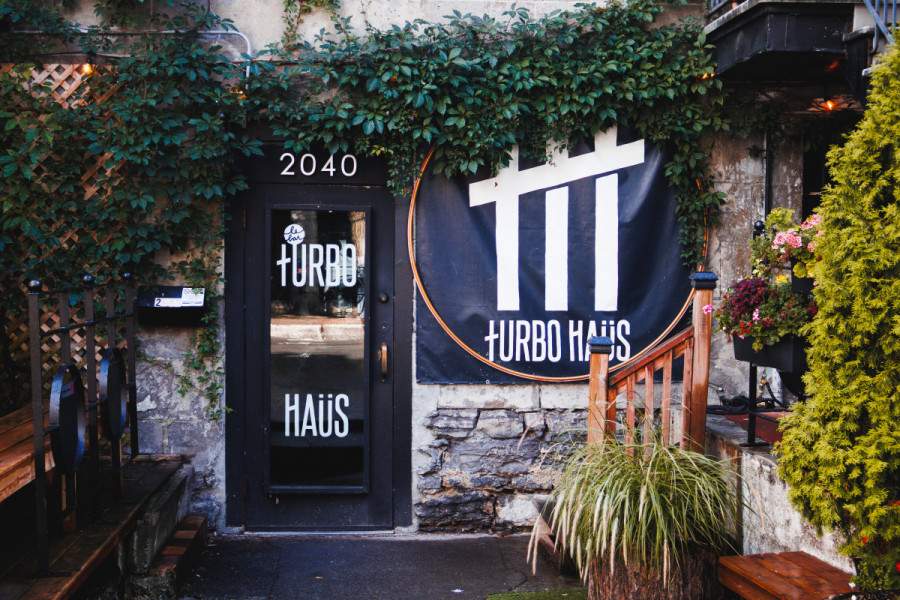
Turbo Haüs. Photo Safa Hachi

Safa Hachi,
Local Journalism Initiative

Your go-to guide for bars, parties and community spaces

Whether you’re fresh to Concordia University, new to the city or a long-time local rediscovering Montreal, the nightlife here has something for everyone. 

Some are well-known staples, while others are more tucked away—places you won’t always hear about unless you do some digging. No need to stress! That’s where we come in.

We’re not calling these places underground, but having a guide can help you cut through the noise and find your next go-to spot with less trial and error. 

From bars with cheap drinks to DJ-driven dance floors, from casual hangouts to themed nights full of activities, Montreal brims with energy, creativity and community. Think of this as your shortcut to finding the spots worth checking out—whether for the music, the drinks or just the company you’ll find there.

MESSY turning the crowd into pure chaos & joy. Courtesy Eloise Haliburton

MESSY 

Part party, part collective, MESSY has quickly carved out a name for itself in Montreal’s queer nightlife scene. The grassroots collective centres lesbian, queer and trans communities, blending live events with digital media to build spaces that feel both celebratory and intentional. Their parties are sweaty, glittery and full of energy—bringing DJs, performers and artists together in a setting that’s as much about connection as it is about dancing. If you’re after nightlife that highlights creativity and community over the commercial club circuit, MESSY is where to start.

Casa del Popolo. Photo Safa Hachi

Casa del Popolo
4873 St. Laurent Blvd.

Translating to “house of the people,” this bar has been a staple for Montreal’s independent and experimental music scene for over 25 years. Equal parts venue, bar and café, it’s the kind of spot where you can grab a drink, catch a weekend DJ set, or discover a standout performance from a local artist. With its cosy, intimate vibe, Casa is a perfect night out with friends.

Else’s. Photo Safa Hachi

Else’s
156 Roy St. E.

Located in a residential pocket not far from both St. Laurent and St. Denis streets, Else’s is a longtime favourite for anyone who wants a laid-back start to the night. The bar’s eclectic, cosy feel pairs perfectly with cheap drinks and affordable food, making it a go-to for students and locals alike. It isn’t exactly a hidden gem, but always worth remembering when you want a night out that doesn’t drain your wallet. 

Champs Bar. Photo Safa Hachi

Champs Bar
3956 St. Laurent Blvd. 

If bars are more your thing, there’s Champs, a lively queer-friendly sports bar with plenty happening week to week. It is also home to some of Montreal’s most creative queer programming, such as SATURGAYS.
Champs’ calendar spans trivia, themed nights, fundraisers and watch parties. This includes favourites like Dyke Night with free pool and Meat Market, a playful dating showcase where singles can present themselves (or a friend) in creative ways for the chance to win a free first date.

SATURGAYS layers on their signature flair at Champs with winter formals, Rocky Horror dance parties and live drunk readings of films like But I’m a Cheerleader and Twilight—all with a queer twist. Together, they make Champs more than just a bar, but a hub where silly, sexy and community-driven nights come to life.

Turbo Haüs Photo Safa Hachi

Turbo Haüs
2040 St. Denis St.

Turbo Haüs is equal parts venue and community hub, known for cheap drinks and affordable shows, and as a space that truly cares about keeping Montreal’s arts scene alive. Owner Sergio Da Silva is vocal about defending local music against noise complaints, making the bar a trusted spot for concerts. The venue also hosts free live band karaoke on Mondays and the weekly Growve jam on Wednesdays. Their motto, “anti-mosh, pro dance,” sums it up perfectly: a place where you can dive into alternative sound or just come dance without taking things too seriously. 

Sweet Like Honey. Graphic Naya Hachwa

Sweet Like Honey

Sweet Like Honey creates intentional spaces where lesbian, sapphic and BIPOC communities can gather and thrive. Their events range from strip-club nights and dance parties to karaoke and picnics, always spotlighting local BIPOC artists and businesses. More than the party itself, they’ve built a culture of care, enforcing rules against transphobia, racism and body shaming to make their events feel safe, welcoming and grounded in respect. In a nightlife scene that too often sidelines these communities, Sweet Like Honey ensures diversity and representation remain at the centre.

Bar Courcelle. Photo Safa Hachi

Bar Courcelle
4685 Notre-Dame St. W.

If you’re looking to step outside of the student-heavy core, Bar Courcelle in Saint-Henri is a cosy spot with plenty to keep you busy. Their weekly deals span everything from cocktail specials to oyster and hot dog happy hours, making it easy to keep things affordable. Beyond the food and drinks, you’ll find live band open mics on Sundays, trivia nights on Tuesdays and karaoke on Thursdays. They even host free live music on occasion, so keep an eye out; you might catch a show while you are there!

The Link’s guide to Montreal’s nightlife Read More »

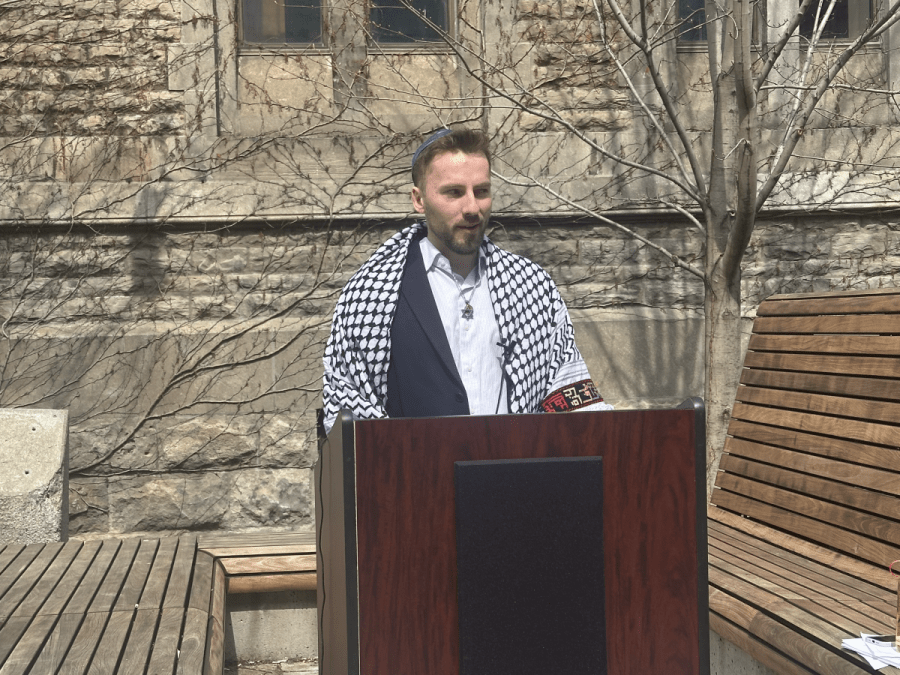
Montrealers rally for Palestine on global day of action

Photo Matthew Daldalian

Matthew Daldalian,
Local Journalism Initiative

Demonstrators gathered outside the U.S. Cconsulate to call for an end to the violence in Gaza

Protesters gathered outside the U.S. consulate in Montreal on the evening of April 25—waving Palestinian flags and chanting for liberation—as they joined a global day of action in support of Palestine.

Demonstrators in Montreal joined the international wave of protests alongside others rallying in solidarity with Palestine worldwide. In front of the U.S. consulate downtown, students tied local victories on university campuses to broader demands for an end to the genocide in Gaza.

Among those attending the protest was Ghazi El Masri, a student at Collège Montmorency, who said he felt compelled to show up as the violence continued.

“The problem with all of this isn’t just the fact that [Palestinians] are oppressed—it’s that children are dying, women are dying, families are dying,” El Masri said, “and unfortunately, Canada is acting as if nothing is happening.”

The protest was organized by the Palestinian Youth Movement’s (PYM) Montreal chapter and Students for Palestine’s Honour and Resistance (SPHR) Concordia and McGilll.

Before the march began, Montreal journalist and community organizer Mostafa Henaway addressed the crowd, highlighting the dangers facing media workers in Gaza. Over 200 journalists have been killed in Gaza since October 2023, according to the Costs of War Project at Brown University, making it the deadliest conflict for media workers ever recorded.

The demonstration came after recent significant developments on Montreal university campuses. 

Concordia University disclosed its $454 million investment portfolio after pressure from activists, while McGill University’s student society officially ratified a pro-Palestine policy following a Quebec Court ruling that upheld students’ right to political expression.

Zeyad Abisaab, a history student at Concordia and a PYM member, called Concordia’s disclosure of its investments a “historic achievement,” but said that demands continue.

“The student movement at Concordia and the movement in all of the diaspora for Palestine demands that [the university] cut ties with the weapons companies, and Zionist weapons companies to be specific,” Abisaab said.

Abisaab added that the demonstration was also part of a direct response to calls from professionals currently in Gaza.

“The journalists and doctors […] have made an outcry to the world to protest in front of the U.S. consulate due to their complicity and support,” Abisaab said.

After speeches, demonstrators marched through the streets downtown, heading down Stanley St. and marching along René-Lévesque Blvd.

A spokesperson for SPHR Montreal, who has been granted anonymity for safety reasons, said the day of action showed that students remain a critical force.

“This call came straight from Gaza and it’s calling on all segments of society and civil society to respond to this call, including students,” the spokesperson said. “Students from New York state, Montreal and Concordia and McGill, who are essentially here to reaffirm that the students are part of this broader movement.”

Following the march, protesters returned to the consulate at around 8 p.m.

Before the crowd dispersed, organizers said their movement and its demands are only growing stronger. For El Masri, simply showing up was a necessary part of that momentum.

“Even if, at the end of the day, it’s just about showing up, I think every presence matters,” El Masri said.

Montrealers rally for Palestine on global day of action Read More »

Concordia University discloses full $454 million investment portfolio

Graphic Maria Cholakova

Maria Cholakova,
Local Journalism Initiative

Investments include BlackRock, Boeing and Murphy Oil

After two years of student pressure, Concordia University’s Inter-Generational Fund (CUiF) released its full public holdings.

Included in its large portfolio are investments in Boeing, BlackRock and Murphy Oil despite its aim transition to 100 per cent sustainability investment rating.

Boeing and BlackRock

The CUiF has $166,518 worth of investments in the American investment company BlackRock.

On a number of occasions, BlackRock has been accused of complicity in the Palestinian genocide. BlackRock holds major investments in Israel and in companies such as Lockheed Martin, RTX, Northrop Grumman, Boeing and General Dynamics. BlackRock is profiting from the war in Gaza and supporting Israel’s settler colonial project in Palestine, and owns US$7.9 billion of Lockheed Martin stock. 

Apart from their investments in weapons, BlackRock manages a collection of exchange-traded funds and index mutual funds under the name iShares ETF. 

One of the companies that iShares ETF invests in is Elbit Systems—a defence contractor known for manufacturing surveillance systems, drones and other military technology. It’s one of Israel’s leading weapons manufacturers and has supplied equipment used in Gaza’s genocide. 

The CUiF has $149,820 worth of investments in Boeing.

Boeing is another company which has been accused of profiting from Gaza’s genocide. As one of the world’s biggest weapons manufacturers, Boeing produces a number of war jets and other military equipment, which Israel has used to attack the Palestinian territories. 

Murphy Oil 

The CUiF has $63,560 worth of investments in Murphy Oil. 

Murphy Oil has been the subject of a number of scandals. Most prominently, a spill from one of the company’s oil storage tanks in Louisiana, USA, in 2008 led to a US$330 million settlement with plaintiffs. It was coined as the worst environmental disaster during Hurricane Katrina. 

Additionally, according to Canada’s National Observer, Murphy Oil was fined $172,500 in 2017 following an Alberta pipeline spill that went undetected for 45 days. 

Concordia’s investments and profits

Including the three above-listed companies, the university has investments in over 1,860 companies, including Airbnb, Nike, Nordstrom, Starbucks, Coca-Cola, Microsoft, Apple and Tesla. 

Based on CUiF’s 2023-2024 annual report, the university’s net assets in investments are worth over $454 million. According to the university’s website, the CUiF’s total value grew from $413 million to $454 million, a $41 million increase for the 2023-2024 fiscal year.

According to Julie Fortier, the university plans to withdraw its investments from BlackRock, Boeing and Murphy Oil in order to transition to 100 per cent sustainable investing. 

 “As part of our commitment to be more transparent, we have been meeting with representatives of the Concordia Student Union in recent months to explain our investment strategy and had agreed to share the list of our internally-managed public holdings as it stood at the end of March – but the list will change on an ongoing basis,” Fortier said in an email to The Link. 

Solidarity for Palestine’s Honour and Resistance (SPHR) Concordia celebrated the release of the document on their Instagram, calling it a victory for students and the pro-Palestine movement. 

“We will continue to fight hard, this is one big step towards our bigger goal of divestment. We are nearly marking a year since the start of the historic McGill [University] encampment,” said a representative for SPHR who was granted anonymity for safety reasons. 

Concordia University discloses full $454 million investment portfolio Read More »

Call the question galore at CSU council meeting

Councillors call the question nine times at latest council meeting. Photo Maria Cholakova

Geneviève Sylvestre,
Local Journalism Initiative

Calls to end debate and accusations of filibustering mark latest council meeting

The latest Concordia Student Union (CSU) regular council meeting (RCM) on April 9 saw councillors strenuously approve the consent agenda and reject all three motions on the agenda.

Throughout the evening, councillors successfully motioned to call the question—or end debate and move directly to a vote—a total of nine times, leading to accusations of filibustering. 

When it came time to vote on approving the consent agenda—the set of committee minutes and executive reports for the month—at the start of the meeting, councillor Drew Sylver motioned to remove four items for further discussion. The items included were the External Committee minutes, the Policy Committee minutes, the Community Action Fund minutes, and the Clubs and Spaces Committee minutes. 

Sylver called for sections of the External Committee, Community Action Fund, and Clubs and Spaces Committee minutes to be separated and voted on individually. All motions failed. 

For each of the items taken out of the consent agenda, councillor Ali Salman successfully called the question during his speaking turn. 

Almost 40 minutes into the meeting, as council was still approving the agenda, Sylver addressed the chairperson, saying that the constant calling of the question could be considered filibustering according to his interpretation of Robert’s Rules of Order. 

In politics, a filibuster is a procedure used to prolong debate to delay or prevent a vote or decision. 

The chairperson said this was not their interpretation of the rules and continued the meeting. All minutes were approved by council. 

Following the approval of the consent agenda, three motions were presented to council. The first was brought forth by Lena Andres, a member of the cooperative CultivAction. Andres motioned to reallocate $25,000 from the CSU Loyola coordinator’s grant to CultivAction, to be divided between the Loyola Campus garden groups. 

Andres claimed they made multiple attempts to communicate with the Loyola coordinator, Leen Al Hijjawi, and expressed dissatisfaction with the new grant. Al Hijjawi answered that they had been in communication and that she does not have a budget of $25,000.

After some discussion by council, Sylver called the question, clarifying he was doing so in a “non-‘filibustery’ way.” The motion failed.

Council moved on to discussing a motion put forth by Sylver to mandate that each councillor must disclose their affiliation with any CSU club in the name of transparency. As before, Salman successfully called the question, and Sylver’s motion failed. 

Lastly, councillor Liora Hechel presented her motion to create a new CSU committee under the Student Life Committee to host food truck events on campus. Hechel proposed that $10,000 be allocated to this new committee per semester.                           
                
External affairs and mobilization coordinator Danna Ballantyne raised concerns about the logistics and costs associated with Hechel’s motion. Later, Hechel said that the CSU could hold fundraiser events, such as a LinkedIn photoshoot, to earn additional funds. 

Once again, following additional discussion, Salman successfully called to end the debate and move to a vote. 

Hechel’s motion failed, and the meeting was adjourned around 8:30 p.m. 

Call the question galore at CSU council meeting Read More »

McGill student society wins Palestine policy injunction in court

Hugo-Victor Solomon, SSMU’s vice president external speaking at the press conference. Photo Maria Cholakova

Maria Cholakova,
Local Journalism Initiative

Members addressed the repression of student freedom of speech during press briefing

In a press briefing held by the Students’ Society of McGill University (SSMU) on April 25, the society announced an April 17 court legal victory.

The win relates to an injunction filed in November 2023 in response to a democratic vote during the SSMU Fall 2023 referendum. McGill University students had voted 73 per cent in favour of adopting the SSMU Policy Against Genocide in Palestine. 

The policy calls on McGill to cut ties with people, corporations and institutions that are “complicit in genocide, settler-colonialism, apartheid, or ethnic cleansing against Palestinians.” The injunction had blocked the ratification of the policy.

The Quebec Court of Appeal unanimously struck down the injunction, stating that “thousands of students who voted for the adoption of the Policy are deprived of the opportunity to express their criticisms and demands, with which one may or may not agree, but which nevertheless constitute the primary expression of their ideas and their social and political freedom of expression.”

According to SSMU’s website, on April 22, the Policy Against Genocide in Palestine was officially ratified 16 months after the original vote.

According to Hugo-Victor Solomon, SSMU’s vice president external, the court decision was a win for student democracy. 

“This is more than a legal win, it’s a resounding affirmation that students have a right to speak, to organize and to demand justice,” Solomon said in a press briefing at McGill’s campus following the court’s decision. 

He added that criticizing Israel’s government is not a form of discrimination. 

“This is why SSMU fought to pass a policy against antisemitism, rooted in […] frameworks that protect Jewish students, without being weaponized to suppress Palestinian solidarity,” Solomon said.

Solomon finished his speech by condemning the genocide, war crimes and human rights violations in Gaza. 

“We affirm one and for all, that SSMU stands in unambiguous solidarity with our Palestinian and Arab peers,” he said.

Solomon was joined by Danna Ballantyne, Concordia Student Union external coordinator, who echoed Solomon’s sentiments. 

“We certainly cannot celebrate our diversity if we are refusing to acknowledge entire communities,” Ballantyne said. “True diversity is not just about inclusion in name, it is about protecting the freedom to speak out, to take political stances and to fight against injustice, no matter how uncomfortable or expensive this may be for those in power.”

The press briefing ended with a round of questions from the media. 

McGill student society wins Palestine policy injunction in court Read More »

Celebrating Pride through resistance

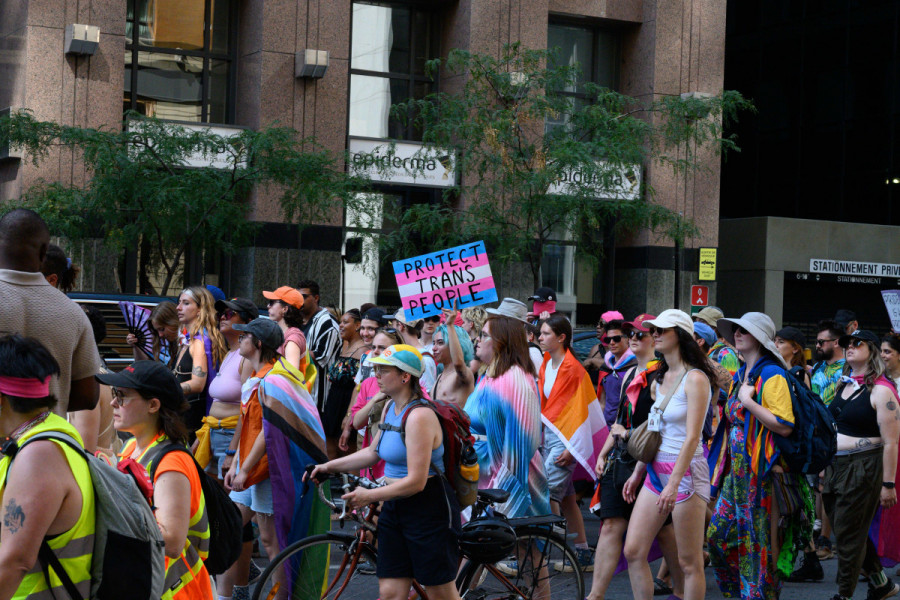
Thousand of Montrealers take to the street for the Wild Pride march on Aug. 10. Photo Lana Koffler

Maria Cholakova & Geneviève Sylvestre,
Local Journalism Initiative

New Wild Pride festival aims to create a non-corporate, safe space for queer identity and politics

Yara Coussa and Aisha White first decided to create an alternative Pride festival following the wave of queer groups and organizations that publicly cut ties with Fierté Montréal back in the spring of 2025.

Coussa and White were texting each other about the city’s need for a non-corporate Pride event, and a week later, White had created an Excel spreadsheet with potential collaborators. 

Preparations for Wild Pride had begun. 

According to them, Wild Pride aims to be an alternative space for queer individuals to celebrate Pride in a radical, anti-colonial, anti-capitalist and anti-corporate environment.

“ [The events are] really a response to a gap and a silence, specifically when it comes to the genocides all over the world, and an unwillingness to make Pride what it is at its core: a political fight,” Coussa said. 

They believe that pre-existing Pride events, like those planned by Fierté Montréal, were overly sanitized and lacked necessary political resistance. 

“In Montreal, [Pride] started as a riot against the police. It started as being led by lesbians of colour, by sex workers,” Coussa said. “So, to be in line with what Pride is, we need to continue being political. We need to continue with our fight.”

To gauge if there was interest within the Montreal queer community for an alternative festival, Coussa and White planned a town hall where 150 organizers showed up and 84 events were planned. 

Celebrations and events started on July 30 and will conclude on Aug. 18 with a variety of shows, workshops and community days.  

On Aug. 8, Wild Pride held a Community Day event, where 22 organizations gathered to promote their community organizations.

Firoza, a Montreal artist who offered henna art, was present and gathering donations for a Palestinian family in Gaza. 

“Historically, Pride has involved working-class queer and trans people, and it feels weird to be in an imperial [corporation], celebrating Pride with the same corporations that are fuelling the genocide and contributing to state-sanctioned violence against Black and Indigenous people,” Firoza said. 

Coussa also emphasized the importance of speaking up about Palestine as queer individuals. 

 “To say that the Palestinian cause and LGBTQ rights are dissociated is just to be blind to what is going on,” Coussa said. “It’s to be blind to the fact that the genocide in Palestine is being justified by pinkwashing.”

A number of QueerJewish and Palestinian voices have spoken out about the dangers of pinkwashing. Decolonize Palestine defines pinkwashing as occurring when “a state or organization appeals to LGBTQ+ rights in order to deflect attention from its harmful practices.”

Coussa, who is from the Levant region, said they feel connected to the Palestinian cause and the need to fight against both queer and Palestinian oppression.

“We live in a globalized system where our consumerism essentially funds [genocide],” Coussa said. “We have this added responsibility to be very conscious about what we consume, about what we support.”

Marchers hold up Palestinian flags and signs in support of the trans community. Photo Lana Koffler

Fierté Montréal and recent fallout 

In April, a number of LGBTQIA2S+ organizations, including Sweet Like Honey, Jeunesse Lambda and Helem Montréal, announced on Instagram that they were cutting ties with Fierté Montréal.  

The CBC also obtained an open letter in May signed by 10 LGBTQIA2S+ organizations denouncing Fierté Montréal, claiming it no longer represented them and that its practices were “unacceptable.”

Signatories also stated that they felt “unheard, used and underpaid.” 

On July 30, following calls from the queer community for the organization to show vocal support for Palestine, Fierté Montréal released a statement condemning the genocide in Gaza. The organization’s board of directors announced it would exclude groups it considered to be “spreading hateful discourse” from this year’s Pride events.

The two groups affected—Ga’ava, a Montreal-based, student-run Pro-Israel LGBTQIA2S+ group, and the Centre for Israel and Jewish Affairs (CIJA)—quickly denounced Fierté’s statement. 

CIJA defines itself as “the advocacy agent of Jewish Federations of Canada-UIA” and has been critical of pro-Palestine movements across Canada.

Over the years, they have opposed the teaching of Palestinian history in Canadian schools, opposed Canada providing aid to Palestinians through the United Nations Relief and Works Agency (UNRWA) and heavily criticized Canada’s decision to recognize Palestine as a state in September. 

Ga’ava, the second banned group, has also faced controversy, with reports from The Rover showing that the organization’s president, Carlos A. Godoy, has denied famine in Gaza and has claimed that “Palestinians are complicit with Hamas.” 

According to the UN, 12,000 children under the age of five were suffering from acute malnutrition in Gaza in July. 

A week after their statement banning the groups from the Pride parade, Fierté reversed their ban and apologized for their original decision, stating that all groups, regardless of religion, were invited. 

Émilie Grandmont, a member of the organization AlterHéros who cut ties with Fierté Montréal in April, was panelling at the Wild Pride community event and spoke of the importance of having an alternative Pride festival. 

“With the recent turn that Fierté has taken—not just with corporation affiliation, but with the refusal to stand against the genocide and pinkwashing—it has become more important to have an alternative community gathering where we can be queer and be proud of it,” Grandmont said. 

The Link reached out to Fierté Montréal for comment, but has not received a reply as of the time of publication. 

Celebrating Pride through resistance Read More »

CSU budget updates include $20k operational deficit and service expansions

The Concordia Student Union held a special council meeting on Aug. 11, 2025. Photo Maria Cholakova

Hannah Scott-Talib,
Local Journalism Initiative

Legal Information Clinic to add $50k in staff honorariums, Advocacy Centre to create new position

One Concordia Student Union (CSU) executive member and one councillor were appointed to the Board of Directors for the Sustainability Action Fund (SAF) at a special council meeting on Aug. 11.

The CSU also presented recent changes to their budget.

According to its website, the SAF is a student-run fee levy group at Concordia University that seeks to fund projects to “develop sustainable infrastructure, urban agriculture, community-building, and education surrounding environmental and community issues, with the long-term goal of inspiring and developing a culture of sustainability” at the university. 

In the meeting, CSU sustainability coordinator Mia Kennedy was appointed as an executive to the SAF Board of Directors alongside CSU councillor Sarah Aspler. 

“With my past experience volunteering for different organizations, I feel that I would be a good candidate,” Aspler said during the meeting. “Getting more people on [the board of directors] who are neurodiverse would be a good idea as well, opening it up for everyone and making it more [accessible] for everyone.”

Following this point on the meeting’s agenda, CSU finance coordinator Ryan Assaker presented adjustments to the student union’s budget. 

“One of the biggest things that has changed [is that] we’ve seen an [increase] in academic initiatives,” Assaker said during the budget presentation. “Academic initiatives have gone up around $6,000-$16,000.” 

According to Assaker, another budget increase can be seen in the domain of sustainability initiatives. 

“We’ve seen some carbon offset projects that have happened in the past that are also going to happen this year,” he said. “There’s also a major thing that we do every year, which is the Menstrual Equity program, which provides hygienic products to students.” 

Assaker then explained that several student services have a significant budget surplus—money accumulated by these services as a result of going under budget in previous years—that transfers into a CSU savings account.

This surplus, Assaker said, can be used by student services to expand and create new initiatives. 

One of the expansions happening this year, according to Assaker, involves the Legal Information Clinic (LIC), which has accumulated around $115,000 worth of surplus.

Drawing from this surplus, the LIC is upping their honorariums section by $50,000 “due to the high demand in terms of students reaching out to be represented and informed [by the LIC],” according to Assaker. 

Assaker said that the Advocacy Centre plans to expand as well, due to the creation of a new working position at the centre. 

The finance coordinator finished the presentation by revealing the CSU’s current total revenues of $4.1 million and its total expenses of $4.2 million, creating a deficit of around $20,000. 

“Generally for the budget, what’s important to keep in mind is that nothing much has changed in terms of [cuts to] the student services,” Assaker said. “The main cuts that have happened are more on the operational side, and we’re still seeing a deficit in operational costs.”

CSU budget updates include $20k operational deficit and service expansions Read More »

Tear gas, police violence and broken glass at Montreal Rad Pride protest

Protesters march alongside Place Émilie-Gamelin as the third edition of Montreal’s Rad Pride gets underway on Aug. 9, 2025. Photo Lana Koffler

India Das-Brown,
Local Journalism Initiative

What organizers say is normally a festive event came to a quick close this year following heavy police intervention

The third edition of Montreal’s Rad Pride, held in opposition to what organizers call the “corporatization and co-option” of Pride’s history, was met with tear gas, police violence and a heavy police presence on Aug. 9.

The march began around 9:30 p.m. at Place Émilie-Gamelin, near the intersection of Berri St. and Ste. Catherine St. in the Ville-Marie borough, and was intended to follow a route into the Village neighbourhood, previously known as the Gay Village. It did not extend farther than the streets directly surrounding Place Émilie-Gamelin.

“Traditionally, Rad Pride walks in the Village―that is supposed to be our Village―and this year, the police used a ton of violence to make sure this wouldn’t happen,” said protest organizer and member of the P!nk Bloc, Camille, who was granted last name anonymity for safety reasons.

At approximately 9:40 p.m., a message “calling for peaceful protests” was broadcast aloud by an SPVM patrol car, according to the SPVM.

At around 9:50 p.m., protesters began marching down St. Hubert St. toward Ste. Catherine St., where they were met with a line of dozens of police officers with shields, helmets, batons and bikes. 

When police were about a metre away from the roughly 50 protesters and some bystanders, they advanced, punching, pushing and hitting them with their shields. More officers with batons, helmets and shields soon arrived, running down St. Hubert St. to reinforce the line.

In a statement to The Link, the SPVM claimed that “protesters began confronting and pushing police officers. Pyrotechnics and objects were thrown at them.”

The force also reported that the window of a banking institution was smashed by demonstrators at the intersection.

Isabelle Boucher, a protester who was granted a pseudonym due to safety concerns, said the window was already broken before the protest, and the police pushed them against the already broken window, causing it to crumble.

“When the cops charged, essentially everyone that was against the wall, including me, panicked and kind of slammed ourselves against the wall [window] to try to be out of the way,” Boucher said.

She said that when backed against the window, she felt that the glass pane had already spiderwebbed-fractured into pieces, yet still held in place. She said she believes it was partially broken before the protest but remained intact.

“I moved because I was like, ‘Oh shit, if I stay in this area, the glass might fall on me if someone else hits it,’” she said. “I was really afraid of getting hurt by the glass.”

The protester said she was a few metres away when it finally collapsed.

“Whoever it was [who broke the glass], I think they were just terrified to be there,” she said. “[They] lifted their hands up in a kind of ‘don’t shoot’ position and slammed against the back of the wall to try to be out of the way as much as possible, and the glass kind of broke down on top of them.”

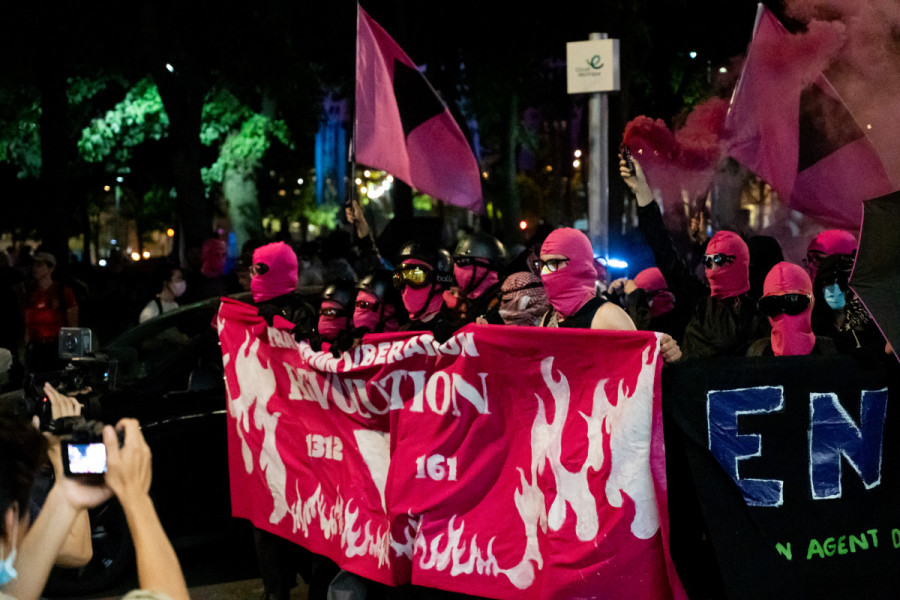
This was not the only altercation at the intersection on Saturday. After demonstrators made a short loop around the square in the other direction, holding flags like the Palestinian flag and the transgender pride flag, and trailing a plume of pink smoke, they were again met with the line of cops with shields. 

This time, police ran forward toward protesters, knocking some over, then began shuffling forward and hitting their shields with batons.

The advancement sent demonstrators fleeing into Place Émilie-Gamelin, where a salsa dancing evening was taking place with Espace Yambae. Some demonstrators were chased down and pushed by police, who also fired what appeared to be tear gas into the dance square.

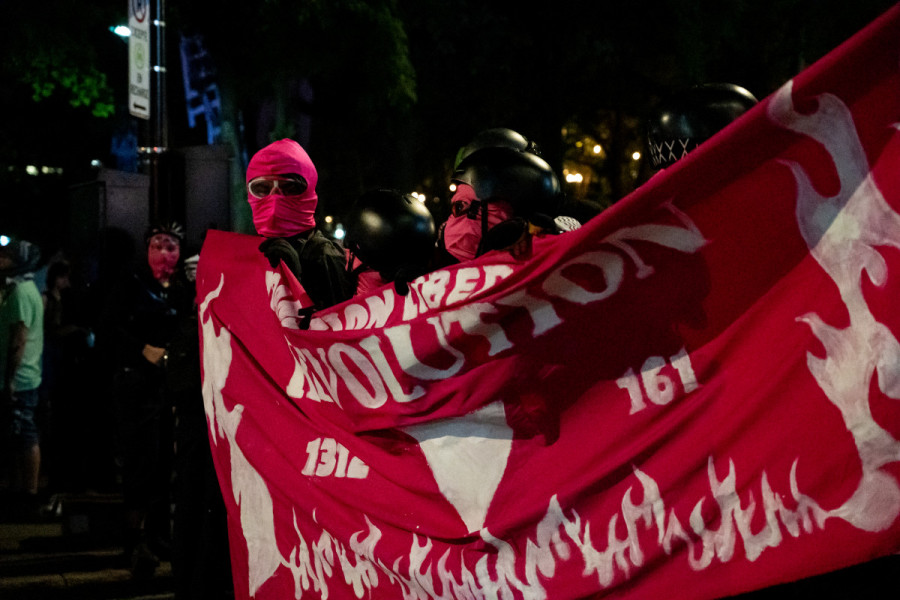
Demonstrators hold a banner during Montreal’s Rad Pride march near Berri-UQAM metro station on Aug. 9, 2025. Photo Lana Koffler

The SPVM did not respond to The Link’s question about whether irritant gas was used at the square; however, they confirmed it was deployed that night.

Protesters, parents, children and other bystanders then fled the square, with many coughing, wiping their eyes or wiping the eyes of their children.

“There was nowhere else I could go,” Boucher said over the phone through tears. She described how north and south on Ste. Catherine St., as well as north on St. Hubert St., was blockaded by cops.

“I had just seen them punch a bunch of people, so I was not going to go towards them,” Boucher said. “So I ran into the square.”

As a result of the disruption, the dance evening was cut short.

“We are a community; we are here for you, and the demonstration today is a planned demonstration, so you don’t have to be scared. This demonstration is to be shared,” said someone affiliated with the dance event in French, to a round of cheers by bystanders who were attending the event.

During the short-lived march, protesters chanted slogans in French like, “Everybody hates the police” and “Solidarity with the people who resist.” They were joined in their claps and chants by a few cars that honked along.

Protesters reported that throughout the night, police hit multiple people on the head with batons and kicked them in the stomach.

“I was very scared, to be honest with you, especially since I saw the level of police presence that was there even before the march started,” said Boucher. “The scale and response of it felt like a military execution of a plan.”

Protesters in pink balaclavas, protective goggles and helmets take part in Montreal’s Rad Pride demonstration near the Berri-UQAM metro station on Aug. 9, 2025. Photo Lana Koffler

Rad Pride was designed as a “combative and festive” evening march without corporate sponsorship or police cooperation, both to reject what organizers see as the commodification of queer culture and to confront the far-right, transphobic and queerphobic movements in Canada, according to Camille.

“Today and yesterday and the day before at the [Fierté] Community Days, [the SPVM] had stands showing up pretending to be allies of the community,” said Camille, referring to police information booths at Fierté Montréal. 

“At the same time, they’re using this extreme level of violence against our communities to try and prevent us from accessing a village that’s supposed to exist as a safe space for our communities,” Camille continued, “a village that was built, and a community that was built, through similar acts of struggles to the ones that were happening [Saturday].”

Camille also called for Fierté Montréal to “drop any ties with any sponsor or partner that has money invested in the genocide in Palestine.”

“It’s selling our culture and our history to the highest bidder, basically,” they said.

Camille says they hope they can prevent people from getting hurt next year, while retaining the “combative festivity that has been synonymous with Rad Pride for the last two years.”

Rad Pride was first organized by six groups: P!nk Bloc, TRAPS, FLIP, OPEN Maisonneuve, FAGS and Brûlances. This year, organizers said it was backed by 30 additional organizations, ranging from student associations to community groups and activist collectives.

The protest thinned out not long after demonstrators fled into Place Émilie-Gamelin, and the crowd fully dispersed by 10:30 p.m. No arrests were made, according to the SPVM.

All accounts in this report are based on multiple eyewitnesses, video footage and observations by The Link’s on-the-ground reporters.

Tear gas, police violence and broken glass at Montreal Rad Pride protest Read More »

Montreal ceremony remembers Hiroshima and Nagasaki after 80 years

Members of Shima no Taiko MTL perform “Sanya” during the Hiroshima and Nagasaki memorial ceremony at the JCCCM on Aug. 9. Photo Claudia Beaudoin

Claudia Beaudoin,
Local Journalism Initiative

Japanese and Canadian communities honour lives lost and highlight the importance of nuclear disarmament

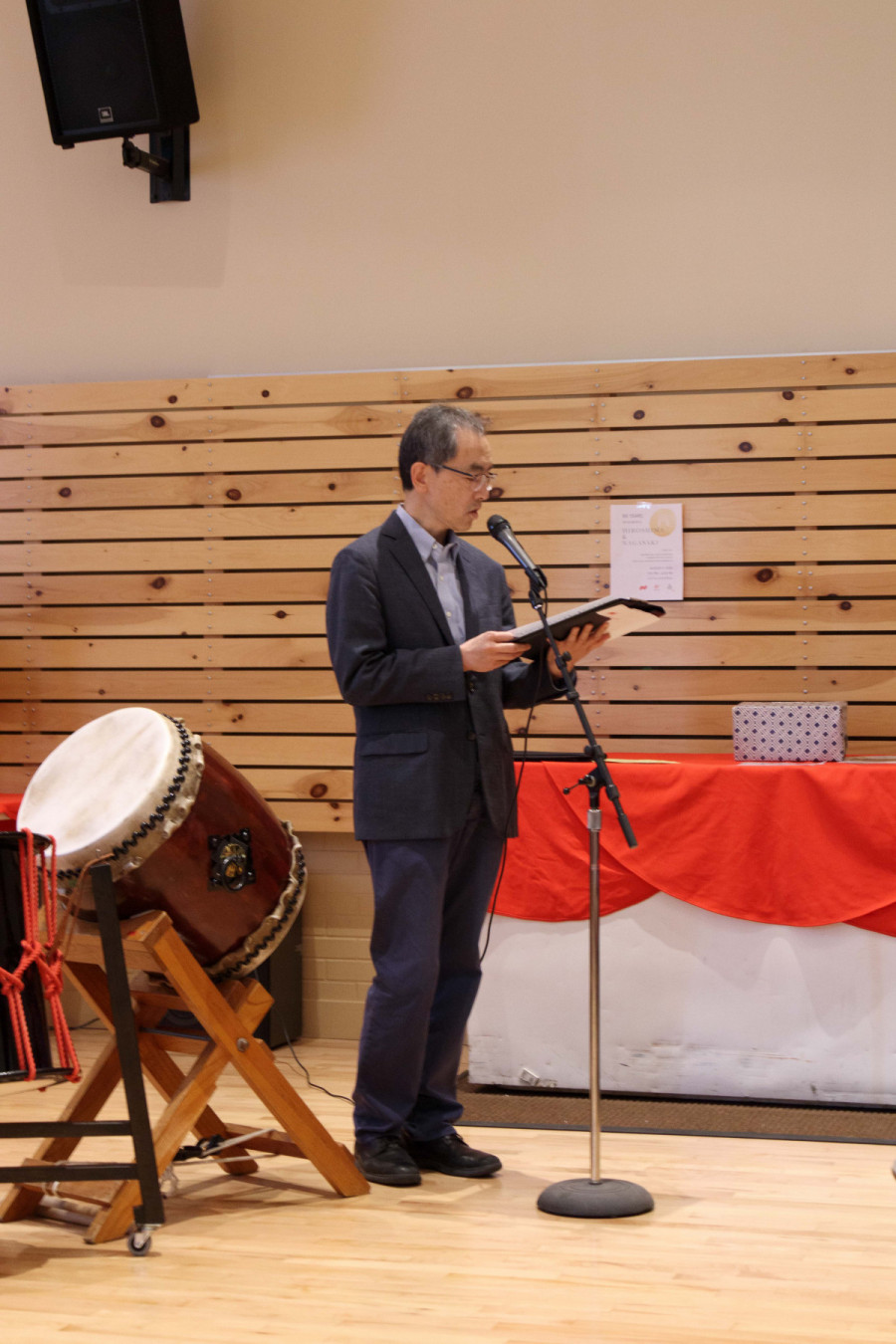
The Japanese-Canadian Cultural Centre of Montreal (JCCCM) and the Quebec chapter of the National Association of Japanese Canadians (NAJC) held a ceremony on Aug. 9 at the JCCCM to mark the 80th anniversary of the atomic bombings of Hiroshima and Nagasaki.

On Aug. 6 and Aug. 9, 1945, during the closing stages of World War II, the U.S. dropped atomic bombs on the Japanese cities of Hiroshima and Nagasaki, respectively. The attacks killed an estimated 150,000 to 200,000 people, the majority of them civilians. These remain the only instances in which nuclear weapons have been used in war.

While Montreal holds its annual Aug. 6 Peace Memorial Ceremony at the Botanical Garden—timed to coincide with Hiroshima’s ceremony—this year’s commemoration extended to Nagasaki’s anniversary as well, bringing together performers, organizations and community members for a full day of remembrance.

The afternoon opened with welcoming remarks from Hisako Mori, secretary of JCCCM, followed by a message from Akihiko Uchikawa, consul general of Japan in Montreal. 

Uchikawa began by offering his condolences to all those affected, recalling how the bombings reduced the cities to ashes and stressing that such destruction must never be repeated. Preventing it, he said, requires understanding the consequences of these acts.

“We must make all our efforts to bring about a world without nuclear war and a world without nuclear weapons,” Uchikawa said. 

He closed his remarks by expressing his hope that attendees would find both meaning and peace in the day’s tribute. 

This event held special significance due to Montreal’s longstanding bond with Hiroshima—two cities united in a shared commitment to peace since 1986, when the mayor of Hiroshima delivered a speech at the International Conference on Peace and Security in Montreal. The relationship was formalized in 1998, when they officially became sister cities.

Following Uchikawa’s speech, Mariko Komatsu—a Hiroshima native and peace education advocate who studied in Montreal for several years—shared a five-minute video message from Hiroshima, expressing gratitude to Montreal for giving her the language skills to advocate for peace globally. In her work, she often invokes the tragedies of Hiroshima and Nagasaki as reminders of the human cost of nuclear war

Akihiko Uchikawa, consul general of Japan in Montreal, delivers a message on nuclear disarmament and offers condolences. Photo Claudia Beaudoin

Komatsu’s words resonated with the day’s larger message, one echoed by Mori. 

“The politics of the world are unstable, and there are still nations that are producing nuclear weapons, which I think is absolutely unbelievable that after such catastrophic loss of life, that this is still continuing,” Mori said.

The ceremony continued with a 15-minute performance of “Sanya” by Shima no Taiko MTL, with the resonant beats of taiko—traditional Japanese festival drums—filling the room. Traditionally played outdoors in the evening, the drumming’s deep tones carried enough sound to merit the distribution of earplugs by volunteers.

“Sanya” portrays a mother’s desperate search for her daughter after the Hiroshima bombing, culminating in the devastating moment she finds her body.

“It’s one thing to talk about the need for nuclear disarmament and the need for peace, but we can get kind of caught up in the rhetoric of it,” said Sara Breitkreutz, a member of Shima no Taiko MTL, the NAJC and the JCCCM board.

“I think when you can experience a story in this more visceral way, it can have a really lasting impact on people,” Breitkreutz added.

Katsukuni Tanaka, a Hiroshima survivor who was just 10 months old when the bomb fell, also addressed the guests with the help of a French translator. Though he has few personal memories of the bombing, he lost close family members, including his aunt, who worked at a post office and whose remains were never found.

Tanaka has dedicated his life to advocating for peace.

“We hope to prevent this from happening again, which is why it’s important to build networks and get involved, because when there is war, the victims are always the civilians,” Tanaka said.

He concluded his talk by removing his blazer to reveal a shirt with bold writing, where the word “peace” stood out clearly, leaving a strong visual statement with the audience.

The ceremony continued with a collective screening of Okurimono, a 2024 Canadian documentary directed by Laurence Lévesque. The film follows Noriko, a Japanese Canadian woman who returns to Japan after her mother’s death to better understand her mother’s experience as a hibakusha—a survivor of the atomic bombing of Nagasaki in 1945.

Every item on the program carried a direct thread to Hiroshima or Nagasaki, inviting attendees to remember, mourn and confront the weight of nuclear war. During the screening, the room shifted between quiet stillness and audible sniffles.

For the organizers, the purpose focused on the creation of spaces where the past could speak urgently to the present.

“There’s a younger generation of people who are not as familiar with the history of World War II and what happened,” Breitkreutz said. “It’s important for us to keep that memory alive, the further and further it recedes into the past, because it’s a really important lesson for all of us.”

The ceremony concluded with three songs by the MTL Shamisen Project, showcasing the shamisen—a traditional Japanese three-stringed instrument known for its unique, expressive tone. The performance ranged from serene, reflective pieces to an original composition that inspired strength and resilience.

Once the ceremony concluded, attendees were invited to share conversations and enjoy refreshments at their leisure. Despite the day’s heavy topic, people connected warmly, thanking one another and reflecting on the ceremony.

When asked what she hoped people would take away from the event, Mori reaffirmed the importance of remembering past tragedies, keeping conversations on disarmament alive and strengthening global solidarity.

“It’s important to maintain this message of hope and reconciliation,” she said, “and to remember that we must take care of our earth for future generations.”

Montreal ceremony remembers Hiroshima and Nagasaki after 80 years Read More »

La traversée du siècle turns Montreal into a living archive

One of Marlène Gélineau Payette’s 72 photographs from La Traversée du siècle, part two, displayed in front of Théâtre du Rideau Vert. Photo Claudia Beaudoin

Claudia Beaudoin,
Local Journalism Initiative

Recasting Michel Tremblay’s world with Marlène Gélineau Payette’s lens

This summer, theatre has stepped off the stage and into the city.

Seventy-two large photographs by Montreal still photographer Marlène Gélineau Payette have been installed outdoors across a network of streets and public spaces linking the Plateau, Quartier des spectacles and adjacent neighbourhoods. 

Each image captures a suspended moment from La traversée du siècle—a bold, 12-hour theatrical epic written and directed by Alice Ronfard in close collaboration with the late André Brassard. 

Woven from Michel Tremblay’s best-known novels and plays, the play follows three women—Victoire, Albertine and Thérèse—whose lives span a century of Quebec’s social and cultural evolution.

The production moves seamlessly between tragedy, comedy, intimacy and grandeur. It paints a wide and detailed portrait of Quebec society, touching on issues like identity, class, queerness and the struggle to survive. Though firmly rooted in Quebec’s history, the themes still echo today, reflecting ongoing social and cultural conversations.

To document the project, Gélineau Payette followed each of the seven stagings, capturing emotional fragments that now form a citywide exhibition. Installed near the very theatres where the play ran, the photographs also trace a path through streets mentioned in the story itself.

“I feel like everything just seemed to come together easily when I started building the project,” Gélineau Payette said about the location of the different exhibitions. 

The seven theatres also form a rough square across the city, with La Fontaine Park—another central setting in Tremblay’s universe—at its heart.

Accompanied by a six-part podcast produced by Espace Libre—equal in length and structure to the performance—the exhibition becomes more than a memory. It’s a theatrical experience meant to be walked, heard and seen across the city.

For Gélineau Payette, it’s that very connection to the city that makes the project so special, rooting it with a deep sense of attachment and place.

“When you follow the characters through the Plateau Mont-Royal—which Tremblay wrote about in the ’70s and ’80s—it’s exactly like my parents’ families. That’s where we come from. So, there’s definitely a sense of belonging,” Gélineau Payette said. “And then, when you’re out for dinner or just walking around, you start noticing things.”

The project began as a photo book, intended as a gift for the actors and collaborators—a behind-the-scenes keepsake capturing not only the play itself, but also its backstage moments and raw in-betweens.

After often seeing photographs displayed while walking through the city, Ronfard suggested to Gélineau Payette that the images should live on in public space, sparking the idea of turning them into an exhibition.

“I find it beautiful to see actors taking over the city with a true story. What’s also wonderful is that the creative work is a project that moves around. It’s multifaceted,” Ronfard said. “It starts as a novel, then becomes a play. After that, it turns into a photo album, and then those photos become part of the city.”

While Gélineau Payette loved the concept, bringing it to life came with its own set of challenges. The displays across the city are managed by different organizations, meaning she had to navigate various people, approval processes, and, at times, even cover costs out of pocket. 

Creatively, the project made sense, but distilling the story into just 72 photographs required tough decisions.

“At one point, I found myself stuck. I really liked a photo, but the podcast audio clip didn’t work well with it,” Gélineau Payette said. “I was really working on both in parallel—the audio and the image. I listened to it again and again, trying to make sure I was giving people enough context to follow the story.”

And this careful curation has resonated across the city all summer long. 

Quebecois comedian and director Martin Faucher happened to see two sections of Gélineau Payette’s exhibition while walking along Mont-Royal.

“I can only repeat that La traversée du siècle is a major event in Quebec theatre,” he said. “It’s fantastic that this moment was captured through [Gélineau Payette]’s sensitive eye. Now, a new audience has access to Tremblay’s universe, but it’s also a celebration of the actors, the theatres and the very spaces that make up our urban fabric.”

Even if you’re unfamiliar with Tremblay’s work, La traversée du siècle can serve as an immersive entry point into his artistic universe. 

The emotional depth of Tremblay’s characters—their struggles, hopes and humanity—was something Gélineau Payette felt keenly while crafting the exhibition.

“Many people talk about Tremblay’s characters as living in hardship, but they’re human,” she said. “It’s like Les Misérables, it’s about misery, yes, but also about resilience and hope. These are characters who hope.”

When asked what she hopes newcomers will take away from her play, Ronfard encouraged curiosity about Quebec’s literary heritage.

“What matters, for me, is inspiring people to read his works, to read Michel Tremblay, and to understand that he’s a poet who has deeply influenced francophone Quebec theatre,” she said.

The exhibitions will not remain on view for the same amount of time. Parts 1 and 2, along with Part 5, will remain until spring 2026. Parts 3 and 4 come down on Aug. 27, while Part 6 wraps up on Sept.16. That leaves just under a month to experience the full sweep of the project. 

Thinking back on how she felt at the end of each performance, Gélineau Payette took a deep breath.

“Oh my God, what an extraordinary journey we’ve shared,” she said—a journey anyone can still experience throughout the city this summer.

La traversée du siècle turns Montreal into a living archive Read More »

Sit-ins for Palestine continue across Canada

Activists wave the Palestinian flag at a sit-in on Aug. 6. Photo Maria Cholakova

Maria Cholakova & Geneviève Sylvestre,
Local Journalism Initiative

Activist groups call out federal government over lack of action on Gaza reunification program

Pro-Palestine groups across the country are continuing sit-ins at Canadian immigration offices, demanding that the federal government take action to unite Gaza family members in Canada.

Activists and community groups are demanding that the government follow through on the Canadian reunification program. First introduced in January 2024 with a 5,000 temporary resident visa applicant cap, the program was meant to keep the promise of reuniting families.

According to the most recent statistics on the Canadian government’s website, as of July 8, more than 1,750 people who exited Gaza have passed security screenings and are approved to come to Canada. However, only 860 applicants have arrived safely from Gaza.

Additionally, as of July 26, Canada has assisted 11 Canadians, including children travelling with their mothers, in leaving Gaza safely, a move the Gazan Canadian Families organization called “not even a bare minimum response” in a press release.

In Montreal, weekly sit-ins, organized by activist Summer Alkhdour, Gazan Canadian Families and Independent Jewish Voices (IJV), happen every Wednesday in front of the Immigration and Refugee Board of Canada building.

On Wednesday, Aug. 6, activists played songs, waved the Palestinian flag and chanted, “IRCC [Immigration, Refugees and Citizenship Canada] while you delay, bombs are dropping every day.” 

Activists from Gazan Canadian Families handed out pamphlets urging immigration officials and the government to implement an efficient screening policy of 14 days and remove biometrics from applications for Gazans; to allow safe evacuations from Gaza through negotiations with the Israeli government; to fast-track approvals for applicants stuck in Egypt; and to collaborate with provinces to provide healthcare and coordinated support for arrivals.

IJV member Niall Clapham Ricardo emphasized the importance of caring about the genocide and confronting the government’s inaction. 

“People should not see this as separate issues from their daily lives; everybody is impacted by [immigration],” Ricardo said. “The more restrictions and obstacles we put towards immigration in this country, the more it will have an impact on every single community.” 

Sit-ins for Palestine continue across Canada Read More »

How unexpected beginnings lit the fire inside Canada’s top rhythmic gymnast

Montreal-born gymnast Suzanna Shahbazian won a gold medal at the 2022 Commonwealth Games. Courtesy Iris van den Broek

Samuel Kayll,
Local Journalism Initiative

Suzanna Shahbazian shares her story and plans for the future

Suzanna Shahbazian thought she was receiving a sweet treat.

The 20-year-old still smiles at the memory of her start in rhythmic gymnastics. At four years old, her mother regularly swam at a local sports complex. Just down the hall was Questo Rhythmic Gymnastics—the studio where Shahbazian still trains. 

One day, while helping a lost girl, Shahbazian’s mother stumbled into the Questo facilities. Intrigued, she returned home and told Shahbazian she had a surprise. 

“My naive self thought it was something like a chocolate or something sweet. And obviously, it wasn’t,” Shahbazian laughed. “So we headed to the gym, and my first coach saw me. She looked at my physical abilities: my splits, my points, my flexibility. And I started rhythmic gymnastics.”

Shahbazian trains at Questo Rhythmic Gymnastics in the Centre Sportif Côte-des-Neiges. Photo Jared Lackman-Mincoff

It’s safe to say Shahbazian doesn’t regret missing out on chocolate now.

Through coaching skepticism, untimely injuries and even belligerent teachers, Suzanna Shahbazian has blazed a trail through her love for rhythmic gymnastics. From the World Junior Championships to a gold medal at the Commonwealth Games to the 2025 FISU Games, her success has brought her to the forefront of Canadian representation in her sport. 

And she’s not done yet. 

“My goal is to bring Canada to a higher level in rhythmic gymnastics on the international stage,” Shahbazian said. “I want to show that with love for what you do, you can get to any goal you want.”

Shahbazian’s ascent surprised even her coach, Natalia Popova, who first trained Shahbazian at six years old. 

“She had flexibility, which is important for our sport,” Popova said. “But she was like an ordinary gymnast—nothing promised this big career. And she was short.”

Popova says Shahbazian’s patience played a key role in her success.

“This career takes patience, because there were many obstacles in her way up to these world competitions,” Popova said. “Now she takes a deeper way to understand how to prepare herself.”

Ekaterina Shtrevensky noticed Shahbazian’s passion for rhythmic gymnastics early on. The former national competitor and current Questo coach outlined Shahbazian’s hunger for knowledge both on and off the mat.

“[Shahbazian] has a pure love for the sport,” Shtrevensky said. “She knew all the champions’ names, the countries they represented, all of that. Even as a young gymnast, she knew that one day she would be up there alongside them. That passion and love really translated into her performances.”

As Shahbazian’s journey progressed, the workload grew. Competing year-round in tournaments like the Rhythmic Gymnastics World Cup, World Championships, and Pan American Championships took a toll on Shahbazian’s schedule—and her relationship with her teachers.

“We didn’t have a sports program in high school. Plus, I was in an enriched program,” Shahbazian said. “I couldn’t miss any classes or exams, and my teachers really didn’t like me. So when I came back from tournaments, they would not let me do any exams. It was very difficult.”

It wasn’t just academics that threatened Shahbazian’s performances, though. As an indoor sport, the COVID-19 pandemic took a particular toll on rhythmic gymnastics. Popova remembered a tournament in 2021 where Shahbazian not only competed online, but also with a severe injury. 

“When things started to be a bit easier with the restrictions, we had very limited time in the gym,” Popova said. “The first Elite Canada was by video, and I remember she had an injury at the time. I was planning not to put her in the competition, but she insisted that she could still do it.”

Popova points to that perseverance as a key part of Shahbazian’s influence at Questo. 

“I hope young kids will see that no matter what, if you like what you’re doing, you can continue as long as you can and you want,” Popova said. “So I hope they will see that, and I hope they will continue like Suzanna.”

Shahbazian knows what it’s like to look up to a club idol—Shtrevensky trained at Questo during Shahbazian’s youth. She hopes to set the example for Montreal’s next generation of rhythmic gymnasts

“When I was younger, I would look up to our senior gymnasts,” Shahbazian said. “I even took [Shtrevensky’s] hoop music in my senior program a year or two ago because I really loved her music when I was a child. So if the kids now look up to me as I once did, of course, it feels special.”

For Shtrevensky, it’s easy to see Shahbazian’s influence on younger gymnasts. She praised Shahbazian for breaking through rhythmic gymnastics’ barriers to flourish at a high level.  

“Fifteen years ago, anyone not meeting certain physical requirements was ruled out from the get-go,” Shtrevensky said. “Suzanna didn’t check all the boxes, but she compensated with her drive. She showed that the sky is the limit if you’re relentless.”

But it’s not just about the club. Rhythmic gymnastics remains a fairly niche sport in Canada, and Popova acknowledges the country’s second-tier international status behind giants like Belarus, Ukraine and Bulgaria.

“We learn from each competition because it’s no secret that our gymnastics is not very popular in Canada,” Popova said. “There aren’t many specialists here in Canada with good technical knowledge. It’s something we learn from, because all these European countries dominate this sport.”

In aiming for crucial performances at the World Championships, Shahbazian hopes to raise the country’s standing in the world of rhythmic gymnastics.

“Going on the carpet, especially when I do well, I can raise my rank,” Shahbazian said. “Every competition for me is a new step towards my end goal.”

For Shtrevensky, it’s inspirational to see not just Shahbazian’s passion, but also her humility.

“She makes this kind of success feel collaborative,” Shtrevensky said. “She goes out of her way to thank not only her coaches, but also the volunteers, the organizers and the other girls who all helped make this result possible.”

For Shahbazian, the World Championships, World Cup and even the 2028 Olympics are all tangible goals.

But it’s about more than that: it’s about Questo, about Montreal, and all of Canada. And her passion there will never fade.

“I always loved rhythmic gymnastics,” Shahbazian said. “I asked my mom, and she said that I was very driven, like I always had that fire inside of me.”

That fire? Given Shahbazian’s career, it may just have been the sweetest treat of them all.

How unexpected beginnings lit the fire inside Canada’s top rhythmic gymnast Read More »

Quebec Superior Court authorizes lawsuit against automatic student insurance

Former Concordia student Arielle Nagar is one of two former students leading the class action lawsuit. Photo Caroline Marsh

Jared Lackman-Mincoff,
Local Journalism Initiative

Former Concordia and McGill university students lead class action lawsuit

The Quebec Superior Court has authorized a class action lawsuit brought by two former students of McGill and Concordia universities seeking damages over the student insurance opt-out system.

A Université de Montréal student first filed the lawsuit against Desjardins Sécurité financière (DSF) and the Alliance pour la santé étudiante au Québec (ASEQ), also known as Studentcare, in June 2023.

However, it is now former Concordia University student Arielle Nagar and former McGill University student Giovana Feth representing the group. 

According to the court decision, the group is seeking “an injunction to end automatic student membership” and is “demanding the reimbursement of insurance premiums paid by members, as well as compensatory, moral, and punitive damages.”

They are also demanding that universities implement an opt-in student insurance system where students can choose to enroll in health coverage, claiming that an automatic enrolment system is illegal. They argue that students often only have a few weeks to opt out, and that the insurers and universities fail to properly inform students of the “optional nature” of the insurance.

La Presse reported on Aug. 6 that a new document was submitted to the court on Aug. 4. The new document asked for the lawsuit to include 32 additional postsecondary schools that face similar opt-out insurance systems. The document says that ASEQ represents over 400,000 postsecondary students per year.

The lawsuit originally sought to target all student health insurance contracts in Quebec that have ended since Dec. 19, 2019, but the court mandated that the lawsuit be limited only to such contracts at Concordia and McGill.

Concordia and McGill are now defendants in the lawsuit along with DSF and ASEQ, having collected insurance premiums from students and delivered them to the insurers.

However, the universities claim in the court decision that they simply play an “administrative assistance role,” and are not involved in the insurance contracts.

Joey Zukran, the group’s lawyer, told La Presse that he hopes to reach a settlement with the defendants within two months to avoid involving too many schools in the lawsuit.

Quebec Superior Court authorizes lawsuit against automatic student insurance Read More »

Rosebuds: The meteoric rise of the Montreal Roses

The Roses sit second in the Northern Super League standings through 15 matches. Graphic Naya Hachwa

Samuel Kayll,
Local Journalism Initiative

The team speaks on the early success of the league and their plan for the future.

Earlier this year, the newly formed Montreal Roses FC travelled to BMO Field for their first match of the inaugural Northern Super League (NSL) season against AFC Toronto. The two teams faced off on April 19 in front of over 14,500 fans, still the record for the highest attendance in NSL history.

But Montreal didn’t just participate—they won, eking out a 1-0 victory over the current league leaders and kicking off the 2025 campaign with a victory. The Roses’ sporting director Marinette Pichon celebrated the moment as a statement of the club’s values and intentions in the newly formed NSL. 

“This was a moment we’ve been waiting for a long time. The players delivered a performance full of intensity, discipline and solidarity,” Pichon said. “It’s a hard-fought victory that perfectly represents the club’s values: commitment and passion.”

As the season progresses, it’s easy to look back and see how that first game and its record-breaking numbers have set the stage for the Montreal Roses in their first year as a professional club.

Whether on or off the field, within the locker room, front office or community, the Roses have fully established themselves as a staple of Montreal’s professional sports scene. And there’s plenty of room to grow.

The first step for the Roses was establishing a culture that resonated with the city and the fans. Nathalie Vachon, the Roses’ VP of strategies and communications, emphasized the importance of a team connected to its supporters and ingrained in everyday life. 

“Fans want more than just games; they want to belong to a movement,” Vachon said. “This is a work in progress, and every step we take now, on the field, in the locker room, and in the community, is an investment in long-term excellence.”

Even the team’s jerseys reflect the goal of community-based connection. Montreal-born artist Niti Marcelle Mueth designed the team’s blue-and-red patterned home kit as an ode to the city and its vibrant identity.

“This forward-thinking design embraces originality and fearlessness, visually expressing the unwavering determination of the Roses,” the club said in a press release. “The intricate print serves as a symbol of a new era in women’s sports, where courage, artistry, and ambition come together to break barriers and set trends.”

And the barriers have kept falling as the season progresses. The NSL has already garnered sponsorship deals with major brands like Coca-Cola, Toyota and Canadian Tire.

But Montreal has taken the barrier-breaking a step further: establishing Stade Boréale, the home of the Roses, in Laval as the first soccer-exclusive stadium and training ground in Canada.

“In professional women’s sports, it’s still all too common for teams to share facilities and rarely be prioritized,” Vachon said. “That’s why it was so important for us to create a dedicated space, one that reflects the identity of the Roses and truly feels like home for our players.”

The club has also emphasized its long-term sustainability by making moves to expand the fan base throughout Montreal. Moves like signing Quebec-born talents such as Stéphanie Hill, Mara Bouchard, Félicia Roy and Lorie Thibault support the team’s initiative to increase local intrigue and provide young players in Montreal with professional role models.

“By welcoming these high-potential local players into our professional league, we are taking a stand so that local talent can evolve at the highest level,” Pichon said. “Each player brings unique skills and fresh energy that will enrich our group. Together, we are going to make history and create beautiful memories on the pitch.”

That includes community initiatives focused on the development of youth soccer programs to increase the buzz around the sport. 

“A key focus will be investing in youth development pipelines, especially for girls, to ensure the next generation has both the visibility and the opportunity to dream big,” Vachon said. “Ultimately, our goal is to make the Roses not only a cornerstone of Montreal’s sports scene, but a cultural institution recognized worldwide.”

And the Roses have become that cornerstone; it shows in the fans that pack Stade Boréale, the enthusiasm from the players at being part of something historic, and an organization unsatisfied with simply arriving.

The Montreal Roses are here to stay, and while the road ahead surely contains some thorns, these Roses can’t wait to bloom. 

Rosebuds: The meteoric rise of the Montreal Roses Read More »

CSU delays vote to fire chief electoral officer

The CSU delayed a motion to terminate its chief electoral officer. Photo Maria Cholakova

India Das-Brown,
Local Journalism Initiative

Lack of meeting notice leads councillors to table motion

On June 11, at the first regular council meeting of its new mandate, the Concordia Student Union (CSU) voted to postpone a motion to terminate its chief electoral officer (CEO) following concerns about procedural fairness and transparency.

External affairs coordinator Danna Ballantyne presented the initial motion, citing months of unresponsiveness, bylaw violations during recent elections, and failure to notify the deputy electoral officer of a called vote. Multiple councillors reported similar issues, with some saying they never received replies to questions during the nomination period.

However, internal coordinator Leo Litke, among others, suggested that the CEO be given a chance to respond, noting that, due to technical issues, the meeting was not properly publicized. The motion was tabled to a later special council meeting (SCM) with Ballantyne’s support. Ballantyne retracted the motion.

The meeting, held over Zoom, was chaired by former CSU chairperson Michelle Lam, appointed after chairperson Angelica Antonakopoulos reported being unwell. Lam was nominated by Ballantyne and approved unanimously.

Agenda delays were attributed to IT miscommunications that left the new chairperson without email access ahead of the submission deadline.

As a result, a request from the fee-levy group Art Matters was not addressed in time and council voted to add Art Matters to the agenda. The fee-levy group’s general coordinator, Bridget McPhee, was able to ask questions about the CSU’s updated fee levy application process.

McPhee raised concerns about conflicting information across the CSU website, bylaws and policy documents. Ballantyne explained that the CSU recently dissolved its fee levy committee and that application procedures are being revised.

Council also approved a motion to move discussion of an office restoration proposal to the operational budget and appointed councillor Lili Daviault-Campbell to the Student Space, Accessible Education, and Legal Contingency Fund Committee, used for large-scale student-focused projects. These include infrastructure like the CSU building on Bishop St. and other initiatives that directly benefit student life, according to CSU finance coordinator Ryan Assaker.

Several councillors raised concerns that CSU meeting minutes had not been uploaded to the website for months. Ballantyne explained that the previous minute keeper stopped attending meetings partway through the last mandate. She added that the new minute keeper is now working to transcribe and finalize the backlog using recorded Zoom meetings.

“A big goal of the incoming executive team is to make sure that we clean up any messes left from the past mandate,” Ballantyne said.

The meeting was adjourned around 8:30 p.m. The date for the SCM on the CEO termination motion will be announced shortly.

CSU delays vote to fire chief electoral officer Read More »

CSU accused of neglecting trans students at AGM

Photo Nikolas Litzenberger

Maria Cholakova,
Local Journalism Initiative

High tensions, long hours and debating marked the meeting

On April 30, during a Concordia Student Union (CSU) annual general meeting (AGM), Queer Concordia senior coordinator Jessica Winton accused the CSU executives of neglecting Queer Concordia and trans students and failing to protect trans individuals. 

The meeting, nearly four hours long, happens every year as a way for the union to present its work and finances to the membership.

The meeting, which was originally set to start at 6:30 p.m., started close to 30 minutes late because quorum was not met in time. 

The AGM started with the union’s chief electoral officer, Ekamjot Kaur, who presented the union’s election results from the fall and winter elections. 

The meeting then moved on to the CSU’s executive team report. The 120-page document was presented by each executive member and outlined the team’s achievements throughout their mandate. 

The executive presentations took up over half of the meeting’s time. Afterwards came a question period, which, according to the chairperson during the AGM, was saved for after the presentation to avoid further delays in the meeting. 

Main takeaways from the report

According to CSU financial coordinator Souad El Ferjani, despite concerns over the CSU being in a deficit, the union projects to end the year with a near $300,000 surplus. 

El Ferjani explained that the reasons for the surplus were staff going on leave, external funding, delays in hiring, and the overestimation of expenses. 

El Ferjani also explained her work in the investment transparency committee, which met six times over the winter semester. The committee was formed with the help of the CSU and the Concordia University administration, after students expressed concerns with the university’s transparency regarding its investments. 

El Ferjani said that, despite the university disclosing its investments, there is still work to be done towards transparency.  

Additionally, sustainability coordinator Maria Chitoroaga presented her transitional housing project, a program to help unhoused students and community members transition into housing.

Chitoroaga said that the project has helped 22 people in need and that 18 of them have successfully graduated from the program and moved into permanent housing. 

Post-report Q&A

Following the presentation of the report, the floor was open for questions from the audience. The first question came from CSU councillor Drew Sylver, who questioned why the investment transparency committee wanted the university to divest from weapons manufacturing. 

El Ferjani clarified that the transparency committee was focused on disclosing investments, not divesting from them. She further clarified that students have called for divestment from weapons manufacturers, as they believe universities should not be invested in companies connected to war crimes. 

Afterwards, Winton accused the union of failing to provide better health coverage for trans students.

Winton claimed that the CSU did not reach out to the organization for consultations. 

CSU academic and advocacy coordinator Vanessa Massot acknowledged that the majority of Winton’s concerns boiled down to the union’s negligence. 

“It’s really disappointing that we weren’t able to negotiate better healthcare for trans students,” Massot said. 

Winton also called out executives for not issuing a public statement or acknowledging transphobic comments made during a regular council meeting at the start of the fall semester.

Winton also accused the union of failing to provide adequate help and support following a separate incident where Queer Concordia’s posters were getting torn down and defaced, including some around the CSU’s office.  

In the last 15 minutes of the meeting, Winton addressed four members of the executive team and asked them to denounce transphobic actions at the CSU and the university. 

“It seems like there is no desire to right the wrongs that were made by the CSU,” Winton said. 

Despite high tensions in the room, all four members who were called to denounce transphobia did so individually, on behalf of themselves and the union.

CSU accused of neglecting trans students at AGM Read More »

CSU judicial board appointment marked by legal letter

Photo Caroline Marsh

Maria Cholakova,
Local Journalism Initiative

The letter alleges the CSU broke several bylaws related to hiring practices

On May 7, the Concordia Student Union (CSU) held a special council meeting (SCM) to interview and hire students to fill the CSU’s judicial board (JB). This is the second time the council has attempted to staff its JB this academic year.

Towards the start of the meeting, which began at 5:30 p.m., councillor Drew Sylver asked that a legal demand letter—issued by councillors Sylver, Anastasia Zorchinsky and Chana Leah Natanblut—to the members of the executives be read to council. The letter pertains to an alleged breach of the CSU’s bylaws regarding hiring practices. 

Sylver alleged that the CSU broke section 4.3.1 of the Policy on Appointments, Appointments Committee, and Equitable Hiring Practices. 

The legal letter was not read or presented to the council, as it was not part of the agenda, and the chair disagreed with the notion that the meeting was not held under proper procedure. 

After Sylver’s attempt to ask executives to read the legal letter failed, he said, “If we move forward, then as the rest of council, or at least the names on that letter, do be prepared for further action in the future. I don’t want to take any.” 

Following Sylver’s statement, the meeting was recessed until 6:30, the time which was set for the interviews.  

Explaining the legal letter

A few minutes before the meeting started, StartUp Nation, a pro-Israel club on campus, posted the legal letter on their Instagram, claiming that the “CSU silences students, muzzles debates and nominates unqualified candidates.” 

In the legal letter, the students alleged that the “CSU policy committee met and approved numerous modifications to the Policy on Clubs and the Policy on Executives, Councils, and Committees. It is important to note that these modifications have occurred without proper consultation or consideration.” 

They also criticized the CSU’s executive decision to interview and nominate one candidate in particular. The letter claims that this candidate “actively engaged in illegal activities such as blocking access to universities and issuing threats against Jewish students.” 

The letter did not outline specific incidents, apart from a picture of a student participating in a protest.  

They demanded that the CSU immediately cease “undemocratic conduct, have any proposed changes to CSU Policies made in accordance with CSU Policies, and submit the same for proper democratic debate before the Legislative Council.”

They also further demanded that the accused candidate be withdrawn from consideration. 

Candidate interviews and deliberation 

The CSU had received seven applications for the JB. However, two candidates dropped out of the running before the interviews started. One of those candidates was the student named in the legal letter. 

Of the five candidates still running, only one was not asked questions in front of the council as they did not attend the SCM. 

During the meeting, councillors stated that Sylver’s sharing of the legal letter was meant to scare candidates away. Throughout the interview process, Sylver motioned to adjourn the meeting twice. Both instances failed. 

After all interviews were complete, councillor Mohamad Abdullah successfully motioned to call to question, and the council proceeded to vote on whether or not to appoint the candidates to the JB in a closed session vote. 

Only two candidates, Aya Saad and Ouswa Ben Rejeb, were selected to join the JB. They will join Suzana Ek, a student who was hired on Jan. 22. 

For JB to function, a minimum of three member need to be active. With the hiring of the new candidates, the CSU will be able to reinstate its JB.

CSU judicial board appointment marked by legal letter Read More »

SPHR criticizes Azrieli Institute’s summer trip to Israel

Photo Caroline Marsh

Maria Cholakova,
Local Journalism Initiative

Activities will take place despite the Canadian government’s non-essential travel advisory

The Azrieli Institute for Israel Studies is once again organizing its “Summer in Israel” trip, which was first held in 2017. This year the program has no collaboration with Concordia and any of its depatments.

The trip would cost over $1,000 per participating student and comes at a time when the Canadian government advises tourists and travellers to avoid all non-essential travel to Israel. For regions like Gaza, the West Bank, Lebanon and Syria, government advisories recommend avoiding all travel to the regions altogether. 

Concordia spokesperson Julie Fortier specified that it is not the university itself that is sending students to Israel, due to Canada’s travel advisory. 

“The Azrieli Institute for Israel Studies has invited students to take part in a program at an Israeli university, and those choosing to do so would be doing it independently,” Fortier said. “Students are, of course, free to travel for their own educational purposes.” 

According to Visualizing Palestine, a visual data tool created in 2012, Bar-Ilan University has allegedly been involved in “work with the Israeli military to develop unmanned combat vehicles and heavy machinery used to commit war crimes like home demolitions.”

A Solidarity for Palestine’s Honour and Resistance (SPHR) spokesperson, who wished to remain anonymous for safety reasons, said that the trip is another example of Concordia’s complicity in genocide. 

“This administration is directly enabling the occupation and ethnic cleansing of Palestinians. Neither SPHR nor any student with principle and moral will ever let this continue without standing against it,” they said. 

This is not the first time SPHR has been vocal about its disapproval of trips to Israel. In August 2022, Concordia president Graham Carr travelled to Israel and spent $9,000 to visit Bar-Ilan University in Tel Aviv and build academic connections. Members and allies of the Palestinian community had denounced the university’s participation in the trip.

SPHR criticizes Azrieli Institute’s summer trip to Israel Read More »

Stingers players honoured at Concordia Athletics banquet

Stingers women’s hockey forward Émilie Lussier was named Concordia’s Female Athlete of the Year. Photo Caroline Marsh

Jared Lackman-Mincoff,
Local Journalism Initiative

A dozen awards handed out to Concordia University athletes

Twelve Concordia University Stingers players took home awards at the annual Concordia Athletics banquet on April 10.

The ceremony recognizes Stingers athletes for their different accomplishments.

Stingers women’s hockey forward Émilie Lussier won the Sally Kemp Award as Female Athlete of the Year. Lussier registered 18 goals and 31 points in 20 regular season games for the Stingers in 2024-25. She added three goals and seven points in six playoff games. Lussier’s honour follows her Rookie of the Year Award in 2024.

On the men’s side, men’s hockey defenceman Simon Lavigne was named Concordia’s Male Athlete of the Year. Lavigne scored 12 goals and 22 points in 24 regular season games for the Stingers, and helped the team to its first-ever Queen’s Cup championship and a U Sports silver medal. Lavigne also won Defenceman of the Year in the Ontario University Athletics conference and helped Team Canada to a gold medal at the Fédération internationale du sport universitaire Games in January.

Men’s hockey forward Julien Anctil took home the Comeback Player of the Year Award. Anctil only suited up for 12 games in 2023-24 due to injuries. However, he got into 18 games for the Stingers in 2024-25 and notched 15 points.

The Rookie of the Year Awards went to men’s basketball guard Yohan Leger and women’s rugby scrum-half Megan Allard. Leger averaged 6.7 points and 18 minutes per game for the Stingers. Allard suited up for all six of her team’s games and punched in a try.

Football defensive back Isaac Pépin and women’s hockey forward Jessymaude Drapeau won their respective leadership awards. The academic excellence awards went to track and field athlete Benjamin Merid-Moore and women’s basketball guard Dalyssa Fleurgin. They have both maintained GPAs above 4.0.

Finally, women’s soccer co-captain Dayne Lebans grabbed the Fittest Female Athlete Award and men’s basketball guard Junior Mercy took home the male counterpart.

The gala officially concludes the Stingers’ season. They will be back in action in late-August.

Stingers players honoured at Concordia Athletics banquet Read More »

Autonomous students vandalize Concordia’s Azrieli Institute

Courtesy Students for Palestine’s Honour and Resistance

Maria Cholakova,
Local Journalism Initiative

Student action against the university continues

In the evening of April 10, autonomous students targeted the Azrieli Institute of Israel Studies, located in the ER Building of Concordia University on Guy St. The institute’s doors were spray-painted with the message “Genocide institute,” and a window was broken. 

By the morning of April 11, the graffiti was erased and the window boarded up. 

The incident was first commented on by Students for Palestine’s Honour and Resistance (SPHR) Concordia, who claimed that the students “will never abandon Palestine.” 

In a post on Instagram, SPHR stated that “students are growing more and more impatient with the Concordia administration, as we have all been demanding that Concordia ends its complicity with zionism.” 

According to Concordia’s website, the Azrieli Institute was founded in 2011 to support “the advancement of Israel Studies through educational programs, publications, and financial support for students and faculty.” 

The institute has come under fire for years due to allegations of encouraging the “touring of colonized areas and the sanitization of apartheid with a university that collaborates with the Israeli army to develop weapon technology,” according to a letter written by Concordia alumni.

An SPHR representative, who was granted anonymity for safety reasons, said that the escalation in pressure tactics is to be expected from students. 

“The administration’s response to these demonstrations has been repressive; it’s only natural for the students to escalate and grow because it’s constantly giving another reason for students to mobilize, on top of the very just cause, which is Palestine and Boycott, Divestment and Sanctions,” they said. 

The SPHR representative further justified students’ dissatisfaction with the administration and the institute. 

“This year has been filled with victories and successes for the movement and has been terribly scandalous for the administration, whether it’s their more exposed complicity or their hiring of mercenaries to beat up their own students,” they said. “The only approval this administration should worry about is that of their students.”

They continued, stating that Concordia’s administration needs to act in good faith towards student demands and stop its administration’s complicity in the genocide of Palestinians in Gaza.

A statement from Concordia president Graham Carr condemned the attack and stated that the incident was being investigated by the SPVM. He stated that violence and hate had no place in the university. 

“I ask the university community to join me in addressing [deeply polarizing challenges] peacefully. Together, we must actively model respect and compassion for all who are suffering, and we must commit to keeping Concordia safe and welcoming for everyone,” his statement read. 

Autonomous students vandalize Concordia’s Azrieli Institute Read More »

Is the CSU transparent?

Students report ongoing problems with the Concordia Student Union. Graphic Emily Wolak

Geneviève Sylvestre & Maria Cholakova,
Local Journalism Initiative

Lack of organization, communication issues and long meetings frustrate the student body

For Jessica Winton, senior coordinator of Queer Concordia, her relationship with the Concordia Student Union (CSU) is nonexistent. 

“Since we’re a fee levy [group], we’re independent, we try to do everything ourselves,” Winton said. “And, given that the CSU has been very reluctant to support us in basically any way aside from two executives, […] I just don’t even bother trying to deal with them at all.”

Winton has worked all year to create a gender-affirming care (GAC) loan program to help students access care without the pressure of waiting for reimbursement from insurance. 

Originally, she went to the CSU to present her motion and ask for a maximum of $100,000 to be allocated to the loan project at the first regular council meeting (RCM) of the fall semester. 

At the RCM, on top of sharing financial concerns, a councillor named another reason to oppose the motion. 

“It’s just contradicting many people’s beliefs and religious values,” the councillor said at the RCM. “I just have to speak in their voice, and I have to say that these students also represent a significant portion of the student population.”

However, according to the CSU Positions Book, the union’s official position since 2021 is that it “stands in solidarity with trans, nonbinary and gender-non-conforming folks.” 

“[The] CSU never publicly acknowledged this incident. They still haven’t published the minutes, as far as I’m aware, they never apologized to us either,” Winton said, adding that only one executive member apologized to her in private afterward. 

Council voted to send her motion to the finance committee, which has a budget of $20,000. Her project was then struck down due to a lack of funds.

After failing to receive support from the CSU, Winton launched the program at a reduced capacity of $20,000 through Queer Concordia. 

To try and get more funding for Queer Concordia and her GAC loan program, Winton sent her application to receive a fee levy increase during the 2025 CSU general elections. 

The CSU Policy on Fee Levy Applications states that existing fee levy groups looking to run for an increase need to provide “an audit or review engagement prepared by an external accountant for the previous fiscal year.” 

As Queer Concordia is the smallest fee levy group on campus—receiving $0.02 per undergraduate student, per credit—Winton said that an official audit could cost around half of the group’s operating budget.  

Queer Concordia sent in their application on Jan. 22, and additional documents on Jan. 23. They received no updates about their application after it was sent and acknowledged. 

On March 4, after reading The Link and The Concordian’s collective editorial, Winton realized Queer Concordia’s fee levy was not even added to the deliberation documents for council to look through. 

“So I reached out,” Winton said. “And apparently, our application was never even presented to the committee.”

According to Leen Al Hijjawi, one of the chairs of the fee levy committee, the Queer Concordia fee levy application was sent after the deadline without an audit. 

However, emails acquired by The Link showed that the application was sent before the last Monday of January—the deadline outlined in the policy. 

The fee levy committee and its lack of organization 

Queer Concordia isn’t the only group that has been having issues with the fee levy committee. 

During the winter semester, fee levy applicants had to send their application to the chairs of the fee levy committee by Jan. 27. 

As is procedure, after receiving the applications, the council needed to meet to deliberate on the packages presented to them. 

However, according to committee chair Moad Alhjooj, despite numerous attempts to convene during the nomination phase of the general elections, councillors were unresponsive. 

As such, the committee did not meet at all. 

By Feb. 25, the CSU held an urgent special council meeting (SCM) to ensure that the upcoming CSU elections would be held properly and according to the rules. The agenda included the approval of fee levy applications and referendum questions. 

The approval of the applications took place four days after the Feb. 21 deadline of the CSU election nomination phase. During the SCM, the CSU chairperson placed the fee levy committee in a breakout room and granted them 40 minutes to deliberate on the applications. 

Only one of the five applications was accepted. Afterwards, groups were not informed about the committee’s decisions for a few days. 

When asked why groups were not kept in the loop about their applications, Alhjooj said it was hard to communicate when there was no new news to share. 

“Sometimes it’s very difficult to deal with applicants when we ourselves don’t have the answers,” Alhjooj said. “When we can’t meet with our fee levy committee, we don’t have any more [information] from them. We don’t know where this is gonna lead or go.” 

A week later, the only group whose fee levy was accepted, ElectroCon, had its application revoked due to a lack of oversight from the committee meeting during the SCM.

The revocation came as a shock to the group. According to Husam Tannira, ElectroCon’s president, the CSU told the group to follow the application criteria on the CSU’s website instead of the fee levy application policy. 

This created an inconsistency in their application, as the website only called for 750 student signatures to create a new fee levy compared to the 3,000 needed, as outlined in the fee levy application policy. 

After the mishap, ElectroCon got in contact with the CSU. 

“They told us [the revocation was] just because there was some misunderstandings between the fee levy committee and the other fee levies. Which, to be honest, we were like, ‘OK, fair enough,’” Tannira said. “We don’t want to be approved on [the] price of other people getting refused for no reason.” 

ElectroCon has yet to meet with the committee and ask them what happened with the application. 

During the last CSU RCM, held on March 12, the council voted to hold a special fee levy referendum as soon as possible due to mistakes made by the fee levy committee during the approval process. 

“Once this is passed, hopefully we’ll call for another fee levy committee meeting where we can discuss all the applications, hopefully not with the time constraint, go over everything in detail and then hold the separate elections just for fee levies,” Alhjooj said during the RCM.

According to Winton, Al Hijjawi informed her that another meeting would be planned to discuss fee levies after the general elections. 

After the fee levy committee meeting, Hijjawi reached out to ask for Queer Concordia’s audit despite Winton explaining it was impossible in their previous correspondence. 

“It feels like everyone’s constantly being given the runaround,” Winton said. “And it feels like these bylaws are kind of redundant, at a point where it’s kind of impossible for little groups to get an increase or to even get instated.”

At the time of publication, the dates for the referendum have yet to be announced.

The Link reached out to the councillors on the fee levy committee but did not hear back by the time of publication. 

CSU’s issues with communication 

According to the CSU general coordinator Kareem Rahaman, it’s hard to define if the year was simply successful or not. He believes it is more complex than that.

“Maybe we strayed from the mandate a bit,” Rahaman said. “But it’s not that we strayed because we just didn’t want to do the mandate.”

Despite not following the general coordinator mandate word for word, Rahaman said that the CSU always made sure executives were present at major events at the university. 

“When things were happening on campus, when police were on campus, we put ourselves in those positions to talk to [police], to try to stop those things from happening,” Rahaman said. “Except [for] a handful of incidents, we tried our best to make sure that these things happening on campus were safe.”

Despite the presence of CSU executives at major events on campus, students like Winton have criticized the union for being unreachable and not answering emails on time or at all. 

“So that’s a problem that I wasn’t even aware of, for the most part. I wasn’t even aware that that was a thing happening,” Rahaman said. 

Rahaman added that if a student wants to reach him or another executive, they can go to the CSU’s office and talk to the receptionist, who will try to get in touch with them. 

“Going to The Link, hearing about [communication issues] for the first time in an interview is not the best way to hear about it, I would say,” Rahaman said. “I mean, the Instagram page is active. There’s a lot of ways to get in touch with [us].”

CSU’s lack of transparency or student lack of understanding? 

Apart from executives’ reachability, students have also been vocal about the union’s lack of transparency. 

During the CSU general elections on March 11 to March 13, slates and councillors ran on promises of transparency for students. 

Rahaman believes that transparency is always brought up during the elections in order to paint the CSU in a bad light. 

“When I first ran, I ran on transparency too. But you know, my definition of transparency [is] something you can see through,” he said. “But in order to see through that thing, you have to look at that thing. You can’t look the other way and then say, ‘Oh, well, that glass is not transparent,’ but you’re looking at the wall.” 

He added that mechanisms for transparency are already in place, as the RCMs are open to all students who would want to participate or present a motion. 

Rahaman did say that, although meetings are public, the CSU’s website has not yet been updated with the most recent information. For example, the most recent minutes from a CSU RCM on the union’s website date back to May 2024. 

Additionally, the latest available budget and audited financial statements on the website date back to 2021-22. Finance coordinator Souad El Ferjani said she believes that, like herself, previous executive members were probably not made aware of the need to update the website. 

“The policy does not specify what things you need to update or not,” El Ferjani said. “And the trainings that we get are not detailed. They do not explain to you the scope of your work.”

El Ferjani added that she will be sending her budget and presentations to the web developer at the end of her mandate.

Where is the Judicial Board? 

Since its last decision was made in 2022, the CSU’s highest governing body, the Judicial Board (JB), has been non-functioning. 

The CSU JB acts as the judiciary branch of the union. It serves to render impartial judgments on complaints and cases by using and interpreting the CSU By-Laws and Standing Regulations.

Despite attempts from the executive team to reinstate the JB at the Jan. 22 RCM, councillors only voted for one out of four candidates who applied for the position. For the board to be active, a minimum of three members are required. 

As councillors entered a closed session to vote on JB candidates, it was not clear why three out of the four candidates were rejected. 

According to Rahaman, the problems with the restoration of the JB began long before the RCM.

He explained that it took the union three separate JB call-outs to get four students to apply for the position. 

As for the vote, Rahaman is still in the dark on why the council rejected the candidates. 

“We don’t even know the reasoning as to why these people weren’t selected,” Rahaman said. “And their job is to keep council in check; it’s to keep these problems from happening. It’s insane to me.” 

Filibustering, long meetings and disagreements

Long council meetings have been a recurring problem for the union this year. 

The CSU council is made up of 30 students from different Concordia faculties. Their responsibilities include passing mandates, voting on motions and approving the budget. 

During the academic year, meetings have often run over four hours, with a number of the meetings being adjourned without completing the agenda. 

This has led to delays in the approval of crucial documents like the budget. El Ferjani said that, despite the budget being added to different RCM agendas since September, meetings were always adjourned before it was approved. 

“I just called [an SCM] just to get the budget approved, because at that point, it was unreasonable,” El Ferjani said.

Arguments and long speaking turns are partially to blame for the long runtimes. Most notably, on Jan. 10, council member Drew Sylver presented a motion that called for the resignation of five councillors and seven out of eight members of the executive team. 

The motion led to an hour-long debate of executives and councillors accusing Sylver of failing to provide proof of wrongdoing for the listed individuals.

“It would be really easy for me [to say that the] union should implement this training and this training […] for the following year,” Rahaman said. “But realistically, that is not going to solve anything, because they’re just going to argue better.” 

With files from Hannah Vogan

Is the CSU transparent? Read More »

Rent hike at St. Denis building rolled back after tenants’ union protest

Representatives of the Montreal Autonomous Tenants’ Union (MATU) negotiated a rent increase of 19.8 per cent down to no increase at 3801 St Denis St. this year. Graphic Naya Hachwa

Hannah Scott-Talib,
Local Journalism Initiative

Landlord backs down on 19.8 per cent rent hike after weeks of negotiation and a picket line

A series of protest actions and a picket line at 3801 St. Denis St. concluded with success following negotiations between the property’s owner and representatives of the Montreal Autonomous Tenants’ Union (MATU). 

Representatives of MATU, some of whom live at 3801 St. Denis St., negotiated a proposed rent increase of 19.8 per cent down to no increase. Instead, as part of the deal, tenants of the affected apartment will take on the costs of electricity separately—a cost which was included in the rent in previous years. 

Lior Maharjan is a representative of MATU and one of the tenants who was affected by the rent increase and renovations that the building has undergone over the past years. She said she feels touched by the support the campaign has received, following months of protest and negotiations with property owner Mario St-Cyr. 

Actions against this rent increase—organized by MATU—included a picket line in front of the building as well as a boycott movement against Le Club Café, a coffee shop in the same building operated by St-Cyr and his son. 

The success comes following what Maharjan said has been years of tension and minor issues between landlord and tenant. 

She said that the previous landlord of the building sold the property to St-Cyr in 2022, without telling them. 

“The way we found out about it was one morning, early in the morning, our apartment door was being opened and the [current] landlord was coming in,” Maharjan said. 

Following that, Maharjan added that the relationship between the tenants and the landlord became slightly strenuous. According to her, several issues kept cropping up, such as their apartment door being changed without consent and renovations being undertaken with little notice.

Still, despite these miscommunications, Maharjan and her partner, Kyle Croutch, had chosen not to open up a case at the Tribunal administratif du logement (TAL). 

“We didn’t want to get to a combative place [with the landlord],” Maharjan said. “It’s not comfortable for us to be in this kind of dispute, so we tried to be as respectful and communicative as possible at every point.” 

Maharjan said a new problem arose in the summer of 2023. 

“Within less than a year of [St-Cyr and his team] owning the building,[…] they proposed to move us out,” she said. “They essentially told us that they were going to do a lot of work on the building, a lot of which was necessary, and that they were concerned about our safety in the building while this work was happening.”

Yet according to Maharjan, St-Cyr did not acknowledge that—as stated within TAL guidelines—in a case of an apartment needing to be vacated due to major renovations, the tenants are to be moved to another place at the cost of the landlord, with the rent continuing to be paid at the same current rate. 

She and Croutch ultimately opted to remain on the property. In response, St-Cyr extended the construction period to ensure that the tenants could live there safely. Still, Maharjan said that their quality of life diminished over the past couple of years, given the construction. 

And just last year, she said that St-Cyr had raised the rent by 11.8 per cent. While Maharjan and Croutch had accepted that increase, she said that St-Cyr’s proposed increase of 19.8 per cent this year was too much for them to ignore.

“At this point, we were saying: ‘This is enough, this is more than we can afford,’” Maharjan said.

In an email to Maharjan and Croutch, St-Cyr informed them that the value of the apartment is double what the tenants are currently paying. St-Cyr then stated that the increase is “directly linked to the expenses I incurred for the major repairs completed last year […] to restore and make safe a century-old building that was in deterioration when I purchased it.”

Such repairs included but were not limited to the replacement of rear balconies with large terraces, the repair of the walls and exterior stonework of the building, the reinforcement of the basement, and the replacement of doors, windows and front balconies.

Maharjan said that she does not believe in the idea that market value should be the determining factor of how much rent is.

“We’re seeing market values increase because rent increases, and it’s a cycle that makes property values more valuable, and it increases rent and inflation,” Maharjan said. “If we take a 33 per cent increase in rent in two years, does that amount to a 33 per cent increase in wages in two years? In our case, it certainly does not.” 

Owen, a member of MATU who was granted last name anonymity  for safety reasons, has been assisting Maharjan in the efforts against the rent hike. According to him, using market value as justification for a rent increase is false logic. 

“There’s this myth of housing being ‘passive income’ or investment, but that’s not the reality—the income is not passive, it’s just exploitation of a tenant’s income,” he said. “There’s a really dire need for people to stand up to that kind of [justification].”

On her end, Maharjan said she began researching the average rent in Montreal in 2024 to see if what she was paying was actually not up to par with market value standards.

According to the Canadian Mortgage and Housing Corporation, the average rent for a two-bedroom apartment in Montreal in fall 2024 was $1,176. That number was several hundred dollars lower than what Maharjan and Croutch were paying. 

In a statement sent to The Link, an anonymous member of MATU wrote that: “We can’t be tricked into thinking ‘average’ rent means the same thing as ‘decent’ rent. Today, average rent is a reflection of years of gentrification, booming landlord profits, and evictions of elderly and poor people.”

At last, Maharjan said that a deal was reached on Aug. 21 between her and St-Cyr, following weeks of back-and-forth both via email and in-person. 

“In the end, our protests were effective enough for Mario to have a change of heart and, while offering the deal we landed on, he expressed understanding that our cause is to maintain the affordability of our home,” she said. 

Ultimately, Maharjan said that while the protests were in response to her landlord’s rent increase in particular, it fell in line with the broader fight against “a tribunal and a provincial government that continues to favour landlord profits over a human necessity: housing.”

“Whether destroying lease transfers or reforming the rent increase formula to increase landlord revenues even more, the CAQ’s track record shows how they have not only neglected the issue, but are exacerbating it for the benefit of the wealthy,” Maharjan said.

The Link reached out to property owner Mario St-Cyr for comment, but did not receive a response by publication date. 

Rent hike at St. Denis building rolled back after tenants’ union protest Read More »

MESSY and Wild Pride take over Bain Mathieu

Ray Resvick from MESSY sprays bubbles over the crowd at Bain Mathieu during the MESSY x Wild Pride event. Photo Belén Catalán

Safa Hachi,
Local Journalism Initiative

A grassroots project turned the historic bathhouse into a liberated queer space

Strobe lights cut through smoke as bass rattled the tiled walls of Bain Mathieu, the historic Montreal public bathhouse turned venue. Sweat, glitter and bodies moved in sync to a lineup of DJs who carried the crowd late into the night. 

Montreal’s queer nightlife is about more than parties—it’s about community, resistance and carving out space on its own terms.

MESSY, a grassroots arts and entertainment collective formerly known as ElleLui, plans on doing exactly that. Their mix of live events and digital media has quickly become a hub for creativity and connection.

At the centre of it sit the three co-founders: Ray Resvick, Lucia Winter and Eloise Haliburton. The trio first came together in 2022, when Resvick and Haliburton joined Winter in organizing ElleLui events.

Their first project as a team was a Halloween party that year. After working together for about two years, they founded MESSY, intending to expand into media projects and build a revised mission that reflected their shared vision.

“That was our first thing all together,” Resvick explained. “And after that, we were like, ‘That went well, let’s do more together.’”

Their mission is simple: to bring lesbian, queer and trans art to the forefront.

“In practical terms, it means that the artists that we hire and that we collaborate with identify as being lesbian, queer or trans,” Resvick said. “When we book artists, we book artists from these communities […] that’s who we want to shine a spotlight on.”

That commitment stretches beyond parties. MESSY also produces digital media projects, including All About Queer Love, a video project that documented queer love stories and launched around Valentine’s Day this year.

It’s part of the collective’s push to expand into podcasts and ongoing media work.

Still, events remain at the heart of what they do. MESSY’s community-driven approach offers a vital alternative. 

“The purpose of the work we do is community-focused,” Resvick said. “In a lot of mainstream Pride celebrations and festivals, it’s really easy to lose the community-driven aspect of things. It’s a reminder that we have the capacity and the ability to do the things we need to do. We can serve ourselves.”

That vision is shared by Wild Pride, which collaborated with MESSY to present the event under their programming.

As Wild Pride  wrote in a statement on Instagram, the festival  “is powered mostly by volunteers—people from different paths, journeys, and struggles. Some of us never felt represented or safe in corporate Pride spaces […] Our community craves more spaces made by us, for us.”

This independence went on full display at the MESSY x Wild Pride event on Aug. 16. The lineup reflected the collective’s curatorial ethos: intentional, eclectic and rooted in queer joy. 

DJ Punani, MESSY’s very own Lucia Winter, as well as Spinelli and San Farafina, rounded out a star-studded show.

“We just wanted a night where people could shake ass,” Resvick said.

For attendees, the mix of sound, space and community care made the night stand out. 

“I get to shake ass and feel safe and feel seen,” attendee Lu Aidel said. “What more can you ask for?”

Gray Chambere, who attended his first MESSY event that night, described it as unlike anything he had experienced before.

“The music was so good, the fact that we were in an empty pool was so dope,” Chambere said.

Beyond music and spectacle, safety remained central.

Days before the event, MESSY posted guidelines on Instagram outlining harm reduction practices and reminding attendees to drink water, take breaks and look out for each other. 

They also affirmed their political commitments in the post: “This event is for queer and trans people whose Pride is inseparable from the liberation of all oppressed people—from Turtle Island to Sudan, Palestine to Haiti, Congo and beyond.”

At the event itself, community care organizations like AIDS Community Care Montreal remained present to distribute harm reduction supplies.

“We want to make sure it can be as safe as possible,” Resvick said.

Looking forward, the trio hopes to grow MESSY into a full-time venture, expanding both their event programming and their digital media projects. 

“We’ve done screen printing workshops, family-friendly day parties, dinners—it’s not just nightlife,” Resvick said. “We’d love to continue serving a broader array of attendees and do more digital media projects.”

For now, MESSY continues to carve out space in Montreal’s crowded arts scene, showcasing what queer-led, grassroots organizing can look like when it refuses to compromise. 

“Be the kind of community member you want to see,” Resvick advised newcomers. “Show up for people, take note of names and pronouns, support projects.”

MESSY and Wild Pride take over Bain Mathieu Read More »

Exploring clay, creativity and queer connection at Wild Pride

Ash O’Gorman (left) puts their teachings into practice while leading a handbuilding workshop at Studio 3 Tables on Aug. 16. Photo Claudia Beaudoin

Claudia Beaudoin,
Local Journalism Initiative

Participants experimented with handbuilding and painted vessels in a Kindred Sagas workshop guided by Ash O’Gorman

About twenty people sat around clay-dusted tables at Studio 3 Tables in Montreal on Aug. 16, learning to shape vessels side by side.

The workshop brought together Kindred Sagas, a new intergenerational series connecting LGBTQIA2S+ elders and younger folks through shared meals and creative projects, and Wild Pride, Montreal’s alternative Pride rooted in anti-colonial, anti-capitalist and intersectional solidarity. 

Guiding the group was Ash O’Gorman, a disabled and queer ceramicist who has spent the past four years working with clay. Throughout the afternoon workshop, O’Gorman leaned into the atmosphere of experimentation, moving between tables, offering tips and encouragement and reminding participants that handbuilding isn’t about perfection. 

“Handbuilding is so organic, you can see your fingerprints on it, you can see everything, and it’s not about having a piece that you got from the store that’s perfectly symmetrical,” they said.

O’Gorman demonstrated a variety of building and decorating techniques, such as pinch pots, coil vessels, and the use of slip—a stickier mixture that helps attach decorative elements or add surface designs. They guided participants on when to apply it, how to smooth it, and encouraged experimentation with layering and textures. 

“Clay is resilient,” they reminded the group as they pressed and shaped the soft material. 

They also emphasized creating art through the body, noting that as a disabled person, they had learned much through trial and error, discovering techniques that worked best for them. 

“It’s not about getting it right. It’s just about understanding what actually feels comfortable for you,” O’Gorman said. 

The session unfolded in steps: participants first sketched their designs, then moulded the clay, and finally painted and decorated their vessels. Throughout, O’Gorman reminded everyone to keep their clay moist and to approach each stage with patience. 

“Pressure to do things the correct way stops people from exploring and creating,” O’Gorman said. “I’m trying not to have that in this space by allowing people to learn, work with their own bodies, and trust that each person knows themselves and their abilities best.”

Meseret Abebe, founder of Kindred Sagas, had followed O’Gorman’s growth as a ceramicist and knew they would be the perfect guide for the workshop.

“They (O’Gorman) have this goal of making pottery adaptable and accessible, and especially when we’re talking about intergenerational connection, we need adaptable and accessible activities,” Abebe said. “I felt like this was a perfect project for them to showcase adaptable pottery skills.”

Accessibility was another central focus of the workshop, highlighting the importance of inclusive art spaces.

“To start, having spaces that are wheelchair- or reduced-mobility accessible matters, because infrastructure is often the first barrier many people face,” O’Gorman said. 

For Abebe, accessibility also extends to organizing.

“Having people from different walks of life be part of the building and creation of the event is how you make it more accessible,” Abebe said.

Some attendees were new to ceramics, while others came with experience. Everyone dove into creating—from incense holders and mugs to duck-adorned trays.

“Everything I saw was amazing. I was really expecting people to just make bowls, but no—people were like, ‘I will make a tray with ducks on it,’” Abebe said with a laugh.

Conversations flowed from past Wild Pride events and the significance of inclusive spaces to more casual topics, like where to find the best vegan food nearby.

Finished vessels rest on the table, ready to be placed in the kiln in the coming weeks. Photo Claudia Beaudoin

“It’s so clearly needed—everyone was so jazzed to be here and be doing this kind of Pride event,” said Ty Sundquist, a volunteer at the event. “Some more mainstream Prides don’t offer this kind of thing, so it’s really lovely that Ash, Kindred Sagas and Wild Pride put this together.”

A spread of tacos and fruit gave participants a chance to pause and connect while creating, reflecting a key element of Abebe’s vision for Kindred Sagas.

“My goal in the end is just to make workshops that reach different generations and offer a space for connection, but also have the opportunity to eat together, because food scarcity is a really big thing right now,” Abebe said.

By the end of the afternoon, vessels of all shapes and sizes filled the room, each a reflection of the maker’s touch. The creations will be fired in the kiln in the coming weeks.

“What we need in a vessel is always going to be different, so I guess I’m just trying to be intentional about that,” O’Gorman said. “Allowing accessibility to be a very intentional and beautiful part of creation, and not just an inconvenient afterthought.”

Exploring clay, creativity and queer connection at Wild Pride Read More »

MUTEK lights up Montreal with six days of digital creation and conversations

DAPASHU uses a mix of synthesizers at MUTEK. Courtesy MUTEK

India Das-Brown,
Local Journalism Initiative

The festival of electronic music and digital creativity gathered global talent downtown

The unfailingly vibrant and eclectic International Festival of Digital Creativity and Electronic Music (MUTEK) returned for its 26th edition in Montreal from Aug. 19 to Aug. 24. 

For six days and nights, the festival stitched together real-time audiovisual performances and talks in the heart of the Quartier des spectacles, rewarding both the curious technophile and the electronic music buff. 

Over 120 artists from 26 countries shared their approaches, many premiering in Montreal, across 17 programs. 

The 11th edition of the MUTEK Forum—a platform and marketplace for “bold ideas in digital creation”—ran from Aug. 20 to Aug. 22. It brought together artists, institutions, researchers, technology professionals, digital experts and curators. 

A program of talks, artist performance lectures, masterclasses, workshops, screenings, listening sessions and networking events highlighted recent, innovative and inspiring practices in digital creation.

Among these was a 10-minute skit by Encode Canada, the Canadian chapter of Encode, a youth-led nonprofit advocating for safety and equity in AI. Six of the chapter’s youth representatives roleplayed contrasting futures: one with transparency, culture and equity, and the other without it.

Structured like a live software patch, “System Reboot” showcased the unravelling of what the group calls “extractive, top-down decision-making models” in AI, imagining what governance could look like if built like an open-source project.

“I was really happy and seeing everybody, like the whole team, finally get out what we’ve been working so hard on,” said Whi-Ming Joseph, a web designer for Encode Canada and a computer science student at Concordia University. “It was really nice to see it on stage and hear everybody laugh.”

According to MUTEK, the Forum focuses on ethical considerations and ecological sustainability in technology. Spanning music, AI, Extended Reality (XR), media art, gaming, quantum computing, architecture, and design, the Forum explored the intersections of art, technology and science, fostering fresh collaborations and exchange.

Friday’s keynote speaker was multi-Emmy and BAFTA-winning composer Cristóbal Tapia de Veer. The Chilean-Canadian films score composer is known for his inventive, genre-defying scores in UtopiaBlack MirrorThe White Lotus, and Babygirl.

Tapia de Veer explained that behind his tracks’ otherworldly vocals and unconventional instrumentation is constant trial, error and experimentation. He described the process behind the sound of The White Lotus’s theme song, known for sounding at once familiar and strange.

“I’m always trying to find a way of making a vocal interesting to me [so] it sounds kind of weird,” Tapia de Veer said, “but not weird in the sense of using vocoders or any kind of effect that sounds like a robot or something like that, but more in the sense that somebody would not sing, actually, humanly possibly sing something like that.”

For host and musician Jarrett Martineau, the approach has proven effective. “The runaway success of The White Lotus theme,” Martineau said, “that shows the reach of some of the work that [Tapia de Veer] has done.”

The Forum also introduced new formats, industry collaborations and demos from the AI Ecologies Lab, MUTEK’s interdisciplinary residency program to develop sustainable AI tools for the digital arts. 

The festival further featured the MUTEK Market component, where emerging Quebec and Canadian artists connected with international presenters, the intention being to open doors to collaboration and new professional opportunities.

As part of the annual festival, Concordia’s Milieux Institute for Arts, Culture and Technology, the Applied AI Institute, and the Hexagram Network also presented exhibitions, workshops and labs. These initiatives invited the public to engage with artificial intelligence, digital ritual and feminist tech practices in playful and critical ways.

MUTEK lights up Montreal with six days of digital creation and conversations Read More »

A look behind the curtain of Concordia recruiting

Concordia places emphasis on its connected, familial environment during its meetings with recruits. Photo Andrae Lerone Lewis

Samuel Kayll,
Local Journalism Initiative

Stingers coaches and administrators discuss the steps in the recruiting process

From the looks of the recruiting form on the Concordia University athletics website, anyone could put their name in the hat to become a Stinger.

On the surface, it seems simple: a multi-question document to gather basic information from a prospective recruit. But that form represents just the tip of the Stingers’ recruiting iceberg. 

Behind it lies a lengthy process of film study, multiple visits to facilities and in-depth discussions about the future—repeated for every recruit the team chooses to pursue. 

Concordia’s recruiting begins at the top. Before and during the season, athletic administrators meet with each program’s coaching staff to determine the best allocation of resources, providing a baseline for identifying each team’s needs. 

D’Arcy Ryan, Concordia’s director of recreation and athletics, explains that the cost of recruiting varies based not only on team needs, but also on each program’s network of support outside the school: scouts, former players-turned-coaches, and external camps and showcases. 

“We’ll have conversations with the coaches to see what the next year’s needs are going to be,” Ryan said. “This way, we know what our baseline level of support will look like.”

While Concordia scans rosters from across the country, they focus primarily on Montreal and its surrounding areas—a talent-rich pool that’s close to home.

“We’re lucky—we do a lot of recruiting in our own backyard,” Ryan said. “It helps keep the cost down because we have a great pool of talent at the CEGEP level, so we don’t have to go too far out.”

Once teams narrow their recruiting lists, they begin a deep dive into each individual player. 

They study game tape, talk to their previous coaches and evaluate their cultural fit. From this process, each team creates its “wish list,” the recruits deemed the most valuable or compatible with the Stingers locker room.

While teams analyze skill and potential, they also look into players’ academic goals and individual personalities. 

Brad Collinson emphasized the importance of creating meaningful relationships with recruits. The Stingers’ head football coach wants players to feel appreciated throughout their recruitment and to solidify the team’s connection to each prospect.

“We set up meetings—a Zoom or phone call to get to know them,” Collinson said. “We try to make it a more personable process than just, ‘Hey, we like you as a football player and we want to get you here.’” 

Along with meetings and tape evaluation, programs pitch themselves through on-campus events. Whether through tours or games, each team aims to give its prospects an accurate depiction of life at Concordia. 

Greg Sutton handles soccer operations for both the men’s and women’s teams at Concordia. He appreciates the connection brought by a face-to-face visit, as it provides a more personal touch to a meeting or interaction. 

“We’ll have a number of players that will come this fall for the following season, to give them a sense of what the game-day atmosphere is like,” Sutton said. “And we have a lot of players that will hang out with some of our current players. We find that having them on campus is a big advantage for us when we’re trying to lock up a recruit.”

But athletics only covers a portion of a recruit’s experience at Concordia. Collinson also uses these meetings to highlight the school’s academic offerings, showcasing programs and opportunities that complement an athlete’s career both on and off the field. 

“We look at the programs that we offer—we’re highly touted in engineering and business,” Collinson said. “And then you have your arts and science programs that no one else offers—I always give the example of the leisure studies program.”

Ryan prioritizes academics alongside the athletic benefits of attending Concordia. He takes recruiting visits as an opportunity to remind student-athletes of the many resources afforded to Stingers players, such as academic advising, access to athletic therapy and leadership workshops. 

“We’re continuously reminding them of these services so they’re able to succeed academically and make it through their program with the support that they feel is necessary,” Ryan said. 

But coaches want recruits to make their own decision to choose Concordia. Sutton prioritizes honesty throughout the process to keep expectations realistic and provide an unbiased and transparent view of the program and life as a Stinger.

“I don’t like to force the hand of the recruit. I think it’s a big step for them and a big decision for them,” Sutton said. “And we don’t want to fill their heads with false promises just to get them to commit to our school because in the end, that doesn’t end well most times.”

Collinson agreed, noting that the team’s honesty and clarity often dissuade decommitments by gaining the respect and trust of recruits. 

“We’re never going to hold a kid here who doesn’t want to be here—I don’t think that’s right,” Collinson said. “But I think if you do your job properly and you create those personal relationships, those are few and far between.”

And through the prioritization of those relationships, Concordia’s recruiting has taken a turn for the better. Sutton noted the influx of new recruits from around the city through the team’s relationship with Quebec-born players.

“One of our biggest challenges is to recruit [Quebec-born] players to come to an English-speaking school. Over the last three or four years, we’ve had a lot of success,” Sutton said. “And when you do that, you attract others because the future recruits see that we’ve got a number of French-speaking players on our team.”

For each recruit, the journey differs. But regardless of the sport, Ryan lets every prospect know how Concordia prepares them for the future. 

“I want them to understand that the three or four years that they’re here are going to be eventful,” Ryan said. “They’re going to be able to compete for a position from day one and graduate with a fantastic degree. Hopefully, they’ve enjoyed their student-athlete experience so that they graduate as a well-rounded contributing member to society.”

A look behind the curtain of Concordia recruiting Read More »

What happened last year at Concordia University

Student protesters gathered outside Concordia University’s downtown campus to strike in solidarity with Palestine on Nov. 21, 2024. Photo Andrae Lerone Lewis

India Das-Brown,
Local Journalism Initiative

A look back at protests, arrests and security at the university and how the administration responded

From September 2024 through spring 2025, Concordia University saw on-campus policing, arrests during two protests, the hiring of private security and advisory council resignations.

This retrospective traces the flashpoints, how decisions were justified, who was affected and what demonstrators can take into this year.

The flashpoints

Sept. 25, 2024 – Walkout and three arrests. A daytime Palestine solidarity walkout travelled from the Henry F. Hall Building through campus tunnels and out onto the street. SPVM officers arrested three people at the Guy-Concordia Metro station on allegations of mischief, assault and obstructing a police officer, according to police quoted at the time. The arrested students were aggressively handled by police officers, with one woman yelling that she couldn’t breathe as an officer kneeled on her back, according to eyewitnesses. Concordia later said Campus Safety and Prevention Services (CSPS) had alerted the SPVM in advance and that one CSPS agent was assaulted while intervening in response to vandalism in the tunnel.

Oct. 31, 2024 – Cops Off Campus and two arrests. A demonstration opposing police presence on campus ended with two student arrests. The SPVM and a university spokesperson said officers intervened after the students allegedly assaulted a CSPS agent. One protester alleged that one CSPS officer began chasing a student through the tunnels before the student was detained by SPVM officers in the LB building. 

How Concordia’s art gallery entered the picture

The Leonard & Bina Ellen Art Gallery was, perhaps unexpectedly, drawn into the year’s conflicts. In November 2024, a scheduled artists’ talk became a surprise silent protest against the arrests of students in the vicinity of the gallery and the dismissal of gallery director Pip Day. Artist Ésery Mondésir criticized the gallery’s use as a “detention centre” during an Oct. 31, 2024, protest and alleged that the community has reason to believe Day was fired because of her support for Palestine. 

By January 2025, five of the gallery’s eight advisory council members resigned. In their public letter, they pointed to “disturbing events” during the previous semester, including the arrests and the director’s departure. They also argued that the university failed “to recognize the legitimate right of the entire Concordia community to peacefully and meaningfully express their solidarity with the Palestinian people.”

The university did not confirm any connection between the director’s dismissal and activism on campus.

More recently, on Aug. 18, artists scheduled for a gallery screening withdrew “in protest against the use of their work to artwash Concordia’s suppression of Palestine solidarity at the Gallery and on campus,” according to an Instagram post by Regards Palestiniens, Artists Against Artwashing, and Academics and Staff for Palestine Concordia.

How Concordia’s security strategy shifted

In November 2024, The Link reported that some students, particularly those from marginalized communities, said they felt surveilled and at times mistreated by campus security.

“You can see the shift,” said a former student union executive at the time. “Security has become more aggressive with students connected to pro-Palestinian activism.”

A Concordia spokesperson told The Link that she encourages students who feel targeted by security to file a complaint with the Office of Rights and Responsibilities.

For 14 days during the Fall 2024 semester, Concordia hired Perceptage International, an external firm founded by a former Israel Defense Forces soldier. According to university records obtained by The Link, the firm’s agents were issued CSPS logo patches and tasked with “crowd control and special intervention.” 

A video posted on Nov. 22, 2024, on the Solidarity for Palestine’s Honour and Resistance (SPHR) Instagram page, appeared to show the extent of security officers’ intervention in student activism. In the video taken during the student strikes for Palestine, Perceptage and other CSPS officers appear to be aggressively pushing students away from picketing actions and into the stairway of the Hall building, while students shouted: “Don’t touch them, don’t shove them, these are Concordia students.” 

Concordia’s deputy spokesperson claimed the Perceptage agents were Canadian Armed Forces veterans and said supplemental staffing was added after reports of “aggressive behaviour, assault and vandalism” at demonstrations. Student organizers criticized the optics and reported rough handling during pickets.

Concordia also publicized protest “behaviour guidelines” at the start of the 2024 Fall semester, outlining existing rules for picketing, encampments and classroom access, and noting that breaches can trigger investigations and sanctions. 

How student leaders responded

Following the September and October 2024 arrests, the Concordia Student Union (CSU) held a press conference with allied groups, alleging police brutality and racial discrimination at the university, while demanding that police be kept off campus. 

On Jan. 29, 2025, over 800 undergraduates voted to mandate the CSU to adopt two Boycott, Divestment and Sanctions motions for “financial investments which are currently held in funds complicit in or which benefit from militarized violence, war, colonialism, apartheid, and genocide.” Concordia president Graham Carr released a statement the next day saying that such boycott campaigns run “contrary to the value of academic freedom.”

A week later, Concordia opened an investigation into how the special general meeting was conducted and suspended the CSU’s ability to book campus spaces, citing alleged policy breaches, pending the outcome. After the CSU sent a legal demand and sought relief in court, Concordia temporarily restored limited booking rights so elections could proceed.

Can you still protest safely?

Knowing Concordia’s protest guidelines can be helpful. Being aware of the limits—such as restrictions on blockades or classroom access—can help participants anticipate when police might be called. 

Documentation is one of the strongest forms of protection. Protesters who record events through video, photography or even audio recordings create a public record that can later be used to clarify disputed accounts. It is also helpful to plan exits in advance and identify safe meeting points should a demonstration be dispersed.

In practice, protests on campus may not be risk-free―but no protest is without risk. How 2025-26 feels on campus remains to be seen.

What happened last year at Concordia University Read More »

CABARET: The Dancing Djinn brings queer Arab histories to life on stage

Nikotine commands the mic as Samara strikes a dramatic pose, the two embodying the cabaret’s blend of song and dance. Courtesy Alizée Legrain

Safa Hachi,
Local Journalism Initiative

A story of exile, desire and revelation told through voice, body and myth

CABARET: The Dancing Djinn is the latest addition to Montreal’s queer arts scene.

Created and performed by artist and singer Nikotine and dancer Samara, the show combines a mix of drag, bellydance and live music that not only entertains but offers something rare on stage: a celebration of queer Arab histories told through myth, memory and performance.

The project’s origins trace back to two moments. During a visit to Granada’s Alhambra palace, Nikotine stumbled upon the long-overlooked legacy of queer Arab performers. Through the work of historians Dr. Ali Olomi and Dr. Borjan Grozdanoski, she encountered the mukhannathun—trans-feminine performers who sang, danced and thrived in medieval Andalusian high society.

Seeing traces of their history reflected in the palace’s art and architecture felt special. Soon after, she crossed paths with Samara at a party. Nikotine, already familiar with Samara’s dancing, immediately felt she had found the right partner to revive these legacies. 

The duo first came alive with a Shakira-Assala Nasri mashup at Woody’s in Toronto, where Nikotine’s vocals met Samara’s belly dance. The 10-minute set ended with a standing ovation and a flood of tips, turning the spontaneous collaboration into the seed of CABARET: The Dancing Djinn.

Onstage, Nikotine wanders through a desert clutching a magic lamp. The barren landscape becomes a symbol of isolation and silence, reflecting moments in her life where queerness was pushed to the margins. Inside the lamp waits Samara, revealed as the spirit of the banished Queen of Queerabia.

“We built this whole concept on what my strengths were as Nikotine and what Samara’s strengths were as Samara,” Nikotine recalls. “Now we’ve become soul sisters. We’re inseparable.”

Together, they guide the audience through memory, myth and desire. For some in the crowd, that journey lands with particular force. 

“As an Arab queer person, their story and energy touched me so deeply,” says Muha, a fan who drove 14 hours from Halifax to Montreal for the show. “It was worth every single minute. I’d do it again in a heartbeat.” 

The cabaret is deliberately immersive, with Nikotine at its centre in the first number. She appears clutching a lamp, terrified of what it contains. Her fear is palpable: she knows the djinn inside holds answers she has long avoided or repressed. That tension ripples out into the audience as Samara circles veiled and spectral, her movements heightening the atmosphere of dread.

But when the second number begins, the focus shifts. After Nikotine flees, the audience encounters Samara on her own for the first time. The veil lifts, revealing not a monster but a force of liberation. By the end of the first act, Nikotine and Samara encounter each other for the first time, instantly falling in love.

This revelation also reveals the root of her fear: queerness itself has been vilified historically, particularly after colonization. 

“What Samara truly is, is this sexy, beautiful, sensual djinn […]. Welcoming queerness and sensuality back into our lives as a key part is what Samara represents,” Nikotine explains.

Samara frames the project as correcting the record.

“We wanted to tell the story truly how it is. What we lived through, inspired by the past, that was wiped out by colonialism, crusaders, religion and politics,” she says.

Since its first Montreal show in January 2025, the duo has sold out venues like Café Cléopâtre and drawn audiences from across Canada. But the appeal doesn’t come solely from the music or choreography, but also in the way the cabaret turns spectators into participants. 

True to the old-school cabaret form, the show relies on intimacy. Nikotine leads sing-alongs, Samara pulls people from their seats to dance, and the line between performer and audience blurs.

The lamp, carried by Nikotine throughout the story, becomes more than a prop. It represents the secrets we all carry, and the possibility that the answers to repression and fear lie within ourselves. 

By the finale, hidden lamp keychains taped under every chair are revealed, making the audience literal keepers of the story’s secret. It’s a reminder that freedom, reclamation of sexuality, and joy aren’t given by others; they already exist within us, waiting to be unlocked.

Self-funded and produced entirely by the two performers—who write the music, choreograph the dances, design costumes and market the show—CABARET: The Dancing Djinn is as much a feat of resourcefulness as it is of artistry. Their next performance sees them travel to Toronto in September 2025, with plans for Montreal in January 2026 and eventual tours in Paris, Barcelona and London.

With its fusion of history, myth and radical queer joy, CABARET: The Dancing Djinn isn’t just a performance. It’s an act of remembering, reimagining and reclaiming—an invitation for audiences to take the lamp, hold it close and dance their truth.

CABARET: The Dancing Djinn brings queer Arab histories to life on stage Read More »

Metamorphosis from recruit to Stinger

Alexis Leclerc (82) gravitated towards Concordia’s honesty and clarity throughout the recruitment process. Courtesy Concordia Athletics

Samuel Kayll,
Local Journalism Initiative

Concordia’s latest crop of athletes discusses their journeys to Concordia and what drove their commitment

As Concordia University’s fall athletic programs ramp up their training for the upcoming season, the rosters will feature a handful of fresh faces. Eager to prove themselves and contribute to success, this class of athletes aims to solidify not just their spot on a varsity roster but also their confidence in their commitment.

While each Stingers squad pushes to sign the best players, it’s ultimately up to the athletes to decide their next steps. Faced with a flood of options, it can become difficult to zero in on an early commitment.

So, how does Concordia separate itself from the pack?

For athletes like Helena Iranpur, Concordia’s strong community presence warrants enough interest to seriously consider it as a next step. The midfielder from John Abbott College saw many of her fellow students make the move to Concordia, solidifying it as a viable option. 

“I went to John Abbott, and a lot of students went to Concordia,” Iranpur said. “Whenever I’d meet up with them or talk to them, they always had great things to say. That really pushed me to want to go there even more.”

Concordia’s pipeline for athletics starts early for many potential signings. Camps and community events—like the men’s and women’s Rugby Academy, the Rob Williams QB Camp in football, and the Stingers Soccer Academy in the winter and spring—provide young athletes with an opportunity to develop their skills while allowing scouts and coaches to evaluate talent and engage with their targets.

Liam Evans joined Concordia’s summer rugby academy at age 16. Through his training with former Concordia coach John Lavery, the forward gravitated to the program from an early age.

“I live pretty far off-island, but it was the first place I ever drove when I got my license,” Evans said. “I’d say from the beginning of my career, taking rugby seriously, Concordia has always been out there.”

But any school can capture a recruit’s attention; maintaining it requires constant focus.

Evans appreciated Concordia’s effort to build meaningful relationships with its prospects and acknowledged the role it played in his commitment. 

“It’s unlike other teams where you could just sign up or show up and then they place you,” Evans said. “They’ll decide if they want you or not. It’s definitely a nice feeling to have an idea that you’re wanted somewhere.”

Alexis Leclerc greeted Concordia’s welcome with open arms. The wide receiver nearly committed to play at McGill, but gravitated towards Concordia for its community and staff support. Their communication and honesty throughout the recruitment process drove him towards becoming a Stinger.

“I was looking for someone to care about football, but also me and my person,” Leclerc said.  “Coach [Justin] Chapdelaine was always there for me. He would text me and FaceTime me almost every week, just getting news from me. And I felt like he had my back and I could trust him.”

Concordia’s academic programs also play a major role in the lives of its athletes. While the university stands out in areas like engineering and business, it also provides an extensive network of academic support for its student-athletes. 

Evans shared the sentiment through his interest in Concordia’s supply chain program.

“I’m not in [the] supply chain now, but my ultimate goal is to get there,” he said. “That was also a no-brainer since Concordia has a supply chain program.”

Iranpur was drawn to the academic resources Concordia provides, which allow athletes to excel not only on the field, but in the classroom as well.

“I’ve heard great things about the resources within the school academically from students that have graduated and students that are still there,” she said. “I think that the advisors there, the way we can move our classes around, they’re always there to help us.”

Throughout their recruitment, all athletes navigate these decisions in their search for a supportive and constructive environment that allows them to compete at the highest level.

At Concordia, they find just that. 

Leclerc’s interactions with other Stingers—not just football players—showed him the familial side of Concordia. The warm reception reinforced his decision to commit to the university. 

“We’re all really close to each other. Everybody’s really kind,” Leclerc said. “I think Concordia is a big family where we’re all supporting each other. That’s the thing that I didn’t know I was looking for. It really was like, OK, here’s my place.”

Evans found a similar environment on the rugby team, having played with and against a handful of his new teammates during his tenure in CEGEP and at his club. 

“I played with a lot of them in [John] Abbott [College], at St. Anne’s,” Evans said. “I know the other guys as well that didn’t play on those two clubs, and they’re also great men. So I know that I’m stepping into a place that’s very welcoming with a strong connection with a group of guys.”

Metamorphosis from recruit to Stinger Read More »

ConU 101: A must-read guide

The Di-Octo sculpture outside Concordia University’s downtown campus. Photo Caroline Marsh

India Das-Brown,
Local Journalism Initiative

If you’re new to Concordia or just trying to find your footing again, here are some things you should know

Whether you’re a new arrival at Concordia University this fall or rediscovering campus life, figuring out where to go for help can feel overwhelming.

Here’s a primer on what to know, where to go, and which free meal you should never say no to.

Academic affairs

Start with the Birks Student Service Centre (LB-185, SGW Campus or Vanier Library, Loyola Campus). It’s the “Who do I even ask?” desk, handling ID cards, policy and tuition questions, and general triage. Phone them at 514-848-2424 ext. 2668 or email them at students@concordia.ca. Walk-ins are 10 a.m. to 4 p.m. on weekdays at SGW, or by appointment at Loyola.

If you have money questions, the Financial Aid and Awards Office (GM-230) handles loans, bursaries and scholarships. Walk-ins are 10 a.m. to 4 p.m. on weekdays.

For accommodations, the Access Centre for Students with Disabilities supports exam accommodations, note-taking and more—register once and you’re set for your time at Concordia. To access final exam accommodations for the Fall 2025 term, you must submit all required documentation to acsd.intake@concordia.ca by Oct. 17.

Are you an international student? The International Students Office (GM-330; ext. 3515; iso@concordia.ca) answers questions on immigration documents, study permits, health insurance and settling-in.

Two other hubs worth knowing are the Otsenhákta Student Centre (H-653; ext. 7327) and the Black Perspectives Office (blackperspectives@concordia.ca). The former is for First Nations, Inuit and Métis students, offering social events, academic support and career advice. The latter is for support, advocacy and mentoring for Black students and those involved in Black-centred research.

For studying, the Webster (SGW) and Vanier (Loyola) libraries run extended hours, including 24/7 study access during the fall and winter terms (don’t forget to bring your ID for overnight access).

The Student Success Centre (H-745 at SGW; AD-103 at Loyola; ext. 3921/7345) offers writing help, tutoring, study workshops and career advising.

Know your rights 

In the case of an academic dust-up like plagiarism accusations, grade appeals or the general policy maze, there are two lifelines: the Student Advocacy Office (which offers confidential guidance) and the CSU Student Advocacy Centre (which is student-run and equally discreet). You can contact them at studentadvocates@concordia.ca and advocacy@csu.qc.ca, respectively. 

For conflicts beyond the classroom, the Ombuds Office provides independent, informal mediation (ombuds@concordia.ca; ext. 8658).

Dining on a student budget

The People’s Potato continues to ladle free vegan meals from Monday to Thursday, 12:30 p.m. to 2 p.m. on the seventh floor of the Hall building; arrive early with a container. Meals are paid for by donation, though most give nothing but gratitude and tupperware. Emergency food baskets are also available, which is worth remembering the next time your rent is due. 

The People’s Potato are also always looking for more volunteers. Those interested can attend their volunteer orientation on Sept. 4 at 3:30 p.m. in their kitchen (seventh floor, Hall building).

Over at Loyola, the Hive Free Lunch hands out free vegan breakfasts and lunches on weekdays, 9:30 a.m. to 10:30 a.m. and 12:30 p.m. to 1:30 p.m. Located at SC 200, they offer nut-free, mostly gluten‑free options—bring your own container unless you’re willing to shell out 25 cents for a compostable one. 

To volunteer, email hivefreelunch@gmail.com. Volunteers “develop kitchen skills, skip the lunch line, get free coffee and endless gratitude, and make friends,” says the CSU website.

The Hive Café Solidarity Co‑op (both SGW and Loyola campuses) invites you to become a member for $10. In return, you’ll earn a 10 per cent discount on food and a vote in its democratic governance. Located in Hall H‑Mezzanine (SGW) and SC‑200 (Loyola), it serves healthy, affordable plant-based fare, run cooperatively by students, for students.

Meanwhile, Le Frigo Vert, down on 1440 Mackay St., markets itself as an anti‑capitalist, anti‑colonial, anti‑oppression grocery space. It is open Monday to Thursday, noon to 6 p.m., and is a cosy spot to grab a bite and study. Membership, funded automatically for Concordia students through a fee levy, gives you access to discounted groceries, herbs and seeds, workshops, and a vote in their annual general meeting. They also accept volunteers!

On the matter of mind and body 

Health Services is the university’s on-campus clinic (GM-200 at SGW; AD-131 at Loyola; ext. 3565/3575) offering medical care, nursing and referrals. Walk-ins are available downtown.

For mental health services (GM-300), start with the mental-health intake—first-come, first-served assessments that connect you to counselling, groups and other supports. 

The Sexual Assault Resource Centre provides confidential support and services for anyone affected by sexual violence (LB-720; sarcinfo@concordia.ca; ext. 5972).

For prayer and quiet, the Multi-faith and Spirituality Centre hosts drop-ins, community activities and maintains prayer and meditation spaces at H-746 (SGW) and SC-032 (Loyola).

The Centre for Gender Advocacy (2110 Mackay; ext. 7431) is student-funded, independent, and is mandated to promote gender equality and empowerment, particularly as it relates to marginalized communities.

Getting around (and under)

The campus shuttle runs weekdays between SGW (outside the Hall building) and Loyola (on Sherbrooke St.). It’s free with your Concordia ID and takes around 30 minutes to shuttle you between campuses. Check the schedule and arrive on time.

If you’re on the STM, a single one-trip fare is currently $3.75; for reduced fares, set up your student OPUS card through the Student Hub account online.

When winter bites, use the tunnels linking Guy-Concordia Metro to the EV, MB, GM, LB and Hall buildings. 

’Til debt do us part

Miss a tuition payment, and you may be introduced to the university’s subsidiary late-fee collection. Consider this your reminder to keep things on time. (For billing questions, contact the Birks Student Service Centre at ext. 2668.)
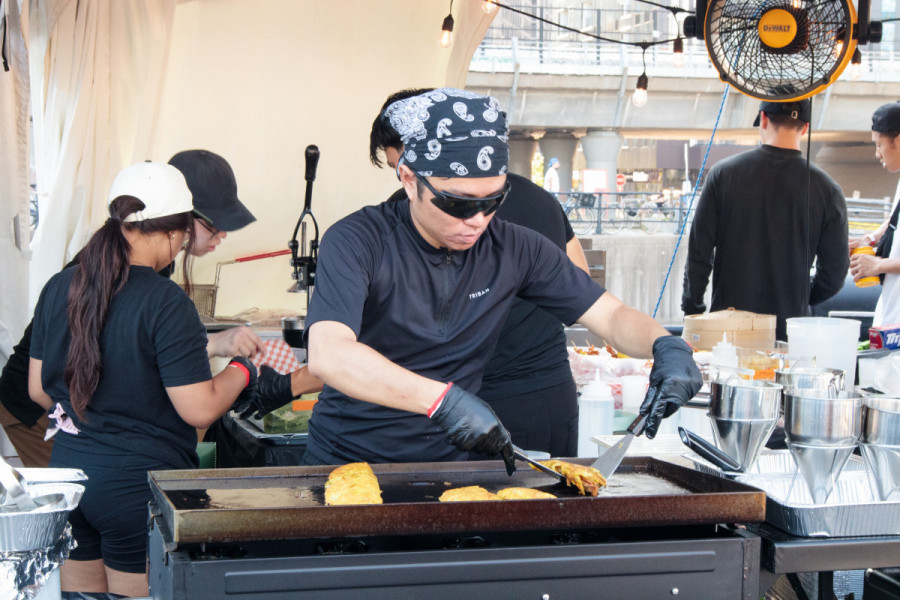
With that, have a wonderful start to the semester―and may your year be lighter than your fees!

ConU 101: A must-read guide Read More »

‘Enough is enough’: Montrealers protest seized Gaza-bound aid boat

Montrealers gather in protest in downtown Montreal less than 24 hours after Israeli forces detained 12 activists, including Greta Thunberg, aboard the Gaza-bound Madleen, on June 9, 2025. Photo Ryan Pyke

India Das-Brown,
Local Journalism Initiative

Demonstration comes in response to interception of the Madleen ship and detention of 12 activists

Hundreds of Montrealers took to the streets on the evening of June 9, demanding the release of the Freedom Flotilla crew aboard the vessel Madleen and urging Canadian and international governments to ensure the delivery of essential supplies to the Gaza Strip.

The demonstration began at 5:30 p.m. outside the Israeli consulate in downtown Montreal, less than 24 hours after Israeli occupation forces detained the Madleen crew in international waters and seized its humanitarian cargo.

The boat was carrying aid―including baby formula, food and medicine―along with 12 activists and journalists, among them Swedish climate activist Greta Thunberg.

“We’ve seen for the last two years, the Israeli government commit war crime after war crime,” said Palestinian Youth Movement (PYM) organizer Rand Hasan. “Enough is enough.”

On board the Madleen were Thunberg; French-Palestinian Member of the European Parliament Rima Hassan; German activist Yasemin Acar; Baptiste Andre, Pascal Maurieras, Yanis Mhamdi, Reva Viard and journalist Omar Faiad from France; Thiago Avila from Brazil; Suayb Ordu from Turkey; Sergio Toribio from Spain; and Marco van Rennes from the Netherlands.  

Hasan called on Canada to “cut all diplomatic ties,” and suspend arms shipments to and from Israel.

“There’s still arms being shipped back and forth to the U.S. and to Israel through Canada,” she said.

Presently, Canada maintains formal diplomatic relations with Israel, including an embassy in Tel Aviv. Cutting diplomatic ties would mean shutting down the embassy, halting formal communications and withdrawing diplomatic staff—an action typically reserved for countries in conflict or severe political disapproval.

Canada has suspended the approval of future arms export permits to Israel as of March 2024, following a non-binding vote in the House of Commons. However, this suspension does not apply retroactively, meaning permits approved prior to that decision may still be active.

“We need to hold all our governments accountable,” Hasan said.

“Mark Carney, pick a side,” was one of several chants that rang out during the march. 

This took place the same day the prime minister shared an Instagram post following his visit to the Nova Music Festival Exhibition, which he described as telling “the story of the brutal massacre carried out by the terrorist entity Hamas on October 7, 2023.”

That same day, PYM’s Toronto chapter posted a video showing the prime minister responding, “Time and a place,” to a question about whether he would be “saying anything about the genocide of the Palestinian people.”

On June 1, the Freedom Flotilla Coalition sent the Madleen from Catania, Italy, to break the blockade in Gaza and deliver aid.

According to the Flotilla, the Madleen was stopped in international waters in the early hours of June 9 in Israel time, shortly before reaching its intended destination off the Gaza coast.

Israel’s Ministry of Foreign Affairs said the move was in line with a naval blockade imposed on the Gaza Strip since 2007, which prohibits unauthorized vessels from entering the coastal territory, according to multiple media reports

According to international law, countries hold no sovereign rights over international waters. Israel’s occupation and siege on Gaza has also been deemed illegal by most governments, as well as the United Nations.

Thunberg is among the four activists who agreed to deportation, while those remaining are set to appear before Israeli authorities.

One protester, Alex, who declined to give his last name due to safety concerns, said the protest was “a manifestation of people not being okay with the status quo.”

Standing outside the Israeli consulate, he called for Canada to “expel all the Israeli diplomats right now, cut all ties with Israel and close the current delegation in Tel Aviv.”

“This business of intercepting boats in international waters is just such a violation of international law,” added Montrealer Rose Marie Walley. “I’m just in horror at what’s happening in Gaza. Not just the Flotilla, that’s just the latest situation.”

Walley said people who want to get involved should call their member of parliament. 

“Tell them to demand an arms embargo,” she said.

Hasan has a message for the Madleen crew and Montrealers alike.

“This is an act of bravery, and we need to continue doing stuff like this, and everyone has a role to play, even if that’s a really simple one like being on a boat or protesting,” she said. “This is just the start of what we can do when we’re organized.”

The protest remained peaceful, with light police presence throughout. The crowd dispersed around 8 p.m. at Phillips Square downtown.

‘Enough is enough’: Montrealers protest seized Gaza-bound aid boat Read More »

The future of Fringe

Amy Blackmore sits in her favourite seat in the MainLine’s MainSpace. Photo Alice Martin

Alice Martin,
Local Journalism Initiative

The MainLine Theatre looks ahead to a post-closure future

After two decades at the MainLine Theatre on St. Laurent Blvd., one moment stands out to Amy Blackmore.

“It’s sitting in the theatre in my favourite seat at the beginning of The Rocky Horror Show, when the lights go down and the band starts to play the opening bars to ‘Science Fiction/Double Feature,’ and you feel the audience ready and waiting for it,” Blackmore said. “It’s like my heart explodes.”

Blackmore has spent the last 14 years as executive and artistic director of both the Montreal Fringe Festival and MainLine. Her favourite seat in the MainSpace—top row, right corner—even has a plaque with her name on it. 

This year marks MainLine’s 20th anniversary as a venue for English-speaking independent arts and the host of the Fringe Festival. But in lieu of celebrations, Blackmore made the tough call to close its doors.

“It was not a decision that we made lightly at all—the decision to close,” she said, “but to close with purpose and celebrate what we’ve built here and prepare for what’s next.” 

MainLine will run shows until June 30, ending with one final Fringe season. Blackmore and her team are seeking a new space to carry on the spirit of the Fringe. 

“I was actually very excited [about the closure] in the sense that we’ve outgrown the space, and working in it has been quite interesting,” said Laurence Côté, artist relations and operations manager at MainLine. “I got into this solving mode that I usually am in.”

A tough past few years

The pandemic hit MainLine hard.

“It was a Saturday, I was here in my office, and we had to tell the artists in the MiniMain (the smaller theatre and rehearsal space) and in the MainSpace (the bigger theatre) that they could not perform their shows that night,” Blackmore said. “It was such a devastating moment.”

The team quickly pivoted, turning the MiniMain into a residency space.  

“We were really fortunate that the government helped us get through it with the wage subsidies and the rent subsidies,” Blackmore said. “I was really committed to making sure that we kept our employees, that we were able to stay open and make it through.”

Then, one day before World Fringe Day in July 2024, record rain from Hurricane Beryl flooded the theatre.

Amy Blackmore’s name is immortalized on the armrest of her favourite seat. Photo Alice Martin

“I was on a train going on vacation and somebody called me and said, ‘Amy, there’s a leak in the lobby,’ and I was like, ‘Oh, just go grab a bucket,” Blackmore recalled. “Then I get another phone call from someone at MainLine, and they’re like, ‘Amy, the water is gushing in, we need 40 buckets.’ The worst thing was sitting on the train, coordinating the staff and calling the landlord and figuring out what to move, what to save.”

A fundraiser launched shortly after received strong community support.

“We raised [over] $75,000 in the end, and again, the actions of our community and the outpouring of love is what really motivates us here,” Blackmore said. “The money raised is what’s allowed this final season at MainLine to take place.”

Looking for a new space

According to Blackmore, the MainLine building was never ideal: It is not wheelchair accessible, is freezing in the winter and simply “isn’t what it used to be.”

“We’re really good at Band-Aids—the people who are around this space come from a DIY grassroots punk background,” Blackmore said. “We make things happen, but at a certain point, Band-Aid [solutions] don’t work anymore.”

She hopes to keep the Fringe Festival in the Plateau-Mont-Royal, which she says is “an integral part of the identity and the DNA of the Fringe.”

After the February closure announcement, Blackmore said support poured in.

“I felt like we broke the internet that day,” she said. “My phone was exploding, my email was exploding. I always knew the MainLine has been important to me, but to hear the outpouring of love and respect from everyone else, it blew my mind.”

Community members even offered leads on new venues.

“I’m planning right away to take folks up on their offers, go check out some spaces,” Blackmore said. “[The search] is active. It’s happening in the background, because we do have a Fringe Festival to produce.”

The Fringe community

For Blackmore, MainLine is about more than the building.

“It’s about the people, it’s about the arts, but it’s really about the community that we cultivate around the arts and the values that we have,” she said.

For Côté, MainLine was her springboard into producing. After graduating in 2021 from Concordia University’s acting for theatre program, she moved in and out of the MainLine sphere. In 2023, she produced her first show, “After Grim: Healing Happens Here,” at Fringe 2023.

“I really soaked up all the opportunities that Fringe gave me,” Côté said. “I was at all the workshops, all the events, and I feel like it really helped propel me as a producer.”

Drag performer Patrick Dale, a.k.a. Little Star, also found their footing at MainLine after starting at Concordia’s performance creation program in 2018.

“I immediately was struck by the vibe and the community energy,” they said. “It’s been like a through line for my emergence, not only as an artist, but as a person, too.”

Little Star directed and choreographed Sweet Charity at MainLine, and first performed there as Magenta in The Rocky Horror Show, a role they’ve since become known for.  

The final act

MainLine is booked until June 30. Côté’s recommendations include The Last Montreal Slow Dance, a Marianopolis rendition of Hadestown, and Fringe for All on May 26.

Little Star will also perform their solo Fringe show, “Little Star: Born of Desire.” 

“Forty-five minutes, fully lip-synced, four acts—it’s all me,” Little Star said with a chuckle. “Basically, it’s my introspective and abstract look of where my drag journey has taken me.”

Community support remains strong. The weekend before Blackmore sat down with The Link, MainLine hosted two sold-out shows in one night.

“The lobby was packed,” Blackmore said. “I sat in my favorite seat in the theatre and I watched the musical Amélie. It was just such a great moment.”

Looking ahead, she’s taking her time.

“My real hope is that our next space isn’t a Band-Aid space,” Blackmore said. “I would really love to find a permanent home for what we do, and that’s why I think it is gonna take a bit of time, because it’s got to be the right fit.”

This article originally appeared in Volume 45, Issue 12, published April 1, 2025.

The future of Fringe Read More »

Theory of Ducks close out Turbo Haüs performance with humour and heart

Theory of Ducks performing at Turbo Haüs. Photo Ryan Pyke

Safa Hachi,
Local Journalism Initiative

The band delivers an emotionally resonant set to cap off a night of local talent

Turbo Haüs hosted a three-act lineup featuring dievanse, NIIVI and Theory of Ducks on July 13. Each band offered something different, but all performed with a shared sense of presence and purpose. Closing out the night, Theory of Ducks delivered a set that was technically sound and confident, marked by solid playing and natural onstage rapport.

Theory of Ducks is the music project of Concordia University English literature student Saam Shahab, who began releasing music as a solo artist. While the solo act remains, Shahab formed a live band under the same name to bring his music to local stages. The group includes Matty Fudge on guitar, Benny Gaucher on bass and Ilai Eirew on drums.

Their chemistry was undeniable from the moment they stepped onstage, immediately joking about the heat as they set up. 

“I think I feel a slight breeze from the fan, but I could be going crazy,” Fudge said, squinting towards the ceiling. The tone stayed light as they cracked jokes, teased each other between songs and laughed through tuning mishaps.

The band played original songs, both released and unreleased, including “Charlie,” “Road Kill” and “Grandpa,” as well as a cover of Alex G’s “Harvey,” a nod to one of the band’s musical inspirations. 

“Grandpa,” one of the first songs Shahab wrote, took on a new weight live, with expanded vocals and a heavier presence. Their sound draws on indie rock touchstones like Elliott Smith, Big Thief and Big Star. Fuzzy guitars and soft melodies, paired with Shahab’s rough-edged vocals, created something raw, emotional and unique.

Despite a few new or loosely rehearsed tracks, the band never faltered. They embraced the spontaneity and the willingness to try songs that had not been played live before, using them to build trust with the crowd.

The band’s dynamic was equal parts tight and goofy. Gaucher frequently grabbed the mic between songs to entertain the audience and talk about video games, focaccia bread, underwhelming GURU energy drink flavours, and time signatures, adding to the charm of the group. 

The crowd itself was a mix of Concordia students, friends and other musicians.

Attendee Sabine Salim-Ullyot, who has seen the band before, said the show was on par with their best. 

“The sound system made a huge difference compared to other venues,” they said. “It’s just nice to see people you know flourish.”

Salim-Ullyot noted that the show reflected what makes Montreal’s music scene unique, with its smaller, lesser-known bands still having the opportunity to perform in respected local venues. 

“This show is so representative of Montreal music culture, […] bands like this are able to perform in venues like this even when they are not hyper ridiculously famous,” Salim-Ullyot added.

Turbo Haüs, known for its solid acoustics as well as cosy layout, was the ideal match for Theory of Ducks’ indie rock sensibility, even after the two heavier-sounding bands prior.

After the set, the band reflected on what it meant to play in that space. 

“It was the first time I could actually hear my vocals on stage,” Shahab said. 

Eirew called it a rewarding experience to finally have proper drum mics, and Gaucher said the band felt “tight and synced.”

“To have the thing you labour over be cared about is really nice,” Gaucher added.

But even as the night showcased emerging talent, it also highlighted the precarity of local venues. With popular Montreal venue Blue Dog recently announcing its closure on July 10 due to financial stress, concerns about the future of local performance spaces have grown. Even Turbo Haüs has faced noise complaints in the past, a reoccurring issue for music venues in the city leading some to close their doors. Fudge shared his concerns.

“The hope is that as one place shuts down, another opens up,” Fudge said. “But I worry they’ll be replaced by corporate bars that don’t give us or other artists the same opportunities.”

Shahab agreed, noting Montreal’s importance for so many up-and-coming bands. 

“It’s a shame seeing these venues shut down because they’re the ones giving artists like us the chance to perform,” Shahab said. 

Learning to navigate the ins and outs of the music scene has been part of Shahab’s process. He booked the show by reaching out to dievanse and NIIVI, both of whom he discovered online or shared stages with before. 

“We played with dievanse on their first show,” Shahab said. “It felt full circle.”

Toward the end of the night, the band teased an unnamed closer. 

“We’re not going to tell you the next song. If you know it, sing it,” Shahab said before launching into Pinegrove’s “Need 2.” 

The crowd immediately responded to Fudge’s strumming. Phones lit up, voices joined in and chants for an encore followed. With a quick nod from the sound tech, the band delivered one last high-energy track, “Moon We’re Doomed.”

For a band still building a name at the start of their careers, figuring out the logistics of booking shows, and navigating the ever-changing local scene, Theory of Ducks feels remarkably self-assured. They’re still new, still goofy, still just a group of friends jamming, but they’re also tight, engaging and increasingly comfortable bringing their music into live spaces.

Theory of Ducks left the stage smiling, grateful and ready for what’s next, leaving the crowd with something to root for.

Theory of Ducks close out Turbo Haüs performance with humour and heart Read More »

Indigenous voices to gather for Montreal’s International First Peoples’ Festival

The 35th edition of Montreal’s International First Peoples’ Festival is set to run from Aug. 5 to Aug. 14 at Place des Festivals in Downtown Montreal. Photo Andraé Lerone Lewis

India Das-Brown,
Local Journalism Initiative

Returning this August for its 35th anniversary, the festival stands united against fascism

Montreal’s International First Peoples’ Festival (FIPA) is back this August, with Indigenous artists from across Turtle Island, New Zealand and Australia to unite through film, music, dance, skateboarding and drumming.

Organized by Land InSights, the 35th edition of the festival is set to run from Aug. 5 to Aug. 14 at Place des Festivals. For over three decades, the festival has brought together global Indigenous artists, activists, filmmakers, musicians and Elders.

This year’s festival lineup will display a breadth of contemporary Indigenous arts, with offerings ranging from sci-fi thrillers to traditional drumming and dances, with voices arriving from Nunavik to Aotearoa.

The programming draws on a unity that is spiritual, political, symbolic and―as André Dudemaine, director of cultural activities for Land InSights, points out―literal.

“Turtle Island is a unity. This is the land of the Indigenous People,” Dudemaine said. “We are all connected―especially in the last 20 years, there has been a lot of connection.”

The director says this unity is how the United Nations Declaration on the Rights of Indigenous Peoples finally got adopted in 2007. 

“Now there is not only a feeling of solidarity, but a real connection that goes all over Mother Earth,” he said.

For Dudemaine, the festival stands in opposition to the rise in far-right politics in the U.S. He says that repression knows no borders, nor does Indigenous resistance.

“We are obviously anti-fascists,” Dudemaine said. “We’re proudly opposing the hard-right political wave that tried to submerge America. And we are part of that fight as First Nations.”

That spirit of global Indigenous unity will be front and centre at Song to the Whales, a large-scale international music project led by Bunna Lawrie, an Aboriginal guest of honour from Australia. He’ll be joined by artists from Nunavik and Aotearoa on Aug. 6 and Aug. 7 at Place des Festivals. 

Inspired by traditional Māori, Indigenous and Inuit songs, the work blends ancestral voices with contemporary instrumentation.

“The whale is a symbol of all that is threatened now on Mother Earth,” Dudemaine said. “This is an animal that is connected with the ancestral cultures, so the ocean represents the connection between all those maritime cultures.”

Seayenna Fontaine Lee, an assistant day camp coordinator at Native Montreal and an Ojibwe member of Manitoba’s Sagkeeng First Nation, said it’s fitting that an international First Peoples festival has found its spot in Montreal.

The city, Lee noted, has long been a gathering place for many First Nations.

“It’s Mohawk territory, but it’s also close to Anishinaabe territory, so it’s been a place where people from different nations can gather for a really long time, since before colonization,” Lee said. 

She added that Montreal, as a multicultural city, is ideal to host an International First Peoples’ Festival.

Lee will be bringing the children from Native Montreal’s summer camp to the festival, where they’ve been invited by Land InSights as “special guests,” she said.

“It’s just important that these kids are shown the importance of Indigenous culture,” she said. “The diversity is really cool, because all the kids are from different nations. So they’ll get to see themselves in some of the Elders, and the people who are there and the artists.”

Beyond the concerts, FIPA will feature the world premiere of Florent Vollant: Innu, directed by Isabelle Longnus, alongside screenings of Ka Whawhai Tonu in the Māori language, Kinra from Peru, and Bibiru and Canuto’s Transformation in Amazonian languages.

Other highlights include “Midnight at the Lonely River,” a genre-bending opening short by Abraham Côté, and The Dim, a sci-fi thriller set to screen at La Métropolitaine. For those seeking deeper immersion, Sanajiit (Inuit Makers), an observational docuseries, will debut at the NFB Space and the daphne art centre.

Throughout August, FIPA will expand beyond its official dates with concerts at Jardins Gamelin, exhibitions at the Grande Bibliothèque and La Guilde, and screenings in Kahnawake in partnership with the Eastern Connection Film Festival.

Kahnawa’kehró:non Elder Sedalia Fazio will open the festival with a drum ceremony at the Outremont Theatre.

“When you see Indigenous things happening, when you see festivals, when you see powwows, go and talk to the people. Go and talk to the people and find out, like, what is their history?” she said, speaking on National Indigenous Peoples Day this June. “Start learning the true history of our people.”

More information on the festival’s concerts, films and exhibitions can be found at www.presenceautochtone.ca.

Indigenous voices to gather for Montreal’s International First Peoples’ Festival Read More »

Cho Dem’s intergenerational celebration of cuisine and culture

Ban Nhạc Dân Tộc Montreal kicks off one of their weekend sets with traditional Vietnamese instruments. Photo Claudia Beaudoin

Claudia Beaudoin,
Local Journalism Initiative

Montreal’s Vietnamese food festival returns for its third edition

Back for its third year, Cho Dem, Montreal’s Vietnamese food festival, took over the Peel Basin from July 18 to 20.

The air was filled with the scent of sizzling skewers and bánh xèo as visitors weaved between booths serving pandan matcha lattes and sugarcane juice. With close to fifty vendors, live music and workshops, the event recreated the energy of a Vietnamese night market in the heart of the city.

A group of young Vietnamese Montrealers launched the festival by forming the nonprofit Association Vietnamiens Québécois (AVQ), dedicated to supporting projects rooted in community and culture.

Charles Nguyen, one of Cho Dem’s cofounders and AVQ’s vice president, said that there hadn’t yet been a festival centred on Vietnamese food and culture. That absence was what sparked the idea of Cho Dem.

“We felt that it would be important for our members to be able to unite under one roof, or should I say in this case one place… where we can assemble around food and around the arts because it’s a great way to convey the culture,” he said.

This year, in particular, carries a deeper meaning, as it marks 50 years since the arrival of the first Vietnamese refugees in Canada following the fall of Saigon. Many settled in Montreal, where the community has continued to grow steadily. What began as a wave of displacement has become a multigenerational presence, deeply tied to the city’s life. 

Nguyen highlighted how Montreal’s Vietnamese community spans three distinct generations: the refugees who first arrived, their children, and the more recent arrivals who didn’t experience the war firsthand. These groups haven’t always connected easily.

That sense of connection is reflected in the festival’s growing popularity. Nguyen estimated that attendance doubled from 25,000 last year to around 50,000 this year.

The festival stretched across two docks at Peel Basin. The south and smaller dock, called the Chợ Bến Thành, felt intimate with its shaded tent, artisan stalls and a cosy stage. The north and larger dock opened up with rows of individual tents, the main stage, the majority of food vendors and a diverse mix of artisans.

Strings of lanterns crisscrossed overhead, glowing softly as they guided visitors to the main stage. On one side, Montreal’s skyscrapers rose sharply against the sky, their glass reflecting the afternoon sun. On the other side, the bright red Farine Five Roses sign stood out against the skyline.

Each summer, Montreal’s calendar is filled with food festivals that spotlight different Asian diasporas, such as the Chinatown Night Market in August and Yatai, a Japanese food festival held each June. 

The food stall XeoXeo serves up bánh xèo hot off the grill. Photo Claudia Beaudoin

Over the span of three days, festival-goers could wander between food stalls, hop into a spice workshop or catch live performances. One of the most striking details was the blend of modern and traditional music—from Yogomi, whose angelic, aurora-like vocals lean toward folktronica, to Ban Nhạc Dân Tộc Montreal, who played traditional Vietnamese instruments.

“A lot of Vietnamese people know these songs, but they don’t know where they come from,” the members of Ban Nhạc Dân Tộc Montreal said before playing the second song in their set.

For Vy Nguyen, one of the dancers in the traditional Vietnamese fan dancing group Pray’NSlay, this intergenerational space is what made the event so meaningful. 

“It’s so hard to get our elders to come out of their homes, out of their comfort zones,” she said. “Just seeing them spend the time and energy to be here with us, out in the sun, on a hot day like this, is so touching.”

She also expressed gratitude for the festival’s space.

“The biggest thing for me is that Montreal has given us such a big, lovely stage,” Vy said. “So that we can promote our local Vietnamese businessmen and women, our local artists, because I feel like Montreal is so underrated. We have so much talent, and we’re always the underdog. This is the opportunity for Vietnamese Montrealers to come up.” 

Vy Nguyen, left, dances with Pray’NSlay, a Vietnamese traditional fan dance group. Photo Claudia Beaudoin

Chhea-Pichpeakdey Ly and Raquel Nueva attended the festival together, with Nueva bringing Ly for his first time to enjoy Vietnamese food, a favourite for both.

What stood out to them was the festival’s organization, especially the waste triage system. Vendors served food and drinks in reusable cups, plates and bowls, and multiple sorting stations made it easy to separate waste and return reusable materials.

“And the location is great,” Nueva said, noting the canal as a scenic backdrop.

While hopeful about the festival’s future, Charles Nguyen emphasized the ongoing challenges of organizing an event run entirely by volunteers without a permanent venue—a common hurdle for many Asian food festivals. He expressed the need for “more active dialogues with the different levels of government to help,” especially as the festival continues to grow.

“The merit to having a permanent place to be able to host these, so that way it’s done in a great manner where people are not only enjoying it, but it’s also safe,” he said.

Despite the challenges, the festival continues to be a space for discovery and connection.

“At the end of the day, that is our hope, to spark just the right amount of curiosity,” Charles Nguyen said, “for every festival goer to learn one new thing, whatever it may be.”

Cho Dem’s intergenerational celebration of cuisine and culture Read More »

Offcuts Jam closes out Blue Dog with final explosive night

Blue Dog hosts its final Offcuts Jam. Photo Geneviève Sylvestre

Safa Hachi,
Local Journalism Initiative

The weekly jam bids farewell to its home

On Friday, July 18, Offcuts Jam held one of its most electric nights yet—the final edition at Blue Dog, where it all began.

For nearly a year, the weekly jam transformed the bar into a hub of sonic experimentation. Every Friday, musicians and vocalists, seasoned and new, gathered to play, rap, sing and improvise. Mistakes were part of the process, and off-the-cuff moments often stole the show. That energy hit a bittersweet peak as jammers and supporters packed the room one last time before Blue Dog’s closure.

From the start, crowd chatter set the tone: jokes and cheers about making it the best jam yet, and how sad it was to see Blue Dog go. The mood was vibrant and reflective, the room buzzing with celebration and a hint of grief.

For many, Offcuts wasn’t just about music, it was about finding a space to grow in the Montreal scene. 

“Blue Dog is very much a cultural space,” said Loren Armstrong, a local event planner and former Offcuts host. “These are spaces where artists feel they’ve found a home, or their first family. We’re losing a lot of venues, unfortunately, and it hurts.”

Armstrong, who moved to Montreal four years ago, is a cornerstone in the city’s event scene. She has hosted Offcuts, founded the DIY home venue The Humble Abode, and works with Scatterbrain and Stimulant magazine as a writer, event planner and event director.

“Art thrives in Montreal,” she said. “Even new artists have a space where they can experiment and feel supported.”

That support was palpable at Friday’s jam. The night was layered with energy and emotion from the range of beatboxing, freestyles, DJ breaks, shoutouts and spontaneous chants thundering through the space. Still, the celebration carried the weight of goodbye.

Blue Dog has been struggling due to noise complaints and ongoing financial challenges. The venue told The Link: “We essentially closed because the bar hadn’t been doing well—it’s been a couple years that overall sales have been way down. It wasn’t sustainable anymore.”

The closure brings an end to Blue Dog’s longstanding role as a hub for local artists and community-driven events. And that legacy was on full display at the final Offcuts jam. 

The completely improvised sets were a reminder of the city’s stockpile of raw talent. Musicians flowed in and out with ease, switching instruments, layering vocals and building off each other’s ideas in real time. 

Vocalists and MCs weren’t limited to the sign-up sheet, as many spontaneously walked on stage to add to the band’s groove.

As the night came to an end, an MC reminded the room, “We’ve only got 30 minutes left. Let’s make this count. Offcuts isn’t going anywhere.” 

Organizers confirmed that Offcuts will move to a different venue. Photo Safa Hachi

The founders–muscian, DJ and MC RISKREATIVE and musician Keegan McCallum–intend to keep that promise. They assured attendees that Offcuts Jam isn’t ending, just changing locations. The organizers are already planning what’s next, encouraging the community to stay connected.

On July 19, 2025, a day after the show, the organizers confirmed with The Link that Offcuts will officially move to Bar La Marche À Côté in the heart of the Plateau. 

“It’s been great seeing how our jams have brought people together,” McCallum said. “We’re hoping to carry that on with us at the new venue.”

RISKREATIVE had been a regular at Strawberry Jam, another local jam night, before it ended. Seeing an opportunity to start something of his own, he reached out to Blue Dog. 

“We got a lot of people on board,” RISKREATIVE said. “The success was immediate.” 

The pair emphasized Offcuts’ welcoming spirit—no rushing, no gatekeeping, just a place to grow. 

“Just like I benefited from jams, I want to give that back,” RISKREATIVE added.  

For musician Théo Bedez, jam nights like Offcuts provided a way to meet people, get involved in the scene, and play without the usual expectations. 

“With everyone knowing everyone, we’re all friends. It feels like there’s no pressure,” Bedez said.

Like Armstrong and RISKREATIVE, Bedez got involved with other jams around the city that brought together many of the same musicians now central to Offcuts. 

“In a city like Montreal, a new jam will be created. The same people will keep showing up, that’s what’s great about the community,” Bedez said. “But it’s still sad to lose the place where it all started, and all the memories that came with it.”

As the final set ended and the lights went off, no one left even after last call. People lingered outside the bar, singing, taking pictures, unwilling to let the night end. It wasn’t just about music but the community that formed around it. 

“Every week is a new jam, a new experience,” Armstrong said. “Everyone loves being part of something. We tend to miss that in daily life.”

Friday’s final Offcuts Jam at Blue Dog was sweaty, spontaneous and soulful. The venue may be gone, but the sessions are just shifting keys.

Offcuts Jam closes out Blue Dog with final explosive night Read More »

New report exposes Canadian arms exports to Israel

A new report published by World Beyond War, the Palestinian Youth Movement and the Arms Embargo Now campaign exposes Canadian arms exports to Israel over the past two years. Photo Andraé Lerone Lewis

Hannah Scott-Talib,
Local Journalism Initiative

Findings contradict federal government’s claims that no weaponry is being sent to Israel

A new report published by World Beyond War, the Palestinian Youth Movement and the Arms Embargo Now campaign reveals that, among other military equipment, nearly half a million bullets have been sent from Canada to Israel since 2023.

The report, titled “Exposing Canadian Military Exports to Israel,” states that the Canadian government has continued to facilitate the shipment of weaponry and military equipment to Israel “despite repeated statements asserting restrictions or prohibitions on such transfers.”

The report highlights 47 shipments transported from Canadian cities to Israel across 100 flights over the past two years. 

Data was compiled through two main sources. The first was commercial shipping data tracing direct shipments from Canadian manufacturers to Israel through July 2025. The second source was import data from the Israel Tax Authority (ITA) from October 2023 to May 2025. 

According to World Beyond War member Rachel Small, classification codes for bullets from the ITA import data allowed researchers to identify the specific number of bullets sent from Canada to Israel since late 2023. It amounts to 421,070 bullets in total. 

However, Small said that these bullets were just a handful of the hundreds of weapons shipments identified, which included cartridges and other ammunition, aircraft engines, radar equipment, composite pieces of F-35 fighter jets, navigation systems and more.

She added that many were shipped directly to Elbit Systems, the primary weapons supplier for the Israeli military. 

“These were weapons parts shipped by Canadian highways, maybe airports, railways and ports, from weapons manufacturers across Canada from coast to coast,” Small said in a press conference on July 29. “[This includes] dozens of flights we tracked down, out of Canadian airports, that carried live military cargo under civilian passenger seats.” 

Small then called out previous Canadian Foreign Affairs Minister Melanie Joly and her statement from September 2024 that no arms or parts of arms would be sent to Gaza, as is “her position and the position of the Canadian government.”

“This report has now uncovered a shipment of cartridges manufactured by General Dynamics in Quebec and shipped to Tel Aviv,” Small said. “It occurred nine days after Joly’s declaration, and we’ve just tracked down another one that left just 11 days ago.” 

Small says this report’s investigation exposes one of the biggest propaganda campaigns in Canadian foreign policy in decades. 

“While Palestinian families buried their children under the rubble of Canadian-armed air strikes, fighter jet parts flew out of Halifax on Air Canada flights, hidden in the cargo beneath unsuspecting passengers,” she said. “The government turned our national airline into a covert military transport service while telling Canadians they had stopped arms exports to Israel.”

Alex Paterson, senior director of strategy and parliamentary affairs at Canadians for Justice and Peace in the Middle East, was also present at the July 29 press conference. Paterson cited Canada’s Export and Import Permits Act to further condemn these shipments to Israel. 

“Arming these atrocities is supposed to be illegal,” Paterson said. “Canada’s Export and Import Permits Act is supposed to stop the transfer of arms where there is a risk of serious violation of international law. And yet, we still sell arms to Israel.”

Moving forward, Small claimed at the press conference that the Canadian government has two choices.

“Either it can try to continue to try to deceive the public, to issue empty statements about the need to ‘take action’ while continuing to ship weapons,” she said, “or it can end Canada’s [complicity] by immediately imposing a two-way arms embargo.”

Small believes the findings of the report do not reveal mistakes by the federal government, but rather a reflection of its current priorities.

“This isn’t bureaucratic oversight,” Small said. “This is systematic deception that makes Canada directly complicit in what most scholars and international organizations agree is a genocide.”

New report exposes Canadian arms exports to Israel Read More »

Thousands attend ‘Palestine in the Park’ fundraiser for Gaza in Montreal

Palestine in the Park took place from 12 p.m. to 8 p.m. and featured over a dozen vendors. Photo Andraé Lerone Lewis

Hannah Scott-Talib,
Local Journalism Initiative

The event’s main focus was a 3D recreation of the Gaza Strip showing damage over the past two years

Thousands of people made their way to Angrignon Park on July 26 for what the Palestinian Youth Movement’s (PYM) Montreal chapter is calling their largest fundraiser for Palestine to date.

The fundraiser, organized by PYM in collaboration with the Canadian Palestinian Foundation of Quebec (CPFQ), took place from 12 p.m. to 8 p.m. and featured over a dozen food, clothing, jewelry and art vendors. 

However, according to multiple PYM members, the main focus of the Palestine in the Park fundraiser was its Gaza exhibit—two 3D recreations of the Gaza Strip from an aerial view, depicting its state before and after Oct. 7, 2023 and Israel’s bombardments. 

Sarah, a member of PYM who has been granted full name anonymity for safety reasons, said that the exhibit serves as a form of forensic architecture, showcasing the scale of the violence over the past couple of years in a way that is easier to understand than news reports.

“I think it’s hard to digest [what has happened] sometimes,” Sarah said. “To see how it was before versus now is very impactful.”

“This [exhibition] is a way for us to confront the attempt [by Israel] to erase us,” PYM volunteer Rama Al Malah added, “and to be able to say that this is not just a few bombardments here and there. This is a systematic and deliberate way of targeting any system in Gaza that can sustain life, to try and eliminate them.”

In addition to the Gaza exhibit, the fundraiser hosted kids’ activities such as paper poppy-making, letter-writing to Gazans and an educational Palestinian “passport tour” that led guests throughout different areas of the park labelled and associated with Palestinian regions. Beside the Gaza exhibit, a timeline of Palestinian prisoners and their backstories was displayed along a makeshift wall. 

“When we talk about the educational side [of this event], passing on knowledge to the next generation is going to be a really huge element of it,” said PYM member Haya, who has been granted full name anonymity for safety reasons.

She continued to say that Palestine in the Park also aimed to showcase the various ongoing campaigns organized by PYM both locally and internationally, and the actions that people can take to get involved in the movement and to continue standing up to the Canadian political class.

A 3D model of the Gaza Strip shows the damage it has undergone since the start of Israel’s escalated attacks following Oct. 7, 2023. Photo Andraé Lerone Lewis

According to Haya, the Israeli occupation forces have shifted their offensive tactics in Gaza recently. 

“[The genocide] has evolved in really significant, really horrific ways,” she said. “One year ago, what we were looking at was bombardment […]. We were looking at attacks on hospitals and schools by the Israeli occupation forces. Right now, what we’re looking at is starvation: a catastrophic level of starvation in Gaza.” 

Currently, Gazans are facing extreme famine as aid is being blocked from entering the city, while Israeli forces reportedly kill civilians waiting for aid. Since the start of Israel’s siege on Gaza almost two years ago, over 100 Gazans have died of malnutrition.

Part of the event’s purpose, Haya continued, was to bring awareness to these changes in violence tactics over the past years. 

Both Haya and Al Malah expressed that the amount of support from the Montreal community, both before and during this event, was crucial to the fundraising efforts. 

“There are a lot of different communities not only showing up to this day, but also contributing to this day,” Haya said. 

“We’re seeing the Palestinian Arab community and allies, we’re seeing children and elderly from the community,” Al Malah added.

Thousands attend ‘Palestine in the Park’ fundraiser for Gaza in Montreal Read More »

‘This is not humanitarian relief’: Montrealers gather to protest starvation in Gaza

Montrealers gather to protest starvation in Gaza. Photo Andraé Lerone Lewis

Geneviève Sylvestre,
Local Journalism Initiative

Hundreds of demonstrators marched to demand an end to Israel’s militarized aid distribution system

Over 200 Montrealers took to the streets on the evening of July 22 to protest starvation in Gaza and demand an immediate lift of the siege on the strip. 

The emergency demonstration organized by the Montreal chapter of the Palestinian Youth Movement (PYM) began at 5:30 p.m. with protestors gathering in front of the city’s United States Consulate General on Ste. Catherine St. W. 

“We are seeing the population of Gaza being deliberately starved to death as a form of slow genocide,” said Rama, a PYM spokesperson who was granted last name anonymity for safety reasons. “We’re here today to demand that humanitarian aid is let in.”

The World Health Organization has called the situation in Gaza “one of the world’s worst hunger crises unfolding in real time,” with the region’s entire 2.1 million population facing prolonged food shortages and almost half a million people in a “catastrophic situation of hunger.”

The United Nations Office for the Coordination of Humanitarian Affairs reports that, as of June 15, 18,741 children have been hospitalized for acute malnutrition in Gaza since the start of the year. This represents only 31 per cent of the estimated 60,000 children in need of treatment.

“This is not humanitarian relief. It is collective punishment, engineered starvation and extreme dehumanization,” a PYM spokesperson said in a speech to the gathered crowd.

Protestors began marching at 6:30 p.m. down Stanley St. up to René-Lévesque Blvd., while chanting for an end to the siege on Gaza and a free Palestine. 

Protesters demand a lift to the siege on Gaza. Photo Andraé Lerone Lewis

Amnesty International has gathered evidence demonstrating that Israel is continuing to use starvation as a weapon of war to inflict genocide against civilians in Gaza through its militarized aid distribution system. 

According to Al Jazeera, since May, almost 900 Palestinians have been killed near aid distribution sites run by the Gaza Humanitarian Foundation, an aid agency backed by Israel and the United States. 

“We want to send a clear message to these governments that the blessing they give in the ongoing mass slaughtering of the people of Gaza is something that will not go ignored,“ said a spokesperson for Students for Palestine’s Honour and Resistance (SPHR) Concordia, who was granted anonymity for safety reasons.

Over 200 non-governmental organizations—counting Amnesty International, Doctors Without Borders and Save the Children—have called for immediate action to end the “deadly Israeli distribution scheme.”

Protestors continued marching in the streets of downtown Montreal down to the Consulate General of Israel, where the protest ended at around 8 p.m.

“The weapons of war used in this genocide are becoming various, and this intense starvation phase is threatening every living person in Gaza,” said the SPHR Concordia spokesperson. “It’s urgent for us to mobilize to stop this in any way possible.”

‘This is not humanitarian relief’: Montrealers gather to protest starvation in Gaza Read More »

The revolution lives in rent-free spaces

The founders of The Renaissance stand side by side in solidarity. Courtesy Dorothy Mombrun/Je suis Montreal

Lory Saint-Fleur,
Local Journalism Initiative

A Martin Luther King Jr. student and a creative strategist come together to better communities

Charles A. Black has witnessed first hand the transformative power of collective community action. 

One of the last living students of Martin Luther King Jr., a working actor for the past 30 years and a long-time activist, Black continues to bring activism to the forefront. He challenges systems of oppression and advocates for community empowerment. However, according to Black, creating a successful movement takes effort and time.

“It’s a matter of organizing and helping people to see the power that they have themselves, and applying that power for their own betterment,” Black said.

Inspired by King’s teachings and his philosophy of nonviolence, Black believes that people must challenge the current political and social system to create long-lasting change.

In the early 1960s, Black was the head of the Atlanta Student Movement, and he highlighted the importance of holding institutions accountable. The student movement was instrumental in fighting for civil rights as they staged marches, pickets and sit-ins. Members boycotted establishments that discriminated against Black people, refusing to let racist institutions use their money.

“We should not finance our own oppression. Withdraw your patronage,” Black said, regarding the purpose of divestment.

As an actor himself, Black believes that artists should be properly supported. With the current cost of living crisis, many people, especially artists, are unable to afford housing on the island of Montreal.

According to the Conseil des arts de Montréal, the average employment income for an artist in 2020 was $17,400 a year or $1,450 per month. The average rent for a one-bedroom apartment in Montreal in 2024 was $1,423.

The need to confront the housing crisis is at the epicentre of the Rent Free Coalition and its La Renaissance project. The coalition is a partnership between artists and social and cultural entrepreneurs from Montreal, Atlanta and New York. They have come together in the hopes of finding innovative solutions to housing injustice.

Mr. Black’s first daughter stands in front of the building with quiet determination. Courtesy Dorothy Mombrun/Je suis Montreal

By placing artists and cultural entrepreneurs at the centre of real estate innovation, the coalition aims to find and create permanently affordable housing for everyone. La Renaissance is inspired by transformative cultural movements like the Harlem Renaissance of the 1920s, which combined culture and real estate.

As the co-founder and chairman of the La Renaissance project, Black seeks to extend that philosophy to Montreal’s political landscape.

The La Renaissance project is not one that Black is tackling alone. 

Marie-France Barbier is the co-founder of the Rent Free Coalition and a creative strategist. Barbier and Black first met in early 2024 through a mutual acquaintance. Black has since become a mentor to Barbier.

As a first-generation immigrant, real estate agent and cultural worker for the past 20 years, Barbier highlights the importance of integrating culture and community into urban development.

“Culture is our biggest capital,” Barbier said. “In order to benefit from our culture, we need to have our spaces.”

During the Harlem Renaissance, African Americans threw rent parties filled with music and soul food to collect money to pay their rent. The Black community came together to help each other as landlords were raising prices at an incredible rate.

The Rent Free Coalition wants to create a similar impact by bringing people together. The goal is not just to provide shelter; it is also to create spaces that foster creativity and collaboration. The coalition’s statement underscores that artists need a place to thrive without the constant pressure of increasing rent.

Barbier believes that rest is a core value of the coalition. She explains that it is important to the well-being and health of people, and that making adequate and affordable housing is a simple human right.

The Canadian Human Rights Commission declares that adequate housing must be secure, affordable and habitable, and include basic services such as clean water. It adds that housing should include heating and be accessible, safe and culturally appropriate, allowing people to rest, recharge and contribute fully to society. 

The coalition is not using new tactics, Barbier says, but they are using a different strategy by allowing the ones impacted by the issue to have their word on how it will be solved. La Renaissance embodies the need for change; Barbier describes it as “a transnational social innovation initiative rooted in a culture, care and collective dreaming.”

The project includes not only artists but also other essential workers like nurses and firefighters. It revolves around a new housing concept called La Restoration that would allow people to access different modalities under one roof—such as a community rest space and artistic third spaces—changing urban rest into urban wealth.

“Wealth means belonging to a village and community, a family,” Barbier said.

Among those supporting the La Renaissance project is Sonny Moroz, city councillor for Snowdon. As an elected official, Moroz is deeply aware of the rising issues with affordability and the impact it has had on various people. He fell in love with helping his community as a young adult and has kept doing so ever since.

Moroz believes that the government must continue to fund the building of homes and apartments. In May 2024, Montreal’s mayor, Valérie Plante, promised to build 120,000 homes over the course of 10 years, including 25,000 homes by 2026. In a 2023 annual report by the Canadian Mortgage and Housing Corporation, Montreal built 68 per cent fewer homes than it did in 2022.

Moroz criticizes this phenomenon as false promises from politicians and the struggle to obtain the correct development permits. The Rent Free Coalition is a chance to establish new and fresh solutions, according to Moroz.

“To innovate, you need to fail in order to succeed better, and that takes an entrepreneurial mindset,” Moroz said.

For Black, the housing crisis in Montreal affects everyone. He believes that while the path to affordable and secure housing may be long, changes happens one step at a time

“[We need a Montreal] where we collectively decide, as a society, to fight for the most vulnerable, together,” Barbier said.

This article originally appeared in Volume 45, Issue 12, published April 1, 2025.

The revolution lives in rent-free spaces Read More »

Students call for boycott of McGill summer course in Israel

Students for Palestine’s Honour and Resistance McGill has started an email campaign to oppose relaunch of summer program. Photo Andraé Lerone Lewis

Geneviève Sylvestre & Maria Cholakova,
Local Journalism Initiative

SPHR McGill denounces university for relaunch of summer exchange program with Israeli university

Students at McGill University have started an email campaign to prevent Israel Defense Forces (IDF) soldiers and Israeli students from coming to the university’s campus. 

The campaign, first started by Students for Palestine’s Honour and Resistance (SPHR) McGill, aims to boycott a summer exchange course between McGill and the Hebrew University of Jerusalem (HUJI).

In their campaign, SPHR McGill accused the university of secretly restarting the POLI 339 course despite previous student attempts to shut it down. In a press release, the group then claimed that McGill has doubled down on its complicity regarding the Palestinian genocide. 

“While students in Gaza fight for the lives of themselves and their families, McGill has invited the facilitators of genocide to spread their genocidal agenda at our university,” the press release reads. 

According to a SPHR McGill Instagram post, Israeli exchange students are supposed to visit McGill from Aug. 1 to Aug. 22. 

History repeats itself

The email campaign is not the first attempt to shut down the course. In April 2019, students organized a sit-in to protest the course and demand its cancellation. 

The course requires enrolled students to pay a mandatory fee of $1,000, which needs to be approved by the Arts Undergraduate Society (AUS) of McGill University. 

In late January 2019, the AUS council voted 14 against and 13 for holding the summer course. According to reports from The McGill Daily, those in favour of the course cited “academic opportunity,” while those against claimed it “discriminated against Palestinian students, Arab students, and students who oppose the Israeli occupation of Palestine, as they could be denied entry at the border and detained by Israeli officials.” 

Accusations of scholasticide and complicity 

In a 2024 statement, the Palestinian Federation of Unions of University Professors and Employees criticized numerous Israeli universities for their complicity in genocide. 

HUJI, in particular, was criticized as one of its campuses was partially built on land illegally expropriated from Palestinian owners in Israeli-occupied East Jerusalem. The university has also hosted a military base on its campus to offer academic training to IDF soldiers.

The Link has reached out to McGill for comment, but has yet to receive a response as of the time of publication. 

Students call for boycott of McGill summer course in Israel Read More »

Yomogi sways between folk roots and electronic winds

Yomogi and vocalist Holly share the stage for the first time on July 18 at Cho Dem, a glimpse into a growing collaboration. Photo Claudia Beaudoin

Claudia Beaudoin,
Local Journalism Initiative

The Montreal artist joins Holly on stage for a first glimpse of their upcoming album

On July 18, singer-songwriter Yomogi and her vocalist, Holly, shared a fleeting glance on stage just before the beat dropped into one of their unreleased songs.

Both wore face paint—dots tracing lines down their foreheads and beneath their eyes—like markings drawn from the earth itself. Barefoot and draped in flowing garments, they swayed to a slow-building beat that pulsed beneath layered synths and soft vocals.

Their voices rose together, quiet at first, then swelled into a smooth, echoing crescendo. When the beat broke loose, they launched into a swirl of sweeping arms and flowing hair. It was a moment suspended between the wild and the intimate.

That night marked the first time they performed together on stage, but their sound felt full, lived-in—like it had been shared before.

“We started practicing like a week before the performance that you saw,” Yomogi tells me a week later, sitting across from me with Holly at the café Le Brûloir.

Their creative partnership runs deeper than that night’s set. The pair first met in the blur of Montreal Comiccon 2018, both volunteering support for a mutual friend Lia, a Japanese artist flown in from Tokyo.

Holly was on makeup; Yomogi was a runner, darting through backstage chaos with last-minute errands. The pace was relentless, but something between them settled quickly.

Orbiting through shared circles without realizing how much they had in common, they drifted in and out of each other’s lives for a while.

“All of my close friends are her close friends,” Yomogi says with a smile, looking at Holly. “And we only realized that later on.”

The two had sung together before in casual settings—often in the after-hours of McGill University’s music rooms—but only recently did Yomogi officially ask Holly to join her as a vocalist. 

Despite a few sound issues during their first set at the Vietnamese food festival Cho Dem, Yomogi says sharing the stage with Holly brought a new kind of energy.

“It adds a lot of power—a kind of depth to the whole performance,” Yomogi says. “I really felt much more in my element when I was performing.”

The pair moved in sync, mirroring each other in sweeping, instinctive gestures that felt more like ritual than choreography. Their movements carried the music, unfolding through every motion.

“For those more dancey songs, you want the crowd to feel your energy—you want to convey that to them,” Yomogi says of their performance. “And for the quieter parts, you just really want them to listen. Even if they can’t understand or hear the lyrics, you want them to feel it.”

Yomogi’s music resists classification, ranging from folktronica to synth pop, and shifting fluidly between moods and tempos. Some tracks lull you into a kind of trance; others make you want to get up and move.

“Everything that is a social issue or controversy or taboo, all of the things that are hard to speak about or are hard to put into words: I’m the type of artist who likes to translate them through music and make the world a more open place,” Yomogi says.

One of Yomogi’s unreleased songs, “Orphan Heart,” draws from her experience with isolation. 

“In the end, I think we are all alone in a way,” Yomogi says. “We only have ourselves to rely on, even though we have family and friends who care and support us.” That isolation, she says, also comes from the emotional weight of being hurt by those we trust. “Orphan Heart” leans into the quiet search for a place to call your own.

“When people break your spirit—not out of anger necessarily, but out of love—it can hurt even more,” Yomogi adds. “It pushes you further into the idea that, okay, I only have myself.”

From unreleased songs to a cover of Aurora, one of her biggest inspirations, Yomogi’s first set with Holly felt like a glimpse into both her music and the friendship behind it.

Cat-Linh Nguyen, a volunteer at the show, described Yomogi’s music as “ethereal.”

“I couldn’t look away even though I was supposed to be working,” Nguyen adds with a laugh. 

That presence on stage is something Holly knows well.

“Her voice is so versatile and powerful. She listens to something, works on the technique, and she’s got it,” Holly says. “She’s so expressive and always able to convey emotion.”

Yomogi is currently working with Holly on her next album, planned as a two-part release—one in fall 2025, the other sometime in 2026. Three times a week, they head to their producer’s studio in the morning and don’t leave until nightfall.

Yomogi explains that it’s rare to find people in Montreal who fully commit to music in a way that takes risks, but she sees that drive in Holly. 

She describes Holly as a perfectionist.“Even though she thinks that’s a flaw, I think that’s what you need to make your music expand beyond the average,” Yomogi explains.

Their friendship is built on this shared passion and mutual inspiration, and both often remark on how much they appreciate where their ears lead them creatively, pushing each other to explore new sounds and ideas.

“She has the potential in her to make a big impact, and I really want to see where she goes,” Holly says, looking at Yomogi. “So I want to be there pushing her along.”

Being a small, growing artist in an oversaturated industry takes a lot of resilience, and Yomogi often turns to journaling to reconnect with her purpose in music, asking herself why she does what she does.

“It’s always about the world and how it’s headed, where it’s headed, and obviously it sounds very grand and as one person you cannot save the entire world, but you can create a movement,” Yomogi says. “You can create this community or a unity that will bring change, and that’s the whole point for me.”

Yomogi sways between folk roots and electronic winds Read More »

Crafting fantasies in high heel boots

Mistress Ayverie perches on the plush black throne in her dungeon. Photo Victoria Vervelsky

India Das-Brown & Anya Tchernikov,
Local Journalism Initiative

Is sex work art? Those who live it every day can provide some answers

Mistress Ayverie greets us in a silk robe at the entrance of her dungeon with a hug and, later, cups of mint tea.

A professional dominatrix, musician, hypnotist and bonafide sadist, Ayverie has set up a cozy space with cushions, candles and incense in a corner of her dungeon, where we sit and ask her what initially drew her to the career of a professional dominatrix.

“I knew you’d ask that. Of course,” she laughs, and launches into a description of her younger, naive former self with no BDSM background, who was intrigued by the concept of dominance.

Initially introduced to the scene when she joined a website for dating wealthy men, Ayverie was often asked by men on the site if she was “dominant.”

“I always immediately said yes without question. I didn’t have to think about it,” Ayverie recalls. “But that got me thinking, obviously, ‘What do they mean by that?’”

From that point on, Ayverie began to explore how she could become a professional dominatrix. 

“[Domination] was fun for me, but I had no idea what the ramifications were psychologically when delving into this play,” Ayverie says, describing what is known as “top space,” where the dominant gets a rush or high from the feeling of power. 

“I could be dark, whereas in normal life that would be unacceptable, especially for a woman,” she says. 

Ayverie began to fly back and forth between Montreal and New York to attend BDSM workshops. Shortly thereafter, she connected with a mentor in Los Angeles, where she enrolled in a dominatrix academy run by Mistress Damiana Chi, who holds a PhD in clinical psychology.

“I honestly thought it was going to be easy to become a dominatrix,” Ayverie says as she pours us tea from a little pot. “Couldn’t be further from the truth. […] It was like six months of intensive training, essentially.”

Ayverie describes the fluid and artistic nature of domination. When she first watched Chi embody the strong goddess energy of the dominatrix, Ayverie was almost brought to tears by the empowerment. 

“It was so beautiful to see and so elegant and not really what I expected,” she says.

Now, after spending much time reading books and attending another dominatrix academy, this time in Montreal, Ayverie feels she is at the point where she gets to play freely with her own creative flavour as a dominatrix. As a musician and performer, she explores musicality in her sessions. She also plans to mix performative art and video art with her music and BDSM in the future.

Having studied clinical hypnotherapy, Ayverie also integrates BDSM as a powerful healing modality, with both erotic and general hypnosis being common kinks in the BDSM community.

“When you understand a submissive’s psychology, or even just a kinkster’s psychology, it’s really easy to break them,” she laughs.

BDSM is like adult playtime, according to Ayverie. Her dungeon, equipped with a plush black throne, a large cage and a row of floggers, paddles and whips, among other toys and equipment, is like a dark and kinky playground for those who are of legal age.

“[BDSM] is inherently creative because we are playing with fantasy, imagination and literal toys,” Ayverie says. “There are endless ways to be creative as a domme, especially because every play partner is different.”

For Ayverie, her work is performance art, but it’s not performative in the sense that it feels like acting or role play―it’s also real, raw and at times surreal.

“Essentially what you’re doing as a dominatrix is you’re creating this world,” she says. “It’s like another dimension that [the sub] enters. […] You slowly take away their old reality, their old self, like stripping it down layer by layer until they’re nothing. And then you kind of own their mind in that time.”

Ayverie’s work also plays with taboo and creates a safe space for things that generally bring the sub shame. This space allows clients to feel seen for who they truly are at their core. 

“It’s this energy of this container that you’re creating,” Ayverie says. “We enter it and we play and dance in that container. And at the end, you slowly bring them back to reality. […] You’re exposing them and it’s scary for them, but ultimately they feel held and they feel safe.”

While Ayverie considers her work as a dominatrix to be an art, other sex workers feel that their work is labour done for financial survival.

“You can find art in horniness,” says Blaire Monroe, an escort who was granted a pseudonym for safety concerns, “but taking something that is unequivocally like a job, it’s kind of like if you walked up to a construction worker and you were like, ‘Isn’t construction work kind of art?’ It’s like, sure, architecture is, but that’s not what I’m doing.” 

Monroe previously worked in a trans-only brothel and has since switched to seeing a private list of “johns,” or clients who seek out prostitutes.

“Classifying those practices of burlesque or queer club performance or sex work is deeply marginalizing and dangerous,” Monroe says. “[Saying] ‘It’s art’ is deeply fetishistic and gentrifying.”

Wolf Storme, who was also granted a pseudonym for safety concerns, has experience selling sexual pictures, videos and clips, but now works primarily as a burlesque performer in Montreal.

“For a lot of people, I think [sex work] is a lot more about survival,” Storme says, “but I was able to make it into art.”

The classification of sex work as art is a hot topic in the contemporary art world, with Anna Uddenberg’s famous work Continental Breakfast making the rounds. The exhibit consists of women dressed as flight attendants walking through a gallery space, with velvet rope tied between the audience and upside-down chairs. The women sit on the chairs behind the velvet rope, in unmistakably erotic positions, face down, ass up, facing the spectator.

Sexuality is endlessly fashionable and risqué in the art world, but Monroe wonders what is done beyond the institutional usage of its aesthetics. With this in mind, she argues that we must ask if the art made about this subject is a sanitized perspective on what modern, digital and sometimes aggressive sexualization does.

For Monroe, it’s unpopular but necessary to talk about the nature of a culture that sells sex and puts workers in harm’s way without acknowledging why clients seek them out in the first place.

“Everyone exists within a tapestry; you can’t be completely devoid of art,” Monroe says. “When you look at the porn industry as art […] they used to be artistic products, now they’re just kind of like jerk-off material. […] What a man wants out of a sex worker is highly influenced by the art of the porn industry. And, what I have to contend with, and do daily, is influenced by art and culture that is happening.”

In a world where sex work is inevitable—at times a survival practice, at times therapeutic and at other times an art—one thing remains clear: safety, professionalism and open discourse are paramount.

“My work is here to […] empower and heal people to be in balance and to be fully expressed, and envision the life of their dreams,” Ayverie says as we finish the last of our tea. “I’ve had a challenging background in my life, as most people do, and what I’m doing right now is building my dream life. And then I’m able to say to other people […] that you can have your dream life too.”

This article originally appeared in Volume 45, Issue 4, published October 22, 2024.

Crafting fantasies in high heel boots Read More »

CSU council candidates call out Students for Better

CSU council candidates are calling out S4B. Photo Maria Cholakova

Maria Cholakova,
Local Journalism Initiative

The group is being accused of using student campaigning material without permission

New group Students for Better (S4B) has been accused of using student councillor campaigning materials without permission from the Concordia Student Union (CSU).

At 10:43 a.m. on March 8, S4B posted a campaign photo of Adam Mills, a candidate running for the CSU general elections, on Instagram. The post featured a screenshot of Mills’s campaign promises alongside his portrait and the caption “Adam is committed to better.” 

When Mills woke up in the morning, he said he was bombarded with messages from his friends who were asking about the post. He told The Link that he had not given S4B permission to use his photo and that he did not want an endorsement from the anonymous group. 

After finding out, Mills commented under the post and told the group to delete the endorsement. His comment was hidden. 

Around 45 minutes later, after Mills called out the group on his personal Instagram, a number of students started commenting to demand S4B take down the post. 

The post was deleted a few hours later.

Mills said he found the endorsement problematic, in part due to S4B being an anonymous group trying to influence the results of the election. 

“[S4B is] a third party [and] nobody knows who they are,” Mills said. “Imagine there was an outside company trying to get a contract from the CSU. They could easily influence the CSU in that way and get some councillors on board and some executives on board and easily get a contract.” 

He added that he also did not want to be associated with the company because he doesn’t know what their end goal is. 

Mills isn’t the only student who had not permitted their image to be used. Kinsey El Tanani, a student running for CSU council, was also endorsed by S4B. Her post was originally taken down on March 8 and reposted again on March 10 without her consent, and then taken down again. 

El Tanani told The Link that she found the endorsement troubling. 

“I believe I was targeted because I am Arab and less vocal about my political opinions compared to other candidates,” El Tanani said. “At no point was I asked for permission to be featured, nor did I ever indicate support for any of the propaganda S4B is spreading against the CSU.”

What do we (not) know about S4B? 

In mid-February, S4B started posting on Concordia University’s subreddit account r/Concordia, criticizing the CSU and urging people to vote in the upcoming CSU elections. Students reported seeing the organization’s sponsored posts on both Instagram and Reddit. 

On March 6, the group also had a paid advertisement at the Guy-Concordia metro station that read: “The CSU puts Concordia’s credibility in danger.”

The group is yet to disclose its finances publicly. 

According to S4B’s website, the organization’s mission is to push “for real leadership – seeking financial transparency, fighting for affordability and inclusivity, and ensuring that student government works for all students, not just a select few.”

S4B’s website also reads that the group “is a grassroots initiative driven by a group of students, alumni, and community members who share a deep commitment to fostering a productive environment for students on college campuses.”

However, S4B is yet to publicize who is running the group behind the scenes.

Mills thinks S4B’s involvement in the elections is a sign of the political climate on campus. 

“The administration’s always already [putting] into question the validity of how the CSU governs itself and its elections,” Mills said. “This certainly doesn’t help the legitimacy of the CSU.”

The Link has reached out to S4B for comment. At the time of publication, the organization is yet to reply. 

According to a promotional ad on Instagram, S4B is allegedly using advertising agency Mash Strategy, a firm based out of Calgary, Alberta. According to the CBC, the business is a “consulting firm that has done work for various conservative parties and leaders.” 

The Link has reached out to Mash Strategy to confirm their involvement with S4B. At the time of publication, the organization is yet to reply. 

This is a developing story. 

CSU council candidates call out Students for Better Read More »

CSU holds first RCM of the year

The CSU held its first RCM on Sept. 18. Photo Ireland Compton

Geneviève Sylvestre,
Local Journalism Initiative

Guest speaker presentations dominated the discussion

The Concordia Student Union (CSU) held its first regular council meeting (RCM) of the Fall 2024 semester on Sept. 18.

The RCM officially began at 6:36 p.m. and lasted over three hours. There were 11 points on the agenda, but the majority were pushed to the following meeting due to the length of the guest speaker’s presentations. The council heard four presentations, details of which follow. 

Concordia Food Coalition food mobilization campaign

Intern and speaker for the Concordia Food Coalition Mia Kennedy put forth a referendum question to be included in the next CSU by-elections. The question aims to empower the CSU to make three demands of Concordia. 

The demands are that the university implement a food policy that centres around social and environmental justice, supports food initiatives that boost community well-being, and abolishes exclusive food contracts with multinationals such as Aramark

The motion passed unanimously.

Queer Concordia gender-affirming care pilot project

Queer Concordia senior coordinator Jessica Winton presented the group’s pilot project that aims to give Concordia students seeking gender-affirming care access to interest-free loans. The CSU’s current insurance plan covers $5,000 per procedure, has a $10,000 lifetime maximum and has no pay-direct coverage, according to the CSU website

Winton asked for $100,000 from various committees, including the Mental Health Committee, the BIPOC Committee and the Finance Committee, to be allocated to the loan project. 

Speakers from the Community-University Research Exchange and the Centre for Gender Advocacy spoke in favour of the motion. 

CSU finance coordinator Souad El Ferjani said that allocating $100,000 to this project would place the CSU’s budget in a bad position. According to CSU general coordinator Kareem Rahaman, groups seeking funding from CSU committees must apply directly to the individual committees. However, Winton said that she had received no response after trying to get in contact with different committees for close to a month.

The proposal was passed to the Finance Committee for further review.

ASFA – Student Spaces fund

Queer Concordia wasn’t the only student organization on campus requesting funds from the CSU. The Arts and Science Federation of Associations (ASFA) asked for $35,000 in funds from the Student Space, Accessible Education, and Legal Contingency Fund. The funds would be used for furniture and office upgrades for both ASFA and its member associations. 

Councillor Sarah Wolman motioned to request more information from ASFA as well as a budget breakdown on how exactly the student association will spend this money. 

The motion passed unanimously.

Studentcare legal essentials service agreement

Former CSU councillor Dave Plant proposed a motion to immediately cancel the Studentcare legal essentials service agreement, an addition to the existing Studentcare coverage that allows students to consult a lawyer and access legal representation.

Plant raised concerns with the contract the union had signed with Studentcare, CSU’s insurance provider. Concerns were mainly regarding the fact that Studentcare can select the law firm that will deliver legal services; Studentcare can become a minority shareholder of the selected law firm; and because Studentcare assumes no responsibility for the quality of the legal essentials programs the law firm provides. 

The CSU created a new standing committee to review the Studentcare contract. The committee will be dissolved following the end of the contract review. 

CSU holds first RCM of the year Read More »

CSU consent agenda modified following injunction

Photo Nikolas Litzenberger

Geneviève Sylvestre,
Local Journalism Initiative

The StartUp Nation filed an injunction against the student union following a decision to revoke its club status

The Concordia Student Union (CSU) held its latest regular council meeting (RCM) on Dec. 11. The evening was marked by the removal of two items from the consent agenda following an injunction filed by The StartUp Nation against the student union.

A majority of councillors were present at the meeting, which lasted a little over 30 minutes. Due to exam conflicts, two councillors and two executive members had sent their notice of absence to the chairperson prior to the start of the RCM. 

Council motioned to accept all of the absences and the motion passed unanimously. 

Consent agenda 

External affairs and mobilization coordinator Danna Ballantyne read out a statement on behalf of the executive team to remove two items from the consent agenda: The ratification of the minutes of the Clubs and Spaces Committee meeting held on Dec. 4, and of the minutes of the CSU policy committee meeting held on Dec. 5. 

She also motioned not to present to council the ratification of either item before the RCM scheduled for Jan. 22, 2025. 

On Dec. 4, at the Clubs and Spaces Committee meeting, councillors unanimously voted in favour of a motion to revoke The StartUp Nation’s club status. 

This decision came following the club’s violation of Concordia’s Policy on the Temporary Use of University Space; CSU policies on space usage; and section 2.2.4 of their own constitution, which states that “the club shall be subjected to both the [CSU] Code of Conduct and Concordia’s Code of Rights and Responsibilities.”

As per the meeting minutes, 12 complaints were filed to the CSU against The StartUp Nation due to tabling events held on Nov. 8 and Dec. 3. During the latter, the club had invited a non-approved community member—former Israel Defense Forces soldier Yoseph Haddad—onto campus, leading to a counter-protest by pro-Palestine students. 

According to point 3.1 of the CSU policy on clubs, the Clubs and Space Committee can make a recommendation to council to remove an official club’s status when it has not acted in accordance with its constitution or CSU by-laws, regulation and policy. 

During the policy committee meeting on Dec. 5, councillors motioned to modify point 3.1 of the policy so that the internal affairs coordinator may also recommend to council to revoke a club’s official status. 

For motions passed during committee meetings to be ratified by the student union, they must first be approved by council. Minutes from previous committee meetings are sent to councillors prior to the start of every RCM and they are able to debate on their ratification when voting on the approval of the consent agenda. 

According to the executives’ statement, the decision to remove the two items from the consent agenda was made following legal proceedings brought by The StartUp Nation. 

“This has required us to redirect extensive amounts of student money towards legal fees where an internal resolution could’ve been made between both parties,” Ballantyne said. 

The Israeli club believes that the motion issued by the Clubs and Spaces Committee on Dec. 4 is invalid. According to an Instagram post made the day after the RCM, The StartUp Nation called the fact that both items were originally added to the consent agenda “unlawful and undemocratic,” claiming that the CSU had violated point 3.1 of the policy on clubs.  

The motion to amend the consent agenda passed unanimously. 

Meeting disruption 

Following the amendment, an unknown individual disrupted the Zoom meeting by sharing their screen and playing a video of a man spewing transphobic rhetoric. The chairperson removed the individual from the meeting.

A councillor later requested that the chairperson remove another individual from the meeting as the councillor claimed that they were showing inappropriate things on their screen. This individual was also removed. 

Request for clarification 

Councillor Aron Kessel asked for the executive team to elaborate on the statement read by Ballantyne, mainly regarding the reallocation of funds towards legal fees. 

Academic and advocacy coordinator Vanessa Massot clarified that relocation of funds is associated with the legal fees incurred in dealing with  an impending application for an injunction. 

Following Kessel’s request for further elaboration, Massot said that the CSU’s lawyers had advised members of the executive team not to discuss the matter further and that the specific legal document had already been sent to all councillors. 

This is a developing story.

CSU consent agenda modified following injunction Read More »

Reggies gets a facelift

Reggies reopened for the 2024-25 school year with brand new artwork. Photo Andraé Lerone Lewis

Geneviève Sylvestre,
Local Journalism Initiative

New menus, decor and cocktails bring in increased student clientele

After a complete redesign, new menus and longer opening hours, Concordia University’s student bar, Reggies, is reshaping its image. This comes after years of financial controversy. 

Operations manager Alex Rona said that Reggies’ old sterile interior was one of the main reasons why the bar was no longer appealing to students. 

“It had to be done,” Rona said. “The whole place was neglected and we needed to bring it up to par to get to that next step of Reggies.”

Over the summer, the space was fully remodelled. Rona and the managing team replaced some of the old furniture and worked with local artists to decorate the restaurant and bathroom walls.  According to Rona, they plan to add more to the space in the future. 

In 2011, the student bar was deemed “un-auditable” by an accounting firm and separated from the Concordia Student Union (CSU) in 2015 to become a solidarity cooperative. 

In 2023, Reggies faced another financial crisis after taking out loans to stay afloat during the COVID-19 pandemic. 

“In 2023 when I [first] started, it became pretty apparent within, like, a week that Reggies was not going to be able to reopen in September of 2023 if it didn’t get a bailout,” said Eduardo Malorni, the current general manager of Reggies who was hired to evaluate the bar’s finances in 2023.

According to CSU general coordinator Kareem Rahaman, Reggies approached the student union and asked for a sum of money to stay afloat. After an uncertain future, Reggies was able to reopen for the 2023-24 school year and effectively broke even by the end of the academic year.

Reggies financial reports from June to October 2024 show that the bar turned a profit for two out of the three months provided for the fall semester. According to Malorni, they are on track to end the school year in the green.  
Reggies is now open for breakfast, lunch and dinner and hosts several events from Tuesday Trivia to Thirsty Thursday, with DJs and discounted drinks. For Rona, that diversity in offerings is important to make all kinds of students feel welcome at Reggies.

“We want Reggies to be the number one spot for events on campus,” Rona said. “It’s really creating that community on campus, which I think is really vital to your university experience.”

According to Malorni, the changes made over the summer, such as the new signature cocktail list with offerings like the Shuttle Bus and the St. Germain Spritz, have been very successful for the bar, with cocktails becoming one of their best sellers. 

As a solidarity cooperative, no single person owns Reggies, which Malorni says allows them to offer students lower prices compared to other downtown businesses. 

“We’re not trying to scam students, we’re giving you the best price,” Malorni said. “Yes, I have to cover my costs, but if I make a huge profit, that doesn’t come to me and it doesn’t go to anywhere else, it just stays in Reggies.” 
Rona said he knows that past financial scandals have left a stain on Reggies’ reputation, but he wants students to know that the bar is changing. 

“If there is something I want to reiterate, it would be: We’ve changed, we’re different now, those were things that happened in the past,” Rona said. “If you’re a Concordia student, there’s a spot for you somewhere in Reggies.” 

This article originally appeared in Volume 45, Issue 7, published January 14, 2025.

Reggies gets a facelift Read More »

Councillors vote for a special fee levy referendum

The Concordia Student Union council voted to hold a special fee levy referendum. Photo Maria Cholakova

Geneviève Sylvestre
Local Journalism Initiative

The fee levy committee will reconvene to reassess applications for an upcoming special election

During the latest Concordia Student Union (CSU) regular council meeting (RCM) on March 12, councillors voted in favour of a motion to hold a special fee levy referendum.

“Due to the time constraints of us trying to accept or review the applications during the SCM, some mistakes were made considering some of the applications, so they were wrongfully denied on the fee levy committee’s end,” said CSU student life coordinator and co-chair of the fee levy committee Moad Alhjooj.

Delayed motion to recess 

The meeting began around 6:30 p.m. with the approval of the agenda. As it is the month of Ramadan, the passing of the agenda was followed by a vote for a 33 minute recess to allow councillors to break their fast at 6:56 p.m. 

During Ramadan, Iftar is the meal enjoyed after fasting that begins at Maghrib (sunset) every day. 

After a councillor motioned for council to take a 33 minute break, councillor Drew Sylver asked to amend the motion. 

“I’m thinking a 33 minute break […] is not sufficient, especially considering everyone who is fasting. So, just to consider, I actually wanted to shift to motion to adjourn,” Sylver said.

The chairperson clarified that both a motion to recess and to amend are non debatable motions so, after a councillor seconded Sylver’s motion, the council voted on the motion to adjourn. 

The motion to adjourn failed three to 14. 

Council then proceeded to vote on the motion to recess, which passed unanimously. However, due to the last minute confusion, the motion passed at 6:57 p.m., a minute after the start of Iftar. 

Fee levy committee

Once council reconvened, councillors voted on appointing a councillor to the fee levy committee. 

Three councillors nominated themselves for the position: Liora Hechel, Norah Finlay and Chana Leah Natanblut. 

Councillor Aron Kessel asked council if they should take into account that the standing regulation recommends that each councilor sit on at least one standing committee when possible. 

In fact, according to the CSU Policy on Executive, Council of Representatives, and Committees, “each Councilor, when possible, shall sit on at least two (2) standing committees.”

The chairperson answered that councillors should sit on a maximum of two committees, but that otherwise the policy serves more-so as a general recommendation. 

Finlay was appointed to the committee with 15 votes in her favour.   

Reading week motion

Following the appointments, Hechel presented her motion to change the start of reading week to the Saturday before reading week. 

According to Hechel, the change in start date would be to avoid professors scheduling exams during the weekend, which can put students going home for Thanksgiving in a difficult situation. 

Hechel shared how one of her midterms was moved to the Sunday before Thanksgiving two weeks prior to the start of reading-week. 

“I had to postpone and pay a heavy fee on my flight home to Switzerland because I got the decision between either getting a zero or I’d have to move my flight,” said Hechel.

Ballantyne said that this motion would need to be brought to senate, as the CSU does not have jurisdiction over the academic calendar. However, Kessel said that, even if the motion is not binding, the CSU could still show support for the motion.

Following a successful motion to end debate from councillor Ali Salman, the motion passed unanimously.

Special fee levy referendum

The meeting ended with a motion by Alhjooj to hold a special fee levy referendum as soon as practical because of mistakes made by the fee levy committee. 

“Once this is passed, hopefully we’ll call for another fee levy committee meeting where we can discuss all the applications, hopefully not with the time constrained, go over everything in detail and then hold the separate elections just for fee levies,” Alhjooj said. 

No fee levy questions were sent to the ballot for the CSU 2025 Winter Annual General Elections. 

The motion passed 13 to six. 

The meeting was adjourned at 8:14 p.m., with council agreeing that Hechel’s reading week motion could be included in a future fee levy referendum.

Councillors vote for a special fee levy referendum Read More »

Leave Black girls alone

Graphic Panos Michalakopoulos

Lory Saint-Fleur,
Local Journalism Initiative

The dangerous effects of adultification and hypersexualization on Black girls

At ten, puberty came knocking on my door like a hurricane, shaking up my world with its wild winds of change. 

I was developing at an alarming pace compared to others. It was made clear from the beginning that this new body I was entering was a distraction. 

This resulted in me being in constant battle with my body. 

I perceived it as a burden. As I looked around the locker room, I could not help but compare my body to the other girls, always feeling a step further. I never dared to think about wearing a tank top, or a tight T-shirt. 

By the time I got to high school, wearing an identical uniform, the difference was still striking. I had the mind of a teenager in a young woman’s body. On my journey to body neutrality and positivity, I have understood that my experience is the one of many young Black girls and women. 

The adultification bias of Black women and girls is entangled in the premature perception of them as adults. 

Adultification is a phenomenon in which Black girls are perceived as more mature than white girls. It robs young Black girls of their childhood, pushing them into a stage of their lives for which they are unprepared. 

In a study about Black childhood, a majority of the participants from diverse backgrounds perceived Black girls between the ages of five and 14 as more mature. 

Adultification leads to many disadvantages for these girls, such as mistreatment to missing simple experiences in finding their identity. This perception extends to viewing Black girls as needing less nurturing, protection because they’re seen as more independent.

Adult survey participants perceived Black girls as knowing more about adult topics, including sex, implying their inherent sexualization. 

This adultification of Black girls as sexualized beings contributes to their loss of innocence, affecting how they are treated in education and juvenile justice systems.

The sexual connotation often attributed to our bodies goes back to slavery. 

During slavery, Black women were stereotyped into categories: the sapphire, the jezebel, or the mammy. 

The sapphire is seen as brute, loud, and aggressive. In contrast, the mammy is nurturing, and selfless, with no sexual desire. Lastly, the jezebel is hypersexual, a seductress that will tempt and exploit men. The jezebel has created the perception of Black women being sexually promiscuous. 

This is not only dehumanizing but also hurtful. These stereotypes have had an exceptional impact on the perception of Black women today.

Hollywood has maintained the dehumanization of Black women by turning them into sexualized objects. A study on the media’s representation of Black women found that they are more likely to be depicted as partially or fully nude compared to white women, and they are twice as likely to be seen in revealing clothing on screen.

This continued cultural fetishization and hypersexualization of Black women further sexualizes Black girls in the process. This affects how Black girls are viewed and treated, contributing to their adultification.

I have experienced many instances of sexualization and adultification as a Black woman. I believe that the root of the problems lies in stereotypes being perpetuated. 

We need to criticize our school systems while holding our cultural institutions accountable for continually fetishizing Black women.

Black girls deserve a sheltered childhood.

This article originally appeared in Volume 44, Issue 13, published April 2, 2024.

Leave Black girls alone Read More »

Copied but never respected

Black hairstyles have been co-opted by the public. Graphic Myriam Ouazzani

Lory Saint-Fleur,
Local Journalism Initiative

The politics of Black aesthetic appropriation

Black culture has been built on ideals of resistance and liberation

Although the definition of Black culture differs around the globe, various elements such as braids and music remain at its core. 

These differences and similarities of Black culture around the globe can partly be attributed to the Atlantic slave trade and colonialism. Ethiopia is known as the only country in Africa not to have gone through colonization, as they defeated the Italians in 1895 at the Battle of Adwa. As for other countries in Africa and the Caribbean, conquest and suffering became the norm. Through nearly 400 years of slavery, more than 12 million men, women, and children were put on ships, many not surviving the treacherous journey.

Across the colonies such as the United States and the Caribbean, the sentiment for a revolution kept growing. The Haitian Revolution started in 1791 and lasted until 1804, Haiti became the first Black republic to gain independence against the French. This is an accomplishment, as multiple African countries only achieved liberation in the 20th century after prolonged struggles against colonial rule. 

Similarly, in the United States, the Black community’s suffering continued. Despite the Slavery Abolition Act of 1833 and the abolition of slavery in 1865, Black people in the US faced various new challenges. Jim Crow laws were instituted in 1877, keeping a clear separation between Black people and white people, keeping slavery ideologies alive and well—a reminder that racism doesn’t disappear overnight. 

This long history of constant oppression led to a movement of opposition around the world. In South Africa, the fight against apartheid—a racist system that divided the population—was only beginning. In the United States, from 1954 to 1968, the civil rights movement became a demand, a fight for social justice, to allow Black people to be treated fairly and with respect. 

This movement marked the way the Black identity was used and showcased, as it gave pride, power and agency to the Black community. The phrase Black is beautiful emerged in the 1960s, as African Americans truly began to embrace their identity.  The popularization of the Afro hairstyle reflected a new sentiment of freedom, as it also became a political statement. Activists such as Angela Davis and the Black Panther Party wore afros as a symbol of defiance. Just as the Afro became a symbol of liberation, for centuries Black hair has carried deep cultural and historical significance. Although braids and cornrows are mostly worn today as stylistic choices, it is theorized that slaves used them as tools to escape, with different patterns and bumps in braids delineating locations such as rivers.

Additionally, dreadlocks became a symbol of identity and spirituality. First used in a derogatory way, dreadlocks were perceived as dreadful, intimidating, and dirty. The Jamaican Rastafari movement used dreadlocks as a way of letting hair grow freely, following the conviction that life is sacred. Though afros, braids, and dreadlocks were deemed nappy and unkept by their white counterparts, for Black people, wearing their hair in its most natural form is synonymous with liberation. 

Black hair has continuously been policed and stigmatized, reinforcing systemic oppression. The policing of Black hair is rooted in respectability politics and hair-based discrimination. 

Respectability politics implies that social pressures have forced many Black people to adhere to Eurocentric beauty standards to be acceptable in social and professional settings. Hair-based discrimination has been weaponized in professional settings to avoid hiring Black workers. 

According to the 2023 CROWN Workplace Research Study, 66 per cent of Black women change their hair for a job interview, as Black hair is 2.5 times more likely to be perceived as unprofessional. Black women who wear their natural hair are also more likely to experience microaggressions. These repeated instances of discrimination have motivated the Black community to demand change by using politics in their favour.

The CROWN Act stands for Create a Respectful and Open World for Natural Hair. The legislative act was first created in 2019 by Holly J. Mitchell in California. The legislation declares that “race is inclusive of traits historically associated with race, including, but not limited to, hair texture and protective hairstyles.”

The act seeks to combat race-based hair discrimination, but legal protections alone cannot undo centuries of bias. True change requires a shift in societal perception; Black hair must be accepted in all of its forms.

Despite a long history of discrimination, Black hairstyles have been co-opted by the public. The same natural hairstyles that were deemed ugly, unfit, and unkept are now frequently used in mainstream fashion as tools of originality, or by everyday people to showcase a “swagger” far from one’s culture. In fashion shows such as the 2016 Marc Jacobs New York Fashion Week show, Black hairstyles such as locks are used on white women to make models look more “edgy” and “interesting”. For example, box braids and cornrows have been worn without proper accreditation to the Black community. Instances of cornrows being called “Kardashian braids,” showcase how dangerous white appropriation is and how by forgoing recognition there can be an erasure of culturally rich symbols. . 

Other Black aesthetics such as clothing and music have followed a similar trajectory. Streetwear fashion and hip-hop culture have been absorbed by white individuals, who use cultural markers for profits. The relationship between Black culture and fashion is complicated, as many fashion companies from Comme Des Garçon and Marc Jacobs have perpetuated a cycle of erasure by not giving proper recognition to Black culture.

Black people have led trends for decades, from long and intricate nails to hoop earrings.  Nails have always been a form of expression for Black women. In 1966, they were worn by the first African-American woman on the cover of Vogue, Donyale Luna.

In today’s technological landscape, this tendency has not changed. 

Multiple viral TikTok dance trends were created by Black creators. One such trend was the 2019 Renegade dance, created by Jalaiah Harmon but commodified by Charli D’Amelio. When elements of Black culture are commodified without proper recognition, it perpetuates a cycle of erasure.

As we dig into Black history and culture, it becomes clear that the problem is about who wears these styles, not the styles themselves. It seems like it was never about the hair or the saggy pants, but about who was wearing it. 
 

This article originally appeared in Volume 45, Issue 9, published February 11, 2025.

Copied but never respected Read More »

Scroll to Top