Safa Hachi

The Link’s guide to Montreal’s nightlife

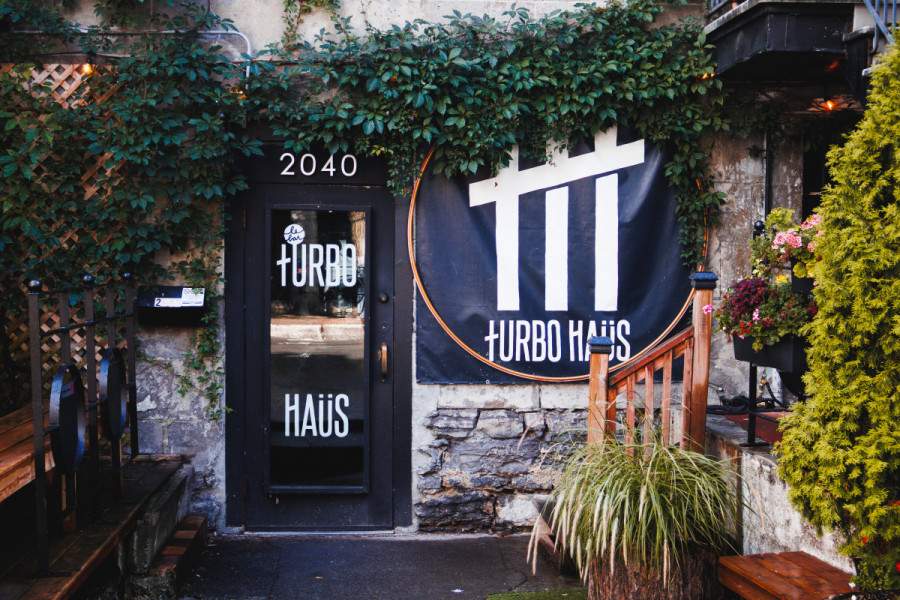
Turbo Haüs. Photo Safa Hachi

Safa Hachi,
Local Journalism Initiative

Your go-to guide for bars, parties and community spaces

Whether you’re fresh to Concordia University, new to the city or a long-time local rediscovering Montreal, the nightlife here has something for everyone. 

Some are well-known staples, while others are more tucked away—places you won’t always hear about unless you do some digging. No need to stress! That’s where we come in.

We’re not calling these places underground, but having a guide can help you cut through the noise and find your next go-to spot with less trial and error. 

From bars with cheap drinks to DJ-driven dance floors, from casual hangouts to themed nights full of activities, Montreal brims with energy, creativity and community. Think of this as your shortcut to finding the spots worth checking out—whether for the music, the drinks or just the company you’ll find there.

MESSY turning the crowd into pure chaos & joy. Courtesy Eloise Haliburton

MESSY 

Part party, part collective, MESSY has quickly carved out a name for itself in Montreal’s queer nightlife scene. The grassroots collective centres lesbian, queer and trans communities, blending live events with digital media to build spaces that feel both celebratory and intentional. Their parties are sweaty, glittery and full of energy—bringing DJs, performers and artists together in a setting that’s as much about connection as it is about dancing. If you’re after nightlife that highlights creativity and community over the commercial club circuit, MESSY is where to start.

Casa del Popolo. Photo Safa Hachi

Casa del Popolo
4873 St. Laurent Blvd.

Translating to “house of the people,” this bar has been a staple for Montreal’s independent and experimental music scene for over 25 years. Equal parts venue, bar and café, it’s the kind of spot where you can grab a drink, catch a weekend DJ set, or discover a standout performance from a local artist. With its cosy, intimate vibe, Casa is a perfect night out with friends.

Else’s. Photo Safa Hachi

Else’s
156 Roy St. E.

Located in a residential pocket not far from both St. Laurent and St. Denis streets, Else’s is a longtime favourite for anyone who wants a laid-back start to the night. The bar’s eclectic, cosy feel pairs perfectly with cheap drinks and affordable food, making it a go-to for students and locals alike. It isn’t exactly a hidden gem, but always worth remembering when you want a night out that doesn’t drain your wallet. 

Champs Bar. Photo Safa Hachi

Champs Bar
3956 St. Laurent Blvd. 

If bars are more your thing, there’s Champs, a lively queer-friendly sports bar with plenty happening week to week. It is also home to some of Montreal’s most creative queer programming, such as SATURGAYS.
Champs’ calendar spans trivia, themed nights, fundraisers and watch parties. This includes favourites like Dyke Night with free pool and Meat Market, a playful dating showcase where singles can present themselves (or a friend) in creative ways for the chance to win a free first date.

SATURGAYS layers on their signature flair at Champs with winter formals, Rocky Horror dance parties and live drunk readings of films like But I’m a Cheerleader and Twilight—all with a queer twist. Together, they make Champs more than just a bar, but a hub where silly, sexy and community-driven nights come to life.

Turbo Haüs Photo Safa Hachi

Turbo Haüs
2040 St. Denis St.

Turbo Haüs is equal parts venue and community hub, known for cheap drinks and affordable shows, and as a space that truly cares about keeping Montreal’s arts scene alive. Owner Sergio Da Silva is vocal about defending local music against noise complaints, making the bar a trusted spot for concerts. The venue also hosts free live band karaoke on Mondays and the weekly Growve jam on Wednesdays. Their motto, “anti-mosh, pro dance,” sums it up perfectly: a place where you can dive into alternative sound or just come dance without taking things too seriously. 

Sweet Like Honey. Graphic Naya Hachwa

Sweet Like Honey

Sweet Like Honey creates intentional spaces where lesbian, sapphic and BIPOC communities can gather and thrive. Their events range from strip-club nights and dance parties to karaoke and picnics, always spotlighting local BIPOC artists and businesses. More than the party itself, they’ve built a culture of care, enforcing rules against transphobia, racism and body shaming to make their events feel safe, welcoming and grounded in respect. In a nightlife scene that too often sidelines these communities, Sweet Like Honey ensures diversity and representation remain at the centre.

Bar Courcelle. Photo Safa Hachi

Bar Courcelle
4685 Notre-Dame St. W.

If you’re looking to step outside of the student-heavy core, Bar Courcelle in Saint-Henri is a cosy spot with plenty to keep you busy. Their weekly deals span everything from cocktail specials to oyster and hot dog happy hours, making it easy to keep things affordable. Beyond the food and drinks, you’ll find live band open mics on Sundays, trivia nights on Tuesdays and karaoke on Thursdays. They even host free live music on occasion, so keep an eye out; you might catch a show while you are there!

The Link’s guide to Montreal’s nightlife Read More »
MESSY and Wild Pride take over Bain Mathieu

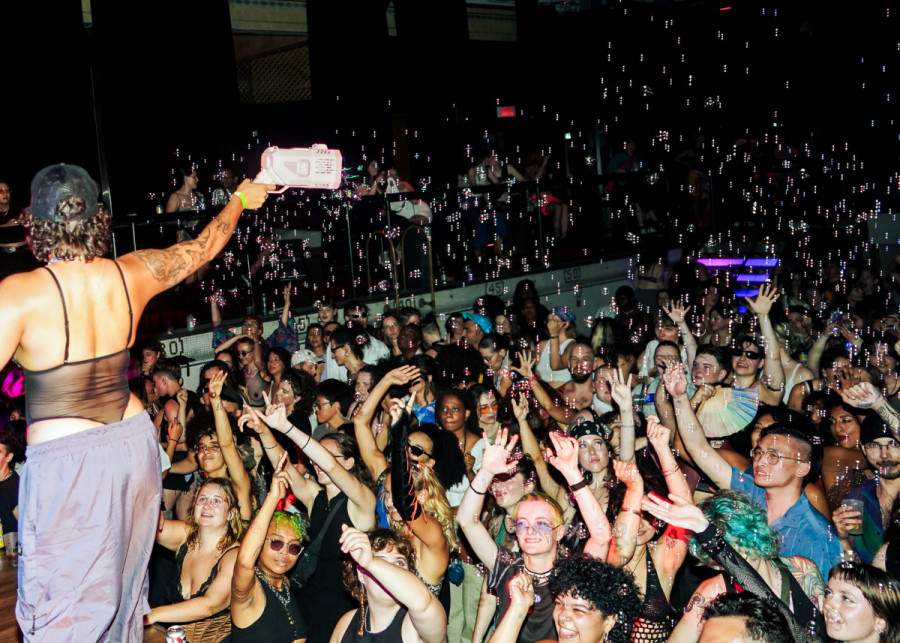
Ray Resvick from MESSY sprays bubbles over the crowd at Bain Mathieu during the MESSY x Wild Pride event. Photo Belén Catalán

Safa Hachi,
Local Journalism Initiative

A grassroots project turned the historic bathhouse into a liberated queer space

Strobe lights cut through smoke as bass rattled the tiled walls of Bain Mathieu, the historic Montreal public bathhouse turned venue. Sweat, glitter and bodies moved in sync to a lineup of DJs who carried the crowd late into the night. 

Montreal’s queer nightlife is about more than parties—it’s about community, resistance and carving out space on its own terms.

MESSY, a grassroots arts and entertainment collective formerly known as ElleLui, plans on doing exactly that. Their mix of live events and digital media has quickly become a hub for creativity and connection.

At the centre of it sit the three co-founders: Ray Resvick, Lucia Winter and Eloise Haliburton. The trio first came together in 2022, when Resvick and Haliburton joined Winter in organizing ElleLui events.

Their first project as a team was a Halloween party that year. After working together for about two years, they founded MESSY, intending to expand into media projects and build a revised mission that reflected their shared vision.

“That was our first thing all together,” Resvick explained. “And after that, we were like, ‘That went well, let’s do more together.’”

Their mission is simple: to bring lesbian, queer and trans art to the forefront.

“In practical terms, it means that the artists that we hire and that we collaborate with identify as being lesbian, queer or trans,” Resvick said. “When we book artists, we book artists from these communities […] that’s who we want to shine a spotlight on.”

That commitment stretches beyond parties. MESSY also produces digital media projects, including All About Queer Love, a video project that documented queer love stories and launched around Valentine’s Day this year.

It’s part of the collective’s push to expand into podcasts and ongoing media work.

Still, events remain at the heart of what they do. MESSY’s community-driven approach offers a vital alternative. 

“The purpose of the work we do is community-focused,” Resvick said. “In a lot of mainstream Pride celebrations and festivals, it’s really easy to lose the community-driven aspect of things. It’s a reminder that we have the capacity and the ability to do the things we need to do. We can serve ourselves.”

That vision is shared by Wild Pride, which collaborated with MESSY to present the event under their programming.

As Wild Pride  wrote in a statement on Instagram, the festival  “is powered mostly by volunteers—people from different paths, journeys, and struggles. Some of us never felt represented or safe in corporate Pride spaces […] Our community craves more spaces made by us, for us.”

This independence went on full display at the MESSY x Wild Pride event on Aug. 16. The lineup reflected the collective’s curatorial ethos: intentional, eclectic and rooted in queer joy. 

DJ Punani, MESSY’s very own Lucia Winter, as well as Spinelli and San Farafina, rounded out a star-studded show.

“We just wanted a night where people could shake ass,” Resvick said.

For attendees, the mix of sound, space and community care made the night stand out. 

“I get to shake ass and feel safe and feel seen,” attendee Lu Aidel said. “What more can you ask for?”

Gray Chambere, who attended his first MESSY event that night, described it as unlike anything he had experienced before.

“The music was so good, the fact that we were in an empty pool was so dope,” Chambere said.

Beyond music and spectacle, safety remained central.

Days before the event, MESSY posted guidelines on Instagram outlining harm reduction practices and reminding attendees to drink water, take breaks and look out for each other. 

They also affirmed their political commitments in the post: “This event is for queer and trans people whose Pride is inseparable from the liberation of all oppressed people—from Turtle Island to Sudan, Palestine to Haiti, Congo and beyond.”

At the event itself, community care organizations like AIDS Community Care Montreal remained present to distribute harm reduction supplies.

“We want to make sure it can be as safe as possible,” Resvick said.

Looking forward, the trio hopes to grow MESSY into a full-time venture, expanding both their event programming and their digital media projects. 

“We’ve done screen printing workshops, family-friendly day parties, dinners—it’s not just nightlife,” Resvick said. “We’d love to continue serving a broader array of attendees and do more digital media projects.”

For now, MESSY continues to carve out space in Montreal’s crowded arts scene, showcasing what queer-led, grassroots organizing can look like when it refuses to compromise. 

“Be the kind of community member you want to see,” Resvick advised newcomers. “Show up for people, take note of names and pronouns, support projects.”

MESSY and Wild Pride take over Bain Mathieu Read More »

CABARET: The Dancing Djinn brings queer Arab histories to life on stage

Nikotine commands the mic as Samara strikes a dramatic pose, the two embodying the cabaret’s blend of song and dance. Courtesy Alizée Legrain

Safa Hachi,
Local Journalism Initiative

A story of exile, desire and revelation told through voice, body and myth

CABARET: The Dancing Djinn is the latest addition to Montreal’s queer arts scene.

Created and performed by artist and singer Nikotine and dancer Samara, the show combines a mix of drag, bellydance and live music that not only entertains but offers something rare on stage: a celebration of queer Arab histories told through myth, memory and performance.

The project’s origins trace back to two moments. During a visit to Granada’s Alhambra palace, Nikotine stumbled upon the long-overlooked legacy of queer Arab performers. Through the work of historians Dr. Ali Olomi and Dr. Borjan Grozdanoski, she encountered the mukhannathun—trans-feminine performers who sang, danced and thrived in medieval Andalusian high society.

Seeing traces of their history reflected in the palace’s art and architecture felt special. Soon after, she crossed paths with Samara at a party. Nikotine, already familiar with Samara’s dancing, immediately felt she had found the right partner to revive these legacies. 

The duo first came alive with a Shakira-Assala Nasri mashup at Woody’s in Toronto, where Nikotine’s vocals met Samara’s belly dance. The 10-minute set ended with a standing ovation and a flood of tips, turning the spontaneous collaboration into the seed of CABARET: The Dancing Djinn.

Onstage, Nikotine wanders through a desert clutching a magic lamp. The barren landscape becomes a symbol of isolation and silence, reflecting moments in her life where queerness was pushed to the margins. Inside the lamp waits Samara, revealed as the spirit of the banished Queen of Queerabia.

“We built this whole concept on what my strengths were as Nikotine and what Samara’s strengths were as Samara,” Nikotine recalls. “Now we’ve become soul sisters. We’re inseparable.”

Together, they guide the audience through memory, myth and desire. For some in the crowd, that journey lands with particular force. 

“As an Arab queer person, their story and energy touched me so deeply,” says Muha, a fan who drove 14 hours from Halifax to Montreal for the show. “It was worth every single minute. I’d do it again in a heartbeat.” 

The cabaret is deliberately immersive, with Nikotine at its centre in the first number. She appears clutching a lamp, terrified of what it contains. Her fear is palpable: she knows the djinn inside holds answers she has long avoided or repressed. That tension ripples out into the audience as Samara circles veiled and spectral, her movements heightening the atmosphere of dread.

But when the second number begins, the focus shifts. After Nikotine flees, the audience encounters Samara on her own for the first time. The veil lifts, revealing not a monster but a force of liberation. By the end of the first act, Nikotine and Samara encounter each other for the first time, instantly falling in love.

This revelation also reveals the root of her fear: queerness itself has been vilified historically, particularly after colonization. 

“What Samara truly is, is this sexy, beautiful, sensual djinn […]. Welcoming queerness and sensuality back into our lives as a key part is what Samara represents,” Nikotine explains.

Samara frames the project as correcting the record.

“We wanted to tell the story truly how it is. What we lived through, inspired by the past, that was wiped out by colonialism, crusaders, religion and politics,” she says.

Since its first Montreal show in January 2025, the duo has sold out venues like Café Cléopâtre and drawn audiences from across Canada. But the appeal doesn’t come solely from the music or choreography, but also in the way the cabaret turns spectators into participants. 

True to the old-school cabaret form, the show relies on intimacy. Nikotine leads sing-alongs, Samara pulls people from their seats to dance, and the line between performer and audience blurs.

The lamp, carried by Nikotine throughout the story, becomes more than a prop. It represents the secrets we all carry, and the possibility that the answers to repression and fear lie within ourselves. 

By the finale, hidden lamp keychains taped under every chair are revealed, making the audience literal keepers of the story’s secret. It’s a reminder that freedom, reclamation of sexuality, and joy aren’t given by others; they already exist within us, waiting to be unlocked.

Self-funded and produced entirely by the two performers—who write the music, choreograph the dances, design costumes and market the show—CABARET: The Dancing Djinn is as much a feat of resourcefulness as it is of artistry. Their next performance sees them travel to Toronto in September 2025, with plans for Montreal in January 2026 and eventual tours in Paris, Barcelona and London.

With its fusion of history, myth and radical queer joy, CABARET: The Dancing Djinn isn’t just a performance. It’s an act of remembering, reimagining and reclaiming—an invitation for audiences to take the lamp, hold it close and dance their truth.

CABARET: The Dancing Djinn brings queer Arab histories to life on stage Read More »

Theory of Ducks close out Turbo Haüs performance with humour and heart

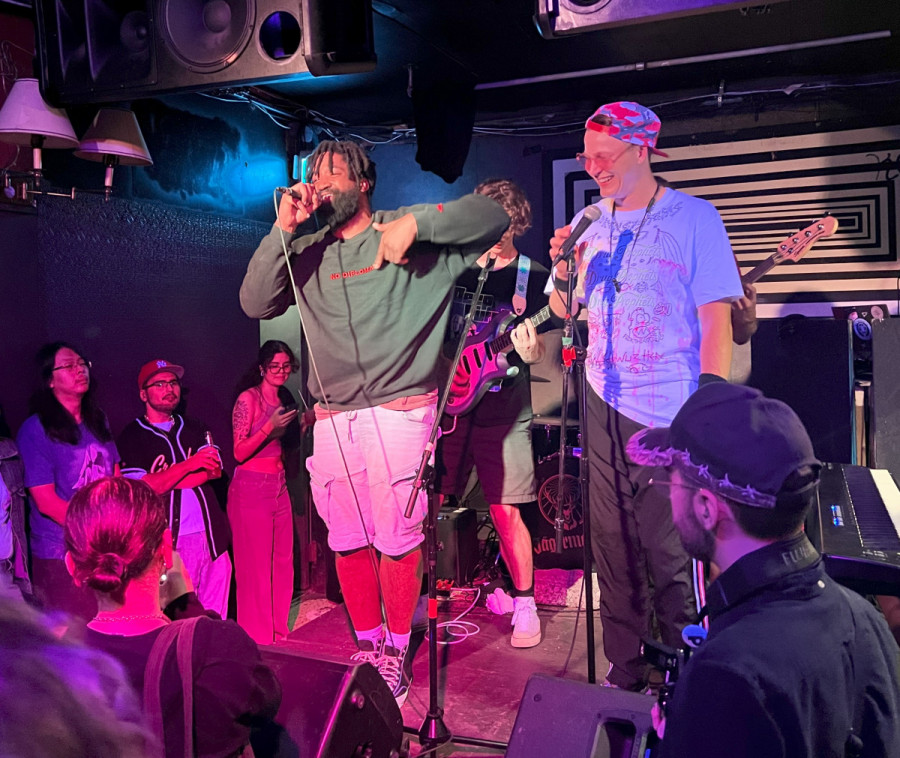
Theory of Ducks performing at Turbo Haüs. Photo Ryan Pyke

Safa Hachi,
Local Journalism Initiative

The band delivers an emotionally resonant set to cap off a night of local talent

Turbo Haüs hosted a three-act lineup featuring dievanse, NIIVI and Theory of Ducks on July 13. Each band offered something different, but all performed with a shared sense of presence and purpose. Closing out the night, Theory of Ducks delivered a set that was technically sound and confident, marked by solid playing and natural onstage rapport.

Theory of Ducks is the music project of Concordia University English literature student Saam Shahab, who began releasing music as a solo artist. While the solo act remains, Shahab formed a live band under the same name to bring his music to local stages. The group includes Matty Fudge on guitar, Benny Gaucher on bass and Ilai Eirew on drums.

Their chemistry was undeniable from the moment they stepped onstage, immediately joking about the heat as they set up. 

“I think I feel a slight breeze from the fan, but I could be going crazy,” Fudge said, squinting towards the ceiling. The tone stayed light as they cracked jokes, teased each other between songs and laughed through tuning mishaps.

The band played original songs, both released and unreleased, including “Charlie,” “Road Kill” and “Grandpa,” as well as a cover of Alex G’s “Harvey,” a nod to one of the band’s musical inspirations. 

“Grandpa,” one of the first songs Shahab wrote, took on a new weight live, with expanded vocals and a heavier presence. Their sound draws on indie rock touchstones like Elliott Smith, Big Thief and Big Star. Fuzzy guitars and soft melodies, paired with Shahab’s rough-edged vocals, created something raw, emotional and unique.

Despite a few new or loosely rehearsed tracks, the band never faltered. They embraced the spontaneity and the willingness to try songs that had not been played live before, using them to build trust with the crowd.

The band’s dynamic was equal parts tight and goofy. Gaucher frequently grabbed the mic between songs to entertain the audience and talk about video games, focaccia bread, underwhelming GURU energy drink flavours, and time signatures, adding to the charm of the group. 

The crowd itself was a mix of Concordia students, friends and other musicians.

Attendee Sabine Salim-Ullyot, who has seen the band before, said the show was on par with their best. 

“The sound system made a huge difference compared to other venues,” they said. “It’s just nice to see people you know flourish.”

Salim-Ullyot noted that the show reflected what makes Montreal’s music scene unique, with its smaller, lesser-known bands still having the opportunity to perform in respected local venues. 

“This show is so representative of Montreal music culture, […] bands like this are able to perform in venues like this even when they are not hyper ridiculously famous,” Salim-Ullyot added.

Turbo Haüs, known for its solid acoustics as well as cosy layout, was the ideal match for Theory of Ducks’ indie rock sensibility, even after the two heavier-sounding bands prior.

After the set, the band reflected on what it meant to play in that space. 

“It was the first time I could actually hear my vocals on stage,” Shahab said. 

Eirew called it a rewarding experience to finally have proper drum mics, and Gaucher said the band felt “tight and synced.”

“To have the thing you labour over be cared about is really nice,” Gaucher added.

But even as the night showcased emerging talent, it also highlighted the precarity of local venues. With popular Montreal venue Blue Dog recently announcing its closure on July 10 due to financial stress, concerns about the future of local performance spaces have grown. Even Turbo Haüs has faced noise complaints in the past, a reoccurring issue for music venues in the city leading some to close their doors. Fudge shared his concerns.

“The hope is that as one place shuts down, another opens up,” Fudge said. “But I worry they’ll be replaced by corporate bars that don’t give us or other artists the same opportunities.”

Shahab agreed, noting Montreal’s importance for so many up-and-coming bands. 

“It’s a shame seeing these venues shut down because they’re the ones giving artists like us the chance to perform,” Shahab said. 

Learning to navigate the ins and outs of the music scene has been part of Shahab’s process. He booked the show by reaching out to dievanse and NIIVI, both of whom he discovered online or shared stages with before. 

“We played with dievanse on their first show,” Shahab said. “It felt full circle.”

Toward the end of the night, the band teased an unnamed closer. 

“We’re not going to tell you the next song. If you know it, sing it,” Shahab said before launching into Pinegrove’s “Need 2.” 

The crowd immediately responded to Fudge’s strumming. Phones lit up, voices joined in and chants for an encore followed. With a quick nod from the sound tech, the band delivered one last high-energy track, “Moon We’re Doomed.”

For a band still building a name at the start of their careers, figuring out the logistics of booking shows, and navigating the ever-changing local scene, Theory of Ducks feels remarkably self-assured. They’re still new, still goofy, still just a group of friends jamming, but they’re also tight, engaging and increasingly comfortable bringing their music into live spaces.

Theory of Ducks left the stage smiling, grateful and ready for what’s next, leaving the crowd with something to root for.

Theory of Ducks close out Turbo Haüs performance with humour and heart Read More »

Offcuts Jam closes out Blue Dog with final explosive night

Blue Dog hosts its final Offcuts Jam. Photo Geneviève Sylvestre

Safa Hachi,
Local Journalism Initiative

The weekly jam bids farewell to its home

On Friday, July 18, Offcuts Jam held one of its most electric nights yet—the final edition at Blue Dog, where it all began.

For nearly a year, the weekly jam transformed the bar into a hub of sonic experimentation. Every Friday, musicians and vocalists, seasoned and new, gathered to play, rap, sing and improvise. Mistakes were part of the process, and off-the-cuff moments often stole the show. That energy hit a bittersweet peak as jammers and supporters packed the room one last time before Blue Dog’s closure.

From the start, crowd chatter set the tone: jokes and cheers about making it the best jam yet, and how sad it was to see Blue Dog go. The mood was vibrant and reflective, the room buzzing with celebration and a hint of grief.

For many, Offcuts wasn’t just about music, it was about finding a space to grow in the Montreal scene. 

“Blue Dog is very much a cultural space,” said Loren Armstrong, a local event planner and former Offcuts host. “These are spaces where artists feel they’ve found a home, or their first family. We’re losing a lot of venues, unfortunately, and it hurts.”

Armstrong, who moved to Montreal four years ago, is a cornerstone in the city’s event scene. She has hosted Offcuts, founded the DIY home venue The Humble Abode, and works with Scatterbrain and Stimulant magazine as a writer, event planner and event director.

“Art thrives in Montreal,” she said. “Even new artists have a space where they can experiment and feel supported.”

That support was palpable at Friday’s jam. The night was layered with energy and emotion from the range of beatboxing, freestyles, DJ breaks, shoutouts and spontaneous chants thundering through the space. Still, the celebration carried the weight of goodbye.

Blue Dog has been struggling due to noise complaints and ongoing financial challenges. The venue told The Link: “We essentially closed because the bar hadn’t been doing well—it’s been a couple years that overall sales have been way down. It wasn’t sustainable anymore.”

The closure brings an end to Blue Dog’s longstanding role as a hub for local artists and community-driven events. And that legacy was on full display at the final Offcuts jam. 

The completely improvised sets were a reminder of the city’s stockpile of raw talent. Musicians flowed in and out with ease, switching instruments, layering vocals and building off each other’s ideas in real time. 

Vocalists and MCs weren’t limited to the sign-up sheet, as many spontaneously walked on stage to add to the band’s groove.

As the night came to an end, an MC reminded the room, “We’ve only got 30 minutes left. Let’s make this count. Offcuts isn’t going anywhere.” 

Organizers confirmed that Offcuts will move to a different venue. Photo Safa Hachi

The founders–muscian, DJ and MC RISKREATIVE and musician Keegan McCallum–intend to keep that promise. They assured attendees that Offcuts Jam isn’t ending, just changing locations. The organizers are already planning what’s next, encouraging the community to stay connected.

On July 19, 2025, a day after the show, the organizers confirmed with The Link that Offcuts will officially move to Bar La Marche À Côté in the heart of the Plateau. 

“It’s been great seeing how our jams have brought people together,” McCallum said. “We’re hoping to carry that on with us at the new venue.”

RISKREATIVE had been a regular at Strawberry Jam, another local jam night, before it ended. Seeing an opportunity to start something of his own, he reached out to Blue Dog. 

“We got a lot of people on board,” RISKREATIVE said. “The success was immediate.” 

The pair emphasized Offcuts’ welcoming spirit—no rushing, no gatekeeping, just a place to grow. 

“Just like I benefited from jams, I want to give that back,” RISKREATIVE added.  

For musician Théo Bedez, jam nights like Offcuts provided a way to meet people, get involved in the scene, and play without the usual expectations. 

“With everyone knowing everyone, we’re all friends. It feels like there’s no pressure,” Bedez said.

Like Armstrong and RISKREATIVE, Bedez got involved with other jams around the city that brought together many of the same musicians now central to Offcuts. 

“In a city like Montreal, a new jam will be created. The same people will keep showing up, that’s what’s great about the community,” Bedez said. “But it’s still sad to lose the place where it all started, and all the memories that came with it.”

As the final set ended and the lights went off, no one left even after last call. People lingered outside the bar, singing, taking pictures, unwilling to let the night end. It wasn’t just about music but the community that formed around it. 

“Every week is a new jam, a new experience,” Armstrong said. “Everyone loves being part of something. We tend to miss that in daily life.”

Friday’s final Offcuts Jam at Blue Dog was sweaty, spontaneous and soulful. The venue may be gone, but the sessions are just shifting keys.

Offcuts Jam closes out Blue Dog with final explosive night Read More »

Scroll to Top