Quebec Court of Appeal

McGill student society wins Palestine policy injunction in court

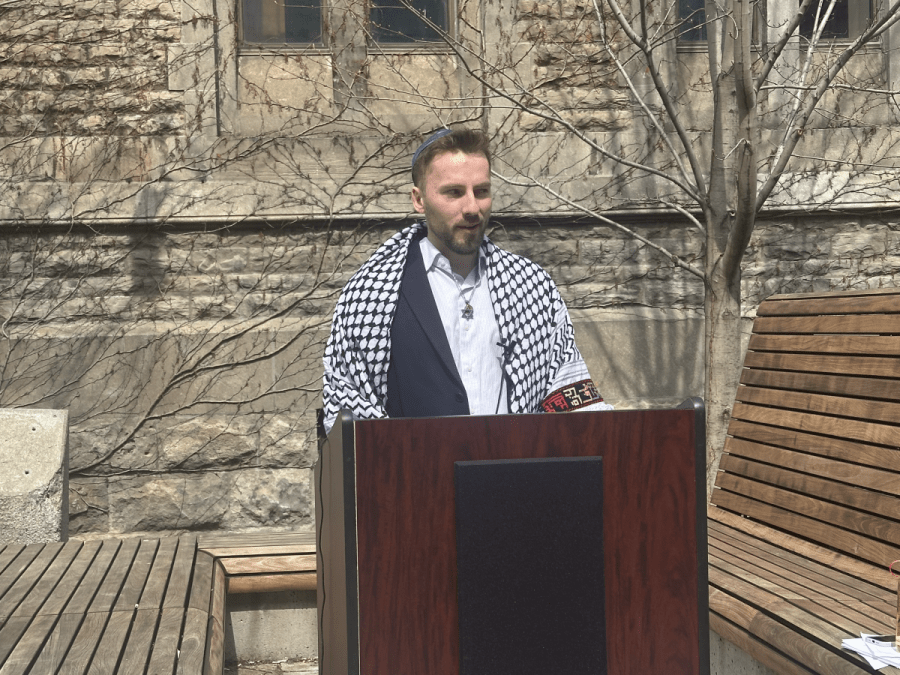
Hugo-Victor Solomon, SSMU’s vice president external speaking at the press conference. Photo Maria Cholakova

Maria Cholakova,
Local Journalism Initiative

Members addressed the repression of student freedom of speech during press briefing

In a press briefing held by the Students’ Society of McGill University (SSMU) on April 25, the society announced an April 17 court legal victory.

The win relates to an injunction filed in November 2023 in response to a democratic vote during the SSMU Fall 2023 referendum. McGill University students had voted 73 per cent in favour of adopting the SSMU Policy Against Genocide in Palestine. 

The policy calls on McGill to cut ties with people, corporations and institutions that are “complicit in genocide, settler-colonialism, apartheid, or ethnic cleansing against Palestinians.” The injunction had blocked the ratification of the policy.

The Quebec Court of Appeal unanimously struck down the injunction, stating that “thousands of students who voted for the adoption of the Policy are deprived of the opportunity to express their criticisms and demands, with which one may or may not agree, but which nevertheless constitute the primary expression of their ideas and their social and political freedom of expression.”

According to SSMU’s website, on April 22, the Policy Against Genocide in Palestine was officially ratified 16 months after the original vote.

According to Hugo-Victor Solomon, SSMU’s vice president external, the court decision was a win for student democracy. 

“This is more than a legal win, it’s a resounding affirmation that students have a right to speak, to organize and to demand justice,” Solomon said in a press briefing at McGill’s campus following the court’s decision. 

He added that criticizing Israel’s government is not a form of discrimination. 

“This is why SSMU fought to pass a policy against antisemitism, rooted in […] frameworks that protect Jewish students, without being weaponized to suppress Palestinian solidarity,” Solomon said.

Solomon finished his speech by condemning the genocide, war crimes and human rights violations in Gaza. 

“We affirm one and for all, that SSMU stands in unambiguous solidarity with our Palestinian and Arab peers,” he said.

Solomon was joined by Danna Ballantyne, Concordia Student Union external coordinator, who echoed Solomon’s sentiments. 

“We certainly cannot celebrate our diversity if we are refusing to acknowledge entire communities,” Ballantyne said. “True diversity is not just about inclusion in name, it is about protecting the freedom to speak out, to take political stances and to fight against injustice, no matter how uncomfortable or expensive this may be for those in power.”

The press briefing ended with a round of questions from the media. 

McGill student society wins Palestine policy injunction in court Read More »

Court of Appeal supports MUHC decision to end ‘life-sustaining care’ in N.G. Case

By Joel Goldenberg
The Suburban

The Quebec Court of Appeal recently upheld a Superior Court ruling agreeing with the McGill University Health Centre’s position that a 77-year-old patient (identified as N.G.) must be allowed to die with dignity according to a palliative care plan, and not continue futile and unethical “life-sustaining treatment.”

The appellant, the sister of the patient acting on his behalf, refused to consent to the palliative care plan.

“The judge performed a structured and thorough analysis ‘in accordance with legal requirements and with utmost respect for human rights,’” Judges Robert Mainville, Guy Cournoyer and Judith Harvie ruled. “The proposed Care Plan makes it possible to put an end to futile treatments and preserve the patient’s human dignity up to the very last moment through care that is humane and provides comfort measures until his death, a death which appears inevitable in this case given his distressing medical condition and the absence of any reasonable expectation of improvement.”

The patient, in 2007, authorized his sister, “in the event of his incapacity, to consent to any care required by his state of health ‘to the extent that such care is beneficial.’”

The court document points out the patient had a perforated stomach ulcer, an abdominal hernia, “for which he declined surgical treatment,” a left femur injury, a broken hip and a kidney obstruction.

Over time, he refused treatment and on five occasions, left the medical institutions that were treating him, each time resulting in rehospitalizations. At one point, he declined medications and, through his sister, insisted on being intubated, even as this course of treatment risked infection.

This prompted the MUHC to seek two psychiatric assessments, both of which recommended confinement for 30 days.

One MUHC doctor opined that while patients have the right to refuse care, “the objection to basic standard care while insisting on all other life sustaining measures is illogical and harmful in the long run to the patient.”

The patient left the hospital again and then quickly had to be rehospitalized.

The Superior Court subsequently, last May, authorized a 12-month care plan, which was initially successful, but the patient then experienced seven minutes of cardiac arrest and suffered brain damage, never regaining consciousness. The MUHC recommended palliative care instead of life-sustaining treatment.

However, the sister believed her brother could still recover and “considered that he… had the right to live.”

The hospital felt the life-sustaining care was “causing unnecessary pain and suffering by prolonging the patient’s agony,” that he was in a vegetative state, “mortality was inevitable” and recommended the halting of various measures, including resuscitation.

The Superior Court ruled last October that “the patient is incapable of giving consent and cannot participate in decision making regarding his care” and that the sister’s refusal to accept this is “unreasonable and unjustified.” The judge also agreed that death was inevitable.

The sister appealed the Superior Court judgment, arguing that it “infringes the patient’s right to life.” The MUHC countered that “continuing the [life-sustaining] treatment violates medical principles and ethics.”

The Court of Appeal agreed with the Superior Court judgment. n

Court of Appeal supports MUHC decision to end ‘life-sustaining care’ in N.G. Case Read More »

English school boards celebrate ‘historic’ victory

By Trevor Greenway

The head of the Western Quebec School Board (WQSB) is praising Quebec’s highest court after it found that sections of Bill 40, which would have abolished English school boards, were unconstitutional. 

In a unanimous decision handed down on April 3, three judges from the Quebec Court of Appeal largely upheld a 2023 Superior Court ruling that declared several parts of the bill violated rights guaranteed under section 23 of the Canadian Charter of Rights and Freedoms.

Executive director of the WQSB George Singfield says the result – which keeps English school boards intact with elected commissioners – is a huge victory, not only for English education in Quebec, but English rights as a whole.  

“I think at the root of everything is the infringement that has been brought forward by the Quebec English School Board on the rights of the anglophone community,” said Singfield, referring to the QESBA, the Montreal English School that first brought the court challenge against Bill 40.  “And so that, I believe, is probably the biggest gain in the decision that was made yesterday – the recognition of those fundamental rights.”

The Legault government introduced Bill 40 to abolish all school boards across the province and turn them into service centres with appointed commissioners. The bill was passed in 2020, but English school boards fought – and won – to keep control of its schools. French school boards were abolished and are now called service centres. 

“It really does reinforce our English-speaking communities in the province, to manage and control our schools and centres, our institutions – that’s the underlying piece,” said Singfield. 

He explained that under Bill 40, English school boards would’ve been abolished and converted into school service centres. The WQSB’s elected council of commissioners would’ve been abolished, and the government would’ve appointed commissioners. This was among the major fears of English school boards across the province, as local representatives – current, former and prospective parents and residents – would be barred from running in elections, and a commissioner would’ve been appointed. 

“At stake was losing the ability to govern our own schools,” said WQSB Commissioner chair Joanne Labadie. “Pre Bill 40, it is the Council of Commissioners that chooses the director general, and the director general reports directly to them, and so this would have given the government the opportunity to appoint whoever they wanted in that – it could have been a friend, someone with different political ideology or cultural leanings, and they would have been able to impose it.”

The 90-page ruling also stated that funding must be the responsibility of minority language representatives and can’t be controlled by the provincial government. 

The ruling also struck down a Quebec provision that argued that only parents with children presently enrolled in English schools are rights holders under section 23 of the Canadian Charter. 

No real path to Supreme Court

“This came quick,” said Labadie about the court’s decision, comparing this trial to the original QESBA challenge, which took a judge 28 months to render a decision.  “And the decision was pretty clear, and we’re all just so thrilled to have our rights recognized once again with this decision and just hope that the government will not appeal it to the Supreme Court. If they do, we’re ready for it.”

The Quebec government has not announced whether or not it will seek to appeal the decision. However QESBA president Joe Ortona told the Montreal Gazette that he doesn’t see a path for the government to appeal the new ruling to the Supreme Court of Canada. 

“This is now, on Bill 40, the fourth sweeping victory that we got … so the government has lost on every single point, in every single argument, in every single instance of the Quebec courts, over and over and over again,” he said.

The English Parents’ Committee Association (EPCA), a coalition of parents’ committees of Quebec English school boards, said it was “thrilled” with the announcement. 

“This is a historic victory,” said EPCA president Katherine Korakakis. “Not just for parents, but for every member of our community who believes in shaping our children’s future. The court’s decision is a powerful reminder that our voices matter, and our right to govern our schools is non-negotiable.”

English school boards celebrate ‘historic’ victory Read More »

Scroll to Top