Author name: Pontiac Journal

Unlicensed cannabis sellers knock on Shawville doors

Tashi Farmilo

Local Journalism Initiative

SHAWVILLE – Reports of unlicensed cannabis sellers going door-to-door in Shawville has prompted concern from local officials. While door-to-door sales are permitted under certain conditions in the municipality, cannabis sales are an entirely different matter — governed exclusively by provincial law, and currently illegal outside state channels.

The municipality issued a public notice warning residents that individuals are offering cannabis for sale directly at people’s homes. A flyer circulated locally advertises a delivery service under the name “Highwayz” listing products including BC cannabis, shatter, THC edibles, vape pens, pre-rolls, and CBD gummies. It includes a phone number and email address, suggesting an organized effort to reach customers in the region — without regulatory oversight or licensing.

Mayor Bill McCleary confirmed the town received complaints about the activity and made it clear the group behind it did not seek — and could not receive — a municipal permit. “That’s not just a town decision. It’s illegal under provincial law.”

“All door-to-door commercial activity in Shawville requires a municipal permit,” McCleary said. “We’ve had issues in the past with various groups. Some were scams; some are legit. So, we implemented a program where, if you want to go door-to-door, you have to come to town hall, explain your project, and get a permit.”

Cannabis is legal in Quebec, but only through a single government-regulated outlet: the Société québécoise du cannabis (SQDC). Sales outside the SQDC — whether through private shops, unregulated online services, or door-to-door delivery — are prohibited.

“You can go door-to-door to sell something, but what you are selling has to be legal,” said Marc Tessier, spokesperson for the Sûreté du Québec (SQ). “The only legal way to sell cannabis in Quebec is through the SQDC. Anything else is illegal.”

The mayor noted the individuals involved were reportedly from outside the municipality, possibly from an Indigenous reservation. Though that claim remains unconfirmed, it has raised questions about overlapping jurisdictions. Tessier explained that while certain activities, including cannabis sales, may occur legally on reservations under different enforcement regimes, that authority doesn’t extend beyond reserve lands. “You can’t take the product and go somewhere else,” he said.

In Quebec, the rules around cannabis are stringent. Personal cultivation is banned, public consumption is heavily restricted, and possession limits are tightly controlled — 30 grams in public and 150 grams per household at home. Selling cannabis without SQDC authorization can result in significant penalties, including fines or criminal charges.

Despite the seriousness of the legal breach, municipal enforcement is limited. “Technically, we could enforce the bylaw,” McCleary said, “but our bylaw officer is only here two days a week. So, if a resident feels uncomfortable, it becomes a police matter.”

The SQ confirmed no formal complaints have been received, but urged residents to report any further incidents. “If we’re notified and there’s evidence, we can take action,” Tessier said.

Unlicensed cannabis sellers knock on Shawville doors Read More »

Water Month flows with education and action

Deborah Powell
Local Journalism Initiative

OUTAOUAIS – The Outaouais watershed organization for the seven rivers, L’Agence de bassin versant des 7 (ABV des 7), is holding a series of activities throughout June to celebrate Water Month.

“Focusing on the theme of pollution and water quality—issues central to today’s environmental concerns—these problems have a direct impact on human health, aquatic ecosystems and biodiversity. Water pollution, whether caused by plastics, chemicals or industrial activity, jeopardizes access to clean water and threatens our collective future. It is more crucial than ever to take action to preserve this vital resource,” reads the group’s publicity material for the month.

Two webinars were held June 4 and 10. The first featured Catherine Hallé from CEGEP Outaouais’ Environmental Health and Biodiversity Research Centre (SEBO), who spoke about microplastic pollution. That pollution is “everywhere, literally,” with major sources including vehicle tire wear, paint, city dust and particles in water from washing clothes. Hallé’s current research focuses on analyzing Gatineau’s water before and after treatment. “We need a clear portrait in order to decide on solutions,” she said, noting that she is not against plastic, but advocates for more sensible use. She encouraged reducing single-use plastics—including sequins and glitter in some crafts—installing washing machine filters, and avoiding bottled water, which she said contains “lots” of plastic particles.

Elizabeth Grater, science programs coordinator for Ottawa Riverkeeper, spoke about the Road Salt Monitoring Program the group has run for the past five years. Research shows that road salt persists in the environment and can reduce biodiversity and a waterbody’s ability to self-purify. Riverkeeper has been working with the City of Ottawa on salt management and plans to collaborate with the City of Gatineau as well.

Quentin Liautaud, ecology projects director for the City of Gatineau, presented the city’s newly developed five-year water management plan during the June 10 webinar. Its goals include protecting aquatic ecosystems, ensuring a sustainable drinking water supply, promoting optimal use of rainwater, and improving wastewater management and treatment.

Maria José Maezo, agroenvironment counsellor with ALUS/UPA Outaouais, was the second presenter on June 10. She explained that helping farmers adopt erosion control measures and protect waterways is central to the program’s work. Optimizing water management is one of the goals in Quebec’s 2020–2030 Sustainable Agriculture Plan, but, she emphasized, “all objectives relate to water.” The ALUS program supports producers with technical advice, financing for planting projects, and annual payments for land stewardship. A video featuring Kristine Amyotte of Beck Family Farms in the Pontiac showed an example of such a project. Maezo also described the water recycling system at the Judd family’s Gladcrest Farms, where ALUS helped plant mixed vegetation around the filtration basins earlier this year.

Another Water Month event is a guided tour at the La Blanche Forest Ecological Reserve east of Gatineau, focused on water, to be held June 19. A final webinar on innovative water treatment technologies is scheduled for June 20.

ABV des 7 is a non-profit organization created in 2004. Its mission is to protect, improve and promote the water resources within its territory, through sustainable development and collaboration with all key stakeholders. The organization’s territory includes the Dumoine, Noire, Coulonge, Quyon, Gatineau and La Blanche rivers, as well as the section of the Ottawa River between them.

Water Month flows with education and action Read More »

Milfoil threat leads packed Otter Lake meeting on environmental issues

Cathy Fox

Local Journalism Initiative

OTTER LAKE — A large crowd gathered at the RA Hall, June 7, for a public information session hosted by the Municipality of Otter Lake. The event, sponsored by the Greater Otter Lake Residents’ Association (GORA), featured presentations by Councillor Robin Zacharias, Mayor Jennifer Quaile, and guest speaker Rui Medeiros of the Petit Lac Cayamant Association. Topics included radon gas, waste management and Eurasian milfoil in local waterways.

Zacharias spoke about radon gas, referencing information from the Government of Canada’s official resources. He stressed the importance of testing buildings for radon and urged residents to use certified professionals for any necessary remediation.

On the topic of waste management, Zacharias presented statistics showing significant changes in garbage hauling costs—rising from $83,000 in 2018 to $137,000 in 2024. The municipality saw the need to separate compost from garbage, which adds substantial weight and contributes to methane emissions and odours at the landfill. Separating compost is both an environmental and financial necessity: it costs $200 per ton to
process compost versus $300 per ton to haul it to the landfill.

Residents were encouraged to recycle more effectively, with handouts distributed at the session. Since January 2025, Otter Lake has enforced a clear garbage bag rule to ensure recyclable and compostable materials are properly sorted. New provincial regulations now allow a broader range of plastics to be recycled—provided they are clean—and materials will be traceable back to manufacturers to ensure compliance. Similarly, new fees on bottles and cans aim to improve recycling rates by returning materials to producers.

Local waste management data shows a consistent reduction in garbage production and
an increase in recycling and composting; however, officials estimate 10% of residents haven’t fully embraced the changes. Residents can use the Ça va où ? website (https://cavaouwebapp.recyc-quebec.gouv.qc.ca/) to check how various items should be disposed of.

The most pressing issue discussed was the spread of Eurasian milfoil, an aggressive invasive aquatic plant now found in six outlying lakes and four main lakes in the Otter Lake area. Biologist Annie Parent and the Agence Bassin Versant des Sept (ABV7) conducted a special analysis of the situation. The invasive plant not only crowds out native species and depletes oxygen levels but also poses risks to recreational activities like boating, swimming, and fishing.

Officials outlined a multi-step plan to combat the spread of milfoil: public education, mandatory boat washing, boat traffic control, shoreline management, obtaining necessary permits from Quebec’s Ministry of the Environment (MEV), and pursuing an operation for long-term eradication. The municipality installed a high-temperature boat washing station at the municipal garage, designed to eliminate both Eurasian milfoil and zebra mussels. The wash is free for local residents, while non-residents pay a $10 fee. A secondary, shorter wash is available for non-motorized boats and trailers.

To support enforcement, 29 red buoys have been placed throughout the main lake and its three connecting bodies of water; four mark areas of dense infestation and are accompanied by warning signs. A $300 fine for non-compliance with boat washing rules is expected to be enforced soon.

In addition, a new bylaw prohibits rental cottages within 50 metres of the shoreline, making it easier to monitor boaters. All property owners are encouraged to use the main public launch at Farm Lake.

Quaile reported the municipality is in the final stages of securing a permit from the MEV to initiate a long-term eradication program. The first phase—to take place by spring 2026—will involve smothering dense patches of milfoil with a specialized tarp costing $50,000, which can be reused in other affected areas. Funding applications are currently underway.

Medeiros spoke about a successful milfoil control initiative at Petit Lac Cayamant using divers to hand-pick the plant, and reassured attendees that waterways will remain open. Both Medeiros and Quaile emphasized the importance of community involvement and one-on-one conversations between neighbours to raise awareness and ensure the success of the control measures.

Photo – Otter Lake Mayor Jennifer Quaile at the boat washing station. (CF)

Milfoil threat leads packed Otter Lake meeting on environmental issues Read More »

Grant fuels major improvements at Chapeau RA grounds

Peter L. Smith

Local Journalism Initiative

L’ISLE-AUX-ALLUMETTES – The Chapeau Recreation Association (RA) has received a $100,000 grant to support upgrades to its ball field, install new drainage infrastructure, and build a pavilion at the RA grounds. The funding was awarded last year through the Revitalization Agreement between the MRC Pontiac and the Ministry of Municipal Affairs, under the Regions and Rurality Fund (FRR). The Municipality of L’Isle-aux-Allumettes also contributed additional funds.

The work will be carried out in three phases and is being supplemented by the association’s online fundraising. The first phase includes the construction of a 30-by-40-foot shade pavilion by local contractor Frank Michaud Construction. The structure, similar to the one built in Chichester, will be located between the swings and the splashpad.

Next, drainage systems will be installed in the soccer field and behind the baseball field, following engineered plans. Work is expected to begin this month. Drainage behind the ball field will be completed after this season’s games and the Robert Chartrand Memorial Tournament in late fall.

The final phase will focus on replacing netting, upgrading the back fence, and improving the field lighting. Fleury Electric of L’Isle-aux-Allumettes has already begun wiring for the new lights and is donating its time to the project.

The RA thanked the adult ball league and players for consistently supporting fundraising efforts and volunteering their time. Special appreciation was expressed to Daniel Godin, Mike Fleury, Joey Sullivan and Owen Sullivan for their help with upgrades.

“This grant application started over three years ago,” said RA spokesperson Karie Bissonnette. “We’ve all been working hard to see this project through. We appreciate your patience, your contributions, and the involvement of those in the community who have lent a hand, advice, and time. It will be very rewarding to see this completed. It takes a village to accomplish something like this, and we couldn’t be more grateful.”

More updates will be shared as the work progresses. Visitors to the RA grounds are asked to be cautious, as construction will begin soon.

Photo – Joey Fleury of Fleury Electric donates his time to upgrade wiring at the Chapeau Recreation Ballfield in preparation for new lights to be installed in the coming months. This marks the start of many improvements to come. (PS)

Grant fuels major improvements at Chapeau RA grounds Read More »

Signal boost: satellite tech to lift Pontiac out of dead zones

TASHI FARMILO
LOCAL JOURNALISM INITIATIVE

MRC PONTIAC – Quebec’s plan to expand cellular coverage in underserved parts of the province, including the Pontiac, is now expected to conclude by the end of 2026—earlier than some local officials anticipated.

At the recent Federation of Quebec Municipalities conference, Pontiac Warden Jane Toller pressed for clarification on the timeline for the project in the Pontiac after prior indications suggested it might be deferred until 2028. Provincial representatives confirmed, however, that the target date remains the end of 2026.

In the Pontiac, mobile service remains unreliable and investment from private providers like Bell has been limited. Low population density and high infrastructure costs have made conventional tower expansion commercially unattractive. In response, the province is pivoting toward a mixed approach that combines satellite coverage with smaller antenna systems mounted on municipal infrastructure.

Although a portion of the Pontiac already has limited access to mobile service via Starlink satellites, officials caution against long-term dependence on foreign-controlled networks. The provincial government has flagged concerns about communications security and emergency preparedness, noting such services can be interrupted without notice. Quebec is now working with federal authorities to establish a domestically managed satellite communications network.

Minister Gilles Bélanger, who leads the province’s rural connectivity portfolio, said testing is underway in dead zones between existing towers, and the government is exploring how municipal assets might be used to host supplementary antenna systems.

In parallel with these ground-based efforts, Quebec has invested $10 million in Reaction Dynamics, a Longueuil-based aerospace company developing a small satellite launch vehicle. The Aurora hybrid-fuel rocket is designed to place payloads weighing up to 200 kilograms into orbit, with a demonstration launch planned for the end of this year and commercial operations targeted for 2027. The rocket’s streamlined propulsion system—consisting of fewer than a dozen components—offers a safer and more cost-efficient alternative to traditional liquid-fuel rockets.

Part of the funding also supports Maya HTT, a Montreal firm creating advanced simulation tools for engine design and optimization. The initiative is part of a broader strategy to improve communications infrastructure in regions still lacking reliable mobile service.

Signal boost: satellite tech to lift Pontiac out of dead zones Read More »

New owner brings fresh energy to Shawville waste site

TASHI FARMILO
LOCAL JOURNALISM INITIATIVE

SHAWVILLE – A longtime waste facility in Shawville has been given new life under the ownership of Martin Perras, an entrepreneur whose career spans healthcare, excavation, and now, waste management. Formerly McGrimmon Cartage, the site has been rebranded as Crush Waste Management, and Perras is focused on modernizing operations and expanding services across the Pontiac.

“This site has been serving the region for years,” Perras said. “But there’s so much more it can offer—better systems, more efficient service, and a greater environmental impact. That’s the direction we’re heading.”

The facility operates as a transfer station. Waste and recycling are collected from municipalities including Campbell’s Bay, Clarendon, Litchfield, Fort-Coulonge, Mansfield, and Bristol, before being consolidated and hauled to either Lachute for landfill or Tricentris in Gatineau for recycling.

“We take in bins from across the region, sort and load them, and then transport the waste,” explained Perras. “It’s about making the system more efficient and transparent.”

Though new to the Pontiac, Perras brings a diverse background. For 16 years, he practised traditional Chinese medicine as an acupuncturist and currently owns a network of Oak Tree chiropractic and acupuncture clinics in Ottawa. In 2020, he entered the construction sector with LBL Excavation in Almonte, where he became deeply interested in recycling aggregates—reclaimed materials like concrete and asphalt.

“That interest has shaped his work at Crush Waste Management, along with his recent acquisition of Town and Country Forming, a Renfrew-based concrete forming company. While all businesses remain separate legal entities, Perras manages them under a shared structure with common standards, procedures, and mutual support.

“You look for synergies,” he said. “How can each company benefit from what the others know or do? That’s how you grow smarter.”

Among his goals is to introduce composting services to the Pontiac, which he says are long overdue.

“In Ottawa, composting is second nature, but just a short drive out of the city, it’s still not available,” he said. “I’d like to help bring that here—to create usable soil from food waste and return it to local farms. It just makes sense.”

Perras is also following the ongoing debate around waste incineration, which has generated both interest and controversy.

He believes the concept has potential—but only with caution.

“Massive incinerators might look efficient, but they create a kind of laziness—where everything just goes into the fire and recycling gets forgotten,” he said. “I think there’s space for smaller, local incinerators as part of a broader system that still prioritizes reusing, recycling, and composting.”

For now, his focus remains on the present. In just a few months, he’s introduced new staffing roles, reorganized operations, and begun preparing for broader changes aimed at improving municipal services.

“This region deserves modern, well-run waste services,” Perras said. “I’m not here to reduce what’s been built—I’m here to grow it. And I think we’re only getting started.”

New owner brings fresh energy to Shawville waste site Read More »

Four-year-old girl found safe after wandering away from daycare

Mélissa Gélinas
Local Journalism Initiative

CAMPBELL’S BAY – A 4-year-old girl walked away unnoticed from her daycare centre and was found about 500 metres away in front of Langford’s grocery store in Campbell’s Bay, where an employee spotted her alone in the rain on May 29.

“It was a rainy Thursday afternoon. While unpacking a delivery, I noticed a little girl pacing in front of our doors,” said Samantha Beauparlant, an employee at Langford’s. “She came toward me crying, saying she had lost her parents,” she added. “She had no idea how she’d ended up there.”

Trying to comfort the child, Beauparlant asked for her parents’ names and immediately recognized them. “I sent her mom a message on Facebook right away to say I had found her daughter and she was safe,” she said. “Her reaction was what you’d expect from any mother— she was shocked, confused, upset, and furious.”

The child, Amelia, attends CPE Picabou at 166 Front Street. The incident reportedly began around 10:55 am, when Amelia asked to go to the bathroom. After a few minutes, the educators began searching for her inside and outside the daycare and at a nearby park. “One staff member had seen her downstairs and thought she was heading to her cubby,” said Amelia’s father, Frank Pilon. “So she didn’t intervene.” He added that the door reportedly wasn’t locked properly, allowing Amelia to exit.

The daycare did not call the parents during the incident. Amelia’s mother contacted the daycare only after receiving Beauparlant’s message.

According to the daycare’s official incident report, the child was gone for about 10 minutes. “We don’t believe that.” said Mr. Pilon. “Given the distance she walked, we think it was more like 25 to 30 minutes.”

Mr. Pilon and his wife filed a complaint with the Ministry of Families, responsible for the oversight of CPEs. The complaint is still under review. They also met with the ­day-care’s director and assistant director. “They admitted there had been a lack of vigilance on the part of the staff,” said Pilon. “We told them it was unacceptable that we didn’t receive a call from them—or the police.”

The daycare director reportedly told the parents that there was no specific protocol in place for a missing child. According to the Ministry, while written protocols are not mandatory, safety is a legal requirement.

“The Act and Regulation respecting educational childcare services establish various safety obligations,” said Ministry spokesperson Pascal Doyon.

“Childcare providers are legally required to take all necessary measures to ensure the health, safety and well-being of children. This is an obligation of results. Each facility may choose the methods it considers appropriate, and the Ministry offers guides and tools to help them meet these obligations.”

“In this specific case,” he added, “an inspection was conducted on site on June 5 following the complaint. Once the findings have been analyzed, the Ministry will determine the next steps and appropriate measures to ensure proper follow-up with the daycare. When necessary, the Ministry does not hesitate to take administrative action—including revoking a licence—or to recommend criminal penalties.”

As of now, Amelia still attends the daycare. “We don’t have a choice because we both work,” Mr. Pilon said. “But my wife is still shaken by what happened.”

CPE Picabou did not respond to requests for comment by press time.

Four-year-old girl found safe after wandering away from daycare Read More »

SADC celebrates 40 years at AGM

DALE SHUTT
LOCAL JOURNALISM INITIATIVE

QUYON – The Pontiac Community Futures Development Corporation (SADC) held its annual general meeting on June 12 at the Quyon Community Centre. The year 2025 marks a milestone for SADC Pontiac, which has supported local entrepreneurs and fostered economic development in the region for 40 years.

After being acknowledged for receiving the King Charles III medal in recognition of her significant impact on the community, Director General Rhonda Perry expressed gratitude to the entrepreneurs, partners, employees and board members who have helped build a strong and dynamic Pontiac. She also introduced the Pontiac Communities Tour, a new initiative the SADC will undertake in 2025–2026. The team will visit each of the 18 municipalities in MRC Pontiac, plus the Municipality of Pontiac, to meet with entrepreneurs, business and community leaders, hear their stories, and better understand the realities they face on the ground. The meeting continued with the 2024 financial report, which highlighted $915,000 in business loans issued for social, tourism, agriculture and trades initiatives—75% for expansion and modernization projects, and 25% for business start-ups.

After a short refreshment break, the highlight of the evening was a talk by Canada Snowboard CEO Dustin Heise. Over his 20-year career as an entrepreneur, Heise has led major corporate and elite sport organizations, as well as real estate development projects. He is known for articulating a values-based strategic vision and for his ability to inspire, motivate, mentor and measure team success.

Heise spoke about achieving excellence in any enterprise, saying success starts with a choice: “Do you choose to be a top business—or do you choose to be the top business?” For Heise, that business is snowboarding. His goal was to make Canada the top snowboarding nation in the world. As CEO, he led the Canadian Olympic Snowboard Team to world-leading medal results at the 2022 Winter Games.

He shared the three pillars of excellence on which his work is based: vision, execution and culture. He also presented a framework he uses called S.C.A.L.E.: S for Start—decide what you want to be; C for Compound—do more of it; A for Augment—do it better; L for Leverage—learn how to do it consistently; and E for Expand—replicate it by seeking new opportunities. Equally important, he said, is the impact you have along the way. “Is the culture of your organization inspiring? Are you setting an example? Are you building resilience in your team?” The bottom line, he said: if you choose to be the best, are willing to do the work, build the right team, and treat every failure as a learning experience, you can develop systems that create a scenario for success.

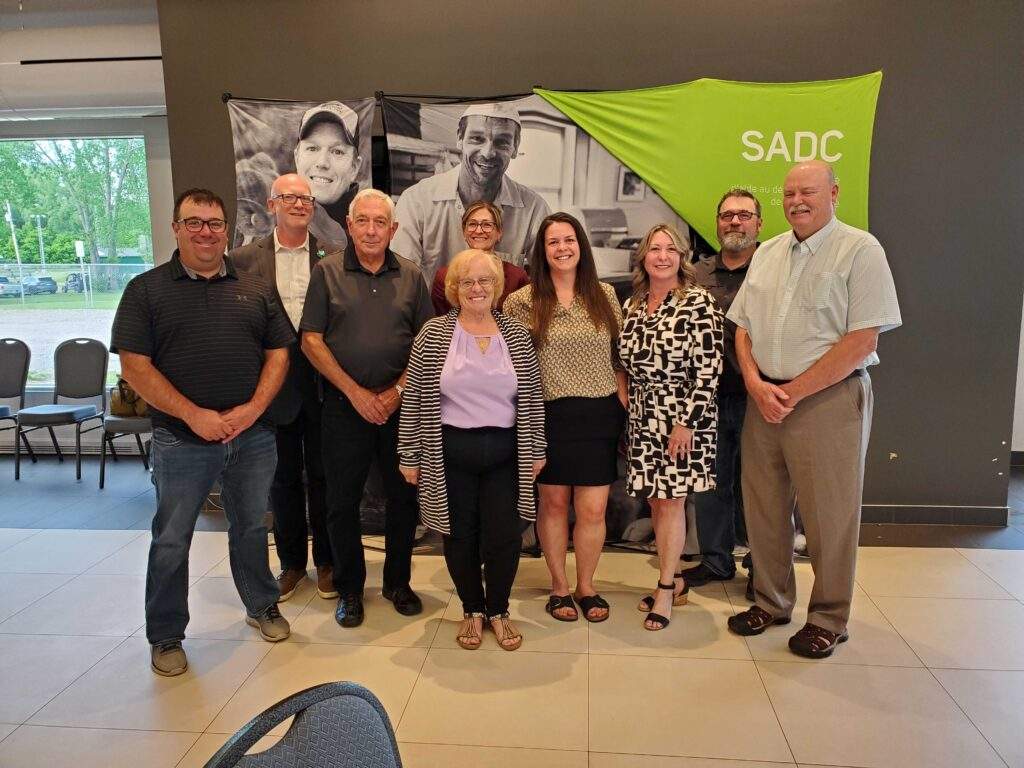
Photo – SADC 2025 board members at the AGM, June 12 L/R: Paul Boivert, Trefor Munn-Venn, Donald Gagnon, Christine Amyotte, Rita Paine, Ellen Bouchet, Rhonda Perry, Terry LaFleur, and Ken Pack.

SADC celebrates 40 years at AGM Read More »

CISSSO sees budget cut scaled back, but challenges remain

Mélissa Gélinas
Local Journalism Initiative

OUTAOUAIS – On May 27, Santé Québec released the new budget for Quebec’s 30 hospital centres. Budget cuts, now set at $925 million, will be distributed based on average operating costs across the province.

Facilities with higher costs, such as Sainte-Justine University Hospital Centre in Montreal, the CIUSSS de la Capitale-Nationale and the CISSS de la Montérégie-Centre, will bear the brunt of the reductions.

The CISSS de l’Outaouais is among the less-affected regions, with its required savings reduced to $45 million, down from the $91 million it had previously been asked to cut. Still, the region’s health centres will face ongoing challenges.

Jean Pigeon, spokesperson for SOS Outaouais, warned that remote areas like Pontiac will feel the impact more acutely. “These cuts make it even harder to attract and retain staff, to maintain local care, and to ensure stable services for the population,” he said.

According to Pigeon, Outaouais is not treated the same as other Quebec regions. “To optimize without compromising care, we need to review some administrative processes and have specific tools to address the unique realities of our border region,” he added.

Currently, the areas most affected by budget cuts are logistics, maintenance and administration. “We’re concerned other services could be impacted if the budget pressure stays the same,” Pigeon said.

The CISSSO has said that staffing levels and the organization’s structure will remain unchanged, noting that previous measures had already addressed the last financial period’s $60 million target.

According to Camille Brochu-Lafrance, communications advisor with CISSSO, concrete steps are being taken—especially in Pontiac—to address the region’s situation. These include strengthening local partnerships for recruitment, supporting housing access for personnel, and boosting regional promotion. “We’re also focused on tailoring working conditions to local realities and improving team stability,” she said. “Maintaining quality care and services for the Pontiac population remains at the heart of our efforts.”

Brochu-Lafrance added that the key to achieving the $45 million in savings will be through better financial resource management. “Budget management is critical, and we are in ongoing discussions with Santé Québec as part of our optimization efforts,” she said.

CISSSO sees budget cut scaled back, but challenges remain Read More »

Working together for the health of the Ottawa River

Deborah Powell
Local Journalism Initiative

OTTAWA RIVER VALLEY – The Ottawa River Concertation Table (TCO) held its third annual water stakeholders’ assembly online on May 29, bringing together nearly 40 participants from across the length of the river.

The TCO’s targeted zone extends from the Première-Chute dam in Notre-Dame-du-Nord, Témiscamingue, to the Carillon dam in Saint-André-d’Argenteuil. It includes the waterway as well as a 1,500-metre strip of land on the Quebec side of the Ottawa River.

The TCO’s mission is “to promote discussion and consultation between stakeholders to attain concerted objectives related to the issues concerning the Ottawa River,” with a vision to “place the river back at the heart of the decisions and concerns of the various stakeholders who have an influence on its integrity.”

TCO coordinator Janie Larivière presented an update on last year’s work, which included tabling an action plan with more than 80 items. She noted the plan is constantly evolving as new priorities emerge. The TCO also began a stakeholder tour, visiting 20 municipalities and collecting local concerns through surveys. This outreach will continue in the coming year, including work with stakeholders on the Ontario side of the river.

Three short partner presentations were also given. Geneviève Michon, TCO president and project coordinator with the City of Gatineau’s Service de la transition écologique, gave an overview of Gatineau’s water management plan. She presented it as a model of what municipalities can do to protect water resources.

Next, Nathalie St-Amour from the Université du Québec en Outaouais (UQO) Department of Social Work spoke about the new regional branch of the Quebec intersectoral flood network (RIISQ) hosted at UQO. RIISQ brings together government stakeholders, socio-economic partners and researchers from all academic fields to improve Quebec’s ability to make science-based decisions for flood preparation and protection. St-Amour emphasized that the branch aims to respond to “real needs,” using research on well contamination after flooding as an example.

The final presentation came from Bianca Bédard of the Abitibi-Témiscamingue regional environmental council (CREAT), who described efforts to prevent the spread of invasive aquatic species by installing boat-washing stations. These are the only effective way to stop boaters—including canoeists and kayakers—from transporting invasive species between waterbodies. Bédard acknowledged that more needs to be done to improve access to these facilities. Jean-François Houle, a biologist from SEPAQ’s Parc national
de Plaisance, also emphasized that all watercraft should be washed after leaving the Ottawa River before entering any other waterway.

Continuing on the theme of invasive species, Pierre-Étienne Drolet from the Lièvre River Watershed Committee (COBALI) invited volunteers to help remove European water chestnut from Lochaber Bay, between Masson-Angers and Thurso, from July 8 to 24.

Detailed information about the TCO’s mandate, structure and work is available at tcriviereoutaouais.ca.

Photo – A mobile boat-washing station being delivered to the Lac Matchi-Manitou Outfitter, east of Val-d’Or, as part of the work of the Abitibi-Témiscamingue environmental council and its partners. (CREAT)

Working together for the health of the Ottawa River Read More »

Hydro-Québec hosts open house on Coulonge substation project

William Dale
Local Journalism Initiative

FORT-COULONGE – Hydro-Québec has begun a major public consultation process as part of its plan to build a new electrical substation—Poste de Coulonge—and a 120 kV transmission line stretching over 30 kilometers from the existing Cadieux Substation in Bryson to a new site in the Coulonge area. This large-scale infrastructure project aims to strengthen the region’s power grid, improve reliability, and support future growth in electricity demand.

The consultation process, which began earlier this year with municipalities in the Pontiac MRC, has now entered a broader public phase. An open house event on May 27 at the Knights of Columbus Hall in Fort-Coulonge invited residents to learn about the project, ask questions, and provide feedback.

“What we’re doing today is part of a comprehensive and ongoing consultation,” Caroline Milliard, a Hydro-Québec spokesperson, explained. “We began meeting with municipal stakeholders early in 2025 and are now inviting the general public to engage with the proposed plan.”

Why the project is needed
The Coulonge substation and transmission line are key to modernizing the aging infrastructure in the region and increasing power system capacity. The existing Cadieux substation, originally built in 1964, has reached its limits.

“This investment will reduce outages and shorten their duration while supporting economic development and the electrification of transportation,” Caroline added.

The new infrastructure will bring high-voltage transmission lines farther north into underserved areas like Fort-Coulonge, Chichester, and Sheenboro—regions that have faced longstanding challenges with power reliability.

Proposed project details

  • Substation location: The new substation will be located somewhere within a defined study zone in the Coulonge area. Criteria for site selection include distance from residential areas, flat and well-drained land, minimal visual impact, and low environmental sensitivity.
  • Transmission line: A new 120 kV line will run from Cadieux in Bryson to the Coulonge area. Hydro-Québec is assessing potential routes based on land use, environmental concerns, and impacts to local landowners and industries such as maple syrup producers.

Consultation timeline and construction
The project is still in its preliminary study phase. No final route or substation location has been selected, but preliminary proposals are expected by fall 2025.

From 2026 to 2028, Hydro-Québec will focus on:

  • Finalizing the route and lot selection
  • Continuing environmental and geological assessments
  • Securing required government authorizations
  • Negotiating with impacted landowners

If all goes according to plan, construction is expected to begin in 2028 and continue through to 2030–2031, when the new infrastructure is scheduled to be commissioned.

Additional upgrades
This project is also tied to upgrades at the Cadieux substation, which will be modernized to support the new line. While the land is already owned by Hydro-Québec, additional regulatory approvals may still be required to proceed.

Community involvement
Hydro-Québec emphasized its commitment to community engagement throughout the process. Over 4,000 letters were sent to residents in the study area, and turnout for the open house included local mayors and citizens from surrounding municipalities.

“We understand our equipment isn’t invisible. But our goal is to do this with the people, not despite them,” said Milliard. “We want to minimize the impact while maximizing the benefits to residents.”

More information, including maps, press releases, and public notices, can be found on Hydro-Québec’s dedicated project website: hydroquebec.com/coulongesubstation.

Photo – Hydro-Quebec Spokesperson Caroline Milliard goes over a map of the study area for the new Coulonge substation project. (WD)

Hydro-Québec hosts open house on Coulonge substation project Read More »

Thorne eyes Shawville/Clarendon fire support amid rebuilding efforts

SOPHIE DEMERS
LOCAL JOURNALISM INITIATIVE

THORNE – Thorne, Clarendon and Shawville are currently discussing a potential extension of the Shawville/Clarendon Fire Department’s service area to include Thorne. According to Shawville Mayor Bill McCleary, Thorne made the request about a year ago and will pay the fire department for access to their services.

“They’re also considering reinstating their fire department. They had issues with recruiting members, as do all small communities, so they’ll be making a deal with a fire chief to try and rebuild their fire department. So down the road, Shawville and Clarendon may not have to provide them with fire services, depending on how successful their rebuild is,” said McCleary.

Until an agreement is made, Throne will continue receiving fire services from Otter Lake.

According to McCleary, the municipality surveyed the fire department to gauge whether there were concerns over receiving more calls; 90% stated they weren’t concerned and would be willing to receive more calls if the service extends to Thorne. McCleary noted the added income from the expansion would be beneficial to the Shawville/Clarendon department.

“Things take time. There are contracts to be reviewed and a lot of discussions and meetings to be had,” said Jessica Ménard, Thorne’s director general, on the progress of the discussions.

Echoing Ménard’s statement, Patricia Hobbs, Clarendon’s director general, said: “Municipalities want to help each other, especially small ones. There would be a monetary advantage of course, but the added advantage is cooperation with other municipalities. Helping smaller municipalities that don’t have a fire department or the resources is the root of it all.”

More information will be available once an agreement is made between the municipalities.

Thorne eyes Shawville/Clarendon fire support amid rebuilding efforts Read More »

Local group advocates for increased accessibility in Shawville’s new apartment buildings

SOPHIE DEMERS
LOCAL JOURNALISM INITIATIVE

SHAWVILLE – A local advocacy group known as the Access Squad is calling for wider doorways in Shawville’s new apartment buildings to improve accessibility for residents with mobility issues.

The Access Squad was created by Olga Ouellet, an occupational therapist with the Centre intégré de santé et des services sociaux de l’Outaouais (CISSSO) – Shawville sector. Ouellet facilitates the group, which consists of people navigating the loss of mobility. She describes it as a therapeutic space that also aims to raise awareness and advocate for accessibility in the community.

“It was brought to our attention that new buildings were being constructed and the doorways weren’t wide enough for people with mobility issues,” said Ouellet. “We want to raise awareness about the needs of our growing population and contribute positively to our community.”

The new apartments are being built by Les Maisons PAJ, a Luskville-based development company owned by Matthieu Jodoin.

“Our apartments are not wheelchair-adapted, but 50% of our units are on the ground floor and have no stairs, making them more accessible for people with reduced mobility,” said Jodoin. “Our mission is to create new, affordable housing for as many people as possible.”

Jodoin explained that making a unit fully wheelchair accessible involves much more than widening doorways or lowering counters. The entire layout must be reconfigured, and several other design considerations must be addressed.

He acknowledged the need for accessible housing and expressed openness to building such units in the future, but said he would require a government partner, such as the Office d’habitation de l’Outaouais (OHM) or a CLSC, to commit to managing or purchasing the building. He added that he is working on a future project that would meet accessibility needs.

Charles Gallant, Shawville’s building inspector, noted that wheelchair-adapted units are typically developed through government programs to ensure they are properly filled. “These units are often tailored to specific needs, and if not occupied by someone using a wheelchair, they can be hard to rent,” Gallant said.

The Access Squad noted that they are not asking for fully adapted units at this stage of construction, but rather for doorways wide enough to accommodate mobility aids such as walkers. Ouellet said she hopes the community can remain mindful of mobility challenges as Shawville continues to grow and develop.

Both Jodoin and Gallant agreed that the responsibility for accessible housing lies with the OHM. “In my opinion, the OHM should be building these types of units,” said Gallant. “But they haven’t built anything in the Pontiac in probably 30 years. There were many grants available to construct new units, but nothing was done.”

The OHM did not respond by press time.

Local group advocates for increased accessibility in Shawville’s new apartment buildings Read More »

Vote or arbitration: postal standoff

Tashi Farmilo & Bonnie James
Local Journalism Initiative

OTTAWA – With mail delays continuing across the Pontiac, the standoff between Canada Post and the Canadian Union of Postal Workers (CUPW) has entered a critical new phase.

On May 30, Canada Post asked the Minister of Labour to authorize a vote on its final offers, aiming to give Urban and RSMC (Rural and Suburban Mail Carriers) members the chance to vote directly on the proposed contracts. The company said that after nearly two years of negotiations, conciliation, mediation, and rotating strikes, a negotiated deal is no longer possible without employee input.

But on May 31, CUPW pushed back, rejecting the vote and instead inviting Canada Post to enter binding arbitration—where a neutral third party would deliver a final and binding decision. “This is the most responsible and effective way to resolve this dispute,” said CUPW National President Jan Simpson, citing the public interest and long-standing bargaining challenges.

Canada Post responded the next day, declining the union’s proposal. In a public statement, the Crown corporation said arbitration would further delay resolution and would remove employees’ ability to decide on their future. The company reiterated that its offers directly reflect the seven recommendations made by the Industrial Inquiry Commission (IIC), which earlier this year concluded that Canada Post is “effectively insolvent” and requires sweeping reform.

The final offer includes a 13.59% wage increase over four years, signing bonuses of $1,000 or $500 depending on classification, elimination of mandatory overtime, and enhancements to cost-of-living allowances. It also features guaranteed hours and benefits for part-time workers and a limited rollout of Dynamic Routing to improve efficiency. Several previously proposed changes—such as reductions to retiree benefits and health coverage for new hire —have been withdrawn.

Despite those concessions, CUPW rejected the offer and rescinded tentative agreements reached earlier this year. The union said it is committed to securing a fair contract and urged Canada Post to act in the best interest of workers and the public by agreeing to arbitration.

Meanwhile, the effects of the impasse are increasingly visible in rural communities like Pontiac. Residents report ongoing mail and parcel delays, sometimes lasting days. The nationwide CUPW overtime ban remains in place, compounding delivery backlogs. In rural areas with limited alternatives, the impact is particularly severe—affecting prescription deliveries, bill payments, small business shipping, and access to important documents.

Canada Post estimates that strike actions—including a 32-day disruption in late 2024 and renewed actions in May—have cost $208 million, contributing to a pre-tax loss of $841 million last year. Parcel volumes have plummeted by two-thirds compared to this time in 2024.

While Canada Post waits for the Minister’s decision on the vote request, CUPW continues to advocate for arbitration. For Pontiac residents, uncertainty remains, and so do the delays.

Vote or arbitration: postal standoff Read More »

Quebec schools to go phone-free this fall

MÉLISSA GÉLINAS
LOCAL JOURNALISM INITIATIVE

QUEBEC – Quebec Education Minister Bernard Drainville announced on May 1 that cellphones will be banned in all elementary and secondary schools across the province starting in September. Schools in the Pontiac will also need to adapt and implement the necessary measures.

According to Drainville, the goal is to promote respect and civility in schools and to provide students with a safe, healthy environment. The new policy complements the Violence and Bullying Prevention Plan introduced in October 2023.

This latest measure builds on an earlier regulation that took effect January 1, 2024, which banned cellphones during class time, with exceptions for health needs, disabilities, or educational use. The upcoming change will expand the ban to cover the entire school day, including breaks and all areas on school property.

“The concept isn’t new to schools in the Pontiac,” said George Singfield, Director General of the Western Québec School Board. “Many of our schools had already implemented cellphone bans in classrooms as of last December.” He believes the new regulation may help students facing bullying.

So far, however, no official directive has been received. “We need more information,” Singfield noted. “Right now, all we’ve seen is media coverage, and we still have many unanswered questions. There should be a transition period.”

One major challenge, he added, will be enforcing the ban across the entire school property. “Some students will go outside and access their phones,” he explained. Dialogue with parents will be important to ensure they understand the purpose of the regulation.

Despite the hurdles, the response from school leaders has been positive. “Some students even said it’s a good idea because it will give them a break,” he added.

Singfield expressed pride in the way school principals have taken the news. “We’ll do our best—even if it’s difficult—to teach students the benefits of this regulation.”

Pontiac High School and Dr. Wilbert Keon School did not respond to the Journal’s request for comment by press time. École secondaire Sieur-de-Coulonge declined to comment on the matter.

Quebec schools to go phone-free this fall Read More »

Waltham standoff ends peacefully, firearm recovered

BONNIE JAMES
LOCAL JOURNALISM INITIATIVE

WALTHAM – Around 7:00 pm on Sunday, June 1, Sûreté du Québec (SQ) officers responded to a call about a man reportedly carrying a firearm while walking along Chemin Nadeau. When police arrived, the man retreated into his home and refused to come out. Officers evacuated nearby residents as a precaution.

Around 2:00 am on Monday, members of the SQ’s Campbell’s Bay detachment entered the residence and found the man hiding inside. A firearm was recovered. The man, in his forties, was taken to the SQ station in Campbell’s Bay and appeared before a judge on June 2. No shots were fired and no injuries were reported.

According to Waltham Mayor Odette Godin, the incident stemmed from a conflict between neighbours that had been escalating over several weeks.

During the standoff, Mayor Godin communicated with residents via a community Facebook group. At 9:00 pm, she warned people to avoid Nadeau and Bechamp Roads, saying “people could get hurt.” An hour later, she clarified that there was no immediate threat to the public, but advised residents to stay away from the area as a precaution. She noted that although the municipality has an emergency alert system, it was not activated because it is typically reserved for natural disasters.

A neighbour commented on Facebook: “This guy, as my neighbour for the last 10 years, has been nothing but kind. He did seem a little troubled, which could happen to any of us. I don’t know the whole situation or what went down, but I’m glad everyone is OK.”

SQ spokesperson Marc Tessier said the investigation is ongoing, and that charges will depend on what is found during the search of the home. Charges were still pending at press time.

Waltham standoff ends peacefully, firearm recovered Read More »

New chapter begins at Pontiac High

NATHAN QUESNEL-GIRARD
LOCAL JOURNALISM INITIATIVE

SHAWVILLE – After three years as principal of Pontiac High School (PHS), Terry Burns is retiring. Burns, who planned to retire a couple of years ago, didn’t expect the adventure coming his way when he applied as an occasional teacher, but landed a one-year contract as a principal at a Val d’Or school. Once his contract ended, he wanted to find a job closer to home and decided to apply for the principal job opening at PHS.

“Everybody understood that by hiring me, a man later in his career, I wouldn’t be here forever. I promised them three or four years when I started, and I kept that promise,” declared the retired principal.

Despite feeling energetic and youthful enough to keep going, many reasons encouraged him to retire.

“I’m going to be 64 years old in June, my wife is a retired schoolteacher and she’s very excited for me to join her in retirement. Also, we’re caring for elderly parents, so it’s important we’re close to their homes to help them,” he explained.

Although he’s leaving the education field, Burns plans on working part-time as a clergyman, a job he occupied before becoming a schoolteacher and principal.

“I won’t be fully retired and slowed down, but my life will be less intense and demanding. Looking after 450 teenagers and 40 staff members requires a lot of energy and focus,” he said.

Administration changes
The chair didn’t remain empty for long as the Western Quebec School Board promoted current vice-principal, Luke McLaren, who has been at PHS since 2007. He started as a teacher, but for the last four years has been vice-principal.

“I’ve been Luke’s loudest cheerleader since we met. We’ve worked together and shared responsibilities for two years. I felt he would be a very wise choice to fill the principal’s shoes,” said Burns.

Bessie Tsatoumas, a former McDowell Elementary principal with 22 years experience in the education field, will now become vice-principal.

The new administration team plans to carry on with the school’s vision.

“In the last few years, the school collectively worked on the Education Project. I was involved in developing it with Mr. Burns, and it’s something we will carry forward as our sort of working guide. Obviously, it can be changed and added to,” McLaren told the Journal.

The new administration assumed their new roles on June 2.

Photo – Luke McLaren (right) now fills the principal’s seat at Pontiac High, as Terry Burns (left) has retired. (DS)

New chapter begins at Pontiac High Read More »

MRC meeting: Solar power, organic waste solutions, and new PPJ bylaw

BONNIE JAMES
LOCAL JOURNALISM INITIATIVE

MRC PONTIAC – The MRC Pontiac’s Council of Mayors held its monthly meeting on May 21 at the MRC headquarters in Litchfield.

Renewable energy production
Council announced their intention to declare full jurisdiction over renewable energy production in the Pontiac, citing a desire to enter the field of solar energy. The Municipal Powers Act allows the MRC to operate a business producing electricity from a renewable energy source. Hydro-Quebec launched a call for tenders for 300 MW of solar energy in May.

The MRC’s jurisdiction over the field would allow strategic collaboration between municipalities and private developers, facilitate large scale renewable energy projects, maximize environmental and economic benefits for local communities, and regulate and manage energy initiatives.

Municipalities have 60 days to opt out of the MRC’s proposed jurisdiction.

Organic waste management
The MRC will issue two calls for interest for organic waste management services by June 15: one for a local composting platform and the other for collecting and transporting organic materials. The resolution states most municipalities are interested in organic waste services and the calls for interest will help provide answers to some of their questions, such as the cost involved in collecting and transporting it, before committing to the management of organic materials.

Changes to PPJ rules
A notice of motion was given for a new bylaw regulating “circulation and proper use of the PPJ”. The current bylaw no longer reflects the evolving uses of the trail, including the growth of cycle tourism, active mobility, and the Vanlife route. The new bylaw will be adapted to new cycle tourism practices, regulate the growing use related to Vanlife (access, parking, services etc.), and align with current territorial policies. The draft bylaw will be presented at a future meeting and posted on the MRC website at that time.

RénoRégion program restored
Kim Lesage, MRC director general, announced that Housing Minister France-Élaine Duranceau has decided to relaunch the RénoRégion program with an envelope of $9.2 million for the 2025-2026 year. The decision follows push-back from the Quebec Federation of Municipalities (FQM), MRCs, and municipalities. Hundreds of resolutions calling for the program’s restoration had been sent to the minister.

RénoRégion is a financial assistance initiative by the Société d’habitation du Québec (SHQ) to help low- and moderate-income homeowners in rural areas undertake essential renovations to correct major defects in their homes. The program was initially cancelled under the new provincial budget.

Lesage said the MRC hasn’t been told how much funding they will receive for the year. The program is funded by the provincial government and administered by the MRC.

Dumont Beach welcome station
Visitors to Dumont Beach in the unorganized territory will soon be greeted by a new welcome station manned by volunteers from Les Amis du lac Dumont, who are responsible for the site’s cleanliness, safety, and accessibility. The new station will inform users about the rules, ecological practises, and community initiatives. It will also serve as a coordination point for volunteers managing the site’s daily operations.

The group hopes the station will provide a visible presence to deter and prevent undesirable behaviour. The station will be an Amish home-style structure built on a trailer frame to allow mobility. The structure will be owned by the MRC and funded from the TNO budget.

MRC meeting: Solar power, organic waste solutions, and new PPJ bylaw Read More »

Otter Lake Community Assembly formulates action plans

CATHY FOX
LOCAL JOURNALISM INITIATIVE

OTTER LAKE – The Otter Lake Community Assembly met for their first working session on May 10 at the Otter Lake RA Centre. The grassroots effort to foster greater community collaboration and engagement was spearheaded by local resident Thomas Villeneuve. With a vision rooted in inclusivity and consensus-based decision-making, Villeneuve invited neighbours to participate in public sessions to share their hopes, concerns, and ideas for the community’s future.

Villeneuve believes that by forming a community group committed to consensus, residents can ensure all voices are heard and decisions are well-explained before any proposal reaches municipal council. This approach, he hopes, will reduce frustration often expressed at council meetings, where residents sometimes feel excluded from the decision-making process.

Villeneuve acknowledges some initiatives may overlap with existing community service clubs. However, he sees the group’s role as complementary — helping these clubs become more visible and accessible while strengthening the fabric of community involvement.

Villeneuve and fellow organizer Kris Lafleur introduced a method for selecting three projects from a list of five categories. This follows an earlier brainstorming session which produced over 80 creative suggestions when participants were encouraged to “dream big”, and their ideas were posted across five project boards, categorized by theme and interest.

Attendees first reviewed the bulletin boards. The room was then reconfigured into a large circle, promoting open dialogue. Each participant voiced their primary interests and listed the skills they could contribute to each project. This collective skill inventory helped determine which initiatives were most feasible.

The final projects decided on were a tree giveaway, a community garden, and a collaborative group to support the municipality’s 150th anniversary committee. The community assembly itself is intended to dissolve once working groups for each chosen project are formed, allowing residents to shift from planning to action.

Photo – Otter Lake Community Assembly organizers Kris Lafleur (left) and Thomas Villeneuve at the organization’s first meeting, May 10, at the Otter Lake RA Centre. (CF)

Otter Lake Community Assembly formulates action plans Read More »

Vaillancourt bids farewell after 19 years at MRC

Bonnie James
Local Journalism Initiative

MRC PONTIAC – Annie Vaillancourt, Director of Finance and Administration for the MRC Pontiac, is leaving the county after 19 years of service. She has accepted a new position
as Treasurer and Deputy Chief Administrative Officer (CAO) for the Township of Laurentian Valley in Ontario. Her last day at the MRC will be May 23.

In an interview with the Journal, Vaillancourt said that although she loved her work and colleagues at the MRC, she was ready for a change and a new challenge. While her new role will be similar to the one she’s leaving, she said she looks forward to learning the municipal landscape in Ontario.

“There are a lot of things I enjoyed about working at the MRC,” she said. “I’m an accountant—I like the numbers, the financial part. I enjoy preparing data and preparing the audit.” She also highlighted the teamwork and strong working relationships: “It makes the days go by fast, and it’s a fun place to work.”

Vaillancourt noted the MRC’s significant budgetary growth over the past decade. “The MRC is receiving more and more funding because the provincial government is delegating more responsibilities to MRCs and municipalities. These new files often come with envelopes,” she explained. She pointed to growth in departments like economic development and waste management, which expanded from one staff member to three during her tenure. “Growth always affects the finances. The more people there are, the more work there is to manage, and the more numbers there are to work with.”

When asked what she was most proud of, Vaillancourt said she was glad to have supported colleagues with the financial side of their projects. “It’s always rewarding when we can make things happen.” She also expressed pride in having managed the additional responsibilities delegated by the provincial government. “That alone has been a challenge, and we’ve made it work.”

She offered a few words of advice for her successor: “Be open to change and to learning new things. Stay up to date and ask questions. Maintain good relationships with council and your colleagues.”

The position of Finance Manager is currently posted on the MRC website. The deadline for applications is June 6.

Photo – Annie Vaillancourt is leaving the MRC after 19 years of service. (MRC Pontiac)

Vaillancourt bids farewell after 19 years at MRC Read More »

Upgrades underway at Pontiac long-term care with MNA support

Tashi Farmilo
Local Journalism Initiative

SHAWVILLE – The long-term care unit at the Pontiac Community Hospital is undergoing a series of upgrades to improve daily life for residents and families: building a patio, an accessible shower for residents with limited mobility, and a new family room. The Pontiac Community Hospital Foundation (PCHF) is coordinating the funding for the upgrades.

Pontiac MNA André Fortin supported the project via a personal financial donation of an undisclosed amount to the PCHF saying that the upgrades align with his commitment to supporting seniors and health infrastructure in the region.

“They’re important projects because they directly improve the living environment for residents and their families,” Fortin said. “A family room or patio offers a space for residents to connect with others, socialize, and share important moments with loved ones and volunteers. That has a real impact on quality of life.”

He also emphasized the practical benefit of the accessible shower for both residents and staff. “This equipment allows the care team to do their work in a safer, more adapted environment,” he said.

According to CISSS de l’Outaouais, the projects are part of a broader plan to enhance care conditions in long-term care settings across the region, given the aging population and rising complexity of care needs.

Upgrades underway at Pontiac long-term care with MNA support Read More »

Shawville session empowers patients to speak up

Dale Shutt
Local Journalism Initiative

SHAWVILLE – Do you know your rights when it comes to health and social services in the Outaouais? Your right to access services, receive clear information, participate in decisions, and, if necessary, file a complaint when treated unfairly or abusively?

On May 15, at St. Paul’s Anglican Church in Shawville, the Connexions Resource Centre hosted a presentation by a representative from the Complaint Assistance and Accompaniment Centre (CAAP), outlining the services available to users of CLSCs and hospitals in Quebec.

Collette Paré, a complaint advisor with CAAP, explained the organization’s mandate: to help users understand their rights regarding health and social services and to support those who wish to file a complaint against an institution, facility, employee, or professional in the region. Upon request, an advisor can help draft the complaint and provide support throughout the process.

Paré outlined common types of complaints, including difficulty accessing services, lack of follow-up, poor service quality, staff behaviour and attitude, and billing” for hospital or ambulance services. CAAP also assists with complaints of physical or psychological abuse.

Navigating the health care system can be overwhelming, especially when you feel mistreated. Filing a formal complaint can seem just as intimidating. During her talk, Paré reassured attendees: “CAAP advisors are there to help. It is your right to complain, and more importantly, complaints help maintain and improve service quality.”

For more information, visit: www.caap-outaouais.ca.

Shawville session empowers patients to speak up Read More »

Hydro-Québec powers up Pontiac with major upgrade

Tashi Farmilo
Local Journalism Initiative

FORT-COULONGE – Hydro-Québec has unveiled plans to significantly upgrade the electrical infrastructure in the Pontiac. The project includes building a new 120/25-kilovolt substation in the Fort-Coulonge–Mansfield area, reconstructing the existing Cadieux substation in Bryson, and constructing a 30-kilometre, 120-kV transmission line connecting the two substations.

The investment, funded entirely by Hydro-Québec, aims to provide a long-term, stable solution to power reliability issues that have troubled the region for decades. An open house for residents and stakeholders will be held on Tuesday, May 27 from 2 – 8 pm at the Knights of Columbus Hall located at 525 Rue Baume, Fort-Coulonge.

Pontiac MNA André Fortin emphasized the importance of this development, noting that addressing power reliability in the Upper Pontiac and Mansfield areas has been a critical concern since his election. Fortin stated that “residents in the Upper Pontiac who have been underserved for years deserve quality service just like anyone else.” He added that while Hydro-Québec had previously attempted short-term solutions, including vegetation management and system restarts, these did not adequately resolve the frequent outages or their impacts.

“Not having a stable power supply has limited economic development, damaged household appliances, hindered working from home, and caused serious safety concerns, particularly in areas with poor cellular coverage,” Fortin explained.

He recalled a dangerous incident from early 2023 when an Upper Pontiac resident faced a medical emergency during a power outage, highlighting the urgency of stable electricity forresidents’ safety and well-being.

Pontiac Warden Jane Toller expressed optimism regarding the announcement, stating, “I am delighted to announce that after seven years of frequent power outages in MRC Pontiac, a solution to provide dependable hydroelectricity to residents and businesses
has been found.”

Mayor Corey Spence of L’Isle-aux-Allumettes also welcomed the project enthusiastically, describing it as “a long-overdue investment for our region and for the prosperity and well-being of the people who call Pontiac home.” Spence acknowledged the persistent advocacy from local officials, Hydro-Québec staff, and residents who worked tirelessly for this improvement, calling it “their victory.”

The project will proceed in stages: technical and environmental studies, along with public consultations, will occur through 2026. Government approvals are anticipated from 2026 to 2028, construction is planned between 2028 and 2030, and the commissioning of the new infrastructure is expected in 2030–2031.

For further details, visit Hydro-Québec’s project page: www.hydroquebec.com/projects/cadieux-coulonge/

A detailed map of the study area can be downloaded here: www.hydroquebec.com/data/projets/7819_uda_001_Cadieux-Coulonge_250326.pdf

Hydro-Québec powers up Pontiac with major upgrade Read More »

Beds full, Shawville ER backs up

Tashi Farmilo
Local Journalism Initiative

SHAWVILLE – Wait times in the Pontiac Community Hospital’s (PCH) emergency room have increased significantly over the past year, making it the only hospital in the Outaouais to see a decline in its overall emergency care performance. PCH’s overall rating dropped from B- to C.

According to CISSS de l’Outaouais data, the average time patients spent on a stretcher while waiting for bed in the Pontiac rose to 17 hours in 2024–2025, compared to just 7 hours the previous year. The proportion of patients remaining on stretchers for more than 48 hours also increased sharply, rising from 1.5% to 6.2%.

This trend stands in contrast to improvements reported in other regional hospitals. Facilities in Hull, Gatineau, Wakefield, and Papineau saw modest gains, including reduced stretcher wait times and improved scores in emergency performance.

A number of factors contribute to longer delays at the PCH. Pontiac ER traffic has nearly doubled in five years — from 527 users in 2020–2021 to 935 in 2024–2025. While some of the increase reflects local need, part of the demand is from residents of urban centres. According to CISSSO, patients sometimes seek care in rural hospitals to avoid longer waits closer to home.

Bed availability is another ongoing concern. Of the PCH’s 33 active care beds, 14 are currently occupied by patients waiting to be transferred to other levels of care. This shortage of available beds creates a backlog in the emergency room, as new patients cannot be admitted until others are moved.

The region’s aging population adds to the pressure. Older patients often require more complex and longer-term care. At the same time, long-term care placements remain limited, with not enough spaces in seniors’ residences or intermediate care facilities to meet growing demand.

CISSSO says efforts are ongoing to improve patient flow and reduce pressure on emergency rooms. These include tools for monitoring hospital stays and initiatives focused on early discharge planning.

Meanwhile, outpatient visits across all six hospitals in the region rose by about 6% last year, reaching more than 103,000 in total. Despite the higher volume, four of the six hospitals improved their emergency department performance, which CISSSO attributed to the work of local care teams and system-wide efforts.

Pontiac MNA André Fortin is concerned about the growing gap in care between rural and urban communities. He pointed to factors like staffing shortages and insufficient access to clinics as reasons more patients are pushed into emergency departments. He reiterated his call for increased health funding in the region and salary parity with Ontario to help recruit and retain healthcare professionals.

Beds full, Shawville ER backs up Read More »

Another postal strike looming?

Lynne Lavery
Local Journalism Initiative

OTTAWA – There could be another postal workers (CUPW) strike as early as May 22. The Federal government forced an end to the last strike in November/December 2024 and set up an Industrial Inquiry Commission (IIC) in hopes of finding a resolution. At that time, existing collective agreements between Canada Post and CUPW remained in effect until at least May 22, 2025.

The IIC held hearings in January and February with the union’s key issues focused on wages, job security, and working conditions, asking for a 24% wage increase over four years. Canada Post countered with an offer of 11.5%.

Canada Post has said they need to revamp their delivery system to be more competitive, stating, “The changes we’ve proposed are critical to better supporting customers long-term with more affordable, consistent and reliable service.”

Talks broke down in March but recently resumed with the help of a mediator. However, on May 13, Canada Post announced they had paused the talks after what was termed
“several days…without meaningful progress.” The union stated they were not in favour of the pause, and said, “It is reprehensible to keep workers and the public on edge when we should all be focused on negotiating agreements…”

On May 16, the IIC released their report stating, “The parties need to make changes to their collective agreements,” to include the flexible use of part-time employees, creating attractive jobs. It also stated the government should end the moratoriums on rural post office closures and ­ community mailbox conversions, concluding, “The world has changed, and both Canada Post and CUPW must evolve and adapt.”

Unless a negotiated agreement is reached in the next few days, a strike could begin after May 22, marking the second major postal disruption in just six months.

In the case of a renewed strike, The Journal will be delivered via multiple drop-off locations in each municipality. Check your local businesses, depanneurs and town halls for a copy or you can read the latest edition free online at www.pontiacjournal.com.

Another postal strike looming? Read More »

Couple loses home in devastating Waltham fire

Peter L. Smith
Local Journalism Initiative

WALTHAM – The Waltham Volunteer Fire Brigade responded to a 911 call Friday evening, April 18, around 8:00 pm at the home of Lynn Dempsey and Dan Amyotte at 648 Highway 148. Neighbours saw smoke and alerted Lynn and Dan, who were inside the house at the time. The couple escaped without injury.

When firefighters arrived, the garage and workshop were fully engulfed in flames, and the fire had spread to a forested area behind the property. Waltham responded with a tanker, pumper, and rescue vehicle, and immediately called for assistance from the Pontiac Ouest Fire Safety Service and Mansfield Fire Department. Crews remained on site until 3:50 am Saturday morning.

Dan had been working in the garage shortly before the fire and believes it may have started in the ceiling after he left.

The fire spread to the house and backyard, destroying an ATV, pontoon boat, tools, and more. Everything inside the house was lost, including treasured memories from both families.

Lynn, a longtime supporter of Animal Aide Pontiac, has received community support. Katherine Morris of the organization set up a GoFundMe page. Through generous donations, $5,200 was raised to help purchase a used fifth-wheel trailer for the couple to live in on-site while they deal with insurance and cleanup. An additional $1,800 has already been raised to complete the purchase.

Many people have dropped off donations for the couple, and the GoFundMe page (https://gofund.me/caa6fef4) remains open for contributions.

Photo – Lynn Dempsey and Dan Amyotte of Waltham lost their home in a devastating house fire, April 18. (PS)

Couple loses home in devastating Waltham fire Read More »

St. Paul’s Anglican Church vandalized on Easter Sunday

MÉLISSA GÉLINAS
LOCAL JOURNALISM INITIATIVE

SHAWVILLE – Easter Sunday took an unexpected turn for St. Paul’s Anglican Church in Shawville when Reverend Eric Morin discovered the church had been vandalized early that morning (April 20).

“The word that comes to mind is disappointment,” said Rev. Morin. “I find the situation sad and unfortunate, especially because it happened on Easter Sunday, our most important celebration of the year.”

“When I arrived at the church for service around 10:30 am, I saw the damage that had been done,” he explained. “The light fixture that illuminates the back door had been ripped out, the surveillance camera was gone, the basement window had been smashed, and the words ‘No fate’ were carved into the front door with a knife.”

The church’s alarm system was triggered when the window was broken. Around 5 am, officers from the Sûreté du Québec (SQ) in the Pontiac MRC detachment responded to the call. “We went to Main Street in Shawville in connection with a mischief complaint,” said SQ media relations officer Marc Tessier. According to Tessier, the window may have been smashed with the broken door handle. However, no one is believed to have entered the building.

Rev. Morin said he does not yet know the estimated cost of the damage but suspects it will exceed the insurance deductible. “We probably won’t receive full compensation from insurance to cover all the repairs,” he noted. “We’re currently in the process of taking the necessary steps. Following this incident, we’ll be looking into additional security measures.”

As of now, no suspects have been arrested and the investigation is ongoing, according to Tessier.

Photo – Plastic covers the basement window of St. Paul’s Anglican Church in Shawville, which was vandalized on Easter morning. (DS)

St. Paul’s Anglican Church vandalized on Easter Sunday Read More »

Community Players host AGM: new plays, new places

DALE SHUTT
LOCAL JOURNALISM INITIATIVE

SHAWVILLE – To conclude a successful 2024 season, the Pontiac Community Players (PCP) held their Annual General Meeting, April 26 at the Continuing Education Centre.

After presenting the annual report, President Greg Graham outlined several new initiatives and equipment upgrades, made possible through funding from the MRC’s Regions and Rurality Fund (FRR), MNA André Fortin, and the Municipality of Bristol. These upgrades include portable sound and lighting systems, which will support the group’s upcoming 2025 “Theatre in the Park” series — a travelling outdoor production.

“We are all about telling stories,” said Graham. A second new initiative for 2025, An Evening with History, will feature performances based on the personal stories of local historical figures. These productions are slated for Bristol, Ladysmith, Quyon, and Shawville.

In 2024, PCP staged three productions: one at Coronation Hall in Bristol, another at Pontiac High School in Shawville, and a live radio play at the United Church in Quyon. Looking ahead, the group plans to broaden their audience by reaching out to venues in the Upper Pontiac and Fort-Coulonge. They also aim to offer theatre workshops later this year.

The financial report revealed a 40% increase in ticket sales over the previous year. PCP donates a portion of its ticket revenue to performance venues and awards an annual bursary to a Pontiac High School student with a passion for theatre. The 2024 recipient, Ollie Côté, is currently studying Theatre at John Abbott College.

The meeting concluded with the election of the 2025 board of directors. Returning members Greg Graham, Will Bastien, Val Twolan-Graham, and Marguerite Carmichael were confirmed, with Rick Valin joining as a new director.

Community theatre has long been a part of Shawville’s cultural life. The Pontiac Community Players, now a registered non-profit, have been entertaining audiences under that name since 2000 — and show no signs of slowing down. Graham encouraged anyone interested in participating to reach out via their Facebook page.

Photo – Pontiac Community Players Board L/R: Marguerite Carmichael, Will Bastien, Val Twolan-Graham, Greg Graham, Rick Valin. (DS)

Community Players host AGM: new plays, new places Read More »

Chamber of Commerce opens new office in Fort-Coulonge

Tashi Farmilo

LOCAL JOURNALISM INITIATIVE

FORT-COULONGE – The Pontiac Chamber of Commerce moved into its new office in a familiar building in Fort-Coulonge on May 1, marking a key step in a broader local revitalization initiative.

The Chamber will occupy part of the former Caisse Desjardins building, recently acquired by local resident and entrepreneur Sébastien Bonnerot. The building became available in June 2024 and since then, he has been working to transform the site into the “Pontiac Business Hub” — a centre for shared professional office space aimed at addressing the town’s dwindling commercial services and encouraging new business activity.

“We’ve lived in Fort-Coulonge since 2017 and have been focusing on launching structuring projects to help revitalize our beautiful village,” said Bonnerot. “With the departure of several businesses over the years and the limited availability of professional services, this is a step toward reversing that trend.”

The new hub will feature six private offices available for annual lease — three are already rented — as well as a shared space designed for young entrepreneurs, a common conference room, and a kitchenette. Alongside the Chamber, confirmed tenants include a notary and Century 21 real estate.

The project received financial support from the MRC Pontiac through the Regions and Rurality Fund (FRR) – Stream 4, while the acquisition of the building was privately funded.

“This is about building a vibrant professional community in Fort-Coulonge,” said Bonnerot. “We want to offer professionals a base to open a satellite office or to launch new services locally — without prohibitive costs.”

Photo – On May 1, the Chamber of Commerce opened an office in the new Pontiac business hub, located in the old Desjardins building, in Fort-Coulonge. (BJ)

Chamber of Commerce opens new office in Fort-Coulonge Read More »

Norway Bay pier could reopen this summer

Deborah Powell
LOCAL JOURNALISM INITIATIVE

BRISTOL – Marjorie Groulx-Tellier, Bristol building inspector, presented a summary of the most recent engineering report for the Norway Bay pier, April 7, at the municipality’s regular council meeting. The report was from WSP Engineering, the company mandated last fall to study the thickness of the steel on the structure, its verticality, as well as the riverbed.

Council closed the pier in March 2024 for safety reasons after receiving a report from W.F. Baird & Associates Coastal Engineers Inc., the company first engaged to study the pier in 2023. Council then accepted the recommendations of the Bristol Pier Committee, made up of elected officials and community members, to pursue the rock revetment pier stabilization option Baird proposed. The method would’ve consisted of piling rocks in a slope against the structure to protect against wear and damage from waves and ice. A geotextile membrane would have be used to contain the existing structure, preventing further leakage of the fill it contains.

However, over the summer, the Pier Committee decided to get a second opinion and, on their recommendation, council approved the WSP study. “The committee and council were relieved to find a Quebec firm interested in this project. We worked really hard to find one with the experience to handle such an undertaking,” said Councillor Valerie Twolan-Graham.

The $39,000 expense was covered by MRC Pontiac’s Regions and Rurality Fund (FRR 2) with a 20% contribution from the municipality. The Pier Committee also successfully obtained about $70,000 through the FFR 1 program for design work and project management to pursue pier revitalization.

In addition to the technical results of their study, the recent report from WSP Engineering lays out a timeline for pier repairs. In order to open this year, the sink holes on the walkway must be fixed, no heavy equipment can be allowed on that part of the pier and safety ladders must be repaired or new ones installed. It’s recommended that repairs to the actual structure be done in the next 2 to 4 years. Beyond 4 years, the structure will become unsafe, according to WSP. Of the possible solutions, WSP recommends adding a new facing of fibre reinforced plastic (FRP) panels to the existing structure, extending its life for about 30 years.

The Pier Committee will be meeting again soon to further examine the WSP report and recommendations and make quick plans to hopefully allow the pier to open this season.

Photo – The Norway Bay pier may be able to reopen this summer after council
received a second opinion on the structure’s condition. (DP)

Norway Bay pier could reopen this summer Read More »

From campaign tips to council truths: Women share the path to politics

Cathy Fox
LOCAL JOURNALISM INITIATIVE

MRC PONTIAC – Two events held in late April shed light on the path to entering municipal politics, offering both campaign advice and insight from officials currently in office.

The first session, held April 26, was hosted by Shawville mayoral candidate Linda Davis. Joined by Otter Lake Mayor Terry Lafleur and Rapides-des-Joachims Mayor Doug Rousselle, the trio shared their experiences with an audience of about 20 attendees. Topics included the nomination process, campaign budgeting, understanding municipal structures, and how to navigate local issues and media.

Davis, who has previously run for council, said she was motivated to organize the session to demystify the process. “A lot of people assume you need to have a background in politics to run, but that’s not true,” she said. “We need more people with diverse experiences at the council table.”

Rousselle emphasized the importance of good communication and accountability. “Residents don’t expect you to solve every issue, but they do expect honesty and follow-through,” he said.

Lafleur encouraged participants not to let fear hold them back. “I was terrified the first time I ran,” she admitted. “But you learn, and you realize you’re not doing it alone. Staff, councillors, and community members are there to support you.”

A second session, held April 29 in Fort-Coulonge, was hosted by MRC Pontiac and the Table de développement social du Pontiac. This workshop was geared specifically toward women interested in running in the 2025 municipal elections.

Organizers said they hope to see an increase in women elected to council seats across the MRC. Currently, only 5 of 18 mayors in the MRC are women. The workshop featured an all-women panel of elected officials including Otter Lake councillor Jennifer Dupuis, Rapides-des-Joachims Mayor Doug Rousselle, Mansfield councillor Chantal Lair, and Waltham Mayor Odette Godin.

Each panellist shared her journey into politics, the challenges faced, and what keeps them motivated. They also answered questions from participants, who ranged in age from 20 to 60.

“You don’t have to know everything,” said Lair. “But you do have to be willing to listen and learn.”

Godin added that the work can be demanding, but incredibly rewarding. “Seeing projects completed, hearing people say thank you—it makes it all worth it.”

Organizers say more sessions may be planned leading up to the November 2025 elections.

Photo – From left: Jennifer Dupuis, Odette Godin, Doug Rousselle, Chantal Lair, and Linda Davis participated in local workshops encouraging political engagement, particularly among women. (CF)

From campaign tips to council truths: Women share the path to politics Read More »

One in four: Pontiac seniors lead Outaouais demographic shift

Tashi Farmilo
LOCAL JOURNALISM INITIATIVE

GATINEAU – Pontiac sen­iors are experiencing the­ realities of an aging popula­tion sooner than others. According to a newly released public health report, the Outaouais stands out in several key ways: a high concentration of English­-speaking seniors, a signifi­cant Indigenous population, and low levels of formal edu­cation among older adults.

The report, État de santé de la population âgée de­ 65 ans et plus en Outaouais, published by the CISSS de l’Outaouais, was launched April 29 at a press confer­ence in Gatineau, where the speakers included Dr. Marc Bilodeau, Isabelle Léger, Dr. Brigitte Pinard, Dr. Camille Paquette, and Patricia Gougeon. During the event, the public health officials emphasized that Pontiac ­represents one of the few areas where demographic thresholds—like having nearly one in four residents aged 65 and older—have already been reached. The rest of the Outaouais isn’t expected to reach that level for several more years, ­making Pontiac a critical test case for the region’s ability to support healthy aging.

Speakers stressed that while Pontiac’s demographic profile is distinct, its ­challenges are emblematic of broader regional issues. In Pontiac, 64% of people over 65 speak English most often at home, far above regional averages, and 12% of seniors identify as Indigenous—more than double of what’s seen across the wider Outaouais. Nearly 39% of older Pontiac adults don’t hold a high school diploma, one of the highest rates among the region’s five health networks.

These characteristics intersect with several chal­lenges highlighted in the report. Across the Outaouais, more than 64% of seniors ­are classified as physically ­inactive, and one in four have diabetes. Hypertension affects half of the region’s older population, rates of psychological distress remain concerning, and nearly one in ten seniors report feeling socially isolated.

Access to basic needs continues to be a significant concern: 18% of senior-led rental households face seri­ous housing challenges, and one in ten seniors in the region reported experiencing food insecurity in 2022.

Dr. Pinard acknowledged that data specific to Pontiac remains limited for some health indicators. Targeted local consultations are planned for May. They will be part of a series of regional meetings focused on identi­fying community-specific priorities and advancing report recommendations to create environments that are healthy, inclusive, and ­supportive of ageing at home.

The report concludes that supporting healthy aging across the Outaouais will require sustained coordina­tion between health ­services, municipal leaders, community organizations, and seniors.

Photo – At a press conference in Gatineau, Dr. Marc Bilodeau, Isabelle Léger, Dr. Brigitte Pinard, Dr. Camille Paquette and Patricia Gougeon presented a new public health report highlighting Pontiac’s unique aging challenges and the need for community-based action. (TF)

One in four: Pontiac seniors lead Outaouais demographic shift Read More »

MRC fights to revive RénoRégion program amid uncertainty

Tashi Farmilo
LOCAL JOURNALISM INITIATIVE

MRC PONTIAC – The MRC Pontiac is calling on the Quebec government to reverse its cancellation of the RénoRégion program, which helped owner-occupants with limited means—many of them elderly or single-parent households—carry out renovations to address major structural deficiencies in their homes. Between 2023 and 2025, more than 35 renovation projects in the Pontiac received $640,000 in total funding under the program.

Despite the program’s impact, the province announced its termination earlier this month, prompting widespread concern from local officials. Citing privacy concerns, the MRC declined to release the number of people currently on the program’s waiting list in the Pontiac.

Without provincial backing, the MRC said it can’t provide an alternative. “The MRC only manages the application and approval process. We don’t have the financial resources to replace a program that’s exclusively the responsibility of the provincial government,” said Jane Toller, Pontiac warden.

The MRC is working with the Conférence des Préfets de l’Outaouais and encouraging local municipalities to adopt resolutions urging the government to reinstate the program. Toller noted a recent comment by the Minister on social media suggesting a willingness to “resolve the situation quickly.”

“We remain fully available to collaborate with stakeholders, and we look forward to a positive outcome as soon as possible,” concluded Toller.

As of April 23, the MRC hadn’t received an official response from the Housing Minister following its request to maintain the program.

MRC fights to revive RénoRégion program amid uncertainty Read More »

No signal: Outaouais excluded from province’s cell coverage plan

Mélissa Gélinas
Local Journalism Initiative

OUTAOUAIS – A $25 million investment is planned to improve Quebec’s cellular network in 2025–2026 through the addition of new towers. However, the Quebec government recently announced that the Outaouais region will be excluded from the provincial cellular coverage plan.

“Six months ago, I attended a conference held by the Quebec Federation of Municipalities (FQM) where I learned that the plan to roll out cellular service would cover the entire province, according to Premier François Legault’s promise to do so by 2026,” said Jane Toller, warden of the Pontiac MRC. “I later found out that the Outaouais had been excluded from that timeline and that the rollout [in our region] would likely happen in 2027 or 2028.”

Toller called the situation unacceptable, pointing out that several municipalities, including Waltham, have no cellular service at all. “It’s especially concerning when it comes to emergencies,” she said. “For example, there’s no coverage while driving along [some sections] of Highway 148, and that’s a serious issue.”

She also noted similar problems on Highway 105 and in Maniwaki, where the network is unreliable.Despite this, the Quebec government continues to claim that the Vallée-de-la-Gatineau has the same level of cellular service as the rest of the Outaouais. But according to Chantal Lamarche, warden of the Vallée-de-la-Gatineau, officials and elected representatives in Quebec City are unaware of the reality and complexity of the region’s geography outside of the City of Gatineau.

“As members of the Outaouais Wardens’ Conference (CPO), we will be submitting a resolution to the Quebec government calling for equitable cellular service across the region and for the rollout to take place by 2026,” said Toller.

The Minister responsible for both communications and the Outaouais, Mathieu Lacombe, did not respond to the Journal’s requests for comment.

No signal: Outaouais excluded from province’s cell coverage plan Read More »

MRC Pontiac launches free online rental platform to address housing needs

Tashi Farmilo
LOCAL JOURNALISM INITIATIVE

MRC PONTIAC – To simplify housing searches and address growing residential needs, the MRC Pontiac has launched a free online platform centralizing rental listings across the region.

The platform, available at logement.mrcpontiac.qc.ca/en/, allows landlords to post properties and tenants to search for accommodations. Officials say the initiative responds to long-standing difficulties navigating fragmented listings previously scattered across community boards, Facebook groups, and classifieds.

“There’s a real lack of centralised housing [listings] in the Pontiac,” said Rachel Soar Flandé, economic development officer for housing at the MRC. “This platform was created to be free, user-friendly, and accessible to all.” The MRC reports that housing inquiries are frequent among local employers, organisations, and residents—especially those seeking better accommodations or relocating. In a tight market, information often reaches tenants too late, when units are already rented.

Landlords must create an account to post, update, or remove listings. The MRC will monitor activity to ensure appropriate use, focusing on medium and long-term rentals to promote stable settlement.

Users can also access links to the 18 municipalities, the MRC Pontiac, Destination Pontiac, the Administrative Housing Tribunal (TAL), and information on renovation and financing programs.

The MRC urges landlords to post units promptly to meet growing regional demand.

MRC Pontiac launches free online rental platform to address housing needs Read More »

CISSSO faces backlash for $216 M in private sector spending

Tashi Farmilo
Local Journalism Initiative

OUTAOUAIS – The Outaouais health authority (CISSSO) is spending over
$216 million a year on private sector services — a move unions criticize as harmful to the public system, while the agency defends it as necessary to ensure patient care during staff shortages and resource gaps.

CISSSO’s annual financial report shows a large portion of the spending goes toward
private service contracts, including specialized medical clinics, group homes, home care, and reimbursements for care provided outside the province. Another $17 million is spent on hiring independent workers like nurses and respiratory therapists when public staff aren’t available.

Union leaders say this level of private spending undermines the public health-care system and makes it harder to attract and keep qualified staff. “This is an organized dismantling of our public services,” said Alfonso Ibarra Ramirez, president of the Outaouais chapter of the Confédération des syndicats nationaux (CSN). “We’ve seen policies that encourage privatization and underfunding, and now we’re all paying the price.”

CISSSO claims the goal isn’t to privatize healthcare, but to maintain services when public resources are stretched. The region faces challenges like workforce shortages, wait lists, and limited operating space in hospitals — all of which make it harder to meet patient needs without external help.

“For example, we sometimes rent space and surgical teams from private clinics to
perform procedures we can’t currently do in-house,” said CISSSO spokesperson Qeren Boua. “These agreements help reduce wait times and ensure patients get the care
they need, especially those who don’t require hospital stays.”

Boua noted CISSSO has reduced its use of independent labour by nearly 50% in recent months, and continues to focus on recruiting staff locally and internationally while
investing in training for current employees.

The Quebec government passed legislation to end the use of independent health workers by 2026. CISSSO will be among the last regions to implement the change, but says it’s on track to meet the target.

Meanwhile, CSN called for the public system to be fully “weaned off” private sector reliance by May 1, 2025. In a press release, union leaders warned privatization increases costs for taxpayers and puts essential public services at risk.

“Everyone loses with subcontracting,” said Alain Smolynecky, president of the Outaouais health workers’ union. “We lose skilled workers to the private sector, and the public pays twice — through taxes and through private fees.”

CISSSO faces backlash for $216 M in private sector spending Read More »

Pontiac–Kitigan Zibi remains Liberal with 55% of the vote

Mélissa Gélinas
Local Journalism Initiative

PONTIAC – More than 58,838 voters in the Pontiac–Kitigan Zibi riding cast their ballots in the federal election held on Monday, April 28. With a total population of 111,138, the voter turnout was approximately 53%. The majority of votes went to the Liberal Party of Canada, with incumbent Liberal MP Sophie Chatel winning 55% of the vote.

“I am deeply grateful to the people of the Pontiac–Kitigan Zibi riding for placing their trust in me to represent them,” said Sophie Chatel. “Our region and our country face major challenges, and now is the time to unite and work together,” she added.

Chatel said her four priorities returning to parliament are:
• Working to remove interprovincial trade barriers, both at the federal level and between Quebec and Ontario.
• Prioritizing the processing and sale of agri-food products and ensuring the sector can reach its full potential.
• Securing funding for recreational tourism initiatives.
• Building housing using locally sourced wood.Results by party in Pontiac–Kitigan Zibi
• Liberal Party of Canada – Sophie Chatel: 32,149 votes – 55%
• Conservative Party of Canada – Brian Nolan: 16,174 votes – 28%
• Bloc Québécois – Suzanne Proulx: 6,099 votes – 10%
• New Democratic Party – Gilbert W. Whiteduck: 2,990 votes – 5%
• Green Party of Canada – Claude Bertrand: 750 votes – 1%
• People’s Party of Canada – Todd Hoffman: 676 votes – 1%

National results by party
Across Canada, over 19.5 million voters participated in the 2025 federal election, representing a turnout of 69%.
• Liberal Party – Mark Carney: 44% – 169 seats
• Conservative Party of Canada – Pierre Poilievre: 41% – 143 seats
• Bloc Québécois – Yves-François Blanchet: 6% – 23 seats
• New Democratic Party – Jagmeet Singh: 6% – 7 seats
• Green Party of Canada – Elizabeth May: 1% – 1 seat
• People’s Party of Canada – Maxime Bernier: 1% – 0 seats

Mark Carney has thus won the federal election and will serve as Canada’s new prime minister. He will lead a Liberal minority government. As long as the minority government does not lose a vote of confidence (which is determined by the support of the House of Commons), it may remain in power until the end of its mandate.

According to the Parliament of Canada website, confidence votes include votes on the budget and the Speech from the Throne, which outlines the government’s priorities.
If a government loses a vote of confidence, the prime minister and Cabinet must resign.

They may also request that the Governor General dissolve Parliament. In that case,
a general election is held to form a new government. A minority government must gain the support of one or more other parties to pass legislation.

Photo – Incumbent MP Sophie Chatel celebrates her win on election night at the
Chelsea Pub. (Sophie Chatel)

Pontiac–Kitigan Zibi remains Liberal with 55% of the vote Read More »

“As far as we know, we reached the peak…”

Tashi Farmilo
LOCAL JOURNALISM INITIATIVE

PONTIAC – On Friday, May 2, floodwaters from the Ottawa River continued to rise across the Pontiac region, but municipal officials remained cautiously optimistic as they monitored forecasts and prepared for a peak this past weekend.

Roger Larose, mayor of the Municipality of Pontiac, said water levels have risen slightly. “The water went up a little bit on the [flood] plain,” he noted. “As far as we know, we reached the peak on Sunday, May 4.” The municipality—which includes Quyon, Luskville, Breckenridge, and North and South Onslow—has experienced recurring spring floods over the past decade. This year, Larose said, the impact is more on infrastructure than homes. “The main issue isn’t the houses—it’s mostly the roads,” he explained. “Only two or three homes have been seriously affected so far.” Speaking to the Journal on Friday, May 2, he said that he expected to know more by Sunday. “Depending on how much rain we get, I think we’ll be alright.”

In Mansfield, Mayor Sandra Armstrong said staff are closely monitoring river forecasts. Without a formal volunteer system, the municipality relies on direct communication to coordinate support. Some residents are managing their own sandbagging, while others are receiving help from municipal crews and students from École secondaire Sieur-de-Coulonge (ESSC).

Sand, bags, and shovels are available for residents at 32 chemin Lac de la Truite.

As of May 2, chemin Léonard was closed to all but local traffic, while water was encroaching on several other roads, including chemins Grand-Marais, Félix, La Passe, and Thomas-Lefebvre. Armstrong said sand barriers have been placed to protect vulnerable areas. “A few private roads are already flooded,” she noted. “We’ve delivered notices advising residents that emergency response may be delayed, and those choosing to stay were asked to sign a waiver acknowledging the risk.”

Municipal staff are conducting daily inspections of low-lying areas, with updates sent to provincial emergency services to ensure access for school buses and emergency vehicles. While parks remain open, their conditions are being monitored closely.

In Fort-Coulonge, Mayor Christine Francoeur reported relatively stable conditions despite rising water. “More than three-quarters of the municipal park is under water,” she said. “But I don’t think we’ll have any water reaching homes. The roads are okay, I haven’t had to close any.” Francoeur’s main concern is the municipality’s sewage infrastructure. “We’re worried about the pumps, but everything is working normally right now,” she said. “If they fail, there’s a risk of overflow into homes, so we’re monitoring them very closely.”

According to the Ottawa River Regulation Secretariat, minor flood levels have already been reached in several vulnerable areas. Water levels in Lac Coulonge were expected to rise to 108.35 metres by May 4—still below major thresholds. Since the forecast included projected rainfall, actual levels may vary.

“We’re always watching the rain,” Armstrong said. “If upstream areas stay dry, that’s good news for us.”

Residents in at-risk areas are encouraged to stay informed through municipal Facebook pages or real-time updates from the Ottawa River Regulation Secretariat at www.ottawariver.ca/conditions.

Photo – Water encroaches on homes and campers in Fort-Coulonge, May 4. (GF)

“As far as we know, we reached the peak…” Read More »

Pontiac entrepreneurs prep for interprovincial trade

Cathy Fox
Local Journalism Initiative

SHAWVILLE – The Pontiac Community Futures Development Corporation (SADC) and MRC Pontiac hosted an information session on Thursday, April 17, at Café 349 in Shawville, featuring a presentation from the Gatineau-based organization Export Outaouais (EO). The event attracted several business owners interested in expanding their operations, especially in light of the anticipated removal of interprovincial trade barriers.

“All political parties support this initiative, so it’s just a matter of waiting for the new funding guidelines to come down from provincial headquarters before announcements can be made to the local municipalities,” said Rhonda Perry of the SADC.

Two local entrepreneurs with a strong interest were Robert Hodgins, owner of Clean Sip—who noted that 90% of his market is in the U.S.—and Gema Villavicencio, owner of Pure Conscience Farm, who is exploring marketing opportunities in Ontario.

The first presentation, by export advisor Safa Saki, outlined EO’s services, which include in-depth analysis and guidance for businesses aiming to grow beyond their current markets.

The second presentation, by Jean-François Normande of Desjardins Enterprises, emphasized the value of financial support, particularly when entering foreign markets with varying degrees of risk. One tool discussed was “factoring,” a form of insurance that protects sellers against non-payment. In this model, the seller assigns collection responsibilities to Desjardins, which pays out 90% of the invoice value upfront. Once the buyer pays, Desjardins transfers the remaining 10%, minus a fee, to the seller. It’s a form of reverse escrow, where the seller is protected and the buyer can be confident they’ll receive what they paid for.

After the formal presentations, attendees mingled, networked, and exchanged ideas—often the most productive part of such events. A sign near the exit announced: “A grant for agricultural businesses is coming soon. Get ready now.” This upcoming funding may be accessed through EO or independently.

For more information on navigating tariffs and accessing export resources, another event sponsor, Canada Economic Development for Quebec Regions, offers support online at: https://www.canada.ca/en/economic-development-quebec-regions.html.

Photo – Export Outaouais advisor Safa Saki explains the organization’s services at an event at Café 349, April 17. (CF)

Pontiac entrepreneurs prep for interprovincial trade Read More »

Tenants report poor conditions, MRC pushes for solutions

TASHI FARMILO
LOCAL JOURNALISM INITIATIVE

MRC PONTIAC – More than half of renters in the MRC Pontiac say they live without a formal lease and in homes needing significant repairs—findings that paint a troubling picture of housing insecurity in the region and point to growing tension between tenants and landlords.

A housing survey conducted by the MRC Pontiac earlier this year gathered responses from 219 residents, representing 1.5% of the local population. Among the results, 55% of tenants said they didn’t sign a lease and 54% said their homes need repairs, compared to just 25% of landlords who acknowledged the same need. The largest concerns related to roofing, plumbing, windows, and overall interior conditions.

Most renters in the region report household incomes below $50,000, while paying between $500 and $750 per month in rent. Many live in one-bedroom units but say they need larger accommodations.

Rachel Soar-Flandé, the MRC’s economic development officer for housing, acknowledged the challenges and outlined several efforts currently underway. The MRC is encouraging municipalities and developers to use the new survey data in applications for federal and provincial funding, particularly through programs like the Canada Housing Infrastructure Fund (CHIF), which support essential infrastructure expansions for housing projects.

However, some initiatives are already facing setbacks. The RénoRégion program, which supported eco-responsible home renovations, recently lost provincial funding. “The MRC is joining others across Quebec to contest this decision,” said Soar-Flandé.

The MRC is planning an awareness campaign on the importance of formal lease agreements. “The lack of rental properties and a fragmented housing market put tenants in a difficult position,” she said. “They often settle for sub-standard options because supply doesn’t meet demand.”

At the same time, zoning regulations present challenges. When asked about loosening restrictions to allow more residential construction on agricultural land, Soar-Flandé was clear: “Currently, no. All such requests must go through the Commission for the Protection of Agricultural Land in Quebec (CPTAQ), and the process is long and strictly regulated.”

The report identifies families with children and seniors as especially affected by the shortage of affordable, appropriate housing. In response, the MRC has launched a “Famille d’accueil / cohabitation” initiative to encourage residents to rent out available rooms in their homes to newly-arrived immigrants and is preparing to announce a new housing-related project soon.

Soar-Flandé highlighted the MRC’s ongoing role in supporting both private and non-profit developers in navigating time-sensitive funding opportunities. The MRC’s housing resource page is available at mrcpontiac.qc.ca/en/mrc/housing/.

Tenants report poor conditions, MRC pushes for solutions Read More »

Community digs into food challenges and solutions

DEBORAH POWELL
LOCAL JOURNALISM INITIATIVE

SHAWVILLE – It was an evening of learning, sharing, networking, and brainstorming—fuelled by a delicious meal—on April 10 at Little Red Wagon Winery in Shawville. The discussion on sustainable food practices was co-organized by Bouffe Pontiac, the Centre intégré de santé et de services sociaux de l’Outaouais (CISSSO), and the Outaouais Coalition for Healthy Lifestyles.

Attendees were introduced to the working committee: CISSSO community organizers Véronique Lamoureux and Serena Larivière; MRC Pontiac Economic Development Commissioners Danelle Bourque (sports and leisure) and Shanna Armstrong (agriculture); and Kim Laroche from Bouffe Pontiac.

Panelists highlighted different aspects of sustainable food practices. MRC Agri-Food Project Manager Maryse Vallière-Murray opened the discussion by outlining the four pillars of food security—a foundational concept of sustainability—and the challenges facing the Pontiac in achieving it. MRC Environmental Coordinator Nina Digioacchino addressed food waste, encouraged local eating, and pointed to federal government resources offering tips on waste reduction. The third panelist, Kim Laroche, spoke about collaborative efforts with the Jardin éducatif du Pontiac.

Following the presentations, participants broke into three discussion groups to share information, identify local issues, and explore possible solutions.

The event was one of four held across the region, funded by CISSSO as part of its public health program.

Photo – MRC Economic Development Commissioner Shanna Armstrong (left) and Agri-Food Project Manager Maryse Vallière-Murray report the results of their group’s discussion at the Eco-Friendly Food Forum held at Little Red Wagon Winery, April 10.

Community digs into food challenges and solutions Read More »

Major upgrades planned for Pontiac arenas

MÉLISSA GÉLINAS
LOCAL JOURNALISM INITIATIVE

MRC PONTIAC – To continue serving the Pontiac community, Shawville’s arena will undergo major renovations, while upgrades have already started at the Centre de loisirs des Draveurs Century 21 Élite in Fort-Coulonge.

Shawville Arena
The Shawville facility requires work on the walls, exterior metal siding, and insulation. “The floor and refrigeration system also need to be replaced,” said the recently formed Pontiac Arena Fund Committee. “This is a top priority for us.”

A $2-million investment is planned to replace the refrigeration system, pour a new concrete floor, and install insulation beneath the bleachers. “We’ll turn to local organizations, businesses, municipalities, and all levels of government to raise the necessary funds,” the committee said.

To help fund replacement of the two exterior walls, the Municipality of Shawville and the Agricultural Society will partner to contribute more than $50,000 annually.

“We’re grateful for the Pontiac community’s continued support,” the committee noted. “Many families rely on the arena, and we’re committed to ensuring it remains a hub for the region.”

Centre de loisirs Des Draveurs Century 21 Élite
Two major upgrades were recently completed at the Fort-Coulonge arena. “We replaced the condenser system and piping at a total cost of $343,000,” said Christine Bourque, vice-president of the arena committee.

Funding came from the MRC Pontiac, the municipalities of Fort-Coulonge and Mansfield, and a fundraising campaign organized by the committee.

“The second project involved repairing the arena’s exterior, adding new metal siding and insulation,” Bourque added. “That cost $93,000. Our main goal is to ensure the arena remains accessible to the region’s youth and families.”

The committee continues to seek funds to complete future projects.

The committee also secured a set of gently used rink boards from the Arnprior arena to replace its aging 1967 boards. Although not originally budgeted for, the $16,000 purchase was made possible in part by an unexpected $8,000 donation from Pontiac MNA André Fortin’s office. Volunteers helped coordinate transportation and storage of the boards, which will be installed once the ice is out.

A grant from the Ministry for Seniors is helping transform the upstairs hall into a more accessible and welcoming space for seniors. “The funding came through a program we applied for,” said Bourque. Plans include furnishing the room with tables, chairs, a television, stereo system, and games like cribbage and darts. “This will give older residents a place to gather and enjoy social activities,” she added.

“On behalf of the committee, we sincerely thank the community for its ongoing support,” Bourque said. “Thanks to your help, we can continue investing in the arena, which remains the heart of our community.”

Photo – Families enjoy skating at the Shawville Arena during the Winter Carnival, Feb. 8. (Municipality of Shawville)

Major upgrades planned for Pontiac arenas Read More »

MRC meeting: Positive trends in waste management; $100K for the abattoir

Local Journalism Initiative

MRC PONTIAC – The MRC Pontiac’s Council of Mayors held its monthly meeting on April 16 at the MRC headquarters in Litchfield.

Warden Jane Toller announced that this would be the last Council meeting livestreamed on Facebook, due to the platform’s new policy of removing streamed videos after 30 days. Future meetings will be streamed on YouTube at www.youtube.com/@mrcpontiac920, where they will be stored indefinitely.

Another change introduced at the meeting was that mayors, rather than MRC staff, read the resolutions. This shift follows a new bylaw governing meeting procedures passed in March.

Civil security
Council approved the appointment of Civil Security Coordinator Julien Gagnon to the newly created position of Head of Civil Security. The promotion reflects increased responsibilities now falling to MRCs under Bill 50, legislation aimed at strengthening civil protection and
disaster resilience. It requires MRCs to take on greater roles in disaster risk assessment and emergency preparedness, including the development of regional resilience plans.

Environment Committee report
L’Isle-aux-Allumettes Mayor Corey Spence presented an Environment Committee report highlighting encouraging trends in waste management, with a steady reduction in waste production and a significant increase in recycling over the past few years.

Waste per capita dropped from 290 kg in 2021 to 261 kg in 2024, while recycling increased from 57 kg per capita to 72 kg during the same period. In total, the MRC produced 5,181 tonnes of garbage in 2024, down from 5,813 tonnes in 2021. Recycling totals rose from 1,143 tonnes in 2021 to 1,431 tonnes in 2024.

The reduction in waste was credited to greater awareness and prevention efforts.

While overall trends were positive, performance varied by municipality. Portage-du-Fort, Sheenboro, and Fort-Coulonge led with recovery rates above 35%, while Bristol, Rapides-des-Joachims, and Shawville lagged behind with rates of 15% or less. The recovery rate refers to the proportion of waste diverted from landfill through reuse, recycling, composting, energy recovery and other methods.

The report emphasized the need to maintain momentum and improve consistency across municipalities. The Committee plans to pursue greater results through education, better infrastructure, and incentives.

$100,000 for abattoir
The abattoir project is receiving a $100,000 funding boost, thanks to residual funds from the first stream of the Regions and Rurality Fund (FRR 1) dedicated to economic development.

Council’s resolution states the support will “help attract key expertise to lead the revival of the slaughterhouse, ensuring regional outreach and a tailored response to producers’ needs.” Of the total, $80,000 will come from FRR 1 and $20,000 will be provided by the MRC in human resources support.

After the meeting, Warden Toller said the opening of the abattoir has been further delayed due to equipment still on order from Germany. MRC Strategic Communications Advisor Francis Beausoleil said an update on the project is expected this week.

Forestry management funds
Through the Sustainable Forest Management Program (PADF), the MRC has been allocated $141,987 annually for 2024–2025 and 2025–2026. These funds will support sustainable forestry on residual forest lands, improvements to multi-use forest roads, and initiatives that promote forestry development or enhance regional forest strategies.

For 2024–2025, $50,000 will go to the Pontiac Forest Products Producers Board to support resource enhancement and implementation of regional strategies. The remaining $91,987 will be used by the MRC for multi-use road maintenance.

In 2025–2026, the full amount will go toward development of residual forest lands (TPI).

The next Council of Mayors meeting is scheduled for May 21.

MRC meeting: Positive trends in waste management; $100K for the abattoir Read More »

Federal election candidates: Their platforms, issues & promises

Lynne Lavery
Local Journalism Initiative

FORT-COULONGE – Five candidates in the April 28 federal election met for the first time at the Pontiac Conference Centre, April 8, to explain their parties’ positions to a small, invited audience. The session was moderated by François Carrier, former director of CHIP FM, and broadcast the next day; it was a collaboration between CHIP FM, Le Droit and the Regional Association of West Quebecers (RAWQ). The candidates participating were Claude Bertrand (Green Party); Sophie Chatel (Liberal); Brian Nolan (Conservative); Todd Hoffman (Peoples’ Party); and Gilbert Whiteduck (NDP); the Bloc Québecois candidate, Suzanne Proulx was not present.

The candidates introduced themselves and explained why they would be the right choice to
represent the Pontiac-Kitigan Zibi riding in Parliament.

Bertrand spoke of his unique experiences and stressed the Green Party is here to champion
the environment: “The environment is not a hobby!” he stated.

Ms. Chatel spoke about the threats posed by the USA to Canada’s sovereignty and economy; she said Mark Carney, the Liberal leader, has the experience needed to keep Canada strong and united. She added despite these threats there are opportunities here to strengthen Canada’s economy.

Nolan insisted it is time for a change, with the Conservatives’ plan to help with affordability and reducing crime; he stressed that Pontiac’s natural resources need to be transformed locally.

Hoffman said his reputation is transparent and that he has given everything to the community. He noted that Pontiac has suffered economic hardships from globalization and government overreach.

Whiteduck stated that Canada “is not broken”; once we pull together there will be opportunities for Pontiac to thrive, he said, adding the NDP carries the values of working people and cautioned that promises remain only promises until they are put into place.

Dealing with tariffs from the USA
The American threats of tariffs elicited similar responses. Chatel repeated strength and unity are necessary, adding that building infrastructure from east to west to reach export markets in the EU and Asia are necessary. Bertrand said all parties need to work together facing these threats, while Nolan referred again to transforming natural resources into finished products. Whiteduck said standing together for what we believe was proven in the War of 1812. Hoffman, on the other hand, encouraged engaging with the US to create a more integrated North American economy.

Mayor Christine Francoeur of Fort-Coulonge, brought it down to specifics noting that a part required for the town’s water system comes from the States and is now more expensive. Answers to her concerns included re-opening negotiations (Conservative); grants for municipalities (Green); an explanation of how counter-tariffs are decided and must involve municipalities (Liberal); the importance of having potable water (NDP); and the need for government to help municipalities because they don’t have the resources to deal with situations like this (PPC).

Misinformation and supporting local media
Lily Ryan, the Journal’s publisher, asked about the current landscape of misinformation, how that ties into protecting democracy, and the importance of keeping local media thriving. All candidates agreed that local media is very important as it brings people together, keeps them informed on local issues, adding these need public funding to survive.

Agriculture questions
Claude Vallière, president of Pontiac’s UPA, asked about direct federal aid to producers touched by the tariffs, in the form of non-refundable loans. He wanted a guarantee that the aid would be quickly accessible for local farm producers. Bertrand commented that farms can’t be just left to fail, and insurance and grants should help. Chatel agreed on the need to protect farmers, starting with the removal of interprovincial barriers, and listed 3 programs available for farmers, one with support up to $6M. Whiteduck noted there are lots of promises but also lots of bureaucracy, confirming the need for a quick response. Nolan said Tories would give support up to $2M per year, whereas Hoffman warned of farmers falling into the trap of having to repay these loans.

Gema Villavicencio, owner of Pure Conscience Farm, asked about specific support to encourage sustainable agriculture and the equitable distribution of those funds. Chatel responded that they are working on a program with $1.53 million to help farmers with “climate resilience”. She also referenced clean technologies available.

Business and new technology development
Sébastien Bonnerot, president of the Chamber of Commerce asked two questions about economic vitality and business development in the Pontiac. Hoffman expressed the need for widening Highway 148 to increase traffic volume; Nolan agreed adding the need for better cell phone infrastructure. Bertrand disagreed, saying that more roads mean more urban sprawl, and that better public transportation was more important. Chatel repeated the need to remove interprovincial barriers, and to invest in building more homes. Whiteduck cautioned on the need to respect provincial jurisdictions and encouraged looking at new international markets; he also stressed the need to protect biodiversity.

In new technology training, Chatel noted that MRC Pontiac would be one of eight MRCs given priority for development, citing the work done by SADC Pontiac and Economic Development Canada. Whiteduck emphasized the need for training youth and creating good employment opportunities to make them want to stay, while Nolan said his government would invest up to $4 million in trades training; Bertand stressed the need to make more use of AI; and Hoffman said more support and workshops would encourage new entrepreneurs.

Other questions touched on housing, with all promising more funding; on cutting the CBC, with the Conservatives in favour and the Liberals opposed; English language rights within Quebec; the removal of the Carbon Tax and concerns over the nuclear dump proposed upstream at CNL.

Second meeting of candidates
Tuesday, April 15 saw the candidates meet for a second time at the Little Red Wagon Winery, with a small crowd of invitees in attendance. Organized by The Equity and the Chamber of Commerce this meeting was described as “not a debate but a conversation” although there was some sparring between the PCC and Liberal candidates. Questions were similar with the addition of one on healthcare (a provincial responsibility) and another on Canada’s stand on the war in Gaza; most candidates said it was a complex situation and Canada should not intervene, with the exception of the NDP and the Green candidate who called it a genocide.

The Green, NDP and PCC candidates also brought up electoral reform and the need to replace the current first-past-the-post” system for proportional representation. This would reflect the percentage of votes received by each party; example: 10% of the votes equals 10 seats in parliament.

Federal election candidates: Their platforms, issues & promises Read More »

Mapping nature’s pathways in the Outaouais

Dale Shutt
Local Journalism Initiative

CAMPBELL’S BAY – On March 24, the Outaouais Regional Council for the Environment and Sustainable Development (CREDDO) held the second of three public consultations in Campbell’s Bay on the identification of ecological corridors in the region. These sessions give CREDDO a chance to connect with residents who know the land and to gather their insights, expectations, and concerns.

CREDDO is one of 17 regional environmental councils in Quebec. Its mandate is to bring together Outaouais stakeholders to address the region’s environmental challenges.

The current initiative aims to identify and promote the conservation of biodiversity and natural environments across the region. During the meeting, CREDDO presented a map of potential ecological corridors in the southern Outaouais, showing a 15-km-wide band stretching from Sheenboro to Bristol along the Ottawa River.

Under the Government Land-use Planning Guidelines (OGAT), which came into effect on December 1, 2024, MRCs in the Outaouais are required to integrate these ecological corridors into their land-use and development plans.

The mapping project considers the needs of wildlife, agriculture, forestry, tourism, and urban development. Its purpose is to balance various land uses, better connect planning and development, and help sustain the region’s vitality.

The CREDDO team will return in early summer to present its final report. Shortly afterward, work will begin on mapping ecological corridors in the northern Outaouais.

The CREDDO team shares a map of a potential ecological corridor stretching from Sheenboro to Bristol. L/R: Anne Budge, Étienne Parenteau Mauffette, Gabe Berthiaume, and Vincent Cameron Trudel. (DS)

Mapping nature’s pathways in the Outaouais Read More »

Environmental organizations weigh in on nuclear waste map project

Cathy Fox & Deborah Powell
LOCAL JOURNALISM INITIATIVE

OTTAWA — Ottawa Riverkeeper has been contracted by the Canadian Nuclear Safety Commission (CNSC) and Environment Canada (ECCC) to gather feedback on an interactive map that forms part of the Regional Information and Monitoring Network (RIMNet). The initiative, launched in response to public concern over environmental monitoring in the Ottawa River watershed, aims to improve information sharing, document the environmental aspects of nuclear facilities and activities, and build trust with Indigenous communities and the public.

According to the government website, the project will also help CNSC and ECCC integrate existing data and, with consent, include Indigenous knowledge.

The first of two Zoom workshops, held March 18 and 25, began with presentations by environmental advocates. Ole Hendrickson of Concerned Citizens of Renfrew County outlined the history of nuclear weapons and power development along the Ottawa River, recommending the CBC GEM documentary Atomic Reaction for further context. He highlighted areas marked A through J on the map that are currently used for nuclear waste storage.

Brennian Lloyd from Northwatch presented “Burying Uncertainty, Transporting Risks, Trafficking Trouble—How Does it Look for the Ottawa Valley?” She focused on Canada’s Adaptive Phased Management (APM) approach, which calls for isolating used nuclear fuel in deep geological repositories. Lloyd raised concerns about the lack of detail on how waste would be extracted and transported, and the absence of testing related to transport safety, especially for first responders. She noted Canada’s 2020 Emergency Responders Guidebook claims minimal risk without offering a technical basis.

Roseanne van Shie, a member of the Kebaowek First Nation’s environmental consultation team, expressed disappointment that previous concerns raised by Indigenous groups remain unaddressed, despite being invited to participate in the project.

The second workshop, led by ECCC representatives, included an overview of project goals and a hands-on demonstration of the RIMNet interactive map. This first phase of the project focuses on compiling data on current and proposed nuclear facilities within the watershed to improve public understanding, build trust, and promote transparency in environmental reviews.

Participants were invited to suggest ways to improve the map’s accessibility and usefulness. Suggestions included ensuring the data reflects cultural, health, and environmental concerns; adding monitoring sites to better trace water flow impacts; linking to studies on pollutants; providing threshold guidelines; and including a simple legend and downloadable resources.

While designed to support transparency and public understanding, organizers clarified the map is not intended to serve as an active monitoring or regulatory tool.

The workshops provided a framework for continued work in phase one of the three-phase project. ECCC plans to host another public consultation to gather feedback on site improvements before moving to the next phase. A report on phase one is available at open.canada.ca.

Environmental organizations weigh in on nuclear waste map project Read More »

Nuclear lab fights order to consult Kebaowek First Nation

SOPHIE DEMERS
LOCAL JOURNALISM INITIATIVE

OTTAWA – Canadian Nuclear Laboratories (CNL) has filed an appeal to the Federal Court’s February 19 ruling by Justice Julie Blackhawk, which found CNL’s consultation with Kebaowek First Nation inadequate. The consultation concerned the proposed Near Surface Disposal Facility (NSDF) at Chalk River.

The court ordered CNL and the Canadian Nuclear Safety Commission (CNSC) to resume consultation with Kebaowek First Nation. The ruling emphasized that the process must align with the United Nations Declaration on the Rights of Indigenous Peoples (UNDRIP) and uphold the standard of free, prior and informed consent (FPIC).

The new consultation was originally set to be completed by the end of September 2026. CNL is now seeking to overturn the ruling.

“This appeal is disappointing but not surprising,” said Kebaowek First Nation Chief Lance Haymond. “From the beginning, CNL has tried to push this project forward without properly consulting us. The court recognized that this approach was unacceptable. And still, CNL prefers to spend time in court rather than consult with us. We will continue to fight to ensure that our rights and the health of the Ottawa River are respected.”

This is not the first legal dispute between the two parties. Kebaowek First Nation previously challenged the NSDF species-at-risk permit and succeeded in having it overturned. According to Chief Haymond, the community has long opposed the project due to environmental risks.

When asked about the appeal, a CNL spokesperson said, “CNL remains fully committed to advancing reconciliation with Indigenous nations. For the NSDF, CNL’s engagement activities over the past eight years have grown to encompass all Indigenous communities and organizations that have expressed interest in the project. All these activities are being carried out in the spirit of collaboration and mutual respect, with a goal of ongoing participation and relationship building.”

CNL says the appeal was filed to clarify the “changing legal landscape.” The organization stated it is actively working toward resuming consultation with Kebaowek First Nation and that it remains confident in the science behind the NSDF project.

Chief Haymond noted that while other Indigenous groups may have been consulted, they are not rights holders. “The real rights holders are the Algonquin Anishinaabeg, who I represent. They are vehemently opposed to the project.”

“While CNL says all the right things, their actions do not reflect what they profess in the public domain,” Chief Haymond added. “CNL says they’re looking forward to engaging us, but they’ve cancelled our last three monthly meetings. Our relationship with CNL has been nothing but a challenge.”

According to Chief Haymond, CNL’s actions have only strengthened the First Nation’s resolve. “Now more than ever, we need public support to ensure that Indigenous voices are heard, and that the Ottawa River is protected. We encourage everyone to support Kebaowek First Nation’s RAVEN campaign (https://raventrust.com/campaigns/kebaowek) and contribute to this crucial fight.”

More information about CNL’s NSDF project is available at: www.cnl.ca.

Nuclear lab fights order to consult Kebaowek First Nation Read More »

Business ‘speed dating’ event promotes collaboration in the Pontiac

CATHY FOX
LOCAL JOURNALISM INITIATIVE

MANSFIELD – Magnum Outfitters in Davidson was the setting for a networking event on Thursday, April 4, where about 30 business owners gathered alongside representatives from the Pontiac SADC, the Chamber of Commerce, and the MRC. The event focused on fostering collaboration and strengthening local business ties.

Rhonda Perry, Director General of the SADC, opened the evening by highlighting that all three organizations share a common goal: supporting businesses as they navigate an ever-changing economic landscape. She noted that, in keeping with this year’s theme of collaboration, the event was designed to help local businesses discover each other’s potential and source products and services locally. Perry emphasized that buying local—and Canadian—is more important than ever.

Brittany Morin, business advisor and marketing and communications officer at the SADC, came up with the idea of adapting the concept of speed dating to business networking. The format allowed participants to quickly get to know one another and explore potential partnerships.

Trefor Munn-Venn, secretary of the Pontiac Chamber of Commerce, saw the event as a valuable opportunity for business owners to share not just what they’re working on, but also their future goals—topics that don’t always come up in traditional business settings.

The event followed a recent presentation hosted by the same agencies on how small businesses can navigate tariffs. Munn-Venn mentioned that a report is being prepared, compiling findings from that session. It will include insights from Pedro Antunes, Chief Economist at the Conference Board of Canada, and local entrepreneurs, offering practical strategies for responding to trade challenges.

The evening was lively, with conversation flowing as business owners rotated every five minutes from table to table. At each station, a representative remained seated, offering services related to one of five sectors: events, services, trade, tourism, and hospitality. Service Canada and the host agencies were among the providers present.

Two bulletin boards were set up at the end of the night—one for products and the other for services—to collect post-it notes about unmet needs. These notes will be followed up on by the appropriate agency.

Céline Morin, owner of Morin et Fils Construction, said that she saw the event as a great opportunity to attract new contracts. But as a mother, she was most excited about making connections that could lead to local job opportunities for her sons, who are still studying at CEGEP.

Photo – Entrepreneurs were seated opposite suppliers rotating every five minutes to make new connections and learn about each other’s offers at a business “speed meet” event held April 4 in Davidson.(CF)

Business ‘speed dating’ event promotes collaboration in the Pontiac Read More »

“Spending more and getting less” Pontiac MNA responds to Quebec budget

SOPHIE DEMERS
LOCAL JOURNALISM INITIATIVE

QUEBEC – Quebec presented its $165 billion budget for 2025-2026 on March 25, predicting a $13 billion deficit, one of the largest in the province’s history.

“This budget is a real head-scratcher, because while the Quebec government is running the largest deficit in its history, they’re also decreasing services in healthcare and education. Usually when you run a bigger deficit, it’s because you’re adding services, but this doesn’t appear to be the case. Quebecers are right to ask where their money is going. If we’re indebting ourselves more while getting less services, something isn’t right with the way we’re governed by Coalition Avenir Quebec (CAQ),” said André Fortin, Pontiac-Aylmer MNA.

The education budget saw a 2% increase, which isn’t enough to cover the 2.5% increase in salary education professionals will receive this year. According to Fortin, this means less money for everyday services in schools as well as less specialized services.

“The government is simply not investing what it should in the two priority areas I hear about in this region: healthcare and education,” said Fortin.

The budget also features $4.1 billion over five years to support the economy, including helping businesses affected by the tariffs with loans and financing for initiatives that help shoppers identify Quebec products.

“The CAQ government can say we’re in this situation because of the potential tariffs, but in truth, the $13.6 billion deficit is a structural deficit that’s been accumulated through years of poor decision making. When they came into power seven years ago, they were given a $7 billion surplus. They’ve turned that into a $13.6 billion deficit,” said Fortin, highlighting the CAQ lost $270 million by investing in Northvolt, made other failed investments and gave tax cuts for “people in very comfortable financial situations”.

Fortin says the province’s Liberal Party feels there was a missed opportunity to make more targeted investments in agriculture, especially with the US tensions making Canadians want to purchase local products and food.

For housing, the budget outlines $228 million over three years for maintaining low-rental housing. The CAQ also plans to build 23,000 housing units by 2029 and commits to opening subsidized housing to 1,000 people over the next five years.

“We’ll support every housing unit the government announces, but they’re underestimating the need for housing right now,” said Fortin, noting that with the increase in homelessness, the province has put more responsibility on cities and municipalities to find solutions when it’s Quebec’s responsibility.

Health will see a 3% budget increase, but planned cuts to the healthcare system will continue. “In the latest round of cuts, they let nurses, nurse auxiliaries and social workers go. CISSSO’s current CEO said if we have to cut more, we’ll have to cut points of service; local CLSCs and vaccination clinics. In Pontiac, Aylmer and Gatineau, we can’t afford to lose any healthcare right now. The Outaouais is ground zero for less-than-optimal healthcare in Quebec,” said Fortin.

Fortin said he will continue to fight for the region in Quebec City and calls on residents to make their voices heard. “If we want them to respond, do better and change their ways, we have to be vocal about it,” he concluded.

“Spending more and getting less” Pontiac MNA responds to Quebec budget Read More »

Navigating tariffs: economist outlines potential impacts

BONNIE JAMES
LOCAL JOURNALISM INITIATIVE

FORT-COULONGE – Around 30 people gathered at Café Downtown on March 26 to hear Conference Board of Canada Chief Economist Pedro Antunes discuss the implications of U.S. tariffs. The talk was hosted by the Pontiac Chamber of Commerce, SADC, and the MRC.

Antunes began by outlining the rationale behind U.S. President Donald Trump’s tariff strategy. Since his first presidency in 2016, Trump has targeted the trade deficit with Canada. Essentially, Canada exports more goods to the U.S. than the U.S. exports to Canada, which Trump believes is a losing arrangement for the U.S. Tariffs, he believes, will drive production and investment back to American soil.

While most economists support free trade, Trump’s current chief economic adviser, Stephen Miran, sees it as disadvantageous. Miran argues that tariffs won’t harm the economy because they will cause the U.S. dollar to depreciate, softening the impact and incentivizing domestic investment without triggering a recession.

Antunes suggested that this approach may be more of a strategic bluff than a serious threat. He noted that in 2016, Trump used tariffs to force a renegotiation of the North American Free Trade Agreement (NAFTA), but the measures were dropped within a year, and trade relations stabilized.


Antunes flagged two major issues the U.S. faces in 2025: a need to re-shore investment and a $2 trillion federal deficit. In that context, tariffs could be used as a tool to raise revenue, especially since reducing government spending alone won’t bridge the gap.

Regarding the impact on Canada, Antunes explained that more than half of Canadian exports to the U.S. are raw materials such as oil, electricity, potash, and metals. Tariffs on these resources are unlikely, as they would increase U.S. production costs and fuel inflation. However, tariffs on aluminum, lumber, and metals would be “very hurtful.”

He warned that a 25% tariff—even temporarily—would shutdown most Canadian manufacturing. If in place for one quarter, it could cost the Canadian economy $35 billion (1.3%) and eliminate 136,000 jobs. If sustained over a year, inflation could rise by 0.7%, and the Canadian dollar could fall to 64 cents U.S.—which, ironically, might soften the blow for exporters.

“The longer we have a tariff, the bigger the hit will be. If it lasts one quarter, it’s a 0.4% impact on the economy. If it lasts four quarters, we’re looking at a recession,” said Antunes.

Trefor Munn-Venn of Leystone Farms asked how agriculture would be affected. Antunes said it depends on the business model and market. He encouraged farmers to capitalize on the buy-Canadian trend and push for the removal of interprovincial trade barriers. While U.S. market access may become more difficult, he noted that new opportunities exist.

To respond effectively, Antunes recommended that Canada diversify trade through bilateral agreements, increase defence spending to spur growth through procurement, reform the tax system to attract private investment, eliminate interprovincial trade barriers, and invest in knowledge-based sectors like finance, engineering, and AI.

For small businesses, he advised reviewing supply chains, stocking inventory in advance, and diversifying suppliers. Companies should strengthen domestic networks, collaborate on bulk purchasing, understand who pays tariffs, and be aware of currency risks.

He also encouraged businesses to tap into the “buy Canadian” movement, use direct-to-consumer platforms, explore new export markets, and seek government support programs.

The event ended with attendees forming breakout groups to discuss their current strategies and possible future actions in response to tariffs.

Photo – Economist Pedro Antunes (left) gives a talk on tariffs at Café Downtown, March 26. (BJ)

Navigating tariffs: economist outlines potential impacts Read More »

Scroll to Top