Author name: Brenda O'Farrell The Advocate

Responding to call for help: Quebec offers farmers $200 million

Brenda O’Farrell
The Advocate

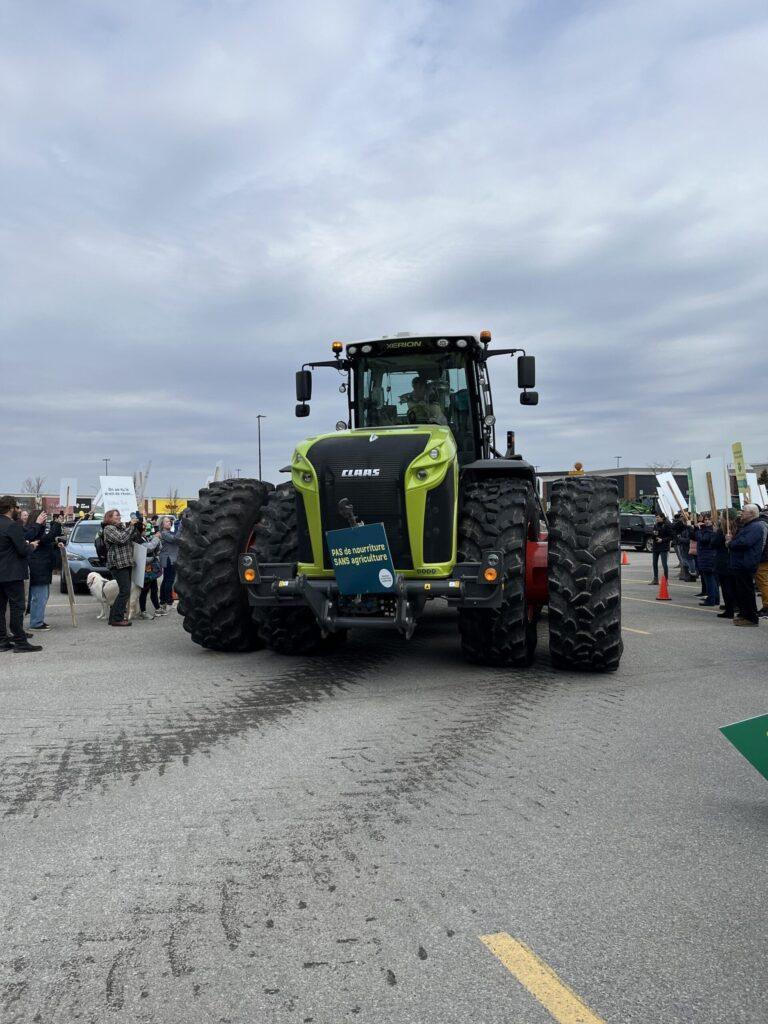
If Quebec farmers wondered whether the provincial government got the message conveyed by their demonstrations earlier this year – as convoys of tractors paraded along the streets of urban centres drawing the public’s attention to the growing list of issues that threaten the financial viability of agricultural producers – provincial Agriculture Minister André Lamontagne earlier this month said ‘Yes.”

Lamontagne’s response to the protests also came with an announcement of more than $200 million in help to mitigate the crisis in the farming sector.

“The economic and weather hazards of recent years have undermined the economic stability of our (farm) businesses,” Lamontagne said as he announced the measures at a press conference in Les Cèdres on June 13. “In such situations, it calls on us to show solidarity with our producers.”

Quebec will add an additional $30 million to its so-called emergency fund created last year to help farmers deal with inflationary costs, bringing the total amount of the fund to $55 million. These funds are expected to help about 3,000 agricultural businesses in the province that are considered to be in financial difficulty.

Another $37.1 million will help young producers offset the cost of increased interest rates. This measure is expected to help about 2,900 producers who have recently launched operations.

The largest infusion of cash – $106 million over five years – will come in the form of grants to help producers adapt to changes caused by climate change. The details will be outlined in the coming weeks.

Producers in the Abitibi-Témiscamingue region will also receive $1.6 million in compensation for losses suffered in 2023 due to extreme drought conditions.

Additional measures specifically targeted at market gardeners and strawberry and raspberry producers through the Agri-Relance program, which receives funds from the federal government, will also be outlined in the coming weeks.

Lamontagne also pointed to what his ministry calculates as $36.8 million in savings for farmers that will result from moves to reduce paperwork and reporting for a variety of environmental regulations imposed in the last few years.

In an interview with The Advocate after making his announcement, Lamontagne confirmed the demonstrations helped him convince his cabinet colleagues the government had to act.

“The more people raise their voices, the more they will be heard,” he added, explaining the announcements he outlined reflect the cooperation of several other ministries.

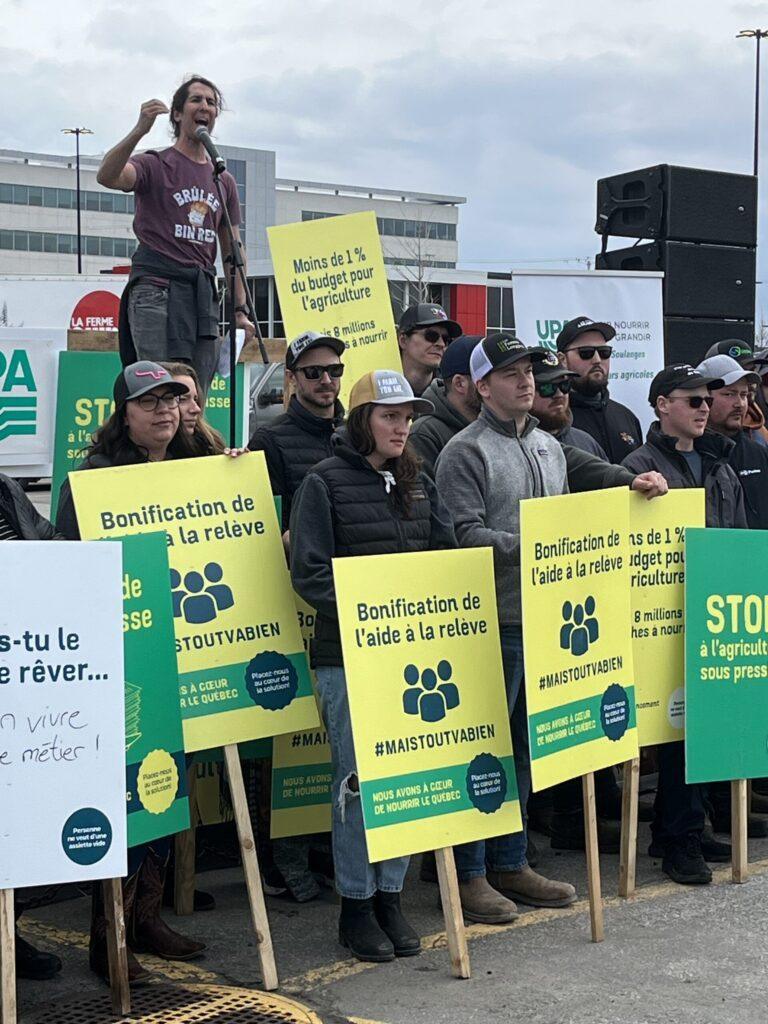
In April and May, Quebec farmers staged 17 demonstrations in all regions of the province involving an estimated 4,500 participants calling on the government to help producers. From high interest rates, to increasing fuel and fertilizer costs, severe weather events triggered by climate change to the increasing bureaucratic burden being imposed on agricultural producers by expanding environmental regulations and reporting requirements, farmers told the government they are struggling to make ends meet.

Given the extent of the demonstrations, Union des producteurs agricoles president Martin Caron, who was with Lamontagne for the announcement in Les Cèdres, was asked: Is the government’s response enough?

“Yes. It’s some big steps being taken,” Caron said in response, but then added that the UPA is still pushing for the provincial government to increase its spending for agriculture.

Caron pointed out that the provincial government still only allocates 1 per cent of its budget to the sector.

“There is an opening, and there is optimism,” Caron added.

In an interview after the announcement, Caron confirmed the demonstrations made a difference.

“It had an impact,” he said, adding that it convinced several ministries to act in consort, a breakthrough that will hopefully continue and allow for what he termed “common sense” take on a bigger role in how the government treats farmers.

Responding to call for help: Quebec offers farmers $200 million Read More »

Quebec encouraging farmers to market directly to consumers

Andrew McClelland
The Advocate

The provincial government has announced a new envelope of $4 million to encourage Quebec consumers to buy their food directly from agricultural producers.

But if you’re an agri-business owner, act fast! Project submissions for the program are open until Oct. 31, 2024 – or until funds run out. That means the earlier you submit a proposal, the more likely you are to receive funding.

“I’m very happy with this new support, which will promote local marketing and help bring consumers even closer to those who feed us,” said Quebec Agriculture Minister André Lamontagne during the “Mise en marché de proximité et agrotourisme” announcement on May 31.

 “The supported projects will make it possible to offer Quebecers even more fresh, quality products. I invite businesses and business groups from across the province to submit their projects.”

The Mise en marché de proximité et agrotourisme 2024-2026 program is designed to support local marketing and agritourism initiatives, both collective and individual (i.e. both individual producers and collective agri-businesses may apply). Producers, businesses, public institutions, co-ops and non-profit organizations can put forth a plan to shorten the supply chain between producers and consumers and bring farmers and the public closer together.

“Local marketing is an important development lever both for bio-food companies and for (rural) regions,” the government claimed in an official statement. “It makes it possible to support joint planning for the marketing of local products or to finance projects aimed at better positioning a company’s products on local markets.”

While projects like starting up a community-supported agriculture food basket program or building an on-farm kiosk are eligible, Quebec’s Proximité initiative can also fund carrying out planning, diagnostics or studies for an agri-business, designing marketing material, or simply provide money for organizational support.

According to the Agriculture Ministry, one in five agricultural businesses in the province sells directly to consumers, either in a public market, through the sale of CSA baskets or directly from the farm gate.

The Quebec government wants to increase those numbers, encouraging more non-farmers to purchase products from producers directly, or from artisanal processors existing outside the traditional distribution networks of grocery stores.

To qualify for the Proximité program, an individual or farm business must have an annual gross revenue greater than $30,000 and less than $1 million.

In response to criticism from earlier versions of the program, applicants with a current gros annual revenues of less than $30,000 are now deemed eligible if the marketing plan they submit shows that they plan to generate an annual income of at least $30,000 within 36 months of submitting their application.

Quebec also says that it has included “an increase in financial aid for projects targeting organic products as well as for those involving an emerging agricultural business.”

With local market season having just started, MNAs from across the province are stepping up their vocal support of farmers’ markets and farm gate sales.

“Summer is just around the corner, and it’s the perfect time to discover the best in agriculture, anywhere and nearby,” said Audrey Bogemans, MNA for Iberville. “Let yourself be surprised by the richness of the terroir and the authenticity of the producers. Everyone will benefit, even your taste buds!”

Applicants to the Proximité program should submit their applications as soon as possible, as previous provincial programs of this type have run out of funds well before the official application deadline.

Quebec encouraging farmers to market directly to consumers Read More »

Make soil a national asset: Senate report

Andrew McClelland
The Advocate

Designating soil as a “strategic national asset” is one of 25 recommendations put forward by the Canadian Senate agriculture committee to protect the soil structure on Canadian farmlands in a report issued earlier this month.

“We do not have another 40 years to protect and conserve our soils,” said Senator Robert Black, chair of the Senate agriculture committee, as he unveiled the new two-year study entitled “Critical Ground: Why Soil is Essential to Canada’s Economic, Environmental, Human and Social Health” on June 6.

The report, which took two years to compile with on-site tours and presentations from farmers, ranchers, research scientists and government officials, recommends that the federal government appoint a national soil advocate.

It is the first substantive study of soil produced by the Senate in four decades, when in 1984, Saskatchewan Senator Herb Sparrow put forth a report entitled “Soil at Risk: Canada’s Eroding Future.”

That report was key in the Canadian farming industry’s adoption of no-till farming. Since then, soil management has improved in Canada and crop yields have increased. But the country’s soil faces new challenges.

“Climate change, extreme weather events and urbanization are degrading soil conditions in every region of this country,” said Black, who previously worked for the Ontario Ministry of Agriculture for 15 years. “We need to look at this strategically because it is an important issue.”

The latest study gathered information from more than 150 producers and considered 60 written briefs, along with supporting documents from soil science researchers, agronomists, farmers, ranchers, foresters, environmental organizations, agri-businesses, industry groups and federal, provincial and territorial governments to make its recommendations.

Chief among those recommendations is the proposal that Canada change the public conversation about how vital soil is to the nation’s health and economy.

“Soil is a valuable natural resource,” states a leading paragraph in the 160-page report. “The Government of Canada should designate soil as a strategic national asset. Other countries, such as Australia, have appointed a national soils advocate; the committee believes that the Government of Canada should do the same.”

The report also suggests that Canada’s current methods for measuring soil health are not advanced enough. The committee called on the federal government to collaborate with the provinces and territories to support the development of a consensus on how to measure, report and verify soil health.

It also recommends that farmers and ranchers should have access to “viable and valuable carbon markets,” be eligible for tax credits for soil preservation action, and that the government fund peer-to-peer knowledge sharing groups.

“To protect and conserve farmland soil throughout Canada, the committee heard that all levels of government … should work together to plan agriculture into, and not out of, communities,” the report states.

Witnesses also said that building soil-based incentives (tax credits for farmers, enhanced crop insurance, a viable carbon market), as well as sustained funding for soil research initiatives is imperative for producers’ prosperity.”

However, the Senate Committee on Agriculture notes that the problem of protecting Canada’s soil goes deeper than that: much of what threatens soil in this country is the lack of awareness on the part of the public about how precious soil health and agriculture are.

“We need to be changing the perception of farmers in our children and youth,” said Carolyn Wilson of the Canadian Young Farmers’ Forum in her address to the committee. “Some of the initiatives that Agriculture in the Classroom is doing include bringing young farmers into high schools or elementary schools — where the students are able to see that face, and think: “This could be me. It’s not just my grandfather, my uncle or what have you.”

Make soil a national asset: Senate report Read More »

Tornado rips path of destruction

BRENDA O’FARRELL
The Advocate

The usually quiet town of Très St. Rédempteur near the Ontario border was a beehive of activity at the end of May in the wake of a tornado touching down, cutting a swath of destruction in a matter of just a few moments.

“To have it gone in under 30 seconds – it’s emotional to say the very least,” said Julia Asselstine, whose old farmhouse suffered the most damage in the sudden swirl as the tornado whipped through her yard.

The front of the roof of her house, which she and her husband, Daniel Gelinas, had purchased in 2020, was ripped from the rafters, while the two large willow trees that framed the building on either side were splintered. The gazebo behind their house was destroyed, with sections of it strewn as far as across the street, while its lounge furniture was still visible, wedged high overhead in a nearby tree. The shed the couple had planned to take down, was left half standing, tattered and twisted by the violent winds.  

Not far away, on Chemin du Petit Brûlé in Rigaud, members of the Carrière family who run Ferme Carra were picking up the pieces on their farm the day after the twister. The tornado destroyed a cement silo by the barn, damaging the steel silo that stood next to it.

“It passed between my house and the garage,” said Carmen Beauclair, who ran the dairy farm with her husband before their son took over the operation.

The winds also ripped a corner of the roof from their barn. No animals were hurt.

Next door, where Beauclair’s son lives, a piece of another neighbour’s chicken barn was sent through a cedar hedge like a projectile, piecing a side window of the house, damaging part of the living room. No injuries were reported.

Only a concrete slab remained of the chicken coop next door. The building housed 75 laying hens owned by the nearby Petit Brûlé – Ferme Écologique

It was believed that all the chickens were lost, said Marie-Pier Thellen, an animal supervisor for Petit Brûlé, who was at the scene the day after the tornado. But while workers picked up the debris, one chicken was found unharmed, but with feathers ruffled.

Environment Canada confirmed the tornado touched down at about 5:30 p.m. on May 27, generating wind speeds of about 155 kilometres per hour.

The meteorological agency said the twister cut a path 14 kilometres long, stretching from Très St. Rédempteur to Rigaud and Pointe Fortune. In all five properties, including a barn in Pointe Fortune, are believed to have been damaged.

According to a statement issued by Environment Canada, data collected by the Northern Tornadoes Project at Western University in London, Ont., the tornado was categorized as an EF-1, which falls on the lower end of the Enhanced Fujita Scale that is used to measure the severity of tornadoes.

Tornado rips path of destruction Read More »

7th generation expands family farm in Outaouais region

Andrew McClelland
The Advocate

Sometimes the early childhood memory of being on the farm is enough to set your path in life. And for 20-year-old Travis Larwill, growing up on the family farm in Buckingham, Que., in the Outaouais region was full of such memories.

“I remember sitting in the cab with my grandfather on hot days and hauling grain from the combine,” Larwill recalled.

“I don’t know what it is, but I’ve always wanted to farm. Just hearing my grandfather’s stories and talking with him and my grandmother, seeing my dad farm, made me love it so much. It gave me a passion to want to grow the farm.”

Larwill is the seventh generation of his family to work the land in Buckingham, which is now part of the municipality of Gatineau. His grandfather made the decision to wrap up the family’s dairy operation and focus on cash-cropping when Travis was a toddler, keeping the young aspiring farmer busy with the annual wheat and grain crop.

Larwill is an only child, and that came with a lot of attention from his father and grandparents —and the knowledge that he had to take on his fair share of the workload.

“It was pretty good,” Larwill said, before adding: “and then sometimes you wish you had a brother to spread the work around with!”

Opted to enroll at Mac

When it came time to decide what to do after high school, Larwill knew that he didn’t want to stray too far from the family farm. He wanted to be able to get back on weekends to help his father, Randy Larwill. Macdonald Campus, a “short” 150 kilometres away, seemed like an ideal fit.

“My grandfather had done some agricultural classes, but I’m the first one from my family to go into a university program for farming,” Larwill said. “I always wanted to have more education after high school in agriculture and I had friends who raved about how great Mac was.”

In the fall of 2021, Larwill enrolled in the Farm Management and Technology program. While the tail end of the COVID-19 pandemic required that students remained masked at all times, he was able to attend in-person classes and meet members of Quebec’s larger English-speaking farming community.

For many students at FMT, the highlight of the program are the required internships, where students stay for weeks at a time with another farm family across the country. For Larwill, that meant heading to Marquette, Man., about 50 kilometres northwest of Winnipeg, where he worked with Jeff and Chris McMillan. It was an eye-opening trip.

Internship opened eyes to possibilities

“I drove out there,” Larwill said. “At first you see a bit of bush in eastern Manitoba and then it just opens up till you see nothing but prairie farmland.”

Larwill’s family farm never had any livestock during his childhood, but seeing a Manitoba dairy, beef and cash-crop operation allowed him to have a hint of what animal tending is like.

“I saw a completely different way of farming,” he said. “Helping with beef and dairy, making feed – it was great to get experience on all those things I had been studying at Mac.”

That experience gave Larwill an idea to diversify his family farm back home: if he started building a small herd of sheep now, it could be a great way to use the family’s vacant dairy barn — and add a new revenue stream to its operations.

“At first, I thought getting into beef would be best,” Larwill said. “But it was too expensive and sheep was an operation you could basically run by hand.”

Larwill had his first lambing season this year. He describes it as a “pretty good start” with all the enthusiasm of a young producer excited to apply the theory he had learned at school on the farm.

“It was definitely a steep learning curve. But any time I was stuck, I could go back to my books and get most of the answers for what I needed to do.”

For Larwill, the family farm, which also includes 650 acres of cash crops, is the obvious place to stay. His father is still working and ready to share his experience.

“With the prices these days, just getting land is so hard if you want to start in agriculture. I made great farm connections with people at Mac, and we have the land here. After that, knowing people is often the best tool we have.”

7th generation expands family farm in Outaouais region Read More »

Animal self-defence not always pretty

Paul Hetzler
The Advocate

To help explain how evolutionary change occurs over time, Charles Darwin used the phrase “survival of the fittest,” meaning that organisms with traits best-suited to their surroundings are more likely to reproduce and pass on those attributes to their offspring. For most animals, it’s a slow process that takes countless generations, but we see it in real time with microbes.

When an antibiotic is used for a bacterial infection, on occasion there may be a very few that live due to a gene variation that lets them break down the drug. The survivors then multiply to form a new strain of resistant bacteria, eventually giving rise to “superbugs,” like Methicillin-resistant Staphylococcus aureus. While this is not exactly natural selection, the same principal holds true: the fittest microbes (in this case, those than can withstand a toxin) survive.

But in popular culture, the concept of “survival of the fittest” is often conflated with physical fitness. Extreme sport competitions have adopted the phrase as their motto, and it was even the title of a 2018 reality TV show. In nature, however, the fittest is rarely the strongest.

Though survival is about finding enough food and water, it’s also about not becoming an entrée on someone else’s menu. For most animals fitness is dodging fangs and claws to live another day.

For a lot of species, fitness is blending in with the background. While I’m impressed by photos of seamless camouflage, a full-length film on it would be like watching paint dry.

On the other hand, I’d buy tickets to watch an animal immobilize attackers with glue-like projectile vomit, spew jets of hot acid at predators, or use its internal organs as projectiles.

Faking death works

Even faking death to avoid actual death is a theatrical affair.

If I were faced with something that wanted me for supper, like a zombie or a bear, my inclination would be to run. Dropping to the ground inert wouldn’t be top of mind. Yet, for a few critters, it seems to work. A well-known example is the Virginia opossum, also known as the American opossum, whose dramatic death re-enactments gave rise to the phrase “playing possum,” meaning to play dead, or to be a faker in general.

Found throughout southern Quebec and Ontario, as well as parts of British Colombia, this native marsupial has been expanding its range northward for decades. If you haven’t seen opossums in your area yet, you very well might in the future. Contrary to popular belief, it does not “play” dead. When threatened, an involuntary response called tonic immobility kicks in. Its muscles go rigid and its heart rate and respiration drop sharply.

Deeply unconscious in this state, it might be a tempting morsel to a carnivore, except that it also salivates profusely, urinates, defecates and releases a foul-smelling fluid from its anal glands. Apparently, no self-respecting predator wants to deal with that mess.

Other animals that exhibit this behaviour include reptiles, like the eastern hognose snake, which is native to Quebec, and at least one type of snake bleeds from its mouth as part of its act. Feigned death is known in a number of rodent and bird species, as well as insects. Tonic immobility can even occur in humans during acute traumatic events.

Some resort to goo

Chemical defense is an ancient survival tool used by microbes, fungi, plants and, of course, animals. The perfect example of this may be the striped skunk, abundant in southern Canada and found as far north as Nunavut and the Northwest Territories. Its weapon of choice is N-butyl mercaptan, related to the nasty stuff put in natural gas so that we can detect a gas leak. It’s very effective, and skunk encounters are memorable and unpleasant.

It’s a good thing the bombardier beetle is not the size of a skunk, or we’d all be in trouble. Distributed throughout North America, this 2.5-cm-long beetle shoots a boiling-hot corrosive cocktail to nail predators as far as 20 centimetres away. Without exaggeration, its concoction is literally 100 degrees F. They have two special abdominal chambers, one for hydrogen peroxide, and the other for hydroquinone. When needed, these are combined, along with a catalyst, and a violent reaction ensues, jetting a defensive liquid at about 40 kilometres an hour.

The northern fulmar, a gull-like sea bird native to the eastern Canadian Arctic, launches a different sort of cocktail. When confronted by a bird of prey like an Arctic skua, it vomits a stream of putrid, oily goo that it keeps on hand in a stomach compartment for just such occasions. This orange substance often clogs the would-be assassin’s flight feathers so it can’t effectively fly for a time. More importantly, the oil strips the natural waterproofing from the predator’s feathers, which means it can’t float and could easily drown. 

When your profession is “prey,” you do whatever it takes to be fit enough to survive.

Animal self-defence not always pretty Read More »

What if a farm could have a so-called ‘second cash crop?’

Mitchell Beer
The Advocate

It shouldn’t be so complicated to seize the opportunity for a second “cash crop” on a farm that needs the income, in a rural community that is looking for an economic boost.

Especially when that opportunity also taps into a farmer’s baked-in interest in doing the right thing to replace fossil fuels and reduce the greenhouse gas emissions that are bringing us ever closer to runaway climate change.

As renewable energy developers look to rural areas to site new solar and wind projects, many jurisdictions are moving to protect prime farmland — as they should. But along the way, those necessary restrictions run the risk of freezing out agrivoltaics, a method of siting solar-electric panels (photovoltaics) on farms in a way that doesn’t impede cultivation, and in some cases can even improve growing conditions.

Seizing the moment

Most of Quebec, Ontario, New Brunswick, Nova Scotia and the U.S. Northeast and Midwest in mid-June experienced a heat dome that generated a humidex of 45°C. So it’s hard not to mix the sense of possibility with the amped-up urgency of not being able to spend very many minutes outdoors without feeling the effects. I can’t imagine how I’d be coping right now if my job had me working outdoors. And yet, if you’re reading this, you’re probably preparing for another sweltering day of early summer heat and drought. (Unless conditions have tipped into flood.)

That’s all the more reason to pay attention to the news coverage on agrivoltaics that has been streaming in from multiple directions — from Albert, Ohio and India. One story about four years ago talked about hiring sheep to clear the brush around the solar panels. (In fact, the headline about pairing grazing sheep with solar arrays showed a little humour: “for mutal baaa-nefit,” it read.)

More recently, when the U.S. announced $2 billion in loans and loan guarantees for rural renewables earlier this year, Agriculture Secretary Tom Vilsack took direct aim at concerns about the best land being overrun with solar and wind farms.

“We’re obviously encouraging use of non-prime farmland for purposes of renewable energy,” Vilsack said.

But that common-sense messaging is too often lost as legislators try to strike the right balance while responding to the needless but rising public opposition to renewable energy projects of all kinds.

In May, a new regulation in Ontario raised the prospect of restricting renewables on prime farmland — once again, without initially distinguishing between options that help farms or harm them, in a province that has been gleefully promoting urban sprawl into farmland and protected areas.

In June, regulators in Maine set out to protect “high-value agricultural soils” by slapping special restrictions on solar projects, but not urban development.

Quebec has an opportunity to get this right as the National Assembly works its way through Bill 69, a new piece of legislation that’s meant to speed up the development of new electricity projects and allow for more private production. Protecting farmland has to be a basic bottom line. But protecting farm economies can and should be on the agenda, as well.

‘Second cash crop’

Whatever form of renewable energy system a farm installs — whether the “right” local answer is a solar array, one or a few wind turbines, a run-of-river hydro system, a biodigester or several of the above — there are dual interests at play.

• The urgent need for faster, deeper carbon cuts, to prevent future climate harm and eventually begin drawing down the carbon, methane and NO2 pollution that is already bringing sustained drought, killer heatwaves, choking wildfire smoke and wacky weather to a farm operation near you;

• The opportunity to reduce your power bills, increase your self-reliance in a grid emergency and, if provincial regulations allow it, sell your surplus power back to the utility.

To look at it another way: Imagine a small farming town that has lost its food processing plant sometime before the pandemic. No one under 30 plans to stay, because they see no job prospects. No one over 30 thinks that’s a good idea.

In that setting, I can’t fathom why anyone would want to descend on that community for a good, earnest talk about climate change and its impacts. Not when the visitors know, the community knows, and the community knows that the visitors know that depopulation will kill the town before drought, flood or wildfire get the chance. There’s absolutely no call to kick people when they’re down. And absolutely no reason to expect anyone to appreciate it.

But what if that conversation begins, and maybe ends, with a second cash crop that will bring income, jobs, and local resilience into the community, without damaging the land that people have been stewarding for decades and generations?

If that shift in thinking led to a surge in rural demand for practical renewable energy opportunities, rather than the misinformation and anxiety we’ve been seeing in recent years, would we start to see provincial legislation and programs that set out to solve multiple problems at once, rather than selling farm communities short?

And if that question makes even the slightest bit of sense…how do we begin to find out?

What if a farm could have a so-called ‘second cash crop?’ Read More »

Farming Facts: From climate change to disappearing farmland

Here are a few fun facts that quantify a few realities of the farming sector.

12%: The amount by which world GDP will drop for ever 1-degree-Celsius increase in global temperature, according to a new study released in May by Harvard University’s Adrien Bilal and Diego Kanzig of Northwestern University entitled The Macroeconomic Impact of Climate Change: Global vs. Local Temperature, published by the U.S.-based National Bureau of Economic Research.

43%: The percentage of Quebec farmers who predict the financial health of their farm business will deteriorate in 2024.

14%: Percentage of agricultural producers in Quebec who operate farms with annual revenues under $100,000 that fear going out of business.

319: The average number of acres of farmland lost a day – the equivalent of nine family farms taken out of agricultural production per week.

Farming Facts: From climate change to disappearing farmland Read More »

The next generation of farmers: Starting out was never easy, but it has gotten harder

Andrew McClelland
The Advocate

Agricultural production has never been for the faint of heart. And maybe it’s never been easy being a young farmer in Canada.

But today’s young producers face challenges that previous generations never had, from the pressures of keeping up with technological change, to the fears of climate change and extreme weather.

No one in Quebec knows that more than the Fédération de la relève agricole. Established in 1982, the FRAQ is the voice of the next generation of Quebec farmers, fighting for the improvement of working conditions for the 8,000 professional and aspiring farmers in the province between the ages of 16 and 29.

“Our membership isn’t limited to people actively working in agriculture, because we recognize that it can be so hard to break into the industry,” said Meghan Jarry, a former dairy producer from Abitibi-Témiscamingue who works as an administrator for the federation.

“Especially with land prices being so high right now, and start-up capital being hard to acquire, we welcome anyone between 16 and 29 who wants to get into agriculture.”

First-hand experience

Jarry knows how hard it can be to get started in farming first-hand. Raised in the Montreal suburb of Boucherville, she bravely enrolled in farm management at Université Laval. Several years later, she married a dairy producer and moved to the little town of Palmarolle, 65 kilometres north of Rouyn-Noranda.

“I was able to see, very up close and personal, how succession planning can be difficult and emotional,” she said, relating her husband’s struggles in navigating his own farm transfer. “And now, I’m still very much committed to seeing that it goes well because that farm will maybe one day be our son’s farm.”

Succession planning is just one of the challenges that FRAQ addresses as it advocates for young farmers within the Union des producteurs agricoles and at the provincial level. And its recommendations on the topic are concrete, well-researched and sometimes radical, as Jarry explained in a June 12 videoconference with the Quebec Farmers’ Association.

Relève advocates for farm splitting

For instance, FRAQ recommends Quebec allow for the splitting or dividing of farmland so that succession can be made easier, a change that would overturn the Commission de protection du territoire agricole du Québec’s long-held ban on splitting farmland.

But, says FRAQ, “splitting farmland can be beneficial for certain agricultural projects, particularly those involving the next generation. By encouraging the diversity of models, it can be a beneficial element in starting new businesses.”

The FRAQ also has solid proposals for changing the way farm financing works in the province.

“We want to help young producers by abolishing the ‘part-time’ category in La Financière agricole’s programs,” Jarry said, echoing a long-held grievance of many producers who are trying to establish themselves. “So many more producers could be helped if all farm start-ups could qualify for the full-time subsidy.”

No shame in being a part-timer

In fact, the distinction between part-time producers and full-time producers is one that the FRAQ is challenging in its advocacy work. For generations now, many producers in central and Atlantic Canada have found it necessary to find off-farm work to maintain a stable income. And that shouldn’t be a point of shame among farmers young or old.

“There’s this perception that, if you are a part-time farmer, you are not a ‘real’ farmer,” Jarry said. “And changing the perception of the industry from within, and changing how the public perceives it, is part of what FRAQ does.”

For Jarry, creating an atmosphere of hope for young farmers in the agriculture industry is a constant battle, waged on a personal level. When asked if the dominant mood among young producers is one of optimism, she reflects pensively and responds:

“Well, when I got into dairy, I was so eager,” she said. “And my friends said to me: ‘Just wait till you’ve been farming five years!’ I do find that I’m more jaded now than I was at the beginning. But we have to support one another and power through. And the community at FRAQ is one that powers through and endures.”

The next generation of farmers: Starting out was never easy, but it has gotten harder Read More »

Farming Facts: From debt to dairy herds

Here are a few fun facts that quantify a few realities of the farming sector.

$1.3 million: That is the expected average debt per farm in 2024 in Canada, according to a recent survey of farm operators conducted by Statistics Canada. The average farm debt increased by more than half a million dollars, $562,543, between the 10-year period of 2011 to 2021, when it reached $1.1 million.

$66 million: That is the total amount of net farm revenue expected in 2024, according to forecasts by Agriculture and Agri-Food Canada, representing a historic low. In 2022, the figure stood at $959 million.

200,000: The number of Quebec companies with 25 to 49 employees that must now comply with francization rules as outlined in Bill 101, following the adoption of Bill 96 in June 2022. As of June 1, 2024, all these companies must register with l’Office afin d’entreprendre une démarche de francisation and conduct all of their business in French.

34: The number of dairy herds in the U.S. that have reported infections of the bird flu virus since the middle of March. The rise in incidents has sparked the U.S. Department of Agriculture to agree to a request from the Canadian Food Inspection Agency to test lactating cows for the virus before they cross into Canada. The testing requirement went into effect April 29.

The virus has not been identified in any Canadian dairy or beef herds to date.

Farming Facts: From debt to dairy herds Read More »

Keeping ‘easy-keeper’ work horses healthy is no easy task

Andrew McClelland
The Advocate

Horses used to be the backbone of a farm. Only a century ago, if a producer wanted to plough a field, remove trees or get into town, he’d have to hitch up a team.

In Canada, it was only in the 1940s that tractors started replacing horses as the engines of most heavy lifting in agriculture.

Yet, the love and fascination for equine companions remains. That means the work horses kept today are descendants of the past genetic selection of Belgians, Percherons, Clydesdales, and all breeds that worked on farms.

But with the more “leisurely” lifestyle that work horses now enjoy can come health concerns.

“All draft horses tend to become overweight very easily,” said Angie Beaudet, an equine nutrition consultant who has worked in the field for 10 years. “Canadians, Halflingers, many of the Spanish breeds, mules, donkeys and miniature horses can also tend to obesity. And these are the ‘easy-keeper’ breeds that are popular for horse lovers to own.”

The most common culprit regarding obesity is insulin resistance. Horses are able to produce more insulin on a higher level than many other species. Similar to a human with pre-diabetes, the insulin of a horse will kick in strongly when its blood glucose levels are rising. While its glucose levels are under control, its insulin is soaring.

Health issues to watch for

“That can lead to a lot of health problems for horses,” Beaudet explained to participants at an April 24th videoconference organized by the Quebec Farmers’ Association as part of its ongoing Farm Forum series. “It’s what leads to laminitis or founder. It’s often associated to Cushing’s disease, and gut issues and even asthma can result from horse obesity.”

Those are health issues no horse owner wants to deal with. Knowing if your horse is overweight is key, says Beaudet, who works at Moulée Vallée Feed in Richmond, QC.

And, much like keeping cattle, keeping track of a horse’s body condition score is the best safeguard against equine obesity and the host of problems that arise from it.

“When I’m evaluating a horse’s health, I’m going to use a body-score system to evaluate the fat distribution in key areas on a horse’s body,” Beaudet said. “That means checking fat distribution in the neck, withers, shoulder, ribs, loin and tailhead.”

Equine body-condition scoring gives a rating between 1 and 9 for each of these six areas; divide the sum total by six and you’ll have an indication of a horse’s body score.

An ideal score in the “easy-keeper” breeds is 5, Beaudet explained. However, most tend to obesity and will stand at the 7- to 9-mark when the overall score is calculated.

Conditions are preventable

“All of these health concerns are pretty much 100-per-cent preventable and we can manage them if we do the proper things,” Beaudet said. “We just have to adapt the horse’s diet to stop health concerns from arising and managing them if they do.”

The first step is getting an analysis of the hay you’re feeding your equine friend. Working with a nutritionist is key, she said, along with getting the hay analyzed by a reputable lab.

“We want a hay with low sugar, starch and digestible energy so that your horse doesn’t gain weight too easily. We also want a low iron level. There’s still a lot of debate on the subject, but some studies have shown that high iron levels predispose horses to insulin resistance,” she explained.

A common misconception among horse owners looking for feeding hay holds that a lower protein level will keep a horse’s protein intake in check.

Keep sugar intake low

However, Beaudet said, hay with a protein level below 10 to 12 per cent will be detrimental to the animal’s ability to gain muscle mass — and muscle mass is key to combating insulin resistance.

“We always want to keep sugars as low as possible,” Beaudet specified. “That means no feed, no grains, no molasses. You want to avoid everything that’s oats, corn, barley —

all those kinds of ingredients.”

As many agricultural producers know, keeping a horse is not for the faint of heart — or for the light of pocketbook. Horse-keeping is expensive due to feed, stabling costs and professional expertise required to keep them healthy. For Beaudet, keeping a close eye on diet and nutrition is vital to making sure your horse is happy and healthy.

“One hundred years ago or even 50 years ago, horses could work 10-12 hours a day, several times a week. That’s just not really realistic nowadays. But the right diet, with the right exercise and monitoring of health concerns can help them adapt to being kept as a hobby or for sheer enjoyment.”

Keeping ‘easy-keeper’ work horses healthy is no easy task Read More »

With risk of being a buzz-kill: Back off from beekeeping

Paul Hetzler
The Advocate

In addition to being a reliable source of honey, not to mention personal satisfaction, backyard beekeeping can be a rich learning experience for the whole family. And yet, at the same time, honeybees are causing grave and, in some cases, irreversible harm to the environment.

It’s imperative that beekeepers learn about the threats to native pollinators posed by honeybees, and actively work to mitigate the damage as much as possible.

Just to be clear, honeybees are a non-native species whose population is burgeoning. They certainly don’t need our help to survive. Statistics Canada reports there were 783,575 honeybee colonies in Canada in 2021, up sharply from 561,297 in 2011 – a 40-per-cent jump in 10 years.

It’s true honeybees are vital to industrial-scale agriculture, like on California’s almond farms, which are the largest in the world, and in Florida’s citrus groves. Although they are relatively poor pollinators, they’re the only ones that can be transported in great numbers.

Outside of vast tree-crop plantations that are inhospitable to native bees, honeybees don’t measurably boost pollination rates, according to a multi-year study by Cornell University. Led by Dr. Scott McArt, a bee specialist at Cornell’s Dyce Laboratory for Bee Research, the team concluded honeybees had an insignificant effect on pollination in all but the largest apple orchards in the study. The 110 species of wild bees the researchers cataloged on apple blossoms did the real work.

Honeybees displace other bees

The problem with honeybees is that they displace, and sometimes extirpate, native bees.

A long-running study by Concordia University noted that honeybee hives on the island of Montreal skyrocketed from less than 250 in 2013 to nearly 3,000 by 2020. During that time, the overall number of wild native bees across 15 sites dropped by an average of 1,200 per sample. Far more concerning was the loss of diversity. In 2013, 163 species of wild bees were documented. In 2020, that number was 120. Forty-three species of native bees disappeared from the record in seven years due to honeybees. That’s huge.

For years, professional beekeepers in the U.K. have been asking the public to moderate the recent “outbreak” of hives, which is putting native bees at risk. The London Beekeepers’ Association is concerned that “the prevailing ‘save the bees’ narrative is often based on poor, misleading or absent information about bees and their needs. It can imply that keeping honeybees will help bees.”

Push to limit honeybee populations

In fact, there is now a global push, led by current and former beekeepers, to limit honeybee populations in order to save wild bees, which do practically all the pollinating in the world.

One could dismiss such pleas from professional beekeepers as self-serving, but Andrew Whitehouse of the insect-conservation group Buglife agrees that the public’s unfettered embrace of honeybees is having dire consequences.

“We know the main reason native pollinators are in decline is a lack of wildflowers in our countryside and urban areas,” Whitehouse said. “To increase competition for limited resources puts a huge pressure on the wild pollinators.”

Too many honeybees also bring diseases to native pollinators.

As Dr. Jane Memmott of Bristol University in England has stated, honeybee hives are sometimes “little ecosystems of plagues and contagion.”

Invasion of the bees

Even the loudest critics of backyard beekeeping don’t want to see it banned. But anyone who likes the thought of a hive on their rooftop or back lot needs to remember the wildflowers in any locale are already spoken for by native pollinators. A meadow in bloom is not virgin territory that honeybees are free to exploit without impact. When a non-native species arrives in large numbers, there will always be repercussions.

It is a moral imperative that beekeepers – big and small – compensate for the nectar and pollen their honeybees consume in a season. Wild bees were there first, and relied on the existing forage to survive. If you keep bees, provide about one acre of flowering plants per hive. This is essential to keep native pollinators healthy.

Flowers that bloom at different times, grow to various heights, and have a multitude of floral structures and colours will serve the greatest diversity of native pollinators. Very often, this can be achieved by simply letting things go wild. Maybe cut back (so to speak) on mowing. Choose some areas to mow once a year in late fall, and others to cut every second or third year.

Bumblebees, which are four times more effective at pollinating than honeybees, often nest in rock piles and old foundations, things that tend to get “tidied up” as rural areas get more populated. Mason bees make use of all types of unkemptness for their nests. Since both kinds of bees are super-pollinators, a small decrease in their population is worrisome. A change in mindset regarding aesthetics will go a long way toward saving bees of all stripes.

And finally, if you don’t have land on which to grow wildflowers, please curb your enthusiasm. Seriously. Divesting is best, but cutting back is good, too. Perhaps one hive can suit your needs, rather than two or three.

With risk of being a buzz-kill: Back off from beekeeping Read More »

Canadian farming sector won’t meet emissions targets: commissioner

Andrew McClelland
The Advocate

Canada’s commissioner for the environment and sustainable development has accused Agriculture Canada of falling behind in meeting its goals for greenhouse gas emissions reductions.

In an official report issued April 30, Jerry DeMarco, the commissioner appointed by the federal government to provide an independent analysis on its environmental and sustainable development issues, heavily criticized Agriculture and Agri-Food Canada’s climate policies and monitoring efforts.

In his “Agriculture and Climate Change Mitigation Report,” DeMarco put emphasis on the Agriculture Ministry’s lagging efforts in developing a plan to reduce emissions from nitrogen fertilizers and suggested the industry needed to shape up fast.

“Given the current climate crisis and limited results thus far, Agriculture and Agri-Food Canada will need to ensure that all its expected reductions in greenhouse gas emissions for 2030 take place in the six growing seasons that remain,” said DeMarco in a press release that accompanied the report.

“The department has so far achieved less than 2 per cent of its 2030 overall greenhouse gas reduction target,” the commissioner stated.

Agriculture Minister Lawrence MacAulay thanked DeMarco for the report and outlined what steps his ministry would take to meet climate goals in the future.

“There is no doubt we need to do more to help the agriculture sector reduce emissions, and quickly,” MacAulay said.

In his response to DeMarco’s criticisms, MacAulay outlined the steps his ministry has taken to ensure Canada’s agriculture industry contributes to the nation’s overall goals in reducing greenhouse gas emissions, citing the funding of 14 research labs across the country and the creation of two programs to help farmers adopt more sustainable farming practices.

“Since 2020, the Government of Canada has announced over $1.5 billion in funding to advance climate change mitigation in the sector,” MacAulay said, “including the Agricultural Clean Technology Program, the Agricultural Climate Solutions – Living Labs Program and the On-Farm Climate Action Fund.”

The federal agriculture minister also pointed out both its “Sustainable Canadian Agricultural Partnership” (Sustainable CAP), a series of programs and activities cost-shared between Ottawa and the provinces, and its “Sustainable Agriculture Strategy,” a long-term plan that it hopes will help bring together action on climate issues in agriculture.

Programs included in both are voluntary for producers. DeMarco noted that such funding programs were flooded with applicants and were delayed by a year in disbursing payments.

“The department’s delays in funding approvals resulted in recipients missing a growing season,” the commissioner wrote, “which limited the greenhouse gas reduction results achieved….”

In his report, DeMarco notes that agriculture accounts for 10 per cent of Canada’s greenhouse gas emissions, which have been increasing since 1990. Agriculture remains a major source of methane and nitrous oxide, which are potent greenhouse gases. Between 1991 and 2021, the sector’s emissions have risen by nearly 40 per cent, driven by increased crop production and fertilizer use.

Those figures are still below the greenhouse gases emitted by Canada’s oil and gas industry (28 per cent), transportation sector (22 per cent), buildings (13 per cent) and heavy industry (12 per cent), prompting MacAulay to defend the efforts the country’s farmers are already making in the fight against climate change. “Being on the front lines of climate change, they have felt the devastating effects first-hand, from droughts to wildfires to floods,” MacAulay said in a statement, referring to producers. “Canadian farmers work hard every day to produce the best products in the world and are already making significant efforts to be more sustainable.”

Canadian farming sector won’t meet emissions targets: commissioner Read More »

Quebec’s sustainable development watchdog critical of MAPAQ, CPTAQ

Brenda O’Farrell
The Advocate

In an exhaustive and highly critical report unveiled last month, Quebec’s commissioner for sustainable development offered a scathing review of both the province’s Agriculture Ministry and Quebec’s farmland protection agency, taking aim at how both are failing to efficiently promote soil heath and effectively protect Quebec’s food-producing land.

“MAPAQ’s interventions are insufficient to ensure the protection and development of Quebec’s agricultural territory, while issues, including the loss of cultivated areas, threaten its sustainability,” wrote sustainable development commissioner Janique Lambert in her 188-page report submitted to the National Assembly on April 25.

Lambert said the mechanisms put in place by Quebec’s Agriculture Ministry “are not sufficient and lack efficiency,” explaining that it is banking on its sustainable agriculture plan, the so-called Plan d’agriculture durable 2020-2030, to accelerate the adoption of sustainable practices, “but the implementation of the plan relies particularly on the commitments of numerous partners to support and train producers.”

This approach, the commissioner says, “will take time to see results.”

She then goes further, saying: “The ministry does not have the necessary data concerning the state of soil health, its evolution as well as current agricultural practices to better establish priorities.”

The commissioner also highlighted that the Financière Agricole du Québec’s programs are “insufficient to accelerate the adoption of sustainable agricultural practices to promote soil health and conservation.”

Lambert did not hold back either when she set her sights on the provincial farmland protection agency, the Commission de protection du territoire agricole du Québec.

“The surveillance activities carried out by the CPTAQ do not make it possible to effectively protect the agricultural zone,” she wrote. “Surveillance is insufficient to detect the offences committed and long delays are observed in the processing of the offenses identified.”

Lambert said MAPAQ has been aware of the CPTAQ’s shortcomings to adequately protect farmland in certain instances for several years. She added, the goals outlined in its bio-food policy, La Politique bioalimentaire 2018-2025, fails to addresses these failures “and it rarely uses its aid programs to encourage enhancing the value of this land.”

The CPTAQ was also criticized for failing “to use all the means at its disposal” to ensure the laws surrounding protecting farmland are respected.

Farmland is a limited and non-renewable resource, Lambert stated, that is essential for ensure Quebecers’ food autonomy.

The mandate of the Sustainable Development Commissioner is to audit the performance of all agencies that are subject to the Sustainable Development Act. Her report is part the Auditor General of Quebec’s report to the National Assembly for 2023-2024.

Quebec’s sustainable development watchdog critical of MAPAQ, CPTAQ Read More »

Capital gains changes in federal budget to impact farm transfers

Andrew McClelland
The Advocate

When Ottawa announced the federal budget last month, few agricultural groups were impressed. Citing a lack of investment in a key sector of the economy, both the Union des producteurs agricoles du Québec and the Canadian Federation of Agriculture spoke of their disappointment in the lack of support the budget offered to agriculture.

Now, many observers are also saying that while the government’s plan to increase the Lifetime Capital Gains Exemption (LCGE) will benefit many producers, it could also introduce a heavier tax burden onto the younger generation of Canadian farmers.

The latest federal budget unveiled in April introduced the government’s intention to increase the LCGE to apply to up to $1.25 million of eligible capital gains, an increase from the current level of $1.016 million , which is indexed to inflation.

“This in and of itself is a positive development,” said the CFA in an official statement, noting that the government’s decision was consistent with the CFA’s budget recommendation “to increase the capital gains exemption threshold above $1 million to be more in line with current market farmland values.”

But the good news stops there, say industry observers. Because those same changes could make it even harder for families to transfer their farms to the next generation.

“This may make it a little bit harder on the incoming generation to generate the cash flow to have funds available to pay out mom and dad,” said Ryan Kehrig, national leader for agricultural tax with accounting firm MNP.

In a podcast hosted by RealAg Radio, Kehrig explained that the increased exemption for capital gains could put younger agricultural producers in a position where they feel obliged to pay more taxes to ensure their farming parents have a comfortable retirement fund.

“Let’s say mom and dad want to have X amount of dollars to fund their retirement, and they plan on selling the farm to the farming kid — to the successor. They’re going to gift anything over and above that number that they want to have here,” Kehrig explained.

“If they want to have, say, $3 million after tax, they’re probably going to have to sell more share equity to their kids at capital gain rates to trigger that $3 million after tax.”

But with a larger equity share being purchased by the successor at capital gain rates, the incoming generation of farmers will feel the pinch.

“So for the farming kid, there’s probably going to be more ‘skimmage’ — taxes being paid to the government — to leave mom and dad in that position.”

Kehrig’s concerns over how Budget 2024 will impact young producers is the same as CFA’s. The national farmers’ federation predicted the increase in the Lifetime Capital Gains Exemption “could play at odds with CFA’s policy objective of creating a more favourable tax environment for young generations of farmers seeking to the enter the sector.”

The federation says that a more detailed analysis of the potential implications for Canadian farms and farm succession planning is required.

But for analysts like Kehrig, the new budget certainly isn’t a cause for celebration for producers who are looking for a break when taking over the family farm.

“There’s a short, immediate impact in terms of succession planning here,” Kehrig said. “And I do see it being a tightening for the younger generation in that regard.”

Capital gains changes in federal budget to impact farm transfers Read More »

Quebec provides $35-million loan to wood producer

Frederic Serre
The Advocate

Arbec, one of the largest wood manufacturers in Quebec, which was seriously affected by last summer’s devastating forest fires, has been awarded a whopping $35-million loan by the provincial government to help it deal with the fire aftermath.

The announcement, made April 23, is part of Quebec’s assistance package to support the province’s forestry industry, as well as provide aid to workers and communities affected by the forest fires.

The financial boost means Arbec will be able to preserve 477 full-time and 525 part-time jobs, along with about 1,000 seasonal jobs.

In business since 2014, Arbec is a leading wood manufacturer, with seven factories located in three regions of Quebec, including the Mauricie, Saguenay–Lac St. Jean and the North Shore. Four of these are sawmills, while the other three specialize in drying, planing and finger-jointing lumber.

Quebec provides $35-million loan to wood producer Read More »

Fail-safes on stone-picker attachment blamed for farm worker’s death

Frederic Serre
The Advocate

The manufacturer of a rock-picking machine is being blamed for the tragic death of a 21-year-old farm worker in the Lanaudière community of St. Jacques last year, and the provincial commission examining the accident at the Ferme Sébastien Lépine is urging better training by the manufacturer as part of its 25-page report released April 18.

Jacob Tousignant was killed May 22, 2023, while using an ELHO destoner attached to a tractor to remove rocks and other debris from a field at the farm, located about 90 kilometres northeast of Montreal.

The Commission des normes, de l’équité, de la santé et de la sécurité du travail (CNESST) spent 11 months studying the fatality. The accident happened when Tousignant was working alone, using a stone picker, when the machine jammed, prompting the young worker to step off the tractor to manually unblock the stone picker. In doing so, Tousignant restarted the machine, which struck the victim. Tousignant was declared dead at the scene.

In its report, the CNESST points the finger at the machine’s manufacturer, saying the stop function on the machine’s control panel did not control its power source. Stopping the machine interrupted its movements, but did not stop it being powered up, thus exposing Tousignant to great danger, especially since the machine did not have a lock or hydraulic stop switch.

The CNESST will present the results of its investigation to the Union des producteurs agricoles (UPA) and to various associations. The report will also be distributed to all agricultural trade training establishments in the province.

Adding to the tragedy is that Tousignant had undergone a life-saving heart operation back in 2016, after being diagnosed with a serious cardiac illness as a child. He was set to celebrate his 22nd birthday less than a week after the accident.

Fail-safes on stone-picker attachment blamed for farm worker’s death Read More »

After the protests – What’s next?

Brenda O’Farrell
The Advocate

Seventeen demonstrations over two months in all regions of the province involving an estimated 4,500 participants.

That is how Quebec’s farmers’ union quantifies the public protests that saw convoys of tractors take to the streets in urban centres throughout April and the beginning of May to draw attention to the growing list of issues that threaten the financial viability of agricultural producers.

The question now is: What’s next?

So far, the Union des producteurs agricoles is far from impressed with the provincial government’s reaction to the calls it has made at the demonstrations for immediate and sustained help to manage and mitigate the financial pressures farmers are facing.

From high interest rates, to increasing fuel and fertilizer costs, severe weather events triggered by climate change that range from periods of drought to heavy rains and windstorms to the increasing bureaucratic burden being imposed on agricultural producers by expanding environmental regulations and reporting requirements, farmers are being hampered and hurt.

And the economic reality is making it increasingly difficult for the next generation of agricultural producers to take over operations.

“The government’s response and will to consider the proposals put forward to date are clearly insufficient,” said UPA president Martin Caron in a letter sent to Quebec Agriculture Minister André Lamontagne on May 9.

In the National Assembly, Liberal agriculture critic André Fortin took up the farmers’ cause, pushing the CAQ government to act.

In a statement, Fortin said: “This is a real crisis. Imagine the farmers who lost 100 per cent of their 2023 harvest and are only offered 15-per-cent compensation. It becomes impossible for them to launch the new season while continuing to make the investments necessary for their production.

“It’s simple,” Fortin continued, “under current conditions, La Financière agricole is not fulfilling its mandate. Despite this, the minister does not seem interested in reviewing the programs.

“Is this willful blindness or bad faith?”

The UPA is hosting a provincial meeting with all its affiliate federations and groups May 23 in Quebec City to provide an updated overview of the financial situation farmers in the province currently face and to discuss next steps in its ongoing campaign to pressure the government to help alleviate the financial strain in the sector.

After the protests – What’s next? Read More »

Speculation, ‘green grabs’ forcing farmland prices up, squeezing farmers out: report

Mitchell Beer
The Advocate

An unprecedented 15-year trend of land grabbing has doubled the global price of farmland and is squeezing farmers on all sides, the International Panel of Experts on Sustainable Food Systems concludes in a new report released this month.

Around the world, “farmers and rural communities are losing land access as economic and tenure security deteriorate — making small-holder agriculture increasingly untenable,” the organization stated in a summary of the 87-page report.

While powerful investors and big agri-business tighten their control over land, international panel’s report adds, some parts of the response to the climate and biodiversity crises are adding to the pressure. “Green grabs” for carbon offsets, large-scale nature conservation, “clean” fuel production, and critical mineral extraction are all opening up new opportunities to commoditize farmland.

The research focuses mostly on developing countries, but Saskatchewan organic farmer and panel member Nettie Wiebe was one of the contributing authors.

“Imagine trying to start a farm when 70-per-cent of farmland is already controlled by just 1 per cent of the largest farms — and when land prices have risen for 20 years in a row, like in North America,” Wiebe said. “That’s the stark reality young farmers face. Farmland is increasingly owned not by farmers, but by speculators, pension funds and big agri-businesses looking to cash in.”

“Instead of opening the floodgates to speculative capital, governments need to halt bogus ‘green grabs’ and invest in rural development, sustainable farming and community-led conservation,” added panel member Sofía Monsalve Suárez, secretary general of FIAN International, an international human rights organization working for the right to food and nutrition. “We’ve got to make serious changes to democratize land if we want to ensure a sustainable future for nature, food and rural communities.”

The summary materials accompanying the report list four “leverage points” to shift the dire picture the panel paints:

• Halting green grabs and taking speculative investment out of land markets;

• Setting up integrated governance systems for land, environment and food systems;

• Supporting collective ownership and innovative financing for farmers;

• Developing a “new social contract” and ringing in a “new generation of land and agrarian reforms.”

Speculation, ‘green grabs’ forcing farmland prices up, squeezing farmers out: report Read More »

Young Outaouais producer continues tradition of Simmental breeding

Andrew McClelland
The Advocate

For anyone not involved in agriculture, the words “family farm” often bring up images of a simple life with a few hens and cows and picturesque buildings on the homestead.

But farm families, like the Egans in the town of Low, north of Wakefield in the Gatineau hills, know that running a family farm is a tough business that constantly requires innovation.

“We try to run a very tight ship,” said 20-year-old Ory Egan. “We take genetics seriously and do our research on our bulls and stallions to ensure we get the best quality offspring.”

It’s a statement Egan — who represents the sixth generation to farm his family’s land in the Outaouais region — makes with pride. 

Any visitor to “Egan Home Farms” will see a lot of Simmental cattle. The family calves 180 a year, keeping full blood Simmentals, commercial Simmentals as well as F1 females crossed between Simmental and Red Angus.

The family – including Ory’s father, Kelvin Egan; grandmother, Leith Egan; mother, Christina Thompson; and sister, Kendall Egan – takes genetics very seriously, working together on the cattle herd along with keeping 20 Percheron draft horses.

“Growing up on the farm was great. I’ve always enjoyed the horses and cattle,” Egan said.

“I remember leading one of our draft horses across the yard with my dad beside me. The mare looked gigantic since I was so small, and I really thought it was crazy how I was able to walk with such a big animal who was so calm and nice.”

Life on the Egan farm was full of hard work and fun: going on sleigh rides, feeding horses and cows, calving cows, foaling mares and working on equipment in the winters. Summers were spent in the hay fields, or moving mares and cows to different pastures, and going to horse shows.

When high school graduation came about, it didn’t take long for Egan to decided that enrolling at Macdonald Campus of McGill University in Ste. Anne de Bellevue was the right thing to do.

“I thought it was important to continue schooling in agriculture, since it would allow me to improve on my strengths and weaknesses,” Egan said. “As we’re focused on livestock at my family farm, cropping was one of the main things I wanted to learn about.”

And learn he did in Mac’s Farm Management and Technology program. Enrolling in the fall of 2021, Egan benefited from the program’s internship component by going to work on a whole different scale of family farm, the “Anchor D Ranch, run by the Skeels family of Rimbey, Alberta.

“It was just a great experience,” he said. “They’re one of the best Simmental breeders.”

“My boss, Dan Skeels, took me in for the summer and treated me as if I was a part of their family,” he added.

Egan stayed out West for 13 weeks, liking it so much that he extended his trip to join the family for a cattle show and getting a chance to travel to British Columbia and see the Rocky Mountains.

Egan finished  the FMT program just this semester. But already he has some great ideas for the family farm in Low.

“I’d like to begin selling some of our heifers privately – both our full-blood replacement heifers and commercial replacement heifers,” he said. “I believe that we have great quality in our cows and would like to give the opportunity to them to go to other farms and show what they have to offer.

“I also think it would be a great Idea to put some focus in cropping,” he continued. “As the saying goes, you can’t put all your eggs in one basket, and we do have both cows and horses. However, I believe it wouldn’t be a bad idea to diversify even more and add crops to our farm.”

But whatever the future holds, this enterprising young farmer is grateful to have come from a family farm.

“You have more reason to be hopeful when your family already has a farm and you are able to take it over,” he said. “I feel bad for young people trying to begin farming and who are starting from scratch. Everyone knows it is not at all easy to get into, nor to be able to afford.

“I do believe that all young farmers can have a future. However, they really have to love what they’re doing. The ones with established farms will have a head start as they will have the knowledge and the capital to continue and or start out.”

Young Outaouais producer continues tradition of Simmental breeding Read More »

Mount Victoria Farms: The history and legacy

BRENDA O’FARRELL
The Advocate

The legacy of Thomas Bassett Macaulay has many chapters.

He was a pioneer in the insurance industry, securing his first job at the age of 17 with the Sun Life Assurance Company. He would go on to become president, credited with transforming Sun Life into one of Canada’s largest firms with a reach that extended across continents. But it was his role that began as a gentleman farmer that would forever change the dairy industry in Canada and around the world.

And for that claim to fame, achieved in the last 18 years of his life in Hudson, Que., he was inducted into the Canadian Agricultural Hall of Fame in 1961, 19 years after his death.

How it started

But, according to reported accounts, Macaulay turned his attention to livestock only after discovering that the fields he had purchased in Hudson in the early 1900s were too sandy to be productive cropland.

It is that decision that set him on a course that would influence the dairy industry throughout Canada, the U.S. and the world – and all from the picturesque patch of ground that offered a stunning elevated view of the Lake of Two Mountains.

It was in 1924, when Macaulay at the age of 66, purchased his first cow, a Holstein, for a reported $900. During the next 18 years he set to the task of refining the pedigree of the breed.

An actuary by profession, he applied the same principles that went into compiling and analyzing statistics to calculate the risks and probabilities relied on by insurance companies to breeding a herd of dairy cows that would produce the most and best quality milk.

Edward Morwick, a criminal lawyer and philanthropist turned cattleman and self-published author who wrote several books on cattle breeding, assessed Macaulay’s research:

“It is essentially a mathematical process and a discipline in which an actuary’s training would stand him in good stead,” he wrote, referring to Macaulay. “Through the lessons learned as an actuary, which were cross-applied to the study of genetics, Macaulay became convinced of his ability to develop a strain of Holstein cattle pure for sound type, good udders and four per cent test.”

Macaulay identified the traits he wanted and researched how to obtain what he needed. This lead him to purchase six cows, which became known as the “Big Six,” and what became known as his main sire, Johanna Rag Apple Pabst. This bull, dubbed “The One” and often referred to as “Old Joe,” was purchased for $15,000 and became the foundation of his breeding line. Together, these Holsteins became known as Macaulay’s Rag Apple bloodline, which produced the highest calibre dairy cows in both quality and quantity of milk. The genetics that sprang from this herd at Mount Victoria Farms can still be traced through to just about every Holstein cow in the world today.

According to records, “Old Joe” was born on Jan. 24, 1921, in Hartford, Wisconsin, and arrived in Hudson by train. By the time of his death in 1933, he had produced 51 daughters and 44 sons, who, in turn, produced most of the existing pure-bred Holstein herds in the world today.

In addition to being inducted into the Canadian Agricultural Hall of Fame in 1961, in a testament to the enduring significance of his legacy in the sector, Macaulay was inducted into the Temple de la renommée de l’agriculture du Québec, the provincial agricultural hall of fame, in 1992 – 50 years after his death.

Macaulay was also honoured as a Pioneer in the Dairy Shrine Club, a U.S.-based association that recognizes those who have contributed to the dairy industry in North America.

Shortly after Macaulay’s death in April 1942, his herd was auctioned off. The 84-page catalogue for the auction held on Monday, June 29, 1942, has become collector’s items.

The Macaulay farm would itself by bought by John Norris, who continued to raise cattle on the land for a time under a new name, Norfolk Farm.

The farmland has since been sold off, redeveloped into residential housing. Part of the farm today is a golf course, while another section is an upscale neighbourhood known for its large homes with grand entrances and pavi-uni driveways.

In 2013, despite efforts by members of the Hudson Historical Society, the barns of the original Mount Victoria Farm, which by this time had deteriorated, were torn down.

But his legacy and contributions to the world of dairy cattle genetics still faintly echo in the community where they were made, acknowledged with a few street names, like Mount Victoria, Macaulay and Rag Apple.

Mount Victoria Farms: The history and legacy Read More »

Unique home décor borrows from Canadian Holstein legacy

BRENDA O’FARRELL
The Advocate

In the world of home decor and design, fashions come and go. In many ways, they evolve.

The origins of some modern home style elements can be linked to early whispered trends in colour and texture, while others emerge from the latest innovations in technology and function.

Rarely, though, can a distinctive decor motif trace its origin back to one man’s legacy that is described as global in scope and unmatched in science by a source as unlikely as the Canadian Agriculture Hall of Fame.

That’s right.

Call it the shades of Holstein heredity, the machinations of Macaulay ingenuity or simply vintage Victoria Farm. But the art that adorns a recently completed house in Hudson, a little town off the western tip of Montreal, offers an inspired and unique nod to the historical and distinctively local legacy of a farming heritage that has spread throughout the world.

“I really wanted to make sure that when they see the house, you know the history of that land,” said designer Samantha Vince, who took on the challenge of giving this new house its unique flare.

That house is a two-storey structure described as “a modern farmhouse” that was completed earlier this year by a couple who had up until recently lived in neighbouring St. Lazare. It is built on land that was once part of the farm owned by Thomas B. Macaulay.

A site with farming history

Back in early 1900s, Macaulay bought the 200-acre property that had a magnificent view of Mount Victoria. He christened it Mount Victoria Farm. It is from this location that Macaulay, who had made a name for himself as an actuary and then president of the Sun Life Assurance Company of Canada, made his mark in the agricultural world.

More specifically, it was on this modest farm that featured iconic red wooden barns with grey metals roofs and twin silos built in the 1920s, that Macaulay applied his training as an actuary to the science of genetics, creating a prize-winning herd of Holstein dairy cattle that was so unparalleled that it has been recognized as “the origin of all Holsteins on the planet” today, according to dairy experts.

“With his actuary training, (Macaulay) applied his mathematical theories to genetic selection, in order to develop a purebred Holstein line with a much sought-after morphology, excellent mammary systems and fat ratings of 4 per cent,” Macaulay’s biography in the Canadian Agriculture Hall of Fame states.

The house, which has a traditional rural-setting rear wrap-around porch, has many stunning features, including impressive 18-foot ceilings, a large fireplace and many modern touches. But it is the art that adorns the walls throughout the home that reflects the history of the site on which it stands.

Cow art

Among the most eye-catching is the commissioned original painting of a single Holstein cow by Coteau du Lac artist Carole Lessard that hangs at the top of the stairs.

Affectionately referred to as Delores, this black-and-white Holstein cow has a slightly whimsical flare that commands attention as she looks out from a stretched canvas that measures four feet wide. Adding a touch of the personal, the date of the homeowners’ wedding anniversary provides the number featured in the cow’s ear tag.

In the dining room, another original painting features the image of the iconic Victoria Farm barns, which were torn down in 2013. The large work by St. Lazare-based artist Allison Robin Smith draws the eye, allowing the space to open an artful window onto the past.

The painting of the barns, with their crimson walls and white trimmed windows, that more than a decade earlier were the focus of heated public discussion in Hudson, where some residents attempted in vain to preserve the by-then neglected farm buildings from being torn down, casts the viewer back to a much earlier time, when the buildings stood proud, yet understated within a field of green.

And throughout the house, in a variety of locations, are framed vintage photographs of Hudson, which Vince selected from the archives kept by a local photographer. The prints, selected from among hundreds of images, showcase views of the original Macaulay farm in all seasons before the barns were demolished and the land subdivided. Included in the collection are photographs of the town’s principle thoroughfare, Main Road, the local train station and kids in canoes on the Lake of Two Mountains.

The effect gives this new home a warmth and charm that is not only elegant in look, but respectful of the place it looks out onto – a little patch of land that lays claim to a fabled piece of Canadian agricultural history that continues to stand unparalleled to this day.

Cutline:

As a nod to heritage of Victoria Farms being the place where all Holstein cattle can trace their lineage back to, this painting by Coteau du Lac artist Carole Lessard has a slightly whimsical flare that commands attention. Adding a touch of the personal, the date of the homeowners’ wedding anniversary provides the number featured in the cow’s ear tag.

Unique home décor borrows from Canadian Holstein legacy Read More »

Will digital technologies decide your next farm machinery purchase

Mitchell Beer
The Advocate

The next threat to your ability to manage your own farm as you see fit may be looming as close as your nearest field or equipment shed. But help is on the way, as long as the Canadian Senate gets its act together.

A bill now making its way through Parliament would allow producers to override the digital locks on farm machinery that can stop them from making best use of equipment they have purchased from competing manufacturers. The locks prevent the computerized systems in the machines from “talking” to each other. Breaking the code can net you a hefty fine under the federal Copyright Act, CBC reported last month.

In other words, it’s a clear-cut case of equipment makers’ copyright over their software (and proprietary approach to their hardware) impeding farmers from mixing and matching the machinery that best suits their operations and their budget.

Interoperability, or the lack thereof, is not quite everyday language. But for better and for worse, it’s getting there. For computer users, it’s the power cord from a PC that won’t connect to a Mac. This is, more or less, the way CBC explained the issue for a mainly urban audience.

Years ago, toll road operators in the United States had to put in a monumental effort to coordinate the five or six different electronic toll systems in different regions of the country so that truckers and other long-distance drivers could navigate the country without filling their windshields with multiple transponders.

Now, the same issue is landing in farm country, with equipment manufacturers claiming they need the digital locks to protect their proprietary technology and prevent hacking. And, really, how can we not take them at their word? They couldn’t possibly be trying to lock in their customers to buying their products forever  – could they?

How interoperability affects farms

You would think that a conversation about digital locks and handshakes between technologies would belong in Silicon Valley. And on some level, you would be right. But in 2021, a policy analyst at Western Economic Diversification Canada looked into the issue from the perspective of farm implement manufacturers who were already facing an “accelerated lockdown” of the software on combines and tractors.

The policy analyst, Gordon Cherwoniak, was particularly concerned about a $4-billion Canadian farm equipment sector, two-thirds of it located on the Prairies, that included 64 companies in Quebec.

Cherwoniak’s 11-page paper called on federal and provincial governments to work together to address a problem that spans several policy areas, including copyright, competition, consumer protection labelling, privacy, environmental policy related to e-waste and contract law. But three years ago, he was already warning that “the pace of technological change and the high business costs they add create challenges for many (small and medium enterprises) and puts them at a disadvantage.”

He found that:

• Digital companies that reach a certain size have a business incentive to lock in customers by limiting interoperability and raising the cost of switching to a competing technology.

• Patent owners can control access to a technology standard and make it unavailable to entire markets or segments.

• On the other hand, interoperability “facilitates interaction between different digital applications and platforms, which contributes to ease of market entry, promotes overall competitiveness and strengthens innovation,” all things we say we want in Canadian agriculture policies and practices.

Parliament to the rescue?

It looks like our elected representatives are trying to do the right thing.

Bill C-294, a private member’s bill sponsored by Saskatchewan Conservative MP Jerry Patzer, passed third reading in the House of Commons nearly a year ago with unanimous support from other parties. It lays out limited conditions under which an individual can circumvent the technological protection measure on a piece of software to make it operable with another system.

It’s a minor miracle that the bill has travelled this far. Private member’s bills are only rarely adopted – in Parliament or in provincial legislatures. But the next test lies ahead. Before a bill becomes law, it must be adopted by both the House and the Senate. Bill C-294 received its first of three readings in the Senate on June 15, 2023. And since then – crickets.

Now, the clock is running. The next federal election is expected in 2025, and any pending legislation that isn’t passed by then will die on the order paper. This means that it will have to be reintroduced in the next Parliament and start the review process from scratch. Meanwhile, farmers will be left to scratch out what solutions they can with equipment manufacturers who are maybe a bit too eager to protect their patents and their markets.

It isn’t impossible that the Senators will get this done. But there are no guarantees.

I’ve been following another Senate bill, the Climate-Aligned Finance Act, over the two years since it was first introduced. It finally received some perfunctory attention last fall, then in mid-April. But for the most part, all it has taken is one hostile, recalcitrant committee chair to stall an essential piece of legislation in its tracks.

So we’ll see how things do with interoperability, copyright infringement, and farmers’ right and ability to direct their own operations. It’s a good start that, at least in the House of Commons, MPs of all political stripes voted in favour of common sense.

Will digital technologies decide your next farm machinery purchase Read More »

Quebec farmers take to the streets

Brenda O’Farrell
The Advocate

From Gatineau to Vaudreuil-Soulanges, and St. Jean sur Richelieu to Ste. Marie de Beauce, farmers have been demonstrating in the streets across the province.

Convoys of tractors – from modest machines to the largest John Deeres on the market – have been parading from town to town and heading to urban centres. And it is going to continue, as agricultural producers sound the alarm: it’s not going well down on the farm.

“There has to be change,” said Martin Caron, president of the Union des producteurs agricoles, in an interview on April 10 as about 200 farmers filled the parking lot in front of the Walmart store in Vaudreuil-Dorion with farm vehicles. “It makes no sense.”

A convoy of just over 100 tractors had made its way from the small farming community of St. Clet in the Vaudreuil-Soulanges region, west of Montreal near the Ontario border, that day before heading to Vaudreuil-Dorion, one of the fastest growing towns in western Quebec.

Caron was there to greet them – as he hop-scotches his away from region to region attending one farmers’ protest after the other.

Commenting on the provincial government’s lack of support for farmers in all corners of the province, Caron is sending out a clarion call: Farmers in Quebec are facing an unprecedented perfect storm of financial pressures.

With high interest rates, increasing fuel and fertilizer costs, drops in harvests due to severe weather events triggered by climate change that range from periods of drought to heavy rains and windstorms – often all in the same season – and the increasing bureaucratic burden being imposed on agricultural producers by expanding environmental regulations and reporting requirements, farmers are being squeezed on all sides.

According to Agriculture and Agri-Food Canada, farm revenues in Quebec in 2023 dropped almost by half – 49.2 per cent – and are projected to drop again this year – by a whopping 86.5 per cent.

While revenues are spiralling, inflation-fuelled costs are rising rapidly – with everything from fuel costs to seed and fertilizer prices seeing unprecedented upticks.

The economics of farming is pushing farmers further and further in debt, Caron said. In fact, according to the UPA, the total debt in Quebec’s agricultural sector has catapulted by 444 per cent in the last 25 years, from 1997 to 2022.

And this is all happening in front of a backdrop of rapidly increasing prices for farmland and growing environmental guidelines that are forcing farmers to shoulder a greater bureaucratic burden, saddling them with the paperwork that comes with demonstrating they are meeting the new regulatory requirements.

It is all putting the future of farming in Quebec in serious jeopardy, the UPA says. And threatening the ability of the next generation of farmers to survive in the sector.

Farmers need help, and they are taking to the streets as they call on the provincial government to help them weather the crisis.

The demonstrations that saw farmers rally in Rimouski and Baie Comeau in March have picked up steam in early April, where convoys of tractors were organized in the Saguenay-Lac St. Jean region.

More than 225 farm vehicles formed a procession in St. Jean sur Richelieu earlier this month, parading in front of the offices of MNAs and alerting the public to their plight.

In Vaudreuil-Soulanges, the demonstration attracted the attention of Conservative leader Éric Duhaime, who attended the farmers’ rally. Even Liberal party leader hopeful Denis Coderre showed up.

Farmers formed a procession from Lachute to Laval, rallied in front of the casino in Gatineau. They drove their vehicles to Mont Laurier and through the streets of Drummondville. They hit the roads in Gaspé and Ste. Marie in the Chaudière-Appalaches region.

Tractors paraded through Coaticook and Val St. François in the Eastern Townships and as far north as Abitibi-Témiscamingue.

More demonstrations are planned in May in Trois Rivières and beyond.

The UPA had pleaded with the CAQ government to increase funding for relief programs that would help producers struggling under the burden of high interest rates and increasing operating costs, but the latest provincial budget failed to deliver, Caron said.

As young farmers who took to the microphone during the demonstration in Vaudreuil-Dorion pointed out, the Legault government can find money for car-battery manufacturers, but are ignoring farmers.

In March, the provincial budget provided $1.251 billion to its Ministry of Agriculture, a figure that represents less than 1 per cent of the government’s overall spending.

Caron said farmers are fed up with the government simply claiming to be hearing what farmers are saying. They want the government to show that they understand the financial burdens they are dealing with and take action.

Quebec farmers take to the streets Read More »

2024 maple season ‘best ever’

Andrew McClelland
The Advocate

It looks like the 2024 maple syrup season will be a record-breaking one for Quebec producers, as early warm weather started the sap flowing in February and luckily kept it going into the spring months.

“We were done by March 17th, but we had more than enough made,” said Walter Last, a cow-calf, lamb and maple syrup producer from Poltimore in the Outaouais region.

The trend of an early-but-bountiful harvest was repeated throughout Quebec, as surprisingly early warm weather started most taps flowing around Feb. 10. While some producers were caught unprepared, and all worried that the early season wouldn’t last, early predictions agree that the 2024 season will likely be the most productive on record.

“We could end up with a production equivalent of a season and a half — maybe even the volume equivalent of two (average seasons),” said Joël Vaudeville, communications director at Producteurs et productrices acéricoles du Québec (PPAQ).

The provincial maple syrup producers federation only tabulates final production data by May, typically making that information public by June. But already, the quantity of syrup harvested in 2024 has surpassed the 35.5 million litres produced across Quebec last year.

See MAPLE, Page 12.

MAPLE: 2024 season could set new record

From Page 1

And that’s welcome news for the province’s maple industry. The lacklustre 2023 season, which brought in only 124 million pounds, resulted in Quebec’s “Global Strategic Reserve,” the federation’s reserve of surplus syrup kept in storage to insure against poor harvests, being reduced to 6.9 million pounds.

This 2024 bumper crop will allow the province’s maple syrup industry to replenish the reserve to its comfort level of around 100 million pounds — if not more.

Global warming, global reserve

For David Hall of Hallacres Farm in Lac Brome, the fantastic 2024 season is both a result of good weather conditions and improvements in the industry.

“What surprised us most is that the sap ran early and it ran hard,” said Hall, who also serves as president for the Montérégie-Est syndicate of the PPAQ. “We had a good February, a great March and finished just yesterday,” he told the Advocate in an April 9th interview.

Hall recalls the previous record-breaking season of 2022, when each of his taps averaged a 5.75-pound output. This year, the average per tap on his 22,000-tap operation is 6.3 pounds.

“The difference is that we as an industry are ready for it now,” said Hall, explaining the number of record-breaking harvests recently enjoyed by Quebec’s maple producers.

“If you’re in the business, you should be ready by Feb. 10th, and able to keep going until around April 15th. That’s the reality now.”

Hall has been involved with maple syrup production his whole life, representing the fifth generation of his family to farm the ancestral land he owns. He’s seen weather trends change and production techniques improve to harvest a lot more than the family business did during his childhood.

“When we still used buckets, we used to start sugaring the 15th of March,” he said. “But buckets dry out, and you’d get dirty spouts that were hard to clean even with a good cleaning regime. Now, vacuum tubes have changed things, and sugar houses have heating in them. So there are a lot of factors at play in our infrastructure that have improved harvests.”

The province’s overall production will further improve over the next few years due to the fact that the Quebec industry will welcome 739 new maple syrup businesses, due to the issuance of 7 million new taps under the supply-managed system.

Those new businesses will enjoy good harvests provided they can be adaptable and at-the-ready when the sap flows. For producers like Hall and Last, each harvest season is a new ball game, where farmers are left guessing when the sap will start flowing from one year to the next.

“In 2023, we had stopped collecting by the date we hadn’t even started the year before,” Last said. “So you never know what kind of season you’re going to get till it comes.”

2024 maple season ‘best ever’ Read More »

Farming groups disaapointed with latest federal budget

Brenda O’Farrell
The Advocate

Both national and provincial farming groups were unimpressed with the federal government’s budget unveiled in the House of Commons on April 16, expressing disappointment in the lack of support and investment for Canadian farmers.

“While we understand there are competing priorities for government funds, with erratic weather and high prices tremendously increasing the risk profile of Canadian agriculture, the government can ill-afford to ignore food production and Canadian farmers,” said Keith Currie, president of the Canadian Federation of Agriculture.

“The responsibility to help the agricultural sector does not fall solely on provincial governments,” said Martin Caron, president of the Union des producteurs agricoles. “Inflation, increased production costs and debt affect all farms across the county. It is, therefore, up to the Canadian government to go beyond its usual participation in financing federal and provincial programs.”

The absence of support measures linked to the government’s own recently launched Sustainable Agriculture Strategy was particularly disappointing, the UPA said.

“If Canadian agriculture is to seize its full economic and climate potential, we cannot keep missing opportunities while our international competitors continue to invest in their agriculture industries,” Currie added.

The CFA pointed to a few positive items mentioned in the latest budget, including carbon rebates for small businesses and maintaining the government’s previously announced funding for temporary improvements to the Advance Payments Program, a plan to access funds on the value of eligible agricultural products that a producer will produce or has in storage.

In a statement, the CFA said it was pleased the government increased the lifetime capital gains exemption, a tool it described as “critical” in supporting intergenerational farm transfers. However, the organization that represents farmers across the country said it will take some time to assess the impact this change will have.

Farming groups disaapointed with latest federal budget Read More »

Bill 96 forcing La Financière to offer info only in French to some clients

Brenda O’Farrell
The Advocate

About 43 per cent of La Financière agricole du Québec’s English-speaking clients will soon be informed that they will no longer receive information from the financial services agency in English.

The reason is La Financière’s requirement to implement provisions of Bill 96, the provincial government’s update of the Charter of the French Language.

Of La Financière’s approximately 23,000 clients, only 517 were categorized as receiving information and communications from the agency in English, said Cynthia Byrne, director of communications for the agency.

Of that subset, however, only 301 are registered individuals. The rest are companies. And under the provisions of Bill 96, only eligible individuals will be able to continue receiving information from the provincial agency in English.

Byrne said only 293 of the 301 registered individuals will be offered the courtesy of communications in English. Eight have been deemed not eligible, she said, because they registered as clients of the agency after May 13, 2021, the cut-off date stipulated in the regulations of Bill 96.

The changes will not be made immediately, however, Byrne explained. La Financière is launching a pilot project by early May, whereby only 80 clients will be informed that communications will be sent to them in French only. These clients are in the Montérégie area surrounding Châteauguay, including the towns of Candiac, Mercier, St. Remi and Beauharnois, and a few in Rigaud. The rest will be informed later this year.

La Financière will continue to offer information about its programs on its website in both languages. Information on the site that deals with provincial programs for agricultural producers offered through provincial ministries, however, will be in French only.

Bill 96 forcing La Financière to offer info only in French to some clients Read More »

UPA calls for aid package to shield farmers from impact of high interest rates

Brenda O’Farrell
The Advocate

The Union des producteurs agricoles is calling on the Quebec government to create a special $300-million fund to help agricultural producers weather the increasing storm of economic pressures they face.

The fund, which would provide $100 million in aid per year for the three-year period of 2024 to 2027, would help farmers mitigate the impact of elevated interest rates to ensure their businesses survive.

To support their call for the fund, the UPA highlights recent economic trends. Most significant among them is the increasing debt Quebec farmers are racking up as they struggle with post-pandemic inflationary pressures.

According to the UPA, between 2012 and 2022, the overall debt held by Quebec farmers increased by 123 per cent, hitting $27.2 billion in 2022, up from $14.9 billion in 2012. By the end of this year, the overall figure of farm debt in this province is expected to hit $29.5 billion.

How that overall financial reality translates for individual farmers paints an even starker picture.

The average debt per farm in Quebec is predicted to hit $1.3 million this year, according to an analysis conducted by Statistics Canada.

According to StatsCan’s figures, the average debt per farm increased more than half a million dollars from 2011 and 2021, or by $562,543, bringing the average debt per farm to $1.1 million in 2021.

This continuing increase in the level of indebtedness during a period of higher interest rates is threatening the viability of many farm businesses, the UPA contends. With the average annual interest cost per farm expected to hit almost $66,000 this year, almost three times as much as the annual cost of $23,712 registered in 2021.

The ironic aspect to all of this is that the increasing financial burden is happening as farms are posting impressive growth in cash receipts, leaving most farmers producing and selling more as they sink further and further into debt.

According to figures produced by Agriculture and Agri-Food Canada, total farm cash receipts between 2012 and 2022 grew by $4.3 billion, total net farm income dropped by $352 million, hitting $959 million in 2022.

But the worst is still to come, according to federal forecasts. Net farm income is predicted to hit $66 million in 2024 – a historic low.

The aid program being touted by the UPA would aim to provide financial assistance to farm businesses whose profitability is compromised by rising interest rates. To be eligible for help, a farm would have to demonstrate it is facing losses, while being able to show the prospect to return to profitability in the future.

UPA calls for aid package to shield farmers from impact of high interest rates Read More »

Enough with the paperwork, UPA tells Quebec agriculture minister

Brenda O’Farrell
The Advocate

The Union des producteurs agricoles appealed directly to Quebec Agriculture Minister André Lamontagne earlier this month, pleading for action in a number of areas to help reduce the ever-increasing bureaucratic burden being imposed on farmers.

In a four-page letter, UPA president Martin Caron asked the minister directly to act in order to fulfill a promise made by CAQ leader François Legault way back in the fall of 2018, when he was campaigning in the leadup to the election that would see him become premier.

“The big priority is the economy,” Legault told members of the UPA during a campaign stop back in September 2018. “And I think that one of the objectives we must give ourselves is to make the lives of our entrepreneurs easier.

“It’s far too complicated, there is too much bureaucracy and the deadlines are too long,” Legault acknowledged when he was seeking election.

Now, Caron is reminding Lamontagne of that pledge his party leader made to make things easier for farmers. It’s a promise that in many respects has not been fulfilled, he said.

When it comes to the administrative burden on farmers imposed by new regulations put forward by the CAQ, Caron was blunt: “The first step would certainly be to stop adding more.”

The worse problem area in this regard are regulations imposed on farmers by Quebec’s Environment Ministry, where Caron said, “the sustained support of producers is being tested regularly by the imposition of new restrictions.”

The creation of new “eco-fees” that were introduced last fall and enforced contributions to the Fonds d’électrification et de changements climatiques has created more than $400 million in extra charges producers have to pay.

The “almost systematic” requirement for farmers to engage a variety of professionals to validate documents and reports requested by government departments also adds “significant costs” for farmers, while at the same time serves as a “real source of frustration,” Caron said.

It also reduces a producer’s ability to run his or her business independently, he added.

Adding to the laundry list of complaints, Caron pointed to Quebec’s modernization of its Environmental Quality Act, legislation he described as “incredibly complex.”

“The procedures are tedious and costly, which discourages the completion of projects that require authorization,” as well as pages of paperwork that “can represent dozens of hours of work, hundreds of pages to complete and thousands of dollars in various fees.”

Caron also underlined the struggles producers wrestle with if they opt to hire foreign temporary works. The UPA president asked Lamontagne for action on these issues “because it is essential to give agricultural producers all possible means so that they can devote more time to carry out their mission.”

Enough with the paperwork, UPA tells Quebec agriculture minister Read More »

Canadian Dairy Farmers aiming to reward consumers who buy Canadian dairy products

Brenda O’Farrell
The Advocate

In the last seven years, and through a number of international trade agreements, Canada has opened access to this country’s dairy market to dairy producers in other parts of the world. The Dairy Farmers of Canada have opposed these concessions every step of the way. But now, they are aiming their sights on a new target in this battle to shore up the market share – the Canadian consumer.

And to do that, the organization is launching a new customer loyalty program.

Dubbed “More Goodness,” the program will offer coupons and incentives to encourage Canadians to reach for products that feature the Dairy Farmers of Canada’s blue cow logo, and not products from other countries.

“Canadian dairy farmers are amongst the most trusted professionals in the country, working day in, day out to feed the nation,” said David Wiens, president of Dairy Farmers of Canada, in a statement. “Our farmers not only produce high-quality milk, but they do so under some of the most stringent standards and sustainable practices in the world.”

The rewards program is a first of its kind. Consumers will have to sign up for the program, which will give them access to special offers, including discount coupons for dairy products; contests; and recipes.

“At Dairy Farmers of Canada, we wanted to reward Canadian shoppers for supporting local farmers and at the same time further educate them on dairy farming practices,” said Pamela Nalewajek, the Dairy Farmers of Canada’s chief marketing officer.

Since 2017, Canada has extended access to its consumer market to foreign dairy producers under the terms of three free-trade agreements – the Comprehensive Economic and Trade Agreement with the European Union, known as CETA; the Comprehensive and Progressive Agreement for Trans-Pacific Partnership, known as the CPTPP deal; and Canada–United States–Mexico Agreement, or CUSMA agreement, which replaced the North American Free Trade Agreement (NAFTA) in 2020.

Under the CUSMA deal, 3.5 per cent of the Canadian dairy market was opened to the U.S.

Canadian Dairy Farmers aiming to reward consumers who buy Canadian dairy products Read More »

Quebec invests $74 million in agri-technology research

Andrew McClelland
The Advocate

The Quebec government has granted more than $7.4 million to finance projects by nine agri-technology innovation companies from different regions across the province. 

The companies that will benefit from the funding were announced March 14 by Quebec Economy, Innovation and Energy Minister Pierre Fitzgibbon.

The largest single amount from the $7.4-million envelope was awarded to Montérégie-based robotics designer SAMI Tech. The company will receive $2 million to work on improvements on a robotic machine that harvests broccoli. 

First manufactured in 2021, the device consists of a farm tractor pushing a machine with robotic arms installed on both sides to pluck broccoli from the field. SAMI Tech hopes the robotic harvester could also be used for asparagus, celery, cabbage, weeding or for crop inventory in the field.

“Our government is committed to investing in agri-technology companies to help them implement innovative solutions specific to their sector,” said Fitzgibbon, who is also minister for Regional Economic Development and minister responsible for the Montreal Metropolitan Region in the CAQ cabinet. “I am convinced that this is how we will create more wealth for all of Quebec.”

Opti-com Solutions, a tech company based in St. Eustache that specializing in artificial intelligence, communications technologies and risk management, was also awarded a large sum. The company will receive nearly $1.8 million to design an air-disinfection and greenhouse-gas-and-odour-reduction system for pork and poultry operations.  The system will use ultraviolet light and be operated through intelligent remote control. 

Other recipients of funding are a Quebec City-based company developing a multipurpose “biopesticide” hoped to promote sustainable agriculture and replace chemical pesticides, a Montreal tech firm designing a humidity-management system to improve energy efficiency and plant production in greenhouses, and a Sherbrooke company creating a prototype of robotic equipment for precision mechanical weeding of root vegetables.

The $7.4-million announcement follows a call for projects launched by the Quebec government in the fall of 2022 to encourage the development of agricultural technologies adapted to the challenges of the farming industry. It is part of the CAQ’s larger Strategy for Research and Investment in Innovation aimed at supporting investments and the commercialization of business innovations over the five-year period from 2022 to 2027.

Quebec invests $74 million in agri-technology research Read More »

Young farmers amplifying farmers’ crisis message on social media

Andrew McClelland
The Advocate

Quebec’s Fédération de la relève agricole has launched a new social media campaign to point out the stress and strain caused by uncertainty for young producers in the farming industry.

Taking to Facebook and Instagram with the sarcastic hashtag #maistoutvabien (#everythingisfine), the FRAQ hopes to highlight the distress facing young producers in an industry where Agriculture and Agri-Food Canada forecasts a 49.2-per-cent drop in net farm income in 2023 and an 86.5-per-cent drop in 2024.

The social media movement was unveiled at the federation’s annual meeting on March 15 in Longueuil, where outgoing FRAQ president Julie Bissonnette spoke of the frustration of seeing governments undervalue agricultural work.

“During my presidency I was able to see that young farmers everywhere share the same dream:

that the premier would speak of agriculture as a real, concrete project for society,” Bissonnette said.

Pointing out double standard

“Why is it that developing, say, an electric car battery industry is considered a plan for the future — a great collective project — but when it comes to investing in agriculture, we have to scrape the bottom of the barrel?”

At the heart of the FRAQ’s social media campaign is the income crisis forcing many young producers to take on a second job and make enormous personal and financial sacrifices just to stay in business.

FRAQ-affiliated producers took to social media, posting photos of themselves holding signs that air their grievances.

“I work for free to feed the world,” one said.

“I took out a second line of credit to start the 2024 growing season,” reads another, each accompanied by the hashtag #maistoutvabien, which the FRAQ hopes will catch on as other young farmers are invited to post similar photos.

Forced to get an off-farm job

Currently, almost half of Quebec’s young farmers must work part time or full time in addition to their work on the farm to ensure the survival of their businesses.

With climate change directly attacking their production and access to financing limited to investment programs that encourage taking on huge debt loads, Quebec’s young farmers are facing an unprecedented crisis.

“It’s as if it’s become ‘normal’ for us to work off-farm jobs while managing a full-time business,” said David Beauvais, FRAQ’s incoming president and a sheep producer from the Eastern Townships. “Meanwhile, we’re never been able to take a vacation and are operating at the breaking point. Would that be considered ‘normal’ in any other sector of the economy? I highly doubt it.”

The FRAQ says its ironic hashtag #maistoutvasbien was inspired by a phrase too-often heard by young Quebec producers when explaining the present income crisis to politicians and decision-makers, who insist that despite their hardships “everything is fine!”

More than words needed

Meanwhile, says the FRAQ, young producers looking to start out are facing enormous increases in land prices. Meanwhile, government spending on agriculture still accounts for only one per cent of the provincial budget.

“Food autonomy shouldn’t just be a slogan,” Bissonnette said. “It should be a set of concrete actions aimed at supporting the entire agricultural network from the work in the fields to the meals on our tables.”

Cutline:

Anouk Caron, a producer in the Eastern Townships: “I work for free to feed the world! #maistoutvabien #FRAQ #quitravaillegratos?”

Young farmers amplifying farmers’ crisis message on social media Read More »

Finding people to work on farms to get harder: HR expert

Andrew McClelland
The Advocate

Every farmer has a story about how difficult it is to find someone to help out on the farm. 

You’re a dairy producer who wants to take a short vacation? Good luck finding a relief milker. Or, maybe you actually want a full-time hired hand? It can be nearly impossible to find someone reliable who is less than an hour’s drive away.

Now here’s the bad news. Attracting employees – and keeping them – is going to get harder, according to a recent study conducted by the Canadian Agricultural Human Resource Council, a non-profit focused on addressing human resource issues facing farm businesses across Canada. 

Blame the COVID-19 pandemic or the mass retirement of Baby Boomers, there are a lot of factors leading to Canada’s farm labour crisis.

“There are 500,000 fewer Gen Xers in Canada than there were Baby Boomers,” said Phyllis MacCallum, senior program manager at Canadian Agricultural Human Resource Council (CAHRC). “How are we going to fill that gap? It’s just something happening in the economy generally.”

MacCallum explained the findings of her research during a QFA videoconference on the topic of agriculture labour shortages held March 21. According to her, the fact that small farms often get consolidated into larger operations and that producers are aging has exacerbated the labour shortage in agriculture.

Farmers older than average

“The average age in Canada is 45 right now,” MacCallum explained. “But the average age of a Canadian ag producer is hovering between 56 and 58. We’re getting to the point where the entire Baby Boom generation is at retirement age. Combine that with farms consolidating and families not being ready for succession, and it becomes very difficult to manage.”

In 2022 alone, the agriculture sector reported a peak worker vacancy rate of nearly 7.5 per cent. That’s 25-per-cent higher than the national average. CAHRC estimates that accounts for a whopping loss of $3.5 billion in potential sales for Canada’s farm industry.

“We’re expecting over 30 per cent of the current ag workforce to retire by 2030,” MacCallum said. “That would be about 85,000 positions – and that will cause a significant challenge for the sector.”

The quickest and most obvious solution for many in the industry has been the hiring of temporary foreign workers. More than 21,500 foreign workers were employed in Quebec agriculture in 2022, which accounted for around 22 per cent of the sector’s workforce – a relatively higher share than most other provinces.

7,800 unfilled jobs in Quebec ag sector

“And even with Quebec’s reliance on temporary foreign workers, Quebec ag still had an estimated 7,800 positions that went unfilled at peak season in 2022,” MacCallum said. 

Temporary foreign workers are most present in Quebec in the  fruit, vegetable, greenhouse and nursery production sectors, with their seasonal nature and need for numerous hands at key moments. For most owner-operators, the program has been a lifesaver.

“Most placements of foreign workers are hugely successful,” MacCallum said. “And we have to remember that the ‘temporary foreign worker’ is filling the long-term labour gap. If things work well, this worker will be here on his work visa for two years, he’ll go home on vacation when necessary, and then the producer will renew his visa for two more years. He’s temporary on a long-term basis.”

But CAHRC has more ideas on how to revive the Canadian agricultural industry than hiring temporary workers. MacCallum and her fellow researchers believe that addressing issues with the perception and awareness of Canada’s farm industry can attract more workers. 

People don’t know of opportunities

“We’re doing a lot of work at high schools and colleges to inform students about what the opportunities are and what your career path can look like in the ag industry – most of them simply don’t know!” she said. “It’s also important that we talk to those looking to change careers, those looking to build a new skill set about what the opportunities could be in the ag space.”

The CAHRC is also doing research into other areas in the aim of identifying ways to make agriculture a more attractive work environment. Improving the workplace culture of farming is a big part of that, as is skill development in the wake of automation and technology.

MacCallum is optimistic in building an agricultural workforce, recognizing that at some level, farming will always be work for people who like to get their hands dirty.

“This is still manual, physical work,” she said. “Ag producers do jobs that get them in the dirt. We need folks who do those jobs – that’s the simple reality of the situation. There’s so much opportunity in the ag sector that pretty much every interest can find an ag job.”

Finding people to work on farms to get harder: HR expert Read More »

Farming Facts: From pork to severe weather

Here are a few fun facts that quantify a few realities of the farming sector.

2.3 million tonnes: The amount of pork produced in Canada in 2022.

$4.9 billion: The value of Canadian pork exports in 2022. This amount represents two-thirds of the country’s pork production, not including the 6.5 million live swine exported that year.

$3.1 billion: This is how much insured damage was caused by severe weather events in Canada in 2023,

one of the highest annual totals in the last four decades.

$29.5 billion: That is the estimated amount of total debt Quebec farms will hold by the end of 2024. This represents an increase of 123 per cent since 2012, when it was $12.3 billion.

Farming Facts: From pork to severe weather Read More »

Provincial authorities swoop down on poachers, issue $300,000+ in fines

Frederic Serre
The Advocate

The strong arm of the law has come down hard on 75 men and women throughout Quebec’s Montérégie and Lanaudière territory, each found guilty of poaching charges in the wake of a four-year investigation that saw fines totalling $314,430 levied against members of what investigators say belonged to a well-organized network.

The Ministère de l’Environnement, de la Lutte contre les changements climatiques, de la Faune et des Parcs in November released the details of its lengthy investigation. Dubbed Operation 57, more than 100 provincial wildlife investigators swooped in on various locations in the region four years ago, on Nov. 27, 2019, making the arrests after acting on tips received from local residents regarding various offences related to poaching. The arrests resulted in the dismantling of a well-organized poaching network, investigators said.

In a recent statement issued Nov. 20, 2023, the provincial authorities provided a detailed list of individuals, including their addresses, charges and fines.

The investigation focused on various activities, including the sale, purchase, illegal possession and exceeding of limits of fish and game, as well as the illegal fishing of yellow perch, walleye, sturgeon and striped bass. Some individuals were also charged with using live fish bait, a practice that is prohibited in Quebec, while others were charged with picking, possessing and selling wild garlic.

According to the ministry, the majority of individuals charged pleaded guilty.

The person facing the biggest fine is Francis Laroche of Beauharnois, slapped with a $67,925 penalty for a total of seven violations – illegal sale of fish, exceeding limits and illegal possession of fish, use of live bait, illegal purchase of large game, non-compliance with fish size limits, use of prohibited fishing gear, and fishing during prohibited times. Laroche also has had his hunting and fishing permits suspended for two years. He is also prohibited from fishing or possessing fishing gear within 100 meters of any body of water for a period of two years (from April 8, 2022).

The second most heavily fined individual is Marcel Champagne of Ste. Barbe. He was fined $54,350 in connection with the illegal purchase and selling of fish, the illegal purchase of large game and the sale and purchase of wild garlic.

Also listed among those facing the heaviest fines were Paul-Emile Richer of Godmanchester, who was fined $20,975; and Jessy Maurice of Beauharnois, who was hit with $11,175 in penalties.

Fifteen residents of Salaberry de Valleyfield were charged. They include Jean-Michel Leboeuf ($6,705), David Breton ($6,375), Jocelyn Faubert ($5,475), Réal Moyen ($5,475), Michel Forget ($5,000), Martine Durocher ($3,650), Patrick Deschambault ($3,650), Carl Delaunière ($3,000), Réal Dufour ($3,000), Gaétan Patry ($3,000), Yolande Laporte ($2,500), Gaétanne Charrette-Giroux ($2,500), Linda Pilon ($2,500), Michèle Schryer ($2,500), François Lafrenière ($2,500).

Richard Clément ($6,650) and Denis Poirier ($3,000), both of Ste. Barbe, as well as Gérald Galipeault of St. Louis de Gonzague ($5,475) and Etienne Nuckle of Terrebonne ($4,600) were among those listed.

Meanwhile, Roger Archambault of St. Zotique, pleaded guilty to illegal fishing and was fined $2,500, while Richmond Monette of Coteau du Lac also pleading guilty to illegal fishing, and fined $2,000. Luce Laberge of St. Zotique was fined $1,825 for the illegal purchase of fish, and Robert Latreille of St. Zotique, was fined $1,825 for the same offence.

Provincial authorities swoop down on poachers, issue $300,000+ in fines Read More »

Case of avian flu leads to 17,000 birds euthanized in Outaouais

Andrew McClelland
The Advocate

Avian flu has been discovered at a commercial poultry operation in the Outaouais region, in the MRC of Papineau, causing the death and euthanization of approximately 17,000 birds.

The Canadian Food Inspection Agency reported the case Jan. 3, noting that the contamination is “unusual” during the winter season. The case is the first confirmed in the Outaouais since 2002.

“It’s surprising us to have cases (of avian flu) in winter,” noted Martin Pelletier, director general of the Équipe québécoise de contrôle des maladies avicoles (EQCMA), a non-profit that works with government authorities to prevent and control diseases in the poultry industry.

“The farm was right in front of a lake where a pump ensures that the body of water doesn’t freeze,” Pelletier told the French-language daily Le Devoir. “It attracts waterflies. With a surface that is not frozen nearby, there is a greater chance that (wild) birds will winter near us (and contaminate domestic birds). That’s an obvious risk factor.”

The case was detected at Abattoir Charron, a family-run commercial poultry slaughterhouse in St. André-Avellin. Approximately 30 employees had to take a leave of absence from work while the facilities were sterilized.

As is customary in cases of avian flu, the federal food inspection agency has declared a wide radius around the site of contamination a possible infection zone. The wilderness as far as Notre-Dame-de-la-Paix to the north and North Nation Mills to the south is included in the agency’s “primary control zone.”

See AVIAN FLU, Page 4.

AVIAN FLU: Number of birds affected by flu in Canada hit 10-million mark this year

From Page 1

“We are very surprised. We know the company is careful in its procedures, in its protocols,” said Jean-René Carrière, mayor of St. André-Avellin, in a interview with Radio-Canada.

“We thought we were safe. Then, we realized that no one is safe. If there are regions that have been spared until now, redouble your efforts: you never know when (the flu) will arrive in your area,” Carrière said.

Biosecurity authorities are particularly worried about a new virulent strain of avian flu that can be transmitted from wild birds, like ducks, to domesticated fowl. Unlike earlier strains of the flu, the virus survives in cold weather and seems to find lakes and wetlands a fertile breeding ground.

The Ministère de l’Agriculture, des Pêcheries et de l’Alimentation du Québec is quick to point out that avian flu is rarely transmitted from birds to humans. In the rare cases when it is transmitted, the virus usually infects people who work in the poultry industry — either on farms, in slaughterhouses or at live poultry markets.

Since 2022, avian flu has caused the death of more than 1 million farmed birds in Quebec. Across Canada, the number of affected animals exceeded the 10-million mark this winter.

Decades ago, outbreaks of avian flu were known to flare up across the globe but would dry up with dryer weather in days or hours. However, this seasonal type of flu has now reached the point where avian flu is now endemic in European countries. The H5N1 strain has been detected in 76 countries in 273 breeds of birds.

There are currently 58 outbreaks in Canada, most in the province of British Columbia.

Case of avian flu leads to 17,000 birds euthanized in Outaouais Read More »

Farmers under pressure: Inflation, interest rates mean producers earning less

Brenda O’Farrell
The Advocate

Despite seeing an increase in farm cash receipts in 2022, Canadian farmers saw their net incomes for the year drop, according to an economic report just released by the Canadian Federation of Agriculture.

The combined effect of high inflation and elevated interest rates is putting what the CFA has described as “tremendous pressure” on both farmers’ financial and mental health.

Farmers earned 6 per cent less in 2022 compared with 2021, the CFA report claims, as operating expenses outpaced revenues across all agricultural sectors.

“While most Canadian farmers have managed to stay afloat, largely due to high commodity prices and farm cash receipts that increased 14.6 per cent over 2021 levels, the ongoing impact of high inflation, matched with increasing interest rates, is beginning to take a serious toll on the operating margins of Canadian producers,” states the Farm Financial Health Report 2023-2024, a 33-page overview issued by the CFA earlier this month.

In 2022, Canadian farmers saw their total farm cash receipts increase by 14.6 per cent compared with 2021, the report says. This jump in revenues, based on figures obtained from Statistics Canada at the end of 2023, are based primarily on higher crop prices, which increased by $7.1 billion across the country, and improved livestock revenues, which gained $3.6 billion overall.

See FARM FINANCIALS, Page 4.

Also see Report recommendations, Page 4.

Report highlights, Page 4.

Optimism waning, Page 4

FARM FINANCIALS: Gains outpaced by growing operating costs

From Page 1

These substantial gains, however, were outpaced by growing operating expenses, which were calculated to have shot up by 18.6 per cent overall. The net effect left farmers with an overall net income of $11.8 billion in 2022 – or 6 per cent less than the $12.8 billion realized in 2021.

“One of the most significant input costs for Canadian producers through 2021 and 2022 was fertilizer,” the report states.

According to Statistics Canada, fertilizer prices began rising rapidly in early 2021 due primarily to high natural gas prices and Russia’s invasion of Ukraine, resulting in a 54.4-per-cent increase in 2022.

Fuel prices also saw a 52.5-per-cent spike in 2022, the report states.

The report includes 18 recommendations aimed at government to help farmers manage the increasing cost of production, navigate regulatory barriers and mitigate the effects of climate change, while also provide support to the next generation of farmers.

The recommendations, the report states, “are aimed at ensuring Canada’s farmers have the flexibility and tools they need to weather the current financial climate and support the transition to a low emissions economy.”

“Canadian farmers play a crucial role in sustaining our rural communities, as stewards of our natural environment and in meeting our national and international food security needs,” the report states. It concludes: “Canadian agriculture has the potential to play an even bigger role in meeting many of the Government of Canada’s objectives related to sustainability, emissions reduction and sustainable growth while continuing to contribute to domestic and global food security.”

Farmers under pressure: Inflation, interest rates mean producers earning less Read More »

MacAuley has big plans for Canadian expansion in Indo-Pacific market

Andrew McClelland
The Advocate

Federal Agriculture Minister Lawrence MacAulay wrapped up 2023 with an ambitious trade mission to Vietnam, Japan and South Korea — countries that many agricultural economics experts predict will make up the world’s fastest-growing export market in the coming decades.

MacAulay, a veteran Liberal cabinet minister who also served as agriculture minister from 2015 to 2019, travelled to the Indo-Pacific region in November to meet with key industry groups, facilitate new business opportunities for Canadian exporters, and promote Canada’s agri-food products.

“We want their business, MacAulay said, who serves as MP for the riding of Cardigan on Prince Edward Island. “We want to provide more and we want to produce more. That’s simply where we are.”

Currently, Canada exports nearly half of its agriculture production to the region.  In 2022 alone, Canada’s agriculture and agri-food exports to the Indo-Pacific totalled $21.8 billion.

But Ottawa sees even more opportunity for growth when looking at the surging population of these overseas markets. It is estimated that by 2030, the Indo-Pacific is likely to make up two-thirds of the world’s middle class — and over half of global GDP by 2040.

“It’s very, very interesting to look at Vietnam and its population, as well as Korea,” MacAulay said. “These are markets that are certainly available to us. And as the population and demand expands, that means the requirement will be bigger, so we want to be there.”

The federal ag minister’s trip was highlighted with key business meetings with government officials in each country.

While in Tokyo, MacAulay joined the Team Canada Trade Mission led by Mary Ng, Canada’s minister of Export Promotion, International Trade and Economic Development. The mission included 160 organizations from Canada, with 17 of them coming in the agricultural sector. 

In Seoul, MacAulay announced more than $23 million in funding for Canada’s agricultural industry stakeholders under the AgriMarketing Program. That program is designed to help major food producers and exporters build ties overseas and diversify the range of Canadian products available around the globe.

“When I first became minister of Agriculture and Agri-Food in 2015, our agricultural exports were $56 billion,” MacAulay said. “As I return to the portfolio, we’ve increased that number to over $92 billion. My goal is to continue to grow our exports. And that starts with opening markets and creating opportunities for our hardworking Canadian farmers.”

Ottawa is also attempting to bolster the presence of Canadian agriculture overseas by opening the first-ever Indo-Pacific Agriculture and Agri-Food Office, planned for Manila, Philippines. No date has been set for the office’s opening, but the federal government has pledged $31.8 million to its development and construction.

MacAulay’s trip is part of Canada’s Indo-Pacific Strategy, unveiled by the Liberal government in November 2022. The strategy’s main priorities include expanding trade and strengthening and diversifying Canada’s economic partnerships through investment and supply-chain resilience.

MacAuley has big plans for Canadian expansion in Indo-Pacific market Read More »

Final phase of farmland consultation extended to Feb. 16

Brenda O’Farrell
The Advocate

The final phase of the provincial government’s year-long consultation as it prepares to overhaul the laws that govern the protection of farmland in the province continues, with the last public input period extended until Feb. 16.

The focus of this phase of the consultation will be the ownership of agricultural land and who should have access to it. The aim of the exercise is to solicit opinions on the increasing value of farmland and the consequences in terms of taxation and the ability of young producers’ to buy it, as well as the question of imposing limits on non-residents owning farmland.

There are two ways to participate in the consultation: responding to an online questionnaire and/or submitting written comments by email.

Announced at the end of last June, the consultation is expected wrap up later this year and will result in the biggest reform of the rules and regulations administered by the Commission de protection du territoire agricole du Québec since the agency was created in 1978.

Although focused on farmland and the activities carried out in the agricultural sector, the general population has been invited to participate in the process.

The first two phases of the consultation dealt with the agricultural territory in general, followed by a look at the activities permitted in agricultural zones.

The final phase, which focuses on ownership of farmland, will delve into topics that include the purchase of farmland by those who do not plan to farm, ensuring that young farmers can access and buy farmland, and restrictions to prevent non-citizens from acquiring farmland in the province.

According to documents made available for the public consultation and compiled using data from the federal census of agriculture and Statistics Canada, in 2021, 64 per cent of agricultural land in Canada was owned by the producers who use them, with 36 per cent rented by farmers.

In Quebec, the figures are higher, with the amount of farmland owned by the farmers who work it at 83 per cent, and farmers renting another 15 per cent.

In Ontario, only 72 of the agricultural land is owned by the farmers who work the land themselves. That figure drops to 62 per cent in the Prairies and 55 per cent in British Columbia.

Once the final phase of the consultation is completed, officials with the provincial Agriculture Ministry will tour some of the regions of the province to host group discussions with stakeholders in the agricultural sector and at the municipal level on the topics raised in the consultations. This will be followed by a day-long public consultation session.

A final report is expected later this year.

The Union des producteurs agricoles has been very clear, it is against any loosening of protections for all farmland, advocating for a zero-net loss policy across the board.

To participate in the consultation, go to https://consultation.quebec.ca/

Click on “Consultations,” then scroll down to the third option, which outlines the process for the consultation on farmland use.

You can also watch webinars on the previous phases of the consultations at the same website. Click on the “Webinaires” tab to find a link to the videos, which are in French only.

Final phase of farmland consultation extended to Feb. 16 Read More »

Stress a big factor in farm businesses

Brenda O’Farrell
The Advocate

Given the challenging economic trends with growing inflation, sustained interest rate hikes and the increasing severe weather events that are having uncontrollable impacts on growing seasons and crop outputs, farmers are less optimistic now than they were a year ago, the Canadian Federation of Agriculture claims in its latest report.

“Recent surveys have shown that the combination of high input costs, inflation, interest and debt levels are weighing heavily on the overall confidence of Canadian farmers,” states the Farm Financial Health Report 2023-2024, a 33-page overview issued by the CFA earlier this month. “When coupled with extreme weather-related events across the country, farmers are less confident in their farm financial security now and for the future than they were even one year ago.”

The report points to a survey conducted by the University of Guelph in 2021 that found that just more than three-quarters of Canadian farmers suffer from the effects of stress. More specifically, 77 per cent said they attribute their stress to the “unpredictability of the agricultural sector and feeling a loss of control,” 73 per cent attribute it to financial pressures, while 72 per cent cited workload pressures or a sense of lacking time.

The Guelph study also showed that farmers have suicidal thoughts at twice the rate of the general population.

Dealing with these high levels of stress, the report claims, can be managed, in part, through providing effective risk management and financial planning services, the authors claim.

The university survey highlights that 88 per cent of producers who follow a written business plan expressed having greater peace of mind in dealing with the growing challenges, while 77 per cent of producers who do not have a written business plan believe it would contribute to greater peace of mind.

But the process of committing a plan to paper is not straightforward.

“Producers are hesitant to plan because of the increasingly unpredictable natural environment, global economy, trade and geopolitical context,” the CFA report states.

Stress a big factor in farm businesses Read More »

Farmers under pressure: New records being hit – from land values, losses, mounting debt, farming seeing new highs and lows

Brenda O’Farrell
The Advocate

Here are a few highlights from the Farm Financial Health Report 2023-2024 issued by the Canadian Federation of Agriculture:

Farmland values see big jump

The value of farmland across Canada increased significantly in 2022, recording a 12.8-per-cent gain, the highest one-year jump in a decade, according to the report.

According to Farm Credit Canada, Canadian farmland values have increased on average 10 per cent annually over the last 10 years.

The largest jumps in farmland prices were seen in Ontario, where the average value of an acre of farmland hit $17,962 – 52.4 per cent more than the average price of $11,786 recorded in 2019.

In addition, average annual mortgage payments jumped a whopping 41 per cent in 2022, the CFA reports, far outpacing the average annual increase of 9.7 per cent recorded in the last decade.

Vegetable, fruit and pork producers suffering big losses

The growing financial pressures in the agricultural industry are affecting the various sectors in different ways, with some feeling the economic pinch more than others.

For example, Canada’s fruit and vegetable sector reported a 40-per-cent jump in production costs – including a staggering 72-per-cent increase in fertilizer cost since 2020. Increasing labour costs have of about 20 per cent have also had a significant effect, while shipping fees have climbed by as much as 42 per cent, the report claims.

This has resulted in 44 per cent of the country’s fruit and vegetable producers – as of last January – reporting they were selling their crops at a loss.

Also leading the pack of sectors hardest hit are Canada’s pork producers.

Hampered by “decreasing processor capacity and increasing non-tariff barriers to trade,” the report says many producers are suffering from losses of $40 to $50 a head.

Farm debt hits record

The total debt held by Canadian farms hit a new record in 2022  – $138 billion.

The impact of interest rate increases on a capital-sensitive industry can be staggering, the CFA report states. Borrowing rates also have a big influence on spending and investment decisions.

According to the statistics, farmers in Ontario, Alberta and Quebec hold the highest level of debt. Farms in Ontario lead the pack with $35.7 billion in collective debt; followed by producers in Alberta, who hold $29.8 billion in loans; and farmers in Quebec, who have $27.2 billion in loans, according to Statistics Canada.

Farmers under pressure: New records being hit – from land values, losses, mounting debt, farming seeing new highs and lows Read More »

Credit program encourages farmers to reduce cow burps

Brenda O’Farrell
The Advocate

A proposal to encourage Canadian farmers to reduce methane emissions from cattle through a credit-trading system was announced by the federal government at the COP28 conference in Dubai last December.

The Reducing Enteric Methane Emissions from Beef Cattle proposal is the latest climate-change initiative put forward by the Canadian government in its ongoing efforts to reduce the effects of greenhouse gases.

The proposal would provide farmers who reduce methane emissions created by cow burps the opportunity to collect credits that could then be sold to other businesses seeking to meet their own emission targets.

These offset credits would be provided through the Canadian Greenhouse Gas Offset Credit System and governed by the system’s previously established regulations.

Each credit would represent a metric tonne of methane emissions.

Reducing burp emissions would be achieved through improving diets for cattle and using strategies that support “more efficient animal growth,” according to the proposal.

Methane is emitted by cows during the animals’ natural digestive process. As food is digested, feed is converted into methane and released back into the atmosphere through burping.

According to the guidelines outlined for the proposal, the aim is to generate emission reductions that are “real, additional, quantified, verified, unique and permanent.”

Only cows confined to “beef cattle feeding operations” qualify. Grazing beef cattle and dairy cows are not included. The government could include other ruminants other than beef cattle in the project at a later date.

Studies of methane emissions from livestock show these emissions can be reduced by altering the animals’ diet, including using high grain rations and adding fats and oils to rations. Feeding higher quality forage – like replacing grass hay with alfalfa, as one example – can reduce the animal’s methane emissions.

Credit program encourages farmers to reduce cow burps Read More »

Inspiring 5th generation: Cattle genetics now at core of Townships’ farm

Andrew McClelland
The Advocate

Five generations is a long agricultural legacy. And 19-year-old River Morse of Hatley, in the Eastern Townships, knows that it’s a special benchmark for any farm family to reach. It’s an achievement that is one of the main joys of his life. And one that he aims to keep going.

“My first memory of being on the farm is of riding along with grandpa in the tractor while feeding cows,” Morse recalled. “Growing up, I would spend most of my days off school with my grandparents, helping out with chores around the farm.”

Morse grew up with a firm sense of his family’s farming history. His great, great grandfather Samuel Morse started the farm that the family still works today. Pork and dairy were the mainstays of production until grandfather Delmar sold the dairy herd to get into beef in the mid-1980s.

“I was raised on the family farm alongside my grandfather,” River explained. “It was him and my dad who started our beef operation. Growing up there allowed me to learn so many life skills, like having a strong work ethic, perseverance and determination.”

Growing purebred herd

That’s how the family business, Sonmar Simmentals, was born.The Morses currently calve 100 to 110 cows on a yearly basis, focusing on highly maternal cows that raise competitive calves for the seedstock industry. They have a growing herd of purebred Angus and Simmentals that River and his father, Jason, hope to expand in the coming years.

“Moving forward, I’d like to expand our purebred side of the enterprise and focus on genetic advancement with functional cattle,” he said.

Morse started participating in events with his local 4-H Club when he was 8 years old and never looked back. For the past two years he has served as the club’s provincial director. His involvement has afforded him opportunities, like interning for a summer in Forestburg, AB., (just east of Red Deer.) He credits 4-H with teaching him valuable life lessons and is eager to mentor farm kids in the way he was mentored.

“The 4-H program has shaped me into the individual I am today,” Morse said. “It’s taught me that nothing is given for granted, and if you want to be successful, you must outwork every other competitor. Luck isn’t given. It’s earned!”

Collecting prize ribbons

And Sonmar Simmentals have earned quite a few prized ribbons with its herd over the years, thanks in no small part to that work ethic and attention to genetics. A heifer that Morse and his father purchased out West last winter was named Grand Champion Female at both the Ayer’s Cliff Fair and Cookshire Fair last summer.

And the honours didn’t stop there.

“My fondest memory growing up would probably be just this past fall in receiving the honour of Supreme Champion Bull at the Expo Boeuf (in Victoriaville),” he said.

A month later, one of the family’s purebred bulls also made it among the top five finalists in the Supreme Champion Bull hunt at Toronto’s Royal Agricultural Winter Fair.

“It was a remarkable experience being with a bull we bred and own — something my father has been doing for 30 years — and then finally being able to celebrate that moment with him and the family!”

Morse enrolled in the Farm Management and Technology Program at McGill University’s Macdonald Campus in Ste. Anne de Bellevue in the fall of 2021. Last November, he was one of five students to win a Warren Grapes Agricultural Scholarship from the Quebec Farmers’ Association.

“I actually heard about the award from my friends and my father,” he said. “So I decided to apply with no intentions of winning. I was very honoured when I received the email to discover I was selected as a recipient.”

Looking to the future

These days, Morse is thinking ahead to graduation, hoping that he can one day return to the family farm while also working off-farm in the ag industry. He knows that the challenges faced by future farmers are considerable, but he’s never been afraid of hard work.

“It’s certainly going to be a challenge for young farmers to be able to progress in today’s world, but I believe my generation has the vision and ideas to continue to progress in this industry,” he said. “The cost of production is rising in all aspects of the agriculture industry, so we have to find other ways to reduce the cost or eliminate it.”

Morse seems poised to progress in his chosen vocation of farming, with both an optimistic mindset and the dedication to achieving his goals.

“I believe the non-farming public needs to better understand the day-to-day life we live. Without agriculture, the world would have a lot of empty plates come meal time. For many of us, it’s a passion that drives us to get up every morning and do the same thing over and over. I strongly encourage farms to have tourism to encourage the public to come see what the farming community does and why. Take the time and tell your story.”

Inspiring 5th generation: Cattle genetics now at core of Townships’ farm Read More »

Diversified cropping helps boost cereal farm productivity

Mitchell Beer
The Advocate

Cereal farmers can increase yields by more than one-third, cut climate-busting nitrous oxide emissions by 39 per cent and improve their operations’ greenhouse gas balance by a mind-bending 88 per cent by diversifying traditional wheat and maize monocultures with cash crops and legumes, according to a six-year study just completed in China.

The study published in the journal Nature Communications is one answer to the relentless spin farmers have been seeing from the national fertilizer lobby, adding to the growing body of evidence – both in theory and practice – that shows how new cropping practices contribute to more profitable operations with healthier soils.

Cereal grains aren’t nearly the biggest part of Quebec’s farm sector. But cereal farming still accounted for 2,159 jobs and $616.1 million in wages in 2023, according to  Cereals Canada, while the wider value chain delivered 51,693 jobs and nearly $9 billion in economic impact.

Apply the overall conclusions of this study from more widely, by adapting the general approach to other farm sectors, and you only magnify the front-line value of a climate solution that goes to the heart of building stronger farm businesses and local economies.

Yields up, emissions down

The research team led by Xiaolin Yang, associate professor at Beijing’s China Agricultural University and conducted in the part of China known as the North China Plain, demonstrated the benefits of changing up a traditional cereal monoculture, adding sweet potato as a cash crop and peanuts and soybeans as legumes. In addition to the big gains in yield, reduced nitrous emissions, and greenhouse gas balance, adding legumes stimulated soil microbial activity and delivered a 45-per-cent gain in soil health, based on selected physiochemical and biological properties.

Some of the biggest gains showed up in subsoil stocks, down to a depth of 90 centimetres.

“The large-scale adoption of diversified cropping systems in the North China Plain could increase cereal production by 32 per cent when wheat–maize follows alternative crops in rotation, and farmer income by 20 per cent, while benefiting the environment,” the study states, “emphasizing the significance of crop diversification for long-term agricultural resilience and soil health.”

The study also paints a picture of what happens when farms try to boost output year after year without taking care of the basic systems that make it physically sustainable. Between 1986 and 2016, the authors say, China increased crop production by 74 per cent, at the expense of a more than three-fold increase in fertilizer use — and food-related climate pollution to match.

“The loss of soil fertility, which may go along with the intensification of crop production, further complicates food production and exposes it to climate risks and environmental health concerns,” they write.

By contrast, integrated farming practices “offer a range of food crops to meet consumer demand for plant-based, healthy food — an increasing dietary trend in high- and upper-middle-income countries — while providing other agricultural products such as animal feed, industrial fibre or multi-purpose biofuels.”

‘Social novelty’ meets a systems approach

The North China Plain researchers stressed a wider array of reasons to adopt better cropping practices. A diversified crop rotation “will add significant ‘social novelty’ to the challenge of bringing essential food nutrients to dining tables without adversely affecting soil health,” delivering benefits “far beyond the agricultural benefits of crop diversification that are broadly recognized worldwide.”

The study cites other studies from North America, Europe, Africa and China that show rotational diversification:

• Increasing crop yields;

• Reducing the impact of adverse weather on ecosystem productivity;

• Enhancing system robustness;

• Delivering a “substitutive interaction” with fertilizer use that increases yields with lower dependency on synthetic inputs.

All told, the researchers say, “cropping diversification offers a comprehensive systems’ approach to enhance agro-ecosystem productivity and adaptability to changing climates worldwide,” while boosting the basic economics the enable any farm to deliver anything at all.

Diversified cropping helps boost cereal farm productivity Read More »

Farm economic indicators to watch in 2024

In the cattle industry

Number of beef cows across North America expected to continue to drop

The number of beef cattle across North America is expected to continue to get smaller in 2024, according to the latest forecast issued by Farm Credit Canada, with the number of heifers and cows being slaughtered expected to reach a new record high.

Recent higher prices for beef seen at the end of 2023 is not expected to stem the herd reductions as producers continue to deal with the impacts of droughts that have affected hay crops in the two of the last three summers.

In 2023, the number of heifers and cows accounted for 51 per cent of the animals slaughtered.

As 2024 begins, unless there is enough rain to provide a good hay and pasturing conditions, the rebuilding of herds is not expected to rebound quickly. Rather, the rebuilding process could span several year.

Insert Chart

In the hog industry

2024 expected to be another tough year for pork producers

This year is expected to be another tough year for Canadian pork producers, as the U.S. Department of Agriculture is predicting another 1.2-per-cent decline in production in Canada, as a global oversupply of pork persists.

According to the USDA, pork producers around the world will continue to suffer from tight profit margins that will result in a drop in the size of the number of pigs globally, including in China.

Farm Credit Canada expects Canadian producers will face tight margins into the summer month, but offer a glimmer of hope by signs of an increase in demand for pork at home as Canadians seek lower priced sources of protein.

In the dairy industry

Lower feed costs will boost profitability

Canadian dairy producers could see their profits return to pre-COVID levels this year, as feed costs stabilize, according to predictions by Farm Credit Canada.

“Feed availability and pricing – which have been extremely volatile in the last three years ­ will be the ultimate determinant of profitability,” the FCC predicts.

With corn futures down to three-year lows, downward pressure on feed.

The FCC says producers should keep an eye on corn production estimates in the U.S. and South America for the upcoming growing season to get a sense of where the price of corn will be headed in 2024.

In farming overall

High borrowing costs weigh on equipment sales

With supply-chain issues no longer plaguing the farm equipment sector, inventory levels are expected to increase in 2024, according to market watchers.

But the industry is facing new headwinds, including inflationary pressures that are driving prices up and higher borrowing costs. The combination is pushing many producers to delay major purchases. These market conditions have cast a shadow on the outlook for farm equipment sales this year, according to the FCC.

In November, the agricultural lender reported: “A slowing of equipment sales means new inventory levels will continue to increase, returning closer to pre-pandemic levels.”

Adding: “Air drills and 4WD tractors are some of the few equipment categories where sales growth is anticipated in 2024 as delivery issues and low inventory in prior years drive sales up.”

Farm economic indicators to watch in 2024 Read More »

Food blues: An agro-forestry option whose time might come

Paul Hetzler
The Advocate

As a longtime gardener who likes to make healthy and eye-pleasing meals, I enjoy the colourful veggies that have come on the market in the past decade or so. Even apartment-dwellers with space on a balcony or patio for a few containers can now grow red lettuce, orange cauliflower, pink potatoes, golden beets, black tomatoes and purple carrots. These and other rainbow-hued produce are also available at farmers’ markets and in large grocery stores.

But as Doctor Suess noted in his children’s book Green Eggs and Ham, pigmented foods need the right context or people are likely to balk.

While bright colours are charming in a stir-fry or omelette, purple milk and orange meatloaf don’t have the same appeal.

Aside from blueberries, blue foods are a tough sell for me. Only chicken cordon bleu with a glass of Blue Nun sound enticing, and neither of those is actually blue. In particular, I find the phrase “blue fungus” to be an appetite suppressant. And yet, an edible blue mushroom called Lactarius indigo may provide us with a powerful means of battling the climate crisis, as well as helping to alleviate food and water insecurity.

Also known as the indigo milk-cap or blue milk-mushroom, L. indigo is native to forested regions of eastern North America, East Asia, Central America and parts of Western Europe. This mushroom’s most unusual feature is that when cut or broken, it oozes a milky blue latex. Once exposed to the air, its gooey blue “blood” slowly turns green. All of which screams “yum,” of course.

The indigo milk-cap is one of many species of mycorrhizal fungi that form symbiotic relationships with tree roots. Though mycorrhizae take small amounts of sugars from roots, they greatly boost their efficiency, allowing trees to absorb water and nutrients more readily. In this win-win scenario, L. indigo lives off trees while making them healthier and faster-growing overall.

Eaten fresh, indigo milk-caps are said to have the crispness of an apple. Their flavour varies from site to site, but is usually described as mild, and when cooked tastes similar to a portobello. Indigo milk-caps and other mushrooms can also be processed to mimic seafood, meat and cheese products, as well as used to make soy sauce, or even fermented into wine and beer.

In a study published in February 2022, researchers from the University of Stirling in England, and El Colegio de la Frontera Sur San Cristóbal de las Casas in Chiapas, Mexico, showed that the amount of protein found in blue milk mushrooms on a hectare of forest exceeds that of beef cattle raised on a hectare of pasture. Not only that, the mushrooms can be harvested year after year with no inputs.

However, the real beauty of these mushrooms is that forests that are either inoculated with L. indigo spores, or already have existing populations of the fungus, remain intact. For a variety of reasons, it takes roughly a century for a tree seedling to become an effective carbon store. These “shroom-forests” will continue to grow and sequester carbon, thus helping to mitigate climate change, and all the while can still be used for recreation or hunting. Land managers can keep harvesting a percentage of mature trees on the same prudent schedule as before, without compromising forest health or affecting the L. indigo mushroom crop.

Worldwide, forests are being clear-cut at the alarming rate of about 24.7 million acres a year. In South America, around 85 per cent of deforestation is for the creation of pasture for beef cattle, and to grow other kinds of animal feeds. Worldwide, beef cattle burp enough methane each year to equal more than 3 billion tons of carbon dioxide, on top of the many other types of greenhouse-gas emissions caused by deforestation.

According to the United Nations Food and Agriculture Organization (FAO), “When sustainably managed, forests contribute significantly to reducing soil erosion….” The FAO also says forests help conserve water, protect fisheries, safeguard biodiversity and provide us with cultural and spiritual benefits.

The FAO reports that close to 80 per cent of humanity faces water insecurity. With about three-quarters of the world’s fresh water originating from forested watersheds, it’s more important than ever to leave forests in place. Harvesting blue milk-mushrooms on a portion of the woodlands now slated for conversion to beef pasture and planting new forests with trees inoculated with L. indigo are great ideas, but will require buy-in from landowners, and most likely some kind of government incentives as well.

Public acceptance of foods based on L. indigo will also be crucial. In 1960, Dr. Seuss got his characters to accept green eggs and ham by pestering them with an intrusive stalker. These days, such antics would get Sam-I-Am taken away in handcuffs. But with soaring food prices giving everyone the “food blues,” perhaps a good PR campaign can sell the world blue veggie-burgers and imitation cheese.

As severe weather events become increasingly common, as well as more costly and destructive, consumer demand is likely to shift away from carbon-intensive food sources to some degree. Growing blue milk-mushrooms in your woodlot isn’t for every landowner. But it’s important to be aware of the many agro-forestry options that could give smaller diversified farms a leg-up as consumer tastes change going forward.

Food blues: An agro-forestry option whose time might come Read More »

Farmers take messageto streets of Quebec City

Brenda O’Farrell
The Advocate

An estimated 1,000 members of the Union des producteurs agricoles took to the streets of Quebec City on Dec. 6 to draw attention to the increasing challenges farmers in the province are facing.

Under sunny skies, a light snow and minus-16 temperatures, the parade of agricultural producers from all regions of the province made its way to the National Assembly, where they demonstrated, calling attention to the growing concern about the financial viability of many farms and the need to encourage and support young people to invest in the sector.

“Producers participate every day in a very important social project, that of feeding their fellow citizens,” said UPA president Martin Caron in front of provincial legislature. “In return, they wish to be at the heart of discussions and decisions having an impact on their future as well as that of the next generation. This future is more fragile than ever and it is high time that lasting solutions are identified and implemented.

“What will be on the plates of Quebecers for the next 10, 20, 100 years that is at stake,” Caron said.

Farmers take messageto streets of Quebec City Read More »

Quebec has to do more to support farmers

That’s the message
UPA sent legislators
in provincial capital

Brenda O’Farrell
The Advocate

If the Quebec government says agriculture is a priority, it has to allocate more of its budget to the sector. And that means investing more than 0.98 per cent of its overall budget as it does now.

That was the clear message from the Union des producteurs agricole as it wrapped up its 99th annual Congrès Général in Quebec City earlier this month.

“We don’t want pity,” UPA president Martin Caron told The Advocate in an interview as the three-day convention wrapped up. “We want equity.”

With about 700 delegates gathering for the convention in the provincial capital, the changing realities of farming was showcased. And it came with a clear, impassioned plea from the UPA , which represents the more than 42,000 farm families from across the province – the government has to put its money where its mouth is and support Quebec farmers now, as the  growing inflationary and climatic pressures are threatening their financial viability.

“We can’t keep going into deeper debt,” Caron said.

To underline its message, the UPA staged a march through the streets of Quebec City on Dec. 6, and held a rally outside the National Assembly, where Caron presented Quebec Agriculture Minister André Lamontagne with the organization’s newly drafted manifesto.

The demand to be part of the solution to help the province’s agricultural producers who face increased economic challenges was on clear display as about 1,000 members of the Union des producteurs agricoles demonstrated through the streets of Quebec City on Dec. 6 as they took their plea to the National Assembly.

“We, the agricultural and forestry producers of Quebec, call on a collective push from citizens and government for the viability and sustainability of agriculture and forestry,” the document declares.

“For more than 100 years, we have been committed to feeding the world with determination and passion, despite all the challenges we have encountered over time,” the message continues, referring to the fact that the UPA is set to mark its 100th anniversary.

“Today, we are at a turning point in our history: more than ever, the sustainability of

our farms are being called into question. The unparalleled situation of economic challenges,

environmental, climatic and social factors expose the vulnerability of the future of agriculture and our ability to ensure Quebec’s food autonomy.”

The manifesto issues a direct call for the provincial government to act:

“Today, we, the 42,000 agricultural and forestry producers of Quebec, call on the government to prioritize our mission, which is so critical to Quebec, through a new, strong bio-food policy that is adapted to the new economic, environmental and social rules, and reflective of the challenging global context and realities of climate change.” “We, the women and men who feed the public, must be at the heart of a social plan that allows us to exercise our profession in an economically viable, effective framework that provides a safety net that supports environmental sustainability.”

Quebec has to do more to support farmers Read More »

Marquis clan of Ste. Croix named farm family of 2023

Brenda O’Farrell
The Advocate

The Marquis family of Ste. Croix – just north of Laurier Station, west of Lévis – was named the Farm Family of 2023 by La Fondation de la famille agricole during the Union des producteurs agricoles’ annual Congrès Général in Quebec City earlier this month.

The family, headed by Émilienne Dion and André Marquis, who married in 1962, had six children – Carl, Simon, Brigitte, Nicolas, Bernard and Marie-Andrée – and now count three generations who are active in farming.

Dion was raised on a farm, while Marquis followed in his father’s footsteps and was a butcher. Together, they had a modest beef farm, where they launched a small grocery store that featured a butcher’s shop that marketed beef they raised themselves.

In 1980, they expanded their operation, purchasing a forested area, where they launched a modest maple operation, tapping about 450 trees, collecting sap in buckets.

As their children grew, so did their family’s farming ambitions.

The couple’s oldest son, Carl, at the age of 19, married and with the financial aid of his parents,  purchased what was considered at the time a rather rundown farm. It is here, at what would become known as La Ferme Lorka, where the family builds dairy, forestry and maple operations.

This expansion also inspires Carl’s brothers to pursue their livelihoods in agriculture.

Brother Simon found employment with a dairy equipment company and became an entrepreneur specializing in farm building construction. He also bought Holsteins that were kept at La Ferme Lorka. He eventually bought his own farm in St. Charles de Bellechasse, where he raised beef cattle. In 1992, with his wife, they launched their own dairy operation, creating what they would christen La Ferme Sika.

The third brother Nicolas became a dairy consultant, and continues to work for Sollio Agriculture.

The fourth brother, Bernard, became an agronomist. Today, he is vice-president of strategic projects for Sollio Group Coopératif.

Now, as the family’s third generation grows into adulthood, the future of both La Ferme Lorka and La Ferme Sika are destined to be transferred to an all-female leadership.

Carl’s daughters Catherine and Justine both aspire to taking over their parents’ farm in Ste. Croix, while Simon’s daughter Laurence aims to take the reins of operations in St. Charles de Bellechasse.

Carl’s other children are also very active in the world of agriculture – Élaine is a veterinarian, while Guillaume has a 4,000-tap maple operation.

As for André Marquis and Émilienne Dion, they are enjoying their retirement as they continue to watch their children and grandchildren build and expand prosperous farming operations. They sewed the seed that has developed strong roots in a farming tradition that continue to grow.

Cutline: When the three generations of the Marquis-Dion family get together it is a large and boisterous gathering.

Credit: Photo courtesy of Union des producteurs agricoles

Marquis clan of Ste. Croix named farm family of 2023 Read More »

Final phase of consultations on farmland use launched

Brenda O’Farrell
The Advocate

The provincial government earlier in December launched the third and final phase of its public consultation as it prepares to overhaul the laws that govern the protection of farmland in the province.

The focus of this phase of the consultation will be the ownership of agricultural land and who should have access to it. The aim of the exercise is to solicit opinions on the increasing value of farmland and the consequences that carries in terms of taxation and the ability of young producers’ to buy it, as well as the question of imposing limits on non-residents owning farmland.

This phase of the consultation is expected to last 45 days, wrapping up in the third week of January. Farmers are encouraged to share their views online at https://consultation.quebec.ca/

Click on “Consultations,” then scroll down to the third option, which outlines the process for the consultation on farmland use.

The consultation is open to the general public, as well as those involved in municipal development.

Once this phase of the consultation is completed, provincial officials will tour the regions hosting online webinars in late winter with those who have shared their opinions with the aim of getting more in-depth feedback.

A final day-long public consultation session will be held in March, before a final report is written summarizing the finding of the consultation process that began last June.

This process marks the biggest reform of the rules and regulations administered by the Commission de protection du territoire agricole du Québec since the agency was created in 1978.

“We must act to ensure that producers will be able to cultivate the land and feed the Quebec of tomorrow,” said Quebec Agriculture Minister André Lamontagne in officially launching this latest phase of the consultation.

But some critics worry that the reform of the law, which might strengthen the protection of some of the highest valued farmland, could make less valued agricultural land more vulnerable to dezoning.

In the last few years, municipal officials in a growing number of regions have been applying pressure on the Legault government to be more flexible when it comes to farmland zoning, as demand for housing and industrial expansions grow.

In an interview in May 2022, Premier François Legault commented on criticism levelled at the CPTAQ, claiming, in some instances, it was too lax in protecting agriculturally zoned land, while in other instances it was too rigid in its protection. The premier responded: “The priority for me is the economy and the acceptability of citizens, and not only the CPTAQ.”

And in recent months, hundreds of hectares of farmland have been earmarked for development for massive electric vehicle battery plants. And a recent report by Radio-Canada claimed that from April 1998 and March 2022, the Commission de protection du territoire agricole approved all 10 mining related requests on agricultural land it received, taking 1,780 hectares out of food production.

The Union des producteurs agricoles has been very clear, it is against any loosening of protections for all farmland, advocating for a zero-net loss policy across the board.

Final phase of consultations on farmland use launched Read More »

Scroll to Top