Author name: Brenda O'Farrell The Advocate

Hollywood takes on drama of Quebec’s maple syrup makers

Brenda O’Farrell
The Advocate

On some level, it’s a story that the Quebec Maple Syrup Federation would rather forget. But a newly released six-part series now on Prime Video is bringing the tale of the Great Canadian Maple Syrup Heist to a new and very wide audience.

Days after its Dec. 6 release, The Sticky topped the rankings on the streaming service as the most-watched series in Canada. It also attracted wide media coverage – from a feature in The Globe and Mail to the topic of conversation on the widely viewed Quebec television talk show Tout le monde en parle.

Described as “The Breaking Bad for the world of maple syrup,” the series is far from a documentary. In fact, it is only very loosely based on the real events of 2011-’12, when thieves made off with more than $18 million worth of maple syrup from a warehouse in central Quebec, a feat that earned the distinction of being the biggest theft in Canadian history. But as the producers clearly state with a message that runs across the television screen at the beginning of each episode: “This is absolutely not the true story of the great Canadian maple syrup heist.”

But the parallels to the Quebec crime are apparent – from the setting in the snow-covered maple bushes in central Quebec, to the warehoused strategic syrup reserve and the distinct Québécois accents.

In real life the famed theft exposed the Producteurs et productrices acéricoles du Québec’s incompetence as it stored its cache of barrels of maple syrup worth more than a $100 million in a former furniture warehouse with barely any security. But the series frames the tale as more of a David-and-Goliath battle.

The series stars well-known U.S. character actress Margo Martindale, who plays Ruth Landry, an English-speaking maple syrup-maker’s wife, who teams up with a Boston-based mobster, played by actor Chris Diamantopoulos. They get in league with the warehouse security guard to steal syrup from what is referred to as “the association,” the maple syrup marketing board that controls who can produce and sell the sweet Quebec staple. The rest of the cast is comprised of well-known Quebec actors who switch from speaking French to English.

The series even has a dash of Hollywood, as producer Jamie Lee Curtis has a small but important role.

The six-episode series is now on Prime Video.

Cutline:

Chris Diamantopoulos and Margo Martindale star in The Sticky, a true-crime-inspired heist thriller based on the Great Canadian Maple Syrup Heist of 2011-’12. Producer Jamie Lee Curtis also appears.

Credit:

Courtesy Prime Video

Hollywood takes on drama of Quebec’s maple syrup makers Read More »

Témiscamingue’s Allen-Lafond clan named Farm Family of 2024

Brenda O’Farrell
The Advocate

The Allen-Lafond family of the little Témiscamingue town of Saint-Bruno-de-Guigues was named the Farm Family of 2024 by La Fondation de la famille agricole during the Union des producteurs agricoles’ annual Congrès Général in Quebec City earlier this month.

The family is headed by Diane Allen and Damien Lafond, who married in 1969. They bought a small farm in the community, located almost 500 kilometres northwest of Ottawa, two months before their wedding and two weeks before it was set to be sold at auction. It cost them $18,000 to purchase 80 acres of land, a house and 13 Ayrshire cows.

And that is how their adventure began. Fifty-five years later, their story has evolved and expanded.

The couple had five children – Patrick, Édith, Benoit, Luc and Danny. And now have several grandchildren and great-grandchildren. When they accepted the honour at the UPA gala on Dec. 4, 27 members of their family joined them to mark the occasion. It was an impressive crowd.

Four of the couple’s children – Patrick, Édith, Benoit and Danny – operate dairy farms today, while Luc works as an electrical mechanic for Lactalis, a processor that manufactures a variety of dairy brands, including Cracker Barrel, Black Diamond, Lactancia, Beatrice and P’tit Québec.

Benoit and his family have taken over his parents’ farm, and where Damien Lafond at age 80 still helps out, while Patrick bought a farm in Plessisville, east of Drummondville. Édith runs a dairy farm in nearby Saint-Eugène de Guigues, while Danny operates his diary farm in his home town.

From modest beginnings with 80 acres and 13 cows producing about five kilos of milk per day, the Allen-Lafond family now operate four farms, collectively producing 388 kilos of milk per day and cultivate 2,500 acres in the Témiscamingue area, with the next generations set to expand operations even more. Seven of the grandchildren are studying or have recently completed their studies in agriculture in St. Hyacinthe.

The couple expressed their gratitude for the honour and invited all who were attending the gala – about 800 members of the UPA from across the province – to visit their corner of Quebec. The coffee is always on, said Diane Allen.

Cutline:

Twenty-nine members – four generations – of the Allen-Lafond family accepted the honour of being named the Farm Family of 2024 during the UPA’s Congrès Général on Dec. 4 in Quebec City.

Credit:

Photo courtesy of Union des producteurs agricoles

Témiscamingue’s Allen-Lafond clan named Farm Family of 2024 Read More »

Ag workshops to be hosted in 36 elementary schools

Frederic Serre
The Advocate

The Quebec government wants more young people to be interested in farming, and it’s injecting $1.5 million to boost a program that will see more than 7,200 kids from 36 elementary schools in seven regions of Quebec benefiting from a new initiative that fosters healthy eating.

Quebec Agriculture Minister André Lamontagne made the announcement on Nov. 28, saying the funding, through its AgrÉcoles workshops, will support nine additional schools while offering learning activities in areas like gardening, local agriculture and healthy eating.

“With this program, agriculture takes its place in Quebec’s classrooms,” said Lamontagne. “This additional support will enable a growing number of students across the province to develop their curiosity about agriculture and its trades, and to learn about the importance of healthy, local food.”

According to Education Minister Bernard Drainville, the school environment is ideal for integrating educational notions about food, and the program appeals to the intelligence of young people in a playful setting, to make them aware of the importance of healthy eating.

“By discovering the origins and pathways of the food they eat, students acquire notions that will enable them to make sensible choices throughout their lives,” he said, adding that since 2019, AgrÉcoles has received more than $4.3 million in funding from Quebec.

The nine new schools to be added to the program include: École Villa-de-la-Jeunesse in Saint-Élie-de-Caxton; École La Providence in Saint-Tite; École du Zénith in Shefford; École Saint-Vincent-Ferrier in Bromont; École du Christ-Roi in Saint-Camille; École Rinfret in Sainte-Ursule; École Belle-Vallée in Saint-Justin; École Lévesque in Saint-Donat and École Henri-Bourassa and Soleil-de-l’Aube in Repentigny.

Ag workshops to be hosted in 36 elementary schools Read More »

La Financière pays out $1.23 billion in 2023-2024

Andrew McClelland
The Advocate

La Financière agricole du Québec has unveiled its 2023-2024 balance sheet, showing that the provincial farm insurance agency provided nearly $1.23 billion in loan guarantees to Quebec farmers in the last fiscal year.

Much of that money was granted to dairy and commercial crop companies ($734.1 million) and forestry producers ($9 million). The FADQ cites climate change and inflation as the big reasons why Quebec producers and agri-food companies needed to appeal to their provincial agricultural risk management agency.

“Faced with difficult climatic conditions and the inflationary economic context, La Financière agricole has demonstrated its support for agricultural producers through its agility, support and ability to adapt its programs,” said FADQ president and CEO Ernest Desrosiers.

That $1.23 billion also comprises 2,305 projects under the FADQ’s Sustainable Growth Investment Program (Programme Investissement Croissance Durable), an envelope of funding for agricultural entrepreneurs undertaking productive and sustainable investment projects.

“Our organization continues its mission for sustainable agriculture,” Desrosiers said. “For Quebec ag companies, we’re a strategic partner through our unique offer in terms of risk management and financing.”

In its efforts to support the next generation of Quebec farmers, the agency awarded 501 grants in 2023-2024, totalling $11.4 million. In its “Young Entrepreneurs” program, FADQ committed amounts of $3 million for 189 projects.

FADQ’s yearly report also showed it paid $820 million into insurance and income protection programs. Crop insurance programs (ASREC) paid $196 million in compensation, including nearly $66 million to companies producing cereals, grain corn and protein crops. For the Agricultural Income Stabilization Insurance (ASRA), compensations represented $382 million, with 6,181 people, especially for hog farms as Quebec’s pork industry continues to suffer from plant closures and instability caused from recovering from the COVID-19 pandemic.

The ”Agri” programs — Agri-stability, Agri-Québec and Agri-investment — paid out $243 million to Quebec producers and agribusinesses.

Business Risk Management pay-outs

  • Agri-stability
    • 13,183 participants
    • Payments of $66 million
  • Agri-Quebec Plus
    • 10,458 participants
    • Payments of $6.3 million
  • Agri-investment
    • 17,695 participants
    • Government contributions of $40 million
  • Agri-Québec (year of participation 2022)
    • 14,786 participants
    • Government contributions of $130 million

La Financière pays out $1.23 billion in 2023-2024 Read More »

UPA, FRAQ welcome proposed farmland protection bill

Brenda O’Farrell
The Advocate

The Union des producteurs agricoles has welcomed Quebec’s proposed changes to the provincial Farmland Protection Act, but cautions it has not yet conducted a detailed analysis of the legislation.

“The bill … incorporates several elements that have come from the province-wide consultation,” said UPA president Martin Caron in a statement after the legislation was presented in the National Assembly earlier this month.

And he pointed to the aim included in the legislation to establish a registry of farmland transactions as a positive step to thwart investors seeking to capitalize on the increasing value of agricultural land in the province that threatens the long-term protection of land dedicated to growing food.

“The sustainability and development of the territory and agricultural activities remain seriously threatened,” Caron added, striking a cautionary tone.

“Non-agricultural uses represent more than 80 per cent of the areas removed over the last 10 years,” Caron continued, explaining that banning speculators and investment firms from buying farmland will help protect the province’s ability to produce food.

Echoing the overall sentiment expressed by the UPA, the Fédération de la relève agricole du Québec, which advocates on behalf of young farmers, said they are pleased the legislation includes provisions that will help the next generation of agricultural producers to gain access to farmland ownership. These measures include a tax on farmland that is not being used for agricultural production, anti-speculation measures and the banning of farmland being purchased by investment funds.

“Access to land is one of the biggest challenges facing the next generation of farmers,” said David Beauvais, president of the FRAQ. “This bill represents a decisive step to combat land speculation and guarantee that agricultural land remains in the hands of those who wish to cultivate it.”

UPA, FRAQ welcome proposed farmland protection bill Read More »

Quebec unveils its farmland protection bill

Brenda O’Farrell
The Advocate

The Quebec government has put an immediate halt to any purchase of agricultural land by an investment fund.

The moratorium was announced Dec. 5 as Quebec Agriculture Minister André Lamontagne unveiled his long-awaited legislation to bolster the province’s protection of farmland, Bill 86.

“I am very proud to present this morning a very ambitious bill,” Lamontagne said at a press conference after tabling the legislation in the National Assembly. “This is the most important revision of the Agricultural Land Protection Act (Loi sur la protection du territoire agricole ) since its creation in 1978.”

The bill proposes a number of amendments to the farmland protection legislation already in place. These changes focus on five areas – strengthening land protections, limiting speculative purchases of land, supporting regions, simplifying the rules regulating farmland, and encouraging agri-tourism and local agriculture.

The legislation, drafted following a year-long consultation process, now heads to committee where it will be studied. It is expected to be approved by the National Assembly in the spring.

“This important revision of the law is the result of mobilization around an inspiring social movement,” Lamontagne said in a statement. “This will result in a major breakthrough for all of Quebec, which will allow us to preserve our capacity to feed ourselves while contributing to the vitality of our communities.”

The moratorium on the sale of agricultural land imposed with the tabling of the proposed legislation will be made permanent if the bill is approved.

Other restriction that went into immediate effect pending Bill 86’s approval include:

  • In certain circumstances, the purchase of agricultural land within 1,000 metres of an urban perimeter is now subject to approval;
  • The construction of greenhouses or other production buildings on what is considered good quality farmland is prohibited;
  • Construction of a second residence on a farm regardless of acquired rights.

These restrictions could be made permanent if the bill is adopted into law without amendments.

In addition to updating the province’s Agricultural Land Protection Act, the 51-page draft bill proposes to amend a number of other existing pieces of legislation, including the Loi sur l’acquisition de terres agricoles par des non-résidents, the Loi sur l’aménagement et l’urbanisme and the Loi sur la fiscalité municipal.

The result will see restrictions on who can purchase farmland and provides for monetary penalties for contraventions.

The bill also seeks to amend the rules related to how requests for rezoning land for uses other than farming can be made by MRCs, and under what conditions new uses of land for residential purposes can be located in agricultural zones.

The bill also seeks to impose mandatory measures on the government if it authorizes a new vocation to existing agricultural land. And it also gives the government the authority to add a lot that is not currently zoned for agricultural use to be included in the agricultural zone if the owner of the land is in agreement.

The bill also grants new regulatory powers to the government to determine when and under what conditions new uses for agricultural land can be assigned without obtaining authorization from the Commission de protection du territoire agricole.

Also included are provisions to exempt pig farms from the current mandatory process of holding a public consultation to approve the expansion of an existing operation.

It also gives municipalities the power to impose an additional tax on agricultural land that is not being farmed.

Erosion of farmland

From 2016 and 2021, just over 9,500 hectares of agricultural land in Quebec have been dezoned to be used for other purposes, according to the CPTAQ.

The agency also confirms that from April 1, 2022, to Feb. 28, 2023, the CPTAQ has received requests to dezone 317 hectares. It refused the majority of those requests, but conceded to rezone 41 hectares in the Centre du Québec region, an area on the south side of the St. Lawrence River across from Trois Rivières that includes Drummondville, Victoriaville and Bécancour.

In September 2023, Swedish battery manufacturing giant Northvolt announced it would build a factory in St. Basile and McMasterville on 170 hectares of mostly farmland.

In all, from April 1998 to March 2022, 1,780 hectares of farmland have been lost to 10 mining related dezoning requests, according to reports, while another 2,826 hectares of farmland has been lost to infrastructure projects linked to transportation and hydroelectric production.

Quebec unveils its farmland protection bill Read More »

Farming Facts: From yogurt to young farmers

Here are a few fun facts that quantify a few realities of the farming sector.

5X: Quebecers have increased the amount of yogurt they consume annual fivefold in the last 40 years, with the average individual eating 8.89 litres in 2022, compared to 1.64 litres in 1981. The latest figure is actually down from an all-time high hit in 2015, when Quebecers consumed an average of 10.99 litres of yogurt.

16%: The percentage of Quebec farmers who are under the age of 40 in 2021. That is down from the 18-per-cent level in 2016. The average age of a Quebec farmer in 2021 was 54, up from 52.9 years in 2016.

505 million: The number of kilograms of cucumbers, peppers and tomatoes grown in Ontario annually. About 85 per cent of this produce is exported to the U.S.

$29.1 billion: The amount of farm, fishing and intermediate food products Canada exported to the U.S. in 2023. This figure accounts for 47 per cent of Canada’s global exports in this sector, which includes live animals, wheat, canola, fruits, nuts, vegetables.

Farming Facts: From yogurt to young farmers Read More »

Between grocery prices and agro-chemical firms: Canadian farmers find themselves stuck in the middle

Christopher Bonasia
The Advocate

Increasing consolidation of agro-chemical companies and high grocery prices for consumers are straining the food system from both sides, while Canadian farmers are caught in the middle, a new report says.

The Canadian Anti-Monopoly Project’s report — From Plow to Pantry: Monopoly in the Canadian Food System — describes a “U-shaped power asymmetry,” with companies that buy inputs or purchase products at the upper ends, while “Canadian farmers are price-takers trapped in the middle.”

Andrew Nixon, one of the report’s authors, told a recent webinar that agricultural producers caught in this trend feel like they’re between “a rock and a hard place.”

Nixon noted that the price commodity squeeze has pushed some smaller producers to switch to selling higher-value products, but larger operations may be locked in by greater committed costs, like higher mortgages and more expensive equipment. He related one quote that summed up the dilemma, from a producer interviewed for the report who said their “vision in the last 25 years has been to basically take the path of least resistance on the easiest market.”

Farmers feeling trapped

“I’m talking about all farm organizations, farmers as a whole,” the producer continued. “And by doing that, we’ve now trapped ourselves. We’re basically following the map of the corporation.”

Cathy Holtslander, director of research and policy with the National Farmers Union, told the same webinar that similar consolidation a century ago gave rise to resistance by farmer organizations, which resulted in creation of the Canadian Wheat Board.

The report builds on one theme that is hammered on repeatedly in the national media — the rising price of groceries — while giving attention to the incessant pressure that industry consolidation places on Canadian farmers. For the most part, Canadians’ anger has been directed at the grocery sector, as Canada’s three top grocery companies have increased profits by 50 per cent in the past four years, even while the number of Canadians accessing food banks rose 78.5 per cent. The high profits in recent years has been the focus of several parliamentary hearings.

But when it comes to consolidation on the other side of the food system, regulators have been less visibly proactive — with 31 significant mergers and acquisitions reviewed by Canada’s Competition Bureau since 2000. None of those mergers have been blocked.

Mergers continue

Meanwhile, a possible merger of agri-business giants Bunge and Viterra is currently pending.

The ongoing consolidation undermines farmer autonomy by removing options for purchasing inputs and by slowing research and development. Ultimately, they constrict the options available to producers. At the same time, companies are profiting from farmers’ personal data that is now also being resold by equipment manufacturers and seed and chemical companies to inform yield and weather data sets.

Opportunities for selling products is also limited as Canadian grain trading and port terminal capacity is largely concentrated among four companies: Richardson, G3, Cargill and Viterra. That consolidation will only become more acute if the pending Bunge-Viterra merger proceeds.

“All along the agricultural supply chain, Canadian consumers, producers and entrepreneurs face fewer choices and are forced to contend with domestic and global giants,” the Canadian Anti-Monopoly Project reports.

“While the sticker shock now familiar to Canadians is one consequence of this path, there are more subtle ways in which consolidation of the supply chain causes harm.”

Between grocery prices and agro-chemical firms: Canadian farmers find themselves stuck in the middle Read More »

Returning home to dairy, crop and Wagyu beef

Mac grad aims to continue and grow the family farm

Andrew McClelland
The Advocate

For Connor Velthuis, growing up on the family farm in small-town Ontario was all about tractor rides and tagging along with dad.

“My very first memory on the farm is sitting in the tractor with dad, pulling the forage harvester,” the 21-year-old recalled. “I held my hands over my ears the entire time because I was afraid of the very loud metal-detector alarm coming on at any time. That would be the highlight of my week!”

The Velthuis farm in Osgoode, now part of the rural south end of the city of Ottawa, started long before Connor came on the scene. His grandparents founded it in 1959, shortly after their emigration from The Netherlands. They started a dairy and crop operation and raised nine children of which two remained on the farm – Connor’s father, Paul, and his uncle, Steven.

Connor joined his local 4-H Club at age 9 and never looked back. Over the years, he has been active in the crop club and dairy clubs and become a senior member.

“I’ve evolved from being the youngest to the oldest member in the club,” he said. “Having been on both sides over the years has led me to have a greater understanding of the teaching and learning processes — and that can be applied to anything in life.”

Diversified operation

Velthuis Farms Limited operates on an expanse of 2,000 acres these days, cropping corn, wheat, soybeans and alfalfa for feed and sale, and milking a herd of 230. But it was a recent venture into speciality beef that has brought Steven and Paul Velthuis’s farm more attention and profit: Wagyu beef, known for its marbling, fine texture and high price.

“The first time I heard of ‘Wagyu’ was when I came home from school one day and saw this big black cow in a pen, and I had no idea what it was,” Connor said. “From there we built our herd and started selling to customers. And it’s only grown ever since.”

Connor’s uncle Steven purchased a cow-calf pair of Wagyu animals in Vermont before the COVID-19 pandemic, when Connor was just enrolled in Macdonald Campus’s Farm Management and Technology program. The family did some flush work with their Wagyu heifer and put embryos into recipients to get their herd on the ground quickly. Now, they have a 50-head Wagyu herd that are DNA-registered with Wagyu associations in Australia and the U.S. to prove their authenticity.

“It was something different to try,” Connor explained. “With the popularity of beef-on-dairy breeding in the industry, we figured we might as well try this with purebred Wagyu and see the process to the end.”

Direct to consumers

Now, Velthuis Farms sells Wagyu beef directly to the consumer and to high-end restaurants and sports bars.

“The first years were essentially word of mouth,” Connor said. “We started going to the Ottawa Farmers’ Market in the spring to get our name out there directly to consumers and that bolstered sales greatly. Now, we have several repeat customers from as far away as Toronto.”

It’s a niche market that has done well for the Velthuis family. Paul, Steven, Connor and Connor’s cousin, Brendan, tend to the herd and are in touch with other Wagyu producers in the province. They estimate that the number of Wagyu beef operations in Ontario is in the low double digits.

And it’s likely to remain a niche product. In 1997, Japan declared Wagyu cattle a national treasure and no longer permits live cattle or their DNA to be exported, making Velthuis Farms a sizeable player in a somewhat protected market.

For Connor, knowing that there’s a stable and diverse farm operation at home means his future is secure. Since graduating from Mac in the spring of 2024, he has returned to Osgoode full time, taking on tasks related to dairy, the family’s cash cropping – and Wagyu beef.

“Having a say in what’s next is a great feeling to have,” he said. “And knowing that I have a great relationship with the prior generations and with my own third generation — that’s a truly great feeling.”

Cutline:

Connor Velthuis showed a heifer from the family farm in the Spring Yearling class at the Royal Winter Fair in 2023.

Returning home to dairy, crop and Wagyu beef Read More »

Gatineau pulp mill gets $5-million grant to reduce greenhouse gas emissions

Frederic Serre
The Advocate

A Gatineau mill specializing in pulp and paper products has received a grant from the Quebec government worth $5 million to reduce its greenhouse gas emissions. The announcement was made last month by Mathieu Lévesque, MNA for Chapleau and Deputy House Leader, on behalf of Benoit Charette, Minister of the Environment, Climate Change, Wildlife and Parks and Minister responsible for the Laurentians region.

The financing, announced Sept. 20, will enable Resolute Forest Products to switch the movable grate on its biomass-fired boiler, thus replacing totally or partially, fossil fuels.

The renovation project will reduce natural gas consumption by more than 7.3 million square metres per year. This will result in an annual reduction in greenhouse gas emissions of just more than 13,000 tonnes of CO2 equivalent, or approximately the same amount of greenhouse gas emissions of 3,800 cars, said Resolute spokesman Richard Tremblay.

“Thanks to better-adapted equipment, we will reduce our use of natural gas and eliminate 13,000 tonnes of CO2 per year. This project is part of our commitment to analyze and reduce our GHG emissions on a group-wide scale,” Tremblay said.

Charette said his government “has equipped itself with the necessary means to support local businesses so that they can contribute fully to Quebec’s climate and energy transition.”

“It’s with projects like the Gatineau plant that we are transforming our economy in a sustainable way and getting closer to our climate objectives more quickly,” he added.

Gatineau pulp mill gets $5-million grant to reduce greenhouse gas emissions Read More »

Quebec makes $5 million available to young farmers

Frederic Serre
The Advocate

Young farmers hoping to establish themselves in Quebec got some good news recently, as the province announced $5 million in support to help them start new farms or take over existing ones.

“Supporting Quebec’s young agricultural entrepreneurs is a priority for this government,” said Quebec Agriculture Minister André Lamontagne. “I’m delighted with this financial support and the changes … that will enable us to support a greater number of young farmers.”

The Quebec government said the eligibility criteria for its Young Farmers and Entrepreneurship initiative have been broadened to allow for a greater number of projects, between 200 and 250, and for the eligibility period to increase from five to 10 years.

The government is teaming up with the Fédération de la relève agricole du Québec to carry out the initiative, a move that Fédération president David Beauvais says will better serve the growing needs of Quebec’s young farmers.

According to Beauvais, the average age of all farm operators has risen from 52.9 in 2016 to 54 in 2021, and the proportion of young farmers under 40 has dropped from 18 per cent in 2016 to 16 per cent in 2021.

The project submission period began on Nov. 4, and applicants will have until Jan. 31 to submit a project, or until the budget envelope is exhausted.

Quebec makes $5 million available to young farmers Read More »

Quebecer and McGill researcher among those named to hall of fame

Frederic Serre
The Advocate

A Quebec research scientist and a researcher who has collaborated with McGill University are among the four 2024 inductees into the Canadian Agricultural Hall of Fame, which held its ceremony in Toronto earlier this month to honour individuals who have dedicated their lives to advance Canadian agriculture.

“We are so proud to shine a bright spotlight on the achievements these individuals have made throughout their careers – advancing forage crops, canola, cattle genetics and entomology – for the benefit of Canadian agriculture,” said Phil Boyd, chair of the Canadian Agricultural Hall of Fame.

The 2024 inductees honoured Nov. 2 are Dr. Charles Vincent, Dr. Bruce Coulman, Dr. Michael Eskin and Paul Larmer. The 2024 inductees will join the more than 250 individuals who are currently in the hall of fame.

Vincent, who lives in St. Lambert, Que., is an internationally respected leader in agricultural entomology. A research scientist with Agriculture and Agri-Food Canada, and accomplished science communicator, Vincent has spent 40 years studying the economic impact of insects on Canadian food production, guided by a vision for developing sustainable agricultural systems that are commercially viable with the lowest environmental impact possible. His work, including the development of the first viral insecticide registered for use in Canada, provides practical tools that have considerably reduced the quantity of insecticides used in commercial production, including apples, grapes and blueberries.

Coulman is an award-winning forage crop researcher who developed 24 novel forage crop varieties throughout his more than four decades of work. As a researcher at McGill, Coulman’s forage breeding work shaped the future for the profitable production of forage seed and forage crops for cattle feed. Coulman worked as a professor and department head at the University of Saskatchewan, and then at Agriculture and Agri-Food Canada’s Saskatoon Research Centre. Many of his forage varieties were industry firsts, including bloat-reduced alfalfa, hybrid bromegrass and smooth-awned forage barley.

Eskin is a trailblazing canola researcher whose work made groundbreaking contributions to the early development and refinement of canola oil. A distinguished professor at the University of Manitoba, Eskin’s work helped transform the quality and stability of canola oil, expanding the market for this quintessential Canadian crop on an international scale. 

Larmer has dedicated his professional life to improving cattle genetics and establishing Canada as a global leader. From his early days as a dairy cattle sire analyst, to overseeing the formation of the Semex Alliance and 17 years at the helm as CEO, Larmer’s lifetime leadership and vision have made a profound impact on the success of the Canadian farmer-owned companies in the global cattle breeding improvement industry. 

Founded in 1960, the Canadian Agricultural Hall of Fame aims to celebrate individual Canadians

for their contributions to the agriculture and food industry. A framed portrait of each new inductee, along with biographical information, is added to the hall of fame’s gallery at the Royal Agricultural Winter Fair in Toronto. The aim is to honour and celebrate the men and women who have influenced all facets of agriculture across the country.

Cutline:

Cutline:

Dr. Bruce Coulman, who was at one time a researcher at McGill University, is one of the four new members inducted into the Canadian Agriculture Hall of Fame this year.

Quebecer and McGill researcher among those named to hall of fame Read More »

Quebec dairy farmers producing more with less

Andrew McClelland
The Advocate

A recent report from the Ministère de l’Agriculture, des Pêcheries et de l’Alimentation du Québec reveals that the number of dairy cows in the province has decreased drastically in the past 40 years.

But the same report also shows that Quebec dairy producers have more than made up for it with their efficiency — producing more milk with smaller herds.

Using figures from Statistics Canada, MAPAQ states that “in the province of Quebec, the total number of dairy cows has fallen by 50 per cent, from 710,000 head in 1981 to 353,000 head in 2022.”

However, figures show that the province’s dairy industry is doing more with less.

“At the same time,” MAPAQ writes, “milk production increased by 21 per cent, from 29 million hectolitres (Mhl) in 1981 to 35 Mhl in 2022.”

Taken together, those numbers reveal that the average Quebec dairy cow is producing 140 per cent more milk in 2022 compared with 1981.

MAPAQ’s report also show that Quebec is leading the country’s dairy production in key areas. The province produces 50 per cent of Canada’s cheese and accounts for 75 per cent of the quantity of yogurt produced in the country.

Milk down, yogurt up

The report reveals some marked changes in consumer habits regarding dairy over the past 40 years.

Overall, consumption of dairy products has fallen by 14 per cent since 1981. That trend is largely driven by a decrease in actual milk consumption: whereas the average Quebecer consumed 55 litres of milk in 1981, and provincial per capita consumption peaked in 1987 at 63 litres annually, the figure now hovers at 30 litres per person. All in all, those numbers represent a decrease of 45 per cent.

Quebecers are also buying and eating less butter.

“From 1981 to 2007, per capita consumption of butter decreased from 4.34 kg to 2.59 kg, the lowest level recorded during the period,” MAPAQ’s report states. “A rise was observed from 2008 to peak at 3.71 kg in 2021.”

Such a drop in milk and butter consumption would have been catastrophic for Quebec’s dairy industry where it not for the great gains made in marketing yogurt and specialty cheeses.

Driven by health food trends and the promotion of yogurt’s probiotic benefits, MAPAQ notes that the consumption of yogurt has increased fivefold in 40 years. Annual yogurt consumption rose from 1.64 litres per person (retail weight) in 1981 to 8.89 litres in 2022. In 2015, annual consumption peaked at 10.99 litres, a level considered by Quebec manufacturers to be a plateau that is holding steady.

Interestingly, 2008 marked the year that yogurt consumption surpassed that of ice cream in the province. Quebecers are now eating far less ice cream than they used to: intake of the frozen dairy dessert has fallen by more than 60 per cent in 40 years, from 12.57 litres to 4.51 litres per year per person.

Specialty cheese capital

Quebec’s status as Canada’s leading cheese producer has meant that it has benefitted greatly from the marketing of specialty cheeses (including mozzarella, but excluding cheddar and processed cheeses).

Per capita cheese consumption across all categories increased by nearly 53 per cent, but specialty or “fancy” and “luxury” cheeses enjoyed huge gains, with annual per-capita consumption rising from 3.03 kg in 1981 to 8.65 kg in 2022.

“These cheeses now represent more than half (58 per cent) of the total volume of cheese consumed per person, compared to less than a third (31 per cent) in 1981,” MAPAQ states.

Quebec dairy farmers producing more with less Read More »

Grocery costs leading consumers to change habits

Brenda O’Farrell
The Advocate

The rising price of groceries is still a burning issue for consumers, with many of them changing their habits to manage costs, according to the first Canadian Food Sentiment Index, a report issued in October by the Agri-Food Analytics Lab at Dalhousie University in Halifax.

Since 2019, food prices in Canada have increased by 27 per cent, the report states. This sharp hike has resulted in 84 per cent of consumers surveyed pointing to groceries as being the category of spending that has affected them the most, and almost half – 48.2 per cent – admitting that they now actively seek out sales and discount offers like coupons to manage their grocery bills.

According to the report, food spending has reached an average of $316.03 per Canadian per month, based on Statistics Canada data. For a family of four, this amounts to about $1,265 per month, or just over $15,000 a year.

The survey shows that 84 per cent of respondents say food expenses was the one spending category that increased the most for them in the last 12 months, more than household items and supplies, cited by 43 per cent of respondents; transportation, highlighted by 36.6 per cent of those surveyed; and utilities, flagged by 35.8 per cent.

Faced with food price inflation, consumers have made changes to the way and where they shop, with almost half of respondents, 48.2 per cent, saying they actively shop sales and seek bargains. Almost a third, 30.5 per cent, said they use more coupons, while almost a quarter, 24.9 per cent, shop at cheaper stores and 22 per cent purchased non-essential foods like ice cream less frequently.

The report shows a growing number of Canadians who claim to have dipped into their savings or borrowed money to buy food, with younger Canadians most affected by this trend.

“This pattern reflects the substantial economic pressures younger generations face, possibly due to escalating food costs, higher living expenses or unstable early-career employment,” the report states.

The statistics show 13 per cent of members of the so-called Great Generation, individuals born before 1946, have admitted to having to draw from their savings or borrow money to put food on the table, while 46 per cent of the Gen Z cohort, people born between 1997 and 2012, finding themselves in the same financial pinch.

The overall picture of what consumers value most when shopping also points to how price is a big factor, with 47.3 per cent of respondents admitting that affordability – more than nutrition, taste and environmental impact –  is a determining factor in what they buy at the grocery store.

Perhaps another measure, albeit a less quantitative one, is the finding that more than half of consumers surveyed believe that the hike in food prices is actually higher than what official government statistics claim, with 54.5 per cent believing government agencies are underreporting food prices.

Grocery costs leading consumers to change habits Read More »

Bill aimed at protecting supply-managed farm sectors likely headed back to House

Brenda O’Farrell
The Advocate

The controversial piece of federal legislation that had been touted to protect Canada’s supply-managed agricultural sectors from being further eroded by trade-deal negotiations looks like it could be returning to the House of Commons after it was amended by the Senate earlier this month.

Senators on the foreign affairs committee amended Bill C-282, by removing its effective ability to shelter the country’s supply-managed agricultural productions like dairy, poultry and eggs from being part of trade-deal talks.

In essence, the amendment removes the prohibitions on new concessions as they would apply to existing trade deals, like the new NAFTA agreement; upcoming expected reviews of current deals, like the planned renegotiation of the Canada-U.S.-Mexico deal in 2026; or any future deal that is already being negotiated, which would include ongoing talks with the United Kingdom, where greater access to Canada’s cheese market is being sought.

Now, if the full Senate accepts the foreign affairs committee’s changes and formally amends the bill, the legislation would be returned to the House of Commons to be reconsidered. This would happen without any firm timeline.

The legislation was first introduced as a private member’s bill by the Bloc Québécois last year, gaining approval by the House of Commons in June 2023.

Last month, it was the focus of broad national attention when Bloc leader François Blanchet added its passage in the Senate to his list of conditions to support the Trudeau Liberals in a future confidence vote. Giving the Liberals an ultimatum, Blanchet accused what he called the “illegitimate” upper chamber of “leading the prime minister around by the nose.”

But all of that has been pushed aside, with the focus now being pulled by the recent re-election of Donald Trump as president in the U.S. Fears of standing up for Canadian farmers during scheduled reviews of trade deals with the U.S. under a Trump administration is being viewed as holding greater risk of triggering an acrimonious trade conflict that could harm other sectors.

“It is not a bill about supply management, but rather about trade policy,” Senator Peter Harder told the committee as he put the amendment forward.

In response, Blanchet criticized the Senate committee, but expressed optimism that the wider Senate would reject the amendment.

“I’m quite confident that the amendment will be beaten and the original version of the bill will be adopted by the Senate and that will be the end of it — not for the sake of any political issue, but for the sake of people who need this feeling of safety for the businesses they manage on a daily basis,” Blanchet told reporters in Ottawa.

In addition to the amendment, the Senate committee added what is termed an observation to the bill, explaining that the change should not be viewed as a lack of support for farmers. Rather, it stated, it “has taken no view on supply management in Canada and has focused its decision on this legislation’s impact on Canada’s crucial trade relationships as an export-oriented nation reliant on trade.”

Bill aimed at protecting supply-managed farm sectors likely headed back to House Read More »

Quebec seeks to get agro-park ready for summer 2025

Frederic Serre
The Advocate

The Quebec government has announced two ambitious initiatives to bring its 250-acre agro-park in the Quebec City area to life in a move to create one of the largest public green spaces in the provincial capital region.

In making the announcement Nov. 4, Quebec Agriculture Minister André Lamontagne said the government is looking for community horticultural projects and for an organization to manage the agro-park and have it ready by summer 2025.

The Legault government bought the land, located in the Quebec City suburb of Beauport, from a religious order known as les Soeurs de la Charité in 2021. The amount of the bid was not made public, but reports pegged the offer at about $30 million, approximately the municipal valuation of the land.

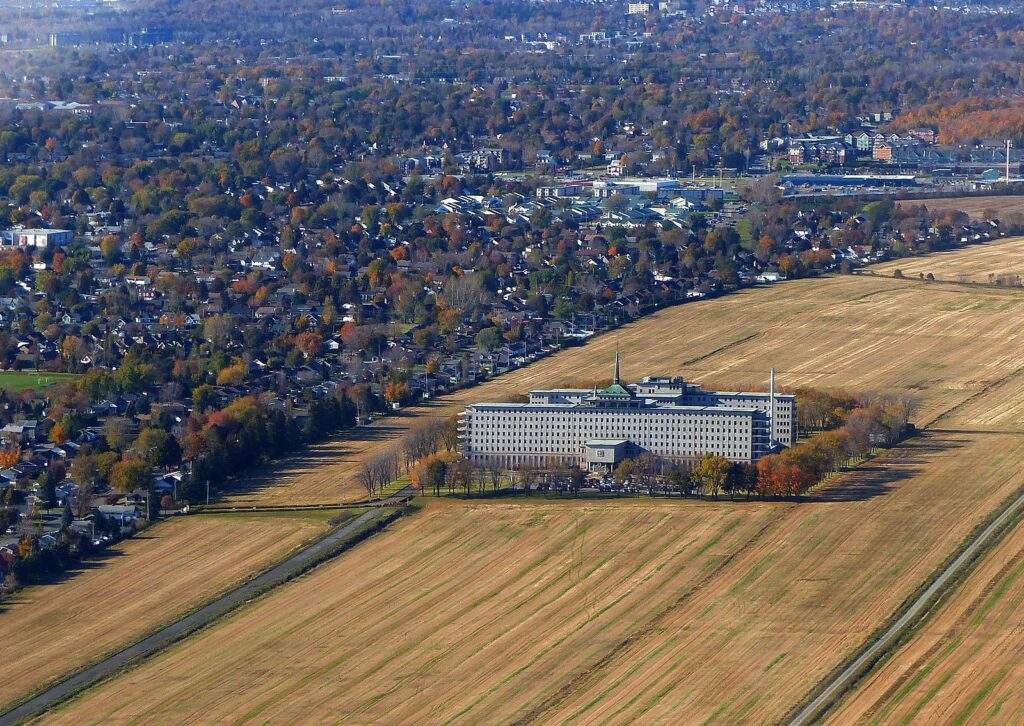
Included on the land is a large seven-storey convent built in 1952. According to a spokesman for the management firm handling the order’s interests in the land deal, as the nuns who live there age and the number of its residents diminishes, much of the vast building is empty. A use for the grey-stone building will need to be found, the spokesman said.

Earlier this month, Lamontagne was joined by other prominent politicians, including Bruno Marchand, mayor of Quebec City. Lamontagne said bids for community horticultural projects will be received until Jan. 10, 2025. Projects submitted must enable the development of a 10-hectare agricultural parcel through its full use, for the benefit of the population and the surrounding community. In addition, they must make agricultural products accessible with a view to food autonomy and security.

“From the moment we acquired the land, we wanted this project to be as inclusive as possible,” Lamontagne said. “Since then, we have acted accordingly through consultations and partnerships with citizens, the farming community and researchers. Whoever is chosen will take charge of a project that will enhance the value of these high-quality lands, for the benefit of Quebec City and Quebec as a whole.”

Cutline:

The provincial government bought this 250-hectare tract of farmland in the Quebec City district of Beauport in 2021. Now known as an agro-park, it is one of the largest public green spaces in the provincial capital region.

Quebec seeks to get agro-park ready for summer 2025 Read More »

Feds create agency to protect freshwater

Andrew McClelland
The Advocate

Environment Canada has launched a new federal agency that will protect Canada’s water from pollution and the damaging effects of industrial and agricultural activities, said Steven Guilbeault, federal Minister of Environment and Climate Change.

“Droughts, floods (and) pollution from farming and industrial activities have significant impacts on water quality — impacts that are very serious and costly,” said Guilbeault at a press conference in Winnipeg on Oct. 16.

The Canada Water Agency (CWA) will implement Canada’s Freshwater Action Plan, which was announced as part of the 2017 federal budget. The plan is aimed at improving freshwater management through efforts to improve the water quality of the Great Lakes, Lake Winnipeg, the Fraser River and other waterways of “national significance” throughout Canada.

“The agency will help the Government of Canada better address current water challenges and those of the future,” Guilbeault told a crowd of reporters and the public in downtown Winnipeg, where the agency will be based.

“We need to be prepared for what comes in the future, we need to recognize that water is becoming more scarce and more precious. We have a responsibility to protect the waters we have.”

Despite Guilbeault’s comments that agricultural pollution has a significant impact on water quality, the creation of a stand-alone agency to manage Canada’s freshwater has been a recommendation of the Canadian Federation of Agriculture (CFA) for years.

CFA president Keith Currie said the federation felt a pan-Canadian regulatory agency was vital given the importance of water for food production and adverse weather conditions driven by climate change affecting farming.

“(We) knew it was imperative that the government coordinate water-related issues across provinces, industries and conservation authorities to best manage water to keep it safe, clean and available for future generations,” said Currie, a sweet corn and hay producer from Collingwood, Ont.

“Water is one of the most essential inputs when it comes to food production, whether that be growing crops or keeping animals hydrated.”

At the moment, Currie says he can’t be sure how the creation of the CWA will impact the practices of agricultural producers in Canada. The federal government’s official release on the agency does not mention agriculture, and Guilbeault did not mention collaboration with agricultural groups at his announcement in Winnipeg.

Nonetheless, Currie says the CFA is hopeful that Ottawa will see agriculture as an ally.

“We will be working with the water agency on behalf of Canadian farmers to ensure that our sector’s needs are represented,” Currie said. “We also hope to see agriculture as a priority sector for water resources when competing with other industries.”

The CWA is funded with $85.1 million set aside from the 2023 federal budget. Ottawa has also pledged $650 million to enable the agency to offer grants supporting projects focused on restoring and protecting water resources.

Aim of Canada Water Agency

The Canada Water Agency’s current initiatives are:

– to restore and protect water quality and the health of aquatic ecosystems

– to advance science, monitoring (including community-based monitoring) and the application of Indigenous knowledge in cooperation with Indigenous peoples to support decision-making and effective action 

– to improve collaboration with Indigenous partners, provinces and territories, and stakeholders 

– to mobilize knowledge and reporting to measure progress towards results

– to improve climate change resiliency through on-the-ground action

The CWA will be headquartered in Winnipeg, including five regional offices throughout Canada and comprise 220 employees when fully staffed.

Cutline:

Federal Environment Minister Steven Guilbeault (right) announced the creation of the Canada Water Agency in Winnipeg on Oct. 16 with Winnipeg South MP Terry Duguid.

Feds create agency to protect freshwater Read More »

Despite rising food prices, farmers most trusted by consumers

As concern over rising food prices continues to be an issue for consumers, Canadian farmers are viewed as the most trusted among the supply-chain stakeholders involved with putting food on their plates, with major grocery store chains ranked the least trusted.

This is one of the key findings of the first Canadian Food Sentiment Index, a comprehensive report issued in October by the Agri-Food Analytics Lab at Dalhousie University in Halifax. The study quantifies and ranks Canadians’ perceptions and attitudes towards food-related issues, including affordability, food security and consumer trust.

The report, based on input from more than 3,000 respondents across the country, “provides a critical look at how Canadians feel about the rising costs of food and their evolving behaviours in response to economic pressures,” Dalhousie officials explained.

According to the study, Canadian farmers receive the highest trust score of 3.69, on a scale of 5, a score the study’s authors said indicates “that Canadians have strong confidence in farmers to act in their best interests regarding food.”

In contrast, independent grocers and major grocery chains received the lowest trust scores, 2.89 and 2.8, respectively. This suggests, the report claims, “that Canadians are less confident in retailers, particularly major grocery chains, to act in their best interest regarding food.

The authors attribute this poor perception to price increases, corporate practices or insufficient support for local food systems.

Other food-chain players ranked in the survey included two government agencies – Health Canada and the Canadian Food Inspection Agency. The authors said this suggests the public view these government bodies play an “crucial role in  ensuring food safety and regulations.”

Food manufacturers ranked in the middle of the trust spectrum with a ranking of 3.26 on a scale of 5, indicating consumers view them with “skepticism, likely driven by concerns over food production practices or corporate motives.”

Despite rising food prices, farmers most trusted by consumers Read More »

Farming Facts: From turkey producers to dropping dairy numbers

Here are a few fun facts that quantify a few realities of the farming sector.

24%: The proportion of the Quebec population who will be 65 or older by 2051. The percentage of seniors on the island of Montreal is expected to be below that level, at 21 per cent.

513: The number of turkey producers in Canada in 2024.

21.8: The number of megatonnes of wheat Canada shipped to a total of 65 countries in 2023-2024, with the top destinations being China, Indonesia, Japan, Bangladesh and the United States.

50%: That is the percentage drop in the number of dairy cows in Quebec in the last 40 years, with the provincial total hitting 353,000 head in 2022 compared to 710,000 in 1981.

Farming Facts: From turkey producers to dropping dairy numbers Read More »

What tangles webs they weave

Paul Hetzler
The Advocate

Spiders can be dangerous in weird ways. In 2014, Mazda had to recall more than 40,000 vehicles because yellow-sac spiders liked to plug fuel-vent lines with silk and nest inside them, causing gas tanks to pressurize, leak and cause fires. In that same year, a guy in Seattle burned his house down trying to kill spiders with a blowtorch in the basement. And at a Michigan gas station in 2015, a man tried to kill one with a lighter and torched a whole pump island.

But fire isn’t typically why we fear spiders.

Some experts think our aversion to spiders may be an evolutionary response, woven into the very strands of our DNA. Even though fewer than 1 per cent of the world’s 50,000 species of spiders pose a risk to us, early humans who kept their distance from things like spiders, scorpions and snakes probably lived longer.

These days, fake spiders star in horror films and come out of the woodwork at Halloween time because a lot of folks – perhaps 75 per cent of the population – still find them creepy.  Arachnophobia, an intense fear of spiders, affects 3 to 6 per cent of us worldwide, and is the most common phobia among humans.

I want to point out that spiders are essential to the web of life, eating millions of tons of insects each year. They reduce fly populations in barns tremendously, and a 2023 University of Guelph study found that spiders are key predators of agricultural pests like aphids. Even though they’re beneficial on the whole, it’s good to know how to identify and avoid the few poisonous spiders that live in our climate.

Canada is home to roughly 1,400 kinds of spiders, of which at least 70 are invasive. At the moment, we only have one species that is truly dangerous, and another two that are mildly toxic. The northern black widow is the main species of concern. In spite of its name, there’s a limit to its cold-hardiness. This native spider occurs in the southern portions of five provinces, including Quebec, where it has been found as far north as Montreal. However, based on a survey done in 2018, researchers from McGill University believe it is slowly moving northward due to climate change.

Here’s one to watch out for

A red-and-black colour scheme on a car is sporty. On a spider, it’s scary. Lucky for us, to identify the northern black widow we don’t have to flip it over to look for the characteristic red hourglass shape on her belly. Females, whose bodies are only nine to 11 millimetres long, can measure 25 to 38 mm when you include the legs. Males are half this size. Females have red geometric shapes (often like a “broken hourglass”) on their dorsal sides, and a red hourglass on their bellies. Males are harder to identify, as they can have stripes or spots in either red or white.

An interesting sidebar about black widows, so called because they’re known to eat the males after mating, is that such behaviour is not the norm. This “sexual cannibalism” was first seen in the lab where males couldn’t get away. It seems that in the wild, males have a “best defense is a running head start” policy, and most survive.

Fortunately, black widows live outside. But they sometimes come in on firewood or other items on which the shy, nocturnal bug-hunters hang out during the day. Northern black widows can also wander in through gaps in foundations or broken weather-seals around doors if there are cool, damp places next to the house to hide in. Move brush and leaves away from foundations, and keep door gaskets in good shape. 

Their bites initially cause redness and swelling, followed by severe muscle and stomach cramps, nausea and sweating within an hour. If you’ve been bitten by a black widow, call a poison control centre or dial 911 immediately. Apply ice to the bite while you wait for help. Do not use a tourniquet.

And one more to beware

Although black widows have the most toxic venom, the brown recluse spider has caused more deaths. Bites from the brown recluse, while rare, may require medical intervention because they can result in extensive tissue death (necrosis), with possible infection and scarring. In about one per cent of cases, their bites are fatal when the venom becomes systemic.

Brown recluse spiders are shiny, hairless, tan to brown, and up to a half-inch long. An important feature to look for is a dark brown, violin-shaped mark on its back, with the neck of the violin pointing backwards. True recluses, these guys like sheltered places, which is a problem when they hide in clothing or bath towels. Primarily an outdoor species, brown recluse spiders will adapt to living inside. The thing is that they sometimes stow away in luggage or gear of returning snowbirds – brown recluses are common in the southern U.S.

Most brown recluse bites result in tissue death around the bite, forming a wound that can take months to heal. The main concern is infection at the site. Bites that lead to fever, nausea or dizziness may suggest a systemic response, and you should seek medical care right away.

We do have two species of house-dwelling, slightly toxic spiders that can bite, the yellow-sac spiders. They can reportedly survive almost up to the Arctic Circle, so it’s a sure thing they’re in your region. Ghostly pale, almost translucent, yellow sac spiders actually range in colour from yellow to greenish, or occasionally pink or tan. They’re tiny; just eight to 10 mm long, which makes them easy to overlook.

Yellow sac spiders cache their silken sac-homes in nooks and crannies behind pictures, in the corners of rooms and, apparently, in auto fuel vent lines as well. Though not dangerous, this species has a mildly toxic venom that causes a rash, and sometimes a limited necrotic area.

About 30 years ago, one bit the side of my neck (it was in my shirt collar), and a nickel-size wound developed. The lesion turned grey, and took nearly a month to heal. I have to count my blessings, though. There was no fire.

What tangles webs they weave Read More »

Sustainability key in how food processors compete globally

How it is measured is the challenge farmers face

Christopher Bonasia
The Advocate

A framework for measuring sustainability across the agri-food industry was presented to a full room during a two-day conference earlier this month, with some questioning how small and mid-sized businesses will fare.

Panelists throughout the Canadian Agri-Food in a Sustainable World conference — hosted in Ottawa by the Canadian Agri-Food Policy Institute on Oct. 2 and 3 — spoke to attendees about how standards for sustainability were shaping how Canada’s food producers compete on national and global markets.

‘Sustainability’ is now a widely sought label among consumers. But agri-food businesses — like farmers, food processors and distributors — have struggled to assign a concrete way to measure it as they try to balance environmental stewardship against other priorities, like maintaining revenue and paying fair wages.

One way to provide clarity was put forward by David McInnes, founder of the Centre for Agri-Food Benchmarking, as he presented the National Index on Agri-Food Performance released by his organization. The index was created by a coalition of private-public partners to “present an integrated picture of sustainability for Canada’s agri-food sector from food production to retail,” according to the centre.

McInnes emphasized that the index should be used as a “framework to derive value” from agri-food businesses’ sustainability efforts by setting standards and ways of measuring performance throughout the supply chain.

“If we don’t measure ourselves, we will be measured,” McInnes told attendees.

The National Index on Agri-Food Performance designates metrics for measuring sustainability across indicators in four categories: environment, economic, food integrity and societal well-being. When applied to a business, the index offers a method of measuring sustainability that doesn’t fall prey to a tunnel-vision focus on any one outcome — like carbon emissions, for example — at the expense of others.

Carbon emissions are included as one metric to measure climate performance, among other environmental indicators, like soil health and water stewardship. But businesses also need to measure up against non-environmental indicators, like food safety, “financial vibrancy and resiliency,” supplying decent work environments and supporting food security.

The index has clear utility for larger businesses and corporations required to apply environmental, social and governance (ESG) targets to their practices and report their performance to investors and boards. But panelists noted that  small and medium-sized enterprises are also feeling pressure to measure up to sustainability standards. Even businesses that haven’t set targets may be asked to report their performance to those they sell to.

Though the index is meant to be used by businesses of all scales, the burden of reporting is proportionally heavier for small and medium-sized businesses that may not have resources to invest in sophisticated data collection. The index’s designers account for this, specifying that these smaller businesses can instead use public data to estimate their outcomes.

But Bruce Marchand, interim chair of the Canadian Sustainability Standards Board, pointed out that estimations based on out-of-date datasets could mask improvement of Canada’s food producers as a whole. The sector could then benefit from public access to better data collection, perhaps from governments or industry associations.

Still, softening requirements for SMEs will not entirely offset the added strain placed on smaller businesses. The trend of increased reporting requirements generally tends to favour larger players, and panelists acknowledged that even reporting based on the index is likely to result in consolidation of food production among ever larger businesses. Panelists emphasized that small and medium-sized enterprises need support to remain competitive, and including protection for them as an indicator of the index could provide them with an edge.

Sustainability key in how food processors compete globally Read More »

Young grain producer expands into custom harvesting, spraying

Andrew McClelland
The Advocate

You could say that from an early age, Andrew Dirven had his priorities straight when it came to farming.

“One day I came home from school and saw that my family was harvesting,” the 21-year-old grain producer recalls. “So I ran inside and told my father that I did all my homework on the bus — which I definitely hadn’t done — just so I could ride in the tractor with my grandfather. I loved every second of sitting in that tractor, until the next morning when I actually had to do my homework on the bus!”

From that young age, Dirven realized that his third-generation family farm in Bainsville, Ont., was something special. And there weren’t many other careers he considered pursuing.

“It was an amazing childhood growing up on the farm,” Dirven said. “I was always fascinated with tractors and combines. And that fascination is still with me. Working alongside my family as a child developed a special bond. Being passionate farmers brought us together.”

The story of the Dirvens’ farm begins in 1977, when Andrew’s grandparents, Peter and Betty Dirven, decided to sell their farm in The Netherlands and relocate to Canada. It wasn’t long before their son, Nick, took an interest in the family business and started a multi-generational grain and cash cropping operation.

Today, the family — along with lots of help from Andrew — produces corn, soybeans and wheat under the name Spendrew Farms.

Located a mere seven kilometres from the Quebec border, it wasn’t difficult for Driven to realize that Macdonald Campus in Ste. Anne de Bellevue was a great, nearby place to receive an agriculture education.

“Mainly, I wanted to go there just because of my passion for agriculture. But after I started, I realized networking was just as important,” he explained.

“Over my three years at Mac, I met a lot of people with the same interests as me, and a lot of those people have become my closest friends.”

Dirven enrolled in the Farm Management and Technology (FMT) program in the fall of 2021, discovering the finer points of soil science, cash cropping and agricultural economics.

“Cash cropping is a very dependant industry on the markets. Our grain prices fluctuate depending on supply and demand around the world,” he said. “There isn’t a lot of security or guarantee to what prices we’ll receive. Although our farm works hard on marketing by making futures contracts, setting targets and other marketing strategies, it still puts a lot of dependency on what’s going on globally.”

That’s what gave Dirven the thought of diversifying. Instead of relying on grain prices to determine the revenue of Spendrew Farms, there was money to be made providing services instead of just selling commodities.

“Since 2023, we’ve been offering custom harvesting and custom spraying,” Dirven said, referring to two tasks he has taken on himself. “I believe in the importance of diversification, having alternative income sources to allow our farm to have more security.” 

With initiatives like those, Dirven is definitely working more than full time on the family farm. Along with spraying and harvesting, equipment maintenance is also his duty at Spendrew. He knows that one day, he’ll be able to take over management of the whole farm — and is more than grateful for the fact that he was born into a family farm so he could pursue his dream.

“I wish for my future generation and other future members in the agriculture industry to have the same opportunities as I had,” Dirven said. “Opportunities to purchase land will be the biggest challenge for young farmers. With land being an appreciating asset, it’ll continue to be more expensive for the next generation. Not only will receiving approval for a mortgage to purchase the land be a challenge, but as well as being able to cash flow the payments.”

That’s part of the reason that family — and family farming — play such an enormous role in Dirven’s life and journey in the industry. For him, family working together is a strength that has to be experienced to be understood.

“Just growing up and watching my family work hard day and night together — to either complete harvest, or try to get the last field planted before the rain, or whatever the task might have been — it’s a level of passion that most people wouldn’t understand unless they lived it.” 

Young grain producer expands into custom harvesting, spraying Read More »

Husband and wife die on Montérégie farm after falling into manure pit

Frederic Serre
The Advocate

A tragic accident at a family farm in the Montérégie village of Ste. Christine earlier this month resulted in the deaths of a man in his 40s and his wife, also in her 40s. The Sûreté du Québec and Quebec’s Commission des normes, de l’équité, de la santé et de la sécurité du travail (CNESST) are investigating the Oct. 4 incident at the farm on Highway 116, near Acton Vale.

According to Camille Savoie of the SQ, officers and local firefighters were called to the Robidoux Jutras veal and grain farm at about 6:30 p.m. after receiving a report of a severely injured man found unconscious in a manure pit. Savoie said the victim’s spouse attempted to rescue him, but she, too, was also seriously injured. The couple was pulled out of the pit by firefighters.

Éric Jutras was pronounced dead at the scene while his wife, Caroline Robidoux, was rushed to hospital. She died nine days later, on Oct. 13.

Investigators believe the accident happened as Jutras was working near the pit. He fell into the pit after possibly suffering a medical emergency due to the toxic gas emanated from it. The SQ said Jutras called out to his wife, who rushed to his aid, but she also succumbed to the fumes and fell into the pit.

A Gofundme campaign has been launched by the family of the couple, with already more than $19,500 raised to support their three children.

The tragedy this month is the second of its type to occur in the area. In 2016, a pig farmer and his 18-year-old employee died while trying to do some work in a manure pit at a farm in St. Valérien de Milton, located about 30 kilometres from Ste. Christine. Investigators reported that the farmer, who was in his 50s, lost consciousness due to the toxic fumes in the pit, and his employee rushed to his aid but was also overcome by the fumes. Both men died at the scene. It was determined that their deaths were the result of inhaling high levels of hydrogen sulfide.

Husband and wife die on Montérégie farm after falling into manure pit Read More »

Women farmers feeling the stress: survey

Andrew McClelland
The Advocate

A new study shows that the vast majority of female farmers in Quebec – 90 per cent – suffer from high levels of stress as they struggle to balance farm tasks, family life and farm management.

“Women in agriculture hold an average of 5.1 positions in the business,” explained Valérie Fortier, president of Agricultrices Québec.

“The five main tasks are management and administration — such as strategic planning, business management, finance and accounting — tasks related to agricultural production, purchasing and supply, and human resources.”

In other words, female agricultural producers feel forced to spread themselves too thin over the many areas of farm production. The study, conducted by Léger, was carried out on behalf of the Fédération des agricultrices du Québec, a specialized federation of the Union des producteurs agricoles. The association was founded in 1987 to highlight concerns of female producers in the province.

“The results of the survey confirm what our members have been telling us for several years,” said Fortier, herself a dairy producer from Saint-Valère in Centre-du-Québec.

“The situation is worrying and concerns all of us, considering the fundamental and structuring role that women play in the agricultural sector in Quebec.”

Province-wide, 27 per cent of farm businesses are owned or co-owned by women. While female producers have made great gains in recent decades, figures show they also bear more than their fair share of the workload, particularly when it comes to paper work and financial management.

“Managing multiple tasks is the top source of stress that respondents report experiencing on a daily basis,” Fortier said.

In fact, 63 per cent of respondents said that multi-tasking and balancing roles was a key source of mental stress.

Other sources of stress include pressure for productivity (46%), financial problems (43%), family responsibilities (41%) and weather conditions (40%).

The situation can be even more challenging for young female producers (between the ages of 18 and 34), who are often juggling the work of supervising children while also managing farm labour.

“For younger women farmers, balancing domestic and professional tasks and reconciling work and personal life are the most important challenges,” Fortier said.

“Women farmers who have children in their household reported that the main challenges are balancing domestic and professional tasks, reconciling work and personal life, and salary conditions.”

Chief among the stressors and tasks often foisted upon female farmers are what sociologists call “invisible work”— work done within the family that may include household chores and personal care, labour performed for a family business, or caregiving for the older generation.

In November, the Les Agricultrices will launch a tool to quantify invisible work in agriculture. The data collected will be used to obtain gendered information on invisible work, to document the phenomenon and raise awareness among agricultural producers.

“Our programming at Les Agricultrices is a response to the mental stress-load issues experienced by women farmers that were identified in Léger’s study,” Fortier explained.

This year, the federation is offering members up to seven hours of free consultations with experts, including notaries, tax specialists, lawyers, agricultural management consultants, marketing-communications advisers and financial planners. Fifteen workshops on various themes along with entrepreneurial mentoring, personalized support and networking are also planned.

To find out more about what help is available from the Fédération des agricultrices du Québec, visit tellementplus.ca

Caption:

Valérie Fortier, a dairy producer from Saint-Valère and president of the Fédération des agricultrices du Québec, knows the type of stress women farmers are feeling. A new study reveals that female producers are carrying a very high stress load from managing multiple roles on the farm.

Credit:

Agricultrices Québec

Women farmers feeling the stress: survey Read More »

Farmland values keep rising

Quebec leading most provinces as prices jump 5.4% in first half of 2024

Brenda O’Farrell
The Advocate

Quebec has recorded the second highest increase in farmland values in the first six months of 2024, as prices jumped 5.4 per cent, according to figures released by Farm Credit Canada earlier this month.

It is the second year in a row that the 6-month increase in farmland prices in Quebec outpaced all provinces except Saskatchewan, where prices jumped 7.4 per cent in the first half of 2024, the data shows.

Ontario recorded the second lowest rate of increase, as prices there rose by 2.1 per, while cultivated land in Prince Edward Island edged up by only 1.7 per cent.

Rates of increase in New Brunswick, British Columbia and Alberta came in at 5.2, 5 and 4.6 per cent, respectively.

Overall, farmland prices saw a 5.5-per-cent average hike in Canada.

This small national deceleration in the growth of farmland values comes as interest rates have dropped, but at the same time farm revenues have been depressed as commodity prices have taken a hit, the FCC highlights.

“High input costs squeeze profit margins, possibly limiting farmers’ capacity to invest in new land and moderating farmland growth,” the FCC said in a statement issued Oct. 4.

Another factor that is a crucial driver of farmland values, the lending organization pointed to, is the limited availability of growing land for sale.

Farmland values keep rising Read More »

Farmers add their voices urging Senate to pass C-282

Brenda O’Farrell
The Advocate

Pressure is mounting on the Canadian Senate to provide its stamp of approval to Bill C-282, legislation that aims to protect the country’s supply-managed agricultural productions like dairy, poultry and eggs.

The bill, a private member’s bill first introduced by the Bloc Québécois last year, was approved by the House of Commons in June 2023. It, however, has been stalled in the upper chamber. And is now part of the political manoeuvring by the Bloc to leverage support for the minority Liberal government in Ottawa.

Bloc leader Yves-François Blanchet has given the Liberals an ultimatum, and earlier this month accused what he called the “illegitimate” upper chamber of “leading the prime minister around by the nose.”

Blanchet added C-282 to his list of conditions to support the Trudeau Liberals in a future confidence vote.

Although Prime Minister Justin Trudeau said he would not interfere with the Senate’s deliberations, International Trade Minister Mary Ng has sent the chairman of the Senate’s foreign affairs and international trade committee, Peter Boehm, a letter in early October.

In addition, farming groups, including members of the Union des producteurs agricoles, were on Parliament Hill earlier this month to add their voices urging the Senate to approve the bill.

But Boehm stated publicly that hearings will continue until the end of October. That process will then be followed by a clause-by-clause study of the legislation.

Private member’s bills approved by the House of Commons are not prioritized on the Senate’s agenda, which, in part, explains why the process has been so slow.

Boehm has also been quoted as saying that he does not think it is in “Canada’s national interest” to pass the bill because it would impact future trade negotiations.

The Canada-United States-Mexico Agreement (CUSMA) is scheduled for renegotiation in 2026.

Dairy, poultry and egg producers continue to argue that supply management has been sacrificed in recent trade negation talks and any further erosion of the protections it offers would seriously harm their livelihoods.

Farmers add their voices urging Senate to pass C-282 Read More »

UPA to mark 100 years

Milestone tells the story of farming in Quebec

Brenda O’Farrell
The Advocate

The history of Quebec has many chapters and spans several centuries, but it is the story of the province’s farms and its farmers that will be showcased later this year as the Union des producteurs agricoles celebrates its 100th anniversary in Quebec City.

And that is where it all started.

It was on Oct. 2, 1924, in the provincial capital that the Union catholique des cultivateurs was formed. On that autumn day 100 years ago, this forerunner to today’s farmers’ union, the UPA, brought together about 2,500 farmers from across Quebec. The goal of joining forces in a union was to speak to government with one voice. And what they had to say charted a course that changed the rural landscape.

The UCC demanded that the electrical grid be expanded from the cities into the outlying regions. It also advocated for income protection and educational initiatives and information resources for agricultural producers.

But the organization’s success over the decades that followed stemmed from its duality – its ability to bring not only farmers from every region of the province together, but unite the different type of farmers – and their different types of specialties, like dairy, pork, beef.

“We protect all the models of agriculture,” said UPA president Martin Caron in a recent interview. “The greatest wealth we have in Quebec is all the diversity in relation to different productions and the models of agriculture, whether large or small farms.”

Creating local farmers’ group was always at the core of the organization’s approach.

The first of those groups was founded within the first week of the UCC’s founding. It was formed in St. Nazaire d’Acton in the Montérégie area, between Drummondville and Acton Vale. The second group was established in the parish of St. Edmond de Coaticook in the Eastern Townships. By 1925, there would be 255 local groups, that included more than 11,000 farmers, about 10 per cent of the province’s agricultural producers at that time.

Laurent Barré became the organization’s first president. He served in that capacity from 1924 to 1926.

Barré would then run for a provincial seat in the National Assembly as a member of the Quebec Conservative Party, winning a seat in 1931. In the 1935 election, we would run under the Union Nationale banner, winning again. He was defeated in 1939, but returned to be part of the Union Nationale government in 1944, when he was named Quebec’s minister of agriculture until 1960.

In 1972, the UCC rebranded itself, becoming the UPA and the only representative of farmers in Quebec through the adoption of the Farm Producers Act. Caron is the 14th president of the UPA.

Throughout the 1970s and ’80s, the UPA was part of a number of campaigns championing the rights of the province’s farmers.

Everything from the fight against the expropriation by the federal government of vast tracts of farmland in Mirabel to build an international airport, to the creation of quota systems for the dairy, poultry and egg sectors were tackled.

In the 1990s, issues of environmental protection began to emerge, as well as global trade pacts.

In 1999, the UPA called for the creation of mechanisms to provide farmers with insurance and financing, leading to the creation of La Financière agricole du Québec in 2001.

Today, the UPA represents more than 42,000 farmers, and the organization is at the forefront of the movement to protect agricultural land from being dezoned for other uses.

As Caron has often cited, only 2 per cent of the land in Quebec is zoned for farming. That represents about a quarter of a hectare per resident, a ratio that is the lowest of all other jurisdictions in America outside of Canada.

Farming in Quebec has evolved from merely a way of life to a way of life that feeds a growing portion of the world. But it still faces a wide variety of challenges.

Those challenges will be the focus of the UPA’s next chapter.

UPA to mark 100 years Read More »

Prairie grazier let market come to him

Andrew McClelland
The Advocate

Ross MacDonald doesn’t necessarily believe that success is all about business savvy and making the right decisions. For the south Saskatchewan rancher, luck and timing are factors, too.

And MacDonald will be the first one to tell you his success is a prime example of that.

“The largest single determinant in business success is timing,” said MacDonald, who grazes beef cattle, a Hereford base herd crossed with Angus genetics.

“If you just sit back and wait for the timing to click, you might not recognize it. But the thing is you have to be searching, MacDonald said. “Things might not always click, but if you’re not searching, you’re not gonna find it.”

The timing first ‘clicked’ for MacDonald growing up the son of lawyers in Lake Alma, Sask. – just 20 kilometres from the Montana border. Many of his parents’ clients were local agricultural producers, and meeting them instilled him with a respect for ranching and grasslands.

MacDonald learned to rope and ride as a teenager and took an animal science degree at the University of Saskatchewan. Upon graduation, the research and teaching being done at Montana State University influenced him as a young grad student.

Broadened his horizon

“In Montana, I got exposed to some very different thinking than I grew up with in terms of agricultural production systems and low-input cow systems,” MacDonald explained. “It really planted a seed of creativity within me. It sort of became my goal to try and capture a piece of grass of my own.”

The timing was right in the early 2000s, when grassland prices were at low-value prices in Saskatchewan. To build his land base, MacDonald was able to parlay small purchases of land with conservation easements and grazing leases with the Nature Conservancy of Canada and Ducks Unlimited Canada. Today, he grazes his herd on about 5,000 acres of prairie grassland.

“I’m pretty risk-averse when it comes to huge financial risks,” MacDonald told participants of a QFA videoconference held Oct. 2. “But I’m not too risk-averse on relationships when it comes to non-typical agricultural relationships, whether that’s with conservation organizations or trying to get further up a supply chain.”

Enter A&W

Having conversations further up the supply chain is what made the timing and the luck really click in MacDonald’s career. When fast-food chain A&W started its “Raised Without” program in 2013, marketing beef raised without artificial hormones or steroids, MacDonald realized that the company’s commitment dovetailed nicely with his production practices.

More, he suspected that the company he was selling his cattle to — Spring Creek Ranch of Vegreville, Alta. — was one of the suppliers for A&W.

“I went to a local producers’ meeting where one of the vice-presidents of A&W was taking questions from ranchers — a lot of whom were really upset by the Raised Without program,” MacDonald explained. “And I said to (the VP), ‘I’m a small ranch that sells into your supply chain, I think there could be a lot more to this story of ‘Raised Without’.”

That encounter developed into a relationship with A&W that has lasted years. MacDonald and his wife Christine Peters began discussing their production with executives at the restaurant chain, ultimately appearing in their commercials and being featured in a series of short documentaries about Canadian ranchers.

And it expanded from there

“During one of our conversations, they said to me, ‘How do you feel about grass-fed?’” MacDonald said.

“I said: ‘Well, really, that’s where the logic of my production system is going, but we don’t have a commercially viable market in Western Canada for grass-fed.’”

That’s how MacDonald contributed to A&W’s decision, in 2020, to use all grass-fed and grass-finished beef. He didn’t tailor his production practices to suit their market — he was searching for opportunity and the timing just clicked.

“Each of those big events in my life has been the result of searching for it,” MacDonald said as he reflected back on his trajectory in the business.  “So when the opportunity arose, I was ready for it. Sure, it also came with an education, a steep learning curve, and a cost. But it has been a lot of fun, and I’ve learned a tremendous amount.”

Prairie grazier let market come to him Read More »

Why autumn pruning is bad

Paul Hetzler
The Advocate

Back when I was a baby arborist, I worked for an old-timer who told me: “The best time to prune trees is when the tools are sharp.”

He would also say: “What doesn’t kill you makes you stronger,” even though he was beset with shoulder injuries, knee problems and back pain.

While he taught me a lot of things, I later learned that both of these old saws are dangerous lies.

There are, in fact, certain times of the year when pruning should be avoided. Late spring, between bud-break and full leaf-out is a key period of pruning abstinence.

The other no-pruning interval is from the time leaves start to change colour in the fall until trees are entirely bare. There are good reasons to put away pruning tools at this time of year.

The claw-back clause

As days get shorter, deciduous trees and shrubs start to make a waxy layer between the petiole base of each leaf and the twig to which they’re attached. The wax is called suberin.

Suberin will eventually plug the vessels that moved water and nutrients into, and sugars out of, leaves all summer. This blockage protects twigs from losing water over the winter. It also leads to the breakdown of green chlorophyll molecules, thus revealing the yellow and orange pigments already present in leaves.

Before the vascular tubes are entirely blocked, though, trees “claw back” about half the nutrients from each leaf: nitrogen, potassium, iron, magnesium, manganese, and other essential elements. This recovery is quite important to the nutrient budget of woody plants.

Trees also move sugar out of the leaves. This sugar is the product of a season’s worth of photosynthesis. Much of the sugar clawed back from autumn leaves before they drop is transported down to the roots, lower trunk, as well as branches, where it is stored as starch. In spring, starch is turned back to sugar and distributed to developing buds and leaves. Pruning branches in autumn, therefore, deprives trees of both nutrients and energy needed for the following year.

The illness angle

All woody plants have internal defence systems that make anti-microbial compounds to fight infections at the site of injuries, like pruning cuts. The renowned biologist and plant pathologist Dr. Alex Shigo, often called “the father of modern arboriculture,” studied trees’ defensive process. He called it Compartmentalization of Decay in Trees, or CODIT. This “tree-mune response” becomes active in the early spring just before bud-break and is in full swing throughout the summer, after which it starts to shut down. By the time leaves are turning, the CODIT response is much attenuated.

Therefore, wounds made in the fall are at greater risk of being infected by fungal pathogens that cause persistent, or perennial, cankers. Nectria and Eutypella are the two primary types of canker fungi, but there are more. And while spores from Nectria and other diseases are always present in the environment, they are most prevalent in the fall. In addition, the long rainy spells typical of autumn further raise the odds of pruning-wound infections, given that canker spores are spread by rain splash.

The best time to prune

Early spring prior to bud-break is the ideal time to prune. Not only is CODIT up and running, there is little chance that pruning sites will dry out too much, which can lead to bark cracks near the wound, as can happen with early winter pruning.

The truly essential reason to stow the lopper and saw while leaves are expanding is that when trees are “busy” pushing out leaves, CODIT goes on a coffee break until full leaf-out. It’s not that it turns off completely, but due to a hormonal shift in trees that happen as leaves are forming, their defenses are weakened temporarily.

The exceptions

‘I’ before ‘e’ except after ‘c’ (well, except for words like “height,” “seize,” etc.). Exceptions can complicate things.

Obviously, some pruning may need to be done right away to address safety concerns, regardless of the season. In such cases, my one-time mentor is right: the best time to prune is when the tools are sharp. But if the goal is to boost aesthetics, or get more light on the garden, or fewer leaves in the pool, or to lessen disease pressure in fruit trees, fall pruning should be off the table.

And then there’s oak wilt, which can decimate oaks like Dutch elm disease did to elm trees. To help prevent the spread of this fearsome disease, the Canadian Food Inspection Agency recommends we not prune oaks between April 15 and July 15, when the risk of spreading oak wilt is extreme.

Depending on the year and where you live, mid-April might still be ahead of bud-break, an optimal pruning time. Some authorities suggest that to be on the safe side, we wait until Oct. 1 to prune oaks, a time that overlaps the period of colour change. Since oak wilt is far worse than perennial cankers or lost nutrients, oak-wilt prevention should always take priority over ideal pruning windows.

Conifers count, too

Although pines and spruces only lose a small portion of their needles in the fall, the same principles hold true for them. Cutting evergreen branches in autumn will rob trees of a share of the nutrients and sugars they need.

Another reason it’s best to cut conifer branches in late winter is that during July and August, a moth called the pitch-mass borer sniffs out fresh wounds to lay her eggs in. Her babies become an issue the next spring as they tunnel under the bark to feed on sap. The grubs enlarge the wound diameter, and trigger excess pitch accumulation. If you’ve ever noticed unsightly, oozing pitch on the trunks of pines and spruces, it’s a result of summer pruning that invited pitch-mass borers to set up housekeeping. The pitch-blobs they leave behind can persist for years, diminishing a tree’s aesthetic appeal.  

The moral imperative:

The last reason to stash the saw until trees are fully dormant is the danger of running into a self-righteous arborist who views fall pruning as a moral failure. They might give you the hairy eyeball, or worse yet, engage in “pruning shaming.” I’m not saying that I’ve ever done that kind of thing.

Why autumn pruning is bad Read More »

Farming Facts: From oilseeds to organic exports

Here are a few fun facts that quantify a few realities of the farming sector.

3%: The amount of the planet’s renewable freshwater reserves located in Quebec, with 40 per cent of that found in the St. Lawrence basin.

$555 million: The value of organic agricultural products exported by Canada in 2022, making the country the fifth largest organic exporter globally.

4 million: The number of acres in eastern Canada that grew oilseeds in 2023, with 70 per cent of the acreage growing soybeans.

240 million: The approximate number of animals on farms in Quebec currently.

Farming Facts: From oilseeds to organic exports Read More »

New guide aims to help incorporated farms prepare for climate reporting

Christopher Bonasia
The Advocate

Small, incorporated farms will feel the impacts that “trickle down” from climate reporting requirements for larger corporations, and a new guide says farmers should start preparing themselves now.

The guide, published by the Canadian Climate Law Initiative (CCLI), is directed toward the growing number of incorporated farms that share the fiscal obligations imposed on larger corporations. They carry these obligations “regardless of personal opinions on climate change,” and directors that fail to do so “may be exposing themselves to personal liability,” the guide warns.

New requirements are already being imposed on larger and publicly-traded agri-food businesses, oil and gas companies, and banks — all entities that Margot Hurlbert, a University of Regina professor and author of the guide, noted are “closely tied to the agriculture ecosystem in Canada,” and through which smaller farm corporations will experience trickle-down effects of reporting requirements.

And even though those larger corporations are likely “governed by more sophisticated boards of directors, the duties with respect to climate also apply to smaller farms and agri-food corporations,” Hurlbert said.

The guide focuses on incorporated farming business. It is a corporate structure that is becoming increasingly common for farms in Canada. Farms may choose to incorporate for a number of reasons, including for access to benefits, like liability protection, access to lower tax rates and opportunities to split incomes or pay out dividends to family members.

More farms in Quebec are incorporated

Most Canadian farms are still sole proprietorships. But of the 189,874 farms Statistics Canada reported operating in 2021, 47,824 — or about 25 per cent — were either family or non-family corporations, up from 13 per cent in 2001. The percentage is even higher in Quebec, where 37 per cent of farms operated as corporations in 2021.

Farms that incorporate become subject to the same legislation regulating other corporate businesses, and so are required to establish a board of officers and directors. People who act in those roles are legally obligated to exercise care and due diligence for overseeing the farm’s operations and ensuring its long-term viability and can be held accountable by shareholders if they don’t.

An officer or director of a small farm corporation is, therefore, responsible for staying informed about, and planning responses to, threats to the business. In a time of rising global temperatures, such threats include both physical impacts from changing weather patterns and from legal and policy changes that will affect farm management.

These changes are happening now. Farmers are likely already aware of new regulations or polices linked to climate change that have either been implemented or are on the regulatory horizon for producers, like taxation on fossil-fuel use and targets for reducing emissions. Changes in institutions that farmers rely on — for insurance or mortgages — or to international trade regulations may also be forthcoming and could disrupt how businesses operate.

Farmers will also need to adapt to new technologies as the rest of the economy electrifies and transitions to low- and zero-emissions energy sources.

In other cases, a farm corporation might find itself in hot water if it doesn’t respond to new policy requirements properly. The guide, therefore, recommends that farm corporations stay aware of carbon-offset schemes and the potential legal risks of over-relying on them to reach decarbonization goals. Furthermore, directors of agricultural operations should be careful about making claims of farm sustainability to avoid potential accusations of greenwashing.

Hurlbert added that the guide’s information is also important for sole-proprietorship farms, who will face many of the same risks even when not shouldering the governance accountability of a corporation. 

New guide aims to help incorporated farms prepare for climate reporting Read More »

Move to protect caribou in Quebec sparks debate

Brenda O’Farrell
The Advocate

A plan put forward earlier this year by the federal government to protect caribou herds in Quebec is going to come at a cost, according to the Montreal Economic Institute.

And that costs varies from region to region, but the overall price tag is $177.6 million and 1,990 jobs, according to the think tank’s estimates, which were included in a report issued Sept. 17.

“If the federal government goes ahead with this decree, it will cause the loss of a minimum of 1,990 jobs and with no guarantee that the caribou will be saved,” said Gabriel Giguère, a senior public policy analyst with the MEI.

In June, the federal minister of Environment and Climate Change issued an emergency order to take steps to address what it deemed are the “imminent threats” faced by three dwindling herds of boreal caribou in the province. These herds are considered at risk, with one herd including as few as nine animals.

These herds are located in Val d’Or, Charlevoix and Pipmuacan, which is located in the Saguenay-Lac St. Jean region.

Ottawa estimates that with nine members, the caribou herd in Val d’Or is at a level that “has already crossed the threshold of quasi-extinction,” officials claim. “The one in Charlevoix is very close to reaching it.” The Charlevoix herd has about 30 animals.

The herd in Pipmuacan is estimated at having fewer than 300 members, with federal officials believing it could become quasi-extinct in about 10 years.

The federal order to protect the animals has been put to public consultation in the regions involved, but has yet to be finalized. When approved, the measure would protect targeted areas of what is considered “best available habitat” on provincially owned lands.

According to the federal government, there are multiple threats to the herds’ recovery, including the increased scope of logging activities and industrial expansion. The order would stop those activities in defined areas.

And it is this possible restriction on logging activities that the MEI focuses on in its report.

More than half of the $177.6 million economic impact – or $93.3 million in annual economic activity – will be felt in the Pipmuacan region, where the MEI estimates the protection of 225 animals would result in the loss of at 1,041 jobs.

In the Charlevoix region, protecting the herd of fewer than 30 could cause the loss of at least 609 jobs and reduce economic activity by $54.3 million.

In Val d’Or, the measure would result in the loss of 38 jobs and $3.43 million in economic activity, the MEI claims.

“Preserving the woodland caribou is laudable,” said Giguère, “but the method adopted should not result in putting so many Quebecers out of work.”

In April the Quebec government announced a $59.5-million plan to safeguard boreal caribou in Charlevoix and mountain caribou in Gaspé, but critics say the protections included for the animals’ habitat arenot enough.

This lack of habitat protection is, in part, what sparked Ottawa’s emergency measure. But federal officials say if Quebec implements concrete protection measures, the federal Environment minister would withdraw the emergency order.

Quebec is home to about 15 per cent of Canada’s boreal caribou population. In 2023,

the Quebec government estimated the boreal caribou population to be between 6,162 and 7,445.

Move to protect caribou in Quebec sparks debate Read More »

Young Townships producer diversifies family sheep production

Andrew McClelland
The Advocate

Maple Star Farm in St. Felix de Kingsey is definitely what you’d call a family farm.

“My brother takes care of the equipment and machinery maintenance; my sister, Trinity, takes care of the social media and sale advertisement of the farm,” explained 20-year-old Ruby Mastine.

“My father does a little bit of everything when it comes to the barns and fields, and my mother helps in the barns for the sheep as much as she can. Everyone has their own role in the business.”

The Mastines come by their dedication to family farming naturally. Ruby is part of the fifth generation to farm the land in St. Felix de Kingsey, just 60 kilometres north of Sherbrooke. What started out long ago as a dairy operation and sugar bush expanded to sheep production with Ruby’s grandparents in the 1960s. Today, parents David Mastine and Erika Brock own and manage the farm, selling lambs for meat all year long and winning multiple awards for their herd and livestock genetics.

For Ruby, sheep rearing has always been a part of growing up.

“One of the first farm memories I have is swinging in a swing that was hung in the barn for us kids while I watch my father feeding the sheep,” Ruby said.

“Seeing all of the ewes running to get their grain while their babies were running and playing up and down the straw bedding. My grandmother, Blanche, always said that if the lambs were playing, that meant they’re healthy. To this day I love seeing them run around, and that quote has always helped me spot when something was wrong.”

Ruby was a member of the Richmond 4-H Club for years, showing sheep, beef, participating in exchanges and even doing some square dancing. After high school graduation, she was uncertain if she wanted to take over the home farm or get a job doing something else in the agricultural sector.  

But she knew that enrolling in Macdonald Campus’ Farm Management and Technology (FMT) program would give her a head start on either path.

“Either way, I knew that the program would help me in the future with either choice,” she said. “I had several family members attend FMT before me, and they showed me the knowledge, friendships and opportunities that they received through it.”

Upon graduating in the spring of 2023, Ruby began working as a feed rep for Moulée Vallée Feeds in Richmond.

“So I ended up doing both,” she said. “Working on the home farm and getting a job elsewhere!”

Maple Star Farm boasts impressive numbers and achievements by any measure: 350 ewes (300 crossbreds and 50 purebred Suffolks) and many of them award-winners. The family won champion Suffolk ewe with a junior ewe lamb at the All Canada Sheep Classic this summer, also racking up three first-place showings in the four categories they entered.

Maple Star also won top terminal breed flock in Canada on the national genetic evaluation program in 2021. In 2022, the family sold the highest-bid Suffolk ram in all of Canada.

Recently, at the new generation’s initiative, the farm has expanded into beef production. In 2017, Ruby and brother Callum decided to purchase two Herefords from their cousins. Seven years later, they’re up to seven cow/calf pairs of purebred Simmentals and Herefords, and the project has made the siblings hopeful about expanding.

“For now, they are an enjoyable hobby,” Ruby said. “However, I would like to one day expand to a larger production of beef to diversify the farm more.”

Through all the hard work and deserved accolades, Ruby Mastine is a confident and determined producer, able to eloquently articulate the challenges of farming for the new generation.

“The weather has always been a farmer’s worst enemy, and it gets worse every single year,” she said.

“With the excessive amount of rain we received last year in Quebec, it made 2023 and 2024 very difficult,” she said. “Expenses have increased immensely since the pandemic, and now they’re doubling over the years due to weather.

“This is a part of farming that the world does not see: it takes a long time to recover after one bad spring/summer, one bad season costs you a lot for the next year. This pushes producers to have to sell sometimes. How are we going to feed the world by 2050 with these weather and economic issues that producers are facing?”

Cutline:

Ruby Mastine of St. Felix de Kingsey in the Eastern Townships has grown up in a successful sheep-producing family. In 2017, she and her brother decided to add Simmentals and Herefords to their family’s fifth-generation farm.

Credit:

Courtesy Ruby Mastine

Young Townships producer diversifies family sheep production Read More »

Laval introduces plan to charge farmland owners who do not farm

Brenda O’Farrell
The Advocate

In what may very well be a first in Quebec, the city of Laval is poised to impose a surtax – or royalty – beginning next year on farmland that is not used for agricultural purposes.

The message to land speculators is clear, according to Laval Mayor Stéphane Boyer: If you are holding on to farmland with the hope it will be rezoned and you will make a profit, it’s not going to happen.

“Land in an agricultural zone will remain in an agricultural zone,” Boyer told LaPresse last month. “So there’s no point in hanging on to your piece of land hoping to make money one day.”

According to the move approved by Laval council in August, a fee will be charged to non-farmers who own farm land that is not in agricultural production. The fee will not be imposed on farmers who farm their land.

This means that, for example, the owner of plot of farmland that is about 1.2 acres in area  – or 5,000 square metres – will have to pay an annual royalty of $1,250 in addition to the existing property tax and the current $200 annual farmland surtax. The royalty rate being applied is 10 cents per square metre.

Rate increases for smaller lots

Smaller lots will be subject to an even higher royalty fee rate, however, according to the city’s plan. Lots that are a quarter of an acre or smaller – 1,000 square metres or less –  will be slapped with a 50-cent-per-square-metre charge. So, for a lot that is 1,000 square metres – or a quarter of an acre – will be subject to a $500 royalty.

Laval estimates the move will raise $1.1 million in additional revenue in 2025. These revenues will be funnelled into a new fund the city will create that will be used to acquire farmland that is not in production with the aim to restore it into agricultural use.

“There is no point in protecting agricultural land if we are not able to cultivate it,” Boyer reportedly said. “So what can we do today with the powers we have in the law?”

“Once we become the owner again, the idea is to put it back into a large lot and resell this large lot to a farmer,” the mayor added. “It could be large farmers already present or small plots of land that we could rent to an up-and-coming farmer. We are going to be really flexible.”

About a third of island is farmland

Laval, which is the third largest city in Quebec, has 29 per cent of its territory – or about 17,420 acres – zoned agricultural, but only about half of that land is actively farmed today.

Much of the agriculturally zoned land that is not farmed is owned by non-farmers, Laval officials say.

The city claims that throughout the 1970s and ’80s much of this land was divided into what officials say are thousands of lots. The Commission de protection du territoire agricole only came into existence in 1978.

The result is that there are now thousands of small plots of land zoned for agricultural use that are lying fallow, with owners who are waiting for the day to develop these lots.

City officials predict this new taxing scheme will see about 2,700 acres of unused farmland put back into production.

In an interview with The Advocate, Martin Caron, president of the Union des producteurs agricoles, says he welcomes the new taxing plan put forward by Laval, explaining that it is not just about money.

Agricultural land left unused by speculators waiting to cash in with the hope of developing it for other purposes is a big problem, Caron said.

Quebec has the lowest ratio of cultivated land per resident in North America, Caron said, with only 0.24 hectares – or 0.59 acres – per resident.

“All tools are welcome,” he added. “We must protect these lands and ensure that they are cultivated.”

Cutline:

Much of the farmland in Laval – which accounts for almost a third of the island’s territory – is in the east end of the island.

Credit:

Google Maps

Laval introduces plan to charge farmland owners who do not farm Read More »

Quebec funds tech testing in horticulture sector

Andrew McClelland
The Advocate

The Quebec government has announced it will provide $1 million to fund technological innovation in horticulture in a move it hopes will help agricultural producers address issues of climate change, environmental practices and labour scarcity.

The Ministre de l’Agriculture, des Pêcheries et de l’Alimentation (MAPAQ) made the announcement late last month, stating that it hopes to offer producers in the market gardening, greenhouse, apple, potato, and strawberry and raspberry sectors “concrete technological solutions,” like robotic machinery, automated tools or intelligent sensors.

“More than ever, research and development of technologies must be systematized in agriculture to increase the robotization and automation of fruit and vegetable production in Quebec,” said Agiculture Minister André Lamontagne. “These are foundations on which prosperous and competitive companies will develop, for a sustainable and modern agri-food sector and greater food autonomy.”

The Association des producteurs maraîchers du Québec, the province’smarket gardeners group, welcomed the announcement, saying the funding will address key issues in Quebec horticulture and prepare the sector for a future where labour shortages are increasingly acute and automation is seen as the best solution.

Automation is key

“Mechanization, robotization and automation remain little integrated in horticultural farms,” said Catherine Lefebvre, president of APMQ. “Companies still rely heavily on the workforce, which accounts for up to 50 per cent of their total costs.”

The APMQ will receive a sum of $760,000 to evaluate technologies aimed at increasing the automation of horticulture production and optimizing the use of pesticides and inputs.

Each horticulture sector – market gardening, greenhouse, apple, potato, and strawberry and raspberry production – will select and test a new technology identified by producer associations as most likely meeting that sector’s needs.

For Quebec market gardeners, that new technology is the Ecorobotix ARA precision sprayer, considered today to be the most precise in the industry.

Already in development and use for 20 years, the Ecorobotix ARA is a semi-autonomous sprayer that allows for a finely-targeted application of herbicides, fungicides, insecticides or fertilizers. The operation of the sprayer is based on algorithms specific to each crop, can be operated remotely, and is able to operate in strong wind conditions thanks to a protective curtain system.

Equipment will be loaned

The province’s greenhouse, apple, potato, and strawberry and raspberry sectors are yet to identify the respective technologies that they will test out through the new program. The $1 million in funding is intended to finance the creation of an evaluation protocol and the implementation of the evaluations in the field. Equipment will be loaned out during the trial and evaluation periods, not purchased.

The project is being carried out between the horticulture producer associations along with the Réseau d’expertise en innovation horticole (a centre of expertise founded to democratize and speed up the adoption of horticulture technologies) and Quebec non-profit La Zone AgTech.

“In the past, there has been no overall vision to develop a strategy for adopting new technologies and to build bridges with technology transfer centres and developers,” Lefebvre said, citing this as a reason the Quebec horticulture industry needs to foster greater use of new technologies to meet its challenges.  “This is where the (Réseau d’expertise en innovation horticole) can act.” 

Quebec’s market gardening and fruit sector includes more than 4,700 producers. In 2023, the sector  generated revenues of nearly $1.47 billion.

Cutline:
Five of Quebec’s horticulture sectors have been given the chance to test out new technologies that will help their production thanks to new funding. The Association des producteurs maraîchers du Québec will be testing out the Ecorobotix ARA precision sprayer, a semi-autonomous sprayer that can be run in remote locations with no Internet signal.

Credit:
Courtesy Ecorobotix

Quebec funds tech testing in horticulture sector Read More »

Call to dezone Laval farmland labelled ‘ridiculous,’ ‘far-fetched’

Brenda O’Farrell
The Advocate

A study advocating for the dezoning of all remaining agricultural land in Laval to make way for 70,000 residential housing units put forward by the Montreal Economic Institute last month is being panned as “ridiculous,” “ill-considered” and “far-fetched,” and fails to grasp the pressures bearing down on agricultural producers and the basic tenants of sustainable development.

“It lacks understanding,” said Martin Caron, president of the Union des producteurs agricoles, in an interview during a conference in Trois-Rivières last month.

“Governments have 98 per cent of Quebec territory to resolve the housing crisis,” Caron said. “Why attack the 2 per cent dedicated to feeding us?”

The MEI put forward a “simple view” that fails to accurately reflect the issues at play when it comes to land management, food production and sustainable development, Caron added.

The MEI looked at land use in Laval, where 30 per cent of the territory of the island north of Montreal is zoned for agricultural use. This represents 70.5 square kilometres of land, or just over 17,420 acres.

“Laval is a case in point: Here we have a large area, close to our metropolis, that could accommodate tens of thousands of additional households if it were allowed to reach its full potential,” said study author Gabriel Giguère, a senior policy analyst at the MEI.

If the farmland in Laval is dezoned and the same population density is applied, the MEI says 70,000 new housing units could be built, “accommodating a total of 181,000 people,” a statement from the MEI claims. “That’s as much housing as exists in the entire city of Lévis, the seventh most populous municipality in Quebec,” the statement continues.

“It’s ridiculous,” said Colleen Thorpe, executive director of Équiterre, a Canadian non-profit that operates in Quebec that advocates for transitions toward an ecological and just society, including many issues involving agricultural production and consumer needs.

Urbanization needs to prioritize areas that Thorpe calls “under used,” where housing densification can be increased and stay away from vital agricultural land.

“The housing crisis is a pressing reality, but it’s dangerous to believe that the solution lies in destroying our agricultural lands,” said Audrey Lemaire, vice-president of the UPA’s Outaouais-Laurentides federation and a dairy farmer in St. Jérôme, north of Laval.

The federation labelled the study as simply being “far-fetched.”

“With the challenges we face in feeding future generations, it’s essential to recognize that our agricultural lands play a crucial role in preserving biodiversity,” said dairy farmer Stéphane Alary, president of the Outaouais-Laurentides federation.

The regional UPA federation said that in 2023, 60 applications to dezone farmland in Laval were filed with the Commission de protection du territoire agricole. The requests illustrate the “relentless pressure exerted by urban development in agricultural zones,” the federation claims. In the past decades Laval has seen tremendous population growth.

The federation calls on the MEI to rethink its proposals and focus on solutions that promote the densification of existing urban areas, while respecting and protecting what it refers to as “our precious agricultural heritage.”

“Building new housing at the expense of agricultural lands is a simplistic and short-sighted approach,” the federation stated. “Such a solution risks creating more problems than it solves, exacerbating our dependence on food imports and reducing our resilience in the face of future crises.”

Even a spokesperson for Vivre en ville, a Quebec-wide organization advocating for sustainable community development panned the MEI study.

“It makes no sense,” said Jeanne Robin, a spokesperson for the group, explaining that the general population needs to understand that agricultural land in Quebec is not limitless.

“The affordable housing crisis is a complex challenge that demands creative and sustainable solutions,” the Outaouais-Laurentides federation stated.

“The region’s agricultural land is among the most fertile in Quebec, offering optimal conditions for quality agriculture,” the federation’s statement continued. “Citizens benefit from peri-urban agriculture, which gives them access to fresh, top-quality produce sold directly by producers. Protecting these lands from urban expansion is crucial to our collective ability to feed future generations.”

The MEI study comes as the provincial Agriculture Ministry prepares to unveil the results of its year-long consultation in a lead up to its awaited overhaul of the laws that govern the protection of farmland in the province. In May, the ministry issued orientations for land management and development, which have been widely seen as being more flexible when it comes to agricultural zoning, while leaning toward giving MRCs more power when it comes to framing agricultural activities.

Meanwhile, at the federal level, a Senate report was published in June that many in the agricultural sector believe could have a long-lasting impact on the future of growing food in this country. It included a key landmark recommendation calling on government to designate soil as a “strategic national asset.”

Call to dezone Laval farmland labelled ‘ridiculous,’ ‘far-fetched’ Read More »

Mac enrolment struggles to adapt to Quebec’s new rules

Andrew McClelland

The Advocate

Staff at Macdonald Campus’ Farm Management and Technology program say their fall enrolment numbers are down slightly from last year, but that it’s still too early to determine if it’s a direct impact of Bill 96.

“Have our numbers gone down? Yes. This year, only 31 (students) instead of around 40 showed up on Day 1,” said Pascal Thériault, director of the FMT program. “How much of it is due to government policy? Hard to say.”

When the Quebec government introduced Bill 96, its update to the Charter of the French Language, it stipulated that students attending English CEGEPs would have to take five courses in French.

While FMT is run by McGill University’s Macdonald Campus, the program is considered a CEGEP-level offering. As such, explains Thériault, FMT is not affected by the controversial tuition hikes for out-of-province students in Quebec universities.

But the program is affected by Bill 96’s introduction of more French-language courses in English CEGEPs.

“The new language regulations might have had an impact and scared away a few students, but it is hard to put a number on it because our student numbers tend to vary from year to year,” Thériault said. “We had to turn away about six Ontario students whose French level would not have made it possible for them to meet the necessary French requirements.”

Bill 96’s new changes do not require that students have a certificate to attend an English institution. But they do impose a quota on the number of non-certificate holders. FMT is excluded from the quota as its students are considered McGill students.

“FMT is funded to train future Quebec farmers who are native English speakers,” Thériault said. “Our recruitment efforts have always been geared toward that clientele, whereas francophones attending the program have been a minority that is always welcome since we do value diversity it all its forms.”

Tuition hikes cause uncertainty

The other issue causing uncertainty at McGill’s Faculty of Agricultural and Environmental Sciences is Quebec’s announcement of tuition hikes for out-of-province students.

When the Quebec government initially announced the tuition hike, it proposed an increase from $8,992 to approximately $17,000, causing an outcry from both the province’s English-speaking community and prospective students from the rest of Canada.

That increase has since been lowered to a minimum rate of $12,000, but with a catch: out-of-province students will need to be able to demonstrate a level-five oral proficiency (an ability to carry on a basic conversation) by the time they graduate.

The decision sent shockwaves through McGill’s recruiting department, says Valérie Orsat, acting dean for Macdonald Campus.

“The number of applications from Ontario significantly dipped,” Orsat said. “We had to reduce our recruiting activities in Ontario, as the feedback from their high schools was not positive: ‘If Quebec does not want us, we shall not apply.’”

Nonetheless, McGill’s Agricultural and Environmental Sciences is seeing a healthy enrolment. Admissions from Canadian high schools in the department are the same as last year’s.

“Overall, our incoming numbers for this fall for our B.Sc. or B.Eng. programs are similar to last year’s numbers,” Orsat said. “Although our applications from the rest of Canada were significantly lower than last year’s.”  

Everywhere in Canada, enrolment in agricultural programs at the post-secondary level is struggling. The fact that Mac has been able to maintain high enrolment numbers is exceptional.

“There is a general trend in ag colleges in Canada where numbers are not on the rise,” Thériault said. “That’s a concern, as I believe we must attract more people to the ag sector.”

Decreasing enrolment in agriculture education is a worrying sign for a variety of reasons, Thériault said.

“Training future farmers is one thing, but the FMT program also trains agricultural technologists who help farmers to make our agricultural sector more resilient, better prepared for climate change and to help them meet social expectations on issues such as pollution, pesticide use and animal welfare. There will be more and more need to offer support for those farmers in the future.”

Cutline:

FMT students at Macdonald Campus receive hands-on training.

Mac enrolment struggles to adapt to Quebec’s new rules Read More »

Farming Facts: From eggs to acres

Here are a few fun facts that quantify a few realities of the farming sector.

100%: The U.S. has taken full advantage of additional tariff-free access for eggs and egg products (e.g., shell eggs, egg powder, etc.) since the implementation of the Canada-United States-Mexico Agreement (CUSMA). In 2024, the negotiated limit of eggs and egg products has already been filled, meaning there will be no further tariff-free imports of egg and egg products from the U.S. and Mexico for the remainder of 2024.

43%: The rate of growth in agricultural production in Quebec between 2018 and today.

3: The number of grains – rice, corn, wheat – that make up about 60 per cent of the calories from plants consumed by humans across the globe.

17,433: The number of acres of land with agricultural zoning in Laval, the province’s third largest city.

The farm zone represents 29 per cent of the land mass of the island city.

Farming Facts: From eggs to acres Read More »

Trees both cause and prevent pollution

Paul Hetzler
The Advocate

To ask if trees are bad for the environment seems absurd. One may as well ask if water is unhealthy for us.

And yet, drinking too much water in a short period can cause “water intoxication,” leading to brain swelling, coma and, on occasion, death. Although water can be harmful in exceptional cases, we should keep drinking it, clearly.

On the other hand, the question of whether trees hurt the planet is a knotty one. When former U.S. President Ronald Reagan said in 1981 that “trees cause more air pollution than automobiles do,” he was widely mocked. However, he had a point. On hot sunny days, trees give off volatile chemicals that indirectly cause serious air-quality issues.

When skies are blue and the sun is high, isoprene and other compounds trees emit can react with nitrogen oxides from auto and truck exhaust to form ground-level ozone. It’s a major lung irritant, and contributes to smog as well. In the stratosphere, ozone protects us from getting fried by ultraviolet radiation; down low, it can fry our lungs.  

Trees worsen ground-level ozone only if car exhaust and sunshine are plentiful. Though it’s not good news, it doesn’t inspire me to run out and paint all trees with the same critical brush. For one thing, I’ve got other stuff to do, plus I’m sure the bristles would wear out pretty quick.

But wait – it turns out that many trees liberate methane from the soil, where it normally remains locked up. The mechanism by which trees do this isn’t clear, but it’s a measurable effect. Methane is a greenhouse gas at least 28 times more potent than carbon dioxide in its ability to warm the Earth.

And the news gets worse for trees: some species, notably cottonwoods, actually make methane, thanks to microbes that colonize their live tissues. We’ve long known that dead trees – and vegetation of all sorts – create this planet-warming gas. Scientists must now consider living forests as methane sources in their climate-change models.

Maybe we’ve been thinking too highly of trees.

New finding: bark absorbs methane

This is where it feels like Mother Nature is pulling our leg. First, we learn that trees might be environmental criminals, and then she rubs our noses in a finding that came to light in 2024: The corky outer layers of tree bark absorb around 50 million tons of methane per year. No other process on Earth removes more of this gas from the atmosphere. Although trees can release soil-based methane, and sometimes create a bit of their own, they are still net methane sinks.

So, score a point for the trees. But they’re not out of the woods yet.

In terms of proving that trees aren’t shady characters, we’ll have to beat the bushes for more evidence in their favour.  

Fortunately, we don’t have to look far. According to the U.S. Forest Service, trees reduce overall sulfur dioxide pollution by 14 per cent. They also take a lot of nitrogen oxides out of the air. To give these things real-life context, breathing sulfur dioxide and nitrogen oxides can aggravate asthma, and even cause irreversible lung damage.

Trees absorb particulate matter

According to one study, trees vacuum out more than 50 per cent of airborne particulate matter. Particulates matter because every year, about 6.4 million deaths worldwide are caused by this kind of pollution. Breathing airborne particles raises our chances of asthma attacks. The smaller the particles, the worst they are, because they lodge deep in our lungs, often entering the bloodstream. This is especially bad for developing fetuses, and puts adults at a greater risk of heart disease and stroke.  

There’s a charge for trees to clean the air: a weak electromagnetic charge on leaf surfaces draws in airborne particles and holds them until rain washes them off. This is much like how a commercial air filter called an electrostatic precipitator cleans pollution in heavy industry.

And pines perform well

In addition, a group of sweet-smelling compounds given off by conifer trees are more than a piney air freshener. Known as terpenes, these molecules drift up to about 3,000 feet, where they make clouds over forested areas that are twice as dense as clouds above other terrain. It’s like corn starch for clouds. Denser clouds reflect about five-per-cent more sunlight, which doesn’t sound like much, but apparently it makes a real difference in helping to moderate the climate. I’d say that’s a cool trick.

Perhaps the best-known “ecosystem service” trees provide is that they take carbon dioxide from the air and store it as wood, which is roughly 50-per-cent carbon. Worldwide, more than 17 million tons of carbon dioxide are taken out of circulation annually and sequestered by trees. Data from south of the border show that their forests sequester about 14 per cent of yearly U.S. carbon dioxide emissions. (Given that per-capita fossil fuel consumption in the U.S. is the highest in the world, they need all the help they can get storing carbon.)

Current studies verify that more diverse forest communities stash a lot more carbon than plantation forests do. Just one more reason to do what we can to preserve species diversity.

We’ve long known that trees do wonders for our mental and physical well-being, and it’s obvious we can put to rest any claim that they sully our planet. I encourage everyone to drink water daily, and to get out and enjoy the shade of a tree whenever possible.

Trees both cause and prevent pollution Read More »

Rural regions hit hard by Debby

Brenda O’Farrell
The Advocate

Every storm eventually runs out of rain, but dealing with the aftermath is not always pleasant.

That is what many individuals in various rural regions of Quebec were facing earlier this month after the remnants of Hurricane Debby swept across southern swaths of the province Aug. 11, dropping record-settings rainfalls that washed out roads and flooded fields.

In all, about 35 municipalities across Quebec were seriously affected by the storm. That included just over 1,500 homes that had been isolated due water washing out roads, while 344 people were evacuated from their homes, according to a statement posted by Quebec Public Security Minister François Bonnardel on the social media platform known as X the day after the deluge.

In addition, an unknown number of homes were flood, with many on the island of Montreal seeing their basements fill with water and sewage overflows.

As the damage reports were compiled, about 150 roads in the province suffered major and minor damage by the storm, while hundreds of homes were left without drinking water.

In the two-day period after the storm, provincial authorities reported 52 landslides had occurred, with many located in Laurentian communities, north of Montreal.

In all, according to Environment Canada, 157 millimetres of rain fell at Dorval airport during the storm, surpassing the previous record of 93.5 mm set in November of 1996, while a whopping 173 millimetres of rain was recorded in Ste. Anne de Bellevue, which not only set a new record, but ranked as the second-highest deluge recorded in the province during the storm.

The most intense rainfall in the province was recorded in the town of Lanoraie in the Lanaudière region, north of Montreal, where 221 mm of rain overwhelmed the tiny municipality of less than 5,000 residents.

Several municipalities declared states of emergency in a wide-range of regions. These included Chelsea in the Outaouais region; Roxton Pond, near Granby; Louiseville, west of Trois Rivières; and several towns in the Laurentians and Lanaudière area, like Rivière Rouge, La Macaza and St. Lin-Laurentides.

In towns like Yamachiche, on the north shore between Louiseville and Trois Rivières, flood waters left the centre of town under water, with vehicles unable to travel its streets.

Many growing areas in a number of regions were flooded days after the storm, with everything from fields of corn and soybeans being partially swamped, to strawberry and raspberry growers reporting losses

It could take weeks, possibly months, for the extent of all the damage is known.

Cutline:

Water in flooded fields came right up to the road in Les Cèdres in Montérégie.

Credit:

The Advocate

Rural regions hit hard by Debby Read More »

Temporary foreign workers program: ‘Abuse, misuse’ must end, ‘bad actors’ taking advantage: minister

Andrew McClelland
The Advocate

The federal government announced earlier this month that it is taking measures to crack down on what it calls “misuse and fraud within the system” of the temporary foreign worker program.

That could mean serious changes in Canadian agriculture: in 2023, just over 70,000 temporary foreign workers were employed in primary agriculture industries in Canada, and just over 45,000 worked in related food and beverage manufacturing industries.

While not singling out agriculture, Minister of Employment, Workforce Development and Official Languages Randy Boissonnault spoke out on Aug. 6 against employers taking advantage of the program.

“Abuse and misuse of the (temporary foreign worker) program must end,” Boissonnault said. “The health and safety of temporary foreign workers in Canada is a responsibility I take very seriously. Bad actors are taking advantage of people and compromising the program for legitimate businesses.”

Changes and possible changes

The biggest change will be the government enforcing a rule that sets a 20-per-cent cap for low-wage temporary foreign workers. That would mean that low-wage workers that applied through the temporary foreign worker program could make up no more than 20 per cent of a Canadian business’ workforce.

So far, that cap does not apply to agriculture. But should Ottawa choose to be more stringent, it could have drastic impact for many Quebec and Canadian farm businesses, many of which rely on workforces made up of foreign workers to pick fruits and vegetables.

The cap also applies to workers enrolled in what is called the “dual intent sub-stream,” which applies to temporary foreign workers who intend to apply for permanent residency. While workers hoping to use their work period in Canada as a springboard for permanent residency wouldn’t be limited, their employers would be subject to stricter guidelines.

Employment and Social Development Canada says the temporary foreign worker program is designed “as a last resort for employers to fill jobs for which qualified Canadians are not available.”

Under the program guidelines, an employer must pay for a Labour Market Impact Assessment (LMIA) for approval, demonstrating there is a need for a foreign worker to fill a position for which no Canadian worker or permanent resident is available. Boissonnault says that fee might increase so that further checks and investigations could be made.

Ottawa also says it’s looking to implement future changes regarding employer eligibility. An employer applying to the program would have to have a minimum number of years of business operations or make its history of lay-offs known.

Boissonnault’s announcement on Aug. 6 could be in reaction to a UN report that denounces the temporary foreign worker program as a “breeding ground for contemporary forms of slavery.”

That report followed a fact-finding mission conducted by UN observers in Ottawa, Moncton, Montreal, Toronto and Vancouver last year and was tabled on July 22.

“The temporary foreign worker program serves as a breeding ground for contemporary forms of slavery, as it institutionalizes asymmetries of power that favour employers and prevent workers from exercising their rights,” the UN report states.

Protecting workers

All effected and proposed regulation changes to the temporary foreign worker program are intended to protect a potentially vulnerable labour force. Employment and Social Development Canada notes that fines for infractions against the program increased by a marked 36 per cent. 

Statistics Canada says that between 2005 and 2020, the number of temporary foreign workers in Canadian crop production, animal production and aquaculture sectors more than tripled.

However, few of those workers succeed in gaining permanent residency. Figures show that after five years of work in Canadian agriculture only slightly more than 10 per cent of temporary foreign workers obtain permanent residency. After 10 years since workers were first employed in the sector, the cumulative transition rate reaches only 16.8 per cent.

Temporary foreign workers program: ‘Abuse, misuse’ must end, ‘bad actors’ taking advantage: minister Read More »

Grocery code of conduct, AgriRecovery top agenda at Ag ministers’ meeting

Andrew McClelland
The Advocate

Canada’s agiculture ministers announced the introduction of a grocery store code of conduct, improvements to the AgriRecovery program and a levelling of the playing field between local and imported products at a meeting in Whitehorse this summer.

The annual summer gathering of federal, provincial and territorial agiculture ministers allows the country’s top agriculture decision-makers to come together and, hopefully, harmonize regulations and programs across all levels of government.

This year’s meeting, held from July 17-19 in the Yukon capital, yielded the announcement of $1.2 million towards the creation of a “Grocery Code Adjudication Office.”

This grocery store code of conduct will operate as a non-profit organization funded by dues collected from grocery supply-chain stakeholders. The Grocery Code Adjudication Office will act as a referee and publicly report violations of the code.

“This will definitely bring more predictability, transparency and fairness among the (supply) chain, and a mechanism to resolve conflict,” stated Quebec Agriculture Minister André Lamontagne, who has been instrumental in bringing about the creation of the code in the wake of food price increases.

At the meeting, ministers announced that Loblaws, Sobeys, Metro, Walmart and Costco had agreed to abide by the code, which should come into effect in June 2025. Sobeys operates IGA stores in Quebec.

Level playing field

Lamontagne also advocated for harmonized regulations between local and imported products, saying Quebec products have to compete with American and other imports while living up to more stringent environmental and health regulations.

“Our agricultural and processing businesses are facing more and more constraints and are constantly making efforts to meet environmental and social requirements,” said Lamontagne, adding that he is pleased with the commitment of his fellow ministers of agriculture to support Quebec’s request to explore ways to ensure that imports meet standards equivalent to those that apply to local products.  

Risk programs

Lamontagne and other provincial agriculture ministers also made recommendations to improve AgriRecovery, the federal and provincial governments’ aid framework designed to help producers get back on track after adverse weather and crop failure.

Ministers stated that within the context of climate change, AgriRecovery needs to be made to work faster and take into account that different types of production need different types of support.

“We don’t think it’s productive across the country to have a program have to fire up and be specialized each time,” said John Streicker, minister responsible for agriculture for the Yukon. “We’re looking for something to be more predictable across the board.”

Lamontagne also said he was pleased with an action plan submitted by the Federal-Provincial-Territorial Working Group on Pesticide Management, stating that he is in favour of weaning Quebec producers off synthetic pesticides and promoting alternative methods of pest management.

The 2025 annual meeting of ag ministers will be held in Manitoba and chaired by Manitoba Agriculture Minister Ron Kostyshyn.

Grocery code of conduct, AgriRecovery top agenda at Ag ministers’ meeting Read More »

100 new cell towers will eliminate ‘cellular deserts’

Andrew McClelland
The Advocate

Work has begun on the Quebec government’s project to build more than 100 new cellphone towers in regions of the province that have poor reception or no signal at all, representing an investment of $170 million.

Premier François Legault made the announcement earlier this summer, noting that the first phase of the CAQ’s high-speed connectivity plan built 79 cellphone towers by the spring of 2024.

“I am very proud of the work accomplished so far to improve cellular coverage and I am delighted to be able to offer all residents, no matter where they are, a quality of life that lives up to what we have the right to expect in Quebec,” said Legault in an official release.

The plan seeks to address the danger of not having cellular reception in some of Quebec’s most remote areas, including a lack of reception for 9-1-1 and other emergency services.

On the North Shore, portions of routes 138 and 389 are still beyond the reach of any cellular network.

In 2022, a 22-year-old woman from the Minganie MRC (north of Anticosti) discovered she was outside any zone of cellphone reception following a near-fatal car accident. The incident highlighted the need for a speedy construction of new cellphone towers across the province.

“In 2024, it is unthinkable not to have a cellular network across the entire territory of Quebec,” said Legault in an announcement made on June 28. “It is a matter of the safety of citizens and visitors, but also of the dynamism and economic development of the region.”

In 2022, the provincial government mapped out what it called “cellular deserts” in Quebec, determining that anywhere from 400 to 700 antennas would be needed to eliminate these dead zones.

Under phase 1 of Quebec’s high-speed ​​internet and special connectivity plan, 84 new cellphone towers were projected to be built. The government’s latest announcement adds an additional 100 towers to the overall project plan, and will extend coverage in the regions of Bas-Saint-Laurent, Mauricie, Estrie, Abitibi-Témiscamingue, Côte-Nord, Gaspésie-Îles-de-la-Madeleine, Chaudière-Appalaches, Laurentides and Centre-du-Québec.

“The regions that will benefit from this new infrastructure will quickly see the difference,” said Gilles Bélanger, MNA for Orford and parliamentary assistant for high-speed Internet and special connectivity projects. “Where their citizens could feel isolated, we are improving daily communications. For both leisure and work, this extended cellular coverage will make life easier for those in the areas concerned.”

The vast majority of the cellphone towers will be constructed by Videotron, Sogetel Mobilité, and TELUS. Quebec says construction is expected to be completed by 2027.

100 new cell towers will eliminate ‘cellular deserts’ Read More »

Commission issues report following death of worker in Beauce maple bush

Frederic Serre
The Advocate

Farms across Quebec that carry out forest management work are being urged to improve employee training and equipment in the wake of a fatal accident last December on an agricultural property in Ste. Marie de Beauce, which was investigated by the Commission des normes, de l’équité, de la santé et de la sécurité du travail (CNESST).

The commission issued its findings July 9 into the accident that claimed the life of a worker from Ferme Noël Maheux et fils Inc. on Dec. 8, 2023.

On the day of the accident, the worker was at the company’s maple bush, thinning and clearing the forest with a chainsaw. As he began felling an ash tree, it became entangled with the top of a maple tree as it fell. To free the ash, the worker began cutting the part of the tree that hinged at its stump. The ash tree fell on the worker, who was rushed to hospital, where he was pronounced dead.

The CNESST investigation identified three causes of the accident:

– The worker’s positioning near the ash exposed him to a sudden fall of the tree.

– The absence of an escape route from the ash felling area deprived the worker of any exit when the tree fell.

– Lack of precision in the execution of the directional notch, the hinge and the felling cut resulted in the ash falling in the wrong direction.

Following the accident, the CNESST required Ferme Noël Maheux to train workers in directional felling, provide them with personal protective equipment for forestry work requiring the use of a chainsaw, equip the company’s chainsaws with safety equipment, use compliant vehicles that are adapted to the work environment and equipped with adequate protection for the driver during forestry tasks.

To prevent such an accident from happening again, the CNESST said it will inform the Union des producteurs agricoles du Québec, the Canadian Agricultural Safety Association and the Producteurs et productrices acéricoles du Québec of the findings of this investigation, so that they can make their members aware of the dangers associated with forest management work.

Commission issues report following death of worker in Beauce maple bush Read More »

Quebec issues $35,000 in fines to individuals, companies breaking forestry rules

Frederic Serre
The Advocate

The Quebec government this month released its list of 14 individuals and businesses that violated the province’s forest management and environmental regulations so far this year, detailing each offence and fines imposed.

The Ministère des Ressources naturelles et des Forêts published the names of companies and individuals who have violated the Forest Act and the Sustainable Forest Development Act by not respecting the sustainable development of forests on government land on its website earlier this month. This publication covers judgments rendered between Jan. 1, 2024 and June 30, 2024.

The list of offenders includes the names of four individuals and 10 corporations who committed 25 offences for which fines totalling $35,340 were imposed. The individuals received fines totalling $3,200, while the corporations received fines that totalled $32,140.

The province’s investigations looked at the size and distribution of cutting areas; the development of infrastructures that enable the crossing of watercourses; soil protection; and the regeneration and protection of fragile environments and wildlife habitats.

Quebec issues $35,000 in fines to individuals, companies breaking forestry rules Read More »

Interest rates continue to cause financial strain on Quebec farms

Brenda O’Farrell
The Advocate

Higher interest rates in the past two years has had a negative impact on Quebec farms, with almost 20 per cent of producers seeking relief in the form of suspending repayment on capital, according to a survey by the Union des producteurs agricoles released earlier this spring.

Increasing costs, including higher interest rates compared with a few years ago, are pushing farming operations to the brink, making it more difficult to maintain financial viability, UPA officials explained as the results of its survey were unveiled.

A total of 3,552 farmers participated in the online survey, conducted by the provincial farmers’ union between March 25 and April 22.

Fifty-two per cent of respondents said they are at risk in 2024 of not meeting their financial obligations, an increase of 11 per cent compared with last year, when the UPA asked the same question.

Among the hardest hit, the survey shows, are operators of small farms and producers in more remote areas, transport represent higher costs.

Interest rates continue to cause financial strain on Quebec farms Read More »

Harnessing farm methane gaining traction

PAUL HETZLER
The Advocate

Whether or not its precise definition is at the tip of our tongues, we all get the drift of what biogas means: there’s biology involved, and the result is gas.

If you’re ever on the same flight as the national sauerkraut-eating team on their way home after taking gold at the Paris Olympics, the biogas will be unmistakeable. And inescapable. More common (and less fictional) examples of biogas include cows’ belches and the bubbles that swarm to the water’s surface if you wade into a marsh.

Composed chiefly of methane (CH4) at concentrations that range from 50 to 60 per cent, biogas can be used in place of natural gas for home-heating and to fuel internal-combustion engines to generate electricity.

28 times more potent than CO2

Formed by microbes under anaerobic conditions (oxygen-free), methane is a greenhouse gas more than 28 times as potent as carbon dioxide at trapping heat in Earth’s atmosphere. Methane is valuable when harnessed and put to good use, but makes the world hotter when it’s released into the air. This is one of the reasons it’s crucial to “harvest” biogas that is naturally released by landfills and manure pits.

Methane itself is colourless and odourless, but biogas is not pure methane. In that context, one generally finds methanein the company of dodgy pals like hydrogen sulfide (H2S), which is responsible for the rotten-egg smell of farts and swamp gas. Not only is hydrogen sulfide a stinker, at high levels it’s toxic and flammable as well.

Another contaminant is ammonia, which forms corrosive nitrogen oxides. In addition to being greenhouse gases, nitrogen oxides cause or worsen the symptoms of emphysema, asthma and bronchitis when we breathe them in. Landfill biogas is frequently tainted by siloxanes found in lubricants and detergents. Siloxanes are also hazardous to breathe. Before biogas can be used as fuel in commercial engines to generate power, these impurities must be filtered out.

Generates heat and electricity,

Even if biogas did not yield perks like heat and electricity, we’d still have to extract it from landfills to keep the darned things from blowing up. Methane accumulates in landfills as organic matter decomposes in oxygen-deprived conditions underground. This led to a spate of biogas explosions, some quite destructive, in landfills across the U.S. and Europe in the 1960s through the 1980s.

Although such events are less frequent now, landfill fires and explosions continue. Recent cases in southeast Calgary in 2022; and Orillia, Ont., and near Vernon, B.C., earlier this year; are reminders that even though biogas can generate electricity for us, not everyone has gotten the memo on the need to manage it.

Biogas is often made in something called a methane reactor, or digester, which “digests” animal manure, sewage or household garbage anaerobically. The resulting methane, which would otherwise have been released to the atmosphere, is collected and used for heat, electrical generation or other applications.

In addition, digester-sourced biogas, which is higher in methane and lower in impurities than landfill gas, can be injected into the natural-gas grid or compressed into liquid and shipped to world markets.

Quebec ships biogas

The first large-scale biogas project in the country began when the Trans Québec & Maritimes Pipeline started shipping biogas in 2003 from a landfill near Ste. Geneviève de Berthier in the Lanaudière region.  According to StatsCan, the number of biogas ventures in Canada rose twofold between 2010 and 2020, and is expected to double again by 2025.

In its essence, a methane digester is an air-tight vessel that is filled with animal manure, food scraps, spoiled hay or other cheap, abundant organic waste. Since plenty of bacteria are already in the organic matter, you don’t need to supplement them. The only element that’s missing is time. It can take anywhere from five to 90 days for methane to “ripen,” depending on the type of vessel, what you put in it and, of course, climate (digesters work faster in Vancouver than in Nunavut). In large-scale digesters, new material is continually moved through the vessel, whereas backyard setups need to be periodically cleaned out and recharged. The residue left over when the process is done is typically used for fertilizer.

Methane digesters generate revenue

These days, livestock farmers are being encouraged to install methane digesters as an additional source of income or to offset heating costs. Digesters reduce greenhouse-gas emissions, and manure processed in a digester retains more nitrogen than manure stored in open-air lagoons. It’s not brain surgery, but there is a learning curve, as well as labour inputs. The Canadian Biogas Association (https://biogasassociation.ca/resources/funding_and_incentives) lists funding sources available to farmers who want to start making biogas. Further information can be found at https://farmingbiogas.ca/  

Digester technology works on a very small scale as well. Backyard units that run on household waste are common in developing areas of the world, and are gaining traction in western Europe. The Chinese have been involved with methane digestion since about 1960, and in the 1970s, roughly 6 million home digesters were given to Chinese farmers. Home digesters are popular in India, Pakistan, Nepal and parts of Africa. In Germany, Europe’s foremost biogas producer, the government gives incentives and subsidies to farmers and others to help them adopt digester technology.

Rural residents can buy home biogas kits online, as long as local regulations don’t prohibit their use. If you’re handy, instructions for making your own backyard methane digester are available.  

Biogas technology is growing as a discipline at many universities. If you’ve eaten too much sauerkraut, you’ll just have to let digestion run its course. Away from others, please.

Harnessing farm methane gaining traction Read More »

Heated greenhouses key to competing against the grocery store

Andrew McClelland
The Advocate

Nicolas Audet knows that great farming technique comes from experience.

But, as this Gaspé-based market gardener, who runs Ferme la cigale et la fourmi, is quick to point out, gaining experience is never easy.

“Making good decisions comes with experience, but experience often comes from making bad decisions!” Audet said with a laugh as he shared his experience with participants of a videoconference hosted by the Quebec Farmers’ Association on July 24.

“I’ve made a couple of mistakes in my career – and I’ve been doing this for almost 20 years. But now, I think I’m starting to make good decisions,” he said.

One of the best decisions Audet ever made was getting into market gardening to sell community-supported agriculture (CSA) memberships early in the game. In 2005, he and his partner Melanie started their farm in Carleton-sur-mer, on the south shore of the Gaspé peninsula, where they grow a huge variety of vegetables and herbs. Today, they deliver baskets to over 200 clients.

That started their family – now grown to include four children — on a life divided between the growing season from July to October and spending November to April in the kitchen turning their harvested produce into products for their loyal clients.

“Our main goal is for our kids to live a good life and have fun on the farm,” Audet said. “They don’t really work on the farm yet, but they can appreciate all the good stuff that comes from living on the farm.”

Audet decided to make the investment into using heated greenhouses after he observed that it just made sense from a business perspective.  

“If you don’t have a heated greenhouse, you’re going to have your products at the same time of year as your clients already have them,” Audet said. “You’re going to have tomatoes, cucumbers and peppers at the same time as your clients who have gardens, so your supply will be high when demand is low.”

Nicolas and Melanie started growing in non-heated tunnels in the summer of 2006. But in Gaspé, where summer nights can easily drop to 10 degrees Celsius, growing in non-heated structures won’t produce the size of harvest that can support a CSA business.

“In our non-heated tunnel, we would come up with cherry tomatoes by the 10th or the 15th of August,” Audet explained. “So you don’t have a big harvest and it’s not the best moment.”

La cigale et la fourmi grows most of its produce in a 30-foot-by-100-foot heated greenhouse made of double polythene. Its foundations and end walls are made of sturdy polycarbonate to hold up against the Gaspé winds, and the 10-inch-by-10-inch cement footings keep the structure stable.

“We also have a garage door, because you have to be able to bring a vehicle in there,” Audet said. “And the height of the rafters has to be a minimum of 10 feet if you’re going to grow cucumbers and tomatoes.”

Audet says one of the keys to success is to seek out a consultant or agronome who knows heated greenhouse production. At the start of La cigale et la fourmi, an agronome would visit for several hours every week, advising on cultivar types and production methods.

“For our whole first year, we had an agronome visit every two weeks. It was a huge help! You should definitely look around your region and see what service is available before investing in the greenhouse.”

Having a technician nearby who can fix and troubleshoot a variety of problems is essential for operating a heated greenhouse, Audet said, explaining that he was lucky to have a close friend able to do repairs at a moment’s notice.

“Of course, the most important thing is what you grow,” he said. “That’s where your value is. You want to be different from what your clients can get in the supermarket, so that when they taste your tomatoes, they say, ‘OK, that’s something special.’”

That’s why Audet grows “Big beef plus,” “Beorange,” “Favorita,” “Sunpeach” and “Sunsugar” tomatoes – types that aren’t as common in grocery stores. And the farm doesn’t do things the easy way. If a type of crop is easy to grow, but tasteless, it doesn’t end up in clients’ baskets.

“Varieties like Rebelski or Sakura tomatoes are easy to grow, and they’re easy to ‘read’ and know what’s going on with them,” Audet explained. “But we don’t like to eat them, so we don’t grow them.”

And that’s what it all comes down to at La cigale et la fourmi — being different from the supermarket competition and being proud of what they do. So far, it has been a recipe for success.

“That’s the main factor for us. Of course, you need the productivity, you need the conservation aspect, but what makes us different? Why do people choose us? Because we have something more special than the supermarkets.”

Heated greenhouses key to competing against the grocery store Read More »

Farming Facts: From home prices to rainfall records

Here are a few fun facts that quantify a few realities of the farming sector.

$447,000: The average price of a single-family homes sold in Quebec in the first half of 2024. That price is  up 7.3 per cent higher than the $416,500 recorded at the end of 2023 and 51.5 per cent higher than the average price recorded of $295,000 recorded in 2020.

30,763: The number of single-family homes sold in Quebec in the first half of 2024.

173: The number of millimetres of rain that fell in Ste. Anne de Bellevue on Friday, Aug. 9, the recording was greater than in any other area of Quebec as the province was hit with the remnants of Hurricane Debby.

A total of 157 mm were recorded at Trudeau Airport in Dorval, marking the highest one-day rainfall ever recorded at this site. The previous one rainfall record is 87.6 mm, which was set in 1880.

221: The number of millimetres of rain that fell in Lanoraie, a town of about 4,750 residents in the Lanaudière region, on Friday, Aug. 9, as the remnants of Hurricane Debby swept across parts of Quebec. It is considered a heavy precipitation day when 10 mm of rain falls in a given location.

Farming Facts: From home prices to rainfall records Read More »

Drilling down into Senate report on how soil should be designated ‘national asset’

Brenda O’Farrell
The Advocate

In June, the Canadian Senate’s agricultural committee unveiled what many farming sector stakeholders describe as a crucial report that could have long-lasting impact on the future of growing food in this country.

Entitled “Critical Ground: Why Soil is Essential to Canada’s Economic, Environmental, Human and Social Health,” the 160-page report put forward 25 key recommendations, including the landmark proposition: Designating soil as a “strategic national asset.”

The recommendations in the study are based on a series of presentations made by researchers, farmers, ranchers during a two-year period.

It has been four decades since the Senate’s agricultural committee produced such a substantive report. The last one, unveiled in 1984, promoted key changes in agricultural practices – including the adoption of no-till planting – that has since become an industry aim.

This report builds on that ground-breaking work in the growing context of climate change.

As the report states in its Forward:

“As we stand on the dawn of a new era defined by environmental challenges and agricultural innovation, the importance of soil health in Canada has never been more profound. This report on the status of soil health in Canada is a testament to our continued commitment to understanding, preserving, and enhancing the very foundation of our country.

“Soil is, and always has been more than mere earth beneath our feet; it is the lifeblood of our nation’s growth, sustenance, and prosperity. From the vast prairies of the West to the resiliency of the North to the fertile valleys of the East, Canada’s soils have sustained generations of farmers, nurtured diverse ecosystems, and supported a thriving agricultural sector that is the envy of the world.

“Yet, the health of our soils is facing unprecedented challenges. Climate change, land degradation, and evolving agricultural practices necessitate a comprehensive understanding of soil dynamics, resilience, and management strategies.”

But in a country as vast as Canada, soil conditions, climate issues and food production challenges vary. What does the report say specifically about Quebec?

Drilling down into Senate report on how soil should be designated ‘national asset’ Read More »

Scroll to Top