Ruby Pratka

Sainte-Sabine family plans human rights complaint against ETSB over “constant” bullying

By Ruby Pratka

Local Journalism Initiative

A Massey-Vanier High School student and her mother are filing a complaint with the Quebec human rights commission, the Commission pour les droits de la personne et de la jeunesse (CDPJ) over what they say is a pattern of racially motivated bullying and the school’s failure to stop it.

Jade, 14, and her mother, Michelle, have requested that media not publish their full names or faces. They say that after enduring more than a year of harassment from fellow students, much of it racially motivated, Jade was put on a different schedule – leaving classes several minutes earlier than her peers, spending recess and lunch periods in an isolation room and checking in at the isolation room between classes – to ostensibly protect her from harassment. They say this approach singles out Jade – one of few Asian students in the English sector – isolates her from her friends and puts her at risk of further bullying, while doing little or nothing to confront or discourage the bullies.

“Things have been thrown at her and she has been subjected to racist and homophobic jokes,” said Michelle at a press conference organized by the Centre for Research and Action on Race Relations (CRARR), which is supporting the family through the CDPJ complaints process. “My daughter has complained and told them to stop, but there’s always a new kid coming up with a new way to harass her. It is severe, repetitive and explicit.”

They also say the school’s approach, which began in February, has led to micromanagement of Jade’s behaviour and cut her off from her friends. “The school decided the best thing for me is to put me in a room…but there’s always someone watching everything I do,” Jade, near tears, told the press conference. “They don’t like it when I socialize…but it’s [the other students’] problem, not mine. Please don’t take my friends away from me.”

Michelle said she had called, phoned and emailed the school repeatedly and sent a registered letter to the Eastern Townships School Board (ETSB) to try to end the isolation room approach. “They have modified it a little, but she still has to report to the room between classes.”

She worried that the school was “setting [Jade] up for failure” by isolating her and blaming or questioning her when she complains. “She’s the one being punished for who she is, she blames herself, and my concern is next time it happens, she won’t complain. They are increasing her risk of being taken advantage of in all kinds of relationships.” She’s also concerned her daughter will decide to drop out of high school. “This is a pipeline to prison or a mental hospital.”

“While racist bullying is violent, the school’s punitive practice of segregating her…and surveilling her every move is far more destructive,” Michelle said.

She said that although some of the alleged bullies have been disciplined, she felt the school needed to do more to “make the [perpetrators] more aware that bullying is not OK.”

Michelle also called on Education Minister Bernard Drainville, himself the father of a young Asian adoptee, to investigate the school’s anti-bullying policies.

“It’s never a punishment”

ETSB spokesperson Holly Bailey said the school board was unable to comment on the family’s specific case for privacy reasons. Emmanuelle Gaudet, director of complementary services at the school board, said students are sometimes put on modified schedules or “sheltered” recess or lunch when teachers believe they might be “overstimulated” by being in a crowd of other students. “It’s never a punishment, but it’s sometimes misunderstood as a punishment,” Gaudet said. “Sometimes [a parent or student] will say they don’t need it anymore, and then realize they do need it when the student becomes disorganized.”

The ETSB anti-bullying policy encourages students and parents to report bullying to a trusted school staff member without delay. Gaudet said staff who witness bullying take a range of approaches depending on the context. “There is no one-size-fits-all instruction manual…sometimes it’s better to address it head-on and sometimes it’s better to approach it in a less confrontational way.” She encouraged parents who believe their child is being bullied to contact their teacher or vice principal, and take the matter to the principal if the situation doesn’t improve. Families can take their case to the ETSB or to the student ombudsman if the situation doesn’t improve, she said.

CDPJ spokesperson Halimatou Bah told the BCN that the agency does not have data on how often it receives complaints related to bullying in schools. She said the CDPJ analyzes each complaint to decide whether to intervene or refer the complainant to other resources. If the commission intervenes, it will speak to all parties and guide them through a mediation process. If mediation is unsuccessful, it will propose corrective measures; if the measures aren’t implemented, the CDPJ may work with the complainant to take the target of the complaint to court.

Sainte-Sabine family plans human rights complaint against ETSB over “constant” bullying Read More »

People who assisted Waterloo fire victims honoured

By Ruby Pratka

Local Journalism Initiative

More than six months after a fire destroyed an apartment building in Waterloo and left 11 people homeless, the municipality held a ceremony to honour people, businesses and community organizations who pitched in to help the evacuees.

Yves Parenteau, Pierre-Paul Foisy, Marcel Croteau and MNA Isabelle Charest were honoured along with the staff of the Centre d’action bénévole aux 4 Vents, Construction POP Inc., the Paroisse St-Bernardin Catholic parish, Coup de pouce, Comptoir familial de Waterloo and the Office municipal d’habitation Haute-Yamaska–Rouville. Waterloo fire chief Patrick Gallagher hosted the ceremony.

Parenteau, a construction site foreman who lives in Saint-Tite in the Mauricie region and was visiting family in the Townships, was one of the first people to notice the fire on the morning of Nov. 12. “I was on my way to get a coffee and I noticed the facade [of the building] was on fire. There was a stopped car in front of me, and the driver said they were calling the fire department. I ran out to let people know about the fire. There was a person at the third-floor window who asked me what was going on. I told them to wake up their neighbours and bring them out the back. In the space of two or three minutes, the fire was 12 feet high.”

Most of the residents left the building safely thanks to quick thinking from Parenteau and from their neighbour; one person was rescued minutes later by firefighters.

“I guess my training [as a construction site foreman] helped with giving orders and that sort of thing,” Parenteau said. “The adrenaline rush makes you able to do all kinds of things.”

Foisy is a local youth soccer booster who lives near the building that burned down. His children attend the same school as two young boys who lost their home in the fire. He let the boys move in with him and started a GoFundMe to assist survivors which raised $4,500. “I’m proud to be part of the generosity that our community has shown,” he said. “I want my kids to see what generosity is.”

Croteau, owner of the Chaussures Pop shoe store, was recognized for donating winter boots to fire survivors. Charest, the local Red Cross, the CAB aux 4 Vents and the other honorees were recognized for the support they provided to survivors in the days and weeks after the fire.

“There are people who came out of that building with nothing, who were barefoot,” Parenteau said. “It takes people to help, to donate boots and storage space and things like that. It was beautiful to see that there are still generous people in the world.

Criminal origins

Isabelle Viens is the food security support worker at the CAB aux 4 Vents. She has been working with survivors since shortly after the fire. “In the first few days, people were in shock; there was a lot of pain and uncertainty. Some people lost a lot of weight from the shock. There are still some [survivors] who come to get food from the centre’s [communal] fridge, but things are getting better.” 

City spokesperson Marilynn Guay Racicot said in a statement that the six families who lost their homes have since been relocated. However, Foisy, who knows several survivors, raised concerns that the building was one of the most affordable in the area. “People there were paying $500 or $600 [per month], and now everything is $1,000, $1,100, $1,500.” He said a new apartment building was being built on the same site, and he worried the new rents would be out of reach for the survivors.

The cause of the fire is still being investigated. Sûreté du Québec spokesperson Jean Ruel said the fire had apparent “criminal origins.” Ruel said the police force had no suspects and could not provide details about the cause of the fire, but that more information may come to light in the coming weeks and months.

People who assisted Waterloo fire victims honoured Read More »

Construction to begin on CAB Cowansville expansion despite incomplete funding

By Ruby Pratka

Local Journalism Initiative

Staff and volunteers at the Centre d’action bénévole (CAB) de Cowansville can’t wait to get cooking. On May 3, the CAB will officially break ground on a long-awaited expansion. The annex will double the size of the centre, which is currently squeezed into a former church presbytery on Rue Principale.

The centre currently operates a food bank, transport services for seniors who need help getting to medical appointments and errands, a phone outreach program for people unable to leave their homes, programs for caregivers and new immigrants, and income tax services. It provides services in both official languages to residents of Cowansville and surrounding municipalities.

Nathalia Guerrero Velez, expansion project manager at the CAB Cowansville, told the BCN the planned annex, which has been in the works since the centre bought land adjacent to the presbytery in 2020, would allow for an expanded food bank and a community kitchen with a cold room, storage space and space for meal preparation. A wheelchair-accessible multipurpose event space will also be added.

“We have no space of our own other than a small office; we have been providing food bank services out of a shopping centre basement,” Guerrero Velez said. “Once we have the new facilities, we’ll be able to move the food bank and everything will be easier.” She said the multipurpose space will be used for events and expanded programming for seniors. “We know we have a lot of isolated older people in the community, and we’d like to give them a nice space to come and eat,” she said. 

Guerrero Velez estimates that the expansion will cost $765,000. Through grants from various levels of government and an online fundraiser, the CAB has raised about two-thirds of that amount – $542,000. The CAB is counting on funding from nonprofits and individual community members to raise the rest.

She said the CAB is moving forward with construction despite the fact not all the money has been raised because there is unprecedented demand for food aid, much of it hidden. “We are seeing an unprecedented growth of need [for food services]. People who have jobs, even families where both parents work, are coming to us for help. We need to keep responding to people’s food needs right here in Cowansville. Anyone you know could be in need of food aid – it could be your neighbour.”

If all goes well, the kitchen, expanded food bank and multipurpose room should be operational by November. Guerrero Velez said she is confident the centre will raise the necessary funds through community support. “The community has been so generous already that we feel we can count on them to help us,” Guerrero Velez said. 

To donate to the CAB Cowansville expansion project, visit cabcowansville.com/je-veux-donner or contact the centre directly.

Construction to begin on CAB Cowansville expansion despite incomplete funding Read More »

“I don’t do threats”: Berthold leaves executive committee after dispute with mayor

By Ruby Pratka

Local Journalism Initiative

Sherbrooke Councillor Danielle Berthold has stepped down from her position as chair of the city executive committee after what she perceived as a threatening phone call from Mayor Évelyne Beaudin.

Berthold said she spoke with Beaudin on the evening of April 8. “I told the mayor I planned to vote against the pool tax, and she said, ‘When we’re on the executive committee, we need to stick together, and if not, there will be consequences.’ I consider that a threat, and I don’t do threats.”

Beaudin confirmed the conversation had taken place. “I told [Berthold] that in life, when you make decisions, it comes with consequences, and when you change sides, there are always consequences,” she told The Record. “When you vote to break the budget, there are consequences.”

The pool tax bylaw – which imposes an $80 per unit of evaluation tax on residential swimming pools – was approved by a single vote at the April 9 council meeting, with Berthold and Councillor Laure Letarte-Lavoie, who briefly attended the meeting with her one-month-old baby in tow despite being on maternity leave, voting in favour.

Berthold explained that she voted for the tax not because her convictions had changed or because she felt threatened by Beaudin, but because the money had already been factored into the budget, which she had voted in favour of. She announced her resignation from the executive committee after the vote. “I voted for the tax even though I explained that it made no sense…There’s no way I’m always going to be stuck between a rock and a hard place and unable to act according to my convictions,” she later said.  

Berthold said she was surprised by the tone of her conversation with Beaudin. “We have had conversations since we were not in agreement…since the beginning of [Beaudin’s] mandate, and nothing like this has happened before.”

Berthold said that despite stepping down from the executive committee, she intends to stay on as councillor for the Desranleau district, a position she has held since 2013. “I’m not leaving politics at all… the citizens gave me their trust and I love doing this job.”

Beaudin said deputy mayor Raïs Kibonge, who stepped in as acting mayor during her recent medical leave, will replace Berthold on the executive committee, meaning that every executive committee position will be filled by members of her Sherbrooke Citoyen slate.

“It’s [Berthold’s] decision to leave the executive committee, but I enjoyed working with her and I hope to work with her more in the future,” said Beaudin. She said Berthold’s resignation “says more about her intentions for the next election” than it does about the working environment at City Hall, which has led councillors to request outside mediators from the Commission municipale du Québec. She pointed to remarks made by independent councillor Nancy Robichaud about the fact that Letarte-Lavoie brought her baby to council as “the biggest scandal we’ve had so far.”

Berthold, 62, has been vague about her electoral intentions. She told The Record she “had no bitterness” toward the mayor and wanted to “move forward.”

“I didn’t get into politics just to be against what someone else is proposing – I want to have results,” she said.

“I don’t do threats”: Berthold leaves executive committee after dispute with mayor Read More »

Former Stoneham resident among seven aid workers killed in Gaza

Former Stoneham resident among seven aid workers killed in Gaza 

Ruby Pratka, Local Journalism Initiative reporter

editor@qctonline.com

A veteran of the Royal 22e Régiment who grew up in the Beauce region was among seven aid workers killed in Gaza when the convoy they were travelling in was hit by an Israeli airstrike on April 1.

Jacob Flickinger, 33, had been in Gaza since early March working with the U.S.-based aid organization World Central Kitchen (WCK), which sets up food distribution sites in disaster areas, conflict zones and refugee camps around the world. According to World Central Kitchen, Flickinger and his six colleagues – Zomi Frankcom, 43, from Australia; Saifeddin Issam Ayeb Abutaha, 25, from Palestine; Damian Sobol, 35, from Poland; and John Chapman, 57, Jim Henderson, 33, and James Kirby, 47, all from the U.K. – were leaving a warehouse in Deir el Balah, central Gaza, when their convoy – two armoured cars and a third vehicle – was fired upon.

“This was a military attack that involved multiple strikes and targeted three WCK vehicles. All three vehicles were carrying civilians; they were marked as WCK vehicles; and their movements were in full compliance with Israeli authorities, who were aware of their itinerary, route and humanitarian mission,” WCK CEO Erin Gore and executive co-chair Javier Garcia said in a statement.

A preliminary investigation by the Israel Defense Forces (IDF) found that the airstrike was “a grave mistake.” According to CNN, citing IDF sources, IDF personnel “misidentified something slung over one of the passengers’ shoulders as a weapon, but forces now believe it was a bag.”

Prime Minister Justin Trudeau, along with other world leaders, has called for an “open, transparent, independent and rapid investigation” into the airstrike.

Flickinger, a Canadian- American dual citizen who lived in Costa Rica, served in the Royal 22e Régiment for 11 years, including an eight- month tour in Afghanistan. After leaving the army, he picked up a variety of contracts, including working at a gym in Saint-Georges, training security personnel in Iraq and delivering meals to hurricane survivors in Mexico with WCK. He lived in Stoneham before moving full-time to Costa Rica during the COVID-19 pandemic.

Flickinger is survived by his parents, John Flickinger and Sylvie Labrecque; his partner, Sandy Leclerc; and the couple’s 18-month-old son, Jasper.

Family and friends described him as a “warrior” who followed the beat of his own drum. “He had a drive, a unique intensity, that was one of the things that defined him,” Labrecque told Radio-Canada.

“He was someone who was always ready to help others, and it’s thanks to him that I became a better person,” David Gilbert, a longtime friend, told the QCT. “He was a confident person, and a leader – the kind of person I would call if we were in a war. It’s hard to believe he’s gone – I thought he was invincible.

“The way he died – that was just so Jacob.”

Samuel Poulin, MNA for Beauce-Sud and a friend of the Labrecque family, said Flickinger would be honoured at the National Assembly in the coming weeks. A GoFundMe campaign to support Flickinger’s partner and son and pay for funeral expenses has raised more than $217,000 as of this writing.

A deadly conflict for humanitarians

Flickinger and his six colleagues are the latest additions to the grim list of humanitarian workers killed in Gaza – at least 200 aid workers, mostly Palestinians working for local organizations, have been killed since the conflict began in October.

François Audet is the director of the Canadian Research Institute on Humanitarian Crises and Aid at Université du Québec à Montréal and a veteran of many humanitarian missions. “States including Israel have signed the Geneva Conventions and different protocols to give humanitarians space to work,” he said. “It is the responsibility of governments to manage their soldiers and make sure [aid workers’] security isn’t in danger … and guarantee access to the populations [in need of assistance].” An airstrike such as the one that killed the WCK team is “a failure at all levels.

“We see Israel trying to block aid into Gaza, destroy any sup- port for the Palestinian people and attack supply chains,” Audet said. “The military strategy of the Israeli army seems deliberate, to attack humanitarian actors who are legitimately there.” WCK has since sus- pended operations in Gaza, where it provided more than 42 million hot meals across the territory and established 68 community kitchens over the past six months. According to the Integrated Food Security Phase Classification, up to 1.1 million people in Gaza could be facing famine by July.

“This goes so much further than my son,” Labrecque told reporters. “It’s a way to starve the refugees in Gaza even more.”

Former Stoneham resident among seven aid workers killed in Gaza Read More »

Espace Riopelle budget balloons as construction set to begin

Espace Riopelle budget balloons as construction set to begin

Ruby Pratka, Local Journalism Initiative reporter

editor@qctonline.com

The much-anticipated Espace Riopelle at the Musée national des Beaux-Arts du Québec (MNBAQ) will cost nearly twice as much as originally expected, the museum announced on April 4. The new building, which will house the world’s largest public collection of works by painter Jean Paul Riopelle, was originally budgeted at $42.5 million. It will now cost closer to $84 million, museum officials estimated in a press release.

Concrea, a construction firm based in Saint-Georges-de- Beauce, won a call for tenders and will construct the new building, designed by Montreal architecture firm Les architectes FABG. Construction should begin this spring, with the building expected to open in 2026.

The Quebec Ministry of Culture and Communications (MCC), the Ville de Québec and the Fondation du MNBAQ all increased their financial contributions to the new wing. The MCC, which announced a $20-million contribution in 2021, has now pledged a total of $44 million. The city, which originally announced a $2.5-million contribution toward a circular room dedicated to Riopelle’s giant triptych Hommage à Rosa Luxemburg, will contribute $5 million. The Fondation Jean Paul Riopelle, which originally committed $20 million, will contribute a maximum of $25 million. The Fondation du MNBAQ will contribute $10 million. “A fundraising campaign will be launched this fall with donors, sponsors and the business community in order to assure the continuity of the educational opportunities around the future Espace Riopelle,” the MNBAQ said in a statement.

“This project will catapult our museum into the future, giving it a unique building that will highlight the work of an exceptional artist,” said MNBAQ director general Jean- Luc Murray.

“The future Espace Riopelle will be an exceptional vitrine for our culture, and one more attraction for citizens and tourists. We’re privileged that the collection of this larger-than- life artist has been entrusted to our state museum,” Mayor Bruno Marchand said.

In an interview with Radio- Canada, Murray attributed the cost overruns to inflation and imprecise early estimates. “For a project of this scale, we think it’s very reasonable,” he said. “All of our partners decided to increase their contributions … everyone believes in it.”

The museum’s central pavilion and the Pavilion Gérard- Morisset are closed during construction, but the Pavilion Pierre-Lassonde remains open to visitors.

Espace Riopelle budget balloons as construction set to begin Read More »

Family doctor shortage concerns health advocates

Family doctor shortage concerns health advocates

Ruby Pratka, Local Journalism Initiative reporter

editor@qctonline.com

The shortage of family doctors in the Quebec City region is real, and expected to worsen in the next several years, according to data from the Association des médecins omnipraticiens de Québec (AMOQ), the regional branch of the province’s federation of family doctors.

According to the AMOQ, the region had a net loss of 16 family doctors in 2022, while the population of poten- tial patients rose by 20,000. Nearly three out of 10 doctors in the region are 60 or older, and those doctors care for a combined 34 per cent of the region’s patients.

By the end of this year, Dr. Mary Delafield and Dr. Alec Cooper, two of the only anglo- phone family doctors in the region, are also expected to step down. Cooper is retiring after a motor neuron disease diagnosis, while Delafield’s retirement was long-planned, according to former patients. The absence of anglophone doctors in the region has advocates for English-language health access worried.

“Language concordance in health care between the patient and the provider is a very important factor in patient compliance, comprehension, readmissions and even out- come,” said Jennifer Johnson, executive director of the Community Health and Social Ser- vices Network. While patients have the right to receive health services in their preferred official language, she pointed out, “The right to receive services in English is often challenged by the system’s capacity to do so.”

“I’m not losing my doctor, but I know a lot of people who are, and they’re concerned because they appreciated being able to talk to their doctor in English,” said Richard Walling, executive director of Jeffery Hale Community Partners. “They’re concerned that they’re now technically ‘or- phan patients’ and wondering what the comfort level of the doctor they’re assigned to will be. My doctor is bilingual and we speak in both languages, but that’s in a normal situation – knock on wood, I’ve never been in a situation of extreme stress. If I was a parent and had a child in difficulty, I could only imagine.”

“I could have [spoken to a doctor] in French, but there’s nothing like using your mother tongue when you’re talking about yourself,” said Mary Robertson, a longtime Quebec City resident and soon-to-be “orphan patient” who has been with Dr. Delafield for more than 20 years. “You don’t have to be creative trying to find ways to say things … you’re more relaxed when you don’t have to look for your words.

“If you lose your family doctor, you go on ClicSanté and register [with the Guichet d’accès à un médecin de famille (GAMF; family doctor access portal)], but I know people who have been on the waiting list for three years or more,” she added.

Jeanne Chambers has also lived in Quebec City for many years. Although she speaks French, her comfort level doesn’t extend to medical terminology. “All the vocabulary is different – you have to bring a dictionary with you,” she said. “I have been fortunate in that time I’ve been referred to another doctor, I’ve been able to find someone to speak to me in English; I just tell them it’s easier.”

Chambers and Robertson said they hoped the provincial government would facilitate credential recognition for immigrant doctors and pay more attention to work-life balance for young doctors, to bring more doctors into the profession. Robertson also suggested that patients put things into perspective. “If you have a medical emergency, you go to [Jeffery Hale Hospital] and wait for five or 10 hours, but you will get seen,” she said. “If we lived in Gaza or Ukraine or one of those [war zones] we wouldn’t get anything. Spending hours in a hallway is better than being in a conflict zone.”

Walling said patients whose family doctor is retiring should sign up with the GAMF as soon as possible; those who need a prescription renewal or an appointment in the short term, or have health questions, can call the province’s bilingual 811 health helpline. When minor medical emergencies arise, the minor emergency clinic at Jeffery Hale Hospital is mandated to serve patients in both English and French. At other health facilities, if no one is available to provide service in English, patients have the right to an interpreter, although, as Walling acknowledged, “it may take time to find the person.”

AMOQ spokesperson Line Parent told the QCT the association doesn’t record data on the first language of its members, but “most doctors in the region get on pretty well in English, given that the text- books used during their studies are exclusively in English.”

Family doctor shortage concerns health advocates Read More »

Bedford Township to get new town hall

By Ruby Pratka

Local Journalism Initiative

Employees and visitors to the town hall in Bedford Township will have a lot more space to move around this time next year, thanks to a provincial government grant allowing for the construction of a new town hall and municipal garage.

“This financial assistance is excellent news for Bedford Township. I am convinced that this new, more modern municipal office will provide a better adapted work environment in addition to contributing to the well-being of staff. In addition, the community space and the city council room will benefit the entire population,” said Brome-Missisquoi MNA Isabelle Charest at the funding announcement on April 2.

The $2.15-million grant from the Ministry of Municipal Affairs will cover the bulk of the project; the remaining $600,000 will be covered by the proceeds from a recent sale of town land, Mayor Gilles St-Jean told the BCN. “There will be no increase to the tax bill this year or next,” he said. “By the time it’s built, it will be already paid for.”

The new building will be built on vacant town-owned land adjacent to the current town hall, which will be repurposed as the garage. In addition to larger offices for town staff, it will contain the town archives, an expanded council room, a covered porch, a community kitchen and showers; there will be an adjacent parking lot with two charging stations for electric vehicles. A large generator will keep it running when the power goes out, so it can double as an emergency warming centre. 

“We’ve been working on this for many years, but there was never a subsidy program we were eligible for until now,” St-Jean said. “All of the other programs we were hoping to apply for, [the applicant] needed to be in debt, and we weren’t. We’ve been asking for this for a long time.” Several years ago, he said, the town bought an old house and had it torn down to clear land for the project.

St-Jean said a larger town hall was needed to accommodate the growing number of staff members in the town of 658 people and allow more people to comfortably attend council meetings. “For years, we had one director general who handled everything; now we have two people and that doesn’t work. We need to hire an assistant, but we haven’t gotten there yet – the receptionist and the director general share one office and the building inspector works out of the council room. When we get an assistant director general, we have no place to put their office,” he said. He noted that the new council chamber would seat up to 80 people, up from the current 20, and include a separate room for in-camera sessions, so that citizens attending council meetings would no longer have to wait outside during in-camera deliberations.

St-Jean said construction on the new town hall began last week, and completion is expected as early as December 2024.

Bedford Township to get new town hall Read More »

Bromont determined to repair damage to marsh, officials say

By Ruby Pratka

Local Journalism Initiative

Repairing the damage done to a Bromont marsh by a botched public works intervention will take time, Mayor Louis Villeneuve and director general Francis Dorion warned at the April 2 council meeting.

In mid-March, a group of local birdwatchers informed city officials that several acres of marshland in the Parc Scientifique de Bromont nature reserve had been drained. The city concluded that the draining was caused by damage from a botched intervention to repair a beaver dam.

“That was a major error, and we are in favour of transparency – we want to explain what happened and the measures of mitigation and restoration we want to put in place in collaboration with our partners,” Dorion said.

He explained that in early November 2023, due to heavy rain, water levels rose in the marsh and water started to overflow onto adjacent agricultural and industrial land. To attempt to lower the water level, employees in the city’s public works department breached a beaver dam over the Ruisseau Dozois and a second dam in the marsh. “Was it urgent to act? Clearly not. Was it necessary to do something eventually? Yes, things couldn’t stay like that.”

Dorion explained that the employees had legally used a rented excavator for a similar intervention the same day near Lake Bromont, “but on a nature reserve, the rules are different.”

He said the town learned about the situation about three weeks ago from members of the Club d’ornithologues de Brome-Missisquoi, and officials went to the scene to verify what the birdwatchers said. The dam breach in the marsh, they confirmed, had essentially “emptied” the marsh.

He said the city was looking at the decision-making process and the information and onsite observations that informed the decision-making process. “We’re not going to conduct a public trial of [individual employees.]”

He said measures would be taken to make sure similar blunders never happened again. “We want to restore the situation as soon as we can,” he said. “The earlier we do it, the less [long-term] damage there will be.”  The city is working with the Quebec environment ministry, the MRC Brome-Missisquoi, the Club des ornithologues and beaver management specialists Gestion Nordik to “repair” the dams and manage water flow, he added, noting that “certain engineering evaluations” were necessary before a solution could be put in place. “We are ready to intervene and ensure it doesn’t happen again,” he said.

The MRC Brome-Missisquoi is providing “technical support regarding the solution envisaged for the restoration of the marsh, as well as support for the city with ministry stakeholders,” spokesperson Mariève Lebrun said.

Ghizlane Behdaoui, a spokesperson for Quebec’s Ministry of Environment, the Fight against Climate Change, Wildlife and Parks (MELCCFP), told the BCN that the ministry carried out an inspection on March 28 and the results of the inspection are currently being analyzed. On April 2, MELCCFP personnel met with city officials and stakeholders to “present a description of the incident, the state of the situation and the regulatory framework,” she said. “Nothing is off the table to ensure compliance with applicable regulations.”

The MELCCFP “supports the city of Bromont in evaluating the proposed corrective measures with the aim of limiting impacts on the environment and wildlife,” Behdaoui said. “The ministry is currently analyzing a restoration proposal sent by the city.”

No one from the municipality was available to respond to detailed follow-up questions before press time.

Bromont determined to repair damage to marsh, officials say Read More »

Calvary United Church building to get third life as daycare centre, event space

By Ruby Pratka

Local Journalism Initiative

For more than 100 years, from its construction as a Methodist church in 1877 until its last service in 2014, Calvary United Church in Sutton was a community hub and a place of worship. In 2014, local artist Brigite Normandin and her partner Peter Reindler bought the building and turned it into a workshop and art gallery, Galerie Art Plus. 

On April 2, Normandin announced that she planned to close the gallery. The church building has been bought by the Town of Sutton, which plans to use the ground floor for a community daycare and the upper floor for an exhibition space.

Normandin said she and Reindler “fell in love” with the church building when they visited it before buying it in 2013, and always felt they were the “temporary guardians” of the place.

“I wanted to have an art gallery in the chapel…and produce [shows by] local artists, and use the upper floor as my workshop,” Normandin said. The gallery went on to host a succession of shows by local contemporary artists. In recent months, Normandin said she struggled to balance the responsibilities of being a professional artist, gallery owner and caregiver to family members. “I spent the last 10 years taking care of the artists, and now I need to take care of me,” she said. “When the town showed an interest in buying the church, I thought, ‘Yes, they’ll be able to keep making it shine.’ That made it an easier decision, but I was brokenhearted all the same.”

Normandin said she hoped the exhibition space, now in the hands of the municipality, would “continue to promote arts and culture in the area and in the life of Sutton and the Townships.”

Sutton Mayor Robert Benoit confirmed the city had bought the church building, the value of which he estimated at $750,000, from Normandin and Reindler for $425,000, with the formal handover planned for May 15. “Ideally, we want the building to be used 365 days a year,” he said. The ground floor was slated to be the new home of the community daycare centre, the Jardin d’Enfants de Sutton, currently at the aging Centre Communautaire John-Sleeth. The upper floor is expected to become a community hall, a multipurpose event space and “a place to spread the visual arts,” continuing the legacy of Galerie Art Plus. Arts Sutton, also currently based at the Centre John-Sleeth, may hold activities there, Benoit said.

Benoit said the church in the village centre was “part of Sutton’s brand.”

“We didn’t want it to become a bed-and-breakfast or a bitcoin [mining centre] or any of the other scenarios you can imagine if it went on the private market,” he said. “It’s a magnificent place and we absolutely need to keep it accessible to the public.”

Benoit said the municipality had done a “review” of the building several years ago, and estimated that it needed about $250,000 in repairs and upgrades before the daycare centre could be moved there. He said the repairs would be financed by the proceeds from the recent sale of some land in the Mont-Sutton area to the Nature Conservancy of Canada.

Benoit said the daycare centre could be moved from the Centre John-Sleeth to the church building as early as September.

Calvary United Church building to get third life as daycare centre, event space Read More »

Access to English interpreters not a given in provincial courts

Access to English interpreters not a given in provincial courts

Ruby Pratka, Local Journalism Initiative reporter

editor@qctonline.com

A custody dispute opposing an Oshawa, Ont. area man and a South Shore woman is shedding light on the difficulties that English-speaking litigants face navigating civil cases in Quebec courts.

Mark Abbott and his Quebec-born former fiancée, whom the QCT has not spoken with and is consequently not nam- ing, were living together in the greater Toronto area when their daughter was born in March 2017. The pregnancy was planned, but the implosion of their relationship a few months later was not. In December of that year, Abbott said, his then-fiancée left for Quebec with the baby. Shortly afterward, she emailed him to end the relationship. Ever since, the couple has been in and out of court, mostly in Ontario. In July 2019, an Ontario judge granted custody of the then-two-year-old to her mother and allowed them to move to Quebec permanently. Abbott was told he could see his daughter on weekends in Montreal or in Saint-Charles-de-Bellechasse, where the child’s mother lived; he made the nine-and-a-half-hour round trip to and from Montreal at every opportunity. Then came COVID lockdowns and rounds of appeals in Ontario and Quebec courts. Abbott said he has seen his daughter in person 12 times in the past five years. He works full time and drives a 28-year-old car, and his parents sold their Toronto home to help pay his court costs.

On April 9, Abbott will go before a Quebec family court judge in Montmagny. “The goal is to decide if I get full custody of [my daughter] and I can take her to Ontario to live with me,” he said.

There’s one problem – Abbott is worried he won’t be able to fully understand the arguments made against him. Although his lawyer and the judge and court clerk assigned to his case are bilingual and he will be able to testify in English, his ex-fiancée has chosen to testify in French.

Abbott, who last took a French course in Grade 10, said he’s worried about having a barrier to communication in court. “She may say something my lawyer might not catch; if I know what is said, I can tell my lawyer, ‘No, that’s not accurate’ or ‘This is what happened here.’”

If a person is facing criminal charges in Canada, they have the right to a trial in the official language of their choice anywhere in the country, with interpreters paid for by the federal government. However, contrary to popular belief, the same is not true in provincial civil courts. According to infor- mation documents prepared by Éducaloi and the Quebec Community Groups Network (QCGN), litigants in civil cases are expected to pay for certified interpreters out of pocket, with the losing party usually reimbursing the costs. In some cases, a family member or friend may be allowed to trans- late for a litigant, but this is at the judge’s discretion. Abbott has been told he would need two interpreters and $3,000 for two days of proceedings. Deeply in debt after years of legal proceedings, Abbott said, “That’s just not something I can do right now. There’s no money to do it.”

He said he believes requiring civil court litigants to pay out of pocket for interpreter services is just another barrier that prevents people without financial resources from fully accessing the justice system. “These smaller [civil] cases have big ramifications,” he said. “This is my life and my daughter’s life. If my daughter remains in Quebec, there’s not much I can do. I’ll have to find a way to live with it and move on.”

If you are willing to provide interpretation services on a volunteer basis from April 9-11 in Montmagny, please get in touch with Mark Abbott directly (markabbott@mail.com) or through Voice of English-speaking Québec (maria.hoyt@veq.ca).

Access to English interpreters not a given in provincial courts Read More »

BRIEF: Hybrid Blue Metropolis festival celebrates multilingual literature

Quebec City author Louisa Blair reads from her book The Calf with Two Heads: Transatlantic Natural History in the Canadas at a launch event in Montreal for the spring 2024 issue of the Montreal Review of Books and the 2024 Blue Metropolis International Literary Festival, a longstanding celebration of English and multilingual literature in Quebec. This year’s festival will run from April 25-28, 2024. While in-person events will primarily take place at the Hôtel 10 in downtown Montreal, a range of online events are also scheduled, including a French-language interview with Wendat author Jean Sioui and an English- language conversation between acclaimed Canadian author and filmmaker Sarah Polley and Eleanor Wachtel, the longtime host of CBC’s Writers and Company. Learn more at bluemetropolis.org/online-2024. (RP-LJI)

BRIEF: Hybrid Blue Metropolis festival celebrates multilingual literature Read More »

Farnham students raise funds and awareness for epilepsy

By Ruby Pratka

Local Journalism Initiative

Three Farnham Elementary School students with epilepsy and their families and classmates raised nearly $300 for Épilepsie Montérégie with a cupcake sale on Epilepsy Awareness Day, March 26.

Epilepsy is a chronic brain condition characterized by seizures, which affects about 300,000 people in Canada and as many as 50 million people around the world. People with epilepsy can experience seizures – sudden, temporary, bursts of electrical activity in the brain which can lead to jerking movements or loss of situational awareness – triggered by sleep deprivation, low blood sugar, flashing lights or other environmental factors.

Lilianne de la Ronde, a Grade 4 student at Farnham Elementary, was diagnosed with epilepsy after suffering a seizure in class late last year.

“I came from outside to inside and I was having a hard time breathing – that’s not unusual, but it was kind of hardcore. I thought it was my asthma but then my stomach started feeling weird – not like I was going to vomit but like a feeling I hadn’t felt before.” She got up to tell her teacher she didn’t feel well, and fell down. “I was kind of in the moon,” she remembered.

Lilianne’s classmate, Keira Trahan, and a Grade 6 student at the school, Kassandra Sanschagrin, also have epilepsy. Keira and Kassandra helped Lilianne process her experience. “I told them that I felt like I couldn’t speak or move [during and right after the seizure],” Lilianne said. “They said it was normal, because it takes a lot of energy and when it’s over you don’t have any energy left.”

When a person has a seizure, Lilianne explained, there’s “not a whole lot you can do,” except for moving sharp or dangerous objects out of the way and making sure the person doesn’t hit their head. An ambulance should be called if the person is having a seizure for the first time or if it lasts for more than five minutes.

Lilianne’s mom, Julie Guay, said her first seizure was a “very scary experience,”  but that she is learning to live with the condition and manage it with medication. She has to be very careful when skiing or skating – both of which she enjoys – but can otherwise do “pretty much anything anyone else can do.”

The Epilepsy Awareness Day initiative at Farnham Elementary School was the brainchild of “three kids with epilepsy and their moms,” and school staff eagerly got on board, allowing Lilianne, Keira and Kassandra to use the school kitchens to make cupcakes for sale, and to miss a bit of class time to speak to their fellow students about epilepsy. They raised $274 for epilepsy research, and perhaps more importantly, spoke to nearly 100 students about epilepsy and seizure safety. 

Farnham students raise funds and awareness for epilepsy Read More »

Cowansville launches city bus pilot project

By Ruby Pratka

Local Journalism Initiative

On April 2, Cowansville commuters got their first taste of something many people in larger cities take for granted – taking a city bus to work.

The MRC Brome-Missisquoi and the Ville de Cowansville, with funding from the Ministry of Housing and Municipal Affairs, have launched a public transport pilot project that will see a city bus circulating on a loop covering a wide swath of downtown Cowansville. Brome-Missisquoi-Perkins Hospital, Massey-Vanier High School and several parks and supermarkets are along the bus route.

Bus service is on the hour from 6:30 to 8:30 a.m. and from 11:30 a.m. to 1:30 p.m. with two additional departures at 3:30 and 4:30 p.m, Monday to Friday. The $4 fare can be paid in cash on the bus or with tickets bought from the MRC office at 749, rue Principale. Children under 14 accompanied by an adult ride free. A full schedule and a route map are available on the MRC website (mrcbm.qc.ca/actualites/projet-pilote-en-transport-a-cowansville; in French only.) Seats do not need to be reserved in advance, although riders are advised to be at their bus stop at least five minutes before the bus is scheduled to arrive, to ensure they don’t miss their bus.

For Mayor Sylvie Beauregard, the transit pilot project offers “an accessible, sustainable and efficient transportation solution that meets the mobility needs of the community.”

Khalil El Fatmi is the transport services co-ordinator at the MRC Brome-Missisquoi. He said the MRC wanted to provide “more complete rush-hour service” for commuters in Cowansville, complementing the existing on-demand transit service. “It won’t just benefit people in Cowansville – because Cowansville is the central point for the MRC, it will benefit people from around the region.”

The route and the schedule, he said, were designed to accommodate “workers, students, older people … and anyone who wants an alternative” to driving everywhere. The main challenge for the project, according to El Fatmi, is making sure people know it exists. “Naturally, if we want people to use the service, we need to talk about it and make sure people know it’s there.”

The pilot project will run until Oct. 1. The MRC would not provide specific ridership targets. However, El Fatmi said if the project was successful, it could be expanded, with a second loop potentially added.

Cowansville launches city bus pilot project Read More »

City employees inadvertently drain Bromont marsh

By Ruby Pratka

Local Journalism Initiative

Several acres of marshland in the Parc scientifique de Bromont nature reserve have been inadvertently drained as a result of city employees carrying out unauthorized work to dismantle a beaver dam, city officials and conservation groups have said.

“The water was overflowing onto industrial land outside the conservation area. So [the employees] created a breach. But unfortunately, this is not the intervention they should have made, and no one within the general management and the city council was aware of this,” Bromont director general Francis Dorion, who was not available to speak to the BCN before the Easter holiday, told Radio-Canada. Local birdwatchers brought the damage to the attention of city officials early last week.

“No one at the city is happy about this,” said Dorion, adding that the city “will do everything possible” to repair the damage.

He said the municipality had the legal right to dismantle beaver dams that threaten human safety or property, but “additional analysis” should have been done before the decision to dismantle the dam was made.

“It’s a deplorable situation, but we don’t want to cast blame,” said Mélanie Lelièvre, president of the local conservation nonprofit Appalachian Corridor, who learned about the damage to the marsh from media reports. “We know the city is on the case – it’s human error and we know they’re looking into it.”

Lelièvre explained that the marsh, which covers about three acres of the 200-hectare park, represents a small but ecologically important part of the reserve. “It’s a really important natural milieu, where we find a lot of plants and animals. There are tortoises and least bitterns [a wetland bird; a rare, tiny member of the heron family].”

According to Parks Canada, beavers create wetlands by building dams and allowing water to pool in ponds. When water builds up to the point where it threatens human activity, tools such as Morency cubes – metal cages which redirect water flow – can help control water levels while keeping dams largely intact, Lelièvre said. In general, Lelièvre said, wetlands “do us a lot of favours ecologically.” Wetlands filter pollutants, reduce erosion and act as natural sponges, absorbing water in wet weather or high tide and retaining it during drought. In light of climate change, she said they are “more important than ever.”

Lelièvre said water levels in the marsh should return to normal over time if the weather co-operates, but that the medium- and longer-term consequences of the breach, if there are any, would not be known for some time. “If we get normal rain in the next few weeks, the water level should be back to where it was, or close to it, but if there’s no precipitation, that will complicate things. If we get the water level back to normal, there should not be consequences for the area as a whole – we should still have a proper nesting area [for birds]. We don’t know about the impact for the amphibians and reptiles who spend the winter in the surrounding mud – did they have the time to dig deeper or find another place? We don’t have the data yet, so we don’t know.”

City employees inadvertently drain Bromont marsh Read More »

Mulroney honoured at state funeral in Montreal

Mulroney honoured at state funeral in Montreal

Ruby Pratka

Local Journalism Initiative reporter & Montreal correspondent

editor@qctonline.com

As a contingent of RCMP officers in red serge dress uniforms bore former prime minister Brian Mulroney’s flag-draped coffin into Basilique Notre-Dame in downtown Montreal on March 23, the wind howled and a late-season snowstorm lashed the soldiers and police officers gathered in the vicinity of the church – a storm any Nord-Côtier would have felt right at home in.

“It’s perfect for Mr. Mulroney – he always loved winter!” Green Party Leader Elizabeth May quipped in front of the church.

May attended the ceremony alongside her four federal party counterparts – Prime Minister and Liberal Leader Justin Trudeau, Conservative Leader Pierre Poilievre, New Democratic Party Leader Jagmeet Singh and Bloc Québécois Leader Yves-François Blanchet. The premiers of all 10 provinces and three territories attended, as did several former prime ministers and premiers, Indigenous leaders, and many federal and provincial cabinet ministers and mayors, including Quebec City Mayor Bruno Marchand and Michel Desbiens, mayor of Mulroney’s native Baie-Comeau.

Politicians of all party affiliations stopped to briefly share Mulroney stories with reporters before hurrying into the church. Official Languages Minister Randy Boissonneault was a young tour guide at Parliament in 1990 when Mulroney, a vocal opponent of the apartheid regime in South Africa, was hosting Nelson Mandela. As Boissonneault recalled, Mulroney and Mandela were walking down a staircase when Mulroney spotted a camera in the young guide’s hands and said, “Make sure to take a good picture!”

For Boissonneault, Mulroney “was a great man … who wanted Canada to take its place in the world” and had a rare gift for creating consensus among different parties. “There’s less of that today, but it still exists,” he added. “We’re all in politics to fight for our ideas, but also to improve the country.”

Mulroney, who served as prime minister from 1984-1993, died in Florida on Feb. 29 at age 84. In the week leading up to his funeral, he briefly lay in state in Ottawa and at St. Patrick’s Basilica in Montreal before his casket was taken to Basilique Notre-Dame on the morning of his funeral. The ceremony itself was filled with references to Mulroney’s working-class roots in Baie-Comeau, his Irish heritage, his devotion to his family and his love of music. His daughter, Ontario cabinet minister Caroline Mulroney, who delivered the eulogy, said, “The prophet Isaiah said, ‘Consider the rock from which you are cut, the quarry from which you are dug.’ While my dad’s Irish heritage was the rock from which his character was cut, Baie-Comeau, Quebec, his hometown, was the quarry from which it was dug.”

Pierre-Karl Péladeau, CEO of Quebecor, for which Mulroney served as board chair until his death, also spoke at the funeral, as did hockey leg- end Wayne Gretzky and former Quebec premier Jean Charest. Tenor Marc Hervieux, who performed a breathtaking rendition of “Quand les hommes vivront d’amour” and harmonized with 18-year-old singer Elizabeth Theodora Lapham, Mulroney’s granddaughter, on “When Irish Eyes are Smiling,” was one of several musical luminaries who performed. A recording of Mulroney himself singing the Second World War-era song “We’ll Meet Again” was played during the recessional, at the former prime minister’s request.

Mulroney honoured at state funeral in Montreal Read More »

BRIEF: Nurses’ union reaches tentative agreement

Ruby Pratka, Local Journalism Initiative reporter

Members of the Fédération interprofessionnelle de la santé du Québec (FIQ), the province’s largest nurses’ union, protested in front of the Musée national des Beaux-Arts du Québec earlier this month before marching to the National Assembly. On March 23, the federation announced that it had reached an agreement-in-principle with the government after 15 months of negotiations and several days of non-continuous strikes. According to the FIQ, the tentative agreement includes a salary increase of 17.4 per cent, bonuses for “critical periods” during the summer and winter holidays and stricter rules around forced overtime, which “should only be used in emergencies.” The federation’s 80,000 members will vote on the agreement from April 10-12. “Our members will decide whether we accept [the agreement] or not,” FIQ president Julie Bouchard said in a statement. (RP-LJI) (Photo by Shirley Nadeau from QCT archives)

BRIEF: Nurses’ union reaches tentative agreement Read More »

Public sector grapples with housing shortage, local recruitment

By Ruby Pratka

Local Journalism Initiative

A representative of the human resources department of the CIUSSS de l’Estrie-CHUS has said the agency is “worried” about the possible impact of the ongoing housing shortage on public sector recruitment.

Marc-Antoine Rouillard, assistant director of human resources at the CIUSSS, was reacting to a report by the provincewide nonprofit Place aux Jeunes suggesting that hundreds of young professionals living in cities have had to decline job offers in the regions after they were unable to find appropriate housing close enough to work. Private and nonprofit sector employers in Brome-Missisquoi have also raised concerns about the impact of housing on recruitment.

“Like all major industries, we’re worried by it. We haven’t felt a major impact yet; it’s not a brake on recruitment at this time, but it is starting to be a concern,” said Marc-Antoine Rouillard.

Rouillard said the agency hires about 3,200 people each year and is currently seeking to fill about 3,000 positions, both frontline health professionals and administrative roles. Once candidates from outside the region are hired, the CIUSSS works with community organizations “who help us help people get housing and bank accounts and daycare.” He said spending on community organizations to support the integration of new arrivals has quintupled – from $20,000 to $120,000 per year – since before the pandemic, as housing and daycare have become harder to find.  Finding housing is hardest in the Granby region, Rouillard said. “The inoccupancy rate is very low, and sometimes there are places available but there’s an issue of [affordability].”

Rouillard said the CIUSSS and its nonprofit partners are “super aware of the issues” and working together to attract and support new employees. “If ever [housing] becomes a serious obstacle, it will raise a whole host of additional challenges,” he added.

Housing is also one of many concerns for municipalities seeking staff. “Recruitment is always an issue in the municipal sector, and the housing shortage doesn’t help,” Pascal Smith, director general of the Ville de Sutton, told the BCN. He said one prospective employee hadn’t been able to take a job offer at the city because of a lack of housing; the housing shortage has also created difficult situations for employers. 

Over the past few years, the city has passed regulations allowing people to build additional outbuildings on their property, and tightened regulations on short-term rentals and building conversions, “to hopefully get more [housing] units back on the market.”

“Most of our personnel lives elsewhere. That doesn’t cause any major difficulties, but it does reduce my candidate pool [for certain roles]. There are still enough staff living here that we have our finger on the pulse of the city,” Smith said.

Public sector grapples with housing shortage, local recruitment Read More »

English-speaking community groups react to budget with cautious optimism

English-speaking community groups react to budget with cautious optimism

Ruby Pratka, Local Journalism Initiative reporter

editor@qctonline.com

Groups representing the English-speaking community across the province reacted with cautious optimism and concern to measures aimed at the community in the March 12 budget.

The Quebec Community Groups Network (QCGN) was “pleased to see a modest increase in the budget for organizations and institutions serving the community, with an additional $825,000 in the budget of the Secretariat for Relations with English-speaking Quebecers [and continued support for] wellness centres that aim to enhance the quality of life for English-speaking seniors,” the organization said in a statement.

However, the QCGN ex- pressed disappointment at the lack of measures built into the budget to compen- sate institutions – such as English-language CEGEPs and universities – facing financial fallout from measures taken by the government to ostensibly shore up French. Over the past year, McGill University and Concordia University were forced to increase tuition fees for out-of-province Canadian students and Bishop’s University faced a drop in out-of- province applications before it was ultimately exempted; the number of non-anglophone students allowed to study at English-language CEGEPs was also capped.

“We see the tuition hikes as a de facto cut in the budgets of our universities, and the government has done nothing to alleviate the pressure on these Quebec institutions to make up for a significant loss in both student applications and revenues,” QCGN president Eva Ludvig said. “This is con- trary to the spirit of the budget, which purports to value health and higher education.”

Despite the record $11-billion deficit, Ludvig said the government “still has considerable discretion in how many of its resources are allocated.

“We’ll be watching closely as details emerge … about just where those dollars will flow, because our community’s needs have not gone away,” she said.

David Méloche, executive director of the Quebec English School Boards Association (QESBA), said school boards were generally content with the state of education funding, but concerned by the lack of new money for school infra- structure and maintenance. “We need to wait for the budget parameters before being able to see the direct impact [on] boards and schools,” he added.

Nicholas Salter is executive director of the Provincial Employment Round Table (PERT), a nonprofit which collects information on employment and employability issues facing English speakers around the province. He said the budget contained encouraging steps forward in terms of French language training but did not sufficiently address the needs of English-speaking job seek- ers. “This budget was a missed opportunity to boost Quebec’s productivity and invest in a population that could be an engine for growth,” he said. “We understand that this bud- get was presented in a tight economic context. However, Quebec’s English-speaking community has been trailing behind in key economic indicators for a number of years. The situation is alarming and requires government intervention. Addressing the employ- ment needs of English speakers is paramount to improving the community’s vitality and contributing to the province’s economic growth.

“Pairing targeted employment services for Quebec’s English speakers with French- language training in the workplace would go a long way to addressing some of the labour shortages across the province. It’s a win-win for our community and Quebec,” Salter concluded.

English-speaking community groups react to budget with cautious optimism Read More »

Provincewide Youth Forum gets young adults talking

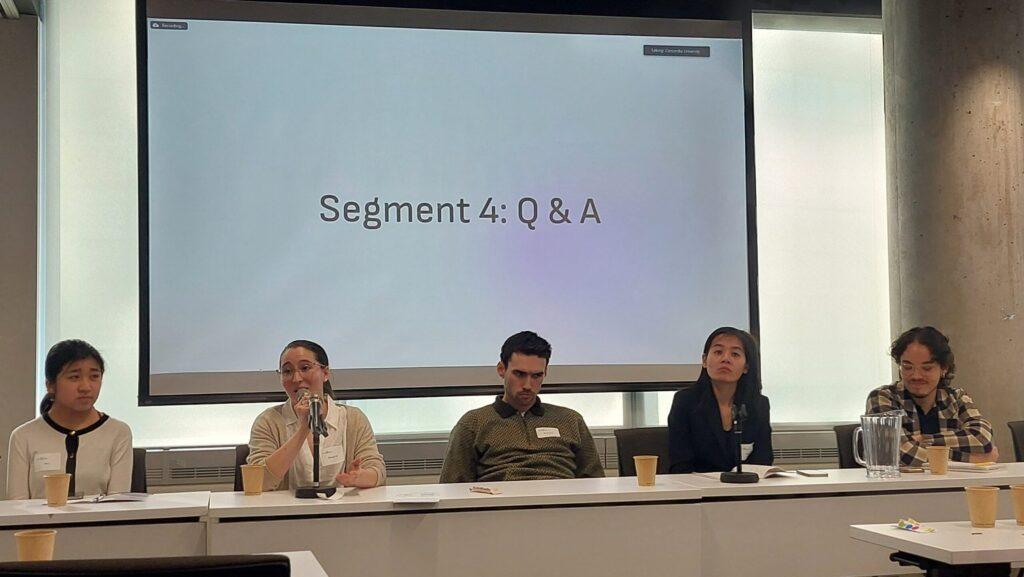
About 100 English-speak- ing teens and young adults from around the province gathered at the Concordia Conference Centre in Montreal on March 15 for the seventh annual Youth Forum organized by Y4Y, a Montreal-based organiza- tion that promotes civic participation, leadership and workplace readiness for members of the English- speaking community aged 16-30.

The geographic breakdown of attendees roughly reflected the larger English-speaking

community – while the ma- jority came from the greater Montreal area, others came from Sherbrooke, Quebec City, the border town of Stanstead in the Eastern Townships, and as far away as the Gaspé. A delegation of high school students from Three Rivers Academy in Trois-Rivières also made the trip.

Y4Y board chair Madeleine Lawler, a recent graduate of law school at Université de Montréal – one of several at- tendees to have done at least part of their education in French – gave opening re- marks, alluding to the difficult political climate for English speakers in the province in recent years. “Our approach to the issues has always been

about providing a platform for English-speaking youth, build- ing bridges and building com- munity,” she said. “Today is not just about venting – it’s about brainstorming and collaborat- ing. We’re all here to learn.”

Y4Y executive assistant Alex Pettem then gave a brief over- view of the demographic situ- ation of the English-speaking community across the prov- ince, which itself challenged a number of entrenched ste- reotypes. The popular percep- tion of the English-speaking community is older and whiter than the reality, he explained, pointing out that “English- speaking communities” make up about 1.2 million of Que- bec’s eight million people. One anglophone Quebecer in three

is an immigrant, one in four is a visible minority and one in four is between the ages of 15 and 34; three out of five live in the greater Montreal area. Young English speakers have higher rates of unemployment than their francophone coun- terparts, but also higher rates of self-employment and civic participation.

Nearly three out of four young adults in the anglo- phone community consider themselves bilingual – “the highest bilingualism rate of any demographic in Canada,” Pettem said. Of the 108,000 youth eligible to attend Eng- lish public school, only about 40,000 actually do.

Despite this, Pettem said, “linguistic insecurity” – anxi-

ety or lack of confidence around language skills – is one of the most common bar- riers to employment for young anglophones, especially in outlying regions. “Most of us are fairly bilingual, but we struggle to leverage that into better opportunities,” remarked Pettem’s colleague, Caleb Owusu-Acheaw.

After the opening presenta- tions, participants took part in youth-led panel discus- sions about education, civic engagement and workforce readiness. Panelists called for an education system that is more accommodating to different learning styles; places more value on vocational skills, financial literacy, civic en- gagement and entrepreneur-

ship; and reinforces students’ French language skills in a more engaging and accessible way.

Samidha Singhal, 25, was born in India, grew up in the Toronto area and now teach- es high school English at a French-language public school in Quebec City. She said the forum helped her understand some of the political faultlines and issues facing the education system and the English-speak- ing community in her new home province. “It just shows the importance of spaces like this … to understand how the Quebec system, political movements and sensitivity around language are affecting the anglophone community,” she said.

Provincewide Youth Forum gets young adults talking Read More »

Voice of English-speaking Québec offers English-language tax clinic

Voice of English-speaking Québec offers English-language tax clinic

Ruby Pratka, Local Journalism Initiative reporter

editor@qctonline.com

Low-income members of the English-speaking community who need help filing their taxes this season will be able to have their returns prepared by trained volunteers, through a partnership between Voice of English-speaking Québec (VEQ) and the Community Volunteer Income Tax Program (CVITP), a long- standing Revenue Canada program.

Individuals who made $35,000 or less in 2023, and couples filing jointly who made a combined $45,000 or less are eligible to file their taxes for free at a CVITP clinic, explained Maria Hoyt, CVITP co- ordinator at VEQ. The income threshold increases by $2,500 for each dependent child listed on the tax return. Only those with simple tax situations – people who are employed or reporting pension or social assistance income – are eligible; those who are self-employed, reporting income from rental properties or capital gains, reporting foreign earned income, dealing with a bankruptcy or filing on behalf of a deceased person’s estate are not eligible.

“If you’re interested in filing your taxes through the clinic, contact VEQ before March 29, and if we haven’t already filled the spots, we might have room,” said Hoyt. “I’ll ask a few questions to make sure you’re eligible. Then we’ll make an appointment where you can come to the office, bring all the tax documentation you have and fill out your consent form.” The necessary documents will then be sent to a volunteer, who prepares the return. Once the return has been filled out, the taxpayer will get a call from VEQ to come in, review their return and sign a final consent form. The volunteer will then file the tax return electronically with Revenue Canada and Revenu Québec.

The VEQ CVITP clinic has a small team of volunteers and spots are limited, Hoyt said. “The goal [of our clinic] is to support unilingual English speakers in the Quebec City region. If people are able to speak French, I refer them to other options.”

While the VEQ CVITP clinic is the only clinic in the region aimed at unilingual English speakers, three other CVITP clinics in the city – at the Centre des loisirs Saint-Sacrement in Upper Town, the Patro Laval in Limoilou and the Notre-Dame-de-Foy parish office in Sainte-Foy – offer English-language service. The Saint-Sacrement and Notre-Dame-de-Foy clinics also offer service in Spanish. Most clinics are able to process returns from current and past years.

VEQ will hold a virtual tax information session at 6 p.m. on March 27 for newcomers and other members of the English-speaking community with tax questions. To learn more or register for the information session, contact Maria Castro at newcomers@veq.org.

To learn more about the VEQ CVITP clinic or to become a volunteer, call VEQ at 418-683- 2366 or contact Maria Hoyt at maria.hoyt@veq.org. To find a CVITP clinic near you, go to canada.ca/en/revenue-agency/services/tax/individuals/community-volunteer-income-tax-program.html and click “Find a tax clinic in your area.” File your taxes by April 30 to avoid late fees.

Voice of English-speaking Québec offers English-language tax clinic Read More »

Youth forum at Concordia University gets students talking

By Ruby Pratka

Local Journalism Initiative

About 100 English-speaking teens and young adults from around the province gathered at the Concordia Conference Centre on March 15 for the seventh annual Youth Forum organized by Y4Y, a Montreal-based organization that promotes civic participation, leadership and workplace readiness for members of the English-speaking community aged 16-30.

The geographic breakdown of attendees roughly reflected the larger English-speaking community – while the majority came from the greater Montreal area, others came from the Eastern Townships, Trois-Rivières, Quebec City and as far away as the Gaspé. At least one Bishop’s University student attended, as did a delegation of five youth committee members and two facilitators from Phelps Helps in Stanstead.

Y4Y board chair Madeleine Lawler, a recent graduate of law school at Université de Montréal, gave opening remarks, alluding to the difficult political climate for English speakers in the province in recent years. “Our approach to the issues has always been about providing a platform for English-speaking youth, building bridges and building community,” she said. “Today is not just about venting – it’s about brainstorming and collaborating. We’re all here to learn.”

Y4Y executive assistant Alex Pettem gave a brief overview of the demographic situation of the English-speaking community across the province, which itself challenged a number of stereotypes. The popular perception of the English-speaking community is older and whiter than the reality, he explained, pointing out that “English-speaking communities” make up about 1.2 million of Quebec’s eight million people. One anglophone Quebecer in three is an immigrant, one in four is a visible minority, and one in four is between the ages of 15 and 34.

Nearly three out of four young adults in the anglophone community consider themselves bilingual – “the highest bilingualism rate of any demographic in Canada,” Pettem said.

Despite this, he said, “linguistic insecurity” – anxiety or lack of confidence around language skills – is one of the most common barriers to employment for young anglophones, especially in rural Quebec. “Most of us are fairly bilingual, but we struggle to leverage that into better opportunities,” remarked Pettem’s colleague, Caleb Owusu-Acheaw.

After the opening presentations, participants took part in youth-led panel discussions about the education system, civic engagement and workforce readiness – all of which centred around education. Panelists called for an education system that accommodates different learning styles; places more value on vocational skills, financial literacy, civic engagement and entrepreneurship; and reinforces students’ French language skills in a more engaging and accessible way.

“Employers would be well served by looking at people’s skills and giving themselves a chance to improve their French on the job rather than rejecting them out of hand,” added Shekina Blackstock, a Montreal native who is studying political science at Bishop’s and improving her French.

“The language laws have caused a lot of anxiety for my family,” said panelist Abbigail Whitcher, 24, a Knowlton native now studying law at McGill. “Two of my brothers have decided to move to Saskatchewan [because of language politics]. Building a sense of belonging for English speakers is very important to me.”

Whitcher pointed out that English-speaking high school students face increased dropout rates compared to their francophone counterparts. “The fact that there’s a difference is telling… especially in smaller communities, where our youth have fewer opportunities.” She observed that while many English-speaking rural communities have extensive programming that caters to seniors, youth don’t always get the same support.

The Stanstead students emphasized the urban-rural divide between English-speaking communities and expressed concern that they weren’t necessarily being “pushed” in high school. “Youth are capable of a lot more than people think, even if you’re from a small town,” concluded Elizabeth, a Secondary 5 student at Alexander Galt Regional High School and Stanstead native who gave only her first name.

Youth forum at Concordia University gets students talking Read More »

Brome Lake to hold information session on affordable housing

By Ruby Pratka

Local Journalism Initiative

The Town of Brome Lake intends to call a public meeting on May 15 to address potential solutions to the housing shortage, director general Gilbert Arel told the BCN.

The information session, held in the evening at the Lac-Brome Community Centre, will address “the town’s housing strategy, housing issues and the long-term vision.” He emphasized that the meeting was intended more as a presentation about affordable housing than as a public consultation.

“Everywhere in Quebec we’re talking about affordable housing, and it’s a concept that is still not well understood,” said Arel, who defined affordable housing as “housing where the increases in cost don’t fluctuate with real estate speculation.”

He said affordable rental apartments “are what we’re missing in Brome Lake,” especially for seniors.

“We have an aging population and people want to stay in their town, but there’s nowhere for them to live after they sell their house – they have no choice but to go to Cowansville, Waterloo or Granby,” he said.  “We’re going to work on the next urban plan [over the next year] and the next step is to develop a housing strategy that will focus on our priority clienteles – seniors and young families.” 

Ongoing projects

In terms of ongoing affordable housing projects, Arel mentioned the conversion of the former Excelsoins seniors’ residence into apartments. “[The building at] 399 chemin de Knowlton has 30 rooms with a community kitchen, and it is affordable,” he said. “There are a few out-of-town workers who live there.” The other former Excelsoins building, at 401 chemin de Knowlton, has sat empty since the residence closed nearly two years ago. Arel said he expects the owners of the residence to submit a specific project permit, known by its French acronym PPCMOI, to the town’s urban planning consultative committee; the permit would allow them to renovate the building and create 40 apartments. “I don’t see how that’s going to be a problem – they [Excelsoins] had a long-term plan to convert the building into apartments.”

Another project, Les Jardins de Lac-Brome, intended to open in July 2024, has met with delays due to a disagreement between city officials and the project promoter, Benoit Laliberté, over construction permits, according to both parties. Laliberté “was supposed to build three buildings of eight units each, and he built one building with more than eight units,” Arel said. “When you receive a permit but you don’t follow it, that raises a lot of issues.” Laliberté initially agreed to an interview with the BCN but was unavailable to comment in detail at the appointed time.

Brome Lake to hold information session on affordable housing Read More »

AMP raises concerns about Potton fire truck call for tenders

By Ruby Pratka

Local Journalism Initiative

The Autorité des marchés publics (AMP), the province’s public-sector financial regulator, has issued recommendations to the Canton of Potton after an investigation found that the municipality did not follow standard procedure related to the acquisition of a fire engine.

“The analysis showed that the quote linked to the municipality’s public call for tenders included technical requirements targeting particular products through the use of trademarks and model numbers,” the AMP said in a statement. “This way of doing things goes against the Municipal Code of Quebec, which stipulates that municipalities must describe their needs in terms of performance or functional requirements rather than in terms of descriptive characteristics.”

When AMP officials conducted checks, they were told the call for tenders “was inspired by quotes prepared by neighbouring municipalities” and that “describing its needs in terms of performance or functional requirements would have caused confusion among potential bidders,” according to the statement. The AMP concluded that the explanations provided by the municipality did not allow it to invoke an exception to the rules authorizing it to describe specific brands or models in its call for tenders.

The AMP also concluded that the call for tenders featured a “major irregularity” related to the guarantee of the fire engine, and the municipality should have declared the call for tenders noncompliant.

The agency recommended that the town council develop “efficient procedures” to ensure that future calls for tenders describe the products required “in terms of functional requirements” and that future decisions to refer to specific brand names and model numbers in calls for tenders are justified. It also recommended that employees undergo training on the conformity of calls for tenders and required the municipality to report back within 45 days, explaining what measures have been taken and the timeline for their implementation.

Potton Mayor Bruno Côté referred the BCN to an external public relations firm, Arsenal. An Arsenal representative declined an interview request on his behalf, but provided the BCN with a written statement which did not directly address the concerns raised by the AMP.

 “The municipality has as a priority to ensure the safety of its citizens and takes the necessary means. Pending the delivery of the new vehicle scheduled for 2025 (acquired in 2023), the municipality has acquired a second-hand fire truck which until recently belonged to the Town of Sutton. This decision-making was accelerated following a visual and auditory safety inspection of the accessible elements of the vehicle on Feb. 16, carried out by an inspector from the Société d’assurance automobile du Québec (SAAQ): the fire truck which was then in circulation no longer meets safety standards. Major defects have been reported, forcing it to be scrapped at very short notice. This responsible and temporary solution ensures that we maintain our capacity for action and intervention while limiting costs,” the statement said.

AMP raises concerns about Potton fire truck call for tenders Read More »

Shannon Irish Show puts spotlight on local dancers

Shannon Irish Show puts spotlight on local dancers

Ruby Pratka, Local Journalism Initiative reporter

editor@qctonline.com

For many people in Quebec City’s Irish community – or Irish- adjacent; everyone is Irish on St. Patrick’s Day after all – “green season” begins with the Shannon Irish Show, tra- ditionally presented shortly before the big day. For those behind the show – from the dancers to the seamstresses to the set designers – it begins months before.

“We start talking about what we want to do in November, and we plan a meeting in early December with our tech crew and the leaders of the different groups,” said Kerry Ann King, who has co-organized the show for many years. “We never want to say, ‘You have to do this and you have to do that,’ and we always come up with a great crew.”

This year’s show will take place the day before St. Pat- rick’s Day – Saturday, March 16, at 7:30 p.m. at the Shan- non Community Centre, with a matinée the same day at 1 p.m. (Doors open one hour before showtime.) It will focus on the evolution of Irish dancing culture in Shannon, and feature local dancers Sarah Audet and Annais Beaupré, who are headed to the World Irish Dancing Championships in Scotland later this year. “Our theme is Irish dancing in Shannon then and now. We want to show how dancing has evolved, the fashion and the steps themselves, how they’ve become more intricate,” King said.

The show will open, as per tradition, with a performance by the Growing Pride of Shannon children’s ensemble. Several other local groups will per- form, including the Valcartier- based Canadian Military Wives Choir, and comedy sketches will be in plentiful supply. The second half will be given over to the traditional Kitchen Party, hosted by Maureen McCarthy and featuring local musicians including Shannon Irish Show stalwart Larry Hamilton and Quebec City historian and singer Joe Lonergan.

Each Shannon Irish Show honours a person who has made a significant contribution to the local Irish community. This year’s honouree is former Shannon mayor – and former Shannon Irish Show master of ceremonies – Clive Kiley.

Kiley was involved in municipal politics in Shannon for more than 40 years, first as a town councillor and then as mayor until 2017. He was also a master of ceremonies and a performer in several Shannon Irish Shows down the decades. “Winter gets a little cold around here, and [being part of the annual show] gives us something to do,” he said. “I enjoyed being the master of ceremonies…. I always like to see the Irish dancing and the singers who come from out of town to be part of the kitchen party.”

“Everyone on council now is from the francophone community, and they don’t have as much interest in the Irish show, but they support it,” he added. “I’ve always felt it is something that we should continue as long as we can. The English population has declined over the years – a lot of the kids move to Montreal and get used to living in the city and finding more to do in English; that’s just part of life. It’s nice to see how many people continue to turn out and get involved and keep our Irish culture alive as long as possible.”

“Clive’s participation on stage and behind the scenes has assured the great success of the Shannon Irish Show year after year, and, for this, we are forever grateful!” King said.

The 55th Shannon Irish Show will take place at 1 p.m. and 7:30 p.m. at the Shannon Community Centre, 75 Gosford Road. Tickets are $10 for adults and $5 for children six-12; younger children are admitted free. Doors will open one hour before each performance. Tickets can only be purchased in cash at the door. The centre seats about 240 people, and there will be a downstairs “overflow room” where people can enjoy a drink and watch the action on a live stream.

Shannon Irish Show puts spotlight on local dancers Read More »

Imagination Writers’ Festival celebrates 15 years

Imagination Writers’ Festival celebrates 15 years

Ruby Pratka, Local Journalism Initiative reporter

editor@qctonline.com

The Imagination Writers’ Festival, the only festival in the Quebec City region celebrating English-Canadian literature, is returning to the Morrin Centre from April 9-14, for a 15th edition. The festival will feature literary discovery activities for children and adults, and a translation- centred event co-hosted with the Maison de la Littérature. There will also be “live writing” sessions at the Maison de la Littérature and artistic projections onto the facade of that building.

For the 15th anniversary of the festival, many authors and speakers from previous years were invited back, explained Morrin Centre events co-ordinator Jeanne Lébossé-Gautron. “Re-invited” authors include novelists Neil Bissoondath, Waubgeshig Rice and Joan Thomas and acclaimed humour and travel writers Will and Ian Ferguson.

The festival opens April 9 when children’s author Kim Spencer meets with young readers. Later that evening, Rice, a CBC Radio host turned bestselling suspense novelist, and Thomas, winner of the Governor General’s Award for Fiction, will discuss their recent works with hosts Kim Garrity and Sylvie De Serres.

The next day will be a celebration of nonfiction featuring innovative memoirist Merilyn Simonds and her husband, science and history writer Wayne Grady. Simonds’ latest work is a biography of Swedish- Canadian ornithology pioneer Louise de Kiriline Lawrence, and Grady’s is an exploration of how the COVID-19 pandemic has shaped modern language and culture.

On April 11, the popular Books & Wine event will return, featuring sommelier Bianca Thériault. Participants can taste wines and appetizers specially selected with the featured works in mind, rub shoulders with their favourite authors and stay to hear the Ferguson brothers discuss their works with Montreal Gazette Quebec City correspondent Philip Authier.

The same evening, across the alley at the Maison de la Littérature, local author Mary Thaler will host a round table on literary translation featuring author Felicia Mihali and translator Judith Weisz Woodsworth. The event will be presented in French with a bilingual Q&A.

The following day, Montreal- based Chinese author Xue Yiwei will discuss his recent works.

On April 13, festivities begin at 10:30 a.m. with an activity for young readers aged three to seven featuring children’s author Cary Fagan. At 11:30, bilingual author and former Université Laval professor of American literature H. Nigel Thomas, whose first novel Spirits in the Dark was recently republished by Véhicule Press, will speak about his body of work with former QCT editor Michèle Thibeau. Aspiring authors are invited to a poetry workshop at 1 p.m., hosted by Daniel Scott Tysdal. At 2 p.m., suspense author Kelley Armstrong, known for the A Rip Through Time series, will discuss her craft. Later that afternoon, Linda Leith, an acclaimed Montreal-based writer and publisher known for establishing Linda Leith Publications and founding the multilingual Blue Metropolis Literary Festival, will share her insights about the publishing industry. That evening, readers will be able to hear from novelists Paul Serge Forest, Andrew Steinmetz and Donna Morrissey.

On April 14 at 11 a.m., the Morrin Centre will host a Tea & Imagination event looking back on 15 years of the festival. That event will be followed by a short-story panel and a presentation by Bissoondath on “self-censorship in an age of nationalist and identity politics.” Later that afternoon, Toronto-based Jamaican-Canadian novelist Zalika Reid- Benta will discuss her debut novel River Mumma. That evening, to close the festivities on a graceful note, the popular Literary Notes event returns. Nominees for the Quebec Writers’ Federation Ian Ferrier Spoken Word Prize will read from their works, accompanied by specially chosen music performed by musicians from the Orchestre symphonique de Québec. Throughout the week, authors will also present in local English schools. Additional events may be announced in the coming weeks.

“We try to represent the diversity in the Canadian literary landscape and new emerging writers,” Lébossé-Gautron said. The festival, particularly the partnership with the Maison de la Littérature, “is a way for us to promote English- Canadian writing to a wider public … and also a way for our [anglophone] audience to discover the Maison, which is a beautiful space,” Lébossé- Gautron said. “English-Canadian literature is so varied and vibrant and alive.”

Festival passes for adults are $40 ($25 for students) and do not include admission to the Books & Wine or Tea & Imagination events (separate tickets available for $30 or $22.50 for Morrin Centre members). Tickets for individual book talks are $15 ($7 for students). Events for children are free. Visit morrin.org to learn more.

Imagination Writers’ Festival celebrates 15 years Read More »

Reford Gardens founder honoured by Quebec government

Reford Gardens founder honoured by Quebec government

Ruby Pratka, Local Journalism Initiative reporter

editor@qctonline.com

The founder of the Jardins de Métis/Reford Gardens, Elsie Reford, was recognized as a person of historic significance by the Quebec government on March 8, International Women’s Day.

Reford, who died at age 95 in 1967, was a Toronto-born socialite, philanthropist and Conservative political activist who played a key role in the organization of Quebec City’s 300th anniversary celebrations in 1908. Reford and her family had a summer home near Grand-Métis, east of Rimouski in the Lower St. Lawrence region – a popular summer getaway for well-heeled English-Canadian families which remains somewhat of an anglophone enclave to this day.

In 1926, while recovering from surgery, Reford could no longer practise her other passions – horseback riding and salmon fishing – so she turned her attention to the estate’s gardens, transforming them into a sprawling horticultural landmark which drew visitors from miles around. Several of the flowers she brought to the gardens, including azaleas and Tibetan blue poppies, had never been grown in the region before.

The Quebec government bought the gardens in 1961. In 1994 they were declared “surplus inventory” and sold to a nonprofit headed by Alexander Reford, Elsie Reford’s great-great-grandson, who still oversees the property to this day. Between June and early October, thousands of tourists flock to the gardens.

“The Gardens are recognized as a historic site, but this is the first time the woman behind them has been recognized as a historic person,” Alexander Reford told the QCT. He said the decision by the Ministry of Culture and Communications to designate his great-great- grandmother a historic person came as a wonderful surprise, two years after the 150th anniversary of her birth.

“She was a person of extraordinary energy and enormous strength and force of character, who led rather than followed,” said Alexander Re- ford, who met his great-great- grandmother once when he was five, and heard many stories about her growing up. “She made a decision for my father when he was engaged; she said, that’s not the woman you want to marry. She was truly legendary.”

Elsie Reford was a self-taught horticulturalist who realized that along the St. Lawrence River, “she had the perfect climate for perennials because of the cool air and the snow,” Alexander Reford said. “She was trialling plants [that were new to the area] … she was fortunate, but she was also a genius.”

Although the aristocratic family matriarch was “initially a bit horrified” at the idea of her gardens becoming a tourist attraction, Alexander Reford said he believed she would be happy to see people from around the country and the world “enjoying her creativity.”

To learn more about the Re- ford Gardens, visit jardinsdemetis.com/en/plan-your-visit.

Reford Gardens founder honoured by Quebec government Read More »

Volunteer tax clinics are ready for tax season

By Ruby Pratka

Local Journalism Initiative

Tax time has arrived, and around the region, volunteer action centres (known as Centres d’action bénévole or CABs) are offering free bilingual tax preparation services for low-income taxpayers.

The clinics are coordinated through a long-established federal government program called the Community Volunteer Income Tax Program (CVITP). CVITP clinics offered by CABs are open to any individual taxpayer with a simple tax situation and an annual income of $35,000 or less; the threshold increases to $45,000 for a couple and goes up by an additional $2,500 for each dependent child listed on a return, explained Marie-Christine Laguë, community liaison agent at the CAB de Farnham, which has administered the program for many years. Self-employed people and those who are filing after a bankruptcy or filing on behalf of a deceased person are not eligible. Most clinics do accept people who have fallen a few years behind on their tax returns.

The CAB de Farnham provides services in Farnham, Sainte-Sabine, Sainte-Brigide and surrounding areas. The CAB de Bedford can help residents of Bedford, Philipsburg, Pike River, Stanbridge East, Stanbridge Station, Notre-Dame-de-Stanbridge and Stanbridge Station who have declared income of $25,000 or less ($32,000 or less for a couple filing jointly). People who use the service are asked to pay $10 to cover printing costs. The CAB de Cowansville can help residents of Cowansville, Frelighsburg, Brome Lake, Sutton and surrounding areas, and the CAB des 4 Vents in Waterloo offers services there. The CAB Haut-Saint-François in Cookshire, the CAB Magog and the CAB Rediker in Stanstead offer tax assistance to residents of those regions. Some centres, including the CAB Farnham, offer at-home service to people with mobility issues.

“We work with people who are employed, who are on social assistance or who receive a pension,” said Rosalie Beaudoin-Martin, service co-ordinator at the CAB des 4 Vents. “The program has remained the same for the last 37 or 38 years, and people are really grateful to have access to it.”

Those who want to file their taxes through the CVITP are encouraged to call their local CAB. Some centres have a walk-in system, others have a locked drop box where people can place their documents and others require appointments to drop off documents. Trained volunteers, many of whom are retired accountants or math teachers, review the documents, complete the participant’s federal and provincial tax returns online and call the participant back to sign a release and pick up their original documents.

At the CAB Cowansville, people can drop off their documents during business hours from Monday to Thursday. The service is even offered year-round. “Most people come during tax season, but there are always some who are late or who have fallen behind,” said CAB Cowansville interim director Sara Martinez.

“It’s important for us to offer services in French or English. We know it’s hard for unilingual anglophones, but we do a lot of recruitment of anglophone and bilingual volunteers to keep serving people on our territory,” she added.

To connect with a tax clinic in your area, visit the Canada Revenue Agency website (canada.ca/en/revenue-agency/services/tax/individuals/community-volunteer-income-tax-program.html) or call your local CAB. The deadline to file your tax returns without late fees or interest is Tuesday, April 30.

Volunteer tax clinics are ready for tax season Read More »

Federal funding for wine sector renewed

By Ruby Pratka

Local Journalism Initiative

Wine producers in the Brome-Missisquoi region are breathing a sigh of relief after federal agriculture minister Lawrence MacAulay and minister responsible for economic development for the regions of Quebec Pascale St-Onge announced $177 million in funding for Canadian wineries through the Wine Sector Support Program (WSSP). The first edition of the program, launched as a pilot project in 2022, doled out $166 million to winemakers across the country, aimed at supporting individual winemakers who are working on projects to increase climate resilience, build production capacity or encourage tourism.

Support was given to 105 Quebec wineries through the first iteration of the program, including 25 in the Brome-Missisquoi region, according to Francis Chechile, a spokesperson for Agriculture and Agri-food Canada.

St-Onge made the funding announcement on March 4 at Vignoble Léon Courville in Brome Lake. “Although the Canadian wine industry has experienced considerable growth in recent years, it continues to face a series of pressures that impact its financial resilience and competitiveness. These pressures include rising input prices, labour shortages, climate-related limitations and severe weather events,” she said in a statement. “Quebec has a small, innovative and growing wine industry, and the province’s wineries continue to be at the forefront of current trends and evolving tastes. Today’s announcement recognizes the importance of investing in this thriving industry, as wine growers face complex challenges to maintain a competitive advantage and continue to support local economic growth.”

Rob Taylor is the director of policy and government relations for Wine Growers Canada. He said growers “appreciate the leadership and support” of elected officials from all parties as the wine sector navigates the impact of climate change.

He noted that Canadian-made wines enjoyed an exemption from domestic excise taxes until 2022, when the World Trade Organization ruled that the exemption constituted inappropriate state support; the government and growers then had to develop a more creative way to support the local wine industry amid cheaper, higher-volume, heavily subsidized European imports. The WSSP, which distributes funding based on the production volume of each winery as a percentage of the total production of the province, is the result of that brainstorming. “Some [wineries] have increased the capacity of their vats, others have looked into weather-resistant varietals or expanded their planting, or made climate adaptations to protect the vines – there have been a lot of innovations.”

Taylor said the program is particularly important in light of the unpredictable climatic conditions British Columbia and the Maritimes have experienced in recent years. “In British Columbia, for example, you had the heat dome [in 2021], then forest fires, then an ‘atmospheric river’ which led to flooding … then, last winter, there was a damaging deep freeze, then another summer of forest fires followed by the most recent and most severe deep freeze, which we aren’t accustomed to. Those are once in a century-type events and having them happen back-to-back in the span of three or four years was unexpected. [Climate change] is happening a lot faster and more dramatically than we expected, and we have to make sure we’re producing the right grape varieties and adapting.”

Growers can apply for WSSP funding between April 1 and May 1. More information is available on the Agriculture and Agri-Food Canada website.

Federal funding for wine sector renewed Read More »

Villeneuve launches “Coffee with the Mayor” initiative

By Ruby Pratka

Local Journalism Initiative

Bromont Mayor Louis Villeneuve has taken a new approach to fighting disinformation and incivility on social media. He’s inviting the trolls – and any other constituents who’d like to have a chat – to City Hall for coffee. Any Bromont resident who would like to book a 20-30-minute morning meeting with the mayor can sign up on the city’s website.

Record numbers of mayors and city officials around the province have resigned since the 2021 election. Many, including former Gatineau mayor France Bélisle and Pierre Tremblay, the mayor of Les Éboulements in the Charlevoix region, who stepped down last week, have cited personal attacks on social media as one of the factors pushing them toward the exit – a situation Villeneuve said he found “really sad.” Other mayors around the province have made headlines by leading online crusades against social media vitriol, reading mean tweets or launching video campaigns urging more respect for civil servants. Although city officials say Bromont has been spared the worst of social media troll campaigns and internal conflict, it’s not completely isolated from it. “There’s a lot of misinformation and incivility on social media, and that is pretty much everywhere,” said Villeneuve. “The pandemic has had an impact on people’s tolerance, and they want answers now. When someone is feeling a lot of pressure, there’s nothing like dialogue.”

The coffee events are an outgrowth of the Brunchs du Maire, which Villeneuve hosted alongside city councillors in 2022 and 2023. “We met a lot of people, but there would always be one or two who would take the floor because the others were shy.” The strict decorum and formality of council meetings isn’t an ideal forum for one-on-one conversations either, he added.  “I felt like sitting down with people and taking time to discuss the issues, one citizen to another.”

He said he is eager to hear what citizens have to say, correct misinformation at the source, and find out what residents are concerned about and whether they’re happy in the city.

The first three mornings set aside for the coffee meetings – March 21, April 4 and April 18 – are already fully booked. Villeneuve said there was no “filtering process” for participants beyond ensuring that they are residents of Bromont. Citizens who want to discuss specific issues can list them on the online signup sheet. Villeneuve said he is looking forward to debates but won’t accept overt rudeness. “I trust people. People can disagree with me. You need to be able to take criticism in politics, but I check out when people start being uncivil.” 

“I have seen people [on the sign-up sheet] who have been rough on me on social media. I don’t know these people and they don’t know me – we’re just operating based on perceptions. Let’s talk!”

Bromont residents interested in booking a one-on-one meeting with Mayor Louis Villeneuve can do so on the city website (bromont.net/administration-municipale/cafe-avec-maire). They must provide their full name, address and contact information.

Villeneuve launches “Coffee with the Mayor” initiative Read More »

Strike sinks Gabrielle-Roy Library reopening, March Break activities

Strike sinks Gabrielle-Roy Library reopening, March Break activities 

Ruby Pratka, Local Journalism Initiative reporter

editor@qctonline.com

The delay-plagued reopening of the Gabrielle-Roy Library hit another roadblock days before the scheduled opening ceremonies.

On Feb. 25, the 240 employees of the Institut Canadien de Québec, which manages the city’s public library network, voted in favour of an indefinite strike starting March 1, the first of three days of planned festivities to celebrate the library’s reopening.

“On March 1, there will be a picket line [in front of the library] if we don’t have a satisfactory offer,” Roxane Larouche, a spokesperson for Travailleurs et Travailleuses unis de l’alimentation et du commerce, Local 501 (TUAC 501) which represents workers at all of the city’s 26 public libraries, said at the time.

Larouche said there would be “no book borrowing, no documentation, acquisition, classification, billing or people preparing materials” to be lent out, for the duration of the strike. The city also scuttled the three days of free concerts, tours and demonstrations planned for the grand opening. Although Mayor Bruno Marchand initially insisted the celebrations would go forward, city officials ultimately decided that “the situation doesn’t allow the public to fully enjoy the planned activities and discover its library.” A media tour was held Feb. 29, the day before the strike began (See article in this edition). City officials say $300,000 of public money was invested in the opening celebrations, of which $60,000 is not recoverable.

“I don’t know what we’re going to do [to celebrate the reopening] but we won’t have the same resources,” said Marchand.

Union members are calling for higher salaries, a payscale in line with Ville de Québec employees carrying out similar tasks, more predictable schedules, paid break periods and the ability to take partial vacation days, Larouche explained. They have been without a contract since December 2022.

The strike comes at an extremely inconvenient time for the central library. It closed for major renovations in August 2019 and was originally sup- posed to reopen in 2021. The ripple effects of the COVID-19 pandemic, the labour shortage and the cancellation of a call for tenders after bids came in higher than expected delayed the opening for more than two years. In March 2023, the reopening was pushed back further when construction crews found that a beam was in need of major repairs. The strike pushes the planned public opening back further; it is now scheduled for March 12.

Twenty-three of the city’s 26 libraries will close for the duration of the strike. The Monique-Corriveau Library (Sainte-Foy) and the Étienne- Parent Library (Beauport) will reopen on a reduced schedule starting March 6.

Strike sinks Gabrielle-Roy Library reopening, March Break activities Read More »

Provincewide forum seeks perspectives of local English-speaking youth

Provincewide forum seeks perspectives of local English-speaking youth

Ruby Pratka, Local Journalism Initiative reporter

editor@qctonline.com

Provincewide civic participation organization Youth 4 Youth Québec (Y4Y) is seeking young people aged 16-30 from the English- speaking community of the Capitale-Nationale region to participate in its annual youth forum in Montreal on March 15.

Youth are encouraged to attend the forum in person at the Concordia Conference Centre on the campus of Concordia University in Montreal, but those who cannot or would rather not make the trip in person will be able to participate online. Participants from Montreal, the Gaspé region, the Lower North Shore and the Centre-du-Québec region are among those expected to take part.

Y4Y executive director Adrienne Winrow said the forum represented a precious opportunity for English-speaking youth from across the province to talk to each other and to share their concerns with representatives of the provincial Secretariat for Relations with English-speaking Quebecers, the federal Office of the Com- missioner of Official Languages and other organizations that support the civic participation of both French- and English- speaking young adults, including Elections Canada. Youth talent will also be on full display with an onsite art exhibit and panel discussions.

“We have put together three youth-led panels on education, the job market and civic engagement, and we want to hear what you think,” Winrow told the QCT. “We want to hear from youth who are in high school, CEGEP or university or who have already started their career path. We want to show the community’s diversity and strength.”

She noted that in policy discussions about Quebec’s English-speaking community, “the focus is often placed on Montreal, but we are stronger if we understand the realities across distances. There is a wide range of different social and economic realities be- tween Montreal and the Gaspé or the Abitibi, for example. If you want to study in English and you’re from the Gaspé or the Abitibi, that means leaving home at 17 – which is obviously much different from growing up in Montreal and being able to live at home and take the bus to school. [The forum] is a networking opportunity, but also a learning opportunity…. My hope is that youth come away from the forum feeling like they are part of something larger.”

Winrow said she is looking forward to hearing the conversations between youth from different regions and between youth and representatives of government bodies. “What is going to be on full display is the potential and professionalism and willingness to engage, of youth in this province. English- speaking youth are a resource for the community, they want to contribute and they are thoughtful about the future.”

To register or learn more, visit y4yquebec.org/youth-forum-2024.

Provincewide forum seeks perspectives of local English-speaking youth Read More »

Communication between administrative bodies must be only in French, ombuds office says

By Ruby Pratka

Local Journalism Initiative

The head of the Eastern Townships School Board (ETSB) education services advisory committee is raising concerns about the capacity of the new regional student ombudswoman’s office to serve the English-speaking community after ombudswoman Caroline Audette responded to English-language questions in French during a presentation to the committee.

“On Feb. 6, the regional ombudswoman came and spoke to us and gave a Powerpoint presentation. She was very professional and very polite, but what concerns me is that while we are an English board and we conduct our meetings in English, her presentation was in French and questions were answered in French,” commissioner Mary-Ellen Kirby told The Record. “That raised red flags for us.”

Student ombudspeople handle complaints from parents and students concerned that a school, school board or school service centre is not meeting its obligations in terms of service provision or protecting student safety. At the beginning of the 2023-2024 school year, national student ombudsman Jean-François Bernier, Audette and 16 other regional student ombudsmen took office after a reform of the ombuds system by the Legault government. Ombudsmen were previously appointed by school boards or regional groups of school boards, Kirby explained, but Bernier, Audette and their counterparts across the province were appointed by Education Minister Bernard Drainville.

“The ombuds office is kind of a last resort for students and parents when things are not going as they perceive they should,” Kirby said. “You don’t go to the ombuds office when everything has been going great. You go there when there has been a trauma, and when there’s a trauma you need to communicate in your mother tongue.”

Audette has previously assured The Record that her office is able to serve English-speaking students and parents in English, and according to Kirby, those assurances were reiterated at the Feb. 6 meeting, but the committee “saw no evidence” that Audette could serve the community in English.

Kirby emphasized that she found Audette personable and professional, and in terms of language skills, she “clearly understood what we were saying.”

“I detected no ill intentions on the part of Mme Audette. She sincerely believed anyone who called her office and spoke English would be served in English, but she couldn’t assure us of that in English. I believe it is because of the dictates of the office,” said Kirby. She said the committee would be “registering our concerns” with Bernier, Audette’s superior.

Via a spokesperson, Bernier told The Record that he and his regional counterparts “are concerned about respecting the Charter of the French Language, and showing exemplary use of the language. Our personnel must express themselves exclusively in French except in certain situations … notably when the principles of health, safety or natural justice require it, or when they are speaking to a person who is eligible for English-language public education.”

“These exceptions allow us to ensure full and real access to our procedure for processing complaints and reports, in a language other than French if necessary,” the spokesperson, Pier-Olivier Fortin, told The Record.  “Moreover, our forms for filing complaints and reports are available online in French and English, as are the posters which were distributed in schools in the English-speaking school boards of Quebec.

He added that bilingualism is part of the selection criteria for regional ombudspeople and their staff  “when required depending on the realities of the region of assignment … in order to be able to speak with non-French-speaking students and parents.”

However, under the French language charter, Fortin said, “communications between administrative bodies, including English-speaking school boards, must be only in French.”

Communication between administrative bodies must be only in French, ombuds office says Read More »

Work on hold in Brigham pine grove

By Ruby Pratka

Local Journalism Initiative

The planned partial clearcut of a pine grove in Brigham has been put on hold due to adverse climatic conditions, Pierre Lefebvre, director general of the municipality, confirmed late last week.

Under a forestry management plan announced in February for a 21-hectare forest owned by the town, a 2.7-hectare pine grove was supposed to be mostly clearcut, and an adjacent forested area of a little less than one hectare was intended to be partially clearcut; “maintenance gardening” including the cutting of some dead, dying or dangerously positioned trees was supposed to be carried out along hiking trails in the rest of the forest. Some residents raised concerns about what they considered a lack of public consultation and a lack of a detailed reforestation plan. An online petition calling for a moratorium on the current forestry plan and for a wider public consultation has gathered 308 signatures as of this writing.

On Feb. 28, the day before the work was scheduled to begin, a public notice was posted on the town’s website to the effect that “the work that was scheduled in the coming days in the pine grove must be rescheduled in light of climatic conditions.”

Lefebvre later told the BCN that no new date had been determined for the beginning of work. “To avoid pointless damage and protect the wood, the soil needs to be either dry or frozen, and it’s neither one right now,” he said. “We’re having a hard winter for that.” Lefebvre said town officials would meet with forestry engineers to determine a new start date. “It will be sometime in the next few months; it could be in the fall. It depends on what the engineers tell us.” 

Work on hold in Brigham pine grove Read More »

Massey-Vanier lockdown shows folly of classroom phone ban: Murray

By Ruby Pratka

Local Journalism Initiative

Eastern Townships School Board chairperson Michael Murray has criticized Education Minister Bernard Drainville’s blanket ban on mobile phones in classrooms after hundreds of students were left without a way to directly contact their parents during an evacuation on Feb. 27.

That afternoon, students at Massey-Vanier High School in Cowansville were evacuated during classes after the school received a threatening phone call. Sûreté du Québec (SQ) officers were called, and conducted a thorough search of the building, which is jointly administered by the ETSB and the French-language Centre de services scolaire Val-des-Cerfs. As of this writing, the SQ has determined that “there was no threat in the building,” but the source of the call is still being investigated, according to SQ spokesperson Sgt. Valérie Beauchamp.

“We had a situation at Massey-Vanier and immediately, the social media buzz lit up,” Murray told the BCN. “Parents got messages from their friends saying, ‘What’s this I hear about a bomb threat at the school?’ In the meantime, the police evacuate the school and the students’ cell phones are in their lockers. Parents are trying to message their kids on social media and the kids can’t answer. That just generates additional panic. It really shows the folly of a blanket ban.”

In October 2023, Education Minister Bernard Drainville issued a directive banning mobile phones in daycare centres and elementary school, high school and vocational training centre classrooms, except for situations where phones are required for pedagogical reasons, to provide support for a student with disabilities or because of a student’s state of health. At the time, Drainville argued that the phone ban, which he first proposed in August 2023, “aims to create a climate more conducive to teaching and learning in order to promote the academic success of students.” The specifics of the ban’s enforcement were left to school boards, service centres and personnel. The ban took effect in January 2024.

“At some schools, students are told to leave their phones in their lockers. Some teachers have boxes at the back door of their classroom that you put your phone into. Some schools are allowing students to use them at recess and at others it is discouraged altogether,” Murray said. Students had no opportunity to go get their phones before the school was evacuated. “We had to respect the evacuation order – you stop what you’re doing and you go outside.”

Murray said the board intended to “bring the issue to the minister’s attention when the opportunity arises.” He added that the board has “larger issues to work on, trying to recover from the strike and coping with various other challenges.”

No one from the Ministry of Education was available to comment at press time.

Massey-Vanier lockdown shows folly of classroom phone ban: Murray Read More »

Bill 21 upheld by appeals court

By Ruby Pratka

Local Journalism Initiative

Quebec’s controversial state secularism legislation, known as Bill 21, which forbids authority figures including police officers and public school teachers from wearing religious symbols while on the job, has been upheld by the province’s Court of Appeals, much to the dismay of many in the English-speaking community. The appeals court panel, made up of Judges Manon Savard, Yves-Marie Morrissette and Marie-France Bich, handed down their judgment on Feb. 29.

The judges found that the law was “valid with regard to the power-sharing principles set out in the Constitution Act, 1867, and did not contradict the law, nor any pre-Confederation principle having constitutional value.” They also found that the law did not infringe on the principle of equality of the sexes or the “educational rights” of the English-speaking community of Quebec, and its uses of the notwithstanding clause were not unconstitutional. They specified that the law banned visible religious symbols in public daycare centres and primary and secondary schools, but did not affect private schools, CEGEPs or universities, and did not prevent anyone from wearing a hijab, kippa, turban, cross or similar symbol outside of a professional context.

The panel overturned a previous Superior Court ruling which found that the law infringed on the constitutional right of the English-speaking community to govern its own schools.

Premier François Legault said the ruling represented “a great victory for the Quebec nation.”

“In 2019 we made the decision to forbid people in authority from wearing religious symbols [while exercising their functions] … as a guarantee that these people are neutral,” he said in a brief French-language video message posted on Facebook. “This is a principle that unites us. We’ll continue to use the parliamentary sovereignty [notwithstanding] clause as long as it takes for Canada to recognize the choices of the [Quebec] nation. I will always fight for our nation to make its own choices,” he said.

The English Montreal School Board was one of the organizations that contested the law in court, supported by the eight other English school boards in the province, including the Eastern Townships School Board (ETSB), and the Quebec English School Boards Association (QESBA).

QESBA vice president Paolo Galati said he was surprised by the judgment. “The part where the judges say they feel the law does not infringe on our right to manage and control our schools – that’s where we don’t see eye to eye,” he said. “Also, we have an important teacher shortage in Quebec, and to oppose restrictions on who we can hire is counterproductive.”

ETSB board chair Michael Murray took exception to the Legault government’s broad interpretation of parliamentary sovereignty, which the ruling upheld. “They [the government] have argued that the legislature has the final say – there are no rights; there are only permissions which the legislature can modify or revoke at any time.” He added that as far as he knows, the board has never received a complaint from a parent uncomfortable with a teacher wearing a hijab, cross or kippa.

“We maintain that the bill infringes on our right to manage and control our own schools,” Galati said, adding that the QESBA board of directors would meet to discuss further steps, which may include an appeal to the Supreme Court of Canada. Federal justice minister Arif Virani has indicated that the federal government will support any appeal.

The Quebec Community Groups Network said it was “profoundly disappointed” with the ruling. “We believe [English] schools should have the latitude to manage their own affairs, as is the case with minority-language schools in other provinces,” QCGN president Sylvia Martin-Laforge said.

“Every time this government doesn’t know what it’s doing, they invoke the notwithstanding clause,” she added. “It is a sad statement about the climate we live in that the government feels the only way it can engineer society the way it wants is to deprive minorities of their rights. [Professionals] who want to wear the kippa or the hijab will want to go somewhere else, for sure.”

Bill 21 upheld by appeals court Read More »

Public sector workers ratify collective agreement

Public sector workers ratify collective agreement

Ruby Pratka, Local Journalism Initiative reporter

editor@qctonline.com

The four trade union federations of the Front Commun bloc, representing more than 420,000 public sector health, education and social services workers, have officially reached an agreement with the Quebec government, ending months of labour strife.

After dozens of union locals around the province voted in a month-long process, the central agreement was ratified with 74.8 per cent of members voting in favour, union leaders announced on Feb. 23. The agreement allows for a 17.4 per cent salary increase over five years, with additional one per cent annual increases possible in the event inflation reaches a certain level. Among other gains highlighted by the unions, psychologists and certain skilled tradespeople will receive additional bonuses, the most senior employees will get an additional week of paid vacation and older workers will be able to “progressively retire” over seven years rather than the previous five. The agreement is valid until 2028.

The Front Commun is made up of the Fédération des travailleurs du Québec (FTQ), Conseil syndical national (CSN), Centrale des syndicats du Québec (CSQ) and Alliance du personnel professionnel et technique de la santé et des services sociaux (APTS). FTQ president Magali Picard, CSQ president Éric Gingras, APTS president Robert Comeau and CSN vice-president François Énault addressed reporters in Quebec City after the results were announced. “This is a historic day – we just finished more than a year of negotiations,” Picard said. “We have a contract, we’re proud of it, but our members still want to send a message.”

Énault noted that the indexation clauses represented “something we haven’t seen since the 1980s” and the salary increase was nearly double the government’s initial offer of nine per cent.

Treasury Board president Sonia LeBel acknowledged the agreement in a post on X. “We’re satisfied with the ground we have covered with the Front Commun,” she wrote. “The agreements we’ve reached are the result of a common desire to negotiate differently and adapt our ways of doing things to the realities of 2024 in order to improve services.”

However, Comeau noted that although the agreement contained “interesting gains,” all parties “still had work to do” to ensure quality public services. “Many of our mem- bers think it would have taken more to solve the problems – [the agreement] doesn’t respond to everyone’s needs,” he said. “Our organizations will keep working to find solutions between now and the next collective agreement. We can’t let our public services reach a breaking point.”

Although the central agreement has been ratified, Gin- gras pointed out that several sectorial agreements, including that involving the CSQ’s health arm, which represents a portion of the province’s nurses, have yet to be finalized. The province’s largest nurses’ union, the Fédération interprofessionnelle de la santé (FIQ) is still in separate negotiations with the government and has not yet reached an agreement in principle. FIQ press officer Félix Tremblay told the QCT the union will not comment on the ongoing negotiations for the time being.

Public sector workers ratify collective agreement Read More »

Défilé de la Saint-Patrick returns March 23

The Défilé de la Saint-Patrick returns March 23

Ruby Pratka

Local Journalism Initiative reporter

editor@qctonline.com 

The streets of Quebec City will once again resound with the rhythms of pipe-and-drum bands from around North America when the Défilé de la Saint-Patrick returns on March 23, parade spokesperson Stephen Burke has announced. 

Pipe bands from Ottawa (RCMP Pipes, Drums and Dancers), New York (the Emerald Society of the New York City Police Department), Boston (Boston Police Gaelic Column of Pipes and Drums), Chicago (Chicago Police Pipe Band) and Toronto (Toronto Police Pipe Band), along with Quebec City’s own 78th Fraser Highlanders and the ceremonial unit of the Service de police de la Ville de Québec, along with several civilian pipe and drum groups and community delegations from around the region, will march from St. Patrick’s High School on Rue de Maisonneuve, up Avenue Cartier and down Grande Allée to City Hall. 

“The pipers are back!” Burke enthused. “That’s why we always have the parade a week after St. Patrick’s Day – if we had it on the day, our friends from New York, Boston, Chicago, Toronto and Montreal couldn’t be there.” He revealed that the Toronto Police Pipe Band “learned [Gilles Vigneault’s classic song]  ‘Gens du Pays’ for us.” 

A longtime parade booster, he extolled the collaboration between the Irish and francophone communities that led to the revival of the parade in 2010, after an absence of more than 80 years. “I find it extraordinary that the [modern] parade was put together by an Irish pub owner [Dublin native and former Le Nelligan owner Peter Farrell] and a group of 10 or 12 young francophones and people with Irish blood, all volunteers.” Nearly 200 volunteers are needed to keep the parade running each year. 

The parade will be led by grand marshal Dennis Dawson, the Limoilou native and former MP for Louis-Hébert turned senator, who retired early last year. “I felt this was his year, and no one really argued with me – he’s always had Quebec City tattooed on his heart and we’re very proud of him,” said Burke. 

“Green season” in Quebec City will officially begin with the Shannon Irish Show on March 16, followed by the traditional raising of the Irish flag at Quebec City Hall on March 17. Other events including a public conference on the Irish language hosted by Irish Heritage Quebec on March 18 and a mobile app-driven “leprechaun scavenger hunt” are also planned in the week leading up to the parade. Visit saintpatrickquebec.com/en for details. 

Défilé de la Saint-Patrick returns March 23 Read More »

Opposition councillors denounce ‘toxic’ City Hall work environment

Opposition councillors denounce ‘toxic’ City Hall work environment

Ruby Pratka, Local Journalism Initiative reporter

editor@qctonline.com

Several opposition councillors at Quebec City Hall have sounded the alarm in recent days about what they describe as a toxic work environment.

On Feb. 21, Québec D’Abord (QD) Coun. Alicia Despins announced she had filed a complaint with the Commission municipale du Québec (CMQ) against Clément Laberge, Mayor Bruno Marchand’s chief of staff, for what she described as his failure to address problematic behaviour by several members of Marchand’s Québec Forte et Fière (QFF) caucus.

“I made two official complaints [to Laberge] and reached out to him a few other times regarding intimidating behaviour,” she said. The incidents include raised voices and an alleged “chest-bumping incident” involving QFF Coun. Steeve Verret and Équipe Priorité Québec (EPQ) Coun. Stevens Mélançon.

“It would be easier if we could [attribute the problem to] just one person – it’s more of a cultural problem,” Despins told the QCT. “The incident with [Verret] is not something that concerns me personally, but it isn’t something that makes me feel safe either.”

Melançon said Verret “raised his voice and got two inches from my face” after a Feb. 6 council meeting, upset over a comment Mélançon had made on a Facebook thread involving another councillor’s ex-partner.

On Facebook, Verret denied there had been any physical contact between the two men, and accused Mélançon of being the first to raise his voice.

“These incidents are not criminal, or even something you could sue someone over – these are insidious things,” commented QD leader Claude Villeneuve, who said Despins had the party’s full support. “If you feel a person is threatening your safety, you won’t want to sit down with that person and work together.”

Marchand’s QFF caucus was in the minority when they were first elected in 2021; over the next two years, several QD and EPQ councillors “crossed the floor” to join QFF. Villeneuve, Mélançon and Transition Québec leader Jackie Smith trace a clear line between QFF’s march toward majority territory and the deterioration of the City Hall work environment. “There have been a lot of floor crossers, a lot of baggage and a lot of old fights [coming to the surface],” Smith said. She acknowledged she was “not dying to go to meetings, because they are so acrimonious, and it’s hard to keep the debates political.”

Marchand, for his part, told reporters he was concerned about “creating a respectful work environment for everyone” and promised to collaborate with the CMQ investigation, but said he and his party had no intention to apologize. Luc Monty, the city’s director general, met with the chiefs of staff of all parties on Feb. 22. City spokesperson François Moisan said in a brief statement that no official complaints had been filed with Monty’s office. “However, following the allegations made to the CMQ by a Québec D’abord councillor, the director general considered it essential to meet the parties. … Maintaining a healthy climate is a shared re- sponsibility for all people work- ing for the Ville de Québec.” He said councillors would receive additional ethics training in the coming weeks.

The next day, Marchand asked city council president Louis Martin to call a closed-door meeting of all councillors to address the situation before the next council meeting.

Quebec City is not the only municipality to struggle with a difficult work environment. On Feb. 22, the day Despins’ allegations surfaced, Gatineau Mayor France Bélisle resigned, ostensibly “to preserve [her] health for the future, because political life weakens a person.” Sherbrooke mayor Evelyne Beaudin recently returned from a three-month leave of absence, and councillors there have requested an external mediator to help “create a healthier climate” at City Hall. Across the province, nearly 10 per cent of all mayors and councillors who took office in 2021 have since resigned. With the next municipal elections on the horizon, Smith and others worry about being able to recruit candidates. “There are limits to what you can do in a training day – we need cultural change,” Smith said.

“There are definite issues with employees and elected officials,” said Jacques Demers, mayor of Sainte-Catherine-de- Hatley and president of the Fédération québécoise des municipalités (FQM), noting that the federation recently received $2 million in provin- cial funding for harassment prevention programs. He cited a general decline in civility, hostility from constituents and a lack of understanding of elected officials’ roles as some possible reasons for the wave of resignations. “Everyone needs to watch how they speak to each other,” he added. “We can raise our voices, but we should aim at the issue, not the person – if you’re aiming at the person, maybe you’re short of arguments.”

Opposition councillors denounce ‘toxic’ City Hall work environment Read More »

Forestry plan mobilizes citizens in Brigham

By Ruby Pratka

Local Journalism Initiative

A citizens’ group in Brigham is raising concerns about a planned partial clear-cut of a 21-hectare forest beloved by local hikers.

Under the plan, presented by private forestry management firm Groupement forestier des cantons (GFC) at the Feb. 6 council meeting, a 2.7-hectare swath of pine forest would be clear-cut and replanted, and another 0.8-hectare stretch would be partially cut. Some trees along the hiking trails further into the forest would also be cut for safety reasons.

Mayor Steven Neil explained that the municipality received a $71,000 grant to maintain the forest from a pandemic-era provincial government program, which was later boosted to $89,000.

“People wanted better access to the outdoors, because people couldn’t see each other inside. We got this grant, we put in signage, benches, swings and things like that and we said we would get a forestry expert in to do an evaluation to help improve the forest.” At a closed-door meeting, GFC presented four scenarios to councillors; the scenario which they eventually voted on at the public meeting involved cutting down a 2.7-hectare stretch of pine, the remains of a decades-old commercial pine plantation, and cutting additional dead or dying trees along existing trails that pose a risk to hikers.

“The pine plantation is at the end of its life and it’s going to be dangerous,” Neil argued. “We had to close the trails after a storm in January. The trees are falling down, dead, dying, you can’t help but see the devastation.” Neil said the pine plantation would undergo “not a clearcut, but close to a clearcut.” The municipality intends to reclaim the wood for sale, invest the profits in forest management and replant the area with new pine, spruce and maple trees, although a detailed reforestation plan is still in development. The rest of the forest will remain open for hikers while the clearcut is continuing, “wherever there is no machinery,” Neil said, and only dead and dying trees will be cut in the rest of the forest.  

“I don’t have a reforestation plan, because once we see what’s left [after the clearcut], then we’ll figure out what to do,” Neil said. “If that forest is not replanted, I’ll give up my seat as mayor.”

Biologist and activist Annie Larose heard about the planned partial clearcut from town councillor Stéphanie Martin-Gauthier, a hiking companion. “No one was aware of anything except for me and the councillors,” Larose said. She said the plan immediately raised three red flags – “the fact that there were no previous meetings or consultations, the fact that there is no replanting plan, and the effect it will have on the temperature, our resistance to storms and invasive species; if we cut everything down, we’ll give invasive species space to grow.” She started a Facebook group and an online petition and got a group of more than 20 residents together to attend the Feb. 6 meeting and show their opposition to the forestry plan. Martin-Gauthier, who voted against the proposal due to the lack of a detailed reforestation plan, now spearheads a citizens’ committee on the future of the trails.

“I found it super interesting that there were so many people at council,” Martin-Gauthier said. “If people mobilize, we need to listen to them.”

Forestry plan mobilizes citizens in Brigham Read More »

Anti-poverty groups call for end to single welfare cheques for couples

By Ruby Pratka

Local Journalism Initiative

For most couples, moving in together is a financial puzzle – figuring out who pays for what and how to divide everyday expenses such as the cost of hydro, internet and groceries. For tens of thousands of social assistance recipients, it’s even more complicated.

A single person on social assistance who is judged to be able to work receives $807 per month to cover everyday expenses; a couple receives a total of $1,224 per month, paid into the account of one person. Advocates for the rights of people living in poverty argue that this system is a recipe for domestic violence and financial exploitation. They say the policy leads some couples to stay apart when they would otherwise move in together to avoid having their cheques cut and maintain financial independence, while others stay together when they would otherwise split, to keep one member of the couple from ending up penniless. If a recipient is found to be “cohabiting” with a person who earns more than $20,000 per year, they lose access to social assistance payments because their “spouse” is expected to cover all of their financial needs, explained Fiona Brivilicas, the co-coordinator of Action Plus Brome-Missisquoi, a local advocacy group for people living in poverty.

The situation becomes even more complicated when people living with relatives or roommates are mistakenly assumed to be “living in a couple,” which could result in their cheques being garnished going back as far as 15 years, noted Catherine Trâgnée, spokesperson for the Front commun des personnes assistées sociales (FCPAS), a social assistance recipients’ lobby group. “You have a sword over your head – ‘If I stay over too often at my friend’s house, is it going to be considered marital life?” 

Late last year, the FCPAS women’s committee launched a petition calling on the provincial government to do away with the “notion of marital life” and treat all social assistance recipients as individuals. The petition, sponsored by Québec Solidaire housing critic Andrés Fontecilla, is expected to be tabled at the National Assembly in mid-March. Trâgnée and her colleagues hope it will influence Social Solidarity Minister Chantal Rouleau, who is said to be working on a welfare reform bill. Last year, the province established a basic income program for people with certain disabilities (“severe constraints to employment”) who have been on social assistance for more than five-and-a-half years; people covered by the program receive payments regardless of their marital status or their spouse’s employment. Advocates argue that this program should be extended to all social assistance recipients.

“Our organization was formed in 1983 and we have been fighting for this [the end of “marital life] since the beginning,” Brivilicas said. “We need to modernize the law, because in our culture, we no longer do that – automatically support the [financial] needs of someone we’re living with.” She noted that social assistance cheques are also garnished if a recipient gets a gift worth more than $100 or earns more than $200 in a month through occasional work – a condition Liberal social solidarity critic Desirée McGraw is hoping to change through a new bill allowing recipients to earn up to $15,000 annually.  “We encourage people to be resourceful, but then we penalize that resourcefulness,” Brivilicas said.

She and her colleagues emphasize that “no one dreams of living on social assistance” but people with disabilities, parents of young children, people dealing with or recovering from addictions and people in rural areas without the resources to move around can find themselves trapped there. “No one prefers living in extreme poverty over a job, especially in Brome-Missisquoi, where there’s almost no transit. If you can’t afford a car, it’s hard to imagine going to work if you have no way to get to work.”

Fontecilla and Rouleau could not immediately be reached for comment.

Anti-poverty groups call for end to single welfare cheques for couples Read More »

“One is too many”

New regional ombudswoman addresses sexual misconduct complaints

By Ruby Pratka

Local Journalism Initiative

Complaints of sexual misconduct in elementary and high schools in the region will be treated “with the highest priority,” regional student ombudswoman for Estrie and Chaudière-Appalaches Caroline Audette has said.

Audette said her office has received five such complaints since she took office in August. Details surrounding the complaints, such as where the alleged incidents occurred and whether they concerned misconduct by a student or staff member, weren’t available due to confidentiality concerns. “Each complaint [of sexual violence] is one too many,” she said.

Audette took office at the beginning of the 2023-2024 school year after the entry into force of Bill 9, which created a provincewide school ombuds office, headed by Jean-François Bernier, and 17 regional ombuds offices. Ombudsmen and ombudswomen are now appointed by Education Minister Bernard Drainville on the advice of a selection committee; before Bill 9, they were appointed by school boards and service centres. Their duties remain the same – when a parent or student believes a school has failed to provide adequate services, they can lodge a complaint with the ombudsman, who will first determine whether the complaint files within their remit, then listen to both sides and recommend solutions. Parents and students can also approach the ombuds office for information and referral requests. Audette said her office had received 91 information or referral requests and processed 34 formal complaints since August. Many complaints involved intervention plans for students with disabilities or concerns around the class a child was placed in.

Filing a complaint with the ombuds office is a three-step process. Normally, Audette explained, “if a parent or student thinks their right [to an education] is not being respected, they speak directly with the teacher concerned or with the principal. They have ten days to address the situation. If the parent is unsatisfied with the resolution or if the deadline has passed, they can speak with the complaints manager of the school board, school service centre or individual private school, who has 15 days to resolve the situation. In turn, if the deadline has passed or if the parent is unsatisfied, they can come to us, and we have 20 to 35 days to resolve the situation.”

In certain cases – such as allegations of sexual violence, situations where the parties have a conflict of interest or time-sensitive files – the complainant can address the ombuds office directly, without going through the school board. If a complaint involves allegations of sexual violence, provincial child protection authorities are also informed. The complainant may be followed by a social worker or given other kinds of support – “the measures needed for [the complainant] to feel safe at school.”

Once the complaint arrives at Audette’s office, she says she verifies whether it’s in her remit before taking the time to speak with all involved parties and request relevant documentation. “I come to a conclusion [as to whether] the rights of the student were respected, if there were errors or shortcomings. If there are, I have the power of recommendation.” Her recommendations are sent to the complainant and the school, which has 10 days to accept or reject the recommendations and ensure follow-up. “I make recommendations, not demands…but it doesn’t look good if the recommendations aren’t accepted,” she said.

Audette said complaints could be filed in French or English and her office would ensure that complainants received support in the language of their choice.

“One is too many” Read More »

DDO School builds community around smoking prevention program

Dollard-des-Ormeaux School builds community around smoking prevention program 

Ruby Pratka, Local Journalism Initiative reporter

ruby@qctonline.com

Fragrant clouds of vape smoke are increasingly vanishing into thin air at Dollard-des- Ormeaux (DDO) High School in Shannon. The school is among the first English public schools in the province to partner with the Quebec Council on Tobacco and Health (QCTH) on a student- centred program aimed at discouraging students from starting to smoke or vape and helping young smokers quit.

The Smoke-Free Generation program is designed to “accompany communities, to help them comply with the law around tobacco and vaping, and make sure youth and school staff are informed of the risks,” said CQTH director Annie Papageorgiou. More than 100 schools participate across the province, including several English schools in the Eastern Townships, but DDO is the first in the region. CQTH supports schools that want to form a multidisciplinary committee, including students and teachers, to develop smoking prevention programs.

“Prevention programs work when communities and young people are involved – we’re just there in support,” she said.

DDO principal Julie Carpentier said that over the course of the COVID-19 pandemic, she and her colleagues noticed – and then established through a survey – that more than one in five students at the small school were smoking or vaping daily, and as many as half were occasional smokers. Students as young as 13 were facing peer pressure to smoke or vape. Survey data also suggested that teens who wanted to quit didn’t know where to go for help or information. “We reached out for help when we saw the data, and we were lucky to get that help.”

The school contacted the CQTH through the Central Québec School Board (CQSB) in 2022 and created an action plan for addiction prevention and education, with the support of teachers, parents, the school nurse, addiction prevention organizations, the Valcartier Family Centre, local police and even local elected officials. “Working in partnership with everyone has helped us put an action plan in place, and we’re not done,” Carpentier said. The action plan includes a more visible anti-tobacco policy, lunchtime talks with speakers from the Maison Jean-Lapointe and other organizations that help people address addictions, and counselling sessions provided by the school’s community development agent. The student leadership committee has pitched in to make posters about smoking and vaping prevention.

“The leadership class is [made up of] our Secondary 5s, the oldest students in the building, and it has a positive influence on the younger kids who may now not start.”

Outside speakers are key to the program’s success, according to Carpentier. “It’s hard to reach out, because in Shannon, we don’t always have help immediately available, and there’s not always public transportation to get help. Inviting partners to the building helps increase the offer of services available.”

“Our plan is to educate our entire community and promote healthy habits … kids don’t seem to understand that vaping is hazardous,” Carpentier said.

According to Health Canada, liquids used in e-cigarettes generally contain nicotine, which can bring about addiction, and users may suffer from throat and mouth irritation, headache, coughs and nausea; the long-term effects of vaping on human health, particularly among people who start vap- ing at an early age, are poorly understood. Like secondhand smoke, secondhand aerosol from e-cigarettes can enter the lungs and bloodstreams of people nearby. In addition to the public health concerns, some once-common flavoured vaping products are now illegal in the province.

DDO School builds community around smoking prevention program Read More »

Government closes door on lowering DUI threshold despite outcry

Quebec will not impose penalties on drivers caught behind the wheel with blood alcohol levels between 0.05 and 0.08, Transport Minister Geneviève Guilbault has said, despite calls to do so from opposition parties, the Canadian Auto- mobile Association (CAA), Mothers Against Drunk Driving (MADD) and victims’ advocates.

Under the Criminal Code, drivers can face criminal charges if caught with a blood alcohol concentration (BAC) of 0.08 or higher. However, provinces can impose sanctions (such as traffic tickets or demerit points on a person’s licence) to drivers whose BAC is below the criminal threshold but still considered risky. In every province and territory except for Quebec and the Yukon, drivers risk penalties if caught with a BAC above 0.05.

The Institut national de la santé publique (INSPQ), Quebec’s public health research institute, has found that drivers with a BAC of between 0.51 and 0.8 face a risk of fatal accidents four times greater than that faced by sober drivers. “The risk of a fatal crash rises exponentially as BAC rises,” an INSPQ brief states, saying sanctions for drivers with a BAC in that range would “allow for gains in terms of the fight against drunk driving and save lives.”

Liberal transport critic Monsef Derraji tabled an amend- ment to the traffic code to lower the limit – an amendment that was ultimately rejected despite support from the Liberals, the Parti Québécois and Québec Solidaire. “I’m bitterly disappointed that the [Coalition Avenir Québec] voted against a decision … that was unanimously supported by research,” Derraji told reporters after the vote.

Marie Claude Morin is the Quebec spokesperson for Mothers Against Drunk Driving (MADD). She said MADD supports “immediate licence suspension” for drivers whose BAC is in the “warning zone” between 0.05 and 0.08. “Having measures [that take effect] at 0.05 is preventative – educate drivers before something happens, before they get arrested with a BAC of 0.16.”

Those opposed to the mea- sure, including the restaurant association Restauration Québec and some rural MNAs, have argued that in parts of the province without public transportation, people would have no way to get home after a few glasses of wine with dinner. “I’m not going to hide the fact it would impact our industry,” said Restauration Québec vice president for public affairs Martin Vézina. He said focusing on 0.05 was “missing the point.” He called for improved training for restaurant and bar staff and increased police surveillance. “If sanctions are in place and there’s no one to enforce them, people will ignore them,” he said.

Dominic Lemieux lost his partner Shellie Fletcher- Lemieux, daughter Emma Lemieux, stepson Jackson Fortin and father-in-law James Fletcher in a crash caused by a highly intoxicated driver in Beauport in 2021. He said any measures that would help drivers “be responsible and plan better” after a few drinks are a step forward. He pointed out that drivers weren’t necessarily aware of what the legal limit was, and said more police surveillance, both outside bars and on the roads, might keep people from taking the wheel drunk. “Anything we can do to stop one person drinking and driving is worth it,” he said.

Government closes door on lowering DUI threshold despite outcry Read More »

Alzheimer Society adds programs for seniors, caregivers in Brome Lake

By Ruby Pratka

Local Journalism Initiative

Action Communautaire Lac-Brome (ACLB) and the Granby–Brome-Missisquoi–Haute-Yamaska chapter of the Société Alzheimer du Québec have expanded their offer of English-language support programs for Alzheimer’s disease and dementia patients and their families at the Centre Lac-Brome.

In addition to the twice-monthly Coffee Break support group program aimed at caregivers, the society now offers weekly respite and stimulation programs for adults with Alzheimer’s and similar cognitive impairments, which give caregivers a much-needed opportunity to rest and regroup.

On Mondays from 9:30 a.m. to 2:30 p.m. qualified caregivers from the Société Alzheimer spend the day with patients “doing various cognitive and physical activities just to keep their brains active,” according to Caroline Hadlock, family and respite care adviser at the Société Alzheimer.

“During that time, they’re with us, they’re safe. They have lunch with us, they do their

activities, and then their caregiver comes and brings them home. But during that five hours, the caregiver is free to do what they want to do – go grocery shopping, take a nap, go skiing, whatever makes them feel good.” ACLB can also help organize transportation to and from the activity, if necessary.

“Caregivers are the people who are taking care of the individuals with the neurocognitive impairments. If the caregivers don’t have energy, if they don’t have a break, if they don’t have that time to recharge their batteries. It becomes very difficult to take care of someone. We prioritize taking care of our caregivers to make sure that they are able to continue taking care of their loved ones and to keep them at home for as long as possible,” Hadlock said.

The first five-hour activity session was held earlier this month, according to ACLB seniors’ outreach worker Marta Gubert Gomes. There are currently six participants, although the program can accommodate as many as nine. Participants must be members of the Alzheimer Society.

“This is a well-established program, already offered in Cowansville. The difference with the programs in Brome Lake is that they are offered by people who are bilingual or anglophone,” Hadlock said.  

Gubert Gomes added that the bilingual Coffee Break support program for caregivers on Monday afternoons is ongoing. The Coffee Break program offers a “safe space” for caregivers to talk about the ups and downs and the emotional toll of caring for a person with dementia. “As a caregiver, the best thing you can do is have a support network around you to make sure that you have a lot of people there to give you a hand, and not to be scared to ask for help when you need it,” Hadlock said. To learn more about respite care and support programs offered in the region by the Société Alzheimer du Québec, call 450 777-3363. To learn more about programs for adults 50 and older and caregivers offered by ACLB, contact Marta Gubert Gomes directly at 450-204-9423.

Alzheimer Society adds programs for seniors, caregivers in Brome Lake Read More »

Planned SQ reshuffle could lead to longer response times: Melchior

By Ruby Pratka

Local Journalism Initiative

Sûreté du Québec plans to assign three fewer patrol agents to the MRC Brome-Missisquoi aren’t sitting well with local elected officials.

Prefect Patrick Melchior said he first learned of plans for a “reshuffle” in December 2022, and has been in discussions with public safety minister François Bonnardel for more than a year, hoping the provincial government would reconsider.

“We received this announcement with incredulity, considering that the region’s population of [permanent residents], seasonal residents and tourists has grown significantly in the past few years,” said Melchior at a press conference in Cowansville on Feb. 19.

“The last time we had a needs assessment done was in 2007, when we had 10,000 fewer residents, fewer tourists and seasonal residents and 1,000 fewer crimes than today, and yet the study found that we needed 65 officers, including 53 patrol agents, which was what we had until last year,” he said. He argued that the region is seeing “a lot of problems that we didn’t have before” as a result of the housing crisis and economic downturn, including people experiencing homelessness and mental health crises.

“We were told that [the new plan] was based on statistics from 2010 to 2021, but even between 2020 and 2024, the situation has changed,” he said. Melchior added he sent a letter to Public Safety Minister François Bonnardel asking him to take into account more recent data.

The SQ plans to add two investigators (enquêteurs) to make up for the loss of the three patrol agents (patrouilleurs), but Melchior said he doesn’t believe that’s sufficient. “Police coverage is already insufficient because our territory is too big. Two or three years ago, we asked for more people, and now they’re taking them away,” he said. “Patrol agents are often the ones who work on crime prevention, helping people who need mental health or psychosocial support, cybercrime, all the things we need addressed.” He pointed out that the MRC pays $10.4 million to the SQ for its services, regardless of the number of officers assigned, equating to 71 per cent of the total cost of the service. “I feel like we’re putting a price on public safety – how much is our safety worth?”

Melchior said he feared that fewer patrol agents on the beat might lead to longer response times.

No one from the Ministry of Public Safety was available to comment at press time. SQ spokesperson Jean Ruel told the BCN that the SQ planned to “analyze the mayors’ declaration” before making a further statement.

Planned SQ reshuffle could lead to longer response times: Melchior Read More »

Art therapy program helps Townships students tackle big questions

By Ruby Pratka

Local Journalism Initiative

Grade 6 students at Lennoxville Elementary School (LES) are addressing life’s big questions through art as part of a project aimed at supporting youth mental health.

Catherine Malboeuf-Hurtubise, a Bishop’s University professor and psychologist specializing in the intersection of child psychology, the arts, education and climate change, is part of the team coordinating the project through the Institut universitaire de première ligne en santé et services sociaux (IUPLSSS) and the CHUS research centre. She explained that the project has been running since 2019 and now covers several English- and French-medium elementary schools and nonprofits working with elementary-age students in Estrie, in the Laurentians and in the Montreal region. Phelps Helps in Stanstead also participates in the program.

Malboeuf-Hurtubise, whose research interests also include preventive care, explained that the workshops are aimed at preventing normal existential questions from giving rise to more serious mental health problems, by discussing such questions frankly and openly.

“Oftentimes as adults, we’re afraid to kind of dive into these questions, and we seem to be even more afraid when these questions come from kids – but everyone asks themselves existential

questions, right? They’re not the same questions if you’re four, if you’re 15 or if you’re 45, of course, but you still think about death [at any age],” she said. “Kids do ask themselves questions about existential issues, about life and death, about love, about climate change, and they don’t have the space to explore it. But if you don’t have the space to explore the questions you’re asking yourself, that’s where anxiety can come in. If you do have the space to express how you feel, it has a calming effect.” 

She noted that exposing children to the arts or philosophical inquiry has been shown to decrease anxiety, improve mental health and foster self-determination and “the ability to act in accordance with your values.”

The weekly modules combine an artistic activity – drawing, sculpting, dancing, photography and building with Legos are popular choices – based on a philosophical issue, followed by a discussion centered around the artwork: “In the first half, we have kids create around a theme, and in the second half, we open up the dialogue.” One of the most popular activities, she noted, was having students create a self-portrait using Legos, as a jumping-off point for a discussion around identity. Teachers listen and join the discussions alongside their students, and students see that they aren’t the only person in the room wondering about climate change, for example.

Through feedback questionnaires submitted to students, Malboeuf-Hurtubise and her colleagues have seen that participants report feeling more at ease in school and building stronger bonds with their classmates.

If a student seems to be in deeper distress than their peers, she added, a teacher may be alerted, but the program isn’t aimed at diagnosing or treating mental illness. Students who already struggle with anxiety get a form of art therapy, and those who don’t get preventive support. “We want to equip them so that if they go through a more difficult phase, they have some tools to manage their emotions, to explore, identify, acknowledge and express them.”

She emphasized that experiencing existential anxiety does not necessarily mean a person is suffering from an anxiety disorder or another form of mental illness: “All emotions are part of life. All emotions have a function and a value.” Climate anxiety in particular “is not something we pathologize.”

In the long term, Malboeuf-Hurtubise said she hoped the program would give young people the tools to acknowledge and manage difficult emotions and decrease the stigma around mental health and around talking about mental health within families. “If we equip the kids today to explore existential issues, maybe once they’re parents, they’ll be able to accompany their kids through those stages. Today’s kids are tomorrow’s parents,” she said.

The Eastern Townships School Board (ETSB) of which LES is a part, referred a request for comment to the CIUSSSS de l’Estrie-CHUS. No one from the Phelps Helps elementary school program was immediately available to comment on Thursday afternoon.

Art therapy program helps Townships students tackle big questions Read More »

“Healthy debate” top of mind for aspiring party leader Cédrick Hamel

By Ruby Pratka

Local Journalism Initiative

The de facto leader of a potential new municipal party in Sherbrooke said he began the process of registering a new party out of a desire to promote healthy debate in municipal politics.

Cédrick Hamel reserved the party name Vision Action Sherbrooke with Elections Québec in early February. The reservation of a name is an optional preliminary step in the formal party registration process. Hamel, 28, was president of the Université de Sherbrooke (UdeS) student federation for the 2021-2022 school year, and helped organize the Jeux de la science politique (JSP), a provincewide French-language debate and political simulation competition for university students, held at Université de Sherbrooke this past January. Until recently, he worked in online sales.

Hamel said his experience working on the organization of the JSP, a yearlong process, gave him the idea of “the importance of healthy debate” in politics. By founding a party, he said he hopes to strengthen debate at the municipal level. The current city council, divided between members of Mayor Évelyne Beaudin’s Sherbrooke Citoyen slate (six seats) and independents (eight seats), has made headlines in recent weeks as a contentious work environment; in a recent interview with Radio-Canada, Coun. Annie Godbout (independent; Rock Forest) called for the council to appoint an external mediator to help defuse what she described as a “climate of tension.”

He said it was “premature” to address the city council situation directly, but “we just want to improve the debate.”

“It would be fun to have another party so more people could form informed opinions and get involved in their city,” he added.

Youth involvement is another key issue for Hamel, whose party has yet to complete the registration process or write up a formal platform. “Our young people are dynamic and active and great,” he said. “It’s not because we’re young that we don’t have good ideas.”

He dismissed speculation that the party was a “vehicle” for the revival of Rénouveau Sherbrookois, the party of former mayor Bernard Sévigny, which announced its dissolution in 2019. “I’ve met a few people who liked my project, and some of them have participated in Renouveau [in the past] but this is not a rebuilding of Rénouveau.” In a brief text message exchange with The Record, Sévigny, who is now an adviser to the Ministry of Municipal Affairs, said he was “not involved in any way” with Hamel’s undertaking and would not comment further.

Hamel emphasized that his proposed party was “in the very early days, when everything is still to be built.” The next step, he said, was to solicit signatures from 100 registered voters as part of the party authorization process. A formal general assembly and a platform would come later. “I want to respect the timeline, so I don’t have much more to say than that,” he said.

“Healthy debate” top of mind for aspiring party leader Cédrick Hamel Read More »

English-language prostate cancer support group goes provincewide

English-language prostate cancer support group goes provincewide

Ruby Pratka, Local Journalism Initiative reporter

ruby@qctonline.com

Montreal resident John Warren didn’t suspect anything before he was diagnosed with prostate cancer in 2016. “I knew I had a prostate, but I never really thought about prostate cancer – it’s a big learning curve when you’re first diagnosed,” he said. A blood test during a routine physical exam found an elevated level of prostate-specific antigen; Warren’s next steps were a rectal exam, a biopsy and an operation to remove the organ.

“It’s not perfect, and there are side effects – I have urinary incontinence and I’ve had to get a separate operation to address that – but as one of the guys on our steering committee said, you’re still alive, aren’t you?”

Since then, in his own words, he’s been “living with cancer.

“I go for a blood test about three times a year, and if the [PSA] levels are elevated, I have to go for treatment, but I’m not worried about it [from day to day].”

According to the Canadian Cancer Society, one in eight Canadian men will be diagnosed with prostate cancer over the course of their lives, and one in 30 will die from it. Warren began getting an idea of how common the disease is when he learned that two of his neighbours had had it.

The early stages of the disease often have no obvious symptoms, which, Warren observed, makes getting tested at an annual physical even more important. Annual testing is recommended for men 50 and older, although, as Warren pointed out, men in their 40s can also get the disease – Karl Tremblay, lead singer of the Québécois pop-folk band Les Cowboys Fringants, was 47 when he died from complications of prostate cancer last November. “There are cases where men in their 40s should get checked out, especially if you have a history of prostate, breast or ovarian cancer in your family – there’s about a 20 per cent chance that you’ll get a diagnosis,” Warren said.

Warren is sharing his own story to destigmatize and encourage prostate cancer test- ing, and encourage men who have already been diagnosed with the disease to join the hybrid (in-person and Zoom- based) peer support group for English-speaking Quebecers he co- ordinates with Prostate Cancer Support Montreal & West Island. The group is leading an outreach campaign in the Quebec City and Sherbrooke regions to help “break the isolation” of English-speaking cancer patients.

“We’re not doctors, so we’re very careful about medical advice, but we share information about the treatments and the experiences we’ve had,” Warren said. The group also offers one-on-one peer support meetings and a voicemail box where men can leave messages and get answers to their questions within 24 hours. He said being part of the group, of which he’s now vice-president, allowed him to “give back, reach out and to let people know that there’s a group out here.”

To learn more about Prostate Cancer Support Montreal & West Island, visit pcsgmontrealwestisland.org.

English-language prostate cancer support group goes provincewide Read More »

City to require additional certification for short-term rentals under new proposal

Ruby Pratka, Local Journalism Initiative reporter

editor@qctonline.com

Quebec City residents who plan to rent out their principal residence on Airbnb or similar sites for part of the year will need to get an official authorization from the city starting in April if new proposed regulations are enforced.

The city permit, which will cost $250, will be in addition to the permit required by the Corporation de l’industrie du tourisme du Québec (CITQ) which costs $51.50 for a primary residence. The city has also expanded its short-term rental inspection squad from three inspectors to five. Coun. Mélissa Coulombe-Leduc, member of the executive committee responsible for housing, said she believed the new certification requirement would cushion the impact of short-term rentals on the city’s long-term rental housing shortage, as July 1 looms on the horizon with long- term vacancy rates around 1 per cent.

In the past year, the city has moved to protect long- term rental housing by making short-term rentals in secondary residences and investment properties in large swaths of the city, particularly in Lower Town, illegal. However, people can still rent out their primary residences on Airbnb and similar sites for short stays.

Coulombe-Leduc said the current rules allowed unscrupulous real estate investors to rent out secondary residences or investment properties by passing them off as their primary residence.

“There is a lot of illegal tourist housing, where people claim a place that they are renting out is their primary residence when it’s not,” she said. Under the new rules, “people will have to prove the address of their primary residence by submitting their notice of assessment from Revenu Québec.”

Nicole Dionne is the co- ordinator of the Bureau d’animation et information logement (BAIL), a Saint- Roch-based renters’ rights organization serving the greater Quebec City region. “Ninety- eight or 99 per cent of the housing units [in the busy sector of Lower Town along Rue Saint-Joseph] have been protected under the current rules, and from now on there will be a more attentive look at conversions … but as long as vacancy rates are under three per cent, we would have liked for there to be a complete freeze,” she said.

Dionne added that invest- ment properties that were converted for short-term rental use before the bans came into effect are “grandfathered in,” reducing the rental housing stock for the foreseeable future. Guillaume Béliveau-Côté, co-ordinator of the Comité des citoyens et citoyennes de Saint- Sauveur, said an estimated 100 rental units in the Lower Town neighbourhood are being used for short-term rentals – about the same number of units as there are families on the social housing waiting list, he said. (The QCT could not independently verify these numbers.)

Saint-Roch neighbourhood council president Alexia Oman said she is “grateful for any- thing put in place to protect [housing for] residents.”

“Short-term rentals are not the only cause of the housing crisis, but they are a factor,” she said. “There’s definitely more stress looking for a home this year than past years. We’re in a very tight position as renters.”

The Ville de Québec is hold- ing a public consultation about the proposed regulations on Feb. 19 at 7:30 p.m. at the Club Social Victoria in Limoilou (170 Rue du Cardinal-Maurice- Roy). People who are unable to attend the event in person can participate on Zoom.

City to require additional certification for short-term rentals under new proposal Read More »

Scroll to Top