Peter Black

Two biotech companies pick up pieces of Medicago

Peter Black, Local Journalism Initiative reporter

peterblack@qctonline.com

Ten months after the sudden shutdown of vaccine manufacturer Medicago, two Quebec biotech companies are bringing new life to some of the defunct company’s abandoned facilities.

Last week, the federal government announced a deal to secure Medicago’s technology and research from its Japanese parent company, Mitsubishi, and transfer it to a new company formed by 14 former Medicago employees.

The deal also includes $40 million recovered from Mitsubishi from the $170 million the federal government had contributed to building the huge new facility for Medicago in Beauport.

According to a news release, the deal with the new company, Aramis Biotechnologies, will “maintain Medicago’s intellectual property and critical research assets in Canada; ensure a Canadian company retains the technology platform, talent and expertise; and identify third-party investors that could help maintain and expand Medicago’s platform capabilities in-country. This is to enhance domestic pandemic preparedness capabilities and ensure that a promising technology platform remains in Canada.”

Aramis president Frederic Ors told the Journal de Québec, “If all goes well, in three years we will have 130 or 150 employees. We have set up a business model which ensures that future employees will also become shareholders. We also have private investors because we could not have done this alone. With private investors and employees, we will invest nearly $40 million in the coming years.”

Aramis will resume operations at Medicago’s former facility in the city’s industrial park, which, according to Ors, could be expanded.

Meanwhile, Montreal-based Linearis Labs Inc., which bills itself as “an innovative company at the intersection of AI and biomarker analysis,” has taken over the laboratory space formerly occupied by Medicago on Route de l’Eglise.

In a Nov. 28 release, Linearis said it has acquired “over 650 scientific instruments and hired some of [Medicago’s] most seasoned specialized personnel in mass spectrometry, quality assurance and laboratory management.”

Company president and CEO Alexandre Le Bouthillier said, “[We] are grateful for the support from Medicago during this transaction enabling the creation of this innovative and collaborative laboratory. The identification of disease signatures not only makes prevention accessible, but it also contributes to improving the prevention, screening, discovery of treatments, and acceleration of precision medicine.”

In a Journal de Québec report, Le Bouthillier said the company may eventually be interested in taking over some space at the now vacant, newly constructed facility in Beauport.

A spokesperson for Innovation, Science and Industry Minister Francois-Philippe Champagne had not replied to an inquiry about the future of the Beauport facility by press time.

Medicago ended operations in February after its COVID-19 vaccine failed to make it to market before the end of the pandemic. The federal government had approved the vaccine, but the World Health Organization refused to authorize it because of Medicago’s association with tobacco giant Philip Morris.

-30-

The future is still uncertain for the shuttered Medicago facility in Beauport.

Photo from QCT archives via CBC

Two biotech companies pick up pieces of Medicago Read More »

Attachez vos tuques for possible second coming of ‘Orange Jesus’

Peter Black

Local Journalism Initiative reporter

peterblack@qctonline.com

“The things we do for Orange Jesus.”

Let’s put that in nomination for best quote of 2023. It comes from the book Oath and Honor by Liz Cheney, former Republican congresswoman for Wyoming; daughter of Dick, the notorious George W. Bush operative; and co-chairperson of the Congressional committee which investigated the events of Jan. 6, 2021– in case you’ve forgotten, that’s the day the United States of America came within a crazed yahoo’s whisker of being thrown into insurrectionist chaos and violence.

Cheney was quoting Tennessee Congressman Mark Green as he lined up with other Republican lawmakers to sign electoral vote objection sheets, obeying the ousted president’s edict to defy and deny the election of Joe Biden.

As we head into 2024, one suspects many people around the planet are wondering just what exactly American voters are prepared to do for Orange Jesus. Is this woebegotten world about to witness his second coming? Will the rough beast of Mar-a-Lago slouch once again towards Washington?

Sorry for these dark thoughts amidst the New Year’s well-wishing and expressions of hope for humanity, but it may behoove all of us, from Quebec to Qatar, to pay close attention to the political spectacle about to unfold in the United States.

Visitors arriving from another planet might be surprised to learn the human who lost the election to lead the most powerful empire on Earth, who organized and inflamed an attempt to overthrow the duly elected government, who faces 91 criminal charges in four cases and who has already received a civil conviction for sexual abuse, whose business dealings have been found by a court to be fraudulent, who has openly declared he’d be a dictator if re-elected and use the power of the state to “come after” his enemies – is a serious contender for president, and by far, the leading candidate for ​the Republican nomination.

He ​would face Biden, who often looks every bit the frail 81-year-old he is. Despite concerns about his stamina and focus, Biden has racked up a remarkable record of achievements, wrangling progressive legislation from a hostile Republican opposition. However, whatever good he is doing is not getting him traction in the polls.

Nervous Democrats are running out of time to replace Biden with any one of a slate of wholly acceptable (and younger) candidates, including California Governor Gavin Newsom and Michigan Governor Gretchen Whitmer. You can include Vice-President Kamala Harris in the group if you wish.

There is some speculation Biden, whose already crushing burden of office now includes his son Hunter’s serious legal woes and a less-serious impeachment campaign by Republican members of Congress, may ring in the New Year with a decision to stand down.

Either way, barring the truly unforeseeable – for example, fleeing to a country with no extradition treaty with the U.S. – Orange Jesus will dominate the political agenda in 2024 and onwards, and the debate over whether a convicted felon can serve as president will intensify.

Here, in the Great White North, ​folks on the Hill will watch next year’s American election with a mixture of dread and intrigue. The Trudeau government endured four years of a MAGA administration and certainly does not relish more and worse of the same.

Yet, politics being a blood sport, the Liberals undoubtedly must be very privately relishing the prospect of having Orange Jesus around to help frame their Conservative opponents as mini-MAGAs. There is even talk that the threat down south may change the stakes and the timing of the next federal election, which is still in Prime Minister Justin Trudeau’s hands.

Conservative MP and former minister Michelle Rempel Garner, whether thinking wishfully or not, speculated, “A MAGA-messaging-reliant Liberal campaign narrative with Justin Trudeau still at the helm has only one optimal window for an election: the October before a Biden vs Trump presidential election day.”

The Liberals, in essence, may be wondering, “What can Orange Jesus do for us?” as they look for a path to a fourth straight mandate.

Happy New Year, and as former prime minister Jean Chrétien would say, attachez vos tuques!

30

Attachez vos tuques for possible second coming of ‘Orange Jesus’ Read More »

City to transform historic buildings in Old City into housing

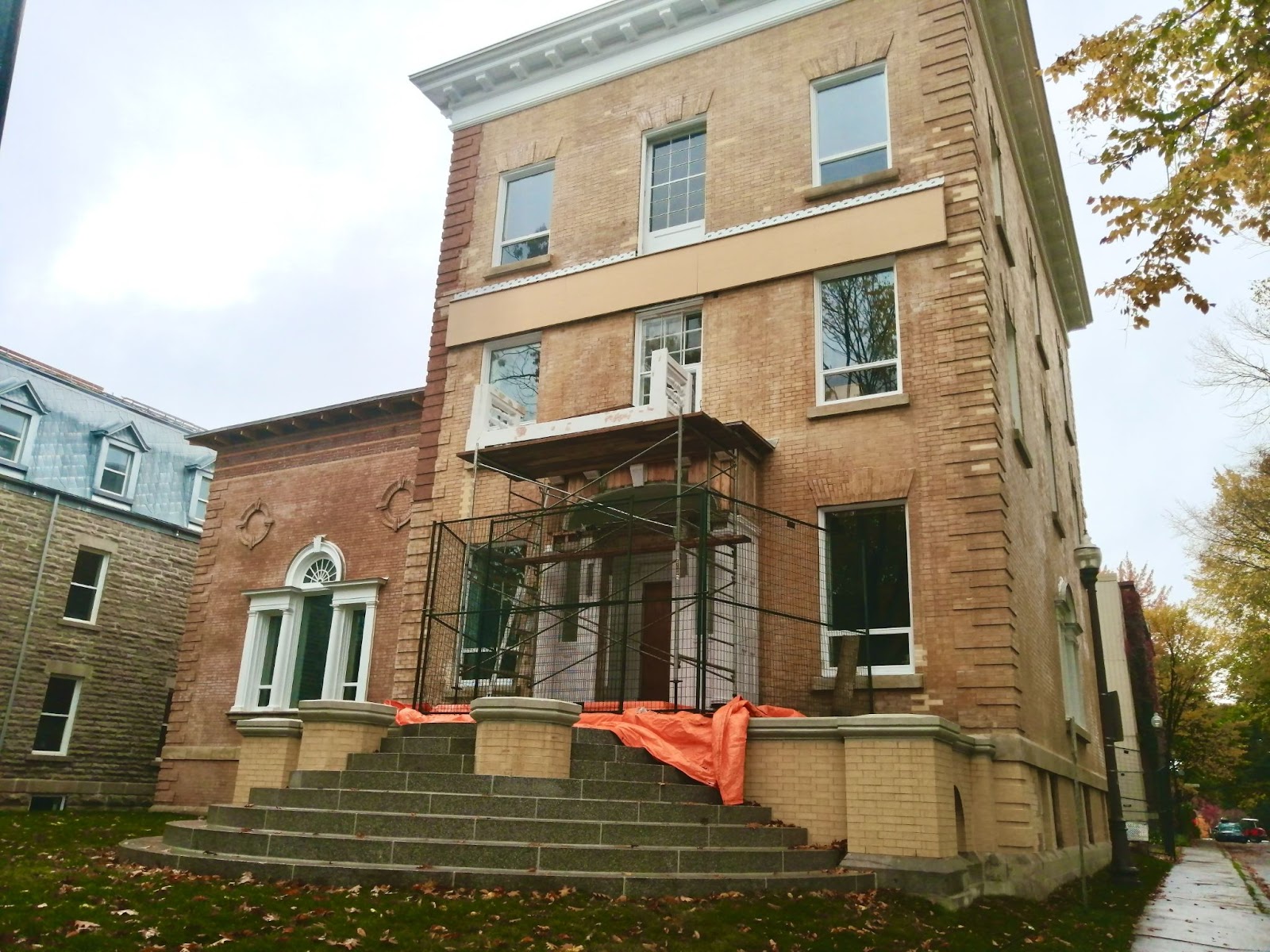
The Ville de Québec plans to convert the Foyer Nazareth building, at left, and the former Saint-Louis-de-Gonzague school in Vieux-Québec into housing.

Peter Black

Local Journalism Initiative Reporter

peterblack@qctonline.com

The city has reached a deal to purchase a former boys school and a one-time boys orphanage in a prime spot in Old Quebec, and convert both buildings into housing.

The two buildings, situated on a large lot at the intersection of Rue Richelieu and Rue des Glacis, are the former home of private boys school Saint-Louis-de-Gonzague and the once-associated orphanage, whose last vocation was as Foyer Nazareth, a seniors residence operated by the Sisters of Charity.

Both buildings were built in the 1800s and are considered of high heritage value.

The city made an offer of $8.275 million to purchase the 14,164-square-metre property from the Centre hospitalier universitaire de Québec (CHUQ), well below its $9.460-million municipal valuation. Neither building had been occupied since 2010, although a hair products supplier is listed as an occupant of the former school.

In a Dec. 1 news release, the city said, “By restoring the two buildings, more than 150 housing units could be created, which corresponds to approximately 225 to 250 new residents.”

Coun. Mélissa Coulombe-Leduc, city executive committee member and councillor for the Cap-Aux-Diamants district, said, “This acquisition will also make it possible to give back to citizens one of the most interesting green spaces in the area, the former primary school courtyard. The land could also accommodate other projects dear to citizens, including a community garden.”

The project is part of Mayor Bruno Marchand’s administration’s plan to bring in more residents and improve the quality of life in the Old City. Figures from the city and Statistics Canada show the residential population within the walls of the Old City is in free fall. In 2006 there were 5,278 residents; according to the latest figures, there are 4,600.

The city revealed no details on how it would proceed with the conversion of the two buildings, or the parameters of the proposed project.

The city’s acquisition of the prized site comes in the wake of a project aborted in 2022. The GM Development company had proposed a plan to preserve both buildings and add a 12-storey building on the site, creating some 250 housing units in total. The project was iced when the CHUQ decided, in the middle of the pandemic, to hold onto the buildings.

The school building became vacant in 2009 when Académie Saint-Louis, a subsidized private school, acquired École Saint-Louis-de-Gonzague, and the two schools merged at the latter’s facilities in Lebourgneuf. Académie Saint-Louis moved from Ave. des Érables in Montcalm in 1995.

The structure had been built in 1898 as a boarding school for boys and had been expanded over the years. Foyer Nazareth, situated on the site of an embankment fortification built by the French army, was built by the British army as quarters for married soldiers and their families.

When the British garrison left the city in 1871, the building was handed over to the Sisters of Charity, who turned it into an orphanage for boys. It was enlarged twice by raising the roof and adding an extension. The orphanage closed in 1915, and the building later became a seniors residence. It was operated by the sisters as Foyer Nazareth until 2010 when it was acquired by the CHUQ.

The city announced other measures to boost residential life within the walls. One is “a complete inventory of buildings located on Rue Saint-Jean and Côte de la Fabrique with the aim of analyzing the sector and improving existing subsidy programs to stimulate the creation of housing in vacant spaces.”

The subsidy for such conversions, provided through a provincial program, can reach $85,000 per unit. The city says the program could create about 30 new housing units.

30

Photo by Peter Black

City to transform historic buildings in Old City into housing Read More »

Honorary Spanish consul pens book about colourful predecessor

Tommy Byrne holds a copy of Premio-Real’s book of musical compositions at the book launch at the Cathedral of the Holy Trinity.

Peter Black, Local Journalism Initiative reporter

peterblack@qctonline.com

A phone call out of the blue from a historian in Spain launched Tommy Byrne, the honorary Spanish consul in Quebec City, on a quest that culminated in a book about his predecessor from 140 years ago, whose remarkable story is all but forgotten.

Byrne hosted an elegant launch party for the book, Premio-Real Dans La Capitale, on Oct. 26 at the Cathedral of the Holy Trinity in Old Quebec. It would have been familiar terrain for the Spanish diplomat, who was a prominent figure in Quebec City society in the late 1800s.

A week later, Byrne flew to Spain to present his book to the Royal Society in Jerez de la Frontera, the home of the historian whose call ended up inspiring Byrne to write the book.

Byrne, the former historical curator at the cathedral, who has a background in international relations, began unearthing the amazing story of the Count Premio-Real, Jose Antonio de Lavalle, when he received an inquiry from the historian wanting to confirm the diplomat’s burial place.

Thanks to a helpful staffer at Notre-Dame-de-Belmont cemetery who found an 1888 obituary of the count in a local newspaper, Byrne’s interest was piqued. He decided to dig into the count’s story and write a book about it.

Five years and a six-month research sabbatical in Spain later, Byrne’s profoundly researched and richly documented 248-page book is now available in French, through legendary Quebec City historical publishers Septentrion.

What Byrne has assembled is not simply a biography of a captivating character, but a fascinating history and analysis of the role of consuls – both honorary and remunerated – dating back to the early days of Canada. As Byrne notes, since 1855, the Spanish representative in Quebec City has been “four times a vice-consul, three times a consul, following which, were civil servants either honorary, career (diplomat) [or] in between.”

Premio-Real, for his part, was a full-blown diplomat, responsible for Spanish relations with all British and French possessions in North America at the time, including Newfoundland and the islands of Saint-Pierre and Miquelon.

Byrne said the count was “kind of a bridge between the two communities [French and English] as a diplomat.”

Born into a noble but not “grand” family, the newly anointed count, having inherited the title from his deceased father, joined the Spanish diplomatic corps at age 17. Prior to his posting in Quebec in 1874, Premio-Real served stints in Wales, Malta, Philadelphia, Naples and Hong Kong.

However, Quebec is where he thrived as a man of letters, composer, architect, mathematician, naturalist and general social butterfly. As the book’s subtitle suggests, Premio-Real’s 14-year stint in the Quebec capital was a “sentimental journey.”

Byrne said perhaps the most surprising thing he learned about Premio-Real is that he was “one of the greatest patrons of the arts” in the city, supporting artists, writers and musicians and often giving them their first exposure.

The artists he supported were mostly French-Canadians, Byrne said, but also included English-speaking talents. He co-wrote a book with Annie Howells Frechette, the daughter of then-U.S. consul William C. Howells, called Popular Sayings from Old Iberia.

Byrne writes that Premio-Real was “in his element” in the intellectual and scientific circles in the city, including the Literary and Historical Society of Quebec, in whose rare book collection one finds a copy of one of the count’s publications, dedicated to the Society.

The count was a close friend of governor generals Lord Dufferin and Lorne, as well as George Stewart Jr., the editor of the Morning Chronicle, a predecessor of the QCT.

Alas, mounting debts, failing health and being stripped of his post ultimately drove the count to suicide on Oct. 16, 1888. A report in the New York Times indelicately noted he blew “his brains out with a pistol.” The report said “the Count was a bon vivant and had a great deal of trouble in consequence.”

Upon Premio-Real’s passing, the book cover notes, “several of his contemporaries paid tribute to him by dedicating works to him, notably Louis Fréchette, Calixa Lavallée and Joseph Vézina.”

Byrne’s account of the life and times of this colourful character is brimming with fascinating detail and depicts a vibrant cultural and political society in Quebec’s post-Confederation history. The preface by Lt.-Gov. Michel Doyon provides some interesting diplomatic context.

The author said he did not set out to glorify the count, but simply to tell a compelling story that’s been lost to time. Premio-Real would surely be pleased.

Byrne said he feels a lot of satisfaction “at having started and finished an undertaking” that began as a New Year’s resolution.

Byrne, honorary consul since 2017, lived in Spain for several years working on a United Nations project, and met his “half-Russian, half-Spanish” wife, Veronica Biriucov González, in Madrid. The community of Spanish expats under his watch numbers about 800.

30

Photo by Peter Black

Honorary Spanish consul pens book about colourful predecessor Read More »

Mayor on budget: Tax hike less than inflation ‘a gift’ to residents

Peter Black, Local Journalism Initiative reporter

Street parkers, parking lot owners, cat owners and anyone who owns a house or a business will feel the pinch of a city budget coping with persistent inflation and other rising costs.

On Dec. 6, the Québec Forte et Fière administration of Mayor Bruno Marchand unveiled its third budget since taking office in 2021, featuring a $131.9-million increase in spending for an overall budget of $1.9 billion.

To help keep a cap on spending, the city is raising taxes and fees on a sweeping array of services, ranging from an average of 3.9 per cent on residential housing property taxes to a new $11 charge for a cat licence.

For a house valued at $293,000, for example, the increase will amount to $120. The property tax increase is the largest since 1991.

The tax bite for non-residential properties, largely commercial and industrial, is even deeper, at 4.7 percent.

One per cent of the property tax hike is designated for the management of water and waste, and is projected to bring in an additional $19 million. A new charge on some 400 outdoor asphalt parking lots, deemed by the city as an environmentally unfriendly drain on municipal services, should raise $1.7 million.

Billing the budget at the City Hall briefing as “a gift” to residents because it kept tax increases below inflation, Marchand said, “Despite a particularly difficult economic situation, we are succeeding in maintaining the quality of services offered, accelerating our investments to respond to the housing crisis and continuing to build up a reserve to enable us to better respond to climate change.”

He added, “I am proud that we have succeeded in doing this by limiting the increase in residential and non-residential tax charges below inflation, for a second consecutive year, in addition to maintaining the priority objective of continuing to reduce the city’s debt.”

The budget is intended to moderate the impact of inflation pegged at 5.6 per cent over the last two years, for a total hike of 11.2 per cent. Two examples the city gives are increases of about 40 per cent in the cost of fuel and natural gas over the past two years.

Cat owners, as of next year, will be required to get a licence for their pet, at a cost of $11. The city said the revenue will help compensate for the cost of disposing of cat litter thrown into garbage collected. The city estimates there are some 12,000 cats on city territory and it costs $5 per cat per year to treat disposed litter.

The tramway project may be on hold, but that doesn’t mean the city isn’t still paying for it. According to city officials, about $613 million will have been spent by the end of the year on preparatory work. Because of the freeze imposed by the provincial government while the Caisse de dépôt et placement studies the issue, the city has budgeted $300 million rather than $600 million to pay for already scheduled work and land acquisition in 2024.

In that regard, a report in Le Soleil confirmed the city concluded on Dec. 1 the single largest property purchase for the tramway, $37 million for land belonging to Industrial Alliance on Route de l’Église which would be used for a proposed exchange hub.

Other budget highlights include:

  • $255 million invested in various housing and renovation programs, including $3 million for new social housing in partnership with Desjardins and the Fonds de Solidarité FTQ.
  • The cost of street parking stickers will jump from $120 to $150 per year, and the cost of a second vehicle registered to the same address leaps from $120 to $225.
  • Under sports and culture spending, $17.2 million will go to tennis and pickleball courts and $8.2 million to two (new?) refrigerated rinks.
  • A slight decrease in overall spending on salaries, from 33.5 per cent of the budget to 33.3 per cent, will be achieved through attrition and not filling vacant positions.

30

Mayor Bruno Marchand has called the 2024 city budget a “gift” to residents.

Photo from Ville de Québec

Mayor on budget: Tax hike less than inflation ‘a gift’ to residents Read More »

Napoleonic thoughts: Muscleman’s murder theory and Louisiana Purchase

Peter Black, Local Journalism Initiative reporter

peterblack@qctonline.com

I have a small laminated copy of Jacques-Louis David’s famous portrait of Napoleon Bonaparte, purchased many years ago from the gift shop of the National Gallery of Art in Washington, D.C.

Why, of all possible souvenirs of works of art on offer, your scribe chose a portrait of Napoleon, escapes me. There just must have been something about it, or him (or was it in the bargain bin of historical portraits?).

In any event, that little Napoleon memento comes to mind as British director Ridley Scott’s cinematic opus about the French emperor hits theatres with a three-hour thump – a running time longer, as one critic noted, than Bonaparte’s coronation ceremony.

The latest surge of Boney-mania also brings to mind a certain Montreal muscleman whose passion – beyond bodybuilding and nutrition – was everything Napoleonic.

Ben Weider, with his brother Joe, built a successful global business publishing fitness and health magazines, selling nutritional products and staging body-building competitions. For example, the Mr. Olympia contest, going, um … strong since 1965, famously brought to world attention, Hollywood stardom and the California governorship seven-time champion Arnold Schwarzenegger.

Napoleon may have been a strongman, but he was no muscleman. Yet Weider had a lifelong fascination with the Little Corporal, amassing a collection of some 100 items of memorabilia, many of them owned by the emperor himself. One Napoleonic keepsake, a lock of the emperor’s hair, became key to Weider’s campaign to prove Bonaparte, 51 years old at the time, did not die of stomach cancer, as the generally accepted version states, but was poisoned by monarchist plotters fearing another comeback.

Weider wrote a 1982 best-seller titled The Murder of Napoleon, in which he makes the case, based on reams of personal accounts and forensic science, that Napoleon succumbed to arsenic poisoning. The most convincing proof was the analysis of hair shaved from his head the day after he died in May 1821.

Weider donated his collection to the Montreal Museum of Fine Art in 2008. A ceremony to accept the Napoleonic treasures, with a Bonaparte descendant in attendance, took place eight days after Weider died that year at age 85.

Weider’s interest in Napoleon ran deeper than simple fascination with an epic historical figure. As cited in one tribute, Weider “often said that one of the chief reasons he so admired Bonaparte was because he was ahead of his time in extending rights to Jews and other minorities; he emancipated Jews from the ghettos and lifted restrictions on their freedoms in the European countries he conquered, and even proposed a Jewish state in Palestine.”

When his plan for a Jewish state in the Middle East failed, following his brutal invasion of Egypt and Palestine in 1798, Napoleon declared France to be the homeland of the Jews.

He was somewhat less tolerant when it came to other types of human beings. His mission in 1801 to suppress a slave revolt in Hispaniola, now Haiti, ended in disaster, with only a fraction of his 35,000-man expeditionary force surviving death in battle or by disease.

As a result, Napoleon had to abandon his plan to reinforce the massive swath of territory in the American midwest he had acquired from Spain in exchange for Tuscany in Italy, creating a French territory to replace Canada – Voltaire’s “few acres of snow” lost in the Seven Years War.

Desperate for cash to fill his war chest to take on the British once again, Napoleon eagerly agreed to sell the Louisiana territory to the United States, for the equivalent of about $350 million US in today’s money.

The Americans had originally only wanted to buy New Orleans, but ended up getting some 828,000 square miles west of the Mississippi River, most of which had never seen a French visitor and was occupied only by Indigenous tribes.

Napoleon’s vision of a French-speaking empire in North America ended when the Americans took possession of Louisiana on Dec. 20, 1803, and promptly started making plans to extend slavery to the new possession, sowing the seeds of the Civil War.

Who knows what would have happened had Napoleon not met his Caribbean Waterloo on Hispaniola, and instead been able to muster a massive expeditionary force to claim this huge and sparsely populated territory – running all the way up to the border with British North America – for France?

It certainly would have given new meaning to the dreaded “Louisianization” of Quebec.

-30-

Napoleonic thoughts: Muscleman’s murder theory and Louisiana Purchase Read More »

Canada’s debt crisis – or the credit grinch that’s stealing Christmas

Peter Black, Local Journalism Initiative reporter

peterblack@qctonline.com

Ebenezer Scrooge gets a bum rap. What was his crime, other than practising sensible spending restraint? Sure, he could have forked over a few shillings to the charity drive gents to help “buy the poor some meat and drink and means of warmth,” but surely he deserves a little credit for sticking to his principles of fiscal prudence.

Did we just say “credit”? Let’s talk about credit, then, but the not-so-beneficial kind. These days, there may not be treadmill jails and workhouses for the poor as there were in Charles Dickens’s time, but there is arguably a prison of another kind – and definitely not just for the poor. That’s the credit and debt trap.

With Black Friday becoming Black Month, and merging with the consumer orgy of Christmas “giving,” an alarming number of Canadians are facing financial stress of unprecedented proportions. Many will be hard-pressed to provide themselves with meat, drink and warmth.

The Equifax consumer credit reporting agency put out a release in September saying Canadian consumer debt had reached $2.4 trillion dollars by the second quarter of 2023 alone. The average non-mortgage debt among credit card users was $21,131.

The company said, “Many Canadians are slowing down their credit card spending, but lower-income households are having a harder time curbing spending, and fewer consumers were able to pay their monthly credit card balance in full during the second quarter.”

Some folks may find that paying off the balance notion laughable, as making the minimum payment may be beyond the means of many credit junkies.

When you add to the credit debt what Canadians as a whole owe on their mortgages, the crunch is truly staggering. In a report earlier this year, the Canada Mortgage and Housing Corporation (CMHC) said, “Canadian households are more in debt than those in any other G7 country, and the amount they owe is now more than the value of the country’s entire economy.”

Household debt currently amounts to 107 per cent of the economy, whereas it was a mere 80 per cent in 2008, when the world economy tanked.

In her recent fall economic statement, Finance Minister Chrystia Freeland acknowledged the “squeeze” many Canadians are feeling as a result of the inflated cost of most consumer goods and the rise in interest rates. She did promise a Canada Mortgage Charter to provide some measures targeted at helping vulnerable mortgage holders.

Thanks, but Canada’s credit and debt addiction goes way beyond pretty much anything any government can do, short of erasing all indebtedness at the stroke of some magic economic wand.

Sorry, Canadians, as much as inflation (among the lowest in the G7) and interest rates (also among the lowest in the G7) are causing the current squeeze, the fact is we all spend too much, and way too much of that spending is with borrowed money.

An economist was on the radio the other day saying that the average percentage of income folks pay to put a roof over their heads has not changed dramatically in the past several decades – about 30 per cent.

What has changed is the pressure, the need, the impulse, the whim of spending on a bunch of other things people consider to be essential for modern life – things they must have now.

There’s the car (or cars), the cell phone plan, the high-speed internet (all multiplied by the number of family members) and the trip to the Dominican Republic, Cuba or Costa Rica. There’s the summer vacay and camps for the kids, sports for the kids, lift tickets, those shoes, that suit, that restaurant meal, that game, movie, play or concert. Charge, charge, charge.

Not to sound too Scrooge-like here, but it would seem the affordability crisis is not just a product of inflation, but also of a lack of individual discipline, discretion, patience and sacrifice when it comes to spending.

Humbug to credit.

Canada’s debt crisis – or the credit grinch that’s stealing Christmas Read More »

Caisse to include ‘third link’ in study of Quebec transit system

Peter Black

Local Journalism Initiative reporter

peterblack@qctonline.com

The so-called “third link” idea is not dead. Indeed, the Coalition Avenir Québec (CAQ) government wants to see its recently abandoned notion of another river crossing re-examined in the study of a transit system for Quebec City which it ordered the Caisse de dépôt et placement du Québec (CDPQ) to undertake.

Details of the mandate the Legault government handed the Caisse’s infrastructure division were made public last week, confirming reports a connection to the South Shore would be included. The CAQ gave the Caisse six months to come up with what it believes to be the best and most cost-efficient system.

The basic mandate is “to identify a structuring transportation project to improve public transportation for Quebec City [and] to improve mobility and fluidity in the Metropolitan Community of Quebec, particularly between the two shores.”

In a media release, Jean-Marc Arbaud, the head of the Caisse’s infrastructure arm, said, “To achieve this mandate, CDPQ Infra will draw on the experience and expertise of its teams in the analysis and planning of large transportation projects acquired in Quebec and elsewhere in the world, while relying on essential collaboration [from] the ministry of transport and sustainable mobility and the Ville de Québec.”

The Legault government announced the abandonment of its plan to build a tunnel between Quebec City and Lévis in April. Since then, it’s been unclear what the next move would be in finding an alternative.

While the Caisse examines options, the office created for the initial tramway project will remain open and continue to work on various “essential” aspects of the system. According to media reports, transport ministry officials have asked the office for a report on work undertaken and underway. The office is also asked to work closely with the Caisse study.

Radio-Canada obtained a copy of a letter from the Ministry of Transport to the city saying it “wants the city to maintain the required teams in order to collaborate with CDPQ Infra in carrying out its mandate and to preserve the expertise developed.”

Radio-Canada also reported that the Caisse may be paid for its study of Quebec’s transit needs, depending on what plan is decided. If it turns out the Caisse will manage the project, the cost would be included in the project’s costs. If the project is handed off to another entity, the Caisse would be reimbursed.

Various interest groups are asking the Caisse to be heard during the process of exploring transit options. According to the 2015 agreement the Caisse had to plan and build Montreal’s REM system, it is required to consult with interested parties. Radio-Canada reports at least one group, Accès Transports Viables, has received an invitation from the Caisse.

Another citizens’ group, Québec Désire son Tramway, had yet to be contacted. Co-founder Nora Loreto told the QCT the group had sent an official request to the Caisse to be heard. The group recently staged a march in support of the tramway that drew thousands.

Meanwhile, a new political party fiercely opposed to the tramway is also asking to be consulted on the future transit project. Respect Citoyens, whose co-founder is former Quebec Conservative Party candidate Stéphane Lachance, wants to propose alternatives to the tramway plan, including reconverting a railway line into a suburban train route.

Photo from CDPQ Infra website

Caisse Infra head Jean-Marc Arbaud.

Caisse to include ‘third link’ in study of Quebec transit system Read More »

Developer has ‘no plans’ for Samuel Holland housing expansion

The 2021 plan for expanding the Samuel Holland complex on Ave. Ernest-Gagnon by Cargo Architectes.

Image from Cargo Architectes

Peter Black

Local Journalism Initiative reporter

peterblack@qctonline.com

After nearly four months of ignored and deflected inquiries with the city and the property owner, the QCT has learned a major project to expand the Samuel Holland housing complex in the Saint-Sacrement district is either dead or indefinitely on ice.

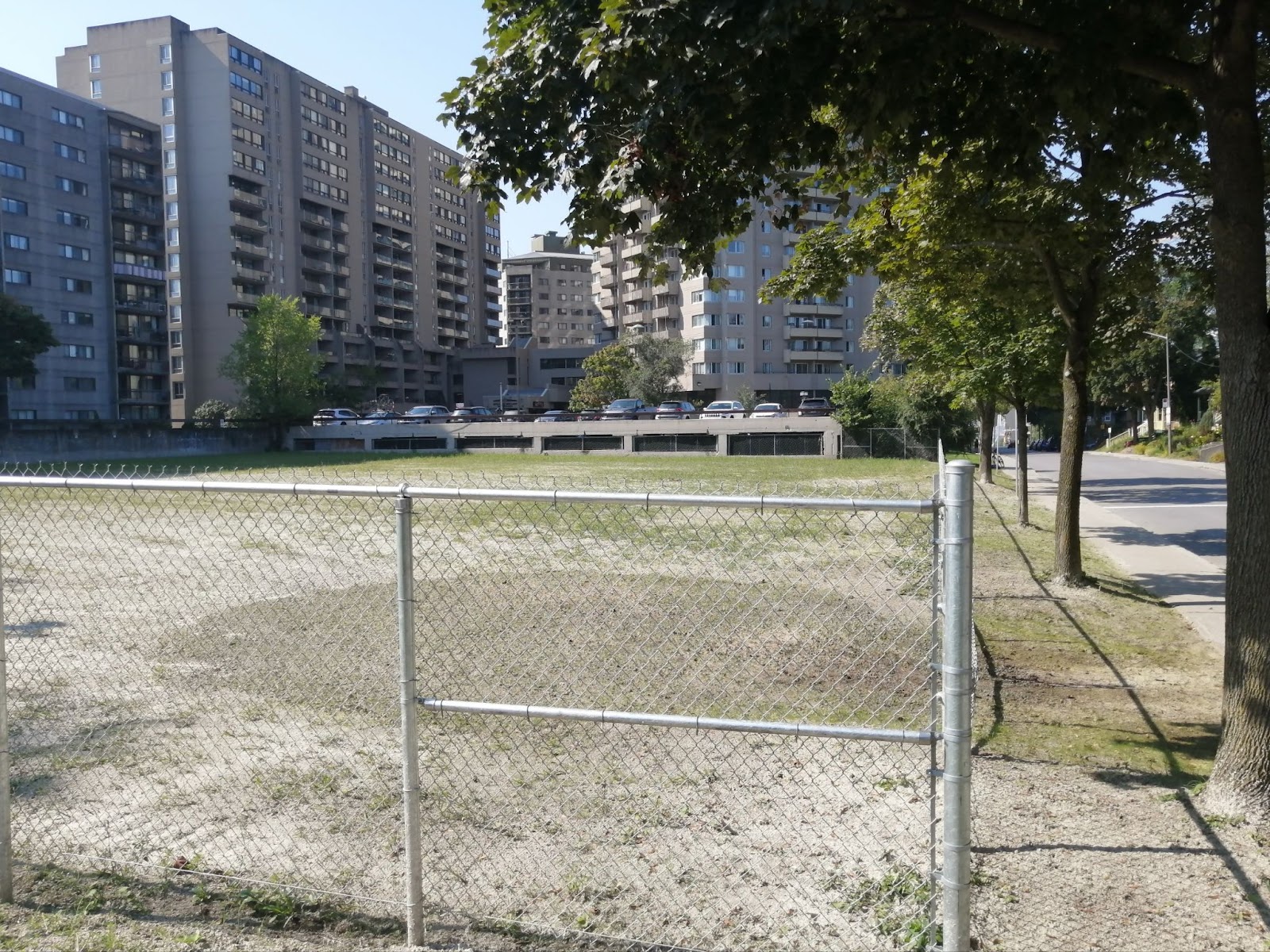
The property is currently a fenced-off field adjacent to Holland Elementary School on Ave. Ernest-Gagnon. Snow now covers vegetation that has grown and thickened in the two years since contractors demolished the building that used to be on the site, the former Quebec City RCMP headquarters.

The owner of the field, according to the city’s tax rolls, is officially registered as Samuel Holland Holdings Company, with an office listed in Halifax. That company is a division of Toronto-based CAPREIT (Canadian Apartment Properties Real Estate Trust), one of the country’s largest rental property landlords.

CAPREIT had acquired the Samuel Holland complex in July 2012 from GE Capital, which had in turn bought the six-building site from the real estate wing of insurance giant SSQ (now Beneva) in 2007.

According to media reports, in 2002 SSQ had proposed building a 150-unit housing project on the site, incorporating the former Mountie building, but abandoned the plan in the face of objections by occupants of the nearby Holland apartment complex concerned about losing their view.

When CAPREIT took over, it revived the project on Ave. Ernest-Gagnon, submitting a plan in 2017 to the city which exceeded zoning height restrictions. In August 2021, CAPREIT returned with a revised project for 168 units of housing, with a row of two-storey townhouse units along the street and an eight-storey building in the back.

This version, according to an August 2021 report in Le Soleil, conformed to local zoning bylaws.

In that Le Soleil report, CAPREIT president and CEO Mark Kenney said, “CAPREIT is refining the details of the project design with its team of consultants and expects to submit its construction permit application in early 2022.” He estimated the cost of the project as “between $40 and $50 million.”

In September 2021, demolition work began on the former RCMP building, which had been abandoned in 1995 and was badly deteriorating. Since then, apart from the installation of a fence around the 2,400 square-metre property, there has been no activity.

Inquiries with the city, beginning in August, revealed that no building permit had been issued for the site and that any inquiry about the status of the project was to be referred to the property owner.

The QCT contacted Cargo Architecture, the Quebec City company that had drawn up the plans for the Samuel Holland expansion, and was told they were no longer involved in the project and were not aware of its status.

Numerous calls and emails to CAPREIT officials, including Kenney, received no response. A receptionist invited the QCT to contact the company’s investor relations or media service, neither of which responded.

On Nov. 8, CAPREIT executives convened a conference call with reporters to discuss company quarterly results, during which the QCT’s request to ask a question was somehow not registered. Afterward, a media relations representative returned a call, apologized for the missed question and promised to look into the Samuel Holland situation.

Two weeks and two more inquiries later, CAPREIT’s anonymous media team sent a response. It said, “We have no development plans currently for this property, and as such, will not be providing additional comment at this time.”

In the absence of more information, official or otherwise, what happened to the 870 Ernest-Gagnon project in the CAPREIT boardroom between August 2021 and the present is open to speculation.

In the Le Soleil interview, Kenney made comments about the obstacles to development, especially zoning regulations slowing down construction projects. “The problem is we need more housing.… The desire to build is there, but it takes years and years because it is a municipal responsibility,” he said.

He also said real estate developers face rising material costs, such as the increase in land prices, so they must be able to build bigger projects to make their investments profitable.

In an August opinion piece in the Hill Times, Kenney wrote about Canada’s housing situation, “The legacies of this era of inaction are many: more burdensome zoning laws, higher development costs, more aggressive and successful “not in my backyard” (NIMBY) interests and fewer Canadians with access to housing that meets their needs and budgets.”

The Ville de Québec had not responded by press time to a request for comment on the icing of the Samuel Holland expansion project.

Including the Samuel Holland complex, CAPREIT has 2,777 units in its Quebec City rental portfolio. Overall the company has $16.5 billion in assets, including 64,500 rental units in Canada and the Netherlands.

The former site of the RCMP building on Ave. Ernest-Gagnon, adjacent to Holland Elementary School, remains vacant as plans for a housing project are suspended.

Photo by Peter Black

Developer has ‘no plans’ for Samuel Holland housing expansion Read More »

Some bright Quebec stars shed light on the mysteries of space

Peter Black

Local Journalism Initiative reporter

peterblack@qctonline.com

Marc Garneau is not known as the most poetic of Canadian astronauts, deep thoughts not being an essential requirement of a naval engineer for flying a space mission. But at a recent speaking engagement at the Morrin Centre, the first Canadian in space mesmerized the audience with a profound, nearly spiritual reflection on the vastness of the cosmos and humanity’s presumption of significance in it.

“From Earth, our perspective goes out to the horizon – 10 or 15 kilometres around. When you see the entire planet, your perspective starts to change. You see that this planet is the cradle of humanity … there’s nowhere else to go, and we have to find a way to get along with each other.”

One supposes that’s what sets astronauts – and now commercial space travellers – apart from more Earth-bound folk: The unique experience, as the poem goes, of slipping the surly bonds of Earth, and being alone with one’s soul and intellect at the doorstep of the unknowable universe.

Garneau, a proud francophone son of Quebec City, made his first of three voyages into space in 1984, a highlight of the remarkable role Quebecers have played and continue to play in exploring the secrets of the heavens.

There are, of course, Garneau’s fellow Quebec astronauts, David Saint-Jacques, who holds the Canadian record of 204 continuous days in space, and Julie Payette, who took part in two space shuttle missions, in 1999 and 2009.

Garneau went on from the astronaut program to become president of the Canadian Space Agency, whose first president in 1989 was physicist Larkin Kerwin of Quebec City, a former rector of Université Laval and head of the National Research Council. Kerwin is credited with naming the famous space Swiss army knife, the Canadarm.

Though, like Kerwin, he never made it into space, one of those remarkable Quebec space explorers, alas, recently “joined the stars” as his family put it – Quebec astrophysicist and science media “star” Hubert Reeves.

Educated at both Université de Montréal and McGill University, Reeves, who died at 91 in October, authored more than 40 books and countless articles about the mysteries of the universe and Earth’s environment.

An adviser to NASA in its early years, Reeves, who, with his white beard looked every inch the wizard professor, was also a serious researcher. He created several TV series to shed light on topics of astronomy and other scientific matters, earning accolades and awards from around the planet.

About his twin passions, he wrote, “Astronomy, by telling us the story of the universe, tells us where we came from, how we came to be here today. Ecology, by making us aware of the threats to our future, aims to tell us how to stay there.”

At the other end of the age spectrum is a remarkable young astrophysicist, Laurie Rousseau-Nepton, who, coincidentally was a recipient of a Hubert Reeves fellowship in 2010. She is also the subject of a newly released five-part National Film Board documentary, called North Star, about her life and career.

Rousseau-Nepton, who grew up and looked up at the stars in the Innu community of Mashteuiatsh in the Saguenay-Lac Saint-Jean region, is described as Canada’s first female Indigenous astrophysicist. She was a resident astronomer for six years at the Canada-France-Hawaii Telescope in Hawaii, forming an international group called SIGNALS “designed to investigate massive star formation in numerous galaxies close to the Milky Way.”

Currently an associate professor at the Dunlap Institute of the University of Toronto, Rousseau-Nepton, like Reeves, has become a popular communicator of the wonders of the stars, with an added Indigenous touch.

As she says in the documentary, “In the Innu culture and many cultures in Canada, we come from the stars and we also return to the stars – and it’s a cycle. For me, it makes sense that I’m doing this. It’s something that I’ve actually learned all of my life: to study where we come from.”

Based on these and other individual contributions, Quebec, with the world-class observatory at Mont Mégantic and the Canadian Space Agency in Longueuil, might rightly claim to be the centre of Canada’s universe in terms of the study and exploration of space.

30

Some bright Quebec stars shed light on the mysteries of space Read More »

Microbrasserie Griendel moving to former Cochon Dingue site in Montcalm

Peter Black, Local Journalism Initiative reporter

peterblack@qctonline.com

A popular microbrewery in the Saint-Sauveur district is hopping up to the Upper Town Montcalm district come the spring, taking over the space formerly occupied by the popular restaurant Le Cochon Dingue (now located on Rue Saint-Jean in the Old City).

The owners of Microbrasserie Griendel, faced with various obstacles at its current site at the corner of Rue Saint-Vallier and Rue Des Oblats, sought out another location, and settled on the space on Boul. René-Lévesque near Ave. Cartier.

Martin Parrot, one of Griendel’s co-founders, explained the move from Saint-Sauveur, where the resto-pub has been a neighbourhood fixture for eight years, also involves moving the actual brewing operation to the small town of Saint-Jacques-de-Leeds on the South Shore, where Parrot lives.

The move has been in the works for months, Parrot said. He explained that the restaurant faced the realities of fewer customers in Saint-Sauveur, plus the impact of major roadwork in the coming year. The busy intersection is also not ideal to attract terrasse customers.

The company has bought a building in Saint-Jacques-de-Leeds for the brewery, which will also include a small pub to sample the suds and a modest restaurant menu.

Parrot said the former Cochon Dingue space is ideal for Griendel’s expansion, with its large seating areas and its terrasse which can accommodate 70 customers.

He said the pub plans to continue activities like quiz nights and featured beer specials that made Griendel a popular spot in Saint-Sauveur.

Parrot’s path to ambitious micro-brewer has been an unusual one. After doing a postgraduate degree in humanities at York University in Toronto – specializing in the history and philosophy of witchcraft in England and Scotland – he found himself producing a documentary film about the emergence of the craft brewing business in Quebec.

The film, titled Brasseurs, focused on four microbreweries in the province, including La Souche in Limoilou, and was shown in theatres in Quebec City and Montreal. It can be viewed on YouTube with English subtitles.

During the making of the film, Parrot, who has been a “beer geek” and home brewer for years, said he had already started making plans to open his own microbrewery, which he did in 2015.

“Most of our clientele was in Saint-Sauveur, but I think that a large part of the people will come to see us [in Upper Town] because of the quality of what we were able to offer, both in terms of beer and in terms of dishes, and in terms of activities too,” he said.

Griendel will remain open in Saint-Sauveur while the new location is being prepared. Parrot said Griendel will be leasing the former Cochon Dingue premises with plans to eventually purchase the building with “one of the best terrasses in the city.”

“For us,” Parrot said, “it’s a stepping stone.”

As for the name, Parrot explains, “Griendel is a German name, an ex-monk from the early 18th century. He was a tinkerer and a travelling scientist. We liked the visual of the name, the German reference (casual German beer culture) and the tinkerer bit (we like to try out stuff, both in the brewery and in the kitchen).”

Cochon Dingue, meanwhile, has far from disappeared after leaving Montcalm. There are now six restaurants bearing the catchy name in the Quebec City region, including the newest in Le Concorde Hotel on Grande Allée. The parent company is also making plans to bring the brand to Montreal.

30

NE

Griendel co-founder Martin Parrot samples one of the microbrewery’s products at its current location in Saint-Sauveur.

Photo courtesy of Martin Parrot

The former home of the Cochon Dingue restaurant on Boul. René-Lévesque will become the new Griendel microbrewery and restaurant.

Photo by Peter Black

Microbrasserie Griendel moving to former Cochon Dingue site in Montcalm Read More »

A walk in the snow? Speculation grows on Trudeau’s future

Peter Black, Local Journalism Initiative reporter

peterblack@qctonline.com

Things could change, of course.” Ah, the escape hatch for the prediction-hedging columnist.

Those words were written in a July piece in which your scribe predicted a rough ride ahead for the leader of the Conservative Party of Canada.

We boldly continued, “Given the beating the Liberals have endured over the past several months (yaddah yaddah) … not to mention the usual fatigue with a government now in power for nearly eight years, one would think the Grits would be tanking hopelessly.”

So, yes, one would think that. But things did change this summer. Perhaps the rising price of hamburger for the barbecue, or the raging forest fires, or raging about a Nazi being applauded in Parliament, or just general raging against anything Liberal, the Grits under Justin Trudeau are indeed “tanking” in the polls. The question, of course, is how “hopelessly.”

The degree of hopelessness has inevitably ignited rampant speculation in the media and at the dinner table about the future of the current prime minister, whose level of public loathing has reached new heights (depths?).

The latest surge of pontification amongst the punditry on the subject, what might be called the “walk in the snow” debate, was sparked by a recent op-ed from Senator Percy Downe, who used to be chief of staff to Jean Chrétien, a politician who knew a thing or two about winning.

Downe writes about future Liberal prospects: “There is a possibility that under our first-past-the-post electoral system, Justin and the NDP could squeeze enough seats to form a minority government. The questions for Justin Trudeau are: given the divisions in our country, is that the best result for Canada, and is it the best result for Justin personally?

“The prudent course of action is for another Liberal leader to rise from the impressive Liberal caucus and … if the next Liberal leader is able to bring the party back to the centre of the political spectrum, Liberals have a chance of being re-elected.”

Downe, incidentally, doesn’t offer a specific diagnosis of the Liberals’ summer swoon in the polls, save “a lack of fiscal responsibility in the Trudeau government, and the damage it caused our economy is now showing up.”

So, in Downe’s opinion, Trudeau needs to take that famous walk in the snow like his father did in February 1984 and call it quits.

Downe’s plea came at just about the same time another voice entered the fray in the person of Mark Carney, former head of the Bank of Canada and the Bank of England – and, even more politically sexy, a bilingual Albertan.

Carney, a card-carrying Liberal, gave an interview to the Globe & Mail in early November where he did not dismiss outright the notion of being interested in the Liberal leadership. As Max Fawcett of the National Observer put it, “in the dialect of aspiring political leaders, that’s as close an answer to ‘hell yes’ as you’re going to get.”

The Liberals still have the gift of time, assuming NDP Leader Jagmeet Singh does not put his precious balance-of-power gig at risk and pull the plug on his party’s deal with the Liberals in the coming months.

Trudeau and his brain trust may make the calculation that they will eventually bottom out in the polls and have nowhere to go but up.

With inflation easing, interest rates dropping and a mercifully brief recession to be endured, some of the anger and bitterness may drain off and put the Liberals back in contention come 2025. Canadians may also become fatigued with the discourse of the Conservative leader.

If, however, defeat does seem inevitable no matter what the Liberals do – the assumption being Trudeau himself is the party’s biggest liability – then perhaps Liberals would ask, “Why would we burn a new leader on a lost cause, and why not let Justin have his round in the ring with his Conservative tormenter in a final, epic campaign?”

There is also the Joe Clark scenario in which the Conservatives win a minority, but voters quickly regret what they did and return the Liberals to power quicker than you can say “Ax the Tax.”

Unlike in 1979, when the Liberals begged a defeated Pierre Trudeau to renounce his resignation and return to lead them into the February 1980 election, one would think the Liberals would allow Justin to stay retired.

Of course, things could change.

A walk in the snow? Speculation grows on Trudeau’s future Read More »
CAQ delays tramway, asks Caisse to decide best transit project in six months

Peter Black, Local Journalism Initiative reporter

peterblack@qctonline.com

The Coalition Avenir Québec government has forced yet another delay in Quebec City’s project to build a tramway system, leading some to wonder if it’s the end of the line for the current plan.

Premier François Legault informed Mayor Bruno Marchand at a Nov. 8 meeting in the premier’s National Assembly office that he was rejecting the $8.4-billion plan the mayor had presented the week before.

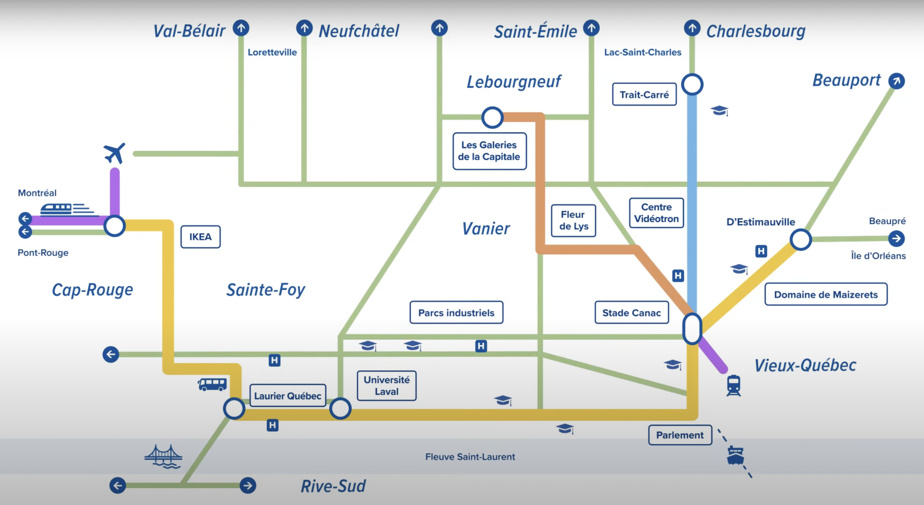
Instead, the premier has tasked the infrastructure wing of the Caisse de dépôt et placement du Québec (CDPQ Infra) to “study over a six-month period the best project for a structured transport system for Quebec [City]. Quebec deserves a transport system worthy of a great capital.”

At a Montreal press conference two days later, Legault said, “What I want first of all is a beautiful, structured transport project that will please people,” whether that be a “tram, a metro or light train.”

He said, “We are asking experts from the Caisse de dépôt to evaluate the Quebec tramway project, which went from $3.4 billion to more than $8 billion, to look at other possible projects.”

In announcing the revised cost of the tramway project last week, Marchand had also said the city would take over the management of the infrastructure construction of the tram line, since no private bidder was able to meet the financing or deadline conditions.

Marchand said the city had the in-house expertise to manage the project and has handled the preparatory work for the tramlines so far.

CDPQ Infra has just completed its first major undertaking, Montreal’s 67-kilometre Réseau Express Métropolitain (REM), a suburban commuter train project for which construction began in 2018. The premier said he had spoken with the head of the Caisse, but as of this writing, according to media reports, no mandate letter had been sent to the pension manager.

Upon leaving the meeting with Legault, Marchand told reporters, “I had a very good discussion with the premier, where we both spoke face to face, alone, he and I, where I presented the plan for the city to carry out the structuring transport project that is the tramway. This is not the option he will choose. Obviously, I’m disappointed.”

Two days later, Marchand, appearing at an announcement with Jonatan Julien, minister for infrastructure and the national capital region, told reporters “all questions related to this project will be redirected to the minister. You may ask me 50 questions, but in the coming months, I won’t answer them. It’s a government decision – they took the ball, they will respond, they will lead the process and we will talk about it again.”

Opposition Leader Coun. Claude Villeneuve, whose Québec D’Abord party ran on a pro-tramway platform, was present at the same announcement. He said, “It is humiliating for the mayor, and through that, it is humiliating for all the citizens of Quebec, the sequence [of events], what we are experiencing, to have the project withdrawn. This is a very hard blow for everyone. Whether we are for or against the tram project, it is certain that it is not a party [the CAQ] for Quebec [City]. I try to imagine [former mayors] Jean-Paul L’Allier, Andrée Boucher or Régis Labeaume putting themselves in that situation, and I don’t believe it.”

Despite the apparent freeze and takeover of the tramway project by the Quebec government, work continues. City spokesperson Miriam Bard-Dumont told Le Soleil, “The project office is continuing to carry out the preparatory work as planned in the various contracts awarded to suppliers.”

It was unclear what the consequences of the Quebec government’s action might have on the contract with Alstom to build the cars for the tramway, mostly at its plant in La Pocatière. The contract called for manufacturing to begin in 2025.

30

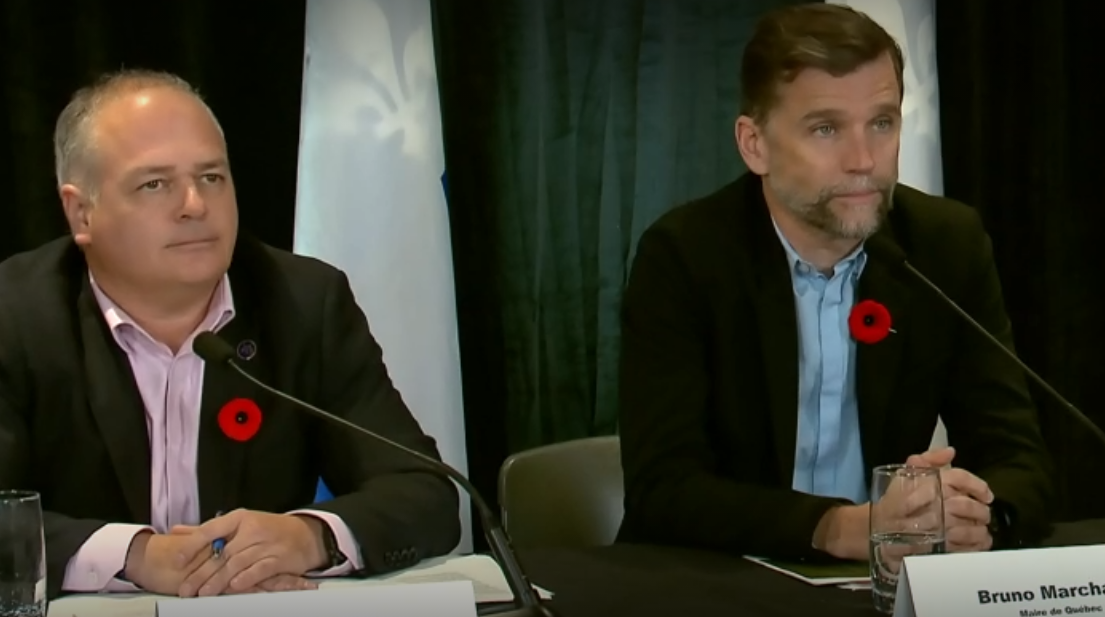
Mayor Bruno Marchand, right, is shown at a press conference with Jonatan Julien, minister for the capital region, at a news conference two days after the Caisse announcement.

Photo from Radio-Canada

CAQ delays tramway, asks Caisse to decide best transit project in six months Read More »
‘Sabotage’ and ‘Groundhog Day’: CAQ Caisse plan draws strong reaction

Peter Black, Local Journalism Initiative reporter

peterblack@qctonline.com

Jean-Yves Duclos had some uncharacteristically harsh words for the Legault government’s decision to hand Quebec City’s tramway project over to the Caisse de dépôt et placement du Québec (CDPQ).

The powerful federal procurement minister and MP for the downtown Québec riding called the move a “sabotage attempt” by the Coalition Avenir Québec (CAQ) government.

Questioned by reporters on Parliament Hill in Ottawa the day after the Nov. 8 announcement, Duclos said, “I think that the Quebec government sabotaged the community’s efforts yesterday because the tramway project has been under study and discussion for 15 years.”

Duclos did not say whether the CAQ decision puts federal funding for an eventual transit project at risk. Last week, Duclos said the Liberal government would financially support the city’s “Plan B” option, with a revised budget of $8.4 billion.

Noting that Quebec City is the only city of its size in North America not to have a modern and electric public transit system, Duclos said the CAQ government is putting at risk “the largest Canadian investment in Quebec in history.”

He said, “The only way the Canadian government can exercise leadership is if the leadership of the Quebec government is also present. I’m sad about yesterday’s result, but I think we have to continue. We can’t afford to stay behind. We must invest in people’s quality of life and people’s health.”

Nora Loreto, cofounder of the group Québec désire son Tramway (QDST; Quebec wants its tramway), said in a statement to the QCT, “This is a really disappointing move from François Legault. Projects like these take years, and by delaying it, the costs will only increase. At the same time, car traffic will also increase, exacerbating an already difficult situation within the national capital region.”

She said, “If the CAQ thinks that delaying this project will hand them the next election, they’re wrong. This decision is a gift to Québec Solidaire and the Parti Québécois, both parties who support the project, and also to the Conservatives, who can cynically use this flip-flopping to try and win a riding or two in the region.”

A post on the QDST Facebook page speculated on the potential impact of the CAQ-Caisse decision on the current project office. William Gagnon-Moisan, who says he’s an engineer specializing in urban transit who’s worked at the office for three years, said, “This project will always have been complicated and strewn with upheavals. But this evening I have difficulty being positive, seeing hope, to still perceive light. So much hard work (and money spent) by so many competent people, to end up like this.” He said, “87 people at the [project office] will lose their jobs … I would have liked to be one of those who will have positively changed the face of our city; unfortunately, it seems that this will not be the case … let’s just hope that the CDPQ will be able to take over.”

The city’s neighbourhood councils, which had, the week before, issued a collective message of support for the city’s plan, reacted with anger and disappointment to the CAQ government’s move. Alexia Oman, president of the Saint-Roch council, told the local news website Mon Quartier that “the CAQ’s recent abandonment of the Quebec City tram project is more than a disappointment; it is a betrayal of citizens and a regression for the future of our city. By refusing a structuring transport system, the government is turning its back not only on residents of central neighbourhoods but also on anyone who dreams of a modern, ecological and efficient capital.”

Veteran municipal columnist François Bourque of Le Soleil wrote, “The good news here, if there is any, is that the government says it is committed to a structuring transport project – for what its word is still worth. Concretely, the scenario of a tram remains possible. However, it will be put back into the balance with others. As if the exercise had never been done. As if the Caisse was going to be able to do better in six months than what has been analyzed for 10 years. The difference is that the bill will have continued to rise and the federal funding may no longer be there when Groundhog Day returns.”

‘Sabotage’ and ‘Groundhog Day’: CAQ Caisse plan draws strong reaction Read More »

St. Lawrence prof Bleau’s research included in new JFK assassination book

Peter Black, Local Journalism Initiative reporter

peterblack@qctonline.com

As the 60th anniversary of the Nov. 22 assassination of John F. Kennedy is marked, CEGEP Champlain-St. Lawrence business professor and assassination researcher Paul Bleau found himself at the scene of the crime in Dallas, Texas.

Bleau is one of the five authors who contributed 10 chapters to a new compendium of research into the president’s killing, titled The JFK Assassination Chokeholds. The title refers to what the authors deem to be examples of incontestable proof “lone gunman” Lee Harvey Oswald was innocent and that there was a conspiracy to kill Kennedy.

Last year, Bleau’s research drew national attention when he was featured in Oscar-winning director Oliver Stone’s documentary, JFK Revisited: Through the Looking Glass. Stone screened the documentary in Quebec City at packed events in June 2022. (The documentary is running again at this time on the Crave channel.)

The release of Chokeholds comes in the wake of the recent stunning revelations from former Secret Service agent Paul Landis, “whose new evidence,” according to Bleau, “seriously calls into question the chain of custody and truth surrounding the alleged ‘magic bullet’ (which is the foundation of the ‘lone nut assassin’ fable of the Warren Commission).”

Besides Bleau, the other contributors are James DiEugenio, who wrote the script for the Stone documentary and is considered the “pre-eminent scholar” of assassination history, and lawyers Matt Crumpton, Andrew Iler and Mark Adamcyk.

Bleau flew last week to Dallas to present the book and his research at a conference and give at least five interviews to local media. It’s a place he has visited previously in the context of his JFK investigations. He confesses he got a souvenir of the famous Dealey Plaza site – a tiny piece of the picket fence behind the famous grassy knoll where some witnesses say they heard shots that did not come from the Texas Book Repository from where Oswald was alleged to have shot the president.

The longtime St. Lawrence business professor came to the attention of the assassination research community with an article he wrote, inspired by his access to education texts through his work at the college, about how the Kennedy assassination is taught to students.

It found that while some books acknowledged there was controversy, readers would conclude that the “lone nut” theory – that former Soviet defector Lee Harvey Oswald acted alone – was the established historical version of what happened.

Bleau’s contribution to the Stone documentary was based on another article he wrote looking into possible prior plots to kill Kennedy in Chicago, Tampa and Los Angeles in the months and weeks leading up to the Dallas killing.

Bleau said the goal of Chokeholds was not to suggest who might have committed the crime but to lay out a series of indisputable, meticulously researched facts that debunk the so-called official version.

Bleau said he is “particularly proud” of his opening chapter of the book which picks apart the inconsistencies, contradictions and omissions of the Warren Commission report.

In a release accompanying the launch of the book, Bleau said, “There is now an overwhelming mountain of evidence that would give a jury more than a reasonable doubt of Oswald’s guilt, and that there is clear and convincing evidence that there was indeed a conspiracy to assassinate the president and to cover up the true nature of the assassination, which has resulted in 60 years of obstruction of justice.”

He said the most recent example of obstruction is “the decisions of both presidents Trump and Biden to keep hidden the thousands of records about the assassination that remain held in secret by the CIA, FBI and other recalcitrant agencies.”
He said, “We’re getting down to the ‘smoking gun’ documents. We kind of know what the documents they are not releasing are about. Many people suspect they would be very, very troubling.”

As for Bleau personally, his JFK assassination curiosity and research have taken him not only to Dallas but to England where there is a community of interest in the mysterious, unsolved killing, what Bleau calls “the greatest whodunit of the 20th century.”

Chokeholds is available online and in bookstores.

30

What is the source of this image?


Chokeholds compiles evidence contradicting the official version of who killed JFK.

St. Lawrence prof Bleau’s research included in new JFK assassination book Read More »

JFK and me: Reflections 60 years after assassination

Peter Black, Local Journalism Initiative reporter

peterblack@qctonline.com

Those who were old enough to remember, remember.

We were in class that Friday morning, itching for the noon bell to send us home for lunch. Someone came to the door and whispered something to the teacher. He settled us down and told us President Kennedy had been shot in Dallas, Texas.

We went home and watched coverage on our small black-and-white TVs. We all knew, children though we were, that the world had changed, and likely not for the better.

What followed in the ensuing days were the indelible images: Oswald’s murder; Jackie’s grief; Bobby comforting the family, the weight of destiny already upon him; John-John saluting his father’s coffin. The Kennedy clan, cursed by tragedy and folly, at its most dire moment.

Years later, having read one of the early books exposing factual improbabilities surrounding the lone gunman theory of who killed Kennedy, I became a low-level JFK assassination buff and followed the various revelations as they cast more and more doubt on the official version.

I have a modest collection of works about the event, including a copy of the debunked and ridiculed Warren Commission report.

There’s also William Manchester’s The Death of a President, which, though rich in fascinating detail and featuring exclusive interviews with Jackie Kennedy – revealing she was a smoker! – still unquestioningly accepted the notion Oswald acted alone. “Oswald was correctly identified as the assassin; the absence of a cabal was established.”

In 1991, the world of JFK assassination skeptics changed with the release of Oliver Stone’s controversial movie JFK, starring Kevin Costner as Jim Garrison, the dogged DA investigating the murder, and Gary Oldman as the “patsy” Oswald.

The movie was so compelling in its destruction of the lone gunman theory that it influenced the U.S. Congress to set up a committee to investigate the assassination.

As circumstances would have it, the assassination buff in me had three opportunities later in life to have a brush with folks familiar with the epic drama 60 years ago.

One was interviewing Stone himself last year when he came to Quebec City to present his documentary updating research into the assassination.

A few years earlier, I had a chance to interview the director of another important film about the assassination, Parkland, which dramatized the shock, chaos and conflict behind the scenes in the immediate aftermath of the shooting, especially at Parkland Hospital, where Kennedy was rushed.

In one scene there is literally a stand-off, with guns at the ready, over who would take possession of the slain president’s body. Another scene depicts Oswald’s lonely funeral.

Coincidentally, there is a brand new documentary series out featuring the testimony of doctors at Parkland, several of whom are still alive.

The documentary concludes, “The government did everything it could do to negate, intimidate and threaten the Parkland doctors, because their observations contradicted the single ‘magic bullet’ theory of the Warren Commission.”

The other brush with the JFK saga was more personal, and frankly, astonishing. I wrote a column about an aspect of the tale last year on the 60th anniversary of the death of Marilyn Monroe, one of Kennedy’s not-so-secret affairs.

In 2013, for the 50th anniversary of the assassination, I interviewed and did a radio documentary about Charles Foster, Monroe’s one-time publicist and subsequent friend, TV scriptwriter and later Moncton-based newspaperman. Foster claimed Kennedy first met Monroe in the flesh by crazy coincidence in his Hollywood apartment when JFK was in Los Angeles in June 1960, to accept the Democratic Party nomination.

Foster had recounted his adventures with MM before in a story published in a local seniors’ magazine, but never revealed the nature of his relationship with Kennedy that followed that chance encounter in his apartment.

He said he was a confidant to the president and from time to time would get personal calls from Kennedy seeking his advice.

Why did he keep the full story of his friendship with Kennedy and Monroe to himself for so many years? “I think mainly I was unhappy with the ending. I cried twice. And I lost two great friends … I want to remember two remarkable people who were very good people and very kind people, and living their own lives at a time when both of them needed to live their own lives.”

For a lifelong assassination buff, hearing Foster’s intimate memories of Kennedy was about as close to the slain president as one could ever dream of getting.

JFK and me: Reflections 60 years after assassination Read More »

Marchand to co-operate; Duclos warns funds at risk

Premier François Legault (right) met with Caisse head Charles Émond Nov. 15 to discuss the tramway study.

Peter Black, Local Journalism Initiative reporter

peterblack@qctonline.com

Events are in motion in the wake of the Quebec government’s surprise decision Nov. 9 to ask the Caisse de dépôt et placement du Québec to choose the best option for Quebec City’s “structured” transit system.

Premier François Legault met Nov. 15 with Charles Émond, head of the Caisse, to formally deliver the mandate to the pension fund manager.

The Journal de Québec reported the CAQ government plans to mandate the Caisse to expand its scope beyond Quebec City to include Lévis, according to Legault’s press secretary, Ewan Sauves. It also learned, according to government sources, that the infrastructure wing of the Caisse may be asked to manage whatever project is decided, as it did with Montreal’s newly opened REM (light rail) system.

Mayor Bruno Marchand, stung by the Legault government’s dismissal of his plan to have the city manage the project he had announced a week earlier, has now promised to cooperate with the Caisse mission.

He told reporters at a fundraiser for his Québec Forte et Fière party Nov. 15 that while he was disappointed by the government’s decision, “We are going to collaborate in writing the mandate [for the Caisse] … to ensure the best project possible.”

He said he is not “sulking in my corner” and that “the city will win even though my ego may be bruised.”

Marchand said, “We are going to collaborate, but that does not mean that we are going to accept any boboche [shabby, improvised] project or any postponement in time.”

Marchand’s comments came at the same time as reports said the Legault government had discussions with the Caisse about 10 days before Marchand made his “Plan B” announcement with a new price estimate of $8.4 billion for the tramway.

Meanwhile, Jean-Yves Duclos, federal minister of procurement and MP for Québec, issued a subtle warning that delaying the tramway project puts federal financing at risk.

Duclos told reporters at a Nov. 15 news conference for another announcement in Quebec City, “There are already many studies that have circulated on this project. We are talking about six months [for the Caisse mandate]. Can we do it a little faster?”

Duclos said, “The objective now is to maintain the momentum of the project … so that in Quebec we continue to have the expertise to implement the project in the event that the Caisse de dépôt rules that the tramway continues to be the right project.”

Duclos also said if the Caisse becomes the project manager, the nature of federal funding would need to change. “The government of Canada’s infrastructure funds are not there to generate profits and returns. This is why the assistance from the government of Canada for the REM was in the form of a loan,” he said.

On a lighter tramway note, the popular Radio-Canada news satire program Infoman took a scathing look at the saga in a five-minute segment titled “Le Vaudeville du tramway,” in which “we go forward three steps and go back four.”

Marchand to co-operate; Duclos warns funds at risk Read More »

Tramway costs soar to $8.4 billion, but Marchand still ‘all in’

Mayor Bruno Marchand announced the revised cost of the tramway system at a Nov. 1 news conference at City Hall.

Photo by Peter Black

Though the projected $8.365-billion cost is more than double the initial estimate five years ago, Mayor Bruno Marchand has said the city is still “all in” on the tramway project.

The mayor, in often impassioned language, unveiled the updated cost of the system at a Nov. 1 City Hall news conference, just days after being informed the only consortium bidding for the infrastructure contract, Mobilité de la Capitale, was unable to meet the deadline or guarantee financing.

Marchand said the city would now pursue the Plan B that’s been in the works for months, whereby the municipality itself would take over the infrastructure component of the system, acting as project manager and hiring the expertise to do the job. Marchand said the in-house management would save billions.

“We are not looking for profit and not dealing with the same risks as consortiums [so] we are able to reduce the price, and reduce it to a level which is acceptable in the context,” the mayor said. The budget projected with a consortium handling infrastructure could have reached $13 or $14 billion, he said.

According to a city release, the infrastructure work is essentially the entire design and construction of the 11.9-kilometre tramway line, including “tram platforms; stations; interchange hubs; the tunnel; the operation and maintenance centre; modal, operation and mobility systems; as well as certain municipal infrastructure, including underground networks, roads and urban developments.”

The mayor said the city has taken on multiple complex projects in the past, such as water treatment plants, the biomethanization plant, the new police station and even the Videotron Centre.

“Our employees are good. They’re at a high level. We have a lot of expertise. We have people who are very efficient. We have other companies that are ready to bring to the table what they offered us to do. We have the knowledge; we are able to do it, to deliver it on time and [on budget]. We think it’s the right amount of money to put in this project.”

The mayor said the Quebec government has known about the backup option since July, when the city presented a business plan. He said he plans to meet with Coalition Avenir Québec government ministers in the near future to discuss the project. Asked whether he believes he can convince the Legault government to get on board, Marchand said, “I hope so.”

He said he had spoken with Jean-Yves Duclos, the federal minister for procurement and MP for Québec, the morning of the announcement and was assured of the Liberal government’s commitment to fund 40 per cent of the project. Duclos said in a media report from Ottawa that there is money on the table to go toward the tramway’s increased cost, but if Quebec City doesn’t take advantage of it, other cities will.

Marchand played a video during the news conference which laid out the vision of the next phases of the tramway project, including routes serving the Charlesbourg and Lebourgneuf areas. It noted that by 2041, the city is projected to have 75,000 more residents making 100,000 additional trips around the city.

The mayor said the tramway would be built in three stages, the first and most complex being the section between Université Laval and the Le Gendre terminus in Cap-Rouge. The service garage is already under construction at the western terminus. About $500 million has been spent to date on tramway preparatory work and installations, the mayor said.

The subsequent phases would be the Saint-Roch to Université Laval line and then the Saint-Roch to D’Estimauville stretch.

Marchand said it is possible people will be able to use the first stage of the tramway line while the two other stretches are still under construction. He said the first phase of the project could be completed before the current target date of 2029.

Asked whether he was confident the project would come to fruition in the next decade, he said, “I am totally confident that this is the project we need. This is a solution to our challenges, so we need to do it, and it’s the only one we can do.

“It’s not a matter of months, it’s a matter of years if we wait or if we build a new project. We take the pragmatic solution. We build a good project, the best project we could build, the project that the federal [government] is into and we need the government of Quebec to be into it as much as we are and to start it as soon as possible.”

Tramway costs soar to $8.4 billion, but Marchand still ‘all in’ Read More »

Mayor announces tramway lines to Charlesbourg, Lebourgneuf

Peter Black, Local Journalism Initiative reporter

In revealing the revised cost of the current tramway project, Mayor Bruno Marchand also set a target of 15 years for building tramway lines to the northern crown of the city.

As presented in a video, the first line would run to Charlesbourg, presumably along a route which had been part of the initial tramway proposal under the administration of Marchand’s predecessor, Régis Labeaume. At the insistence of the Coalition Avenir Québec government, that leg was changed for the line to the Beauport district of D’Estimauville.

The other line would pass through the Vanier district, with a hub at Les Galeries Fleur de Lys, and then head off to the Lebourgneuf sector and terminate at the Galeries de la Capitale.

The mayor’s first public commitment to the next phases of the tramway vision comes on the heels of a poll showing the tramway is far from popular in the suburbs. In Charlesbourg, according to the Leger poll, only 35 per cent of respondents had a position view of the plan; in the Les Rivières district it was 29 per cent.

Transition Québec Leader and Limoilou Coun. Jackie Smith said in a Nov. 3 release the city needs to get moving on the next phases. “We cannot wait for the tram to roll to D’Estimauville before starting to debate what happens next. Our city is in transition and this must include all boroughs as quickly as possible. The tramway is not just a toy for people in the city centre.”

Smith has launched an online survey to gather opinions on four scenarios for the Phase 2 line, all of which would connect with the hub in Saint-Roch. Last year, she urged the city to establish a project office to begin planning for the next phase of the tramway.

Marchand echoed the urgency, saying, “We have to think about this right now. If we wait, we’re going to hit a wall.” He noted the lines would be built to address an anticipated demand for transit based on population projections showing some 75,000 more residents by 2041.

30

This map shows possible routes for Phase 2 and 3 of the Quebec City tramway plan, with one line running to Charlesbourg and one to Lebourgneuf.

Image from Ville de Québec

Mayor announces tramway lines to Charlesbourg, Lebourgneuf Read More »

Revised tramway cost draws mixed reaction

Peter Black, Local Journalism Initiative reporter

Quebec City’s tramway plan is at a crossroads. That’s the consensus after last week’s announcement by Mayor Bruno Marchand of the revised cost of the system and the city’s decision to manage construction itself.

As the city put it in a press release, the ball is now in the court of the federal and provincial governments. The federal government, via MP and minister Jean-Yves Duclos, is “all in” according to Marchand, but the support of the Coalition Avenir Québec government is less certain.

Premier François Legault, asked about the new cost shortly after Marchand’s announcement, said, “That’s a lot of money. It’s worrying. It’s expensive, very expensive.”

According to Marchand, the Quebec government has known about “Plan B” and its $8.4-billion estimate since July. Legault said he and his relevant ministers, notably Transport Minister Geneviève Guilbault and Infrastructure and National Capital Minister Jonatan Julien, need to meet with the city to discuss the way forward.

As for the potential future federal government, Charlesbourg MP and Quebec lieutenant Pierre Paul-Hus repeated Conservative Party Leader Pierre Poilievre’s vow to not put any extra funding into the tramway. “Pierre Poilievre was clear that we would not pay any cost overruns.”

At the Conservative convention in Quebec City in September, Poilievre said he would not spend “billions on projects mismanaged by incompetent politicians” if he became prime minister.

At city hall itself, the revised plan earned the support of Claude Villeneuve, leader of the Official Opposition party, Québec D’Abord, the successor to the party of former mayor Régis Labeaume that first proposed the current plan six years ago.

Villeneuve told reporters there didn’t seem to be much communication between the city and the Quebec government. “You’re adults. Talk to each other.” He said if the project does die, the mayor needs to reconsider his political future.

For Patrick Paquette, interim leader of Équipe Priorité Québec, which has always opposed the tramway, Marchand has already failed and should resign. Paquette said the project should be halted immediately to “stop the bleeding.” In an open letter, Paquette said his party favours an improved system of electric buses.

Transition Québec Leader and Limoilou Coun. Jackie Smith said she would have preferred Plan B to Plan A to begin with. “At some point we have to move forward, have a vision and continue with a project that is already too late,” she said.

Donald Charette, spokesperson for the Québec Merite Mieux group opposed to the tramway, told Radio-Canada, “If consortia withdraw because they are not capable of delivering at a reasonable price, I don’t see how the city can do it. The CAQ must draw the right conclusions.”

Christian Savard of Vivre en Ville said in a statement, “Finally, we have the facts on how we can succeed with the tramway project in Quebec. The route that had been taken through the call for tenders was not the right one. We see that the prices would have been much higher.”

For François Bourque, veteran city hall columnist for Le Soleil, the wavering of the CAQ government’s support for the tramway, “makes the question unavoidable: Is this the end of the tramway?”

He wrote in a Nov. 3 analysis of the status of the project: “For a government that has often felt uncomfortable with the tramway project in recent years, the excuses to get out of it are piling up … explosion of costs, insufficient social acceptability, decline in public transit ridership since the pandemic, withdrawal of the only consortium still in the running for the major tram infrastructure contract, complexity of management if the city becomes project manager instead of a consortium.”

Bourque asks, however, if it kills the current tramway plan, “Will the Legault government have anything else to offer? A more unifying, less expensive project, achievable within a reasonable time frame and with financial support from the federal government?”

30

Premier François Legault’s immediate reaction to Mayor Bruno Marchand’s revised tramway cost estimate of $8.4 million was, “That’s a lot of money.”

Photo from National Assembly website

Revised tramway cost draws mixed reaction Read More »

Tram Tracker: Poll shows tramway plan most popular in sectors served

This image shows what one of the underground stations of the Quebec tramway system would look like.

Image from Ville de Québec

Peter Black, Local Journalism Initiative reporter

peterblack@qctonline.com

The latest poll on Quebec City’s tramway project shows a slight majority of respondents in the central districts the system will serve support the plan.

The Léger poll, conducted between Sept. 28 and Oct. 10, during the high-profile Jean-Talon byelection campaign, sampled some 1,000 residents in various sectors of the city.

The strongest support was in Sainte-Foy–Sillery–Cap-Rouge, at 55 per cent in favour of the project, followed by 51 per cent in La Cité-Limoilou. The least support was in the Haute-Saint-Charles and Les Rivières districts, where only 29 per cent were in favour.

Mayor Bruno Marchand unveiled the poll results at an Oct. 27 news conference at City Hall, with Léger vice-president for the Quebec City region Cyntia Darisse at his side. The mayor said, “Support for the tram continues despite the media whirlwinds, the byelection and the recent statements of opponents. There is a solid core of citizens who support the project, mainly in the neighbourhoods that the tram will pass through.”

Darisse said, “We are talking about 40 per cent support overall, but this rate varies a lot between the districts. This variation between the central districts and those on the outskirts has always been present to this extent in all the other [polls] we have carried out in the past.”

Darisse and the mayor used the 40 per cent figure, which, as several media reports noted, excludes the nine per cent of respondents who had no opinion. With those numbers included, overall support for the tramway drops to 36 per cent.

The poll did find a relatively high rate of familiarity with the tramway project among citizens, with 45 per cent saying they were “familiar enough” with it, and 19 per cent saying they were very familiar.

In a section of the poll asking citizens what topics they would want more information on, the top item was cost (57 per cent) followed by impact on traffic (46 per cent) and location of routes and stations (43 per cent).

The poll comes a few weeks in advance of the expected release of the city’s updated cost estimate for the tramway plan, which is expected to climb significantly due to inflation and delays. The project was originally budgeted at $3.3 billion when it was announced five years ago.

The mayor pointed out that while the level of support for the project may not be as strong as he would like citywide, the tramway does address citizens’ concerns.

“I notice that active and collective mobility is taking more and more [of a] place in the priorities of the citizens of Quebec,” Marchand said. “Our project is ready to move forward and will respond to these needs quickly. More than ever, we need a strong consensus that brings together the economic sector, the community world and the three levels of government. This project will be good for all spheres of our ecosystem in Quebec.”

Tram Tracker: Poll shows tramway plan most popular in sectors served Read More »

Sillery neighbourhood council wants better access to Promenade beach

Most of these beachgoers soaking up the sun at the Phase 3 Promenade Samuel de Champlain beach earlier this summer came by car. The Sillery council wants to improve access by bus and bike.

Photo from CCNQ

Peter Black, Local Journalism Initiative reporter

peterblack@qctonline.com

The Sillery neighbourhood council (conseil de quartier) is mounting a campaign to have improved access to Phase 3 of Promenade Samuel-De Champlain and its popular beach area.

The council adopted a resolution at its Sept. 12 meeting calling on the Ville de Québec, the Commission de la capitale nationale du Québec (CCNQ) and the Réseau du Transport de la Capitale (RTC) to “improve active mobility and public transport links between the top and bottom of the Sillery cliff to improve the accessibility of Phase 3 of the Promenade Samuel-De Champlain.”

The motion, moved by neighbourhood council member Janet Drury, also calls on the three bodies to consult with the council as they ponder ideas to improve access and reduce congestion from car traffic trying to access the beach area.

The problem of access arose quickly this summer when throngs of people flocked to the newly opened Phase 3 project, which features a huge swimming pool, a large water-jet park and access to the riverside beach as well as large sandy zones, playgrounds and picnic areas.

As the preamble to the resolution notes, most beachgoers arrived by car, only to find parking spots at a premium, leading to congestion on Promenade Champlain as people sought a place to park.

“The cliff is really an obstacle,” Drury said. “You really pretty much have to have a car” to get to and from the beach, given the lack of public transit service.

Drury said the council sprung into action following comments in mid-August from Jonatan Julien, the Quebec government minister for the capital region, calling on the CCNQ to come up with ideas to improve access to the park. Julien had called for a review in September.

“Timing is everything,” Drury said, “and this is the time to let our ideas be heard.”

The ideas the Sillery council proposes, supported by the Montcalm council and the neighbourhood council bicycle consultation organization, include better RTC bus service for the Promenade as well as better accessibility for cyclists.

Regarding RTC service, Drury said the public transit corporation had brought in a shuttle bus service, number 400, that ran from Old Quebec to the aquarium, but it only ran on weekends and was not linked with regular bus routes.

Another idea would be to equip buses that do serve the Promenade with bike racks, or to add bus shuttles just for bikes.

Drury noted the RTC has already moved to increase the number of àVélo stations on the Promenade. The electrically assisted bike rental service enjoyed a highly successful run in its third season and is planning to add 41 new stations.

CCNQ spokesperson Jean-Philippe Guay said, “Obviously, we want to encourage active mobility in order to limit the number of vehicles in the area and take into account parking capacity. For example, bicycle racks will be added to the 150 already in place near the beach station, allowing more cyclists to stop there and enjoy the site.”

Guay said, “Throughout the fall, we will consult all the partners involved in the various operations of the Promenade and the beach station to have an overview of the situation and to take the necessary actions in anticipation of the next season.”

Drury said the immense popularity of the beach below the cliff from Sillery presents an opportunity for the district to attract more people to the newly revamped Ave. Maguire and sites such as the Bois de Coulonge and the new Sentiers des Grands Domaines de Sillery. She said merchants in the district may want to revisit the idea of a tourist shuttle bus that operated a few years ago in light of the beach’s popularity.

Drury said she hopes Maude Mercier-Larouche, city councillor for the district and president of the RTC, will support the initiatives of the Sillery neighbourhood council.

The traffic problems Phase 3 experienced in its inaugural summer, Drury said, were foreseen in environmental assessment reports on the project.

A 2013 report by the Bureau des audiences publiques sur l’environnement (BAPE), a provincewide body which assesses the environmental impact of major development projects, said, “The CCNQ’s parking proposal seems inconsistent with the current trend in terms of travel management. Parking needs are analyzed solely based on users from the beach sector who would travel by car.

“Collective transportation, although considered, is not really favoured. Cyclists who make up a significant portion of users in phase 1 and the future Phase 3 seem absent from the calculations of potential attendance in the beach sector.”

Sillery neighbourhood council wants better access to Promenade beach Read More »

Seaway strike halts St. Lawrence shipping

Peter Black, Local Journalism Initiative reporter

peterblack@qctonline.com

Business leaders around the country are calling for an end to the strike by some 360 port workers along the St. Lawrence Seaway that began Oct. 22.

As of this writing, a tentative agreement had been reached between Unifor, the union representing workers, and the St. Lawrence Seaway Management Corp., the federally mandated body that operates the Seaway from Lake Erie to Montreal, and employees have returned to work pending ratification.

At least 100 ships along the seaway have been on hold pending resolution of the strike. Particularly sensitive is food cargo, such as grain, as harvests from Western Canada are moved eastward for shipments to markets around the world. Among the other commodities the ports handle are iron ore, petroleum products, stone and coal.

The Canadian Chamber of Commerce issued a statement on Oct. 27 decrying the mounting losses as the strike entered its second week. It estimated the “impact of activity will have reached a staggering figure of nearly $900 million.”

Pascal Chan, the Chamber’s senior director for transportation, said, “This strike impacts businesses on both sides of the border and is harmful to our reputation as a reliable trading partner. We need leadership from the federal government to use every tool at their disposal to ensure a quick resolution.”

According to the Seaway corporation website, “Cargo shipments on the Great Lakes-Seaway waterway generate US$ 50 billion of economic activity and 356,858 jobs in Canada and the U.S.”

The striking port workers are seeking higher wages and improved working conditions.

The ripple effects of the strike have reached the Port of Quebec, where five of the six ships expected in port this weekend failed to appear as scheduled, according to Port spokesperson Frédéric Lagacé. The port has been at the centre of a labour dispute of its own for more than a year; dock workers represented by the Canadian public service union have been locked out by their employer, the Société des arrimeurs de Québec. The locked-out workers have been replaced by non-union workers.

Seaway strike halts St. Lawrence shipping Read More »

Economic leaders endorse tramway while Guilbault wavers

Economic leaders are pushing for Quebec City’s tramway project to move forward.Image from Ville de Quebec.

Peter Black

Local Journalism Initiative reporter

Peterblack@qctonline.com

Quebec City’s ambitious tramway project got a big boost in support last week from a “common front” of key players in the local economy. Shortly after that ringing endorsement hit the news, Transport Minister Genèvieve Guilbault was conspicuously cool about her support for the plan.

This latest twist in the tramway scheme’s journey came in the countdown to the anticipated submission of bids for the project’s largest contract, a key to calculating the revised overall budget for the system, set at $3.3 billion when the project was launched in 2019. The deadline for the bids for the system infrastructure is Nov. 2.

On Oct. 11, the “common front” issued a statement to respond to recent discussion in the media “of mobility issues in the greater Quebec City region,” a reference to ideas floated by the Coalition Avenir Québec government in the wake of the Oct. 2 Jean-Talon byelection, won by the Parti Québécois candidate.

The 17 signatories to the statement include most major employers in the region, excluding the Quebec government, from Université Laval to the insurance giants. They also include mobility and environmental players such as CAA Quebec, Équiterre and Vivre en Ville.

The statement says, “The tram project is the right solution for Quebec. It responds to real needs and is based on numerous studies. The greater metropolitan region of the capital is experiencing strong economic growth and will welcome tens of thousands of new households in the coming years.

“The current public transport network, restricted to buses, has reached its limits since the end of the last century. To preserve the quality of life, to achieve our environmental objectives and to support the attractiveness of the region without encroaching on agricultural land and natural environments, we need the tramway.”

The common front statement concludes: “Questioning the tram project when it has already been on the rails for several years would send a very bad message about Quebec’s capacity to carry out major infrastructure and public transportation projects.”

Yvon Charest, retired head of Industrial Alliance and proponent of the J’ai Ma Passe pro-tramway group, said in the statement, “This is the first phase of a network that will grow and evolve over time. We must now think about the mobility solutions that the citizens of the region will need for the next 50 years.”

The endorsement by the heavy hitters in the region came as welcome news to the head of a group that’s been trying for months to rally public support for the tramway.

Nora Loreto, co-founder of Québec Desire Son Tramway, told the QCT, “A tramway in Quebec City is a no-brainer. Smart business leaders know that less traffic and a more efficient pathway for people to access their businesses is good for everyone. The most important call right now, is for politicians to commit to helping residents and businesses impacted by the period of construction.”

Meanwhile, Guilbault, the minister responsible for transportation in the province, drew the ire of tramway supporters, notably Mayor Bruno Marchand, for her lack of enthusiasm for the project. The minister made a speech last week to a conference on urban mobility without making reference to Quebec’s tramway plan.

In a subsequent media scrum Guilbault said the city still has to make the “social acceptability case” for the project and cast doubt on Ottawa’s commitment to fund anticipated tramway cost overruns, a claim quickly dismissed by Jean-Yves Duclos, federal Liberal minister and Québec MP.

Marchand, on a visit to Europe, said, “It’s up to her [Guilbault] to demonstrate that she is ready to fight for sustainable mobility in Quebec [City] and throughout Quebec. If she does not demonstrate this quickly, we will come to the conclusion that she is not a good advocate [for the tramway].”

The mayor’s staff issued a statement saying, “We need the minister to be a convinced and convincing advocate” for the tramway project.

The latest tramway hubbub comes as Premier François Legault mused openly about reviving the “third link” discussion, saying there is a need for a tunnel or a bridge to address traffic issues in the greater Quebec City region.

Economic leaders endorse tramway while Guilbault wavers Read More »

Transport minister: Feds very close to buying Quebec Bridge

Peter Black

Local Journalism Initiative reporter

Peterblack@qctonline.com

A deal is imminent for the federal government to buy the Quebec Bridge, ending a dispute dating back at least 30 years.

Transport Minister Pablo Rodriguez told reporters after an Oct. 20 meeting in Quebec City with his Quebec counterpart, Geneviève Guilbault, “We are coming to the final conclusions” in negotiations with the province and Canadian National Railways, which has owned the historic span since 1993.

Ottawa appointed retired insurance executive Yvon Charest to head negotiations in August 2019, and in April 2021, the federal government announced its intention to buy back the bridge. What remained to be determined is how much Quebec would pay for rent and upkeep of its highway on the bridge, and how much CN would settle for as a purchase price.

In 2005, CN halted the painting of the bridge about one-third of the way into the job. The cost of painting the bridge is prohibitive, it being the longest clear-span cantilever-style bridge in the world, containing eight times more steel than the Eiffel Tower.

Rodriguez said, “We are refining the last details. It’s because we’re buying the bridge. We are investing significantly in painting and something else too because Quebec deserves to have a beautiful bridge.”

The minister said he met with the CEO of CN last week. He said the two had a long meeting, where “we discussed, for the most part, the bridge. There are announcements that will be coming soon.”

The Quebec Bridge opened in 1917 after two deadly collapses during construction delayed its completion. On average, 33,000 vehicles and 6,000 public transit riders cross the bridge each day.

Transport Quebec is undertaking major repair work on the bridge that will create congestion for the next few months. The span was completely closed overnight on Oct. 22 and 23.

Transport minister: Feds very close to buying Quebec Bridge Read More »

QCGN denounces CAQ’s ‘kneecapping’ tuition fee hikes

Higher Education Minister Pascale Déry and French Language Minister Jean-François Roberge announce tuition hikes at an Oct. 13 press conference.

Photo from CAQ website

Peter Black

Local Journalism Initiative reporter

Peterblack@qctonline.com

Quebec’s three English-language universities are scrambling to deal with the impact on registration and financing provoked by the Coalition Avenir Québec (CAQ) government’s abrupt hike in tuition fees for out-of-province and international students.

Pascale Déry, minister for higher education, and Jean-François Roberge, minister responsible for the French language, announced the fee increases on Oct. 13. The changes, effective for next fall and exempting current students, would raise fees for out-of-province students to around $17,000 from the current $9,000. International students would pay $20,000.

Déry justified the action by saying, “We are taking a strong action that is part of our government’s vision for the future of French. Quebecers will no longer pay for the training of English-speaking Canadian students, most of whom return to their province after graduation, a reality that costs taxpayers more than $100 million per year.”

In media reports following the announcement, Premier François Legault said the tuition hikes “are not against anglophones. They are to protect the French language. When I look at the number of anglophone students in Quebec, it threatens the survival of French.”

The move sparked a storm of reaction, from the universities affected as well as in the business community and the political sphere.

The university most affected would be Bishop’s, in the Sherbrooke borough of Lennoxville. Of the student population of 2,600, 30 per cent come from Canada outside Quebec and 15 per cent from outside the country. The newly appointed principal of Bishop’s, Sébastien Lebel-Grenier, has said the tuition change poses an “existential threat” to the university. Legault ruled out any exemption for Bishop’s.

Jill Robinson, a Bishop’s graduate and former president of the Quebec City branch of the alumni association, said, “It seems the CAQ has been gradually targeting our English educational institutions – first with the fight with our school boards, then CEGEPS with Bill 96 and now our universities with the tuition fee hike for out-of-province and international students. It does not look good for our universities.”

Robinson, who also served as educational co-ordinator for the Central Québec School Board, asked,“What happened to consultation and problem-solving with educational partners if they are so concerned about the health of the French language? Very closed-minded thinkers rather than broad-minded, creative thinkers.”

At McGill University, 20 per cent of students come from other provinces and 30 per cent from outside the country. At Concordia, the split is nine per cent Canadian outside Quebec and 22 per cent international.

The tuition hike also applies to French-language universities, which welcome a growing number of international students but a small fraction of Canadian students from outside the province. Déry has said there may be special measures for Canadian students from other provinces who choose to study at French-language universities.

The Quebec Community Groups Network (QCGN), which represents some 40 English-language organizations in the province, reacted angrily to the tuition increase and called on Finance Minister Éric Girard, the minister responsible for relations with the English-speaking community, to intervene.

In an Oct. 18 release titled “Coalition Avenir Québec’s outrageous tuition policy hurts all Quebecers,” QCGN director general Sylvia Martin-Laforge asked how Girard “can stand by in silence while his cabinet colleagues deny English rights and access to services, penalize English institutions like universities and CEGEPs, and publicly denigrate the very sound, the very presence of English in a cosmopolitan, world-class city?

“We ask Minister Girard to tell us what he intends to do on behalf of the community of Quebecers for which he has ministerial responsibility. Kneecapping English universities in Quebec, which include some of the best in the world, will only work against attracting the talent, energy, brains and perspectives Quebec needs to build and grow in an increasingly globalized economy.”

Girard, himself a McGill graduate, made a speech recently bemoaning the fact McGill had fallen behind the University of Toronto in its global ranking.

As of press time, Girard had given no official reaction to the tuition issue.

Although Quebec residents aren’t directly affected by the tuition hike, Martin-Laforge said the tuition policy may also hurt young Quebec anglophones who may no longer feel welcome in the province.

She added, “While the CAQ’s measures in general, including the hurtful Bill 96, may be aimed at the Montreal region, they also bring collateral damage to the nearly 250,000 English-speaking Quebecers who live outside the metropolis. We all pay a heavy price for the CAQ’s obsession with hearing ‘Bonjour/Hi’ in downtown Montreal.”

30

QCGN denounces CAQ’s ‘kneecapping’ tuition fee hikes Read More »

Sixty years after ‘founding mothers’ acted, French immersion still growing

Peter Black

Local Journalism Initiative reporter

Peterblack@qctonline.com

This month marks the 60th anniversary of an obscure but important event in the cultural and political life of this country.

On an October day in 1963, a trio of stay-at-home mothers living in Saint-Lambert on Montreal’s South Shore convened a meeting of like-minded parents to discuss doing something about the lack of opportunities for their English-speaking children to learn and speak French.

Olga Melikoff, Murielle Parkes and Valerie Neale may not have their faces on Canadian currency or be honoured with a statue in a park, but the three women may have done as much in their own way to build bonds between Canadians than any politician or leader you could name.

Of course, boosting national unity was not their intention, but simply helping their kids get a solid grasp of French in a majority French-speaking province.

What the three ended up doing, through dogged determination and sound academic argument, was to compel the local school board to create the first public school French immersion program in Canada, at Margaret Pendlebury Elementary School in Saint-Lambert.

That program, which graduated its first students in 1966, spawned more French immersion programs in Quebec which in turn spilled over into the rest of the country.

While the motives of the “founding mothers” of French immersion may not have been national in ambition, they aligned with the zeitgeist afoot in the land in the 1960s, with mounting concern about the state of the unique and historic French-English relationship in Canada.

Then-prime minister Lester Pearson, alarmed by brewing tensions in Quebec over respect for French language and culture within Canada, created the Royal Commission on Bilingualism and Biculturalism in 1963. Its core recommendation was the bolstering of access to federal services in French, as embodied in the Official Languages Act.

The Act was seen as too soft in some quarters of Quebec, and a plot to shove French down English throats elsewhere in the land. Still, whatever squabbling there might have been about bilingualism on the political level, it’s obvious a large swath of ordinary Canadians got the message and took action.

True enough, many parents were surely motivated by the fact that only demonstrably bilingual people would be eligible for top government jobs and decided to give their kids a leg up through French immersion.

More than 450,000 students are currently enrolled in French immersion programs in Canada. Ontario accounts for more than half that total, with 252,000, although Canada’s most populous province ranks sixth in the proportion of students in French immersion, with 13 per cent – tops is officially bilingual New Brunswick (36 per cent) followed by Prince Edward Island (26 per cent).

Enrolment in French immersion in Ontario increased an average 5.6 per cent annually for 14 straight years, until 2018-19. To help meet the incessant demand for teachers for all these French immersion programs, the Ontario government recently increased funding, aimed at training an additional 110 French teachers.

Several studies conclude the major obstacle to the expansion of French immersion programs in Canada is the shortage of qualified teachers. A few years ago, British Columbia sent a delegation to Belgium and France to recruit adequately fluent French teachers.

Among the growing multitudes of French immersion students in Ontario are the three children of my niece who lives north of Toronto. The kids, in their endearing shoulder-shrugging way, say they enjoy it. The eldest is likely to continue his French learning in a new high school soon to be built.

For most folks who come to Canada from places where having a second or third language is the norm and a necessity, learning French is no big deal and an advantage of living in Canada.

Yet, it’s one of the inscrutable ironies of this country that literally millions of Canadians outside Quebec are keen to have their children learn French despite Quebec’s hardly reciprocal attitude about francophones learning in English, most notably Bill 96’s restriction of access to English CEGEPs.

There’s politics, and then there’s the people, and for a consistent number of English-speaking people, learning French is a transcendent and positive thing. The founding mothers – and the founding fathers – would be pleased.

Sixty years after ‘founding mothers’ acted, French immersion still growing Read More »

Montcalm housing boom: Quartier Cartier rising on former garage site

The Quartier Cartier building will look like this when finished next summer. It’s located on Chemin Sainte-Foy across Ave. de Bourlamaque from the La Passerelle building and the IGA grocery store seen at far right.Image from Appartements Urbains

Peter Black

Local Journalism Initiative reporter

Peterblack@qctonline.com

The rental office is now open for yet another upscale housing development in the Montcalm district. Quartier Cartier, now rising from the ground on Chemin Sainte-Foy at Ave. De Bourlamaque, joins two other major recently or soon-to-be completed residential projects within a block of each other.

The new structure, destined to be five storeys, is on the site of what was for decades the Bérubé auto repair garage. The garage closed in 2009 and the site remained abandoned until construction started in the spring.

The project manager is Appartments Urbains, which also manages about a dozen properties in various parts of the Quebec City region. In Montcalm alone, the company manages the newly built Le Watier on Grande Allée, 120 Boul. René-Lévesque, and La Passerelle, adjacent to Quartier Cartier on Chemin Sainte-Foy, connected to the IGA store.

Appartements Urbains spokesperson Alexandra Drolet-Blouin said, “There is keen interest and big demand” for the new units under construction. “We have other buildings in the area so we know what to expect. People have been waiting a long time for this project.”

The 69 units will cover a wide variety of configurations, from small studios to nine two-storey townhouses with individual entrances on Rue Dumont. Rents range from $1,500 for a studio to $3,500 for a townhouse.

Drolet-Blouin said they already have a potential tenant for the 8,000 square foot commercial space on the street level.

She would not divulge the name of the building’s owners, listed as Îlot Bérubé S.E.C. on the city’s municipal tax roll. The company has an address in the same building on Chemin Sainte-Foy as Appartements Urbains. The site had been acquired by investors associated with the Germain family hotel business.

One of the novel features of the Quartier Cartier is a cross-country ski waxing room, an addition Drolet-Blouin said reflects the interests of people in Montcalm who have ready access to the trails on the Plains of Abraham. It also has a room for bicycle storage and maintenance, a gym, a rooftop terrasse and a common space available to residents.

Drolet-Blouin said the building is expected to be ready for occupation by July 2024.

Across the street, the Le Vitrail complex, which incorporates two historic villas, was completed earlier this year and all but a handful of the 96 units have been rented.

Nearing completion on Chemin Sainte-Foy, west of Ave. des Érables, is the luxury building Le Cartier Rive Gauche. The new five-storey building is connected to the renovated former residence of the Holy Family of Bordeaux nuns’ order. The complex contains 60 condominiums, all but three of which have found buyers. The building features a roof-top swimming pool.

The last available of the 12 fifth-floor units is listed at $1.6 million plus taxes, with 2,500 in square footage. A 1,300 square-foot first floor condo is listed at $679,000 plus taxes.

It is a project of the Norplex company whose other holdings include the Domaine de Sillery and Les Lofts in Saint-Roch.

Drolet-Blouin, of Appartements Urbains, said the company has another project in the works in the Montcalm district but said it is too early to reveal where.

-30-

Montcalm housing boom: Quartier Cartier rising on former garage site Read More »

Another award for ‘family style’ Auberge Saint-Antoine

Peter Black

Local Journalism Initiative reporter

Peterblack@qctonline.com

Auberge Saint-Antoine has scored another prestigious recognition, being named the top hotel in Quebec City in the 2023 reader’s choice awards of Condé Nast Traveler, the magazine dedicated to luxury travel and lifestyle.

The hotel in the Old City was also named the 10th best hotel in all of Canada, which is down a few notches from last year’s number-one ranking by the same publication. It also won best hotel in Canada in 2016 and 2019.

Llewellyn Price, co-owner of the hotel along with brother Evan, sister Lucy and mother Martha (Muffy), said the distinction is “recognition of the dedication and the hard work of our team. The hotel business is a team sport and we have a wonderful team at the Auberge.”

Pressed to define what distinguishes the hotel in such a competitive city, Price said, “We’re more of a family style hotel than a corporate hotel. That’s one aspect. It’s the family culture that we have within the organization.”

That family management style emanates from the hands-on approach of the Price family members, all of whom were involved in the creation of the hotel in 1992 and its development since.

Price said the hotel project began when he and his brother bought a piece of land in a historic corner of the Old City. “I remember at the time thinking it’s not such a great idea because we don’t know anything about the hotel business.

“We started off as a very simple 20-room bed and breakfast and now we’re on the Condé Nast list. It’s been a huge evolution.”

He said what drives the family is “basically our love of the place. We keep on adding to it, trying to improve it. Everything we do, we think long and hard about.”

That applies to the latest project, the incorporation of the huge former Union Bank building into the existing Auberge, which is already the consolidation of three separate buildings.

“You can’t see it, but there’s a lot going on behind the scenes,” Price said. “This is a complicated project; this one is not easy. But it’s moving ahead.” He expects the job of gutting and renovating the historic building, in which the Price family once had business offices, to be completed in two and a half years.

Another award for ‘family style’ Auberge Saint-Antoine Read More »

Quebec companies hoping name changes can be game-changers

Peter Black

Local Journalism Initiative reporter

Peterblack@qctonline.com

It’s a little-known fact – who remembers trivia buff Cliff from Cheers? – that before they renamed their world-shaking search engine, Larry Page and Sergey Brin called it BackRub, referring to how the algorithm mined the backlinks of the World Wide Web. No, I don’t understand it either, and who remembers the term “World Wide Web?”

The pair and fellow Stanford University computer geeks wisely rechristened the program Google, which is a misspelling of “googol,” a word for infinite numbers. The rest is history – and you can BackRub that!

Some folks of a certain age would remember taking a flight on TCA – Trans-Canada Airlines – founded in 1937 as a division of Canadian National Railways before it became, by an act of Parliament pushed by Jean Chrétien in 1964, Air Canada.

It’s not unusual for companies to change names, for whatever reason. Here in Quebec there are two recent examples of prominent corporate leopards changing their spots, with obviously different motivations for doing so.

Back in 1944, Dr. Jacques Tremblay, a Quebec City physician, created a medical insurance plan to help impoverished people and called it SSQ – Les Services de Santé de Québec. That little local insurer grew and grew, until with assets of $11 billion, it became an attractive potential partner for another Quebec City-based insurance company, La Capitale.

The two policy-pushers merged in 2020, and seeking a fresh start and new image for the combined company, went on a search for a name. What they came up with was the benign but somehow mysterious name Beneva, a completely made-up word. The company announced the change in December 2020, and embarked on the rebranding campaign which took full effect at the beginning of 2023.

The company explained the genesis of the new name: “Beneva has two parts to it. Bene is associated with benevolence, kindness and benefits, while va is a French word associated with movement.”

New handle aside, the merged company ranks eighth among Canadian insurance giants, with assets of some $26 billion. Tremblay surely would be astounded, but what about policies for the poor folks?

While the new name Beneva is an attempt to inspire and celebrate the tradition of familiar corporate entities, another significant corporate name change is clearly an attempt to bury a less glorious past.

Imagine this headline: “No investigation of political interference allegations in AtkinsRéalis affair: RCMP.” How about: “Jody Wilson-Raybould resigns over AtkinsRéalis interference”? You guessed it. AtkinsRéalis is the new name of SNC-Lavalin, the Quebec-based engineering firm that got itself and the Trudeau government into deep doo-doo a few years ago.

The first headline above marks more or less the final chapter in the affair, with the Mounties confirming there was not sufficient evidence to pursue a criminal investigation of the prime minister’s dealings with then-justice minister Wilson-Raybould regarding SNC-Lavalin’s legal woes. The federal ethics commissioner had concluded Trudeau had violated the conflict of interest act.

SNC-Lavalin’s name change, according to CEO Ian Edwards (a unilingual Brit), denotes a big shake-up in the company, whereby it sheds losing endeavours and doubles down on winners.

In case you were wondering, the SNC stood for Arthur Surveyer, Emil Nenniger and Georges Chenevert, the engineering partners who created the company in 1946, built on the company Surveyer started in 1911. In 1991, the company merged with rival Lavalin. It was and still is, one of the biggest engineering outfits in the world.

The new name, unveiled last month, combines the company’s big British acquisition WS Atkins with another made up word – Réalis, which the company says is “a word ‘inspired by the city of Montreal and the company’s French-Canadian roots.’ Réalis also resembles the verb ‘to realize’ or ‘to make happen’ which emphasizes our focus on outcomes and project delivery.”

Hoping there’s no AtkinsRéalis scandal looming in the future, the company once known as SNC-Lavalin looks forward to all the benefits a name change can bring.

Trudeau, one imagines, may be wishing it were so easy to get a fresh start for the brand with a name change. Like Joly, Champagne, Freeland, Carney or Anand.

Quebec companies hoping name changes can be game-changers Read More »

Most exterior work done on Maison Pollack while city weighs new role

Peter Black

Local Journalism Initiative reporter

Peterblack@qctonline.com

Exterior work has been halted and the security fence removed at the Maison Pollack site on Grande Allée.

Mayor Bruno Marchand announced at the end of August the city had abandoned the notion of creating a centre to celebrate and showcase diversity in the historic mansion.

The project had been advanced by the administration of Marchand’s predecessor, Régis Labeaume, as part of the rationale behind acquiring the building from a Montreal developer for $1.4 million in September 2022.

Since then, the city has poured at least $3.5 million into restoring the building. City spokesperson Jean-Pascal Lavoie told the QCT in an email that the city has “carried out work aimed at decontamination, stabilization and preservation of the building.”

Considerable work has been done on the exterior, repairing brickwork and refurbishing windows. The granite stonework for the stairs and platform of the main entrance structure is complete; the original, badly deteriorated, was demolished. The grounds surrounding the building have been freshly sodded.

What remains uncertain at this stage is whether the already costly renovation project will include the authentic restoration of the building’s most distinctive feature: the six towering columns of the portico. The new entrance foundation does have two footings for the forward columns should they be restored and replaced.

Lavoie said, “The colonnade, the balcony and the interior design work are part of a subsequent phase to be carried out when the new vocation of the building will be determined. The restoration work on the columns has therefore not started.”

The house was completed in 1910, designed in the neo-baroque style by famed architect René-Pamphile LeMay for merchant James McCarthy. Businessman and philanthropist Maurice Pollack and family lived in the house from 1930 until 1948; Pollack subsequently sold it to the federal government for use as a Royal Canadian Mounted Police detachment. The RCMP moved out in the 1970s and the building became a rooming house. The city’s architectural heritage website says the Maison Pollack “constitutes one of the rare examples of the influence of neo-baroque architecture in domestic architecture in Quebec City and Quebec province. Its monumental colonnade, unique in Quebec, as well as certain brick details contribute greatly to the architectural value of this exceptional house.”

The question remains whether the building’s new vocation will allow for the expense of an authentic restoration and installation of Maison Pollack’s signature columns.

Photo by Peter Black

Much of the work on the exterior of Maison Pollack is completed. The columns could be restored once the city determines the building’s new vocation.

Photo by Peter Black

A peek through the window of the Maison Pollack shows the main staircase and a completely gutted interior. The Baptist church across Grand Allée can be seen in reflection.

Most exterior work done on Maison Pollack while city weighs new role Read More »

Alberta seeks pension plan like the one Quebec fought hard to get

Peter Black

Local Journalism Initiative Reporter

Peterblack@qctonline.com

Alberta Premier Danielle Smith wants her province to have its own pension plan. To do that, she wants to separate out Alberta’s share of the Canada Pension Plan and create the province’s own plan, just like Quebec has.

Without going into the disputed details of Smith’s proposal, based on a study she commissioned, it’s clearly an explosive issue with serious national implications.

Whatever dangers the Alberta plan may pose for national unity, though, they pale next to the high stakes of Quebec’s bid 60 years ago to have its own independently managed plan, separate from the national scheme Ottawa was proposing.

The showdown was so risky and fraught with political tension that Liberal then-prime minister Lester Pearson said in retrospect, “That issue could have broken up our country. If Quebec had gone ahead with a pension plan of its own that bore no relation to the national plan, it would have been a disaster.”

How that deal was struck was a combination of James Bond-style cloak and dagger tactics, actuarial chess and desperate persistence, conducted with a backdrop of simmering nationalist sentiment in Quebec.

The key figures at the top were Pearson and Quebec premier Jean “Maîtres Chez Nous” Lesage, but the real grinding work of coming up with a win-win deal was left to brilliant civil servants – policy advisor Tom Kent and cabinet minister Maurice Sauvé for the feds, and Claude Morin, Quebec’s deputy minister for federal-provincial affairs.

The federal Liberals had promised an improved pension plan in the 1963 election, and finally having gained power – albeit a minority government – they now had to act. The proposal they came up with, basically a pay-as-you-go plan, clashed with Quebec’s vision of a compulsory contribution scheme.

Talks with the provinces broke down, with Ontario’s John Robarts, for one, liking the Quebec notion better than Ottawa’s. With a serious rift between Ottawa and Quebec brewing, Sauvé began getting calls from Morin; the two had been friends for years in political circles.

What ensued was a round of intense negotiations between Morin, Sauvé and Kent, with Quebec City actuary and future medicare creator Claude Castonguay joining the talks. Between April 7 and 18, 1964, the emissaries travelled in secret back and forth between Quebec City and Ottawa; Lesage had a budget speech scheduled, but postponed it with a possible deal – or a fatal breakdown – looming.

A crucial moment in the talks, as Peter C. Newman describes it in The Distemper of Our Times, is the stuff of theatre. With the negotiators gathered at 24 Sussex Drive for a final consultation, Morin was left alone with Pearson, lying on a sofa and bemoaning his situation: “I just don’t know what to do. I don’t want to be praised. But I don’t want to be criticized all the time either. Sometimes I wonder whether I’m really fit for the job.” (Take note, present and future prime ministers).

Morin replies, “You may be criticized now, but I’m sure that a few years from now they’ll say, ‘Well, Pearson was the man who had to be there at that particular time.’” (Morin, still active at 94, would go on to be a key minister in the René Lévesque government and an admitted informant for the RCMP, codename: French Minuet.)

They concluded the deal that day, which involved Ottawa making many concessions to Quebec on tax measures and the like. Thanks to Pearson’s wisdom and Quebec’s preparation, persistence and vision, working Canadians, whether living in Quebec or elsewhere in the country, have a well-funded, portable and relatively generous pension.

The bonus for Quebec was the creation of the Caisse de dépôt et placement du Québec, whose assets now total $424 billion.

Lesage, naturally, milked the moment in announcing the pension plan deal in the legislature on April 18, 1964: “During the past month, I have lived a terrible life. I have worked for my province as no man has ever worked before. I used all the means that Providence has given me so that Quebec, in the end, would be recognized as a province with special status in Confederation – and I have succeeded.”

Swap out “man” for “woman” and “Quebec” for “Alberta” in that speech, and imagine it coming from Danielle Smith’s mouth.

Alberta seeks pension plan like the one Quebec fought hard to get Read More »

Will new women’s pro hockey league play for its own Stanley Cup?

Peter Black

Local Journalist Initiative reporter

Peterblack@qctonline.com

Surprisingly few headline writers went with the somewhat patronizing “a league of their own” in stories about the end of a lingering feud between rival women’s hockey associations and the birth of a new and united league.

If you missed the story amidst coverage of this summer’s floods, fires or Trump trials, it’s essentially that the Professional Women’s Hockey Players’ Association merged with the Premier Hockey Federation, blessed with some deep-pocketed financial backing, to form the Women’s Professional Hockey League (WPHL).

The deal announced in early July includes an initial six teams, three in the United States – Boston, New York City and Minneapolis–Saint Paul – and three in Canada – Montreal, Toronto and Ottawa. Last week the teams were busily signing and drafting players with the goal of a season and league debut in January.

This development is a miracle of sorts, given the profound disarray of the women’s pro game in recent years and the refusal of the NHL to officially support any faction. That obstacle has been removed and the men’s league will be partners of sorts with the women’s.

The league hired NHL front office veteran Brian Burke to represent the players, the lowest paid of which will earn $35,000. The biggest stars will earn up to $110,000, which is possibly what Toronto Maple Leafs star Auston Matthews spends on hair and mustache products per annum.

In the end, the women’s pro hockey merger was relatively serene and civilized compared to the 1979 World Hockey Association (WHA) merger with the NHL. That transaction was not actually a merger, but a takeover by the traditional league of the upstart loop on very harsh terms. Whatever, it still gave Canada three NHL teams: the Edmonton Oilers, Winnipeg Jets (the first edition) and Quebec Nordiques (until 1995).

Some folks of a certain age will recall the WHA championship trophy was called the Avco Cup, which the Jets won three times and the Nordiques once. The artsy trophy with the floating crystal ball, named for the financial arm of a defence contractor, was retired when the WHL died, and the three copies of the cup are on display in hockey museums in Toronto, Winnipeg and Halifax.

It is assumed, though it has not been confirmed (as far as we can tell), that the WPHL championship hardware would be the Isobel Cup, the trophy battled for since 2016 by teams of the the Premier Hockey Federation.

The current Isobel Cup champions are the Toronto Six, who defeated the Minnesota Whitecaps in a game played at the Mullett Arena in Tempe, Ariz., the 5,000-seat Arizona State University rink which is the temporary home of the NHL’s Arizona Coyotes.

Teams created for PWHPA competitions, meanwhile, have played since 2020 for the Secret Cup, named for the women’s deodorant brand that gave the association a million-dollar sponsorship. There’s a bit of a hint of a hockey future in Secret’s 1958 debut product, the Ice-Blue roll-on. The deodorant’s somewhat ambiguous tagline – “Strong enough for a man, but made for a woman” – still resonates 50 years after it was unveiled.

There’s more to the Secret connection with the women’s hockey world. The brand, one of dozens in the Procter & Gamble health and hygiene empire, has been a major sponsor of the Women in Sports Foundation tennis legend Billie Jean King founded in 1974. (Fifty years ago this month, King beat aging former pro Bobby Riggs in the so-called Battle of the Sexes.)

King’s Billie Jean King Enterprises worked with Los Angeles Dodgers owner Mark Walter to buy out the PHF and unblock the impasse between the rival women’s leagues.

King’s Secret affiliation aside, it would seem the Isobel Cup has more of a noble allure than one named for a body odour retardant. The Cup is named for Lord Stanley’s hockey-loving daughter, Lady Isobel Gathorne-Hardy. Lord Stanley, of course, was governor general of Canada who, in 1893, at the urging of Isobel and her many hockey-loving siblings, donated a championship cup for men’s hockey.

Which of the six teams in the brand new women’s professional hockey league will be the first to hoist the as-yet-to-be-decided championship trophy next spring? Will a Canadian team finally win a Stanley (family) cup?

Will new women’s pro hockey league play for its own Stanley Cup? Read More »

Mayor says tramway project is now a reality

This image depicts what the tramway line is expected to look like in the Saint-Roch sector of Lower Town.

Image from Ville de Québec

Peter Black, Local Journalism Initiative reporter

peterblack@qctonline.com

Buoyed by a unanimous vote of support from the National Assembly and the signing of a contract for infrastructure work on a key stretch of the system, the mayor of Quebec City has issued a detailed update on the project’s progress to date.

In a Sept. 21 statement, Mayor Bruno Marchand said, “We have been talking about the tramway as a project for years, but we forget to say that it is already becoming a reality every day. This is a project that is already stimulating the region’s economy and will help accelerate our city’s preparation for climate change.”

The statement noted more than $341 million has been spent since 2020 on planning and preparatory work. “These amounts are part of activities authorized by the government for a total of $924.6 million,” the statement said.

The latest contract signing is for $12 million to Stantec, a Montreal-based engineering services company, to design and plan the shift of municipal infrastructure and utility networks – natural gas, electricity, cable and phone lines – along a four-kilometre stretch of Boul. René-Lévesque, from the eastern limit of the Université Laval campus to Ave. Turnbull.

Two of the three major partners in the project have already been chosen – Alstom for the rolling stock and maintenance, and CSiT for the centralized technical management of the various operating systems.

The third and largest contract is for the construction of much of the actual tramway instructure. The two bidders are expected to submit their proposal by the Nov. 2 deadline. The city has said if it does not like the proposals it will undertake much of the work itself with in-house expertise.

Once the amount of the infrastructure contract is known, city officials say they will be able to calculate the revised overall cost of the project, estimated at $3.3 billion when the initial version of the plan was first announced in 2018. Accounting for delays and inflation, the cost is expected to be well beyond $4 billion.

Part of the “reality” to which the mayor referred is the “major achievement” of the completion, by the end of the year, of an estimated 60 per cent of the transfer of technical networks on either side of the tramway platform. As the statement explained, moving the network will “make it more reliable and avoid service interruptions in the event of a breakdown.”

The soon-to-be-completed work is mostly in the Le Gendre sector, Chemin des Quatre-Bourgeois, Boul. Laurier and the Saint-Roch and Vieux-Limoilou districts.

The city notes, “In addition, these interventions make it possible to bury the overhead wires still present in the routes taken by the tramway while ensuring an upgrade of the infrastructure according to the future development of the city.”

The tramway project also gives the city the opportunity to replace and update some 84 km of water and sewer lines. “These new infrastructures will also meet current environmental standards and will be adapted to forecasts of climate change such as increased precipitation,” the city says. To date, a 10th of such work has been completed.

Reinforcing the “reality” of the tramway project in the face of rising costs and eroding support in polls, Québec Solidaire proposed a motion in the National Assembly Sept. 21 to endorse the scheme. The motion passed unanimously.

In another tramway development, the city announced it is speeding up the process of acquiring properties adjacent to the tramway line. In a Sept. 15 news release, the city said it will be moving to expropriate, where necessary, pieces of private property, 90 per cent of which are partial strips.

To date, the city has come to agreements with owners for some 205 of the 415 parcels it needs. In the release, the mayor said, “The time has now come to complete the acquisitions required for the construction of this essential project for our city. Expropriation is a common legal procedure in large infrastructure projects. It will ensure that we are well placed for carrying out the work.”

Mayor says tramway project is now a reality Read More »

Jackie Smith returns to council, sharing seat with baby daughter

Limoilou Coun. Jackie Smith holds baby Daphnée upon her return to City Hall.

Peter Black

Local Journalism Initiative reporter

Peterblack@qctonline.com

As of last week, there are 21½ seats in the Quebec City council chamber, with Limoilou Coun. and Transition Québec Leader Jackie Smith sharing her place with infant daughter Daphnée.

Smith made her return to council Sept. 19 after taking maternity leave back in May to give birth to Daphnée, now four months old. She is the first city councillor to have a child while serving on council. She and her husband, Hoffman Wolff, also have a son, Adrian, born in 2018.

“Obviously I have a busy and atypical schedule, which complicates things when you have a very young family, but I’m not the only woman experiencing this type of situation,” Smith told the QCT. “Like others before me, I occupy a position that was designed for men of a certain age and we sometimes have to make our way by taking action if we want our institutions to evolve.”

She said, “To sit on the municipal council with my daughter is another step. We’ll see how things go and adjust. I want to help make it easier for those who follow.”

Smith’s council seat-mate, Québec d’abord Coun. Alicia Despins, told the QCT, “Jackie’s a real inspiration for new mothers juggling with the obligations of city council. As her desk neighbour, she has my full support if she ever needs it.”

“Daphnée is so calm,” she joked, “it seems like she’s the only one following the rules in the chamber!”

At one point during council proceedings, Smith handed her daughter to Despins. “I was so happy to cuddle a baby so small,” she said. Coincidentally, Québec d’abord and Opposition Leader Claude Villeneuve recently returned from paternity leave for the birth of his second child.

Despins said, “Claude knows he also has our full support if he ever needs to bring his newborn daughter to the city council. I told him yesterday that I can hold two babies at once if needs be!”

As for the political aspect of Smith’s return to council, she said, “I have had time to take a step back, and I’m back motivated by the progress made since the elections. I may be the only elected councillor from Transition Québec, but it is clear that our ideas are moving forward and often taken up by my colleagues. We work hard, we remain faithful to what we presented in the campaign, and, although partial, we are making gains.”

Smith was first elected to city council in 2021. She ran for mayor under the Transition Québec banner, coming fourth with nearly seven per cent of the vote. She easily won the Limoilou council seat, defeating a member of the former administration’s executive committee.

30

Photo by Francis Fontaine

Jackie Smith returns to council, sharing seat with baby daughter Read More »

New Saint Brigid’s Home becomes late byelection issue

This photo shows a narrow hallway at Saint Brigid’s Home, one of the substandard features of the residence.
Photo from CBC submitted by Kerry Ann King

Peter Black

Local Journalism Initiative Reporter

Peterblack@qctonline.com

On the eve of the Oct. 2 Jean-Talon election, people involved in managing Saint Brigid’s Home were calling on whoever ends up as the next MNA for the riding to take action on frozen plans to build a new residence.

The state of the bilingual seniors’ residence on Chemin Saint-Louis made province-wide news with a Radio-Canada report on Sept. 28 that put the spotlight on substandard conditions at the home that have persisted for years.

As reported previously in the QCT, the basic reason for the inappropriate conditions at Saint Brigid’s has been the gradual transition of the clientele from largely independent seniors to residents needing long-term care. In short, the residence, which was designed and built in the 1970s, was never conceived for the level of “heavy” care it currently tries to provide.

The Radio-Canada report refers to a recent analysis by the Centre intégré universitaire en santé et services sociaux (CIUSSS) de la Capitale-Nationale, which gave the institution the lowest possible ranking for care homes under its jurisdiction.

Bryan O’Gallagher, head of the Jeffery Hale Hospital–Saint Brigid’s Home board of governors, said in the report, “We are talking about an extremely narrow corridor which prevents two wheelchairs from passing at the same time; we are talking about 43 people for a single bathroom [for body care] which is unusual.”

CIUSSS spokesperson Melanie Otis said, “Its significant functional obsolescence places it among the priority CHSLDs [long-term care homes] in terms of infrastructure at the CIUSSS de la Capitale-Nationale, and it is in this context that it is one of the files which were transmitted to the MSSS [ministry of health and social services] for possible registration in the PQI [Quebec infrastructure plan].”

As the QCT reported in February, the Coalition Avenir Québec (CAQ) government put plans for a new Saint Brigid’s facility on hold. Joëlle Boutin, the CAQ MNA whose resignation prompted the byelection, said at the time, “In the short term [for 2023] it is true that the Saint Brigid’s project is delayed, due to inflation and construction prices. This has put tremendous pressure on current projects already approved in the Plan québécois des infrastructures (PQI) as construction prices have skyrocketed.”

Richard Walling, executive director of Jeffery Hale Community Partners, said in February that being on the PQI list represents “sort of an initial commitment of the government to say eventually we’re going to do the project, and it also liberates some money up front to start doing the background work in terms of looking at the possibilities, for example – the land that would be required, the size of the footprint, all the stuff that you need to do even before you go to tenders and launch the project.”

Walling said during the election campaign Saint Brigid’s officials “have met with the CAQ candidate, the Conservative candidate, the Liberal candidate and the PQ candidate.”

Liberal candidate Élise Avard Bernier raised the issue of the condition of Saint Brigid’s at the all-candidates debate Radio-Canada hosted during the campaign.

CAQ candidate Marie-Anik Shoiry, in a statement to the QCT, blamed the previous Liberal government for the state of Saint Brigid’s and other such facilities. “We inherited 15 Liberal years of underinvestment in our living environments for seniors. We have to catch up today.”

Shoiry said, “Our seniors deserve living environments on a human scale and adapted to their needs. I visited the CHSLD Saint Brigid’s with Minister [for seniors] Sonia Bélanger in recent weeks. I was able to see for myself the dilapidation of the building. If I am elected as MNA for Jean-Talon, rest assured that I will work in collaboration with the government to move the reconstruction project forward.”

In a follow-up CBC report, Bélanger said the government is “currently evaluating the state of CHSLDs in the province and 19 are set to be refurbished.”

Refurbishing Saint Brigid’s, however, is not an option, according to Walling.

The pandemic, he said, “just really highlighted the importance of essentially getting a much more modern facility. Even if we try and renovate Saint Brigid’s, it can only be brought up to about 60 per cent of the norms of what a new CHSLD should be, because of the architecture of the building.”
Kerry Ann King, president of the home’s residents committee, said in the CBC story, “The facility needs to be rebuilt to allow residents to stay as healthy as possible and have a safe and homey environment. But I must say that the community and the staff [and] the management work very hard to make Saint Brigid’s Home a really lovely place to be.”

Saint Brigid’s Home is the only residential and long-term care centre in the Quebec City region offering bilingual services, with 142 beds in private rooms as well as an 11-bed unit for residents with dementia-related behaviour.

New Saint Brigid’s Home becomes late byelection issue Read More »

PQ takes Jean-Talon riding for first time, winning byelection

Peter Black

Local Journalism Initiative reporter

Peterblack@qctonline.com

Pascal Paradis will be the new MNA for the Jean-Talon riding following a crushing victory in the Oct. 2 byelection, the first time the Parti Québécois has won the seat since its creation in the 1960s.

Paradis, 52, a lawyer and co-founder of the Lawyers Without Borders organization, won 44 per cent of the 25,664 votes cast, nearly doubling the 5,474 tally for Coalition Avenir Québec (CAQ) candidate Marie-Anik Shoiry.

The results were also a blow for Québec Solidaire candidate Olivier Bolduc, making his third bid for the seat after coming a close second in the 2022 general election to the CAQ’s Joëlle Boutin. It was Boutin’s abrupt resignation in July for what she said were family reasons that sparked the byelection.

Liberal candidate Élise Avard Bernier failed to revive the party’s vanishing vote in a riding that used to be a fortress. She got 8.85 per cent of the vote, down from the 13.5 per cent the Liberal party candidate got in the 2022 election.

Conservative Jesse Robitalle came fourth with 6.0 per cent and Climat Québec candidate Martine Ouellet earned 308 votes.

For the PQ, the win in the riding was a triumph, although not a surprise, according to Paradis. He said he had a team of 728 volunteers who worked hard to get out the vote. With a voter turnout of 55.2 per cent, clearly the PQ’s work on the ground had an impact on the results. The turnout for the general election a year ago was 73.2 per cent.

Paradis said the result was “electrifying.” In a post-election interview with CBC Radio, Paradis said, “the PQ is really back not only in Jean-Talon, but in the region, here and nationally.”

The party has not held a seat in the Quebec City region since Québec Solidaire’s Catherine Dorion succeeded the retiring Agnès Maltais in 2018 in Taschereau. Paradis said voters in Jean-Talon responded to his “positive message” and “people wanted the government to know that things must change in the way Quebec is governed and in the way things were managed here in Jean-Talon.”

Paradis also said he benefited from the changing demographics of the riding, with an influx of immigrants and young families. “We did connect with the newly arrived persons in Jean-Talon because I’m the former head of Lawyers Without Borders. I’ve been travelling in many of the countries where they come from.”

He said he also connected with the university community, entrepreneurs and seniors, noting that his parents live in the riding. “They are facing the same problems that other seniors in the riding were telling me about. So we really connected, I think, with many of the different profiles that we see in the riding.”

Paradis, a graduate of Université Laval law school and the London School of Economics, will be the fourth PQ MNA in the National Assembly; the party suffered its worst result ever in the 2022 election. The newly elected MNA said he and the PQ will focus on the cost of living in the coming months.

The CAQ is now down one seat from its 2022 total of 90. Premier François Legault said at Shoiry’s post-election gathering at an Ave. Maguire restaurant, “I think the people of Jean-Talon were the spokespeople for all the citizens of the greater Quebec [City] region to tell us: you must examine your conscience. This is what we are going to do, because I have every intention in the coming months of rebuilding this bond of trust with the people of Quebec.”

The CAQ first won the riding in a 2019 byelection, ending a long Liberal reign, a result which reflected the traditional party’s waning fortunes outside Montreal. Some commentators see the PQ’s win in Jean-Talon as a harbinger of the party’s emergence as a potential challenger to Legault’s CAQ in the next election, expected in 2026.

PQ takes Jean-Talon riding for first time, winning byelection Read More »

Phase 4 of the Promenade Samuel de Champlain project would aim to improve access to the popular Baie de Beauport beach site. Photo from Port de Quebec

Consultations coming on Phase 4 of Promenade Samuel de Champlain project

Peter Black

Local Journalism Initiative Reporter

Peterblack@qctonline.com

Buoyed by the spectacular success of Phase 3 of the Promenade Samuel de Champlain project, the Quebec government is moving on to the fourth and final stage of the waterfront redevelopment.

The government is expected to make an announcement soon, calling for consultations on what to do with the approximately 10-kilometre stretch between Baie de Beauport and Montmorency Falls.

Jonatan Julien, the Coalition Avenir Québec (CAQ) minister responsible for the national capital region, publicly made the commitment at the July inauguration of Phase 3 of the Promenade Champlain, which completed the reclaiming of the shorefront from Côte Gilmour to Cap-Rouge.

With Premier François Legault in attendance, Julien said, “We have to find the best way to continue this Promenade. We want an idea competition with specialists and experts who will look into this question to offer us the best possibilities with the objective we have.”

Julien confirmed the commitment to Phase 4 at an announcement at the end of August, although he did not offer a timeline for when the government wants to see work begin.

Observers have noted two developments which have helped clear the way for Phase 4, notably the CAQ government’s decision to drop its plan for a third-link tunnel under the St. Lawrence River, and the abandonment of the Port of Quebec’s plan to build the massive Laurentia cargo terminal in the vicinity of the Baie de Beauport.

Le Soleil municipal affairs columnist François Bourque noted that the “addition of a highway tunnel exit on Dufferin-Montmorency would have jeopardized the possibility of transforming it into an urban boulevard. Access to the river would have remained difficult and the general quality of the project would have suffered.”

Phase 4 would face a similar, if not more difficult challenge, as Phase 3, with a Canadian National railway line running along the river creating a barrier to access. For Phase 3, difficult negotiations with the railway company delayed the plan to move the tracks away from the waterfront and close to the promontory.

Neither Julien nor Transport Minister Geneviève Guilbault has made a commitment to the transformation of Autoroute Dufferin-Montmorency into an urban boulevard.

As Bourque pointed out, “The Special Urban Planning Program (PPU) for the Estimauville district adopted in 2013 (revised in 2016) also calls for an urban boulevard and for a direct link with the Baie de Beauport.”

It reads: “Access to the river and the recreational tourism facilities located on its banks is essential for the development of the Estimauville sector.”

In anticipation of the upcoming “idea competition,” a group that’s been advocating for years for Phase 4 issued a nine-point manifesto in mid-September on essential features for the redevelopment and how the government should proceed.

The Table citoyenne Littoral Est said, “If accessibility to the river and improvement of road safety are obvious needs, the creation of real biodiversity corridors with a large place for revegetation and the restoration of natural environments are also essential expectations.”

The group wants the government to seek public input before summoning the experts for ideas. “Consultations made several years ago must be updated to reflect the context of climate change, the reality of which has been highlighted by the summer we have just experienced, heightened environmental sensitivity and evolving expectations and planning principles.”

The Table has created a video about the principles of a proposed Phase 4 project, featured on its website, littoralcitoyen.org.

Consultations coming on Phase 4 of Promenade Samuel de Champlain project Read More »

Moose hunt goes on, but what’s the state of Quebec’s herd?

Peter Black

Local Journalism Initiative reporter

Peterblack@qctonline.com

come from a place where in the morning you can go to a wildlife park and pet a moose on the muzzle, and later that same day see a pickup truck with a moose head strapped to the roof cruise down the main drag. Not the same moose, we assume.

Moose hunting season is in full swing – or should that be full blast? – in this province as it is elsewhere in the country (with the exception of P.E.I., where there are no moose, but four species of snake!).

Newfoundland has the highest moose population density in the land, with approximately 120,000 roving the Rock, every one of them descended from a pair imported in 1878 and two pairs in 1904.

For many city-slickers, animal rights sympathizers and generally people with a soul, the cold-blooded killing of a creature as majestic and massive as the moose is an atrocity, yet it’s an atrocity that’s embraced by a startling number of ordinary peace-loving citizens each year.

Last season Quebec’s wildlife authority issued more than 170,000 moose hunting permits which resulted in the harvest (slaughter?) of about 18,400 of the “shimmering beasts” as they are known in folklore.

In case you were wondering, there were 133,000 deer hunters in 2022 who bagged some 55,000 future venison steaks. That excludes new UNESCO World Heritage Site Anticosti Island, where the hunt scarcely makes a dent in the teeming deer population, estimated at more than 50,000, with not a predator in sight except for the occasional gun-toting human.

Overpopulation of moose is also a problem in some places in Quebec. In Forillon National Park in the Gaspé, for example, they’re dealing with what biologists call a hyperabundance of moose, which is causing a serious degradation of the forest.

As strange as it sounds, occurrences that humans fear or loathe – forest fires, insect infestations (spruce budworm), logging operations and windstorm damage – are manna to moose populations, who are crazy, in their laid-back ungulate way, for the fresh, green growth of forest regeneration.

Climate change may be an increasingly important factor in the future health of moose herds, with the blood-sucking winter tick becoming more prevalent because of more clement winters. A recent study in Maine, home to the largest moose herd in the United States, found that increasing the number of hunting permits – a modest cull, in other words – drastically reduced the number of calves succumbing to the effects of winter ticks.

In Forillon Park, the main recommendation of an exhaustive study of the moose overpopulation problem is a “conservation hunt” to reduce numbers. No one is in a rush to launch such a mass execution, and its “social acceptability” may be the subject of some debate.

Elsewhere in the province, there is debate about the actual state of the moose population outside of places where hunting is banned, like parks. Last week, the Quebec Federation of Hunters and Fishers submitted a petition to the National Assembly calling for better management of the province’s moose.

The concern is that there’s inadequate collection of data on the number and whereabouts of moose in many zones of the province. In the sprawling La Vérendrye wildlife preserve north of Mont Tremblant, for example, a scarcity of the animals has prompted the government to impose a moratorium on moose hunting that’s now in its third year.

The federation, in its “cry of alarm” wants the Quebec government to boost funding for aerial surveys and ensure more co-ordination of data between government, Indigenous communities, hunters and other stakeholders to get a clearer global picture of the condition of the herd.

Federation president Marc Renaud told the Journal de Québec, “We do not want to relive the period of the 1980s and 90s when moose herds were seriously in trouble. We need to know more about the diseases and the different types of users of the resource. Sport hunters should not be the only ones penalized.”

Are moose endangered in Quebec? Are hunters and disease threatening the herd? Apparently, no one really knows. Meanwhile, the hunt goes on for the king of the forest, the shimmering beast.

Moose hunt goes on, but what’s the state of Quebec’s herd? Read More »

Scroll to Top