Peter Black

Government hints Mont Sainte-Anne’s future could be decided soon

Peter Black,

May 1, 2024

Local Journalism Initiative reporter

peterblack@qctonline.com

With another season ended at the Mont Sainte-Anne ski resort, there are signs the Quebec government is preparing to act to find a new operator and upgrade the deteriorating attraction.

Jonatan Julien, the minister of infrastructure and minister responsible for the capital region, said a deal regarding the future of the ski hill, currently in the hands of Alberta-based Resorts of the Canadian Rockies (RCR), “is certainly possible” before the start of the next season.

Julien made the comments at an April 23 parliamentary committee meeting to discuss budget credits for the capital region. Responding to questioning by Liberal interim leader Marc Tanguay, Julien said the file “is progressing very well, quite honestly … We are having very, very important discussions.” He did not specify with whom.

Whatever deal the government may be working on, a tight deadline looms, according to Les Amis de Mont Sainte-Anne, the group that’s been pushing for new ownership to revamp the facility.

Group president Yvon Charest told the QCT, “If you don’t have a new manager for the mountain by July 1, it’s going to be impossible to make the infrastructure improvement in time for the Canada Winter Games that will be happening in February 2027.”

Charest said the Coalition Avenir Québec government needs to change its strategy of trying to negotiate with RCR, which has already rejected private offers to purchase the ski station. He said the government “does not want to play tough with RCR” because it is afraid the owner will walk away and stick Quebec with the ownership and onus to invest millions in new facilities.

Charest said there is an ideal option available with the interest expressed in Mont Sainte-Anne by Christian Mars, founder of the French-Swiss management company e-Liberty, which last year signed a 33-year lease to operate the Mont Grand-Fonds ski hill in the Charlevoix and plans to invest some $45 million to develop the site.

Mars, through his Compagnie des montagnes de ski du Québec, has offered to invest $100 million in Mont Sainte-Anne, topped up by another $20 million from local investors, Charest said.

In a recent interview with the Journal de Québec, Mars deplored the deteriorating condition of Mont Sainte-Anne. “It’s true that in Europe, a station in this state is closed immediately. We don’t let it run. It is not possible. There is a level of security that is not sufficient.”

The safety factor may give the Quebec government an opening to seek expropriation of Mont Sainte-Anne, Charest said, noting ski lifts on the mountain are more than 35 years old and operating well under capacity. Serious accidents on the lifts have occurred in recent years.

The public interest factor also needs to be considered, Charest said, with the upcoming Canada Winter Games in Quebec City in need of a downhill ski event venue up to current standards.

Mars said he met with Industry Minister Pierre Fitzgibbon at Mont Grand-Fonds in March. “He was able to see that we were doing what we are committed to. We are operators and we have shown that what we say, we do.”

Mars said, “The solution lies with the government. Our plan is known to the premier’s office, Mr. Fitzgibbon and Investissement Québec.”

Charest said RCR may have more incentive now to divest itself of Mont Sainte-Anne having recently lost control of the eastern part of the mountain in a court case brought by the Quebec government’s SEPAQ outdoors facilities agency. 

The loss of revenue from that on top of the bleak ski season just finished may add up to retaining the resort not being worth the cost to RCR, he explained. 

Charest said, “The way I see it is that it would be quite wise for the government.to move right now because of public interest, and I’m sure that if the government wants to do so you would have a happy community.”

      30

Le Mont-Sainte-Anne, en avril 2024  Photo from e-Liberty

Prospective Mont Sainte-Anne operator Christian Mars shows off the gondola lift he’d like to see on Quebec slopes. 

Government hints Mont Sainte-Anne’s future could be decided soon Read More »

Quebec getting to know what’s in PSPP’s heart and head

Peter Black

May 1, 2024

Local Journalism Initiative reporter

peterblack@qctonline.com

The Parti Québecois has had six elected leaders since the sovereigntist party was created in October 1968. Its founder, René Lévesque, was never actually elected leader, but as the head of the larger group that merged with another group to form the PQ, he automatically assumed the leadership. 

One leader since then has been acclaimed – Lucien Bouchard, in 1995, after then-premier Jacques Parizeau resigned abruptly in the wake of the failed sovereignty referendum of the same year.

This group of leaders can be broken down generally into two categories: heart or head, emotion or reason. Some fit more neatly into one category or the other.

Take the founder, for example. Lévesque knew instinctively that the path to sovereignty lay with an emotional appeal to Quebecers fed up with a federation that showed little respect towards the francophone majority. Little concerned was he with the nuts and bolts of how sovereignty-association with Canada might work. When he was preparing to bolt the Liberal Party, his then friend and future political foe Robert Bourassa cautioned him, “You don’t seem to realize that political independence goes with monetary independence. Quebec cannot be sovereign and pay the bill with Canadian dollars.”

To which Lévesque replied, “Monetary system, economic system, all this is plumbing. One doesn’t worry about plumbing when one fights for the destiny of a people.” Heart.

By contrast, Jacques Parizeau, though a bit of a lefty radical in his youth, was a technocrat through and through. Prior to joining the PQ in 1969, he had been a senior civil servant instrumental in setting up much of the infrastructure underpinning the Quiet Revolution – the nationalization of Hydro-Québec and creation of the Caisse de depôt et placement being two examples.

His pompous demeanor and trademark three-piece banker suits were not exactly the package to connect with the little people. Still, he had the good timing to take over the PQ as the Meech Lake Accord was unraveling and about to rev up the masses with the potent brew of humiliation and resentment. 

A few thousand votes more on the Yes side in the 1995 referendum and Parizeau could well have been the perfect péquiste premier to negotiate Quebec’s exit from Canada. All head.

Then, amongst the group of five PQ leaders to win an election – Lévesque the only one to win two, 1976 and 1981 – there is Lucien Bouchard, who, history concedes, nearly single-handedly brought the Yes side to the brink of victory.

That Bouchard was all heart, a mesmerizing, emotional speaker who felt first hand the bitter failure and betrayal of Meech. Once winning the 1998 election, however, with the referendum heat cooled, he was the Quebec leader forced to bring in hotly contested austerity measures. 

The only other PQ leader to win an election was Pauline Marois, who cashed in on fatigue with the long reign of Liberal Jean Charest. She won a minority in 2012 but lost two years later to new Liberal leader Philippe Couillard. She wasn’t around long enough to determine how much heart she had – obviously not enough to stay in power, let alone win a referendum.

Other PQ elected leaders – Pierre-Marc Johnson, Bernard Landry, André Boisclair, Pierre Karl Péladeau (!) and Jean-François Lisée – sorry to say, are asterisks in the party’s saga, which, frankly, seemed to be nearing an end with the three seats won in the 2022 general election under new leader Paul St-Pierre Plamondon (PSPP).

So what about PSPP? Heart or head? 

He is so high in the polls he is convinced he sees the promised land. But does that make his heart soar like a hawk? Hardly, based on the 1960s-style bitterness- and resentment-spewing speech he gave to a PQ gathering in Drummondville on April 14.

His Durham Report vision of a Canada deliberately plotting to “weaken and erase” the Quebec people, to “crush those who refuse to assimilate,” had commentators rethinking the glowing praise they have been heaping on the separatist golden boy since the party won a surprise victory in a Quebec City byelection last year..

Then, last week, in a National Assembly exchange with Premier François Legault, PSPP mimed slitting his wrists when the premier asked him if he would join the CAQ if the PQ leader’s proposed third referendum failed.

Heart or head? Hard to tell. But folks are sure getting to know more about the real PSPP.
    30

Quebec getting to know what’s in PSPP’s heart and head Read More »

FEQ fills in blanks with Canadian legends

Peter Black 

April 24, 2024

Local Journalism Initiative reporter

peterblack@qctonline.com 

The Festival d’Été de Québec has completed its lineup, filling in some blanks in the schedule with familiar acts on an all-Canadian night.

Legendary rockers Blue Rodeo are the marquee act on July 13 on the Loto-Québec stage in Parc de la francophonie, with veteran rocker Sass Jordan warming up the crowd.

The same night, across the park on the SiriusXM stage, Canadian country-rock band the Hello Darlins, open for multiple-platinum album pop-rock singer Amanda Marshall, the pride of Toronto. 

FEQ also announced an “Emo Punk” night on July 10 featuring American band All Time Low on the Loto-Quebec stage while Canadian quartet Silverstein perform on the SiriusXM stage. Other acts on the program are Toronto punk-rockers The Anti-Queens and Moneen, and singer-songwriter Cam Kahin.

FEQ opens on July 4 and runs until July 14, featuring hundreds of performers, including such big names as Post Malone, Nickelback, 50 Cent and the Jonas Brothers.

All general admission passes (bracelets) are sold out. The sole remaining passes available are hotel packages.

      30 

PHOTO BELOW 

Quebec rocker Sass Jordan opens for Blue Rodeo on July 13.

Photo from FEQ

FEQ fills in blanks with Canadian legends Read More »

La Maison Smith to conquer Plains of Abraham crowds with café

Peter Black 

April 24, 2024

Local Journalism Initiative reporter

peterblack@qctonline.com 

After an absence of three years, food and drink service is returning to the pavilion on the Plains of Abraham next to the Edwin-Bélanger Bandstand. 

The new operator of the concession will be La Maison Smith, a familiar player in the city’s restaurant community. The Plains location will be the family-run company’s 11th coffee shop in the city.

The cafe is expected to open on June 8, once renovations to the pavilion are completed. La Maison Smith will also provide a food truck and an “espresso bike” to reach less accessible areas.

Mathilde Plante St-Arnaud, one of the three co-owners of La Maison Smith, explained why the company bid for the Plains location: “For 10 years, we have carefully selected the sites where each coffee shop is established. The Plains of Abraham are emblematic and we see the opportunity to promote the city of Quebec by combining our offer with the exceptional site.”

Plante St-Arnaud said the existing pavilion’s interior will be renovated in line with La Maison Smith’s typical decor, but “we always immerse ourselves in the environment where we set up. We have a few weeks to put the interior of the pavilion in our image while respecting the character of the Plains.”

Katherine Laflamme, director of marketing and development for the National Battlefields Commission, said in an April 18 news release the partnership with La Maison Smith “will enhance the experience of visitors to the Plains of Abraham throughout the year. We are excited to provide a wide variety of high-quality food to people visiting the site to discover its history, have fun, play their favourite sport or simply enjoy the park.”

Some four million people visit the Plains park each year.

The Plains cafe will be open year-round, with the daily operating schedule adjusted to events in the park and the demands of the tourism season. There will be interior seating for 55 people and outdoor seating for 50. The cafe will serve alcoholic beverages as well as hot drinks. 

La Maison Smith opened its first coffee shop in Place Royale in 2013, in a building erected in 1653 and occupied for many years by businessman Charles Smith and his family.

Since then, it has added outlets in Old Quebec and around the city. It also recently took over restaurant space in the Centre des congrès de Québec. Its food truck has become a regular sight at major events. 

The company has a coffee roasting facility at its location in Limoilou. It has a workforce of some 270 employees.

Plante St-Arnaud said the company’s rapid success and expansion are due to putting “all our energies in the quality of the product and service. Roasting and training are two key elements. In addition, the choice of each location is decisive.” 

Plante St-Arnaud recently became a co-owner in the company where she has served as executive director since it was founded by Jerome Turgeon and Veronic Pelletier in 2013. 

She said, “It’s sometimes hard to believe for Jérôme and I that we have reached 11 coffee shops and a [food truck] in 10 years. But we keep pace with the demands thanks to an incredible team who support us, who grow with us and who are the foundation of the company.” 

   30 

PHOTOS BELOW 

Mathilde Plante St-Arnaud, co-owner of La Maison Smith; Johanne Laflamme of the National Battlefields Commission, and co-owners Jerome Turgeon and Veronic Pelletier stand before the pavilion near the Edwin-Bélanger Bandstand, the future location of the popular café. 

Photo courtesy of La Maison Smith/Noemie Rochette

A Maison Smith “espresso bike” will be pedaling coffee to visitors to the Plains. 

Photo courtesy of La Maison Smith 

La Maison Smith to conquer Plains of Abraham crowds with café Read More »

CAQ government proposes new $2.8-billion bridge for Île d’Orléans

Peter Black 

April 24, 2024

Local Journalism Initiative reporter

peterblack@qctonline.com 

There will be a new bridge to Île d’Orléans as of 2028 at an estimated cost of $2.79 billion, according to a plan the Coalition Avenir Québec (CAQ) government released last week.

The new bridge would replace the existing one built in 1935 which, while officials assure it is still safe, does not conform to modern standards. The government awarded the contract to a consortium called Groupe Heritage Île d’Orléans, one of two bidders for the project.

Deputy premier and Transport Minister Geneviève Guilbault, in making the April 16 announcement, noted one of the challenges of building the new span: “The new Île d’Orléans bridge is a unique project, in an extremely fragile environment. Every detail of the project is thought out in this sense. This is also why a cable-stayed bridge is built. This is the best solution to respect the environment and cultural heritage.”

The bridge will be just over two kilometres long and have one lane in each direction with wide shoulders, paths for pedestrians and bicycles on both sides, as well as lookouts.  

The new bridge is to be built about 120 metres to the west of the current structure, which will be demolished.

A new bridge for the island had been proposed in 2015 by the previous Liberal government. When the CAQ came to power in 2018, it adopted the notion, initially estimating the cost at about $500 million. 

Guilbault acknowledged the cost was high, due in part to delays in moving forward with the project, but said the government had no choice in the matter.

Jonatan Julien, the minister of infrastructure and minister responsible for the Quebec capital region, said in a press release, “Agricultural and tourist activities on the island will be boosted. They will contribute to the socioeconomic development of the MRC of L’Île-d’Orléans and the Capitale-Nationale.” 

While municipal officials on the island lauded the decision, there was negative reaction from other quarters. 

Lévis Mayor Gilles Lehouillier, a staunch proponent of a third link across the St. Lawrence River, told TVA after the announcement that it is  “unimaginable that we would submit a project like that to the population … without an overall vision” and without waiting for the conclusions of the Caisse de dépôt et placement du Québec (CDPQ) Infra which is studying the transportation needs of the region.”

He said, “The disappointment among the population does not diminish in the face of what is happening: for the tram, the cross-river link and the Île d’Orléans bridge. The disappointment of the population of Quebec City and Chaudière-Appalaches is enormous.”

Quebec City Mayor Bruno Marchand said in a Radio-Canada interview that he was surprised at the price of the bridge, but it’s “a classic case of what happens when you wait too long” to get a project underway. He said he agrees a new bridge to the island is needed, but hopes the money is still there for the city’s tramway project.

Perhaps the harshest criticism came from Quebec Conservative Party Leader Éric Duhaime, who has been advocating a third link to the South Shore passing across Île d’Orléans.

Duhaime said in a release that he thought it “insane” to spend “$2.7 billion for the Île-d’Orleans bridge, which was initially expected to cost around $500 million, in order to serve a population of 7,082 people.”

Duhaime said the CAQ government is “announcing very bad news, poorly planned, without vision, not broad enough, too expensive. Why the rush when the Caisse will submit its report on the third link within two months?”

The CAQ government commissioned the Caisse report in November in reaction to the new $10-billion estimate to build Quebec City’s tramway system. The Caisse was mandated to study the overall transit needs of the city, including a possible new bridge or tunnel between the two sides of the river. 

   30 

IMAGES BELOW 

This cross-section image of the proposed bridge shows two lanes for motorized traffic and paths on both sides for pedestrians and cyclists. 

Image from Quebec government.

The new bridge to Île d’Orléans will be two kilometres long and cost at least $2.8 billion. 

This view is looking towards Beauport and Montmorency Falls. 

Image from Quebec government. 

CAQ government proposes new $2.8-billion bridge for Île d’Orléans Read More »

Dear Bill Maher: Canadian ‘cautionary tale’ is a bit of a joke

Peter Black

April 24, 2024

Local Journalism Initiative reporter

peterblack@qctonline.com 

Dear Bill,

You have no way of knowing this, but my wife and I are big fans of your Friday HBO show, Real Time with Bill Maher. It’s been an essential viewing ritual ever since we subscribed to HBO (yes, kids, we have Game of Thrones!), ever more so with the political rise of Donald Trump. 

Suffice it to say, you had us with that whole business of Trump suing you for suggesting he was sired by an orangutan because the primate’s fur colour is the only one in the natural world comparable to Trump’s trademark mop. It was obviously a joke, but Trump took the bait, and later dropped the suit.

We admired how you fearlessly skewered Republicans and Democrats, hosted panels that combined folks with all points of view, and interviewed a wide range of guests from Elon Musk to William Shatner to David Byrne.

We were thrilled that the show the week before the November 2016 election (that Trump won) featured a panel of three natural-born Canadians: comedian Martin Short, conservative commentator David Frum and former Michigan governor Jennifer Granholm; soon-to-be former president Barack Obama was on the same show.

We noted that current federal Finance Minister Chrystia Freeland has been on the show twice, the first being in November 2013, when she was a new Liberal MP after a high-profile career in business journalism. The second was in November 2015, when she was the newly minted trade minister in the Justin Trudeau government, destined two years later to negotiate a new free trade deal with the Trump administration. 

We remember how on that program you and Freeland sparred over the place of Muslims in North American society, with Freeland defending the principle of diversity. You, meanwhile, called out liberals who defend Islam, despite views that, for example, treat women as second-class citizens.

We think, Bill, that Freeland’s attitude may have stuck in your mind (which, you admit, is frequently “enhanced” by pot) as the kind of approach that would eventually brand the Trudeau government as, dare we say it, a beacon of wokeness. 

Hence, for whatever reason that triggered it, in a recent episode you devoted your usual closing “New Rules” editorial to exposing “zombie lies” about how wonderful Canada is – “Where all the treasured goals of liberalism worked perfectly. It was like NPR [National Public Radio] come to life, but with poutine.”

You went on to list the woes besetting Canada, from an enormous influx of immigrants, to pollution in cities, to the unemployment rate (compared to the States), to the price of housing: “If Barbie moved to Winnipeg, she wouldn’t be able to afford her dream house and Ken would be working at Tim Hortons.” 

You took aim at the “vaunted health care system, which ranks dead last among high-income countries for access to primary health care and ability to see a doctor in a day or two.” Can’t argue with that, although the U.S. ranks 69th in the world in quality of health care, according to another comprehensive survey.

We think you might want to invite your pal Chrystia back to the show to correct your assertion that “Canada has the highest debt to GDP ratio of any G7 nation. I don’t know what that means, but it sounds bad.”

I don’t know what it means either, but the fact is Canada has by far the lowest debt-to-GDP ratio among the G7 – 15 per cent vs 96 per cent in the U.S. Japan is tops with 159 per cent.

The point of your rant is that Canada is a “cautionary tale” for America: “You can move too far left, and when you do, you wind up pushing the people in the middle to the right. At its worst, Canada is what American voters think happens when there’s no one putting a check on extreme wokeness.”

Bill, thanks for thinking about Canada and all that, but, all joking aside, what’s happening in the American election, with Trump still a credible contender for president, would seem to be a more serious “cautionary tale” for the world than Canadian liberalism.

-30-

Dear Bill Maher: Canadian ‘cautionary tale’ is a bit of a joke Read More »

Income tax time in Quebec means double the pleasure or pain 

Peter Black

April 17, 2024

Local Journalism Initiative reporter

peterblack@qctonline.com 

“In this world, nothing is certain except death and taxes.” 

It’s a little-known fact that Benjamin Franklin initially penned the famous quote in French. The American Renaissance man used the phrase in a 1789 letter to a French scientist in reference to Franklin’s uncertainty about the durability of the newly signed United States Constitution.

Whatever language it was written in, the message still holds true, although one suspects that once artificial intelligence makes human death obsolete, taxes will still be imposed on whatever sentient beings evolve in one form or another. 

Yup, it’s tax time, and in Quebec, being a distinct society, the annual rendering unto our contemporary Caesars is double the pleasure or pain for citizens. That is, of course, because Quebec is the only province that collects its own income tax, in addition to the federal government’s exacting of a pound of fiscal flesh. 

This oddity does lead to some understandable confusion for those who have scant interest in or knowledge of the complexities of federal-provincial fiscal arrangements, a group to which your scribe belongs. Most folks, though, do understand that having to file two tax returns does not mean paying double the tax. 

How Quebec came to have its own income tax is as exciting a tale as it sounds, except that the premier who pulled it off, that iron-fisted rascal Maurice Duplessis, rarely did anything boring.

As much as one might like to paint le Chef’s intention to give the Quebec government its own direct taxing powers as an affront to federalism, the fact is Quebec was simply taking back constitutionally-granted powers it and the other provinces had temporarily ceded to the federal government during the Second World War.

Seven of the nine provinces (this was before Newfoundland and Labrador joined the Canadian club) had separate income tax regimes at the time; Nova Scotia and New Brunswick did not, for whatever reason. British Columbia was quick off the hop, bringing in its own income tax in 1876, five years after it joined Confederation.

Quebec didn’t introduce personal income tax until 1939, under Duplessis, but, as circumstances would have it – blame Hitler – the federal government took over the provincial income tax powers with the 1941 Tax Rental Agreement.

After the war, though, only Quebec acted to reclaim its income taxing power, and it took much Duplessis arm-twisting and endless meetings and studies before the deal was finally done in March of 1954. Happy 70th birthday, Quebec income tax! Many happy … returns.

The other provinces were content to allow Ottawa to collect taxes, because it meant the federal government would use the revenue to address serious imbalances in provincial financing.

Thus was born one of the pillars of the Canadian federal system – equalization payments based on a fiscal Three Musketeers code of all for one and one for all. It is so central to the Canadian federation that it was enshrined in the Constitution in 1982.

In 2023-2024, Quebec received some $14 billion in equalization payments, one of six provinces to get the federal payout. The system has come under attack of late from the western provinces, who, because of the current structure of the equalization formula, do not get any payments. 

Of course, the same provinces did not complain about the formula when they were on the receiving end of the equalization subsidies.

As for Quebec’s separate income tax regime, there are periodic calls to have only one tax return, with Quebec collecting for the federal government. Indeed, the Conservative Party supported such a notion in the last federal election. We’re not sure if it is still the official Tory stand.

Prime Minister Justin Trudeau has declared a single income tax system administered by Quebec as a hill too far in the ongoing war with Quebec over jurisdiction. There’s just too much of a whiff of building the infrastructure of a future sovereign Quebec to consider such a move.

As Duplessis put it, “The power to tax is the power to govern.”
    -30-

Income tax time in Quebec means double the pleasure or pain  Read More »

Licence plate-based parking meters coming this month 

Peter Black

April 10, 2024

Local Journalism Initiative reporter

peterblack@qctonline.com

The Ville de Québec is replacing all its current parking meters with new terminals based on licence plate numbers.

The replacement program, announced in an April 4 news release, begins this week with installers working sector by sector to switch 143 old terminals for new ones. The work is expected to be completed by the end of the month, at an estimated cost of $3.4 million.

Coun. Pierre-Luc Lachance, the executive committee member responsible for transport and mobility, said, “The current system has reached a stage of technological obsolescence, and our objective was to proactively respond to the needs of citizens while improving their user experience.”

He said, “by adopting licence plate payment technology, our city is aligning itself with innovative practices observed in other large metropolises around the world.”

With a licence-plate-number-based system, payment is based on the vehicle, not the parking space. Thus, people can move from one parking spot to another without having to pay again as long as the time on the initial meter has not expired.

The new system offers other advantages including “the possibility of stopping the time, the addition of time without overlapping, the registration of several license plates, the sending of alerts when time has expired and easy access to history.

Parking enforcement will be carried out using cars equipped with licence-plate-reading cameras. A parking ticket will still be printed and placed on the windshield of the offending vehicle.

The system will be deployed first on Ave. Maguire and Ave. Myrand in Sillery before being rolled out to (in order) Limoilou, Saint-Roch, Vieux-Port, Vieux-Québec and finally Saint-Jean-Baptiste.

During the transition period, parking in the affected sectors will be free.

Once the payment holiday is lifted, rates will remain at the current $3 for 60 minutes. The city has also standardized the hours when parking is paid on its territory. Unless otherwise noted, on-street parking is chargeable daily from 9 a.m. to 9 p.m. It also eliminated the notion of maximum length of time for parking.

    30 

The Ville de Québec is replacing city parking meters with new ones based on licence plate numbers. 

Photo from Radio-Canada/Louis Gagné

Licence plate-based parking meters coming this month  Read More »

He is risen’: Will Pierre Poilievre be able to separate church and state?  

Peter Black LJI reporter

April 10, 2024

As much as some may loathe Quebec’s legislative approach to secularism,, there is something to be said about the determination it shows to separate the church from the state. 

In a place where evidence of the 400-year-long, all-encompassing grip of the Roman Catholic church still abounds in religious architecture and the like, laity has become as much a Quebec “value” as civil unions, militant unionism and language vigilance.

A recent manifestation of the sacredness of secularism in Quebec was the unholy reaction in the provincial media to Conservative Party Leader Pierre Poilievre’s Easter video message, in French and English.

When your scribe first saw it, he initially thought it was an early April Fool’s joke generated by artificial intelligence. 

If you missed it, here it is:

“He is risen. Today Christians celebrate the resurrection of our Lord and saviour Jesus Christ. Through his sacrifice he paid the ultimate price for our sins and overcame the power of death itself so that we could rejoice in His promise of everlasting life. 

The man who would be prime minister goes on: “The joy of Easter unites all Canadians. It reminds us that although we face hardship we have the promise of a new beginning, of redemption and of the hope of eternal life as families come together to attend church services, paint Easter eggs and enjoy some much needed rest. May you be refreshed and restored in the spirit of Easter season.” 

Poilievre also posted on Facebook a picture of himself with a cross and a murky image of what must be JC in the background, with those words again: “He is risen.”

We get and accept that people believe what they believe as long as they don’t hurt anybody in the process – Hamas and the like being obvious exceptions. 

Religious freedom is a protected right in the Constitution and Charter of Rights and Freedoms and “God” – whose? – is still in the national anthem. 

There have been relatively few religious zealots amongst Canadian political leaders, with the notorious exception of “Bible Bill” Aberhart, the premier of Alberta in the 1930s. (Google him for a jaw-dropping bio).

Prime ministers have conspicuously kept their faith to themselves; indeed Mackenzie King’s borderline insane obsession with mysticism and seances remained a secret until after his death. 

The notion of Canada’s leader during the Second World War seeking advice beyond the grave from his mother and pet dog might not have been comforting to Canadians or other Allied leaders.

Pierre Trudeau, probably the only true intellectual to lead the country and possessed of a profoundly rational mind, was a devout Catholic, a fact he rarely revealed in public. 

A review of Citizen of the World: The Life of Pierre Elliott Trudeau, John English’s biography of Trudeau, observes: “Even when Trudeau was viciously attacking Quebec priests and bishops, as he did often in the heady political debates of 1950s and ’60s Quebec, he was using the same language, thought categories and basic beliefs as his opponents. The church had shaped him far more than we ever knew, even though he was to later reject some of its basic moral teachings on sexuality.”

That last bit refers to Trudeau’s liberalization of laws on the books regarding divorce, abortion and homosexuality. “The state has no place in the bedrooms of the nation,” quoth he, and the corollary of that might be the church has no place in the cabinet rooms of the nation. 

Then there’s Poilievre who is clearly an unabashed disciple of Jesus Christ (“our Lord”) and embraces the Christian orthodoxy surrounding “eternal life.” He also obviously does not care what anyone thinks of his evangelical-style beliefs. We can assume he’s locked up the religious right come election time.

But, as Quebec commentators have wondered with some alarm, how would Poilieve separate his devotion to his “saviour”from his political agenda.

As Journal de Quebec/Montreal columnist Richard Martineau put it: “The word of God is not a buffet where we only choose the passages that suit us …  However, the Bible is clear: God condemns adultery, fornication, homosexuality and considers that the soul is present in every human being from conception.”

He and other observers wonder when and if Poilievre is handed the levers of power of the state, will he serve the people or his Lord?

          30

He is risen’: Will Pierre Poilievre be able to separate church and state?   Read More »

Drainville: ‘It’s a given’ Caisse will recommend third link

Peter Black

April 3, 2024

Local Journalism Initiative report

peterblack@qctonline.com 

With the report on the Quebec City region’s transit needs expected to be delivered in about two months, proponents of the so-called “third link” are speaking out.

In November, the Coalition Avenir Québec (CAQ) government, alarmed at the rising cost of Quebec City’s tramway project, asked the Caisse de dêpot et placement infrastructure division to study the overall transit picture, including a crossing of the St. Lawrence River to supplement the Pierre-Laporte and Quebec bridges. 

Last week, according to media reports, Bernard Drainville, education minister and the MNA for Lévis, gave a speech in which he made it clear the CAQ plans to bring back a third link plan, only a year after abandoning its project to build one of the world’s longest automobile tunnels under the river.

Drainville was openly emotional when reacting to the announcement of the tunnel cancellation at the time.

In a March 25 speech to the Chambre de commerce et d’industrie du Grand Lévis, Drainville said, “We have never abandoned the idea of a new link. Even after the announcement, we continued to work internally to tell our government we can’t just abandon a project we’re committed to.”

Drainville added, “The commitment we have from the Caisse is that they will submit a project for a cross-shore link. That’s a given.”

The minister cautioned that whatever project the Caisse proposed “must respond to needs, and they [the Caisse] must also ensure that the project they are going to submit is technically feasible. That is the big challenge.”

Drainville, a former minister in the Parti Québécois government of Pauline Marois, did not go as far in making a nationalist argument for the third link as Lévis Mayor Gilles Lehouillier, a former Liberal MNA for the South Shore region.

Lehouillier, a longtime proponent of a third link, said in a statement issued March 28, “I am sending a signal to all those who want to build a country. If we want a capital that has an international stature, it will take something other than a single link between the two shores. If we want to adequately accommodate our people, so that they are not too stuck in traffic, that requires public transport.”

He said, “There are people from the CAQ who want a country. There are people from the Parti Québécois who want a country. There are people from Québec Solidaire who want a country. I am speaking to those who want a country: let’s give ourselves a national capital with mobility infrastructures that look good.”

The Lévis mayor’s “signal” reached PQ Leader Paul St-Pierre Plamondon, who admitted to reporters he is “in reflection” regarding his party’s position on a third link. The party opposed the tunnel project as presented by the CAQ.

St-Pierre Plamondon told reporters at the National Assembly, “There is one part where he [Lehouillier] is absolutely right: Quebec [City] deserves a transport infrastructure commensurate with the importance of this city for us in Quebec and the size of its population.”

He added, “Even more so, when we acquire the status of international capital, when we welcome hundreds of embassies arriving overnight and there is an economic boost, we must have the infrastructure to match that status.”

The PQ leader, who polls say would win a majority if an election were held today, said he would wait to see what the Caisse proposes and the CAQ government supports before taking a firm position on a tunnel or bridge.

Meanwhile, the Conservative Party of Quebec has released a poll it commissioned showing strong support for “a third link that includes public transport.”

The Leger poll, issued March 27, found that 70 per cent of respondents “are convinced that a new road link would help improve the flow of traffic between the two shores.”

The poll also found 62 per cent support for the Conservative Party’s proposal to build a bridge that spans Île d’Orléans.

Conservative Leader Éric Duhaime said in a news release, “Our proposal corresponds to what Quebec has always needed and desired. The time is no longer for grand speeches and popular consultations; the time has come for construction of the third link.” 

    30

The CAQ government abandoned the twin tunnel plan last year. 

Image from Quebec government

Drainville: ‘It’s a given’ Caisse will recommend third link Read More »

Popular àVélo e-bike rental station network to expand to suburbs

Peter Black

April 3, 2024

Local Journalism Initiative reporter

peterblack@qctonline.com 

Quebec City’s wildly successful àVélo electric bicycle rental program is rolling into the suburbs.

The Réseau de transport de la capitale (RTC) last week announced a huge expansion of the service, adding 40 new stations, 520 bikes and 900 anchoring slots. 

The new stations are destined for strategic spots in neighbourhoods in Loretteville and Vanier, and in the Saint-Louis, Plateau, Saint-Rodrigue and Vieux-Moulin districts.

The RTC is also responding to complaints about a lack of àVélo stations at the popular new beach on Promenade Champlain. Two stations with a total 52 anchorages will be installed.

The 2024 additions will bring the RTC’s total àVélo network to 115 stations and 1,300 bicycles. The program is in its fourth year, with last season seeing a major surge in usage, particularly during the Festival d’Été. 

At the March 25 announcement of the bike rental expansion in Loretteville, Mayor Bruno Marchand said, “The success of the àVélo service no longer needs to be demonstrated. People across the city want to be able to access this easy, available and efficient service whenever they want it. It’s also about thinking about mobility in a different way. It was essential for our administration to deploy this new network so extensively so that more and more people can travel within our territory.”

Rental fees will rise by five per cent to help pay for the expansion. For example, an annual membership with a base of 30 minutes goes from $114 to $120. A 30-day membership with a 30-minute base rental goes from $31 to $33. There is also a daily rate for out-of-town visitors. Don’t forget to bring your own helmet. 

Executive committee member and RTC president Maude Mercier Larouche said in a news release, “The success of àVélo continues to increase year after year, and the benefits are major. In addition to having a direct impact on [greenhouse gases] and promoting modal transfer, àVélo offers flexibility, contributes to the population’s active lifestyle and reduces road congestion.” 

For details, visit rtcquebec.ca/en/rates-and-purchase/rates-and-passes/fare-schedule.

  30 

Image from RTC

The city is adding 40 more àVélo bike rental stations.

Popular àVélo e-bike rental station network to expand to suburbs Read More »

Eclipse is spectacular, but are we ready for a big solar storm?

Peter Black

April 3, 2024

Local Journalism Initiative reporter

peterblack@qctonline.com

One might hope a little good would come from this total eclipse fever. Like maybe imposing a little cosmic context on humanity to the point of realizing how utterly insignificant Planet Earth is in the grand unknowable scheme of things.

Not to get too dark, but an eclipse is not likely to spark a global epiphany and bring an end to human cruelty, brutality and criminality in the name of race, creed or greed. Nothing seems to humble the arrogant and foolish species befouling this jewel of a rock in space. 

There is, on the other hand, a solar phenomenon that is not an eclipse that has the potential to, if not send humanity back to the Stone Age, cause damage to our precious technology-driven civilization on an apocalyptic scale.

We take you back 35 years, to March 13, 1989, a Monday. At 9:27 p.m., what is called “a coronal mass ejection” –  a bit of solar flatulence, if you will – wafted to the Earth. 

As described in a recent article on solar storm watchers in The New Yorker, “Within 90 seconds, transformers on the Quebec power grid malfunctioned, dozens of safety mechanisms failed, and the entire grid shut down, leaving almost a quarter of the population of Canada in the dark.”

The massive outage lasted nine hours and became known as the Great Quebec Blackout. Surprisingly, it was not the fault of the federal government. Rather, the culprit, according to scientists, was Quebec’s particular geomorphology, notably the hard rock of the Laurentian shield that does not absorb energy very well. When the solar storm hit, the energy was transferred to the Hydro-Québec power grid, which overloaded.

The 1989 solar storm was the least severe of four major events of the like recorded by scientists in recent history. The worst, in September 1859, is known as the Carrington event, in recognition of the British astronomer who happened to be observing the sun at the time and noted the flare.

That solar outburst had rather sci-fi consequences, with telegraph systems sending “fantastical and unreadable messages,” according to one U.S. newspaper report. 

Another storm struck in May 1921. During that event, according to the New Yorker story, “‘electric fluid’ leaping from a telegraph switchboard set on fire a railroad station in Brewster, New York, while stray voltage on railway signals and switching systems halted trains in Manhattan.”

A 2008 report examining the impact of a Carrington-sized storm on today’s modern infrastructure concluded, “Extensive damage to satellites would compromise everything from communications to national security, while extensive damage to the power grid would compromise everything: health care, transportation, agriculture, emergency response, water and sanitation, the financial industry, the continuity of government.”

Do we have your attention now, Earthlings?

Although solar storms are happening all the time with negligible impact, the reason there is suddenly heightened interest in the phenomenon is that 2025 will be the peak of what’s called the solar cycle. 

As a NASA website explains, “Every 11 years or so, the sun’s magnetic field completely flips. This means that the sun’s north and south poles switch places. Giant eruptions on the sun, such as solar flares and coronal mass ejections, also increase during the solar cycle. These eruptions send powerful bursts of energy and material into space.”

So how well are we prepared for a major solar storm, the so-called one-in-a-hundred-year blast?

Hydro-Québec, for its part, says it learned a lot from the massive outage of 1989 and a solar storm has not disrupted the utility’s grid since. It says it has taken various steps to reduce risk to the system, such as reducing the transmission load when solar storms are forecast. Still, what about the Big One?

As we gaze through our protective glasses with awe and wonder at the total eclipse, we might spare a thought for how we’d deal with the nasty side of our marvellous sun.

        30

Eclipse is spectacular, but are we ready for a big solar storm? Read More »

New plan, 150-unit complex slated for old Loto-Québec HQ on Grande Allée 

Peter Black

March 24, 2024

Local Journalism Initiative reporter

peterblack@qctonline.com

Developers of a project on a prime stretch of Grande Allée went back to the drawing board and came up with a redesign they hope wins the approval of residents and city officials.

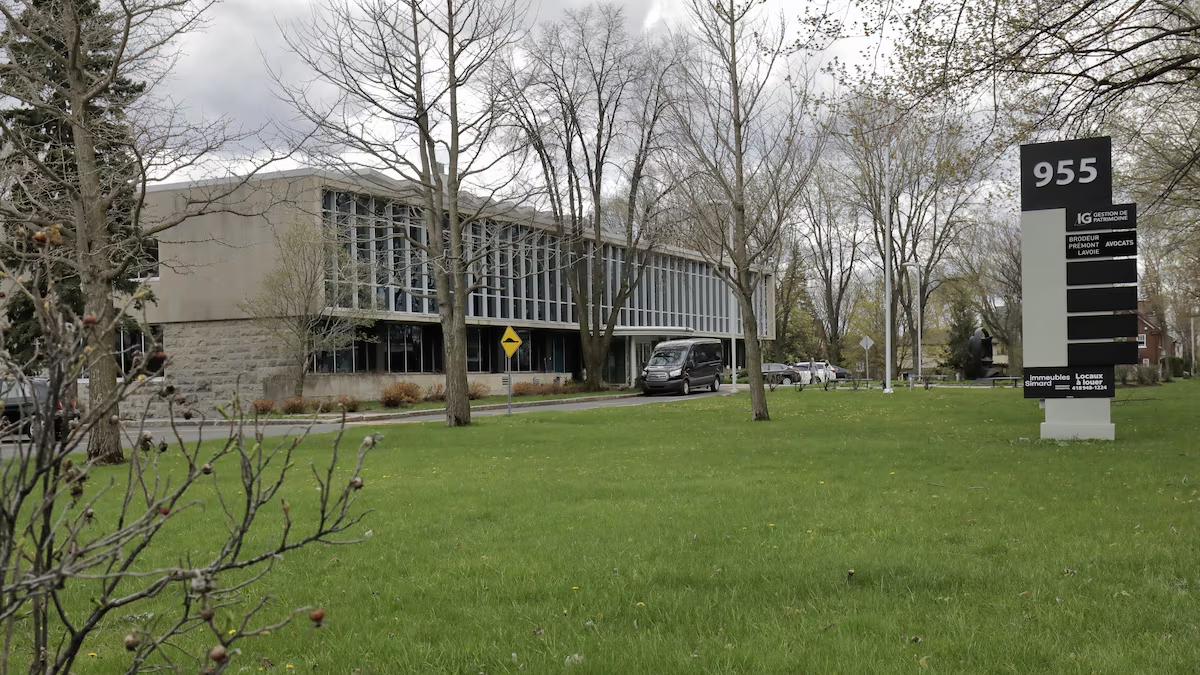
The large site at 955 Grande Allée Ouest currently hosts a long four-storey office building, erected in 1958 as an insurance company office, which later served for many years as the headquarters for Loto-Québec.

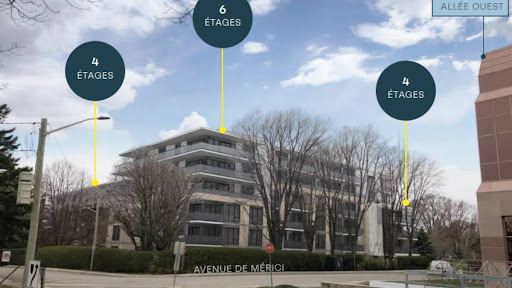
The developers, Les Immeubles Simard, unveiled a new plan for the building at a public information session they convened at Loisirs Montcalm on March 19. The plan includes preserving the existing structure essentially as is, and building two residential structures behind, of four- and six-storey height, fronted on Avenue de Mérici.

The complex would create some 150 housing units of various sizes on what now is a large parking lot. Some 270 parking spaces for residents and office workers would be available in an underground parking garage yet to be built.

The new buildings would cover 25 per cent less surface than the previous plan the company submitted in 2021. The administration of former mayor Régis Labeaume rejected that proposal following negative reaction from the public regarding the impact of the project. 

Les Immeubles Simard, in collaboration with PMA Landscape Architects Limited, has been behind several noteworthy projects in the Montcalm district, including the Le Vitrail complex incorporating two historic villas on Chemin Sainte-Foy, and Les Étoiles on Grande Allée Est, a project on the site of a former monastery.

The Simard company acquired 955 Grande Allée Ouest in 2019.

As the architect in charge of the project, Sandrine Toulouse-Joyal, told the MonMontcalm local news website, “The vertical distribution of the project and the maximization of underground parking spaces would make it possible to preserve as much tree cover as possible and increase the percentage of green areas on the lot.”

The public presentation contained detailed studies on the impact of increased traffic and sunlight for neighbouring residences. Both are negligible, the studies conclude.

Jonathan Tedeschi, the president of the Montcalm neighbourhood council, who attended the meeting, told the QCT, “Several points of view were expressed during this workshop, but there seemed to be a consensus that the new version of the project was more interesting than the old one. Many modifications have been made, which makes the project more attractive.”

Two city councillors attended the session about the project, which straddles the border of the districts they represent: Catherine Vallières-Roland of Montcalm–Saint-Sacrement and Maude Mercier Larouche of Saint-Louis–Sillery.

Mercier Larouche told MonMontcalm, “The [housing] crisis we are currently experiencing is unprecedented. So, when developers do projects, when it happens near us, I can understand the concerns that it generates, but why we do it is really important. It’s an opportunity to respond to the challenges expressed and to achieve the targets we have set.”

The next step for the developers is to submit the new plans to city planning authorities. They have not put a price tag on the project.

30 

IMAGES BELOW 

This image shows the proposed housing complex to be built on Avenue de Mérici. 

Image from Les Immeubles Simard.

The former Loto-Québec headquarters on Grande Allée would largely stay the same in recently announced plans for a housing complex.  

Photo from Les Immeubles Simard 

New plan, 150-unit complex slated for old Loto-Québec HQ on Grande Allée  Read More »

Changes to FEQ pass sales might ruin ‘magic,’ organizers say

Peter Black

March 27, 2024

Local Journalism Initiative reporter

peterblack@qctonline.com

Festival d’Été de Québec (FEQ) organizers have said they did all they could to ensure a fair sale of festival passes in the wake of complaints about a system that left thousands of fans disappointed. 

With only half an hour’s notice, passes went on sale an hour earlier than planned, at 11 a.m. instead of noon, on March 20, the morning the festival announced the line-up of artists at a news conference at the Bell Imperial theatre.

Festival spokesperson Samantha McKinley explained the move was a means to thwart robo-callers and to relieve pressure on the online system given the enormous number of people on the waiting list hoping to get passes.

McKinley told Radio-Canada the festival recognizes the problem and will look at better ways to organize the sale of passes. She mentioned the example of the huge Glastonbury festival in England, where passes are distributed by lottery.

The root problem is the escalating demand for the passes, which, at $150 for the full 11 days, are priced far below other large festivals. Ottawa Bluesfest, for example, charges $150 for a day pass and $450 for the 10-day event.

The festival said about 70 per cent of passes sold went to fans in the Quebec City region.

FEQ programming director Louis Bellavance told the QCT the festival is committed to keeping the festival accessible and affordable. He said the business model, based on selling a large number of tickets at low cost, works because FEQ has the capacity, with a main stage that can accommodate 80,000 fans.

Bellavance said FEQ can sell 125,000 tickets knowing that with the diversity of programming at other sites, not all ticket-holders will want to go to the huge Plains venue for a specific headliner.

The huge crowds FEQ can draw for most acts is a powerful pitch to artists, Bellavance said. “Even if your name is Post Malone, I’m probably the only buyer out there that can look his agent in the eyes and say he is going to play for 80,000 plus.”

Bellavance said raising ticket prices to reduce demand is out of the question. He said the result would be that only people with money would be able to afford passes, and “you’re not gonna get the craziness on the field. It will become the high-end festival for people with money. And you know what happens with people with money…. They don’t cheer. They don’t cry. They don’t dance. So here you go. You, you killed the magic.”

Selling more tickets is not an option either, Bellavance said. “There would be a lot more people upset if they could actually get a ticket and could not get on the field to see Post Malone.”

    30 

Changes to FEQ pass sales might ruin ‘magic,’ organizers say Read More »

‘Big names everywhere’ and a return to Place D’Youville to mark FEQ 2024

Peter Black

March 24, 2024

Local Journalism Initiative reporter

peterblack@qctonline.com

To the delight of fans able to get passes, and the disappointment of those who were not (see article below/on page ?), the 2024 edition of Festival d’été de Québec (FEQ) features a lineup organizers call one of the most impressive ever.

Some of the big prizes headlining the July 4 to 14 event include the immensely popular pop-rapper Post Malone, whose FEQ gig is his only one in Canada this summer; Canadian mega-star rockers Nickelback, making their first FEQ appearance after a 2015 date was cancelled; country stars Zack Brown Band and Latin sensation J Balvin.

Other big names booked for the giant Plains of Abraham stage are punk-pop legends The Offspring, pop favourites The Jonas Brothers, rapper 50 Cent, electro star Alan Walker and “heritage” rockers Mötley Crüe.

FEQ programming director Louis Bellavance told the QCT that in the past the festival relied on two or three huge stars, but this year “all I see are big names, some heavy hitters.” 

The only woman to headline the big stage is Quebec neoclassical star Alexandra Streliski, who will create a carte blanche event with invited guests. Despite that, Bellevance said about half of the acts are women.

Quebec favourites Karkwa will also head up a carte blanche evening, with Les Hay Babies, Fleet Foxes and Tokyo Police Club on the bill.

The twin stages in Parc de la Francophonie are back, featuring some slightly less widely known names, such as Ava Max, Michel Rivard, Martha Wainwright, Les Soeurs Boulay, KITTIE, Kim Mitchell and Kansas.

Bellavance said he is particularly proud of the diversity of this year’s line-up, with something to appeal to most tastes. 

What is also impressive, he said, is that many of the “undercard” performers are headline acts in their own right, giving the example of Killer Mike opening for 50 Cent or Loud Luxury setting up Alan Walker on the electro night.

The festival will be returning to Place D’Youville this summer after a two-year absence. The Place D’Youville stage and the stage in front of the National Assembly will feature emerging artists. Both sites are free to access.

For the first time, FEQ will come to the Grand Théâtre this year. Tickets for Grand Théâtre shows will be sold separately from the regular festival. The lineup is to be announced later.

30 

Canadian rock legends Nickelback will make their FEQ debut this summer. 

Photo courtesy of FEQ

Pop-rap sensation Post Malone makes his only Canadian stop at FEQ this summer. Photo courtesy of FEQ

‘Big names everywhere’ and a return to Place D’Youville to mark FEQ 2024 Read More »

Mexican visa mess shows how Quebec needs immigrant workers 

Peter Black

March 27, 2024

Local Journalism Initiative reporter

peterblack@qctonline.com

Maybe in the age of Donald Trump, saying outrageous things does not necessarily mean the end of a politician’s career. 

Take the example of Jean Boulet, the Coalition Avenir Québec minister of immigration at the time, who proclaimed during a September 2022 election campaign debate: “80 per cent of immigrants go to Montreal, do not work, do not speak French or do not adhere to the values of Quebec society.”

Whether they poison the blood of true Quebecers, Boulet did not speculate.

The statement, of course, sparked the requisite amount of angry reaction, and Boulet offered up an apology of sorts for saying out loud what he was thinking. 

Then-Liberal leader Dominique Anglade, the multilingual, super-high-achieving daughter of immigrants, called for Premier François Legault to fire his seemingly anti-immigrant minister of immigration. 

Boulet was re-elected with an increased majority in his 92 per cent white and francophone Trois-Rivières riding, and Legault promptly named him labour minister in the new cabinet. 

From his new vantage point as minister responsible for the Quebec workforce, Boulet surely would have intimate knowledge – and a different opinion – of the role immigrants play in the job market.  

Though he didn’t have temporary foreign workers in mind when he unleashed his rant, Boulet is surely mindful of the importance they have in the seasonal Quebec economy. 

For example, we are seeing the impact of the CAQ government’s freak-out about unwanted immigrants play out in different ways. Quebec begged Ottawa to reimpose visa requirements on Mexican travellers in the hopes of keeping out undesirable asylum seekers. Ottawa quickly obliged, and now, because of the short notice to process visas, the immigrant worker-dependent Quebec fish processing industry is paralyzed by a lack of workers for plants. 

One operator in Gaspé has 12 workers approved of the 125 he wants to put to work. In Matane, a Danish-owned processing plant has closed completely for want of its Mexican workers, throwing some 50 locals out of a job as a consequence.

The trouble in the fishery business is just the first wave of the impact of the new Mexican visa requirement. With the planting season around the corner – believe it or not, with winter still stubbornly gripping the land – agricultural producers are about to hit the panic button.

About 4,500 Mexican workers have been hired to work in Quebec fields as of April, and less than half have had their applications processed to fly north in time. The Association des producteurs maraîchers du Québec, the Quebec market gardens association, is dreading a disaster where vegetable prices soar and producers face bankruptcy.

Such is the impact of a hasty political decision driven by the desire to prevent asylum seekers from flying to Canada, where many, if not most, once arrived here, promptly attempt to cross by land into the United States illegally.

The Mexican visa mess is a skirmish in the larger war with the federal government over absolute control over immigration into Quebec, a longstanding plank in the CAQ platform. 

There were the requisite howls from the usual quarters when Prime Minister Justin Trudeau officially refused Legault’s request at a recent meeting in Montreal.

Trudeau could hardly surrender to Quebec what the Constitution currently forbids. Immigration is a shared power. Sharing that power is something the federal government has already done, courtesy of a 1991 deal that gives Quebec, alone among the provinces, full control of “economic immigrants,” notably those who bring expertise and investment to the province.

Trudeau, of course, has plenty of wiggle room to grant Quebec more input into the amount and type of non-economic immigrants, including asylum-seekers, students and people entering for the purposes of family reunification, the latter being particularly sensitive.

Still, in Legault’s and Parti Québécois Leader Paul Saint-Pierre Plamondon’s dreams, what would full control of immigration look like? One suspects whatever restrictive, francophone-favouring measures that might ensue would eventually rid Quebec of the problem of too many immigrants wanting to come to this place.

And with immigration being the sole bulwark against a declining and aging Quebec population, who is going to do all the work Boulet says immigrants don’t do?

          30 

Mexican visa mess shows how Quebec needs immigrant workers  Read More »

Trudel brothers to transform Place Quatre-Bourgeois mall

Peter Black

March 20, 2024

Local Journalism Initiative reporter

peterblack@qctonline.com 

Not content with a massive redevelopment of a mall in an asphalt wasteland in Vanier, the company founded by brothers William and Jonathan Trudel is undertaking a similar major revamp in Sainte-Foy.

Last week, Trudel Alliance released details of a long-term plan to transform Place Quatre-Bourgeois into a residential and commercial zone, replacing the sprawling parking lot with green space and buildings with vegetated roofs. 

The plan, developed following consultations with residents, features some 1,500 housing units of various sizes, 15 per cent of which will be designated affordable housing and 10 per cent adaptable for people with physical disabilities. 

As for the aging shopping centre, the only tenant remaining would be the IGA grocery, which itself would undergo a facelift. The mall’s current tenants include Winners, Jean Coutu, Dollarama, Aubainerie and Nautilus Plus.

The new commercial mall will have the same configuration but with each tenant having street access. About 1,000 underground parking spaces would be created.

Construction is slated to begin in the fall of next year or spring 2026.

The Trudel company acquired the mall in 2019 from Toronto-based open-air mall giant First Capital Realty, one of seven Quebec City region shopping centres included in the $165 million deal. 

The previous year, the Trudels bought Place Fleur de Lys in Vanier, which is now undergoing a vast redevelopment.

A similar redevelopment is in the works for Galeries Charlesbourg.

PHOTO BELOW 

Nouvelle rue d'accès au site et parc central.

The vast parking lot at Place Quatre-Bourgeois is to be transformed into a more green residential and commercial zone. 

Images from Trudel Alliance 

Trudel brothers to transform Place Quatre-Bourgeois mall Read More »

RTC denounces modest CAQ budget boost for green urban transit

Peter Black

Local Journalism Initiative reporter

peterblack@qctonline.com 

Quebec City’s transit authority says it “deplores” last week’s provincial budget for failing to provide adequate funding for more environmentally sustainable urban transport.

Coun. Maude Mercier Larouche, the city executive committee member who heads the Réseau de transport de la Capitale (RTC), issued a statement in the wake of the March 12 budget, denouncing “the absence of a stable, indexed financial framework consistent with the objectives of the government’s sustainable mobility policy.”

What Mercier Larouche was referring to obliquely was the modest increase in the budget “to improve mobility and electrify public transit.” The Coalition Avenir Québec (CAQ) government spending plan includes just $700 million on top of the $13.8 billion allocated over 10 years.

Despite the lack of a big spending increase on modernizing urban transit, Mayor Bruno Marchand remains confident the Quebec government is still committed to funding a major “structured” transit project, notably the tramway.

He told reporters after the budget speech in the National Assembly, “We were told that there was still capacity in the budget [for the tramway]. We will see what they are able to do. If there is no launch in the next year, the region has lost.”

The minister responsible for the capital region and for infrastructure, Jonatan Julien, said the CAQ government is still committed to a transit project for the Quebec City region. He told a parliamentary committee studying spending credits in the budget, “We have not abandoned this firm and clear desire to create a structuring network for the national capital. We believe in it ardently.”

Julien said the tramway project is still included in the government’s infrastructure plan and the financing is secured. 

Julien also told the committee that several “red flags” prompted the CAQ government to pause the tramway project in November and ask the Caisse de dëpot et placement infrastructure division to study the region’s transit needs and file a report by June.

The red flags included the “tripled” estimated cost of the project, from $3.3 billion to at least $10 billion, the lack of consensus on “social acceptability,” and the fact no company had submitted a bid for the major infrastructure contract.

In a related story, Liberal party critic for the capital region, Montreal-area MNA Marwah Rizqy, blamed Julien, a one-time right-hand man to former mayor Régis Labeaume, personally for the lack of major projects in the region. 

Addressing the minister at a National Assembly committee session on March 13, she said, “They [the CAQ government] made many promises, they talked a lot, but they delivered nothing. Honestly, for the capitale nationale, it’s embarrassing.” 

“He [Julien] is the problem,” she said.

While the city awaits the outcome of the deliberations of the Caisse, RTC head Mercier Larouche said the CAQ government is thwarting the long-term goals of the transit body as “a leading player in achieving the GHG [greenhouse gas] reduction targets of the Quebec government, particularly in Quebec City where the share of emissions linked to transport is higher than elsewhere in the province.”
Mercier Larouche said, “We must demonstrate ambition to maintain and improve our service offering.… Without a stable, indexed and recurring financial framework, we will eventually have to make difficult choices, which go against our mission which aims to facilitate the travel of thousands of people daily, throughout the territory.”

  -30-

Photo below  

RTC president Maude Mercier Larouche “deplores” the lack of funding for transit in the CAQ budget. 
Photo by Peter Black from QCT archives

RTC denounces modest CAQ budget boost for green urban transit Read More »

Neighbourhood council calls meeting on future of Provisions Inc.

Peter Black

March 20, 2024

Local Journalism Initiative reporter

peterblack@qctonline.com 

The Montcalm neighbourhood council is rallying residents to discuss the future of Provisions Inc., a popular grocery store on Ave. Cartier that closed suddenly under murky circumstances in January.

The Conseil de quartier de Montcalm has organized a meeting on March 25 to share information and gather opinions and suggestions regarding the fate of the store. It is to take place at 7 p.m. at the Centre culture et environnement Frédéric Back at 870 Avenue de Salaberry.

Meanwhile, the plot thickens as to what led the owners of the grocery, Stéphanie Guessas Bouillon and her husband Christophe Bouillon, to abruptly close and abandon the business they had acquired less than a year previous.

According to a Journal de Québec report, the couple, who came from Ardennes, France, rapidly found themselves in a perilous financial situation with the new business, a state of affairs worsened by health issues Guessas Bouillon was experiencing.

Le Journal contacted the lawyer for the couple who have since returned to France. Ahmen Harir said the Bouillons had closed the store “in extremis” due to Guessas Bouillon’s health problems as well as mounting financial difficulties.

Harir said the French couple were “scammed” by the store’s former owners. “The last six months have been a nightmare,” the lawyer told Le Journal. “She [Guessas Bouillon] was no longer sleeping, it was really catastrophic for them.… They had no other choice but to leave … They lost everything.”

In the same report, the former owners, cousins Vincent and Bruno Drouin, deny the couple’s allegations. The Drouins have sued the Bouillons for nearly $500,000 in Superior Court, the “balance of the sale price” established during the sale of the store in November 2022.

That lawsuit and other legal entanglements put in doubt a quick resolution to the future of the 70-year-old business, a popular spot, especially in summer when it becomes a miniature market for local produce.

The former owners have said they would be willing to help out any future buyer wanting to restart the business, but have ruled out reacquiring it. 

Jonathan Tedeschi, president of the Montcalm neighbourhood council, told the QCT there are reports of people interested in buying the grocery. 

He said the March 25 meeting will be an opportunity for “residents to come together to see what we can do.”

              30 

Photo below 

The Provisions Inc. grocery store on Avenue Cartier has been closed since January. 

Photo by Peter Black from QCT archives 

Neighbourhood council calls meeting on future of Provisions Inc. Read More »

Appliance compliance: Manufacturers say new French rules don’t wash 

Peter Black

March 20, 2024

Local Journalism Initiative reporter

peterblack@qctonline.com

Le transmission t’a lâché,” the repairman said after listening to about five seconds of the violent thunka-thunka of our Inglis washer. (Who knew a washer had a transmission? It also has a clutch, the guy said).

This was the same repairman who had fixed the same washer a few years ago with a nine-dollar spring and a modest service charge. The same guy who last year made our fridge like new with a replacement part and the same reasonable house call fee.

Our washer is like part of the family, having cleaned a mountainous heap of our clothes, sheets, tablecloths and the like for nearly three decades. 

The transmission replacement, while not cheap, is much, much more affordable than the new machines, which, the repairman said with thinly disguised scorn, he’s been called to repair after only two years of operation.

Where are we going with this sentimental ode to an appliance? Well, as you know all too well in Quebec, all, or at least many, roads lead to the peculiarities, put politely, of the distinct society.

In this case, we mean how the looming application of the new jacked-up language law known as Bill 96 is causing concern in the major appliance community. Call it the “appliance compliance” showdown.

Quebec government language officials recently informed businesses what needs to be done to conform to the new regulations. In the case of household appliances, as of June 2025, wording of controls as well as digital displays must be available in French. 

Manufacturers are not thrilled about the new regulations – which are not actually new, the government of Jean Charest having given the idea a try in 2012 – and are not eager to comply.

The Association of Household Appliance Manufacturers submitted a brief to the government saying Quebec makes up just two per cent of the North American market and it’s not worth it for factories to retool at a high cost to accommodate that minor pool of consumers.

The association says a survey of its members indicated 90 per cent would not comply with the new regulations. 

The result, observers say, will be fewer choices and higher prices for Quebec consumers who would thus be tempted to buy online instead of patronizing brick and mortar stores.

Language Minister Jean-François Roberge begs to differ, saying the global French-speaking world numbers 320 million people and “if some companies don’t want to do business in Quebec to avoid translating the instructions on their products, if they refuse to speak to Quebecers in French, we’re convinced that their competitors will take advantage of these opportunities to the benefit of Quebecers.”

The government notes that in countries such as Belgium, Poland and Portugal, appliances are available in the local language. It also says as recently as 1977, 80 per cent of appliances sold in Quebec had bilingual controls, compared to two per cent today.

The larger question, one supposes, is how this measure in any way advances the elusive goal of Bill 96 to increase the use of French in the province.

As Journal de Québec columnist Marc-André Leclerc put it, “In Quebec, everyone understands what the famous ‘on/off’ on our devices means. No one became anglicized by cooking their pizza on ‘broil.’ So why waste your time and ask for a requirement that is not demanded by Quebec consumers?

In the meantime, our washing machine keeps chugging along unilingually. We take some patriotic comfort knowing our washer was actually built in Canada, an increasing rarity these days with household appliance production consolidated in the United States and Asia. 

If eventually our washer does give up the ghost and we want to get another Inglis, well, the brand still exists, but the company has been owned for decades by Michigan-headquartered global appliance giant Whirlpool. 

Of course, if, as seems likely, Whirlpool rejects the Quebec bilingual controls rules, we’ll be shopping for another brand.
            30

Appliance compliance: Manufacturers say new French rules don’t wash  Read More »

Mayor: Colisée ‘no longer suitable,’ doomed to demolition

Peter Black

March 13, 2024

Local Journalism Initiative reporter

peterblack@qctonline.com 

Nearly nine years after it hosted its final event, a concert by rock gods Metallica, the historic but obsolete Colisée arena is edging closer to demolition.

While consultations are still underway on a development vision for the zone that includes the Colisée on the ExpoCité site, Mayor Bruno Marchand has made it clear the building must go.

At a March 4 news conference to unveil sports and recreation infrastructure investments, the mayor reaffirmed his campaign promise to demolish the 75-year-old structure, which he said is beyond saving.

“It is not profitable. We had suggestions [for other uses], but the fact remains that it is an enormous infrastructure which is no longer suitable. Just bringing it up to fire safety standards is out of the question. It would cost a crazy amount.”

Official Opposition and Québec D’abord Leader Claude Villeneuve is of the same opinion. “Maybe it’s too old and needs too many repairs and investments,” he said in an interview with the QCT.

Villeneuve said he knows people have sentimental memories of the old arena and he wants to hear what people have to say about its future in ongoing consultations on the future of ExpoCité.

He said he disagrees with former mayor Régis Labeaume’s idea of transforming the building into a centre for “emerging sports” such as BMX and rock climbing. 

Labeaume estimated the cost of converting the building for its new mission at $40 million. When the former mayor made the announcement in 2021, the price of demolishing the Colisée was pegged at $17 million.

Limoilou Coun. and Transition Québec Leader Jackie Smith, whose district includes ExpoCité, is proposing a hotel for the site, in contrast to the mayor’s stated desire for more housing.

She told reporters, “I recognize the need and I am fighting to increase the number of housing units, but it’s going to cost a fortune to redo the place and we don’t need $3,000 housing in the neighborhood.”

Smith said, “I like the idea of densification, but not of creating a neighbourhood for rich people in this area.”

Villeneuve said a proposal for a hotel needs to be “coherent” with other developments in the area, notably the massive redevelopment in the Place Fleur de Lys zone the Trudel brothers’ company has launched, which includes a hotel.

Consultations on the future of ExpoCité are expected to continue into June. 

The Colisée, first built in 1949, has seen many changes over the years. In 1979 it underwent extensive renovations to prepare it to welcome the NHL’s Nordiques, which had been transferred from the World Hockey Association.

The last NHL game in the Colisée was a first-round playoff game in May 1995 between the Nordiques and the New York Rangers. Shortly afterwards, the team was bought and moved to Denver, Colorado, and renamed the Avalanche. More recently, the arena was the home of the Quebec Remparts, until the opening of the Videotron Centre in 2015. 

        30 

Mayor Bruno Marchand has said he intends to demolish the Colisée Pepsi. 

Image from Ville de Quebec

Mayor: Colisée ‘no longer suitable,’ doomed to demolition Read More »

City expanding pedestrian-only zones in Old Quebec

Peter Black

Local Journalism Initiative reporter

peterblack@qctonline.com

March 13, 2024

Vowing to put an end to the “degradation” of the ambiance of the historic Old City, Mayor Bruno Marchand has announced the doubling of zones where motorized vehicles will be banned during the summer months.

Building on last summer’s pilot project, the city will create an additional pedestrian area to supplement the zone established last year in the “Latin Quarter” north of Côte de la Fabrique. 

The new zone will be south of Rue Saint-Louis between Ave. Saint-Denis and bordered by rues Sainte-Ursule and Haldimand. 

Eight concrete barriers will serve as barricades, and only local residents with city-issued passes, taxis and delivery drivers will be allowed to enter with vehicles. The zones will be in place every day from June 26 to Aug. 23 between 11 a.m. and midnight.

Other changes include the enlargement of the pedestrian walk on Rue Saint-Louis and the removal of parking zones on rues De Buade, des Jardins and Côte de la Fabrique to allow more room for pedestrian traffic and for restaurants with terrasses.

The mayor, speaking at a March 8 press conference at City Hall, said his administration is proceeding with these changes because “the status quo is not acceptable. The slow degradation is over.” He added he is determined to stem the exodus of residents from the Old City and prevent it from becoming like a “cardboard” Disneyland.

Marchand, who is the current president of the World Heritage Cities Organization, presented figures showing the residential population of the Old City has declined by nearly 700 since 2006, now totalling some 4,600. 

He said Quebec City is facing the same problem as hundreds of cities around the world where vehicular traffic and overdevelopment are threatening popular historic areas.

The city has launched a series of consultations on the “pedestrianization” measures it is putting in place in the Old City. Last summer’s changes drew some criticism for the impact they had when major construction projects were underway, such as revamping the square in front of City Hall.

30 

This diagram shows where new pedestrian zones are to be established this summer in the Old City.

Image from Ville de Quebec

City expanding pedestrian-only zones in Old Quebec Read More »

Meet some of the prospects for your future Poilievre government

March 13, 2024

Peter Black

Local Journalism Initiative reporter

peterblack@qctonline.com

If, as the pundits and pollsters predict, the Conservative Party of Canada romps to power some 16 months hence – figuring on or about June 2025 when the Liberal-NDP shack-up expires – it might be as good a time as any to take a look at what the government of future prime minister Pierre Poilievre might look like.

Before we go further, let’s accept that the Conservatives need to win 52 more seats than the 119 they now have (including the recent Toronto-area byelection win to replace ousted leader Erin O’Toole) to get past the magic mark of 170 seats for a majority. 

With some polls showing the Tories soaring into 1984 Mulroney territory (211 out of a 282-seat House), who knows what common sense lawmaking talent such an impending blue wave might wash up? 

We’ll soon get an inkling as the nomination process heats up and the rightward political stars come to light. The enticing prospect of serving in a Poilievre cabinet surely must be stirring in many an ambitious Conservative brain across the land.

So, what kind of timber might Poilievre have with which to cobble together a cabinet to axe the tax, give everyone powerful paycheques, abolish Justinflation and make Canadians forget about the woke Marxist-Liberal government?

Let’s start with his shadow cabinet, which, truth be told, casts a rather expansive pall, given that just about all members of the Tory caucus have been assigned some kind of critic task, no matter how insignificant. 

One of Poilievre’s two deputy leaders is Toronto-area MP Melissa Lantsman, who used to be a go-to Conservative talking head on CBC political panels; at least she was until the leader forbade members of his caucus to collude with the Liberal propaganda organ he has vowed to defund once he takes the keys to the kingdom.

Lantsman, a professional Conservative operative in the mould of Poilievre, is one of two out gay MPs in the Conservative caucus. She has been at pains lately to explain her leader’s recent declaration that trans women be forbidden to use women’s washrooms.

“I think the leader has made his common-sense Conservative position very clear, and our caucus stands by it, alongside most Canadians,” she said in a Hill Times report.
Who knows what portfolio the leader will assign Lantsman when the time comes – OK, if the time comes.
What about candidates for a future Conservative finance minister? The current shadow minister of finance is Edmonton MP Jasraj Singh Hallan. He has an accounting diploma from an Alberta college and a master builder certification with which he established his house-building business. Not a Michael Wilson or Jim Flaherty, perhaps, but who’s to say what it takes to manage a multi-trillion-dollar economy?
What about the prickly portfolio of Canadian Heritage, which handles everything from minority languages to culture to policing the internet to funding the CBC?
The shadow minister is Lethbridge, Alberta MP Rachael Thomas (née Harder; she changed her last name when she got married in 2021) who made headlines in November when she asked the current minister of Canadian Heritage, Pascale St-Onge, to speak English at a committee hearing.
Thomas also got attention for claiming the CBC is “on the side of terrorists” and that Prime Minister Justin Trudeau meets the criteria of “dictator.” She is also known to be among the more hard-core anti-abortion MPs in Poilievre’s caucus.
A recent survey by the Abortion Rights Coalition of Canada identified only 15 Conservative MPs in favour of the right to abortion. According to that survey, incidentally, four of the nine Quebec Tory MPs are known to be pro-choice; three have unknown opinions and one is declared anti-abortion.
While we’re talking Quebec, what might be the cabinet reward for Charlesbourg–Haute-Saint-Charles MP Pierre Paul-Hus? He was the only Tory member from the province to endorse Poilievre’s leadership bid in 2022, for the perfectly understandable reason that Poilievre “needed to have someone from Quebec supporting him,” for the sake of party unity.
Paul-Hus’s current caucus duty is serving as Poilievre’s Quebec lieutenant, which seems appropriate considering he reached the rank of lieutenant colonel in his 22-year military career. Pencil in Paul-Hus for Conservative defence minister.
We could go on and on, of course, but the above are just a sampling of names to note for future Conservative cabinet fame – or notoriety.

          30 

Meet some of the prospects for your future Poilievre government Read More »

City puts incinerator steam project for super-hospital on back burner

Peter Black

Feb. 28, 2024

Local Journalism Initiative reporter

peterblack@qctonline.com

An ambitious plan to provide steam power from the city’s massive incinerator to the new L’Enfant-Jésus super-hospital is on ice.

City officials confirmed the postponement of the project in the face of ballooning costs. Le Soleil initially reported on the cancellation on Feb. 15. A day later, Mayor Bruno Marchand told reporters the estimated cost of the project had more than doubled, from $44 million to $90 million.

The magnitude of the cost increase surfaced in pre-budget discussions in December, according to a follow-up report by Radio-Canada. When it was announced in July 2021, the project cost was to be split roughly evenly between the city and the federal and Quebec governments.

The freeze on the project means the halt of work, initially scheduled to start last year, to build an underground pipeline and a conversion plant to transform steam from the incinerator into energy to heat and cool the hospital.

According to city spokesperson Jean-Pascal Lavoie, quoted in Le Soleil, the city has informed the hospital “of its decision to return to the study phase of the steam sales project, considering the increase in costs.”

Marchand said that while the project has “an environmental value,” a potential $50-million investment by the city “is not worth it.”

Radio-Canada reported the hospital administration is still in discussions with the city about the steam project and that its suspension will have no impact on the construction of the facility.

Without steam energy, the hospital will be served predominantly by natural gas. 

While the hospital is no longer an immediate customer for steam energy from the incinerator, the plant, located in Limoilou, continues to supply nearby paper mills White Birch and Nordic Paper. It is also used to heat organic material at the city’s new biomethanization plant.

Still, according to city information, 40 per cent of the excess energy the incinerator generates is released into the air in the form of vapour. 

30

A plan to sell steam energy from the city’s incinerator to the new super-hospital has been shelved.

Photo from Radio-Canada

City puts incinerator steam project for super-hospital on back burner Read More »

Boul. Pierre-Bertrand cut off for water pipe replacement

Peter Black

March 6, 2024

Local Journalism Initiative reporter

peterblack@qctonline.com 

One of the city’s main north-south arteries will be severed for several weeks while workers undertake a major repair job on underground infrastructure.

According to information from the city, the work on Boul. Pierre-Bertrand “is being carried out to remedy a break in one of the pipes which supplies drinking water to some of the city’s residents. The complexity of the work arises from the location of the pipe and its manufacturing method, thus requiring the collaboration of several teams with various skills.”

The four-lane boulevard is cut off between rues Beaucage and Nolin, with traffic rerouted along Boul. Père-Lelièvre to the west. The city says it will maintain access to businesses and residences in the construction zone. 

The street has been closed since Feb. 24 and work is expected to be completed in three to four weeks. 

          30

This barrier greets motorists on Boul. Pierre Bertrand at Rue Beaucage. Workers are replacing damaged water pipes. 

Photo by Peter Black

Boul. Pierre-Bertrand cut off for water pipe replacement Read More »

City unveils social housing project for scenic Old City site

Peter Black

March 6, 2024

Local Journalism Initiative reporter

peterblack@qctonline.com

One of the most coveted and scenic sites in the city will be devoted to social housing, if a plan the city announced last week comes to be.

Under the plan, the former site of the Saint-Vincent-de-Paul church and community centre, a few years ago destined to become a luxury hotel, will welcome a two-building complex with some 170 housing units, a daycare and green spaces.

The plan is the result of consultations launched in the wake of the city’s acquisition of the site in 2022 after a prolonged dispute with a developer over the parameters of the proposed hotel.

A collection of community groups has been pushing for years to have the prized site in the Saint-Jean-Baptiste sector devoted to a social housing project. Those groups are Action-Habitation, the Fédération des coopératives d’habitation de Québec Chaudière-Appalaches, La Bouée and the Comité populaire Saint-Jean-Baptiste.

The groups hired the well-known local architecture firm Lafond Côté to draw up the vision for the site. One of the buildings will be designated as a residence for seniors with appropriate services. Both buildings will have “green” roofs with vegetation and gardens.

At a Feb. 26 City Hall news conference to announce the project, whose financing is yet to be determined, the city councillor for Cap-aux-Diamants and executive committee member responsible for urban development, Mélissa Coulombe-Leduc, applauded the breakthrough in a long deadlock.

“The models presented put forward a project on a human scale which fully meets the city’s objectives in terms of housing, sustainable development and active mobility,” Coulombe-Leduc said. She added the project requires no zoning changes.

The new project for the site contrasts with what former mayor Régis Labeaume had in mind when the city decided to take the previous owner to court to obtain the property. 

In November 2019, in rejecting a social housing mission for the site, he said, “It will be a park, an exceptional park, but there will be no building there.” He said he’d also like to see “a mechanical link there, to make it easier to travel between Upper Town and Lower Town.”

Coun. Claude Villeneuve, the current head of Québec d’Abord, Labeaume’s former party, said he supported the principle of the social housing complex. In a statement to the QCT, he said, “We are pleased to see such a project in Quebec City. However, [Mayor Bruno Marchand] is announcing a project for which he doesn’t even have a financial plan. He can pretend that the project got unanimous support but without providing a budget, it’s illogical and irresponsible.”

Villeneuve said, “We truly want to see such a project come to fruition in Quebec, but with the proper means. The mayor was unsure which provincial government program to reference. It is a bit concerning regarding the implementation. He said that the construction could begin in 2025 but many elements are missing.”

Limoilou Coun. and Transition Québec Leader Jackie Smith said she is “delighted” with the project. “After decades of procrastination regarding this land, we can only rejoice at the progress of this project. New local shops, greening, social housing, a CPE [daycare] and an RPA [seniors’ residence], this is what the neighbourhood needs,” she said in a statement. 

Marchand said it’s not certain how much funding the city or other levels of government will contribute to the project, but he was confident construction could start next year.

Coulombe-Leduc said the adjacent former garage property which the city owns is not part of the project at the moment because of complexities relating to demolition of buildings on the site and decontamination of soil. She said the city did not want to delay the start of the larger project while awaiting preparation of the neighbouring site.

The 170 units in the two buildings, varying between six and eight storeys, are expected to welcome some 350 new residents to the Old City, which has been a priority for the city. It recently also acquired the nearby site of the former Saint-Louis-de-Gonzague school and Foyer Nazareth with a future housing project in mind.

  30 

This artist’s concept shows an aerial view of the plan for two residential buildings on the Ilot Saint-Vincent-de-Paul site. The Dufferin-Morency autoroute is at the bottom left. 

Image from Lafond Côté Architectes.

City unveils social housing project for scenic Old City site Read More »

Triumph and error marked the momentous saga of Brian Mulroney 

Peter Black

March 6, 2024

Local Journalism Initiative reporter

peterblack@qctonline.com 

The Brian Mulroney political saga could well have come to an abrupt end on Feb. 22, 1976. 

The slick Montreal lawyer with small-town Quebec roots was up against a little-known Progressive Conservative MP from Alberta in the race to succeed “the best prime minister there never was,” former Nova Scotia premier Robert Stanfield.

Mulroney and his rival Joe Clark, both 36, faced the perceived favourite, former Quebec Liberal justice minister and federal PC MP Claude Wagner, whose son Richard is now chief justice of the Supreme Court of Canada.

Clark narrowly beat Wagner on the fourth ballot, with Mulroney eliminated on the third, far back from the top two.

After the convention in Ottawa, according to The Politics of Ambition, the 1991 biography by veteran journalist John Sawatsky, a bitterly disappointed Mulroney quoted U.S. senator Daniel Patrick Moynihan about the day President John F. Kennedy was shot: “If you are Irish, you know that at some point the world is going to break your heart.”

Broken-hearted and broke from campaign debts, Mulroney retreated to Montreal and settled into a despondency that often involved drink and railing against Clark. There is even a story that the federal Liberals, hearing of Mulroney’s agonized state, tried to recruit him.

But then, faith and begorrah, the luck of the Irish shone brightly through the gloom enveloping the Boy from Baie-Comeau. On Dec. 13, 1979, the minority government Clark had won by beating the mighty Pierre Trudeau seven months earlier was defeated on a confidence motion in the House of Commons. 

Your scribe happened to be in the gallery when the vote was counted that day, which, in retrospect, was one of the most momentous in recent Canadian history.

An election set for Feb. 18, 1980, would return a resurrected Trudeau and the energized Liberals to power, with a referendum on Quebec sovereignty to fight as a top priority. Holding court at the Ritz-Carlton Maritime Bar, Brian Mulroney knew he had been given a second chance to realize his ambition thanks to a fatal error by his nemesis.

The fight in the 1983 Tory leadership convention that followed a leadership review the previous year was bitter, but Mulroney finally edged Clark out on the fourth ballot. Still, it was a close vote, with Clark ahead on the first three ballots.

We raise this no-so-farfetched “what if …?” because it’s hard to imagine what might have transpired in Canadian politics if Joe Clark had won that fateful vote – as he easily could have with a little more procedural smarts – and Brian Mulroney was rendered a footnote of history.

Maybe he would have eventually swallowed his considerable pride and become a powerful Quebec minister in a Clark government. Maybe he would have stayed put in the corporate world and made a fortune – his stint between 1976 and 1983 as president of the Iron Ore Company of Canada had already given him lifelong financial security.

From the torrent of reflections on Mulroney’s legacy published since his death on Feb. 29, one gleans that his was a record of exceptional achievement, but also of failures and human weakness. This was exemplified by the fact the same man who won the largest majority in history for his party in 1984 also left it in a position to be all but wiped out in the 1993 election. 

Two years after that epic defeat of the soon-to-be-extinct Progressive Conservative party, Canada came close to chaos and break-up in the second Quebec sovereignty referendum in 1995. 

That national nail-biter was the direct result of Mulroney’s well-meaning but high-risk Meech Lake Accord, an attempt to repair what he perceived to be Pierre Trudeau’s error in adopting an amended Constitution lacking the signature of Quebec premier René Lévesque, who had just lost the 1980 referendum.

Mulroney’s aim 10 years later to have Quebec renew its vows with Canada with “honour and enthusiasm” backfired into a roaring backlash of humiliation and anger.

The Accord died in June 1990, the result of a baffling three-year deadline for ratification by all 10 provinces. Two years later, the Charlottetown Accord, an attempt to appease recalcitrant provinces, was defeated in a national referendum.

All political hell broke loose, and here we are 30 years later with the Bloc Québécois still a force in Quebec and an ascendant Parti Québécois threatening another episode of referendum drama. 

That little quibble aside, we salute a remarkable character, a bold leader who achieved much and was not afraid to “roll the dice.” 

      30 

Triumph and error marked the momentous saga of Brian Mulroney  Read More »

Newly renovated Gabrielle Roy library offers much more than books

Peter Black, Local Journalism Initiative reporter

March 6, 2024

peterblack@qctonline.com

The newly renovated Bibliothèque Gabrielle-Roy has a performance theatre, a movie theatre, a kitchen area, a terrasse with a garden, several play areas for children, a recording studio, a broadcast room, bold works of art, musical instrument rentals, a seedling plant zone, a number of meeting rooms and more.

It also has books and documents, as a library should – more than 200,000 of them.

With a strike by city library employees delaying the official reopening of the facility (see article on p. ??), officials gave reporters a tour Feb. 28 to unveil the results of years of construction and planning dating back to 2016.

Visitors to the library, when it does open to the public after its $43.3 million makeover, will see a vastly brighter, more open and varied space compared to the gloomy interior of the original building that opened in 1983. While the familiar staircase and circular storeys remain, they have been completely rebuilt.

Designed around the concept of 10 “thematic centres,” the building itself is more than a quarter larger than the original structure, at 10,500 square metres. The design team was a consortium led by Saucier + Perrotte and GLCRM.

Mayor Bruno Marchand said in a statement, “This central library is an exceptional place – one of the most beautiful in Canada, and I would even go so far as to say in the world.”

While the transformation of the library’s interior space and exterior structure is an impressive enough achievement, the city architect overseeing the project has said the most difficult challenge was having to essentially redo from top to bottom an existing structure in a busy urban zone.

Yasmina Lacasse said transforming a building erected in the 1980s to conform to current regulations meant “lots of changes to the structure” in terms of, for example, earthquake resilience standards and electromechanical infrastructure.

On top of the architectural and engineering challenges, the COVID-19 pandemic and its ripple effects presented a major setback and caused construction delays. In spring 2023, “major repairs to a beam” delayed completion further. The opening date was initially targeted for last spring. 

Although there is some question about the global cost of the project, officials say it stayed within the $43.3 million budget with the help of some cost-cutting measures such as reducing the size of the rooftop terrasse.

The provincial government contributed about $10 million and the federal government $1.5 million to the project.

Lacasse said, “I’m just hoping every citizen finds themself in it, likes every space or just only one, and maybe discovers something else, something new, something that could be interesting. So I really hope citizens like it as much as we thought they would.”

The library features some 11 major art pieces by Quebec artists, including the refurbished work by Micheline Beauchemin that hangs in the atrium, comprising some 18,400 strips of golden aluminum.

There is also a portrait of the library’s namesake painted by Jean-Paul Lemieux in 1953 and on loan from the Institut Canadien.

The library’s extensive archival collection will be more accessible in the new building. As an example, on display for the media tour was a city register with the signatures of King George VI and Queen Elizabeth dated May 17, 1939, signed when the royal couple toured Canada and the United States to drum up support for the impending war with Nazi Germany.

Whenever the library finally opens to the public, Marchand said, “It is up to the population to reclaim this incredible place of culture and knowledge which will become an important part of our cultural signature in Quebec.”

    30 

The familiar hanging artwork has been restored and returned to the newly revamped main staircase in the library.

Photo by Peter Black

City architect Yasmina Lacasse, who oversaw the project, checks out the secret door in the children’s book section.

Photo by Peter Black

Newly renovated Gabrielle Roy library offers much more than books Read More »

Caisse Infra consultations underway for June tramway report

Peter Black

Local Journalism Initiative reporter

peterblack@qctonline.com

With the deadline to submit a report on Quebec City’s urban transit future about four months away, Caisse de dépôt et placement du Québec (CDPQ) Infra officials have been busily meeting with a long list of groups with a stake in the outcome.

As of this writing, according to a list the Caisse provided the QCT, some 33 groups including political parties, environmental advocates, educational groups, municipal officials and employees from building project offices, met with CDPQ Infra representatives between Jan. 16 and Feb. 15. 

The consultations are expected to continue into April.

The Coalition Avenir Québec (CAQ) government called a halt to work on the tramway project in November following Mayor Bruno Marchand’s update on the cost of the project, which he pegged at about $8.4 billion.   

Calling the plan too expensive, the government asked the Caisse’s infrastructure unit, whose major undertaking has been Montreal’s newly opened REM system, to evaluate Quebec City’s urban transit needs and come up with recommendations by June of this year. 

The Caisse is also mandated to include the controversial “third link” with the South Shore as part of a global approach to the provincial capital’s transit picture. In April 2023, the CAQ government abandoned its plan to build a tunnel that would be shared by automobiles and public transit.

According to city estimates, at least $613  million has been spent on preparatory work for the tramway including the acquisition of land for stations along the proposed route.

One of the groups consulted was Quebec désire son tramway, a grassroots organization whose goal is to rally public opinion in favour of the tramway project. The group organized a protest march attended by thousands in the wake of the CAQ’s decision to pause the tramway project.

Co-founder Nora Loreto said the group got a two-day notice from CDPQ Infra to attend the meeting on Feb. 15. Although she was out of town and unable to attend, Loreto said the members told her they were relieved to know the Caisse was “not starting from zero” and “very happy about where things seemed to be.”

Loreto said, “When the government announced that they were going to kick it to the Caisse, people were really afraid that that was the end of the project. I didn’t have that fear. I thought it was much more of a political posturing, kind of ‘let’s make this go away for a little bit of time and come back to it later’ decision.”

She said she suspects in the report it eventually presents, the Caisse “might propose modifications, but it would be very surprising if it was a modification that was so big, like an aerial suspended monorail or something. 

“We have to remember that we arrived at a tramway because it has been studied so much, because we know that the rapid buses won’t have enough capacity, because we know that for a subway Quebec City is not dense enough and on top of bedrock and there’s not enough dynamite.”

Meanwhile, the head of the Caisse, Charles Émond, told Radio-Canada in an interview on Zone Économie that the group mandated to study Quebec City transit will meet the June deadline for a report.

Émond also said, “There will be a specific project that we will submit. This allows us to offer an integrated solution for the entire metropolitan community of Quebec City.”

Marchand, who has vowed to not comment on the tramway project while it is being studied, did tell Radio-Canada Émond’s admission is good news. However, he said he will “judge the tree by its fruits” and will take the time to analyze the project when it is submitted.

    30 

Work on Quebec City’s tramway system has been halted while the Caisse infrastructure office studies the city’s transit needs.

Image from Ville

Caisse Infra consultations underway for June tramway report Read More »

Quebec’s ‘Oppenheimers’ leading race to commercial fusion energy

Peter Black

Feb. 28, 2024

Local Journalism Initiative reporter

peterblack@qctonline.com

If you’ve been paying attention, reader, you will know the world may be on the verge of a big change. Not today, not tomorrow, but likely during most of our lifetimes. 

That change is fusion energy, and, if you can believe what scientists and investors are saying, the new form of power is about to transform the world’s energy technology and possibly chase away the black clouds of climate change. 

Justin Trudeau once dazzled reporters – back in those “sunny ways” days – when he explained quite convincingly the concept behind quantum computing. I won’t and can’t do that when it comes to nuclear fusion energy.

The best I can venture is that fusion is the process of combining atoms to make energy, as opposed to fission, which is splitting atoms to make energy, like they do for nuclear reactors and atomic bombs. And, oh yeah, fusion has something to do with magnets.

Suffice it to say, creating fusion energy is vastly complicated, although it is based on the simple scientifically proven process by which our sun and all those countless stars create energy to shine so brightly. Recreating the sun’s energy? How hard can that be?

Hard, but not impossible, and hence the world finds itself in a sort of arms race, with a growing number of demonstration projects springing up around the world. It’s like having dozens of Manhattan Projects working feverishly to be among the first to build a viable, reliable commercial fusion energy plant. 

When that is done, they say, humans can start shutting down other kinds of carbon-based energy plants, because fusion will be cheap, safe and environmentally benign. 

Two Canadians are deeply involved in the quest for commercial fusion energy – our very own Oppenheimers, if you will – and both have solid Quebec connections.

It’s not often both The Economist and The New Yorker talk about two Canadians in the same article, so featuring two Canadian scientists, both of whom are working at the forefront of world-changing technology, may be a first. 

Michel Laberge is a physicist born in Quebec City who studied at Université Laval before heading off to do postgraduate work at UBC. After working at an industrial laser company in Vancouver, he created the General Fusion company, according to one biographical note, working alone in a converted gas station garage to develop a proof of concept model of his specialty, magnetized target fusion.

General Fusion boasts on its website: “We are leading the commercialization of fusion with the most practical, cost-competitive technology. Our innovative and protected technology is the result of 20 years of development and 150 patents, and pending patent applications.”

General Fusion is building a demonstration facility at its Vancouver headquarters, but also, as of last month, it has approval to build a 70 per cent scale prototype commercial fusion reactor in the quaint English countryside near the city of Oxford. 

The other prominent Canadian in this nuclear-fusion quest is Dennis Whyte, whom The New Yorker describes in an October 2021 article as “a gentle giant from Saskatchewan, Canada. “If you’ve ever been to the middle of nowhere, that’s where I grew up,” Whyte told the magazine.

Still, the Prairie boy thought big and followed up his University of Saskatchewan physics doctorate with a stint at the plasma physics program at the now-closed Université du Québec facility in Varennes, south of Montreal.

“I thought, ‘Great: I’ll learn French and get to work on a tokamak,’” he said, referring to the doughnut-shaped machine whose design is used for fusion experiments.

Whyte went on to the Plasma Science and Fusion Centre at the Massachusetts Institute of Technology (MIT) from which was spun off Commonwealth Fusion Systems which is building a prototype reactor on MIT’s Devens campus.

Commonwealth is targeting 2026 for when its gizmo, called SPARC, will generate “net gain,” meaning producing more energy than it takes to create it.

True, there are deeply seated concerns out there that, despite the enormity of the research effort and investment costs, fusion energy just might not be viable on a large enough scale. 

Of course, there were doubters who said the same about any quantum leap in technology, from human flight to the atomic bomb.

            30 

Quebec’s ‘Oppenheimers’ leading race to commercial fusion energy Read More »

Port of Quebec first in Americas to earn green distinction

Peter Black

Feb. 21, 2024

Local Journalism Initiative reporter

Peterblack@qctonline.com 

The Port of Quebec is already one of the most popular tourist destinations on the planet; now it has been recognized as among the most environmentally sustainable.

Last week, the port announced it had received the Biosphere certification from the Responsible Tourism Institute of the Global Sustainable Tourism Council (GSTC), which promotes environmentally responsible tourism.

According to the GSTC website, the organization was formed in 2007 “as a coalition of 32 partners, initiated by the Rainforest Alliance, the United Nations Environment Programme (UNEP), the United Nations Foundation (UN Foundation) and the United Nations World Tourism Organization (UNWTO).”

The organization’s purpose is to “foster increased understanding of sustainable tourism practices and the adoption of universal sustainable tourism principles.”

The GSTC certification comes three years after the federal government’s termination of the Port of Quebec’s ambitious plan to develop a massive container ship terminal, called Laurentia, in the Baie de Beauport area, following a highly critical environmental review.

The distinction is shared by the city’s tourism agency, Destination Québec cité, which itself became a member of GSTC just last year.

According to a Feb. 14 news release from the port, “For over 25 years, the Biosphere program has helped destinations, businesses and organizations define, organize and make visible their sustainable goals. It offers a model for developing a sustainable development plan in a personalized way, including an annual evaluation process and external audits to measure progress.”

In the release, Biosphere Canadian director Brent Mainprize saluted the fact Quebec City is the first city in the Americas to attain certification. “Their steadfast dedication to embracing sustainable maritime practices sets an inspiring precedent for the industry,” he said.

Port CEO Mario Girard said, “Obtaining this certification was a priority for us, as it is perfectly in line with our 2035 Vision, for which one of the major pillars is to commit to a more sustainable world.”

The certification comes as the port pursues its plan to transition to “shore power” which involves providing electrical connections to the cruise ships that visit the city’s harbour and rely on mostly fossil fuel to sustain ship systems while in port. 

Port officials say they will “submit a shore power project for cruises by the end of this month. The project’s realization will make it possible to accommodate several dozen ships as soon as 2027.”

The plan will “contribute to the positioning of the Canada – New England itinerary as one of the most advanced regions in terms of sustainable development.”

Port spokesperson Fréderic Lagacé listed in an email to the QCT some examples of actions the authority has taken to promote environmental values. “Our biodiversity conservation projects as part of the St. Lawrence Action Fund. 

“This partnership is intended to finance projects encouraging the conservation and development of ecosystems in port areas. The five-year agreement provides for an investment of $350,000, half of which will come from the Port of Quebec.”

The port is celebrating what it calls a “good year” in 2023, with an increase in transhipped goods at a total of 27.9 million tonnes. On the environmental front, the port established a working group last year aimed at “developing the port territory biodiversity and ecosystems,” in co-ordination with the Ville de Québec, the Capitale-Nationale regional environment council, the Huron-Wendat Nation and several other representatives of expert organizations.”

The port boasted, in an end-of-year statement, “a cruise season reflecting the efforts made toward responsibly and sustainably developing the industry: 154,000 passengers, 28 companies and 41 different ships completing 131 stopovers. These efforts earned Québec City Porthole Cruise and Travel Magazine’s award for best cruise destination in Canada/New England.”

      30 

The Port of Quebec is planning to provide electric “shore power” to ships visiting the harbour, starting in 2027.

Image from Port of Quebe

Port of Quebec first in Americas to earn green distinction Read More »

Companies seize opportunities in wake of Bell’s radio retreat

Peter Black

Feb. 21, 2024

Local Journalism Initiative reporter

peterblack@qctonline.com

Quiz time: Which notable Canadian coined the phrase “a licence to print money?” A) Pierre Poilievre referring to Trudeau government spending, B) Pierre Poilievre referring to the golden opportunity of cryptocurrency or C) Lord Thomson of Fleet referring to his chain of radio stations in Canada?

The answer, of course (of course!) is Roy Thomson, once the most powerful media baron on the planet. That quote is often mistaken to suggest the “licence to print” pertains to “printed” newspapers, some several hundred of which Thomson once owned around the world. The QCT itself was part of the Thomson empire until the 1970s.

I know a bit about Roy Thomson, having had his portrait staring at me in the office of the newspaper editor who gave me my first job as a reporter. The newsroom, where we pounded away at electric typewriters with the ticker-tape clattering away and drinking bad coffee, was on the second floor in a magnificent Art Deco building in the town centre (now tragically demolished). 

The printing presses thundered away on the ground floor. 

The radio station was on the third floor (closer to heaven) and had all the wondrous sound recording technology of the era, and a studio where the local rock bands would cut their longshot demos.

It was in recording advertisements for radio broadcast where the printing of money was done. Low overhead, no physical product, meager wages for the on-air talent and a mostly captive audience. Thomson, who got his start in the media business selling radios, astutely figured the better way to make a buck was selling what we would now call “content” for those radios.   

That radio station in my hometown, which began broadcasting in 1933, is still on the air, although under new call letters and beaming out “hot adult contemporary” music, whatever the heck that is. It’s now one of the 52 stations Rogers Radio operates in five Canadian provinces.

Although it closed an AM station in the highly saturated Ottawa market in the fall, we’re not hearing much about Rogers retreating from the radio business on the scale of the bombshell Bell Media just dropped.

If you missed the news, Bell Media, a subsidiary of communications colossus BCE,  is cutting some 4,800 jobs from its workforce (about nine per cent of the total) by eliminating many television productions and selling off 45 of its 103 regional radio stations, the largest radio grouping in the country (Halifax-based Stingray Radio is second largest with 71 stations).

What is surprising about BCE’s big “restructuring,” besides the magnitude and suddenness of the cuts, is how quickly stations the media giant put on the block found takers.

In British Columbia, for example, Vista Radio, which already owns 51 stations in the country, snapped up 21 BCE stations in the province, excluding still lucrative stations in Vancouver and Victoria.

The new owner of the stations has vowed to protect jobs and even beef up the staff of some outlets. 

Here in Quebec, there’s a similar situation, albeit on a smaller scale. Arsenal Media, based in Saint-Lambert on Montreal’s South Shore, is a feisty and ambitious company, at least according to its website promotion. 

Arsenal owner Sylvain Chamberland, whose CV includes stints at Radio-Canada and TVA, pounced on the opportunity to acquire a batch of Bell Media cast-offs in the type of regional markets that are Arsenal’s forte.

Adding stations in Rimouski, Amqui, Drummondville, Saint-Hyacinthe and Saint-Jean-sur-Richelieu brings the total Arsenal radio … um, arsenal to 25 stations, making it the largest broadcaster in the province. 

It also validates the company’s stated commitment to regional and community journalism.

Chamberland said in an interview in Le Soleil: “Our business model is not to cut jobs, but rather to continue with what already exists and do it better. We launched local information platforms in each of our regions a long time ago. We believe in it. It’s written by journalists and not by ChatGPT!”

Radio may no longer be a “licence to print money” in this era where an ocean of social media, podcasts, digital channels and streaming services compete for the ears and eyeballs of readers and listeners with diminishing attention spans – now less than a goldfish, according to some studies. 

But clearly there is still money to be printed by companies attuned to the everlasting need for local news and information. 

30 

Companies seize opportunities in wake of Bell’s radio retreat Read More »

Will lack of respect for Quebec spark sovereignty hopes?

Peter Black, Local Journalism Initiative reporter

peterblack@qctonline.com

Feb. 14, 2024

Where is a Marc-Antoine Dequoy when you need him? 

As folks may recall, Dequoy, a player on the Montreal Alouettes football team, unleashed an epic tirade on RDS after his team unexpectedly won the Grey Cup, blasting the Canadian Football League (CFL) powers-that-be for having scarcely a word of French at Tim Hortons Field in Hamilton, where the game was played in November. 

The same scenario basically repeated itself at the NHL All-Star festivities in Toronto recently, which, for the amount of Canada’s other official language to be found, could have been staged in any generic English-speaking city on the planet.

There was no potential Dequoy equivalent in attendance at the All-Star festivities, most likely because the roster did not include even one francophone player from Quebec. The only Quebec content was non-French-speaking Montreal Canadiens captain Nick Suzuki (from London, Ont.), who was there because all 32 NHL teams got to send a minimum of one player.

The snub – arguably on the same scale as Taylor Swift’s breezy obliviousness to Céline Dion at the Grammys – did not go unnoticed in Canada’s 80 per cent French mother-tongue jurisdiction. 

This comment about the unilingual English All-Star event popped up on my Facebook feed: “The RoC [Rest of Canada] does not have one gram of respect towards the French minority, and considering the Canadian content, it is just another sign that the RoC is rapidly becoming a USA clone. We who believe in a strong, bilingual Canada are not helped by this kind of parochial behaviour in Toronto, or by the NHL. I am disgusted.”

That was from an anglophone Quebecer.

Let us state, for the record, neither the National Hockey League nor Maple Leaf Sports and Entertainment – 37.5 per cent owned by Montreal-based Bell Canada – are legally mandated to promote Canada’s bilingual status. 

That said, surely someone involved in organizing such an extravaganza in Toronto might have put up their hand and said, “Gosh, wouldn’t it be nice if the bilingual version of the national anthem could be sung, eh?” 

Nope, but organizers did manage to find a singer who draped herself in pro-Palestinian protest garb to warble the “Star-Spangled Banner” before the game. 

In more hard-core Quebec nationalist quarters, the All-Star game’s bilingual blindness was largely acknowledged as more of the same. The ever-quotable Journal de Québec/Montréal columnist Mathieu Bock-Coté chose to mock Quebec federalists for putting up with the rampant indifference to Quebec’s French fact.

“For them, it will always be better to negotiate down the defence of Quebec’s interests and reduce its identity than to mark a red line that must not be crossed, otherwise they would choose independence,” Bock-Coté wrote. “They prefer to see the Quebec people drown in English rather than break with federalism.”

A recent Leger poll shows support for sovereignty, despite the Parti Québécois’ recent rocket-riding under leader Paul St-Pierre-Plamondon, at 35 per cent of respondents, 21 points behind support for a united Canada. 

Whether or not a slight at the Grey Cup or NHL All-Star game or any number of compounding examples of disrespect for French – not to mention looming Supreme Court rulings on Quebec “identity” laws – will create what former premier Lucien Bouchard called “winning conditions” for a sovereignty referendum is an open question.

Bock-Coté, though, is more confident. He wrote: “Support for sovereignty is growing. Quebecers are coming back to life. And waking up. The next independence referendum appears on the horizon. The Oui camp has a good chance of winning. History is in progress. The independence of Quebec will be achieved.”

Maybe. One thing seems certain: Quebec independence likely would mean the end of a bilingual Canada from coast to coast to coast, as flawed as it is. And French would not only be scarce at the Grey Cup game, but pretty much everywhere outside the province.

As Dequoy said in nuancing his rant, his “emotions were high” because “I just felt disrespected for me and for my province and for my heritage.”

          30 

Will lack of respect for Quebec spark sovereignty hopes? Read More »

City’s two-day fireplace ban first test of new measures

Peter Black

Local Journalism Initiative reporter

peterblack@qctonline.com 

Feb. 14, 2024

Mayor Bruno Marchand was forced to explain why the city abruptly imposed a ban on wood-burning stoves and decorative fireplaces last week.

Most residents learned of the prohibition through local media, the actual official notice of the unprecedented move having been made in an avis public buried in a section on the city’s website.

The “preventive” ban, due to “atmospheric and weather conditions … conducive to a deterioration in air quality in the territory of Quebec,” according to a city official, took effect at noon on Feb. 7. It applied to “the use of any solid fuel appliance, even if it is certified, in order to limit the emission of fine particles and other pollutants into the air.”

The day the city imposed the ban was cloudless, sunny and clear. Another avis public announcing the lifting of the ban as of 6 a.m. Friday appeared on the city’s website on the Thursday prior.

At a City Hall scrum, Marchand said air conditions had improved enough to allow the ban to be removed and said he was satisfied with what was a first test of the city’s new measures on wood-burning stoves and fireplaces, adopted last year.

The mayor did acknowledge, however, that the method of communicating the ban could be improved. “We will obviously re-evaluate everything to see how we communicate it and how we continue to do it. It was a first experience; we will always prefer imperfection to nothingness,” he told reporters.

As for what atmospheric conditions prompted the ban, city spokesperson Jean-Pascal Lavoie explained in an email to the QCT that “the city uses different sources to model air quality forecasts. The decision to temporarily ban the use of solid fuel appliances is taken based on the anticipated deterioration in air quality.”

Lavoie said the ban “aims to moderate this deterioration and its impact on health. Remember that the emission of fine particles is a significant source of pollution which affects many people, particularly those with more fragile health.”

He said, “Fine particles remain suspended in the air and are not carried away by the wind or rise in altitude. These conditions are therefore conducive to a deterioration in air quality. This is why we try to act upstream to limit degradation.”

The stoves and fireplaces covered by the ban are targeted for complete prohibition as of 2030. Residents with the devices must register them by April 1. The city introduced the policy last year, following similar measures in Montreal.

A Radio-Canada report on Feb. 9 cast some doubt on the data the city is using to justify the crackdown on wood-burning stoves and decorative fireplaces. Marchand had said in announcing the policy in November that “143 of these devices emit as many fine particles in one year as the [city’s main] incinerator, or around 11 tonnes.”

The report cites environmental consultant Sébastien Raymond who says the data the city used to make calculations of the comparative amount of particles emitted is misleading and ignores the frequency of when fireplaces are used.

Marchand said the city will review its policy in light of the experience of the first ban under the new measures.

-30- 

City’s two-day fireplace ban first test of new measures Read More »

French ‘in decline’ in Quebec City, Journal de Québec finds

Peter Black 

Local Journalism Initiative reporter

peterblack@qctonline.com

Feb. 14, 2024

The same week that Premier François Legault declared it was unfortunate that young francophones find it “cool” to use English words, a report in Le Journal de Québec decried the increase in complaints of English use by businesses in Quebec City.

Under the headline, “French in decline in Quebec (City). French increasingly mistreated in Quebec (City)” (Recul du français à Québec. Le français de plus en plus malmené à Québec), the paper reports that complaints to the Office québécois de la langue française (OQLF) about business services in French have increased from 56 in 2021 to 67 in 2023. 

Complaints about English commercial signage jumped from 63 to 104 in the same period. A chart in the report showed the increase was the largest proportionally in the province. For example, complaints about commercial signage in Montreal only increased from 662 to 677 in the last two years.

The report does not give specific examples of complaints made to the OQLF, but the newspaper went out and found its own. The story contains pictures of two shops in Old Quebec, one with a Bonhomme Carnaval emblem in the window along with a small sign saying “Come in. We’re Open.”

The other is from Fucklamode, a well-known clothing store on Rue du Petit Champlain, which has a small sign saying “Closed.” No French equivalent sign is depicted in the photo.

Under Bill 96, the language law crackdown, businesses with a storefront in Quebec will have until April 2025 to ensure that French is “markedly predominant” over any other language.

Le Journal also investigated selected retail businesses in its quest for violations of language laws. The reporter visited the Dollarama in Place de la Cité and found an employee stocking shelves who could not reply in French. A French-speaking employee intervened.

At the McDonald’s restaurant on Rue Bouvier, which the reporter visited at 11:30 p.m., no employee at the counter was able to express themselves in French.

There was no answer at the restaurant when the QCT called for comment.

Dollarama spokesperson Lyla Radmanovich told the Journal, “French is a second language for some of our employees, and Dollarama encourages these employees in their efforts to improve their knowledge of the French language.”

The QCT was unable to reach Radmanovich directly for comment. The French-speaking manager of the Dollarama refused to comment on the Journal report.

The Journal quotes Maxime Laporte, president of Mouvement Québec français: “The status and vitality of our national language are regressing, as are the fundamental linguistic rights of Quebecers, including in the Capitale-Nationale region. I think businesses, including businesses that operate in the tourism sector, have an interest in being proud to display themselves in French and to show themselves to be franco-responsible.”

      30 

Image below

Image from Journal de Québec. 

Photos by Elisa Cloutier and Stevens Leblanc from Journal de Québec
Pictures in Journal de Québec story show examples of alleged language law violations.

French ‘in decline’ in Quebec City, Journal de Québec finds Read More »

‘Respect, reconciliation, environment’ top priorities for new LG Jeannotte

Peter Black

Local Journalism Initiative reporter

peterblack@qctonline.com

It’s not often someone appointed to a government position immediately faces a unanimous parliamentary motion to abolish that position.

Such was the case for Manon Jeannotte when she was named as the new lieutenant-governor of Quebec in early December, succeeding J. Michel Doyon, who had held the post for eight years.

The day after the prime minister’s office announced her appointment, the National Assembly passed a motion at the initiative of Québec Solidaire to replace the colonialist relic of lieutenant-governor with a more democratic position. 

How did Jeannotte, the first Indigenous person to hold the vice-regal post, react? “I smiled,” she told the QCT in an interview last week in the lieutenant-governor’s office on the first floor of the André Laurendeau building behind the National Assembly. “I said to myself, ‘It’s politics and I completely understand. I was not angry. I understand. I was in politics. I know they want to abolish the position, but for me, as long as I have the position I will exercise diplomacy.”

Jeannotte herself had her doubts about how the appointment of a First Nations person might be perceived by the Indigenous community when she was initially approached about the position in July. “My first reaction was what about the First Nations. I thought they would be angry about that. But no, it was the opposite.”

She said she received hundreds of messages from people in the Indigenous community congratulating her on the appointment. “They are really proud.”

Jeannotte may be the first Indigenous person to be named lieutenant-governor in Quebec, but other provinces have had vice-regal representatives with Indigenous roots over the years. The first was Ralph Steinhauer, who then-prime minister Pierre Trudeau named to the post in Alberta in 1974. At the federal level, Inuit leader Mary Simon became the first Indigenous governor general in 2021. 

Jeannotte addressed the matter of the National Assembly resolution head on in her speech at her installation ceremony on Jan. 25. 

“As a First Nations person, I should be the very first to want its abolition – however, this is not the case. Like the majority of Indigenous peoples in Canada, I agreed to work with the system in place, namely the system of constitutional monarchy of which Quebec is an integral part.

“It is important to note that the first treaties with the British crown were signed in 1678 and that the principles governing the negotiation of these treaties are defined in the Royal Proclamation of 1763, which is still in force today.”

Jeannotte said the Trudeau government chose her for her community involvement, especially her years as a councillor and then chief of the Gespeg Micmac Nation in the Gaspé. She said her father, who worked as an advisor to Indigenous groups, inspired her to enter politics after years of working as a civil servant in Ottawa. She also names late Huron-Wendat chief Max Gros-Louis as a strong influence on her.

Following her term as chief, she worked as an economic development advisor for another First Nations community in Quebec before becoming the co-leader of the First Nations Executive Education program at the École des hautes études commerciales (HEC) in Montreal. 

In her inaugural address, the section in English focused on environmental issues. “I am fully aware that we need a prosperous economy; however, for me, it should always be done in accordance with the principle of the next seven generations.”

She said, “respect, reconciliation and the environment will be my priorities for the coming years.” 

Jeannotte thanked the Gespeg council she had served for 15 years for the gift of a traditional drum, featuring an illustration of Cap Bon Ami in Forillon National Park.

Amidst her new duties, both ceremonial and constitutional, such as signing acts of legislation into law, Jeannotte needs to find a place to live in Quebec City. The lieutenant governor’s office, while spacious, has no living quarters.

Jeannotte, 52, is not only the first Indigenous person and the second woman to be named lieutenant governor, but also the youngest person to hold the office. 

      30 

Lieutenant-governor Manon Jeannotte met the QCT in her office. The drum mounted on the wall is a gift from the Gespeg Micmac council she served on for many years.

Photo by Peter Black

‘Respect, reconciliation, environment’ top priorities for new LG Jeannotte Read More »

Aging leaders a concern in coming American election

Peter Black

Local Journalism Initiative reporter

peterblack@qctonline.com

Feb. 7, 2024

I’ve been thinking about aging. Not that I or anyone else has a choice in the matter. Ha, ha.

Kidding aside, kids, we are referring to aging as it concerns the two likely aspirants to lead the free world. 

The age of presumptive Republican candidate Donald Trump, who turns 78 in June, and President Joe Biden, who turned 81 two months ago, is very much an issue as the U.S. election campaign wobbles, dawdles and stumbles towards the November vote.

It is sobering to think that Ronald Reagan, typically depicted as an absent-minded, chuckling old grandpa figure, was actually a sprightly 69 when he won the 1984 election. 

Eight years later, when he left the White House, he was still younger than Trump and Biden are now – and there were those who publicly diagnosed the Gipper with early-onset dementia in the latter years of his presidency. Indeed, Reagan died in 2004 after a long struggle with Alzheimer’s Disease.

Here in the frozen north, we have been blessed (debate among yourselves) with an abundance of choir-boyish youthful leaders over the years. Of the 23 PMs since Confederation, nine have been in their 40s or younger when elected, and six in their 50s. The youngest was Joe Clark, who was 39 when he bested Pierre Trudeau in the 1979 election and served as PM for all of 273 days.

Canada’s oldest prime minister when elected was Dr. Charles Tupper, a father of Confederation from Nova Scotia, whose 68-day tenure in 1896 was the shortest in history. The “Ram of Cumberland” was 74 when he had his brief twirl in office, but lived to the ripe old age of 94, quite an achievement in those days.

Sir John A. Macdonald, the longest-serving PM, was 52 when he became Canada’s first head of government with Confederation in 1867. He was 76 when he died in office 24 years later – still younger than Biden and Trump are now.

Even “Uncle” Louis St. Laurent, who just looked like a very old man, was only 66 when he became Canada’s second francophone prime minister in 1948, serving nine years.

In Quebec, surprisingly, no premier has served into their 70s, with the youngest being Robert Bourassa, elected  in 1970 at age 37.

South of the border, though, it’s shaping up to be a battle of the geriatrics. If you’ve been following the American election, you might have noticed a shift in the discourse in recent weeks. Whereas Biden’s mental acuity has been called into question since his first presidential run in 2020, it is now Trump’s mental health that is becoming a topic of concern.

Whereas Trump was once considered to be crazy as a fox, he is now showing signs, according to various reports, of being clinically crazy, if you will.

For example, in a U.S. News report, former psychology professor John Gartner, founder of Duty to Warn, “a movement by medical professionals to draw attention to Trump’s cognitive health,” said Trump is exhibiting symptoms of “advanced dementia.”

Those symptoms include, most publicly and disturbingly, confusing his Republican nomination rival Nikki Haley with former Democratic House of Representatives speaker Nancy Pelosi as the person responsible for security during the Jan. 6, 2021 insurrection he orchestrated and provoked.

Haley, grasping at a straw in a quixotic campaign, has challenged Trump to a cognitive test showdown. Trump said he has already “aced” a cognitive test, referring to the Montreal Cognitive Assessment, which measures various mental skills such as “attention and concentration, executive functions, memory, language and conceptual thinking.”

The Biden campaign, in an epic example of turnabout being fair play, last week launched a TV ad mocking Trump’s mental lapses, interspersing clips of his brain cramps – “We won all 50 states, right?” – with comments from his fellow Republicans, including Haley, questioning if he’s losing his marbles. 

One shudders at the prospect of the two candidates, total age 159 years, battling each other over the next 10 months to lead the United States into an uncertain future. 

At least here in Quebec and the rest of Canada, while people may question the policies and character of our political leaders, they don’t question their actual sanity.
        30

Aging leaders a concern in coming American election Read More »

Vanier streets to go green with city tree-planting program

Peter Black

Local Journalism Initiative reporter

peterblack@qctonline.com 

Feb. 7, 2024

Two of the most barren streets in the city are to receive an intense greening over the summer.

The city announced a program on Jan. 26 to transform Rue Chabot and Ave. Plante to plant at least 90 trees along the busy streets that serve as connector to major arteries such as Rue Soumande and Boul. Pierre-Bertand. 

The work, to begin this summer and undertaken by private contractors, includes, according to a news release, “demineralisation of permeable surfaces, increase in vegetated areas and biodiversity and improving the management and infiltration of rainwater.”

The work will entail reducing the width of roadways and shortening pedestrian crossings. 

Coun. Marie-Josée Asselin, executive committee member responsible for sustainable development, said in the release, “Cities across the world are mobilizing to fight against heat islands and bring nature back to the city to benefit citizens’ quality of life, and Quebec is no exception. The particularity of these two projects is that they provide for a series of one-off interventions on certain favourable sections rather than a redevelopment of the street over its entire length.” 

A video on the city’s website describes the process and philosophy behind the greening projects, which are part of the city’s 2023 Green Economy Plan.

The work on Chabot and Plante follows other recent greening projects in Vanier, on Ave. Champagne and Rue Beaucage. 

Coun. Alicia Despins, who represents the Vanier district, said, “One of my priorities since [I first took office in] 2017 is increasing the canopy coverage of Vanier.” 

She said there will be a presentation at the Feb. 19 Vanier neighbourhood council meeting for residents interested in learning more about the project.

The Vanier district has the second least canopy coverage in the city, behind the Saint-Jean-Baptiste district in the central core.

      30 

Photo by Peter Black

A tree grows in Vanier – one of the rare trees currently found on Ave. Plante. The city will be planting 90 this summer on the street as well as on Rue Chabot. 

Vanier streets to go green with city tree-planting program Read More »

Popular Ave. Cartier grocery Provisions closes without warning 

Peter Black

Local Journalism Initiative reporter

peterblack@qctonline.com

Feb. 7, 2024

There is uncertainty about the future of a small independent grocery store considered to be the heart of Ave. Cartier. 

Provisions Inc. has been closed for several weeks, with a sign on the door saying “Fermeture pour Travaux.” According to numerous reports, the closing is the result of the owners, a couple from France, abandoning the business, selling their house in Sillery and either returning to France or otherwise going incommunicado.

A report in the Journal de Québec said the couple, Christophe and Stéphanie Bouillon, closed up shop owing six employees two weeks’ pay.

The building, which has two upstairs apartments, is for sale for $4 million through a real estate firm. According to the Journal, the Bouillons are also in default of their mortgage on the building.

The Bouillons bought the business last year from the Drouin family that founded the grocery 75 years ago. Cousins Vincent and Bruno Drouin said at the time they sold the business because the younger generation of the family did not want to take over. 

The Drouins filed a legal claim in January to try to collect some $400,000 still owed them by the French buyers.

Besides being a thriving independent grocery, Provisions Inc. was a mini market during the summer months for local fruits and vegetables.

    30 

Provisions Inc. has been closed and the building is for sale after French buyers apparently abandoned the business.

Photo by Peter Black

Popular Ave. Cartier grocery Provisions closes without warning  Read More »

Move to CQSB’s new South Shore school delayed until fall 

Peter Black

Local Journalism Initiative reporter

peterblack@qctonline.com

Jan. 31, 2024

The opening of the new Central Québec School Board (CQSB) school on the South Shore has been postponed to September.

The plan had been to transfer students now attending St. Vincent Elementary in Sainte-Foy to the school now under construction, named New Liverpool Elementary, after the March break. St. Vincent was temporarily renamed New Liverpool in September.

The board informed teachers, staff and students’ families of the decision before the Christmas break, Stephen Burke, chair of the CQSB council of commissioners, told the QCT.

Burke, fresh from inaugurating a $17.3-million improvement project at the board’s school in Chibougamau, said, “Technical issues and tardiness in receiving essential elements of the heating system” of the new school forced the delay.

In September 2023, some 150 former St. Vincent students living in Quebec City found themselves transferred to other schools in the area, the largest share going to Everest Elementary. 

That left about 300 students at the former St. Vincent who are destined to attend the new school in the Saint-Romuald sector of Lévis. The new building, budgeted at around $30 million, is set on the site of a former religious centre and incorporates a pyramid-shaped structure that will be the school’s gym.

The opening of New Liverpool and the closing of St. Vincent are part of the board’s plan to consolidate its three high schools in the region – Quebec High School, St. Patrick’s High School and the high school section of Dollard-des-Ormeaux School in Shannon – into a new facility to be built on the site of St. Vincent on Ave. Wolfe in Sainte-Foy. 

Burke said, “The high school project is moving on according to schedule. We still are confident that it will be ready for the start of the 2027-2028 school year.”

On the website of the Société des Infrastructures du Québec, which manages large public sector construction projects in the province, the call for tenders for the new high school is slated for as early as July, with construction possibly starting this fall. The school is budgeted at up to $150 million.

Board officials say the St. Vincent building needs to be “disassembled,” rather than outright demolished, due to the presence of asbestos in the structure. That work could start in late June, once school is out for the very last time.

30 

New Liverpool Elementary School will open for classes in September. 

Image from CQSB 

Move to CQSB’s new South Shore school delayed until fall  Read More »

RTC puts three fully electric buses into service on regular routes

Peter Black

Local Journalism Initiative reporter

peterblack@qctonline.com 

Jan. 31, 2024

Quebec City’s tramway project may be stuck in the station, but the plan to replace the Réseau de Transport de la Capitale (RTC) gas-powered buses with electric ones is rolling along.

On Jan. 22, passengers boarded for the first time three 100 per cent electric buses on regular routes, as the city pursues the second stage of the pilot project that will eventually see a complete conversion of the RTC fleet.

RTC president and city executive committee member Maude Mercier Larouche said in a statement, “A major step has been taken today with the entry into service of our vehicles on regular routes, but the challenges remain for the future.”

She said electrification, “which adds a significant financial burden to public transport companies, must not be to the detriment of the service offered. To do this, public transport companies will need a sufficient, recurring and stable financial framework, and we will continue our discussions in this direction.”

The regular passenger service with the electric buses follows the first stage of the pilot project last year, which aimed to increase familiarity with the technology, conduct tests and train staff.

The three buses covered more than 29,000 kilometres over four different routes. According to a release, the buses drove “in varied conditions, namely summer and winter temperatures (minimum temperature of -17.5 degrees Celsius and maximum of 32.8 degrees Celsius), with and without load on board and on roads with different topographies. To this end, the tests carried out on several slopes in Quebec City were all successful.”

The trial also found the three buses could run for about 300 km and as much as 370 km before needing a charge, which meets the standard the RTC desired. The average time to recharge the vehicles was about three hours, according to the RTC. 

The buses have been rented from Novabus, a company owned by the Swedish giant Volvo, which has a manufacturing plant in Saint-Eustache. The RTC also has several hybrid buses operating in its fleet.

The RTC’s electric fleet, up to 100 vehicles, will be housed and maintained in a new building now under construction on Ave. Newton, the site of the former Simons store distribution centre.

The RTC called for tenders for the supply of electrical buses, and Novabus was the winning bidder. The first bus is to be delivered in 2026 and the second the year after.

      30 

This 100 per cent electric bus is one of three the RTC has put into service on regular routes as part of an ongoing pilot project.  

Photo from Ville de Quebec

RTC puts three fully electric buses into service on regular routes Read More »

Commons committee to see unredacted Medicago contract

Peter Black

Local Journalism Initiative reporter

peterblack@qctonline.com

Jan.31, 2024

Members of the House of Commons standing committee on health will be able to see the unredacted vaccine supply contract between the federal government and the now-defunct Quebec City-based Medicago biomedical research and manufacturing company.

A spokesperson for Health Minister Mark Holland confirmed the contract would be made available in compliance with the committee’s request in a motion passed at a Jan. 19 emergency meeting Conservative party members had requested. 

Alexandra Maheux, director of communications for the minister, said in an email to the QCT, “As always, we will uphold the request of the committee.” She said the committee clerk could provide further information on when the contract would be made available. 

Conservative MPs have been demanding to see the unedited contracts with Medicago to find out what happened with millions of federal dollars accorded to the company during the COVID-19 pandemic.

When the race was on to develop a vaccine, the federal government invested $173 million in Medicago to develop its homegrown, plant-based serum. The company also got a $150-million non-refundable advance to speed along production of its vaccine. 

Medicago eventually developed a vaccine that was approved by Health Canada, but by then other manufacturers had captured the market as vaccination campaigns intensified. What’s more, the World Health Organization refused to approve the Medicago vaccine because tobacco giant Philip Morris had a stake in the project through Mitsubishi, the Japanese parent company. 

In February 2023, Mitsubishi shuttered Medicago, including a massive $245-million plant under construction in Beauport. Since then, the federal government has recovered some $40 million of its investment, and the company’s research and intellectual property has been secured and farmed out to other Canadian companies.

The Conservatives, in tandem with the Bloc Québécois, have been seeking answers from the government since The National Post reported in November “that the Public Health Agency of Canada (PHAC) wrote off $150 million last fiscal year for an ‘unfulfilled contract by a vendor’ with no expectation of recovering the money.”

Using a committee order normally reserved for emergency sessions, the Conservatives convened the Jan. 19 meeting which passed an amended motion, supported by Liberal and NDP members, to produce the unredacted document.

The Conservatives had wanted all documents related to Medicago to be made public without restrictions, with six days of committee hearings with government witnesses scheduled to study them.

The document, once produced, will be available for viewing by committee members for a week, but “under the supervision of the clerk and [on condition] that no personal mobile, electronic or recording devices of any kind be permitted in the room that week; and that no notes be taken out of the room.”

Charlesbourg–Haute-Saint-Charles MP Pierre Paul-Hus was a substitute member of the committee debating the motion. The Conservatives on the committee released a statement afterwards condemning the “cover-up coalition” for not releasing unredacted documents related to the federal government’s dealings with Medicago.

A Liberal member of the committee, Marcus Powlowski, criticized the Conservatives for calling an emergency meeting to discuss the Medicago dealings instead of what he described as more pressing issues, such as the opioid crisis or a women’s health study.

                  30

The Medicago plant in Beauport was closed last February as it was nearing completion. 

Photo from QCT archives via CBC

Commons committee to see unredacted Medicago contract Read More »

Champagne may be ‘quality candidate’ Quebec Liberals need 

Peter Black

Local Journalism Initiative reporter

peterblack@qctonline.com 

If there is a byproduct of Denis Coderre’s Quebec Liberal Party (QLP) leadership water-testing tour, it is that it may encourage other “quality” candidates to ponder a run.

We put “quality” in quotes because that is the diplomatic word interim Liberal leader Marc Tanguay used in relation to Coderre’s potential bid: “For me, this is confirmation that people of quality are thinking about the leadership.”

Coderre, a one-term Montreal mayor, former longtime Liberal MP and former minister of various portfolios under prime ministers Jean Chrétien and Paul Martin, says he won’t decide until May whether or not he’ll run. So it’s too early to say whether an ABC (Anybody But Coderre) movement will emerge.

To date, few people have openly expressed an interest in leading the Libs back to the promised land, one they have ruled for about 70 of the past 120 years. 

Quebec Liberal MP Joël Lightbound (Louis-Hébert), who two years ago dimmed his rising star wattage with criticism of his government’s pandemic policy, was mulling the idea about a year ago. He recently told Radio-Canada he has not closed the door necessarily, but needs more time to reflect.

The other known interested party is Montreal MNA Fréderic Beauchemin, who recently returned to the Liberal caucus after he was suspended pending an investigation into a dispute with a party official.

Another rising star in the mix potentially is charismatic MNA Marwah Rizqy, the darling of several media commentators. Pregnant with her second child, she has said the timing is just not right for a contest that will take place next year.

As a sideshow that at least got the QLP in the news, Coderre and Rizqy traded barbs over the relative merit of their respective political careers.

Then there is federal Innovation, Science and Industry Minister François-Philippe Champagne. According to a revealing report last week in The Hill Times, the energetic minister was not quite emphatic enough in denying his interest in the provincial Liberal leadership, and therefore he was declared to be interested.

 What he actually said when asked “if it would be accurate to say he’s not ruling out the possibility [of running]” was: “Listen, I have a job. I’m always amazed at people, people always ask me if I want another job. I have a job, and I’m pretty happy with that, and I’m pretty busy.”

Of course, leading Quebec’s Liberals is not just another job. In fact, one might argue if there ever was a job crying for a “quality” candidate of Champagne’s ilk, it’s Quebec Liberal leader at a time when the Coalition Avenir Québec government could be on the way out in the 2026 election, with no federalist alternative.

As former Liberal premier Jean Charest put it in a CBC Radio interview last week, the QLP “is the only federalist party in the National Assembly. … There needs to be a strong federalist voice that brings people together.”

Champagne is surely aware of the political stars aligning. With Justin Trudeau seemingly sincere about leading the Liberals into the 2025 federal election, he either faces exile to opposition if the Grits lose to Pierre Poilievre’s Conservatives, or another stint as a minister in what, in the most optimistic scenario, would be another Liberal minority. 

Even if and when Trudeau decides to leave, Champagne’s odds to succeed him would be slim against the likes of Chrystia Freeland, Anita Anand, Sean Fraser, Mélanie Joly or Mark Carney. 

The QLP executive has decided the leadership vote will be in the spring of 2025, although it is not clear when the deadline for entering the race might be. 

It seems clear the QLP leadership would be Champagne’s for the asking, except, according to the Hill Times report, no one from the party has officially asked him yet.

While Champagne’s departure from the Trudeau cabinet would be a mighty blow, it might be seen as a sacrifice for the greater good of the country.

One thinks of Jean Lesage, who spent 13 years as a federal Liberal MP, including four years as minister, before taking on the leadership of the QLP in 1958, in opposition to Union Nationale premier Maurice Duplessis (comparisons to François Legault optional).

Lesage, as we know, ushered in the Quiet Revolution modernizing Quebec. Champagne has the same opportunity – to lead Quebec’s 21st-century transformation.

30 

Champagne may be ‘quality candidate’ Quebec Liberals need  Read More »

Jean Chrétien at 90: The uncertain legacy of a populist PM

Peter Black

Local Journalism Initiative reporter

peterblack@qctonline.com

Jean Chrétien, at 90, seems a safe distance from having a foot in the grave. He even boasts he is in better shape than 81-year-old U.S. President Joe Biden. Indeed, there’s a famous video of Chrétien slalom water-skiing when he was the same age as Biden is now.

So, while it may be premature to roll out the obituary reflections on the long career of Canada’s 20th prime minister, his public birthday appearances, media interviews and a big Parliament Hill party have prompted some reflections on his legacy, some of them harsh.

Perhaps the most scathing came from the National Posts Chris Selley, one of the newspaper’s stable of generally Liberal-loathing, Pierre Poilievre-loving columnists.

In a Jan. 16 piece titled “More pearls of nonsense from Jean Chrétien,” Selley takes apart the words and deeds of le petit gars de Shawinigan with gleeful viciousness. Quite frankly, though, one would be hard-pressed to dispute much of his criticism.

Selley takes specific aim at Chrétien’s handling of Indigenous issues, particularly residential schools. Chrétien has claimed that as minister for “Indian Affairs,” as it was called during his tenure in the late 1960s, he knew nothing about anything amiss going on, contrary to the recollections of other officials involved in the issue back in the day.

Selley referred to a 2021 appearance Chrétien made on Radio-Canada’s Tout le Monde en Parle, where “[h]e likened abuse at the residential schools to his own at the academically elite Joliette Seminary. He made light of child sexual abuse, suggesting he mightn’t have been interfered with at Joliette because he hadn’t been ‘pretty enough.’”

“It was disgusting,” Selley writes.

Maybe so, but it was vintage Chrétien, whose 10 years and 38 days as prime minister, on top of the 23 years he spent as MP for Shawingan and minister in Pierre Trudeau’s and briefly rival John Turner’s government, was rich in controversy sparked by his cocky attitude and street fighter reputation.

Look up the “Shawinigan handshake” for one example. There’s even a beer named for it.

It seems implausible now, but Chrétien won three consecutive majorities, a feat bested only by Canada’s first francophone PM, Sir Wilfrid Laurier, who won four straight. Even his mentor Trudeau the Elder managed only three, with a minority and a defeat between 1968 and 1980.

This unlikely prime minister, who cultivated his rough-hewn image yet was an aficionado of classical music, had the great timing to arrive at the helm of the Liberal Party when the voting public was bone-weary of nine years of Brian Mulroney’s Progressive Conservatives.

The 1993 election saw the utter demolition and fragmentation of the once proud and intermittently progressive conservative movement into the western-based Reform Party, the tiny surviving PC rump (hello Jean Charest) and the Bloc Québécois under Mulroney’s star Quebec recruit Lucien Bouchard.

Such was Chrétien’s good fortune that the opposition forces at the time were almost numerically incapable of forming a government. Hence you had the wacky situation of Bouchard, a fiery separatist, as leader of Her Majesty’s loyal opposition, the Bloc having won the second most seats – 54 to Reform’s 52.

In various birthday interviews, Chrétien said his proudest achievements were balanced budgets, not joining the U.S.-led invasion of Iraq and the Clarity Act. The latter was the response to the razor-thin federalist win in the 1995 referendum, which, depending on who you believe, could have gone the other way were it not for some shady tactics on the Non side.

Mired in scandal (Shawinigate, the sponsorship mess) and hounded by the impatient mutinous forces of Paul Martin, Chrétien read the room and retired from politics in November 2003.

What advice does the Liberal éminence grise offer Trudeau the Younger with a federal election possibly a mere 18 months away? Stay or go? You’d be at a loss trying to glean a straight answer from the man whose autobiography is titled Straight from the Heart.

All this carping about Chrétien’s legacy aside, it’s quite possible this enduringly popular populist prime minister could have won a fourth straight election in 2004, although probably not a majority.

After all, his less charismatic successor Martin, hobbled by the sponsorship scandal, still pulled off a win over new Conservative leader Stephen Harper in the election that first brought Pierre Poilievre to Parliament, nearly 20 years ago.

30

Jean Chrétien at 90: The uncertain legacy of a populist PM Read More »

Visit to QC building site prompts Poilievre ‘incompetent mayors’ barb

Peter Black

Local Journalism Initiative reporter

peterblack@qctonline.com

Conservative Leader Pierre Poilievre’s condemnation of the mayors of Montreal and Quebec City as “incompetent” in promoting housing development appears to have been prompted in part by a tour of a Quebec City construction site with a prominent developer.

Poilievre sparked an uproar last week with an attack on Montreal Mayor Valerie Plante and Quebec City Mayor Bruno Marchand in a Jan. 18 message on X (formerly Twitter).

The Conservative leader decried a “massive drop in construction in Quebec, while [Prime Minister Justin] Trudeau pays billions to incompetent mayors, Marchand and Plante, who block construction sites. Federal money for cities will be linked to the number of houses and apartments built when I am PM.”

On Jan. 16, Poilievre posted on X several pictures of himself touring the construction site on the Place Fleur de Lys shopping centre property in Vanier.

The text says, “The family business Trudel Construction is building 3,500 housing units in the heart of Quebec City by repurposing a former shopping centre. It’s time to break down bureaucratic barriers so innovative builders like William [Trudel] and his team can build more affordable housing.”

Poilievre’s Quebec lieutenant and Charlesbourg–Haute-Saint-Charles MP Pierre Paul-Hus reposted the X message the same day. Paul-Hus’s constituency office had not replied by press time to a QCT request for comment on his leader’s “incompetent” attack.

The Trudel Alliance project does not involve “repurposing” the shopping centre, but rather building housing units, a hotel and other structures around the upgraded mall.

The Quebec government agency, Investissement Québec, has contributed $43 million in a repayable loan to the developers, on the condition the project provides a certain level of social housing. The plan calls for 15 per cent “affordable” units and 250 social housing units.

On Jan. 19, William Trudel was making headlines by denouncing government delays as an obstacle to building projects. In a Radio-Canada report, Trudel said it’s taken more than five years to begin construction on the first phase of the Fleur de Lys development, a 480-unit housing project.
Trudel said the city’s regulatory framework is too cumbersome, especially when a project requires a zoning change to move forward.

“It will take political and administrative leadership in Quebec City to shorten deadlines and make decisions more quickly.… The development model in Quebec currently is not sustainable,” Trudel said.

Whatever prompted Poilievre’s attack on Plante and Marchand, reaction was harsh and swift from many political players, particularly the primary targets.

Marchand responded initially on X, saying, “Poilievre’s ‘common sense’ is to insult the elected representatives of Quebec. Frankly, this is not only contempt for elected officials, but for all those who work on housing issues in our city. This is petty politics. Quebec does not deserve this contempt.”

Marchand later added in a media scrum, “For a man who wants to be prime minister, to act like this … is not at all common sense. Common sense is to respect people.”

Plante, meanwhile, responded to Poilievre, offering a lesson in how Ottawa-Quebec relations work. The Conservative leader, she said on X, does not understand “that in Quebec, federal funding for housing does not go through the cities. Common sense is also to understand the financing mechanisms specific to each province.”

Trudeau, in Nunavut for a land transfer ceremony, told reporters Poilievre’s comments showed “condescension” to Quebec’s political leaders and an “ignorance for how things work between the federal government and the provinces.”

It was not the first time Poilievre has used the word “incompetent” to describe Quebec politicians.

In September, while in Quebec City for a party convention, the Conservative leader, referring to the rising cost of the city’s tramway project, said, “The federal government should not pay for cost overruns. Zero. It’s not my money; this money belongs to the taxpayers and I’m not going to continue throwing billions of dollars into projects poorly managed by incompetent politicians.”

30

William Trudel (left) gives Conservative Leader Pierre Poilievre a tour of the Place Fleur de Lys construction site.

Photo from Pierre Poilievre via X

Visit to QC building site prompts Poilievre ‘incompetent mayors’ barb Read More »

City councillors want to see women’s pro hockey team in Quebec City

Peter Black

Local Journalism Initiative reporter

peterblack@qctonline.com

There’s nothing official about expanding the league yet, but there’s a desire among the players at Quebec City Hall to have a Professional Women’s Hockey League (PWHL) team in the city.

In what might be called a faceoff, Coun. Anne Corriveau of Québec D’Abord, the official opposition party at City Hall, proposed in a statement at the very end of the Jan. 16 city council meeting that the city “encourage” the acquisition of a PWHL team.

At 7:30 the following morning, Limoilou Coun. and Transition Québec leader Jackie Smith sent out a notice of a news conference later that morning to discuss “the return of professional hockey to Quebec City.”

Regardless of which city councillor won possession of the political puck, the city executive committee member responsible for sports, Coun. Jean-François Gosselin, a one-time professional hockey player, was quick to jump into the play.

Gosselin told a media scrum, “It’s a good idea. If there is a promoter who comes forward, we will respond.” He added, “Quebec is a hotbed of talent and it would help boost women’s hockey, which is very intense and very physical even if there is no body checking.”

In a statement, Smith said, “A PWHL team would only be positive for Quebec City. It would be good for hockey fans, good for our young girls, good for the local economy and the Videotron Centre.” She added, “The revival of the historic rivalry between Quebec and Montreal would be a major asset for this emerging league and the players would play in a modern and certainly noisy arena.”

While there are still some die-hards, such as the Coalition Avenir Québec government, who believe in the eventual return of a National Hockey League team to the Quebec capital, Smith said she believed it was time to move on.

“I hope that politicians will tell citizens the truth: the NHL will never return to Quebec; economic reality does not allow it; the league does not see the point in it.… Let’s leave the past behind us – the future of professional hockey in Quebec is female. Let’s open our arms to the PWHL, and I am convinced that before long, we will have a professional hockey team in Quebec,” Smith said.

In her proposal, Corriveau, noting the Montreal PWHL team sold out its home opening game at the Verdun Auditorium on Jan. 13, said, “Given that the female representation in a predominantly male sport helps eliminate discrimination in sport … the creation of a PWHL team in Quebec would be an opportunity to encourage the sport and once again demonstrate the passion of the people of Quebec for professional hockey.”

Despite the enthusiasm at City Hall and elsewhere, the wait may be a long one for an interested promoter to formally apply for a PWHL franchise.

In an email to the QCT, PWHL communications director Paul Krotz said, “We are gratified by, and deeply appreciative of, the enthusiastic response our league has received from our founding fans and business partners. The PWHL community has been growing daily since our launch this month, and we are committed to extending that growth and momentum as we go forward.”

Regarding new franchises, Krotz said, “To this point, our focus has been on sharing the stories of our athletes and on creating an environment in which they can excel and entertain. While a time may come when the expressions of interest we’ve received from other markets can be given the attention they deserve, that time has not been identified. We launched our league on a remarkably aggressive timeline, and our current priority is to serve our inaugural six markets to the best of our ability.”

The PWHL, created in August 2023, currently has six teams – Ottawa, Montreal, Toronto, Boston, New York and Minnesota – all owned by the league, which is backed by American billionaire Mark Walters, owner of the Los Angeles Dodgers.

Players earn between $35,000 and $80,000 US, plus bonuses. Those amounts will rise by three per cent annually over the course of the eight-year deal. The salary cap is $1.26 million US.

The teams do not have names other than those of their host cities. The inaugural season, which began on Jan. 1, will have 24 games; next year’s full schedule, beginning in November, will have 32.

There is speculation that a March 16 game between Toronto and Montreal, currently marked “to be determined” on the PWHL schedule, may be staged in Quebec City.

The Montreal PWHL team salutes the fans at the club’s sold-out home opener on Jan. 13 at the Verdun Auditorium.

Photo courtesy of the PWHL

City councillors want to see women’s pro hockey team in Quebec City Read More »

Was NatAss vote to abolish lieutenant-governorship an insult to new LG?

Peter Black

Local Journalism Initiative reporter

peterblack@qctonline.com

On Dec. 7, Prime Minister Justin Trudeau announced the appointment of a new lieutenant-governor of Quebec, Manon Jeannotte, a woman of many accomplishments, not the least of which is serving as chief and councillor of the Gespeg Micmac nation in the Gaspé.

When Jeannotte is sworn in on Jan. 25, she will succeed J. Michel Doyon, a distinguished lawyer who has held the position since 2015. Jeannotte is the first Indigenous person to be appointed to the position in Quebec, and the second woman, following the regrettable 10-year tenure of Lise Thibault (convicted of fraud, served six months in prison. Another first).

In a Radio-Canada interview on the day her appointment was announced, Jeannotte, a graduate of the McGill/HEC executive MBA program, said about the vice-regal gig, “It is a source of pride, a recognition. For me, the priority has always been reconciliation, working together, being there for everyone. I want us to find a way, as a society, to progress together, to understand each other better.”

Gaspé Mayor Daniel Coté said about Jeannotte, “She carries this culture, this background, and with her qualities as a leader and visionary … I can tell you that I am terribly proud. It’s incredible.”

“Incredible” might be one way to describe, in a less complimentary way, how the National Assembly reacted the very day after Jeannotte’s nomination.

On a motion proposed by Sol Zanetti, the Québec Solidaire MNA for the Quebec City riding of Jean-Lesage, the National Assembly voted unanimously, all 100 of the deputies in the chamber that sleepy Friday morning, to abolish the office of lieutenant-governor. That includes all 15 purportedly federalist Liberals in attendance. Premier François Legault had exited before the vote.

The motion reads: “With all respect for the person who occupies this position, may the National Assembly note that the function of lieutenant-governor has no democratic legitimacy and that its origins remind us of a colonial period in our history which no longer has anchoring in modern Quebec; Let it take note of the very weak attachment of Quebecers to monarchical institutions; That the National Assembly expresses the wish that the position of lieutenant-governor be replaced by a democratic institution.”

The motion, seconded by the Parti Québécois, will be sent to the federal government and the Coalition pour l’abolition de la monarchie au Québec.

No debate, no speeches … and of course, no actual legislative impact, aside from the symbolic statement of rejection of the monarchy.

One wonders, despite the “all respect” bit, how the incoming LG feels about such a rebuff in the immediate aftermath of an appointment she accepted with pride, knowing its historic baggage.

The reference to the “colonial period” surely must seem to her a bit rich coming from a body of lawmakers containing precisely one Indigenous member (CAQ MNA Kateri Champagne Jourdain, who voted for the abolition). There has been only one other Indigenous MNA in Quebec history.

How does such a motion rank on the wokeness scale, where knee-jerk abhorrence of the monarchy trumps the implied gratuitous insult to a prominent Indigenous woman appointed to an important, though largely symbolic post?

There is, of course, no suggestion in the motion of how exactly the “position of lieutenant-governor be replaced by a democratic institution.”

As those who inform themselves on such matters would know, it’s not that Canadians embrace the monarchy – indeed polls show most folks across the country would rather give King Charles III and the royal firm the heave-ho. The problem is finding the political will, the constitutional means and a workable alternative to the current admittedly archaic system.

The constitutional bit might be the easy part, requiring a majority vote of the House, the Senate and all 10 provincial legislatures. And then what?

The most recent – and rare – example of a subject nation abolishing the British monarchy is Barbados, where all that it took to do the deed in 2021 was a two-thirds majority vote of both houses of parliament.

The new president of the Republic of Barbados, incidentally, is Sandra Mason, elected by a majority vote of parliament. Mason had been the previous governor-general of the country.

Neither the abolition of the monarchy nor the selection of head of state involved a vote of the people. Not exactly “democratically legitimate.”

Here in Canada, we are stuck with Chuck for the foreseeable future, and so folks might as well embrace Manon Jeannotte, his esteemed and historic vice-regal rep.

30

Was NatAss vote to abolish lieutenant-governorship an insult to new LG? Read More »

Tramway

Year-end shows mock QC transit woes but 2024 promises action

Peter Black

Local Journalism Initiative reporter

peterblack@qctonline.com

Although both the “third link” tunnel plan and Quebec City’s tramway project stalled in confusion in the past year, they did provide hilarious fodder for Radio-Canada’s popular year-end shows, Infoman and Bye Bye 2023.

Both sketch comedy shows devoted elaborate segments to the Coalition Avenir Québec (CAQ) government’s flip-flopping on the cross-river connection and its decision to freeze the tramway project while the Caisse de dépôt et placement du Quebec’s infrastructure department takes six months to study it.

The Infoman bit, titled “La Re-résurrection du troisième lien,” began with an image from the movie Ice Age, where the resignation of CAQ MNA Joëlle Boutin provoked a catastrophic byelection loss for the government in the Jean-Talon riding and sparked Premier François Legault to revive the plan to build a “third link” abandoned only a few months before by his government.

The segment contained a scene in CAQ MNA Bernard Drainville’s office where he unveiled a model for the link, a bridge seemingly made with a child’s play kit. Quebec City Mayor Bruno Marchand welcomed host Jean-René Dufort to his office, where stacks of tramway studies were piled high on his desk.

“How will the Caisse go through these in six months when it would take an army of people to read them in that time?” Marchand said.

What followed was a parody of a “bad film,” in the words of interim Liberal Leader Marc Tanguay, the Jesus of Nazareth series from 1977. Using actual scenes from the series, the faces of Quebec politicians and media figures were cleverly inserted, with the premier as a Roman ruler and Marchand nailed to a cross as the Messiah of Limoilou.

Afterwards, Dufort and Marchand wrote on slips of paper who they thought was the “Judas” of the tramway project. The two seemed to agree, and then Dufort ate the pieces of paper to keep the secret.

Bye Bye featured a parody of the TV series Plan B, whereby Legault, played by Claude Legault (no relation), prodded by his wife, played by Guylaine Tremblay, repeatedly goes back in time to change the plan for the “third link.” His final idea is a gondola ride between Quebec and Lévis.

All joking aside, 2024 promises to be a year of decisions on the two key transit projects in the Quebec capital. Ironically, it appears the fate of both the tramway and the “third link” may be determined by the Caisse’s study of the global picture of Quebec City and Lévis’ transit needs.

The clock is ticking on federal financing of the tramway and potentially the cross-river project, with Jean-Yves Duclos, the MP for Québec and powerful minister of public services and procurement, warning Ottawa can’t and won’t wait forever while Quebec dithers on major infrastructure projects.

Duclos will be front and centre on another major regional transportation issue, with a settlement possibly imminent on the decades-long dispute over the Quebec Bridge.

Just prior to the holiday break, Duclos, in year-end interviews, said the federal government’s “final” offer to purchase the 100-year-old span is currently on the desk at Canadian National, the owner of the bridge.

Once the ownership issue is settled, there remains the question of who pays to complete the paint job which began several years ago. The government of Quebec, as a major user of the bridge, will inevitably be asked to contribute.

At the moment, the Quebec transport ministry is undertaking major work at the approaches to the bridges, forcing reduced lane access during the day and nighttime closures.

CN has not made any public statement on the federal offer as of this writing.

30

Year-end shows mock QC transit woes but 2024 promises action Read More »

Limoilou to Charlesbourg is next big bike path project

Peter Black

Local Journalism Initiative reporter

peterblack@qctonline.com

With residents still adjusting to and businesses coping with the implementation of year-round bike lanes along Chemin Sainte-Foy, the city is moving forward with a plan for a similar project to extend a path from Limoilou to Charlesbourg.

The plan, unveiled before Christmas, would see a north-south path created along 6.7 kilometres of streets, with a connecting 2.3 km “antenna” on 3ème Ave. Ouest. The path would pass along 3ème Ave. Est and 4ème Ave. Est, with one stretch through Limoilou along a trajectory to be determined.

The path network would be built in six sections beginning this year, with completion expected in 2026. The Charlesbourg line is part of the sweeping Corridor Vélo Cité (CVC) plan to vastly increase the extent of the city’s bike path system. After Charlesbourg, networks serving Beauport to the east and Lebourgneuf in the west are in the works.

Coun. Pierre-Luc Lachance, the executive committee member responsible for transport and mobility, said in a Dec. 12 release, “We chose the Charlesbourg/city centre axis as the first official Vélo Cité corridor because it corresponds to the axis with strong current and anticipated cycling potential in this sector.

“This is an important step in our vision of building an integrated, continuous and connected cycling network, thus promoting sustainable and inclusive mobility for all.”

While the Charlesbourg project may be the first official CVC, the path implemented along Chemin Sainte-Foy the past summer was the first local test case of the insertion of permanently designated bicycle lanes in a dense urban street.

To create the two-km path, with lanes on either side of the street, some 136 parking spots needed to be eliminated, provoking some consternation among business owners along the route.

There are plans afoot to extend the Chemin Sainte-Foy path east to Place D’Youville in the Old City. Mayor Bruno Marchand made the commitment at the official opening of the Chemin Sainte-Foy bike paths in September. The city is studying options for the route, but merchants have already raised concerns about the impact the path might have on parking and accessibility.

The city plans to hold consultations on a key section of the Charlesbourg corridor through Vieux-Limoilou. The choices offered for the stretch between de la Canardiere and 22e Rue, are 3ème Ave and Boul. Benoit-XV, or 4ème Ave. The city will organize a vote by residents on the choices.

Full details on other issues for consultation on the CVC plan are available on the city’s website, as well as the map of the proposed routes. Work is set to begin in the spring on at least three of the six sections of the Charlesbourg bike path.

By 2027, the city hopes to have expanded its “active mobility” network by 100 km, for a total of 500 km. A budget of $95 million has been designated for the project, of which $50 million comes from the provincial government.

-30-

A bike path opened last summer along Chemin Sainte-Foy. Work is expected to begin on a similar path between Limoilou and Charlesbourg this summer.

Image from Ville de Québec

Limoilou to Charlesbourg is next big bike path project Read More »

Aftermath of Quebec teacher strikes: Is there a better way?

Peter Black

Local Journalism Initiative Reporter

peterblack@qctonline.com

Snow days notwithstanding, students are returning to public schools and CEGEPs across the province, in the wake of the storm of teacher strikes.

When all is tallied up – an estimated $11 billion in wage increases each year of the five-year deal; a $300 million catch-up plan; incalculable impact on the learning of affected students, particularly kids with disabilities; and parental frustration and anger – what conclusions can we draw about how unions and government handle negotiations in Quebec’s education sector?

We’ll leave the question of whether the strikes were worth it for the strikers themselves. One thing seems clear: the settlement reached might bring the salaries paid to teachers in Quebec closer to what teachers are paid in other provinces.

According to Statistics Canada, teachers in Quebec are the lowest paid in the country by a considerable margin. The numbers for 2019-20 show the average entry-level salary for both elementary and secondary teachers here is $42,431. The next lowest is British Columbia with $52,300. Ontario is $54,648, and the highest – excepting the territories, where salaries reflect the far higher cost of living – is Manitoba at $60,806. The national average is $52,975.

Quebec teachers nudge ahead of their New Brunswick counterparts by a few bucks after 15 years of service, at $82,585 versus $81,480, but are way behind Ontario at $100,925 and the national average of $93,646.

One can conclude there was some catching up to do during the recent negotiations with the Coalition Avenir Québec (CAQ) government, hence the 17.4 per cent hike over five years. Benefits and working conditions are too complicated for this space to compare to other provinces.

Despite the significant salary increase, one must feel some pity or something like it for the members of the Fédération autonome de l’enseignement (FAE), who stayed out the longest, without the benefit of a strike fund (how is that even legal?). The increase they won may compensate somewhat for a large chunk of lost income in 2023.

Is all this strike damage necessary? For a partial answer, we turn to the United States, a country one assumes to be a pro-union bastion, but not when it comes to teachers. According to a recent report on the Education Week website, 37 of the 50 states ban teacher strikes, including two of the three most populous, Texas and New York – one red, one blue. California, notably, allows teacher strikes, and there were several in 2023.

Despite the restriction of such drastic labour tactics, teacher salaries in the U.S. have kept pace with the rest of the Western world. The average starting salary for a public school teacher in the U.S. is $42,723 US vs. $40,722 US in Canada; the top rate is $74,214 vs. $70,331 in Canada.

If you want to make your fortune as a schoolteacher, by the way, head to Luxembourg, where the starting salary is $71,812 US, topping out at $126,000.

Clearly in a place like Quebec, where big unions have serious clout, it’s unlikely any government, especially one afraid of its own shadow like the CAQ regime is these days, is going to dare take up the cause of declaring teaching an essential service and protecting the enshrined right of children to an education.

In any event, with a hard-won five-year deal now in place – barring a rejection in ratification – both parties are surely in no mood to engage in a battle over the right to strike.

Parents, though, are not likely to be so complacent in ensuring their children’s education isn’t put in peril by future labour disruptions. The current trend to send kids to Quebec’s network of government-subsidized private schools is likely to accelerate.

According to one recent study of Quebec’s education system, enrolment in public elementary and secondary schools has dropped by four per cent and five per cent respectively over the past two decades, while enrolment in private schools has surged by 20 per cent over the same period.

The point has been made, in the debate over teachers’ strikes, that educators take to the picket lines not just for more money, but to improve working conditions and thus provide better education for children.

That notion will be put to the test as hundreds of thousands of Quebec students try to catch up on many days of learning lost to strikes.

30

Aftermath of Quebec teacher strikes: Is there a better way? Read More »

Scroll to Top