BRENDA O’FARRELL

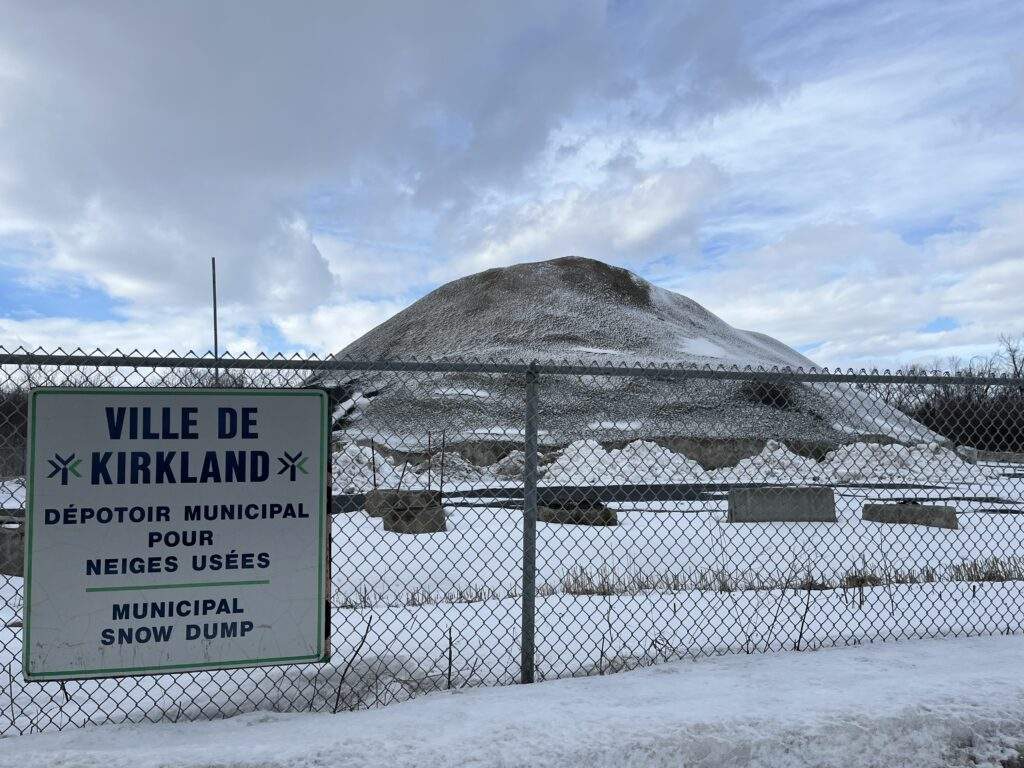
How long will snow in Kirkland dump last?

BRENDA O’FARRELL
The 1510 West

April showers, as the saying goes, bring May flowers. But how will last weekend’s two days of rain affect a closely watched contest in Kirkland?

That contest – now in its 10 year – is the game of guessing how long it will take the giant pile of snow at the Kirkland snow dump to melt.

“It’s a fun annual event,” said Kirkland councillor Mike Brown, who organizes the contest that has grown in popularity among the residents of Kirkland’s Timberlea district, where the snow dump on Ste. Marie Road is located.

So how long does the snow dump take to melt?

Well, that is a function of how much snow was dumped at the site in any given winter, how warm the spring and early summer temperatures are and how much rain we get.

In past years, the pile of snow has lasted well into July, Brown said, who remembers it even making a last gasp as late as the first few days of August.

According to Environment and Climate Change Canada, 161.8 centimetres of snow fell in the Montreal region since Jan. 1, 2025. So that reflects only the snow of part of a winter season. It does not include the snow that fell in the last months of 2024. And although the region saw record back-to-back snowfalls in the late winter months earlier this year, the amount of snow is actually less than in previous years.

The pile of snow at the dump represents all the snow cleared from the streets and parking lots in Kirkland.

This year, 140 residents of Timberlea have entered the contest. To be eligible, residents have to be members of the Timberlea Neighbourhood Watch Facebook group. Each participant simply selects a day they predict will be the day the entire pile of snow will disappear. The cut-off date to enter a guess was April 10.

Now, all everyone has to do is wait – and watch the pile melt. It’s not an action-packed contest, but the popularity of the event has grown over the years. The winner, Brown said, will be announced this summer, with a series of prizes awarded.

“It brings people together,” he said, explaining that the pile of snow – and how long it lasts – is an ongoing topic of conversation in the neighbourhood.

Brown created the Facebook group in 2013, shortly after he was elected to council. It is a closed group just for residents of his district, where they can “interact and keep each other informed on different issues that arise from time to time, such as, upcoming and ongoing city projects, city events and services, city fundraisers, safety, lost pets, crime, etc.”

The prize pool for the contest has grown over the years, with everything from beauty products to car wash certificates donated to the effort.

Cutline:

This photograph of the snow dump on Ste. Marie Road in the Timberlea area of Kirkland was taken last Thursday. How long will it last this year? Guessing the date of when it will all be melted is the focus of a contest organized by Kirkland councillor Mike Brown.

How long will snow in Kirkland dump last? Read More »

Scarpaleggia earns title of longest-serving Liberal in Quebec

BRENDA O’FARRELL
The 1510 West

As widely expected, the Liberals swept all three West Island ridings in Monday’s federal election, with incumbents not only garnering strong majority support but improving on their showings from the last election.

The most decisive win was in Lac—Saint—Louis, where incumbent Francis Scarpaleggia secured his eighth term, attracting 67.4 per cent of the votes cast and marking the highest level of support he has received since first elected in 2004. Monday’s win also has earned him the distinction of now being the longest-serving Liberal in Quebec.

“It was the most positive campaign I’ve ever had,” Scarpaleggia said in an interview yesterday, explaining how voters very clearly expressed support for Canada.

The new government, he said, which fell four seats short of forming a majority in Parliament, will immediately focus its attention on the economic challenges of navigating a tariff war with the biggest economy in the world.

“We’re going to have to restructure the economy to pivot away from the U.S.,” he said, describing the Liberals’ failure to secure a majority was not what the party was hoping for.

“But we know how to manage minority situations,” he said, explaining that of his eight elections, this is the sixth time he has been a member of a minority Liberal government.

Conservative candidate Matthew Rusniak posted a respectable showing, collecting almost 24 per cent of the vote. Lac-Saint-Louis includes the municipalities of Senneville, Ste. Anne de Bellevue, Baie d’Urfé, Kirkland, Beaconsfield, Pointe Claire and the western part of the Pierrefonds-Roxboro borough.

In Pierrefonds—Dollard riding, incumbent Sameer Zuberi easily won his seat for the third time, picking up almost 60 per cent of the vote. His closest rival was Conservative Tanya Toledano, who captured 31 per cent of the vote in what turned out to be, essentially, a two-person race, as Bloc candidate Katrina Archambault finished a distance third with only 5.3-per-cent of the vote.

The riding includes the municipalities of Dollard des Ormeaux, most of Pierrefonds-Roxboro borough and all of the Île Bizard-Ste. Geneviève borough.

In Dorval—Lachine—LaSalle, Liberal incumbent Anju Dhillon held on to her seat, earning just over 59 per cent of ballots cast. She defeated Conservative Alioune Sarr, who came in a distant second, with less than 22 per cent of votes cast.

Scarpaleggia earns title of longest-serving Liberal in Quebec Read More »

Quebec farmland values jump 7.7% in 2024: FCC

Brenda O’Farrell
The Advocate

The value of agricultural land in Canada continued its upward trend again last year, but that rate of increase is showing signs of slowing.

The value of farmland in Quebec jumped by an average of 7.7 per cent in 2024, less than the national average of 9.3 per cent and below the double-digit increases seen in the province in the three previous years, according to the latest figures compiled by Farm Credit Canada.

The rate of increase in Quebec was the fourth highest in the country, behind Saskatchewan, where prices increased by 13.1 per cent; British Columbia, which saw values jump 11.3 per cent; and New Brunswick, where the increase was 9 per cent.

Overall, the upward trend in farmland values across the country in 2024 continued to set new highs, but the national rate of increase seen in 2024 dipped below 2023 levels, when land values jumped by 11.5 per cent. In 2022, the across-Canada values increased by 12.8 per cent.

“The increase in Canadian farmland values in 2024 reflects an enduring strength in demand for farmland amid some pressures on commodity prices,” said J.P. Gervais, the FCC’s chief economist. “

Lower borrowing costs also helped drive the increase, Gervais added.

In Quebec, farmland values have seen consistent year-over-year increases for the last 39 years, with the most pronounced hikes recorded from 2011 to 2015. Last year’s 7.7-per-cent hike comes following a 13.3-per-cent hike in 2023, an 11-per-cent jump in 2022, a 10-per-cent increase in 2021 and a 7.3-per-cent improvement in 2020.

Quebec outpaced Ontario

In Ontario, farmland prices only saw a 3.1-per-cent hike last year, but the overall average dollar figure per acre in Ontario remained higher compared with Quebec. The average price of an acre of farmland in Ontario ranged from a low of $4,900 to a high of $33,700, with an average price of $20,087. In Quebec, the average price of an acre of farmland ranged from $1,700 to a high of $22,800, with the average pegged at $17,720.

Looking across the province, the Laurentides-Lanaudière region, north of Montreal, reported the highest rate of increase in farmland values, with selling prices recorded last year seeing a 14.8-per-cent hike.

According to the FCC’s report, the highest increases in that part of the province were in the central and eastern sectors of the region.

“The area is known for its diverse buyers (dairy, poultry, grain, potato and field vegetable producers),” the report states. “Therefore, when a particular sector experiences difficulties, this region is less likely to feel the effects on its land values.”

The Bas-Saint-Laurent – Gaspésie region saw the second-largest spike in farmland prices last year, with values increasing by 14.1 per cent. It is important to note, however, that despite the percentage jump, this region has some of the least expensive land in the province.

The demand in this region was driven by demand from supply-managed producers, according to the report.

In the Montérégie region, where the highest prices for farmland in the province continue to be recorded, the value of land jumped 3.2 per cent last year, with the average price hitting $22,800 per acre. The average price is $700 an acre more than in 2023, according to transaction data compiled by FCC. Sales prices last year ranged from $14,400 to $30,300 per acre in the region.

The tariff threat

“Overall, the increase in farmland values is a testament to the strong outlook for the demand of agricultural commodities and the high-quality food produced in Canada,” Gervais said.

But U.S. tariffs could have an impact, he added in a briefing with reporters last month.

In the short term, he said, “we are staring at even lower commodity prices.” But in the long term, “the world needs more of what we grow.”

But Gervais cautioned, the longer the tariff disruptions last, the larger the impacts will be on farmers’ bottom lines.

“Uncertainty – that’s a big deal,” Gervais said. “It applies to ag as it applies to the overall economy.”

This, in turn, will create an impediment to the willingness to invest in land.

On the national level

Although all provinces saw jumps in the prices of farmland in 2024, only three reported a higher growth rate compared with 2023 – British Columbia, Alberta and New Brunswick. There were an insufficient number of reported sales in Newfoundland and Labrador, and the northern territories to assess the changes in farmland values in those parts of the country.

More favourable weather conditions in the prairies last year was one factor cited in bolstering demand for land out west, according to the FCC.

The FCC’s latest findings are based on prices of land sold between Jan. 1 and Dec. 31, 2024.

But overall, the question of farmland affordability continues to hang over the sector. While the rate of increase for prices of farmland is showing signs of slowing, the affordability of land relative to farm incomes continues to deteriorate, the FCC claims.

“The affordability index is not trending in the right direction,” Gervais said, pointing out that Canadian farmers are facing the lowest level of affordability in the last 40 years.

This reality, he said, creates growing challenges for those producers looking to expand their land base, as well as being an impediment to young producers looking to establish an operation.

Quebec farmland values jump 7.7% in 2024: FCC Read More »

Farming Facts: From fresh produce to CO2 emissionsFarm facts

Here are a few fun facts that quantify a few realities of the farming sector.

48%: The amount of Canada’s fresh produce exports that are grown in greenhouse facilities.

24-ounce bag: That is the size of ‘O Canada Blend’ potatoes launched earlier this month by RPE Canada, which is actually a U.S.-based company that partners with Canadian farmers. ‘O Canada Blend’ potatoes are a mix of Honey Gold and Ruby Sensation spuds “designed to celebrate the traditions and flavours of Canada.” The package features the Canadian flag, and images of bears, beavers and moose, with the tagline: “It’s a tasteful tradition, eh!” The potatoes are grown by Canadians, for Canadians, the company claims. RPE is aiming to expand its presence in the Canadian market.

60%+: That is the percentage of Canada’s agricultural and agri-food exports that go to the U.S.

27: The number of megatonnes of CO2 emissions produced by cows in Canada. The output is produced from enteric fermentation, driven in large part by cattle’s natural digestive process.

This figure represents 39 per cent of the country’s agricultural sector’s total carbon footprint.

Farming Facts: From fresh produce to CO2 emissionsFarm facts Read More »

Quebec pork sector faces double tariff threat

Brenda O’Farrell
The Advocate

History shows that shifts in the world economy – traditionally triggered by advancements in technology, automation, wars, population growth – cause massive disruptions, resulting in losses for some sectors, but winners in others.

But experts say U.S. President Donald Trump’s tariff war, which is reordering the global economy, could produce only losers. And in that context, the agricultural sector needs to brace itself.

That is not the only challenge facing Canada’s agricultural sector, however. At the same time, some subsectors are also being hit with punishing tariffs from China, putting some grain and pork producers – at increased jeopardy.

In March, China slapped 25-per-cent tariffs on Canadian pork and seafood, and a 100-per-cent surcharge on canola. These measures were in response to Canada’s move to impose 100-per-cent levies on Chinese-made electric vehicles and a 25-per-cent tariff on aluminum and steel products that had been announced in late 2024.

And with Quebec being Canada’s largest pork-producing province, with 1,482 producers, according to Les Éleveurs de porcs du Québec, the impact in this sector cannot be ignored.

“The recent imposition of a 25-per-cent retaliatory tariff on Canadian pork by China has dealt a severe blow to one of the country’s most vital export sectors,” said the Canadian Meat Council in a statement issued April 14. 

In 2024, Canada exported $468.6 million worth of pork products to China, according to Agriculture and Agri-Food Canada.

“China’s tariffs will have a significant impact on both employment and production, potentially leading to widespread layoffs or even closures of operations,” said Chris White, CEO of the Canadian Meat Council. “This situation is devastating – not only for meat processors, but also for the thousands of people employed and the communities that depend on them.”

The Canadian Meat Council called on the federal government to take “meaningful action in support of the country’s meat industry.” And described the support measures such as those announced through the AgriStability fund in March have been wholly inadequate, as they do not provide relief for processors.

The Canadian Meat Council “is calling for direct, targeted financial support for meat processors to offset the immediate and significant impact of these tariffs and to help maintain slaughter capacity. This support is critical not only for the viability of processing facilities – some of which are projecting losses of over $100 million this year – but also for Canadian pork producers, who depend on these plants to continue selling their animals and sustaining farm operations.”

Adding to the tariff woes for the Canadian pork industry is the worry that Mexico will impose a levy on U.S. pork.

Mexico is the largest importer of U.S. pork. This could see U.S. pork exports drop, pushing U.S. pork prices down. This would drag Canadian pork prices down with them, as Canadian hog prices are tied directly to U.S. pricing models as determined by the Chicago Mercantile Exchange.

And all of this is happening as the Quebec pork industry is attempting to recover from a major overhaul triggered by financial setbacks suffered by Olymel, the Quebec-based company that is the largest pork processor in province, that sent rippling affects across the sector.

In 2018, Canadian pork exports totalled about $4 billion, with $514 million attributed to the Chinese market, with projections of these figures would soon double.

But in June 2019, China banned pork imports in retaliation for the arrest and detention of an executive with Chinese tech firm Huawei Technologies.

Although the ban was lifted almost six months later, damage was done. And Olymel was scrambling after expanding its production facilities. The pivot saw the company cut the number of hogs it would process, and closed its facility in Vallée Jonction in the Beauce region of Quebec in 2023.

Now, industry observers say the sector needs to focus on influencing consumers to opt for pork more often at the grocery store. Growing the Canadian market for pork, while exploring other export avenues is becoming the tariff-war opportunity.

Quebec pork sector faces double tariff threat Read More »

Rebuilding St. James: Preserving past with eye to the future

BRENDA O’FARRELL
The 1019 Report

In the world of architecture and design, every new project usually starts with a concept. But when it comes to rebuilding an historic stone church that dates back decades before Confederation, the first step is asking the question: How should the scope of the concept be redefine and modernized?

That is what a group dedicated to seeing St. James Anglican Church rebuilt has asked hundreds of people in a very organized and deliberate way. And now, one year after flames ripped through the roof of the stone structure on Main Road in Hudson and destroyed an adjacent hall, they are pulling all that feedback together to ensure that what comes next meets the needs of today and tomorrow, while preserving what has been a big part of Hudson’s past.

“We are very excited about this project and the potential for the Hudson community and beyond,” said Marcus Owen, a volunteer who is overseeing the reconstruction of the church’s roof and the plan to replace the adjacent Memorial Hall that was destroyed last April. “It takes a village, and that’s who we’re engaging in the process.”

Owen has spearheaded an ambitious community consultation process that has included interviewing 200 individuals from both Hudson and neighbouring municipalities to do a deep dive on what community stakeholders need.

The goal is to rebuild what Owen calls “a community hub,” a place where people will be able to come together for a wide range of reasons, not just for religious services.

“There is a need in the community for more community space,” Owen said in an interview with The 1019 Report.

“It’s a beautiful building that needs to be preserved,” Owen said, but when it comes to its functionality, the focused has to be put on how it can be used today and into the future.

And that is the challenge the committees organizing the rebuilding project are weighing.

In the past weeks, work crews have been putting the final touches on a new roof atop the church, a stone structure that was originally completed in 1842. The cemetery just outside its doors dates back even further, to 1819. The graveyard is the oldest in Hudson and is the resting place of dozens of Canadian soldiers from the first and second world wars, including those who died in battle and veterans who returned home after the wars.

To the rear of the church is a large reception hall, the footprint of where Memorial Hall once stood and, off to the side, a manse. The grounds include a vast 10 acres, a portion offering incredible views of the Lake of Two Mountains, while fields of space lie on the south side of Main Road.

How can all of this be put in service to the community? How will the inside of the church be completed? Will it have traditional pews? Or, a more flexible interior space that can accommodate concerts and other events?

All the ideas put forward during the consultations have been tabulated and categorized with the help of an artificial intelligence tool. The emerging themes and priorities are what architects are now working with to produce a series of designs for both the church and plans for how a new Memorial Hall can be re-imagined.

“We want to rebuild the church so that it is of service to the community,” Owen said as he provided a peek inside the historic structure last week.

As work crews on the roof could be heard, he highlighted some of the work that has been completed inside to ensure the integrity of the structure – repairs to a brick archway and the impressive stonework that had been covered for decades now fully exposed, punctuated by the distinctive lancet window frames.

“The days of church being a place that everyone showed up to on Sunday with all their friends and neighbours are gone,” said Reverend Sophie Rolland. “One thing Hudson has always had, however, is a great community spirit and we want to capitalize on that in ways that simply haven’t been done before. It’s tremendously exciting and will bring people together.”

Rebuilding St. James: Preserving past with eye to the future Read More »

Weekend closure of bridge needed before 4th lane reopened

BRENDA O’FARRELL
The 1019 Report

The Île aux Tourtes Bridge will be completely closed this coming weekend as work crews reconfigure the lanes to permit the reopening of a fourth lane on the span, marking the first time in more than three years that two lanes of traffic will be available in both directions.

The weekend closure will also mark the 10th time since the beginning of 2024 that the span, which links the Vaudreuil-Soulanges region to the island of Montreal along Highway 40, will be completely closed to traffic to accommodate the ongoing work to repair the old span as work to build a new bridge continues. Several partial closures of the span that limited its use in only one direction have also been needed in the last 16 months.

The bridge is expected to be closed from midnight Friday until 5 a.m. on Monday, April 28, with traffic diverted from the St. Charles exit in Vaudreuil-Dorion in the eastbound direction, and from Anciens Combattants Blvd. in Ste. Anne de Bellevue in the westbound direction. Tolls on Highway 30 will be lifted during the closure.

According to Transport Quebec, putting a fifth lane into service on the six-lane span is the next objective. No projected date for that has been offered, however.

The weekend closure will permit the painting of new lines to delineate the new configuration of the lanes, make repairs to an area of the surface of the span that had been damaged during earlier repair works and to install two beams.

The reopening of the fourth lane comes as major re-enforcement work on the span has been completed, Transport Quebec said. This includes reconstruction of much of six supporting pillars.

When the fourth lane is reopened, trucks will be prohibited from using the right lanes in each direction on the span, while overloaded vehicles will continued to be barred from the route at all times.

Weekend closure of bridge needed before 4th lane reopened Read More »

Mayoral race is on in Hudson

BRENDA O’FARRELL
The 1019 Report

Municipal elections are still a little more than six months away, but the race for mayor in Hudson has been triggered, as a challenger has stepped forward looking to unseat incumbent Chloe Hutchison.

“I know I could do much better to make Hudson the gem it should be,” said resident Chantal Perreault, a lawyer who has launched her campaign for the top job on the town’s municipal council.

“I’m not there to add a title to my CV,” Perreault said in an interview with The 1019 Report last Sunday. “I want to be there to get results, to accomplish things.”

A resident of Hudson since 2013, Perreault says she has gotten to know the community, has been involved with a number of groups and has watched how the current administration has failed to deal with a list of issues – from putting a solid administrative team together to handle the day-to-day operations at town hall, to Sandy Beach, to continuing to rack up budget surpluses, a sign, she says, that shows residents are being overtaxed for services they are not receiving.

“It’s not because you’re small,” she said, referring to the size of the town, “that you can’t accomplish great things.”

“It’s a lack of leadership and vision,” she added. “We have to put the car in drive. I feel we have been idling for four years.”

Hutchison yesterday confirmed she will seek re-election, but has yet to turn her attention to the election, which is schedule for early November.

Her focus at the moment is to put a new director-general in place, she said, ensure the treasury department is functioning at full capacity and continuing to focus on ongoing projects.

See HUDSON, Page 2.

HUDSON: Challenger seeks
top job on town council

From Page 1

Perreault, a 66-year-old mother of two who has two grandchildren, has a priority list of what she would like to tackle if elected.

Improving the town’s parks is at the top of that list.

“There is pretty much nothing” for young families when it comes to parks, Perrault said.

That will change within the first year, she pledges. Changes are also needed to how the vast trail network in Hudson is maintained, she said.

She also aims to settle the Sandy Beach issue.

“We need to find a solution to preserve Sandy Beach and guarantee access for the summer of 2026,” she said.

That solution includes striking what she described as a reasonable agreement with the current owners of the waterfront site and “exercising the power available by the law.”

“The cost of securing that land for public use has become lower than it has ever been,” she said. “We can make it an asset for our youth.”

Perreault also points to the need to put an end to what she called “the revolving door” at town hall, referring to the constant turnover of personnel in key positions.

In February, Hudson hired a new treasurer, its third in two years, and is currently looking to hire a new director-general after a deal was struck last month to part ways with the previous top administrator who had been on a leave that began only months after she was made permanent.

Other changes Perreault believes are needed include instilling a different approach to dealing with taxpayers. They need to be treated as clients, she said. And ask: “How can I serve? How can I help? It has to come from the top.”

Perreault also wants to tackle the issue of water, improving the quality and quantity of tap water available and extending the waste water network to where it can feasibly be done within the town’s core.

She also wants to put added emphasis on governance issues, including the way the town drafts its budgets and plans its priorities.

Perreault believes her experience as a lawyer, a former school commissioner, volunteer and administrative judge who dealt with issues of ethics and professional governance will lend itself to her role if elected. She wants to put her skills to work for her town, she said.

“I’m not running against anybody. I am running for Hudson. I am rooting for Hudson.”

Mayoral race is on in Hudson Read More »

No one questions focus of Hudson Film Festival any more

BRENDA O’FARRELL
The 1510 West

As the 2025 edition of the Hudson Film Festival gets set to dim the lights and let the movies roll at Hudson Village Theatre next week, chief organizer Clint Ward says there is one question he is not being asked any more.

“Why just Canadian films? I’m not asked that question that much this year,” Ward said.

The politics of the day, with Canadians united in the face of threats to the country’s sovereignty from U.S. President Donald Trump and his aggressive economic assault in an escalating tariff war, has put all things Canadian front of mind across the country. If ever there was a time to support Canadian film, it’s now.

The film fest, which marks its 10th anniversary this year, dubs itself “The Big Little Canadian Film Festival.” For the past decade it has prided itself in showcasing the best in film this country has to offer. It’s a mission that has gained much traction this year, Ward said.

From April 21-27, this year’s edition offers 17 films. From documentaries to dramas, Oscar-nominated works to the best from Quebec and Indigenous film-makers, the festival celebrates the movie-going experience and provides in-depth conversations with some of the people behind the movies.

This year’s festival features a special evening on Saturday, April 26, with Canada’s best-known ballet dancer Karen Kain.

She will attend the screening of Swan Song, a documentary that provides a behind-the-scenes look at how Kain, on the eve of her retirement from a career that put her at the top of the international classical dance world, directed the National Ballet of Canada in mounting a production of the iconic ballet Swan Lake. The film captures an emotional and intimate look at the dancers’ private lives, their passion, tenacity and devotion to their skill.

Kain will take questions from the audience and share her insights.

“She’s coming to visit Hudson for three days,” said Ward, who said the audience at the April 26 screening will be entranced by the conversation with this Canadian icon.

To consult the Hudson Film Festival schedule of screenings and for tickets, go to https://www.hudsonfilmsociety.ca/hudson-film-festival-2025/

No one questions focus of Hudson Film Festival any more Read More »

Request for letter for forest funding still awaited

BRENDA O’FARRELL
The 1510 West

A request made to Pointe Claire council for a letter to start the process of seeking funding from provincial authorities with the aim of acquiring Fairview Forest was met with support earlier this month, but so far no action.

“We’ve done nothing as a city to advance the Fairview Forest project,” said councillor Eric Stork in an interview Monday. “We’ve done absolutely zero.”

But Geneviève Lussier, the spokesperson for the Save Fairview Forest group, which has been advocating for the preservation of the wooded area west of the Fairview Pointe Claire shopping centre, is still hopeful the city will get on board to request financial support from the provincial Plan Nature 2030, a plan to preserve 30 per cent of Quebec’s natural spaces by 2030. The $922-milliion fund launched last year received an additional $100 million in federal funding last month.

“The purpose of the funding would be in helping to purchase the land from the current owner,” said Lussier in an interview Monday.

Lussier said she requested the letter from the city, along with a meeting with the council to discuss a possible plan aimed at preserving the forest from development at the April 1 council meeting as a followup to council’s move last fall to commission studies to evaluate the land. She has not heard back from any city representative, however.

“I’ll be encouraged when the letter is sent,” she said. “We just need action.”

Council members have not discussed when they would meet with members of the group.

At the April 1 meeting, Pointe Claire council approved a $112,000 eco-systems study of the entire territory of the city, which will catalogue the so-called services natural spaces provide the city in terms of heat-island protection, air quality, noise pollution mitigation and other benefits. A second study that will put together an ecological portrait of both private and public natural spaces is expected to go to tender shortly.

Request for letter for forest funding still awaited Read More »

Hearing to be set to assess ethics claim

BRENDA O’FARRELL
The 1510 West

The Commission municipale du Québec is expected to schedule a hearing in the coming weeks to formally assess accusations levelled against Pointe Claire Mayor Tim Thomas that allege he misused his city-supplied car and credit card.

“A hearing date will be set in the coming weeks,” said commission spokesperson Anne-Julie Lefebvre on Monday in response to questions from The 1510 West.

It is at a hearing that evidence will be presented, Lefebvre stated, adding that details of the allegations will not be made public until then. The identity of the individual or individuals who filed the complaint are not revealed.

As of yesterday, no hearing involving Thomas appeared on the commission’s schedule, which has public hearings booked in other matters until the end of May.

On March 21, the Commission municipale issued a municipal ethics citation, a two-page form letter that outlines four allegations of how Thomas has alleged to have contravened the City of Pointe Claire’s ethics rules. The allegations include having used the car leased for him by the city for personal use; having used a city-issued credit card to purchase gas for the vehicle while using the car for personal use; and charging meal expenses while travelling to meetings of the Montreal Agglomeration council.

The citation was issued almost two months after Thomas was summoned by Commission municipale officials and questioned about the anonymous complaint lodged against him. He answered questions for about four hours.

According to the Commission municipale, a citation is issued when its municipal integrity investigations and prosecutions directorate “believes that the information in its possession is likely to demonstrate that a municipal elected official or office staff member has violated an ethics rule.”

In this instance, the commission could find fault with Thomas’s and/or the City of Pointe Claire’s administration’s actions.

At the April 1 Pointe Claire council meeting Thomas vehemently defended his actions with respect to his use of the city-leased vehicle and credit card, and compared his expense claims with those of former mayor John Belvedere.

“I want to reassure citizens that I have been spending their taxpayer dollars appropriately and in a manner that is consistent with what previous mayors of Pointe Claire have done,” Thomas said.

Thomas claimed he spent $4,844 in gas, which was charged to his city credit card during a period of time that stretched from shortly after his election in late 2021 and when it was revoked by the city’s administration in 2024, a period of less than three years. The amount is comparable to the gas charges of $5,510 posted by Belvedere during his four-year term in office, from 2017 to 2021. Thomas said he obtained the figures through an access-to-information request.

Thomas also said he charged a total of $1,326.23 on his city credit card on meals, which represented working dinners with other mayors of demerged municipalities following meetings at the Montreal Agglomeration council. In comparison, he said Belvedere accumulated $10,966.28 in meal charges during his term in what Thomas described as a variety of contexts, including meals in Pointe Claire with other members of council, where he picked up their tab.

The City of Pointe Claire’s administration opted not to continue to provide Thomas with a car in April 2024, after the vehicle was damaged beyond repair when the mayor hit a deer in the Laurentians, where he was visiting his mother. The city’s director-general at that time also asked Thomas to return the credit card that had been issued to him by the municipality.

If found in breach of an ethics violation, Thomas could face a penalty that ranges from a reprimand to being ordered to reimburse any benefit received, a suspension or fined a maximum of $4,000 for every breach upheld by the commission.

Hearing to be set to assess ethics claim Read More »

Petition launched to push Île Perrot municipal mergers

BRENDA O’FARRELL
The 1019 Report

Stymied by elected officials in its bid to have the provincial government conduct a feasibility study on the possible merger of the four towns on Île Perrot, a grassroots group has launched a petition hoping public support will convince local politicians get the ball rolling.

“I am persuaded that citizens want this information,” said Lise Chartier, the communications director for Avenir Île Perrot – Becoming Île Perrot in an interview Monday.

The petition, urging elected officials in Pincourt, L’Île Perrot, Notre Dame de l’Île Perrot and Terrasse Vaudreuil to request the free study be conducted by Quebec’s Municipal Affairs department, was launched last week. As of yesterday, 314 people have signed the online roster on the group’s website. The group aims to collect 400 signatures, but that goal could be upgraded, Chartier said.

Avenir Île Perrot – Becoming Île Perrot was formed last May. Its purpose is to advocate for the fusion of the four towns on Île Perrot in an effort to better provide cultural and sports services, offer a long-term planning and development vision for the island, as well as reduce administrative costs.

So far, Notre Dame Mayor Danie Deschênes and Terrasse Vaudreuil Mayor Michel Boudreau have refused to meet with representatives of the group, while meetings with elected officials in Pincourt and L’Île Perrot were held last fall. But none have made the move to ask Quebec for the study.

Only municipal officials can request the study.

Chartier said a request for the free study is an important step in informing taxpayers of the pros and cons of a possible municipal merger. It is an issue that has been floated several times in the last few decades, she said. The group claims a merger would provide savings for taxpayers and allow for a better sharing of resources to promote buy-in to provide cultural and recreational infrastructure, like an arena and a performance space.

If the four towns on Île Perrot merged, the new entity would be the second largest municipality in the Vaudreuil-Soulanges region, with a population of about 40,600, only slightly smaller than Vaudreuil-Dorion. The new town would be the 35th largest municipality in Quebec and the fourth largest in the greater Suroît region, which includes Valleyfield, Châteauguay and Vaudreuil-Soulanges.

Avenir Île Perrot – Becoming Île Perrot will be hosting a second open-house information session at the Station des Sports, 336 Grand Blvd.  in L’Île Perrot on May 4 at 10 a.m.

Petition launched to push Île Perrot municipal mergers Read More »

Hudson’s Sandy Beach expected to remain closed this summer

BRENDA O’FARRELL
The 1019 Report

As negotiations between the Town of Hudson and the owners of Sandy Beach continue, access to the once-popular waterfront site along the shores of the Lake of Two Mountains is expected to remain closed this summer.

On Monday evening Hudson council voted to renew an agreement with Nicanco Holdings, the owner of the wooded area around the waterfront, to prohibit parking along the private stretches of Beech Road that trace the outline of the land the town is seeking to purchase.

“It is expected that Sandy Beach will remain closed this year,” said Hudson Mayor Chloe Hutchison during the meeting, adding that negotiations with Nicanco continue.

Last month, Hutchison confirmed the town had presented Nicanco with an offer to purchase the waterfront land. She, however, refused to discuss the response to the offer.

The waterfront property has been the focus of a growing grassroots campaign to preserve the natural space from development.

“There is nothing to report at this time,” Hutchison said during Monday’s meeting.

In February, Hudson council, armed with two reports commissioned last summer to help determine the value of the land in the Sandy Beach area, had agreed on an offer to buy the waterfront property. The amount of the offer was not disclosed.

In March, Hutchison said the purchase proposition had been presented. At that time, councillor Mark Gray described the bid as “a reasonable offer.”

On Monday evening, Hutchison declined any further comment, explaining the town and Nicanco officials had agreed not to make any public statements.

Environment Quebec officials are aware the town is attempting to negotiate a deal with the Nicanco. In October 2023, Environment Minister Benoit Charette revoked Nicanco’s permit to backfill part of the wetlands to allow it to move forward with a proposed 214-unit housing development. Nicanco subsequently challenged that decision, taking its arguments to a provincial tribunal. The Tribunal Administratif du Québec has yet to issue a ruling.

The town commissioned valuation reports on the property last July after Nicanco representatives asked municipal officials if they would be interested in discussing a possible deal, marking the first time in recent years it had considered the option of a sale to the municipality.

In March 2024, Nicanco had announced it would no longer tolerate residents and visitors trespassing on its property. The move sparked an emotional response from many residents who had for years enjoyed walking along the trails through the woods that provide access to the beach.

Hudson’s Sandy Beach expected to remain closed this summer Read More »

Fairview Forest group building momentum

BRENDA O’FARRELL
The 1510 West

Attention, timing and momentum. These are the forces the Save Fairview Forest group have successfully harnessed, accomplishing what few believed would ever be possible. But as it prepares to review its successes this evening at its third annual general meeting, the group is keeping its eye on the prize, a goal that now appears less pie-in-the-sky than ever before.

“Things are finally moving in the right direction,” said Geneviève Lussier, president of the group that has been lobbying for the protection of the woodland just west to the Fairview Pointe Claire shopping centre, north of Highway 40.

The group has staged weekly rallies by the forest for 227 Saturdays. That is more than four years of protests every weekend on the sidewalk that traces the limit of Fairview Forest, a 39-acre tract of land north of the REM train line that is the only remaining piece of undeveloped wooded area in Pointe Claire.

The group’s goal is to save the forest from being developed by its owner, Cadillac Fairview, which is also seeking to redevelop much of the adjacent shopping centre property, building three multi-level residential towers in the parking lot of the mall site.

“It’s nice to be able to celebrate our success this year,” Lussier said in an interview with The 1510 West, referring to tonight’s meeting.

And in the last year, those successes point to a shift in support for saving the woodland.

The first breakthrough, which has been churning for more than a year, will be unveiled later this spring, when the Communauté métropolitaine de Montréal releases its new urban planning documents, which will identify the woods as a “natural space of ecological interest,” an official designation required for land to be protected.

This follows part of the forest being officially designated as wetlands, which prohibits development in these areas and in a 30-metre buffer zone surrounding them. This, on its own, protects half the forest, Lussier said.

“That is a huge win,” she explained.

But it is not the only one.

In the last year, the Quebec government has adopted Bill 39, a law that gives municipalities more latitude to expropriate what are defined as exceptional natural spaces. In the past months, other municipalities, including Longueuil and St. Bruno, have used the legislation to protect tracts of land within their borders.

The provincial and federal governments have also made new funds available to underwrite the acquisition of natural areas.

While at the municipal level, Lussier said, the City of Pointe Claire earlier this month closed the tender on a study that will focus on all the privately owned natural spaces in the city, a result of a resolution council adopted last fall to formally take a new look at the future of green spaces in the municipality, including how recent provincial legislation can be leveraged.

“When this resolution was passed we were cautiously optimistic,” Lussier said, explaining the resolution showed a willingness to look at the issue.

It is not clear where it will lead, but as Lussier added, “We have been lobbying all levels of government,” referring to the municipal, CMM and provincial levels. “There are multiple funding opportunities to look at.”

Since the start of Save Fairview Forests lobbying efforts began, Cadillac Fairview has also sold 11 acres of the green space to accommodate the REM, whittling down the 50-acre woodland to 39 acres. Although, the forest is smaller, Lussier said, the cost of acquiring what remains will be less costly, making the task more manageable.

Save Fairview Forest’s annual general meeting is tonight at 7 p.m. at Cedar Park United Church, 204 Lakeview Ave. in Pointe Claire. It is open to the group’s members and all others who would like to attend.

Fairview Forest group building momentum Read More »

Farming Facts: From emissions to experiencing hunger

Here are a few fun facts that quantify a few realities of the farming sector.

4: The number of megatonnes of CO2 emissions produced by dairy cows in Canada. The total carbon footprint of  all types of cows in Canada is 27 MT. The output is produced from enteric fermentation, driven in large part by cattle’s natural digestive process, produced in Canada.

757 million: The number of people in the world who experience hunger.

18.3%: The percentage increase in net income for Canadian farmers in 2023 compared with 2022 to hit $14.5 billion collectively. The increase in 2023 comes after the country’s farmers saw a 4.1-per-cent drop in net income in 2022.

40.3%: There are more older men in the farm population compared with the total population. In fact, 40.3 per cent – or just over 4 in 10 men – in the farm population were 55 years or older compared with 31.2 per cent in the total population.

Farming Facts: From emissions to experiencing hunger Read More »

How dairy? Or should that be: How dare he?

Trump targets supply management

Brenda O’Farrell
The Advocate

Few things are clear in the expanding tariff war being waged by U.S. President Donald Trump, especially in Canada, where weeks of threats are being followed by a dizzying string of flip-flops and pauses, more threats of retaliatory counter-measures, annexation overtures and “colourful” phone calls between Ottawa and Washington, as Justin Trudeau described them.

But when it comes to the impacts on the agricultural sector, one result is crystal clear: Farmers on both sides of the border are experiencing a cocktail of emotions as the agricultural sector braces for impact.

As UPA president Martin Caron put it: “Our discussions with agricultural organizations in the United States show that there is discontent on both sides of the border.”

Caron is a member of the Council on Canada-U.S. Relations appointed by Trudeau in January to help formulate and steer Canada’s response to tariff threats.

But now, tariffs may not be the only issue.

Hidden in Trump’s focus on dairy tariffs is the growing concern, especially in Quebec, that the real threat is that the U.S. government wants to dismantle Canada’s supply-management system at the centre of Canada’s dairy sector.

Canada conceded ground on supply management in the last round of negotiations that led to the Canada-U.S.-Mexico Agreement signed by Trump during his first term. At that time, federal officials in Canada compensated dairy farmers for allowing the U.S. limited access to our dairy market. And they vowed that would be it.

But Trump appears to want more now.

Yes, as the tariff war ratcheted up in February and early March, federal officials, including Innovation, Science and Industry Minister François-Philippe Champagne, in early March pledged their support to protect the system.

Speculation over whether it is worth protecting, however, persists.

During the CUSMA negotiations, the first Trump administration argued Canada’s supply management system unfairly limited U.S. access to this country’s dairy market. Yet, despite reaching a deal, the loosened access still annoys Trump. But his criticisms do not reflect the reality of what is actually happening.

His very public gripes and threats to impose a 250-per-cent reciprocal tariff on Canadian dairy entering the U.S. grabs headlines, but observers say all that bluster – even if he carries through with the threat – will have little impact.

So far, U.S. dairy producers have not come close to hitting the threshold that would trigger a tariff under the existing CUSMA deal.

Then there is the other fact that Trump opts to ignore: Canada exports less dairy products to the U.S. than it imports from the U.S., meaning Canada posts a trade deficit when it comes to dairy.

But that is not the only concern. The U.S. is not the only country that has raised issues with Canada’s supply-management system. And as Canadian officials look to diversify their trading deals with other countries around the globe, the issue could again draw criticism.

How dairy? Or should that be: How dare he? Read More »

Despite tariff chaos, Canadian ag can be export leader: RBC report

Brenda O’Farrell
The Advocate

With the U.S.-Canada trade war ramping up and switching gears on an almost daily basis in what feels like a whirlwind of cross-border chaos and growing concern over how it will impact the economy, a report by the Royal Bank of Canada suggests the country’s agricultural sector could be a trade diversification leader and generate $44 billion in new agri-food exports in the next 10 years.

 “We have an opportunity to turn agriculture into a driving force for trade diversification,” said John Stackhouse, RBC senior vice-president who heads the bank’s Economics and Thought Leadership group, which published the report Food First: How agriculture can lead a new era of Canadian exports, at the end of February.

“If we act now, we can ensure Canadian farmers, processors and exporters are well positioned to lead the global food economy rather than losing ground to competitors,” Stakehouse continued.

With the country’s political leadership and provincial premiers now focused on finding new trade partners around the globe in an effort to reduce Canada’s reliance on the U.S. as the country’s key export destination, the RBC report outlines not only where the agricultural sector can diversify its markets abroad but delves into why it needs to do it now – and quickly.

“While Canada’s agricultural exports have quadrupled in value since 2000, its global market share has shrunk by 12 per cent as competitors like Brazil and Australia expand into high-growth regions,” said the report’s author Lisa Ashton, who is also the agriculture policy lead with RBC’s Thought Leadership. “With rising trade uncertainty and escalating tariffs in North America, Canada must accelerate efforts to diversify its trading partners, particularly in Southeast Asia, Africa and the Middle East.”

To map out the path forward based on the data, RBC partnered with BCG Centre for Canada’s Future, a division of the Boston Consulting Group, an agency that specializes in helping businesses build and sustain competitive advantages.

According to the findings, more than $100 billion in agricultural and agri-food products cross the Canada-U.S. border annually, with the U.S. buying the majority share of that – almost 60 per cent. That represents a huge increase in the last quarter century.

The report states: “Canada is now the source of 20 per cent of U.S. agriculture and agri-food imports.”

“No longer just a bulk commodity producer, we are now a dominant foreign supplier to America’s grocery aisles and dining tables, as Canadian farmers and processors have become more advanced in developing new products and marketing them to Americans,” the report highlights.

But those gains are now the focus of the dilemma Canada faces as the tariff war takes hold.

In addition, what the gains do not show is how Canada, while increasing its agricultural exports overall, its growth has lagged behind advances made by other countries. In fact, Canada overall is losing market share on a worldwide scale.

“… we’re not keeping pace with the rest of the world, which saw agriculture and agri-food exports grow five-fold over the same period,” the report states.

In fact, in the last 25 years, Canada dropped from fifth place in the world in terms of agricultural exports, to seventh place, putting it now behind China and Brazil. If the current trend continues, the report states, Canada could drop to ninth place in the next 10 years.

That is the warning.

The challenges, however, are cast in a more optimistic light. The sector can regain market share and reverse that slide – even in the current tariff-threat climate – by taking vital strategic action, the report’s authors argue.

“Our model estimates that Canada’s share of the global export pie could grow by 30 per cent by 2035, adding $44 billion to total exports, if we pursue three main trade objectives: grow where Canada has market access, expand in the world’s best growth markets and maintain existing relationships through strengthened ‘food diplomacy,’ ” the report outlines.

The opportunities:

  1. Grow where Canada has market access:

“Canada has 18 free-trade agreements providing access to over two-thirds of the global economy. Through these agreements, there is room to make better use of Canada’s market access in Europe, Asia,” the report states.

  • Expand in the world’s best growth markets:

That starts in Asia.

“Consumers in Southeast and South Asia are expected to have more to spend on higher value products over the next decade, thanks in part to expectations for economic growth that will be among the best in the world, with GDP per capita forecast to rise 3.9 per cent, annually between 2024 and 2033….”

Sub-Saharan Africa, the Middle East, North Africa and Latin America are also expected to see large GDP expansions.

  • Maintain existing relationships through strengthened ‘food diplomacy.’

“These markets include the U.S., Japan, China and Mexico — the first three of which are projected to have food trade deficits over the next decade that surplus producers like Canada will compete for. Our advantage is established business networks and consumer confidence in our products.”

Despite tariff chaos, Canadian ag can be export leader: RBC report Read More »

Ste. Anne to keep some English info

BRENDA O’FARRELL
The 1510 West

How the Town of Ste. Anne de Bellevue communicates with its English-speaking residents is about to change as it implements the requirements outlined in Quebec’s Bill 96.

But a directive approved by the town council Monday evening aims to maintain as much English in the small town as possible.

“We have to recognize the needs of our citizens and respect the law,” said Mayor Paola Hawa in an interview with The 1510 West on Monday.

Ste. Anne is the only West Island demerged suburb that does not have bilingual status. This means it must adhere to all the rules outlined in Bill 96, the Act respecting French, the official and common language of Quebec.

Under the implementation guidelines of Bill 96, adopted by the provincial legislature in 2023 that aims to strengthened Quebec’s French language charter, all unilingual municipalities have until September of this year to comply.

But there are a few exceptions unilingual towns can avail themselves of if they adopt a specific directive. And that is what Ste. Anne council did Monday evening.

Council unanimously approved a motion, entitled Directive relative à l’utilisation d’une autre langue que le français, which outlines a clear framework for town staff as to when and how they can use English.

The directive lists specific instances when the town can disseminate information in English, as permitted under Bill 96. These areas include in emergencies, in situations involving public safety, fire prevention, crime prevention, extreme weather events, to ensure that bylaws are accurately interpreted and issues touching on tourism.

The directive also includes communication to residents directly from the mayor.

“We recognize that French is the common language of Quebec, and that it is a cultural asset that sets us apart in the Americas,” Hawa said in a statement. “Considering the unique context of Ste. Anne de Bellevue and recognizing the significant historical contribution of English-speaking culture to our community’s development, we are committed to integrating the provisions of the law in a spirit of harmony and with respect for all our citizens.”

Council’s approval of the directive is a key move. Without it, a unilingual municipality would not be able to provide a broader range of communication in English to residents after September, when the so-called transition period to the stricter language guidelines outlined in Bill 96 expires.

Among the changes Ste. Anne will have no choice to make, however, is removing all English information that does not fall into the exemptions from its website. That means the “English” button at the top of its website, which opens an index of information available in English on the site, will disappear. To compensate, Ste. Anne last month began to update its online portal to incorporate an artificial intelligence function that will offer automated translation.

Ste. Anne will also have to ensure all official communication from the town outside of the exceptions outlined in the directive is in French only. That includes all written and oral communications.

That means when a resident asks a question in English at a public council meeting, the question will have to be translated into French, and then the response must be given in French. The mayor, however, will be able also provide an oral English translation of the answer.

Hawa will also begin issuing what she described as “messages from the mayor,” which fall under the exceptions outlined in the directive approved Monday. These communications can be issued in both French and English. They will be provided more frequently now in an effort to keep everyone well informed, Hawa said Monday.

Bilingual municipalities retain the right to communicate in writing in both French and English with their residents and maintain English on their websites along with French.

Ste. Anne, which has a population of 5,027, according to the 2021 Census, has never had bilingual status, which can only be claimed by municipalities where English-speaking residents account for more than 50 per cent of the population. According to the last Census, only 42.6 per cent of Ste. Anne residents claimed English as their mother tongue.

In the West Island, the demerged municipalities of Baie d’Urfé, Beaconsfield, Dollard des Ormeaux, Doval, Kirkland, Pointe Claire and Senneville all have bilingual status.

Ste. Anne to keep some English info Read More »

Demerged suburbs take Montreal to court

BRENDA O’FARRELL
The 1510 West

The demerged municipalities are taking the City of Montreal to court over an issue that cuts to the heart of growing tensions between suburban mayors and Valerie Plante’s administration – increasing costs being imposed on suburban taxpayers by the Agglomeration of Montreal.

The focus of the battle is a $20-million loan bylaw approved by the Agglomeration council in January to, in part, finance the acquisition of land in the Hippodrome sector of Montreal just west of Décarie Blvd. to push forward a 20,000-unit housing development. The bylaw, which was approved despite the objections from all 15 mayors of the demerged suburbs on Jan. 23, puts the full financial burden of the loan on the agglomeration instead of on the shoulders of the City of Montreal, where it belongs by law, the suburban mayors say.

“Clearly, it’s a shot across the bow,” said Ste. Anne de Bellevue Mayor Paola Hawa, describing the move by the demerged suburbs to seek a court ruling to nullify the loan bylaw.

Last week, in a series of emergency meetings convened by each council of the 15 demerged municipalities – including eight West Island towns – elected officials gave the green light to mandate lawyers to file a suit in Quebec Superior Court to block the bylaw. The lawyers also filed a complaint last Friday with the Commission municipale du Québec, a quasi-judicial body that oversees municipal matters.

The emergency meetings were necessary because the demerged cities only had 30 days from the day the loan bylaw was approved to file a complaint with the Commission municipale. The suit in Quebec Superior Court was filed on Monday. The law firm of PFD Avocats is representing the suburban municipalities.

According to documents shared among the suburban mayors obtained by The 1510 West, the loan bylaw “is not in accordance with the powers of the Montreal Agglomeration council.” More specifically, the loan bylaw does not outline which lots are to be acquired.

“Therefore it is impossible to determine whether these acquisitions are for projects within the agglomeration’s jurisdiction or a project of the city of Montreal,” said Pointe Claire Mayor Tim Thomas at a special meeting of his council on Feb. 19 to approve the mandate to seek a court ruling to nullify the bylaw.

According to Hawa, the City of Montreal is solely responsible for the land acquisitions for the housing development, while the agglomeration would be on the hook for any costs involving the extension of Cavendish Blvd., which would access the area. But land currently identified for the Cavendish extension is pegged at $3.5 million, well over the scope of the borrowing bylaw.

The demerged municipalities advocated in favour of the court action because the situation involving the financing of land for the housing project on the site of the former Blue Bonnets racetrack is almost identical to how the City of Montreal originally proposed to finance the redevelopment of Griffintown about a decade ago. The suburbs succeed in its opposition to that financing scheme, forcing the City of Montreal to shoulder the entire cost.

Hawa said the Hippodrome plan and the original Griffintown proposal share the “same fact pattern,” adding she is confident the suburbs have a winning case.

“The law is very clear: You have to be precise. You have to be clear, and they have not done that,” Hawa said. “They’ve forgotten the lessons learned from Griffintown.”

Going to court also gives the demerged suburbs an opening in what has become an ongoing battle over the City of Montreal’s control of the agglomeration council. The makeup of the council gives Montreal representatives a large majority, with demerged municipalities representing only 17 per cent of the vote on the council. This means that despite opposition to a number of issues, the demerged cities get ignored.

This situation has created frustration among the suburban mayors. Since the beginning of 2024, the mayors of the demerged municipalities have consistently voted against resolutions put forward by the agglo that have approved millions of dollars in spending on issues they claim focus solely on local Montreal projects. The mayors argue Montreal’s control of the balance of power on the agglo facilitates what they term abuse of taxpayers in the suburbs.

But up until now, this David-and-Goliath matchup has continued with the suburbs being ignored every time they raise an objection. Now, the lawsuit means David is showing up with a stick to fight this next battle.

“We haven’t had a stick in a while,” Hawa said, describing the suburbs ongoing battles with the agglo.

She is hoping this could change the dynamic as the suburban mayors seek a more equitable and democratic approach to managing expenses on the island.

“As long as we do not have a card to play, they’re not going to listen,” Hawa said. “Now, we have a card to play.”

Demerged suburbs take Montreal to court Read More »

Farming Facts: From temperatures to bird flu

Here are a few fun facts that quantify a few realities of the farming sector.

1.7 degrees: That is how much the annual and season mean temperatures across Canada have increased between 1948 and 2016, with the greatest warming occurring in winter.
The average mean temperature in northern Canada has increased even more in that period – about 2.3 degrees Celsius.

16%: The proportion of municipalities in Quebec who stipulate English skills when hiring in 2023. This percentage has dropped from 24 per cent in 2018.

22,823: The number of family physicians needed in Canada, according to a new federal study released in the last week of January that predicted the situation of Canadians unable to access health care will only worsen in the next decade if action is not taken. The report, which looked at the education, training and distribution of the health work force, stated Canada only produces 1,300 medical graduates a year.

950: Number of dairy herds in the United States that have been infected with the H5N1, a version of bird flu, as of early February. The herds are located in 16 states.

Farming Facts: From temperatures to bird flu Read More »

Farm sectors brace or impacts as U.S. tariffs loom

Brenda O’Farrell
The Advocate

With the majority of Canada’s agri-food exports going to the United States each year, including much of Quebec’s farm and food products, the threat of a tariff war looms large over the agricultural sector. Producers on this side of the border remain in a tense wait-and-see mode as they speculate over what U.S. President Donald Trump will do next.

As the 30-day reprieve from the 25-per-cent tariffs imposed on all Canadian goods except for energy, counts down to March 4, farmers in every sector are bracing for some form of impact.

Overall, 60 per cent of Canada’s agricultural exports go to the U.S., while 68 per cent of Quebec’s bio-food exports are shipped south of the border.

Pork sector

In the pork sector, a total of $582 million in product from Quebec was exported to the U.S. in 2023, according to figures from the Éleveurs de porcs du Québec.

“We would lose market share,” said René Roy, president of the Canadian Pork Council and a pork producer from Beauce. “Yes, in the medium term we could find other markets, but this would result in economic losses. Because if our industry sells so much to the United States, it is because the distance and the type of products we send to them remain more profitable than sales in other markets.”

Exports of pork to Mexico have already picked up slightly since the threat of tariffs, Roy says.

Roy also points to another optimistic development – traders in the U.S. are pressuring the Trump administration to exempt the sector simply because of high consumers demand for the product.

Pork producers out west are not in the same position as those in Quebec, however, Roy points out.

Pork producers in Western Canada rely on the export of piglets. American operations that import these animals for raising and slaughterhouses that process them could see rising costs making it more difficult to fill their needs.

Maple syrup

In the maple sector, tariffs on a product that is viewed as a bit of a luxury could be very harmful.

Adding to the concern is that 62 per cent of Quebec’s maple syrup is exported to the U.S., the biggest export market for Quebec producers. The second largest importer of syrup from the province is Germany, which accounts for 8 per cent of sales from Quebec.

Last year, 45 million kilograms of syrup were shipped to the U.S. This represents $368 million in exports.

Dairy

Canada’s supply-managed sectors like dairy are not immediately at risk if tariffs are imposed. And consumers will not see any price changes in the grocery stores. But these sectors have always been in the crosshairs of the Trump administration, which has repeatedly criticized the system and demanded greater access to the Canadian market for American products.

Since his inauguration, Trump has frequently commented publicly that he wants American dairy farmers to have greater access to the Canadian market. It is a likely target in any future trade pact negotiations, although federal Canadian officials have promised no more concessions in the supply-managed sectors.

Vegetable sector

One winner in a trade war could be Quebec’s vegetable and berry producers.

Retaliatory tariffs on U.S. vegetables will increase the cost of these products steering consumers to opt for more locally grown selections. This includes strawberries that could bolster greenhouse operators.

But anecdotal evidence is already pointing to an uptick in sales as consumers insulted by the U.S. president’s expansionist view and calls to claim Canada as the 51st state have pushed shoppers to boycott U.S. grocery products.

Beef

Canadian beef producers are perhaps the ones dealing with the highest level of uncertainty.

Fifty per cent of meat raised in Canada is exported. And the largest client is the U.S., which accounts for 70 per cent of those exports. Anyway you look at it, tariffs will have a harsh downside.

And with U.S. beef herds at historic lows, there is no pressure from the industry in the states to seek any exemptions for the sector like in the pork industry.

Farm sectors brace or impacts as U.S. tariffs loom Read More »

New national crisis hotline aims to help farmers deal with stress

Brenda O’Farrell
The Advocate

A national crisis hotline has been launched with the aim of helping farmers cope with the unique stresses that come with running an agricultural operation.

Farming is one of the most demanding and high-stress occupations, according to health experts. And the stresses are intensifying as financial pressures from a growing list of circumstances and weather events multiple.

“The financial pressures, isolation and emotional demands of caring for livestock and crops can take a toll on mental health,” said officials with the Canadian Centre for Agricultural Wellbeing, a national non-profit organization focused on the mental health of farmers in Canada, which launched the hotline on Feb. 4.

The service received $1.5 million in financial backing over three years from Farm Credit Canada.

It aims to help producers cope with what the Canadian Centre for Agricultural Wellbeing describes as the “unique mental health challenges faced by Canada’s farmers, farm families and agricultural workers.”

The free service, which is available 24 hours a day, provides farmers with access to a confidential counselling service that is specifically tailored to help farmers, with personnel who have an understanding of the demands farmers face.

“Farm life comes with so many joys and celebrations. And yet, the challenges of farm life are often faced alone and without the needed supports,” said Justine Hendricks, president and CEO of Farm Credit Canada in a statement. This partnership with CCAW is our commitment to Canadian farm families; to help provide access to critical mental health resources that reflect the realities of their daily lives.”

In a 2023 report by Canadian researchers that delved into the types of stress farmers experience showed farmers “attributed stress to a variety of chronic and episodic stressors, which they described as complexly interrelated, cumulative and overwhelming.”

“Farmers worldwide consistently score more severely on measures of stress than the general population,” states the study, funded in part by the Ontario Ministry of Agriculture, the University of Guelph and Agriculture and Agri-Food Canada. “Recently, farmers in Canada have scored more severely on the Perceived Stress Scale than population norms.”

In Canada, the report continues, women and producers in the swine production sector experience the most stress.

Farmers can call the National Farmer Crisis Line at 1-866-FARMS01. All calls are confidential.

New national crisis hotline aims to help farmers deal with stress Read More »

Saskatchewan farmer named to Canadian Senate

Brenda O’Farrell
The Advocate

The vice-president of the Canadian Federation of Agriculture had been named to the Canadian Senate.

Saskatchewan farmer Todd Lewis was appointed to the Upper Chamber by Prime Minister Justin Trudeau on Feb. 7.

In a statement from the Prime Minister’s Office, Lewis was described as a “strong voice for the Saskatchewan agriculture industry and dedicated community leader throughout his life.”

Lewis is the fourth generation to work the family farm in Gray, Sask., south of Regina. He is the former president of the Agricultural Producers Association of Saskatchewan and is currently a vice-president of the Canadian Federation of Agriculture.

Lewis is the second member of the CFA executive to be named to the Senate in as many years. In early 2024, former CFA president Mary Robinson was named to the Upper House. These latest appointments signal a step to enhance the expertise in the agricultural sector.

A veteran farmer, Lewis has spent decades advocating for the agricultural sector and his local community. He has taken on roles with the Saskatchewan Chamber of Commerce environment committee, worked with Agriculture and Agri-Food Canada’s Crop Logistics Working Group, was a member of the board of directors of the Western Grains Research Foundation and Saskatchewan’s provincial Water Advisory Group. He is also a member of the Canadian National Railway Agricultural Advisory Council.

He has also served two decades as a municipal councillor and has been a volunteer firefighter.

In 2017, Trudeau visited his farm, drawing attention to the grain industry and its importance in the rural economy and to Lewis’s efforts in representing producers.

Lewis’s Senate appointment was one of three announced earlier this month. The other appointees to the Upper Chamber were Baltej Dhillon, a former police officer from British Columbia who was the first RCMP officer to wear a turban on duty; and Martine Hébert, an economist from Quebec, who represented the province as its delegate to Chicago and New York. Hébert also worked with the Canadian Federation of Independent Business, was an associate commissioner of the Great Lakes Commission and was a director of Government and Professional Affairs for the Ordre des conseillers en ressources humaines agréés du Québec, and an adviser on provincial policy.

Cutline:

Todd Lewis was named to the Senate on Feb. 7.

Saskatchewan farmer named to Canadian Senate Read More »

UPA president one of 2 Quebecers on federal tariff panel

Brenda O’Farrell
The Advocate

The 19-member crisis panel struck by Prime Minister Justin Trudeau last month to help formulate and steer Canada’s response to tariff threats from U.S. President Donald Trump includes two Quebecers – former premier Jean Charest and Martin Caron, president of the Union des producteurs agricoles.

Caron’s appointment ensures that interest of Quebec farmers will be part of the Council on Canada-U.S. Relations’s conversations surrounding how Canada should plan and respond to the tariff threats.

Critics, however, have already weighed in, voicing concerns that other sectors are receiving priority treatment, especially in the wake of the so-called tariff summit the prime minister convened in Toronto on Feb. 7.

Keith Curry, president of the Canadian Federation of Agriculture, attended the summit, which focused heavily on the looming tariff threat and their impacts on the auto industry. In media interviews, Curry said he would have liked to have seen a more proportionate representation from the farming sector.

“I know the auto industry’s getting a lot of play around these tariffs, and rightfully so,” Curry said, “but the industry that has $14 billion GDP annually, versus an industry that has $150 billion GDP annually, you’d think the ratio of representation would have been different.”

The Council on Canada-U.S. Relations also includes Steve Verhaul, Canada’s former chief negotiator from 2017 and 2021. He was responsible for hammering out the NAFTA agreement with the U.S. and Mexico and the Canada-European Union trade agreement. Prior to that he was Canada’s chief agriculture negotiator responsible for leading the country’s involvement in international trade talks involving agriculture, including with the World Trade Organization.

UPA president one of 2 Quebecers on federal tariff panel Read More »

Active case of bird flu confirmed in Quebec

Brenda O’Farrell
The Advocate

In the first month of 2025, one case of avian flu has been confirmed in Quebec, according to the Canadian Food Inspection Agency.

The virus was detected at a commercial poultry operation in the MRC of Matawinie, in the Lanaudière region. It is the only active case in the province, the food inspection agency claims. It was confirmed on Jan. 31. No other details are available.

The case is one of 37 active cases in the country as of Jan. 31, the agency reported.

Previously, the agency has recorded a total of 58 cases of the infectious disease in Quebec, which have affected a total of about 1.46 million birds. Across Canada there have been 486 cases, with British Columbia being the hardest hit.

As of Jan. 31, there were 27 active cases in B.C. impacting just more than 8.7 million birds.

Although the virus has been detected in a dairy herd in the U.S., no such inter-species transfer has occurred in Canada, a statement issued by the food inspection agency claimed.  Only poultry operations have been infected in this country.

On Feb. 11, however, Parks Canada issued a warning after a case of bird flu was confirmed in Rouge National Urban Park in the Scarborough area in Ontario. The warning advised visitors to the park to keep dogs on leashes and report if any sick or dead birds are spotted. Five suspected cases in the park have also been found, Parks Canada said in a statement issued Feb. 11.

Federal officials say the H5N1 avian influenza virus is currently “circulating widely” in the country. Since 2021, it has been found in wild birds in every province and territory.

Active case of bird flu confirmed in Quebec Read More »

Pointe Claire backs push for Ottawa to run vets’ cemetery

BRENDA O’FARRELL
The 1019 Report

The City of Pointe Claire has formally endorsed the national campaign aimed at convincing the federal government to take over responsibility for the veterans’ cemetery in the municipality – the largest resting place for military service personnel in the country and the only one that is not administered by Ottawa.

Pointe Claire council earlier this month adopted a resolution urging the federal government to take control of the National Field of Honour, which was designated a national historic site in 2007. The cemetery, which is the resting place for about 22,500 veterans, is currently administered by the Last Post Fund, a non-profit that aims to provide a dignified burial and military gravestone for any military personnel.

“The National Field of Honour also serves as an appropriate perpetual memorial to honour past service and to inspire continued commitment to safeguard Canada’s national purpose and identity,” the resolution states.

The endorsement from the city was requested by Robert Peck, Canada’s former ambassador to Greece who grew up in Pointe Claire.

The push to have Ottawa take over control of the cemetery is part of a five-year campaign spearheaded by Peck and another former ambassador, Peter MacArthur, who grew up in Beaconsfield. Both their fathers are buried in the cemetery. They are aiming to persuade the federal government to agree to the transfer before the anticipated next election and in time to mark the 80th anniversary of the end of the Second World War later this year.

Financial need is at the root of the effort. With burial revenues down and costs rising, the cemetery is operating with an annual deficit, which is on target to wipe out the not-for-profit’s remaining $900,000 perpetual care fund in three to four years, according to Derek Sullivan, a past president of the Last Post Fund Sullivan who spoke to The 1510 West last month.

The $900,000 would also be transferred to the federal government, according to the terms the Last Post Fund has outlined to the government.

The cemetery, adjacent to the Lakeview Memorial Gardens cemetery off Donegani Avenue, is one of three veterans’ cemeteries in Canada. The other sites  – one in Nova Scotia and another in British Columbia – are owned and operated by Veterans Affairs Canada.

Pointe Claire backs push for Ottawa to run vets’ cemetery Read More »

Candidate launches bid for mayor of Beaconsfield

BRENDA O’FARRELL
The 1510 West

The 2025 municipal election season has officially started in the West Island, with Beaconsfield councillor Martin St-Jean launching his bid to be the next mayor of the demerged city. But, with long-time incumbent Georges Bourelle not yet decided if he will seek a fourth term, the question is: Will there be a race?

“We need new inspiring leadership,” St-Jean said in an interview Monday with The 1510 West. “I want to tackle the challenges ahead for Beaconsfield.”

These challenges, he said, include updating aging infrastructure while keeping an eye on the costs and preparing the mostly residential suburb for the future, a process that involves ensuring the tax burden does not overwhelm homeowners, he explained.

“We’re at a junction where the status quo doesn’t work for Beaconsfield any more,” St-Jean said.

St-Jean was elected to Beaconsfield council in 2020. A lawyer, now in private practice, he has work extensively in the municipal sector, serving as director of legal services and the city clerk’s office for the City of Westmount from 2015 to 2019; and as a lawyer for the City of Montreal, from 2011 to 2015, where he managed the process of awarding contracts. He also represented Montreal before the Charbonneau Commission, the provincial inquiry into corruption in the management of public construction contracts.

Beaconsfield has to look at how it will increase its population density, he said. First, because the Communauté métropolitaine de Montréal is in the process of mandating the city to add housing density within its borders. But also because Beaconsfield has to find ways to diversify its tax revenues, through what St-Jean calls “soft densification” that would add a wider selection of housing options that will be affordable for young families and empty-nesters, and expand the city’s commercial sector.

“We have to be bold in our choices,” said the 58-year-old father of two. “Things have changed dramatically in the last four-five years.”

As for Bourelle, he will announce whether he will seek a fourth mandate as mayor in spring.

First elected in 2013, the 84-year-old Bourelle, who was the former president and CEO of Prévost Car, a Quebec-based firm that produces buses and touring coaches, admitted in an interview yesterday there is a “strong possibility that I would not return for a fourth term.”

“I will make my decision in June,” he said.

Bourelle has been at the front of the fight with the Montreal Agglomeration, which continues to increase costs on demerged municipalities. In 2019, Beaconsfield launched a $6-million lawsuit against Montreal for what it claims are unjust expenses charged to the suburb. In 2023, it increased its demand for compensation in the suit to $15 million.

Municipal elections will be held Nov. 2 in more than 1,000 municipalities in Quebec, including all towns and boroughs in the West Island.

Candidate launches bid for mayor of Beaconsfield Read More »

National campaign to save veterans’ cemetery seeks Pointe Claire’s support

BRENDA O’FARRELL
The 1510 West

A national campaign to secure the financial viability of the National Field of Honour in Pointe Claire is now appealing to the city’s municipal council to endorse the effort to convince the federal government to take over responsibility for the veterans’ cemetery, the largest resting place for military service personnel in the country and the only one that is not administered by Ottawa.

And the aim is to persuade the federal government to do it before the anticipated next federal election and in time to mark the 80th anniversary of the end of the Second World War later this year.

“What better occasion for Canada to honour the sacrifice and legacy of veterans who rest in the National Field of Honour but to announce the federal government will ensure that the cemetery will be maintained and taken over by the government of Canada,” said Canada’s former ambassador to Greece Robert Peck, who addressed members of Pointe Claire council earlier this month.

“I request the city council pass a resolution urging Minister (Darren) Fisher, the minister of Veterans’ Affairs, to take the necessary steps to ensure, in perpetuity, the viability and sustainability of the Field of Honour, a national historic site in the boundaries of Pointe Claire,” added Peck, a former resident of Pointe Claire.

The call on the City of Pointe Claire is the latest move in a five-year push spearheaded by Peck and another former ambassador, Peter MacArthur, who in his career in the diplomatic ranks served as Canada’s ambassador to Indonesia and more recently as ambassador to the Philippines. Both grew up in the West Island and their fathers are buried in the cemetery.

The campaign to convince the federal government to take over responsibility of the cemetery, where about 22,500 military personnel are buried, was launched in March 2020, and included a petition sponsored by Lac-Saint-Louis MP Francis Scarpallegia, which collected about 1,500 signatures that was tabled in the House of Commons last fall.

According to Derek Sullivan, a past president of the Last Post Fund who is working to secure government endorsement of the effort to transfer responsibility to the government, financial need makes the move necessary.

With burial revenues down and costs rising, the cemetery is operating with an annual deficit, which is on target to wipe out the not-for-profit’s remaining $900,000 perpetual care fund in three to four years, Sullivan said in an interview Monday.

“It would be unconscionable to allow a cemetery with that many Canadian veterans – and prominent Canadian veterans – to go bankrupt and, therefore, into disrepair,” Sullivan said, adding the request for Pointe Claire’s support is an example of how “every little bit can help” convince government officials.

In response, Pointe Claire Mayor Tim Thomas said he sees no reason why council would not endorse putting forth a motion.

“Everyone is in support of the Last Post Fund,” Thomas said. “It’s a part of Pointe Claire.”

Thomas expects council will adopt of resolution of support in February.

The cemetery, established in 1930, includes six acres of land adjacent to the Lakeview Memorial Gardens cemetery off Donegani Avenue. It was created by the Last Post Fund, a non-profit that aims to provide a dignified burial and military gravestone for military personnel.  The site’s iconic stone gateway, known as the Gate of Remembrance, was unveiled in 1937. In 1975, a chapel was added, followed by a columbarium in the years that followed. The cemetery was also enlarged over the years, with the latest addition made in 1997.

There are two other veterans’ cemeteries in Canada – one in Nova Scotia and another in British Columbia. Both are owned and operated by Veterans Affairs Canada.

National campaign to save veterans’ cemetery seeks Pointe Claire’s support Read More »

Ste. Anne’s urban plan leverages REM in different way

BRENDA O’FARRELL
The 1510 West

The Town of Ste. Anne de Bellevue has taken what its mayor has described as a “visionary and courageous” step with its new urban plan and turned an old stereotype of life in the suburbs on its head by planning for the town’s future growth by not expanding it as a bedroom community, but as a place where young professionals will come to work.

“I’m happy with it,” said Ste. Anne Mayor Paola Hawa in an interview with The 1510 West, referring to the municipality’s urban plan that was submitted to public feedback earlier this month. “I’m proud of it.”

“Our densification is economic densification around the train station. That is what we are doing,” Hawa said, explaining that unlike in many other suburban municipalities, Ste. Anne has made its planning objectives clear. It wants to attract more businesses to its industrial park in the north end of the town, north of Highway 40, in the immediate area around the new Anse à l’Orme REM light rail station, which is expected to go into service later this year.

Hawa wants to leverage the location of the light rail station as a feature that will help firms attract a workforce to the industrial park, explaining that the new transit system does not have to only be seen as a means of transportation to allow residents of Ste. Anne to access work in other areas of the island.

“Come and work here,” she said, explaining the train will make it easy for Montrealers to now work in Ste. Anne.

Ste. Anne has about 60 to 100 hectares of land in its industrial park that ca be developed, and the urban plan makes it clear what that development will look like. Hawa says the town is looking for research and development firms and urban technology facilities, which provide high-paying career opportunities for professionals in areas of activity that will address economic sectors aimed at the future, while banning facilities like distribution warehouses that provide low-paying jobs and create traffic.

“We’re thinking for the 2040s,” Hawa said.

All new buildings in the industrial park will have to include plans for either a green or white roof, Hawa said. A green roof is designed to support vegetation and capture carbon, while a white roof is made of white materials that reflect light to avoid heat islands.

The economic densifications, she said, also lightens the taxation burden from the residential sector of the municipality.

The town’s 279-page urban plan, which was first put forward last November and was the focus of a public register earlier this month, did not attract any opposition. According to Ste. Anne clerk’s office, no one signed the register held Jan. 13, expressing opposition to the proposed changes. A total of 379 signatures were required to push the new plan to a town-wide referendum.

The plan outlines regulations for everything from the use of temporary winter car shelters to parking areas, signage on commercial establishments to setbacks for residential construction along with town-wide zoning regulations. It has now been submitted to the Montreal Agglomeration, where it will be reviewed to ensure that it meets with the regional government’s planning guidelines.

Among the residential sector, the plan allows for three degrees of housing densification – low-, medium- and high-density developments. Low-density areas are mainly located in the eastern and northern sectors of the village area and built areas in the town’s northern sector and are characterized by single-family homes. Medium-density areas remain in the area north of Ste. Anne Street and south of Highway 20 and small pockets near the commuter train station. They are characterized by residential structures of one to four units each. High-density sectors, which include buildings of three to eight storeys, are limited to four small specific areas in the village area south of Highway 20 and four small areas immediately around Highway 40.

Cutline:

Map shows the zoning plan for the village sector of Ste. Anne de Bellevue that is included in the town’s new urban plan.

Ste. Anne’s urban plan leverages REM in different way Read More »

Average property tax bill in Ste. Anne to go up 3.2%

BRENDA O’FARRELL
The 1510 West

The average homeowner in Ste. Anne de Bellevue will be paying 3.2 per cent more in property taxes this year, according to the municipality’s $24.8-million budget, which was approved last month.

That means the tax bill for an average single-family home – now valued at $655,403 – will be $4,823, or $152 more than the 2024 total of $4,671. The calculations are based on a mill rate set at 73.59 cents per $100 of valuation, up 3.25 per cent from the 2024 rate of 71.27 cents.

An additional fee for water based on consumption will also be assessed.

Tax rates for residential buildings with six or more units is set at 79.23 cents per $100 valuation, up 3.25 per cent from 2024; while the non-residential tax rate jumps 3.25 per cent to $3.0286 per $100 valuation. The taxation rate for vacant lots taxes a whopping 29.15-per-cent hike this year, hitting $2.5755 per $100 valuation, up from $1.9887 in 2024.

Overall, the town will increased its spending by 7 per cent this year compared with 2024, with the biggest increase attributed to costs assessed to the town by the Montreal Agglomeration and the Communauté métropolitaine de Montréal. These costs, which total almost $11 million, account for 45.1 per cent of the town’s budget.

Since 2021, these costs, which the town has no control over, have increased by 37.8 per cent, budget documents show.

The second largest increase in spending falls under the category of general administration, where costs will hit $2.2 million, up almost 24 per cent from $1.8 million in 2024. This jump, according to town documents, are attributed in part to $150,000 budgeted for municipal elections in the fall and an $117,500 increase in professional fees to handle land transfers and negotiations for collective agreements.

Ste. Anne council also approved a $23.2-million triennial investment plan for 2025-2027, which includes $9.8 million in spending for this year.

Among the projects earmarked in 2025 are $3.1 million for the reconstruction of St. Jean Baptiste Street, including replacing sewers, and redoing sidewalks and paving; and $2.26 million in upgrades along the boardwalk, which includes $1.5 million for a new pavilion at Lalonde Park.

Average property tax bill in Ste. Anne to go up 3.2% Read More »

2024 Warren Grapes Scholarship winners

Every year, the Quebec Farmers’ Association offers deserving students pursuing studies in agriculture scholarships through its charitable foundation – The Warren Grapes Agricultural Education Fund.

Since the first winners were announced in 1999, the QFA has awarded 155 scholarships. And last year, at the organization’s annual general meeting, six more names were added to the list of recipients.

Here are the 2024 winners:

Sonia Auger: Sheis a second-year student at the Farm Management and Technology program at McGill University’s Macdonald Campus in Ste. Anne de Bellevue. She claims to have been working on her parents’ dairy farm since the age of 5. This is a farm her grandparents ran, and her great-grandparents before them in the town of Ste. Françoise de Lotbinière in the Centre du Québec region. She intends to one day help run the farm, but before then also aims to do a major at McGill’s Agro-Environmental Sciences program, and become an agronomist.

Sheena Ben-David: She is asecond-year FMT student at Macdonald Campus. Early memories of her grandparents’ garden, an interest in choice quality food ingredients in preparing meals and the COVID-19 pandemic experience seeing the abrupt drop in accessibility to an array of these quality ingredients fuelled her interest in greenhouse food production. In 2022, she and a partner purchased 75 acres and launched a not-for-profit incubator operation for new farmers.

Aiden Velthius: A third-year student in the FMT program at Macdonald Campus, his family runs a dairy-cash crop operation in eastern Ontario. He describes growing up on a family farm as “a gift.” His plan is to return home and be one of the successors to the family business.

Massimo Malorni: He is also anFMT student. Growing up, he spent his summers on his grandparents’ farm in Italy, where he helped care for livestock and learned how to harvest grapes. Now, his aim is to bridge the gap between old and new. As he says, “combining the wisdom of previous generations with the technological advancements of today” to foster a more sustainable future for agriculture. Agriculture, stands at a pivotal moment, he believes, and he is eager to be part of its transformation toward a more sustainable and equitable future.

Alice Charlebois: As second-year FMT student from Coteau du Lac, this is her first experience at an English educational institution.She did not grow up on a farm, but rather in a farming milieu. She has worked for other farmers. Now, she intends to pursue her studies to become an agronomist, with an eye to possibly starting her own lamb operation, an interest she has dabbled in.

Florence Bolduc: She is another example of a non-farm kid who has taken a keen interest in agriculture, working for about three years now on a large dairy farm in St-Stanislas-de-Kostka, where she has obtained first-hand experience working with a large herd and all that goes into that.Her aim is to continue her studies to become an agronomist.

The Warren Grapes Agricultural Education Fund was created in 1998 with the aim to promote agricultural education among the English-speaking community in Quebec.

The fund was named after Warren Grapes, who was a past president of the Quebec Farmers’ Association.

He grew up on a farm in Sawyerville, Quebec, in the Eastern Townships. And for a time was the president of the Townshippers’ Association. He was also a graduate of Macdonald College.

He became a teacher, offering a course in agriculture at Champlain Regional College in Lennoxville. And taught for many years.

The fund was named in his honour after his death to highlight his dedication to agricultural education in Quebec.

2024 Warren Grapes Scholarship winners Read More »

BILL 86: Wide breadth of changes proposed

Brenda O’Farrell
The Advocate

Other restriction that went into immediate effect pending Bill 86’s approval include:

  • In certain circumstances, the purchase of agricultural land within 1,000 metres of an urban perimeter is now subject to approval;
  • The construction of greenhouses or other production buildings on what is considered good quality farmland is prohibited;
  • Construction of a second residence on a farm regardless of acquired rights is barred.

These restrictions could be made permanent if the bill is adopted into law without amendments.

In addition to updating the province’s Agricultural Land Protection Act, the 51-page draft bill proposes to amend a number of other existing pieces of legislation, including the Loi sur l’acquisition de terres agricoles par des non-résidents, the Loi sur l’aménagement et l’urbanisme and the Loi sur la fiscalité municipal.

The result will see restrictions on who can purchase farmland and provides for monetary penalties for contraventions.

The bill also seeks to amend the rules related to how requests for rezoning land for uses other than farming can be made by MRCs, and under what conditions new uses of land for residential purposes can be located in agricultural zones.

The bill also seeks to impose mandatory measures on the government if it authorizes a new vocation to existing agricultural land. And it also gives the government the authority to add a lot that is not currently zoned for agricultural use to be included in the agricultural zone if the owner of the land is in agreement.

The bill also grants new regulatory powers to the government to determine when and under what conditions new uses for agricultural land can be assigned without obtaining authorization from the Commission de protection du territoire agricole.

Also included are provisions to exempt pig farms from the current mandatory process of holding a public consultation to approve the expansion of an existing operation.

It also gives municipalities the power to impose an additional tax on agricultural land that is not being farmed.

Erosion of farmland

From 2016 and 2021, just over 9,500 hectares of agricultural land in Quebec have been dezoned to be used for other purposes, according to the CPTAQ.

The agency also confirms that from April 1, 2022, to Feb. 28, 2023, the CPTAQ has received requests to dezone 317 hectares. It refused the majority of those requests, but conceded to rezone 41 hectares in the Centre du Québec region, an area on the south side of the St. Lawrence River across from Trois Rivières that includes Drummondville, Victoriaville and Bécancour.

In September 2023, Swedish battery manufacturing giant Northvolt announced it would build a factory in St. Basile and McMasterville on 170 hectares of mostly farmland.

In all, from April 1998 to March 2022, 1,780 hectares of farmland have been lost to 10 mining-related dezoning requests, according to reports, while another 2,826 hectares of farmland have been lost to infrastructure projects linked to transportation and hydroelectric production.

BILL 86: Wide breadth of changes proposed Read More »

Proposed farmland bill provisions put into effect immediately

Brenda O’Farrell
The Advocate

The Quebec government has put an immediate halt to any purchase of agricultural land by an investment fund.

The moratorium was announced Dec. 5 as Quebec Agriculture Minister André Lamontagne unveiled his long-awaited legislation to bolster the province’s protection of farmland, Bill 86.

“I am very proud to present this morning a very ambitious bill,” Lamontagne said at a press conference after tabling the legislation in the National Assembly. “This is the most important revision of the Agricultural Land Protection Act (Loi sur la protection du territoire agricole ) since its creation in 1978.”

The bill proposes a number of amendments to the farmland protection legislation already in place. These changes focus on five areas – strengthening land protections, limiting speculative purchases of land, supporting regions, simplifying the rules regulating farmland, and encouraging agri-tourism and local agriculture.

The legislation, drafted following a year-long consultation process, heads to committee this year where it will be studied. It is expected to be approved by the National Assembly in the spring.

“This important revision of the law is the result of mobilization around an inspiring social movement,” Lamontagne said in a statement. “This will result in a major breakthrough for all of Quebec, which will allow us to preserve our capacity to feed ourselves while contributing to the vitality of our communities.”

The moratorium on the sale of agricultural land imposed with the tabling of the proposed legislation will be made permanent if the bill is approved.

Proposed farmland bill provisions put into effect immediately Read More »

Hollywood takes on drama of Quebec’s maple syrup makers

Brenda O’Farrell
The Advocate

On some level, it’s a story that the Quebec Maple Syrup Federation would rather forget. But a newly released six-part series now on Prime Video is bringing the tale of the Great Canadian Maple Syrup Heist to a new and very wide audience.

Days after its Dec. 6 release, The Sticky topped the rankings on the streaming service as the most-watched series in Canada. It also attracted wide media coverage – from a feature in The Globe and Mail to the topic of conversation on the widely viewed Quebec television talk show Tout le monde en parle.

Described as “The Breaking Bad for the world of maple syrup,” the series is far from a documentary. In fact, it is only very loosely based on the real events of 2011-’12, when thieves made off with more than $18 million worth of maple syrup from a warehouse in central Quebec, a feat that earned the distinction of being the biggest theft in Canadian history. But as the producers clearly state with a message that runs across the television screen at the beginning of each episode: “This is absolutely not the true story of the great Canadian maple syrup heist.”

But the parallels to the Quebec crime are apparent – from the setting in the snow-covered maple bushes in central Quebec, to the warehoused strategic syrup reserve and the distinct Québécois accents.

In real life the famed theft exposed the Producteurs et productrices acéricoles du Québec’s incompetence as it stored its cache of barrels of maple syrup worth more than a $100 million in a former furniture warehouse with barely any security. But the series frames the tale as more of a David-and-Goliath battle.

The series stars well-known U.S. character actress Margo Martindale, who plays Ruth Landry, an English-speaking maple syrup-maker’s wife, who teams up with a Boston-based mobster, played by actor Chris Diamantopoulos. They get in league with the warehouse security guard to steal syrup from what is referred to as “the association,” the maple syrup marketing board that controls who can produce and sell the sweet Quebec staple. The rest of the cast is comprised of well-known Quebec actors who switch from speaking French to English.

The series even has a dash of Hollywood, as producer Jamie Lee Curtis has a small but important role.

The six-episode series is now on Prime Video.

Cutline:

Chris Diamantopoulos and Margo Martindale star in The Sticky, a true-crime-inspired heist thriller based on the Great Canadian Maple Syrup Heist of 2011-’12. Producer Jamie Lee Curtis also appears.

Credit:

Courtesy Prime Video

Hollywood takes on drama of Quebec’s maple syrup makers Read More »

Taxes in Hudson to jump between 2 and 3.8% in 2025

BRENDA O’FARRELL
The 1019 Report

Residential property tax bills in Hudson will increase by 2 to 3.8 per cent next year, according to the municipality’s $17.7-million budget adopted Monday.

It is expected that the owner of a single-family home with water and sewer services valued at $871,966, which is the average value of a home, according to the new three-year valuation roll that comes into effect in 2025, will pay $5,585 in municipal taxes. The figure represents an increase of $138, or 2.53 per cent, compared with this year. The same house that is not on the sewer network will pay $5,189 in taxes next year, a 2-per-cent hike, or $102 more than in 2024.

The home of the same value in the Whitlock area will pay $6,487 in taxes next year, an increase of $240, or 3.8 per cent, compared with 2024.

The basic residential tax rate for 2025 has been set at 46.62 cents per $100 of property valuation, down from the 2024 rate of 64.20 cents. The drop in the mill rate is due to the more than 40-per-cent increase in property valuations reflected in the new three-year valuation roll.

“It’s a prudent budget,” said Mayor Chloe Hutchison. “We wanted it to be a budget about developing services.”

But not all members of council supported the fiscal plan presented, with two councillors – Benôit Blais and Douglas Smith – voting against the adoption of the budget and the town’s triennial infrastructure investment plan.

“We could do a lot better than we are,” said Blais in an interview yesterday, adding: “It’s our fourth year and it’s the fourth year without a vision.”

Blais pointed to the fact the town has increased spending by an average of 10 over the last four years.

“Considering those increases, I do not feel that this council fulfilled its responsibilities and due diligence for the citizens of Hudson, and that is why I’m voting no,” Blais said Monday.

The town’s overall spending will increase next year, to hit $17.7 million, a jump of 4.7 per cent over the $16.9 million in 2024. The largest spending increases next year are attributed to a hike in the amounts that will be spent on contractors, most of which are filling vacant positions; the municipal payroll; and an additional branch pickup that will be offered.

The town also adopted its three-year capital expenditures plan Monday. It outlined a total of $5.9 million in spending in 2025, $7.1 million in 2026 and $10.35 million in 2027. Included in the plan for next year is $3.245 million for roads, parks and green spaces; $640,000 for municipal building renovations; almost $625,000 for vehicle replacement, including the purchase of fire service vehicles that had previously been leased; and $567,000 on water service improvements.

Taxes in Hudson to jump between 2 and 3.8% in 2025 Read More »

Témiscamingue’s Allen-Lafond clan named Farm Family of 2024

Brenda O’Farrell
The Advocate

The Allen-Lafond family of the little Témiscamingue town of Saint-Bruno-de-Guigues was named the Farm Family of 2024 by La Fondation de la famille agricole during the Union des producteurs agricoles’ annual Congrès Général in Quebec City earlier this month.

The family is headed by Diane Allen and Damien Lafond, who married in 1969. They bought a small farm in the community, located almost 500 kilometres northwest of Ottawa, two months before their wedding and two weeks before it was set to be sold at auction. It cost them $18,000 to purchase 80 acres of land, a house and 13 Ayrshire cows.

And that is how their adventure began. Fifty-five years later, their story has evolved and expanded.

The couple had five children – Patrick, Édith, Benoit, Luc and Danny. And now have several grandchildren and great-grandchildren. When they accepted the honour at the UPA gala on Dec. 4, 27 members of their family joined them to mark the occasion. It was an impressive crowd.

Four of the couple’s children – Patrick, Édith, Benoit and Danny – operate dairy farms today, while Luc works as an electrical mechanic for Lactalis, a processor that manufactures a variety of dairy brands, including Cracker Barrel, Black Diamond, Lactancia, Beatrice and P’tit Québec.

Benoit and his family have taken over his parents’ farm, and where Damien Lafond at age 80 still helps out, while Patrick bought a farm in Plessisville, east of Drummondville. Édith runs a dairy farm in nearby Saint-Eugène de Guigues, while Danny operates his diary farm in his home town.

From modest beginnings with 80 acres and 13 cows producing about five kilos of milk per day, the Allen-Lafond family now operate four farms, collectively producing 388 kilos of milk per day and cultivate 2,500 acres in the Témiscamingue area, with the next generations set to expand operations even more. Seven of the grandchildren are studying or have recently completed their studies in agriculture in St. Hyacinthe.

The couple expressed their gratitude for the honour and invited all who were attending the gala – about 800 members of the UPA from across the province – to visit their corner of Quebec. The coffee is always on, said Diane Allen.

Cutline:

Twenty-nine members – four generations – of the Allen-Lafond family accepted the honour of being named the Farm Family of 2024 during the UPA’s Congrès Général on Dec. 4 in Quebec City.

Credit:

Photo courtesy of Union des producteurs agricoles

Témiscamingue’s Allen-Lafond clan named Farm Family of 2024 Read More »

Opening of 4th lane on bridge pushed off again

BRENDA O’FARRELL
The 1019 Report

Despite the promises – right up until earlier this month – a fourth lane on the Île aux Tourtes Bridge will not be opened by the end of the year, Transport Quebec last week confirmed, adding that the prospect of restoring a more fluid flow of traffic in both directions on the span at all times of the day has been postponed to some time “before the end of the winter.”

“The return to service of a fourth traffic lane was planned before the end of 2024, but certain beams on the bridge continue to deteriorate in the Senneville sector,” Transport Quebec said in a statement. “Therefore, before reopening another lane safely, the shoring under way since last summer must be sufficiently advanced. In short, we must first complete the interventions on either side of one of the two piles under construction.”

With this ongoing work continuing throughout the winter, Transport officials said, occasional weekend closures of the span will be scheduled in the new year.

Transport Quebec officials did not provide specifics about the work that had not been completed, despite assurances two weeks ago it would provide details of the “remaining steps” required for a fourth lane to reopen.

Work to repair the Île aux Tourtes began in 2016.

When plans to build a new bridge were announced in 2018, the completion date set at that time was for 2028 or 2029. But the rate of deterioration of the old span forced Transport Quebec to shorten the timeline. It is now expected that construction of the new bridge, which began in the summer of 2023, will be completed by the end of 2026.

Two lanes of traffic in both directions of the old bridge have not been available since June 14, 2021, when it had been restored for a few days, as Transport Quebec soon reduced traffic to three lanes, opening two lanes in the direction of rush-hour traffic. This was all following the dramatic complete shutdown of the span on May 14, 2021, that banned all traffic on the bridge for 12 days.

It was also in mid-June of 2021, that Transport officials said they were aiming to have three lanes open in each direction by June 21, 2021, but that never happened.

When it was in full use, the span supported three lanes of traffic in each direction.

Opening of 4th lane on bridge pushed off again Read More »

UPA, FRAQ welcome proposed farmland protection bill

Brenda O’Farrell
The Advocate

The Union des producteurs agricoles has welcomed Quebec’s proposed changes to the provincial Farmland Protection Act, but cautions it has not yet conducted a detailed analysis of the legislation.

“The bill … incorporates several elements that have come from the province-wide consultation,” said UPA president Martin Caron in a statement after the legislation was presented in the National Assembly earlier this month.

And he pointed to the aim included in the legislation to establish a registry of farmland transactions as a positive step to thwart investors seeking to capitalize on the increasing value of agricultural land in the province that threatens the long-term protection of land dedicated to growing food.

“The sustainability and development of the territory and agricultural activities remain seriously threatened,” Caron added, striking a cautionary tone.

“Non-agricultural uses represent more than 80 per cent of the areas removed over the last 10 years,” Caron continued, explaining that banning speculators and investment firms from buying farmland will help protect the province’s ability to produce food.

Echoing the overall sentiment expressed by the UPA, the Fédération de la relève agricole du Québec, which advocates on behalf of young farmers, said they are pleased the legislation includes provisions that will help the next generation of agricultural producers to gain access to farmland ownership. These measures include a tax on farmland that is not being used for agricultural production, anti-speculation measures and the banning of farmland being purchased by investment funds.

“Access to land is one of the biggest challenges facing the next generation of farmers,” said David Beauvais, president of the FRAQ. “This bill represents a decisive step to combat land speculation and guarantee that agricultural land remains in the hands of those who wish to cultivate it.”

UPA, FRAQ welcome proposed farmland protection bill Read More »

Average tax bill in St. Lazare to jump 1.8% in 2025

BRENDA O’FARRELL
The 1019 Report

The owners of an average single-family home in St. Lazare will see their property taxes increase by 1.8 per cent next year, according to the town’s $46.2-million budget adopted last week.

With a new three-year property valuation roll taking effect for the 2025 taxation year, the average single-family home in the municipality saw a whopping 50-per-cent increase in value. This means the average house in the town is now valued at $702,694, up from $467,600.

This huge hike has forced the town to lower its taxation rate. The owners of this property will see a tax bill of $3,738 in 2025, which represents an increase of $65 compared with 2024. This year, the taxes on that same home jumped $156, or 4.45 per cent and the previous year there was a $141 hike, or a 4.19-per-cent increase, bringing the overall increases in taxes on that property since the end of 2022 to $362, or 15 per cent.

The residential property tax rate for 2025 has been set at $0.4246 per $100 of valuation, down from the 2024 rate of $0.6262.

Included in the calculation of each tax bill is a $280 annual water tax, up from $275 this year; a $185 garbage tax, up from $180 this year; a $165 sewer treatment charge, which is the same since 2023; and a $50 potable water treatment plant fee, which is also the same as this year.

The property tax increase in 2025 averages out to about $5.40 per month for the average single-family home.

There are other itemized charges that are assessed based on specific tax rates per $100 of valuation, meaning those properties with higher valuations will pay more, while owners of lesser valued properties will pay less. For the average valued home of $702,694, they include a $25.30 charge for the construction of municipal buildings, which is down 42 cents from last year; a $14 fee for the construction of the new fire hall, which is the same as this year; a $13 fee for the extension of the bicycle path network, again, about the same as this year; a $10.54 charge for the reconstruction of Ste. Elizabeth Street; a $7 charge for the expansion of the La Pinière nature park and a $4.92 contribution to the building of the synthetic playing field next to Westwood High School’s junior campus.

Spending is up

Overall, the city will be spending about $3.1 million more next year compared with 2024. Among the biggest increases are services the municipality has no direct control over. Among those charges is the town’s share of the cost for the Sûreté du Québec, which is up 10.34 per cent in 2025, which represents a total of $5.34 million, marking the first time policing costs have topped the $5-million mark for the municipality. The contribution to the MRC of Vaudreuil-Soulanges jumps 6.38 per cent in 2025 compared with 2024.

Other increases assessed to the town are charges from the Communauté métropolitaine de Montréal, which will jump 5.54 per cent next year compared with this year; and fees for the regional transit authority, or Autorité régionale de transport métropolitain, which will increases by 6.94 per cent from 2024.

These charges represent about 20 per cent of St. Lazare’s overall spending, or about $9.2 million. The biggest slice of the town’s budget – 36 per cent, or about $16.6 million – goes to salaries.

3-year capital program

The city also adopted its three-year capital expenditure program on Dec. 11. It includes $50.6 million in projects in 2025, $14.27 million in spending in 2026 and $20.9 million in plans for 2027, for a total of $85.785 million.

Among the projects planned for 2025 are about $19.6 million to improve and extend potable water services; $23.5 million in recreational upgrades, including establishing a new youth centre. Another $7 million will be spent on road improvements.

Part of this spending in 2025 will be financed by about $15 million in provincial government grants, the town’s treasurer said.

Average tax bill in St. Lazare to jump 1.8% in 2025 Read More »

Quebec unveils its farmland protection bill

Brenda O’Farrell
The Advocate

The Quebec government has put an immediate halt to any purchase of agricultural land by an investment fund.

The moratorium was announced Dec. 5 as Quebec Agriculture Minister André Lamontagne unveiled his long-awaited legislation to bolster the province’s protection of farmland, Bill 86.

“I am very proud to present this morning a very ambitious bill,” Lamontagne said at a press conference after tabling the legislation in the National Assembly. “This is the most important revision of the Agricultural Land Protection Act (Loi sur la protection du territoire agricole ) since its creation in 1978.”

The bill proposes a number of amendments to the farmland protection legislation already in place. These changes focus on five areas – strengthening land protections, limiting speculative purchases of land, supporting regions, simplifying the rules regulating farmland, and encouraging agri-tourism and local agriculture.

The legislation, drafted following a year-long consultation process, now heads to committee where it will be studied. It is expected to be approved by the National Assembly in the spring.

“This important revision of the law is the result of mobilization around an inspiring social movement,” Lamontagne said in a statement. “This will result in a major breakthrough for all of Quebec, which will allow us to preserve our capacity to feed ourselves while contributing to the vitality of our communities.”

The moratorium on the sale of agricultural land imposed with the tabling of the proposed legislation will be made permanent if the bill is approved.

Other restriction that went into immediate effect pending Bill 86’s approval include:

  • In certain circumstances, the purchase of agricultural land within 1,000 metres of an urban perimeter is now subject to approval;
  • The construction of greenhouses or other production buildings on what is considered good quality farmland is prohibited;
  • Construction of a second residence on a farm regardless of acquired rights.

These restrictions could be made permanent if the bill is adopted into law without amendments.

In addition to updating the province’s Agricultural Land Protection Act, the 51-page draft bill proposes to amend a number of other existing pieces of legislation, including the Loi sur l’acquisition de terres agricoles par des non-résidents, the Loi sur l’aménagement et l’urbanisme and the Loi sur la fiscalité municipal.

The result will see restrictions on who can purchase farmland and provides for monetary penalties for contraventions.

The bill also seeks to amend the rules related to how requests for rezoning land for uses other than farming can be made by MRCs, and under what conditions new uses of land for residential purposes can be located in agricultural zones.

The bill also seeks to impose mandatory measures on the government if it authorizes a new vocation to existing agricultural land. And it also gives the government the authority to add a lot that is not currently zoned for agricultural use to be included in the agricultural zone if the owner of the land is in agreement.

The bill also grants new regulatory powers to the government to determine when and under what conditions new uses for agricultural land can be assigned without obtaining authorization from the Commission de protection du territoire agricole.

Also included are provisions to exempt pig farms from the current mandatory process of holding a public consultation to approve the expansion of an existing operation.

It also gives municipalities the power to impose an additional tax on agricultural land that is not being farmed.

Erosion of farmland

From 2016 and 2021, just over 9,500 hectares of agricultural land in Quebec have been dezoned to be used for other purposes, according to the CPTAQ.

The agency also confirms that from April 1, 2022, to Feb. 28, 2023, the CPTAQ has received requests to dezone 317 hectares. It refused the majority of those requests, but conceded to rezone 41 hectares in the Centre du Québec region, an area on the south side of the St. Lawrence River across from Trois Rivières that includes Drummondville, Victoriaville and Bécancour.

In September 2023, Swedish battery manufacturing giant Northvolt announced it would build a factory in St. Basile and McMasterville on 170 hectares of mostly farmland.

In all, from April 1998 to March 2022, 1,780 hectares of farmland have been lost to 10 mining related dezoning requests, according to reports, while another 2,826 hectares of farmland has been lost to infrastructure projects linked to transportation and hydroelectric production.

Quebec unveils its farmland protection bill Read More »

Billions added to overall real estate values

BRENDA O’FARRELL
The 1019 Report

Real estate prices across the Vaudreuil-Soulanges region have been on a steady march upward since the COVID-19 pandemic, with sale prices of individual homes seeing substantial jumps in the last four years. But the overall increases in property values are coming into sharper focus as municipalities reveal the numbers contained in the new three-year valuation rolls being used to calculate tax bills for 2025.

The property value increases in municipalities across the region are hovering around 40 per cent, with St. Lazare seeing one of the largest, at 50 per cent. The result is adding billions of dollars to the region’s asset balance sheet.

The overall value of properties in St. Lazare, the second largest municipality in the region by population, has hit $5.7 billion, according to the new 2025-2027 valuation roll. That figure represents a $1.9-billion increase in the collective value of all properties in the town since 2020, when the last three-year roll that covered 2022-2024 was drafted, a jump of 50 per cent.

In Vaudreuil-Dorion, the largest municipality by population in the area, the overall value of properties now stands at $11.38 billion, according to the new roll. That is up 38.9 per cent from the $8.19 billion as outlined on the 2022-2024 roll.

In Hudson, the overall value of all properties in the town is now pegged at $2.2 billion, a 40.1-per-cent increase over the $1.58 billion in the 2022-2024 roll.

In all three municipalities, the rate of increase in residential properties compared with other categories, including vacant lots, commercial assets and agricultural holdings, saw the largest rate of increase.

The valuation rolls serve as one of the key tools in calculating municipal and school tax bills.

But a significant jump in a property’s value does not directly translate into an increase in taxes. Municipalities compensate for the increase by reducing their mill rate, the figure charged per $100 of valuation.

Billions added to overall real estate values Read More »

Farming Facts: From yogurt to young farmers

Here are a few fun facts that quantify a few realities of the farming sector.

5X: Quebecers have increased the amount of yogurt they consume annual fivefold in the last 40 years, with the average individual eating 8.89 litres in 2022, compared to 1.64 litres in 1981. The latest figure is actually down from an all-time high hit in 2015, when Quebecers consumed an average of 10.99 litres of yogurt.

16%: The percentage of Quebec farmers who are under the age of 40 in 2021. That is down from the 18-per-cent level in 2016. The average age of a Quebec farmer in 2021 was 54, up from 52.9 years in 2016.

505 million: The number of kilograms of cucumbers, peppers and tomatoes grown in Ontario annually. About 85 per cent of this produce is exported to the U.S.

$29.1 billion: The amount of farm, fishing and intermediate food products Canada exported to the U.S. in 2023. This figure accounts for 47 per cent of Canada’s global exports in this sector, which includes live animals, wheat, canola, fruits, nuts, vegetables.

Farming Facts: From yogurt to young farmers Read More »

Taxes in Pointe Claire to go up 1.8% in 2025

BRENDA O’FARRELL
The 1510 West

Homeowners in Pointe Claire will see their municipal tax bills go up by an average of 1.8 per cent next year, according to the city’s $191.5-million budget adopted on Monday.

That means the owners of an average house – valued at $674,216 – will pay $4,297 in municipal taxes in 2025, an increase of $76 compared with this year.

The tax rate for single-family homes, as well as residential units in multi-storey buildings, has been set at 63.74 cents per $100 of valuation, up from this year’s rate of 62.61 cents.

Overall, the city will increase its spending next year by $10 million, a 5.5-per-cent increase over this year. This increase comes after a $8.3-million jump in spending in 2023, reflecting an increase in expenditures of 10.56 per cent in the last two years.

A large portion of the $10-million hike in expenditures in 2025 covers a $5.37-million increase in the amount Pointe Claire has to hand over the Agglomeration of Montreal. The agglo will siphon $91.145 million from Pointe Claire next year, which represents a 6.3-per-cent increase over the almost $85.8 million in 2024, budget documents show. Services provided by the agglomeration include public transit, police and water.

That means that for every tax dollar Pointe Claire collects, 55 cents goes to the agglomeration.

The latest increase in agglomeration costs is in addition to the 6.4-per-cent hike in the central government’s costs assessed to Pointe Claire in 2024 and the 8.1-per-cent hike in 2023, bringing the increases in the agglo costs to Pointe Claire taxpayers since the end of 2022 to 16.55 per cent.

Among expenses controlled by the municipality, the largest increases in costs in 2025 will come from the general administration of the city and leisure and culture programs, which jump 6.8 per cent and 6 per cent, respectively.

Pointe Claire council also approved the city’s three-year capital expenditures program. The plan will see $28.6 million invested in 2025, including $13.2 million for infrastructure improvements and $4.8 million on construction and renovation of municipal buildings.

Taxes in Pointe Claire to go up 1.8% in 2025 Read More »

StatCare clinic slated to close

BRENDA O’FARRELL
The 1510 West

The StatCare clinic in Pointe Claire will close its doors in the coming weeks in the wake of the facility’s operator being granted creditor protection on Dec. 11, officials at StatCare have been told, The 1510 West has learned.

But, according to the court-appointed monitor overseeing the restructuring of the clinic’s parent company, the ELNA Medical Group, that is just one of three scenarios on the table at the moment.

“It’s a disaster as far as I would think,” said a clinic employee who The 1510 West is not identifying because they are not authorized to comment on the situation.

The employee said staff were informed last Friday that the clinics would be among 12 facilities operated by the Montreal-based ELNA Medical Group that would be closed.

Last week, the ELNA Medical Group, a company that bills itself as Canada’s largest network of medical clinics and diagnostic laboratories, was granted creditor protection by Quebec Superior Court, leaving the operations of its facilities in question. The company also received court approval to solicit interest in the possible sale of its facilities, either individually or as group.

In an interview with The 1510 West yesterday, Benoit Fontaine, a spokesman for Raymond Chabot Grant Thornton, the trustee named by the court, said the closure of StatCare would involve the transfer of the clinic’s doctors and patients to another ELNA clinic in the West Island. Other scenarios being looked at is the sale of the Pointe Claire clinic to a group of doctors or to other investors.

The possible closure or sale of the Pierrefonds Medical clinic on Gouin Boulevard is also on the table, Fontaine said.

A spokesperson for the CIUSSS de l’Ouest-dell’Île-de-Montréal, which oversees the medical network in the West Island, said yesterday that it had not received “any official notice” from ELNA regarding the future of its clinics, but are working on contingency plans.

“Our teams are currently carrying out an in-depth analysis of the potential impacts that such closures could have on our territory, if they were to materialize,” said Hélène Bergeron-Gamache, an official with the CIUSSS communications department.

ELNA operates more than 100 clinics in five provinces, including 49 in Quebec. In the West Island, ELNA also operates the Tiny Tots clinic in Dollard des Ormeaux.

StatCare, which operates seven days a week, currently has 20 doctors, nine part-time nurses, six part-time receptionists, one full-time receptionist and an administrator, and sees about 16,000 to 18,000 patients a year, including many that are referred from the Lakeshore General Hospital, located across the street on Stillview Avenue in Pointe Claire.

In a statement, the president and founder of ELNA, Laurent Amram, said by seeking bankruptcy protection, the company “is proactively addressing its liquidity challenges, strengthening its financial stability and ensuring uninterrupted care for our valued physicians, health-care professionals and patients.”

In February, ELNA acquired the Brunswick Health Group, which operates the Brunswick Medical Centre in Pointe Claire.

In January, the company bought the largest medical group in the Quebec City region, La Cité Médicale in Sainte-Foy and La Cité Médicale in Charlesbourg.

StatCare clinic slated to close Read More »

Kirkland mayor to play role in St. Pat’s parade

BRENDA O’FARRELL
The 1510 West

Following in the tradition of Kirkland mayors before him, Michel Gibson has been given a key role in the 2025 Montreal St. Patrick’s Parade, being named Chief Reviewing Officer where he will preside over the 200th edition of the longest running St. Paddy’s Parade in Canada.

“It is a great, great honour, not only for me, but for my residents and my ancestors,” Gibson said in an interview with The 1510 West last Saturday.

Gibson received his official green sash, which he will wear in the parade, earlier this month.

“You now join a long list of distinguished individuals who have played an integral role in the history of this beloved event,” said Lori Morrison, president of the United Irish Societies of Montreal in a letter announcing Gibson’s appointment.

“As Chief Reviewing Officer, you will be part of a tradition that stretches back over two centuries, a role filled by civic leaders, dignitaries and individuals who have demonstrated a deep connection to our city and its Irish community,” Morrison stated.

In fact, two previous mayors of Kirkland have played key roles in the parade, an event organized by the United Irish Societies of Montreal.

In 1988 Sam Elkas, who was the mayor of Kirkland from 1975 to 1989 before representing the West Island riding of Robert-Baldwin from 1989 to 1994, was Chief Reviewing Officer of the 1988 parade, while John Meaney, who was mayor of Kirkland from 1994 to 2013, was the Grand Marshal of the 2008 parade. Meaney died in 2021.

Gibson’s Irish roots date back generations. Although the first Gibsons to come to Canada stemmed from Scotland, his great-grandfather, James Gibson Jr., married an Irish girl, Margaret Hayes. Michel Gibson organized a large family gathering in 2003 to celebrate the family’s Irish and Scottish roots that included a visit to Grosse Île, an island in the St. Lawrence River near Quebec City that served as an immigration depot and quarantine station. From 1832 to 1848, it is estimated that about half a million Irish immigrants passed through Grosse IÎe on their way to Canada. More than 3,000 Irish died on the island and more than 5,000 are buried there, including those who did not survive their voyage to Canada. The island today is a national historic site.

Kirkland mayor to play role in St. Pat’s parade Read More »

How should towns protect heritage assets?

BRENDA O’FARRELL
The 1510 West

How should a municipality best protect its heritage buildings?

It’s a question that at least one councillor in Pointe Claire believes should not be swept aside and dealt with in a bureaucratic manner. It deserves citizen input, expertise and a framework to help preserve a municipality’s built heritage, he suggests.

“What does heritage mean to us?” asked councillor Bruno Tremblay in an interview with The 1510 West. “What would we like to preserve in the city?”

The questions were sparked by Pointe Claire council’s move at its last public meeting on Dec. 3 to give the city’s Planning Advisory Committee new responsibilities that focus on preserving the city’s heritage structures. Tremblay was the only councillor to vote against the move. The objection was supported by Mayor Tim Thomas, but was ultimately approved by a majority of council.

A municipal Planning Advisory Committee, commonly referred to by its acronym PAC, is a body that is required by law and is composed of elected officials and citizens. It is tasked with offering council advice and recommendations on topics dealing with building projects, including minor exemptions, and planning bylaw applications.

“As I have argued in caucus on several occasions,” Tremblay explained in a public statement made during the council meeting, “I believe we as a community have not done a very good job in the last 20 years of working together to value, protect, enhance and preserve our built heritage.”

The provincial government has recently mandated municipalities to specifically assign the responsibility of heritage concerns to either its PAC or a local heritage committee, a body that would essentially be formed under the same framework as the planning committee but exclusively be tasked with focusing on heritage issues.

Pointe Claire council voted to assign the responsibility to its existing PAC.

“The (Planning Advisory Committee) already has a lot on its plate,” Tremblay said. “Adding heritage building responsibility addresses this problem bureaucratically, but does not provide any substantive direction.”

He would have preferred the city to have what he called a “proper heritage advisory committee.”

“I worry the path proposed in the draft bylaw will simply allow all items pertaining to heritage to actually fester and become what we have today – the status quo I’m not in agreement with or favour,” Tremblay said.

In an interview, he elaborated on what he sees an the unacceptable status quo. He pointed to issues over the past two decades in Pointe Claire, including the failure to move forward with preserving the windmill, the future of the convent along the waterfront next to the windmill, the acrimonious debate over the fate of the now demolished Pioneer in the village sector and a number of older homes that have been torn down.

“My goal is to put this problem to rest,” Tremblay said, explaining individuals have different views of what heritage is.

Defining a policy would add clarity, he added, and would get away from a “culture of making decisions on a basis of liking or disliking certain people.”

Councillor Eric Stork, who is an elected member of the PAC, said the resolution supported by the majority of council was put forward by the city’s administration to meet the new requirement established by the provincial government. Although he supported it, in an interview Monday said he is not against establishing a separate heritage advisory committee.

“This is just the first step to getting there,” Stork said, adding: “I’m 100 per cent for putting a heritage committee together. We want to protect our heritage, there’s no doubt about that.”

How should towns protect heritage assets? Read More »

As SQ costs go up, number of officers drops – again

BRENDA O’FARRELL
The 1019 Report

The growing burden of the increasing costs of Sûreté du Québec services on municipal budgets is not the only issue that has local municipal officials reeling. The fact that the number of officers assigned to the Vaudreuil-Soulanges region continues to drop while these costs are rising is an added rub.

Forcing taxpayers to continuously pay more for less is outrageous, Vaudreuil-Dorion Mayor Guy Pilon says.

Despite overall SQ costs rising by in the Vaudrueil-Soulanges region, there will be five fewer officers assigned to the area in 2025 compared with 2024, according to Pilon.

This new drop in staffing is in addition to the 10 officers who were transferred out of the region last year.

“The level of service does not correspond to what we pay,” Pilon said.

And adding to the frustration for Pilon is that fact that elected officials cannot find out how many officers are on duty in the territory at any given time.

“We don’t know how many officers we have (on patrol),” Pilon said.

This information is denied, he says, with the SQ claiming disclosing that number would compromise public security.

“We never know how many officers are on the territory,” he reiterated, explaining that of all the officers assigned, it is not known how many are on vacation, sick leave, maternity or paternity leave, or otherwise unavailable.

The number of officers scheduled during various days of the week or for the various shifts during any given 24-hour period is also not known, Pilon said.

According to an analysis of the SQ costs put together by St. Lazare Mayor Geneviève Lachance, 131 officers were assigned to the Vaudreuil-Soulanges region in 2023. That number was cut to 121 in 2024. Now, it is expected to drop again by five to hit 116.

There were 3,369 officers on the SQ force across the province in 2024, according to Lachance’s analysis. With the total cost of the provincial force this year set at $814.13 million, the cost per officer is $241,653.

In the Vaudreuil-Soulanges region in 2024, the overall cost of policing hit $34.3 million, up from $31.99 million in 2023. This represents a 6.49-per-cent increase.

Based on the number of officers assigned to the region in Lachance’s analysis, the cost per officer in 2024 is $281,513, 16.5-per-cent higher than the provincial average.

It is expected that with the increased costs and lower staffing levels for the coming year that the cost per officer in 2025 will substantially top those levels.

As SQ costs go up, number of officers drops – again Read More »

Still no date for 4th lane on bridge

BRENDA O’FARRELL
The 1019 Report

With only 27 days left in 2024 and despite a promise from Transport Quebec that a fourth lane will be reopened on the Île aux Tourtes Bridge before the end of the year, there is still no date when another lane will be put into service across the span allowing two lanes of traffic in both directions.

“The reopening of additional lanes depends on the progress of the work, which is complex, as well as weather conditions,” Transport officials confirmed in a statement issued last week. “The number of lanes on the bridge will increase as soon as it is safe to do so and an update will be provided over the coming days on the remaining steps to get there.”

That is the latest update from the Transport Ministry last week as they announced the bridge will be closed completely again next weekend.

Marking the eighth time the span will be shut to all traffic this year, the Île aux Tourtes will be blocked to all vehicles from midnight on Friday, Dec. 6, until 5 a.m. on Monday, Dec. 9.

The upcoming closure is to allow the reconfiguration of the lanes of Highway 40 on the approach to the bridge “in anticipation of the winter period,” Transport Quebec said in a statement issued last week.

At the end of October, Transport Quebec officials said an additional lane was to reopen before the end of 2024. That announcement was made as the ministry announced another weekend closure of the span, which occurred from Nov. 1-4. At that time, the closure was said to be necessary “to carry out marking work and to modify the configuration of the lanes in anticipation of the reopening of a fourth traffic lane. This is planned for the end of the year, when work to strengthen the current bridge will be sufficiently advanced. The ministry wishes to carry out these interventions now in order to take advantage of more favourable weather conditions for the durability of the marking.”

In September, the span was closed for two full weekends, once at the beginning of the month and then again towards the end of the month.

Those closures were deemed necessary to accommodate work in the installation of steel structures under a portion of the east end of the bridge. These structures are designed to provide additional support to the span.

Throughout last summer and into the fall crews extended two jetties into the lake from the eastern shores in Senneville. These jetties have served as work areas, allowing workers to install piles. The aim is to install steel structures on the piles, providing additional support to the old bridge’s main beams.

It is once these steel structures are in place that Transport Quebec said it would be able to open more lanes across the span.

Still no date for 4th lane on bridge Read More »

Hudson takes 1st step to launch affordable housing project

BRENDA O’FARRELL
The 1019 Report

Hudson town council on Monday took the first step towards establishing an affordable housing project in its village centre by approving a motion to proceed with the purchase of land on Main Road, next to the former Wyman Church. But not all elected officials are onboard.

The plan, as briefly outlined by Mayor Chloe Hutchison, would see the lot eventually transferred to a non-profit organization that would, in turn, oversee the construction and eventually manage the project.

“This would offer affordable housing in the core” of the town, Hutchison said during the public meeting.

No details about the size or the number of units the project would include were provided.

But not all councillors supported the move.

“I’m pro development of this kind,” said councillor Benoit Blais in an interview with The 1019 Report yesterday. “But I’ve never seen in my career a project of a few million (dollars) where you can’t see the legal documents.”

“The money,” Blais continued, “will it be repaid in a year, two years, three years?”

He reiterated that he is not against the idea of the town backing an affordable housing development project. But, he said, there are too many unanswered questions about this particular proposal at this time.

Hutchison, however, was adamant that the project will not cost Hudson taxpayers.

“There is no potential dollar loss on this project,” she said in response to questions about the proposal.

“There is zero cost to the town,” she later added.

According to the resolution adopted by the majority of councillors, the town will seek to negotiate the purchase of the lot, a 37,000-square-foot tract of land off Main Road, which had once been the planned site of the proposed Villa Wyman seniors’ residence, which was abandoned after its plans failed to get approval from the town.

Now, if the town buys the land, it would then transfer the lot to Toit d’Abord, a non-profit specializing in affordable housing in Vaudreuil-Soulanges.

The non-profit would then seek a series of grants – from the Communauté métropolitaine de Montréal and the provincial government’s Société d’habitation du Québec ­– which would then reimburse Hudson for its investment.

Toit d’Abord would be the eventual owners of the project and manage the property.

“They will run the place. They will handle its upkeep, all the leases and all the subsidies from the provincial government,” Hutchison said.

Councillor Douglas Smith was the other councillor who voted against the move.

“As stewards of our town, we shouldn’t be gambling with taxpayers’ money,” Smith said in an interview yesterday. “And I see this as a gamble. We haven’t seen enough proof that this is something we can’t lose on.”

Earlier this year, the board of directors of Villa Wyman had put the property up for sale, with an asking price of $650,000. In June, an offer to purchase the lot for an undisclosed sum was accepted. But that deal fell through. The purchase offer, however, put the possibility of the town acquiring the land on the council’s radar, as the municipality had registered a right of first refusal on the property.

In August 2023, Hudson council voted to formally register a right of first refusal on 22 lots within the town’s territory, including all the lots in the waterfront area surrounding Sandy Beach; all the churches in the town, along with the parking areas surrounding them; the Sikh temple on Main Road; the Como golf course; and the Manoir Cavagnal seniors’ residence. The move was made after the provincial government passed a law that allows municipalities to register a right of first refusal on properties that are put up for sale.

By filing the right with the land registry, the law gives municipalities the opportunity to match, or even increase offers, in order to purchase land and buildings that are up for sale once an offer on a registered property is accepted by the current owner.

It was while the town was considering its option on whether to avail itself of its option to purchase the Wyman lot, that the offer by a private owner was withdrawn.

“My intent is to go through an acceptability process with the neighbours” to integrate the project, Hutchison said, explaining that there is a growing demand for affordable housing in the region.

She said there is a need for approximately 2,500 units to meet the housing demand in the Vaudreuil-Soulanges region, according to current estimates. This project would be a small contribution to filling that need with affordable residences in the area, she said.

Affordable housing is defined as housing that costs less than 30 per cent of a household’s pre-tax income. Applicants would have to meet criteria set by the provincial government to qualify to rent a unit in the project.

Last month, a proposed plan to build a three-storey, 18-unit affordable housing project in Vaudreuil-Dorion through Toit d’Abord was withdrawn after residents raised a series of objections. Criticisms included the fact the building would be built, in part, on land that currently is part of a park and is included in a newly identified flood zone, would obstructed the view of the Baie de Vaudreuil, and the city had not conducted public consultations before selecting the location.

Hudson takes 1st step to launch affordable housing project Read More »

Record hikes in SQ costs for 2025 ‘indecent,’ mayors say

BRENDA O’FARRELL
The 1019 Report

Rising costs for the Sûreté du Québec have local elected officials voicing outrage and calling on the Quebec government to make changes.

“It’s indecent,” said Vaudreuil-Dorion Mayor Guy Pilon last Wednesday after the MRC approved its $40.1-million budget for 2025.

The exact cost of the provincial police force in 2025 is not yet publicly known, as each municipality receives a separate bill for the service. But the two largest towns in the region – Vaudreuil-Dorion and St. Lazare – are reporting hikes of just over 10 per cent, pushing costs for policing services to record highs.

What is worse, Pilon argues, is the amounts the 23 municipalities in the MRC Vaudreuil-Soulanges pay for policing has increased faster compared with other regions of the province, while the number of officers assigned to this area is set to drop again in 2025, for the second year in a row.

“We should not accept it,” Pilon told his colleagues during the MRC meeting. “We should reject it.”

As the largest municipality in the MRC, the City of Vaudreuil-Dorion pays the biggest share of the MRC’s policing bill in the region. In 2025, that figure is expected to hit $10.9 million, up 10.1 per cent from the $9.9 million paid in 2024, said city treasurer Marco Pilon in an interview with The 1019 Report last week. The city’s council is set to formally adopt its budget for the coming year on Dec. 9.

In St. Lazare, the second largest municipality in the region by population, the bill for SQ services is set to top the $5-million mark for the first time, hitting $5.34 million in 2025, representing a 10.6-per-cent increase over the 2024 bill of $4.82 million, according to Mayor Geneviève Lachance.

St. Lazare council will formally be denouncing the hikes for policing costs at its next public meeting on Dec. 10, Lachance said. The municipality will also issue a call to the provincial government to change how it bills municipalities for policing, including setting maximum limits.

How SQ costs are assessed is determined by the provincial Public Security Ministry. It is calculated using a complex formula largely based on property valuations within each MRC, which provides for the so-called richest regions of the province – those with the highest property values – to pay more. As such, municipalities in MRCs like Vaudreuil-Soulanges end up footing more of the provincial bill to reduce the financial burden of the SQ on other, less affluent regions.

But that formula is being abused, Pilon claims. Instead of towns within the MRC Vaudreuil-Soulanges sharing its policing bill with the provincial government – as was promised when municipalities were forced to disband their local policing services in favour of SQ services in 2003 – it is now one of three regional counties in the province that pays more than 100 per cent of the assessed costs to offset the burden on other regions. This shifting of the financial burden is completely out of whack, he says, with the municipalities in the MRC Vaudreuil-Soulanges now assuming just over 117 per cent of the actual costs of the police force.

“There is a word for that,” said an incensed Pilon in an interview with The 1019 Report last week. “It’s ‘fraud.’ It may not be illegal, but it’s immoral en maudit.”

“The MRC has to settle this issue,” Pilon added. “It’s a nail they should be hammering all the time.”

For her part, Lachance has put together an analysis of the growing costs to bolster the message her council will be sending to the Quebec government, arguing that since municipalities have no input on the SQ’s costs and given that the provincial officials are the only ones to negotiate these costs, the provincial government should assume a larger share of the bill.

Record hikes in SQ costs for 2025 ‘indecent,’ mayors say Read More »

Scroll to Top