Author name: The Record

Pandemic perspectives four years later: wins, losses and lessons learned

Dian Cohen

Local Journalism Initiative

The World Health Organization (WHO) declared the COVID-19 virus a global pandemic on Jan. 30, 2020 and declared it no longer a public health emergency on May 5, 2023. Between the onset and now, more than 700 million people contracted the disease and 7 million people worldwide died. Canada’s experience was little different: almost 5 million contracted COVID-19 here and more than 50,000 died.

Canada, along with the other 193 member countries of the WHO have been meeting regularly to negotiate an international agreement to support pandemic prevention, preparedness, and response globally. The deadline for these negotiations is approaching – the “pandemic accord” is supposed to be delivered at the 77th World Health Assembly that begins today in Geneva and is in session for the entire week. It’s worth a look back to consider how we in Canada managed the worst pandemic in a century, how our economy and our daily lives have been impacted, what we’ve learned that will alleviate the damage of ‘the next time’.  

Today, a quick overview since early 2020. Tomorrow, a look at what the pandemic has done to and for the economy; Wednesday, how our lifestyles and the way we socialize have been impacted; Thursday, wins and losses in the medical and scientific fields. Friday we’ll try to sum up lessons learned, where we are today, how we’re preparing for the next time and the longer-term implications of our actions.

*  *  *

When the “coronavirus” was declared a global pandemic at the end of January, 2020, Canada had already confirmed its first case. Discussions were both public and private – the government’s message was that the risk to Canadians was low, quarantining was not deemed necessary, it would be discriminatory to exclude travellers from China. By February, contradictory advice began to emerge: the Minister of Health Patty Hajdu recommended that citizens stockpile food and medication while the Health Canada website recommended against such bulk purchases. Theresa Tam, Chief Public Health Officer of Canada thought there was no need to wear a mask.

On March 9, 2020, two months after the declaration of a global pandemic, British Columbia’s provincial health officer Dr. Bonnie Henry announced that a man living in the Lynn Valley Care Centre in North Vancouver had become Canada’s first death. The elderly man had health problems prior to contracting COVID. The feds began to bulk up their bank accounts to deal with the outbreak – the precursor of Bill C-13, the COVID-19 Emergency Response Act – multi-billions of emergency spending legislation for research to manage solutions, for the provinces and territories, and ultimately stimulus packages for everyone affected.

Two weeks after that, on March 20, the Canadian government closed the borders for all travelers except Canadian and American citizens and ordered Canadians to restrict their movements. Lockdowns became the order of the day. The border closure led to a million Canadians returning to Canada – masking was minimal and not officially recommended. There were no temperature checks at airports. Hand sanitizer dispensers had not been installed. There was no system in place to monitor 14-day self-isolation and not everyone knew they were supposed to do it.

Statistics Canada reported the country’s economy lost nearly two million jobs during the first full month of the lockdown, catapulting the unemployment rate to 13 per cent. The annual inflation rate turned negative as the economy came to a standstill. Stocks plummeted, yet Shopify became Canada’s most valuable company — its share price more than doubling as brick-and-mortar retailers were forced to close and consumers turned to online alternatives.

April was a cruel month for the feds to crack down on social distancing and quarantining. The RCMP had the power to enforce the Quarantine Act of 2005 (put in place after the SARs epidemic). Penalties for violations included fines of up to $750,000 and imprisonment for six months. By April it was also known that the vast majority of deaths in the country were connected with long-term care and seniors’ homes. By May, the death toll from COVID-19 passed 5,000 and the country’s overall caseload rose to 70,000. Flaws in the long-term care system were so egregious that more than 1,000 members of Canada’s military — including most of its medical personnel — were deployed to long-term care homes in Quebec and Ontario.

Although thousands of schools had been shut in February, by week 10, Quebec reopened elementary schools and daycares outside the Montreal area while Newfoundland and Labrador’s schools remained closed. Amid anti-lockdown protests, BC, Ontario and Saskatchewan took tentative steps to reopen their economies. By June, Ontario was back to emergency measures — bars and restaurants, except for takeout and delivery, would stay closed. Gatherings were limited to five people. New variants were emerging that rollercoaster-ed illness and deaths. Indeed, five distinct waves of between 100 and 200 days each were tracked from January 2020 to February 2022. The sixth wave, beginning March 2022 is ongoing – now more than 800 days, because reliable tracking on recoveries has stopped.

Canada’s response to the pandemic was less than stellar. The SARS outbreak in 2003 was the impetus for the creation in 2004 of the Public Health Agency of Canada and the appointment of a Chief Public Health Officer. That same year a Canadian Pandemic Influenza Preparedness guide was published, purporting to outline how federal, provincial, and territorial jurisdictions should work together to ensure a coordinated and consistent health-sector approach to pandemic emergencies. According to the government’s website, the plan was tested with the advent of the H1N1 pandemic of 2009. There is no official evaluation of whether the plan worked as expected. Several other guidelines were created between 2013 and 2018. We now know that these guidelines were never updated, coordinated with the provinces or tested. The Auditor General said in 2021 that they were neither used nor useful during the COVID pandemic.  

For the general public in 2020, it appeared that there was no plan in place. Aside from the financial support the government hastily legislated, public sentiment was that the people who were supposed to be in charge, weren’t. Past patience with public and private sector leaders who managed the country gave way to confusion and disillusionment as Canadians contemplated contradictory instructions, draconian lifestyle restrictions and the possibility of financial ruin.

The wait for clear direction and help or a cure seemed interminable. But the wait was less than a year and that was akin to a miracle. Thanks to an unprecedented level of global cooperation, on Dec. 9, 2020 Health Canada authorized the Pfizer-BioNTech COVID-19 vaccine. Canada started injecting COVID-19 vaccines on Dec. 14, 2020.

A surge of ills is being attributed to the pandemic. As social creatures, the pandemic’s disruption and isolation created problems from which we still have not recovered. Among the biggest costs has been learning loss. Students have begun to recover some of the pandemic losses from long school closures but have a long way to go. In addition to deaths from the virus, long COVID — which scientists still don’t understand — has afflicted many people.

On Oct. 1, 2022, the Government of Canada removed all COVID-19 border measures including proof of vaccination, testing, quarantine, isolation and use of the ArriveCAN app. By then, Canada’s federal COVID-19 spending totaled $359.7 billion, added $8.3 billion to present-day interest costs and is generally playing havoc with fiscal prudence. A global bond ratings agency has downgraded Canada’s credit rating from triple-A to double-A-plus.

On April 4, 2024, the government stopped reporting COVID-19 hospital use. Nationally, the number of people getting COVID-19 is decreasing and remains at low levels, although 31,000 tests were reported on that day.

Tomorrow, we’ll look at how the economy has been transformed.

Pandemic perspectives four years later: wins, losses and lessons learned Read More »

Federal plan for universal access to contraceptives and diabetes medication announced in Sherbrooke

Federal ministers, local MPs, and representatives from contraception- and diabetes-related local organizations gathered for a press conference to announce the new federal plan. Photo by William Crooks

By William Crooks

Local Journalism Initiative

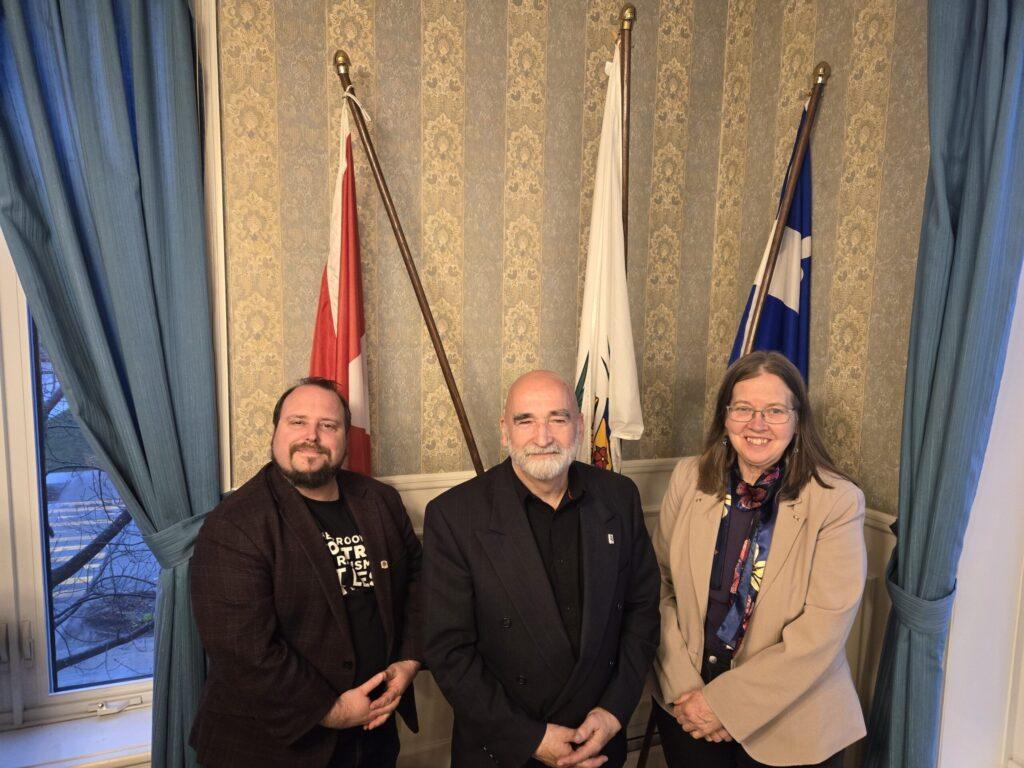
Pablo Rodriguez, Minister of Transport and Quebec Lieutenant, Pascale St-Onge, Minister of Canadian Heritage and MP for Brome-Missisquoi, and Élisabeth Brière, Parliamentary Secretary for Mental Health and Addictions and MP for Sherbrooke, presented the government’s plan for the rollout of the first phase of national universal pharmacare May 24. This initiative aims to provide universal access to most prescription contraceptives and diabetes medication.

The announcement took place at Collective for Free Choice in Sherbrooke. Representatives from ConcertAction Femmes Estrie, the Collective for Free Choice, Elixir, the Cégep de Sherbrooke’s Youth Clinic, the University of Sherbrooke Health Clinic, and Diabète Estrie were also in attendance.

Speaking first, Brière thanked The Collective for Free Choice for welcoming the three MPs into their premises. She said the collective has been instrumental in informing, raising awareness, and advocating for the rights of women in Sherbrooke since 1989. The collective works tirelessly, she continued, not only to maintain abortion services but also to empower women regarding their sexual and reproductive health.

Brière said ensuring that every woman has the freedom to choose, access to contraceptives is essential, and that this freedom should not come with a price tag. Addressing the gathering of representatives, she said their support and commitment to this cause are crucial for advancing the government’s efforts and creating a society where health choices are freely accessible.

Speaking next, St-Onge said the MPs presence in Sherbrooke sends a clear and straightforward message: the Liberal government will always support women and their reproductive rights. The health of Canadians and Quebecers is a priority for our government, she continued. This has been reinforced by our engagement with communities across Quebec and Canada, leading to unprecedented federal support for the health system here in Quebec.

Historically, St-Onge said, Quebec has been a leader in pharmaceutical insurance since 1996, but the government recognizes that there is always room for improvement; Canadians should never have to choose between medication and putting food on the table. St-Onge said the public health system in Canada was founded on the promise that all Canadians would have access to necessary medical care, regardless of their location or income.

Speaking last, Rodriguez said the theme of the 2024 federal budget was equity, particularly intergenerational equity. This involves building housing faster, protecting tenants, and helping young people buy their first homes, he said. It also includes, he continued, combating climate change and creating a robust economy with good jobs for future generations. He said equity also extends to Canada’s childcare services, dental care, and school meal programs, which ensure that Canada’s children receive the support they need.

Rodriguez said that with the 2024 budget and our current bill on pharmaceutical insurance, the federal government will make prescription contraceptives free for all Canadian women. This includes birth control pills, IUDs, and emergency contraception. The government will also allocate $80 million to organisations working on sexual and reproductive health, supporting their work on the ground.

During question period, The Record asked about supporting those who choose to start families. Rodriguez responded that various programs support families, including child benefits and housing initiatives. These changes significantly impact financial stability, with some receiving up to $7,000 monthly to help support their families.

When asked about the cost of this new pharmacare measure, Rodriguez mentioned that $1.5 billion is being invested, and negotiations with provinces will ensure comprehensive coverage. Regarding the distribution of the $80 million for organisations supporting sexual and reproductive health, Rodriguez clarified that it would commence once the budget is passed. He urged all parties, including the Bloc and Conservatives, to support this initiative for the swift availability of funds.

Another question focused on the birth rate and support for families. Rodriguez reiterated the government’s various support programs, emphasising that today’s announcement prioritises women’s right to choose whether and when to start a family.

Federal plan for universal access to contraceptives and diabetes medication announced in Sherbrooke Read More »

Bishop’s student awarded 3M National Student Fellowship

Sonoma Brawley. Photo courtesy

By William Crooks

Local Journalism Initiative

Sonoma Brawley, a student at Bishop’s University (BU), has been honoured with the prestigious 3M National Student Fellowship for 2024. This fellowship represents the highest national recognition of student educational leadership in Canada, according to a May 13 press release.

The 3M National Student Fellowship annually acknowledges up to ten full-time students from Canadian post-secondary institutions who have shown exceptional leadership both in their academic pursuits and their communities. These students are recognized for their commitment to enhancing the educational experience through leadership and community engagement.

Brawley, a second-year student at Bishop’s University, is pursuing a Bachelor of Arts in Music Performance with a Musical Theatre Concentration and an English Minor. Originally from Squamish, B.C., Brawley is also a Chancellor’s Excellence Scholar and a recipient of the Bishop’s Exceptional Student Talent (B.E.S.T.) Fund, which supports innovative experiential learning opportunities.

Additionally, she is a Stephen A. Jarislowsky Student Fellow, a three-term Humanities Senator for the Student Representative Council, Junior Co-Captain of the competitive dance team, and Co-Lead of the BU Music Society.

Brawley is recognized for her transformative leadership as a research fellow for the Hope Circuits project, which aims to rewire universities for human flourishing, and for her contributions to the Online Learning Technology Consultant program, which focuses on involving students in the design of 21st-century classrooms.

Brawley joins a distinguished group of Bishop’s students who have received this national recognition in recent years. Each year, only ten fellowships are awarded from over 1.1 million eligible students attending Canadian post-secondary institutions.

BU has celebrated eight student fellows in the past nine years, including Liam O’Toole (2023), Sufia Langevin (2022), Georges-Philippe Gadoury-Sansfaçon (2021), Maxim Jacques (2020), Ethan Pohl (2019), Théo Soucy (2018), and Jason Earl (2015).

Dr. Jessica Riddell, a 3M National Teaching Fellow and professor at BU, nominated Brawley for this award. She praised Brawley as “an exceptional student with a deep commitment to leadership, innovation, and advocacy, particularly in the field of humanities education. I have had the privilege of witnessing Sonoma’s transformative journey and contributions to our academic community at Bishop’s University and her impact in the public sphere.”

More from Sonoma Brawley

“[3M] looks at the current needs in higher education and society and seeks to implement change,” said Brawley, speaking on her achievement to The Record May 16. Brawley has sought to be engaged in the BU community, primarily in her role as a Humanities Senator for the university’s student union where she worked to convince her colleagues of the value and benefit of the humanities.

Brawley has also worked closely with Riddell on Riddell’s project for Hope Circuits, which seeks to “rewire university for human flourishing.” Her interest in the humanities developed in her last few years of high school and have been important to her throughout her “education journey.”

Brawley, coming from a small town in B.C., came to the conclusion that the arts are underfunded and underrepresented. She is grateful to have learned at BU what higher education looks like as a whole and how students can get involved and create change.

Brawley thinks bringing humanity and human experiences back into the university is essential. Students are not just numbers to be tracked on a sheet, she said, and need to feel welcomed and be encouraged to be themselves in the classroom. Different parts of the university system can be developed and improved, she insisted.

As a part of this fellowship, Brawley will be travelling to Niagara Falls for a weekend in June to attend a conference where she will meet up with the other winners of the award. She and her fellows will also receive funds to create a project in the teaching and learning field. She is really looking forward to bringing everything she learns from her fellows back to BU. She thinks it will “re-energize” and give her a new sense of purpose.

Going forward, Brawley would like to continue on in musical theatre. She is currently working in P.E.I. at a professional show, “Anne and Gilbert,” which follows the storyline of the second and third of Lucy Maud Montgomery’s famous series of books. A professor from BU, Wade Lynch, is directing the project. “It’s been a really fun process,” Brawley said, “it’s been an amazing experiential learning opportunity.”

Brawley is “incredibly honoured” to be recognized alongside nine other student leaders and innovators and is very grateful for all the support she received from mentors and teachers at BU.  

Bishop’s student awarded 3M National Student Fellowship Read More »

Townships tourism announces more than 100 new summer attractions

Tourism officials from every corner of the Townships spoke on the new attractions in their regions. Photo by William Crooks

By William Crooks

Local Journalism Initiative

Tourisme Cantons-de-l’Est (TCE) announced more than 100 new attractions and experiences for the upcoming summer season at a press conference in Sherbrooke May 21. From culinary adventures and invigorating outdoor activities to family entertainment and diverse accommodation options, the region promises unforgettable moments for visitors, according to a May 22 release.

Isabelle Charlebois, Executive Director of TCE, kicked off the conference, with representatives afterwards, from every corner of Townships, addressing those gathered on the new attractions in their regions.

“We’re here to celebrate the beginning of summer… I think you have some great new things this year to enjoy,” Charlebois said.

More information was revealed before the representatives spoke. According to a recent survey, about 70 per cent of local respondents are optimistic about the summer of 2024, reflecting confidence in the region’s potential to attract and delight visitors. Improved labour conditions are expected to enhance both visitor and employee experiences.

Despite a mixed winter season affected by mild weather and precipitation, the total solar eclipse on April 8 marked a significant boost for the local tourism industry, drawing over 55,000 visitors and generating more than $4 million in tourist spending. This event has greatly increased the region’s visibility on both national and international stages.

A recent survey by the Transat Tourism Chair indicates that the Townships is among the top three preferred destinations for Americans and Western Canadians planning summer trips.

TCE has launched its summer promotional campaign, “Close to You. Far from Ordinary,” targeting both the Quebec market and the English-speaking markets in Ontario and the northeastern United States. The campaign, supported by a robust media strategy and influencer partnerships, is backed by an investment exceeding $600,000.

New attractions in the Townships

This summer, visitors can enjoy many new or enhanced offerings across the region’s nine territories, detailed below:

– Auberge du Changement d’Ère in Coaticook introduces “Gouttes d’air,” spherical treehouse accommodations.

– Hébergement aux Cinq Sens in Piopolis features eco-friendly mini-homes inspired by indigenous values.

– Huttopia in Sutton expands with 15 new Canadian tents equipped with wood stoves.

– Quartier des Marinas in Magog offers 30 luxury suites aimed at corporate travelers.

– Espace Hors Champs in Austin combines accommodation with agricultural activities and farm-to-table dining.

Exploring national parks

– Mont-Mégantic National Park celebrates its 30th anniversary with a new show at ASTROLab.

– Frontenac National Park upgrades its camping facilities and adds a new event space, L’Oasis.

– Yamaska National Park enhances its accommodation options with 26 new camping units.

Unique culinary experiences

– Val Caudalies vineyard in Brome-Missisquoi debuts a new white melon wine.

– La Vallée du Moulin in Melbourne introduces eco-friendly fig cultivation.

– Restaurant Ôma in Dunham offers a farm-to-table dining experience by Chef Hakim Chajar.

Expanding Brewing Culture

– La Halte des Crinqués in Sherbrooke opens a Viking-themed microbrewery.

– À l’Abordage in Sutton expands to Bromont.

– Matera Brasseurs in Dunham joins the Brome-Missisquoi Wine Route.

Enhanced Cycling Routes

– Val-Saint-François region now features nine gravel bike routes covering 426 kilometers.

– La Frontalière offers an 87-kilometer cycling trail connecting Ayer’s Cliff and Newport, Vermont.

– Circuit des Trois Lacs in Granby stretches over 74 kilometers, connecting Estriade with Brome-Missisquoi.

Family Activities

– Ulverton Wool Mill offers an immersive historical tour with augmented reality.

– Scotstown introduces four new heritage tours via Balado Découverte.

– Maison Merry in Magog presents an exhibit showcasing the history of local photography.

Festivals and Events

– New events include the Bromont Wine Festival, Les Restos prennent l’air, FAUNE Festival, and Folk & Blues des Cantons. Numerous other musical, culinary, sports, and cultural events are set to make this summer vibrant and memorable.

Townships tourism announces more than 100 new summer attractions Read More »

New federal School Meal Program will help Sherbrooke, says local food charity director

Sherbrooke MP Élisabeth Brière, Compton-Stanstead MP Marie-Claude Bibeau, and La Grande Table Director Vincent Boutin gathered to discuss how the new federal School Meal Program will affect Sherbrooke. Photo by William Crooks

By William Crooks

Local Journalism Initiative

In the 2024 federal budget announcement, the Canadian government pledged an investment of $1 billion over five years to implement a new school meal program. This initiative is expected to provide nutritious meals to an additional 400,000 children, augmenting the existing school food services and addressing the critical issue of food insecurity among students.

Compton-Stanstead MP Marie-Claude Bibeau, Sherbrooke MP Élisabeth Brière, and La Grande Table Director Vincent Boutin, held an informal, joint press conference May 17 in the La Grande Table dining room to discuss the issue. La Grande Table is a food-assistance charitable organization that has been in operation in Sherbrooke since 1991.

“And it is certain that national aid would allow us to serve all of these young people, because for some people, even one dollar is too expensive to eat properly,” Boutin said to reporters.

“And at least with a national program… for us, it is certain that we see this in a positive light.”

The need for this program has been evident for years, according to the three. Discussions with local education authorities and visits to schools have highlighted the acute demand for better food support systems.

Boutin, a key figure in advocating for the program, has frequently noted the stark realities faced by schools, especially in economically disadvantaged areas like Sherbrooke. Recognized as one of the poorest constituencies in Canada, Sherbrooke stands to benefit significantly from this initiative.

The new funding aims to bridge the gap in nutritional provision within schools, ensuring that more children receive the meals they need to thrive academically and socially. Research consistently shows that proper nutrition is crucial for students’ energy levels, concentration, and overall performance in school. Moreover, it addresses the broader issue of food insecurity, which affects many families, particularly in low-income districts.

The federal government’s commitment includes not only the school meal program but also support for local food infrastructure through the Local Food Infrastructure Fund. This fund assists with the costs of essential equipment such as cold storage units, refrigerated trucks, and community kitchens, thereby enhancing the capacity of organizations like La Grande Table. This organization has been instrumental in providing meals to schools, and the new funds will enable it to expand its reach and impact.

For Sherbrooke, the practical impact of this program is already becoming evident. Two years ago, only 4-5 schools were receiving meal support through local initiatives; today, that number has increased to 13, with approximately 800-900 meals being served daily. However, this still only covers a fraction of the 43 school service centers in the area. With the new federal funding, it is anticipated that the program will extend to more schools, potentially increasing coverage to all schools in Sherbrooke.

Negotiations between the federal and Quebec governments are ongoing to finalize the transfer and allocation of funds. The intention is to enhance existing programs rather than replace provincial funding with federal money. This collaboration aims to ensure the program’s smooth implementation and long-term sustainability. Quebec is expected to receive around 22-23 per cent of the total funds, reflecting the usual distribution of federal support to the province.

In addition to providing meals, the program is designed to address cultural and logistical challenges faced by families. For many parents, transitioning from daycare, where meals are often provided, to school, where they need to prepare lunches, can be daunting. The new program aims to standardize meal provision across schools, easing this burden on families and ensuring all children have access to healthy, balanced meals.

The program also has significant educational benefits. Studies show that children who have access to nutritious meals are more likely to attend school regularly and perform better academically. The initiative is expected to boost school attendance and reduce dropout rates, particularly in underprivileged areas. Moreover, by providing a reliable source of nutritious food, the program can help foster better eating habits among children, which can have long-term health benefits.

The 2024 budget’s investment in school meals is part of a broader strategy to address child poverty and promote educational equity. The initiative is in line with the Canada Food Policy, which was developed with input from over 35,000 Canadians. This policy aims to ensure that all Canadians have access to healthy food and that the food system is resilient and sustainable.

The introduction of this program is timely, as the COVID-19 pandemic has exacerbated food insecurity and highlighted the importance of robust food support systems. The pandemic has led to an increase in demand for food assistance, both at food banks and within schools. The new school meal program is a response to these increased needs, providing a structured and sustainable solution to child hunger.

New federal School Meal Program will help Sherbrooke, says local food charity director Read More »

“Protected in perpetuity”

Friends of Quebec Lodge, some from as far away as Toronto, gathered May 18 for the organization’s annual spring work day to clear brush, stack wood, clean up the beach, put in the dock, and get things ready for the summer. Photo by William Crooks

Quebec Lodge teams up with Massawippi Conservation Trust to preserve forest

By William Crooks

Local Journalism Initiative

In a landmark agreement signed on April 24, the Quebec Lodge (QL) Foundation, in partnership with the Massawippi Conservation Trust and the Anglican Diocese of Quebec, secured the perpetual protection of roughly 50 acres of land east of Chemin du Lac.

This collaboration will see the Trust building and maintaining hiking trails on the property, with some areas set aside for future development by Quebec Lodge, including potential new “yurt villages” and an organic garden.

This effort aligns with QL’s long-term conservation goals and highlights the role of the Massawippi Conservation Trust and Foundation in preserving the natural beauty and ecological integrity of the Lake Massawippi watershed.

New QL Agreement

“The [QL] Foundation retains ownership,” explained QL Foundation Board Chair Ruth Sheeran to The Record May 17, “but we are working in partnership with the Massawippi Conservation Trust.” A servitude agreement was signed April 24 between the QL Foundation, the Massawippi Foundation, and the Anglican Diocese of Quebec, who donated the land to the QL Foundation in the first place.

The agreement pertains to the roughly 50 acres of land east of Chemin du Lac. The land is now “protected in perpetuity,” Sheeran said. The Massawippi Conservation Trust will build publicly-accessible, hand-made hiking trails through the property. It will also maintain them with a little help from QL staff.

Sheeran noted some areas of the land have been set aside for further QL development. QL currently operates one “yurt village” near its lodge, but has planned to eventually build as many as three villages, of three yurts each, in total. One new village may be placed on the now-protected land where QL used to run its “Pioneer” camps decades ago. Another area, a clearing hugging Chemin Taylor, may host an organic garden in the future.

Sheeran said preserving this land has been a goal of the QL Foundation since the camp was restarted after its closing nearly 20 years ago. “We’re pretty excited that we’ve accomplished that [with this partnership],” she said.

“[QL] is very interested in conservation,” said Massawippi Foundation Executive Director Helene Hamel to The Record May 18, “they have a beautiful property.” The Massawippi Foundation is an affiliate of an umbrella conservancy organization called Appalachian Corridor, who sent biologists to the land and determined it is worth protecting.

Notable natural inhabitants of the land include two kinds of bat, the Hoary bat and the Silver bat, both considered to be in a “precarious” situation, and three types of uncommon ferns. The property also contains areas of wetland. Hamel said the land will be inspected annually and will never be built upon regardless of potential future zoning changes.

The Massawippi Foundation and Massawippi Conservation Trust     

Hamel explained the relationship between the Massawippi Foundation and Massawippi Conservation Trust and their point and purpose, putting this novel agreement with QL into perspective:

The Massawippi Conservation Trust and the Massawippi Foundation, two sister organizations established in 2011, play a crucial role in environmental conservation in the Lake Massawippi watershed. These organizations, despite their different functions, work harmoniously towards a common goal of preserving the natural beauty and ecological integrity of the region.

The Massawippi Foundation primarily functions as the fundraising arm of the conservation efforts. It gathers the necessary financial resources to support the Trust’s activities. The Massawippi Conservation Trust is the operational entity responsible for stewardship and property management.

This structure allows the Trust to focus on direct conservation efforts, such as property ownership and trail management, while the Foundation handles fundraising and financial support.

The inception of these organizations was driven by a group of multi-generational families concerned about the increasing development on the mountain ridges west of Lake Massawippi. These families witnessed significant changes in the landscape, which prompted them to take action to protect the forests and ridges from further encroachment.

The Quebec government’s zoning regulations, which aimed to protect agricultural land, inadvertently left mountains unprotected, leading to increased development pressure on these areas. As lakefront properties became scarce, the demand for mountain-view properties grew, threatening the forests and ridges surrounding Lake Massawippi.

The organizations’ efforts were first focused on the western ridge of the lake, deemed the top priority for conservation due to its environmental significance. To date, they have protected approximately 1,300 acres, including over 800 acres owned directly by the Trust.

While the primary goal is conservation, the Trust also recognizes the benefits of providing public access to nature. Trails are developed with care to avoid sensitive areas, ensuring the preservation of rich ecological zones. For example, the Trust has constructed trails in Scowen Park in North Hatley, fulfilling agreements with local municipalities to provide public access.

The western ridge trails overlooking the lake, although limited to about 15 kilometers to prevent overuse, offer visitors a chance to experience the natural beauty of the area without disturbing critical habitats. Future plans include expanding trail networks, with new trails scheduled to open by 2026.

Originally focused on the five municipalities surrounding Lake Massawippi, the Trust has expanded its conservation efforts to the broader Massawippi watershed, including areas as far as Lake Lyster. This expansion reflects a growing commitment to preserving larger ecological systems beyond immediate lake surroundings.

One significant recent development is the signing of a conservation servitude with Burroughs Falls in Stanstead East. This marks the second servitude on the east side of the lake, with trail development planned for completion by October.

“Protected in perpetuity” Read More »

Pickleball courts and Del Monty revitalization

More Stanstead Council Meeting highlights

By William Crooks

Local Journalism Initiative

The recent Stanstead town council meeting held May 13, presided over by Mayor Jody Stone, covered significant updates on the development of pickleball courts and the revitalization of the Del Monty property, along with other municipal matters.

Pickleball Facilities near completion

The town has completed the procurement of essential equipment for its new pickleball courts in Generations Park, including four high-quality nets, paddles, and balls. The courts are designed to meet regulation standards, ensuring an optimal playing experience for residents. The selected equipment is known for its durability and suitability for frequent use.

To ensure fair and efficient use of the new facilities, the town is implementing a structured schedule. It will allocate specific times for various activities, including basketball and potentially roller hockey, to avoid scheduling conflicts and maximize the utility of the courts. Residents will have designated slots for pickleball, promoting organized play and accessibility.

Stone emphasized the importance of these facilities in promoting physical activity and enhancing community well-being. The new pickleball courts are expected to become a popular spot for recreational activities, catering to all age groups and encouraging a healthy lifestyle among residents.

Del Monty property revitalization efforts

The town is actively soliciting proposals to revitalize the Del Monty property. Stanstead came under the ownership of the historic Del Monty Hotel in 2021 after the building’s owner stopped paying property taxes several years previous.

The goal is to attract projects that can transform this area into a vibrant hub of activity. The town is open to both commercial and residential developments, aiming to boost local economic activity and improve the overall quality of life for residents.

A key component of the revitalization effort is community involvement. The town has launched a transparent process, inviting residents to voice their ideas, suggestions, and concerns. This inclusive approach ensures that the final development plan aligns with the community’s needs and preferences, fostering a sense of ownership and participation among residents.

Potential projects for the Del Monty property include mixed-use developments featuring retail spaces, residential units, and community amenities. These developments are expected to create jobs, attract new businesses, and generate additional revenue for the town. The focus is on sustainable and innovative solutions that can drive long-term economic growth and community development.

Border Theatre grant announcement

Stone announced the receipt of a federal grant amounting to $2.1 million for the restoration of the Border Theatre in Rock Island.

The grant will fund comprehensive restoration and modernization of the historic Border Theatre. Plans include upgrading the theatre’s infrastructure, enhancing accessibility, and installing state-of-the-art facilities to support a variety of events and performances. These improvements aim to preserve the theatre’s historical significance while making it a modern cultural venue.

The restoration of the Border Theatre is projected to attract more visitors to the area, providing a significant boost to local businesses. The theatre’s revitalization will also foster a vibrant cultural scene, offering residents and visitors access to diverse cultural and artistic events.

In addition, the council discussed a range of summer projects aimed at improving local infrastructure and providing recreational opportunities for residents. This includes maintaining and upgrading local parks, organizing community events, and ensuring the smooth operation of municipal services. These initiatives are designed to enhance the town’s appeal and offer a variety of activities for residents during the summer months.

Stone encouraged residents to stay engaged with the town’s initiatives and participate in upcoming meetings. The council values community feedback and aims to incorporate residents’ input into ongoing and future projects. Regular updates and open communication channels are part of the town’s strategy to maintain transparency and foster a collaborative community environment.

Pickleball courts and Del Monty revitalization Read More »

Lampe Foundation illuminates local learners

Lampe Foundation award and scholarship recipients addressed the gathering on their various projects (some could not attend in person). Photo by William Crooks

By William Crooks

Local Journalism Initiative

The Lampe Foundation held a ceremony May 15, handing out 25 scholarships and awards totaling $35,100 to local students at Lennoxville’s Hope Community Church. The Foundation forecasts awarding over $60,000 in total in 2024. The Record attended and interviewed three women involved in the event.

Julianne Cairns

Julianne Cairns is studying to be a physician; it is her first year receiving the Lampe/Tillotson Coaticook Region Fund Physician Scholarship and second year receiving a scholarship from the Lampe Foundation. She is in her second year at McGill, in her pre-clerkship phase.

At the moment, she is finishing up her pediatrics rotation at the Montreal Children’s Hospital. She has not ultimately decided what kind of doctor she will be, but she has put a lot of thought into it already.

One of her “deep passions” is neurology and neuroscience, something she studied previously at Bishop’s University (BU). Her interests primarily lie in neurosurgery.

She is also interested in family medicine, with a focus on addiction science. The issue is “deeply personal,” she has experienced loss in her family due to addiction.

Finally, she is interested in reconstructive plastic surgery, and has completed a rotation at the Montreal Jewish Hospital which focused on surgery helping those who have suffered from breast cancer.

Cairns grew up in a small town north of Montreal, but visited the Townships many times with her father, who loves the outdoors. Thus, she decided to pursue her education at BU. “I fell in love with the place,” she said.

A highlight of her time at BU was working in its research lab under Dr. Heather Lawford, which “opened her eyes to how research could be.” The experience was “beautiful and formative,” she added.

Carmen Moliner

Carmen Moliner’s family made a donation to the Lampe Foundation when her mother, Ouida Ramon-Moliner, passed away. “It was her donation,” Moliner clarified. Education is one of the Moliner family’s values, and one of the most important things you can give to your children as an inheritance, she said.

Moliner believes in supporting first-generation recipients, those who have “greater challenges” moving up the ladder. Her family’s award (named after Ouida) supports anybody in any discipline who wants to pursue higher education.

“Ouida was a very engaged woman in her community,” Moliner said, which came after a life working as an anesthesiologist. She worked at the CHUS until her retirement, and was very involved in the North Hatley community. “She was a forerunner of women in medicine,” Moliner added.

The Ouida Roman-Moliner Scholarship has been awarded since 2021.

Carol Mooney

Carol Mooney has been involved with the Lampe Foundation almost since its inception in 1993. She was co-president in the late ‘00s and is now a member of the board. She has stayed on because she finds it rewarding to be involved.

Awards have been added over the years, with families and individual donors stepping up and giving money to the Foundation. The awards are for men and women, but over half are for health scholarships. The Foundation also supports local student leaders in all levels of education, from high school and up. The biggest awards are for those pursuing their education to become a physician, which are renewable – some for three or four years.

Reading the applications for the awards is “heartwarming and heart-wrenching,” she said. Some have compelling stories, some had to delay their education. She enjoys seeing how the awards help local students on their way to future success, which she can see with her own eyes years later.           

Lampe Foundation  

For 30 years, the Lampe Foundation has supported education by providing financial assistance and mentoring to qualified students from the Eastern Townships and across Canada.

Originating from the Canadian Federation of University Women (CFUW) Sherbrooke & District Club’s efforts, the Foundation was established in 1993 with a new logo symbolizing knowledge and giving. Volunteers administer it, supported by CFUW, local businesses, and philanthropists.

In its 30th year, the Lampe Foundation launched the ’30 for 30 Campaign’ to fund a new Rural Opportunity Scholarship for students overcoming learning obstacles in rural communities.

The Foundation ranks in the top tier of Clubs in Canada for award value, behind Vancouver, Toronto, St. John’s, Ottawa, and Victoria clubs. It operates with a five-year strategic plan guiding daily operation. Over the past 30 years, the Foundation has grown exponentially, increasing its value from a modest $20,000 to $1,073,225.

Lampe Foundation illuminates local learners Read More »

Local health authority announces adjustments to summer services

By William Crooks

Local Journalism Initiative

The CIUSSS de l’Estrie-CHUS recently held its annual press conference May 16 to announce the adjustments to its service offerings for the upcoming summer season. Officials speaking included Karine Duchaineau, Deputy Director General for Social Programs and Rehabilitation, and Annie Boisvert, Deputy Director General for General and Specialized Physical Health Programs. They were joined by Yann Belzile, Director of Human Resources.

Duchaineau emphasized that the preparation for the summer season begins during the winter months, ensuring that the CIUSSS can handle the unique challenges of the summer. She noted that this year’s summer season is expected to be less demanding compared to the previous year, thanks to continuous learning and improvements.

Key adjustments in service offerings

1. Home Care Services

   – Reduction and Adjustment of Services: As in previous years, there will be a reduction in home care services during the summer. However, every patient will have a reference contact, such as a primary or pivot intervenor, to manage their care needs during this period.

   – Intensive Home Rehabilitation: A significant transformation in service delivery now allows for intensive rehabilitation to take place at patients’ homes. This is particularly beneficial for patients recovering from cerebrovascular accidents, providing physiotherapy, occupational therapy, and specialized education directly at home. This approach has led to high satisfaction rates among users and optimized hospital bed usage.

2. Long-term care facilities

Some long-term care facility beds, particularly in the western part of the territory (e.g., Bedford, Marie-Berthe-Couture, and Leclerc centers), will be closed temporarily through attrition, minimizing impact on residents.

3. Mental health services

All inpatient beds for mental health services will remain open. Services for mental health, dependencies, and homelessness will continue to be accessible, with priority given to those with urgent need.

4. Sampling centers

   – Closure and Redistribution: Three sampling centers (Lac-Brome, La Patrie, and Argyll (Sherbrooke)) will be closed for the summer. Patients can book appointments through Clic Santé, and those unable to use online services can call the designated phone numbers.

   – Increased Availability: There will be more sampling slots available this year compared to last summer. Notably, the Granit local service network has increased its capacity by 70 percent, offering more appointment slots and walk-in options.

5. Local service points

All local service points will remain operational except for one in Magog. These points will continue offering various health services, including COVID-19 and influenza testing, colorectal cancer screening, and rapid COVID-19 tests distribution. New services will be added in the coming months.

Community guidance

For those currently receiving services, it’s crucial to maintain contact with their reference intervenors for any updates. If appointment changes are not communicated, individuals should attend their scheduled appointments as usual. Additionally, those needing assistance with booking appointments can use the provided phone numbers.

Emergency and information contacts:

– General Health Information: 8-1-1, Option 1 (Info-Santé)

– Social and Mental Health Services: 8-1-1, Option 2 (Info-Social)

– Primary Care Access: 8-1-1, Option 3 (Primary Care Access Desk)

– Suicide Prevention: 1-866-APPELLE (1-866-277-3553)

These services operate 24/7 to provide support and guidance to the community.

For more information on the service adjustments and detailed schedules, visit the CIUSSS de l’Estrie-CHUS website at: santé-estrie.qc.ca

Boisvert emphasized the prioritization of urgent cases during the summer period. She reassured the public that emergency room services across the territory would remain accessible. Boisvert urged residents to use alternatives for non-urgent situations to reduce pressure on emergency rooms.

Regarding operating rooms, extensive efforts have been made to address surgical waitlists, focusing on cases that exceed waiting times. Plans are in place to continue these efforts throughout the summer, although activities in various operating rooms will be modulated based on specific site requirements. The aim is to maintain urgent surgeries and quickly resume full surgical activities post-summer to tackle waiting lists effectively.

Hospital bed usage will undergo similar modulation, with adjustments based on local needs and resource availability. Boisvert highlighted the importance of timely hospital discharges to free up beds for new patients. She also encouraged accepting transitional accommodation options if offered, even if not the first choice, to ensure appropriate care and maintain bed availability.

Question period highlights

During the question period, several issues were discussed:

1. Fluctuating Hospital Bed Usage: Approximately 120 to 140 hospital beds will be closed during the summer, representing around 10 percent of the total beds. This is a slight increase from the previous year, influenced by varying activity levels and staffing.

2. Staffing challenges: The region faces a potential shortage of up to 2,000 employees during the summer. However, proactive measures from a plan established in 2022 have mitigated the situation, preventing further deterioration. Forced overtime is considered a last resort, and efforts are ongoing to reduce its usage, which has already decreased by nearly 60 per cent since 2021.

3. Decentralization of hours: The implementation of decentralized scheduling has been successful, with over 5,000 employees participating. This approach has improved flexibility and reduced the need for forced overtime.

4. Employee turnover and gains: The CIUSSS has seen a significant improvement, moving from a loss of 3,000 employees to a net gain of 300 over the past year. This positive trend is attributed to enhanced employee engagement and better working conditions.

5. Fleurimont Hospital: Last summer, the operating room at Fleurimont faced considerable challenges, operating at 50 per cent capacity. Due to concerted efforts, capacity has now increased to 75-80 per cent. For the upcoming summer, six operating rooms will remain functional, with plans to reach full capacity by fall, depending on resource availability.

Local health authority announces adjustments to summer services Read More »

Sherbrooke’s youth protection workers mobilize for their safety

Nearly 200 of Sherbrooke’s youth protection workers demonstrated for their safety. Photo by William Crooks

By William Crooks

Local Journalism Initiative

On May 15, youth protection workers held a march from the Youth Centre office in Sherbrooke to the office of CEO Stéphane Tremblay on Argyll Street.

The purpose of the march was to deliver signed forms denouncing the numerous assaults occurring in the course of their work. The march comes days after the physical assault last week on a worker from the Direction de la protection de la jeunesse.

The Alliance du personnel professionnel et technique de la santé et des services sociaux (APTS) represents approximately 60,000 members who play an essential role in the functioning of the health and social services network, including nearly 5,000 at the CIUSSS de l’Estrie CHUS.

APTS Estrie Union Representative Danny Roulx was on the scene and led the demonstration through Sherbrooke after saying a few words of encouragement to those gathered.

“Following the aggression at the Palais de Justice last week… we find it deplorable how the administration has not listened to us,” Roulx said to The Record in a short interview in person before the march. More measures should be put in place, he added, and a recent meeting with the administration May 10 went poorly.

He said youth protection workers are mobilizing this week to let everyone know they experience too much physical, verbal, and non-verbal aggression and it is unacceptable. They are not always safe at work, and adding security measures has been difficult to work out with their employer. He said something must be put in place quickly to safeguard employees’ physical and psychological safety.

Aggression can come from the youth under their protection, but also parents. “[Youth protection workers] give excellent service to the population with all their hearts,” he said. Their security at work must be assured to prevent service interruptions or the workers quitting due to their lack of safety.

Roulx said the Palais de Justice does not have the resources to handle the problem on its own. Moreover, the workers need security everywhere they work, morning and night. They simply do not feel administration is listening, and they are passionately calling for more support.   

Sherbrooke’s youth protection workers mobilize for their safety Read More »

Stanstead’s water comes up clear

Photo by William Crooks

By William Crooks

Local Journalism Initiative

The Town of Stanstead recently announced its water has tested of excellent quality, along with the adoption of a resolution on a bid to remove sludge from its water system. The town undertakes annual waterworks maintenance to enhance its infrastructure and improve environmental hygiene.

Details of the process were revealed at the town’s monthly meeting May 13 amidst discussions on competitive service bids and advanced measurement techniques to optimize future operations. Mayor Jody Stone presided over the meeting with five residents in attendance.

Flushing the sludge

Stanstead is currently undertaking its annual maintenance of the waterworks network, which involves a meticulous flushing process to rid the system of build-up. During the meeting, it was disclosed that the town had received a competitive service offer from Quali-D’eau priced at $14,950 before tax.

Considering the town’s history of satisfactory results with past services, a motion was proposed to the council to accept an alternative service offer from the company Simo for the same task at the same price.

In a related matter, the council discussed the contractual needs for sludge measurement at the wastewater treatment plants serving the Beebe and Stanstead regions. This involves managing the draining of aerated basins, a critical task for maintaining the operational integrity of the treatment facilities. The town again had received a service bid from the company Simo.

A significant portion of the discussion focused on a comprehensive offer that included not just the measurements, but also the drafting and dissemination of a report to relevant governmental bodies. The offered amount was $7,584, considered reasonable given the scope of work.

The discussion further delved into the methodology of the measurement and sampling process. The thorough approach advocated by Simo is intended to provide an accurate baseline of sludge levels, which is crucial for the planning of subsequent sludge removal operations.

By obtaining a precise estimate of sludge volumes, the town can issue more accurate bids for sludge removal, potentially leading to cost savings by avoiding over or underestimation of the required services.

Moreover, the council members debated the broader implications of the measurement outcomes. They recognized that an accurate assessment could influence the scheduling of future cleanings, possibly extending the interval between necessary drainings. This would not only save money but also minimize the environmental impact of frequent cleanings.

How’s the water?

According to General Manager Hughes Ménard, the town’s environmental hygiene systems are functioning smoothly with no significant issues reported. The networks are currently stable, and as ongoing maintenance and upgrades are implemented, the focus has shifted predominantly to the town’s infrastructure, particularly in areas concerning telemetry, electronics, and pumps.

Recently, the town encountered challenges with its telemetry systems, which are crucial for monitoring the system’s environmental conditions. However, a comprehensive system reset was successfully executed last week, resolving the issue. This reset was part of broader efforts to streamline the network operations, including a significant update to the system’s hardware and software components.

Ménard said the network manager, referred to only as “Yannick,” has been instrumental in these updates. The system overhaul included consolidating operations which previously were managed across four separate computers at different locations. This consolidation has simplified the management and troubleshooting of the network, ensuring that all components are now linked and communicating effectively.

The town has recently received water analysis results from 2022, which included detailed assessments of various substances such as suspended materials, phosphorus, and PFAs (Per- and Polyfluoroalkyl Substances). The overall results indicate that the water from local wells is of excellent quality.

However, it was noted that the water is naturally hard, necessitating treatment to adjust its hardness. Despite this, the treated water meets and even exceeds major regulatory standards.

Stanstead’s water comes up clear Read More »

Action Patrimoine seeks reversal of demolition decision for historic North Hatley residence

By William Crooks

Local Journalism Initiative

Action Patrimoine, a non-profit organization dedicated to the protection and promotion of Quebec’s built heritage, has formally requested May 9 the MRC de Memphrémagog to overturn a recent decision by the Village of North Hatley’s municipal council to authorize the demolition of a historic home located at 190 Main Street.

In letters obtained by The Record addressed to Jacques Demers, Prefect and President of the MRC de Memphrémagog, as well as key provincial officials, Action Patrimoine expressed its strong opposition to the demolition. The organization, which has been active since 1975, argued that the house is an integral part of a protected heritage site established by the municipality in 1987.

Renée Genest, executive director of Action Patrimoine, highlighted in the letter the historical, architectural, landscape, and urbanistic value of the property, which she believes were not adequately considered by the council in their decision. She emphasized that the collective character of the heritage site, rather than individual buildings, contributes to its overall value.

Action Patrimoine had previously voiced its opposition to the demolition on Feb 9, 2023, and March 7, 2024. Despite these efforts, the municipal council followed the demolition committee’s recommendation on May 6, leading to the approval of the demolition.

The organization also raised concerns about procedural irregularities. According to Action Patrimoine, the preliminary program for the reuse of the cleared land, required by the municipality’s demolition regulation No. 2022-641, was not adequately presented.

This program should include detailed plans and architectural elevations of the proposed replacement buildings, but the document submitted to the council lacked these concrete plans. Moreover, it was noted that no maintenance had been performed on the house since 2017, leading to its deterioration, which further complicates the situation.

Action Patrimoine has urged the MRC de Memphrémagog to use its authority under Article 148.0.20.1 of the Act respecting land use planning and development to reverse the municipal council’s decision. They argue that the demolition regulation aims to control demolition works, protect culturally valuable buildings, and manage the reuse of cleared land, which they believe was not adhered to in this case.

Reaction from property owner

The Record contacted 190 Main Street Owner Kimberly Myles May 14 to get her perspective on the decision and more information on how things may unfold in the future.

“The decision has to be reviewed,” Myles said over the phone from New Jersey, “so we can’t make too many plans until we get through with the rest of the process.” She is relieved the North Hatley council made the decision it did May 6. Having to renovate a $300,000 house in a flood zone for $1.2 million is “crazy,” she added.

She appreciates that the town did its due diligence, including a heritage study that showed the house does not have anything more than average heritage value. “Nothing famous ever happened there,” she said. She sympathizes with those who hate to see change, but her plan is to build a single-family home that is in keeping with the other typical homes in North Hatley.

Myles said she was instructed by zoning inspectors that the decision to demolish the house was completely independent from what she planned on building in its place. She emphasized that whatever she decides to build, if given the green light, still has to meet all of North Hatley’s regulations and building codes. “There was no point in taking a design process all the way to completion if we are not going to be able to demolish the house,” she explained.

On March 20, when the demolition committee made its initial decision, Myles was present and said she could prove she did not know the property was classified as a heritage location when she initially made the purchase.

“I’m reluctant to name any names,” she said when questioned on the comment May 14, “we may decide to take some [legal] action on [not being told it was a heritage property].” She said she has it in writing that she inquired on whether or not there were any renovation or demolition restrictions on the house. “We were told we could do anything we wanted with the property,” she said.

Myles was told the MRC will be voting on the decision June 19. It is her understanding that the MRC has 90 days from May 6 to intervene.

MRC response

On May 13, The Record contacted the Memphremagog MRC over the phone for an interview or comment on the issue and left a message with its communications director with a deadline of 3 p.m. The Record followed up on the same day with an email asking what will go into the MRC’s decision, if the public has any influence, and how the process will work.

MRC Representative Philippe Vermette responded via email, which is summarized below:

The MRC can overturn the decision made by the municipality of North Hatley to issue a demolition permit for the building at 190 Main Street, which is located in a patrimonial site designated by a municipal citation by-law. The MRC has a 90-day window from the municipality council’s decision on May 6 to act on this matter.

The MRC will consider this case in a committee responsible for such matters, which is not open to the public. Following the committee’s review, the mayor’s council will either:

1) Approve the municipality’s decision to issue the permit, possibly with conditions;

2) Overturn the permit issuance;

3) Choose not to express any opinion on the matter.

Currently, the MRC has not yet acknowledged the issue and has no predetermined stance on the outcome. Additionally, unlike some urban planning by-laws, the MRC’s decision on this matter does not require a referendum approval.

North Hatley fails to respond

The Record placed three calls to the North Hatley municipality office from May 7 to 9 looking for a comment or interview regarding the May 6 decision, leaving a message each time. The Record sent an email on the same issue May 7. On May 9, the office receptionist answered the phone and confirmed the email had been forwarded to Mayor Marcella Davis-Gerrish.

Editor’s Note: Managing Editor Matthew McCully placed a call to North Hatley on May 13 and left a voicemail for director general Benoit Tremblay regarding the lack of response to media requests from the town and followed up later in the day with a call to the town’s receptionist, who said she would pass on the message. By press time on May 14 no one from the town had returned the call.

Action Patrimoine seeks reversal of demolition decision for historic North Hatley residence Read More »

Pro-Palestinian encampment set up at Sherbrooke University

SDHP Sherbrooke set up around 12 tents in an ongoing pro-Palestinian demonstration at Sherbrooke University. Photo by William Crooks

By William Crooks

Local Journalism Initiative

At the Université de Sherbrooke (UdeS), students have established a pro-Palestinian encampment, joining similar movements at McGill University and the Université du Québec à Montréal (UQAM).

The encampment features around a dozen tents set up May 13 in front of the university’s multifunctional pavilion.

The group organizing the encampment, Solidarité pour les droits humains des Palestiniens – Université de Sherbrooke (SDHP Sherbrooke), announced the action on Instagram.

They called for public condemnation of what they describe as genocide in Palestine and called for the support of other student movements, a denouncement of Canada’s alleged complicity, cessation of arms sales to the region, and full disclosure of related investments.

The Record contacted the UdeS communications team and its student association for comment but did not hear back before press time.

Pro-Palestinian encampment set up at Sherbrooke University Read More »

58th Finale of the Jeux du Quebec in Sherbrooke a success

Sherbrooke Mayor Évelyne Beaudin congratulated the event’s organizers and said Sherbrooke was proud to have hosted such an inspiring event for Quebec’s youth. Photo by William Crooks

By William Crooks

Local Journalism Initiative

The organizing committee of the 58th Finale of the Jeux du Québec-Sherbrooke 2024 (COFJQ) has announced it surpassed its objectives related to the legacy of the multi-sport event, held March 1 to 9.

The region’s athletes, sports organizations, institutional partners, and the community will benefit from the funds raised. The Games brought together 2,500 athletes aged 12 to 17 who competed in 19 disciplines across 10 sports venues in Sherbrooke.

“The 58th Finale of the Quebec Games was a mobilizing and inspiring event for our youth. As residents of Sherbrooke, we can be very proud to have hosted athletes and participants from across Quebec in such an exceptional manner. A huge thank you to the organizing committee, partners, volunteers, and everyone involved in this unforgettable adventure!” said Évelyne Beaudin, Mayor of Sherbrooke, at a May 13 press conference in City Hall.

“The success of the 58th Finale was obviously based on high-level competitions and services, but also on ensuring a lasting legacy. We worked hard to ensure this event leaves a positive impact on Sherbrooke. We are very happy with the results,” emphasized Jocelyn Proulx, Executive Director of COFJQ-Sherbrooke 2024.

A sum of $400,000 dedicated to the legacy was already included in the event’s budget, but the final amount exceeded these expectations.

Legacy of the 58th Finale of the Quebec Games:

– Canada Games 2013 Legacy Fund: $875,000

– Material Legacy to 12 Sports and Institutional Partners: $150,000

– Sherbrooke Sports and Leisure Fund: $50,000

– Major Renovations to Rock Forest Recreation Center: $5 million (Quebec Games Infrastructure Support Program, Ministry of Education)

– Mobilization of 2,500 volunteers, with over 775 expressing interest in future events in Sherbrooke

An economic impact study conducted by the firm Mallette at the request of the organizing committee revealed economic benefits amounting to $19.8 million.

The organizing committee sincerely thanks the members of its board of directors, SPORTSQUÉBEC, the City of Sherbrooke, the Quebec government, Kruger, Desjardins, all its national and regional partners, and its valuable volunteers for their contribution to this event, which will forever mark the history of Sherbrooke.

The organizing committee also gave special thanks to the following institutional partners without whom this event would not have been possible: Centre de services scolaire de la Région-de-Sherbrooke, Université de Sherbrooke, Bishop’s University (BU), Cégep de Sherbrooke, Collège du Mont-Sainte-Anne, CIUSSS de l’Estrie-CHUS, Conseil Sport Loisir de l’Estrie, and Excellence sportive Sherbrooke.

Matt McBrine, the director of sports at BU, expressed his gratitude to members of the organization for their excellent coordination. He emphasized that the success of the Games should be measured by the experiences of the athletes and their families.

McBrine noted that they surpassed all expectations and highlighted the growth of sports in Sherbrooke since the Canada Games in 2013. He praised the city for its impressive support and all of the Quebec regions for their participation.

“I hope we can continue as a group of sports enthusiasts, working together and investing in sports in Sherbrooke,” McBrine said.

“Certainly, you can count on my support and that of Bishop’s University.”

58th Finale of the Jeux du Quebec in Sherbrooke a success Read More »

To Grenada and beyond!

Jay Caunter’s sailboat anchored near Georgetown in the Bahamas. Photo courtesy

Local man sells everything, sails to Caribbean

By William Crooks

Local Journalism Initiative

Editor’s note: The following is the sequel to an article printed Nov 17, 2023. The Record caught up with Jay Caunter over the internet April 30 while he was anchored near Saint Martin in the northeast Caribbean.

Townshipper Jay Caunter sold his belongings and sailed down to the Caribbean, determined to fulfill his dreams. He is currently in the Caribbean, with his next major goal to be south of Grenada by June. He is staying connected with friends via phone and internet while prioritizing safety.

Caunter lived in Toronto for about 25 years before returning to North Hatley in 2011 to care for his father. After his father passed away, with no remaining family ties, he felt free to chase his aspirations. He sold everything, acquired a larger boat, a 1979 Sabre 34, in Sarnia, Ontario, and embarked on his journey.

“Rainstorms today,” Caunter said April 30 over the internet to The Record, “it’s been crazy.” It had been raining for three days. “Since I’ve been on the boat, I rarely know what day it is, let alone the time,” he added.

He said he has a “buddy boat” with him, and is waiting for him to put on a new sail. He has been in Saint Martin for about a month, which was not a part of his plans. Caunter is making some minor repairs to his boat before continuing on. “There’s always something to do,” he said.

He was in Luperon, Dominican Republic, for two weeks. He made quite a few repairs there, too, with inexpensive parts readily available. He also ordered a new sail while he was in the Bahamas, which he picked up at a friend’s place in the Virgin Islands.

The new sail is “really nice,” his old one was ripping all the time. His old main sail came with the boat originally; it was around 50 years old. Every time he would fold it up and put it away it would tear, and it used to tear in strong winds. He ran out of patching material about a month ago.

“The boat itself has been wonderful,” he went on, “nothing serious has gone wrong.” However, his new electronics have been “giving him grief.” His autopilot is right at the limit for what it can handle given the size of boat he has. It cost him a lot of money to fix, but he trusts the worker at the marina he visited knew what he was doing.

A friend of his came to join him in Miami for his crossing to the Bahamas. “It was the crossing from hell,” he said. Instead of the wind being 15 knots, it was 30 knots, and the waves were 15 feet tall. Caunter used his motor; sailing was too dangerous.

Waves like that need to be taken at a bit of an angle, but he more or less took them straight on. The trip took 11 hours. They left Miami at 4 a.m., so the first few hours were in the pitch black.

Caunter’s friend had never been on the ocean before. “When you can’t see the waves, you don’t realize how big they are,” he said, “it wasn’t really fun.” I was his first big excursion out into the ocean. When they reached Freeport, Caunter’s friend left and flew back to Vermont.

Caunter then continued on to Nassau, which was a “beautiful sail, lazy, not much wind.” In Nassau, he spent two weeks getting over Covid. He isolated himself on his boat while he was sick. “I had no energy, I could nap all day if I had to,” he said, “it took me 10, 12 days to feel human again.” Some of his fellow sailors visited, but did not get on his boat.

After getting over Covid, another friend from Vermont joined him on his sail to Georgetown. He ran into weather troubles again, and had to wait a few days for the wind to die down before making the trip. Once in Georgetown he had to wait three weeks to continue on, “waiting for a weather window to leave.”

“The hardest part is waiting,” he admitted. This year has been “extremely bad” for anybody sailing east. The wind is always coming from the east and it blows hard and kicks up big waves. He has to look carefully at the three days on either side of a potential weather window, because forecasts are not always spot on.

The weather was too bad for him to make a planned stop at Crooked Island, still in the Bahamas. He then made his way to Luperon and stayed a few weeks. One of his most “terrifying moments” happened in Luperon when approaching the “extremely dangerous” harbour at night.

He tried three times and was about to give up and just sail out a few miles, point into the wind, and wait until morning, but a local fisherman ended up leading him in. Caunter did not trust his electronics in the situation and could hear the waves crashing on shore nearby. Three markers were not working and you have to travel within 50 feet of nearby cliffs.

He eventually made his way to Saint Martin where he docked and prepared for the next leg of his voyage. He plans on being south of Grenada by June to ride out hurricane season there.

“What are you plans after that?” this reporter asked. “My plans after that are written in sand at low tide,” Caunter said.


To Grenada and beyond! Read More »

Sherbrooke MNA allocates salary increase to permanent preservation of Sherbrooke’s forested spaces

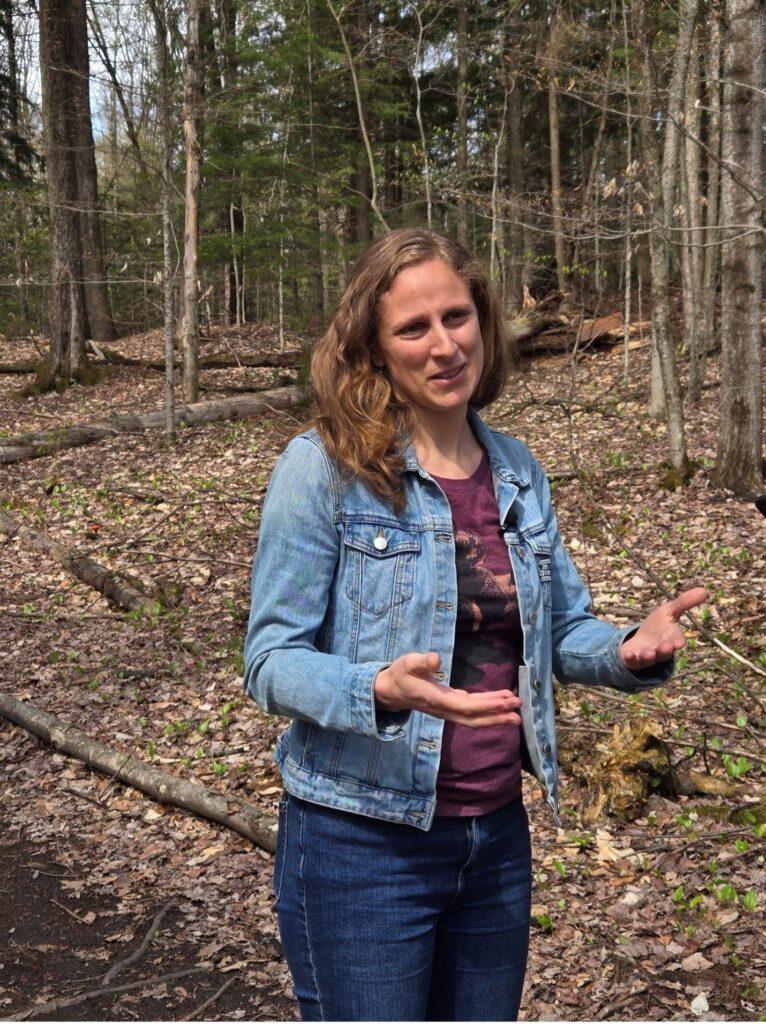
Sherbrooke MNA Christine Labrie explains why she is donating her raise to preserve the Ascot-Lennox Woodland. Photo by William Crooks

By William Crooks

Local Journalism Initiative

Christine Labrie, MNA for Sherbrooke and a member of Québec solidaire, has fulfilled her commitment to donate her entire salary increase to the community by supporting the establishment of a social utility trust aimed at protecting the city’s forested areas. The announcement was made May 10 in the Ascot-Lennox Woodland near Baker Street.

“I wanted to ensure that this money would have the most sustainable impact on the Sherbrooke community. As soon as I learned about the trust project from the Association for the Protection and Enhancement of the Ascot-Lennox Woodland, the decision became clear,” Labrie explained to reporters.

“By contributing to the protection of Sherbrooke’s remaining forested areas, I know that this money will benefit the community for generations to come.”

Her donation of $18,000 will enable the organization to create a social utility trust dedicated to safeguarding Sherbrooke’s ecologically or quality-of-life valuable natural spaces in perpetuity. The trust will ensure respectful access while maintaining ecological balance, according to a May 10 release.

“For our association members, it has always been essential to protect the Ascot-Lennox Woodland for the benefit of present and future generations. We’ve done this with an emphasis on social, environmental, and intergenerational justice,” said Mathieu Vinette, President of the Association for the Protection and Enhancement of the Ascot-Lennox Woodland.

“As we refined this idea, we recognized the value of establishing a trust, not just for the Ascot-Lennox Woodland but for any other natural space in Sherbrooke.”

Vinette welcomed Labrie’s contribution and hopes that others will be inspired to follow suit. Protec-Terre, an organization dedicated to environmental conservation and supporting communities in establishing agroecological social utility trusts, will assist the association in implementing the trust.

In June 2023, the CAQ members of the National Assembly passed legislation that increased deputies’ salaries by 30 per cent, despite opposition from Québec solidaire and civil society, who criticized the move as inappropriate. In response, Labrie pledged to donate her entire salary increase to the community.

More details were revealed as Labrie, Vinette, and Louis Béchard, representative of Protec-Terre, were questioned by reporters.

The trust itself holds a fiduciary estate, which can include real estate properties such as land. This might involve the woodland, but it encompasses the whole territory. This trust has a mission and designated uses. All assets within this trust must adhere to these designated uses.

The creation of the social utility trust, aimed at protecting and enhancing Sherbrooke’s woodlands, would allow individuals to donate to the trust, which could then be used to purchase lands that would be protected indefinitely. People could even bequeath their own land to the trust as an inheritance. The goal is to create a vehicle for acquiring as much land as possible to protect and enhance it further.

The Ascot-Lennox Woodland is the largest woodland within the urban perimeter of the city of Sherbrooke. It is located 5 km from downtown and spans 280 hectares of forest. It has gone through various stages related to conservation.

This project has real ecological value for ecologists, biologists, and human value for those living near the Ascot-Lennox Woodland. It is essential to think about these spaces because it is uncertain if they will be there in the future. What the project aims ensure is that residents, their children, and future generations can enjoy them.

Sherbrooke MNA allocates salary increase to permanent preservation of Sherbrooke’s forested spaces Read More »

Bishop’s Professor recognized as 3M National Teaching Fellow

Bishop’s Professor Dr. Heather Lawford. Photo courtesy

By William Crooks

Local Journalism Initiative

Dr. Heather Lawford, a distinguished professor in Bishop’s University’s (BU) Department of Psychology, has been honored as one of this year’s ten 3M National Teaching Fellows, signifying her position among the most impactful educators in higher education.

Her outstanding contributions have been acknowledged through prestigious teaching awards, and she is recognized as a Canada Research Chair and a leading authority on generativity, a field that explores how and why people create legacies to benefit others.

Lawford has been part of BU since 2012, where she has fostered a culture of curiosity around teaching and research. She values collaboration with her students and has actively engaged with diverse communities across Canada. She is committed to helping other faculty and administrators incorporate student perspectives into decision-making.

In 2021, Lawford earned the William and Nancy Turner Teaching Award, the highest teaching recognition at BU, according to a May 6 press release. Her exceptional work has also been recognized by the Robert Gordon Educational Leadership Fund and the Student Representative Council Social Sciences Division Teaching Award. She is actively involved with the Students Commission of Canada, a non-profit that amplifies youth voices and supports their legacy projects.

Lawford holds a Canada Research Chair in Youth Development and has secured over $8 million in research funding from Tri-Council, Public Safety Canada, UNICEF, and other organizations. Much of this funding has supported her mission of compensating students and youth for their valuable contributions.

Her forthcoming book, “Unlocking Superhero Powers: Metaphors and Mentorship in the Marvel Cinematic Universe”, co-authored with BU’s Dr. Jessica Riddell, aims to inspire readers to harness generative qualities for a more equitable and just world.

Riddell, a 3M National Teaching Fellow (2015) and Jarislowsky Chair of Undergraduate Excellence at BU, nominated Lawford for this fellowship. She has praised Dr. Lawford’s teaching style.

“Dr. Lawford extends learning beyond the classroom and into the world with student-led initiatives like conferences, summits, knowledge mobilization projects, and leadership institutes. Her undergraduate students are authentically engaged as partners, colleagues, co-authors, and co-inquirers. Dr. Lawford is a beloved and transformative educator,” Riddell said.

More from Dr. Lawford

“[3M’s] website says it’s the most prestigious award in Canada,” Lawford said in an interview with The Record May 9. They select 10 professors across Canada every year. She is always “up for getting an award,” but more importantly this is “a joining of a community of practice.”

The 10 professors selected will meet in June for a conference and then later will spend a week together in the fall in Banff, Alberta. The goal is to come up with a project that positively impacts higher education. Ideas, resources, and tools will be shared. “That’s what’s so exciting for me, a lifetime admittance to a conversation about how to do our job better,” she said.

Lawford’s research is on “youth generativity.” Adults think a lot about the legacies they want to leave and she has studied that phenomenon in young people. Much of her time has been spent trying to convince others that young people are interested in their legacies, too.

This has motivated her to think about how education can be transformed to allow youth to “connect to the legacy work they want to do now.” She has tried to connect young people to community organizations that let them see what is possible beyond what they have seen in their own life.

Something else she has been passionate about at BU is “knowledge mobilization.” A lot of students wish to go on to graduate school, she said, “but there are no jobs in academia, so what are we preparing them for?” She thinks the answer is there is a lot of work to be done in knowledge mobilization – turning science into action.

She just got back from a conference between researchers and members of parliament where they discussed how to build legislation off of evidence. BU’s knowledge mobilization certificate allows students to learn how to do it well and make a change outside of the classroom.

Lawford reiterated that she has found in her research that young people’s generative motivation is just as strong as it is in adults. Her studies have shown some highly generative youths are primarily driven by the notion that they do not want the next generation to deal with the same obstacles they did. These obstacles include language issues, unhealthy relationships, and lack of opportunity for racialized youth.

Lawford spent the morning of May 9 sending thank you letters to everyone who worked together to put in her application for the honour. She still feels a little emotional about it. She thinks it is great to see the profile of BU and other Maple League universities (Acadia, Mount Allison, and St. Francis Xavier) raised in association with her winning the award. “There are so many outstanding professors at BU that go unrecognized,” she said.

Lawford emphasized how important it was for non-profits to allow her students to experience what it was like working with them and noted the support other universities in the Maple League made to her research.        

Bishop’s Professor recognized as 3M National Teaching Fellow Read More »

The Cougar Run returns for a second edition

Participants were showered with coloured powder during the race. Photo by William Crooks.

By William Crooks

Local Journalism Initiative

The second edition of The Cougar Run was back and better than ever, offering a 5-kilometer course around Bishop’s University (BU) campus where participants were periodically immersed in a rainbow of coloured powder. This event welcomed participants of all ages and fitness levels to join in the fun, whether they chose to run, jog, walk, or dance through the course.

On May 11, the Cougar Run provided more than just an exciting course. Families could enjoy a lively atmosphere with music and a bouncy house for children. The first 150 participants to sign up received a pair of Cougar Run sunglasses and a Cougar Run t-shirt.

The event was a fundraiser supporting the Champlain-Lennoxville Foundation, with all proceeds directed toward athletic excellence (participation in national championships) and the General Fund, which aids in student success and well-being.

“We started it last year with the help of the Champlain-Lennoxville Foundation,” Organizer and Dean of Student Services Jean-François Joncas said in a brief interview with The Record on the scene. The goal of the run is to raise funds to support students in need. “We wanted something a bit different that brings the community together,” he said.

Some 92 people registered last year with this year’s total near 100 again. “We’re super excited, the weather is perfect,” he said. The women’s basketball team and the men’s football team helped out, along with BU security.

Joncas said it was optionally competitive, but the goal was for everyone to have fun. The course was comprised of two loops around campus. “We have a beautiful campus, so let’s use it,” he said.

After Joncas said a few words, participants warmed up. The race started near 10 a.m., with smiling competitors, sporting their brand-new sunglasses and t-shirts, running, jogging, or walking the course.

The Cougar Run returns for a second edition Read More »

Need your fashion sense restored?

Soon-to-be-restored Saint James Church in Hatley on the rainy day of May 9

Saint James Hatley announces Charity Lunch and Fashion Show

By William Crooks

Local Journalism Initiative

Saint James Church in Hatley is set to host a Lunch and Fashion Show event June 14 at noon. The event aims to raise funds for the restoration of the historic building.

Tickets for the event are priced at $125, with a $50 tax receipt provided to each attendee. The function will take place at the Massawippi Union Hall, located at 813 Route 208, Hatley, Quebec. Interested parties can make reservations by visiting the website at: stjameshatley.org

Saint James Restoration Project Heads Alexandra Reid and Peter Provencher filled The Record in on all the details over the phone May 7.

“This project has been going on since 2021,” Reid said, “it’s a slow process… it’s hard to raise money.” The project has already applied for three years of grants from the Conseil du Patrimoine Religieux du Québec (CPRQ). It is also in the midst of applying to Heritage Canada.

Monies from the CPRQ will go towards restoring the building, while Heritage Canada primarily supports transforming the soon-to-be former church into a novel space for community-oriented activities. Reid said the Town of Hatley has been very supportive in helping the project navigate all the “loops and hoops” it has had to go through.

“It’s about a $1.4 million project,” said Provencher, elaborating on the project’s financial aspect. Fundraising events like the fashion show and other donations will comprise about $500,000, while the other $900,000 will come from grants. The CPRQ has already confirmed $438,000.

“For us to kick off our capital campaign, we need to see construction activity at the church,” he said. People need to see concrete action before lending their support, he continued, which is fully understandable.

The church is currently overseen by the St. Francis Deanery of the Anglican Diocese of Quebec. “It is an Anglican Church endeavour to restore this [year] 1827 church,” Reid explained. The church is the oldest wooden church in English Quebec. It is a Class A heritage building – the highest possible designation.

The restoration of the building has been unofficially awarded to a general contractor with a lot of experience in heritage restoration. “We’ll actually be seeing digging this summer, which is great,” Reid said, “we’re finally moving forward.”

The coming construction in June will represent one third of the project’s cost, Provencher said. This will include work on the foundation and installing proper drainage. The stained-glass windows will also be removed and sent to a specialist in the province.

In 2025, the project will ask the CPRQ for additional stages of funding with the grand opening of the building set for May 1, 2027. In July 2027, the church will be 200 years old, so a huge gathering and celebration will be held tied into Hatley’s Canada Day parade.

The project has met with nearby cultural groups, and some from Montreal, who are all very interested in using the space for art shows, poetry readings, book launches, and concerts. A committee will be formed to manage and maintain the church.

Speaking on the fashion show, Reid said that more than a fundraiser, the project is using it to raise awareness amongst locals that the project is happening. The project was initially looking for adults to participate, but ended up finding children more amenable to the idea. “People don’t really want to strut up and down the runway,” she said with a laugh. Local clothing store Hatley jumped at the chance to provide clothing for the show.

“It’s going to be beautifully decorated… and the food will be divine,” Reid said. The event will be catered by Magog’s White Horse Café Bistro.             

For additional information, potential attendees of the event are encouraged to contact the organizers via email at: stjameschurchhatley@gmail.com

Need your fashion sense restored? Read More »

Roads, $11 million in loans, and ballparks

Mayor Mario Gendron presided over the 45-minute meeting with well over 50 separate items on the agenda

Cookshire-Eaton holds its monthly council meeting

By William Crooks

Local Journalism Initiative

The Municipal Council of Cookshire-Eaton held its monthly meeting May 6 at the Cookshire Town Hall, with much of the public discussion centering around the use and abuse of local roads.

Topics at the meeting also included two unanimously adopted bylaws authorizing substantial loans, one of more than $11 million, and a proposal to replace Birchton’s baseball field with a housing development.

Mayor Mario Gendron presided over the meeting with around nine local residents in attendance. The meeting lasted roughly 45 minutes, with well over 50 separate items on the agenda.

Roads   

In the meeting’s first question period, community members voiced concerns about local infrastructure, municipal projects, and public safety issues. The conversation started with a citizen addressing Gendron directly.

He offered a proposal concerning municipal street cleaning operations. Observing street cleaners at work, he believes their labour conditions are deplorable and inefficient. He suggested the city should invest in advanced cleaning machines that can streamline the process. According to him, these machines can significantly reduce the workforce required, resulting in more efficient cleaning.

Throughout, he passionately described the difficulty street workers endure, emphasizing how disheartening it is to see them struggle. He insisted that better equipment would make their work easier, allowing one operator to do the job of multiple people.

He also brought up a Facebook post advertising a new machine that could handle the workload with a single person. He expressed concerned about the maintenance of the equipment, noting that sometimes machines are down for repairs.

Another individual raised concerns about the grading of gravel roads. He claimed that the current maintenance isn’t keeping up with demand, leaving potholes that reappear shortly after grading. The individual questioned the need for additional graders, considering that in the past, fewer graders handled the same workload without a problem.

Further conversation highlighted road widening initiatives that could necessitate additional gravel. Residents expressed frustration with the inefficacy of repairs, noting that water drainage issues persist. The municipality’s reliance on external contracts rather than fully utilizing in-house resources was questioned, and Gendron acknowledged the concern.

Another speaker discussed speeding vehicles in a residential area. He reported how a delivery driver was recently clocked at 64 km/h on Chemin Learned Plain, endangering pedestrians and employees who work near a blind curve. He suggested reducing the speed limit to 30 km/h to ensure safety.

The conversation briefly shifted to the perceived negligence of a local event organizer who allegedly failed to notify residents about decibel testing and other measures to mitigate noise complaints. A council member claimed that the project is suitable but agreed it shouldn’t occur near residential neighborhoods.

Finally, a citizen questioned the recent voting process for a dam project in Cookshire. He mentioned confusion about the process, recounting how he was informed that he had missed some paperwork during the voting. After a neighbour’s call, he returned to rectify the issue, but was upset that it occurred. A council member agreed that it should not have happened, but insisted it was unintentional.

Throughout the meeting, Gendron listened attentively, validating concerns and promising follow-up actions or further clarification with relevant departments or stakeholders.

Loans

Notable amongst the many items on the agenda were two new unanimously-adopted bylaws introduced to authorize large loans.

The first allowed the town to go ahead with an expenditure and a loan of $800,000 for the repair of municipal services on Sawyer, Bibeau, and de la Meunerie streets.

The second focused on the implementation of a water network in the Johnville area. This by-law will permit a loan of $11.1 million for the project, which will include a grant from the Ministry of Municipal Affairs and Housing under the Municipal Infrastructure Program.

Ballpark

The Record received a message in mid-April urging it to look into the proposed replacement of Birchton’s park with a housing development.

The message said tensions are rising due to the municipality’s plan to demolish the ballpark, playground, and picnic area in favor of an expensive housing development. It said since merging with Cookshire, Birchton has lost several amenities and now faces losing more.

The message said Yvon Roy, who contributed significantly to the park’s creation and is a former town councillor, is determined to oppose the plan. The Record was provided with Roy’s contact information but has received no response to attempts to contact him since April 17.

At the end of the second question period on May 6, the Record asked the council about the issue.

Councillor Marcel Charpentier responded that a meeting would be held May 14 wherein residents from Birchton are going to “tell [the council] what they want.”

“Nothing is decided,” he added.

“We’ll go from there,” Charpentier continued, “there’s no skyscrapers going up yet.”

He went further and explained that no baseball is possible at the park because the town cannot get the appropriate insurance. “We have two really nice ballparks, one in Sawyerville and one in Johnville,” he said, which are insurable.

The Birchton ballpark is not insurable because the “ball goes too far,” he said, “and you cannot control who goes on there.”

The Record was initially under the impression that the upcoming meeting will be open to the public, for an attendee urged this reporter to put the date of the future consultation in this report.

However, Adjoint General Director France Dumont confirmed May 7 in an email that “there is a meeting between a citizens’ committee and the city, but it is not public.”

The Record followed up and asked who was on the citizen’s committee and why the meeting will not be public but did not receive a response before this article went to press.   

Roads, $11 million in loans, and ballparks Read More »

May flowers bloom

Mary Neville shows off this year’s flora, with her new business set to open May 8

New Neville greenhouse set to open this week

By William Crooks

Local Journalism Initiative

Les Serres Mary Neville, located just outside Lennoxville on Chemin Dillon, will open its doors to the public for the first time May 8. Selling a wide variety of flowers, vegetables, and herbs until June 30, the greenhouse is the latest iteration of the local Neville family’s decades-long history of providing plants to the area.

“My parents had the business for many, many years,” Owner and Operator Mary Neville said to The Record in a May 6 interview on her property. The Nevilles previously operated a garden centre in Lennoxville on Queen Street beginning in the late 80s. “I grew up in this,” she said.

Initially, Neville did not want to take over the business, but she helped out on and off her entire life. Neville returned to university in her early thirties and worked at the family business full time from spring until the early autumn. “It was those years when I started really liking it a lot,” she said.

Neville’s parents eventually sold the garden centre and she worked for the new owners for three years. This is when she really gained the experience to “be in charge of everything.” She learned a lot and it went really well.

The best way to do retail and production is to sell from the place you are producing, she went on, because it limits costs. Moving plants from one place to another is a “huge job.” Full time staff are needed to load, unload and place everything. That is why she decided to do it all at one location.

“This year we’re keeping it pretty simple, because it was a little last minute,” she said. She plans on expanding every year. Moving forward, she is looking to have more perennials, indoor plants, shrubs and even fruit trees.

The Nevilles suffered a fire at their production greenhouses on Dillon in 2018. All five greenhouses used to be heated and running all season. Two greenhouses remain functional. Her secondary greenhouse currently holds mostly vegetables. They are saving money by heating with sawdust from their own land along with the standard propane.

Neville received the cuttings for this year’s crop around March 22. Before that there was clean up and preparation to do. “I had about a month and three weeks to grow all this stuff,” she said with a laugh. Neville has no real staff; her parents are helping with some of the logistics, such as the accounting, setting up the cash register, taking orders, and taking care of the vegetables.

Neville emphasized she does not use any chemical fertilizers or any chemicals at all with her vegetables. She does use fertilizer for her flowers. “It’s pretty hard not to with flowers,” she admitted. Nevertheless, she uses no insecticides or plant-growth regulators.

She said many industrial-sized greenhouses use plant-growth regulators to slow the growth of their plants to keep them a certain size before shipping. Plant-growth regulator use can be hazardous and requires special safety equipment. She said they space the plants properly instead so they keep a nice shape.

Neville has already received advance orders from the municipality of Waterville and Bishop’s College School. Other individuals have pre-ordered special boxes of flowers and arrangements. “If people want something really nice, I’m your man,” she said.

Neville stressed that clients will be able to pay by card. “People think, ‘Oh, we’re going to the country, so it’s cash-only,’” she said, “but it’s not.” They will also provide a delivery service; she just bought a van for the purpose.

Expansion next year will depend on how things go this year. She would love to get her other greenhouses going, but they would need to set up the heat and plumbing, and do a few minor repairs. These greenhouses are framed in metal and were partially melted in the fire. “We know how to do it all,” she said, “I hope over time it will happen – I’d like it to.”

“We’re always here for advice,” Neville said. She said she can usually figure out her clients’ problems and offer solutions. She has accumulated a lot of knowledge over the years.

“Come on over to ours this season!” reads Neville’s new brochure.

Find out more here: www.lesserresmaryneville.com   

May flowers bloom Read More »

Detached dwelling dos and don’ts

Sherbrooke officials hold consultation meeting in Lennoxville on proposed new construction bylaws

By William Crooks

Local Journalism Initiative

Officials from the city of Sherbrooke held a public consultation meeting April 30 at Lennoxville’s Town Hall to discuss several proposed by-laws concerning the city’s zoning and construction codes. City Councillor and Borough President Claude Charron presided over the meeting with a few members of the public in attendance.

Charron explained the purpose of the new rules in his own words during the meeting. He called the process “soft densification,” where the city’s officials are encouraging the practice of adding additional dwellings to single-family or semi-detached properties.

He emphasized that this approach, which involves minor additions or modifications, contrasts with “hard game” densification, which could involve building larger structures that might affect the landscape and other aspects of the environment.

The idea behind soft densification is that it can support multi-generational living or provide housing for students. The city has aligned its laws to facilitate such modifications, whereas previously one would have needed to apply for a permit to make these changes. The overarching goal is to encourage this type of gradual and gentle increase in housing density.

Among the bylaws discussed were amendments to the zoning and subdivision by-law, which would allow the construction of additional attached or detached dwelling units for secondary use in single-family or two-family dwellings.

Another item proposed integrating the National Building Code of Canada 2015 into Sherbrooke’s construction by-law. Further discussion centered on requiring fire separation for secondary use detached dwelling units and amending conditional use by-laws to cover additional dwelling units and expansions.

The following is a summary and selection of the voluminous proposed technical changes to Sherbrooke’s municipal regulations, which will go into effect, unless appealed, within the next few months:

Bylaw 1200-222: Zoning and Subdivision Regulations

1. Definition of Principal Residence:

   – A principal residence is defined as a residence where a person primarily resides, centralizing their family and social activities.

   – This definition was added to respond to public consultation feedback.

   – Requirement: The residence must be the principal residence of one of the persons living in the dwelling.

   – The definition is aligned with the Quebec Tourism Accommodation Act.

2. Main Buildings and Detached Units:

   – The city has a limit of one principal building per plot.

   – Exception: Allows an additional detached dwelling unit alongside the main residence. This applies to additional detached units located in the backyard.

3. Building Dimensions:

   – Minimum Area: For main buildings, the minimum area was 45 square meters, with a minimum frontage of 7.3 meters. This requirement is removed for additional detached units.

   – Maximum Area: The maximum area for an additional detached unit is 70 square meters.

   – Maximum Height: The height of the additional detached unit should not exceed that of the main dwelling.

4. Building Accessories:

   – The total number of accessory buildings on a lot is limited to two.

   – A person cannot have two accessory buildings, such as two garages, and then add a third building as a detached dwelling.

   – For example, one garage and one detached additional dwelling are permissible.

5. Parking Regulations:

   – For complementary dwellings, integrated and detached additional units, no specific minimum parking space is required.

   – The number of parking spaces will be evaluated under conditional use regulations to satisfy the residents’ needs.

   – The evaluation will be conducted by the Planning Advisory Committee and the municipal council.

6. Additional Regulations for Detached Units:

   – Location: The additional detached dwelling must be located on the same lot as the principal residence. No cadastral operation can dissociate the two buildings.

   – Occupancy: One of the dwellings must be occupied by a person for whom the dwelling is the principal residence. The lot must have a minimum area of 450 square meters.

   – Foundation: The building must be constructed on a foundation that conforms to the building code.

   – Balconies: Only one balcony, with a maximum area of 5 square meters, is allowed on certain facades.

   – Utilities: A single water and sewer connection must serve both the main and additional dwellings.

   – Privacy: Landscaping or fencing should preserve the neighbors’ privacy.

   – Shared Spaces: The shared amenities, such as swings or pools, are encouraged to be used by all occupants.

   – Floor Area: The floor area of the additional dwelling must not exceed 35 percent of the total floor area of the main building, including the basement but excluding the garage.

7. Procedural Steps:

   – June 4th: Planned adoption.

   – June 4th – July 4th: Period for appeals to the Commission Municipale du Québec on conformity with the urban planning scheme.

   – July 6th: Expected enforcement date.

 Bylaw 1201-4: Construction regulations

1. Fire Separation Requirements:

   – Introduces fire separation requirements for detached additional units.

   – Separation: At least 45 minutes of fire resistance is required between a garage and an additional dwelling.

2. Procedural Steps: same as above.

Bylaws 1206-2 and 1201-3: Conditional use regulations

1. Overview:

   – Updates building regulations and aligns with the 2015 Building Code.

   – Alternative Solutions: Allows for alternative measures if they meet safety standards, approved by professionals.

2. Regulation of Conditional Uses:

   – Applies to detached additional units, integrated additional units requiring an extension, and complementary units requiring an extension.

   – The evaluation of conditional use requests follows a defined process, including examination by the Planning Advisory Committee and the municipal council.

   – Criteria for Evaluation:

     – Compatibility with surrounding uses.

     – Minimal impact in terms of nuisances like light and noise.

     – Harmonious integration with the built environment.

     – Preservation of trees and vegetation.

     – Adequate parking for the residents’ needs.

3. Solution of Last Resort:

   – If compliance with the building code is impossible, the city may accept an alternative solution if approved by an engineer or architect.

   – The alternative solution must maintain the safety of occupants and the building.

   – An advisory committee evaluates the proposed alternative measures.

4. Procedural Steps: same as above.  

Detached dwelling dos and don’ts Read More »

Sherbrooke Mayor steps back

Sherbrooke Mayor Évelyne Beaudin answers reporters’ questions after stepping down as head of the Sherbrooke Citoyen party and announcing she will not seek re-election as mayor in 2025

Beaudin steps down as head of Sherbrooke Citoyen party, will not seek re-election for mayor

By William Crooks

Local Journalism Initiative

Sherbrooke Mayor Évelyne Beaudin announced May 3 her decision not to seek re-election in the November 2025 municipal elections. She intends to complete her current term to fulfill commitments made to the citizens of Sherbrooke.

Concurrently, she will resign from her position as leader of the Sherbrooke Citoyen party. The interim leadership of the party will be assumed by councillor Geneviève La Roche until a new party leader is elected.

Surrounded by reporters and backed by Citoyen elected officials at City Hall, Beaudin expressed her dedication to founding a new political party and to the profound reform of municipal governance, stating her belief in her suitability for the tasks she undertook during her term.

She mentioned that it seemed prudent to make way for a new mayor who can bring different talents and strengths, as well as a fresh approach to meet the evolving needs of the city. She remains confident and committed to honoring her avowed obligations to the populace until the end of her term in November 2025.

Beaudin also advocated for a thorough and expanded reflection on local democracy and reiterated the need for a consultation commission throughout Quebec to lay the groundwork for reforming local democratic institutions.

Responding to reporters after the announcement, Beaudin said she was primarily feeling a sense of accomplishment. She admitted recent political difficulties have “left a mark” on her. Her decision to stay on as mayor until the next election is all part of the original four-year plan her party devised at the beginning of her mandate.

While she feels good and full of energy at the moment, she does not see herself as able to put in another four years after her mandate ends. In addition, she is unsure what the political context surrounding her party will be around the time of re-election.

She thanked those who voted for her “from the bottom of her heart.” It is not time to say goodbye, she said, for 18 months still remain in her term.

“Politics will remain politics,” she responded to a reporter asking if this decision would “lower the tension” in city hall. She thinks tensions will rise, as is normal, with the approach of the next elections.

She hopes the media will turn their attention in the next few months to the leadership election for head of the Citoyen party. She feels she still has the support of Sherbrooke citizens, with many residents expressing it to her in person.

The Record asked if her decision had anything to do with recent high-level resignations and the criticism of Beaudin from some of Sherbrooke independent elected officials. “No,” she responded.

Councillor Danielle Berthold recently resigned as chair of the city executive committee following a phone call from Beaudin, which Berthold interpreted as threatening. During the call on April 8, after Berthold informed Beaudin of her intent to vote against the pool tax, Berthold said Beaudin emphasized the importance of unity in the committee and warned of consequences for dissent.

Several independent members of Sherbrooke city council expressed concerns last month to the Record about the future of democratic debate in the chamber, as Beaudin’s Citoyen slate increasingly fills key roles.

Sherbrooke Mayor steps back Read More »

Lenn’ me your ears!

Stanstead College cleans up at CFUW public-speaking contest

By William Crooks

Local Journalism Initiative

Two students from Stanstead College, Alison Om (Senior) and Jade Thibault (Junior), won in their respective categories at the Canadian Federation of University Women- Sherbrooke and District’s (CFUW) annual public-speaking competition held May 1 in the basement of Lennoxville’s Hope Community Church. The winners received $100 each for their school’s library.

Organizer Jane Loiselle presided over the event with nearly 40 in attendance, including local politicians Claude Charron and Jennifer Garfat. The competition was put on hiatus for four years due to the pandemic.

Some seven students from local high schools participated. Loiselle said some schools were not represented due to exam rescheduling caused by the teacher’s strikes at the end of last year. Previous events boasted upwards of 20 young competitors.

Judging the event were Tim Belford, former CBC “Quebec AM” radio show host and columnist for The Record, Jan Draper, senior project coordinator of Write Here, Write Now, and Bev Taber Smith, who is involved with the Townships Sun and the CFUW.

The following are the names of the student participants, the title of their speech, what school and category they represented, and a short summary of what they said:

Kayla Pietraszkiewicz – “Animal testing should be banned worldwide” (Galt Junior)

In an evocative speech, Pietraszkiewicz passionately argued against animal testing, depicting its brutal reality where animals endure extreme suffering for products meant for human use.

She highlighted the high failure rate of such tests and the subsequent unreliability in medicine, questioning the justification of such cruelty.

She pointed out the environmental hazards from disposing of the tested animals and urged a global ban on animal testing, noting the unnecessary loss of animal lives and the ineffectiveness of the results in contributing valuable medical information.

She advocated for consumer awareness and choosing products that do not perpetuate animal suffering.

Alexandre Papillon – “What’s on our plate?” (BCS Junior)

Papillon’s presentation addressed the transparency and safety concerns surrounding Canadian food safety standards.

He pointed out that commonly enjoyed products like gummy bears are made with gelatin derived from cattle bones and pork skin, which many consumers may not be aware of. Furthermore, he highlighted that certain toxins, including melamine known to harm kidneys, are legally permitted in food products like dairy.

He also mentioned troubling findings of physical contaminants such as glass and paintbrush parts in food, demonstrating potential flaws in current regulatory practices.

He suggested that adopting organic foods could mitigate exposure to artificial chemicals and reduce environmental pollution, advocating for improved food safety regulations and clearer labeling to better inform consumers.

Jade Thibault – “It’s not enough to be against something. You have to be for something better” (Stanstead Junior)

Thibault addressed fellow students, faculty, judges, and guests, invoking a powerful quote from Tony Stark in “Avengers: Endgame”: “It’s not enough to be against something. You have to be for something better.”

This choice was motivated by her belief in the quote’s truthfulness. She interpreted it as a call to support causes actively seeking change, rather than merely opposing issues, which she deemed performative.

The example of Martin Luther King Jr. was highlighted, noting his peaceful, proactive stance against inequality, exemplified by actions like the Montgomery Bus Boycott.

She emphasized the importance of nonviolent solutions, urging the audience to engage in activities like protests, signing petitions, and encouraging participation in social causes.

She challenged the audience to reflect on their role in combating inequality, underscoring the ongoing struggle but affirming the impact of individual contributions toward societal change.

Janani Spurthui Sikhakolli – “Measles” (Galt Junior)

Sikhakolli said measles, once believed to be under control, remains a highly contagious disease, with 90 per cent infection rates among the unprotected.

She said it manifests with flu-like symptoms and distinctive irritating rashes. Historically noted since the 9th century, measles caused up to 2.6 million deaths annually before widespread vaccination.

Despite vaccinations reducing occurrences, the COVID-19 pandemic diverted attention and resources, causing a resurgence.

Annually, measles still affects nine million people globally, leading to around 136,000 deaths. Vaccination remains the most effective prevention, with a 97 per cent efficacy rate with two doses.

She said this alarming persistence underscores the need for continuous public health vigilance and education about measles.

Aurélie Monast-Haddad – “Our Accent, Our Legacy” (BCS Senior)

Monast-Haddad announced her topic on accent discrimination and its deep-seated roots in societal norms.

She described accent discrimination as a systemic linguistic oppression impacting millions globally. She admitted her own guilt in perpetuating these biases, despite being a victim of mockery for her Quebecois accent, highlighting a lack of representation in the media and the scorn it incites even among Quebecers.

She explained the cognitive strain foreign accents produce, which unfortunately leads to negative perceptions.

She advocated for awareness and inclusivity, emphasizing that accents are more than just pronunciations; they are the legacies and histories of individuals, deserving respect and honour rather than mockery.

Arabella MacAulay-Fishman – “Why you should vote” (BCS Senior)

MacAulay-Fishman, a 15-year-old Grade 10 student, passionately addressed the importance of voting and the need for better political education in schools.

She noted that in Canada’s last election, only 78 per cent of eligible voters participated, leaving over 12 million people who did not vote. She emphasized that even those uninterested in politics are affected by election outcomes, which influence crucial policies on education, healthcare, and the environment.

She argued that non-voters inadvertently increase the influence of those who do vote, leading to a government that may not reflect the broader population’s interests.

She highlighted the historical struggles for enfranchisement as a marker of societal power and pointed out that barriers like a lack of political education still hinder voter participation.

Citing a study, she revealed that many Canadians received little to no civic education, which is vital for informed participation and advocacy. She called for a standardized civic curriculum to empower future generations and encourage active engagement in societal change.

Alison Om – “You never know. You hope for the best and make do with what you get” (Stanstead Senior)

Om referenced a quote from Nick Fury about making the best of what one has. She highlighted common clichés about perseverance and achievement, acknowledging the fatigue many feel towards such sayings.

She then addressed common excuses people make for not pursuing their dreams, like being too tired or feeling inadequate. She pointed out the reality that some dreams are indeed unachievable, but emphasized hard work, dedication, and goal-setting as keys to overcoming doubts and limitations.

She cited two athletes who overcame significant physical disabilities, to inspire the audience to challenge their own perceptions of limitations and pursue their “impossible” despite the odds.

She concluded by questioning whether constant negativity is truly realism or just a disguise for pessimism, urging the audience to consider how they approach their own challenges.

After the speeches there was a brief time of socializing and refreshment while the judges made their decisions. Loiselle handed out participation certificates to all competitors and announced Thibault and Om as the winners.

Loiselle congratulated the winners and said she hoped more students would participate next year.

Lenn’ me your ears! Read More »

Lennoxville United Church “Service of Hope & Inspiration” supports cancer-affected individuals

By William Crooks

Local Journalism Initiative

Lennoxville United Church’s (LUC) upcoming “Service of Hope & Inspiration” aims to support individuals and families impacted by cancer. This special event to be held on May 5, at 10 a.m. at the LUC, is organized to bring together those who have been touched by this challenging disease, offering a space for remembrance and encouragement.

All financial contributions collected during the event will be divided equally between two notable cancer support organizations: La Maison Aube -Lumière and Leucan. These organizations are dedicated to providing care and support to cancer patients and their families, making significant impacts in their communities.

Attendees are encouraged to make floral or monetary donations in memory of their loved ones. For details on how to contribute, interested parties can contact LUC Outreach Team Member Frankie Noble at 819-348-9118.

The service promises not only a moment of reflection and hope but also an opportunity for attendees to connect with others over refreshments, which will be available after the ceremony.

“It’s a service in which we dedicate some flowers to members of the family of friends of those suffering through cancer or have succumbed to cancer,” Noble explained in a brief interview with The Record May 2. Lennoxville’s Cass Funeral Homes is donating the flowers, she added.

Flowers will be given out at the door to people who come in; during the service they will be placed in “a big vase of hope” and can then be taken home afterwards. Those who wish to include a special dedication in the bulletin to a loved one should contact the LUC before May 4.

Noble said Robbie Hinds will be there representing Leucan and will shave his head in support of cancer victims after the service for a third year in a row. Christian Gagnon, executive director of Aube -Lumière, will attend to represent his organization. Both will be presented symbolic envelopes near the end of the service representing the money raised at the event.

Everyone is invited for refreshments downstairs after the service, Noble said. “Hope bags” will be available there for people to take to loved ones that need to spend time in the hospital due to cancer-related treatments. They contain toiletries, crossword puzzles, pens, pencils and more. “Those are available for anybody to take to anyone, free of charge,” Noble noted.

The event is organized annually by LUC’s Outreach Team, co-chaired by Kristan McKercher and Nancy Suitor.

Lennoxville United Church “Service of Hope & Inspiration” supports cancer-affected individuals Read More »

Public spaces, useful places

Debate over use of Lennoxville’s old firehall focus of monthly meeting

By William Crooks

Local Journalism Initiative

Lennoxville’s Borough Council held its monthly meeting April 30, with numerous local residents urging the Council to free up the use of the town’s old firehall for public projects as it was previously when it was overseen by volunteer firefighters. Borough President and City Councillor Claude Charron presided over the 20-minute meeting with seven members of the public in attendance.

Jane Loiselle, representing the Lennoxville Art Group, took the floor first to address the Council during the meeting’s question period. She reminded those gathered she attended a Council meeting back in February and brought up the firehall topic. At that meeting, she was urged to write a letter to the town on the issue.

She received a response within a week, which she appreciated. However, she admits she was “not pleased” with its contents. Loiselle read out parts of the response to the group.

“Unfortunately, it will not be possible to hold activities on this premises,” it read.

“As you mentioned, they are exclusively devoted to storage.”

The response went on to say the town could provide a 10ft. by 10ft. tent instead.

“[That] is nice, but I’m sorry, for an art group a 10ft. by 10ft. tent is not practical,” Loiselle said to the April 30 gathering. She does not think the issue has been explored enough. Many groups wish to use this space, and she thinks such a quick negative response was unwarranted.

Loiselle was approached recently by the Uplands Cultural and Heritage Centre, who suggested a joint project with the Lennoxville Art Group could be held this August. If they had access to the old firehall, they know they could pull it off even if the weather turned sour.

“What’s the next step?” she asked the Council.

“The first step, you did it – you got your administrative answer,” responded Charron.

Technically, it is assigned as storage, he went on. Previously, Lennoxville firefighters would oversee events held in the space which minimized security concerns. “At this point we’re in a different environment… it becomes political,” he added. He said if enough groups show support, the matter can be studied.

It is not so easy for the city to allow the use of a designated garage for other purposes, he continued. If the space were to be allowed for other purposes, the costs of renovation and other matters would need to be balanced against the potential benefits. Charron promised he would take action to get a study done on the situation.

Discussion then turned to previous evaluations of the old firehall, which are not made public. Other options than the old firehall, that are not a small tent, could be explored, it was agreed.

Heather Thompson, representing the Lennoxville Library, spoke next in support of Loiselle. The library has activities in the summer and holds two book sales at Square Queen, right across the road from the old firehall. “When it rains, we have to annul our activities,” she said.

Charron noted that the upstairs of the building, Salle Amédée Beaudoin, is being used by the art group, but agreed it is not a “permanent solution,” because it is not always accessible.

Charron said they will work on it and that it is not a short-term, but a long-term issue.

After a few minor points on the meeting’s agenda and some brief messages from the councillors, the meeting was adjourned at roughly 5:20 p.m.

Public spaces, useful places Read More »

Stay or go?

Research group to study international student transition to permanent residency in Sherbrooke’s English community

By William Crooks

Local Journalism Initiative

The Social Research and Demonstration Corporation (SRDC), a non-profit organization dedicated to social research, is collaborating with Immigration, Refugees and Citizenship Canada (IRCC) on a study focusing on the transition of international students in Canada to permanent residency.

The study particularly emphasizes the experiences of students in Official Language Minority Communities (OLMCs) such as Sherbrooke, a city with a notable population of former students from Bishop’s University and Champlain College who have transitioned to permanent residency, according to an April 25 release.

The SRDC’s research seeks to understand the factors that influence international students’ decisions to remain in Canada. To gather comprehensive data, the organization is conducting a survey and follow-up interviews with international students at Bishop’s University (BU) and Champlain College. These efforts aim to uncover the motivations and challenges these students face when deciding to settle permanently in Canada.

The findings from this research are expected to be instrumental in shaping immigration policies and initiatives designed to attract and retain international talent in communities like Sherbrooke.

Participants in the study, which has received ethics approval from BU, will complete a brief, five-minute survey to express their interest, followed by a semi-structured interview lasting between 60 to 90 minutes. As a token of appreciation for their participation, they will receive a $50 gift card.

The SRDC encourages international students to engage in this important study by visiting this survey link: https://ca1se.voxco.com/SE/99/Transition/

A one-page brochure with more details about the project is available for interested parties.

More from Project Manager Julie Rodier

“There are two types of OLMCs,” explained Rodier in an interview with The Record April 30. These are either French language communities in majority English provinces, such as Moncton, New Brunswick, or vice versa, such as Sherbrooke’s English community.

The study’s goal is to find out if international students’ experiences in OLMCs are different than those of international students outside OLMCs. Many studies have already been done on the latter, and though this study is small (only Sherbrooke and Moncton), the SRDC is hoping to find out what challenges, opportunities, and factors play into international students’ decisions to stay in or leave OLMCs in Canada after their schooling.

Rodier said they already know that many students already have it in their heads that they will stay when they come here. Others decide during the course of their studies. The main factor playing into a student’s decision to stay is whether or not they can find a good job, “that is associated with their experience, education, and expertise.”

Other factors include whether or not there is a better quality of life in Canada than their country of origin, whether their schooling experience was positive, how welcoming the community has been, and whether there is the possibility to work in their language of choice in the OLMC.

“[IRCC data shows] only about 50 percent of [English-speaking] international students that obtain permanent residency in Quebec stay in Quebec,” Rodier continued. Some 35 percent end up moving to Ontario, with the other 15 percent moving to somewhere else in English Canada. “We want to know why,” she added.

The SRDC survey questions and interview will focus on the four stages of the participant’s “journey”: Arrival in Canada, integration into the community, experience at school, and afterwards. Interviewers will ask what the participant was thinking at each stage to get an idea of some of the potential “barriers” at play.

Rodier admitted that Sherbrooke and Moncton are “quite different.” Each community will be looked at separately, but also compared to tease out commonalities. New Brunswick is a bilingual province, so she thinks it is likely easier to live and work in French there. On the other hand, some recent Quebec policies, like the need to learn French, “may be changing people’s motivations.”

Results of the study will be compiled, analyzed, and turned into a report that will inform future IRCC policy. She emphasized that no participant’s name or identifiable information will be passed along in the report.

The report will be comprised of “high level themes” of what they found in the interviews combined with existing data present in the relevant literature. Rodier noted that information gathered like this (in interviews) is “qualitative” and will be roughly grouped according to similarities in content. “Most people mentioned this, some people mentioned this, one person mentioned this,” she explained.

Rodier encourages those who wish to know more to contact her by email at: jrodier@srdc.org      

Stay or go? Read More »

Quebec announces more than $34 million for Eastern Townships tourist projects

By William Crooks

Local Journalism Initiative

Caroline Proulx, Quebec’s minister of tourism and minister responsible for the Lanaudière region, along with the Eastern Townships caucus, has confirmed financial support totaling more than $34.3 million for local tourist projects.

This investment was announced in Orford April 29 in the presence of regional representatives including François Bonnardel, minister of public Security and minister responsible for the Eastern Townships region; Isabelle Charest, minister responsible for sports, leisure, and outdoor activities and MNA for Brome-Missisquoi; Gilles Bélanger, MNA for Orford; and André Bachand, MNA for Richmond.

The Eastern Townships, renowned for its robust tourism industry with nearly 1,400 businesses and over 20,500 jobs linked to the sector, have seen an economic contribution from tourism amounting to $794 million, according to an April 29 press release.

At the announcement, Proulx emphasized the importance of local tourism as a major economic sector that enriches Quebec and highlighted the government’s commitment to fostering its development to ensure all regions benefit.

“It takes entrepreneurs, it takes businesses that, when we attract these tourists, will come to the events, but will be able to have access to dining, to our farmers, to our food, to our hotels, to our guesthouses, winter tourism, nature, adventure,” she said.

“It is with immense pleasure that the Government of Quebec is proud, very proud to support our Quebec businesses in the region today.”

Bonnardel expressed satisfaction with the governmental support which will enhance the region’s attractiveness and visitor appeal, particularly praising projects such as the four-season sports and activities at Ski Sutton, which align with its mission.

Investments include a significant grant to the Museum of Nature and Sciences in Sherbrooke for a new permanent exhibition aimed at promoting innovation and raising awareness about humanity’s impact on Earth.

The region’s tourism appeal is further bolstered by projects like the development of services at the summit of Mont Prospect and enhancements in Mont Sainte-Cécile, both poised to attract outdoor enthusiasts.

The funding is part of several programs such as the Tourist Industry Recovery Aid Program, the Tourist Attractions Development Support Program, and the Tourist Offer Development Program in Regional Parks. Notably, the partnership and digital transformation in tourism agreement (2022-2025), funded by the Ministry in collaboration with Tourism Eastern Townships, has allocated $2.8 million to the region.

Since the creation of the Tourist Industry Recovery Aid Program in 2021, $269 million has been allocated to 87 projects, with potential investments reaching over $521 million. The Tourist Attractions Development Support Program has facilitated investments exceeding $1.1 billion in the tourist industry since its inception in 2013.

The following is a list of the organizations awarded money, the individual amounts, and what it will be used for:

Corporation Ski et Golf Mont-Orford: $5,000,000

Repositioning, modernization, and expansion of service areas in the main chalet, implementation of an RFID system, development of an electric-assist mountain bike trail network and a learning progression area, modernization of the snowmaking system.

Ski Sutton: $5,000,000

Installation of a new quadruple mechanical lift, automated lift access system, creation of an art trail in the mountains, construction of a signature viewpoint, and rustic camping and experiential lodging areas.

Musée de la Nature et des Sciences: $1,300,000 + $650,000 from the Ministry of Municipal Affairs and Housing

Development of the new Ipso Mondo exhibition – “A Single Planet,” offering an immersive, participatory multi-part experience.

Development of Mont-Ham: $1,250,000

Construction of four-season architectural eco-cabins with Abenaki design.

Jardin de Cocagnes: $812,500

Development of a collective agrotourism project.

Auberge Ripplecove: $5,000,000

Expansion of common areas to cater to business clientele, including meeting rooms, reception areas, and outdoor spaces.

Manoir Hovey: $5,000,000

Construction of a new pavilion with about a dozen rooms.

Multi-Ind. Capital: $2,000,000

Expansion and renovation of rooms, dining rooms, and meeting rooms at the Auberge aux 4 Saisons d’Orford.

Domaine Lac-Brompton: $2,000,000

Realization of phase 1 of a project for a resort complex in a natural setting, including chalet accommodation and a welcome building with recreational equipment rental for outdoor activities across all seasons.

Villégiature Forêt: $245,000

Construction of ecologs, trail development, and purchase of equipment for outdoor activities.

Parc de la Gorge-de-Coaticook – Parc Découverte nature: $500,000

Construction of twelve ecological small houses.

Parc Régional du Mont-Ham: $114,223

Development of a new stopover for recreational vehicles.

Manoir Maplewood: $28,000

Addition of two rooms.

Société Zoologique de Granby: $15,000

Feasibility study for a new winter activity at the zoo and an off-site business model.

Expérience Embargo: $35,000

Organization of the Soif de Musique 2024 festival.

Cécile Lodges: $99,000

Acquisition and setup of three autonomous, fully furnished, eco-friendly, four-season microchalets, and development of spaces for converted vans.

Lauz Immos: $100,000

Acquisition, installation, and setup of four domes with services at the top of Prospect Mountain.

Station Mont-Saint-Cécile: $100,000

Development of trails, a skills park, a learning and jumping area, and a welcome building. Acquisition of a bike fleet.

Ski Bromont: $30,000

Implementation of real-time broadcasting tools for enhanced communication with visitors.

Vignoble Léon Courville: $23,000

Redevelopment and enhancement of visitor areas and equipment for viticulture interpretation activities.

Rang 1 – Direction Culture: $20,000

Organization of the Colline 2024 festival.

Ville de Danville: $48,500

Acquisition and installation of six charging stations for electric-assist bicycles, including secure storage spaces, in five municipalities certified as “Cœur villageois”: Bromont, Saint-Adrien, Eastman, Danville, and Sutton.

Quebec announces more than $34 million for Eastern Townships tourist projects Read More »

Trudeau visits Bromont

Federal government announces near $60 million investment into semiconductor initiatives

By William Crooks

Local Journalism Initiative  

Prime Minister Justin Trudeau announced in Bromont on April 26 a federal investment of $59.9 million to bolster IBM Canada and the MiQro Innovation Collaborative Centre (C2MI) in their semiconductor initiatives. This funding is part of a larger scheme with a total value of $226.5 million aimed at enhancing Canada’s role in the high-tech sector, specifically in quantum technologies and semiconductor production.

“Today’s announcement has a strategic importance,” said Trudeau to reporters surrounded by high tech machinery on IBM Bromont’s factory floor.

“These microchips are at the basis of everything. We have them in our computers and our telephones and in our medical equipment.

“The way that we assemble chips, how they’re laid out and how they’re organized, is quite essential for the proper operation of these advanced technologies, and the research and development conducted here is an essential element.”

The investment is anticipated to bring significant economic growth to Quebec and create over 280 new skilled jobs in the Bromont region, while also offering up to 240 co-op positions to foster the next generation of innovators in semiconductor packaging and quantum technologies, according to an April 26 press release.

This substantial federal contribution is supplemented by additional support from the government of Quebec. Together, they aim to extend the manufacturing capacity and capabilities at IBM Canada’s semiconductor packaging facility in Bromont.

This effort is expected to help the facility keep pace with market demands, attract new clients, and reinforce domestic production capabilities essential for both businesses and consumers.

The investment aligns with a commitment announced by Trudeau and President Joe Biden in March 2023. This commitment focuses on developing a cross-border semiconductor manufacturing corridor, starting with significant investments like the one at IBM’s Bromont facility to develop new and expanded packaging and testing capabilities.

Semiconductors are vital for the security and economic prosperity of Canada, as they play a crucial role in numerous industries, including automotive and electric vehicles, defense, telecommunications, and low-carbon technologies.

Canada’s semiconductor sector comprises over 500 domestic and multinational companies involved in the research, development, and manufacturing of microchips, highlighting the strategic importance of this industry.

With over 282,000 employees working in 175 countries, IBM is one of the largest and most longstanding IT product and service providers globally. Its advanced semiconductor packaging facility in Bromont stands as the largest of its kind in North America.

C2MI is pivotal within Canada’s semiconductor industry. It offers unique infrastructure, cutting-edge scientific equipment, and a network of nearly 400 organizations spanning various sectors, supported by a team of professionals.

At the event, Brome-Missisquoi MP Pascale St-Onge emphasized the University of Sherbrooke and various small and medium businesses here will benefit from what’s happening. She said it will lead to thousands of excellent jobs for future generations.

“So, thank you, Mr. Prime Minister, for putting your confidence in Bromont by investing here in the extraordinary, smart employees that do wonderful things here for Canada and for the planet,” she said.

Trudeau visits Bromont Read More »

Tillotson Coaticook Region Fund donates more than $125,000 to local organizations

By William Crooks

Local Journalism Initiative

The Tillotson Coaticook Region Fund (TCRF) gave out 36 grants totalling more than $125,000 to local community organizations at a gathering at the Coaticook Arts and Culture Pavilion April 24. The grants were disbursed one by one, with recipients saying a few words about their projects and thanking the foundation for its donation.

 The TCRF had its beginnings as a small glove company in Coaticook. It employed 50 to 60 people from 1978 until recently. It was owned by Neil Tillotson.

Tillotson was an American who lived in New England and owned a lot of nearby land in both Canada and the United States. He also owned companies all over the world, producing mostly latex gloves.

When Tillotson passed away in 2001, he left a large sum of money (over $100 million) to the New Hampshire Charitable Foundation. $3 million was used to start the TCRF. The money is invested, and the returns are distributed amongst community organizations twice a year.

The Fund focuses on helping the community out with its basic needs, like educating children and services that support the elderly, and has been operating since 2012. It has given back nearly $2.5 million thus far.

Tillotson’s philosophy was “Be humble, be creative, and be kind.”

The following are each organization’s name, the purpose of the grant, and the amount awarded:

  • Camp Massawippi – Acquisition of chairs to allow disabled children to safely enter and exit a lake – $3,000
  • APH Coaticook – Bowling and gymnastics activities for clients with intellectual disabilities – $4,000
  • Musée Beaulne – Trips for students outside Coaticook to the museum to awaken them to arts and heritage – $3,500
  • Loisirs CFD – Refurbishing JB Hall for shows – $4,500
  • Centre Communautaire de Coaticook – Replacement of kitchen robot and floor maintenance system – $2,500
  • Lennoxville Elementary School – New sound system for the school – $5,000
  • Bibliothèque Françoise Maurice – Purchase of books in English – $7,500
  • Les Habitations Hestia – Acquisition of a defibrillator – $2,475.27
  • Club Joyeux St-Herménégilde – Purchase of computer equipment – $1,500
  • Chorale La Clef des Chants – Purchase of scores and harmonization – $3,500
  • Fondation Collège Rivier – Improvement of volleyball grounds – $8,500
  • Bulwer Golden Ages – Breaking the isolation of the elderly by organizing activities – $2,500
  • Les Comptonales – $4,000
  • FADOQ Coaticook – 50th foundation anniversary – $2,200
  • Association Soccer Football Coaticook-Compton (ASFCC) – Equipment renewal – $7,000
  • Ayers Cliff Rec.com – BBQ for events – $800
  • École Sacré-Cœur – “Growing together to be healthy” – $1,500
  • Frontier Lodge – Purchase of AED for camp and community – $1,900
  • Musée Colby-Curtis – Intergenerational cultural program – $3,000
  • Aide Communautaire Lennoxville – Aid for the elderly – $2,300
  • Lampe Foundation – Lampe/Tillotson Science Scholarship-Champlain regional college – $2,000
  • CAB Coaticook – Club des P’tits Chefs, collective kitchen for holiday events – $8,000
  • MRC de Coaticook – Youth zone at the Back-to-School Party – $2,600
  • Townships Sun – Townships Young Voices Awards 2024 – $900
  • Alexander Galt Regional High School – Galt rugby shirts – $5,000
  • Lennoxville scout group – Essex International Jamboree and group equipment – $4,000
  • Comité de Loisirs Martinville – Equipment for the youth – $2,115
  • Corps de Cadets 2852 de Coaticook – Clothing for Cadets corps 2852 Coaticook – $1,500
  • École Primaire Jardin des Frontières – Enhancement of sports equipment – $5,000
  • Maison des Jeunes Les Pacifistes de Waterville – Arts throughout the “MDJ” – $594.27
  • 5e Groupe Scouts Coaticook – Summer Camp 2024 – $2,000
  • Lennoxville Library – Rethinking library space – $3,500
  • Maison de la Famille MRC de Coaticook – Adapted and inclusive material for youth – $7,000
  • Carrefour Loisir de la MRC de Coaticook – Enhancement of material for Camp Kionata
  • animations – $7,000
  • Opération Nez Rouge – Breathalyzer – $640
  • MDJ de Waterville – “The big update” – $2,000

Tillotson Coaticook Region Fund donates more than $125,000 to local organizations Read More »

Bill 96 stay celebrated, Secretary General’s retirement acknowledged at local English school board meeting

By William Crooks

Local Journalism Initiative

The Eastern Townships School Board (ETSB) held its monthly Council of Commissioners meeting April 23 at which a stay of Bill 96, a law with the stated aim of protecting the French language in Quebec, was celebrated, and Secretary General Éric Campbell announced his retirement. More than 30 people attended the gathering, presided over by Chair Michael Murray, in person in Magog and online.

Bill 96

In his Chair Report, Murray expressed the ETSB’s collective satisfaction with the recent court judgment on Bill 96. The English Montreal School Board, along with eight other English school boards, successfully challenged Bill 96 in the Quebec Superior Court, obtaining a stay on certain aspects of its application relating to school boards.

This legal action was a response to incidents arising from the bill’s “extreme interpretations,” as the ETSB experienced firsthand, he said. An employee from the Ministry of Education, specifically the regional ombudsperson, recently insisted on speaking only French and claimed the law prohibited any other language use, reflecting a “misinterpretation” that also surfaced in other widely publicized cases.

In addition, despite translating presentation materials into English, ministry personnel recently said they were unable to speak English to parents of students with special needs, citing Bill 96.

Thankfully, Murray said, the court’s ruling upheld the status quo, allowing communications in English, French, or both, as was the practice before.

The ETSB is pleased with this outcome, reinforcing its right to communicate in the preferred language, often bilingual. This victory supports the ETSB’s expectation that Bill 96 will eventually be ruled unconstitutional regarding its application to English school boards and other linguistic rights protected by the Canadian Charter of Rights. The ETSB’s legal counsel has been instrumental in these victories, and the ETSB will continue to rely on their expertise.

“We’re all basking in that glow for the moment,” Murray said.

“I think it’s number four of our string of successes in the courts so we’re not unhappy with that.”

Murray added in his Quebec English School Boards Association (QESBA) Report that the QESBA’s main focus over the past few months has centered on its interactions with the Ministry of Education. Last week, the Executive Committee of QESBA “finally” met with Education Minister Bernard Drainville, he said.

Murray noted this one-hour meeting coincided with the day Drainville publicly apologized for civil servants presenting only in French to English-speaking parents of special-needs children. During the meeting, Drainville acknowledged that ministry personnel had misinterpreted Bill 96, which mandates that communications involving more than two people must be in French.

Drainville committed, according to Murray, to ensuring that the ministry understands that communications can be in English when dealing with English groups and individuals entitled to attend English schools. Although QESBA had limited time and could not discuss specific cases, such as the behavior of the ombudsperson at the ETSB, QESBA addressed several other “irritations.”

These included barriers faced by adult rights holders in obtaining certificates of eligibility necessary for CEGEP applications. Murray said Drainville recognized these as unjustified and planned to discuss these issues with the Minister of Superior Education.

QESBA also discussed the issuance of certificates on humanitarian grounds. Drainville believed the process was expedited, though QESBA contested this view and agreed to provide examples showing delays and unjustified obstructions.

Overall, despite these challenges, the meeting was productive, Murray said.

Éric Campbell retires

The ETSB scheduled the appointment of a new Secretary General, Director of the General Secretariat of Communications and School Transportation Services, following Campbell’s official retirement effective June 12.

The candidate, Mr. Shawn Champigny, underwent a thorough selection process and was chosen for his matching qualifications and experience. His appointment includes a one-year probationary period and a performance appraisal process.

Director General Kandy Mackey celebrated Campbell’s 12-year tenure at the organization with the following words:

“Tonight, I am delighted to present this report as a dedication to honoring the retirement of a devoted educator. [He] began his career as a physical education French teacher.

“For over a decade, Eric has been an invaluable asset to our organization, serving with unwavering dedication in various roles, including Secretary General, Communications, and Community Development.

“In 2018, he took on the additional responsibility of Director of Transportation. His career path, from teaching to leadership positions at [other organizations], and ultimately within the ETSB, showcases his extensive experience and commitment to the educational system.

“Throughout his tenure, Eric has earned admiration from external partners and colleagues alike, and his reputation for rigor, knowledge, and eloquence remains unparalleled.

“Eric has been a member of the ETSB for over a decade, and has been a pillar of support in handling various responsibilities, from addressing parent complaints to navigating complex transportation issues, and supporting the operations of our governing boards and the Central Parents Committee.

“His leadership in organizing Council Commissioner meetings and collaborating with legal teams has been invaluable to our organization.

“As Eric embarks on this new chapter of retirement, we extend our heartfelt congratulations and best wishes. While we will miss his contributions, we are confident that his family, especially his wife, children, and three grandchildren, will cherish the additional time with him.

“We have no doubt that retirement will bring new adventures and accomplishments for Eric. Eric, your dedication and contributions have made a lasting impact on our organization, and we thank you for your years of service.

“Happy retirement, Mr. Campbell, and enjoy your 250th Council and Board of Directors meeting this evening.”

At the end of the meeting, Murray also thanked Campbell for everything he has done.

“It’s quite a career, quite a history, but much more than that, for those of us who’ve worked with you, Éric, it has been a great experience,” Murray said.

“We really appreciate your commitment to ETSB, and I want to personally thank you for all that you’ve done for me and for the board during your tenure here.”

“I highly appreciate what you have said about my little contribution in the last past 12 years with the ETSB,” said Campbell in response.

“As I always said, I think I’m a better administrator now than I used to be 12 years ago. It’s cause of all of you, so thank you very much.

“Now it’s time for me to leave and hopefully my successor will raise the bar again and bring the ETSB to another level, it was a pleasure for me to serve all of you for all these years.”

The meeting was adjourned at around 8 p.m.

Bill 96 stay celebrated, Secretary General’s retirement acknowledged at local English school board meeting Read More »

Cool ‘dos and rad tattoos

Local businesses fundraise for autism in Cowansville

By William Crooks

Local Journalism Initiative

Coiffure Spectrum and its partners, Aloha Santé, Gypsy Tattoo, and Anxiety Tattoo, are hosting their 4th annual fundraising event to support those with autism spectrum disorder. The event, scheduled for April 27 in Cowansville, will raise funds for Camp Garagona and Pleins Rayons, two organizations that aid individuals with autism in the community.

This year’s event will offer a variety of activities suitable for all attendees, according to a press release. Local organizations will set up an information booth to provide details about services available for those with special needs. Additionally, tattoo lovers can get inked on-site by skilled artists from Gypsy Tattoo and Anxiety Tattoo.

The day’s activities include a silent auction, a pastry sale, booths by local vendors and artisans showcasing unique products, and a barbecue offering delicious food options from 9 a.m. to 4 p.m. The evening will feature a performance by Leadville Union from 6 p.m. to 10 p.m., rounding off a day dedicated to solidarity and support for a significant cause.

“I have a hair salon that specializes in kids with special needs,” said Tonya Harvey, owner of Coiffure Spectrum, in an interview with The Record April 23. When she first opened up, she did not know how to spread the word about her new business. Thus, the need for this fundraiser, to raise awareness about what she does and other related organizations. Parents of children with autism, she continued, do not always know where to turn to get hers or related kinds of help.    

Harvey’s salon is specialized to cater to children with autism spectrum disorder and ADHD, and she provides “mobile services” for those with limited mobility. “There are so many hairdressers in Cowansville that you really need to set yourself apart,” she added, and the demand for her services is substantial.

Her special needs clients are served “one-on-one,” with the whole salon to themselves. She sometimes uses a special clipper that makes no noise. She takes the time to really get to know her clients and see what works for them. “Whether it’s in the chair, in front of the television, I have an aquarium… whatever they need,” she said.

Initially the event was held in her salon, but now it is so popular she has to rent a hall. This year she has 37 tables reserved for vendors and artisans of all kinds. “Go big or go home!” she said. Fudge, bake sale goods, gems, and jewellery will be available, along with tables set aside to promote Camp Garagona and Pleins Rayons. “There is something for everybody,” she said.

Harvey hired local band Leadville Union to provide music for the night’s dance. “They play blues/country/rock… a mix,” she explained.

She likes to encourage people in their ventures, she said, because she started out as a small business and knows what it is like. “From day one it’s been quite the adventure,” she said. Things did not work out with her initial business partner. The pandemic hit right after she first opened. Her landlord helped her out when many other small businesses faltered.

“Word of mouth is the best thing you can do,” she said, speaking on how everything has turned out for the best. It is also a “plus” to be an English hairdresser in the area, she added.    

Further details and updates on the event can be found on Coiffure Spectrum’s Facebook page.

Cool ‘dos and rad tattoos Read More »

Tractors and detractors

Earth Day brings two protests to Sherbrooke

By William Crooks

Local Journalism Initiative

On Earth Day, April 22, two protests on two different but related issues took place in Sherbrooke. In addition, Canadians revealed their views on Earth Day and related topics in a recently released Ipsos poll.

In the morning, agricultural producers in Estrie, Quebec, joined their peers across the province to amplify their call for government understanding. In a significant demonstration, at least 500 individuals, along with over a hundred tractors and other farm vehicles, convened on Boulevard Bourque in Sherbrooke. They gathered in front of the offices of the Ministry of Agriculture, Fisheries, and Food, delivering a message about the challenges they face.

Michel Brien, a dairy and hay producer from Racine and president of the UPA-Estrie Federation, voiced the concerns of the farming community in an April 22 press release.

“Inflation, interest rates, and the rising cost of agricultural land are decimating farms. Climate variability and global market pressures threaten the rest. Agricultural zones are continuously being reduced, and bureaucratic burdens are increasing. Far from the autonomy desired by the Quebec government, it is now food security that we need to worry about,” he said.

In the afternoon, nearly 500 people took part in a protest aimed at climate change that began at Sherbrooke’s CEGEP and wound its way through downtown to the intersection of Belvédère and King Ouest. Chanting slogans, the procession was headed by a banner reading “The Planet Burns,” and many others held signs saying “Planet on Strike.” “There is no work on a dead planet,” one sign added.  

A recent Ipsos poll conducted for Earth Day Canada reveals insights into Canadians’ awareness and behaviors related to environmental issues and sustainable commuting. The poll was conducted online from Feb. 12 to 16, surveying 1,000 Canadian adults, with results weighted to reflect the population according to the latest census data.

Earth Day Awareness and Participation

54 percent of Canadians acknowledge the severe effects of climate change personally, with 67 percent anticipating more extreme weather conditions.

Regarding Earth Day awareness, only 44 percent of respondents were aware of the date.

Sustainable Commuting Preferences

The survey indicates a strong preference among Canadians for more sustainable and affordable commuting options. 59 percent agree with the need for such options broadly, with 76 percent of employed Canadians specifically favoring sustainable commuting.

Despite a considerable percentage favoring sustainable methods, actual commuting patterns show minor differences between current methods and preferred options if costs and convenience were equalized.

Barriers and Employer Support

Key barriers to sustainable commuting include lack of infrastructure, policy support, and personal constraints like commuting distance and family obligations.

28 percent of all Canadians would be more inclined towards sustainable commuting if their employers offered relevant incentives and infrastructure, a sentiment even stronger among the employed at 35 percent.

Tractors and detractors Read More »

Can you say CANberries?

Local universities team up to revolutionize berry cultivation

By William Crooks

Local Journalism Initiative

In an ambitious effort to meet the increasing demand for raspberries year-round, researchers from Bishop’s University (BU) and Université de Sherbrooke (UdeS) are pioneering a sustainable agricultural technique that could revolutionize berry cultivation in Canada. The project, titled “CANberries,” involves extending the natural growing season of raspberries to ensure availability irrespective of traditional seasonal limitations and climate conditions.

Leading this innovative endeavor are Dr. Mirella Aoun of the Department of Environment, Agriculture and Geography at BU, and Dr. Sébastien Poncet from the Faculté de Génie at UdeS.

The project has received substantial backing, with a $1 million grant awarded through the Shepherd Phase of the Homegrown Innovation Challenge, funded by the Weston Family Foundation, according to an April 19 press release. Success in this initial phase could open the door to an additional $5 million in funding during the upcoming Scale Phase, aimed at expanding the project’s scope and impact.

Aoun’s approach focuses on the preconditioning of berry plants, leveraging various plant types and varieties to stagger production. The objective is to manipulate the biological triggers of the plants, coaxing them into producing fruit outside their typical growing window.

Meanwhile, Poncet is set to enhance these efforts by incorporating advanced agrivoltaic and air technologies into a specially designed solar passive greenhouse system. This system will manage essential factors like air, light, heat, and water treatment, compensating for Canada’s challenging growing conditions due to low light levels and cold temperatures.

The collaboration extends beyond these two researchers. Dr. Leyla Amiri, Assistant Professor in the UdeS Mechanical Engineering Department, and Mr. Jean-François Lerat, a Research and Development expert, are also integral to integrating innovative technology into the project.

This project not only aims to bolster Canada’s food security by reducing reliance on imported raspberries but also sets a precedent for sustainable agricultural practices in urban and remote settings across the country. If successful, the CANberries initiative could pave the way for similar advancements in the cultivation of other fruits and vegetables, transforming the landscape of Canadian agriculture.

The CANberries project is one of eleven teams funded by the Weston Family Foundation as part of the broader Homegrown Innovation Challenge. This six-year, $33 million initiative is dedicated to developing innovative solutions that enable Canadian farmers and producers to sustainably and competitively grow berries—and potentially other crops—out of season.

More from Dr. Aoun

“It’s a small fruit that’s indigenous to Canada,” said Aoun, explaining why raspberries were chosen for their research. She added Canada imports a lot of raspberries out of season. Much similar work has been done with strawberries, but not raspberries.

Raspberry plants are “more bushy” and take up more space than raspberries, she continued. Raspberries take longer to produce and are cultivated more like fruit trees. BU has already produced some raspberries this year inside their innovative new greenhouse.

BU’s greenhouse addresses various issues with producing raspberries out of season, like “growth media” and “energy consumption.” It uses renewable energy, natural light, and geothermal temperature controls. It also uses agrivoltaic technology, the dual use of “land” for solar energy production and agriculture.

Agrivoltaic curtains in the greenhouse, which are periodically pulled closed to give the plants shade, take solar energy and transform it into electricity. One metre below the greenhouse is a rock bed that is used to geothermally control the air temperature inside. Air passes through the rock bed, warming the air in the winter and cooling it in the summer.

“I don’t want to compete with in-season,” Aoun explained, noting the aim is specifically to grow berries out-of-season. Raspberries are normally harvested during the summer. She is aiming to cover those other nine months of the year to produce local, fresh raspberries. Their current crop grown in the greenhouse, planted in the end of January, will be harvested in May. They hope to harvest another crop, planted in the summer, between October and December.

Once harvested, the current crop will not be sold but have its quality compared to what is imported to Quebec. Researchers will also get an idea of how much the greenhouse yields. The purpose of the research is “not selling,” she insisted, but innovation and “proof of concept.”

Along with her research and industry partners, students from BU and UdeS put in hours at the greenhouse for training purposes and as a part of their course-work. “They can contribute, they work as research assistants… they analyze and take data” she said, and benefit from being on the cutting edge of Canadian agricultural innovation.

Can you say CANberries? Read More »

Sherbrooke donation center celebrates Earth Day with a “Mega Donation Drive”

By William Crooks

Local Journalism Initiative

In celebration of Earth Day, Sherbrooke’s Centre de Dons held a mega donation drive with the goal of collecting 1,000 pounds of used goods by April 22. Donating to the Centre provides you with the opportunity to declutter your home and give your old items a new lease on life, all while supporting the Border Animal Society.

“Join us in making a difference not only for our planet but also for animals in need,” said the Centre on its Facebook page.

“Don’t miss out on a chance to transform your unwanted items into valuable resources for a great cause.”

Operator Mario Rizzi emphasized to The Record in a short April 22 interview that what makes their organization special is items are kept within Quebec and not sent overseas where they often end up “polluting” other countries. He said everything is reused unless it cannot be, in which case it is recycled.

The Centre de Dons, located at 355 Marquette, only takes donations; no items are available there for purchase.

Find out more here: www.RecycleOrange.com

Sherbrooke donation center celebrates Earth Day with a “Mega Donation Drive” Read More »

Community contributors commended 

Lennoxville holds annual awards ceremony

By William Crooks

Local Journalism Initiative

The Lennoxville Awards Ceremony of 2024, held April 18 in Lennoxville’s Community Hall, celebrated individuals who have dedicated themselves to the betterment of their community through various acts of civics, volunteerism, and cultural contribution.

Around 50 local residents attended the event, presided over by City Councillor and Borough President Claude Charron, which featured light refreshments and live soft jazz music.

“Every gesture counts,” said Sherbrooke Mayor Évelyne Beaudin in a recorded video message preceding the ceremony, “on behalf of the city council, I say thank you!”

Borough Councillor Jennifer Garfat thanked everyone for attending and promised a more extensive ceremony next year. Charron commented that the annual event has been disrupted since 2020 by the pandemic. “We have to reset everything, we have a real challenge tonight,” he said.

“It’s nice to remember we have guardian angels here,” said Borough Councillor Guillaume Lirette-Gélinas, “we can never thank you enough.”      

Below are the stories of the remarkable individuals and groups that were honoured this year for their outstanding achievements.

Citizenship and Volunteerism: Marisa Hoy

Marisa Hoy has been a cornerstone of volunteerism in Lennoxville, notably through her long-standing commitment to the 1st Lennoxville Scouting Group. Since joining in 2019, Marisa has played pivotal roles, from a volunteer leader for the Beaver Colony to the Group Commissioner overseeing all scouting sections.

Even during the challenging times of the pandemic, Hoy’s efforts kept scouting vibrant and engaging through virtual activities, maintaining strong group participation. Her leadership was integral during the return to in-person events, such as the provincial scout camp in 2022.

Recognizing her decade-long service to scouting and previous volunteer work with the Girl Guides, Marisa has also been previously honoured with Scouts Canada’s Medal of Good Service and the Long Service Medal. Her unwavering dedication exemplifies the spirit of community service and leadership.

“There’s not a lot of outside stuff for [kids] to do,” said Hoy after receiving her award, “that’s why I’m doing it, to help the little kids learn new skills.”

Citizenship and Volunteerism: Elaine Lebourveau

Elaine Lebourveau’s exceptional dedication to supporting seniors in Lennoxville and her involvement with Lennoxville & District Community Aid has been invaluable, providing escort-transport for seniors and delivering Meals-on-Wheels.

Lebourveau’s impact extends to her active participation at Hope Community Church, where she organizes and serves at the monthly Seniors’ Luncheon. This event is more than a meal; it is a crucial social lifeline for many seniors.

Elaine’s continuous efforts to bring comfort and joy to the elderly exemplify the profound impact one individual can have on the well-being of an entire community.

Citizenship and Volunteerism: George Martel

George Martel has made significant contributions to Lennoxville as a volunteer firefighter for over 50 years, deeply involving himself in various community events through the Lennoxville Firefighter Association.

His service extends beyond firefighting; he has also been a dedicated member of the local Army, Navy, Air Force unit for over a decade, managing renovations and serving on the board of directors.

In addition to these roles, Martel participates in the Meals on Wheels program, delivering meals and offering companionship to those in need. This multifaceted volunteer work showcases his commitment to improving community life and supporting his neighbors in meaningful ways.

Arts and Culture: Eight Misbehavin’

Since their inception in 2014, Eight Misbehavin’ have become a beloved part of the Lennoxville community, offering free Christmas concerts at Uplands. These concerts not only showcase their musical talents but also raise funds for community projects.

Their performances are characterized by a joyous atmosphere, with sing-alongs and festive gatherings that include specialties like mulled wine, creating memorable experiences for all attendees. Their contribution to the cultural fabric of Lennoxville celebrates the spirit of community and the arts.

Eight Misbehavin’s current core members are Sarah Heath, Stephanie Fournier, Jennifer Cianca, Fannie Gaudette, Daniel Miller, William Crooks, Jamie Crooks, and Tim Doherty. Former members include Melinda Enns and Sam Crooks.

“It’s a group of people that just love to sing,” said Doherty after receiving the award on behalf of the group, “it’s a nice thing to do at Christmas time.” 

Youth Engagement: Fiona McMaster, Maille Baker, and Catherine Lampron

Fiona McMaster, Maille Baker, and Catherine Lampron were honored for their exceptional leadership in organizing the Bishop’s University Fashion Show, which raised over $28,000 for the Dixville Foundation.

Their efforts not only showcased the creative talents of over 100 student volunteers but also significantly supported individuals with intellectual disabilities and autism. The fashion show, featuring two sold-out performances, highlighted the positive impact that motivated youth can have on their community.

Their ongoing commitment to the Dixville Foundation and plans to revive the ‘Best Buddies’ program underscore their dedication to fostering meaningful community ties and support systems.

“We just want to thank you all for letting us be a part of your community for the last four years,” said Lampron said after the three received their award.

Donald Patrick Award: David Wright

David “Skip” Wright is celebrated with the 2024 Donald Patrick Award for his extensive involvement in various community projects and organizations. Since taking the reins of The Townships Sun in 2000, Dave has been a fixture in local media and environmental initiatives.

His roles have included everything from editing and publishing to volunteering at the North Hatley Legion and mentoring at Bishop’s Dobson-Lagassé Entrepreneurship Centre. His ongoing presidency at the St-Francis Valley Naturalists’ Club and his involvement in the MADA initiative for Hatley Township highlight his commitment to environmental stewardship and community well-being.

Wright’s broad range of activities and his positive influence on the community embody the spirit of the Donald Patrick Award.

“It’s true what the other speakers have been saying,” said Wright after accepting his award, “we need the young ones to come in… and we’re doing it.”

After the award presentations, prizes were given out to attendees by random draw and those gathered socialized and enjoyed refreshments.

A booklet including the text from the awards night and every historical recipient will be available at the Lennoxville borough office some time next week.

Community contributors commended  Read More »

Coaticook Arts and Culture Pavilion back in business after more than $5 million in renovations

By William Crooks

Local Journalism Initiative

The Coaticook Pavilion of Arts and Culture welcomed its first visitors in a year on April 19. During the inaugural press conference, nearly 50 Coaticook residents, local media, and politicians of all levels celebrated the renewal of performances at the Pavilion. The venue, Sisco Memorial Church, underwent 11 months of extensive renovations.

In June 2022, Compton-Stanstead MP Marie-Claude Bibeau and Saint-François MNA Geneviève Hébert announced a $3,617,400 investment to renovate the Pavilion, according to an April 19 press release.

This funding included $1,808,700 from the Community, Cultural, and Recreational Infrastructure component of the Investing in Canada Infrastructure Program and an equal amount from the Cultural Infrastructure Development Assistance Program (PADIC). The total cost of the renovations approached $5.3 million, with the city of Coaticook contributing $1,664,600.

The renovations enabled the reconstruction of the ground floor structure, a complete overhaul of the stage, the installation of new sanitary blocks on two floors, enhancements to building ventilation, improvements to two dressing rooms and the kitchen, reconfiguration of the administrative sector including the ticket office and a cloakroom, and updates to meet all fire resistance regulations.

More than just a performance hall, the Pavilion serves as a hub for cultural, community, and family gatherings. It has been instrumental in the professional development of artists and has provided locals their first opportunity to perform onstage.

Since its inception in 1923, the Sisco Memorial Church has been a central feature of downtown Coaticook. It underwent significant renovations from 1993 to 1995 when the city acquired and transformed it into a cultural center. As the building celebrated its 100th anniversary, its interior was transformed yet again.

Press conference

Presiding over the press conference was Shirley Lavertu, who is responsible for communications for the city of Coaticook. Lavertu emphasized the floors of the pre-renovation Pavilion had become “dangerous” and gave a brief history of obtaining the grants for the project before introducing Bibeau.

“The Pavilion is the cultural heart of the city,” Bibeau said. She noted its importance to local families and its role as a place where people can discover new artists. She said the renovations maintained the building’s “unique character” and its “stability for years to come.”

“The opening of the Pavilion will benefit the entire Coaticook community,” Hébert said, speaking next. She thanked the city for its generous donation of over $1.6 million, which she said serves as an inspiration to other municipalities in her riding. Since 2018, she said, her party has aimed to protect Quebec’s religious heritage “because it is a part of our history.”

Coaticook Mayor Simon Madore then took the floor. “Coaticook is as strong in culture as any sport,” he said. Madore noted many artists debut in Coaticook every year and love to return, something of which he is very proud. He said the importance of culture to the city justified the large amount of money it spent in renewing the Pavilion.

Sylviane Ferland, chair of the Pavilion’s board of directors, addressed the gathering. “A municipality… is not complete without its cultural component,” she said. She added Coaticook has a rich and diverse cultural life. She reminded everyone that the Pavilion has been a vibrant part of Coaticook since the first performance at the venue in 1995. She thanked Lavertu for her integral role in obtaining the grants for the project. “Conserving culture delays the end of the world,” Ferland said.

The event concluded with the cutting of a ribbon to officially inaugurate the refurbished building, followed by a time of socializing and refreshment.    

Coaticook Arts and Culture Pavilion back in business after more than $5 million in renovations Read More »

Stanstead Mayor Jody Stone

Tête-à-têtes with your local elected officials

By William Crooks

Local Journalism Initiative

Editor’s note: The following is the first in a series of one-on-one conversations with some of the Townships’ elected officials. The series’ aim is to give the reader a more personal view on their lives, struggles, achievements, and takes on today’s pressing issues.

Balancing business ownership and mayoral duties, Mayor Jody Stone of Stanstead juggles a packed schedule to shine a light on his town, striving to manage and transform local challenges into opportunities for growth.

Despite the pressures of public office, Stone maintains a positive outlook, navigating the complexities of local governance with a focus on revitalizing Stanstead’s downtown core and enhancing community amenities, all while advocating for civility in public discourse.

Stone spoke with The Record over the phone April 18.

Stone said the toughest part of his job as mayor is trying to find the time to do everything. He owns a business with his wife, which gives him the flexibility to do everything he needs to, but it’s not always easy. Someone with a normal nine-to-five job would find it nearly impossible, he said. “The salary a mayor makes is not a full-time position,” Stone insisted.

Flexibility is required because meetings can be any time during the day, for which you must be available. Often citizens need to meet with him during the day. Cellphones, emails, and texting allows him to juggle all his obligations. He regularly works nights and weekends.

Stone said he personally puts in 30-40 hours every week just in his role as a public official. He is also the president of the Régie Incendie de Memphrémagog Est and sits on quite a few MRC committees. “I’m really involved because I want to… shed a light on Stanstead as much as I can,” he explained. That was his objective when he got elected.

What takes up most of his time is preparing for and sitting on meetings. There is a lot to read. But other local elected officials’ meetings are more “interesting,” he said. “I’m very lucky,” he said, “all of our meetings go very well.” He does not have to deal with a lot of the issues his colleagues in other parts have to deal with.

What issues? “Intimidation, pressures, people questioning politicians’ integrity, and transparency,” he explained. As of this moment, he has never had to deal with any of that. Stone was elected as Stanstead’s mayor in November 2021.

Stone admitted to dealing with some “unpleasant people.” That is part of the job and something you need to become good at dealing with. When it goes beyond unpleasant it becomes “difficult,” he said. He has not had anyone cross that line; he has never felt he has been intentionally criticized unfairly.

Stone commented that new legislation has been suggested to curb abusive behaviour towards politicians, but he is not sure exactly how it will work, if passed. It could involve fines, he said.

He understands why citizens can get upset over issues like zoning changes that affect what they can do on their property. This can cause people to “put down” those in charge. He speculated this new law, if passed, could keep people on the “more civil side.”

Switching tacks, Stone said a big issue Stanstead faces is the “revitalization of its downtown core.” Central is what will be done with the currently unused Del Monty hotel. The town took over ownership of the hotel in December 2021 and it has been vacant since 2017.

The town is allowing people to bid on the project and there has been some interest, Stone said. He hopes the town will end up with some new ideas to present to the population. “It’s a negative we’re trying to turn into a positive,” he said.

Residents finding affordable homes and apartments is another “major issue” he is trying to tackle. On the positive side, a “small house” development is coming along well in Beebe. Some three or four houses are built already, he said, with another four more slotted to be built this year.

Stanstead’s new park, Generations Park, saw a lot of use last fall after it was officially opened in October, Stone reported. This past mild winter was not the best for skating on the new rink in the park. “The weather kind of hurt us there,” Stone said with a chuckle.

This year the park’s parking lot will be fixed and a new barrier will be put up to keep cars in their designated areas. The town plans on planting more trees in the park. “Step by step we’ll keep improving it,” Stone said.

While no big events in Stanstead are coming up in the short term, Stone looks forward to Septemberfest and the second year of FestiMusik in August. FestiMusik last year was a “great success” and organizers are planning on making it even bigger this year.

Stanstead Mayor Jody Stone Read More »

Independent councillors fear “loss of democracy” as Beaudin ally Kibonge replaces Berthold in key roles

By Ruby Pratka

Local Journalism Initiative

Several independent members of Sherbrooke city council have told The Record they have concerns about the future of democratic debate in the chamber as an increasing number of key roles are filled by members of Mayor Évelyne Beaudin’s Sherbrooke Citoyen slate.

Earlier this week, Beaudin appointed deputy mayor and Sherbrooke Citoyen Councillor Raïs Kibonge as council president, replacing veteran independent Councillor Danielle Berthold. At the April 9 council meeting, Berthold resigned from the executive committee; the committee is now made up of Beaudin, Kibonge, Councillor Laure Letarte-Lavoie and Councillor Fernanda Luz, all Sherbrooke Citoyen members. Although independent councillors outnumber Sherbrooke Citoyen members on the full council eight seats to six, they worry that those with dissenting views may lose the opportunity to express them unless there’s a strong independent voice on the executive committee.

“The executive committee prepares the files for the full council, so instead of nuanced proposals that will have something in them to attract anyone, we’ll have proposals with [less nuance]. It will be harder for the independents to have their voices heard,” Berthold said.

“There’s a lot of centralization in the executive committee now – there’s no one to bring an alternative point of view,” said independent Councillor Christelle Lefevre. “It’s damaging and it’s not representative of the population.”

Lennoxville Borough President Claude Charron was more direct. “We’re losing democracy,” he said. “They [Sherbrooke Citoyen] are in the majority on the executive committee, and that’s where the decisions are made. You see that a lot in municipal politics, it’s not unique to Sherbrooke; whenever a party gets in, things get difficult for independents. I try to push ideas through now and it’s a challenge.”

Lefevre said she was worried that the consolidation of power would bring more “mistrust” between independents and Sherbrooke Citoyen members, while Berthold said there could be “fireworks” on the council floor if independent members felt their views weren’t being taken into account.

Kibonge, for his part, sought to allay their concerns. He said he found it surprising that independent members were worried. “The executive committee handles day-to-day affairs, the executive committee might make a proposal, but the city council, where independents are the majority, has the power to accept or reject any decision – they are the only decision-making body.”

“Anyone can table a proposal – whether they are on the executive committee or not makes no difference,” he added. “Anyone can table a proposal and if there is no opposition, it passes, and if there is opposition, we vote. The independents are in the majority. It would be surprising if we weren’t able to address their files.”

Kibonge is a first-term councillor and close Beaudin ally who served as acting mayor during Beaudin’s medical leave late last year. He will now be tasked with impartially and diplomatically chairing the meetings of a deeply divided council. La Tribune political columnist Pierre Harvey recently described Kibonge as “le funambule en chef” – the chief highwire artist – of the city. Kibonge doesn’t shy away from the metaphor. “I do have to try to move forward while keeping everything balanced!” he said.

The independent councillors the Record spoke to all seemed willing to wait and see how council would function under Kibonge’s leadership.

“Ms. Berthold has a lot of experience, she knows how the machine works and she brought our attention to some important points,” said Lefevre. “Mr. Kibonge doesn’t have as much experience, he still has a lot to learn. We’ll see what happens.”

“There was already a difficult climate between Sherbrooke Citoyen and the independents. Will this calm things down? I don’t think so. Will things work better because Mr. Kibonge is in my place? I don’t know, but we all need to make an effort to make sure things work right,” Berthold said. “I hope for the sake of democracy that we’re moving in the right direction.”

Independent councillors fear “loss of democracy” as Beaudin ally Kibonge replaces Berthold in key roles Read More »

Quebec Lodge benefactor strikes again!

Permanent generator installed after generous donation from former camper

By William Crooks

Local Journalism Initiative

Local summer camp and nature education mainstay Quebec Lodge (QL) installed a new permanent generator April 12. The project was funded by Nils Bodtker, a former QL camper and whom after which QL’s new lodge is named. Bodtker was also instrumental in getting the camp restarted after it shut down nearly 20 years ago.

“With climate change we’re having more severe storms,” explained QL Director Brian Wharry in an interview with the Record April 17. “The power is going off regularly,” he added. Without power, the camp has no water or septic system.

Some two years ago, QL installed infrastructure to support running its lodge at a bare minimum level off a portable generator. QL would either rent one or borrow one from a nearby supporter. Word about the situation got back to Bodtker who insisted on installing something more permanent.

Loss of power at camp does not affect the campers’ experience much, Wharry said, but it creates a lot more work behind the scenes for QL staff. Cooking must be done on portable propane stoves and water must be carried up from the nearby stream. Potable water must be purchased.

The contract for the new generator was signed last November and its installation was completed April 12, but it is not yet in service. The generator runs on propane. This will allow a future upgrade of QL’s kitchen stoves from electric to propane. Propane stoves are much more efficient, Wharry said.

Severe weather is not just periodically knocking out QL’s power, but damaging its distinctive yurts. Strong winds have torn one of their roofs. The roof will have to be sent back to the manufacturer for repairs. Wharry is waiting for a good weather forecast to do so. In addition, the hot sun has over the years cracked some of the yurts’ characteristic domes, which were replaced free of charge.

Wharry reported QL’s overnight camps this summer are slotted to be full, with many prospective campers on waiting lists. “The day camps are starting to be filled up,” Wharry added. Staffing is also coming along well.

Wharry spoke candidly on Bodtker’s contribution to QL’s revival around 10 years ago. Bodtker donated the money then needed to hire a company to raise funds for QL’s reawakening. “[Bodtker] has been very outspoken that QL made him what he is today,” Wharry said.

“[Bodtker] was our first donor, and has been our most generous donor,” Quebec Lodge Board Chair Ruth Sheeran added over the phone with the The Record April 17. Sheeran said the Anglican Church used to send a carload of kids, of which Bodtker was a member, down from his hometown of Baie Comeau to QL every summer.

Bodtker attended when local Rev. Al Salt was QL’s director over 60 years ago. “[Bodtker] has great affection for the camp,” Sheeran said, and when Bodtker heard of QL’s need for a generator he quickly volunteered.  

QL will be holding its annual Spring Work Day May 18, to which everyone is invited. More details are available here: https://www.facebook.com/groups/2229161680

Quebec Lodge benefactor strikes again! Read More »

“Intergenerational equity” budget not a consensus budget

By Ruby Pratka

Local Journalism Initiative

Compton-Stanstead MP and Minister of National Revenue, Marie-Claude Bibeau, has called the $535-billion budget released Tuesday an “intergenerational equity” budget, vaunting proposed new protections for renters and first-time homebuyers.

“There are a lot of Gen-Xers in our caucus, and we see the worries our [Gen Z] kids have,” she said in a post-budget chat with The Record. “Young people don’t dream of buying their own home anymore, because property isn’t accessible.”

The budget contains provisions to provide federal loans to support provincial and municipal housing projects. For former renters making the transition to owning their own home, programs laid out in the budget will make it easier for renters with a stable payment history to qualify for a mortgage, Bibeau explained. Mortgage insurance rules will be amended to allow 30-year mortgage amortizations for first-time homebuyers buying newly built homes, and homebuyers will be able to withdraw an additional $25,000 from their RRSPs to put toward a down payment on a house. To incentivize new builds, GST will no longer be applied to construction materials.

For renters, a $1.5-billion Renters’ Assistance Fund will be established; some of the funds will be disbursed to community organizations providing legal support and information for renters; some will be used to establish a charter of rights for renters and set up “something like a rent registry” – a public database allowing renters to see what the previous tenant paid for their house or apartment, a longstanding demand of renters’ rights groups.

The budget will also allow for the establishment of a $500-million fund for youth mental health programming, an echo of an as-yet-unfulfilled 2021 election promise. Bibeau said local mental health promotion organizations such as Mental Health Estrie would be able to apply for funding through this program to improve their own programming for youth.

On the health front, Bibeau said disability benefit recipients will get an extra $200 per month, and the federal dental care plan will continue its gradual rollout and be extended to seniors 65 and older, children under 18 and disability benefit recipients, and the first phase of a national pharmacare plan will be rolled out, making contraceptives and certain diabetes medications free to people covered by their respective provincial health plans. 

While Bibeau was hesitant to speak about the potential ramifications of specific budget measures for her riding, she cited the doubling of the volunteer firefighter tax credit (from $3,000 to $6,000) and the renewal of support for community media through the Local Journalism Initiative as budget measures to help rural areas.

The Conservatives and the Bloc Québécois have both said they intend to vote against the budget – Conservative leader Pierre Poilievre has called the budget “wasteful and inflationary” and Bloc leader Yves-François Blanchet has accused the Liberals of interfering in provincial jurisdiction. “The Bloc Québécois denounces, among other things, the imposition on Quebec and municipalities of federal priorities in terms of housing, the imposition of infrastructure conditions under threat of depriving the provinces of funds, the financing of federal drug insurance and federal dental care,” the party said in a statement.

The future of the budget – and of the Liberal government – is in the hands of the NDP, and as of this writing, the party hasn’t said whether they will support the budget. NDP leader Jagmeet Singh has called investments in pharmacare and dental care “a glimpse of what an NDP government can do” but attacked the Liberals’ overall plan: “Justin Trudeau has had nine budgets to make life better and more affordable, but Canadians are still falling farther behind.”

A “no” vote from the NDP would bring down the minority Liberal government and trigger an election.

That prospect doesn’t seem to ruffle Bibeau. “We’ve respected our engagements, and we are pretty confident that we have a people-centred budget,” she said. “I figure the next election will come in 2025. 

“Intergenerational equity” budget not a consensus budget Read More »

Messy Church, clean planet

Lennoxville United Church celebrates Earth Day with special intergenerational event

By William Crooks

Local Journalism Initiative

The Lennoxville United Church (LUC) will host a unique “Messy Church” Earth Day celebration April 19, inviting individuals and families of all ages to engage in a variety of activities and worship in a communal atmosphere. The event, characterized by inclusivity and intergenerational participation, promises an integration of food, fun, and faith.

The celebration will commence at 5 p.m. with the distribution of nametags, followed by a time for coffee and socializing in a circle. At 5:30 p.m., attendees will enjoy a supper, setting the stage for the evening’s main activities.

From 6 to 7:30 p.m., the program features engaging crafts and activities suitable for all ages. The event will also include a short, dynamic worship session led by Rev. Mead Baldwin, alongside Shanna Bernier, Youth Minister for the Nakonha:ka Regional Council.

“The Messy Church has been happening in Lennoxville for quite awhile now,” said Bernier in an April 16 interview with The Record, “around 57 years.” She said the Messy Church project originally came from England. The aim is to be more accessible than Sunday morning Church. “It’s a little bit more of a softer landing,” Bernier said, “which is easier for young families to participate in.”

Bernier said the event is normally comprised of multiple stations of activities, but this time it will be different. In celebration of Earth Day, attendees will participate in a “massive art project” involving recyclables people will bring from home. These items will be used to make animal-, flower-, plant-, and creature-themed works of art.

Bernier said the United Church of Canada (UCC) has embraced a call to confront climate change and environmental issues. She added that people have tended to be, and are presently, negligent in their roles as stewards of the Earth. “We need to take care of the planet,” she insisted. Instead of the traditional “domineering, colonial empire perspective” where the Earth is “managed,” we need to recognize the need to coexist.

Bernier said Messy Church is held at the LUC seasonally – a few times a year. The last two Messy Church events were very well attended with over 60 people participating. Bernier stressed that everyone is welcome though the activities will be centered on children.          

Although Messy Church typically conducts its gatherings primarily in English, French-speaking attendees are warmly welcomed. Activities and instructions will be available in both English and French to accommodate everyone present.

Those interested in attending are encouraged to RSVP by contacting Bernier. She can be reached via email at sbernier@united-church.ca or by phone at 819-674-7532. The organizers stress the importance of confirming attendance to ensure adequate preparation for the supper and activities planned.

Messy Church, clean planet Read More »

Enchanted April: A tapestry of local voices at free poetry reading

By William Crooks

Local Journalism Initiative

A free poetry reading, “Enchanted April,” featuring poets from across the Townships will take place April 21 from 2 – 4 p.m. at Uplands Cultural & Heritage Centre. The Townships Sun, Uplands Cultural & Heritage Centre, Quebec Writers’ Federation, Lennoxville Library, and Write Here, Write Now co-sponsor this event in celebration of National Poetry Month.

“It’s a collaborative reading,” explained local Write Here, Write Now Coordinator Jan Draper in an April 16 interview with The Record. Readers will hail from Maple Leaf to Bromont. “We really are covering most of the Eastern Townships,” Draper said.  

“Rest assured, it won’t be boring,” Draper insisted. She emphasized the event will “move along quite quickly.” Readers will only have two minutes to present and there will be no pauses between readings. A question-and-answer period will be held in the middle of the event and tea and treats will be available before and after.

The poets will select pieces of their own work that cover a wide range of topics and formats. “There will be everything from haiku to longer lyric poems,” Draper said. Some poems will be more traditional, some free verse with little punctuation.

Draper said some people consider poetry to be something they cannot relate to or understand, but that is not the way it is. “Poetry is accessible to everyone,” she said.

Featured poets will include Tanya Bellehumeur-Allatt, who writes for children, adults, and everyone in-between, covering genres such as poetry, short fiction, and creative non-fiction. Thistledown Press published her critically acclaimed Middle East memoir, “Peacekeeper’s Daughter,” in September 2021. Her debut poetry collection, “Chaos Theories of Goodness,” was released by Shoreline Press in June 2022.

Angela Leuck runs and owns Shoreline Press, which is based in Coaticook, and will also be reading. Leuck has published many books of poetry and haiku.

Also reading will be Steve Luxton, born in Coventry, England, in 1946. He now resides near Ayer’s Cliff. He taught English Literature at John Abbott College and Creative Writing at Concordia University.

Rachel Garber, editor of the Townships Sun, and Rebecca Welton, editor of Flash Reads, will also participate. Draper said Welton’s son and daughter write haiku every day and will attend the event.

Lori Schubert, the executive director of the Quebec Writers’ Federation, will attend. The event marks the first time Schubert will visit the area in her capacity as executive director. Draper said Schubert hopes more people in the Townships will become members of the Quebec Writer’s Federation.

Write Here, Write Now has been offering free writing workshops online since 2016.

Those who wish to attend should RSVP here: TownshipsSunRSVP@gmail.com 

Enchanted April: A tapestry of local voices at free poetry reading Read More »

“I don’t do threats”: Berthold leaves executive committee after dispute with mayor

By Ruby Pratka

Local Journalism Initiative

Sherbrooke Councillor Danielle Berthold has stepped down from her position as chair of the city executive committee after what she perceived as a threatening phone call from Mayor Évelyne Beaudin.

Berthold said she spoke with Beaudin on the evening of April 8. “I told the mayor I planned to vote against the pool tax, and she said, ‘When we’re on the executive committee, we need to stick together, and if not, there will be consequences.’ I consider that a threat, and I don’t do threats.”

Beaudin confirmed the conversation had taken place. “I told [Berthold] that in life, when you make decisions, it comes with consequences, and when you change sides, there are always consequences,” she told The Record. “When you vote to break the budget, there are consequences.”

The pool tax bylaw – which imposes an $80 per unit of evaluation tax on residential swimming pools – was approved by a single vote at the April 9 council meeting, with Berthold and Councillor Laure Letarte-Lavoie, who briefly attended the meeting with her one-month-old baby in tow despite being on maternity leave, voting in favour.

Berthold explained that she voted for the tax not because her convictions had changed or because she felt threatened by Beaudin, but because the money had already been factored into the budget, which she had voted in favour of. She announced her resignation from the executive committee after the vote. “I voted for the tax even though I explained that it made no sense…There’s no way I’m always going to be stuck between a rock and a hard place and unable to act according to my convictions,” she later said.  

Berthold said she was surprised by the tone of her conversation with Beaudin. “We have had conversations since we were not in agreement…since the beginning of [Beaudin’s] mandate, and nothing like this has happened before.”

Berthold said that despite stepping down from the executive committee, she intends to stay on as councillor for the Desranleau district, a position she has held since 2013. “I’m not leaving politics at all… the citizens gave me their trust and I love doing this job.”

Beaudin said deputy mayor Raïs Kibonge, who stepped in as acting mayor during her recent medical leave, will replace Berthold on the executive committee, meaning that every executive committee position will be filled by members of her Sherbrooke Citoyen slate.

“It’s [Berthold’s] decision to leave the executive committee, but I enjoyed working with her and I hope to work with her more in the future,” said Beaudin. She said Berthold’s resignation “says more about her intentions for the next election” than it does about the working environment at City Hall, which has led councillors to request outside mediators from the Commission municipale du Québec. She pointed to remarks made by independent councillor Nancy Robichaud about the fact that Letarte-Lavoie brought her baby to council as “the biggest scandal we’ve had so far.”

Berthold, 62, has been vague about her electoral intentions. She told The Record she “had no bitterness” toward the mayor and wanted to “move forward.”

“I didn’t get into politics just to be against what someone else is proposing – I want to have results,” she said.

“I don’t do threats”: Berthold leaves executive committee after dispute with mayor Read More »

Mae Sot Education Project celebrates 20th year at annual benefit dinner

By William Crooks

Local Journalism Initiative

The Mae Sot Education Project (MSEP) celebrated 20 years of operation April 6 at its annual benefit dinner held at the Old Lennox Golf & Ski clubhouse. Over 80 supporters attended the event, which included traditional Burmese and Thai food, volunteer testimonials and a video presentation, a raffle, and live music.

MSEP is a youth volunteer project that assists refugee and migrant children from Myanmar (Burma) living in Mae Sot, Thailand, and helps Canadians better understand the plight of people displaced by repression and conflict.

“We’ve been doing this dinner since 2010,” said Project Coordinator Mary Purkey in an April 6 interview with The Record. She added that a few years were missed during the pandemic and MSEP has found supporters “really look forward to it.”

This is the first time the event has been held at the Lennoxville Golf Course. Previously, it took place at Lennoxville’s Oasis Christian Centre.

Over 80 supporters gathered for the Mae Sot Education Project’s annual benefit dinner to celebrate its 20th year of existence

The MSEP Team, with assistance from friends, created and prepared a menu featuring creamy Thai green curry pea soup with coconut, lime, and coriander; classic Burmese ginger salad (Gin Thok) and traditional pickled tealeaf salad (Lephetoe) with tomatoes and cabbage; Thai Panang Curry with chicken, peanuts, and sweet peppers, along with Burmese Golden Egg Curry with coconut milk for main courses, served with jasmine rice; and mango pudding with cashews and a hint of cardamom for dessert.

The MSEP received a small grant for one of its volunteers to do an archiving of the history of the project, Purkey said, which will look at the MSEP’s impact on volunteers and the children served in Mae Sot. She hopes it will result in a “lessons learned” document that will be made public and circulated.

Local history professor David Webster has been integral in making the history project happen. The video presentation during the dinner was a “teaser” of the forthcoming completed work.

“The important thing [about MSEP] is that it’s very community-based,” Purkey said. Many of the people attending the dinner have been supporting the project for nearly 20 years. They have donated money, time, and their talents.

A family of Burmese origin, headed by Soemyint, prepared much of the food for the event. Soemyint and his wife came to live in Canada, with the help of MSEP committee member Garry Retzleff, after their son studied at Bishop’s University as a sponsored student. Soemyint’s daughter and her husband, and their 15-year-old daughter, just applied as asylum seekers to Canada in December.

Florence Côté and Maika Beland, two MSEP volunteers, will be traveling to Mae Sot for the first time in the near future.

“I was looking for this experience to help abroad,” Beland explained. She chose Thailand after seeing what the MSEP was accomplishing on its website.

Mae Sot Education Project volunteers, many dressed in traditional Burmese longhis, served food at the benefit dinner  

Côté heard about the MSEP at school. “It’s so awesome, educating people that need it,” she said.

Both will be in Mae Sot, teaching English for around 20 hours a week at different schools, for three months. Beland will work with older teenagers, who have a more advanced level of English.

Côté looks forward most to getting to know the children. “Their life experience is so different from mine,” she said. “It will be a life-changing experience,” Beland added.

More information on the MSEP can be found on their website: https://maesoteducation.ca/

Mae Sot Education Project celebrates 20th year at annual benefit dinner Read More »

Lennoxville Maxi officially opens!

Store Manager donates $2,500 in snacks to local schools

By William Crooks

Local Journalism Initiative

Maxi has officially unveiled its latest store concept in Lennoxville after several weeks of renovations. The 16,000-square-foot store, representing a multi-million-dollar investment, held its opening ceremony on the snowy day of April 4. To celebrate the opening and show support for the community, Store Manager Robert Lafond donated $2,500 worth of snacks to three local schools.

Lafond, Maxi Vice President Patrick Blanchette, City Councillor and Lennoxville Borough President Claude Charron, and Borough Councillor Jennifer Garfat were in attendance for the ribbon cutting ceremony, along with representatives from Alexander Galt Regional High School, Lennoxville Elementary School, and École Saint-Antoine.

Formerly a Provigo, Lafond said the new Maxi already sees much more traffic than it did previously, though some patrons miss the “fresh food section” where items like hot chicken and french fries were available. Charron said he has heard positive feedback from Lennoxville residents, who he said used to use the Provigo as a depanneur and do their “big shopping” elsewhere.  

Lennoxville Maxi officially opens! Read More »

Bishop’s grad financial advisor talks personal finance

By William Crooks

Local Journalism Initiative

Zach Graveson, a Bishop’s University (BU) graduate (‘19) and current financial advisor, presented “Tools for your Financial Freedom: A Graduate’s Guide to Personal Finance” at BU to over 20 in-person and online attendees April 4. Graveson gave simple and direct advice on debt, budgeting, and investment. The presentation was capped with a question period where Graveson went into further detail on topics such as when to get your first credit card and what priority should be placed on building an “emergency fund.”

Debt

Not all debt is “bad,” Graveson said, it depends on its interest rate – “the cost of borrowing money.” Credit cards and car payments are among the worst kinds of debt. Any debt with a less than five per cent interest rate is “good.” Interest rates of five to 10 per cent are borderline; anything above 10 per cent must be prioritized and paid off as quickly as possible.

A credit card with an interest rate of 20 per cent is like investing in a fund that is guaranteed to lose you one fifth of your money. The only way making payments on that debt would become secondary is if you knew of an investment that paid out more than 20 per cent. “If you know of that investment, I’ll hire you right now,” Graveson said, “it doesn’t exist.”

Should you rent or buy a house? It depends, according to Graveson. If you want to own property, then buy a house. Either way, you’re paying off a mortgage, either your own or someone else’s. If you want to buy a house, it is better to do it sooner rather than later. He admitted paying your own mortgage can function like an investment or savings account, and said the condo he bought and then sold two years later was one of his best investments.

Budgeting

The simplest way to calculate your own budget is to start with your after-tax monthly income. “Before you get anything it has to go through Mr. Trudeau and Mr. Legault,” he said. From that you subtract your fixed monthly expenses. These are expenses that do not change month to month, like internet, phone, rent and insurance payments. You are left with a rough measure of your monthly disposable income.

Graveson suggests you then calculate what 20 per cent of that disposable income is. This is how you will “pay yourself in the future.” This money should be invested. For example, suppose your after-tax monthly income is $2,000 and your fixed monthly expenses are $1,000. With these numbers you should “pay yourself in the future” $200 a month. He suggests the remaining $800 can be put towards whatever you want. “I’ll never tell an adult not to buy their Starbucks coffee,” he quipped.

Investment

Time is your “secret weapon” when investing. It is best to start as young as possible. He suggests starting with a safe and good base before trying to “hit it big” with riskier individual investments.

The best way to avoid risk in the market is to not try to “time the market” altogether. “People who make millions make those mistakes,” he said. Making solid, long-term investments also takes the emotion out of trading and takes zero effort. Steadily investing a set amount every month, called “dollar-cost averaging,” is your best bet.

To show just how much time is a factor, Graveson compared two imaginary twins, Sarah and Liam. Sarah invests $2,000 a year from the age of 18 until the age of 25 into her tax-free savings account and then forgets about it. Liam starts at the age of 25 and invests the same amount of money per year until he is 65.

Who has more money at the age of 65? Due to the magic of compound interest, Sarah does. At a nine per cent gain per year rate, Liam ends up with roughly $736,000 while Sarah has around $755,000. If Sarah had also invested until she was 65, she would be a millionaire.

When should you get a credit card and when should you use it?

It depends on the person, Graveson said. You have to be the kind of person who will always pay off your credit card at the end of the month. Some credit cards come with cash back and perks, but they are not worth it if you are not paying your card off. “The big thing is, are you responsible enough to manage that credit card?”

What per centage of your income should go towards your “emergency fund?”

The 20 per cent of your monthly disposable income that goes towards your investments should first go towards your “emergency fund.” The money should be set aside in a place where it can be accessed immediately and does not depreciate over time. An “emergency fund” is about three months worth of expenses in case you lose your job or face some other misfortune. Everything after that should be invested.

Where should you invest your money?

Graveson said he could not give direct investment advice, but warned that your money should not be put in a regular savings account. These accounts do not keep up with inflation, so you will be losing money long term. He suggested a high interest savings account (4.25 per centinterest) at the very least. For long term investing, mutual and index funds are safest.   

Bishop’s grad financial advisor talks personal finance Read More »

Promising the moon

French astronomer talks coming solar eclipse

By William Crooks

Local Journalism Initiative

Bishop’s University will hold a free Donald Lecture on Thursday, April 4, at 7:30 p.m., featuring Professor Jean-Louis Heudier, a distinguished astronomer and author from the Côte d’Azur Observatory in France, who will be speaking about eclipses. In his lecture, titled “Fantastic Eclipses, From Fear to Reason,” he will delve into how humanity’s views on eclipses have evolved from fear to fascination. The Townships region is set to enjoy a rare total solar eclipse in the afternoon on Monday, April 8.

“It’s important to talk first about the moment of surprise the eclipse will cause,” Heudier said in an interview over the phone with The Record April 3. Humans and animals will be “perturbed,” he said, with humans asking “what is going on?” and animals getting confused and perhaps settling down to sleep. Panic may set in, he warned.

The eclipse will begin with a partial phase, he explained. “It will be spectacular when half of the Sun is eaten by the Moon,” he said. It will take about an hour until the sun is “completely eaten.” For a few minutes the sun will entirely disappear.

Once the sun is gone, it will quickly become night. Stars will be visible. It will take another hour for the Moon to move out from in front of the Sun. The whole process will take about two hours.

From our vantage point in the Townships, the Moon will be very slightly larger than the Sun in the sky, so the eclipse will be total. Eclipses sometimes occur when the Moon is further away, so the Sun is not completely covered, giving the Moon a spectacular halo.

“Solar eclipses for a given location are rare,” he explained. The shadow caused by an eclipse only covers “a few hundred kilometers.” The shadow moves a few kilometers per second over the Earth. “You are very lucky this year,” he said. Every year around the world there are at least two solar eclipses.

A total solar eclipse revisits the same location roughly every 375 years on average, while a total lunar eclipse, or Blood Moon, becomes visible from any given location about once every 2.5 years. Every century, approximately 240 solar eclipses and a similar number of lunar eclipses occur.

One needs to be right under the shadow to see anything. He said a few dozen kilometers away it will be as if nothing is happening. The eclipse will cause a slight drop in temperature and may kick up a little wind. He said even if it is cloudy, it will still become like it is nighttime.

“It will be a magical moment, extraordinary!” he said, and wished everyone a “Good eclipse!”

Eclipse start and end times across the townships. Plan ahead and have your eclipse glasses ready!

Promising the moon Read More »

Barking up the right tree?

Local man raising funds for “dog-friendly, co-working space” in Lennoxville

By William Crooks

Local Journalism Initiative

Local Roy Patterson wants every dog to have its day and is looking for help to make it happen. His idea is to purchase a property on the outskirts of Lennoxville near the 410 highway and make it into a “dog-friendly, co-working space.” He has already raised $9,000 in the past two weeks towards his $100,000-in-90-days goal.

“I see three dog spaces,” Patterson said, describing his plan as he toured this reporter around the potential location April 2. The first “space” is a large concrete slab at the front of the building. “The inside is all an open dog area and co-working space,” he continued. A little hill behind the building up into the woods leads to a flat third space in the back.

Dogs will stay close to their owners, whether inside or outside, he explained. He sees the building as a good spot for dog-owners with jobs such as graphic designers, architects, or freelancers. Students might like it, too.

The first step will be to pay $5,000 for a contract, which he insisted is fully refundable in case the deal falls through or they end up choosing a different location. The property is worth $200,000, so the money raised will go towards half its cost, with the property’s current owners temporarily covering the other half to get things up and running. “They’re being the bank for a couple years,” Patterson said.

The inside of the building is currently office and warehouse space. It is enough (3,000 square feet) for five to 10 owners and their pets to comfortably fit “on a lousy day.” The doors and windows would eventually need to be redone, he said, but the roof is in good condition. The yard will need to be cleaned up, but there is easily enough time to do so before July.

“We’re not a dog park, we’re a dog-friendly, co-working space,” he explained. He estimates there are 1,000 dog-owners in Lennoxville, easily enough to make it a viable project. He envisages it working on a subscription model. “I see it working as a not-for-profit,” he said.

Patterson has put the word out about the project with the 470-strong Lennoxville dog-owner’s group of which he is a member, Facebook, and The Record. This property was the best among the three locations Patterson scouted for the venture, but it’s still possible they might find an even better one in the future once he meets his funding target.

“Dogs rarely want to leave a dog park,” he explained, it is the owners that need to go to do other things. Here, he said, the owners will be comfortable, so that will not be a problem.    

“We’re looking for donors,” he said with a smile, “we’re looking good, but there’s a long way to go.”

Detailed information and updates on the project can be found here: https://www.facebook.com/roiiiy    

Barking up the right tree? Read More »

“Nobody has any rights in Canada anymore”

Local school board chair blasts recent court ruling on Bill 21 at monthly meeting

By William Crooks

Local Journalism Initiative

Eastern Townships School Board (ETSB) Chair Michael Murray has criticized in strong terms the recent ruling by Quebec’s Appeal Court to uphold Bill 21, which bans public officials from wearing religious symbols on the job.

“There are many rights that have been handed down by various levels of court, including the Supreme Court, since the 1990s,” Murray said to those gathered at a virtual board meeting March 26.

“So basically, to paraphrase the judgment, it was a decision that nobody has any rights in Canada anymore.”

The remarks came in the context of an update on the Quebec English School Board Association (QESBA). QESBA is an “intervener” in the case, Murray said, so all nine English school boards in the province are parties to a potential appeal of the ruling. QESBA is consulting its legal counsel to see if another appeal is worth pursuing.

The court rejected the appeal against Bill 21, ruling the notwithstanding clause supersedes any legislation. The court explained that the legislature holds supremacy over the judicial system, allowing it to invoke the notwithstanding clause without judicial intervention.

Section 33 of the Canadian Charter of Rights and Freedoms, also called the notwithstanding or override clause, permits federal, provincial, or territorial governments to temporarily bypass certain Charter rights. Governments must renew these overrides every five years.

Murray further noted that he did not think the central question, whether teachers count as “influential people” and fall under Bill 21’s purview, was properly addressed.

Another piece of legislation, Bill 40, was discussed. Bill 40, if fully passed, would eliminate all school boards and replace them with “service centres.” It was ruled unconstitutional in its application to English school boards, but the Quebec government is currently appealing the decision.

Murray reported that QESBA has revived its fundraising efforts under the theme “Every Dollar Counts,” urging everyone to donate personally, even if it’s just one dollar. He highlighted the symbolic importance of these contributions alongside the financial goal.

QESBA estimates needing about three quarters of a million dollars more to support the potential appeal of Bill 21 and Bill 40 to the Supreme Court. This anticipation comes in light of potential unfavorable appellate court judgments or government contestations of favorable ones.

“Fundraising will begin soon, and we will move forward with it as energetically as possible,” Murray explained.

Secretary General Éric Campbell announced the ETSB received a thank you letter from QESBA, expressing gratitude for a previous generous contribution towards challenging Bill 40 legally. This donation is expected to boost the momentum for the legal fund campaign, with the letter signed by David Meloche, QESBA’s new executive director.

Campbell clarified that the donation came from personal resources of all 16 commissioners, including the chair, rather than school board funds.

Commissioner Gordon Barnett said at the meeting he recently attended two conferences on the effects of Bill 21 and Bill 40 on the English community.  

“I would say that really there’s quite a dark cloud on the horizon as far as the community is concerned,” he said.

“Nobody has any rights in Canada anymore” Read More »

Scroll to Top