Author name: The Low Down

Wakefield community centre transfer: What does it mean?

By Trevor Greenway

Q: Explain the role of the municipality and the role of the Centre Wakefield-La Pêche cooperative under the transfer agreement

A: The COOP will continue to design, implement and execute artistic, recreational and cultural programming. It will be entitled to use the premises free of charge for its activities. It will assume all housekeeping, cleaning, computer, and any other costs associated with the activities or events. The municipality will assume all fees and other costs related to the building transfer. It assumes all costs associated with the building, such as building maintenance and repair, cleaning costs for the common areas, electricity, HVAC, telecommunication infrastructure, security, fixed equipment maintenance, grounds maintenance, and snow removal.

Q: Will the cooperative be forced to share revenue generated from events with the municipality?

A: No, the municipality will assure the coop of peaceful enjoyment of the premises. 

Q: How will the cooperative ensure that it has full control of programming in the future?

A: The transfer agreement will include the stipulation for full autonomy on the programming in the future.

Q: If the municipality becomes the owner of the building, will it have the power to mandate more French programming because of Bill 96?

A: Quebec’s language law, Bill 96, has implications for most organizations throughout Quebec. However, the municipality has no role or responsibility in monitoring or enforcing this piece of Quebec legislation, even if it becomes the owner of the building. 

Q: Will Bill 96 affect the way the centre runs in any way? If it has more than 25 employees, will the centre be forced to comply with Quebec’s francization requirement?

A: The coop is responsible for adhering to Bill 96 and other language laws of the Province of Quebec, such as in signage, advertising, and legal documentation. This will not change. The coop has a mission and vision that informs its operations and planning. It is not conceivable that the coop would ever have more than 10 employees, many of whom would be part-time. Therefore, the francization requirements for organizations with more than 25 employees would likely never apply. The municipality has its own obligations to follow regarding Bill 96 as outlined on its website.

Q: How long is the agreement for? Can the municipality sell the building or change its use in the future? Is the agreement in perpetuity?

A: The intent is to negotiate a legal agreement to be in perpetuity, with a condition whereby the building cannot be sold or its use changed.

Q: How can members ensure they are eligible to vote on June 20?

A: The date for the [vote] is June 20. Instructions were provided to members in the invitation. All active members may vote on June 20 unless they joined after May 20 of this year. Members are welcome to call the centre to validate their membership status.

Wakefield community centre transfer: What does it mean? Read More »

Heated debate: Should La Peche take over Wakefield centre

By Trevor Greenway

After two long years of drama, damning financial numbers and infighting between board members, members of the Wakefield community centre cooperative are finally ready to figure out its future. 

About 70 members filed into the community centre on May 30 for an information session on whether or not to transfer ownership of the building to the municipality of La Pêche later in June. But what came out of the meeting was former board members accusing current ones of “skewing” numbers to paint a more doom and gloom picture of the centre’s future finances. 

Former Centre Wakefield La Pêche (CWLP) board president Irene Richardson ignited an intense debate over the origins of the municipal building transfer and suggested that an agreement was drafted without the knowledge of the community centre’s board  by councillors back in 2021. 

“It was an unsolicited letter sent to the board…. I did not really appreciate that whatsoever, and I don’t think that’s accountability or transparency” said Richardson.

CWLP treasurer Lynn Forrest interrupted to state that she has a copy of an email from Richardson to the municipality, officially requesting a letter from the municipality regarding the draft agreement. 

“I did not do that, and you do not have it,” Richardson fired back during an intense exchange. Richardson then took aim at the centre’s finances and claimed that the numbers that the current board put out in its 2024 financial statements were inaccurate. She was referring to the deficit projections put out by the board in late May, which show losses in the $200,000 range for the next three years. 

“We’re not going to be in a $200,000 deficit three years from now,” Richardson told the crowd. “Well, I guess we could but…”

Board member Vanessa Passmore stepped in to say that board members were “very generous” when putting the projections together and added that the board is neither for nor against transferring the building to the municipality. 

“And just to be clear, we are not trying to stretch numbers or anything like that,” she said. “We are you, we are members, and we are doing this for free. We are clearly just trying to bring this offer to you.”

Richardson continued to push buttons, but it was clear that neither the board members nor the crowd were interested in digging into issues of the past. 

“This isn’t about that,” interrupted Forrest. “We have a letter before us, Irene, and we are being asked to review it, and that’s what this is about.”

The draft agreement from La Pêche states that the coop would “transfer ownership of the building” to the municipality while it would “continue the design, implementation and execution of artistic, recreational and cultural programming” at the centre. The municipality would be responsible for “all costs related to the building,” including maintenance, repairs, electricity costs, grounds maintenance and snow removal. The coop would be entitled to use the building rent-free and would have 24/7 access to the building for its day-to-day operations. 

La Pêche Mayor Guillaume Lamoureux told the crowd that his council views the project as “viable” and that if the coop could focus solely on programming, it would benefit the municipality as a whole. With the municipality already paying off the centre’s 14-year mortgage, and since it owns the land which the building sits on, he said it makes financial sense for the municipality to add another asset to its infrastructure ‘library.’

“I don’t think that we would do this systematically for any building in La Pêche. We’ve seen community centres close, and we’ve not stepped up,” said Lamoureux. “The overall benefit to the community that would be generated by the coop free of this burden would exceed whichever cost.”

On June 20, members will vote “for or against entrusting the board of directors to negotiate and finalize the transfer of the CWLP building to the municipality of La Pêche.”

Hostile community

Former board member Peter Gillies questioned why board members are remaining neutral on the issue, and argued that because they represent the cooperative, they should be making a recommendation either for or against a municipal transfer. 

“I think it’s the board’s job to make a recommendation, and it has made an implicit recommendation tonight by making a very strong and well thought-out case, but for some reason the board is reluctant to stand up,” said Gillies. He noted that he’s aware of the sometimes aggressive feedback board members get from “the hostile takeover group and the other negative narrative people.”

“But I think it’s really important that you stand by your guns and respect the work that you have done and expect that you are going to get good respect from the community on that,” Gillies added. 

Forrest was blunt in her answer, saying that she and other board members didn’t have the “guts” to take a stance in front of the community.

“We have faced, over the last few years and the previous board, an extremely hostile community and a lack of trust,” said Forrest, who told the crowd that she had put in 36 hours of volunteer work in preparation for the meeting. In an emotional plea to the membership, she described how difficult being a CWLP board member really is.  “All you have to do, it appears, is get on this board and you won’t be trusted,” said Forrest. “We have personally been attacked in the community, verbally. I apologize if it’s our job, but we didn’t have the guts.”

Three-quarters of members in attendance need to vote for the transfer of ownership for it to be approved by the board. 

Heated debate: Should La Peche take over Wakefield centre Read More »

Cries for help ignored ‘all night long’

By Trevor Greenway

editor@lowdownonline.com

Several residents at a care home in Hull say they heard Aline Maisonneuve screaming for help for hours on April 12, but nobody came to her bedside.

Her pleas in the middle of the night went unanswered and by morning, when staff checked on her, she was unconcious in her bed and they couldn’t wake her.

She died two days later in hospital. A Quebec coroner is now investigating the cause of her death.

Doctors at the Hull Hospital have filed an official complaint against the Résidence Villa des Brises long-term care home after they found bed sores all over the 95-year-old Masham woman’s body.

One resident said Maisonneuve had been “wailing” for help all night on April 11 and through the early hours of the morning on April 12, and nobody came to help her.

“It was all night long – I didn’t sleep that night at all,” said Sharon Nobert, who spent five weeks at the home between March 18 and April 25, while recovering from a broken knee and ankle. She said she’ll never forget the screams she heard that night. “It was horrible. She was wailing, crying out for someone to help her. She would stop for four or five seconds, and then she’d start up again. It lasted all night long. I feel so guilty now that I didn’t pull my alarm cord. I should have done it.”

The Aylmer resident said she heard Maisonneuve screaming until close to 7 a.m. when the morning staff switched over from the night shift employees. She said she thought Maisonneuve had finally settled. 

Low resident Steve Connolly was also staying at the home at the time of Maisonneuve’s death, and also reported hearing her screams. He said that Maisonneuve had been complaining about a stomach ache on the evening of April 11, but that the staff had told him that “she was fine.”

“She was screaming for help,” said Connolly. He said he watched an orderly “play with an iPhone” while her screams continued. Using a wheelchair, he said he wheeled over to the employee and said, “Can you not hear this elderly lady crying for help?” Connolly said the worker begrudgingly went to check on Maisonneuve and, a few minutes later, wheeled her into the TV room, leaving her with her back to the screen. Connolly said he thought Maisonneuve had settled for the night, so he went to bed and woke up to commotion in Maisonneuve’s room around 7 a.m. with employees shouting for help. It would be the last time Connolly said he saw her alive. 

According to her Masham family, on the morning of April 12 Maisonneuve was transported to the Hull Hospital, where doctors spotted the bed sores and immediately brought in Maisonneuve’s family to show them the disturbing state of her body. 

The Low Down spoke with Maisonneuve’s son Guy, and his partner Shelley Langlois at their Masham home. Speaking about his mother’s wounds, Guy said, “It’s still…” his voice breaking off, unable to continue. 

“It was very traumatic,” interjected Langlois. 

“They were profound wounds,” continued Guy, describing the bed sores that stretched from the base of his mother’s neck, all over her back and torso area. “The [Hull Hospital] nurses said they had never seen anything like it in 30 years. So, somehow, somewhere, no one tended to her, and there were no [Résidence Villa des Brises] nurses on the floor,” added Langlois. 

Deteriorated in two months

Langlois and Guy cared for Maisonneuve at their home in Masham during the pandemic – feeding, bathing, and clothing her daily and keeping her active until her dementia became too much. She was transferred to a long-term care bed at the Wakefield Memorial Hospital. She was set to be moved permanently to the Centre d’hébergement de soins de longue durée (CHSLD) in Masham, but there wasn’t room for her earlier this year. Instead, she was transferred to des Brises on Feb. 26 while awaiting a spot at the Masham facility. Des Brises has a partnership with the CHSLD and takes overflow patients when needed. 

Guy and Langlois praised the staff at the Wakefield hospital but said they noticed that Maisonneuve’s state deteriorated quickly while at the des Brises home – a span of only two months. 

“She was walking when she entered that home,” said Guy. “And that was the last time she ever walked.”

From chatting with other patients while Maisonneuve was under the care of Des Brises, Guy and Langlois said they started to get a picture of what life was like there, and they said what they heard was disturbing. 

One of those patients was Connolly, who kept a 40-page diary of the daily neglect he said he witnessed while recovering from cancer at the care home, which he showed to the Low Down. The Low Down contacted Connolly by telephone while speaking with Guy and Langlois at their Masham home. Guy had to remove himself from parts of the conversation because he said it was too disturbing to hear.

According to Connolly, orderlies regularly ignored patients who used one of the two alarms in the bedrooms.  

He recalled hearing Maisonneuve scream for help one day during lunch and said no staff was willing to help her for an hour and a half. He said that when he wheeled into her room, he saw her lying on the floor, helpless.  

“We’re in the dining room, and this damn alarm is going off at lunchtime down the hall, and nobody is answering,” said Connolly, explaining that a staff member was in the dining room, could hear the alarm, but continued to ignore it. 

“There are three people serving lunch, and everyone can hear [the alarm], and they’re not doing anything,” Connolly said, explaining that he then wheeled over to Maisonneuve’s room to check on her and realized that she was not okay.

“There she is lying on the floor, and she can’t talk very well,” said Connolly. “I said, ‘Are you okay?’ She said, ‘Help.’” Connolly said he then went to wheel back into the dining room, and realized an employee had followed him into the room and attended to Maisonneuve. 

These are just a few of the “abuses” that Connolly and Nobert said they witnessed during their time there. Nobert also told the Low Down that staff would routinely ignore her when she pulled the alarm for help. 

“The staff couldn’t get you to bed fast enough,” said Nobert, adding that all patients were in bed by 9:30 p.m. so that staff “were free to do what they wanted.”

“I think it’s abhorrent. It’s terrible. Something’s got to be done about that place.”

Résidence Villa des Brises is a Private Seniors’ Residence (French acronym: RPA), owned and managed by Mandala Santé, which owns several seniors’ homes in Quebec. The home partners with CHSLDs to take overflow patients when necessary. Mandala Santé did not respond to the Low Down’s questions regarding Maisonneuve’s death or answer general questions about how the home is operated. 

Coroner Pinault is expected to conclude her report sometime in June. 

According to CISSS de l’Outaouais (CISSSO), the health authority has appointed a manager to oversee things at Villa des Brises, and staff are working on an “improvement plan” to ensure that there is no gap in quality of care. 

“In accordance with our anti-abuse policy, as soon as there is suspicion of neglect or abuse, a report is made and safety nets are immediately established in collaboration with the residence,” wrote CISSSO spokesperson Camille Brochu-Lafrance in an email to the Low Down. “A complete analysis of each situation is then made with a view to correction or improvement.”

Brochu-Lafrance added that CISSSO staffers are now on site at the care home day and night to ensure that quality standards are met. 

“The quality of care and services is a priority for our establishment,” she added. “An improvement plan is underway, and collaboration with the partner is good. CISSSO workers are present on all day and evening shifts. Users or their caregivers can contact their pivotal workers at any time to address their concerns.”

Mother of six was ‘the salt of the earth’

Maisonneuve’s Masham family is now agonizing over the wait for a coroner’s report to determine whether or not the neglect they and other patients said they witnessed at the home played a factor in her death. 

“It’s like a nightmare that just won’t end,” said Langlois from her Masham home. “We’re reliving it because it was so traumatic,” added Guy.

The family said they have many questions, including how it was possible that the nurses and staff didn’t notice the bed sores, and why nothing was done about them earlier. They also questioned who dressed “an unconscious woman” in the morning; Maisonneuve arrived at the hospital fully dressed, meaning she was either dressed by staff at the home or went to bed in her clothes. 

Guy and Langlois said they are disturbed and devastated and want closure; to be able to lay the mother of six children and grandmother of six grandchildren to rest. 

“She was the salt of the earth,” said Guy, adding that anyone who met her became instant friends. Langlois said that all of their family friends called Maisonneuve “Grandmama.”

“She’d be dressed with a scarf and her pearls, and she would say, ‘How are you today? Would you like something to eat?’ No matter what was going on,” recalled Langlois. 

“Our kids are devastated,” added Guy about the loss of their Grandmama. 

20 Cases of elder abuse at Montreal homes

Reports of elder abuse have been making headlines since the pandemic. In Montreal in 2022, nearly 200 seniors were transferred from two seniors’ homes after an investigation found instances of abuse at Floralies-de-LaSalle and the Floralies-de-Lachine care homes. 

At least 20 cases of mistreatment had been reported at the two private long-term care homes before the regional health authority was mandated to take control of the situation. Quebec launched an investigation into the homes in August. According to their report, “abuse in all its forms” was found in the homes. Quebec’s Minister Delegate for Health and Seniors Sonia Bélanger told Le Droit that her government has “zero tolerance” for abuse at care homes across the province, and that she will ensure that the “necessary means are put in place” to ensure no other patients in the home suffer abuse. 

“It’s zero tolerance,” said Bélanger. “Employees and managers in RPAs must in no way neglect the safety of seniors and the quality of care and services.”

Gatineau MNA Robert Bussière did not return the Low Down’s calls for comment. 

Cries for help ignored ‘all night long’ Read More »

Feds warned Quebec about Outaouais health crisis last year

By Trevor Greenway

A year ago this May, the federal government warned Quebec that it would have a health crisis in the Outaouais unless serious money was injected into the region. 

Liberal Pontiac MP Sophie Chatel says the CAQ government didn’t listen, and now the Outaouais is experiencing a major disruption of services. Staffing levels are at an all-time low, hospital wait times are at an all-time high, and operating rooms and medical scans are set to close at a number of hospitals in the region. 

On May 22, 2023, Chatel sent a letter to then Quebec Health Minister Jean-Yves Duclos, noting that the Outaouais was “hemorrhaging” from healthcare workers migrating to Ontario, where wages and working conditions are more favourable. The letter, obtained by the Low Down, refers to a number of studies, such as the Observatoire du développement de l’Outaouais (ODO), which revealed that the “Outaouais region will be short of around 1,000 nurses and nearly 250 doctors by 2020–2021.”

The report also notes that the Outaouais needed 198 short-term beds and 502 long-term beds to reach Quebec average of beds per 100,000 inhabitants. In 2021 alone, the Outaouais received $781 less per capita for local health and social services programs than the Quebec average, according to the ODO.

When asked if she thinks the Quebec government is taking the Outaouais health crises seriously, Chatel said, “No.”

“We read the documents, the statistics and the data, and we thought we were building a good argument for why it’s important to invest more in healthcare and the region to avoid a situation like we are seeing now,” added Chatel. “So I don’t know why [the Liberal party was] not listened to. Perhaps it’s because it’s not our jurisdiction, and I get that. But we knock on doors, we meet with citizens, and they don’t necessarily want to hear,  ‘I’m sorry, this is not my jurisdiction.’ They want solutions to their problems.”

According to a 2021 Institut de recherche et d’informations socioéconomiques (IRIS) report, nearly 12,700 people travelled to Ontario hospitals for care because of the struggles in the Outaouais. Chatel said that she’s heard from several of her West Quebec constituents that Ontario clinics are increasingly turning down Quebec patients. 

For Chatel, the solution is simple: it’s funding – funding for staff, funding for equipment, but most importantly, funding that will make salaries for healthcare workers on par with those in Ontario. 

In a recent letter to Quebec Health Minister Christian Dubé, Chatel called on Quebec to “improve the salary bonus and working conditions of healthcare personnel”; fund “modernization of medical technology systems” to facilitate information sharing between Ontario and Quebec; prioritize “inter-regional equity” so the Outaouais gets its fair share of health funding; and to apply the “principle of portability” so that Quebec patients can be treated in Ontario as if they were Ontario residents. 

Feds warned Quebec about Outaouais health crisis last year Read More »

Chelsea business owner charged with sexual assault

By Trevor Greenway
editor@lowdownonline.com

A prominent Chelsea business owner and a Gatineau lawyer have been charged with sexually assaulting a young woman. 

Meech & Munch owner Joey Therrien-Rivers and Hugo Petit, a lawyer with the Quebec Bar Association, were charged with sexual assault in early April following a June 2023 incident with the alleged victim, whose identity is protected by a publication ban. 

According to court records obtained by the Low Down, Therrien-Rivers and Petit are each accused of sexual assault with the participation of another person. The two men appeared in a Gatineau courtroom April 17 and were released with conditions. They are due back in court on June 5. 

Therrien-Rivers is the owner of Meech & Munch, as well as two other Outaouais restaurants, including Foubrac and Sans Façon in Hull. Meech & Munch on Chelsea’s main drag was destroyed by fire in August of 2022, but Therrien-Rivers announced on social media two weeks ago that rebuilding efforts would begin this summer. The Chelsea restaurant was also at the centre of a criminal investigation in 2020 after an explosive device was thrown at the building. No criminal charges were laid in that case. 

Petit has been registered with the Quebec Bar Association since 2023, according to the professional order’s website. According to Radio-Canada, Petit was previously employed by the Robinson Business Law firm in Gatineau. Founder and partner Bryan Robinson confirmed to the Crown broadcaster that Petit no longer has any connection with the firm.

The identity of the alleged female victim is protected by a publication ban. 

Therrien-Rivers did not return the Low Down’s calls for comment. 

Chelsea business owner charged with sexual assault Read More »

Opioids and other substances claim 227 lives in Outaouais

By Trevor Greenway

Drug overdoses continue to wreak havoc on the province, and the Outaouais region is not spared when it comes to those who have died from opioids and other substances. 

According to the CISSS de l’Outaouais, 227 people died “potentially due to an overdose” from opioids or other substances in the region between 2018 and 2023. Mid-pandemic times – 2020 and 2022 – showed the most significant proportion of overdose deaths, with 45 fatalities in each of those years. 

The data comes as the Quebec Statistics Institute (QSI) released its report on life expectancy in the province, which has dire outlooks. 

According to the report, while life expectancy is returning to pre-pandemic levels, opioids continue to be the leading cause of the rise in deaths among 25 to 44-year-olds.

According to the QSI, overdose-related death rates in that age group are now higher than motor vehicle accidents, homicide or femicide. 

According to Stats Canada, more than 40,000 people across the country have died from opioid use, with 22 people dying every day from the powerful drugs. The federal agency notes that paramedics, on average, make 121 emergency interventions every day for patients who have suspected opioid-related overdoses. Opioid deaths are on the rise, with an eight per cent jump in fatalities from 2022 to 2023. 

One of those victims was Wakefield’s own Jessamy Hogan-Lucuik, who died in 2020 from an accidental fentanyl overdose in Kingston, Ont. She was just 27 years old when she died. 

According to the CISSSO’s 2020-21 Quebec Population Health Survey, 15 per cent of Outaouais residents aged 15 and over reported “having consumed opioids that had been prescribed to them in the year preceding the survey.” 

The data did not include opioid use from the illicit market. 

Opioids and other substances claim 227 lives in Outaouais Read More »

MRC Police, officer face $1 million lawsuit over botched search

By Trevor Greenway

editor@lowdownonline.com

An MRC des Collines Police officer, who leaked information about a search and seizure operation the night before a raid, is being sued for $1 million, along with her police force. 

Lawyers on behalf of the plaintiffs argue that the botched search allowed a Chelsea resident to destroy evidence.

MRC des Collines Police and agent Christel Lanthier are both named in the suit after Lanthier allegedly sent a text message on March 19, 2023 to Chelsea resident Christian Bordeleau, the subject of a search and seizure, alerting him that cops were coming to raid his home on Chemin du Manoir the next day, according to court documents

The search was in connection with a $1.7 million fraud allegation.

“Indeed, on March 19 at 7:42 p.m., defendant Lanthier transmitted the following text message directly to Bordeleau, the subject of the orders that would be executed the next day,” the statement of claim reads. Alexandre Cayer is the lawyer representing Nikolaï Guillemette-Ray and Joël Lavoie of the real estate training business MREX, the two Quebec City businessmen who filed the lawsuit. 

According to court documents obtained by the Low Down, the text message sent by Lanthier to Bordeleau read: “I’m Lieutenant Christel Lanthier and I’ll be in charge of your search tomorrow. My colleague Lieutenant Josée Forget is in charge tonight, and she’ll be in charge of dispatching the agents tomorrow morning. You can reach us at this number or directly at the MRC des Collines Police Station at 819-459-9911.” It’s important to note that the text message was addressed to bailiff Yvan Martimbault. 

Guillemette-Ray and Lavoie allege that their former business partner Bordeleau stole $1.7 million from the company. The allegations are based on a salary dispute, where Bordeleau says his salary was $278,000 and MREX claims it was $104,000. 

Guillemette-Ray and Lavoie obtained a series of court orders in March 2023 allowing the seizure of all bank accounts, computer devices and real estate assets of Bordeleau. 

Lawyers for MREX argue that because Bordeleau was alerted of the search, it would have given him time to prepare, “notably by destroying documents and electronic exchanges.”

According to the judgment on the search and seizure orders, bailiff Martimbault testified that Bordeleau did destroy evidence. 

“The bailiff testifies that his technician informed him that several documents were destroyed in the hours leading up to the execution of the judgment,” reads the March 23, 2023, judgement. “The information leak also enabled Bordeleau to erase all his call and text-message histories from his cellphone prior to the search on March 20, 2023 and to conceal certain pieces of evidence.”

Court records show that, according to Martimbault, who was in charge of the search, a computer technician found the text exchange between Lanthier and Bordeleau. Martimbault said under oath that he never gave Bordeleau’s number to police, noting that Lanthier would have had to “find” Bordeleau’s number to communicate with him. 

“Thus, it is obvious that additional steps had to be taken by defendant Lanthier to obtain Bordeleau’s telephone number, which is unknown to the plaintiffs to this day, unless the defendant Lanthier already had Bordeleau’s telephone number, and Bordeleau ‘boasted’ that he had friends in the police force,” the lawsuit reads. “The plaintiffs really question whether it was a case of gross negligence on Lanthier’s part, or whether she consciously and voluntarily caused the ‘search’ to fail.” 

MRC des Collines Police wouldn’t comment on the specific file, but according to La Presse, Lanthier was disciplined following an internal investigation but ultimately exonerated for her misconduct. 

The Montreal daily reports that Lanthier maintains she has no link to Bordeleau and asserts that the leak was not intentional. 

According to their statements of defence, both Lanthier and MRC des Collines Police say they will contest the lawsuit. A judge is expected to render a decision by June; however, Justice Judith Harvie noted in her search and seizure judgment that “there is a reason to conclude that there is the real possibility of destruction of evidence.”

‘I don’t know her’ 

During a sit-down interview with Bordeleau on March 24, the Chelsea resident said that he’s never met Lanthier before and has no idea why she texted him. 

“I don’t know her. Never heard her name before. Never seen her,” said Bordeleau. “She didn’t send me the [search] order. I didn’t do anything. I had no idea. I would have put my firearm in the safe to avoid any drama.” 

Bordeleau said that when he received the text message from Lanthier, he thought it was regarding a Kubota tractor, which was being seized for non-payments. He also said that he didn’t destroy any evidence.

“At the time, I didn’t know that they had a court order for a preventive seizure,” he told the Low Down. “Until you get notified of that, how can you know? So, the only thing that I thought at the time was that they were coming for the tractor.”

But lawyers for Guillemette-Ray and Lavoie argue that he was notified by Officer Lanthier, which allowed him enough time to destroy documents and hide evidence. 

Police discovered an assault-style rifle in Bordeleau’s Chelsea basement. He’s been charged for negligent storage of a firearm due to an improper trigger lock. He pleaded not guilty to that charge and said he has a permit for the gun and shoots it recreationally at a local gun range.

Judge orders return of RV, other items

In an April 2024 decision, a Quebec judge ordered the return of some of Bordeleau’s items, notably an RV that was seized during the search at his Chelsea home. Bordeleau’s lawyers argued that the search and seizure order was approved on false affidavits and they won a series of judgments on the search order. Bordeleau says he has since had his RV bike, barbecue, patio and beach chairs, tables and Apple Watch returned. 

The MRC des Collines regional government, which funds the local police force, wouldn’t comment on the specific case because it’s before the courts. 

“Please be assured that we are closely monitoring the situation and taking all necessary measures to ensure the safety of our citizens,” an MRC statement read. “We are acting diligently and are continually reviewing our processes to take appropriate measures where necessary.” 

MRC Police, officer face $1 million lawsuit over botched search Read More »

Learning French in Quebec: Parents worry over ‘all or nothing’ French curriculum 

By Trevor Greenway

Editor-in-chief

The Quebec government wants everyone in the province to speak French – at work, at home and at school.

Yet in the Gatineau Hills, only around 20 percent of the student population can take advanced French in junior and high school. There is no option for French immersion in the region due to a lack of francophone teachers in the system to run both programs.

Bill 96, the province’s overhaul of the Charter of the French language, has put additional pressure on English-speaking students heading to CEGEP. The bill, passed into law in 2022, now requires three additional core courses in French or three additional French-language courses for students to receive their diplomas. 

The shortfall of francophone teachers in West Quebec — namely at Hadley Junior High, which is the only local school to offer a French program — may be putting some students at a disadvantage. Those who don’t have top elementary French marks may not gain admission if spots are full. And those who aren’t strong enough to handle a curriculum designed for francophones of the equivalent grade don’t have the option of a dialed-down French immersion program. 

According to Payne, Hadley/Philemon’s Enriched French program hosts 267 pupils of the 1,350 student body – or around 20 percent of the school’s population. Payne said that the school doesn’t restrict students from entering the program – even if their elementary school French marks or their Hadley French assessment aren’t up to snuff. However, when the programs are full, which is usually the case every year, some students are forced into the English stream, as a French immersion option doesn’t exist. 

Western Quebec School Board director-general George Singfield admitted that a step is missing in the region’s education system. 

“There is fundamentally, I suppose, a gap between the core and then the Enriched French,” Singfield told the Low Down. “That’s a concern that has been raised.”

“We’re also struggling with finding the right teachers,” said Hadley/Philemon Wright principal Dodie Payne, explaining that the school increased its Enriched French program from two groups to three after a bigger demand for Enriched French. “It took us a long time to be able to build up to three groups because of staffing. If I’m a full-time teacher, you can’t make me teach French if I can’t teach French.”

Singfield explained that while there is concern over the number of French teachers available, the main worry is not having enough teachers of any language. “The teacher shortage is a problem everywhere,” said Singfield. “Right now, French immersion teachers are not really the area of concern. It’s just teachers in general.”

The lack of French teachers in West Quebec is a result of funding and allocation. The average teaching salary in Quebec is $64,421, whereas in Ontario, teachers make $75,379 – a nearly $11,000 difference. At the start of the 2023-2024 school year, Education Minister Bernard Drainville confirmed that the province had a shortfall of more than 8,000 teachers. 

Singfield explained that the WQSB couldn’t just increase the number of Enriched French classes, as doing so comes with a financial cost. He said that the Enriched program at Hadley does not receive extra funding from the province, and adding more classes “really depends on the numbers.”

“Principals are given a staffing allocation based on the full number of students that are in their school,” he said, “not on how many are in immersion of Enriched French. There’s no distinction made. As a former principal, there were years when the numbers worked really well, and there were years when Enriched was very costly because I had to run another group, but then the class size was very low.”

Singfield said that while more and more parents are pushing their kids into French because of Bill 96 requirements, the school board is currently “meeting the demand.”

‘A lot riding on getting into the program’

Getting into the Enriched French program involves a number of factors – not all of which are in students’ control. 

According to Payne, the school uses several benchmarks to determine whether or not a student is suited to the Enriched program: students must complete Grade 6; have a “successful result” on the Grade 6 June French exam at their respective schools; and must also be successful on the Hadley Enriched French entrance assessment, which includes a written and an oral evaluation.

“If somebody fails that assessment, they are still allowed in the program if there is a spot, it’s just that we make sure that there are supports in place,” said Payne. 

It’s important to note that Hadley’s Enriched French is the only option for students looking for French-only language education. There is no French immersion option at the school, and St. Mike’s in Low doesn’t offer it. 

Expect grades to slip, say parents who’ve sent their child to Hadley’s Enriched French program. They told the Low Down that parents should expect more homework and be prepared for added stress as students juggle a heavy course load. 

Wakefield resident Jackie Hansen is one of those parents. 

Her son is in Grade 6 at Wakefield Elementary and was preparing to take Hadley’s Enriched French entrance exam the week of May 13. She said both Hansen and her son are nervous—not only about doing well on the exam but also about what’s at stake if he doesn’t get accepted. 

“I feel like his future in this province is uncertain unless he’s in this program,” said Hansen. “And so it feels like there’s a lot riding on him getting into the program and then being successful in the program. There is a huge difference between an enriched French program with an hour or two of homework a night that is incredibly intense – and one class of French.”

The gap between the Enriched French and what Hadley calls “core French” on the English side is wide. In Enriched French, students do nearly everything in French – science, geography, ethics and history and an advanced French-language class. In the Core French stream, everything is in English and students get one class of basic French per week. 

“[If] the goal of the government of Quebec is to have everyone learning French, I would hope that there would be more options to ensure that all kids can be successful in becoming fully bilingual,” added Hansen. “It really seems like an all-or-nothing model.”

Hansen is also concerned about whether her child will be accepted into the Enriched French program. She has been speaking to fellow French parents who want their francophone kids to spend more time in English environments. She knows of two francophone families who are sending their kids to Hadley next year.

“I’m feeling nervous knowing that he is going to be competing against kids who have been entirely educated in the French system,” Hansen said.“Have we studied enough? Should we be studying more? It’s so hard to know.”

Colleen MacDonald is another parent who has serious concerns about the education model in West Quebec. Her son was accepted into Mont Bleu High School’s Sport-études program for baseball last year. But when he took the French entrance exam, he didn’t do well enough and the school dropped him from the sports program. 

“He was devastated,” said MacDonald. “But it kind of reinforces the need for French. It just shows you how disadvantaged these kids are.” None of the anglophone high schools in the Outaouais offer a Sport-études program.

While her son has since “found his place at Hadley,” MacDonald said that although her family was told Enriched French would be difficult, they had no idea just how intense it would be. 

“It’s more work than we thought it would be,” said MacDonald, adding that there was, at times, up to three hours of homework a night. “We were warned by the school that there would be likely a drop in grades and also that there would be quite a bit of homework – more homework than what would happen in the English program. But even still, it was surprising the volume of homework that was coming home.”

Both Hansen and MacDonald say their kids are committed to learning French and understand its importance. But getting to the level that is needed to thrive in Quebec under Bill 96 is another.

Learning French in Quebec: Parents worry over ‘all or nothing’ French curriculum  Read More »

Decoding Hadley’s Enriched French program

By Trevor Greenway

Many parents of Grade 6 students leaving elementary schools in the region and heading off to junior high school may be looking to enroll their child in a French immersion program. 

However, parents could be surprised to find out that their understanding of “immersion” may not reflect the Enriched French program offered by Hadley Junior High School.

According to Dodie Payne, principal at both Hadley Junior and Philemon Wright High Schools, Enriched French is not French immersion, but rather a “higher level” of French than one would find in any immersion schools around. The program is designed for Francophone kids – pupils who can already read and comprehend French at a high level, according to Payne. But she said that doesn’t mean English kids can’t thrive with the proper support.

“We have found that the key to success in the Enriched French program is being able to read and comprehend a text at a Grade 7 level like you would in a French school,” said Payne. “There usually is more homework because the vocabulary is so different; it takes longer to teach the lesson in class, so there is always follow-up afterward. It’s not added work; it’s the same work; it’s just taking longer because it’s in French at a higher level.” 

Some parents the Low Down spoke with reported doing up to three hours of homework a night – in multiple subjects. 

“It was stressful,” said parent Colleen MacDonald, whose son is taking the Grade 7 Enriched route. She said the hours of homework a night have been intense, but his grades eventually climbed, and he made the honour roll during the school’s second term. But maintaining those grades comes with stress. 

“He still worries about his marks, because he knows that he has to get 70 per cent [average] in order to stay in the [Enriched French] program.” MacDonald said they thought they were prepared: he had a private French tutor in Grade 6 and his elementary school marks were high. But the intensity of Grade 7 French Enriched still surprised them and he struggled through the first term.

“He came into the program strong, but I wouldn’t say that he was prepared for the level of French he needed for the enriched program.”

Payne explained that the Enriched French program at Hadley offers a higher level of French than one would get at a French immersion school. What the school has done though, is built an immersion program around the Enriched French – science, geography, ethics and history – for a nearly all-French program for the students who choose to go that route. On the English side, students are taught the same content in science, geography, ethics and history – only that it’s taught in English. The French language class in Enriched French and that in the English program are vastly different in terms of the level of French that is used in class. 

“Everybody in Grade 7 is doing the same. It’s just that some are doing it in English, and some are doing it in French,” explained Payne. “The only difference is that Enriched French is at a very different level than the Core French, so that’s the only subject that’s different. But it is very much a higher level.”

It’s important to note that Hadley is the only option for any kind of Enriched French or immersion program in the region, as St. Mike’s in Low doesn’t offer it. 


‘Supports are there’ for struggling students: principal

Hadley doesn’t refuse students from entering the Enriched French program as long as there is room – even when a student’s French assessment isn’t up to the level it should be, according to Payne. She told the Low Down that the school puts support in place for student success. 

“If somebody fails that assessment, they are still allowed in the program if there is a spot, it’s just that we make sure that there are supports in place,” said Payne, referring to lunchtime remediation sessions, after-school tutoring programs and buddy programs with senior students. 

“If there is a spot, a student can go in as long as we have met with the parents and that there are supports put in place. Supports is there, explains Payne, sometimes for anxiety; sometimes  for academics; sometimes just to make sure that someone is checking in. It depends on the student.”

She said that while the program is challenging and designed for kids who already have a good grasp of the French language, it has a 95 per cent success rate, with only about five per cent of kids ditching it for the English stream. 

But Payne said she wants parents to know that if their kids aren’t strong enough for Enriched French, it doesn’t necessarily mean they will be disadvantaged if they graduate from the English stream. Hadley’s Core French program is robust enough for students to gain what they need to move on to higher education in Quebec, according to Payne.

“If you go all the way through and graduate from Philemon Wright in Core French, you’re considered bilingual,” said Payne. “Our kids are ready for CEGEP with the new Bill 96.”

Can my child switch out of Enriched French if they are struggling?

Yes, however, it’s important to know that the cutoff date for switching from Enriched French to Core French, or vice versa, is at the end of September. Payne said that the school finds it too disruptive for kids to switch after the first month, and most will spend the rest of the year “trying to catch up.”

Are kids well prepared in elementary school?

Western Quebec School Board schools have various models of French immersion programs that help students transition into Enriched French at Hadley. Wakefield Elementary strives for a 60 per cent English/40 per cent French split. According to principal Julie Fram Greig, schools determine the English/French split based on staffing – how many francophone teachers they have. 

“You can’t just give French to anglophone teachers or hire francophones if you already have employees, so it takes time,” said Fram Greig, explaining that Wakefield increased its ratio to 60/40 over the last few years after hiring several francophone teachers. 

Fram Greig said that more than half of graduating Wakefield students enter the Enriched French program at Hadley and “do very well there.” However, she said she does worry about out-of-province students who have had little exposure to French.

“The standards for graduating in high school, even in base, are very high… I worry about those students who come in later and have missed some of this time in French,” she continued. “Some just struggle to learn in English, so adding the second language can be an added stress for some. Providing support for those who struggle to learn French is always a challenge for us.”

By the numbers:

Hadley/PWHS enrollment: 1,350 students

Number of students in Enriched French: 267

Enriched French success rate: 95 percent

Enriched French dropout rate: 5 percent

Date for switching out of Enriched French: Sept. 30

Decoding Hadley’s Enriched French program Read More »

Low loses ‘institution’ to raging fire

By Trevor Greenway

editor@lowdownonline.com

It didn’t take long for the Pineview Restaurant in Low to become engulfed in flames. 

The fire ignited around 3:30 p.m. May 7 and within minutes flames were shooting through the roof. By dusk, the last remaining restaurant in Low – the only place where locals could get a classic bacon and eggs breakfast or afternoon club sandwich – was but a smoldering heap of debris. 

“We’re heartbroken,” said owner Lorraine Marengere Roussel, who has owned the restaurant for the past nine years after she purchased it from her brother Jean-Guy. “This was a place of history. We are so sad. My customers, my employees – I just love them so much.”

Marengere said she had just closed up the shop at around 3:15 p.m. and then got a call that the restaurant was on fire. 

Nobody was injured in the afternoon blaze, but The Pineview, which locals called “an institution,” is no more. 

“The Pineview is a part of Low,” said resident Sarah Desmarais, watching the restaurant burn to the ground from her aunt’s property – about 30 feet away from where intense flames were rapidly consuming the building. You could hear wood crackling and firefighters shouting as they tried to battle the raging fire – a battle they were quickly losing. The building was shrouded in a thick cloud of black smoke for several hours as crews doused the restaurant with truckloads of water.

“The flames were about as high as the roof,” added Desmarais, 18. She and her friends were nearby when they saw the flames, thought it was her aunt’s home on fire and rushed to the property. Desmarais said they began preparing in case the Pineview fire spread. 

“My aunt came, and she was pretty nervous that it was going to spread to her garage and we just went inside and took the cats outside of her house to be safe,” she said. “She’s pretty shaken up.”

The large fire closed down a portion of northbound Hwy 105 between O’Connor’s gas station and the CLSC building and brought more than a half dozen fire trucks from Low, Kazabazua, Lac-Ste-Marie, Gracefield and La Pêche to help fight the blaze. When the Low Down arrived on the scene, it was difficult to see through the thick, black smoke that was billowing from the building. Cars were at a standstill and a few firefighters who had just arrived were suiting up in their gear.

“Everything caught very fast,” said Low Fire Chief Michel Lemieux, who spotted smoke at the restaurant around 3:30 p.m. as he was on his way to the O’Connor gas station.  He said he immediately called into the station to alert the firefighters and said by the time crews arrived a few minutes later, it was already too late to save the building. 

“It was very difficult to contain because it’s an old building and it had been renovated a few times,” added Chief Lemieux. “At one point we had walls made out of stucco and then wood on top of that. It went up fast.”

Lemieux said investigators are still working to determine the cause, and he couldn’t divulge where the fire started in the restaurant. No customers were inside, and no injuries were reported. 

“It was the last restaurant we had, so that’s bad news for us,” added Lemieux, who said he used to breakfast frequently at the Pineview Restaurant – always his regular two eggs over easy and sausage. “That was the only place people go for breakfast and lunch. It’s an institution, they’ve been there for so long.”

The Marengere family first opened the Pineview in 1990, drawing locals in for an early 6 a.m. breakfast or the restaurant’s famous Mother’s Day brunch, which didn’t happen this year. However, locals say that the building has housed some type of restaurant since the 1950s. 

Marengere said she wants to thank the firefighters and everyone who has supported her over the last near decade. She said she isn’t sure if the family will rebuild or not. 

Low loses ‘institution’ to raging fire Read More »

La Pêche threatens legal action over budget critique

By Trevor Greenway

editor@lowdownonline.com

The municipality of La Pêche is taking legal action against a resident who made comments online that councillors and the mayor consider “defamatory.”

La Pêche is fighting back against resident Michel Beaulne after he critiqued their budget presentation in January of this year, and posted a short rant on Facebook criticizing municipal spending. It’s these remarks that Mayor Guillaume Lamoureux and his council consider “defamatory.”

“Disrespectful behaviour towards municipal elected officials has serious repercussions on local democratic life and the proper functioning of a municipality,” wrote the municipality in an April resolution. “During the presentation of its 2024 budget to taxpayers at the start of the year, defamatory information and insulting remarks were spread against members of the municipal council. These baseless and offensive statements have damaged the reputation of municipal elected officials.”

The resolution continues: “The municipality will take legal measures against Mr. Michel Beaulne, the author of these unacceptable comments on social networks. The municipal council therefore authorizes the administration to take all necessary legal steps against Mr. Michel Beaulne to put an end to any defamation against municipal elected officials and obtain compensation for the damage suffered.”

Toxicity in politics has increasingly become a concern among politicians. Several leaders recently quit their high-profile posts: Gatineau Mayor France Bélisle quit in February over what she called “hostile” political climate and a mayor in Russell, Ont., quit over similar concerns this April. It’s this “hostile” environment that municipalities like Low, La Pêche and Val-des-Monts are trying to curb with local bylaws that govern council meetings and how residents behave when dealing with public servants. 

In Val-des-Monts, councillors proposed a new bylaw banning “debate-provoking” questions from council meetings after several recent meetings went overtime and led to back-and-forth spats between councillors and the public. 

Low passed a similar bylaw last year that gave Mayor Carole Robert and any future mayors the power to remove anyone from a public meeting for “shouting, heckling, making noise” or “initiating debate with the public.”

La Pêche also has a decorum document of its own, but it’s nowhere near as strict as Low or Val-des-Monts. In La Peche’s council meeting decorum bylaw, residents have three minutes to ask any question they like, and councillors will only cut them off if they abuse the time limit, go off-topic or attack anyone in public.  

“The chairman of the meeting may refuse any question from a speaker or interrupt the speaker and withdraw his or her right to speak if it contravenes the rules of procedure; if the question is of a frivolous or vexatious nature; if the question exceeds the time limit; or if it is a personal attack on a member of council or municipal staff.”

The posts in question have since been removed from Beaulne’s Facebook page. La Pêche didn’t confirm how much money in terms of “compensation” it is seeking from Beaulne. 

Michel Beaulne did not respond to the Low Down’s queries by press time. 

La Pêche threatens legal action over budget critique Read More »

La Pêche drops ward in electoral changeup

By Trevor Greenway

Editor@lowdownonline.com

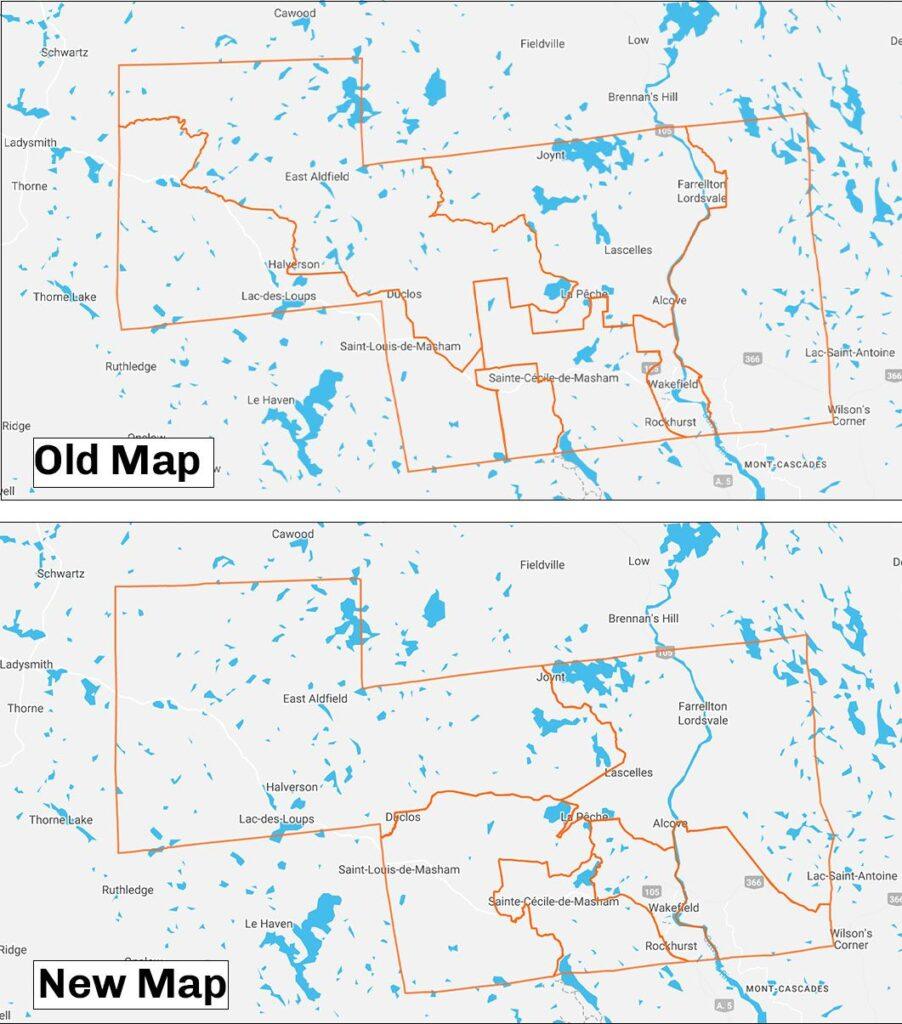
Hundreds of voters in La Pêche will lose their municipal councillor – or be shuffled into a new ward during the next municipal election, as the municipality gets set to shrink its electoral districts from seven to six. 

The major shift in La Pêche politics will see the municipality elect one fewer councillor to its chambers and change every electoral district, at least slightly, by the time the next municipal election rolls around. This means that residents in Edelweiss, Farrellton and Lac-des-Loups will experience the most significant changes in their representation. 

According to Elections Quebec, of the 207 municipalities in Quebec with a population of 20,000 or fewer, only one is divided into seven electoral districts: La Pêche. Mayor Guillaume Lamoureux said that the change would not only provide a better balance in voter populations throughout the municipality but would also save the municipality $27,000 per year with one fewer councillor’s salary on the books.

“It’s a question of efficiency,” Lamoureux told the Low Down. Two hundred municipalities below 20,000 residents function that way – you’re able to do the same thing at a lower cost. There’s also something to be said about having an even number of councillors when there’s an [split] vote; the mayor has a tiebreaker.”

Municipalities are supposed to review their electoral boundaries every four years. Lamoureux said it was evident in 2020 that La Pêche’s boundaries would have to change, as the municipality has grown by more than 800 registered voters since 2016. Because of this influx of voters, the representation among La Pêche’s seven wards became skewed, with Ward 7 (Edelweiss) having too many voters, while Ward 1 (East Aldfield) and Ward 2 (Lac-des-Loups) didn’t have enough. The new changes will see much more balance throughout the wards regarding voter population, with the new Ward 3 (Masham) hosting the most voters at 1,305, compared with the lowest in Ward 6 (Wakefield-Edelweiss) at 1,013 voters. 

“Overall, the number of electors per district is increasing because we’re going from seven [wards] to six,” added Lamoureux. “The changes are more important in places in the municipality where you have a lower population density. The reason we do this in the first place is because the balance of electors is no longer respected.”

With the proposed changes, Lamoureux said he hopes that balance will be restored.  

The most significant changes will be felt in Ward 6 (Wakefield-Edelweiss), where voter numbers dropped by 14.5 per cent, and in the former Ward 7 (Edelweiss), where voters have been moved to either Ward 6 or Ward 5 (Lascelles-Farrellton). Ward 2 (Lac-des-Loups) is also being chopped up. 

La Pêche held public consultations in early April, and residents have until May 13 to sign a register opposing the proposed electoral changes. To sign the register, visit the municipal office. 

La Pêche drops ward in electoral changeup Read More »

Wakefield to lose 3 MDs by summer’s end

By Madeline Kerr

The number of Hills’ residents without a family doctor is expected to rise, and the shortage “won’t get better any time soon,” according to a long-time Wakefield physician.

There are already over 6,000 residents in the region waiting for a family doctor – and 72,000 in the Outaouais, according to the Centre intégré de santé et de services sociaux de l’Outaouais (CISSSO). 

Last fall, Dr. Amani Ben Moussa, who was practising at the Clinique médicale des Collines in Wakefield, left to join a private practice in Gatineau. And in the coming months, two family doctors who have both served the community since the 1980s, Dr. Curtis Folkerson and Dr. Gary Satenstein, will retire without a plan to be replaced. 

While the Centre intégré de santé et de services sociaux de l’Outaouais (CISSSO) said that it could not confirm how many people are affected by the departure of these doctors, Dr. Folkerson recently told the Low Down that he has well over 600 patients on his active caseload. 

He estimated that his colleague, Dr. Satenstein, has more than 700 patients in his care. 

These patients will soon be doctorless, although Folkerson explained that the clinic is trying to accommodate the roughly 1,400 individuals left without a family doctor by offering them appointments with other MDs at the clinic if available. 

“It’s not going to get better any time soon,” Dr. Folkerson told the Low Down. He said that his decision to retire after 42 years at the Wakefield Family Medical Centre was a difficult one, but he said he believes that even if he were to wait a few more years, there still wouldn’t be anyone available to replace him. 

The reasons for the shortage, Folkerson explained, are wide-ranging and can be traced, at least in part, to the federal budgetary deficits of the 1990s. 

He explained that cuts to transfer payments led provinces to slash healthcare spending, which resulted in fewer doctors being trained at universities like McGill, leaving a dearth of family doctors for generations to come. 

Folkerson said rising administrative obligations – too much red tape, in other words – and the need to pass French language exams have also added to the shortage. 

Plus, medical professionals can usually expect to earn more across the border in Ontario, making western Quebec especially susceptible to losing trained doctors. 

Camille Brochu-Lafrance, a spokesperson for the CISSSO said one resource for patients who are without a doctor is the Primary Care Access Point, known as GAP, which helps Quebecers find health services even if they don’t have a doctor. 

“[This] will be the entry point for people who have lost their family doctor. The GAP assesses the person’s needs and makes an appointment with the right professional depending on the person’s condition,” Brochu-Lafrance said. 

The average waiting time for patients registered with the Quebec Family Doctor Finder (GAMF) in the MRC des Collines is 575 days, or over a year and a half, CISSSO reported. 

However, anecdotally, some individuals told the Low Down that they are left waiting much longer. Recently, Liberal MP for Pontiac Kitigan Zibi, Sophie Chatel, who lives in Gatineau, said she has personally been waiting 10 years for a family doctor. 

The shortage of family doctors is dire province-wide: According to the Montreal Gazette, around 40 physicians left the public network in Quebec last year, contributing to the shortage of more than 1,200 family doctors. Even worse, a quarter of all family doctors in the province are already over the age of 60, suggesting there will be a surge of retirements in the decade to come.

A spokesperson for the CISSSO said that “the regional department of general medicine (DRMG) in collaboration with doctors from each of the local service networks (RLS), is in the process of continuous recruitment. A team is dedicated to medical recruitment.” 

The spokesperson affirmed: “If a candidate is interested in a practice in the RLS des Collines, [they] will be welcomed without delay.”

Wakefield to lose 3 MDs by summer’s end Read More »

‘Nightmare’ in the Outaouais: ER Doctor

By Madeline Kerr

madeline@lowdownonline.com

Gatineau Hospital will go down to just one operating room this summer, and an ER doctor is raising the alarm about what this could mean for anyone giving birth who may require an emergency cesarean section.

Dr. Peter Bonneville, who works as an emergency room doctor in Gatineau and is the president of Conseil des médecins, dentistes et pharmaciens (CMDP) of the Integrated Health and Social Services Centre of Outaouais (CISSSO) explained that Gatineau is “the only hospital in the area that does obstetrics now. And we may not have good 24-hour-a-day coverage for cesarean sections, which is a nightmare.” 

He added, “I’m very concerned about the safety of those women.”

Bonneville told the Low Down that the hospital has seven operating rooms in total, but not enough staff to run them.

“If you go back about seven or eight years ago, all seven were working every day,” he said. “But right now, we’re down to two per day. Sometimes with retired people coming to help, we can get three operating rooms a day.”

However, over the summer “the nursing staff, because they are allowed, like any human being, to have vacations…we’re going to be going down to pretty much one operating room. And that operating room is going to need to work, obviously, 24 hours a day because you can’t function [otherwise].”

“So those nurses for the summer, they’re going to be either on vacation or working non-stop,” which Bonneville admitted doesn’t make for a “great lifestyle.”

According to CBC News, the Gatineau birthing unit delivered more than 2,300 babies last year. The only other hospital in the Outaouais with a birthing unit is the Pontiac Hospital in Shawville. 

In Quebec, a little more than one in four births results in a c-section, according to the not-for-profit organization Naître et grandir. A portion of these are planned in advance, but some are unplanned or emergency c-sections, which require surgery to be done immediately once a doctor has determined it’s necessary. 

However, if the operating room is already in use, Bonneville said there will be nowhere else in the hospital for the woman to receive that necessary surgery.

When asked what hospital staff would do in this event, Bonneville said, “We’re trying to work on contingency plans.”

For now, he said, “We’re going to make sure that the government understands there’s a sense of urgency to this. I mean, I’m totally against Band-Aid solutions, but we’re going to need a Band-Aid here until [the government can] manage the complete problem.”

“I think most women right now do not realize that that is the case,” he said, adding that part of his plan is to alert the public to this situation.

According to the CISSSO, five hospitals in the Outaouais can perform emergency surgeries, including Gatineau, Hull, Papineau, Pontiac and Maniwaki hospitals.  In December 2023, CBC News profiled the Gatineau birthing unit, calling it a rare success story in a healthcare system otherwise struggling with a lack of resources. At that time, the unit had 28 vacancies without replacement out of the total 188 positions. 

A doula’s perspective

Local doula, Kaëlla Charette, told the Low Down the news that Gatineau Hospital will go down to just one operating room this summer is “definitely concerning.”

A doula is a trained professional who supports parents during childbirth. 

According to Charette, emergency c-sections are relatively rare. In her five years of experience, she has assisted more than 100 births including many at Gatineau Hospital. She said that only two of the births she’s attended as a doula have resulted in what is known as a “P0” cesarian, or a c-section that needs to be performed without any delay. Most c-sections are less urgent, she explained, although typically surgery is performed within 30 minutes to two hours after a doctor deems it necessary. 

She pointed out that research by the World Health Organization has found that countries where more than 10 per cent of births result in c-section do not see any increased benefits in maternal or newborn mortality rates. Currently, Quebec’s rate of c-sections is around 28 per cent. Charette hopes that, in the face of an operating room shortage, health care providers will focus on “evidence-based care” that is proven to reduce the need for a c-section. 

“Some c-sections are absolutely life-saving and necessary,” Charette said, “but lowering the overall number [of c-sections] will lessen the burden on the system.”

‘Nightmare’ in the Outaouais: ER Doctor Read More »

Fortified footy forthcoming for femmes

By Trevor Greenway

editor@lowdownonline.com

Soccer des Collines is getting serious about footy in the Hills. 

The organization has hired two new professional directors – both of whom bring some high-level soccer experience, and it has installed a new president and a new board of directors, while laying out a new vision for success on the pitch. 

According to Soccer des Collines president Roy-Girard, just 420 females joined the league this year, compared to 683 males. To combat this, Roy-Girard and his team have been speaking with female soccer leagues around the country for ideas on how to entice young women to pick up or continue the sport. Roy-Girard said female numbers are strong in four-to-six-age range, but there’s a drop-off when the kids get older. What it needs now is volunteers, young coaches and more female players. 

“There is a very low number of girl registrations, but it’s not just a Des Collines problem; it’s a soccer Outaouais problem,” said Roy-Girard. “The whole region is low on women, and in our case, there seems to be a gap in the seven-to-eight-age group. We don’t have that next generation that is going to fill in.”

This year’s registration numbers show that in the U8 (seven-eight age group), boys greatly outnumber their female counterparts – 120 boys compared to just 38 girls. 

The hope is that this year’s summer Olympics, where Canada’s female squad will take on France, Colombia and New Zealand in Group A, will help entice younger girls to stay in soccer. Roy-Girard said that Canada’s sports culture still revolves around men’s hockey, but with the success of the new women’s hockey league (PWHL) and the rise in popularity of the Women’s National Basketball Association (WNBA), he said he’s hoping more young girls will see how far soccer will take them.

“We don’t have the [soccer] culture like hockey, where everyone knows the game and knows the players,” he said. “And because the majority of our players are under 12, we want to show them that it’s about having fun, but it’s also important to show where they can go with it; they can go to university; they can get scholarships; they don’t have to be a professional player. But we’re going to start to try and educate our base to let them know what opportunities are out there.”

Part of the overhaul at Soccer des Collines was due to past years’ struggles, during which Roy-Girard admitted the organization “let down” parents, coaches and players. Communication, management structure and governance issues have plagued the club since the pandemic, he said. 

So, cue the talent. Soccer des Collines hired former Brazilian professional player Juninho da Silva as its technical director to help steer the club along. Da Silva has played professional soccer in Brazil, Bolivia, Mexico, Tunisia, Puerto Rico and the U.S. over a 20-year career. Roy-Girard said he will be instrumental in helping increase players’ skills this season. 

The club also brought on sporting director Anthony Delion, who holds degrees in the Union of European Football Associations (UEFA) coaching and is a certified technical director. Delion, from southern France, has played soccer since age five and founded the highly successful Plateau Soccer Club in Gatineau.

Both new directors are full-time hires, and the hope is that they will maintain consistency from year to year, while board members and presidents are swapped out yearly. 

“Anthony and Juninho are critical for the continuation of the club,” said Roy-Girard. “We want to be able to have a club that can run year after year without depending on the board members. If I leave tomorrow, the club should not fold,” he said. “I think our biggest struggle is communication with members. We’ve not been great at that in the past. I think we’re getting better at responding and being a little more proactive. I still feel like we’re a little last minute, but you know, we’re going to continue to improve on that.”

The club is in good financial shape, said Roy-Girard, and said it has some surplus money this year that will go back into the club to offer free training sessions for players. He also said there would be free spring training, some specialty sessions like goaltender training, and a bigger year-end party, adding that he is hoping for some team outings, like Olympic viewing parties and going to see Atlético Ottawa games at TD Place. 

Soccer registration for most age groups closed on April 30, however, the club is accepting registrations for U4-8 until the end of May.

Fortified footy forthcoming for femmes Read More »

NCC buys Dunnderosa Golf for $3.9M

By Trevor Greenway

editor@lowdownonline.com

The NCC wants to own every bit of property in Gatineau Park, and the crown corporation is getting closer to that goal after it acquired another 42 acres of land – the former Dunnderosa Golf Course. 

With that acquisition, which was finalized at the end of March, the NCC now owns 99 percent of Gatineau Park and says it has its sights set on that last remaining one percent. 

“Because, for our conservation mandate, it’s easier to have the control and the management over all the lands in the park,” explains Catherine Verreault, director of Quebec Urban Lands and Gatineau Park with the NCC, about the crown corporation’s goal. “But we’ve been having good discussions with the private property owners and municipalities in the park.”

The NCC paid $3.9 million for the 42 acres that used to be home to the Dunnderosa Golf Course, and Verreault said the organization is thrilled to conserve this land, especially because owners had previously wanted to put a housing development there. The lands, which connect to the Chelsea Creek Ecological Corridor, will be conserved and maintained as eco lands – with user trails connecting to Gatineau Park. Verreault says the property has rich biodiversity, and the NCC will create a plan that allows residents to ski, bike and hike through the lands, while giving flora and fauna natural space to thrive. 

“Securing this land allows us to protect part of that corridor,” adds Verreault. “The golf course has not been used in many years, and it’s starting to regenerate. It’s a really nice, open area and used by lots of pollinators, breeding birds, amphibians, reptiles and small mammals. It’s very interesting in terms of biodiversity.”

According to the NCC’s Ecological Corridor report, 16 species of special concern – both plants and animals – are found within the Chelsea Creek Ecological Corridor, like the eastern milk snake, olive-sided flycatchers and woodland pinedrops. 

The NCC has acquired 63 separate properties in Gatineau park since 2008, amounting to 665 acres. To own 100 per cent of the land in Gatineau Park, the NCC needs to acquire the remaining 884 acres, which they say they plan to do. 

While the Dunnderosa Golf Course has been closed since 2020, Village Dunnd’s still operates a minigolf and outdoor playground at the corner of Notch and Kingsmere roads.  

NCC buys Dunnderosa Golf for $3.9M Read More »

Drug company sends ‘sample’ cocaine to recovered user

By Trevor Greenway

An online recreational drug company sent a sample vial of cocaine to a recovered addict in the Hills.

The online company fcuk Reality sent .025 grams of what they brand as “high heat” cocaine through Canada Post to the recipient’s community mailbox in early April. The recipient, who overcame their addiction to the drug over a decade ago after spending time in rehab, said the delivery of this illegal and highly addictive drug was “triggering.”

“If this had been a bad week personally, this would have been up my nose,” said the recipient, who said they wish to remain anonymous. They said they have serious concerns over how this company got their information, as the package, which came in a green envelope, had their name and address on it. The package came with a large branding sticker that reads “fcuk Reality cocaine, high heat, free sample” with a QR code on the front. Inside the package was a flyer from the company marketing “lab-tested drugs to adults for safer consumption” and a vial of white powder. 

The recipient said they flushed the powder down the toilet, but before doing so smelled the top of the vial. “Oh, it was definitely cocaine,” they told the Low Down, adding that they did not ingest any of the illegal substance and haven’t touched the drug in over a decade. 

A search of fcuk Reality online turns up only some unconnected Instagram accounts or articles about the 2004 film “Layer Cake”, which used the French Connection UK (fcuk) brand for a particular scene; the online drug company has seemingly imitated the branding from the film. 

The only way to access fcuk Reality’s encrypted site is through the QR code on the package. When the Low Down scanned the code, we were brought to a site offering everything from cocaine, ecstasy and MDMA to psychedelics like DMT and LSD. Fcuk Reality’s site even sells the potent sedative GHB, which is known as the “date rape” drug. Purchases on the site are restricted to cryptocurrency.

The company claims to offer “clean” drugs, and its website states that the cocaine sent to the Hills resident was 87 per cent pure and contained “no fentanyl” – the powerful, synthetic opioid that has caused a drug epidemic across North America. Anyone with access to the site can buy up to 28 grams of cocaine for $1,400 – about half of what that amount is worth on the street, according to the 2019 Global Drug Survey. 

Fcuk Reality didn’t respond to the Low Down’s queries, but the website states that the Canadian company was formed to combat overdoses. 

“So many of us have lost family and friends to overdoses. What’s even more upsetting is that this could be changed so easily,” the site reads, continuing, “An extra day or two of due diligence via sending products to the lab is all it takes to save countless lives.”

But the recipient in the Hills had already saved their own life by overcoming their addiction. 

‘Predatory’ drug companies target addicts

Carleton University law professor Dawn Moore, who is an expert on illicit drugs, said the delivery of cocaine to a recovered user is an irresponsible move by the company, but it’s also not surprising given that since the legalization of cannabis, other drugs like magic mushrooms and ketamine are being “marketed” to both recreational users and addicts. 

“It pisses me off,” said Moore, who has spent years working with addicts in the region. “Because people work so hard to get clean. I don’t judge people who use, just do it safely and responsibly and please have babysitters for your children. But folks who are trying to get clean need all the protection and love and support in the world. But this is the dark side of legalization, right?”

Moore said that since cannabis was legalized in 2018, drugs – everything from cannabis and magic mushrooms to harder substances like Ketamine and MDMA – have become marketable to consumers.” Moore called drug companies like fcuk Reality “predatory.”

“Legalization was great for a lot of things,” said Moore. “But what it also brought us was capitalism into the drug economy and the ability to mass market and to target vulnerable people in this way, and that I find really upsetting. We don’t pay attention enough to how much we live in an addiction-driven society where so many of our habits are manufactured addictions.”

The recipient said they surmise that because they’ve purchased cannabis online through various companies, their information was sold to the drug company, which then sent the sample vial of drugs to their address. 

According to Sûreté du Québec spokesperson Marc Tessier, while drugs like cannabis and magic mushrooms are being sent through the mail more frequently, this is the first time his police force has ever heard of cocaine being delivered through Canada Post. He said the SQ wouldn’t comment specifically on the case because the recipient did not report it to authorities.  

In its 2022 sustainability report, Canada Post noted that its postal inspectors stopped $17.74 million of illicit substances, including contraband tobacco, from being delivered throughout its 22,500 urban and rural delivery routes. The federal postal service says that it works with law enforcement and agencies to collaborate on investigations and to coordinate search warrants. 

“We have several security, screening and safety protocols in place to help us identify suspicious items,” Canada Post spokesperson Lisa Liu told the Low Down. “Postal inspectors have the authority to inspect mail, and if illegal or dangerous non-mailable matter is found, it is removed from the postal system.” She didn’t comment on the local cocaine specifically or how it got through their protocols. 

Drug company sends ‘sample’ cocaine to recovered user Read More »

Teen charged for online harassment

By Trevor Greenway

A 13-year-old Gatineau boy has been arrested for a series of online harassment charges after he allegedly harassed another Hills minor for several months. 

According to an MRC des Collines Police press release, the alleged victim’s parents reported the online harassment after they say their child suffered from the “suspect’s wrath” for several months.

Police began an investigation into the matter and showed up at the teen’s home to arrest him on April 14 but were forced to return with a search warrant the following day after his parents refused to cooperate, according to the release.

Police arrested the 13-year-old April 15, and he appeared in a youth court on April 16. He was charged with criminal harassment, making threats of death or bodily harm, distribution of juvenile pornography and unauthorized possession of restricted weapons. He was released on several conditions, including restricted access to social media. The teen is also barred from using the internet or other digital networks without adult supervision. 

Police did not disclose the details of the harassment or provide any other information. 

Teen charged for online harassment Read More »

Quebec farmers demand more support

By Trevor Greenway

Quebec farmers are angry. 

Close to 100 tractors, trucks and other vehicles converged on downtown Gatineau on April 17 to pressure elected officials to reform its programs and budgets after they say financial forecasts for 2024 will see Quebec farmers net $66 million in total, working out to just $2,300 per farm. 

More than a dozen of those producers rolled through Wakefield and gathered at the community centre on April 17 before meeting two other convoys en route to Gatineau. 

“We’re sick and tired of not being heard,” says local Union des producteurs agricoles (UPA) president Cheryl Layer, a fourth-generation farmer who runs Alcovia Angus in Alcove. 

“We’re getting squeezed from every group. We’re environmentally squeezed. We’re financially squeezed with inflation, and the government has cut our funding for all of our programs, and in the budget we are the lowest on the totem pole – we got less than a billion dollars.”

In its 2024-25 Quebec budget, tabled in early April, the CAQ government announced $380 million over five years to support the agriculture sector. However, producers say that number falls well below what they need. 

Last summer, farmers in the Hills, like Ferme Sage owner Stan Christensen, were left vulnerable by “chaotic weather,” and many expect another problematic year with projected drought after a mild winter and a lack of winter runoff. 

“Despite the fact that we have some of the best prices we’ve had for cattle ever, the costs have gone up so much that it’s just making it difficult to make ends meet,” says Christensen, referring to increased costs in equipment, vehicle maintenance and other expenses. 

One factor hampering farmers’ ability to thrive in a complex landscape is all the regulations they must adhere to, say farmers. Christensen, who won an environmental stewardship award through Les Producteurs de bovins du Québec (PBQ) for land management on his Val-des-Monts farm, says he and other farmers are drowning in paperwork. 

“There are so many restrictions on how we do things,” says Christensen. “We have to have a specialist to sign off on everything we do, and it’s become a real challenge. We want to be able to go out in the morning and feed the cows, we don’t need to have a permit to do it.”

Farmland prices increasing

According to Layer, farmland in the Outaouais has increased by more than $7,000 an acre over the last few years. Add this to the increased machinery, livestock, feed and labour costs, opening up a new farm is no longer viable for young farmers. 

“If you can buy the farm, you can’t afford the machinery,” says Layer. “Or if you have the machinery, then you have got to rent a farm, and there is nothing to rent.”

In its 2021 census, Stats Canada recorded around 190,000 farms nationwide – down from around 245,000 in 2001. In Quebec, farms rose 1.6 per cent to 29,380 from 2016 to 2021. However, in the Outaouais, the UPA says that the region has lost 55 per cent of its farms since 2012. 

Ivan Hale has run Hale Farms out of Wakefield since 1985, and says that farming has become increasingly difficult over the years due to the “unpredictability” in the industry, both in terms of climate change and rollercoaster prices. He says that during the Farmers’ Market in Wakefield last year, the farm advertised prices on their meat but ended up losing money because prices fluctuated drastically throughout the summer. The farm couldn’t come to grips with increasing prices after customers had been used to paying a specific price throughout the summer. He says the farm won’t be advertising prices on their packages this year, so that they can adapt throughout the year. 

“By the end of the summer, the costs had gone up so much that we were losing money on every package,” says Hale, gathering with fellow farmers during the protest. “We couldn’t change the price. So this year, we’re selling our meat with no prices on it because we were afraid that we may have to adjust the prices as we go along.”

He says that some local farmers also have part-time jobs to make ends meet. 

“Any of us can run a pretty good business if we know what the circumstances are in the environment and what we’ll get for our labour at the end of the day, but when you don’t know…” he finishes with a shrug. 

Liberal MNA for the Pontiac André Fortin, who was at the April 17 protest, says that farmers lost 80-85 per cent of their yields last year due to severe weather events. He argues that if the CAQ government doesn’t get serious about supporting Quebec’s agriculture sector, local farms will continue to die – and with it, local, fresh food. 

“I’ve done a few across the province of these – these farmer protests – and to me, it seems that the government is not addressing the urgency of the situation,” says Fortin, adding that Agriculture Canada projects that farmers will lose 86 per cent of their crops this year due to high interest rates, inflation and climate change. “They’re not grasping the fact that a lot of farmers are struggling to figure out how they will get through this. I don’t know a lot of people who would stay in their jobs when they get an 86 per cent decrease in salary.”

Fortin is urging the CAQ government to reform its La Financière agricole du Québec program, the province’s insurance program for farmers, so that producers can receive compensation for the losses they endured last year. Fortin says the insurance program “needs to be fixed.”

Gatineau MNA Robert Bussiére sent the Low Down a statment on the protest, explaining how his CAQ government created an emergency fund through agriculture finance, which “can generate up to $167 million in liquidity.”

“I am very sensitive to the reality and the concerns of the farmers in the constituency,” wrote Bussière.  “I am aware of the many hours of work and the efforts that they must invest day after day.”

Quebec farmers demand more support Read More »

More patients will die: ER doctor

By Trevor Greenway

An ER doctor in Gatineau is ringing alarm bells and says that more patients will die after services at the Hull hospital are slashed in the coming weeks. 

Dr. Peter Bonneville, president of Conseil des médecins, dentistes et pharmaciens (CMDP) of the Integrated Health and Social Services Centre of Outaouais (CISSSO) and an ER doctor in Gatineau, says the region will be in a “crisis” in a matter of weeks after three medical scan technicians leave the Hull hospital for higher salaries in Ontario. 

“The first crisis of many is upon us,” Dr. Bonneville told the Low Down, explaining that all medical scans will be unavailable to patients every day from 4 p.m. to 8 a.m. in Hull. This means that anyone needing a scan, which Bonneville says is crucial to identifying 90 per cent of emergency ailments – bone breaks, internal bleeding, concussions – will have to travel to the Gatineau hospital. However, if treatment is needed, Gatineau is not equipped to operate and a patient would need to be transferred back to Hull if surgery is required. Bonneville says the situation will ultimately lead to more patient deaths, as Hull is “the trauma centre for the area” for everything from critical care to neurology, cardiology and intensive care.

Bonneville pointed to a case in 2020 when 70-year-old Gatineau resident Jean Malavoy died at the Hull hospital after the hospital scanner was broken and he was transferred to Gatineau. In Gatineau, scans revealed internal bleeding, but the ER doctor there couldn’t operate and Malavoy was transferred back to Hull for treatment. A coroner’s report noted that the transfers caused two hours of delays and contributed to the man’s death. 

“If one person in 2020 died because they didn’t have access to the scan with proper timing, I think it is fair that we can assume that this will happen again.”

The problem, says Bonneville, is staffing.

He told the Low Down that most facilities in the region – CLSCs and clinics – are staffed at around 40 to 50 per cent, while operating rooms and ERs in the region are worse, as low as 35 per cent staffed.

“We have many floors that are actually closed because we don’t have staffing. We’re lacking staffing and laboratories. Any service you can name, I can assure you that we are lacking staffing there,” he said. “The MRI in Gatineau is closing in two weeks; Maniwaki’s radiology is closed down at eight o’clock in the evening. They’re amputating every arm of the system in order to save the lungs and the heart.” 

He says the Outaouais’ healthcare problems can be solved with a simple solution: money. According to Bonneville, the technicians leaving Hull are heading to Ontario, where they can make $30,000 more per year in salary. A recent report from The Outaouais Development Observatory, an organization dedicated to researching and collecting data regarding the region’s economic development, revealed that the region needs $180 million in healthcare funding to be on par with other regions in Quebec. 

“The solution is 100 per cent in the hands of the Quebec government,” says Bonneville. He says he’s calculated that since the CAQ government took power in 2018, it has saved a billion dollars in funding that should have gone to the Outaouais for healthcare. 

Bonneville says he’s also aware of three family doctors who will be leaving Wakefield clinics by the end of the summer, and says that their departure will affect “thousands” of patients. The radiology department in Wakefield was also on the chopping block, but will be spared for now, says Bonneville. However, hours for radiology in Wakefield have also been reduced to 8 a.m. to 8 p.m. This means that a patient needing an x-ray after 8 p.m. would have to go to Gatineau and, if needed, transferred back to Hull for treatment. 

Watchdogs decry Santé Québec

Health watchdogs in the area say they are concerned about the coming months as the CAQ rolls out its centralized health network, Santé Québec.

The new system will centralize Quebec’s health network and remove key decision-making roles from doctors and healthcare professionals working on the ground. 

“Give the locals the power,” says Vigi Santé spokesperson Marcel Chartrand. “And give them the budget to do it. They know the community. They know the needs. Decentralize the whole thing. The manager at the CHSLD in Masham does not need to go to Gatineau and plead for what they need. Gatineau will say, ‘Based on the priorities of the other regions, we’re going to say no.’ It’s not right.”

Dr. Peter Bonneville, an ER doctor in the region for over 30 years and the head of the Outaouais Health Council, agrees with Chartrand and argues that Quebec’s new Santé Québec is going backward.

“My main concern right now is that doctors in general have been losing any say in a lot of the decisions that are being taken in healthcare,” says Bonneville. “I can assure you that all medical associations in Quebec are very, very concerned about the fact that the new law, once it is put forward, is getting doctors even farther away from the decision process.” 

In an email to the Low Down April 22, the province’s Minister of Health, Christian Dubé, said that measures are being deployed in the “short, medium and long term to ensure the service.” 

The ministry wrote that it is offering signing bonuses worth $20,000 for technicians looking to work in the region. The government is also offering $40,000 bonuses for new CEGEP grads who commit to working in the region. 

“This is a worrying situation, and we are monitoring it very closely with the Outaouais MNAs and the regional minister, Mathieu Lacombe,” wrote the ministry.  

More patients will die: ER doctor Read More »

Former mayor ordered to return money spent on alcohol

By Trevor Greenway

Former Denholm mayor Gaétan Guindon has been ordered to pay back the $3,470.71 of taxpayer money he racked up on a municipal credit card to buy alcohol. He has been given six months to pay back the money. 

He has also been fined $1,000 for breaching Quebec’s municipal code of ethics.

In his April 9 decision, Quebec Municipal Commission (CMQ) Judge Denis Michaud concluded that Guindon committed two breaches of the code of ethics and professional conduct for elected officials. He was cited for using a municipality credit card for expenses and for using municipal resources for personal purposes by purchasing $3,470.71 worth of alcohol. According to the decision, Guindon admitted spending this money on alcohol for a company party but claimed that it was in line with municipal bylaws. 

“When questioned about these expenses, he stated that they were in the performance of his duties as representative of the municipality,” wrote Michaud in the decision. “The evidence shows, however, that the mayor’s meal expenses regularly exceed the maximums set out in the municipality’s bylaw, and that he also paid with the municipality’s credit card for alcohol without a meal.”

Section 7 of Denholm’s bylaw on municipal expenses states, “The cost of alcoholic beverages are neither authorized nor reimbursed, with no exceptions.”

According to court documents, Guindon purchased the alcohol Between Jan. 1, 2020, and Dec. 31, 2022. 

“Expenses for the consumption of alcohol during these meals, whether or not approved by the municipal council, cannot be considered as expenses incurred on behalf of the municipality or in the performance of an elected official’s duties,” concluded Michaud. 

Guindon resigned as mayor of the small hamlet east of Low on March 24 after he pleaded guilty to driving a municipal vehicle while under the influence. He was arrested for the offence in October 2022 but pleaded guilty on Jan. 29 of this year. Guindon has been at the helm of Denholm since 2013. 

According to the CMQ, Guindon’s DUI charge is in breach of section 302 of the Act respecting elections and referendums in municipalities, which states that a person convicted of an offence punishable by up to two years or more in prison is “disqualified from holding office as a member of the council of a municipality.”

The municipality of Denholm will hold a by-election for the mayor’s seat on May 19. 

Former mayor ordered to return money spent on alcohol Read More »

Uranium in water

By Trevor Greenway

When Melanie Benard moved into “Environmentally Friendly” Chelsea a year ago, she never imagined that she would be drinking uranium straight from her well. 

But after noticing a sulphur smell during blasting operations in Farm Point for the River Road stabilization project last summer, she thought getting a mineral test done would be a good idea. 

The results were “quite a shock.”

“I’d be lying if I said I felt totally safe,” said Benard. 

The water tests obtained by the Low Down show that Benard has three times the level of uranium that is considered safe. According to the federal health agency, Canada’s limit for uranium is 0.02 mg/L; Benard’s well shows three times that amount at 0.06 mg/L.

“So I’ve been doing the bacteria testing as recommended, and it came back saying that the water was safe, like safe drinking water,” said Benard, pouring a glass of water from her reverse osmosis system – an $800 system she was compelled to install so that she can safely drink her tap water. 

“So the only reason I did the additional testing is that [work crews] had done a lot of blasting when they did the construction on Chemin de la Rivière. The house would shake repeatedly throughout the day, and I noticed a sulphur smell.”

According to Chelsea spokesperson Ghislaine Grenier, the municipality is aware that uranium has been found in some residents’ wells, but said that an “expert” concluded that there is no correlation between blasting alongChemin de la Rivière and the uranium found in Benard’s water. 

“According to our expert, no cause-and-effect relation is demonstrated between blasting and uranium in water,” wrote Grenier in an email. “The uranium is naturally found within the Canadian Shield and is not uncommon in the Outaouais region.”

When asked what can be done to help residents like Benard, Grenier pointed to the municipality’s webpage that has information about water tests. She also said the municipality routinely encourages residents to test for bacteria twice a year and to conduct a “physico-chemical” test, which would reveal things like uranium and lead, once a year. 

The municipality used to have a water-testing program, where residents could easily drop off water samples and the municipality would send them out for tests. 

But amid budget cuts, the water testing program was cut this year.  Grenier noted that, “well owners are responsible to make sure their well water is safe to drink.”

Benard told the Low Down that when she moved into Chelsea last year, the first thing she did was follow the municipality’s guidelines for water testing on its website. 

But, she says, at the time there was no information about conducting a physio-chemical test – only information about the bacteria tests. 

Grenier told the Low Down the information has been available on the website since at least 2022, if not earlier. 

According to Health Canada, exposure to high levels of uranium in drinking water for a long period of time could affect a person’s kidneys and bones. 

However, the federal health agency says that, “Exposure to uranium in drinking water for a short time should not have a negative impact” on health.

Pregnant women can pass uranium to the fetus during pregnancy, while mothers can pass it to their newborns through breastfeeding. Health Canada recommends using an alternate water source, such as bottled water, or installing a treatment unit, as Benard did. 

For Benard, she’s happy she’s finally able to drink her tap water, but she worries about potential damage already done to her body. 

She no longer feels that her Chelsea home is as “Environmentally Friendly,” as Chelsea’s municipal slogan says it is. 

Uranium in water Read More »

Keeping it in the Family

By Trevor Greenway

Everything Marilyse Bisson learned about building houses, she learned from her dad. 

Everything Stephanie Gauvin learned about selling houses, she learned from her dad.

And soon, Century 21 real estate broker Stephen Lynott “will not be able to keep pace” with his son, Patrick, who will eventually take over the family business. 

These are just three stories of generational Hills business owners who are passing the torch to their children. 

“At 16 years old, [Stephanie] told me that she wasn’t going to go to CEGEP or anything like that,” says Jean-Pierre Gauvin, the founder of Gauvin Realty in Wakefield. The real estate company is celebrating 30 years of business this year, and Jean-Pierre says he has no hesitations about handing the keys over to his capable daughter. “She said, ‘I’m going to take over the business.’ She was 16 years old. I was laughing and said, ‘Go for it.’”

And go for it, she did. While Stephanie says she doesn’t remember the specific conversation, she says she was certain that she wanted to sell homes from a young age, and that the school route wasn’t up her alley. 

“I wasn’t really a school girl,” admits Stephanie, who remembers going on house visits with her dad as a young girl. She says that “going to the office” when she was a kid was always exciting. “I didn’t really skip school or anything like that, but it just wasn’t my niche to go to college. But for real estate, it seemed like the doors were wide open. It was an opportunity.”

Jean-Pierre founded his Wakefield realty company in 1994, and it quickly became one of the top real estate companies in the region. He says the sky’s the limit for his daughter. 

Stephanie officially took over as owner of Gauvin Realty in 2017, but she says she will always turn to her dad’s expertise whenever she needs help. Her dad doesn’t expect too many calls. 

“She’s better than me,” says Jean-Pierre, his eyes softening as he looks across the desk at his daughter. “She runs the office better than me, and she sells more than I ever did.”

Stephanie’s happy to see her dad finally retire after 35 years of selling homes in the Hills. Based on everything she’s learned from her papa, she’s confident that she’ll be able to keep the Gauvin legacy going for years to come. 

“It’s the honesty,” she says, when asked what the most important lesson she’s learned from working alongside her dad was. “Everywhere we went with people, he was always honest, and that has really helped the business grow.”

Hills builder Marilyse Bisson knows how far honesty goes in the construction business and, like Stephanie, learned the value of being true to yourself and your clients from her dad, Jocelyn Bisson. The two worked together for years at his Armoires Bisson & Fille construction company before she started her own construction company, Mavie Construction, in 2018. 

“He was always honest,” says Marilyse. “My dad always cared about the clients, and he gave exceptional after-sales service.”

Marilyse remembers being barely able to walk but wanting to be just like her dad – the big, tough builder who could fix anything. So he would arm her with a hammer and finishing nails on job sites and give her small projects that may or may not have been part of a renovation he was working on. 

Jocelyn Bisson died last spring, leaving Marylise and her sister Rapaële without their funny, caring and loving father.

“He was such a great dad with great values and a huge heart,” says Marilyse. “He was always so proud of his daughters. We never doubted his love.”

Parental pride is something Stephen Lynott knows a lot about. His son Patrick – without any coaxing, he says – chose to follow in his father, grandfather and great-grandfather’s footsteps and has been working at Century 21 for the past two years. The Wakefield real estate company just celebrated 70 years of business in 2022, and Stephen doesn’t think it’s too far off to see his son running things in the near future. 

“We have always been close, but real estate is not for the faint of heart, and we support each other very well,” Stephen tells the Low Down. “To watch him grow up and to work side by side with him and to share our generational differences and put that to work for people has been truly rewarding.”

Stephen says that in real estate it’s always important for brokers and agents to be selling homes in the area in which they are knowledgeable. Seventy years in business has helped shape the company’s roster with these talents, but with Patrick being immersed in real estate his entire life, those seven decades of knowledge are already permeating through. 

“The benefit that a family local business brings is that our brokers for the most part have grown up in the community they serve,” says Stephen, adding that Patrick’s “true blue passion for the industry” would make his grandfather, Frank Macintyre, and his great-grandfather, Duncan Macintyre, the founder of Century 21, “truly proud.” 

“It adds a flavour to the family recipe that is hard to replicate.”

Keeping it in the Family Read More »

Much more than a retrofit

By Trevor Greenway

Aaron-lee Odjick was always told that, in his culture, elders come first. 

That’s why the 29-year-old Anishinabeg father and husband, known throughout his Kitigan Zibi reservation as “Ning,” wants to help his band improve living conditions for seniors in his First Nation community. 

He said that poor living conditions on reservations across the country – poor ventilation, non-potable drinking water, mould, leaky roofs and other issues – are doing more harm than most people think and are contributing factors holding back First Nations communities from recovering from past trauma. 

“When people are less stressed out and have adequate living conditions – that can help with the healing and help with tackling those basic things,” said Odjick from the Wakefield Mill in mid-February. He had just completed an intensive 18-month Project Accelerator Program, which is part of Indigenous Clean Energy’s Bringing it Home initiative – a campaign that seeks to empower and train Indigenous youth to become energy efficiency experts and to lead housing projects in their communities. 

Odjick was one of 16 youths selected for the program and spent a year and a half learning about eco-home building, energy efficiency and capacity building to gain the skills to become a project manager on large-scale construction projects. 

The program offers participants up to $125,000 in funding for housing projects in their communities, and Odjick said he has an ambitious plan to retrofit elders’ homes in Kitigan Zibi. 

“I took the little bit from my culture that I knew about – and the Elders always come first, I was told – so I took that approach,” said Odjick. “We’re a little bit more fortunate in Kitigan Zibi; we don’t have as much overcrowding issues as some of the other communities, but we do suffer from the same collective trauma. That’s definitely still there.”

And while Odjick said his community in Kitigan Zibi is more “fortunate” than other First Nation communities across the country, the local band still faces significant housing issues, namely access to clean drinking water. 

According to former Kitigan Zibi chief Gilbert Whiteduck, now the head of the Gatineau Valley Historical Society, nearly half of residents on the reserve do not have access to clean drinking water. 

“The home I live in now, where I raised my family [for] some 45 years, has not had potable water for over two decades,” said Whiteduck, who has lived on the reserve for nearly 70 years. “We continue to receive bottled water on a weekly basis.”

Whiteduck added that Kitigan Zibi has completed sewer and water extension plans but needs funding commitments from the federal government to get the work done. In 2015, Prime Minister Justin Trudeau pledged to end water advisories in Indigenous communities by March 2021, but that target was missed. The feds have since dumped $4 billion into clean water projects for Indigenous communities, but Kitigan Zibi – a short 1.5-hour drive from Parliament Hill – still struggles without potable water. 

“The original work that was carried out to address the potable water and sewer issue in the community for a limited number of homes has been done in phases and took a lot of hard bargaining,” added Whiteduck. “Nothing comes easy when it is a basic right issue.”

But Whiteduck added that, in Kitigan Zibi, it’s not so “doom and gloom.” He said that the band has good leadership and that most homes on the reserve are in good shape and if they’re not, the band will work with residents to fix them. 

“We are a resilient people,” added Whiteduck. 

However, he said that Odjick’s project was “ambitious” and would help the band manage and maintain elders’ homes on the reserve. He hopes the project will encourage other Indigenous youth to take up community projects to improve life for their people. 

For Odjick, he said his retrofit project has the potential to “change my community.” 

Odjick’s project will utilize local contractors, educate current builders on eco-practices and efficient building techniques and create jobs for locals who want to stay in their community. 

“We’re not looking for small-scale projects where we are going to build five to 10 homes  – we’re looking for community-scale,” said Corey Cote, project manager at Indigenous Clean Energy, who is heading the Bringing it Home Initiative. Indigenous Clean Energy is a not-for-profit that advances Indigenous-led capacity building and collective action in Canada’s clean energy transition.

According to his organization, almost one in six Indigenous people in Canada lived in homes requiring significant repairs in 2021. He said many Indigenous communities still face overcrowding, mould and a “chronic shortage of housing” that is alarmingly disproportionate compared to non-Indigenous communities. 

“What Aaron-lee Odjick’s project showed me is that they have a number of band-owned homes, so [he] has large-scale access to do this work,” added Cote. “He is thinking big picture, and he did show the commitment of leadership to support the project.”

Odjick has to meet several deliverables throughout the project to access the entire $125,000 in funding for his retrofit initiative. Step one is creating a project manager position for himself in Kitigan Zibi, where he will need to convince the band to hire him for the retrofit project. But with 18 months of intensive training under his belt, Odjick said he is confident that he’s the right person for the job. 

“It’s amazing,” added Odjick. “I could possibly have a permanent, really good job in my community, which is hard to get.” He added that he hopes his retrofit project will help others find work locally, too.

Much more than a retrofit Read More »

Q&A with new Outaouais healthcare CEO

By Trevor Greenway

editor@lowdownonline.com

Marc Bilodeau has gone from caring for Canadian soldiers fighting in Kabul, Afghanistan to advocating for healthcare in the Outaouais as the new CEO of CISSS de l’Outaouais.

Bilodeau served as surgeon general in the Canadian Armed Forces from 2020 to 2023, after serving for 28 years in military roles including physician leader and military physician. He was deployed to Afghanistan in 2003, where he was responsible for pre-hospital and primary care. 

The former major was hired as president and chief executive officer of the Centre intégré de santé et des services sociaux de l’Outaouais (CISSS) in the fall of 2023 and began his official four-year mandate in the position this past January. He’s fully bilingual and says he wants to be an engaged CEO in the Outaouais. 

The Low Down interviewed Bilodeau on March 20 as part of our four-part health series, “Health in the Hills”. 

His answers have been edited for length, grammar, style and clarity. 

Low Down (LD): You spent the first couple of months of your mandate meeting with local health organizations throughout the region. What did you learn about the MRC des Collines’ healthcare situation and its challenges?

Marc Bilodeau (MB):  The biggest challenge for the whole region, I would say, is human resources. Unsurprisingly, we are in a very challenging environment with lots of demand and few human resources available in the specific context of youth. Our region is very close to large Ontarian employers, as well as the federal government, which is making it very challenging for us to bring new employees in but keep them as well. The MRC des Collines is impacted by that…A challenge of the MRC des Collines is that it’s close enough to the city but far enough from the city to be in between those challenges. So, that makes it a bit unique, and this MRC’s needs must be considered in their uniqueness.

LD: We lose a lot of nurses to Ontario. What is your plan for recruiting and retaining healthcare professionals in the Outaouais?

MB: Some conventions are being negotiated right now at the ministry level…. This hopefully will give us a few additional tools to keep our nurses and bring additional ones. On top of that, we’re working very closely with academic institutions to train more nurses in the area because we know that if they’re trained here, they’re more likely to stay around…. On top of that, we are trying to make working conditions as compatible as possible with a work-life balance and giving a bit of respite to our nurses, who have been working very hard for so many years due to the pandemic. 

LD:  Why are nurses leaving Quebec for Ontario?

MB: There is a significant discrepancy in salaries between the two sides of the [Ontario-Quebec] border. This is the main factor, in my opinion. We’re trying to provide the best working conditions possible. It’s becoming very challenging, though, when you’re below a certain number of people. In some areas I’m staffed at about 30 per cent of the total number I would need. Maintaining good working conditions in that environment is also hard because there is so much pressure on the few people we have. So, even if we have good working conditions, it is less enjoyable to work in because of the amount of work and volume. So, workload as well. I guess it’s a combination of both. 

LD: The Outaouais has been grossly underfunded in healthcare, as evidenced by a 2018 Institut de recherche et d’informations socioéconomiques (IRIS) report, which put the shortfall at $250 million. What will you do to fight for healthcare funding in the Outaouais?

MB: My goal is make sure the Ministry of Health is fully aware of the unique challenges we are facing here. This is part of my role as CEO – to ensure that there is visibility and understanding of the reality of the situation here. I’m doing that in partnership with local officials, and so far, we have had very good collaboration from the deputy minister and his team in Quebec City. And I hope to keep working with them to find long-term solutions for the Outaouais situation. We know it’s been a challenge for many decades here.

LD: Healthcare watch dogs are concerned that the new Santé Quebec will centralize services, causing them to lose autonomy over spending local money and making local decisions. How will you ensure that these important groups will still have a voice?

MB: The reading I have of the new Bill 15 is that I really believe it won’t change much in terms of how we do business internally within the CISSS de l’Outaouais. I’m still going to be the CEO; I’m still going to have the same powers I have now. Yes, it’s going to be different at the ministry level with the creation of the agency – I won’t have a board of directors anymore at my level – it’s going to be more of an advisory board that will help inform my decisions. So, on a day-to-day basis, I don’t think it will change a lot. Honestly, I’m kind of reassured by the fact that I’m going to keep the same tools, and hopefully the agency will be a bit more agile than the ministry currently is.

LD: Will you still work and consult with health watchdog groups like Action Santé and Vigi Santé?

MB: I think we have to. We have to collaborate with all these partners and figure out ways to address the Outaouais’s needs. I think it’s a societal responsibility that we work together to do better, and it goes well beyond just healthcare, in my view. So, we have to work in partnership with all organizations, whether they are charities or other community organizations – and that includes the media and the politicians…. That is my goal: to engage with all those groups to ensure that we have a consistent message for Quebec City and to try to secure a better future for the Outaouais region. 

LD: How will you ensure that English services are maintained under the new Santé Quebec in places with fewer than 50 per cent anglophones?

MB: It’s always a challenge to maintain services in both official languages. My opinion, though, is that this is a patient safety issue if we don’t. I think access to healthcare depends on your ability to communicate in your own language. However bilingual you are when you are sick, you are suddenly less bilingual, and that’s the reality. So, I really believe that we have to keep working on this one and make sure that, at least at the frontline, we have the ability to answer to people in their preferred language and hopefully keep doing the best we can to support patients in our region, despite what their primary language is.

LD: What is your number one priority for the region?

MB: Trying to stabilize the human resources and staffing situation is my number one priority because this directly affects my ability to provide safe care to Outaouais citizens. So that is my number one, two and three priorities.

Q&A with new Outaouais healthcare CEO Read More »

Denholm mayor ousted for DUI on the job

By Trevor Greenway

The mayor of Denholm has resigned from his post after pleading guilty to driving a municipal vehicle while drunk. He’s also under investigation for allegedly spending more than $3,400 of taxpayer money on alcohol. 

Former Denholm Mayor Gaétan Guindon officially resigned on March 24 after he was charged with driving a municipal vehicle while intoxicated on Oct. 5, 2022, in Cantley. He pleaded guilty on Jan. 29 at a Gatineau courthouse, was ordered to pay a fine of $1,500, and was prohibited from driving for the following 12 months. 

Guindon, who has been at the helm of the small municipality east of Low since 2013, had his mayorship terminated by Quebec’s Directorate of Investigations and Prosecutions in Municipal Integrity (DEPIM) on March 25 – a day after he delivered his resignation to the municipality. 

The DEPIM noted that Guindon’s conviction for the drunk driving incident automatically bans him from holding public office, as he is in breach of section 302 of the Act respecting elections and referendums in municipalities, which states that a person convicted of an offence punishable by up to two years or more in prison is “disqualified from holding office as a member of the council of a municipality.”

Denholm deputy mayor Sara Turpin told the Low Down that Denholm will hold a by-election this spring to fill the mayor’s vacant seat, which carries a mandate until November 2025.

“Because he has lost his driver’s licence because of alcohol, this was the reason he was kicked out by the municipal commission,” Turpin said. “It’s not only because he was driving a car of the municipality; it’s just that when you are guilty of that act, you cannot be a mayor anymore.”

But Guindon’s troubles in office don’t stop there. The DEPIM also alleges that Guindon used a municipal credit card to purchase $3,470 of alcohol over a three-year period. 

“Between Jan. 1, 2020, and Dec. 31, 2022, Mr. Guindon allegedly used, on several occasions, the municipality’s resources for personal purposes, directly incurring expenses of $3,470.71 for the purchase of alcohol, thus contravening article 5.4 of the 2018 Code and article 5.2.2 of the 2022 Code,” reads a citation from the DEPIM.

Turpin said that the municipality is still waiting for a judgment from the DEPIM regarding the alleged fraud of using a municipal credit card. She couldn’t comment on when that case could conclude. 

According to one councillor, who wished to remain anonymous, Guindon “did some good things over the years,” but his recent actions let both councillors and taxpayers down. 

“People are upset about this,” said the councillor, who told the Low Down that Denholm spent close to $30,000 in lawyer fees on this case. “And it’s the residents who are paying with their taxes. It’s disappointing, for sure. It’s a big lack of judgment.”

The councillor told the Low Down that he thinks Guindon will be forced to pay back the municipal money he spent on alcohol but added that councillors won’t know more until the DEPIM renders a judgement. 

The Low Down reached out to Guindon for comment, but he did not respond.

In the meantime, mayoral candidates can submit their names until April 19, with the vote taking place on May 19. 

It’s not the first time Denholm has had integrity issues in the municipality with a population of less than 1,000 residents. In 2018, the then-director general and secretary-treasurer was convicted of fraud after she used a municipal credit card for personal expenses including phone bills and cash advances. She spent $10,000 of taxpayer money and was given a suspended sentence and three years of supervised probation. 

Across the river in Low, a former assistant secretary-treasurer was also convicted of theft and fraud in 2019 after she stole $4,424 while working as secretary-treasurer. She was sentenced to 12 months of house arrest.

Denholm mayor ousted for DUI on the job Read More »

ACRE bans bikes on its Chelsea trails

By Trevor Greenway

The last thing ACRE wanted to do was ban mountain biking on its trails throughout Chelsea. 

But when its insurance company “refused to cover mountain biking,” the environmental organization said it had no choice but to ban the popular Chelsea sport. 

“When we started the process of acquiring lands, we were under the impression that we were covered for all activities on our lands,” said Action Chelsea for the Respect of the Environment (ACRE) board member Olaf Jensen during a public meeting on March 27. “In February 2023, we were informed by our insurer that we were covered for all activities, except biking – all biking activities.”

Close to 85 mountain biking enthusiasts filled a room on the Meredith Centre’s second floor during the meeting, where they were apprised of ACRE’s short-term plan of placing prohibitive signs along popular mountain biking trails in the Larrimac area, including the Jolicoeur-McMartin, Larrimac and the Dionne-Wilson Forests. 

“This is not like the desired state for ACRE; it’s not something we’ve tried to achieve,” Jensen told the crowd. “We were very surprised by this. I think most of us feel that there’s a misunderstanding [by insurance companies] of what biking is all about. According to Jensen, ACRE pays approximately $500 per year to insure hiking, walking, cross-coutnry skiing and snowshoeing activities on its trails throughout the municipality. However quotes to include mountain biking along these same trails – trails that locals have cycled on for more than 20 years – range between $6,000 and $20,000 per year. Jensen told the crowd that without insurance the organization couldn’t risk a potential lawsuit if a biking accident occurred on one of its properties.

“While the probability of an accident is low, and the probability of being sued for an accident is low, the potential impact is that there are legal fees that would have to be incurred to defend against the lawsuit,” said Jensen. “And if a suit were successful, we would potentially have to sell some or all of our assets to be able to pay for those fees.”

ACRE member Marie-Claude Osterrath told the crowd that mountain biking is not the only activity being targeted, saying insurance companies are “making it impossible” for houseboat owners and other activities they deem “high risk.”

“There is a big change going on in the insurance landscape,” she said. “Less and less insurance companies are willing to invest in what they consider risky activities. It’s not just biking, but it’s kind of across the board a new phenomenon that’s happening with insurance companies.”

Some mountain bikers in attendance expressed their concern with the loss of trails they had been riding for two decades (some spots were formerly technically considered trespassing, while others came with verbal agreements with landowners). But now that ACRE has acquired these lands to conserve in perpetuity, some said they worry that the land-use agreements, which protect activities such as hiking, cross-country skiing and biking, won’t be honoured. 

Chelsea mountain biker Derek Medland told the Low Down that his biggest concern is creating animosity between trail users, especially when the “bikes prohibited” signs go up. While ACRE won’t be actively enforcing the ban, he hopes that all trail users – walkers and cyclists – can remain “civil.”

“I think people are concerned that it’s just going to invite confrontation between user groups, and that’s not right,” said Medland. “A lot of mountain bikers and fat bikers do a lot of the trail work back there but also contributed a lot of money under the understanding that the usage wasn’t going to change.”

Medland said he appreciates the work ACRE has done on the file and feels confident that riders in Chelsea will come together to find a solution to raise money and maintain the trails. However, he agreed that there is still a lot of work to do to get the trails to an insurable level, both from a “functional and governance” perspective.

For ACRE’s part, it told the crowd that it is still committed to “maintaining the existing uses on the trails.” However, for now, mountain biking is prohibited until an insurance solution is found. 

ACRE bans bikes on its Chelsea trails Read More »

Live to 120 – and beyond

By Trevor Greenway
editor@lowdownonline.com

When 69-year-old Ed Chicoine works out with his family, his children – all six of them – can’t keep up with him.

There never really was a day when Chicoine’s kids – Tanya, Ben, Dayna, Karina, Jake or Whitney – could ever best their dad in physical work. He’s been in tip-top shape since his 20s and doesn’t see himself slowing down anytime soon – perhaps not for another five decades. 

“It’s all about the mindset,” said the Wakefield chiropractor, speaking with the Low Down from his village practice. “That was what I was exposed to when I was in my 20s and that really was my guiding light the whole time.”

Chicoine said he has been doing a “deep dive” on aging and longevity and exploring geriatric scientists and their work on aging. He’s hosting a workshop on aging on April 2, called Decoding the Aging Process, and says that humans are gaining the ability to live longer and longer.

“I’ve been following this stuff from these researchers called Geroscientists, and we’re at the point where people can live to 120,” said Chicoine. “That’s doable now.”

During Chicoine’s aging event at the Wakefield community centre, which is a fundraiser for Wakefield’s palliative care home, La Maison des Collines, the Wakefield chiropractor, who has been serving Hills patients for over 30 years, will discuss the “hallmarks of aging” and give aging residents tools and tricks to stay active and healthy well into their 80s, 90s and beyond. Tickets for the April 2 event are $10 and can be purchased through Chicoine’s website at www.chirochicoine.com

“What happens at the hallmarks of aging is that you’re screwing up your communication system from cell to cell and from different parts of your body,” said Chicoine, explaining that dead cells pile up in the body and become “totally useless.” 

“They’re called zombie cells,” said Chicoine. You know zombies in the movies? Well, that’s really what is happening – you have these cells that are not dead yet, but they are totally useless, and they need to be cleaned up.”

Chicoine is aware of the technical, medical jargon that often confuses regular folks – terms like “genomic instability” and “epigenetic alterations”,  which are usually only understood by those with a medical background. While these are some of the new 15 hallmarks of aging, Chicoine feels it’s integral for people to understand what’s happening in their bodies. 

“I’m going to tell a story,” said Chicoine. “I am going to compare it to owning a manufacturing plant and what happens in that plant. If you had a manufacturing plant and all these things that are happening in our body were happening in a factory, there’s no way you’d ever let it go that bad. But we don’t see it [in our bodies], and by the time symptoms occur,  you’re close to a crisis moment.”

Chicoine, who is close to retiring and handing his Wakefield chiropractic business off to his daughter, Whitney, will also unveil his “next adventure” at the workshop, which – he hints – will empower aging citizens to become as fit as he is. 

Just don’t try to keep up with him.

Live to 120 – and beyond Read More »

Don’t be blinded by the light

By Trevor Greenway

Wakefield optometrist Dr. Barbara Kurtz knows her patients are smarter than Donald Trump, but she still worries that people may damage their eyes during the upcoming total solar eclipse on April 8.

“Well, we know we should never look up at the sun, but this event is going to attract people to want to look up, so that’s why we say it’s potentially dangerous, unless you’re wearing the proper eclipse glasses,” Kurtz told the Low Down. “It can be really dangerous” – even for presidents.

Former president Donald Trump made headlines in 2017 after he directly stared at the sun during a solar eclipse without protective glasses. 

On April 8, a total eclipse will darken Quebec skies along the St. Lawrence Valley and across southern Quebec, including most of Montreal. The eclipse’s path of totality can be seen in the skies of Montérégie, the Eastern Townships, Centre-du-Québec, the Beauce and the Magdalen Islands.

But here in Western Quebec, just outside the path of totality, viewers will only be able to see partial phases of the eclipse, not witness the moon completely blocking the sun. 

Despite not seeing the full eclipse here, Kurtz still recommended that residents protect themselves and said the damage could be permanent.

“So the part of the eye that light will focus on is called the retina, and if you stare up at the sun, you can damage the cells there, and they remain damaged permanently,” added Kurtz. There’s no treatment, so you basically have to live with a big blind spot in your vision.”

Eclipse viewers are encouraged to use eclipse glasses that comply with the ISO 12312-2 safety standard, which blocks out harmful ultraviolet (UV) and infrared (IR) radiation, as well as intense visible light. 

Réseau BIBLIO de l’Outaouais has sent 75 pairs of solar glasses to the Wakefield, Masham and Lac-des-Loups libraries for rental – all of which have since been rented out. 

School board concerned, switches PD Day

In the Hills, the Western Quebec School Board (WQSB) was so concerned with children’s safety that it switched a PD day to coincide with the eclipse so that students wouldn’t be exposed to the sun while travelling home from school. 

“Complicating the situation is the fact that the eclipse will take place in our region between 2:10 p.m. to 4:35 p.m. This is the period of time our students will be boarding buses, travelling home by bus, being picked up by parents or walking home,” wrote WQSB director-general George Singfield in a recent letter to parents. 

He explained in the letter that former PD days Tuesday, April 2, and Friday, April 5, will now be regular school days to make up for the loss of an “eclipse day” on April 8, adding: “This ensures students are not at risk during the eclipse and avoids any loss of class time and learning for our students.”

According to the Canadian Space Agency (CSA), Canadians will have to wait 20 years for the next total eclipse and that will be mainly visible in the Northwest Territories and Alberta. In Quebec, the CSA says it won’t be visible again until 2106, however, partial solar eclipses, as well as total and partial lunar eclipses, can be viewed regularly in Canada. 

Don’t be blinded by the light Read More »

No camping at Lac Philippe for second summer

By Trevor Greenway

For the second consecutive season, camping at Lac Philippe will remain shuttered.

National Capital Commission (NCC) communications advisor Benoît Desjardins told the Low Down that “labour shortages and high inflation” continue to delay the campground’s $20 million renovation. The NCC said that the original planned opening of summer 2024 is no longer realistic. 

“The completion of the work is now scheduled for the fall of 2024, with a reopening planned for late spring 2025,” wrote Desjardins in an email on March 25.  “Most of the construction work has stopped for the winter season to ensure winter activities can continue to be offered in the park.”

He added that campsites and ready-to-camp units at Philippe, Taylor and Renaud lakes will be closed from April to November 2024 to allow construction to resume. Desjardins said the company doing the work, Pomerleau, demolished the existing buildings in the fall of 2022 and began construction on a new camp store, outdoor amphitheater and pavilion, along with 10 new, ready-to-camp cabins in May 2023. 

While the Lac Philippe modernization project will be a boon for campers in the area once complete, the loss of close to 300 local campers will certainly be felt in the Hills. In 2021, Gatineau Park booked more than 17,000 nights of camping and the only other alternative for Gatineau Park camping this summer is at Lac La Pêche, which requires a canoe to access. The NCC did not confirm if the lake’s two beaches – Parent and Breton – would remain open for the summer. 

While the loss of camping will certainly be felt by local businesses, including Marché Masham and La Patate À Carlo, the owners of  Ti-Ray , which is a few kilometres away and past the entrance to Lac Philippe, say they have their “loyal customers” to rely on and aren’t too concerned about a loss of revenue this summer. Because the Ti-Ray burger joint is further away from Lac Philippe, much of their customer base in the summer comes from either locals or cottagers, who own property in Lac des Loups. 

The Lac Philippe renovation project will see the entire campground upgraded, with increased access to water and electricity and improved accessibility for campers who have mobility issues. The NCC received $228.6 million in federal funding for “critical repairs of high impact and high-value assets,” and the NCC used just over $20 million of that on the Lac Philippe rehabilitation project. 

No camping at Lac Philippe for second summer Read More »

Wakefield pizzeria serves up last slice

By Madeline Kerr

Luigi’s Pizza in Wakefield is closing for good, but it still needs your money.

In an interview with the Low Down on March 22, Pizza de Luigi co-owner Marie-Josée Baril confirmed that despite a GoFundMe call to the community for donations to “Save Luigi’s Pizza!,” the shop will serve its last slice at the end of the month.

She told the Low Down that she still needs $35,000 to pay suppliers and her 10 employees who she called “troopers.”

“It’s a question of integrity…it’s the right thing to do and the only option, really,” Baril said. “My suppliers have been there for me over the years and I need to back them up.” She added, “And most importantly, I need to look after my employees.”

The $35,000 she is asking for – down from the original ask of $75,000 – will go towards supplier debts and vacation pay for her soon-to-be former employees.

Baril said that she is devastated to say goodbye to her family business, admitting that the hardest part was breaking the news to her workers.

“It was so hard, but I had to be honest with them,” said an emotional Baril.

She told the Low Down that “a complication of factors” have led to the business being forced to close its doors on March 31.

Baril explained that sales have taken a serious hit in the last year, which she believes is the result of Canadians’ collective belt-tightening as the cost of living soars. She said that she’s also struggled to find enough staff and can’t afford the minimum wage pay increase of 50 cents per hour that is coming into effect in Quebec on May 1. 

On top of that, the cost of making a pizza has skyrocketed since the pandemic: before, Baril said that one shipment of pepperoni would cost her $90; just a few years later, the cost has doubled to $180 for the same volume. 

Canada Emergency Business Account (CEBA) loans that were offered to small businesses during the pandemic are now being called in by the federal government at five per cent interest – another expense that Pizza de Luigi can’t absorb, Baril explained.

Last year, Luigi’s moved from its home of nearly 10 years at 12 Ch. de la Vallée-de-Wakefield and now rents the former home of Sur la Lune Ice Cream Shop just a few doors down and across the street. At the same time, Luigi’s took over the ice cream parlour and began offering both sweet and savoury treats. 

The move was an effort to save the business, which Baril said was already facing financial difficulties, but ultimately, it didn’t pay off. 

Baril, who works a full-time job besides managing Luigi’s, said that she’s faced criticism from some for not being open on certain days of the week. But she said that she doesn’t regret staying closed, even on profitable days like Sunday, because it meant she could spend time with her family. 

“There will always be some people who are quick to judge, but until you’ve been in this business, until you’ve done this kind of work, you really can’t say anything…[because] you have no idea what it’s like,” she said.  

In recent years, Baril worked alongside her daughter, Kassandra McNeill, and son-in-law, Michel Houle, who she said “make an amazing team.” She watched with pride as the two worked together to churn out a whopping 50 pizzas every Thursday morning in order to supply lunch for the Wakefield Elementary School. 

Across the province, too, the situation is bleak: In September last year The Suburban reported that 20 per cent of Quebec restaurants have closed since the start of the pandemic. 

“I’m hopeful that other businesses can keep thriving in Wakefield because we have some amazing eateries here,” said Baril.  

“I really want to say a big thank you to [the community] for the continued support, the memories, and the laughs over the years,” she added. “I’ve always fought to keep going, even maybe, in retrospect, when I shouldn’t have,” Baril said, holding back tears. “I know that when one door closes, another opens…there is something else out there for me, and this has been an amazing experience in a lot of ways.”

Baril’s GoFundMe has received $1,375 in donations by the time of publication. Luigi’s will officially close its doors March 31.

Wakefield pizzeria serves up last slice Read More »

ACRE fighting ‘tusnami of invasive species’

By Trevor Greenway

If you’ve been strolling through the Hills over the past several years – along the Meech Creek eco corridor, through the Jolicoeur-McMartin Forest, in and out of the Hundred Acre Wood – you may have noticed less and less butternut and elm trees. 

That’s because most of them have been wiped out by diseases such as Dutch Elm Disease and Canker and have been rapidly disappearing from the Gatineau Hills landscape. 

“It has virtually killed them all,” said Action for the Respect of the Environment President Stephen Woodley, referring to how canker – an invasive fungus – has killed nearly every butternut left in the region. “We have just remnant butternut left, and most of them are dying that are left. Butternut is the only tree here that produces a big edible nut, and people have always eaten butternut here.”

Butternuts are also important for local fauna, as squirrels and other rodents feed on them. Woodley added that one tree can produce a “bucket of nuts” that humans, rodents, and sometimes deer will feed on. 

However, the environmental organization in Chelsea has found a solution that should replenish both the butternut and elm populations in the region within the next few decades. ACRE has sourced disease-resistant butternut trees through the Forest Gene Conservation Association of Ontario (FGCA) and Dutch-elm resistance elms through the University of Guelph, which it plans to plant throughout several forests that the organization acquired as eco lands.  Woodley said the area is under attack by invasive species, and ACRE is fighting back. 

“Our forests, even the ones that aren’t subject to development, are getting really hit hard by invasive fungus and invasive insects,” said Woodley. “We’re having a tsunami of invasive species wreaking havoc in our forests. So, this is a small attempt to fight back against that. And we’re planting two trees, both of which are endangered.”

According to ACRE Program Manager Valeria Kuzivanova, the FGSA tested pure butternuts that were showing “signs of putative tolerance to canker.” The seedlings were then grown in the field for one season in 2022 and in pots for a second season in 2023. The trees are now ready to be transplanted to Chelsea. 

“The FGSA has been observing them for many years, and they’ve never had any traces of Canker,” she said. “As part of an agreement with FGSA, we will monitor these trees for a minimum of five years and send reports on their health.” 

ACRE will be getting 60 butternut trees and however many elms can fit in the truck and will be hosting a volunteer planting day sometime this May.  ACRE plans to plant the trees on all of its properties, including Place Eco Rubin in Pontiac, Hundred Acre Wood in Wakefield and Jolicoeur-McMartin,  Larrimac,  Dionne-Wilson forests in Chelsea.

ACRE fighting ‘tusnami of invasive species’ Read More »

Road fatalities down nearly 8% across province

By Trevor Greenway

A total of 279 people died on Quebec roads served by the Sûreté du Québec (SQ) in 2023, and while “each fatality is one too many,” the provincial police force is pleased to see a near eight per cent drop in road deaths across its territories. 

According to the SQ’s annual report on road safety, there was a 7.5 per cent drop in road deaths across the province, including in the Outaouais-Laurentides region, which saw 25 people die in 2023 compared to 38 road fatalities the previous year. 

The report notes that the leading cause of fatal collisions is reckless driving and speed, in which 31 per cent of all road fatalities were caused by these driving behaviours. Impaired driving, which included both drugs and alcohol, caused 16 per cent of all fatal collisions in 2023 across the SQ’s territories. Nine per cent of fatal crashes were caused by distracted or inattentive driving. 

“These main causes remind us that human behaviour is at the root of the majority of fatal and serious-injury collisions,” the report noted. “The continued work of police officers in the field and the adoption of safe behaviours by motorists are therefore essential to reduce the number of road collisions.”

The SQ is the province’s provincial police force and serves nine rural regions in Quebec. 

Road fatalities down nearly 8% across province Read More »

Farmless Hendrick Farm settles out of court

By Trevor Greenway

Hendrick Farm residents may not be getting the “farm” they were promised by developers, but they have reached an out-of-court settlement that has consumed this particular Chelsea neighbourhood for the past three years. 

Development company Landlab president Sean McAdam released a joint statement on March 11 between his company and the farm’s residents, stating that “the parties involved in the legal proceedings over the agricultural servitude have decided to settle their differences and bring the legal chapter to a close.”

Residents of Hendrick Farm filed a lawsuit in May of 2021 after Hendrick Farm ceased operations of the organic farm due to financial instability. 

Resident Geoffrey O’Brian previously told the Low Down that part of the reason he purchased property in the development was the prospect of an organic farm. According to the statement of claim in the original lawsuit, residents did not ask for financial compensation but an injunction to restore the organic farm. 

According to McAdam, the farm cost developers $820,000 to run between 2016 and 2019, but it only brought in $113,000 in sales during that time. Hendrick Farm converted the organic farm into a community park in 2021, but 17 residents filed an injunction against the development, requesting that the park be redeveloped back into an organic farm. 

In 2022, Landlab requested a dismissal of the case, but Justice Anne-France Gagnon sided with residents and said it should be heard on its merits. 

Since then, the two parties two parties have settled. 

“Hendrick Farm understands and acknowledges, with the benefit of hindsight, that it could have handled the matter differently,” wrote McAdam in the statement. “While some may have preferred to maintain the farm, walking in the garden and the community plots, seeing the bees, butterflies and chickens reminds us all that there is beauty and nature around us.”

The statement stated that the settlement “should not be interpreted as an admission of liability by anyone.”

The details of the out-of-court settlement have not been disclosed. 

Farmless Hendrick Farm settles out of court Read More »

MRC launches new climate action plan for real action

By Trevor Greenway

The MRC des Collines has $1.2 million to spend on creating a climate action plan – and Prefect Marc Carrière promises that the plan will be more than just a plan. 

“It’s fun to have a plan. But if it doesn’t have action with it, it’s useless,” Carrière told the Low Down  “We wanted to do some action throughout the MRC because it’s for every citizen. It’s quite an issue when you see winters like this and fires and flooding and so on. We need to act now.”

Carrière said that action will come in the form of an overhaul of the region’s public transit system, Transcollines. The public transportation system uses taxis for on-demand service, and Carrière said he wants to improve and increase public transportation in the region to put less cars on the road. 

“We will be very active with Transcollines to find a way to reduce our carbon footprint,” he said. “The first thing we will do is a diagnostic of the MRC to see what our reality is. After that, we will be meeting with many specialists to see what we can do. Is it to plant more trees in the villages? It’s too soon to know exactly, but, for sure, transportation will be an issue that we will work on.”

The MRC just released its annual report and in it the regional government talks about some upcoming projects for the region, including a new Eco Centre at the corner of highways 366 and 307, where residents will be able to drop off construction materials, large bulky waste and dangerous goods. Carrière said the MRC will build several satellite depots throughout the region. 

“There will be a regional centre but maybe two satellite depots, one in the east and west. We will be working with Pontiac and the City of Gatineau to see if we can work together.”

Another project for the MRC, according to Carrière, is a big awareness campaign on recycling, garbage and compost, namely to educate residents on what goes in each bin. 

Carrière said homeowners are still putting the wrong items in the wrong bins; batches of compost or recycling can be tainted with garbage and the whole batch goes to the dump, he explained. 

“If you were putting the right stuff [in] the right place, like compost in compost and recycling in the recycling, we would probably, collectively at the MRC, save at least half a million dollars,” said Carrière.

Carrière also said the MRC spent the last year focusing on public security and will launch another nautical safety campaign for water users this summer. 

He also said the MRC was happy to agree on a new contract for MRC des Collines Police. The MRC des Collines and the union representing police officers in the Gatineau Hills – the fraternité des policiers – reached a new agreement last November, which will see officers receive a wage increase of 17.6 per cent over five years.

MRC launches new climate action plan for real action Read More »

Quebec budget fails at affordable housing

By Trevor Greenway

MRC des Collines Prefect Marc Carrière says that unless you already own a home in the Gatineau Hills, you may never get the chance.

His comments come just days after the Quebec government released its 2024 budget March 12, which included zero dollars for affordable housing in the Outaouais. 

And with housing prices rising and affordable housing units few and far between, Carrière said he worries how future generations will ever be able to afford buying a home. 

“It’s quite disappointing,” Carrière told the Low Down, arguing that people who don’t already own property in the Gatineau Hills are being pushed out of the region, as a lack of rental options has been plaguing the region for several years. 

“Every MRC is very disappointed, especially in the rural sectors,” he said. “Either you are an owner, or you are not in the rural sector. 

There are not very many rental units in the area of the MRC. That is quite an issue, so we are looking at ways to innovate with local municipalities.”

According to data from the La Table de développement social des Collines-de-l’Outaouais (TDSCO), housing prices have been increasing in the Hills over the past several years and owners are struggling to pay for them. 

The socio-economic development agency found that 15 per cent of MRC households, or around 3,000 residents, spend more than 30 per cent of their income on housing. 

The 30 per cent income-to-housing ratio is the threshold used by the Canada Mortgage and Housing Corporation (CMHC) to consider a home as “affordable.” 

What’s worse is the divide between homeowners and renters in the region, as the TDSCO reported 31.6 per cent of renters in the MRC des Collines spend more than 30 per cent of their income on housing, while just 13 per cent of those who own their homes spend as much on their mortgages.

Low Down readers may recall the front page story last November of Sam Maloney – the Wakefield mother of three who said she had to move out of Wakefield because of a lack of rental options in the Hills. 

She told the Low Down that she had “no options” and had to relocate 50 kilometres up the line to find something more affordable. 

“We know, the cities know, residents know that the cost of housing has increased dramatically over recent years and it’s had an impact on the housing prices, but it’s also had an impact on the rental prices and on the availability of housing for a lot of people,” said Liberal MNA and official opposition critic for the Outaouais, André Fortin. “Some folks are finding themselves squeezed out of the market; there’s a whole generation of Quebecers who are wondering if they’ll ever be able to access homeownership.”

Fortin called the CAQ 2024 budget, with its $11-billion deficit, a “failure.” 

“When the CAQ government came in, they had a $7 billion surplus,” noted Fortin. “And in the budget they presented last week, they had an $11 billion deficit. They have not been good managers of public money in Quebec and have invested in things and some items that are very debatable.”

Fortin pointed to things like the $870 billion roof repair for Montreal’s Olympic Stadium and the $8 million the CAQ is spending to bring a Los Angeles Kings game to Quebec City. 

“That’s money that could have been sent to food banks,” said Fortin. “It’s money that could have been used to build more housing.”

Fortin said he wishes the province would get serious on affordable housing like Ontario did when it cut PST on affordable housing projects and building supplies. 

Neither our own MNA Robert Bussière, nor the Minister for the Outaouais Mathieu Lacombe, responded to the Low Down’s request for a comment on the budget. 

Quebec budget fails at affordable housing Read More »

Creative, powerful women take centre stage

By Trevor Greenway

Hundreds of mostly women – with a few men scattered about – packed the Wakefield community centre March 8 for International Women’s Day for what turned out to be a heartwarming, poignant celebration of women in the Hills. 

Ilse Turnsen of the Wakefield Grannies started the night out with an homage to the OG Granny, Norma Geggie, who 20 years ago asked the question, “What if?” – What if a group of Wakefield grannies began a relationship with grandmothers (gogos) in Alexandra Township in South Africa who were caring for children orphaned by AIDS? 

Geggie had the idea in 2004. Fast-forward 20 years, and the Grannies and the gogos are still forging their relationship ahead. Friday’s International Women’s Day raised over $6,000 for the gogos through donations and sales from the Grannies’ jewelry and scarf sale. 

But it was the performances that made this night so beautiful. Chris MacLean sang two moving originals that had the crowd at a standstill. She stood in the spotlight, crooning, just her, her guitar and her angelic voice weaving through the crowd. 

Turnsen performed spoken word poetry, confidently pumping up the crowd with her “This is your soul” performance, encouraging everyone in attendance to live in the moment. 

Christina Stobert had the entire community centre singing along with her when she sang out a gorgeous rendition of John Prine’s “Angel from Montgomery”.

Wakefield creative queen Jill Rick, as usual, took the cake. Dressed as both Brad and Janet from “The Rocky Horror Picture Show”, Rick had the crowd bursting at the seams as she took turns singing both male and female parts. She dedicated the show to her sister Janet, who is in end-of-life care for leukemia.

“I was her stem cell donor but it didn’t take, so I was glad to honour or maybe mortify or humiliate her,” said Rick after the performance. “She doesn’t have long, so I was glad to add some levity to the Granny show as well as for my sister.”

It was also announced that Rick is the newest Wakefield Granny – a welcome addition to an already stellar roster of Grannies. 

All the money raised will go towards supporting the South African gogos in Alexandra Township. 

Creative, powerful women take centre stage Read More »

No snow, no problem

By Trevor Greenway

Don’t judge the region’s ski conditions by your melty backyard. That’s the message Erin Boucher is trying to get out to skiers and snowboarders after a week of warm weather and rain made winter all but disappeared across the Hills. But not at most area ski hills. 

“We survived Saturday’s rain and got a bit of natural snow,” said Boucher, marketing director at Camp Fortune in Chelsea. By press time, the hill had 14 runs still open, but with temperatures set to rise into the double digits this week, that number could shrink. 

“For now, we have full coverage on all of our main runs, but we all know snow melts, and we cannot work miracles, although we came pretty close this season. Our advice is to ski now,” encouraged Boucher.

She said Fortune hopes to stay open until Easter Monday but added that the hill will assess conditions and release a schedule of spring skiing for the rest of March. Boucher said the hill will be open all week – day and night – during Ontario’s spring break. 

Edelweiss director-general Jean-Sébastien Saia reported similar conditions at his hill this week, noting that the slopes are open every day, including at night, and that now is a great time to ski and board along the hill’s nine runs that remain open. 

“Conditions are actually beautiful,” said Saia. We have full snow coverage on all our trails with no bare spots yet.” 

He told the Low Down that snow crews at Edelweiss this year anticipated a warmer-than-usual winter but were able to make enough snow early to create a solid base that is now helping extend the season. Edelweiss plans to stay open through all of March, he said.  

“The exceptionally warm temperatures were challenging, but our constant investments in our snowmaking capacity and installations allowed us to offer exceptional skiing and full coverage through the winter,” he explained. “New technologies allow us to produce snow at warmer temperatures, and we knew this year would be the most challenging yet with the strong El Niño weather pattern that we were aware of.”

Vorlage closed

Centre Vorlage in Wakefield hasn’t been so lucky. The hill officially closed the ski season on March 11, noting that the warm weather had “caused too much damage” to the few runs that were still open. Owner Alex Gaboury said the hill is investing in “top-notch” snowmaking gear for next season and is pivoting toward hosting NHL playoff parties this spring before the hill switches to a mountain bike park for the summer. 

Mont Cascades has nine of its 21 runs open this week, with night skiing and three chair lifts open, while Mont Ste-Marie has 18 runs open, including two double black diamonds and two black diamond runs. 

These conditions won’t last, so hit the slopes this week before the snow is gone for good. 

No snow, no problem Read More »

Salmon on the menu for Meals on Wheels

By Trevor Greenway

The La Pêche family spark house – translated etincille in French – is finally getting a home –  its own home, where it can run its successful Meals on Wheels program, offer cooking classes, art days and parenting support for families. 

“We are currently in the [Masham] arena and we have been there for the last few years, but we have a construction project to build our own building and it will be really perfect for all our needs,” said Daniel Lafleche, the director-general at Maison de la famille l’Étincelle in La Pêche. “We have an amazing team, but they are always on the road and La Pêche is really big, so we do want to be a little bit more centralized.”

Lafleche said he doesn’t have a timeline for construction of the Maison’s new home, but said shovels will go in the ground as soon as the ground thaws, sometime in April. The home will be built just behind the Masham arena. 

Maison de la famille l’Étincelle is a non-profit organization under the umbrella of The Quebec Federation of Family Community Organizations. This federation offers economic support and social development aid to families in Quebec and works with close to 260 family community organizations, like Maison de la famille l’Étincelle, to offer everything from cheap groceries to low-income households, social events for families and a Meals on Wheels food-delivery service for seniors in the region. 

It’s the latter initiative that is the home’s bread and butter, as more than 30 seniors in La Pêche get fresh prepared meals delivered to their door five times a week, and Lafleche said he has made a constant effort to ensure the food is delicious.

“I know food,” said Lafleche, explaining that he worked in food management for 50 years and has built relationships with local food purveyors to expand the program’s offering. He said through these connections, as well as funding his organization received from the Centre intégré de santé et des services sociaux de l’Outaouais, the home is able to keep food costs down. By keeping costs low, Lafleche said he can spend a bit more on products for his Meals on Wheels program and add special monthly treats to the meals. 

Lafleche said he has a full-time cook on staff, and he’s coached the chef to add a little flare to the weekly meals. 

“This is a little bit like cafeteria food, but it has to be good, it needs to be tasty,” said Lafleche. “We are able to have salmon once a month, and people love it. Salmon is expensive.”

The Meals on Wheels program offers seniors in La Pêche several menu choices every week, which includes a soup, a main course and a dessert. Maison L’Étincelle delivers 3,000 fresh meals every year to low-income seniors. 

Aside from food delivery, the family home also boasts weekly events for families and adults. There is the Collective Kitchen, where families can show up and bake cookies, make fresh pasta and cook a meal together without having to pay for the expensive ingredients. Last week, several families made choco squares. 

Lafleche said that with inflation and the cost of gas and groceries rising, Maison l’Étincelle is seeing more folks from different socioeconomic backgrounds take advantage of their services – everything from free family movie nights to adult creativity nights like paint night and their weekly food bank. Every Thursday the Maison l’Étincelle offers free food to the community that is near its expiry date. It also receives donations from IGA and local food banks in Chelsea, Cantley and Gatineau.

“For the food bank, I have people that make over $80,000 that come,” said Lafleche. “We have people who own businesses and are struggling. Everyone needs it.”

There seems to always be something happening at Maison l’Étincelle, and Lafleche said his organization is able to keep families busy through funding from multiple partners. The yearly budget is typically around $350,000, with funding coming from the province ($180K), Centraide ($17–20K) and smaller contracts, including CISSSO, which funds Maison l’Étincelle’s Meals on Wheels. 

Check out Maison de la famille l’Étincelle on Facebook and take part in one of their weekly events. All services are available in both French and English. 

Salmon on the menu for Meals on Wheels Read More »

CSSPO email suggests Chelsea had choice in school location

By Madeline Kerr and Trevor Greenway

The Low Down has obtained an email from the French school service centre that appears to contradict information from Chelsea Mayor Pierre Guénard on whether or not the municipality has a choice in where to build a new French-language elementary school slated for 2026. 

In an email to Chelsea Foundation vice president Rick Traer on March 4, Centre de services scolaire des Portages-de-l’Outaouais (CSSPO) director-general Stéphane Lacasse appears to suggest that Chelsea did have a choice in the location. 

“While we understand that you do not agree with the land that the municipality of Chelsea offered to the CSSPO, under section 272.10 of the Education Act, it is up to the municipality to decide which property it will transfer in the area identified in the CSSPO’s space requirements,” stated Lacasse in the email, which was translated from the original French wording. “For this reason, we refer you to the [municipality] of Chelsea if you feel that it has erred in its choice.”

Guenard maintains that the municipality has no choice in where the school will go. A council meeting was held Tuesday night, before press time for the print edition. Stay tuned to our website for more updates as this story unfolds. 

CSSPO email suggests Chelsea had choice in school location Read More »

ACRE concerned about potential precedent of expropriation

By Trevor Greenway

Action Chelsea for the Respect of the Environment (ACRE) says that, while it doesn’t’ feel that any of the land they have saved is under threat, they are concerned about the precedent Chelsea could be setting if they expropriate the Meredith Foundation soccer fields for a new French school. 

ACRE president Stephen Woodley told the Low Down that one of his biggest questions surrounding the potential expropriation has to do with precedent and determining if a registered charity has ever been expropriated by a municipality before. 

“The idea that you could expropriate land from a charity, which was obtained for community purposes, I’m not aware,” said Woodley, adding that he asked that question during a Chelsea council meeting and was given unclear answers. “Has this ever happened anywhere else in Canada? And to my knowledge, it has not happened. So it does raise the question of…what are the conditions for expropriation, and there’s not a clear answer to that. Expropriation laws are wide.”

ACRE, a non-profit made up of concerned citizens working towards an environmentally-healthy community in the Hills, has acquired and preserved hundreds of acres of land over the last several years, including 70 acres in the Jolicoeur-McMartin Forest for ecological purposes. There’s also the Larrimac Forest, a 42-acre plot of land within the Larrimac Ecological Corridor, which lies adjacent to Gatineau Park. ACRE purchased this land in July of last year to protect it from future development and to maintain the eco-corridor to help plants and animals migrate, reproduce, feed and adapt to climate change. 

Despite the potential precedent being set by Chelsea, Woodley said he doesn’t think any of the lands ACRE has saved will be under threat. 

“ACRE is not overly concerned that any of our lands are ripe for expropriation, but we’re uncomfortable with the precedent,” added Woodley. “And I’m sure all land trusts in Canada would be uncomfortable with setting this kind of precedent.”

Last fall, the municipality of Chelsea announced the location of a new French school set to open in 2026, which sparked confusion and concern among Foundation members, as two-thirds of the chosen land is owned by the charity and currently in regular, year-round use as a recreational hub for the community. 

The Foundation came out swinging last week, telling this newspaper that it was not willing to negotiate with the municipality, and that Chelsea would have to expropriate the land for the school. 

The municipality argues that its “hands are tied,” as Quebec’s Bill 40, passed in 2020, allows school service centres to require municipalities to hand over land for the purpose of building or adding to a school.  

The municipality has said that the Centre de services scolaire des Portages-de-l’Outaouais (CSSPO) – the school service centre in the area – is solely responsible for the decision to use the Foundation’s land.

Woodley said he feels for politicians who are in a difficult position and hopes that the CSSPO and the municipality can find a different piece of land to build the school. 

ACRE concerned about potential precedent of expropriation Read More »

Local journalism gets federal shot in the arm

By Trevor Greenway

Local journalism is getting a much-needed boost from the federal government. 

Pontiac Liberal MP Sophie Chatel announced on March 1 that her government has secured a total of $68.8 million over the next three years to help small independent newspapers and community radio stations thrive in a difficult media landscape. 

Chatel, who is the chair of the Rural Caucus, a select group of MPs bringing rural issues to the national agenda, told the Low Down that she has been fighting to keep funding flowing through the Local Journalism Initiative – and pushed back against changing the fund to a tax credit, which Chatel said “would not actually help local media.”

“Our work was really to show how this initiative is the lifeline of our local media,” said Chatel. 

Low Down publisher Nikki Mantell praised the announcement, saying that this money will help newspapers like this one continue to hold governments accountable and tell important stories from the community by helping newsrooms stay afloat. 

“The local journalism initiative has been instrumental in keeping our newsroom staffed with quality reporters who are dedicated to real journalism that has an impact on the community.”

Chatel said that small town newspapers and community radio stations became essential for local residents during the pandemic, keeping the public informed about restrictions, vaccine rollouts and other important medical information. She said that without local media, she wouldn’t be able to serve her riding of 41 municipalities accurately. 

“Local media is really the voice of our community,” she said. “It’s our story. She said she’s grateful to be a part of a community that has fairly flourishing local radio and newspapers. “If we were to lose that, I think it’s not only the information we would lose, but it will be eroding the foundation of our community.”

Of the nearly 450 news operations that have closed across Canada between 2008 and 2021, 345 of them have been community newspapers.

Local journalism gets federal shot in the arm Read More »

Don’t let computers ‘remember password’

By Trevor Greenway

We’ve all had the calls: the sketchy duct cleaning salesman who aggressively tries to get you to hire a cleaner when you don’t even have a furnace; the bizarre, recorded message seemingly from the RCMP or police that you have been involved in drug charges or child pornography or what seems like a legitimate call from  the Canada Revenue Agency about  tax arrears; a computer tech who says you’re about to lose all your data, but if you send him your passwords, he will help save you. 

These calls are not uncommon in Quebec. In fact La belle province ranks first in the country in terms of the number of identity fraud cases for the third consecutive year, according to the Canadian Anti-Fraud Centre (CACF). The anti-fraud organization says that all types of fraud combined caused $54 million in financial losses in Quebec in 2023, compared to $42 million in 2022 and $30 million in 2021.

Part of the problem, according to the CACF, is that most fraud cases go unreported, with only five to 10 per cent of victims going to police for help. 

To combat this, the Sûreté du Québec, along with the Bank of Canada and the CACF launched Fraud Prevention Month in March, the twentieth year of the campaign. Through a digital and printable booklet, “Fraud in 3D: Detect, Denounce, Deter”, Quebecers can educate themselves on the types of common frauds – bank, urgent request and romance scams – and prepare for any unsolicited calls, text or emails they receive. 

The booklet goes over how fraudsters get your information, typically through email phishing scams, text messages, phone calls or even by rummaging through your recycling bins. The CACF has a list of recommendations to avoid being scammed or what to do once you’ve been compromised. They encourage you to increase your privacy setting before downloading applications, registering on social media sites or anything that requires your personal information. Always use a two-factor authentication, which requires a second sign-in (usually a pin texted to your smartphone) to log in to websites. 

“This additional protection measure makes it possible to associate information that you know (your password) with information that you have (a code sent by SMS, a token, a fingerprint, etc.),” the booklet states. The CACF also recommends that smartphone users always read the fine print – usage and privacy policies – before turning tracking on for any apps or websites. 

One common way that fraudsters get your information is also through “remember password” prompts on certain websites. Although it’s convenient, the CACF urges users to always decline this option. 

Download the “Fraud in 3D” booklet at https://www.bankofcanada.ca/ (safe link)

“Fraudsters generally rely on ignorance, the vulnerability of victims, the feeling of urgency, authority or even speed to achieve their ends,” states a Sûreté du Québec press release. “Reporting is taking action!”

Anyone who has been a victim of fraud is urged to contact the Canadian Anti-Fraud Centre at 1-888-495-8501. 

Don’t let computers ‘remember password’ Read More »

Former Chelsea teacher still fighting Bill 21 battle

By Trevor Greenway

It’s been over two years since Fatemeh Anvari was banned from her Chelsea classroom for wearing a hijab, but the former teacher still feels like she’s fighting the same, stigmatic battle. 

A Quebec Appeals Court on Feb. 29 upheld the province’s controversial Bill 21, which restricts Quebecers in positions of authority – teachers, police officers and politicians – from wearing religious symbols on the job. 

Anvari was a teacher at Chelsea Elementary and was removed from her Grade 3 classroom in 2021 for wearing a hijab. She was moved to an administrative role within the school, but has since left teaching. 

In a heavily anticipated, 290-page decision, a panel of judges from Quebec’s highest court determined that Bill 21 “does not affect Canada’s constitutional architecture.”

The judgement not only supports Bill 21 but also reverses a previous exemption made by Superior Court Judge Marc-André Blanchard, which allowed English schools to employ teachers wearing religious symbols, such as a head covering, while on the job.

“I hope we can see the day when we are all equal,” Anvari told the Low Down March 3, three days after Quebec upheld the law that ended her teaching career. She’s wearing a white hijab and a black and white patterned vest, her piercing green eyes lighting up her warm smile. “It really is sad that it had to take two -and-a-half-years after Bill 21 was passed for people to realize that this affects people.” Anvari became the face of Bill 21 in Quebec after this newspaper broke the news of her being removed from her class on Dec. 2, 2021. The story reignited the debate over Bill 21 across the country, with the Prime Minister’s office weighing in, telling the Low Down at the time that, “Nobody in Canada should ever lose their job because of what they wear or their religious beliefs.” 

Anvari said she received a swell of support from fellow teachers, staff at the Western Quebec School Board (WQSB), parents and students, who wrote her more than 40 cards – most of them coloured in her favourite green – that are still stacked in a special drawer at her Gatineau home, which she said she opens often. 

“I would not have felt safe to speak out had the school community not been behind me,” said Anvari, adding that she was overwhelmed by how many people – mostly parents from the entire school – took a stand to fight for “someone who looked different from them.”

“They really were the ones who came out and spoke against Bill 21,” she said. “Parents were tearing up on the radio, on TV, they had their kids with them, they made signs, they went to protests. I haven’t found the right words to do it justice. It was just so humbling and so eye-opening as to how intelligent kids are…and so much more intelligent than so many of our adults.”

When the story first hit the press, Anvari said she was concerned about her safety. Journalists were chasing after her vehicle in the Chelsea Elementary parking lot, media requests were coming in rapidly and her face was pasted all over social media. Quebec politicians with the ruling CAQ party were taking shots at her, arguing that she wore her hijab to “make a statement.”

But after seeing support for the bill drop 11 cent among Quebecers in a Leger poll released after Anvari’s story went national, she felt a sense of responsibility to speak out against the oppression of fellow Muslim women, not only on Canadian soil but those fighting the oppressive regime in Iran where she is from.  She also mentioned that while policing woman in Canada doesn’t manifest as violent, the bill represents the same opressive message. 

“I choose to dress this way, and I’ve never criticized women who wanted to not abide by the mandatory hijab law in Iran,” added Anvari. “I’ve always believed that it’s ridiculous to police women’s voices and their body, but have I understood the depth of how painful it is on a day-to-day basis to not have that sense of belonging?”

Despite the wave of support she received, Anvari said she still finds that Canada is struggling to eradicate Islamophobia – in the media, in pop culture and on the political stage. She has been clear from the beginning that she chooses to wear her hijab, but said the stigma around face and head coverings still exists with so-called “feminists” fighting for her right to remove it. 

“We don’t need liberating,” said Anvari. “We’re free. To decide what free looks like for us is antithetical to freedom.”

Pontiac MP decries notwithstanding clause

Pontiac MP Sophie Chatel told the Low Down that her Liberal government will intervene on Bill 21 when it heads to the Supreme Court, which is likely where the bill is headed. 

Chatel challenged Quebec’s pre-emptive use of the notwithstanding clause when the bill was being adopted in 2019 and warned that its use would prevent the bill from being struck down by lawmakers if it was deemed to go against Canada’s Charter of Rights and Freedoms. This is what she argues happened last week when Quebec’s high court upheld the law. 

“This is a very problematic use of the notwithstanding clause – to use it to prevent judges to determine whether or not there was a charter violation,” said Chatel. “It has to be case by case, and there has to be empathy for the person experiencing the impact of a legislation to be able to decide whether or not there is a violation of the Charter of Rights. Preventing judges to look at that is just not right.”

Chatel said she is looking forward to seeing the case at the Supreme Court, especially since Ontario Premiere Doug Ford also used the notwithstanding clause to impose a new labour contract on striking education workers in 2022. 

“Where does it end?” asked Chatel. “The Supreme Court needs to look at the issue, and that’s what I’m hoping for – that we intervene to demonstrate that this is not who we are as a country.”

The Quebec Community Groups Network (QCGN) also decried the decision, noting that the “justices’ hands were tied by the Quebec government’s use of the notwithstanding clause.”

“Well, it demonstrates the power of the notwithstanding clause in both the Canadian and Quebec Charter rights,” said QCGN director-general Sylvia Martin-Laforge. “The ruling did not say Bill 21 is constitutional. It said that even if elements of the law are unconstitutional, the court had no power to say so because of the notwithstanding clause protecting large parts of the bill from judicial scrutiny.”

Martin-Laforge and her organization have been at odds with the CAQ’s divisive policies since it took power in 2018, pushing back against Quebec’s French-language bill, Bill 96; Bill 40, which aims to dissolve English school boards across the province; and Bill 21, which has “brought misery to many,” alluding to individuals such as Anvari. 

“Young, observant Muslim women, for example, cannot work as teachers and still honour their religious convictions,” said Martin-Laforge. “We have already seen a case of a teacher being removed from the classroom and reassigned to an administrative post because she wore a head covering for reasons of conscience. It was administrators who decided her head cover was a religious symbol.”

Gatineau MNA Robert Bussière did not return the Low Down’s calls. 

WQSB disappointed with decision

WQSB director-general George Singfield told the Low Down that the decision was both “disappointing and frustrating” for his board, especially since Anvari was a WQSB teacher when she was removed from her class. He told the Low Down that the ruling doesn’t align with the school’s values. 

“It’s about what we stand for,” Singfield told the Low Down. “When we speak about the importance of recognizing diversity and honoring the dignity of all of our stakeholders, students and staff, it makes it difficult to walk that talk when we have this restriction that’s mandated by the government.” 

Singfield said that, despite the law, WQSB continues to ensure that its diverse board, staff, teachers and students always feel welcome in their schools. After Quebec Education Minister Bernard Drainville barred prayer rooms in public schools in April of last year, citing the province’s policy on institutional secularism, the WQSB board initiated “quiet rooms” where students can study, mediate or pray. 

“In a number of our schools we have quiet spaces that students may use. They may go in and meditate, they may go in and pray,” said Singfield. “Do we label them prayer rooms? Not necessarily because they could be used for other things.”

For Anvari, she said she hopes that school boards like the WQSB and the English Montreal School Board, which took the government to court over Bill 21 provisions, continue to stand up for their staff and students. She questions how secular Quebec really is when provincial curriculums include ethics and religious studies.

“So, what are you saying, that they are allowed to learn these religions exist, but god forbid they be exposed to someone of that other religion? Is that the message?”

Former Chelsea teacher still fighting Bill 21 battle Read More »

NCC ‘open to anything’ for O’Brien House

By Trevor Greenway

Want to turn O’Brien House into a wellness retreat? Or a sugar shack? The NCC says it’s open to just about anything.
The National Capital Commission (NCC) is looking for a new tenant for O’Brien House in Gatineau Park, and while the organization says they are “open to pretty much anything,” they are really hoping for a boutique hotel, restaurant or both.
“We’re not necessarily looking for a hotel and a restaurant, but we think that those are probably the best fits,” said Bill Leonard, the NCC’s real estate and development vice president. “So, if someone only wants to open a restaurant or only wants to operate the restaurant side, we could do a multi-tenant experience here, too. We’re really trying to throw it open, so if someone has a creative idea in terms of a different use, we are open to that too – the fundamental being that we want it open to the public.”
In 2016, Bob Milling, the owner of the Wakefield Mill, signed a five-year lease to operate a boutique hotel out of the historic building and opened it in April of 2018 after extensive renovations, paid for in part by Milling and the NCC. The total renovation amount was $3.9 million, according to the NCC. But things didn’t work out, with Milling telling the Low Down in 2019 that the boutique hotel model was not “economically sustainable.” He pivoted to run the house as an events-based business for weddings, private functions and retreats, but the NCC and Milling were at odds over the business model.
“It was really a philosophical difference in terms of how to operate it,” said Leonard. “And so that’s basically what led to them not operating anymore.”
Milling declined to comment for this story.
O’Brien house was listed for lease again in 2019, but then the pandemic hit and while the NCC did receive a lot of interest in the property, nobody was willing to take the risk of trying to find staff during such an unpredictable time.
“We had lots of people kicking the tires but no one willing to pull the trigger,” said Leonard. “It was a really tough time to find any tenants at that point. Now we’re finding that things seem to be on the bounce back, and we have a significant amount of interest in the building.”
Leonard added that there is also a three-bedroom house that can be added to the lease as a “caretaker home,” which gives a tenant more stability to house employees in the region.
“We want someone that loves the property as much as we do and wants to show it off,” added Leonard.
According to the NCC’s request for proposals, annual market rent of the O’Brien House is $144,000. The caretaker property can be leased for an extra $2,450 per month, plus property taxes estimated at just over $6,000 for the year and is subject to annual municipal increases. O’Brien House was built in 1930 for Renfrew, Ont. businessman Ambrose O’Brien, who founded the National Hockey Association, the predecessor of the NHL, and was a founding owner of the Montreal Canadiens. The NCC bought the house in 1964 as part of an ongoing program to expand federally owned land in Gatineau Park.
For more information on the lease or to apply, visit https://ncc-ccn.gc.ca/

NCC ‘open to anything’ for O’Brien House Read More »

Low-flying helicopter not looking for mine sites

By Trevor Greenway


If you spot a helicopter flying over the Hills in Low, Chelsea or La Pêche this week, don’t worry, it’s not a mining company looking for minerals on your land.
Hydro-Québec has been conducting thermography inspections on some of its electricity transmission lines throughout the Outaouais, which began Feb. 19 in Denholm, Low, Chelsea and La Pêche, as well as other municipalities throughout the region.

The work aims to identify and replace components that, “over time, are more likely to cause service interruptions due to failure. The helicopter that will crisscross the sky could therefore focus on certain components of the transmission lines, which could seem curious to observers who are not familiar with the operation,” according to Hydro-Québec spokesperson Marie-Lou St-Onge.
“The helicopter inspection could take place over two or three days, depending on weather conditions.”
The work is part of a larger $9.5 million project over the next two years that will see the power company replace 100 wooden posts, install conductor protectors on approximately 20 kilometres of line, bury a portion of the power lines of the network and deforest certain areas that interfere with power lines. Hydro-Québec nor the municipality have said where the work on burying power lines will take place yet.
The power company said it hopes to cut service interruptions by 35 per cent across the province with this work.
Hydro-Québec said close to 2,000 homeowners will be affected by service interruptions but those residents would be notified via voicemail.

Low-flying helicopter not looking for mine sites Read More »

Rapids spirit has ‘brought our community together’

By Trevor Greenway
If there is one thing players and coaches have been most impressed with this season, it would have to be the fan response. As a new team in the league, the Rapids didn’t really know how popular they would be. But when 518 fans packed the Low arena for their inaugural home game last October, it was clear that this team was here to stay. A record 628 fans showed up for the Heritage Game on Feb. 3.
“This team has brought our community together in ways that I don’t know what else could have,” said fan Shelley Merrifield, who has attended every single game this year, including travelling as far as Chesterville and Cornwall to support the Rapids on the road. She said there is a crew of about 30 or so fans from Low who travel to every away game.
“Since COVID, there has been nothing, so it’s important to show our support for them the way they supported our community,” she said.
And it’s not just Merrifield who has caught the Rapids bug. Anyone who has attended a home game can agree that it’s the place to be Saturday night. The Low arena is always packed with fans, many of them clad in blue and black Rapids colours from team hoodies to hats. Kids run around, hopped up on sugar, some playing mini sticks in the dressing room hallways. Older fans keep bartenders busy or rally the crowd with “Let’s go, Rapids, let’s go,” like Becky Early did all game Feb. 18 during Game 2 of the playoffs. She didn’t have much of a voice by the end of the game.
The Rapids have become more than just hockey players on the local team. They’ve been donating volunteer hours to help with the figure skating club at the Low arena after their weekday practices and are helping young hockey players improve their skills.
But away from the arena, the team is also helping kids deal with the struggles of life, most recently by speaking to kids at St. Mike’s high school about mental health during suicide prevention week.
“[The Rapids are] a bunch of kids but they have their roots in the local community,” added Merrifield from the bleachers of the Richcraft Sensplex Feb. 17 during Game 1 of the Rapids playoff series. She was decked out in Rapids merch – a hoodie and mittens with that familiar blue and black logo.
There were close to 200 fans from Low who made the trip to Ottawa to see Game 1, hoping their Rapids would win and force a decisive Game 2 in Low. They did, with a 6-4 victory.

Rapids spirit has ‘brought our community together’ Read More »

Rapids win thriller in overtime

By Trevor Greenway


The first goal he scored won the Rapids the series.
Bryan Kealey’s heroic overtime playoff goal against the Bytown Royals may have been his first of the year but it was also the biggest. His goal, just three minutes and nine seconds into the first overtime on Feb. 18, sent his Paugan Falls Rapids into the second round of the Eastern Ontario Super Hockey League (EOSHL) playoffs and launched a raucous crowd of 500 fans into a frenzy of celebration.


“I waited for the right time to score my first goal of the year, hey?” said a jovial Kealey, minutes after playing the overtime hero in the 4-3 win.
Kealey is the oldest player on the team at 37 and has played every game as a solid, shut-down defenceman who never misses practice. He couldn’t contain his excitement after his historic, game-winning goal.
“We got the puck deep, and I picked it up, walked around the first guy and things opened up,” he said, taking the Low Down through the winning play. “I was able to come in and put [the puck] far side, post and in.”
It was that “ping” sound off the post that had all 500 fans packed into the Low arena on their feet. A split second later, the place erupted in a sea of cheers after the puck stretched the twine inside the net. The puck was in and the game and the series over.
“It was amazing,” added Kealey, sweat still pouring down his head and neck. “Everybody was standing up, and I put both my hands up and skated and started tapping on the glass where the fans were. It was so loud.”
The crowd exploded with Kealey’s goal, with fans jumping up and down, embracing each other and banging on the glass where the Rapids were celebrating in a mad scrum of blue jerseys. It’s the Cinderella story heard ’round the league: The EOSHL’s newest team, the Rapids, with its 6-12-0 regular season record, barely slipped into the playoffs and then took out one of the league’s best – the Bytown Royals – in a two-game playoff series. To put things into context, the Rapids lost all four regular season outings to the Royals by a combined score of 38-13. But, as captain Ryan Peck says, the Rapids are a far cry from the team they were last October.
“The growth these guys have shown this year has been incredible,” said Peck outside the Rapids team dressing room minutes after taking down the juggernaut Royals.
Peck was “Captain Clutch” through the two-game series, notching four goals and six points, including a four-point effort in Game 1 in Ottawa on Feb. 17 when the Rapids felled their foes 6-4. “From where we started, to what we are doing now, it’s just incredible.”
After winning Game 1, the Rapids again came out flying the next day for Game 2 and took an early 3-0 lead in front of their home crowd in Low. The game seemed to be in the Rapids’ control, but several delays – including a bad injury that sent a Royals player to hospital – halted the game for close to an hour. There were also problems with the ice. Despite losing a player to injury, the Royals stormed back to tie the game at 3-3 before Kealey ended it with his overtime heroics.
Rapids goaltender Aiden Foley faced a barrage of shots in the game, making an impressive 49 saves en route to his second Star of the Game honours. Foley is also a paramedic by trade and went into medic mode when the Royals player was injured. He ripped off his gear and began attending to the player, along with several volunteer Low firefighters. An ambulance later arrived and took the player to the Wakefield Hospital to be treated for shoulder and elbow injuries. Foley was impressed with how his team stayed focused throughout the entire ordeal.
“I feel like we all came together as a team for the last two games, and we just had the mentality to win,” said Foley, his goalie pads still strapped to his legs. “All the fans are so dedicated, even if we are losing 12-0, they are all here in support of us.”
Head coach Randy Peck said he knows his team will be in another intense dogfight in Round 2 with the league’s best, The North Dundas Rockets, who have won the EOSHL championship the past two years in a row. The Rockets lost just one game this season and amassed an impressive 20-1 record. But Randy’s certainly not counting his Rapids out of it – especially since they just turned the tables on the Royals, who had their number all season long.
“We’re feeling pretty good,” said Randy. “It was a big tough chore to win two straight against that team, especially after they dominated us all season. But we are not the same team now that we were at the start of the season.” They’ll have to be at their best if they want a chance at taking down the Rockets. The best of five series kicks off in Chesterville Feb. 24 at 2:15 p.m. and will head back to Low for Game 2 Feb. 25 at 3 p.m. Game 3 will be back in Chesterville and, if necessary, Game 4 in Low.

Rapids win thriller in overtime Read More »

Cantley mayor says he’s ‘cleaned house’

By Madeline Kerr 

Cantley’s Mayor David Gomes says he wants residents to understand that when he became mayor in November 2021 he inherited a financial mess. But, he adds, he is doing the hard work necessary to clean it up. 

The Low Down recently sat down with the mayor to discuss a range of issues, during which finances became a focal point.

Just a few months ago, Cantley was forced to borrow more than $3 million in order to help cover a nearly $4 million deficit. Gomes was adamant that this deficit was the result of poor financial management and a freeze on taxes by previous councils dating back almost a decade. 

“For 10 years [there was] zero augmentation of tax. …For years politicians here were saying ‘no augmentation of taxes, no higher taxes’, so when I arrived [as mayor] and I saw the financial situation, I said ‘f–k,’” an impassioned Gomes exclaimed. 

He showed the Low Down a ledger of financial statements, which indicates that in 2016 Cantely’s surplus sat at over $5 million. Every year since then, the municipality has been running a deficit and taking from the surplus to balance the budget. 

By 2022, not only had Cantley eaten its own surplus, the municipality was a whopping $3,961,395 in the hole. 

Gomes told the Low Down that the former council would regularly take from the municipality’s surplus to cover discrepancies in the budget. 

Unlike the other two levels of government, municipalities are not allowed to run a deficit. In November 2023, Cantley passed a loan bylaw allowing it to borrow $3.26 million with an interest rate of 5.5 per cent. Taxes were also raised 4.95 per cent this year, about three quarters of which is needed to help pay off the loan. 

The Ministry of Municipal Affairs and Housing [MMAH] opened an investigation into the municipality in late 2023 after some residents cried foul over the state of the municipality’s finances. 

“The same people were calling all the [newspapers] and saying ‘Gomes has put Cantley in the shit.’ They called Mr. [MNA Robert] Bussière, they called all the deputies, they called the ministry of municipal affairs two or three times to say they should make a denunciation of me, of Cantley…you can see I’m really pissed off,” he said, laughing.  

“With a lot of complaints, the [MMAH] doesn’t have a choice except to call my DG [director-general] and ask, ‘What is happening in Cantley?’” 

He claimed that the investigation has since concluded, and that he has been cleared of wrong-doing.

Gomes admitted that his council is responsible for a further $700,000 deficit accumulated in 2022, but he maintains that he is doing his utmost to reverse Cantley’s situation. In 2023, he raised taxes almost 14 per cent, an unpopular move at the time but one that he said he believed was necessary to help balance revenue and spending. 

“I’ve corrected a lot of things inside. The financials now are back on track. What I’ve said to people is that we’ve cleaned the house here in Cantley,” Gomes explained. 

‘This is democracy’

One of the ways that Gomes said he hopes to bring in greater revenue for the municipality is with the development of a sports complex, which he originally hoped would be connected to the municipal community centre on Chemin River. He said the complex was designed to include a soccer field, a mezzanine for indoor walking, a climbing wall and an outdoor skate park. 

In August 2023, council passed a resolution to expropriate a historic farm next to the community centre for these purposes. But a large number of residents pushed back; 556 signed a petition and over 60 showed up to a council meeting on Sept. 19 demanding that the farm be saved. Five of the six councillors reversed their decision, and the resolution was overturned. 

“The population debated, and we decided not to go any further. A lot of people confronted us, and councillors changed their decision. This is ok, this is democracy, and so we changed the program,” Gomes said. 

He didn’t say where the complex would be relocated, but explained that new plans for the building are smaller than the original. 

He insisted that, although a great initial expense – he estimated between $7 million and $12 million to build – the sports complex would end up paying for itself, something which current municipal infrastructure does not do, he added.

Ambitious plans

Gomes told the Low Down he believes that environmental issues are “very, very important,” which is why he is happy his council formed the municipality’s first environmental committee two years ago. 

“We also [made] a resolution to protect 51 per cent of the [municipality’s greenspace],” he explained. “Quebec says it has to be 30 per cent that’s protected, but we made it 51. It’s ambitious…right now we are working with the MRC des Collines and different [agencies] of government to see if we can buy some land.” 

He said he believes his plans for protecting Cantley’s environment is a step above some neighbouring municipalities, though he wouldn’t name which ones. 

He added that Cantley has “stopped all development outside the urban perimeter.” 

A sizable chunk of Cantley greenspace was recently protected thanks to the efforts of a group of locals who’ve helped conserve an ecologically delicate, hundred-acre parcel of land known as Ginns Eco Park. 

In the past, members of the organization Friends of Ginns Eco Park have voiced concern that Mayor Gomes is not on their side, but Gomes insisted during the interview, “We have protected Ginns Park from the beginning.” 

He declined to comment on the ongoing legal battle between Cantley and Ginns’ neighbour, Sylvain Lafrenière, the owner of the mountain biking centre Domaine Kanewe, who wants to build a road through the park. The court date was originally set for Feb. 19 and 20 but has been postponed. 

Next steps: ‘a clear vision’ forward  

According to Gomes, Cantley does not have a master plan in place, but he said he is keen to develop one as soon as possible. He said he’s hoping to persuade council to put $25,000 towards creating a master plan, something that he said some councillors are reluctant to do. 

“We don’t have a vision, and we need a clear vision for everybody,” he said. “This is about the long term, and the next elected officials who come in after the next election need to have something in place. If it’s not going to be me, then I want to be able to leave something after me,” adding that he has four kids and campaigned on change. 

“The first responsibility of our council was to clean house financially, now we have to do good maintenance for the future,” he added, stating that citizen engagement is a top priority.

“For me, the biggest strength in Cantley is the citizens,” Gomes said, although he noted that, while important, discussions are “polarized these days.” 

Mayor Gomes is in his third year as Cantley’s mayor. The next election will be held in 2025. 

Cantley mayor says he’s ‘cleaned house’ Read More »

Conservation Cantley wants to protect 50 per cent of greenspace

By Trevor Greenway

A new non-profit conservation group in Cantley wants to help the municipality reach its ambitious goal of protecting 50 per cent of its greenspace by 2030. 

Conservation Cantley launched this fall after Daniel Lacasse and other residents were showing up to Cantley council meetings with concerns about urbanization within the municipality – residents like the swarm of concerned citizens who showed up last year to fight expropriation plans on an historic Cantley farm. 

“There’s a realization from citizens that the environment is very important,” said Lacasse, who is the president of Conservation Cantley. “People moved to Cantley in particular to be close to nature, but people realize that access to nature is difficult. And I think there is a realization that you can’t only rely on the government alone to protect the environment.”

Lacasse was clear that the organization was not born to fight any specific development project but more to build a strategy on how to conserve land of ecological value that falls within Cantley’s borders. The organization has been working with Action Chelsea for the Respect of the Environment (ACRE), an environmental organization that has acquired hundreds of acres of ecological land throughout Chelsea and Wakefield. 

Lacasse spoke of the organization’s three-point mandate: to acquire eco lands, make these lands accessible to the public and educate the public about the importance of environmental protection. 

“One thing we clearly heard from ACRE is that people are much more inclined to invest in the acquisition of land if they can have access to it,” added Lacasse. She explained that Conservation Cantley will be looking at acquiring ecological land and then maintaining it so that locals can have access to trails that won’t damage the environment. 

“We really want to have an advisory role in terms of educating, advising and making the municipality and the public aware of the importance of environmental protection and conservation,” said Lacasse. “We also want to work with the MRC des Collines in terms of understanding the territory to be able to identify where to buy land [and determine] what land is of ecological value. We need to know the territory we are on.”

Although the organization just launched last fall, they have a roster of board members with experience leading other non-profit organizations in the area or with ecological expertise, such as Marguerite Poelman, who helped establish the Table de développement social des Collines-de-l’Outaouais and the Cercle d’autosuffisance de Cantley, and Carine Côté-Germain, who has a master’s degree in forest management and who worked as a species-at-risk biologist in Yellowknife for the federal government. 

The organization hasn’t acquired any land yet but is in the process of identifying plots that would be of interest to the organization. 

Conservation Cantley said it is always looking for more volunteers and members to join their cause, and is also working on gaining registered charity status so it can produce donation receipts. Contact them at: https://www.conservationcantley.org

Conservation Cantley wants to protect 50 per cent of greenspace Read More »

Scroll to Top