

By Trevor Greenway
Aaron-lee Odjick was always told that, in his culture, elders come first.
That’s why the 29-year-old Anishinabeg father and husband, known throughout his Kitigan Zibi reservation as “Ning,” wants to help his band improve living conditions for seniors in his First Nation community.
He said that poor living conditions on reservations across the country – poor ventilation, non-potable drinking water, mould, leaky roofs and other issues – are doing more harm than most people think and are contributing factors holding back First Nations communities from recovering from past trauma.
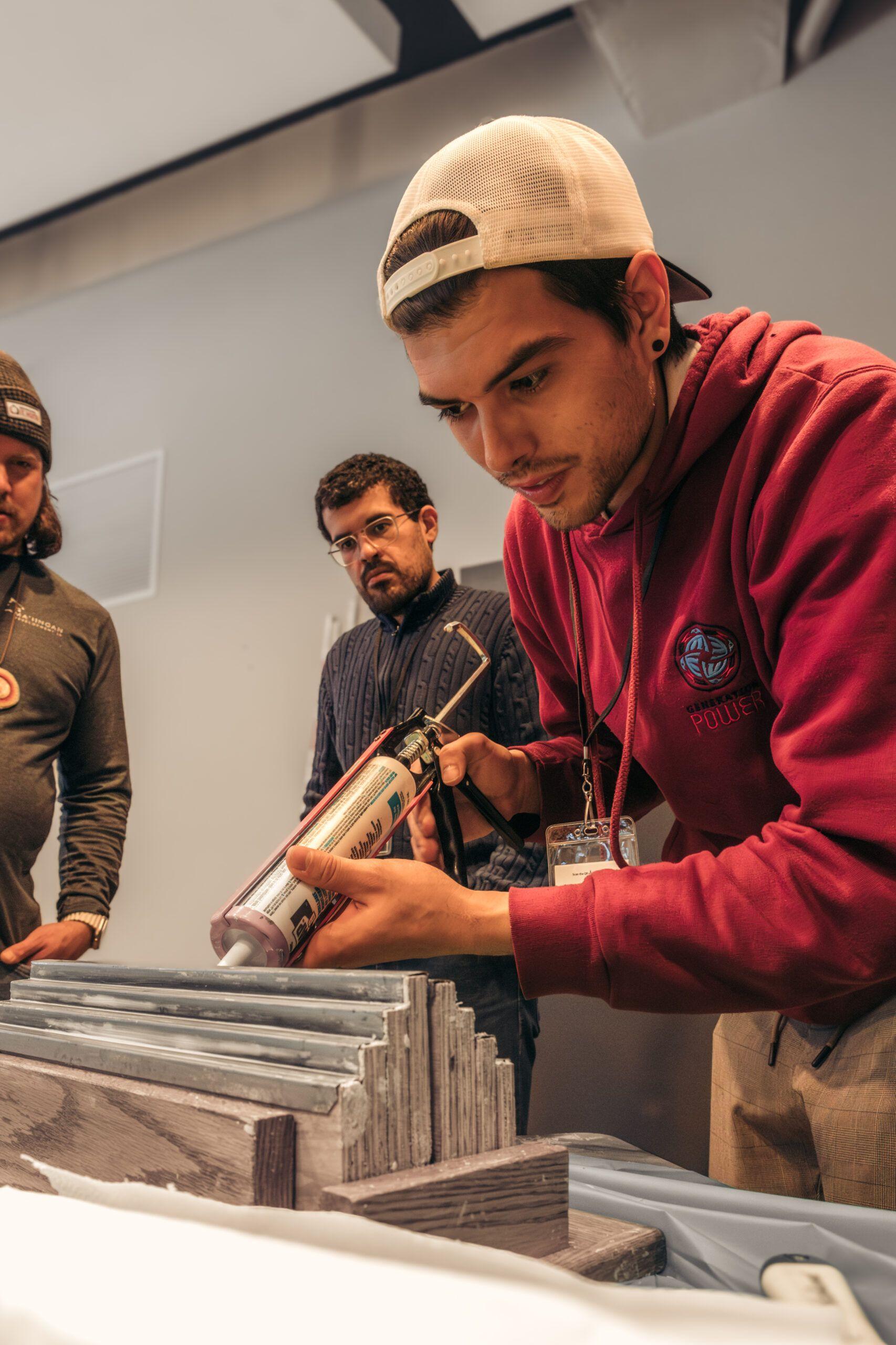
“When people are less stressed out and have adequate living conditions – that can help with the healing and help with tackling those basic things,” said Odjick from the Wakefield Mill in mid-February. He had just completed an intensive 18-month Project Accelerator Program, which is part of Indigenous Clean Energy’s Bringing it Home initiative – a campaign that seeks to empower and train Indigenous youth to become energy efficiency experts and to lead housing projects in their communities.
Odjick was one of 16 youths selected for the program and spent a year and a half learning about eco-home building, energy efficiency and capacity building to gain the skills to become a project manager on large-scale construction projects.
The program offers participants up to $125,000 in funding for housing projects in their communities, and Odjick said he has an ambitious plan to retrofit elders’ homes in Kitigan Zibi.
“I took the little bit from my culture that I knew about – and the Elders always come first, I was told – so I took that approach,” said Odjick. “We’re a little bit more fortunate in Kitigan Zibi; we don’t have as much overcrowding issues as some of the other communities, but we do suffer from the same collective trauma. That’s definitely still there.”
And while Odjick said his community in Kitigan Zibi is more “fortunate” than other First Nation communities across the country, the local band still faces significant housing issues, namely access to clean drinking water.
According to former Kitigan Zibi chief Gilbert Whiteduck, now the head of the Gatineau Valley Historical Society, nearly half of residents on the reserve do not have access to clean drinking water.
“The home I live in now, where I raised my family [for] some 45 years, has not had potable water for over two decades,” said Whiteduck, who has lived on the reserve for nearly 70 years. “We continue to receive bottled water on a weekly basis.”
Whiteduck added that Kitigan Zibi has completed sewer and water extension plans but needs funding commitments from the federal government to get the work done. In 2015, Prime Minister Justin Trudeau pledged to end water advisories in Indigenous communities by March 2021, but that target was missed. The feds have since dumped $4 billion into clean water projects for Indigenous communities, but Kitigan Zibi – a short 1.5-hour drive from Parliament Hill – still struggles without potable water.
“The original work that was carried out to address the potable water and sewer issue in the community for a limited number of homes has been done in phases and took a lot of hard bargaining,” added Whiteduck. “Nothing comes easy when it is a basic right issue.”
But Whiteduck added that, in Kitigan Zibi, it’s not so “doom and gloom.” He said that the band has good leadership and that most homes on the reserve are in good shape and if they’re not, the band will work with residents to fix them.
“We are a resilient people,” added Whiteduck.
However, he said that Odjick’s project was “ambitious” and would help the band manage and maintain elders’ homes on the reserve. He hopes the project will encourage other Indigenous youth to take up community projects to improve life for their people.
For Odjick, he said his retrofit project has the potential to “change my community.”
Odjick’s project will utilize local contractors, educate current builders on eco-practices and efficient building techniques and create jobs for locals who want to stay in their community.
“We’re not looking for small-scale projects where we are going to build five to 10 homes – we’re looking for community-scale,” said Corey Cote, project manager at Indigenous Clean Energy, who is heading the Bringing it Home Initiative. Indigenous Clean Energy is a not-for-profit that advances Indigenous-led capacity building and collective action in Canada’s clean energy transition.
According to his organization, almost one in six Indigenous people in Canada lived in homes requiring significant repairs in 2021. He said many Indigenous communities still face overcrowding, mould and a “chronic shortage of housing” that is alarmingly disproportionate compared to non-Indigenous communities.
“What Aaron-lee Odjick’s project showed me is that they have a number of band-owned homes, so [he] has large-scale access to do this work,” added Cote. “He is thinking big picture, and he did show the commitment of leadership to support the project.”
Odjick has to meet several deliverables throughout the project to access the entire $125,000 in funding for his retrofit initiative. Step one is creating a project manager position for himself in Kitigan Zibi, where he will need to convince the band to hire him for the retrofit project. But with 18 months of intensive training under his belt, Odjick said he is confident that he’s the right person for the job.
“It’s amazing,” added Odjick. “I could possibly have a permanent, really good job in my community, which is hard to get.” He added that he hopes his retrofit project will help others find work locally, too.