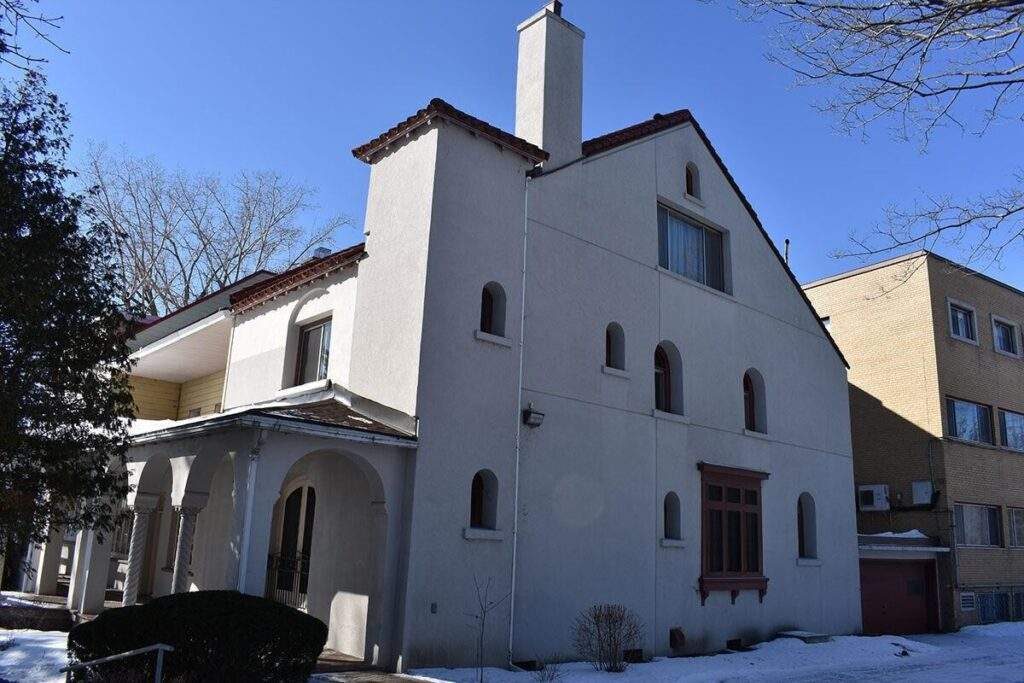
Historic Dorval convent’s fate sparks heated debate
By Chelsey St-Pierre
The Suburban
A retired conservation architect has raised serious concerns about the City of Dorval’s plans for a historic building at 12 Dahlia Avenue, challenging the financial and environmental wisdom of its proposed demolition.
The property, steeped in local history, represents a significant piece of Dorval’s heritage. The site was originally home to Désiré Girouard, who became Dorval’s first mayor when the town was incorporated in 1892. The main residence, known as “Quatre Vents” (Four Winds), was built in 1873 and has undergone several architectural modifications throughout its 150-year history.
The building at the centre of the current controversy, known as the Annex, has its own rich history. The Congregation de Notre-Dame acquired the property in 1970, converting it into both office space and residential quarters for the sisters. The four-storey structure, which later housed 75 nuns, served as a testament to the religious community’s presence in Dorval until its recent acquisition by the city for approximately $3 million.
Fernando Pellicer, a conservation architect with 44 years of residency in Dorval, contacted The Suburban critiquing in detail the city’s November 26 information session where five options for the building’s future were presented. The session, which drew significant community attention, focused on the Annex building’s fate.
Pellicer’s analysis reveals allegedly misleading cost estimates in the city’s proposals. While the city estimates $700,000 for total demolition, Pellicer argues the true cost would approach $2 million when including necessary site restoration. Combined with the initial purchase price, taxpayers could be looking at a $5 million expenditure “for a 10,000 sq. ft. lawn,” as Pellicer puts it.
The controversy has mobilized community action, with over a thousand Dorval residents along with non-residents signing a petition demanding a comprehensive study of the site’s future with community input. The property, which encompasses three distinct buildings — the historic mansion, a cement block structure, and the Annex, represents a unique architectural ensemble within the city’s landscape.
“You don’t demolish an asset before deciding what to do with it,” Pellicer argues, proposing instead a $7 million renovation plan that would fully modernize the building while preserving its historical character. This alternative, he suggests, would be significantly more cost-effective than the $18 million estimated for a comparable new structure.
City officials paused their decision following public pushback after their April 2024 announcement of intention to demolish. The city’s position, based on an architectural report, maintains that the building has limited heritage value, though this assessment is disputed by preservation advocates.
The City of Dorval originally purchased the property to protect its historical and heritage value, making the current demolition proposal particularly controversial among preservation advocates. With mounting tensions between preservation advocates and city officials, the outcome of this historic site remains uncertain, highlighting the challenges municipalities face in balancing heritage preservation with modern development needs. n
Historic Dorval convent’s fate sparks heated debate Read More »