BRENDA O’FARRELL

Soulanges towns get $27M of infrastructure funding

BRENDA O’FARRELL
The 1019 Report

Just over $27 million in government funds will be invested in the 16 towns in the Soulanges riding to improve municipal infrastructure – everything from drinking water networks, to waste-water treatment, roads and to improve the energy efficiency of public buildings – provincial authorities announced last week, with St. Lazare set to receive the largest grant.

The funds will help finance projects over the next five years.

St. Lazare, the largest town in the Soulanges riding, will receive just over $6.6 million, while the town of St. Zotique will receive $2.98 million, Rigaud will be granted $2.3 million and Coteau du Lac $2.2 million. Hudson will receive $1.69 million.

The other 11 towns will receive sums between $2.1 million and about $628,000.

The grants are part of a special $3.2-billion province-wide infrastructure program, with $2.2 billion coming from the federal government’s Canada Community Building Fund, which provides funds annually to communities across the country to improve essential services. A total of $1 billion is provided by the province.

Here is a detailed breakdown of the funds that local towns will receive:

Coteau du Lac: $2.237 million

Hudson: $1.69 million

Les Cèdres: $2.1 million

Les Coteaux: $1.78 million

Pointe des Cascades: $894,805

Rigaud: $2.3 million

Rivière Beaudette: $1.07 million

St. Clet: $873,278

Ste. Justine de Newton: $710,534

Ste. Marthe: $720,221

St. Lazare: $6.63 million

St. Polycarpe: $1.04 million

St. Télesphore: $665,973

St. Zotique: $2.98 million

Très St. Rédempteur: $732,492

Soulanges towns get $27M of infrastructure funding Read More »

Hudson prepares for negotiations with Sandy Beach owner

BRENDA O’FARRELL
The 1019 Report

Hudson taxpayers will be given a say on whether the town moves forward with a formal bid to purchase the land surrounding Sandy Beach if a deal is struck with the owners of the wooded wetlands along the Lake of Two Mountains, said Mayor Chloe Hutchison.

That was the assurance the mayor offered July 15 as Hudson council held a special meeting to approve two contracts for studies that will help the town determine the value of the land.

When asked, Hutchison said she personally supports the idea of saving all of the Sandy Beach area from development, but as mayor, she is “keeping an open mind and open ears” to find the level of acceptability from residents in terms of what financial burden they are willing to shoulder to make that happen.

The two contracts approved by council last week include a $25,000 market valuation of the properties in the Sandy Beach area owned by developer Nicanco Holdings Inc. and a neighbouring lot that is currently listed for sale for $1.5 million, and a $27,500 cost-benefit analysis of the proposed development project for the site that will outline the entire cost to the town, including infrastructure and service expenditures. This will provide a clearer understanding of the fiscal implications of the proposed development plans.

It is expected that the studies will take several months to complete.

Lawsuit on hold

Hutchison said the reports will help inform the town’s negotiations with Nicanco, which has formally informed the town that it would be willing to entertain an offer to purchase the land. To that end, the company has put its lawsuit against the town over delays on hold.

Meanwhile, a group of residents who have stepped forward to lead a grassroots fundraising effort to create a funding vehicle to facilitate the purchase of the Sandy Beach area in order to eliminate the threat of development has made strides in the last few weeks.

“There is a lot of opportunity and we have organized ourselves to deliver a lot of money,” resident Cam Gentile, who is one of the organizers of the group, told council at the meeting.

Part of the group’s efforts, Gentile said, will be the launching of an awareness campaign to build public support for its fundraising effort.

Hudson prepares for negotiations with Sandy Beach owner Read More »

St. Lazare man credits pharmacist with saving his life

BRENDA O’FARRELL
The 1019 Report

A St. Lazare man has a message for his friends and neighbours: Your local pharmacist can save your life.

Oh, and you should think about carrying an epi-pen.

That is what 63-year-old Michael Blakey said after he survived a harrowing ordeal July 12, a quiet Friday when he was preparing his boat to go fishing with his son for the first time this summer. As he prepared the craft, he unknowingly disturbed a hive of wasps that had established itself under the seat of his boat. Before he knew it, he had been stung several times.

Within minutes, hives broke out on his feet and in his armpits, his lips were swelling. He popped a Benadryl, a popular antihistamine, he had in the house. But that seemed to have little effect.

“I needed an epi-pen,” Blakey said, referring to an auto-injector device that deliver a small dose of epinephrine, a medication to treat allergic emergencies, often referred to anaphylactic shock.

Instead of calling 911, he jumped in his car and raced down to the Pharmaprix outlet on Ste. Angelique Road. That is where pharmacist Peter Hanna immediately used an epi-pen to help ease Blakey’s reaction, then, he called 911.

At this time, Blakey described his breathing as laboured. He said he felt “odd, itchy, panicky” and admitted he was scared. St. Lazare first-responders were on the scene in minutes, followed by an Urgences Santé ambulance. He was monitored at the store for a while, where it was established that the oxygen level is his blood had dropped dangerously low.

Blakey was taken to the Lakeshore General Hospital in Pointe Claire, but by then, the swelling of his lips and tongue was subsiding. He was monitored in the emergency ward for about four hours before he was released, and returned home.

Hospital officials said he “made a very smart move” by rushing to the pharmacy, he said. Hesitating or waiting for an ambulance to arrive could have resulted in a much more serious outcome, he believes.

Now, Blakey keeps three epi-pens with him – one at work, one at home and one in his car.

“People need to be prepared for this,” he said, explaining how the allergic shock came on so fast and could have been deadly, as his airways became obstructed.

He returned to the pharmacy the following week to thank Hanna. He credits the pharmacist’s quick actions with saving his life.

Oh, and the pharmacy even picked up the cost of the ambulance.

St. Lazare man credits pharmacist with saving his life Read More »

Pointe Claire to pull lot out of building freeze

BRENDA O’FARRELL
The 1019 Report

In an unexpected move, Pointe Claire council has proposed a motion to remove a lot from the city’s ongoing development freeze with the aim to allow two 13-storey residential buildings to go up on St. Jean Blvd. north of Highway 40.

Citing the need to move quickly to address the widespread housing crisis that has seen the price of homes and rents rise rapidly across the country in the last few years, Pointe Claire councillors said it could not wait for the city’s urban development plan to be completed, effectively approving a proposal that would see 367 rental units be built at the southwest corner of Labrosse Ave. and St. Jean Blvd., north of the Fairview Pointe Claire shopping centre.

“There is a housing crisis in Canada that we have to respond to,” said councillor Kelly Thorstad-Cullen as the motion was put forward at the July 2 council meeting.

“It is not an option for us to say we are going to do no more development,” Thorstad-Cullen continued.

The move sparked harsh criticism from Pointe Claire Mayor Tim Thomas, who condemned the action before the city has had a chance to put forward its development plan following an extensive public consultation process.

“I oppose this amendment,” Thomas said, reading from a prepared statement during the council meeting. “I don’t believe we should be taking any more properties out of the (development freeze) until public consultations and the revisions of our urban plan are completed.”

“For the past eight years, our urban planning has been decided for and by developers,” Thomas continued. “Changes to our bylaws have been driven by those who have best access to city hall and have gotten what they want on a case-by-case basis.

“There has never been an overall plan that takes account of our housing needs, our infrastructure capacity or the quality of life of our entire community,” he said.

“We can all see the strains on our infrastructure ­– from the traffic on St. John’s, to the brown water and reduced water pressure in Valois, to the frequent blackouts in Cedar Park,” Thomas said. “We can also see neighbourhoods which have failed to live up to our planning programs with regards to green spaces and first-floor commercial spaces for residents. This has to change.”

In response, Thorstad-Cullen said the majority of council has listened to what citizens have said during the consultation process, claiming: “And there are many aspects in this project specifically that are responding to what we’re being asked for.”

“It is in line with what we are planning to do with our planning bylaws,” Thorstad-Cullen added. “It is checking all the boxes of what citizens have told us.”

Thomas took issue with Thorstad-Cullen’s reasoning, arguing that it is not up to council members to interpret what they have heard via the consultation process in a haphazard manner. Rather, they should wait for the consultants hired by the town to convey the results of the consultation process to the city’s urban planning professionals, who will, in turn, formulate an overarching urban planning proposal, which could then be approved by council and applied to all proposals submitted to the city.

“What we have to have is a coherent organized plan that reflects what the citizens have told us, and then use that plan in its application to subsequent projects,” Thomas said during the council meeting.

Councillor Eric Stork added his voice in support of removing the lot from the building freeze, saying all 367 units in the two buildings planned will be rental units, which will be priced at 15-per-cent below the average market rate for the area, determined by the Canada Mortgage and Housing Corp.

The building will include 3½- and 5½-room units to accommodate families, with rents for smaller units receiving 10-per-cent rental rate reductions, while larger units receiving 20-per-cent rental subsidies, for a minimum of 16 years.

Stork added that council was merely putting forward a notice of motion to remove the lot from the development freeze, and that public consultations on the project will be held in either August or September, after council votes next month to ratify the move.

In an interview Monday, Thomas said the city’s administration brought the proposed project to council for approval with concerns about possible legal action from the developer against the city, claiming the project, which had obtained subsidies from the CMHC, had already passed a number of hurdles in the approval process when the development freeze was imposed, putting it on hold.

First imposed in February 2022, Pointe Claire’s development freeze – which is often referred to by its French name – Règlement de contrôle intérimaire, or RCI –  put a halt to building projects in several key areas of the city, including the parking lot area of the Fairview Pointe Claire shopping centre, where a massive development comprised of thee high-rise towers has been proposed; the adjacent Fairview Forest; Pointe Claire Village; Valois Village; as well as at Pointe Claire Plaza at St. Jean Blvd. and Highway 20; and various stretches of Lakeshore Rd. and Hymus Blvd.

In April  2022, a majority of council voted to exclude the Fairview parking lot from the freeze only to reverse course a month later, and re-introduce it back into the development freeze.

RCIs are a relatively new tool provided to municipalities by the Quebec government to allow them to pause development in order to recast their planning bylaws to reflect the scope and scale of development within their territories. Pointe Claire’s development freeze is slated to be lifted once council adopts its new planning bylaws, expected to be unveiled some time later this year.

Pointe Claire to pull lot out of building freeze Read More »

Pointe Claire looks to build Highway 40 pedestrian overpass

BRENDA O’FARRELL
The 1510 West

The city of Pointe Claire last week issued a $2.2-million contract to a Canadian engineering firm to design plans for a pedestrian and cycling overpass across Highway 40 just west of St. Jean Blvd. that could cost more than $20 million to build.

But there is no commitment as of yet to actually build the infrastructure, according to city officials.

“This is just to create the plans,” said councillor Brent Cowan at the July 2 Pointe Claire council meeting as he explained why he was voting against the contract. “The actual pedestrian-cycling overpass would be up to 10 times that and more,” he added.

The city has opted to commission a design for the structure that would link the south side of the city, near Alston Avenue, to the REM commuter rail station next to the Fairview Pointe Claire shopping centre, north of the highway, with the promise of federal funding that would cover part of the cost of construction. Land on either side of the highway would have to be acquired for the project to move forward.

But Cowan said delays in getting provincial approval to allow the city to accept the federal funds has meant that it is not quite clear if Pointe Claire would be able to count on that contribution. Then, there is the unknown final cost of such a project, he added.

“In my mind, that’s too many uncertainties,” Cowan said. “So I will not be supporting this motion.”

Councillor Claude Cousineau also voted against the contract, which was finally approved by a majority of council.

“We are not ready for this,” Cousineau said. “It can wait. There are other priorities.”

Cousineau confirmed the final bill to build the structure could go as high as $20 million or more, adding there is no information on how many pedestrians or cyclists would actually use it.

In an interview earlier this week, Pointe Claire Mayor Tim Thomas said the federal government had offered the city an $8-million subsidy for the project back in 2022. But it is difficult to measure the significance of the grant, he conceded, without knowing the final cost of the plan.

Thomas said the design contract would propose options for the structure – like whether it would be covered to protect users from the elements, especially in winter. The final cost of the project would depend on the design selected.

“It’s a cool project,” Thomas said. “But it’s going to be costly. It’s going to be substantial.”

At the meeting, Cowan said this is the type of project that should be, in part, shouldered by the agglomeration. At this time, however, there is no financial commitment from the regional administrative body.

Pointe Claire looks to build Highway 40 pedestrian overpass Read More »

Hudson set to discuss deal for Sandy Beach

BRENDA O’FARRELL
The 1019 Report

The town of Hudson is preparing to negotiate some sort of deal with the owners of Sandy Beach to determine how the waterfront area can be spared from development, but it will come down to price – and how much of that price taxpayers are willing to shoulder, says Hudson Mayor Chloe Hutchison.

This spring representatives of Nicanco Holdings, which own the wooded tract of land along the shores of the Lake of Two Mountains, asked the town if it would be interested in discussing a possible deal, Hutchison said, marking the first time in recent years the landowners would consider the option.

“There is an opening on their part,” Hutchison said in an interview with The 1019 Report this week.

This led to about five meetings involving members of council and others to hash out a formal response from the town. That response, which was outlined in a statement, was delivered to Nicanco a week ago, Hutchison said Monday. She declined to share the substance of the message.

The meetings to draft the response involved all members of council, the town’s director-general, its special projects co-ordinator and the town’s lawyers.

“The message coming from council is to save all of it,” Hutchison said, referring to the entire tract of wooded wetland that traces the shore of the lake. But she cast doubt on whether that option will be possible.

“We won’t get away without paying some profitability,” Hutchison said, referring to what the developer will be seeking in terms of value for its land.

To prepare for possible negotiations, council next week will hold a special meeting. Four items have been outlined on the agenda of that meeting, including two that will deal with Sandy Beach. One item, Hutchison said, would be to approve a contract to assess the market value of the land owned by Nicanco and an adjacent 1.9-acre lot located at 2 Royalview Street that has recently been listed for sale with an asking price of $1.5 million.

A second contract set to be issued is to assess the cost to the town if the proposed development Nicanco has put forward to build about 200 housing units in the area goes through. This would include the financial impact of everything from infrastructure to services weighed against the possible tax revenue generated from the construction of new residential dwellings. The aim is to inform council and taxpayers in clear, calculated terms the positive or negative fiscal impact of development to the town, she said.

The town is planning to issue two additional contracts at a later date to support its talks with Nicanco, Hutchison said.

In the meantime, several other factors could affect the value of the land, including the awaited outcome of the legal challenge to the Quebec Environment minister’s decision to revoke Nicanco’s permit to backfill part of the area around Sandy Beach that has stalled its original 214-unit housing development project to move forward.

If the ministerial revocation of the permit stands, it would only limit development in a small section of the site, and Nicanco could still develop within a wide tract of the area. To that end, the developer has already drafted plans for an amended version of its building plan, but it has not yet been approved.

Also, the provincial Environment Ministry is currently updating its new flood plain maps. Depending on the outcome of this process, which is now undergoing consultations, the area along the waterfront that would be permitted for development could change dramatically. The new flood maps are only expected to be publicly unveiled some time next year.

Ultimately, Hutchison said, it will come down to price.

“We can consider putting in a third of something,” she said, explaining the remainder of any final price would have to come from other sources. Convincing taxpayers to go along with such a plan, however, is not a given in her estimation.

And that is where a grassroots group that held a public meeting last month could come into play.

The meeting, organized by a small group of citizens who support saving Sandy Beach from development, invited the public to discuss what was framed as “a viable alternative solution to residential construction” surrounding the beach site. About 100 people showed up June 21. Among the topics raised at the gathering was the development of what one organizer called “a financial vehicle” to attract and raise funds to support the purchase of the popular waterfront natural space.

“The enthusiasm from the meeting has been phenomenal,” said Hudson resident Cam Gentile, one of the organizers of the meeting. “There is tremendous support.”

About 25 people have stepped forward following the meeting, Gentile said, to help the group organize its efforts. This expanding group has held a series of meetings in the past weeks.

The objective, Gentile said to build awareness of the group’s effort and create a vehicle to collect what he described as “a significant amount of funds” to help buy Sandy Beach.

Hudson set to discuss deal for Sandy Beach Read More »

MRC votes to suspend director-general, launch probe

BRENDA O’FARRELL
The 1019 Report

The MRC Vaudreuil-Soulanges has suspended its director-general pending an investigation into what multiple sources have described as a series of issues.

Guy-Lin Beaudoin was suspended with pay from his duties last month at a special meeting called by the MRC council.

A majority of the mayors who sit on the 23-member MRC council also voted to contract the services of a lawyer to conduct an independent probe into issues of concern which were raised by the elected members of the council who sit on the agency’s human resources committee.

According to multiple sources who spoke to The 1019 Report on the promise of anonymity, some elected officials on the MRC council were surprised to recently learn that the director-general’s employment contract had been renewed in May 2023 without their knowledge.

The head of the MRC, prefect Patrick Bousez, has the authority to renew the director-general’s contract.

The lawyer mandated to conduct the inquiry had previously been commissioned by the MRC on other matters before the contracted was extended to include this new probe.

“It is more complex than we can believe,” one source told The 1019 Report without providing specifics. “As we have learned things, we had to act,” the source said, referring to the mandate extended to an independent lawyer to conduct a series of inquiries.

The region’s mayors have been meeting behind closed doors to discuss issues for several weeks, sources confirmed. These meetings have included Bousez.

Bousez declined a request for an interview, but issued a short statement to The 1019 Report:

“The MRC will not issue any comments regarding the investigation that will be launched and the suspension of the employee involved,” Bousez stated in an email delivered through the MRC’s communication staff.

The MRC’s acting assistant director-general, Alexandre Lambert, will act as interim director-general until the inquiries are completed.

Beaudoin has served as the MRC’s top administrator for about 15 years. In 2018, he was recognized for his years of service by the Association des directeurs généraux des MRC du Québec. The honour, which is posted on the MRC Vaudreuil-Soulanges’ website, outlines a career that has so far included stints as assistant director-general for the MRC Manicouagan, before becoming the director-general of the MRC Val-Saint-François. He also served as director-general of the town of Richmond for seven years.

During his tenure at the MRC Vaudreuil-Soulanges he has overseen the construction of the regional authority’s new headquarters on Harwood Blvd. which also includes the offices of the regional municipal court and the offices of the MRC’s business development agency, Développement Vaudreuil-Soulanges.

MRC votes to suspend director-general, launch probe Read More »

St. Lazare posts $5.5-million surplus for 2023

BRENDA O’FARRELL
The 1019 Report

The town of St. Lazare posted a $5.5-million budget surplus for 2023, bringing its accumulated surplus to about $8.8 million, according to its audited financial report unveiled last month.

The report, approved by the city’s municipal council on June 11 and subsequently submitted to the provincial government, provides a detailed overview of the city’s fiscal performance in the last year.

According to the figures, the city posted total revenues of $36,700,722 in 2023, while all expenses came in at $31,161,212, leaving a surplus for the year of $5,539,510.

The city’s unallocated accumulated surplus as of Dec. 31, 2023, totalled $8.8 million.

In addition to the unallocated surplus, the city also controls an allocated surplus of $4.4 million. Of that sum, $2.55 million has been assigned to the city’s 2024 budget in an effort to reduce the tax burden on taxpayers.

According to figures released by the town, St. Lazare ended last year with a long-term debt of $26.7 million. Just more than half of that debt, 54 per cent, is carried by all property owners in the town, while 39 per cent is attributed to only some taxpayers who have been assessed with local improvement projects and specific water and sewer upgrades.

According to St. Lazare Mayor Geneviève Lachance, the level of long-term indebtedness of residents is pegged at a level of 94 cents per $100 of property valuation, well below the comparative level of $1.54 per $100 of valuation, which is the average for towns in the MRC of Vaudreuil-Soulanges, and $1.69 per $100 of valuation for towns across Quebec of comparable size to St. Lazare.

St. Lazare posts $5.5-million surplus for 2023 Read More »

Responding to call for help: Quebec offers farmers $200 million

Brenda O’Farrell
The Advocate

If Quebec farmers wondered whether the provincial government got the message conveyed by their demonstrations earlier this year – as convoys of tractors paraded along the streets of urban centres drawing the public’s attention to the growing list of issues that threaten the financial viability of agricultural producers – provincial Agriculture Minister André Lamontagne earlier this month said ‘Yes.”

Lamontagne’s response to the protests also came with an announcement of more than $200 million in help to mitigate the crisis in the farming sector.

“The economic and weather hazards of recent years have undermined the economic stability of our (farm) businesses,” Lamontagne said as he announced the measures at a press conference in Les Cèdres on June 13. “In such situations, it calls on us to show solidarity with our producers.”

Quebec will add an additional $30 million to its so-called emergency fund created last year to help farmers deal with inflationary costs, bringing the total amount of the fund to $55 million. These funds are expected to help about 3,000 agricultural businesses in the province that are considered to be in financial difficulty.

Another $37.1 million will help young producers offset the cost of increased interest rates. This measure is expected to help about 2,900 producers who have recently launched operations.

The largest infusion of cash – $106 million over five years – will come in the form of grants to help producers adapt to changes caused by climate change. The details will be outlined in the coming weeks.

Producers in the Abitibi-Témiscamingue region will also receive $1.6 million in compensation for losses suffered in 2023 due to extreme drought conditions.

Additional measures specifically targeted at market gardeners and strawberry and raspberry producers through the Agri-Relance program, which receives funds from the federal government, will also be outlined in the coming weeks.

Lamontagne also pointed to what his ministry calculates as $36.8 million in savings for farmers that will result from moves to reduce paperwork and reporting for a variety of environmental regulations imposed in the last few years.

In an interview with The Advocate after making his announcement, Lamontagne confirmed the demonstrations helped him convince his cabinet colleagues the government had to act.

“The more people raise their voices, the more they will be heard,” he added, explaining the announcements he outlined reflect the cooperation of several other ministries.

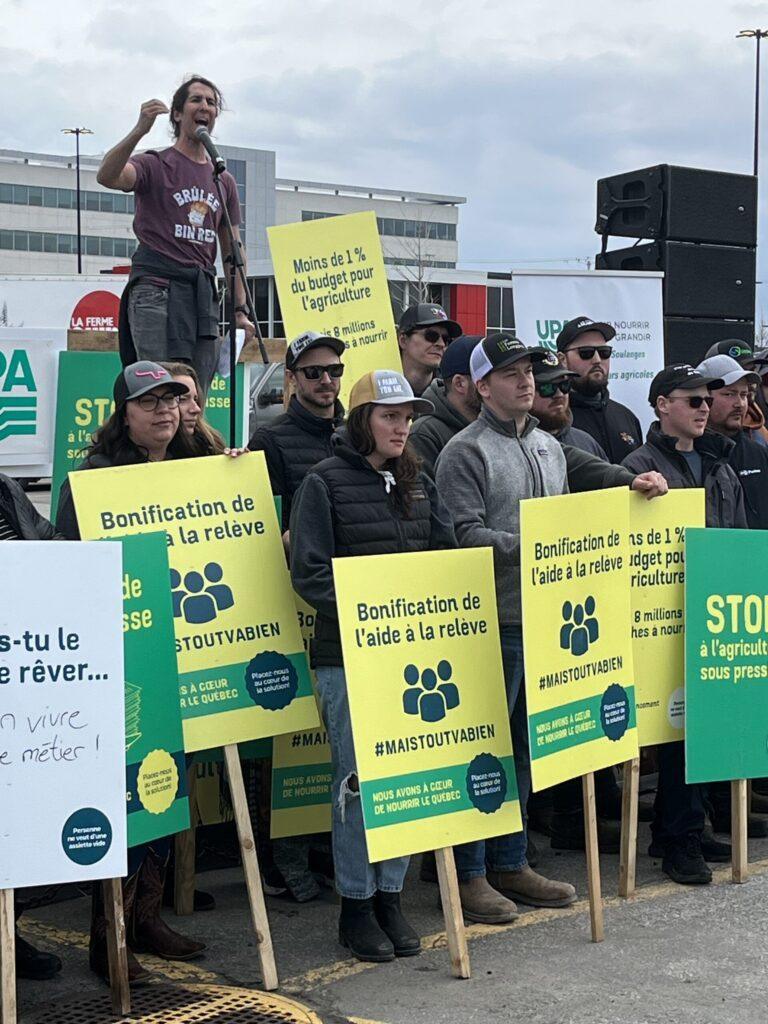
In April and May, Quebec farmers staged 17 demonstrations in all regions of the province involving an estimated 4,500 participants calling on the government to help producers. From high interest rates, to increasing fuel and fertilizer costs, severe weather events triggered by climate change to the increasing bureaucratic burden being imposed on agricultural producers by expanding environmental regulations and reporting requirements, farmers told the government they are struggling to make ends meet.

Given the extent of the demonstrations, Union des producteurs agricoles president Martin Caron, who was with Lamontagne for the announcement in Les Cèdres, was asked: Is the government’s response enough?

“Yes. It’s some big steps being taken,” Caron said in response, but then added that the UPA is still pushing for the provincial government to increase its spending for agriculture.

Caron pointed out that the provincial government still only allocates 1 per cent of its budget to the sector.

“There is an opening, and there is optimism,” Caron added.

In an interview after the announcement, Caron confirmed the demonstrations made a difference.

“It had an impact,” he said, adding that it convinced several ministries to act in consort, a breakthrough that will hopefully continue and allow for what he termed “common sense” take on a bigger role in how the government treats farmers.

Responding to call for help: Quebec offers farmers $200 million Read More »

Tornado rips path of destruction

BRENDA O’FARRELL
The Advocate

The usually quiet town of Très St. Rédempteur near the Ontario border was a beehive of activity at the end of May in the wake of a tornado touching down, cutting a swath of destruction in a matter of just a few moments.

“To have it gone in under 30 seconds – it’s emotional to say the very least,” said Julia Asselstine, whose old farmhouse suffered the most damage in the sudden swirl as the tornado whipped through her yard.

The front of the roof of her house, which she and her husband, Daniel Gelinas, had purchased in 2020, was ripped from the rafters, while the two large willow trees that framed the building on either side were splintered. The gazebo behind their house was destroyed, with sections of it strewn as far as across the street, while its lounge furniture was still visible, wedged high overhead in a nearby tree. The shed the couple had planned to take down, was left half standing, tattered and twisted by the violent winds.  

Not far away, on Chemin du Petit Brûlé in Rigaud, members of the Carrière family who run Ferme Carra were picking up the pieces on their farm the day after the twister. The tornado destroyed a cement silo by the barn, damaging the steel silo that stood next to it.

“It passed between my house and the garage,” said Carmen Beauclair, who ran the dairy farm with her husband before their son took over the operation.

The winds also ripped a corner of the roof from their barn. No animals were hurt.

Next door, where Beauclair’s son lives, a piece of another neighbour’s chicken barn was sent through a cedar hedge like a projectile, piecing a side window of the house, damaging part of the living room. No injuries were reported.

Only a concrete slab remained of the chicken coop next door. The building housed 75 laying hens owned by the nearby Petit Brûlé – Ferme Écologique

It was believed that all the chickens were lost, said Marie-Pier Thellen, an animal supervisor for Petit Brûlé, who was at the scene the day after the tornado. But while workers picked up the debris, one chicken was found unharmed, but with feathers ruffled.

Environment Canada confirmed the tornado touched down at about 5:30 p.m. on May 27, generating wind speeds of about 155 kilometres per hour.

The meteorological agency said the twister cut a path 14 kilometres long, stretching from Très St. Rédempteur to Rigaud and Pointe Fortune. In all five properties, including a barn in Pointe Fortune, are believed to have been damaged.

According to a statement issued by Environment Canada, data collected by the Northern Tornadoes Project at Western University in London, Ont., the tornado was categorized as an EF-1, which falls on the lower end of the Enhanced Fujita Scale that is used to measure the severity of tornadoes.

Tornado rips path of destruction Read More »

Farming Facts: From climate change to disappearing farmland

Here are a few fun facts that quantify a few realities of the farming sector.

12%: The amount by which world GDP will drop for ever 1-degree-Celsius increase in global temperature, according to a new study released in May by Harvard University’s Adrien Bilal and Diego Kanzig of Northwestern University entitled The Macroeconomic Impact of Climate Change: Global vs. Local Temperature, published by the U.S.-based National Bureau of Economic Research.

43%: The percentage of Quebec farmers who predict the financial health of their farm business will deteriorate in 2024.

14%: Percentage of agricultural producers in Quebec who operate farms with annual revenues under $100,000 that fear going out of business.

319: The average number of acres of farmland lost a day – the equivalent of nine family farms taken out of agricultural production per week.

Farming Facts: From climate change to disappearing farmland Read More »

Will there be consultation on future of Fairview Forest?

BRENDA O’FARRELL
The 1510 West

Will the residents of Pointe Claire have the opportunity to participate in a public consultation meeting on the future of the wooded area commonly known as Fairview Forest?

It is a question without an answer.

At least that is how it appears in the wake of the June council meeting in Pointe Claire – more than a year since the city launched its public consultation process following the adoption of a development freeze in key areas in the municipality to allow the public to weigh in on how development should take shape.

At the meeting on June 4, Geneviève Lussier, the spokesperson for the Save Fairview Forest group, put the question about the forest consultation directly to elected officials. The response she received was far from clear.

Mayor Tim Thomas turned to the city’s director-general for an update.

“We have to have a workshop … with the council before … for (council) to decide what the next steps for that,” said Pointe Claire director-general Karina Verdon.

Taking that information, Thomas then turned to Lussier and said: “Apparently, it’s still in the works.”

But then the mayor, who has repeatedly stated publicly he is in favour of seeing the woodland preserved from development, cast the prospect of a consultation session on the subject under a shadow of doubt: “My concern is whether it happens,” he said.

In an interview earlier this week, Lussier summed up her frustration with the lack of clarity on whether the residents of Pointe Claire will get a chance to weigh in on what she described as “the biggest issue in Pointe Claire right now.”

“I’m a little bit perplexed that this has not moved forward,” she said in an interview with The 1510 West.

“We’re flummoxed,” Lussier said, referring to her group which has been holding weekly demonstrations at the forest for the past 186 weeks, just more than three years, urging the woodland be preserved as a natural space.

She could only speculated that the acrimonious climate on council might be behind the lack of action on this question.

“There has got to be reasons,” she said. “I would like to know what those reasons are.”

In an interview earlier this week, Thomas said: “It seems to be a very cumbersome, slow-moving, almost stalled process.”

“I, too, would like to see where it’s going,” said councillor Bruno Tremblay in an interview.

Tremblay is clear he would like to see all of the remaining 43 acres of Fairview Forest preserved from development.

“I can only voice what I think should happen,” Tremblay added.

Councillor Eric Stork said the potential for a public consultation on the forest “is in the hands of urban planning  and the mayor. I have yet to see any proposal.”

“The administration is aware of the public interest in the topic,” said councillor Brent Cowan.

Given that the fate of the forest is one of the mayor’s priorities, Cowan added: “The mayor should have a significant role to play. It’s not my priority.”

So far, the city has hosted five public consultation meetings with the help of a consulting firm. Adding a session would require issuing another tender to engage a consultant to lead the process, Thomas said. There is no record of a tender being issued by the city, according to the Système Élecronique d’appel d’offres du gouvernement du Québec.

“It needs to happen since it was promised to us,” said Lussier, referring to a consultation on the forest. “It’s a matter of responsibility and ethics on the part of the council and administration.”

A session held by the consultants last October that touched on environmental issue, which included references to what homeowners could do on their lots and allowing chicken ownership, did not look at topics of development on a broader scale within the city, Lussier said.

Referring to preserving natural spaces and other issues touching on climate change, she said, “This is the issue of our times and there is very little action. Why is there such silence?”

Fairview Forest, she said, “is perfectly placed to be the Central Park of the West Island.”

This is not the first time criticism of the consultation process in Pointe Claire has surfaced. Earlier this spring, a resident asked council why key specific subjects, including the forest; the parking lot the Fairview Pointe Claire shopping centre, where Cadillac Fairview has proposed building a 20-storey seniors complex and two 25-storey apartment buildings; areas along St. Jean Boulevard; and the Pointe Claire and Valois villages have not been raised in the consultations to gauge residents’ views on these topics.

The process, said resident David Johnston in April, has not given “citizens the opportunity to talk about what everyone wants to talk about.” Nor has it touched on issues like the height of high-rises, the redevelopment of commercial zones or what would be the cost of possibly acquiring Fairview Forest, he said.

Last fall, a number of residents were outraged when they were informed at the consultation that dealt with environment issues when they were informed there would be no discussion of the forest. The topic was off limits due to what was referred to by the consultatnt as “judicial considerations,” one resident claimed to have been told at the meeting.

In the meantime, councillor Tara Stainforth in April has opted to revert to Facebook where she has posted a survey asking residents about how much money they would be willing to pay extra in taxes to see the forest purchased by the city. The initiative has sparked criticism as to methodology in gauging opinion.

Will there be consultation on future of Fairview Forest? Read More »

Municipal Affairs will not issue report on Pointe Claire

BRENDA O’FARRELL
The 1510 West

As Quebec Municipal Affairs wraps up this week its inquiries into how the city of Pointe Claire is being run, it will not issue a report, The 1510 West has learned.

“The process does not provide for the writing of a report,” said Sébastien Gariépy, a media spokesperson for the ministry, in a written response to inquiries from The 1510 West.

Officials in Pointe Claire have been meeting with the representative of the provincial government in a series of meetings throughout the last few weeks. The sessions were organized following a vote in April by a majority of the city’s council requesting help from the Ministry of Municipal Affairs to restore order in the city.

Some, but not all, members of council have met with a Municipal Affairs official in one-on-one meetings, with some meetings scheduled for this week. At least one meeting has been held with a ministry representative and council as a whole, it has been confirmed. Meetings have also been held that brought in top administrators with the city, including the director-general, the assistant director-general and the clerk, it has been confirmed by a source.

Pointe Claire director-general Karina Verdon and city clerk Caroline Thibault have also met with a provincial official, according to one source.

But without a report on the provincial findings following the meetings, it is not clear what information will be shared with residents.

Asked what actions the ministry could take after completing its interviews with city officials in Pointe Claire, Gariépy said: “The framework provides for other possible actions, but this not currently planned.”

“The city is running well,” said Mayor Tim Thomas, when asked to comment earlier this week.

He would not share the details of the questions he was asked, but said that if anyone looks at how the city is run, they will see that services are being delivered, its finances are in order, it has a budget surplus.

During a special meeting of council in April, all elected representatives except councillor Bruno Tremblay and Thomas voted to approve a motion requesting help from the provincial ministry to restore what was characterized as order in the municipality.

Although the wording of the resolution adopted on April 16 states that deterioration of the climate at city hall cannot be attributed to “a single person, nor a group of elected officials,” councillors have since made it clear they blame Thomas for an acrimonious climate.

“The problem is our mayor, plain and simple,” said councillor Eric Stork in an interview with The 1510 West last month. “Everybody is done,” he said in frustration.

“The mayor doesn’t know how to be a mayor,” said councillor Brent Cowan in a separate interview last month. “He only knows how to be against things.”

In voicing his opposition to the resolution in April, Tremblay accused the majority on council who oppose the mayor of turning to Quebec merely as a political move to discredit the mayor, describing it as “a cannon shot to end political opposition and affect the 2025 election.”

Quebec Municipal Affairs has carried out 141 interventions in municipalities across the province similar to its engagement in Pointe Claire between April 1, 2019, and March 31 of this year, according to information obtained by The 1510 West.

This type of provincial intervention includes “support in conflict management, municipal management and intermunicipal cooperation.”

When asked for examples of the results of these interventions, Gariépy said the ministry does not keep statistics on the service.

Municipal Affairs will not issue report on Pointe Claire Read More »

New housing plan for Sandy Beach put forward

BRENDA O’FARRELL
The 1019 Report

The owner of the Sandy Beach area in Hudson has stepped forward with a new housing development plan for the waterfront site and is seeking to discuss the option with the town, The 1019 Report has learned.

“We’re at the infancy stage,” said councillor Peter Mate in an interview yesterday. “The ball is in play.”

“Nicanco has presented a new plan,” confirmed councillor Douglas Smith, describing it only as a “different configuration” from the original 214-unit housing project that had been approved by the previous municipal council in 2020. That plan was put on hold last October when Quebec Environment Minister Benoit Charette revoked a permit that would have allowed the developer to backfill part of the wetlands at the site.

Smith described the new development option presented to the town as having “more or less” the same densification as the 2020 project, meaning roughly the same number of housing units.

As of yesterday, there was no consensus as to how council will proceed with negotiations, Smith added. Elected officials are scheduled to meet to discuss the issue behind closed doors tomorrow.

Mayor Chloe Hutchison did not respond to The 1019 Report for comment yesterday.

Mate said it is the first time discussions with the property owner have been offered with the current council, describing this latest move as a “huge opportunity.” He refused to share any details of the plan, claiming making details public at this time would not “help the negotiations.”

Mate concurred that council has not reached a consensus on what level of development – if any – would be acceptable, however, he added that he would favour some development, including condo buildings that would be four storeys high. The previous plan limited multi-unit buildings to three storeys.

“It has to make financial sense for the developer,” Mate said. “Everyone will need to concede a little bit.”

This latest revelation comes as a provincial tribunal prepares to hear arguments in a challenge to the Quebec Environment minister’s decision to revoke Nicanco’s permit to backfill on the site.

Recently, the Tribunal Administratif du Québec postponed a hearing that had been set for May 14 until July 9.

Last week, the town of Hudson voted to close the Sandy Beach park area to all visitors and fine anyone who ignores the new rules.

That action was taken following the landowner’s move in March to no longer tolerate trespassing on its property, which feature walking trails that provide access to the beach.

According to the town, the restrictions on access to the area is temporary, as it has launched the process of establishing trails to access the beach from publicly-owned land. But that requires applying for a permit from the provincial Environment Ministry because the new trails would trace through sensitive wetlands. It is not known how long that process will take, or if permission to create new trails will ultimately be granted.

In announcing the beach would be off limits for the summer, Hutchison had said, the town’s aim was to work collaboratively with the landowner, rather than be confrontational, in order to “find a way forward.”

Earlier this month, an abandoned house on Beach Road near the wooded lots adjacent to the beach area that is owned by Nicanco was demolished. Smith said a request for a permit to tear down the building was never submitted to the town’s demolition committee, which he sits on. The permit, he said, was issued directly by the town’s urban planning department.

Councillor Mark Gray, who has advocated for the preservation of the wetlands in the area, could not be reached for comment.

Rob Horwood, a spokesman for the grassroots group Nature Hudson, said yesterday that his group maintains its opposition to any development in the forested wetlands at the site. The group also opposes the town’s plan to seek permission to install new walking trails along the water’s edge on town-owned land, saying: “It’s a bad idea to build on this sensitive habitat.”

Horwood said if the land owner and municipal officials should discuss reopening the trails that exist and “stop the nonsense.”

New housing plan for Sandy Beach put forward Read More »

Farming Facts: From debt to dairy herds

Here are a few fun facts that quantify a few realities of the farming sector.

$1.3 million: That is the expected average debt per farm in 2024 in Canada, according to a recent survey of farm operators conducted by Statistics Canada. The average farm debt increased by more than half a million dollars, $562,543, between the 10-year period of 2011 to 2021, when it reached $1.1 million.

$66 million: That is the total amount of net farm revenue expected in 2024, according to forecasts by Agriculture and Agri-Food Canada, representing a historic low. In 2022, the figure stood at $959 million.

200,000: The number of Quebec companies with 25 to 49 employees that must now comply with francization rules as outlined in Bill 101, following the adoption of Bill 96 in June 2022. As of June 1, 2024, all these companies must register with l’Office afin d’entreprendre une démarche de francisation and conduct all of their business in French.

34: The number of dairy herds in the U.S. that have reported infections of the bird flu virus since the middle of March. The rise in incidents has sparked the U.S. Department of Agriculture to agree to a request from the Canadian Food Inspection Agency to test lactating cows for the virus before they cross into Canada. The testing requirement went into effect April 29.

The virus has not been identified in any Canadian dairy or beef herds to date.

Farming Facts: From debt to dairy herds Read More »

Ferry sees jump in users as motorists look to avoid bridge

BRENDA O’FARRELL
The 1019 Report

The operator of the Hudson-Oka ferry has seen a marked uptick in the number of users seeking to find an alternative route that allows them to bypass the traffic backlog caused by ongoing repair work on the Île aux Tourtes Bridge, but has confirmed there are no immediate plans to put another boat into service.

As the warm weather kicks into full gear, this could spell a long summer for residents living on Bellevue Street in Hudson, as commuters drive past their door on the north-south artery that provides direct access to the water-crossing.

“It’s tangible,” said Claude Desjardins, owner of the ferry service, describing the increase in the number of vehicles arriving to cross the Lake of Two Mountains by boat.

Although he could not provide exact figures, Desjardins said the jump in the number of users is noticeable during weekday rush-hour periods.

Desjardins said he was contacted about two weeks ago by an official with Soulanges MNA Marilyne Picard’s office inquiring about the prospect of eliminating the fee for motorists using the ferry while work on the Île aux Tourtes Bridge continues. But has not heard back after he asked if the provincial government would cover the cost of the $14 fee per vehicle.

But deciding to build and put a third boat into service to increase the number of crossings across the lake is a costly investment that he is not going to make this year. Two years ago, his company spent about $100,000 to expand its parking area to permit more vehicles to queue as they wait to get on the ferry. The move was co-ordinated with the town of Hudson’s initiative to add an extra lane to the north end of Bellevue and along a short stretch of Main Road just east of the ferry yard entrance designed to alleviate congestion at the site.

“It works,” said Desjardins, explaining how the traffic backlog in the vicinity of the ferry has been diminished.

But it has done little to slow speeders travelling up and down Bellevue and along Main Road, said Hudson town councillor Douglas Smith.

Smith says he regularly hears from residents of Bellevue who complain about the speeding.

“They’ve got a legitimate complaint,” said Smith on Monday, explaining that the problem for residents is not just the volume of traffic, but the “excessive speed up and down the street.”

“The people living on Bellevue are being subjected to unfair amounts of speed and noise,” he said.

Adding to the problem, Smith said, is the fact that more than a month after the ferry service opened for the season, the bollards that are usually installed on Bellevue that delineates the pedestrian and cycle path along the street and serve as visual cues to drivers to slow down have not yet been installed.

“It’s not being given the attention it needs and deserves,” he said.

Ferry sees jump in users as motorists look to avoid bridge Read More »

Quebec’s sustainable development watchdog critical of MAPAQ, CPTAQ

Brenda O’Farrell
The Advocate

In an exhaustive and highly critical report unveiled last month, Quebec’s commissioner for sustainable development offered a scathing review of both the province’s Agriculture Ministry and Quebec’s farmland protection agency, taking aim at how both are failing to efficiently promote soil heath and effectively protect Quebec’s food-producing land.

“MAPAQ’s interventions are insufficient to ensure the protection and development of Quebec’s agricultural territory, while issues, including the loss of cultivated areas, threaten its sustainability,” wrote sustainable development commissioner Janique Lambert in her 188-page report submitted to the National Assembly on April 25.

Lambert said the mechanisms put in place by Quebec’s Agriculture Ministry “are not sufficient and lack efficiency,” explaining that it is banking on its sustainable agriculture plan, the so-called Plan d’agriculture durable 2020-2030, to accelerate the adoption of sustainable practices, “but the implementation of the plan relies particularly on the commitments of numerous partners to support and train producers.”

This approach, the commissioner says, “will take time to see results.”

She then goes further, saying: “The ministry does not have the necessary data concerning the state of soil health, its evolution as well as current agricultural practices to better establish priorities.”

The commissioner also highlighted that the Financière Agricole du Québec’s programs are “insufficient to accelerate the adoption of sustainable agricultural practices to promote soil health and conservation.”

Lambert did not hold back either when she set her sights on the provincial farmland protection agency, the Commission de protection du territoire agricole du Québec.

“The surveillance activities carried out by the CPTAQ do not make it possible to effectively protect the agricultural zone,” she wrote. “Surveillance is insufficient to detect the offences committed and long delays are observed in the processing of the offenses identified.”

Lambert said MAPAQ has been aware of the CPTAQ’s shortcomings to adequately protect farmland in certain instances for several years. She added, the goals outlined in its bio-food policy, La Politique bioalimentaire 2018-2025, fails to addresses these failures “and it rarely uses its aid programs to encourage enhancing the value of this land.”

The CPTAQ was also criticized for failing “to use all the means at its disposal” to ensure the laws surrounding protecting farmland are respected.

Farmland is a limited and non-renewable resource, Lambert stated, that is essential for ensure Quebecers’ food autonomy.

The mandate of the Sustainable Development Commissioner is to audit the performance of all agencies that are subject to the Sustainable Development Act. Her report is part the Auditor General of Quebec’s report to the National Assembly for 2023-2024.

Quebec’s sustainable development watchdog critical of MAPAQ, CPTAQ Read More »

After the protests – What’s next?

Brenda O’Farrell
The Advocate

Seventeen demonstrations over two months in all regions of the province involving an estimated 4,500 participants.

That is how Quebec’s farmers’ union quantifies the public protests that saw convoys of tractors take to the streets in urban centres throughout April and the beginning of May to draw attention to the growing list of issues that threaten the financial viability of agricultural producers.

The question now is: What’s next?

So far, the Union des producteurs agricoles is far from impressed with the provincial government’s reaction to the calls it has made at the demonstrations for immediate and sustained help to manage and mitigate the financial pressures farmers are facing.

From high interest rates, to increasing fuel and fertilizer costs, severe weather events triggered by climate change that range from periods of drought to heavy rains and windstorms to the increasing bureaucratic burden being imposed on agricultural producers by expanding environmental regulations and reporting requirements, farmers are being hampered and hurt.

And the economic reality is making it increasingly difficult for the next generation of agricultural producers to take over operations.

“The government’s response and will to consider the proposals put forward to date are clearly insufficient,” said UPA president Martin Caron in a letter sent to Quebec Agriculture Minister André Lamontagne on May 9.

In the National Assembly, Liberal agriculture critic André Fortin took up the farmers’ cause, pushing the CAQ government to act.

In a statement, Fortin said: “This is a real crisis. Imagine the farmers who lost 100 per cent of their 2023 harvest and are only offered 15-per-cent compensation. It becomes impossible for them to launch the new season while continuing to make the investments necessary for their production.

“It’s simple,” Fortin continued, “under current conditions, La Financière agricole is not fulfilling its mandate. Despite this, the minister does not seem interested in reviewing the programs.

“Is this willful blindness or bad faith?”

The UPA is hosting a provincial meeting with all its affiliate federations and groups May 23 in Quebec City to provide an updated overview of the financial situation farmers in the province currently face and to discuss next steps in its ongoing campaign to pressure the government to help alleviate the financial strain in the sector.

After the protests – What’s next? Read More »

Mount Victoria Farms: The history and legacy

BRENDA O’FARRELL
The Advocate

The legacy of Thomas Bassett Macaulay has many chapters.

He was a pioneer in the insurance industry, securing his first job at the age of 17 with the Sun Life Assurance Company. He would go on to become president, credited with transforming Sun Life into one of Canada’s largest firms with a reach that extended across continents. But it was his role that began as a gentleman farmer that would forever change the dairy industry in Canada and around the world.

And for that claim to fame, achieved in the last 18 years of his life in Hudson, Que., he was inducted into the Canadian Agricultural Hall of Fame in 1961, 19 years after his death.

How it started

But, according to reported accounts, Macaulay turned his attention to livestock only after discovering that the fields he had purchased in Hudson in the early 1900s were too sandy to be productive cropland.

It is that decision that set him on a course that would influence the dairy industry throughout Canada, the U.S. and the world – and all from the picturesque patch of ground that offered a stunning elevated view of the Lake of Two Mountains.

It was in 1924, when Macaulay at the age of 66, purchased his first cow, a Holstein, for a reported $900. During the next 18 years he set to the task of refining the pedigree of the breed.

An actuary by profession, he applied the same principles that went into compiling and analyzing statistics to calculate the risks and probabilities relied on by insurance companies to breeding a herd of dairy cows that would produce the most and best quality milk.

Edward Morwick, a criminal lawyer and philanthropist turned cattleman and self-published author who wrote several books on cattle breeding, assessed Macaulay’s research:

“It is essentially a mathematical process and a discipline in which an actuary’s training would stand him in good stead,” he wrote, referring to Macaulay. “Through the lessons learned as an actuary, which were cross-applied to the study of genetics, Macaulay became convinced of his ability to develop a strain of Holstein cattle pure for sound type, good udders and four per cent test.”

Macaulay identified the traits he wanted and researched how to obtain what he needed. This lead him to purchase six cows, which became known as the “Big Six,” and what became known as his main sire, Johanna Rag Apple Pabst. This bull, dubbed “The One” and often referred to as “Old Joe,” was purchased for $15,000 and became the foundation of his breeding line. Together, these Holsteins became known as Macaulay’s Rag Apple bloodline, which produced the highest calibre dairy cows in both quality and quantity of milk. The genetics that sprang from this herd at Mount Victoria Farms can still be traced through to just about every Holstein cow in the world today.

According to records, “Old Joe” was born on Jan. 24, 1921, in Hartford, Wisconsin, and arrived in Hudson by train. By the time of his death in 1933, he had produced 51 daughters and 44 sons, who, in turn, produced most of the existing pure-bred Holstein herds in the world today.

In addition to being inducted into the Canadian Agricultural Hall of Fame in 1961, in a testament to the enduring significance of his legacy in the sector, Macaulay was inducted into the Temple de la renommée de l’agriculture du Québec, the provincial agricultural hall of fame, in 1992 – 50 years after his death.

Macaulay was also honoured as a Pioneer in the Dairy Shrine Club, a U.S.-based association that recognizes those who have contributed to the dairy industry in North America.

Shortly after Macaulay’s death in April 1942, his herd was auctioned off. The 84-page catalogue for the auction held on Monday, June 29, 1942, has become collector’s items.

The Macaulay farm would itself by bought by John Norris, who continued to raise cattle on the land for a time under a new name, Norfolk Farm.

The farmland has since been sold off, redeveloped into residential housing. Part of the farm today is a golf course, while another section is an upscale neighbourhood known for its large homes with grand entrances and pavi-uni driveways.

In 2013, despite efforts by members of the Hudson Historical Society, the barns of the original Mount Victoria Farm, which by this time had deteriorated, were torn down.

But his legacy and contributions to the world of dairy cattle genetics still faintly echo in the community where they were made, acknowledged with a few street names, like Mount Victoria, Macaulay and Rag Apple.

Mount Victoria Farms: The history and legacy Read More »

Unique home décor borrows from Canadian Holstein legacy

BRENDA O’FARRELL
The Advocate

In the world of home decor and design, fashions come and go. In many ways, they evolve.

The origins of some modern home style elements can be linked to early whispered trends in colour and texture, while others emerge from the latest innovations in technology and function.

Rarely, though, can a distinctive decor motif trace its origin back to one man’s legacy that is described as global in scope and unmatched in science by a source as unlikely as the Canadian Agriculture Hall of Fame.

That’s right.

Call it the shades of Holstein heredity, the machinations of Macaulay ingenuity or simply vintage Victoria Farm. But the art that adorns a recently completed house in Hudson, a little town off the western tip of Montreal, offers an inspired and unique nod to the historical and distinctively local legacy of a farming heritage that has spread throughout the world.

“I really wanted to make sure that when they see the house, you know the history of that land,” said designer Samantha Vince, who took on the challenge of giving this new house its unique flare.

That house is a two-storey structure described as “a modern farmhouse” that was completed earlier this year by a couple who had up until recently lived in neighbouring St. Lazare. It is built on land that was once part of the farm owned by Thomas B. Macaulay.

A site with farming history

Back in early 1900s, Macaulay bought the 200-acre property that had a magnificent view of Mount Victoria. He christened it Mount Victoria Farm. It is from this location that Macaulay, who had made a name for himself as an actuary and then president of the Sun Life Assurance Company of Canada, made his mark in the agricultural world.

More specifically, it was on this modest farm that featured iconic red wooden barns with grey metals roofs and twin silos built in the 1920s, that Macaulay applied his training as an actuary to the science of genetics, creating a prize-winning herd of Holstein dairy cattle that was so unparalleled that it has been recognized as “the origin of all Holsteins on the planet” today, according to dairy experts.

“With his actuary training, (Macaulay) applied his mathematical theories to genetic selection, in order to develop a purebred Holstein line with a much sought-after morphology, excellent mammary systems and fat ratings of 4 per cent,” Macaulay’s biography in the Canadian Agriculture Hall of Fame states.

The house, which has a traditional rural-setting rear wrap-around porch, has many stunning features, including impressive 18-foot ceilings, a large fireplace and many modern touches. But it is the art that adorns the walls throughout the home that reflects the history of the site on which it stands.

Cow art

Among the most eye-catching is the commissioned original painting of a single Holstein cow by Coteau du Lac artist Carole Lessard that hangs at the top of the stairs.

Affectionately referred to as Delores, this black-and-white Holstein cow has a slightly whimsical flare that commands attention as she looks out from a stretched canvas that measures four feet wide. Adding a touch of the personal, the date of the homeowners’ wedding anniversary provides the number featured in the cow’s ear tag.

In the dining room, another original painting features the image of the iconic Victoria Farm barns, which were torn down in 2013. The large work by St. Lazare-based artist Allison Robin Smith draws the eye, allowing the space to open an artful window onto the past.

The painting of the barns, with their crimson walls and white trimmed windows, that more than a decade earlier were the focus of heated public discussion in Hudson, where some residents attempted in vain to preserve the by-then neglected farm buildings from being torn down, casts the viewer back to a much earlier time, when the buildings stood proud, yet understated within a field of green.

And throughout the house, in a variety of locations, are framed vintage photographs of Hudson, which Vince selected from the archives kept by a local photographer. The prints, selected from among hundreds of images, showcase views of the original Macaulay farm in all seasons before the barns were demolished and the land subdivided. Included in the collection are photographs of the town’s principle thoroughfare, Main Road, the local train station and kids in canoes on the Lake of Two Mountains.

The effect gives this new home a warmth and charm that is not only elegant in look, but respectful of the place it looks out onto – a little patch of land that lays claim to a fabled piece of Canadian agricultural history that continues to stand unparalleled to this day.

Cutline:

As a nod to heritage of Victoria Farms being the place where all Holstein cattle can trace their lineage back to, this painting by Coteau du Lac artist Carole Lessard has a slightly whimsical flare that commands attention. Adding a touch of the personal, the date of the homeowners’ wedding anniversary provides the number featured in the cow’s ear tag.

Unique home décor borrows from Canadian Holstein legacy Read More »

Municipal Affairs setting up meetings in Pointe Claire

BRENDA O’FARRELL
The 1510 West

An official with the Quebec Municipal Affairs Department is currently scheduling meetings for later this month with members of Pointe Claire city council to discuss next steps in the wake of council’s approval of a resolution seeking help from the provincial ministry to restore order in the municipality last month.

Yet, it is still not known how long and what will result of the intervention, according to members of council.

“I don’t know where this will lead,” councillor Bruno Tremblay said last Friday.

Tremblay is the only councillor, along with Mayor Tim Thomas, who voted against the resolution at a special meeting on April 16.

On Monday, a spokesperson with the Municipal Affairs office in Montreal refused to comment when contacted by The 1510 West, while questions submitted to the ministry have gone unanswered.

However, one motivation for the resolution that has been driving seven councillors who voted in favour of the move is coming into clearer focus – their frustration with the mayor.

Although the wording of the resolution adopted last month states that deterioration of the climate at city hall cannot be attributed to “a single person, nor a group of elected officials,” councillors have since made it clear they blame Thomas.

“The problem is our mayor, plain and simple,” said councillor Eric Stork in an interview with The 1510 West. “Everybody is done,” he said in frustration.

“The mayor doesn’t know how to be a mayor,” said councillor Brent Cowan in a separate interview. “He only knows how to be against things.”

During the special meeting April 16 councillor Cynthia Homan, who also voted in favour of the resolution, pointed to a “lack of leadership” when answering a resident’s question on the need for the resolution.

Thomas, however, is pushing back.

“If I hold blame, it’s because I’ve defended what my supporters elected me to do,” Thomas said in an interview with The 1510 West on Monday, which was to slow down development to give the city time to revise its planning bylaws, a process that continues since a development freeze was imposed in 2022.

When questioned about his obligation to represent the interests of all residents, including those who did not vote for him in the last election, he added: “So you have to compromise, which I am willing to do.”

But finding compromise has been elusive.

According to Tremblay, one of the reasons for the lack of agreement is that it is not clear what the majority of council is pushing for, except undermining the mayor in the eyes of the public.

“Having lived in this environment for more than two years, I simply can’t believe this resolution’s being tabled for the sake of peace, love and understanding,” Tremblay said in explaining his opposition to the resolution at the April 16 meeting. “This is brute force given the sequence of events that I’ve witnessed and seen in the past. It’s a cannon shot to end political opposition and affect the 2025 election.”

In an interview last week he elaborated: “I was getting tired of these kind of moves – every few weeks, every few months,” he said, referring to a list of events that have punctuated public discussion, including members of council publicly rebuking former councillor Erin Tedford before she resigned in early 2023, councillors walking out of public meetings, calls for the mayor’s resignation and what he has described as “non-stop chirping on Facebook.”

“All of these things have come in a sequence,” Tremblay said. “I see this as an extension of this continuum,” he added, pointing to the call for Municipal Affairs to intervene, which he described as “a political manoeuvre hiding behind a ‘let’s be friends gesture.’”

Tremblay added that the majority of council has the votes to do what it wants on council. “They could take anything out of the RCI,” he said, referring the development freeze. “They didn’t have to vote for it.”

When questioned about the climate of political discord, he said there were a variety of options to seek dialogue other than asking the provincial government to intervene and create uncertainty. But none of his council colleagues ever reached out to him to discuss the topic.

“I see this whole thing as a political move to make sure Tim Thomas is crippled for the next election,” he said.

To the councillors who oppose the mayor he said: “They don’t stand for anything. They are too busy electioneering.”

As for Stork, he claims one of the biggest issues that needs to be addressed is how council meetings are conducted, pointing to the mayor, as chair of the meeting, allowing residents to criticize and, what he claims, “insinuate things.”

“It’s turned into a charade,” Stork said, referring to public meetings.

Stork admits he has spoken to officials with Municipal Affairs on several occasions, and claims the city’s administration is not receiving guidance from council, a function, he claims, should be handled by the mayor.

“Hopefully, this will all come out,” he said, referring to the report that he anticipates will result from Municipal Affairs’ intervention.

Cowan echoed the complaints levelled at the mayor, saying the city lacks what he called “senior high-level decision-making,” and said question period during public council meetings “has turned into a complete cockup.”

“It’s not supposed to be a debate,” he added.

Municipal Affairs setting up meetings in Pointe Claire Read More »

Hudson closes beach, will fine trespassers

BRENDA O’FARRELL
The 1019 Report

The municipal signs welcoming visitors to Sandy Beach in Hudson will soon be replaced, as the town’s council on Monday formally adopted a motion to close the park to all visitors – a move that will be reinforced with a commitment to fine anyone who ignores the new rules.

The action was taken following a decision in March by Nicanco Holdings, the owners of the land along the waterfront, to no longer tolerate trespassing on its property that features walking trails that provide access to the beach.

According to the town, the situation is temporary, as it has launched the process of establishing trails to access the beach from publicly-owned land. But that requires applying for a permit from the provincial Environment Ministry because the new trails would trace through sensitive wetlands. There is no timeline available on how long that process will take, but estimates extend well past the end of summer.

“It is currently impossible to put forward a date for the reopening of the beach, as the town does not control the deadlines for the stages that are the responsibility of other partners, including the Ministry of the Environment, which must approve the installation of a new pathway,” a message posted to the town’s website last week stated.

On Monday, Mayor Chloe Hutchison admitted the situation “is not ideal,” but steps have already been taken to begin the process. That includes hiring a consultant to provide a report that will characterize the site and make recommendations on how and exactly where the new trails can be created.

“Our commitment is to reopen the beach and to work alongside the owners,” Hutchison said when asked whether the town had obtained a legal opinion on whether Nicanco is adhering to the terms of the agreement signed in 2017 granting the town the beach servitude.

See SANDY BEACH, Page 11.

Page 1 Cutline:

The town of Hudson will soon replace these signs by the walking trails near Sandy Beach to make it clear that this is private land and trespassers will be fined.

Credit:

The 1019 Report

For Page 11:

SANDY BEACH: Trespassing fines start at $100

From Page 1

The aim at this stage, Hutchison responded, is to work collaboratively with the landowner, rather than be confrontational.

“Our goal is to work with the developer to find a way forward,” she said Monday, adding despite the apparent escalation of tensions since March when Nicanco blocked access to its land by posting signs and installing concrete barriers, relations with the developer in the last three weeks have been “good.” Hutchison pointed to the fact that the company granted the town permission to access its land in order to replace a footbridge on the town’s neighbouring lot.

Although Nicanco has not made any public statements to explain why it has decided to deny access to the walking trails, the move came shortly after a hearing before the Tribunal Administratif du Québec in late February. The tribunal is set to decide whether Quebec Environment Minister Benoit Charette’s move to revoke the land owners’ permit to backfill part of the area along the Lake of Two Mountains should stand. If the revocation is upheld, it would effectively block Nicanco’s proposed 214-unit housing project for the site.

In order to ensure that no one trespasses on the private walking trails, the town’s move to close the beach includes prohibiting anyone accessing the area from the lake, including by canoe or kayak. This is necessary, Hutchison said, because the town has no way of accessing the beach to maintain it.

Anyone who contravenes the beach or trespasses by using the privately owned trails will be liable for a $100 fine. Any subsequent violations carry a $200 fine.

The town also moved to prohibit parking along Beach Road, near the Sandy Beach area. Hutchison said these restrictions are being implemented to provide “coherence” with the town’s move to encourage residents to respect the private land owner’s wishes to eliminate trespassing on its land.

Hudson closes beach, will fine trespassers Read More »

Group aims to merge Île Perrot towns

BRENDA O’FARRELL
The 1019 Report

Two years after the island of Île Perrot celebrated its 350th anniversary with events that marked the many phases of its long history, a group of residents is launching an initiative they hope will open a new chapter –  the fusion of the four municipalities on the island, creating the second-largest municipal entity in the Vaudreuil-Soulanges region.

“We are an island and we have a need to work on projects together,” said Lise Chartier, a Notre Dame de l’Île Perrot resident who is a founding member of Avenir Île Perrot – Becoming Île Perrot, a bilingual grassroots non-profit organization formed for the purpose of fostering support for the merger of the towns of Pincourt, Île Perrot, Notre Dame de l’Île Perrot and Terrasse Vaudreuil.

The new municipality would have a population of about 40,600, only slightly smaller than Vaudreuil-Dorion, the largest municipality in the Vaudreuil-Soulanges area, which has a population of just under 43,300, according to the 2021 census. The new merged town would be the 35th largest municipality in Quebec, the ninth largest among towns of populations between 25,000 and 50,000 residents and the fourth largest in the greater Suroît region, which includes Valleyfield, Châteauguay and Vaudreuil-Soulanges.

“We are citizens who want to improve our mileu,” said Chartier, a historian and author who has published three books on the history of the Île Perrot.

These improvements involve formulating a global vision to better provide existing services and expand that offering to encompass more sports and cultural facilities and events to the population who call the island home, the organization’s president, Francine St-Denis said an interview with The 1019 Report.

This includes joining forces to better afford to build venues like arenas and cultural event spaces, St-Denis explained. To do that a municipality needs to have geo-political heft, she explained. A merger would give the residents of the island more clout within the MRC of Vaudreuil-Soulanges, the larger Communauté métropolitaine de Montréal and with the provincial government, which provides a number of grants and subsidies for municipal projects, many of which are prioritized based, in part, on the number of residents these projects will benefit, St-Denis explained.

The population of the island is growing, but each town is still relatively small on its own, Chartier explained. This means community groups – from sports associations to local artist collectives and any number of organizations that make up the local artistic community – can share permanent facilities like sports venues, theatre spaces and meeting centres.

St-Denis said the group is not a political party, and she is not seeking to run for office.

“We are there to inform, to meet people, do research to bring about a consensus of bringing the four towns together – and the positive reasons to do that,” she explained.

The group has already reached out to the Quebec’s Municipal Affairs Ministry to seek its support and guidance to outline the necessary steps to merge the towns. It expects a date for a consultation meeting in the coming weeks or months, St-Denis said.

The founding group of about 30 residents have been meeting to discuss the issue of merger for about a year, obtaining its formal charter as a non-profit group last November. And they are welcoming new members every month, inviting more residents to get involved or merely listen to options that include the financial benefits over the long-term, explaining they have already done the initial research on what has happened in other regions of Quebec where similar merger initiatives are happening and the impact it has had on taxes.

The groups wants to share this information as it aims to generate greater public conversations on the subject.

The group is looking into a wide range of issues, including the protection of areas such as forests and wetlands, and maintaining the bilingual status that the town of Pincourt currently holds.

If the towns merge, the group says, residents would be represented by one municipal council – a single mayor and eight councillors.

“This is the vision we have at the moment,” said Chartier.

The group’s process aims to foster a sense that of listening to citizens, she added, explaining that the initial reaction from taxpayers has been: “It’s about time.”

“What is missing is a global development vision for the island,” St-Denis said. “It takes people with vision,” for what she describes as the long-term development of the island. “We have elected officials with short-term visions.”

She is hoping that residents who “are open to change and have a long-term vision” will step forward to run in the 2025 municipal elections to help support the movement.

Group aims to merge Île Perrot towns Read More »

Hudson approves final version of new planning rules

BRENDA O’FARRELL
The 1019 Report

The town of Hudson is one step closer to lifting its development freeze imposed more than two years ago, as it approved the final amendments to its new urban planning bylaws Monday evening.

The new regulations, which were retooled following a comprehensive public consultation processes earlier this year that generated clear opposition to some of the proposals that had been outlined in the draft version of the bylaws in January, provide better protection measures of natural spaces and the town’s newly created list of remarkable trees.

Among the major changes to the final version of the planning regulations that were adopted was the elimination of a contribution to a parks fund that would have been imposed on  homeowners who planned to demolish a residential building and construct a new dwelling or renovate more than 33 per cent of their home; and restrictions that would have prohibited the cutting of a tree that was more than five centimetres in diameter without a permit.

The new regulations maintain current tree-cutting restrictions, which require a felling permit for a tree that is larger than 10 centimetres in diameter, while a park fund contribution of 10 per cent will only be imposed on the owner of a residential building who seeks to add two or more units to an existing building.

For commercial buildings, the imposition of a 10-per-cent park fund contribution proposed for owners who planned to expand their establishments by more than 25 per cent was eliminated, as was a 10-per-cent fee for owners who change the use of a building.

The ability for golf courses to obtain a permit to cut up to 10 per cent of the trees on their territory per year has also been eliminated from the final version of the regulations.

Now, the new bylaws will be submitted to the MRC Vaudreuil-Soulanges for review to make sure they conform to the larger region’s development guidelines. That process could take up to 120 days. Only then will the development freeze imposed by Hudson council in 2022 be lifted.

Mayor Chloe Hutchison said she is pleased with the result, explaining the new planning bylaws protect remarkable trees, safeguard buffer zones between residential and other zones, reduce the deforestation of setback strips in residential areas, eliminate the backfilling of wetlands with very few exemptions, increase fines for tree-cutting that align with minimums set by provincial authorities and increase the contributions demanded from developers who seek to subdivide the largest undeveloped areas in the municipality.

Hudson approves final version of new planning rules Read More »

Quebec farmers take to the streets

Brenda O’Farrell
The Advocate

From Gatineau to Vaudreuil-Soulanges, and St. Jean sur Richelieu to Ste. Marie de Beauce, farmers have been demonstrating in the streets across the province.

Convoys of tractors – from modest machines to the largest John Deeres on the market – have been parading from town to town and heading to urban centres. And it is going to continue, as agricultural producers sound the alarm: it’s not going well down on the farm.

“There has to be change,” said Martin Caron, president of the Union des producteurs agricoles, in an interview on April 10 as about 200 farmers filled the parking lot in front of the Walmart store in Vaudreuil-Dorion with farm vehicles. “It makes no sense.”

A convoy of just over 100 tractors had made its way from the small farming community of St. Clet in the Vaudreuil-Soulanges region, west of Montreal near the Ontario border, that day before heading to Vaudreuil-Dorion, one of the fastest growing towns in western Quebec.

Caron was there to greet them – as he hop-scotches his away from region to region attending one farmers’ protest after the other.

Commenting on the provincial government’s lack of support for farmers in all corners of the province, Caron is sending out a clarion call: Farmers in Quebec are facing an unprecedented perfect storm of financial pressures.

With high interest rates, increasing fuel and fertilizer costs, drops in harvests due to severe weather events triggered by climate change that range from periods of drought to heavy rains and windstorms – often all in the same season – and the increasing bureaucratic burden being imposed on agricultural producers by expanding environmental regulations and reporting requirements, farmers are being squeezed on all sides.

According to Agriculture and Agri-Food Canada, farm revenues in Quebec in 2023 dropped almost by half – 49.2 per cent – and are projected to drop again this year – by a whopping 86.5 per cent.

While revenues are spiralling, inflation-fuelled costs are rising rapidly – with everything from fuel costs to seed and fertilizer prices seeing unprecedented upticks.

The economics of farming is pushing farmers further and further in debt, Caron said. In fact, according to the UPA, the total debt in Quebec’s agricultural sector has catapulted by 444 per cent in the last 25 years, from 1997 to 2022.

And this is all happening in front of a backdrop of rapidly increasing prices for farmland and growing environmental guidelines that are forcing farmers to shoulder a greater bureaucratic burden, saddling them with the paperwork that comes with demonstrating they are meeting the new regulatory requirements.

It is all putting the future of farming in Quebec in serious jeopardy, the UPA says. And threatening the ability of the next generation of farmers to survive in the sector.

Farmers need help, and they are taking to the streets as they call on the provincial government to help them weather the crisis.

The demonstrations that saw farmers rally in Rimouski and Baie Comeau in March have picked up steam in early April, where convoys of tractors were organized in the Saguenay-Lac St. Jean region.

More than 225 farm vehicles formed a procession in St. Jean sur Richelieu earlier this month, parading in front of the offices of MNAs and alerting the public to their plight.

In Vaudreuil-Soulanges, the demonstration attracted the attention of Conservative leader Éric Duhaime, who attended the farmers’ rally. Even Liberal party leader hopeful Denis Coderre showed up.

Farmers formed a procession from Lachute to Laval, rallied in front of the casino in Gatineau. They drove their vehicles to Mont Laurier and through the streets of Drummondville. They hit the roads in Gaspé and Ste. Marie in the Chaudière-Appalaches region.

Tractors paraded through Coaticook and Val St. François in the Eastern Townships and as far north as Abitibi-Témiscamingue.

More demonstrations are planned in May in Trois Rivières and beyond.

The UPA had pleaded with the CAQ government to increase funding for relief programs that would help producers struggling under the burden of high interest rates and increasing operating costs, but the latest provincial budget failed to deliver, Caron said.

As young farmers who took to the microphone during the demonstration in Vaudreuil-Dorion pointed out, the Legault government can find money for car-battery manufacturers, but are ignoring farmers.

In March, the provincial budget provided $1.251 billion to its Ministry of Agriculture, a figure that represents less than 1 per cent of the government’s overall spending.

Caron said farmers are fed up with the government simply claiming to be hearing what farmers are saying. They want the government to show that they understand the financial burdens they are dealing with and take action.

Quebec farmers take to the streets Read More »

Farming groups disaapointed with latest federal budget

Brenda O’Farrell
The Advocate

Both national and provincial farming groups were unimpressed with the federal government’s budget unveiled in the House of Commons on April 16, expressing disappointment in the lack of support and investment for Canadian farmers.

“While we understand there are competing priorities for government funds, with erratic weather and high prices tremendously increasing the risk profile of Canadian agriculture, the government can ill-afford to ignore food production and Canadian farmers,” said Keith Currie, president of the Canadian Federation of Agriculture.

“The responsibility to help the agricultural sector does not fall solely on provincial governments,” said Martin Caron, president of the Union des producteurs agricoles. “Inflation, increased production costs and debt affect all farms across the county. It is, therefore, up to the Canadian government to go beyond its usual participation in financing federal and provincial programs.”

The absence of support measures linked to the government’s own recently launched Sustainable Agriculture Strategy was particularly disappointing, the UPA said.

“If Canadian agriculture is to seize its full economic and climate potential, we cannot keep missing opportunities while our international competitors continue to invest in their agriculture industries,” Currie added.

The CFA pointed to a few positive items mentioned in the latest budget, including carbon rebates for small businesses and maintaining the government’s previously announced funding for temporary improvements to the Advance Payments Program, a plan to access funds on the value of eligible agricultural products that a producer will produce or has in storage.

In a statement, the CFA said it was pleased the government increased the lifetime capital gains exemption, a tool it described as “critical” in supporting intergenerational farm transfers. However, the organization that represents farmers across the country said it will take some time to assess the impact this change will have.

Farming groups disaapointed with latest federal budget Read More »

Bill 96 forcing La Financière to offer info only in French to some clients

Brenda O’Farrell
The Advocate

About 43 per cent of La Financière agricole du Québec’s English-speaking clients will soon be informed that they will no longer receive information from the financial services agency in English.

The reason is La Financière’s requirement to implement provisions of Bill 96, the provincial government’s update of the Charter of the French Language.

Of La Financière’s approximately 23,000 clients, only 517 were categorized as receiving information and communications from the agency in English, said Cynthia Byrne, director of communications for the agency.

Of that subset, however, only 301 are registered individuals. The rest are companies. And under the provisions of Bill 96, only eligible individuals will be able to continue receiving information from the provincial agency in English.

Byrne said only 293 of the 301 registered individuals will be offered the courtesy of communications in English. Eight have been deemed not eligible, she said, because they registered as clients of the agency after May 13, 2021, the cut-off date stipulated in the regulations of Bill 96.

The changes will not be made immediately, however, Byrne explained. La Financière is launching a pilot project by early May, whereby only 80 clients will be informed that communications will be sent to them in French only. These clients are in the Montérégie area surrounding Châteauguay, including the towns of Candiac, Mercier, St. Remi and Beauharnois, and a few in Rigaud. The rest will be informed later this year.

La Financière will continue to offer information about its programs on its website in both languages. Information on the site that deals with provincial programs for agricultural producers offered through provincial ministries, however, will be in French only.

Bill 96 forcing La Financière to offer info only in French to some clients Read More »

UPA calls for aid package to shield farmers from impact of high interest rates

Brenda O’Farrell
The Advocate

The Union des producteurs agricoles is calling on the Quebec government to create a special $300-million fund to help agricultural producers weather the increasing storm of economic pressures they face.

The fund, which would provide $100 million in aid per year for the three-year period of 2024 to 2027, would help farmers mitigate the impact of elevated interest rates to ensure their businesses survive.

To support their call for the fund, the UPA highlights recent economic trends. Most significant among them is the increasing debt Quebec farmers are racking up as they struggle with post-pandemic inflationary pressures.

According to the UPA, between 2012 and 2022, the overall debt held by Quebec farmers increased by 123 per cent, hitting $27.2 billion in 2022, up from $14.9 billion in 2012. By the end of this year, the overall figure of farm debt in this province is expected to hit $29.5 billion.

How that overall financial reality translates for individual farmers paints an even starker picture.

The average debt per farm in Quebec is predicted to hit $1.3 million this year, according to an analysis conducted by Statistics Canada.

According to StatsCan’s figures, the average debt per farm increased more than half a million dollars from 2011 and 2021, or by $562,543, bringing the average debt per farm to $1.1 million in 2021.

This continuing increase in the level of indebtedness during a period of higher interest rates is threatening the viability of many farm businesses, the UPA contends. With the average annual interest cost per farm expected to hit almost $66,000 this year, almost three times as much as the annual cost of $23,712 registered in 2021.

The ironic aspect to all of this is that the increasing financial burden is happening as farms are posting impressive growth in cash receipts, leaving most farmers producing and selling more as they sink further and further into debt.

According to figures produced by Agriculture and Agri-Food Canada, total farm cash receipts between 2012 and 2022 grew by $4.3 billion, total net farm income dropped by $352 million, hitting $959 million in 2022.

But the worst is still to come, according to federal forecasts. Net farm income is predicted to hit $66 million in 2024 – a historic low.

The aid program being touted by the UPA would aim to provide financial assistance to farm businesses whose profitability is compromised by rising interest rates. To be eligible for help, a farm would have to demonstrate it is facing losses, while being able to show the prospect to return to profitability in the future.

UPA calls for aid package to shield farmers from impact of high interest rates Read More »

Enough with the paperwork, UPA tells Quebec agriculture minister

Brenda O’Farrell
The Advocate

The Union des producteurs agricoles appealed directly to Quebec Agriculture Minister André Lamontagne earlier this month, pleading for action in a number of areas to help reduce the ever-increasing bureaucratic burden being imposed on farmers.

In a four-page letter, UPA president Martin Caron asked the minister directly to act in order to fulfill a promise made by CAQ leader François Legault way back in the fall of 2018, when he was campaigning in the leadup to the election that would see him become premier.

“The big priority is the economy,” Legault told members of the UPA during a campaign stop back in September 2018. “And I think that one of the objectives we must give ourselves is to make the lives of our entrepreneurs easier.

“It’s far too complicated, there is too much bureaucracy and the deadlines are too long,” Legault acknowledged when he was seeking election.

Now, Caron is reminding Lamontagne of that pledge his party leader made to make things easier for farmers. It’s a promise that in many respects has not been fulfilled, he said.

When it comes to the administrative burden on farmers imposed by new regulations put forward by the CAQ, Caron was blunt: “The first step would certainly be to stop adding more.”

The worse problem area in this regard are regulations imposed on farmers by Quebec’s Environment Ministry, where Caron said, “the sustained support of producers is being tested regularly by the imposition of new restrictions.”

The creation of new “eco-fees” that were introduced last fall and enforced contributions to the Fonds d’électrification et de changements climatiques has created more than $400 million in extra charges producers have to pay.

The “almost systematic” requirement for farmers to engage a variety of professionals to validate documents and reports requested by government departments also adds “significant costs” for farmers, while at the same time serves as a “real source of frustration,” Caron said.

It also reduces a producer’s ability to run his or her business independently, he added.

Adding to the laundry list of complaints, Caron pointed to Quebec’s modernization of its Environmental Quality Act, legislation he described as “incredibly complex.”

“The procedures are tedious and costly, which discourages the completion of projects that require authorization,” as well as pages of paperwork that “can represent dozens of hours of work, hundreds of pages to complete and thousands of dollars in various fees.”

Caron also underlined the struggles producers wrestle with if they opt to hire foreign temporary works. The UPA president asked Lamontagne for action on these issues “because it is essential to give agricultural producers all possible means so that they can devote more time to carry out their mission.”

Enough with the paperwork, UPA tells Quebec agriculture minister Read More »

Canadian Dairy Farmers aiming to reward consumers who buy Canadian dairy products

Brenda O’Farrell
The Advocate

In the last seven years, and through a number of international trade agreements, Canada has opened access to this country’s dairy market to dairy producers in other parts of the world. The Dairy Farmers of Canada have opposed these concessions every step of the way. But now, they are aiming their sights on a new target in this battle to shore up the market share – the Canadian consumer.

And to do that, the organization is launching a new customer loyalty program.

Dubbed “More Goodness,” the program will offer coupons and incentives to encourage Canadians to reach for products that feature the Dairy Farmers of Canada’s blue cow logo, and not products from other countries.

“Canadian dairy farmers are amongst the most trusted professionals in the country, working day in, day out to feed the nation,” said David Wiens, president of Dairy Farmers of Canada, in a statement. “Our farmers not only produce high-quality milk, but they do so under some of the most stringent standards and sustainable practices in the world.”

The rewards program is a first of its kind. Consumers will have to sign up for the program, which will give them access to special offers, including discount coupons for dairy products; contests; and recipes.

“At Dairy Farmers of Canada, we wanted to reward Canadian shoppers for supporting local farmers and at the same time further educate them on dairy farming practices,” said Pamela Nalewajek, the Dairy Farmers of Canada’s chief marketing officer.

Since 2017, Canada has extended access to its consumer market to foreign dairy producers under the terms of three free-trade agreements – the Comprehensive Economic and Trade Agreement with the European Union, known as CETA; the Comprehensive and Progressive Agreement for Trans-Pacific Partnership, known as the CPTPP deal; and Canada–United States–Mexico Agreement, or CUSMA agreement, which replaced the North American Free Trade Agreement (NAFTA) in 2020.

Under the CUSMA deal, 3.5 per cent of the Canadian dairy market was opened to the U.S.

Canadian Dairy Farmers aiming to reward consumers who buy Canadian dairy products Read More »

Farming Facts: From pork to severe weather

Here are a few fun facts that quantify a few realities of the farming sector.

2.3 million tonnes: The amount of pork produced in Canada in 2022.

$4.9 billion: The value of Canadian pork exports in 2022. This amount represents two-thirds of the country’s pork production, not including the 6.5 million live swine exported that year.

$3.1 billion: This is how much insured damage was caused by severe weather events in Canada in 2023,

one of the highest annual totals in the last four decades.

$29.5 billion: That is the estimated amount of total debt Quebec farms will hold by the end of 2024. This represents an increase of 123 per cent since 2012, when it was $12.3 billion.

Farming Facts: From pork to severe weather Read More »

St. Lazare rescinds offer to help pay for Pine Lake dam in Hudson

BRENDA O’FARRELL
The 1019 Report

Almost 10 years to the day after the dam at Pine Lake in Hudson broke, draining the lake and reducing it to a swamp, and almost four years after making an offer to contribute to help cover the cost of replacing the crippled structure in an effort to restore the lake, the town of St. Lazare last week formally rescinded its bid of financial aid.

St. Lazare council unanimously voted to withdraw the offer at its meeting on April 9 after receiving confirmation from the town of Hudson that it had abandoned its plan to build a dam at Pine Lake, at least in the short and medium term, according to St. Lazare city clerk Nathaly Rayneault.

In May 2020, St. Lazare council had approved a plan that would make a maximum of $400,000 available to restore the once-iconic lake along Cameron Road as a fish habitat.

The offer was part of a compensation agreement the municipality reached with Fisheries and Oceans Canada for permission to conduct work to stabilize the banks of the Quinchien River in St. Lazare’s Chaline Valley. The project reprofiled the slopes along the river with the aim to reduce the risk of landslides in the area and allow the Vaudreuil-Soulanges MRC to remove the residential area from being designated as being in a landslide zone.

Part of the conditions to obtain authorization from Fisheries and Oceans Canada to conduct the work along the Quinchien River, which was deemed necessary but threatened the fish habitat in the waterway, included paying compensation to improve the fishing habitat in another area. St. Lazare at that time opted to help its neighbour, offering to direct the compensation payment to the Pine Lake project.

But with the town of Hudson having put that project on hold for now, and St. Lazare required to pay its compensation penalty by the end of 2024, St. Lazare council made the move last week. Rayneault said St. Lazare is awaiting a list of alternative options of possible recipients from Fisheries and Oceans Canada for the $400,000 in compensation owed.

Last April, Hudson council opted not to move forward with a plan to commission a new technical design and drawings for a new dam, siting increased costs, which were described simply at that time as “extremely high.”

Hudson had issued a tender for the new design in November of 2022 after it scrapped the plans approved by the previous council in May of 2021, which had originally pegged the estimated cost of rebuilding the dam at $1.05 million. However, when the final drawings were revealed, they showed a much-larger-than-anticipated concrete structure for the waterway and were accompanied by updated cost projections that put its price tag at about $1.9 million.

St. Lazare rescinds offer to help pay for Pine Lake dam in Hudson Read More »

Suburban mayors take first swing in their David-Goliath battle with agglo

Suburban mayors threatened to fight the Montreal agglomeration in 2024, and last month they took their first official swing. The punch landed, but it didn’t even leave a bruise.

And that is how their David-and-Goliath matchup is going to continue until something changes.

That something, according to Ste. Anne de Bellevue Mayor Paola Hawa, is the structure of the agglomeration system of government and, more specifically, expanding the pool of voters who elect the mayor of Montreal.

“That would change a lot of things,” Hawa said, explaining that taxpayers in all the demerged cities should have a say in who is elected mayor of Montreal.

Hawa was commenting after the mayors of the 15 demerged cities, including eight in the West Island, last month voted against nine resolutions at the first monthly agglomeration meeting of the year. Despite the opposition, all nine resolution passed without even a raised eyebrow of concern because the mayors of the demerged municipalities only control 17 per cent of the vote on the council.

“Even if we didn’t show up and not vote, it wouldn’t make a difference,” Hawa conceded, explaining that the big part of the problem is not just the unfair costs being imposed on the demerged cities, but the wholly undemocratic structure of the agglomeration council that effectively disenfranchises taxpayers in the suburbs.

“They can give us a bill – any bill – there is no way for us to contest it,” Hawa said in an interview with The 1510 West.

“It’s not just a question of money,” Hawa continued. “It’s a question of the system we are working under. This is not democratic.”

Voted against $63 million in costs

The resolutions proposed by the agglomeration council on Jan. 25 that were opposed by the suburban mayors totalled about $63 million. They included expenditures for everything from infrastructure work like sidewalk repairs on St. Paul Street in Old Montreal to cycling paths in districts of Montreal and work related to the extension of the metro system’s Blue Line to the east-end Anjou district of Montreal, yet the cost of the work is being imposed, in part, on the demerged municipalities.

“From now on, (the mayors of demerged municipalities) will systematically oppose any expenditure or financial measure proposed by the agglomeration, unless a direct, tangible and equitable benefit is clearly established for one, several or all of the demerged municipalities,” the Association of Suburban Municipalities explained in a statement released following the agglomeration meeting.

The strategy, the mayors say, will continue in an effort “to defend the interest of their fellow citizens and to promote fair financial management within the agglomeration.”

Something has got to give

“The status quo is no longer an option,” said Beny Masalla, president of the suburban mayors’ association and mayor of Montreal West.

The campaign to highlight the inequities at the regional level began late last year, when the suburban mayors voted against approving the agglomeration’s budget for 2024 that imposed 38 per cent of the annual increase in costs on the shoulders of the demerged cities, which only represent 12 per cent of the population on the island of Montreal.

In addition, according to the suburban mayors, the demerged cities pay an average of 65 per cent more for services than citizens living in the city of Montreal while receiving fewer of these services, like policing and public transit.

But Hawa insists the issues with the agglomeration are not simply about money.

“It’s taxation without representation,” Hawa said, pointing to the fact that if the approximately 400,000 residents of the demerged cities had a say in who is elected the mayor of Montreal, the suburbs would not simply be viewed as a cash cow.

A democratic principle is at stake as well, she argues.

The city of Montreal has no incentive to address this, she argues. In fact, it would be up to the provincial government to change the structure. But first, the average taxpayer has to understand that fact.

Suburban mayors take first swing in their David-Goliath battle with agglo Read More »

Objections raised in Hudson

BRENDA O’FARRELL
The 1019 Report

In response to objections raised by Hudson residents to the town’s proposed planning bylaws that aim to limit how and where development can be carried out in the municipality, the town’s council will be going back to the drawing board to rewrite some provisions.

“You have been heard,” said Hudson Mayor Chloe Hutchison at Monday evening’s council meeting, referring to the hundreds of residents who participated in the information meetings and consultation sessions organized by the town.

The public consultation process launched last month – and which continues until Feb. 14 – has generated a mountain of feedback, including more than 400 survey forms as of Monday that were filled out online.

“We continue to hear you,” Hutchison said, adding: “We expect to return to the drawing board.”

“If we weren’t genuinely interested in getting your input, we wouldn’t have gone to such an extensive process,” the mayor explained. “We will get there.”

See HUDSON CONSULTATIONS, Page 4

HUDSON CONSULTATIONS:

Feedback from residents

has been loud and clear

From Page 1

Hutchison admitted that the feedback – in some instances couched in outrage and delivered with pointed criticism and accusations of purposely aiming to penalize residents – has been harsh.

“It’s not an easy time right now,” Hutchison said at the end of Monday’s council meeting.

But, she admitted in an interview after the meeting, that it is all part of the process that council designed to determine what residents are willing to accept and where there is pushback.

About 140 residents participated in a consultation session last Wednesday where the two proposed bylaws were discussed and residents had the opportunity to both ask questions and provide their comments. Much of the attention was focused on two provisions: One that would impose a fee on homeowners who would undertake major renovations of their homes. And another that would require property owners to request a permit to cut a tree with a trunk that is as small as five centimetres in diameter.

According to one of the proposed bylaws, the fee that is currently imposed on landowners who subdivide their property would be extended to property owners who want to build on a vacant lot, build a replacement building after a house has been demolished, add two or more residential units to an existing building, undertake a renovation that touches on 33 per cent or more of a building, expand a commercial building by more than 25 per cent of its existing footprint or change the use of a building, such as converting it from commercial to residential use. The money generated by this measure would go into a dedicated fund to finance parks, playgrounds and the acquisition of natural areas.

The example of renovating a home that would include a third of the building drew the most criticism during the consultation meeting.

“It’s not the right way to raise funds,” said resident Chantal Perreault, who called the measure “discriminatory,” and “unfair.”

Another resident suggested undesirable actions should be targeted and assessed a fee as a means to disincentivize the practice, instead of forcing homeowners looking to improve their homes or renovate to make space for adult children to live to pay a fee that could total into the tens of thousands of dollars.

One resident highlighted that the fee being triggered by a renovation that touches on 33 per cent of a home discriminates against the owners of smaller homes who often have modest means.

When it came to the plan to require a tree-cutting permit for a tree as small as having a trunk of five centimetres in diameter, the move was almost unanimously condemned. Described as “unreasonable” and “restrictive,” residents questioned whether they would be prohibited from cutting back a lilac bush. They scoffed when they were told that if the stems of the lilac were bigger than five centimetres, they would have to apply for a permit.

Other provision that sparked criticism included the increase in the buffer zone around wetlands that would restrict activity within a 15-metre band, increased from the existing 10-metre zone, and the town’s lack of a detailed plan that shows how much money the proposed renovation fees and reconstruction fees would generate and how it would use the park and natural spaces fund.

On Monday, Hutchison said council will take all the feedback into consideration before bringing forward a final version of the bylaws, adding she hopes that other aspects of the planning bylaws, which propose a framework for landscape development and site plans, that aim to ensure the town maintains and enhances a certain esthetic, not get lost in the public conversation.

The town will continue to accept feedback via an online survey until next week. A consultant hired by the municipality will then compile the responses in a report to council. Council will then begin the process of amending the proposed bylaw.

Objections raised in Hudson Read More »

Farmers under pressure: Inflation, interest rates mean producers earning less

Brenda O’Farrell
The Advocate

Despite seeing an increase in farm cash receipts in 2022, Canadian farmers saw their net incomes for the year drop, according to an economic report just released by the Canadian Federation of Agriculture.

The combined effect of high inflation and elevated interest rates is putting what the CFA has described as “tremendous pressure” on both farmers’ financial and mental health.

Farmers earned 6 per cent less in 2022 compared with 2021, the CFA report claims, as operating expenses outpaced revenues across all agricultural sectors.

“While most Canadian farmers have managed to stay afloat, largely due to high commodity prices and farm cash receipts that increased 14.6 per cent over 2021 levels, the ongoing impact of high inflation, matched with increasing interest rates, is beginning to take a serious toll on the operating margins of Canadian producers,” states the Farm Financial Health Report 2023-2024, a 33-page overview issued by the CFA earlier this month.

In 2022, Canadian farmers saw their total farm cash receipts increase by 14.6 per cent compared with 2021, the report says. This jump in revenues, based on figures obtained from Statistics Canada at the end of 2023, are based primarily on higher crop prices, which increased by $7.1 billion across the country, and improved livestock revenues, which gained $3.6 billion overall.

See FARM FINANCIALS, Page 4.

Also see Report recommendations, Page 4.

Report highlights, Page 4.

Optimism waning, Page 4

FARM FINANCIALS: Gains outpaced by growing operating costs

From Page 1

These substantial gains, however, were outpaced by growing operating expenses, which were calculated to have shot up by 18.6 per cent overall. The net effect left farmers with an overall net income of $11.8 billion in 2022 – or 6 per cent less than the $12.8 billion realized in 2021.

“One of the most significant input costs for Canadian producers through 2021 and 2022 was fertilizer,” the report states.

According to Statistics Canada, fertilizer prices began rising rapidly in early 2021 due primarily to high natural gas prices and Russia’s invasion of Ukraine, resulting in a 54.4-per-cent increase in 2022.

Fuel prices also saw a 52.5-per-cent spike in 2022, the report states.

The report includes 18 recommendations aimed at government to help farmers manage the increasing cost of production, navigate regulatory barriers and mitigate the effects of climate change, while also provide support to the next generation of farmers.

The recommendations, the report states, “are aimed at ensuring Canada’s farmers have the flexibility and tools they need to weather the current financial climate and support the transition to a low emissions economy.”

“Canadian farmers play a crucial role in sustaining our rural communities, as stewards of our natural environment and in meeting our national and international food security needs,” the report states. It concludes: “Canadian agriculture has the potential to play an even bigger role in meeting many of the Government of Canada’s objectives related to sustainability, emissions reduction and sustainable growth while continuing to contribute to domestic and global food security.”

Farmers under pressure: Inflation, interest rates mean producers earning less Read More »

Final phase of farmland consultation extended to Feb. 16

Brenda O’Farrell
The Advocate

The final phase of the provincial government’s year-long consultation as it prepares to overhaul the laws that govern the protection of farmland in the province continues, with the last public input period extended until Feb. 16.

The focus of this phase of the consultation will be the ownership of agricultural land and who should have access to it. The aim of the exercise is to solicit opinions on the increasing value of farmland and the consequences in terms of taxation and the ability of young producers’ to buy it, as well as the question of imposing limits on non-residents owning farmland.

There are two ways to participate in the consultation: responding to an online questionnaire and/or submitting written comments by email.

Announced at the end of last June, the consultation is expected wrap up later this year and will result in the biggest reform of the rules and regulations administered by the Commission de protection du territoire agricole du Québec since the agency was created in 1978.

Although focused on farmland and the activities carried out in the agricultural sector, the general population has been invited to participate in the process.

The first two phases of the consultation dealt with the agricultural territory in general, followed by a look at the activities permitted in agricultural zones.

The final phase, which focuses on ownership of farmland, will delve into topics that include the purchase of farmland by those who do not plan to farm, ensuring that young farmers can access and buy farmland, and restrictions to prevent non-citizens from acquiring farmland in the province.

According to documents made available for the public consultation and compiled using data from the federal census of agriculture and Statistics Canada, in 2021, 64 per cent of agricultural land in Canada was owned by the producers who use them, with 36 per cent rented by farmers.

In Quebec, the figures are higher, with the amount of farmland owned by the farmers who work it at 83 per cent, and farmers renting another 15 per cent.

In Ontario, only 72 of the agricultural land is owned by the farmers who work the land themselves. That figure drops to 62 per cent in the Prairies and 55 per cent in British Columbia.

Once the final phase of the consultation is completed, officials with the provincial Agriculture Ministry will tour some of the regions of the province to host group discussions with stakeholders in the agricultural sector and at the municipal level on the topics raised in the consultations. This will be followed by a day-long public consultation session.

A final report is expected later this year.

The Union des producteurs agricoles has been very clear, it is against any loosening of protections for all farmland, advocating for a zero-net loss policy across the board.

To participate in the consultation, go to https://consultation.quebec.ca/

Click on “Consultations,” then scroll down to the third option, which outlines the process for the consultation on farmland use.

You can also watch webinars on the previous phases of the consultations at the same website. Click on the “Webinaires” tab to find a link to the videos, which are in French only.

Final phase of farmland consultation extended to Feb. 16 Read More »

Stress a big factor in farm businesses

Brenda O’Farrell
The Advocate

Given the challenging economic trends with growing inflation, sustained interest rate hikes and the increasing severe weather events that are having uncontrollable impacts on growing seasons and crop outputs, farmers are less optimistic now than they were a year ago, the Canadian Federation of Agriculture claims in its latest report.

“Recent surveys have shown that the combination of high input costs, inflation, interest and debt levels are weighing heavily on the overall confidence of Canadian farmers,” states the Farm Financial Health Report 2023-2024, a 33-page overview issued by the CFA earlier this month. “When coupled with extreme weather-related events across the country, farmers are less confident in their farm financial security now and for the future than they were even one year ago.”

The report points to a survey conducted by the University of Guelph in 2021 that found that just more than three-quarters of Canadian farmers suffer from the effects of stress. More specifically, 77 per cent said they attribute their stress to the “unpredictability of the agricultural sector and feeling a loss of control,” 73 per cent attribute it to financial pressures, while 72 per cent cited workload pressures or a sense of lacking time.

The Guelph study also showed that farmers have suicidal thoughts at twice the rate of the general population.

Dealing with these high levels of stress, the report claims, can be managed, in part, through providing effective risk management and financial planning services, the authors claim.

The university survey highlights that 88 per cent of producers who follow a written business plan expressed having greater peace of mind in dealing with the growing challenges, while 77 per cent of producers who do not have a written business plan believe it would contribute to greater peace of mind.

But the process of committing a plan to paper is not straightforward.

“Producers are hesitant to plan because of the increasingly unpredictable natural environment, global economy, trade and geopolitical context,” the CFA report states.

Stress a big factor in farm businesses Read More »

Farmers under pressure: New records being hit – from land values, losses, mounting debt, farming seeing new highs and lows

Brenda O’Farrell
The Advocate

Here are a few highlights from the Farm Financial Health Report 2023-2024 issued by the Canadian Federation of Agriculture:

Farmland values see big jump

The value of farmland across Canada increased significantly in 2022, recording a 12.8-per-cent gain, the highest one-year jump in a decade, according to the report.

According to Farm Credit Canada, Canadian farmland values have increased on average 10 per cent annually over the last 10 years.

The largest jumps in farmland prices were seen in Ontario, where the average value of an acre of farmland hit $17,962 – 52.4 per cent more than the average price of $11,786 recorded in 2019.

In addition, average annual mortgage payments jumped a whopping 41 per cent in 2022, the CFA reports, far outpacing the average annual increase of 9.7 per cent recorded in the last decade.

Vegetable, fruit and pork producers suffering big losses

The growing financial pressures in the agricultural industry are affecting the various sectors in different ways, with some feeling the economic pinch more than others.

For example, Canada’s fruit and vegetable sector reported a 40-per-cent jump in production costs – including a staggering 72-per-cent increase in fertilizer cost since 2020. Increasing labour costs have of about 20 per cent have also had a significant effect, while shipping fees have climbed by as much as 42 per cent, the report claims.

This has resulted in 44 per cent of the country’s fruit and vegetable producers – as of last January – reporting they were selling their crops at a loss.

Also leading the pack of sectors hardest hit are Canada’s pork producers.

Hampered by “decreasing processor capacity and increasing non-tariff barriers to trade,” the report says many producers are suffering from losses of $40 to $50 a head.

Farm debt hits record

The total debt held by Canadian farms hit a new record in 2022  – $138 billion.

The impact of interest rate increases on a capital-sensitive industry can be staggering, the CFA report states. Borrowing rates also have a big influence on spending and investment decisions.

According to the statistics, farmers in Ontario, Alberta and Quebec hold the highest level of debt. Farms in Ontario lead the pack with $35.7 billion in collective debt; followed by producers in Alberta, who hold $29.8 billion in loans; and farmers in Quebec, who have $27.2 billion in loans, according to Statistics Canada.

Farmers under pressure: New records being hit – from land values, losses, mounting debt, farming seeing new highs and lows Read More »

Credit program encourages farmers to reduce cow burps

Brenda O’Farrell
The Advocate

A proposal to encourage Canadian farmers to reduce methane emissions from cattle through a credit-trading system was announced by the federal government at the COP28 conference in Dubai last December.

The Reducing Enteric Methane Emissions from Beef Cattle proposal is the latest climate-change initiative put forward by the Canadian government in its ongoing efforts to reduce the effects of greenhouse gases.

The proposal would provide farmers who reduce methane emissions created by cow burps the opportunity to collect credits that could then be sold to other businesses seeking to meet their own emission targets.

These offset credits would be provided through the Canadian Greenhouse Gas Offset Credit System and governed by the system’s previously established regulations.

Each credit would represent a metric tonne of methane emissions.

Reducing burp emissions would be achieved through improving diets for cattle and using strategies that support “more efficient animal growth,” according to the proposal.

Methane is emitted by cows during the animals’ natural digestive process. As food is digested, feed is converted into methane and released back into the atmosphere through burping.

According to the guidelines outlined for the proposal, the aim is to generate emission reductions that are “real, additional, quantified, verified, unique and permanent.”

Only cows confined to “beef cattle feeding operations” qualify. Grazing beef cattle and dairy cows are not included. The government could include other ruminants other than beef cattle in the project at a later date.

Studies of methane emissions from livestock show these emissions can be reduced by altering the animals’ diet, including using high grain rations and adding fats and oils to rations. Feeding higher quality forage – like replacing grass hay with alfalfa, as one example – can reduce the animal’s methane emissions.

Credit program encourages farmers to reduce cow burps Read More »

Hudson launches planning rules consultations

BRENDA O’FARRELL
The 1019 Report

The town of Hudson will host a series of public consultations sessions beginning tomorrow as it gets set to adopt its long-awaited planning bylaws that aim to limit how and where development can be carried out in the municipality.

The two bylaws put forward by Hudson council earlier this month comprise a major planning reform that seeks to protect the town’s existing tree canopy and limit construction throughout the municipality, but most specifically in four of its the largest undeveloped areas, including the Sandy Beach area and the zone that is slated for Phase 2 of the Willowbrook residential development in the east-end Como district along Main Road.

“This is a huge step for all of us,” said Hudson Mayor Chloe Hutchison in officially unveiling the proposed overhaul of the town’s planning guidelines.

“The purpose of the consultation is to explain the content (of the draft bylaws) and the changes that are involved,” Hutchison said.

“We want to do this with the buy-in of the population,” she added.

In the works for a little more than two years, the proposed bylaws, once formally approved, will trigger the lifting of the second of two building freezes that has been in place since 2022.

See HUDSON, Page 8.

HUDSON: Development not
banned in Sandy Beach area

From Page 1

As the drafts outline, development will not be banned outright in undeveloped areas, including in the Sandy Beach area, where a previously proposed 214-unit housing project has sparked major opposition in the town. The developer behind that project is currently awaiting a ruling from the Tribunal Administratif du Québec on whether a move by Quebec Environment Minister Benoit Charette to withdraw a permit to allow backfilling of wetlands on the site will stand.

The new guidelines focus on strict rules governing the protection of trees, restrictions on cutting a detailed list of 191 specifically identified “remarkable trees,” the banning of filling in wetlands for residential development projects and the protection of wetland buffer zones. The bylaws also introduce a series of financial contributions to a parks and natural areas fund by landowners seeking to construct and renovate buildings or subdivide lots.

To explain all the details and implications and solicit feedback, the town has engaged professional consultants to carry out a series of public information sessions. These sessions will also provide an opportunity for residents to voice their opinions that will be considered with the aim of possibly amending the proposed bylaws.

The feedback from residents, Hutchison said, will serve as a barometer on “how well we’ve done and whether we should be doing more.”

After the consultation sessions council will consider amendments to the proposal.

Councillor Mark Gray, who has been active in the grassroots group to save the wetlands in the Sandy Beach area from development, said he would have been more aggressive in imposing stricter restrictions, but qualified the draft as “a good balance that will be accepted.” He would be open to hearing if residents want restrictions to go further.

When questioned about how the new rules do not totally restrict residential development in the Sandy Beach area, Gray said: “If we can’t buy it, at least we have a framework in place to limit the damage (to the environment).”

The first two of three public information sessions on the proposed changes are scheduled for tomorrow, Jan. 25, from 7 to 9 p.m., and Saturday, Jan. 27, from 9 a.m. to noon, at the community centre.

On Wednesday, Jan. 31, at 7 p.m., the town will host what is being touted as a public feedback session, where residents are invited to discuss and ask questions about the proposed bylaws.

The next day, Feb. 1, marks the beginning of a two-week public consultation period, which includes an online questionnaire for residents to provide feedback. This input will be submitted to council and will be taken into consideration, Hutchison said.

In March, Hudson council will make another presentation highlighting the feedback received. A final version of the bylaws will be presented for adoption by council in April. The next step will be to send the approved legislation to the MRC Vaudreuil-Soulanges for its approval before the bylaws will be put in force.

Hudson launches planning rules consultations Read More »

Dubé refuses to reverse decision to build 14-acre hospital parking lot

BRENDA O’FARRELL
The 1019 Report

Quebec Health Minister Christian Dubé made it clear again that he intends to stick to his decision to build a 5.7-hectare parking lot on the site of the new hospital in Vaudreuil-Dorion during a visit to the construction zone Monday, according to Vaudreuil MNA Marie-Claude Nichols.

“On the hospital parking issue, the minister provided a clear and definitive response,” Nichols said in a statement after meeting with Dubé. “He indicated that his government has no intention of returning to tiered parking.”

The move will create the largest heat island in the region, Nichols added, referring to the paved parking area designed to accommodate almost 1,900 vehicles and stretch over an area of just more than 14 acres.

Dubé announced his decision to scrap the plans for either an underground or multi-tiered parking plaza in favour of a surface parking lot last June as a measure to save $50 million on the $2.6-billion hospital project.

The move has come under widespread criticism from local elected officials and environmental groups, including Mères au Front, a local grassroots organization that launched a petition last fall. The petition, calling on the government to abandon its plan for the surface lot and signed by 2,632 residents of the region, was presented to members of the National Assembly in November.

A number of municipalities in the region, including the city of Vaudreuil-Dorion, as well as the MRC of Vaudreuil-Soulanges, have also called on the province to reconsider the plan for a surface lot, arguing the Legault government broke its commitment to build the hospital with a focus on environmental sustainability.

“The Quebec government’s decision to build a surface parking lot runs counter to municipal, regional and provincial environmental policies and objectives,” Vaudreuil-Dorion Mayor Guy Pilon said when the move was first announced.

“I also stressed (to Dubé) that we have already suffered significant consequences from climate change, particularly during the floods of 2017 and 2019,” Nichols said. “He told me that nothing would make him reverse this decision.”

The Vaudreuil-Soulanges hospital will feature 404 beds, employ about 3,200 people and contribute $407.5 million to Quebec’s annual gross domestic product, according to a report commissioned by the CISSS and Développement Vaudreuil-Soulanges in 2022.

Construction of the main pavilions of the hospital continues at the intersection of Cité des Jeunes Blvd., near the junction of Highway 40 and Highway 30. It is slated to open at the end of 2026.

Dubé refuses to reverse decision to build 14-acre hospital parking lot Read More »

Suburbs push back on rising agglo costs

BRENDA O’FARRELL
The 1510 West

As West Island demerged cities enter into a new year on the heels of approving their annual budgets for the coming 12 months, the growing burden of the cost of shared services controlled by the Montreal agglomeration is put in sharper focus. But this year, the accelerating pace of those costs and the seeming trend to shift a greater weight of the financial burden on to the suburbs is hitting a breaking point.

“Enough is enough,” is the message being levelled by the Association of Suburban Municipalities, a coalition that represents the 15 demerged cities on the island of Montreal, including eight West Island municipalities.

“This injustice is a true abuse of power, and in the name of fairness and respect for all taxpayers, it must absolutely stop,” said Beny Masella, president of the association and mayor of Montreal West, in a recent statement. “We call for an urgent and genuinely effective response from the city of Montreal to address this blatant fiscal injustice for our citizens.”

According to the association, residents of demerged cities now pay about 65 per cent more per capita for services managed by the agglomeration than citizens of the city of Montreal. And in many cases, they receive what is described as “significantly fewer” of those services, including police presence and public transportation.

In the West Island, this has translated into taxpayers in almost all demerged cities forking over about 46 to 62 cents of every tax dollar they will pay in 2024 to the Montreal agglomeration.

See COSTS, Page 2.

Also see Editorial, Page 6.

COSTS: Kirkland mayor calling for end to agglo

From Page 1

And in every demerged city – from Senneville to Dorval – the amount being charged to taxpayers has increased this year.

In Dorval, the city will be paying $84.3 million for agglomeration services this year. That is $4 million more than the municipality was billed in 2023.

In Pointe Claire, the agglomeration charges will reach $85 million – about $5 million more than last year.

In Kirkland, the agglomeration bill this year has hit $38 million. It now represents more than half – 52 per cent – of the municipality’s annual budget.

While the cost of services are going up across the island, the proportion of the growing burden is shifting, the Association of Suburban Municipalities says. This means the rate of increase assessed taxpayers in the suburbs is increasing more compared with taxpayers who live in the city of Montreal.

More specifically, the association claims that between 2019 and 2023, the inequity continued to grow, with demerged towns seeing a 28.2-per-cent increase in costs, while Montreal saw its burden rise only 19.3 per cent.

The situation has pushed Kirkland Mayor Michel Gibson to call for the abolition of the agglomeration.

“The agglomeration is something that should be eliminated completely and we should look at a more democratic way of being able to share expenses,” Gibson said in an interview with The 1510 West.

In Beaconsfield, municipal officials continues to pursue a court action initiated against the agglomeration in 2019.

Beaconsfield Mayor Georges Bourelle has called the agglomeration “a joke.” And does not hide his disdain for its practices of shifting the cost burden onto the suburbs.

This year, more than half of Beaconsfield’s $59.9-million budget – $30.6 million – will be handed over to the agglo.

In a report by the Association of Suburban Municipalities submitted to Commission on Finances and Administration of the City of Montreal in December, the demerged cities claim that despite efforts to address the growing disparity in the assessment of costs, substantial “disagreement persists” between affiliated municipalities and the city of Montreal regarding the fair sharing of agglomeration expenses.

The association even goes as far as to accuse the city of Montreal of making “no concrete effort to resolve this situation and evidently prefers to continue benefiting financially from these fiscal inequalities.”

“This is socially and morally unacceptable,” Masella stated. “We cannot accept that there are two classes of citizens on the Island of Montreal.”

Suburbs push back on rising agglo costs Read More »

Still no parking at Pointe Claire REM station

BRENDA O’FARRELL
The 1510 West

With just months before the Reseau express métropolitain light rail commuter train line is pushed into service in the West Island, there is still no provisions for parking at the Pointe Claire station next to the Fairview shopping centre.

According to a spokesperson for CDPQ Infra, the consortium building the $6.9-billion rail project, no plan to provide commuters with a parking area has been secured for the Pointe Claire station, nor has any parking for the general public been devised for the Kirkland station.

The town of Kirkland has struck a deal with a developer to provide 200 spots near the station, but this area will be reserved for Kirkland residents only.

“CDPQ Infra seeks to maximize access to REM stations by focusing on different modes of transport, including active and collective transport, as well as access by personal car,” said Michelle Lamarche, director of media relations for the consortium developing the rail service, in an email to The 1510 West last week.

“We are always working with local partners to develop access proposal best suited to the sector,” Lamarche added. But so far, no space for vehicle parking has been identified.

When plans for the REM in the West Island were unveiled in 2016, CDPQ Infra had promised 4,500 parking spots at the four West Island stations along the 14-kilometre route. That number has since been cut to 700, including 500 spaces at the Des Sources station and 200 at the Anse à l’Orme station in Ste. Anne de Bellevue.

It is expected that 4,300 riders will use the West Island train on a daily basis by 2031, according to CDPQ Infra. On its website, it only lists space for 50 bicycle parking spots at the Pointe Claire station – 30 under a roofed stand.

Almost two years ago – in the spring of 2022 – a CDPQ Infra spokesperson admitted that the lack of parking at the Pointe Claire and Kirkland stations was a concern that kept being brought to the consortium’s attention. At that time, the spokesperson said CDPQ Infra was looking to negotiate a deal to allow commuters using the Pointe Claire station to use existing parking lot space at the Fairview mall. Cadillac Fairview, the owners of the mall, have not been willing to agree to any such offer.

Still no parking at Pointe Claire REM station Read More »

Pointe Claire presents new plan to preserve iconic windmill

BRENDA O’FARRELL
The 1510 West

Pointe Claire council is set to move forward with a plan that aims to see the iconic centuries-old stone windmill along its lakefront restored. But it is still not clear when work will begin.

On Tuesday evening, council was expected to approve the adoption of a bylaw to create a financial assistance program that would fund the restoration of the windmill, which dates back to the early 1700s. The bylaw was proposed in December and was slated to be adopted with modifications yesterday after The 1510 West went to print.

The move would allow for the Catholic Archdiocese of Montreal, which owns the windmill, to apply for a grant from the city of up to $967,761. The grant would be subject to a number of conditions, including that the archdiocese secures a matching grant from the provincial government to carry out the needed renovation work to ensure that the historic stone structure be restored.

According to councillor Brent Cowan, a member of a committee that hammered out the framework for the new grant program to fund the windmill restoration, the proposal agreed to would see only work on the exterior of the windmill carried out – including repairing the roof, stonework and replacement of the blades. Replacing the inner mechanism of the windmill that would enable the mill to be returned to working condition is not included.

In addition, the archdiocese would not have to commit to allowing public access to the site, an issue that previously had brought up concerns about liability and insurance requirements. The church, however, would be prohibited from building a fence around the structure, Cowan said.

In an interview Monday, Cowan said he was not aware of the modifications that would be included in the final version of the bylaw set for adoption yesterday, explaining that they were determined during the last round of discussions between Pointe Claire’s director-general and the archdiocese’s representative on Monday morning.

Although council in the fall of 2022 approved a preliminary plan that pledge public funds to finance the restoration, a needed step to allow the archdiocese to move forward with an application to secure a provincial grant to cover half of the cost of the restoration work, Cowan said church officials have not yet submitted a request for funding with Quebec. With that step still expected, it is predicted that the delays for approval of provincial funding could take up to 18 months, which will delay the start of any work.

In an interview last weekend, Pointe Claire Mayor Tim Thomas criticized the proposed deal.

“We’re years off with this arrangement,” Thomas said.

The mayor is frustrated that council refused to ratify a deal he had negotiated along with the city’s former director-general and the archdiocese in the fall of 2022 that would have included restoring not only the exterior of the windmill but its inner workings.

“We are going to get less for our money,” he said, adding that the delay also pushes the project further back without a clear start date.

“It’s all so that I won’t get a windmill agreement during my mandate,” Thomas said.

Built in 1710, the windmill is Pointe Claire’s civic symbol, gracing everything from the city’s water tower to its municipal website and banners. It was classified as a heritage site by the provincial government in 1983 and is one of a handful of Quebec windmills built under the French regime that still exist. 

Cutline:

Neglected for years, the blades of the windmill on the shores of Lake St. Louis in Pointe Claire has been damaged by storms, while its roof and stonework are in need of repair.

Credit:

The 1510 West file photo

Pointe Claire presents new plan to preserve iconic windmill Read More »

Owner of average house in Pointe Claire to see 3.9% tax hike

BRENDA O’FARRELL
The 1510 West

Homeowners in Pointe Claire will be seeing their municipal tax bills go up again this year, with the owner of an average house having to pay 3.9 per cent more in 2024, according to the city’s $181.5-million budget adopted last month.

That means the owners of an average house – valued at $674,216 – will pay $4,221 in municipal taxes this year, an increase of $158 compared with last year. This does not include a separate rate for water, which goes up slightly this year.

The tax rate for a single-family home has been set at $0.6261 per $100 of valuation, up from last year’s rate of $0.6026.

In terms of expenses, the city will increase its spending this year by $8.3 million, which represents a 4.8-per-cent jump compared with 2023. A large portion of that – about $5 million – is attributed to increased charges from the Montreal Agglomeration for shared services, said Pointe Claire finance director Daniel Seguin during a public meeting last month when the budget was presented.

In 2024, Pointe Claire will pay a total of $85 million to the agglomeration. This represents a 6.4-per-cent hike in charges over last year. It also represents almost half – 46.8 per cent – of the city’s overall budget this year. Services provided by the agglomeration include public transit, police and water.

The latest increase in agglomeration charges is in addition to the 8.1-per-cent hike assessed last year, bringing the rise in charges from the central island authority to 17.4 per cent since 2022.

“We give our citizens more bang for their dollar than the city of Montreal,” Mayor Tim Thomas said when asked to comment on the rising agglomeration charges.

Thomas criticized the agglomeration for not providing adequate justification for the increasing bills.

“If you have to pay, we should be getting accounting,” he said. “There is no real itemized bill.”

Among expenses controlled by the municipality, the largest increases in costs come from the operational expenses for city buildings, which jump 11.7 per cent; public security, which will see a 9.1-per-cent hike; and vehicle charges, which are up 7.8 per cent.

Pointe Claire council also approved the city’s three-year capital expenditures program. The plan will see $35.4 million invested this year on various infrastructure projects, as well as the renovation of certain municipal buildings and upgrades in parks. More specifically, the city plans to carry out road work on Monterray, Milhaven and parts of Winthrop avenues, planning for the overhaul of two highway overpasses – Highway 20 and Sources Blvd., and Highway 40 and St. Jean Blvd.; the installation of a pickleball court in Northview Park and a bicycle path near Brigadoon Ave.

Owner of average house in Pointe Claire to see 3.9% tax hike Read More »

Questions swirl over why Walmart dropped plant plans

BRENDA O’FARRELL
The 1019 Report

The news that Walmart Canada has decided to pull out of its plan to operate a $100-million fulfillment centre in Vaudreuil-Dorion – a facility touted to be “the first of its kind” in Quebec for the retail giant when it was announced in the fall of 2022 – has been widely reported in the past few weeks. But the reasons for the decision continue to be the subject of several unanswered questions.

“I was surprised for sure,” said Vaudreuil-Dorion Mayor Guy Pilon last week.

Pilon has not received any confirmation as to why the retailer abruptly pulled out of the project in late December. He speculated that it could simply be a case of a corporate shakeup at Walmart Canada that prompted the change in plans.

“This is what I think,” Pilon said, but later added he did not speak to anyone at Walmart.

In an email statement to The 1019 Report, Walmart Canada spokesperson Sarah Kennedy, senior director for internal and external communications, confirmed the company plans to sub-lease the facility.

“(Walmart) made the decision to sub-lease the previously-announced Vaudreuil-Dorion facility because we believe we can better serve and fulfill online orders for our Quebec customers by accelerating upgrades to our existing network, including our Quebec stores,” Kennedy said.

She refused to answer any other questions about the lease.

See WALMART, Page 4.

WALMART: Traffic caused by bridge chaos not a factor, retailer says

From Page 1

Pilon said he had previously been informed that Walmart had a 15-year lease with renewal options on the facility – a sprawling building with about 70 truck loading bays, making it one of the largest logistical hubs in the region.

When pressed about whether traffic chaos in the region caused by work on the Île aux Tourtes Bridge played a role in the decision to back out of the shipping hub it planned to open later this year, Kennedy said: “I can tell you that traffic was not a factor in this decision at all.”

Contacted earlier this week, a spokesperson for Chris and Tyler Harden, co-CEOs of the Harden Group, the owners of new industrial park near the junction of Harwood and Henry Ford roads in Vaudreuil-Dorion where the Walmart facility is located, said the company would not comment on Walmart’s decision.

A spokesperson for DEV Vaudreuil-Soulanges, the regional business development agency, confirmed a subletter is being sought.

In an interview Monday, Guy Boyer, the director of territorial development and industrial commission with DEV Vaudreuil-Soulanges, said he is hoping to meet with Walmart representatives as well as officials with the Harden Group to discuss the situation later this week.

Boyer, too, admits he was surprised to hear of Walmart’s abrupt change of plans, adding, however, that he does not believe it will be too difficult to find a new tenant.

Adding to the list of officials who were surprised by the news is Vaudreuil MNA Marie-Claude Nichols. In an interview earlier this week, she said she had worked closely with officials with the Harden Group to obtain the needed ministerial approval for Hydro-Québec hookups for the facility in the first half of 2023. According to Nichols, the CAQ government passed a law earlier in 2023 that required large projects that required more than 50 megawatts of power to obtain government approval before Hydro could provide services. Nichols said she was solicited to help obtain the approvals, which were subsequently granted.

Walmart’s change of plans, she added “was a surprise for me.”

CAQ MNA Marilyne Picard was not available for comment.

Kennedy said Walmart plans to invest about $100 million to upgrade eight stores in the province “by the end of our next fiscal year,” but ignored questions inquiring about which stores the company will focus on.

Questions swirl over why Walmart dropped plant plans Read More »

As SQ costs keep rising, number of officers to be cut

BRENDA O’FARRELL
The 1019 Report

In the last month, all municipalities in the region adopted their budgets for the current year. And just about all recorded increases in expenses for 2024. Among those hikes is a substantial increase is the price of police services provided by the Sûreté du Québec. But there is one thing that the financial documents do not show: As the costs for police services continue to go up, the amount of service is about to go down.

A total of 131 SQ officers are assigned to this region. How many are on duty at any given time, including the number who patrol the streets of the region, varies according to an internal schedule. That overall number, however, is about to drop by seven to 124, according to Patrick Bousez, prefect of the MRC of Vaudreuil-Soulanges. And that means only one thing, the amount of police coverage in this region is going to be less – but the bill will not be lowered.

“This angers me,” said a frustrated Guy Pilon, mayor of Vaudreuil-Dorion, the largest municipality in the territory that pays the biggest slice of the MRC’s policing bill. “It’s illogical.”

“We control nothing,” Pilon said, referring to the towns that shoulder the costs. “We just get the bill.”

See SQ COSTS, Page 2.

SQ COSTS: Bill for policing keeps rising year after year

From Page 1.

Municipalities have no control on the policing cost, Pilon explained. “All we have to do is shut up and pay.”

He was informed of the pending cuts by MRC officials.

Bousez said the new arrangement is part of a 10-year agreement signed with Quebec’s Public Security Ministry, which negotiated the deal with the SQ administration and the Union des municipalités du Québec. It was based on a study of a number of factors, including crime rates in the various regions.

What is the most difficult to accept, Bousez said, is that while Vaudreuil-Soulanges will see its police force trimmed, the neighbouring MRC of Beauharnois-Salaberry will see its numbers of officers increase without seeing its cost go up.

“We are not happy,” Bousez said. “No one in the region is happy.”

It’s a situation that all the region’s municipalities are struggling with, Pilon said, as costs for the provincial police service continue to rise year after year.

In Vaudrueil-Dorion, the bill for the SQ in 2024 will hit $7.25 million, up almost nine per cent from the $6.6 million in 2023. In St. Lazare, SQ costs are up 6.55 per cent this year. In Hudson, policing costs are up 5.5 per cent, hitting $1.93 million this year.

In 2022, Vaudreuil-Soulanges was charged $30.2 million for SQ services, according to data obtained by The 1019 Report from the Ministry of Public Security.

Pilon said cities and towns across the province who had their own municipal forces were sold a bill of goods when they were forced to disband their local policing services in favour of SQ services in 2003.

“They sold us smoke, saying it would cost us less,” Pilon said, recalling how the transition was presented two decades ago.

Municipalities were told they would receive the same level of service at a lesser cost, he said. Today, most towns have seen a steady rise in the cost of the SQ and have had to hire public security contractors to provide a presence in parks and to make sure everything from dog bylaws to parking restrictions are enforced – services the SQ does not provide.

The cost of the SQ assessed the MRC of Vaudreuil-Soulanges is set by the provincial government. It is determined by a formula based on property valuations, which provides for the so-called richest regions to pay more. As such, MRCs like Vaudreuil-Soulanges end up footing more of the provincial bill to reduce the financial burden of the SQ on other, less affluent regions.

This formula also includes a provision whereby MRCs that pay the most receive a partial reimbursement. This calculation, however, has been the focus of legal action of late. In 2021, the MRC passed a resolution to change this calculation method. In response, four towns in the region – Vaudreuil-Dorion, Pincourt, St. Zotique and Les Coteaux – challenged this new approach. Last year, the court upheld the new method.

The ruling did not, however, outline how the redistribution of the reimbursements be applied. Now, the town of Hudson is taking issue with the MRCs latest approach. In response, the MRC has launched an internal review of its billing practices.

As SQ costs keep rising, number of officers to be cut Read More »

Average tax bill to jump 4.45% in St. Lazare

BRENDA O’FARRELL
The 1019 Report

The owners of an average single-family home in St. Lazare will see their property taxes increase by 4.45 per cent this year, according to the town’s new $43.1-million budget adopted last month.

The value of an average single-family home in the municipality is pegged at $467,600. The owners of this property will see a tax bill of $3,672 in 2024, which represents an increase of $156 compared with 2023. Last year, the taxes on that same home jumped $141, or 4.19 per cent, bringing the overall hike in taxes on that property since the end of 2022 to $297, or 8.8 per cent.

The residential property tax rate for 2024 has been set at $0.6262 per $100 of valuation, up from the 2023 rate of $0.6034.

Included in the calculation of each tax bill is a $275 annual water tax, up from $250 last year; a $180 garbage tax, up from $165 last year; a $165 sewer treatment charge, which is the same as in 2023 and a $50 potable water treatment plant fee, which is also the same as last year.

The property tax increase “represents less than $13 per month for the average single-family home, which council considers reasonable under the circumstances,” city officials stated in a prepared statement. The increase, in fact, represents exactly $13 a month for an average home.

There are other itemized charges that are assessed based on specific tax rates per $100 of valuation, meaning those properties with higher valuations will pay more, while lesser valued properties will pay less. For the average valued home of $467,600, they include a $25 charge for the construction of municipal buildings, which is up about $3 from last year; a $14 fee for the construction of the new fire hall, which is the same as last year; a $13 fee for the extension of the bicycle path network, up from the $5.61 assessed last year; a $9.82 charge for the reconstruction of Ste. Elizabeth Street; a $7 charge for the expansion of the La Pinière nature park and a $4.68 contribution to the building of the synthetic playing field next to Westwood High School’s junior campus.

Spending is up

Overall, the city will be spending about $5.5 million more this year as compared with 2023. Among the biggest increases are services the municipality has no direct control over. Among those charges is the city’s contribution to the MRC of Vaudreuil-Soulanges, which jumps 18.71-per-cent in 2024 compared with 2023, bringing the total handed over to the regional authority to just over $2.4 million this year. Other increases assessed to the town are charges from the Communauté métropolitaine de Montréal, which jumps 17.53 per cent this year compared with last year; and fees for policing services from the Sûreté du Québec, which increase by 6.55 per cent this year. The city’s contribution to the regional transit authority, or Autorité régionale de transport métropolitain, increases 4 per cent from 2023.

These charges represent about 85 per cent of St. Lazare’s overall spending.

The city also adopted its three-year capital expenditure program on Dec. 19. It includes $25 million in projects in 2024, $28.2 million in spending in 2025 and $13.3 million in plans for 2026.

This year, among the projects planned are $14.7 million to improve and expand potable water services; $6.5 million in recreational upgrades, including refurbishing certain parks, replacing the surface of the synthetic field near Westwood High School and about $1.6 million for the construction of a youth centre, which will be financed in part by an expected $980,000 grant. Another $3.14 million will be spent on road improvements, the installation of electric vehicle charging stations at the community centre and the replacement of certain municipal vehicles.

Most of these items will be financed through a combination of provincial government grants, long-term borrowing and the municipality’s reserved funds.

Average tax bill to jump 4.45% in St. Lazare Read More »

Motorists in this region to be hit with new $59 car registration fee

BRENDA O’FARRELL
The 1019 Report

Vaudreuil-Soulanges commuters sitting in rush-hour traffic as they attempt to travel across the Île aux Tourtes Bridge will have plenty of time to contemplate the irony behind a new tax they will be slapped with this year: A $59 charge that will be added to their vehicle registrations for 2024 courtesy of the Communauté métropolitaine de Montréal and the regional public transit authority.

Beginning this month, all personal vehicles registered in the 11 municipalities in this region that are part of the CMM will be hit with the new charge that aims to help finance public transit in the greater Montreal region.

More specifically, as explained by the CMM, the regional authority that includes 82 municipalities on and around the island of Montreal, “this measure aims to diversify the sources of funding for the public transportation network in the metropolitan Montreal region to meet the population’s needs in terms of sustainable mobility, while contributing to the reduction of greenhouse gas emissions and road congestion.”

The charge is expected to generate about $125 million to $128 million in revenue for the transport authority across the CMM in 2024.

The 11 of the 23 municipalities in Vaudreuil-Soulanges that are part of the CMM include Vaudreuil-Dorion, St. Lazare, Hudson, Pincourt, L’Île Perrot, Notre Dame de l’Île Perrot, Terrasse Vaudreuil, Vaudreuil sur le Lac, Les Cèdres, Île Cadieux and Pointe des Cascades.

The fee will be collected by the Société de l’assurance automobile du Québec on behalf of the Autorité régionale de transport métropolitain (ARTM), and is in addition to the $30 annual fee dubbed a “public transit contribution” already charged to most residents in the region who are included in the CMM, bringing the total public transit tariff on each vehicle registrations to $89 a year.

Motorists living in Les Cèdres, Île Cadieux, Pointe des Cascades and Vaudreuil sur le Lac are exempt from paying the $30 fee. They will have to pay the new $59 tax, however.

Since 2011, motorists living on the island of Montreal have been paying a $45 annual public transit fee plus the $30 annual “public transit contribution.” Starting this year, the public transit fee they are assessed will be increased to $59, bringing their total public transit annual surcharges to $89.

The CMM council approved the new tax back in April, after the ARTM revealed a substantial operating deficit. In the months that followed, negotiations between the provincial Transport Ministry, the CMM and the transit authority explored ways to address the shortfall. These talks looked at alternative funding schemes. But the mayors who sit on the CMM council were adamant that contributions from the municipalities should remain capped at a 4-per-cent increase.

The provincial government then announced it would pitch in $346 million, which represents about 75 per cent of the expected $461-million operating deficit for 2024. The $346 million includes $218 million from Quebec, as outlined in the CAQ government’s fall economic update announced Nov. 7 and $128 million from transit fees collected through the vehicle registration charges approved in April that come into effect starting this month. The formula still leaves the transit authority with a shortfall, which will still have to be managed, according to the CMM.

“I am completely against increasing the cost of licensing (a vehicle),” said Vaudreuil-Dorion Mayor Guy Pilon last week.

The original contribution motorists were forced to pay, Pilon explained, was designated to improve services. Now, the transit authority is using these funds and charging more to cover its operating shortfall.

“I am completely against that,” Pilon reiterated, adding that the current financing scheme still does not cover the entire operating deficit, which means the transit authority might have to now cut services. “Everything is on the table,” he said.

Motorists in this region to be hit with new $59 car registration fee Read More »

Despite slow start to ski season, Mont Rigaud looks toward smooth run

BRENDA O’FARRELL
The 1019 Report

Last Sunday’s snowfall put an end to the speculation over whether winter was actually going to show up this year, and it got skiers excited about hitting the slopes. But now, the question for the operator of the Mont Rigaud ski hill is: Will the rest of the winter make up for the slow start?

Although skiers were on the slopes at Mont Rigaud on Sunday as the snow fell at a gentle and steady pace, it was a different story just the day before. On Saturday, Jan. 6, there were a few skiers, but it was far from a busy Saturday.

“The weather is a major influencer,” said Luc Elie, the owner and general manager of Mont Rigaud. It has a major impact on the centre’s monetary performance, he explained.

Up until last Saturday, traffic on the 15 runs at Mont Rigaud was down substantially since the centre opened this season on Dec. 1, Elie said.

Although he did not have exact figures, he estimated the volume of skiers at the centre in each week throughout December and the first week of January was roughly the same as what the centre saw per day last season.

The number of season passes sold at the hill are down, too – by about 10 per cent, he said.

Elie said the centre has three key periods each winter season – the Christmas holidays, the eight weekends in January and February, and March break. So far, the Christmas holiday period has been a financial bust. But he is optimistic things will turn around.

“It’s part of the game,” he said. “March break might be excellent.”

Last year, the centre invested about $1 million in snow-making equipment, a move that has allowed Elie to ensure that just about all runs have a solid snow cover regardless of the amount of natural snow. All 15 trails down the mountain have been open since Jan. 1, he said, explaining that whenever there was a short cold snap, his crews were making snow and grooming the trails.

In December, however, the unseasonably mild temperatures meant the man-made snow kept melting. 

But with the return of below-zero temperatures in January, the groomers have been able to keep a solid base on the hill. The only run that had not yet opened as of last week is the one that winds its way through a wooded area.

“We have had excellent conditions,” Elie said, referring to the performance of his new snow-making capabilities. But he concedes, when people do not have snow at home, they are not as inclined to think of heading to the slopes. He’s hoping that those worries are behind him now that the winter seems to be back on track.

Despite slow start to ski season, Mont Rigaud looks toward smooth run Read More »

Scroll to Top