Taylor Clark

Gatineau Mayor to appoint new deputy

Photo caption: France Bélisle, Gatineau Mayor, debunks sick leave rumour with journalists at an executive committee press briefing on February 7.

Photo credit: Screenshot from Mêlée de presse of the Comité exécutif of the Ville de Gatineau on February


A member of the executive committee will be replacing deputy mayor Isabelle Miron, Gatineau Mayor France Bélisle told reporters during a press briefing for the committee on February 7.

The news came as Bélisle addressed the media about a rumour circulating after a closed session on February 6.

“I wanted to come back to first say how disappointed I was that the closed session was not over and certain media had received information on comments made by the mayor, which are false,” said Bélisle. “I have never, in this close session, suggested that I was in favour of taking sick leave. We discussed, in this closed session, a follow-up or change to the deputy mayor to ensure continuity in activities.”

Bélisle said the position should be filled by a member of the executive committee to ensure the fluidity of activities and operations. She intends to make the change and new appointment at the next municipal council meeting.

The mayor said the shake-up would come as no surprise to Miron, who was appointed to the position last February, as the two had had several discussions on the matter.

“But I myself wanted, for transparency, to share it with the members of the council. I find myself, 24 hours later, disappointed in the lack of integrity of my colleagues but I just wanted to correct the matter.”

Bélisle admitted to experiencing health issues last fall. “Right now, I don’t feel at risk but I’m notsafe from it like any human is not safe from sick leave. The difference is that I have a responsibility to ensure that life continues.”

7

Gatineau Mayor to appoint new deputy Read More »

Mobilize to perpetuate this Black History Month

On February 9, as part of Mois de l’histoire des Noirs à Gatineau, the Conseil de la Communauté

noire de Gatineau brought together support structures for authors, artists, and cultural groups to

discuss the opportunities they offer to the Black community of Gatineau.

Throughout February, the Conseil de la Communauté noire de Gatineau and its partners organize

various events for the 22 nd edition of Mois de l’histoire des Noirs à Gatineau. With this year’s

theme of “Mobilizing to perpetuate”, the Conseil has launched a call for mobilization aimed at

increasing and perpetuating the participation of the Gatineau community in the search for

solutions to current issues.

Host Sylberte Desrosiers was joined by director of the Salon du Livre de l’Outaouais Mélanie

Rivet, general director of Culture Outaouais Julie Martineau, founder of Éditions l’Empreinte du

Passant Dr. Kalula Kalambay, as well as president and general director of Mosaïque

Interculturelle Nicole Baptiste.

The panelists touched on the challenges, successes, and future prospects for the members of the

artistic and literary community of Gatineau. While exploring the issues, the panelists also shared

ideas on how support structure can be improved to better meet the specific needs of Black artists.

“Why do artists of African, Indigenous, or other descent have difficulty integrating into artistic

institutions? This is because there is a hierarchy of culture,” said Baptiste. “Maybe I’ll quote

Martin Luther King, but it’s not a dream. We must work to ask the question of what value we

attribute to each culture. That is to say, all cultures should be seen. If all cultures are seen as

having the same value, there is no longer any hierarchy.”

This would allow, as Baptiste explained, for the works, the authors, and the artists to be

evaluated not in comparison with another culture but for the work itself.

“Black History Month continues and, as we like to say, it’s not just in February that we should

celebrate the Black community. We are there every day, so we will find other actions, other

initiatives that will undoubtedly allow us to come together,” said Conseil de la Communauté

noire de Gatineau president Mamadou-Garanké Bah.

He highlighted the Closing Mois de l’histoire des Noirs Gatineau Gala on February 29 from 6:00

pm to 8:00 pm. For more details and information on other events, check out the Mois de

l’histoire des Noirs Gatineau website at mhngatineau.com.

Photo caption: Literary and visual artist Sylberte Desrosiers kicks off a Mois de l’histoire des

Noirs à Gatineau event surrounding authors, artists and cultural groups on February 9 at the

Maison du Citoyen.

Photo credit: Taylor Clark

Mobilize to perpetuate this Black History Month Read More »

Lo-fi to take centre stage at next edition of Health Foundation masquerade

Photo caption: Performers hit the stage in the fifth edition of “Get into Bed with the Des Collines Health Foundation” masquerade on February 10.
Photo credit: Taylor Clark

The Des Collines community got wild at the Centre Wakefield La Pêche and was able to surpass

its goal for the fifth edition of the “Get into Bed with the Des Collines Health Foundation”

masquerade.

While committee members for the masquerade work away at a final tally, Chrissy Shannon said

roughly $35,000 to $40,000 was raised, exceeding the $25,000 goal to assist in covering the cost

of a $45,000 CellaVision DMI machine.

Judges were entrusted with the difficult task of picking one winning team and “The Wild Boys”

were ultimately awarded the golden toilet plunger.

Teams will be able to have another go at the top prize next year while tackling the new theme of

lo-fi.

Shannon said performers will have to figure out how to come up with creative, low-technology

acts but also have the opportunity to play around low-fidelity sounds.

Lo-fi to take centre stage at next edition of Health Foundation masquerade Read More »

Kilometres of sidewalk abandoned under Gatineau’s snow removal policy

Photo caption: Although the snow may be melting, the issue of sidewalk snow removal continues to be a topic for the Comité consultatif d’urbanisme.

Photo credit: Taylor Clark

Under the Ville de Gatineau’s current snow removal policy or “viabilité hivernale” as dubbed by the city, around 20 kilometres of sidewalk has been dropped from routes.

“I am convinced that there will be some that we will bring back, but we will not bring them all back. It will be up to each elected official to look at their territory,” Masson-Angers district councillor and president of the Comité consultatif d’urbanisme Mario Aubé told journalists on February 7.

While the new policy saw the clearing of an additional 30 kilometres of sidewalks and paths this winter, it also left several abandoned, including six kilometres in centre-ville.

Aubé said the changes were to create equity throughout the whole city. “When I talk about my area (Masson-Angers) or we talk about Aylmer, people have the right to walk on their sidewalks.”

He pointed the blame to the former policy “that dates back almost to the merger” which created a disparity across the city over the years. Sidewalks and paths were plowed that Aubé said theoretically should not have been cleared.

“When we had the new flowchart to calculate, to actually review what we were doing, there were places that, unfortunately, perhaps went under the radar because we hadn’t necessarily seen it. The new flowchart will put everyone on an equal footing,” said Aubé. “The administration is looking to see if there can be rapid changes in the short term … Otherwise, it will be for next season.”

Mayor of Gatineau France Bélisle added that snow removal from sidewalks has improved. “I understand that there have been problems, but we are changing policy; we are continuously improving. And when we can adjust, we will do it.”

All elected officials were invited to ask the administration to check certain places in their sectors that are currently under review.

“Any new policy that we put in place or change, we must give ourselves time to see how it fits, how it adjusts. Then, once we have that, we can proceed with adjustments that need to be made.”

Kilometres of sidewalk abandoned under Gatineau’s snow removal policy Read More »

Service de police will work to foster trust in new chapter for Gatineau

Photo caption : Carrefour-de-l’Hôpital district councillor and president of the commission de la sécurité publique Olive Kamanyana moderates a round table discussion on issues in the Black community on February 6.
Photo credit: Taylor Clark

Questions from a round table of conversation and citizen consultation that were focused on issues in the Black community will help inform the upcoming work plan for the Commission de la sécurité publique.

“Living in our city, it just takes feeling good. You can’t go to work if you don’t feel safe … We cannot separate public safety and economic development and social development and really well-being,” said Carrefour-de-l’Hôpital district councillor and president of the Commission de la sécurité publique Olive Kamanyana, who also acted as moderator.

The discussion was hosted by the Conseil de la Communauté noire de Gatineau and Mois de l’histoire des Noirs à Gatineau at the Maison du Citoyen on February 6.

“Why Black History Month? It’s very simple because it’s a moment when we can think about consulting members of the Black communities, and also members of society who come to hear what members of the Black communities are experiencing,” said Kamanyana.

She was joined by director of the Service de police de la Ville de Gatineau Simon Fournier, Aylmer district councillor and president of the municipal council Steven Boivin, and Lac-Beauchamp district councillor and commission de la sécurité publique member Denis Girouard.

“Often, the problems we have come down to perception. Sometimes it’s the truth. So, how can we resolve real issues and how can we resolve perception issues to build trust?” said Kamanyana. “How can we manage to feel at home? Because this is our place to help build this city.”

Trust was a common theme in the Service de police de la Ville de Gatineau’s strategic plan for the next four years.

In the message from the director, Fournier highlighted a new chapter where efforts will be mobilized around a victim-centred approach, community policing approach, staffing, and intelligence-led policing. Founding the base of this new vision was humanity, proactivity, and trust.

“Ultimately, our vision was born from this ambition to always remain an exemplary police service that inspired trust, the source of our legitimacy to act and an important factor in maintaining a feeling of security,” wrote Fournier.

In a press briefing on January 30, Kamanyana told reporters she was encouraged by the strategic plan and that the commission would assist in its implementation. “We will ensure that what is proposed in the plan is done on the ground.”

She went on to compare Gatineau to the policing situation in cities like Montreal or the ones around its metropolitan area. “In Gatineau, we are notgoing to have all this very tense relationship with cultural communities, all these very tense relationships with Black communities, but we can improve.”

One area that needs improving is racial profiling. In 2021, the Commission des droits de la personne et des droits de la jeunesse won a racial profiling case involving two Gatineau police officers at the Quebec Human Rights Tribunal. The decision was later challenged by the city but was refused by the Quebec Court of Appeal.

While Gatineau trailed behind Montreal, Laval, and the Sûeté du Québec for notices received by the Commissaire à la déontologie policière from 2020 to 2021, it was still one of the leading police services with notices indicating a breach in the code of ethics. ​

“Our police service must adapt. Our police force must understand today’s reality,” said Fournier. “I see that there is something positive about the future. It will not be perfect, it will not be a rainbow, but I think that it is by working, by discussing, by opening the discussion, by having a partnership with other authorities, by being transparent, that you will understand, see all the aspects and all the work that we do as an organization for you.”

Service de police will work to foster trust in new chapter for Gatineau Read More »

Confusion around centre-ville de Gatineau governance

Photo caption: Ville de Gatineau general director Simon Rousseau joins Mayor France Bélisle and councillor Steve Moran in sharing the findings from a recent study from l’Observatoire de l’Outaouais.

Photo credit: Taylor Clark

A shift is needed within the Ville de Gatineau to deliver an ambitious plan for the future of its centre-ville, Mayor France Bélisle told journalists at a press briefing following a meeting of the Table de concertation du centre-ville on February 2.

“Sometimes I find that what we have heard is very positive. We are not here in a world of cuddlybears where we tell ourselves that everything is perfect,” said Bélisle. “We are in a world where we say we roll up our sleeves. Let’s become ambassadors of solidarity. And to be ambassadors ofsolidarity, we need a clear plan.”

For the first time, members at the table were joined by the commission du développement du territoire et de l’habitation and commission de développement économique to review the findingsfrom a study by l’Observatoire de l’Outaouais.

Carried out at the request of the city, the study, entitled Étude sur l’attractivité et la diversification économique du centre-ville de Gatineau , highlighted various challenges faced by the sector and recommended possible solutions.

The study laid out six courses of action and three conditions for success. It underlined the fact that recommendations do not establish a public policy proposal or action and that the final say would be up to the Ville de Gatineau and its partners to prioritize actions.

“I don’t think the data we saw concerning the downtown is surprising,” said Bélisle. “What I feel is that the plan is not clear; people are looking for what is happening. People clearly don’t understand where we’re going. We need to take note of that and do better.”

Bélisle was joined by Hull-Wright district councillor Steve Moran, who also sits on the Table de concertation du centre-ville, and general director Simon Rousseau.

The research revealed a “certain confusion” that has emerged around downtown governance and the multitude of roles and responsibilities which Rousseau said would be reviewed.

“I don’t want us to pretend to take what has been done and throw it in the trash,” said the general director. “That’s not how we’re going to do things. I think we will really be in continuous improvement. If we want to move to another level, we must do it a little differently.”

Another hurdle comes with citizens’ sense of belonging to the centre-ville. In a city that has been amalgamated for over 20 years, Bélisle noted that people’s attachment was naturally to their sector.

“We have to get out of this logic of competition because we’re actually responding to different needs for the various people in the region,” said Moran. “Our downtown must be defined as a collective. This means that it must meet the needs of the entire region, not just the people of a certain sector, but of the entire Outaouais.”​

But a sense of belonging takes time, said Bélisle. “We won’t see gains in 48 hours, nor next year. We will have to talk about it again in ten years.”

In the meantime, an annual action plan should come to light in March, as well as budget requests in the context of the 2025 budget.

“Then, we will have a little clearer idea of what we are doing and what the financial commitments are.”

Confusion around centre-ville de Gatineau governance Read More »

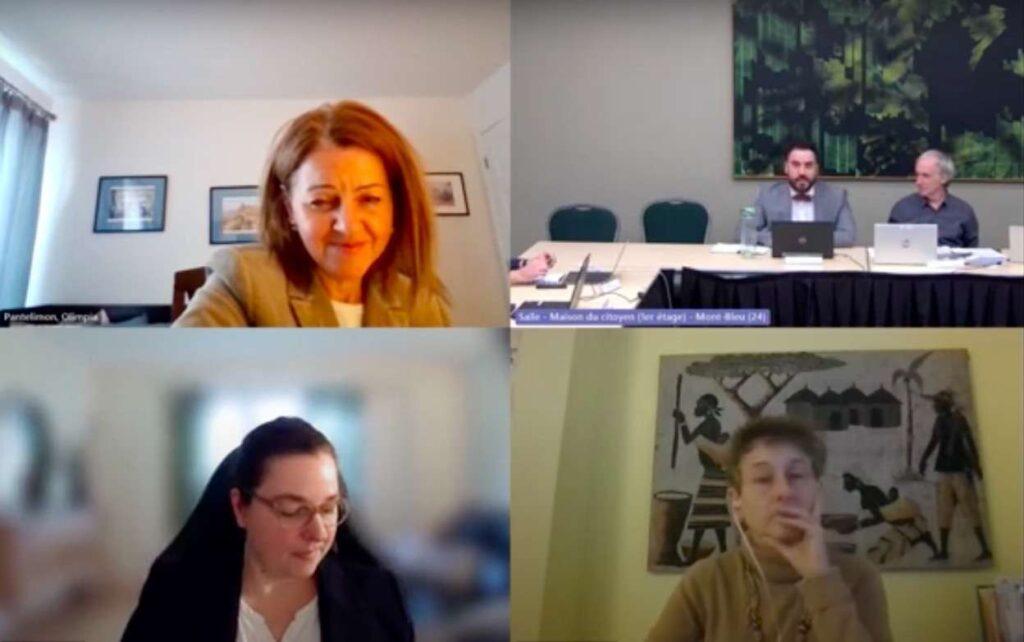
Gatineau Climate Action plan front and centre at Environment Committee meeting

Photo: Ecological Transition Director Frédéric Vandal takes questions from the Committee on the Environment and the Fight against Climate Change on the city’s Climate Plan. (TC) Photo: Screenshot from Committee on the Environment and the Fight against Climate Change meeting on Oct. 19, 2023

The Committee on the Environment and the Fight against Climate Change reviewed year one of Gatineau’s Climate Plan at its meeting on Oct. 19, 2023.

The Climate Plan was set into motion with the creation of the Ecological Transition Service in May 2022 to provide a framework for reducing greenhouse gas (GHG) emissions and quickly responding to climate-related emergencies.

Reducing GHG emissions to be carbon neutral by 2050, adapting to climate change, reducing vulnerabilities, and ensuring open governance were among the plan’s four objectives.

The objectives span over 12 priority projects which were made up of 44 priority measures identified by citizens and experts. Totaling 231 measures, Ecological Transition Director Frédéric Vandal said things were still constantly evolving.

The estimated cost of the measures was $104 million but Mr. Vandal noted the estimate was not to finance the plan but its actual value.

Since the plan’s adoption in 2021, major achievements like conducting vulnerability studies of water plants, the Urban Forestry Plan, and the beginnings of the Biodiversity Charter have been checked off the list.

The new year will bring new projects like reviewing and amending the actions and measures in the plan, establishing funding sources, and striking up an annual inventory of GHG emissions.

Among the suggestions from the commission members included informing and raising awareness among the population about the actions set out in the plan and promoting the mobilization of citizens by involving them more.

“What is the involvement of the companies in the region to ensure that we achieve our objectives,” said Benoit Delage with the Regional Council for the Environment and Sustainable Development in the Outaouais. “Yes, we can regulate with regulations to complete the actions, but we can go even faster and further, embarking together.”

The results of the Climate Plan will be presented to the municipal council during the study of the budget on Oct. 30.

Gatineau Climate Action plan front and centre at Environment Committee meeting Read More »

Drug drop-off foiled by drone sighting at Hull detention facility

An attempt to deliver drugs via drone to the Hull detention facility on January 26 was short-lived after the aircraft was spotted over the facility. Gatineau Police were notified of the sighting over the facility on rue Saint-François slightly before 11:00 am.

The Gatineau Police Public Relations Officer Andrée East stated that, upon arriving at the scene, the police officer was met by an officer of the facility who had detained a suspect vehicle containing three male passengers. A fourth male who was exiting a wooded area not far from the drone sighting was later found by the police officer.

All four men were arrested and transported to the police station. East said those involved were Ontarians ranging from 18 to 34 years of age.

Two of the four signed a promise to appear, and the others were released without any accusation. East said the police service will be seeking charges for drug trafficking.

Photo caption: The City of Gatineau Police Service have arrested four men in connection with an attempt to deliver drugs into the Hull detention facility.

Photo credit: The City of Gatineau Police Service Facebook

Drug drop-off foiled by drone sighting at Hull detention facility Read More »

Scroll to Top