

Andrew McClelland
The Advocate
Ben Nichols knows that any successful dairy farmer has a good team around him.
“I built my barn to be able to manage my farm by myself if need be, but in reality you can’t do it on your own,” said the Eastern Townships producer. “You need family, you need reliable teams and the proper tools to help always improve. I never think I’m perfect.”
Family farming has always been the way for Nichols and his ancestors. His great-great-grandfather came to Canada from the U.S. in 1887, purchasing 50 acres in Compton, southeast of Sherbrooke, that would become the nucleus for the land Ben and his wife, Annie Grubb, still farm. It was Nichols’s grandfather who brought in the Ayrshires that would be the basis for their Crystal Brook Farm’s dairy herd.
“When my father took over, he improved the field management quite a bit,” Nichols said. “I’ve been working hard to increase both the field production and milk production with all the tools that I try to bring to the farm.”
Ben took over the family farm in 2014, after graduating from Macdonald Campus in 2010. He had big plans to expand right away, bringing in five kilos of relève quota to help increase the 24 kilograms of the farm’s quota. Today, they have 60 kilograms.
But Nichols knew expansion would require more help. And that’s why, in 2020, he decided the family team on his farm needed a little help from a robotic milking system.
“A robot never calls in sick,” said Nichols with a smile. “It’s always very consistent, and it’s a bit better tempered than we can be sometimes.”
Specifically, Nichols went with the Lely Astronaut A5 milking system, known for its adaptability to cattle behaviour, allowing each heifer to choose when to be milked and resulting in less stress and higher milk production.
Data galore
Nichols explained his approach to mixed herd management through robotic milking during a videoconference in June hosted by the Quebec Farmers’ Association.
“The cow learns the robot and the robot learns the cow,” Nichols explained. “Starting from Day 1, the robot memorizes where the teat placement is. So if the cow moves to the one side, the robot knows that the next time, it’ll probably move again.”
From the start, Nichols could see that the system provided a wealth of information for herd management.
“It’s got over 100 reports that I can view at any time on the computer or from my phone,” he said.
Lely Horizon — the management system that comes with the A5 — provides charts, graphs and statistics on anything and everything from Herd Overview, Cow Robot Efficiency, Health Report, Cow Daily Production, Milk Yield Prediction and Herd Plan.
“With these kind of graphs, which I can see every day, the system helps me plan for the future to make sure that I’m not going to be overproducing or underproducing,” Nichols explained.
Crystal Brooks’ milking herd currently sits at around 45-55 head, mostly Ayrshires, according to family tradition, but with 20 per cent Jerseys and five per cent Holsteins.
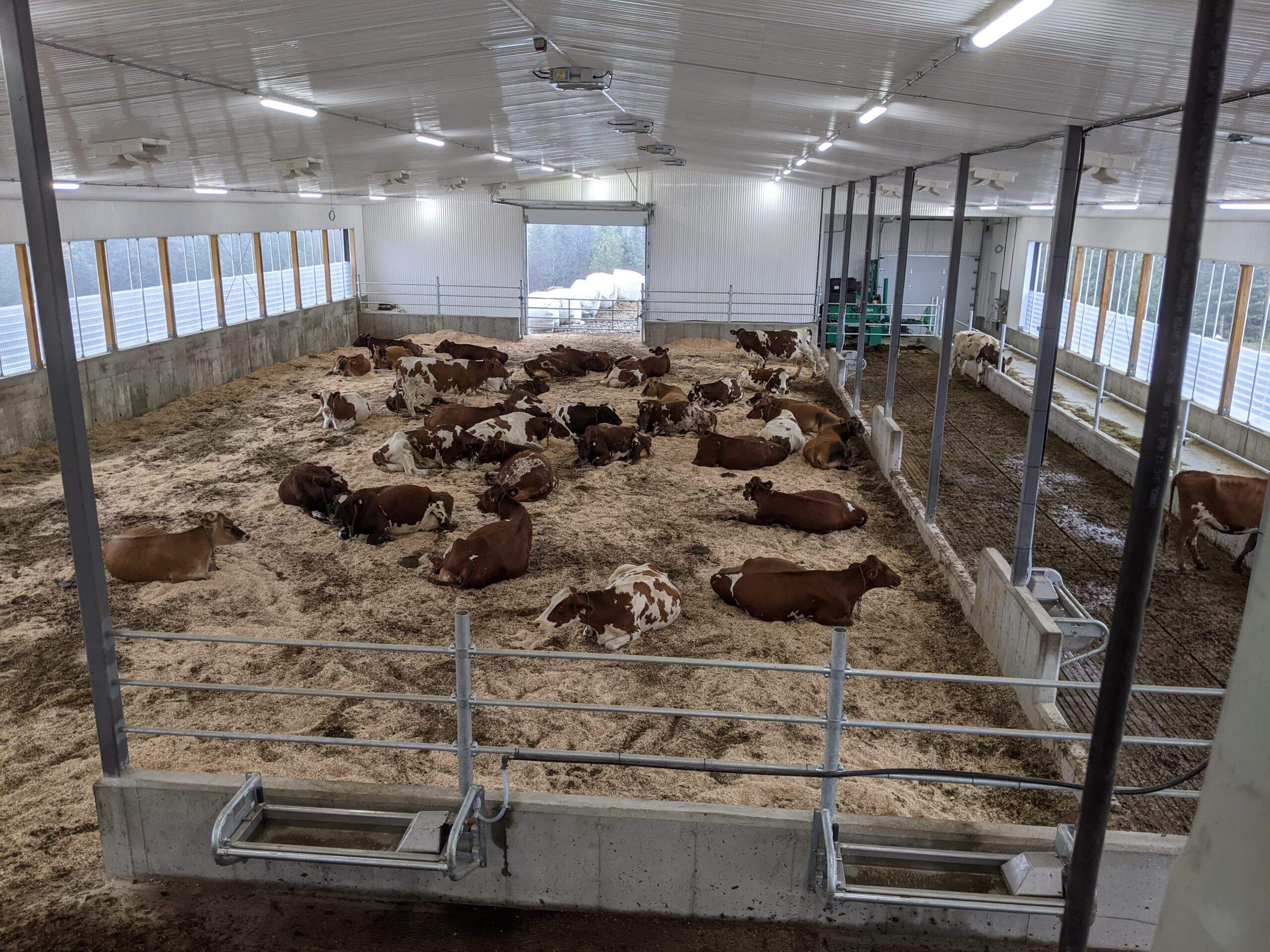
Nichols uses a bedded pack barn design, which he finds provides flexibility for different cow sizes and superior comfort compared with other housing systems. While aerating the hardwood shavings requires a lot of management and cattle wrangling, it’s a system that suits his herd.
“In the wintertime, it’s twice a day I have to work it and turn it over,” Nichols explained. “I have to put shavings down about every four or five days at its extreme in the winter — and once every couple weeks in the summer. But for the herd, it’s a comfort that you can’t have in any other system.”
Team work
Nicholsis a firm believer in doing the work he does best — and then hiring the rest. That means relying on expertise from different field reps, vets and genetic advisers.
“I know a little bit about everything and a lot about nothing. So I make sure that I have a good team behind the scenes to help me out for cattle management.”
As such, Crystal Brook Farm uses feed reps to offer advice on rations, field reps to help manage field performance, visits from the Clinique Veterinaire Coaticook every three to five weeks, and genetic reps from CIAQ or Select Sires to inform him of new bulls that would complement his mixed herd.
“I don’t think any ‘brand’ is better than the other. I think it’s important to find which reps in your area you can trust. Because if you’ve found you can trust them in the past with good advice, they probably have your best interests at heart,” Nichols said.
But, in the end, family is the biggest part of the equation for Nichols’ success. Just as it has been for the four generations.
“My family is always there, too, telling me if I’m doing things right or if I’m forgetting something,” Nichols admitted. And that humility is part of how he innovates and continues to learn.
“If I think I’m doing something right, I make sure I find somebody who tells me I’m doing something wrong and find out what I can do better. Because there’s always room to improve.”