

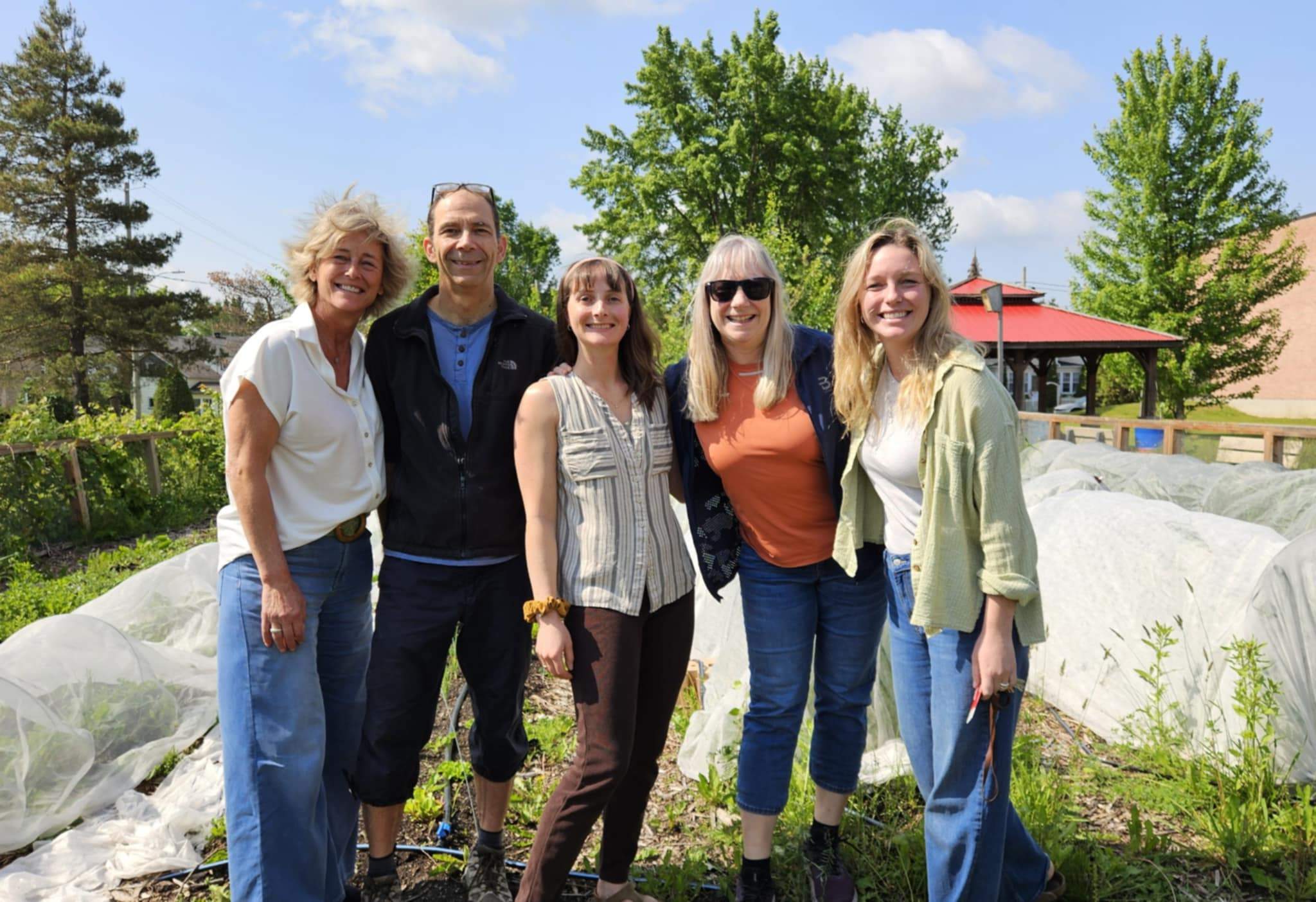
Courtesy
From left to right: Marie-Andrée Lafrance, Thomas Dandurand, Léonie Gamache (Gleaning Project Coordinator), Aileen Collier, and Sarah Richard stand together as members of the CéSAM executive committee. Missing from the photo: Karine Beaupré and Lisane Boisclair.
By William Crooks
Local Journalism Initiative
A new initiative to recover unused crops and fight food waste is taking root in the Memphrémagog region this summer. Launched by the Comité sécurité alimentaire Memphrémagog (CéSAM), the “Seconde Récolte Memphré” gleaning project seeks to collect surplus fruits and vegetables left behind in fields and redistribute them to local residents, volunteers, and food banks.
“This project is environmental, social, and deeply human,” said Léonie Gamache, the new project coordinator hired by CéSAM to lead the initiative. “It helps recover valuable food, supports food security, and strengthens relationships between citizens and local producers.”
Gleaning—an age-old practice of recovering leftover crops post-harvest—takes on a structured and community-focused form in this pilot program. Speaking with The Record, Gamache explained that the idea is to “make sure that we don’t waste any food directly in the field.” With nearly 400 local producers in the region, she noted, the potential impact is significant.
“There was already another project in the area that was slowing down, but the committee really wanted to implement something sustainable because they saw a big need,” she said. “This is a brand-new idea with a structure around it.”
The model is simple but effective: when farmers anticipate having crops they cannot harvest—due to time, labour shortages, or because the produce is slightly blemished or overly abundant—they can contact the project team. Volunteers are then gathered and dispatched to harvest the surplus produce. The bounty is divided evenly: one-third goes to the farmer, one-third to the volunteers, and one-third to the Memphrémagog Food Bank.
“It’s just going out and harvesting in the field—saving food that’s not going to be sold,” Gamache said. “Sometimes the farmers don’t have enough employees to go out there, or the fruit and vegetables are a bit ugly, but still perfectly good to eat or to transform into sauces or preserves.”
While the project is still in its infancy—no field outings have taken place yet this season—Gamache said she expects the effort to recover “many kilos” of produce by the end of the summer. The focus will be on crops that tend to be overproduced or particularly abundant.
“Things like zucchinis, cucumbers, and strawberries—those are often the ones left behind because they produce so much,” she said. “It really depends on the crop and what the farmer grows. We’re not likely to see things like garlic, which are high-value and usually all picked.”
CéSAM is actively seeking both farmers willing to participate and volunteers interested in helping out. Information and sign-up forms are available at www.cepop.ca/glanage, and the site offers an English translation option. “We’re super available,” said Gamache. “There’s a contact email, phone number, and online form—whatever works best for people.”
To raise awareness about the initiative, CéSAM will also have an information booth at the Intercultural Summer Market in Magog on July 3, from 5 p.m. to 8 p.m. at 350 Saint-David Street.
Founded in 2013, CéSAM is a collaborative network that brings together various organizations committed to improving food security in the MRC de Memphrémagog. The committee works to ensure all residents have access to healthy food and takes coordinated action based on local needs.
Gamache said she hopes to return at the end of the season with photos and data showing the success of this summer’s pilot. “We’re really just launching,” she said. “But the response already shows people are excited to get involved.”