

Andrew McClelland
The Advocate
In March, the Commission de protection du territoire agricole du Québec ordered the owner of a popular cabane à sucre in Mirabel to cease using a portion of its land “for purposes other than agriculture despite several refusals by the commission to grant applications for authorizations.”
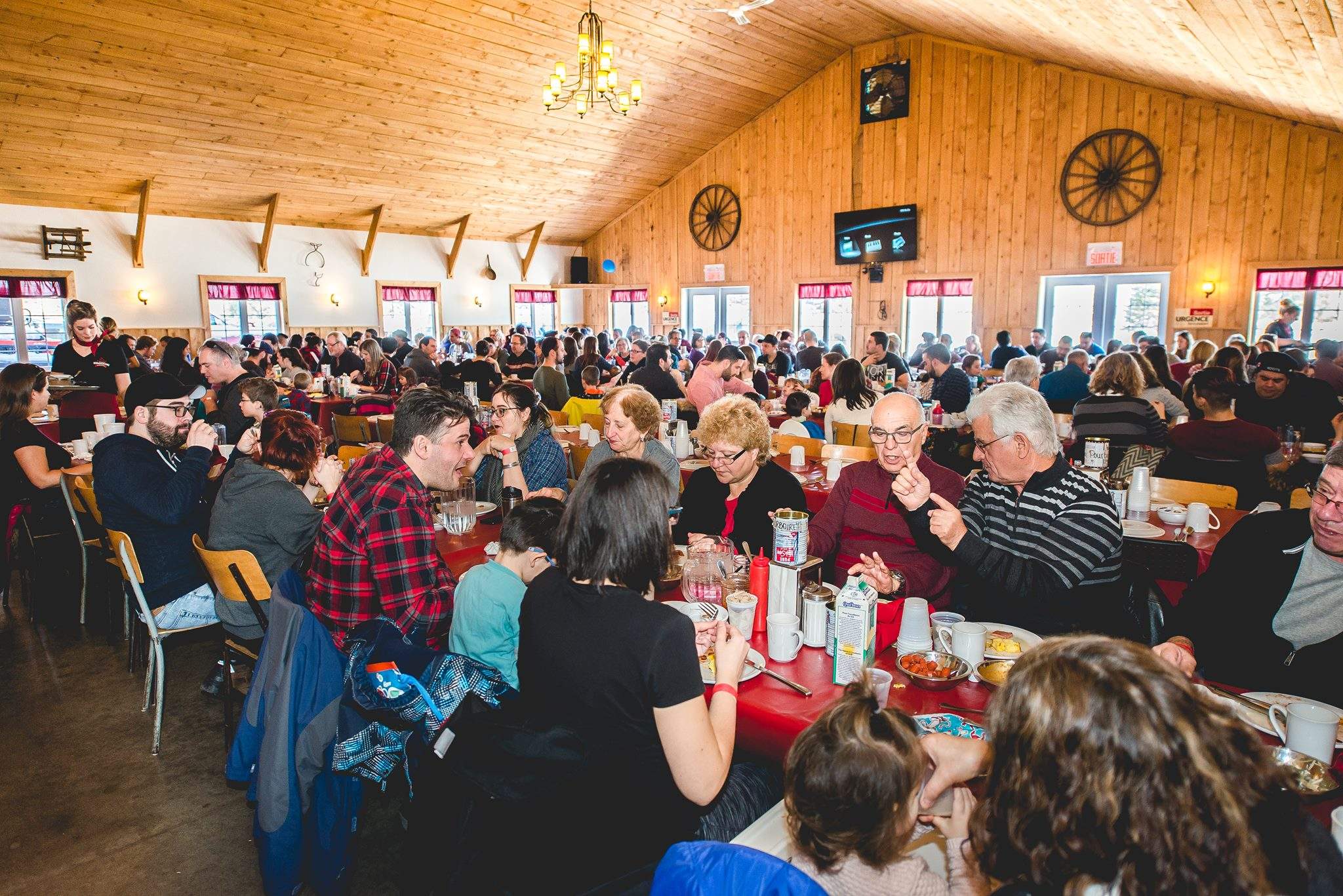
At issue are what the CPTAQ claims are the owners’ non-agricultural operations: a 9-hole golf course, seating for 1,000 customers in the cabane’s dining room, a microbrewery that seats 300, and a rodeo that drew about 18,000 attendees last summer — which all operate on agricultural land the agricultural land zoning authority says should be reserved for agriculture.
Alexandre Ladouceur, the current owner of La Sucrerie Bonaventure, says his businesses are agri-tourism. But the CPTAQ says simply it is not just agriculture.
A long history
The CPTAQ’s long list of grievances with La Sucrerie Bonaventure goes back to the late 1980s.
And it all revolves around the development on lot 1,690,382 of the Quebec cadastral map, where La Sucrerie Bonaventure’s main buildings are located, at 15400 rue Charles.
Back in the 1980s, the land was owned by a sod farm, Gazons Éthier, which argued that soil depletion on the land made its business unsustainable and proposed the development of an 18-hole golf course that would take up 35 hectares. Despite the support of the City of Mirabel, the CPTAQ was not convinced that the land’s soil was depleted and refused the application. The Quebec Court of Appeal upheld that decision.
Nonetheless, by 1993, a golf course and parking lot were operating on the land. The Club de golf Bonaventure greeted visitors with a reception area, even turning an agricultural building constructed in 1990 into a concession stand and golf equipment shop.
The next year, owners of the Club de golf Bonaventure made a second application to the CPTAQ, stating it would “regularize” its golf course by experimenting with different types of grass and lawn production. The CPTAQ, however, argued that the project would use 40 hectares of class 3 agricultural land and could be established on other non-agricultural land within the municipality of Mirabel. Once again, the Court of Appeal upheld the CPTAQ’s refusal.
New owners, same infractions
The ownership of lot 1,690,382 changed a few times during the 2000s, with the Club de golf Bonaventure finally closing for business after repeated requests from the CPTAQ.
Current owner Alexandre Ladouceur started operating La Sucrerie Bonaventure in 2015, one of the many large cabanes à sucres north of Montreal offering horse rides and pea-soup-and-pork brunches around the sugaring season.
But in the depths of the COVID-19 pandemic, Ladouceur made the decision to reopen golf facilities on the site.
“It’s not a ‘golf course’, in the sense that there is no member who comes here. There is no one who pays to come and play golf,” explained Ladouceur in an interview with Radio-Canada. “The people who come here pay to buy an agricultural product – which is beer or maple syrup – and then from there, they’re given access to the land.”
Ladouceur made his most recent proposal to the CPTAQ in 2020, hoping to gain authorization to produce beer made from his own barley for his company, “Microbrasserie L’Entêté,” which serves meals to up to 60 customers and offers guided mini-farm tours. The plan also requested for a parking lot that would accommodate 400 cars.
The project would only touch 1.19 hectares of Ladouceur’s land, but the CPTAQ similarly rejected his proposal, citing the protection of highly arable farmland.
Rodeo draws 18,000
Fast-forward to the summer of 2024: La Sucrerie Bonaventure now seats up to 1,000 and its sister company Microbrasserie L’Entêté can accommodate 300.
Under the justification that it is holding a “country party” (and that such events do not require the authorization of the CPTAQ), Ladouceur and his staff promote Rodéo L’Entêté, a two-day gathering featuring dance classes, live music and two evening rodeos. Advertising for the event invites attendees to “discover local agriculture by exploring our agricultural zone.”
The rodeo draws an estimated 18,000 people. The City of Mirabel itself, citing excessive traffic problems caused by the event, makes a complaint to the CPTAQ, citing “excessiveness of activities in this agricultural area.”
In response, the CPTAQ informs Ladouceur in September 2024 that investigations into land-usage offences are being conducted on five of his property lots. On March 21, 2025, the commission sends La Sucrerie Bonaventure its most recent cease-and-desist order.
In part, it states that Ladouceur cease all activities on lot 1,690,382 “for the purposes of catering, meal service, alcohol and microbrewery service, golf, smoking, sales of goods, articles and miscellaneous products, beer production, maple water processing, parking, storage of goods, various objects and materials not intended for agricultural purposes as well as for the purposes of storage and sale of goods, objects and materials not produced on that lot.”
The CPTAQ gives Ladouceur 24 hours to comply.
Orders ‘speak for themselves’
As part of the agricultural law judicial process, the CPTAQ does not comment on current cases. In an email to The Advocate sent on April 8, the commission says the cease-and-desist order “speaks for itself.”
For his part, Ladouceur has already re-applied to the CPTAQ for authorization to host a second edition of the Rodéo L’Entêté this summer.
“We are in there, with the lawyers, to set up a file, to prove that the rodeo (is) more than just a rodeo,” Ladouceur said. “You know, we have horses. We give (riding) lessons. We have a lot of activities that are related to the rodeo.”
As of mid-April, both La Sucrerie Bonaventure and Microbrasserie L’Entêté were still operating. Sugaring season is on, and that means customers from Montreal are driving north to have Easter brunch on the many cabane à sucres in the Laurentians.
According to reporting by Radio-Canada, Ladouceur’s revenue exceeds $1 million annually. The CPTAQ’s fines for contravening regulations can range anywhere from $500 to $72,000.
But for Ladouceur, the issue lies in what is the definition of “agri-tourism” — and of agriculture itself.
“I will fight to the end to prove that what I do is agricultural,” he stated in a media interview. “Ninety-seven per cent of our sales are made on the farm. But if tomorrow morning, you take that away from me, I’ll stop cultivating. I’ll stop being a farmer.”