

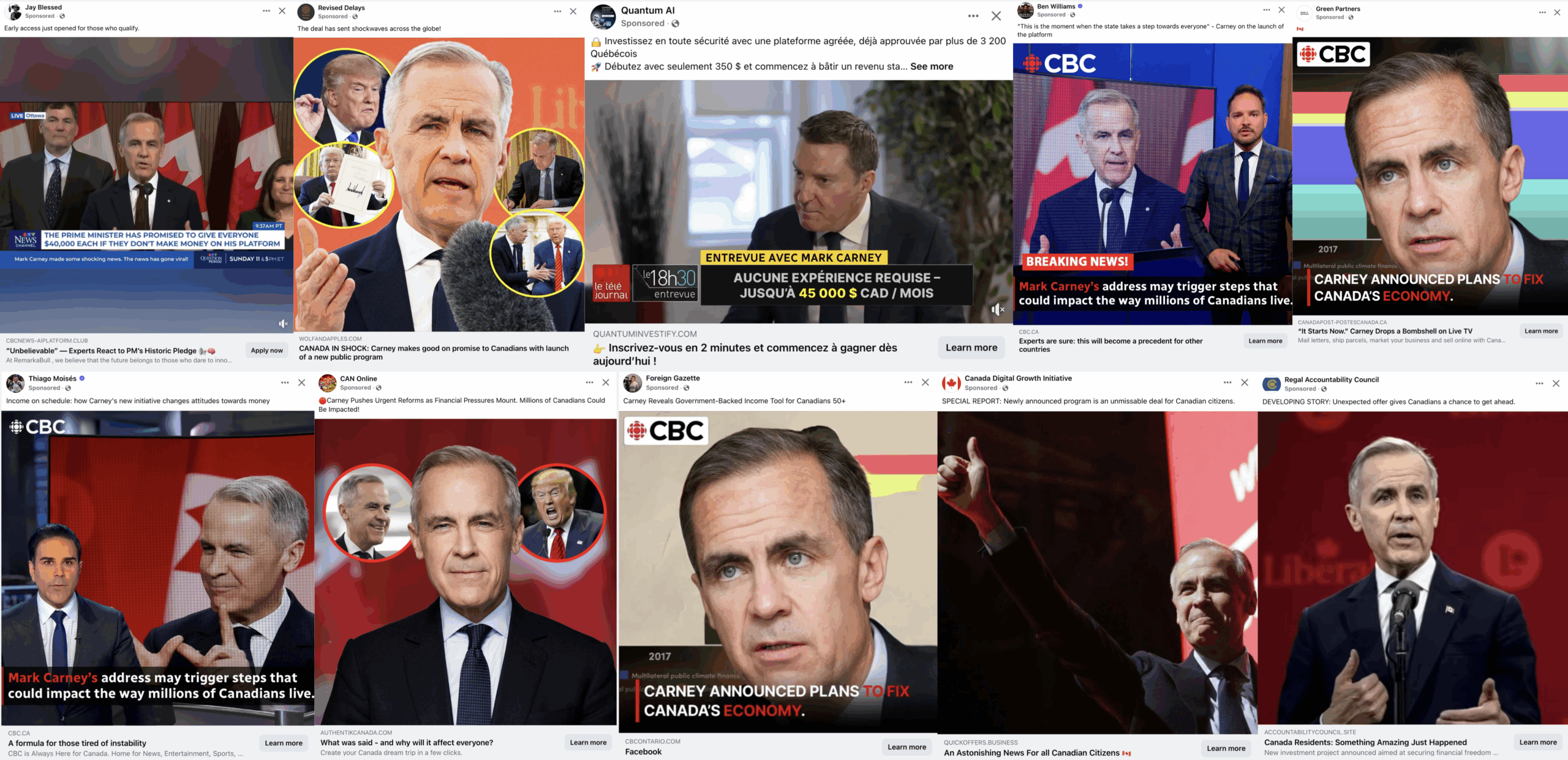
Screenshots from Meta
Fraudsters claim Carney created and endorsed a new big-returns investment platform for Canadians in Facebook sponsored posts
By Bryan Laprise
Local Journalism Initiative
What started as an investigation into an investment fraud scam promoted through sponsored posts on Meta’s Facebook became a month-long battle for information with numerous Canadian government agencies.
The fraud consisted of Prime Minister Mark Carney deepfakes “talking” about a new investment platform that “brings Canadians” big returns. Canadians were encouraged to make a $355 payment to be part of this “investment program.” It was shared through sponsored Facebook posts from random individuals, such as Brian Lee, who was listed as an entertainment website from Norristown, Georgia.
“Deepfakes use AI to fabricate video or audio of a person saying or doing something they never actually did. Fraudsters use deepfake tools to impersonate celebrities and public figures to trick victims into believing they’re dealing with legitimate sources,” explained Jeff Horncastle of the Canadian Anti-Fraud Centre.
Multiple instances of this type of fraud were witnessed by Record staff members, all pretending to be news reports from the CBC. Upon clicking on the post, it brought users to a near-copy of the CBC News website, with an article video from another network—CBS News—and their anchor Shanelle Kaul. The whole website was identical to the real one, but though no other links were valid, except for the article.
Any attempt to report the content on the Facebook platform only results in seeing more of it, as the user is interacting with it. Deepfakes are also visible on other platforms such as YouTube, where public figures are shown (with AI manipulation) to be doing or caught doing something scandalous.

Screenshot of the linked CBC page to the sponsored Facebook posts displaying a story about a new “investment platform” and the site victims are directed to
Fight for information
The Record reached out to the Canadian Anti-Fraud Centre on June 17, which collects and provides information on fraud. A deadline was included and was set as the end of the following day. Multiple weeks go by without any response.
The Canadian Centre for Cyber Security whose description is stated as being “the single unified source of expert advice, guidance, services and support on cyber security for government” was then contacted. The email cited the Carney deepfakes requested an interview with a cyber security specialist at their earliest convenience. They responded the same day asking if a written response would be accepted.
The Record reiterated the original request, for which Janny Bender Asselin from Media Relations and Public Affairs answered that they would get back shortly. Five days later, on July 22, she responded with one line: “Unfortunately, we cannot accommodate an interview at this time.”
On the same day, Jeff Horncastle, Client and Communications Outreach Officer from the Anti-Fraud Centre replied to the June 17 email apologizing, saying that the email ended up in their spam folder. He offered an interview for two days later, specifying that the CAFC didn’t have data specific to Mark Carney deepfakes or deepfakes in general, but that he could share crypto investment fraud statistics. An interview was conducted.
The Record broadened its scope and emailed the CRTC on July 22 asking if there is anyone that could speak to the issue, or if they could direct us to the right agency. Media relations officer Mirabella Salem wrote back saying that it falls to Innovation, Science and Economic Development Canada.
ISED and their Competition Bureau were contacted for interviews on July 22. ISED launched an AI safety institute in November to understand its risks and how to mitigate them. Media relations officer Hans Parmar asked for a deadline. They were given three days. On July 25, ISED responded with a written statement, bypassing the original request for an interview with a specialist, directing fraud victims to contact their local police and report the situation with the CAFC.
The Competition Bureau declined an interview request on July 28, sending a written statement which stated that the Bureau investigates contraventions to the Competition Act, including with AI.
“It would be inappropriate for us to speculate on specific situations or to comment on the activities of specific companies, including those mentioned in your request. The Bureau must conduct a thorough and complete examination of the facts of any matter before reaching a conclusion as to whether the Competition Act has been contravened,” wrote Anna Maiorino, the bureau’s communication advisor.
Despite these lengthy email exchanges with five agencies, none assumed responsibility for the file and none knew who is in charge of the oversight of this issue, which directly impersonates the country’s prime minister.
Investment fraud
Deepfakes have led the fraud landscape to significantly evolve from suspicious phone calls and emails. Most instances in which they are used for fraud is linked to cryptocurrency (digital money not reliant on government or bank maintenance) schemes.
Of the $313.8M in losses reported to the CAFC for investment fraud in 2024, $224.2 was linked to crypto, more than 70 per cent. “We estimate that only five to ten per cent of victims actually report to the [Canadian Anti-Fraud Centre], so it’s only a very small sample of what’s actually out there,” Horncastle told The Record.
In the past, there were signs to identify deepfakes, such as choppy video, but they have “evolved substantially.” It’s now come down to assuming the videos or fake until it’s possible to prove that they’re legitimate, Horncastle said. “Right from the beginning, celebrities or public figures endorsing investment platforms should raise a red flag. It’s not impossible, but in most cases, there’s a good chance that it’s fraud.”
Additionally, schemes that promise zero risk or guaranteed return should also be suspicious as “no legitimate investment can promise this,” he explained. There is often pressure to act quickly, so it’s impossible to consult friends or family.
Horncastle defined “victims” as being someone that has lost money or had personal information compromised, such as a driver’s license or social insurance number stolen. Even if they haven’t lost money, when giving these details, an individual becomes at risk of identity theft and fraud.
He encouraged anyone that comes across deepfake videos promoting fraudulent schemes online to report them on their host platform. However, he acknowledged that whenever one is taken down, there’s a good chance another one goes up.
“Fraud is evolving fast and deepfakes are blurring the lines between what’s real and what’s fake like never before, but by staying informed, skeptical and spreading the word, we can reduce victimization and stop fraudsters in their tracks,” he concluded.
Horncastle was unable to tell The Record who is in charge of overseeing circulating fraud schemes on social media.