Author name: Brenda O'Farrell The 1510 West

Pointe Claire consultations side-stepping key issues: resident

After more than a year since the city of Pointe Claire launched its public consultation process following the adoption of a development freeze in key areas in the municipality to allow the public to weigh in on how and how much development should be allowed, one question is emerging: Why hasn’t the consultation process focused public discussion on these specific areas.

These areas include the woods known as Fairview Forest; the Fairview Pointe Claire shopping centre parking lot, where Cadillac Fairview has proposed building a 20-storey seniors complex and two 25-storey apartment buildings; areas along St. Jean Boulevard; and the Pointe Claire and Valois villages.

“Almost one-and-a-half years later, we haven’t had a city discussion on any of these areas,” said resident David Johnston, who has attended three of the five consultation sessions that have been held so far.

The process to date has not given “citizens the opportunity to talk about what everyone wants to talk about,” Johnston said.

The five session held so far have dealt with general topics that include mobility and transportation; strategies that involved renovating homes, the transformation of underused commercial and industrial properties and the acquisition of vacant lots for redevelopment.

None of it has touched on issues like the height of high-rises, the redevelopment of commercial zones or what would be the cost of possibly acquiring Fairview Forest, Johnston said in an interview.

Last week, Johnston put his questions to council at the April 2 meeting.

“I think we need polling assisted by information that teases out the degrees of public opinion,” Johnston told council, explaining that it is clear that residents are divided, but it is still not known to what degree there is support for issues like a complete ban of development in Fairview Forest, partial development of the wooded area, development on the parking lot at Fairview mall in exchange of preservation of some or all of the neighbouring forest, and the potential of development across from Fairview at the Maxi shopping plaza.

And there are other questions, he says, including the eventual fate of the Pointe Claire Plaza property and other areas of the city that have been included as part of the building freeze.

Pointe Claire Mayor Tim Thomas pushed back. He disagreed with Johnston’s assessment.

“A lot of these consultations have been very positive and well conducted and the citizens have come away satisfied, which is, in the end, the objective,” Thomas said.

In an interview earlier this week, however, Thomas admitted that he is disappointed with what he called “the lack of specificity” of the consultations.

“I would have liked it to be more specific on height, greenspaces, the waterfront,” he said, adding the size of homes, specifically new homes being built, is another issue.

The city has promised to host an additional session that will focus on Fairview Forest. A date has not yet been set.

However, Johnston raised concerns about the possible scope of that session.

“We can’t consult on it in isolation,” Johnston told council last week, referring to the woodland. “Any consultation on the Fairview Forest has to be in conjunction with the mall property because I see them as two parts of a whole of one development project that has been presented by Cadillac Fairview.”

Johnston continued: “At the same time, I think it’s important that a number of other dimensions be brought to the debate. It would be nice if the consultation on Fairview Forest and (the neighbouring mall property) had with it a component that summarized where we are in the courts.”

In an interview, Johnston highlighted a number of other issues he said citizens should be informed on, including the significance of the permit issued by Environment Quebec to Cadillac Fairview to build in Fairview Forest and the cost of possibly saving the forest from development given that it is right next to the REM commuter rail station.

Although the consultations can be criticized for the lack of specificity, Thomas said, people are expressing themselves.

“They’ve been effective,” Thomas said, referring to the consultation sessions and online survey that have been conducted. “People have come out and spoken.”

Pointe Claire consultations side-stepping key issues: resident Read More »

DdO planning to increase residential development

JOHN JANTAK
The 1510 West

With residential construction projects already in the works on Sources Blvd. in Dollard des Ormeaux, the city last week signalled it is seeking to see its population grow in the coming years as it plans for several residential projects along other major arteries.

Among plans highlighted in public information sessions were two residential projects currently under construction at the intersection of Brunswick Blvd. and Davignon St., next to Promenades Sources – a 12-storey complex and a 14-storey high-rise.

Work on another eight-storey residential building recently broke ground at the intersection of Sources Blvd. and Hyman St. which is next to the Faubourg Dollard des Ormeaux.

Several projects are also being considered along St. Jean Blvd., including around the Blue Haven and Shakespeare commercial plazas.

“We’re looking at our boulevards that are in industrial and commercial zones and saying, ‘How can we retool these to meet the needs and demands of our future residents by bringing in a residential element,’ ” Dollard Mayor Alex Bottausci said.

“The urban plan has not been touched since 1982,” Bottausci added. “Some 40 years later, we don’t have a harmonious urban plan.”

Part of the city’s strategy as it revises its urban plan, officials said, is to encourage commercial space on the ground floor of new residential buildings.

This would help to support local commercial activities and “offer a wider range of housing types to meet needs of a greater number of citizens,” said Kerri-Lynn Strotmann, section chief with the city’s department of urban planning and territorial management.

Among the areas that would see the addition of residential units in what are now exclusively commercial zones is the Marché de l’Ouest mall on De Salaberry Blvd. The city is proposing to allow nine-storey residential buildings on the property while maintaining the existing indoor and outdoor retail space, including conserving the popular outdoor farmers’ market.

“There are certain elements we are bringing in,” Bottausci said. “And what residents have asked for is not only the residential component being added in for mixed use, but also how these buildings will be built, the materials that will be used and their proximity to transportation.”

The city also aims to introduce what it terms sustainable mobility strategies into its new urban plan to encourage active transportation corridors to the REM commuter rail stations at St. Jean and Sources boulevards by optimizing the bus network and expanding its bicycle paths.

The city’s strategy is “to create stimulating living environments on a human scale, while addressing housing issues,” Strotmann said.

The goal of the two public information sessions held last Thursday and Saturday at the civic centre was to present the urban plan to its residents “to validate its acceptability with the population,” Strotmann added.

The aim of the public consultation process is to continue getting feedback from residents regarding the city’s proposed urban development plans.

“Not everything will happen within the next year, just as not all sectors with transformation potential will be developed within the next year,” Strotmann said. “The planning horizon is part of a long-term perspective of 10 to 15 years.”

DdO planning to increase residential development Read More »

‘Only solution’ to frequent power outages – bury hydro lines: mayor

JOSHUA ALLAN
The 1510 West

The heavy snowstorm last week that caused widespread power outages was just the latest example that emphasizes the need for Hydro-Québec to put a plan together to gradually bury power lines, said Beaconsfield Mayor Georges Bourelle.

Last Thursday’s outage left more than 200,000 Hydro customers without power, including about 12,000 dwellings in the West Island in the cold, according to the utility. By that evening, 1,600 West Island households were still in the dark. By the next morning, more than 1,000 homes in the area were still without power, several hundred of which were located in Beaconsfield.

Beaconsfield residents are no strangers to power outages, Bourelle explained. He has experienced six outages in his home in the past year alone.

“I’ve received a number of emails from frustrated residents saying, ‘What are you going to do about it?’” Bourelle told The 1510 West. “And there’s not very much we can do as a municipality other than put pressure on Hydro-Québec.”

Hydro blamed the power outages on “strong gusts of wind or the weight of broken tree branches” damaging numerous above-ground power lines.

This is a reoccurring issue that will not disappear without action, Bourelle said, adding that the only viable solution is for Hydro to launch a province-wide plan to bury the power lines.

The crown corporation currently aims to offset damage to existing above-ground power lines by keeping them clear of vegetation, including by pruning branches and clearing weakened trees. According to Hydro-Québec’s website, this vegetation control must be carried out along 17,000 kilometres of power lines annually.

“In Beaconsfield, we have probably the biggest tree canopy on the island, and if not, maybe in Quebec,” Bourelle said, adding: “There’s no doubt that, with climate change, there are violent storms, snow that comes down very heavily. There are chances that trees or branches will fall.”

The mayor argued that these power lines should not be prioritized over tree canopies. These canopies, he explained, serve to reduce urban heat and air pollution, generate oxygen and increase property value.

Premier François Legault had previously said that such a project would be unrealistic, estimating the total cost would be about $100 billion. Bourelle, however, suggested that this number is exaggerated, adding that the cost must be weigh against the financial and economic impacts of regular power outages.

In terms of implementation, Hydro-Québec should prioritize working with municipalities to identify areas where above-ground power lines are the most vulnerable to outages, Bourelle said. “And then have a plan to gradually bury the lines at every opportunity.”

Last week’s widespread power outage comes almost exactly one year after a powerful ice storm caused a massive outage, knocking out power for an estimated 1.3 million Quebecers.

‘Only solution’ to frequent power outages – bury hydro lines: mayor Read More »

Ste. Anne’s only grocery store fails to make financial go of it

ALEXANDRA ROBERTSON
The 1510 West

The only grocery store in Ste. Anne de Bellevue is set to close – again.

On April 21, the small town will have to say goodbye to Marché Richelieu for good.

“It’s been a rollercoaster, but now we are truly at the end of the ride,” said Mayor Poala Hawa, referring to the store that has struggled to say afloat since it reopened last spring after the former owner filed for bankruptcy in January 2023.

Hawa added that although the city tried everything it could to keep the doors open, there is nothing more that can be done.

“Whatever we were able to do to help, we did,” she said. “We sat down with Metro. We tried to find other ways to bring in new business and help them advertise it.”

She noted that the promotion was set to begin this summer.

Hawa mentioned that there was a spark of hope about a week and a half ago, when another grocery chain was going to step in and take over. But, in the end, those hopes were dashed.

“It’s legally very, very complicated,” she continued. “It’s a long-term lease that Metro had and they couldn’t transfer it over to the other grocery chain because they would basically be giving it over to their competitor.”

Claude McSween, the current owner of the store, had been keeping the place going for about a year. Growing up in the neighbouring town of Île Perrot, he had managed and worked in other small markets and a butcher shop, bringing a lot of experience to the table.

The expenses were becoming too high, and Hawa said that they were basically working at a loss from month to month.

“God bless them, they threw everything at it,” Hawa said. “They tried their best. They tried every avenue and number crunched as much as they possibly could.”

Everyone is heartbroken, Hawa said.

The mayor understands that this little shop was vital for the small community of Ste. Anne.

“The village is very different from the rest of the West Island,” Hawa explained. “It’s very car-centric everywhere else, you can just get in your car to go to Costco or wherever.”

But Ste. Anne village is different. The car does not reign supreme in this area, which is characterized by narrow streets and residential dwellings that are tightly fitted one next to the other, where many seniors and students live.

“People walk to do their groceries,” Hawa said.

“It’s a basic service that we’re losing,” she continued. “Most people don’t have a car, and because we don’t have a very good public transit system that people can rely on, they’re really stuck.”

The nearest grocery stores are Provigo in Baie d’Urfé or Maxi in Pincourt.

McSween and his family became a part of the Ste. Anne neighborhood, according to the mayor.

“It’s not just a grocery store; it’s a community centre,” Hawa said. “You go get a carton of milk and all of a sudden you run into your next door neighbour who you haven’t seen in three weeks. Then you stay to chit chat. You always run into someone.”

Marché Richelieu has served Ste. Anne for 85 years. It closed for a short while in January 2023 after the Coopérative de solidarité de Bellevue announced it had filed for bankruptcy. McSween and his wife reopened the outlet on May 25 with a new, fresh layout, new products and ready-made meals. The store is operating under normal hours until April 21.

Ste. Anne’s only grocery store fails to make financial go of it Read More »

Couple safe, but frustrated after car hit by debris

FREDERIC SERRE
The 1510 West

A West Island man says he’s been left in the dark by the Sûreté du Québec and Transport Québec in the wake of a serious road incident last Thursday in which a piece of concrete from a Highway 13 overpass came crashing down on his car’s windshield as he and his wife were driving along Highway 40 east. The couple miraculously escaped without injury, thanks, they said, to the strength of the windshield which somehow did not collapse.

“We have not had any follow up,” Dan Chelowa told The 1510 West on Monday.

The SQ and Transport Quebec have remained mum since the incident, saying only that the case is under investigation, adding that the pothole on Highway 13 that is believed to have been the source of the concrete that caused the accident has since been repaired. Officials with both agencies could not be reached for comment yesterday, although the SQ told Chelowa that at least 12 similar incidents were reported to 911 prior to his incident.

Chelowa, meanwhile, says that with so many similar cases having been reported to authorities even before his post about the incident went viral on social media, the matter should be taken more seriously.

“The police said they had over a dozen similar reports. They told me to file an insurance claim and have a nice day,” he said. “There’s zero accountability for any of this and I think that’s the most frustrating part of it.”

“We didn’t get hurt, that’s all that matters in the end,” he said.

Chelowa continued driving and even attended the gala, only reporting the incident to a downtown Montreal police station, where he was told to report it to the SQ the next day because Highway 40 is an SQ jurisdiction.

“I don’t think it has really sunk in yet, but the extent of what happened and how it happened is very scary,” said Chelowa.

Couple safe, but frustrated after car hit by debris Read More »

Agglo OKs plan that omits major W.I. boulevards as essential transit routes

Three West Island mayors voted against the Montreal agglomeration’s proposed land use plan last month, after the city of Montreal failed to include the region’s three main north-south arteries among the thoroughfares listed as essential for public transit.

The omission, according to Dollard des Ormeaux Mayor Alex Bottausci, is particularly egregious given the fact these roadways – Sources, St. Jean and St. Charles Boulevards – serve as direct access routes to the REM light rail stations, which are expected to be in operation later this year.

“I do not understand how a city can achieve densification on its territory without integrating public transit,” said Bottausci in a statement. “It’s a contradictory statement.”

The land use plan, which must be approved by the Communauté métropolitaine de Montréal, the regional authority that includes 82 municipalities on and around the island of Montreal, provides the framework for development across its vast territory, setting residential densification targets that will force cities and towns to increase construction to accommodate larger population bases.

To denounce what Bottausci described the omission as an “unacceptable situation,” he and the mayors of Kirkland and Pointe Claire voted against approving the draft. The motion, however, passed by majority vote.

At the same meeting, all 15 mayors who represent the demerged municipalities on the island continued to voice their opposition to a series of spending moves presented by the city of Montreal.

The suburban mayors voted against a total of $152 million in spending they deemed unfairly forces residents of demerged municipalities to pay for projects or work that does not in any way benefit them. Among the projects they opposed was a new bicycle network and roadwork on the Jean-Talon corridor between Pie-IX and Cavendish Boulevards.

Next week the suburban mayors plan to continue to oppose the unjustified spending imposed on their taxpayers. To date this year, the representatives of the demerged municipalities have objected to a total of $357 million in spending. The agglomeration council, however, has approved all the expenditures, as elected members from the city of Montreal hold a majority.

Agglo OKs plan that omits major W.I. boulevards as essential transit routes Read More »

West Island director presents award-winning play described as interesting, complex

ALEXANDRA ROBERSTON
The 1510 West

Shame and suppression, with a little bit of joy and comedy mixed in are just a few themes in Dancing at Lughnasa, the play now at Hudson Village Theatre.

West Island director Donna Byrne said all of the characters are multi-dimensional and the audience will fall in love with them immediately.

“I think they are so well developed, and any family can relate to what’s going on here,” Byrne said.

This award-winning piece was written by Brian Friel, who loosely based the story on his own life. It takes place in 1936 in County Donegal in Northern Ireland, in a fictional town called Ballybeg. It tells the story of the five Mundy sisters who are struggling with poverty in the Industrial Age, while raising their nephew, Michael.

Byrne, who’s both a director and actor and a member of Playwrights Guild of Canada, noted that this piece is different from other performances she has directed because it’s a memory play. It is told from the perspective of seven-year-old Michael, who narrates, as he tells the story of a summer in his aunts’ cottage.

“We have the adult Michael on stage, answering as the child, but in the adult voice. The others who are on stage do not see him. It’s all in his memory,” Byrne explained.

Since this character has the perception of a young kid, he sets the tone for the whole story.

“It’s very interesting and complex,” she said. “But I’ve directed it so that it’s very easy to get. It’s no messy.”

Believe it or not, there are some similarities between this troupe and people today, and the challenges we have to face.

As Bryne explained: “One of the sisters, Kate Mundy, says, ‘Now that the Marconi radio is here, nobody talks to anyone any more!’ And it’s the same as when cellphones came around.”

Local actors are featured in the production, including Susan Corbett, who plays Kate Mundy; Dawn Hartigan and Susan Walsh, who take on the roles of Chris and Maggie Mundy; Bill Jackson plays Father Jack; and Steve Walters is featured as Michael Evans.

Bryne admitted that she couldn’t have asked for a better group to work with.

“I am so proud of them,” she said. “They are all big roles, and they are doing an incredible job.”

Byrne has now directed more than 60 plays, including Lost in Yonkers for the Lakeshore Players Dorval. And she is already thinking about what she will be doing next.

“With Lakeshore Players, we’ve had a few groups that we’ve formed,” she said. “We have the Moonlighters who would go around performing in seniors’ homes. That was pre-pandemic. We are thinking about picking that back up again.”

The West Islander says she falls in love with every project she is a part of.

“Once it opens, I like to go to every show. I like to just sit and watch the performance and the story. I get a lot of joy out of the fruits of my labour.”

Dancing at Lughnasa is produced by the Hudson Players Club and runs until April 14. For tickets, go to the Hudson Players’ Club website.

West Island director presents award-winning play described as interesting, complex Read More »

Car thefts on rise in W.I.

FREDERIC SERRE
The 1510 West

Of all the West Island municipalities, it is in Pointe Claire and Dorval that car owners stand a greater chance of seeing their vehicles stolen, according to statistics released by the Montreal Police Department that show that car thefts skyrocketed in these two municipalities between 2022 and the first six months of 2023.

Indeed, the numbers for the period between January and September 2023 paint a disturbing picture for car owners living in the district served by Station 5, which saw a whopping 126-per-cent increase in reported car thefts in the first three months of 2023 alone, compared with the period in 2022, while there was a 120-per-cent jump between April and June 2023, compared to the previous year.

During the first six months of 2023, a total of 654 vehicles were reported stolen in Pointe Claire and Dorval. In all of 2022, there were 545 vehicles stolen on that territory.

The statistics for vehicle thefts in the West Island compiled by the Montreal police service come in the wake of the national summit on combatting car theft hosted by the federal government last week in Ottawa. The summit drew representatives from government, municipalities and law enforcement agencies. According to law enforcement consultant and former Canadian Police Association CEO Scott Newark, auto theft in Canada is out of control.

“There are several other developments, but given the priority these issues have finally received, I think car theft is an issue we should discuss because it’s not going away and it’s highly relevant to all Canadians,” he told The 1510 West, adding that auto theft spills into other areas, such as drug and weapons smuggling and organized crime.

“I’ve had involvement in auto theft and marine port export smuggling matters repeatedly since the late ’90s, when the Chrétien government inexplicably privatized Canada’s port authorities, abolished the Canada Ports Police and then allowed the China Ocean Shipping Company (COSCO) full docking privileges and control of their facilities at the Port of Vancouver, which resulted in a huge increase in illegal importation of drugs, guns and people.” 

Meanwhile, in police District 1, which covers Baie d’Urfé, Beaconsfield, Kirkland, Ste. Anne de Bellevue and Senneville, car thefts increased by 95 per cent during the first three months of 2023, compared with the same period in 2022.

Île Bizard, Pierrefonds-Roxboro and Ste. Geneviève saw a 74-per-cent increase in auto thefts between April and June of 2023 and a 14-per-cent decrease between July and September. Car thefts in Dollard des Ormeaux increased by 46.4 per cent during the first six months of 2023.

Car thefts on rise in W.I. Read More »

W.I. couple who exposed another CAQ ‘pay-for-play’ undeterred

A West Island couple’s attempt to advocate for a cause they have been supporting for years that got swept up last week in the growing pay-to-play scandal engulfing the CAQ government say they want to keep the focus on their mission – persuading provincial authorities to impose stricter drunk-driving regulations.

But Roxboro resident Elizabeth Rivera acknowledges the revelation she made during a hearing last Thursday before a National Assembly hearing examining Bill 48 that aims to amend Quebec’s Highway Safety Code has attracted more attention than all of their lobbying efforts to date. Yet, she refuses to be distracted, pointing out that she has still not received a reason why Quebec Transport Minister Geneviève Guilbault refuses to lower the drunk-driving threshold, leaving Quebec as the only province in Canada that has not dropped the limit to 0.05 for administrative regulations that would permit a driver’s licence to be suspended or have a vehicle impounded.

“They never gave us a clear reason why,” Rivera said in an interview with The 1510 West on Sunday. “We ask the question: Tell us why. Why are we the last province? They don’t want to change it. And we don’t understand why.”

Although the federal Criminal Code makes it a criminal offence to drive with a blood-alcohol concentration of 80 milligrams of alcohol per 100 millilitres of blood, a measurement that is referred to as 0.08, all provinces except Quebec impose administrative regulations that permit a motorist’s driver’s permit to be suspended or their vehicle to be temporarily impounded if they are found to have a blood-alcohol level of 0.05.

Rivera, who is the president of Mothers Against Drunk Driving Montreal, said she and her husband, Antoine Bittar, have been pushing for Quebec to strengthen its administrative sanctions so that drivers testing at 0.05 or above have their cars seized for up to seven days and their driver’s permits suspended for seven days. These measures would not affect the 0.08 threshold that would trigger criminal sanctions.

Rivera argues that stricter administrative regulations that would come with non-criminal sanctions like in the other provinces would have a preventative effect.

If a driver has their licence suspended for seven days, “the next time the person drinks, they will think,” Rivera said.

“Why aren’t we doing prevention?” she asked, pointing out that the statistics from other provinces that have made the move have seen a drop in alcohol-related deaths.

In British Columbia, she said, alcohol-related deaths on the roads have dropped by 52 per cent since the province dropped the limit to 0.05. In Saskatchewan, the limit has been dropped to 0.04.

Rivera urges everyone to sign the electronic petition that is registered with the National Assembly in support of MADD’s demand.

Sponsored by West Island MNA Monsef Derraji, the petition can be found on the legislature’s website: assnat.qc.ca.

To find the petition, look for the tab in the centre of the page that is part of the blue heading that says “Exprimez votre opinion!” Click on Petitions: “Signer un petition électronique.” Scroll down the list of petitions until you see the one sponsored by Derraji entitled: “Ajout de mesures visant à prévenir la conduit avec les facultés affaiblies par l’alcool.”

W.I. couple who exposed another CAQ ‘pay-for-play’ undeterred Read More »

Roxboro couple did not intended to re-ignite CAQ ‘pay-to-play’ scandal

A grieving West Island couple who unveiled the latest incident in the widening “pay-to-play” scandal that has engulfed Premier François Legault’s CAQ government had no intention to embarrass the minister they were appearing before last week when they presented a brief at the National Assembly in Quebec City. But they have no regrets, either.

“I answered a question,” said Elizabeth Rivera in an interview Sunday with The 1510 West. “At no time did I want to explode a bomb.”

Rivera and her husband, Antoine Bittar, appeared during a commission hearing before Transport Minister Geneviève Guilbault to discuss Bill 48, legislation put forward last fall that seeks to amend the provincial Highway Safety Code.

The Roxboro couple have become actively involved in advocating for stricter drunk-driving regulations following the death of their 26-year-old daughter in a car accident on Highway 20 on March 20, 2017. The driver of the car their daughter and two others were in lost control of the vehicle, crashing on an exit ramp. The driver had been drinking and was found to have a blood-alcohol level of 1.25, Rivera said, more than three times the legal limit of 0.08.

After presenting their brief demanding that Quebec follow the lead of all other provinces and drop the blood-alcohol limit to 0.05 for administrative regulations to kick in, allowing police to suspend a motorist’s driver’s permit for seven days and impound their vehicle for seven days, Rivera and Bittar were asked by Nelligan MNA Monsef Derraji, a Liberal member of the commission, to explain the steps they had taken since their daughter’s death to push for these tighter measures.

In answering the question, Rivera described that after initially starting a petition that had been rejected by the National Assembly, the couple approached Soulanges MNA Marilyne Picard after hearing that her step-son had died in an accident. They felt Picard would be sympathetic to their cause and help them push for stricter regulations.

After Bittar had an initial conversation with Picard in the spring of 2023, the couple said they were disappointed with the inaction. They made several attempts to get Picard to respond to their inquiries about presenting Guilbault with the documents they had supplied – proof of how lowering the regulations in other provinces showed a drop in the number of deaths. But their requests went unanswered, so they gave up in frustration, they said.

Then, months later, in October 2023, an aide to Picard called them to say that if they paid $100 each to attend a fundraising cocktail, they would each be given two minutes with Guilbault.

The couple decided to pay and attend the event, as it was two days after the minister had announced publicly that the government would not be reducing the drunk-driving threshold. The couple were hoping to get an answer as to why, Rivera said on Sunday.

The revelation comes as the National Assembly’s commissioner for ethics and professional conduct launched two investigations earlier this month into two MNAs following news reports that they had invited mayors and voters to fundraising events to meet ministers in the Legault government.

Guilbault defended herself after the hearing last Thursday, saying no one has to pay to meet with her.

Questions about the government’s ethical practices has prompted Legault to announce the CAQ will no longer accept donations from individuals, despite having proposed last summer to raise the contribution limit to $200.

Legault has also reimbursed Rivera and Bittar for the contributions received last October. The couple will donate the funds to MADD.

Roxboro couple did not intended to re-ignite CAQ ‘pay-to-play’ scandal Read More »

Not allowing cars on new boulevard‘incredible’

JOSHUA ALLAN
The 1510 West

The plan to build a long demanded new north-south boulevard in the West Island but restricting regular vehicle traffic from using it has left some West Island mayors shaking their heads.

In fact, as traffic snarls the lanes of St. Jean and St. Charles boulevards well beyond traditional rush-hour periods, one mayor claims the recent announcement by the city of Montreal for the new artery defies the “West Island reality.”

The new boulevard is set to run from Antoine-Faucon Street in Pierrefonds-Roxboro, west of St. Charles Boulevard, to Ste. Marie Road in Kirkland where a REM station is under construction. The new 1.5-kilometre route will be open to public transit, pedestrians, cyclists and emergency vehicles only. The roadway is expected to cost about $60 million and is projected to be completed by 2027.

“It’s incredible to me,” responded an exasperated Jim Beis, the borough mayor of Pierrefonds-Roxboro.

See NEW ROAD, Page 2.

NEW ROAD: Restricting its use defies ‘W.I. reality’

From Page 1

“To spend $60 million when we know that the city is struggling financially, when we have other priorities, and you’re imposing something in my community that’s not wanted, it’s incredible to me,” Beis told The 1510 West.

Montreal Mayor Valérie Plante has said that this new initiative would encourage West Island residents to opt for public transit, a more environmentally friendly option to taking their cars. Montreal city council approved a $20-million loan bylaw in January to allow construction to proceed.

Beis has been vocal with his objections to the project. He says restricting regular vehicle traffic from using the new road is illogical in a highly residential area where public transit is not as accessible as in the city.

He pointed out the fact that Antoine-Faucon is “a dead-end street. A quiet area. And now all of a sudden, you’re proposing to have a transit link that would take you to the train station. And not allow for any vehicles.”

Ste. Anne de Bellevue Mayor Paola Hawa agrees that denying regular motorists access to this new traffic corridor does not reflect the “West Island reality.”

Hawa explained that most neighbourhoods in the West Island were not developed to match the reality of the densely populated areas in Montreal’s downtown.

“The way the West Island developed over time means that it’s very car-centric,” Hawa said, adding that regular day-to-day commutes without the use of a car is not realistic for most area residents.

However, their views on the new project are not unanimous among West Island mayors.

Kirkland Mayor Michel Gibson says the plan for the new artery is “on the right track” given the local infrastructure.

“I have nothing against what’s going on right now,” he told The 1510 West. “We need the proper infrastructure to basically accept cars. And eventually we’ll have cars. But for now, the infrastructure doesn’t permit it.

“For now, the realistic thing to do is to be patient,” he added.

Both Beis and Hawa say they are in favour of climate-conscious measures, like promoting public transit. But both take issue with the City of Montreal and the Société de transport de Montréal making unilateral decisions affecting West Island communities without consulting local elected officials.

“This case is a perfect example of them imposing their will on a community where we haven’t even been brought to the table to discuss and negotiate, or even explain the necessity of having something like this occupy that space,” said Beis. According to Hawa, no West Island mayors to date has been invited to discuss new bus routes with the transit authority. If the buses are not strategically routed to facilitate access for suburban residents looking to get to the REM, Hawa added, “most probably (people) will say ‘to hell with it, I’m taking my car.’ ”

Not allowing cars on new boulevard‘incredible’ Read More »

Suburban mayors take first swing in their David-Goliath battle with agglo

Suburban mayors threatened to fight the Montreal agglomeration in 2024, and last month they took their first official swing. The punch landed, but it didn’t even leave a bruise.

And that is how their David-and-Goliath matchup is going to continue until something changes.

That something, according to Ste. Anne de Bellevue Mayor Paola Hawa, is the structure of the agglomeration system of government and, more specifically, expanding the pool of voters who elect the mayor of Montreal.

“That would change a lot of things,” Hawa said, explaining that taxpayers in all the demerged cities should have a say in who is elected mayor of Montreal.

Hawa was commenting after the mayors of the 15 demerged cities, including eight in the West Island, last month voted against nine resolutions at the first monthly agglomeration meeting of the year. Despite the opposition, all nine resolution passed without even a raised eyebrow of concern because the mayors of the demerged municipalities only control 17 per cent of the vote on the council.

“Even if we didn’t show up and not vote, it wouldn’t make a difference,” Hawa conceded, explaining that the big part of the problem is not just the unfair costs being imposed on the demerged cities, but the wholly undemocratic structure of the agglomeration council that effectively disenfranchises taxpayers in the suburbs.

“They can give us a bill – any bill – there is no way for us to contest it,” Hawa said in an interview with The 1510 West.

“It’s not just a question of money,” Hawa continued. “It’s a question of the system we are working under. This is not democratic.”

Voted against $63 million in costs

The resolutions proposed by the agglomeration council on Jan. 25 that were opposed by the suburban mayors totalled about $63 million. They included expenditures for everything from infrastructure work like sidewalk repairs on St. Paul Street in Old Montreal to cycling paths in districts of Montreal and work related to the extension of the metro system’s Blue Line to the east-end Anjou district of Montreal, yet the cost of the work is being imposed, in part, on the demerged municipalities.

“From now on, (the mayors of demerged municipalities) will systematically oppose any expenditure or financial measure proposed by the agglomeration, unless a direct, tangible and equitable benefit is clearly established for one, several or all of the demerged municipalities,” the Association of Suburban Municipalities explained in a statement released following the agglomeration meeting.

The strategy, the mayors say, will continue in an effort “to defend the interest of their fellow citizens and to promote fair financial management within the agglomeration.”

Something has got to give

“The status quo is no longer an option,” said Beny Masalla, president of the suburban mayors’ association and mayor of Montreal West.

The campaign to highlight the inequities at the regional level began late last year, when the suburban mayors voted against approving the agglomeration’s budget for 2024 that imposed 38 per cent of the annual increase in costs on the shoulders of the demerged cities, which only represent 12 per cent of the population on the island of Montreal.

In addition, according to the suburban mayors, the demerged cities pay an average of 65 per cent more for services than citizens living in the city of Montreal while receiving fewer of these services, like policing and public transit.

But Hawa insists the issues with the agglomeration are not simply about money.

“It’s taxation without representation,” Hawa said, pointing to the fact that if the approximately 400,000 residents of the demerged cities had a say in who is elected the mayor of Montreal, the suburbs would not simply be viewed as a cash cow.

A democratic principle is at stake as well, she argues.

The city of Montreal has no incentive to address this, she argues. In fact, it would be up to the provincial government to change the structure. But first, the average taxpayer has to understand that fact.

Suburban mayors take first swing in their David-Goliath battle with agglo Read More »

Quick-thinking city worker thwarts Mercedes theft in Pointe Claire

FREDERIC SERRE
The 1510 West

A quick-thinking Pointe Claire public works employee tag-teamed with police officers to nab a pair of car thieves as they were in the act of stealing a luxury Mercedes SUV recently.

The drama unfolded on Jan. 27 at about 10 a.m. at the corner of St. Jean Boulevard and the Highway 40 service road.

“I followed them in my city truck,” said Vaudreuil-Dorion resident Thomas Schiess, 56, adding that he had a bad feeling when his eyes caught sight of a tow truck with no logo or lettering awkwardly towing the SUV.

“The two guys were wearing orange construction vests, and the tow truck was being followed by a pickup truck and they both went into the back loading dock area of the IGA on St. Jean,” Schiess explained.

The city worker kept on driving, but the situation was gnawing at him.

“So I told the guys, ‘Hang on, I’ve got to go back’ (to the scene),” he said.

“By the time I got back, they were just pulling out of the IGA to go north on St. Jean, then east on the service road, with the Mercedes now being towed by the rear wheels, but the front wheels were turned so the Mercedes had pivoted out and was pretty much on a 45-degree angle as they went down the service road, and that’s when I called 911.”

Schiess says he credits the rapid response by police constables from Station 5, as they immediately chased down the tow truck and the accompanying vehicle and placed two men under arrest as Schiess arrived on the scene. Schiess then drove to Station 5 in Pointe Claire to write his statement for police.

An hour later, while filling potholes with his crew on St. Jean Blvd., Schiess says a Station 5 cruiser pulled alongside Schiess’s truck. Inside were the two constables who had made the arrest of the alleged car thieves. They had recognized Schiess and his truck and thanked him for his help.

“I was in the right place at the right time,” said Schiess, who has been working for Pointe Claire for eight years.

Quick-thinking city worker thwarts Mercedes theft in Pointe Claire Read More »

Community says farewell to veteran cop, ‘King of Cloverdale’

Friends, colleagues and West Islanders from all walks of life packed the Rideau Funeral Home in Dollard des Ormeaux last Thursday to say farewell to Frank Taylor, a decorated 30-year police constable who spent most of his career patrolling the streets of the West Island. Taylor died at his home in St. Lazare on Jan. 30 at the age of 80.

Long known as the “king of Cloverdale,” Taylor was remembered as a dedicated police officer, family man and role model for West Island youth. He patrolled the region’s north shore municipalities for three decades, before retiring in 1998. Taylor served out of the former station 12 in Pierrefonds and station 4, but began his policing career with the town of Hampstead.

“I want to express my deepest gratitude for your presence at my father’s funeral,” his daughter Patricia Taylor told mourners. “Your support during this difficult time has meant the world to our family.”

Friends, neighbours and colleagues also paid tribute to Taylor on social media, praising him for his generosity, kindness, sense of humour and for giving hope to young people.

“Frank Taylor was a great man and an amazing cop,” said Shawn Fitzgerald, whose father patrolled with Taylor. “He and my dad always laughed it up together. The Taylors’ loss is my loss, having known him over 40 years. His laughter will be missed by me.”

“A true legend, Mr. 12-4, Frank Taylor has left us,” wrote Sûreté du Québec dispatcher Stéphane Brunet, adding: “Frank marked the lives of so many for so many years. Through his great generosity and his good cheer, he was a friend to everyone. Today, my sadness is immense, but I promise that when I think of you, Frank, I will smile – but just not today.”

In 1997, Taylor was honoured with a Canadian Police Association Top Cop Award and a Montreal police order of merit for having risked his life trying to save a suicidal Boston man who had driven his car into Rivière des Prairies in Ste. Geneviève in 1996. Taylor rushed out of his cruiser and used an old rowboat that had a hole in it (which he plugged up with a shirt) to attempt to reach the victim, pulling him back to shore. Sadly, the man did not survive.

Last Thursday as the family received condolence, Patricia Taylor particularly praised members of the Low Vision Self-Help Association, who travelled from various destinations to pay their respects. Taylor himself faced the challenges of macular degeneration in recent years.

“Among peers who intimately understood the struggles he endured, he discovered a sense of camaraderie and gained practical advice that went beyond the confines of medical consultations,” Patricia Taylor said. “The impact of this group on his emotional well-being was immeasurable.”

Taylor is survived by Heidi Luther, his wife of 60 years, his daughters Patricia and Jennifer, and his precious pooch, Henry.

Community says farewell to veteran cop, ‘King of Cloverdale’ Read More »

Suburbs push back on rising agglo costs

BRENDA O’FARRELL
The 1510 West

As West Island demerged cities enter into a new year on the heels of approving their annual budgets for the coming 12 months, the growing burden of the cost of shared services controlled by the Montreal agglomeration is put in sharper focus. But this year, the accelerating pace of those costs and the seeming trend to shift a greater weight of the financial burden on to the suburbs is hitting a breaking point.

“Enough is enough,” is the message being levelled by the Association of Suburban Municipalities, a coalition that represents the 15 demerged cities on the island of Montreal, including eight West Island municipalities.

“This injustice is a true abuse of power, and in the name of fairness and respect for all taxpayers, it must absolutely stop,” said Beny Masella, president of the association and mayor of Montreal West, in a recent statement. “We call for an urgent and genuinely effective response from the city of Montreal to address this blatant fiscal injustice for our citizens.”

According to the association, residents of demerged cities now pay about 65 per cent more per capita for services managed by the agglomeration than citizens of the city of Montreal. And in many cases, they receive what is described as “significantly fewer” of those services, including police presence and public transportation.

In the West Island, this has translated into taxpayers in almost all demerged cities forking over about 46 to 62 cents of every tax dollar they will pay in 2024 to the Montreal agglomeration.

See COSTS, Page 2.

Also see Editorial, Page 6.

COSTS: Kirkland mayor calling for end to agglo

From Page 1

And in every demerged city – from Senneville to Dorval – the amount being charged to taxpayers has increased this year.

In Dorval, the city will be paying $84.3 million for agglomeration services this year. That is $4 million more than the municipality was billed in 2023.

In Pointe Claire, the agglomeration charges will reach $85 million – about $5 million more than last year.

In Kirkland, the agglomeration bill this year has hit $38 million. It now represents more than half – 52 per cent – of the municipality’s annual budget.

While the cost of services are going up across the island, the proportion of the growing burden is shifting, the Association of Suburban Municipalities says. This means the rate of increase assessed taxpayers in the suburbs is increasing more compared with taxpayers who live in the city of Montreal.

More specifically, the association claims that between 2019 and 2023, the inequity continued to grow, with demerged towns seeing a 28.2-per-cent increase in costs, while Montreal saw its burden rise only 19.3 per cent.

The situation has pushed Kirkland Mayor Michel Gibson to call for the abolition of the agglomeration.

“The agglomeration is something that should be eliminated completely and we should look at a more democratic way of being able to share expenses,” Gibson said in an interview with The 1510 West.

In Beaconsfield, municipal officials continues to pursue a court action initiated against the agglomeration in 2019.

Beaconsfield Mayor Georges Bourelle has called the agglomeration “a joke.” And does not hide his disdain for its practices of shifting the cost burden onto the suburbs.

This year, more than half of Beaconsfield’s $59.9-million budget – $30.6 million – will be handed over to the agglo.

In a report by the Association of Suburban Municipalities submitted to Commission on Finances and Administration of the City of Montreal in December, the demerged cities claim that despite efforts to address the growing disparity in the assessment of costs, substantial “disagreement persists” between affiliated municipalities and the city of Montreal regarding the fair sharing of agglomeration expenses.

The association even goes as far as to accuse the city of Montreal of making “no concrete effort to resolve this situation and evidently prefers to continue benefiting financially from these fiscal inequalities.”

“This is socially and morally unacceptable,” Masella stated. “We cannot accept that there are two classes of citizens on the Island of Montreal.”

Suburbs push back on rising agglo costs Read More »

Suburban mayors demand betterfrom Montreal agglomeration

Here are a few points from the report from the Association of Suburban Municipalities to the Commission on Finance and Administration of the City of Montreal delivered last month.

“The City of Montreal, through the president of its executive committee, officially recognized during the Agglomeration Council meeting of Nov. 29, 2022, that the existing system of assessed contributions for the Agglomeration de Montréal had reached its limit. Unfortunately, this legitimate recognition has yet to be translated into concrete action and results.

“For more than 16 years, the (Association of Suburban Municipalities has) been lobbying the City of Montreal to achieve true tax fairness for their taxpayers, and to date, without any real response or success. We insist and remind all concerned that there is a flagrant tax injustice for the citizens of our linked metropolitan cities in the agglomeration of Montreal, and that this problem must ultimately and effectively be resolved. Such an agreement will be the cornerstone of a true agglomeration partnership.

“Now that all our cities, including Montreal, have recognized the obvious fact that the current quota system for the agglomeration of Montreal has reached its limits, productive discussions should be relaunched as soon as possible to identify and implement a new management framework for sharing agglomeration expenses.”

Suburban mayors demand betterfrom Montreal agglomeration Read More »

Cops probe after canal building gutted by fire

FREDERIC SERRE
The 1510 West

Ste. Anne de Bellevue residents wishing to take a stroll along the canal in the town’s west end will have to wait as Parks Canada and police investigate a suspicious fire last week that gutted a visitors’ cabin on the grounds of the historic site. For now, the area has been cordoned off, said Ste. Anne de Bellevue spokesperson Rita Latif.

“We know as much about this fire and its cause as what Parks Canada has told us,” Latif added.

Parks Canada issued a public notice Jan. 10, alerting residents that a fire had broken out inside the building, causing extensive damage.

“Please note that the Ste. Anne de Bellevue Canal National Historic Site is currently closed indefinitely due to a fire in the lock’s log cabin. We ask you to respect the signage in place,” the notice stated.

The town also posted a public notice on its website and Facebook page, repeating Parks Canada’s warning to stay away from the locks while the investigation continues.

Parks Canada officials could not be reached for comment.

Local resident Natacha Filion, who regularly strolls along the canal, said she hopes the cordoned off area will reopen to the public soon.

“One thing for sure is that I miss my jetty walks,” Filion said. “The crossing is blocked from access.”

Another local resident, photographer Dan Bouger, visited the site this week and posted a photo of the gutted structure, suggesting that perhaps some good can come from the unfortunate incident.

“Here’s wishing that Parks Canada takes the occasion of this fire to rebuild and beautify the current site,” Bouger said, “with more open space and lots of windows rather than a cabin with disgusting toilets for employees who deserve better.”

Cops probe after canal building gutted by fire Read More »

Still no parking at Pointe Claire REM station

BRENDA O’FARRELL
The 1510 West

With just months before the Reseau express métropolitain light rail commuter train line is pushed into service in the West Island, there is still no provisions for parking at the Pointe Claire station next to the Fairview shopping centre.

According to a spokesperson for CDPQ Infra, the consortium building the $6.9-billion rail project, no plan to provide commuters with a parking area has been secured for the Pointe Claire station, nor has any parking for the general public been devised for the Kirkland station.

The town of Kirkland has struck a deal with a developer to provide 200 spots near the station, but this area will be reserved for Kirkland residents only.

“CDPQ Infra seeks to maximize access to REM stations by focusing on different modes of transport, including active and collective transport, as well as access by personal car,” said Michelle Lamarche, director of media relations for the consortium developing the rail service, in an email to The 1510 West last week.

“We are always working with local partners to develop access proposal best suited to the sector,” Lamarche added. But so far, no space for vehicle parking has been identified.

When plans for the REM in the West Island were unveiled in 2016, CDPQ Infra had promised 4,500 parking spots at the four West Island stations along the 14-kilometre route. That number has since been cut to 700, including 500 spaces at the Des Sources station and 200 at the Anse à l’Orme station in Ste. Anne de Bellevue.

It is expected that 4,300 riders will use the West Island train on a daily basis by 2031, according to CDPQ Infra. On its website, it only lists space for 50 bicycle parking spots at the Pointe Claire station – 30 under a roofed stand.

Almost two years ago – in the spring of 2022 – a CDPQ Infra spokesperson admitted that the lack of parking at the Pointe Claire and Kirkland stations was a concern that kept being brought to the consortium’s attention. At that time, the spokesperson said CDPQ Infra was looking to negotiate a deal to allow commuters using the Pointe Claire station to use existing parking lot space at the Fairview mall. Cadillac Fairview, the owners of the mall, have not been willing to agree to any such offer.

Still no parking at Pointe Claire REM station Read More »

Community involvement propelledHurley into mayor’s post in Île Bizard

JOHN JANTAK
The 1510 West

Nearly three decades of community involvement through volunteerism inspired Doug Hurley to run for mayor of the borough of Île-Bizard–Ste. Geneviève under the Ensemble Montréal banner last fall, winning the by-election Dec. 17.

Hurley, a former police officer and currently a teacher at John Abbott College, won the support of residents with 78.42 per cent of the votes. He replaces former borough mayor Stéphane Côté, who resigned in August because of health problems. Hurley beat opponent Ghassan Baroudi of Valérie Plante’s Projet Montréal party.

“I’m a local boy,” Hurley told The 1510 West. “I’ve been here for 37 years and I’m literally humbled by the amount of people who voted for me.”

Hurley said he ran for mayor because it’s an extension of what he already does in the community as a volunteer.

“I’ve been the president of the local Optimist Club for the past seven of the 10 years I’ve been with them,” said Hurley. He has also coached hockey, baseball and softball in the community for 27 years.

“This probably explains why when I was doing my door-to-door election campaign, I was surprised at how many people I knew,” he said.

Overseeing the construction of the new Jacques-Bizard Bridge, improving public security and keeping the green aspect of Île Bizard are his priorities.

“That’s the one thing we’re famous for,” he said. “We have the land mass necessary for parks and green spaces. I’d compare it to living in Hudson. We want to keep that orientation.”

The city will also prepare for the influx of traffic expected into Île Bizard during the President’s Cup golf tournament at the Royal Montreal Golf Club in Île Bizard in late September.

“This is going to be another one of our challenges, especially with the bridge under construction,” Hurley said, as thousands of spectators are expected to attend the event.

“That’s where my background with 32-and-a-half years as a police commander is going to come into play, plus my 28-plus years training police officers at John Abbott College as a teacher,” he added.

Community involvement propelledHurley into mayor’s post in Île Bizard Read More »

Pointe Claire presents new plan to preserve iconic windmill

BRENDA O’FARRELL
The 1510 West

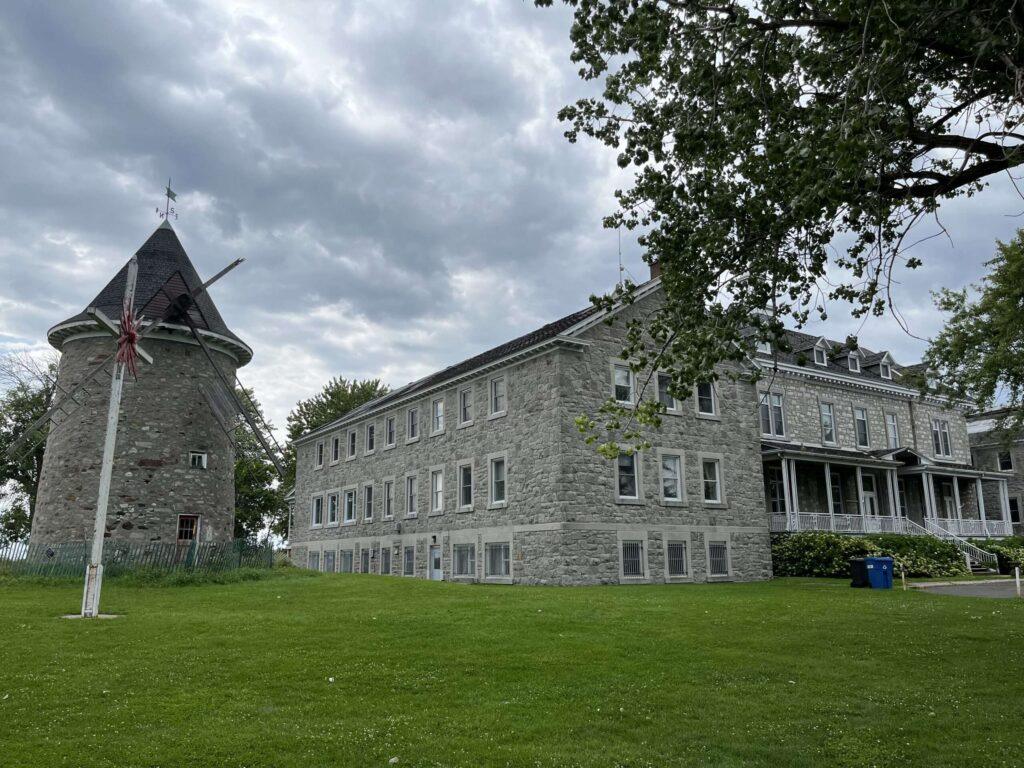
Pointe Claire council is set to move forward with a plan that aims to see the iconic centuries-old stone windmill along its lakefront restored. But it is still not clear when work will begin.

On Tuesday evening, council was expected to approve the adoption of a bylaw to create a financial assistance program that would fund the restoration of the windmill, which dates back to the early 1700s. The bylaw was proposed in December and was slated to be adopted with modifications yesterday after The 1510 West went to print.

The move would allow for the Catholic Archdiocese of Montreal, which owns the windmill, to apply for a grant from the city of up to $967,761. The grant would be subject to a number of conditions, including that the archdiocese secures a matching grant from the provincial government to carry out the needed renovation work to ensure that the historic stone structure be restored.

According to councillor Brent Cowan, a member of a committee that hammered out the framework for the new grant program to fund the windmill restoration, the proposal agreed to would see only work on the exterior of the windmill carried out – including repairing the roof, stonework and replacement of the blades. Replacing the inner mechanism of the windmill that would enable the mill to be returned to working condition is not included.

In addition, the archdiocese would not have to commit to allowing public access to the site, an issue that previously had brought up concerns about liability and insurance requirements. The church, however, would be prohibited from building a fence around the structure, Cowan said.

In an interview Monday, Cowan said he was not aware of the modifications that would be included in the final version of the bylaw set for adoption yesterday, explaining that they were determined during the last round of discussions between Pointe Claire’s director-general and the archdiocese’s representative on Monday morning.

Although council in the fall of 2022 approved a preliminary plan that pledge public funds to finance the restoration, a needed step to allow the archdiocese to move forward with an application to secure a provincial grant to cover half of the cost of the restoration work, Cowan said church officials have not yet submitted a request for funding with Quebec. With that step still expected, it is predicted that the delays for approval of provincial funding could take up to 18 months, which will delay the start of any work.

In an interview last weekend, Pointe Claire Mayor Tim Thomas criticized the proposed deal.

“We’re years off with this arrangement,” Thomas said.

The mayor is frustrated that council refused to ratify a deal he had negotiated along with the city’s former director-general and the archdiocese in the fall of 2022 that would have included restoring not only the exterior of the windmill but its inner workings.

“We are going to get less for our money,” he said, adding that the delay also pushes the project further back without a clear start date.

“It’s all so that I won’t get a windmill agreement during my mandate,” Thomas said.

Built in 1710, the windmill is Pointe Claire’s civic symbol, gracing everything from the city’s water tower to its municipal website and banners. It was classified as a heritage site by the provincial government in 1983 and is one of a handful of Quebec windmills built under the French regime that still exist. 

Cutline:

Neglected for years, the blades of the windmill on the shores of Lake St. Louis in Pointe Claire has been damaged by storms, while its roof and stonework are in need of repair.

Credit:

The 1510 West file photo

Pointe Claire presents new plan to preserve iconic windmill Read More »

Average property tax bill up 4.6% in Baie d’Urfé

JOSHUA ALLAN
The 1510 West

Homeowners in Baie d’Urfé will see their property tax bill increase again this year, jumping another 4.6 per cent, according to the town’s $28.3-million budget for 2024 adopted last month.

That means the owner of an average home valued at $1.17 million will pay $5,026 in property taxes this year, $223 more than last year.

The residential property tax rate is set at $0.4310 per $100 evaluation, slightly up from $0.4118 per $100 of valuation in 2023.

Overall, the town will spend $1.9 million more this year compared to last year, which represents a 7-per-cent increase.

Almost 62 per cent of the town’s budget – or $17.5 million – is attributed to cover the cost of services provided to the Montreal agglomeration contribution. These costs, shared with the City of Montreal and other demerged cities, include emergency services, public transport and water management. Baie d’Urfé’s agglomeration payment rises by $600,000 – or 3.5 per cent – this year compared with 2023.

“Overall, this expense represents 62 per cent of our total budget, and 76 per cent of our property tax revenues,” said Mayor Heidi Ektvedt at a Dec. 12 town council meeting.

Among the additional local expenditures in this year’s budget Ektvedt highlighted are adjustments to the drainage systems on Sunny Acres Street and Lakeview Street, the construction of a central septic system to service recreational centres and a “facelift” for Bertold Park.

Average property tax bill up 4.6% in Baie d’Urfé Read More »

Beaconsfield taxes to see 3.7% jump in 2024

JOSHUA ALLAN
The 1510 West

Property taxes are swinging upwards once again for Beaconsfield residents. After being hit with a 9.4-per-cent tax increase last year, the city’s $59.9-million budget will deliver another 3.7-per-cent hike.

This raises the total municipal tax on an average single-family home – valued at $1.03 million –

to $7,030, an increase of $242 compared with 2023.

The bill includes an annual garbage fee of $210, an increase of $25 compared with 2023; and a water tax of $40, which is unchanged from last year.

The residential tax rate has been set at $0.6061 per $100 of property valuation, up from last year’s rate of $0.5878.

Beaconsfield will increase its overall spending in 2024 by just over $2 million, according to the budget that was approved in December.

Some $30.6 million – just over half of Beaconsfield’s total budget – will go to toward the Montreal agglomeration budget as payment for shared services. These services include public transit, social housing and emergency services. This cost is up by nearly $960,000 compared with last year.

In a Dec. 12 presentation on the new budget, Beaconsfield city manager Patrice Boileau and finance and treasury director Robert Lacroix delved into the details of the changes in the new budget compared with last year.

The presentation compared the yearly change in cost of the local budget with that of the city’s agglomeration payments. All in all, the cost of Beaconsfield’s local budget was upped by 4.3 per cent, while the cost of the agglomeration portion of the budget rose by 3.2 per cent.

However, Boileau and Lacroix pointed out that this change is not indicative of the overall trend over the past decade.

“Over a time base of 11 years it’s the opposite,” Lacroix said. “The agglomeration increases have been a lot more than the local increase.”

Beaconsfield’s agglomeration payments have risen by 56.6 per cent during that period, while its local budget has comparatively risen by just 12.6 per cent, according to Boileau and Lacroix.

Beaconsfield Mayor Georges Bourelle has been vocal in his opposition to the growing price tag of these agglomeration payments for demerged cities. He has argued that the City of Montreal has taken advantage of demerged cities by overtaxing residents, while giving these cities little voting power at agglomeration council meetings.

Bourelle is at the forefront of an ongoing lawsuit against the Montreal Agglomeration Council for what he claims is an over taxation of residents of these demerged cities. The council treats demerged cities and their taxpaying residents as a “cash cow,” Bourelle told The 1510 West in December.

Beaconsfield taxpayers will receive municipal tax bills to be paid in three instalments in 2024, Boileau explained. First, residents will receive their agglomeration tax bills this month to be paid in two installments – one in February, and the other in May. The local tax bill will be distributed in November to be paid in December.

Beaconsfield taxes to see 3.7% jump in 2024 Read More »

Owner of average house in Pointe Claire to see 3.9% tax hike

BRENDA O’FARRELL
The 1510 West

Homeowners in Pointe Claire will be seeing their municipal tax bills go up again this year, with the owner of an average house having to pay 3.9 per cent more in 2024, according to the city’s $181.5-million budget adopted last month.

That means the owners of an average house – valued at $674,216 – will pay $4,221 in municipal taxes this year, an increase of $158 compared with last year. This does not include a separate rate for water, which goes up slightly this year.

The tax rate for a single-family home has been set at $0.6261 per $100 of valuation, up from last year’s rate of $0.6026.

In terms of expenses, the city will increase its spending this year by $8.3 million, which represents a 4.8-per-cent jump compared with 2023. A large portion of that – about $5 million – is attributed to increased charges from the Montreal Agglomeration for shared services, said Pointe Claire finance director Daniel Seguin during a public meeting last month when the budget was presented.

In 2024, Pointe Claire will pay a total of $85 million to the agglomeration. This represents a 6.4-per-cent hike in charges over last year. It also represents almost half – 46.8 per cent – of the city’s overall budget this year. Services provided by the agglomeration include public transit, police and water.

The latest increase in agglomeration charges is in addition to the 8.1-per-cent hike assessed last year, bringing the rise in charges from the central island authority to 17.4 per cent since 2022.

“We give our citizens more bang for their dollar than the city of Montreal,” Mayor Tim Thomas said when asked to comment on the rising agglomeration charges.

Thomas criticized the agglomeration for not providing adequate justification for the increasing bills.

“If you have to pay, we should be getting accounting,” he said. “There is no real itemized bill.”

Among expenses controlled by the municipality, the largest increases in costs come from the operational expenses for city buildings, which jump 11.7 per cent; public security, which will see a 9.1-per-cent hike; and vehicle charges, which are up 7.8 per cent.

Pointe Claire council also approved the city’s three-year capital expenditures program. The plan will see $35.4 million invested this year on various infrastructure projects, as well as the renovation of certain municipal buildings and upgrades in parks. More specifically, the city plans to carry out road work on Monterray, Milhaven and parts of Winthrop avenues, planning for the overhaul of two highway overpasses – Highway 20 and Sources Blvd., and Highway 40 and St. Jean Blvd.; the installation of a pickleball court in Northview Park and a bicycle path near Brigadoon Ave.

Owner of average house in Pointe Claire to see 3.9% tax hike Read More »

Dorval residents to see slight tax increase in 2024 budget

JOSHUA ALLAN
The 1510 West

The average Dorval taxpayer will see a 2-per-cent increase on their municipal taxes in 2024, ending the city’s multi-year trend of lowering the average resident’s tax bill.

The owner of an average single-family house in Dorval– valued at $640,631 – will pay $58 more in municipal property taxes this year, according to the city’s 2024 budget adopted in December. That means the tax bill for that house will increase to $2,939 in 2024, which represents a 2-per-cent hike from the $2,881 paid in taxes in 2023.

The residential tax rate per $100 of valuation is set at $0.4587. This is a slight decrease from 2023, when the rate was set at $0.5005.

Tax rates for non-residential buildings, industrial buildings and residential dwellings of six or more units will be raised by six per cent, said Dorval Mayor Marc Doret.

Up until this year, Dorval taxpayers have seen slight reductions in their annual municipal tax bills every year since 2017 – with the exception of 2019, when taxes were raised by 0.1 per cent – followed by a freeze in 2023.

Referring to this year’s increase, Doret called for residents to keep the current economic circumstances and high inflation rates in mind.

“Despite an increase of 2 per cent in their 2024 tax bill, citizens must realize that they benefited from a real-life decrease due to the 4.6-per-cent inflation rate,” he said.

Overall, Dorval will spend $158.4 million in 2024. This figure represents an increase of $10 million, or 6.67 per cent, compared with 2023.

As with other demerged cities, Dorval’s municipal budget includes expenses for local services and payments to the city of Montreal for services supplied by the agglomeration, which include public transit, social housing and emergency services.

For services provided by Dorval, the city this year will spend $74 million, a $6.1-million increase increase over last year, which represents a 9-per-cent jump. Areas of increased local spending include: transport, which increased to $17.1 million, a 20.5-per-cent jump; and leisure and culture, which increases by 5.7 per cent to hit $20.7 million. Amortization costs jump 21.2 per cent to hit $11.7 million this year.

Dorval’s share of agglomeration payments has increased by $4 million, or 5 per cent, totalling $84.3 million this year. This makes up for around 53 per cent of the city’s total 2024 budget. Doret said the agglomeration payments have increased by approximately $15.6 million since 2021.

Dorval will invest just under $51 million in various community projects as part of its three-year capital expenditures program. Among the projects are a redesign of St. Charles Park, the construction of a covered refrigerated skating rink and upgrades at the Ballantyne Aquatic Centre.

Dorval residents to see slight tax increase in 2024 budget Read More »

It’s a 6.5% tax hike for owner of an average home in Kirkland

JOHN JANTAK
The 1510 West

Homeowners in Kirkland will see their tax bills increase an average of 6.5 per cent this year after council adopted its $73.76-million budget for 2024 in December.

For the owners of an average residence assessed at $810,982, they will receive a tax bill of $5,189 this year, which is an increase of $311 compared with 2023, and includes a $90 fee for water.

The residential property tax rate for 2024 has been set at $0.6288 per $100 of valuation, a decrease from the 2023 rate of $0.6628.

“The overall tax increase is in line with what the city was projecting to do,” Mayor Michel Gibson told The 1510 West. “If you look at our history over the last 10 years, the average increase per year was 2.3 per cent.”

Kirkland will spend about $2.5 million more this year compared with 2023, according to the $73.76-million budget, which represents an increase of 3.52 per cent.

A 2.2-per-cent wage increase included in the latest collective agreements with the city’s blue- and white-collar workers and the hiring of staff in the public security and urban forestry departments were factored into this year’s budget, Gibson said.

The city’s contribution to the Montreal Agglomeration rose by 3 per cent this year to just over $38 million — up from the $36.9 million it contributed last year. Fees paid to the agglomeration represents 52 per cent of Kirkland’s total budget for 2024.

“What can we say,” Gibson said, referring to the agglo charges. “We don’t have any control over the budget which is set up by the agglo. It’s completely under the control of Montreal, unfortunately, and these expenses are still going higher. It seems they don’t know how to control their own budget. We don’t have a say.”

“The agglomeration is something that should be eliminated completely and we should look at a more democratic way of being able to share expenses,” Gibson added. “We still have a long way to go in this area.”

Kirkland will spend $16.84 million for various projects in 2024 as part of its triennial capital works program. The amount includes $8 million for road repairs, $2.6 million for sewers and aqueducts, $5.4 million for the development of parks, green spaces and bicycle trails, $641,000 for it municipal vehicle replacement program and $207,000 for the repairs of buildings and street lights.

The various projects planned for the city’s parks include work at Paiement Park; an overhaul of Heritage Park, which will include adding a splash pad; and three new tennis courts at Holleufer Park.

It’s a 6.5% tax hike for owner of an average home in Kirkland Read More »

Property taxes up 5.5 per cent in Ste. Anne de Bellevue

JOHN JANTAK
The 1510 West

Homeowners in Ste. Anne de Bellevue will see their tax bills increase an average of 5.5 per cent this year after council adopted its $23.19-million budget for 2024 last month.

The residential property tax rate for this year has been set at $0.7221 per $100 of valuation, up from the 2023 rate of $0.6755.

For the owners of an average residence valued at $575,000, they will receive a tax bill of $4,152 this year, an increase of $268 compared with 2023. 

The town’s share of expenses to the Montreal agglomeration, including potable water this year, increased by $599,800, a hike of 5.9 per cent compared with 2023. The total amount set aside for the agglo is just over $10.7 million and represents 46.2 per cent of the town’s total operating budget this year.

The 46.2-per-cent increase represents the fourth highest percentage jump in agglo charges among the 15 demerged municipalities on the Island of Montreal.

In terms of local improvements planned, Ste. Anne will make significant investments in its parks and playgrounds this year as part the city’s triennial program, which also includes repairs to streets and municipal buildings.

The city has set aside $1.5 million for phase 2 of work that will take place at Robillard Park, $1.57 million for the construction of an open pavilion at Lalonde Park and the relocation of the parking area at the park, and $1.4 million for the redevelopment of Aumais Park to include water games, and new tennis and pickleball courts.

Improvements to the city’s road infrastructure include $750,000 to repair the intersection at Garden City Avenue and Pacific Avenue and $350,000 for the installation of permanent traffic lights on Anciens-Combatants Avenue at the east side entrance to the new Dev Méta Clinic.

The town has also allocated $3.2 million for the renovation of Industriel Boulevard and Daoust Street from Chemin Ste. Marie to the end of the existing sidewalk on Daoust Street.

Work slated for the village area includes $1.5 million earmarked for upgrades to the waterfront boardwalk and retaining wall as part of flood mitigation measures at the Lalonde parking lot, and $1.5 million to repair the retaining wall and paving stones at Kelso Park, which is also being done to reduce the risk of flooding.

Property taxes up 5.5 per cent in Ste. Anne de Bellevue Read More »

Senneville property taxesup 7.3%, agglo costs up 4.6%

JOHN JANTAK
The 1510 West

Homeowners in Senneville will see their tax bills increase an average of 7.3 per cent this year after council adopted its $7.95-million budget for 2024 last month.

The residential property tax rate for 2024 has been set at $0.4800 per $100 of valuation, up from the 2023 rate of $0.4532.

For the owners of an average residence valued at $1.33 million, they will receive a tax bill of $7,236 this year, an increase of $481 compared with 2023.

The village’s share of expenses to the Agglomeration of Montreal this year increased by 4.63 per cent compared with 2023, which is less than the 13.18-per-cent increase last year. The total amount set aside for the agglo is just over $4.38 million and represents 55 per cent of the village’s total operating expenses this year.

The village has allocated $2.78 million this year for several projects as part of its three-year capital program, including the conversion of the town hall into an emergency shelter with a stand-alone generator to maintain emergency operations.

Other infrastructure projects include the redevelopment of Pacific Avenue/Ste. Anne Street/Anciens-Combattants Road intersections in collaboration with the neighbouring municipality of Ste. Anne de Bellevue.

Also included on the list of investments is the shoreline development at Souvenir Park, upgrades of the playground and pool equipment at Senneville Park, studies for a path at Grand Parc de l’Ouest, and eco-territory forest conservation and tree planting for a total cost of just over $937,000.

Senneville property taxesup 7.3%, agglo costs up 4.6% Read More »

Ste. Anne eliminates shortcuts to cope with bridge chaos

When there is a bridge crisis at the western tip of the island, the town of Ste. Anne de Bellevue has learned how to react: You cut off all the so-called “shortcut routes.”

It’s the only way to avoid complete gridlock in the town’s village core. Then, you wait and hope that the growing number of people who travel to and from the West Island and Vaudreuil will stop trying to find some alternative route through the quaint little village as they desperately attempt to avoid lines of traffic on the highway and rejoin the queue closer to the bridge.

That is one of the coping mechanism Ste. Anne Mayor Paola Hawa has adopted in the last weeks since ongoing emergency repair work on the Île aux Tourtes Bridge has closed all but one lane in each direction on the span along Highway 40.

“There is almost no access to (Highway) 20 west from the village,” Hawa said, explaining that eliminating left turns for commuters heading north on St. Pierre Street from the village to access the autoroute to Île Perrot has deterred drivers heading west from leaving the highway at Morgan and attempting to make their way along the lakeshore in the hope of bypassing the congestion on Highway 20.

“We’ve shut down each and every way,” Hawa said.

That includes eliminating access to commuters who attempt to cut across the John Abbott and Macdonald College campus to access westbound Highway 40 as a means of avoiding the backlog of traffic on that expressway that often snakes back all the way to St. Charles Blvd. in Kirkland during rush hours.

“It’s not ideal,” Hawa admitted. “It’s making the most out of a really bad situation.”

It is also – slowly, as commuters figure out the restrictions put in place and – in some instances enforced by police, who are handing out fines – ensuring that local traffic flow through Ste. Anne is not constantly snarled like when the Île aux Tourtes was closed completely for a short while in May 2021.

Hawa is outraged that mayors and provincial elected officials on both sides of the Île aux Tourtes are not clamouring for the Quebec government to answer for not acting sooner to begin construction of a new bridge or put forward a design of a new span that would accommodate extending the REM light rail service to the off-island.

“When are we going to call for an investigation on how we got here,” she said. “Who dropped the ball?”

On Monday, Quebec Transport Minister Geneviève Guilbault held a press conference in Senneville to announce that work on building a new span has begun and that its completion would be accelerated so that the new span would be put into service by the end of 2026, a target date that had already been put forward by Transport Quebec officials back in April.

Ste. Anne eliminates shortcuts to cope with bridge chaos Read More »

Five W.I. schools on Fraser Top 100 ranking

Five of the West Island’s 13 high schools are listed in the Top 100 of the Fraser Institute’s annual ranking of Quebec secondary schools, with Collège de l’Ouest de l’Île, the French wing of the private school in Dollard des Ormeaux, listed as the best performing in the region.

Another five are listed in the top half of the think-tank’s list that looks at all of the 468 high schools in the province.

The private schools in the area scored the highest on the ranking that was released Nov. 18, with Kuper Academy in Kirkland ranked in 37th place, while the English wing of West Island College was in 61st place.

John Rennie High School in Pointe Claire, which is administered by the Lester B. Pearson School Board, was the top ranked public secondary school in the region, registered in 67th place on the listing.

Appearing on the bottom half of the annual ranking report are École Secondaire des Sources in Dollard at 246th position, Beaconsfield High School in Beaconsfield, which was pegged in 255th position; and MacDonald High School in Ste. Anne de Bellevue, which was 307th on the list.

Joanne Malowany, the assistant director of communications with the Lester B. Pearson School Board, declined to comment on the report, explaining the board does not remark on external rankings.

The Report Card on Quebec’s Secondary Schools 2023, evaluated all 468 public and private high schools that provide instruction in both French and English in the province. The schools were ranked based the results of provincewide tests in four key subjects – the language of instruction, second language, science and math – during the 2021-22 academic year.

Taking the grades data, the Fraser Institute calculates a rating for each school based on five indicators: average uniform examination marks in each of the four subject areas; the percentage of uniform examinations failed; school-level grade inflation, which measures how a given school’s average marks compares with the overall average mark for required courses; the difference between the examination results of male and female students; and a measure of the likelihood that students enrolled at the school will not complete their program of studies in a timely manner. This computation results in a grade for each school on a scale of 1 to 10.

“Our report card offers parents information they can’t easily get anywhere else about their child’s school and how it compares to other schools across Quebec,” Yanick Labrie, a senior fellow at the Fraser Institute, said in a statement. The Fraser Institute is an independent public policy research and educational organization with offices in Vancouver, Calgary, Toronto and Montreal.

Five W.I. schools on Fraser Top 100 ranking Read More »

West Island cities push to extend Jacques Bizard Blvd.

West Island municipalities are pushing the Montreal Agglomeration council and Transport Quebec to revisit the idea of extending Jacques Bizard Blvd. south into Pointe Claire.

The hope is to build a new major north-south artery from Pierrefonds Blvd. to the south side of Highway 40. The city of Pointe Claire last week became the latest West Island municipality to endorse the push. Dollard des Ormeaux, Kirkland and the borough of Pierrefonds-Roxboro have also supported resolutions aimed at encouraging regional and provincial authorities to prioritize the plan.

The resolution passed by Pointe Claire council last week in support of building a new artery between St. Jean and St. Charles boulevards stipulates the need for either an overpass or an underpass at Highway 40. Pointe Claire’s support is contingent on an interchange of some sort at Highway 40, to avoid creating traffic bottlenecks on Pointe Claire streets. Pointe Claire council, however, did not unanimously endorse the idea. Two councillors voted against it, claiming it is not yet clear how and where the artery would be integrated in the existing street grid and whether it should be restricted to public transit.

West Island cities push to extend Jacques Bizard Blvd. Read More »

Agglo council is ‘a joke,’ should be abolished: West Island mayors

JOSHUA ALLAN
The 1510 West

The Montreal Agglomeration council is “a joke” that siphons money from demerged cities without giving them a voice, according to officials in several demerged cities.

“The demerged municipalities are really there to rubber stamp what’s on the agenda because we have absolutely no power,” Beaconsfield Mayor Georges Bourelle told The 1510 West. “The agglomeration council meetings are a joke. They’re an absolute joke.”

The comments come as towns across the West Island are in the throes of wrestling their municipal budgets into submission, attempting to juggle the increasing financial burden imposed by the city of Montreal for shared services, inflationary pressures that are pushing the cost of local services upward and the need to keep taxes increases from overburdening homeowners.

These monthly council meetings are designed to adopt bylaws and authorize expenditures on shared services across the island of Montreal, including public transit, social housing and emergency services. The council is  made up of 15 Montreal city councillors and the mayors of the 14 demerged cities.

However, the council’s voting system reduces the weight of the demerged cities significantly, allotting them only 13 per cent of the votes compared with the city of Montreal’s 87 per cent.

Kirkland councillor Domenico Zito sat in for Mayor Michel Gibson during the Nov. 15 and Nov. 23 agglomeration meetings, and offered a bleak report at the Dec. 4 Kirkland town council meeting.

The demerged cities had “nothing to say because we’re outvoted all the time,” Zito told council. “Whatever we would like to say, we are always being outvoted. Nothing really happened that really we could do anything about.”

This is not a new phenomenon, Zito said. “It is the same story every month.”

Gibson agreed: “We are not being heard and we cannot stop any agglomeration item on the agenda,” he stated in an email.

The mayor of Kirkland went on to suggest that the agglomeration council be abolished and replaced with what he called a “ special-purpose board.” He explained that this step would be the “only way to have justice and a say for what we are paying for.”

As for the Montreal councillors who sit on the agglomeration council, “they really don’t care,” Gibson added.

In 2019, the city of Beaconsfield launched a lawsuit against the agglomeration for what it claims is unfairly high taxation on Beaconsfield residents for public services. Bourelle said Beaconsfield residents pay about 60 per cent more for services compared with Montreal residents.

“We’re paying through the nose, and we’re not getting an equivalent service for the money we’re paying,” Bourelle said. The case is still pending.

The demerged cities are “a cash cow to the City of Montreal,” Bourelle added.

A recent report by Montreal’s Commission sur les finances et l’administration – on which Bourelle serves as vice-chair – highlighted the taxation inequity between residents of Montreal and the demerged cities.

The report states: “Most of the agglomeration’s services are provided on the territory and for the primary benefit of the population of the city of Montreal alone.” This report is set to be presented at the next Agglomeration council meeting, which takes place tomorrow, Dec. 14.

Agglo council is ‘a joke,’ should be abolished: West Island mayors Read More »

Increasing demand putting strain on West Island food banks

JOHN JANTAK
The 1510 West

Food banks in the West Island have seen requests for food baskets increase by up to 30 per cent this holiday season, leaving officials at the West Island Mission in Pointe Claire wondering if they will have enough in the new year.

“It’s alarming,” said Suzanne Scarrow, executive director of West Island Mission. “Typically, what came in at Christmastime pre-pandemic would last us until June and then we would run our Hunger Doesn’t Take a Vacation campaign.”

“The last couple of years the supply lasted until March, and right now we honestly don’t believe it will last us until March next year,” Scarrow said in an interview with The 1510 West. “It’s very surreal times.”

While food assistance requests from families have risen significantly in the last year, there also has been a noticeable increase among single adults and seniors.

More seniors asking for help

“That is very concerning to us,” Scarrow said. “People who are potentially collecting their pension and should be enjoying their lives are now in a position where they have to go to a food bank. That’s scary.”

“This is something we’ve never experienced before,” she added.

Food assistance requests have also increased by 20 to 30 per cent this year at On Rock Community Services in Pierrefonds-Roxboro, said president and founder Kim Reid.

“A lot of families are coming in who would have never used the food bank before, but with the cost of living increasing, it’s becoming really hard on families,” Reid said.

“We also have a fair amount of elderly people, too, who are using our services,” Reid added.

While demand has increased, Reid said some people are reluctant to ask for help.

“You’ve got to show up at the door and look people in the eye. There’s a shame there for a lot of people. We do our best to give as much dignity as we can to people that come to us,” Reid said.

“But at the end of the day, they’re still coming and asking for food because they can’t take care of their needs on their own,” he added.

Reid said On Rock is still able to meet the demand by networking with different distributors instead of relying solely on donations from Moisson Montreal, the largest food bank in Canada.

“Luckily, through our networking, we’ve always able to bring something extra,” Reid said. “I know it’s a struggle for a lot of food banks to keep up with the demand.”

Strikes affecting collections at schools

The West Island Assistance Fund in Pierrefonds-Roxboro has also seen demand for its food bank services increase, with an average of five to seven new applicants each week. It currently serves 1,600 people.

“It’s getting harder and harder for the population,” said Dillimah Nawosah, a spokesperson for the fund.

The organization is also worried its current food supply could run out by mid-February. It is appealing to the public to make whatever donations they can to keep their shelves stocked.

The provincial teachers strike has also put a crimp on the amount of food donations it would have normally received from schools in the area at this time of the year, Nawosah said.

“This is also impacting us. They give lots of donations during the festive times, and we’re already in a tough situation,” she said.

Increasing demand putting strain on West Island food banks Read More »

Pointe Claire windmill plan takes new twist

Will the iconic windmill along the waterfront in Pointe Claire be renovated and restored?

It’s still an open question, despite decades of talk, negotiation, the city pledging money to help cover the costs and – earlier this year – the announcement by Pointe Claire Mayor Tim Thomas that an agreement to make it happen was struck between the city and the Catholic Archdiocese of Montreal, which owns the historic landmark.

Last week, Pointe Claire council reset the long drawn-out process by approving a notice of motion to create a way for the Archdiocese to apply for funding from the city to restore the crumbling structure. Available funds have been capped at $967,000.

Determining if this is a step forward or a step backward in the process depends on who on Pointe Claire council describes this latest development.

According to Mayor Tim Thomas it’s a major setback that could delay any work getting started to restore the stone windmill by years.

“This process could easily take one or more years, if it happens at all,” said Thomas in an interview. “So we are back to Square One.”

Thomas contends that he and the city’s previous director general stuck a deal with the Archdiocese in September of 2022 that would have allowed work to begin, with the city contributing about $950,000, and the Archdiocese obtaining a matching amount from the province to carry out the needed restoration work that would see the windmill renovated and restored to working condition.

But the majority of councillors who refuse to accept the deal Thomas claims was struck last year and have approved the new framework last week claim the new process is a prudent and necessary step that aims to protect Pointe Claire taxpayers from getting hit with what they predict could be hefty maintenance costs in the future.

“The aim of the committee was especially to protect the taxpayer,” said councillor Claude Cousineau, referring to the group of councillors and city officials who put the latest process in place. It avoids, he said, “a very costly deal if it goes sideways.”

Councillor Paul Bissonnette described the deal Thomas had put together as “far from being complete.”

“There were a lot of things to iron out,” Bissonnette said. “We are not going to be there to maintain the windmill,” he said, after claiming the Archdiocese has failed up until now to maintain the structure or the neighbouring convent.

“We are not the evil bad guys here,” he said during last week’s council meeting. Built in 1710, the windmill is Pointe Claire’s civic symbol, gracing everything from the city’s water tower to its municipal website and banners. It was classified as a heritage site by the provincial government in 1983 and is one of a handful of Quebec windmills built under the French regime that still exist.

Pointe Claire windmill plan takes new twist Read More »

John Abbott plans to build $30-million sports complex

JOHN JANTAK
The 1510 West

John Abbott College is planning to build a $30-million multi-sports complex on its campus in Ste. Anne de Bellevue – if it receives a grant from the provincial government.

Officials at the CEGEP are seeking a $20-million subsidy from the province for the project. A grant application was submitted last week to the provincial financial assistance program for recreational, sports and outdoor infrastructures (PAFIRSPA), said Patrice Lemieux, manager of the Casgrain Sports Centre at the campus.

If approved, the new facility will provide indoor space for a wide range of sporting activities.

“We’re bursting at the seams,” Lemieux said. “The new sports complex will complement the services we already provide at our sports centre.”

Feedback from the students and staff at the college has been positive.

“Everyone is onboard with the idea,” Lemieux added. “It will free up space at our sports centre.”

“It’s also a great opportunity for the college to fulfill its internal needs and to also have that additional link with the communities we serve. It’s a win-win situation,” said Lemieux.

It could take two to three years for the multi-sports complex to be built if the college receives the grant. Details about the scale and scope of the project will be announced at that time.

“We’ll wait for the grant first to see if project goes forward,” said Lemieux.

John Abbott plans to build $30-million sports complex Read More »

Concern raised over future of Mac Farm in Ste. Anne

Serious questions are being raised about the future of the farm at Macdonald Campus of McGill University in Ste. Anne de Bellevue in the wake of the provincial government’s plan to dramatically hike tuition for students from outside Quebec looking to attend English-language universities.

In an open letter Nov. 2, Deep Saini, the principal and vice-chancellor of McGill, singled out a short list of faculties and programs that could face the biggest impacts if the tuition increases are imposed for 2024, levelling a serious financial blow to the university. The letter has sent waves of concern about the long-term prospects of the operations at the university’s campus in Ste. Anne.

“The Faculty of Agricultural and Environmental Sciences, the Faculty of Education and the B.A. & Sc. Interfaculty programs will also be severely affected,” wrote Saini, outlining the hit McGill would suffer from the provincial government’s decision.

The Agricultural and Environmental Sciences faculty has about 2,000 students, according to Valerie Orsat, assistant dean of student affairs for the department. That includes roughly 1,300 undergraduates and 700 graduate students. In the last five years, about 20 per cent of them come from other provinces.

Another 20 to 25 per cent are foreign students. With Quebec also proposing changes in the funding model for international students, this could further reduce the revenue McGill retains from the tuition paid by these students.

“We can’t offer programs if we don’t have students,” Orsat said.

The immediate question looming over the faculty, Orsat said, was the university’s current student recruitment campaign, which is in full swing in November.

“It’s recruiting season right now,” she said. “Do we completely forget the rest of Canada?”

With tuition for students from outside Quebec set to jump from $8,992 to approximately $17,000, Orsat seriously questions how many students from the rest of Canada would opt for McGill.

Orsat says the faculty always attracts students from the western provinces, explaining they see McGill as an exciting option that offers them a “different experience before settling on the family farm.”

Adding to the uncertainty is the blow that the campus’ Farm Management and Technology program has already suffered this year with the changes it was forced to impose due to Bill 96, the province’s update to its Charter of the French Language.

The FMT program is a CEGEP-level offering that has seen its numbers drop in the past year because it must now abide by new regulations requiring all students to have certificates of eligibility to attend an English-language institution. Post-secondary students from other provinces do not qualify for an eligibility certificate.

“My numbers are already down,” said Pascal Theriault, head of the FMT program.

“I’m not sure what to think yet,” Theriault said recently in an interview. “There is still a big fog around it,” he added, referring to the uncertainty of what the future holds.

With the number of FMT students dropping and the number of students in the Faculty of Agriculture poised to take a dip due to the tuition hikes, the cost of maintaining the farm becomes more difficult, he said.

The capacity to continue to offer quality programs if the faculty loses a number of students in the undergrad level could be affected, he said, adding the FMT program would not be able to afford to keep the farm operating on its own. “We might lose a critical mass of students.”

Theriault said offering proper training for students in the field of agriculture is expensive, but in the era of growing climate change challenges it is even more crucial.

“If you want to train farmers in new technologies, you need that infrastructure,” he said.

Training agrologists and agricultural engineers is crucial now more than ever, Theriault said. “When I look at climate change, the financial stress, the need to have professionals working with (farmers) to feed Canadians – that is where my concern is,” he added.

Concern raised over future of Mac Farm in Ste. Anne Read More »

Pointe Claire residents demand: Who issued gag order?

Who put a gag order on the consultants who are conducting the city of Pointe Claire’s public forums for its urban plan that forbid any resident from discussing the future of the wooded area north of Highway 40 known as Fairview Forest?

That is the question residents who recently attended a consultation meeting were asking members of Pointe Claire council last week. And so far, the answer is still not entirely clear.

It’s a situation described by one resident as “outrageous.”

“The evening’s consultation had been long awaited, long anticipated as its focus was on the environment – a hot topic, as we know, in Pointe Claire,” said resident Ralph Stocek, describing the public forum held Oct. 25. “Yet, we were forbidden to discuss the most important environmental decision the city faces – Fairview Forest.”

“What exactly were the instructions from the city that allowed such an outrage to occur?” Stocek asked council last week.

According to Stocek and others who took their turn during the question period at last week’s council meeting, the consultant hired by the city to host the public forums to solicit residents’ input on the city’s urban plan informed those in attendance that due to what was referred to as “judicial considerations,” the topic of Fairview was off limits.

“What judicial consideration forces the city to cancel public input on the most important issue facing Pointe Claire?” Stocek asked. “What judicial consideration forces Pointe Claire to abandon the democratic participation by its citizens on the future of its last protected forest?”

In 2022, shortly after the city of Pointe Claire imposed a development freeze on many parts of the city as part of the process of updating its urban plan, Cadillac Fairview, which owns the forest west of its shopping mall, filed a lawsuit against the municipality.

Resident David Johnston referred to the inability to discuss the forest as a “gag order.”

“They couldn’t bring it up,” Johnson said, referring to the topic.

Said Stocek: “The consultant said nobody would be allowed to discuss Fairview Forest.”

“No mention of it, he emphasized,” Stocek added, referring to the consultant, who reportedly continued: “No mention of Fairview Forest would appear in any of the documentation and any of the reports coming forth.”

“The political wars and the legal battles are one thing, but the voice of the citizens should not be denied like that,” Stocek continued. “In my mind, the city’s actions here are kind of suspect.”

“Why can’t we say Cadillac Fairview?” asked Lynn Conway when it was her turn to ask council a question. Conway attended the Oct. 25 consultation meeting as well.

“We should still be able to say what we would like north of Highway 40 west of St. John’s,” she added. “We weren’t allowed to say anything like that.”

In response, Pointe Claire Mayor Tim Thomas promised to inquire what instructions were given to the consulting firm Groupe BC2 for the session. Contacted Monday, Thomas said he has yet to get an answer from city administrators.

“I have demanded a meeting with the (city director general) and the consulted,” Thomas said in an interview.

“I am concerned a key part of our consultations is flawed,” he added. “We should have to revisit this part of the consultation. You can’t alter your methodology. You need to get an accurate reflection of people’s views.”

According to a city spokesperson, participants at the Oct. 25 consultation were clearly told the topic for the session was residents’ private property, and that the forested land would not be discussed. The reason Fairview Forest would not be discussed was the ongoing legal action launched by Cadillac Fairview.

“We understand that people are frustrated,” said Lucie Lemieux, Pointe Claire’s director of  communications.

She said the consultant said he would not deal with Fairview Forest and would not include any reference to the woods in his report in an attempt to focus the gathering on the narrow topic of private lots after one participant lost his temper. “It was not the topic of the day,” Lemieux said. The 43-acre forested area owned by Cadillac Fairview is currently under two development freezes imposed by the city of Pointe Claire as well as the Communauté métropolitaine de Montréal.

Pointe Claire residents demand: Who issued gag order? Read More »

Zoning change next step for Beaconsfield development project

JOHN JANTAK
The 1510 West

Beaconsfield council next week is expected to vote on a zoning change that would allow a residential development project transform a rundown strip mall just north of Highway 20 to move forward.

“It will be on the agenda for approval by council at the next public meeting on Nov. 20,” Mayor Georges Bourelle told The 1510 West, referring to a project that would revamp Elm Plaza on Elm Avenue, west of St. Charles Blvd.

But not all councillors, however, may agree with the zoning change, said Bourelle.

“It’s possible council won’t approve it,” he said. “We’ll see what happens.”

In September, council granted preliminary approval to a proposed plan to transform the shopping plaza into a mixed-use commercial development with a high-rise residential component that would include 130 units – 13 townhouses and 117 condos.

Earlier in the year council had rejected the first version of the plan that featured 14 townhouses and 138 condo units, with parking space for up to 211 vehicles and 30 bikes. That project was slammed by local residents, who argued it would lead to major traffic headaches on the surrounding residential streets.

The new plan was outlined at a public consultation meeting Oct. 24, where residents again expressed their concerns about the proposed plan.

They wanted to know how the revised project if given final approval will impact their neighbourhood, especially regarding increased traffic and whether there will be adequate parking for everyone.

Bourelle said it was premature to bring up these issues at this point because council has to first approve the zoning change and the city has not yet received a final plan from the developer.

“We haven’t seen the revised architectural design of the project,” he said last week.

The city will be able to answer citizens’ concerns about the project only after the developer resubmits its revised architectural design to the city. But first, council has to approve the zoning change, which is crucial for any residential plan to move forward.

“It’s not a done deal,” Bourelle said. “There’s a lot that still has to be adjusted before council would go ahead with it.

If council adopts the zoning change, citizens could still block the initiative at the public registry stage. If enough signatures are collected on the registry, council would be forced to withdraw the zoning change or put it to a referendum.

At the end of 2022, the plaza was sold for $9 million to a numbered company, which put forward the redevelopment plan.

Cutline:

Beaconsfield council is set to vote on a zoning change for the Elm Plaza site to allow a proposed commercial-residential project to move forward.

Zoning change next step for Beaconsfield development project Read More »

Quebec, Montreal halt plans to tear down Braerob ruins in Ste. Anne

JOHN JANTAK
The 1510 West

The plan to tear down the ruins of the Braerob Farmhouse in Ste. Anne de Bellevue has been stopped, said the town’s mayor, Paola Hawa.

“The Montreal agglomeration has put a hold on our plans, as has the provincial Ministry of Culture and Communications at the provincial level,” Hawa told The 1510 West. “Now, we’re waiting for them to get back to us as to what the next steps could possibly be.”

The historical significance and value of the farmhouse, which dates back to 1797, were the reasons given for stopping the demolition two months after the town submitted its demolition request in September, Hawa said.

Ste. Anne council opted to demolish the ruins because the cost of renovating the stone farmhouse, known officially as the Maison Michel Robillard, was simply too high for the small town to cover.

“We had the money pre-COVID, but when all the prices exploded after COVID, the cost is now double what it was. We can’t afford it any more,” Hawa said.

The original cost of the renovation work was about $2.4 million, with the town footing less than half as it had a $1.4-million grant from the province. But now the cost estimates have nearly doubled to $4.3 million.

“That’s too expensive,” Hawa said. “We reached out to them and said it was all right a few years ago, but now with this new reality and pricing it just doesn’t cut it.”

The town is waiting to hear from the Montreal agglomeration and provincial culture ministry regarding their restoration proposals for the farmhouse.

“It’s basically out of our hands right now,” Hawa said. We did the first step in the process of holding a demolition committee and recommending the demolition.”

“But because of the way the process and structure is set up, that resolution has to go to the agglo and Quebec,” she explained. “Once they found out our intention, they contacted us and put a stop to the demolition until they could do whatever they need to do on their end.”

“Your guess is as good as mine as to what’s going to happen next.” Hawa added.

It is now uncertain whether a structure that will serve as a welcome centre at the entrance to the l’Anse à l’Orme Nature Park will be ready by the time the elevated REM commuter rail service arrives in 2024.

“The window is narrowing. Either we’re going to have to renovate the Braerob if some money falls from the sky and/or we’re going to have to build a new entrance,” Hawa said. “It’s a pretty long, laborious process. You have to get the design, approve it, go out for quotes publicly. You just don’t build something.”

The town of Ste. Anne acquired the old house in 2018 from the Grilli Property Group, which had owned it since 2005 and had intended to build a residential housing development in the surrounding area.

At a cost to Ste. Anne of $60,000, the purchase of the old stone house was part of a larger scheme that saw the Montreal agglomeration invest about $11 million to expand the Anse à l’Orme park, a move the ended a long-running campaign that had pit conservationists against the real estate developer. Later, the city of Montreal invested another $21 million to expand the Grand Parc de l’Ouest.

Quebec, Montreal halt plans to tear down Braerob ruins in Ste. Anne Read More »

Pointe Claire residents feeling loss in wake of funeral home fire

By JOSHUA ALLAN

The 1510 West

The fire that destroyed the Collins Clarke MacGillivray White funeral home in Pointe Claire last Wednesday was like losing an “icon in the community,” say some Pointe Claire residents.

The establishment, just off Highway 20 at Cartier Avenue, opened in the 1960s, quickly becoming the go-to option for funerals and memorial services for many residents of Pointe Claire, said resident Terry O’Shaughnessy.

“Both my parents, my grandparents were waked from there, some aunts and uncles, some neighbours, friends,” O’Shaughnessy said. “It’s sort of like a place for our family history that’s now gone.”

“Collins,” as it was often referred to, had been a part of the family history for many residents of the West Island, including Donna Cameron, a lifelong resident of Pointe Claire.

It was where Cameron’s family held a wake for her brother, and later for her father.

“It really is the funeral home,” she said. “Whenever one of my friends’ parents passed away, or neighbours, or people that you know in Pointe Claire, it’s rare that it’s not at Collins.”

Cameron said she witnessed the smoke from the fire rising into the sky while driving home on Highway 20 last Wednesday.

“Just seeing it burning brought back all those memories,” she said, recalling the many wakes and visitations of friends and family she attended over the years at the funeral home. 

Collins had also contained a columbarium which had not been spared by the fire.

Cameron said she knows people who kept the ashes of deceased family members in the columbarium.

“My mother called me and was quite upset because her friend’s husband’s (ashes) were in there,” Cameron said. “She actually had made plans to join her husband, put her urn in there as well.”

Pointe Claire Mayor Tim Thomas took to social media last Wednesday to express his sympathies regarding the fire.

“Collins served several generations of Pointe Claire citizens in their time of need and is an important part of our community,” he wrote. Montreal’s fire service is currently investigating the cause of the fire and has yet to disclose the cause of the blaze.

Pointe Claire residents feeling loss in wake of funeral home fire Read More »

Many urns recovered from fire ruins

Many of the more than 250 urns stored at the Collins Clarke MacGillivray White funeral home in Pointe Claire are salvageable, said an official at the fire site last Saturday.

The urns are being collected and transported to the company’s other location in N.D.G., where they will be cleaned. Families will then be notified, the official said.

In an official statement released by the owners of the property, Dignity Memorial, the cause of the blaze is still being assessed.

“However, our priority is our families. We have been a proud member of this community since 1940 and will continue to provide funeral services for our families through our other locations in the area,” said Christopher James, a communications official with Dignity Memorial. “Rest assured we are in the process of contacting families about this unfortunate circumstance.”

He would not respond to other questions.

Church officials from around the West Island have reached out to offer facilities for services that had been planned for the funeral home, the official on the site last weekend said. He also said the company plans to rebuild the funeral home in Pointe Claire.

Many urns recovered from fire ruins Read More »

Lack of plan for parking at rail station raising concern

BRENDA O’FARRELL
The 1510 West

The threat of paving what some describe as a little piece of paradise to put up a REM parking lot is looming large in Pointe Claire.

As the clock ticks down to the opening of the light rail station by the Fairview Pointe Claire shopping centre and no plan yet in place for West Island commuters to leave their vehicles, concern is growing about where CDPQ-Infra, the contractor behind the rail project, will put a lot.

For Geneviève Lussier, a spokesperson for the grassroots group Save Fairview Forest, the concern is that the parking lot will be located in what is now a wooded area west of the mall, just north of the rail line.

“Can we say we don’t think the parking lot should go there?” Lussier asked the members of Pointe Claire council earlier this month, referring to the forested land.

Going one step further, the greenspace activist whose group recently held its 150th weekly demonstration at the wooded area in an effort to save it from development, encouraged Pointe Claire administrators and elected officials to get involved in the decisions of the parking plan before a solution is announced and imposed.

“If there are discussions going on right now, maybe we should be part of those discussions,” Lussier said, urging the city to inquire where the talks on the parking situation are at.

Previously, CDPQ-Infra has said discussions to come up with a solution to the parking needs for the train station were ongoing with Cadillac Fairview, the owner of the shopping centre. Rather than build a new parking lot, the contractor’s goal had been to use some of the existing spots within the centre’s parking lot for the REM.

But Cadillac Fairview has made it clear the shopping centre’s parking spots are off-limits, and that CDPQ-Infra will need to find another place for commuters to leave their cars before boarding the electric train.

Officials with Cadillac Fairview could not be reached for comment.

“Would it be possible for the citizens and the city to work together and speak to the CPDQ and have a united voice about making sure we don’t pave one of the last green spaces in that area – actually, the only last green space in that area – and keep the parking lot on something that is already paved?” Lussier asked council.

“If there is a way to unite our voices on that, that would be amazing,” she added.

In response, Pointe Claire Mayor Tim Thomas said: “There wouldn’t be any harm in renewing discussion with the CPDQ.”

Thomas admitted, however, that the consortium building the rail line holds authority over the project, including where parking will be located.

“There are a lot of residents who would help you have that greater voice if you wanted it,” Lussier said, explaining how residents in the east end of Montreal had effectively lobbied the rail project managers to take local concerns into consideration when planning facets of the project in that part of the island.

The forest is currently subject to two separate development freezes – one imposed by the city of Pointe Claire and another by the Communauté métropolitaine de Montréal. The moratoriums prevent any plan to build on the land to move forward. Shortly after the city imposed its freeze in early 2022, Cadillac Fairview filed a lawsuit against the city. The company is seeking to maintain its right to develop the land.

In 2016, when the REM project was first unveiled, CDPQ-Infra had promised there would be 4,500 parking spots spread across the four stations that make up the 14-kilometre stretch of the West Island line.

That number has since been cut to 900, with 500 spots at the Des Sources station; 200 at the Anse à l’Orme station in Ste. Anne de Bellevue; and 200 at the Kirkland station reserved only for Kirkland residents. A parking plan for the station next to Fairview has not been announced.

Officials at CDPQ-Infra were unavailable to comment.

Lack of plan for parking at rail station raising concern Read More »

Beaconsfield has biggest income gap in W.I.: report

BRENDA O’FARRELL
The 1510 West

Of the five biggest de-merged municipalities in the West Island, Beaconsfield has the biggest income gap among its residents, according to a ranking of Canadian municipalities by the Local News Data Hub at Toronto Metropolitan University.

The ranking lists the 418 municipalities across the country with populations of 10,000 or more, focusing on the gap between the highest earning households and the households with the lowest incomes in each town.

Beaconsfield, with a population of 19,040, ranked 17th on the list, placing it among the top towns in the country when measured by the discrepancy between the households that earn the most and those that earn the least within its boundaries.

The other four West Island municipalities in the West Island that made the list were Kirkland, which ranked 40th; Dorval, which ranked 45th; Pointe Claire, which was 64th; and Dollard des Ormeaux, which came in at 75th.

See INCOME GAP, Page 2.

INCOME GAP: Richest households in Beaconsfield make 4.2 times more than poorest

From Page 1

Income inequality has been recognized as a social measure that has a negative impact on health, happiness and community ties and can limit opportunities for financial stability, according to researchers.

According to the data, the most affluent households in Beaconsfield make 4.2 times more than the least well off in the town.

The data shows that median after-tax income of a household in Beaconsfield in 2021 was $110,000. Despite this apparent wealth, a total of 655 people, or roughly 3.4 per cent of the population of 19,040, live in poverty.

In Kirkland, where the median after-tax household income in 2021 was $104,000, the most affluent households make four times more than the poorest households. According to the ranking, 805 people, or roughly 4.2 per cent of the population of 19,240, live in poverty.

In the city of Dorval, where the median after-tax household income in 2021 was $66,000, the most affluent households make 3.6 times more than the poorest households. According to the ranking, 1,165 people, or roughly 6 per cent of the population of 19,115, live in poverty.

In Pointe Claire, where the median after-tax household income in 2021 was $78,000, the most affluent households make 3.5 times more than the poorest households. According to the ranking, 1,380 people, or 4.4 per cent of the population of 31,560, live in poverty.

In Dollard, where the median after-tax household income in 2021 was $82,000, the most affluent households make 3.5 times more than the poorest households. According to the ranking, 2,435 people, or roughly 5 per cent of the population of 47,925, live in poverty.

The data shows that both the towns with the biggest and smallest gaps between rich and poor households were found in Quebec.

Westmount is where the biggest gap exists – with 10 per cent of households earning 10.9 times more than the lowest earning households in 2020. Meanwhile, in St. Amable, a municipality of just more than 13,000 residents north of Beloeil, the most affluent households make 2.6 times more than its least well off.

The Local News Data Hub also pointed to a recent Statistics Canada report that showed the wealthiest 20 per cent of households in Canada controlled two-thirds of the country’s net worth as of early 2023, while the bottom 40 per cent accounted for just 2.7 per cent.

The StatsCan report also noted the wealth gap between rich and poor in Canada widened at the fastest pace on record in the first quarter of this year. Compared with the wealthiest households, lower-income Canadians accumulated more debt, saw their savings shrink and received less investment income.

The Canadian median after-tax household income in 2020 was $73,000, according to the data.

To compare income inequality across Canada, the Local News Data Hub ranked the country’s 418 largest municipalities using Statistics Canada’s 2020 Gini index for adjusted after-tax household income. The Gini index is an internationally recognized tool statisticians use to measure how income is distributed across a society. It takes into account wages, pension income, investment earnings and government payments like social assistance.

Beaconsfield has biggest income gap in W.I.: report Read More »

Beaconsfield residents now will have their say

130-unit housing project part of plan to revamp shopping strip

JOSHUA ALLAN
The 1510 West

A proposed plan that would transform a small rundown shopping plaza in Beaconsfield into a mixed-use commercial development with a highrise residential component that would include 130 units was given preliminary approval last month. Now, residents will have the opportunity to weigh in whether it should be allowed to move forward.

After Beaconsfield council on Sept. 25 approved what has been called “a first draft” of the proposal to redesign the Elm Plaza on 275 Elm Ave., Mayor Georges Bourelle said the project would better meet the housing needs in the municipality.

Developers are envisioning a mix of commercial and new residential space, which would include 13 townhouses and 117 condo units.

Beaconsfield’s aging population, many of whom are looking to downsized, are looking for condo options, Bourelle told The 1510 West. Though a final draft of the proposed project remains to be seen, a development like this would certainly meet this objective, he added.

But some residents are not as sure, expressing their concerns about the project at the Sept. 25 meeting.

Resident Ike Partington warned that the current proposal would “loom” over the existing neighbourhood and contravene several of the municipality’s bylaws.

The plans “don’t contravene our bylaws by centimetres or millimetres,” Partington said. “They are by whole metres, and some of them are multiple metres.”

To respond to these concerns, the project developers have organized a series of public information sessions to offer details and address questions from residents. The first session was held yesterday, with two more meetings planned for tonight, Oct. 18, and tomorrow, Oct. 19, from 7 to 10 p.m. at the Elm Plaza.

Bourelle added that he hopes the information sessions are used by the developers to “get the feeling, the concerns from the residents of the area, and listen to them carefully.”

“Hopefully (the developers) will make some compromises to (their) final design,” Bourelle said.

A spokesperson for the developers did not respond to a request for comment.

Residents also will have the opportunity to express their opinions about the project during a public consultation meeting with city council on Tuesday, Oct. 24.

Councillor Martin St-Jean voted in favour of approving the first draft of the project, but his support should not be considered an endorsement of what could be the final plan.

His ongoing support for the project will depend on whether residents continue to voice opposition following the consultations, he said.

“The reason why I voted in favour of the first draft being adopted is so that the public can actually get to see what is being proposed,” St-Jean explained. “After the public consultation meeting, the project can be tweaked.”

Cutline: Beaconsfield council last month approved the first draft of a plan to transform Elm Plaza into a housing project with 130 units and commercial outlets on the ground floor. Now, the proposal will be opened to public consulations.

Credit: The 1510 West

Beaconsfield residents now will have their say Read More »

A seat with a view

Parks Canada offers 100+ spots – 19 in Quebec, but only 1 in the West Island

BRENDA O’FARRELL
The 1510 West

What is it about a tranquil waterfront view? It makes you stop. Look out. And look some more.

Now, if that view is of a uniquely-Canadian sight and comes with a fall wind and a comfortable Adirondack chair in which to sit while contemplating the surroundings, well, let’s just say that as you huddle your arms together and feel the weather at this time of year, the combination unlocks a moment that is worth your while.

That is what is on offer at 106 locations in Canada, including 19 in Quebec and just one in the West Island. A red Adirondack chair is waiting for you at each of these spots.

The chairs are provided by Parks Canada, which just over a decade ago launched an initiative that was simple in concept, yet grand in scope. It aims to provide Canadians with a comfortable chair to take in a fabulous view. The spots are among the best of the best of the country’s public spaces, providing a glimpse of Canada’s picturesque landscapes that combine iconic rugged beauty with, in some instances, a sense of natural serenity, while in others, a backdrop of historical significance. All you have to do is sit back and take it all in.

The chairs in West Island can be found at the Sainte-Anne-de-Bellevue Canal National Historic Site.

There are actually two sets of chairs at the park, one just off Ste. Anne Street, where pedestrians can access the site. They offer a front-row seat to view the old locks. The other set is at the far end of the concrete pier that is known as Lookout Point at the western tip of Ste. Anne Canal, where the St. Lawrence River’s Lake St. Louis melds into the Ottawa River’s Lake of Two Mountains.

Take in the surroundings

The red chairs near the locks themselves, two identical Adirondacks with wide armrests and comfortable backrests, standout in Canada’s flagship colour. They offer a vantage point that allows you to see the workings of the locks. They also allow you to take in all the comings and goings of people who are drawn to the park. It can be a busy place depending on the weather. Behind you, the spire of the Ste. Anne de Bellevue Catholic Church rises, framing the treed front yard that looks out on the waterway.

The chairs out at Lookout Point offer an entirely different experience, and worth the walk to find them. Set up in the middle of the concrete quay, they offer an expansive view of the rapids, Île Perrot, Île Bellevue and the smaller non-inhabited island in the area. In the distance, vehicles can be seen as they make their way across the Île aux Tourtes Bridge. The view is wide and conjures a sense of isolation, especially as the temperatures at this time of year keep you company.

Look back at history

The Ste. Anne locks are part of network of canals that permit boats to bypass rapids, acting as a gateway to the Ottawa River.

The locks at this site date back to before Confederation. Merchants who would travel from Kingston to Montreal had petitioned the government of Lower Canada to build it to provide save public access to the route that, up until then, had been controlled by private companies that operated a canal off Vaudreuil.

Construction began in 1840, and the locks opened on Nov. 14, 1843, an event that is credited, in part, to enabling the settlement of Upper Canada, what is known today as Ontario.

Accessing the locks was not an easy navigational feat, however. And in 1870, the Canals Commission recommended new locks be built, running parallel to the old locks. These new locks were completed in 1882. At the same time, a channel was dredged in the middle of Lake St. Louis, allowing larger ships to make their way across the waterway.

The use of the second locks at Ste. Anne by commercial ships was healthy up until the first two decades of the 1900s, when the transition to rail transport took hold.

But the Ste. Anne locks continued to function, and today are widely used by reacreational and pleasure boaters who make their way from Lake St. Louis to the Lake of Two Mountains and beyond.

Finding a part of the past

In October of 2020, Parks Canada officials pulled an old lock gate from the waters of Lake St. Louis. The large wooden panel fitted with steel fixtures weighed more than 36 tonnes. It was determined that the gate was one of the emergency doors that had been sunk to the bottom of the waterway to be used in case of needed repairs.

Parks Canada analyzed the large flat panel, opting not to return it to its underwater holding spot nor putting it on display after finding it contained toxic chemicals.

Commemorating site’s significance

The canal was officially recognized as being of national historic significance in 1987. In August of 2007, the federal government unveiled a plaque at the canal site commemorating this designation, recognizing it as an integral part of a network of inland waterways that played a big role in the growth and development of Canada. As Senator Claude Nolin said when the plaque was installed: The canal “played a major role in the transportation of lumber and the transit of immigrants toward the country’s interior during the 19th century.”

So if you have a moment to reflect, head to Ste. Anne, find the chairs, take in the view and cast your mind back to the past.

Cutline: These red Adirondack chairs are waiting for you at the Saint-Anne-de-Bellevue Canal National Historic Site. They provide a beautiful view of the locks near the junction of Lake St. Louis and the Lake of Two Mountains.

A seat with a view Read More »

Double homicide in Beaconsfield is backdrop of latest work from Pointe Claire author

BRENDA O’FARRELL
The 1510 West

It happened 10 years ago. The scene of the crime is an address on a quiet cul-de-sac in Beaconsfield. Inside the home, the bodies of a couple in their mid-60s were found. Both had been shot.

That is the setting of the newly released novel, My Brother’s Keeper, by Pointe Claire author Sheila Kindellan-Sheehan, published by Véhicule Press. It is her 12th book, and her 11th work of fiction.

It is Kindellan-Sheehan’s first mystery entirely set in the West Island. It is a story that follows the reopening of a police investigation to find the truth behind the deaths of Stu and Carol Tibbetts, described as an ordinary couple living in a house that some wondered how they could afford. It spins a tale of life in the suburbs that, on the surface, looks typical, but encompasses yet-to-be-discovered truths forged by complicated family ties, sibling relationships and secrets that began to be kept long before a 911 call set a homicide investigation into motion.

As Kindellan-Sheehan sets up the story in the opening chapter: “The tragedy was either a murder/suicide or a premeditated cold-blooded murder, committed by their children, or someone who hated them enough to want them dead.”

And just like life, this fictional tale about death is complicated – and sprinkled with familiar geographic references that all West Islanders will immediately recognize and appreciate.

Kindellan-Sheehan uses her West Island roots to build the story of the Tibbetts family, creating a believable back history that fits into its setting.

Although the story centres around a double homicide, Kindellan-Sheehan is quick to admit that the depth of the tale is what she hopes will resonate with readers.

“You don’t write about crime. You write about people,” the author said in an interview, explaining that crimes are usually committed by ordinary people.

Kindellan-Sheehan enjoyed the process of building the back story of her characters all the while weaving in current references, including a mention of the West Island’s latest news source, The 1510 West.

But it is creating a character’s history “is what makes it interesting,” she said.

“The past is never the past, as Faulkner believed,” Kindellan-Sheehan said, referencing the well-known American novelist. “The past is just what you’re carrying on your shoulders. No one escapes it. It’s just like injuries – when you turn 40, you find out that nothing completely heals.”

A retired teacher who taught at St. Thomas High School in Pointe Claire for many years, Kindellan-Sheehan began writing in 1998 following the death of her husband. Her first book, published in 2003, was a memoir, Sheila’s Take, which became a best-seller. She then turned to fiction, writing 11 mysteries, including five since 2013 featuring the recurring characters of Sûreté du Québec investigators Toni Damiano and Pierre Matte.

“I never wrote for money. I never wrote for acclaim,” she admitted. “Writing was like a companion, and I had the best companion for 22 years.”

Kindellan-Sheehan’s latest novel, My Brother’s Keeper, as well as her earlier books are available at Indigo in Pointe Claire and online, and can be ordered on Amazon.

Cutline: Kindellan-Sheehan marked the official launch of My Brother’s Keeper at the Indigo outlet in Pointe Claire last Saturday.

Credit: The 1510 West

Double homicide in Beaconsfield is backdrop of latest work from Pointe Claire author Read More »

Kirkland building boom will see all sectors expand – industrial, commercial, residential

JOHN JANTAK
The 1510 Report

It is projected that the population of Kirkland will grow by as much as a third in the next 10 years, but the town’s expansion will not be limited to the residential sector. It’s industrial and commercial base is going to get bigger, too. And signs of that building boom can already be seen on the north side of Highway 40, where the steel frames of two massive industrial buildings are taking shape.

In fact, there will be three new structures in the industrial campus north of the highway just west of St. Charles Blvd., a strip that encompasses 1.3 million square feet, when the buildings are completed

The project represents a $300-million investment by the Rosefellow real estate management and development firm which owns the land.

“One reason for the large investment is because all three buildings will be carbon neutral,” said Kirkland director general Joe Sanalitro.

“This is very important to the town in order to reach our objectives in terms of sustainable development. There are not too many buildings like this right now on the Island of Montreal,” Sanalitro added.

“The land, which is zoned industrial, was expropriated by the city 12 years ago for $25 million and we sold it for $70 million. There was a welcome tax of over $1.6 million,” said Mayor Michel Gibson.

The city is not yet sure how much tax revenue will be generated after the construction phase is completed.

The first building will be completed by the end of this year and the other two by spring 2024. The tenants of the new buildings have not yet been publicly announced. More than 800 trees will be planted on the site.

New commercial operations, too

The city’s commitment to sustainable development is also what prompted electric carmaker Tesla to locate in a 90,000-square-foot dealership along the Highway 40 service road east of St. Charles Blvd.

“They wanted to set up shop in Kirkland because of the services we give our residents and to the commercial sector as well,” Sanalitro said. “We’re happy to have them because their mission lines up with our sustainability plan as well.”

It took almost three years of discussions between the city, Tesla and the Broccolini Group, which developed and manages the property, to realize the project.

“They did a great job on the site itself. We had some high standards in terms of architecture and they were willing to follow those standards,” Sanalitro said. “And we’re happy with the result.”

Another major project currently under way is the expansion of the Canadian Tire retail outlet on Highway 40 west of St. Charles Blvd., which is building an extension to its existing building that will add about a third more space to the retail outlet.

“It’s a big project. They’re modernizing the whole store,” Sanalitro explained. “The expansion is mostly on the west side of the structure where they had the outdoor nursery.”

He added the city council is very selective with the development projects that are authorized in Kirkland.

“We really strive hard to keep the quality of life for the residents versus development,” Sanalitro said. “There’s always aspects that are considered by council, the impact on quality of life but also the balance between development and the quality of development.”

In the next decade, the population of Kirkland, which now stands at about just over 19,000 is expected to reach about 30,000, with the jump in the number of residents coinciding with the opening of the REM light rail service, mitigating the demand a growing population will put on the region’s road network.

There are currently three residential projects in the works in Kirkland, including the Lacey Green Village development. This project – which stretches from the border with Pointe Claire westward, between Brunswick Blvd. and the Highway 40 service road – includes 47 single-family homes, 110 townhouses and up to 900 condo units in a string of buildings that could be as high as 12 storeys. Another 800 units will be found in four buildings slated to go up near Ste. Marie Road, and another development with an as of yet undetermined number of units will be built on the site of the RioCan Centre near the Kirkland cinema.

Cutline: The steel frame of new industrial building can be seen taking shape north of Highway 40, west of St. Charles.

Credit: The 1510 West

Kirkland building boom will see all sectors expand – industrial, commercial, residential Read More »

Scroll to Top