

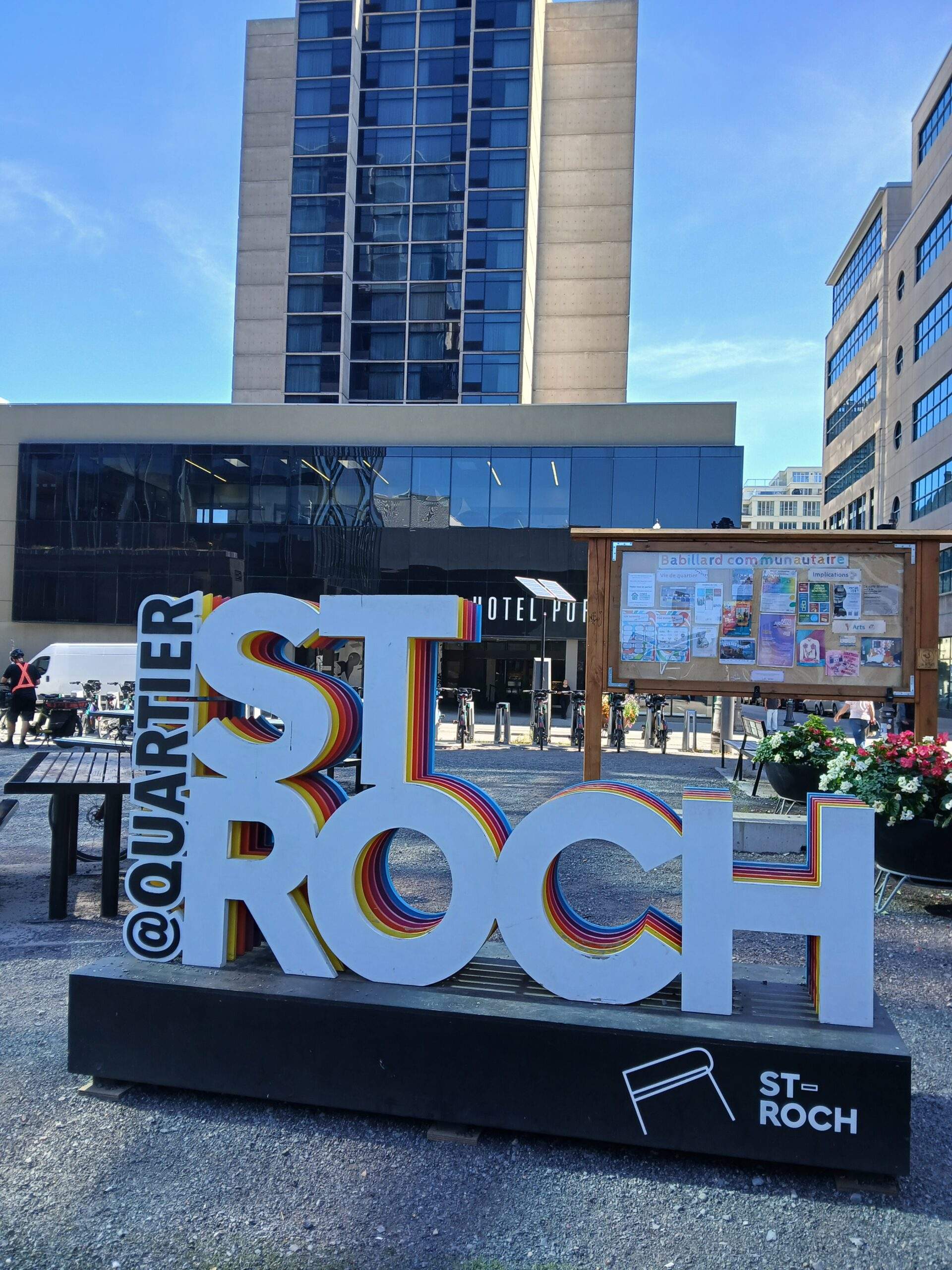
Electoral campaign heats up in Saint-Roch
Ruby Pratka, Local Journalism Initiative reporter
editor@qctonline.com
The road to Quebec City Hall leads through Saint- Roch.
The neighbourhood is different things to different people. To some, it’s the heart of Lower Town’s nightlife, food scene and still-vibrant tech sector, home to several theatres and the bright new central library. To others, it’s a close-knit working-class neighbourhood where people share the little they have. To still others, it’s a symbol of post-pandemic decline, with tourists rolling suitcases toward dubiously legal “ghost hotels,” past clusters of homeless people and half-empty office buildings.
As the campaign for the mayor’s office has ramped up, candidates have increasingly focused on the borough. The current city councillor for Saint- Roch–Saint-Sauveur, Pierre-Luc Lachance of Mayor Bruno Marchand’s Québec Forte et Fière (QFF) party, is not running again; QFF has recruited Marchand’s former press attachée, Élainie Lepage, to run there. Marchand recently met with businesspeople in Saint-Roch, and announced $100 million in funding over 15 years – mostly infrastructure upgrades – to the neighbourhood.
Transition Québec (TQ) and leader Jackie Smith have recruited a star candidate of their own, former CKIA radio host Marjorie Champagne, and opened their campaign headquarters in the former Benjo toy store on Rue Saint-Joseph.
Leadership Québec (LQ) leader Sam Hamad initially recruited restaurateur Napoléon Woo to run in the district; Woo stood down after publicly accusing community organizations in the area of perpetuating homelessness in order to keep their jobs. Shortly before this newspaper went to press, Hamad named a new candidate, social worker Pascale Houle.
Québec d’Abord leader Claude Villeneuve and candidate Quentin Maridat countered with an announcement of their own on Rue Saint-Joseph, accusing Marchand of overpromising and underdelivering on homelessness and Hamad of stigmatizing Saint-Roch. Respect Citoyens has recruited restaurateur Mélanie Leroux.
Community groups and business representatives the QCT encountered are wary of being seen to take sides in the upcoming election, but they are eager to show the candidates “their” Saint-Roch.
“Saint-Roch is downtown, it’s the heart of the city, and there’s downtown life that goes with that,” said Marc-Antoine Beauchesne, president of the SDC Saint-Roch business owners’ association. “We kind of lost our rhythm from before the pandemic, but we’re getting it back now.”
“There’s a big issue around homelessness and mental health, and we have secondary problems coming from that…. We need to work on that and it will solve everything else,” he said, adding that the SDC didn’t believe in “hiding” homeless- ness or other signs of poverty or distress, but rather working toward shared solutions. “We’re ready to contribute.”
“Saint-Roch is the subject of a lot of conversations,” said Marie- Noëlle Béland, executive director of L’Engrenage, a community organization based at Église Saint-Roch. “For example, the problem of businesses [leaving] Rue Saint-Joseph, you read that it’s ‘because of homelessness,’ but the causes are a lot larger than that. There are fewer workers in the neighbourhood because of telecommuting; people have less disposable income because the cost of housing has risen so high.”
L’Engrenage recently released a 174-page “portrait” of Saint-Roch, laying out the neighbourhood’s history as a bustling hub for middle- and working-class francophones that has gentrified rapidly in the past few decades. It also released a questionnaire for the candi- dates, with a series of questions about urban planning, mobility, housing, economic and cultural life and civic participation.
“For urban planning, for example, many people don’t have private yards, and there aren’t many parks with picnic tables. We don’t have a lot of drinking water in public places, and the same goes for public washrooms, laundromats, trash cans, benches, ashtrays, shady spots or places where people who are homeless can safely leave their things. These are things that would be really helpful for the people themselves, and for cohabitation in general. Mobility is another thing. We want to quiet the traffic and make the roads and sidewalks safer for pedestrians and cyclists. There need to be more public benches, for older people, people with disabilities and anyone who’s carrying a heavy load. … There’s also the question of [short-term rental ghost hotels], increasing surveillance to find illegal Airbnbs, but also seeing what we can do to keep housing on the residential market.”
L’Engrenage plans to send the questionnaire this week and make candidates’ responses public. Until then, Béland is keeping an open mind. “We’re ready to talk to any of the candidates. … It’s interesting to see that the people running are interested in the neighbourhood. That’s a good thing. But should this campaign be about homelessness? Obviously, homelessness concerns everyone, but … there are people who seem to believe that it’s mainly a municipal issue, when the resources are more on the side of the Quebec government. It’s a little risky. I don’t want to minimize the impacts of homelessness, but I don’t want to stigmatize the whole neighbourhood for it either.”