

Andrew McClelland
The Advocate
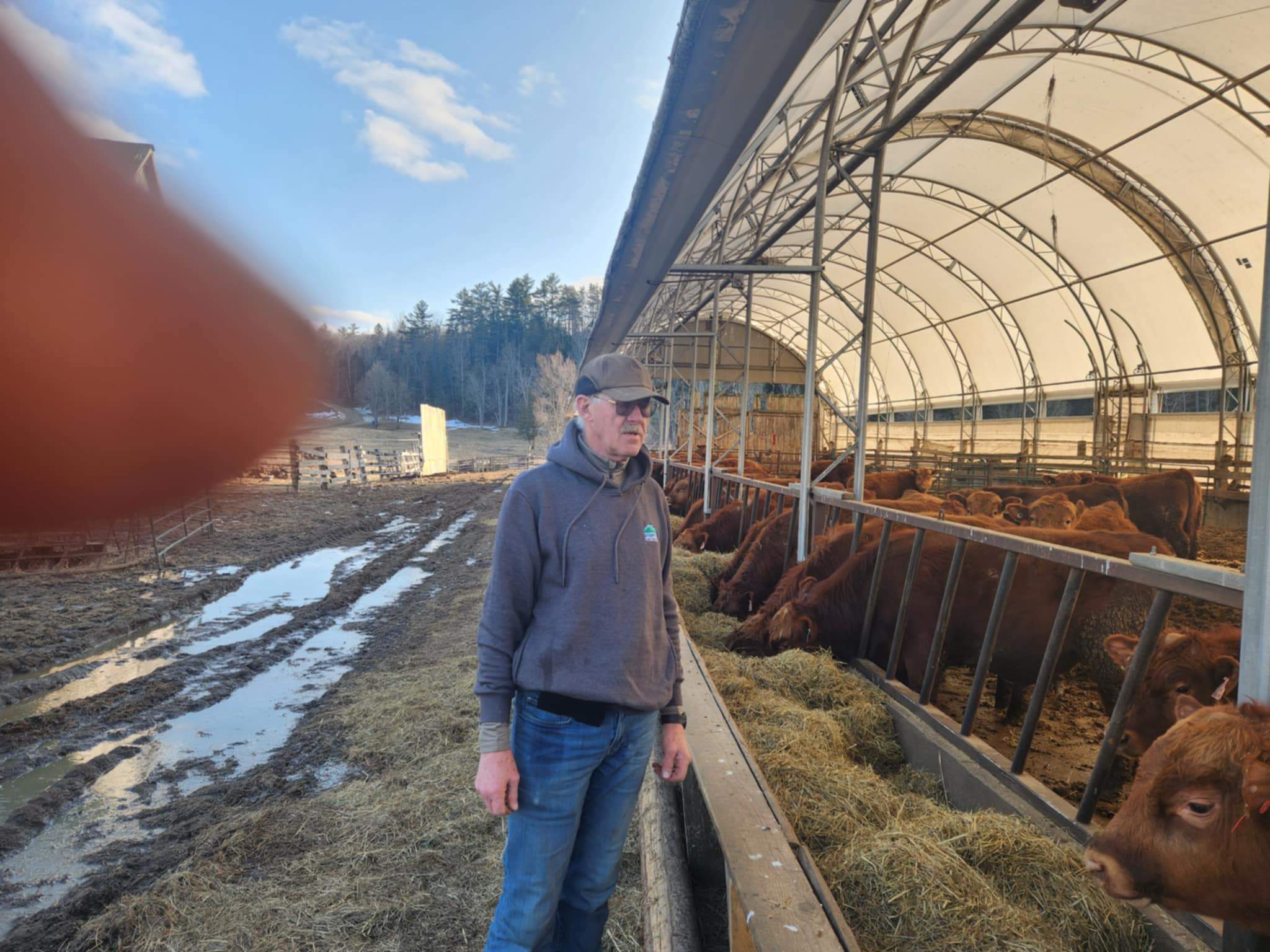
Stan Christensen isn’t really interested in the old business model of selling at the lowest possible price to the largest number of customers.
Instead, this beef producer would much rather sell his product at a fair price to a dedicated group of people who value great beef.
“If someone sends me an email saying, ‘I’m interested in your products. Can you send me your prices?’ we’re likely not on the same page,” explained Christensen, who run a farm in Lac Ste. Marie, north of Gatineau. “If price is your main concern, you can get cheaper beef at the supermarket.”
It’s a business philosophy that wasn’t apparent for the 73-year-old veteran of Quebec’s beef sector when he first started in 1980. At that time, Christensen and his wife Cheryl Sage had 36 cattle. Throughout the ’80s, the family grew their commercial cow operation, expanding to a full purebred Red Angus herd.
And then something unexpected happened.
Mad cow crisis changed everything
“As anyone in the beef industry knows, our 9/11 was May 20, 2003, with BSE,” Christensen recalled, referring to the discovery of a single reported case of bovine spongiform encephalopathy, or mad cow disease, on an Albertan farm on that date.
With the regular supply chain in Canadian beef turned upside down overnight, Christensen and Sage began looking at how they could sell beef directly to the consumer.
“We started with a lot of ideas of how that was done,” Christensen explained during a videoconference hosted by the Quebec Farmers’ Association on March 12. “It was a steep learning curve, because we discovered that most of those ways don’t work.”
It was a time of reflection. And Ferme Sage emerged from it with a way to reinvent its business and become a pillar of its community.
Key decisions made
“We decided the best way to find out how to sell beef direct is to figure out who we are and what we want to do,” Christensen said. “And then can we translate that into creating a product that people will buy into so that they are willing to support us.”
Christensen started by with simple math: how much beef could they have ready for sale on a consistent schedule and how many customers could they reliably sell to? He also looked into market research done in the U.S., which revealed that the most appealing marketing term in American grocery-store advertising was “local.”
That gave him an idea.
“I had been a ski instructor for decades at that point and had a lot of connections with the community around Mont Ste. Marie,” Christensen explained. “Cheryl had a lot of connections through the health industry from working at the CLSC. We looked at all these things and said, ‘Who could we sell to?’ And that’s when we discovered that everybody was looking to help us out.”
Connected with customers
Ferme Sage’s livestock and land management turned out to be just what forward-thinking customers wanted. Christensen grazes his cattle throughout summer and winter, uses no hormones and introduces antibiotics only when treating a sick or injured cow. The farm hasn’t used herbicides or pesticides in more than 30 years, and a member of the family has always sat on the watershed committee that is responsible for the Gatineau River and for conservation around lakes in the region. In 2023, Ferme Sage was the Quebec nominee for the Environmental Stewardship Award.
Those qualities helped Ferme Sage develop a loyal customer base. To promote their direct sales, Stan and Cheryl (and, by this time, sons Eric and Ian) supported local tournaments and charity events.
“After that, it was just word-of-mouth,” Christensen said. “Since around 2014, we’ve been screening clients and the rest is friends, long-time customers — and even some other farmers.”
These days, Ferme Sage also sells breeding stock throughout Quebec and Ontario, takes its own cattle to the Thurso abattoir, and sells vacuum-packed, frozen meat from a small retail shop on the farm. It also supplies the Mont Ste. Marie ski resort, golf course and Restaurant Lachapelle in nearby Kazabazua.
Size isn’t everything
For Christensen, the key to success hasn’t been “bigger means better.” It’s been adjusting his sales to what Ferme Sage can reliably produce and then finding the right customers.
And it turned out they were his friends and neighbours.
“Selling locally, is just a great experience for somebody that wants to connect with their community,” he said. “If every local farm product is sold on the commodity market, nobody gets to know that what they see along the road is something they can actually buy and consume and share the benefits of with their friends.”