

William Crooks
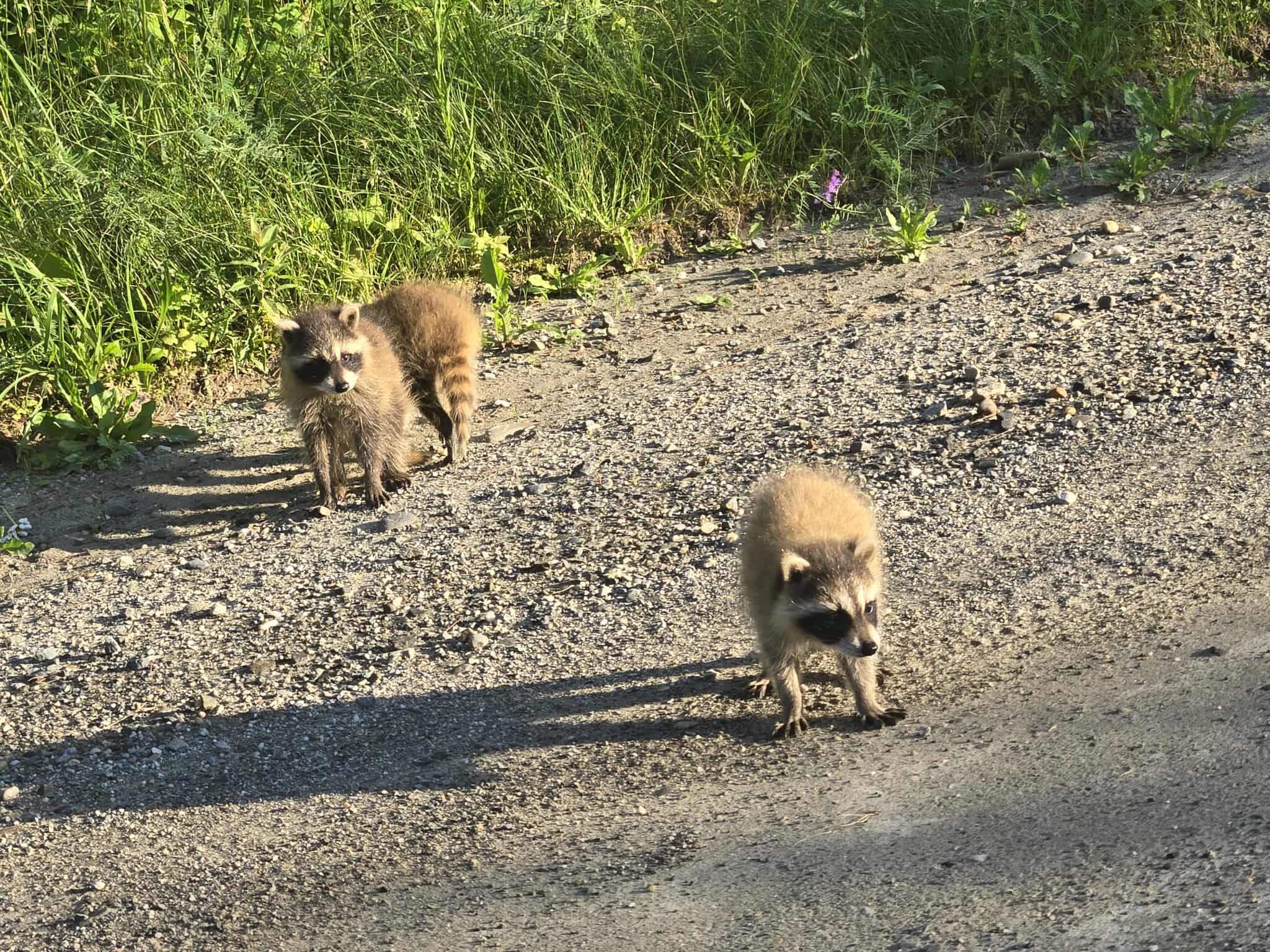
Young raccoons make their way across a quiet country road near Cookshire earlier this summer
By William Crooks
Local Journalism Initiative
An unexpected raccoon attack on a Hatley Township resident has renewed concerns over the spread of rabies in the Eastern Townships, as local animal experts stress the importance of vaccination and caution when dealing with wildlife.
A sudden bite on a quiet evening
Brigitte Beauchamp was relaxing on her deck after dinner one Saturday evening when a raccoon climbed up from the yard and bit her without warning.
“It just got dark, probably about 8, 8:15. And out of nowhere, this thing came up and just bit my leg,” Beauchamp recalled. “I didn’t even know he was anywhere until he bit me”.
The raccoon had apparently climbed one of the deck posts and emerged from behind a barbecue before biting her. Beauchamp, who now bears four puncture wounds on her leg, described the moment as terrifying. Her husband tried to chase the animal away with clapping and stomping before finally resorting to a garden hose.
“I heard you scream. It was a scream of terror,” a neighbour later told her, having heard the incident from next door.
Beauchamp was rushed to Sherbrooke’s Hôtel-Dieu Hospital, where she received immediate treatment. She was shocked to learn from the doctor on duty that such incidents are becoming far more common. “Two years ago, he would treat one person for a bite. Now this time he says it’s five a week,” she said.
Long and painful treatment
The bite launched Beauchamp into an intensive rabies prevention protocol. She spent ten hours in hospital on the first night, receiving multiple injections, including a vaccine and a specialized treatment derived from blood products.
“That was already five needles,” she said. “And then yesterday I went and I had to get a tetanus shot again because my tetanus shot was eight years ago, and another rabies shot. I have three lined up in Montreal. I’ll be finished around the 14th of September”.
Although she praised the health system for taking rabies very seriously—“Right away, I was given multiple calls from people asking how I was and setting it up”—she expressed frustration at the lack of follow-up from wildlife officials. “I called the wildlife, Faune Quebec. They asked for my phone number and my address, and I have yet to see somebody come by. So, they’re not really taking this seriously,” she said.
SPA Sherbrooke urges prevention
Alexis Savoie of the Société protectrice des animaux (SPA) de l’Estrie said Beauchamp’s case highlights the ongoing risks of raccoon rabies in the region. “We always recommend people to have their animals vaccinated to prevent these kinds of situations,” he said. “People don’t often know that it can be dangerous to their animals, but also themselves”.
According to Savoie, reports of raccoon rabies began surfacing near the Vermont border late last year, and the threat has grown since. “It started to really become a possible problem in the last couple of months in the area just across the border from the U.S. There are cases of raccoon rabies in that area, so there is a possibility that it will spread in our region,” he explained.
In response, Quebec has been distributing vaccine baits across the Eastern Townships and Montérégie since Aug. 6, with operations continuing through Sept. 20. “They’re like little ravioli,” Savoie said, describing the edible vaccine packets dropped in wooded areas and along waterways.
Advice for residents
The SPA stresses that residents should never approach unfamiliar or apparently sick wildlife. “Even if he seems inoffensive, maybe he’s not—you can never tell for sure,” Savoie cautioned. Foaming at the mouth, aggression, or unusual behaviour are clear warning signs.
If someone is bitten or comes into contact with saliva from a potentially rabid animal, the wound should be washed immediately with soap and water for 10 to 15 minutes, and medical help should be sought without delay. “Even if the wound seems minor, it can spread really quickly,” Savoie said.
Pet owners are urged to consult veterinarians to ensure animals are up to date on rabies vaccinations. “If your animal was bitten, you have to react quickly and not let that potentially spread,” he said. “If they’re not well protected, it can ultimately cause death quite fast”.
Savoie also warned against relocating wildlife. “Do not relocate animals that may have rabies or that have been orphaned in the wild, because you could spread the disease,” he explained. Moving raccoons from one area to another, even unknowingly, risks transporting the virus into previously unaffected communities.
Growing unease in the Townships
For Beauchamp, the attack has changed her daily routine. “I know I don’t sit out in the evening. You know, it’s 7, 7:30, I’m in the house,” she said. “What’s the chance he’s coming back for me? It’s probably never going to happen again. But it’s just really scary and I just wish that somebody would take it seriously”.
She believes more needs to be done to warn residents, particularly as other neighbours have also complained about raccoon problems. “It would be good to warn people to be careful. But, you know, this thing came out of nowhere, so I don’t know what to say,” she said.
With confirmed rabies cases in raccoons south of the border and aggressive behaviour reported in the Townships, experts agree vigilance is essential. The SPA and government authorities continue to roll out prevention campaigns, but residents like Beauchamp say they want more visible action to match the growing threat.