

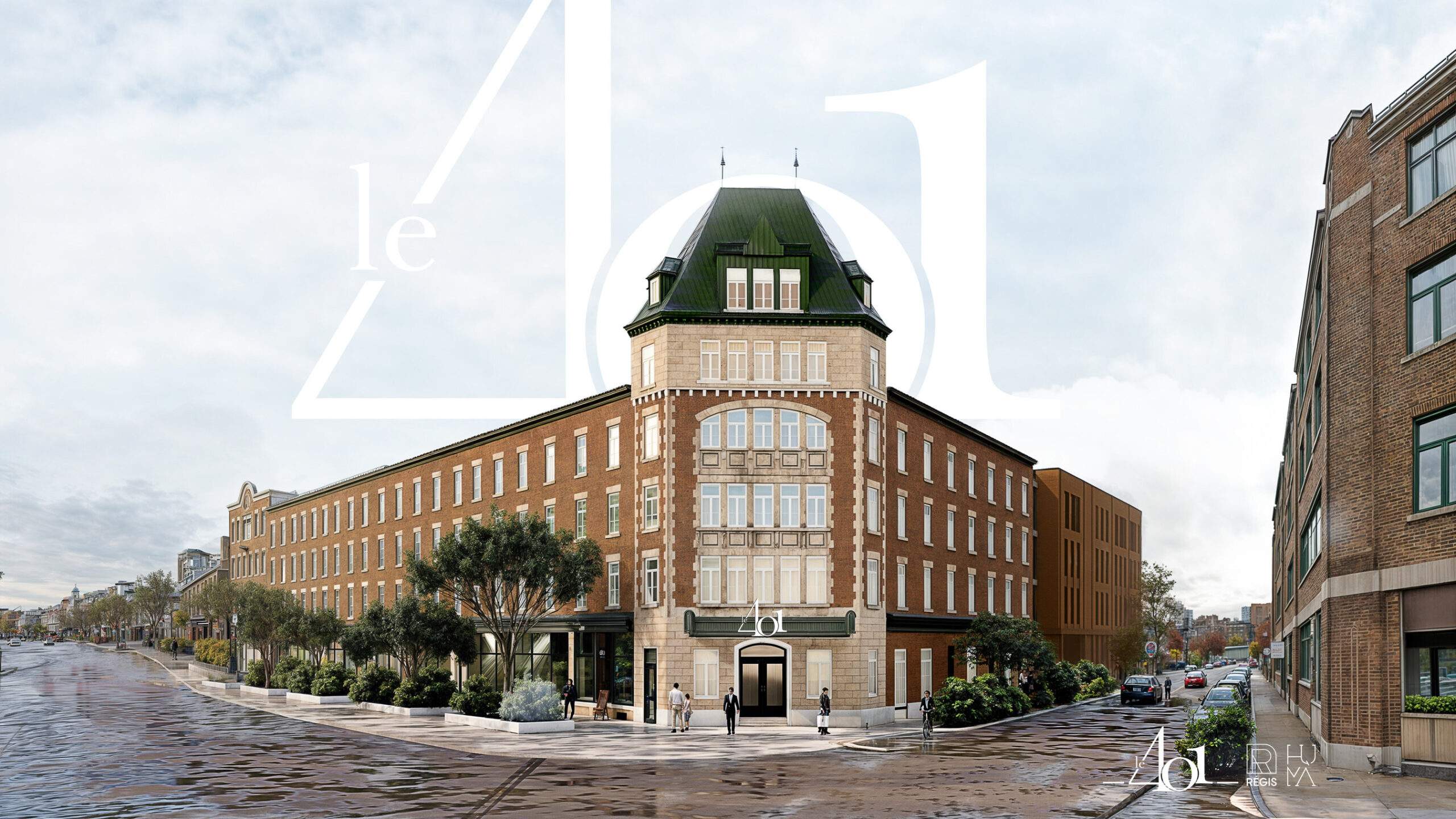
Former hotel and homeless shelter to become apartment complex
Peter Black, Local Journalism Initiative reporter
peterblack@qctonline.com
It was once an upscale hotel, then it became a homeless shelter; now the landmark building on Rue Saint-Paul across from the train station is being transformed into a modern housing and commercial complex.
The home until recently of the Lauberivière homeless shelter, the four-storey corner building with the distinctive tower will become Le 401, reflecting the building’s civic address, with 142 apartments built into the existing structure plus a new annex.
The project’s lead developer is family-owned C76 Investissements, in partnership with other companies, including Beauce-based steelmaker Groupe Canam.
The $52-million project, with some $3 million from city funds, was announced at a news conference on Feb. 24, with municipal officials in attendance.
The project will give the building “a third life,” C67 president Jérôme Côté told the QCT. The building opened in 1927 as the Château Champlain, in which then-mayor Joseph Samson was a share- holder; the hotel was strategically located across the street from the train station.
In 1981, the building was put up for sale and a group organized by the Catholic Diocese of Quebec turned it into a shelter two years later. In 2018, Lauberivière announced a project for a new shelter in Saint-Roch, financed in part by proceeds from the sale of the building.
The timing was right for his company, Côté said, as it had been seeking a project of its own to put some innovative construction practices into action without being constrained by pressure from clients.
After buying the building in 2021, the company had to remove asbestos insulation from the interior before renovation work could begin.
Côté said Le 401 is a pilot project for such environmental techniques as recycling the existing masonry and especially the steel, hence the involvement of Groupe Canam. Côté said the “circularity” of steel repurposing in the project means some of the steel in the current structure will be used in the new annex, and what can’t be used will be turned into furnishings or decoration for Le 401 or used to build something elsewhere in the city.
Another environmental feature, Côté said, will be a geothermal system and an energy loop to maximize energy efficiency. He said the project is aiming for a zero-carbon certification.
Because of the limitations of the structure of the building, Côté said most units would be studio or one-bedroom apartments, although there will be a few two-bedroom units. Rents will range from $1,100 to $3,000.
Mayor Bruno Marchand said the project fits with the city’s plan to boost the residential population of the Old City. “Our goal is to bring 500 more people back to the area,” he said.
“The revitalization program is an example of this. If we want to achieve our goal, it takes concrete action, and that is exactly what we are doing – and today, we have great proof that these efforts are paying off.”
The city’s financial support includes $545,000 under the sustainable housing projects program, and up to $3.5 million from a fund to support renovation of heritage buildings in the Old City.
Construction is expected to start in the fall with completion targeted for spring 2027.
Côté said, “Our work over the last few months has been to think about an architectural proposal that will allow the preservation of most of the existing building, facing Rue Saint-Paul, because we wanted to honour this piece of history that this century-old building represents.”
The developers do not yet know which businesses will be tenants on the street level, but Côté said they would be the type to integrate with the building and the neighbourhood.